Author: astrid
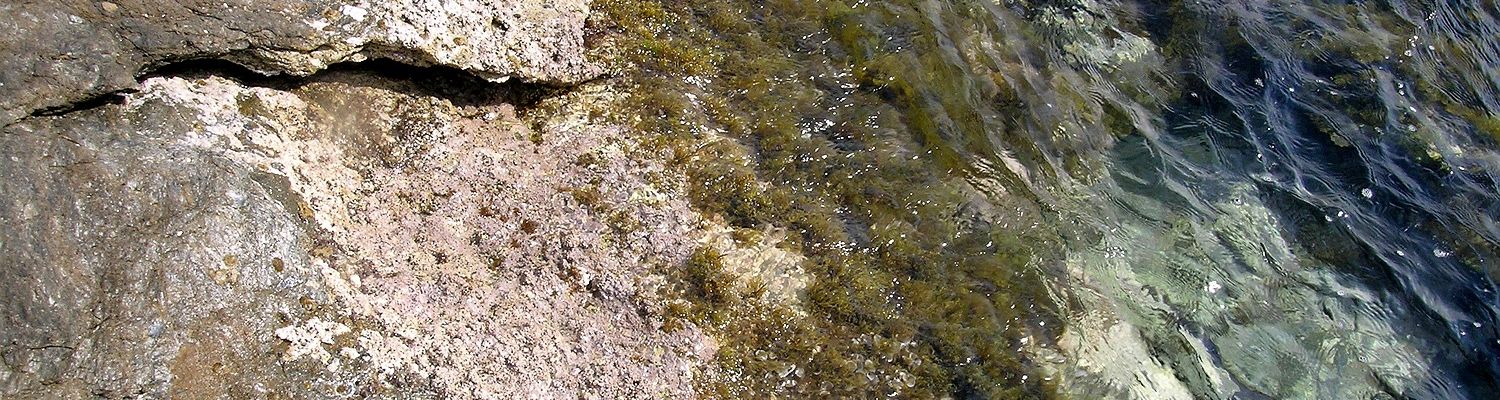
The infralittoral zone begins at the lower waterline, which means that it encompasses the permanently submerged area of the coastal benthal. It extends down to the depth at which light-loving species such as seagrass and many types of algae can no longer thrive. Due to its large extent and the fact that its organisms are not exposed to drying out, the infralittoral is much richer in species than the zones above it. In terms of environmental conditions, the infralittoral...
The Eulittoral
The eulittoral is the tidal zone; it is defined as the area between the upper and lower waterlines (mean high and low waterlines). In areas with strong tides, especially in mudflats, the eulittoral is extremely extensive, teeming with life and playing an important role in the ecosystem.
In the Mediterranean, on the other hand, the intertidal zone is limited to a narrow zone of often only a few centimeters due to the low tidal range. Here, the eulittoral is the zone that is...
The Supralittoral
The supralittoral is the splash zone, which ist not submerged permanently, but reached by the waves and the spray. It begins at the mean high-water line (the average water level at high tide) and extends to the highest point reached by the waves or spray. In the Aegean Sea, where the tidal range is minimal but the water level fluctuates significantly for other reasons, it seems most sensible to consider the supralittoral zone as the part of the coast that lies above the...
Dolmadakia, Gefüllte Weinblätter
Der Frühling ist da und der Wein treibt aus – und damit ist die Dolmadakia-Saison eröffnet. Dolmadakia (eigentlich ein türkisches Wort) sind die gefüllten Weinblätter, die in Griechenland so beliebt sind. Es gibt viele verschiedene Arten, Dolmadakia zuzubereiten. Hier für alle, die es ausprobieren wollen, die zwei leckersten Rezepte:
Als erstes braucht man Weinblätter, und zwar frische, junge, zarte (aber nicht zu kleine) Blätter. Diese werden gewaschen und dann (am...
Bivalvia
The Bivalvia belong to the phylum Mollusca, together with the snails and cephalopods (octopuses, squids) and some smaller groups such as the chitons and the tusk shells. Around 8,000 species have been described worldwide, which live mainly in the sea, but also in fresh water.
Here you can skip the introduction and go directly to the species.
There are comparatively few bivalvia in the seas around Naxos. Bivalvia shells can only be found on sandy or fine gravel beaches, but...
10. April 2009: Der Frühling ist da!
Der Frühling ist da:
Der Wein treibt aus…
…im Weinfeld blüht der Mohn…
…Schmetterlinge flattern umher…
…Bienen besuchen die Birnbaumblüten…
…und überall blüht es.
Und die Vögel zwitschern (leider nicht so einfach zu dokumentieren!): Kappenammern, durchziehende Dorngrasmücken, Grauortolane, Samtkopfgrasmücken; diese Tage singt auch oft eine Nachtigall bei uns im Garten. Der Vogelzug ist in vollem Gange: Graureiher sitzen...
Marine snails - Introduction
The snails, or gastropods, belong to the same phylum as bivalvia (e.g. mussels), cephalopods (e.g. octopus and squid) and some smaller groups such as chitons and tusk shells, i.e. the phylum Mollusca. With around 100,000 species, the snails are its largest class. Snails are found in all habitats on earth. Most species live in or near the sea. However, numerous species also occur in fresh water, and snails are the only molluscs to have conquered the land.
Here you can skip...
Corals
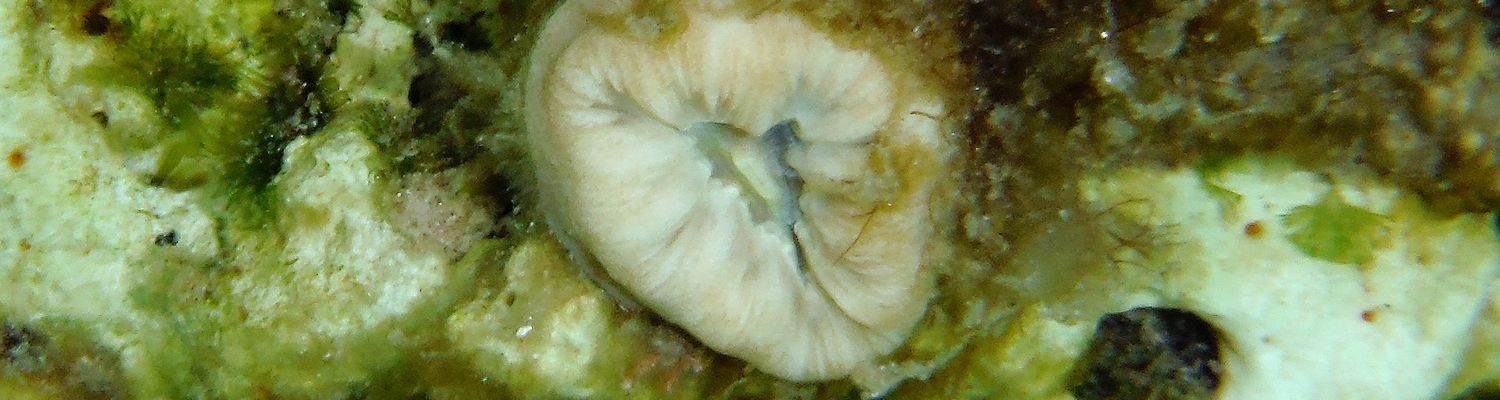
Corals belong to the class of anthozoans (Anthozoa), together with the sea anemones. These form the phylum Cnidaria together with the hydrozoans and the jellyfish. Cnidarians are a ‘lower’ group of animals that, at first glance, resemble plants. Their members are usually small, simply structured and mostly radially symmetrical; a characteristic feature are the cnidocytes, special stinging cells, which they use to capture and kill their prey.
Unlike sea anemones, which...
Chitons
The phylum of molluscs comprises several classes, among which the bivalvia (mussels), the snails and the cephalopods (octopuses, squids) are the most important and best known. However, to the molluscs belong also a number of other, smaller classes, such as the chitons (Polyplacophora). Chitons are a very ancient group of animals, which are also known in many fossil forms. Today, there exist about 900 species that live exclusively in the sea.
Here you can skip the...
Life between the algae
Benthic algae, i.e. algae that are attached to the substrate, provide a habitat for countless animals. Since most of these species are quite small, you have to make an effort to spot them. Many can only be found by picking off the algae and examining them with a magnifying glass.
The best living space is provided by various species of Cystoseira, whose dense branches offer an ideal hiding place for numerous animals. However, most of these animals are so small that they are...
Ascects of the evolution of the algae
The first living organisms on Earth were bacteria (and archaea, a now rather rare and still little-researched bacteria-like group that differs significantly from both bacteria and eukaryotes (i.e. plants, animals, fungi)). These organisms lived in the sea and obtained their energy from chemical reactions with hydrogen sulphide or hydrogen (the Earth’s atmosphere was still oxygen-free at that time). Relatives of these bacteria still exist today in the ‘black smokers’...
Algae
Algae do not generally have a particularly good reputation. When it comes to algae, most people think of killer algae, toxic algal blooms or simply slippery, bone-breaking, ugly coatings on wet rocks. Yes, algae can be annoying or even dangerous, especially where the natural balance of an ecosystem is disturbed for example by excessive nutrient input.
‘Ugly’, slippery algae coatings of this kind, which are completely natural, form on rocks in shallow water that are not...
Fish
When it comes to marine animals, most people naturally first think of fish: these are known to everybody and of the greatest importance to us as a source of food. Due to its low content in nutrients and plankton, the Mediterranean Sea is relatively poor in fish. In addition, fish populations have been severely depleted in recent decades through overfishing.
Here you can skip the introduction and go directly to the species.
fish in their natural environment
Naxos is not an...
Organisms living in stone
Apart from the numerous plants and animals that grow on the rocks in the sea, some organisms live inside the rock. Understandably, these are rarely visible while they are alive, but you can find their traces in many stones on the beach. The most common are the holes and chambers eaten into the stone by boring sponges.
Heavily eroded marble rock just below the sea surface
limestone rock eroded by the boring sponge and inhabited by many other creatures
Stone with holes...
Sponges
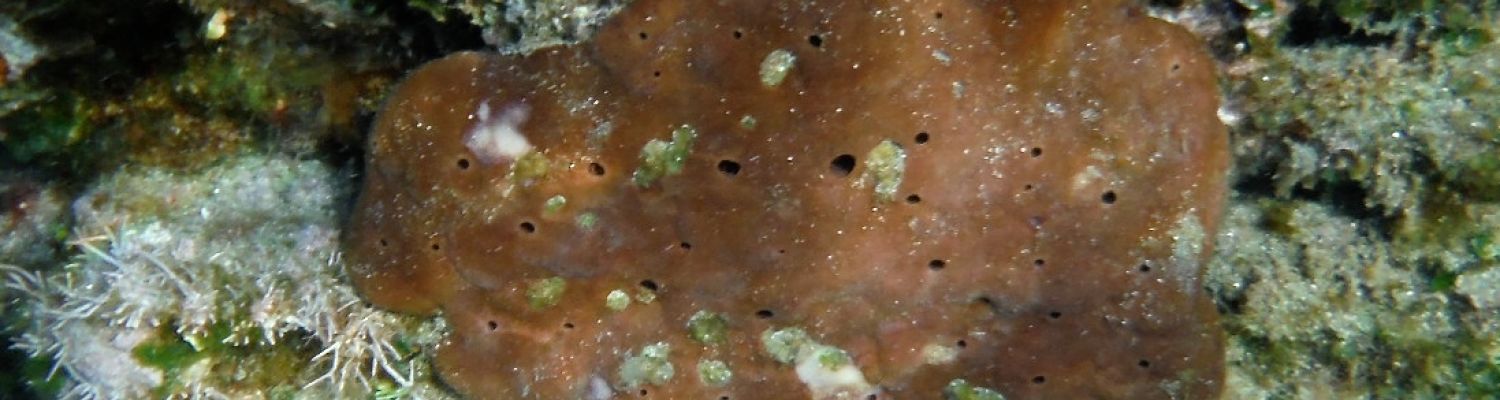
Sponges are very unusual organisms. They belong to the animal kingdom, but in some respects they are more like plants, for example they are sessile (attached to the substrate), their shape is not symmetrical and they grow irregularly like a plant. Furthermore, they do not (or hardly) react to external stimuli and do not (or hardly) move. Sponges are multicellular animals. Each sponge is a single organism (not a colony as for example in the sometimes similar corals). Like...
Sea cucumbers
Sea cucumbers do not look particularly attractive; they are in fact rather ugly and appear boring and uninteresting. Nevertheless, these animals play a very important role in the marine ecosystem and should not be underestimated or neglected.
Here you can skip the introduction and go directly to the species.
Sea cucumbers (class Holothuroidea) are related to the sea urchins and the starfish, with which they form the phylum Echinodermata. At first glance they do not look at...
Sea anemones
On the rocks in shallow water in the small bays near Azalás, it is easy to find some particularly beautiful and interesting representatives of marine fauna: the sea anemones. The order of sea anemones (Actiniaria), with around 1200 species, belongs with the corals to the anthozoans (class Anthozoa), which together with the hydrozoans and the jellyfish form the phylum Cnidaria.
Here you can skip the introduction and go directly to the species.
The cnidarians have a rather...
Gastropoda 6: Worm snails
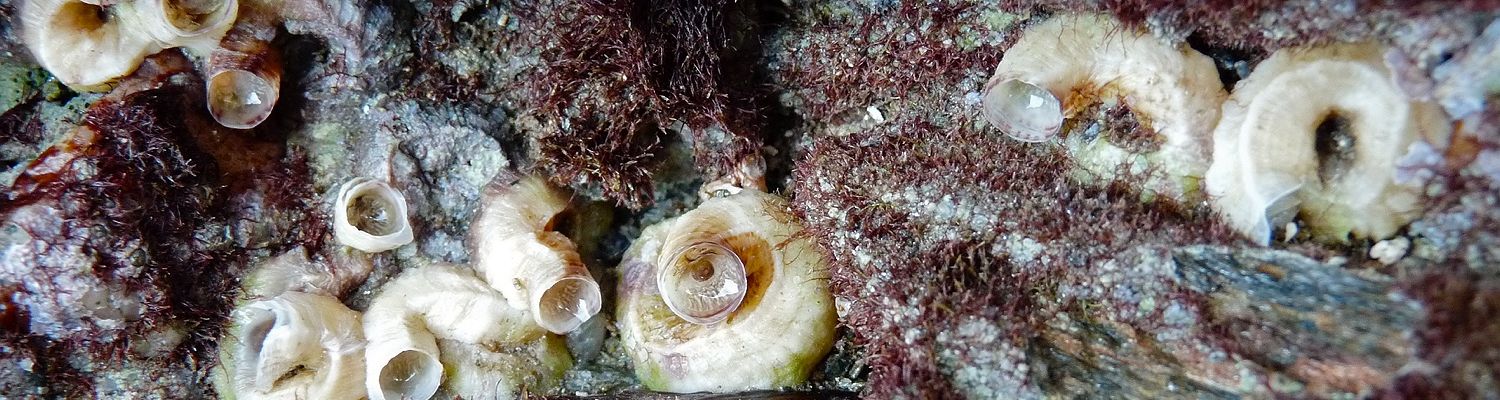
Among the many strange creatures of the intertidal zone are the worm snails. These snails only crawl around freely while they are young, then they attach themselves to the substrate and adopt a sessile lifestyle. Several species are found on Naxos. Worm snails or tube snails form their own family (Vermetidae) within the Littorinimorpha, a large suborder within the Gastropoda, to which many of our marine snails belong.
The Photo gallery of the marine snails gives an...
Barnacles
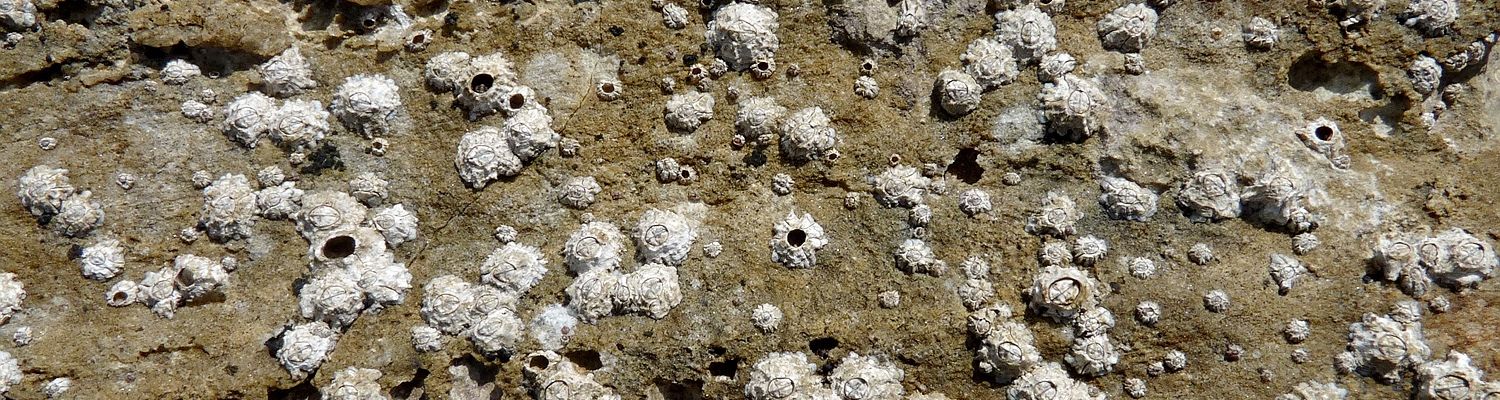
Seeing barnacles on a rocky coastline one would hardly think that they are close relatives of crabs and lobsters. However, they belong to the Crustacea, and together with the Goose barnacles and some parasitic forms, they make up the subclass Cirripedia.
Here you can skip the introduction and go directly to the species.
Barnacles are sessile animals. Their carapace takes the form of a cone-shaped shell made of calcareous plates, the open tip of which is closed with...
The Zones of the Mediterranean Sea
The marine ecosystem is divided into a number of zones with different environmental conditions. To begin with one must distinguish the seabed, known as the benthal, and the water column, known as the pelagial. Within both, the euphotic (light-rich) areas offer significantly different living conditions from the aphotic (lightless) areas. The coastal, shallower areas above the continental shelf are referred to as the neritic region, while the deep oceanic areas are referred...