Sea cucumbers
Sea cucumbers do not look particularly attractive; they are in fact rather ugly and appear boring and uninteresting. Nevertheless, these animals play a very important role in the marine ecosystem and should not be underestimated or neglected.
Here you can skip the introduction and go directly to the species.
Sea cucumbers (class Holothuroidea) are related to the sea urchins and the starfish, with which they form the phylum Echinodermata. At first glance they do not look at all similar to sea urchins or starfish: they rather look like thick worms. On closer inspection, however, one can see features that they have in common with other echinoderms, such as the ambulacral system with tube feet on the ventral side, which enable them to crawl slowly. They have thick, leathery skin with small spiny projections, similar to that of starfish. The endoskeleton of other echinoderms is reduced to small calcareous needles embedded in the skin. Many sea cucumbers breathe through water lungs formed from protrusions of the intestine. The five-rayed symmetry so typical of echinoderms can only be seen in the internal structure of the sea cucumbers.

Here you can see the underside of a sea cucumber with its partially retracted tube feet, which the sea cucumber uses to move around.
Most sea cucumbers feed by taking in sediment from the sea floor with their mouths, digesting the organic components and excreting the sand. They are, so to speak, the garbage disposal system of the sea. They are resilient and adaptable organisms and occur in large numbers in many areas. They can survive in more polluted areas of the Mediterranean Sea and are often the most common animals of the macrofauna. In the deep sea, they live naturally in large numbers and make up the vast majority of the fauna. Around 1,200 species are known worldwide. Depending on the species, sea cucumbers can reach a size of between one millimeter and two meters.

Sea cucumbers feed by ingesting sediment from the sea floor, digesting the organic components it contains and excreting the sand in typical wormlike faeces. They are the “garbage collectors” of the sea.
Sea cucumber species on Naxos
Species on Naxos
The Photo gallery of the marine animals gives an overview over the species.
A note on identification: Some species usually can be identified easily and reliably. In many cases, however, several related species are difficult to distinguish. Also not all species are included in the field guides; even using the internet, it is difficult to find information on some species. Accordingly, some of the identifications may not be correct.
Holothuria sanctori ?, Delle Chiaje
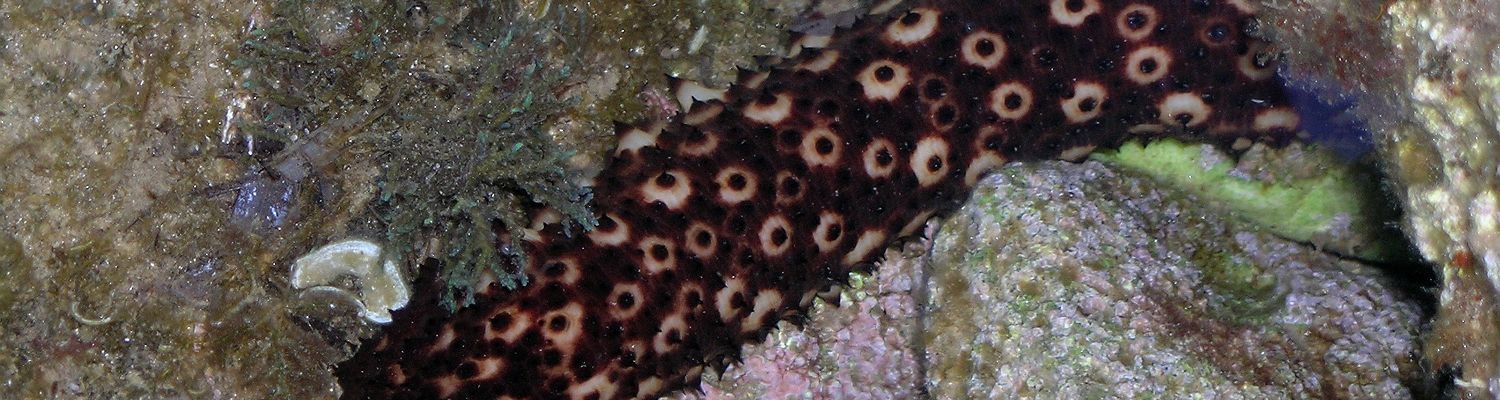
Identifying sea cucumbers is more difficult than one might think. The sea cucumbers I have found in our area probably mostly belong to the species Holothuria sanctori, which is found in warmer regions and often occurs in shallow water. It usually, but not always, shows conspicuous white spots around the spiny warts on its surface.
When irritated, Holothuria sanctori ejects the so-called Cuvier’s tubes, white, cobweb-like threads. It can even expel its intestines, which later grow back.

Most sea cucumbers in our area probably belong to the species Holothuria sanctori.

This species often shows conspicuous light spots around the large warts on its skin.

When disturbed, Holothuria sanctori can eject the strange Cuvier’s tubes.

The tubes form a kind of white web that is intended to distract the attacker or stick to it.
Tube sea cucumber, Holothuria tubulosa, Gmelin
The Tube sea cucumber is much rarer in our region than H. sanctori. It differs in its uniform dark brown colouring and thick, cone-shaped warts. This species is stiffer than the previous one and does not secrete Cuvier’s tubes.

The Tube sea cucumber is dark brown in colour with thick, cone-shaped warts (visible at the right end of the animal).
Brown sea cucumber, Holothuria stellati ?, Delle Chiaje
The Brown sea cucumber, which occurs rather rarely in our area, has a rather smooth surface; its warts are much smaller. According to some studies, Brown sea cucumber is not a separate species, but rather young specimens of the Tube sea cucumber.

The specimen on the left probably belongs to the species Holothuria stellati.
continue: Sea squirts
back: Marine animals (Overview)
see also: