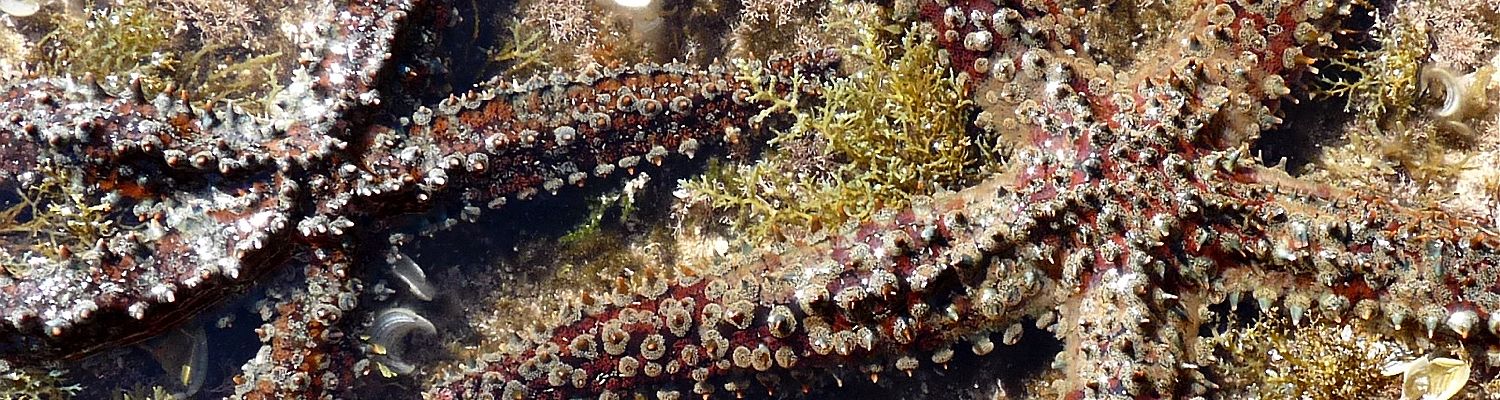
Starfish
The starfish (class Asteroidea) belong together with the sea cucumbers and the sea urchins to the phylum Echinodermata.
Here you can skip the introduction and go directly to the species.
The echinoderms are exclusively marine, that is they are living only in the sea. Their bodies are – rather unusually in the animal kingdom – five-rayed radially symmetrical with an exoskeleton, either in the form of a shell (sea urchins) or as calcified plates in the epidermis (starfish and sea cucumbers). Sea urchins carry mobile spines; also starfish often have spines, albeit much smaller ones. In addition, echinoderms often have small pincers, called pedicellaria, which are used for feeding and defence. The internal structure of echinoderms is simple; the mouth opening lies on the underside of the body and the anus on the upper side. The simple nervous system, the blood vessel system (with a simple heart) and the gonads are symmetrically arranged in five parts. The most interesting organ system, unique to this animal group, is the ambulacral system, a network of fine channels that ends in small tube feet in starfish and sea urchins, which are used for locomotion and feeding, but also for gas exchange and excretion.
Most starfish have five arms, but some species have more (up to 50 in the case of some sun starfish). They live on the sea floor, with many species burrowing into the sand and therefore rarely seen. They can move around using their feet and turn themselves over if they fall onto their backs. Respiration takes place via small papillae on the upper side (gills), which are more or less visible. Starfish do not have highly developed sensory organs; however, their arms and feet contain sensory cells that can perceive tactile, light and chemical stimuli; they can also detect temperature, position and other factors.
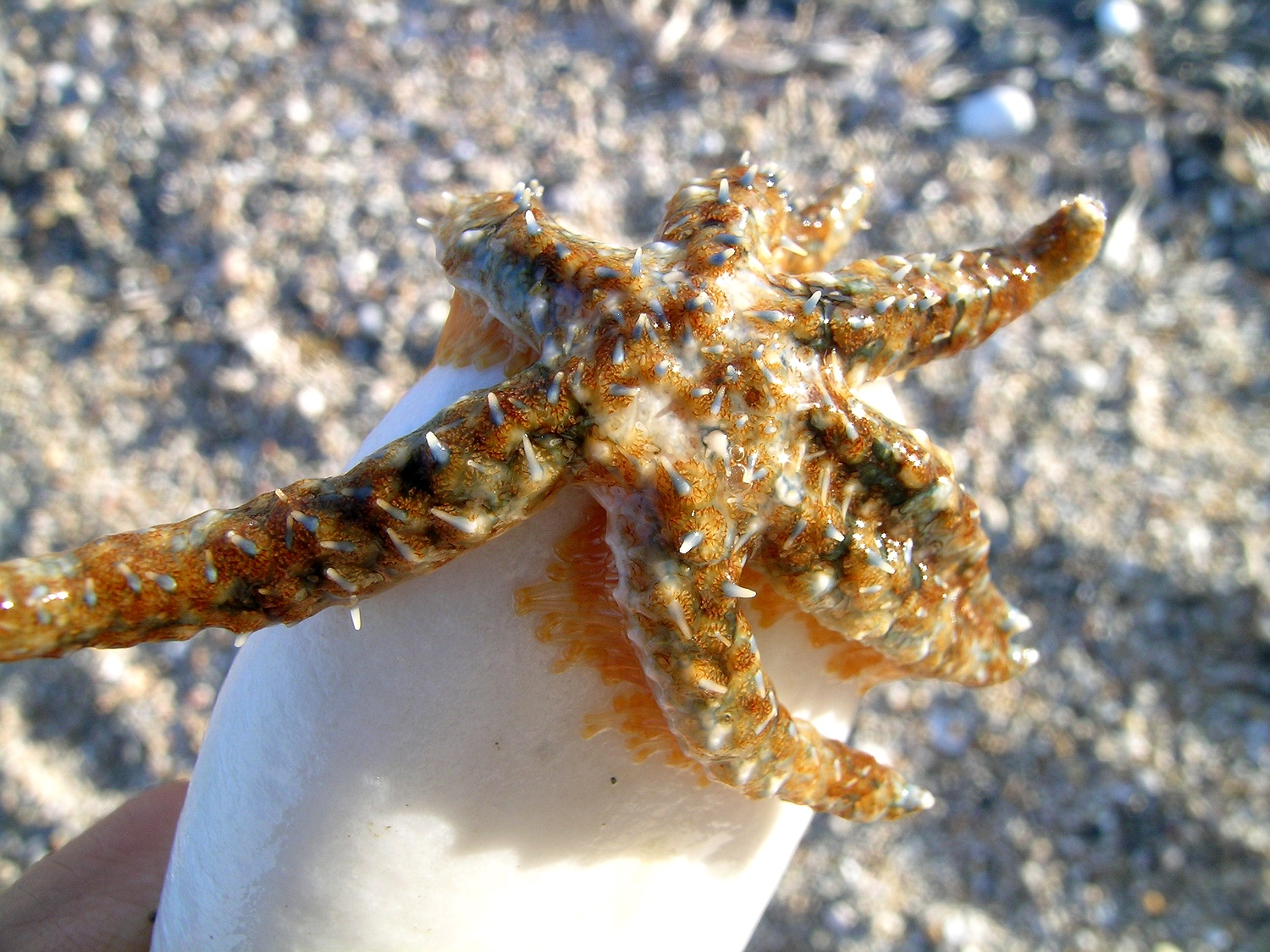
Blue spiny starfish; the tube feet on the underside are visible, as are the spines on the upper side
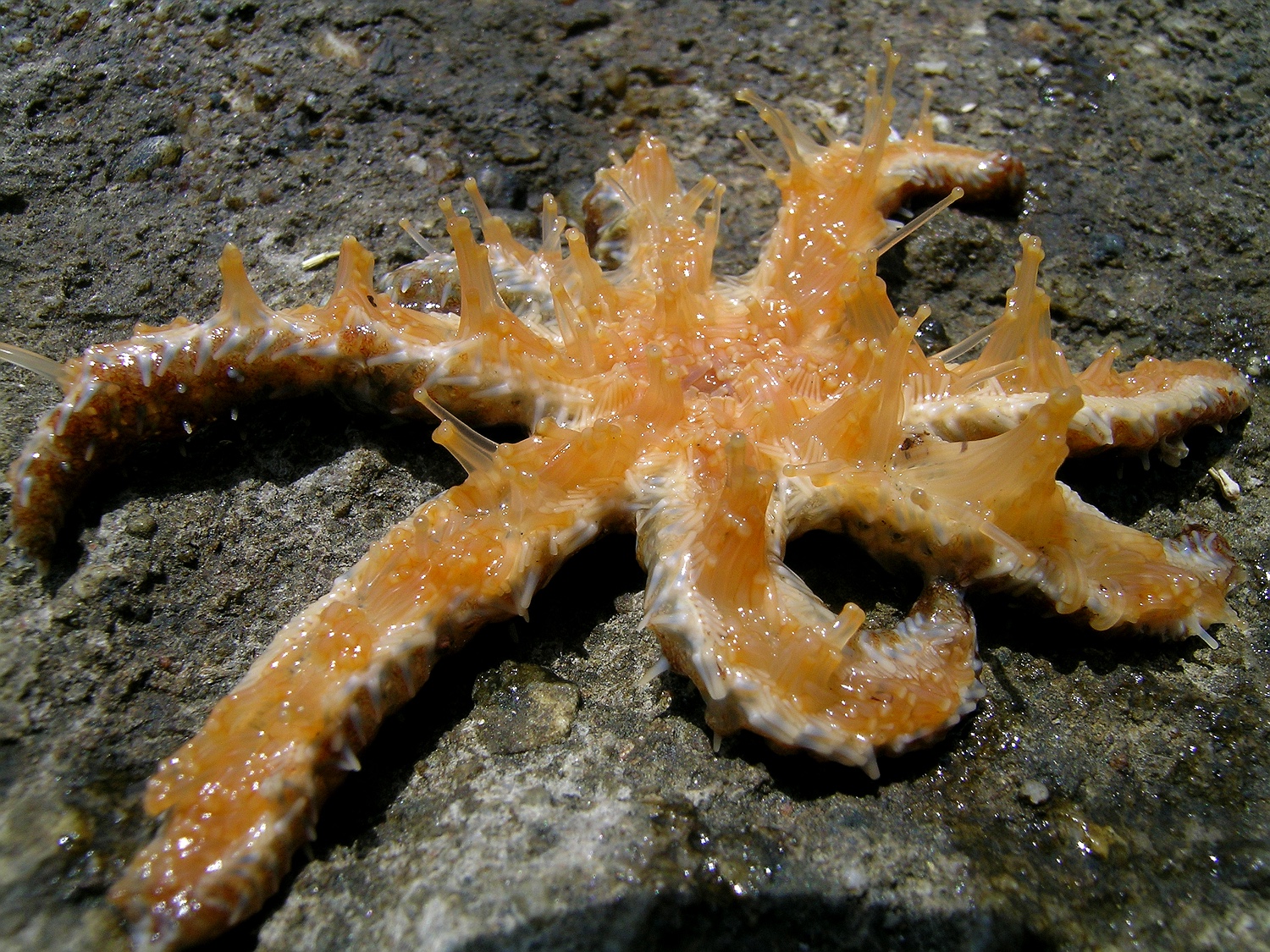
If you turn a starfish onto its upper side, it will turn itself back over again with the help of the tube feets on the underside of its arms.
Starfish feed on dead organisms, sponges, sea urchins, other starfish or brittle stars and, above all, mussels. To consume a mussel, the starfish opens it with its arms (demonstrating its remarkable strength!), injects digestive secretions into it and then absorbs the digested juice with its stomach, which it has inserted into the mussel – starfish are among the most dangerous predators in the sea!
In addition to sexual reproduction, in which the eggs and sperm are usually simply released into the water, starfish can also reproduce by division; even severed arms can often grow back into a whole starfish. There are about 1,500 known species of starfish. Several species occur on Naxos, but most are rarely seen.
Species of starfish on Naxos
Species on Naxos
The Photo gallery of the marine animals gives an overview over the species.
A note on identification: Some species usually can be identified easily and reliably. In many cases, however, several related species are difficult to distinguish. Also not all species are included in the field guides; even using the internet, it is difficult to find information on some species. Accordingly, some of the identifications may not be correct.
Here you can jump directly to the species (return with the back arrow or by swiping back):
Blue spiny starfish, Coscinasterias tenuispina – Spiny starfish, Marthasterias glacialis – Astropecten platyacanthus – Astropecten bispinosus – Hacelia attenuata – Mediterranean red star, Echinaster sepositus – Ophioderma longicaudum – Ophiopsila aranea – Ophiotrix spec.
Blue spiny starfish, Coscinasterias tenuispina, Lamarck
The most common starfish species around Naxos is the Blue spiny starfish, which one can find on rocky beaches when one turns over larger stones. It is brownish in colour and can be recognised by the relatively large spines on its upper side, each surrounded by a ring of tiny pincers. It usually has more than five arms, some of which are often very small: these are arms that grow back after the animal has divided itself.
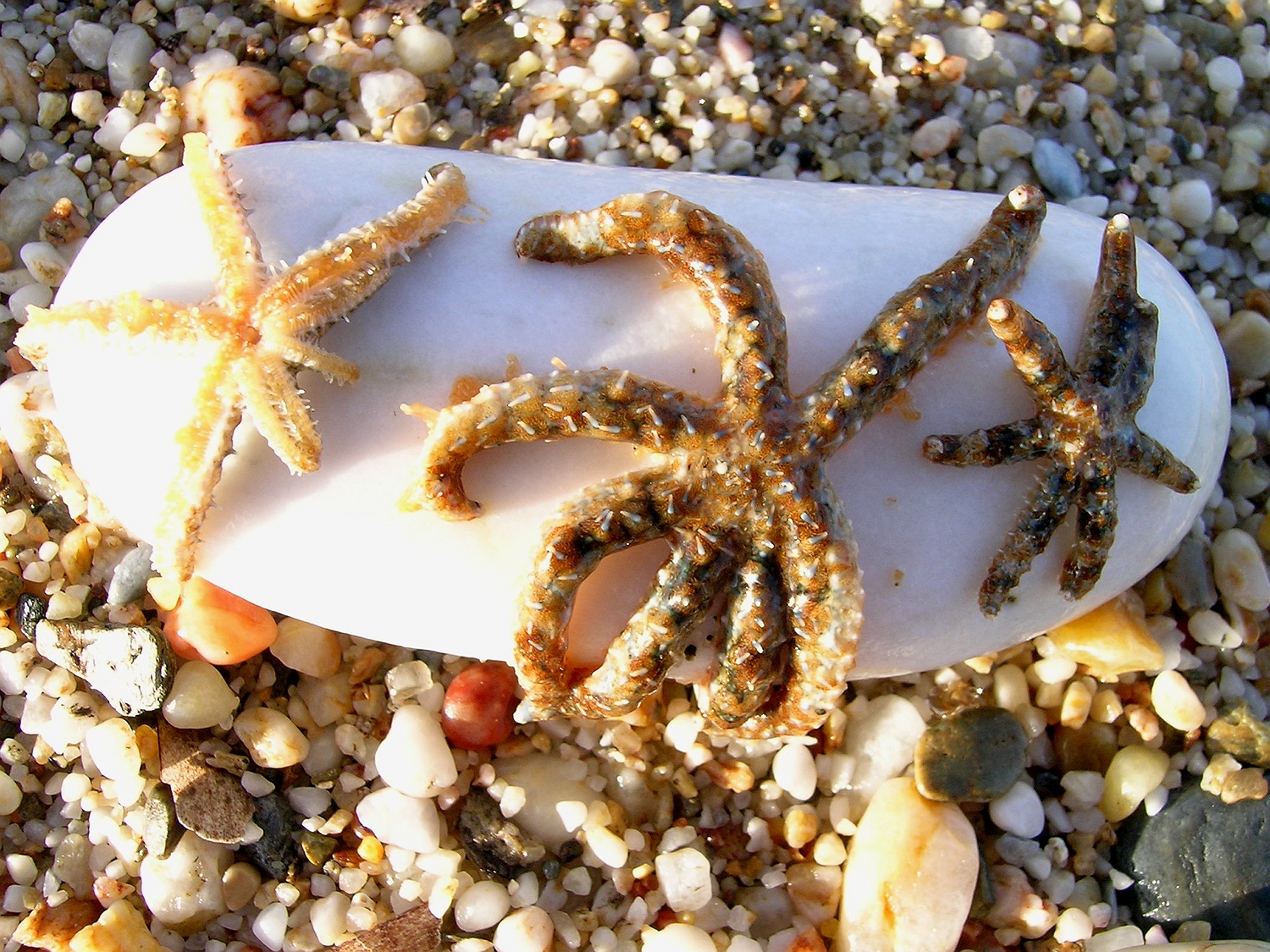
Blue spiny starfish
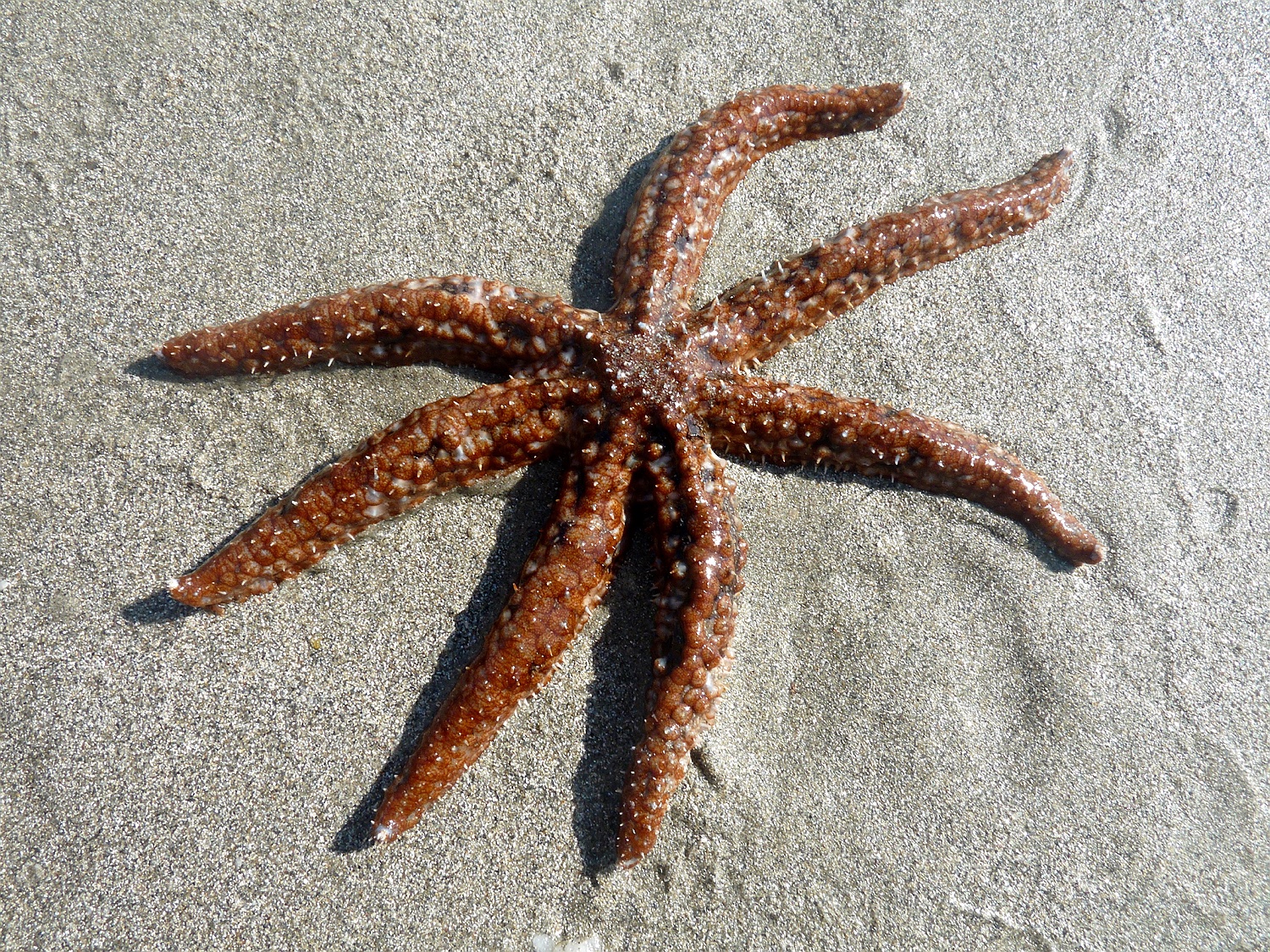
Blue spiny starfish often has more than five arms.
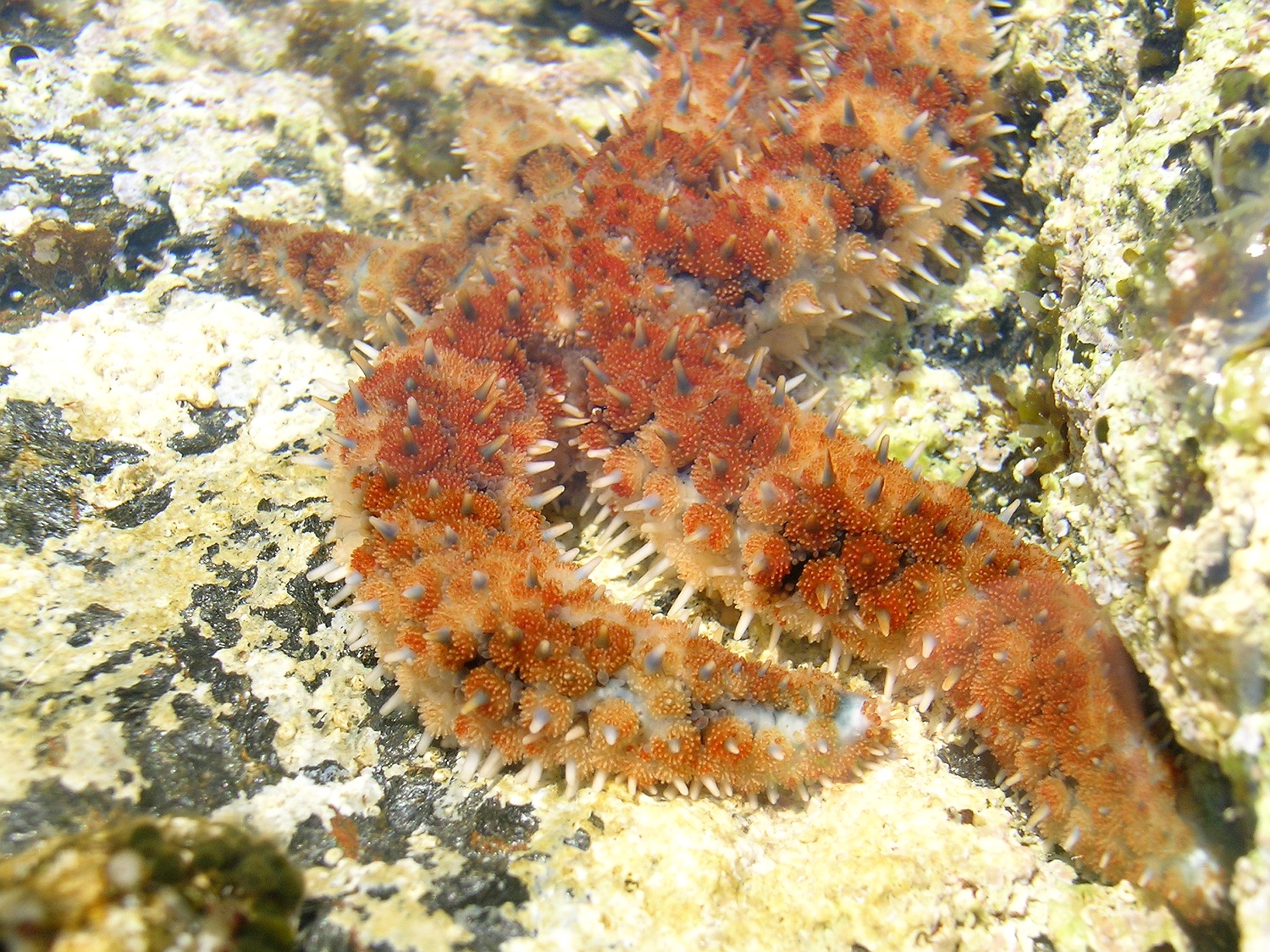
The large spines are each surrounded by a ring of tiny pincers.
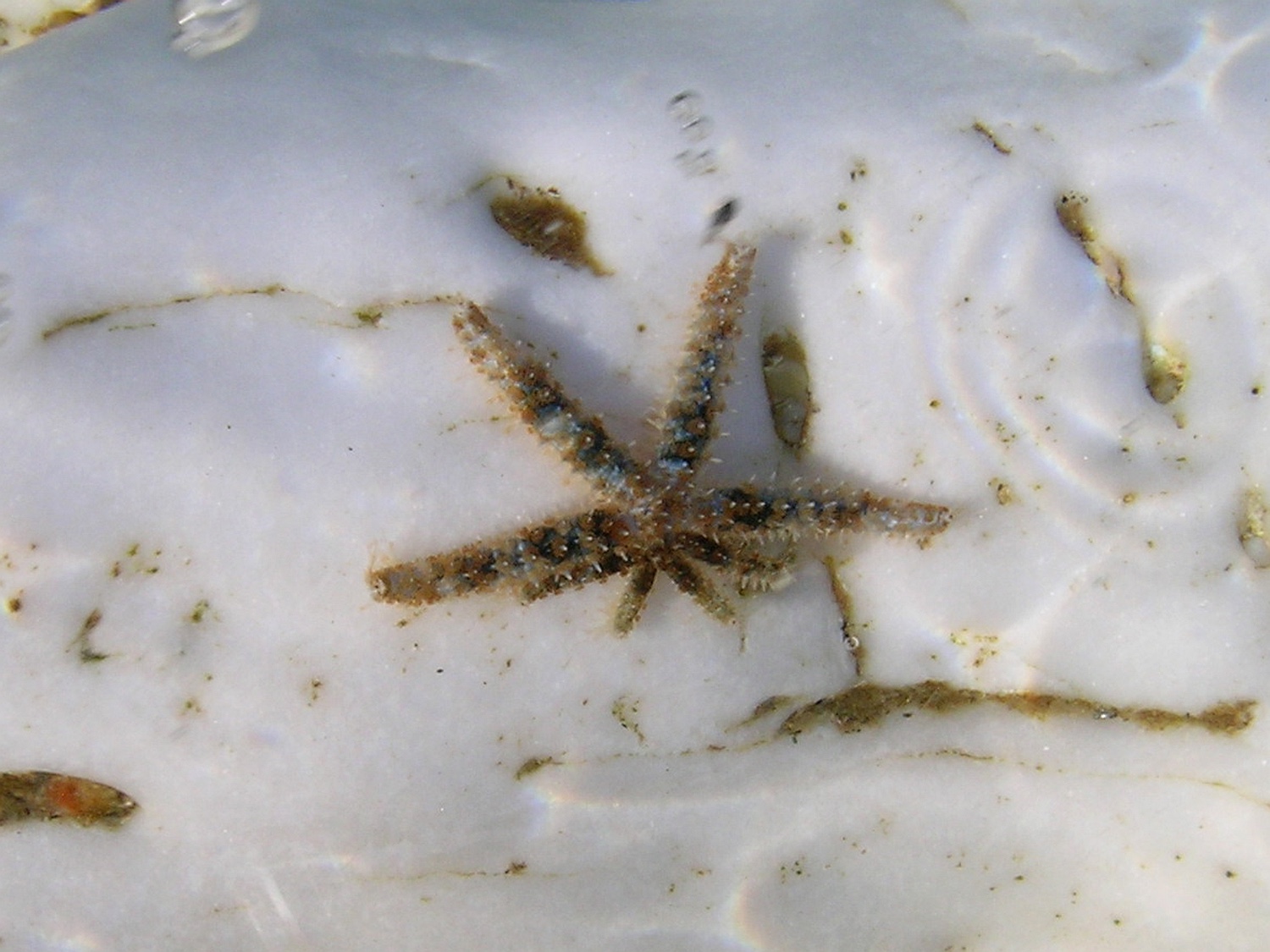
recently divided Blue spiny starfish with small regrowing arms
Spiny starfish, Marthasterias glacialis, L.
The grey-green or reddish Spiny starfish is the largest of all Mediterranean starfish; it can reach up to 1 m in diameter (however, these large specimens are only found at greater depths). Unlike the former species, the Spiny starfish always has five arms. These bear thick, spiny bumps in three or four longitudinal rows.
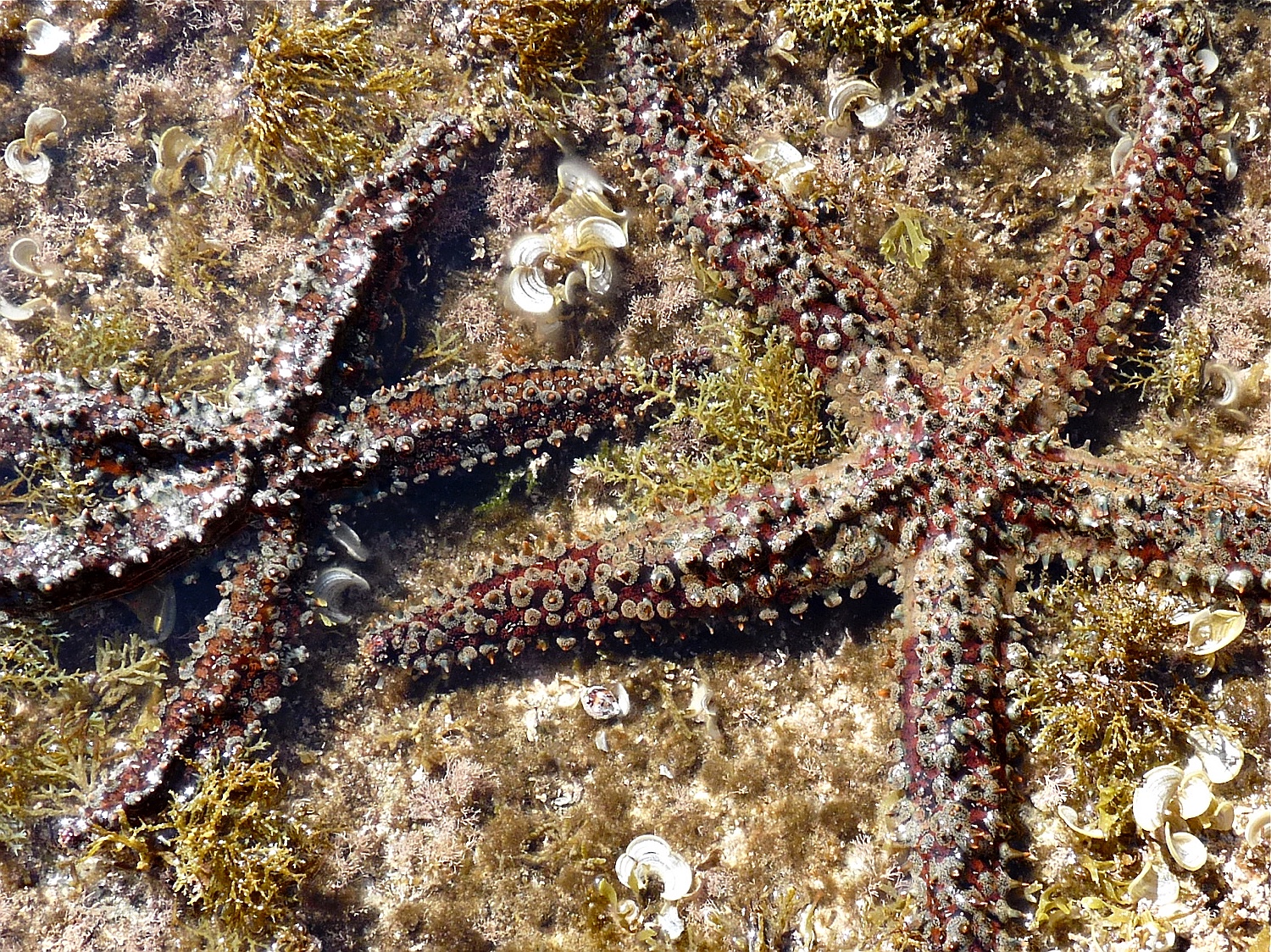
This species also can be found in shallow water.
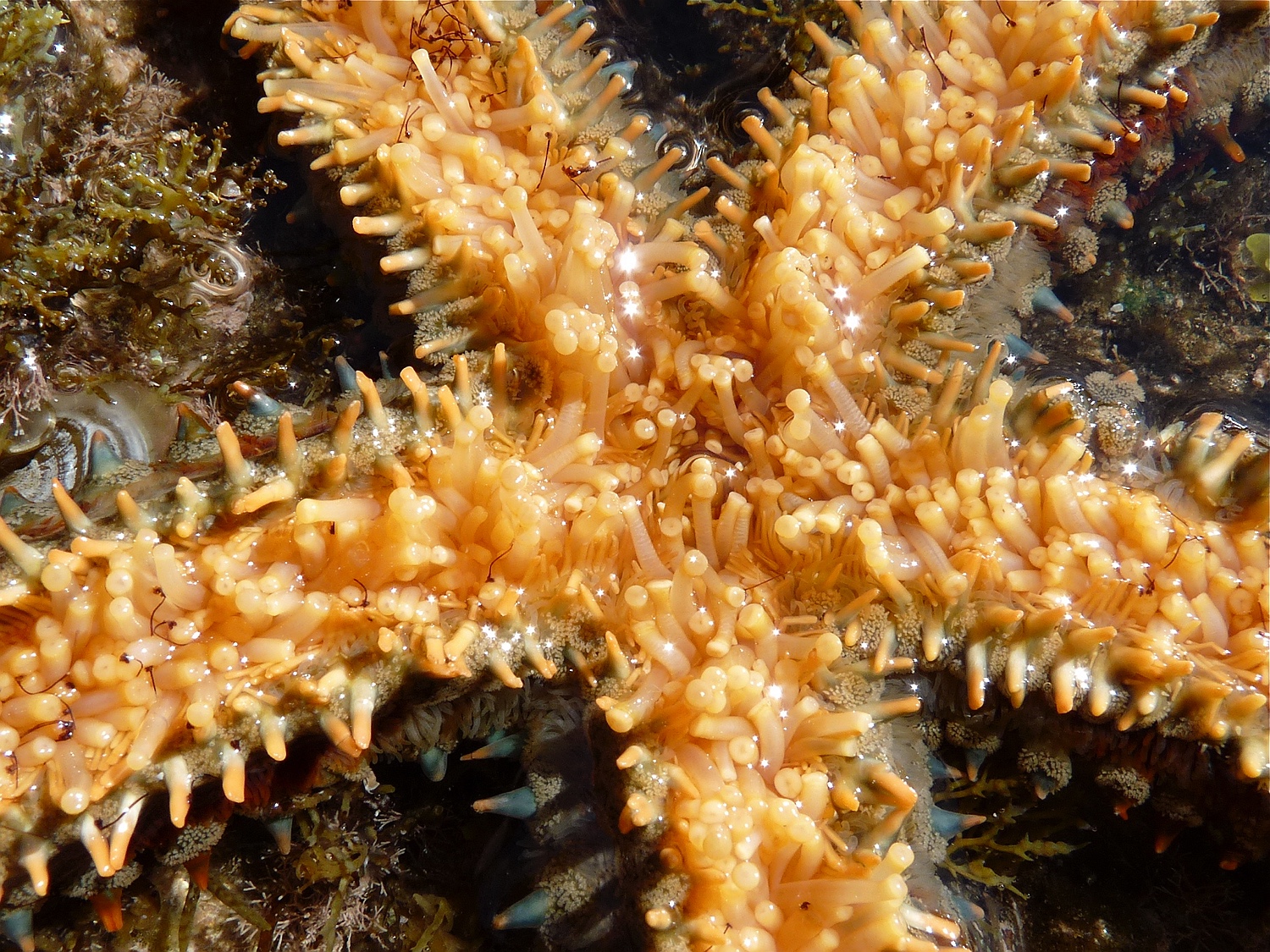
Spiny starfish from below
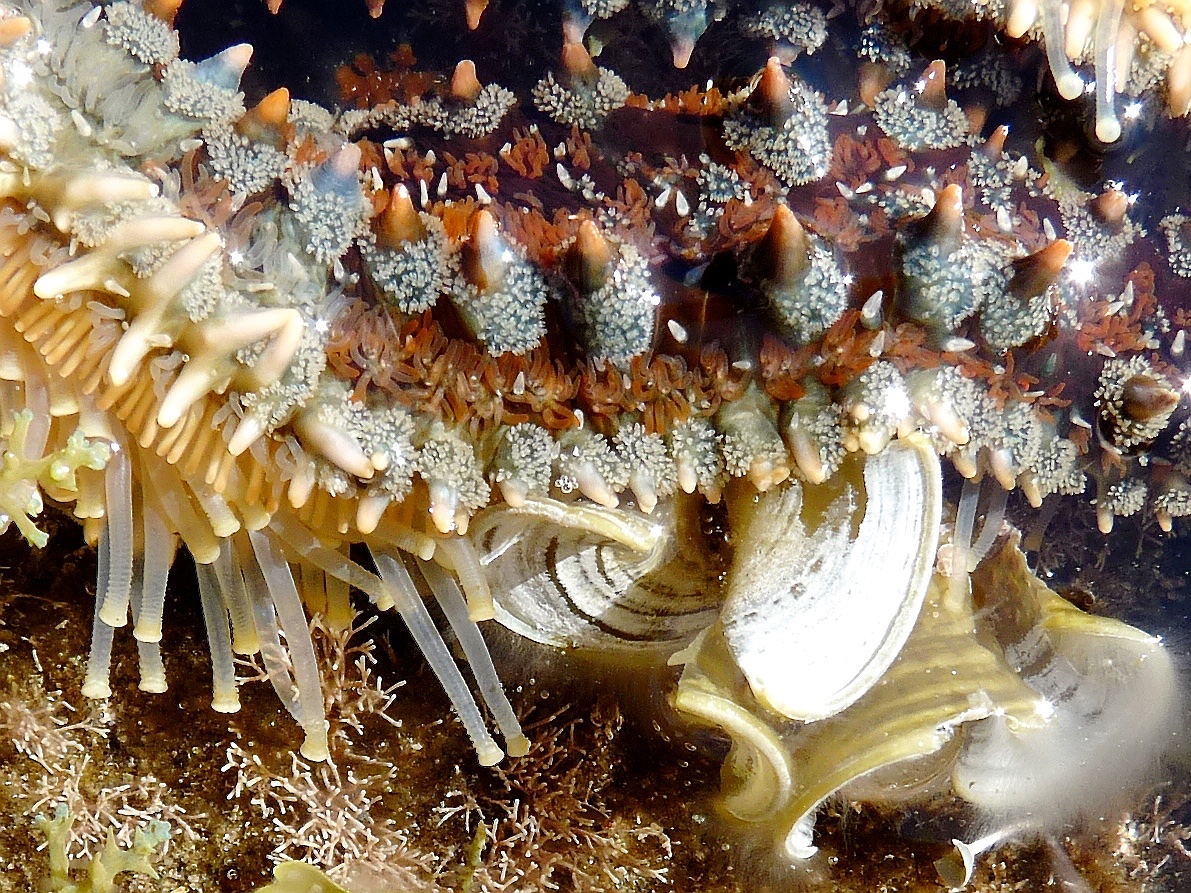
The surface of the Spiny starfish has whitish to reddish spines (standing alone on the upper side, in pairs at the edge), which are surrounded by rings of tiny pedicellariae (without pincers). Between the spines sit numerous brown-red gill papillae with individual, smaller spines in between.
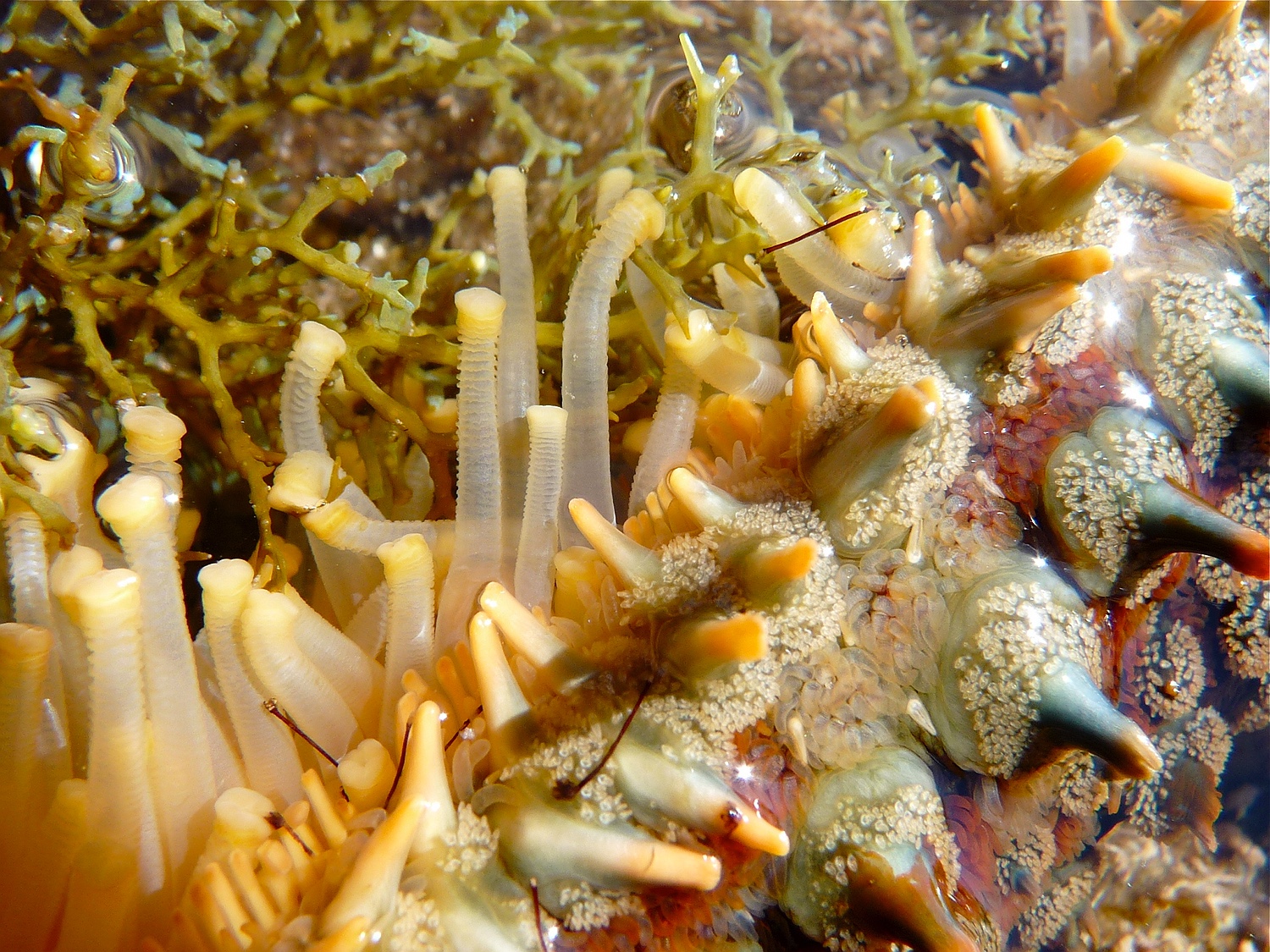
Here one can see the extendable tube feet.
Astropecten platyacanthus, Philippi
Starfish of the genus Astropecten live buried in the sand during the day, so they are rarely seen. They are uniformly star-shaped and have five strong arms that taper evenly. The edges of the arms feature rows of comb-like spines. Several closely related species occur in the Mediterranean, which are difficult to identify: the exact shape, arrangement and size of the spines are important identifying features.
One of the species that can be found in our region is Astropecten platyacanthus. This species can be recognised by its fairly large central disk and long, slightly flattened upper spines, which are particularly well developed in the arm bends. These spines (curved upwards in the specimen in the photo) are not located quite at the tip of the marginal plates (small skeleton plates on the side of the arms), but a small white area (blue on the less elongated spines at the tips of the arms) is left free at the top. The lower spines are long and rather pointed.
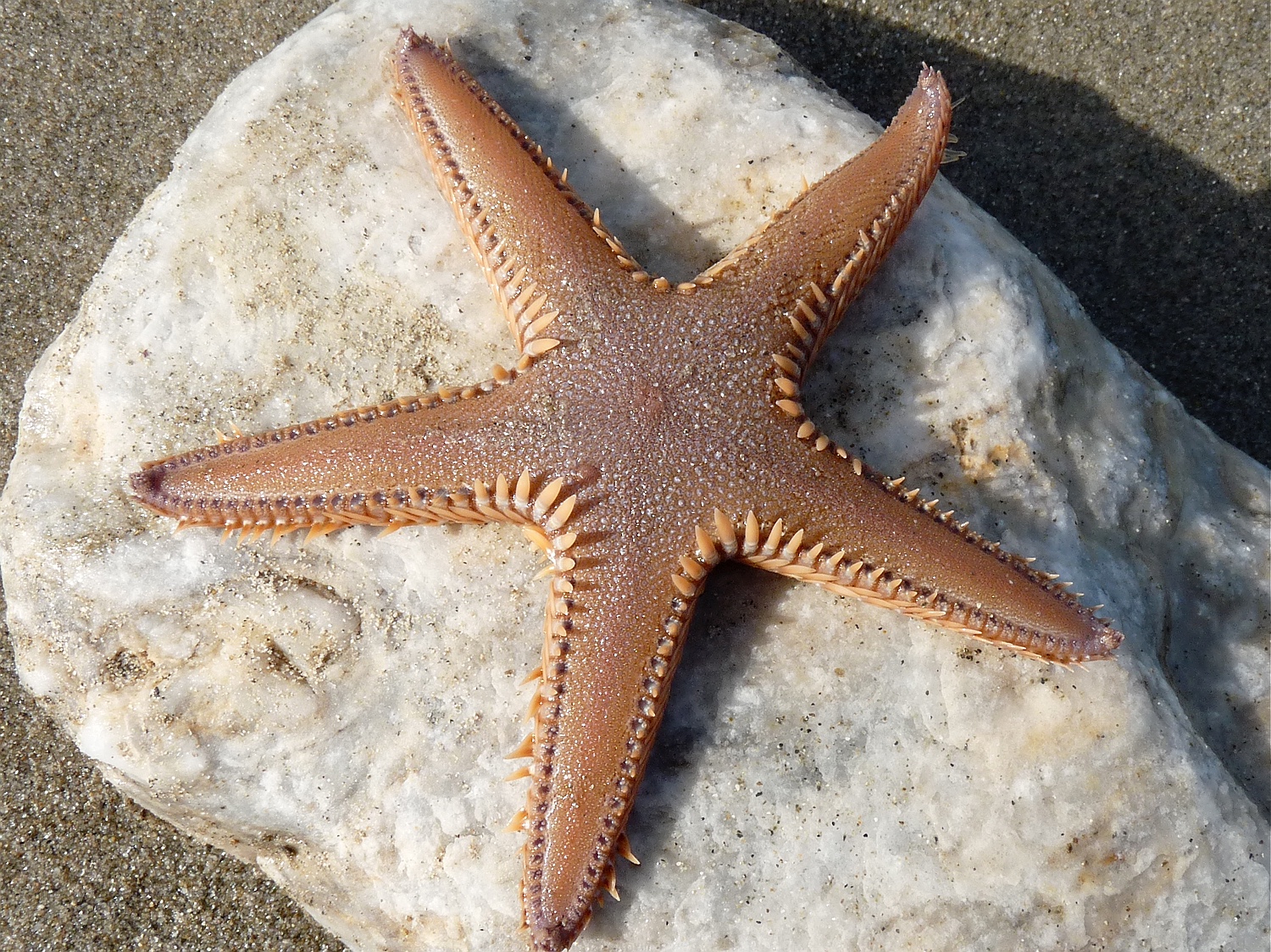
Members of the genus Astropecten are rarely seen because they live buried in the sand during the day. Characteristic features are the large spines on the edges of their arms, which often point upwards. Here we have a specimen of Astropecten platyacanthus.
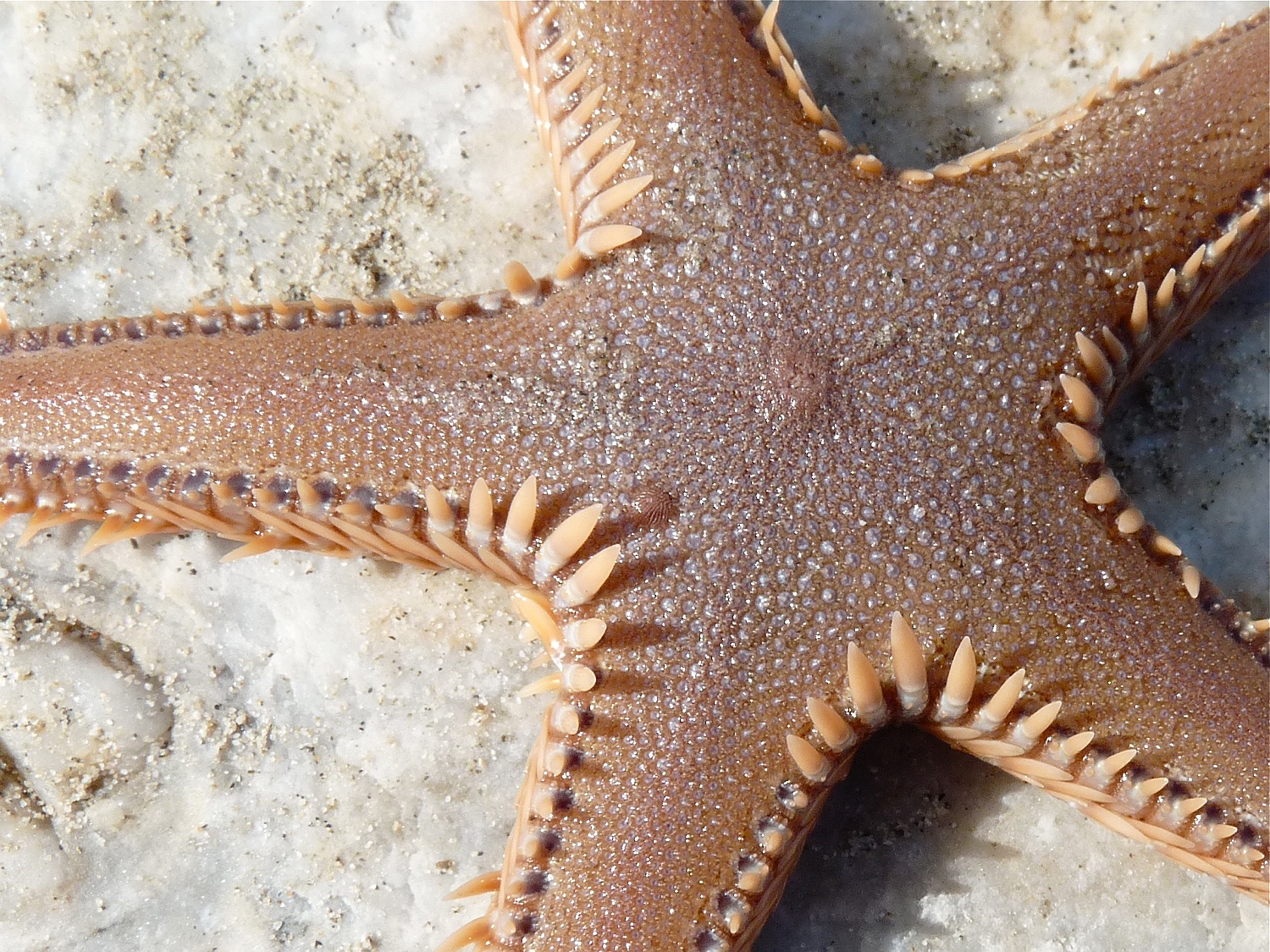
This species has long, slightly flattened upper spines in the arm bends, which do not sit quite at the very top of their plates, but leave a small white area, which is blue in shorter spines. The lower spines are long and quite pointed.
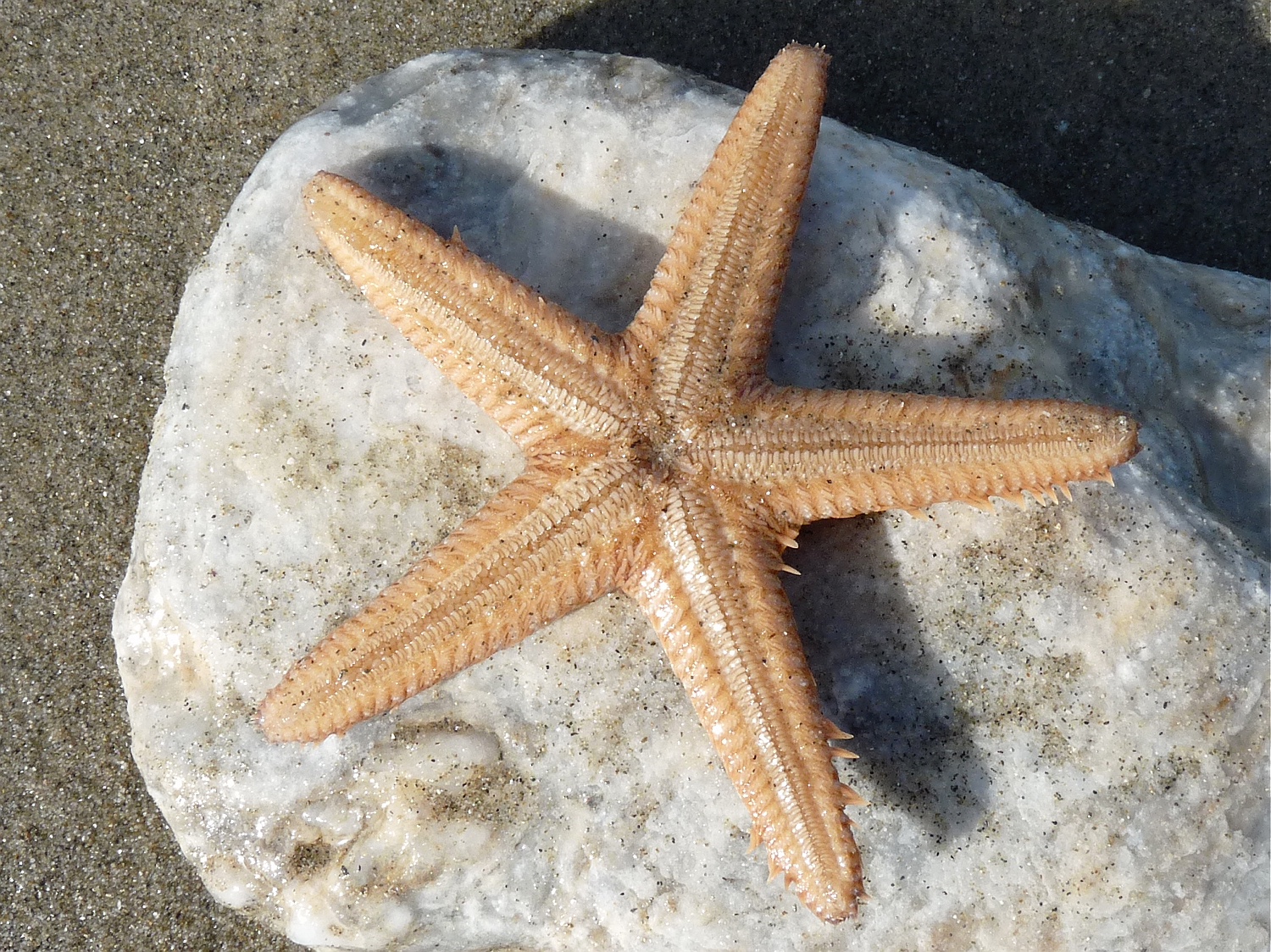
from below
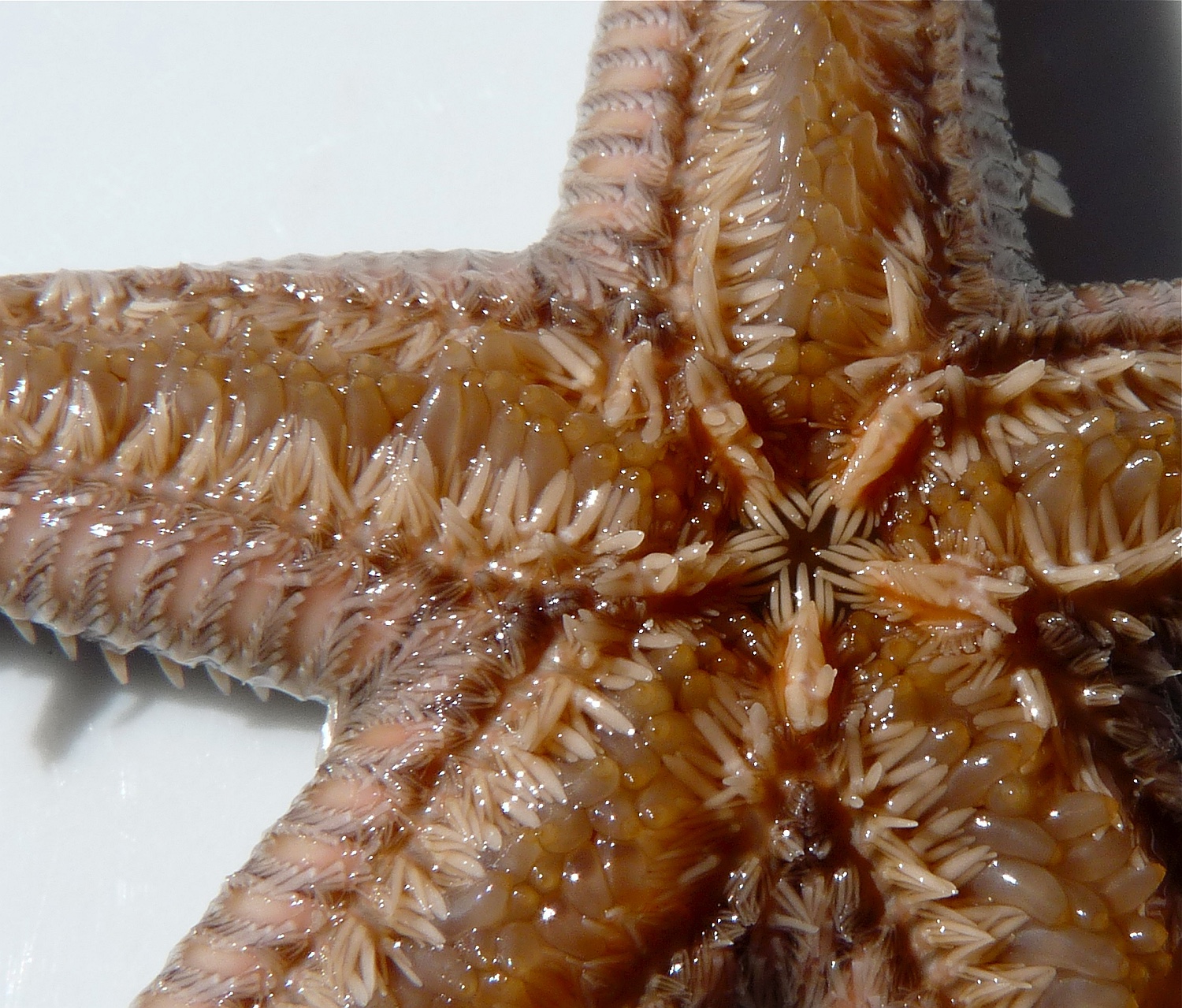
Here you can see the tube feet, which are arranged along the midline on the underside of the arms, and which, in this species, do not have suction cups. Also there are numerous larger and smaller spines arranged in several rows.
Astropecten bispinosus
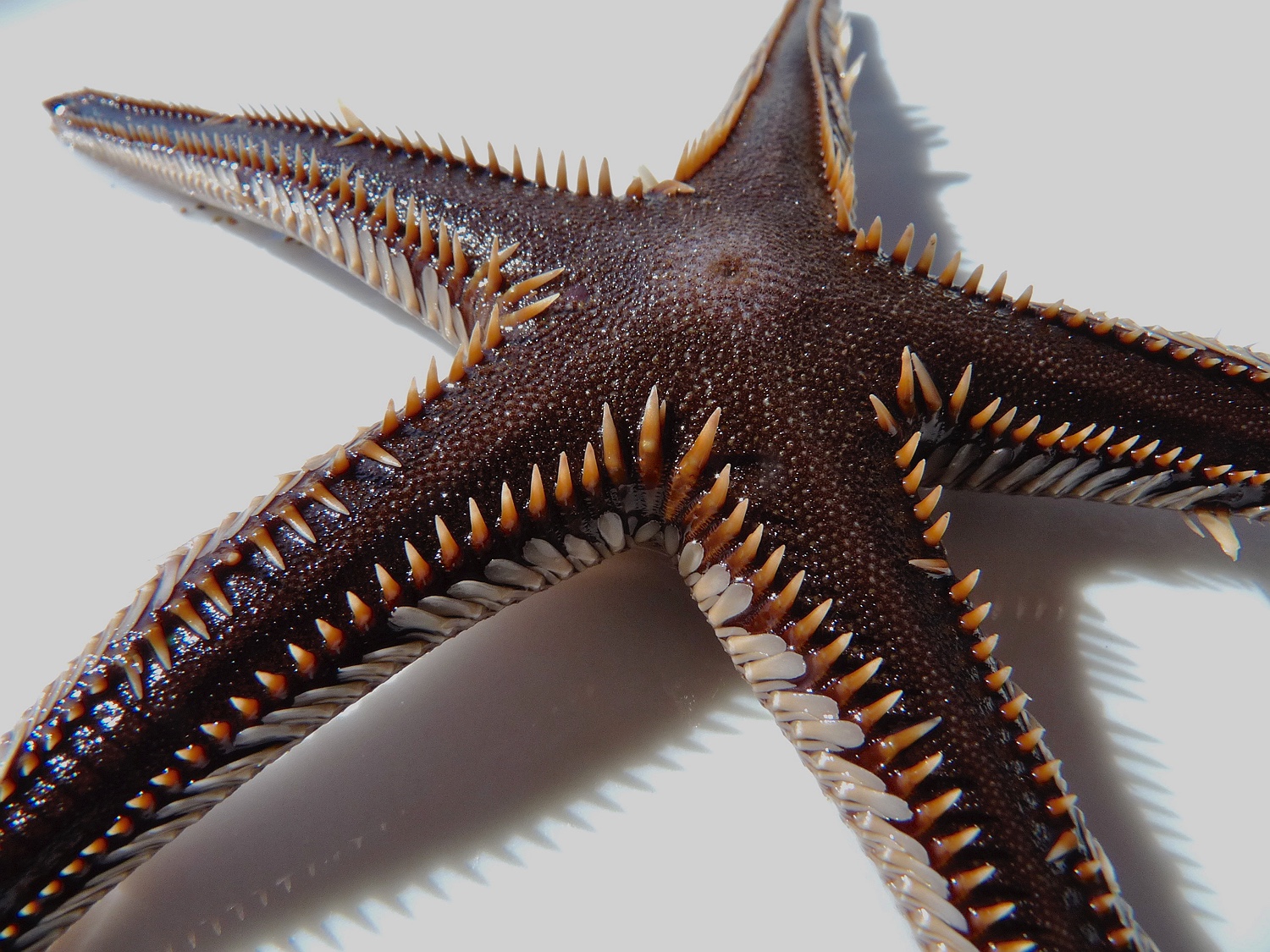
Astropecten bispinosusis characterised by a dark upper side and a rather small central disc. The upper spines are conical, not flattened, while the lower ones are significantly broader and not pointed. The spines stand slightly denser in this species than in the previous one.
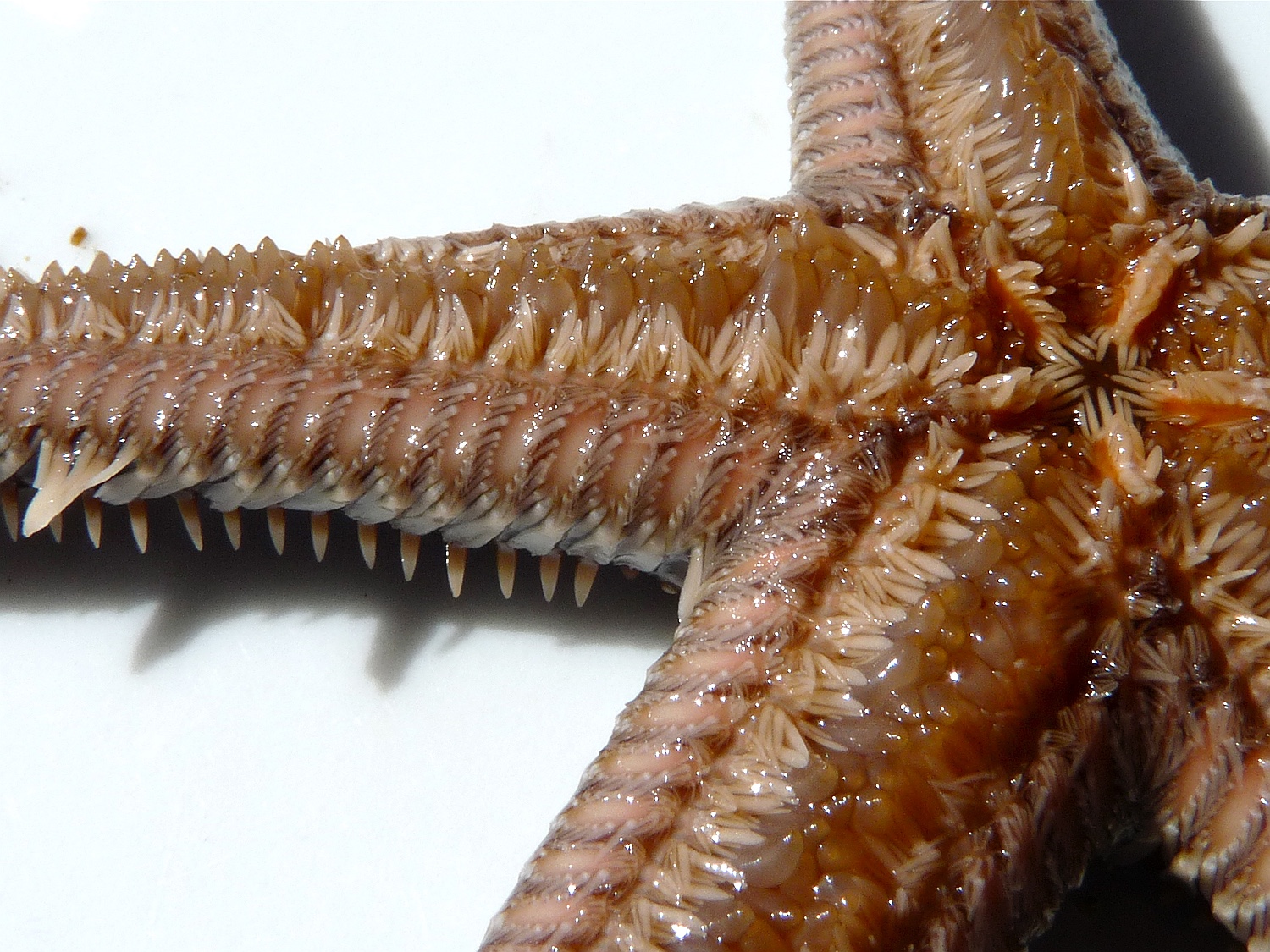
Astropecten bispinosus seen from below
Hacelia attenuata, Gray
Another species that can be encountered from time to time is Hacelia attenuata. It is also found near the coast, but mainly at greater depths. It lives mainly in shady places and in caves, which is why it is not seen very often. It feeds mainly on sponges. The Hacelia attenuata can reach a diameter of 30 cm. It is orange-red in colour and has a small disc and evenly tapered roundish arms without spines. These bear regularly arranged rows of darker coloured plates, which make the species easy to recognise.
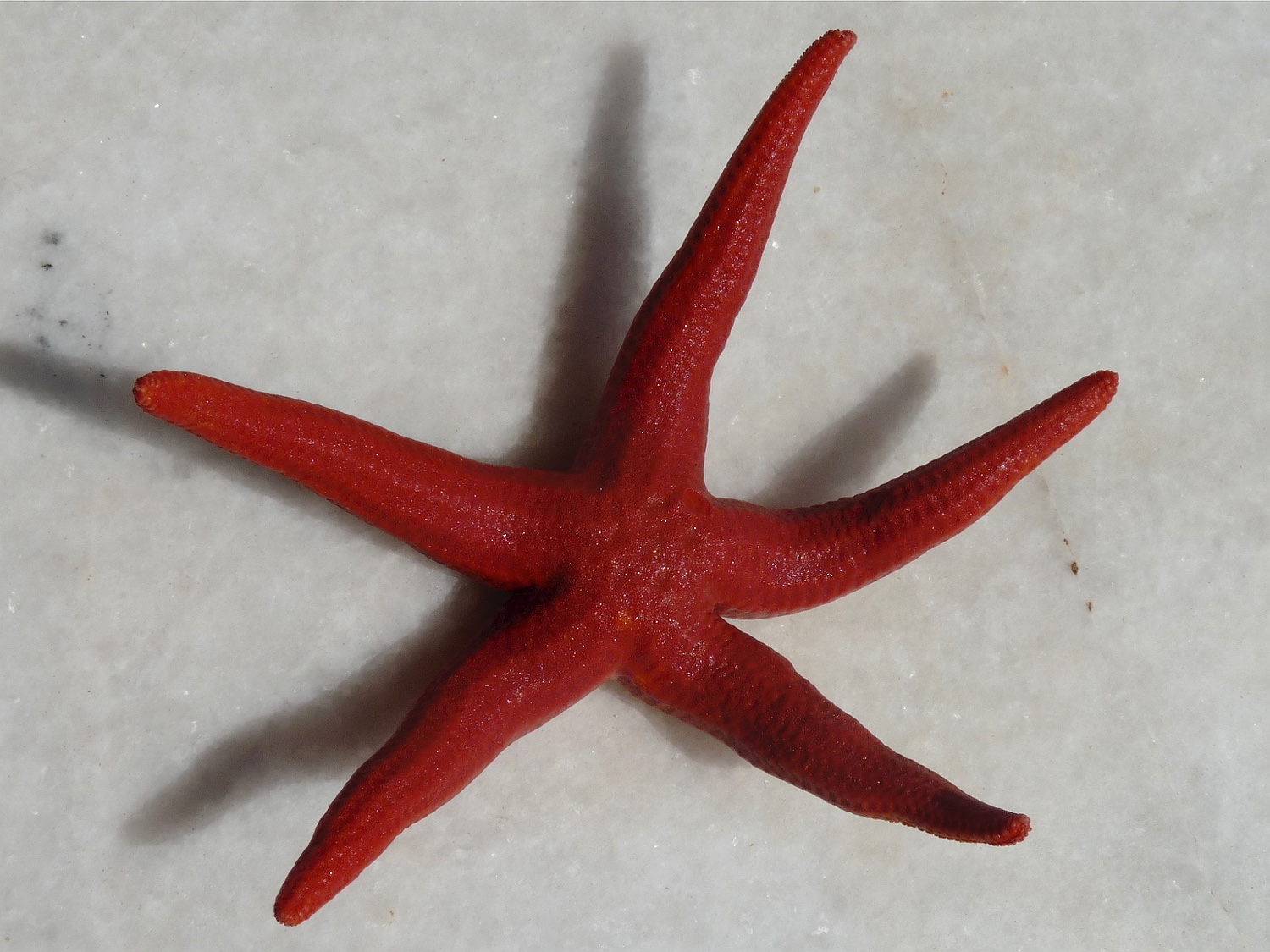
Hacelia attenuata has evenly tapering round arms.
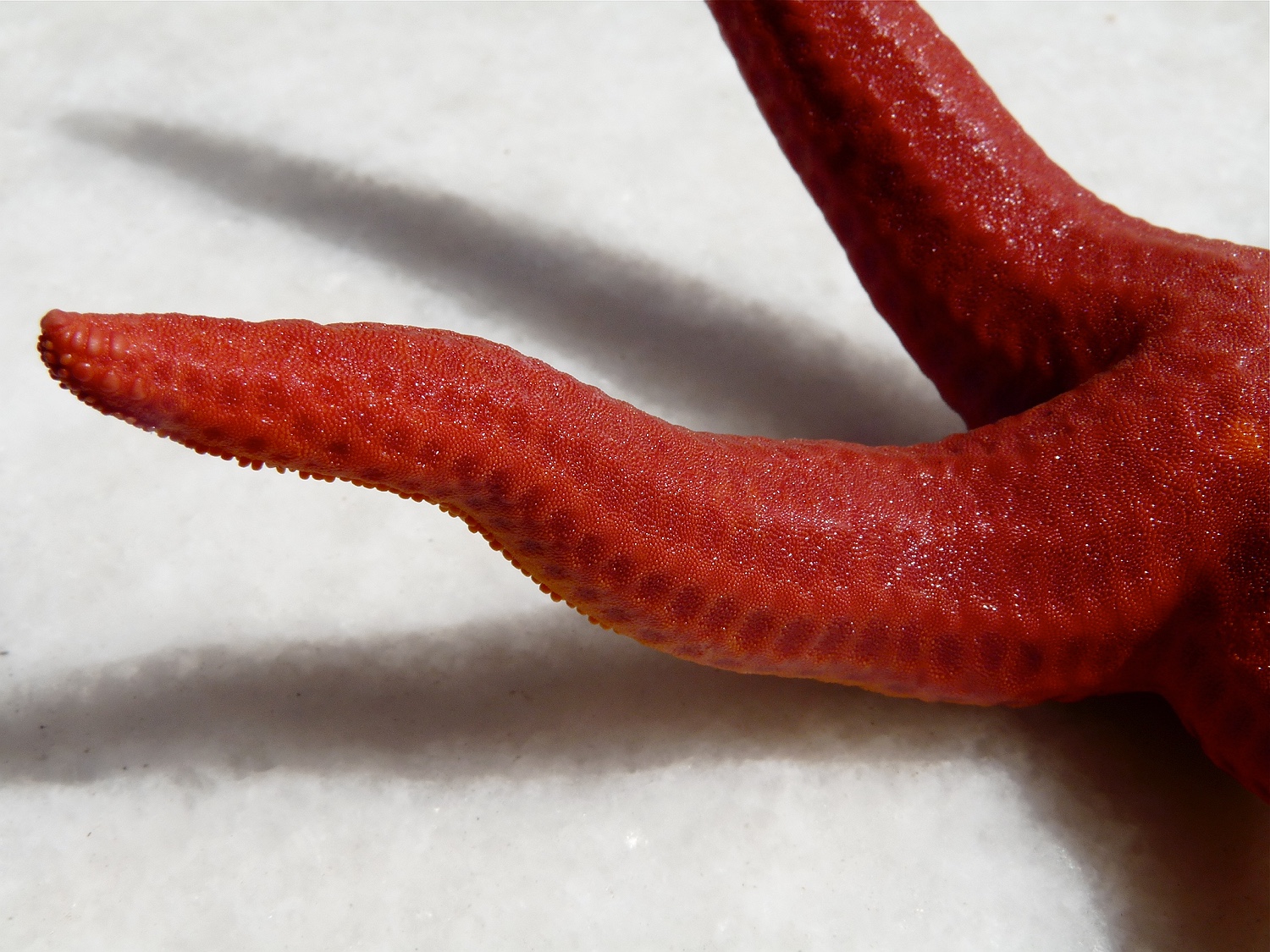
The arms are adorned with several rows of darker spots.
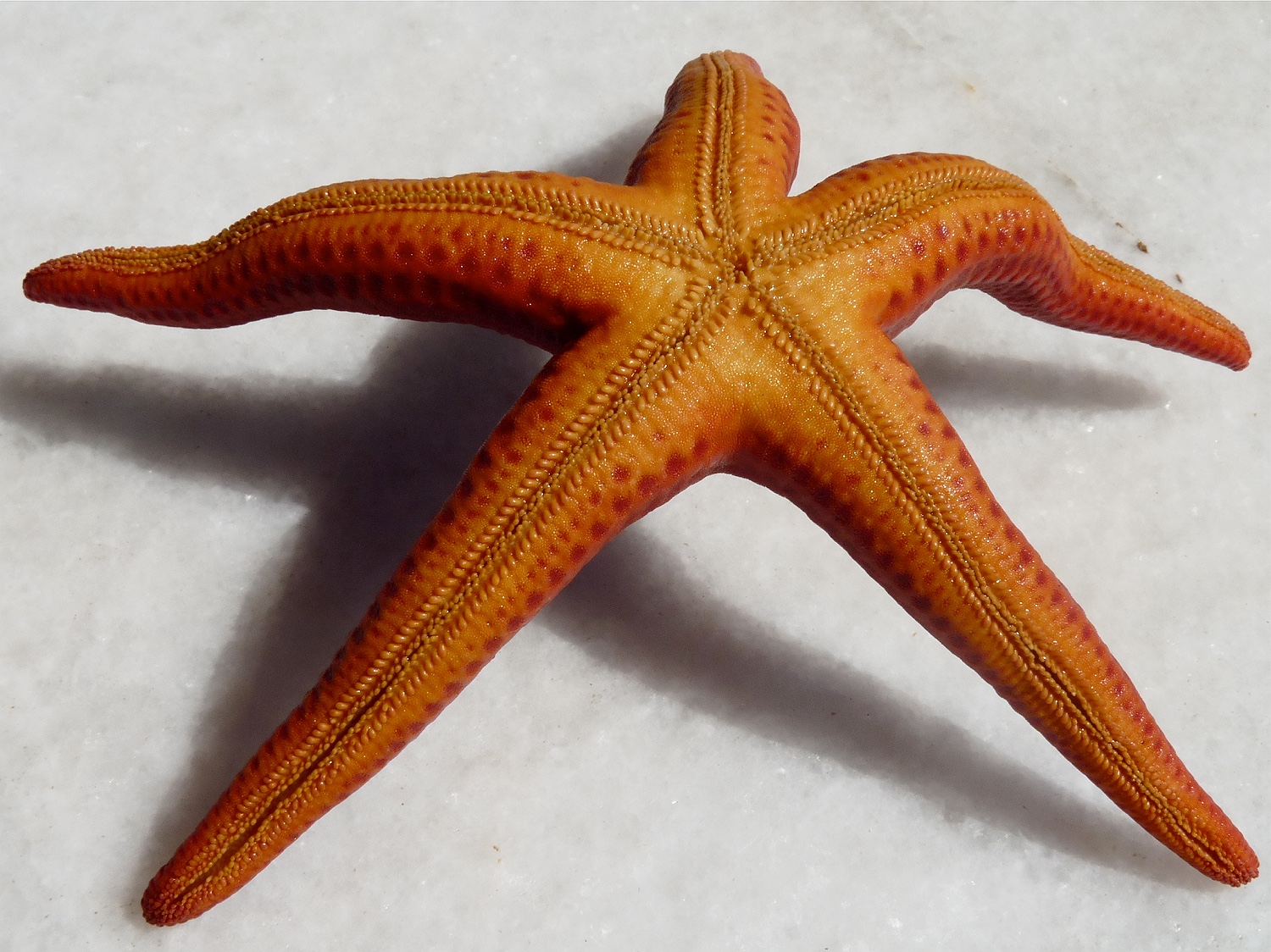
The underside has a yellowish colour.
Mediterranean red star, Echinaster sepositus, Retzius
The Mediterranean red star is easily recognised by its orange-red colour and its almost round arms, which are rough with many small pits in which lie the tiny, extendable gills. It can sometimes have more than five arms. This starfish is rather rare in our region and is mainly found on rocky sea floor, where it feeds on micro-organisms and sponges.
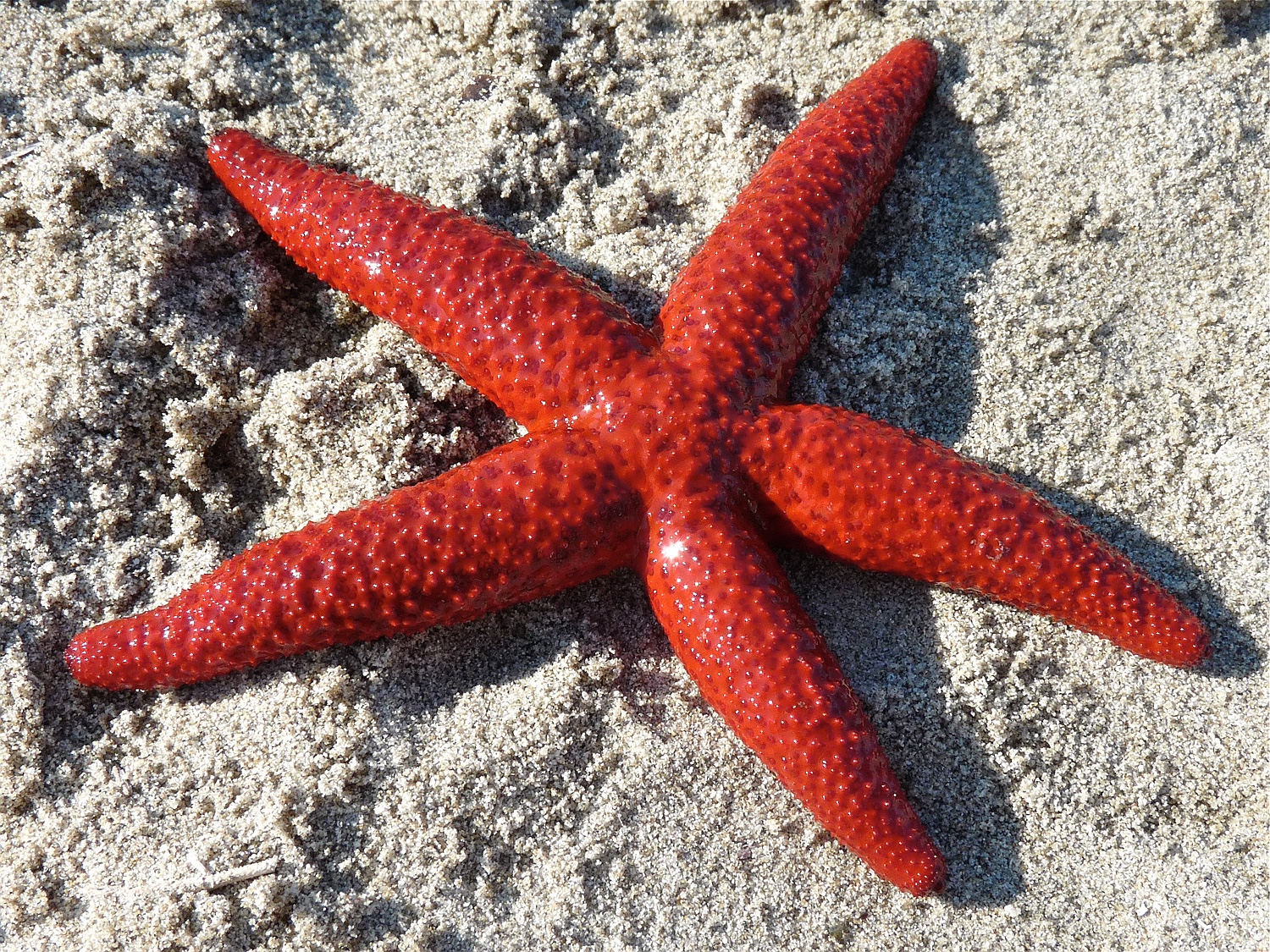
The Mediterranean red star is orange-red in colour; the thick round arms are a bit narrowed where they meet the central disk.
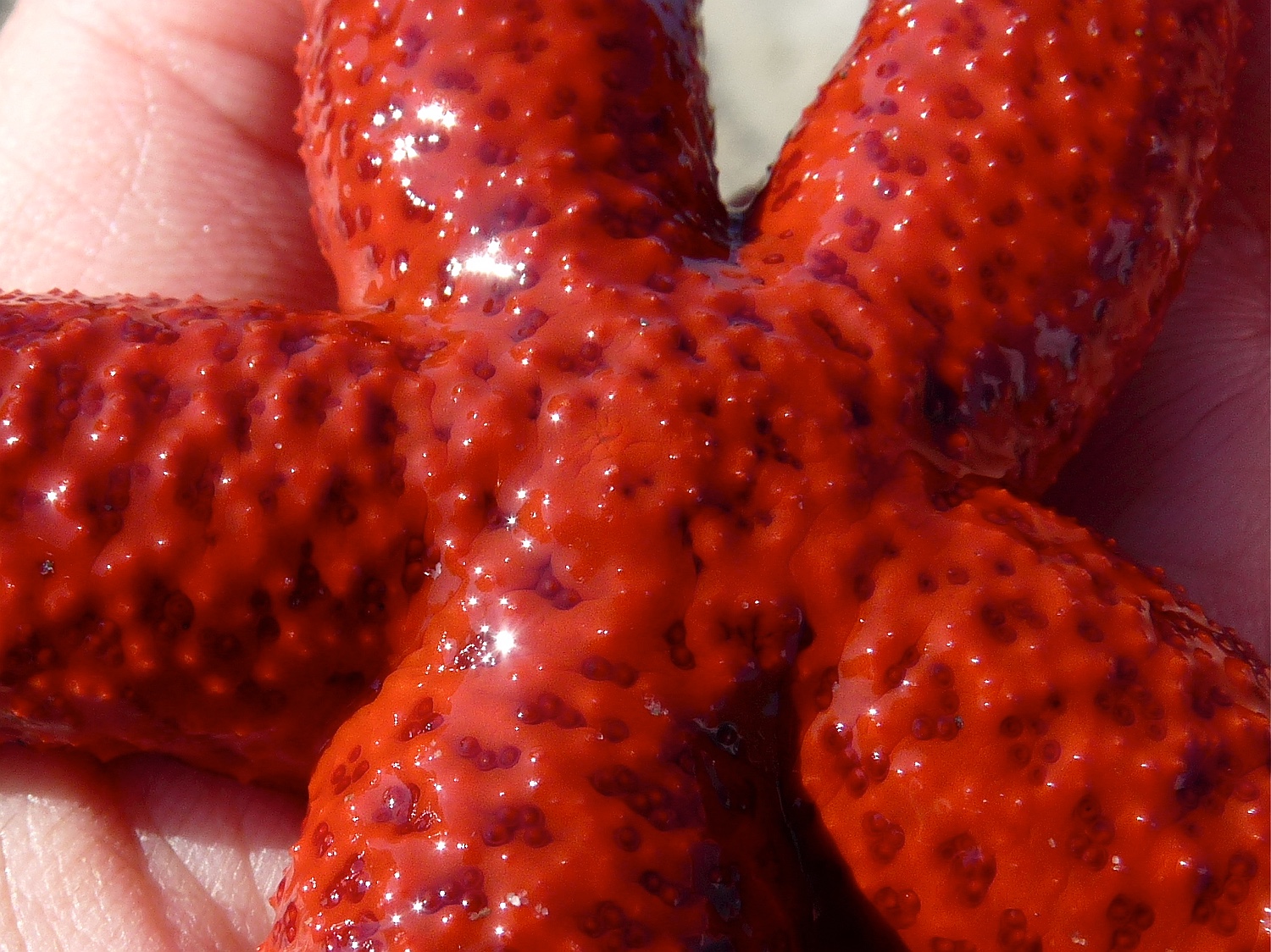
The surface is rough with many small pits.
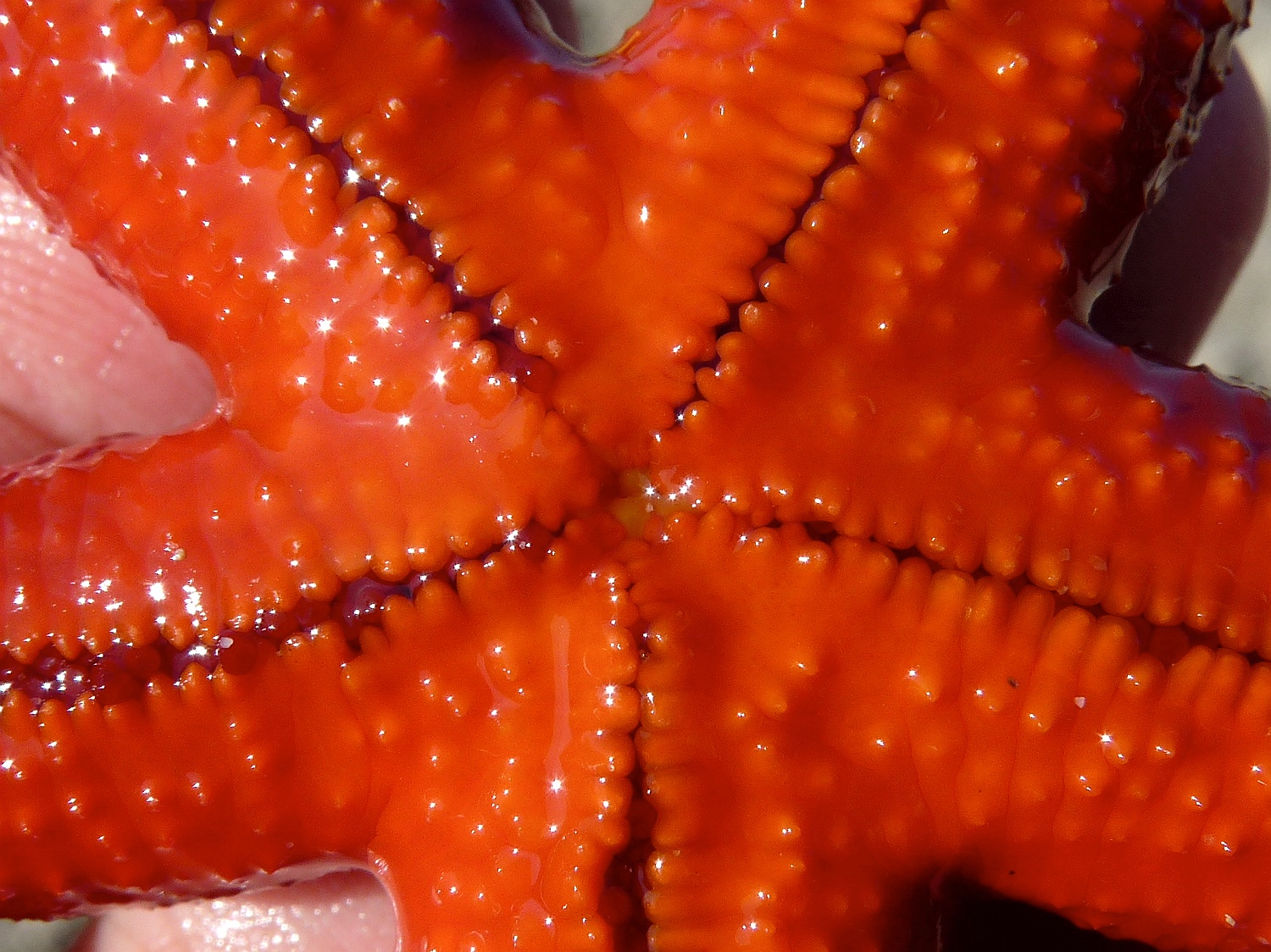
On the underside one can see a groove along the midline of the arms, in which tiny organisms from the seabed, which form the starfish’s food, are transported to the mouth opening with cilia.
Brittle stars
Similar to the starfish are the brittle stars (Ophiuroidea), which, like starfish, sea urchins and sea cucumbers, form their own class within the echinoderms. They resemble starfish, but differ in that their very thin arms spring “abruptly” from their small round body disk. On Naxos, mainly quite small species of brittle stars live in the algae of the infralittoral zone and can be found by picking off algae and shaking them out or examining them under a magnifying glass. Many brittle stars also live buried in the sand or on the underside of rocks. They feed on tiny suspended particles or small organisms, which they catch with their tube feet. There are about 2000 species worldwide.
Ophioderma longicaudum, Bruzelius
Due to their secretive lifestyle, brittle stars are rarely seen. We found this specimen among the rocks in shallow water. Identifying the species is difficult and depends on the shape and also on the arrangement of the plates on the body surface.
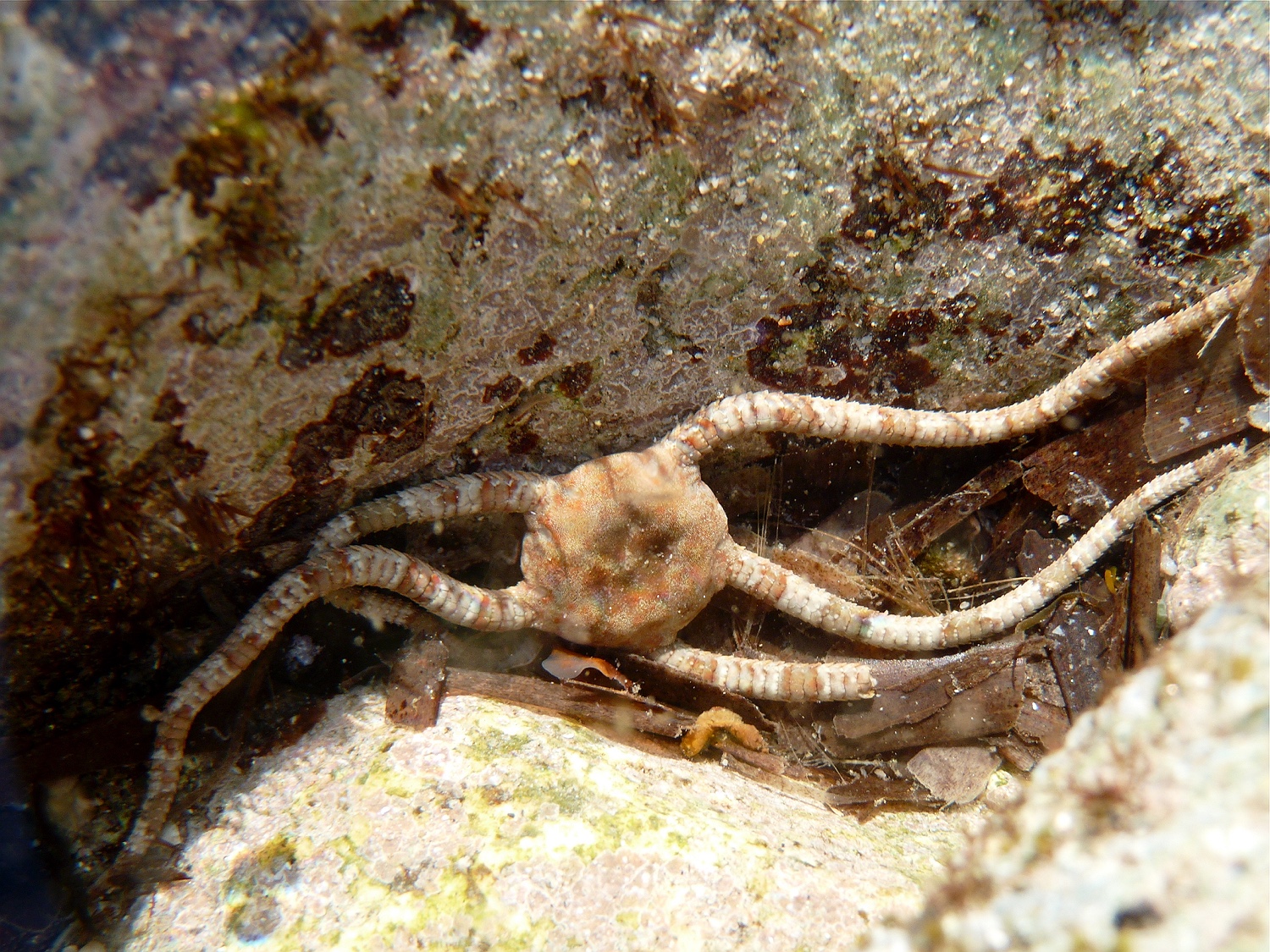
This species has long, thin arms; the body disk has a granular surface.
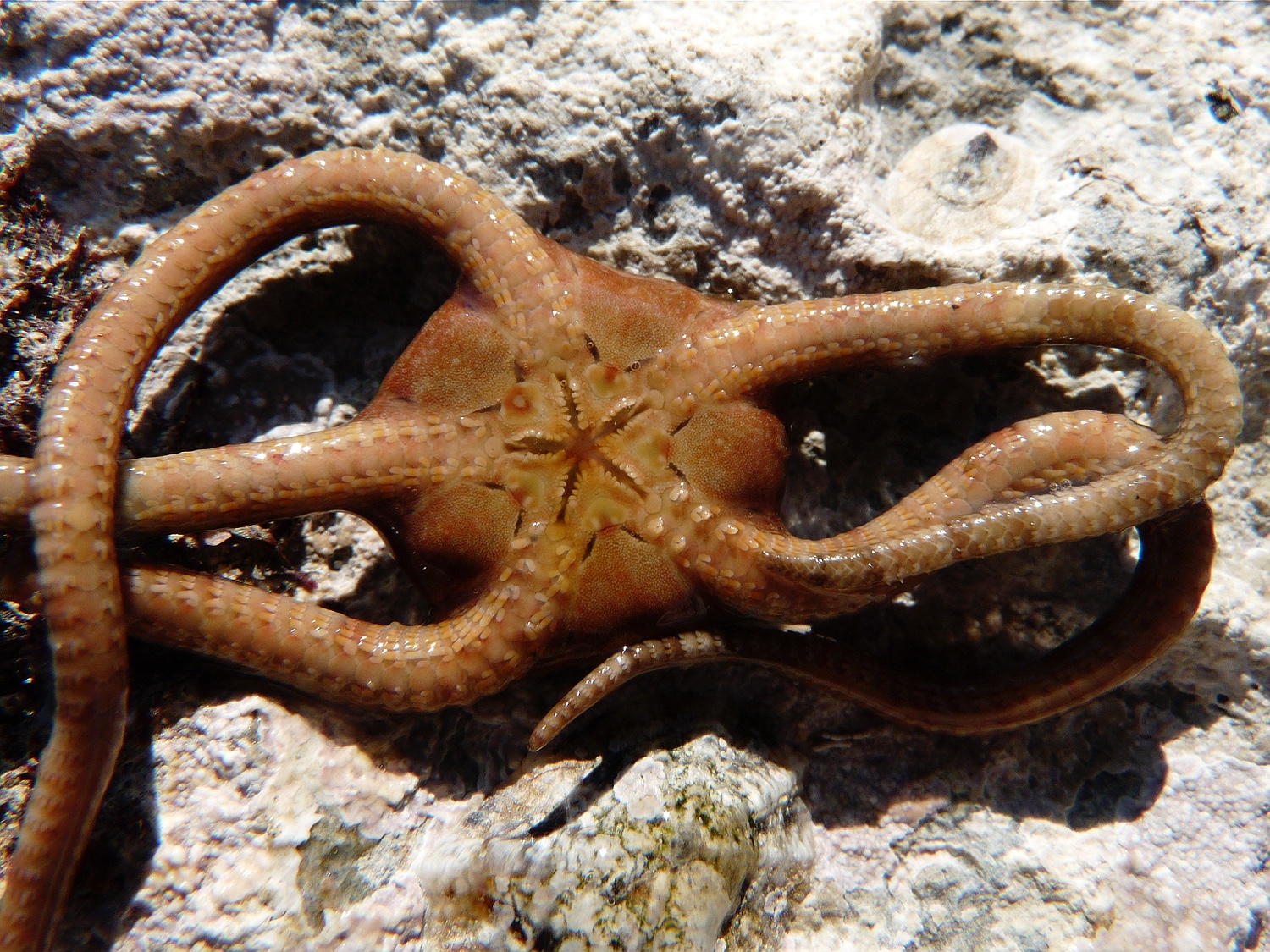
The species can be identified by the arrangement of the plates on the central disk.
Ophiopsila aranea, Forbes
One of the smaller species, which lives in the algae on the rocks, is Ophiopsila aranea.
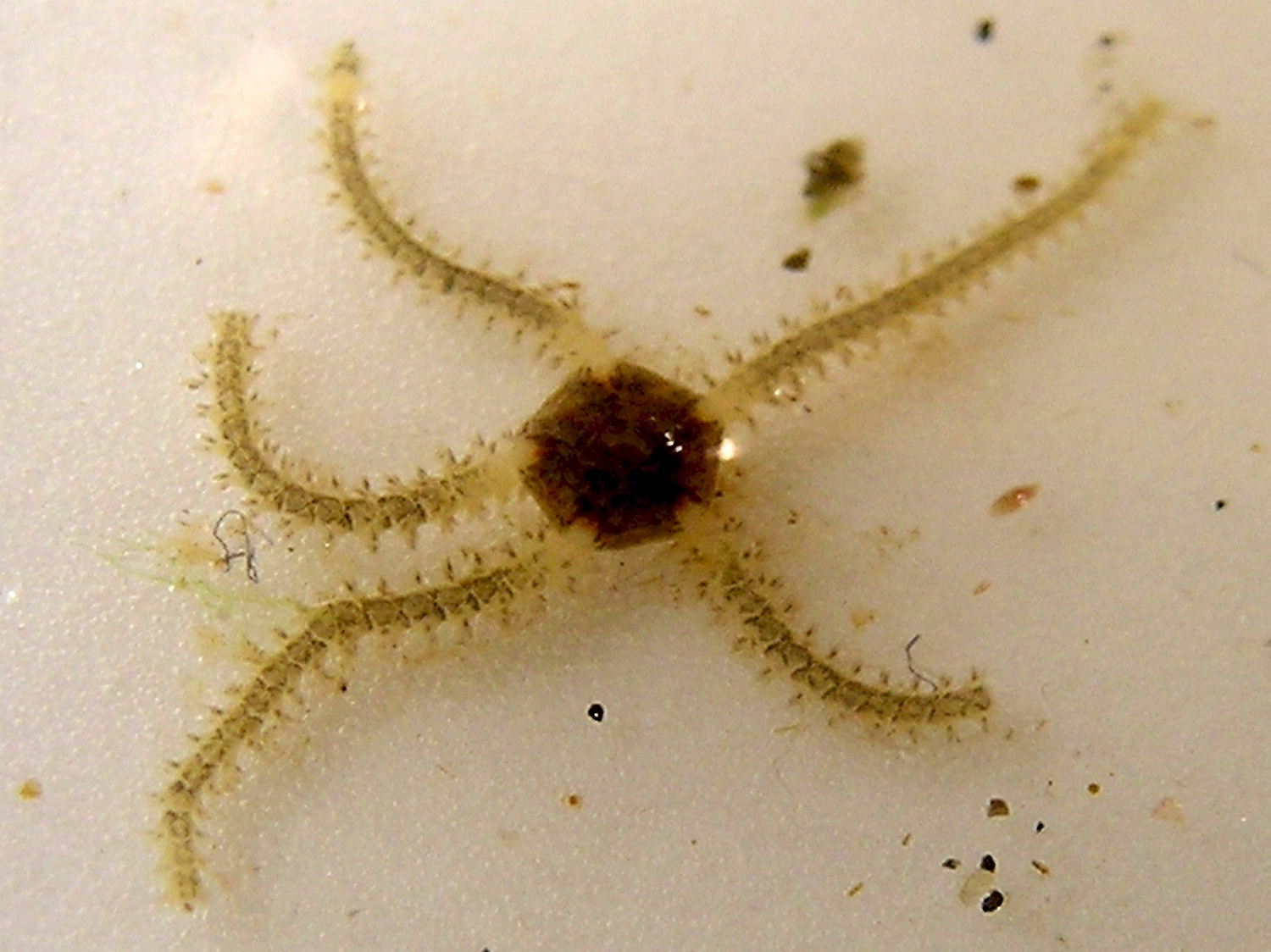
The arms of this species are very thin and carry small bristles. Here a small specimen.
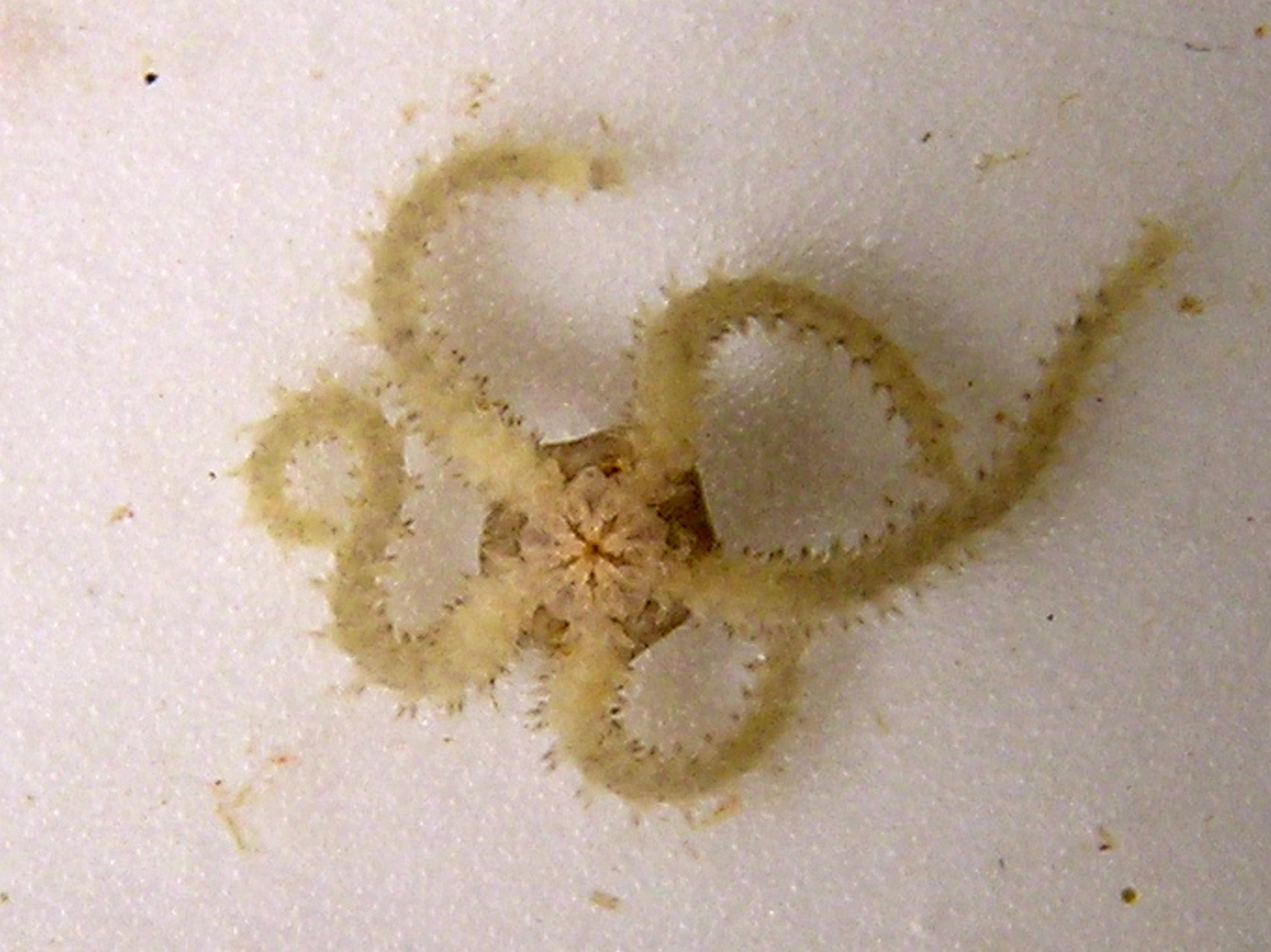
the underside
Ophiotrix spec.
In the Mediterranean Sea occur two species of this genus Ophiotrix (O. fragilis and O. quinquemaculata), which are difficult to distinguish. The genus can be recognised by its very thin, fragile arms with relatively long, thin, translucent spines. The body disk is small and pentagonal. The colouring is quite variable.
Ophiotrix can reach a diameter of about 12 cm. It usually sits hidden under stones or seaweed and extends only two or three arms into the water, which it uses to catch tiny plankton.
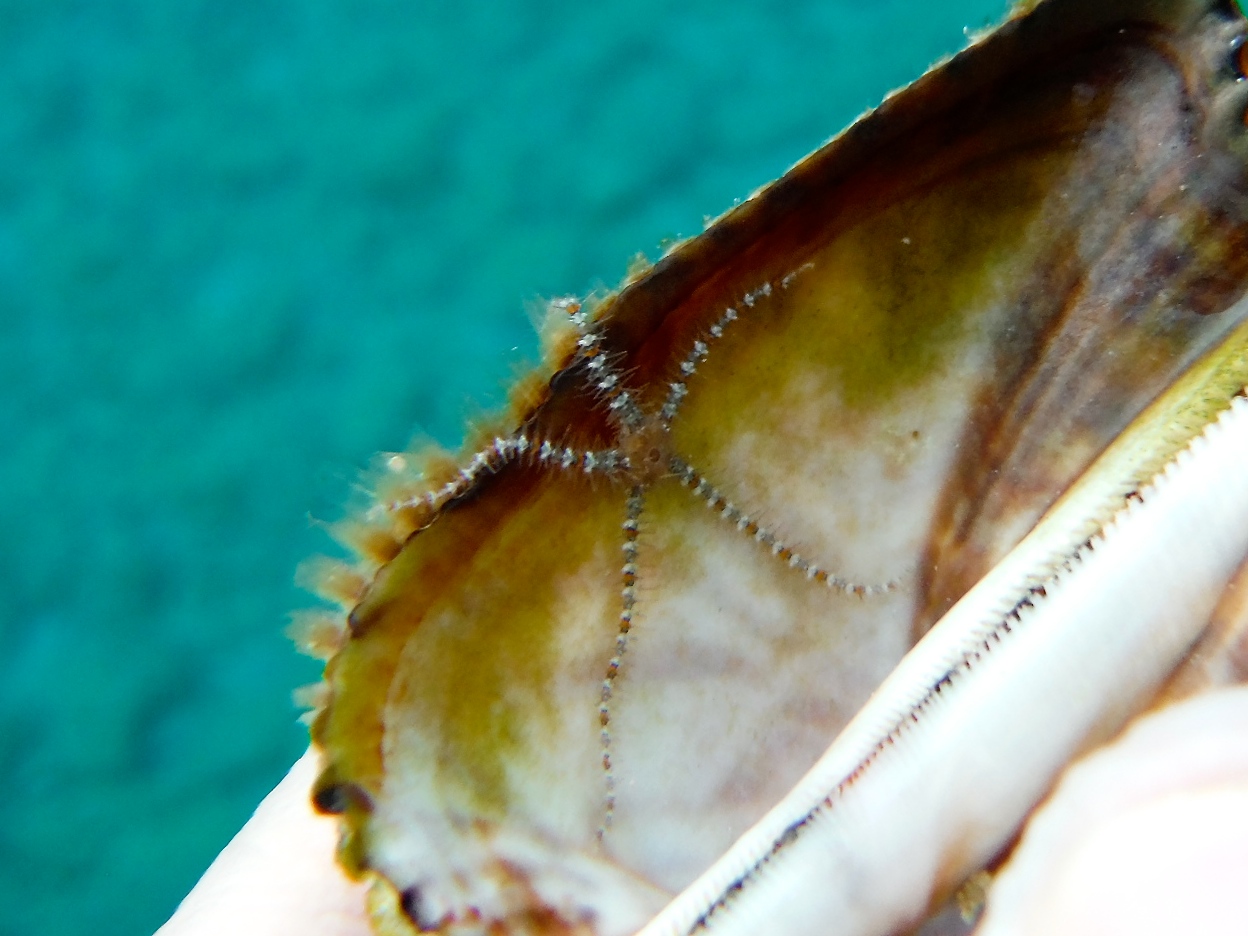
Brittle stars of the genus Ophiotrix have very thin arms with long spines. In our specimen, the “segments” of the arms are alternately white and rust-red or grey in colour.
continue: Sea cucumbers