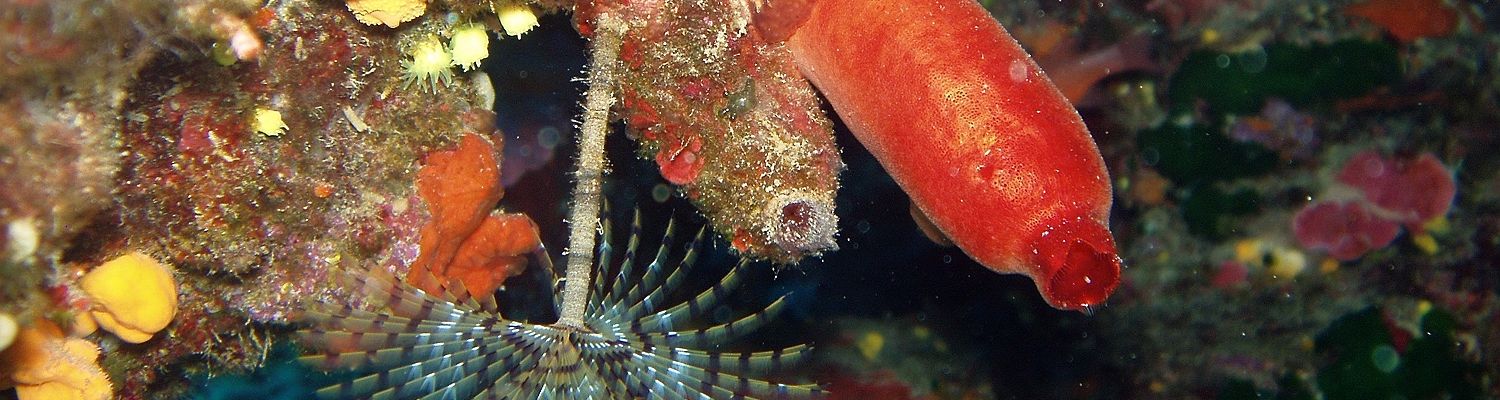
Sea squirts
Sea squirts (class Ascidia) belong to the phylum Tunicata, which, despite their simple structure, are the closest relatives of the vertebrates. They are characterised by a gelatinous, cartilaginous or leathery cellulose-like substance that envelops the entire body (mantle or tunic) and the notochord, a cartilaginous rod that serves as a supporting organ and is a precursor to the spine.
The anatomy of the sea squirts is very simple: they essentially consist of a tube attached to the substrate and enveloped by the mantle. Sea squirts feed by filtering seawater. Small cilia in the inflow opening create a water current that leads to a simple stomach, where food particles are filtered out and digested. The water flows out again through the outflow opening, which is usually located on the side. Sea squirts have a simple nervous and circulatory system and strong muscles, and can contract when disturbed. Many species live solitary, others form colonies. They show different colours, sometimes being very colourful, while other species are completely transparent, and each has a characteristic shape, especially with regard to the arrangement of the inflow and outflow openings.
The about 2,000 species live exclusively in the sea (about 100 species in the Mediterranean). Most species grow to several centimeters or decimeters in size, while others are microscopically small and live in the sand gap system. In the deeper regions of the sea, sea squirts are often very common on rocky bottoms. The larvae swim freely in the sea. In the larva the resemblance to vertebrates is much more obvious than in adult animals: they look like tadpoles.
The Photo gallery of the marine animals provides an overview of the described species. Please note that I am not an expert and that some of the identifications may therefore be incorrect.
Microcosmus spec.
In the Mediterranean Sea occur numerous species of the genus Microcosmus. The identification of the species is usually very difficult. They live on rock and can be encountered also in shallow water. The genus is easily recognisable: the squirts are covered with numerous organisms (thus the name).
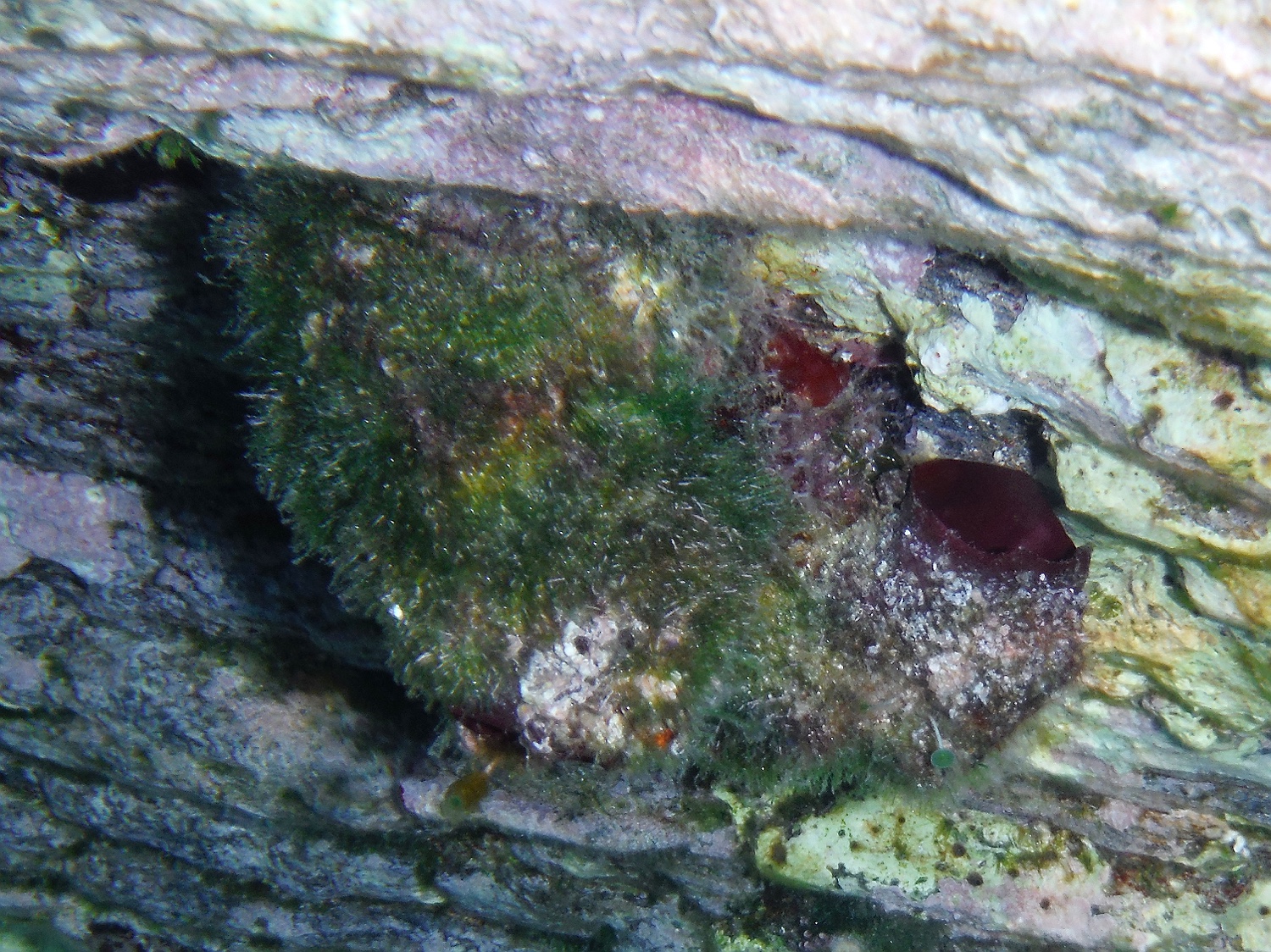
Sea squirts consist of a simple tube-like body with an inflow opening at one end and an outflow opening on the side. The species of the genus Microcosmus are densely overgrown by sessile organisms. They are dark red in colour on the inside and slightly compressed; to the right you see the inflow opening.
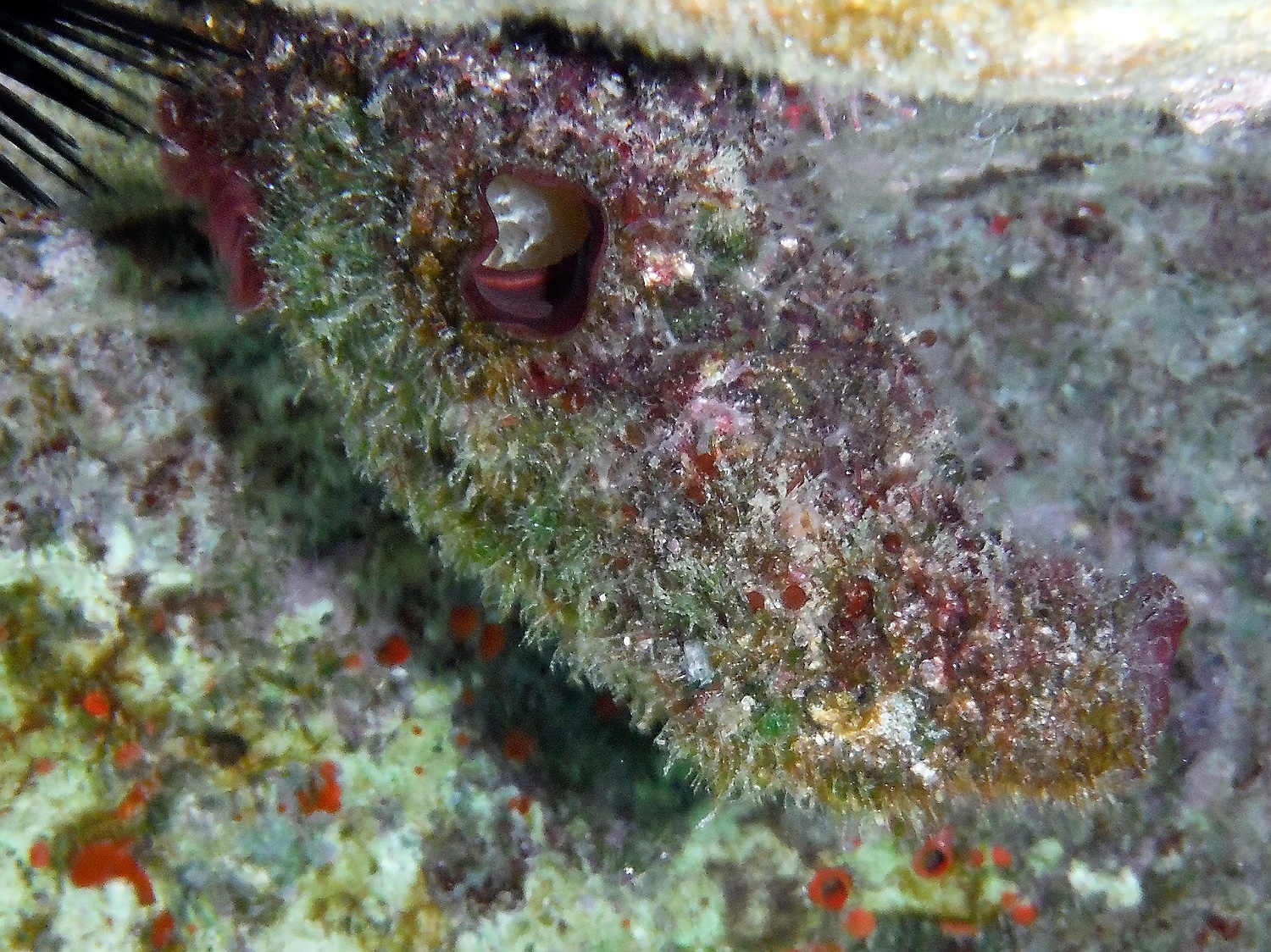
Here the outflow opening with the dark red inside is visible.
Red sea squirt, Halocynthia papillosa, L.
The Red sea squirt also grows solitary. It reaches a size of up to 10 cm and is often found in shady areas or in deeper water.
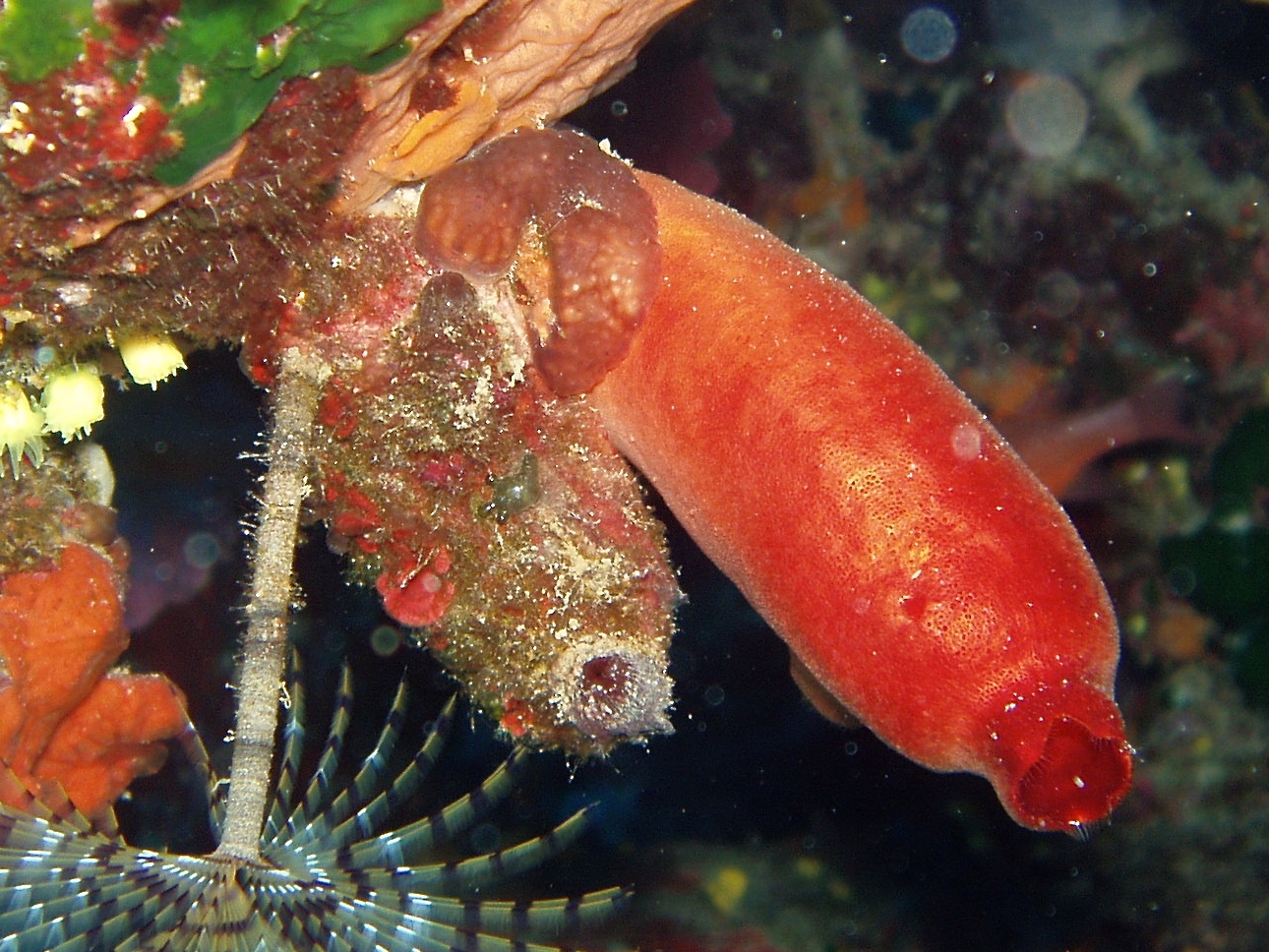
The Red sea squirt is mainly found at greater depths. Photo by Themos Bogiatsoglou
continue: Fish