Author: astrid

Schmetterlingsblütler, Fabaceae

Die Familie der Schmetterlingsblütler (= Leguminosen oder Hülsenfrüchtler, Fabaceae) bildet zusammen mit den Kreuzblumengewächsen (Polygalaceae) und zwei kleinen, tropischen Familien die Ordnung der Schmetterlingsblütlerartigen (Fabales). Die Schmetterlingsblütler sind im Mittelmeergebiet mit auffällig vielen Arten vertreten. Von den knapp 1000 bisher auf Naxos nachgewiesenen Pflanzen gehören je ein gutes Zehntel den drei für den Mittelmeerraum besonders charakteristischen...

Continue reading

Zum Argokili

Von unseren Ferienhäusern aus kann man über einen alten kleinen Pfad zur Hochebene von Atsipápi laufen. Hier liegt in einer Entfernung von etwa 5 Kilometern von Azalás die bedeutendste Wallfahrtskirche von Naxos, Panagía Argokiliótissa. Diese feiert am Freitag nach Ostern, dem Tag des Lebensspendenden Quells, ihr Kirchenfest. Dieses Jahr wurde das Fest besonders groß begangen, weil die neue, sehr große Wallfahrtskirche eingeweiht wurde: Zum ersten Mal wurde die Liturgie im...

Continue reading

Schneckenklee, Medicago

Eine der artenreichsten Pflanzenfamilien im Mittelmeergebiet sind die Schmetterlingsblütler, und unter diesen ist die Gattung Medicago (Schneckenklee) besonders umfangreich (weltweit etwa 110 Arten). Die bekannteste Art, die Luzerne (Medicago sativa), dient als Futterpflanze und ist eine der ältesten Kulturpflanzen der Welt. Sie wurde angeblich von Darius aus der Landschaft Medien (im heutigen Iran) in Griechenland eingeführt und erhielt deswegen den griechischen Namen...

Continue reading

Affodill und Junkerlilie, Asphodelus und Asphodeline

Der Affodill oder Asphodill gehört zur Ordnung Asparagales innerhalb der Einkeimblättrigen Pflanzen; die frühere Familie der Asphodelaceae wird heute zur Familie der Grasbaumgewächse (Xanthorrhoeaceae) gerechnet. Die Unterfamilie Asphodeloideae umfasst 11 Gattungen mit etwa 800 Arten, die in der Alten Welt, vor allem im Mittelmeergebiet und in der Kapregion Afrikas vorkommen. Die bekanntesten Arten sind die Aloen. Es gibt je etwa 20 Arten Affodille und Junkerlilien...

Continue reading

21. März 2010: Frühling...

Ja richtig, der Frühling ist wieder da! Hier in Griechenland war der ganze Winter eher mild, aber nun ist es richtig warm und angenehm geworden. Der Garten muss schon bearbeitet werden: Das Unkraut wuchert, wenn man nichts dagegen tut, die Weingärten sind gefräst und beschnitten, und wir haben schon das erste Sommergemüse gepflanzt. Ausblick von unserem Balkon auf das Meer Blick nach Norden; im Vordergrund das Kartoffelfeld Der Mandelbaum blüht herrlich! An den Rändern...

Continue reading

Agios Nikolaos at the Troullo near Komiaki

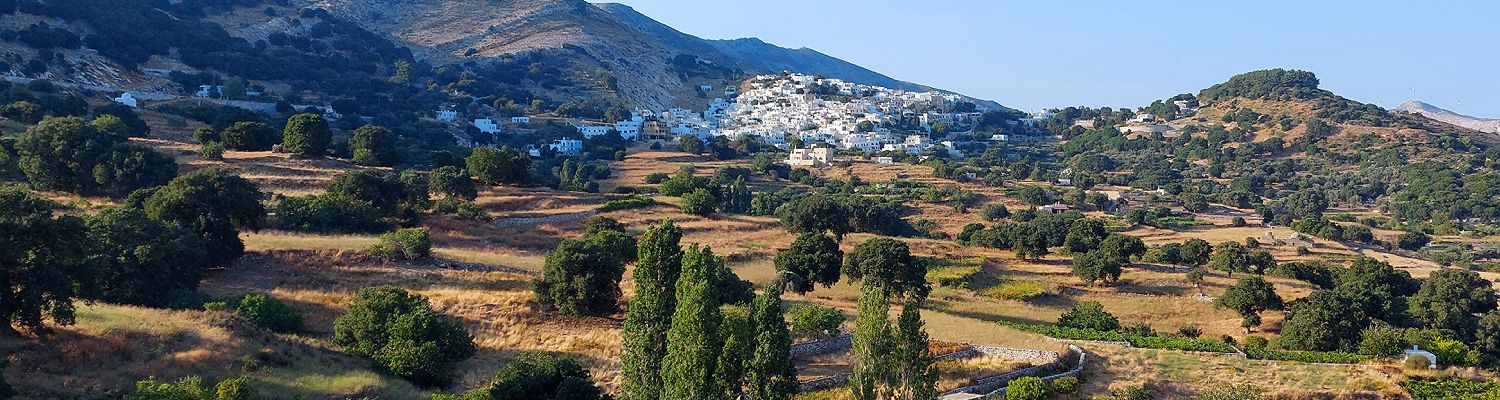
The small but intersting Byzantine church of Agios Nikolaos Troullos is located below the road from Skadhó to Komiakí, the northernmost of the mountain villages of Naxos. Komiakí lies on the edge of a large fertile and lush valley. View of Komiaki, in the foreground you can see the church of Agios Nikolaos. the small Byzantine church of Agios Nikolaos About halfway from Skadhó to Komiakí the mounalt=”Agios Nikolaos Troullos Komiaki Naxos”tain bends towards...

Continue reading

The Byzantine fortress of Apalirou

The most important Byzantine fortress of Naxos is located in the southwest of the island between the small village of Sangrí and the bay of Agiassós. The large castle complex occupies the top of the 450 m high mountain of Apalírou and overlooks one of the largest plains of Naxos. The mountain and the castle got their name from the buckthorn (Rhamnus lycioides, gr. apaliriá), which can still be found here today. Today it grows only as a low shrub; in the past, however, it...

Continue reading

The Temple of Dionysus in Iria near the Chora

The area around the capital of the island of Naxos, Chóra, has been inhabited for millennia. Excavations show that from the Early Bronze Age (Cycladic culture) on a significant settlement (excavation Grótta) existed in the same place as today’s city, which was also densely populated during the Mycenaean epoch. In the following Archaic epoch (about 8th till 6th century BC), just as today, the settlement in the Chóra was the largest settlement on the island. The...

Continue reading

The Byzantine fortress on Mount Kalogeros

Near Apóllonas on the northern tip of Naxos, the remains of a small Byzantine fortress lie on the 350 metre high mount Kalógeros. View of the Kalogeros from the harbour of Apollonas; the fortress lies on the far right. The valley from Apóllonas towards Komiakí, which is overlooked by Kalógeros, is cut into a deep V-shape. Most of the slopes here have an incline of around 45%, which seems rather intimidating (on average, the island only rises at an incline of around 3%: 1...

Continue reading

Seafaring and trade in the Cycladic culture

The earliest evidence of human presence on the Cyclades are the Paleo(!)- and Mesolithic chert tools on Naxos and the Mesolithic finds of obsidian from the island of Milos on the mainland and on other islands. Obsidian from Milos appears in 9,000 year old layers of the Franchthi Cave on the Peloponnese. There is no clear evidence that the Cyclades were already permanently inhabited at this early time. The earliest traces of settlements generally date back to the 5th...

Continue reading

Contacts to the neighbouring peoples

As an island people the inhabitants of the Cyclades always had close contacts to their neighbours. The islands were probably settled by a people from the East, from the Levant and Asia Minor. Since the Stone age close ties also existed to the northern Aegean and Bulgaria; these areas being probably settled by the same tribes advancing further north. During the Bronze age, trade with neighbouring peoples was intensified. One can summarize the relations of the Cycladic...

Continue reading

The idols and the religion of the Cycladic culture

The Cycladic idols The most famous artefacts of the Cycladic culture are doubtless the marble idols. These unique works of art testify in an especially impressive way to the craftsmanship and artistic sense of the Cycladic people. They are abstract, simple, but often very carefully crafted human figures, usually about two or three decimeters (up to 1.5 m) high. Cycladic idols were found almost exclusively in graves. Stone idols existed already during the Stone age, and...

Continue reading

Crafts in the Cycladic culture

In the Early Bronze age, crafts and techniques already known from the Neolithic age such as pottery, sculpture, metalworking and shipbuilding developed to a significantly higher level. Individual people in the community started to specialize on one special craft, so that professional crafts commenced. Trade became more and more important, especially the trade with raw materials such as obsidian and emery, but also the discovery and exploitation of metal deposits, which...

Continue reading

Metal crafts in the Cycladic culture

Even in the late Stone age, people occasionally used metal to make simple tools or jewelry. These were mostly made of metals, which could be found in a pure form in nature, not as an ore, like silver and gold, but also lead and copper. The beginning of the Bronze age was marked by the development of metal processing, in which an alloy was produced or the metal was extracted from ores. The discovery of the production of bronze, an alloy of copper with tin or arsenic, led to...

Continue reading

Cemeteries and burials in the Cycladic culture

Already during the Stone age people started to bury their dead. The oldest known graves are dated to an age of 40,000 years. The first known cemeteries are about 12,000 years old. On the Cyclades as far as I know no Stone age graves have been found. Even the well-advanced Stone age cultures of the Balkan don’t seem to have buried their dead in cemeteries. In contrast, numerous graves and cemeteries are known from the Early Bronze age, and in fact most of our...

Continue reading

Peoples and language of the Cycladic culture

We don’t know exactly who the people were who lived in the Cyclades in the Early Bronze age. There is no direct written evidence from the time of the Cycladic culture; the first writings in Greece, the Minoan Linear A- and the Mycenaean Linear B-script, appear around 2,000 and 1,400 BC respectively (after the Sumerians had already developed cuneiform writing around 3,300 BC). We know that the first Greek tribes appeared on the Greek mainland around 2,000 BC. They...

Continue reading

The settlements of the Cycladic culture

During the Neolithic age, human settlement on Naxos was probably still sparse. In the Early Bronze age, on the other hand, large areas of the island were inhabited: numerous sites have been found, especially along the south coast of the island from Moutsoúna via Pánormos and the southwest (e.g. Agiassós, Kastráki, Mikrí Vígla and Ágia Ánna) up to the Chóra; other sites have been discovered in the north and in the interior of the island (e.g. near Mélanes, Sangrí,...

Continue reading

The Cycladic culture

In the third millennium BC a remarkable culture developed on the Cyclades, the so-called Cycladic culture, which had an important centre on Naxos. It was one of the first cultures in Europe to take the step into the Bronze age: the Cycladic culture is defined as Early Bronze age, followed by the Minoan epoch (Middle Bronze age) and finally the Mycenaean epoch (Late Bronze age). Typical for the Cycladic culture (3rd millennium BC) are elaborate and unique stone vessels...

Continue reading

The history of Naxos

(Here you can jump directly to the links further down on the page.) The history of the Cyclades and of Naxos in particular is exceptionally interesting. The first humans reached the Cyclades already in the Palaeolithic age, although a permanent settlement of the island can only be proven for the Neolithic age. The step to the Bronze Age was made very early, at least several centuries earlier than in the other areas of Europe. It is no exaggeration to say that the Cyclades...

Continue reading

Neolithic

Relatively little is known about the Stone age in Naxos and in Greece, especially compared to the later times. But also in comparison to Central Europe our information about the human presence in Greece during the Stone age is quite poor. Only a few sites are known in Greece with finds from the Paleolithic and Mesolithic (600,000 to 8,000 B.C. and 8,000 to 6,500 B.C. respectively). Obsidian, which originates from the Cycladic island Milos, has been found on the Greek...

Continue reading