
Bivalvia
The Bivalvia belong to the phylum Mollusca, together with the snails and cephalopods (octopuses, squids) and some smaller groups such as the chitons and the tusk shells. Around 8,000 species have been described worldwide, which live mainly in the sea, but also in fresh water.
Here you can skip the introduction and go directly to the species.
There are comparatively few bivalvia in the seas around Naxos. Bivalvia shells can only be found on sandy or fine gravel beaches, but even there they occur in significantly smaller quantities than, for example, in the North Sea. Nevertheless, one may encounter quite a lot of species. Living bivalvia are difficult to spot: they live buried in the sand, burrowing into limestone or among the calcareous algae in the rocky littoral zone.
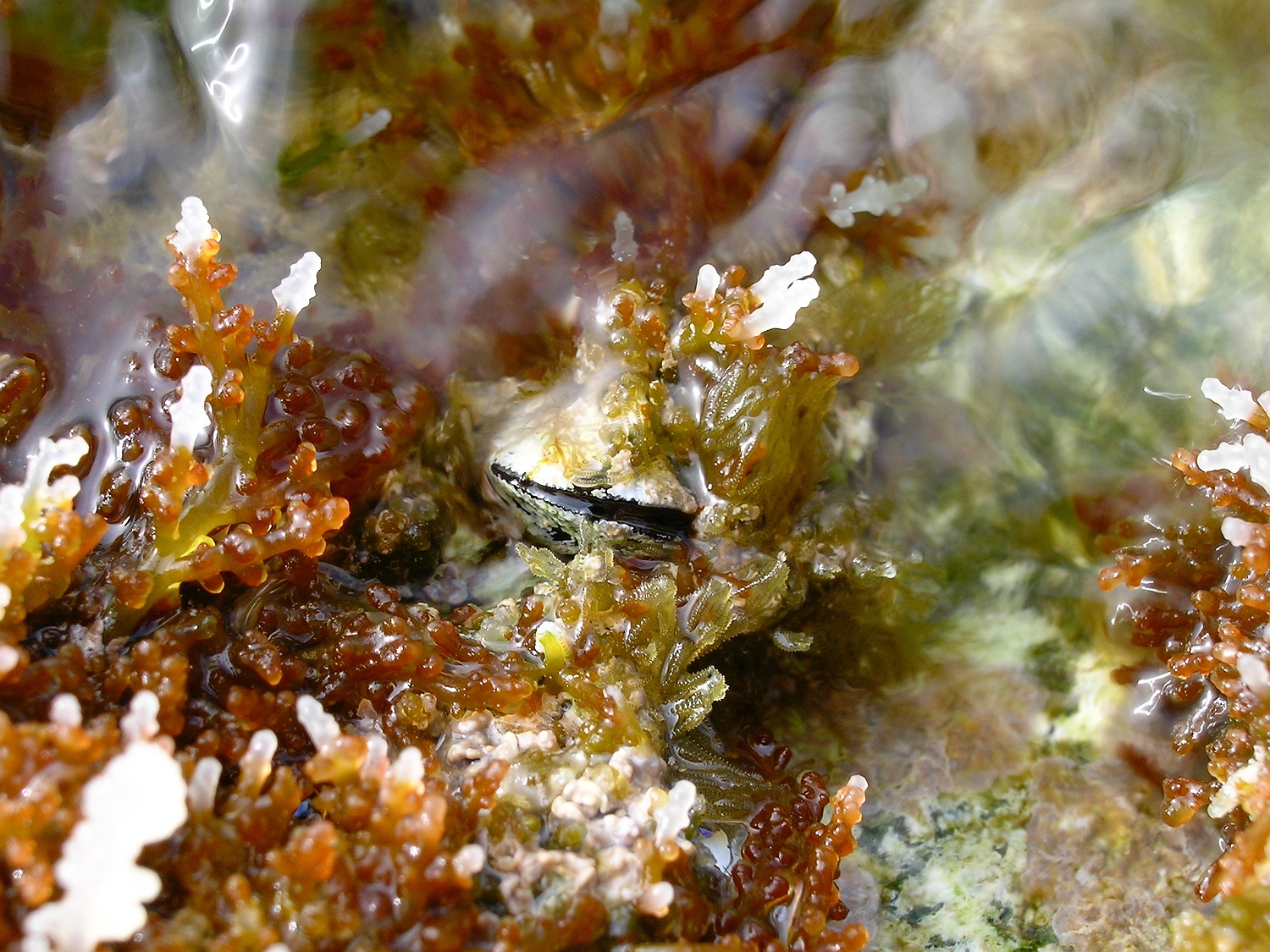
Most bivalvia are difficult to spot, both because of their small size and because they are usually mostly overgrown with algae.
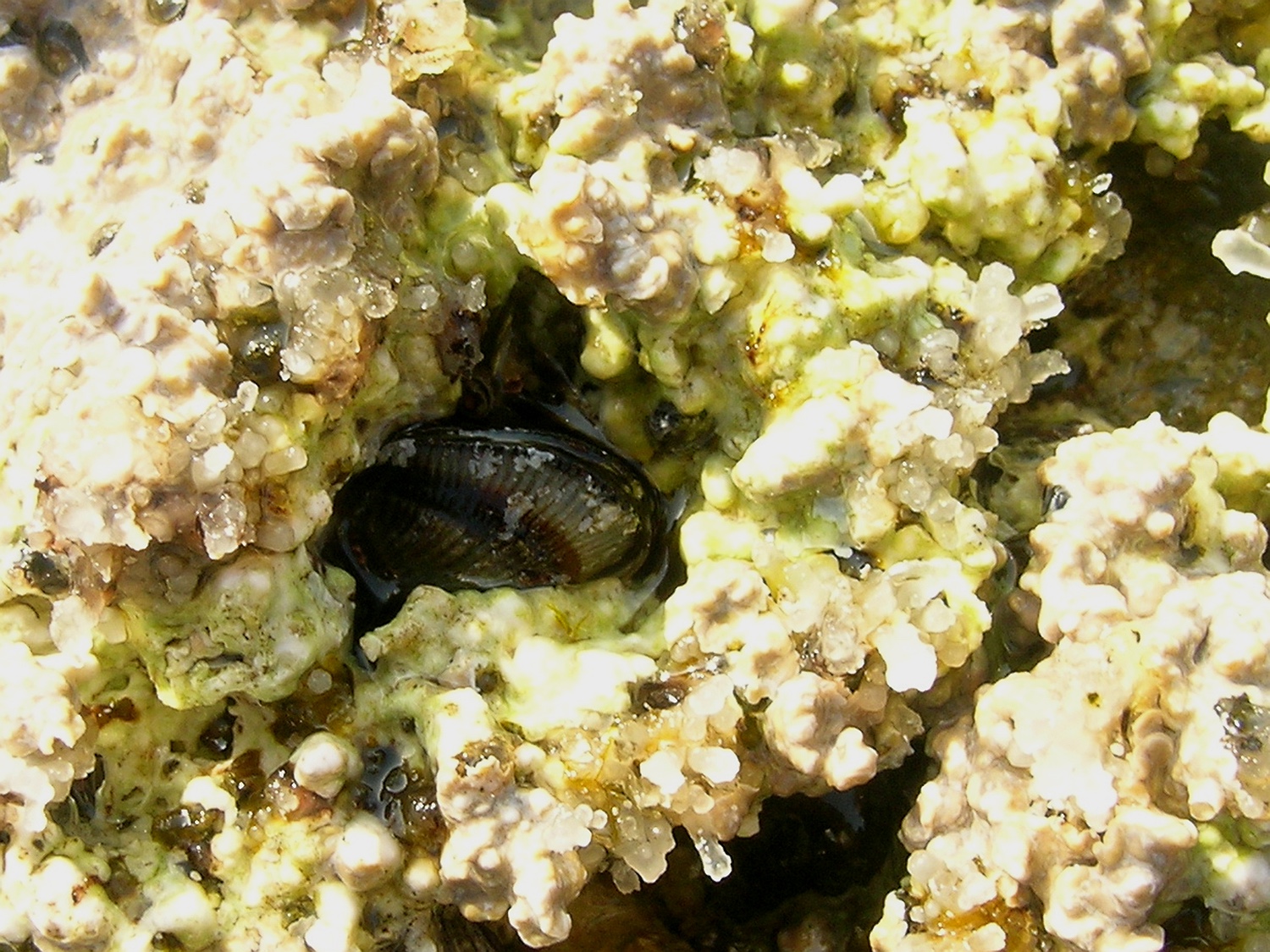
bivalve in shallow water
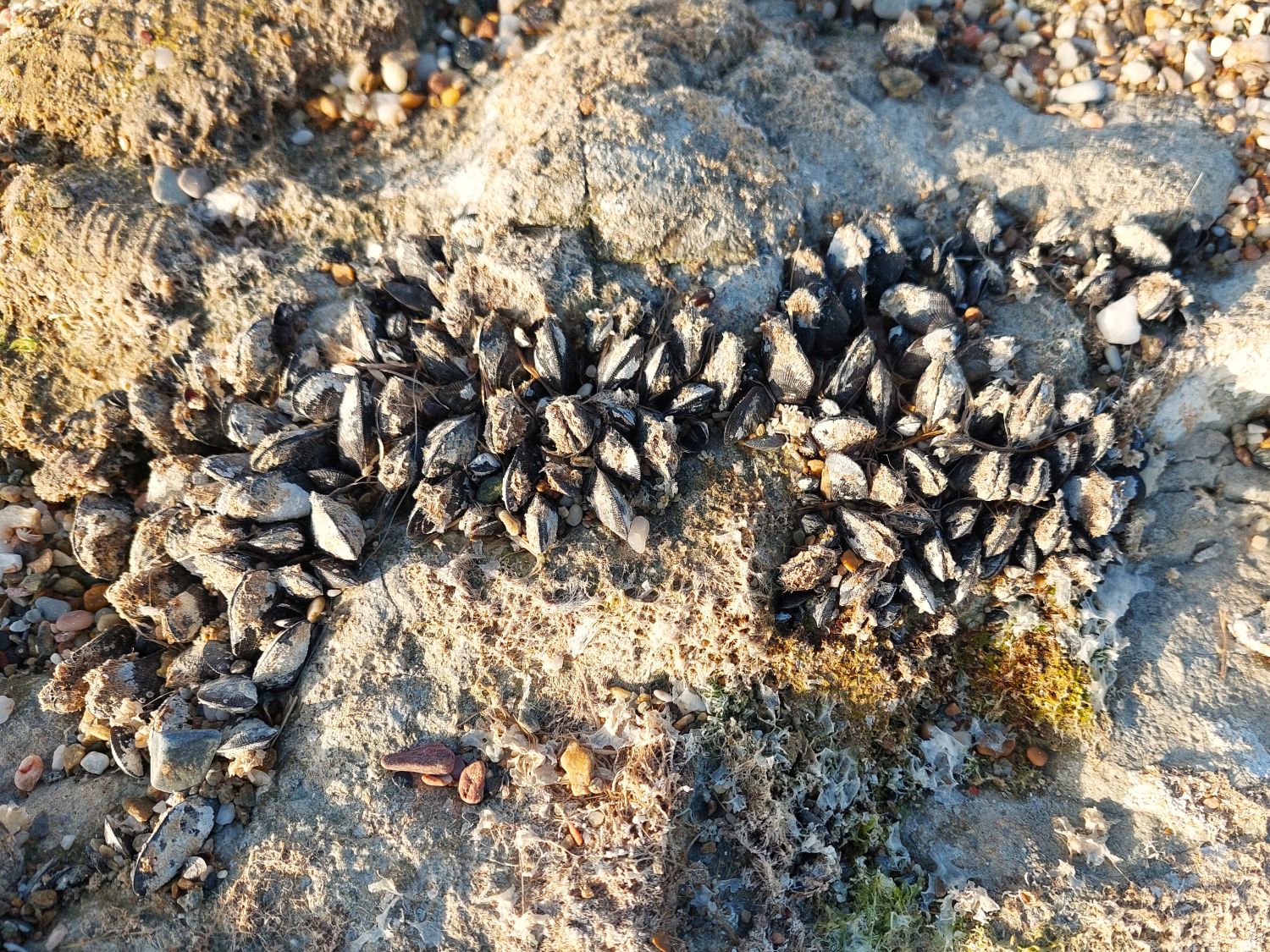
The small mussel species Brachidontes pharaonis sits in clusters directly at the waterline.

Only on the larger sandy beaches of Naxos can one sometimes find bivalvia in larger numbers; here at the lagoon south of Chóra.
The shell
In contrast to snails, bivalvia have two shells that they can open and close. The shells are held together by the hinge, which is equipped with characteristic teeth. The shell is calcareous and (in living animals) covered on the outside by a thin membrane, the periostracum, which also extends over the hinge as ligament. Inside, it often has a shiny layer of mother-of-pearl or nacre.

Here you see the hinge of a clam shell with its characteristic teeth.
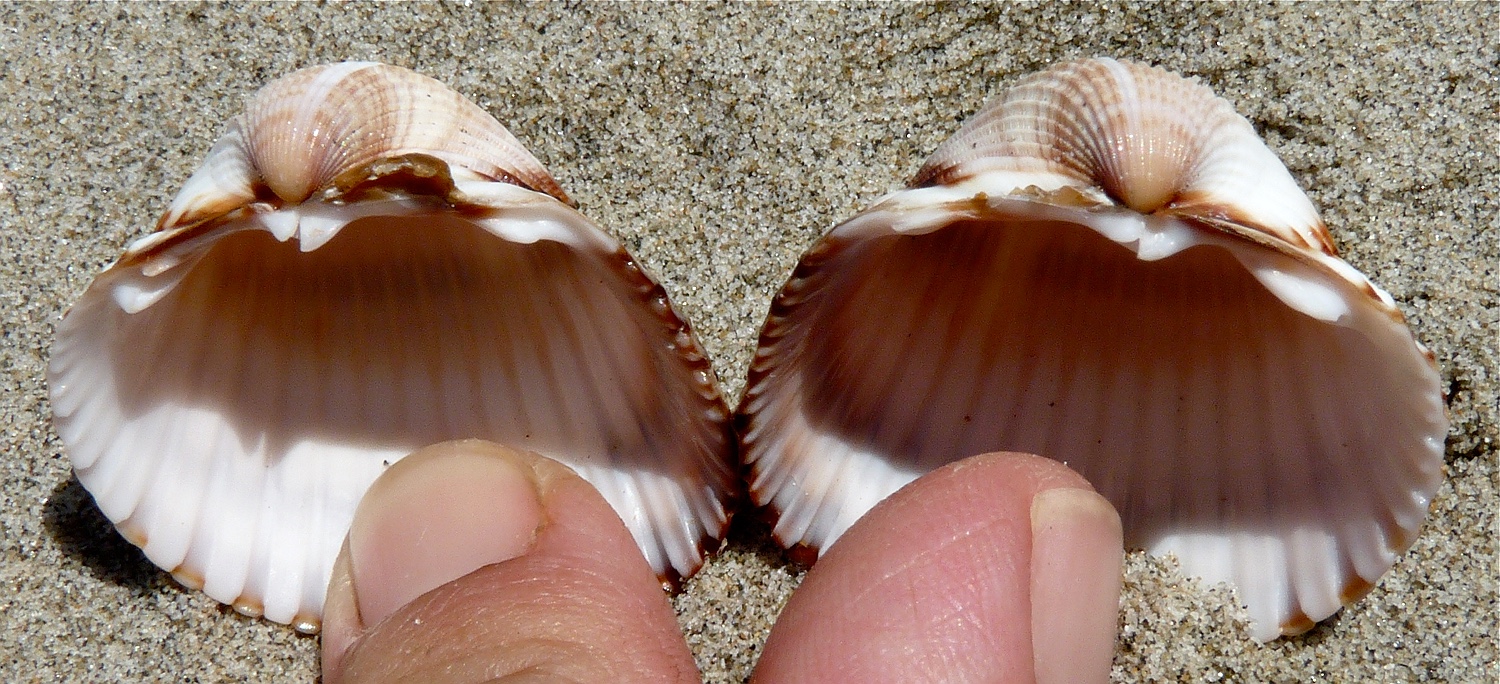
On this cockle, you can see the strongly protruding main teeth and the lateral ridge-like side teeth.
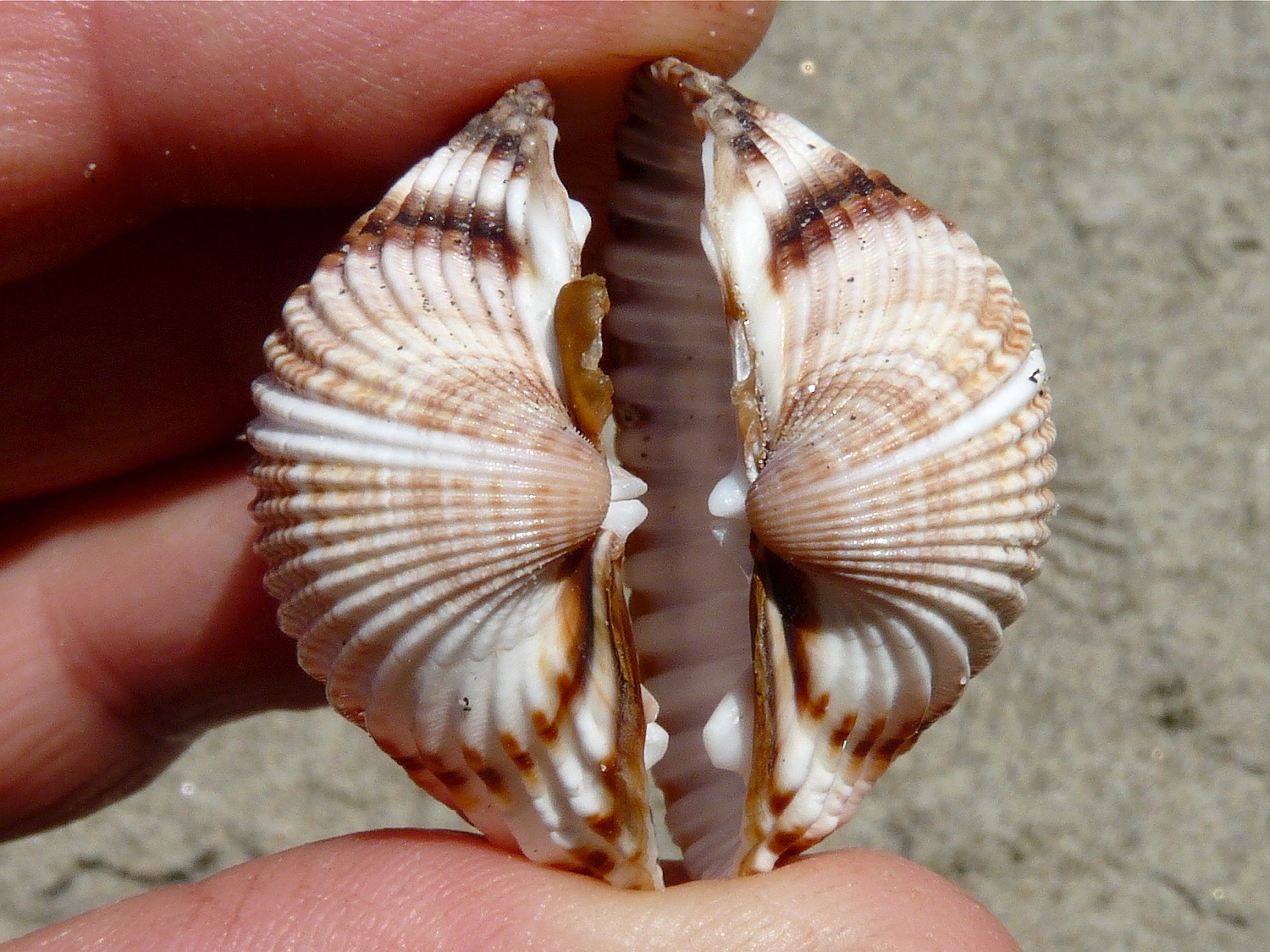
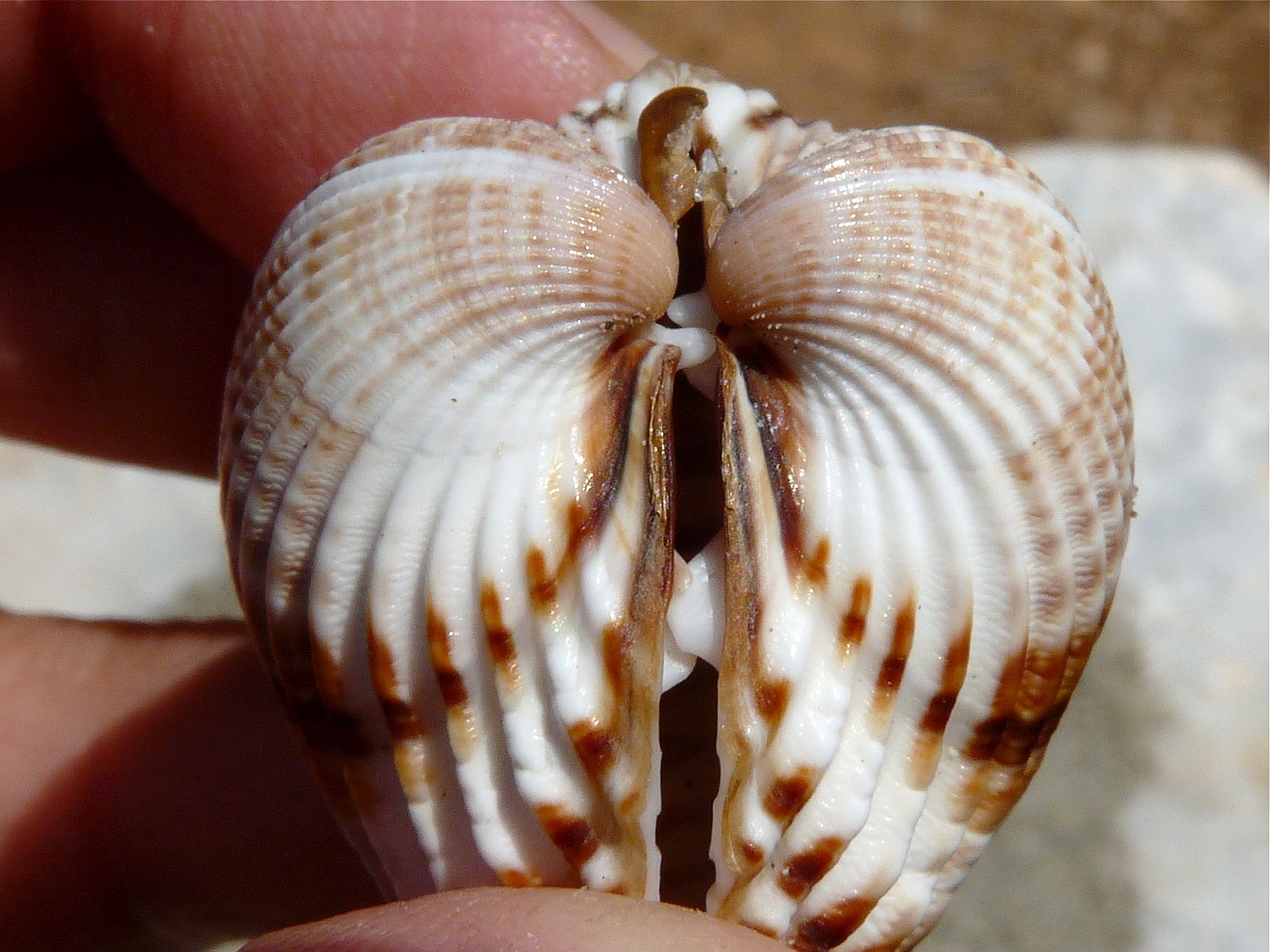
The teeth fit perfectly.
Anatomy
Bivalvia show a simple anatomy. The body consists of a rudimentary head, the foot, which in species living in the sand can extend like a tube (siphon) to the surface of the sand, and two mantle lobes attached to the shells which surround a body cavity, in which the gills and simple digestive organs are located. The side of the shell where the siphon is located is called the rear end. Many bivalvia are asymmetrical: in many species, the rear and is slightly longer and more pointed than the front end (although sometimes it is the other way around!). In some species, the two shells are also different in form, e.g. one may be more convex.
Bivalvia can close their shells so tightly with their adductor muscles that it is very difficult to open them when the animal is alive. On the inside of the shell, you can often see the imprints (“scars”) of the adductor muscles, which are sometimes connected by a characteristically shaped line. At the rear, where the siphon that can be retracted into the shell is located, this mantle line is often slightly indented. This also allows you to identify which shell you are looking at: if you look inside the left shell, the rear edge with the siphon and the indentation of the mantle line lies on the left.
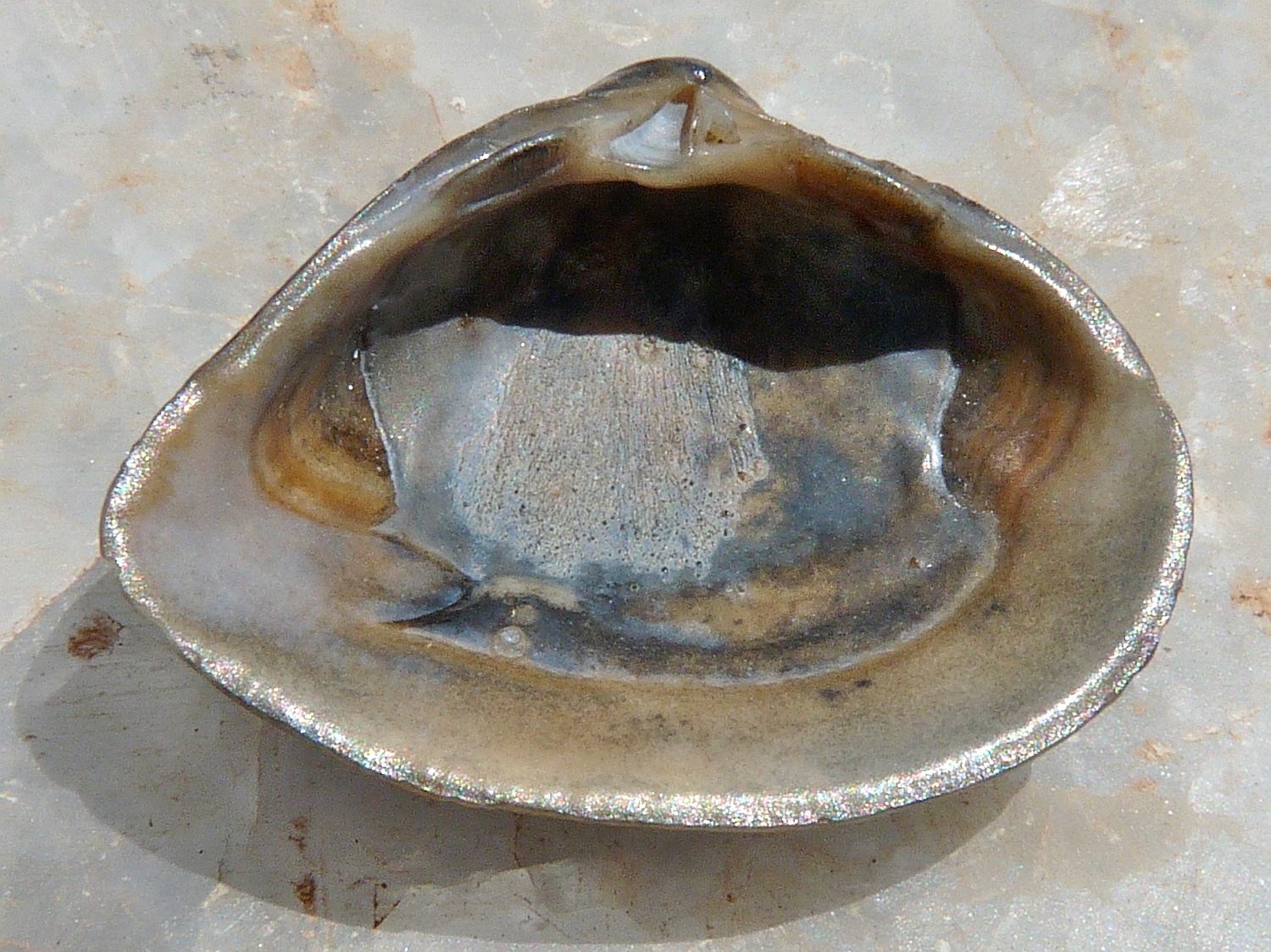
The two round brown spots on the right and left sides of the shell are the attachment points of the adductor muscles. The shape of the muscle “scars” and of the mantle line connecting them are often important identifying features. Here, you can see a small indentation in the mantle line on the left side of the shell, which means that this side is the rear end of the bivalve, and that it is a left shell.
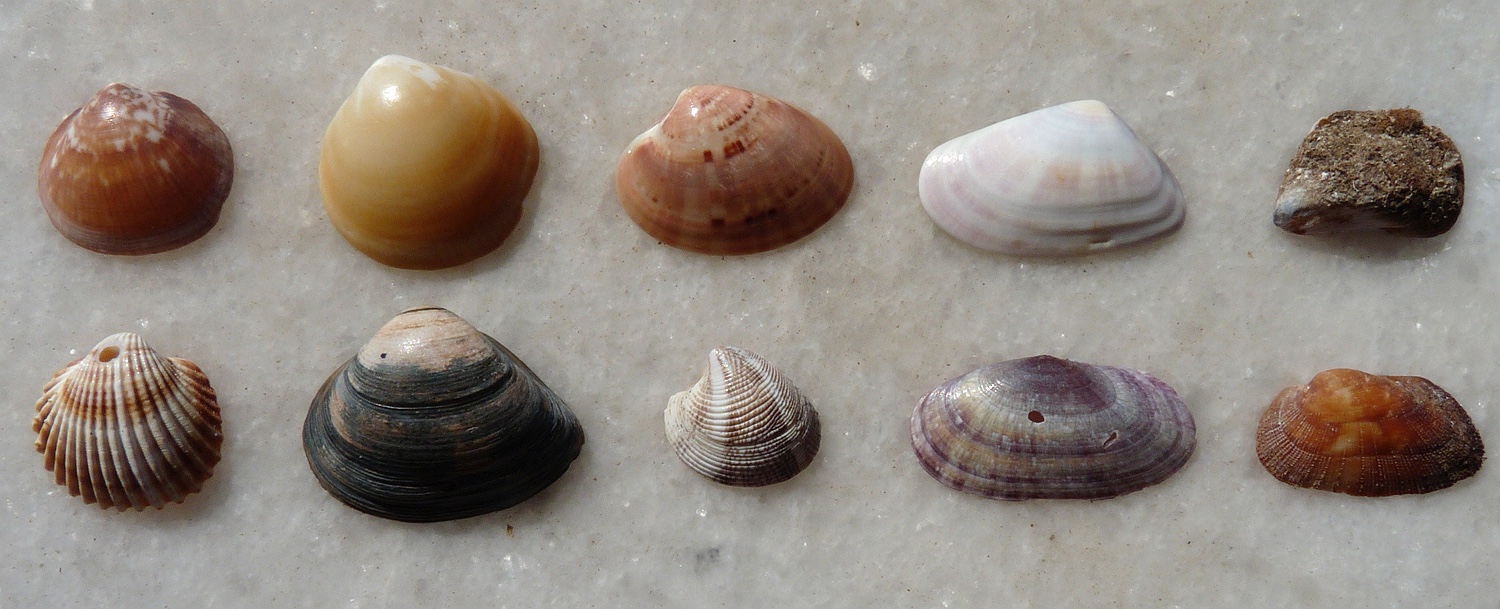
Most bivalves are at least slightly asymmetrical. The hinge is usually shifted towards the front end, but sometimes also towards the rear end. The photo shows only left shells, meaning that the front ends are on the left.
Most bivalvia hardly move and often attach themselves to the substrate with thin but very durable threads (“byssus”). However, there are also some species that can swim or actively burrow into the sand. Others can even jump away with the help of their foot when a predator approaches.
Diet and reproduction
Most bivalvia feed on plankton, which they capture by filtering the water using their specially developed gills. They filter large amounts of water every day and therefore play an important role in the ecosystem, especially in plankton-rich seas, where they occur in much greater numbers than in the nutrient- and plankton-poor Mediterranean Sea. A number of bivalvia do not feed by filtering, but instead use their siphon to collect small detritus particles from the sand surface.
Most mussels are dioecious and release large numbers of eggs and sperm into the water. After fertilisation, a veliger or trochophora larva develops, that drifts in the plankton. After some time, it metamorphoses into a juvenile bivalve and settles on a suitable substrate.
Species of bivalvia on Naxos
Species of bivalvia on Naxos
The Photo gallery of the marine snails gives an overview over the species.
A note on identification: Some species usually can be identified easily and reliably. In many cases, however, several related species are difficult to distinguish. Also not all species are included in the field guides; even using the internet, it is difficult to find information on some species. Accordingly, some of the identifications may not be correct.
And a word about the names: As with many marine animals, there is a great deal of confusion surrounding the names of snails: for almost all species, a large number of synonyms exist that are no longer valid today but are still used in older books. I use the names according to the World Register of Marine Species (as of 2020), where you can also find the corresponding synonyms.
Here you can jump directly to the species (return with the back arrow or by swiping back):
Mussels (Modiolus, Brachidontes) – Date mussel (Lithophaga) – Ark shells (Arca, Barbatia, Striarca) – Dog cockles (Glycymeris) – Pearl oyster (Pinctada) – Pen shells (Pinna) – Fileclams (Lima, Limaria) – Scallops (Manupecten, Mimachlamys) – Oysters (Spondylus, Ostrea, Neopycnodonte) – Saddle oysters (Anomia) – Hatchet shells (Loripes, Ctena) – Cardita, Cardites – Cockles (Acanthocardia, Laevicardium) – Pseudochama – Trough shells, (Mactra, Spisula) – Peronaea – Sunset clams (Gari, Solecurtus) – Wedge clams (Donax) – Furrow shells (Abra) – Venus clams, Carpet shells (Chamelea, Venus, Callista, Ruditapes, Globivenus)
The size indicated for the photos is the largest measurement of the largest specimen shown (either the height or length, depending on the shape).
Bearded horse mussel, Modiolus barbatus, L.
very common
The Bearded horse mussel has the characteristic shape and colour of a mussel. The shell carries a bristly periostracum, which usually remains intact even after the animal has died. The bearded mussel lives on hard substrates, to which it attaches itself with byssus threads. Size up to 6.5 cm.
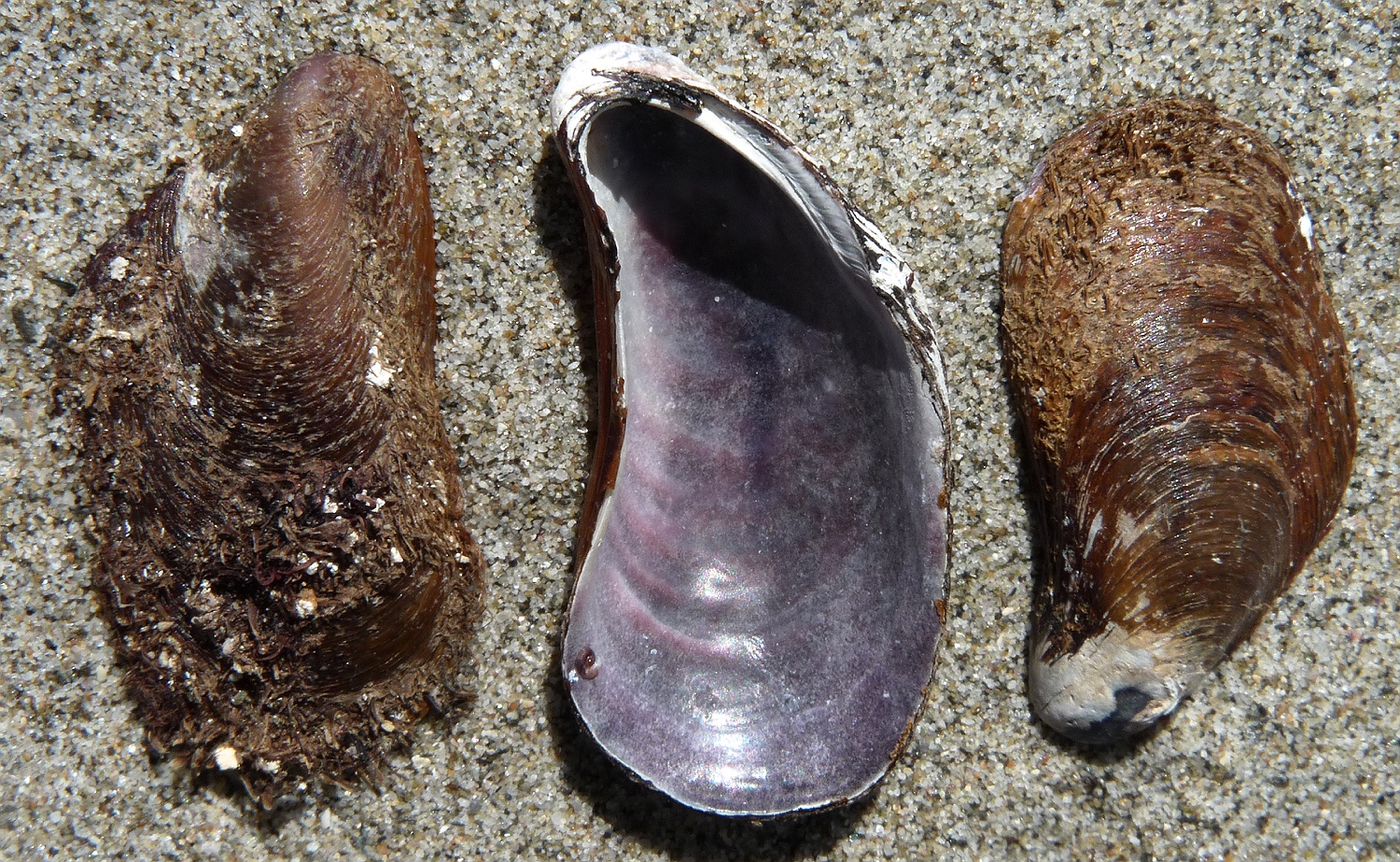
The Bearded horse mussel is one of two “hairy” mussels in our area. Size: 40 mm
Brachidontes pharaonis, P. Fischer
locally common, direclty at the waterline
This small mussel species migrated from the Red Sea into the Mediterranean Sea via the Suez Canal. It has now reached the western Mediterranean and is found in high densities in some places; it is one of the invasive species that are capable of displacing native species.
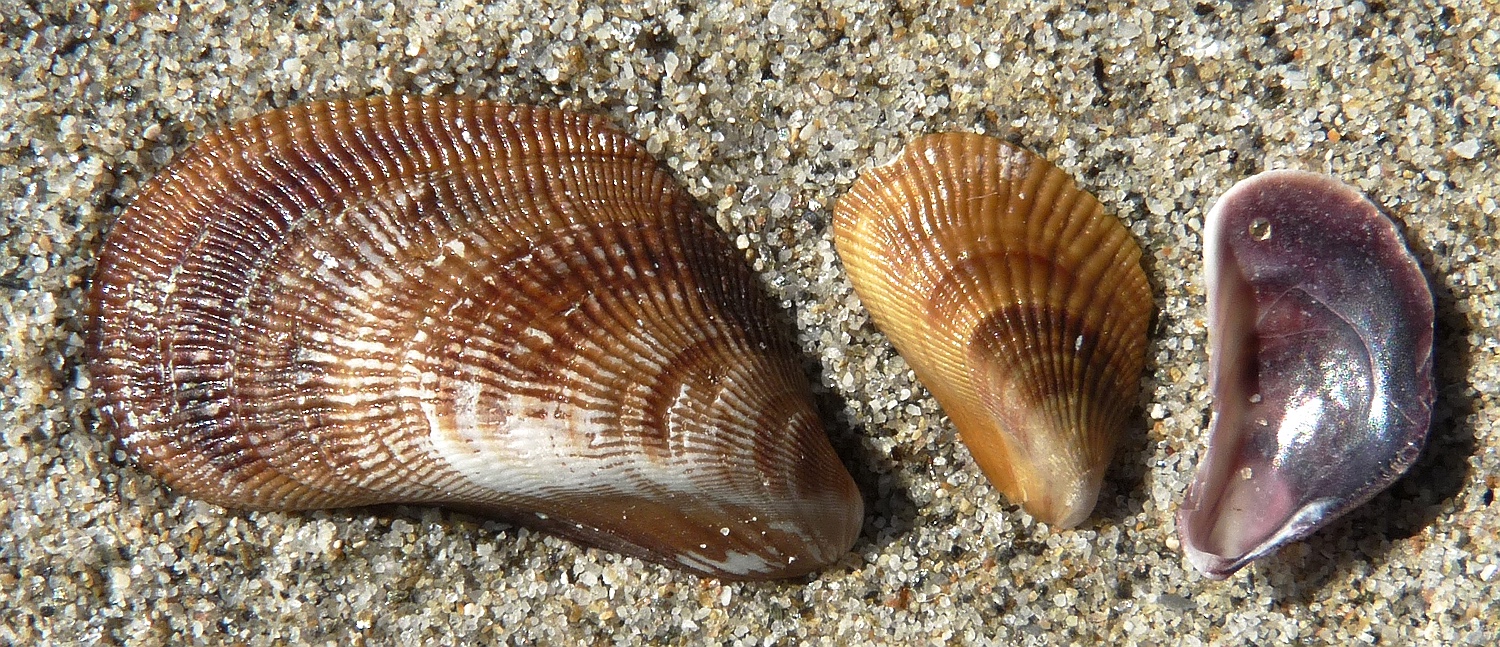
Brachidontes pharaonis can be recognised by the fine radial, fan-shaped ribs on the shells. Size: 22 mm
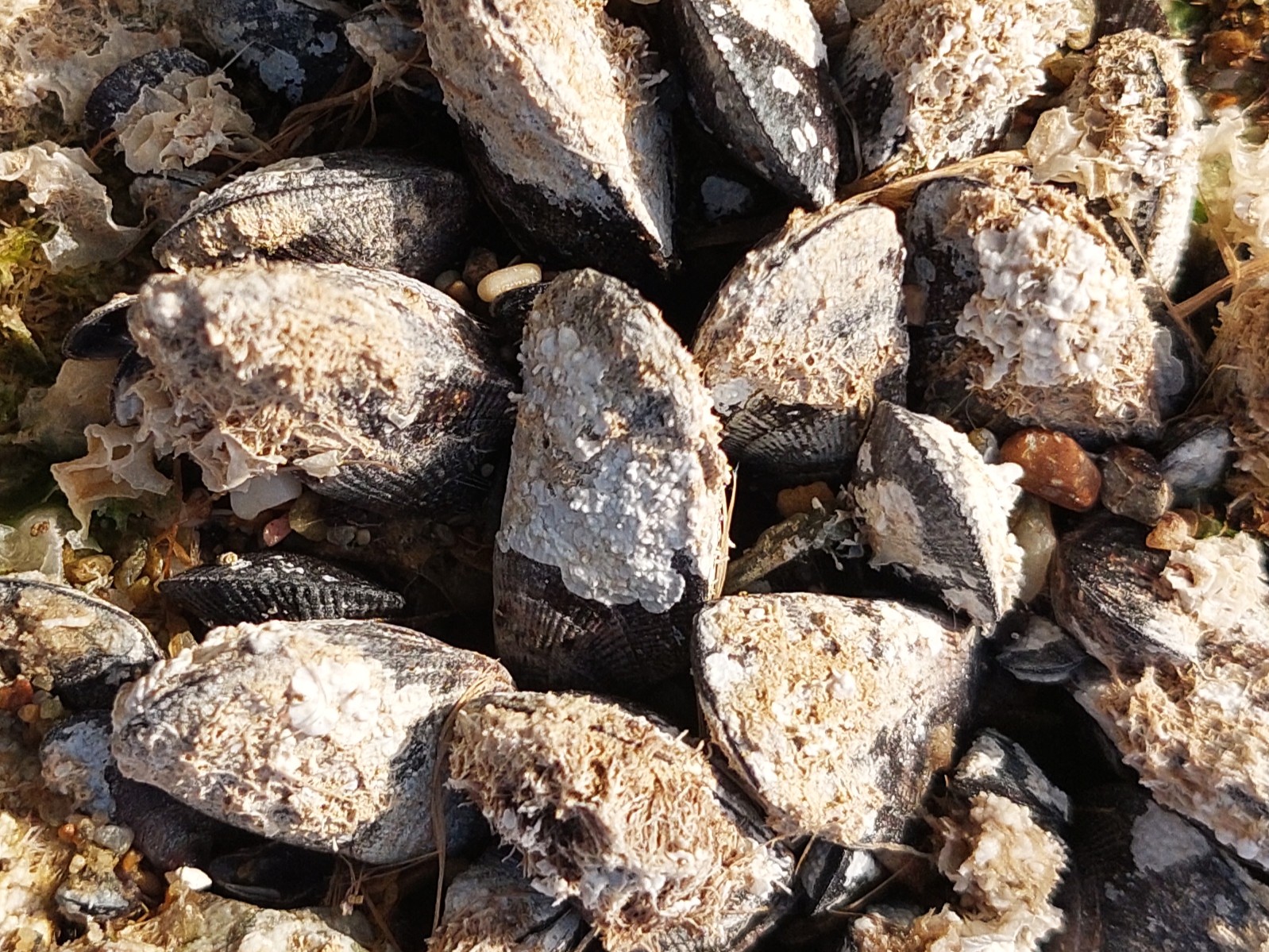
In Pánormos this species sits in small clusters directly at the waterline.
Date mussel, Lithophaga lithophaga, L.
rather common, but hard to find
The Date mussel is elongated, with the hinge connecting the two halves located at one end. It lives in limestone: as it grows, it etches a deep, smooth hole into the rock using acids to dissolve the stone, in which it fits exactly and which takes on the exact shape of its body. Only the brown end of the mussel is visible from the outside.
The Date mussel grows very slowly; it takes up to 20 years to reach a size of five centimeters. It can reach a length of 10 cm. It feeds by filtering the water. It is edible, but to my knowledge it is not collected on Naxos.
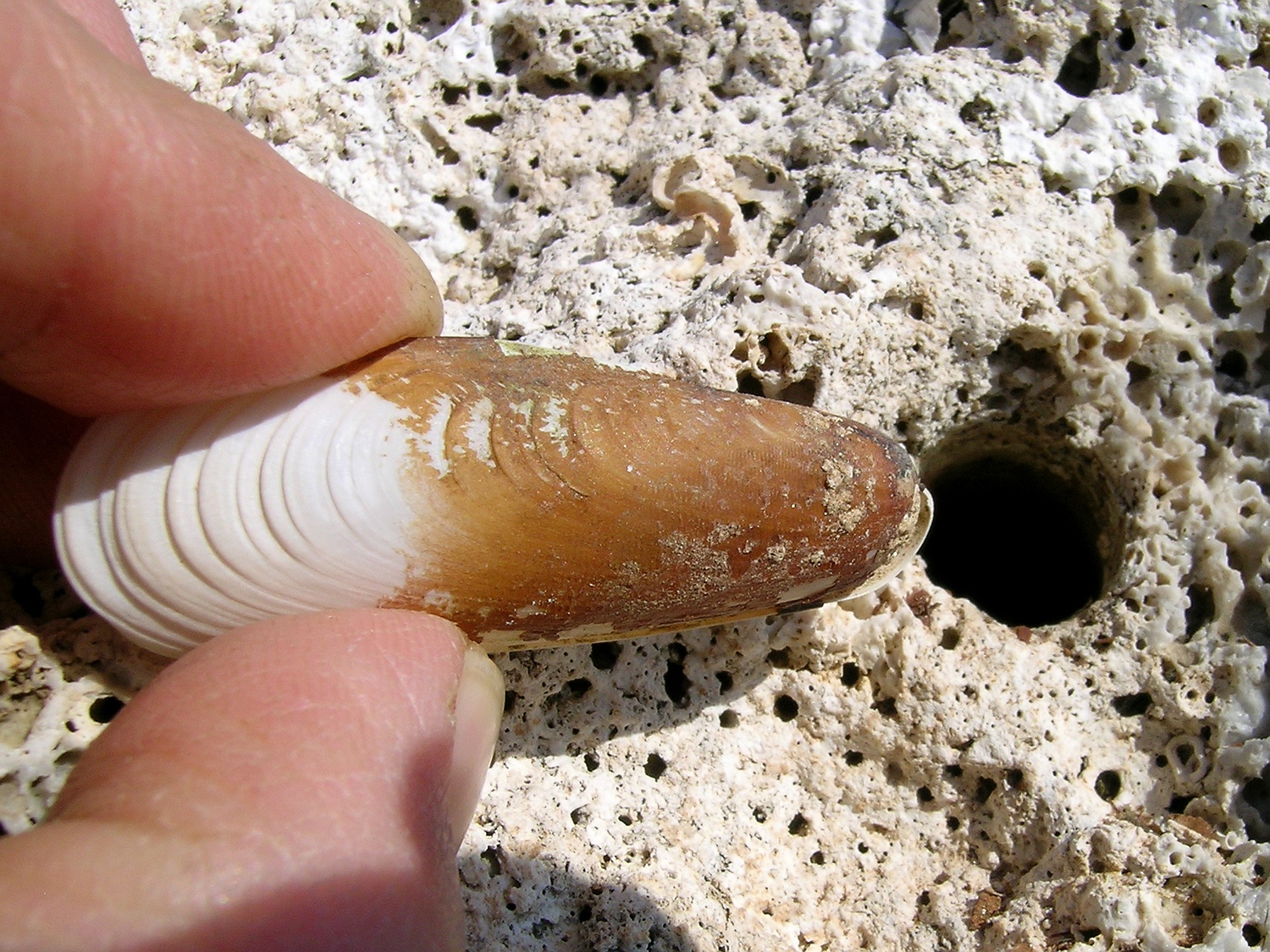
a dead Date mussel and its hole, size: 40 mm
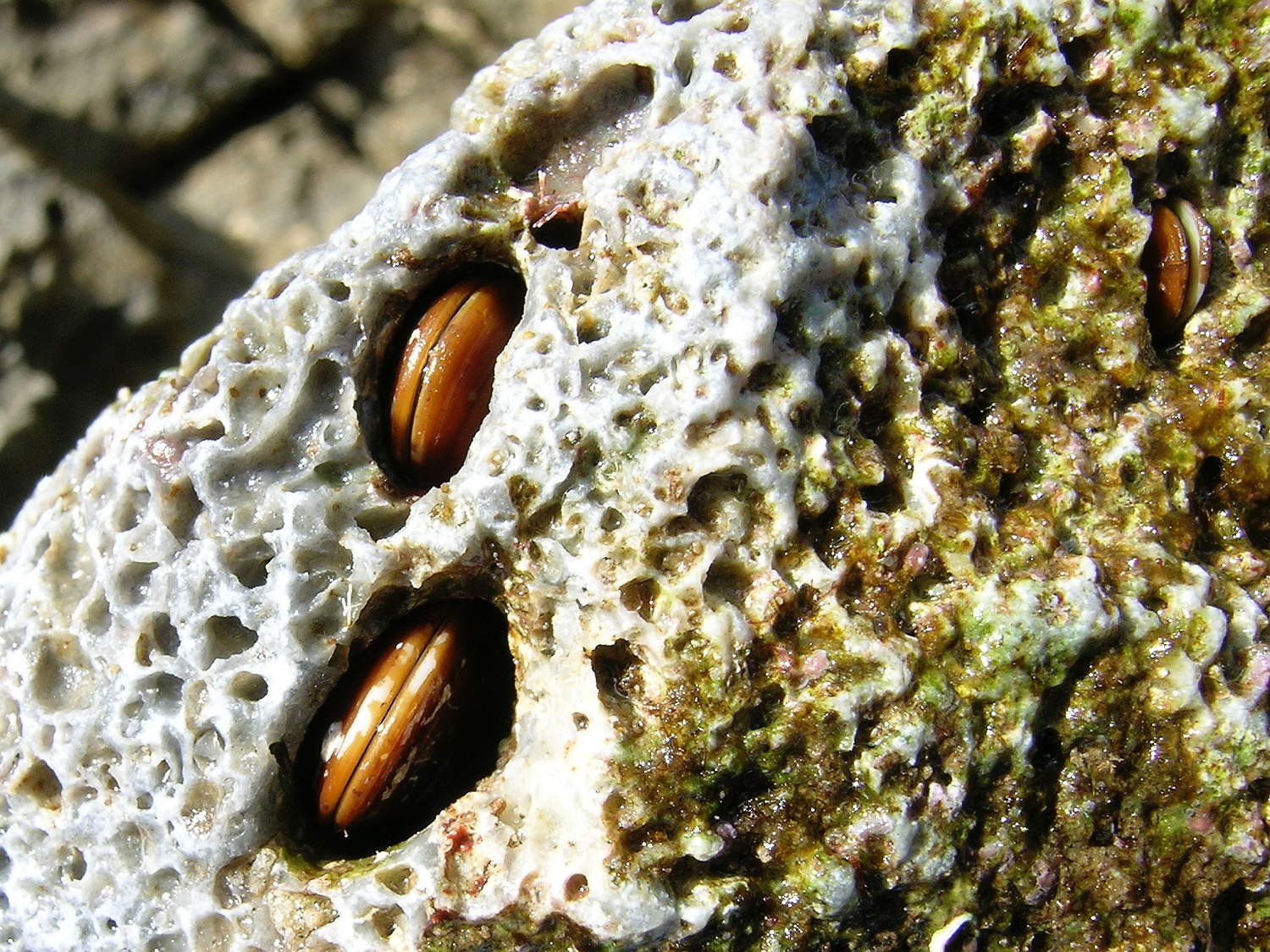
live Date mussels in a rock
Noah’s Ark shell, Arca noae, L.
very common
Noah’s Ark shell has an elongated, boat-shaped shell. When closed, the whorls of the two shells do not lie close together, but are clearly separated from each other. As with all ark shells, the hinge consists of numerous small teeth arranged in a straight line along the upper edge of the shell (taxodont hinge). The shell is radially ribbed and has a pattern of reddish-brown zigzag bands. Noah’s ark shell lives attached to hard surfaces. Size up to 12 cm.
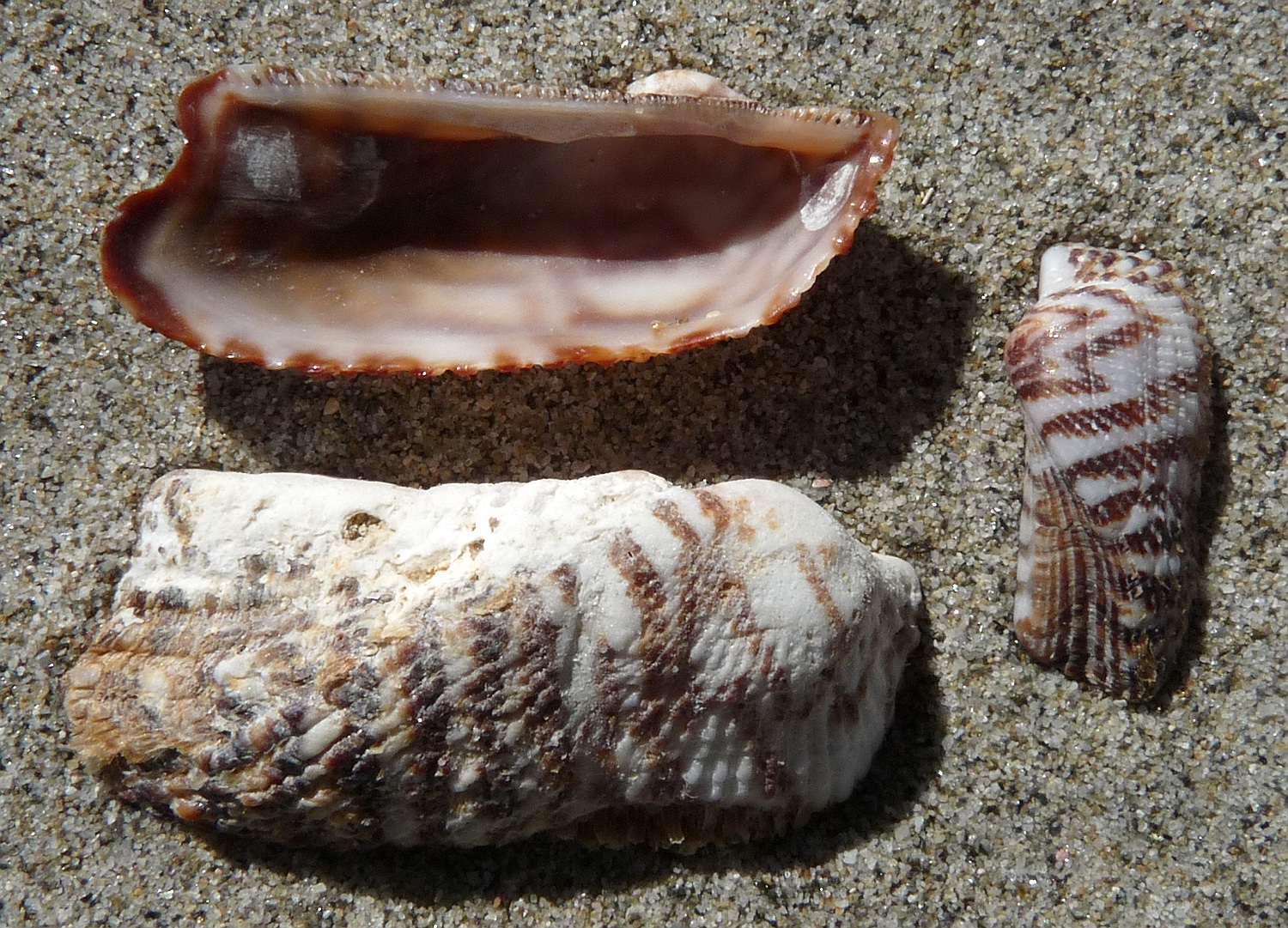
Noah’s Ark shell is easily recognised by the form of its shell. Size: 70 mm
Barbatia barbata, L.
very common
The shell of this species is also elongated, but more rounded than the previous one. The shell is brown, and the periostracum bears distinct, long bristles on the lower half, similar to the Bearded mussel, from which it can be distinguished by the shape and the fine sculpture of the shell.
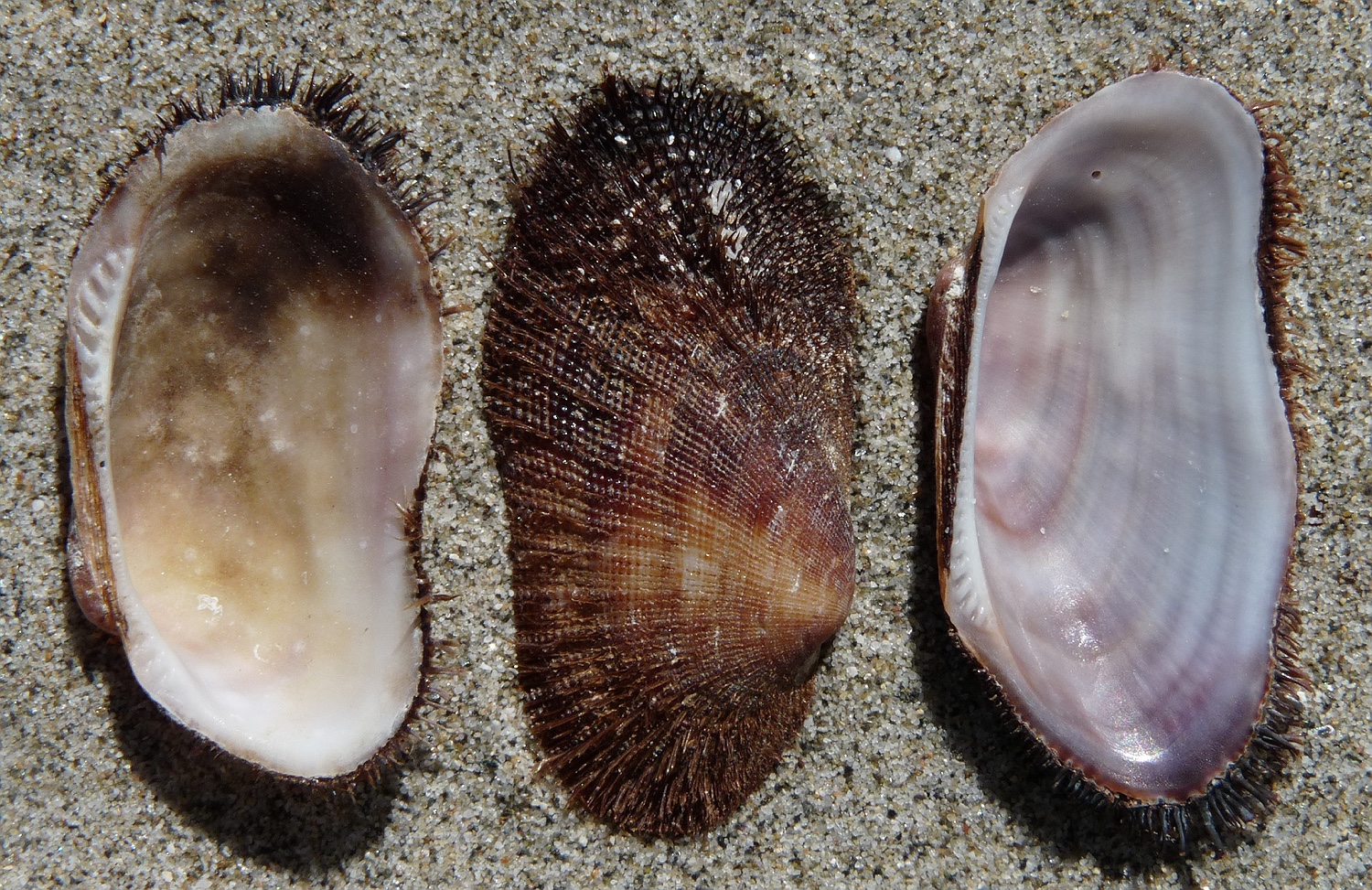
Barbatia barbata has a hairy peristracum. Size: 50 mm
Striarca lactea ?, L.
locally quite common
The small species Striarca lactea belongs to the ark mussels with its long hinge with many small teeth. Our specimens are white, not brownish as usual, and only slightly ribbed, which may be due to the surface being worn away; the identification is not entirely certain.
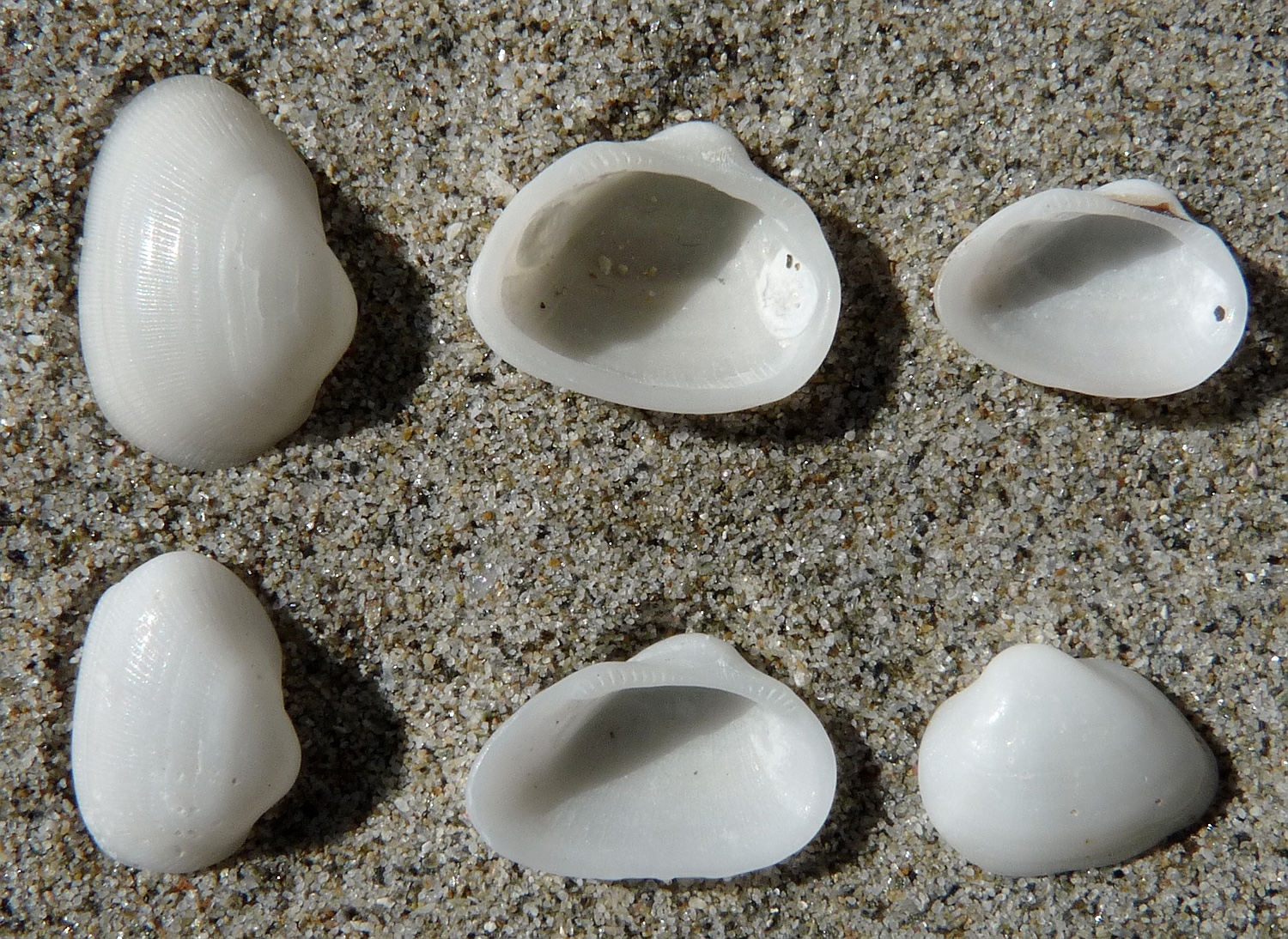
The small ark mussel Striarca lactea has a white, finely ribbed, oval shell with a lock consisting of numerous small teeth on the upper edge. Size: 14 mm
Dog cockle, Glycymeris glycymeris, L.
rare
Members of the genus Glycymeris can be recognised by their thick, round shell with a finely notched inner edge. The shell has no main teeth, but a whole row of secondary teeth on the upper edge. The Dog cockle grows to a size of up to 8 cm. When alive, the shell has a velvety hairy periostracum. Dog cockles live on sandy bottoms at depths of usually 25 to 50 m and can live to be over 100 years old. They are edible and are collected in many areas. The Dog cockle is found in the Atlantic, the Mediterranean and the North Sea.
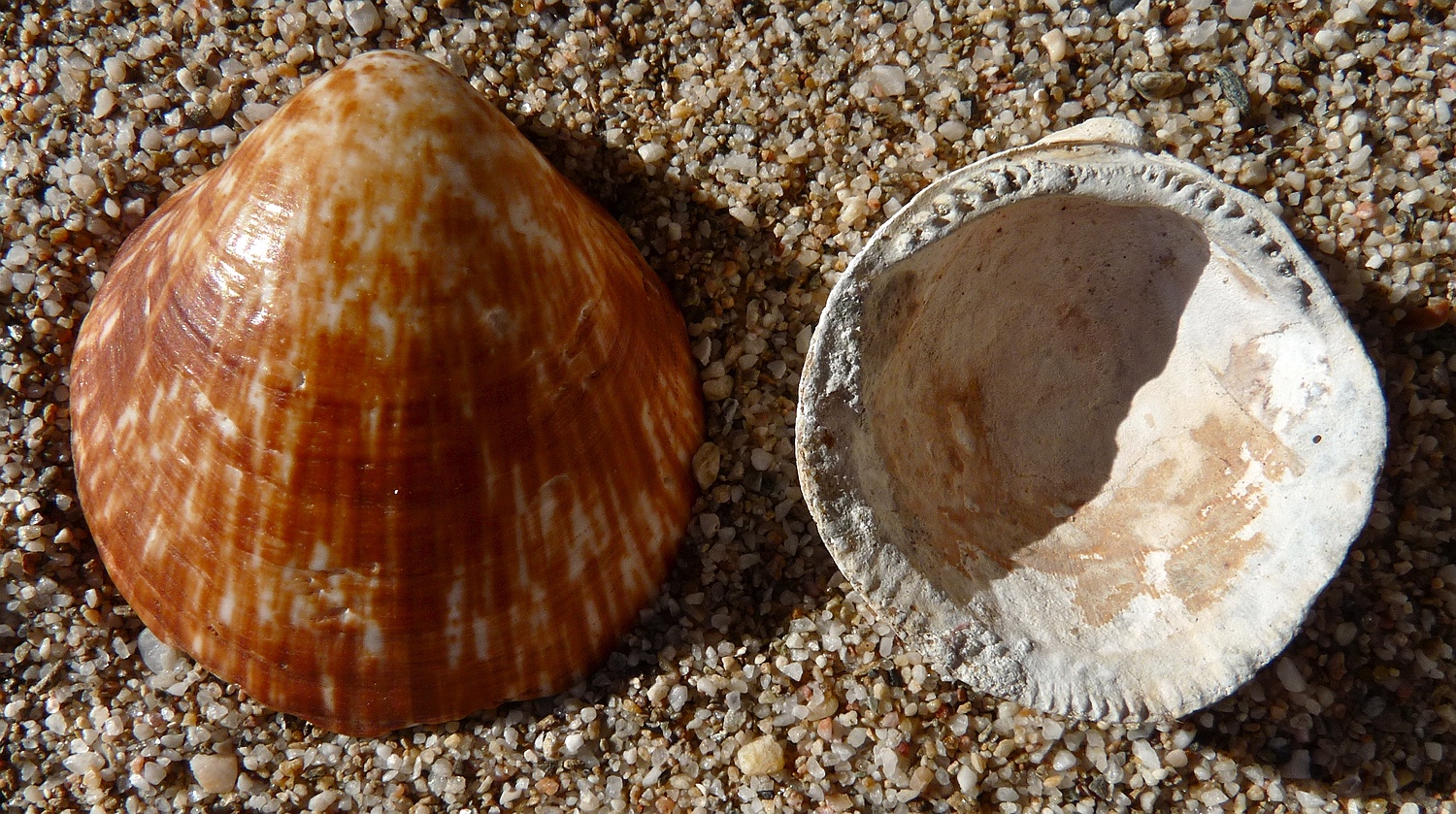
The Dog cockle can be recognised by the zigzag pattern on the almost round, thick shell. Size: 50 mm
Glycymeris bimaculata, Poli
rather common
The similar species Glycymeris bimaculata shows fine radial stripes and concentric rings that form a delicate lattice pattern. It is slightly larger than the Dog cockle.
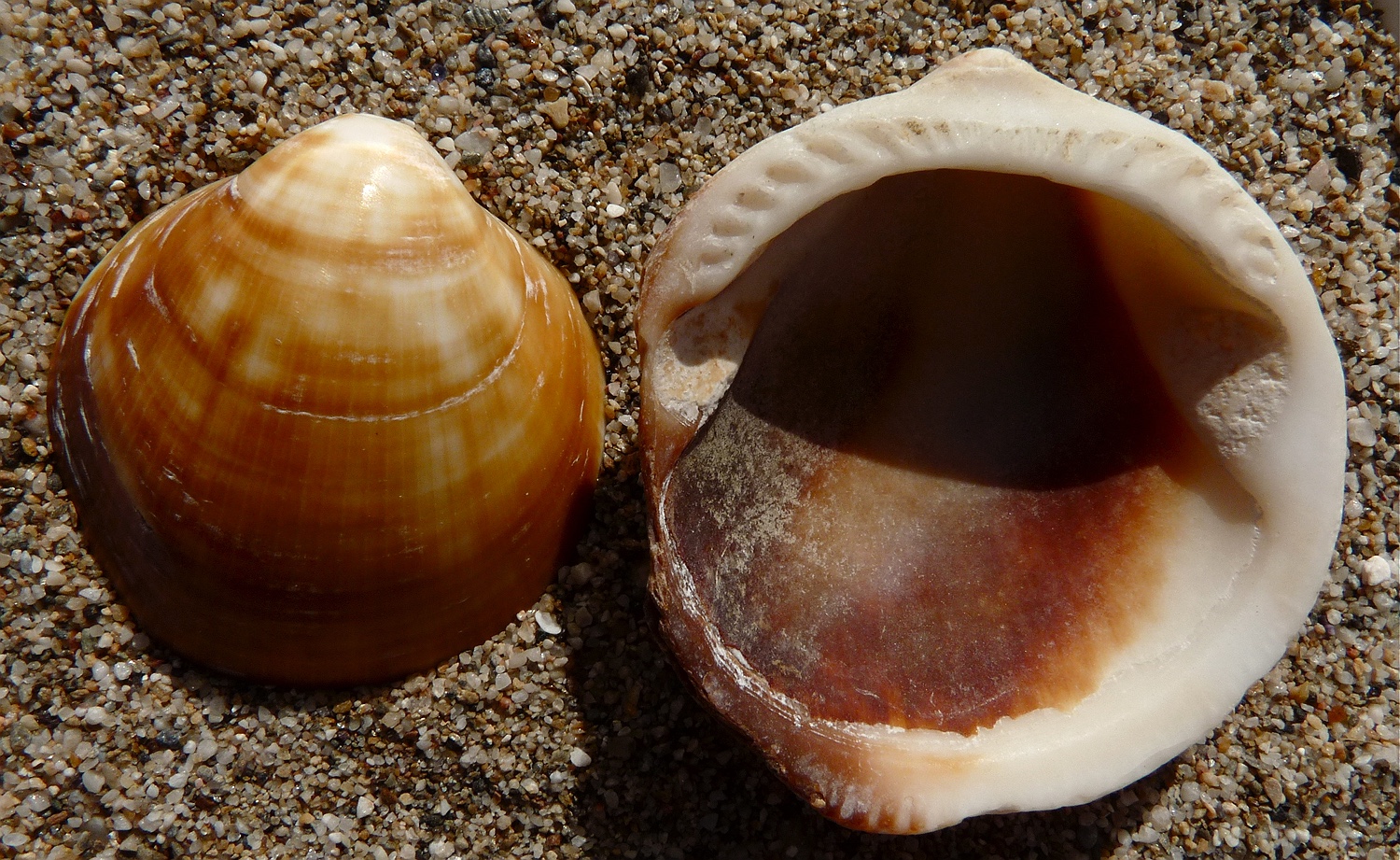
The shell of Glycymeris bimaculata resembles that of the previous species. Size: 47 mm
Rayed pearl oyster, Pinctada imbricata, Röding
rather common
This beautiful bivalve belongs to the family Pteriidae. It is very flat and almost rectangular in shape with one very straight edge. The upper side shows irregular radial ridges and is greenish or grey in colour; the inside is covered with nacre.
The Rayed pearl oyster migrated from the Red Sea into the Mediterranean after the opening of the Suez Canal. It lives attached to hard surfaces. Size up to 7 cm.
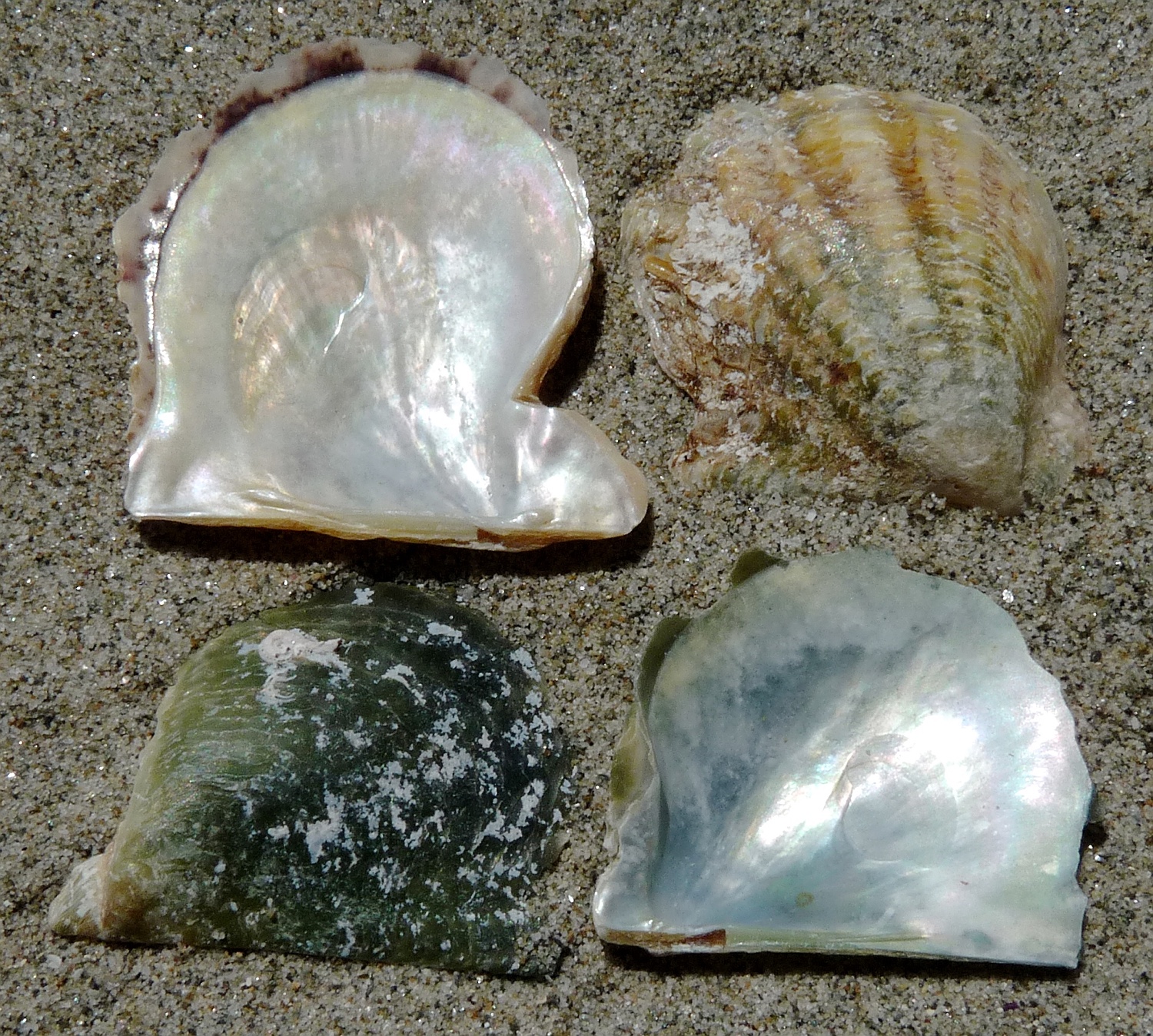
The Rayed pearl oyster is easily recognised by its characteristic form. The inside is strongly pearlescent. Size: 30 mm
Noble pen shell, Pinna nobilis, L.
rare, only found in deep water; fragments of small specimens can occasionally be found on the beach
The Noble pen shell is the largest bivalve in Europe, growing up to 80 cm in length. It lives in sandy soils, often next to or in seagrass meadows. The shell sticks in the sand with its thin end and is anchored to the substrate with strong byssus threads.
In the Middle Ages, the very fine but extremely durable, golden-shimmering byssus threads were knitted into expensive garment articles such as gloves. The Noble pen shell is edible and was often collected in the past, but is now protected throughout Europe. It lives for many years, which is why diminished populations take a long time to recover. Around Naxos, Noble pen shells can be found in some areas in deeper water. However, the shell in the photo comes from northern Greece, where they are often washed up on some beaches. Unfortunately, Noble pen shells are declining, not only because they are collected and affected by trawling, but more recently also because of the rise in sea temperatures due to climate change.
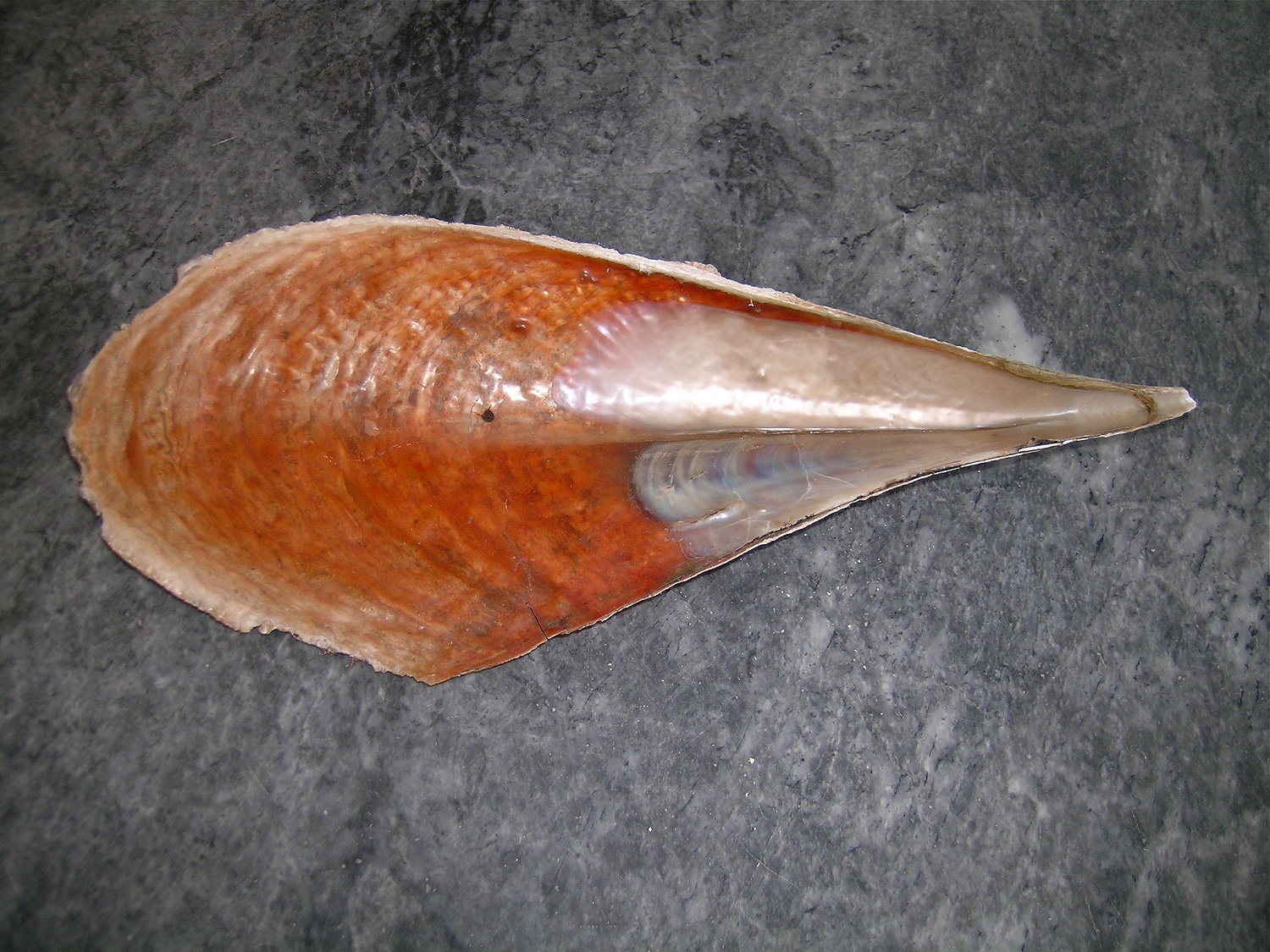
The Noble pen shell is the largest bivalve of Europe. Size: 500 mm
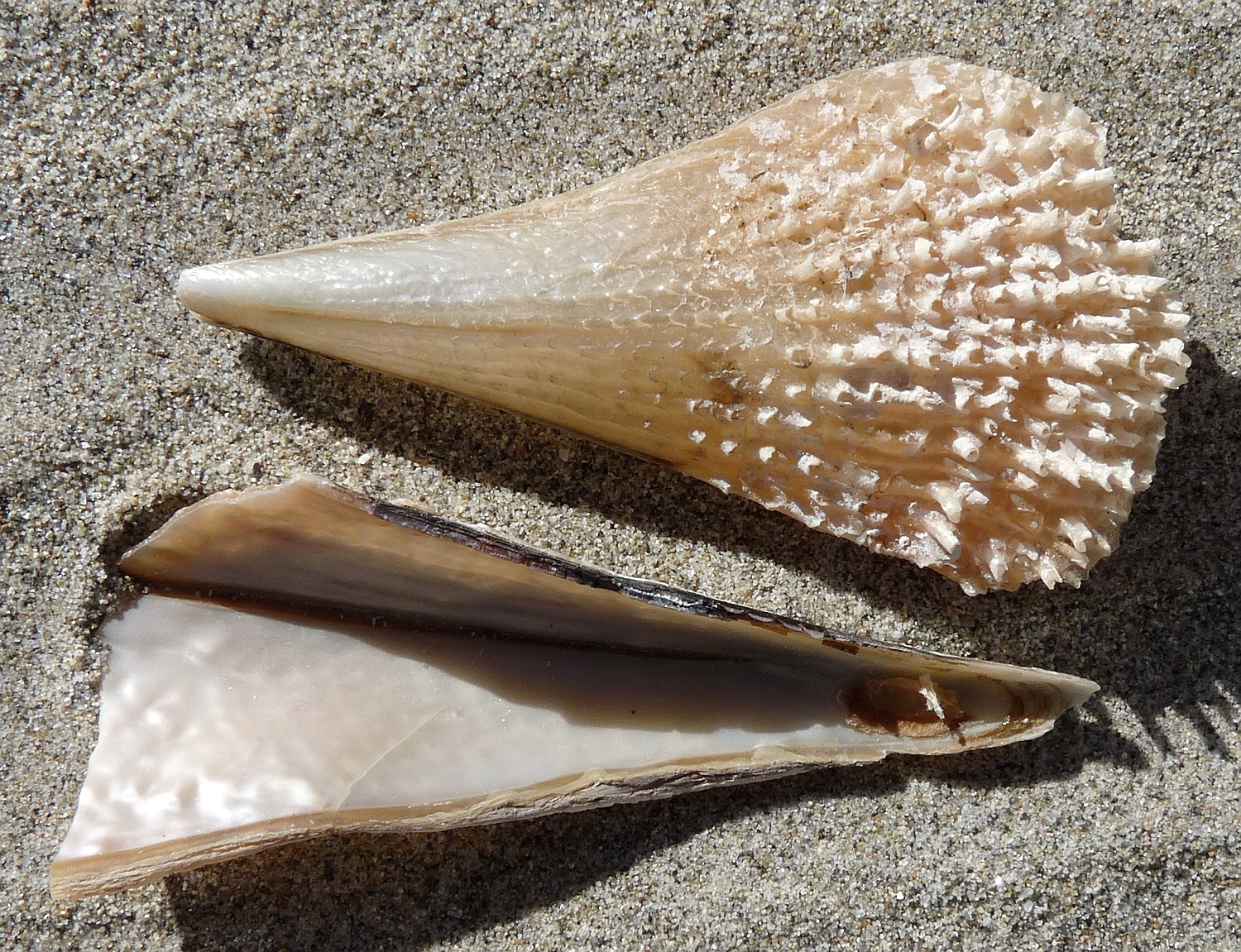
Young specimens carry spines on their translucent and very fragile shells. Occasionally one can find broken pieces the sandy beaches of Naxos. Size: 70 mm
Spiny fileclam, Lima lima, L.
quite common
The Spiny fileclam has an elongated shape and fan-shaped ribs. It attaches itself to rocks, sponges or sea squirts with a dense byssus web. A ring of orange-red tentacles protrudes from the shell, which the clam usually holds slightly open. The Spiny fileclam can swim by opening and closing its shells. Size up to 4 cm
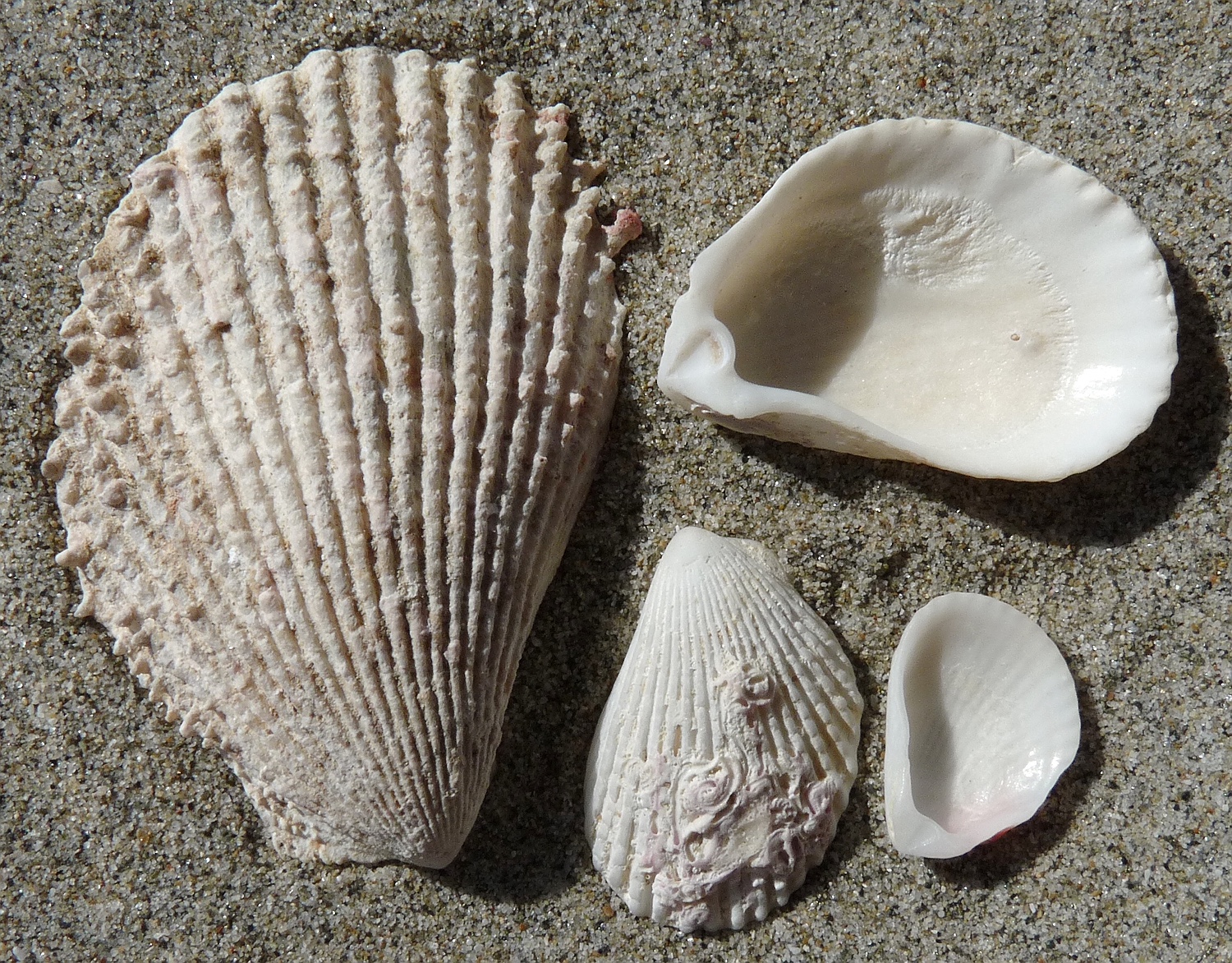
The Spiny fileclam is related to the scallop, but it is asymmetrical and elongated. The larger shell is adorned with the spines that give it its name, small protrusions on the ribs. Size: 52 mm
Limaria tuberculata, Olivi
rather rare
This species is very similar to the fileclam, but the ribs on the shells are more numerous and narrower, and the lock is differently shaped: the corner of the shell where the lock is located is not rectangular, but truncated.
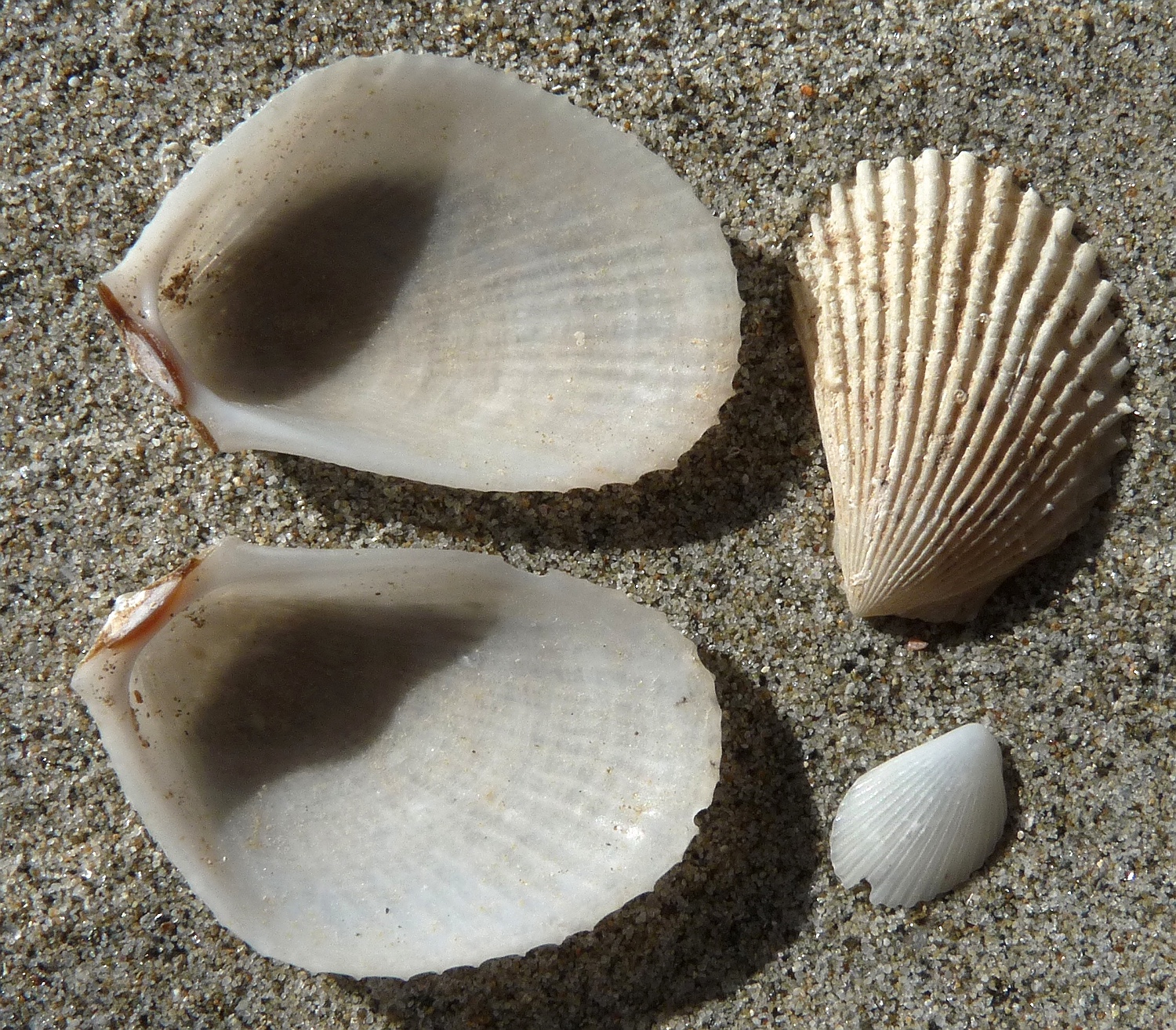
Limaria tuberculata differs from the Spiny fileclam in its smaller size and truncated front edge, where the lock of the shell is located. Size: 30 mm
Cat’s paw scallop, Manupecten pesfelis (= Chlamys p.), L.
rather rare
Scallops have a distinctive fan-like shape. The different species are not easy to tell apart. They burrow flat into the sand so that the upper shell lies just below the surface. The live animals have numerous simple eyes on the edge of the mantle, which they use to detect predators. They also extend a row of touch-sensitive tentacles from the shell. In case of danger, the scallop can swim away.
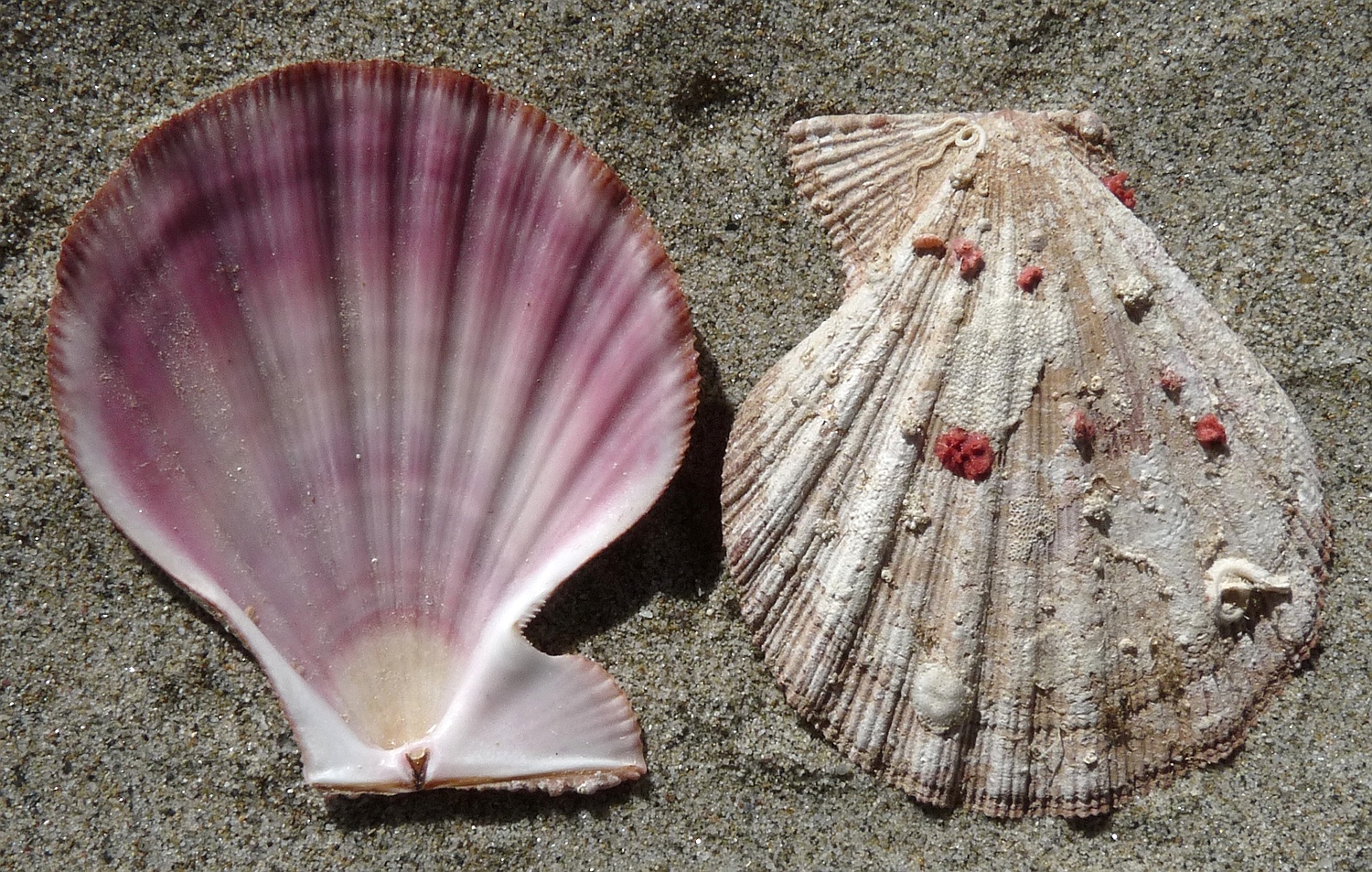
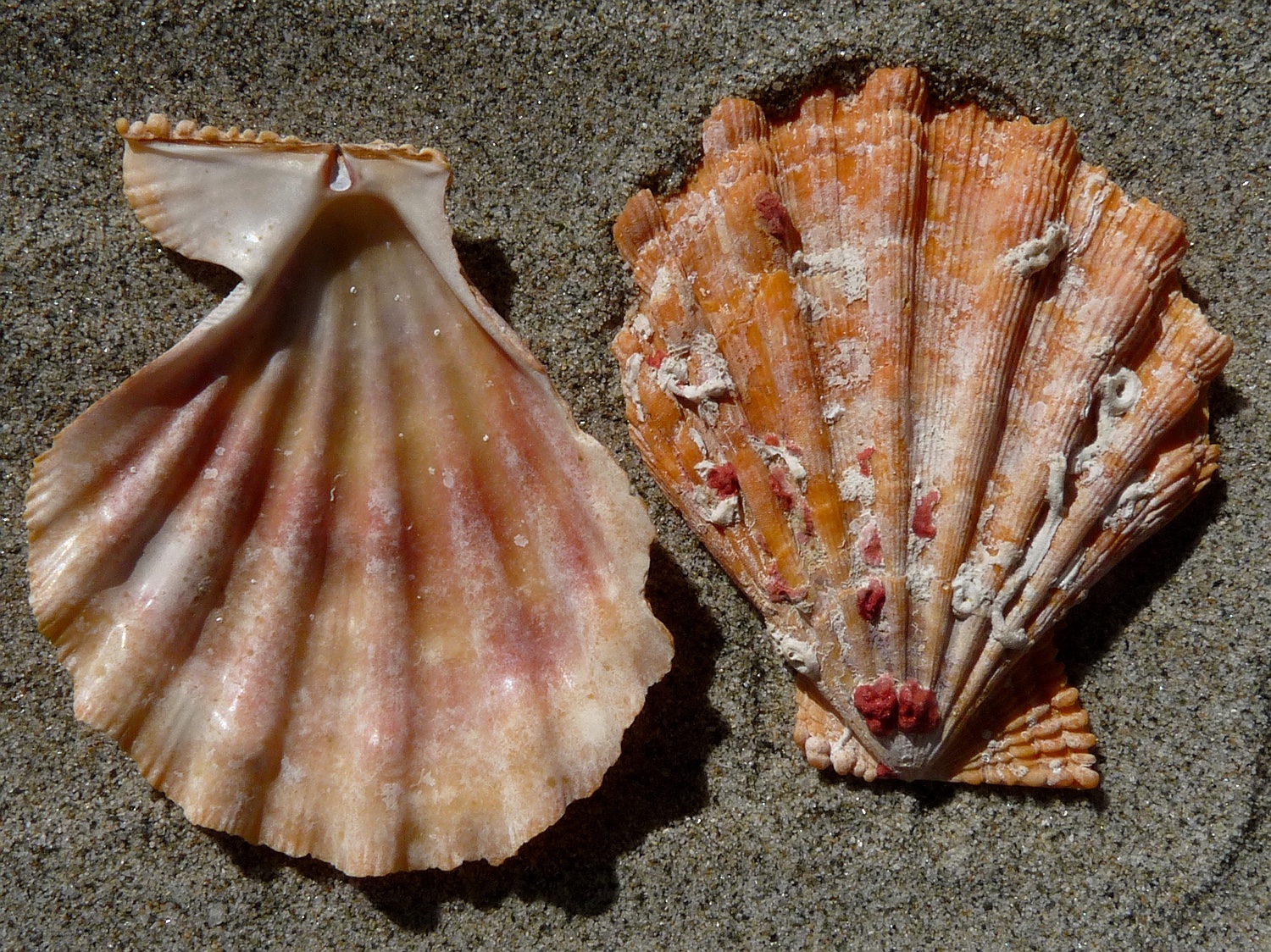
The Cat’s paw scallop has “ears”of different size and only a few broad radial ribs on the shell, which show fine longitudinal grooves. Size: 60 mm
Mimachlamys varia (= Chlamys v.), L.
very rare
Some species of scallop are quite small, such as Mimachlamys varia, whose shell has numerous small radial grooves and reaches a size of up to 2,5 cm.
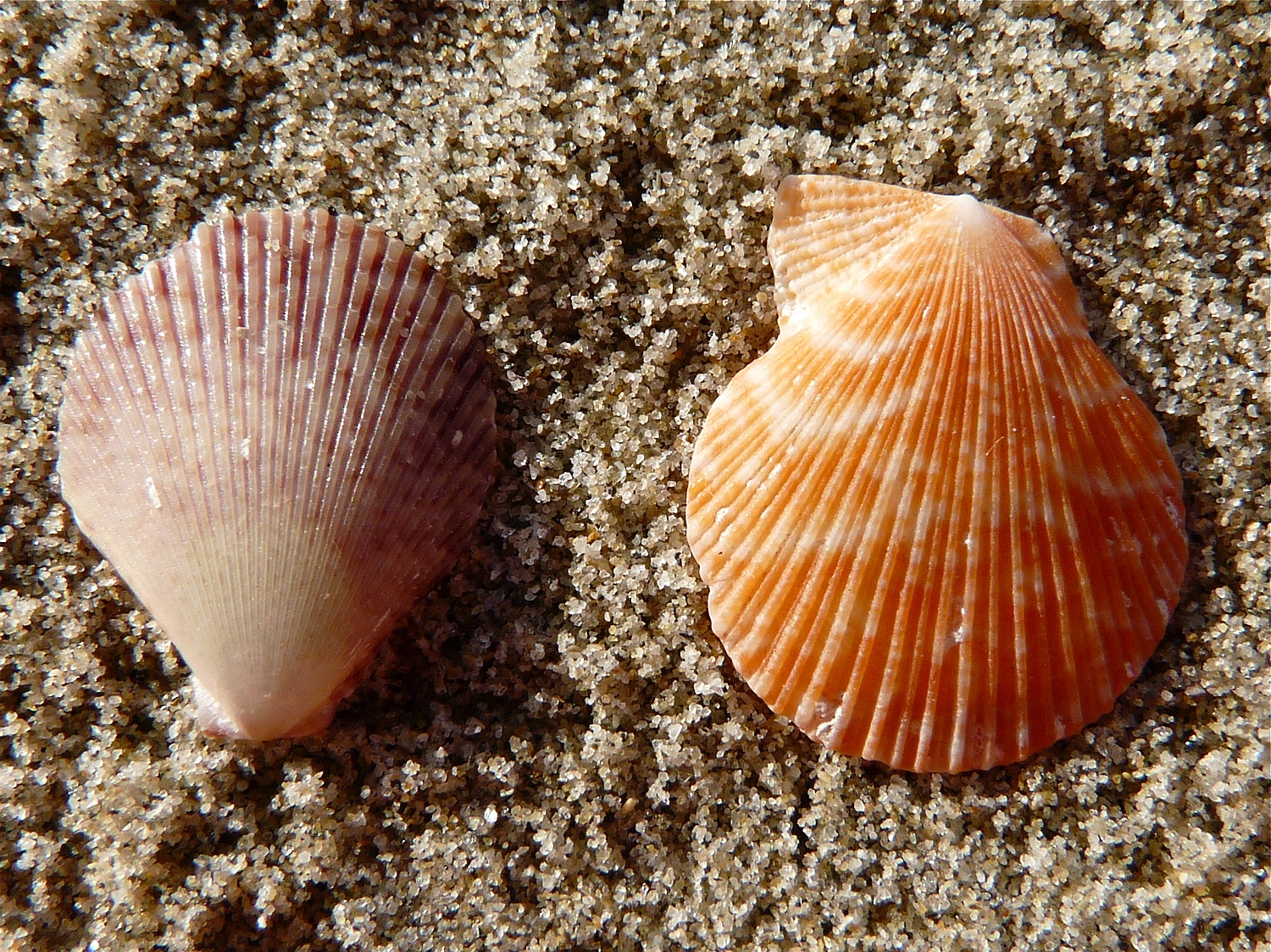
Mimachlamys varia (left specimen; the right specimen might be some other species) is very small and has around 50 thin ribs. Size: 16 mm
Thorny oyster, Spondylus gaederopus, L.
rather rare
The Thorny oyster is easily recognisable by the long spines on its shell. Like all oysters, it has one flat and one convex shell; the convex shell is attached to the substrate (rock) with byssus threads. When alive, the Thorny oyster is very difficult to spot because it is usually densely covered with algae and other organisms. Size up to 12 cm
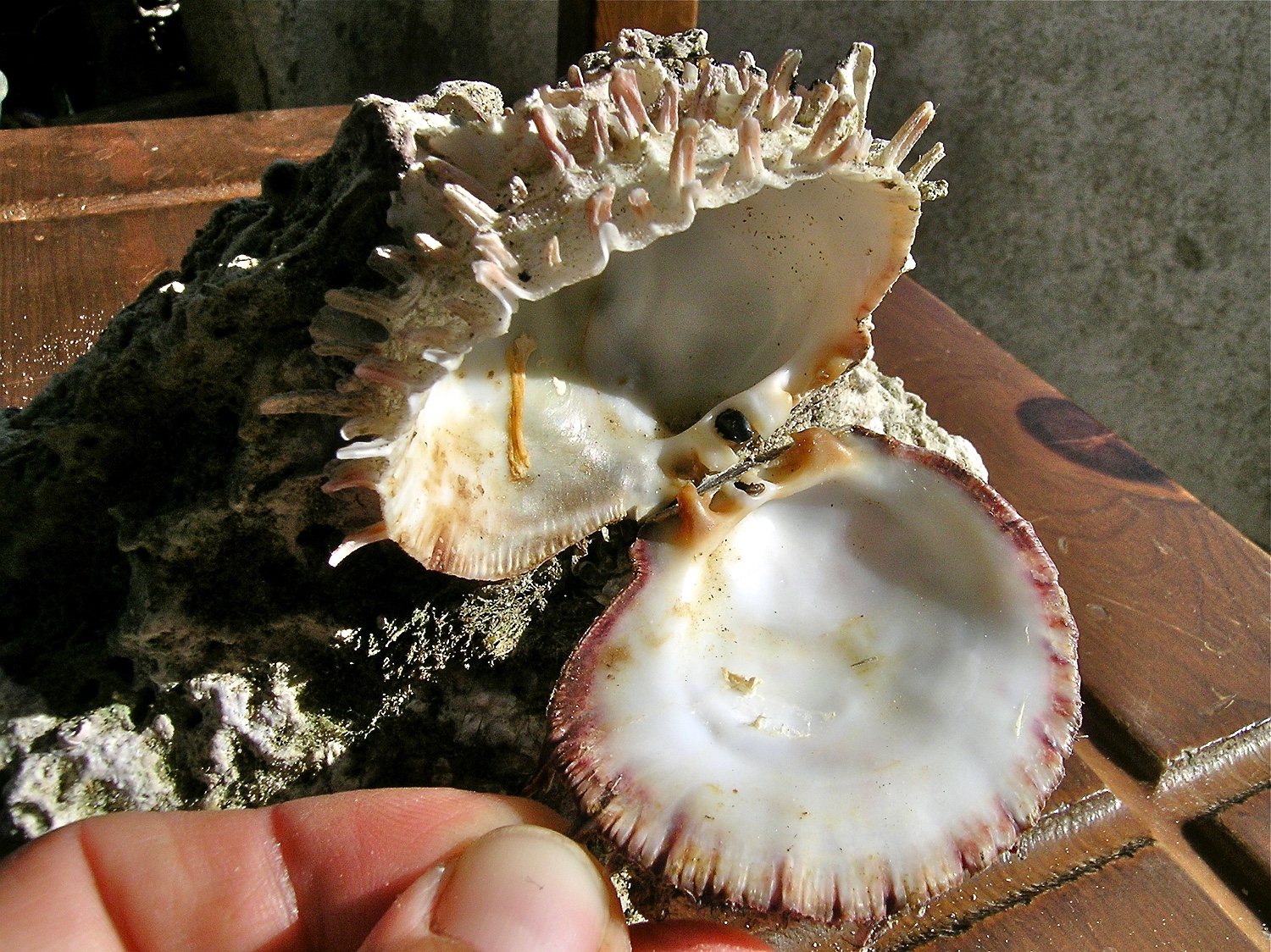
The convex shell of the Thorny oyster is attached to the rock. Here the strongly sculpted lock is also visibe.
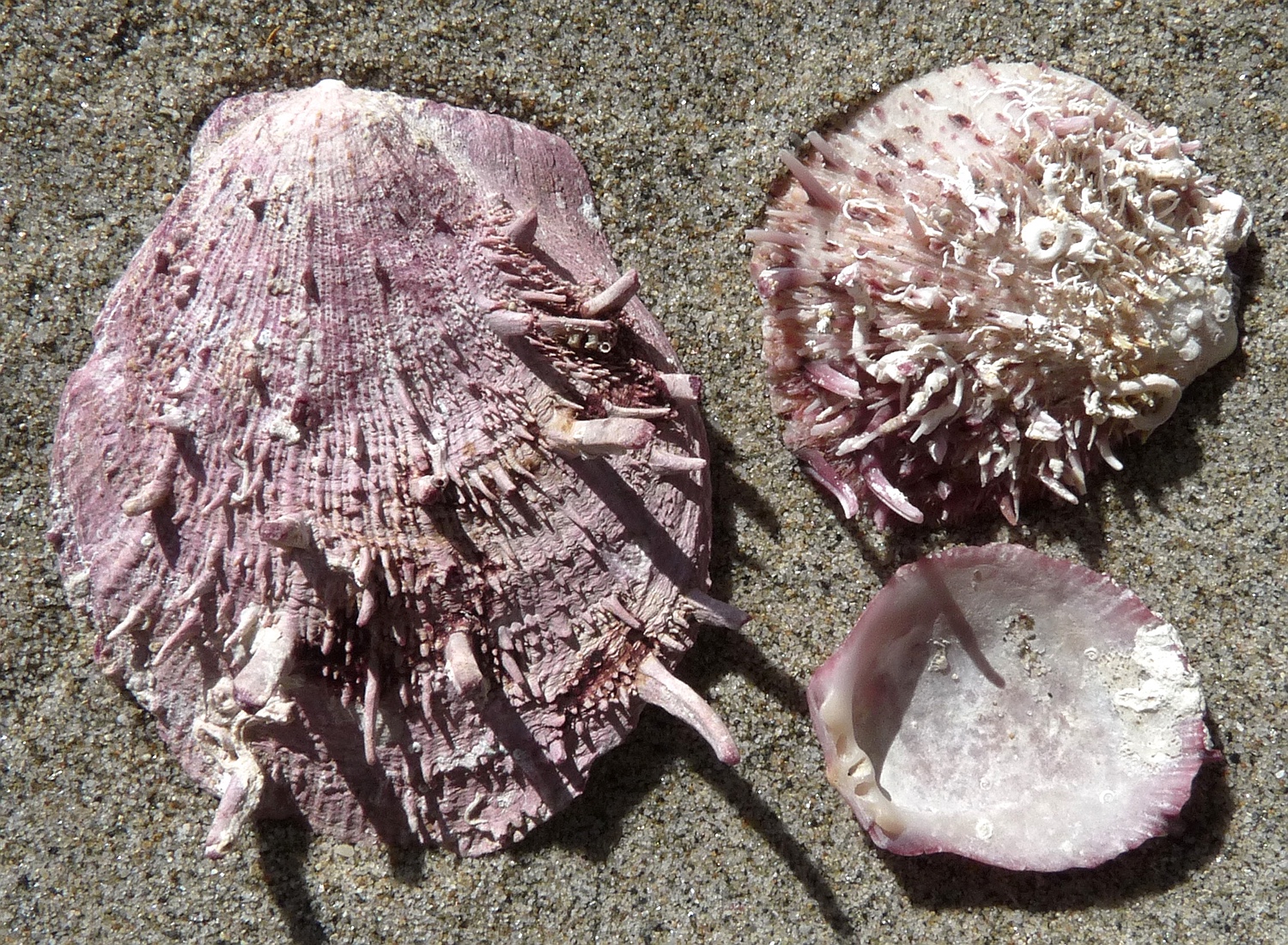
The Thorny oyster is easily recognisable by the long spines arranged in rows on its shell. Size: 75 mm
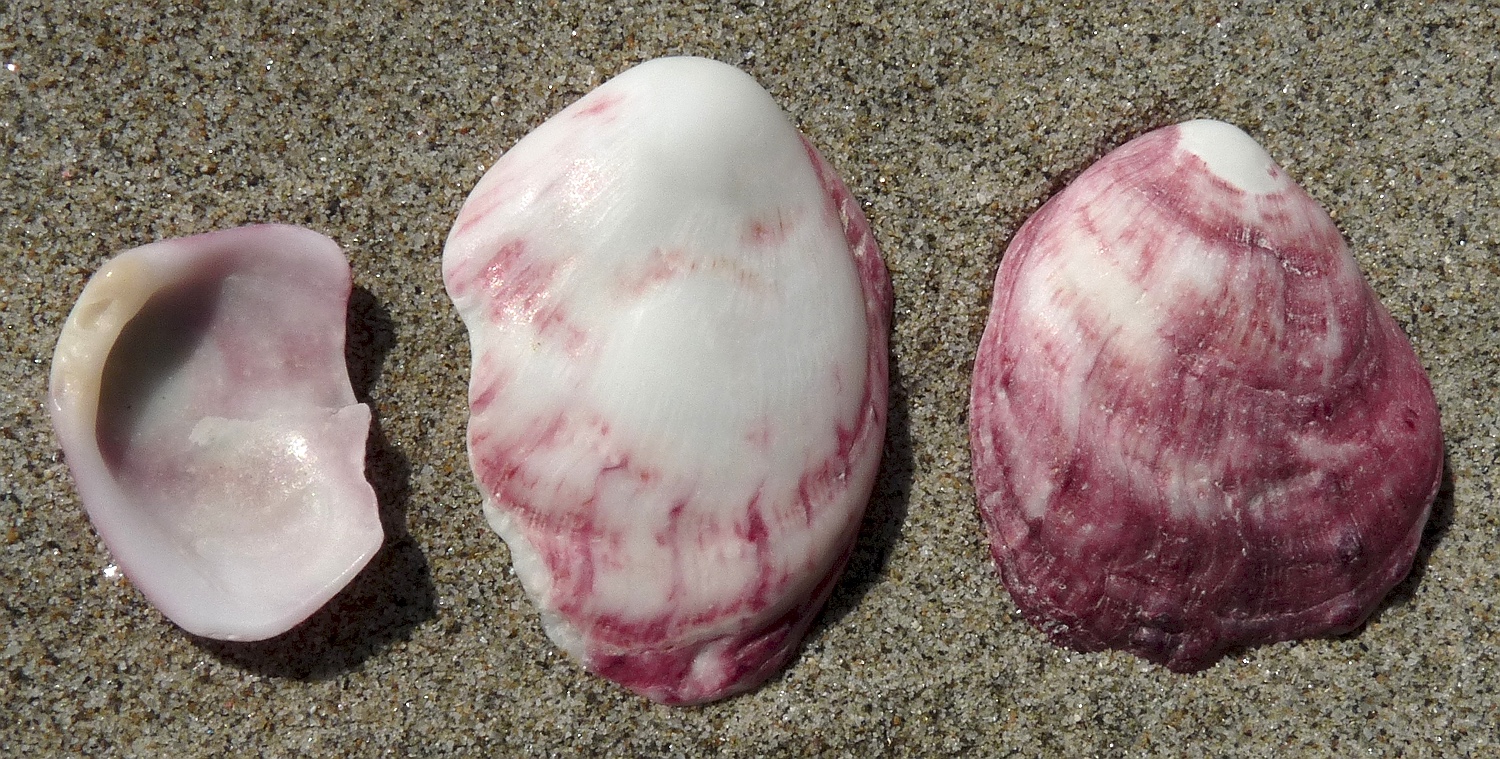
Occasionally, you can find shells of the Thorny oyster on the beach where the spines have been completely worn away. The pinkish-red colour reveals the species. Size: 41 mm
Ostrea stentina, Payraudeau
very rare
Like most oysters, Ostrea stentita has an irregular shape. It is rather small and can be found occasionally in shallow water. This species is recognised by the jagged edge of its shell.
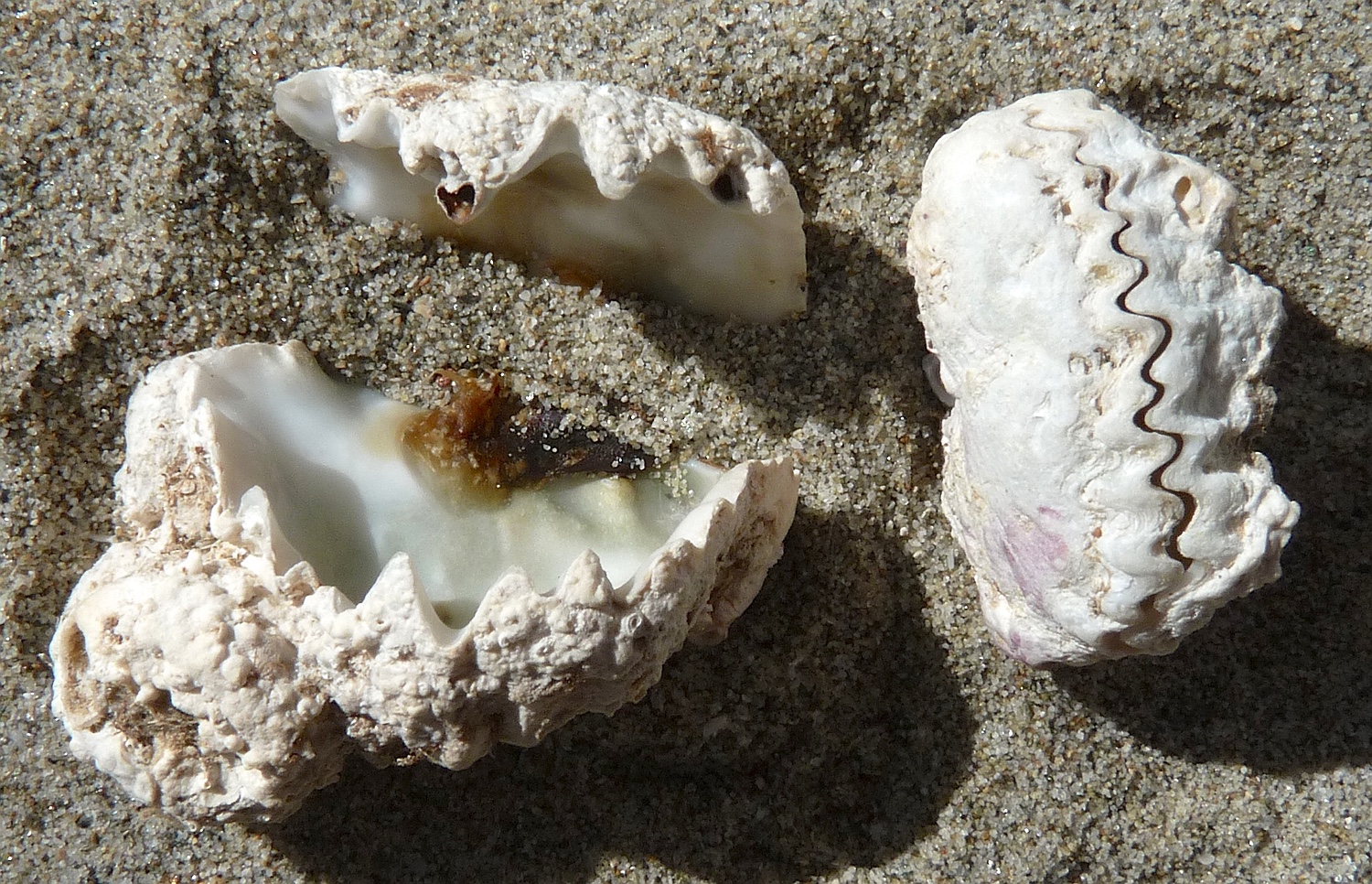
The opened shell of Ostrea stentita looks like a toothed mouth. Size: 27 mm
Neopycnodonte cochlear, Poli
very rare
The species Neopycnodonte cochlear, which is related to oysters, belongs to the family Gryphaeidae, which includes many species known only from fossils. The members of this family usually live in deeper water and not much is known about them. Neopycnodonte cochlear is found in the Mediterranean Sea and the Indo-Pacific region. It forms colony-like structures in which many shells grow on top of or next to each other. On Naxos, you can occasionally find a shell or a fragment of a “colony”.
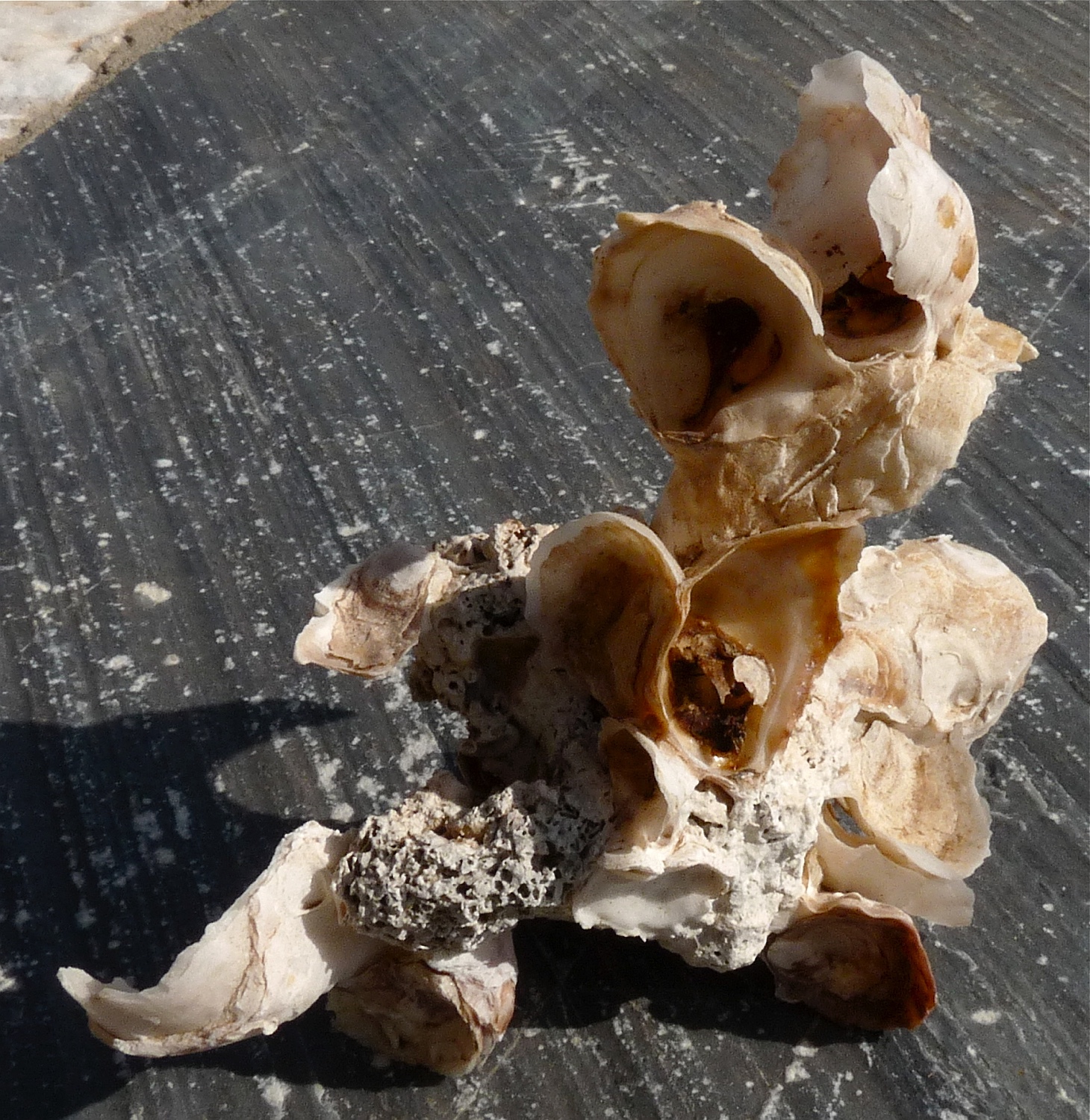
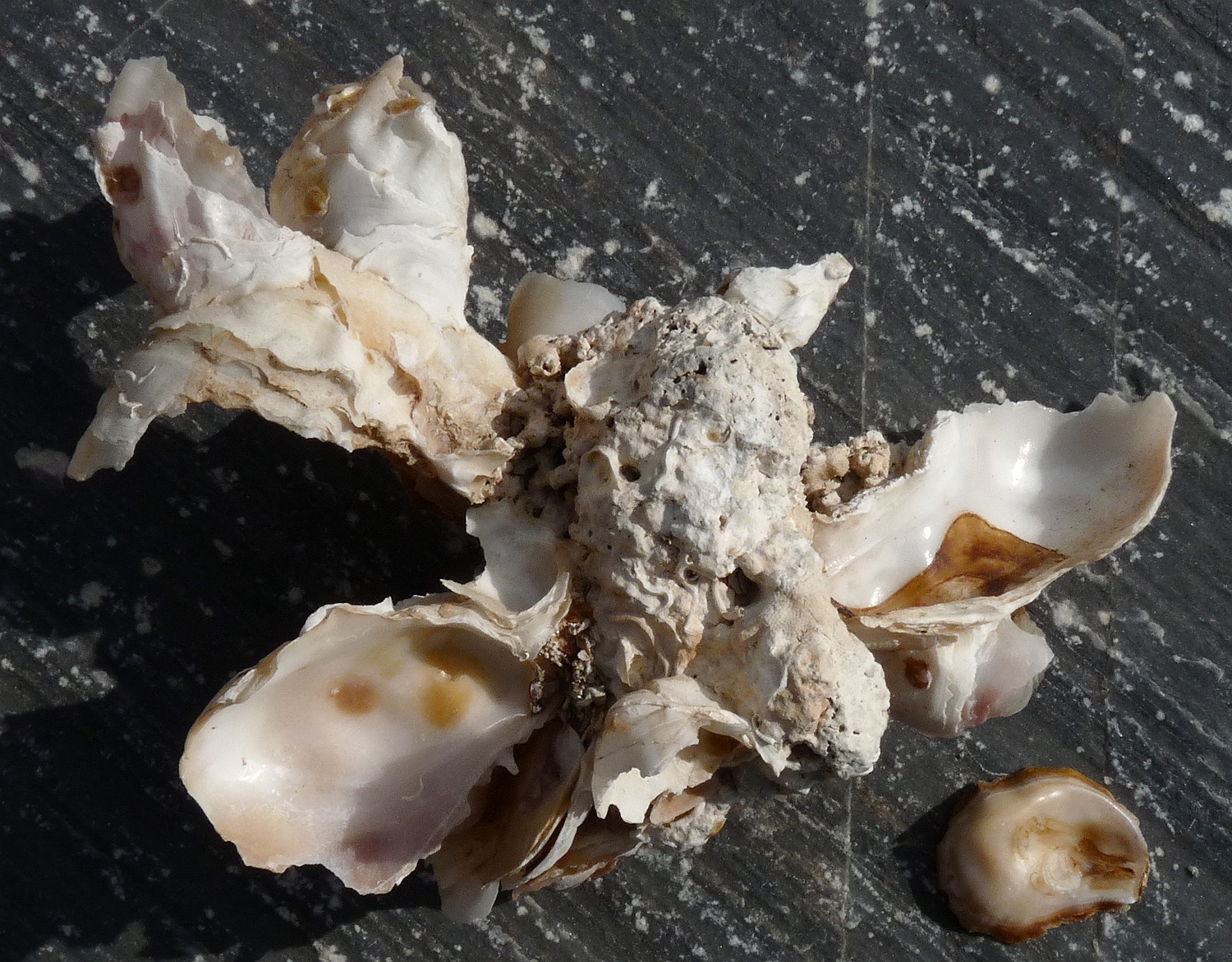
A “colony” of Neopycnodonte cochlear. Size of the largest shell: 51 mm
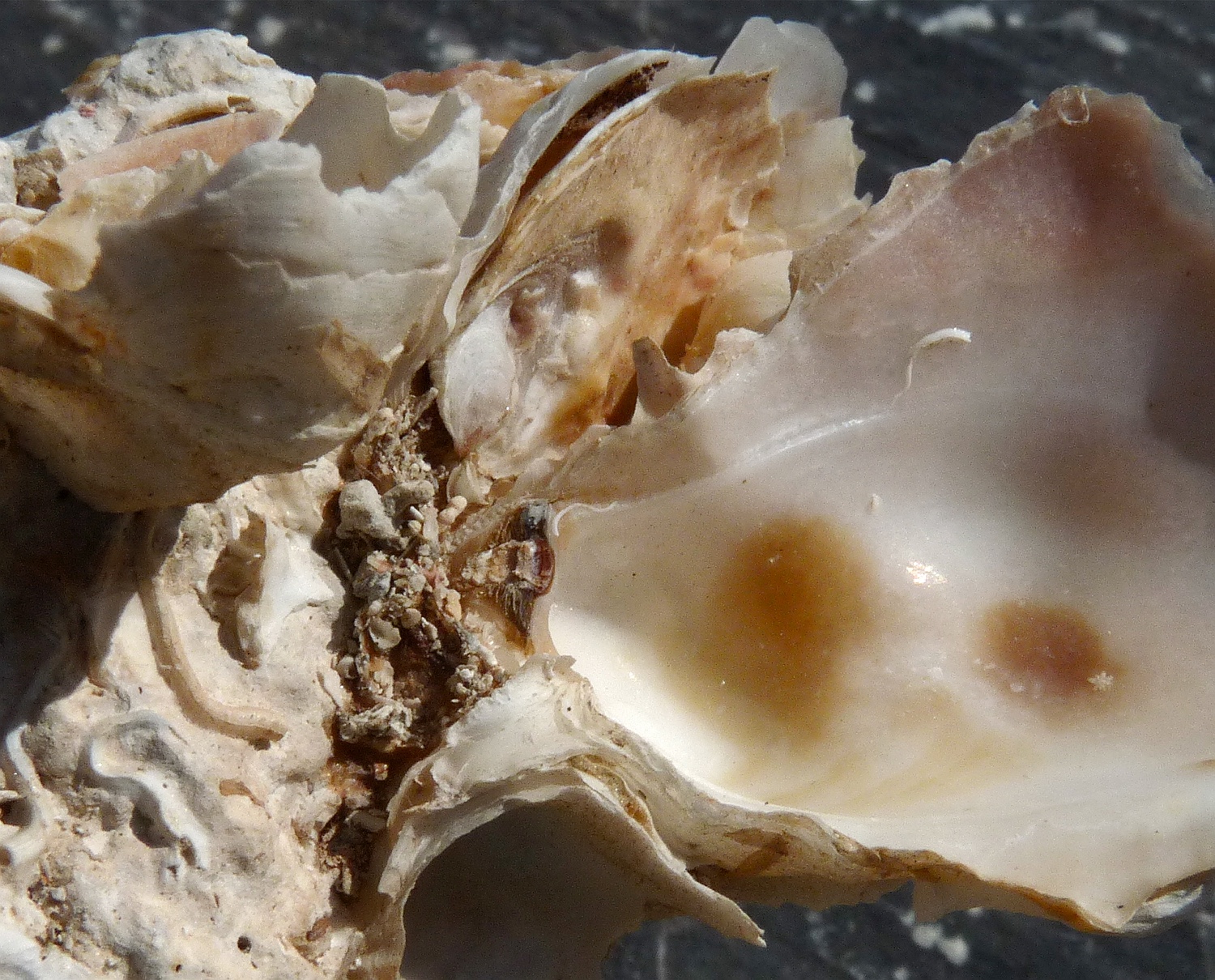
Here one sees the hinge of a shell that sits with its tip on the substrate
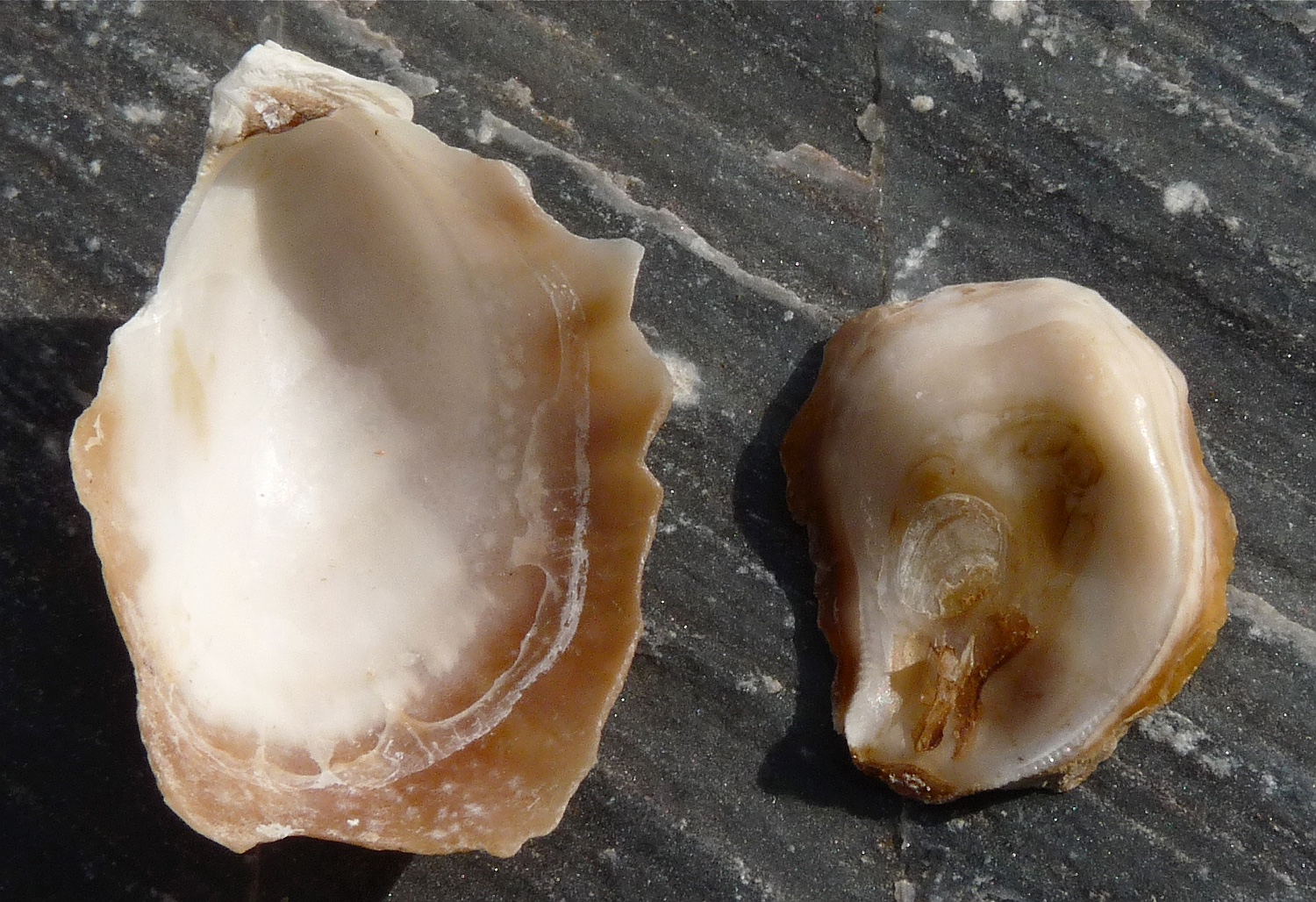
The two shells are quite different in shape: while the left, ‘lower’ shell (left) is strongly convex, the right, ‘upper’ shell is flat to only slightly convex. The right shell lies inside the left shell, which protrudes a little at the edge. The round muscle scars can be seen in the shells. Size: 39 mm
Anomia ephippium, L.
rather common
The species Anomia ephippium belongs to the saddle oysters. It has a thin, usually flat, irregularly shaped shell that is attached to rocks or other shells and snails and adapts its shape to the substrate. Size up to 7 cm
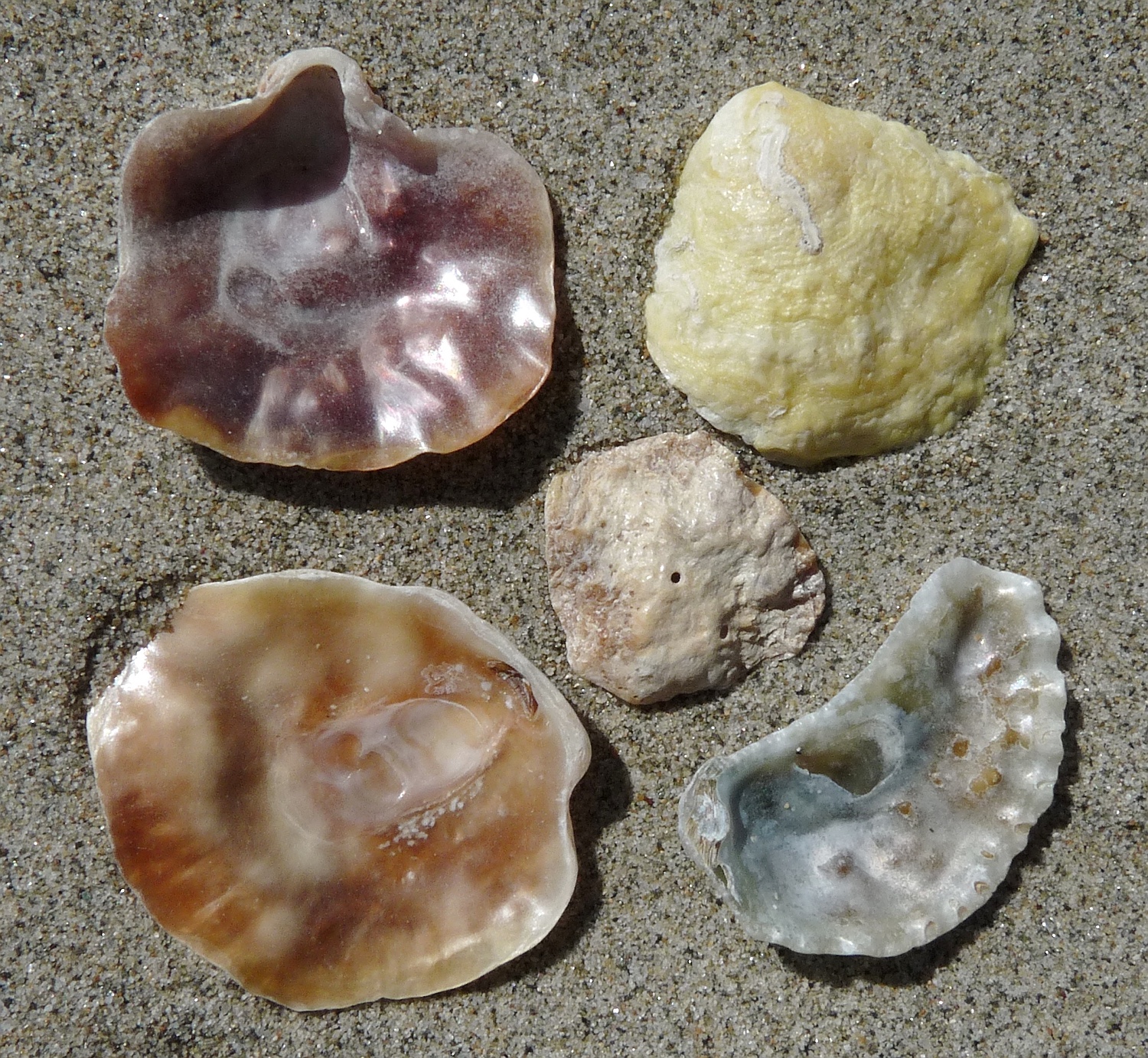
The saddle oyster Anomia ephippium has an irregular shape that adapts to the substrate it sits on. Sometimes the shells are almost transparent. Size: 60 mm
Loripes orbiculatus, Poli
very rare
This species, which belongs to the Lucinidae or Hatchet shells, has a nearly round shell with concentric growth lines. Size up to 2 cm
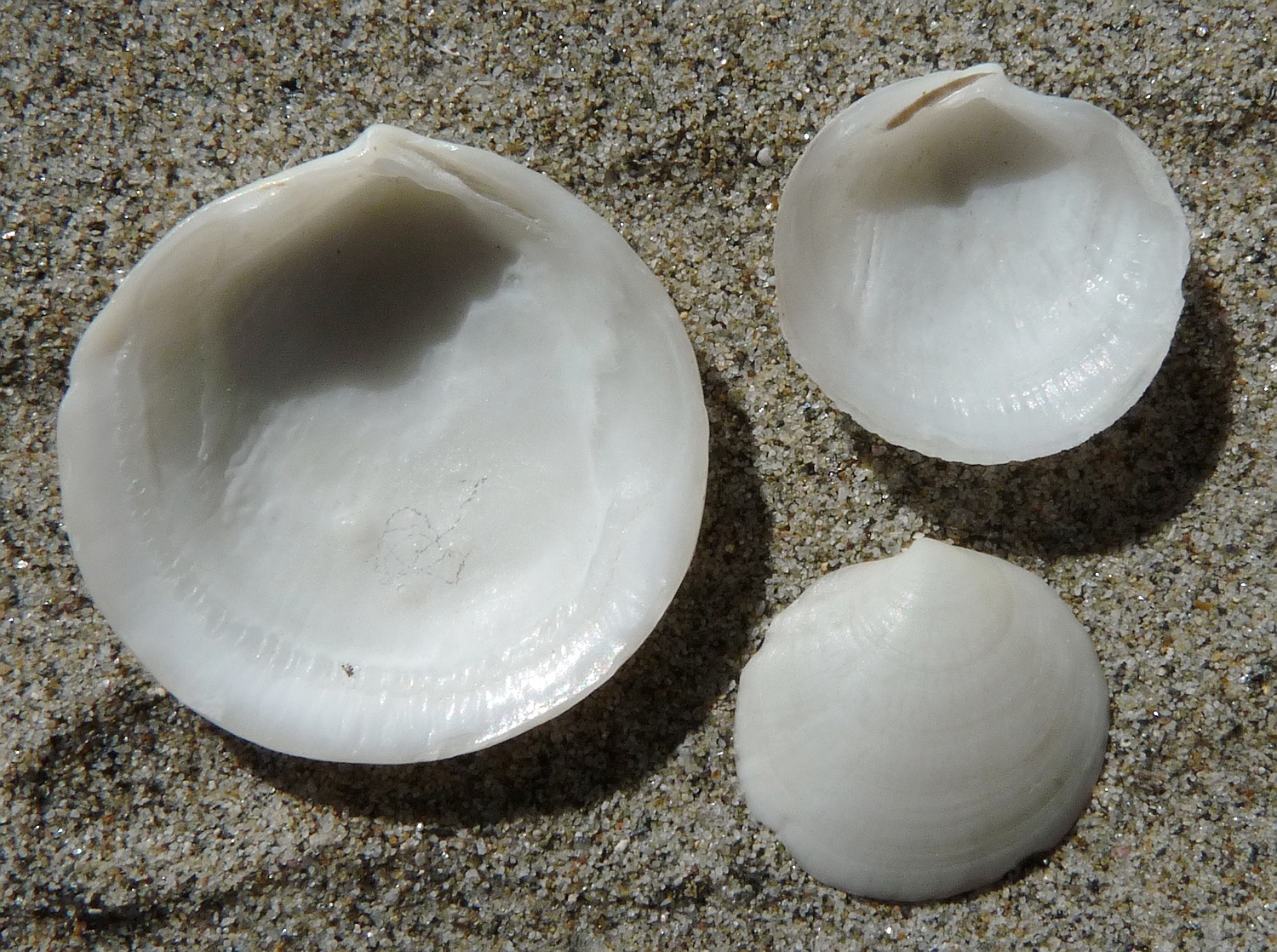
Loripes orbiculatus is nearly round and shows concentric grows lines. Size: 25 mm
Ctena decussata, O. G. Costac
locally quite common
Another small, white, round shell is Ctena decussata; it differs from the closely related species Loripes orbiculatus in that it has fine radial striations in addition to the concentric stripes.
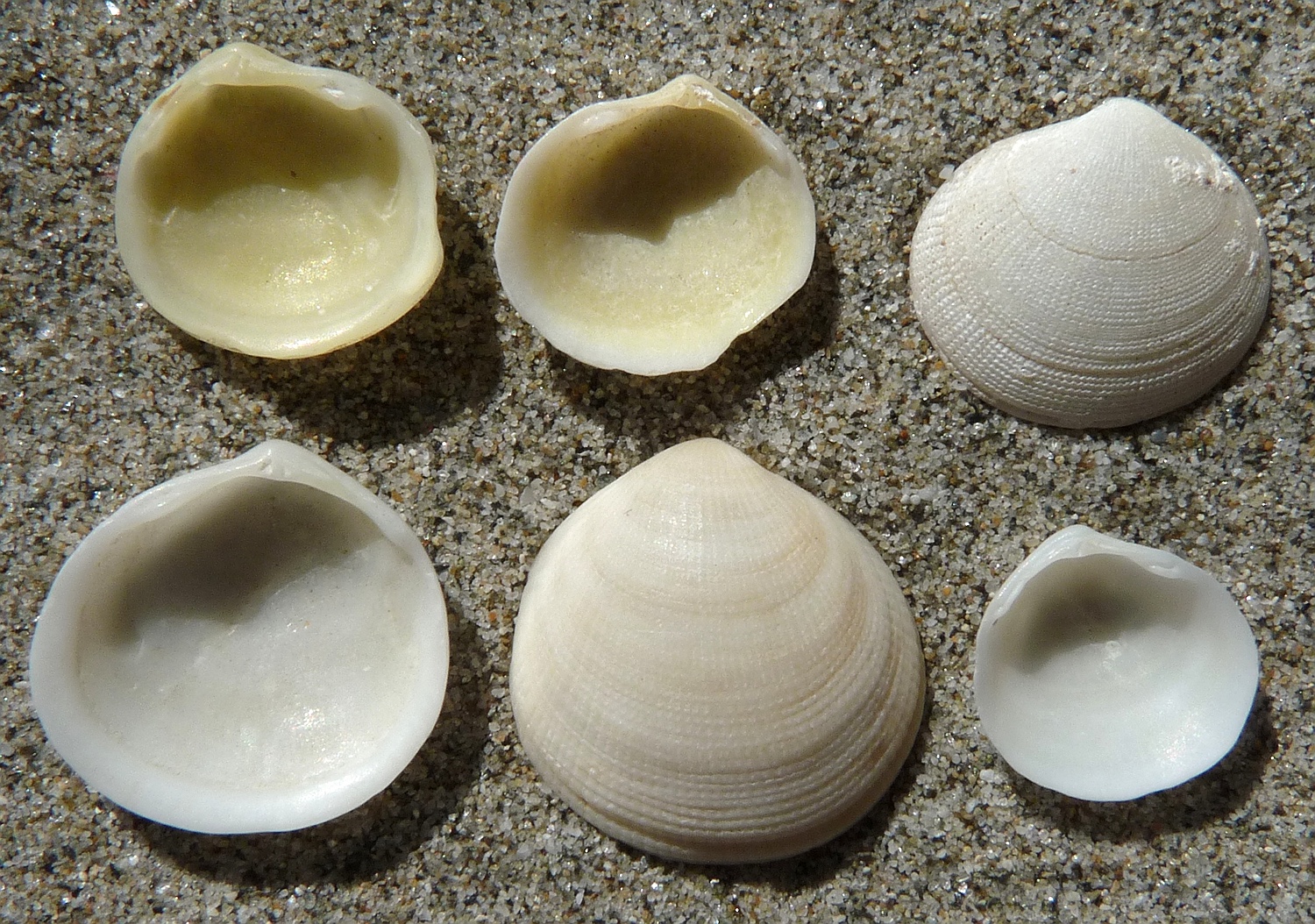
Ctena decussata resembles Loripes lacteus, but is smaller and has fine radial stripes on its shell, which together with the growth stripes form a grid pattern. The inside of the shells is sometimes slightly yellowish. Size: 18 mm
Cardita calyculata, L.
common
This small species has an almost rectangular shell, with the hinge located in one corner. The brown-spotted shell has thick, rounded, often scaly radial ribs. Size up to 2 cm
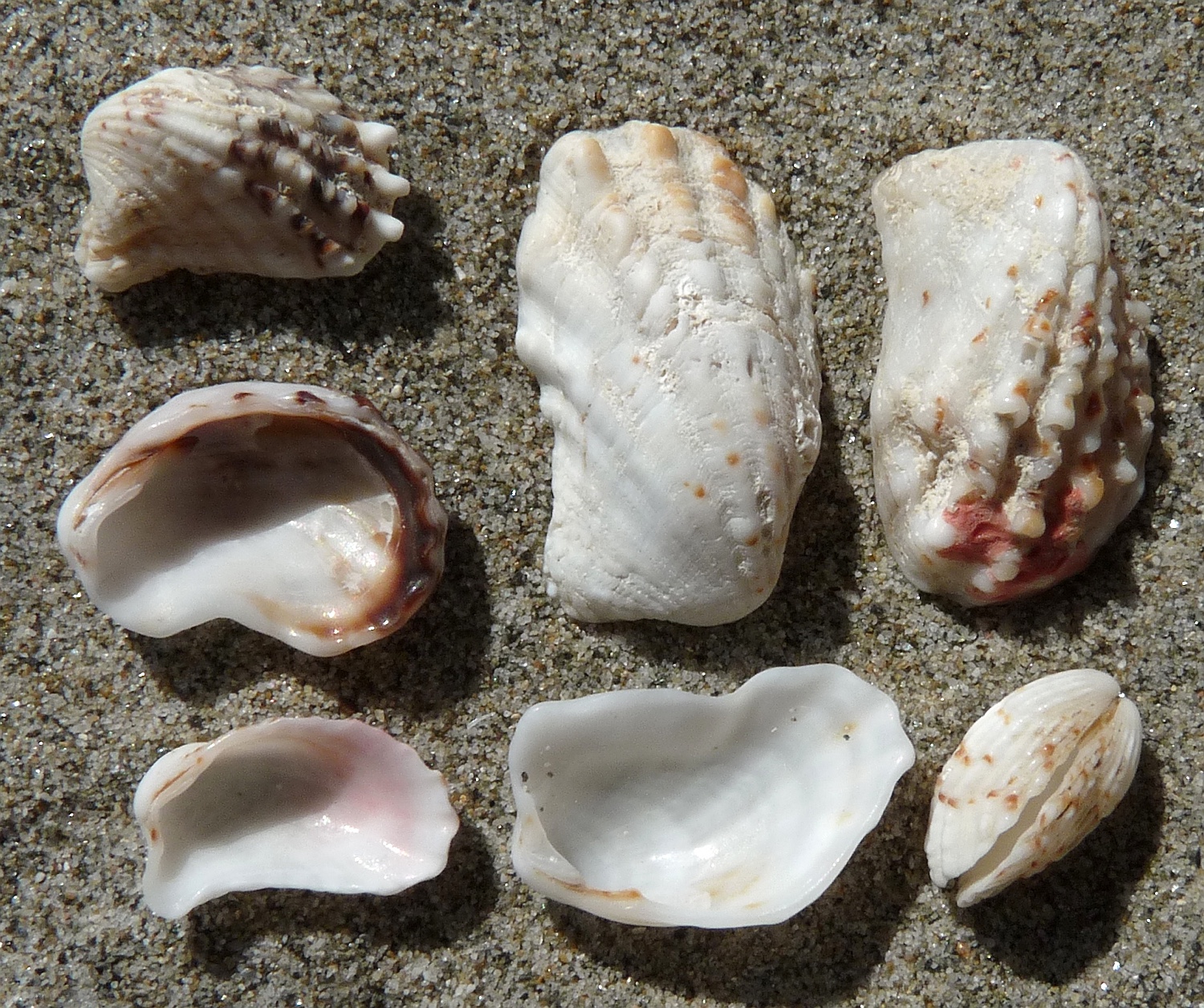
The small Cardita calyculata can easily be recognised by its unique form: 25 mm
Cardites antiquatus, L.
(= Venericardia antiquata)
rather rare
This mussel looks quite similar to cockles (see below), but has fewer, distinctly knotty ribs and a more slanted hinge. Size up to 3.5 cm.
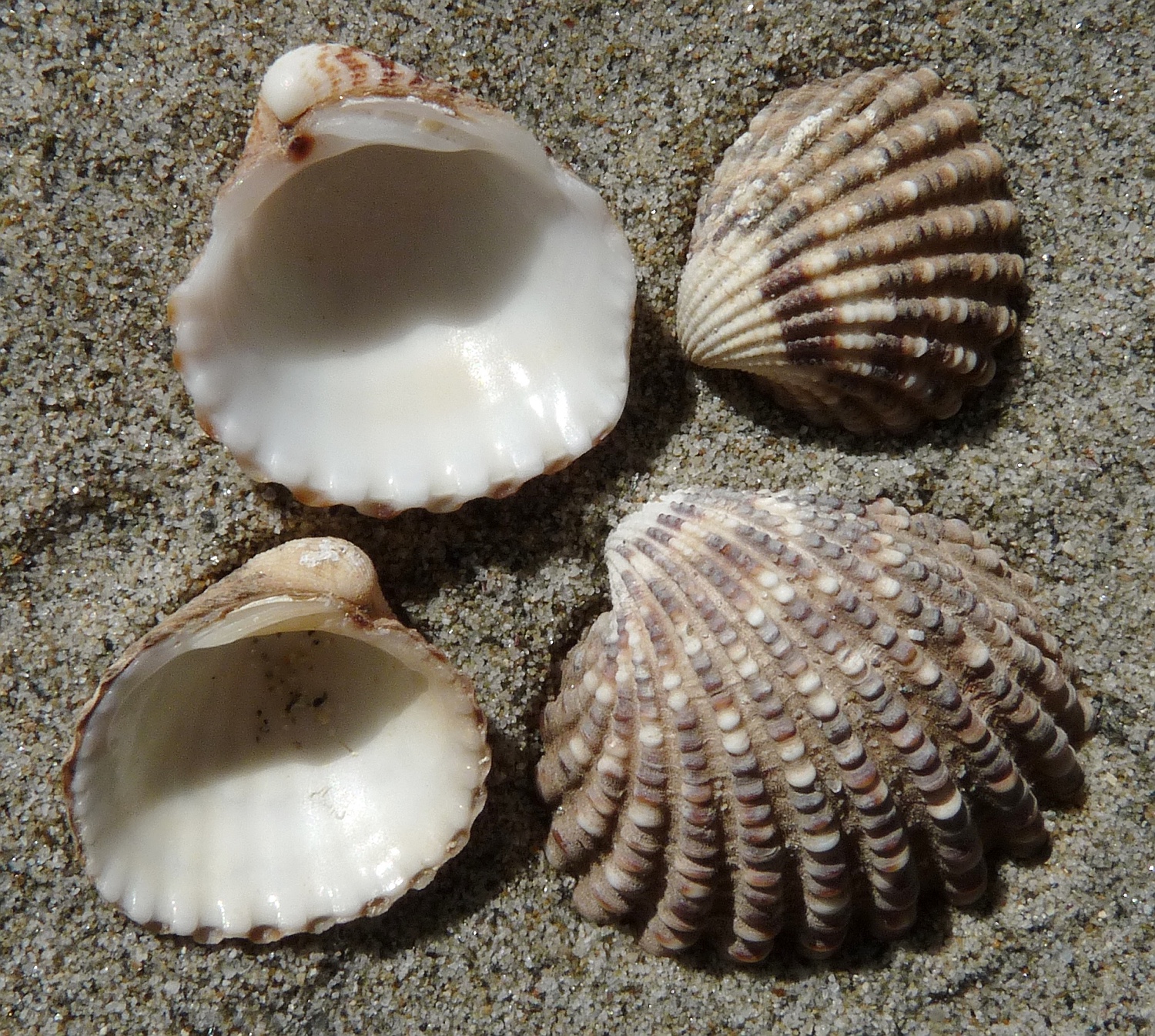
Cardites antiquatus, which resembles the cockles, has a non-symmetrical shell with knotty ribs, the hinge of which is offset to one side. Size: 30 mm
Rough cockle, Acanthocardia tuberculata, L.
very common
Cockles are easily recognisable by their round, strongly curved shape with numerous distinct ribs. Viewed from the side, the two shells resemble a heart. The Rough cockle is one of the most common bivalves on Naxos.
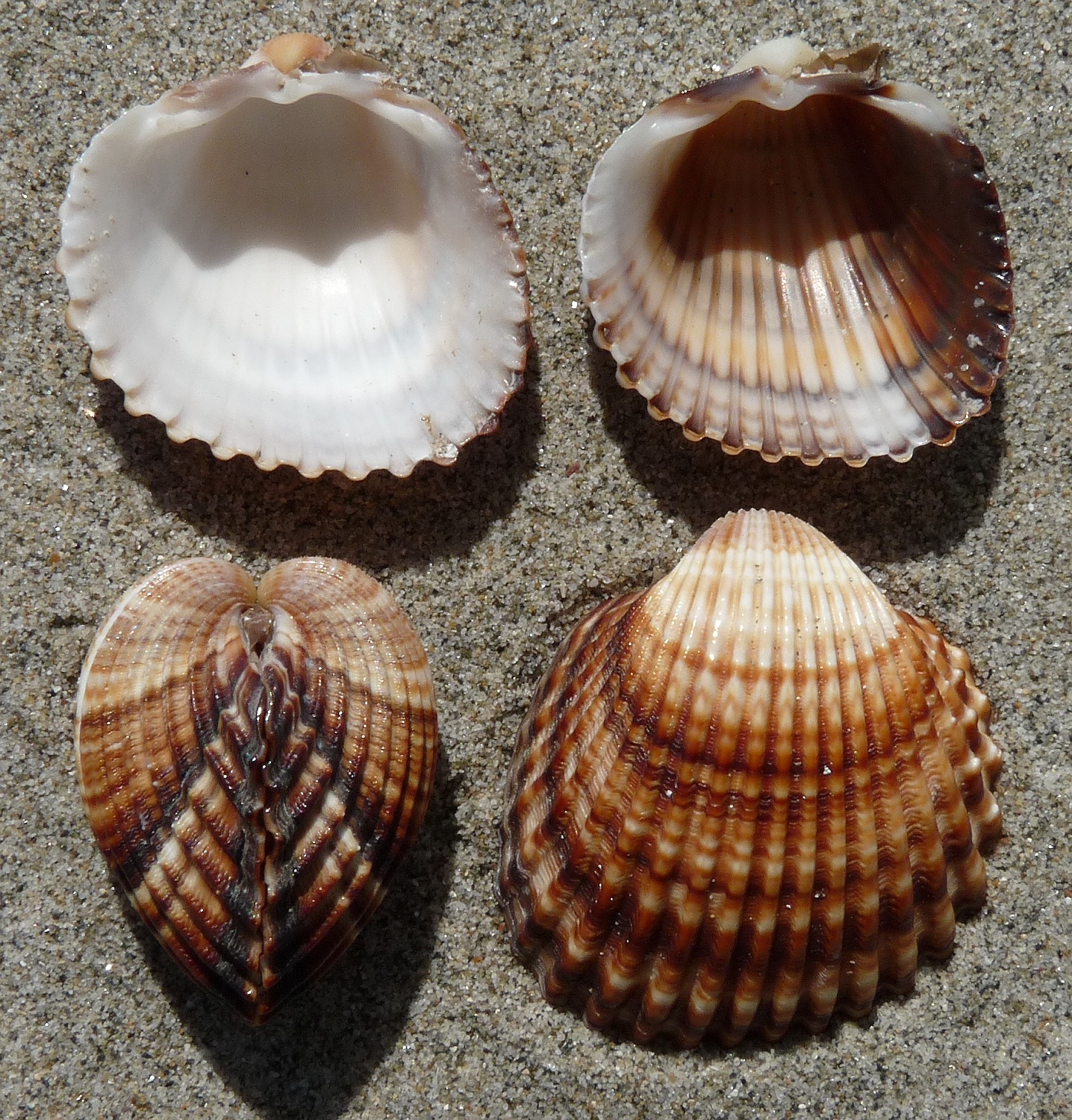
The Rough cockle looks very similar to the Edible cockle found in the Baltic Sea, North Sea and Atlantic Ocean. Size: 45 mm
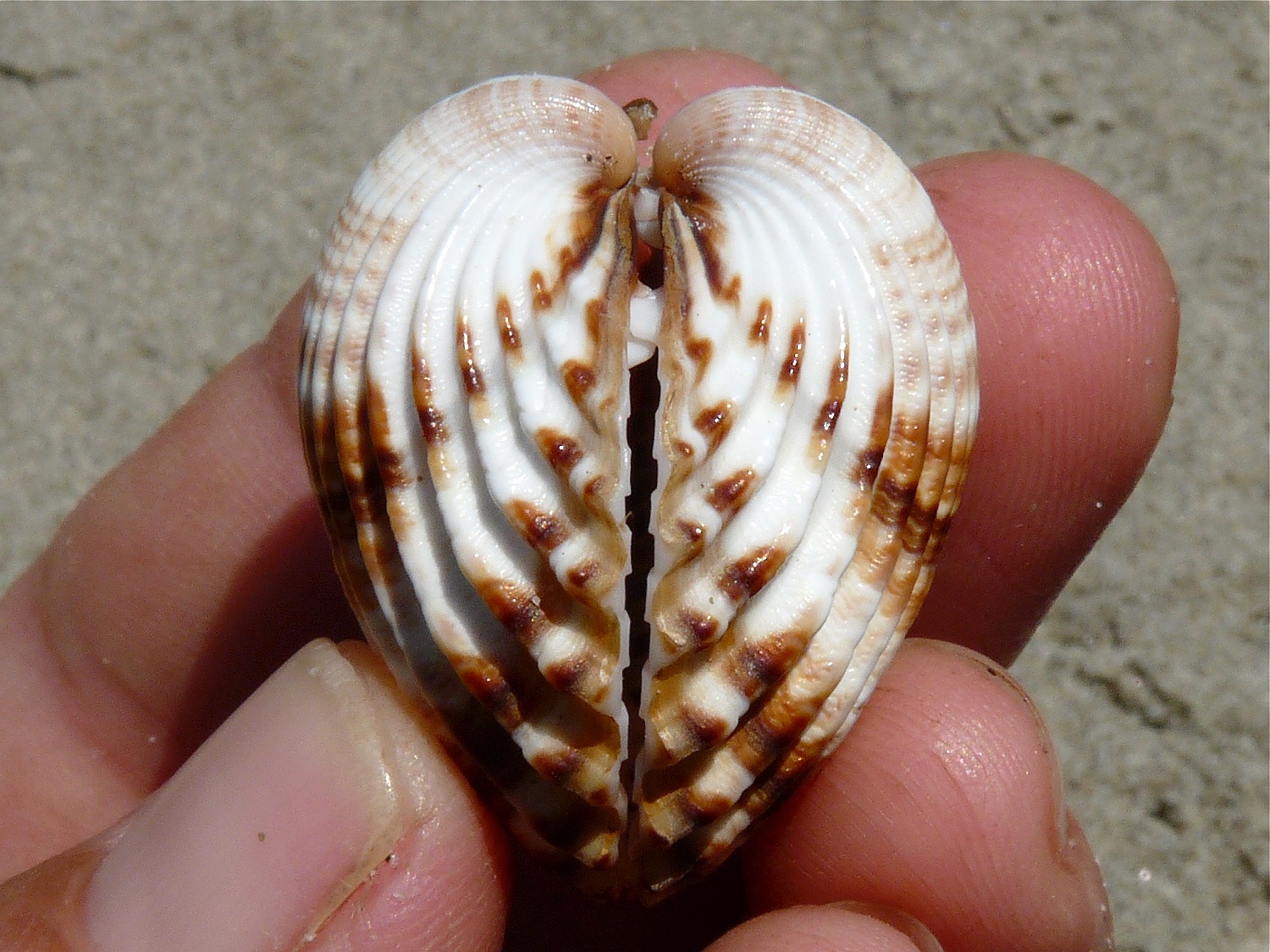
From the side you can see the characteristic heart-shape.
Norwegian egg cockle, Laevicardium crassum, Gmelin
rare
This species has a similar shape, but the ribbing is largely absent and only hinted at towards the edge; the rest of the shell is flat and shiny.
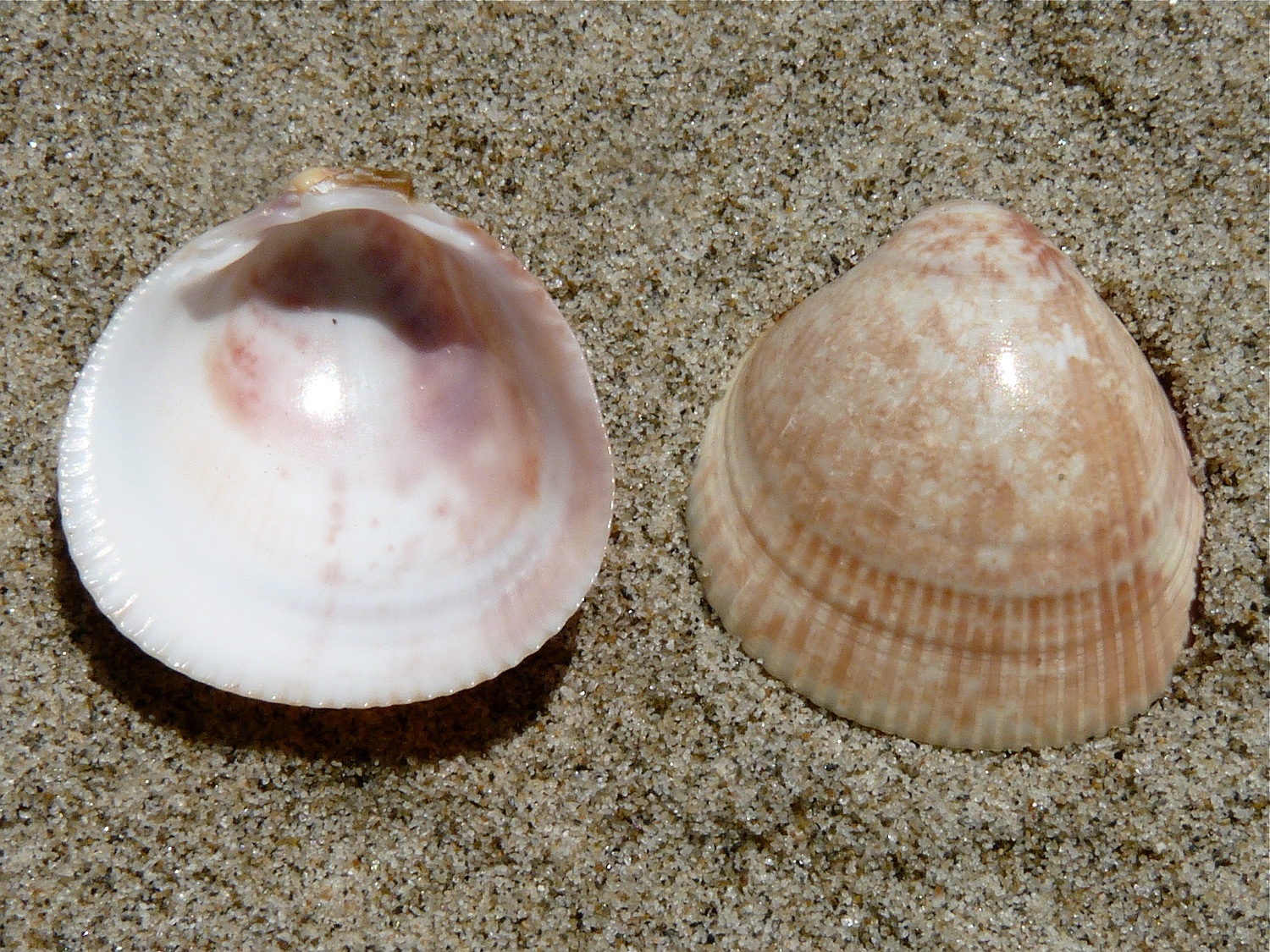
The Norwegian egg cockle shows only a slight ribbing towards the edge. The shell is finely spotted and very shiny. Size: 24 mm
Pseudochama gryphina, Lamarck
rather common
This bivalve forms a very thick, rounded shell with an irregularly scaly exterior. It is firmly attached to the substrate with its left shell, which is significantly more curved and often has a slightly triangular keel on the outside. On the inside, the shells show two approximately symmetrical muscle scars. Pseudochama gryphina is found in the Mediterranean and Atlantic oceans and grows to a size of about 3 cm.
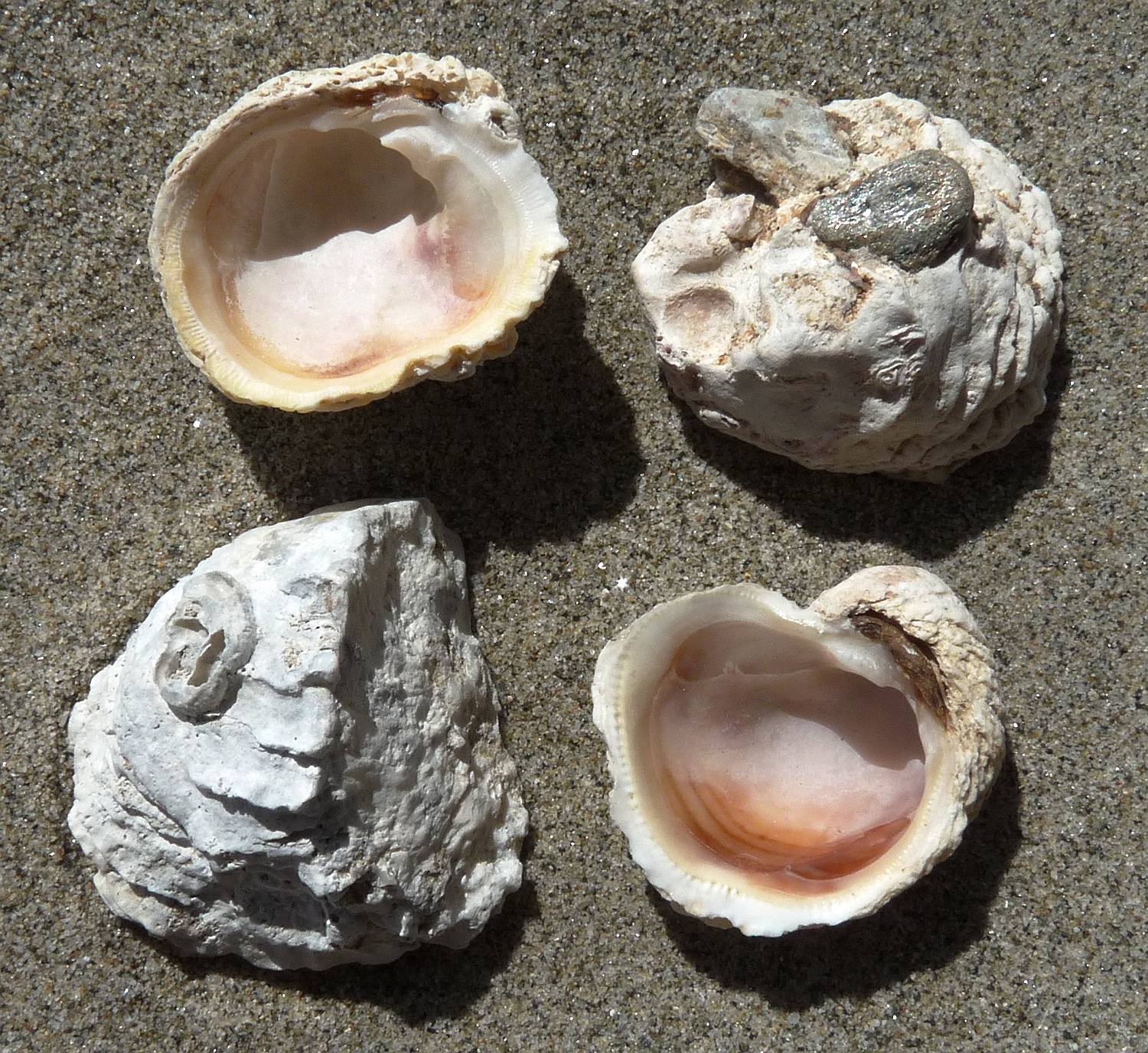
Pseudochama gryphina forms very thick, rounded, flaky shells that grow firmly attached to the substrate. The muscle scars can be seen on the inside of the shell, also fine striations around the edge. The hinge has a characteristic shape with a broad tooth. Size: 38 mm
Rayed trough shell, Mactra stultorum, L.
not uncommon
The Rayed trough shell has a rounded-triangular, shiny shell with fine concentric rings and coloured radial bands. Size up to 6 cm.
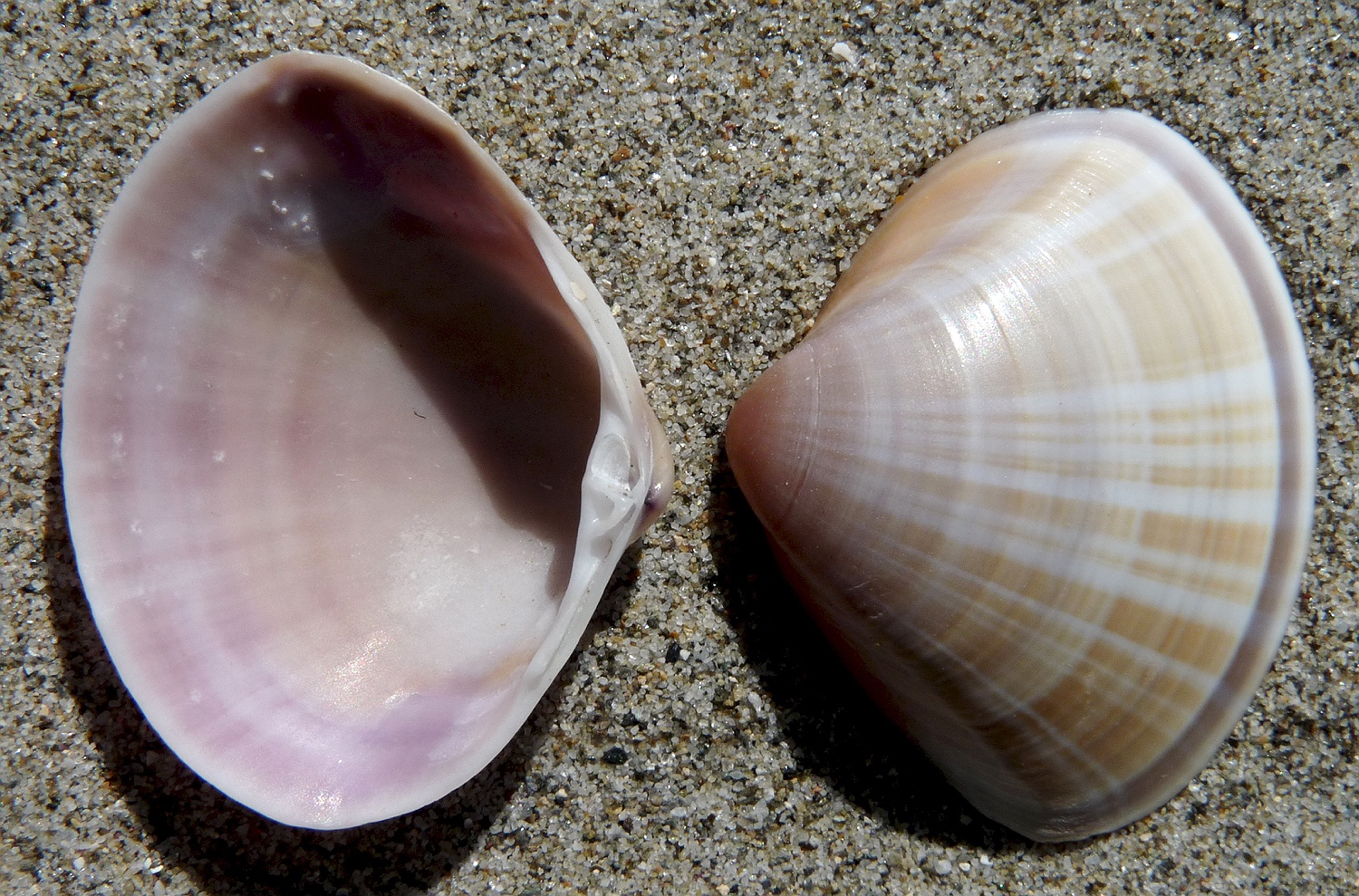
The Rayed trough shell can be recognised by its form and the characteristic radial bands. Size: 30 mm
Surf clam Spisula solida, L.
rather rare
The Surf clam forms a strong, slightly triangular shell with distinct concentric rings; the rear end is slightly pointed. The shell is bluish or off-white and often bears ring-shaped dark remnants of the periostracum. This species lives on sandy soils. When threatened, it can jump away by a quick movement of its foot. Size up to 3 cm.
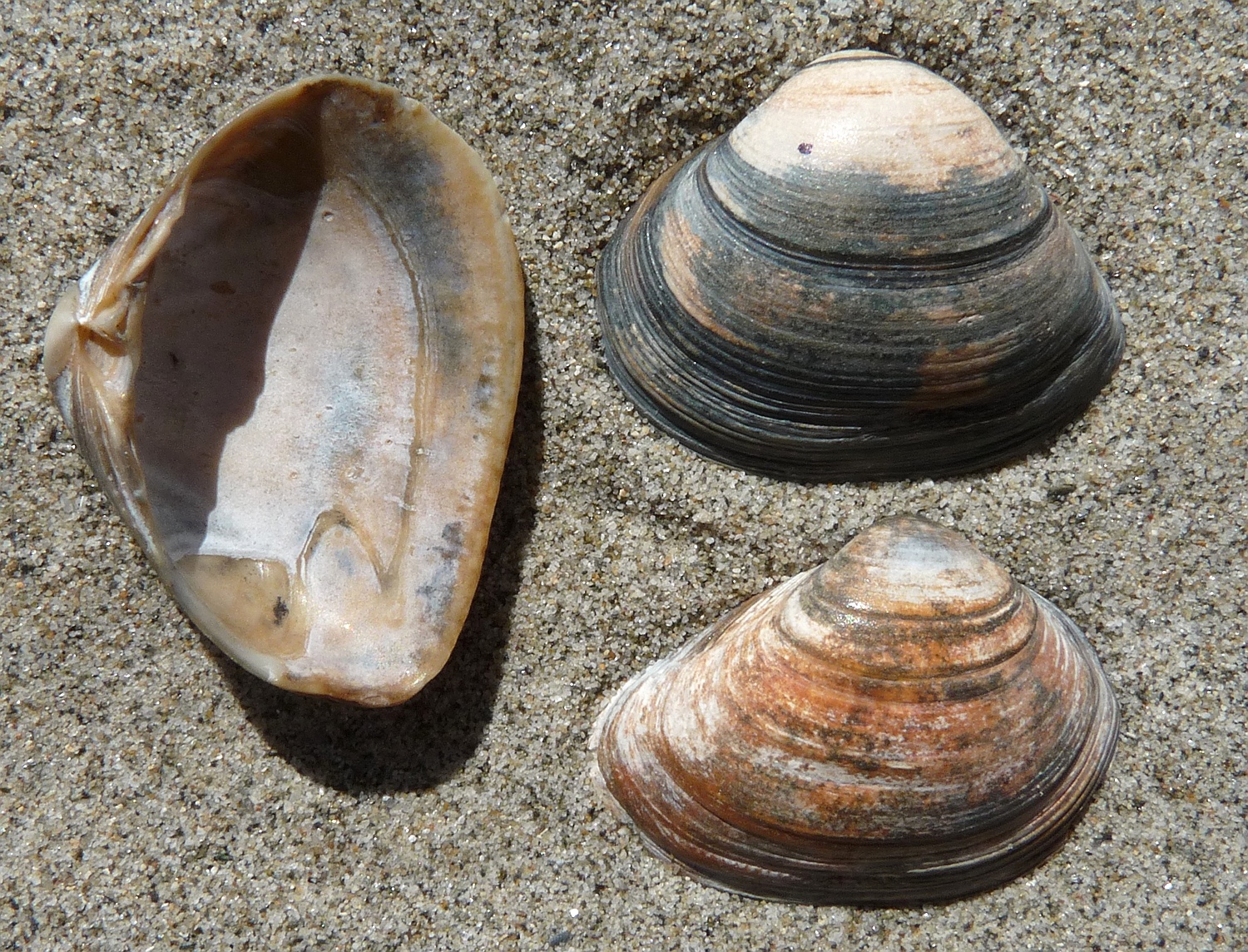
The Surf clam has a slightly triangular form with distinct concentric rings on the shell. Size: 30 mm
Peronaea planata, L.
(= Tellina planata)
rather rare
Peronaea planata has a flat, oval, white shell with fine concentric rings. Size up to 6 cm
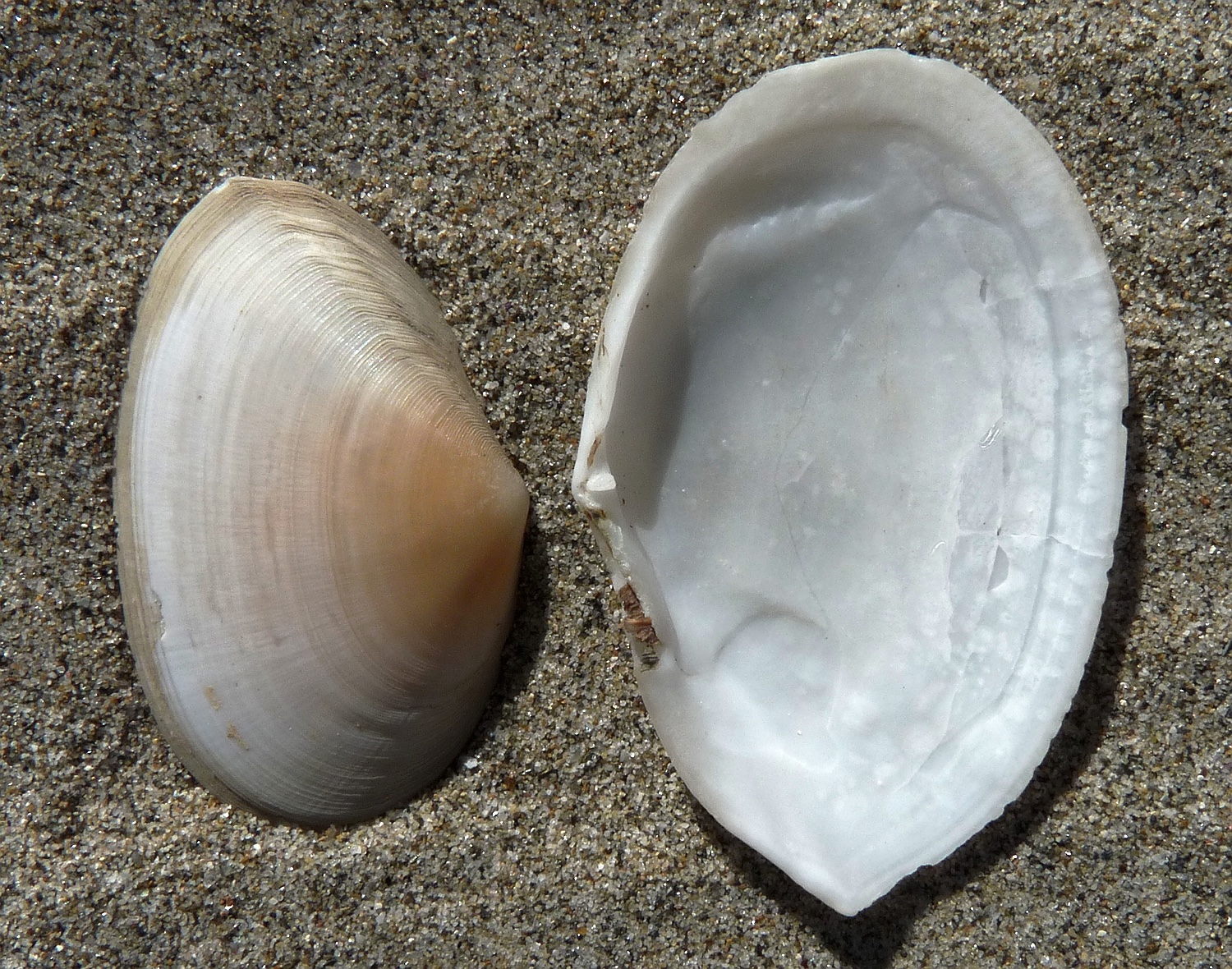
Peronaea planata has a very flat shell. Size: 50 mm
Large sunset shell, Gari depressa, Pennant
rather rare
The Large sunset shell has an elongated oval shape with slightly truncated ends; the shell has fine concentric and radial lines. It is purple to dirty grey in colour.
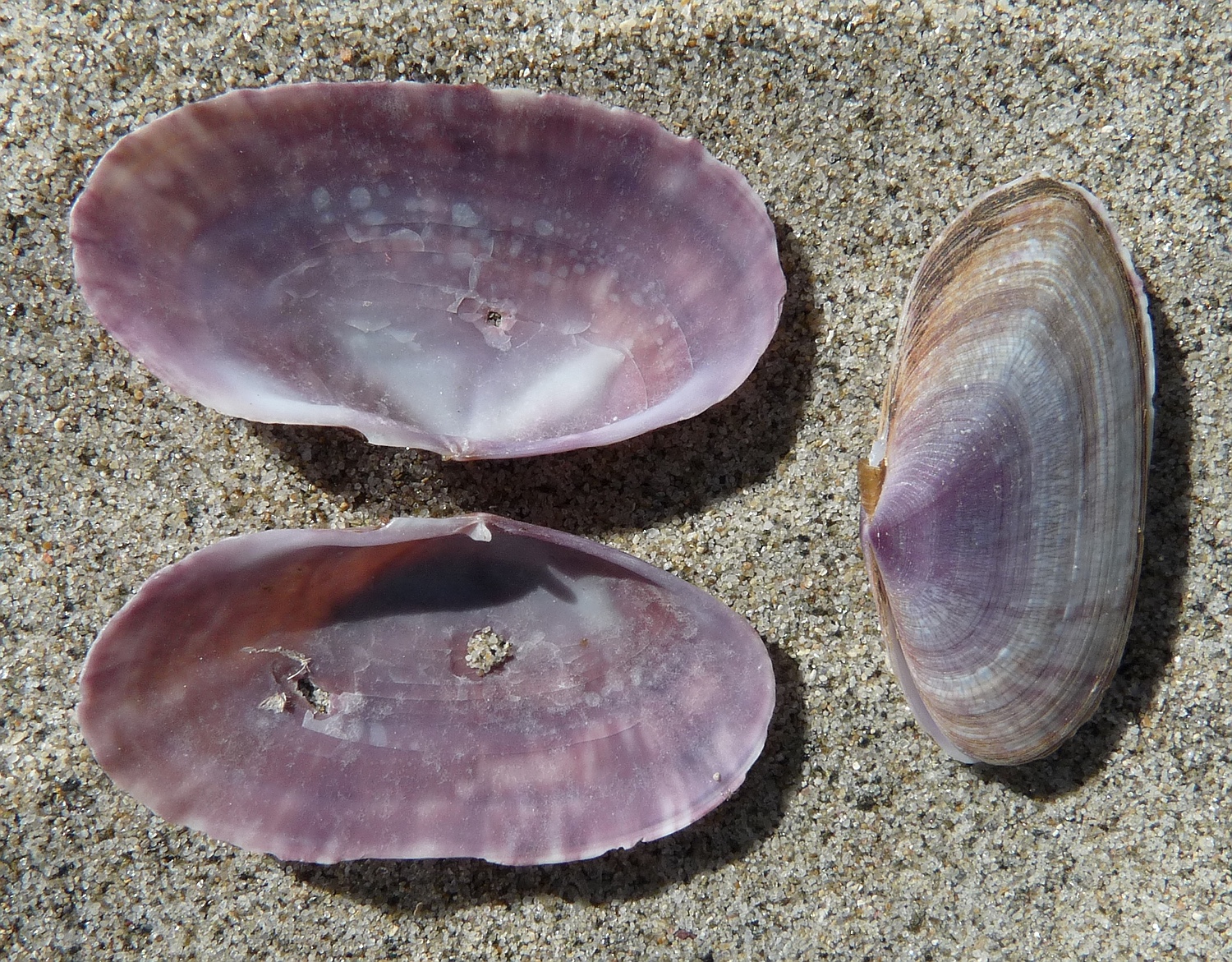
The Large sunset shell has a delicate purple colour with fine concentric rings. Size: 32 mm
Rosy razor clam, Solecurtus strigilatus, L.
at the large beaches in the southwest of Naxos, rather rare
The Rosy razor clam is unmistakable with its elongated oval, strongly domed shells. It lives buried in the sandy soil as a filter feeder, with long siphons protruding to the sand surface to suck in and expel seawater. The animal is larger than the shell and cannot retreat completely into it. With the help of its large foot, the clam can burrow through the sand so quickly that it is almost impossible to dig it out.

The Rosy razor clam can be recognised by the characteristic shape of the shells which are elongated with oval ends, and strongly domed. The shell surface shows very fine oblique lines. The colouring is also characteristic: the shell has a light pink colour with two white stripes running slightly diagonally from the whorl to approximately the middle of the opposite side.

From the side, you can see that the shells are gaping apart at the rounded corners: the living animal cannot retreat completely into its shell.
Wedge clam, Donax trunculus, L.
rather rare
The Wedge clam can be recognised by its oblique triangular shape and fine concentric and radial lines. The inner edge of the shell is serrated in the middle. Size up to 3 cm.
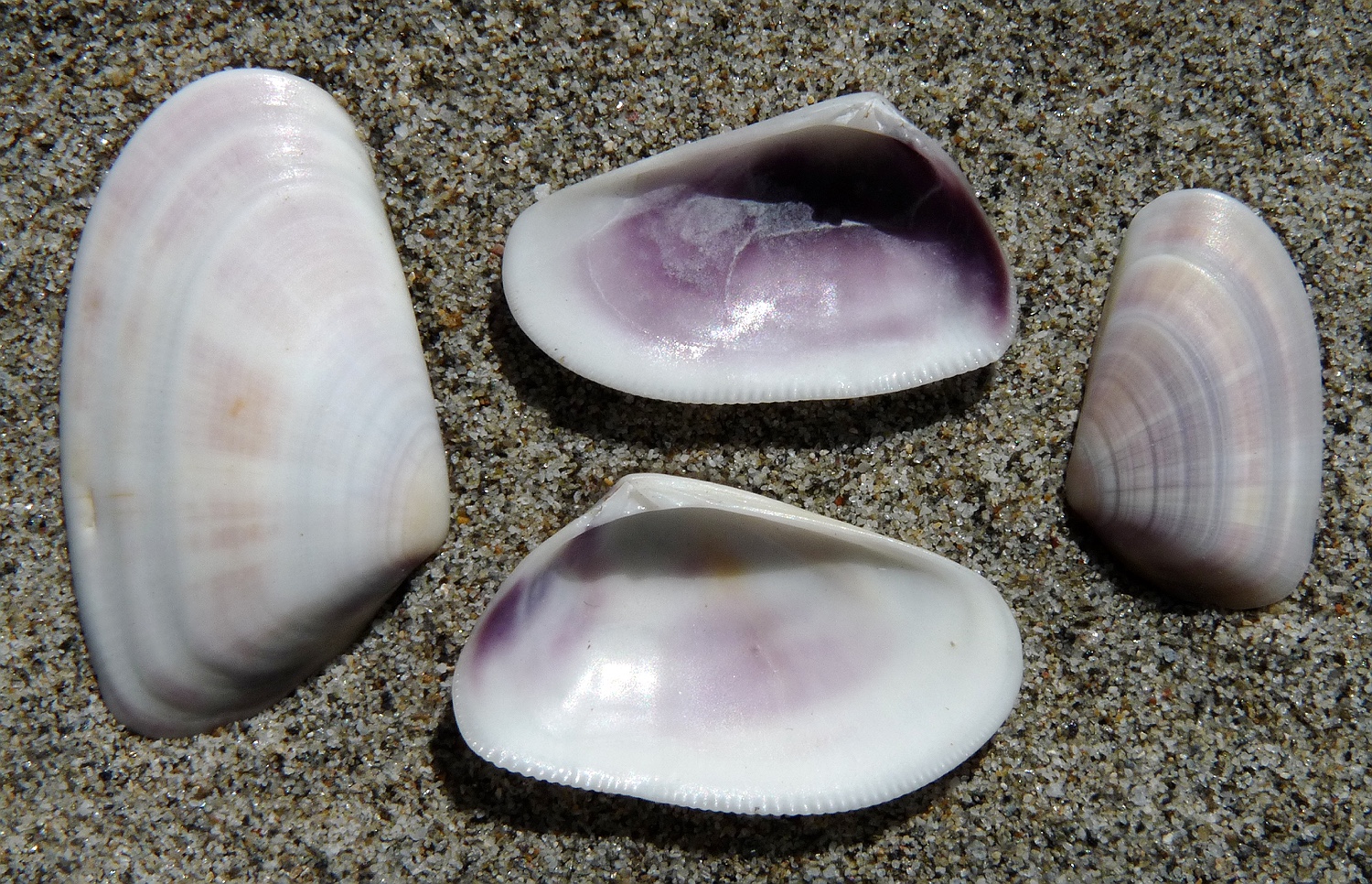
The Wedge clam has a characteristic oblique triangular shape. Size: 30 mm
White furrow shell, Abra alba, W. Wood
very rare
The White furrow shell is a small, thin-shelled bivalve that lives in fine sand and collects detritus with its long siphon. It reaches a size of 2.5 cm.
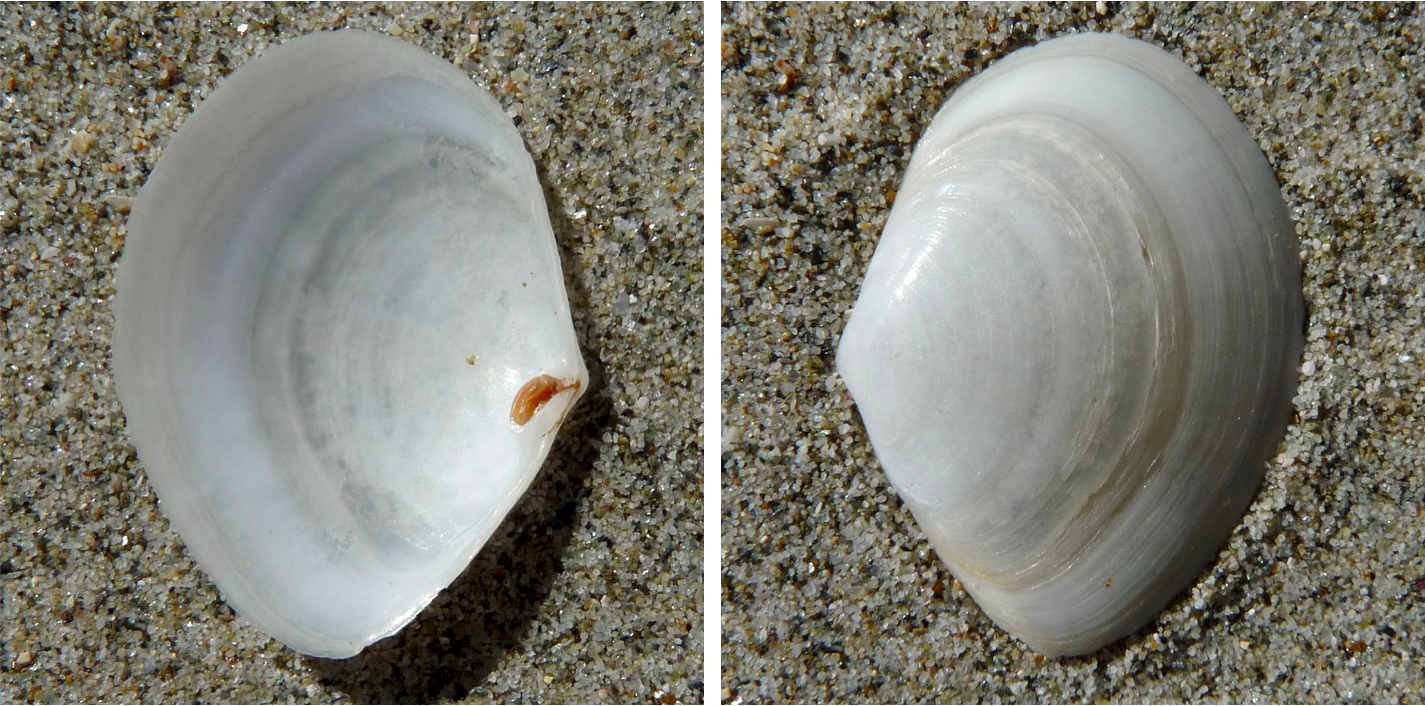
The White furrow shell can be recognised by its oval shape, concentric growth rings and slightly translucent white colouring. You can see the characteristically shaped brown lock. Size: 25 mm
Chamelea gallina, L.
quite common
This clam, which belongs to the Venus clams, shows fine, irregularly branching concentric ribs on its strongly domed shell. The whorl is curved towards the front end. The shell often shows darker radial stripes and brown zigzag bands. The clam lives buried in coarse sand, for example with sea urchins and brittle stars, especially at slightly greater depths. Size up to 3.5 cm
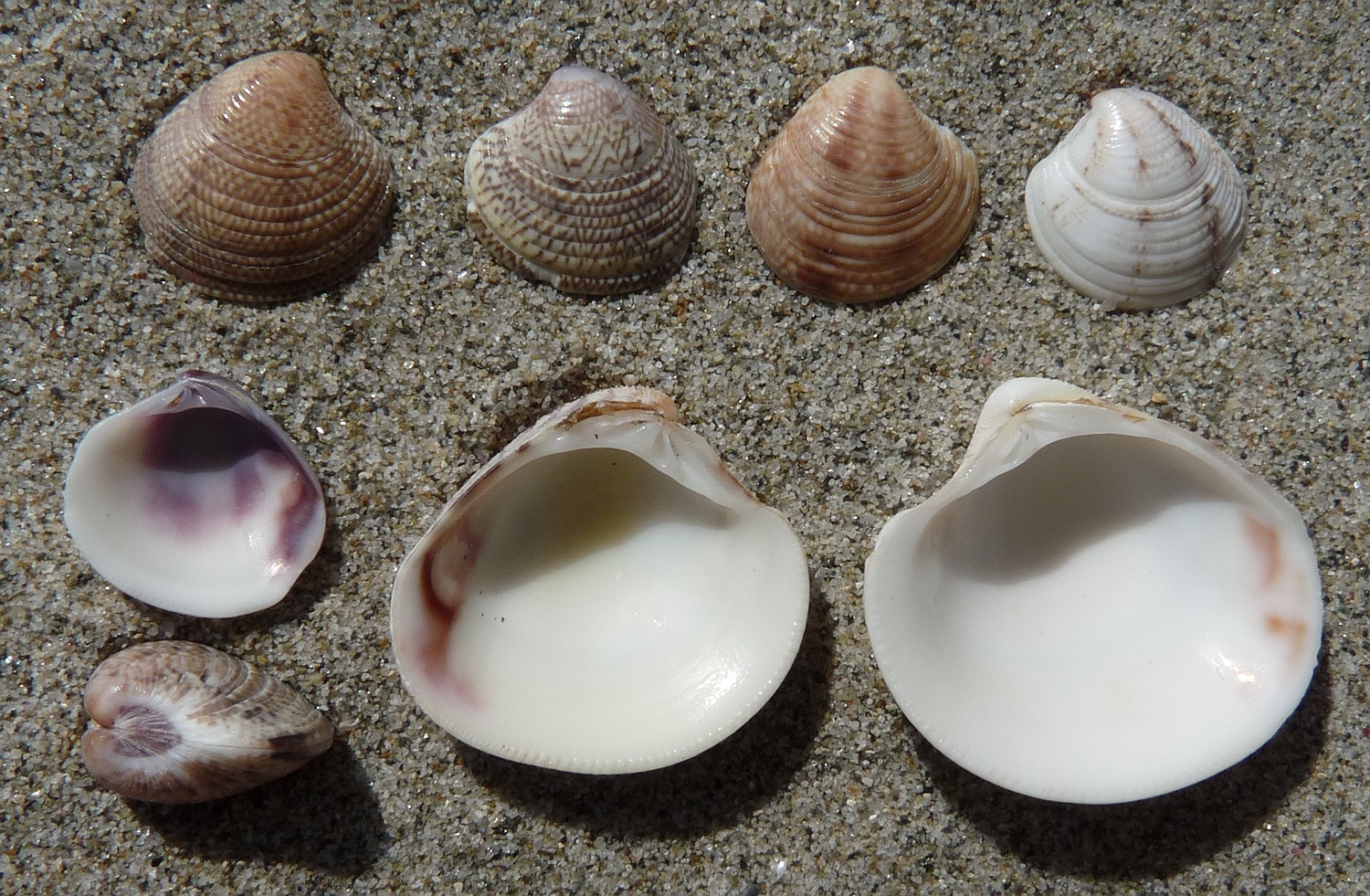
This species of Venus clam can be recognised by the obliquely curved whorl of the strongly domed shell. Size: 18 mm
Warty venus, Venus verrucosa, L.
rather common
The shell of the Warty venus has distinct warty concentric rings. It is light in colour and lives in shallow sandy soils. Size up to 7 cm.
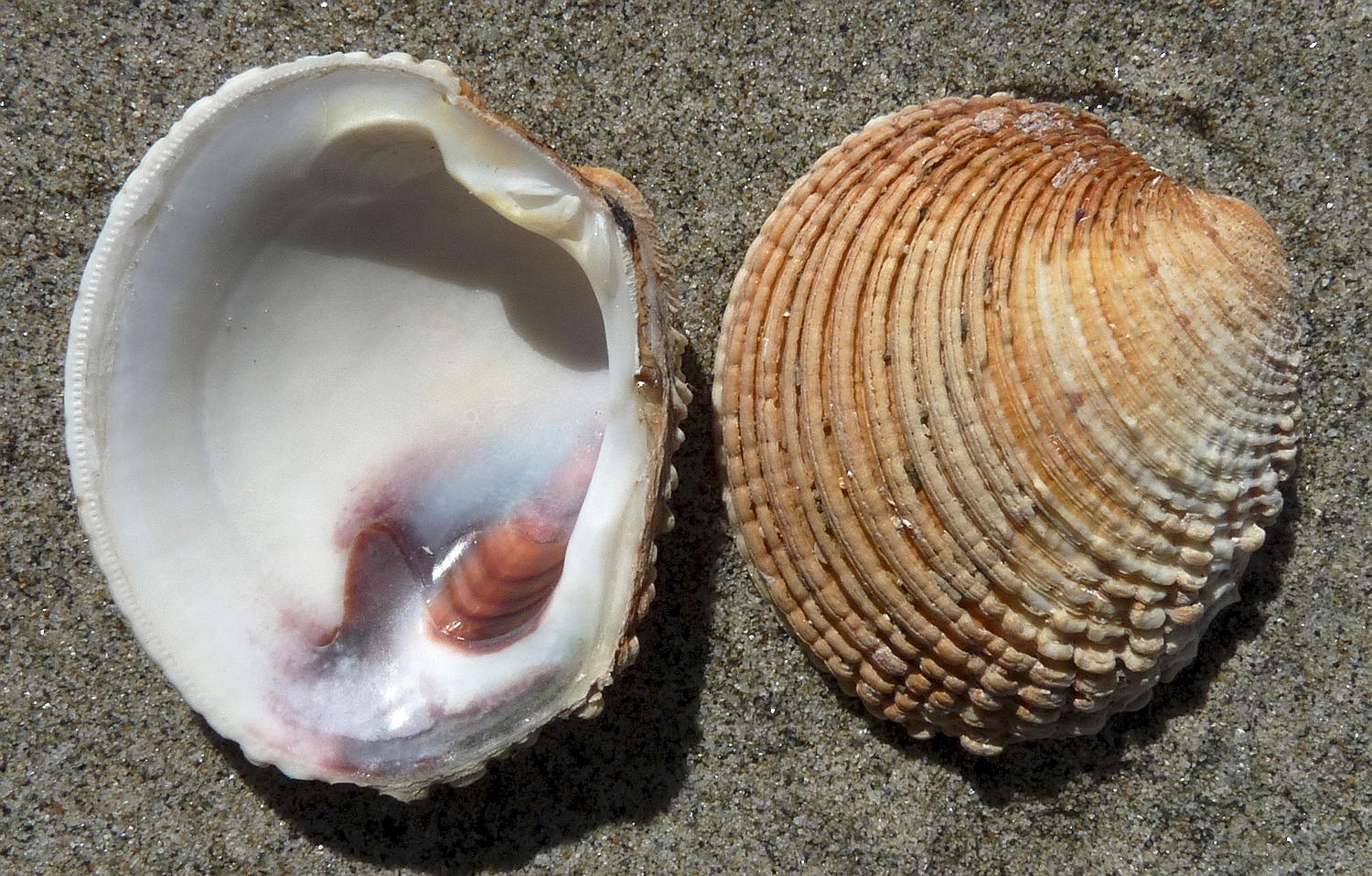
The Warty venus is rounder in shape; it can be recognised by its pronounced concentric rings which are in places warty. Note the prominent teeth on the lock. Size: 36 mm
Smooth clam, Callista chione, L.
rather rare
This very beautiful clam has a shiny reddish shell with faint concentric growth rings and radial stripes, some of which show rectangular darker spots. Size up to 10 cm
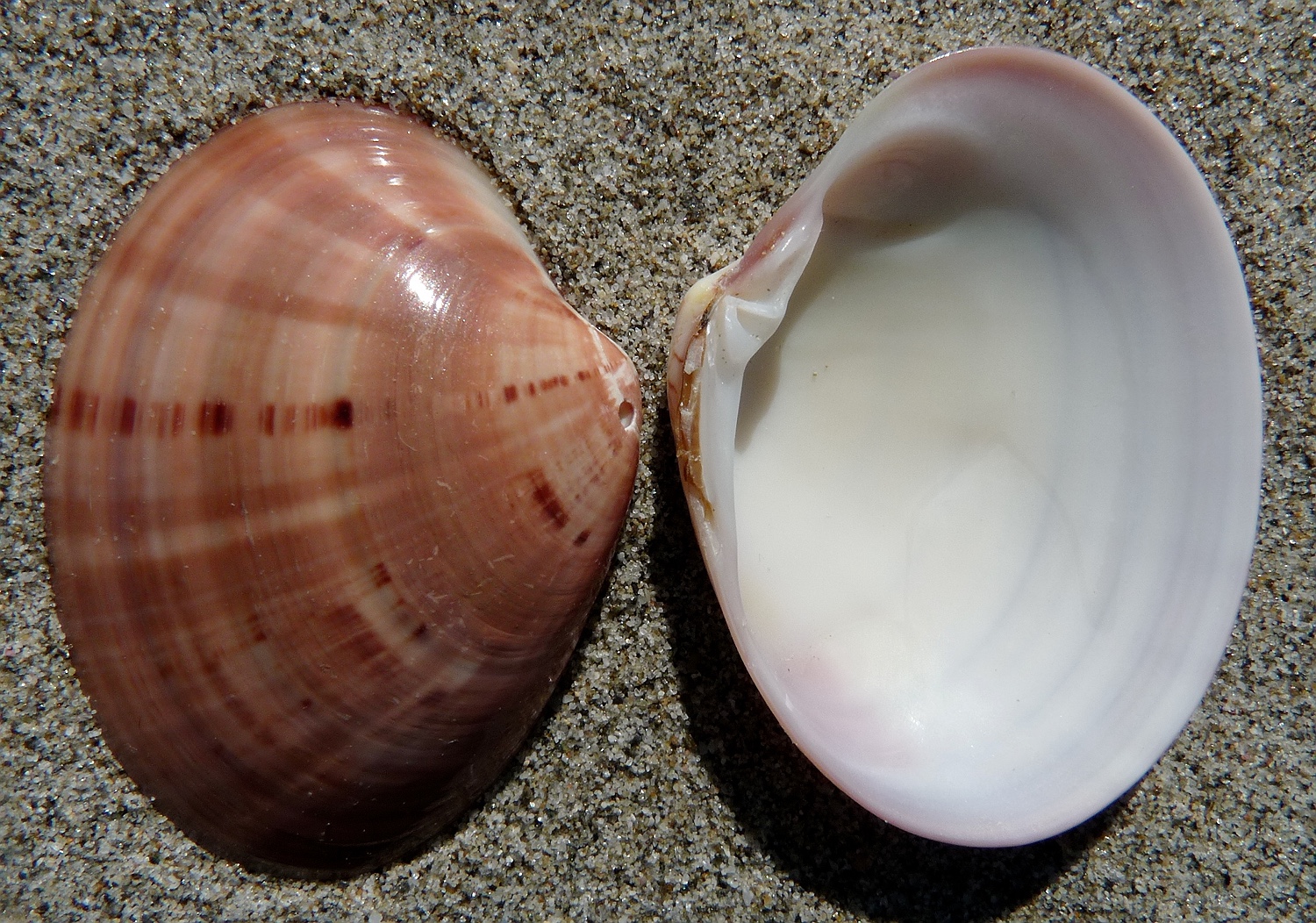
The very beautiful Smooth clam has a shiny reddish upper side with irregularly distributed darker spots; the hinge is slightly shifted towards the front end. Size: 27 mm
Grooved carpet shell, Ruditapes decussatus, L.
(= Venerupis decussata)
rather rare
The rather light coloured Grooved carpet shell has a forward-turned whorl like the venus clams; its rear half is significantly longer than the short, round front. The surface is covered with a dense pattern of fine radial and spiral lines.
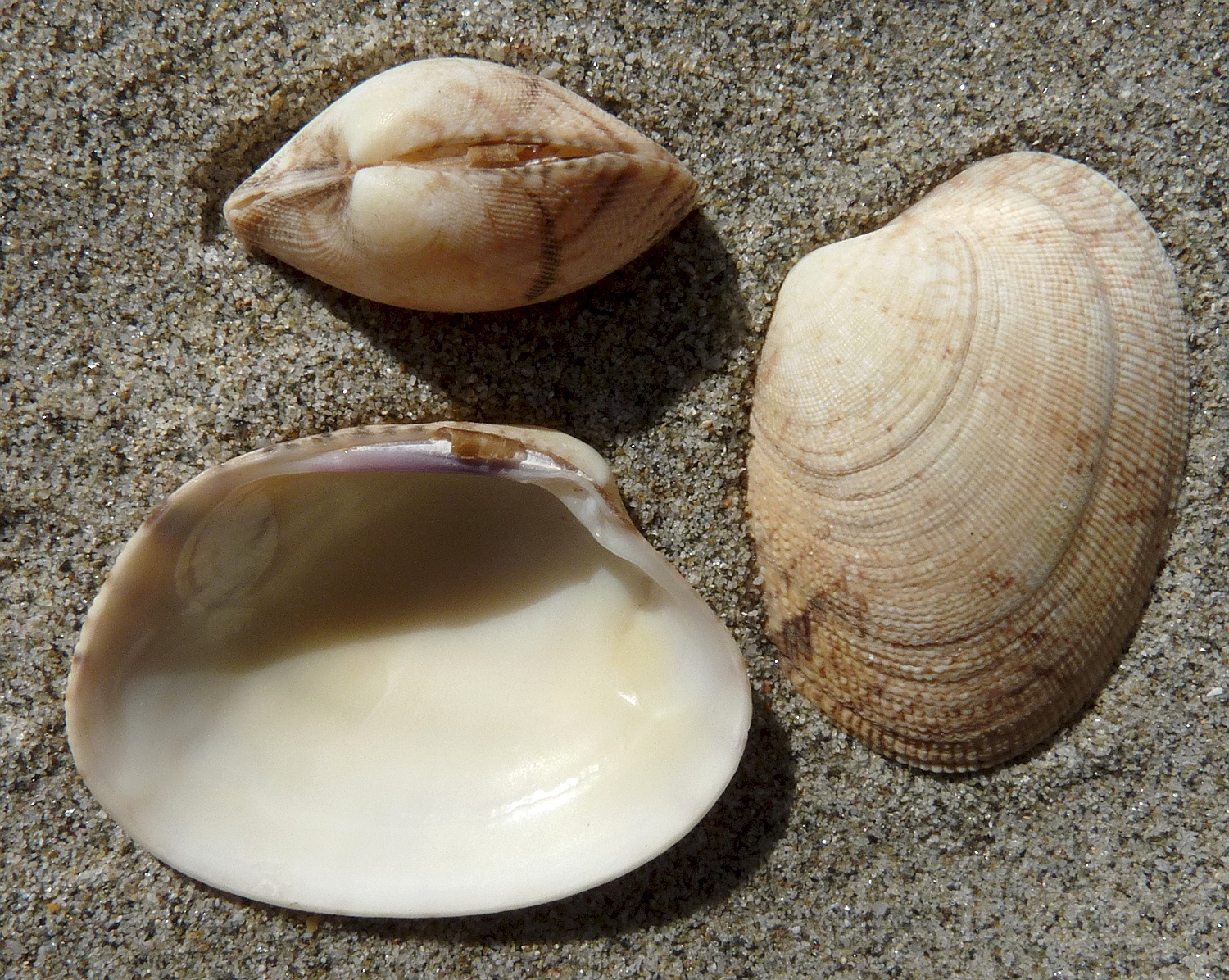
The shell of the Grooved carpet shell has a finely reticulate sculpturing. Size: 35 mm
Polititapes aureus, Gmelin
(= Venerupis aureus)
very rare
This bivalve is slightly more elongated than the Grooved carpet shell. It has fine radial stripes and an irregular, variable pattern. The inside of the shell is shiny golden yellow.
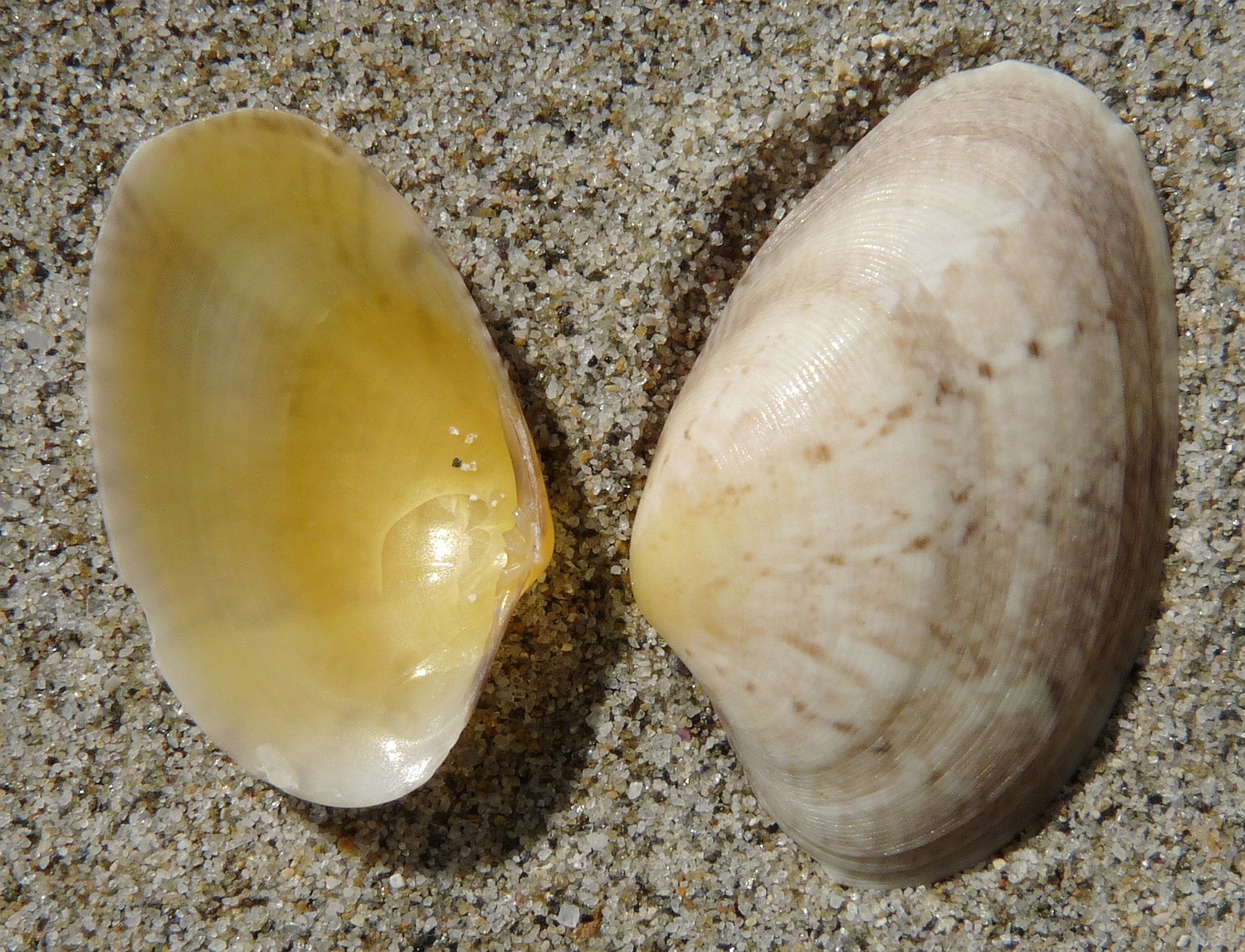
The beautiful species Polititapes aureus resembles the Grooved carpet shell, but has a smoother shell and is more elongated. It can be recognised by its golden yellow inside. Size: 28 mm
Globivenus effossa, R. A. Philippi
very rare
This species has a round, strongly domed shell with pronounced concentric stripes and a characteristic lock.
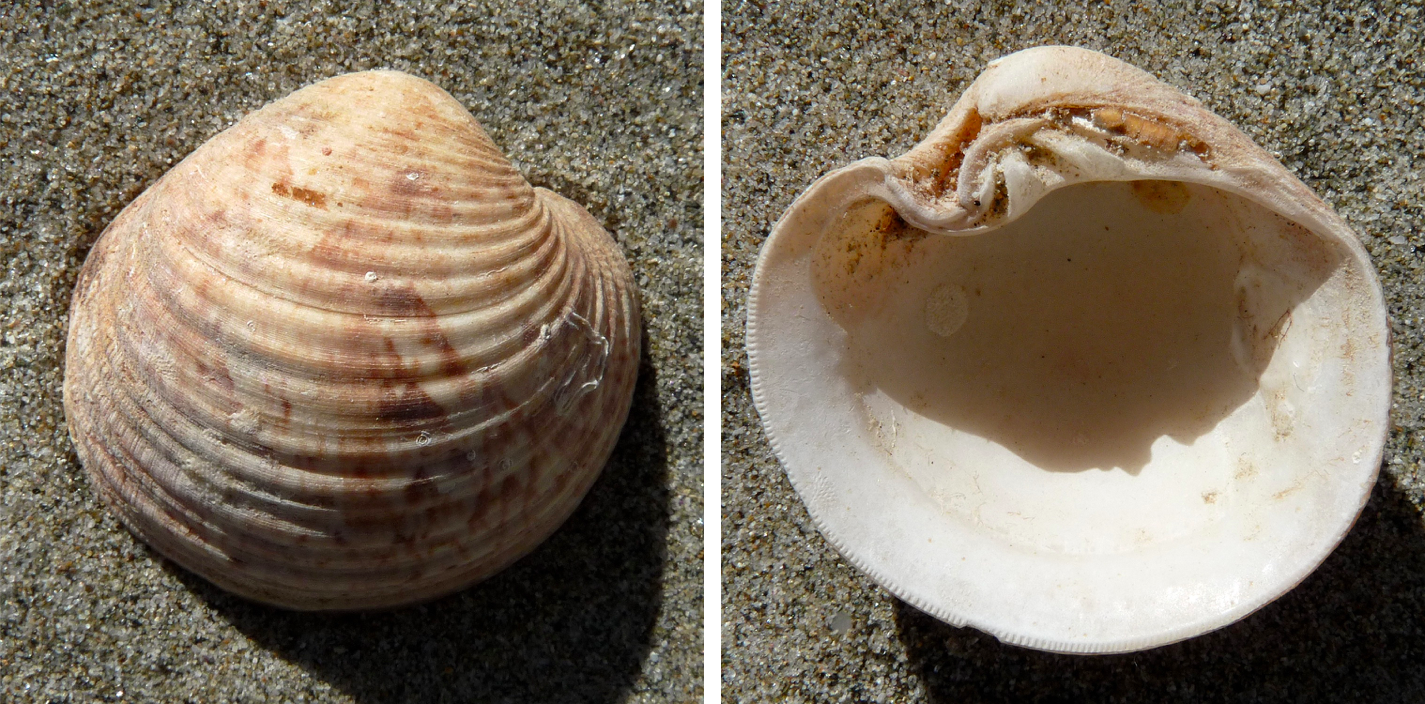
The shell of Globivenus effossa is particularly domed with strong concentric bands. Note the intricately shaped hinge. Size: 36 mm
continue: Tusk shells
back: Marine animals (Overview)
see also:
For the identification of bivalve species, the Marine Species Identification Portal is useful; it is well made, but does not contain all Mediterranean species.
Further reading: