
Chitons
The phylum of molluscs comprises several classes, among which the bivalvia (mussels), the snails and the cephalopods (octopuses, squids) are the most important and best known. However, to the molluscs belong also a number of other, smaller classes, such as the chitons (Polyplacophora). Chitons are a very ancient group of animals, which are also known in many fossil forms. Today, there exist about 900 species that live exclusively in the sea.
Here you can skip the introduction and go directly to the species.
The chitons resemble the snails in many respects, but carry eight narrow shell plates on their backs, surrounded by a belt. The shell plates often have a longitudinal keel or separate central and side fields or a granular structure. Unlike the shell of a snail, the shell of the chitons is living tissue and equipped with sensory organs (e.g. sense of touch and simple vision through tiny, translucent aragonite crystals, under which light-sensitive cells are located). The colouring of chitons is usually variable. When detached from their substrate, they are able to slowly curl up.

Unlike the shells of snails, the shell of the chitons, which consists of eight transverse plates, is living tissue. Here you can see the granular structure of the shell plates and the surrounding belt, which has a dense ring of fine spines at the edge.

When a chiton is detached from the rocky substrate, it slowly curls up.

Chitons are among the more inconspicuous marine animals. They are small, usually about one to two centimeters long, and well camouflaged by their colouring (this only applies to the chitons native to our region; elsewhere one finds species that grow up to 45 cm in size and are often very colourful). During the day, the chitons often sit under stones or in the algae. They are found on rocky substrates in the intertidal zone and in shallow water. They attach themselves to the substrate with their foot, much as limpets. When active, they move very slowly by crawling around.
Like limpets, chitons feed on encrusted algae or blue-green algae, which they scrape off with their radula, which is covered with small “teeth” containing magnetite. The larvae live for a short time free-swimming in the plankton.
Chitons are difficult to identify; their colouring is variable and one needs a magnifying glass to see the structure of their shell plates. Therefore, the identification of the two species presented here is not entirely certain.
Chiton species on Naxos
Chiton species on Naxos
The Photo gallery of the marine snails gives an overview over the species.
A note on identification: Some species usually can be identified easily and reliably. In many cases, however, several related species are difficult to distinguish. Also not all species are included in the field guides; even using the internet, it is difficult to find information on some species. Accordingly, some of the identifications may not be correct.
And a word about the names: As with many marine animals, there is a great deal of confusion surrounding the names of snails: for almost all species, a large number of synonyms exist that are no longer valid today but are still used in older books. I use the names according to the World Register of Marine Species (as of 2020), where you can also find the corresponding synonyms.
Common chiton, Lepidochitona cinerea, L.
The Common chiton has a broad, granular belt that is usually alternately dark and light in colour. The shell plates are also granular. The colouring is very variable. It is one of the most common species in the Mediterranean and the European Atlantic.
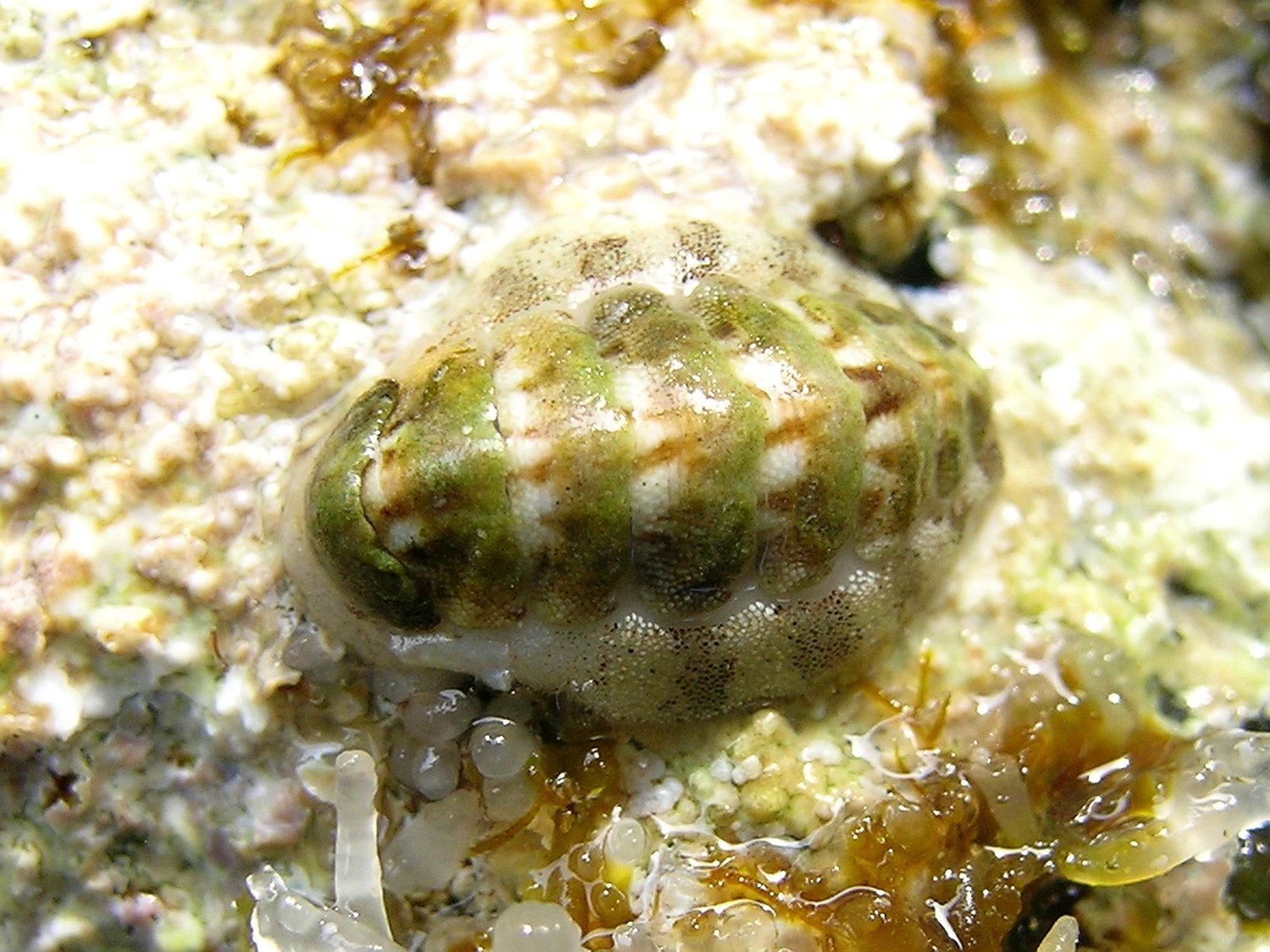
Chitons are difficult to spot in their natural environment because their colouring closely resembles the substrate.

They live on rocky substrates in the intertidal zone and in shallow water.

Here a specimen with black spots.

Here one can see the underside; from below, the body closely resembles that of a limpet.
Green chiton, Rhyssoplax olivacea, Spengler
(= Chiton olivaceus, Spengler)
The Green chiton is also common in the Mediterranean. It is brownish in colour and has strongly striped shell plates.

The Green chiton has strong stripes on its shell plates.

The main plates are striped lengthwise, the side plates crosswise. The belt is finely dotted.
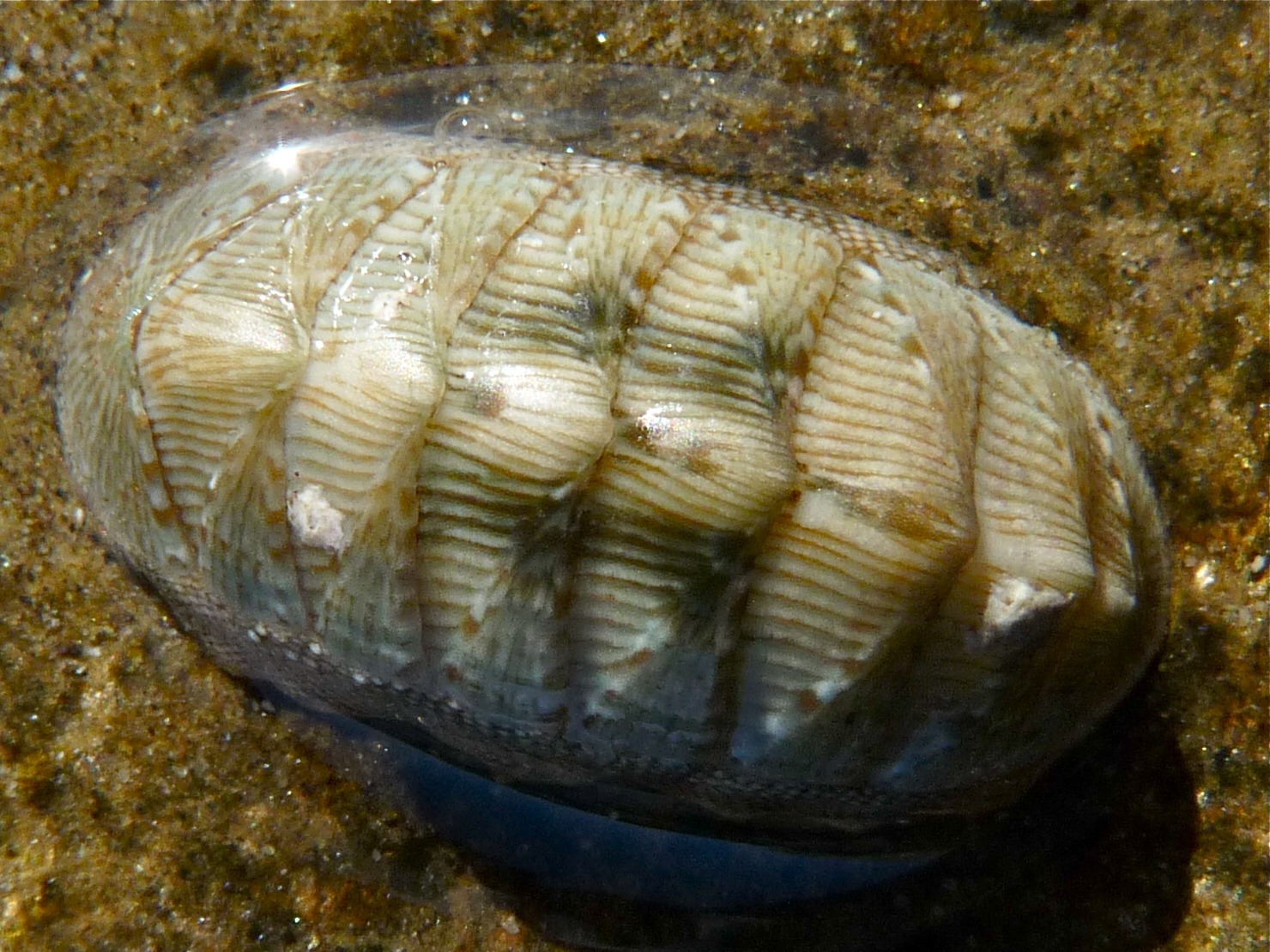
A pretty creature and a rather amazing animal!
continue: Bivalvia
back: Marine animals (Overview)
See also:
Further reading: