The Zones of the Mediterranean Sea
The marine ecosystem is divided into a number of zones with different environmental conditions. To begin with one must distinguish the seabed, known as the benthal, and the water column, known as the pelagial. Within both, the euphotic (light-rich) areas offer significantly different living conditions from the aphotic (lightless) areas. The coastal, shallower areas above the continental shelf are referred to as the neritic region, while the deep oceanic areas are referred to as the pelagic region.
The illuminated, euphotic part of the benthal is divided into several characteristic zones: The supralittoral, the splash zone above the upper waterline, the eulittoral from the upper to the lower waterline (upper and lower limits of the tidal range or water level fluctuations), the infralittoral, whose lower limit lies where photophilic organisms such as seagrass can no longer exist (in the Mediterranean usually at a depth of about 30 to 50 metres), and the circalittoral, which extends to the end of the euphotic zone (around 100 to 200 metres deep).
The zoning is particularly visible in the coastal areas:
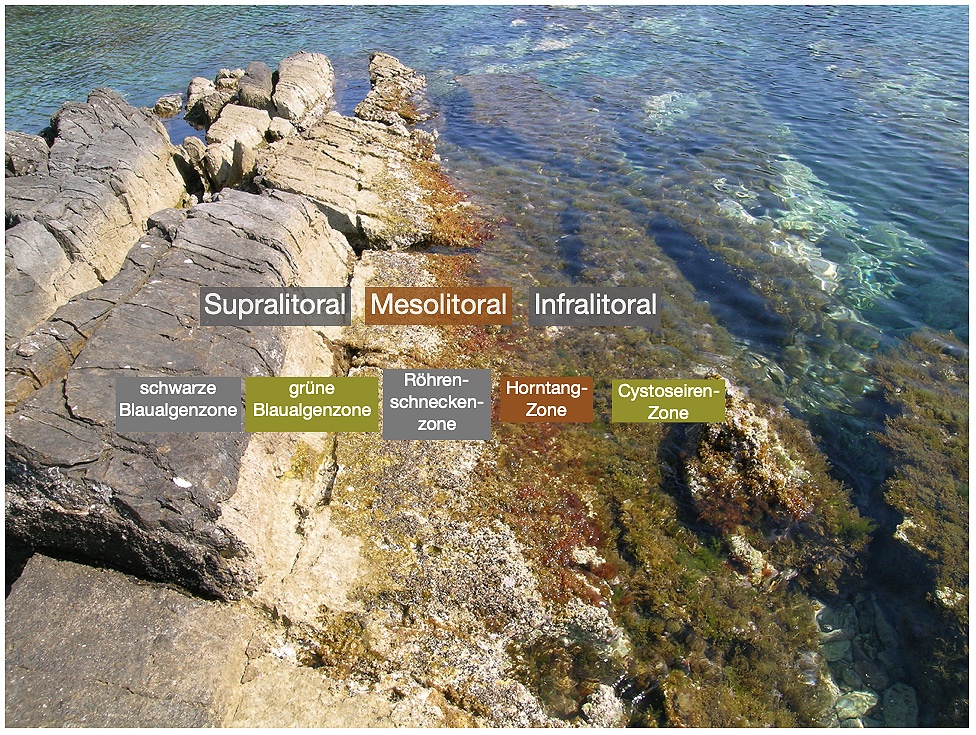
zoning near the waterline
The aphotic zone, which follows below the circalitoral zone, is divided into the bathyal zone (down to a depth of approximately 2,500 to 3,000 meters), the abyssal zone (covering most of the real ocean floor down to a depth of 6000 to 7000 meters) and the hadal zone (the deep-sea trenches below 7000 meters). The latter zone is completely absent in the Mediterranean, and the abyssal zone is also poorly developed and largely colonised by organisms that live elsewhere in higher areas. In the Aegean Sea, the aphotic region falls entirely within the uppermost bathyal zone: the sea depth nowhere exceeds 2500 meters.
The pelagic zone can also be divided into a euphotic (illuminated) zone (epipelagic zone, down to a depth of about 200 m) and an aphotic zone. The comparatively very thin epipelagic zone is further subdivided into layers according to the availability of light and oxygen. Particularly the oxygen-rich surface layer, which is only about half a meter thick, is clearly distinguished by the organisms living there. The lower, aphotic layers of the pelagic zone are also divided into several zones. Here, only a small number of species can exist.
The marine plants (algae and higher plants: seagrass) depend on light as energy source for photosynthesis (with a few exceptions among single-celled algae). Their occurrence is therefore limited to the illuminated layers of the sea, the euphotic zone. Due to the steeply sloping seabed in most areas of the Mediterranean, less than one per cent of the benthal belongs to the euphotic zone. Green algae, which absorb the red components of light, occur mainly in the upper areas of the euphotic zone, brown algae are most abundant in the middle regions, while red algae, which can also absorb the blue light, predominate in the deeper areas (however, there are also numerous brown and red algae species in the areas close to the surface). The euphotic zone of the benthal is also home to a great variety of animals, many of which are sessile.
However, the majority of photosynthesis in the sea is not carried out by sessile plants, but by the mostly single-celled plants of the plankton (dinoflagellates, chrysophyta and diatoms; these planktonic algae have not been studied sufficiently, but each are represented by at least several hundred species). The absorption of carbon dioxide and release of oxygen by the epipelagic algae is invaluable to the ecosystem (not only) of the sea. Also the algae of the plankton play a crucial role as food source for countless marine animals. The zooplankton and most free-swimming animals also live predominantly in the epipelagic zone.
The number of species (and individuals) in the aphotic zone of the sea is significantly lower than in the euphotic zone. Only animals can exist here, feeding on detritus, i.e. dead organic matter that continually sinks to the sea floor.
The descriptions of the supra-, eu- and infralittoral zones (see below) are based mostly on my observations here in Azalas; however, probably the organisms and communities I describe are also typical for many other coastal areas of Naxos and the Cyclades. I have studied the infralittoral zone mostly only as far as one can observe it from land; almost all of the photographs were also taken from the land. The circalittoral zone I describe only shortly and not from my own observations. The pelagic zone I cannot consider at all.
back: The Mediterranean Sea
continue:
see also: