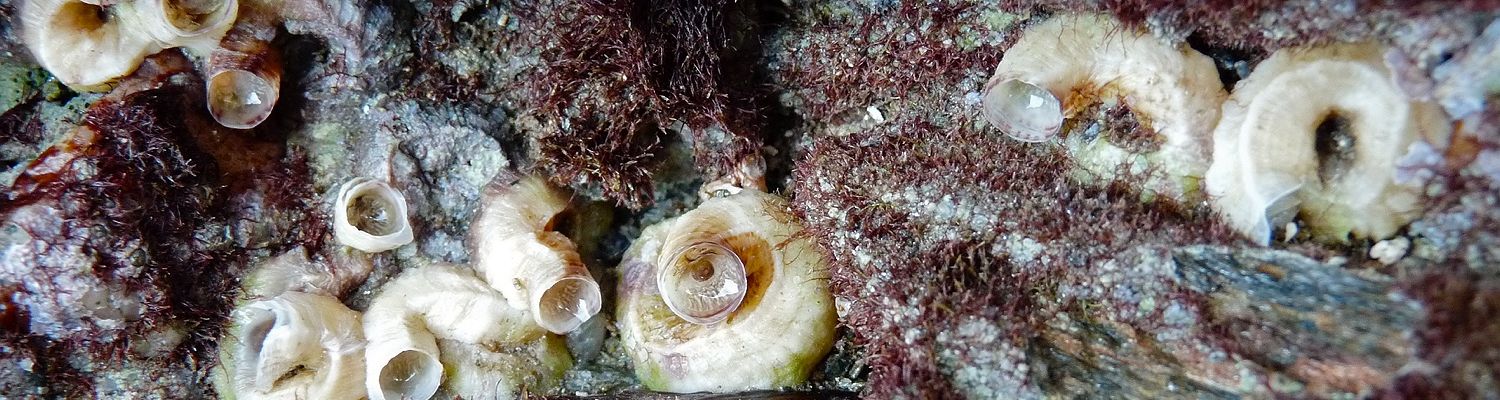
Among the many strange creatures of the intertidal zone are the worm snails. These snails only crawl around freely while they are young, then they attach themselves to the substrate and adopt a sessile lifestyle. Several species are found on Naxos. Worm snails or tube snails form their own family (Vermetidae) within the Littorinimorpha, a large suborder within the Gastropoda, to which many of our marine snails belong.
The Photo gallery of the marine snails gives an...
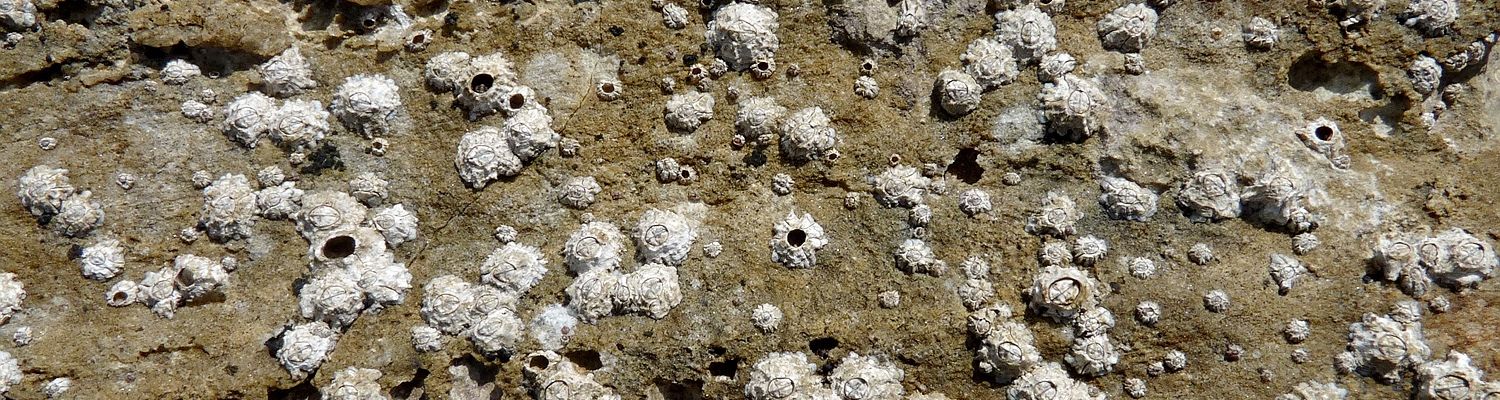
Barnacles
Seeing barnacles on a rocky coastline one would hardly think that they are close relatives of crabs and lobsters. However, they belong to the Crustacea, and together with the Goose barnacles and some parasitic forms, they make up the subclass Cirripedia.
Here you can skip the introduction and go directly to the species.
Barnacles are sessile animals. Their carapace takes the form of a cone-shaped shell made of calcareous plates, the open tip of which is closed with...
The Zones of the Mediterranean Sea
The marine ecosystem is divided into a number of zones with different environmental conditions. To begin with one must distinguish the seabed, known as the benthal, and the water column, known as the pelagial. Within both, the euphotic (light-rich) areas offer significantly different living conditions from the aphotic (lightless) areas. The coastal, shallower areas above the continental shelf are referred to as the neritic region, while the deep oceanic areas are referred...
The demands of the sea on its inhabitants
Life in the sea places significantly different demands on organisms than life on land. First of all, of course, there is an unlimited supply of water. All organisms need water – they consist largely of water. Terrestrial organisms must therefore protect themselves against evaporation more or less effectively depending on the dryness of their habitat. Aquatic organisms can do without that protection, apart from those that live in the coastal strip, which temporarily falls...
The environmental factors in the Mediterranean Sea
With 3.9 per cent by volume, the eastern Mediterranean Sea has a fairly high salt content. The water temperature ranges from 25°C in August and September to 14°C in December and January. In summer, the upper layers of water warm up to a depth of sometimes up to 30 meters, where the temperature suddenly drops (thermokline). In the depth, the water of the Mediterranean Sea has a temperature of no less than 13°C. When the upper layers of the water cool down in winter, this...
The emergence of the Mediterranean flora and fauna
The precursor oceans of the Mediterranean, the Paleo- and Neotethys, were tropical oceans located near the equator. Accordingly, as fossils show, they were inhabited by a tropical flora and fauna similar to the species found today for example in the Indian Ocean. During the Jurassic and Cretaceous, huge coral reefs existed in the then extensive shelf areas of Africa and in the relatively shallow ocean arms, as well as on the flooded terranes that were later stacked up to...
The geological history of the Mediterranean Sea
In the Palaeozoic era
The first precursor to the Mediterranean Sea was the Palaeozoic ocean known as Palaeotethys. This existed as a huge bay at the end of the first (and longest) of the three geological eras documented by fossils, the Palaeozoic (540 to 250 million years ago). During the last epochs of the Palaeozoic, the Carboniferous (345 to 295 million years ago) and the Permian (295 to 250 million years ago), all the continents were clustered together (Pangaea) and...
The Mediterranean sea
Das Mittelmeer
Das Mittelmeer ist ein vergleichsweise kleines Meer. Die Ägäis ist kein echter Ozean, sondern ein versunkenes Stück Kontinent, weswegen die Meerestiefen im Allgemeinen eher gering sind. Die Artikel auf dieser Webseite beschäftigen sich hauptsächlich mit den Organismen, die man der Küste und im flachen Wasser antreffen kann.
Schon direkt an der Küste kann man einen faszinierenden Einblick in die Meereswelt erhalten. Fast alle in den folgenden Artikeln...
Crustaceans
The crustaceans belong to the large phylum Arthropoda which also includes the chelicerates (Chelicerata) with the horseshoe crabs and arachnids (spiders, scorpions and mites), and the millipedes and hexapods (insects, springtails, etc.). The crustaceans form a subphylum, whose more important and well-known classes are the higher crustaceans (malacostraca), the branchiopods, the copepods, the ostracods and the Thecostraca, which include the goose barnacles and the...
Starfish
The starfish (class Asteroidea) belong together with the sea cucumbers and the sea urchins to the phylum Echinodermata.
Here you can skip the introduction and go directly to the species.
The echinoderms are exclusively marine, that is they are living only in the sea. Their bodies are – rather unusually in the animal kingdom – five-rayed radially symmetrical with an exoskeleton, either in the form of a shell (sea urchins) or as calcified plates in the epidermis...
Marine animals (overview)
Meerestiere Überblick
Die Meeresfauna ist bei uns in Azalas noch recht artenreich. Das Mittelmeer ist zwar überall überfischt, aber es ist hier – mitten in der Ägäis – vergleichsweise noch recht sauber und die verschiedenen Pflanzen- und Tiergesellschaften der unterschiedlichen Biotope sind relativ intakt. Interessant und artenreich ist vor allem die Zone um die Wasserlinie, das Eulitoral, wo an der Felsküste oft ein schönes “Kalkalgentrottoir”...
Gastropoda 9: Slugs
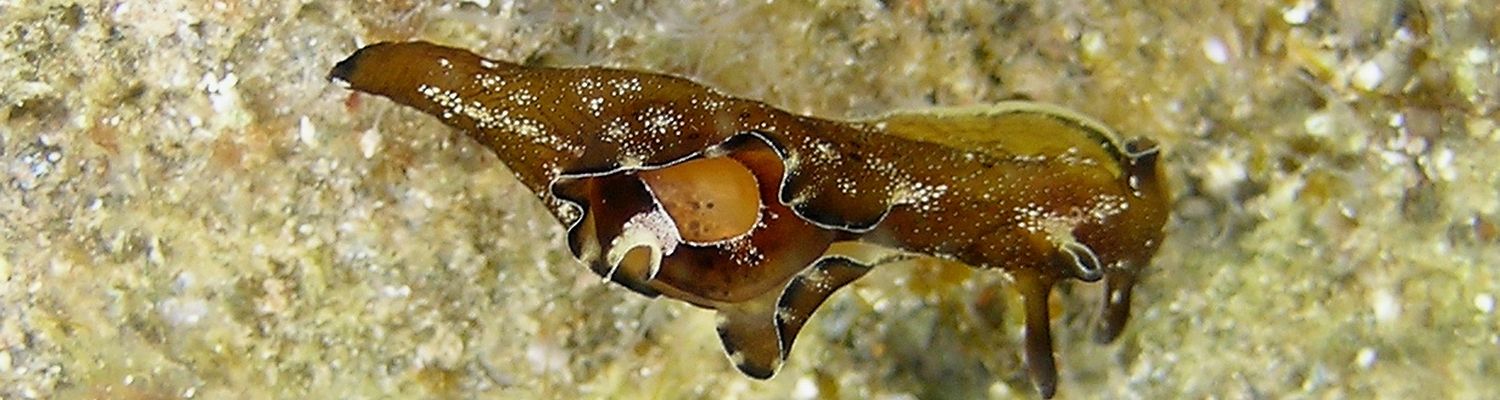
Marine slugs belong to the gastropods (Gastropoda) and, more specifically, to the opisthobranchs, though this group is no longer recognized. Today the marine slugs mentioned here are placed in the superorder Nudipleura and the three orders Pleurobranchida, Nudibranchia and Aplysiida (sea hares). There are around 3,000 species of marine slugs, of which some are herbivorous while others feed on sessile marine animals such as sponges, corals, polyps and tunicates. They...
Sea urchins
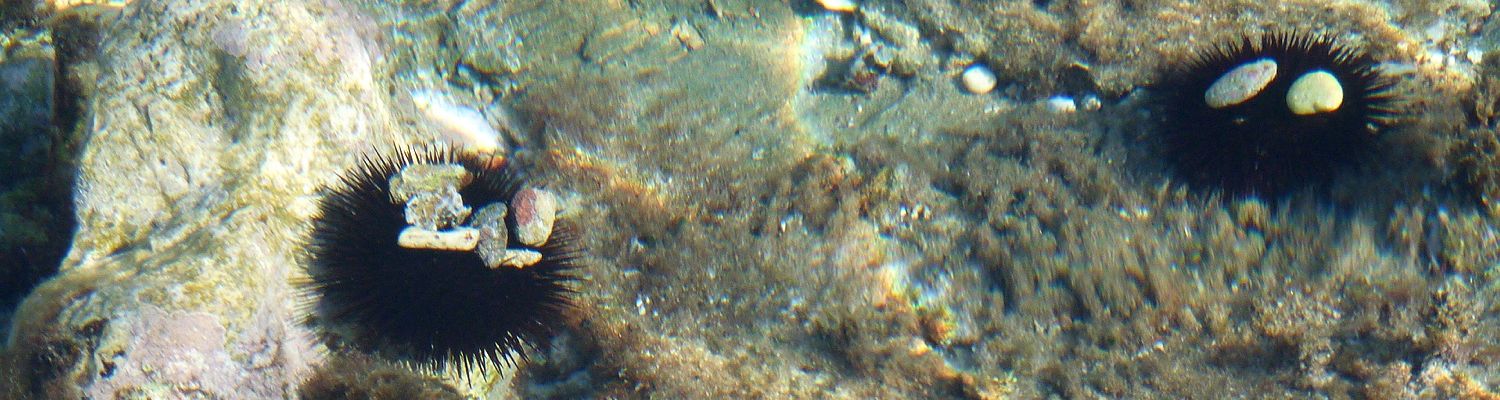
Sea urchins are not the most popular sea animals. However, in moderate numbers, they are an important part of a healthy ecosystem.
Here you can skip the introduction and go directly to the species.
Black sea urchins in shallow water
Despite their simple body anatomy, sea urchins stand quite “high” in the “phylogenetic tree”, close to the vertebrates. With almost 1,000 species, they form their own class (Echinoidea) and form the phylum Echinodermata...
Gastropods 1: Limpets
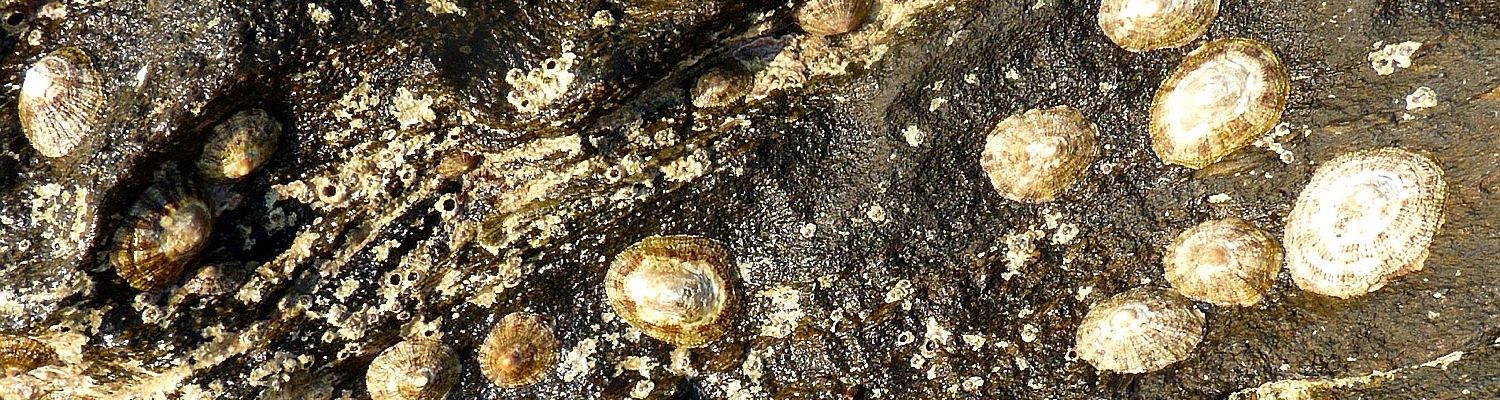
The limpets (genus Patella) belong to the snails and not to the mussels, even though their shells are not coiled. Unlike snails, mussels always have two shells. Within the snails, the limpets and their relatives form the more primitive subclass Eogastropoda, while all the other snails belong to the subclass Orthogastropoda.
Here you can skip the introduction and go directly to the species.
At least two species of limpets are common in the intertidal zone of Naxos....
25. Februar 2009: Der Fluss in Azalas fließt!
der Fluss in Azalas fließt
Bei starken Regenfällen wird auf einer steilen Insel wie Naxos längst nicht alles Regenwasser von der Erde aufgesaugt. Dann werden die trockenen Torrente der Insel kurzfristig zu Flüssen, und in den Flussbetten rauscht wild das Wasser. Vor den Flussmündungen färbt sich das Meer auf weite Strecken braunrot. Und die Fische haben eine Abwechslung im Speiseplan: die Fische, die Nikos einmal nach einem starken Regenfall fing, bei dem die Flüsse...
Eis und Schnee
Trotz der Sommerhitze gibt es auch in Griechenland jedes Jahr Eis und Schnee. Auf dem Festland sind die Winter in den Bergen in vielen Gegenden sogar sehr hart; der Schnee liegt manchmal metertief und die Temperaturen können bis deutlich unter -10°C sinken. Viel Schnee fällt bei den Wintereinbrüchen außer in den Gebirgen des Festlandes auch auf Kreta und der Peloponnes, wo der Schnee sich auf den Bergen bis in den Sommer hinein halten kann. Besonders schneereich ist auch...
Regen, Hagel und Gewitter
Regen und Hagel
Wenn Wolken eine große vertikale Ausdehnung erreichen (Cumulonimbus– und Nimbostratus-Wolken), dann beginnt es aus ihnen zu regnen. In reinen Wasserwolken können die Regentropfen nur so weit anwachsen, dass es zu einem leichten Sprühregen kommt. Damit großtropfiger Regen fallen kann, muss die Wolke zumindest in ihren obersten Teilen vereist sein: Nur Hagelkörner können in der Wolke soweit anwachsen, dass sie (wieder...
Regenbogen und Halo-Erscheinungen
Halo-Erscheinungen
In dünnen Zirruswolken-Schleiern entstehen durch die Brechung des Sonnenlichtes an den Eiskristallen oft regenbogenartige Leuchterscheinungen. Die häufigste dieser Erscheinungen ist der Kleine Haloring in einem Winkelabstand von 22° von der Sonne, der durch die Brechung des Sonnenlichtes an sechseckigen Eisplättchen entsteht, die in Zirrus-Wolken bei -20 bis -50° C vorherrschen. Dieser kann von weiteren Bögen umgeben sein, die ihn oben und unten...
Wolkenformen
Wolkenformen
Die Bestimmung von Wolken
Die Wolken werden nach ihrer Höhe und Form in unterschiedliche Kategorien eingeteilt. So werden sehr hohe (Cirrus-), mittelhohe (Altus-) und niedrige Wolken unterschieden. Nach der Wolkenform unterscheidet man Haufenwolken (Cumulus) und Schichtwolken (Stratus). Mit dem Zusatz -nimbus werden die Wolken bezeichnet, aus denen es regnet.
Bei der Bestimmung von Wolken ist zu beachten, dass die Übergänge zwischen zwei verwandten...
Weather and Climate
Wetter und Wolken
Die Beobachtung der Wolken ist eine der schönsten Naturstudien: Wolken sind faszinierend und beeindruckend. Wolken und das Wetter kann man überall beobachten kann, ohne dass Hilfsmittel oder weitreichende Kenntnisse nötig wären: Man braucht nur ein wenig hinzuschauen! Und die Beobachtung der Wolken ist nützlich, denn mit zunehmender Erfahrung kann man (gegebenenfalls in Verbindung mit der offiziellen Wettervorhersage) durchaus etwas über die lokale...