
Marine snails - Introduction
The snails, or gastropods, belong to the same phylum as bivalvia (e.g. mussels), cephalopods (e.g. octopus and squid) and some smaller groups such as chitons and tusk shells, i.e. the phylum Mollusca. With around 100,000 species, the snails are its largest class. Snails are found in all habitats on earth. Most species live in or near the sea. However, numerous species also occur in fresh water, and snails are the only molluscs to have conquered the land.
Compared for example to the North Sea, only relatively few snail shells can be found on the beaches of the Mediterranean. Many of the snail species that occur in the sea around Naxos are very small and difficult to find. The best places are beaches with sand or fine gravel. Some species can also be observed alive at the rocky coast, but it is almost impossible to find an empty shell to collect and identify: nearly all the empty snail shells are inhabited by hermit crabs! On windstill days hermit crabs often gather on small rocks that protrude from the water. In this way one can at least get an impression of different snail species that occur in the area, including those that live in slightly deeper water or hidden among the algae, or that are nocturnal and therefore hardly ever seen alive.


Snail shells which are inhabited by hermit crabs can often be seen in small clusters at the waterline; thus we get to see also some of the more elusive snail species.
The most common species of snails living at our coast are the limpets, the turbinate monodonts, the small periwinkle and Columbella rustica. Less common are the banded dye-murex, Cerithium vulgatum, Pisania striata and the Mediterranean cone snail. There are also many smaller species some of which are difficult to identify, such as species of the genera Gibbula and Tritia and many more. The largest species in our region are the impressive Triton snail and the equally large giant tun. So far we have encountered more than 80 species of marine snails around Naxos.
The shell
Snails have a hard, calcified outer shell that is usually coiled. Most snails have right-handed shells: when the tip points upwards the mouth (aperture) lies on the right-hand side; when viewed from above, the coil runs clockwise from inside tout.
Snail shells come in a wide variety of shapes and colours. Nudibranchs have no shell at all. Among the species with shells, there are some that sit flat on the ground like an upside-down plate or a small hat and whose shells look more like a mussel shell, such as the limpets.

The shells of some gastropod species are not coil-shaped: e.g. the limpets and related groups. At first glance, these shells resemble mussel shells; however, mussels shells always have two halves. A slight spiral twist reminding of the coiled snail shells can be seen in the shell of the green ormer (abalone, bottom left).
Among the species with coiled shells, there is also a great variety in forms. Some are flat and disc-shaped, but most are cone-shaped. The upper end of the shell is usually more or less pointed; the lower end of the coil can also be pointed or flat, or indented like a navel. The coils of the shells are rather flat in some species, while in others they are convex with grooves between each other. The shape of the aperture also varies very much: it can be almost round or elongated, and it can have thickened lips, teeth or folds. In many species, the aperture is extended at the lower end into a narrow siphon canal of varying length.

Most species of snails have a coiled shell. Here, the columella inside the shell can be seen on the left-hand side.

In some species, the shell has no tip (left), but in most it is conical and pointed (center and right). The shell may be indented on the underside (shells with umbilicus, right). The species shown here have an elongated or rounded aperture without a siphon groove.

In many species, the aperture of the shell is not rounded, but has a siphon groove at the lower end or extends into a siphon canal of varying length.
The sculpture of the shell also varies greatly: it can be smooth or show spiral or radial ribs, as well as ridges, knobs or spines.

Smooth shells, shells with spiral bands, granulation, reticulated shells, shells with radial ribs, bulges and knots
Body anatomy and diet
The soft body of the snails is quite simple, but significantly more differentiated than that of the related bivalvia. It consists of the foot, which the snail uses to crawl, and the head with the mouth opening with the radula (a “tongue” with many tiny “teeth”) and the antennae on which the sensory organs are located (sensors for touch and taste and simple eyes). Within the shell lies the so-called mantle which produces the shell and in whose cavity the intestines are located. Towards the rear end of the foot, many species, especially those in the intertidal zone, carry a horny or calcified lid, the operculum, with which the snail can tightly close its shell to protect itself from moisture loss.
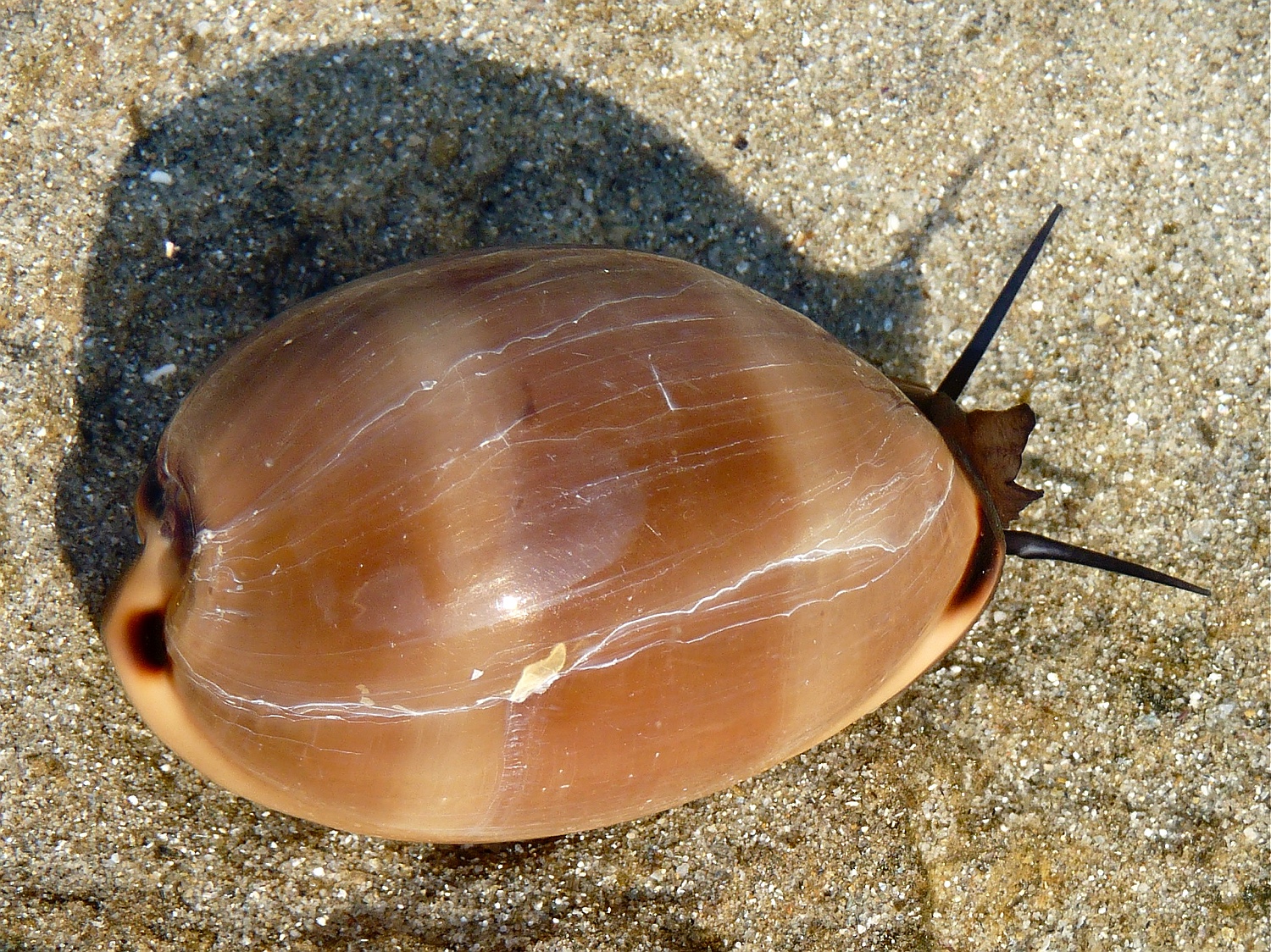
Here you can see the head and extendable antennae of a cowry snail. The eyes are located at the base of the antennae.
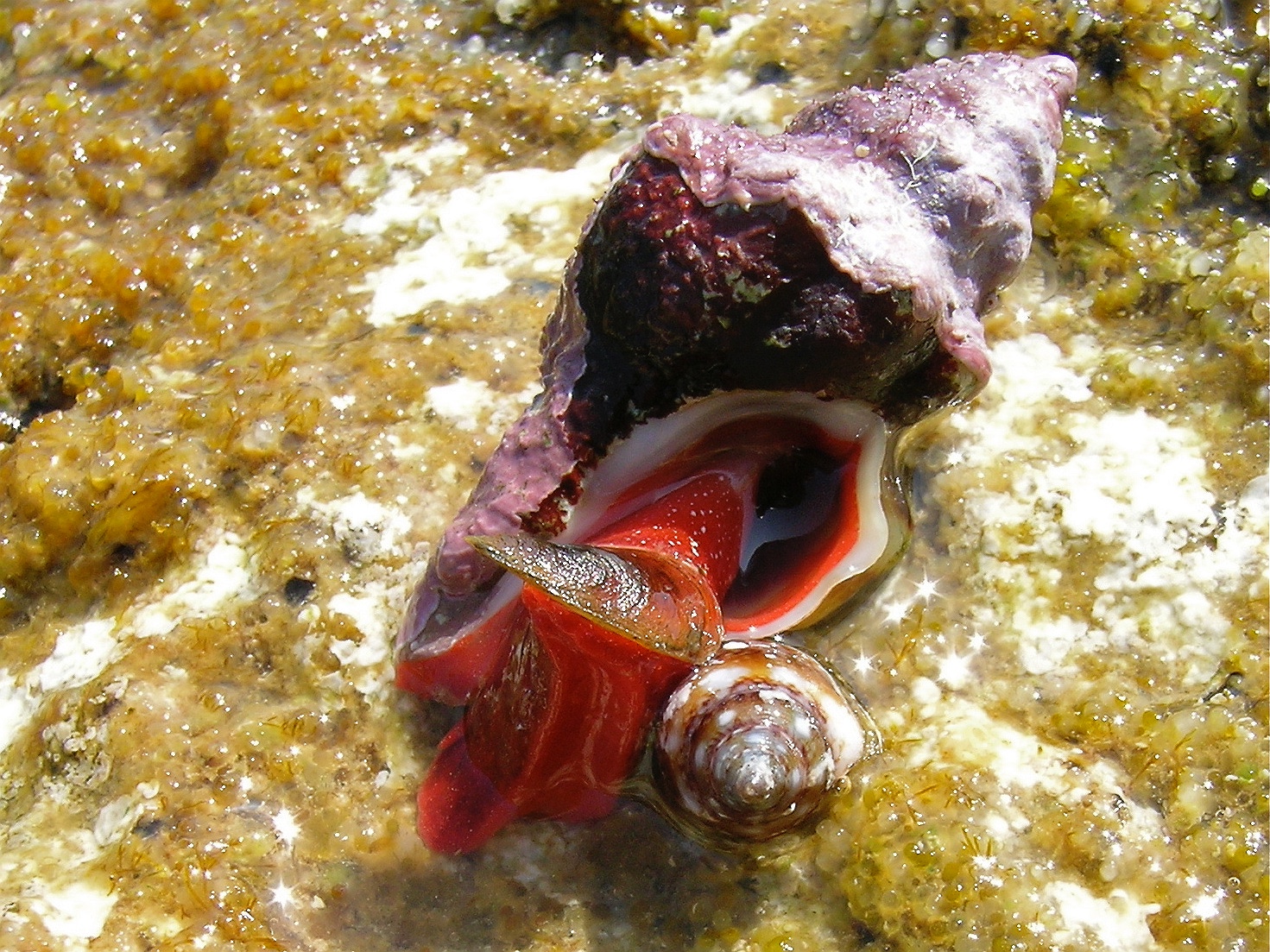
Tarantinaea lignaria features a strong foot and a horny operculum shaped exactly like the aperture.
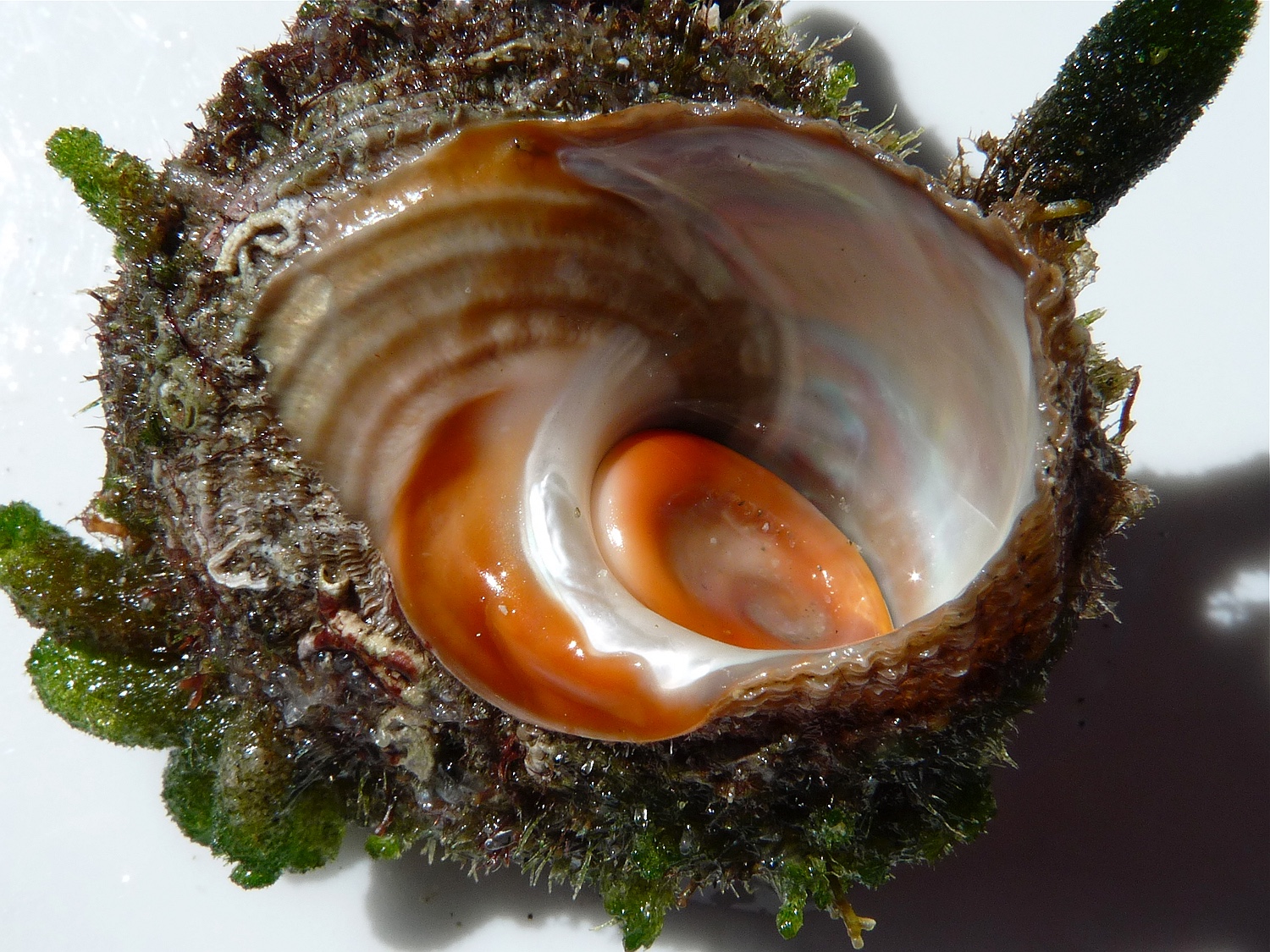
Bolma rugosa has a calcified operculum.
Many marine snail species are herbivores, using their radula to scrape algae off rocks. Other species filter seawater, feed on carrion or are predatory, eating for example other snails or mussels by drilling a hole into their shells and injecting digestive fluid. Snails breathe through gills located in the mantle cavity. The seawater for respiration is supplied through a slit, which in many species is extended to form a tube which lies in the siphon canal.
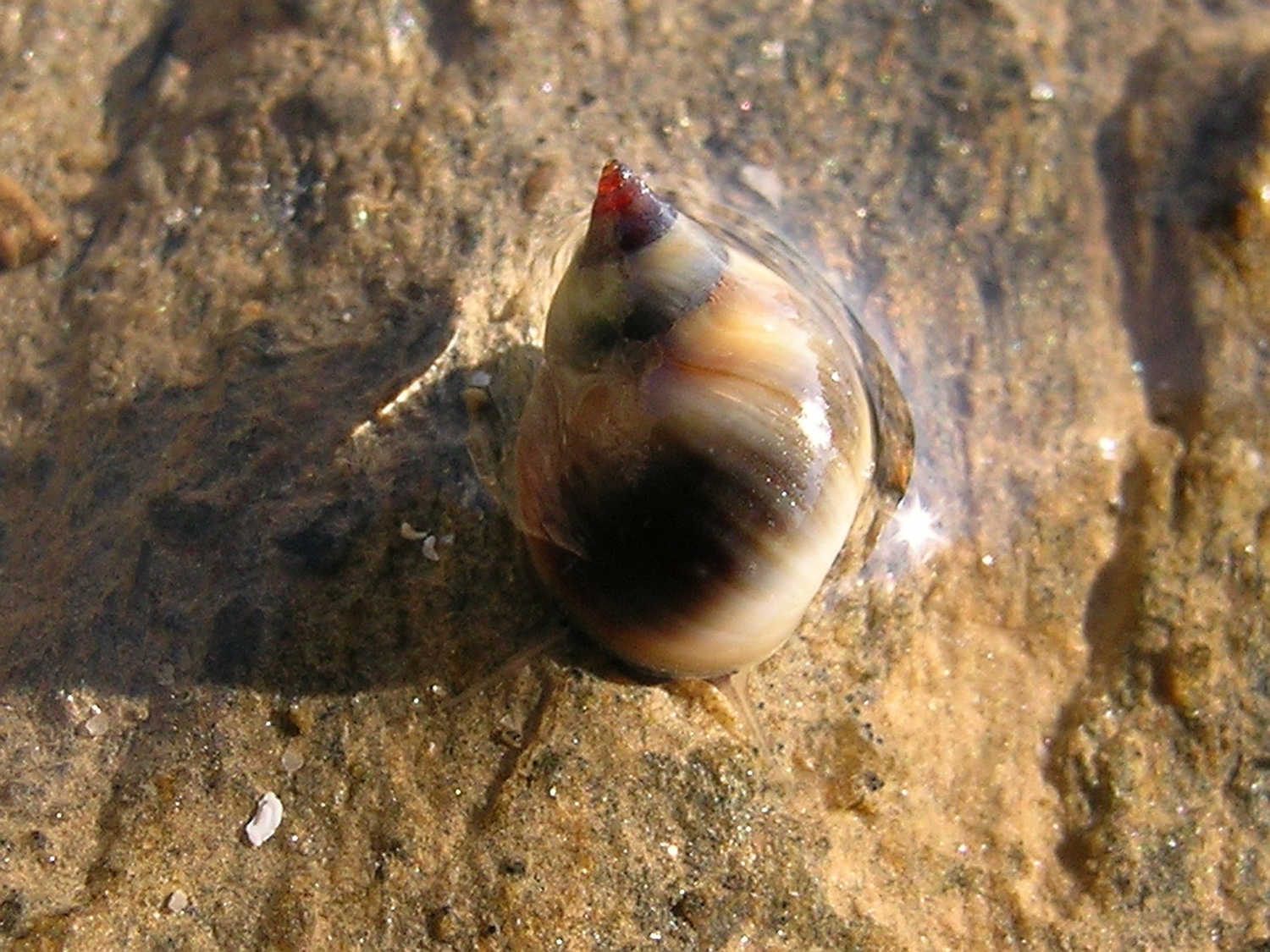
The small periwinkle is one of the species that scrapes algae off rocks with its radula.
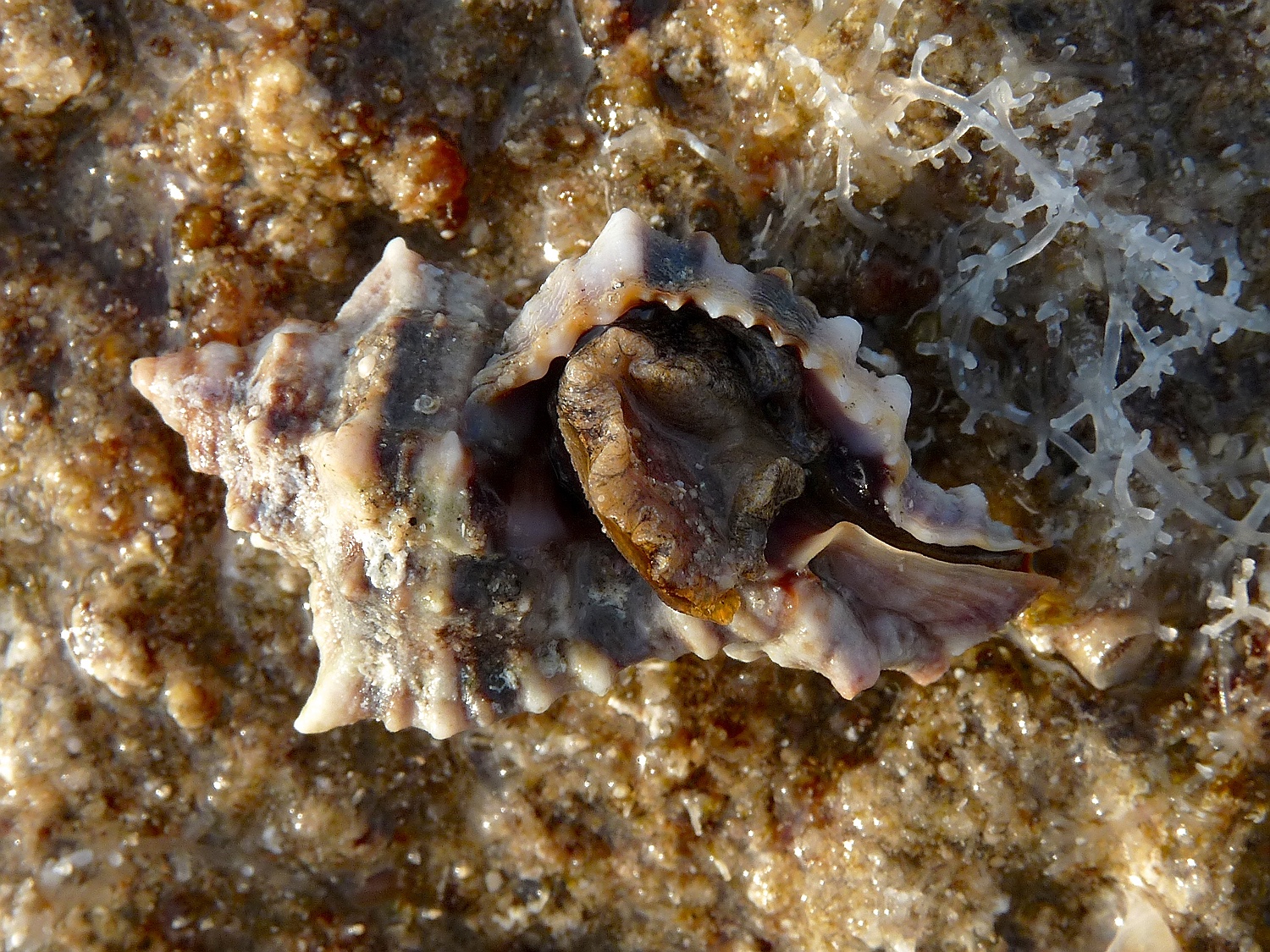
The purple snail, on the other hand, is a dangerous predator that drills into the shells of other molluscs, injects digestive acids and then absorbs the fluids.
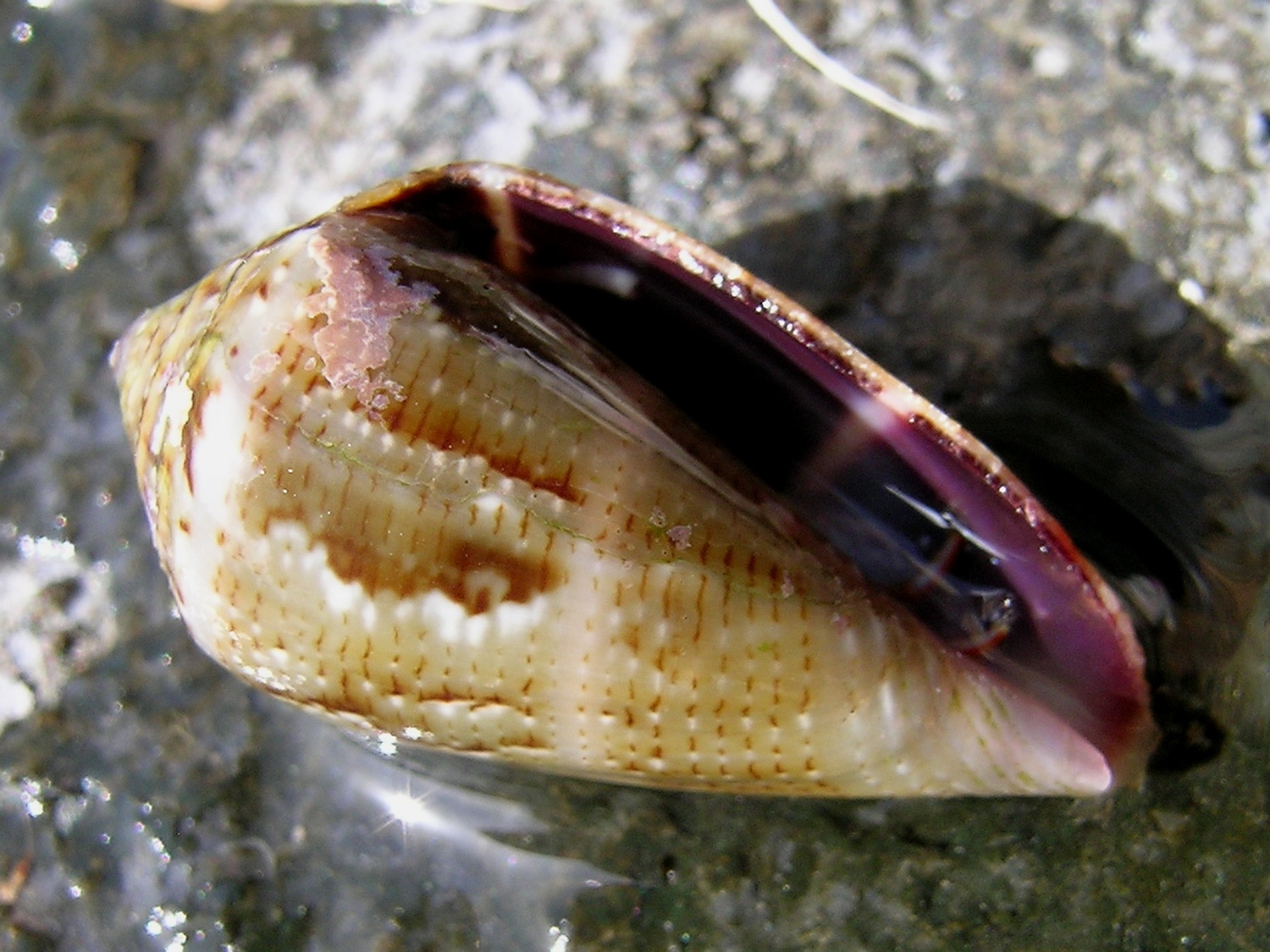
Like all cone snails, the Mediterranean cone captures its food (mainly worms and molluscs) by “harpooning” it with a long, needle-sharp radula tooth, which injects a mixture of neurotoxins into the victim. Some related species even catch fish in this way and possess toxins that are so effective and fast-acting that they can also be fatal to humans.
Reproduction
Unlike land snails, which are mostly hermaphroditic, sea snails are predominantly dioecious. They often lay very beautiful eggs that are shaped like small works of art. The larva, called a veliger larva, swims in the plankton, moving with the help of small cilia. Some larvae feed on plankton, while others feed exclusively on their yolk reserves. Veliger larvae have a simple coiled shell. The larva transforms into a small snail that lives on the substrate in a metamorphosis that lasts up to two days.
Articles about sea snails
Articles about marine snails on this web site:
The snails I have found so far at the coast of Naxos are presented in these articles:
- Limpets
- Abalone and Fissurellidae
- Trochidae
- Buccinidae and Turritellidae
- Littorinimorpha
- Wormsnails
- Neogastropoda
- Pulmonata and Opisthobranchia (Trimusculus, Bulla, Haminoea und Umbraculum)
- Slugs (including sea hares)
see also:
- Marine animals – Overview
- Chitons
- Scaphopods (Tusk shells)
- Bivalvia
- Cephalopods
- Hermit crabs (crustaceans)
The Photo gallery of the marine snails provides an overview of the described species. Please note that I am not an expert and that some of the identifications may therefore be incorrect.
More information:
- WoRMS: World Register of Marine Species; Here you will find all sea snails (among others) with their accepted and obsolete names, with systematic classification
- Gastropoda: Photographs of many sea snails, systematically arranged; with numerous references
- Sea shells collection bei Idscaro.net: Very extensive collection of photographs of Mediterranean gastropods, with descriptions.
- The Greek Seashells, Gastropoda
List of marine snail species identified by us on Naxos to date, arranged taxonomically (according to WoRMS 2020)
Class Gastropoda (Snails)
- Clade Patellogastropoda
- Superfamily Patelloidea
- Family Patellidae, Limpets
- Patella caerulea
- Patella rustica
- Family Patellidae, Limpets
- Superfamily Patelloidea
- Clade Vetigastropoda
- Superfamily Haliotoidea
- Family Haloitidae, Abalones
- Haliotis tuberculata
- Haliotis mykonosensis
- Family Haloitidae, Abalones
- Superfamily Fissurelloidea
- Family Fissurellidae, Lochschnecken
- Diodora gibberula
- Diodora italica
- Emarginula huzardii
- Emarginula octaviana
- Emarginula sicula
- Family Fissurellidae, Lochschnecken
- Superfamily Trochoidea
- Family Trochidae
- Gibbula ardens
- Gibbula turbinoides
- Steromphala adansoni
- Steromphala divaricata
- Steromphala rarilineata
- Steromphala umbilicaris
- Steromphala varia
- Jujubinus curinii ?
- Jujubinus exasperatus
- Jujubinus karpathoensis ?
- Clanculus corallinus
- Clanculus cruciatus
- Clanculus jussieui
- Phorcus turbinatus
- Phorcus articulatus
- Phorcus richardi ?
- Calliostoma laugieri
- Family Turbidae
- Bolma rugosa
- Family Trochidae
- Superfamily Phasianelloidea
- Family Phasianellidae
- Tricolia pullus
- Tricolia speciosa
- Family Colloniidae
- Homalopoma sanguineum
- Family Phasianellidae
- Superfamily Haliotoidea
- Clade Neritimorpha
- Superfamily Neritoidea
- Family Neritidae
- Smaragdia viridis
- Family Neritidae
- Superfamily Neritoidea
- Clade Caenogastropoda, Order Caenogastropoda
- Superfamily Cerithoidea
- Family Cerithiidae
- Cerithium lividulum
- Cerithium vulgatum
- Bittium latreillii
- Bittium reticulatum
- Family Turritellidae
- Turritellinella tricarinata
- Family Cerithiidae
- Superfamily Cerithoidea
- Clade Caenogastropoda, Order Littorinimorpha
- Superfamily Vermetoidea
- Family Vermetidae, Worm snails
- Thylacodes arenarius
- Vermetus triquetrus
- Dendropoma cristatum
- Family Vermetidae, Worm snails
- Superfamily Calyptroidea
- Family Calyptraeidea
- Crepidula unguiformis
- Family Calyptraeidea
- Superfamily Cypraeoidea
- Family Cypraeidae
- Luria lurida (protected!)
- Naria spurca
- Family Cypraeidae
- Superfamily Littorinoidea
- Family Littorinidae
- Melarhaphe neritoides
- Family Littorinidae
- Superfamily Naticoidea
- Family Naticidae
- Neverita josephinia
- Euspira guilleminii
- Payraudeautia intricata
- Naticarius hebraeus
- Naticarius stercusmuscarum
- Notocochlis dillwynii
- Family Naticidae
- Superfamily Stromboidea
- Family Strombidae
- Conomurex persicus
- Family Aporrhaidae
- Aporrhais pespelecani
- Family Strombidae
- Superfamily Tonnoidea
- Family Cassidae
- Semicassis undulata
- Family Tonnidae
- Tonna galea (protected!)
- Family Ranellidae, Triton snails
- Charonia variegata (protected!)
- Family Cassidae
- Superfamily Rissooidea
- Family Barleeiidae
- Barleeia unifasciata
- Family Rissoidae
- Alvania discors
- Alvania lineata
- Rissoa violacea
- Family Barleeiidae
- Superfamily Velutionoidea
- Family Triviidae
- Trivia mediterranea
- Pseudopusula problematica
- Family Triviidae
- Superfamily Epitonioidea
- Family Epitoniidae, Wentletraps
- Epitonium clathrus
- Epitonium turtonis
- Gyroscala commutata
- Family Epitoniidae, Wentletraps
- Superfamily Vermetoidea
- Clade Caenogastropoda, Order Neogastropoda
- Superfamily Buccinioidea
- Family Buccinidae
- Pisania striata
- Aplus dorbignyi
- Euthria cornea
- Family Columbellidae
- Columbella rustica
- Mitrella scripta
- Family Fasciolariidae
- Tarantinaea lignarius
- Aptyxis syracusana
- Family Nassaridae
- Tritia mutabilis
- Tritia incrassata
- Tritia cuvierii
- Tritia pellucida
- Family Buccinidae
- Superfamily Muricoidea
- Family Muricidae
- Hexaplex trunculus
- Bolinus brandaris
- Stramonita haemastoma
- Ocinebrina aciculata
- Family Coralliphilidae
- Coralliophila meyendorffii
- Family Costellariidae
- Pusia ebenus
- Pusia granum
- Family Muricidae
- Family Mitridae
- Episcomitra cornicula
- Superfamily Buccinioidea
- Superfamily Conoidea
- Family Conidae, Cone snails
- Conus ventricosus
- Family Mangeliidae
- Bela cycladensis
- Family Conidae, Cone snails
- Clade Heterobranchia
- Superfamily Architectonicoidea
- Family Architectonicidae
- Philippia hybrida
- Family Architectonicidae
- Superfamily Trimusculoidea
- Family Trimusculidae
- Trimusculus mammillaris
- Family Trimusculidae
- Superfamily Architectonicoidea
- Clade Opisthobranchia, Order Cephalaspidea
- Superfamily Bulloidea
- Family Bullidae
- Bulla striata
- Family Bullidae
- Superfamily Haminoeoidea
- Family Haminoeidae
- Haminoea hydatis
- Family Haminoeidae
- Superfamily Bulloidea
- Clade Opisthobranchia, Order Umbraculida
- Superfamily Umbraculoidea
- Family Umbraculidae
- Umbraculum umbraculum
- Family Umbraculidae
- Superfamily Umbraculoidea
(Tap on the triangle to open)
Comments are closed.