
Gastropoda 8: Pulmonata and Opisthobranchia
While most marine gastropods belong to the Prosobranchia, whose gills are located in front of the heart (a taxonomic unit that is no longer used because it has been found to be paraphyletic, i.e. is not based on actual kinship), most land snails belong to the Pulmonates and the marine nudibranchs to the Opisthobranchia. However, there are also some Pulmonates that live in the sea and some Opisthobranchia that have a shell. Some of these species can also be found on Naxos, though only very rarely.
The Photo gallery of the marine snails gives an overview over the species.
A note on identification: Some species usually can be identified easily and reliably. In many cases, however, several related species are difficult to distinguish. Also not all species are included in the field guides; even using the internet, it is difficult to find information on some species. Accordingly, some of the identifications may not be correct.
And a word about the names: As with many marine animals, there is a great deal of confusion surrounding the names of snails: for almost all species, a large number of synonyms exist that are no longer valid today but are still used in older books. I use the names according to the World Register of Marine Species (as of 2020), where you can also find the corresponding synonyms.
Here you can jump directly to the species (return with the back arrow or by swiping back):
Trimusculus mammillaris – Bulla striata – Haminoea hydatis – Umbrella slug, Umbraculum umbraculum
1. Lung snails, Pulmonata
The order of the lung snails (Pulmonata), often classified as a superorder, comprises most land snails, including terrestrial slugs. However, the order also includes some smaller groups of marine snails, such as the Trimusculidae.
Trimusculidae
The family Trimusculidae comprises only one genus with a few species.
Trimusculus mammillaris, L.
Very rare
The members of the genus Trimusculus resemble limpets: their shells are not coiled, but bowl-shaped. The living animal also looks similar to a limpet, but it does not feed by scraping algae off the substrate, but by catching suspended particles with a mucus net.
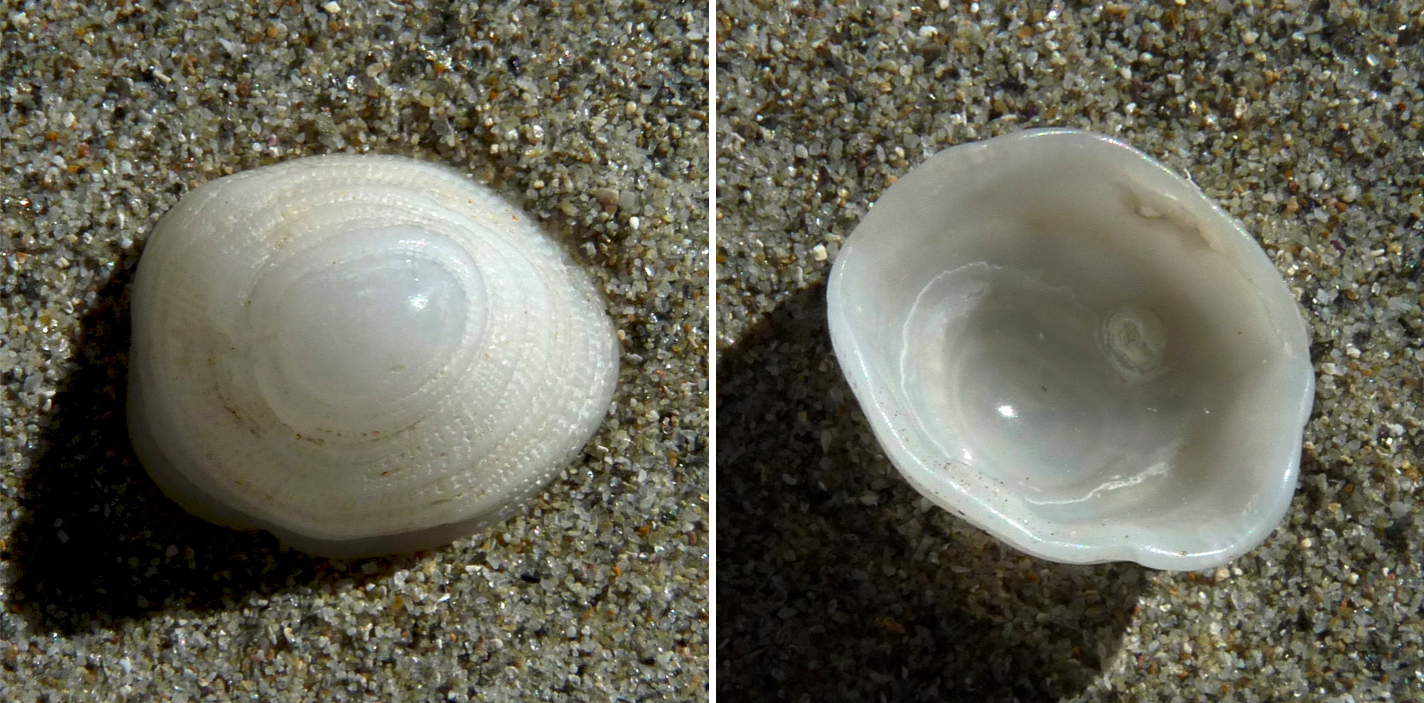
The small species Trimusculus mammillaris has a circular, cup-shaped white shell that is rounded and shiny at the tip, with a fine sculpturing on the outer part. Size: 13 mm
2. Opisthobranchia, Opisthobranchia
The opisthobranchs (Opisthobranchia), classified as an order, superorder or subclass depending on the system, mainly comprise marine nudibranchs as well as some snails with reduced shells into which the animal cannot completely retreat.
The nudibranchs and sea hares belonging to the opisthobranchs are discussed on a separate page.
1. Cephalaspidea, head shield slugs or bubble snails
The suborder of head shield slugs includes snails that resemble limpets, although they cannot completely retreat into the small shell that they carry on their back. On the head they show a “head shield” which is made from the broadened, backward-facing antennae.
1.1. Bulloidea, bubble snails
This superfamily includes snails with small shells into which the large body cannot completely retract. The last whorl of the shell is comparatively large; often the apex is depressed like a navel, and the aperture extends over the entire length of the shell (as in cowrie snails), being wider and rounded at the lower end. Bubble snails live on sandy soils. The superfamily Bulloidae comprises only one family (Bullidae) and only one genus (Bulla) with about twelve species.
Bulla striata, Bruguière
rare
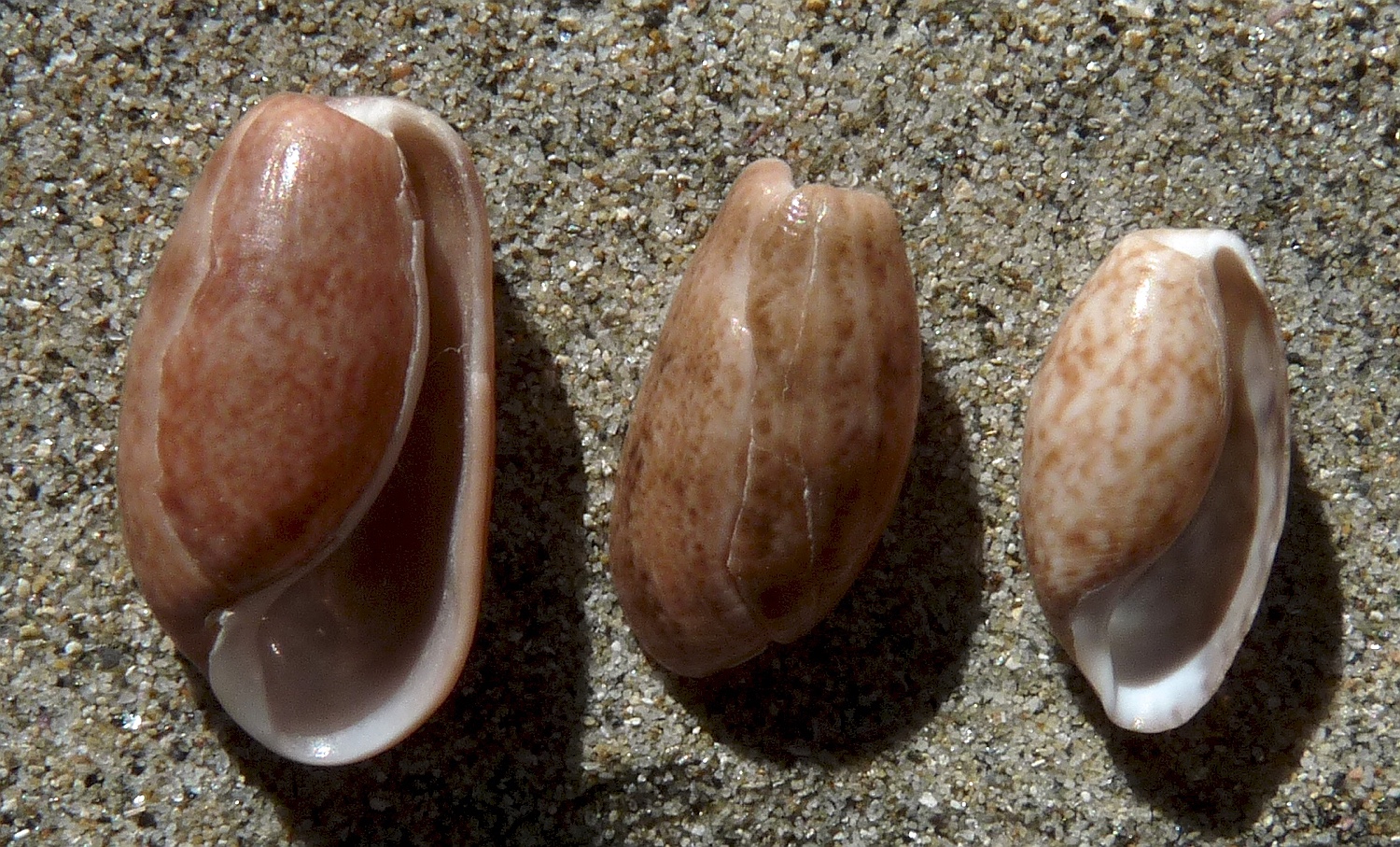
This snail has a brownish shell with a depressed apex and a long narrow aperture which is widened and rounded at the lower end. It is rarely found in our region. Height: 17 mm
1.2. Haminoeidea
The superfamily Haminoeidea comprises three families and a whole range of genera with small, oval, almost transparent shells into which the snail cannot completely retreat. The snails are often colourful and at first glance resemble slugs: The shell is barely visible, as it is almost transparent and partially covered by lateral folds of the mantle. Very little is known about most species, although some occur in large numbers. Some species have only been described from their empty shells. Since the internal anatomy must also be taken into account for reliable identification and classification, the entire family still requires thorough revision. Haminoeidea usually live in shallow water on sandy and muddy sea floors as well as in sea lettuce and similar algae; they are vegetarians.
Haminoea hydatis, L.
Very rare
The living snail of Haminoea hydatis is greenish with small brown spots. As with all head-shield snails, the head has lateral lobes that make it appear flat and rectangular; the rear end of the foot is also flat and broad. Haminoea hydatis lives on muddy sea floors and in algae.

This delicate, very small, translucent white shell belongs to Haminoea hydatis. In the living snails, the almost transparent shell is covered with a greenish periostracum. The body is somewhat larger than the shell. Height: 10 mm
2. Umbraculoidea
The superfamily Umbraculoidea is considered to be a sister genus of the head-shield slugs. It comprises only one family (Umbraculidae) with two small genera.
Umbrella slug, Umbraculum umbraculum, Lightfoot
very rare
Umbrella slugs are nudibranchs with a large, broad body that can reach over 10 cm in size; it carries only a small, reduced shell which sits approximately in the middle of the body. The body of the snail is covered with thick warts and is intensely coloured, often in orange, red or brown. The umbrella slug is nocturnal and usually lives in shallow water, but has been found also in depths of over 100 m on rocky or muddy sea floor. It occurs in the Mediterranean, the central Atlantic and the Indo-Pacific region. The European form is often referred to as U. mediterraneum; it is still unclear whether it is a separate species.
The shell of the umbrella slug resembles that of a limpet, but is rather flat and has a small elevated point in the middle. From above, the shells look whitish with concentric layers; the inside is shiny white, yellowish or brownish.
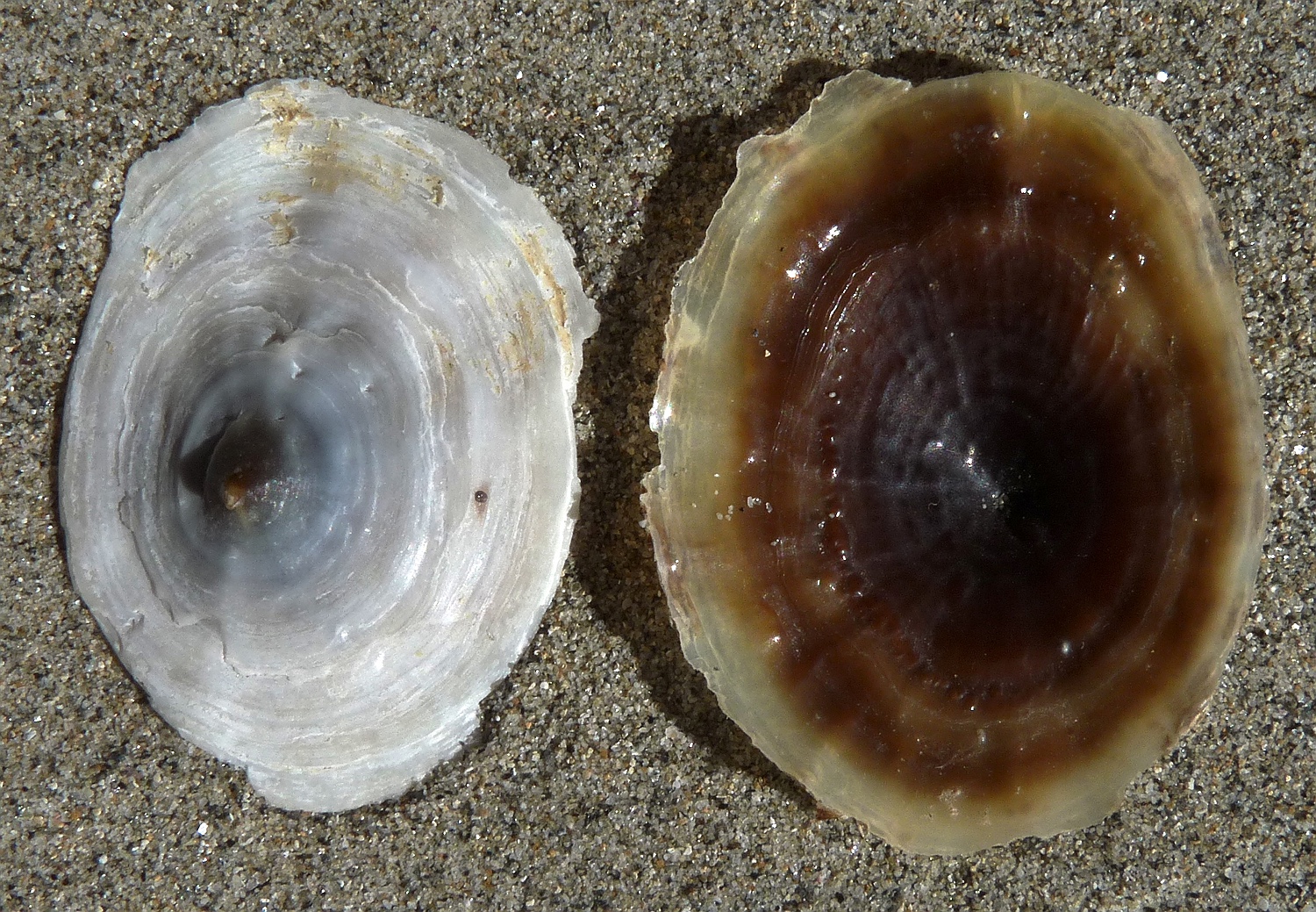
The shells of the umbrella slug sit like a cap on the center of the much larger body of the nudibranch. Size: 39 mm
continue: Slugs (Nudibranchs)
back:
further reading: Umbraculum umbraculum at Idscaro.net, with amazing photos of the live snail