
Gastropoda 3: Trochidae
The large superfamily of Trochoidea is represented in our area by the families Trochidae, Calliostomatidae, Turbinidae, Phasianellidae and Colloniidae (sometimes considered subfamilies or superfamilies); like the abalone and Fissurellidae, they belong to the superorder Vetigastropoda. Apart from the mentioned families, in this article I also describe the emerald nerite (Smaragdia viridis), the only species of the superorder Neritimorpha found in our region.
The Photo gallery of the marine snails gives an overview over the species.
A note on identification: Some species usually can be identified easily and reliably. In many cases, however, several related species are difficult to distinguish. Also not all species are included in the field guides; even using the internet, it is difficult to find information on some species. Accordingly, some of the identifications may not be correct.
And a word about the names: As with many marine animals, there is a great deal of confusion surrounding the names of snails: for almost all species, a large number of synonyms exist that are no longer valid today but are still used in older books. I use the names according to the World Register of Marine Species (as of 2020), where you can also find the corresponding synonyms.
Here you can jump directly to the species (return with the back arrow or by swiping back):
Gibbula – Steromphala – Clanculus – Jujubinus – Phorcus – Calliostoma – Bolma – Tricolia – Homalopoma – Smaragdia
A: Subclass Vetigastropoda
1. Trochidae, Top-snails
The top-snails are rather small snails with conical shells with round aperture, often with a distinct umbilicus, while the siphonal groove is at most faintly indicated. They usually live in the intertidal zone or in seagrass meadows and feed on detritus and algae, which they scrape off the substrate with their radula. There are a number of species, some of which are rather difficult to identify. They differ in the exact shape and colouring of their shells, in their sculpturing with spiral ribs and nodes, and in the shape of their umbilicus.
Gibbula ardens, Salis Marschlins
common
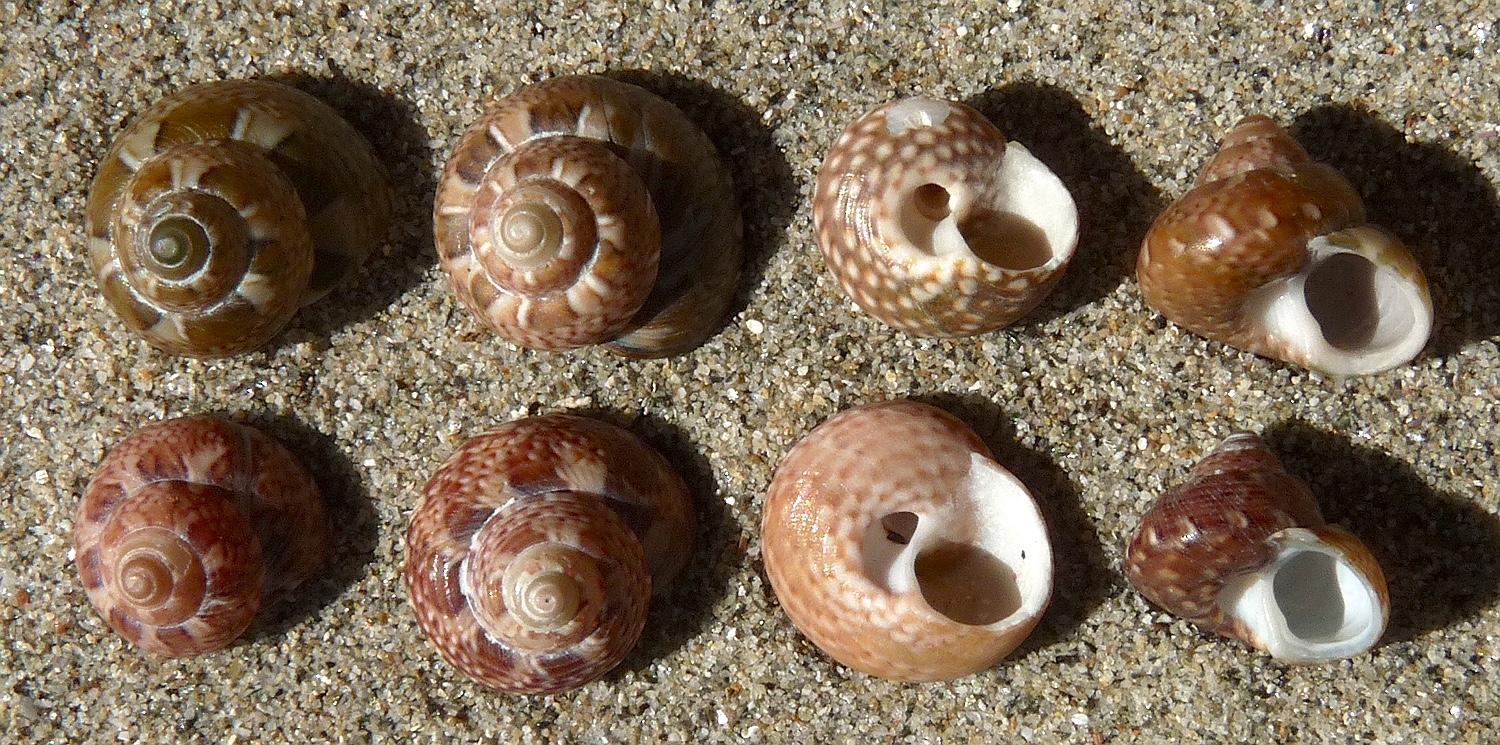
Gibbula ardens has a particularly deep umbilicus. The shell is olive brown or reddish in colour and displays intense markings with flame bands and light spots on the upper edges of the whorls. Height: 10 mm
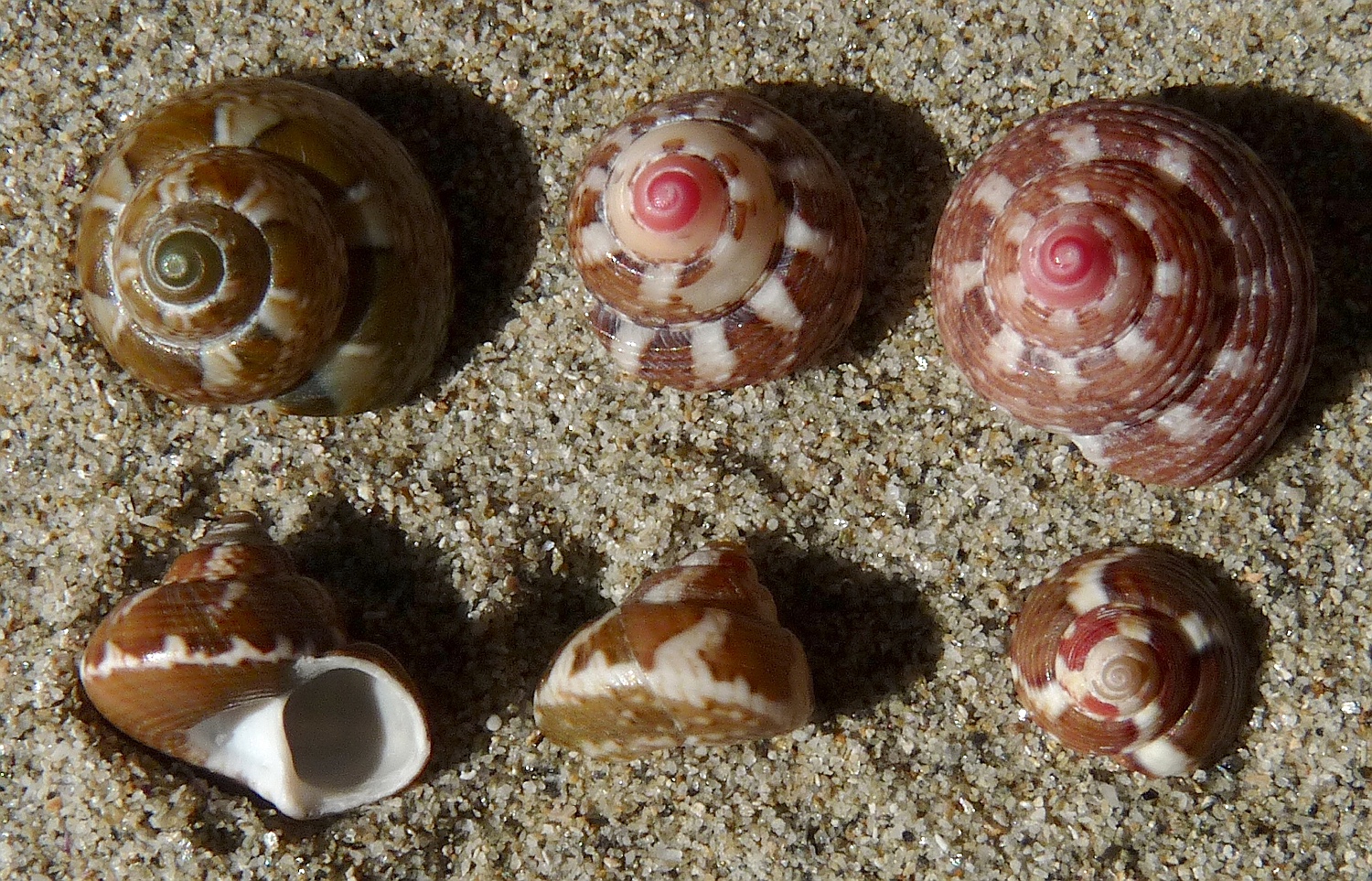
Gibbula ardens is probably the prettiest species in our region. Some specimens show a pink apex or a white spiral band.
Gibbula turbinoides ?, Deshayes
very rare
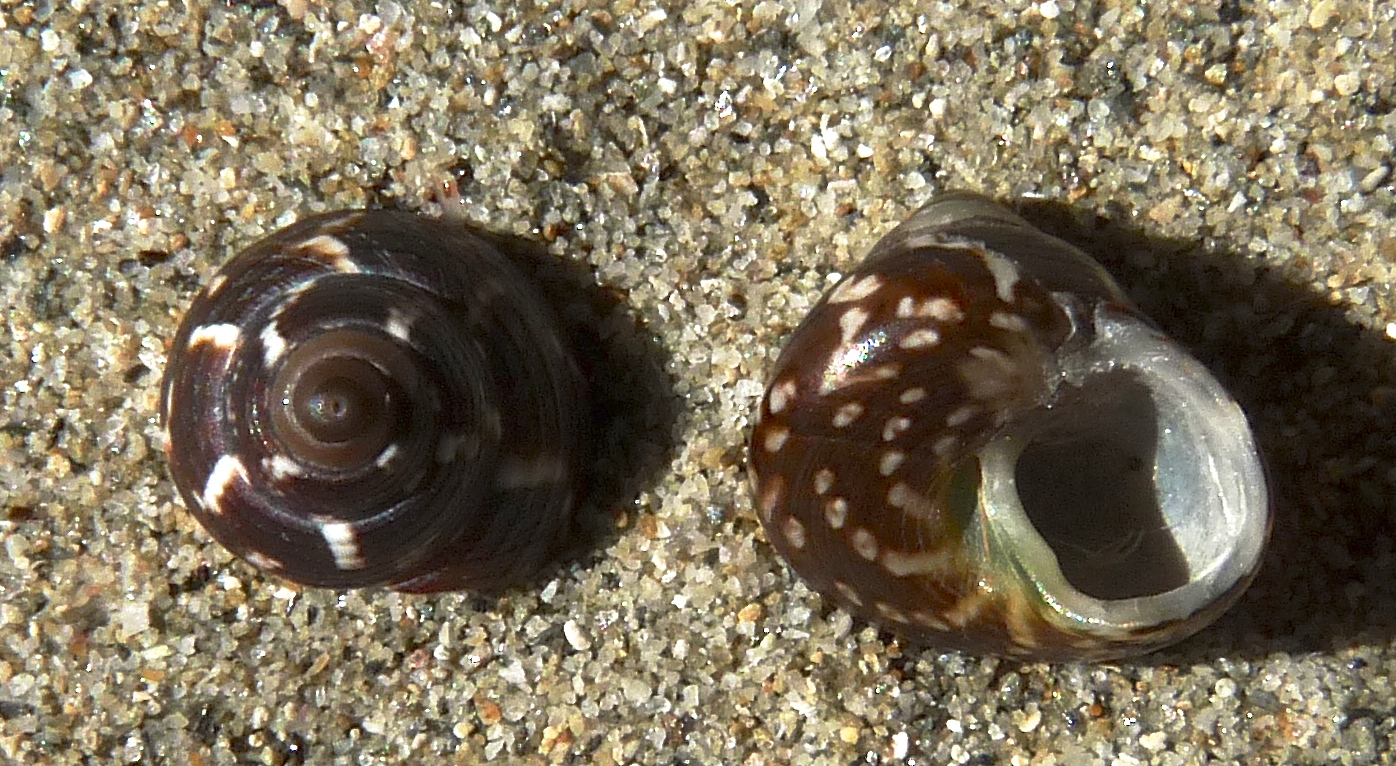
This small, very dark snail with intense markings might be Gibbula turbinoides. Height: 8 mm
Steromphala adansonii ?, Payraudeau
common especially on the sandy beaches in southwest Naxos
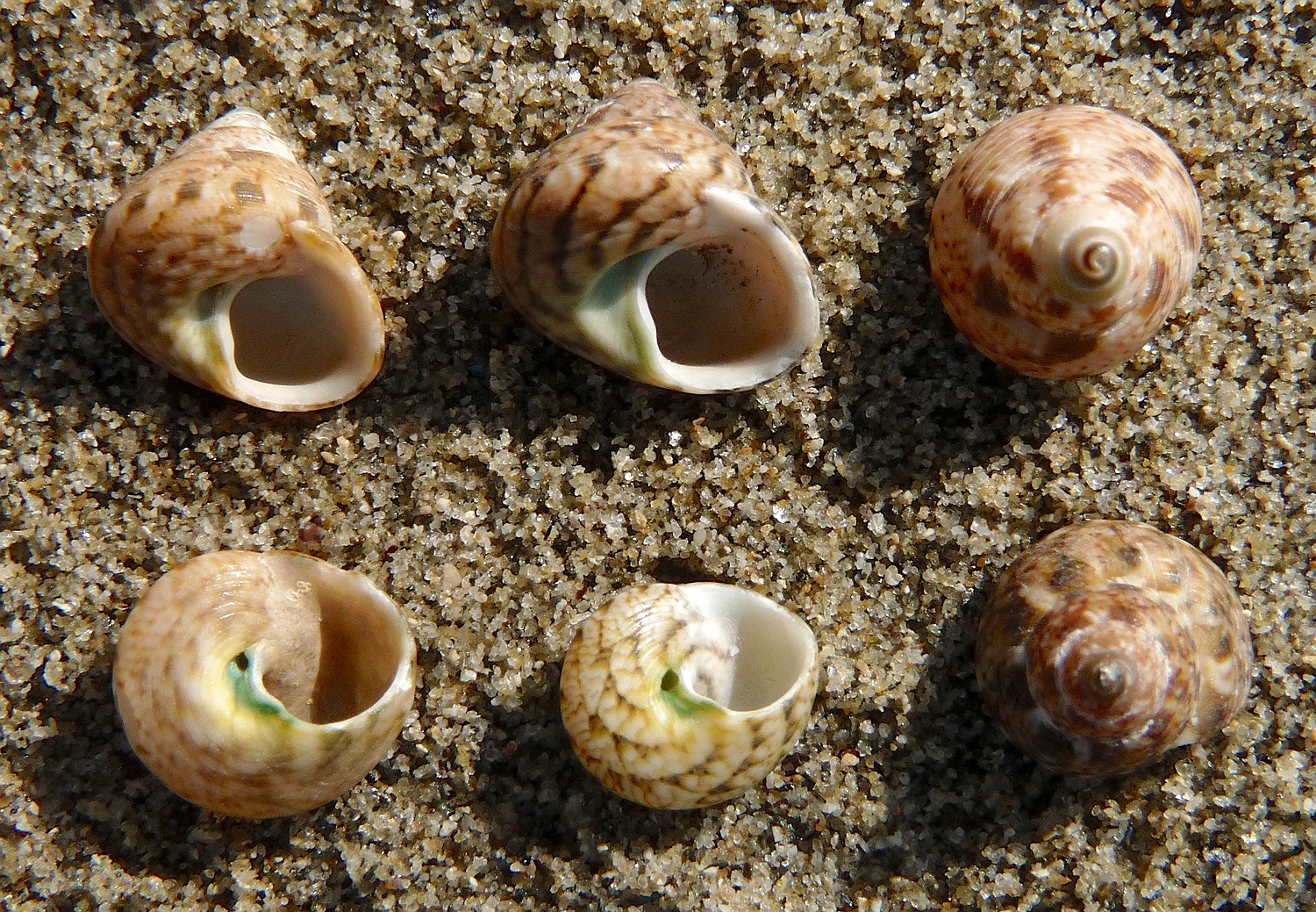
Steromphala adansoni is brownish in colour with fine flame bands; it has a small, narrow umbilicus, which often shows a characteristic green colouration. The shell is slightly taller than that of the other species. Height: 9 mm
Steromphala divaricata, L.
very rare
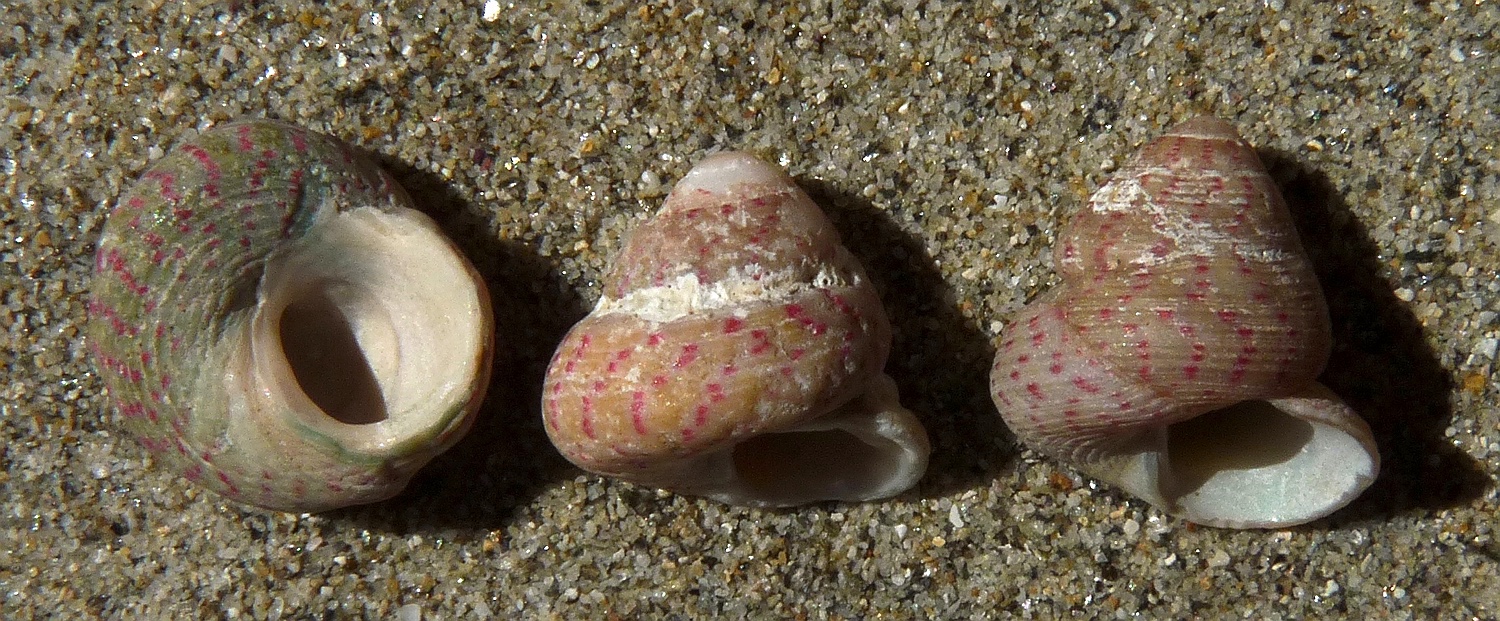
Steromphala divaricata has slightly convex whorls; the shell is quite tall. The umbilicus is closed; the shell is grey to greenish in colour with red spots running in radial stripes. Height: 11 mm
Steromphala rarilineata, Michaud
rather rare, but more common than the previous species
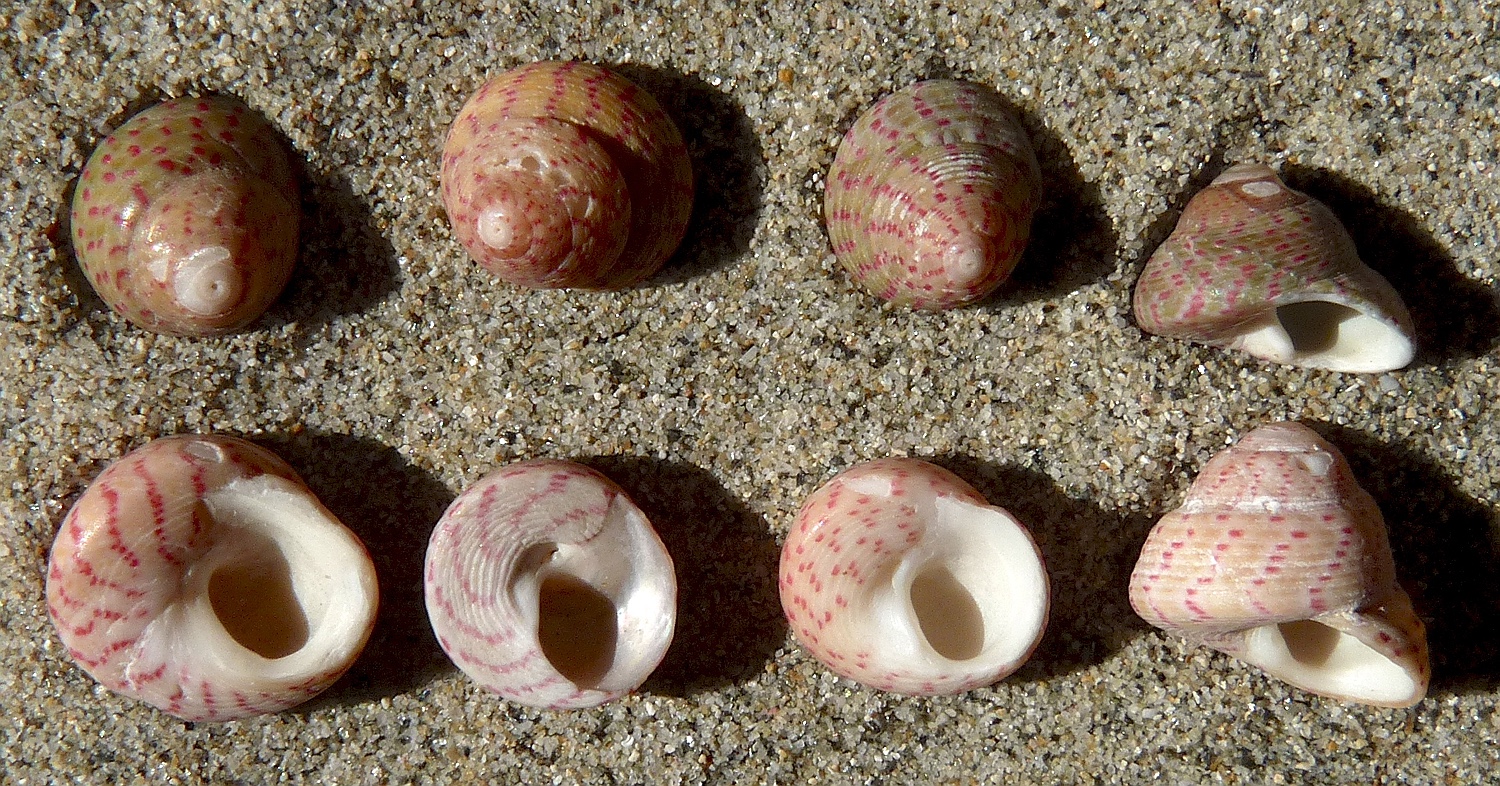
The umbilicus of Steromphala rarilineata is very small or completely closed; the shell is similar in colour to the previous species. It is rather low and often has a slightly concave underside; the whorls are hardly convex. Height: 12 mm
Steromphala umbilicaris, L.
rare
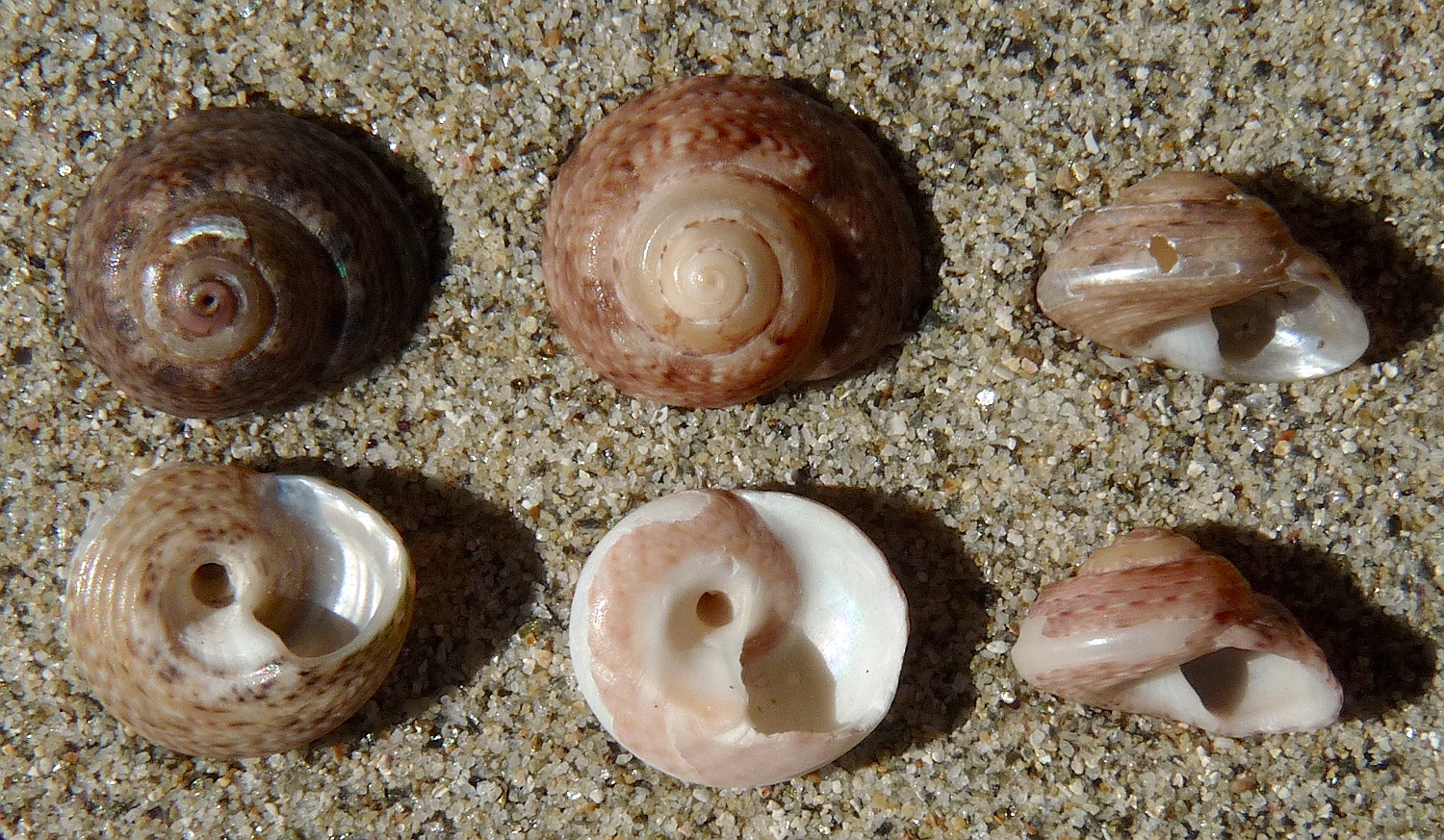
Steromphala umbilicaris is usually grey or brownish in colour. The shell is very flat and has a very pronounced umbilicus. Size: 11 mm
Steromphala varia, L.
rather common
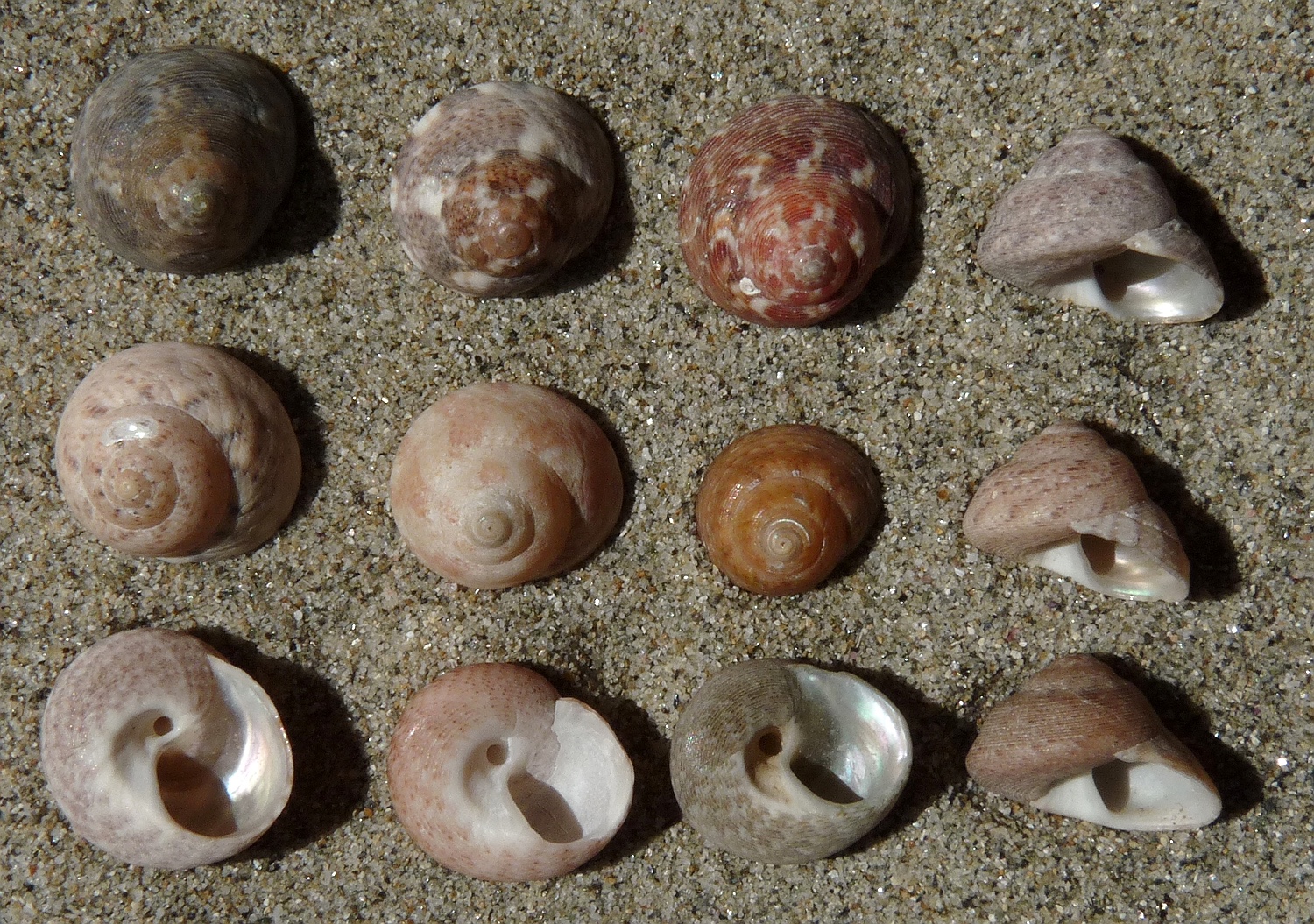
Steromphala varia can vary greatly in colour: the shell may be grey, brown or reddish, with a rather faint pattern. The umbilicus is deep, but smaller than in G. ardens; the white inner area of the umbilicus is larger. The shell usually shows fine, faint spiral grooves. A characteristic feature is “knee” made by the last whorl of the relatively flat shell; also the aperture looks flat, not round when the shell is seen from the side. The inside of the aperture is pearly with a distinct shimmer. Size: 11 mm
Clanculus corallinus, Gmelin
common
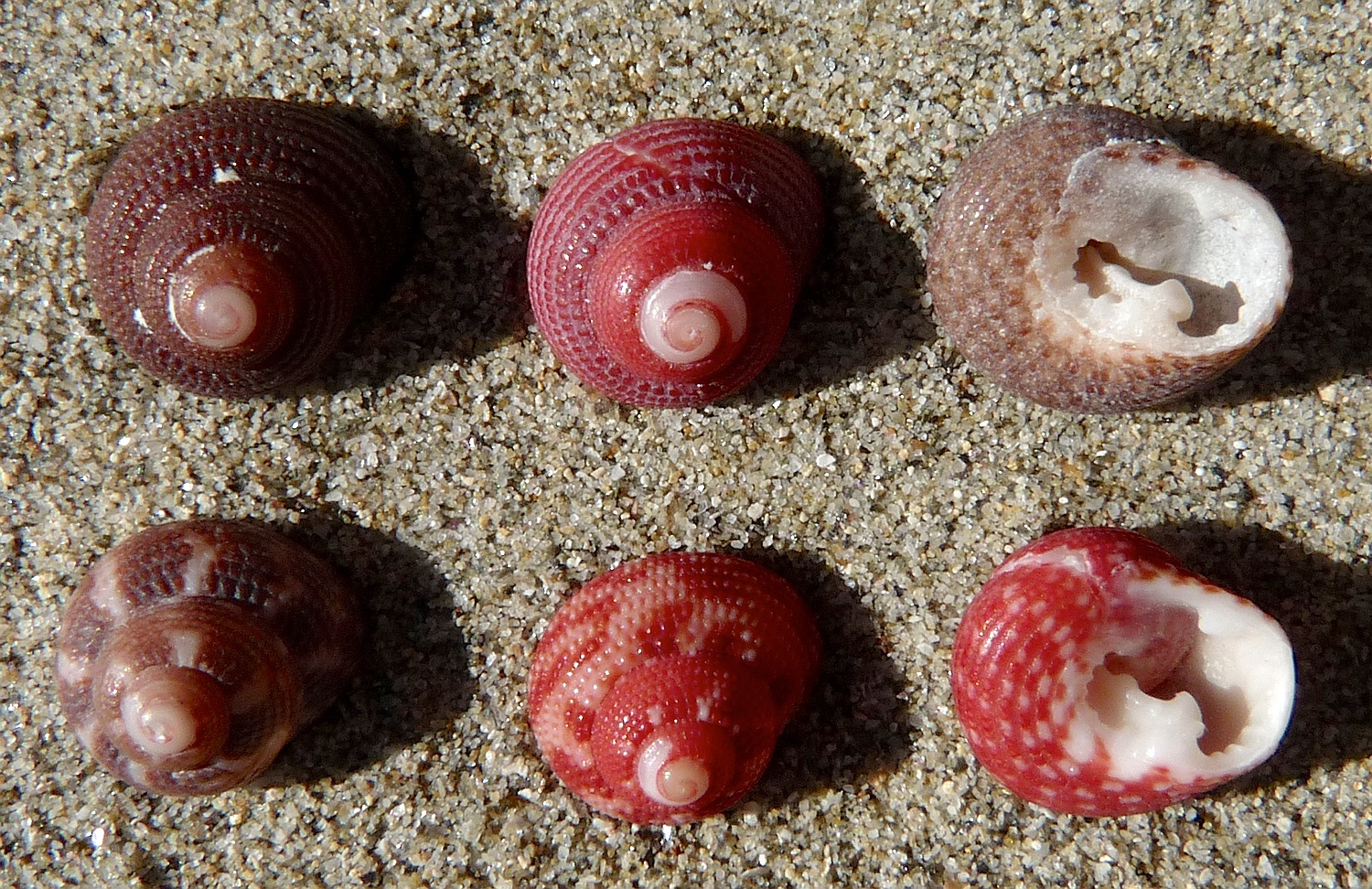
The shells of Clanculus are finely granose, especially towards the apex. They have a deep umbilicus. Clanculus corallinus can be recognised by the dentate aperture and two large teeth at the base of the columella. The shell is coral red or brown, often with lighter spots. Height: 10 mm
Clanculus cruciatus, L.
common
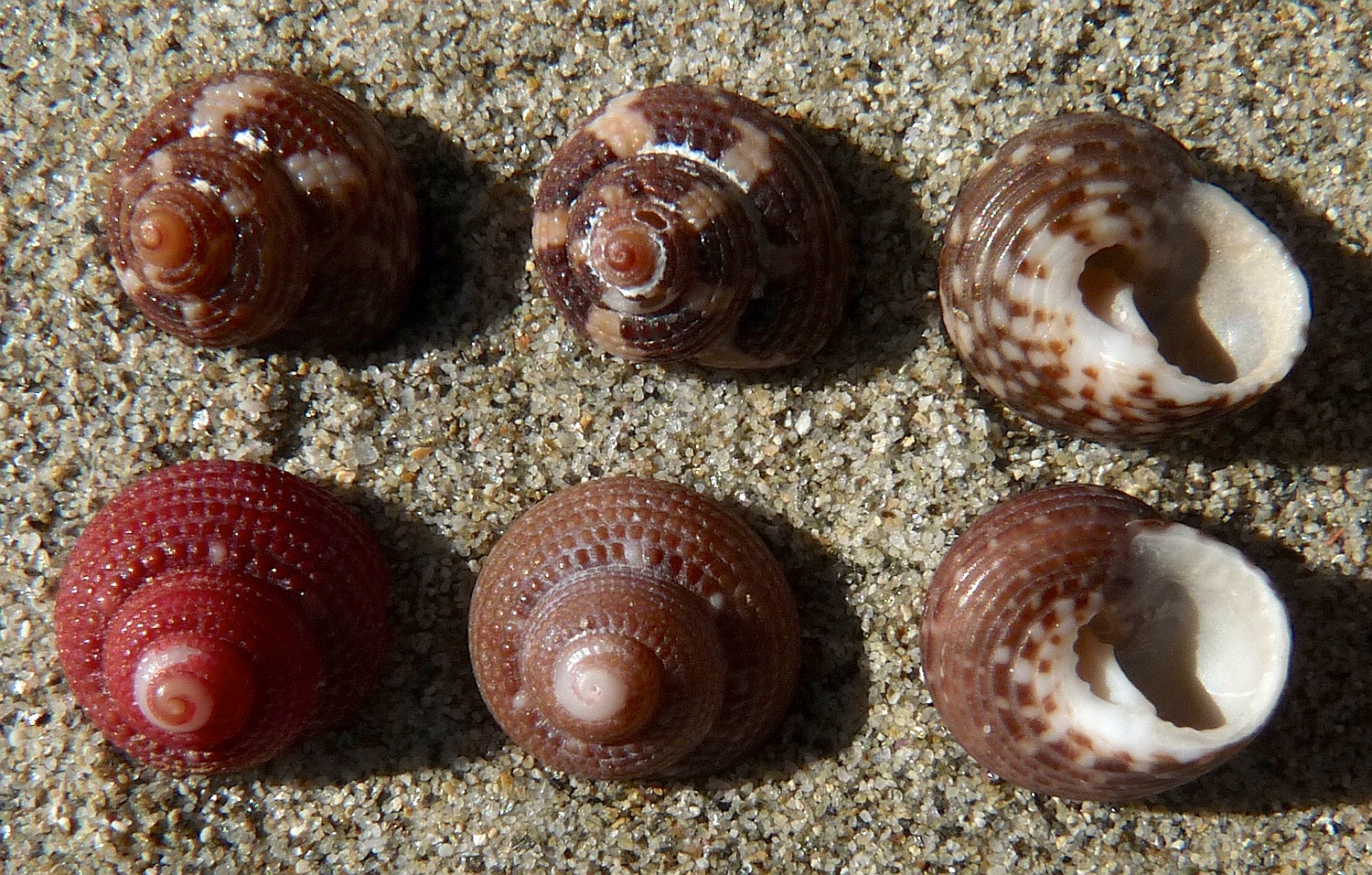
This species is very similar to C. corallinus, but has much smaller teeth at the base of the columella. The shells vary in colour and pattern; red individuals are much rarer than brown ones. Height: 9 mm
Clanculus jussieui, Payraudeau
rather rare, mostly on the sandy beaches in southwest Naxos
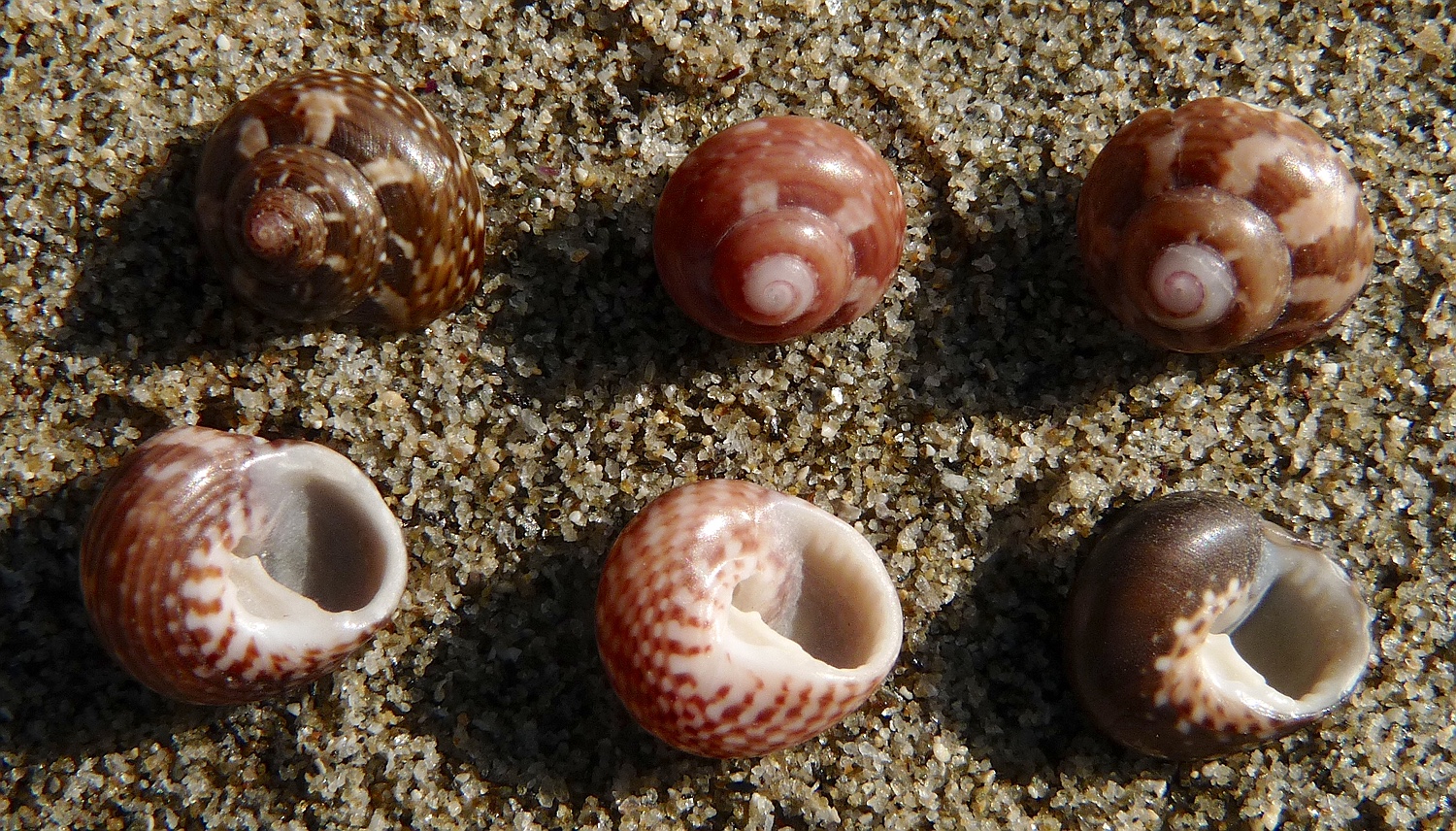
Clanculus jussieui resembles Cl. cruciatus in colouring and shape of the navel, but has a smooth, shiny, non-granose surface. Height: 7 mm
Jujubinus exasperatus, Pennant
rather rare
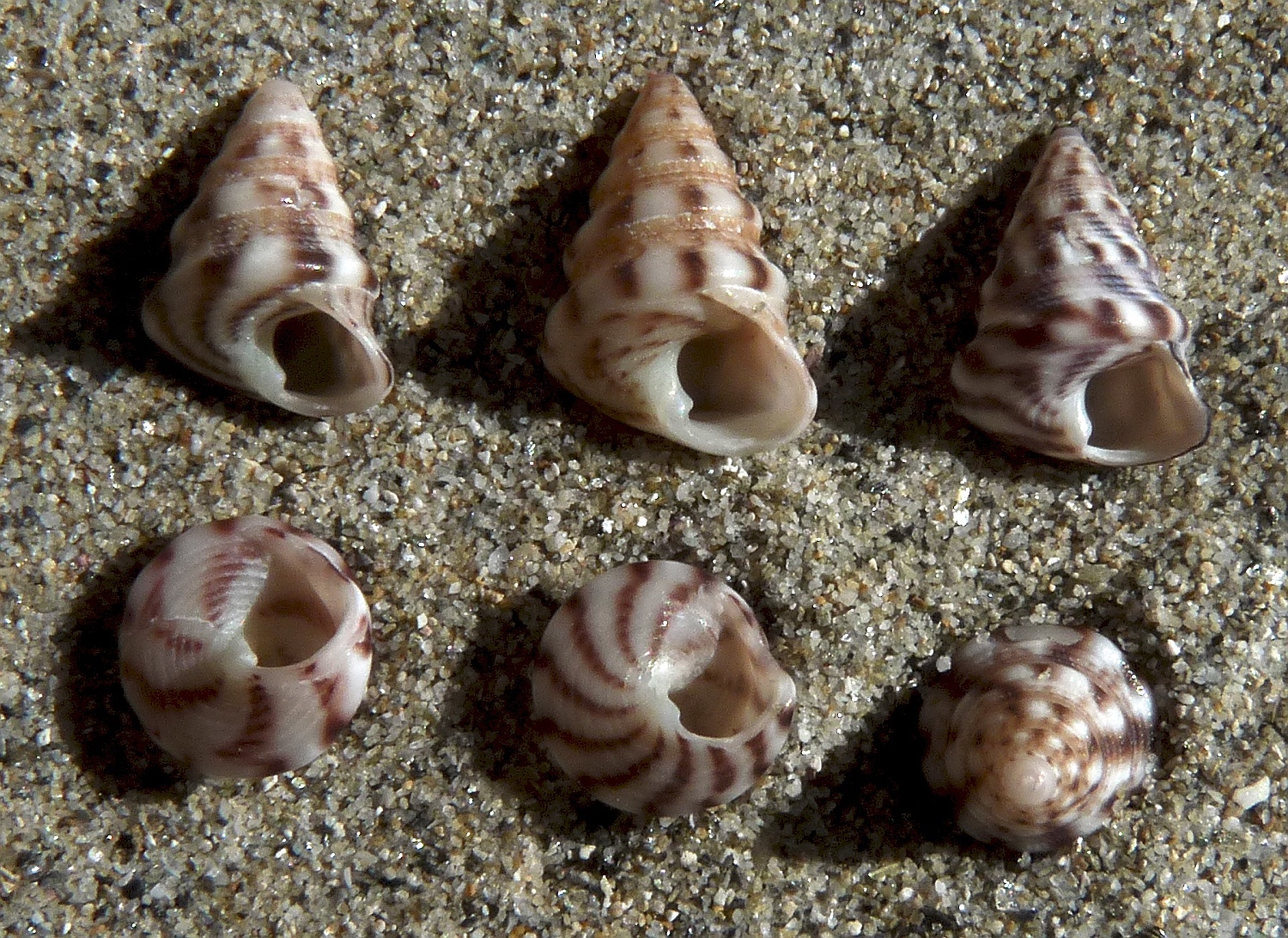
The species of Jujubinus can be recognised by their particularly tall shells. This species shows intense black and white markings. Height: 11 mm
Jujubinus curinii ?, Bogi & Campani
very rare
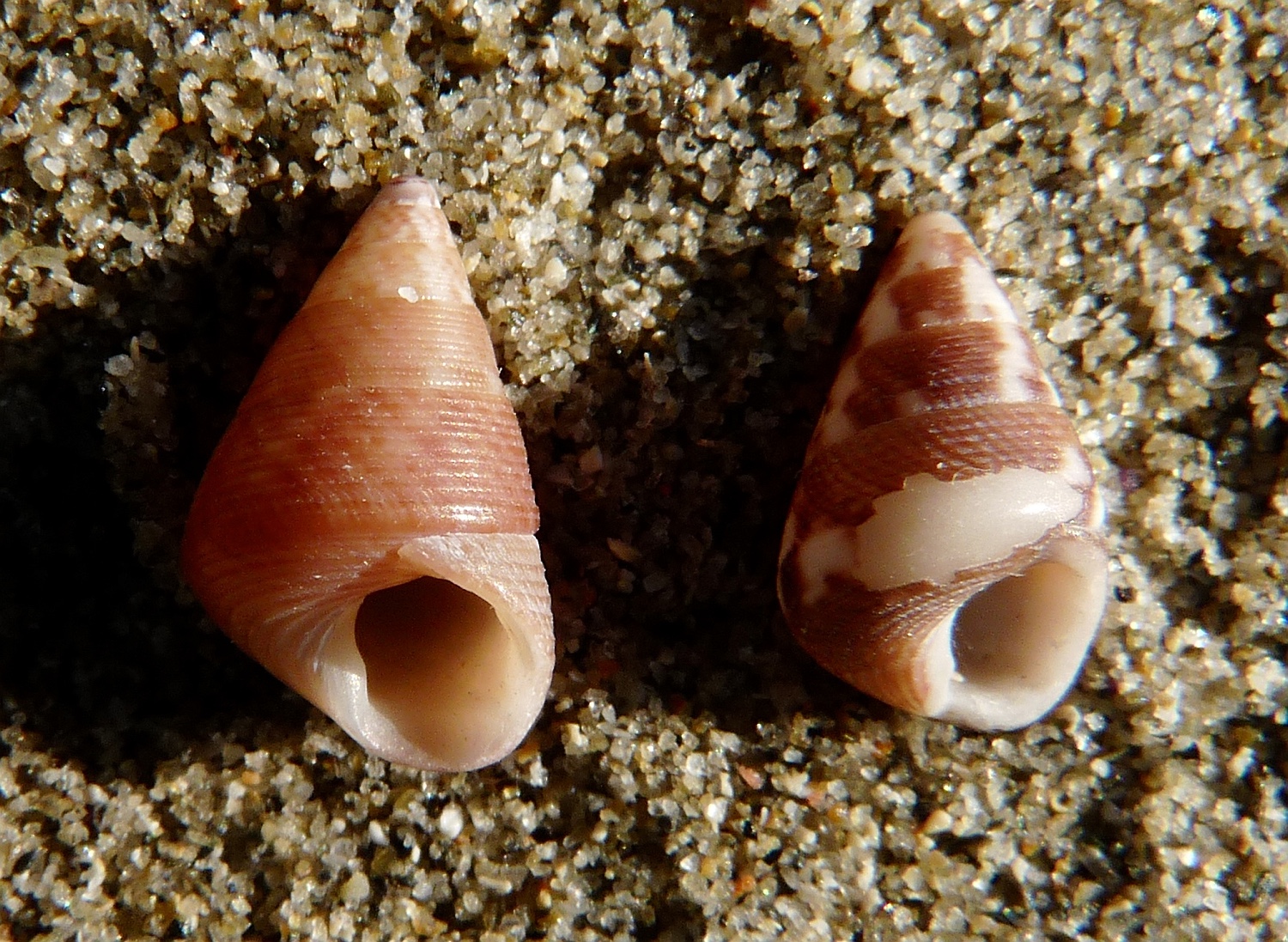
Very rarely, you may also find this species, possibly Jujubinus curinii, with a brownish colouring and a rounded, not flat underside. Height: 9 mm
Jujubinus karpathoensis ?, F. Nordsiek
very rare
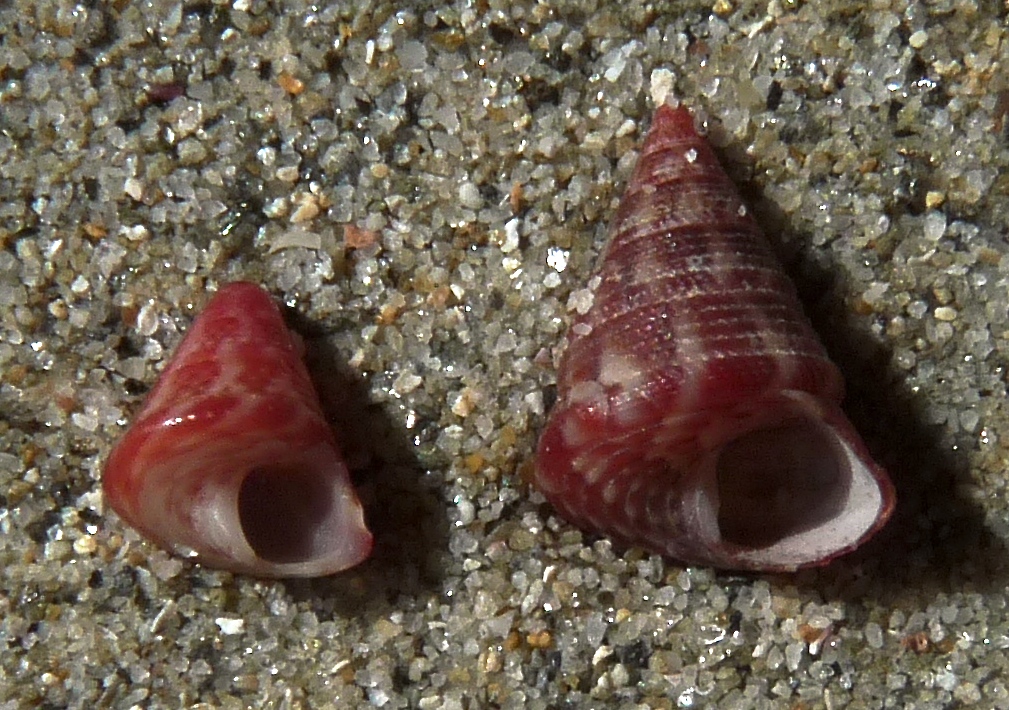
a very small species with a red shell, possibly Jujubinus karpathoensis. Height: 6 mm
Turbinate monodont, Phorcus turbinatus, Born
(= Monodonta turbinata, Osilinus turbinatus)
The Turbinate monodont is often found in large numbers in crevices in the rocks along the coast; at night, the snails emerge from their hiding places in search of food. They are vegetarians and scrape off the thin layer of algae on the rocks in the splash zone with their radula.
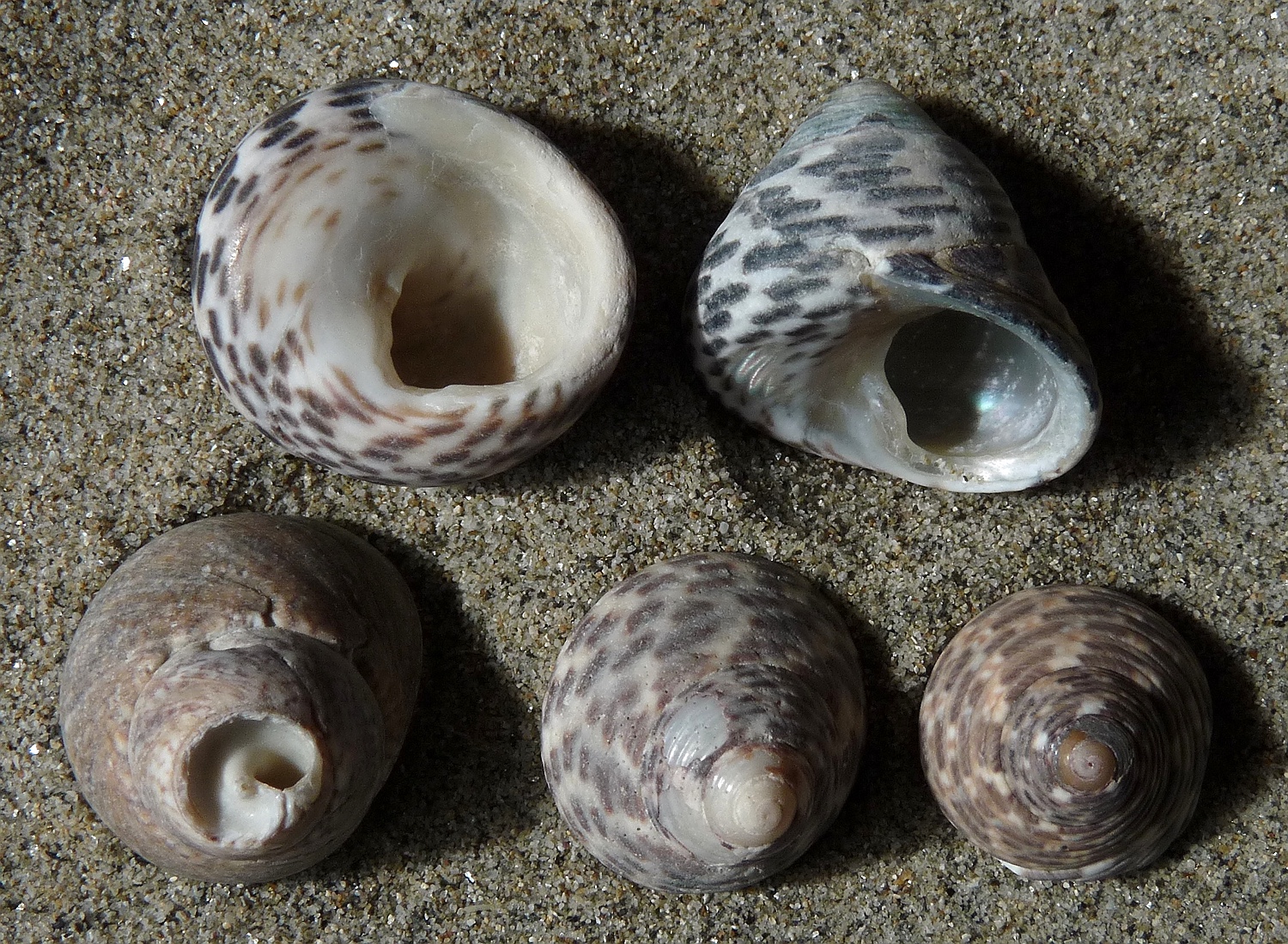
The very common species Phorcus turbinatus has a strong, thick-shelled, compact shell with a closed umbilicus and black and white markings. The specimen at the bottom left probably belongs to the species Ph. articulata. Height: 26 mm
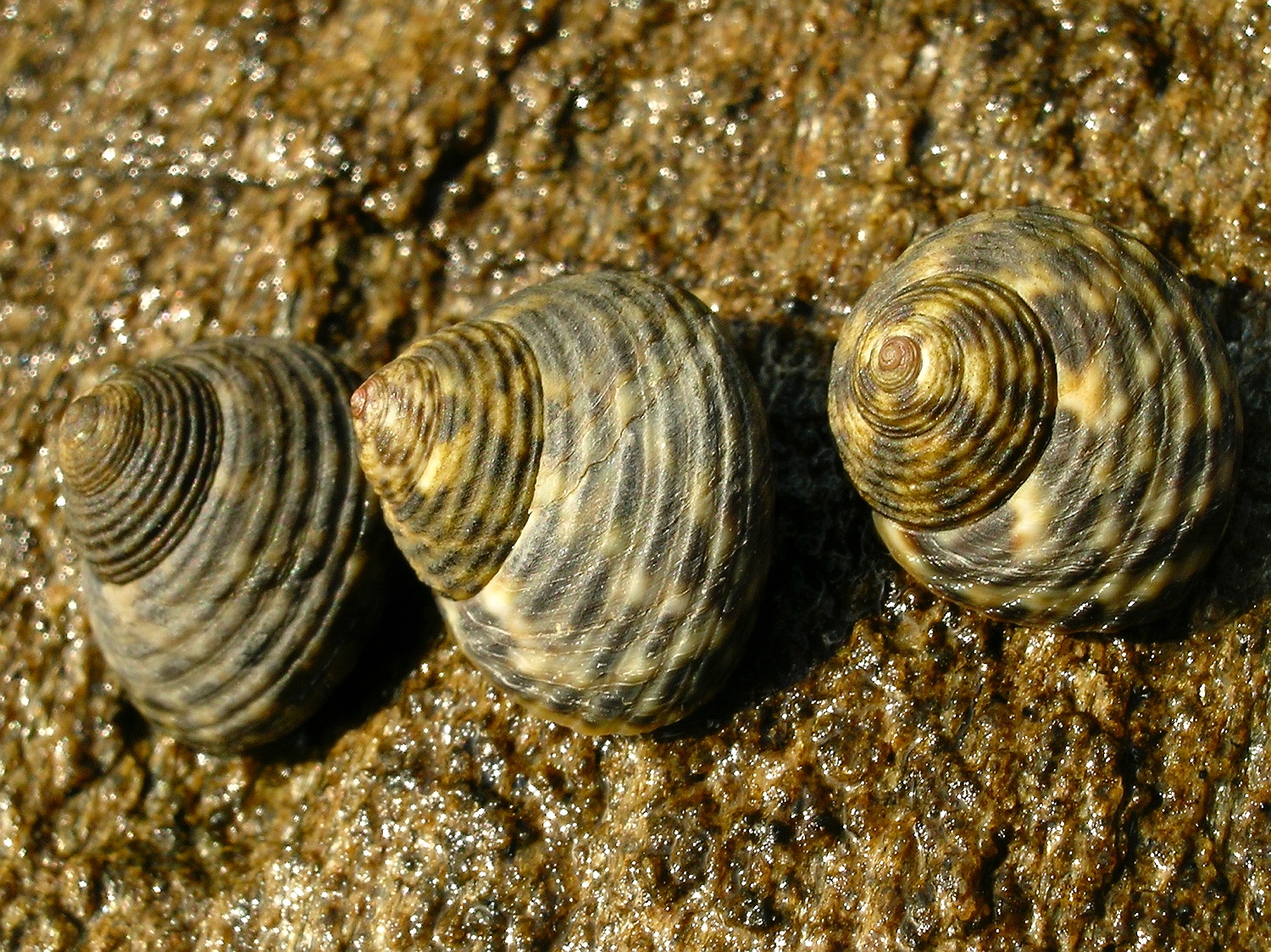
Younger specimens feature distinct spiral grooves and are brownish in colour.
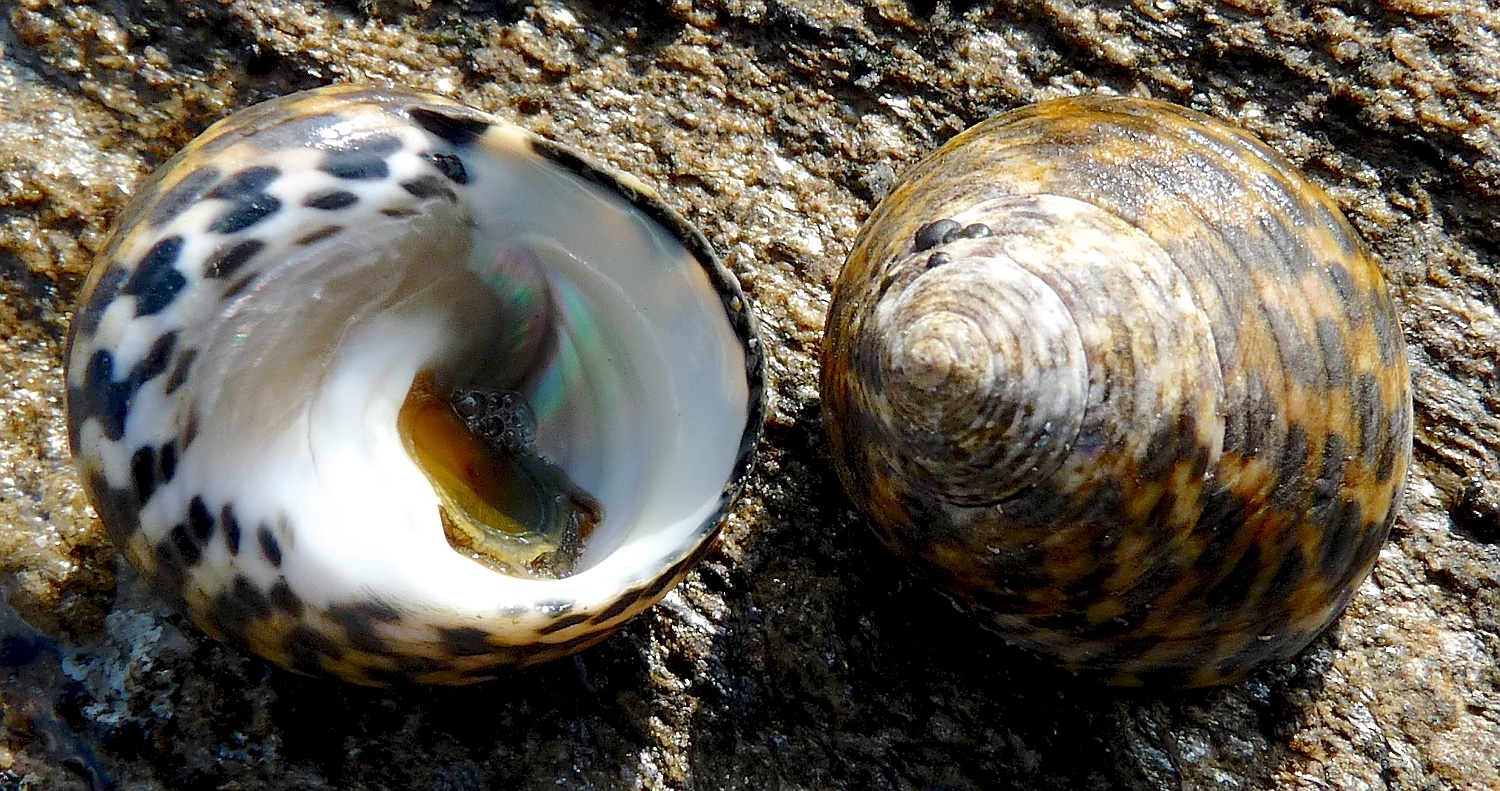
On the underside, you can see the contrasting black and white pattern and the horny operculum.
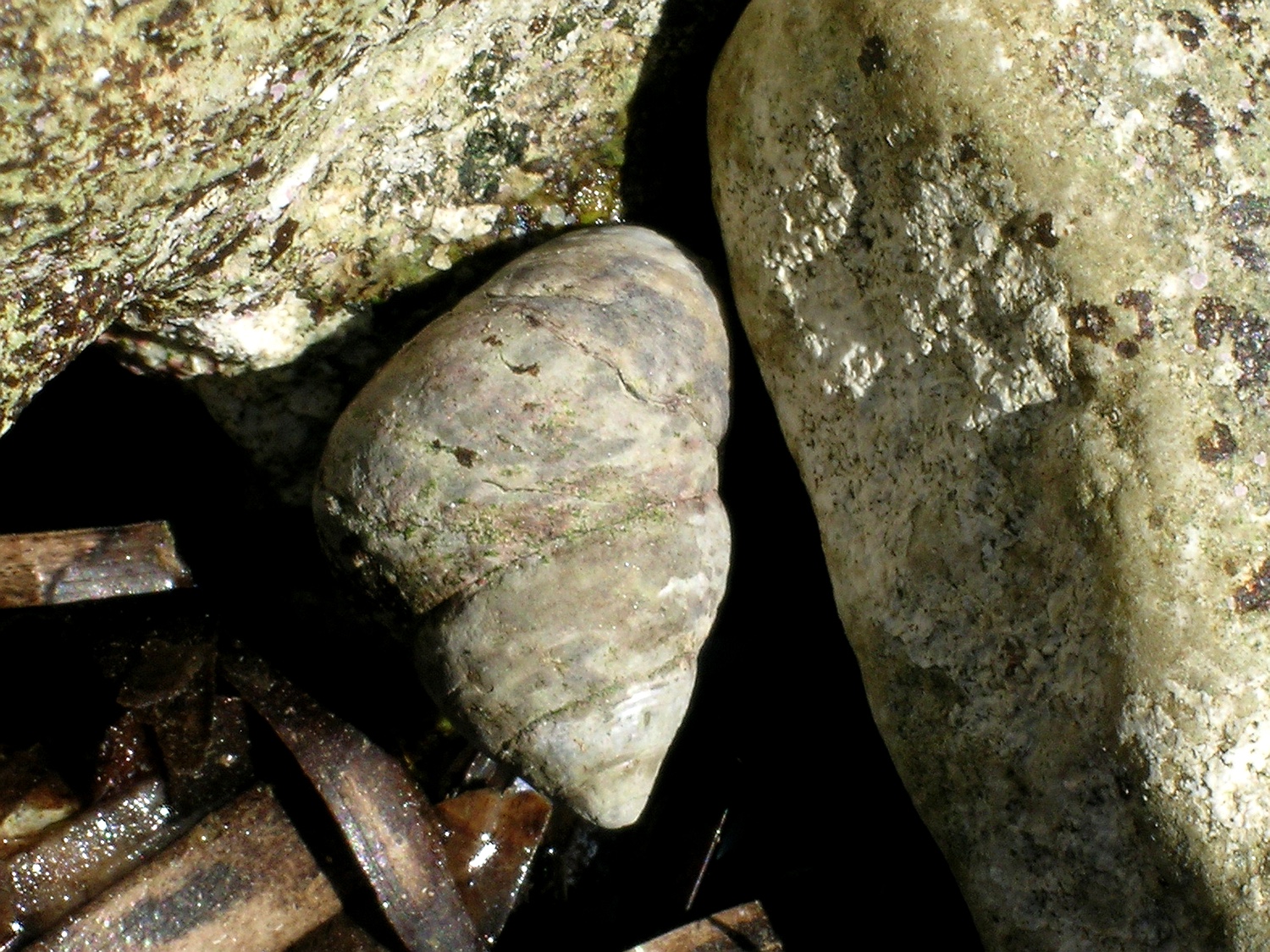
These specimens with a taller and smoother shell probably belong to the same species.
Phorcus articulatus, Lamarck
quite common, edible
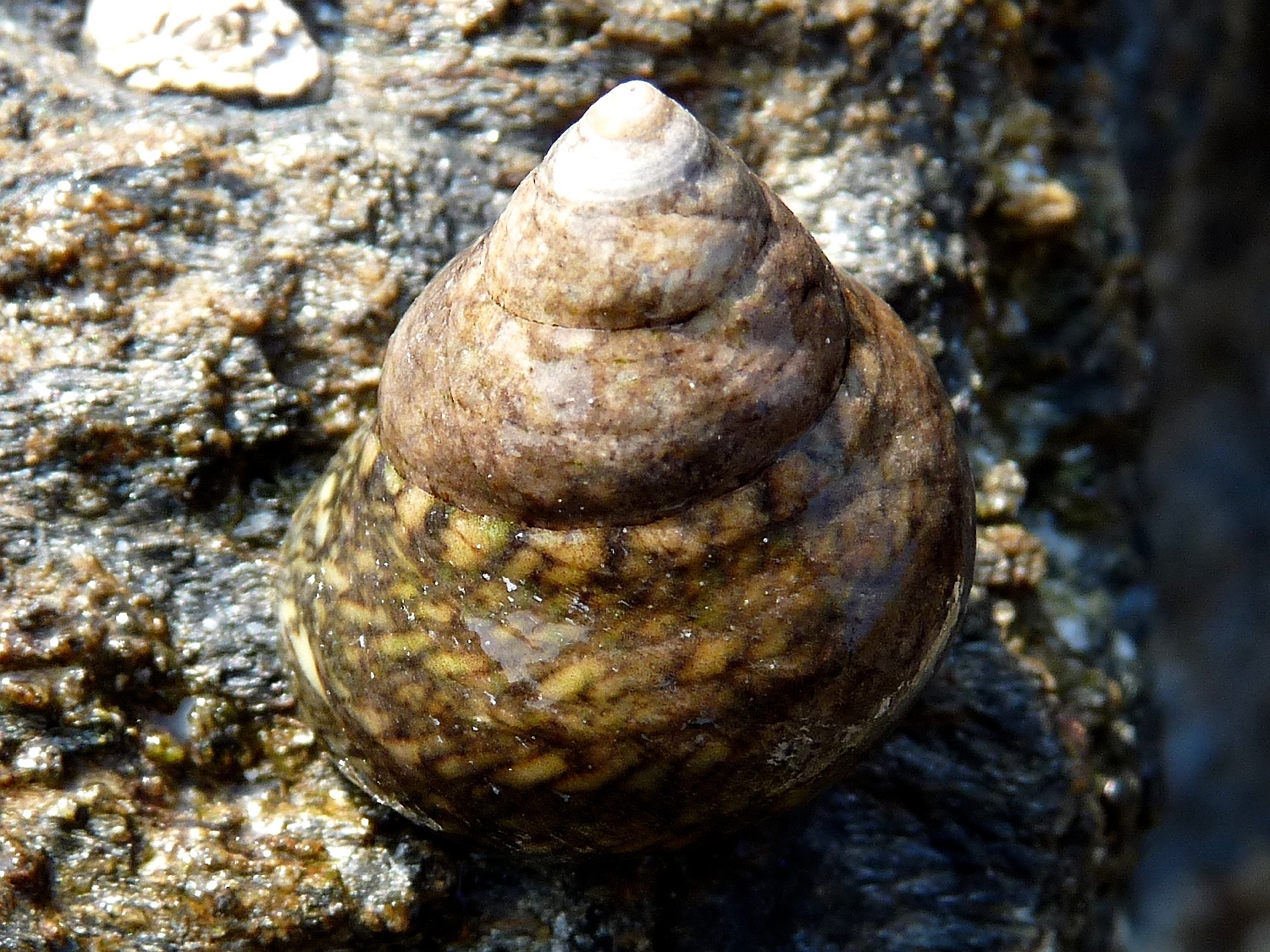
Phorcus articulatus is very similar to the previous species. The snail has a tall shell with slight shoulders on the whorls. The whorls show no spiral grooves as in Ph. turbinatus.
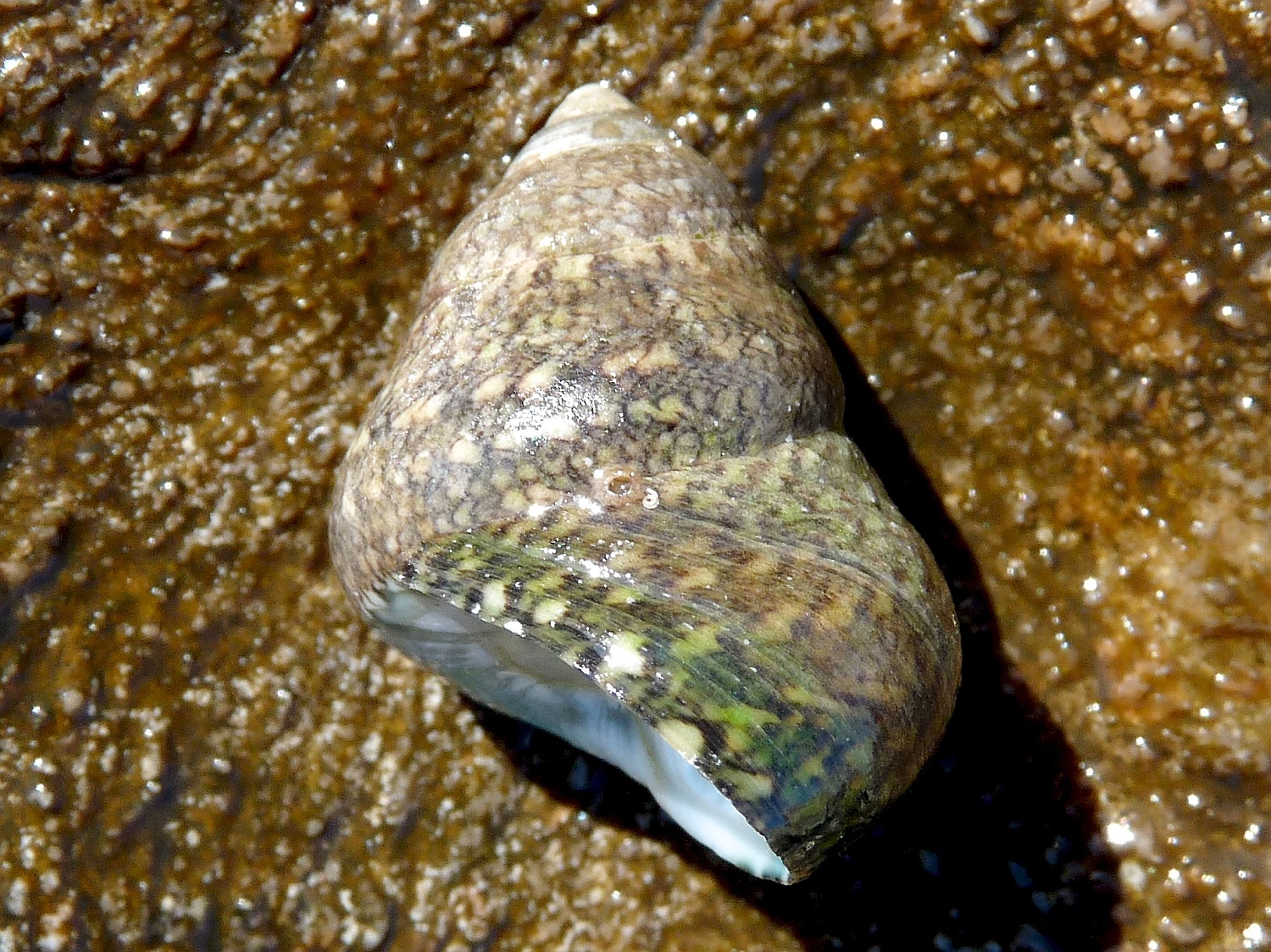
Here you can see the typical colouring with a fine pattern and characteristic spiral bands.
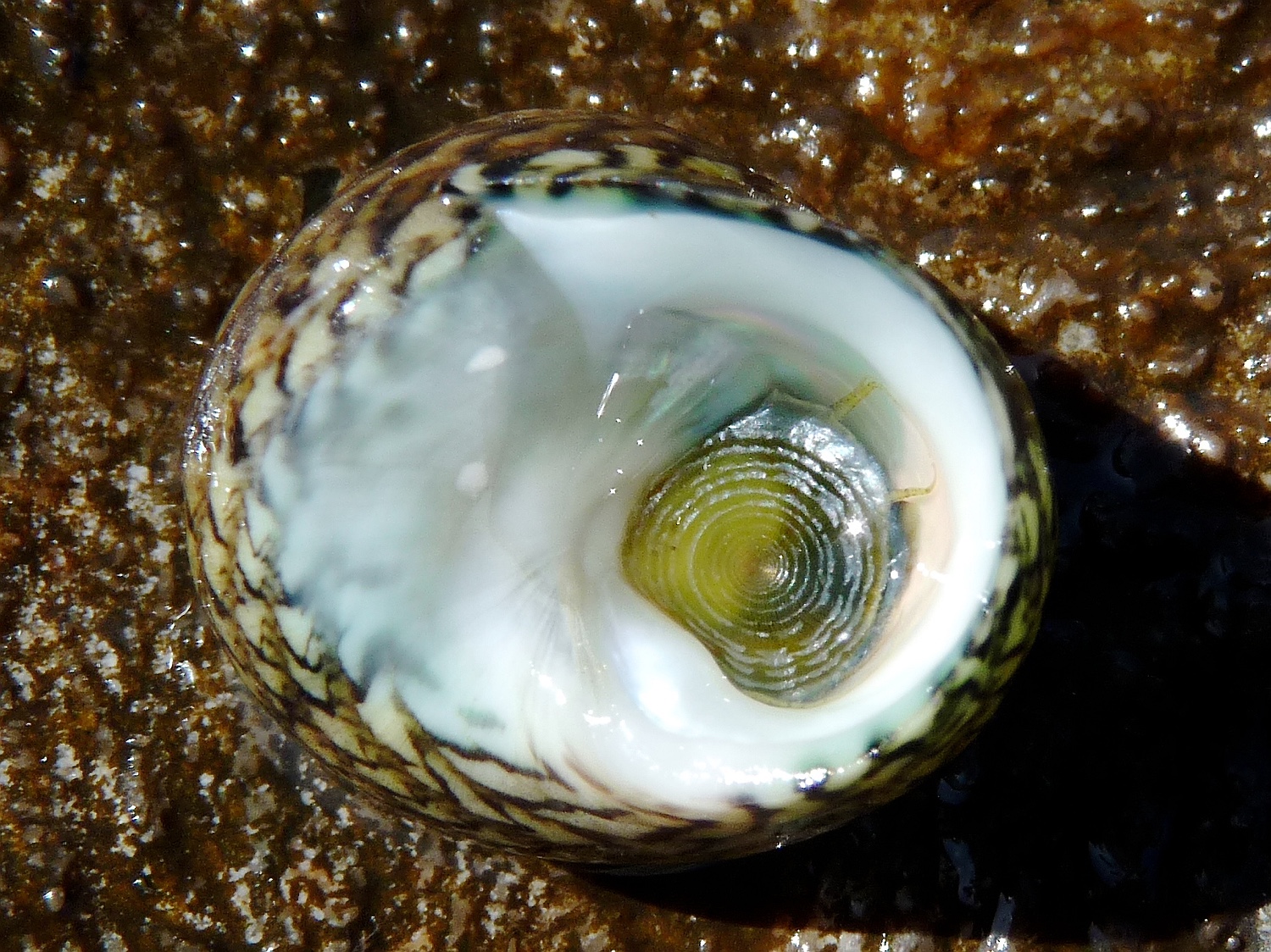
The white underside has a finer pattern than Ph. turbinatus. The operculum is light in colour with thin spiral grooves.
Phorcus richardi ?, Payraudeau
locally rather common
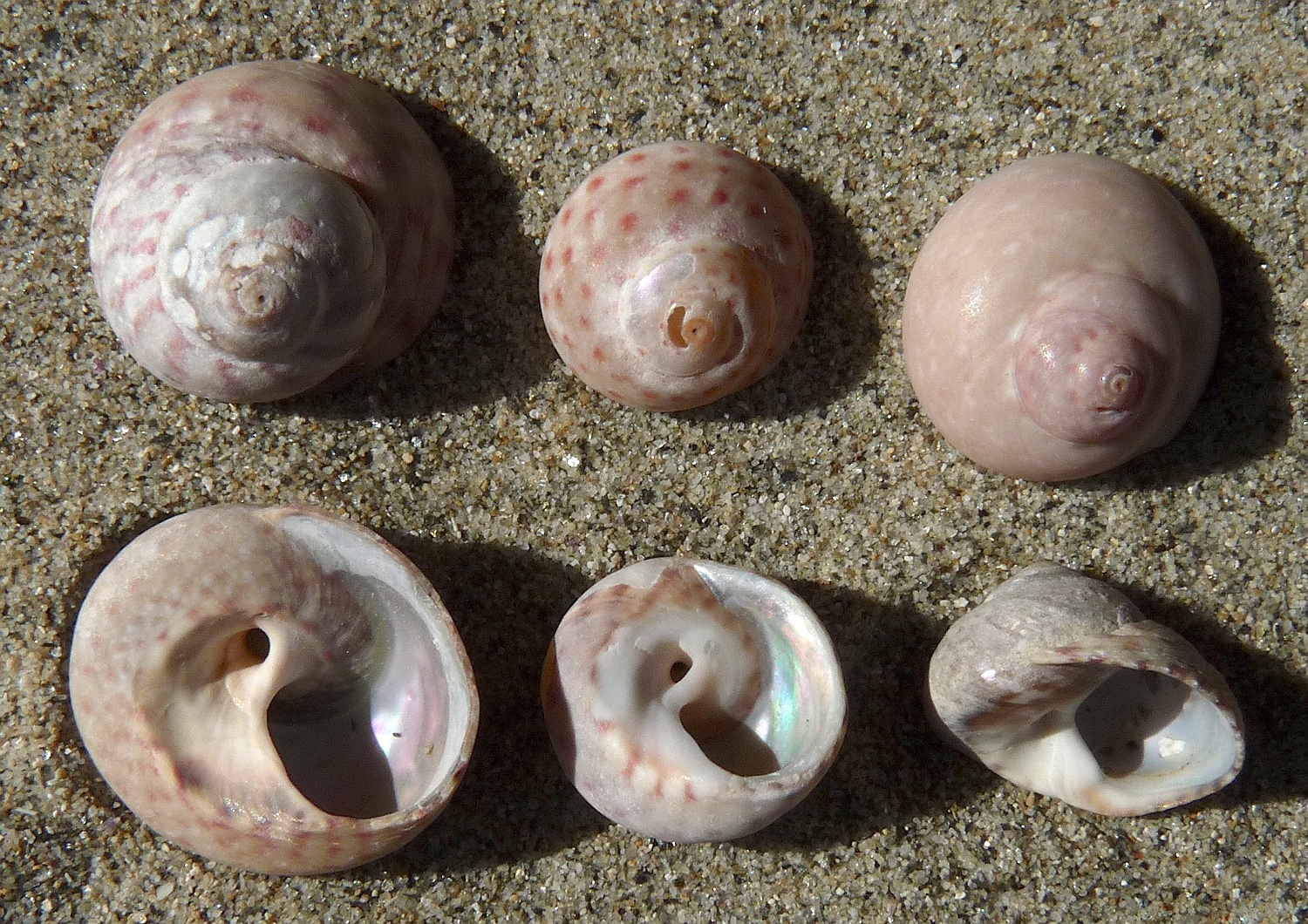
This species, with its robust, rounded shell with a distinctive umbilicus and a pearly sheen on the inside, is probably Phorcus richardi. Its colouring is reddish or grey, often with red spots. Size: 14 mm
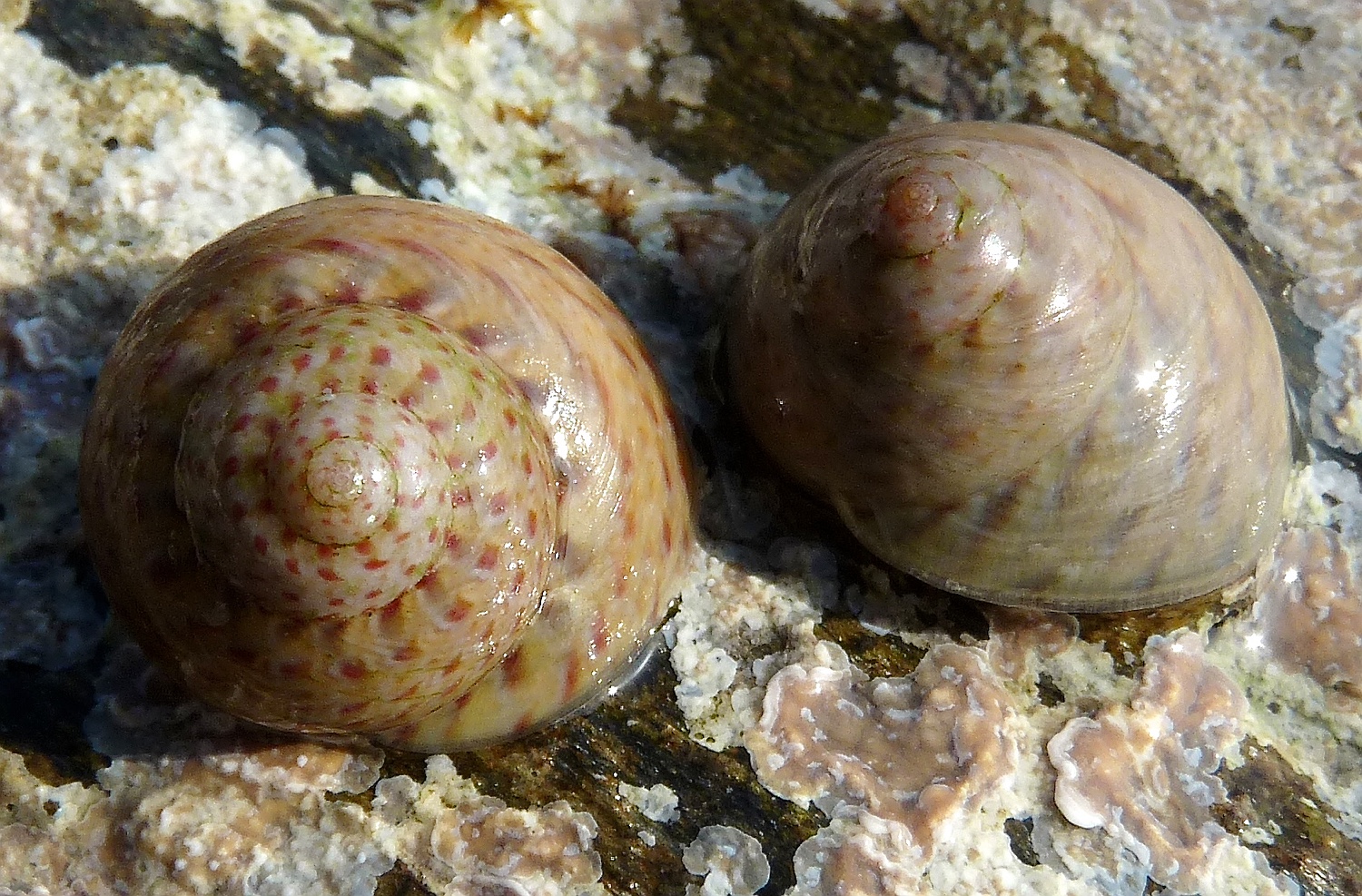
Here Phorcus richardi in its natural habitat. One can see the characteristic fine pattern with small reddish spots.
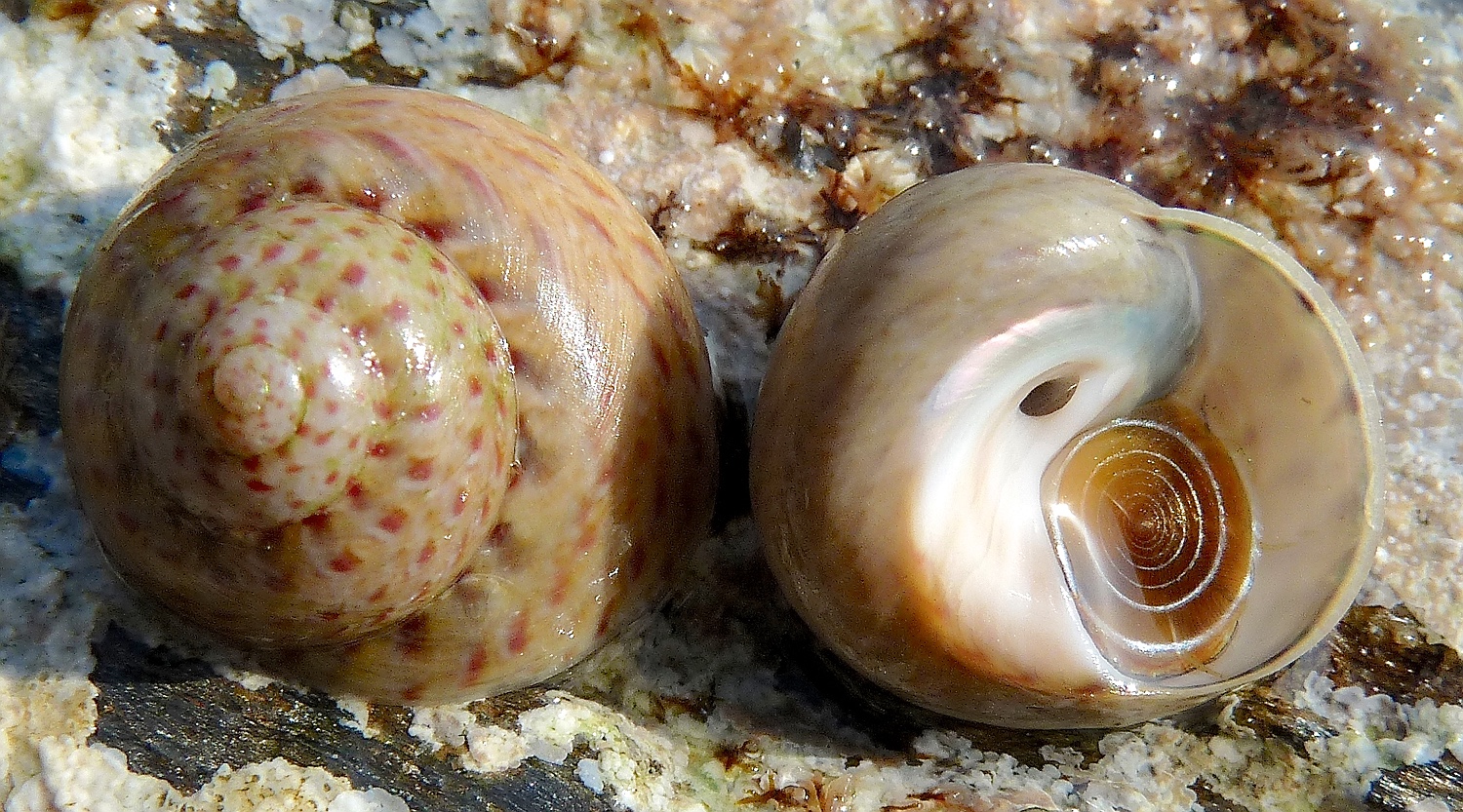
The deep navel lies in a white field; the horny operculum shows a fine white spiral line.
2. Calliostomatidae
Calliostoma laugieri, Payraudeau
rather rare
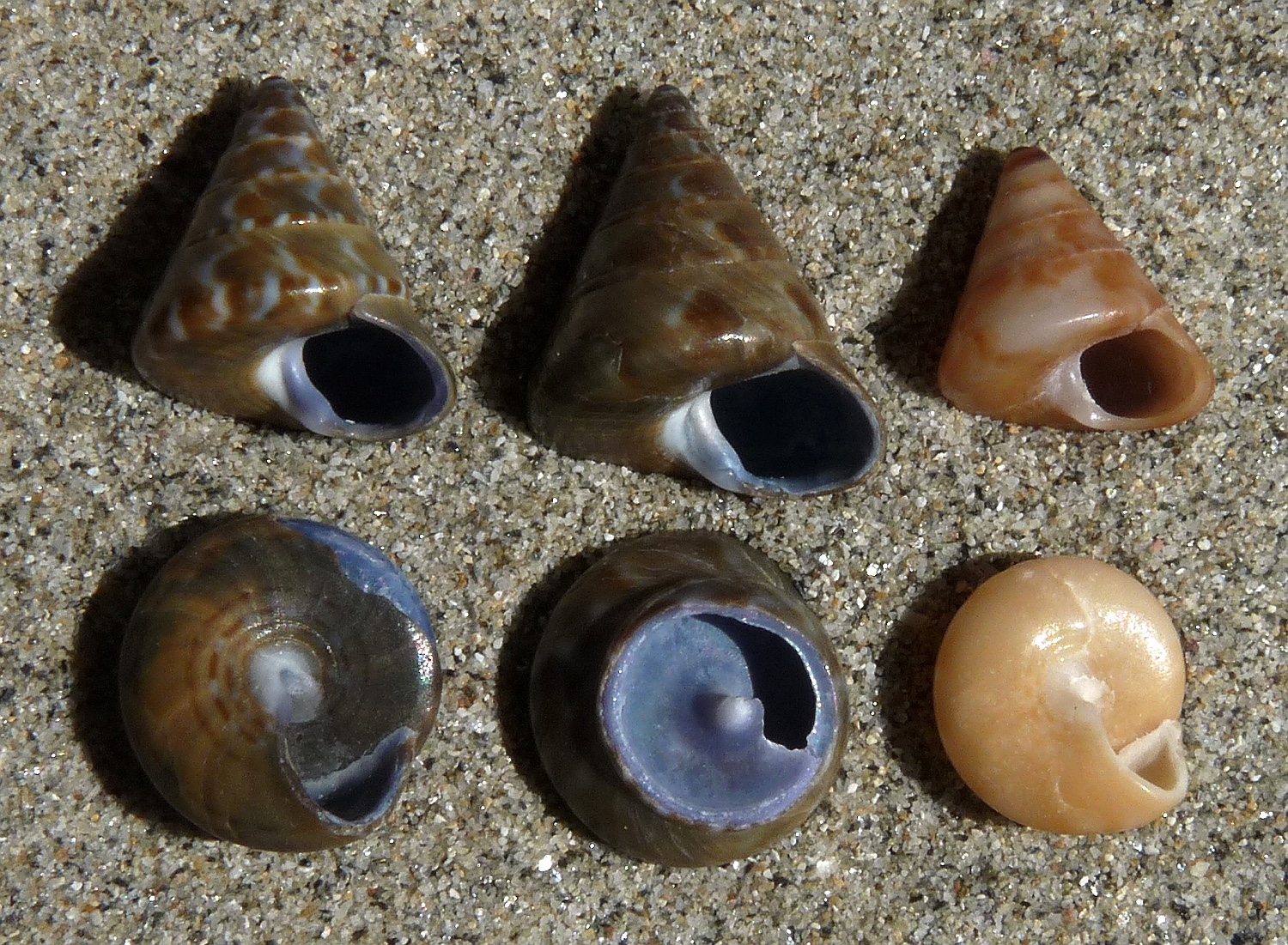
The snails of the genus Calliostoma have perfectly cone-shaped shells. Calliostoma laugieri is yellowish or olive green with a beautiful blue interior. Height: 10 mm
3. Turbinidae, Turban snails
Bolma rugosa, L.
in greater depths, only very rarely found on the beach
Only one species of turban snails is found around Naxos: Bolma rugosa. It can grow up to 6 cm in size and lives in deeper water on rocky substrates, where it grazes on algae. The shell is rarely washed ashore, but one may find the pretty operculum, which is often used to make jewellery. The species regularly appears as by-catch in trawl nets.
Bolma rugosa has a strong, cone-shaped shell with arched whorls, which are separated from each other by a distinct suture. Numerous knobs sit on the whorls which in young animals carry spines. The operculum, the thick, calcified lid with which the snail closes the aperture of its shell, is called a eye of the Virgin Mary. With a little luck, you can find one on the sandy beaches of Naxos. The operculum is smooth and white on one side with a delicate spiral line and beige or orange-brown on the other side with an elevated ridge. It can reach a size of about 2 cm.
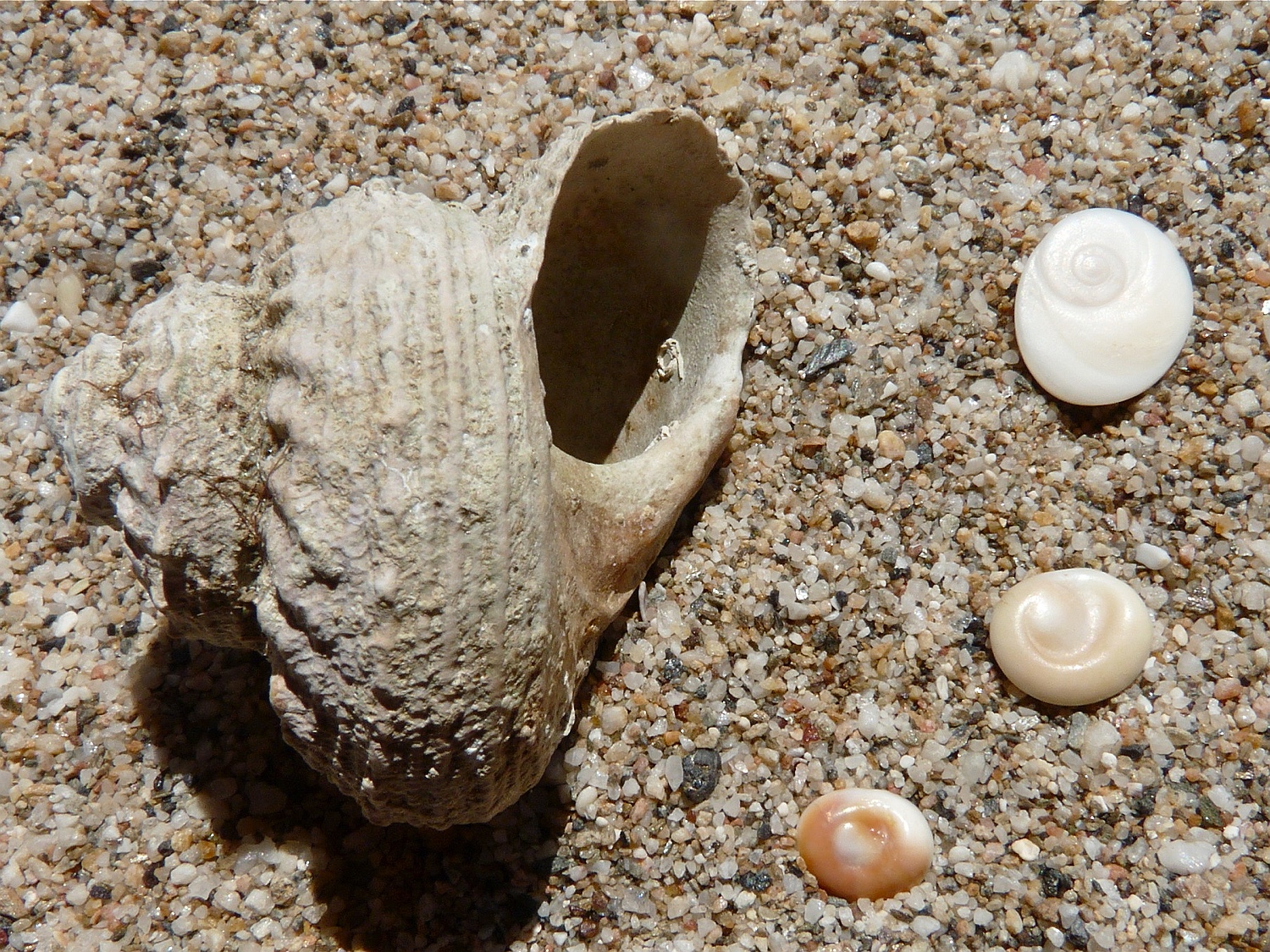
The large shell of Bolma rugosa shows distinct steps with convex whorls. Height: 45 mm
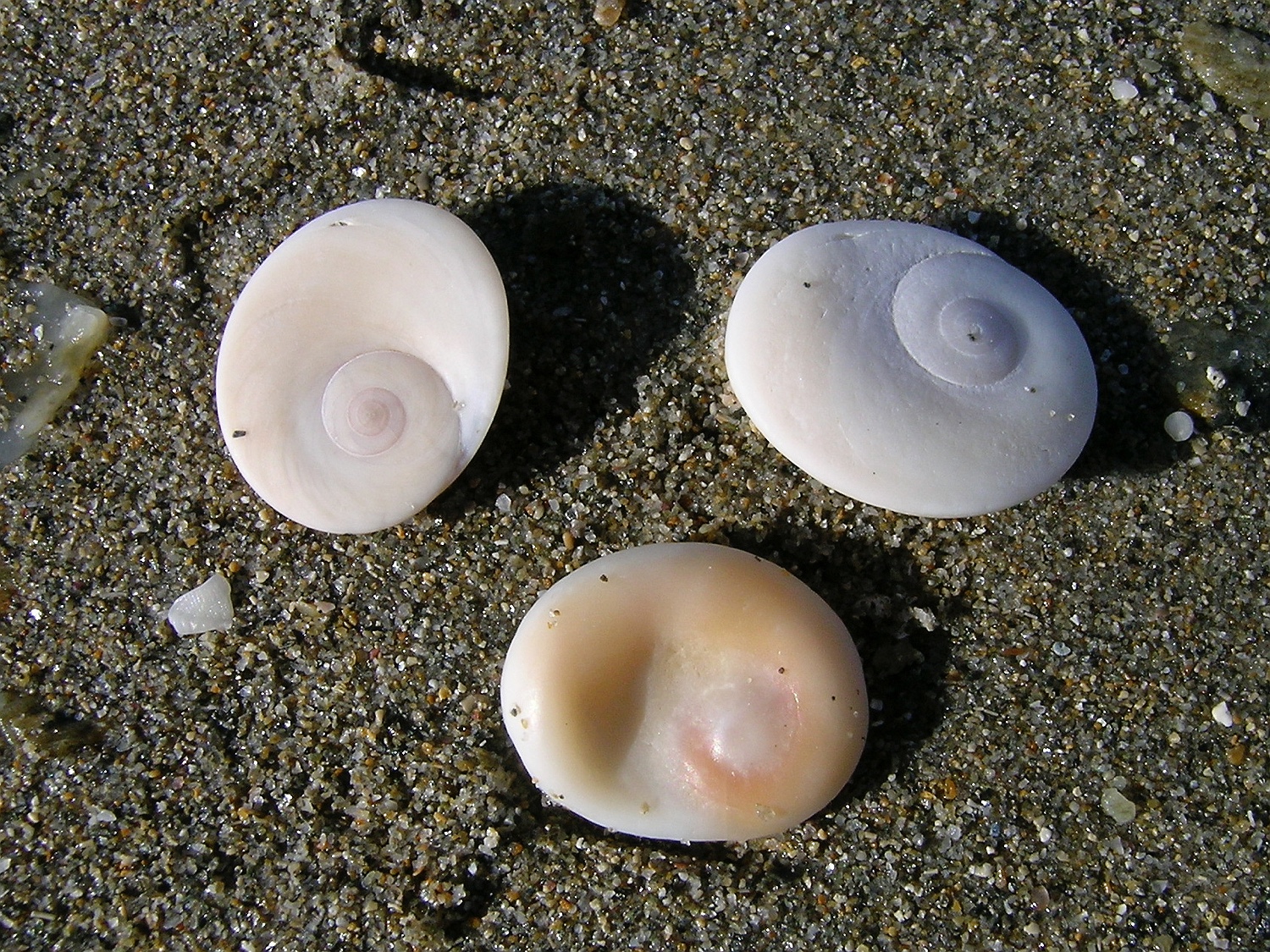
The beautiful operculi are called “eyes of the Virgin Mary” (gr. máti tis Panagías). On Naxos they are made into jewellery, especially pendants and earrings.
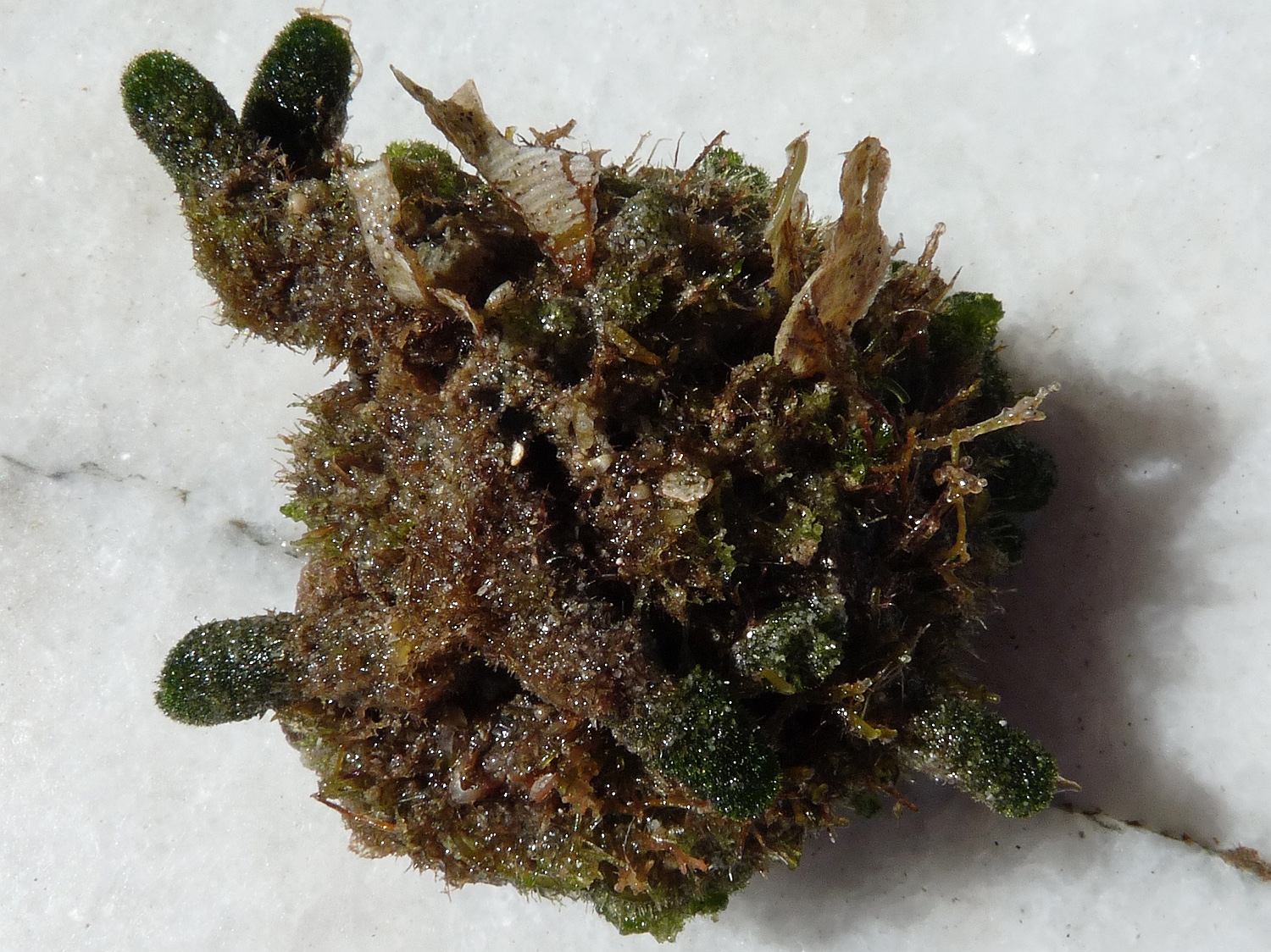
The living snails are usually densely covered with algae; they occur in deeper water.
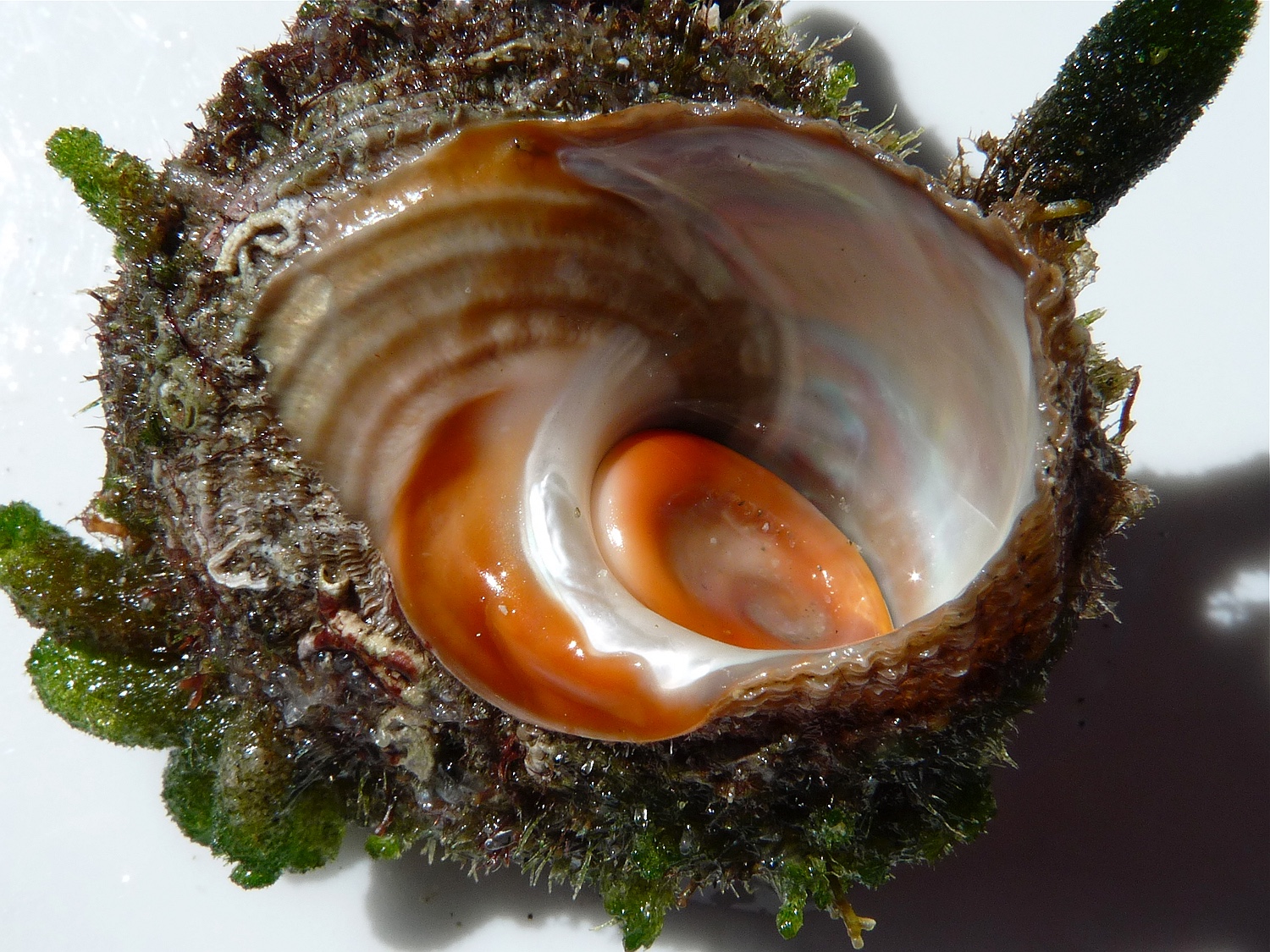
On the underside on sees the pearlescent inside of the aperture, the operculum and the shiny, orange-red navel area.
4. Phasianellidae
The species belonging to the family Phasianellidae are very small. They have egg-shaped shells with convex whorls and round apertures. The shell is smooth and shiny with red spots and streaks. They live in algae stands, especially among red algae.
Tricolia pullus, L.
(= Phasianella pullus)
rather common
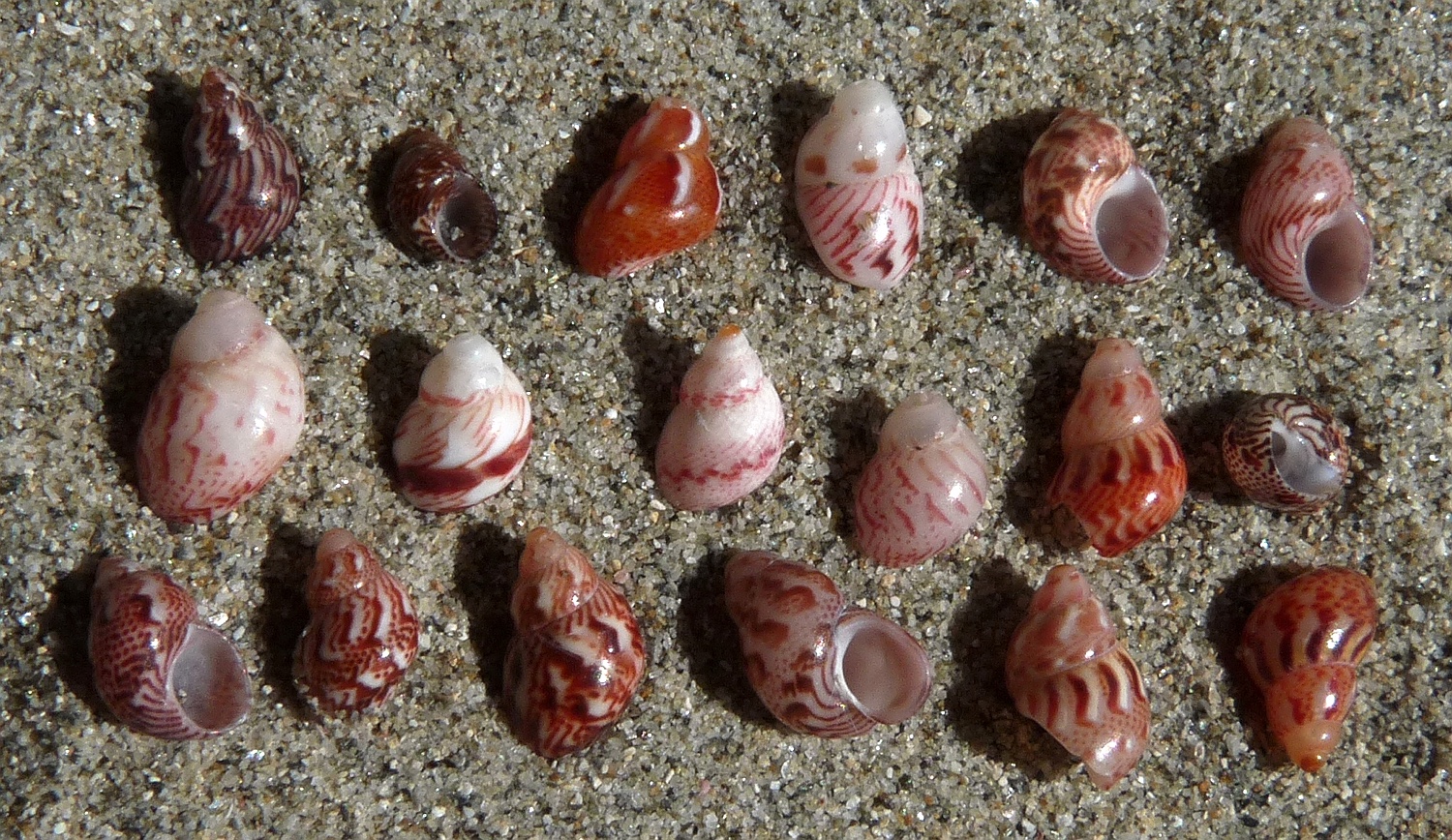
This tiny species displays a great variety in colouring: the shells can be almost transparent, white, pink, red or even dark, and each snail has slightly different zigzag markings or flame patterns. Height: 7 mm
Tricolia speciosa, Megerle von Mühlfeld
very rare
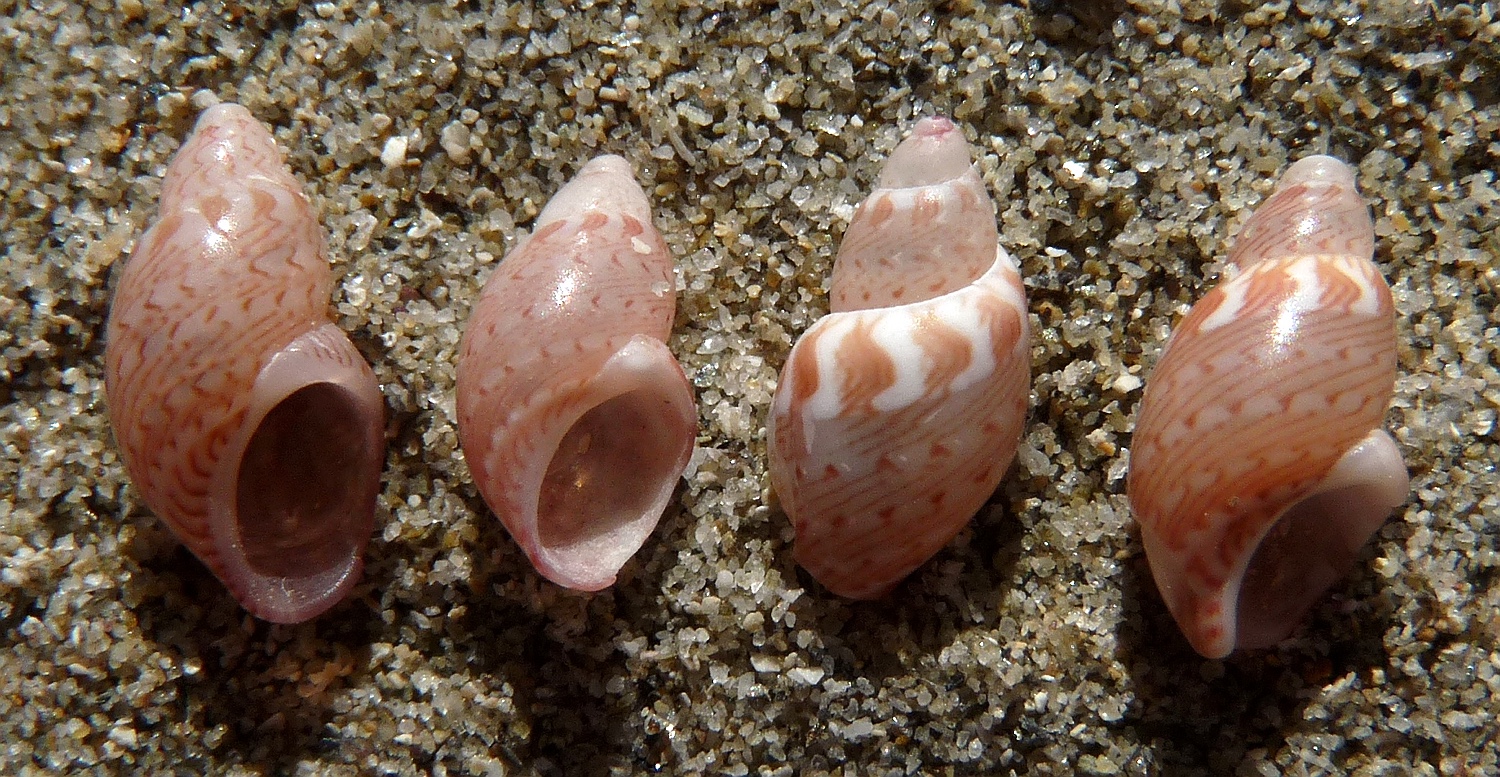
Tricolia speciosa has a higher shell which is light orangepink with delicate flame bands and fine spiral lines. Height: 9 mm
5. Colloniidae
The species of the genus Homalopoma usually have flat shells with a closed navel.
Homalopoma sanguineum, L.
very rare
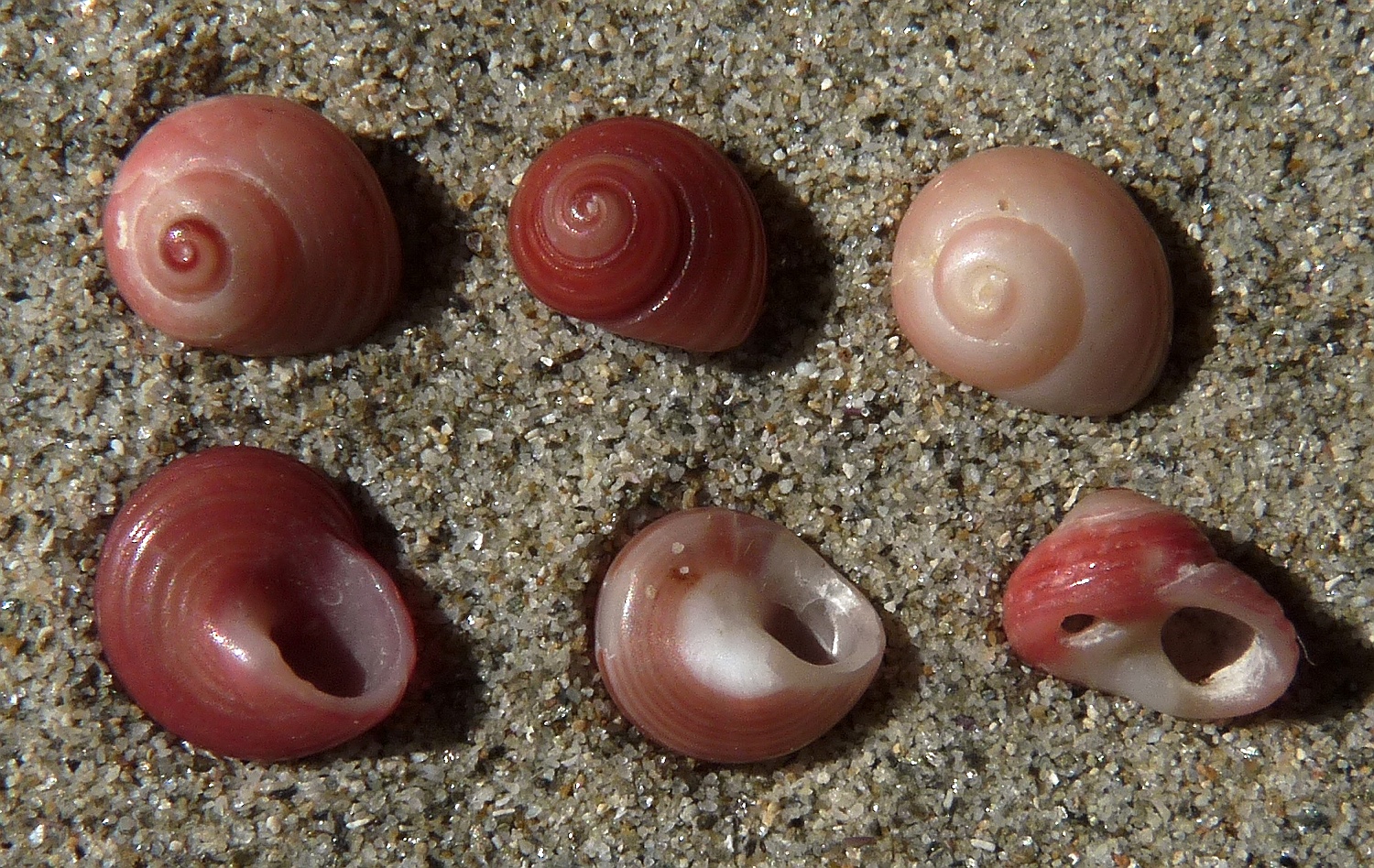
The very small species Homalopoma sanguineum has a beautiful, red, rather smooth and flat shell with a whitish navel area. Size: 7 mm
B. Subclass Neritimorpha
Neritoidea: Neritidae
Emerald nerite, Smaragdia viridis, L.
The tiny Emerald nerite occurs in shallow water (to a depth of 20 m) and lives on seagrass which constitutes also its food.
rather rare

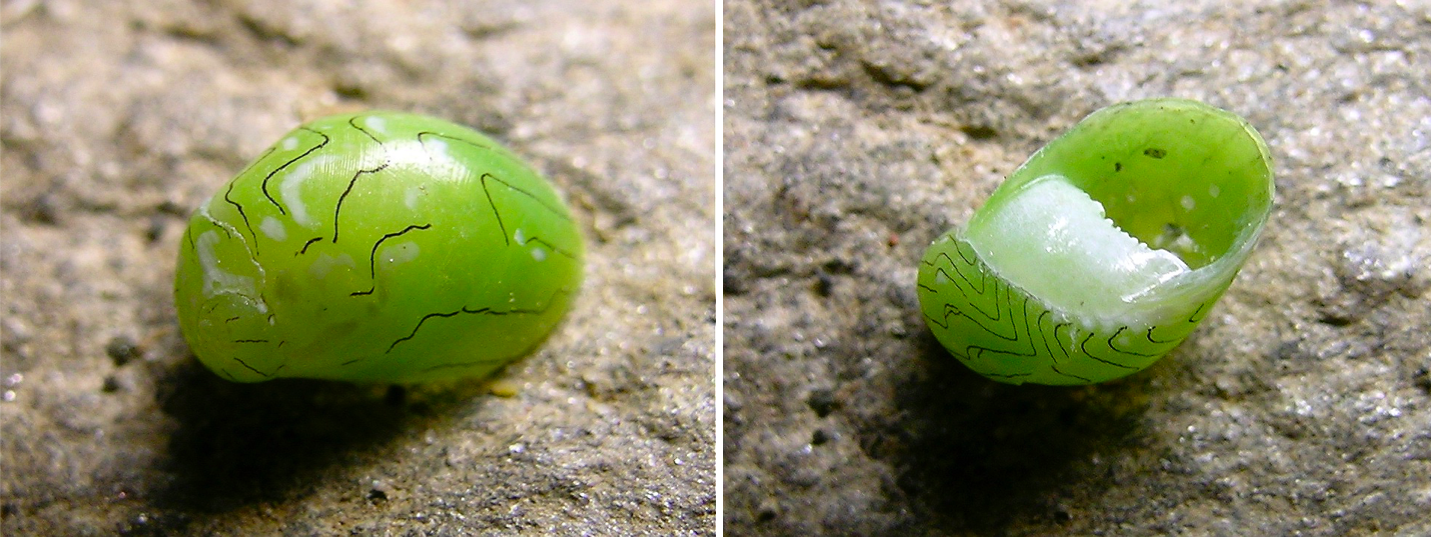
The tiny Emerald nerite is unmistakable in colour and shape. Size: 5 mm
continue: Buccinidae and Turritellidae
back: