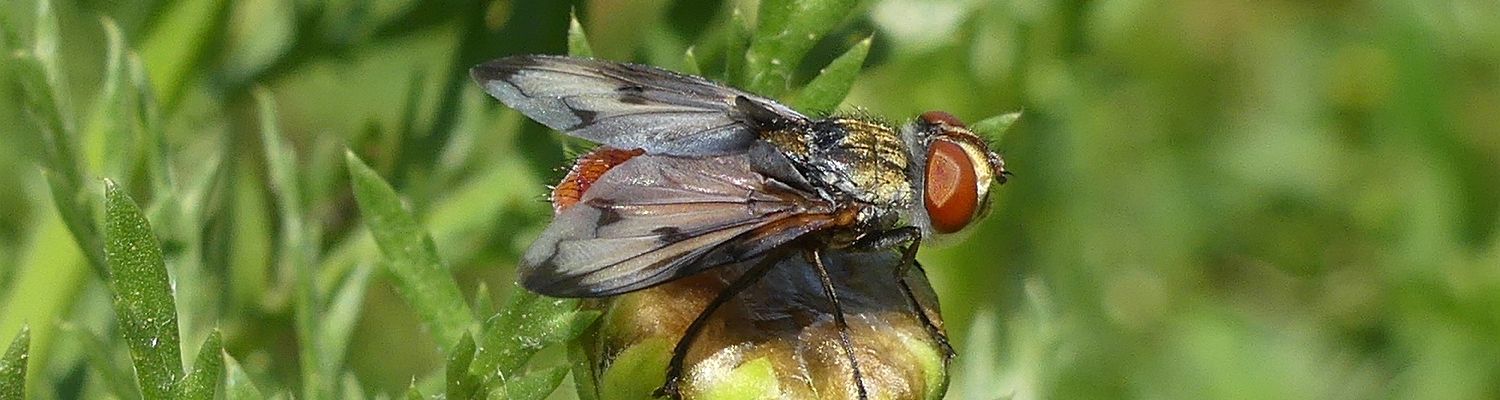
Flies
The flies form, together with the mosquitoes, the order Diptera, which comprises around 160,000 species. Unlike most other insects, the Diptera, as the name suggests, have only two wings. Flies have developed many different ways of life and have conquered every habitat on Earth. They are a highly successful group of animals that often occur in large numbers.
Here you can skip the introduction and go directly to the species.
Biology
In dipterans, only the front pair of wings is used for flight; the hindwings are reduced to so-called halteres, small, club-shaped structures equipped with numerous sensory organs that provide the fly with information about its movements in flight and thus help with stabilising the flight. In some flies, such as house flies and tachinid flies, a small scale at the rear edge of the forewing, the calypter, covers the halteres.
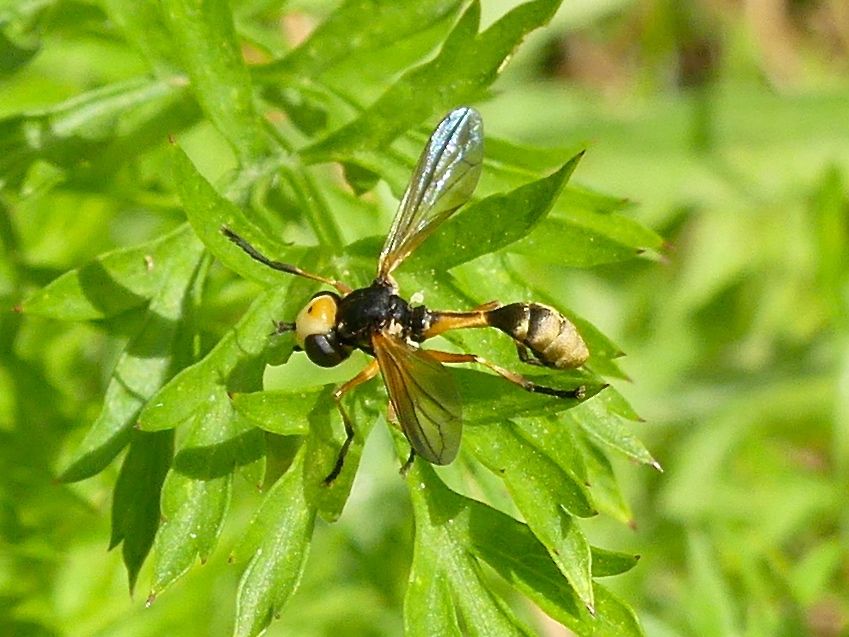
Unlike wasps and bees, flies have only one pair of wings. The hind pair of wings has been modified into small halteres which bear many sensory organs. The pale yellow halteres are visible in this thick-headed fly.
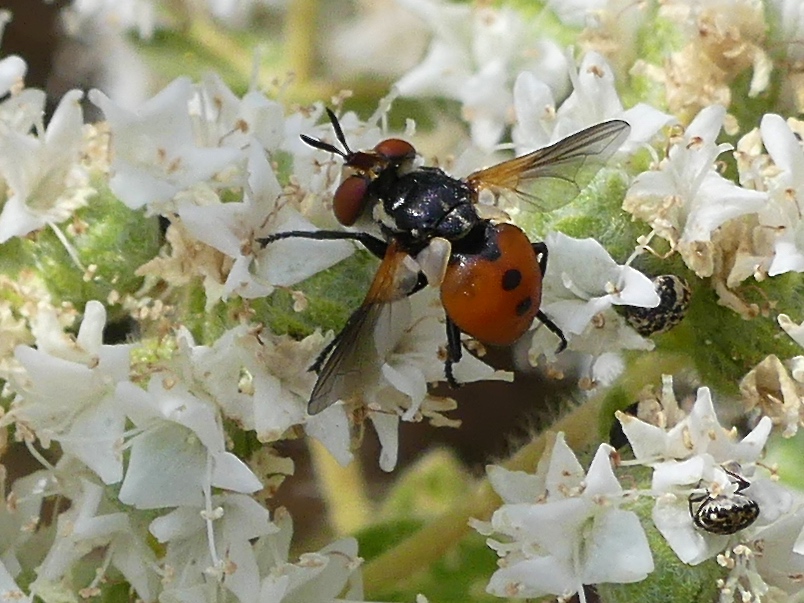
In this tachinid fly, you can see the white calypter at the rear edge of the wing near the base.
Flies usually have large, well-developed eyes. Their antennae are short and club-shaped with a fine bristle (arista) that branches off laterally. The mouthparts are of the lapping-sucking or piercing-sucking type. Many flies bear conspicuous, robust bristles on the head, body and legs, which, like the venation of the transparent wings, are important for identification and systematic classification.
Development
Flies undergo a holometabolous development with a pupal stage. The simply constructed larvae are known as maggots; they have no legs and no head capsule. In some species the larvae live predatory, in others they are herbivores or live as parasites.
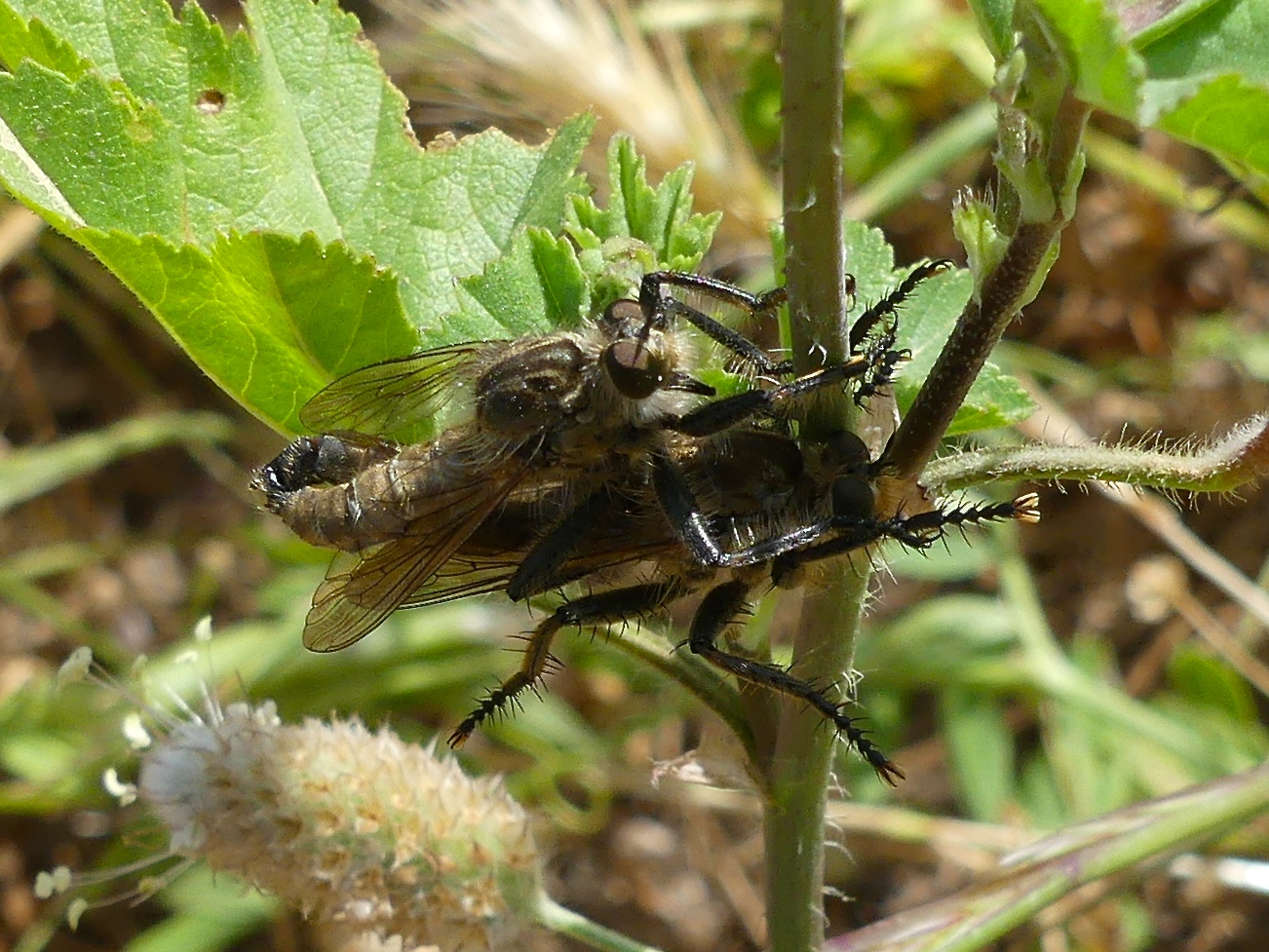
Robberflies during mating: the flies press the tips of their abdomens together, whereby the sperm packets are transferred to the female, which can store them for a long time until laying the eggs.
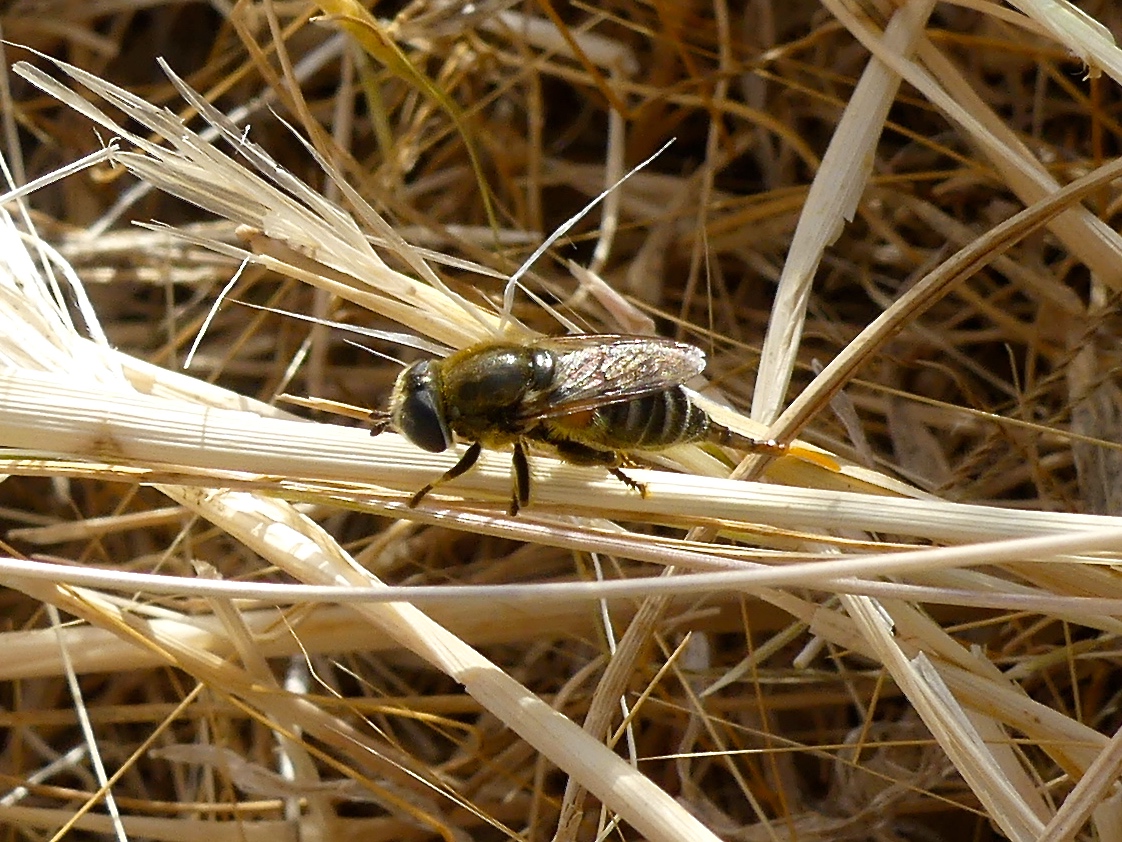
Hoverfly laying eggs
Significance for humans
Many flies are significant pests for humans; for example, the larvae of some species live in fruit or vegetables. Among these species are major pests such as the Olive fly and the Mediterranean fruit fly. Other species live as larvae in dung, carrion or meat; they are of great importance to ecosystems as decomposer of organic material, but can often transmit diseases or spoil the infested meat. Some species feed on the blood of humans and animals, and in many cases, such as the African tsetse fly, they are vectors of dangerous diseases.
Fly species on Naxos
Flies on Naxos
Of course, far too many species of flies occur on Naxos for me to offer anything remotely close to a complete account; however, in the descriptions below you will find some representatives of the most common and important groups, and you can get to know some of the more striking or interesting species.
The Photo gallery of the flies, wasps and bees gives an overview over the species.
A note on identification: While some flies can be identified easily, this is not true for all species. In many cases, accurate identification relies on characteristics that cannot be seen in photos and require examination of the dead animal under a magnifying glass or microscope; also one would need special literature and identification guides. For this reason, I cannot guarantee the correctness of the identification of many of the species in the following description. I would like to thank the forum of the website Entomologie.de and the very dedicated members of the Facebook group “Insects of Greece and Cyprus” for helping with the identification of several species.
Here you can jump directly to the larger groups within the flies (return with the back arrow or by swiping back):
House flies (Muscidae) – Flesh flies und Blowflies (Sarcophagidae, Calliphoridae) – Tachinidae – Robberflies (Asilidae) – Thick-headed flies (Conopidae) – Marshflies and Fruit flies (Sciomyzidae, Tephritidae) – Grass flies (Chloropidae) and Anthomyiidae – Dagger flies and Dance flies (Empididae, Hybotidae) – Long-legged flies and Soldier flies (Dolichopodidae, Stratiomyoidae) – Horse flies (Tabanidae)
The hover flies und bee flies are treated in separate articles.
House flies, Muscidae
The house or stable flies comprise around 4,000 species, many of which are found in close proximity to humans. They exhibit quite diverse lifestyles. The larvae, and sometimes the adults, feed on carrion, dung or plant sap; furthermore, some species suck blood and some larvae live as parasites. Many species can transmit dangerous diseases.
Housefly, Musca domestica, L.
The housefly is one of the most common and ubiquitous animals. It is found all over the world – particularly in the vicinity of humans. The adults feed on liquids or fine solids, which they dab up with their proboscis. The larvae live on manure, compost, faeces or decaying plant material. The housefly’s development time is extremely short. Under favourable conditions, only 7 days elapse from egg-laying to pupation, and the adults can mate again after just 3 days. This enables the housefly to have up to 15 generations per year. The female lays up to 400 eggs every 3 to 4 days. Under favourable environmental conditions, the flies can mulitply very quickly, even though the adult flies live for only a few weeks.
The housefly can transmit a range of diseases to humans, as it likes to sit on faeces, decaying meat and wounds. The pathogens are transmitted primarily through the fly’s excrement.
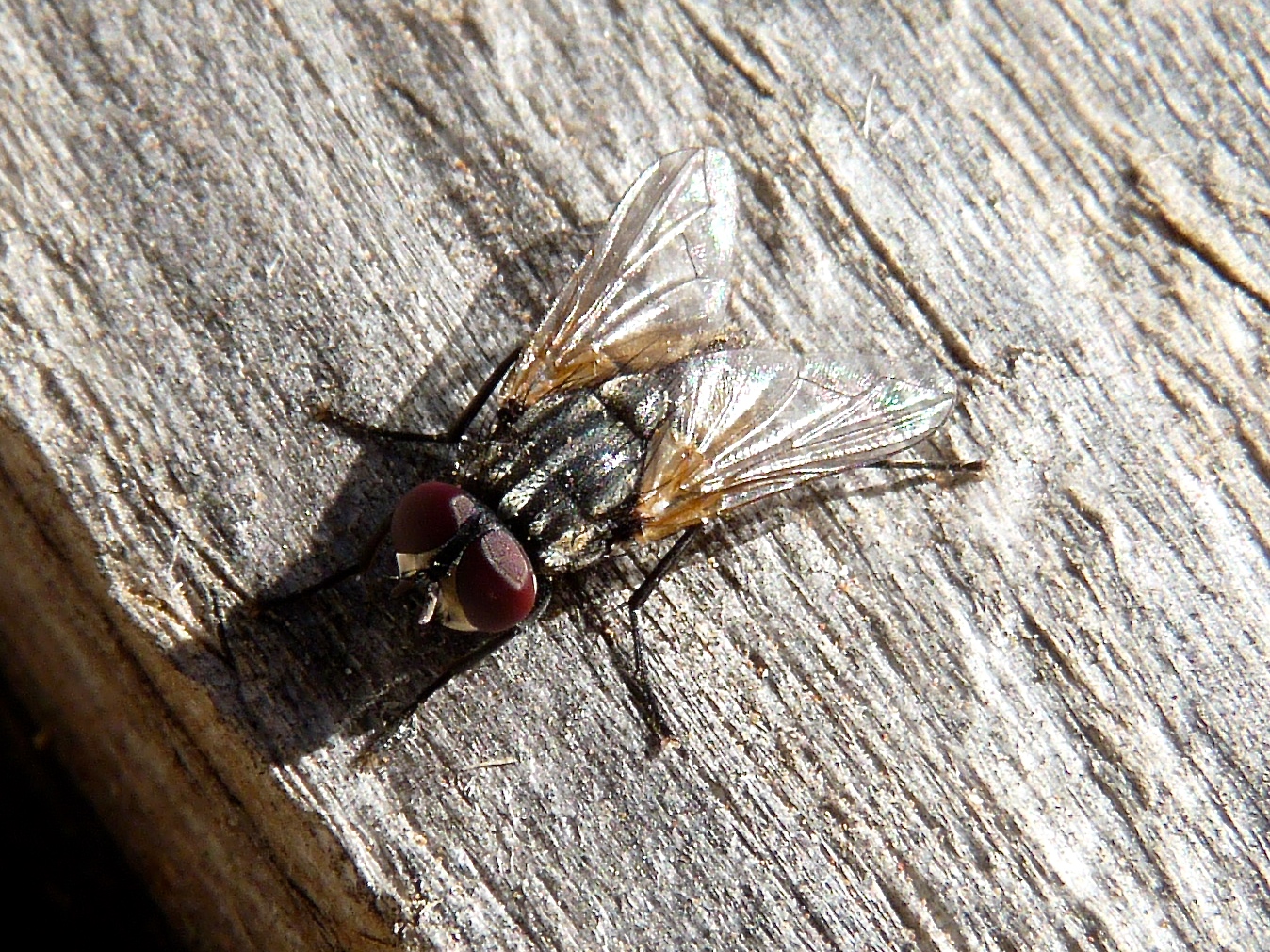
The well-known housefly has large brown-red compound eyes, a body with black and grey longitudinal stripes, and yellowish spots at the base of its wings.
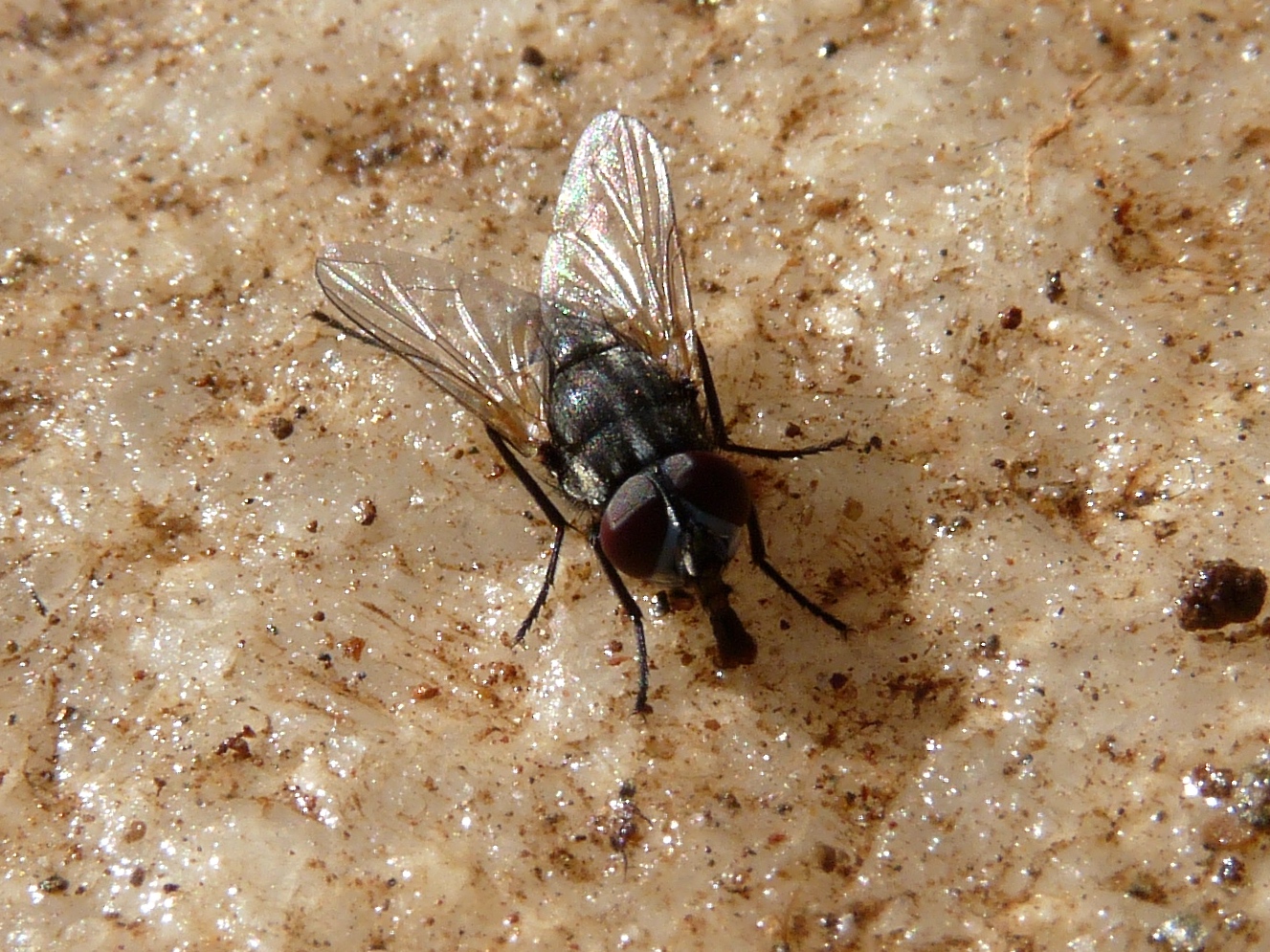
Here you can see the short, thick proboscis with its sponge-like end, which the fly uses to take up liquids and fine solids.
Stable fly, Stomoxys calcitrans, L.
The Stable fly looks very similar to the housefly, but has a long and thin proboscis with which it sucks blood from animals and humans. Stable flies sometimes occur at the beach or in our area; they can be very annoying as they keep returning until they have had their meal; the bite is quite painful and causes severe itching. The Stable fly is very quick and cautious, and extremely difficult to swat. The larvae of this fly species live on dung heaps and in manure as well as in marine plant material, e.g. seagrass, that has been deposited on the beaches. Animals such as dogs, goats and cattle also often suffer greatly from Stable flies.
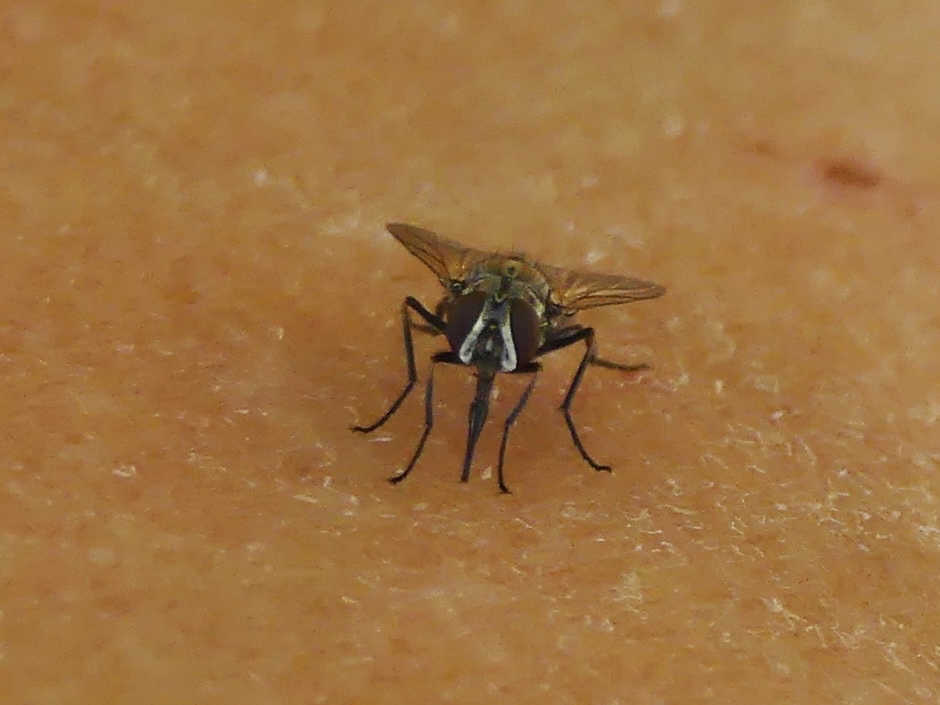
Stable fly sucking blood
Flesh flies, Sarcophagidae
Around 2,500 species of flesh flies exist, all of which look quite similar: the species are in general very difficult to distinguish. Adult flesh flies feed on plant sap, for example from fruits. In contrast, the larvae have very different feeding habits: in some species they are predatory, in others they feed on carrion or on dung, and many larvae live as parasites on a wide variety of animals.
Flesh fly, Sarcophaga spec.
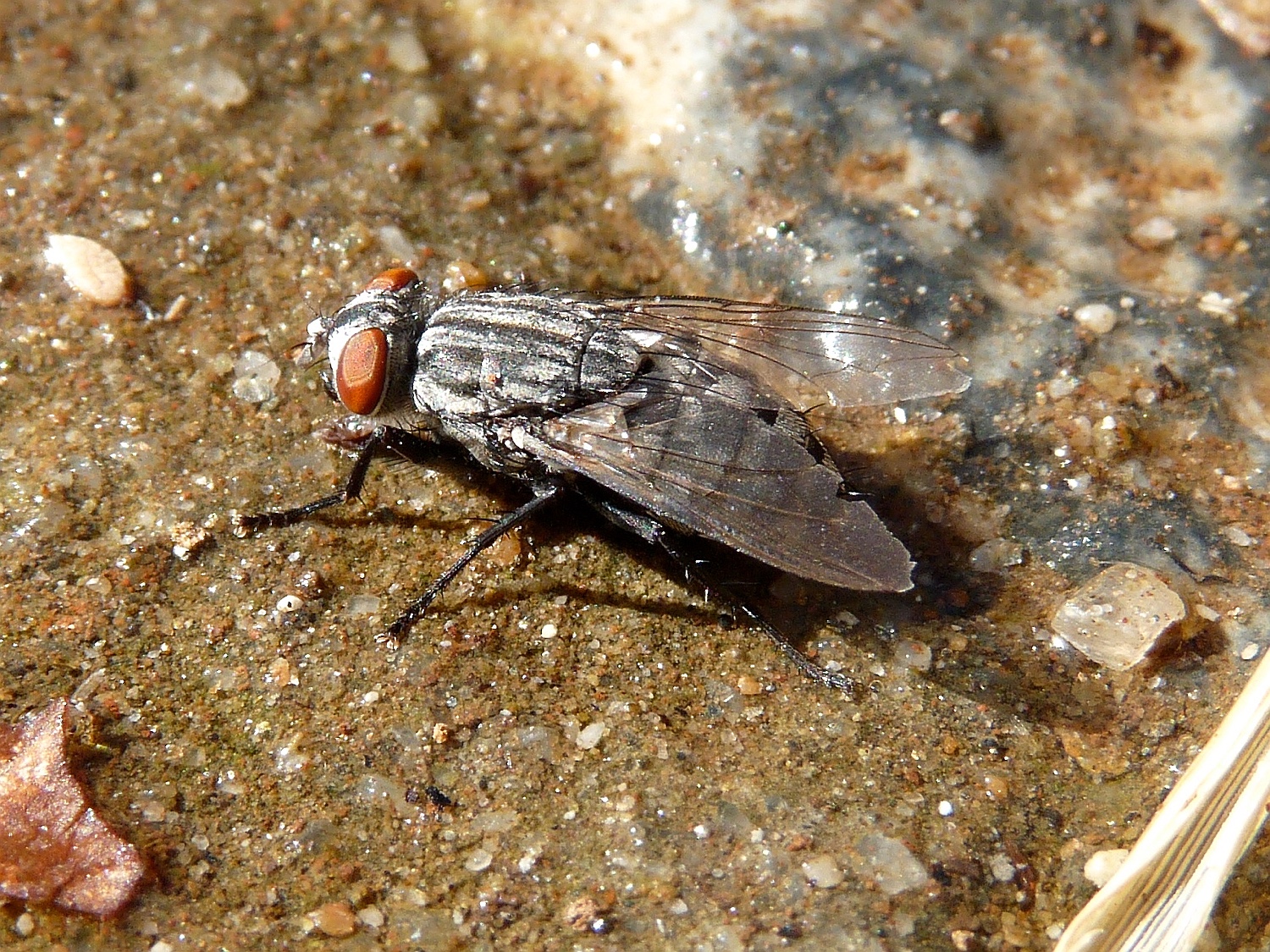
With around 1.5 cm, flesh flies are significantly larger than houseflies, and their eyes are set further apart. The abdomen, with its long bristles, shows a black-and-grey chequerboard pattern.
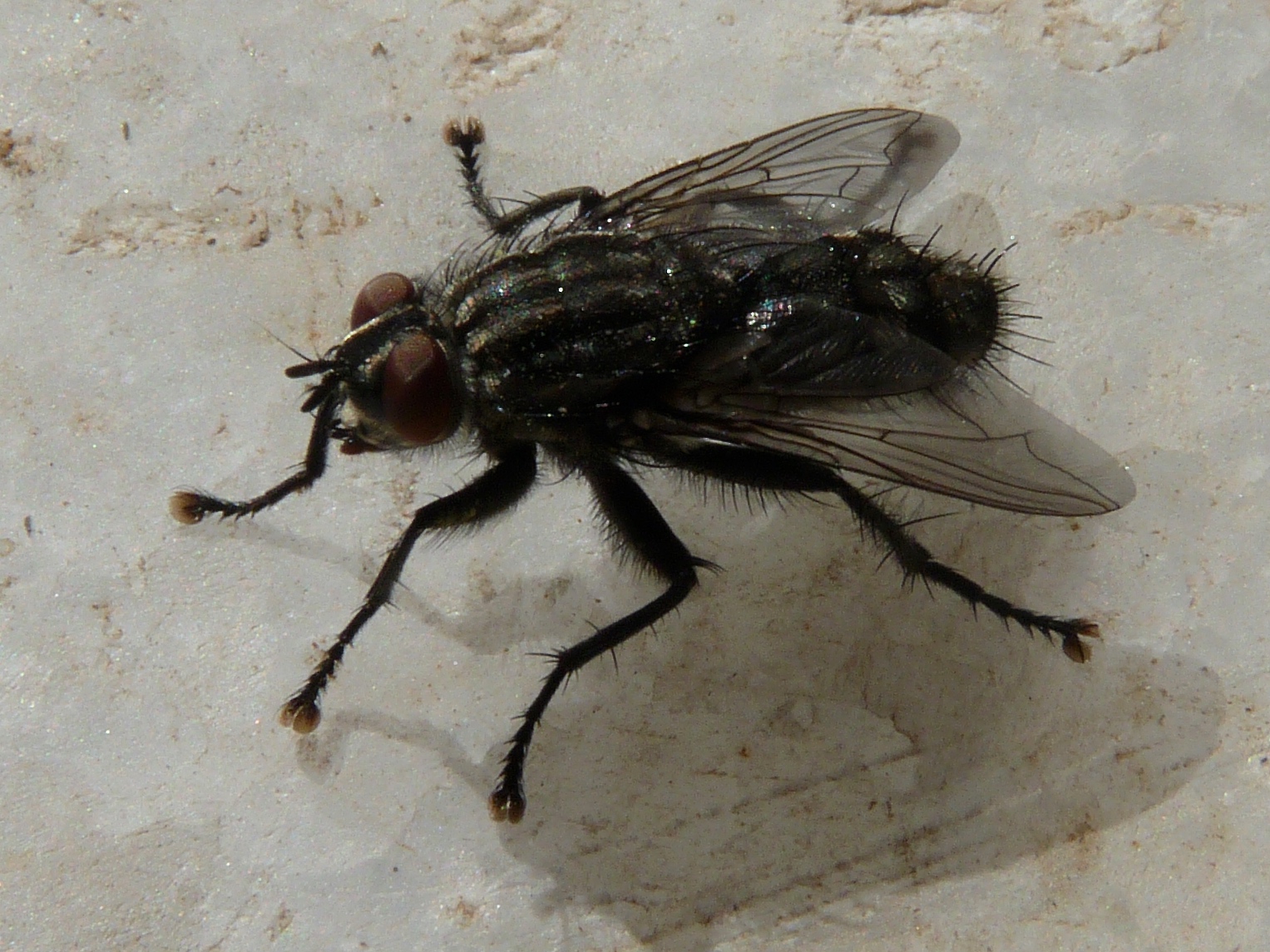
In this photo, you can see the flies’ club-shaped antennae with their fine bristles set more or less in the middle, as well as the adhesive pads on their feet, which enable the fly to cling to very smooth or overhanging surfaces.
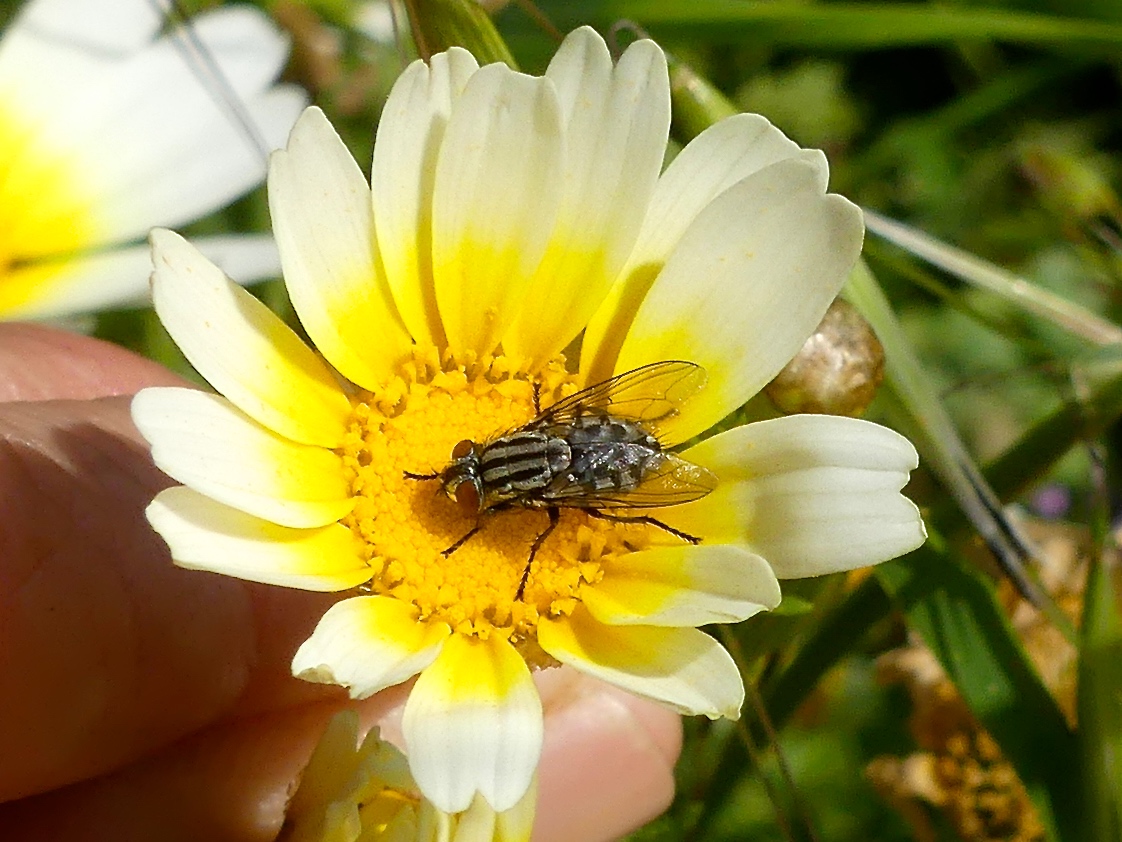
Many species of flesh fly exist that look very similar and are difficult to tell apart.
Blowflies, Calliphoridae
The blowfly family comprises around 1,000 species, many of which are comparatively large. The body is usually metallic blue, green or golden-green. The adults are flower visitors and feed on nectar, pollen or plant sap. The larvae live on carrion and faeces; some species live as parasites on vertebrates, e.g. in wounds. Due to substances harmful to humans that the larvae release into the flesh, and due to the microorganisms they can transmit, meat infested with blowflies is not fit for consumption.
Calliphora vicina, Robineau-Desvoidy
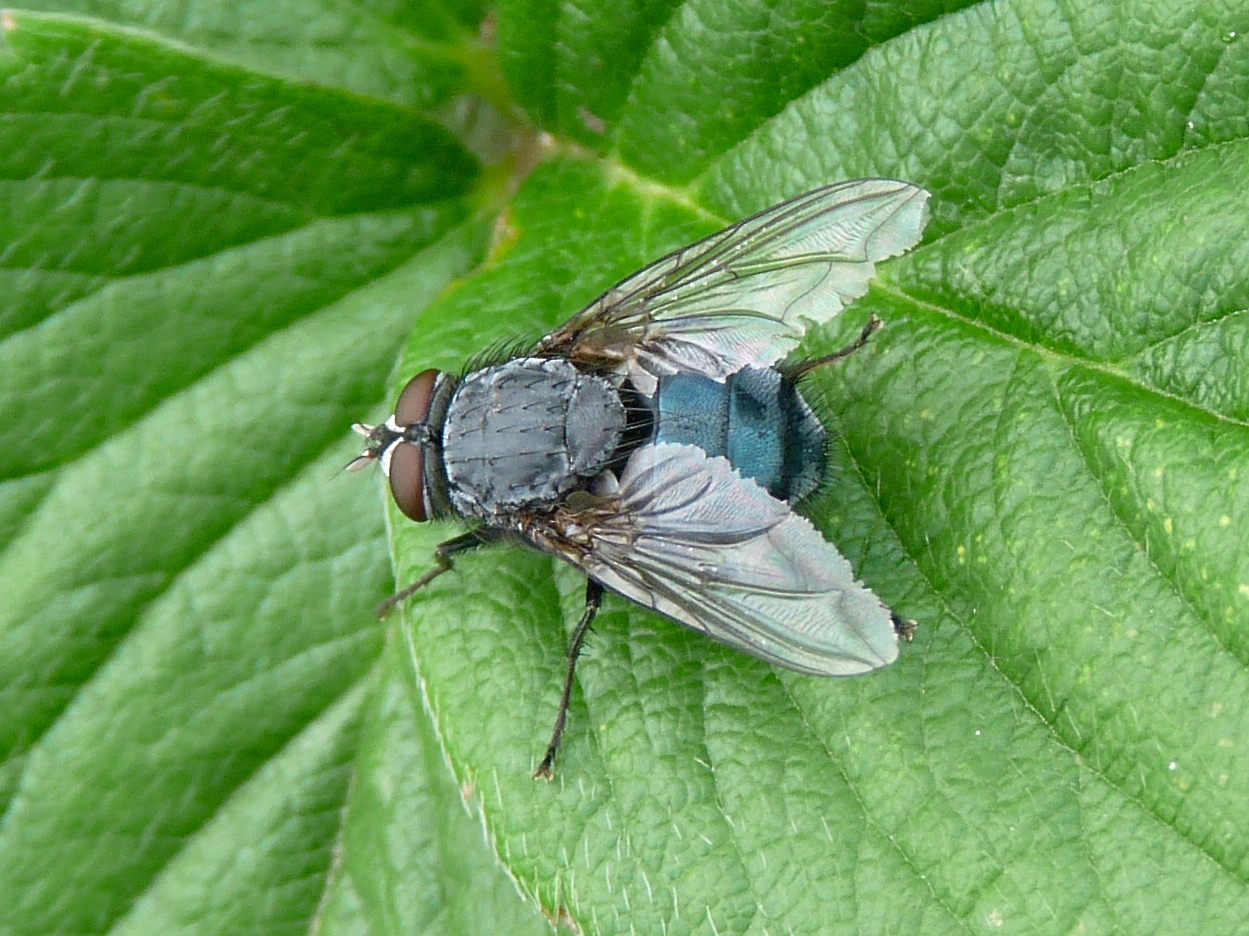
The blowfly Calliphora vicina has a metallic-blueish abdomen; the thorax is dark blue-grey. The large compound eyes almost touch on the forehead.
Green bottle fly, Lucilia spec.
The genus of Green bottle flies also belongs to the blowflies. It comprises numerous, often widespread and common species, which are frequently so similar that reliable identification is only possible on the basis of microscopic characteristics. A characteristic feature of Green bottle flies is their metallic gold-green body. They prefer to live in the vicinity of humans and lay their eggs on raw meat and carrion, but above all in wounds, where the maggots feed on the dying tissue. Some species are therefore significant pests, particularly in sheep farming. The problem here is not so much the maggots themselves, but the diseases that both the maggots and the adult flies can transmit (such as cholera and typhus).
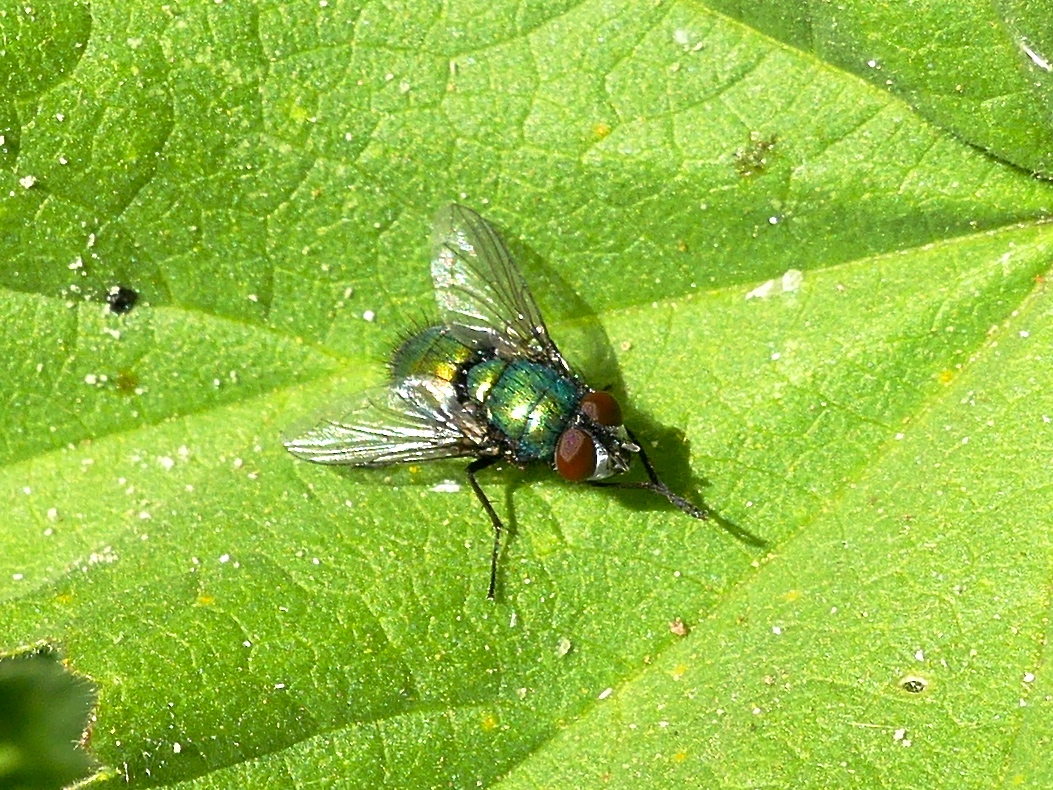
The Green bottle flies lay their eggs on carrion and in wounds and are feared as disease vectors.
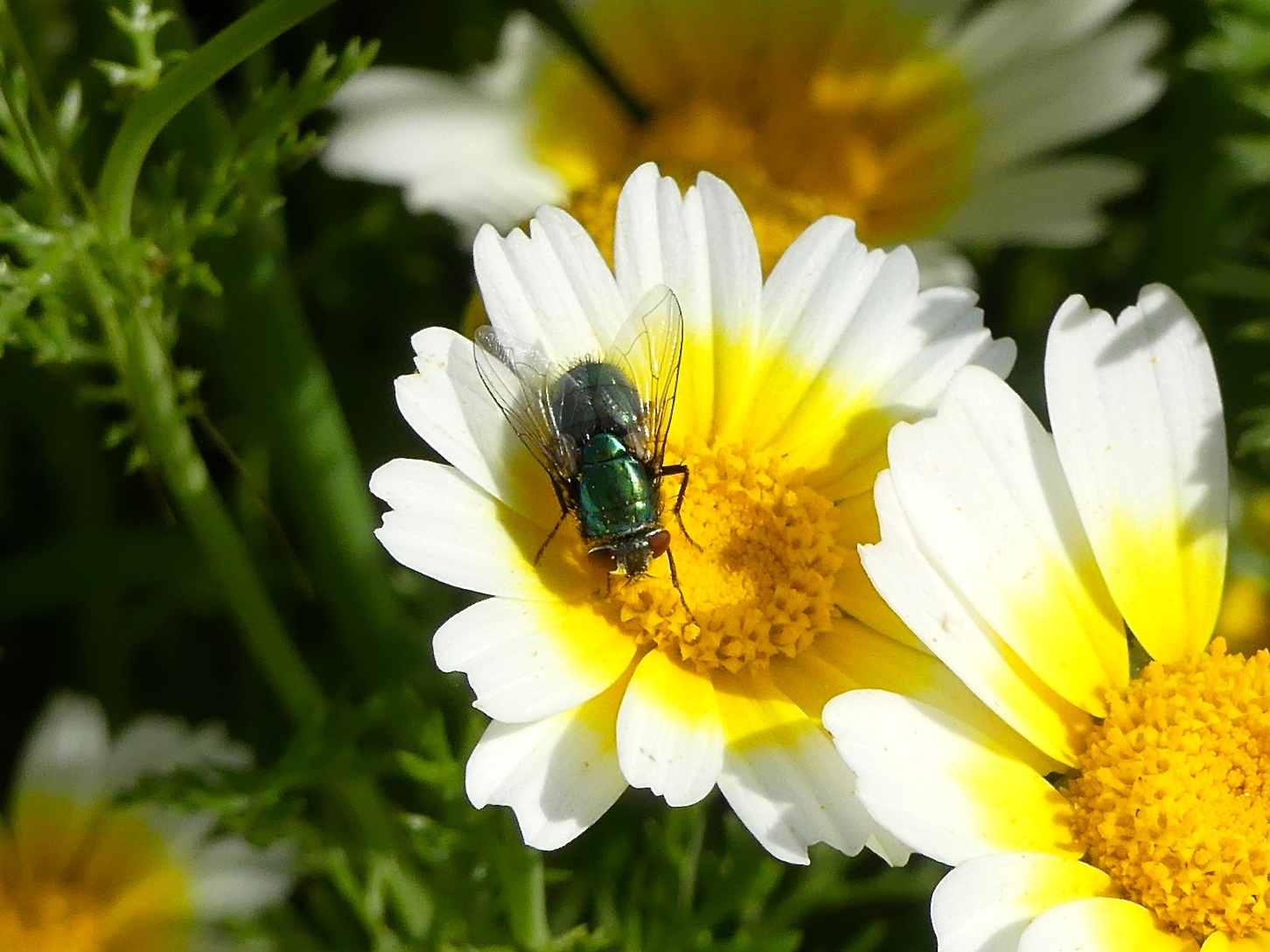
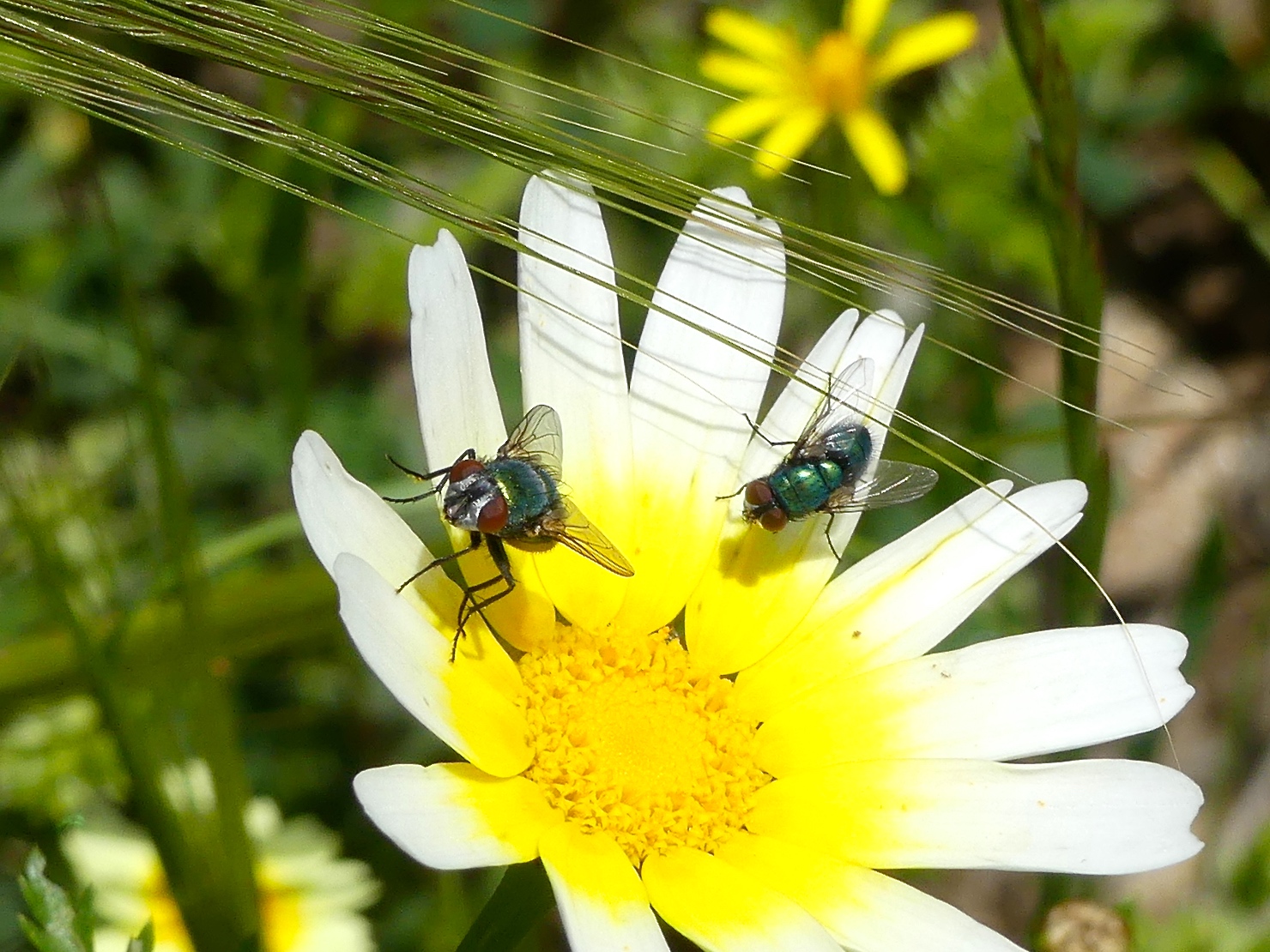
Specimens of this species vary considerably in size; they range from about half a centimeter to one centimeter in length.
Rhiniidae
The family Rhiniidae has only recently been separated from the family Calliphoridae; its members are also often called blowflies.
Stomorhina lunata, Fabricius
The blowfly Stomorhina lunata does not hold its wings spread out like most flies, but rather one on top of the other over the abdomen. The compound eyes show characteristic iridescent stripes. The thorax bears dark longitudinal stripes, while the abdomen is black and yellow in males and black and grey with transverse stripes in females.
This species is widespread in Europe, North America, North Africa and Asia. The more northerly populations migrate south in winter. The adults visit flowers and feed on pollen and nectar, while the larvae feed on insect eggs, particularly those of grasshoppers, making the species beneficial to humans.
I would like to thank the forum on the website Entomologie.de for helping me with the identification of this species.
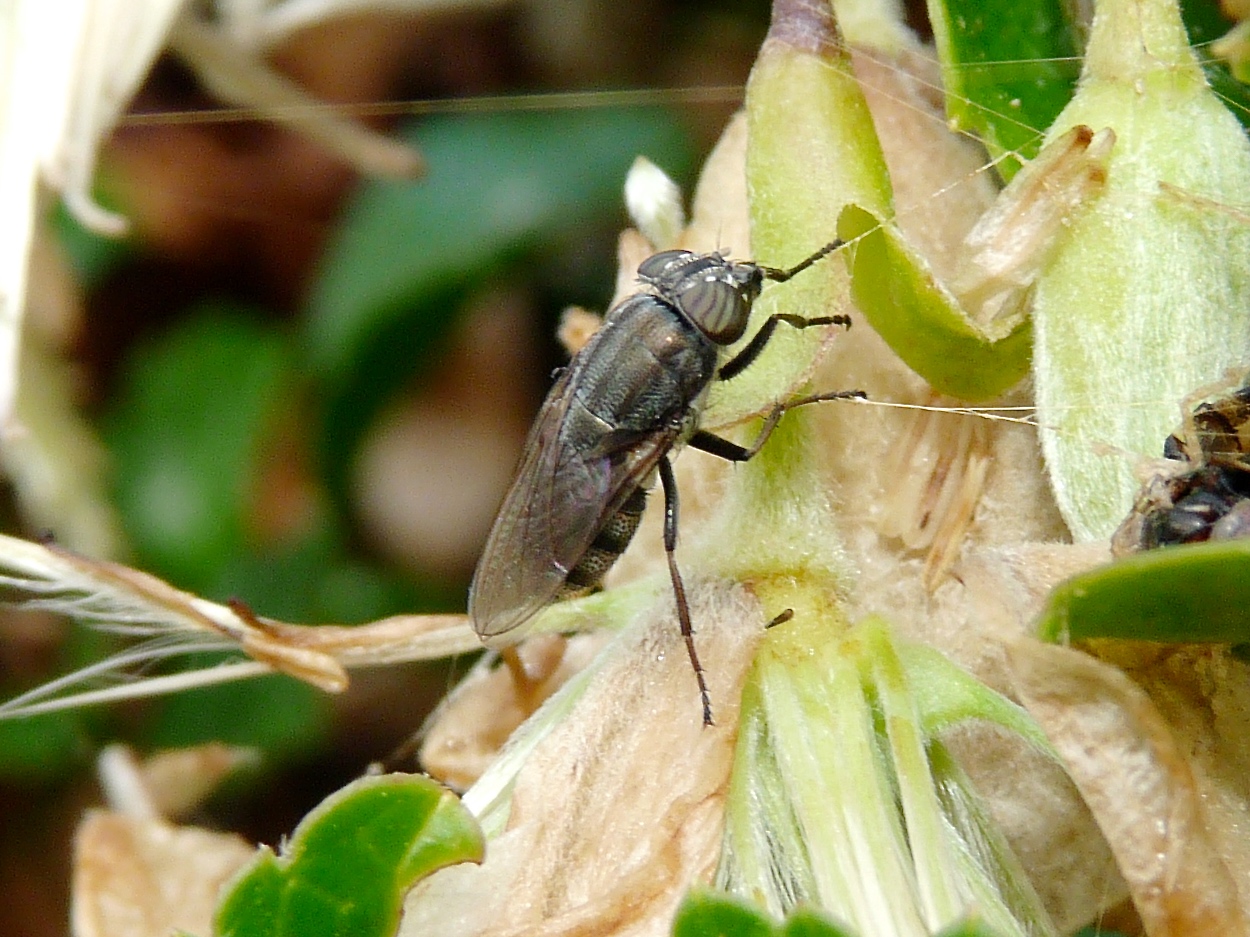
This rather inconspicuously coloured fly (here a female) can be recognised by the characteristic striations on its compound eyes and body.
Rhyncomya sinaiensis, Rognes
This small species is widespread in the Middle East. The identification seems to fit well, but it might be a related, similar species.
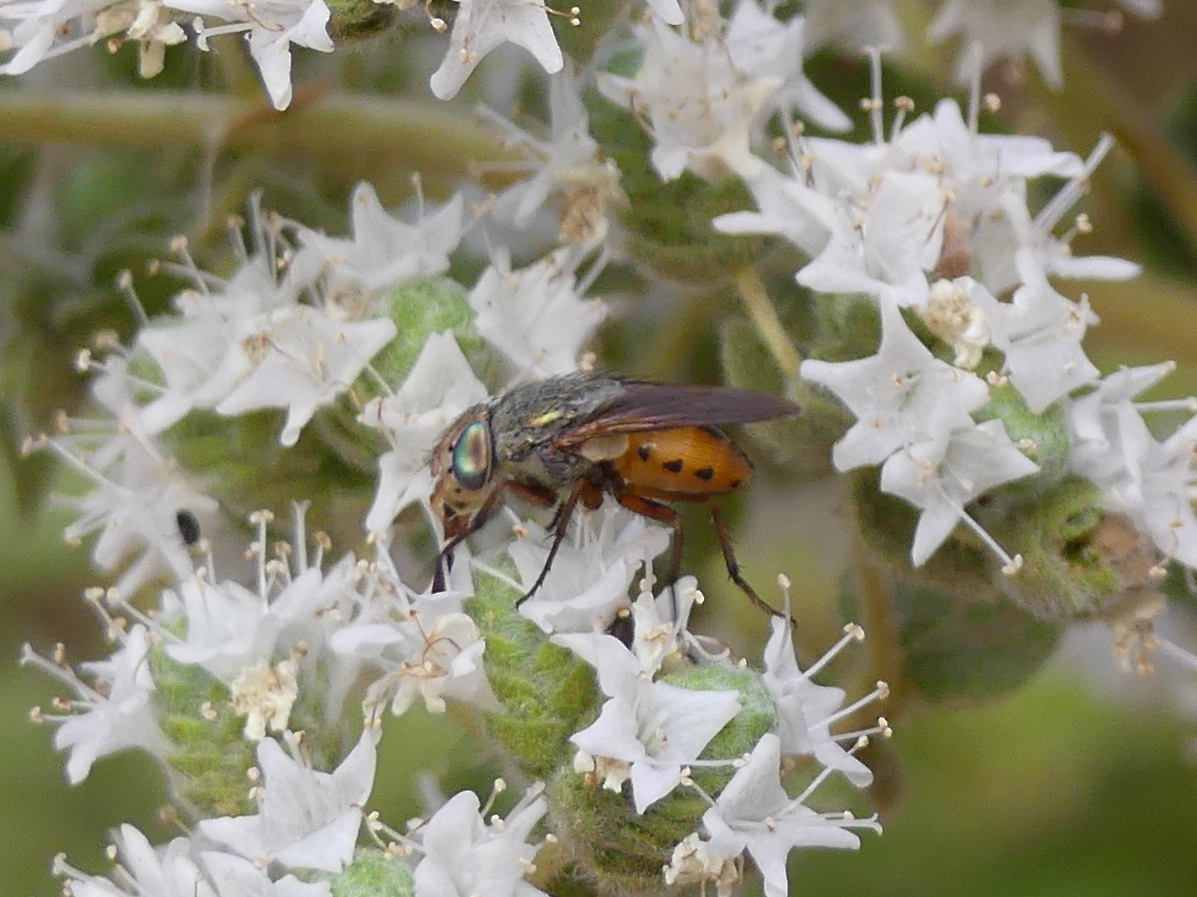
This rather small fly has an orange abdomen with small triangular spots. The back is slightly iridescent, bluish-green with dense hair; the almost teardrop-shaped eyes are also bluish-green. Two small black spots sit at the edge of the eyes.
Rhyncomya speciosa, Loew
This species of the genus Rhyncomya reaches a size of around 1.5 cm. It is quite rare in our region.
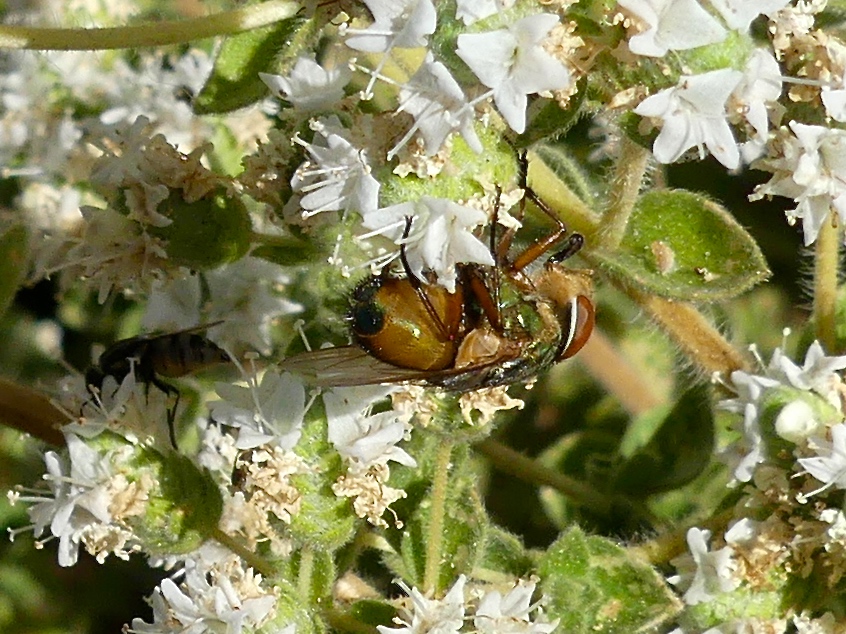
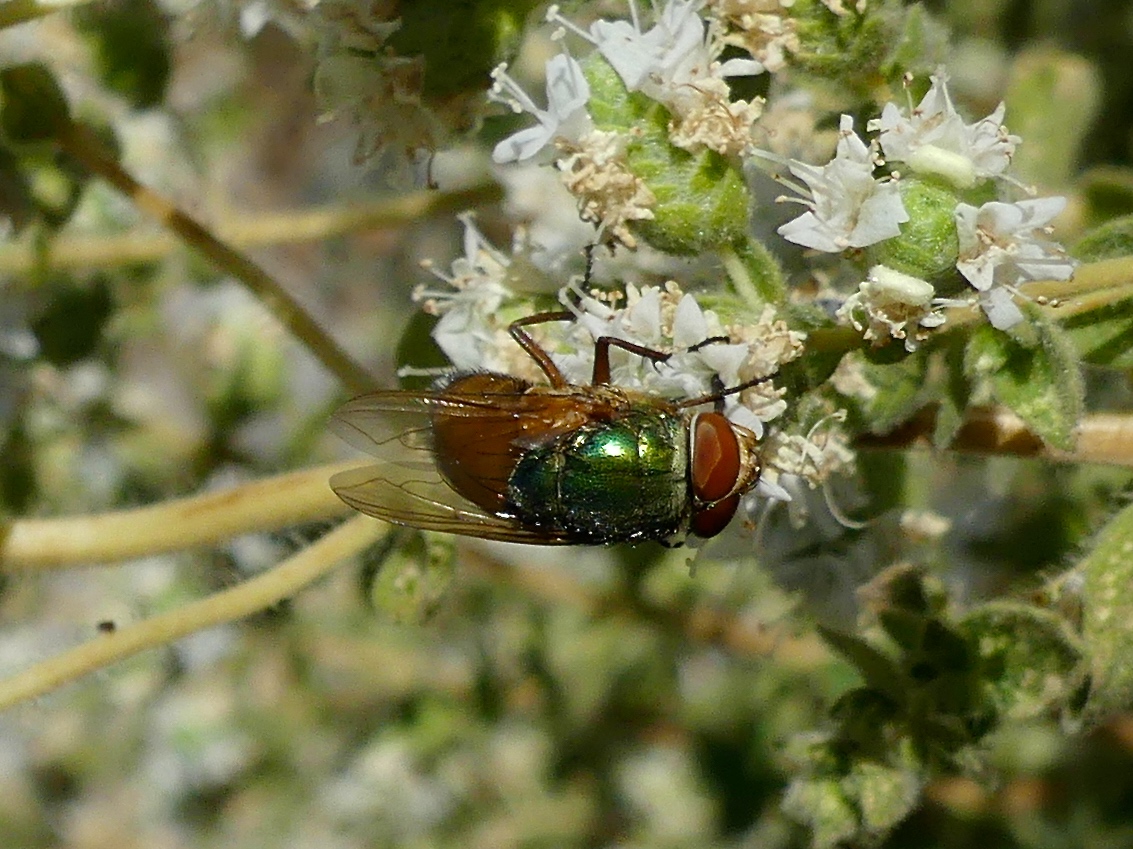
This large species has large, reddish-brown eyes and a green, shiny thorax; the abdomen is light orange with a glossy green tip.
Tachinidae
With over 8,000 species, the Tachinidae are one of the largest families of flies. They often have conspicuous bristles. The larvae of tachinid flies live as parasites on other insect larvae, primarily on the caterpillars of butterflies or plant wasps, and less commonly on beetle larvae. Some species are specialised on a single host species, while others parasitise many different hosts, which may, however, sometimes live on a single plant species. The adults visit flowers and feed on nectar and pollen.
Due to their parasitic lifestyle, many tachinids are well suited for biological pest control, and in several cases it has been possible to effectively fight an invasive species by introducing the appropriate tachinid fly.
Tachina fera, L.
Tachina fera has particularly long bristles. Its larvae parasitise the caterpillars of various owl moths.
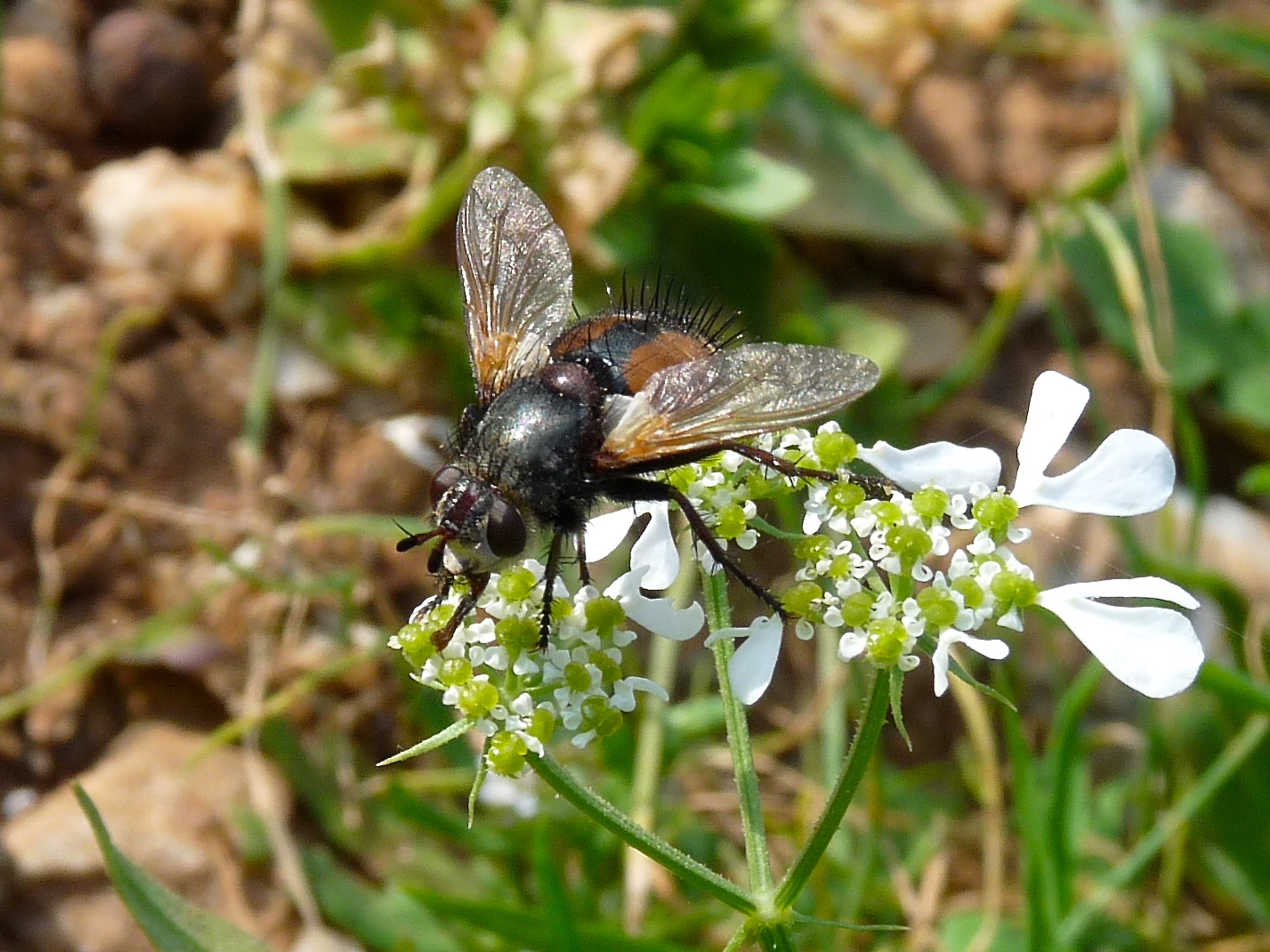
Here one can see the bristles typical of the species, and the club-shaped antennae with the bristle (arista) sitting at approximately half its length.
Ectophasia leucoptera ?, Rondani
This large and stout fly with a bright orange-red abdomen and the wings held at an angle, belongs to the tachinid subfamily Phasiinae, probably to the genus Ectophasia. The larvae of this group live mostly parasitic on bugs. The pattern on the light grey wings resembles that of Ectophasia leucoptera; nevertheless, the identification is not certain.
I would like to thank the forum on the website Entomologie.de for the identification of this species.
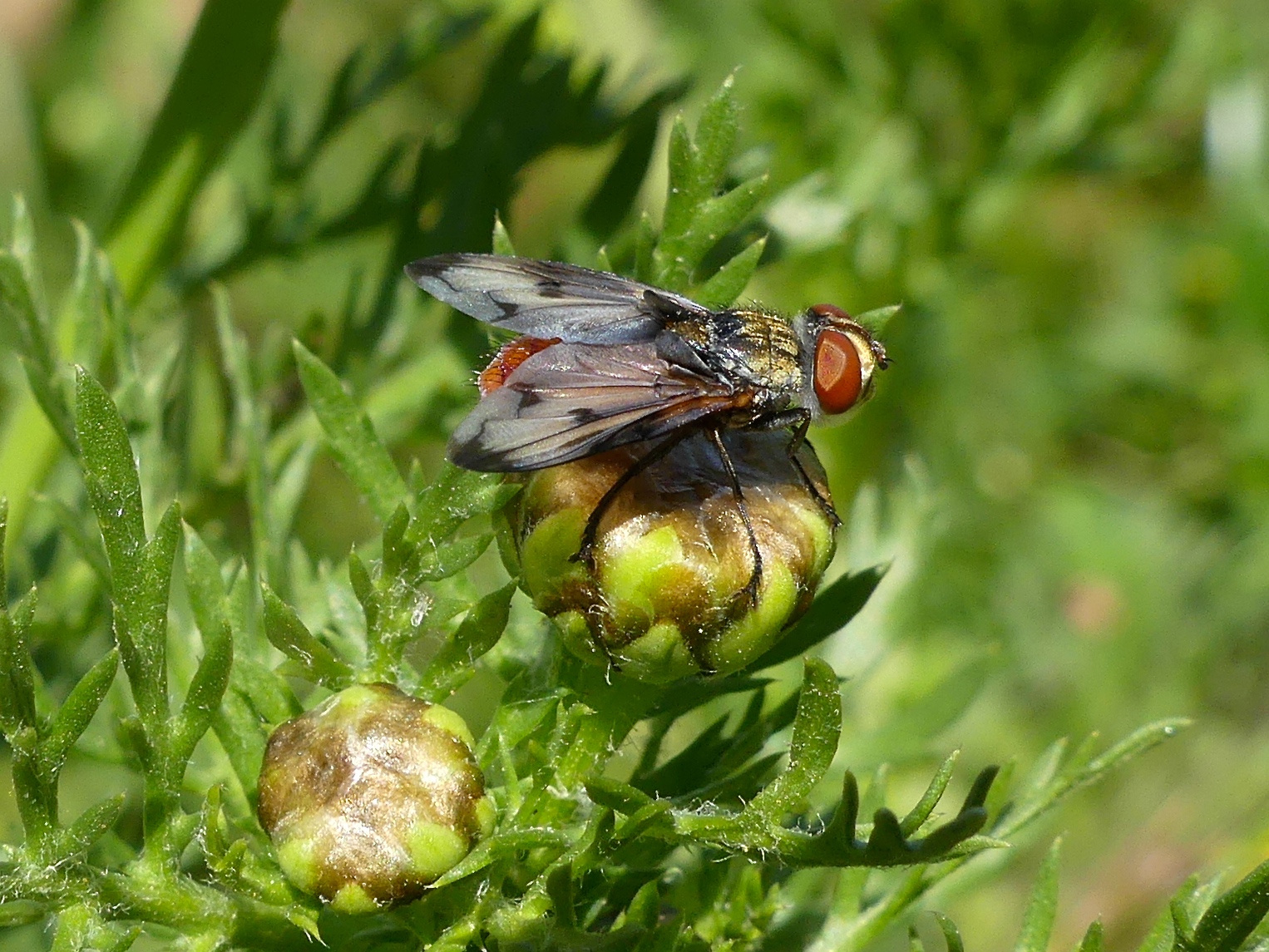
This large, beautifully coloured tachinid probably belongs to the genus Ectophasia.
Ectophasia oblonga, Robineau-Desvoidy
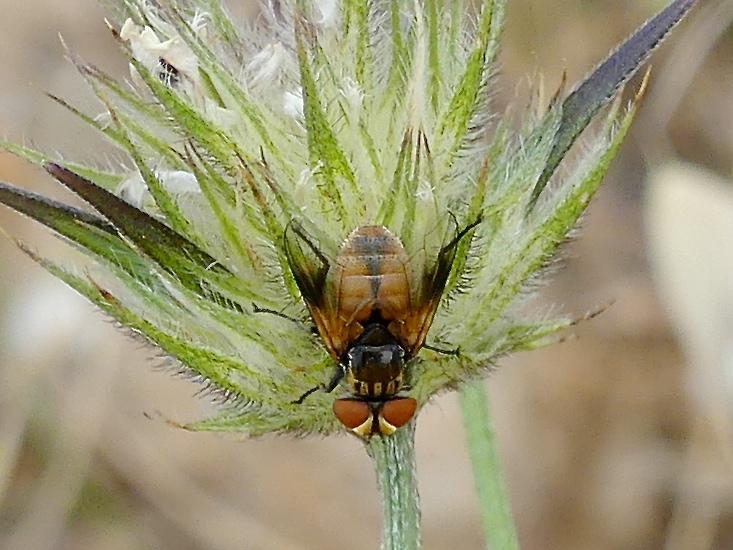
Ectophasia oblonga can be recognised by the dark cross-band on its wings and its predominantly orange abdomen.
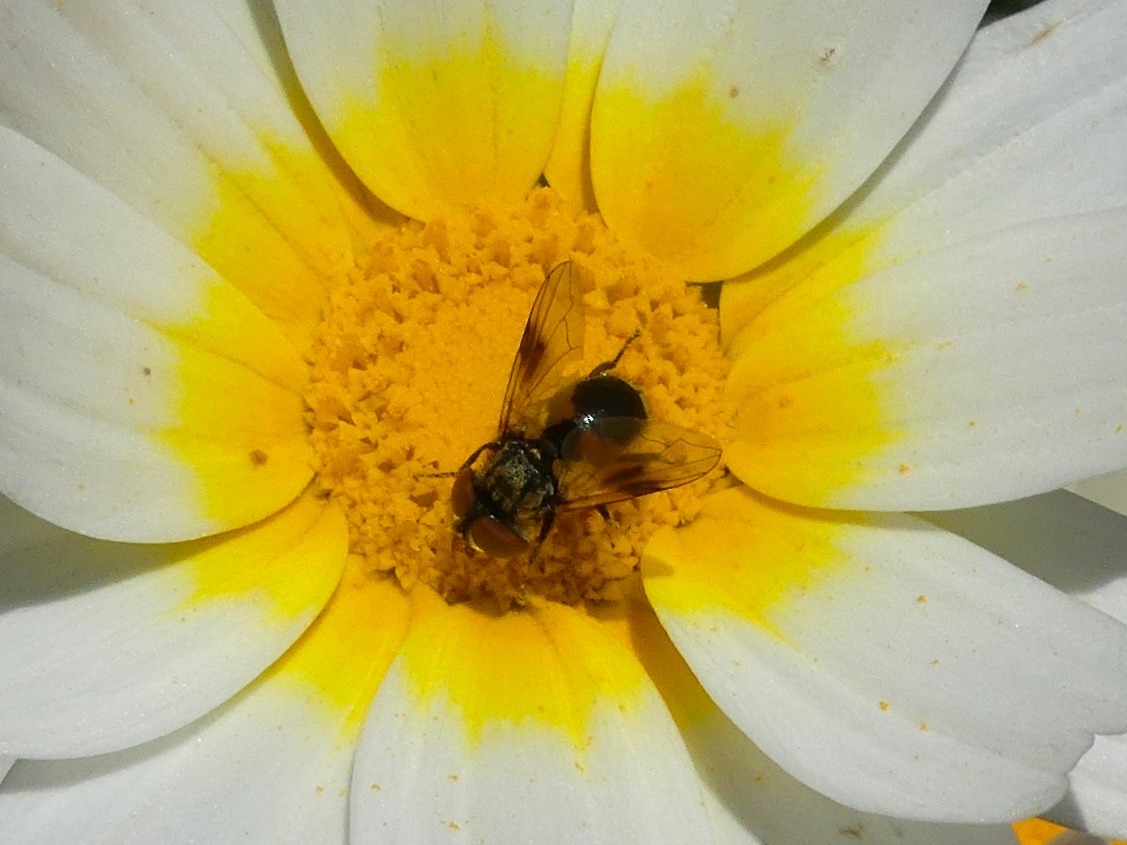
This species is quite variable in colouration. Here a specimen with more black on the abdomen.
Labigastera forcipata ?, Meigen
This fly is also a tachinid and probably belongs to the species Labigastera forcipata.
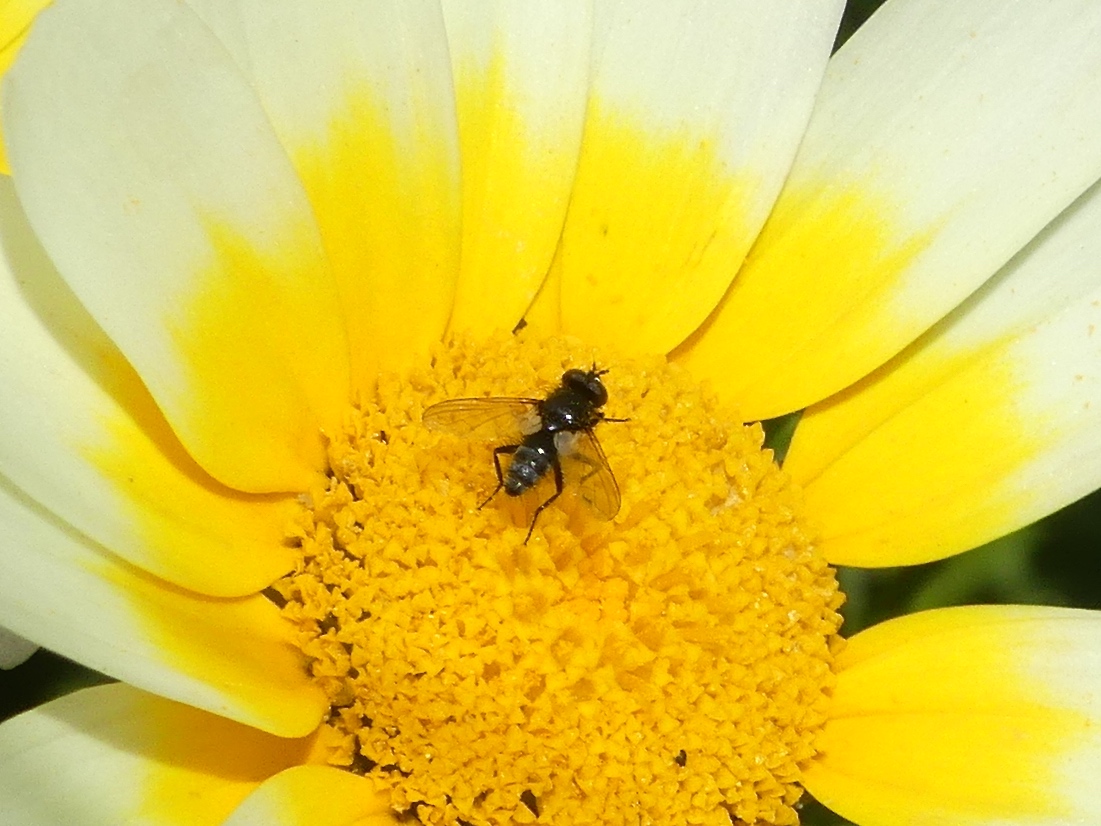
Like many tachinids, Labigastera forcipata has long bristles on its body. It has a shiny black body with a bluish tinge on its rather narrow abdomen. The wings show a yellowish spot at the base (not clearly visible here) and a white calypter.
Gymnosoma rotundatum, L.
The pretty Gymnosoma rotundatum, with its round, bright orange body, unlike almost all other tachinids, carries no long hairs or bristles. This fly holds its wings especially wide apart. The larvae parasitise tree bugs.
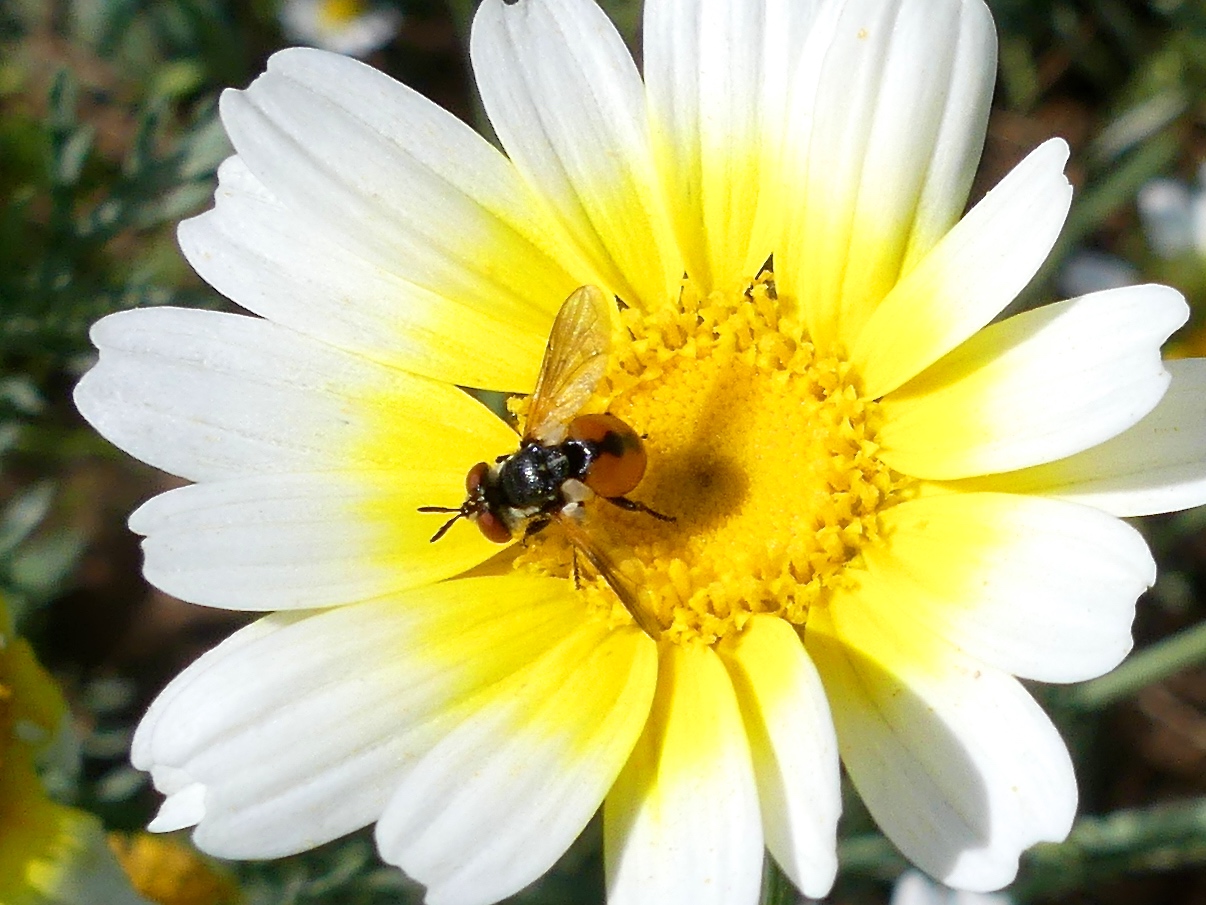
In this photo, you can see the calypters, small lobes on the hind edge of the wing near the base, which cover the halteres (the reduces hind wings).
Dinera ?
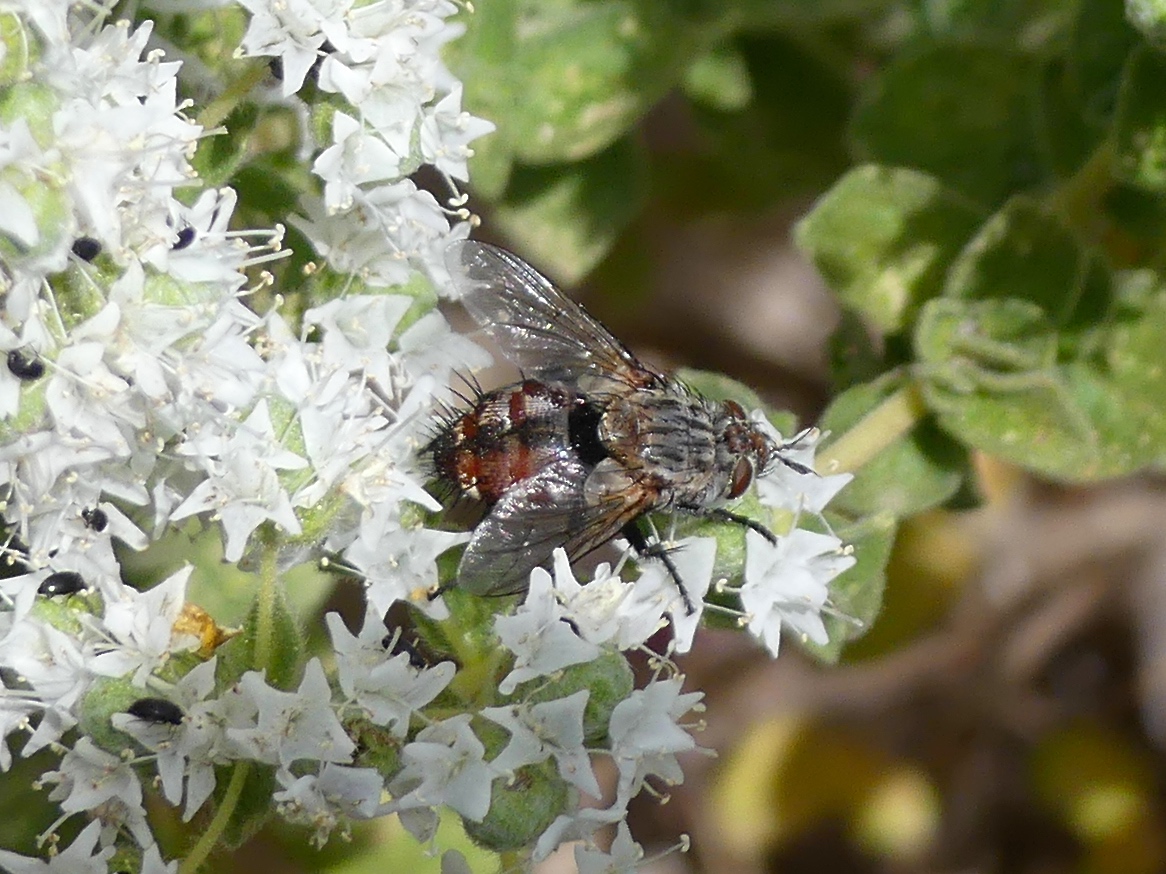
This rather large species, which resembles a blowfly in shape and markings, belongs to the tachinid flies, perhaps to the genus Dinera.
Cylindromyia brassicaria, Fabricius
Members of the genus Cylindromyia hold their abdomen nearly vertically and their wings spread wide while feeding on flowers. The wings are darker in colour along the front edge. In this genus, too, the calypters are often very conspicuous.
Due to its slender body, the species Cylindromyia brassicaria does not look like a tachinid fly at first glance. It bears the typical bristles on its abdomen, but these wear away somewhat over time, so that in some specimens they are almost absent. This species parasitises tree bugs.
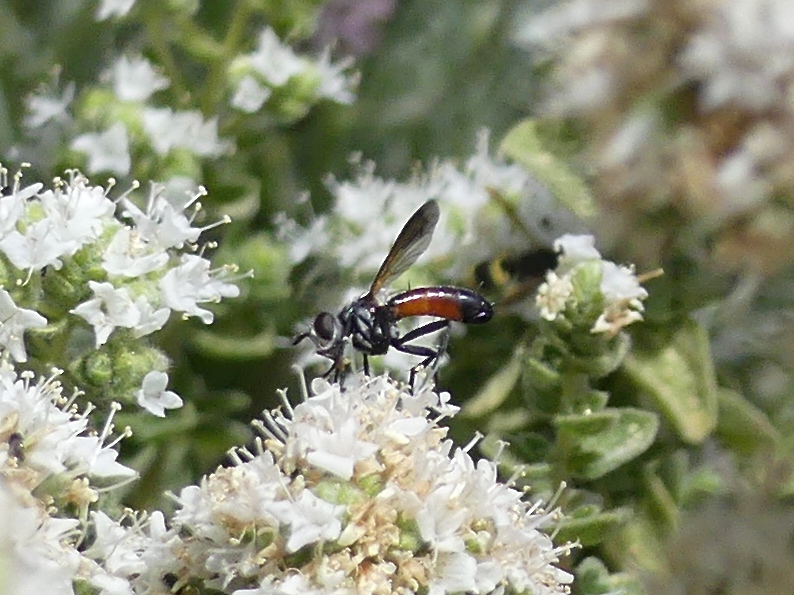
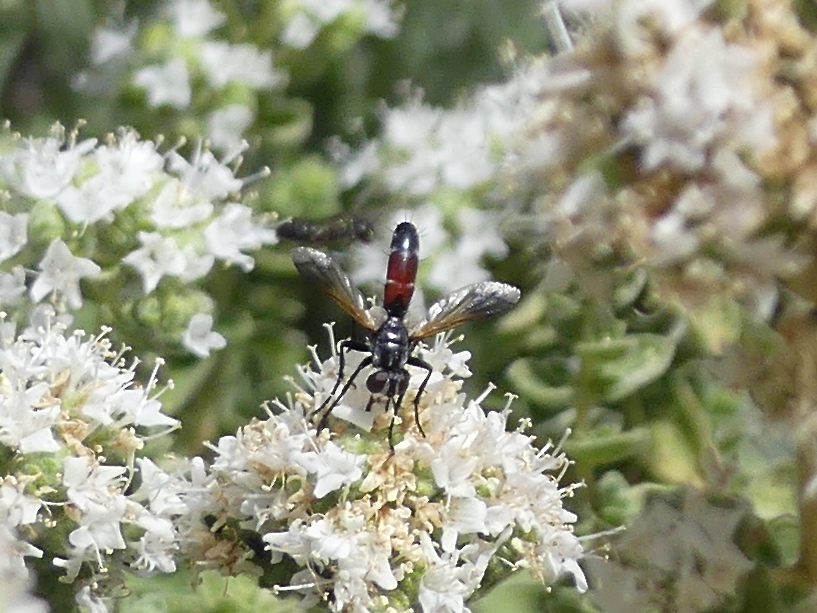
Characteristic features include the red colouration of the abdominal segments and the black triangle at the front edge of the abdomen. Here you can also see the typical body posture.
Cylindromyia interrupta ?, Meigen
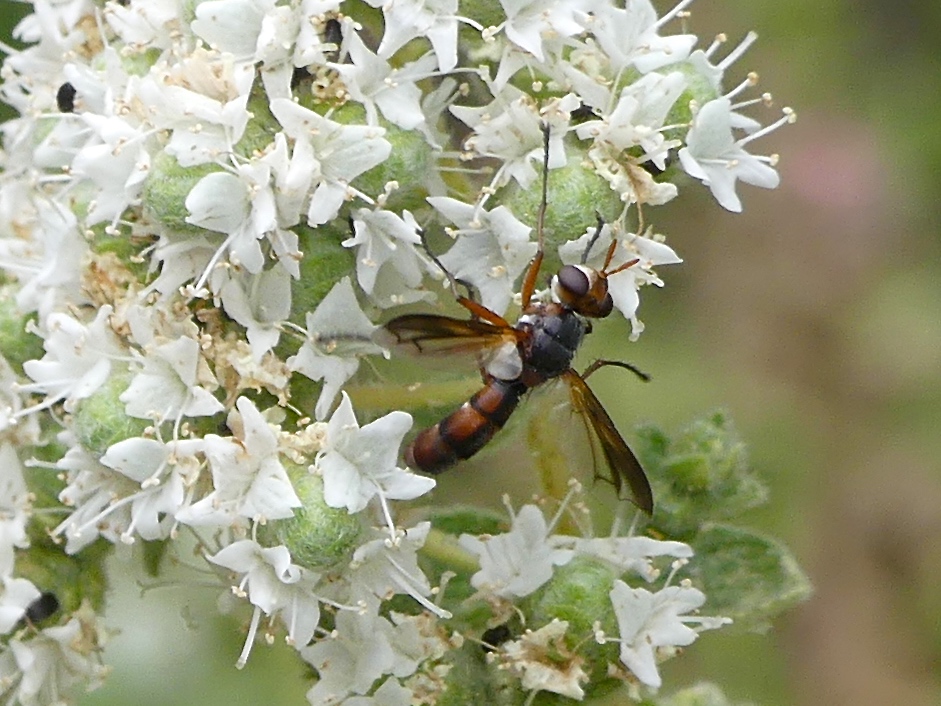
This species is very similar, but the abdomen is darker with dark transverse bands and a dark longitudinal stripe on the upper side. The white calypter is visible on the left wing.
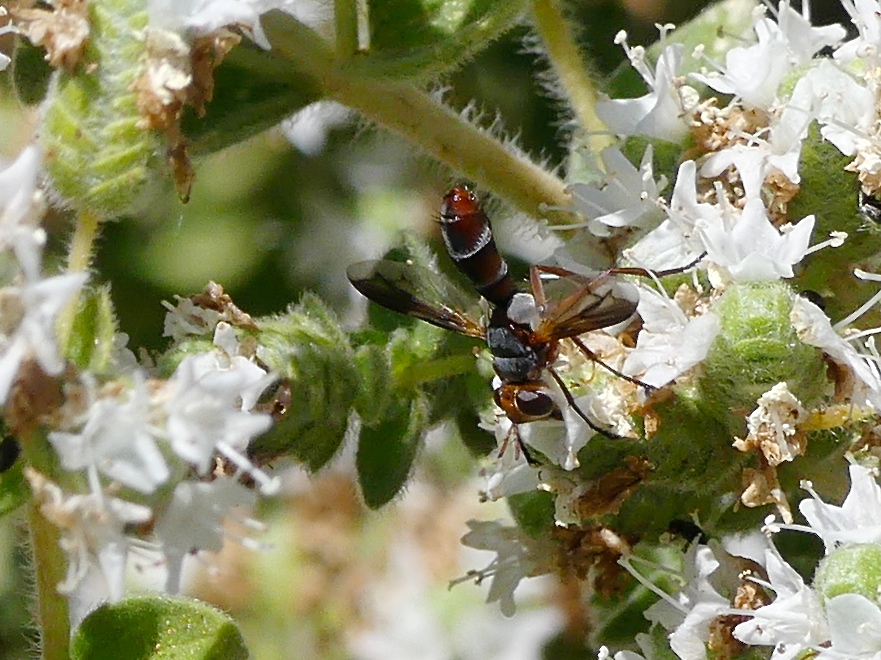
When feeding, flies of this genus hold their abdomen upright. Here you can see that the abdomen has white rings on the sides.
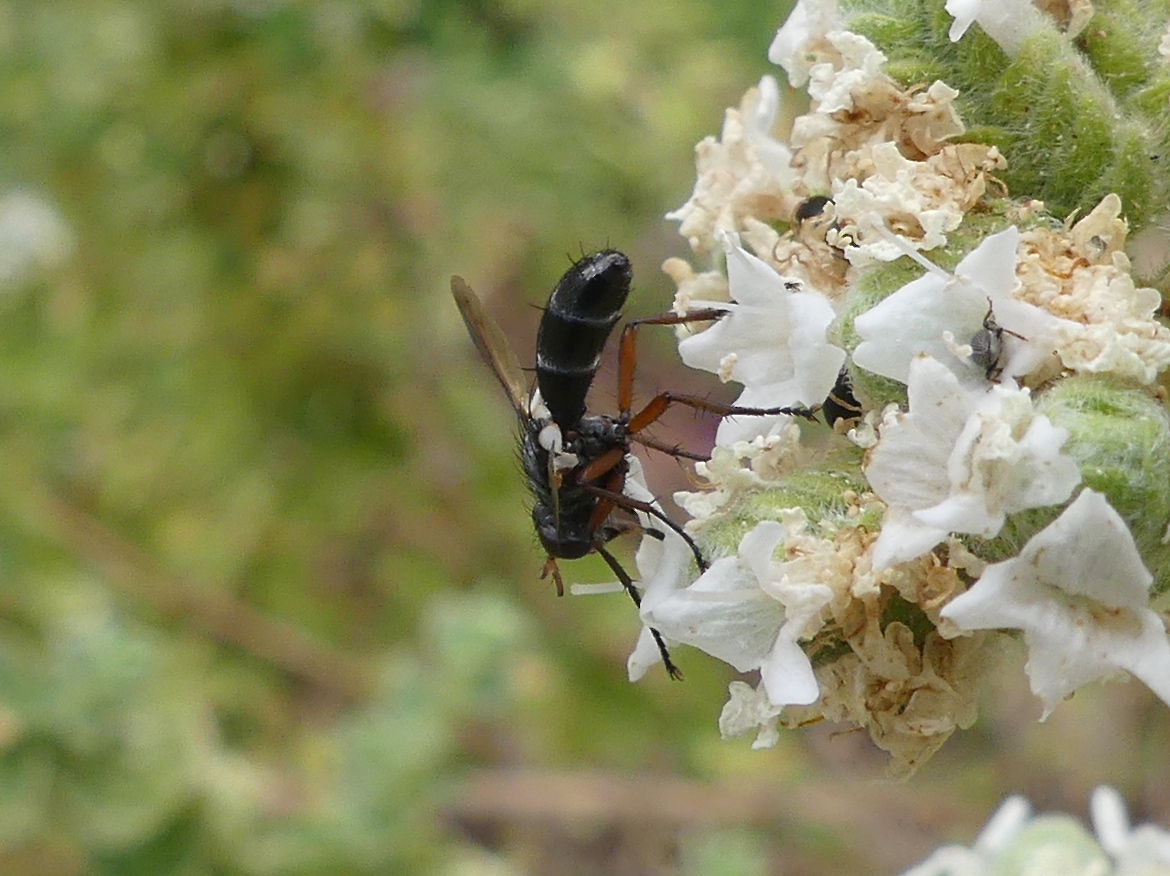
In this specimen, the abdomen is dark, not red, with thin white rings. The legs are reddish. It could be a different species, or simply a colour variant.
Robber flies, Asilidae
The robber flies comprise some 7,000 species worldwide. Whilst they vary considerably in appearance, all robber flies share a predatory lifestyle: they catch other insects in flight, much like dragonflies. To do this, they require not only strong, long wings, but also large, powerful eyes. The fly sits on a perch and scans its surroundings. When it spots a prey, usually another flying insect, it takes off and catches it in mid-flight with its legs. It then pierces it with its proboscis, injects a lethal venom and digestive fluid, and subsequently sucks the insect dry. Robber flies can capture insects that are significantly larger than themselves, including beetles with very hard shells. Their larvae live in the soil, often quite deep. Consequently, not much is known about them, except that they too are predatory, preying mainly on other insect larvae. Robber flies are found in many different habitats, but are most common in open and dry areas.
Machimus rusticus ?, Meigen
This robber fly, which is common in our region, is probably Machimus rusticus or a similar species.
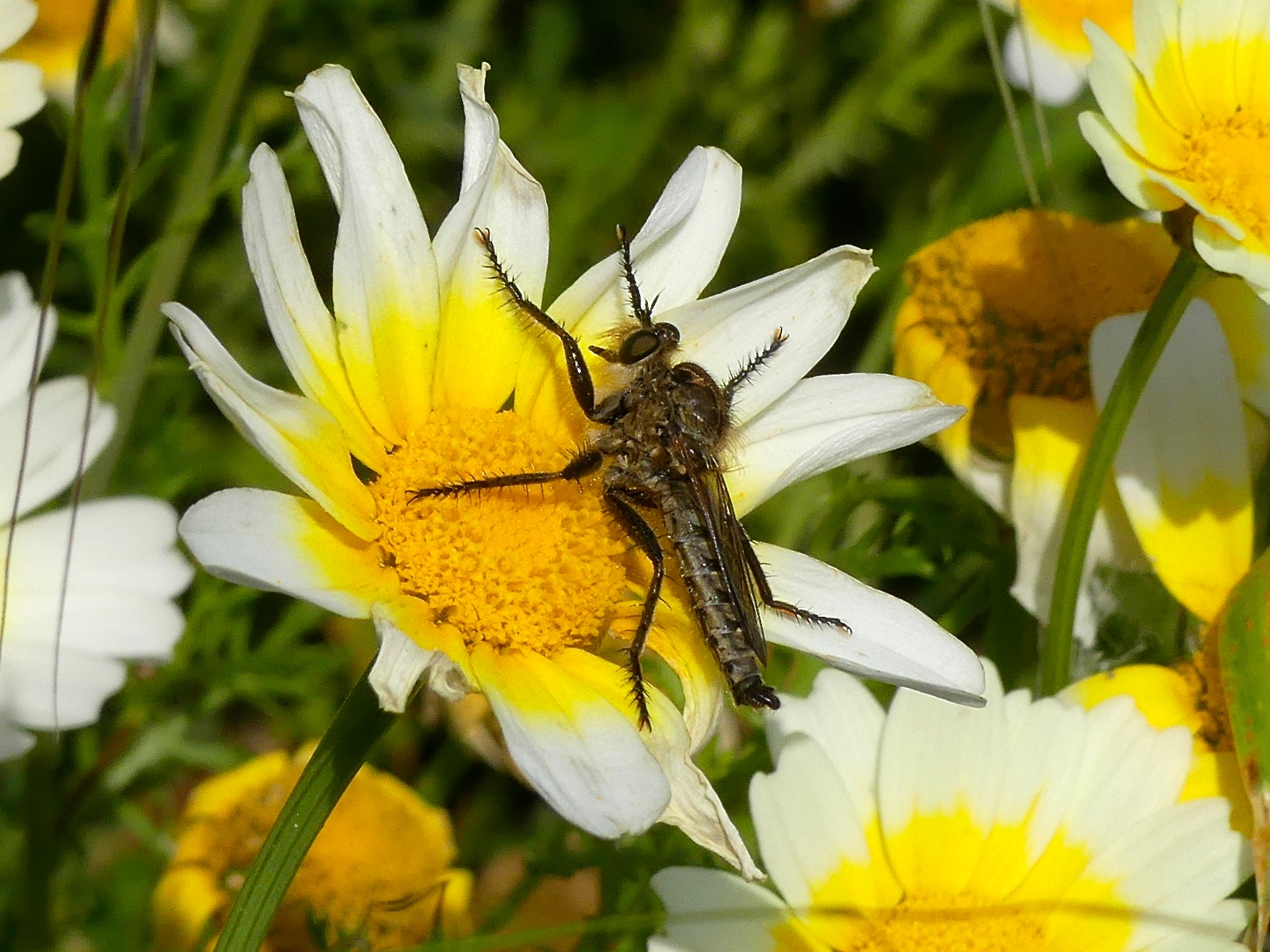
Machimus rusticus has long yellow hair on its head and thorax. The legs are covered in sturdy bristles. As with many robber flies, the thorax is very thick, due to the powerful flight muscles required by this skilful hunter.
Common awl robber fly, Neoitamus cyanurus, Loew
The Common awl robber fly is rarer in our region than the former species and appears later in spring. The legs of this species are reddish, and the body is covered with black hair. The larvae live as predators in the soil.
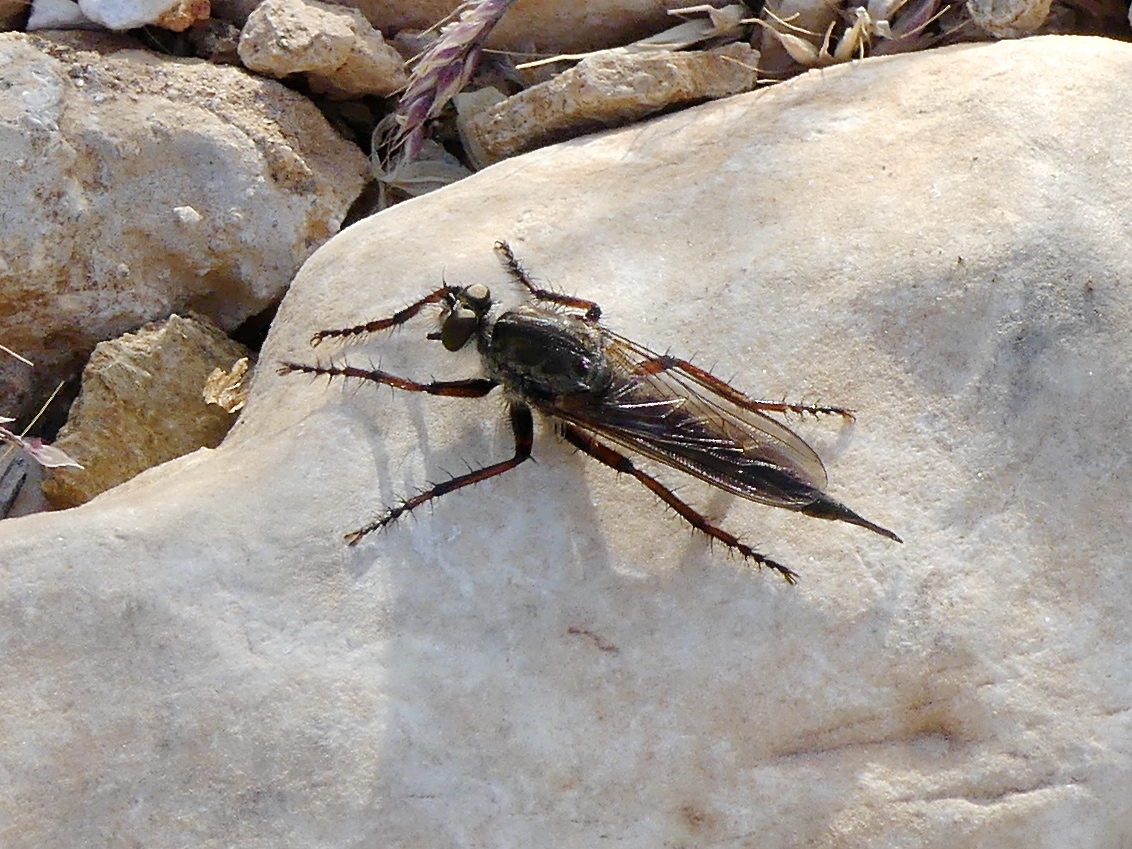
The females of the Common awl robber fly have a long, slender, tapered abdomen.
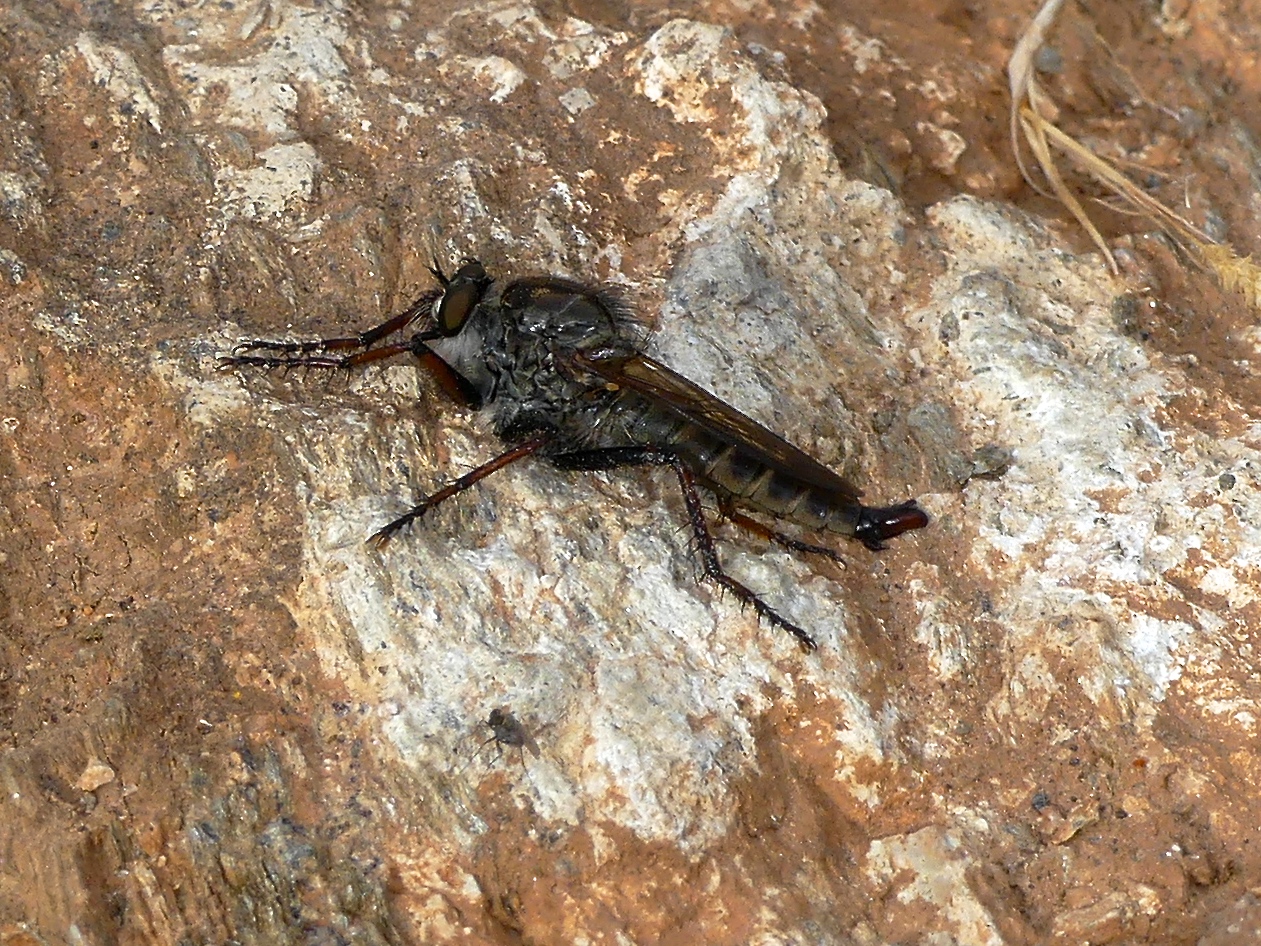
In the males, the end of the abdomen is flattened laterally and curved upwards in a spatula-like shape. This serves to grip the female’s abdomen during mating.
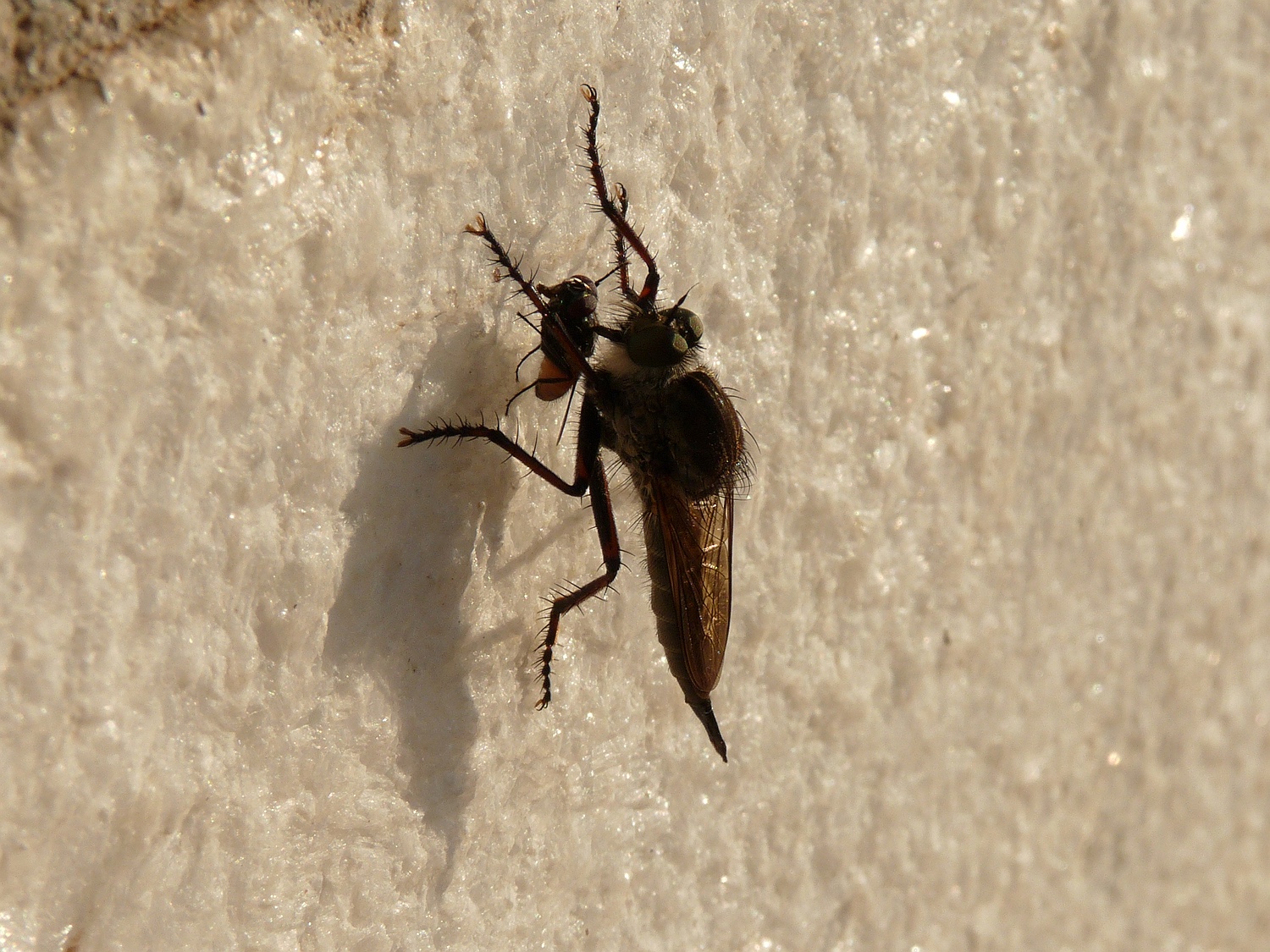
Here, the robber fly is sucking out a housefly with its proboscis.
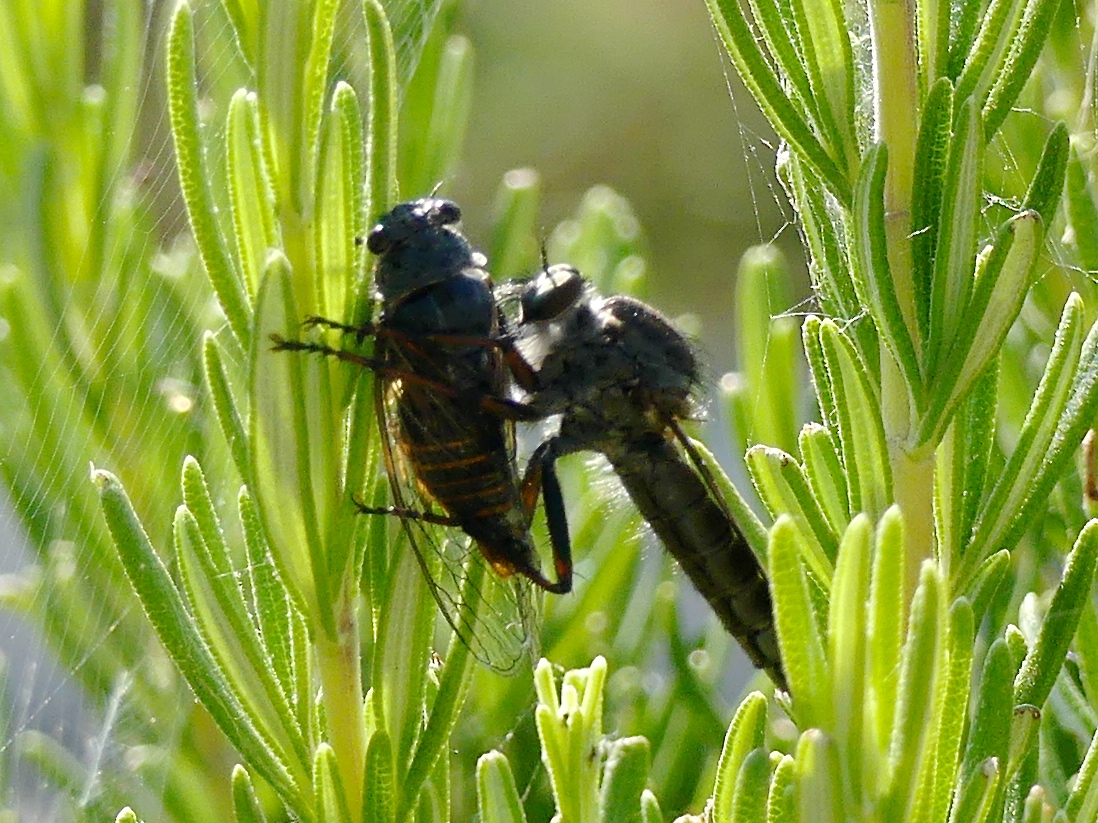
Robber flies can overpower very large prey – such as this cicada, which is about the same size as the robber fly itself.
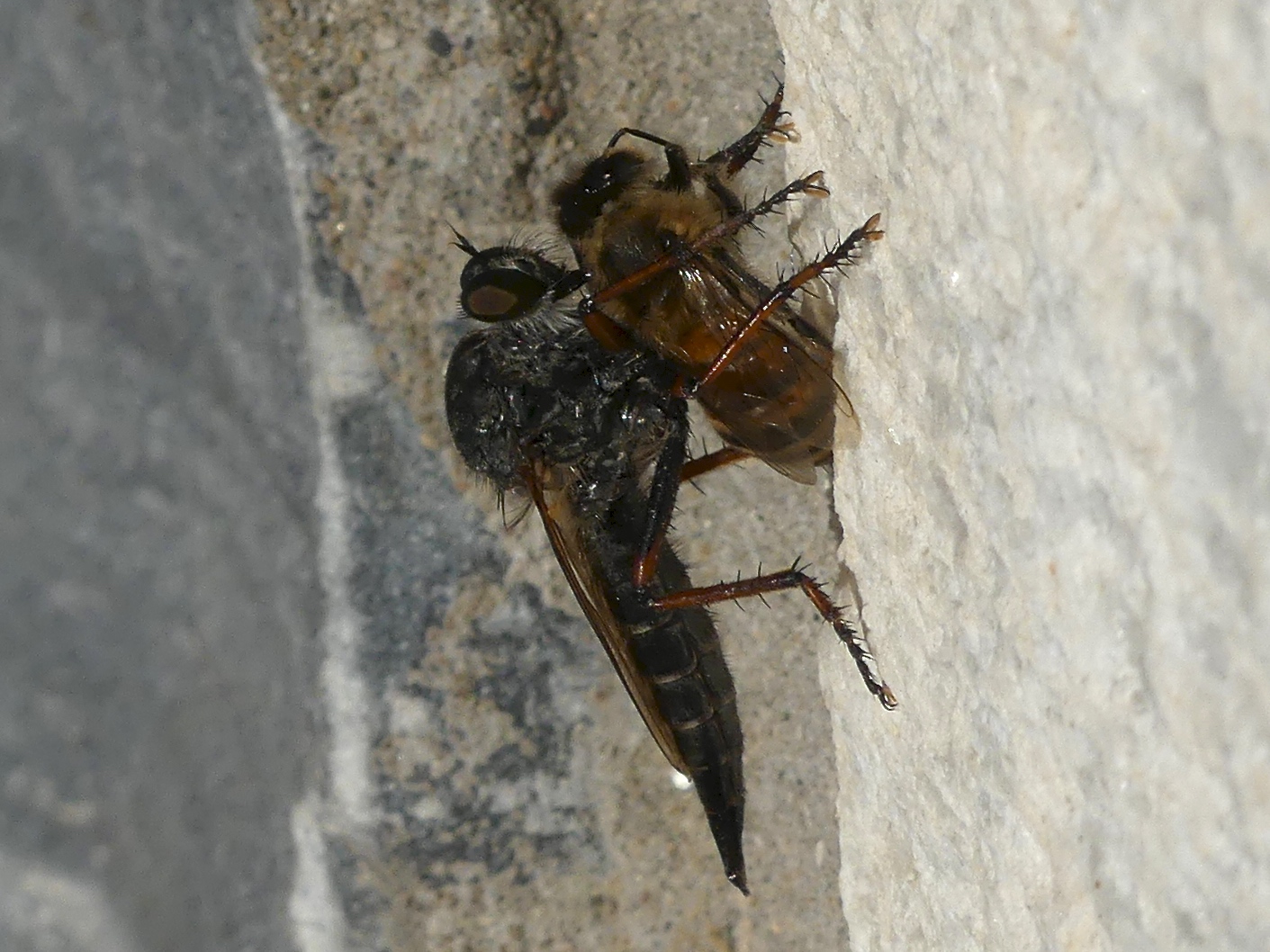
Here it has caught a large hoverfly.
Violet black-legged robber fly, Dioctria atricapilla, Meigen
The Violet black-legged robber fly is much rarer in our region than the two previous species of robber flies.
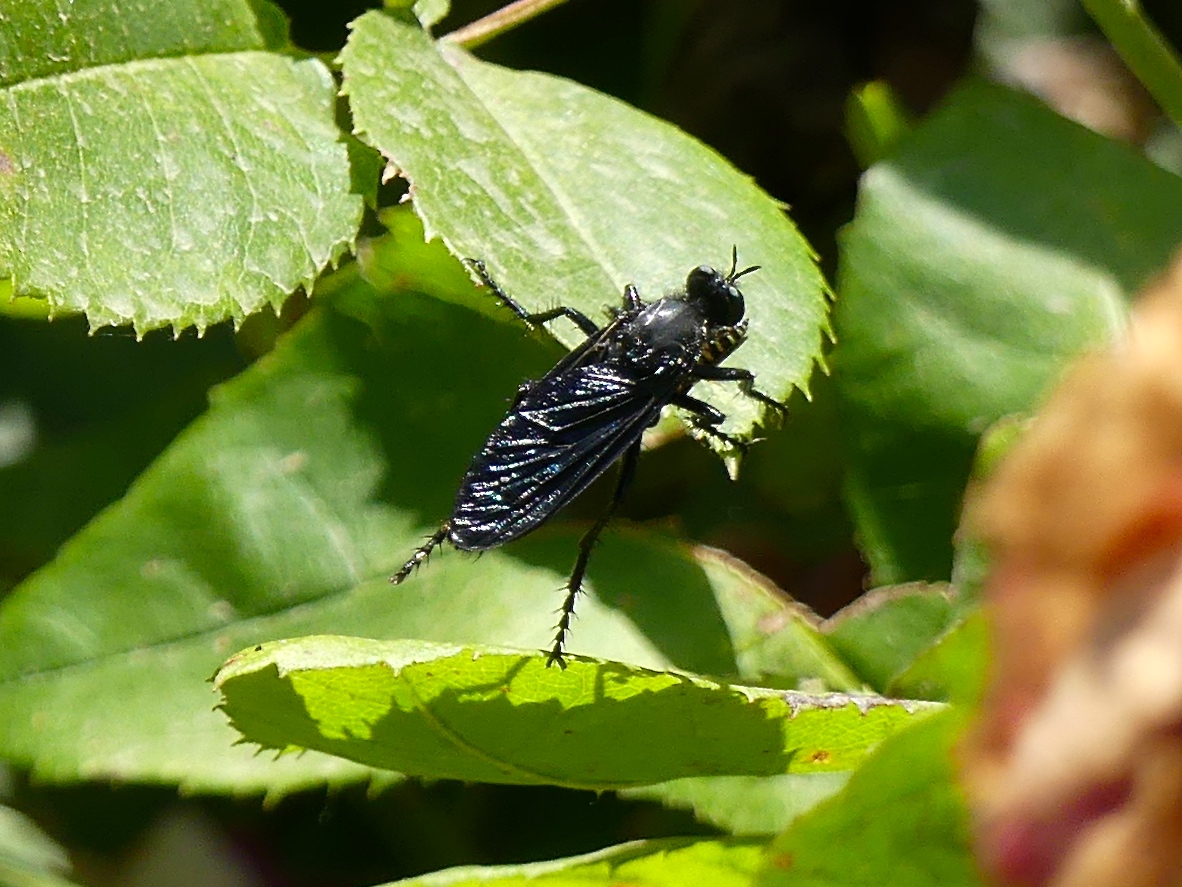
The Violet black-legged robber fly lacks the characteristic hump of most robber flies, so it looks more like a ‘normal’ fly. It is entirely black in colour. If you look closely, you can see that this robber fly has captured a small insect.
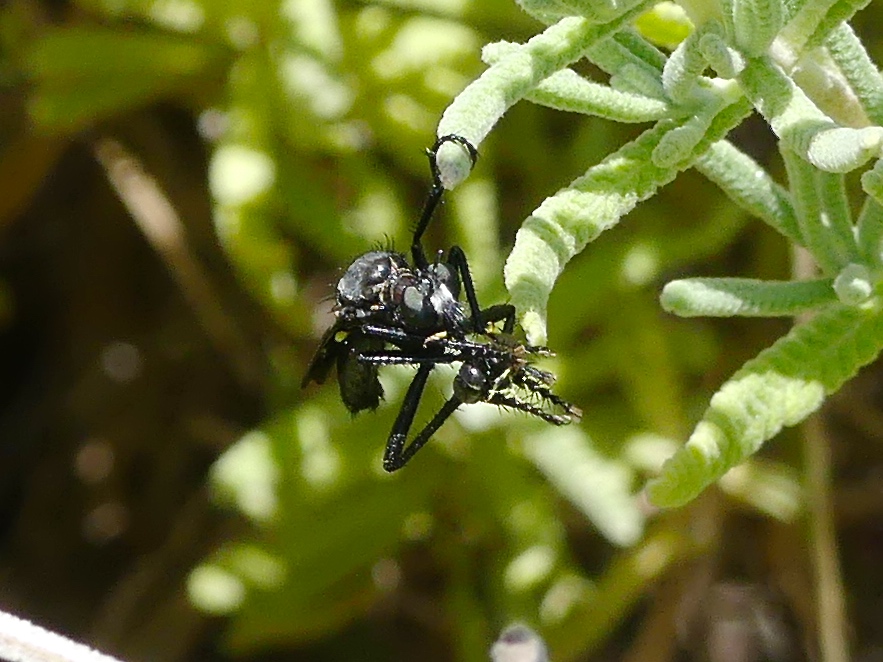
Here, a Violet black-legged robber fly is sucking out a captured fly, whilst holding on to the plant with just one foot.
Pogonosoma maroccanum, Fabricius
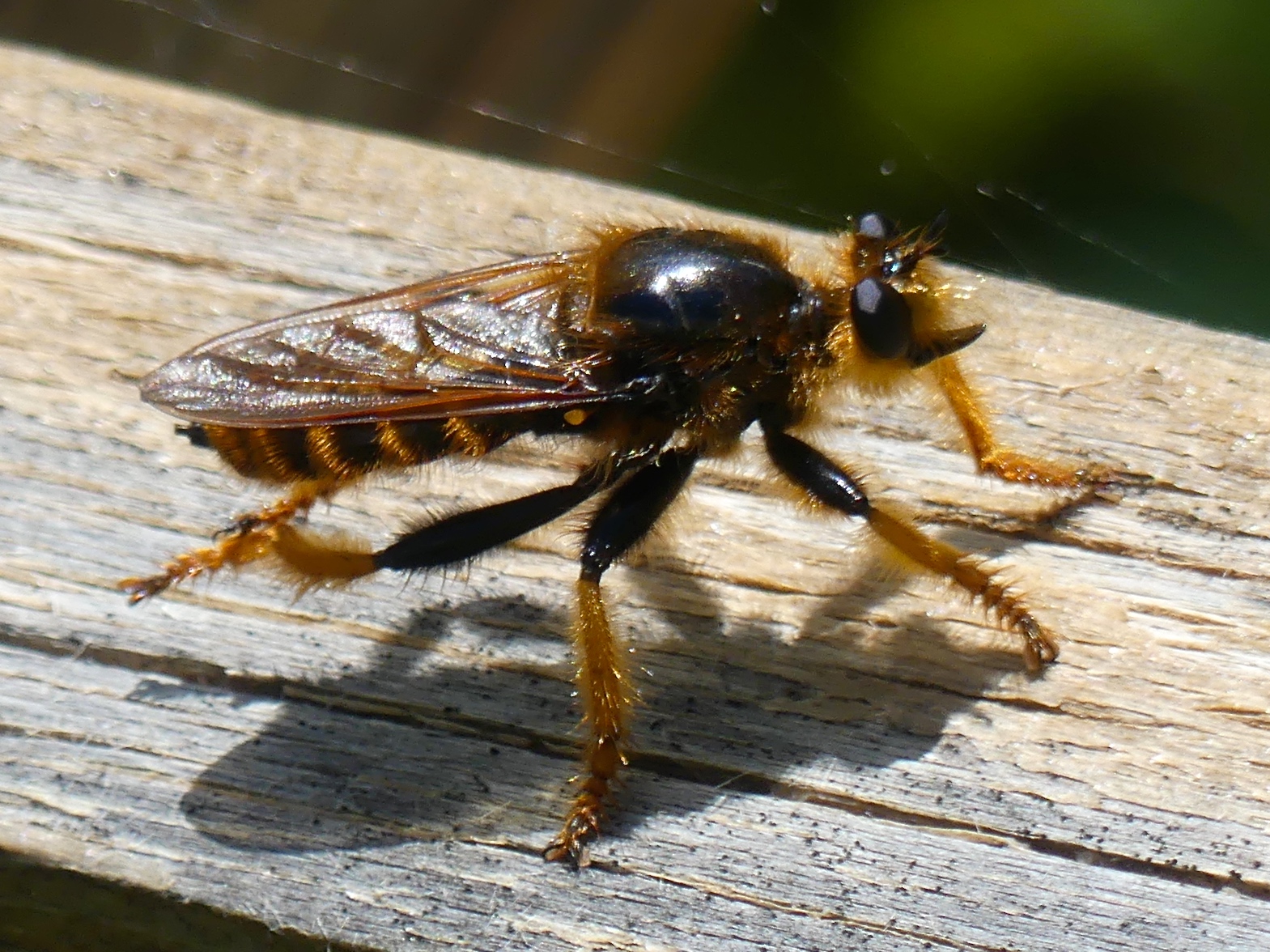
This very large and robust robber fly, with its striking orange bristles, is very rare in our area. It is a Mediterranean species. Its larvae are predatory and live in the tunnels of wood-boring insects.
Thick-headed flies, Conopidae
As the name suggests, thick-headed flies have a relatively thick, rounded head. Their body shape varies considerably from species to species. Some of the approximately 800 species resemble wasps, with a narrow petiolus (i.e. the second abdominal segment is transformed into a narrow stalk). Thick-headed flies lay their eggs in flight onto other insects, primarily hymenoptera (bees and wasps) and grasshoppers, in which the larvae live as parasites, leading to the death of the host animal.
Physocephala vittata, Fabricius
This species, widespread in southern Europe, can be recognised by its yellow forehead.
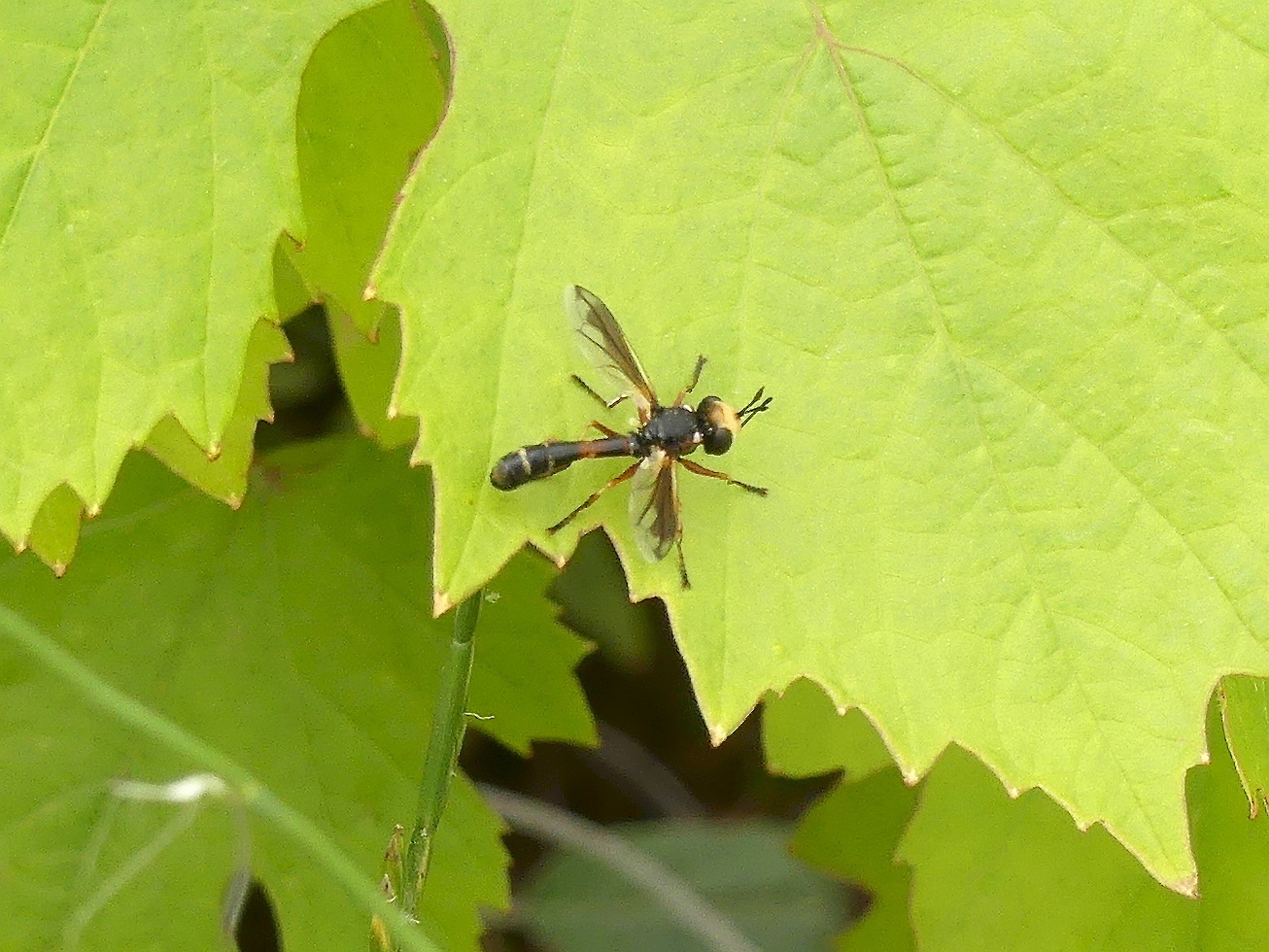
Physocephala vittata has a swollen-looking yellow forehead; its legs and body are black and reddish-brown in colour. The wings show a brown pattern in the front part. In this photo, you can also see the proboscis, which is often held at an angle pointing forwards in thick-headed flies.
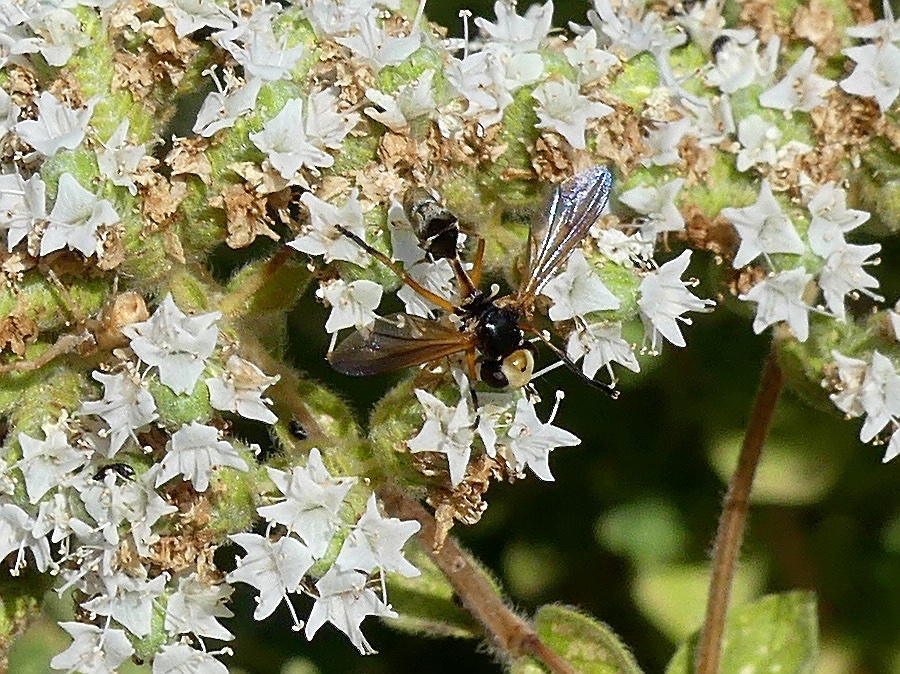
In this specimen, the abdomen is almost golden in colour. The petiole is particularly narrow. It might belong to a different species.
As in the previous photo, the halteres or wing stalks can be seen below the narrow wings; these are the fly’s reduced hind wings, which are equipped with numerous sensors and serve to aid the fly’s orientation and stabilise its flight movements.
Conops flavipes, L.
Conops flavipes has a wasp-like colouring and resembles, for example, members of the genus Ancistrocerus. The larvae parasitise the nests of various bee and bumblebee species, living as endoparasites in their larvae.
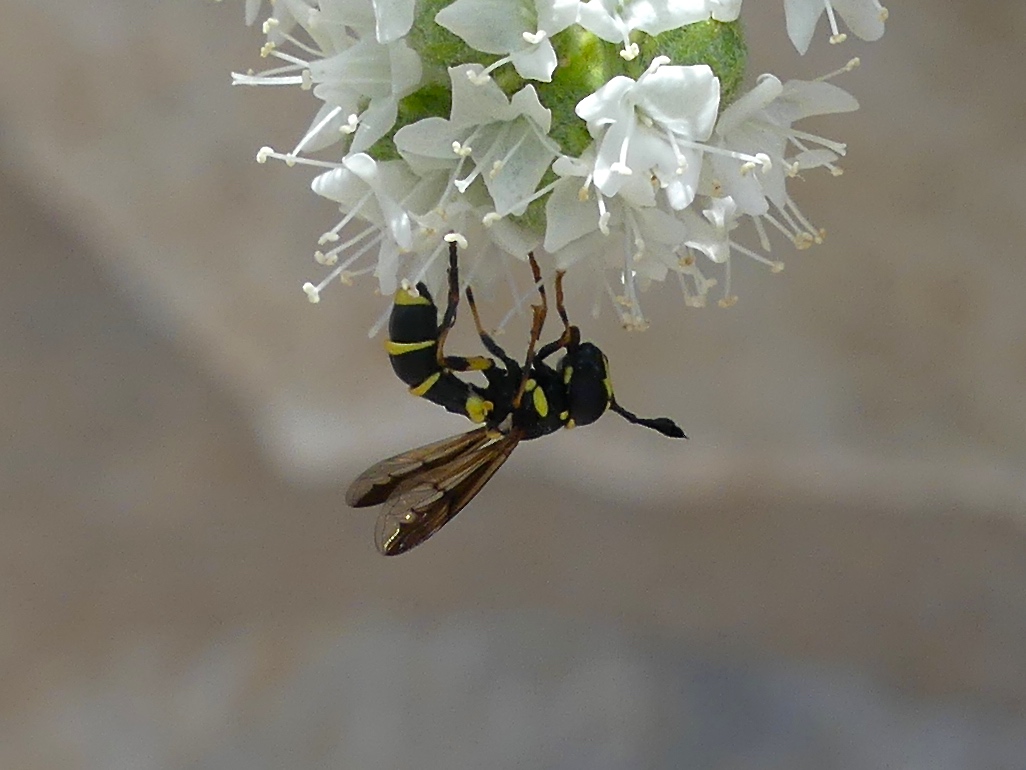
As with many thick-headed flies, the front section of the wings is slightly tinted. The species can be recognised by its black and yellow banding, its yellow-brown legs and the small yellow spots on its ‘shoulders’.
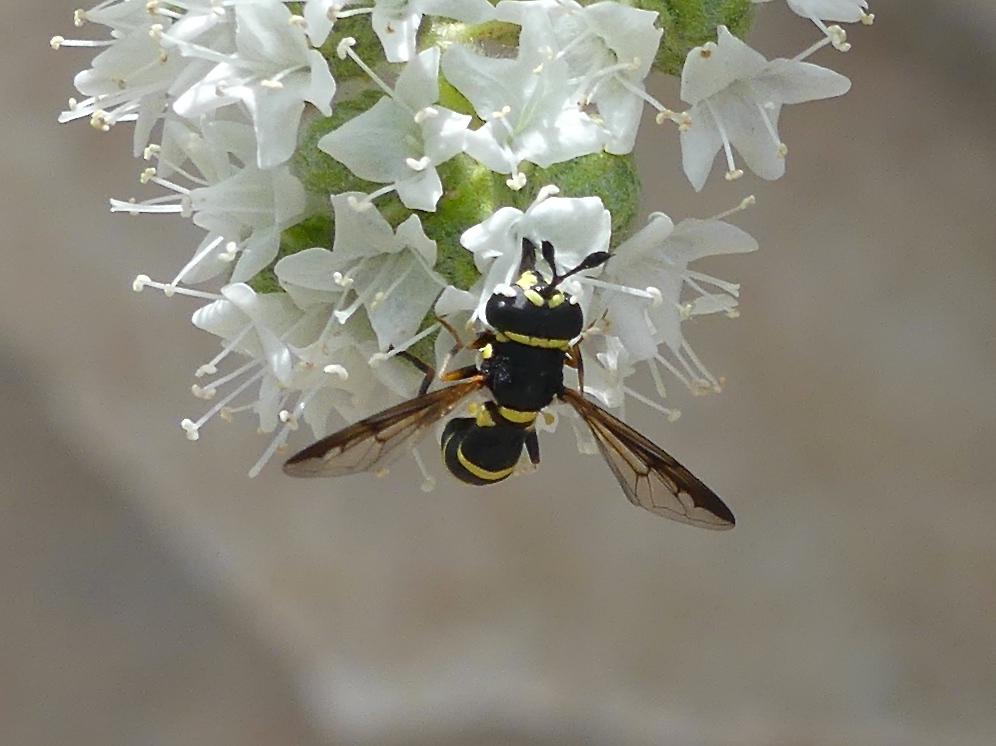
Here you can see the features that tell us this is not a wasp, but a thick-headed fly: Like all flies, it has only one pair of wings, whilst the hind pair has been transformed into small yellow, club-shaped halteres, which can be seen quite clearly here. The antennae, as in all thick-headed flies, emerge from a short common “stalk” before dividing in a V-shape.
Unidentified thick-headed fly
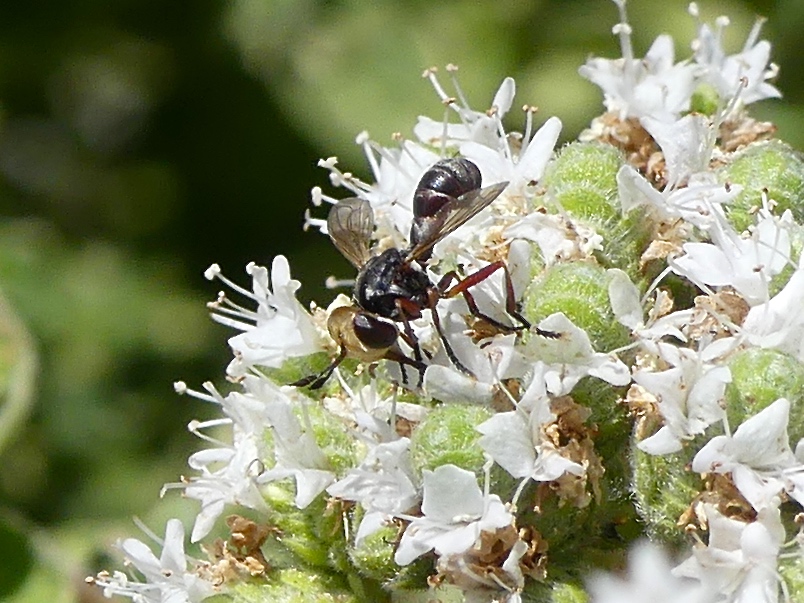
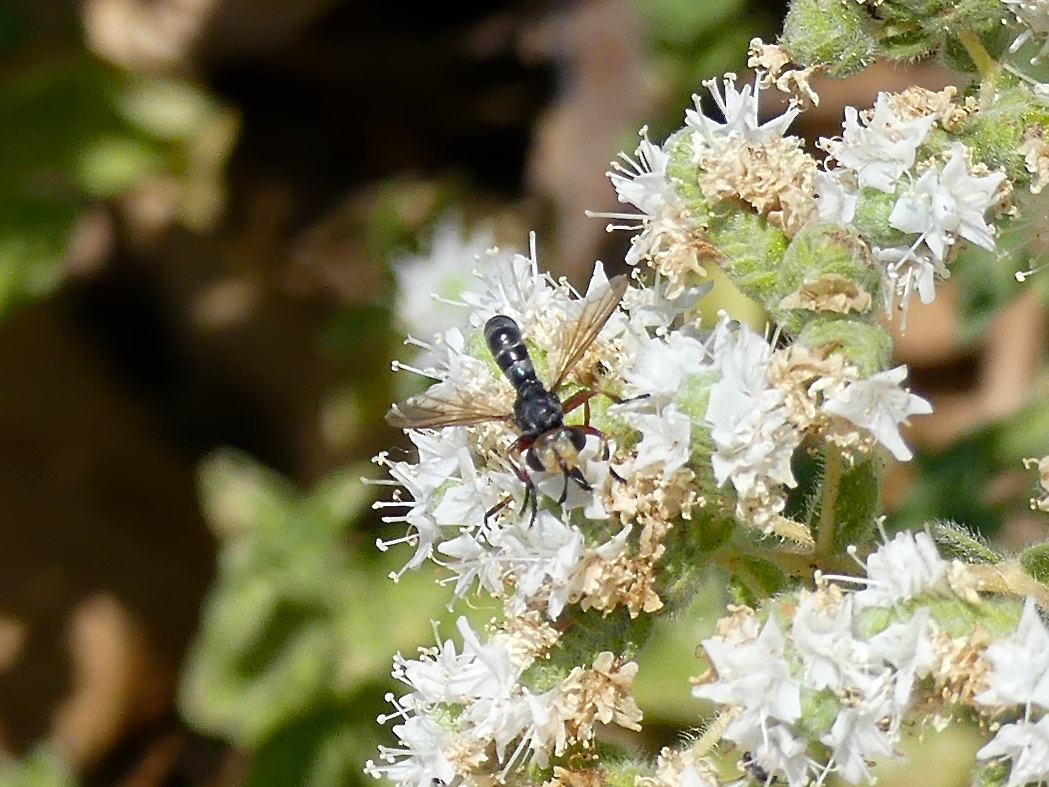
This specimen of thick-headed fly I have not managed to identify. The wings are only very faintly coloured. One can see the strong, spear-like antennae. The abdomen, held curved downwards as in most thick-headed flies, is grey with bluish stripes; the legs are reddish.
Marsh flies, Sciomyzidae
The marsh flies are mostly found in humid areas. The larvae live as parasites on snails. With about 500 species worldwide, they are among the more inconspicuous and lesser-known groups of flies.
“Snail fly”, Pherbellia spec.
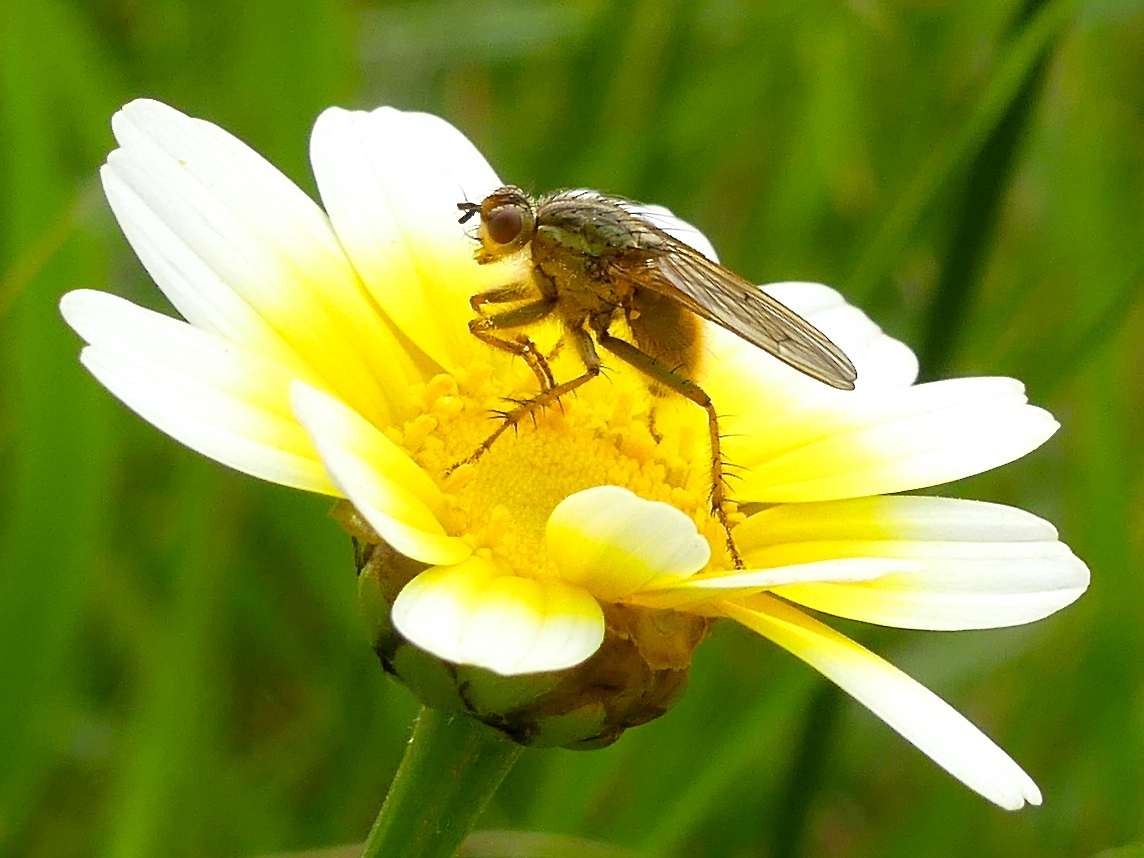
The “Snail flies” of the genus Pherbellia have quite long legs and a rather thick body. The thorax is grey in colour with faint longitudinal stripes and long bristles, whilst the abdomen is brownish. The head has a characteristic shape; the eyes are set wide apart and the forehead is red. Beneath the wings, one can see the small, club-shaped, yellow halteres.
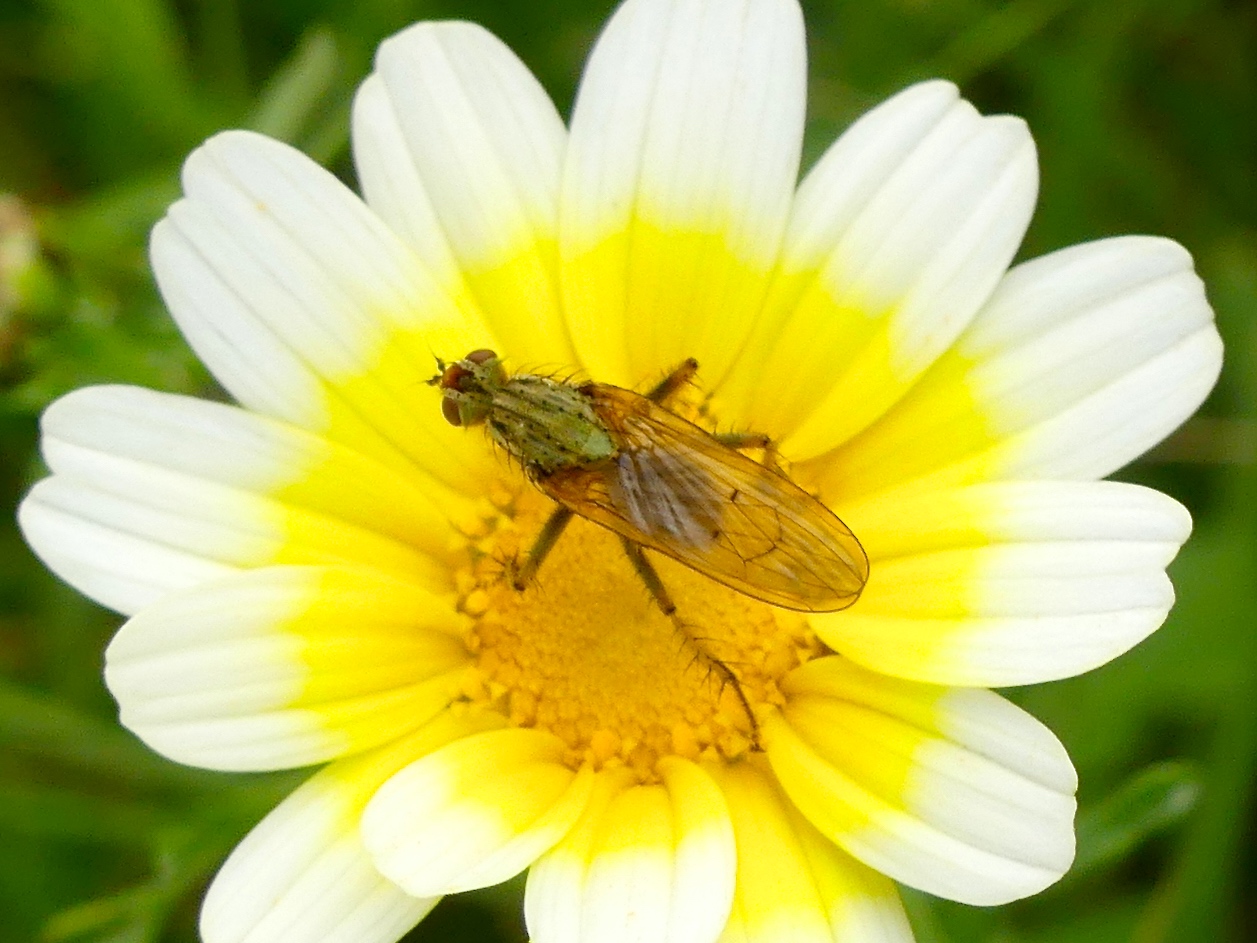
Here you can see the wing venation with two prominent markings and the broad red forehead.
Fruit flies or Peacock flies, Tephritidae
The Peacock flies, also called Fruit flies (together with the “true” Fruit flies, family Drosophilidae), are mostly small, often very pretty flies that frequently have patterned wings or colourful markings on their abdomen and neck. As adults, they have a lifespan of only a few days. The larvae live in plant tissue, often in fruit, and can cause significant damage to crops. Many species induce the formation of galls.
Olive fruit fly, Bactrocera oleae, Gmelin
The Olive fruit fly is a major pest in the Mediterranean region. Its larvae live inside the olives. With a severe infestation, the quality of the oil suffers (the acidity increases) and the yield may also be significantly reduced. If the fly population is not controlled, the harvest can often be completely lost. The Olive fruit fly reproduces particularly in early autumn, when the olives are nearly ripe; high temperatures keep the flies’ reproduction rate lower.
In the past, the Olive fruit fly was controlled by spraying the trees with poison over large areas; today, a moderate infestation can also be controlled by hanging attractant traps and by spot-spraying with poison mixed with attractant (whereby the poison does not need to be sprayed onto the olives themselves, but can be applied, for example, to the trunks or to nearby shrubs).
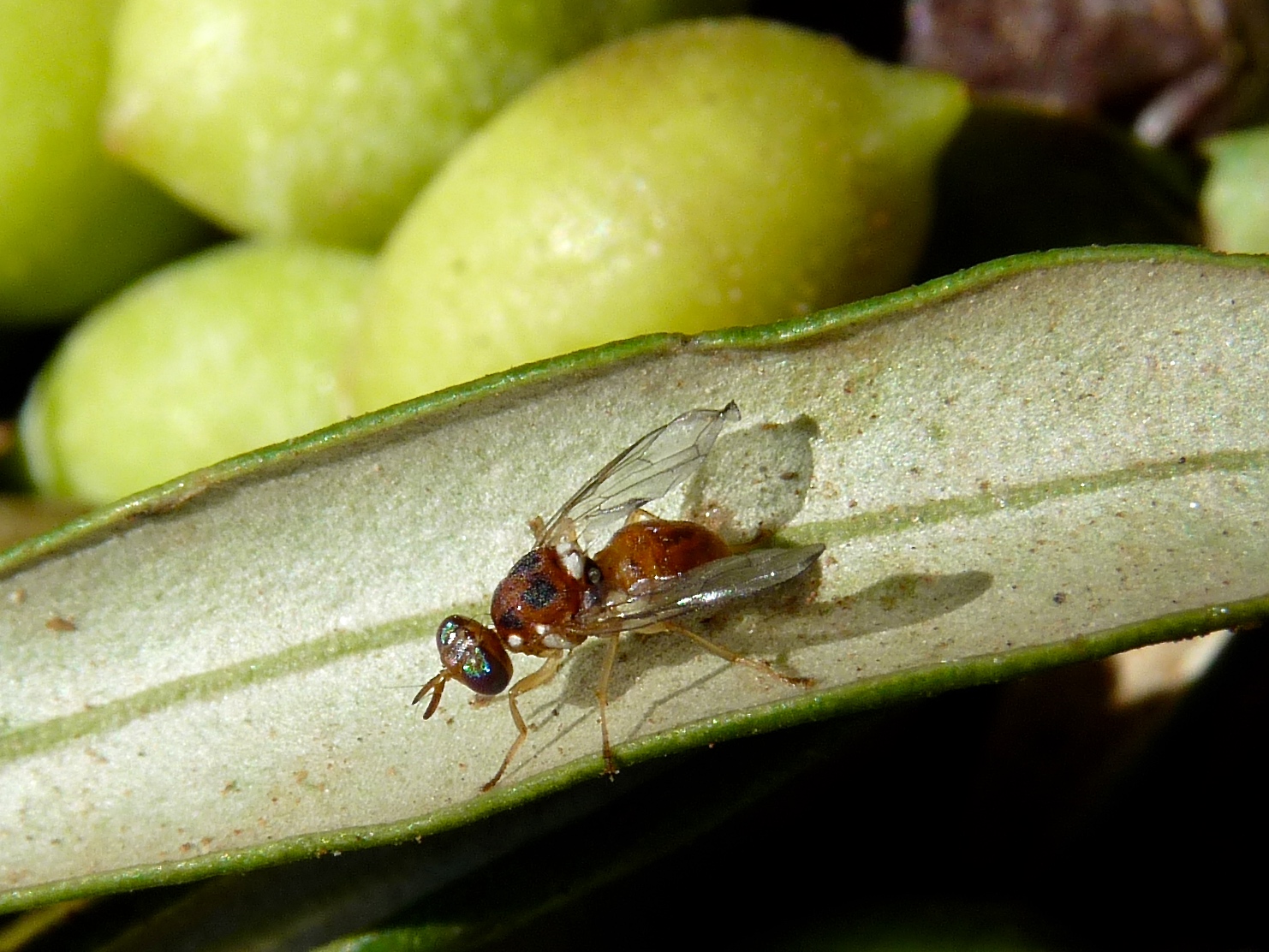
Unlike many species of Tephritidae, the Olive fruit fly Bactrocera oleae has unpatterned, transparent wings, but its body is strikingly coloured.
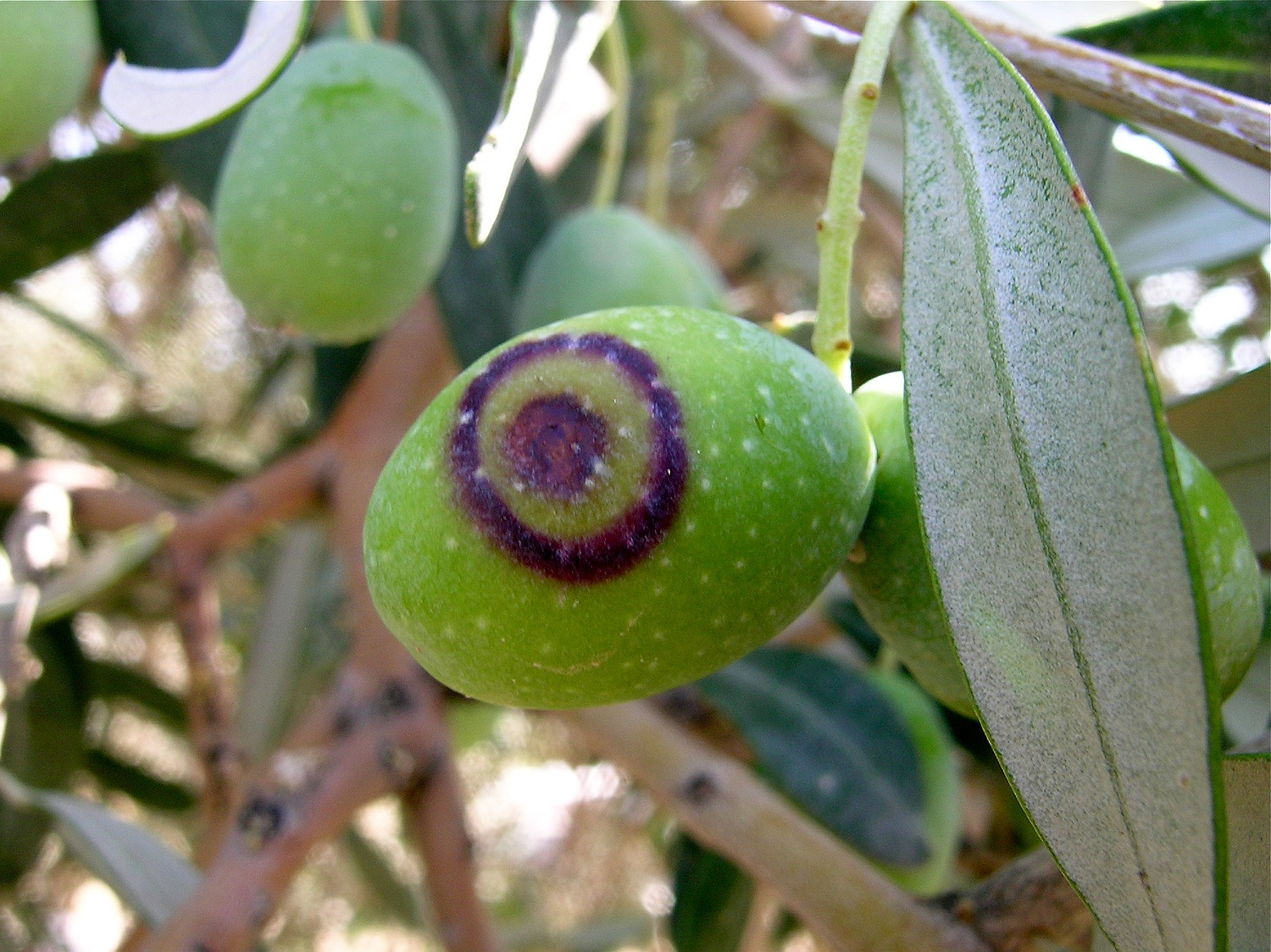
On the olives one can see the puncture mark where the female has laid her egg; a characteristic reddish-brown ring often forms around it. The small larvae hatch from the egg after just two or three days (or after 10 days in cooler temperatures).
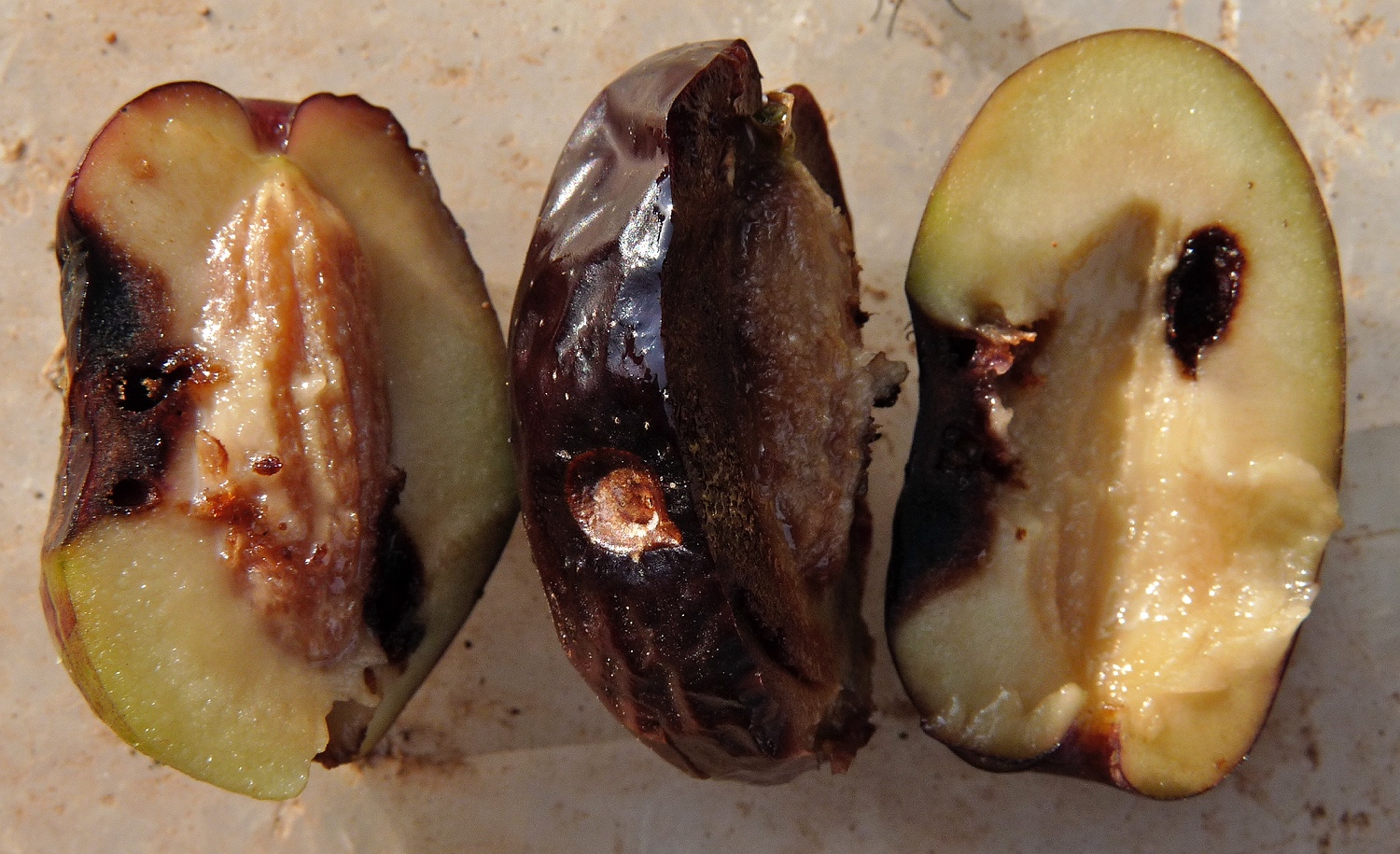
The maggot eats its way through the flesh of the olive, which leads to losses in the quantity and quality of the oil. On the middle olive, you can see the spot where the maggot left the olive before pupating.
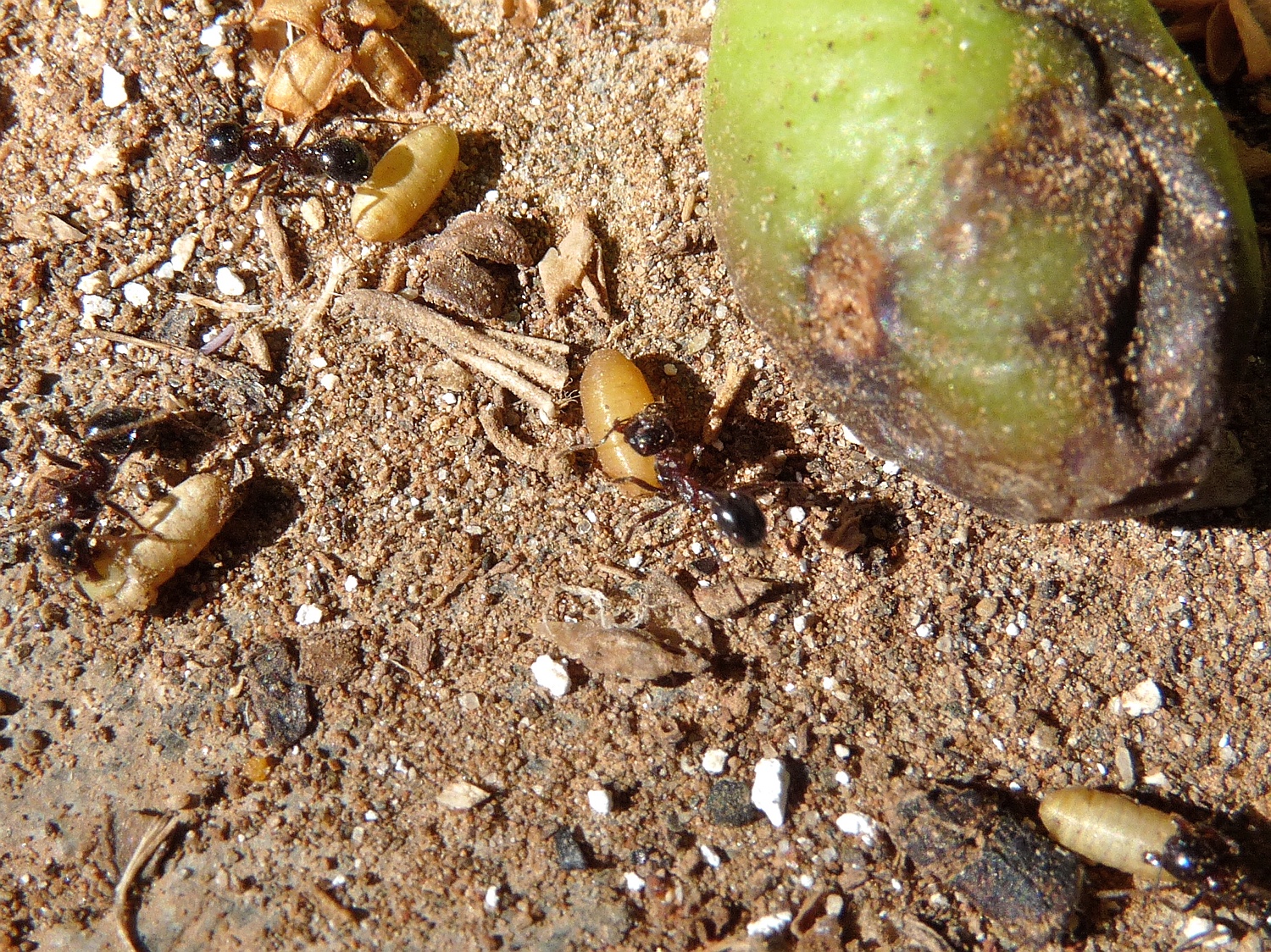
The pupae fall to the ground, and the young flies hatch after just a few days. The pupae are gathered by the ants, which busily carry them back to their nests as food for their own larvae.
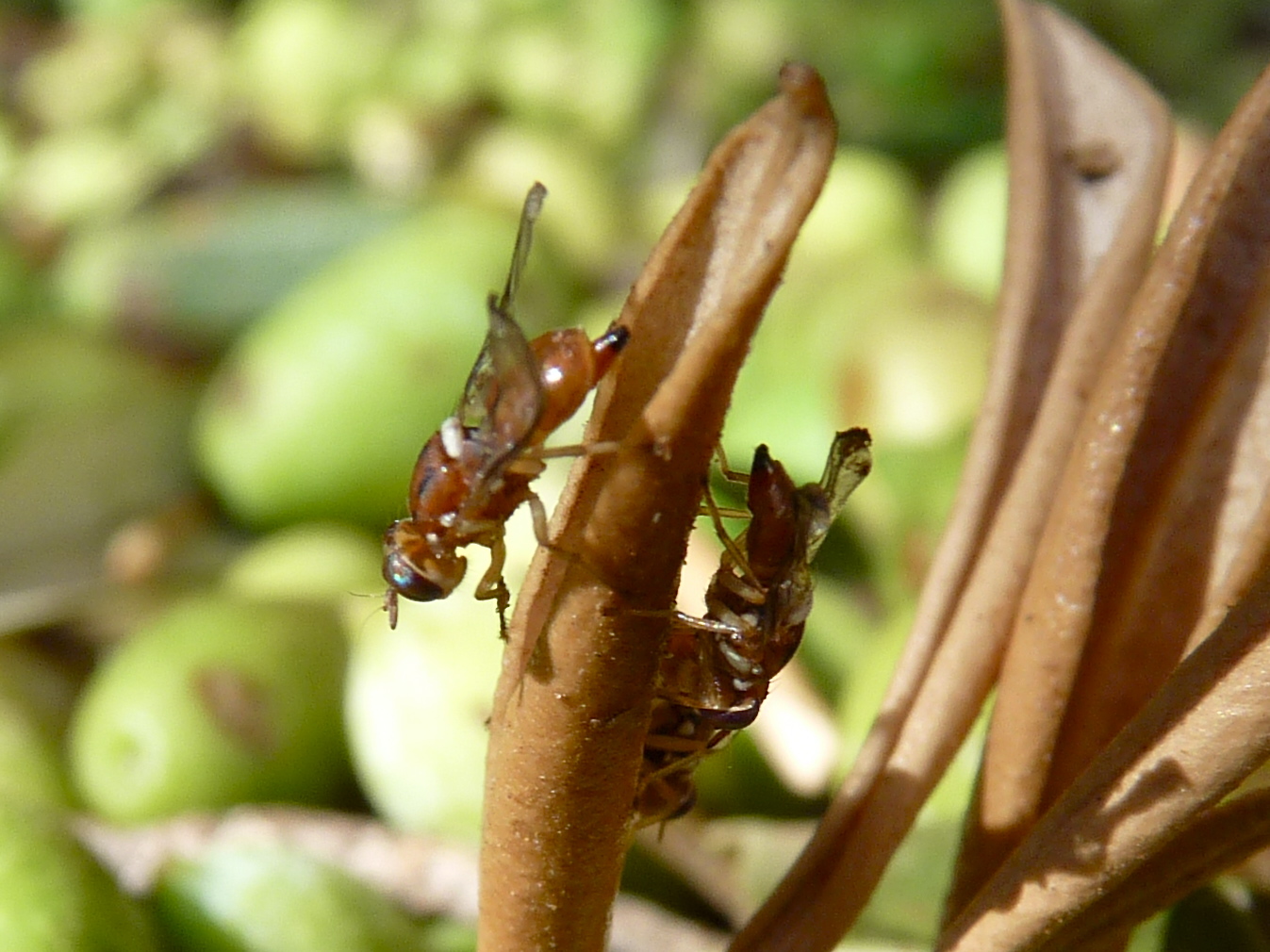
Newly hatched olive flies. Due to the fly’s rapid development, the population can literally explode under favourable conditions.
Mediterranean fruit fly, Ceratitis capitata, Wiedemann
Another major pest in the Mediterranean region is the Mediterranean fruit fly, introduced from Kenya, which causes considerable damage to fruit such as apricots, citrus fruits and figs, but also, for example, to peppers.
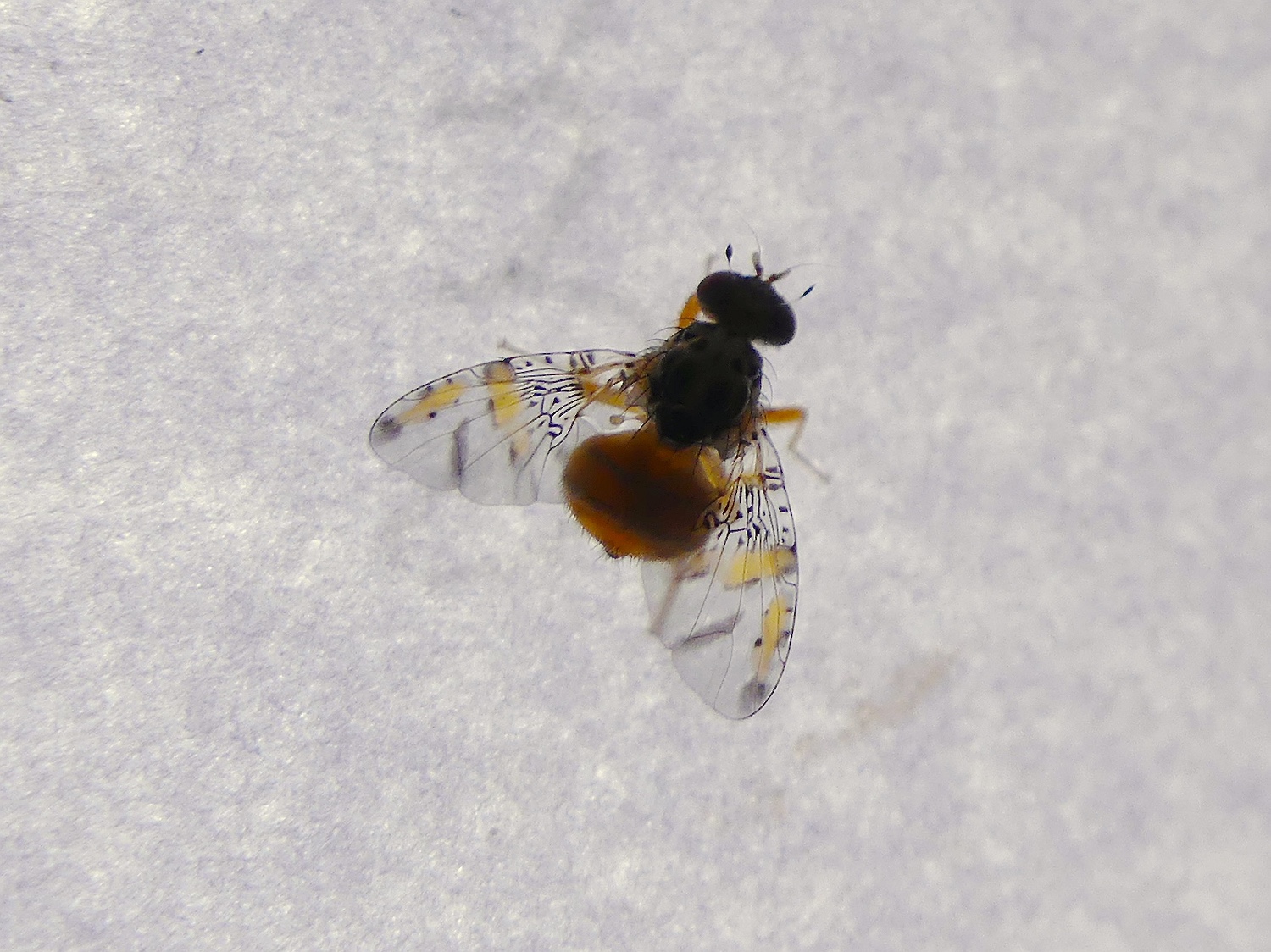
The pretty Mediterranean fruit fly, with its patterned wings, is a major fruit pest. Today, attractant traps can be hung in the trees to control the population.
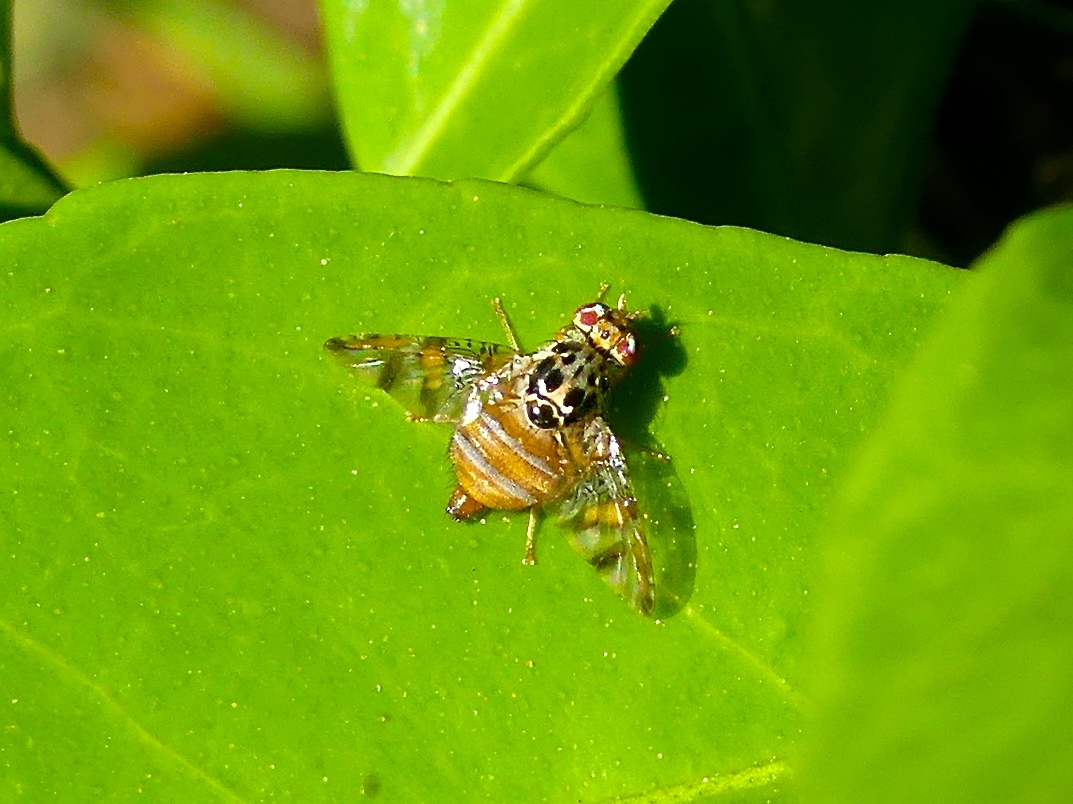
Here in our lemon tree. The thorax has many small black spots. The eyes are also patterned: they have whitish spots on a reddish-brown background.
Sphenella marginata
Sphenella marginata lives on groundsel (Senecio vulgaris).
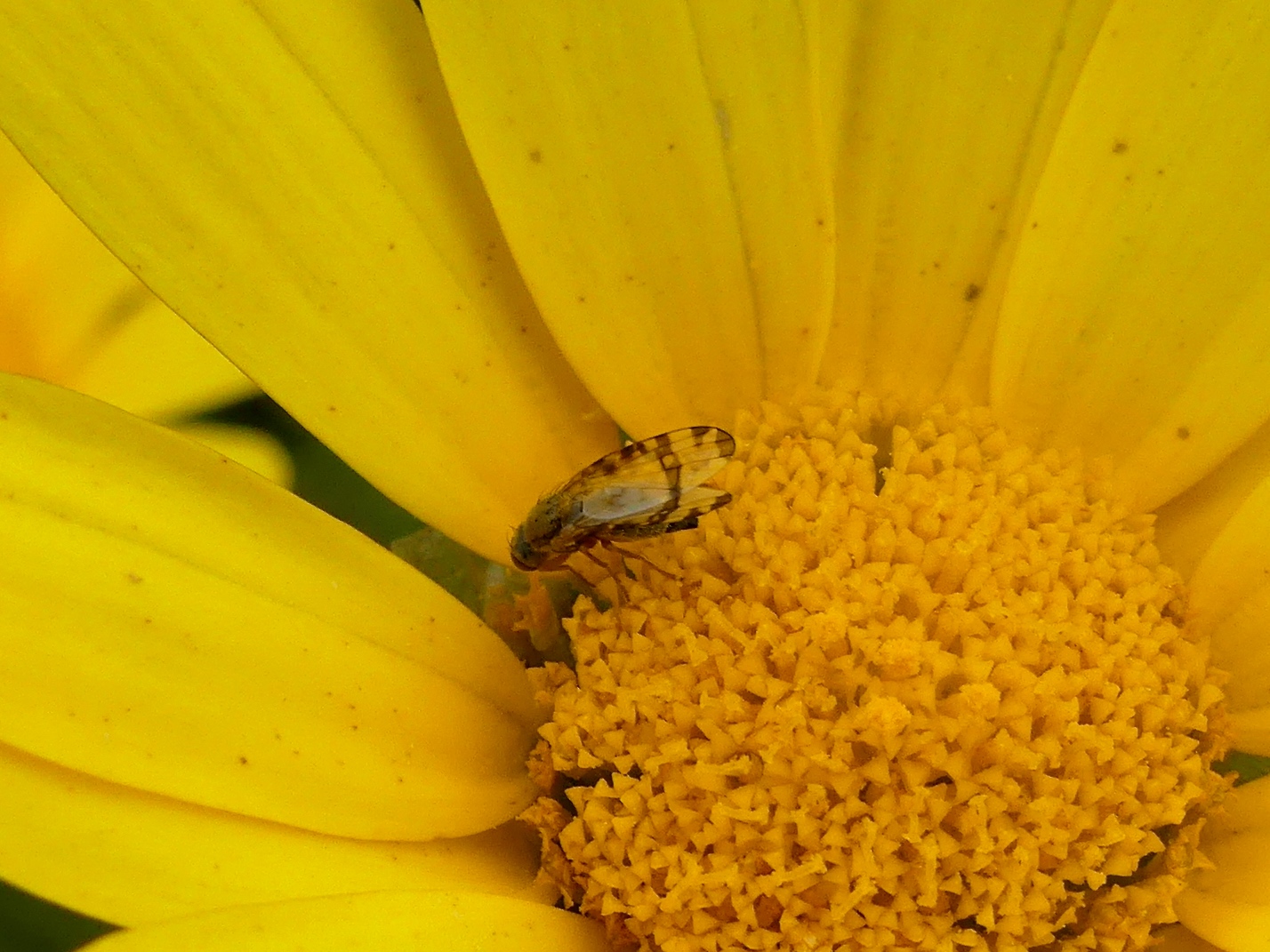
This species also has a characteristic wing pattern.
Chaetorellia spec.
This small fly with colourful eyes also belongs to the family Tephritidae. The wings bear dark stripes, which are not visible here as the fly holds the wings over its body. The larvae of the species of Chaetorellia live in knapweeds (Centaurea); some species are used to control invasive knapweeds introduced to America.
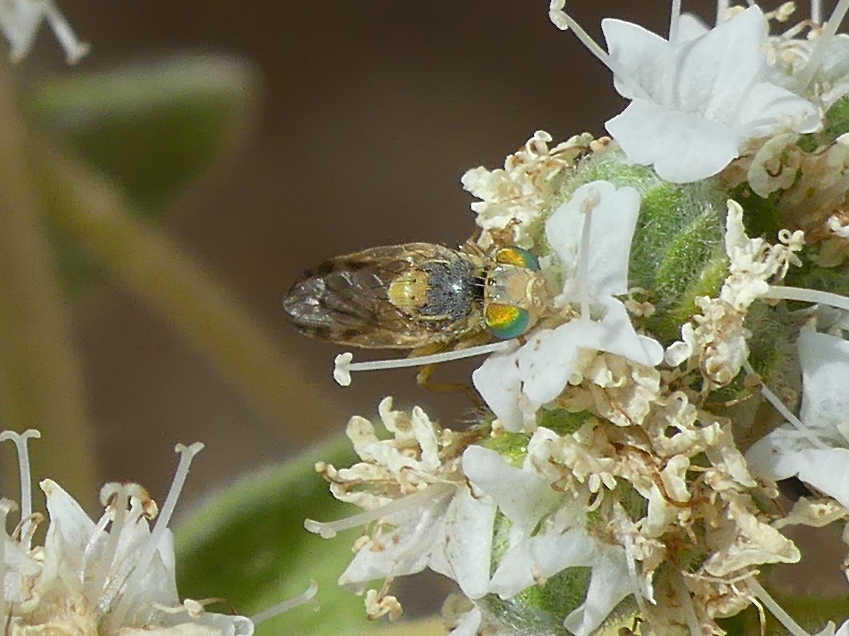
This small fly can be recognised by its striped wings, the characteristic yellow-grey markings on its body and its colourful eyes.
Grass flies, Chloropidae
Grass flies are very small flies, usually only 2 mm in size, but they often occur in large numbers. They are mainly found in meadows. The larvae often live in grasses or other plants.
Chloropinae
There are many very similar species of Chloropinae. This is probably a species of the genus Chlorops or Thaumatomyia.
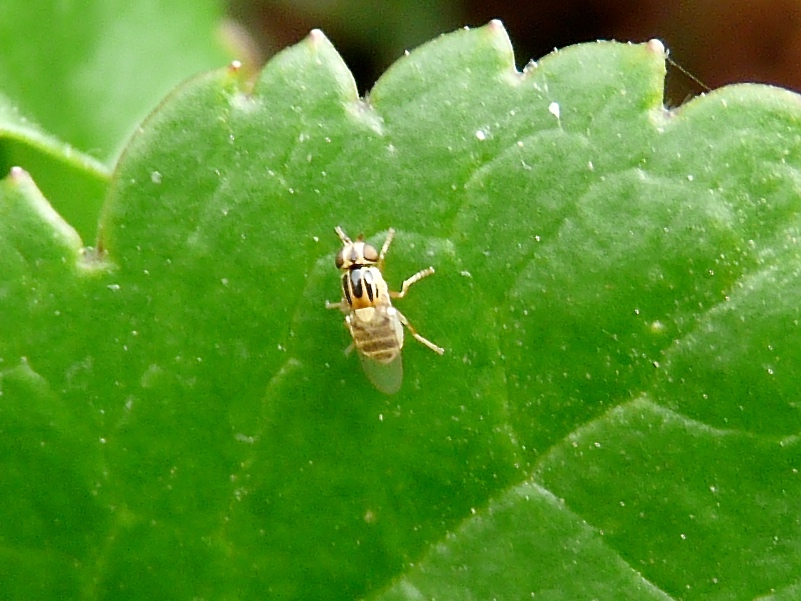
This yellow fly, just 2 mm in size, with pretty black markings, lives on grasses and shrubs. There are numerous very similar species in several genera.
Anthomyiidae
The Anthomyiidae are small to medium-sized flies that are frequently found on flowers and feed on nectar as adults. The larvae are also mostly phytophagous; some species are significant plant pests and live – depending on the species – on the roots of, for example, onions, cabbage or beans. However, the larvae of some species are also parasitic or reside in the nests of wasps or bees, where they feed on the food stores.
Anthomyia spec.
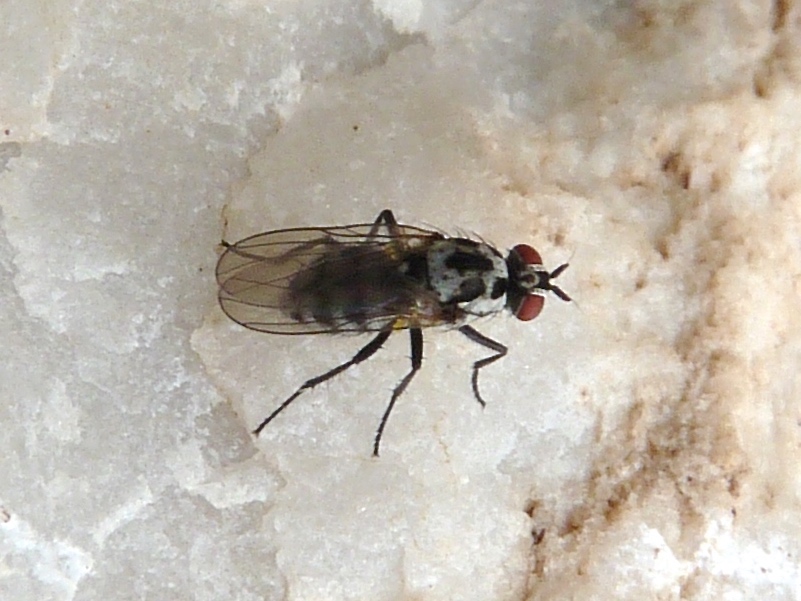
This very small, pretty species of Anthomyia has red eyes and a black-and-white pattern on its thorax.
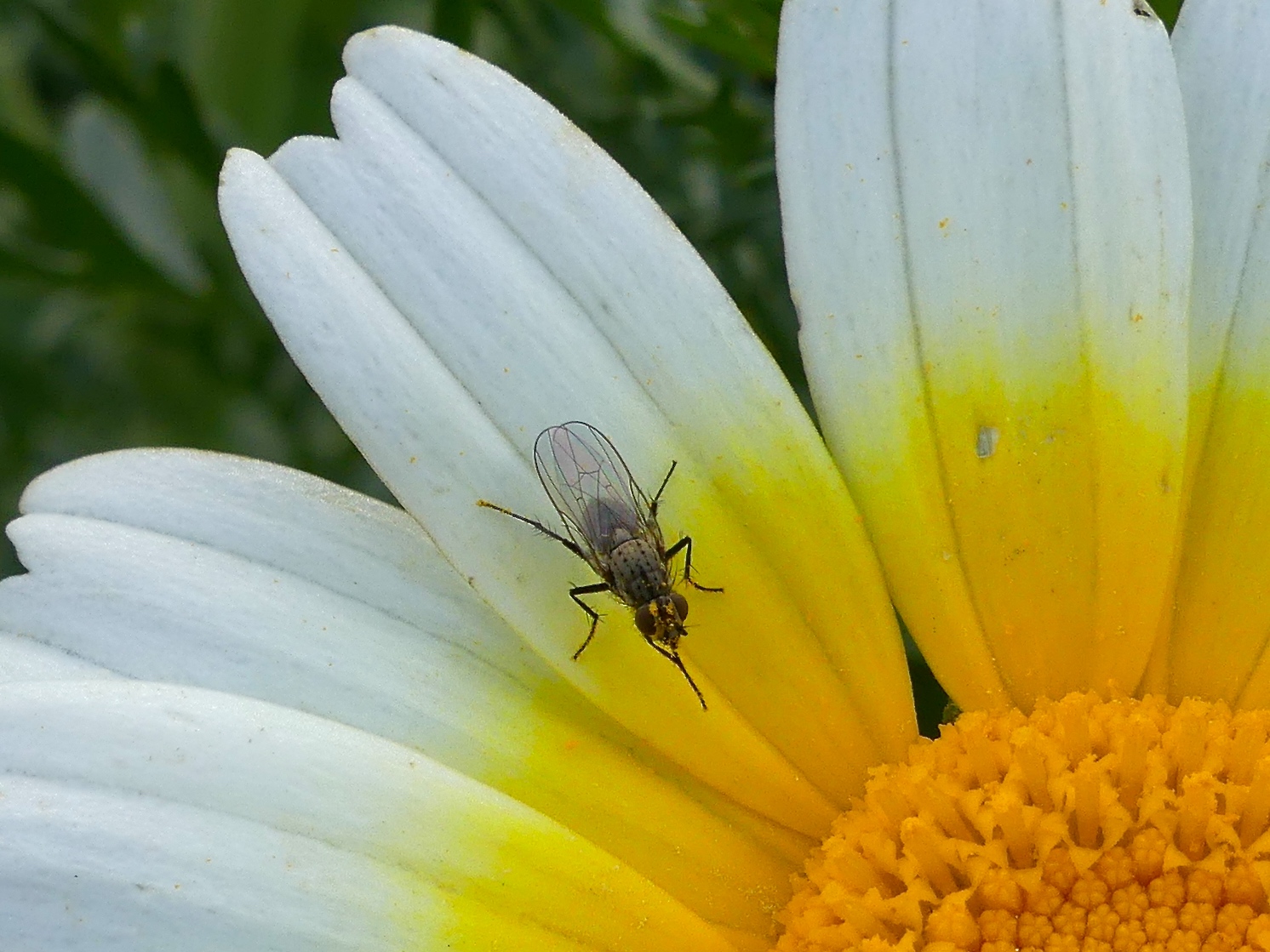
This small fly also belongs to the Anthomyiidae – unfortunately, it is not possible to identify the specific species without microscopic examination.
I would like to thank the identification forum of the website Entomologie.de for identifying this species.
Dagger flies, Empididae
Dagger flies are small, inconspicuous flies with long legs. They are predators and often catch prey significantly larger than themselves. Some species feed on pollen and nectar, which they suck with their long proboscis. To mate, dagger flies fly in small swarms, ‘dancing’ in the air; these groups consist only of males or only of females and are then visited by individuals of the opposite sex. The males often court the females by presenting them some prey as a mating gift, which seems justified in predatory species, as cannibalism can occur. Astonishingly, even in some herbivorous species, the males give the females some prey as a gift, for which the females then have no further use, thus it may be used by the males for multiple matings.
The larvae are predatory, feeding on other insect larvae, either in water or in the soil.
Empis spec.
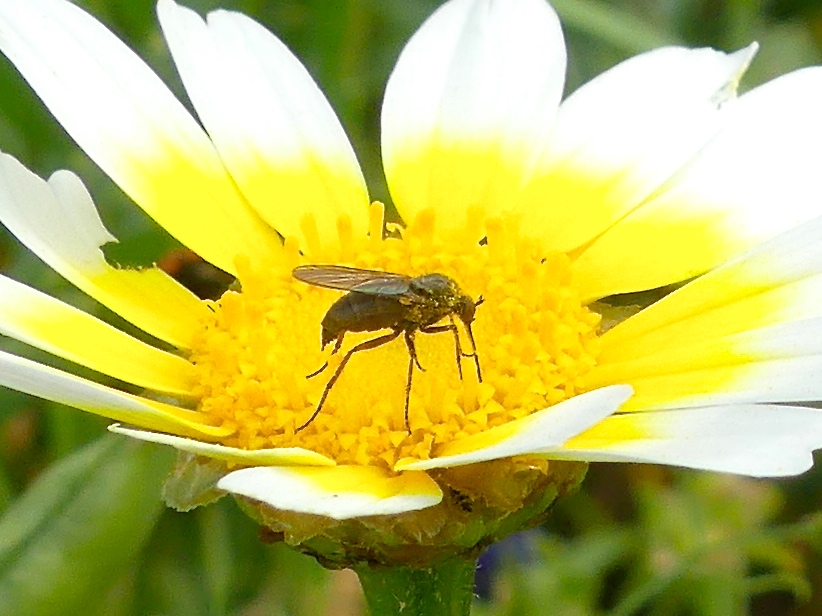
This small fly with long, thin legs is probably a member of the genus Empis. Members of this genus are mostly herbivorous and use their long proboscis to suck the nectar from flowers.
Dance flies, Hybotidae
The dance flies are easily recognisable by their humped body. Their legs are long and powerful. Dance flies are predators and hunt their prey mostly on foot. They are usually found amongst vegetation. In most areas, quite a few species occur in small numbers, but they are usually overlooked due to their secretive lifestyle.
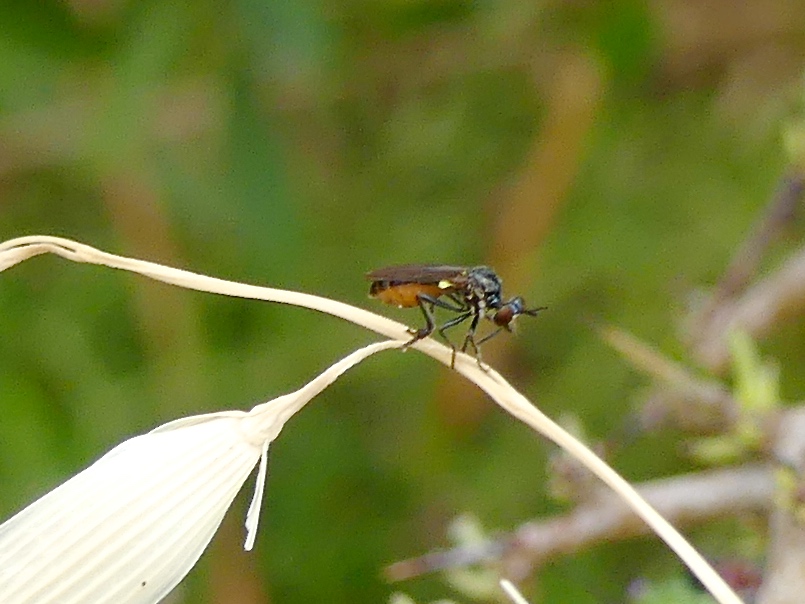
The dance flies can be recognised by their long, powerful legs, the hump-shaped thorax and the distinct neck. Unfortunately, it is not possible to identify the species or even the genus.
Long-legged flies, Dolichopodidae
The small long-legged flies are predators that feed on other insects. They have long legs and large eyes and often display a slightly metallic shimmer. Their posture is unusual: they stand very upright.
Medetera spec.
The larvae of the genus Medetera feed on beetle larvae that bore into bark. Although there are numerous species, the these flies are usually overlooked due to their small size.
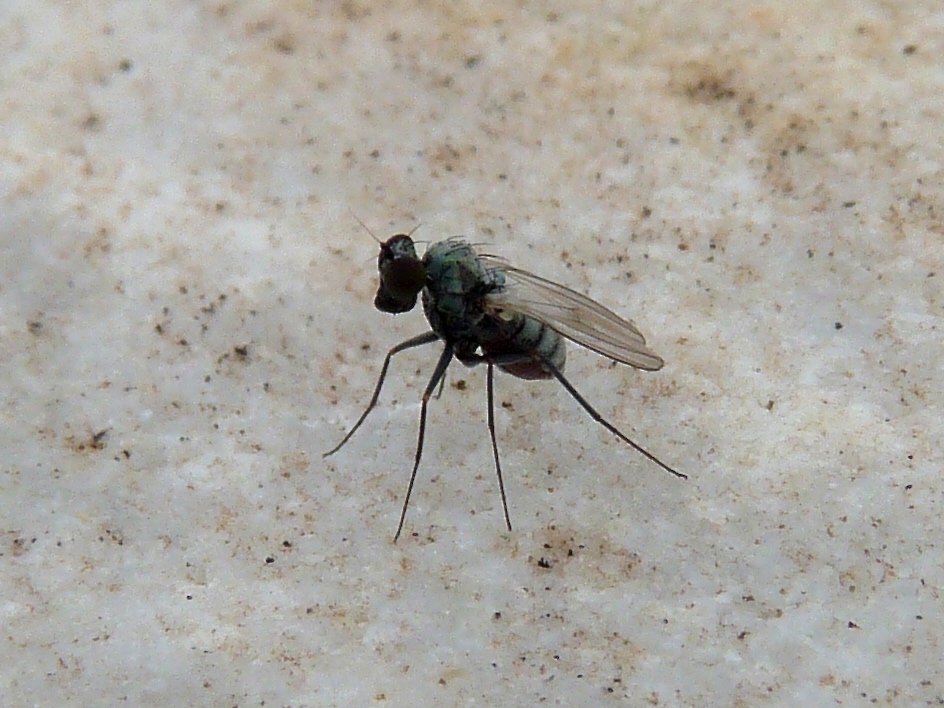
The long-legged flies of the genus Medetera are usually overlooked, as they are only a few millimeter in size. They are recognisable by their characteristic upright posture and their peculiar head shape.
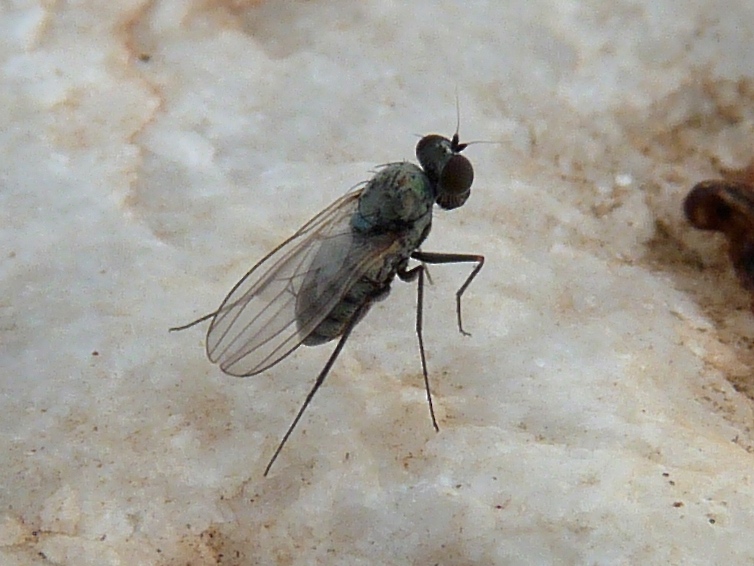
These flies are predators that feed on small insects.
Soldier flies, Stratiomyidae
Soldier flies are mostly medium-sized flies whose abdomen is often very broad, so that it protrudes beyond the folded wings. The various genera exhibit very different ways of life. The adult flies are flower visitors and usually live in forests. In some groups, the larvae live in water, in others, they parasitise ant nests or mine in plants.
Odontomyia flavissima, Rossi
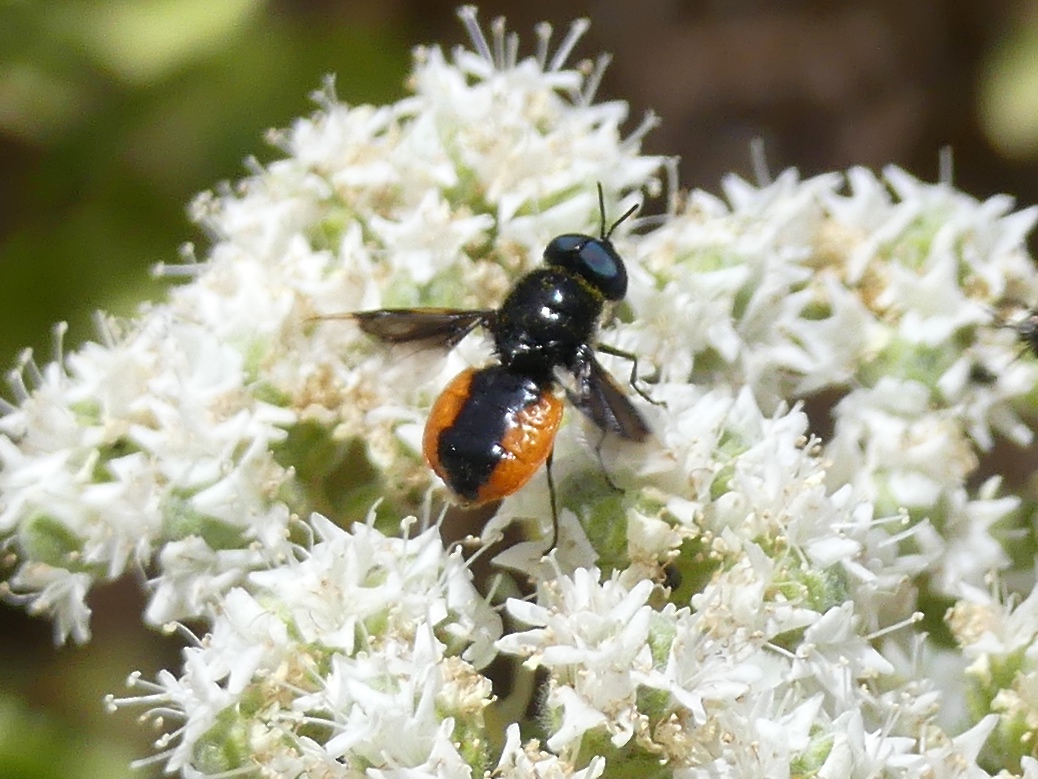
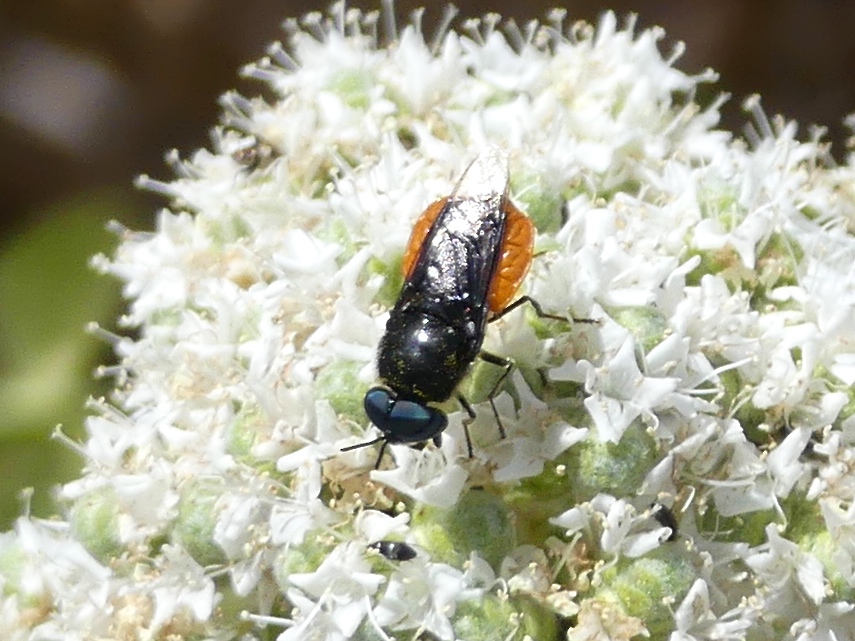
The soldier fly Odontomyia flavissima is easily recognisable by the strikingly orange sides of its abdomen, which appear slightly swollen. It is rare in our region.
Horse flies, Tabanidae
The horse flies are a fairly large family of flies, comprising around 4,000 species. Male horse flies feed exclusively on plant nectar, whilst the females require a blood meal before laying their eggs. Unlike mosquitoes, which deliver a barely perceptible bite with a very fine proboscis, horseflies typically create a larger wound with their mouthparts, which hurts from the beginning. Many species can transmit diseases. However, the species of the subfamily Pangoninae are entirely vegetarian, i.e. the females do not suck blood.
Pangonius pyritosus, Loew
The horsefly species Pangonius pyritosus is strictly vegetarian; here one can see it sucking nectar from oregano with its long proboscis. I would like to thank Andrew Stephen Grace for the identification.
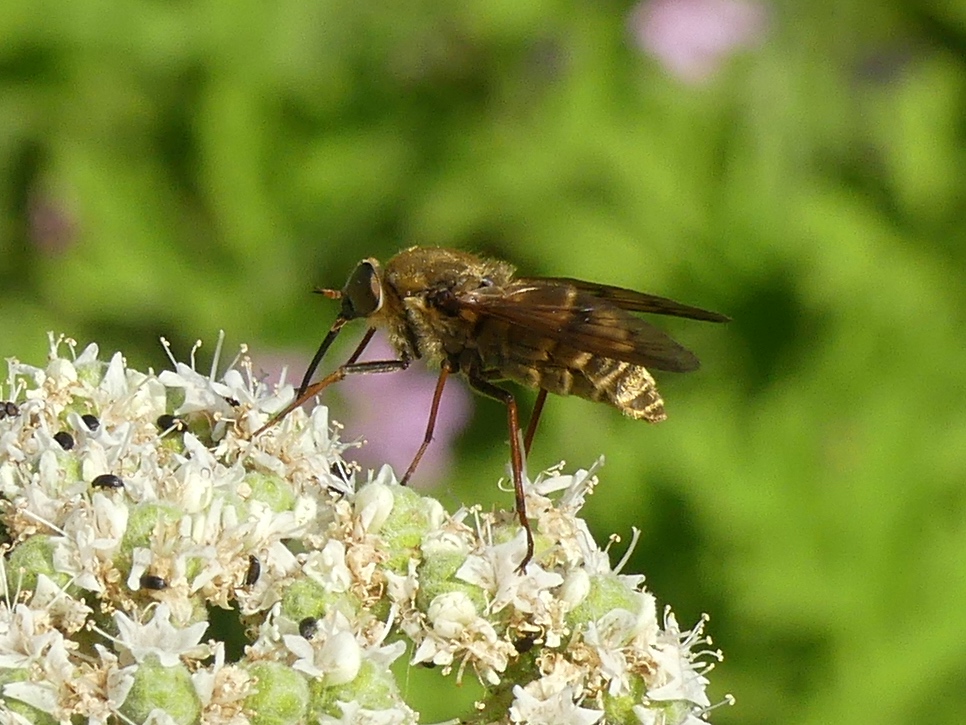
The horsefly species Pangonius pyritosus is found in (South-)Eastern Europe and Asia Minor. It can be recognised by its two-coloured legs, with black femur and red tibia. The antennae are reddish with black tips, and the face is black.
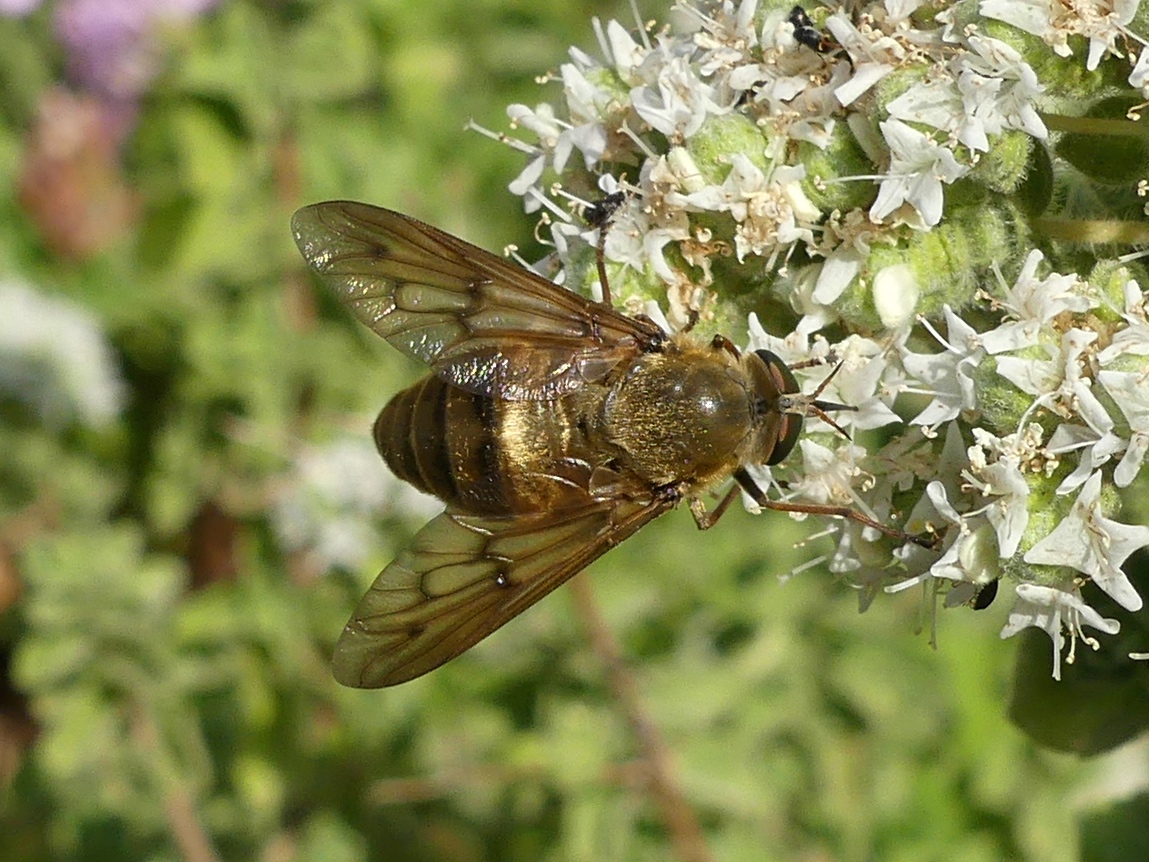
The wings have a slight brownish tinge, with the wing veins darker in places. Thorax and abdomen are covered in shiny golden hair.
The bee flies and the hover flies are treated on different pages, as are the snakeflies (order Raphidioptera) which do not belong to the Diptera.
continue: Hover flies
back:
See also: