Bees
Bees (Apiformes = Anthophila) belong to the diverse order of the Hymenoptera, which, with over 150,000 species, is one of the largest groups of insects. The Hymenoptera include many ecologically important species, such as the bees, which are indispensable as pollinators, the ants, which have a significant influence on the face of the earth through their decomposing and burrowing activities as well as through the dispersal of seeds, and the wasps, many of which play an important role in the ecosystems, for example as parasites of other insect species.
The rather diverse Hymenoptera include many large superfamilies, such as Ichneumonoidea, Chrysidoidea, Pompiloidea, Vespoidea, Formicoidea (ants) and Apoidea (bees and related groups).
In this article I introduce some of the bee species found on Naxos. The wasps are covered on a separate page.
Bee species on Naxos
The Photo gallery of the flies, wasps and bees gives an overview over the species.
A note on identification: Bees are in general particularly difficult to identify. In most cases, many very similar species exist, and a correct identification is possible only by the microscopic examination of dead specimens. In many cases, from a photo alone one cannot even determine the genus. I endeavour here to present some of the species found in our region, identifying them to the best of my abilityas best I can; however, I am not a specialist and (as always) cannot guarantee the accuracy of the identifications. I would like to thank the forum on the website Entomologie.de for the identification of several specimens.
Here you can jump directly to the sections on the various groups (return with the back arrow or by swiping back): Sweat bees (Halictidae) – Lasioglossum – Blood bees (Sphecodes) – Andrenidae – Masked bees (Hylaeus) – Honeybee (Apis) – Long-horned bees (Eucera) – Anthophora, Amegilla – Mourning bees (Melecta, Thyreus) – Bumblebees and Carpenter bees (Bombus, Xylocopa) – Mason bees and Leafcutter bees (Megachilidae) – Carder bees and Resin bees (Anthidium et al.) – Mason bees (Osmia) – Melittidae, Pantaloon bee (Dasypoda)
The bees are divided into Short-tongued bees, Long-tongued bees and the Melittidae.
1. Short-tongued bees
Sweat bees, Halictidae
The Sweat bees constitute the second-largest family of the Hymenoptera. Some species are solitary, others live in colonies or in small groups. The eggs are laid in underground nests and are supplied with pollen and nectar.
Halictus ?
The genus Halictus (sweat bees) comprises around 200 species and is found worldwide.

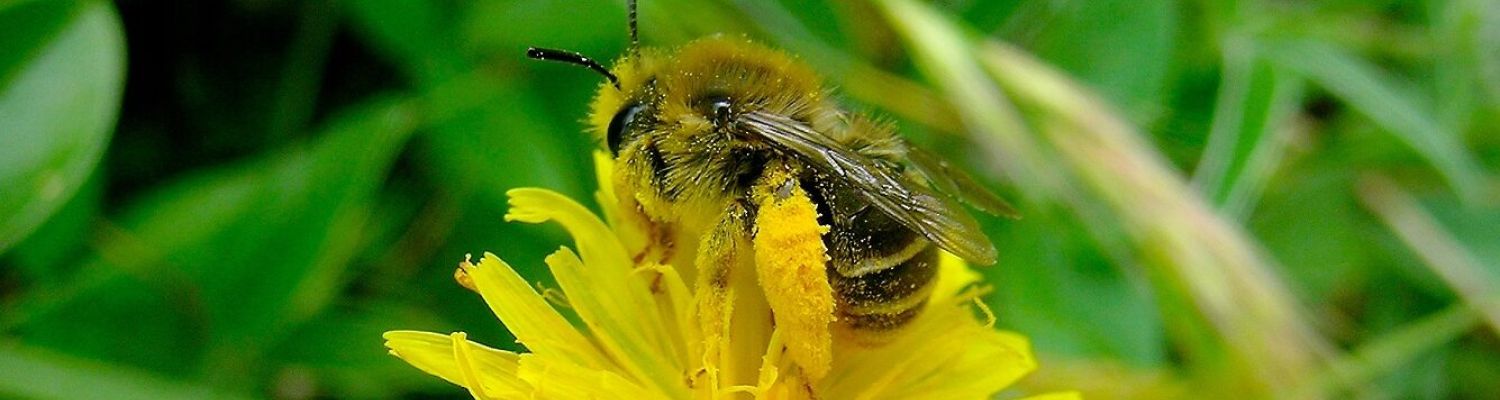
This small bee collects nectar and, above all, pollen from the large flowers of the Chrysamthema. The pollen gets caught in the dense, long hair on the underside of its body and, in particular, on its hind legs, which the bee holds aloft in a conspicuous way most of the time. This bee probably belongs to the genus Halictus.
Vestitohalictus ?
This small bee might belong to the genus Vestitohalictus, which comprises very small, grey-coloured species.

As with many of the specimens that I encounter in our garden, it is not possible to identify his small, light-grey bee from the photo. Probably it belongs to the genus Vestitohalictus.

Here you can see the strange proboscis that can unfold in a characteristic way.
Lasioglossum ?
The genus Lasioglossum, also belonging to the family Halictidae, constitutes with over 1,700 species the largest genus of bees. It includes both solitary species and species that live in colonies or societies, as well as parasitic species.
I would like to thank the forum of the website Entomologie.de for identifying this bee.

This bee probably belongs to the genus Lasioglossum. The upper surface of the body is sparsely hairy and has a slight metallic green sheen. The three simple eyes (ocelli) on the forehead are visible.

This bee probably also belongs to the genus Lasioglossum. It is so small that it has to climb onto the stamens of the rosemary flower in order to reach the pollen.

The pollen is transported in the hair on both the underside of the abdomen and the hind legs. The species Lasioglossum can hardly be distinguished in the field; identification is usually only possible through microscopic examination.

This tiny bee with its thick, pollen-laden ‘trousers’ is too small to be identified. It could also belong to the genus Lasioglossum.
Blood bees, Sphecodes spec.
Blood bees also belong to the Halictidae. They are characterised by their sparse fur, their red-coloured abdomen and the absence of hairs on their legs for the collection of pollen. Blood bees do not build their own nests, but instead parasitise the nests of other ground bees, particularly species of the genera Halictus or Lasioglossum.

Most bees are very hairy. Not so the blood bees: They have only sparse hair. Characteristic is the red abdomen. The male bees have long antennae consisting of many small segments.
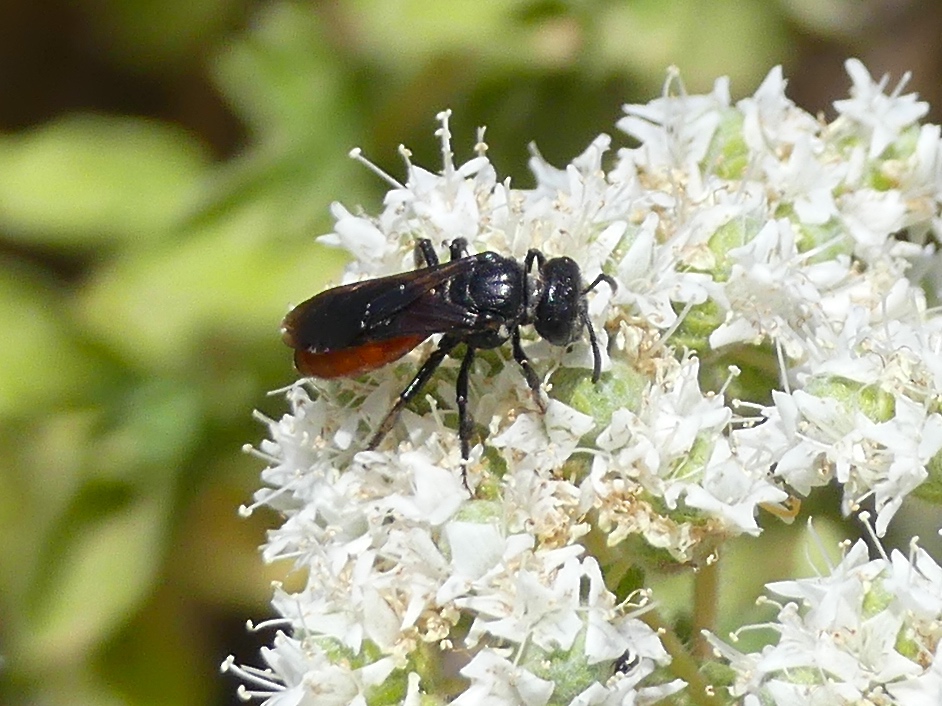
The females have shorter, slightly bent antennae.
Andrenidae
The family Andrenidae also belongs to the Short-tongued bees. They collect the pollen in the hairs of the legs and build their nests (usually solitary) in the ground.
Ashy mining bee, Andrena cineraria, L.
The genus Andrena (sand bees or solitary mining bees) is particularly large; microscopic examination is usually required for the precise identification of the species. Most species build their nests in the ground and provide pollen as food for the larvae.
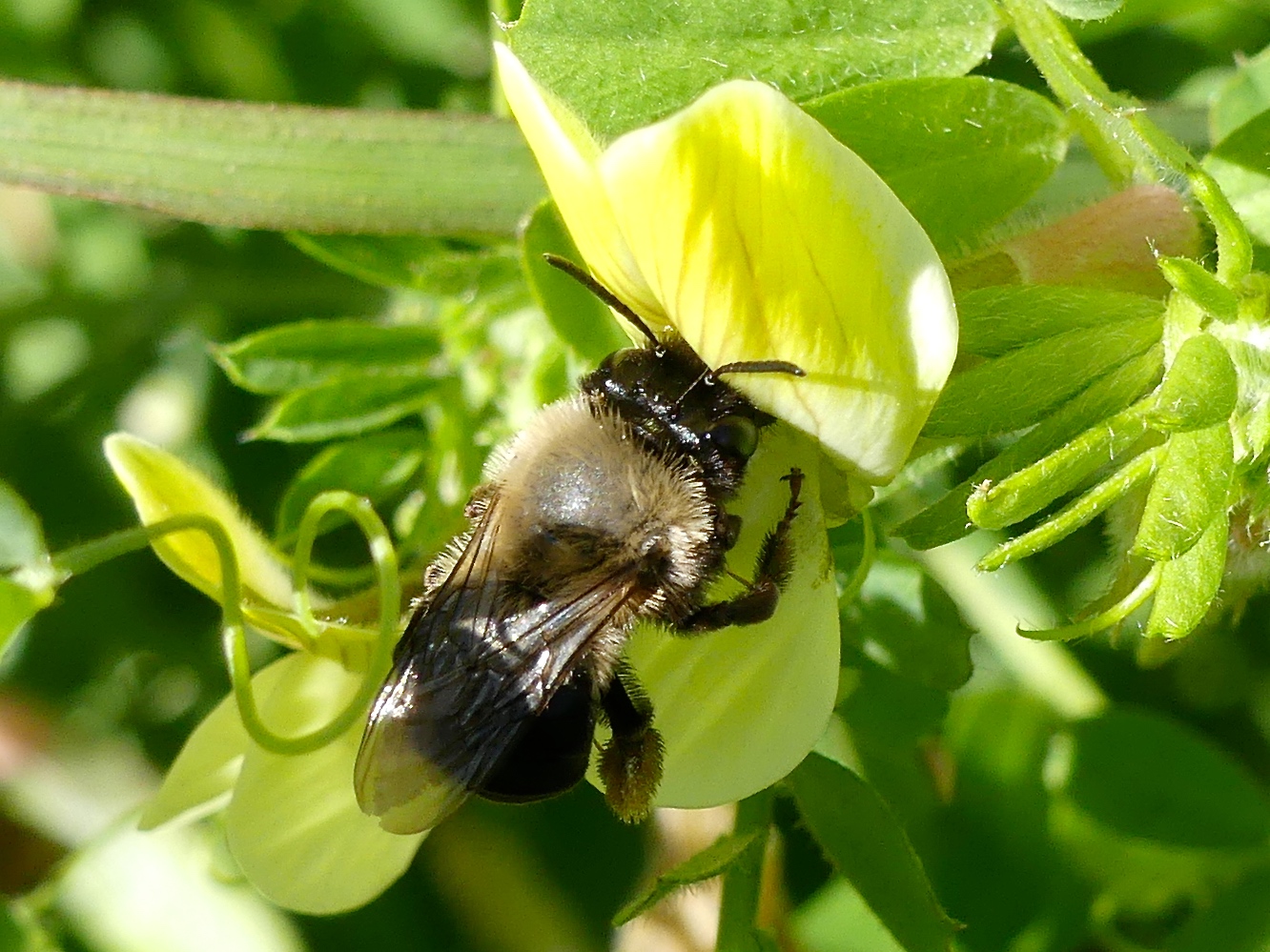
The Ashy mining bee is mostly black in colour, except for the hair on its thorax, which is whitish.
Andrena gravida ?, Imhoff

This species could be Andrena gravida or a similar species. The bands on the abdomen, the thorax and the “face” are covered in long, whitish hairs.

Here you can see the characteristic wing venation.
Andrena agilissima ?, Scopoli

This specimen probably belongs to the genus Andrena and might possibly be Andrena agilissima, although this species usually shows white hair on the head and thorax, though this is sometimes only faintly visible.

The entire body is black, with the exception of the brownish tuft on the hind legs. The wings are also distinctly black in colour.
Andrena spec.

This bee is very dark in colour with reddish-brown thoracic hair, a brown brush on the hind legs and dark brown-tinted wings. It resembles the northern species A. clarkella.
Plasterer bees, Colletidae
The family Colletidae comprises relatively primitive solitary bees that usually build their nests in the ground and collect pollen and nectar for their larvae. The pollen is not carried with the help of hairs, but in the crop.
Hylaeus variegatus, Fabricius
The Masked bees (genus Hylaeus) are characterised by a white facial mask, which is particularly well-developed in the males. Like the blood bees they also don’t look much like bees because they have no fur. The genus occurs worldwide with many species. Masked bees line the brood cells of their nests, which are built in soil or wood, with a cellophane-like glandular secretion. Hylaeus variegatus builds its nest within the old nests of other species of burrowing bees.

The small bee Hylaeus variegatus is mostly black in colour with a dark red anterior abdomen. The thorax bears a narrow white ring at the front and two small white spots below the flight joints.

Here you can see the white facial mask consisting of two pointed triangles.
2. Long-tongued bees
“True bees”, Apidae
Western honey bee, Apis mellifera, L.
The honeybee is perhaps the best-known insect. It is of great importance to humans not only as a source of honey, but also as a pollinator for many plants in agriculture. Economically speaking, it is the world’s most important livestock animal after cattle and pigs. Humans have probably been keeping bees for 7,000 years.
The genus Apis, the honey bees, comprises around 10 species, which are found primarily in Asia.

Honeybees are particularly fond of collecting nectar and pollen from Fabaceae. In our area, Trigonella balansae is one of their favourite food plants in spring. The bee carries the pollen in the pollen basket (corbicula), a pit on its hind leg surrounded by long hairs.

Here, the bee uses a special brush on its lower leg to gather the pollen that has been caught in the hairs on its legs and lower body, and pushes it into the pollen basket on the other lower leg.

The Italian subspecies of the bee (Apis mellifera ligustica), which also occurs on Naxos, can be recognised by the orange-coloured rings on the front of its abdomen.

Honeybee on a sunflower. A characteristic feature of the species is the wing venation with a very elongated cell near the wing tip on the outer edge of the wing.

Judging by the shape of its legs and the wing venation, this brown bee is also a small honeybee.
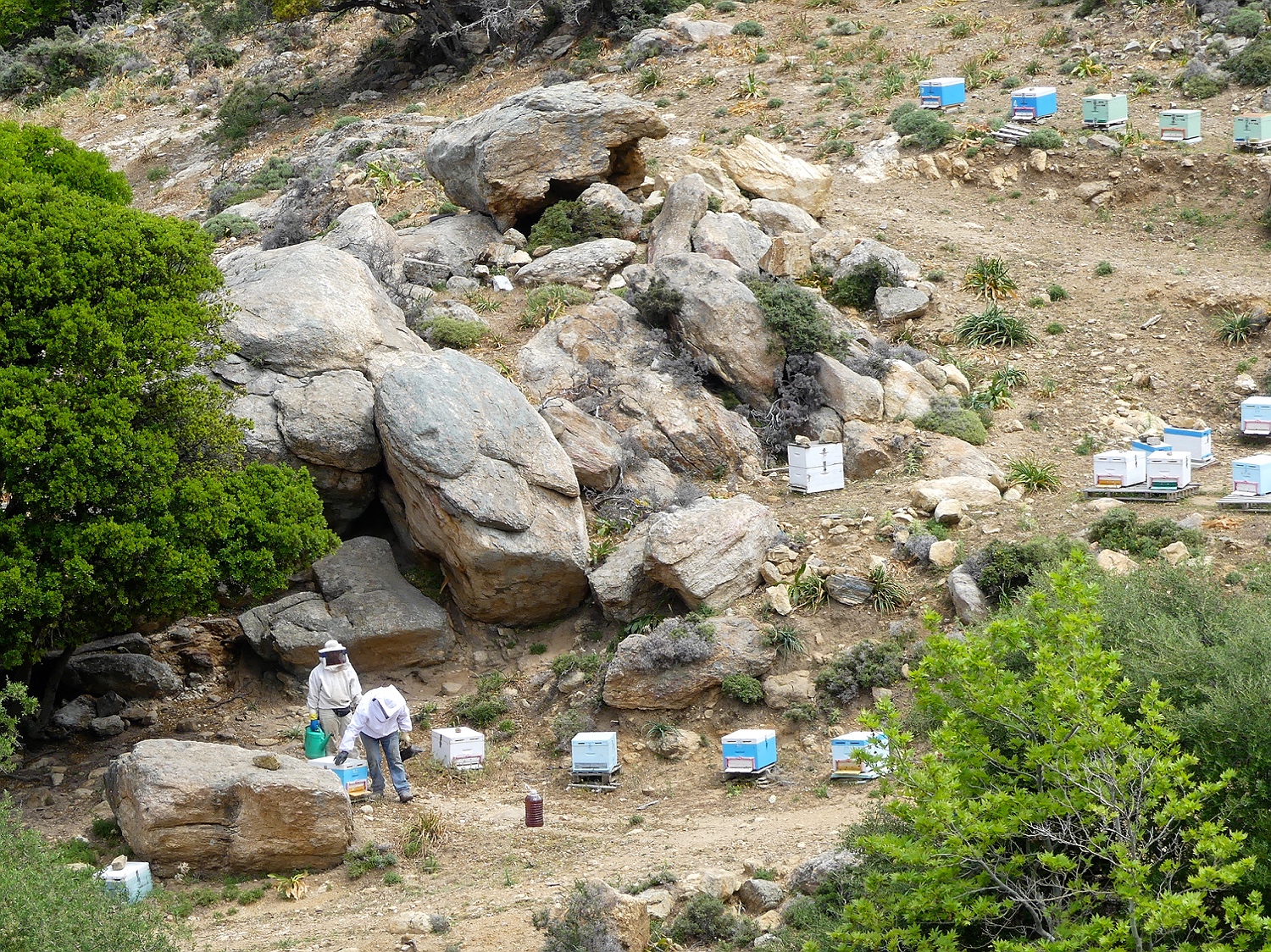
Honey of excellent quality is traditionally produced on Naxos, including both heather honey and the particularly popular thyme honey.


A beekeeper’s equipment and products in Kóronos

Traditional beehives with stone-built niches, in which the ceramic beehives were placed, near Monítsia
Eucera longicornis ?, L.
The Long-horned bees form a diverse genus, characterised by the males’ long antennae. They are solitary bees, but sometimes nest together in large colonies. The bees build nests with several cells in the ground, which are lined with wax and stocked with a paste of pollen and honey as food for the larvae. Long-horned bees mainly visit the flowers of Fabaceae. They are found in Europe and Asia and are particularly common in coastal areas.
In our garden, a species of long-horned bee, probably Eucera longicornis, is common in spring. At first glance, this bee resembles a normal honeybee; however, the male can be easily distinguished by its very long antennae. The body is dark in colour with light grey to brown hair.
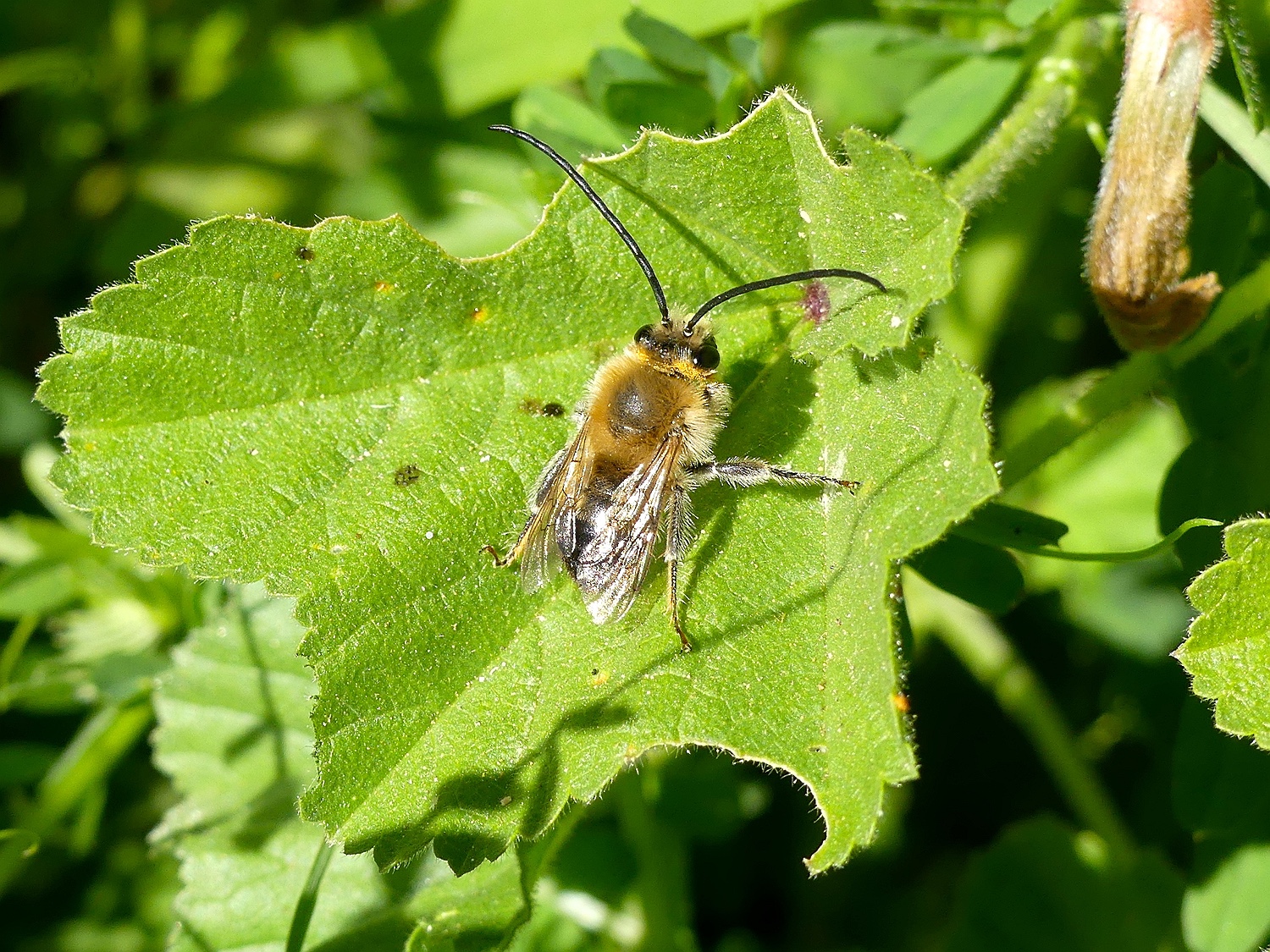
The males of the Long-horned bees have antennae that are about as long as their bodies. They appear in early spring, usually slightly earlier than the females.

This species is particularly fond of collecting pollen and nectar from species of Fabaceae. It pushes its head deep into the flower, causing the antennae to fold together.

Here you can see the long, thick proboscis. The bee’s deep black eyes are also visible.
Anthophora
The species of the genus Anthophora are furry, rather stocky solitary bees, but sometimes they build their nests together in large colonies. The genus Anthophora is one of the largest bee genera. These bees are remarkable agile flyers.
Green-eyed flower bee, Anthophora bimaculata ?, Panzer

The Green-eyed flower bee can be recognised by its greenish eyes and yellowish face. Its body is covered in thick, light brown hair. The abdomen has light-coloured hair fringes. In this photo one can see the long, straight proboscis of the bee.

Here you can see the abdomen with its distinct light brown bands of hair.

This species has a dense, light-coloured “brush” for collecting and transporting the pollen on its hind leg.
Anthophora nigrocincta (= A. canescens, A. subterranea), Lepeletier
I would like to express my sincere thanks to Prof. Hannes Paulus for the identification.
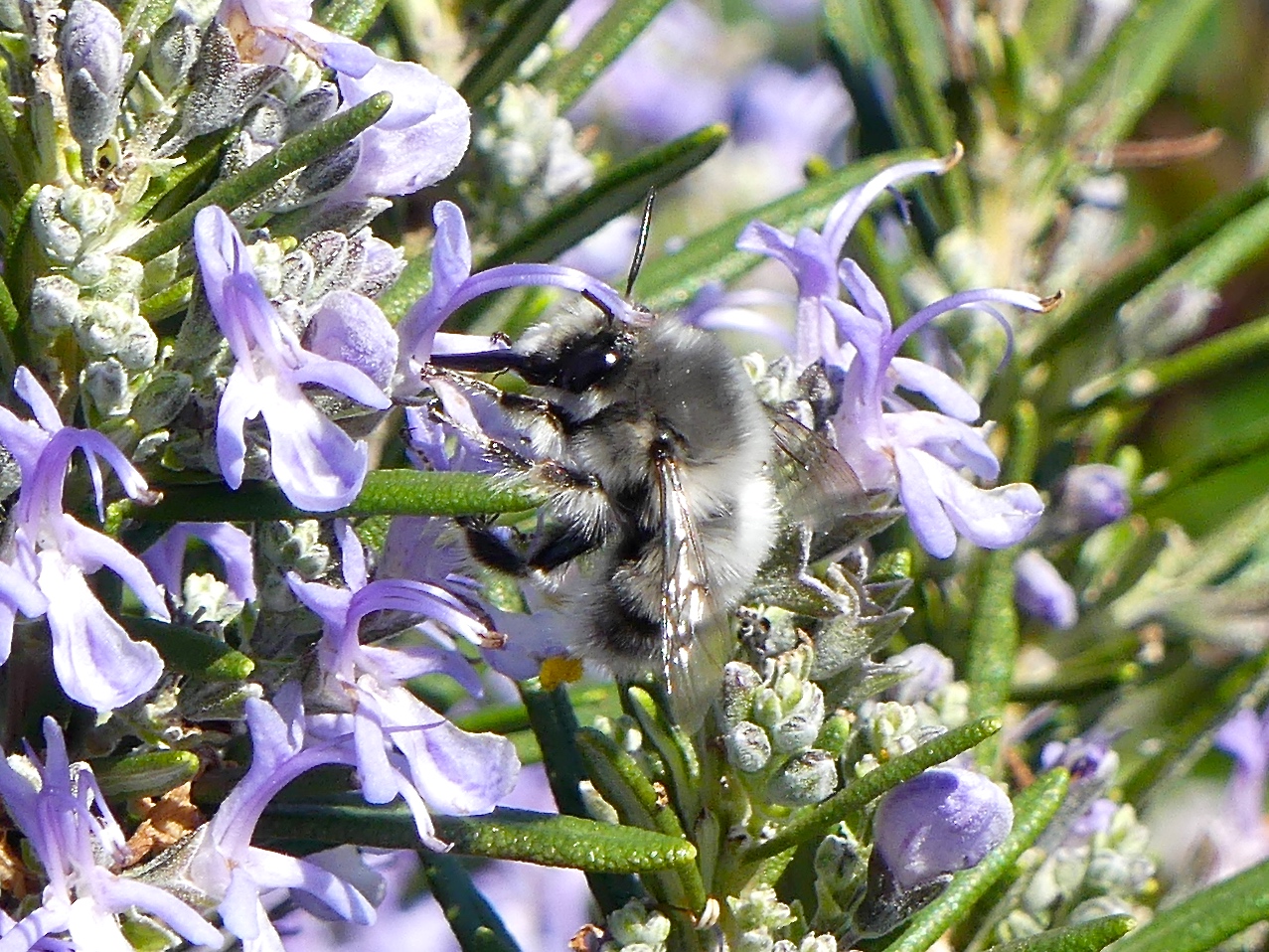
Bees of the genus Anthophora are distinguished by their particularly dense and long fur. Anthophora nigrocincta is light grey in colour with dark rings at the end of the abdomen.

Anthophora nigrocincta is a solitary bee that can be found on fine days even in winter. As it approaches the flower, its long proboscis is visible.
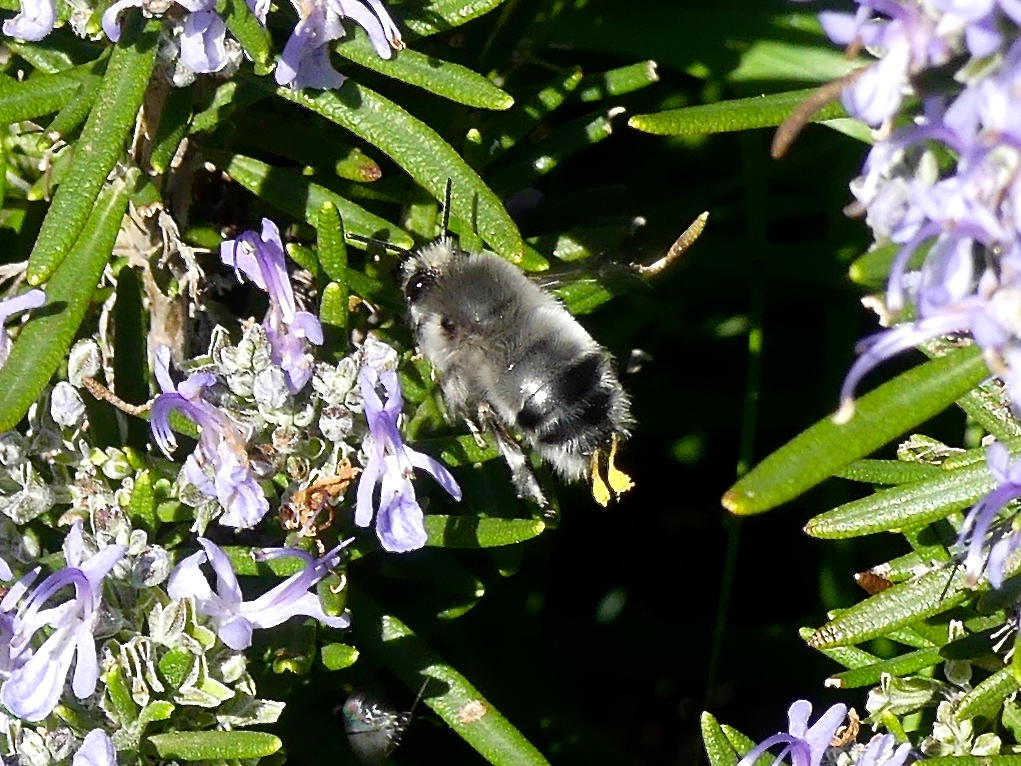
This specimen is a male. At the tip of the abdomen, two pollinia from the orchid species Ophrys basilissa can be seen. The flower mimics a female of this species, causing the male to attempt to copulate with it. In the process, the pollinia from the orchid flower are attached to the male.
The early-winter-flowering orchid species Ophrys basilissa is pollinated exclusively by the males of Anthophora nigrocincta. The flowers mimic the females of this species in shape, colour and markings; even if they do not necessarily look similar to our eyes, they do display the key characteristics that the male uses for recognition (e.g. hairiness, markings visible under UV light, and scent).
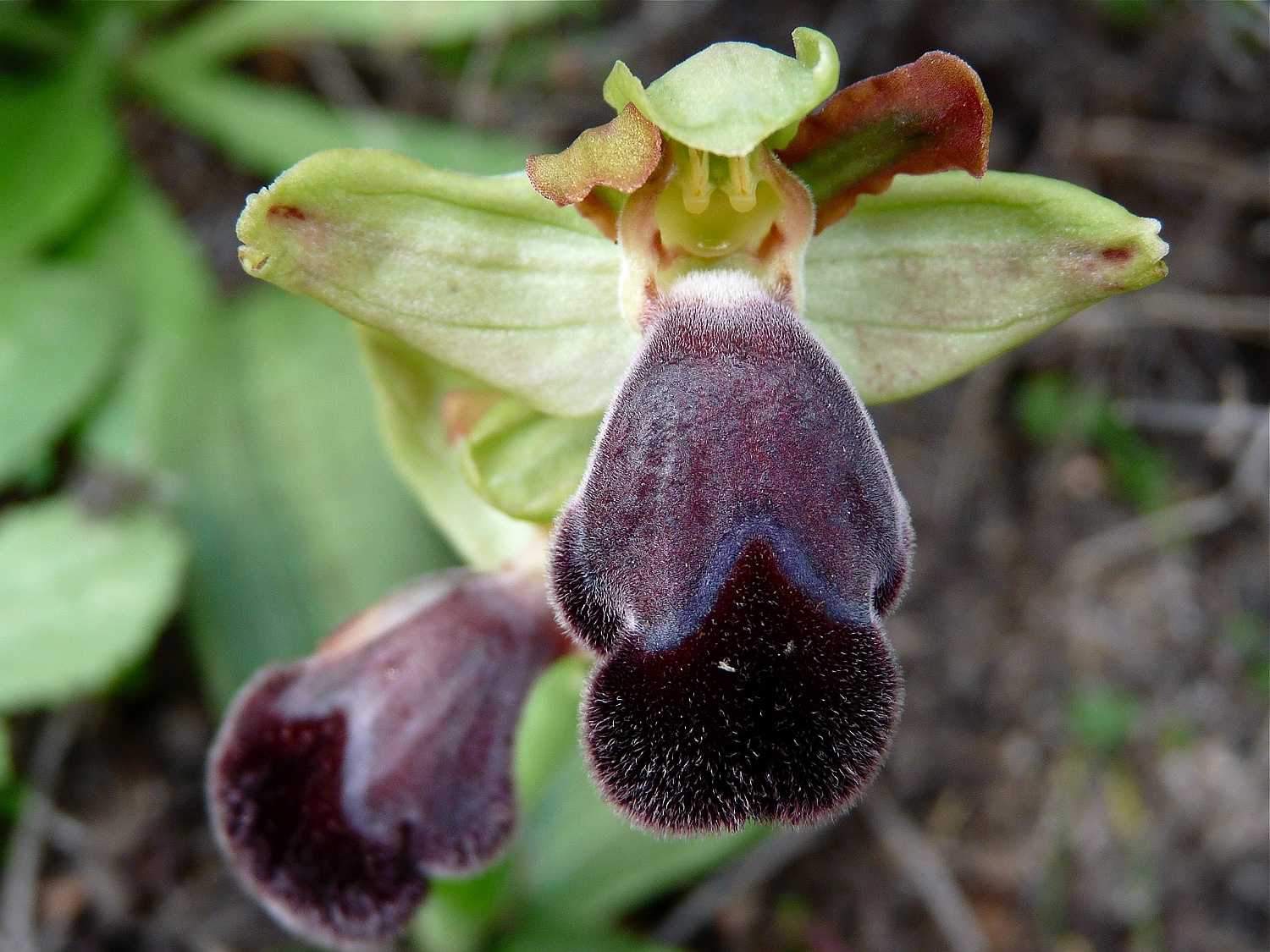
Ophrys basilissa; at the top of the flower, hidden beneath the uppermost, helmet-shaped sepal, one can see the stigma to which the pollinia are attached. In this species, the pollinia are attached to the pollinator’s abdomen, i.e. the male bee lands on the flower with its head pointing downwards.
Hairy-footed flower bee, Anthophora plumipes ?, Pallas

This bee is probably a Hairy-footed flower bee. Note how worn the wings are! The typical wing venation of the genus Anthophora is also visible.

This bee has particularly long hairs on its hind legs, which serve to store and transport pollen.

This small grey bee with black eyes and a distinct reddish hair brush on its hind leg could also be a pale female of Anthophora plumipes.
Anthophora retusa ?, L.
Early in winter, a small, reddish-brown species of Anthophora is very common in our area. Based on the combination of characteristics, particularly the hair on the legs and eye colour, this could be a pale colour variant of Anthophora retusa.

Bees of the genus Anthophora have fringes or brushes of hair on their legs, which vary in shape and are partly used for transporting pollen. This species has a rounded-looking black fringe on the tibia of the middle leg, as well as long, light-coloured hairs on tibia and femur.

The eyes of this species are greenish; as with many Anthophora, the face is patterned in black and yellow beneath the light-coloured hair.

Presumably the same bee species also occurs with light beige fur. It displays the same type of hair on the leg.
Anthophora ?

This bee, which probably also belongs to the genus Anthophora, builds underground nests in a large colonies, here in the floor of an old church.

On the left-hand nest, you can see that the interior of the pit is lined with wax.

Here you can see the neat, round entrances to the nests.
Digger bees, Amegilla
The genus Amegilla is closely related to Anthophora; the species presented here are often placed in the genus Anthophora.
Amegilla albigena ?, Lepeletier

This small, compact bee with a conspicuously striped abdomen can frequently be seen in our garden in summer, collecting nectar and pollen from flowers. It could be Amegilla albigena (= Anthophora albigena).
White-banded digger bee, Amegilla quadrifasciata, Villers

This species looks similar to the previous one; however, it is significantly larger, as can be seen when compared with the plant it fees on (Ballota acetabularia). It is probably Amegilla quadrifasciata.
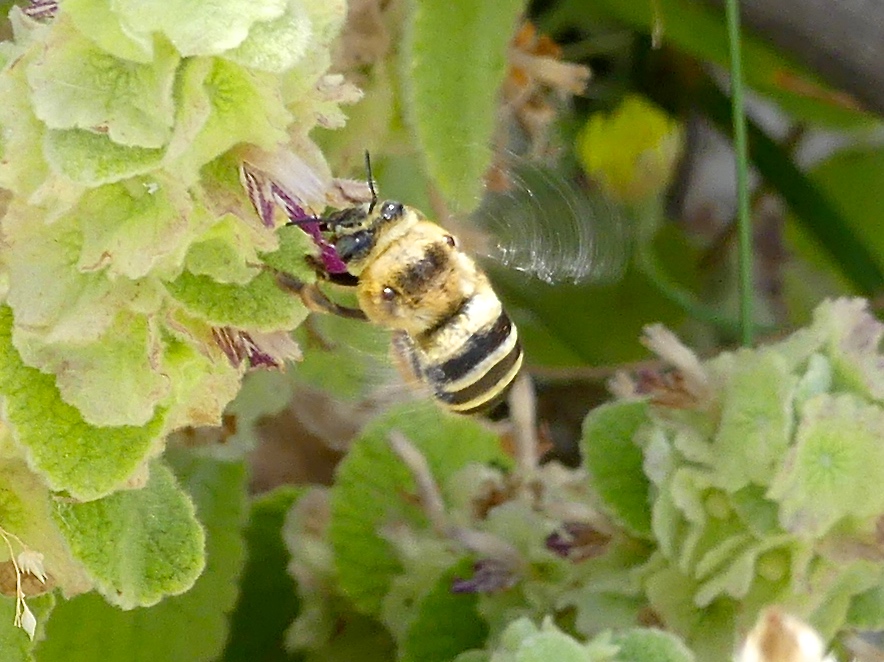


From the front, you can see the typical white facial markings of the species.

Here, the wing venation is also visible.
Mourning bees, Melecta
The predominantly black mourning bees (genus Melecta) act as ‘cuckoo bees’, parasitising bees of the genus Anthophora. The females lay their eggs in the hosts’ nests. The mourning bee larva, which hatches first, feeds on the host’s food stores, whilst the larva of the host bee dies or is also eaten. In this way, the cuckoo bees can seriously diminish the species they parasitise in some years, whereupon the cuckoo bee population also declines until the host species has recovered. The adult bees feed on nectar. The mourning bees are active in late winter and early spring, just like their host species of the genus Anthophora.
Square-spotted mourning bee, Melecta luctuosa, Scopoli
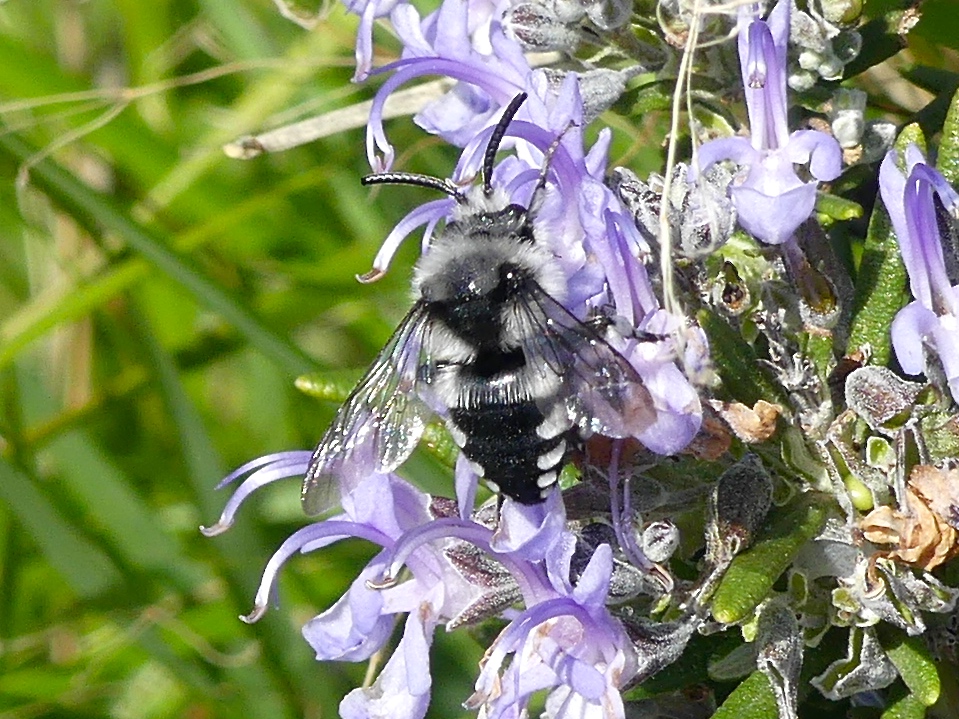
The Square-spotted mourning bee is black in colour with distinctive white markings on the sides of its body and on its legs. The thorax is partly covered in light grey hairs, as is the first abdominal segment.

It also has tufts of white hair on the legs.
Melecta duodecimmaculata, Rossi
Melecta duodecimmaculata is very similar to the Square-spotted mourning bee, but has more tufts of white hair.


Melecta duodecimmaculata carries two white tufts of hair on each side of the front two abdominal segments, making a total of 12 tufts.
Thyreus spec.
The cuckoo bees of the genus Thyreus look very similar to the mourning bees and have a similar biology. They differ in having less hair and in the fact that they bear white tufts of hair also on the scutellum. There are numerous species, but identification is very difficult. In our region, these bees can be found in small numbers in autumn, when they forage on flowers alongside their hosts, such as Amegilla quadrifasciata.


This bee of the genus Thyreus is black with white spots on the sides of its body. It also carries white spots on its thorax and scutellum.
Bumblebees, Bombus
Bumblebees (genus Bombus) comprise around 250 species and are found primarily in the cooler regions of the Northern Hemisphere. They are usually quite large and thick and are covered in dense hair all over their bodies. They live in large societies with labour division.
Large earth bumblebee, Bombus terrestris, L.
The Large earth bumblebee is a particularly efficient pollinator of many crops. For this reason, it is now used worldwide as a pollinator in greenhouses, where artificial nests are installed; more than a million of these are produced annually. Bumblebees sometimes escape from greenhouses and have established themselves in many parts of the world where they do not naturally occur, often displacing native bumblebee species or other pollinators. Large earth bumblebees usually build their nests deep underground in abandoned mouse nests or mole tunnels. This enables them to survive the winter.

The Large earth bumblebee is one of the most common bumblebee species. It can be recognised by its two yellow stripes and the white tip of its abdomen; the rest of its body is almost black.
Carpenter bees, Xylocopa
Carpenter bees build their nests in dead wood; in our region, mainly in reeds, which are often used as windbreaks or sunshades. The carpenter bee gnaws brood cells into the reed and constructs partitions from wood pulp mixed with saliva. Both the adults and the larvae feed on pollen and nectar.
Violet carpenter bee, Xylocopa violacea, L.
The Violet carpenter bees are among the largest bees, with a body length of up to almost 3 cm. They are entirely black in colour; their wings have a violet sheen. Despite its impressive size, the carpenter bee is not very aggressive and stings only very rarely.

The very large, black Violet carpenter bee has slightly bent antennae. The males of this species can be recognised by a brownish ring just below the tip of the antennae.

Due to its size, the Violet carpenter bee is unmistakable. It is one of the largest hymenoptera in our region.

Its wings shine with a violet-black sheen. Quite often many mites are sitting on the backs of carpenter bees.
Mason bees, Megachilidae
The family of mason bees and leafcutter (Megachilidae) comprises around 4,000 species. These bees usually construct brood cells in the ground or in plants, with many species using pieces of leaves (“leafcutter bees”); some species, however, construct their nests using clay, and a few species lay their eggs as brood parasites in the nests of other bee species. In the females, the underside of their abdomen is covered with long hairs, which they use to collect the pollen they provide as food for their larvae.
Leafcutter bees, Megachile spec.
The leafcutter bees use pieces of leaves for the building of the brood cells in their underground nests: they construct the walls of the cells from rolled-up leaves and seal the cells with small pieces of leaf. The cell are supplied with pollen as food for the larvae. The leaf fragments presumably prevent the pollen from drying out. Leafcutter bees are particularly fond of rose leaves, from which they skilfully cut out round pieces that they roll up and carry to the nest. The genus Megachile comprises over 1,500 species. Unfortunately – as with most bees – the identification of the species is difficult.

Female leafcutter bees use pieces of leaves, particularly rose leaves, to build their brood cells. Our species has broad, conspicuous white stripes on the abdomen and dense, light-coloured hair on the thorax and head; the underside of the abdomen is of a vivid orange.


The bee cuts out a piece of leaf in a circular motion using the mandibles.

The bee then flies away carrying its piece of leaf, holding it rolled up between its legs.
Megachile pilidens ?, Alfken
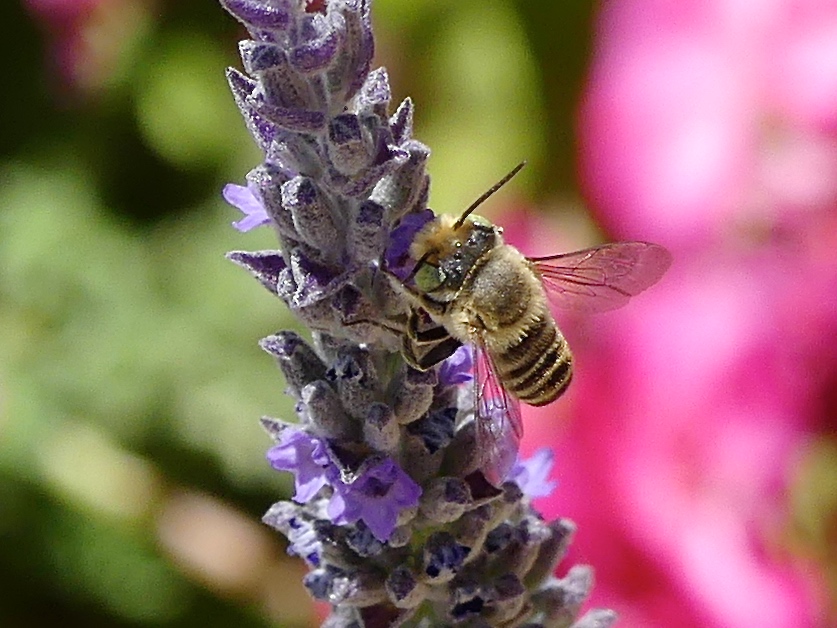
This small grey-brown bee could belong to the leafcutter bee species Megachile pilidens.

Here you can see its greenish eyes.
Megachile parietina, Geoffroy
In Megachile parietina, the females are entirely black in colour; even the wings have a dark hue. The males, on the other hand, are covered with brown and orange hair. Megachile parietina builds its nests using clay and small stones. The several brood cells are supplied with pollen and nectar as food for the larvae. The bee collects pollen mainly from species of Fabaceae and Lamiaceae.

Megachile parietina is quite large and entirely black in colour; its wings are also dark. This specimen has grey hairs along the front edge of the thorax.

Here you can see the wing venation.

A female sits at the entrance to its clay nest.

Here, the bee is smoothing the inside of the newly built cells. It stayed in the brood cell like this for many minutes, working very carefully.

In this nest, the two chambers on the left are already finished and sealed, whilst the one on the right is still under construction. You can see the small stones that the mason bee uses.

And this is what the nest looks like the following year, when the young bees have emerged.

This is probably also a nest of Megachile parietina.

Here a male – males are much rarer to be seen. I would like to thank Cosmas Apergyis for the identification.

The males are very colourful: the thorax is light brown, the anterior abdomen reddish-brown, the tip of the abdomen is black, and the hairs on the underside of the thorax are white.
Megachile melanopyga ?, Costa
This small leafcutter bee probably belongs to the species Megachile melanopyga, a species widespread in southern Europe. Like all leafcutter bees of the family Megachilidae, it holds its abdomen in a characteristic manner, slightly arched upwards. The species can be identified by its yellow-brown hair.

The leafcutter bee Megachile melanopyga can be observed in autumn, particularly on Asteraceae. It is yellow-brown in colour and, at first glance, resembles a honeybee, but can be recognised by the way its holds its abdomen curved slightly upwards.

Like all leafcutter bees, this species collects pollen in the dense hairs on the underside of its abdomen.
Coelioxys argentea, Lepeletier
Some species of the family Megachilidae live as cuckoo bees, that is they do not build their own nests, but lay their eggs in the nests of other bee species, often those of their closest relatives, i.e. leafcutter and mason bees. The larva feeds on the pollen stores in the nest and also eats the host egg or larva. Female bees of the genus Coelioxys have a conical, tapered abdomen. The males carry 6 to 9 small spines at the tip of their abdomen. The genus comprises numerous species, which are difficult to identify. Judging by its light colouring, our specimens could belong to Coelioxys argentea.
I would like to thank the dedicated insect enthusiasts on the Facebook page ‘Insects of Greece and Cyprus’ for helping me identify this and other species.

The males of the cuckoo bees of the genus Coelioxys carry small spines on their abdomen. The eyes are brownish-grey with fine speckles.

In this species, the abdomen is predominantly silver-grey in colour with characteristically shaped dark stripes.
Carder bees, Rhodanthidium and Anthidium, Latreille
A large genus within the Megachilidae is the genus Anthidium, which with some related genera such as Rhodanthidium forms the tribe Anthidiini.
Rhodanthidium septemdentatum, Latreille
All carder bees display striking, almost wasp-like yellow stripes on the abdomen, which are only visible in flight. The wings, which cover the abdomen when the bee is sitting down, are dark in colour. The large thorax is also dark. The males of many carder bee species carry spines at the tip of their abdomen, which they use to ward off competitors by attacking them in flight. They are territorial and fiercely defend their area against other bees. Consequently, unlike most bee species, the males of carder bees, with over 1.5 cm in body length are significantly larger than the females, which reach only just over 1 cm. The females prefer territories with a good supply of flowers. They are usually approached by the males for mating whilst they collect pollen from the flowers. This gives the males, who defend large, flower-rich territories, a better chance of reproducing.
The carder bees feed on pollen and nectar, primarily from Lamiaceae. Like many related species, they engage in elaborate nest-building. The female constructs small brood chambers from plant hairs in natural cavities in the soil, sometimes incorporating clay, leaves or resin. It lays one egg in each cell. The bee collects “wool” from the hairy leaves and stems of her food plants by gnawing off the hairs with her mandibles and shaping them into a ball, which she carries back to the nest. The interior of the cells is treated with the sap of certain plants, such as Crepis, which the bee collects using special hairs on her legs; this coating is believed to have an antibiotic and water-repellent effect. Finally, the female stocks the cells with pollen for the larvae.

When sitting, Rhodanthidium septemdentatum, like all carder bees, appears to be uniformly dark; the wings are also dark.

In flight, the markings on the abdomen are visible, with white-yellow stripes interrupted in the middle by a black longitudinal stripe. Viewed from below, the abdomen is pale yellow, the legs are orange-yellow and the thorax is uniformly dark with pale hair.

Here another specimen.
Anthidium loti, Perris

This carder bee from the genus Anthidium has interrupted pale yellow stripes on its abdomen.

Here the same individual from the side; one can see several yellow spots and stripes on its thorax and head and the yellow legs. It is probably Anthidium loti.
Rotund resin bees, Anthidiellum
The very small bees of the genus Anthidiellum (Rotund resin bees) build nests from tree resin, that hang suspended from stones, stems or trees. They stock them with pollen, which they collect in the dense hair on the underside of their abdomen. Identification of the many is very difficult.
Anthidiellum strigatum ?, Panzer

This bee is very small; its body appears very short.

It has yellow stripes on its head and thorax.

The abdomen of this individual is more yellow than is usual for Anthidiellum strigatum; it may be a related species.
Mason bee, Osmia or Hoplitis
The members of the very similar genera Osmia and Hoplitis are known as mason bees. Mason bees build their nests in small cavities, in sandy soil or in empty snail shells, using clay or, less commonly, chewed plant material. They bring pollen into the nests for their larvae. They live solitarily, but often form small colonies.
I would like to thank the forum of the website Entomologie.de for identifying this species.

This small species of mason bee probably belongs to the genus Osmia. It is covered with a fur of long hairs, particularly on the front of the head and the sides of the thorax. Note the spherical wing joint.
3. Melittidae
The Melittidae are a small family of bees comprising around 200 species, distinct from both the long-tongued and short-tongued bees. They nest in the ground and are often specialised on specific food plants, from which they collect pollen using very long hairs on their legs (leg-collectors). They are found in Eurasia and southern Africa.
Pantaloon bee, Dasypoda hirtipes ?, Fabricius
The pantaloon bees have very long hair brushes on their hind legs, in which the pollen becomes trapped, enabling them to collect and transport astonishingly large quantities of pollen. The body is densely hairy and features white bands at the ends of the abdominal segments. Pantaloon bees collect their pollen mostly from composite flowers. The nests are built in sand or loose soil, into which the female digs a tunnel up to 0.5 metres long, from which the round brood cells branch off. It deposits pollen in the brood cells, mixing it with nectar to form a ball standing on three small legs, onto which she lays one egg each. The cell is then sealed.

Pantaloon bees often collect pollen for their nests from Asteraceae. You can see the hind legs laden with pollen.

This is probably also a pantaloon bee.


In spring, the pantaloon bees are busy in our garden. In this picture, you can see that they do not have long probosces like the bees of the genera Anthophora and Amegilla.

Here you can see the small vertical entrance to the nest that the bee digs into the ground.

The bee collects pollen as food for the larvae, which it carries using its long-haired hind legs.

Here, the bee laden with pollen disappears into its nest.
continue: Flies
back:
see also: