
Wasps
Wasp are fascinating insects. Together with bees, they form the diverse order of the Hymenoptera, which, with over 150,000 species, is one of the largest groups of insects.
Here you can skip the introduction and go directly to the species.
The Hymenoptera include many ecologically very important species, such as the bees, which are indispensable as pollinators, the ants, which have a significant influence on the face of the earth through their decomposing and burrowing activities as well as through the dispersal of seeds, and the wasps, many of which play an important role in ecosystems as parasites of other insect species.
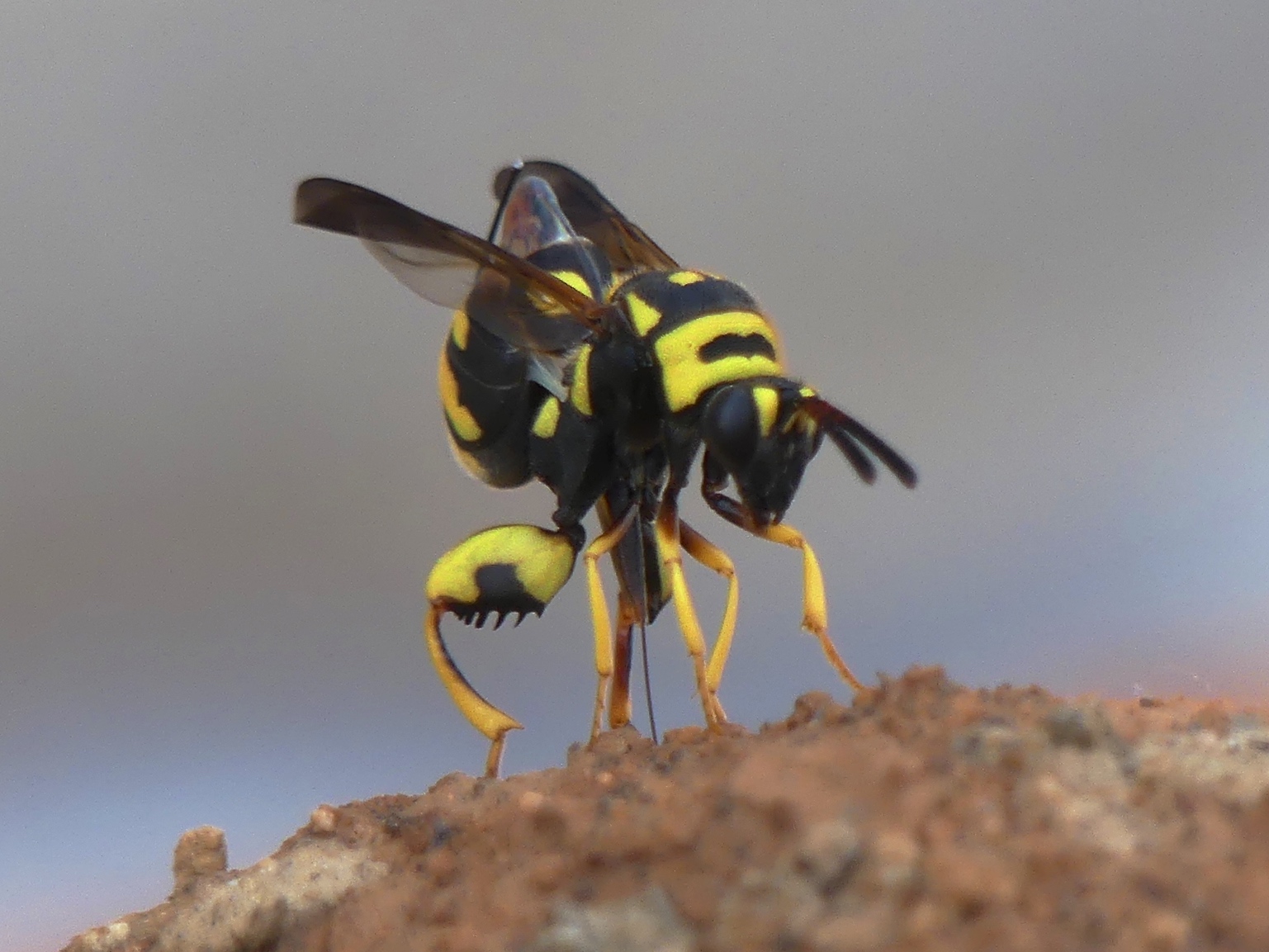
The larvae of the wasp Leucospis gigas parasitise in mason bee nests. It is no easy task for the female wasp to pierce the hard wall of the clay nest to lay its eggs inside.
Many Hymenoptera (primarily bees and ants, but also some wasps) display a highly developed and organised social life, ranging from the division of labour and the organised cultivation of fungi to slavery and parasitism within other insect colonies – a fascinating world of wonders! Apart from these social species, numerous solitary species exist, many of which also take elaborate care of their larvae by building sophisticated nests in which they store suitable food – some species dig the nests underground or lay the eggs on or in plants, while other species build beautiful clay nests.
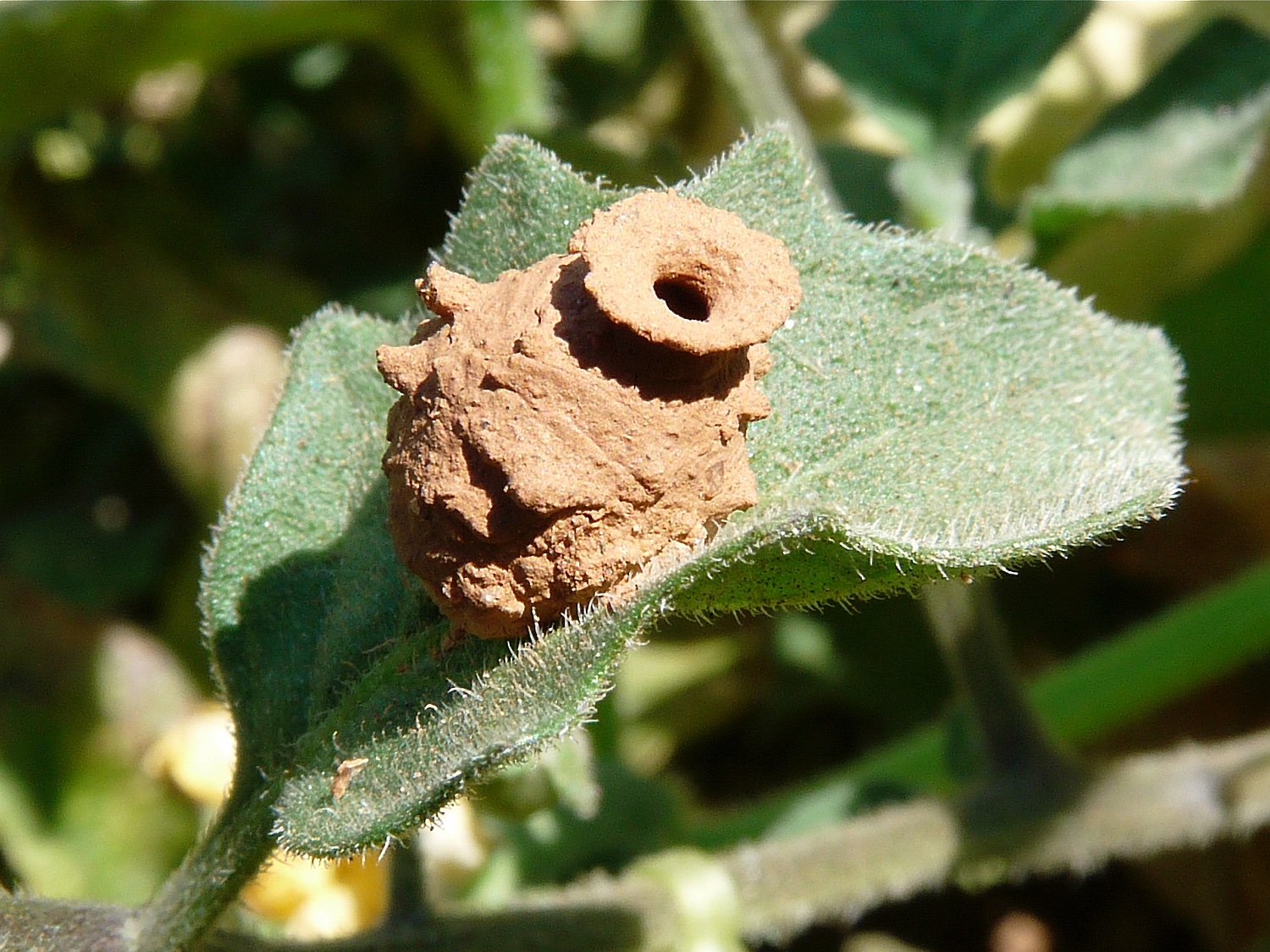
Some potter wasps build very pretty clay urns for their larvae.
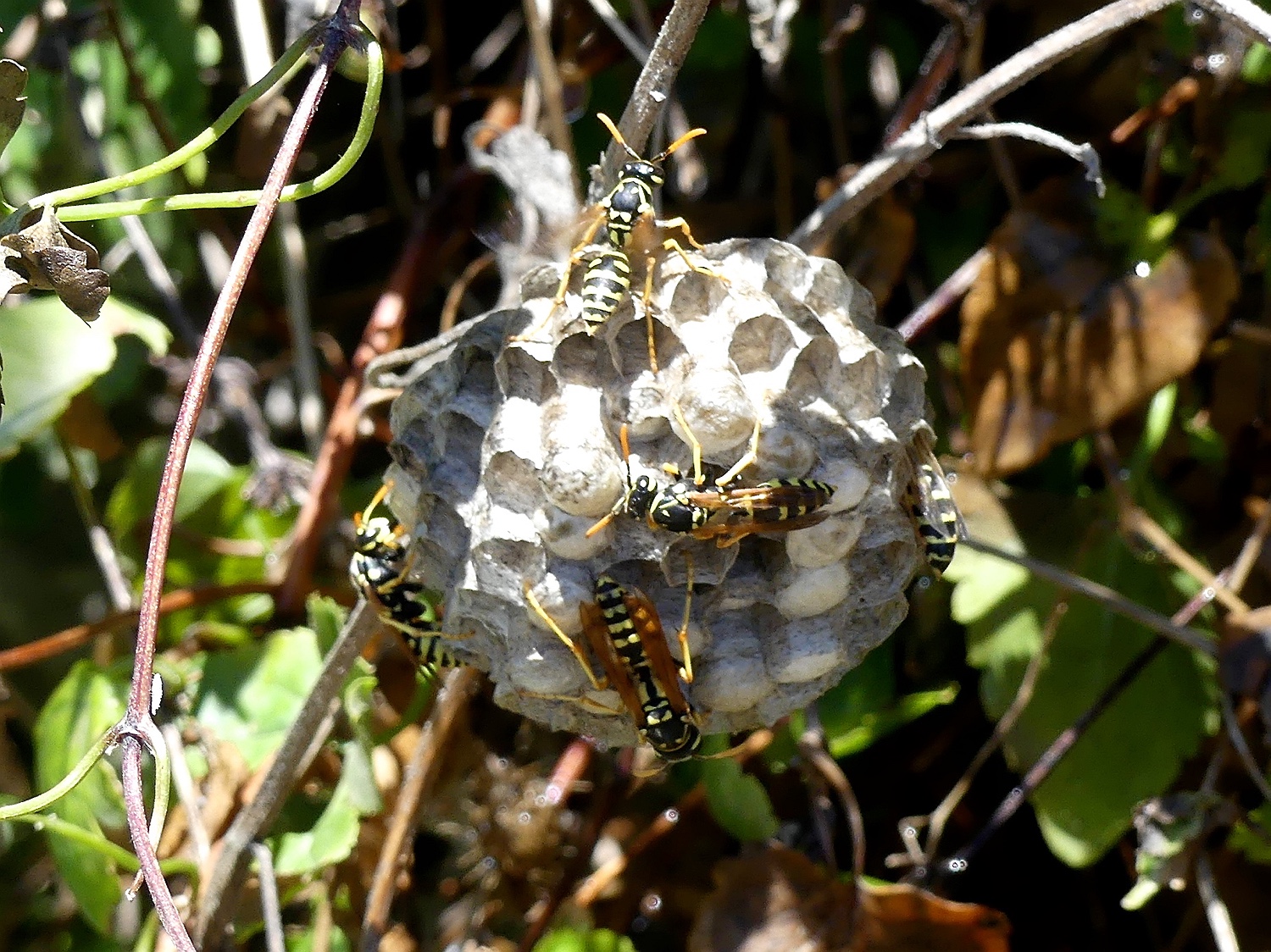
The European paper wasp belongs to the social wasps; here you can see the wasps on the nest, which is built from wood pulp.
The Hymenoptera are divided into the Symphyta (sawflies and wood wasps) and the Apocrita, which display the characteristic slender “waist” of the wasps. The Apocrita comprise many different superfamilies such as the Ichneumonoidea, the Chalcidoidea, the Chrysidoidea, the Vespoidea, the Formicoidea (ants), the Pompiloidea and finally the Apoidea (bees and some related groups of wasps).
In the following, I present some of the wasp species found on Naxos. The bees are presented on a separate page.
Wasp-species on Naxos
Wasps on Naxos
The Photo gallery of the flies, wasps and bees gives an overview over the species.
A note on identification: Wasps are in general particularly difficult to identify. In most cases, many very similar species exist, and a correct identification is possible only by the microscopic examination of dead specimens. In many cases, from a photo alone one cannot even determine the genus. I present here some of the species found in our region, identifying them as best I can; however, I am not a specialist and (as always) cannot guarantee the accuracy of the identifications. I would like to thank the forum of the website Entomologie.de and the dedicated members of the Facebook-group “Insects of Greece and Cyprus” for the identification of several specimens.
Here you can jump directly to the larger groups within the wasps (return with the back arrow or by swiping back):
Sawflies, Symphyta – Ichneumon wasps, Ichneumonidae – Gasteruptiidae – Leucospidae and Chalcididae – Emerald wasps, Chrysididae – “True wasps”, Vespidae – Potter wasps, Eumeninae – Scoliidae – Velvet ants, Mutillidae – Spider wasps, Pompilidae – Sphecidae – Crabronidae and Bembicidae – Philanthidae and Astatidae
Sawflies, Symphyta
The sawflies and wood wasps (suborder Symphyta) differ from the wasps in the suborder Apocrita in that they lack the typical slender “wasp waist”.
Argidae
The argid sawflies are found mainly in the tropical regions. The family comprises around 900 species, most of which are small and inconspicuous, and consequently little known. The adults feed on nectar or don’t take any food at all. They are not particularly good flyers and usually do not stray far from their host plant. The larvae of Argid sawflies resemble butterfly caterpillars and feed on plant leaves. Many species are restricted to a single host plant species. Sawflies cannot sting; the larvae, which usually sit freely on the leaves, protect themselves with toxins. When disturbed, they assume an S-shaped defensive posture. Some species can cause a certain amount of damage in agriculture.
Subfamily Sterictiphorinae
Members of the subfamily Sterictiphorinae are recognisable by the antennae of the males which are bifurcated like a tuning fork. Only a few species occur in Europe, and these have been little studied.
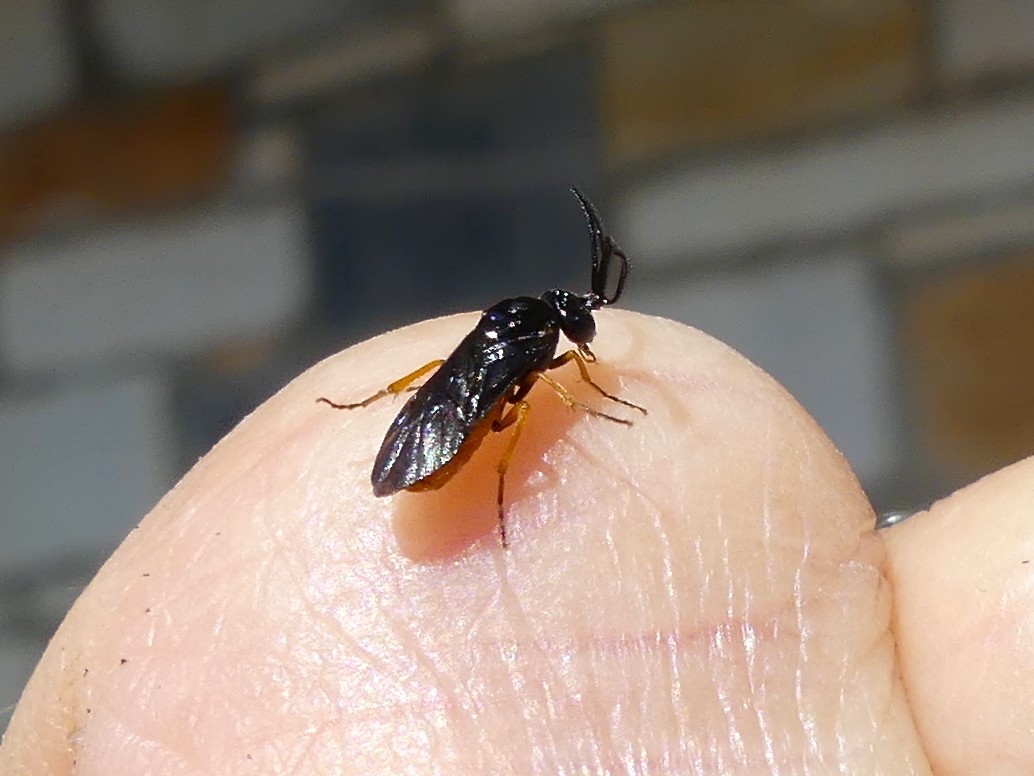
I found this small sawfly sitting on our window pane.
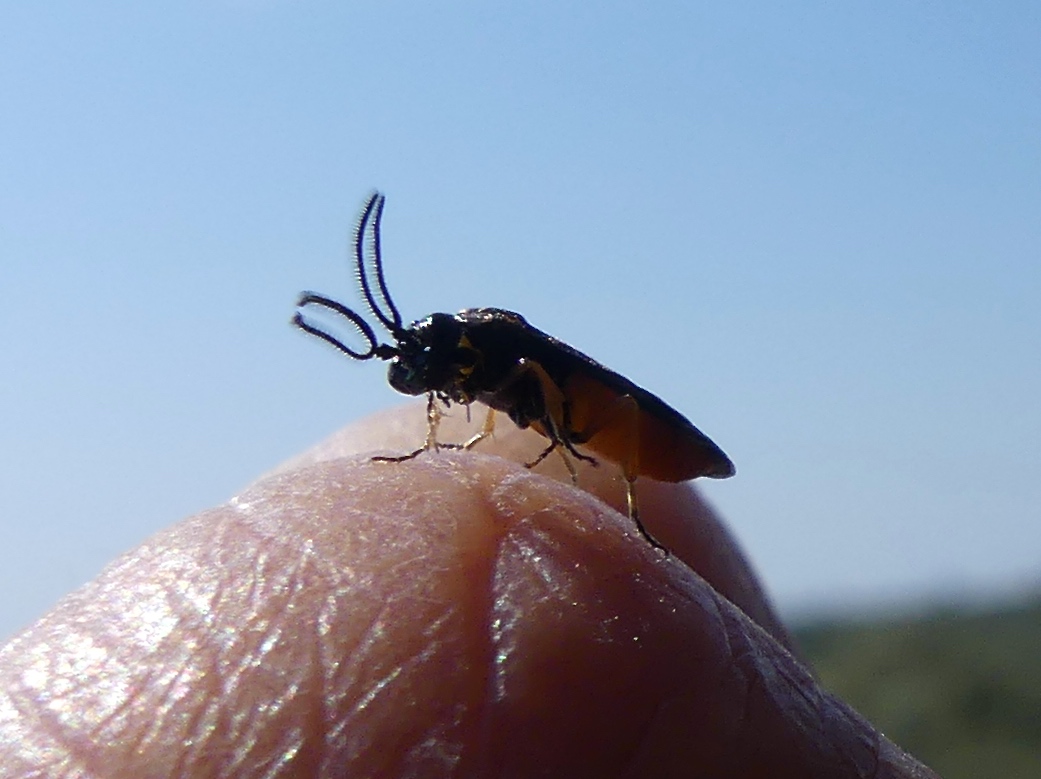
As shown by its antennae, which are bifurcated like a tuning fork, it is a male from the subfamily Sterictiphorinae.
Apocrita
Superfamily Ichneumonidea
Ichneumonidae
The Ichneumon wasps are the largest family of the Hymenoptera. All species are parasitic, that is their larvae live on other insects or spiders. Ichneumon wasps often occur in large numbers and thus keep the populations of their hosts under control. Consequently, they are frequently used in biological pest control. They are usually very slender with long legs. The females possess a conspicuous, long ovipositor, which they use to lay their eggs on the larvae or eggs of the host species. They are capable of piercing through thick wood or other material to do so.
Ophion spec.
The species of the genus Ophion, which is mainly found in temperate regions, are often comparatively large, with their body length reaching about 2 cm. They are mostly nocturnal and possess large ocelli (three simple eyes on the forehead between the compound eyes). The adults feed on nectar; the larvae parasitise butterfly caterpillars.
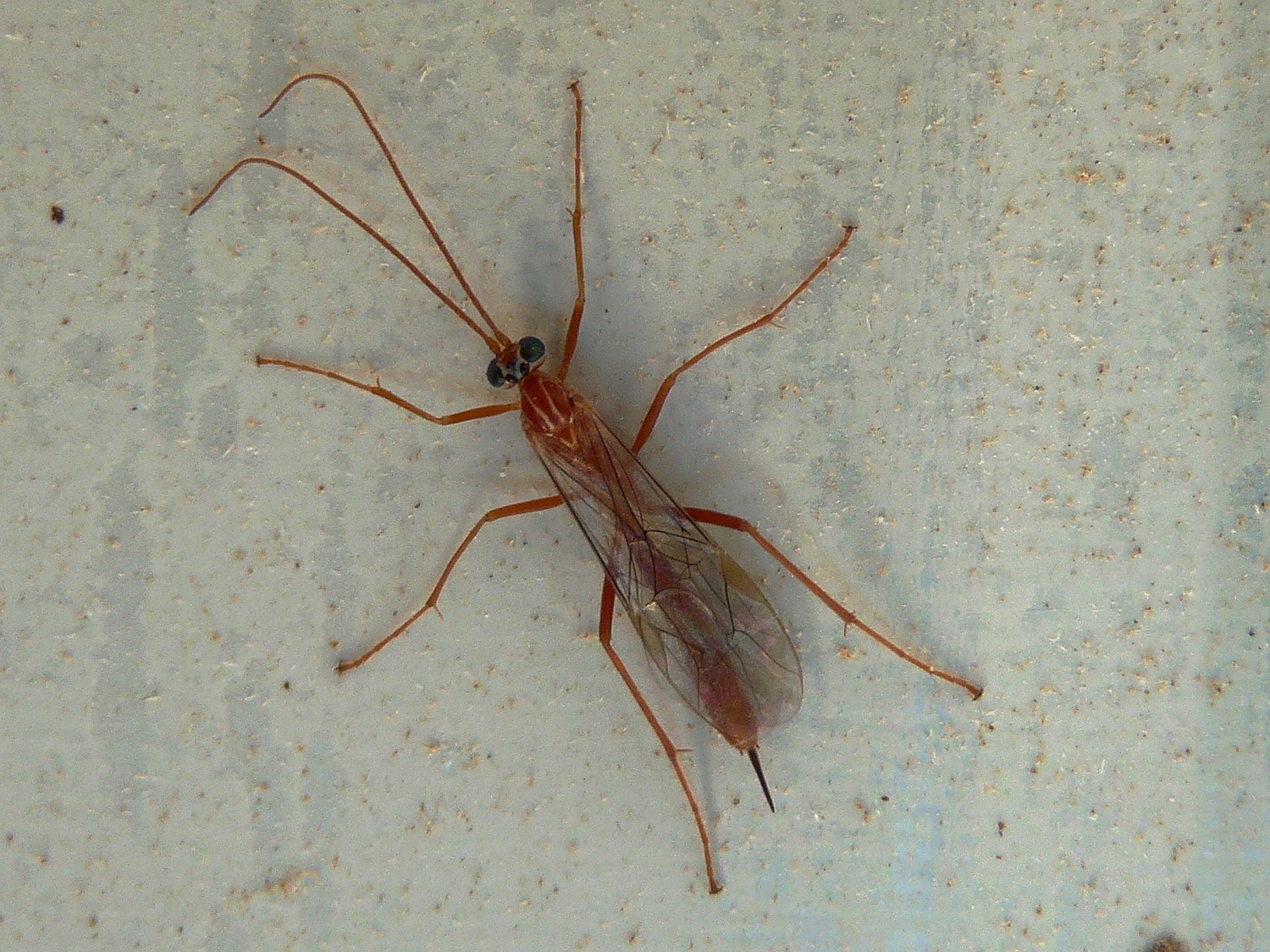
This wasp belongs to the genus Ophion. It has a rather short ovipositor, which can also be used for defence (rather unusual in Ichneumon wasps).
Amblyteles armatorius, Forster
Amblyteles armatorius mimics the black-and-yellow colouring of stinging wasp species such as the German wasp, though itself cannot sting. It lays its eggs in the caterpillars of moth species.
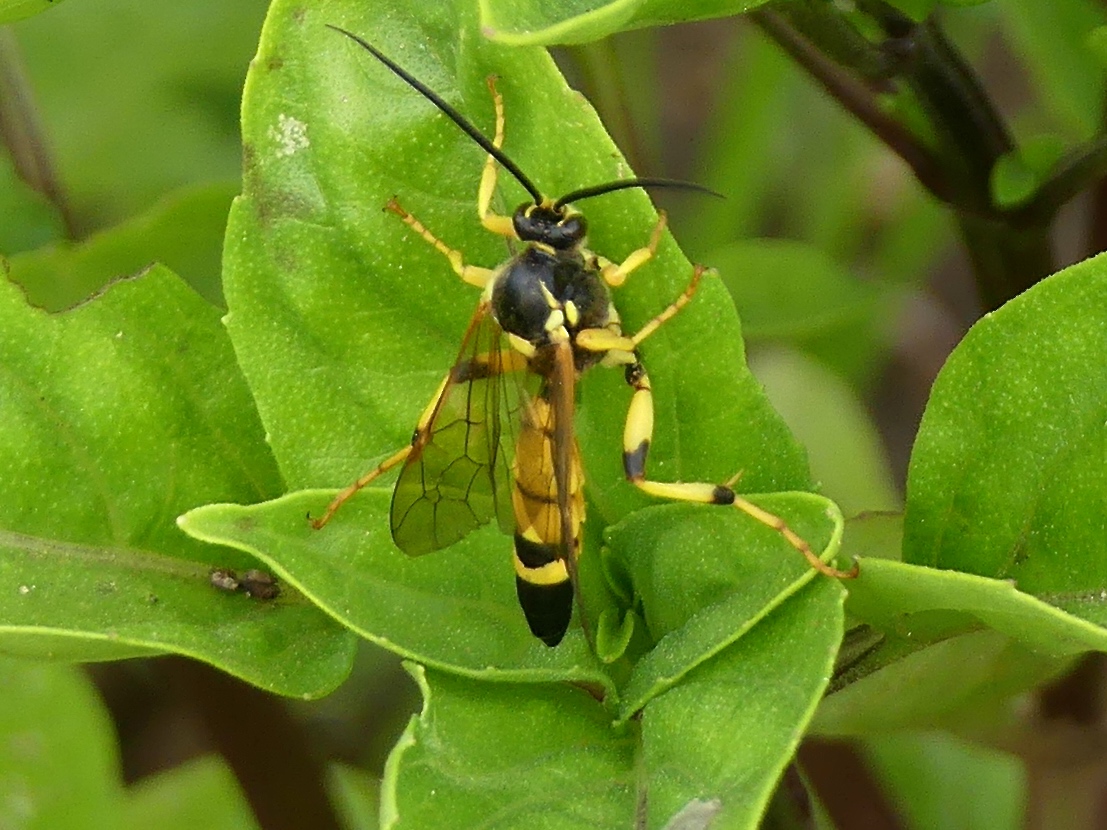
Unlike ‘true’ wasps like the German wasp, which it resembles in colouring, Amblyteles armatorius does not fold its wings when at rest. Characteristic features include the long, fairly thick antennae, the pattern of the wing veins with a yellowish mark on the front edge, and the yellow spot on the hind edge of the thorax.
Black slip wasp, Pimpla rufipes ?, Miller
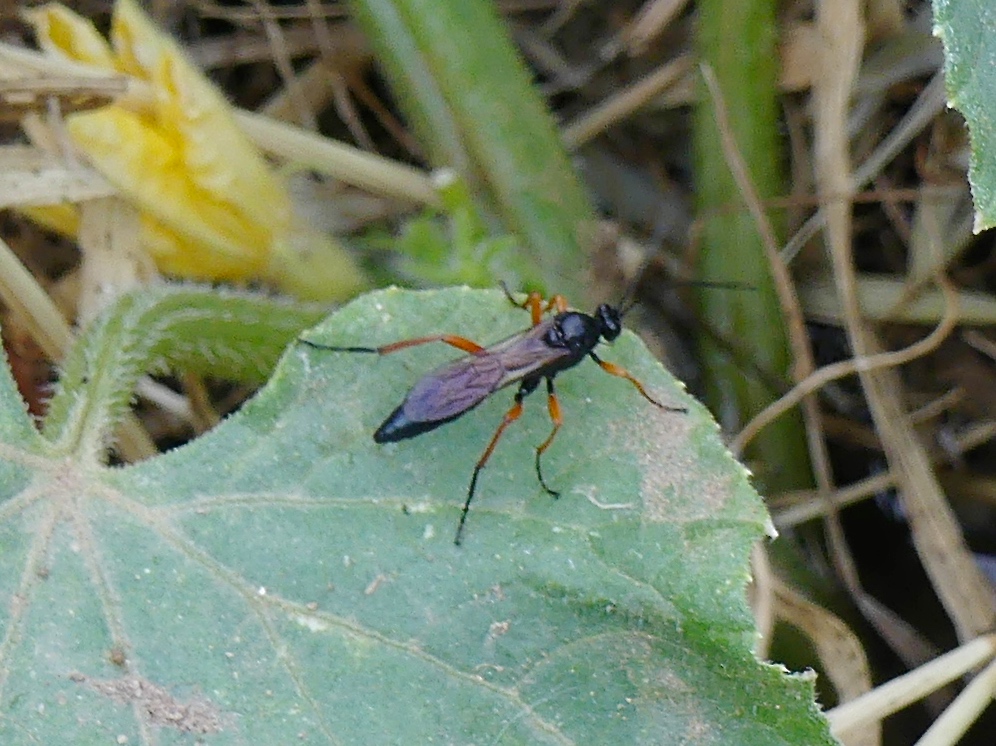
This Ichneumon wasp, with a black body and red legs, could be Pimpla rufipes or a related species.
Stenarella domator, Poda
This Ichneumon wasp is quite common in our area. It often walks on stone walls, as if searching for prey in which to lay its eggs. Stenarella domator is a hyperparasite, i.e. it parasitises the nests of parasitic solitary wasps, for example those of the genera Ancistrocerus or Delta unguiculatum, which build mud nests and provide butterfly caterpillars for their larvae. Stenarella domator uses its long ovipositor to pierce the mud nests and lay an egg inside; its larva feeds on the host larvae which in turn have fed on the butterfly caterpillars.
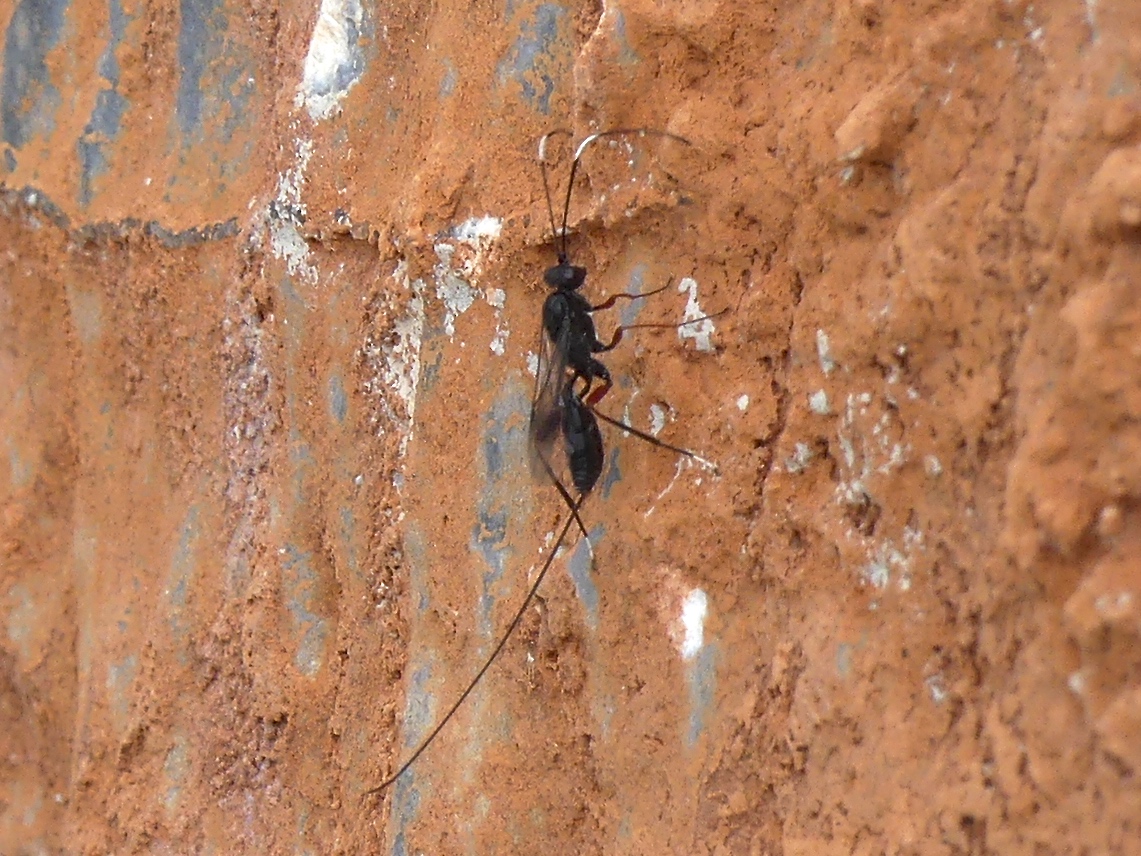
Stenarella domator has a particularly long ovipositor.
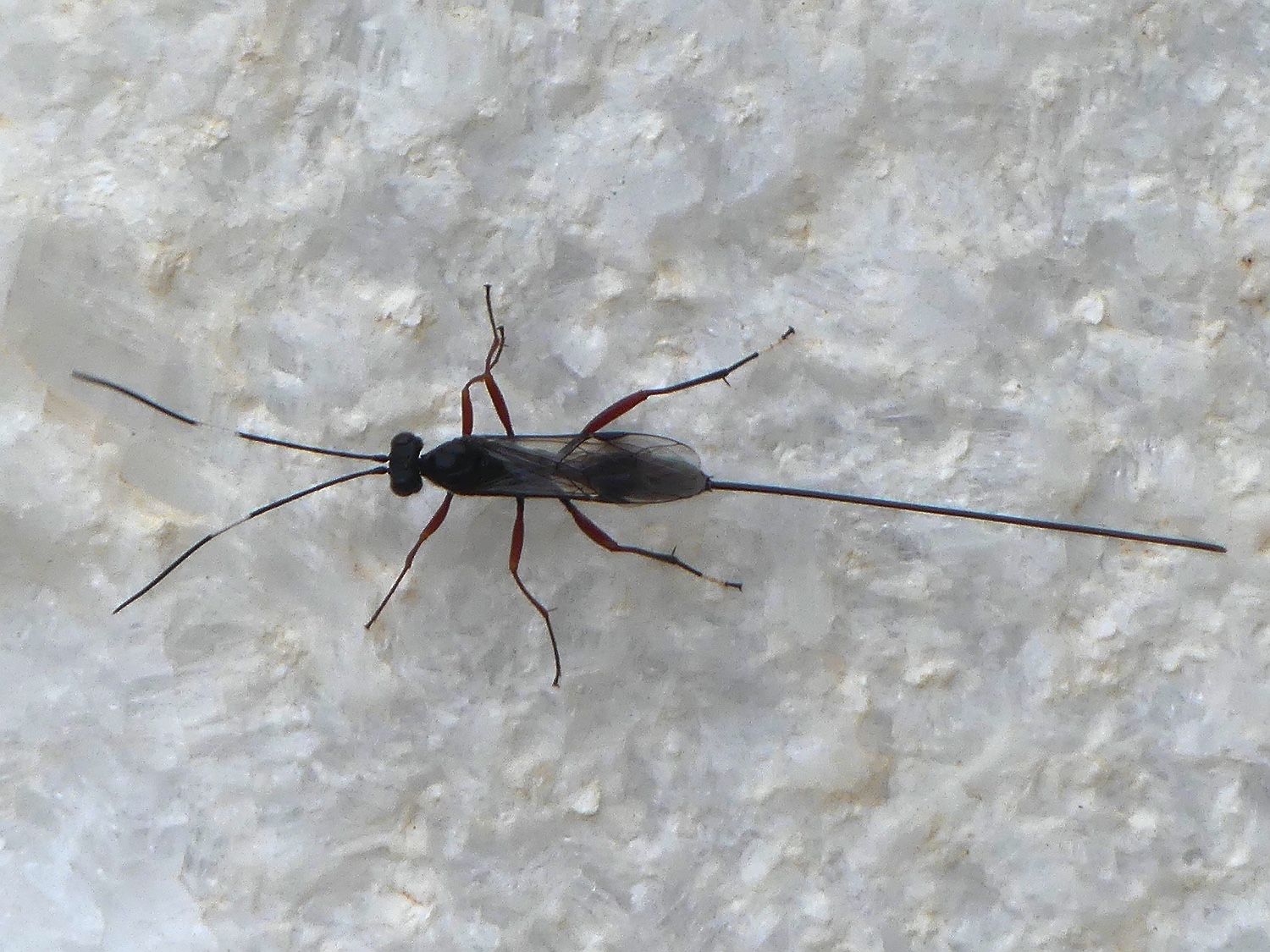
Although this wasp is very thin and slender, it grows quite large: including the ovipositor, it reaches about 4 cm.
Unidentified Ichneumon wasp
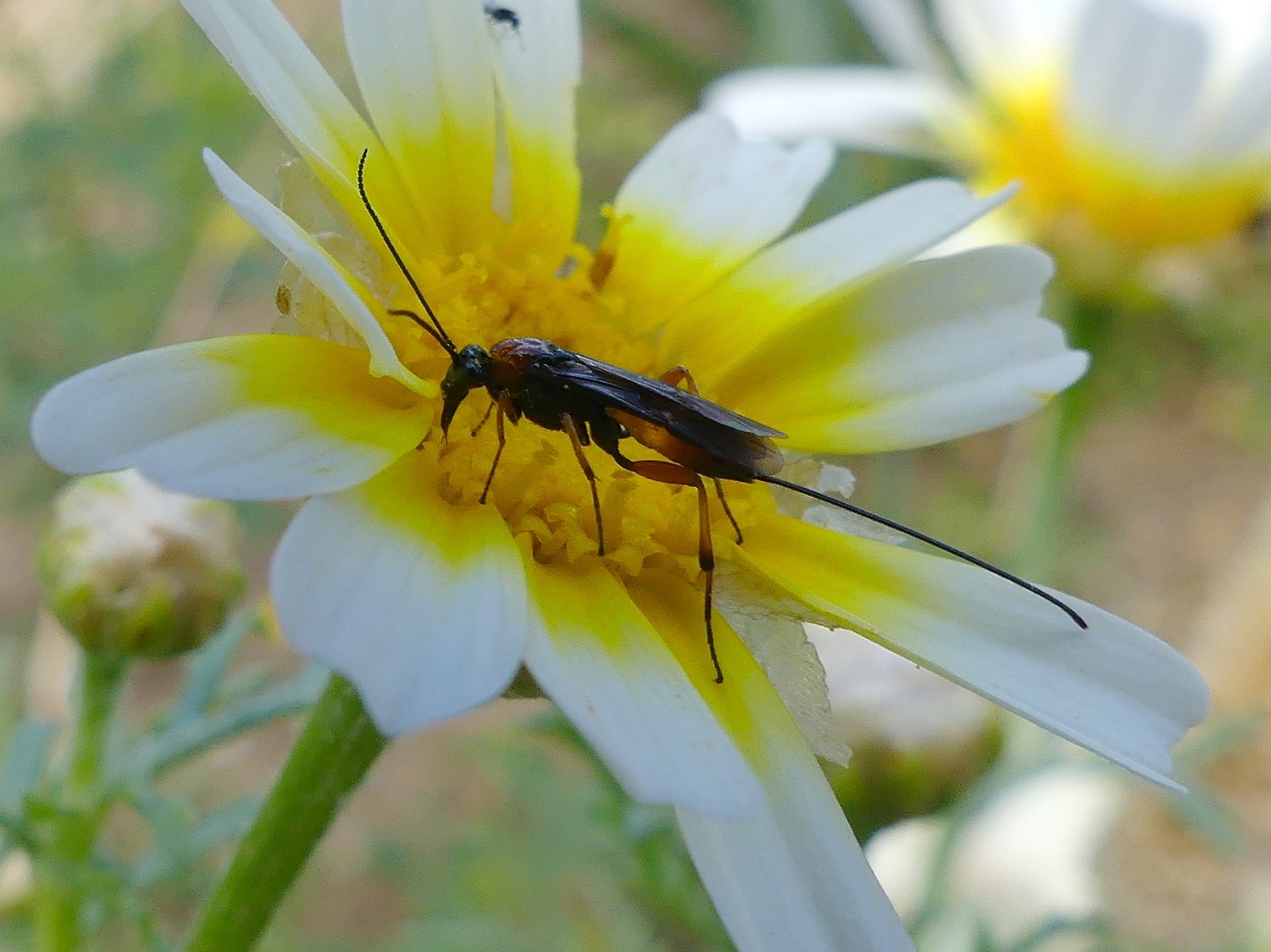
This species displays the colouring typical of many Ichneumon wasps, with a predominantly black body and reddish legs and anterior abdomen. It is a female, as indicated by the long ovipositor.
Brachycyrtus spec.
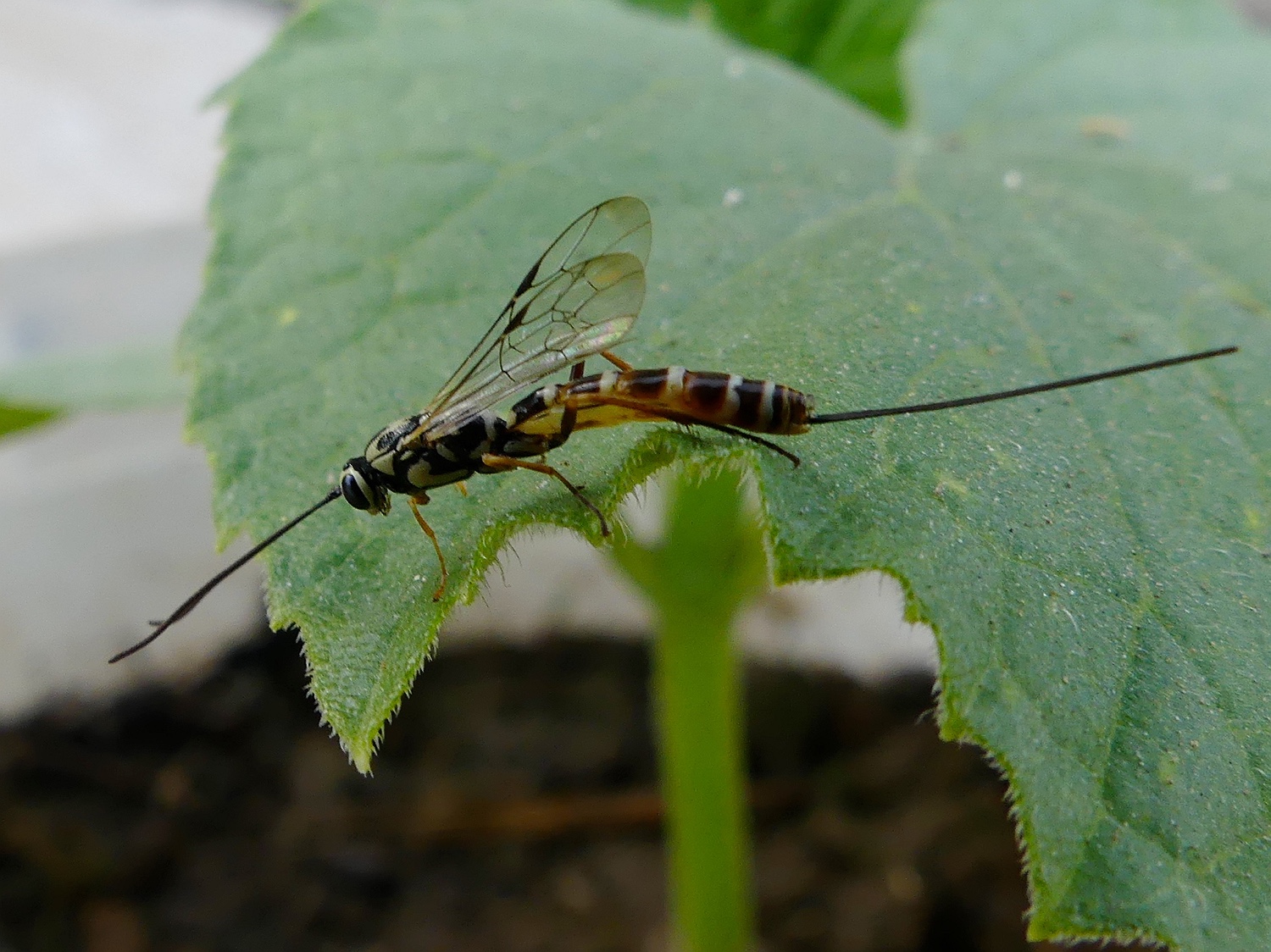
This pretty Ichneumon wasp could belong to the genus Brachycyrtus. Unfortunately, there is very little information available about these groups, so that we can’t identify the species.
Unidentified Ichneumon wasp, probably genus Ichneumon
The Ichneumon wasps are a very large family, with many similar-looking species. The whole group is relatively poorly known, so that precise identification of the species is often a rather hopeless endeavour.
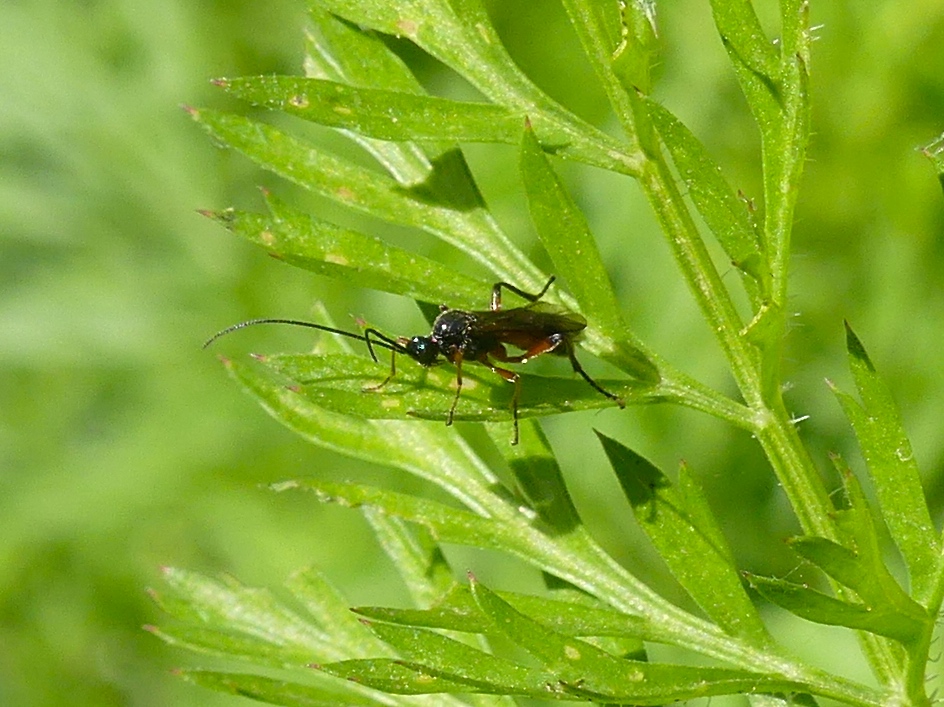
Many species of the genus Ichneumon have a domed, glossy black thorax, just like this specimen.
Superfamily Evanioidea
Gasteruptiidae
The Gasteruptiidae are a small wasp family, whose members are distinguished by their anatomy and biology. They have a long, narrow body, with a thin, slightly club-shaped abdomen sitting unusually high on the thorax. The head shows a distinct ‘neck’ and bears large eyes and long, thin antennae. When at rest, the wings are folded together in a manner similar to the Vespidae. The legs are long, particularly the hind legs, which have characteristic, thickened tibias. Most species are black in colour, sometimes with reddish-brown patches on the abdomen.
The larvae of the species of the Gasteruptiidae usually parasitise the nests of solitary bee species, such as mason bees and carpenter bees. Depending on the species, they feed on the egg, the larva or the pollen stores of the host. The females lay their eggs into the host nest, piercing it with their ovipositor. The family Gasteruptiidae has not yet been studied in great detail and many species remain undescribed.
Gasteruption jaculator ?, L.
In Europe, over 20 species of Gasteruptiidae are known. This could be Gasteruption jaculator, one of the most common species. It grows to almost 2 cm in length, but is quite inconspicuous due to its very slender body. When the wasp sits down, it first moves its abdomen up and down a few times in a ‘pumping’ motion.
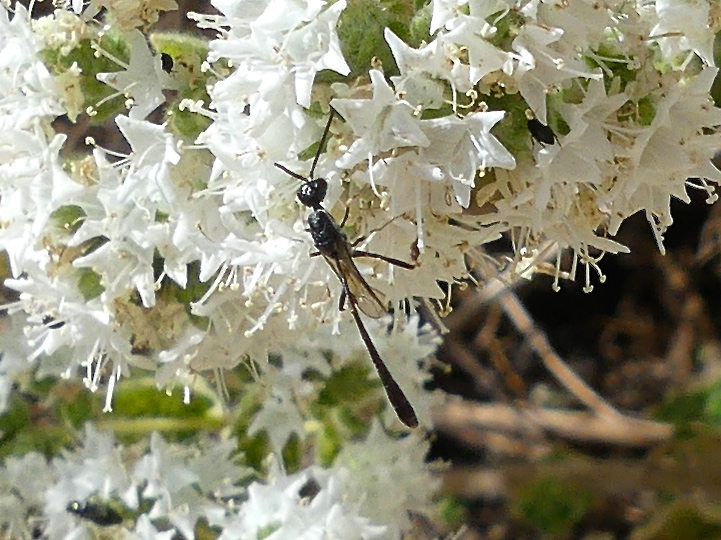
Members of the family Gasteruptiidae have a long, slender body. The adults do not have elongated mouthparts and therefore like to visit the flowers of the Greek oregano, which openly offers its nectar and pollen and is therefore very popular with many insects.
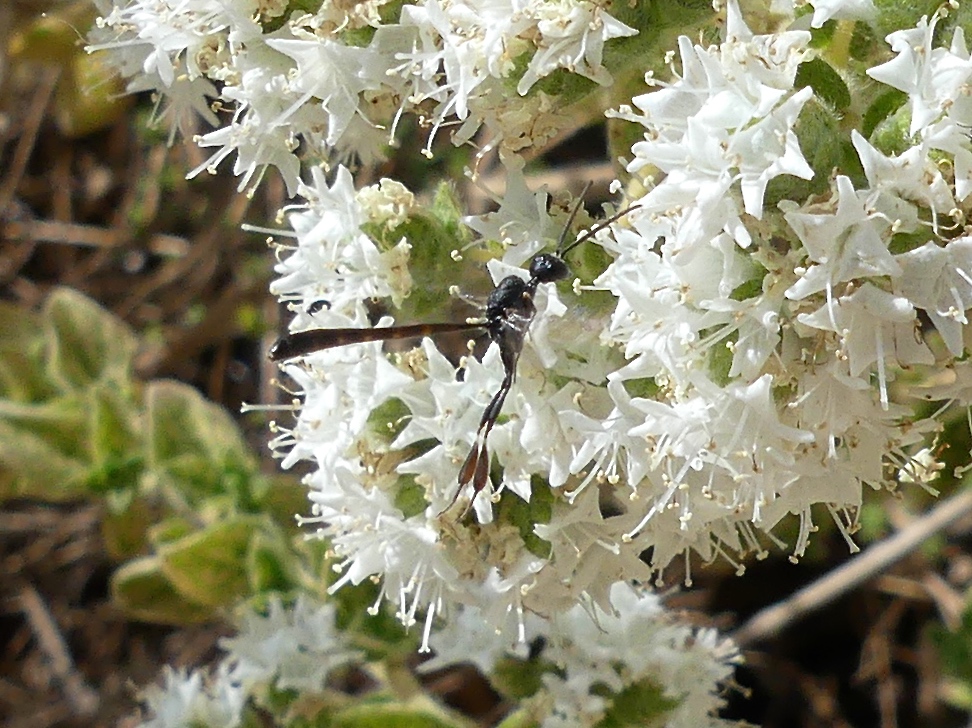
In this photo one can see the unusually long hind legs with thickened tibias. This is a male (as it has no opvipositor), possibly belonging to the species Gasteruption jaculator, as it shows four pale stripes on the underside of the abdomen.
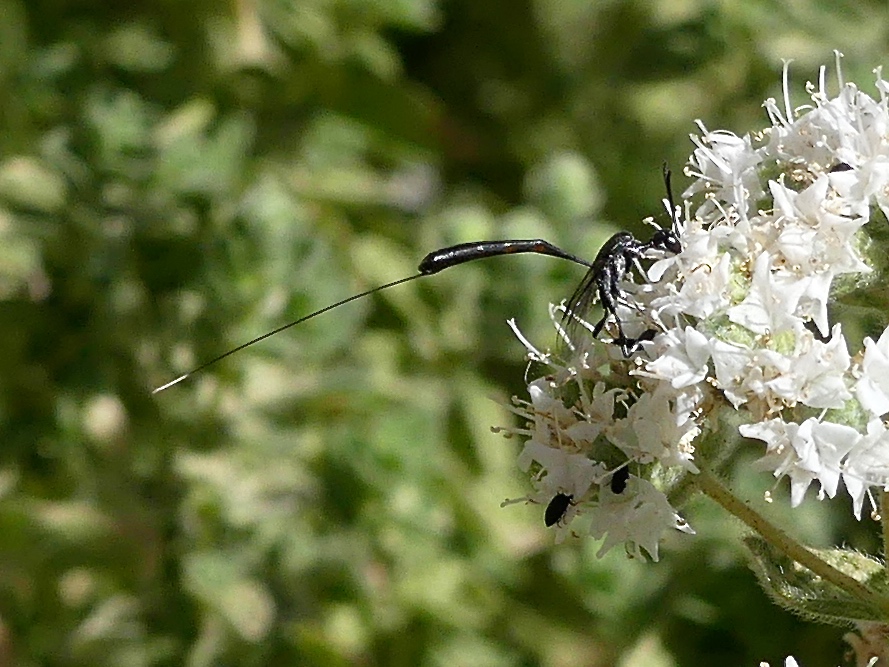
Here a female with its very long ovipositor, which has a white tip.
Superfamily Chalcidoidea
The superfamily Chalcidoidea comprises many families. Around 22,000 species have so far been described worldwide, but the group presumably includes many more species. Many chalcidoid wasps are very small; numerous species grow to only a few millimeter in size. Consequently, they are very often overlooked. Many species display a metallic colouration. The larvae are mostly parasitic, though in some species they are predatory or feed on plants. Many species are used in biological pest control.
Leucospidae
The family Leucospidae comprises mainly comparatively large and conspicuous species, which are usually wasp-like in appearance. Their larvae parasitise exclusively on bees and wasps.
Leucospis gigas, Fabricius
Leucospis gigas is recognisable by its unusual body shape with a thick, humped thorax. The femur of the hind legs is enlarged into a disc-like structure. The female lays its eggs into the nests of mason bees (genus Megachile). To do this, it must use its ovipositor to bore through the very hard clay wall of the nest, a process that can take an hour. After emerging from the pupa, the adult wasp must force its way out of the clay nest using its very powerful mandibles. Interestingly, males of this species are very rarely found; reproduction apparently occurs mostly via parthenogenesis.
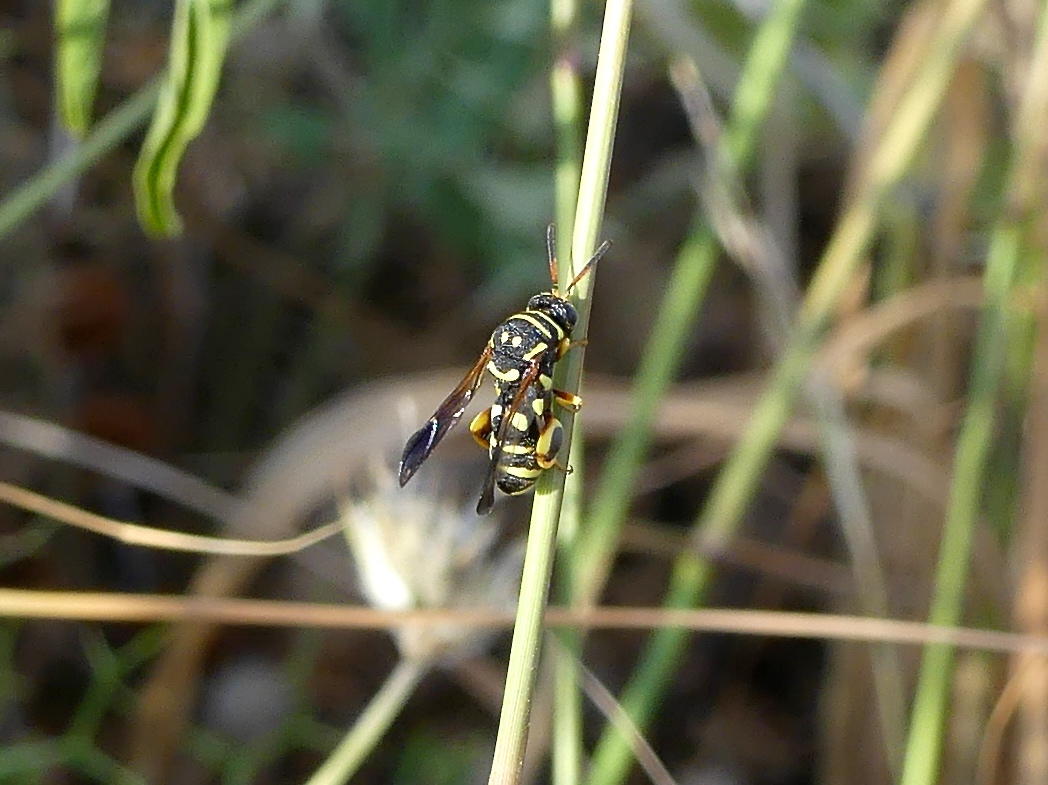
Leucospis gigas, which is about 1,5 cm in size, can be recognised by its unusual body shape with a ‘hump’ and by the thickened femurs of its hind legs.
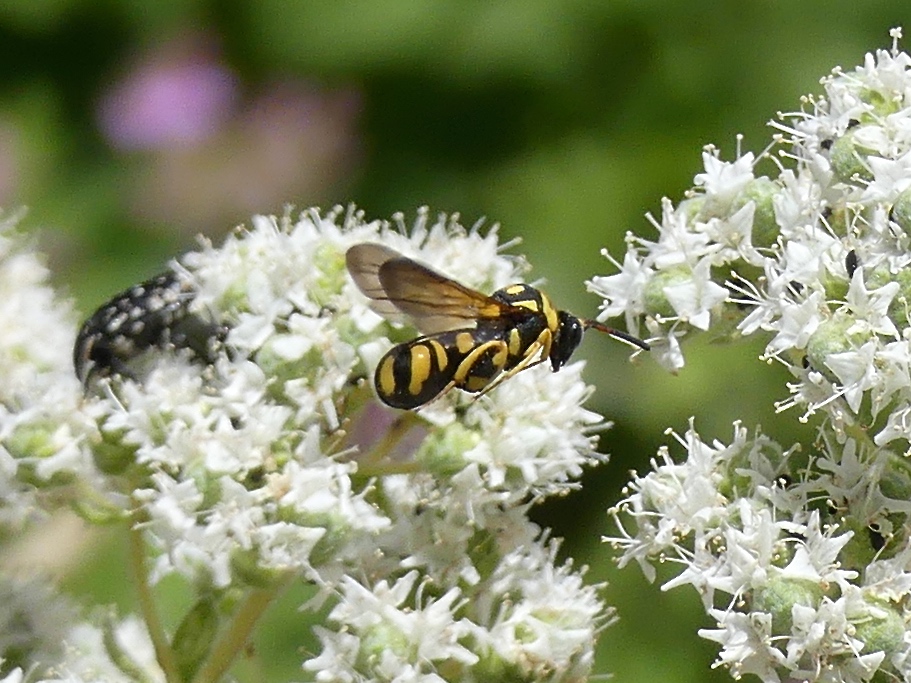
in flight
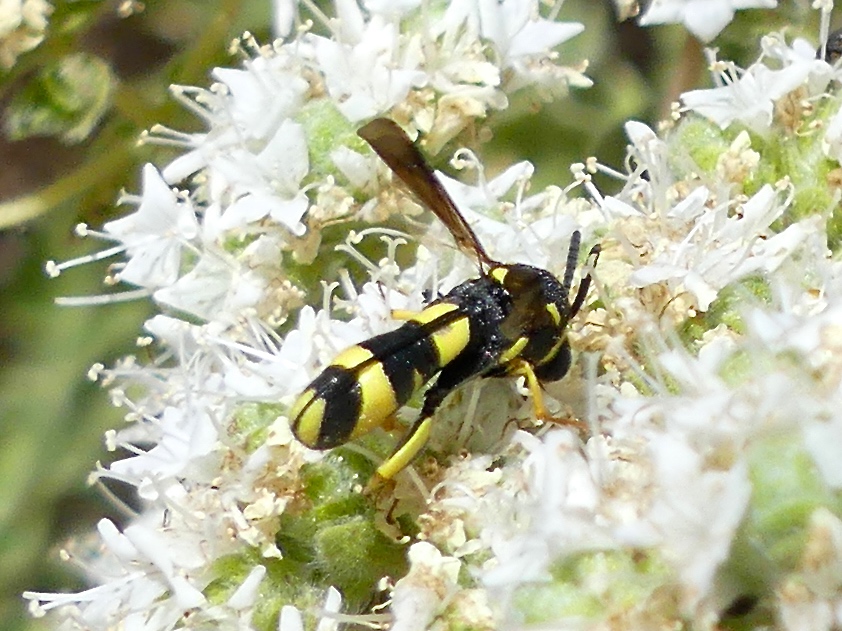
Here you can see the ovipositor, which this species carries folded upwards on its abdomen.
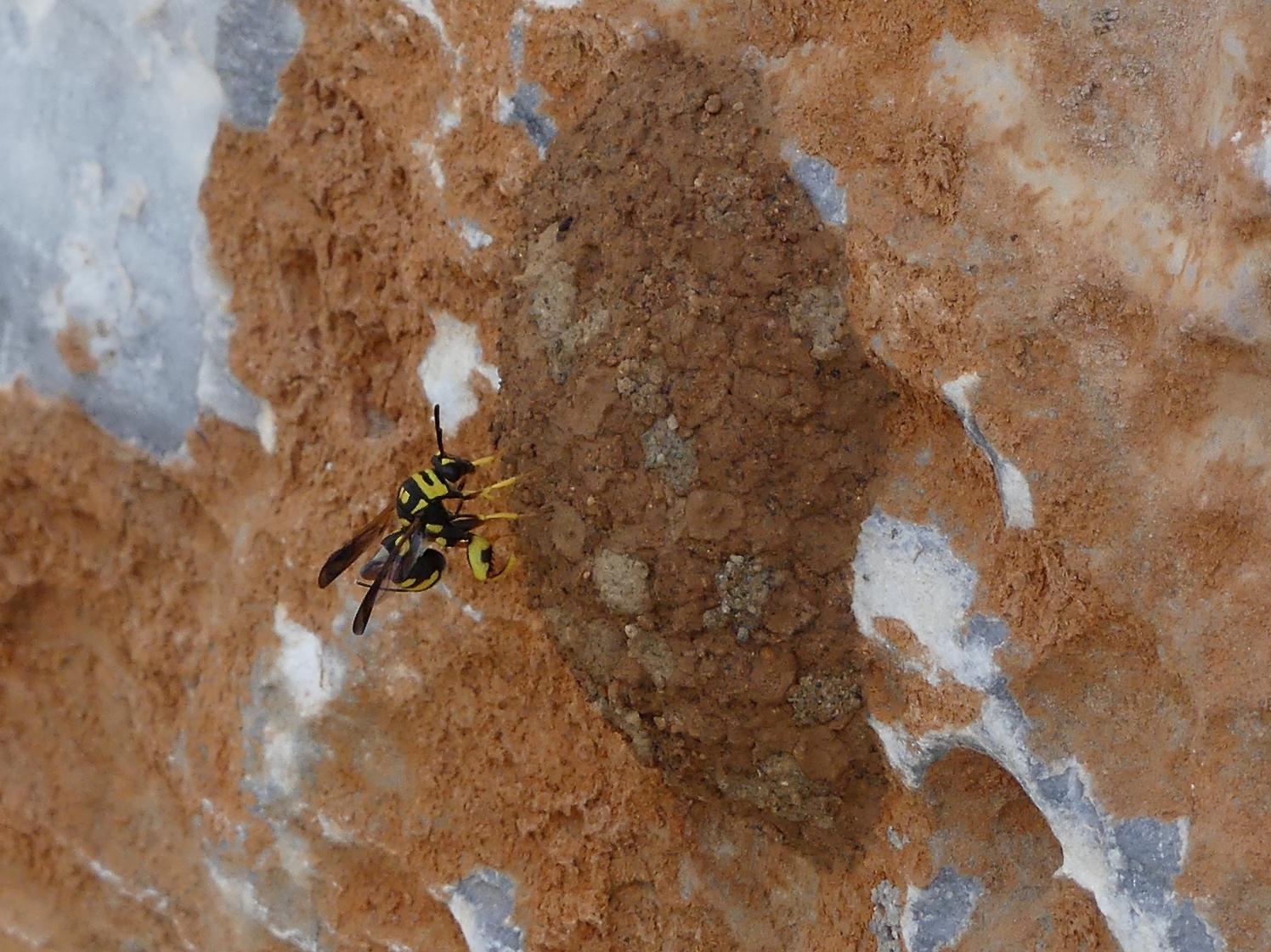
Leucospis gigas in the process of laying its eggs into a mason bee nest
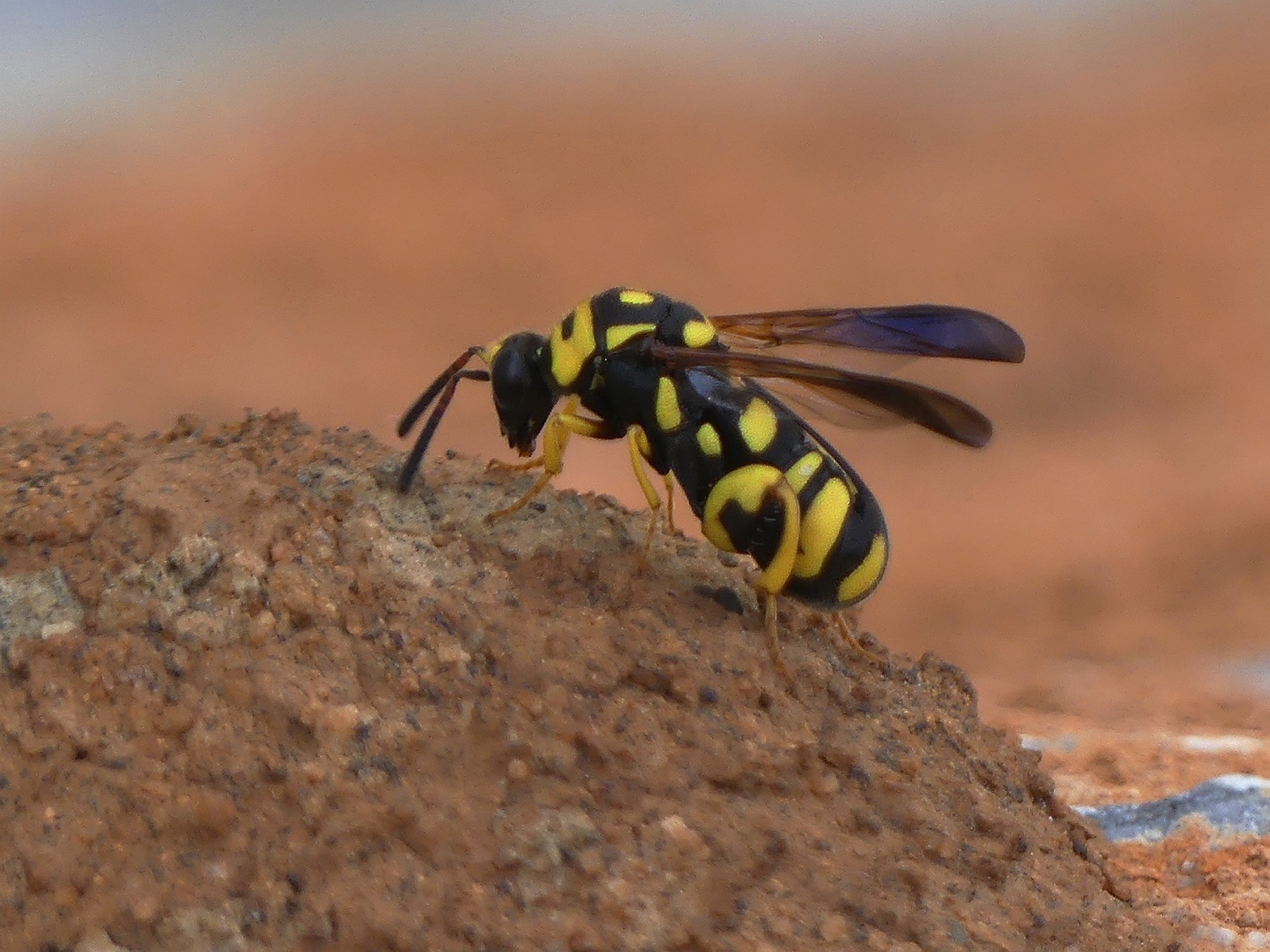
Here, Leucospis gigas sits on the nest of a mason bee, preparing to lay its eggs. First, using its antennae, it searches for a suitable spot, i.e. a brood chamber containing an egg that has not yet been infested.
In order to pierce the hard wall of the mason bee’s nest, the wasp must build up considerable pressure. To do this, it adopts this peculiar posture. The thin ovipositor can be seen between the legs; its upper part sits in a tapered sheath, which the wasp uses to manoeuvre it into position.
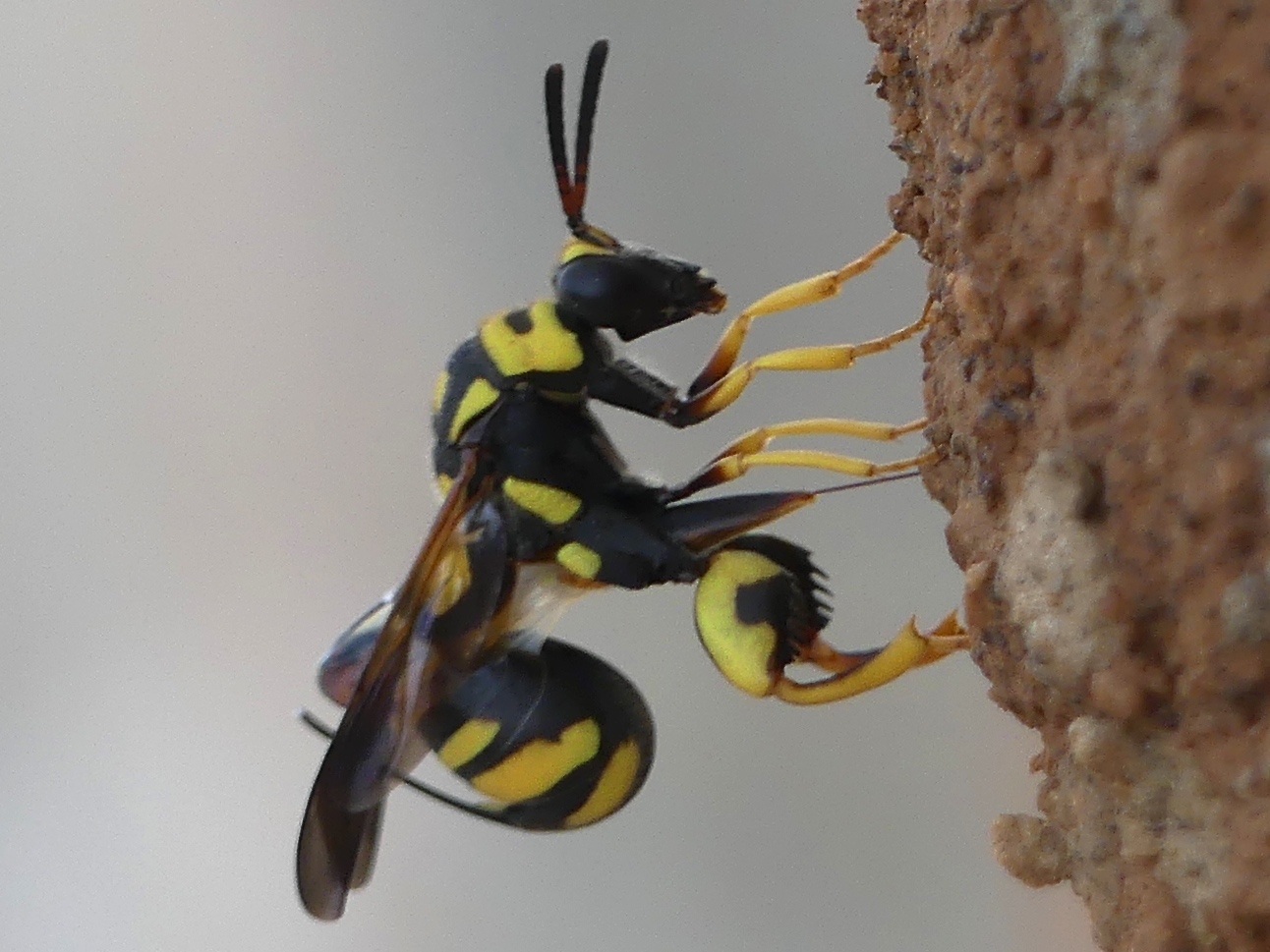
Here from the side. The very thin ovipositor can again be seen between the legs. Above the abdomen, you can see the tube in which the ovipositor rests when not in use. Unusually for wasps, it is carried folded upwards on the back.
Here you can watch a short video (on YouTube) showing the egg-laying of Leucospis gigas.
Leucospis dorsigera, Fabricius
The species Leucospis dorsigera, which is widespread in Europe and north Africa, is considerably smaller; it reaches only about 1 cm in length. The larvae parasitise the larvae of various bee or wasp species that nest in plant stems or wood. The females lay their eggs into the host nests using their long ovipositor, held on their backs, in a manner similar to that of Leucospis gigas.
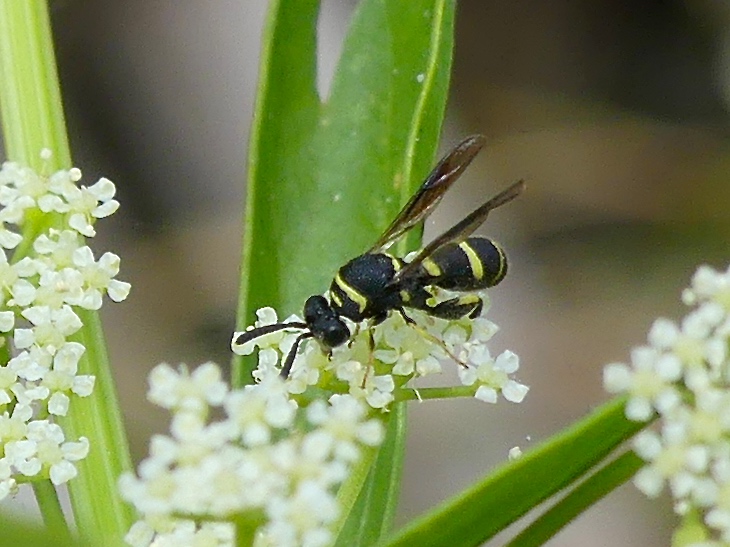
Leucospis dorsigera displays a black-and-yellow warning colouration, but with less yellow than the previous species. It is considerably smaller.
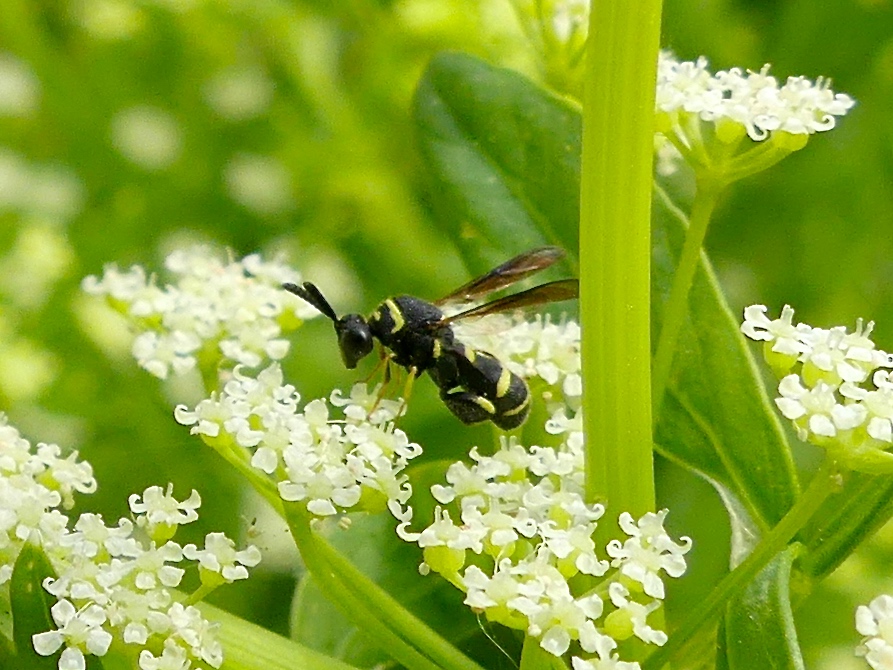
This female shows the distinctive humped body shape and the curved, enlarged hind legs that are characteristic of the genus.
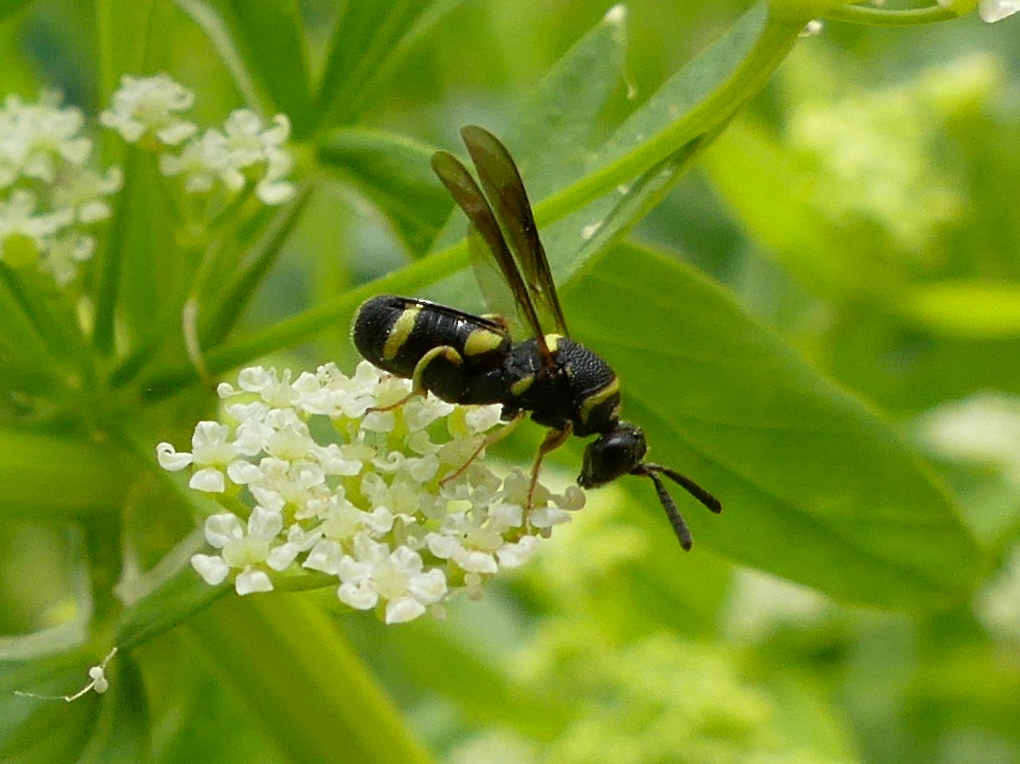
The ovipositor is held on the back of the wasp. The wings are folded when they are not used.
Chalcididae
Brachymeria minuta, L.
The small species Brachymeria minuta is not specific in terms of its hosts: it parasitises various butterflies and flies.
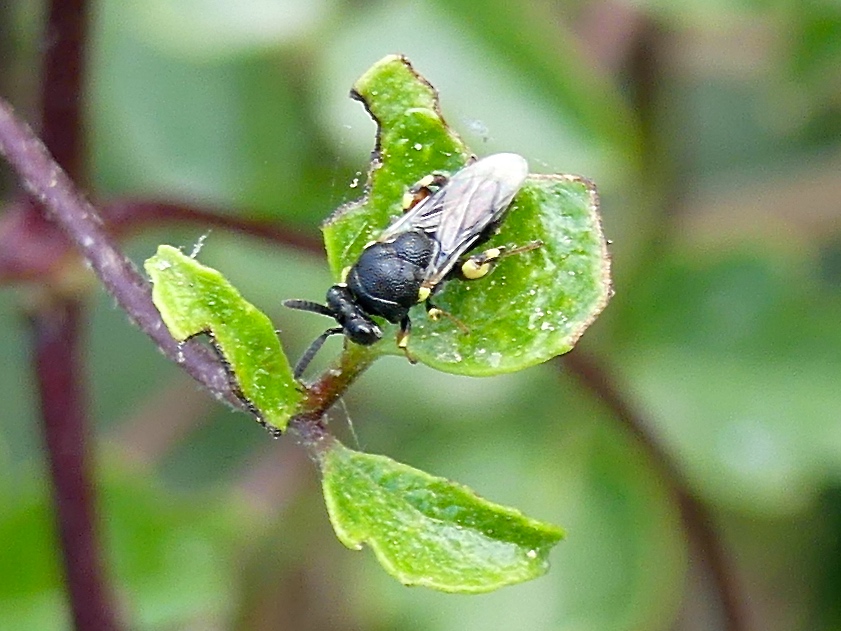
The small species Brachymeria minuta is predominantly black in colour with yellow spots on its legs.
Superfamily Chrysidoidea
Emerald wasps, Chrysididae
The Emerald wasps or Cuckoo wasps comprise over 3,000 species, many of which are very similar. Although most species are quite small, they are often conspicuous due to their metallic sheen and golden, red or blue-green colouring. They live as parasites, i.e. they lay their eggs in the nests of other hymenopteran species so that their larvae feed either on the host’s food supplies or on the larvae or pupae of the host.
Stilbum cyanurum, Förster
This pretty, shiny gold, green and red species can occasionally be observed in our area in early summer. It is quite restless and therefore not easy to photograph. The larvae of Emerald wasps live as parasites on solitary bee and wasp species.
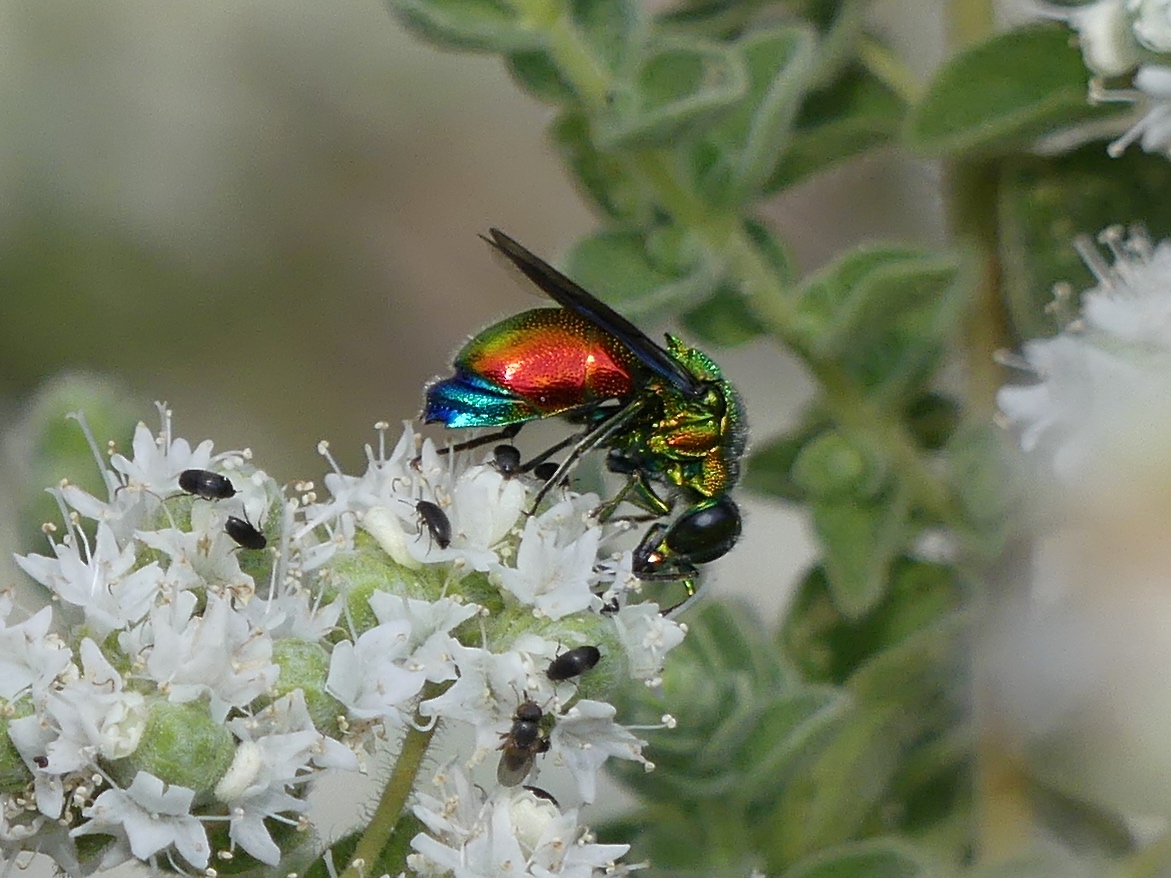
The small Emerald wasps often show an amazing metallic gleam in gold, green and red colours. This predominantly gold-green species, with a shiny red abdomen with a metallic blue tip, is probably Stilbum cyanurum.
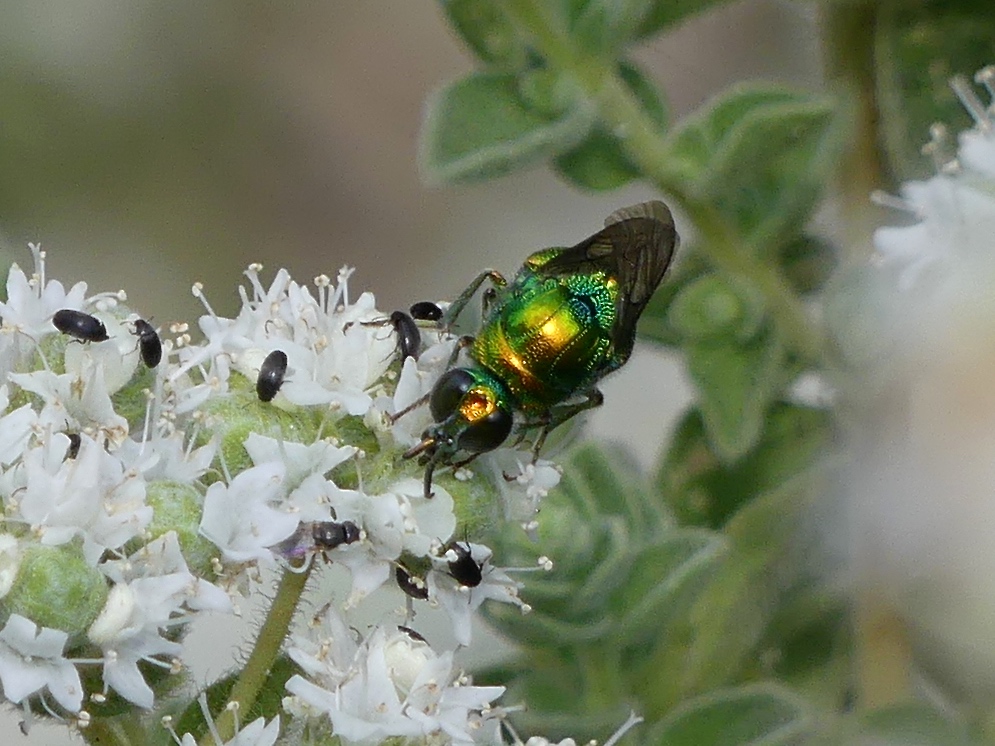
Here from the front – you can see the fine granulation of the chitinous exoskeleton.
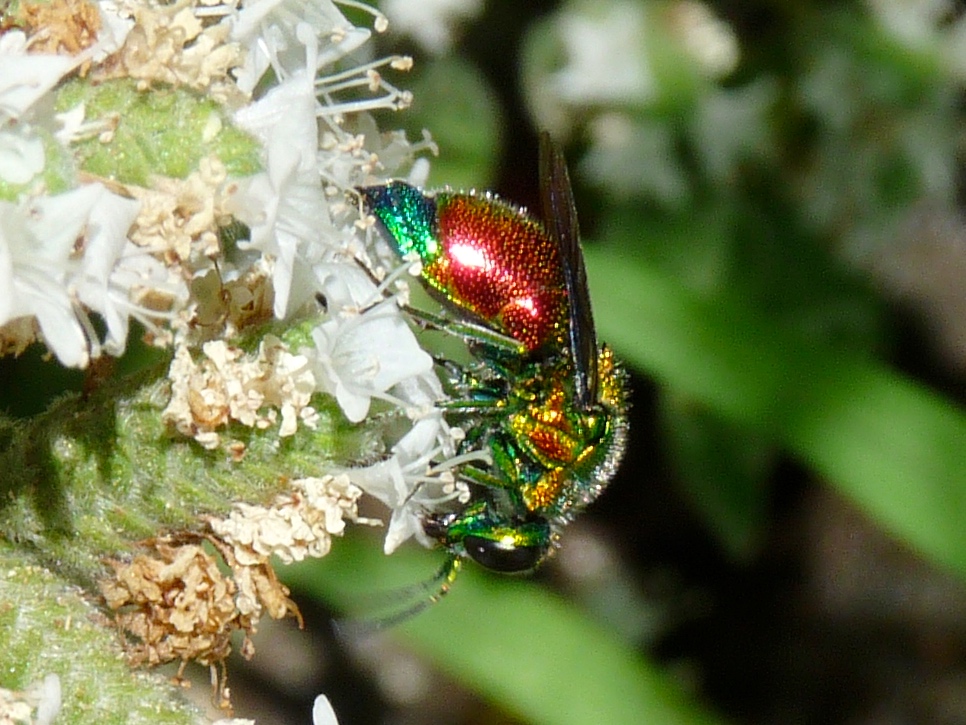
This specimen probably also belongs to Stilbum cyanurum.
Ruby-tailed wasp, Chrysis ignita ?, L.
The Ruby-tailed wasp parasitises the nests of various potter wasps. Depending on the food available for the larva, the adult reaches very different body sizes (from 4 to 13 mm). Several almost identical-looking species exist, that seem to parasitise different wasp species.
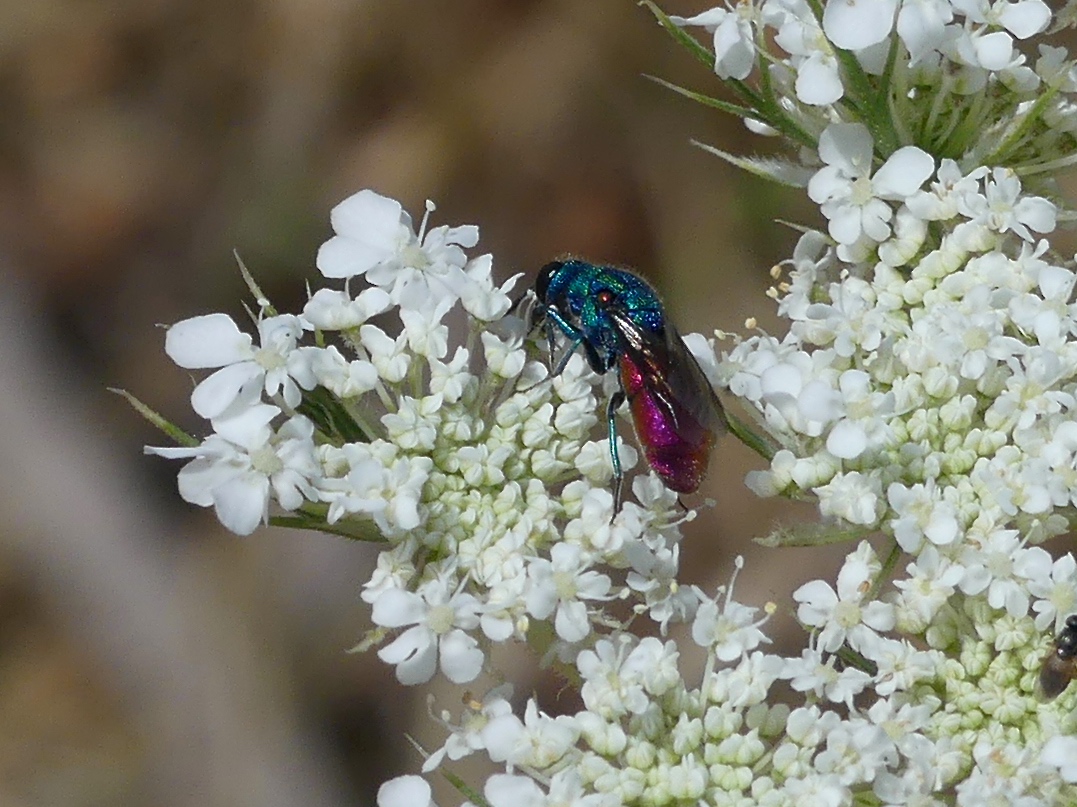
The Ruby-tailed wasp is one of the more common species of Emerald wasps in Europe.
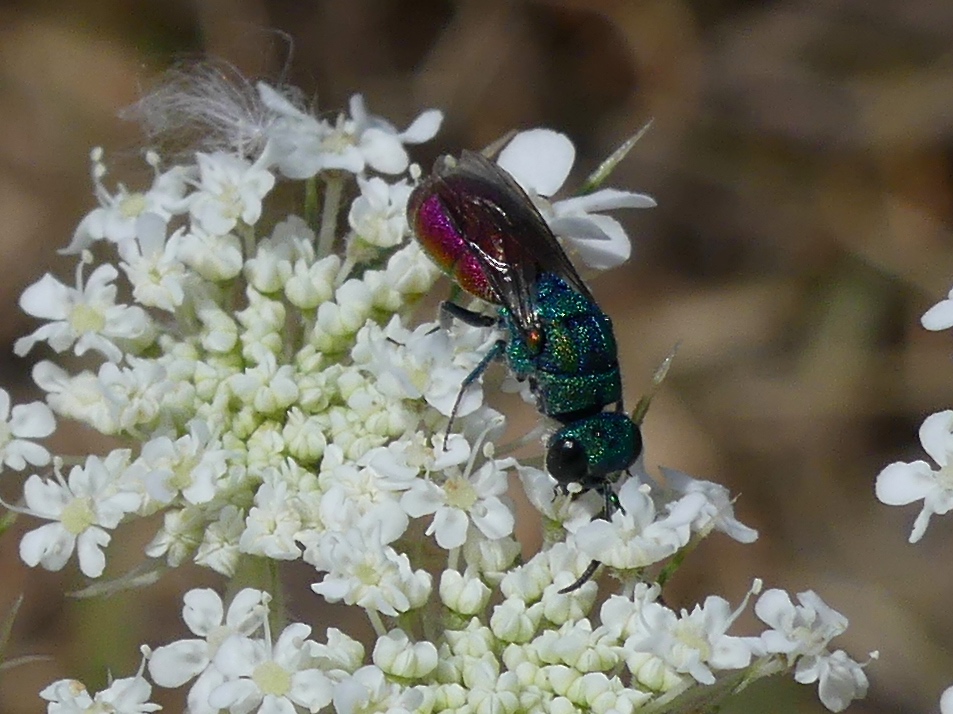
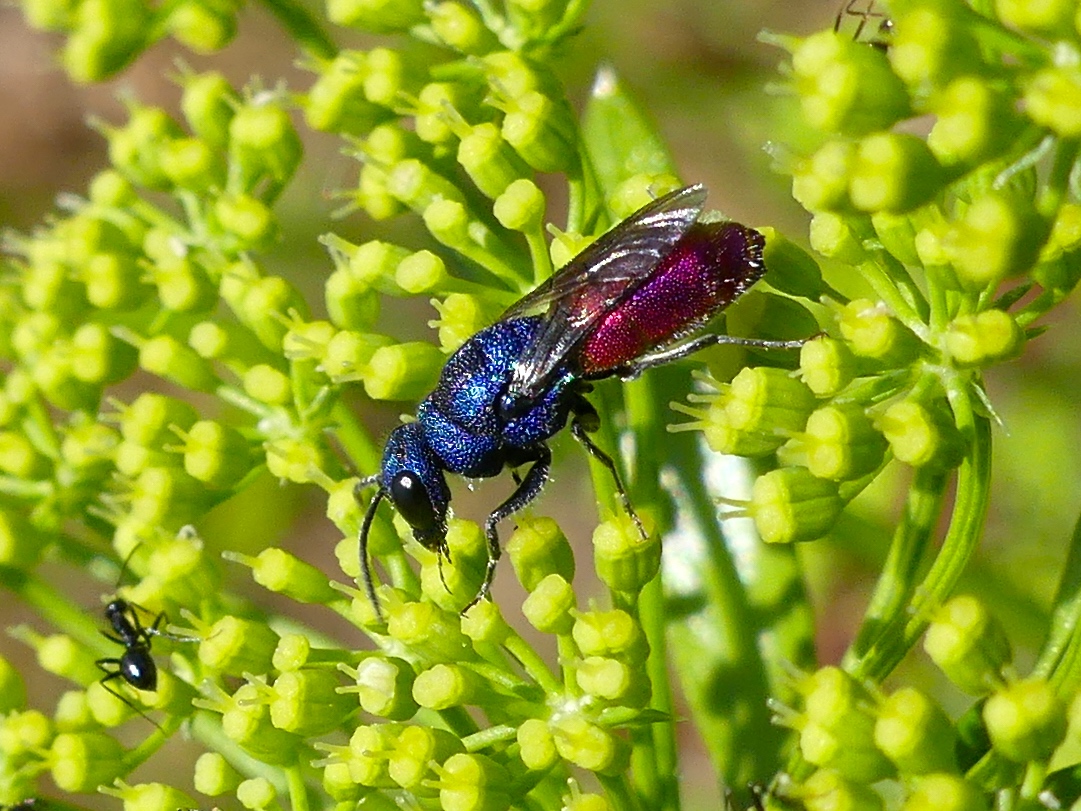
It has a red abdomen, whilst the thorax and head are blue-green. These photos show the characteristic fine granular texture of the Emerald wasps. The metallic sheen of this wasp is particularly intense, though it is not well captured in the pictures.
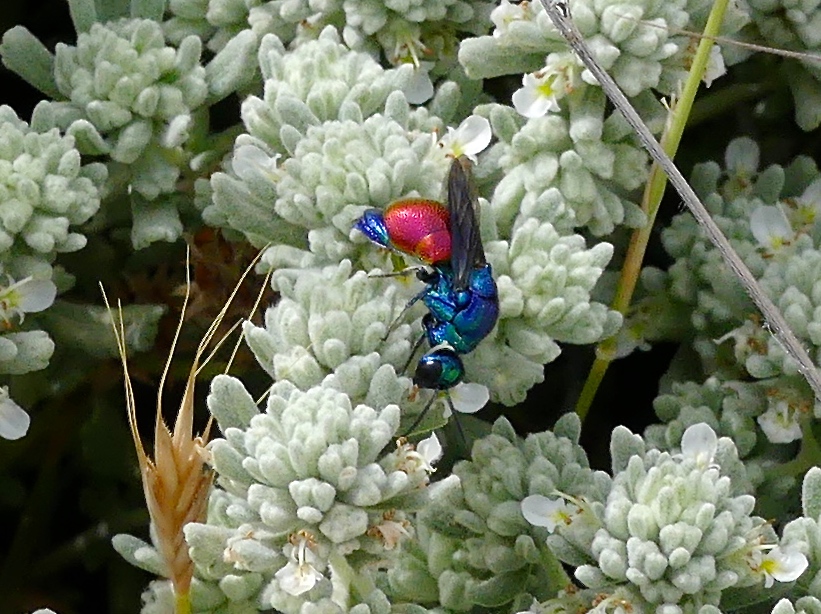
Chrysis insperata ?, Chevrier
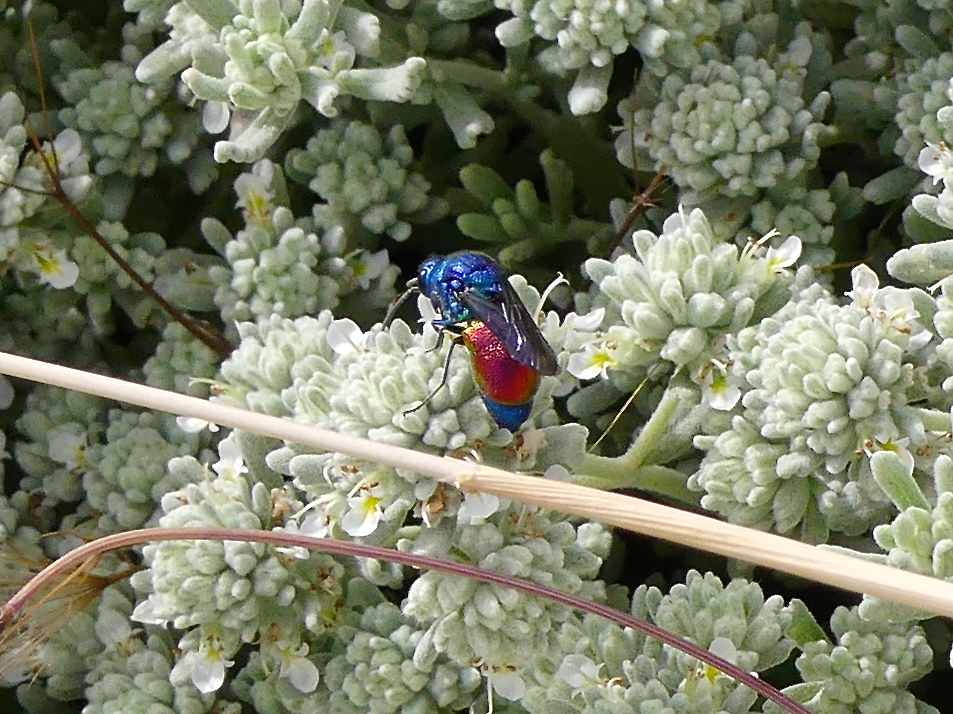
In this species, the thorax and the tip of the abdomen are bright blue, whilst the two enlarged segments of the anterior abdomen have an intense copper colour. This is probably the species Chrysis insperata, which is widespread in the Mediterranean region.
Superfamily Vespoidea
Vespidae
The Vespidae fold their wings lengthways when sitting. Many species in the subfamilies Vespinae and Polistinae are social. Other species live solitary such as those of the subfamily Eumeninae.
Polistinae and Vespinae
European paper wasp, Polistes dominula, Christ
The European paper wasps builds its nest from a paper-like substance which they produce from gnawed wood mixed with saliva. The nest is openly attached to buildings or plants. Several wasps join together to build a nest, with the strongest female developing into the queen, whilst the others take on the role of workers. The nest comprises up to 150 cells. It is aggressively defended and carefully tended. Depending on weather conditions, the workers can cool or warm the nest. The queen and the larvae are fed by the workers with a paste of captured flies and spiders.
Several very similar species of paper wasps exist. They can be distinguished from other wasps by their colouring and their long legs, which hang down whilst in flight. The European paper wasp is a successful species that is spreading across Europe and also colonising other continents to which it has been introduced. As they prey on flies and spiders, paper wasps are beneficial to humans. They are not very aggressive, but can sting to defend their nest.
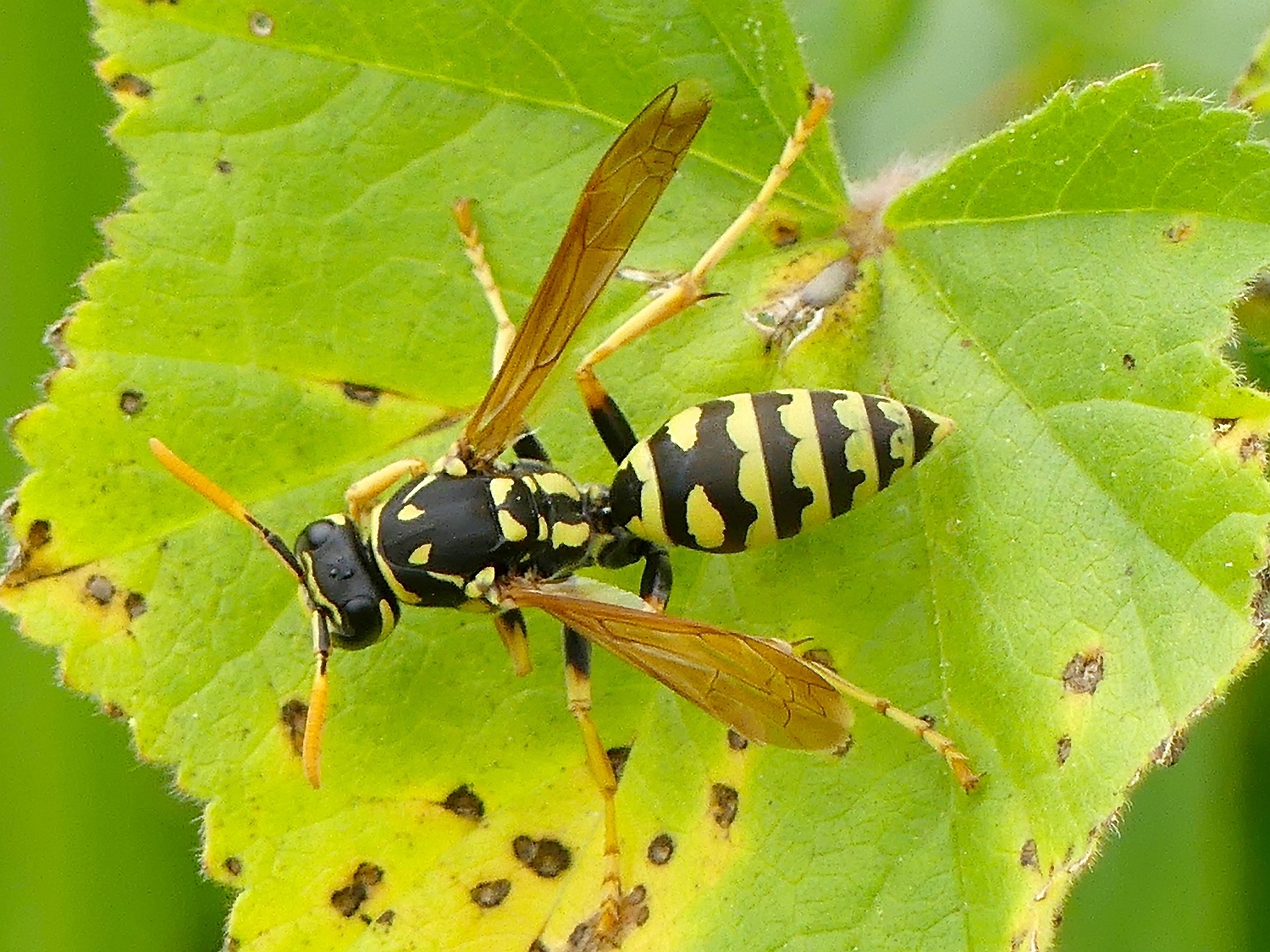
The European paper wasp can be recognised by its characteristic yellow and black markings and the long legs. As in all members of the Vespoidea, the wings are folded together when at rest.
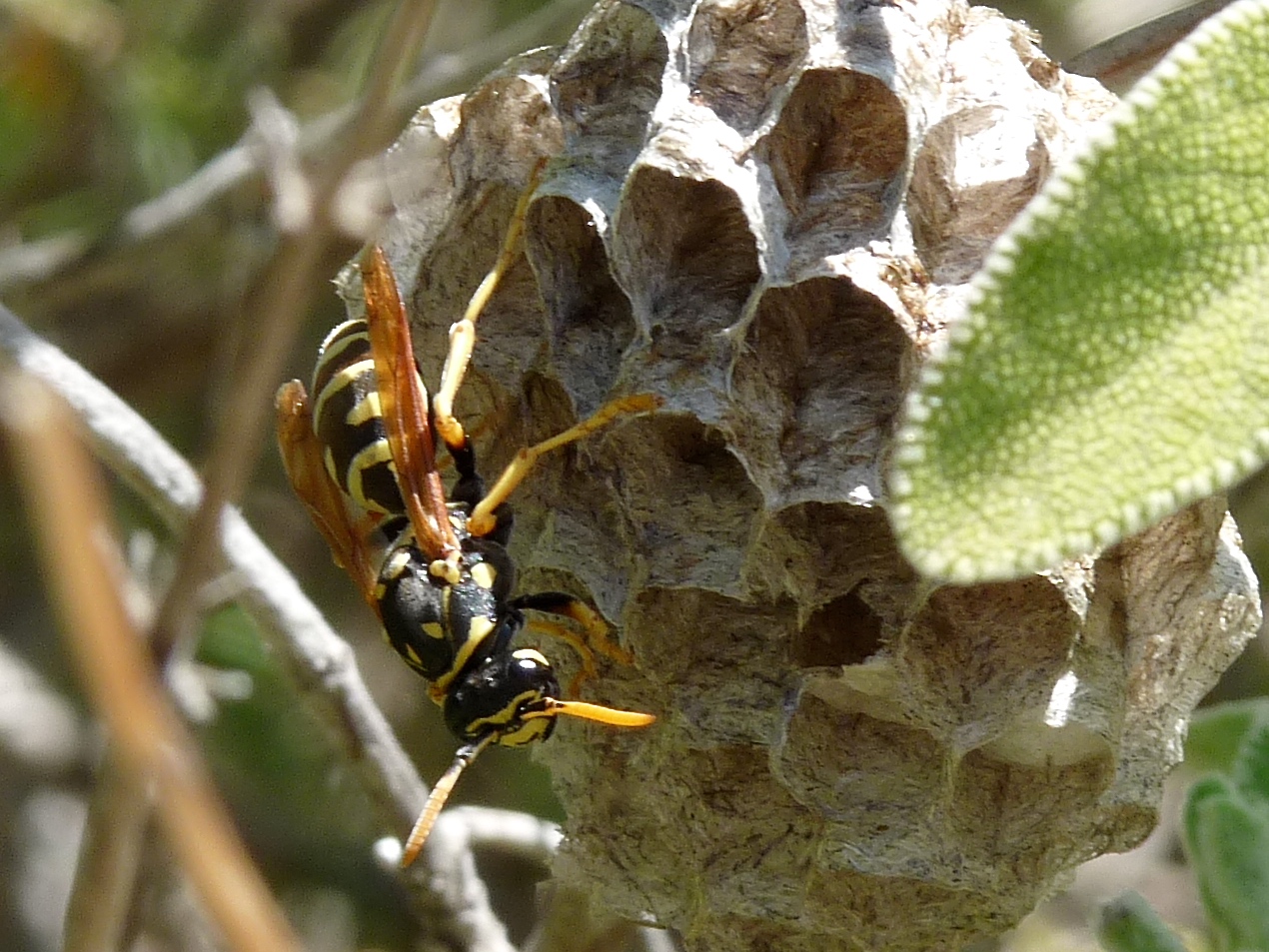
The European paper wasp builds paper nests, which are usually attached to plants.
European paper at the nest. The topmost wasp is fanning its wings, presumably to cool the nest.
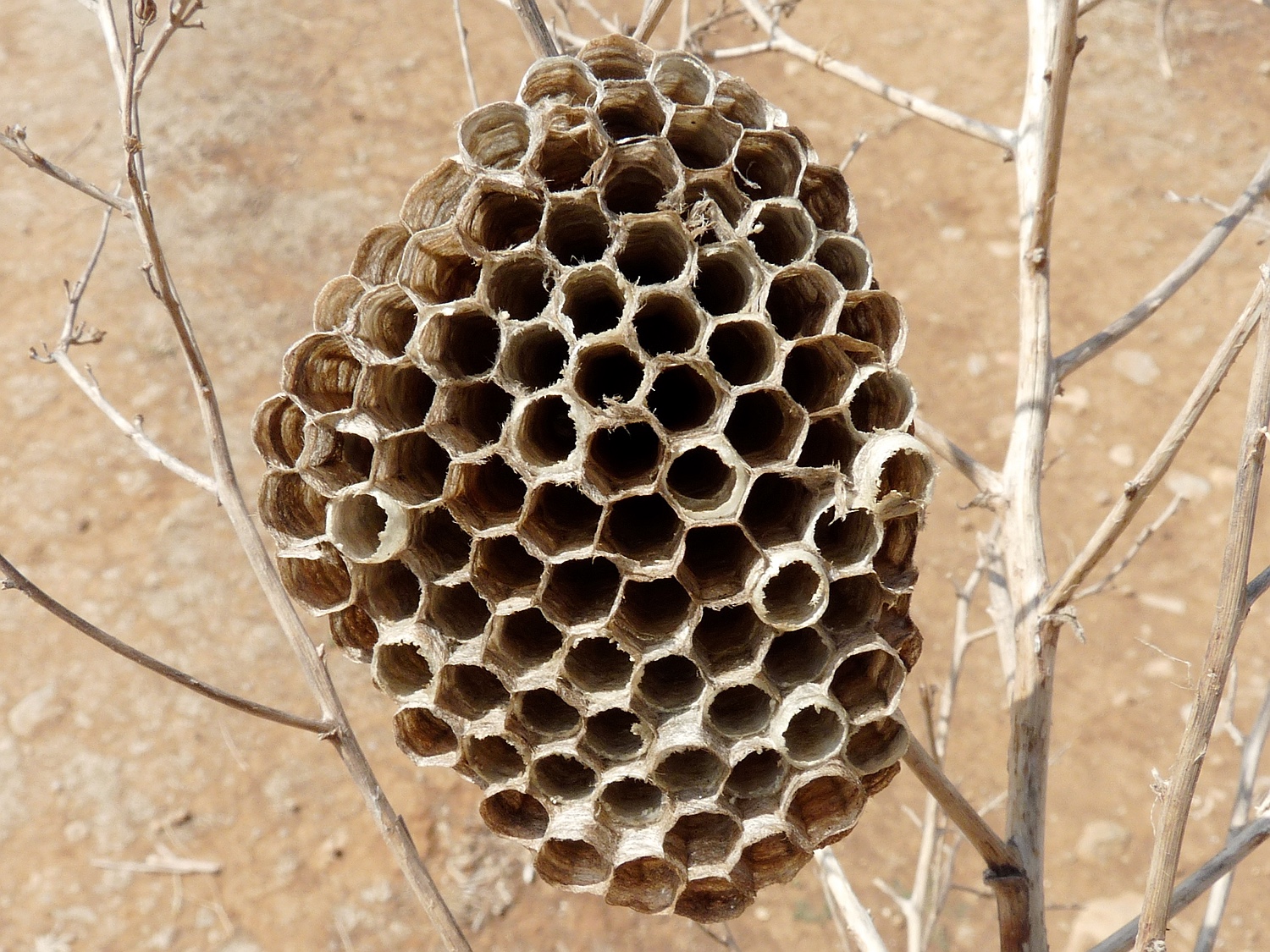
old, empty nest
German wasp, Vespula germanica, Fabricius
The German wasp belongs to the Vespinae. It builds its nests underground, in small cavities or old mouse tunnels. The nest is made of paper (wood pulp). The combs hang horizontally from the ceiling and, unlike in the nests of paper wasps, are enclosed by an outer layer. Over the course of the year, the colony founded by a queen grows to up to 4,000 individuals. The worker wasps each take on different tasks such as building further cells, cleaning the nest, feeding the larvae or the queen, and gathering food, mainly insects or meat. In autumn, most of the workers die; only a few overwinter in sheltered spots to emerge as new queens and found a new colony the following spring. Each queen raises the first generation of workers alone; consequently, in spring one sees far fewer German wasps than European paper wasps, whilst in summer the German wasps are more common.
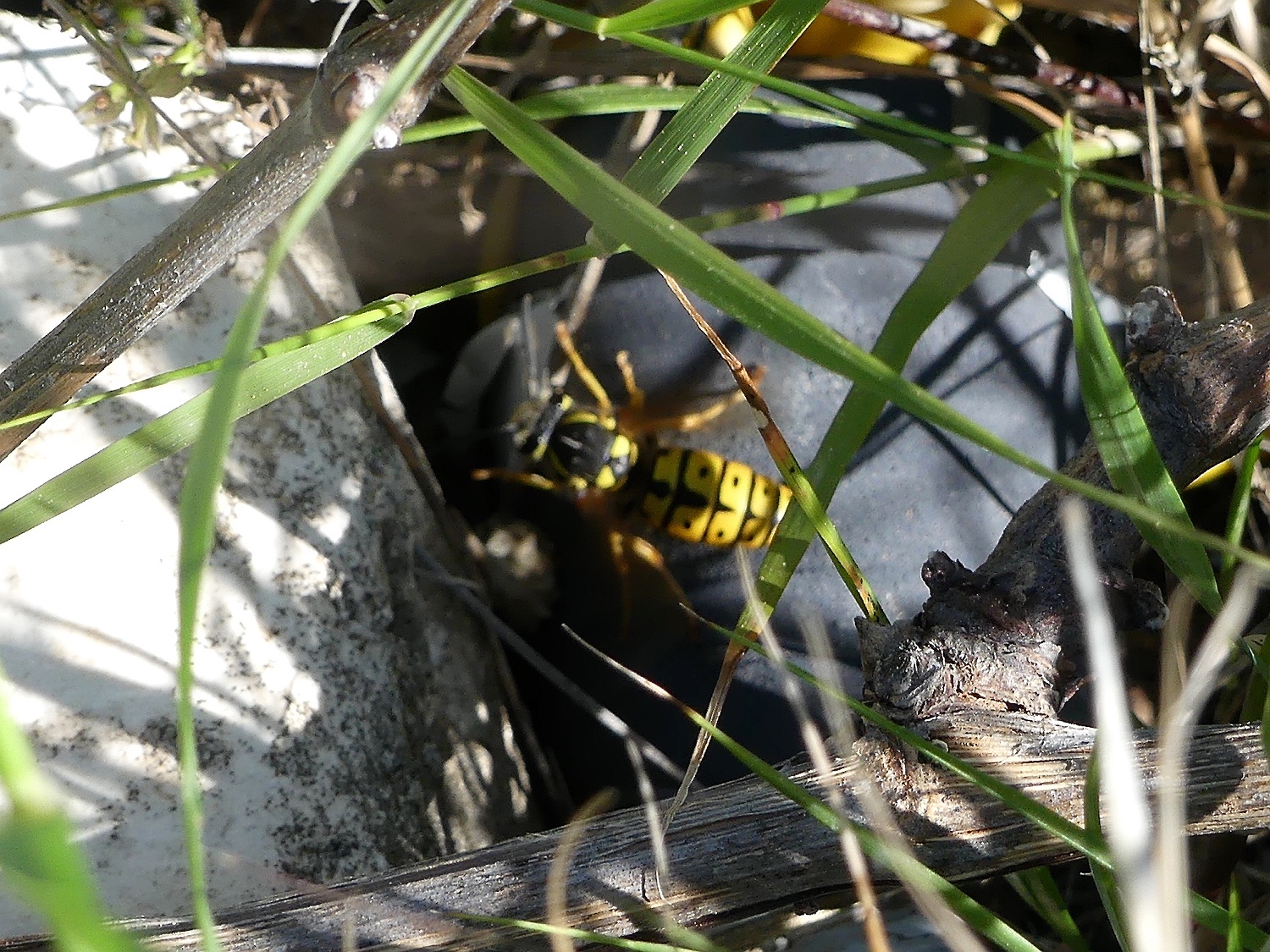
Here you can see a German wasp queen searching for a suitable cavity for a new nest. You can see the wasp’s typical black and yellow markings.
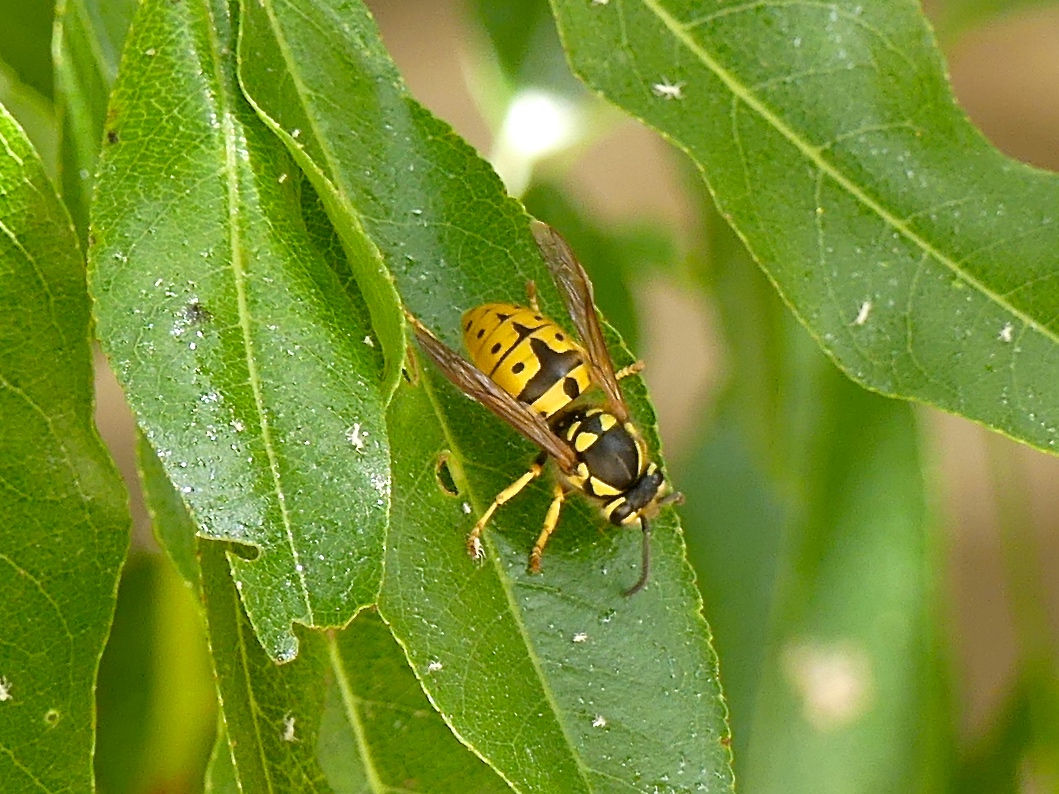
This German wasp is licking up the sugary excretions of aphids on the leaves of our almond tree. The adult animals live on nectar, fruit and other sweet substances.
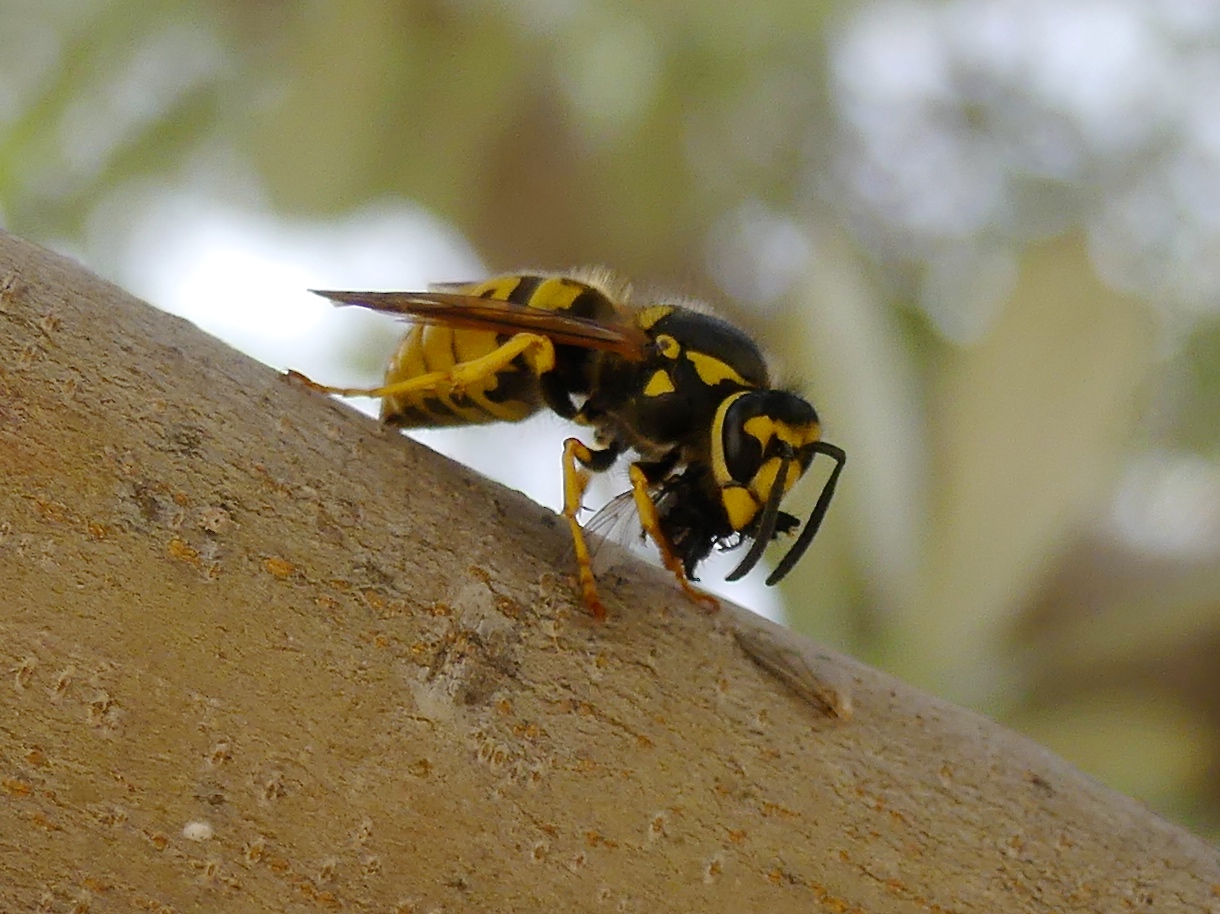
As food for their larvae, the wasps catch insects, especially flies; they also collect meat. This wasp has caught a fly on our oregano plant, which is visited by many insects, and has retreated to a neighbouring tree to cut off the wings. The larvae are fed with a protein-rich paste from the prey the workers gather.
Oriental hornet, Vespa orientalis, L.
With the queens measuring up to 3.5 cm in body length, hornets are among the largest wasps. The Oriental hornet is common on Naxos. In spring, the queens, which have spent the winter in sheltered places, start searching for a suitable place for the nest, usually in a hole in the ground. There they raise the first generation of workers. Afterwards, they leave the construction of the nest and the care of the brood to the workers and merely lay eggs. By autumn, a colony can comprise around 2,000 cells in several horizontally arranged combs. The last individuals reared in autumn develop into queens, which each found a new colony in the following year.
Adult hornets feed on fruits and plant sap. They are particularly fond of grapes and can cause considerable damage in vineyards. They also enjoy licking the sweet excretions of aphids. The larvae, on the other hand, are fed with animals, particularly with other insects. The Oriental hornet often invades bee colonies, kills the bees and steals the honey, usually resulting in the complete destruction of the colony. Consequently, the species is very unpopular with beekeepers on Naxos.
While hornets are not aggressive at their feeding sites and rarely sting (unless stepped on or touched), they defend their nest vehemently. If you come near a hornet’s nest, the only recourse is to run away as fast as possible. The stings are usually not worse than wasp stings, but many stings can be quite uncomfortable or even dangerous.
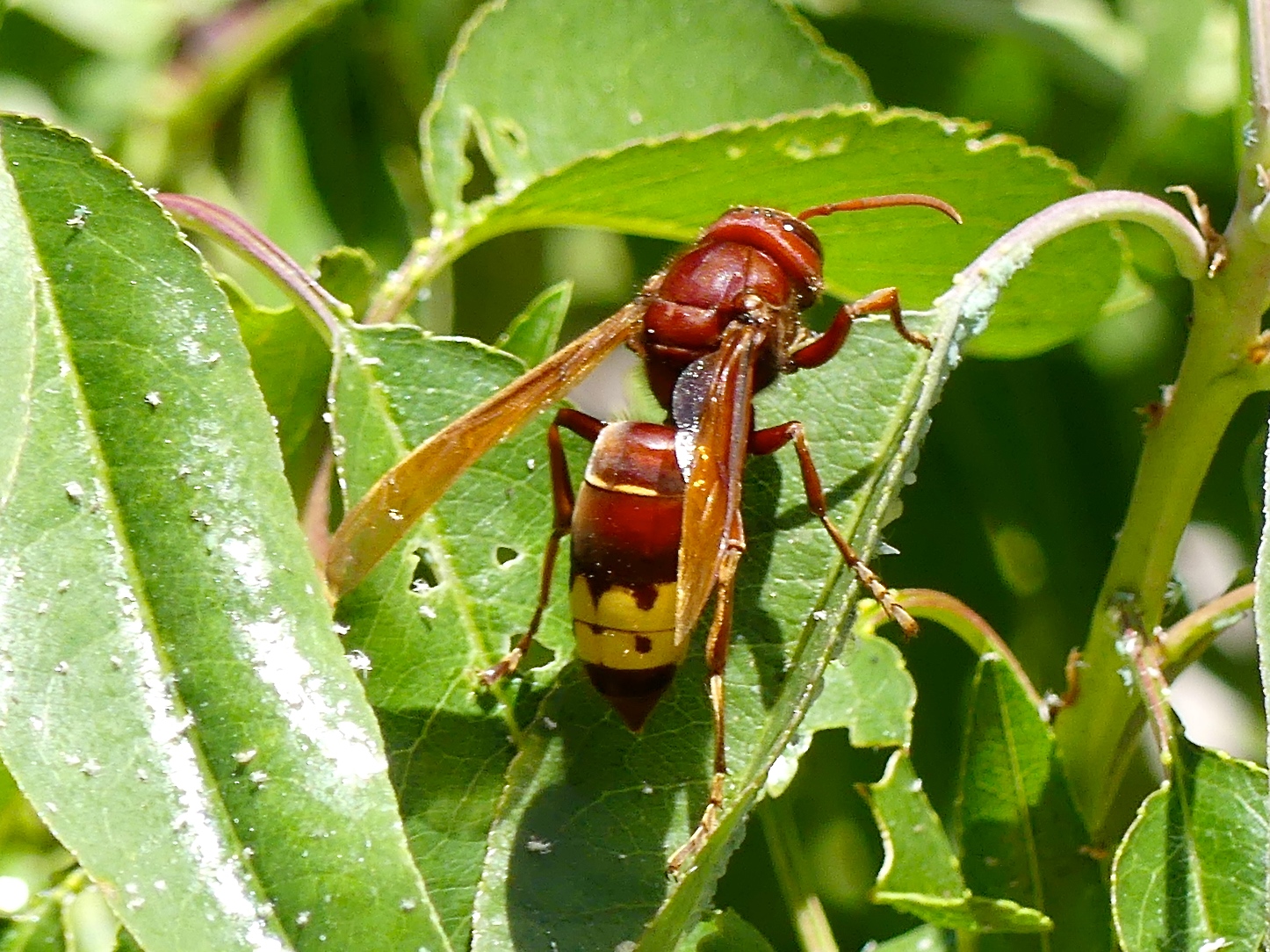
In spring, Oriental hornet queens often visit our almond tree to lick the sugary secretions of aphids from the leaves. At 3.5 cm in length, they reach a considerable size. You can see the typical colouring of the Oriental hornet.
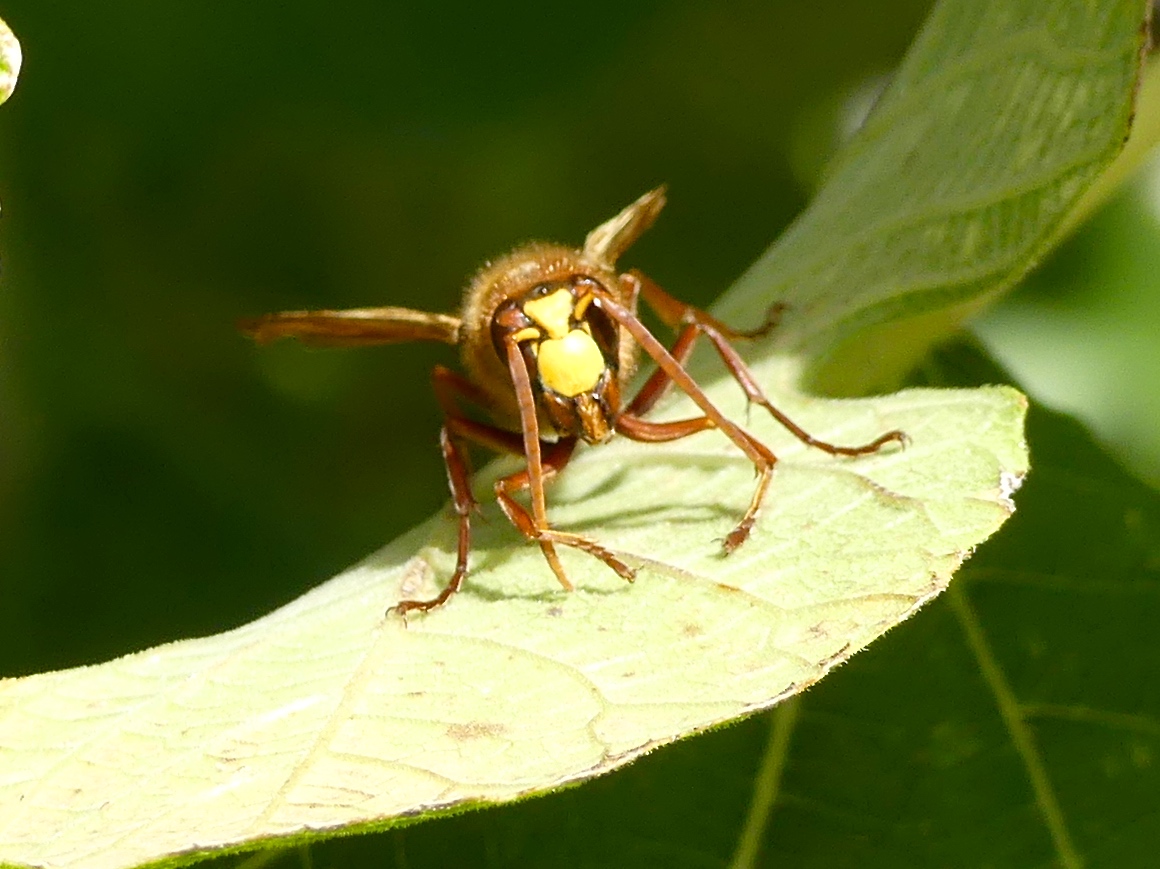
Here you can see the hornet’s characteristic yellow face.
Potter wasps, Eumeninae
The family of the Vespidae includes not only the social wasps that form colonies (see above), but also numerous solitary wasps, such as the Potter wasps. These build individual nests out of clay, which they provide with insect larvae as food. Potter wasps are characterised by a narrow, elongated, slightly curved first abdominal segment. They are usually black in colour with species-specific yellow markings. A large number of genera exists, some with very many quite similar species, making identification difficult; I have attempted to assign names as accurately as possible here, but most identifications are not certain.
Eumenes mediterraneus, Kriechbaumer
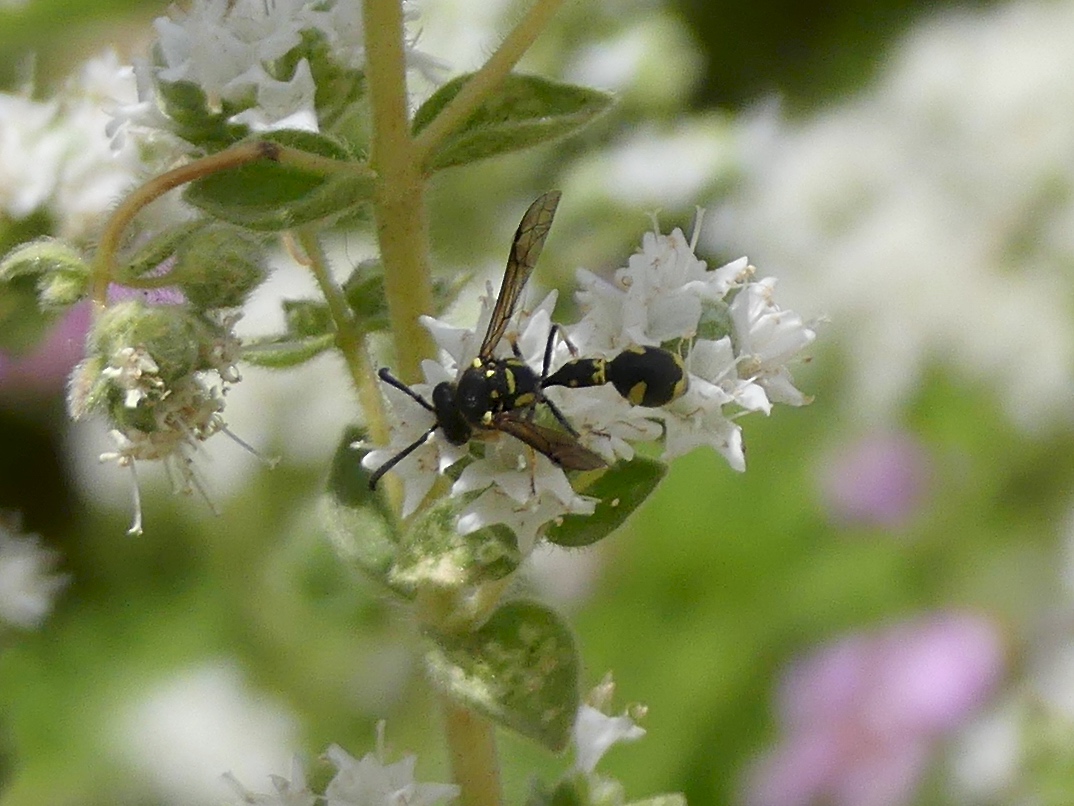
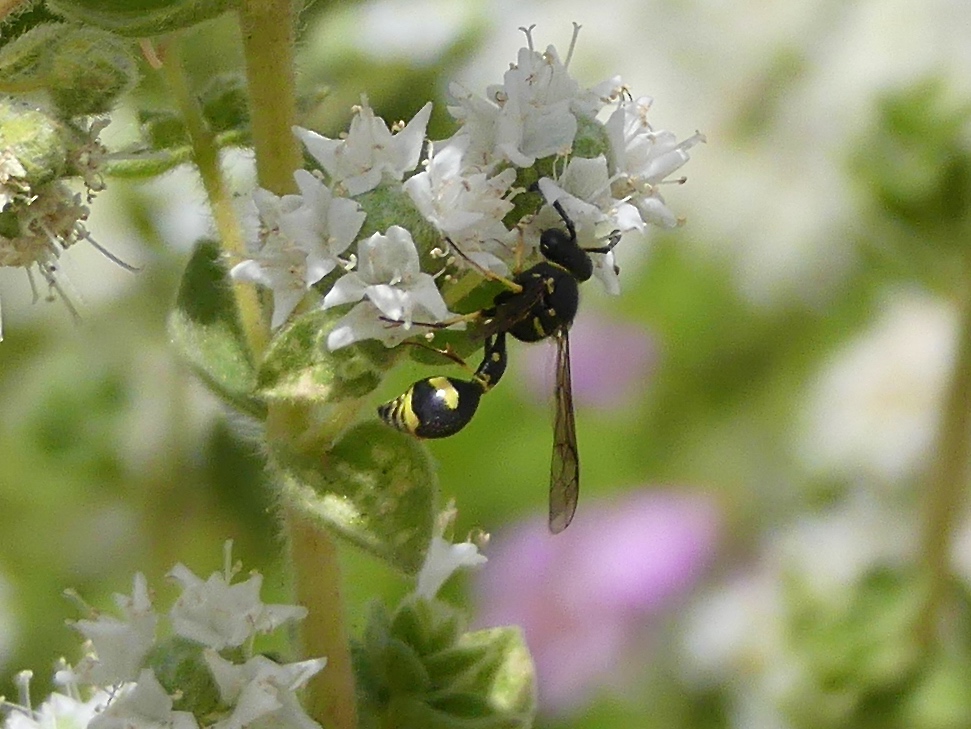
Potter wasps can be recognised by their characteristic narrow first abdominal segment. Based on the colouring, this is probably Eumenes mediterraneus.
Eumenes sareptanus, André
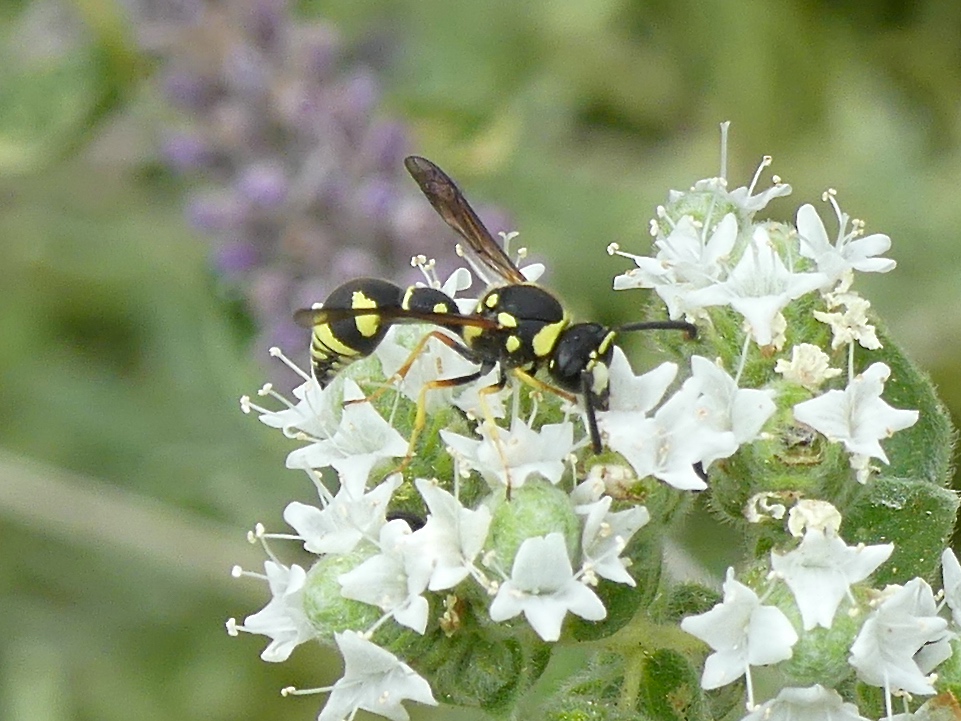
Here we have another species, probably Eumenes sareptanus.
Eumenes spec.
What a lovely little nest this potter wasp has built for its offspring! Unfortunately, I did not see the adult.
Delta unguiculatum, Villers
Delta unguiculatum is one of the few European representatives of its genus, which is otherwise found mainly in the tropical regions of Africa and Asia. It reaches a length of up to 2 cm and builds clay nests for its larvae, often in walls or on houses, providing butterfly caterpillars as food.
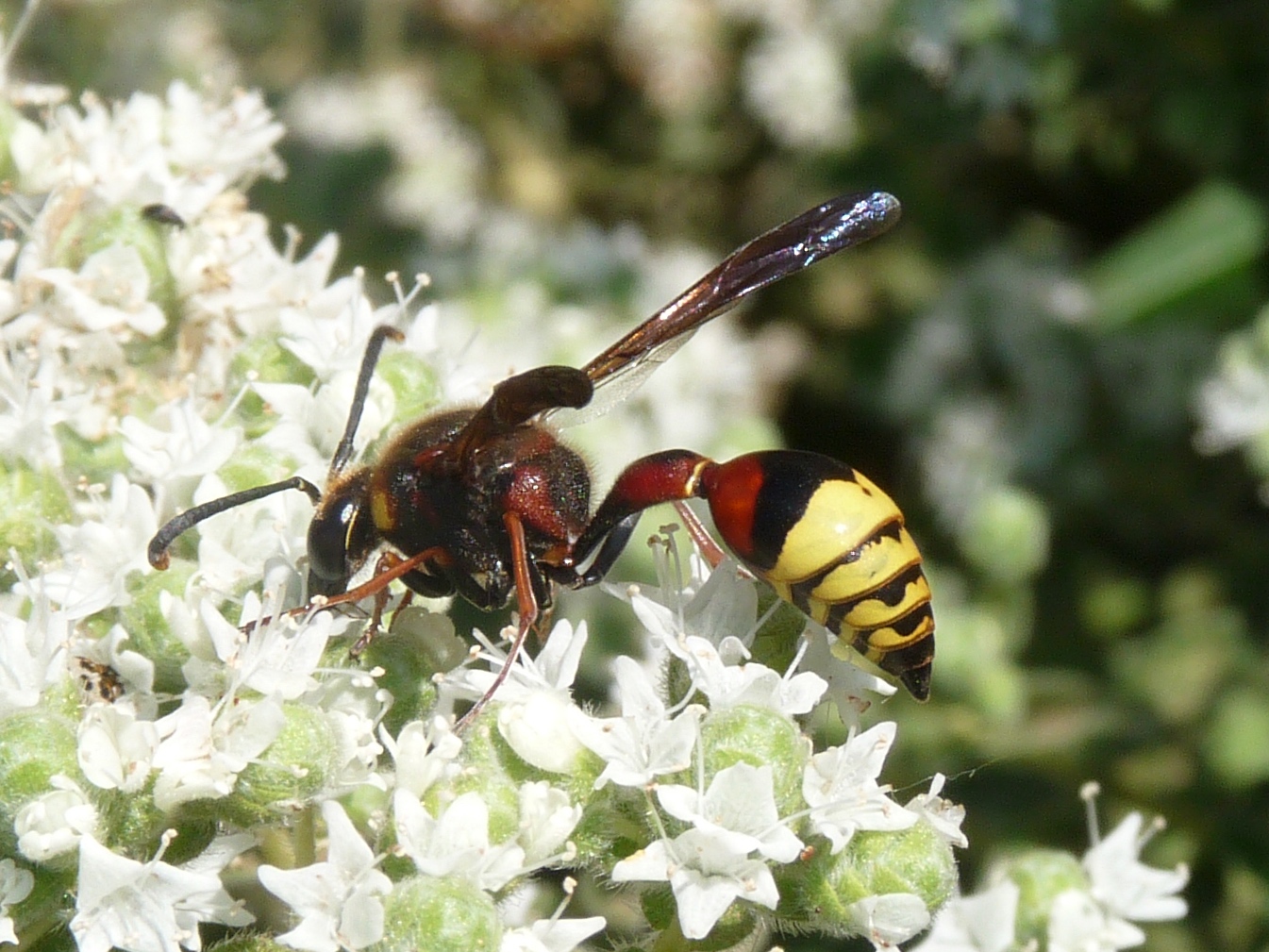
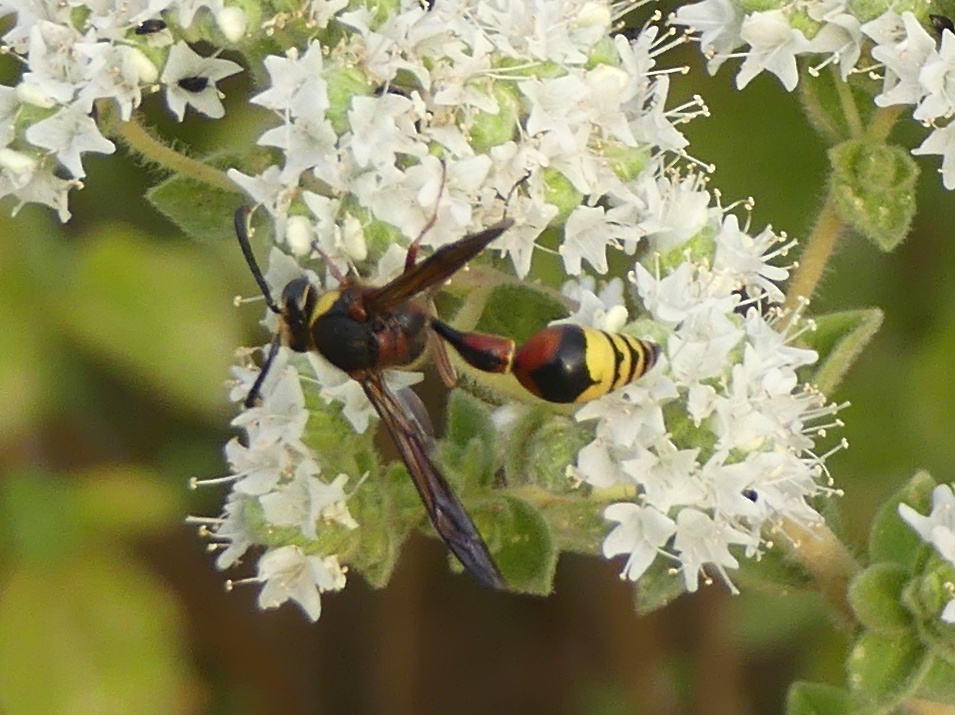
As all members of the Vespidae, Delta unguiculatum folds its wings together when at rest. The first segment of the abdomen is stalk-like in shape and somewhat curved. The colouring of the wasp is mostly rust-brown and yellow with black stripes.
Katamenes dimidiatus, Brullé
The species Katamenes dimidiatus bears a strong resemblance to the former species, but is somewhat stockier and has antennae that are mostly reddish-brown rather than black. It builds beautiful clay urns for its offspring. This species is found in Greece and the Middle East, as well as in Ukraine.
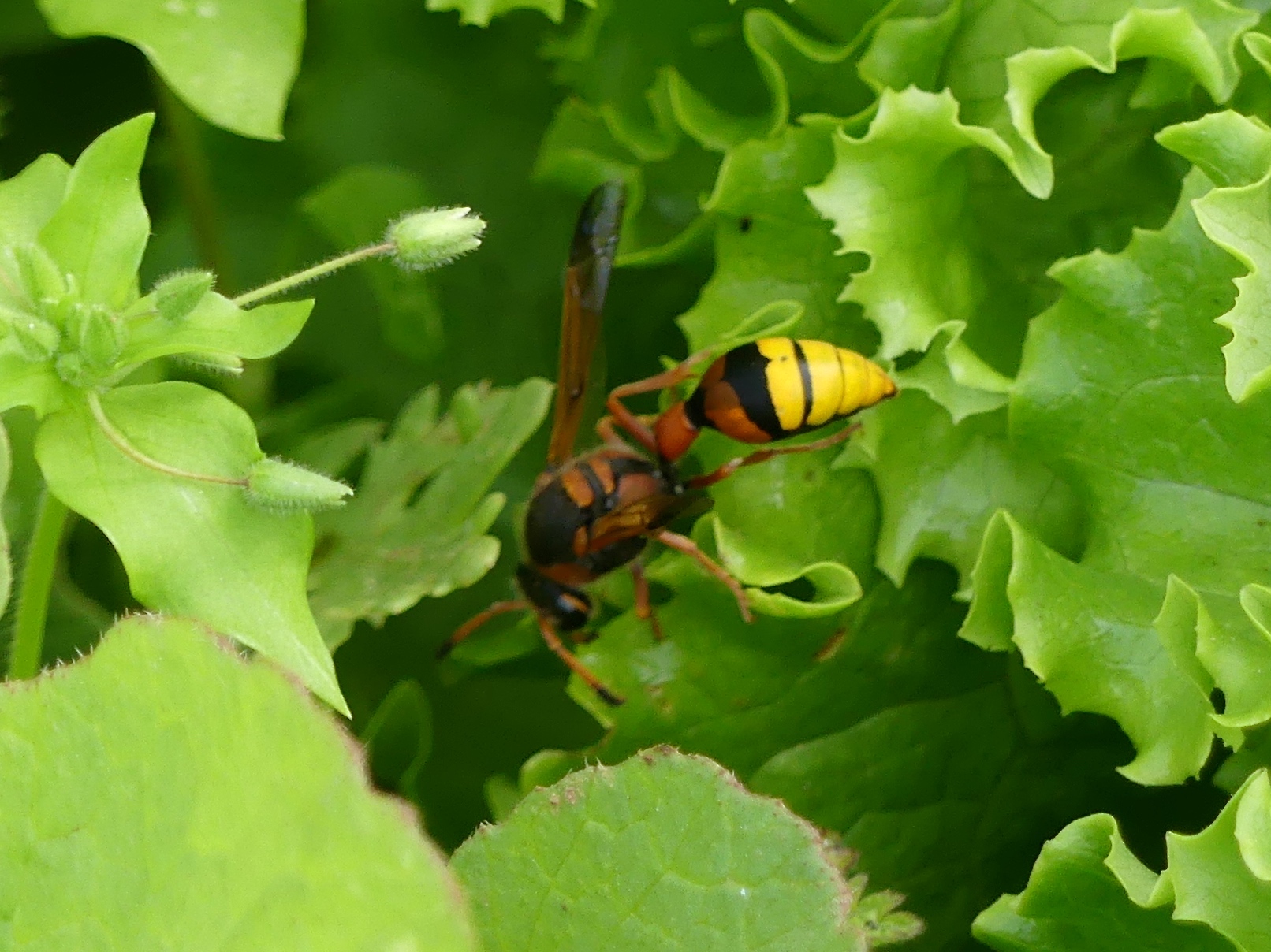
Katamenes dimidiatus resembles Delta unguiculatum. The best way to distinguish it is by the antennae, which are partly reddish-brown.
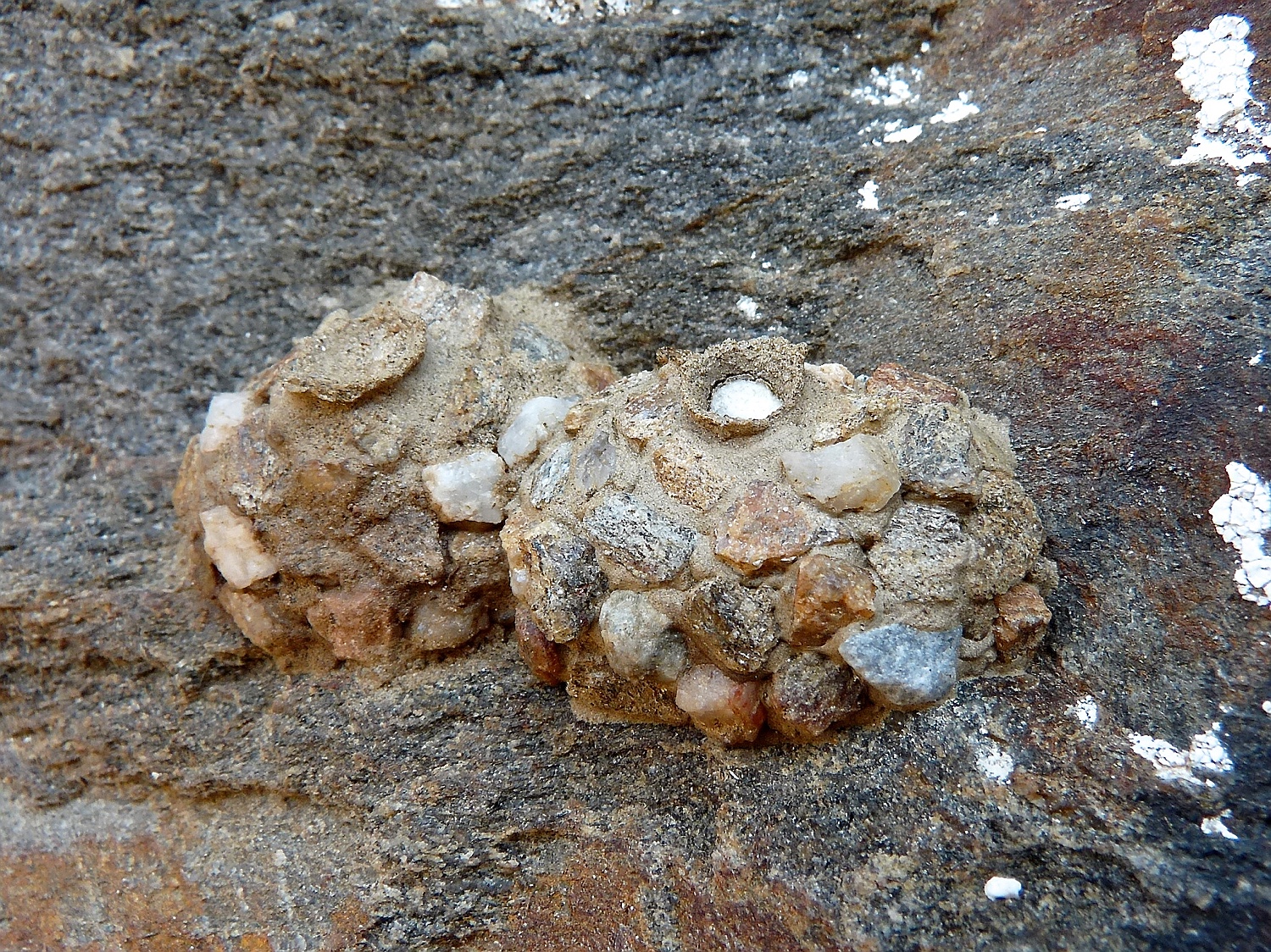
The nests of Katamenes dimidiatus are carefully constructed from tiny pebbles held together with clay.
Rhynchium oculatum, Fabricius
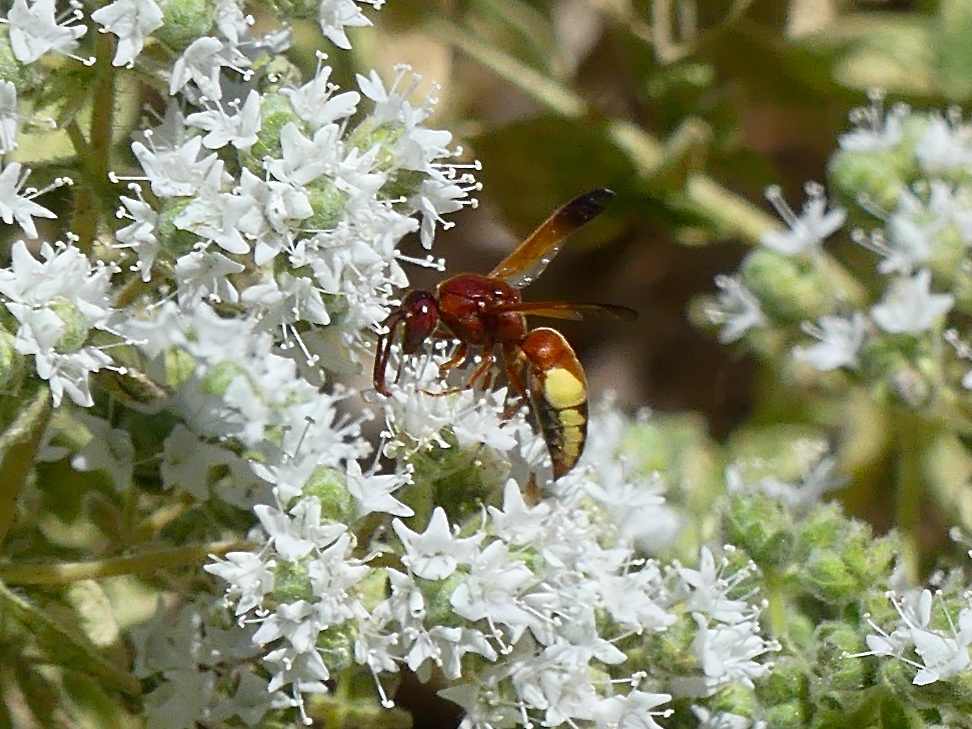
The potter wasp species Rhynchium oculatum, which is widespread in southern Europe, can be recognised by its characteristic reddish-brown colour and the yellow spots on the sides of its abdomen. The tips of the wings are dark.
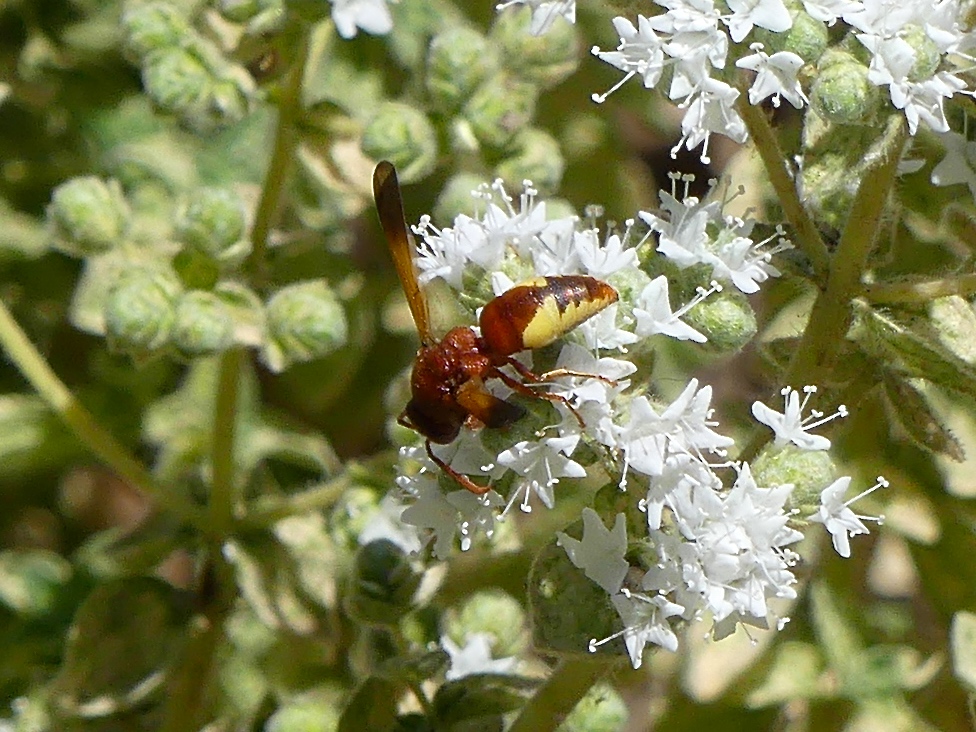
This species can often seen flying over flowering plants such as Greek oregano, presumably searching for suitable prey that is then deposited in the nests as food for the larvae.
Ancistrocerus nigricornis, Curtis
The species of the genus Ancistrocerus build their nests in holes or stems, less commonly as free-standing urns, and usually bring in small caterpillars or beetle larvae as food.
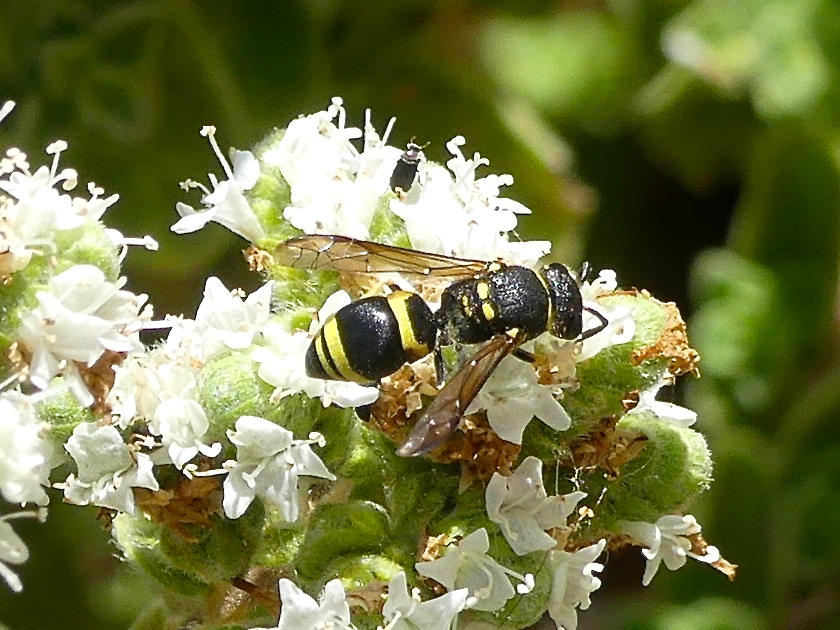
This is Ancistrocerus nigricornis or a very similar species. It can be recognised by the characteristic shape and arrangement of the yellow stripes and markings.
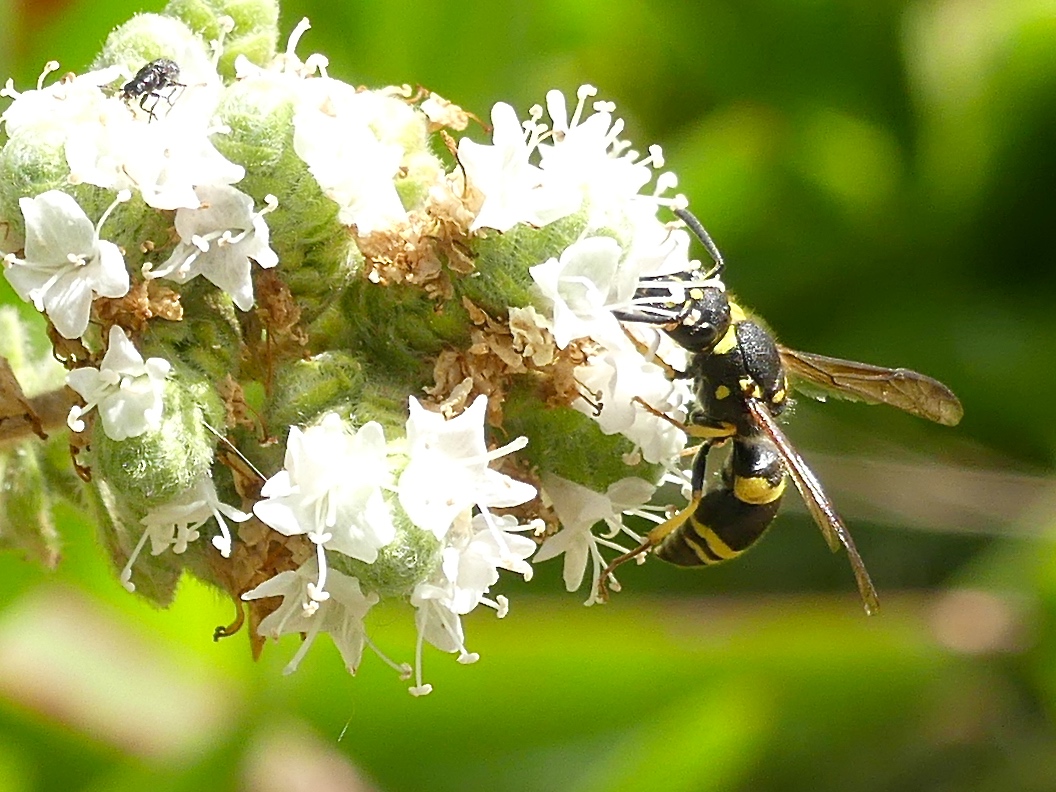
Ancistrocerus oviventris, Wesmael
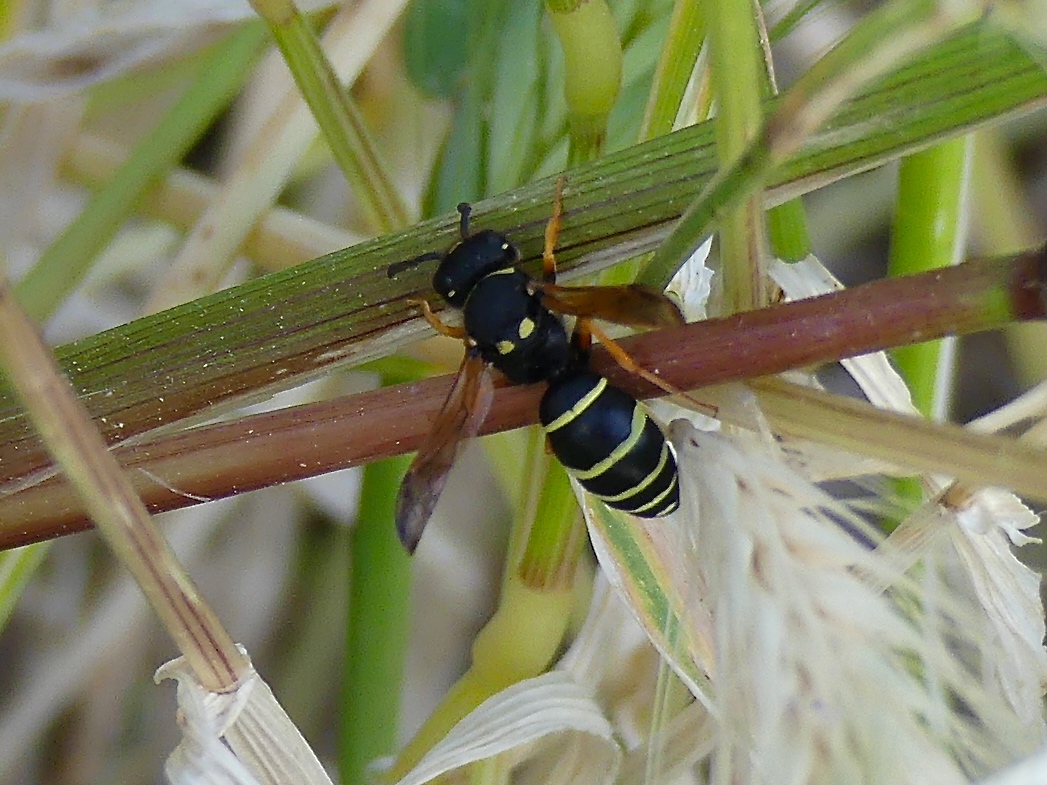
This species, with its narrower yellow stripes, could be Ancistrocerus oviventris.
Ancistrocerus trifasciatus, Müller
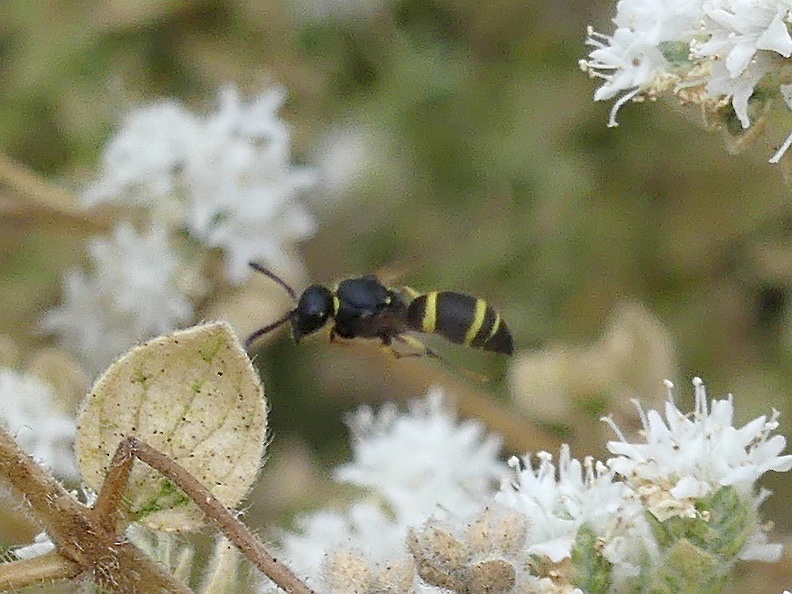
Ancistrocerus trifasciatus has only three narrow yellow stripes on the abdomen. The thorax also shows only very small yellow spots.
Euodynerus dantici, Rossi
Euodynerus dantici is a widespread and common species in Europe and neighbouring regions.
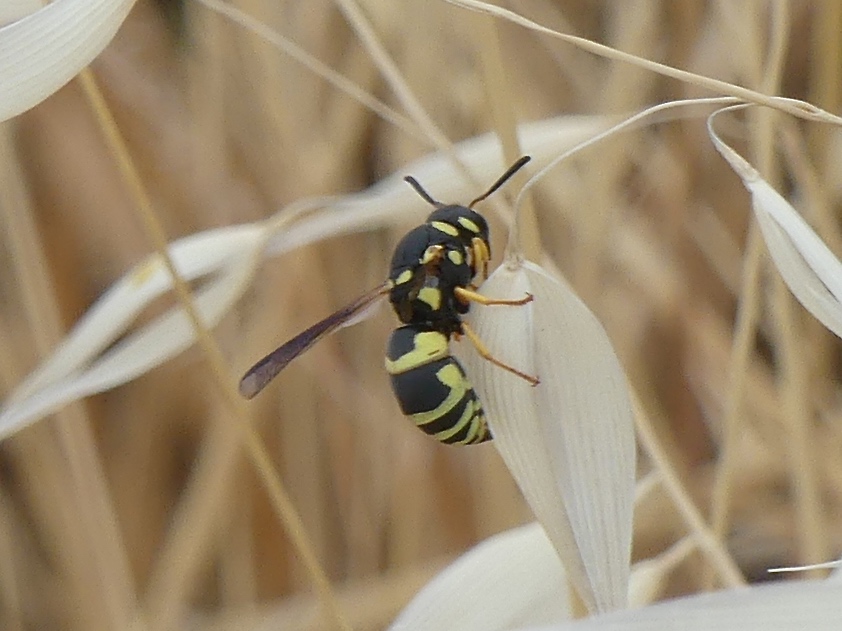
Euodynerus dantici is a relatively large species, in which the two front yellow stripes on the abdomen are indented in the middle.
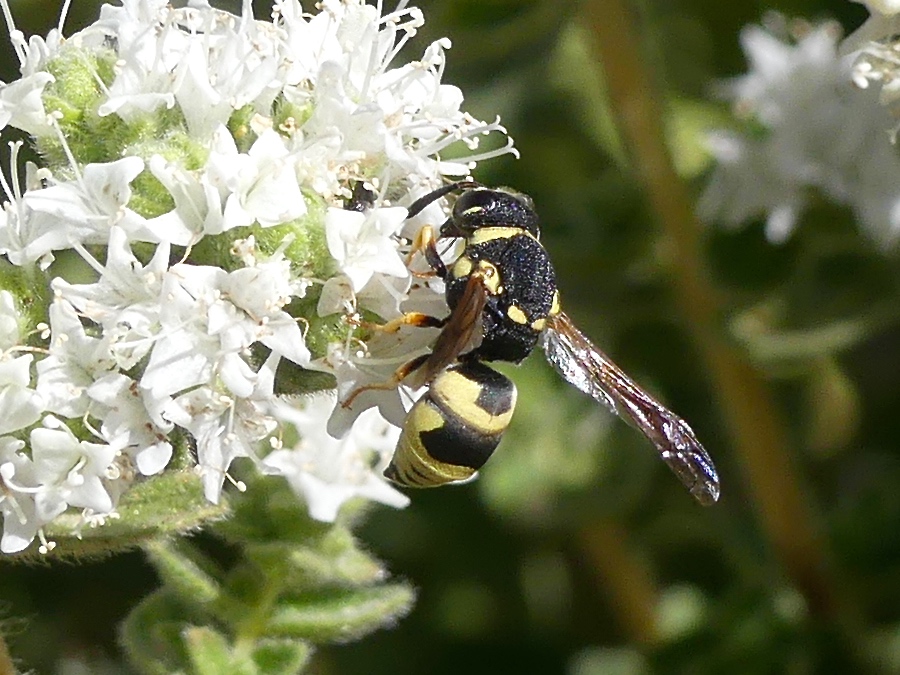
Antepipona orbitalis, Herrich-Schäffer
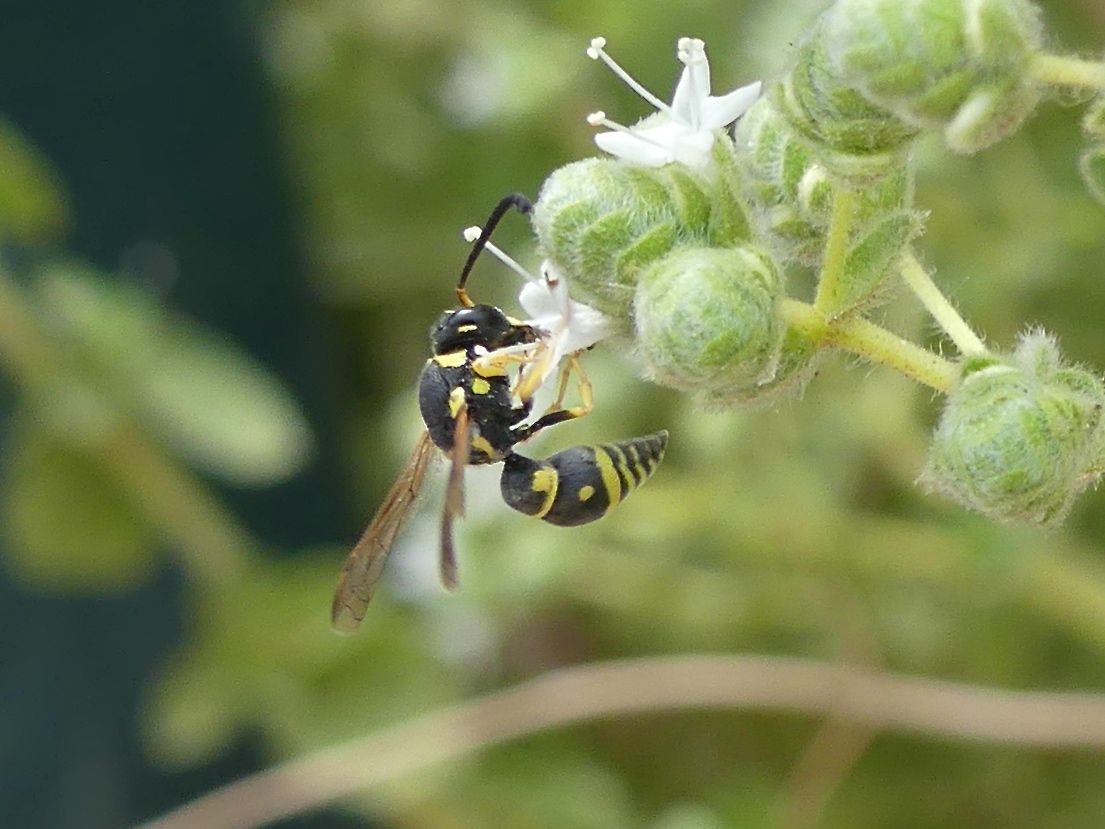
Antepipona orbitalis can be recognised by the fact that the second stripe on the abdomen is reduced to a dot.
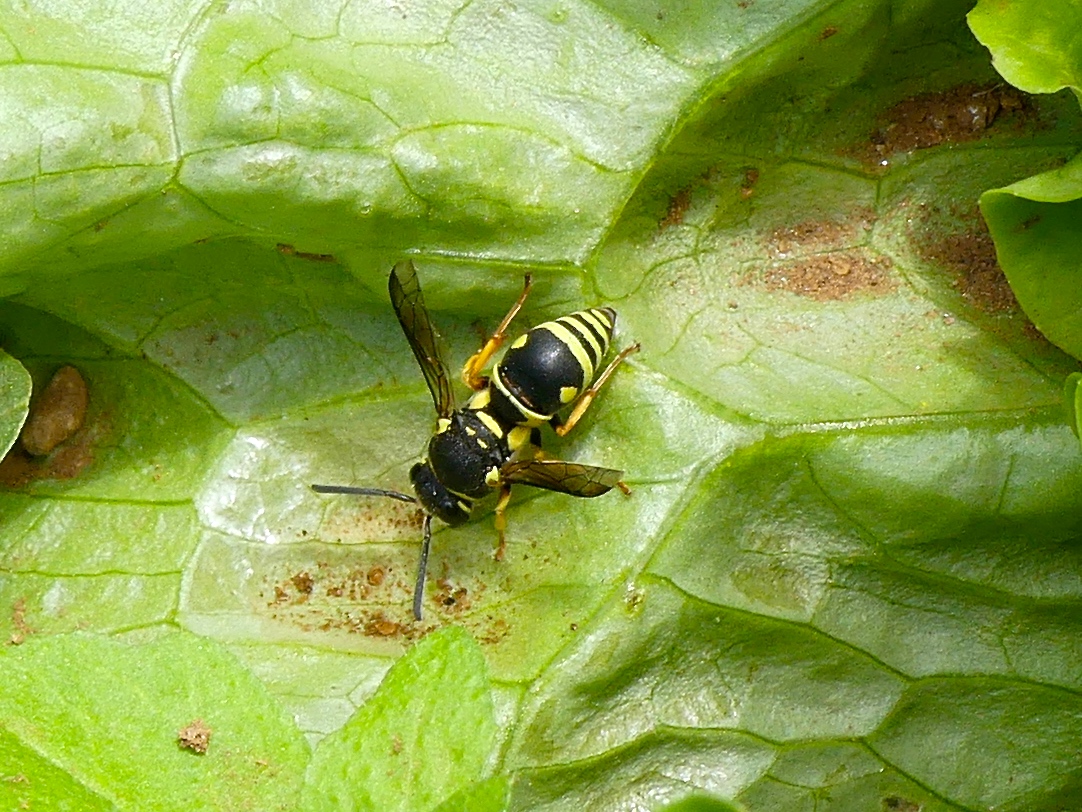
This is probably the same species. It likes to sit on the lettuce in our garden.
Superfamily Scoliidea
The Scoliidae are among the largest Hymenoptera. Despite their impressive size, their stings are not painful, or barely so. The adults visit flowers, where they feed on nectar and pollen. The larvae parasitise on beetle larvae, mostly those that live underground in the earth (grubs). Scoliidae are found primarily in tropical regions. Around 70 species occur in the Mediterranean.
Mammoth wasp, Megascolia maculata, Drury
The Mammoth wasp, with a body length of 4 cm in females, is the largest hymenopteran in Europe. It is mostly blackish with a light brown, hairy thorax and an elongated abdomen featuring two broad yellow stripes in the middle, whilst the tip is reddish and hairy. The wings are brownish in colour. The head bears long, stout antennae. The head of the male wasps is rather small and inconspicuously black, whilst the females have a large bright orange or yellow forehead.
The female Mammoth wasp lays its eggs on the larvae of the rhinoceros beetle which live underground. To do this, it flies about 15 cm above the ground, searching for beetle grubs, which it locates using its sense of smell. Once it has found a grub, it quickly digs into the ground, until it reaches it. The Mammoth wasp overpowers the fiercely struggling grub by biting or stinging it without using venom. The prey is then paralysed by a sting containing a special venom that blocks the grubs’ nervous system. The female wasp forms a cavity around the beetle grub, which it stabilises with saliva. Then it cleans the larva of any other parasites and lays an egg on it. The wasp larva feeds exclusively on its grub until pupation.
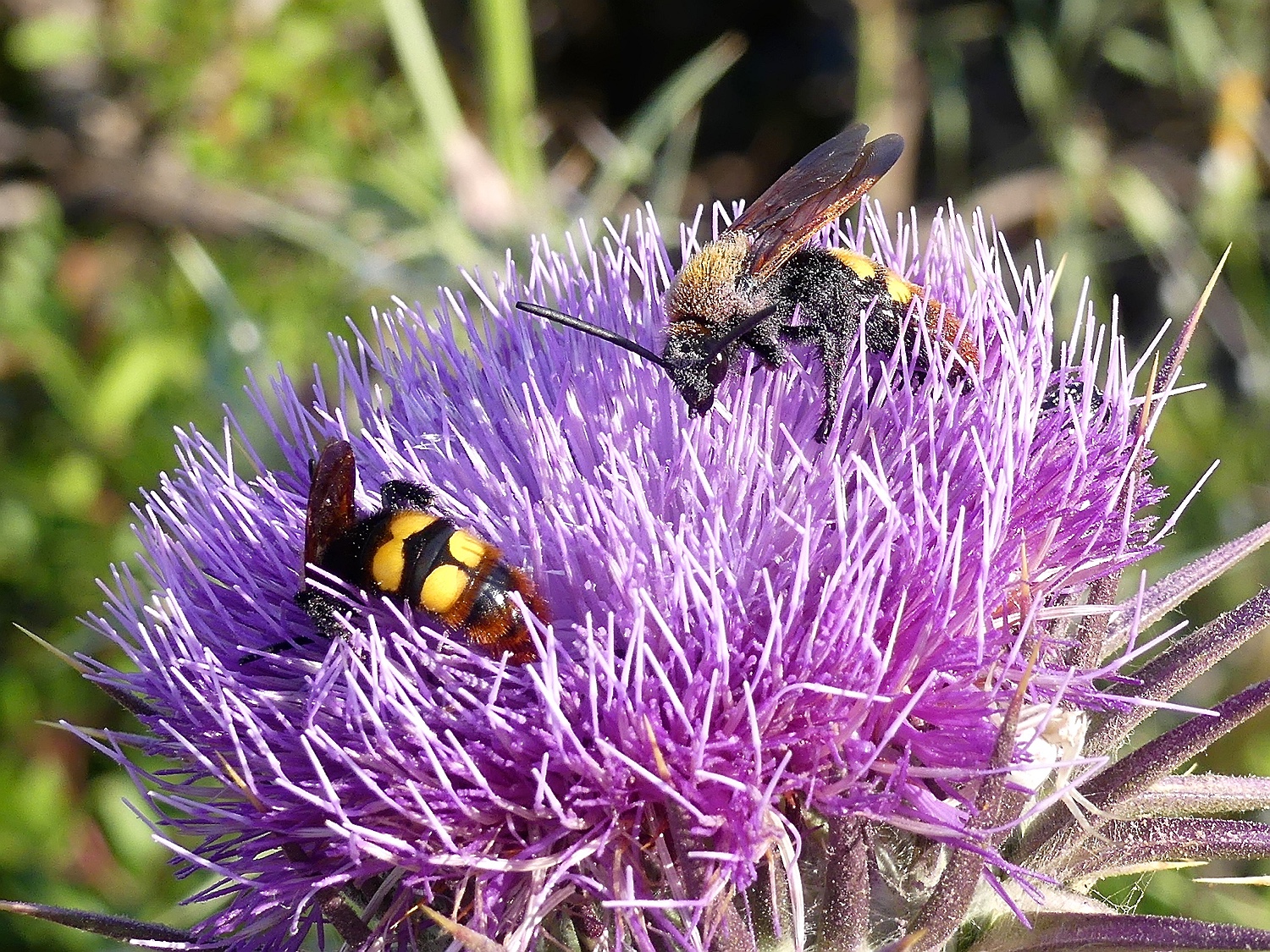
The huge but harmless Mammoth wasps often sit on large thistle flowers, feeding on their nectar and pollen. The males have a small black head.
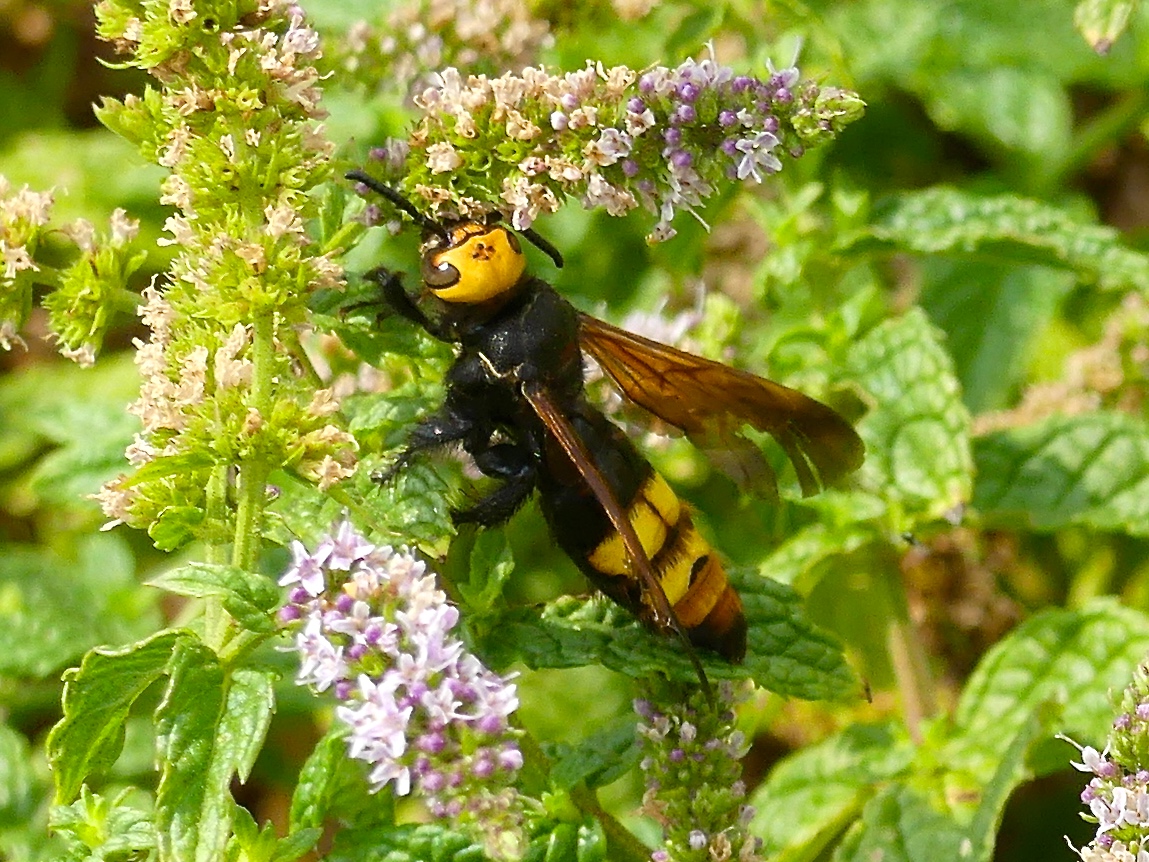
The females have a yellow, helmet-like forehead with three small ocelli in the centre.
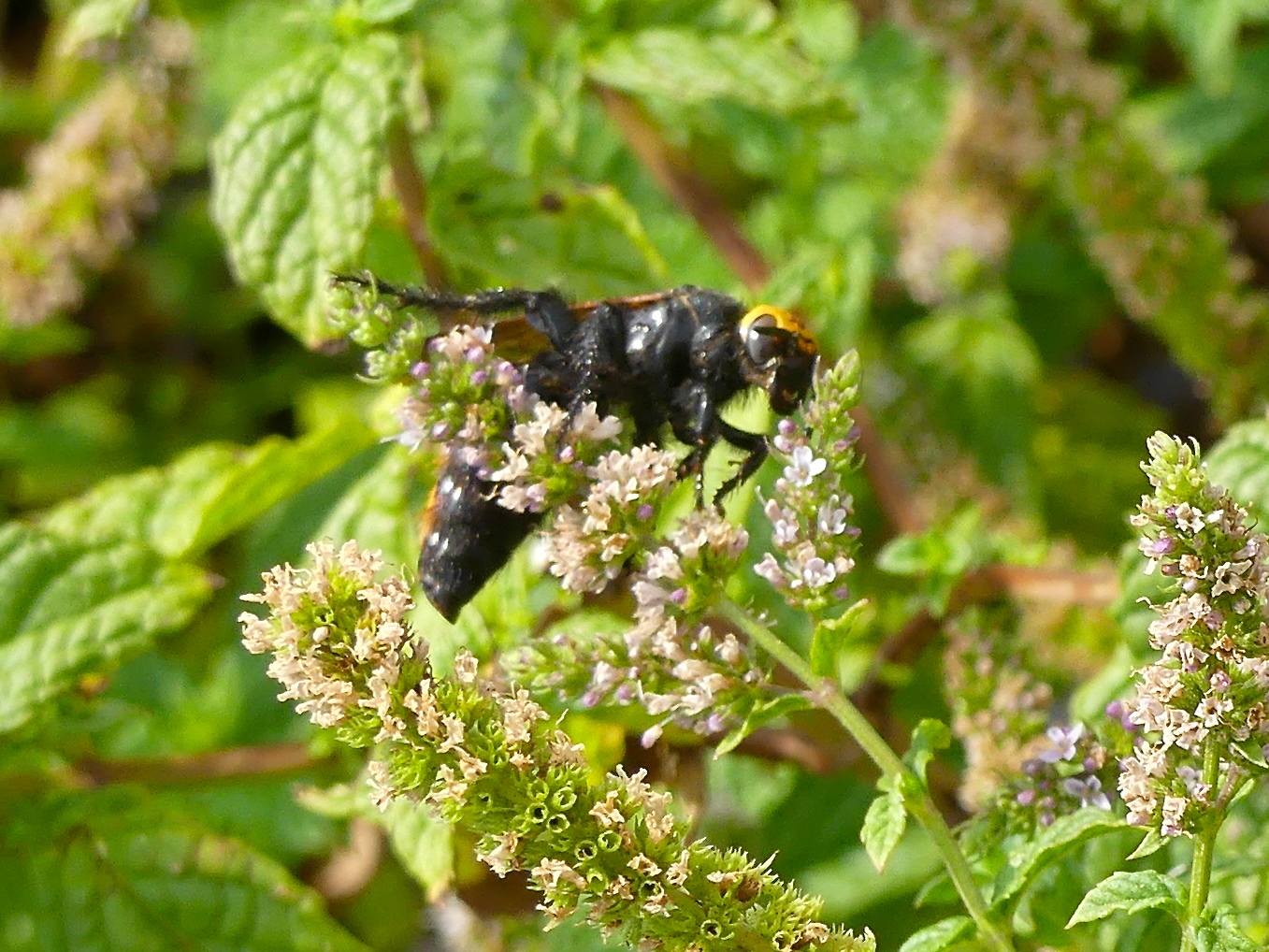
Female Mammoth wasps have large dagger-like mandibles, which they use to overpower the beetle larvae they use as food for their own larvae.
Scolia hirta, Schrank
Scolia hirta belongs to the same family as the Mammoth wasp, but is smaller and slimmer; it reaches a bit more than 2 cm in length. Scolia hirta is black in colour with two distinct, bright yellow rings on the abdomen. Like in the Mammoth wasp, the larvae parasitise grubs.
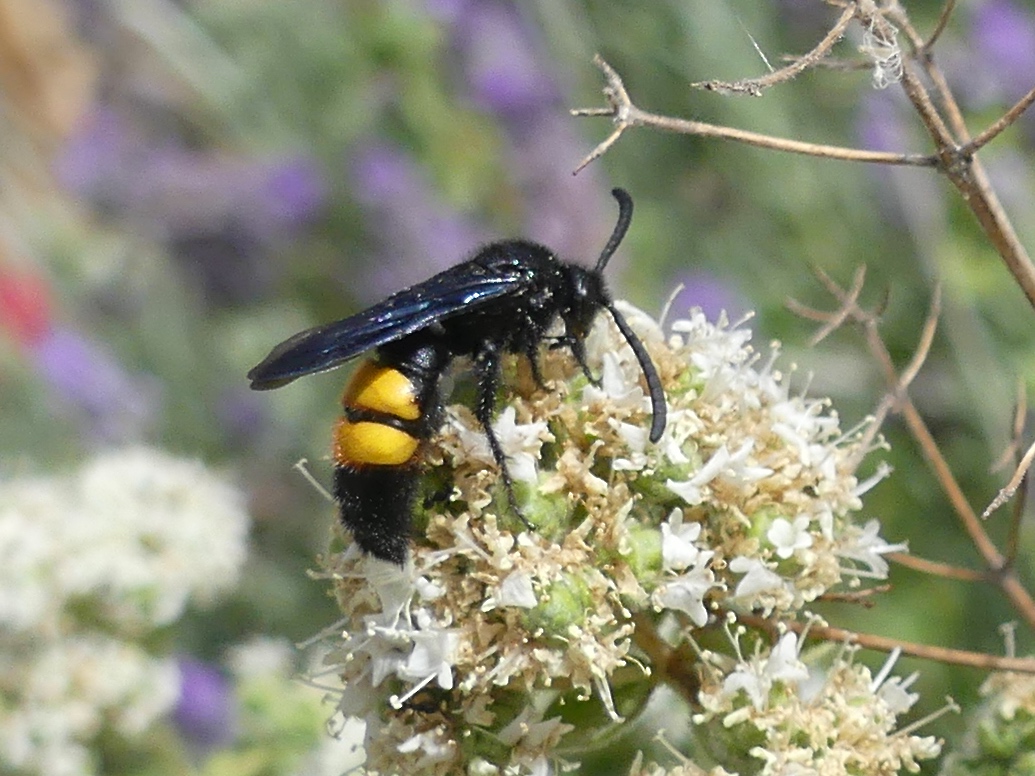
Scolia hirta, with its striking yellow rings on the abdomen, is rather rare in our region.
Scolia sexmaculata, O. F. Müller
Scolia sexmaculata with maximum length of 1.5 cm is rather common in our garden in summer. The rings on the abdomen of Scolia sexmaculata are white. The larvae of this species parasitise the larvae of rose chafer beetles and cockchafers, which the females track down in the soil.
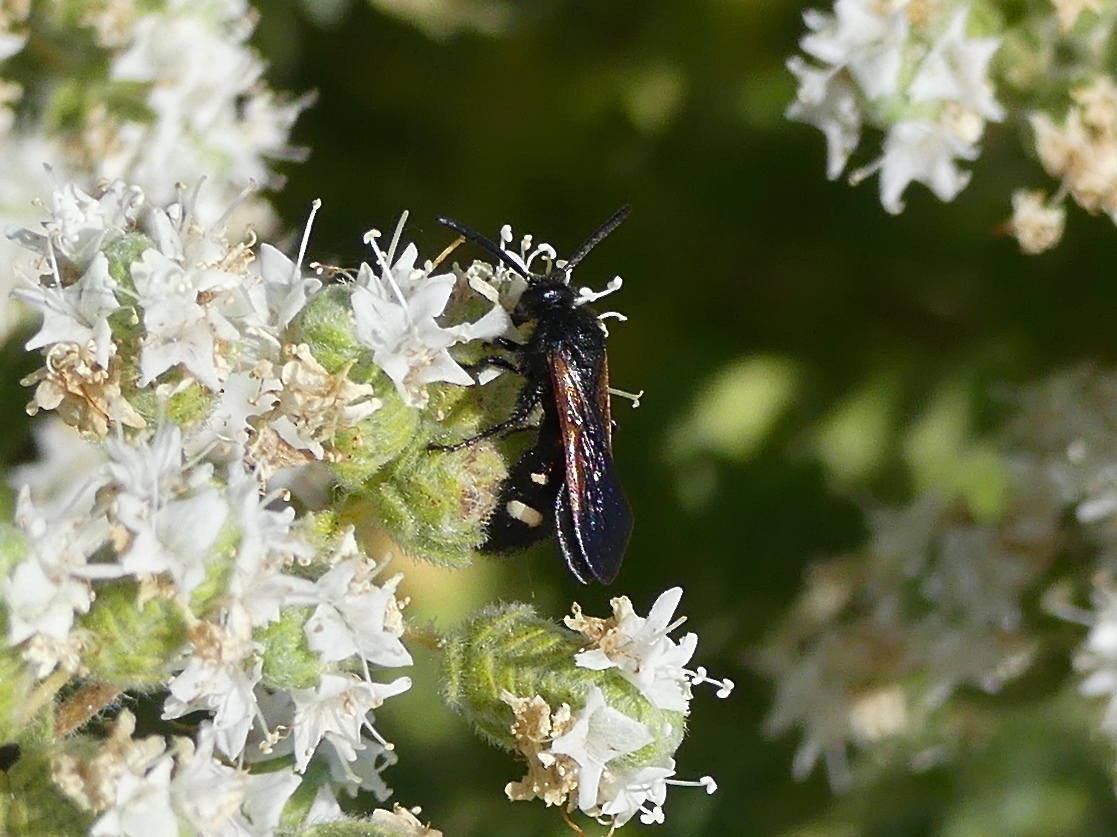
Scolia sexmaculata is almost black with dark reddish-brown wings and two interrupted white rings on the abdomen (i.e. four, not six white spots).
Colpa sexmaculata, Fabricius
Another species of scoliid wasp can very rarely be observed in our region: Colpa sexmaculata, a somewhat more distant relative (with a very similar name).
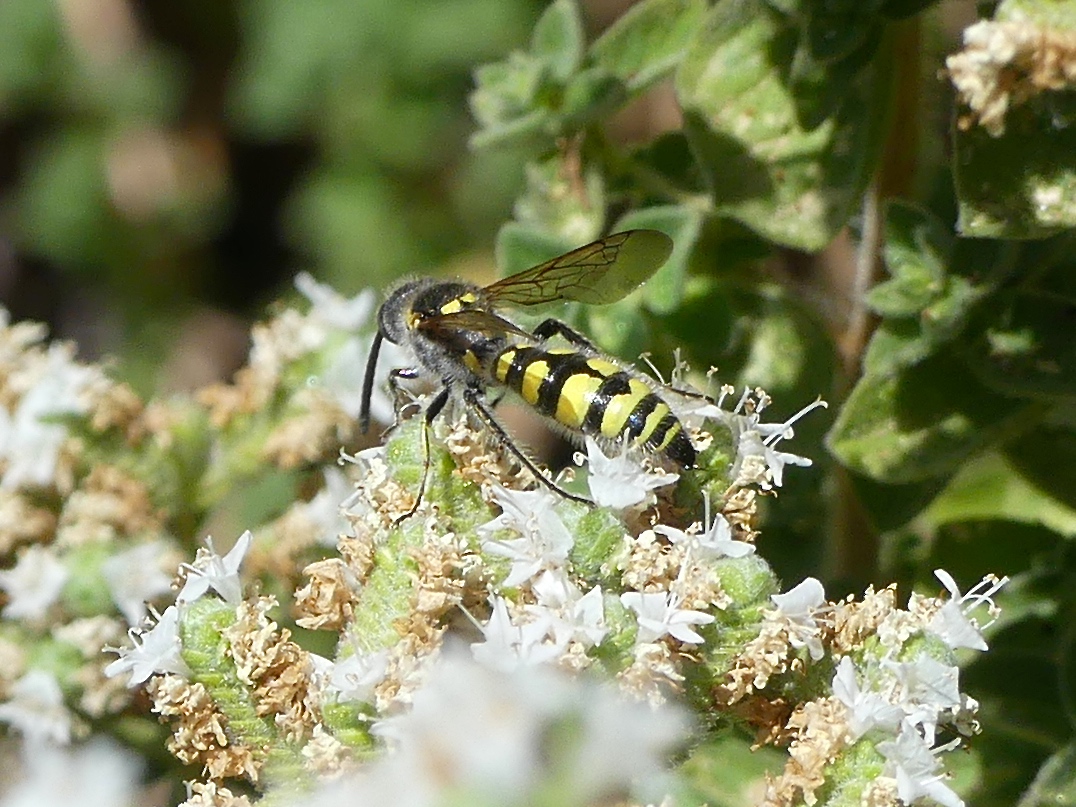
This species is also quite elongated; in this specimen, the abdomen is predominantly yellow with black rings and a black stripe down the center. Note the characteristic wing venation.
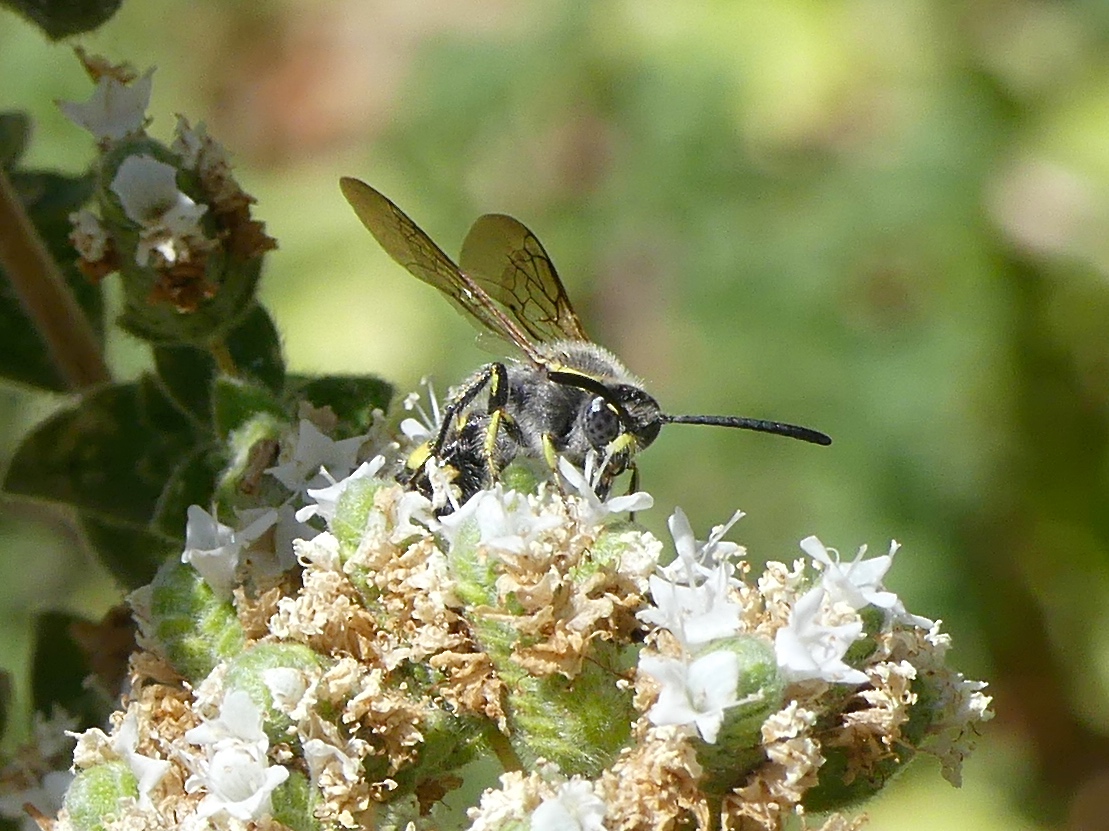
Here the same insect viewed from the front. The eyes are grey with small darker spots.
Superfamily Pompiloidea
Velvet ants, Mutillidae
The Velvet ants are particularly curious members of the Vespoidae. They are usually very small and, at first glance, resemble ants, particularly the wingless females. Males and females often look quite different, so much so that they have frequently been described as separate species.
Velvet ants are parasitic, i.e. they lay their eggs in the nests of bee or wasp species. The females in particular possess an exceptionally hard exoskeleton to defend themselves against the stings of their hosts. They can also deliver very painful stings themselves. The adults feed on nectar.
Mutilla quinquemaculata, Cyrillo
The small Velvet ant Mutilla quinquemaculata is common in the Cyclades. It can often be seen running across the ground, and is so quick that it is almost impossible to photograph.
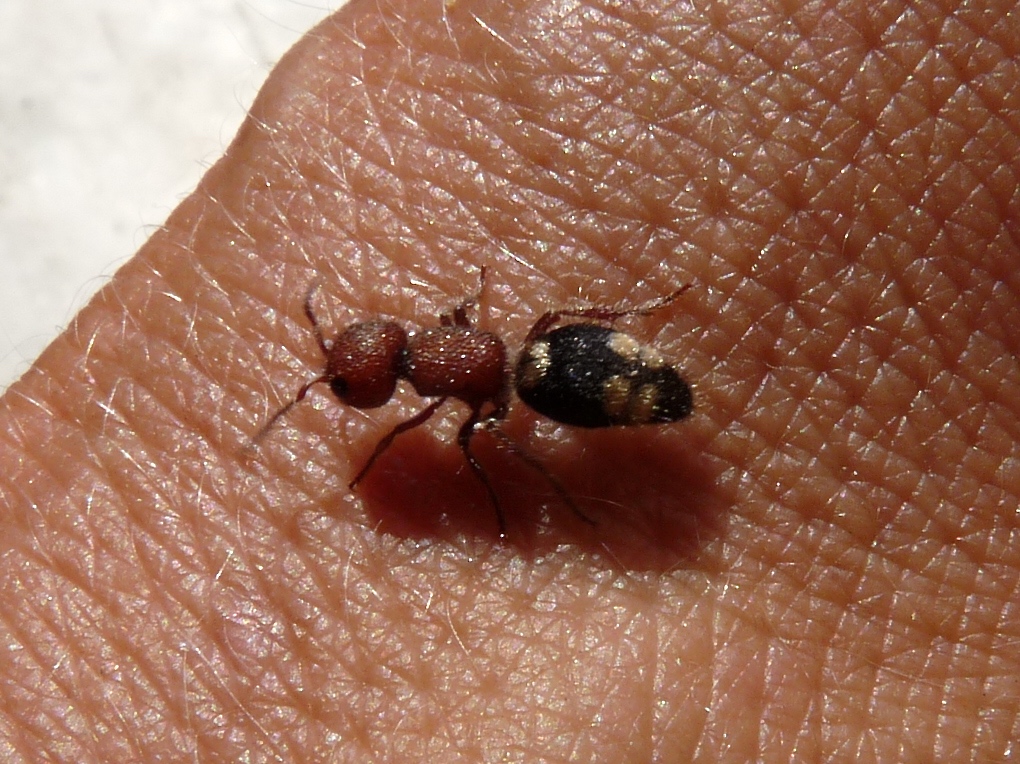
Mutilla quinquemaculata has a reddish-brown head and thorax and a black abdomen with white spots.
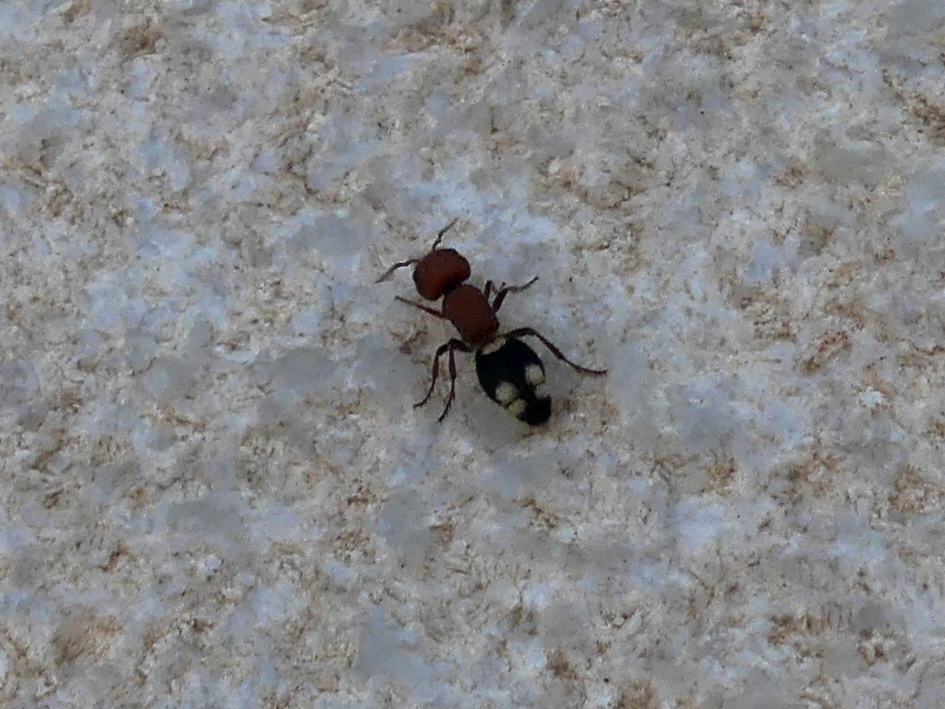
Female velvet ants have no wings.
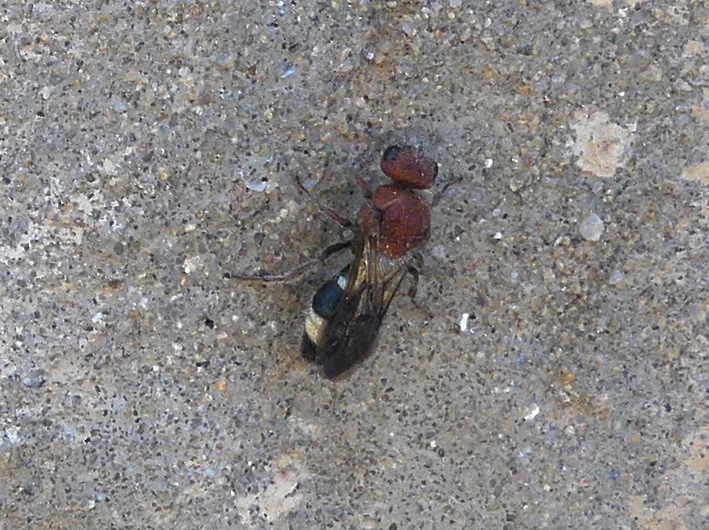
Males with wings occur much less frequently than the wingless females.
Ronisia barbara, L.
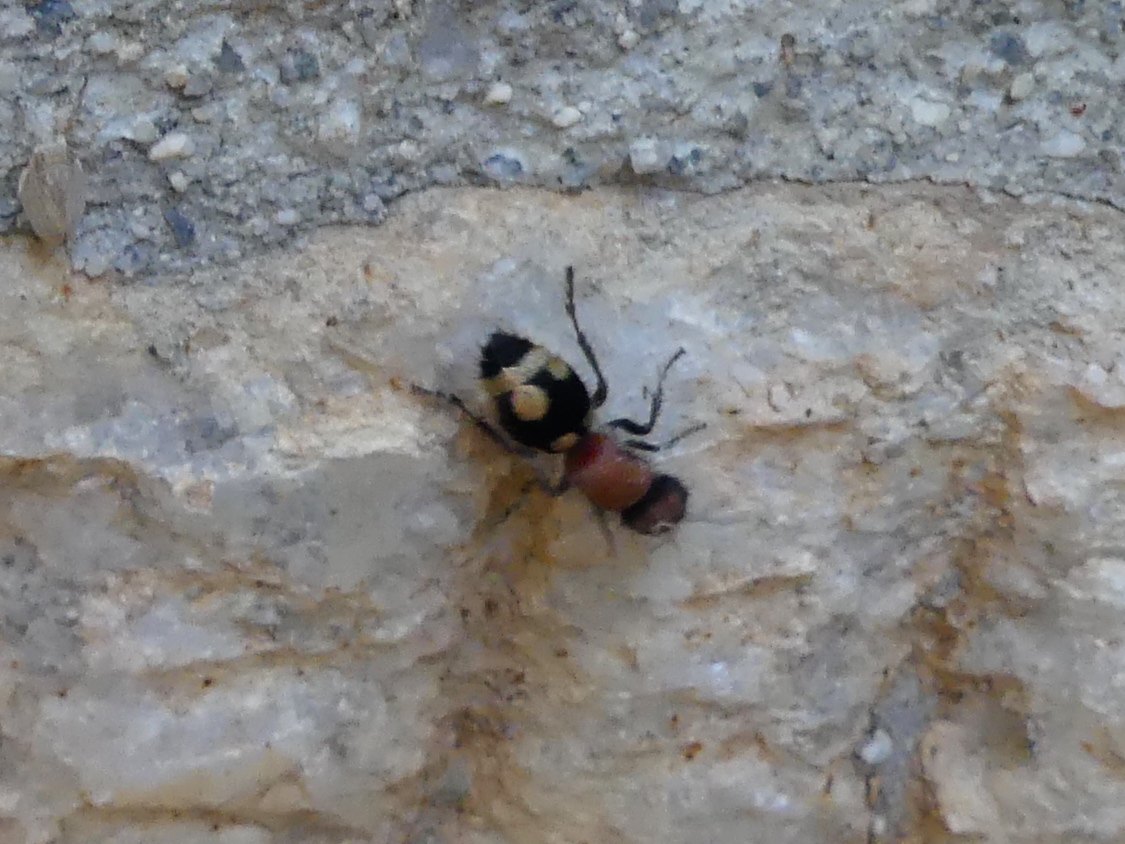
Ronisia barbara reaches a body length of up to 2 cm. Like all velvet ants, it moves very quickly on foot; that is why the photo has a rather poor quality. The head is predominantly black; the abdomen bears a few white spots and a white ring.
Tropidotilla litoralis, Petagna
This species is found in North Africa and Southern Europe. It lays its eggs in the nests of the potter wasp Paragymnomerus spiricornis (Eumeninae).
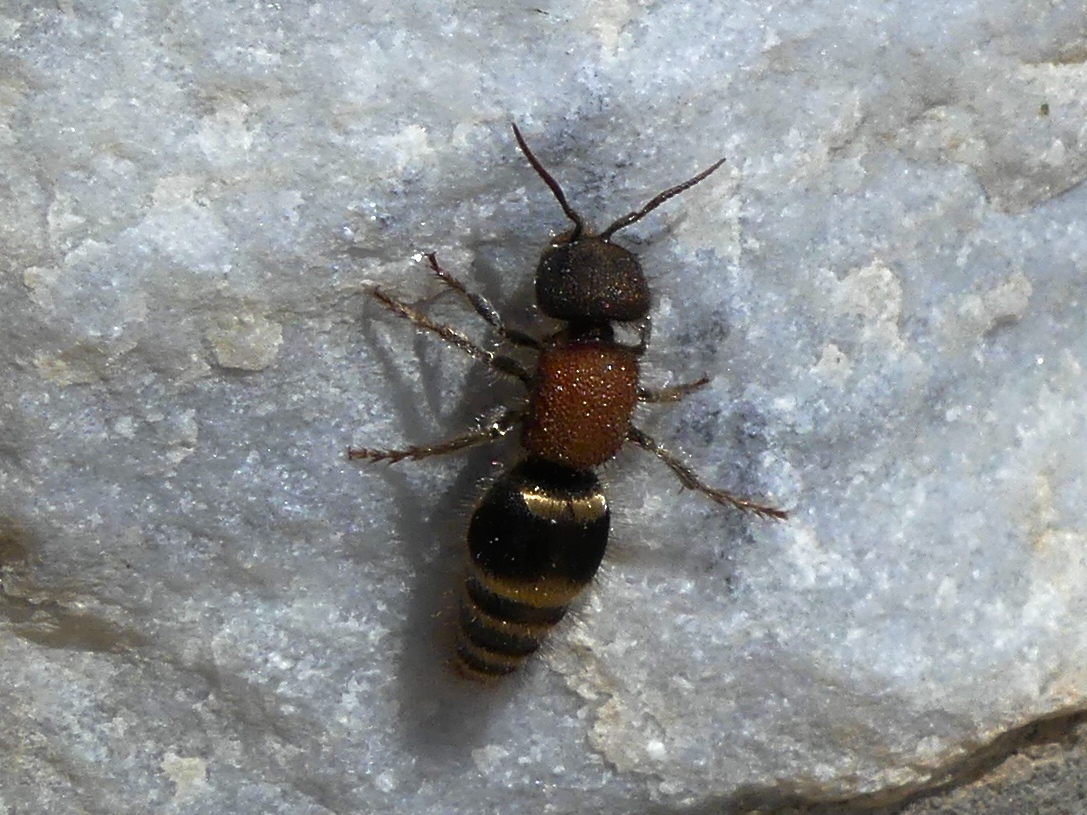
Tropidotilla litoralis, which reaches 1.5 cm, has a red thorax, whilst its head and abdomen are blackish. The last segments of the abdomen bear silvery-white rings, as does the foremost segment.
Spider wasps, Pompilidae
The Spider wasps comprise around 5,000 species. They gather spiders as food for their larvae. In some species, the spider wasp temporarily paralyses the spider and lays its egg on it, with the larva living off the spider until it eventually dies; other species build nests in which they put permanently paralised spiders as food for the larvae (some species steal the prey of other spider wasps).
Batozonellus lacerticida, Pallas
The spider wasp species Batozonellus lacerticida catches (like all spider wasps) spiders, which serve as a food for the larvae.
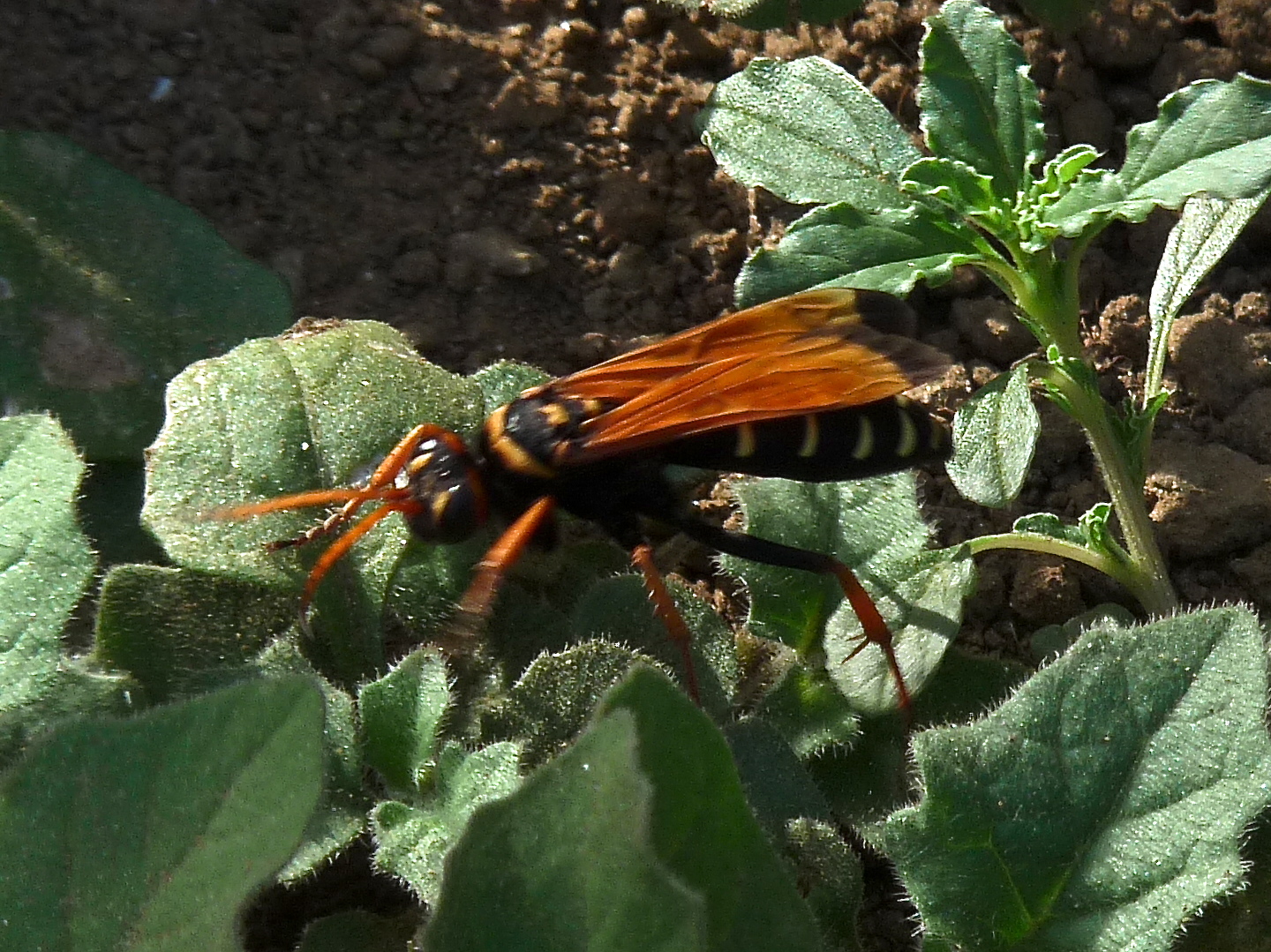
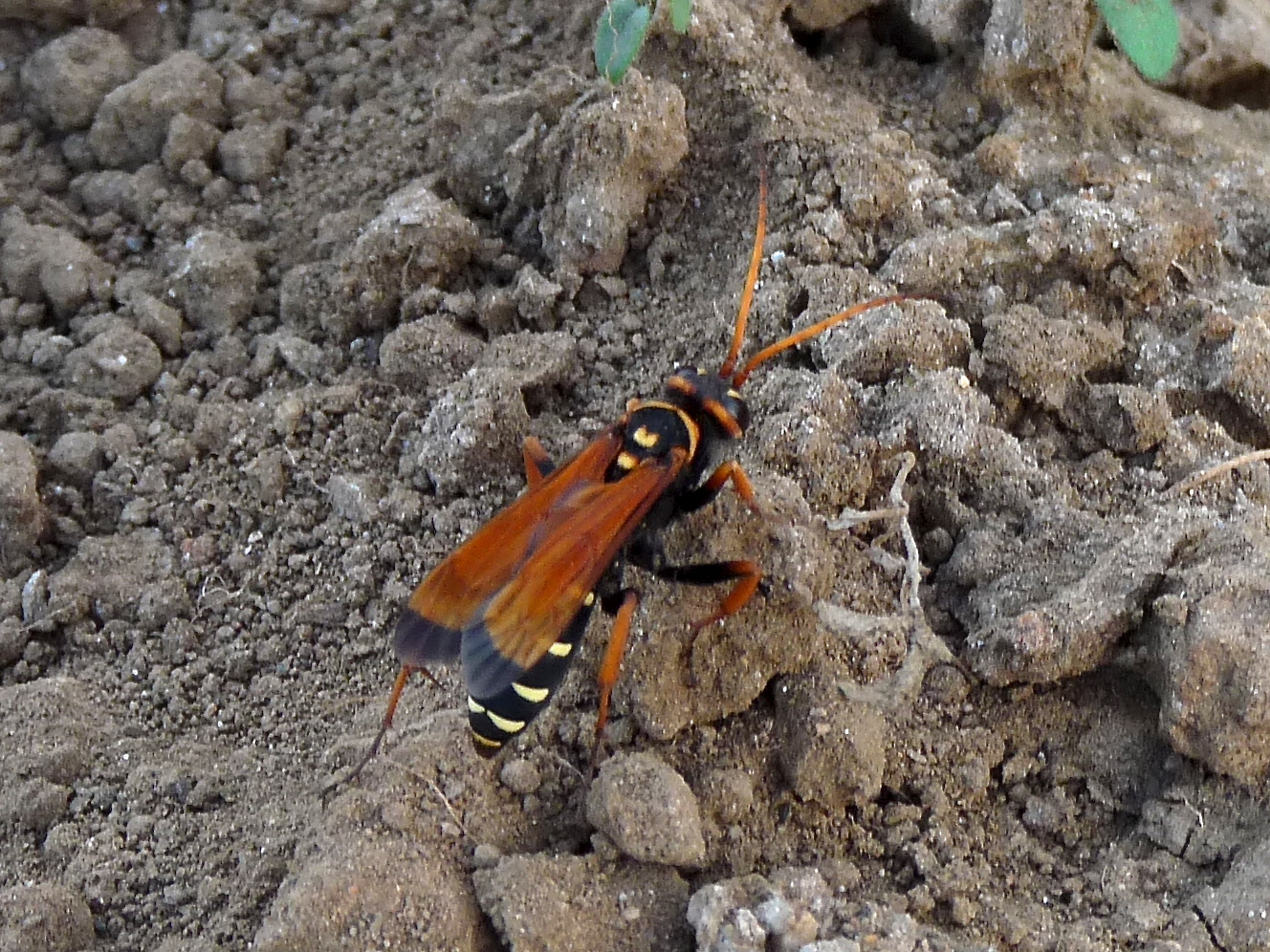
Batozonellus lacerticida can be recognised by its colouring: it has orange-red wings with brown tips and antennae and legs of the same colour, whilst the body is black with narrow yellow stripes on the segments.
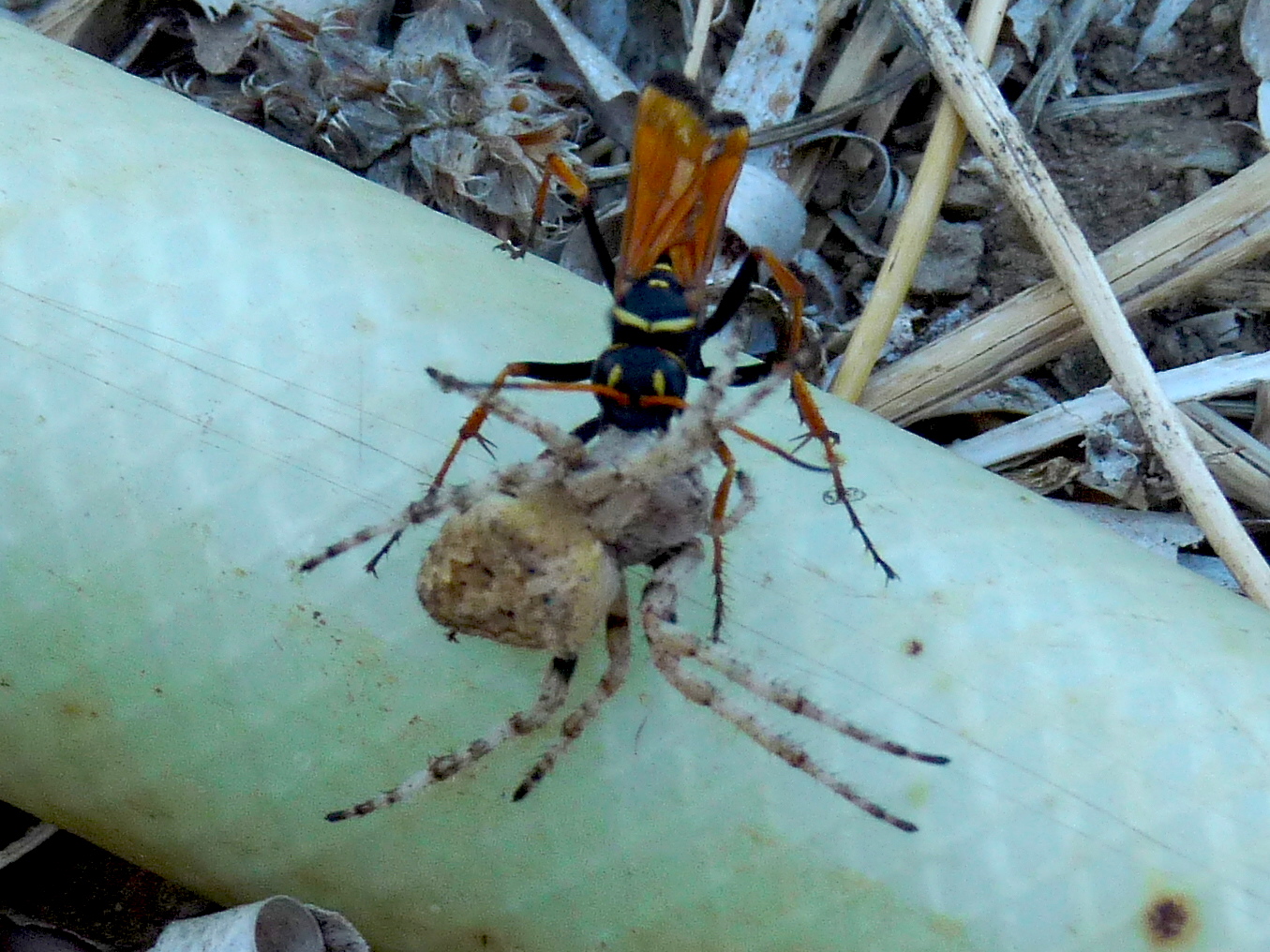
The spider wasp carries the spider to its nest on foot. It runs so fast that it is almost impossible to photograph. Only when the wasp had to slow down to cross the garden hose I managed to take a shot.
see also: A spider wasp
Ctenagenia vespiformis, Klug
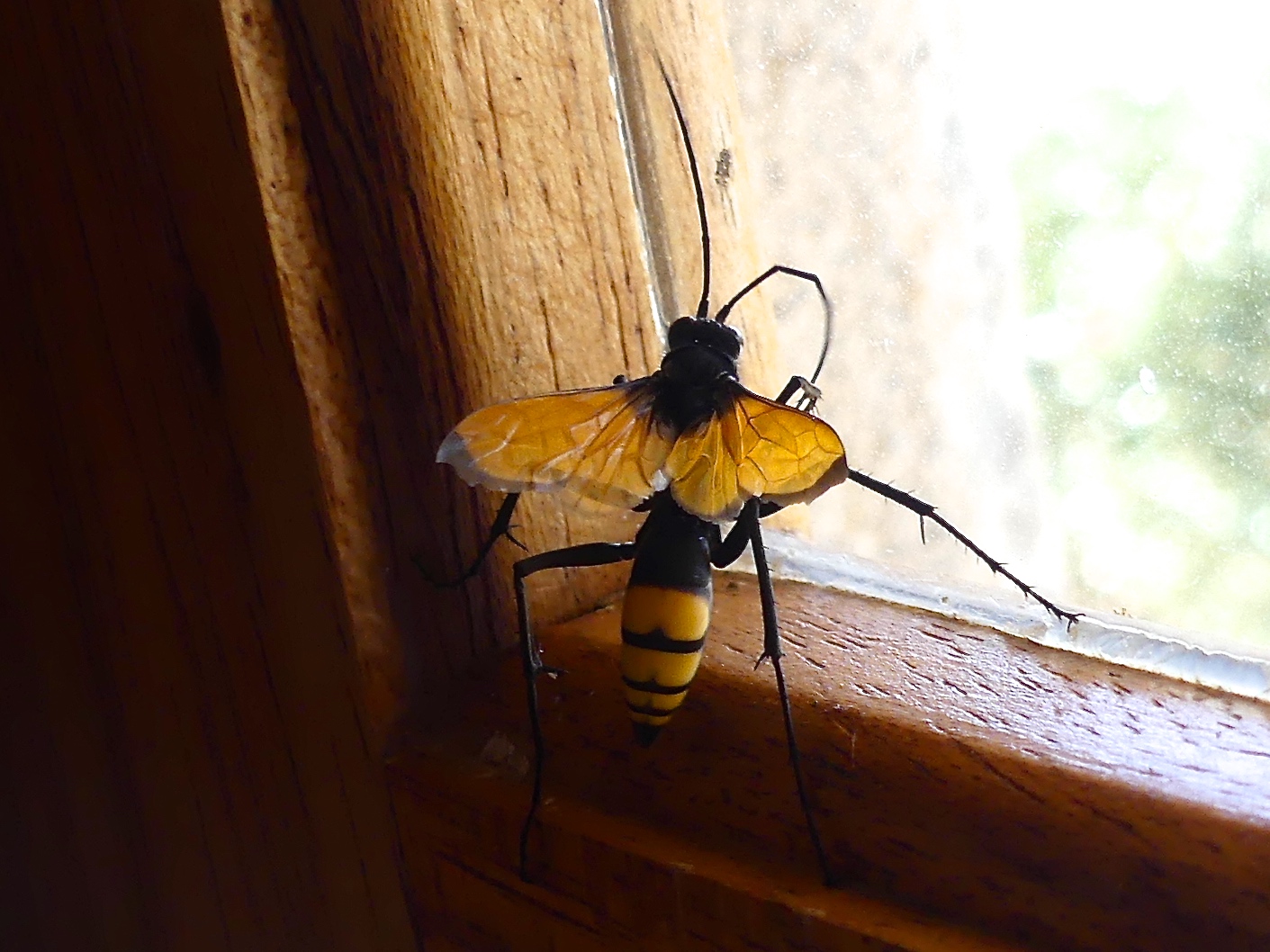
The large, rare spider wasp species Ctenagenia vespiformis has bright orange-yellow wings and a yellow abdomen with narrow black bands. It too preys on large spiders to feed its larvae.
Ferreola denticulata, Taschenberg
This particularly large species, with a body length of up to 2 cm, collects large spiders as food for its larvae; according to the literature (Wikipedia), primarily tube spiders. I observed it attacking the “cocoon” (a dense web used as hiding place during the day) of the large stone huntsman spider Eusparassus walckenaeri, which was located in a crevice between the stones of a wall on our property. Whilst the wasp worked its way into the web from one side, the spider managed to slip away unnoticed on the other side. The wasp searched for the spider in this crevice and in the neighbouring crevices and holes for over a quarter of an hour, running back and forth eagerly and hurriedly, but without success. (I would like to thank Thanos Boulás from the Facebook page “Insects of Greece and Cyprus” for the identification.)
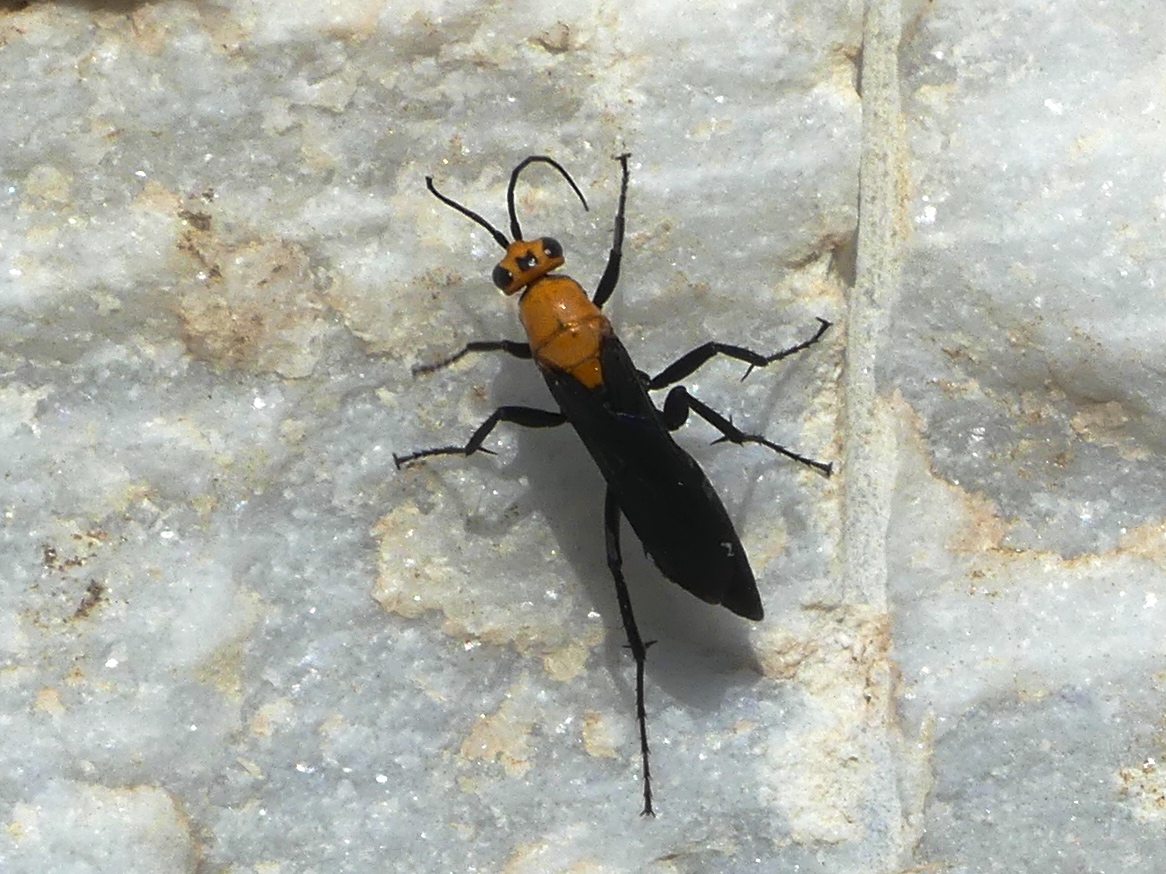
Only once have I encountered the very large spider wasp Ferreola denticulata with an orange-yellow head and thorax so far.
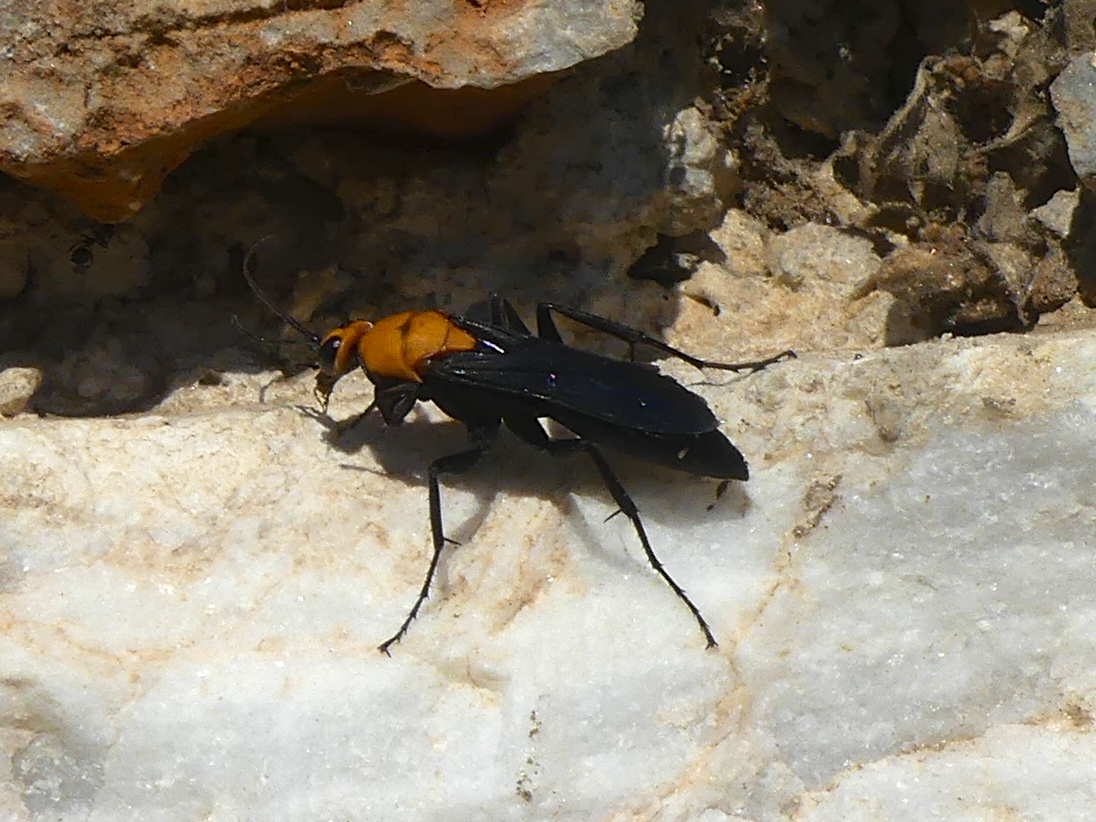
It was searching in all the cracks and holes on the wall for a large huntsman spider, which had already escaped unnoticed.
Superfamily Apoidea
Sphecidae
The Sphecidae, together with the bees, form the superfamily Apoidea within the Hymenoptera. Most species dig underground nests; only the mud dauber wasps of the genus Sceliphron build mud nests, which they attach to rocks (or houses) above ground.
Golden digger wasp, Sphex funerarius, Gussakovskij
The Golden digger wasp (Sphex funerarius) is one of the largest hymenopterans, with a body length of up to 2.5 cm. It is found in southern Europe, north Africa and Asia as far as Mongolia.
Like most solitary wasps, digger wasps stock their nests with insects or spiders as food for their larvae. They catch and stun their prey and deposit it in underground nests. The Golden digger wasp, one of the largest species of digger wasp, catches grasshoppers as prey.
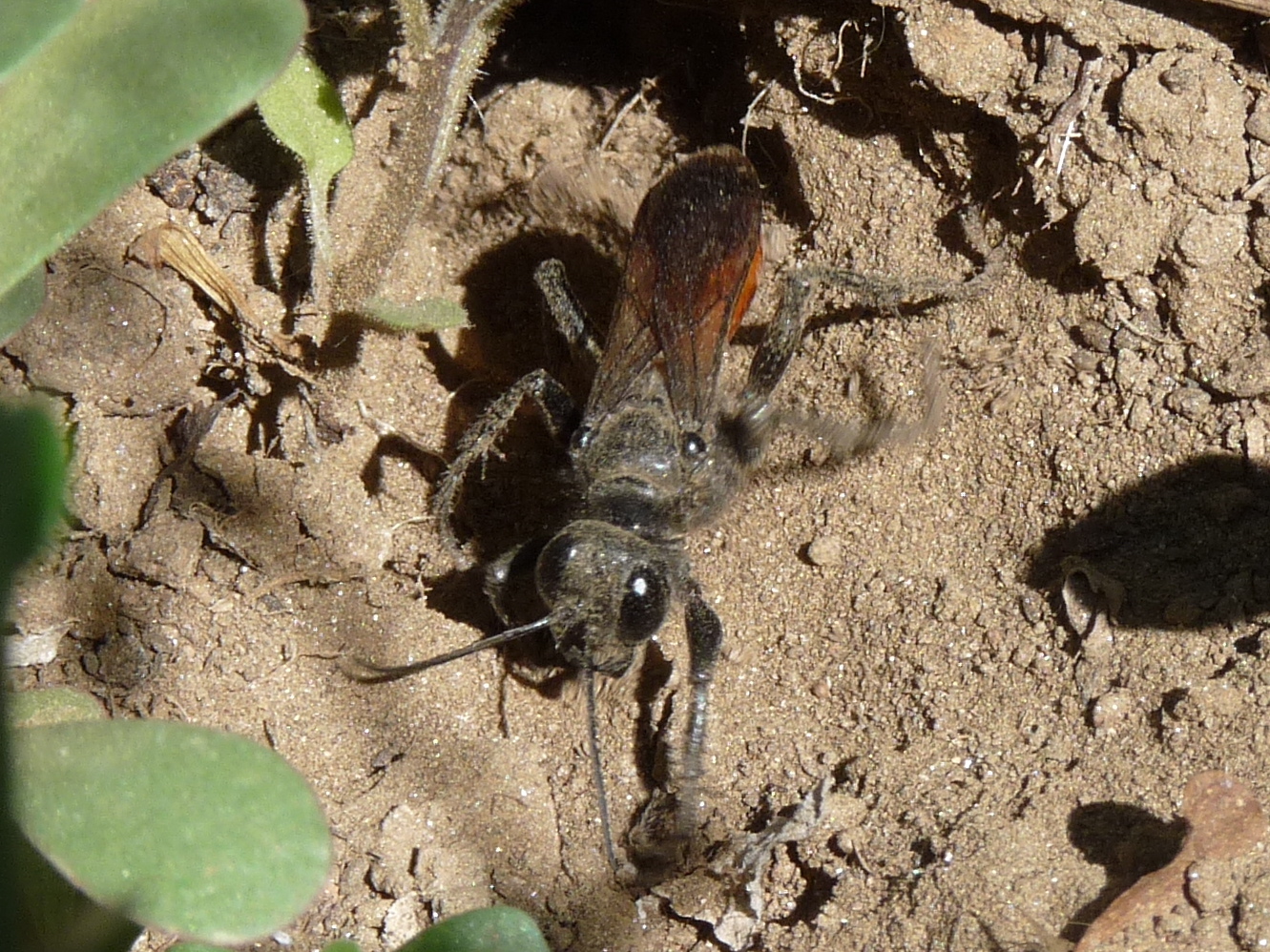
The Golden digger wasp can reach a size of 2.5 cm. It is blackish in colour except for the orange-red anterior segment of the abdomen. Digger wasps do not fold their wings.
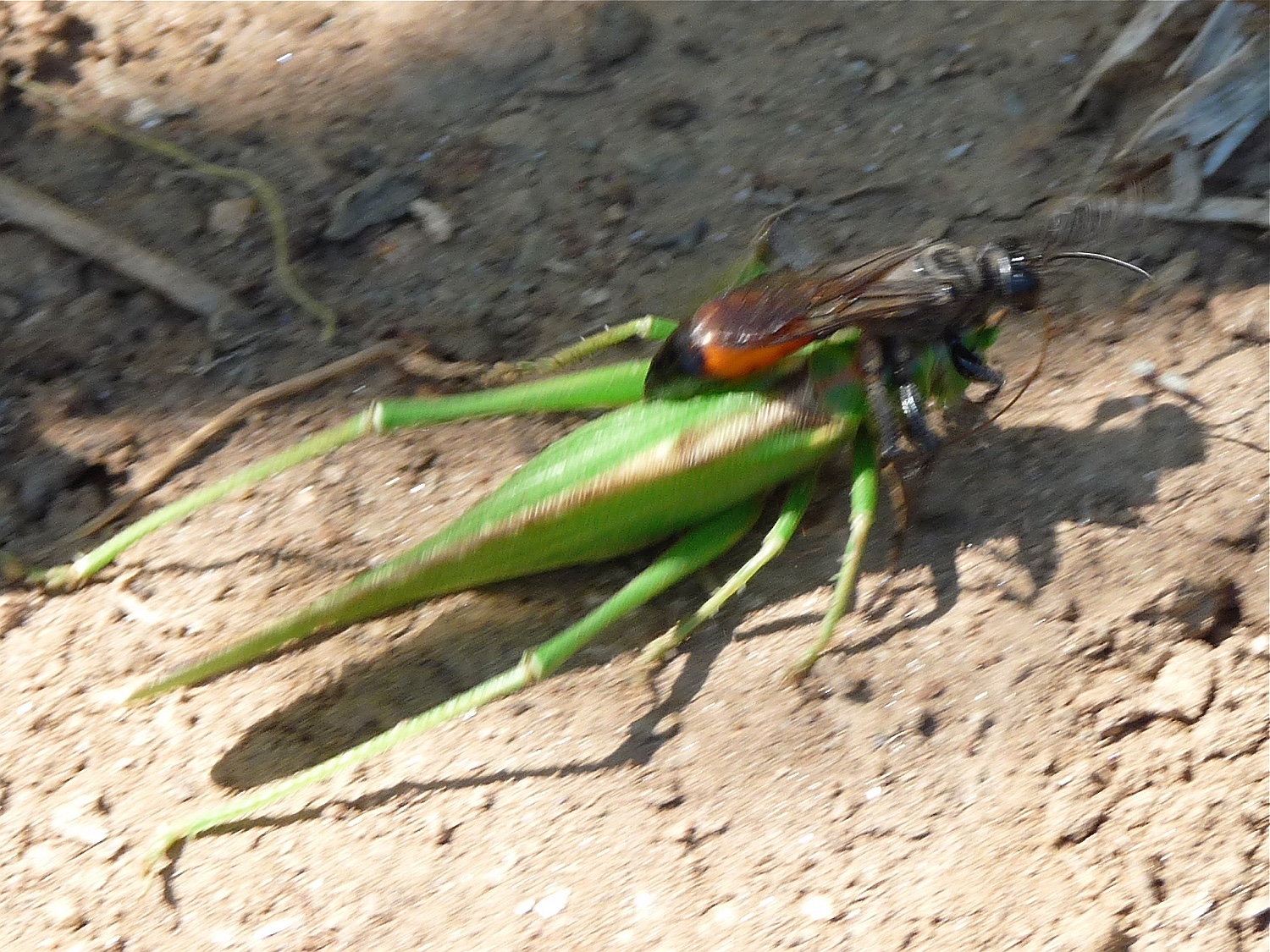
The Golden digger wasp catches grasshoppers as prey for its larvae, stunning them with several stings. As can be seen, the wasp is capable of overpowering grasshoppers that are considerably larger than itself. The prey is carried to the nest, with the wasp gripping the grasshopper by the base of its antennae with its mandibles (jaws) and dragging beneath its body. It moves so quickly that I was unable to take a decent photo, even though the wasp dragged the grasshopper across half our garden.
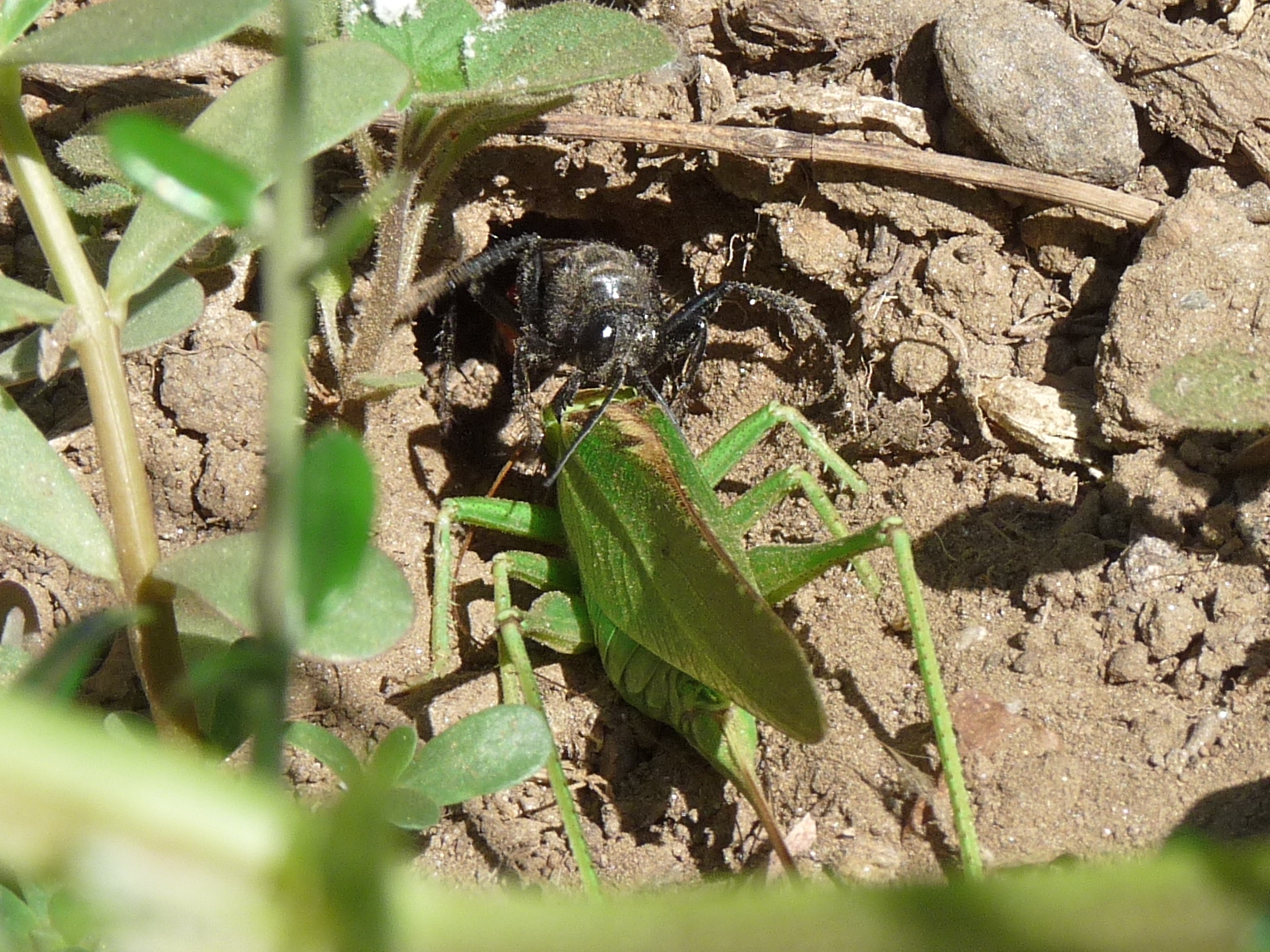
Here, the grasshopper is being dragged backwards into the nest built in the ground. The wasp deposits the prey in one of the several brood chambers branching off from the main passage laying an egg on each grasshopper; after a few days, the larva hatches and feeds on the living but stunned prey.
See also: The Golden digger wasp
Black-and-yellow mud dauber wasp, Sceliphron destillatorium, Illiger
In contrast to other digger wasps, species of the genus Sceliphron (mud dauber wasps) construct moulded clay nests, which they attach in rain-protected spots to walls or houses, often even inside inhabited houses. On Naxos, the species Sceliphron destillatorium is quite common. The Black-and-yellow mud dauber wasp reaches a body length of 3 cm, but is very slender.
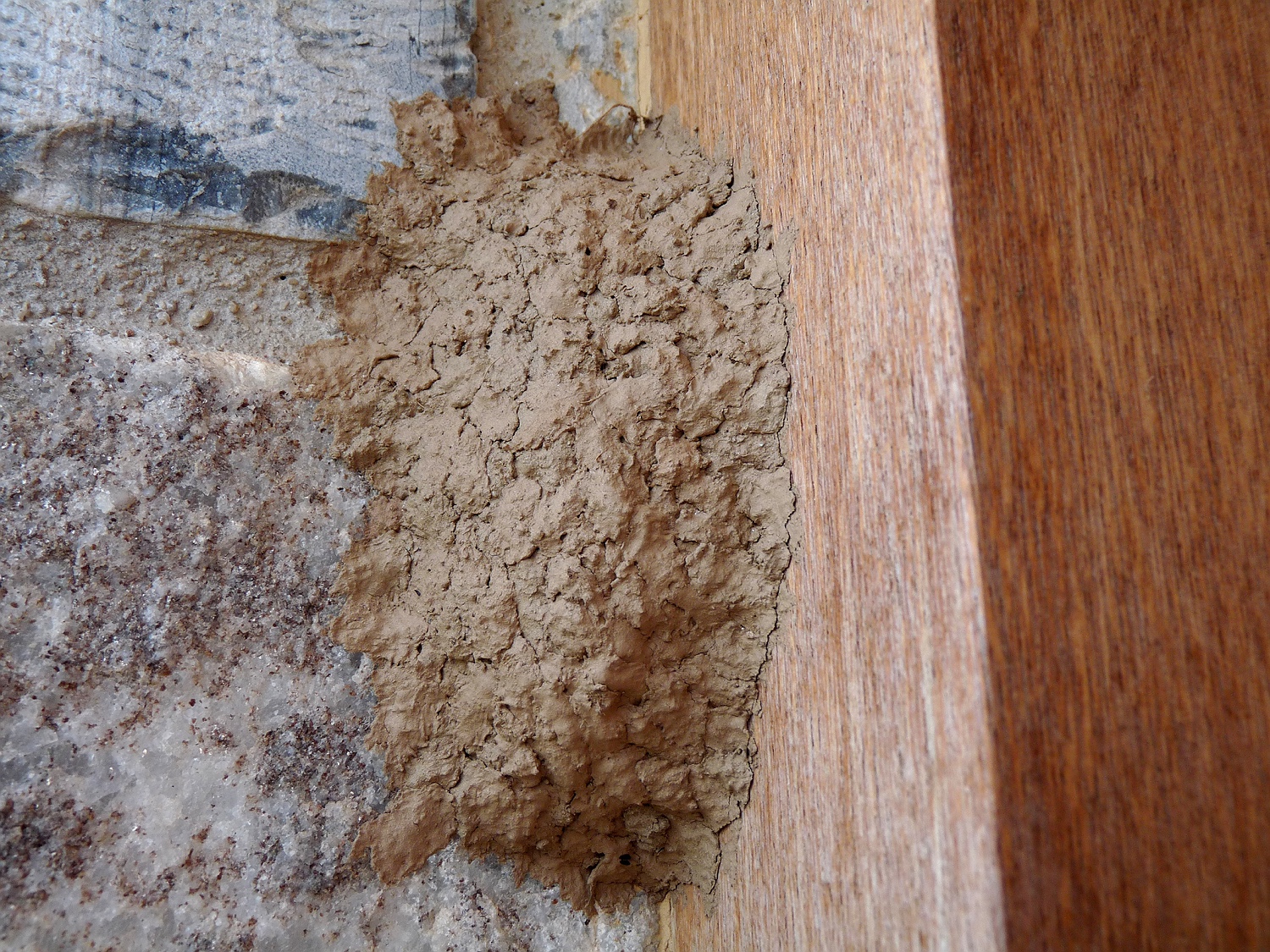
The Black-and-yellow mud dauber wasp likes to attach its mud nests to door frames or under the ceiling of open buildings.
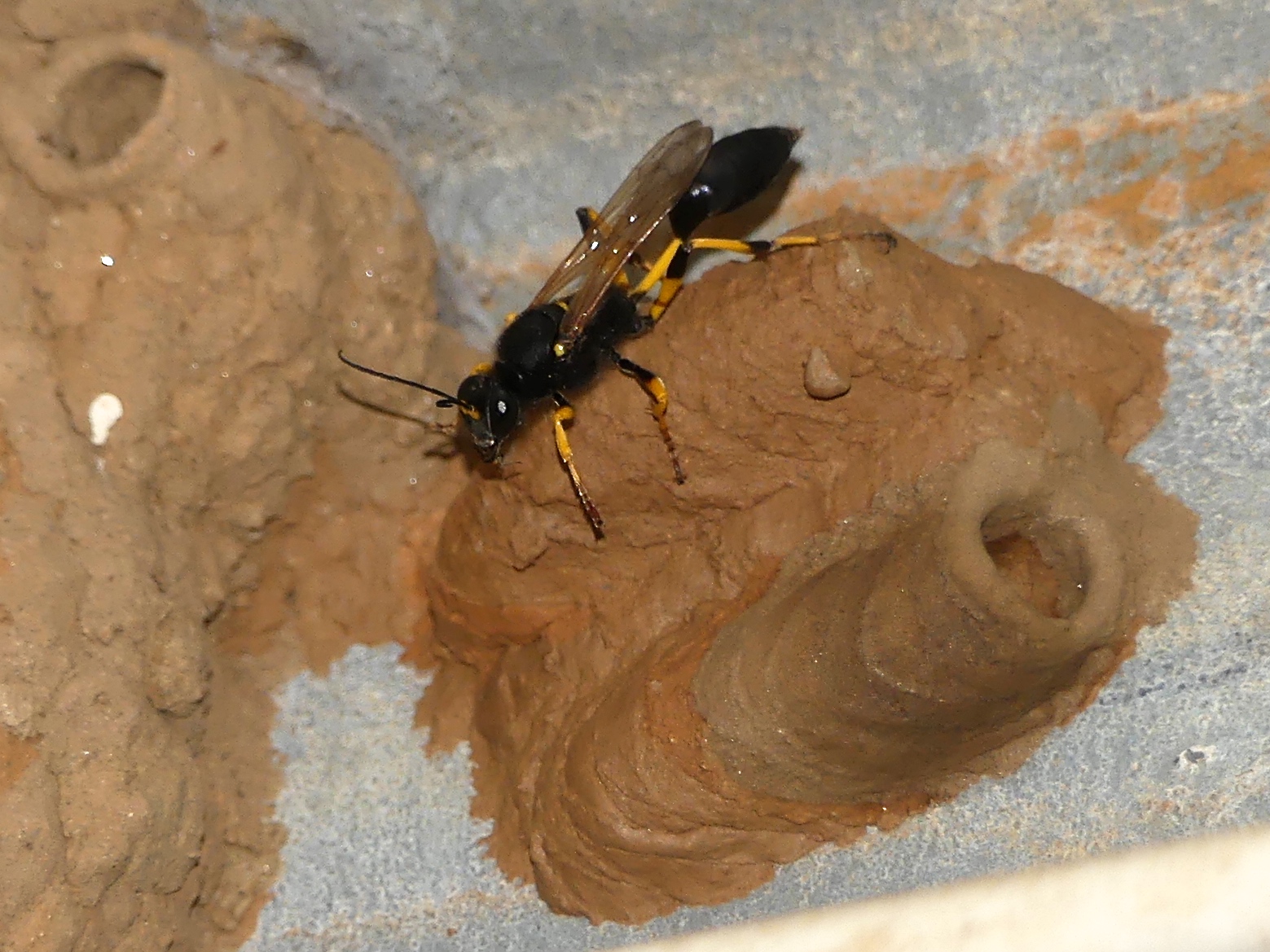
It has long, black and yellow legs and an extremely thin, yellow petiole in the front part of the abdomen.
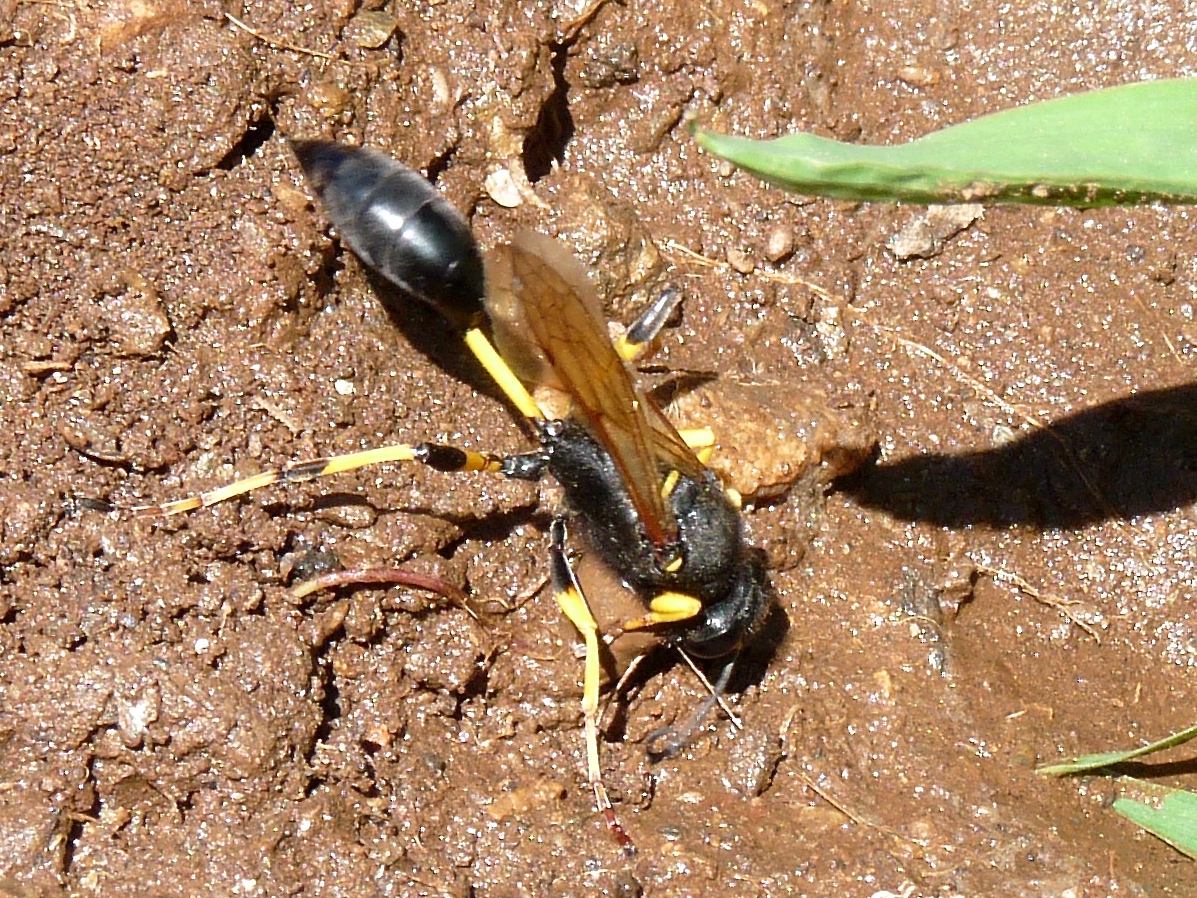
The Black-and-yellow mud dauber wasp collects the building material for its nest in the garden from areas with freshly watered soil. Using its front legs, it scrapes together some moist soil, which it shapes into a round ball and then carries to its nest. If you look closely, you can see the clay ball in the photo, which the wasp turns and shapes with its front legs, aided by its curled antennae.
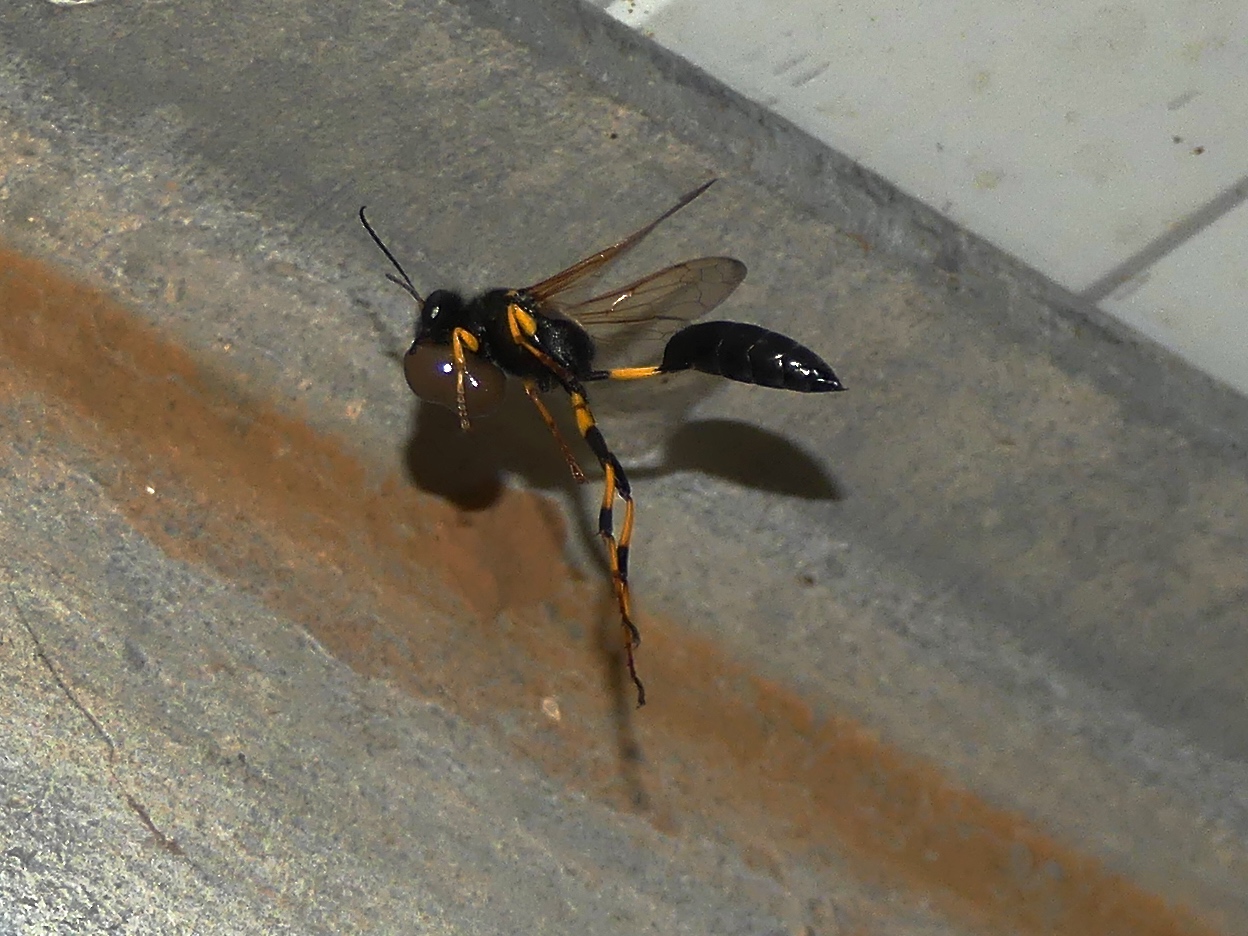
Here the wasp arrives with her ball of clay at the nest it is building.
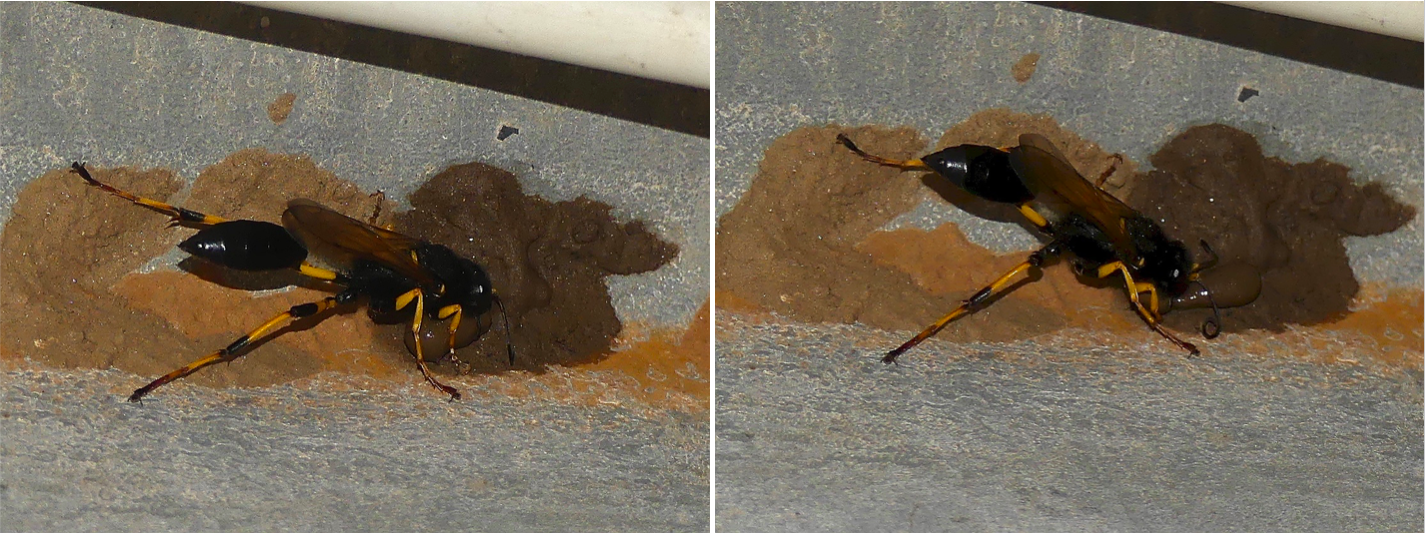
Bit by bit, the brood cell is shaped.
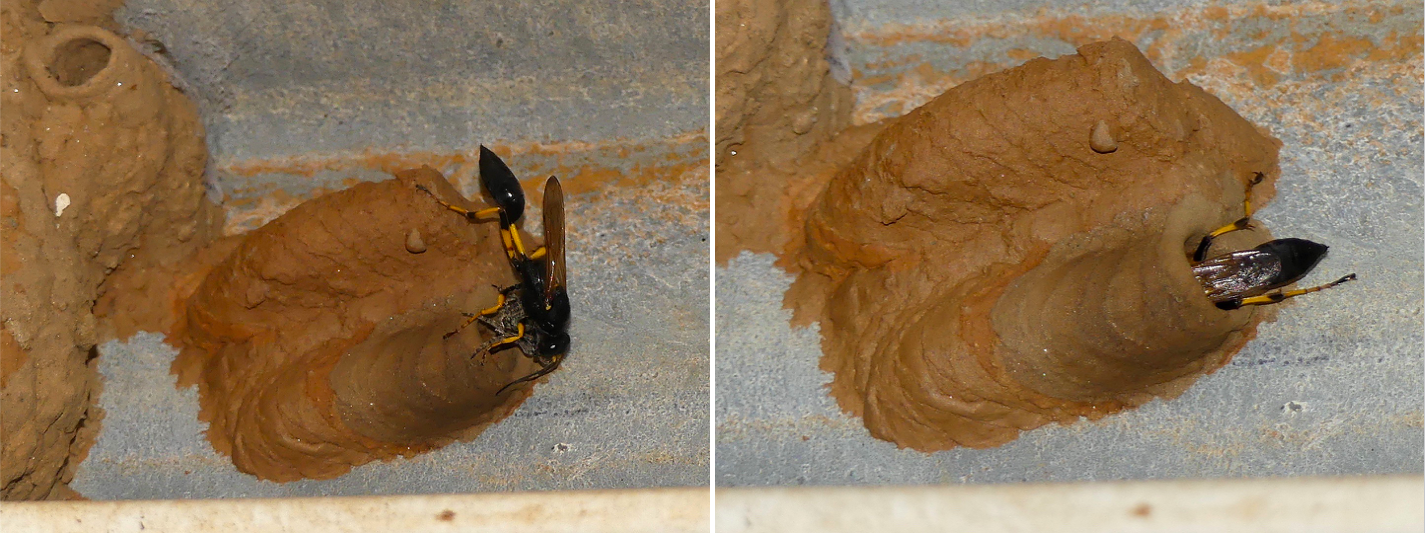
The Black-and-yellow mud dauber wasp puts a large spider into each brood cell as food for the larva.
See also: The Black-and-yellow mud dauber wasp
Sceliphron destillatorium f. pensile
This form of the Black-and-yellow mud dauber wasp, with a black petiolus (abdomen stalk), is much rarer; it occurs in Greece and Corsica.

This rare colour variant of the Black-and-yellow mud dauber wasp has a black petiole. It is incredible how narrow and long the petiole is!
Ammophila heydeni, Dahlbom
The sand wasp Ammophila heydeni also belongs to the Sphecidae and, like the former species, has a very thin petiole. It is black in colour with reddish legs (front and middle pairs) and a light red abdomen with a black tip. It lives in sandy, sparsely vegetated areas of southern Europe. The larvae feed on butterfly caterpillars (Geometridae).
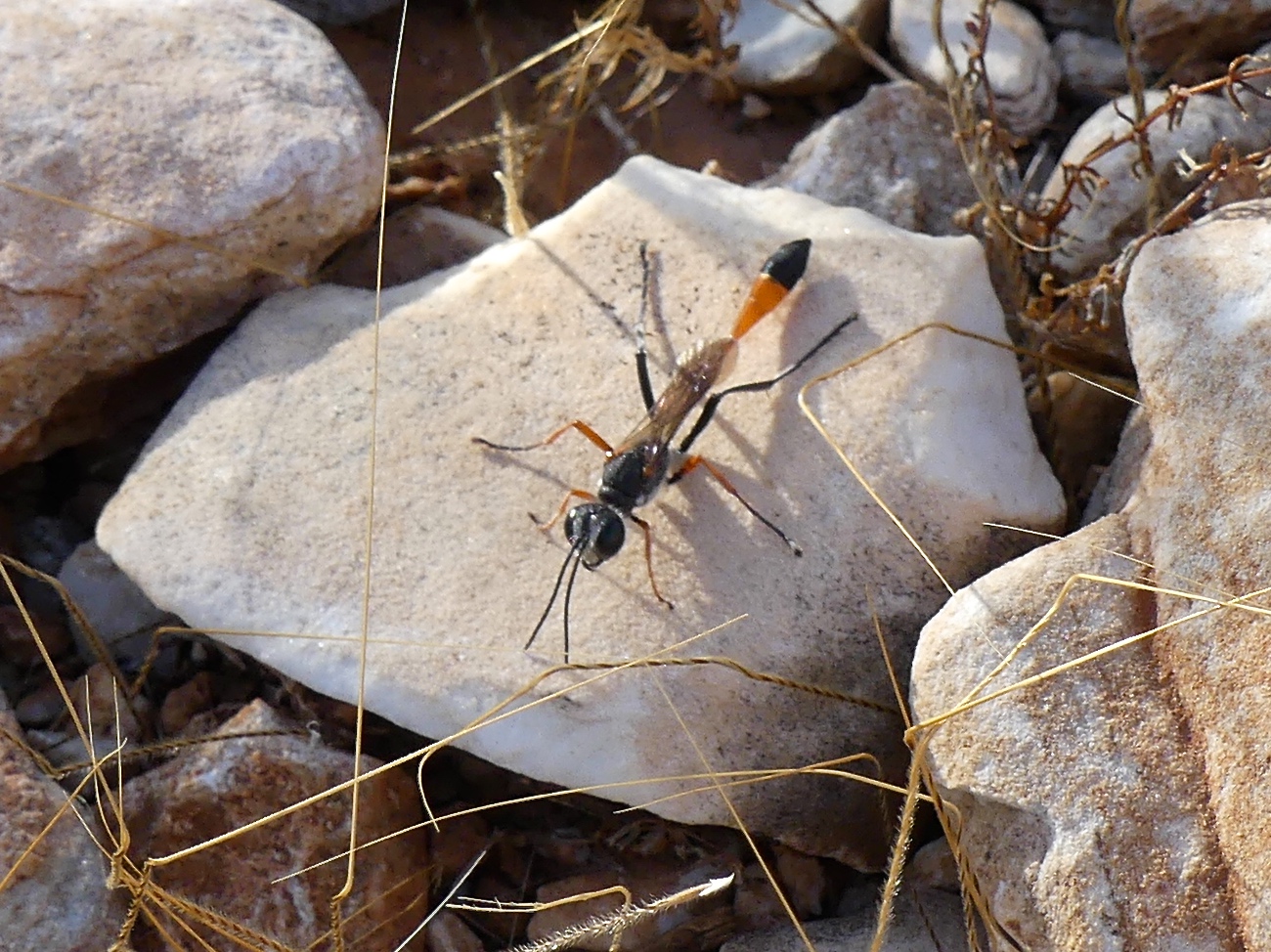
The black and red sand wasp Ammophila heydeni reaches just under 2 cm in length.
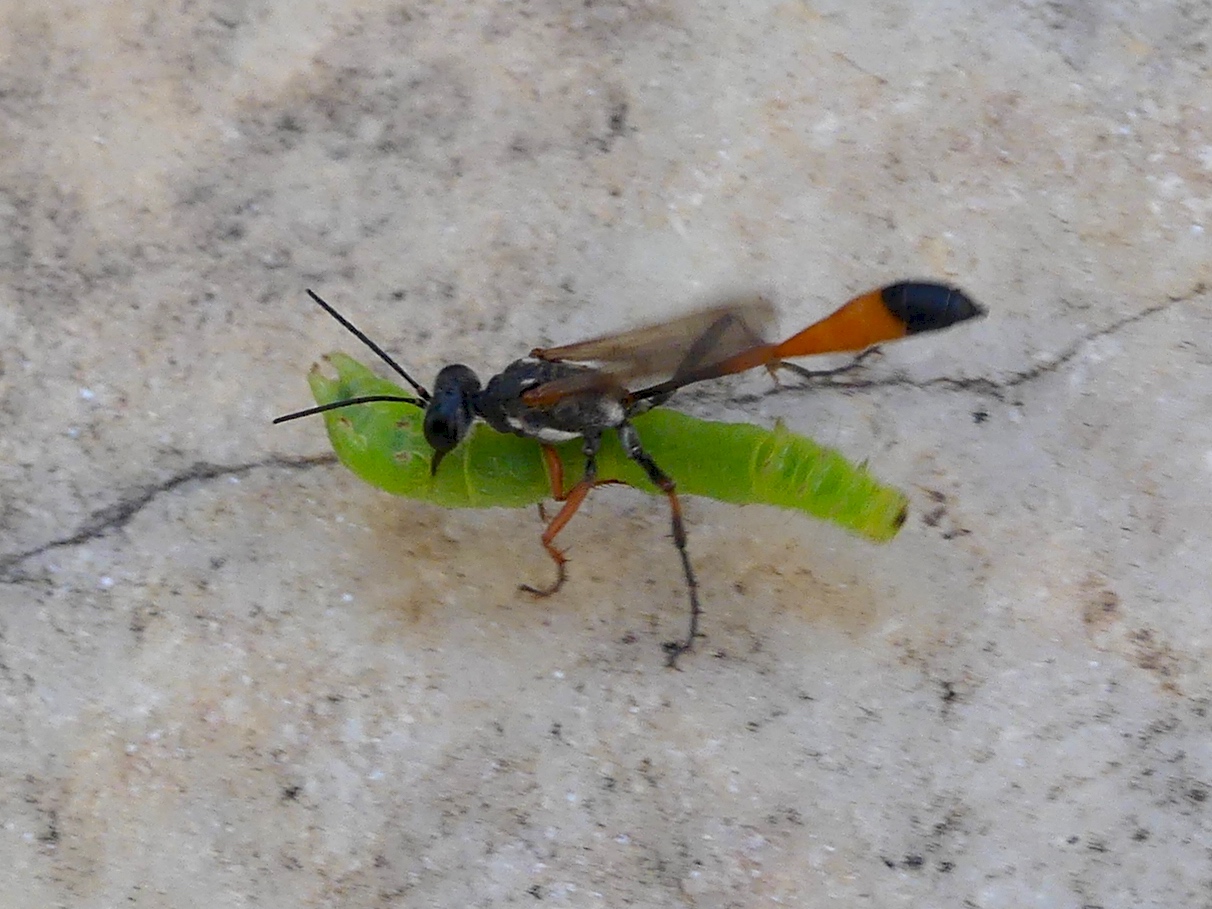
Here with a captured caterpillar. The wasp carries the caterpillar beneath its body holding it with its mandibles and front legs.
Crabronidae
The Crabronidae with around 8,000 species also belong to the superfamily Apoidea.
Stizus ruficornis ?, J. Forster
The species of the genus Stizus are usually quite large. They build individual nests in the ground providing them with grasshoppers or praying mantises as food.
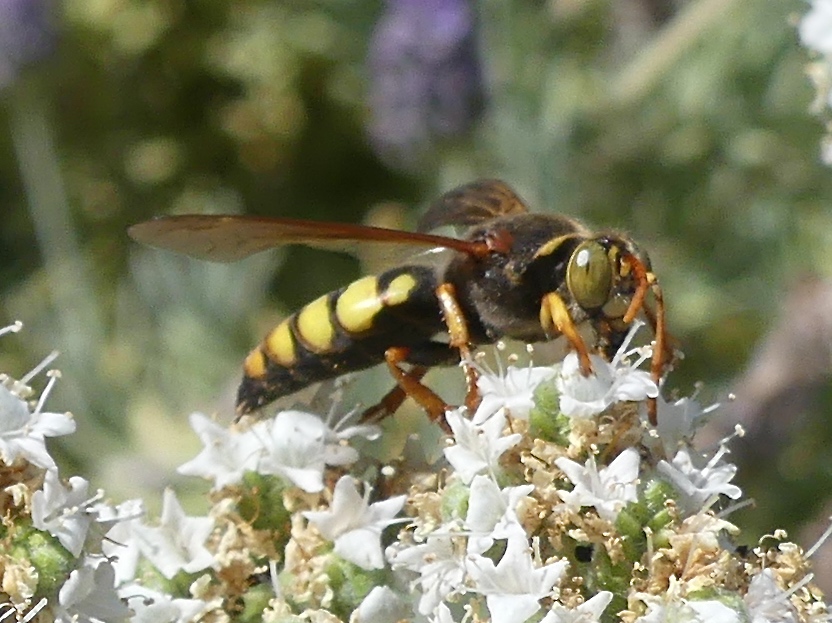
The abdomen of this large wasp, probably Stizus ruficornis, is predominantly yellow with black rings; the eyes are greenish.
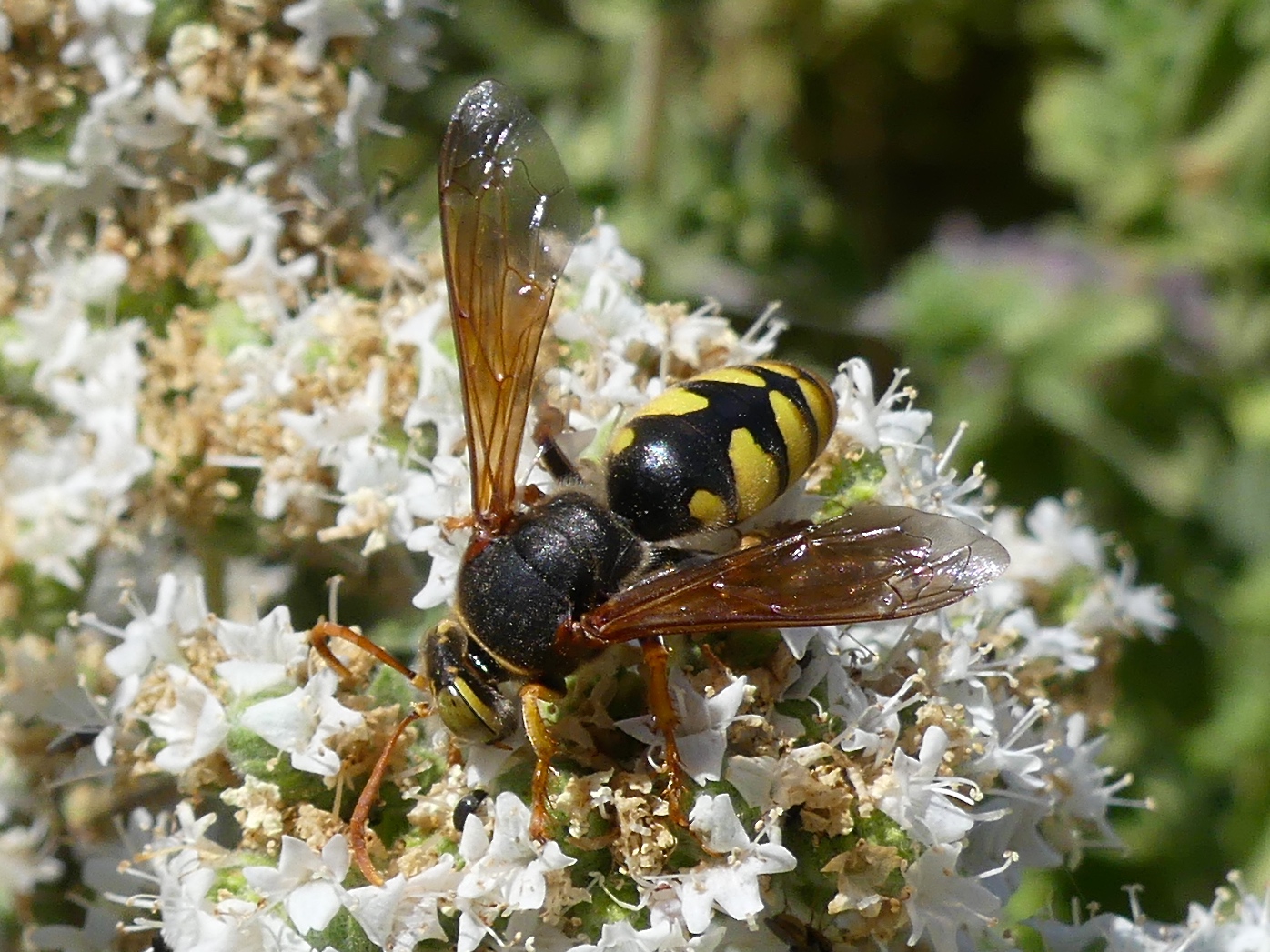
The thorax is black, the wings are reddish-brown.
Tachysphex obscuripennis ?, Schenck
Many species of the large genus Tachysphex are notable for their huge, protruding yellow eyes.
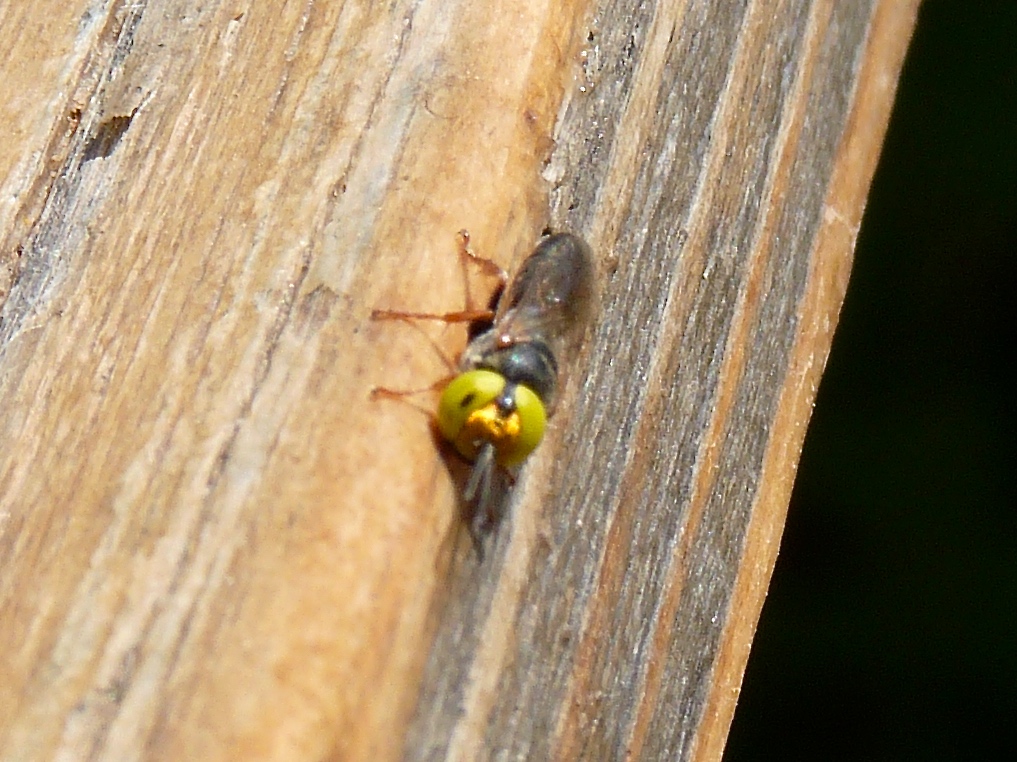
This small wasp, probably Tachysphex obscuripennis or a related species, has a dark body and reddish legs. The large yellow eyes with a small black spot are very conspicuous. The front of the head is orange; the antennae point straight forwards.
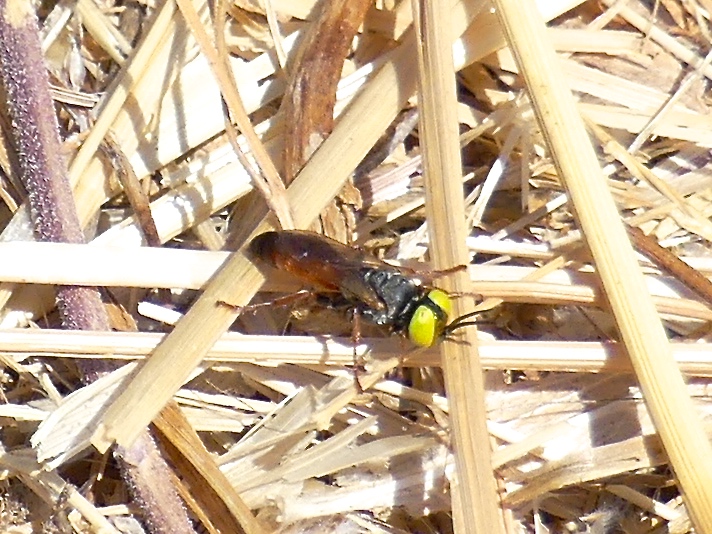
Here you can see that the front part of the abdomen is brownish-red in colour.
Bembicidae
Bembix rostrata, L.
The genus Bembix and 80 related genera have been seperated lately from the Crabronidae as a seperate family. The members of this family usually build their nests in the earth or in sand. Some species have become rare in many areas due to destruction of their habitat.
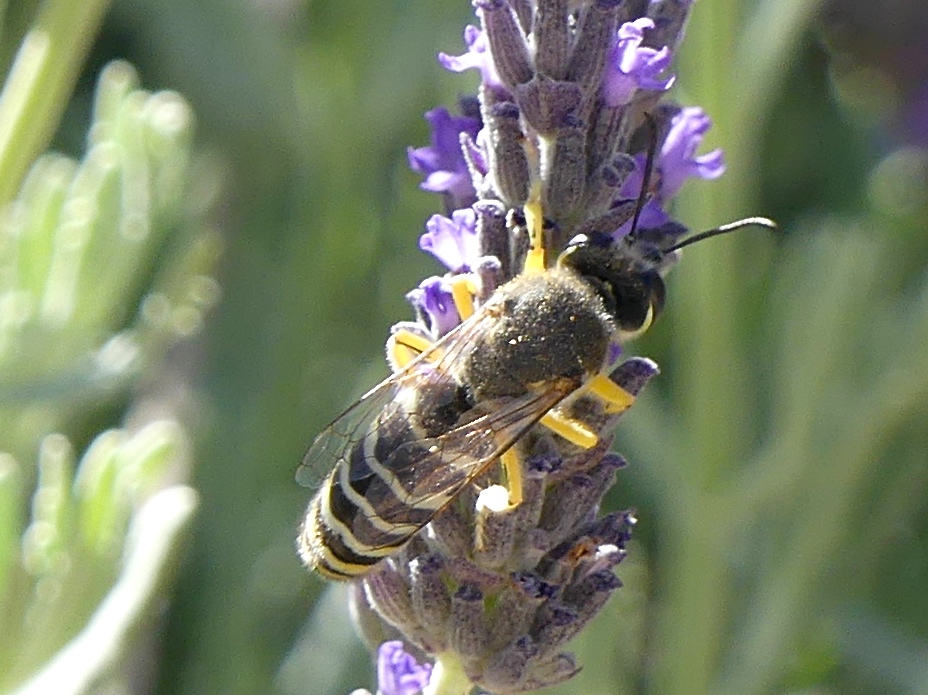
Bembix rostrata is a fairly large wasp, recognisable by the narrow, curved whitish stripes on the abdomen and by its yellow legs.
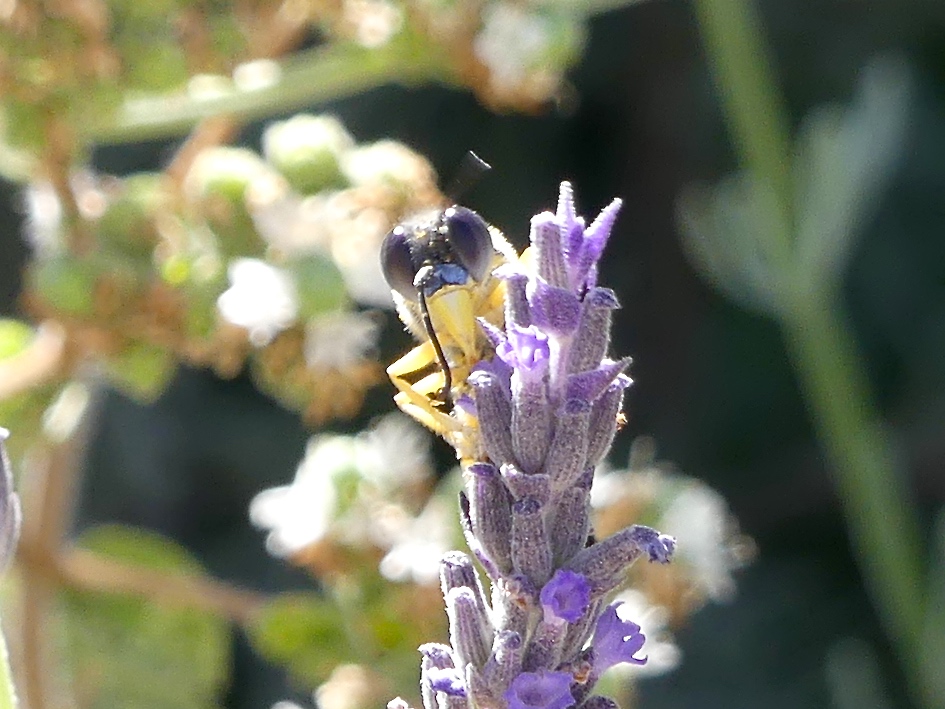
Here you can see the broad, pointed yellow proboscis. This species primarily provides large flies as food for the larvae. It often builds its nests in large colonies.
Bembix spec.
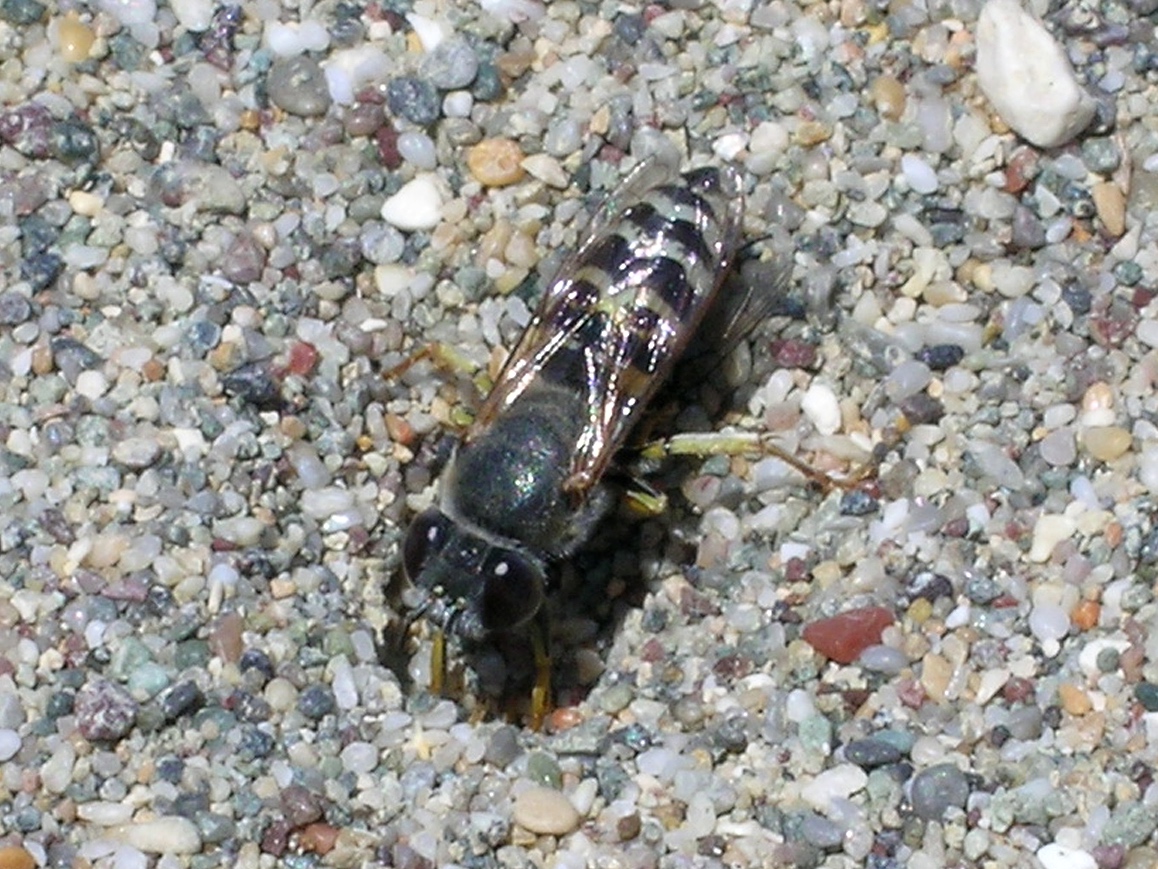
These small wasps, which presumably also belong to the genus Bembix (Bembix oculata ?), build their nests in large numbers in the loose sand on the beaches of the Mákares Islands. Other hymenopterans or flies serve as food for the larvae.
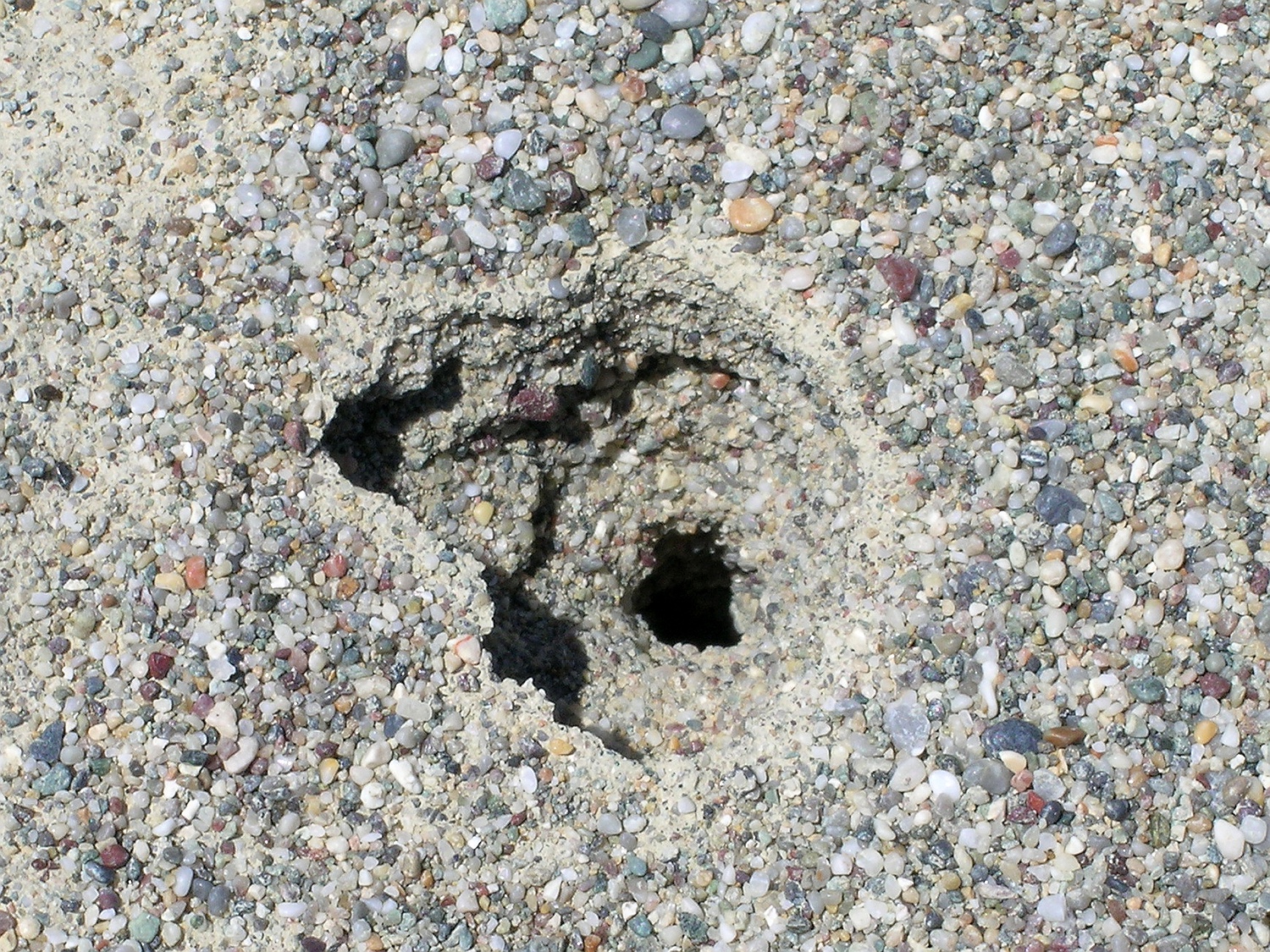
Here you can see the entrance to a nest.
Philanthidae
The family Philanthidae includes only 8 genera, some of which are however very large. The best known species are the beewolves.
European beewolf, Philanthus triangulum, Fabricius
The beewolf is a fairly small and slender wasp. Whilst the adults feed only on nectar, the female beewolf – as the name suggests – hunts honeybees as food for its larvae. To do this, it perches on a raised vantage point and scans the surroundings. When it spots a bee, it approaches and uses its sense of smell to confirm that it is indeed a honeybee. It then seizes the prey with its legs and stuns it with a sting. The entire attack happens so quickly that the bee has hardly any chance to defend itself. The beewolf then uses its abdomen to squeeze the bee’s abdomen, causing a drop of nectar to emerge from the bee’s mouth, which the beewolf licks up. The bee is carried into the nest, which is dug in the ground and consists of a tunnel up to 1 meter long with several brood chambers. The bee is carefully licked clean by the beewolf, which prevents it from spoiling through mould.
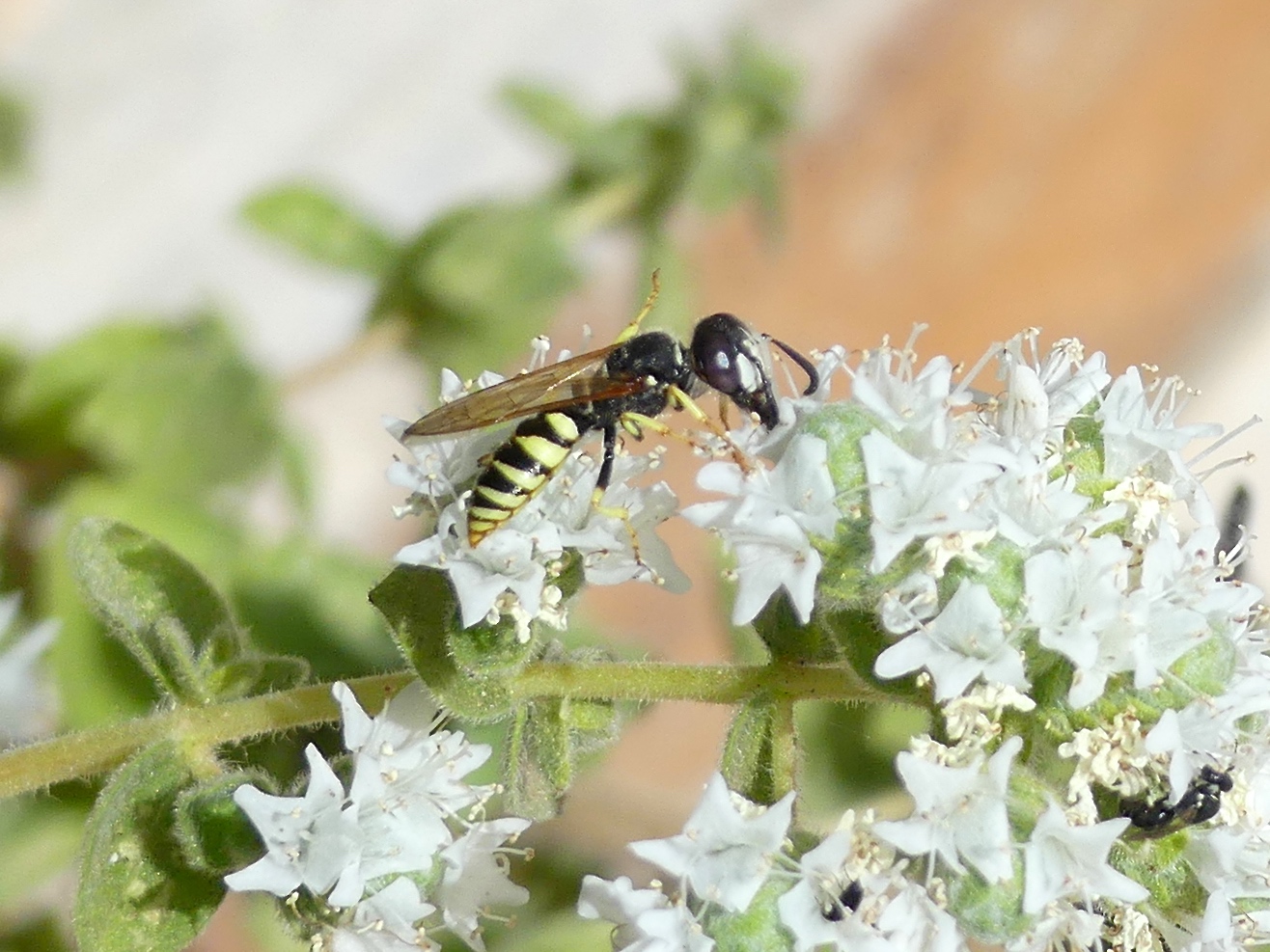
The beewolf has slightly reddish-tinted wings, large eyes and a yellow abdomen with black stripes that widen into a triangle towards the middle. In males, the abdomen is more black than yellow.
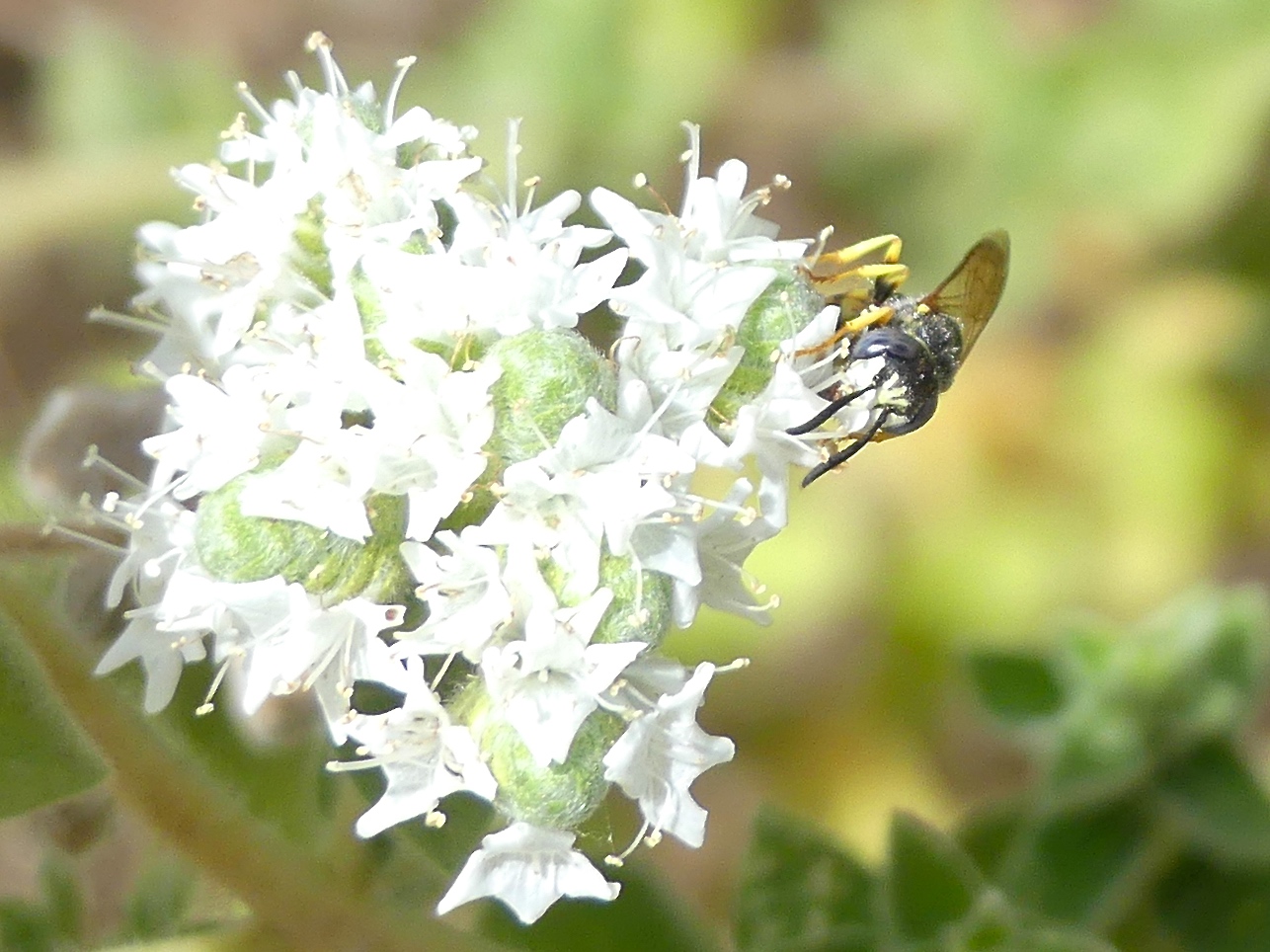
The males’ face has a white “face mask” featuring three small lines extending upwards. The legs are yellow.

Some specimens have two white spots on the rear thoracic segment; furthermore, on the white facial mask, the central line is slightly extended upwards, the black stripes on the abdomen are slightly reddish-brown at the rear edge, and the eyes are bluish.

Females are larger and have thinner black stripes on the abdomen, so that they appear predominantly yellow. They prey on honeybees to feed their larvae. The photo shows the powerful mandibles used to grasp the prey.

Here, a female beewolf sits on a perch, scanning the surroundings for honeybees.

The female’s face features a white mask with only two upward-pointing lines.

Here you can see the almost entirely yellow abdomen. From a distance, the females often appear strikingly golden.
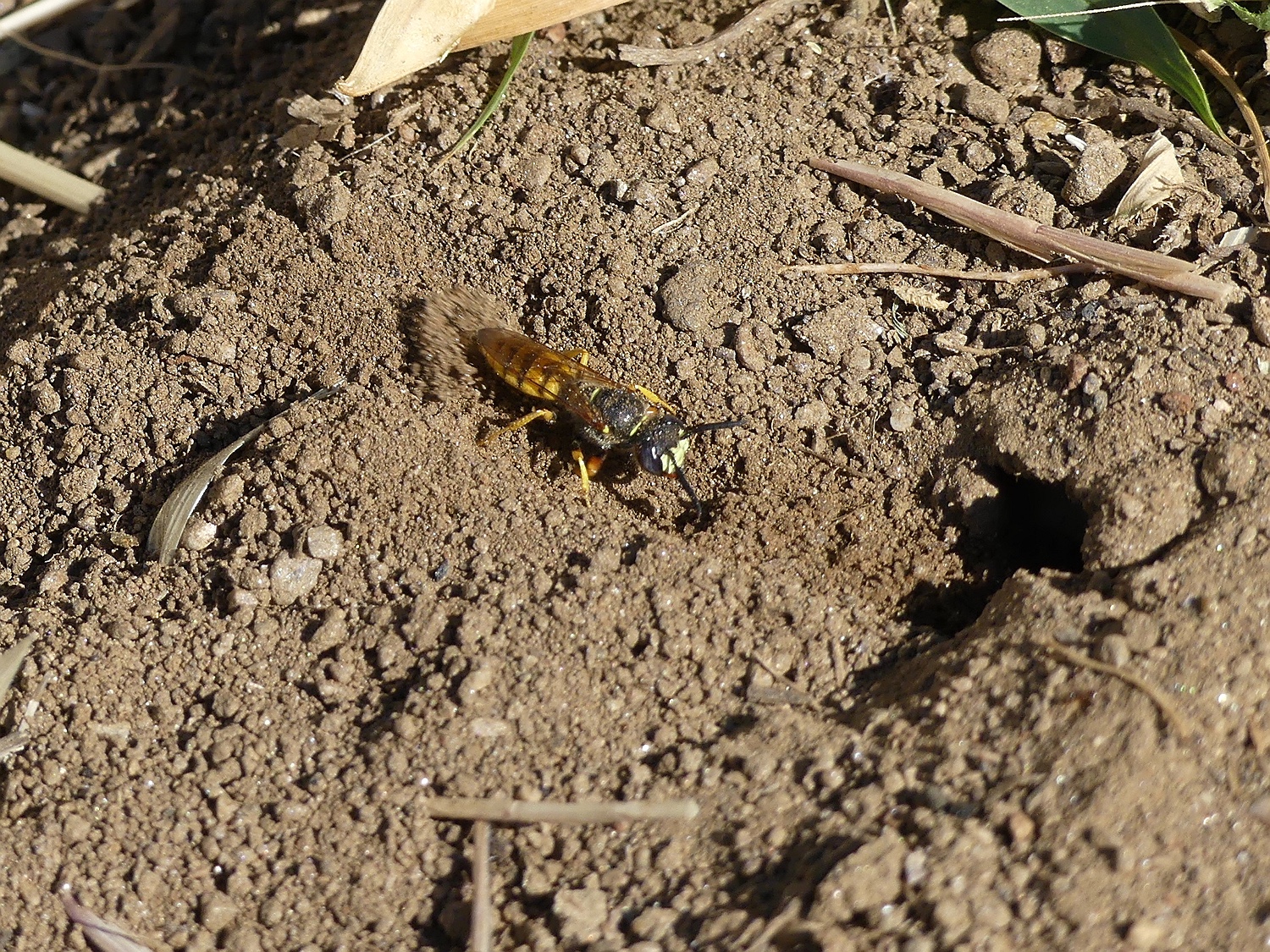
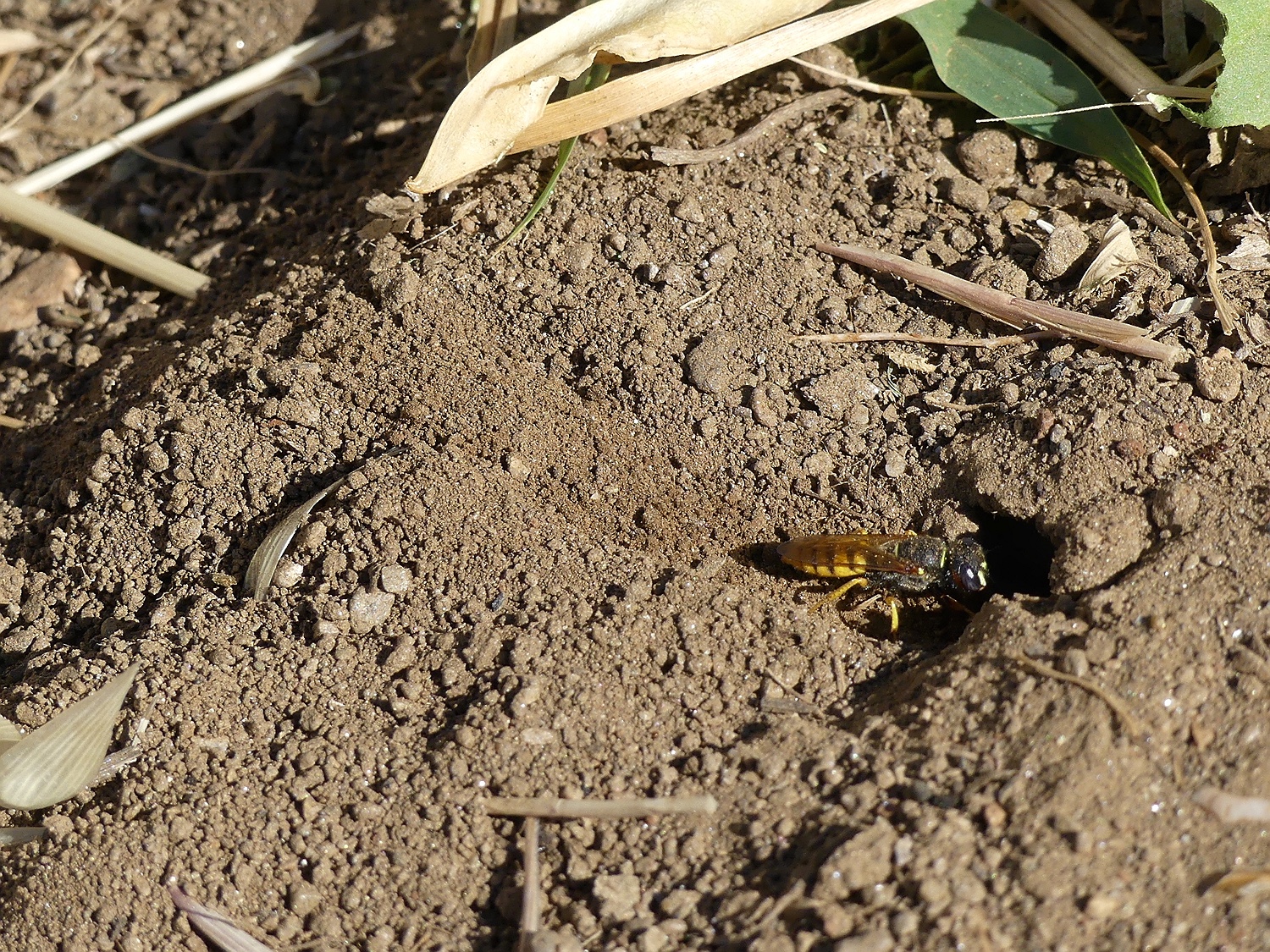
This female beewolf is busy building its nest. It settles down about 20 cm in front of the opening and first digs in front of the nest as it approaches it; then it disappears into the hole, continuing to dig in the same manner; when it emerges again, it walks backwards to the same distance and starts digging once more.
Cerceris sabulosa, Panzer
Many species of the genus Cerceris, one of the largest genera of the Apoidea, show a discintly separated, spherical first segment of the abdomen. They lives in a similar way to the beewolf and, depending on the species, catch beetles or bee species as food for the larvae.
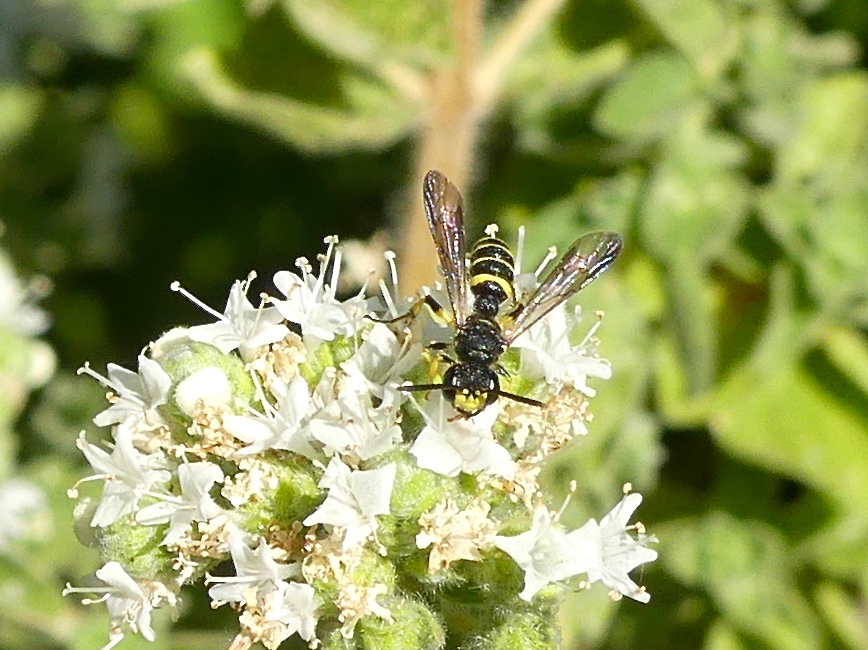
Here you can see the spherical first abdominal segment. The other abdominal segments are also slightly constricted. This species keeps its wings somewhat apart when sitting. The yellow facial mask shows a small triangle in the middle; the bases of the antennae are also yellow.
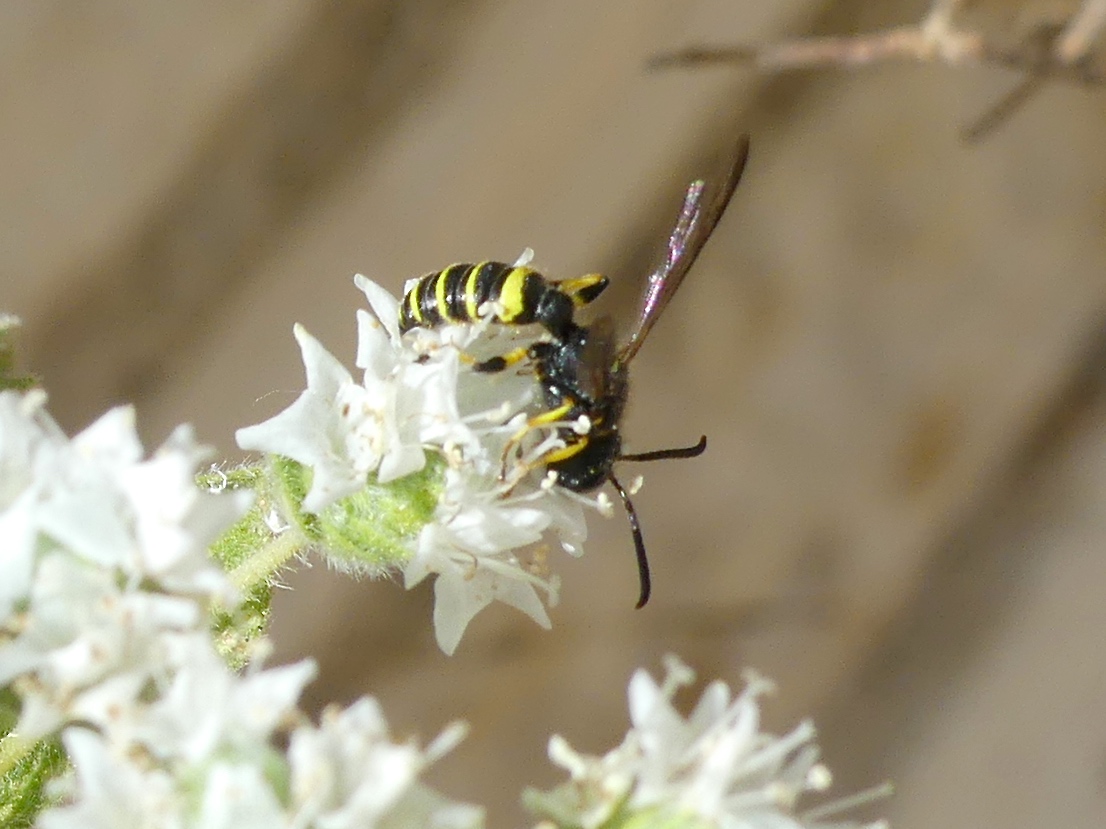
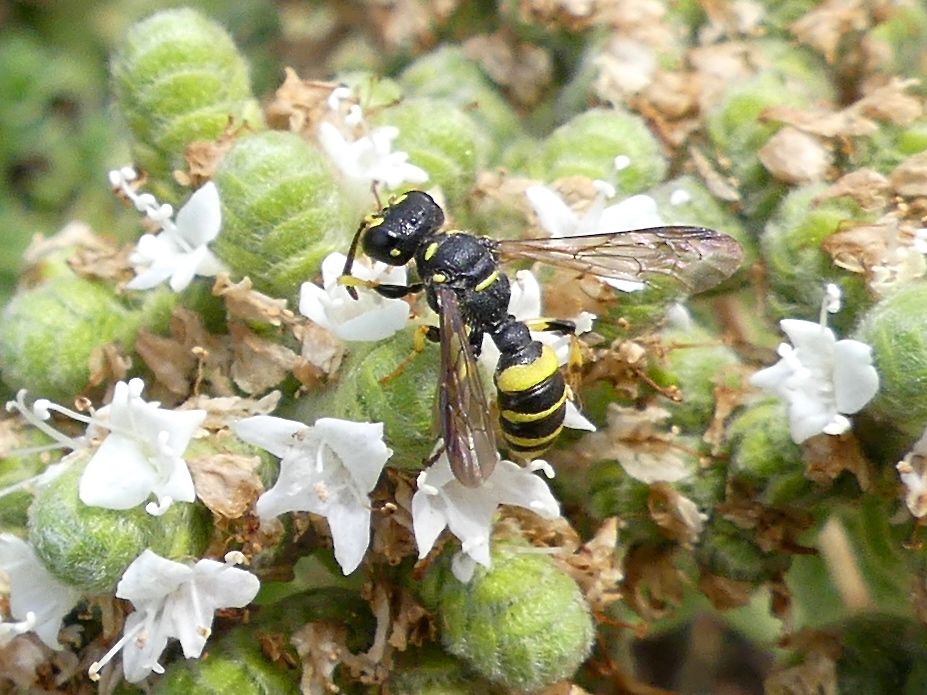
In this species, only the frontmost yellow stripe on the abdomen is slightly wider.
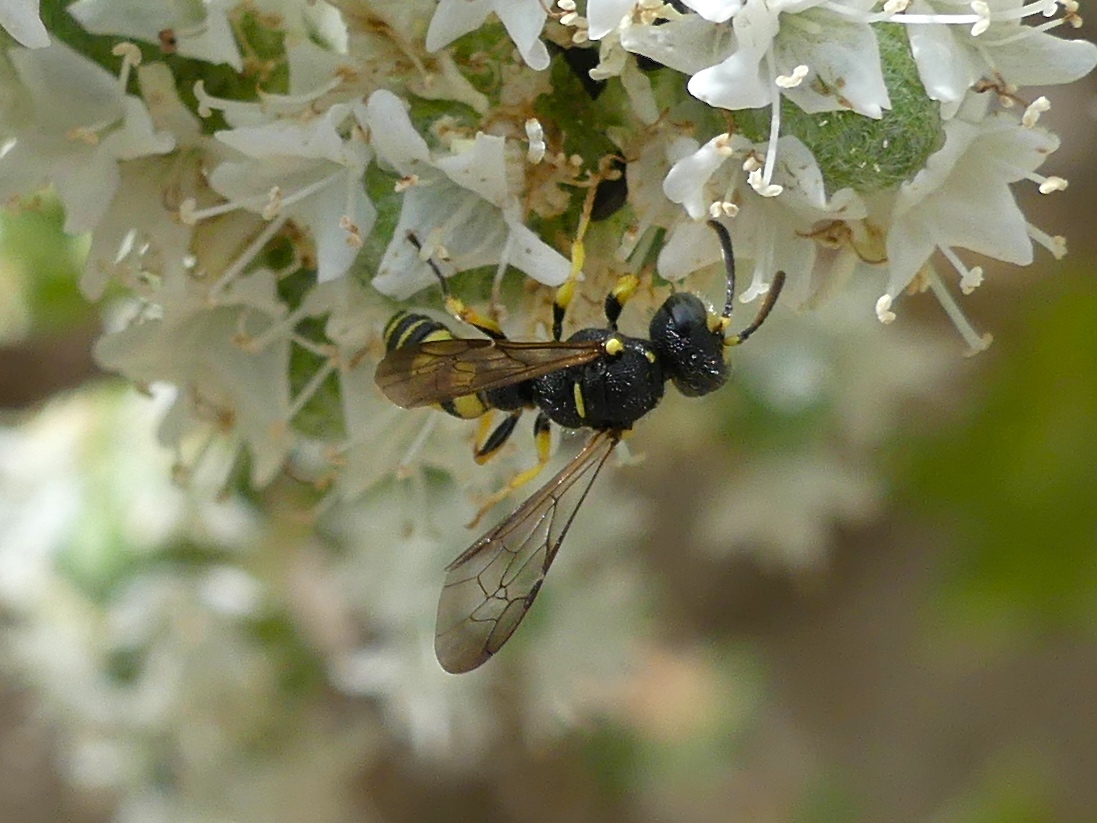
This photo shows the characteristic wing venation of the members of the genus Cerceris. The thorax is usually black with small yellow spots. This specimen may belong to a different species: here, the first two yellow stripes on the abdomen are wider than the rest.
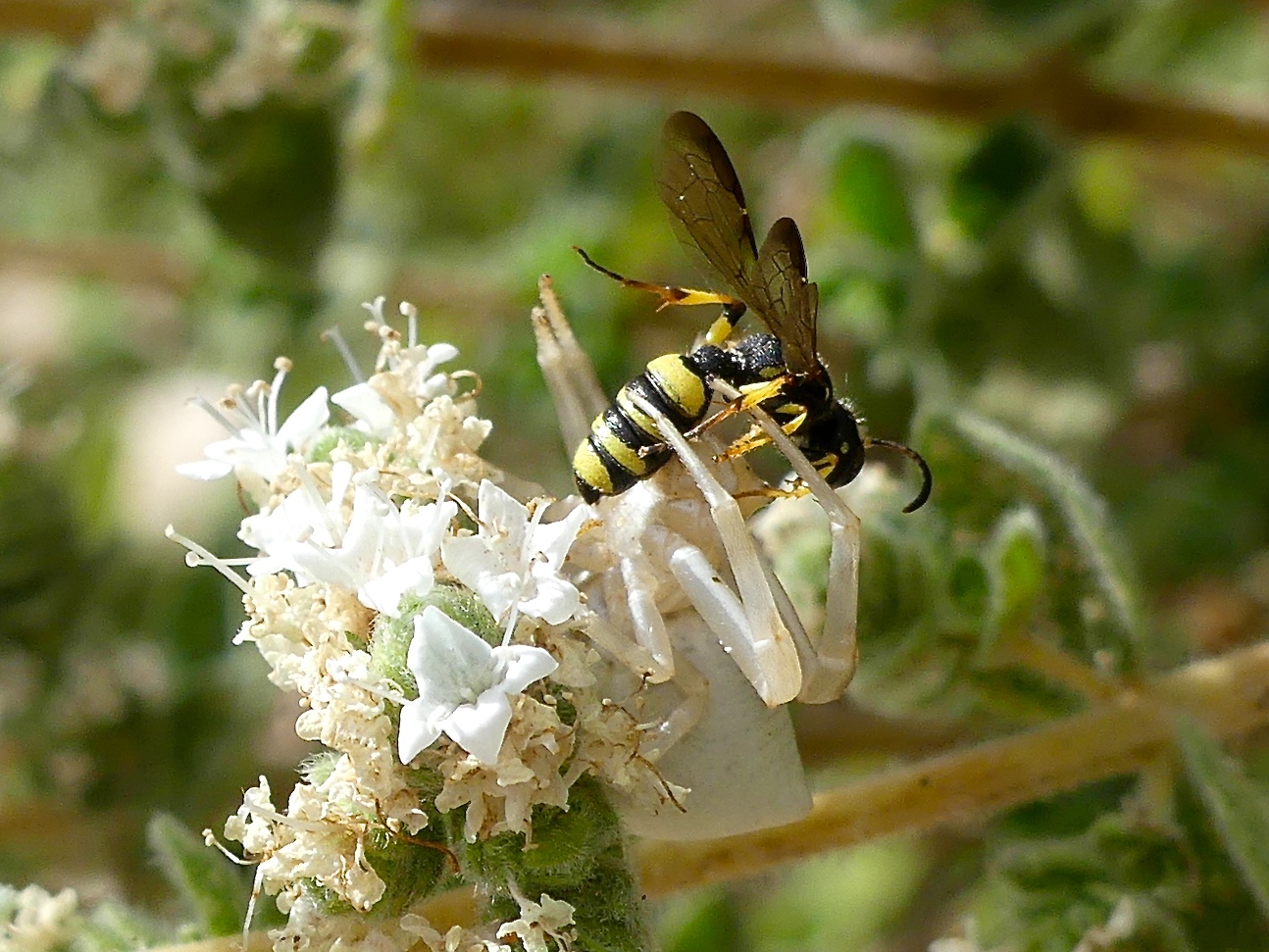
A crab spider has caught this wasp, possibly yet another species: the abdomen bears quite broad yellow stripes, with the first and last stripes being wider than the rest, and the wings are dark-coloured at the front edge.
Cerceris ?
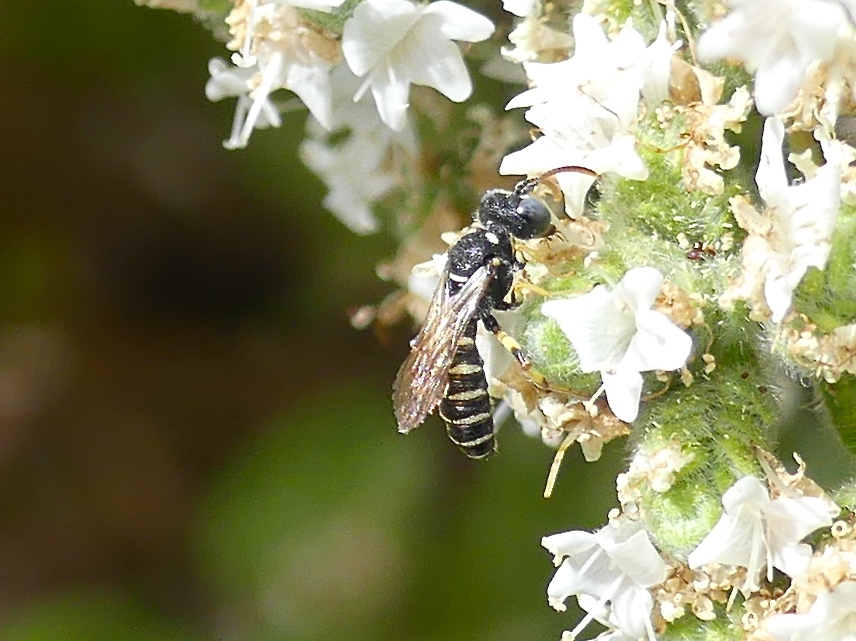
This species may also belong to the genus Cerceris, but is significantly darker in colour than the previous species, with white rather than yellow stripes. When sitting it usually keeps its wings closed.
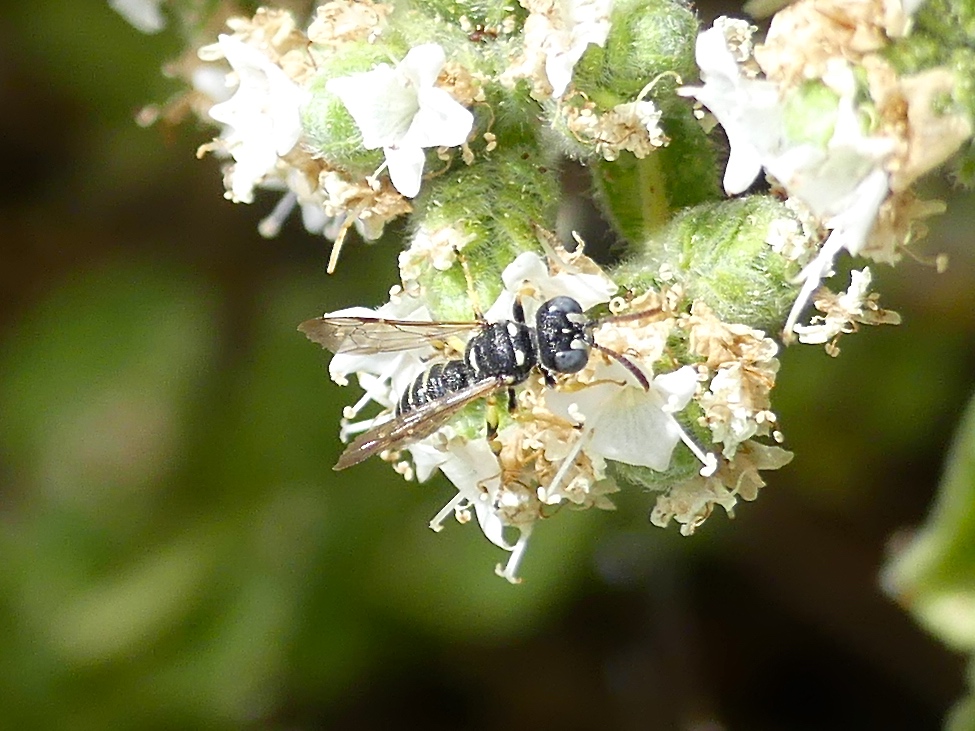
The eyes are bluish.
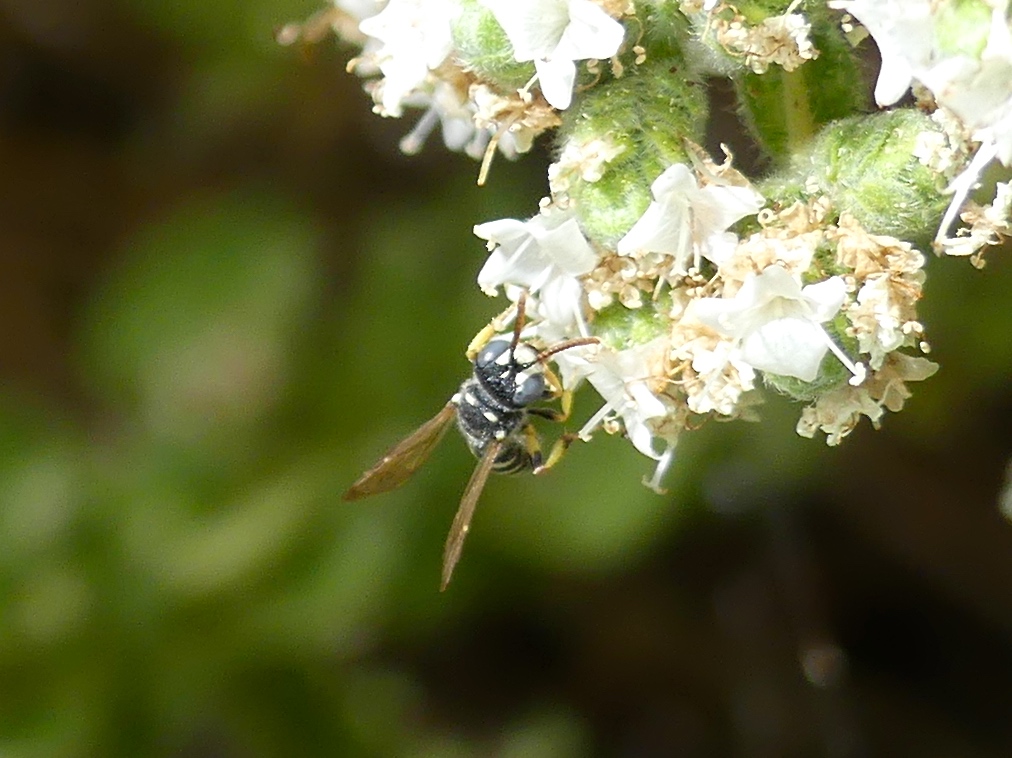
Here you can see the white facial mask.
Astatidae
Astata spec.
The species of the genus Astata build nests in the ground, into which they bring shield bugs as food for the larvae. Here you can probably see a male looking out for a female in an open spot. Judging by the colouring, it could be the species Astata boops.
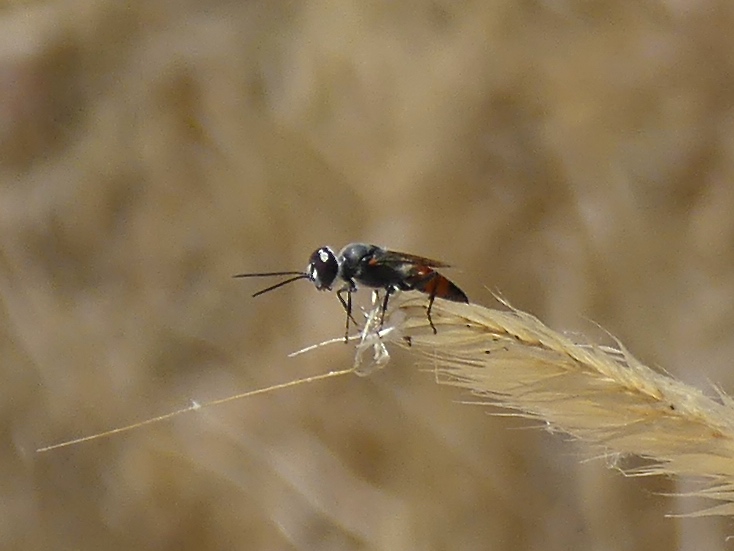
The wasps of the genus Astata have large eyes and are skilled flyers. They prey on bugs for their larvae; the nests are built underground.
continue: Bees
back:
see also:
further reading: