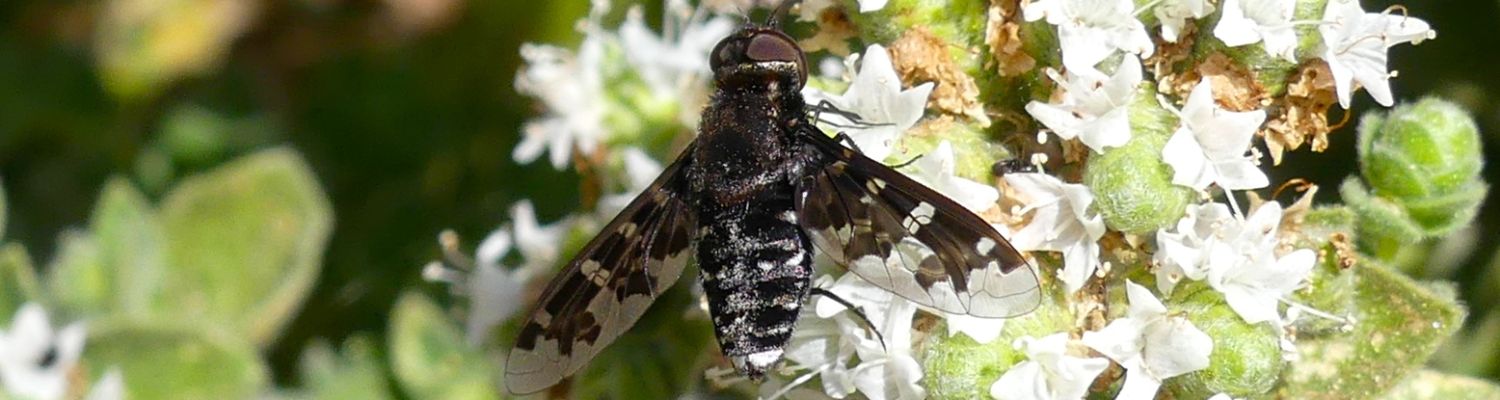
Bee flies
The stout, often very hairy beeflies (family Bombyliidae) belong to the order of the flies, but in some cases they rather resemble small bumblebees. Their most striking feature is their characteristic, slow flight, during which they often hover in one spot. When they are sitting, they hold out their wings at an angle. The adults feed on nectar and pollen. Some species “stand” hovering in front of the flower from which they feed. The larvae of beeflies live as parasites, primarily on the larvae of hymenoptera, and sometimes also on flies, grasshoppers or butterflies. In some species (genus Hemipenthes), the larvae parasitise on parasites that live on hymenoptera larvae (“hyperparasites”). The females lay their eggs near the host’s nest; sometimes the eggs are “shot” into the nest by the flying female. In other species the first larval stage has legs and invades the host’s nest on its own; later larval stages have no legs.
Worldwide, around 5,000 species of bee flies in over 200 genera have been described to date. Bee flies usually occur in small numbers and are among the less conspicuous insects, so we do not yet know much about many species and genera. Numerous species are found in the Mediterranean region; on Naxos, a whole range of species can be encountered in spring and summer. They usually sit on the ground rather than on flowers, where they are easily overlooked. Apart from the very common Heath bee fly, most species are rather rare.
The Photo gallery of the flies, wasps and bees gives an overview over the species.
A note on identification: While some flies can be identified easily, this is not true for all species. In many cases, accurate identification relies on characteristics that cannot be seen in photos and require examination of the dead animal under a magnifying glass or microscope; also one would need special literature and identification guides. For this reason, I cannot guarantee the correctness of the identification of many of the species in the following description. I would like to thank the forum of the website Entomologie.de and the very dedicated members of the Facebook group “Insects of Greece and Cyprus” for helping with the identification of several species.
Heath bee fly, Bombylius minor, L.
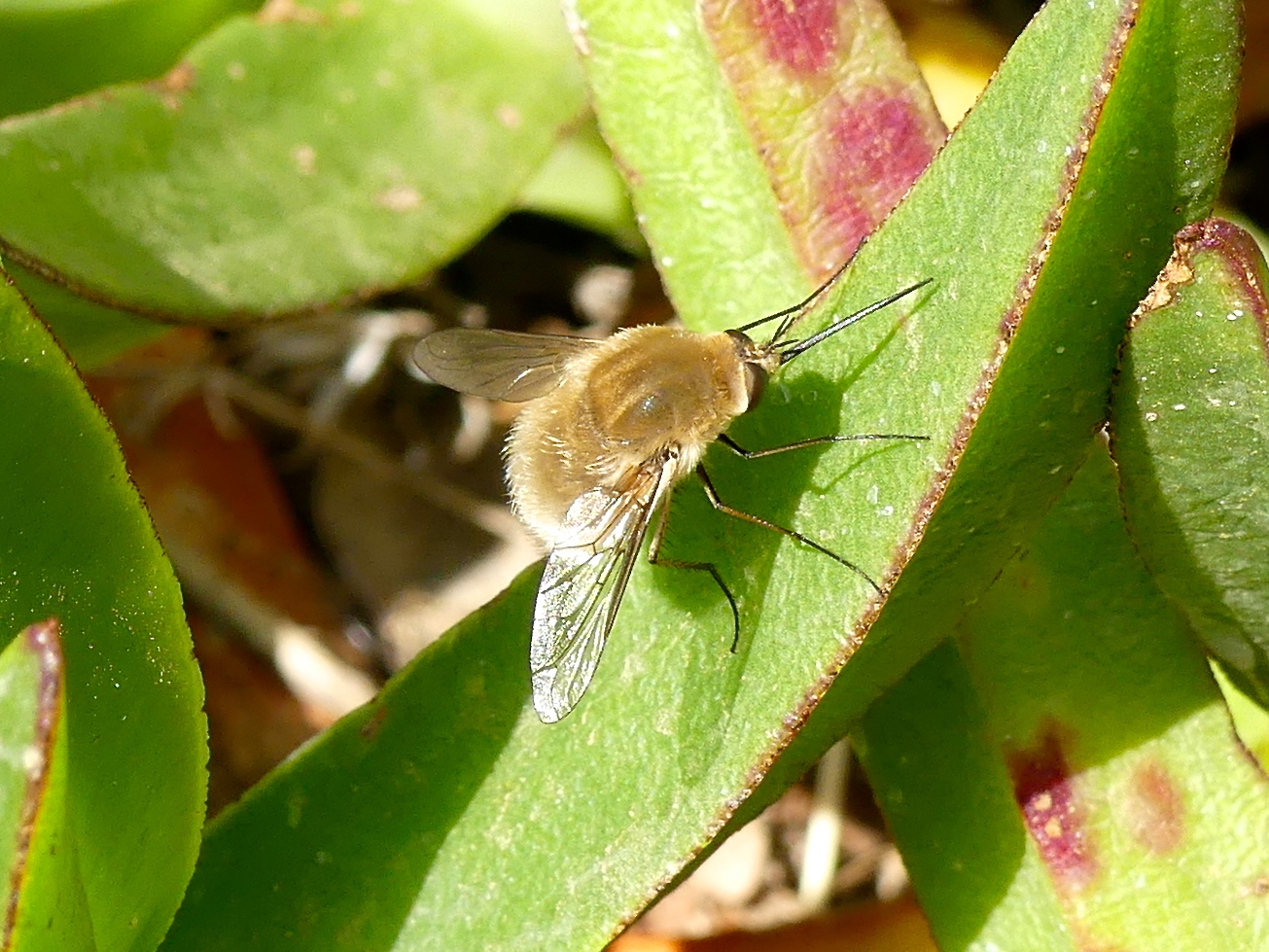
The Heath bee fly looks somewhat like bumblebees due to their round bodies and long hairs.
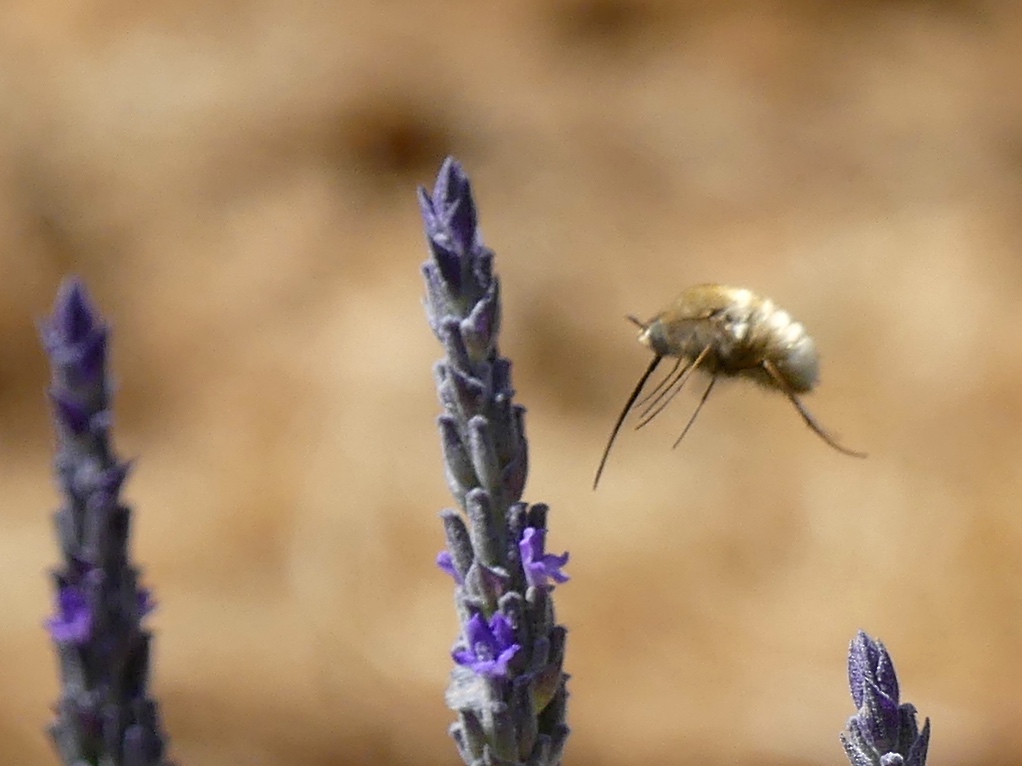
The Heath bee fly is very common in our garden in spring and early summer. With their long proboscis, which they hold outstretched in flight, Heath bee flies feed on flowers in flight or while sitting. Here you can see just how astonishingly long the proboscis is.
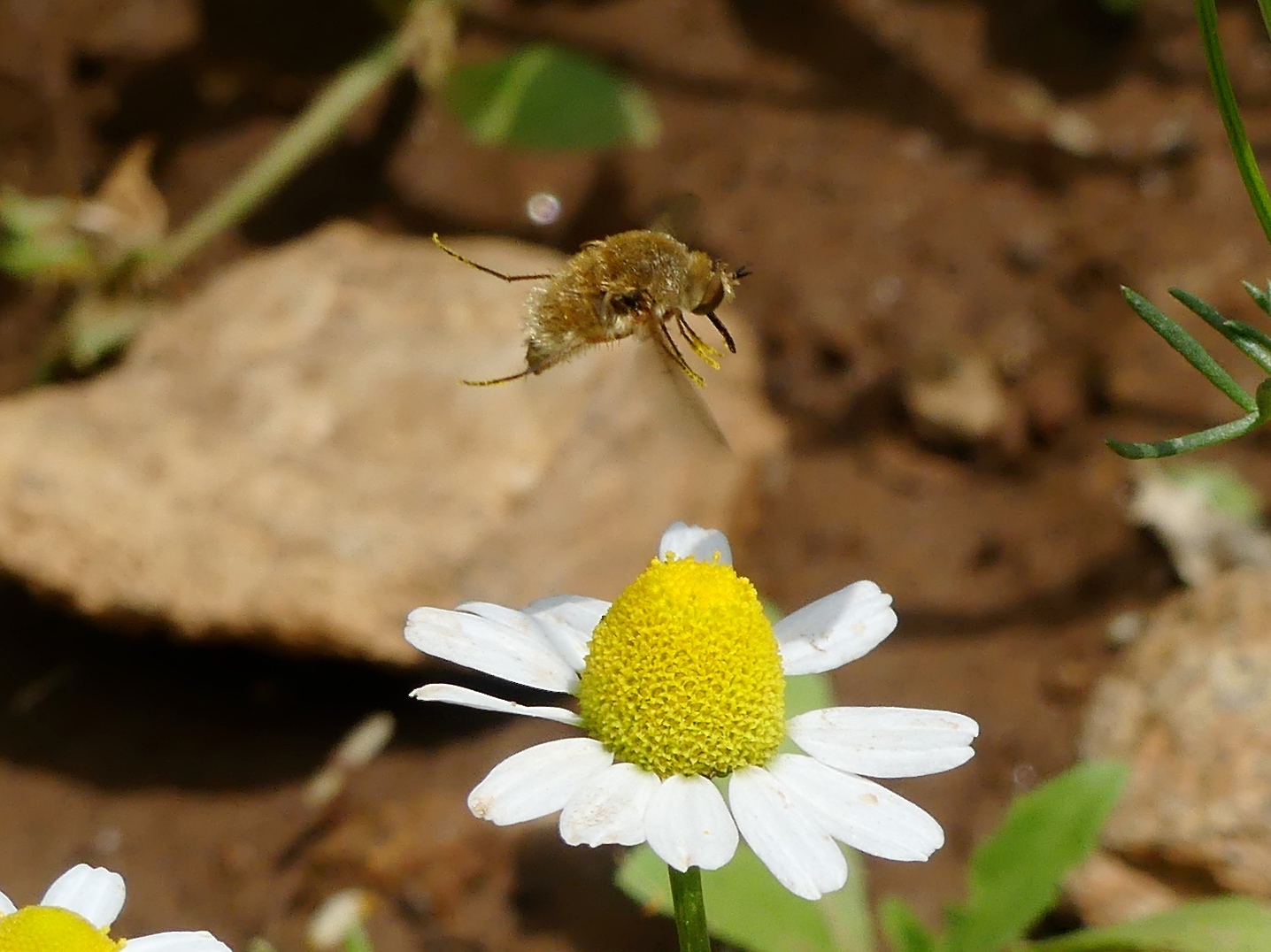
A Heath bee fly approaching its favourite flower in our garden, the chamomile. In flight, the hind legs are spread upwards and backwards in a characteristic manner, as seen here. The Heath bee fly usually flies very slowly and at a constant speed from one flower or plant to another. This makes them easy to observe.
Anthrax aethiops, Fabricius
The species-rich genus Anthrax is widespread in the Northern Hemisphere and tropical Africa. The larvae usually live on hymenopteran larvae. Most species are rather small and have strikingly patterned wings with a black front section and a transparent rear section, which are quite clearly demarcated from one another. The body is predominantly black.
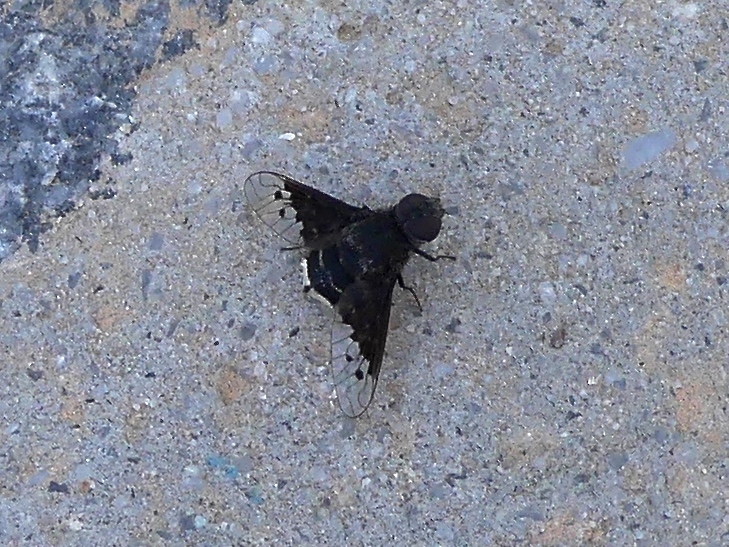
The wings of Anthrax aethiops are black in the front half and transparent at the rear, with two small black spots in the light area. The elongated body is black with a lead-grey tip of the abdomen, which bears a narrow black longitudinal stripe down the center.
Anthrax binotatus, Wiedemann in Meigen
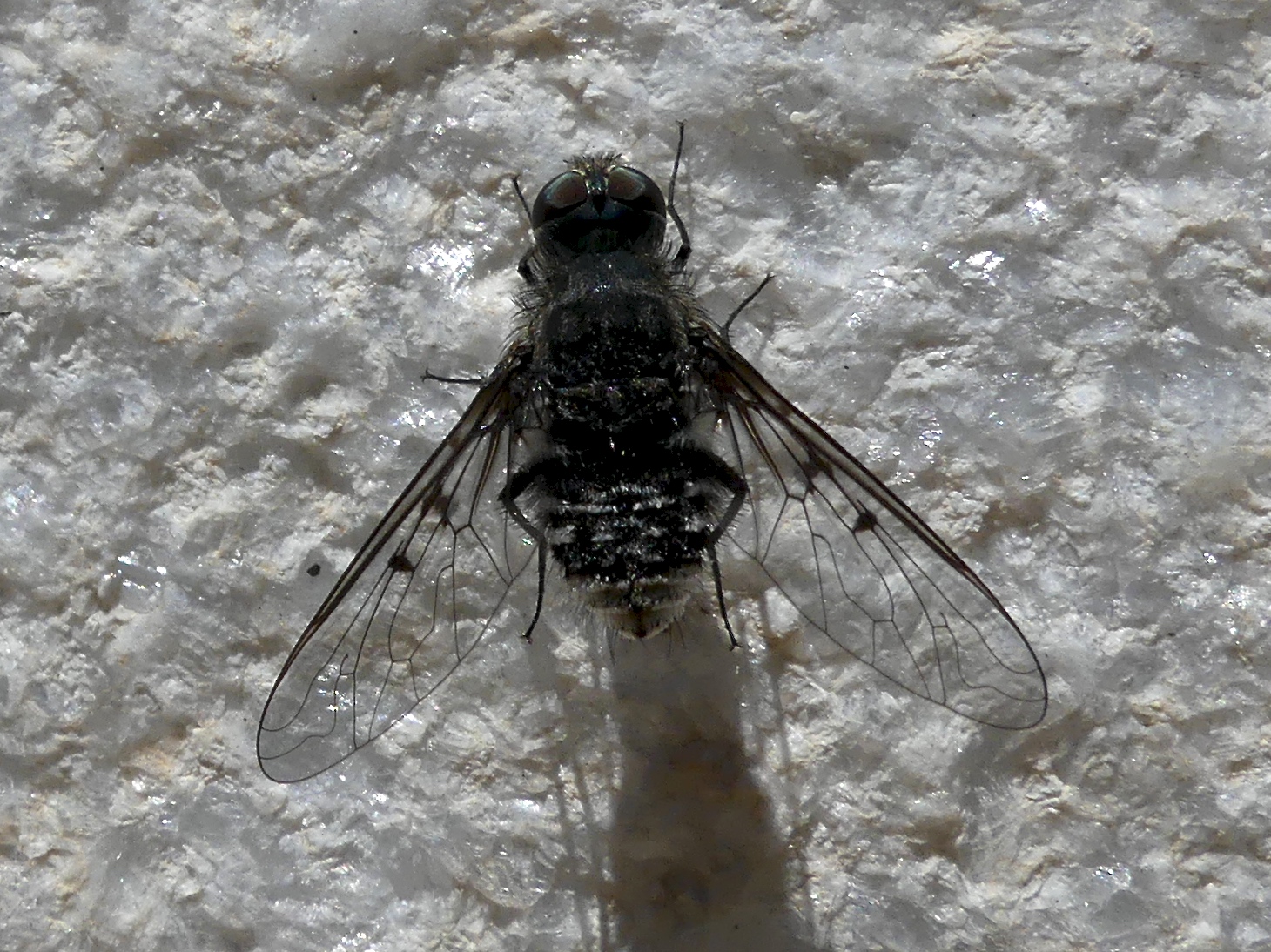
Anthrax binotatus can be recognised by its characteristic wing markings with small black spots and the pattern of the wing veins. As with all Anthrax species, the body is mostly black.
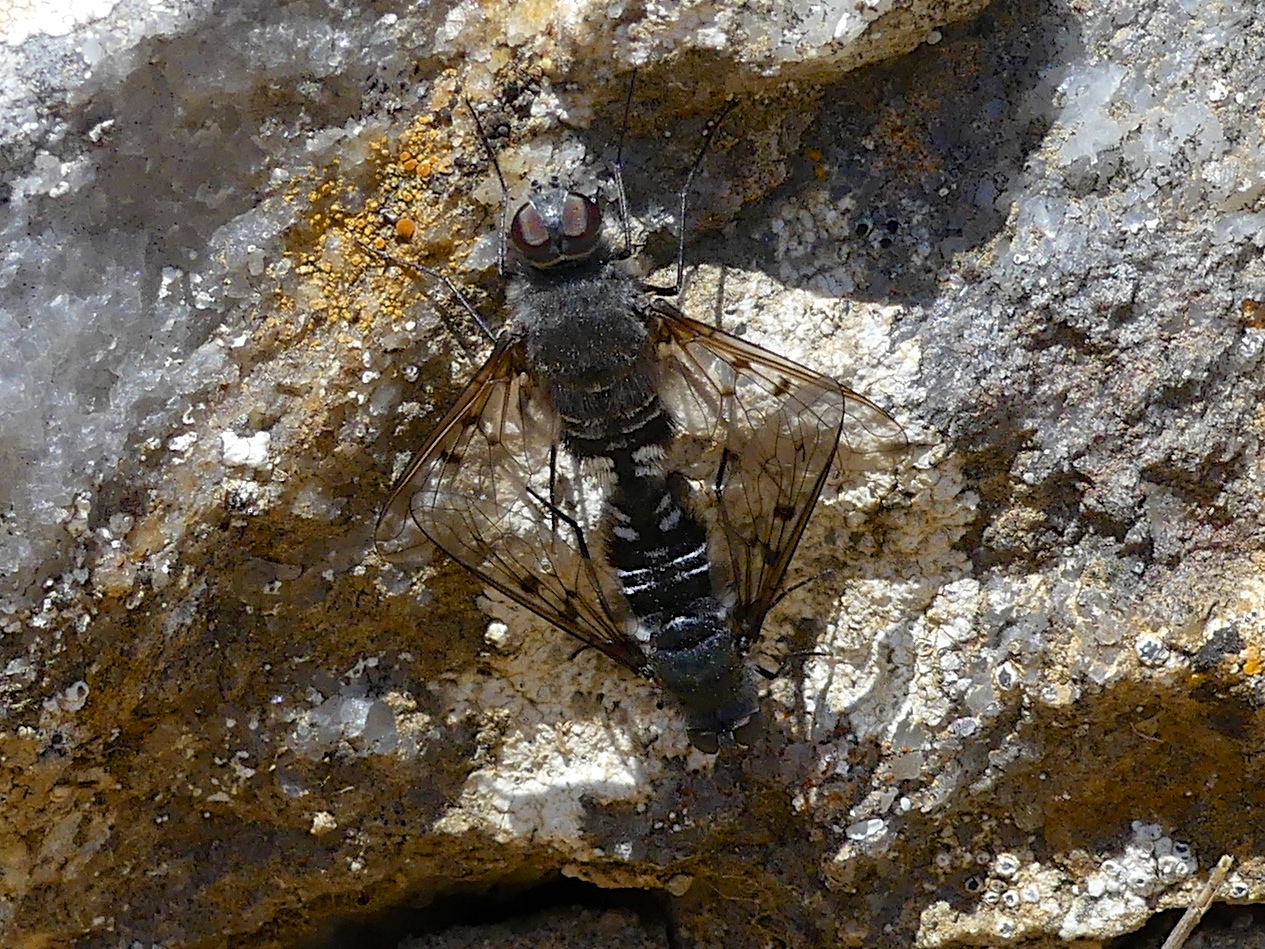
Here two individuals mating. One sees the distinct white stripes on the abdomen; the characteristic spots on the wings are also visible.
Heteralonia megerlei, Meigen
This species has dark wings with a small light tip and a characteristically shaped, indented light mark roughly halfway along the wing.
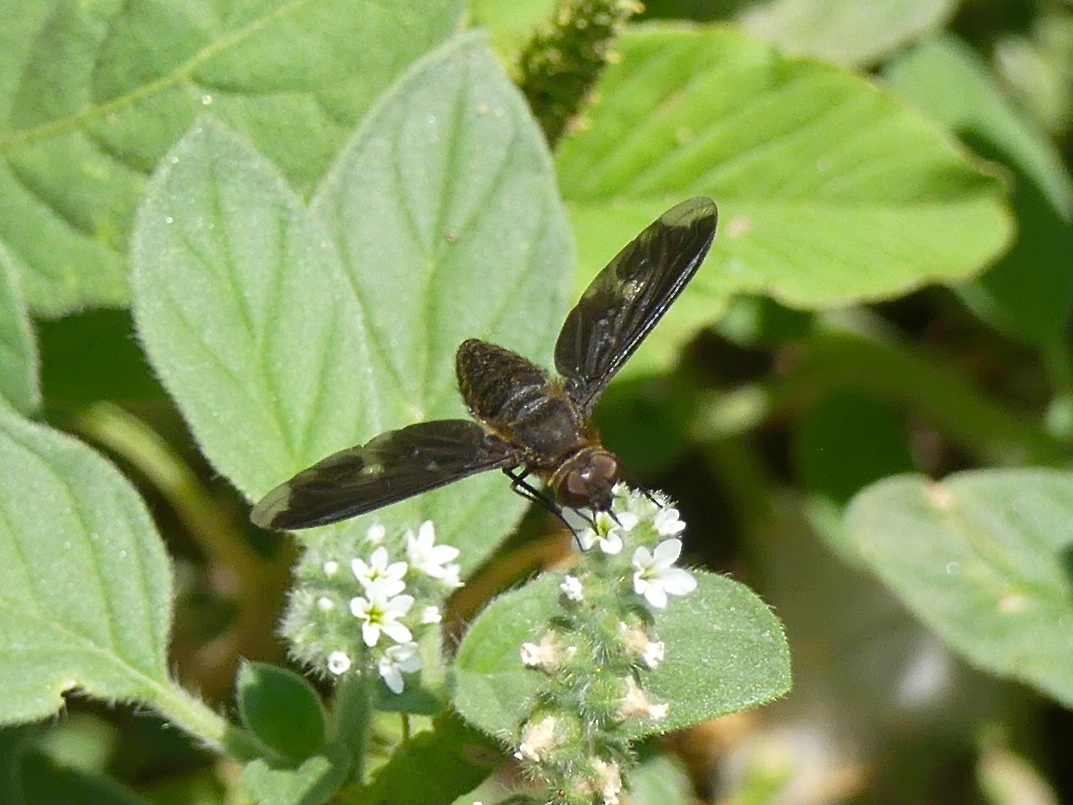
Heteralonia megerlei regularly occurs in our garden in early summer. As with many beeflies, the size of the insects can vary greatly; here we have a small specimen.
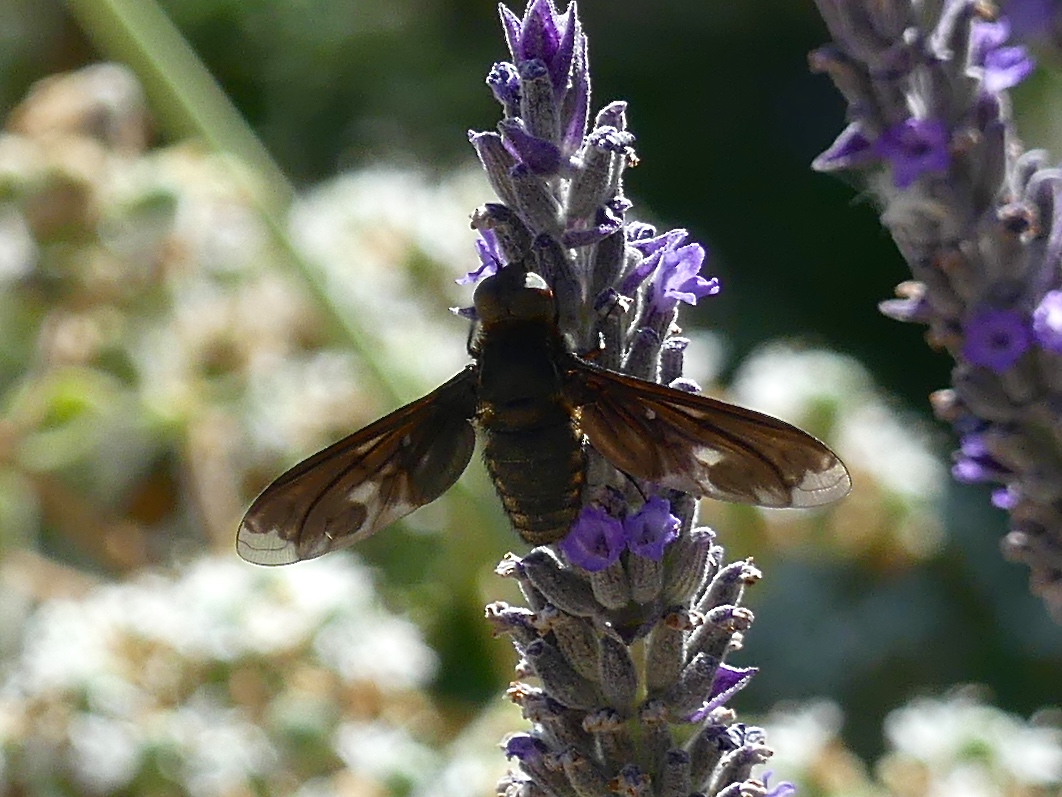
This species has a very unusual wing venation with a thick longitudinal vein. This is a very large specimen – it is easily twice the size of the one in the previous picture!
Hemipenthes velutina, Meigen
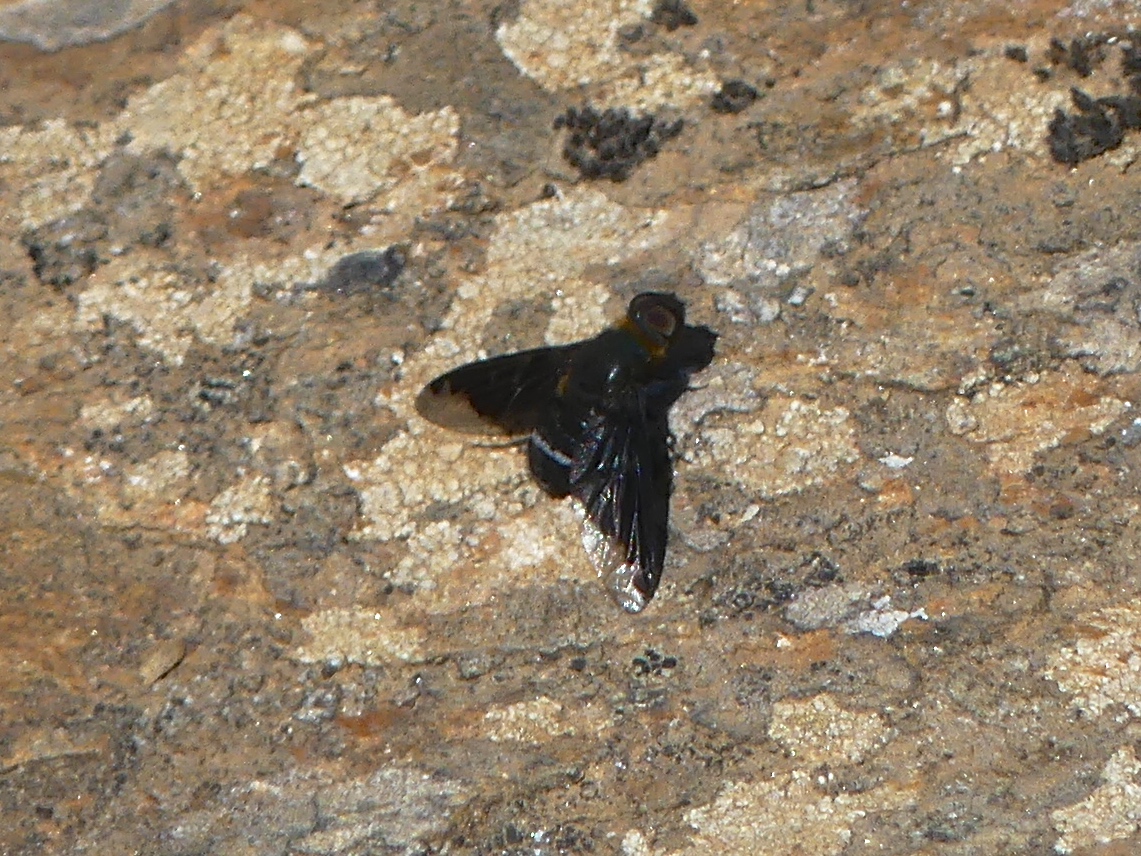
Hemipenthes velutina has a black body with a distinct white stripe on the abdomen and a light brown ‘collar’. The eyes are brown. The wings have only a relatively narrow transparent rear section with a distinct black spot on the outer edge. So far, I have seen this species only once on Naxos, in the Tragaía.
Silvery bee fly, Exoprosopa jacchus ?, Fabricius
The members of the large genus Exoprosopa vary considerably in colour. As with all beeflies, the larvae live as parasites. Exoprosopa jacchus is widespread in the Mediterranean region. The very similar species Exoprosopa pandora can only be distinguished by the structure of the genitalia, so the identification must remain uncertain. Exoprosopa jacchus, with a body length of up to a good 1.5 cm, is one of the larger beeflies, although the body size varies considerably: the largest specimens we encounter are almost twice the size of the smallest. The size depends on how much food was available to the larva. Exoprosopa jacchus is frequently found in our phrygana in early summer. It usually sits on plants, less often on the ground.
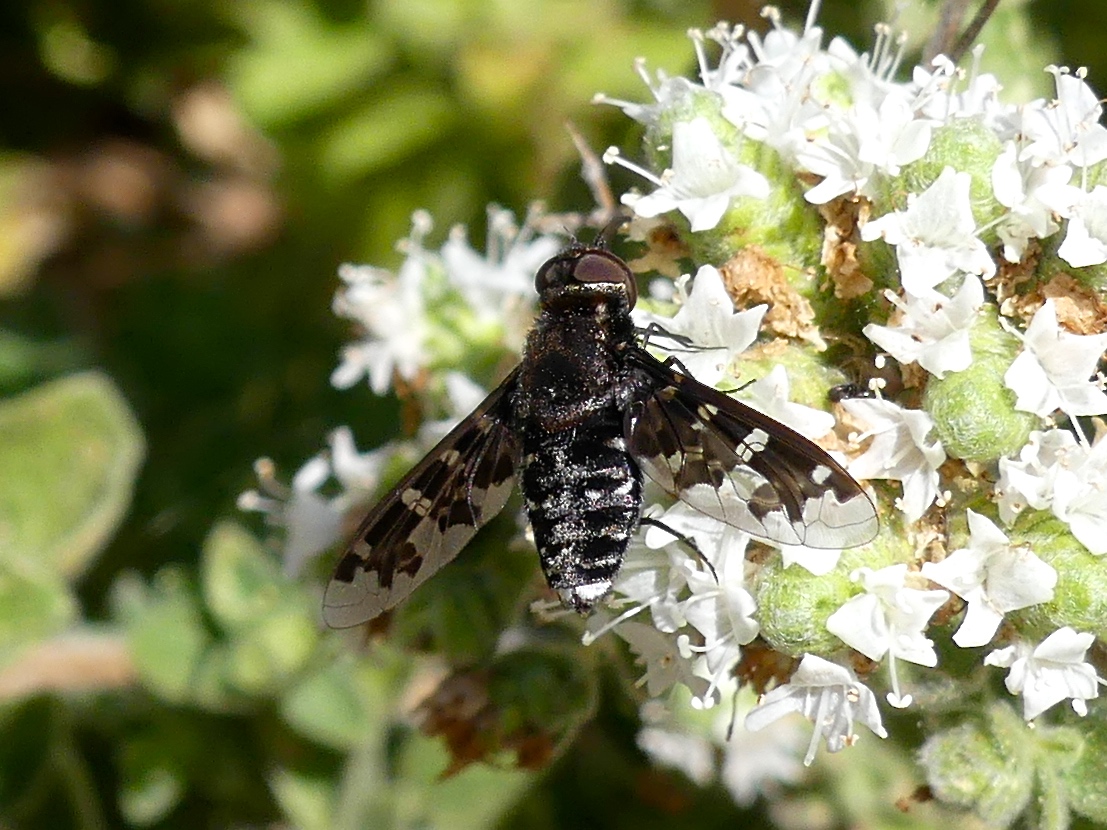
The Silvery bee fly has a dark brown body and dark brown wings with lighter spots forming a characteristic pattern. There are other similar species that are difficult to distinguish.
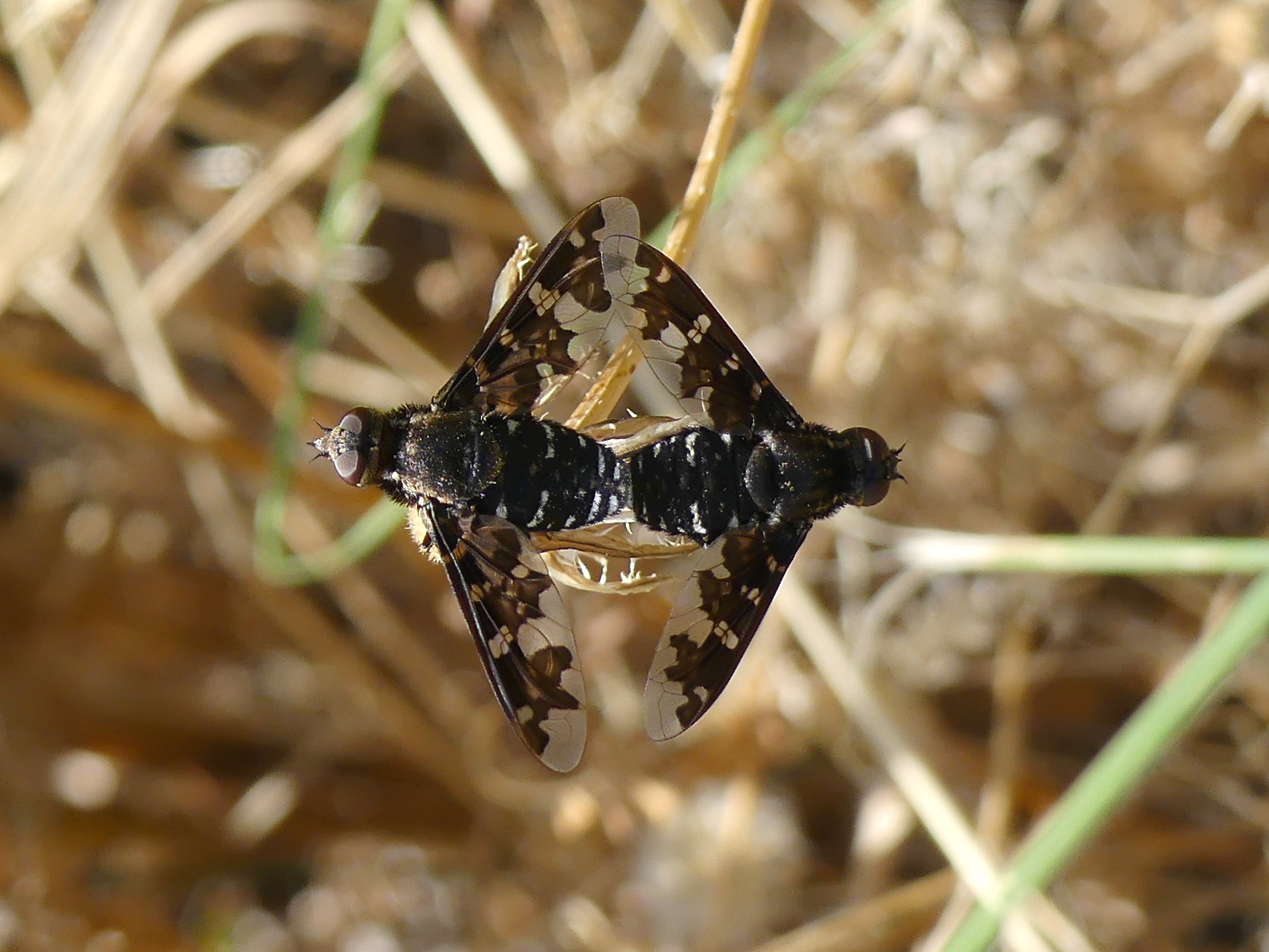
Here two Silvery bee flies mating. How lovely they look! In this photo, you can also see the markings on the body with white stripes and spots.
Exoprosopa minos ?, Meigen
In addition to the dark species with heavily patterned wings, the genus Exoprosopa also includes grey species with barely tinted wings. These too are predominantly rather large species. As is the case almost everywhere, identification based solely on external characteristics is difficult; so our identifications and not entirely certain.
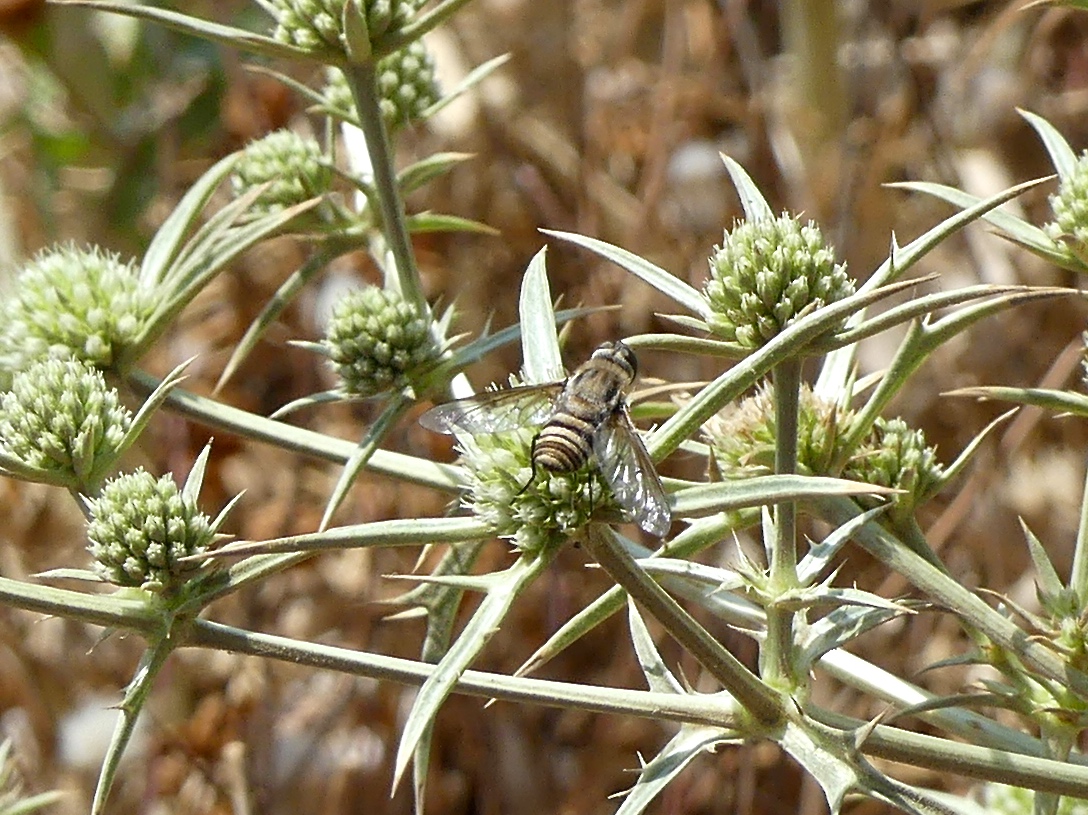
Exoprosopa minos holds its striped abdomen slightly curved upwards in a characteristic manner.
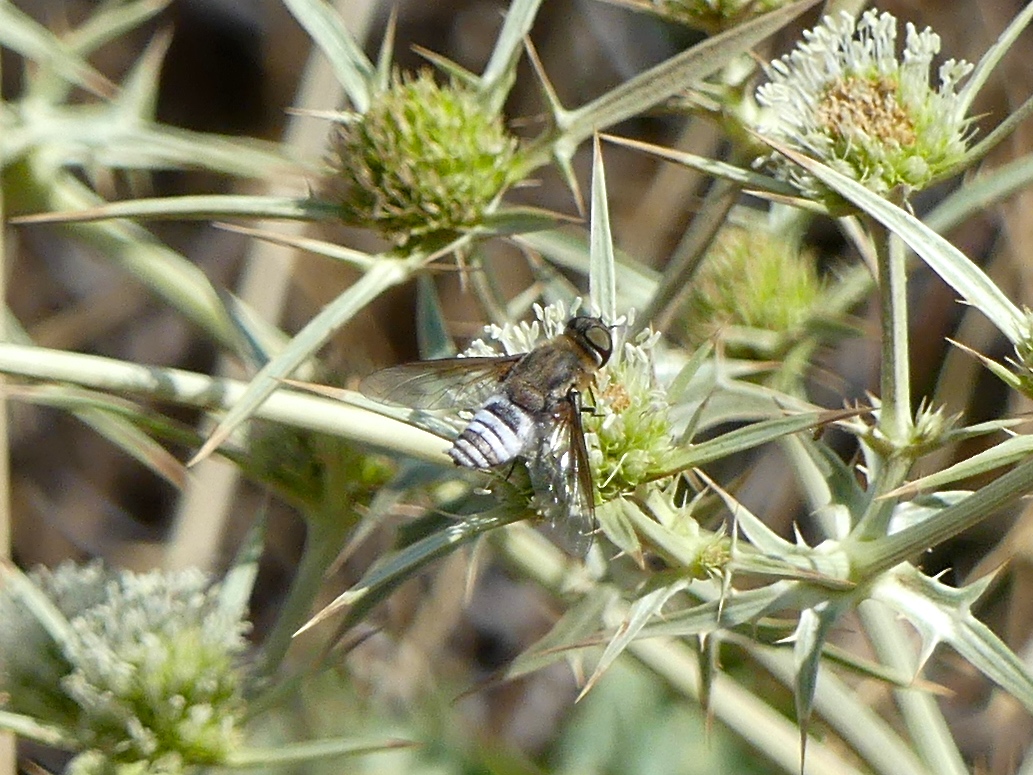
In males, the abdomen is very pale or almost white in colour. The first dark stripe is often confined to the middle section. The wings are brownish at the front.
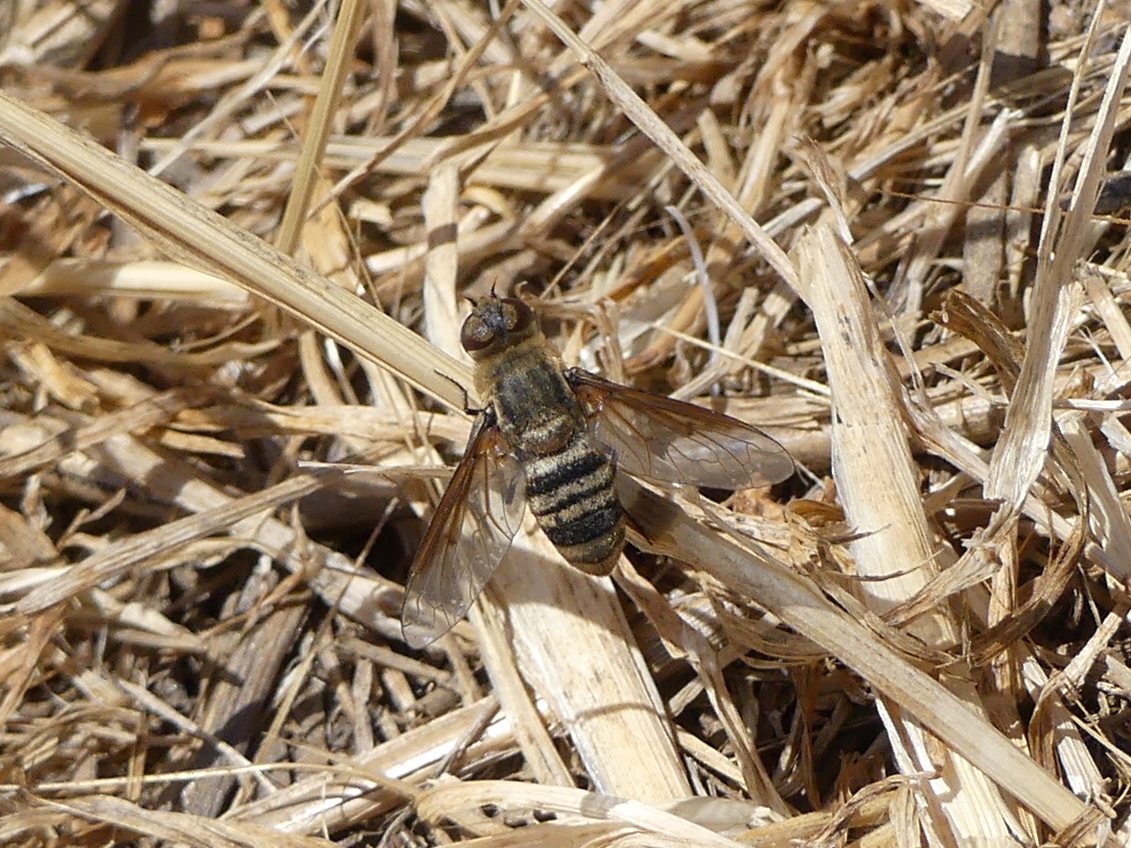
Here you can see the typical striping of the abdomen in the female. The first and third stripes are thicker, the second considerably thinner.
Exoprosopa grandis, Wiedemann in Meigen
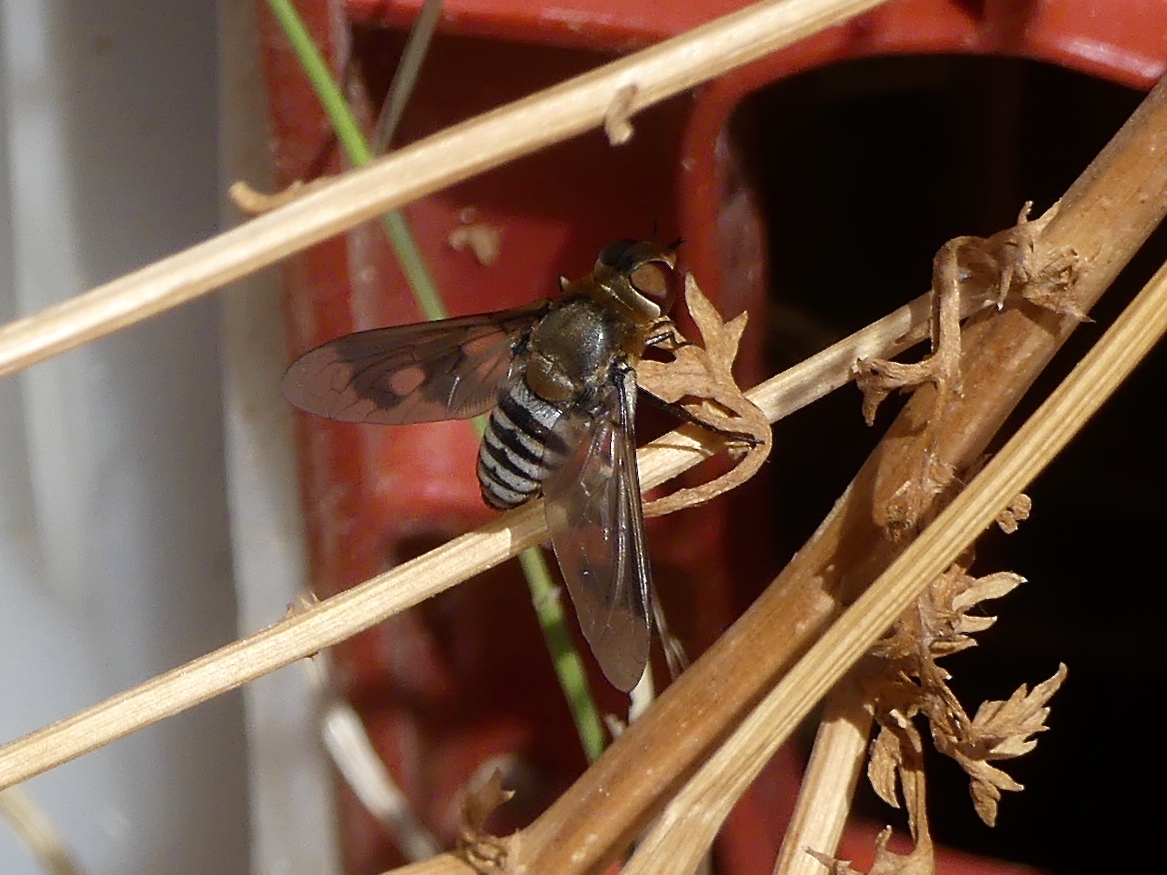
Exoprosopa grandis is one of the larger hoverflies. The abdomen bears contrasting stripes; the wings display a coarse pattern of light and dark markings.
Exoprosopa ?
This large species could also belong to the genus Exoprosopa.
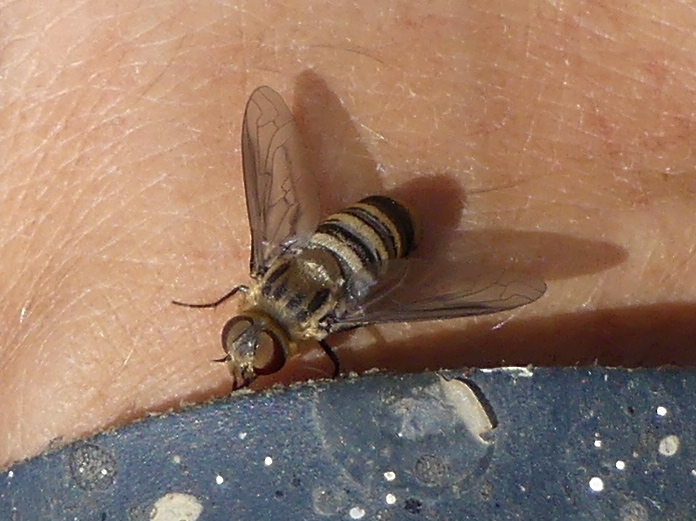
This species has a strongly patterned thorax. The abdomen bears characteristic, intricate stripes. The wings are barely coloured.
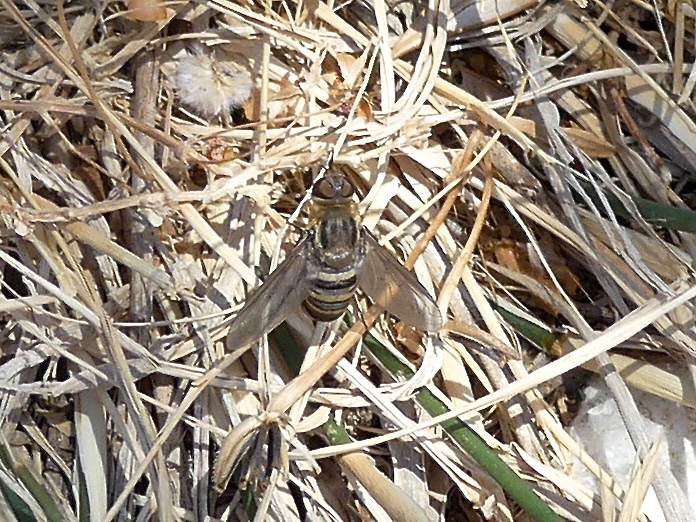
In the striping of the abdomen, the first band is very light, the second very dark with a lighter stripe within it, followed by a grey band bordered by a thin black band that omits the center. The next dark band is grey with a black border on both sides and a fine dark band in the center. The last dark band on the abdomen is very broad.
Cytherea obscura ?, Fabricius
This lead-grey beefly probably belongs to the species Cytherea obscura. This species also grows quite large (around 1.5 cm) and is not uncommon in the phrygana; however, it is easy to overlook due to its inconspicuous colouring.
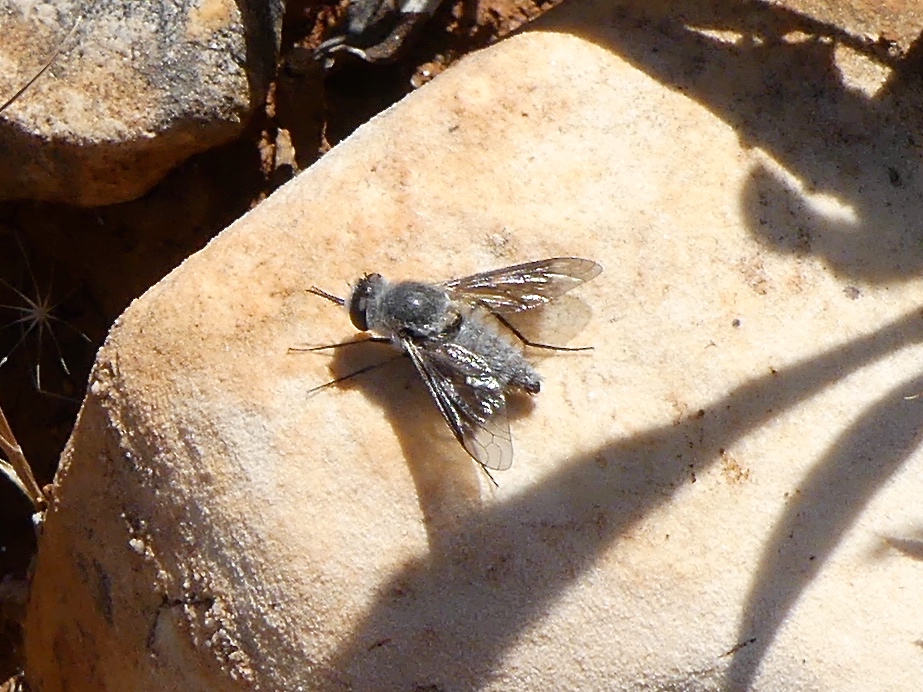
Like most beeflies, Cytherea obscura prefers to sit on the ground, where it is easy to overlook.
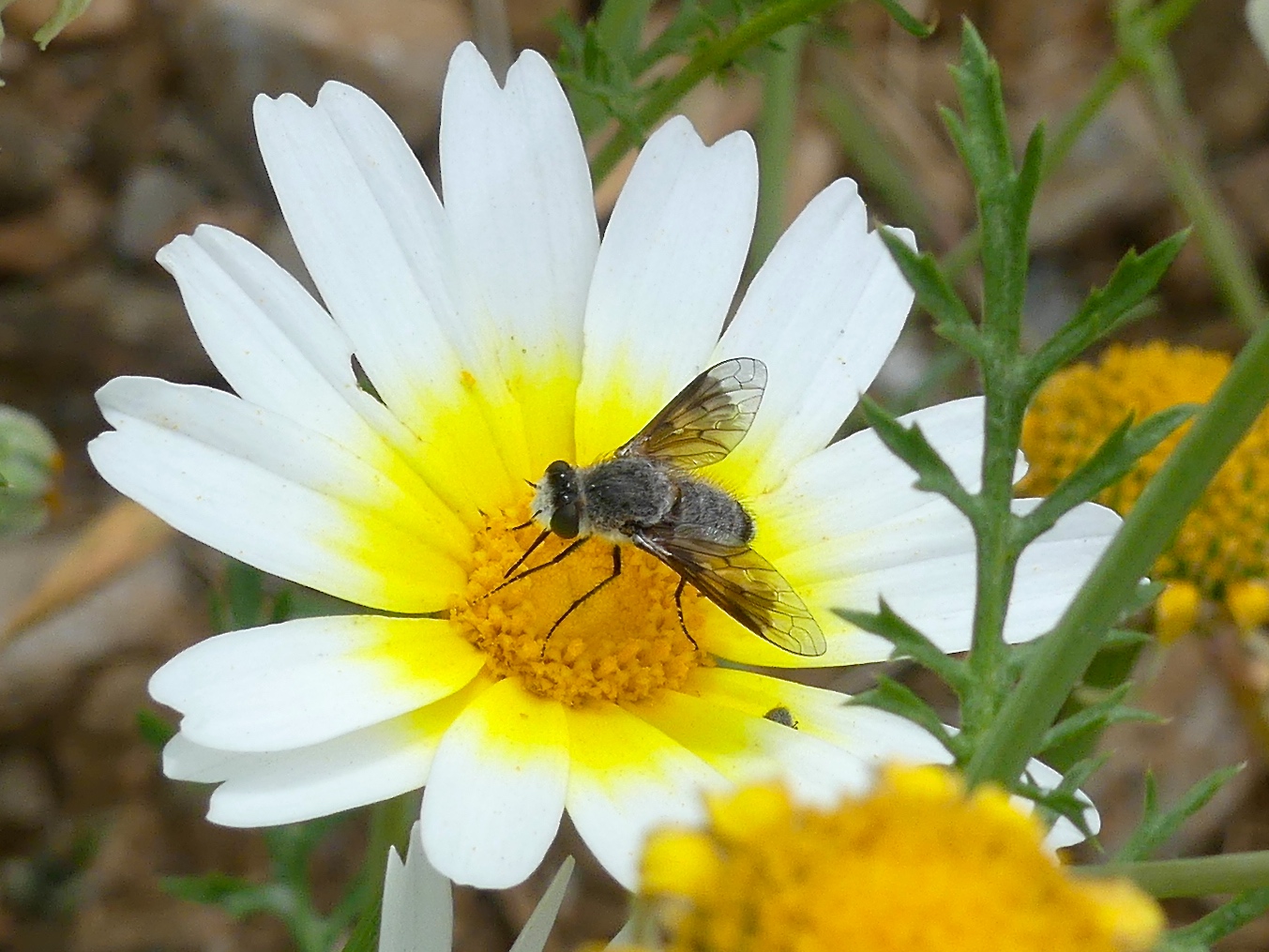
Here on a flower. The wings are partly orange-brown and partly dark in colour. The wing tips are transparent.
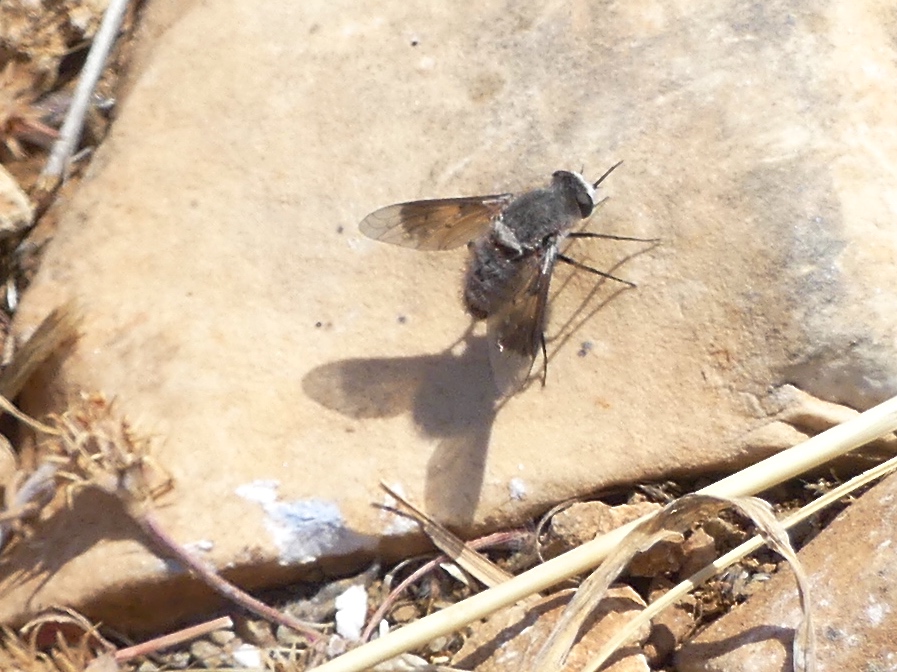
The white face is characteristic. Three small darker spots are visible on the wings.
Thyridanthrax elegans, Wiedemann in Meigen
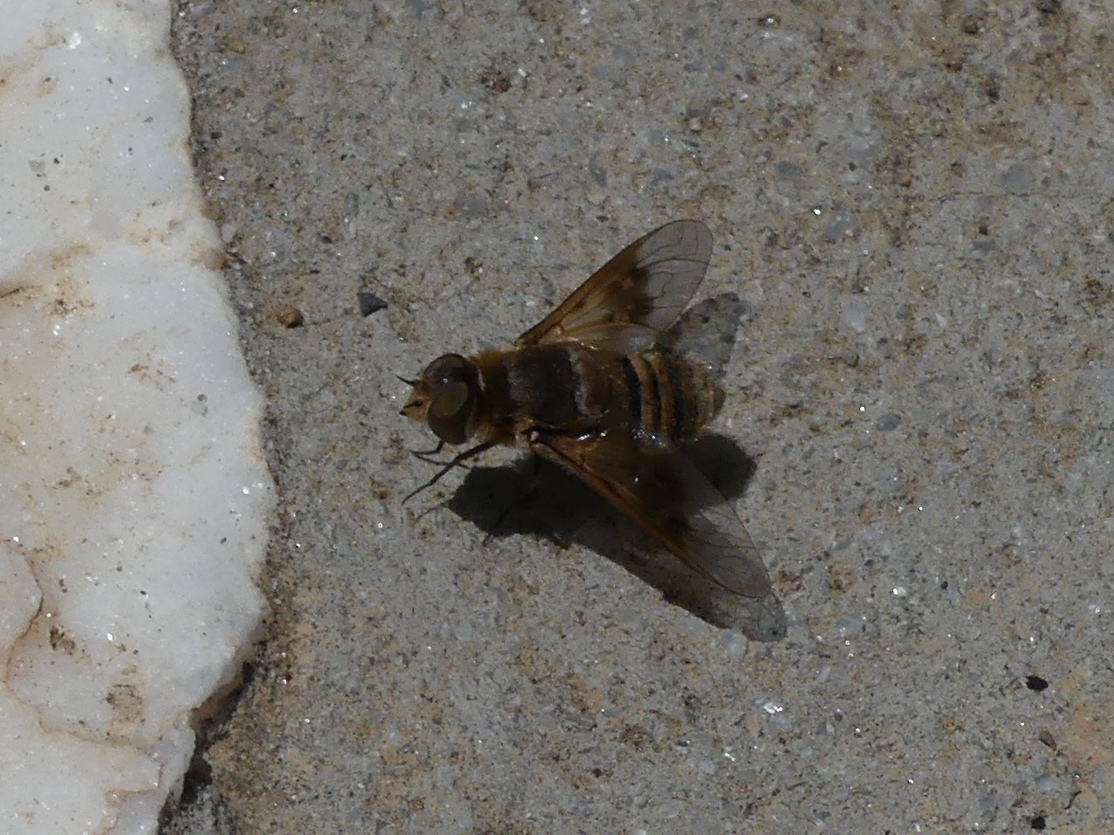
Thyridanthrax elegans can be recognised by the small lighter spots in the dark-coloured area of the wings and by the characteristic arrangement of the stripes on the abdomen. This species is very rare in our region.
Satyramoeba hetrusca, Fabricius
This beefly, also known as Spongostylum etruscum, is very large and conspicuous, measuring more than 2 cm in body length. One can see it sometimes in summer. According to my observations, it parasitises the large carpenter bee.
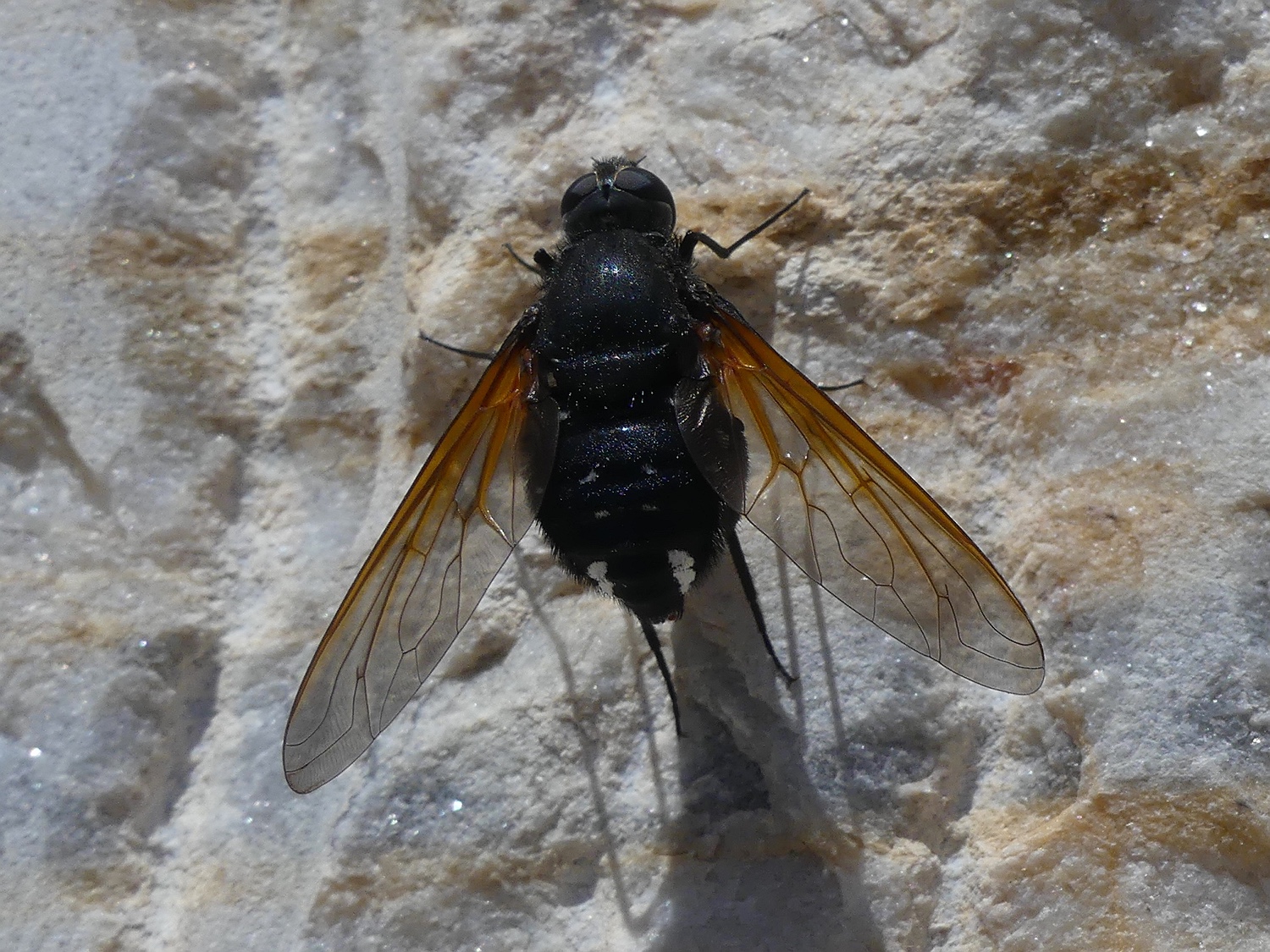
Satyramoeba hetrusca is by far the largest beefly in our region. Its body is black with small white spots on the abdomen. The front section of the wings has a distinct brown tinge.
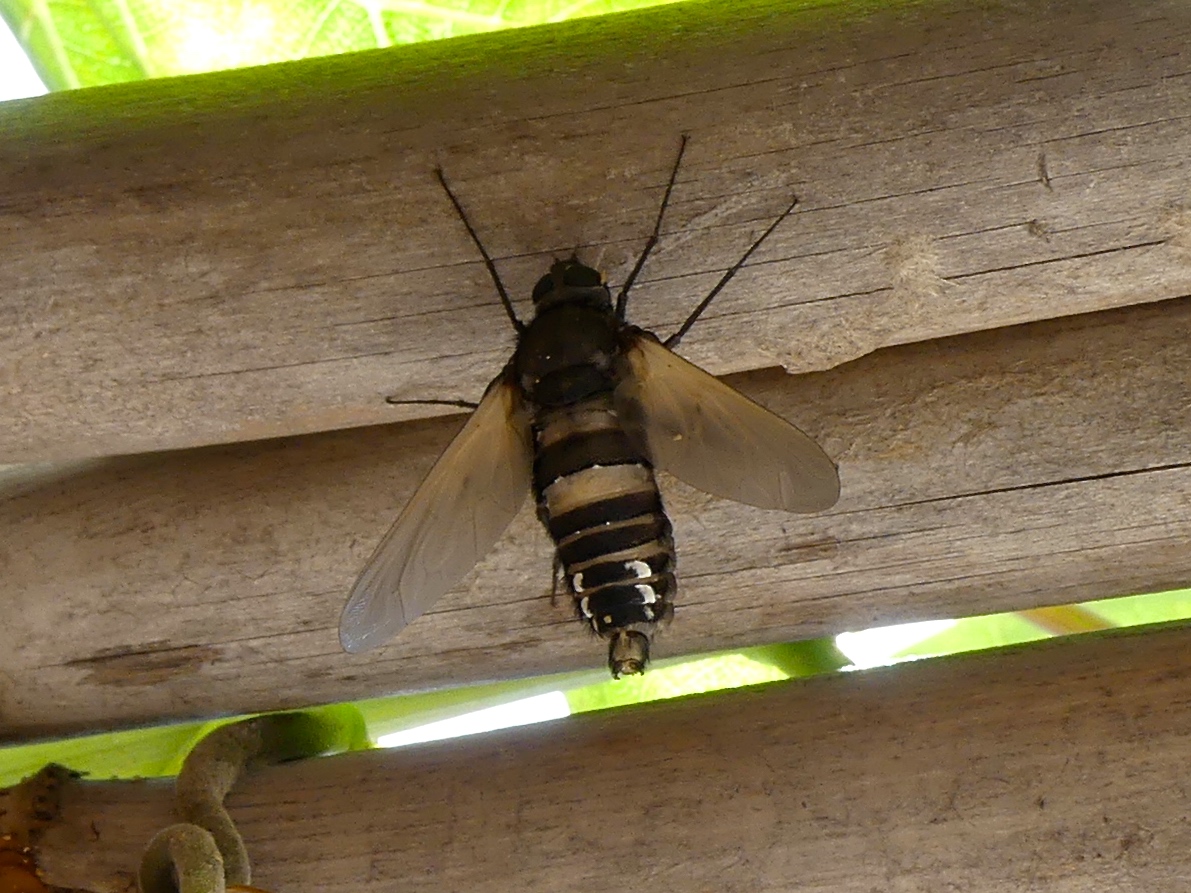
This specimen has just “hatched” from a carpenter bee nest (in the reeds of the veranda roof). It looks as though the rings of the abdomen still need to contract.
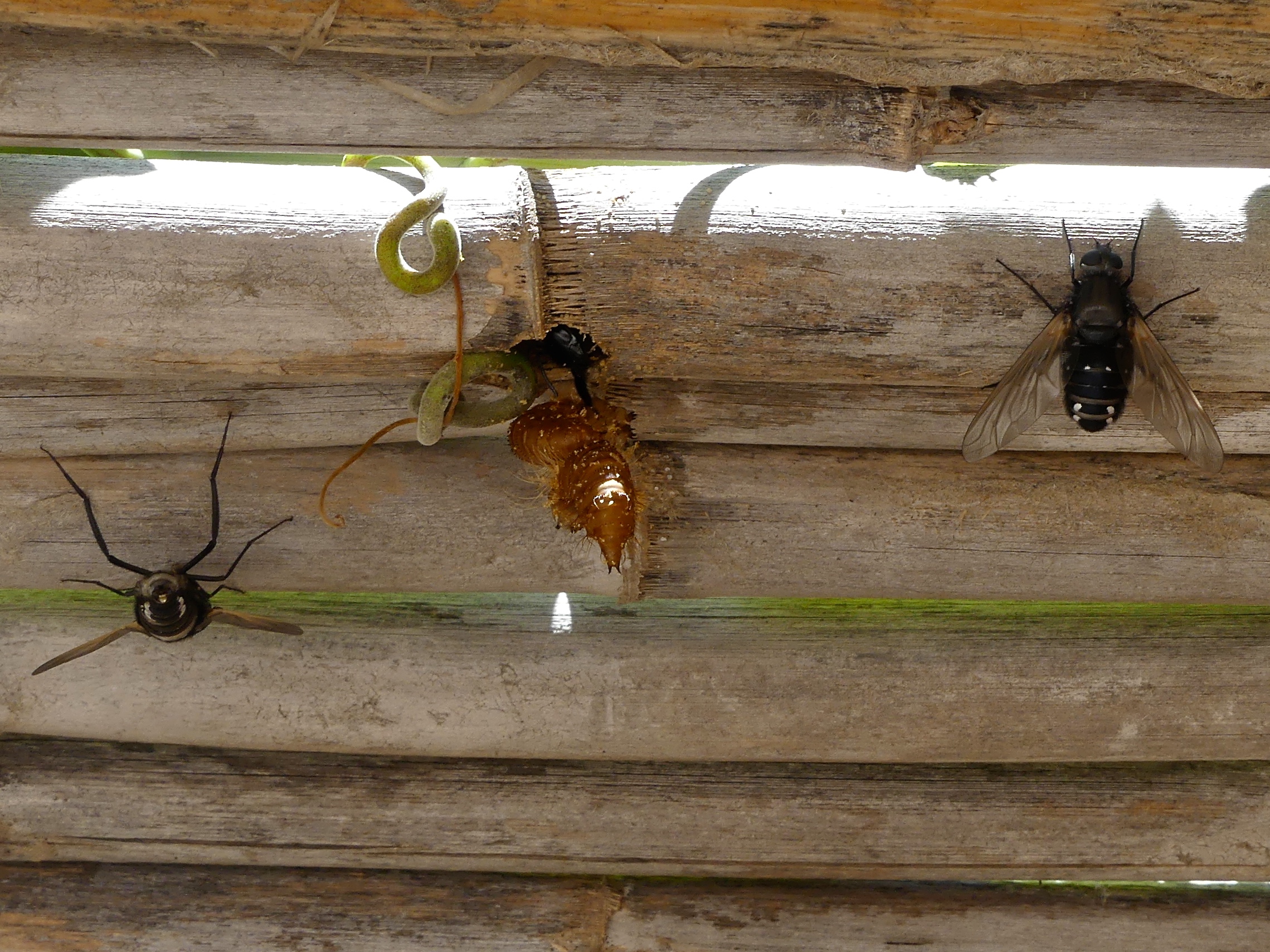
After a while, the beefly takes on its proper shape and colouring, though the tinted area of the wings is still paler than usual. It takes about half an hour for the newly hatched insect to fly away. Each year, over a few days at the end of June, a number of specimen of Satyramoeba hetrusca emerge around the thatched roofs of our verandas.
Villa hottentotta, L.
Members of the genus Villa are mostly yellowish or brownish in colour with dense hair, and bear distinct dark cross-stripes on the abdomen. The wings are only slightly tinted at the front. The genus can also be identified by the precise pattern of the wing veins.
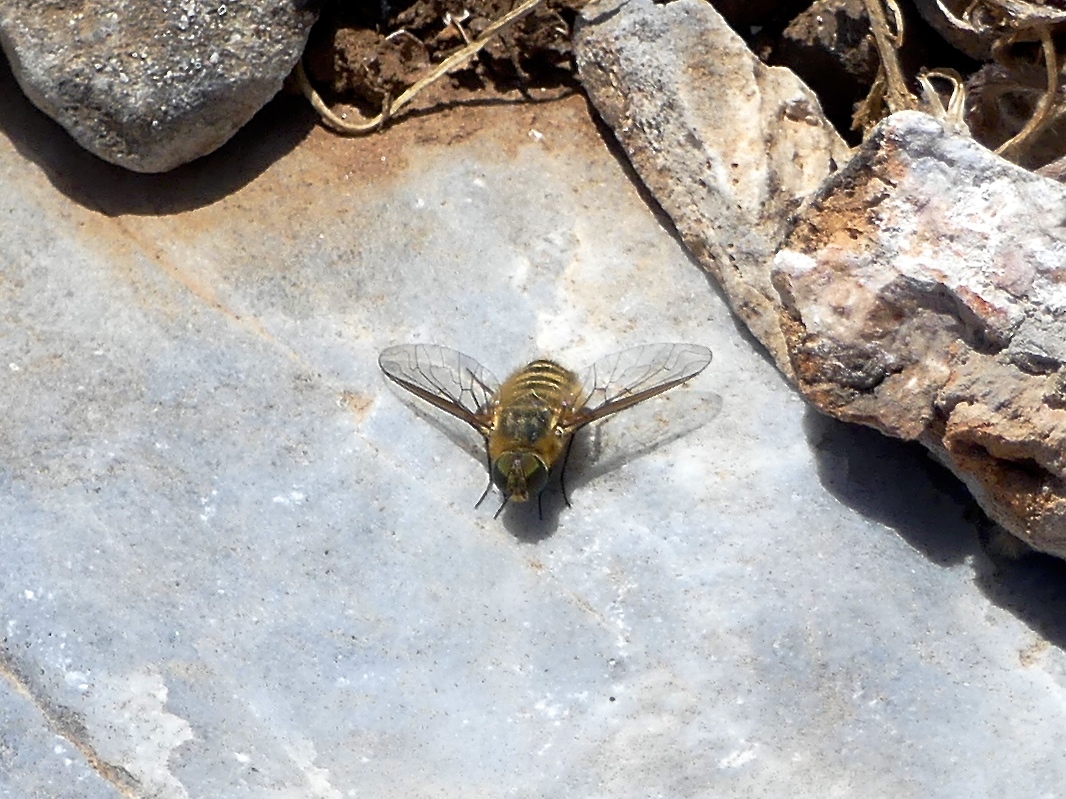
At first glance, Villa hottentotta hardly looks like a beefly. Its wings are only very slightly tinted at the front.
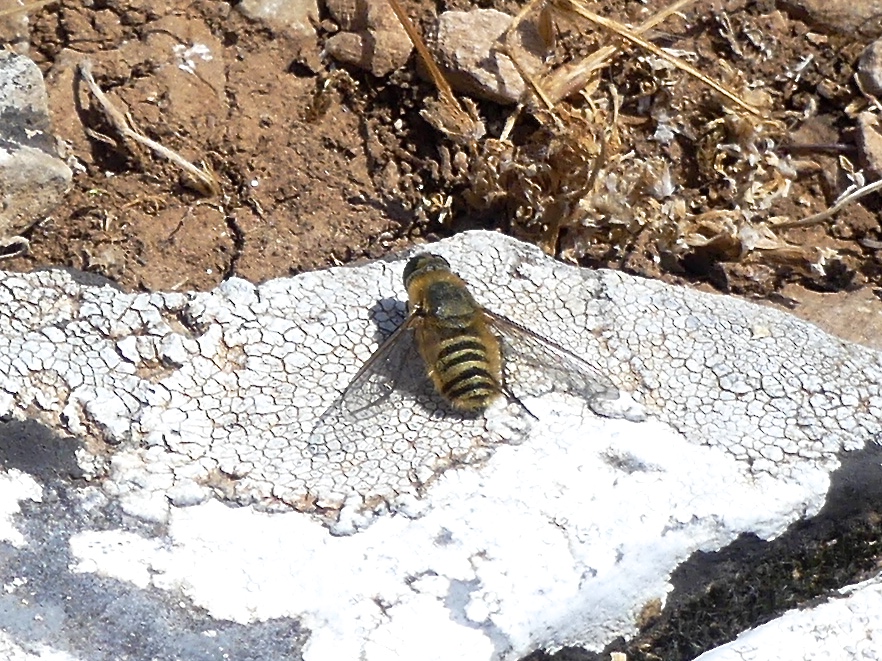
Here you can see the long, golden-yellow hair covering its body. Villa hottentotta, with its thick body, reaches almost 2 cm in length.
back: