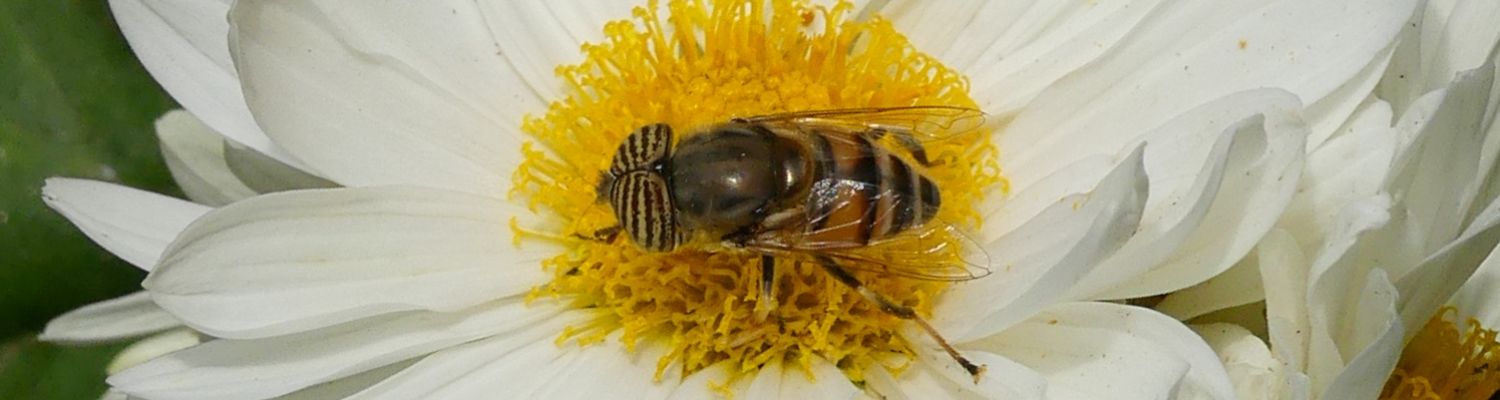
Hover flies
Hoverflies (Syrphidae) are a large family in the order of flies (Diptera), comprising around 6,000 species. They vary greatly in appearance; for example, some species mimic bees, wasps or bumblebees. All hoverflies have the habit and ability to hover in one spot and often do so when visiting flowers. The adults feed on pollen and nectar. They do not sting, but many species attempt to deter potential predators through a wasp-like warning colouration.
The Photo gallery of the flies, wasps and bees gives an overview over the species.
A note on identification: While some flies can be identified easily, this is not true for all species. In many cases, accurate identification relies on characteristics that cannot be seen in photos and require examination of the dead animal under a magnifying glass or microscope; also one would need special literature and identification guides. For this reason, I cannot guarantee the correctness of the identification of many of the species in the following description. I would like to thank the forum of the website Entomologie.de and the very dedicated members of the Facebook group “Insects of Greece and Cyprus” for helping with the identification of several species.
Hoverfly species on Naxos
Naturally, there are far too many hoverfly species on Naxos for me to provide a complete overview here; however, the following descriptions will introduce you to a few of the more common or interesting species.
Pied hoverfly, Scaeva pyrastri, L.
The Pied hoverfly is quite common in our region. It is widespread across Europe, Asia and North America.
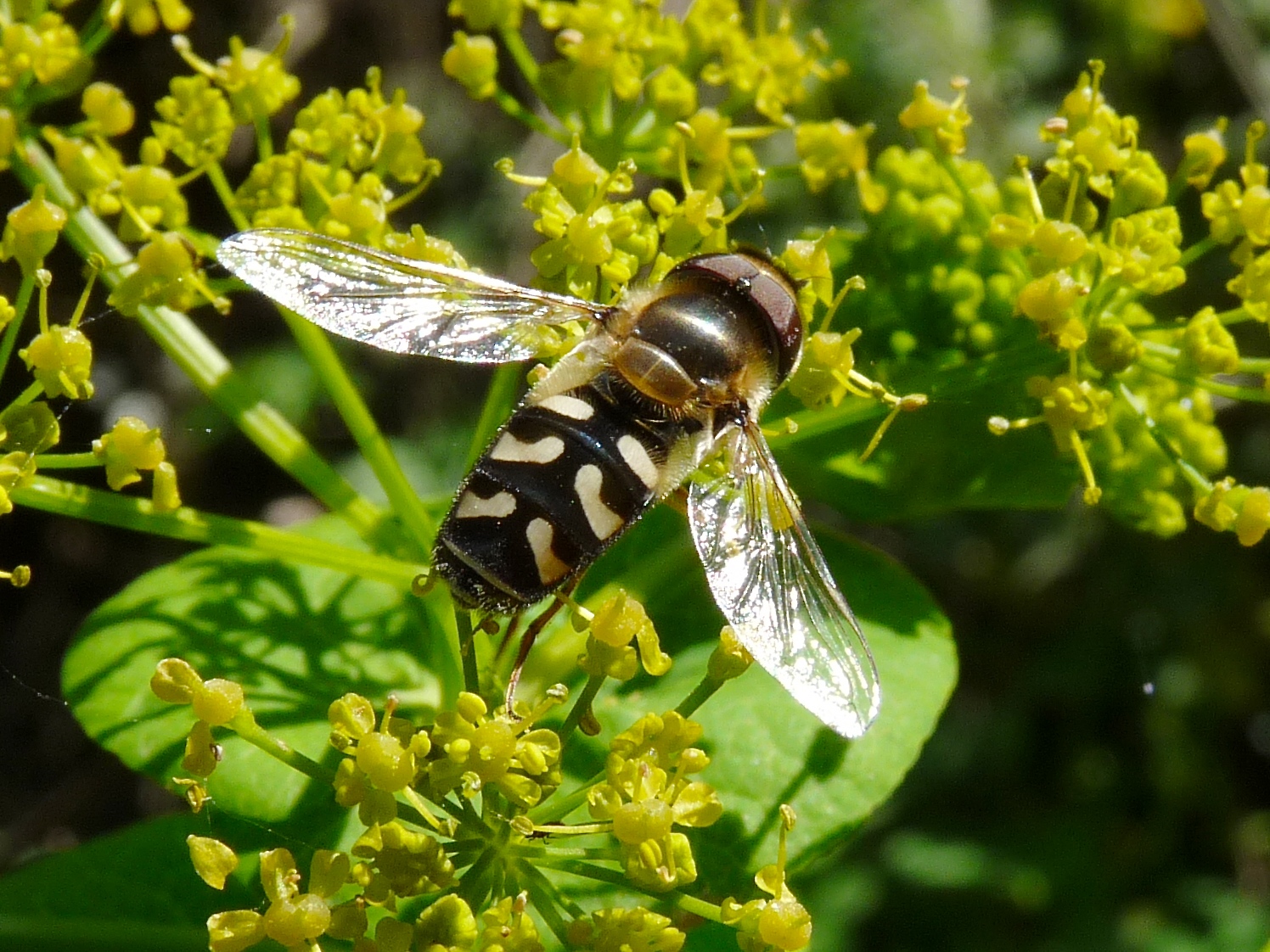
This small hoverfly, probably the species Scaeva pyrastri, displays a warning colouration with white, wasp-like stripes.
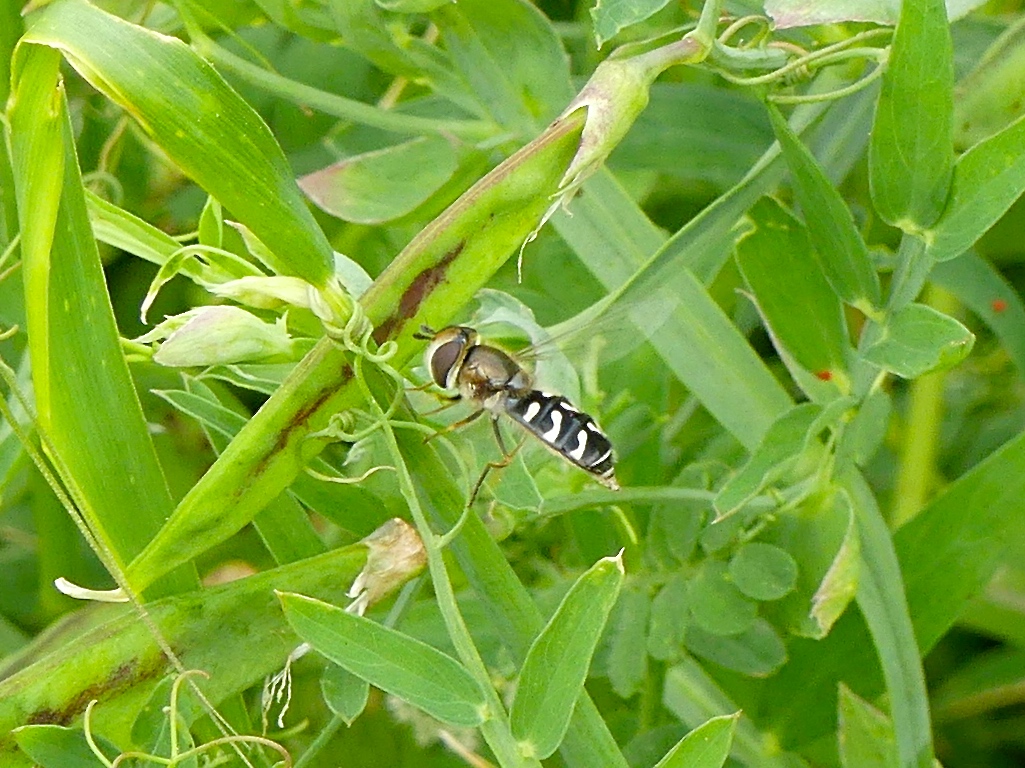
…and once again, here from the side.
Eupeodes corollae, Fabricius
This species of hoverfly is also widespread and common in Europe, Asia and North America. The larvae feed on aphids.
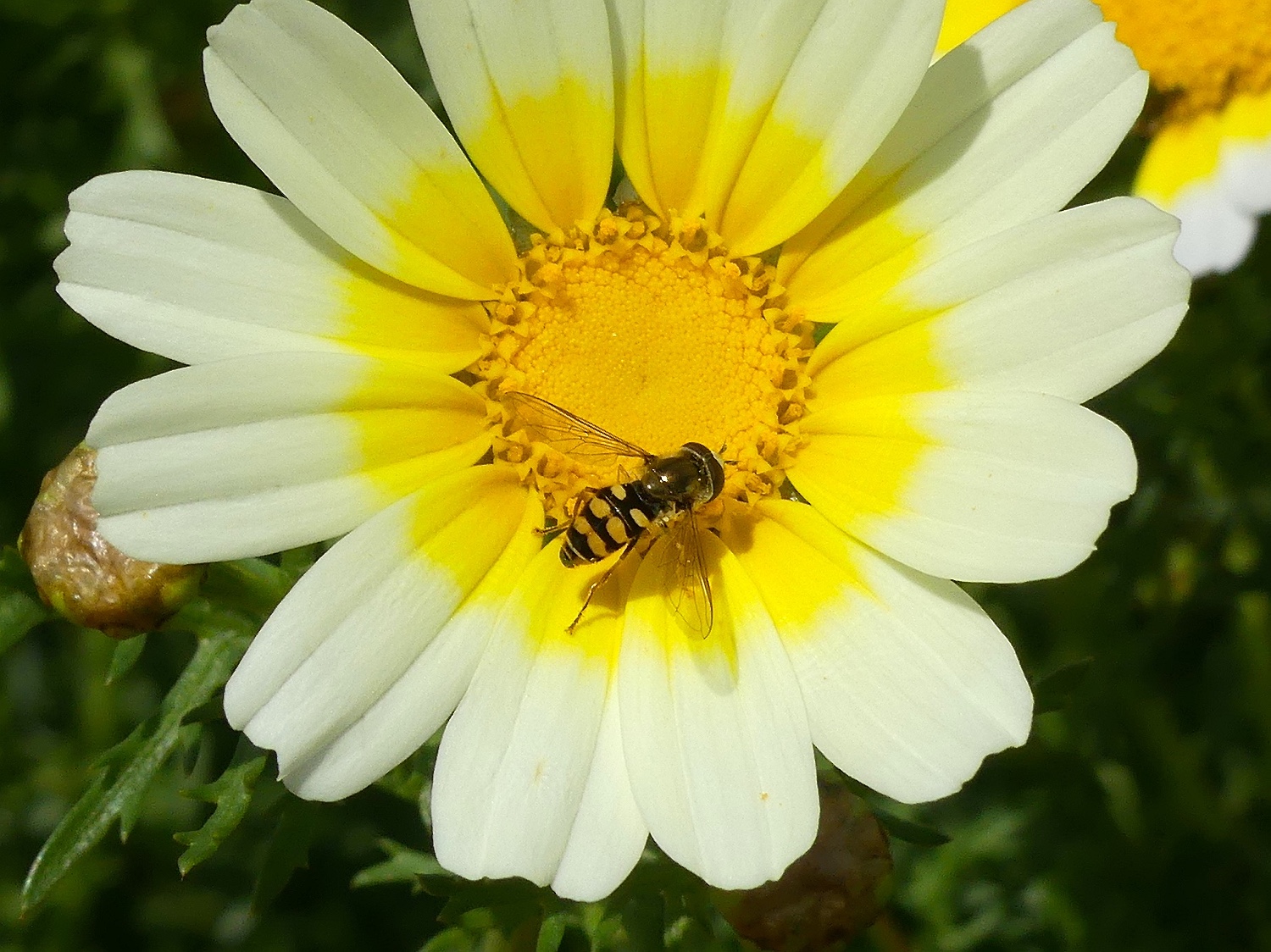
This species has yellow stripes on its abdomen. Whilst these are interrupted in the middle in females, similar to the Pied hoverfly, the two halves are connected by a narrow yellow bar in males, as can be seen here.

Here is a female: the yellow stripes are interrupted in the middle.

Viewed from the side, you can see that the yellow stripes are connected to the yellow underside at their front end.
Marmalade hoverfly, Episyrphus balteatus, DeGeer
The Marmalade hoverfly, with its characteristic stripes, is one of the most common hoverfly species in Europe. It migrates in large numbers to the Mediterranean region in autumn. The larvae feed on aphids, so the species is also used in biological pest control.
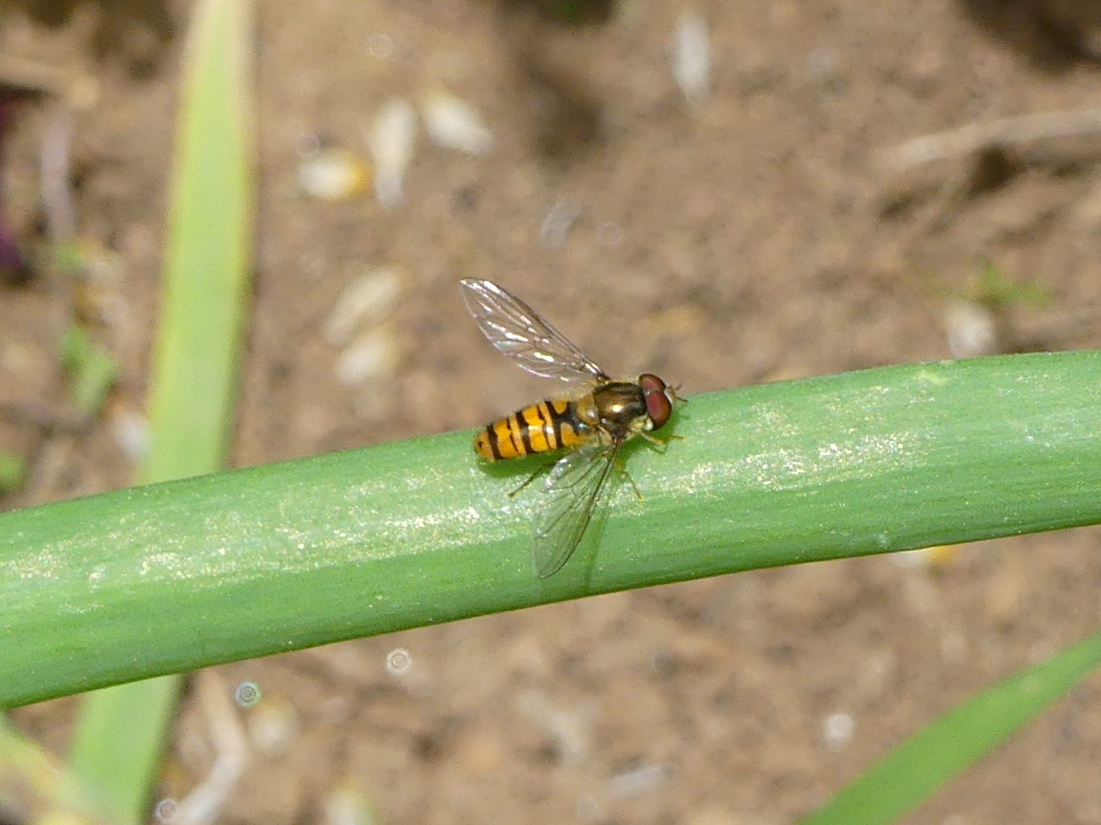
The Marmalade hoverfly is easily recognisable by the characteristic stripes on its abdomen.
Long hoverfly, Sphaerophoria scripta, L.
The larvae of this small, slender hoverfly also feed on aphids.
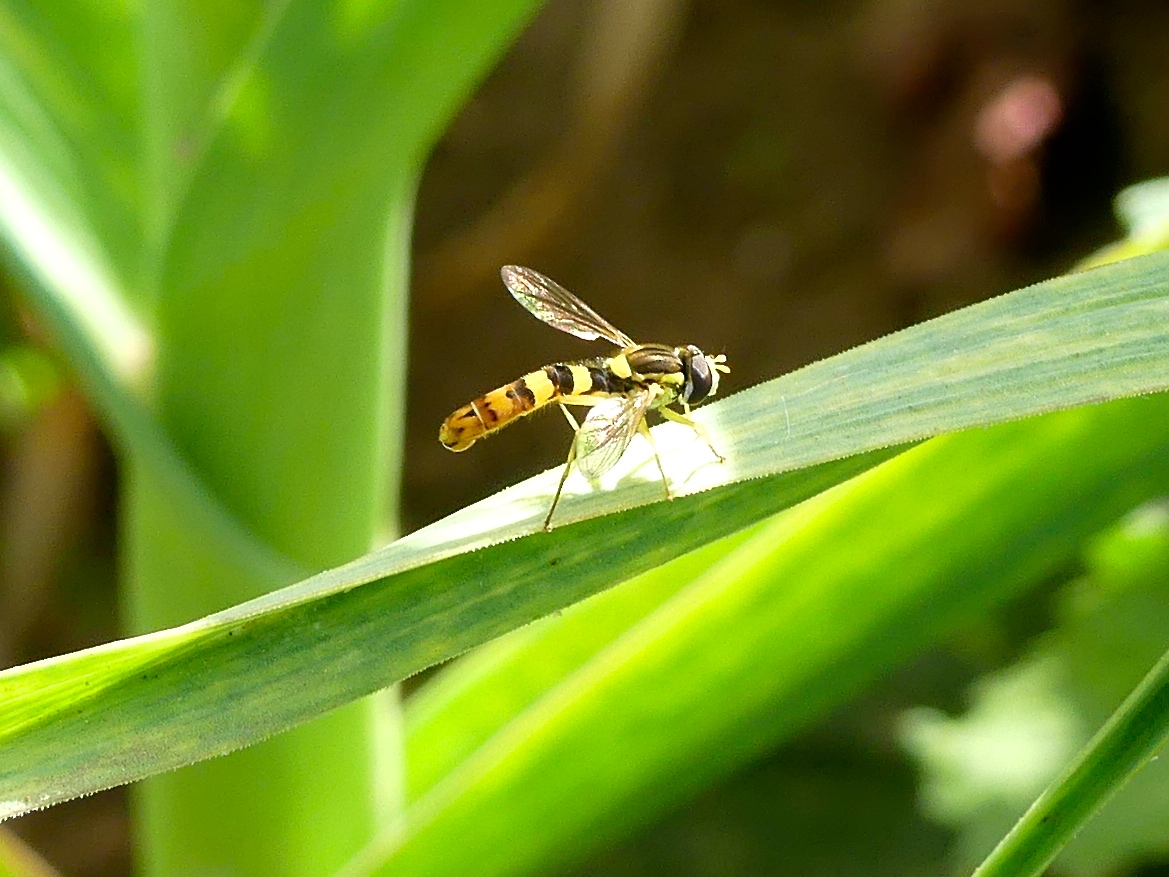
The male of the Long hoverfly has a narrow abdomen that is slightly club-shaped at the tip and curved downwards. The thorax is bronze-coloured with indistinct longitudinal stripes, whilst the abdomen bears black and yellow transverse stripes. The yellow legs are quite long.
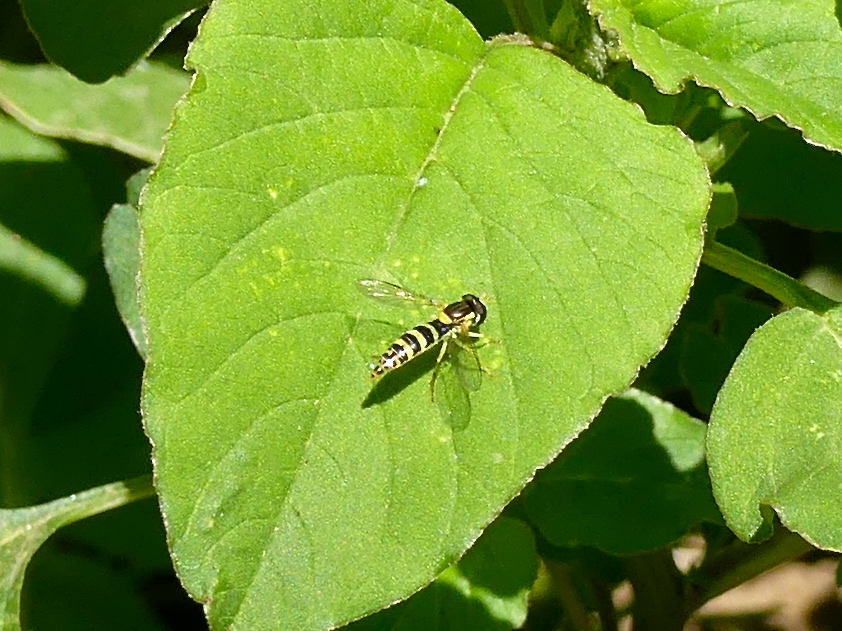
The females have a pointed abdomen. Their abdominal stripes are also distinct.
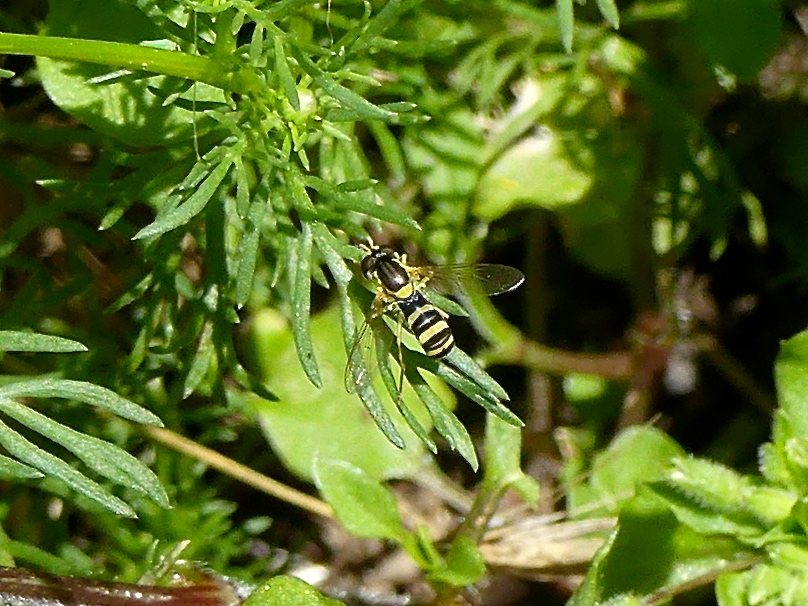
The female is often sitting with her abdomen curved downwards.
Sphaerophoria spec.
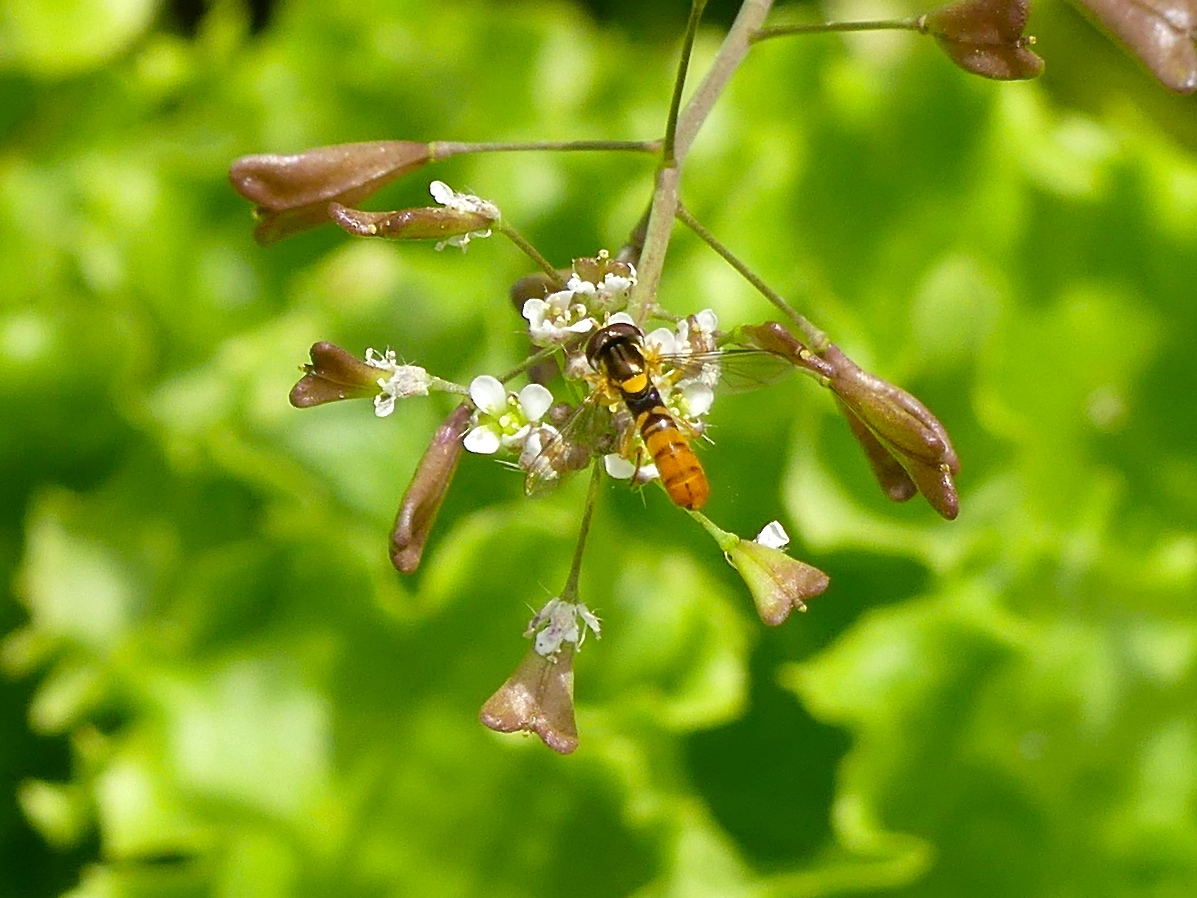
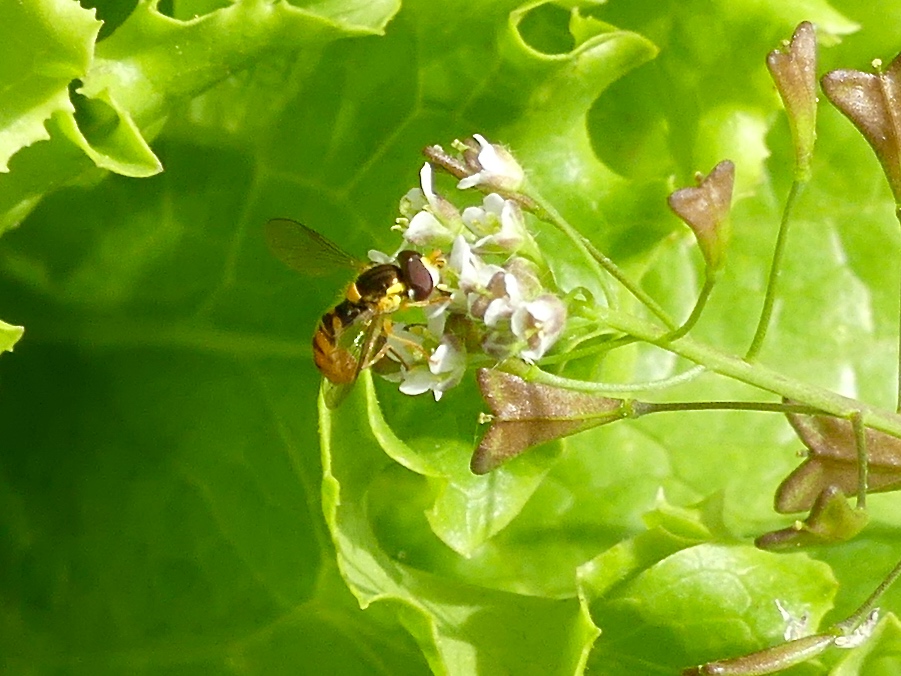
This is probably a different species of the genus Sphaerophoria; the abdomen of this small fly is orange, while its shape closely resembles that of the previous species.
Thick-legged hoverfly, Syritta pipiens, L.
The Thick-legged hoverfly has thickened femurs on its hind legs; the body is quite slender and brownish. The Thick-legged hoverfly is very common in Europe and also in our region. The adults feed on dead plant material and visit flowers; the larvae live in compost, manure and dung.
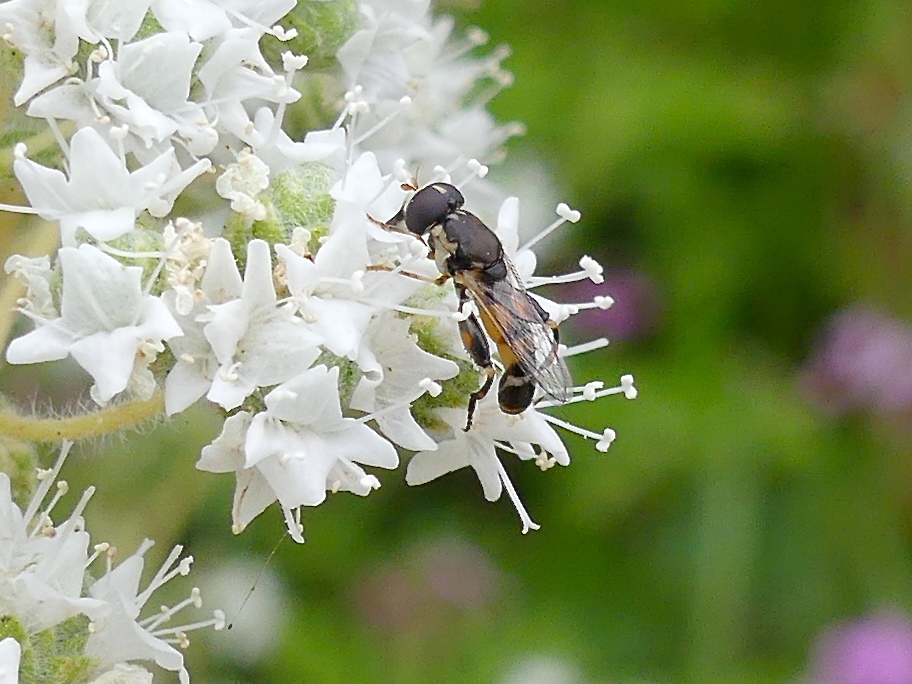
The Thick-legged hoverfly is easily recognised by the thickened femurs of its hind legs, which bear small spines on the underside. The thorax has a deep brown colour; the abdomen is dull orange with darker stripes.
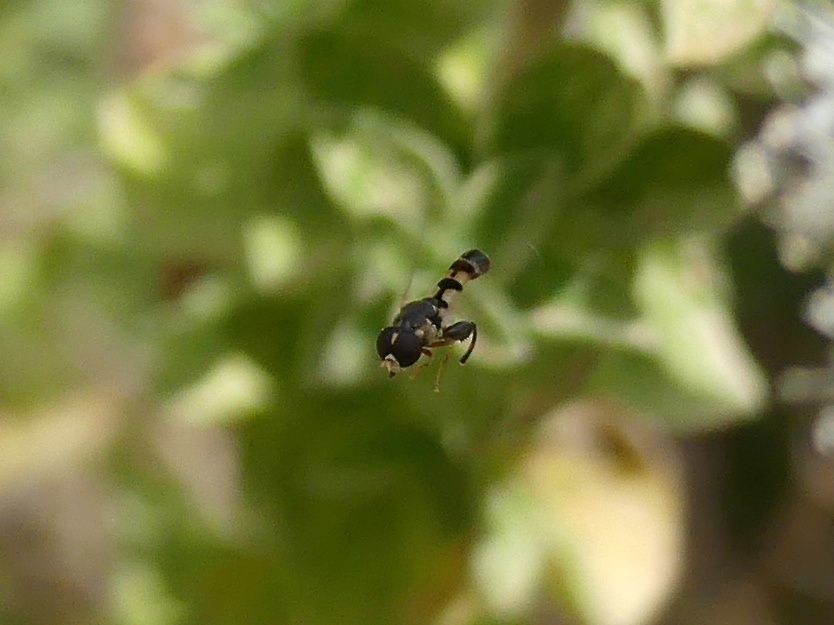
Thick-legged hoverfly in flight.
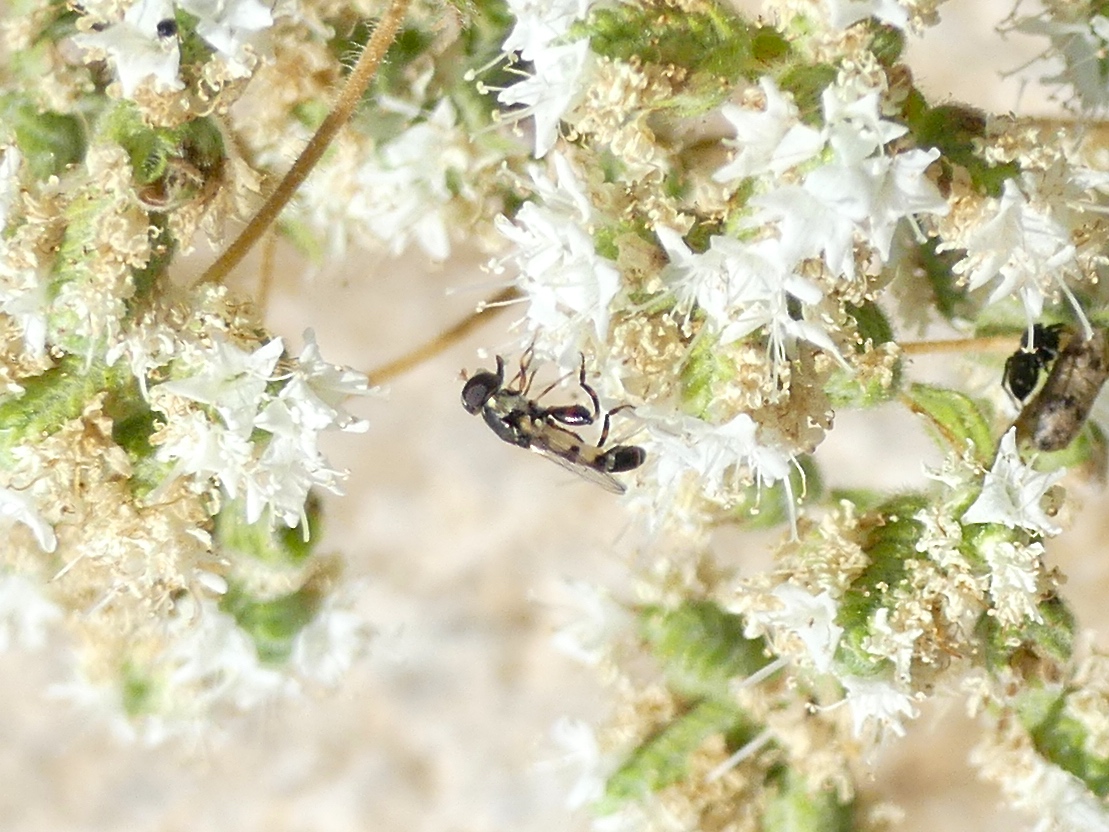
Here you can see the thickened hind legs. This specimen has whitish stripes, not orange-yellow ones.
Brachypalpus spec.
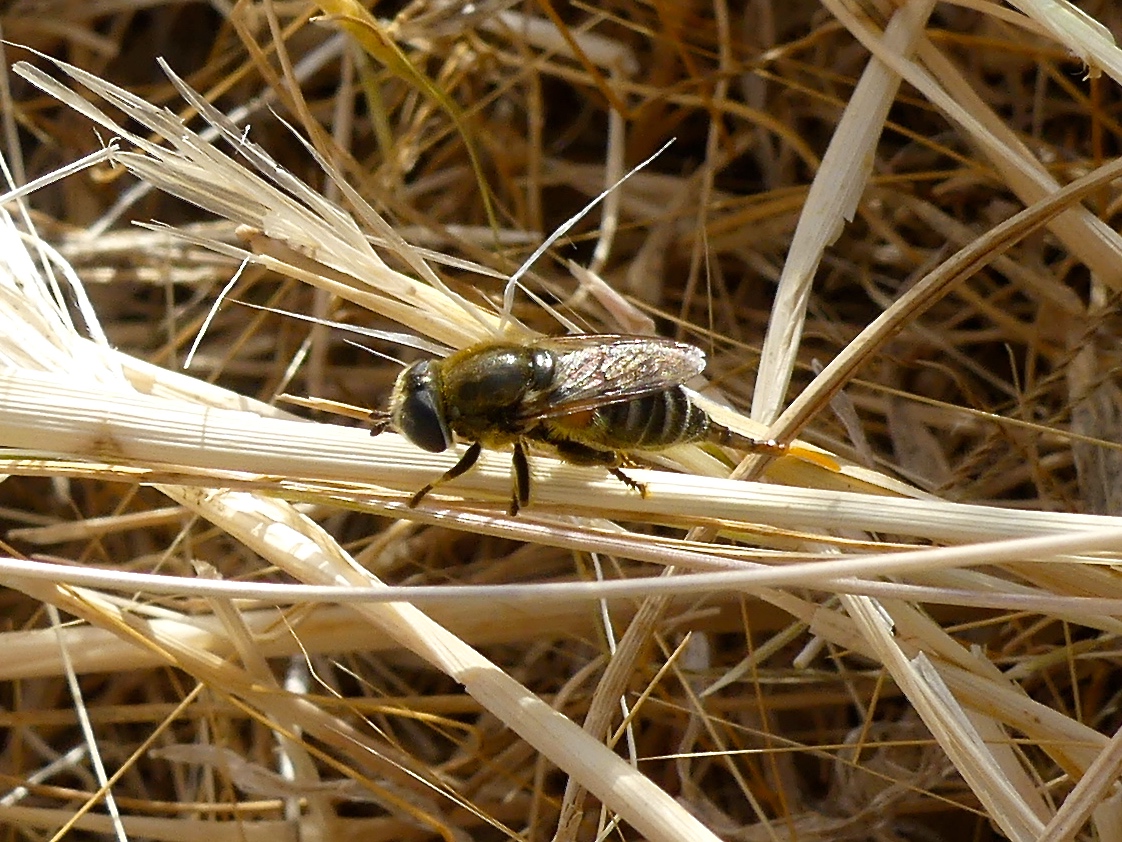
This hoverfly is probably a member of the genus Brachypalpus, which, with its hairy body, mimics the appearance of a bee. Another characteristic feature are the thickened femurs, particularly on the hind legs.
Common drone fly, Eristalis tenax, L.
The Common drone fly is a large hoverfly species that is quite common in our region. Its larvae live in dirty water, moist dung and compost heaps. They possess a long respiratory tube, which gives them a characteristic body shape (‘rat-tail larvae’). By filtering bacteria and organic matter out of the water, they help to purify wastewater and are therefore useful.
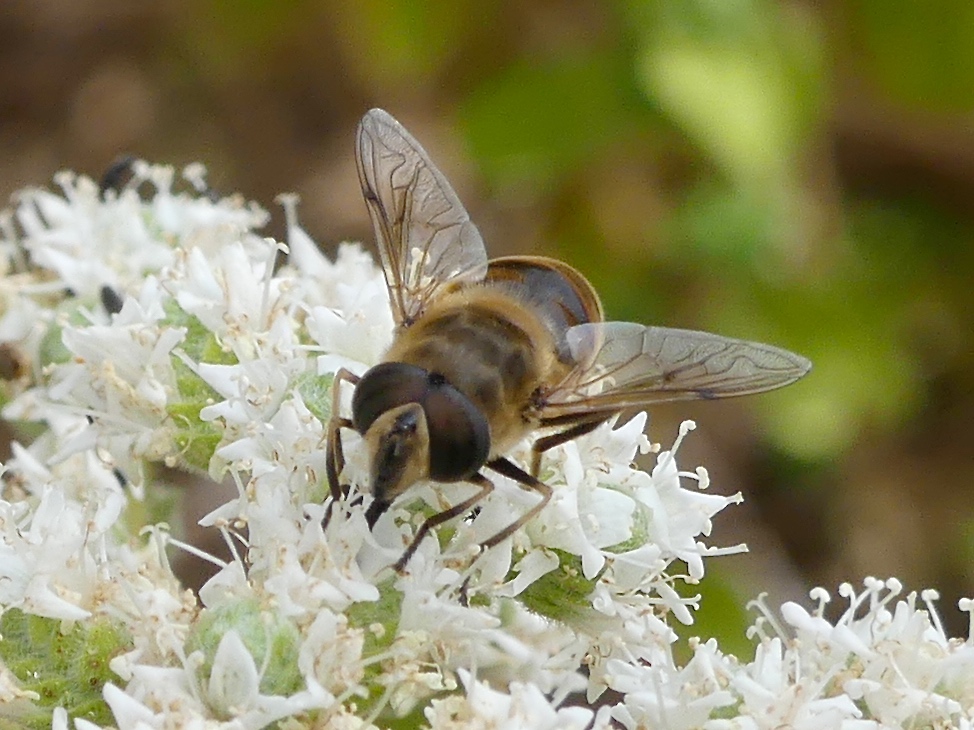
At first glance its brownish colouring makes the Common drone fly look rather like a bee.
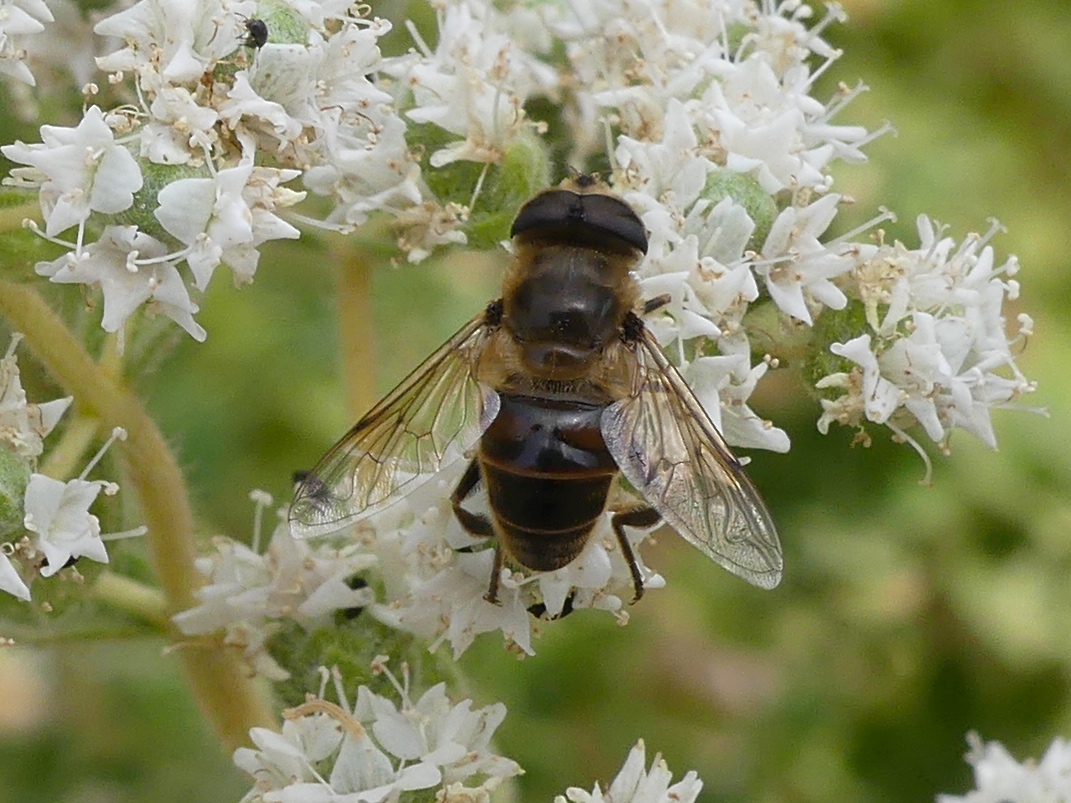
Some specimens are dark brown in colour with no discernible markings.
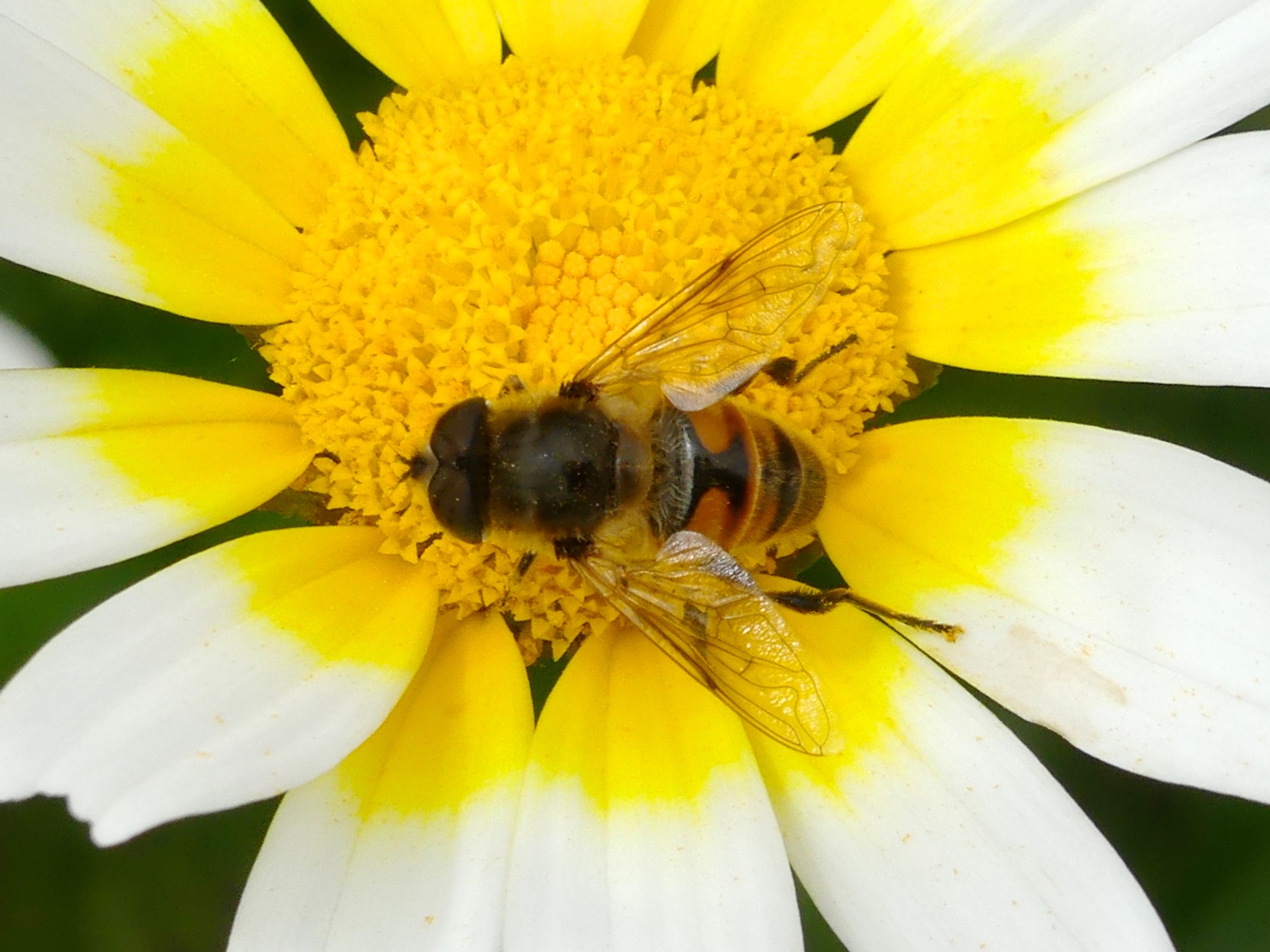
This specimen, however, displays a striking, characteristically indented reddish stripe on the abdomen. In all the photos, one can see the characteristic wing venation of many hoverflies, with a strongly curved vein near the wing tip.
Band-eyed drone fly, Eristalinus taeniops, Wiedemann
The Band-eyed drone fly can be recognised by its beautiful, longitudinally striped compound eyes. Like the Common drone fly, its larvae live in dung or dirty water. It is rather rare in our region.
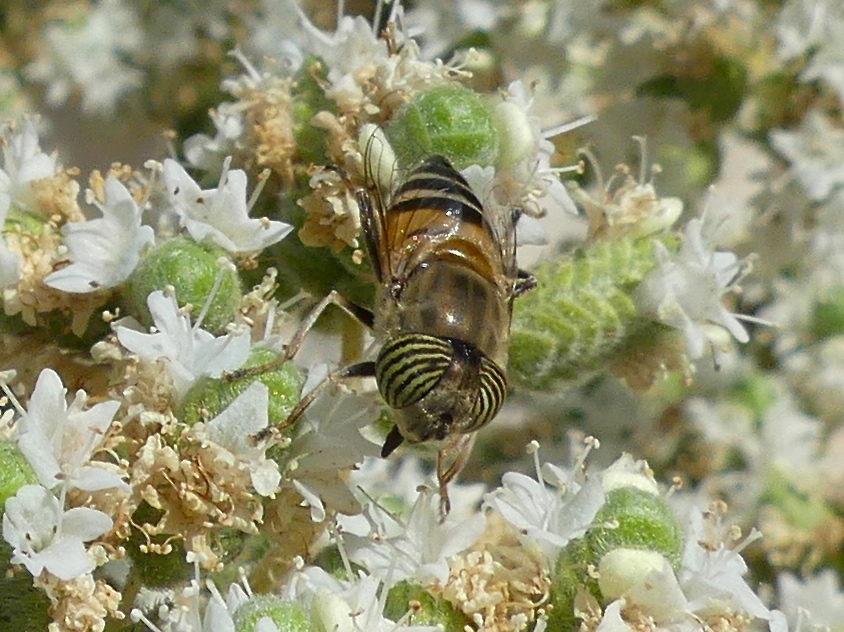
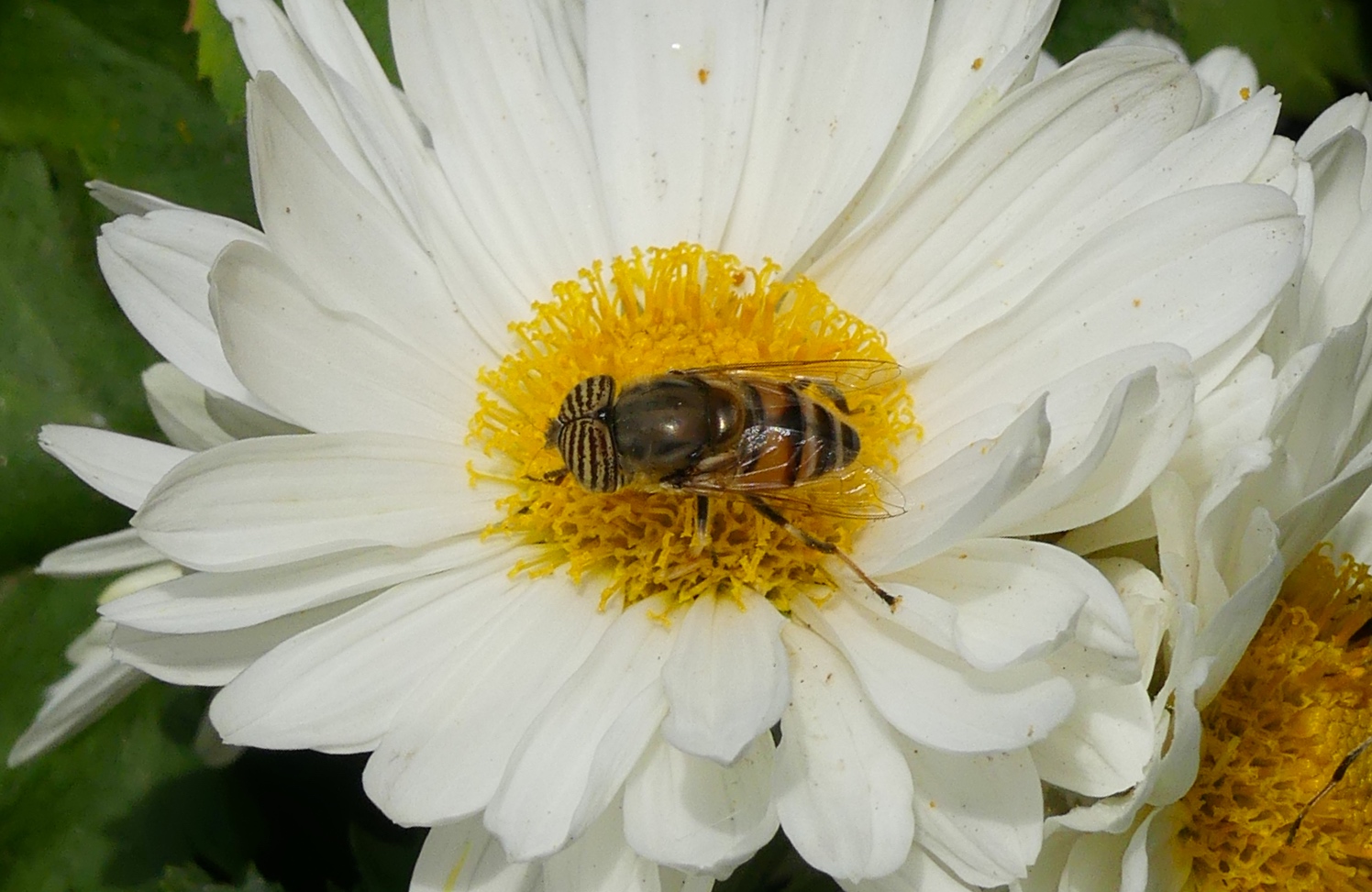
The Band-eyed drone fly is a particularly impressive hoverfly with its beautiful striped eyes.
Batman hoverfly, Myathropa florea, L.
This large species of hoverfly is widespread and common throughout Europe and large parts of Asia and North Africa.
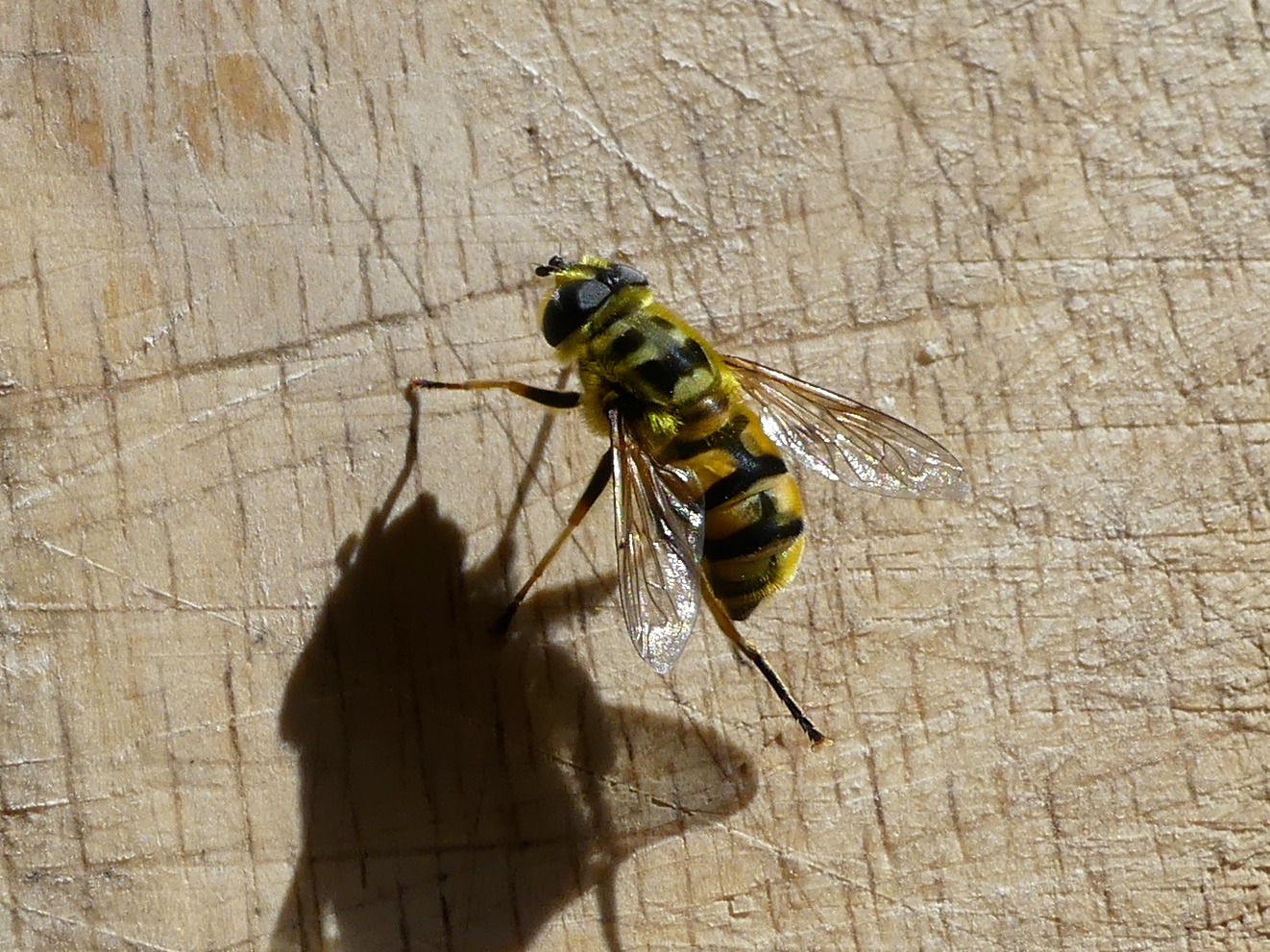
The Batman hoverfly has a black abdomen with yellow spots on the sides. Unlike in most hoverflies, the abdomen of this species is distinctly hairy. The wings are slightly brownish in colour.
Hornet mimic hoverfly, Volucella zonaria, Poda
The Hornet mimic hoverfly is one of the largest hoverfly species in Europe; it can reach a length of up to 2.2 cm. It has a yellow and black striped body, reddish-brown eyes and a yellow forehead, thus resembling a hornet, which deters potential predators. The Hornet mimic hoverfly feeds on nectar from various flowers, here on the oregano in our garden. It lays its eggs in wasp, hornet or bumblebee nests, where the larvae cause no harm but are actually beneficial to their hosts, as they feed on waste and dead or sick insects.
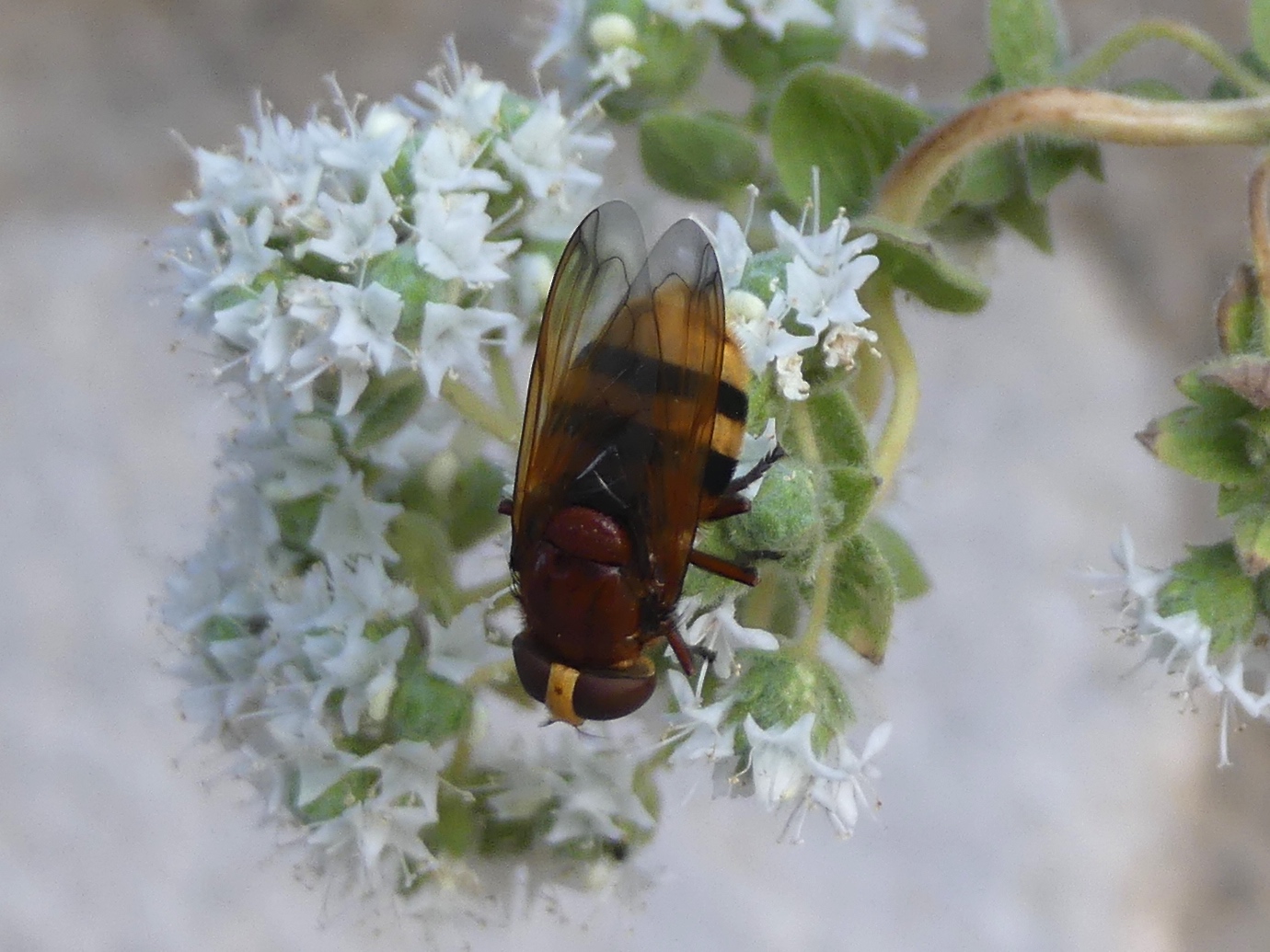
The hornet mimic hoverfly is very large. Its wings are brownish in colour and its abdomen is yellow with two black stripes.
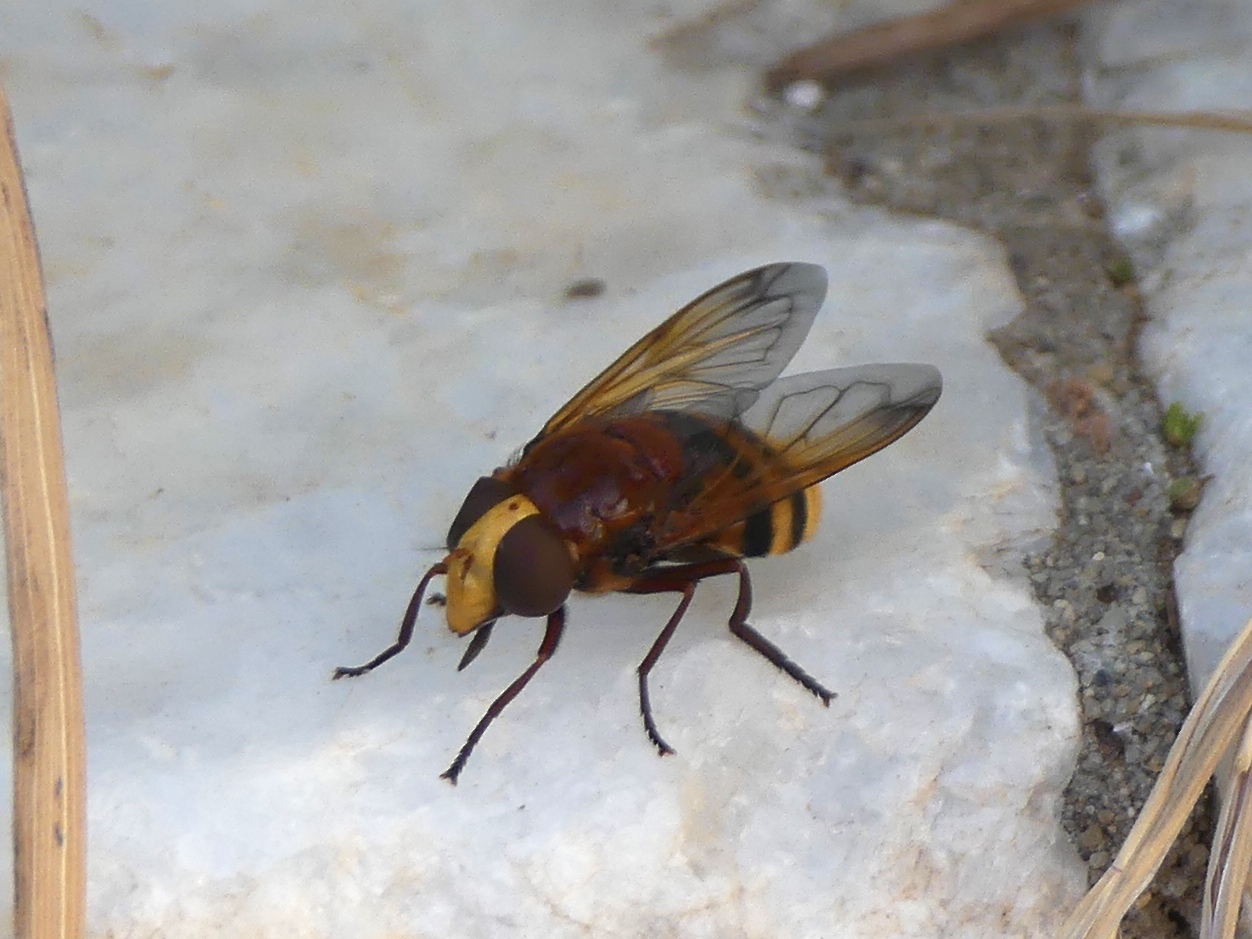
From the front, you can see the yellow forehead. This is a female as shows the gap between the eyes.
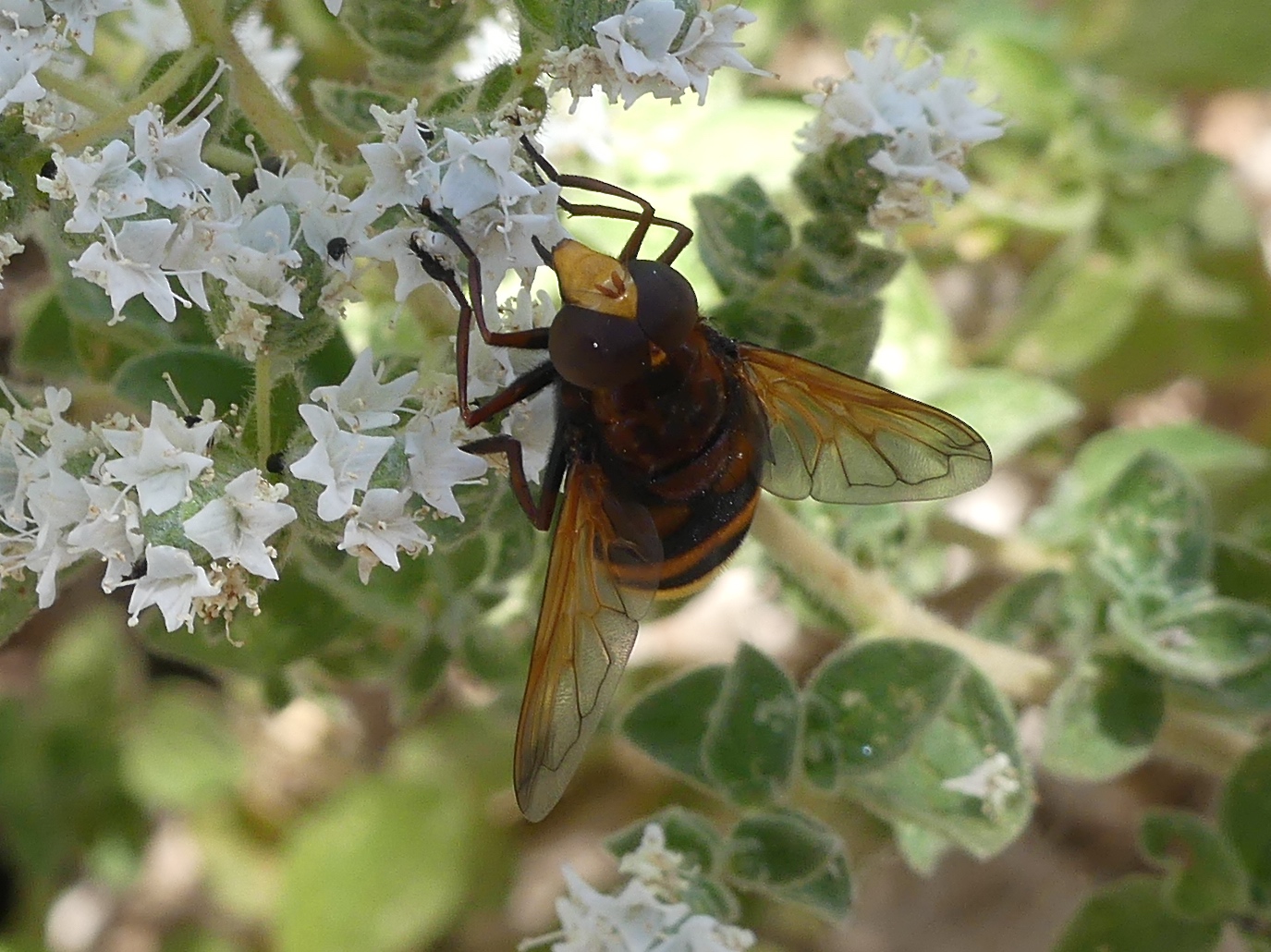
In males, the eyes meet on the forehead.
Milesia semiluctifera, Villers
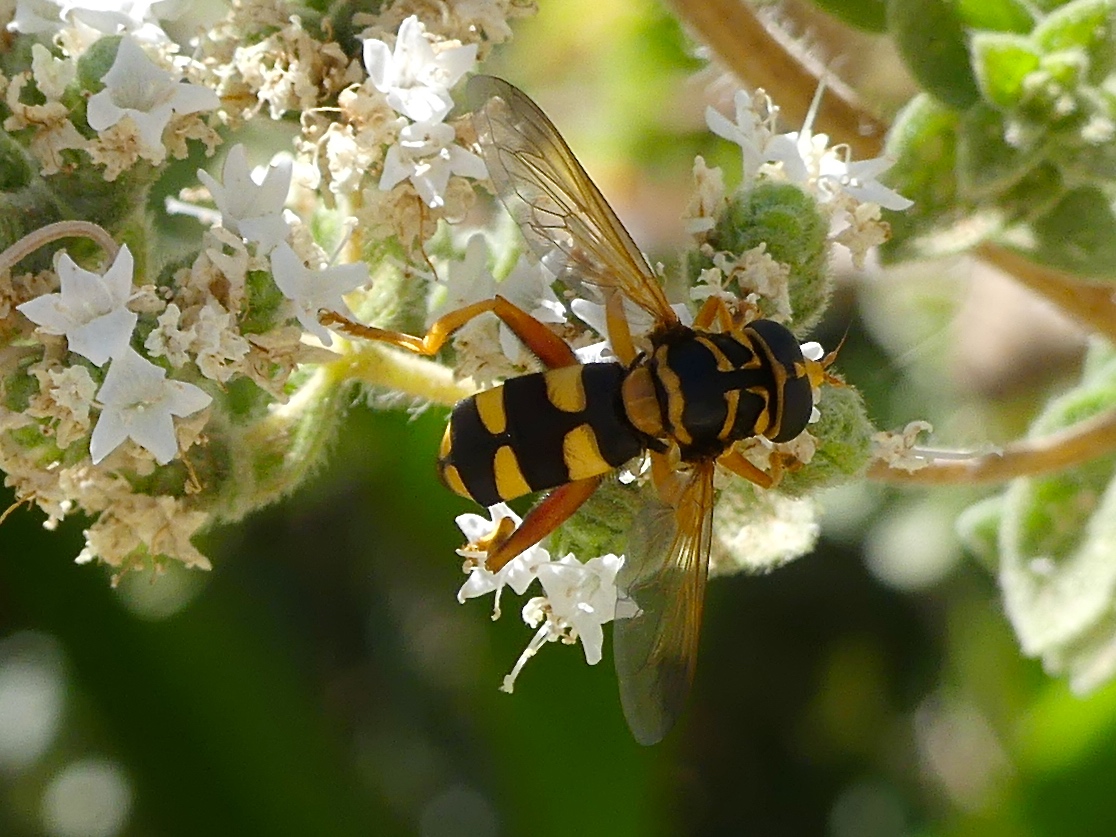
This hoverfly is also very large; its colouring probably mimics that of a wasp. This species is very rare in our region.
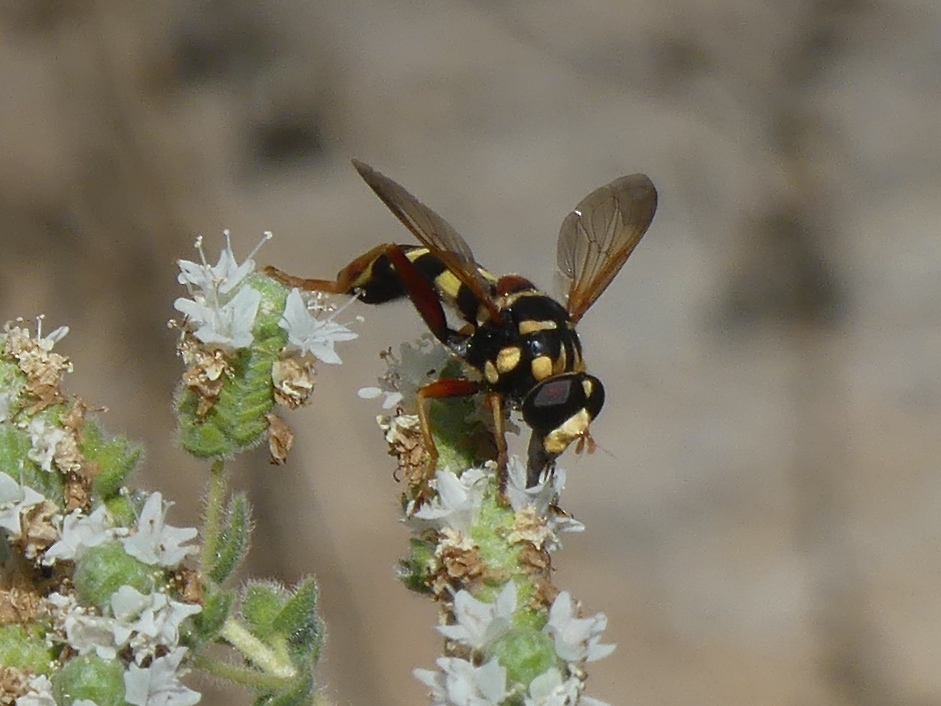
Here another individual with a reddish-brown scutellum and slightly different markings; however, it is probably the same species.
Merodon clavipes, Fabricius
The genus Merodon, which is mainly found in the Mediterranean region, comprises around 50 species and is one of the largest genera of hoverflies in Europe. They are comparatively large, bee-like hoverflies. My thanks to Roger Thomason from the forum Diptera.info and to Jannis Gavalas for the identification!
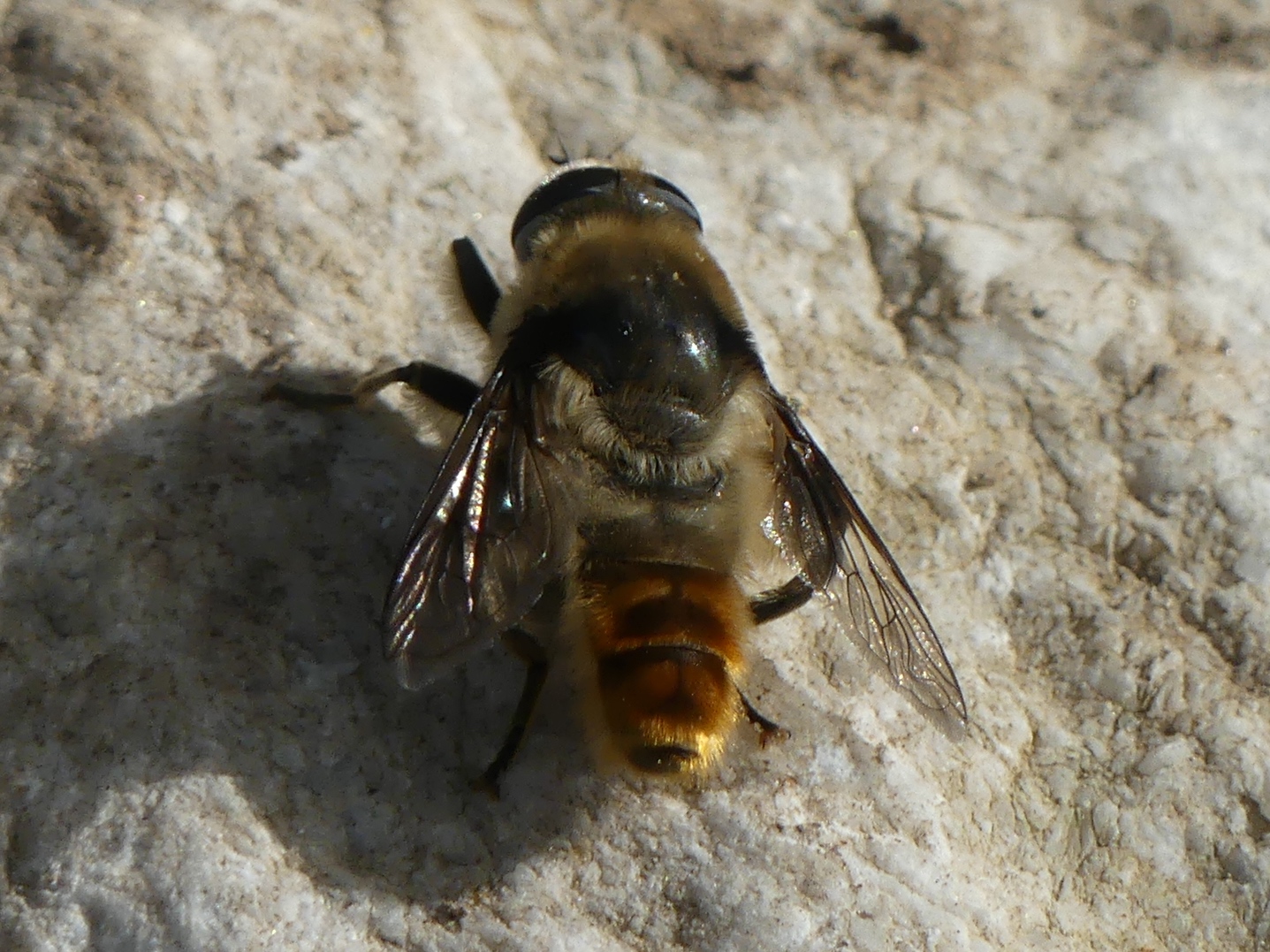
This large, stout hoverfly with a long-haired, golden-shimmering abdomen, which we found in Agiá by the little stream, is probably Merodon clavipes.
Black-backed grass skimmer, Paragus haemorrhous ?, Meigen
The small Black-backed grass skimmer is widespread in Europe, Asia and North America. The adults feed on nectar and act as pollinators, but the larvae are also useful in the garden as they feed on aphids.
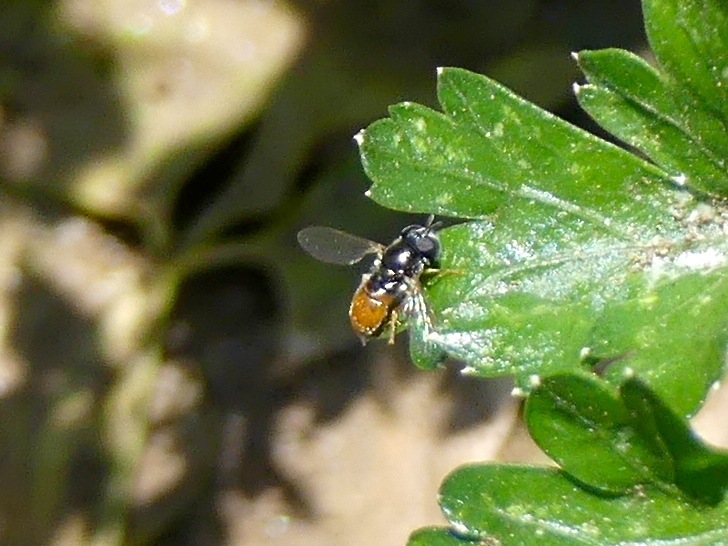
This hoverfly, with its shiny, greenish-black thorax and orange-red abdomen, probably belongs to the genus Paragus; it could be the Black-backed grass skimmer. It is easy to overlook because it is so small, but it’s quite common in our garden.
Unidentified hoverfly
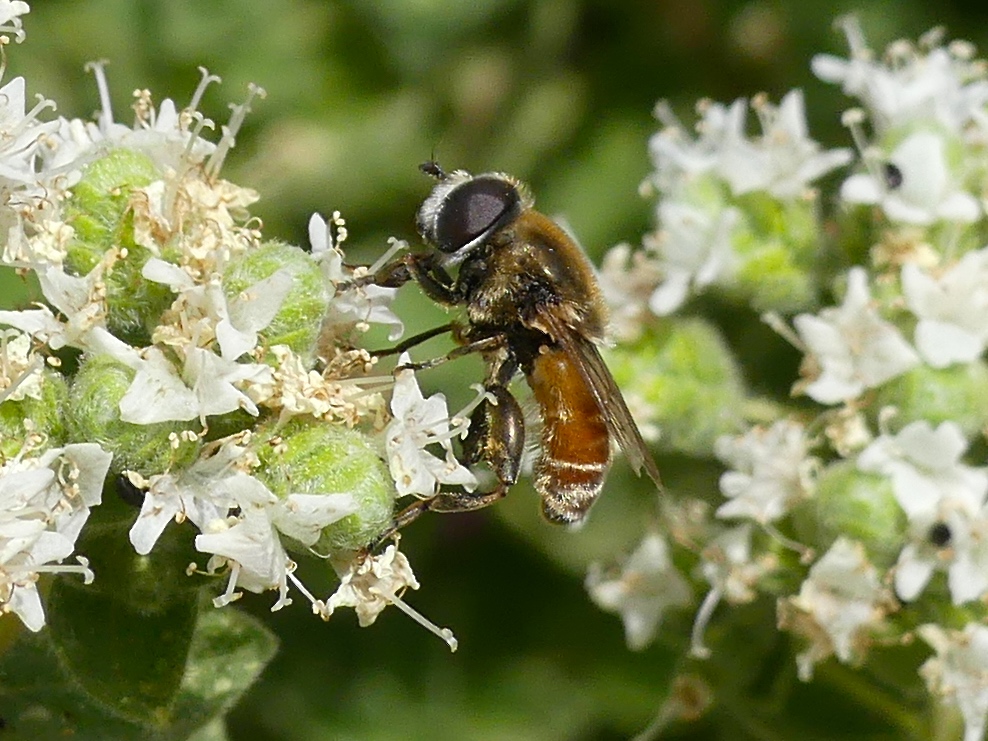
I have not yet been able to identify this small fly with a hairy, brown thorax, orange-brown abdomen and large, curved hind legs. It is probably also a hoverfly.
continue: Bee flies
back: