Skip to main content
DE
ΕΛ
Home
Feedback and questions
About us
News from Azalas
Web site content
Categories - Directory
Best articles
Picture of the day
Holiday homes Azalas
Most important articles
The cottages
Photo galleries
Location
Calendar and Reservation
The Prices
How to get to Azalas
The area
Activities on Naxos
Guest book
Culture
Sights and monuments
Villages (in German)
Cultural landscape (in German)
Village life (in German)
Nature
Mediterranean Sea
Fauna of Naxos
Flora of Naxos (in German)
Vegetation (in German)
Landscape (in German)
Geology (in German)
Weather (in German)
Hikes and tours
Other islands
DE
EN
ΕΛ
Home
Feedback and questions
About us
News from Azalas
Web site content
Categories - Directory
Best articles
Picture of the day
Holiday homes Azalas
Most important articles
The cottages
Photo galleries
Location
Calendar and Reservation
The Prices
How to get to Azalas
The area
Activities on Naxos
Guest book
Culture
Sights and monuments
Villages (in German)
Cultural landscape (in German)
Village life (in German)
Nature
Mediterranean Sea
Fauna of Naxos
Flora of Naxos (in German)
Vegetation (in German)
Landscape (in German)
Geology (in German)
Weather (in German)
Hikes and tours
Other islands
Natures
Here you find all of the 400 or so articles dealing with the nature of Naxos, organised chronologically with the latest articles at the top.
1
…
17
18
19
20
21
22
23
24
Apollonas – ein malerisches Hafenörtchen
11. August 2009
Apóllonas ist ein malerischer kleiner Hafenort an der Nordspitze von Naxos, der immer einen Ausflug wert ist. Apollonas vom Meer aus gesehen Blick auf Apollonas mit seiner Kirche Fischerboote im…
Zum Beitrag
Blennies and gobies
9. August 2009
Blennies (Click here to go directly to the Gobies) The small blennies inhabit mostly the shallow sea, usually occuring in rocky areas. They live among algae or in small crevices and holes in the rock…
Zum Beitrag
Makares – uninhabited islands out of paradise
3. August 2009
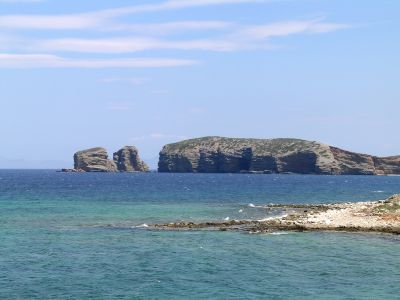
About seven kilometers off the east coast of Naxos, directly opposite Azalás, lies an uninhabited group of islands, the Mákares Islands. We see them every day, but it is something else to take a boat…
Zum Beitrag
Auf dem Fanari 1
1. August 2009
– Panorama mit Sonnenuntergang Den Fanari, den dritthöchsten Gipfel von Naxos, kann man von Apíranthos aus in einer guten halben Stunde (eine Richtung; bei flottem Schritt) ersteigen. Blick von der…
Zum Beitrag
Auf dem Zeus 2
28. July 2009
– Kleinode am Boden Es ist naheliegend, wenn man auf dem Gipfel des Zeus steht, den Blick in die Ferne schweifen zu lassen und die Aussicht zu genießen. Es lohnt sich aber durchaus auch, einmal zu Bo…
Zum Beitrag
Auf dem Zeus 1
28. July 2009
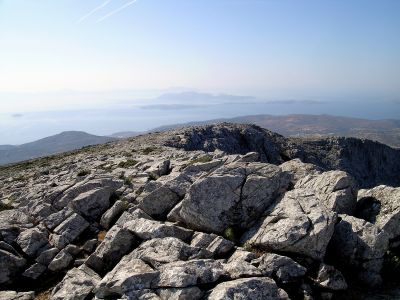
– Blick in die Ferne Der Zeus ist mit 1001 Metern der höchste Gipfel nicht nur der Insel Naxos, sondern der gesamten Kykladen. Er besitzt einen eindrucksvollen, unzugänglichen Steilabfall an seiner W…
Zum Beitrag
Am Fluss von Kinidaros 1
23. July 2009
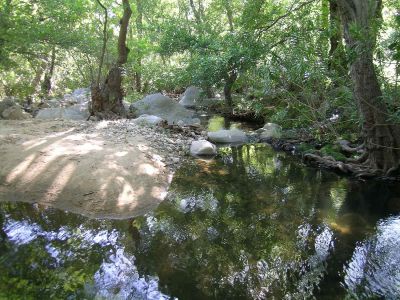
Nördlich von Kinídaros und südlich des Kóronos-Berges liegt ein tief eingeschnittenes Tal. In diesem Tal fließt der wasserreichste der fünf perennierenden Flüsse von Naxos. Man kann ein ganzes Stück…
Zum Beitrag
The bridge near Kinidaros
23. July 2009
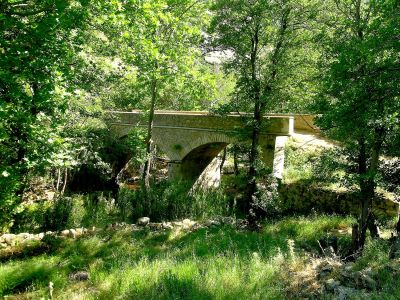
North of Kinídaros, runs the largest river in Naxos in a deeply incised valley. From Kinídaros, an adventurous, steep road leads down into the valley and to the church of Ágios Artémios, which is loc…
Zum Beitrag
Skeponi 2
22. July 2009
– ein verwunschener Gebirgsbach und Erdbeerbäume Skepóni heißt die Gegend oberhalb des großen Stausees nördlich der Chóra, am westlichen Abhang des Kóronos-Berges. Den Spaziergang zur verlassenen Sie…
Zum Beitrag
Ein Tümpel bei Kinidaros
19. July 2009
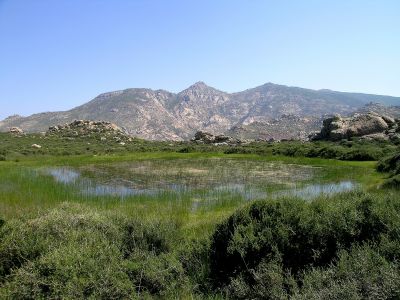
Bei uns im östlichen Teil der Insel bestehen die Berge hauptsächlich aus Marmor und verwandten Gesteinen. Anders in Zentral-Naxos: Hier ist die Wurzel des Gebirges aus Granit (bzw. Migmatit) und Gnei…
Zum Beitrag
Koronos – das Dorf des Schmirgels
17. July 2009
Kóronos ist eines der größeren Gebirgsdörfer von Naxos (in den Vierziger Jahren zählte es 1888 Einwohner); heute ist es jedoch größtenteils verlassen (die letzte Volkszählung ergab etwa 300 Einwohner…
Zum Beitrag
Bei Atsipapi
16. July 2009
Wenn man vom Dorf Kóronos aus Richtung (Süd-)Osten fährt, gelangt man auf eine Hochebene mit aufgegebenen Feldern und Olivenhainen. Hier liegt die kleine, schon lange verlassene Siedlung Atsipápi mit…
Zum Beitrag
Mauervegetation bei Koronos
15. June 2009
Auf Naxos stehen außer im westlichen Bereich nur an wenigen Stellen ebene Flächen zur Verfügung, die für eine großflächigere Kultivation geeignet sind. In der Bergregion mussten die Bauern für den An…
Zum Beitrag
Von Koronos nach Skado
7. June 2009
Kóronos und Skadó sind zwei typische, urtümliche Gebirgsdörfer von Naxos. Sie liegen am Rande eines der schönen, fruchtbaren Hochtäler der Gebirgsregion, nordöstlich des fast 1000 Meter hohen Gebirgr…
Zum Beitrag
Mehr Meerestiere
3. June 2009
Die Meerestier-Seiten haben sich bei unseren letzten Küstenspaziergängen und Fischzügen um einige Arten erweitert, vor allem um Fische wie den interessanten Pfeifenfisch, einen hübschen Schleimfisch…
Zum Beitrag
A stroll through the phrygana
8. May 2009
If you love hiking and are interested in flowers, then the best time to come to Naxos is spring, from the end of March to the beginning of May (depending on the weather conditions). This is the peak…
Zum Beitrag
Cape Stavros near Moutsouna
4. May 2009
Cape Stavrós near Moutsoúna is the only major cape of the island of Naxos. It extends about one and a half kilometers into the sea. Our Holiday homes lie approximately two kilometers north of the cap…
Zum Beitrag
Marine worms
24. April 2009
Many species of marine worms populate the seas, most of which are rarely seen due to their small size or hidden lifestyle. Nematodes, acorn worms, priapids, horseshoe worms, annelids, squirt worms, c…
Zum Beitrag
Hydrozoa
24. April 2009
Hydrozoans, like sea anemones and corals, belong to the cnidarians. Like these, they have a simple, radially symmetrical body and stinging cells. Here you can skip the introduction and go directly to…
Zum Beitrag
The Circalittoral
22. April 2009
The circalittoral zone begins where the light becomes too weak for light-loving organisms (such as seagrass) to thrive, i.e. at depths of around 30 to 50 meters, or even 100 meters in very clear wate…
Zum Beitrag
1
…
17
18
19
20
21
22
23
24