
Hydrozoa
Hydrozoans, like sea anemones and corals, belong to the cnidarians. Like these, they have a simple, radially symmetrical body and stinging cells.
Here you can skip the introduction and go directly to the species.
Hydrozoans exhibit the original life cycle of cnidarians with two alternating, very different generations: a sessile polyp generation and a medusa generation (hydromedusae) that drifts in the plankton. In many species, the polyp generation and medusa generation were originally described as different species and were given different names. Sometimes one of the two forms is still unknown. In many hydrozoans, the medusa generation is greatly reduced and sometimes remains attached to the polyp or colony as a so-called gonophore; in others, the polyp generation is reduced. The polyp generation reproduces by budding, while the medusa generation reproduces sexually; eggs and sperm are released into the sea.
The hydromedusae usually grow to only a few centimeters in size. The jellyfish are treated on a separate page.

Hydrozoans in between algae in shallow water
The polyps of most hydrozoans form tree-like or feather-shaped colonies which rise from an axis (stolon) attached to the substrate to a height of a few centimeters. The individual polyps of the colony are directly connected to each other. Each polyp is surrounded by a small capsule into which the tentacles can be retracted. Most polyps in the colony are feeding polyps; special polyps are formed for reproduction, and others for defending the colony; these defense polyps are equipped with a particularly large number of stinging cells.

Hydrozoans are very small and delicate, and can easily be overlooked. However, they are not uncommon in coastal areas.


With a little effort, you can see some polyps with outstretched tentacles in this picture.
Hydrozoans live on rocks or marine plants. They can be found in coastal areas and, despite their delicacy, can survive even in locations directly exposed to strong waves. They sometimes form dense populations, but their small size makes them difficult to spot. Hydrozoans cannot easily compete with algae in light-rich locations, which is why many species are found mainly in slightly deeper waters or in shady locations such as caves.
Around the world, approximately 3,200 species of hydrozoans have been described, about a tenth of which occur in the Mediterranean Sea.
Hydrozoans on Naxos
Hydrozoans on Naxos
The Photo gallery of the marine animals gives an overview over the species.
A note on identification: Some species usually can be identified easily and reliably. In many cases, however, several related species are difficult to distinguish. Also not all species are included in the field guides; even using the internet, it is difficult to find information on some species. Accordingly, some of the identifications may not be correct.
Here you can jump directly to the species (return with the back arrow or by swiping back):
Kirchenpaueria spec. – Aglaophenia spec. – Pennaria disticha
Order Leptothecata
In the order Leptothecata the polyps sit in small transparent capsules called hydrothecae. The polyp can retract its tiny, delicate tentacle ring, which it uses to capture plankton, into the hydrotheca. Between, on or next to the hydrothecae, many species display smaller capsules, the nematothecae, which contain the defensive polyps equipped with many stinging cells. The families, genera and species are distinguished by the shape and arrangement of the hydrothecae and nematothecae. However, identification is only possible with a very strong magnifying glass or a microscope.

Here you can see the cup-shaped hydrothecae, which sit in a tight row on the “branches” of the hydrozoan colony and contain the feeding polyps. Between the hydrothecae, it is possible to just make out the smaller nematothecae, which house the defensive polyps. Based on the arrangement of the nematothecae, this species probably belongs to the genus Kirchenpaueria. In the center of the picture, you can see the microscopic, bizarrely shaped skeleton shrimp, which spends all its life on hydrozoan colonies.
Kirchenpaueria spec.
These particularly long, regular, feather-shaped colonies probably belong to the family Kirchenpaueriidae. They are characterised by a fairly strong, straight stem with numerous side branches, on which many hydrothecae sit close together.
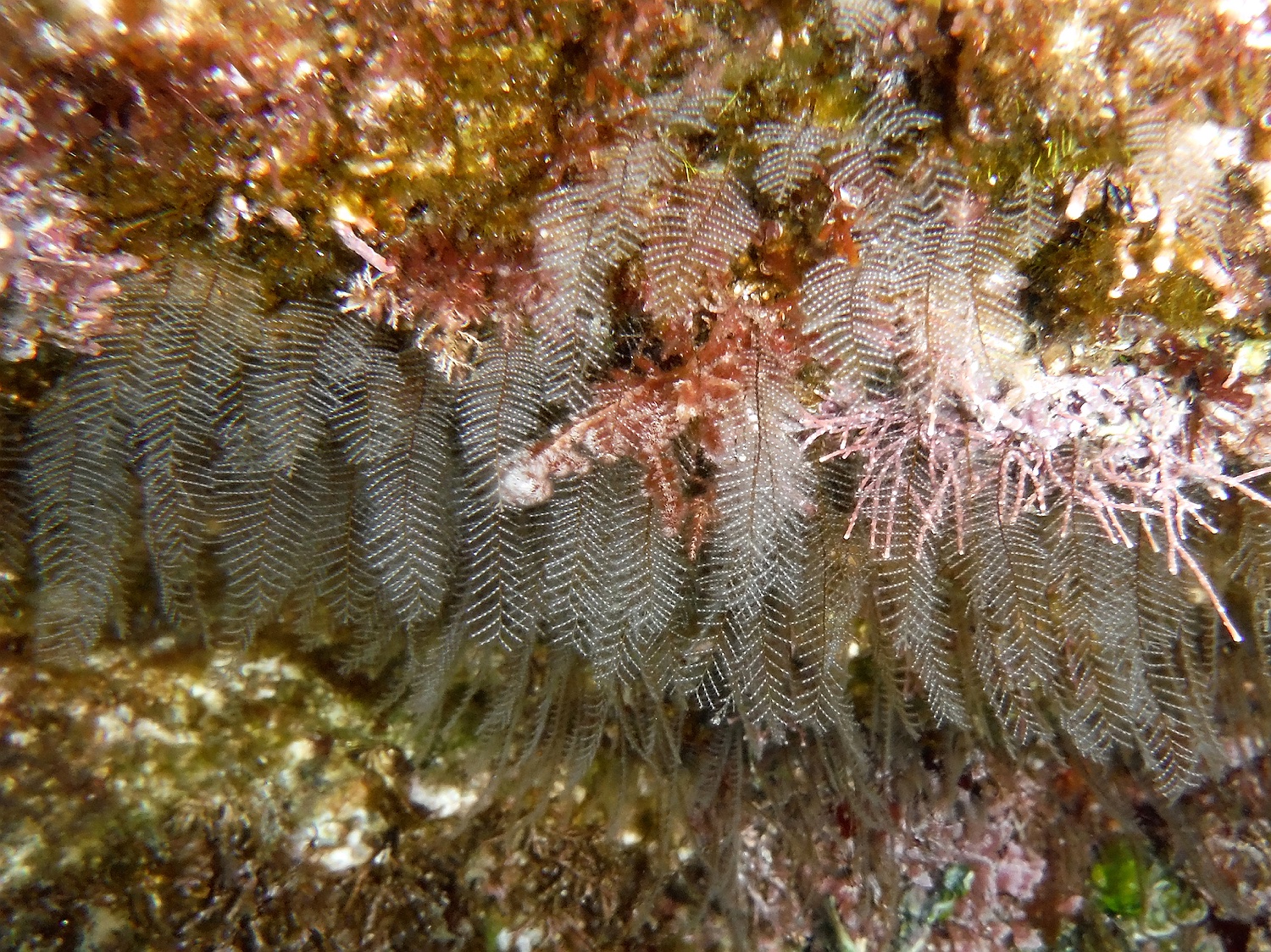
This species is quite common in our area close to the waterline. It is probably belongs to the genus Kirchenpaueria.

The species are identified by the shape and arrangement of the thecae, the “houses” of the individual polyps, which are just visible here. As far as can be seen, small, slender nematothecae (defensive polyps) sit between the cup-shaped hydrothecae.

Despite their delicacy, hydrozoans, such as the colony pictured here, often grow in areas exposed to strong waves.
Aglaophenia spec.
Hydrozoans of the genus Aglaophenia (family Aglaopheniidae) are also occasionally found in our region; again, identification of the species is not possible without a microscope.

Based on the shape of the hydrothecae, this species probably belongs to the genus Aglaophenia.

Here the individual hydrothecae can be seen. In this genus, the nematothecae are not located between the hydrothecae, but on their sides; they are visible as small outgrowths on the upper edge of the hydrothecae.
Order Anthoathecata
The Anthoathecata do not form thecae; here, the polyps sit without a shell on the branches of the colonies (or live singly on the substrate). The “crown” of tentacles of the polyps is often particularly large and comparatively easy to see.
Pennaria disticha, Goldfuss
The polyps of Pennaria disticha sit widely dispersed on the stems; they have no shells and quite large tentacle crowns.

Pennaria disticha has distinctly stalked polyps without hydrothecae, with only 3 – 4 polyps on each branch with large spaces in between. The oval whitish bodies that can be seen in several places are gonophores, i.e. bud-like outgrowths that produce eggs and sperm and correspond to the greatly reduced medusa stage.
continue: Jellyfish
back: Marine animals (Overview)
see also: