
Butterflies
Butterflies probably are the most popular insects. Most species are not only exceptionally beautiful, but also possess a natural elegance with their delicate flight; moreover, as flower visitors and pollinators they are easy to sympathise with. Butterflies are a superfamily in the order Lepidoptera, which encompasses many other clades and superfamilies that are collectively called “moths”.
Here you can skip the introduction and go directly to the species.
Anatomy
The most characteristic feature of the Lepidoptera are their large and broad wings, which in many species, especially among the butterflies have vivid colours and beautiful patterns. Both the forewings and hindwings are used for flying; both are about the same size. They are stabilised by a coarse network of veins and are covered with tiny scales. The wings are attached to the thorax, which, as in all insects, consists of three segments. Each of the thorax segments also carries a pair of long, thin, jointed legs. The feet often carry sensory organs for taste.
The rather small head of the butterflies carries thin, usually club-like antennae, while moths mostly have feather- or comb-shaped antennae. Both groups have large compound eyes, which are composed of up to 6,000 individual eyes. The long proboscis, which is rolled up under the head when at rest, is used to suck nectar or other liquids such as fruit juice. The length of the proboscis varies between species, in adaptation to the types of flowers that the animals visit. Some species, especially among the moths, do not feed at all as adults; their mouthparts are reduced.
The abdomen of butterflies and moths is quite simple in shape. It consists of 10 segments and is covered with scales or hairs.
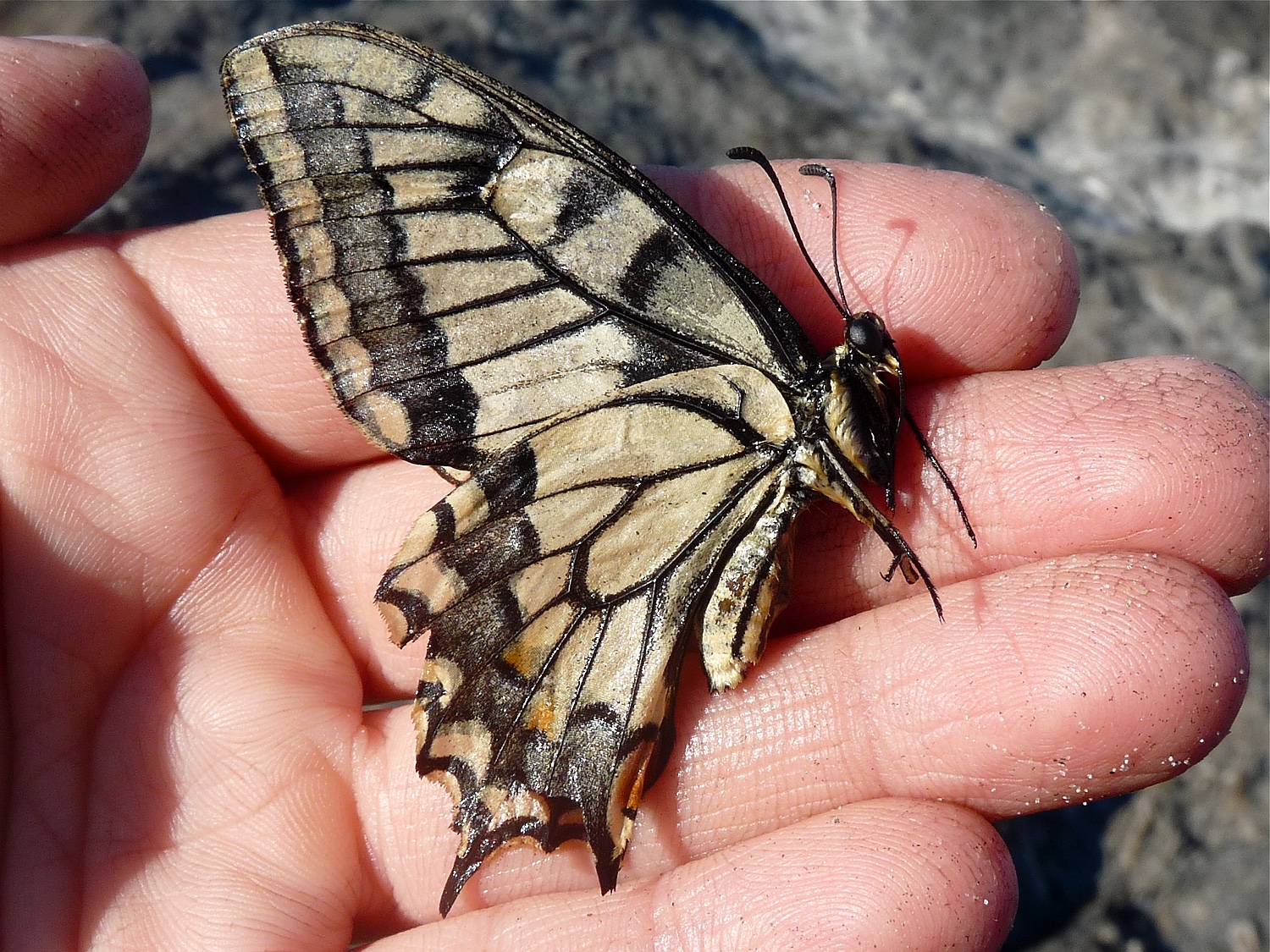
On the wings of this dead swallowtail one can see the characteristic strong veins.
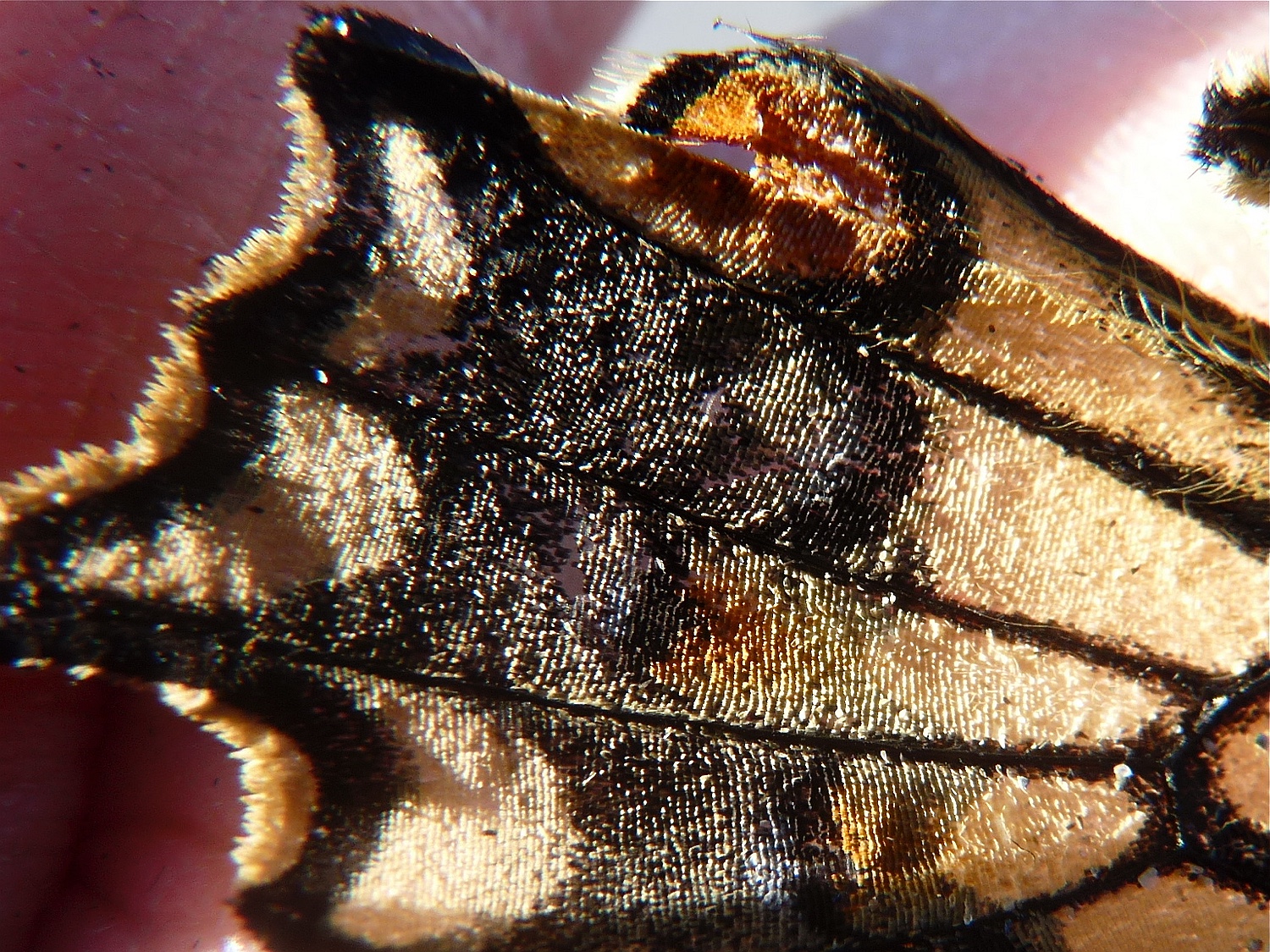
The wings of butterflies are covered with tiny, coloured scales.
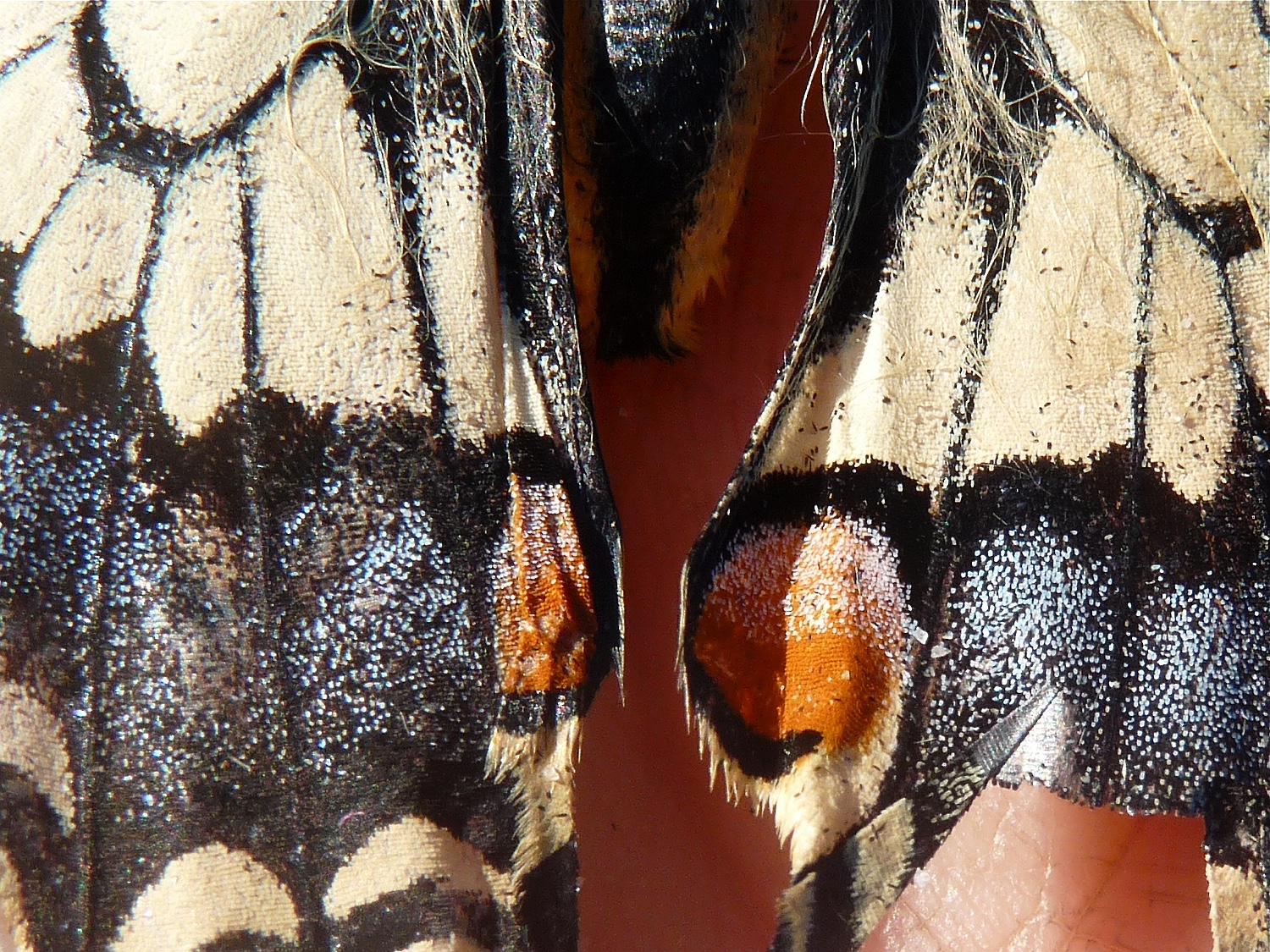
The metallic iridescent colours, such as the light blue shown here, are created by the special surface structure of the scales.
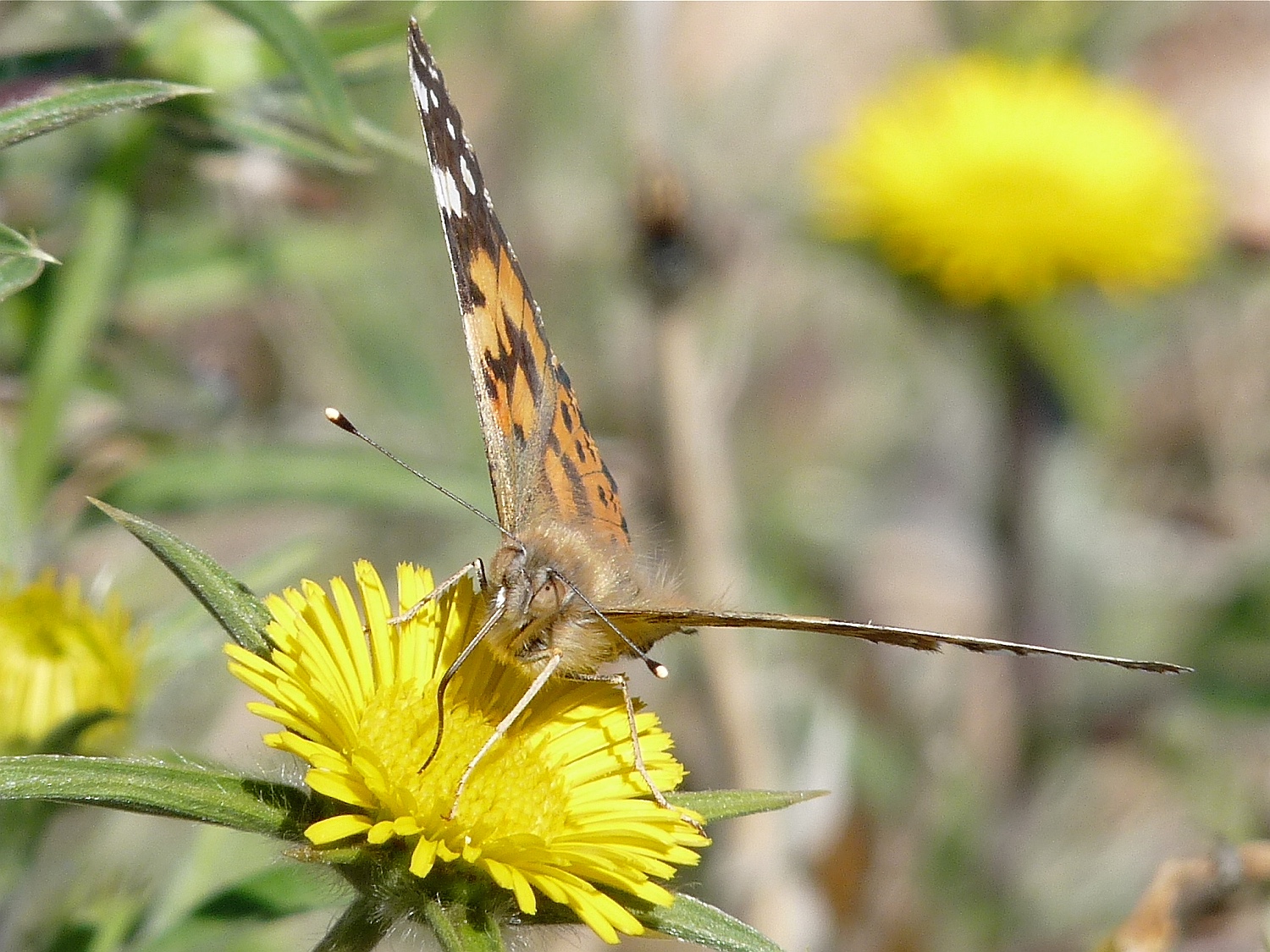
Most butterflies have a proboscis with which they suck nectar from flowers. Some species are equipped with special hairs on their feet that carry sensory organs for taste, while they can perceive smells with their thin antennae with club-shaped ends.
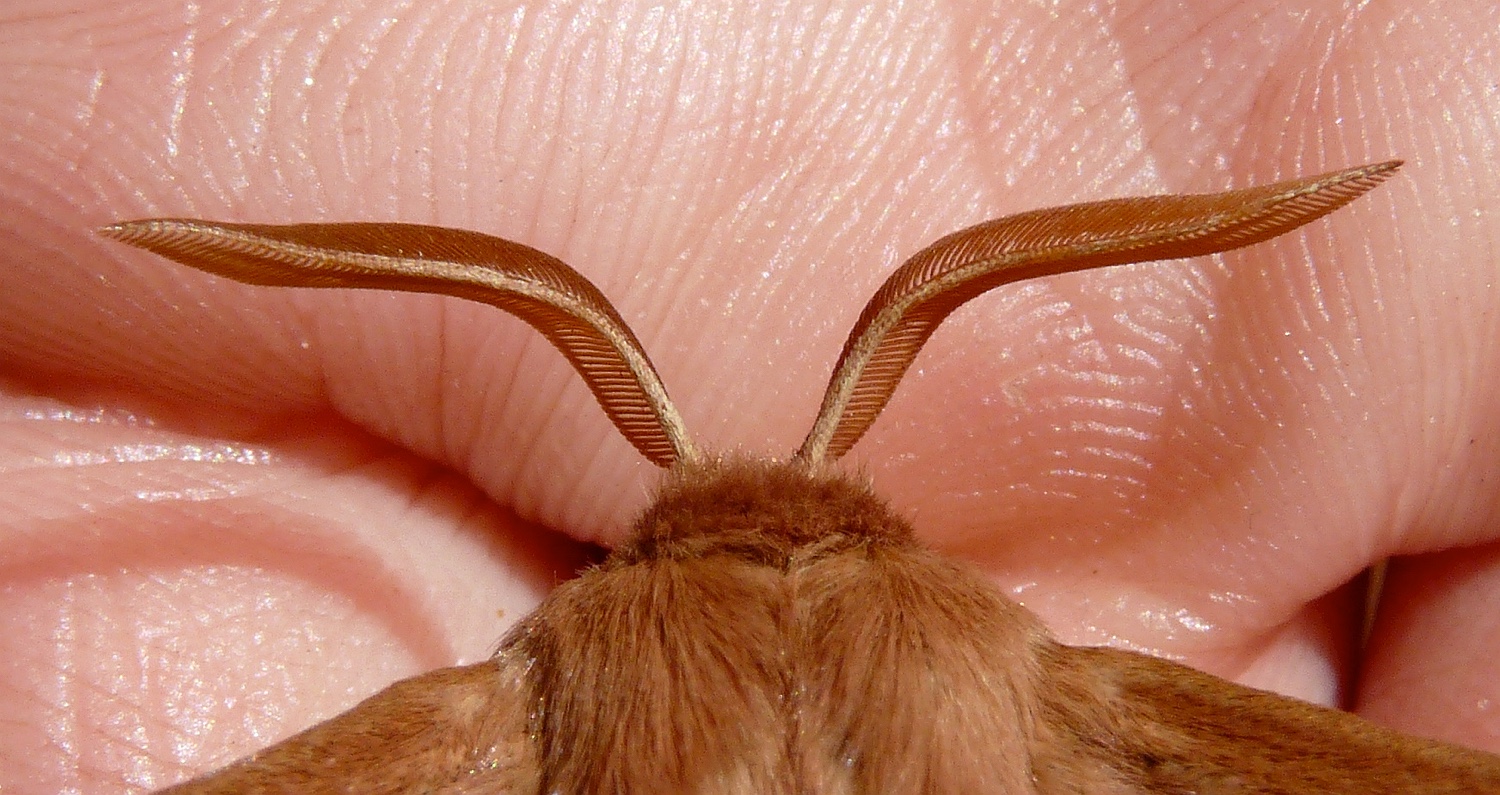
Many moths have large comb-like or feathery antennae. These are used less for detecting food than for locating the females, which attract the males with species-specific pheromones. In some cases, males can detect almost immeasurably low concentrations of the pheromone.
Biology
All butterflies undergo metamorphosis, during which the completely different-looking caterpillar transforms into the adult animal. Caterpillars usually feed on leaves, sometimes of only one or a few species. They eat more or less continuously, except when moulting. After several moults the caterpillar pupates, sometimes spinning itself a cocoon of silk thread. Inside the pupa, the transformation into the adult butterfly takes place as the body rebuilds itself. Butterflies often hibernate as pupae; in some species, the adult animals also hibernate. Several successive generations often develop over the course of the year, which may differ slightly in appearance. A newly hatched butterfly, especially of one of the larger species, is amazingly beautiful!
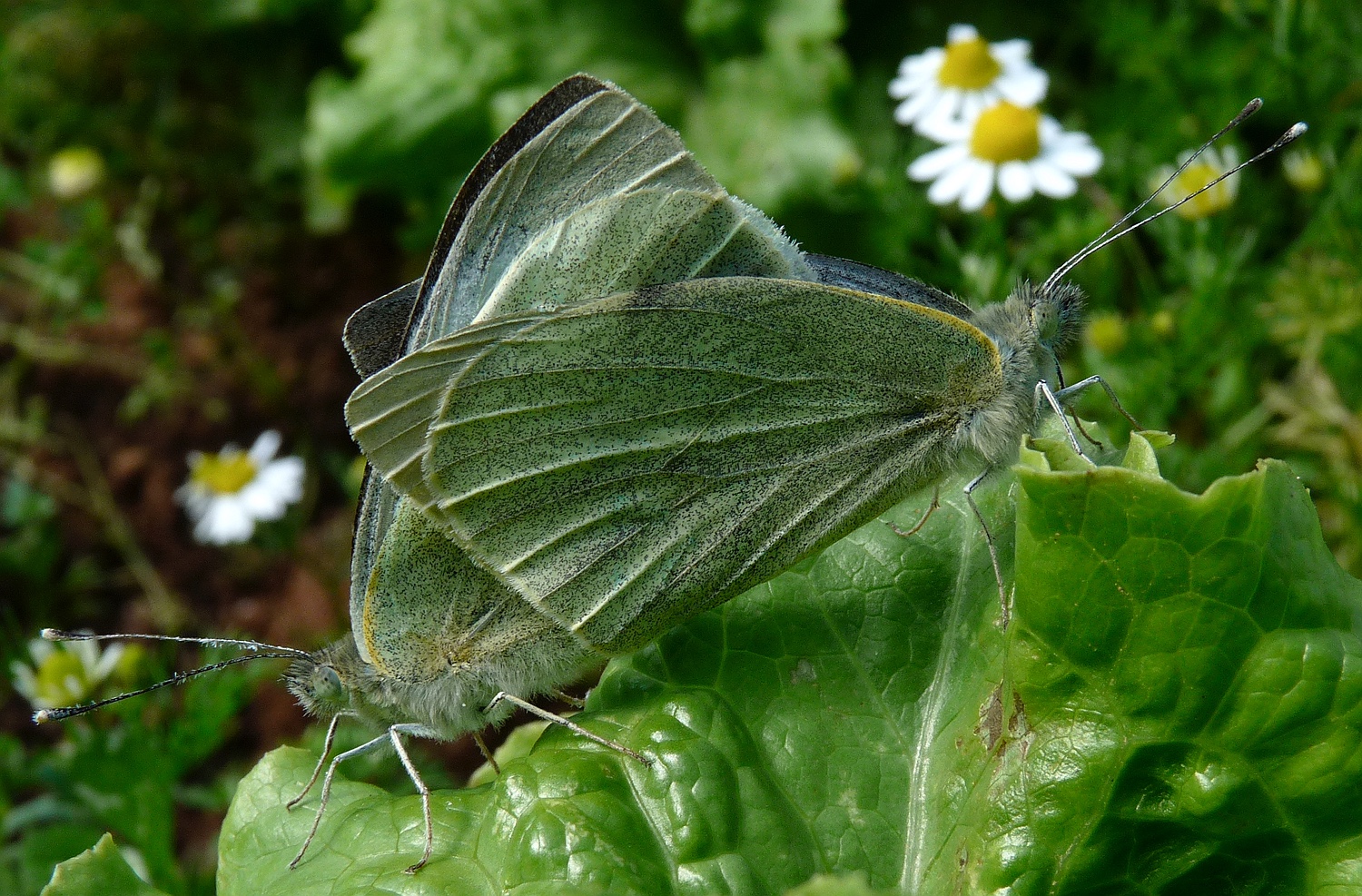
Large whites mating
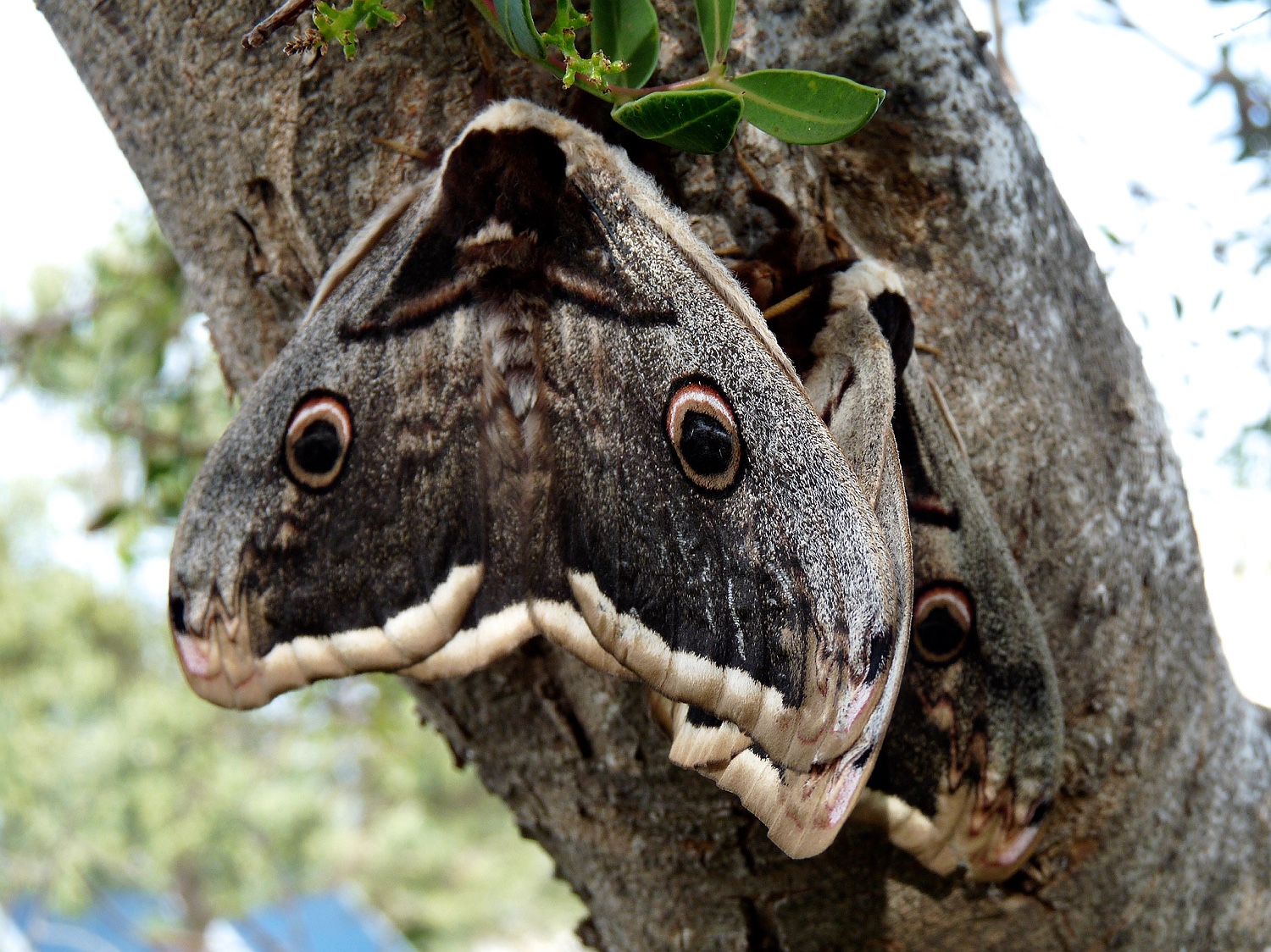
The largest lepidopteran in our region is the Giant peacock moth. This species only appears for a short time in spring; the adult animals, which do not eat anything, die a after few days. The Giant peacock moth hibernates in the pupal stage. Here two animals mating.
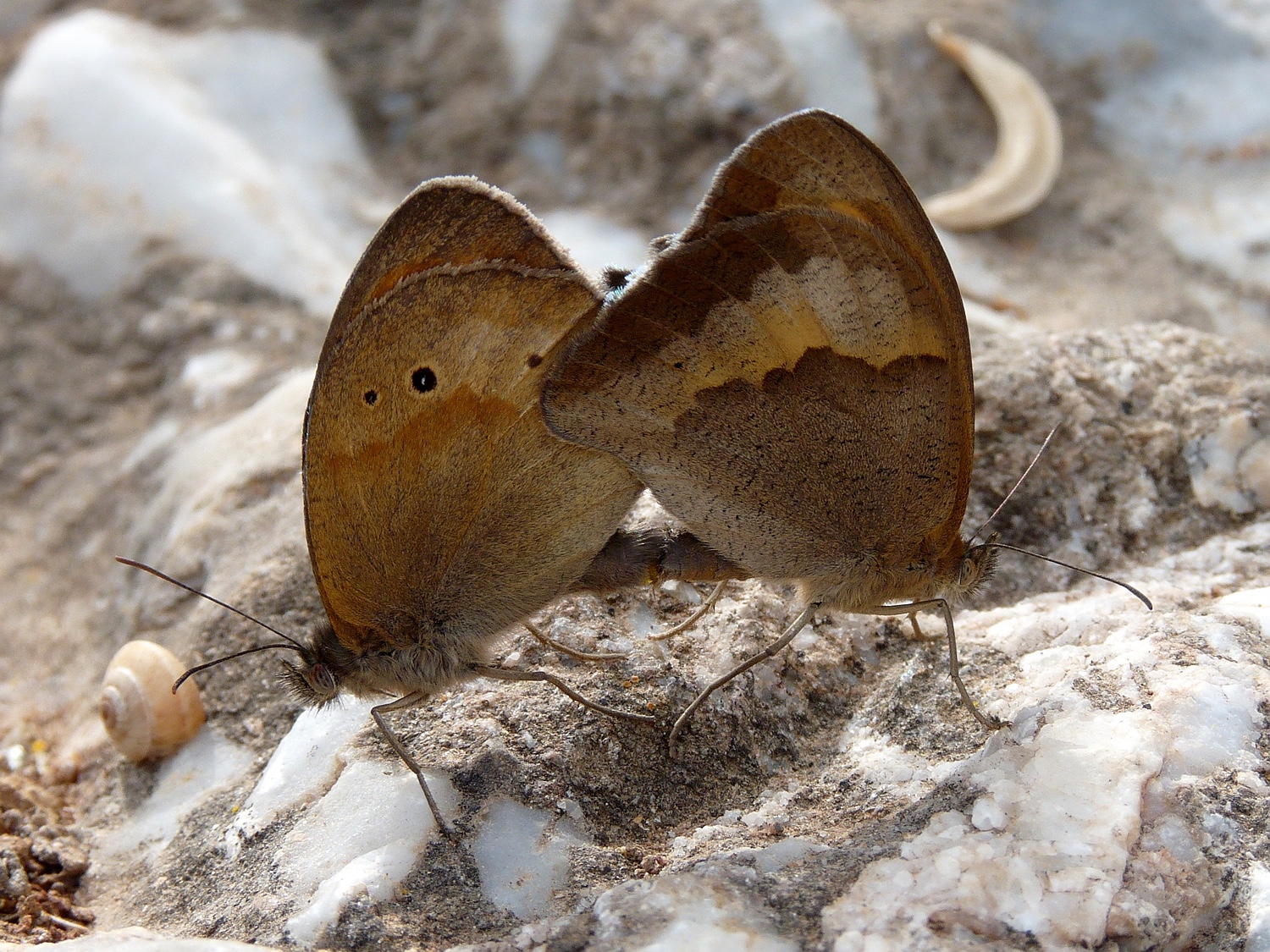
In the Meadow brown, the males (left) look significantly different from the females (right).
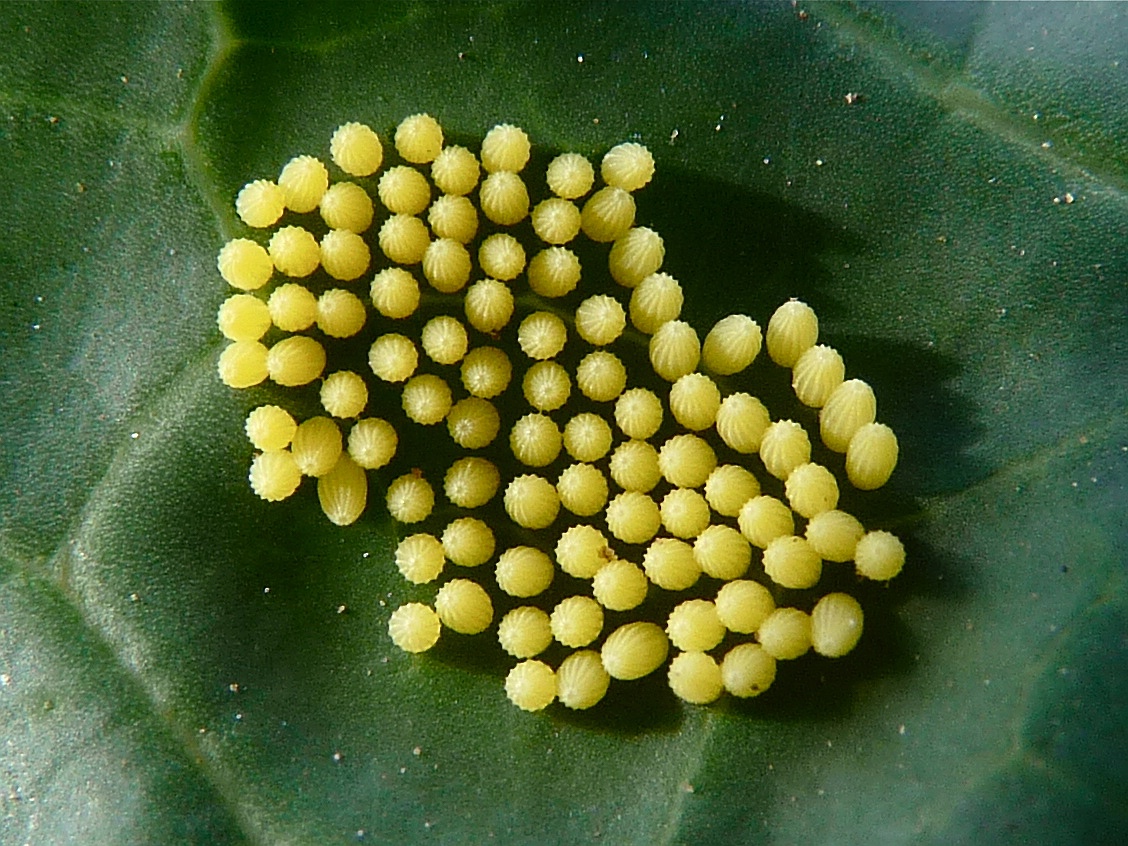
Even butterfly eggs are little works of art (Large white).
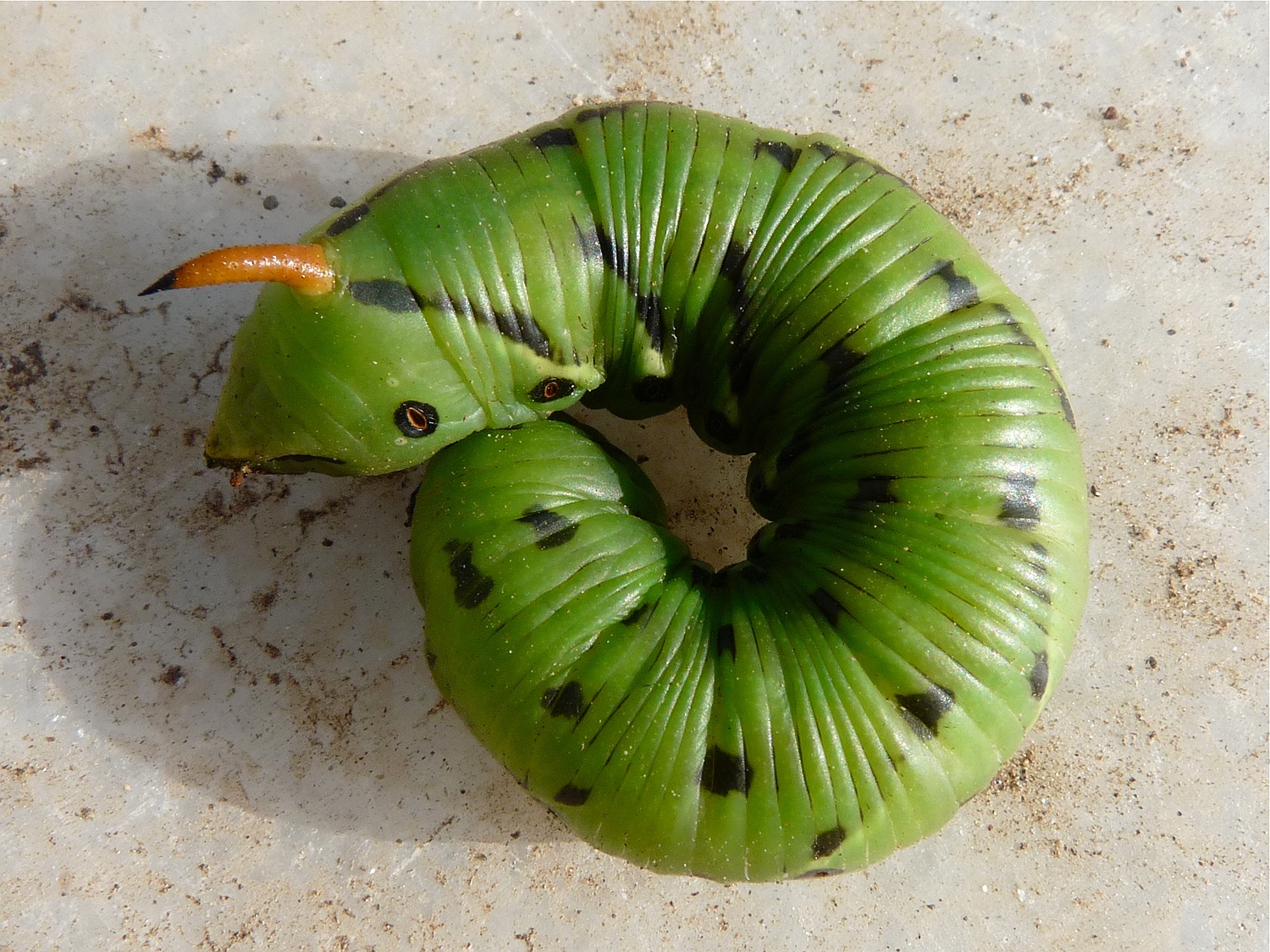
Everyone knows that caterpillars look completely different from adult butterflies; there are often also significant differences in shape and colour between the different caterpillar stages (here the final caterpillar stage of the Convolvulus hawk moth).
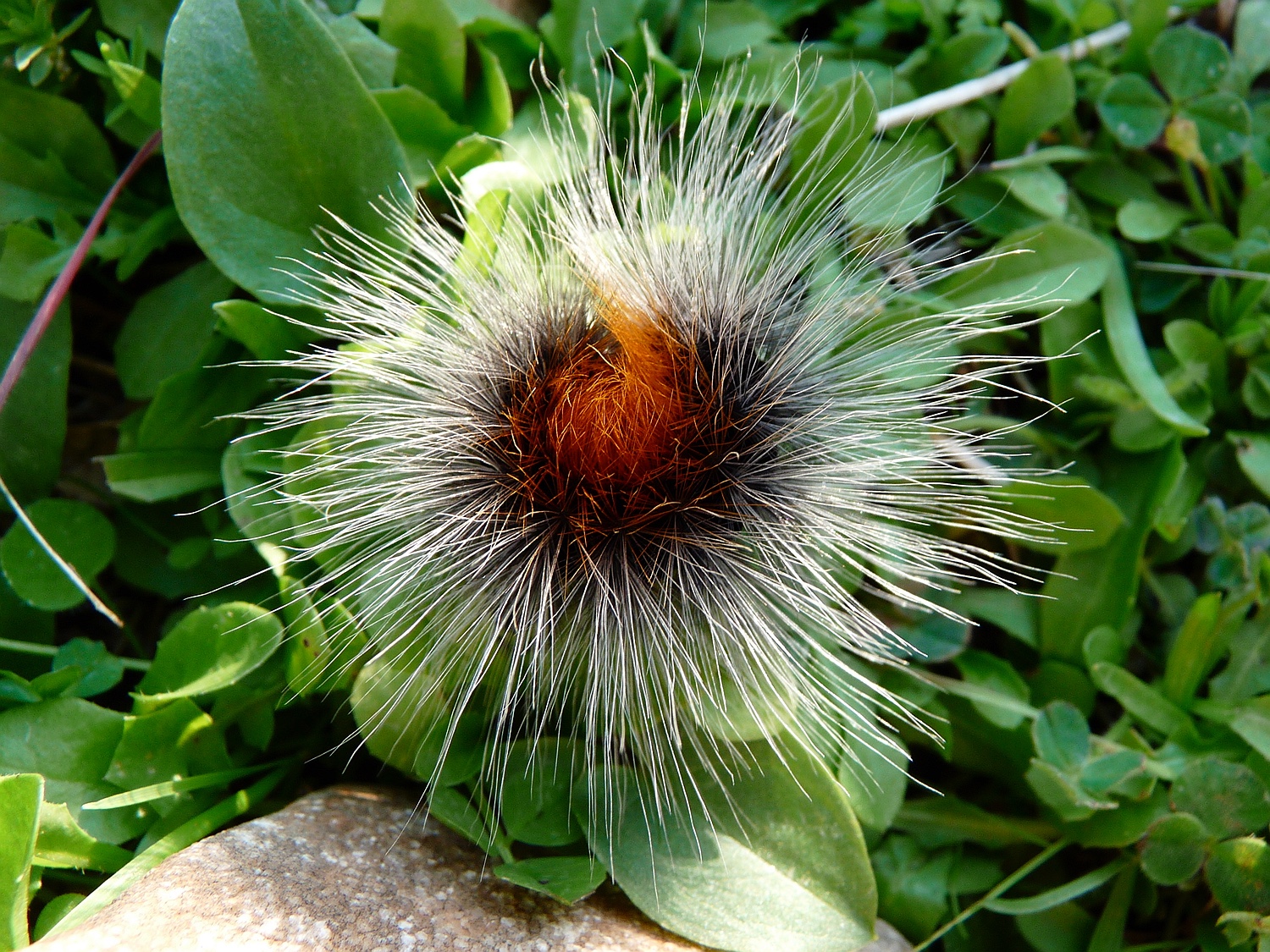
Many caterpillars, especially those of moths, are very hairy, which is intended to deter predators (Hebe tiger moth).
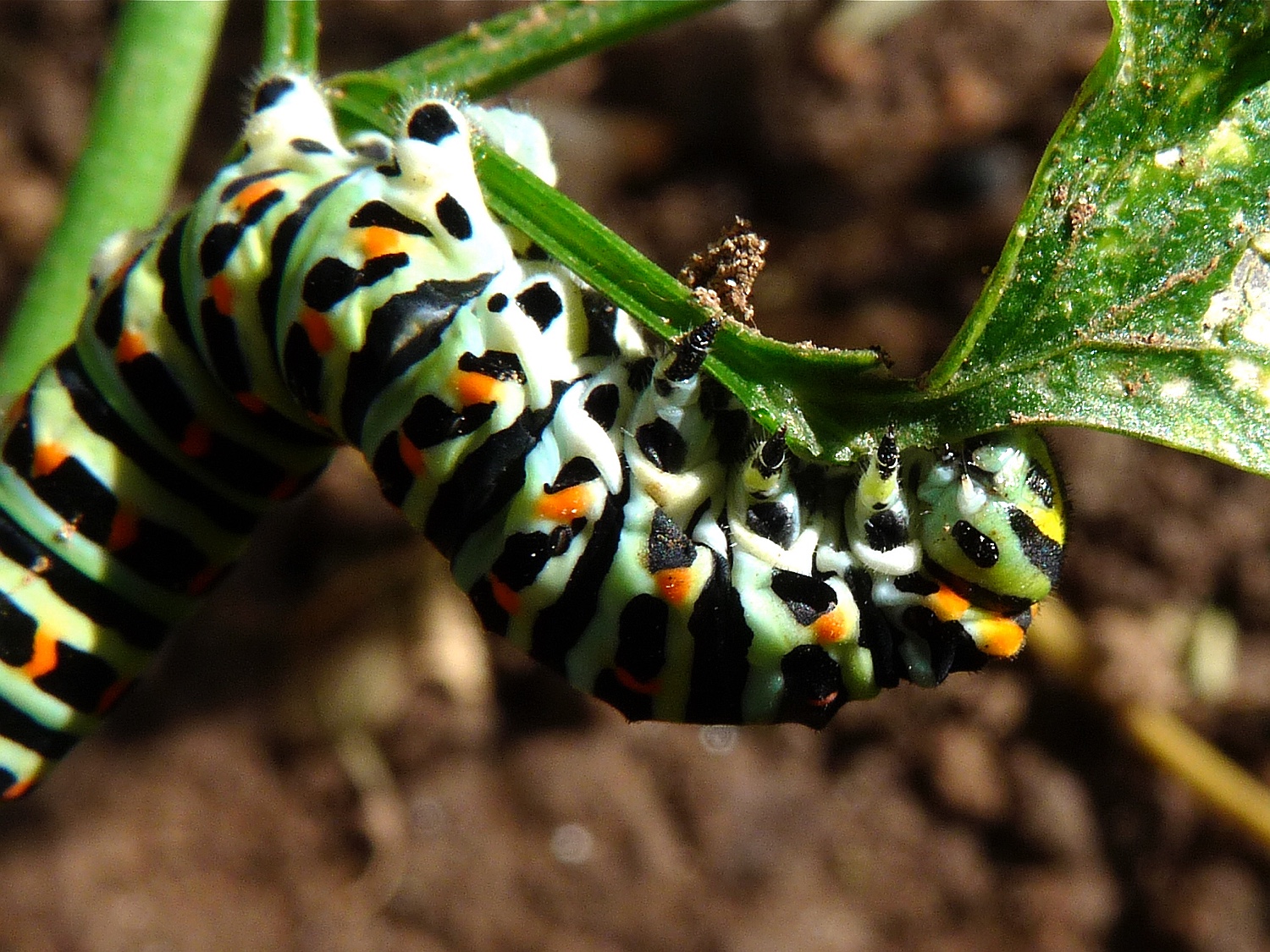
The caterpillars of many butterflies have three pairs of true limbs on their thoracic segments and one pair of legs on the last abdominal segment, as well as so-called abdominal legs on some of the other abdominal segments (Old world swallowtail).

The caterpillars of hawk moths have no true legs, but only thick, round abdominal legs (prolegs) with hairy rings at the end for a better grip. (Vine hawk moth).
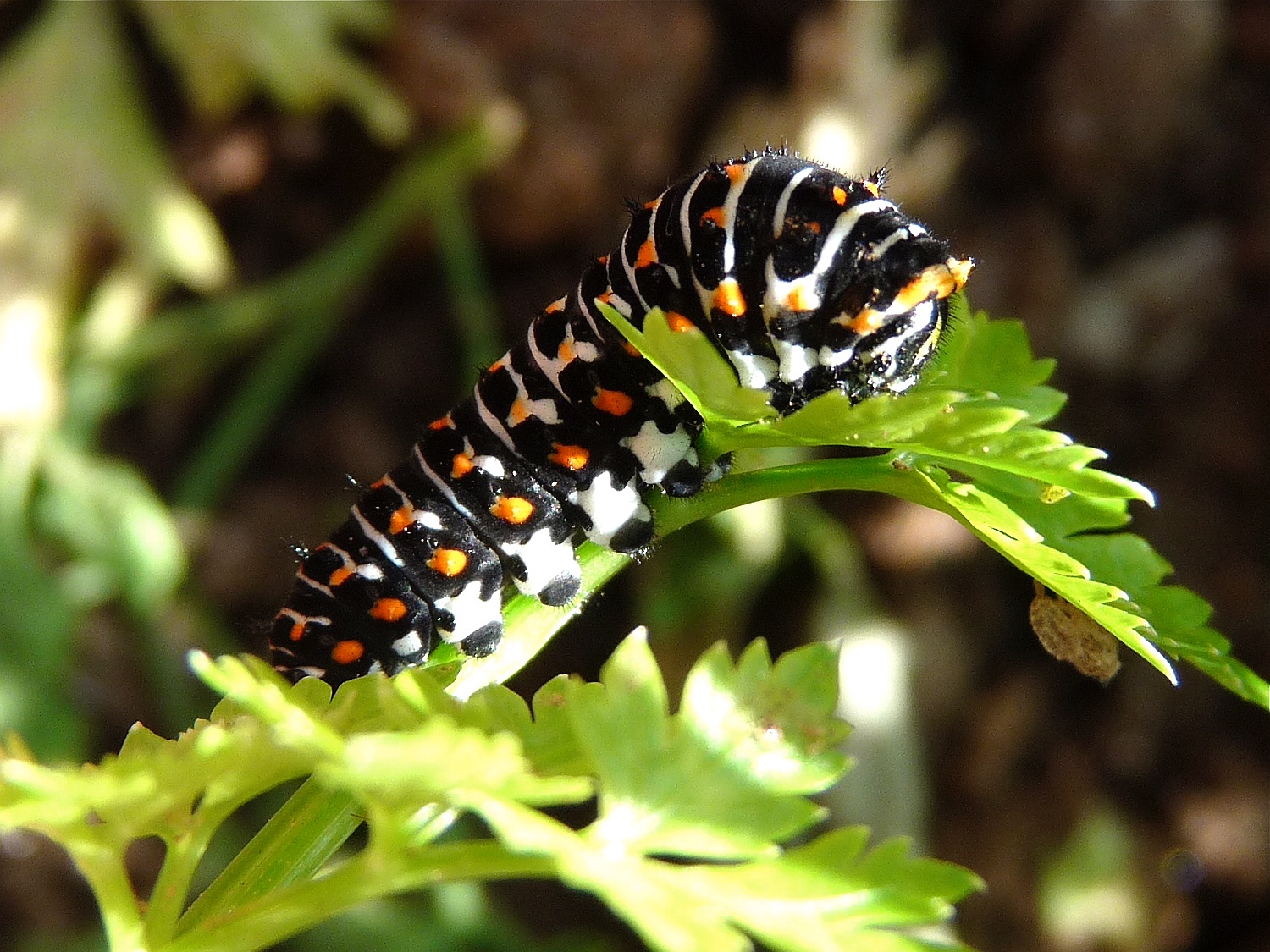
While adult butterflies only feed on nectar or fruit juice or, in some species, do not eat at all, the caterpillars seem to exist solely to eat, and can cause considerable damage to plants (Old world swallowtail).

Here you can see the small head with the mouthparts (Vine hawk moth).
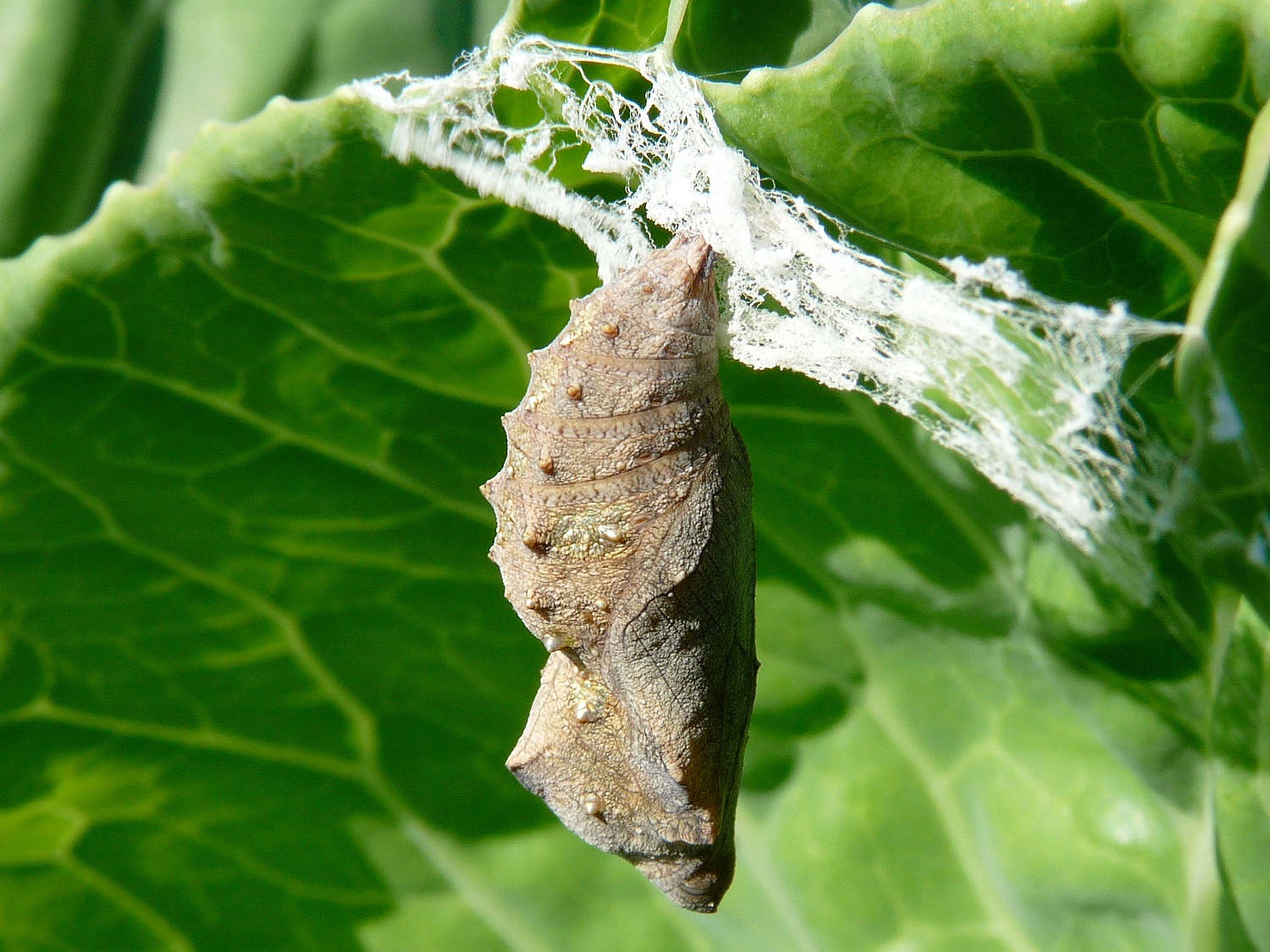
The transformation into the adult butterfly takes place in a resting stage, the chrysalis. This chrysalis hangs from a small web (Red admiral).
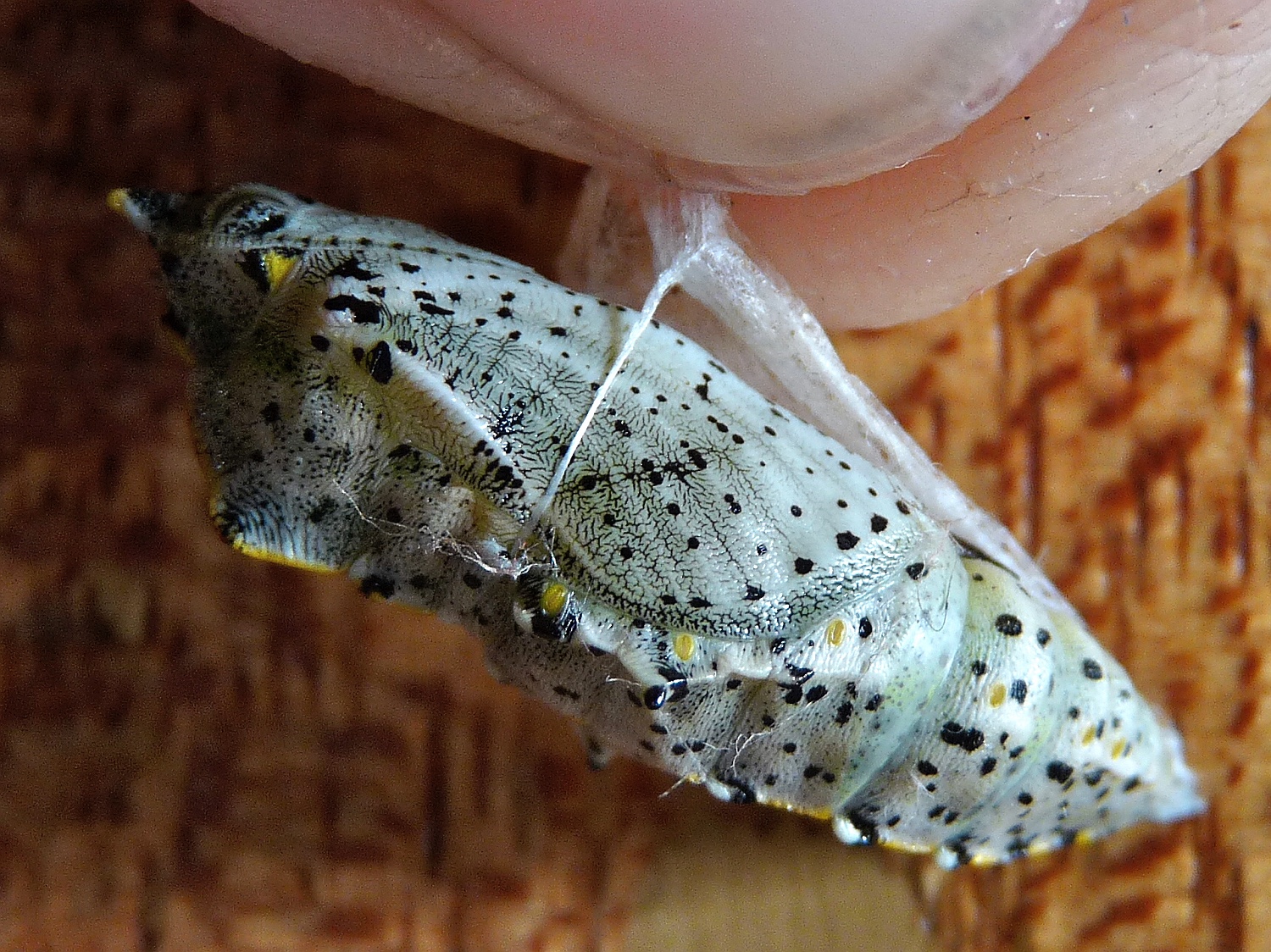
In the Large white the chrysalis hangs from a thin ‘belt’.
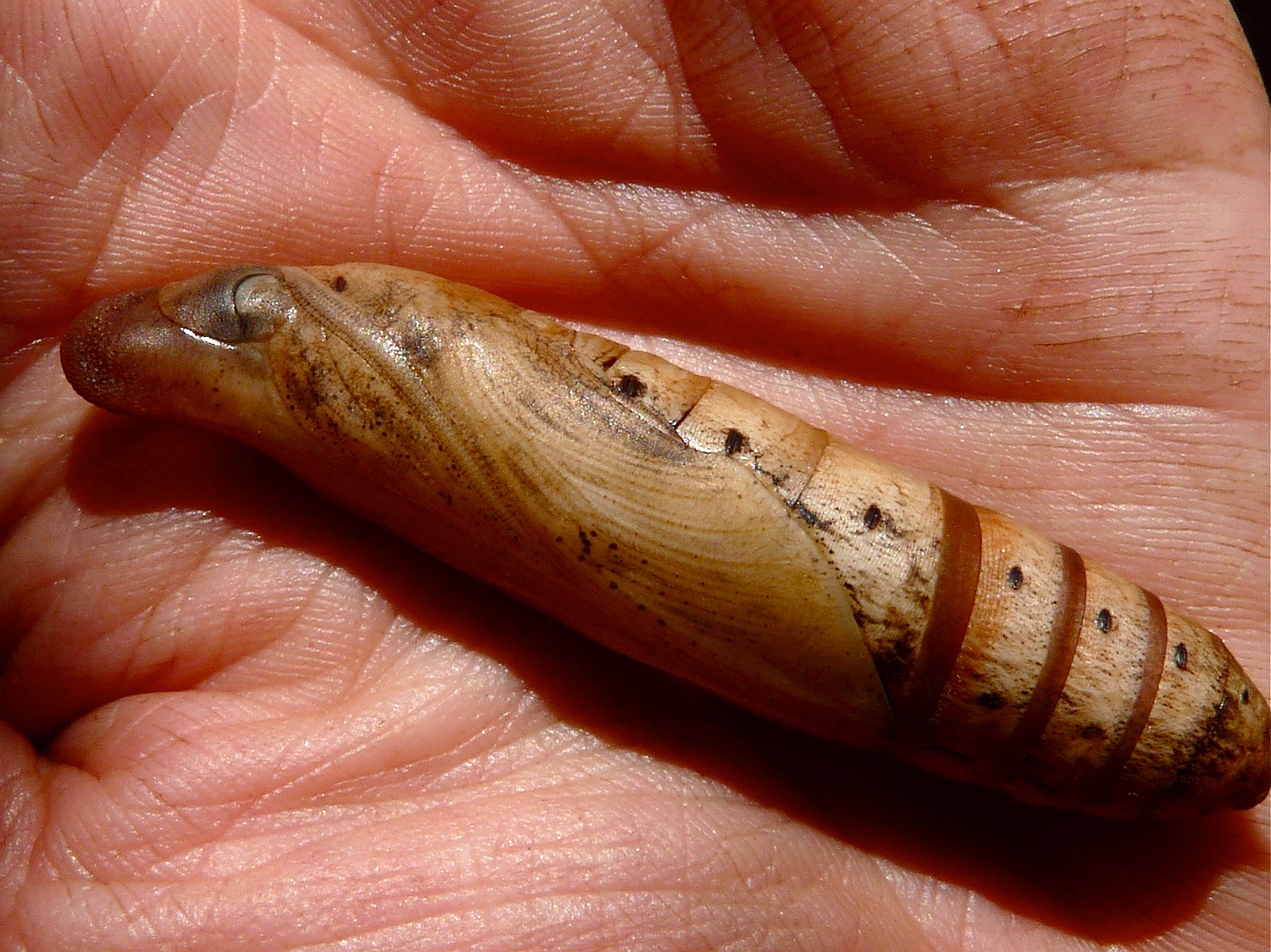
In this large pupa, you can discern the body, head and wings from the outside.
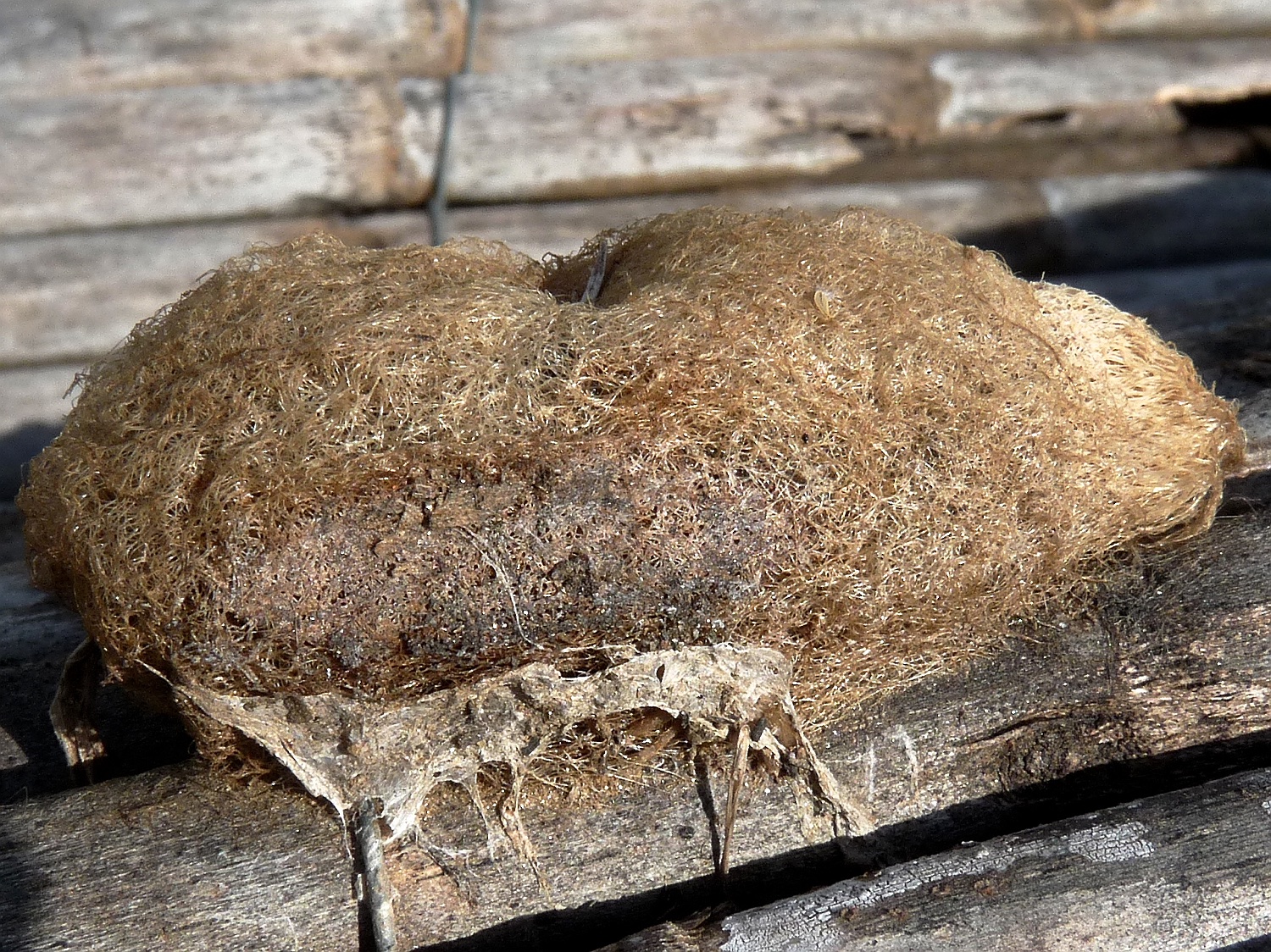
The caterpillar of the Giant peacock moth surrounds its pupa with a thick web, the cocoon.
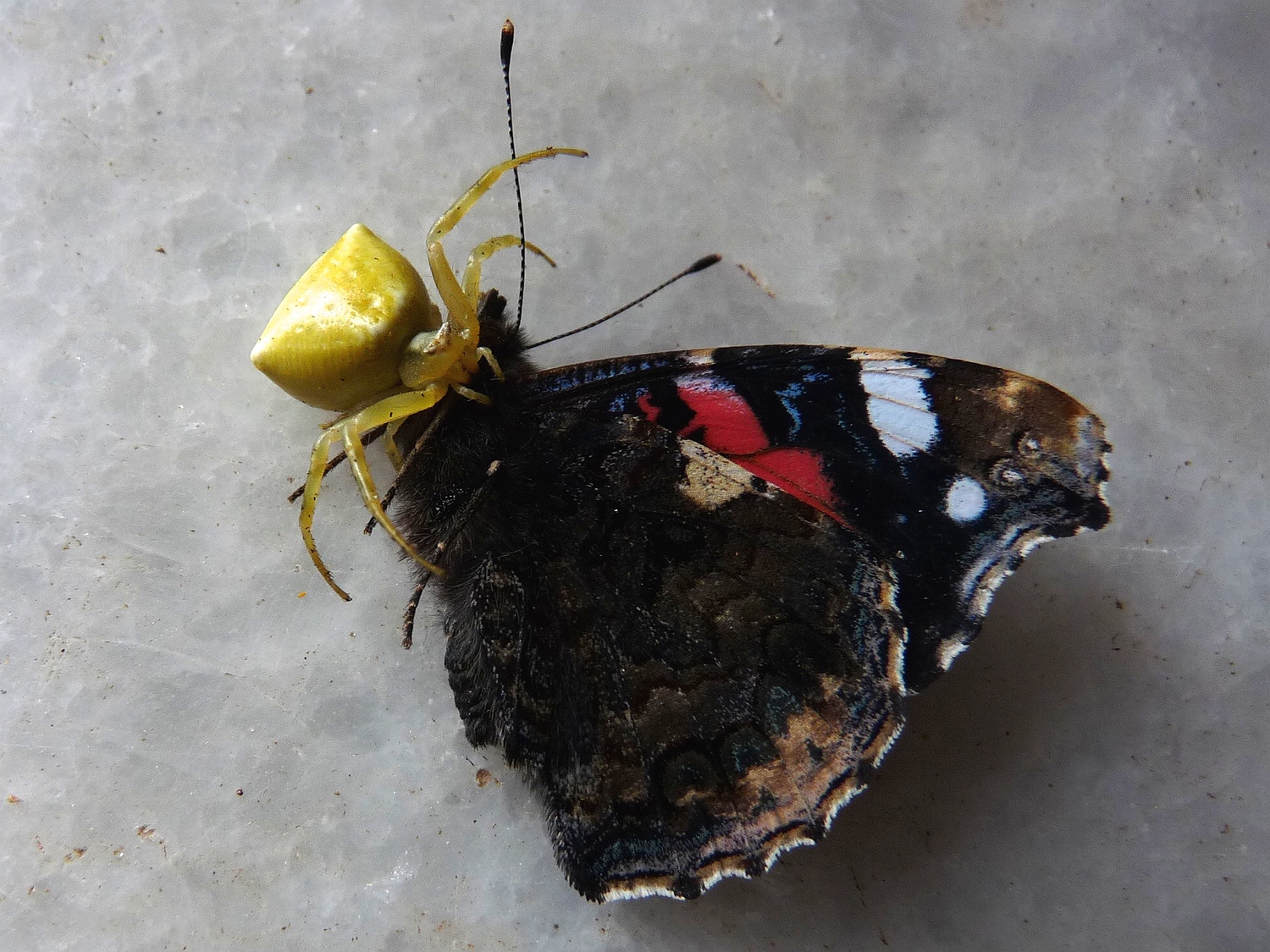
Butterflies easily fall prey to other animals, such as this spider. Their best defence is their erratic flight and often their camouflage. Some butterflies have an unpleasant taste or secrete foul-smelling substances. These species often display striking warning colours.
Butterflies on Naxos
With around 160,000 described species, the order of the Lepidoptera is one of the largest insect orders. Around 4,000 species are reported for central Europe, most of which, however, are inconspicuous small moths. The conditions on Naxos are not the most favourable for butterflies; the long summer drought is particularly problematic, as is the usually strong wind. Nevertheless, a whole range of species can be found. Some species are quite variable; sometimes the different generations throughout the year look slightly different. The website Lepiforum e.V. (only in German), which features excellent photos of almost all European species, is a very useful help for identification.
The Lepidoptera are traditionally divided into diurnal species (butterflies) and nocturnal species (moths). This division has no systematic basis, but has proven to be practical. I present the moths on a separate page.
Butterfly-species on Naxos
The Photo gallery of the butterflies and moths gives an overview of the species.
Here you can jump directly to the larger groups within the cicadas (return with the back arrow or by swiping back):
Swallowtails (Papilionidae) – Brush-footed butterflies (Nymphalidae) – Browns (Satyrinae) – Whites (Pieridae) – Blues, Coppers, Hairstreaks (Lycaenidae) – Skippers, (Hesperidae)
Swallowtails, Papilionidae
Swallowtails are among the largest and most beuatiful butterflies. Two species occur in our region: the Old world swallowtail and, much more commonly, the Scarce swallowtail.
Old world swallowtail, Papilio machaon, L.
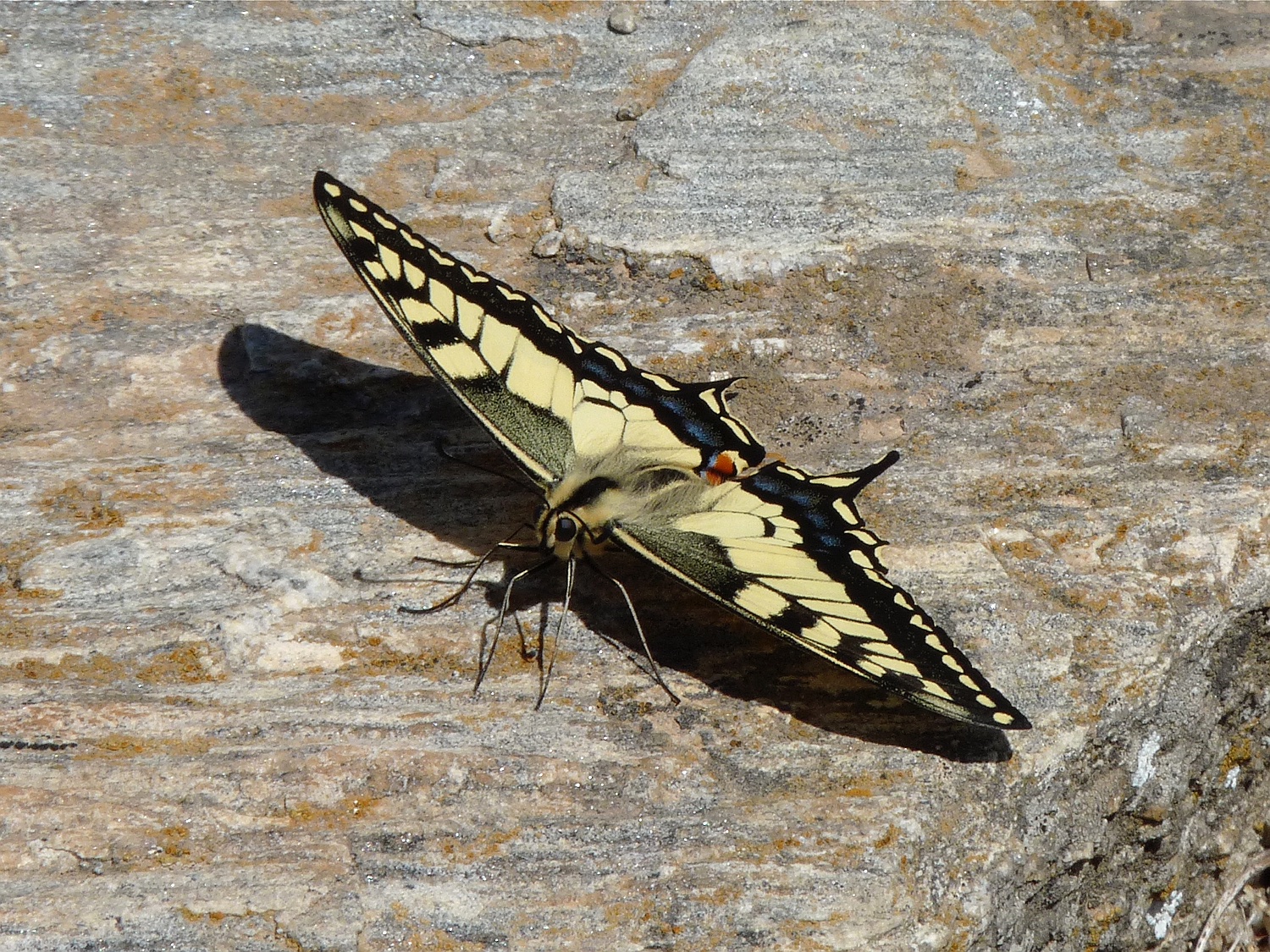
The Old world swallowtail is one of the largest and most beautiful butterflies on Naxos. We once collected an ugly brown chrysalis and a few days later had a freshly hatched swallowtail with its amazing patterns and pure cream white colour sitting in the jar – an unforgettable experience. In contrast to the very similar Scarce swallowtail, the Old world swallowtail is rather rare in our region.
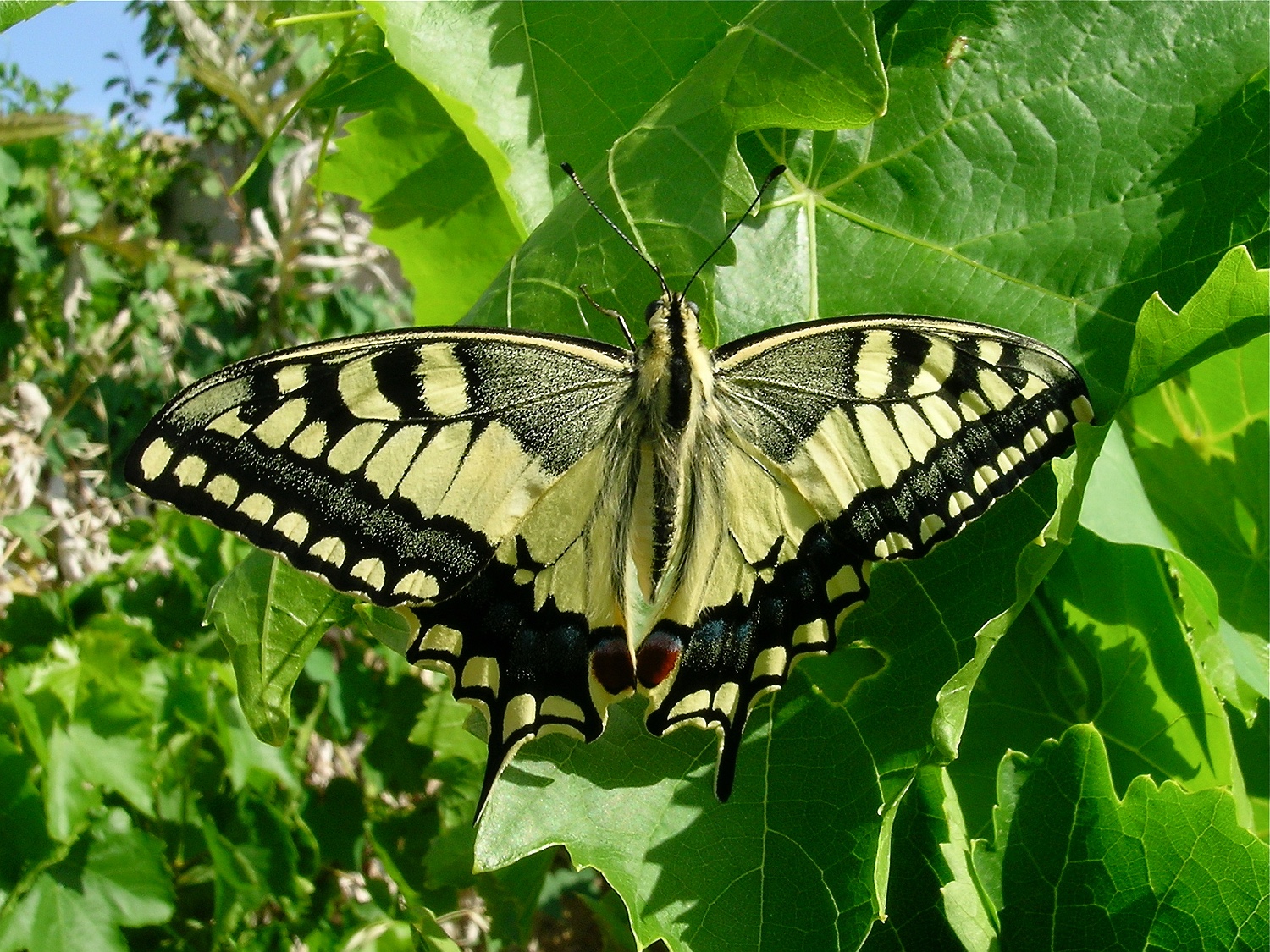
Newly hatched swallowtails are incredibly beautiful.
The caterpillars of the swallowtails live on umbelliferous plants; in our region, mainly on parsley, dill and fennel. Here an earlier…
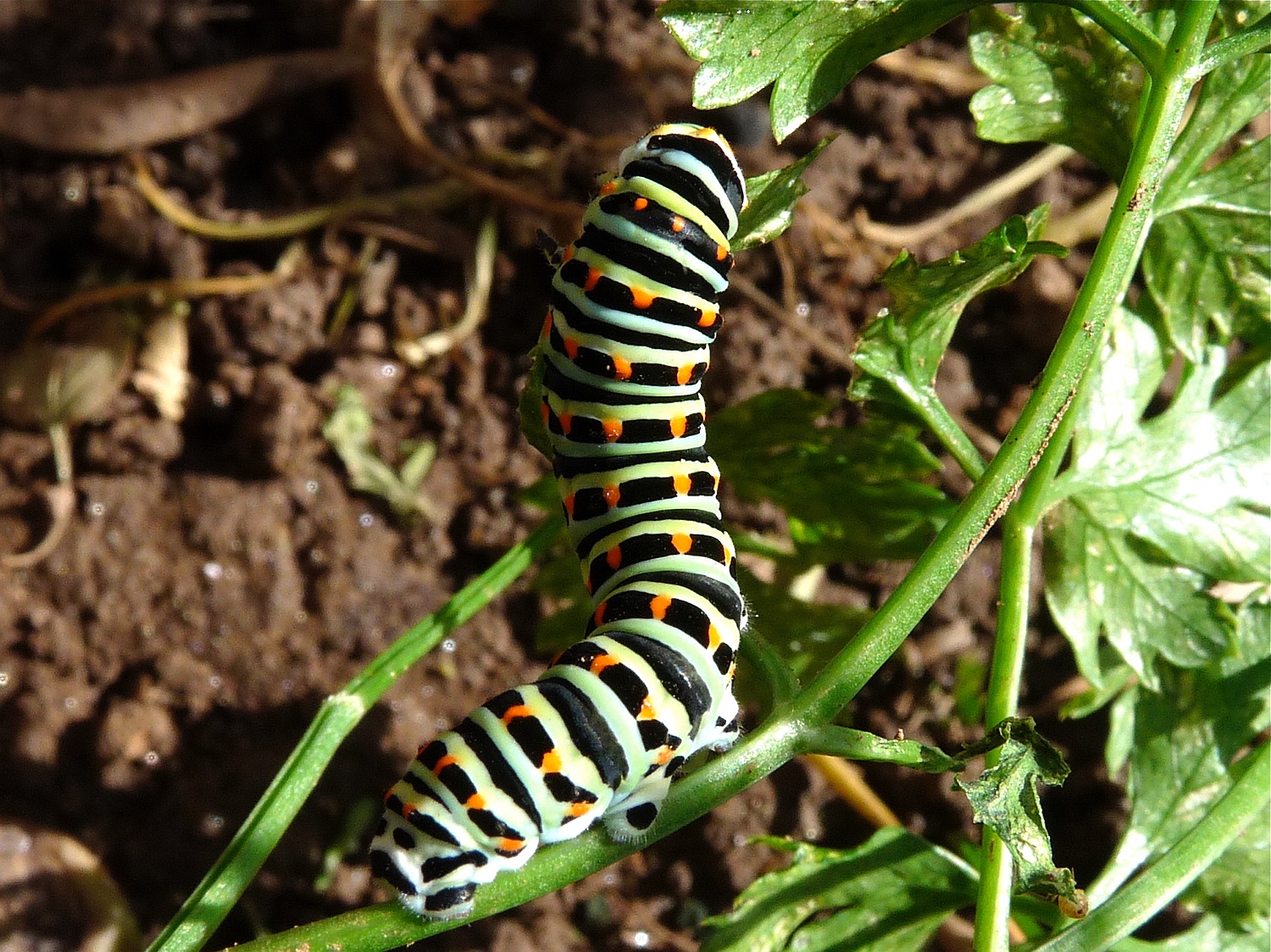
… and a later stage.
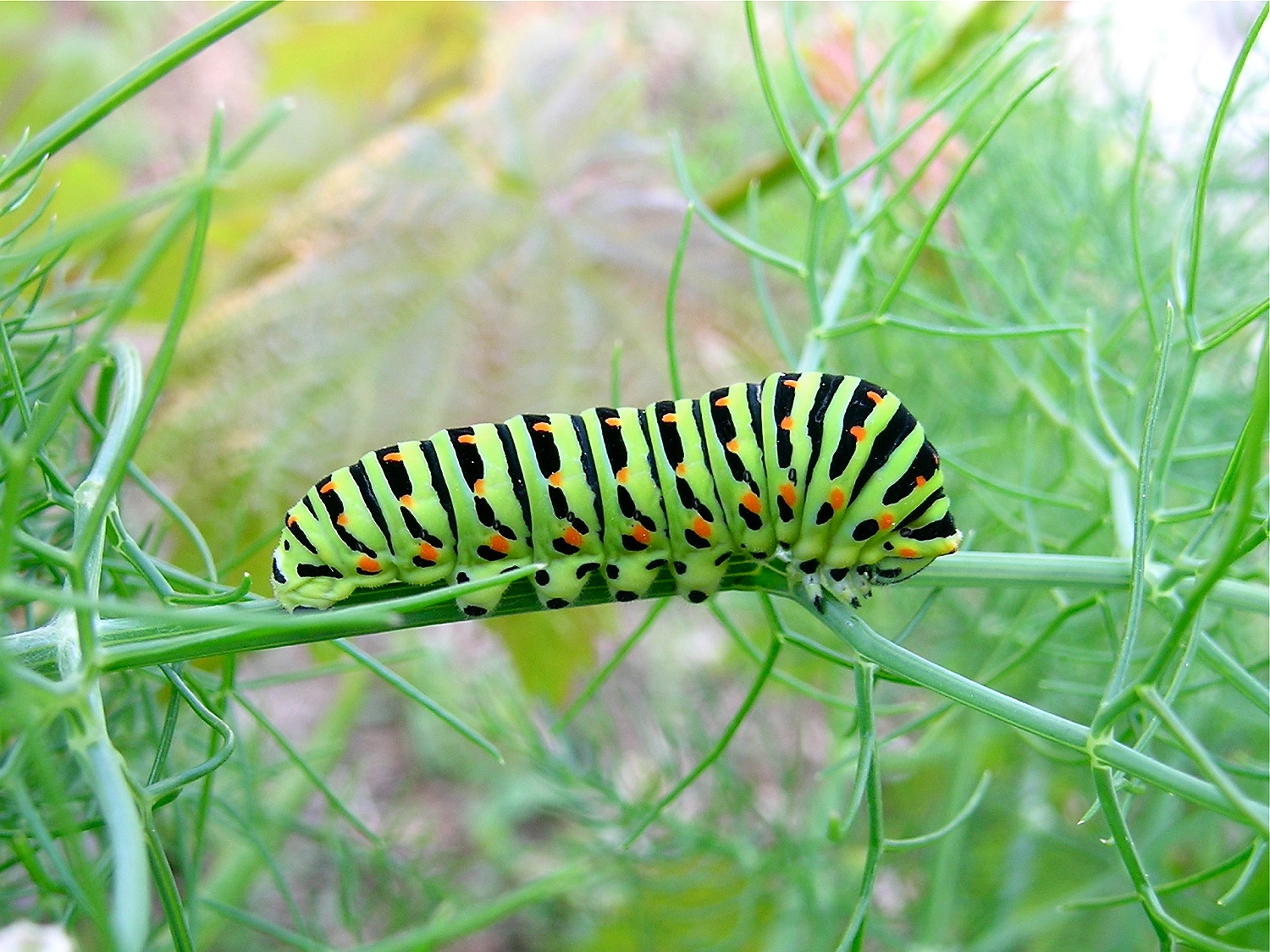
shortly before pupation
Scarce swallowtail, Iphiclides podalirius, L.
The Scarce swallowtail is similar to the Old world swallowtail; it differs in the six alternating long and short bands on the forewings and the longer “tail” of the hindwings.
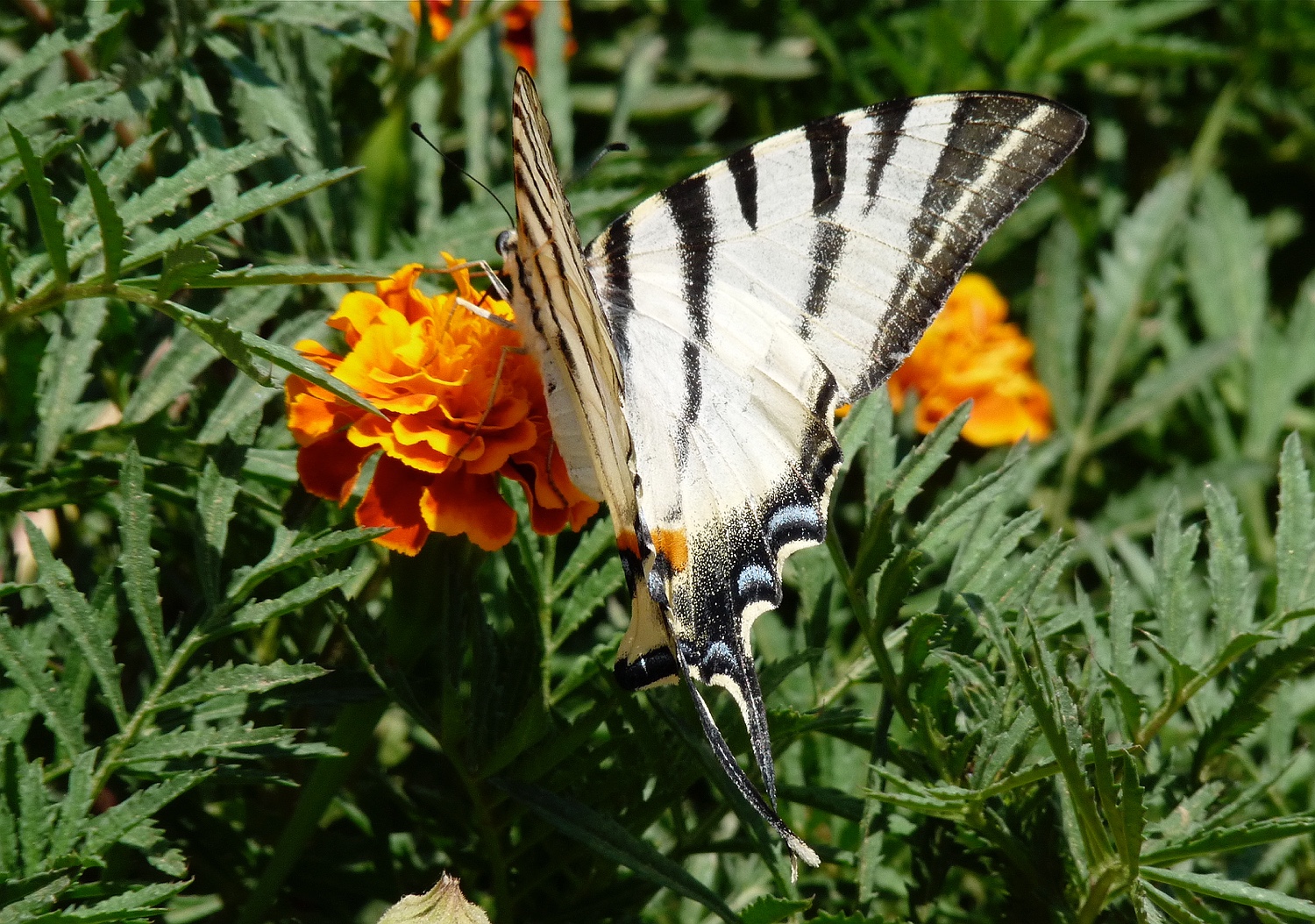
Scarce swallowtails are shy and can only be photographed with a bit of luck or a lot of patience. They often fly up and down in a characteristic manner near flower beds or trees, only sitting down briefly in between.
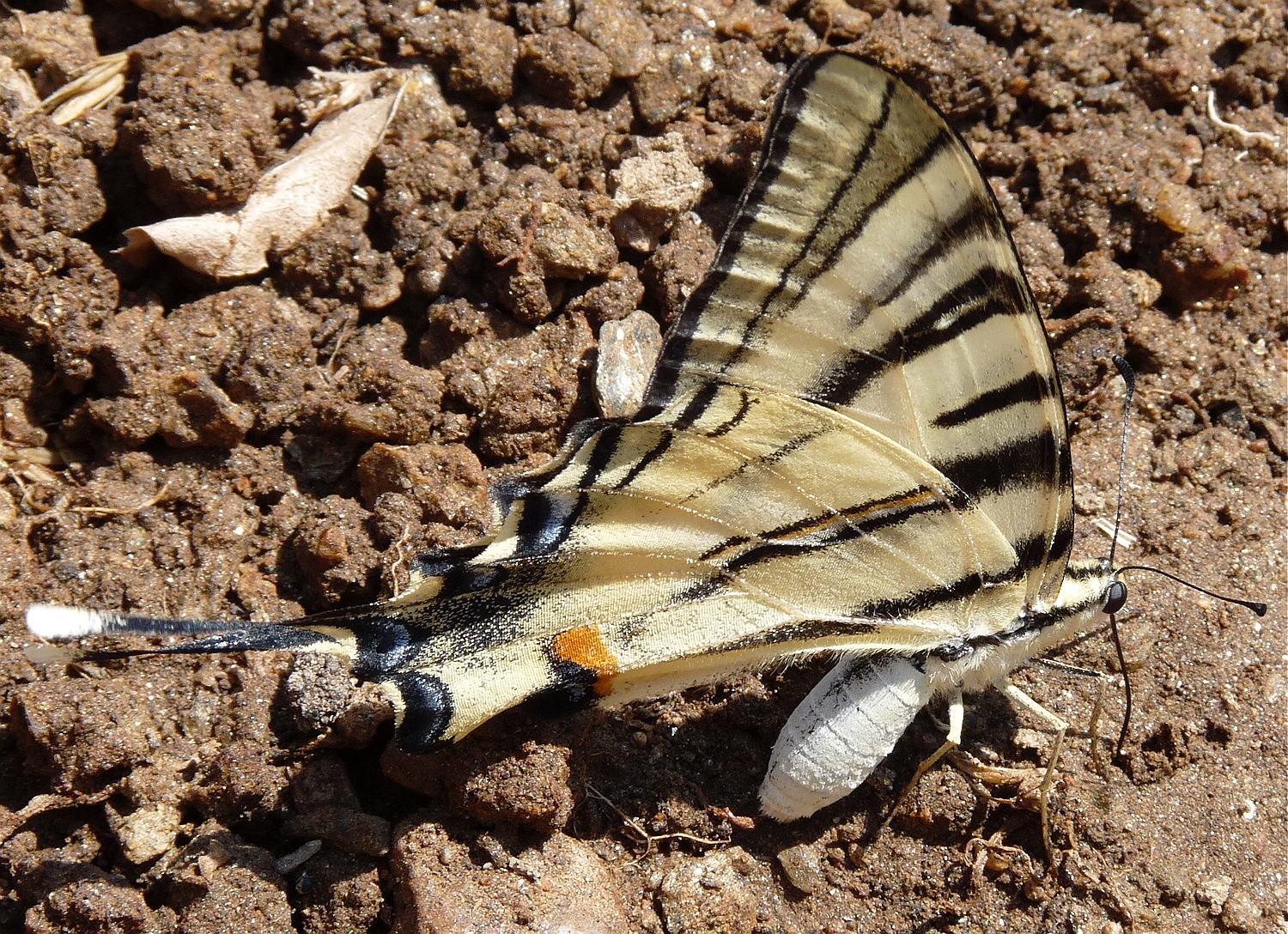
The Scarce swallowtail can be distinguished from the Old world swallowtail by the longer tips of its hindwings and the stripes on the wings. Here you see also its thick, white abdomen.
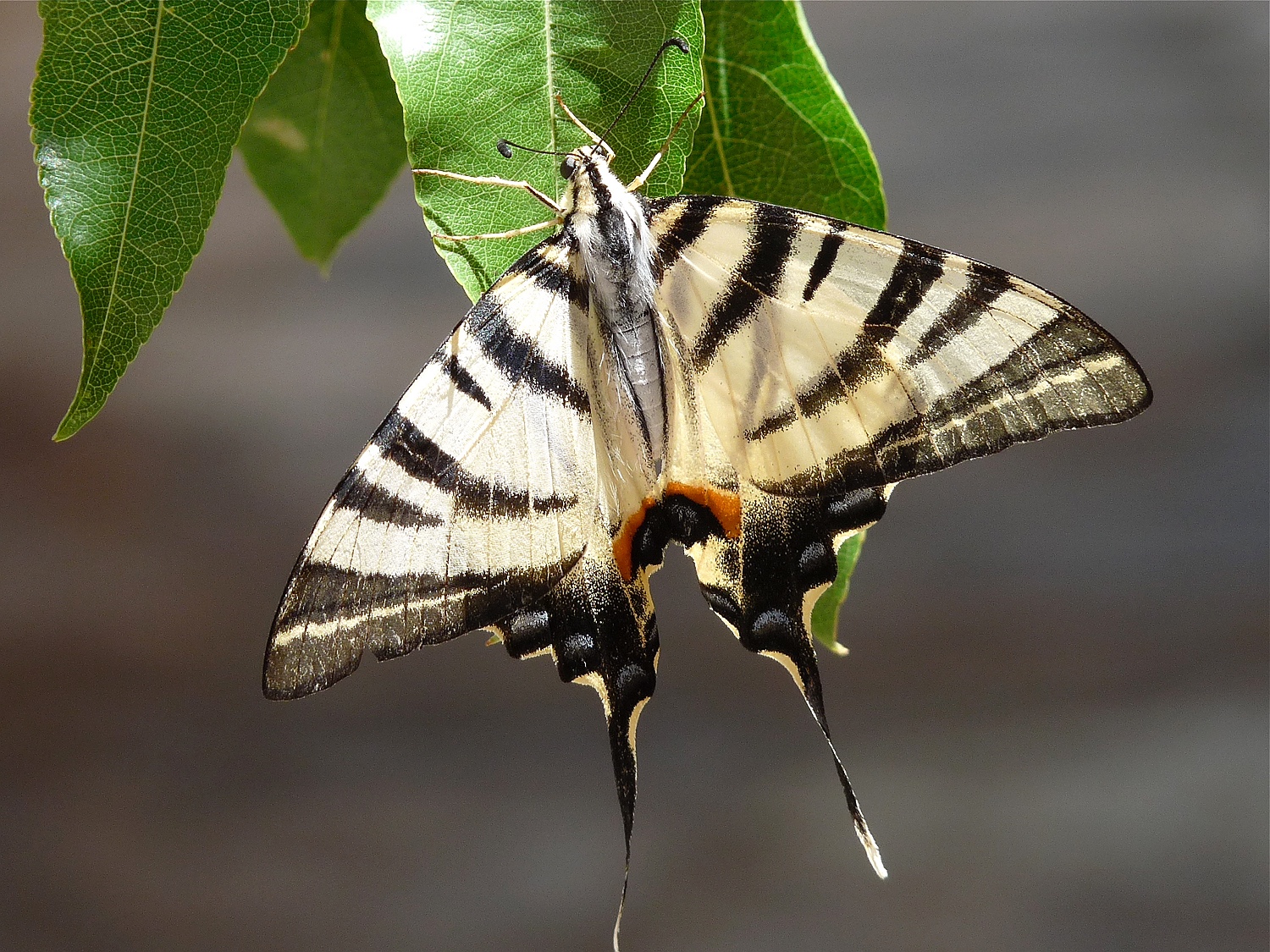
What a beautiful animal!
Brush-footed butterflies, Nymphalidae
The Brush-footed butterflies are the largest butterfly family. Many of the species are very colourful, especially tropical species. They have only four legs: the front pair is reduced in size and looks sometimes like a brush. Its function is unknown; it is thought that the butterfly may use it to clean itself.
Red admiral, Vanessa atalanta, L.
The Red admiral is one of the most common butterflies on Naxos. In autumn, Red admirals migrate from central Europe to the south to spend the winter in the Mediterranean region, thus coming also to Naxos in great numbers.
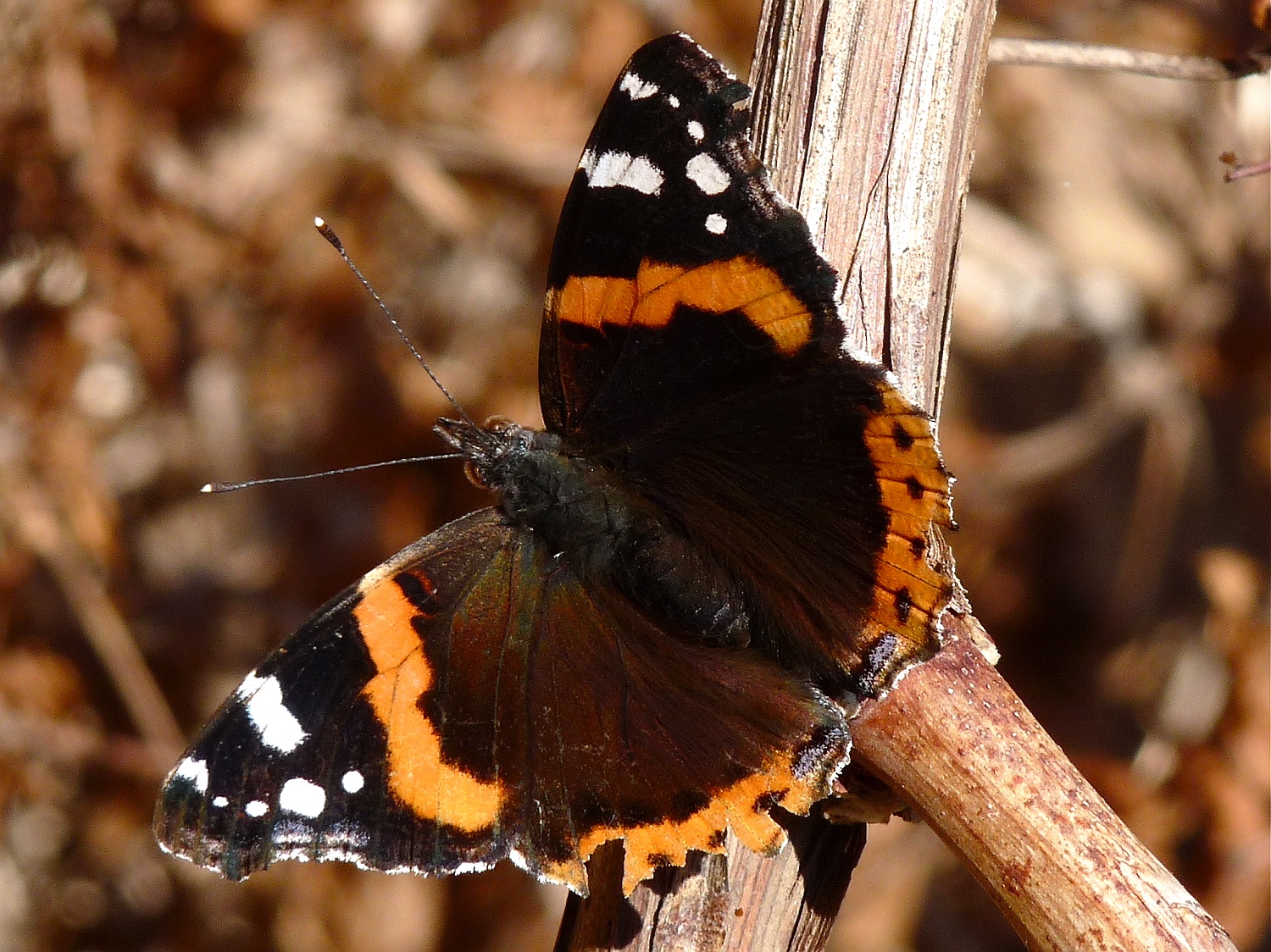
The Red admiral is predominantly black in colour with an orange-red stripe across both wings and white spots at the tip of the forewing.
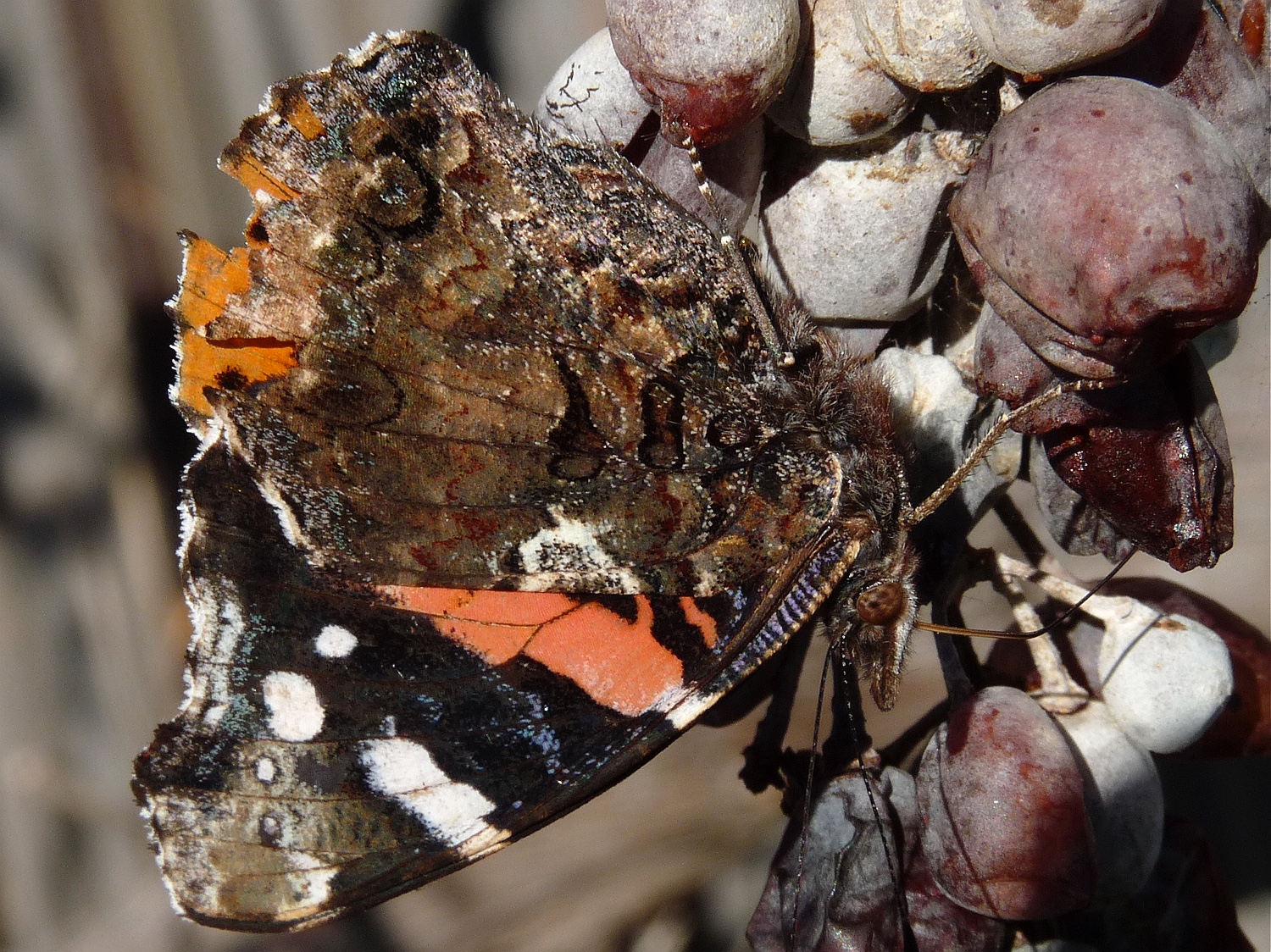
Red admirals like to suck on fruit.
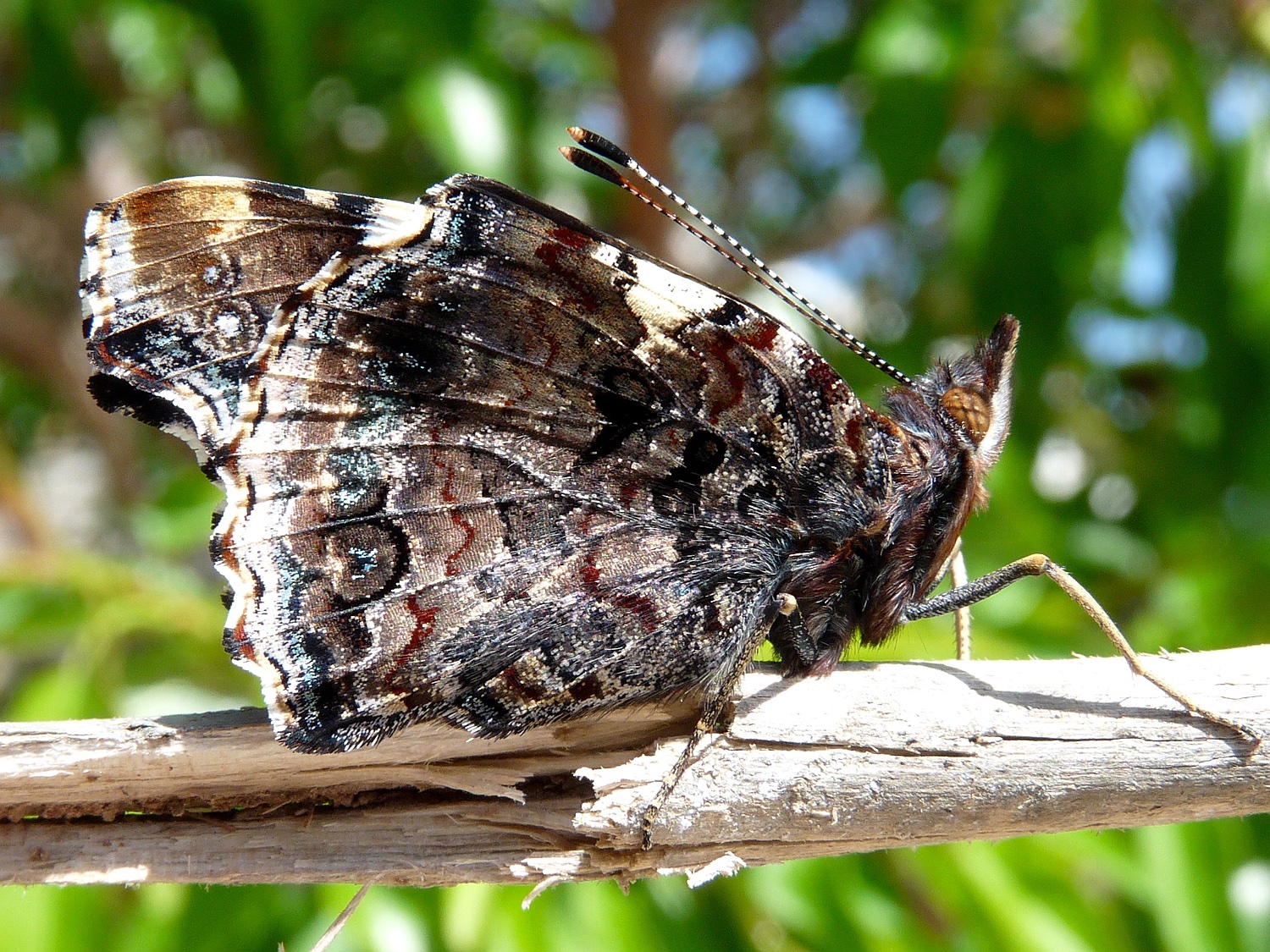
In this newly hatched Red admiral you can see the underside of the wings which have a camouflage colouring. All members of the Nymphalidae have only four legs: the front legs are reduced to short claws.
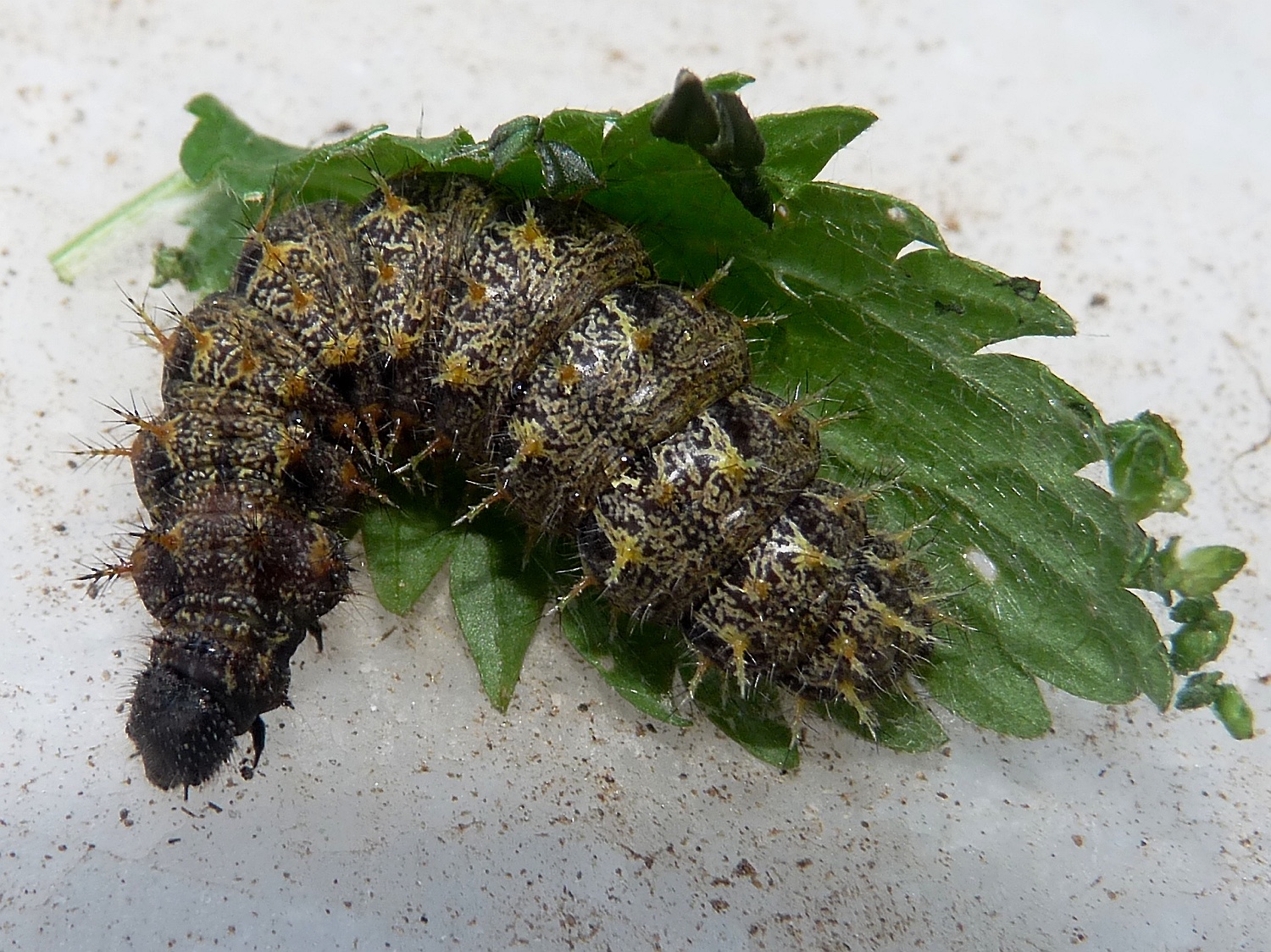
The caterpillars of Red admirals are variable in colour.
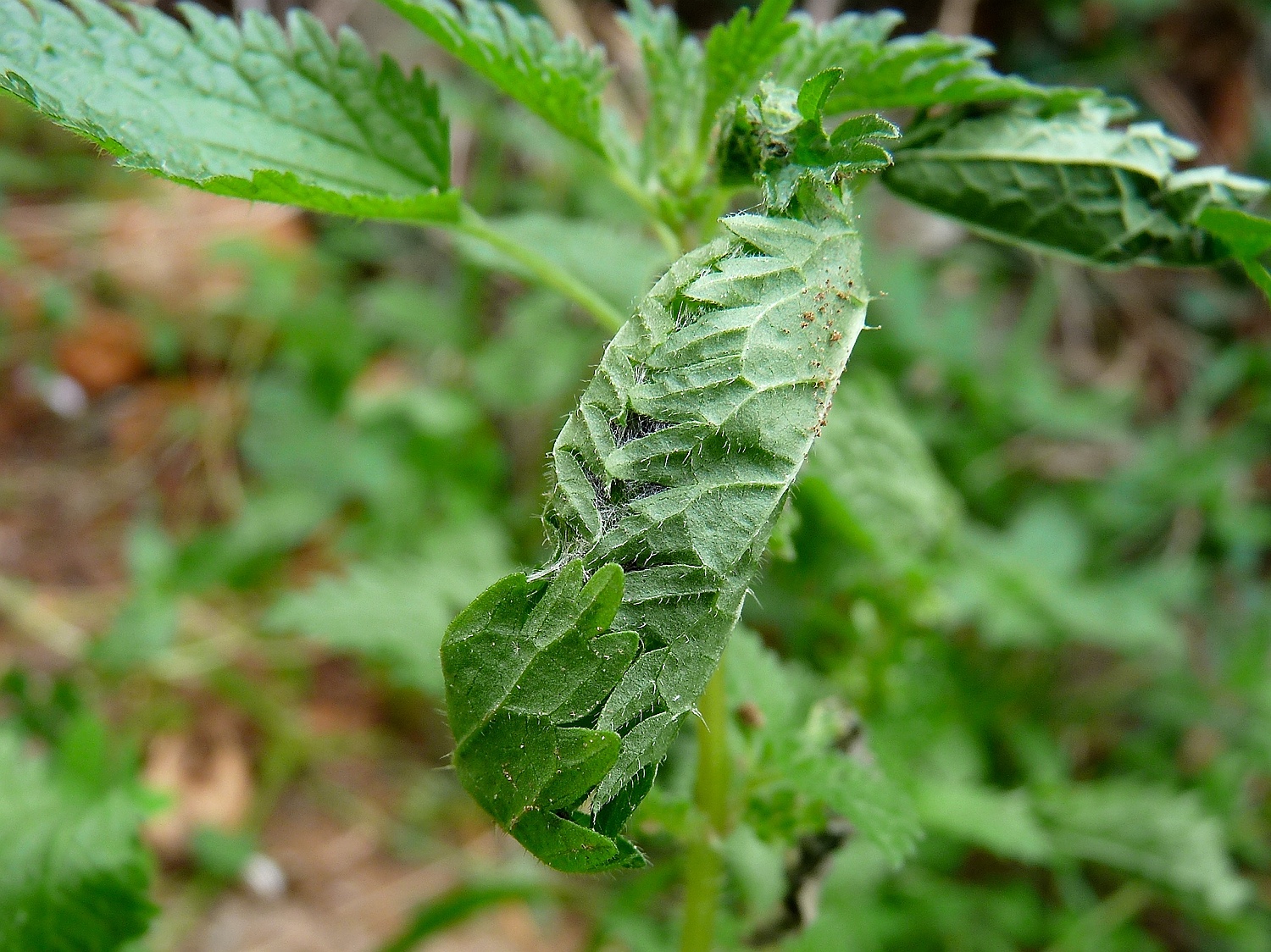
They live on nettles and reside in pretty leaf envelopes that they build by drawing the edges of the leaf together with “silk” threads.
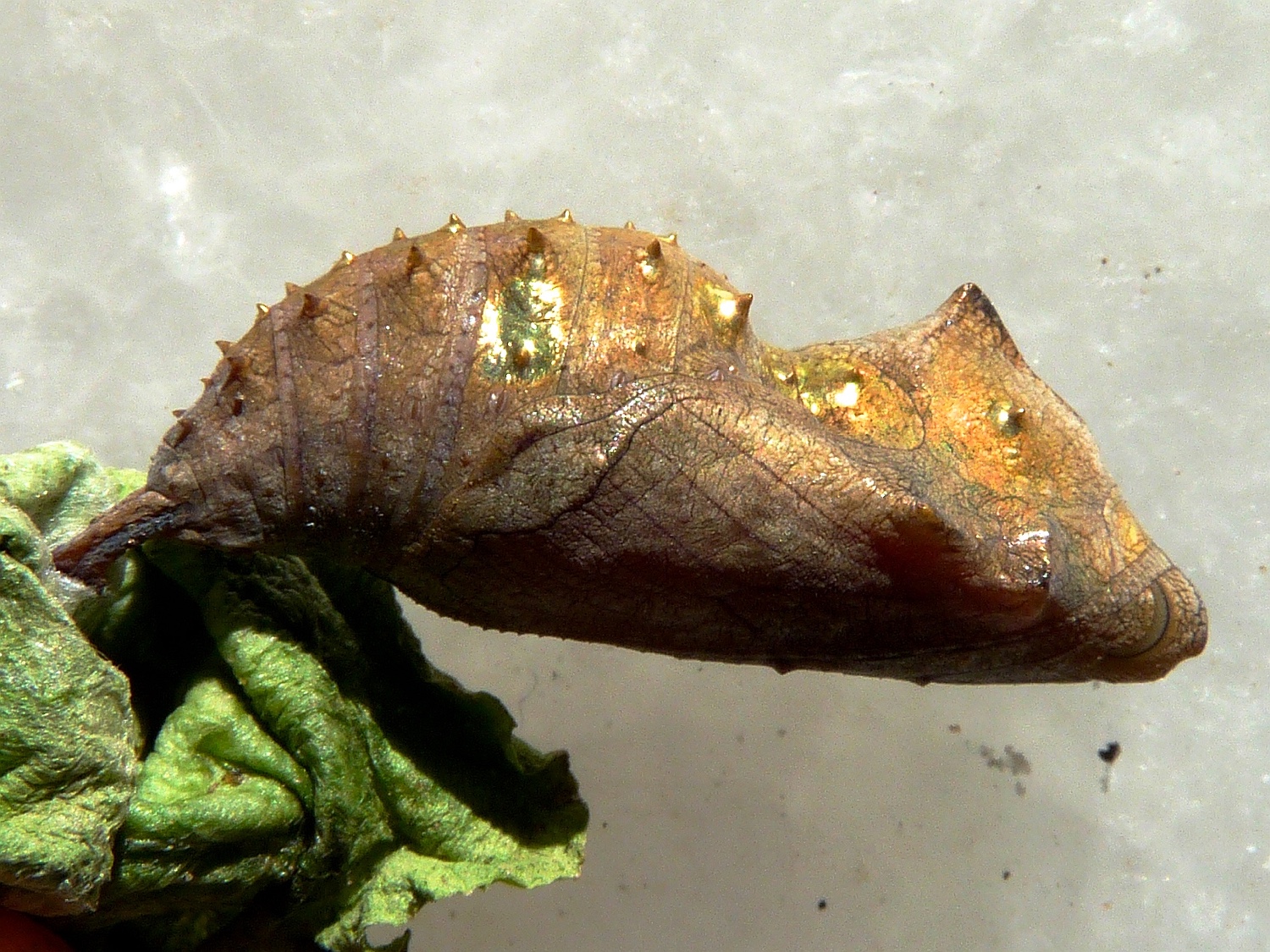
The chrysalis of this species is particularly beautiful with its bright golden areas (the word “chrysalis” derives from the Greek word chrysos = gold).
Painted Lady, Vanessa cardui, L.
Like the Red admiral, the Painted lady is a migratory butterfly that migrates from central and northern Europe to the Mediterranean region, where it spends the winter. It is a good flyer and one of the most common butterflies on Naxos.
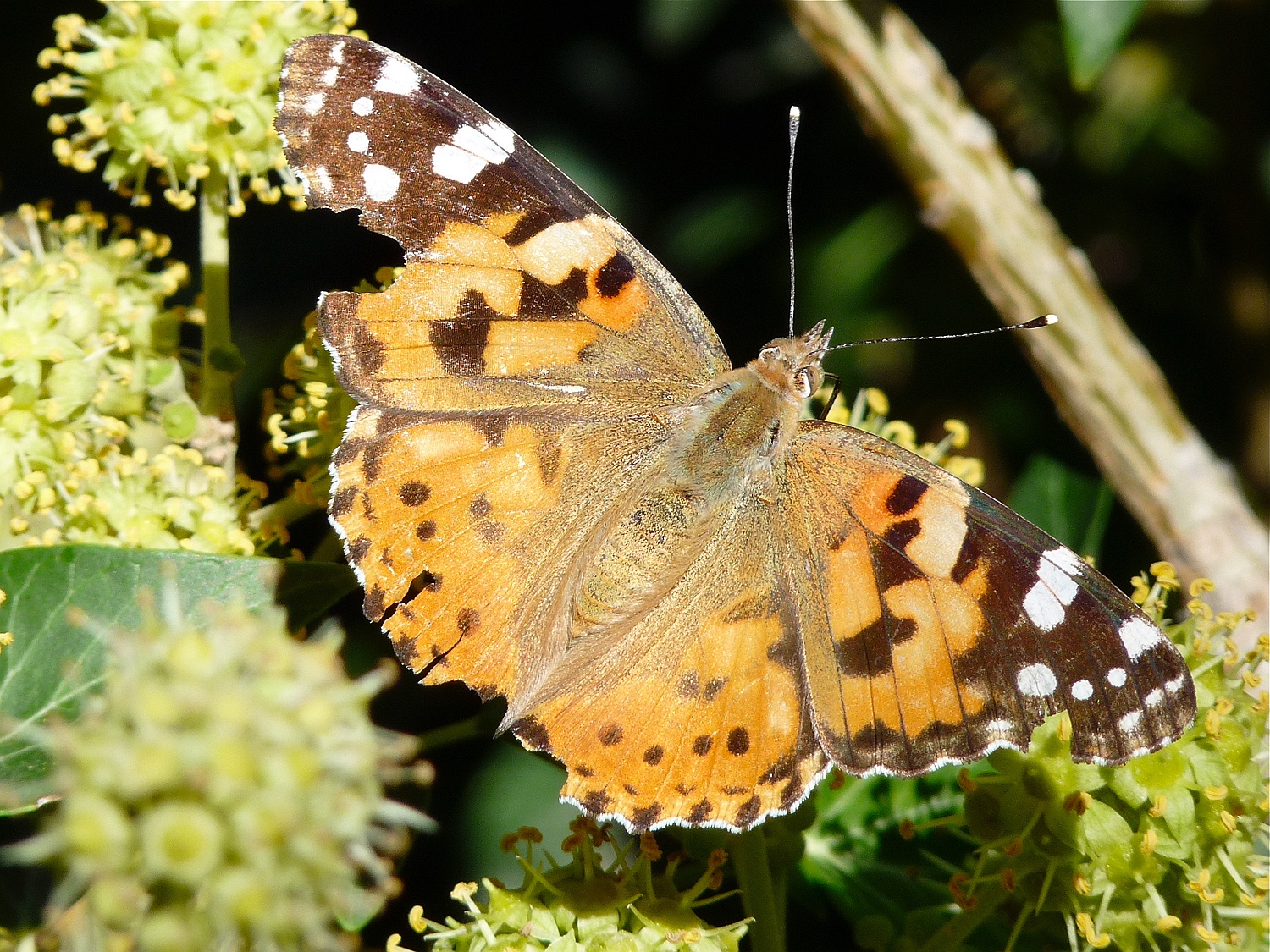
The Painted lady is easily recognisable by its brownish colouring with darker patterns and white spots on the tips of its front wings.
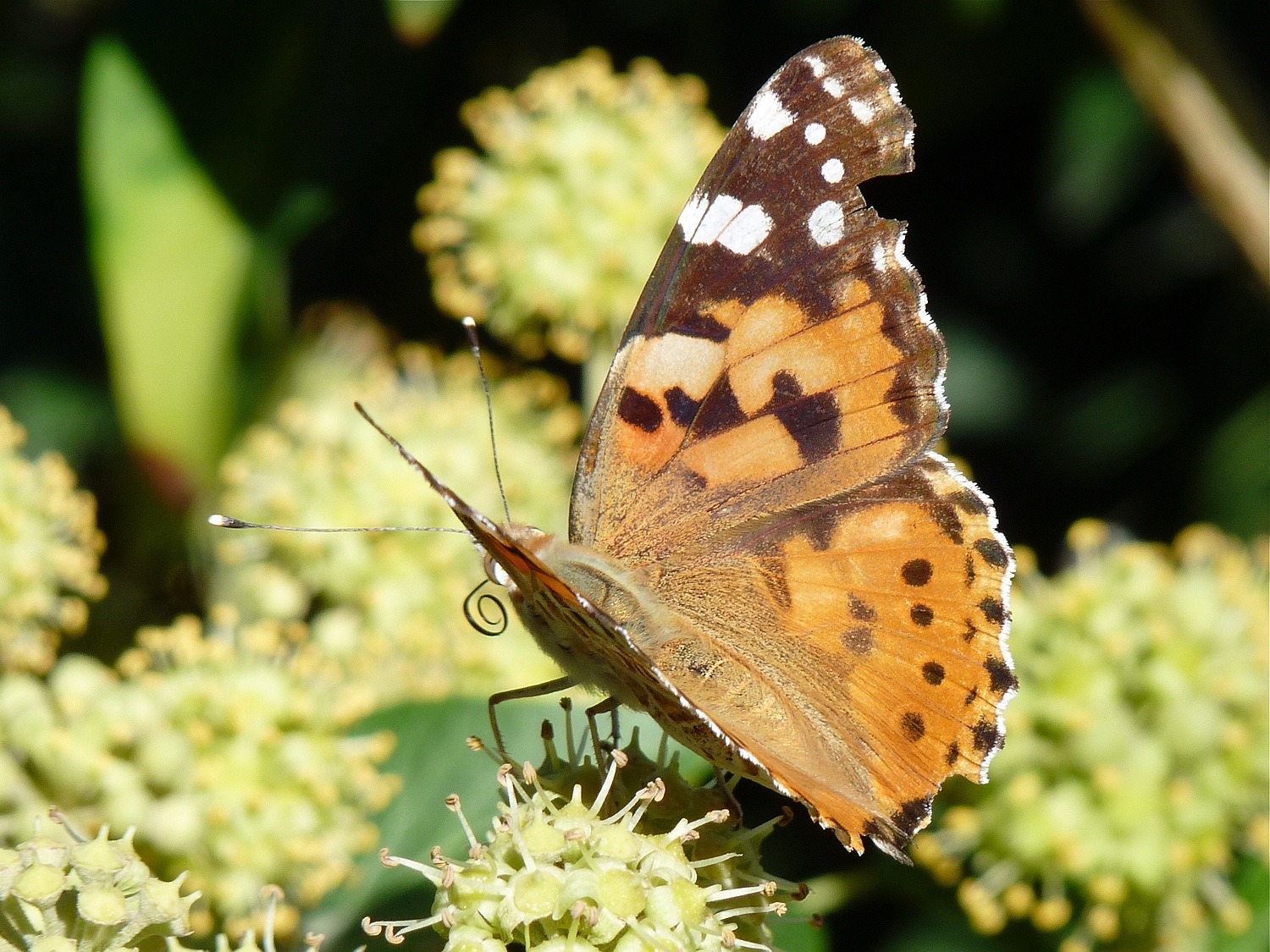
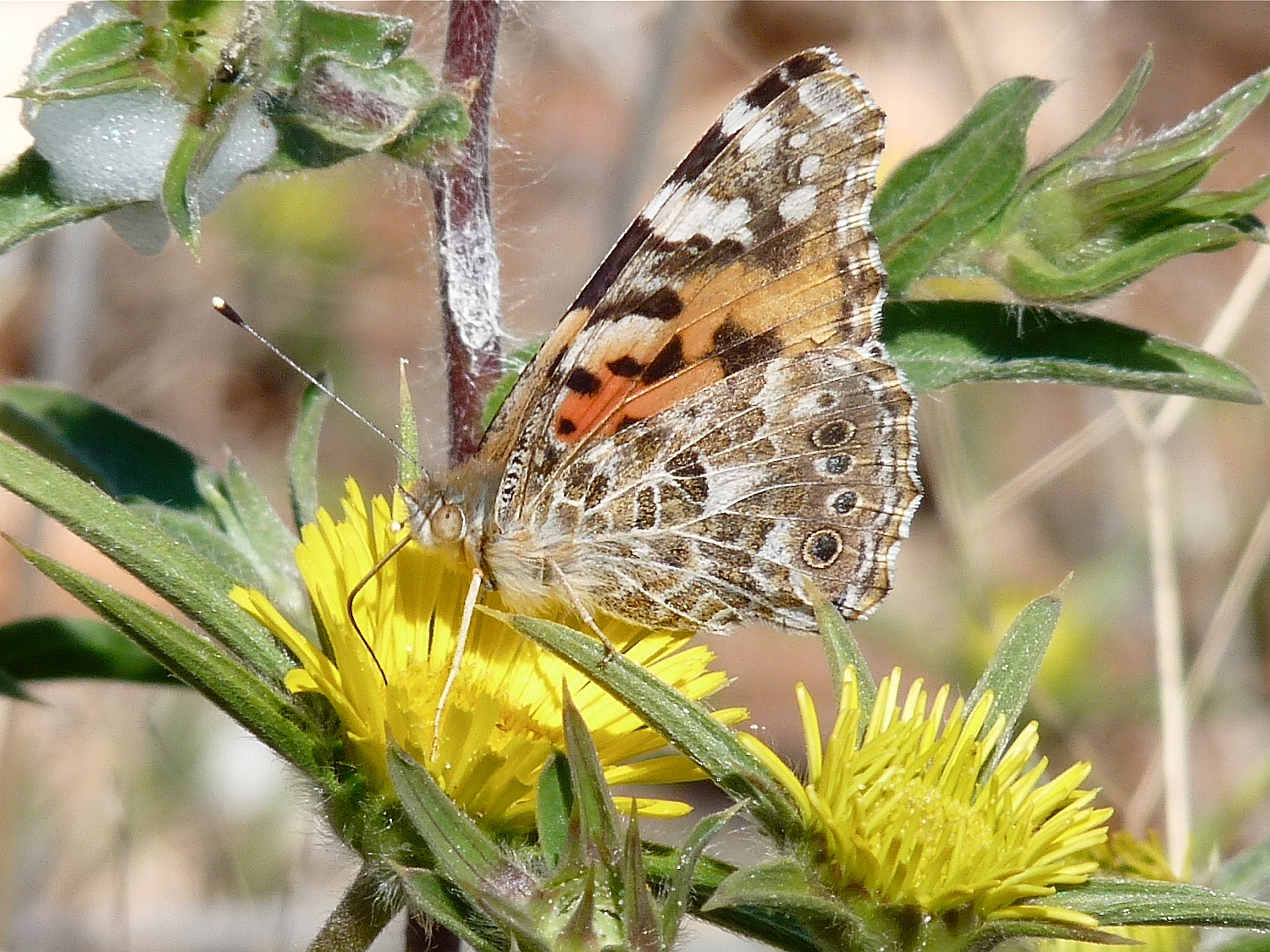
The underside of the hind wings is marbled with characteristic eye spots.
Southern comma, Polygonia egea, Cramer
The Southern comma (Polygonia egea) is rare on Naxos. I have seen it only occasionally, always in the mountains.
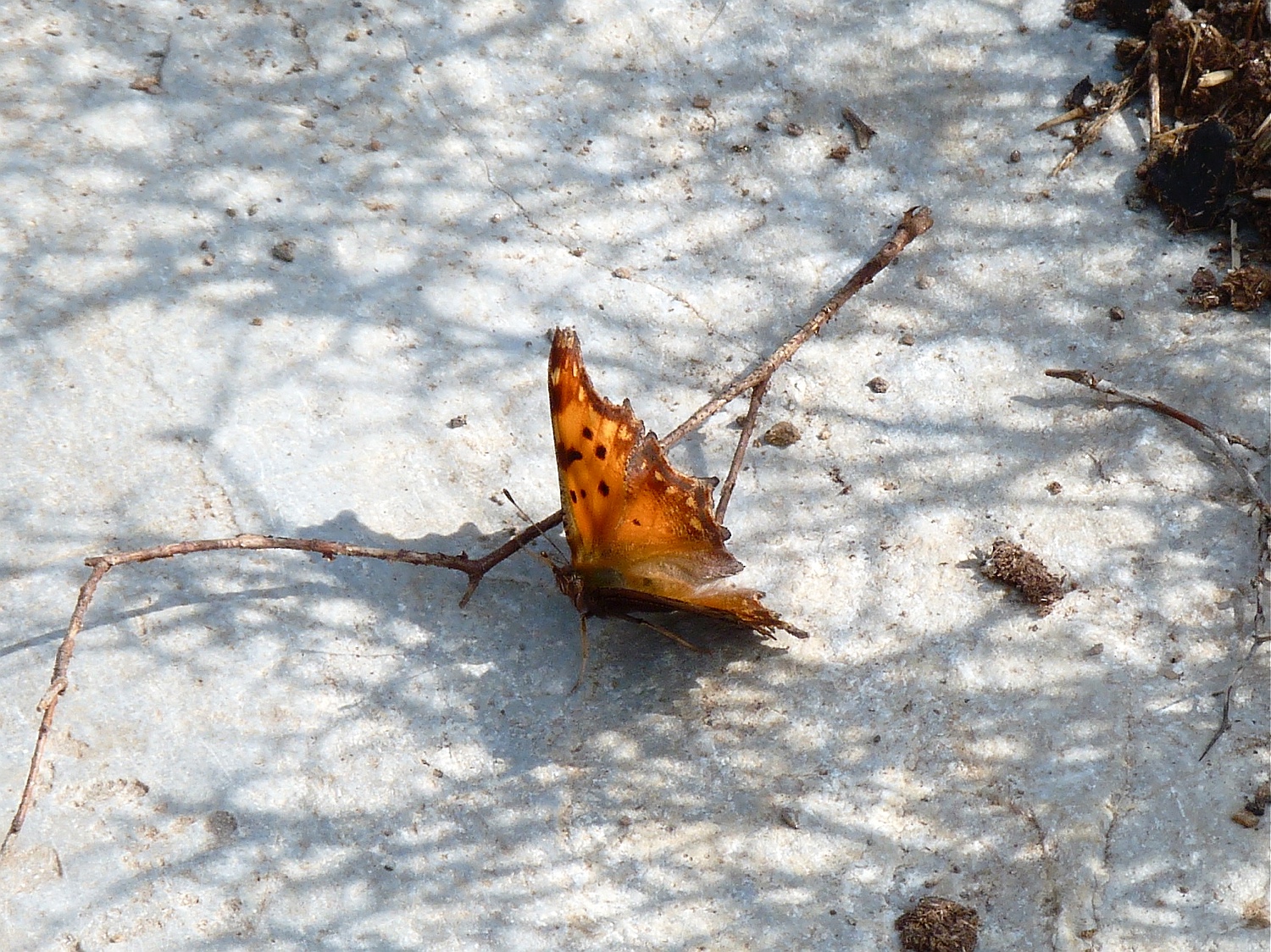
From above, the Southern comma is reddish brown in colour with a few dark spots; the bulges and jagged edges of the hindwings are characteristic.
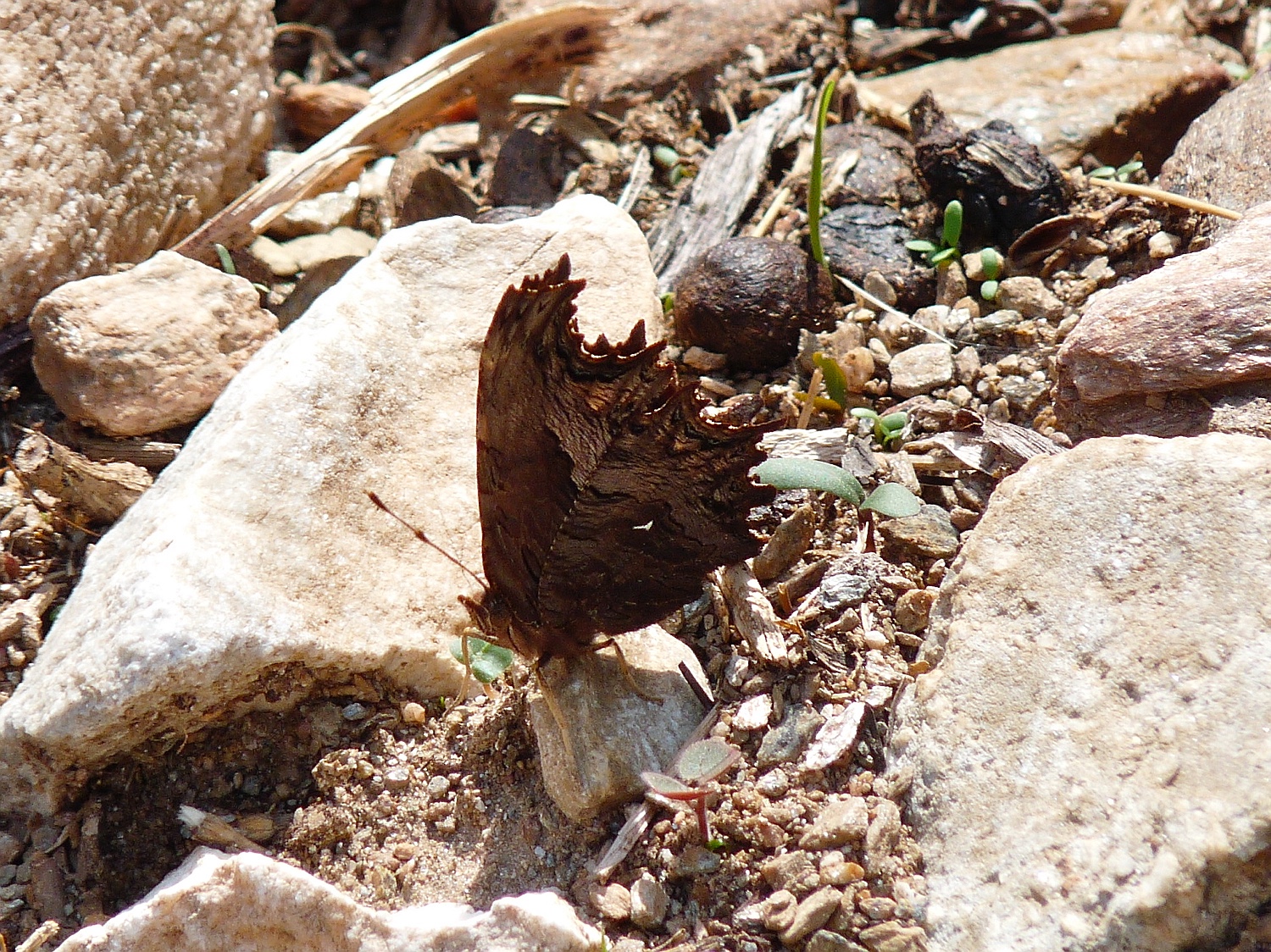
On the underside sits a small, white, Y-shaped mark, which gave the butterfly its name.
Large tortoiseshell, Nymphalis polychloros, L.
The Large tortoiseshell occurs in the Mediterranean region and in Asia. I have seen this species only once in our area. The Large tortoiseshell usually does not sit on flowers, but prefers to suck the sap of trees. The caterpillars live on willows, poplars and fruit trees. The Large tortoiseshell has an orange-brown colour with black spots and a bluish border on the edge of the hindwings. The Scarce tortoiseshell (Nymphalis xanthomelas) is very similar.
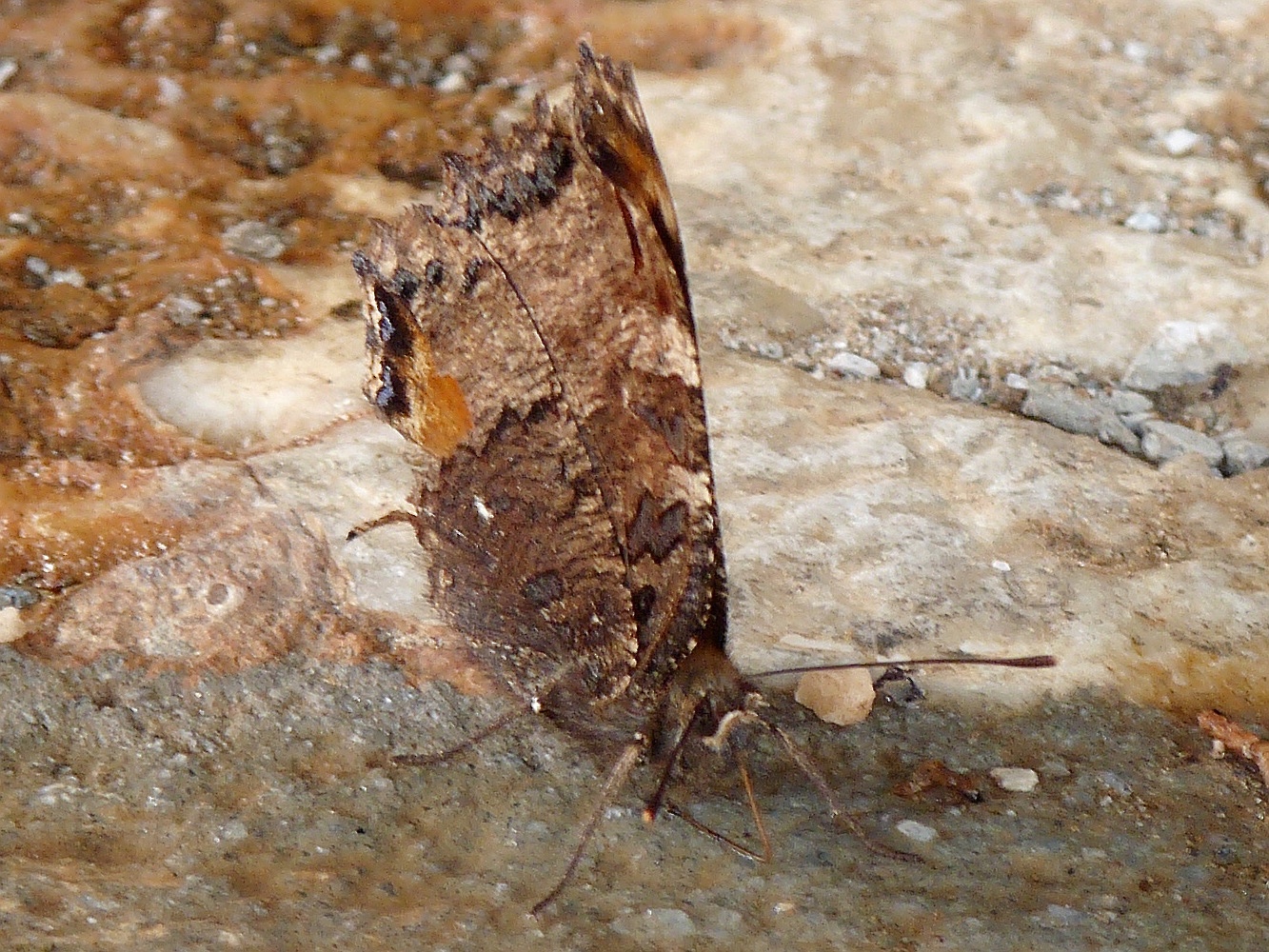
From underneath, the Large tortoiseshell is inconspicuously brown in colour.
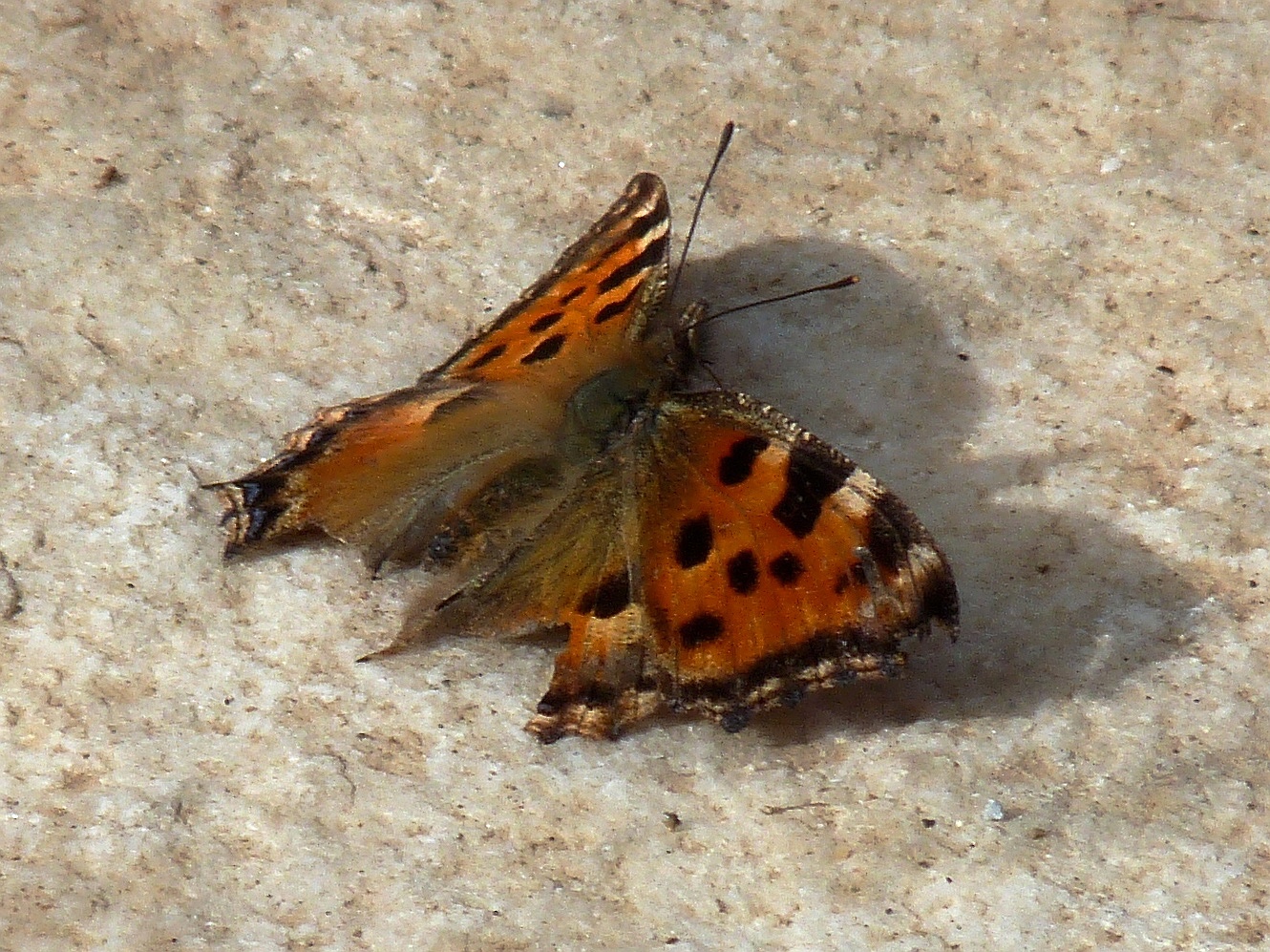
This specimen is already quite damaged. Like all brush-footed butterflies, it likes to sit facing the sun.
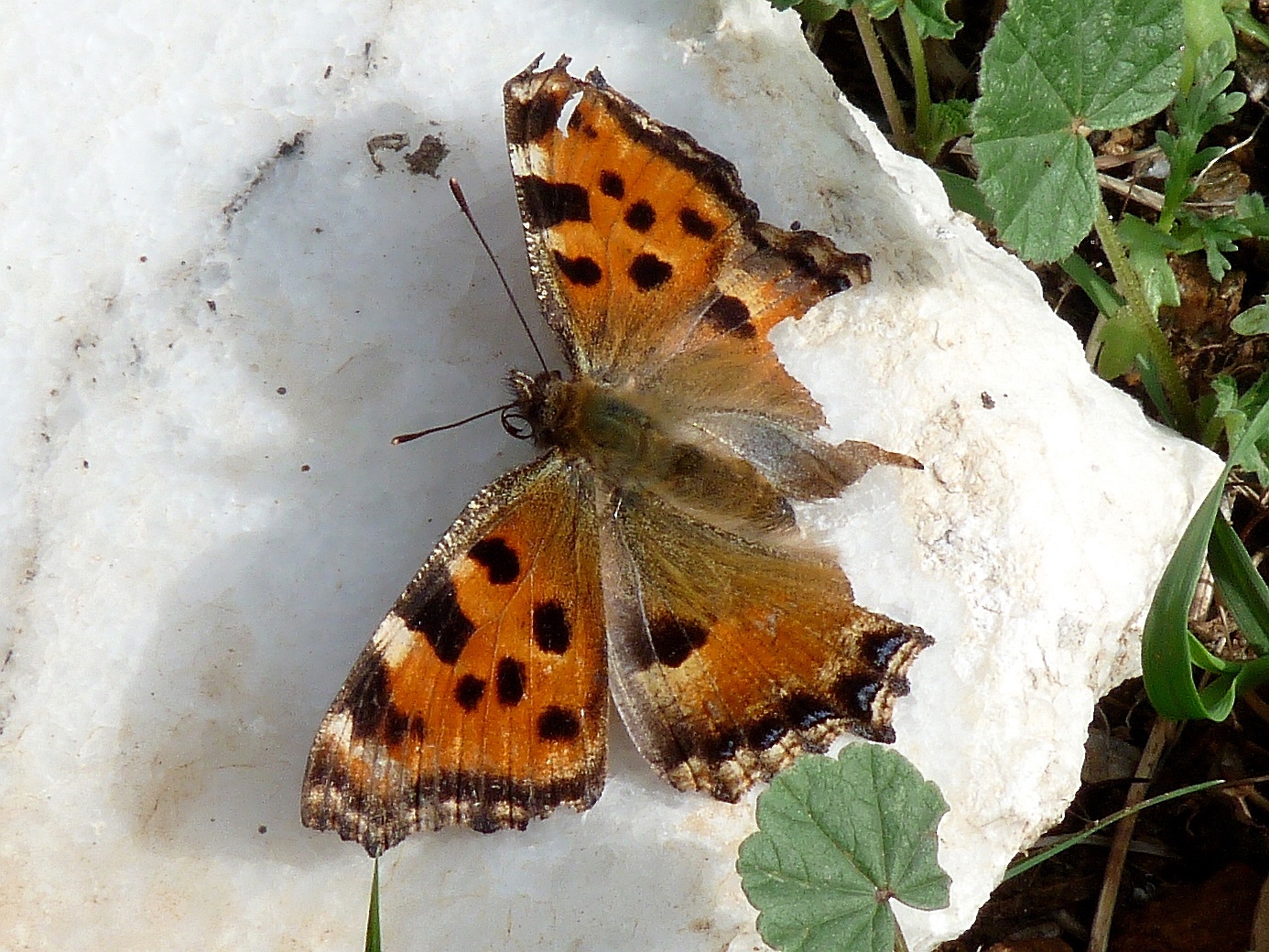
The upper side of the wings is orange-brown with black spots, with light spots in between on the front edge; the edge of the hind wing carries a discontinuous narrow blue band.
Plain tiger, Danaus chrysippus, L.
The Plain tiger or African queen belongs to the subfamily Danainae. It is widespread in Africa and Asia, especially in India, where it is the most common butterfly. In the Mediterranean region it is less common, but as a migratory butterfly in some years it appears in regions far outside its normal range. On Naxos the Plain tiger shows up only rarely; in some years though it invades the island in large numbers.
The Plain tiger has bright orange wings with a black border and striking white spots. The front wings show a large black tip with white spots. The colouring of the underside of the wings is similar to that of the upper side, although the hindwings are less brightly coloured and the wing tips are less black. There are four black spots on the hindwings, the largest of which has a white center. The body is black with white dots.
The Plain tiger is poisonous and can therefore afford to have such striking colouring: it serves as a deterrent warning colour (which, incidentally, is imitated by a whole range of other butterfly species). The flight of the Plain tiger is also very conspicuous: it glides and flutters slowly close to the ground; in our vineyard, we observed it flying the same route in circles over a long period of time.
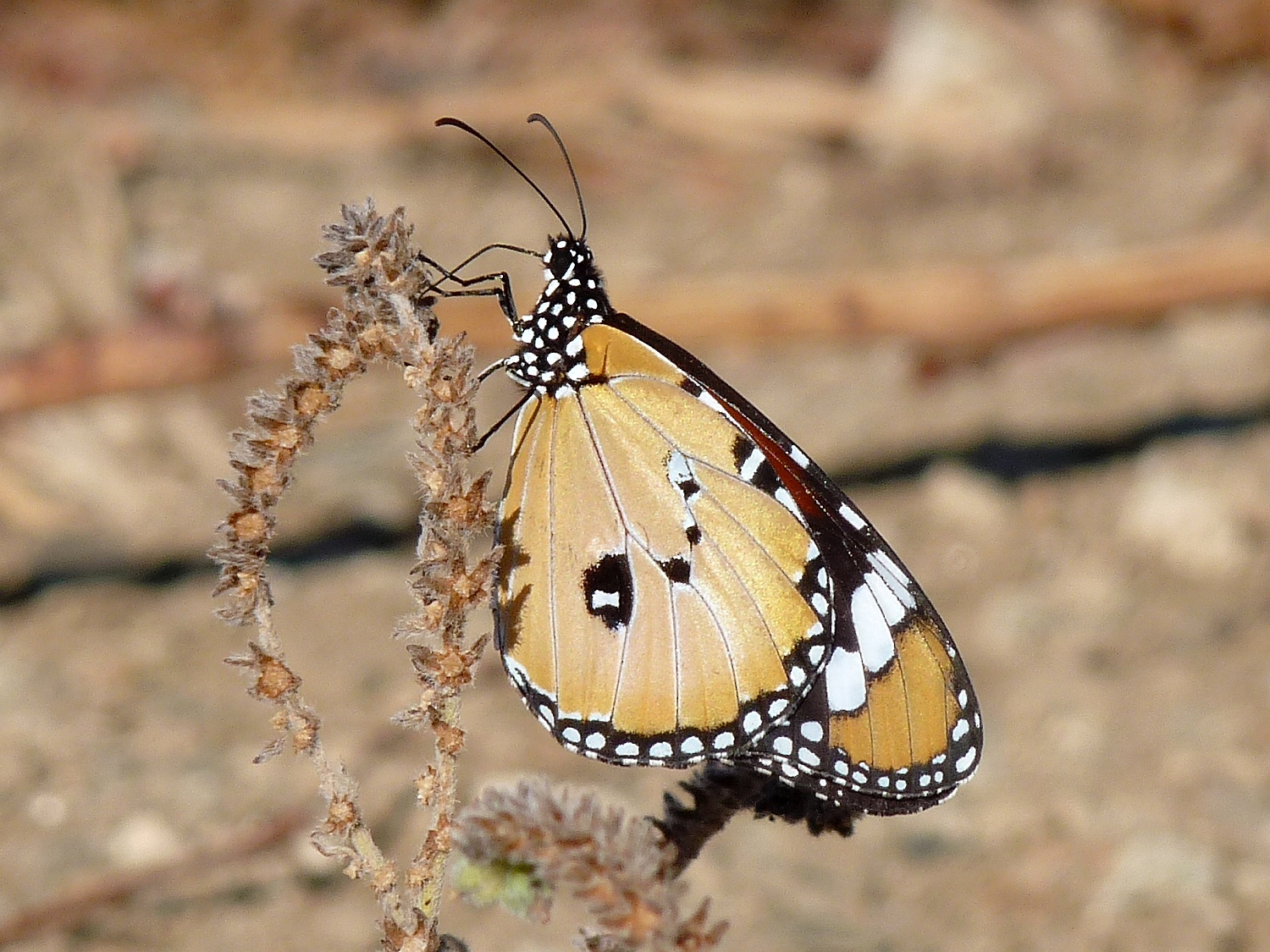
The Plain tiger has a beautiful body, which it is black with snow-white spots.
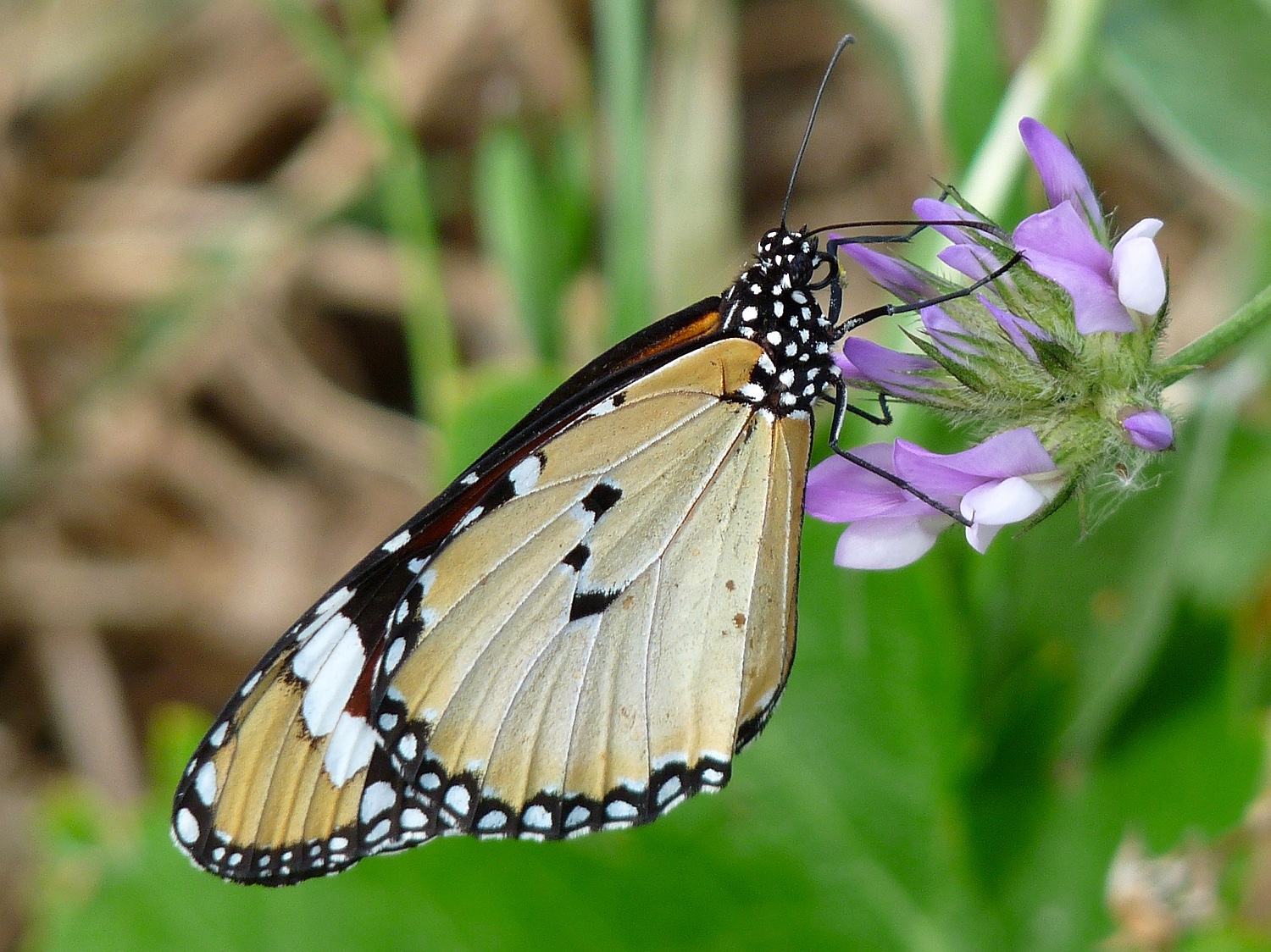
The underside of the wings is bright orange-brown in colour.
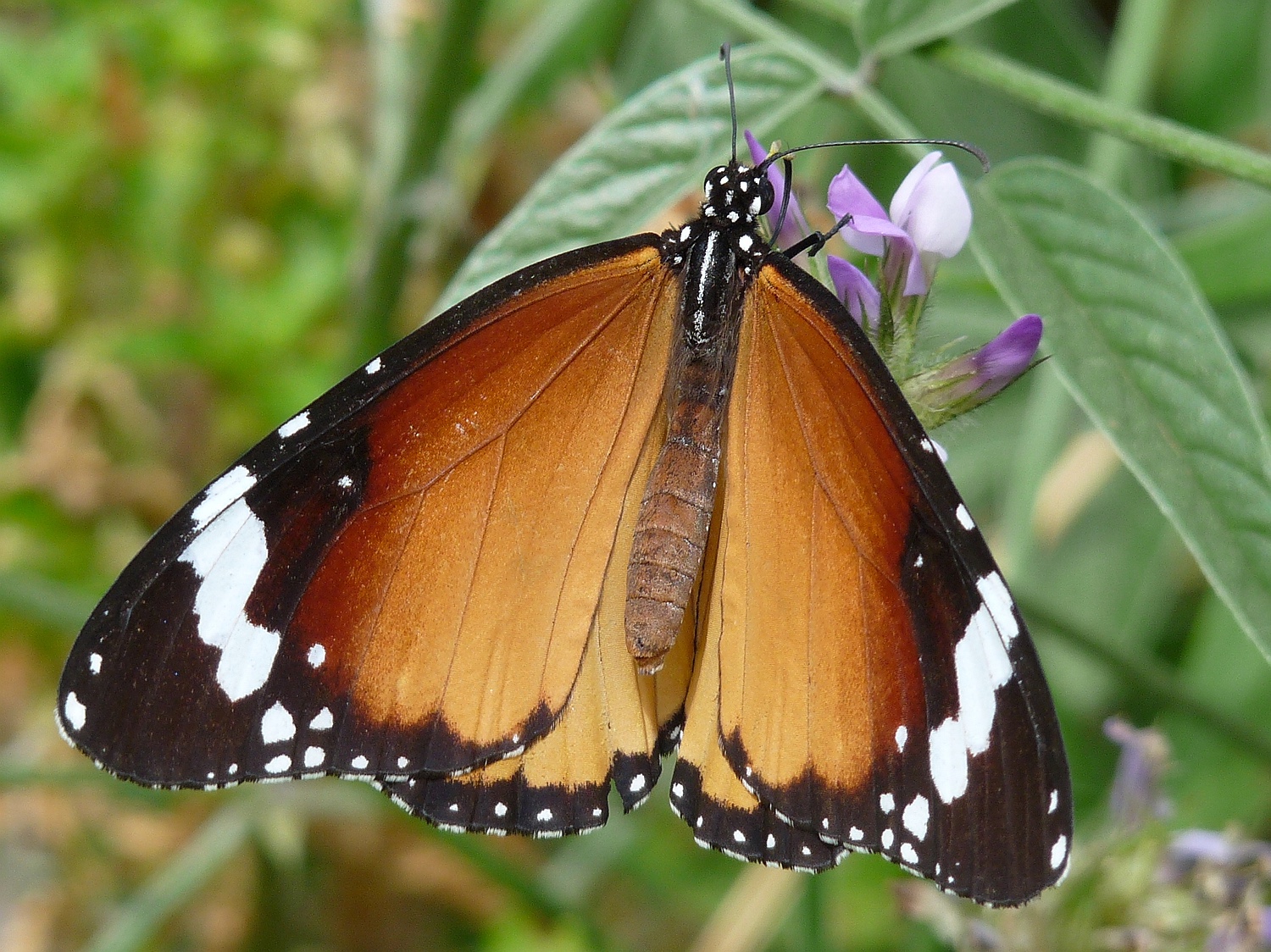
The upper side of the wings is beautifully patterned with intense colours.
Two-tailed pasha, Charaxes jasius, L.
The Two-tailed pasha (subfamily Charaxinae) is found in southern Europe (parts of Portugal, small areas in Spain and southern France, many Mediterranean islands) and North Africa, but has become rare in most regions. It usually lives in scrubland or on the edges of forests. With a wingspan of up to 9 cm, this species is the largest European butterfly.
The Two-tailed pasha has a velvety brown upper side with a yellow stripe at the edge; the underside, on the other hand, is intensely patterned in white and reddish-brown colours. I have only seen this beautiful species two or three times, right in our garden, where it was flying around the olive and fruit trees. Its large size makes it quite conspicuous when it is flying, but once it landed, I had great difficulty to spot it, even though I had seen exactly where it had settled: it is so well camouflaged that it took my brain a long time to identify it in the vegetation and in the play of light and shadow.
The caterpillars of the Two-tailed pasha live exclusively on strawberry trees (Arbutus), which on Naxos grow only in a very small area near Skepóni. The butterfly had not previously been recorded from Naxos or the Cyclades. It is unlikely that the species is native to the island; probably these were individuals that were wandering about.
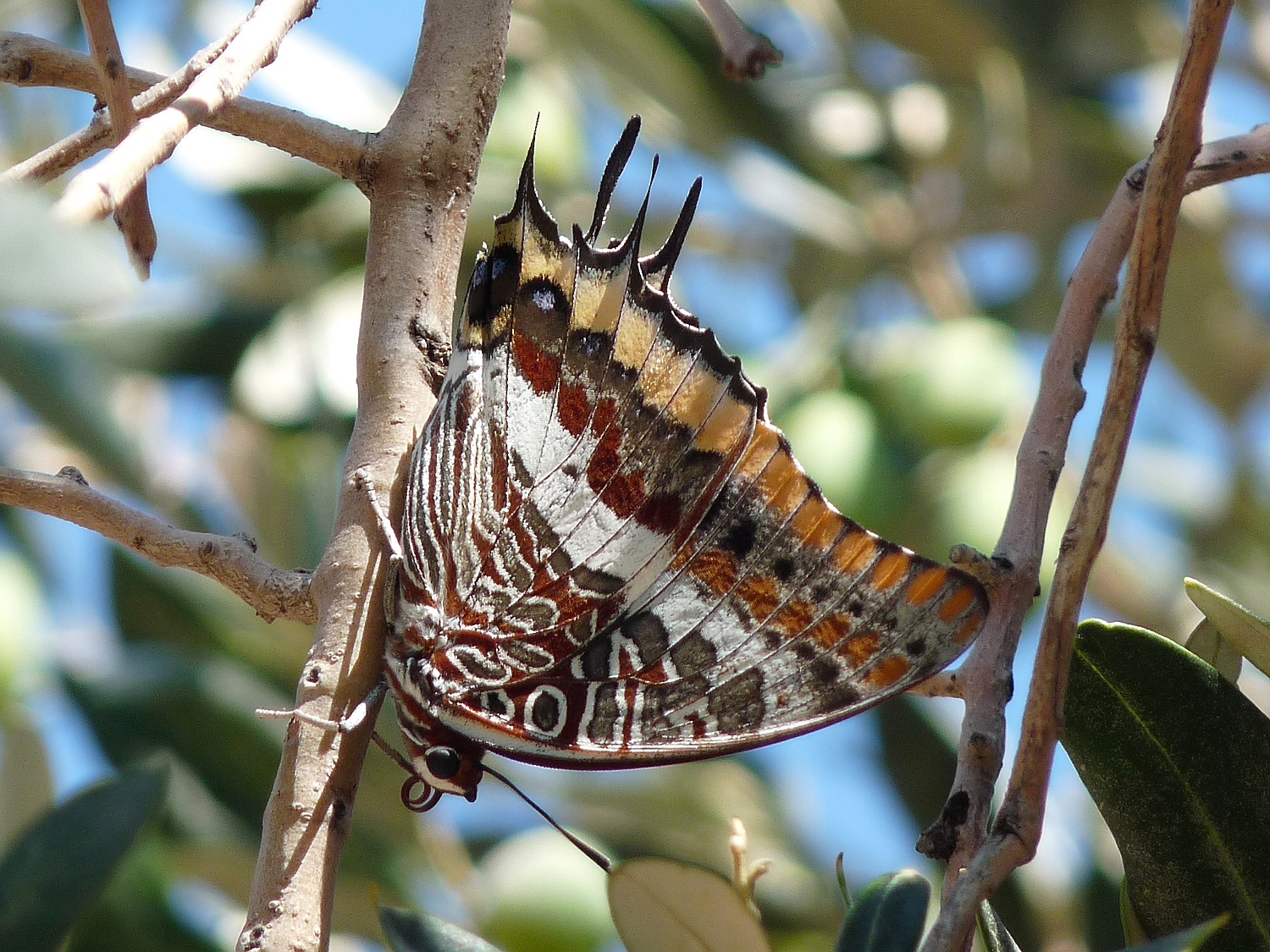
The rare Two-tailed pasha with its beautifully patterned underside is unmistakable. It is the largest European butterfly.
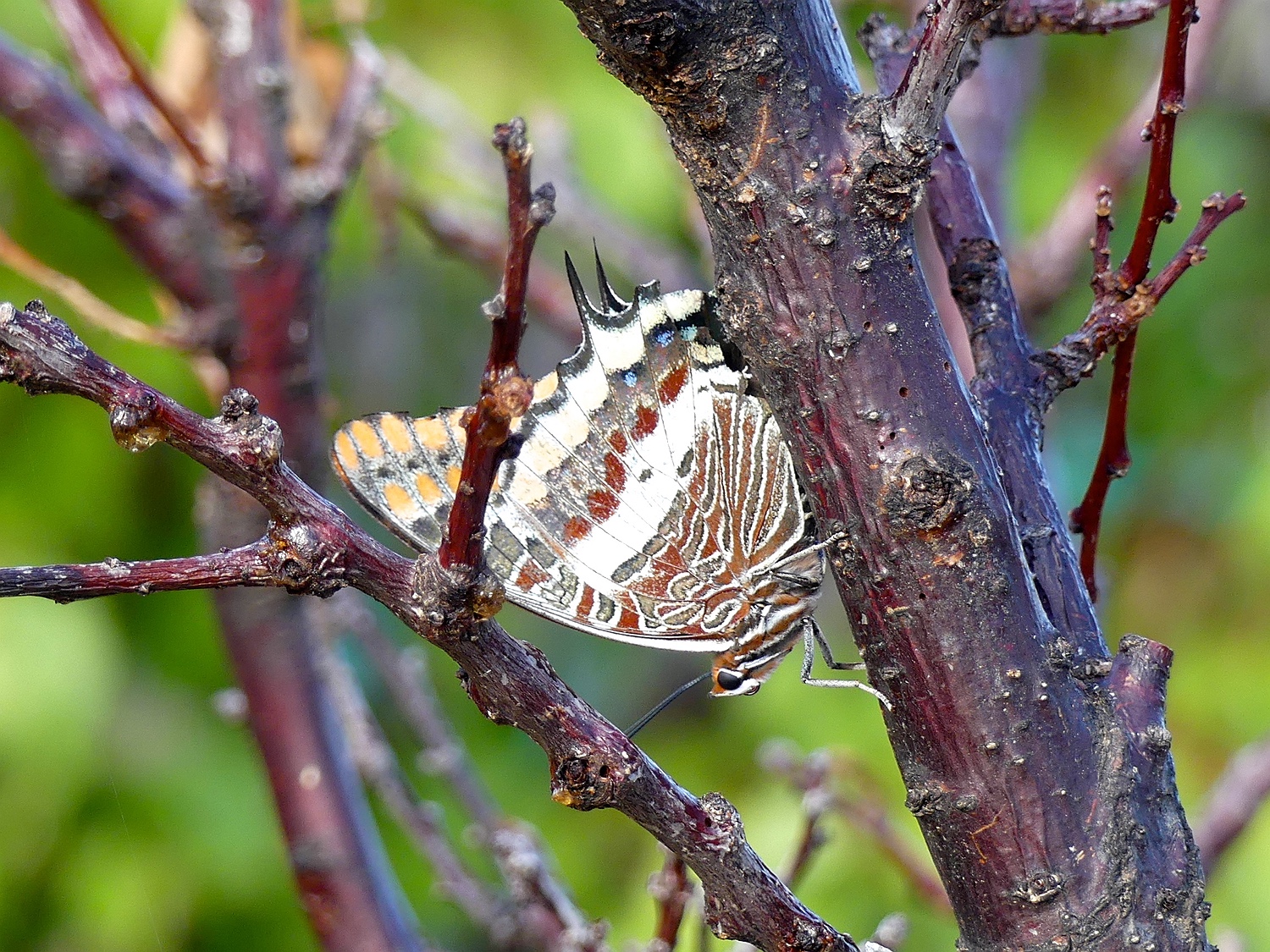
Even though it seems hard to believe, I could hardly spot this butterfly, even though I had seen exactly where it had landed. The pattern on its wings apparently confuses our brain so much that we overlook the animal.
Subfamily Browns or Satyrines, Satyrinae
The Satyrinae, a large subfamily of the Nymphalidae, comprise species that are predominantly brown in colour with distinct ocelli (eye spots) on their wings. The caterpillars of these species live on grasses; many have a particularly long development period. Many species have become rare in Europe, especially those whose caterpillars live in dry, nutrient-poor meadows.
Meadow brown, Maniola jurtina, L.
The Meadow brown is very common on Naxos. It is not very shy and easy to observe. It is territorial; in our garden one can see the Meadow browns often in the same places. Browns almost always sit with their wings closed; the upper side of the wings can rarely be seen.
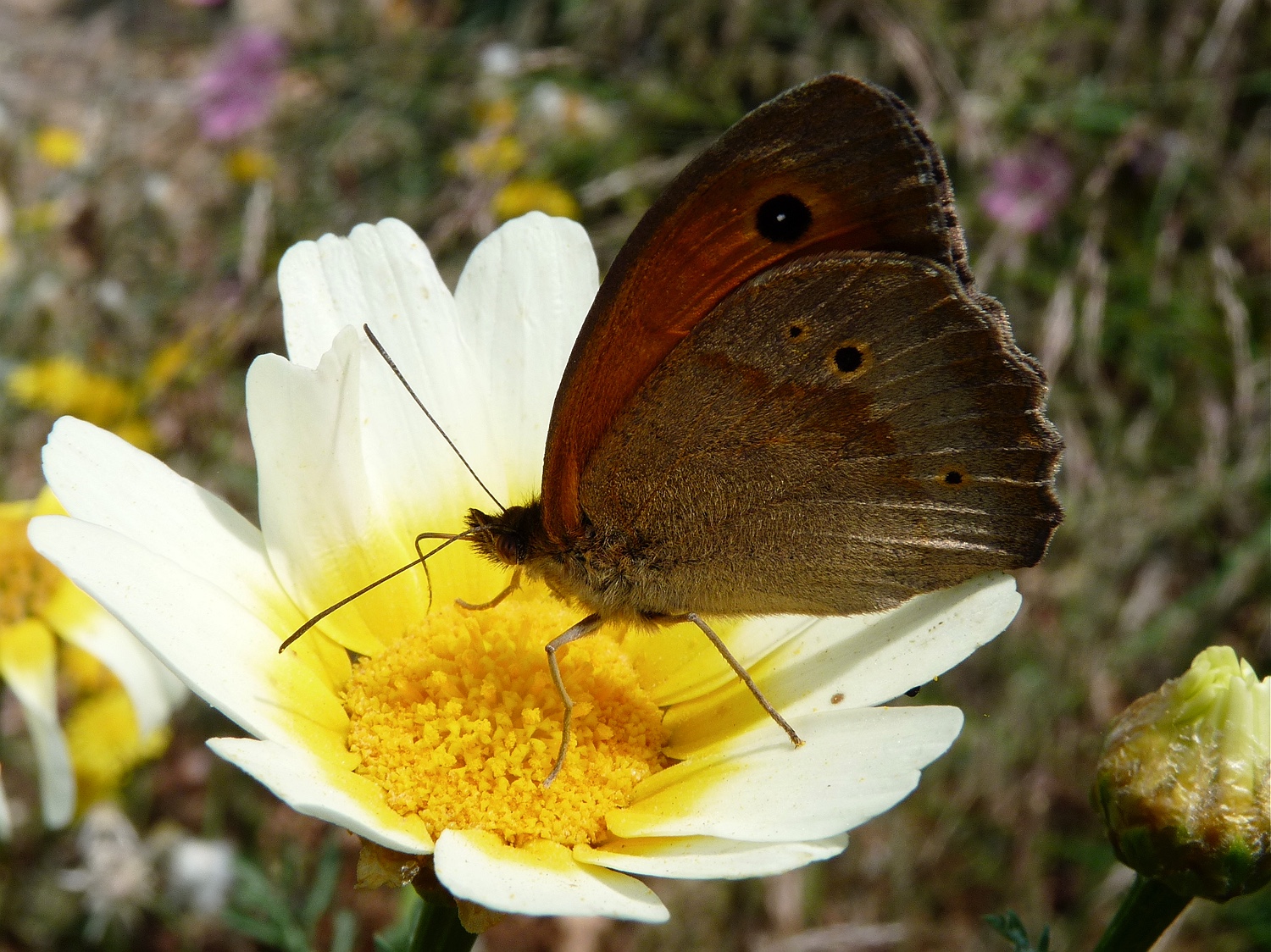
This species shows an ocellus on the underside of the forewing and three small spots on the hindwing.
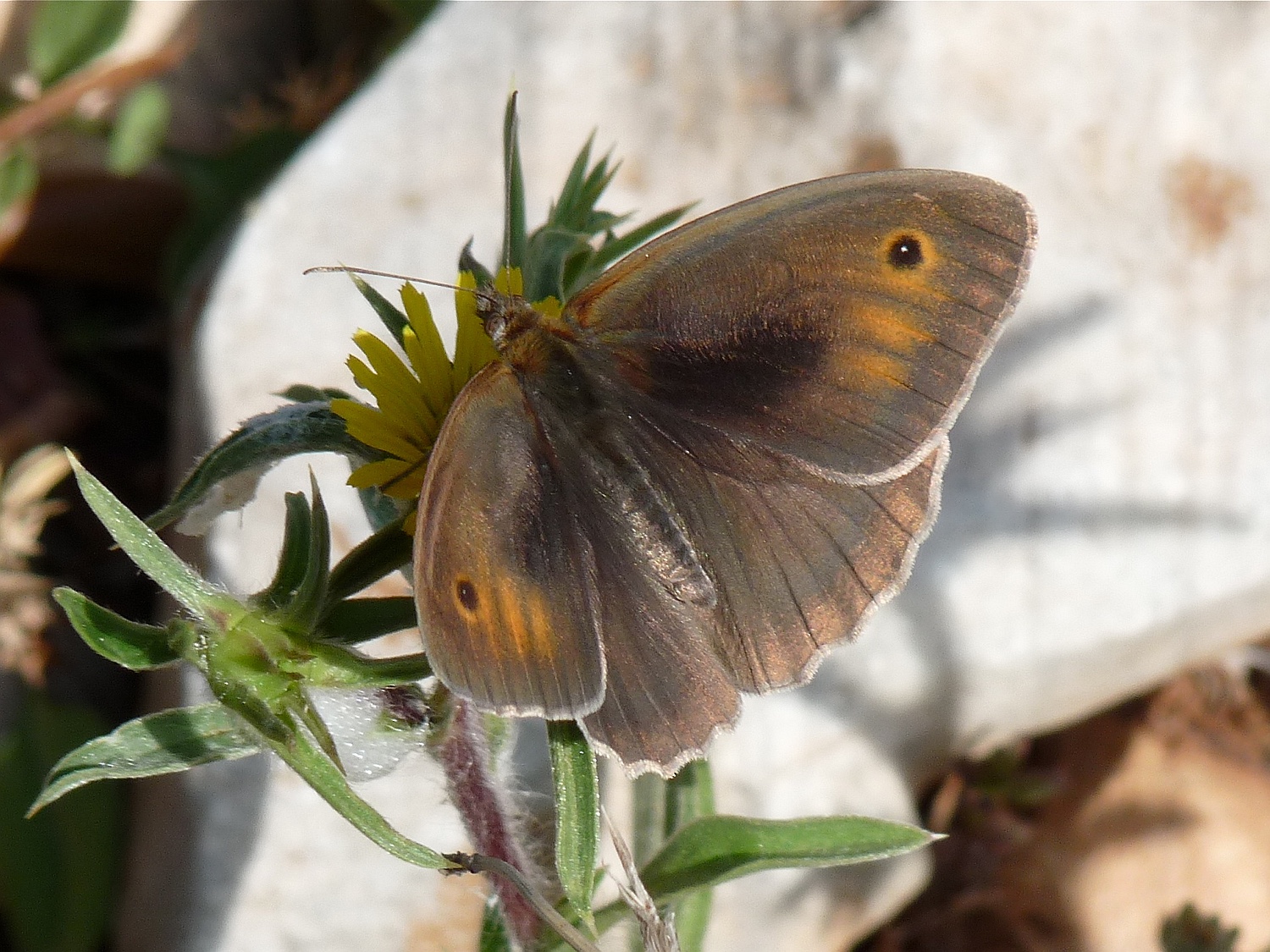
The upper side of the wings is very dark with a single small ocellus on the forewing.
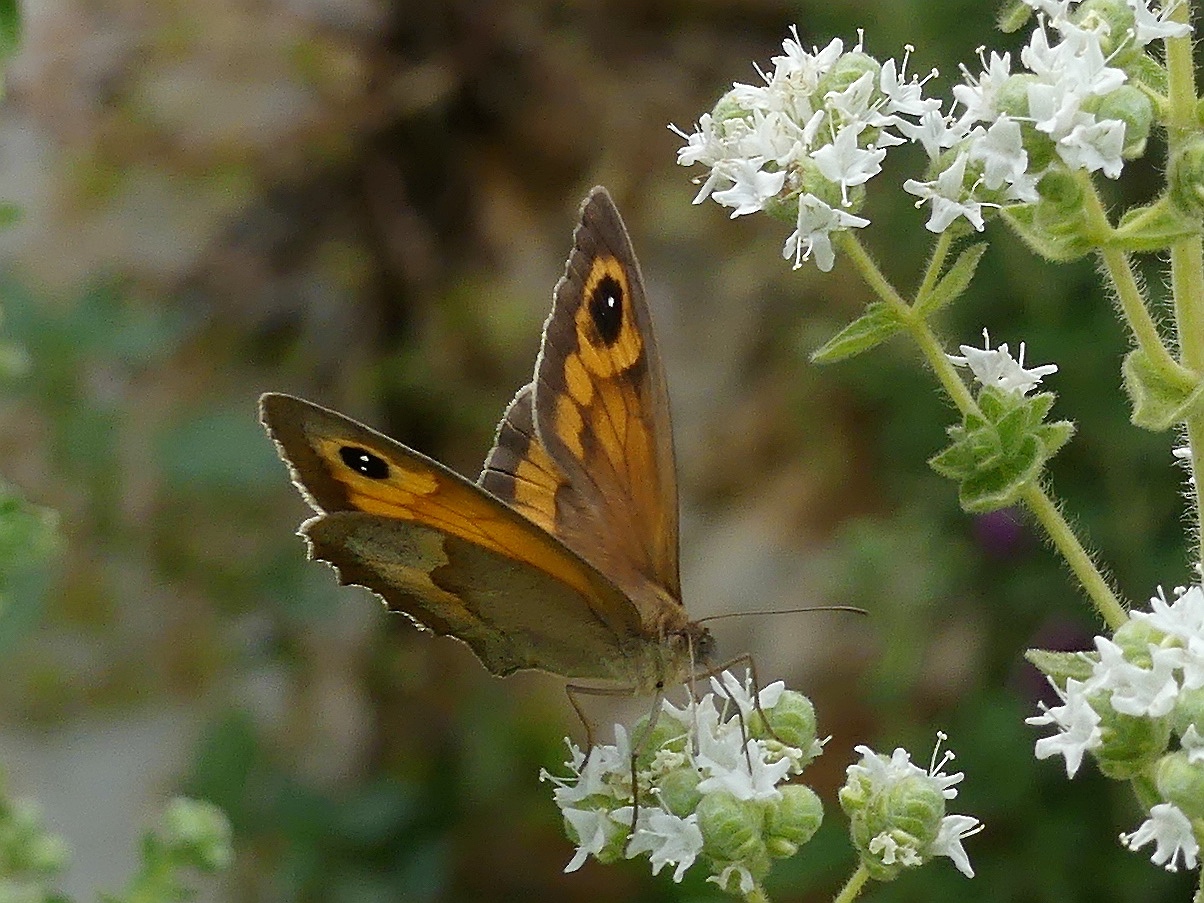
The female of the Meadow brown looks significantly different from the male.
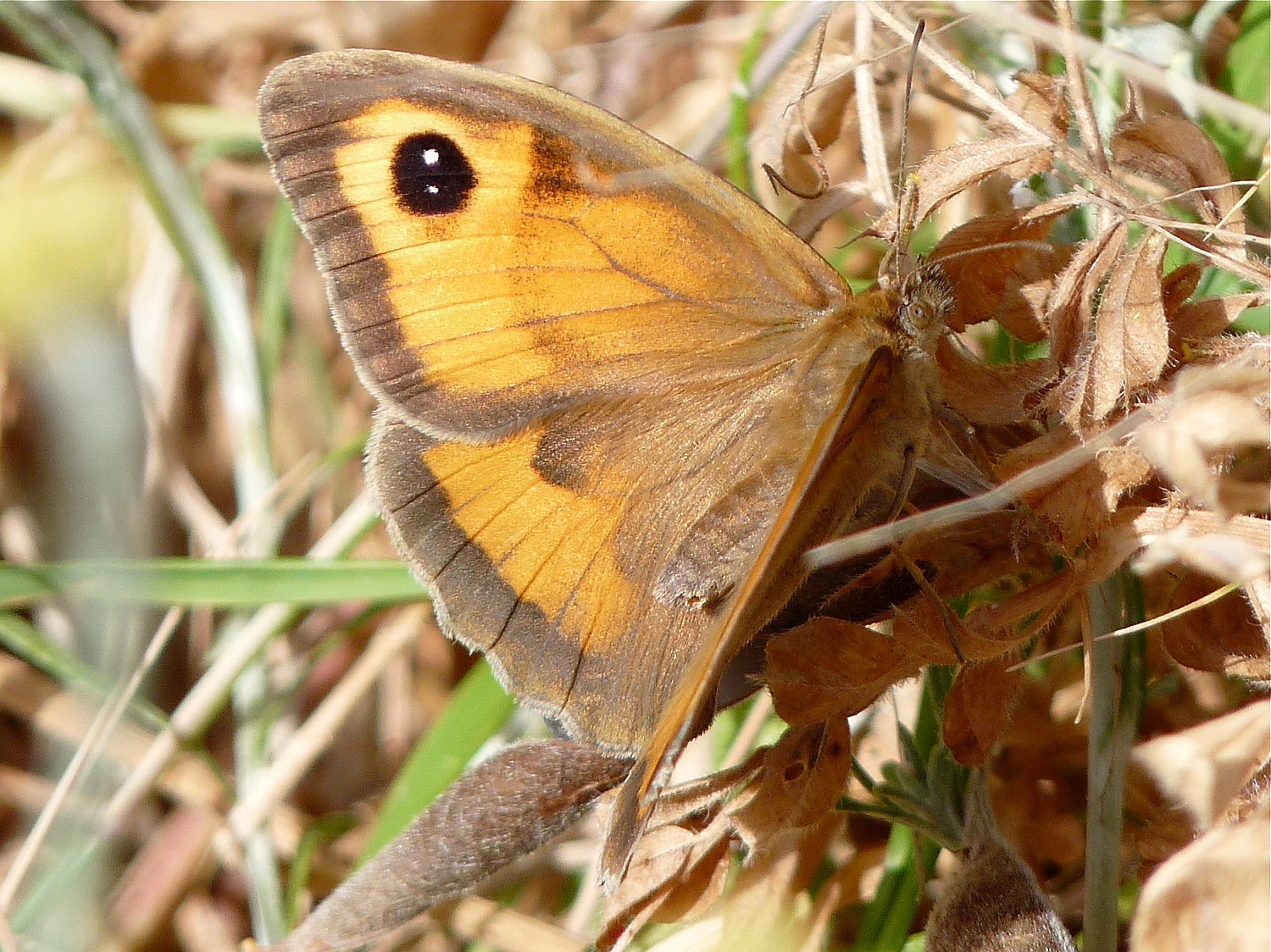
Its wings have a light brown upper side with a broad dark border and a large ocelli with two white dots.
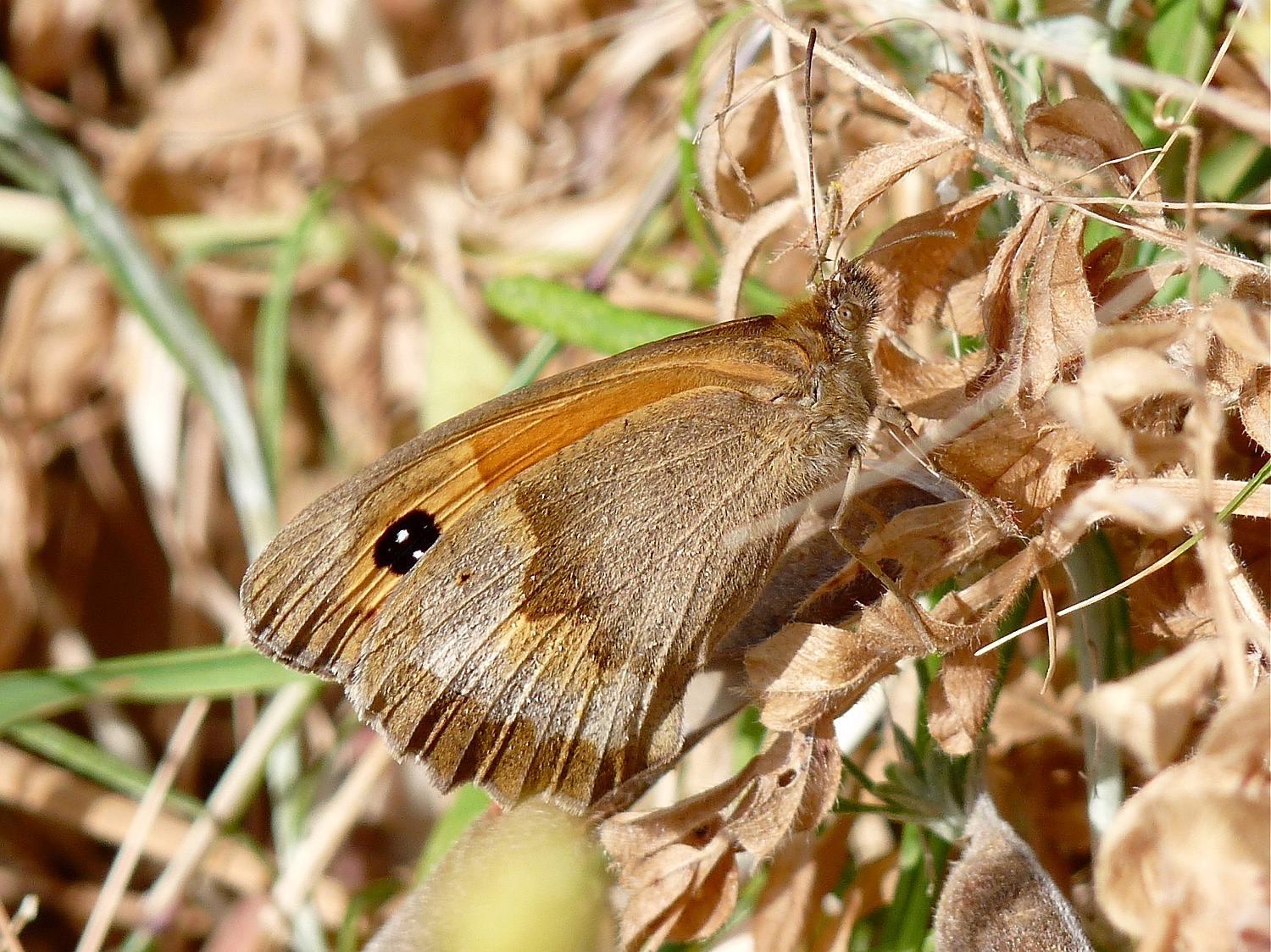
The underside of the forewing has a similar pattern, while the hindwing has a delicate brownish colour.
Wall brown, Lasiommata megera, L.
As far as the Wall brown is concerned, one can see how worthwhile it is to look closely. From a distance, this Wall brown looks very similar to the previous species; only on closer inspection can you see the pretty markings on the upper side and the beautiful ocelli on the underside of the wings. The Wall brown is rare in our region.
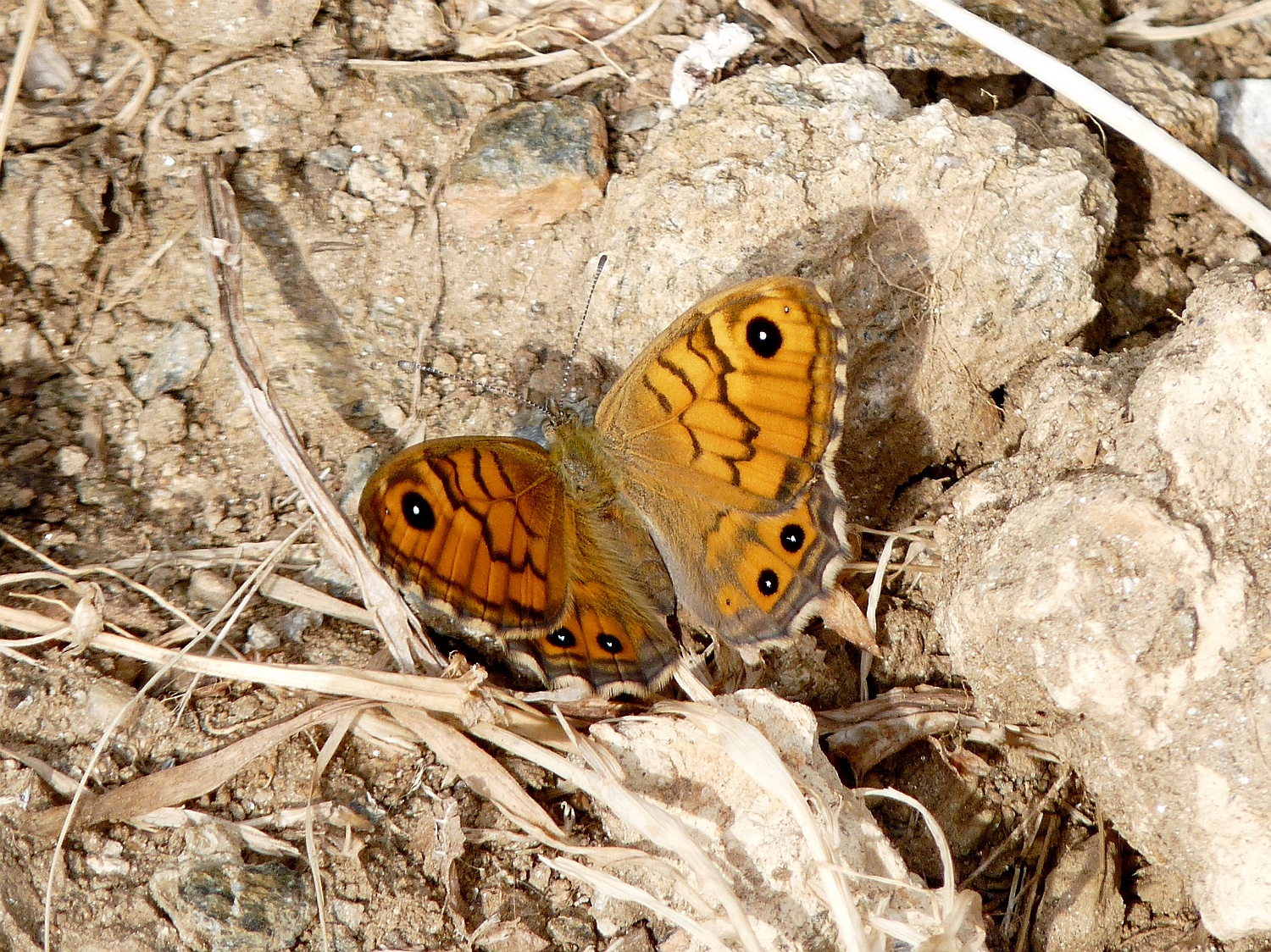
The Wall brown too usually sits with its wings closed; it is difficult to manage to photograph the upper side.
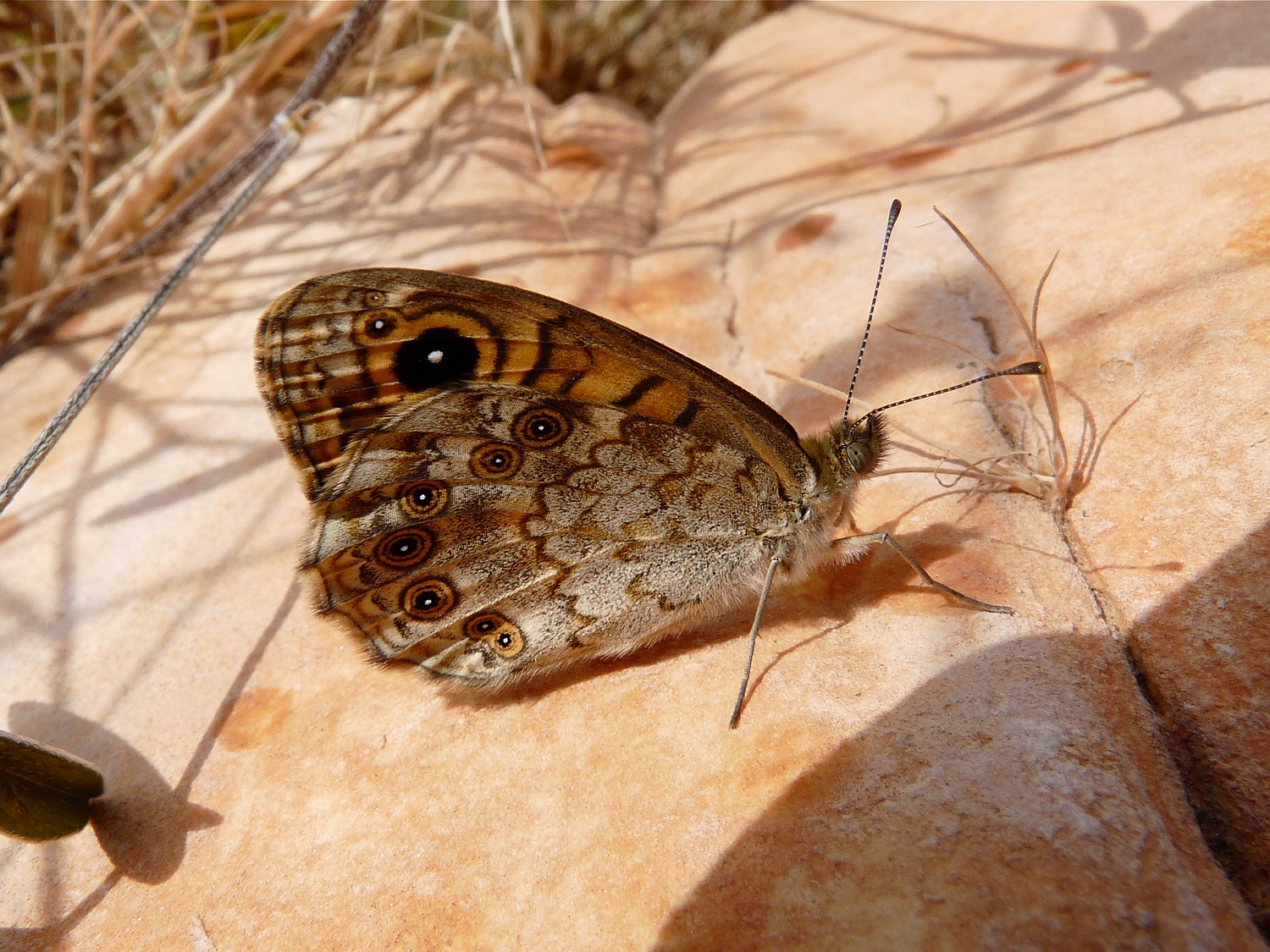
The underside of the wings with their ocelli looks even prettier than the upper side.
Balkan grayling, Hipparchia senthes, Fruhstorfer
This species, which is widespread in the southern Balkans, occurs on Naxos mostly in the mountains. It prefers more shady areas in the mountains. The underside of the hind wings of the Balkan grayling carries a light, jagged band. I would like to express my thanks to Lepiforum for helping me identify this and other species.
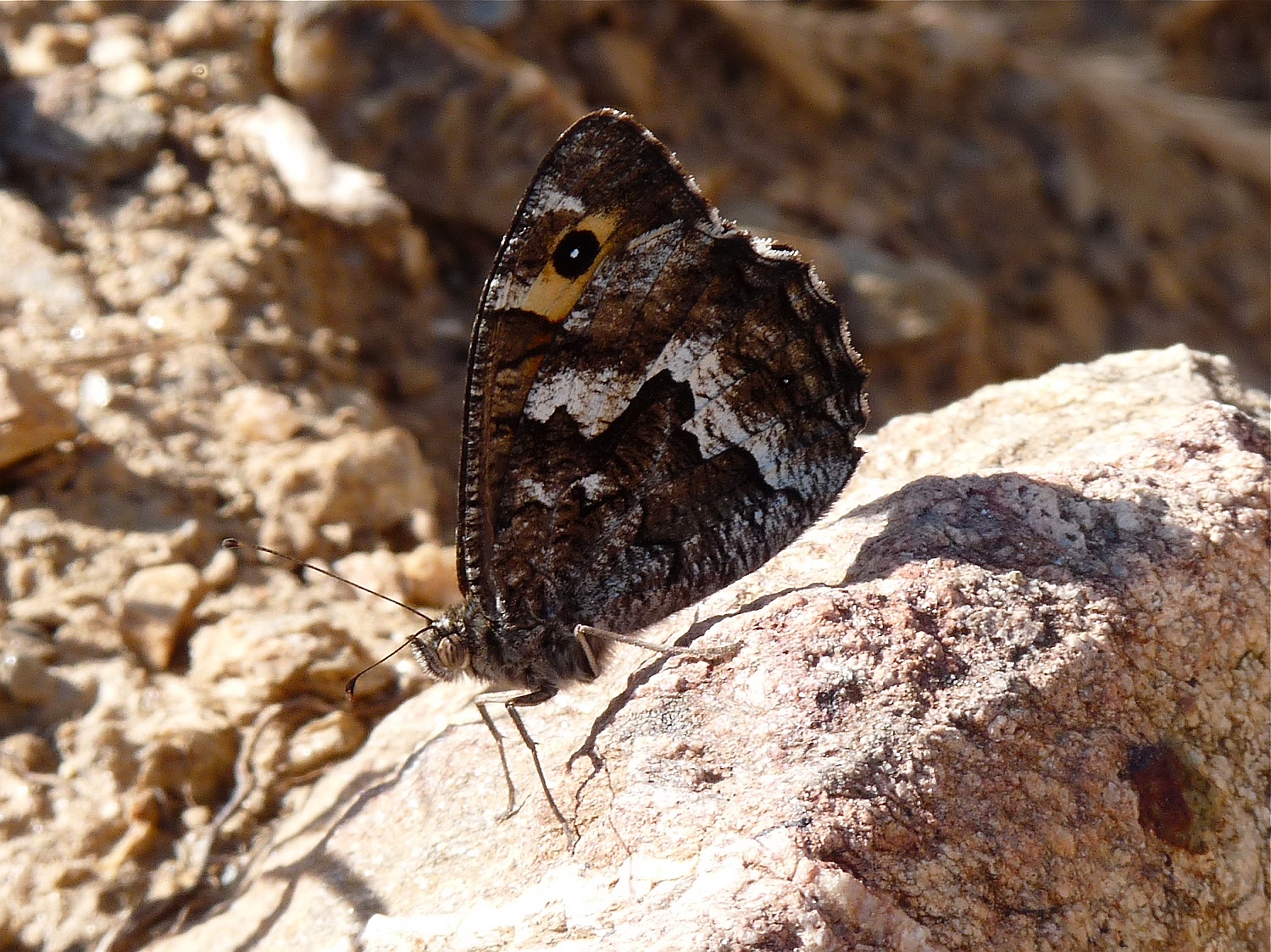
The Balkan grayling can be recognised by the jagged light band on the underside of the hind wings.
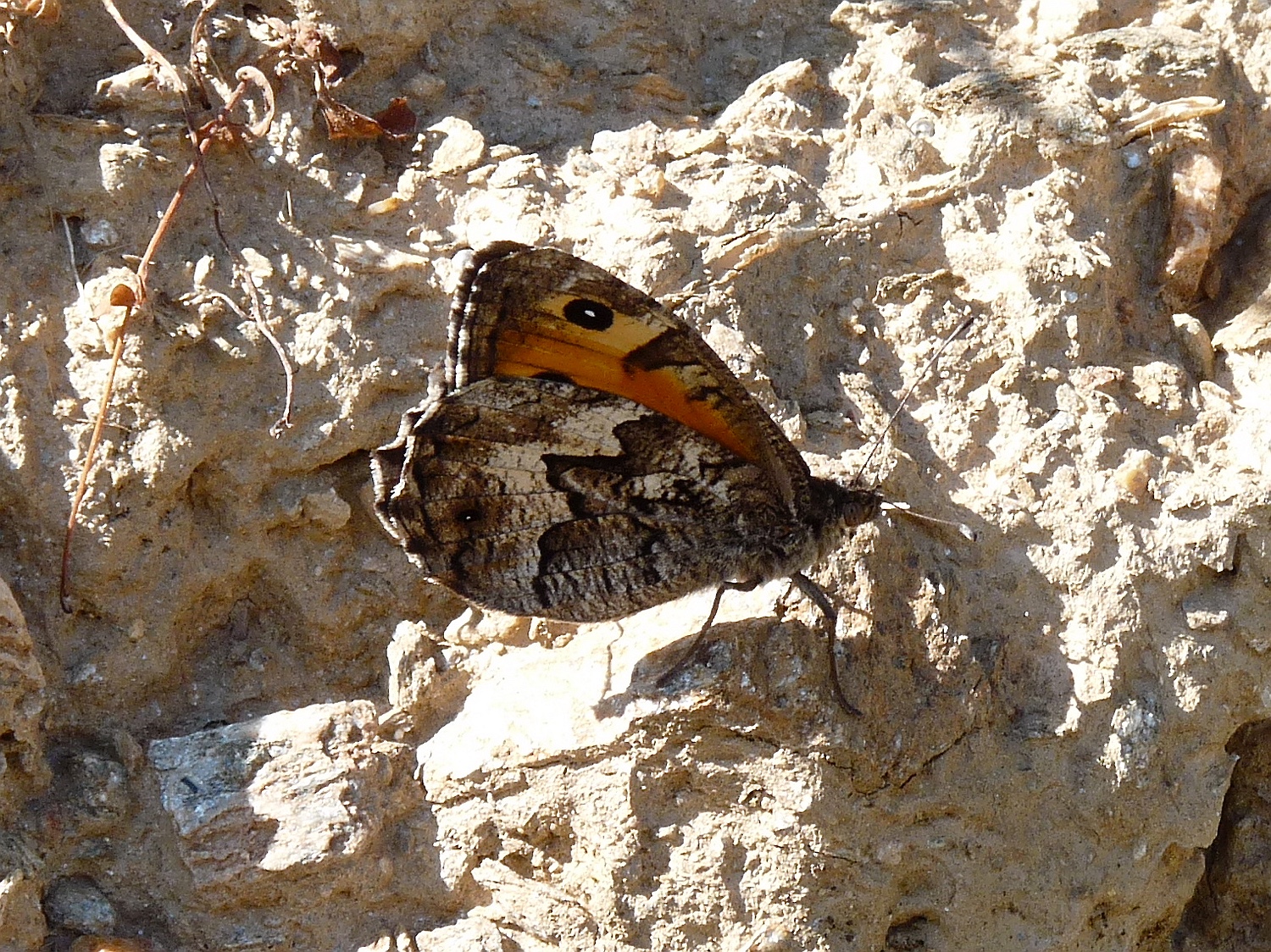
The underside of the forewings is orange and carries two ocelli.
Lattice brown, Kirinia roxelana, Cramer
The Lattice brown can be found on Naxos only in the shady and relatively moist woods in the mountains around Komiakí. Its distribution is restricted to the eastern Mediterranean region (in Europe it occurs only in Greece and Turkey).
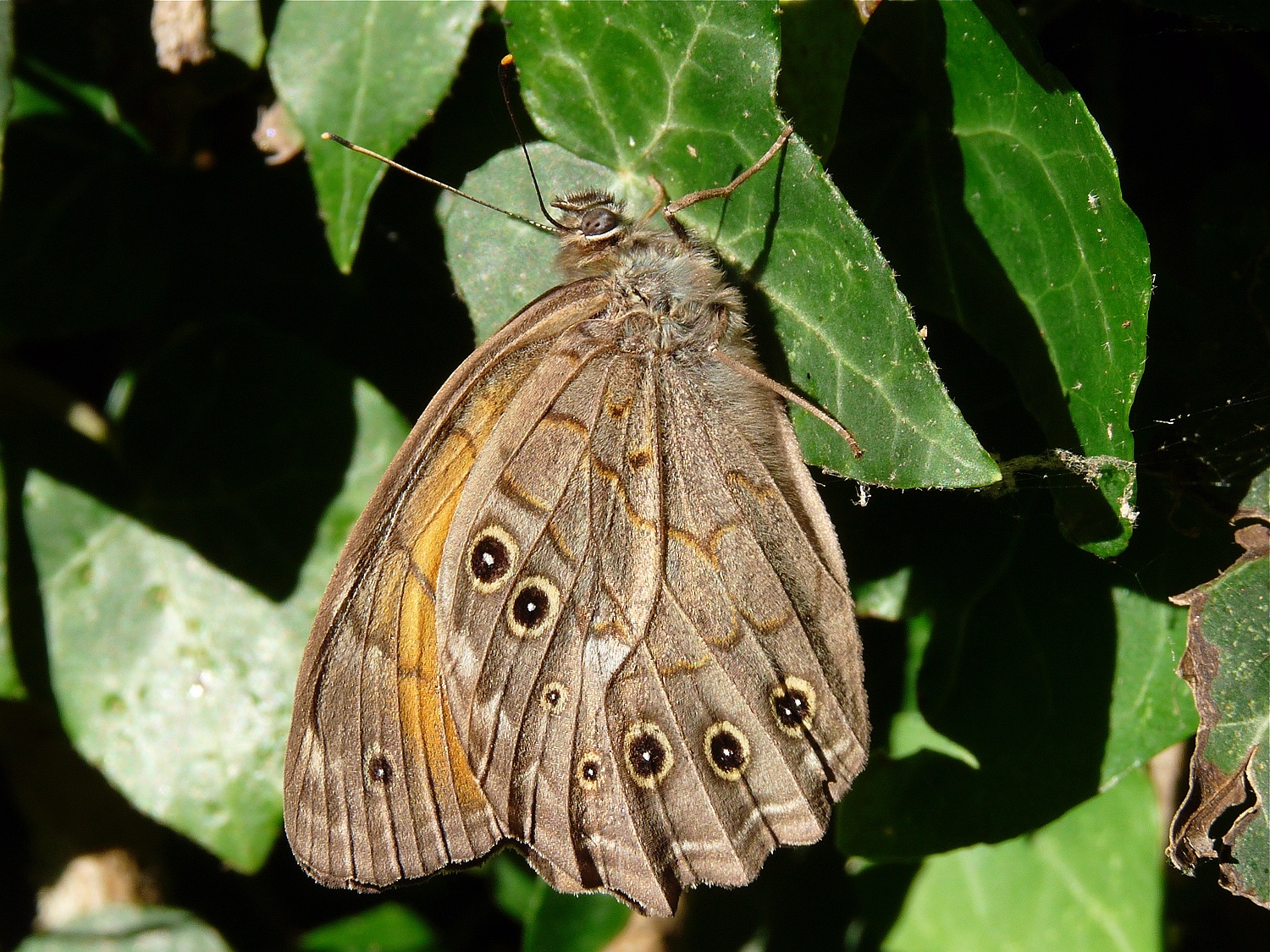
The pretty Lattice brown with its many ocelli on the underside of its hind wings lives in shady, damp places such as here by a river.
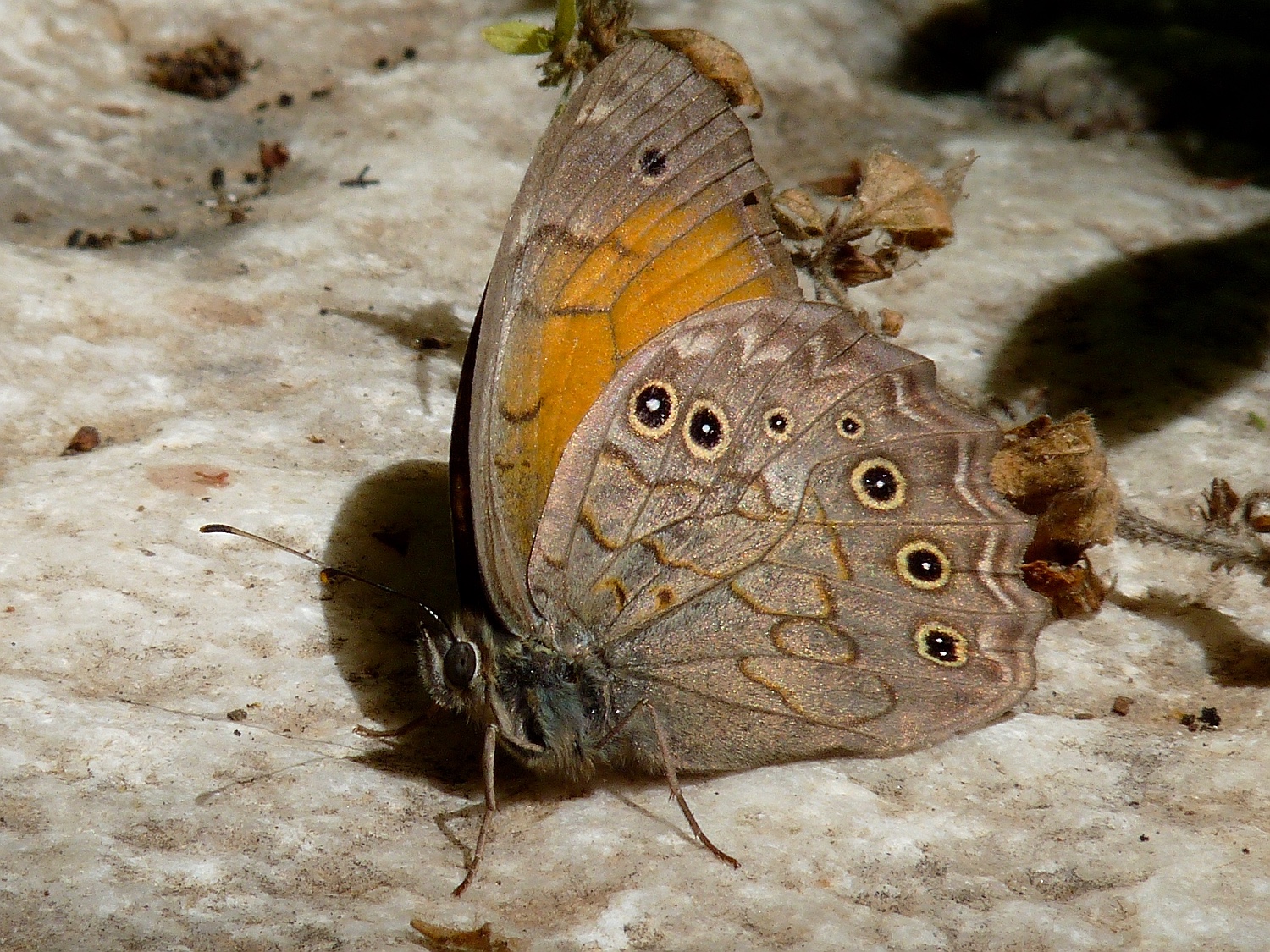
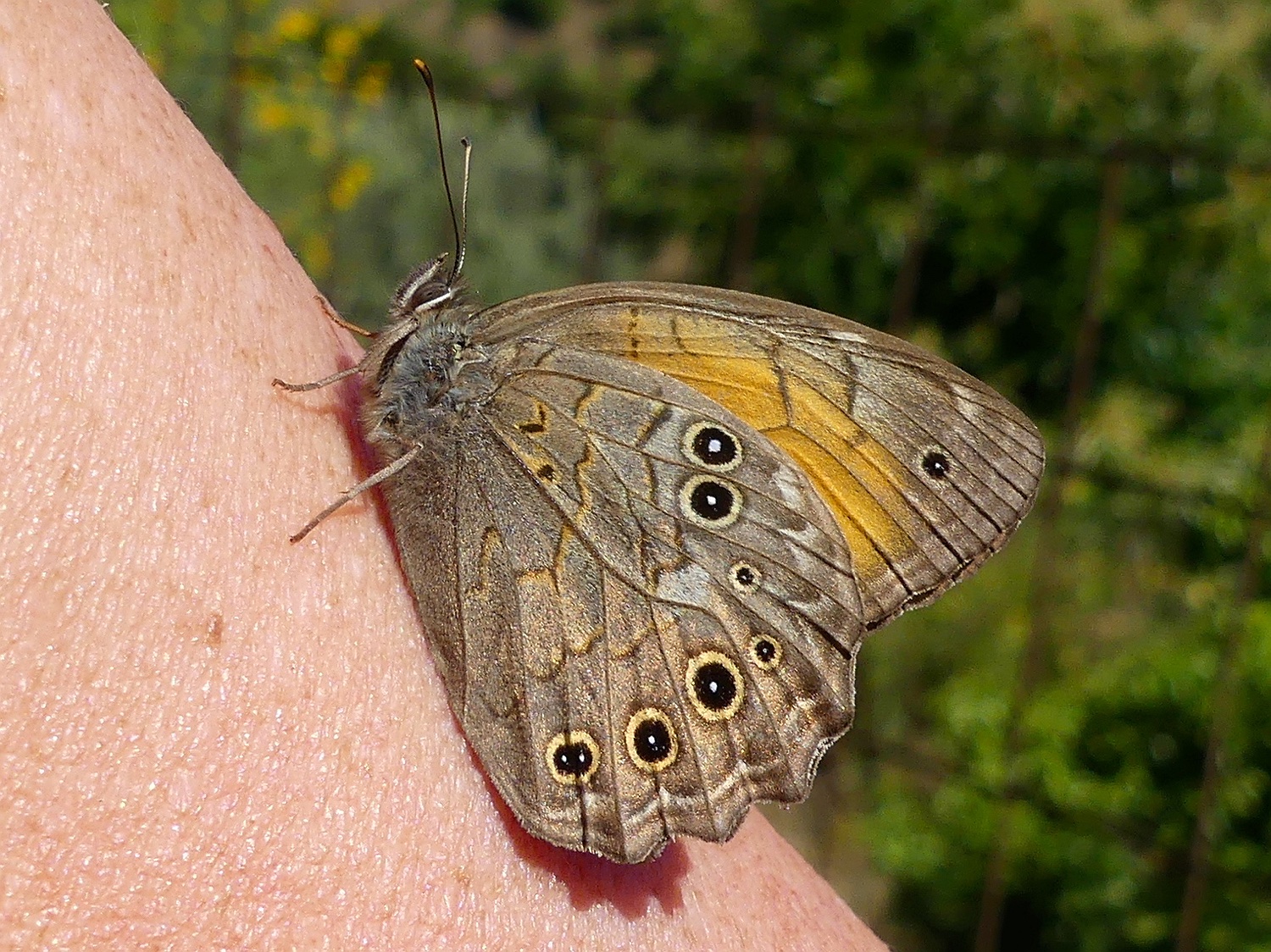
So far, I have encountered this species only in the forested areas around Komiakí.
Pieridae
The Pieridae are mostly white or yellowish in colour. This makes them very conspicuous in flight; in contrast, they are difficult to spot when sitting, even if you have seen exactly where they have settled. The caterpillars live mainly on cruciferae and leguminosae.
Large white, Pieris brassicae, L.
The Large white is widespread in Europe and is considered a significant pest in agriculture.
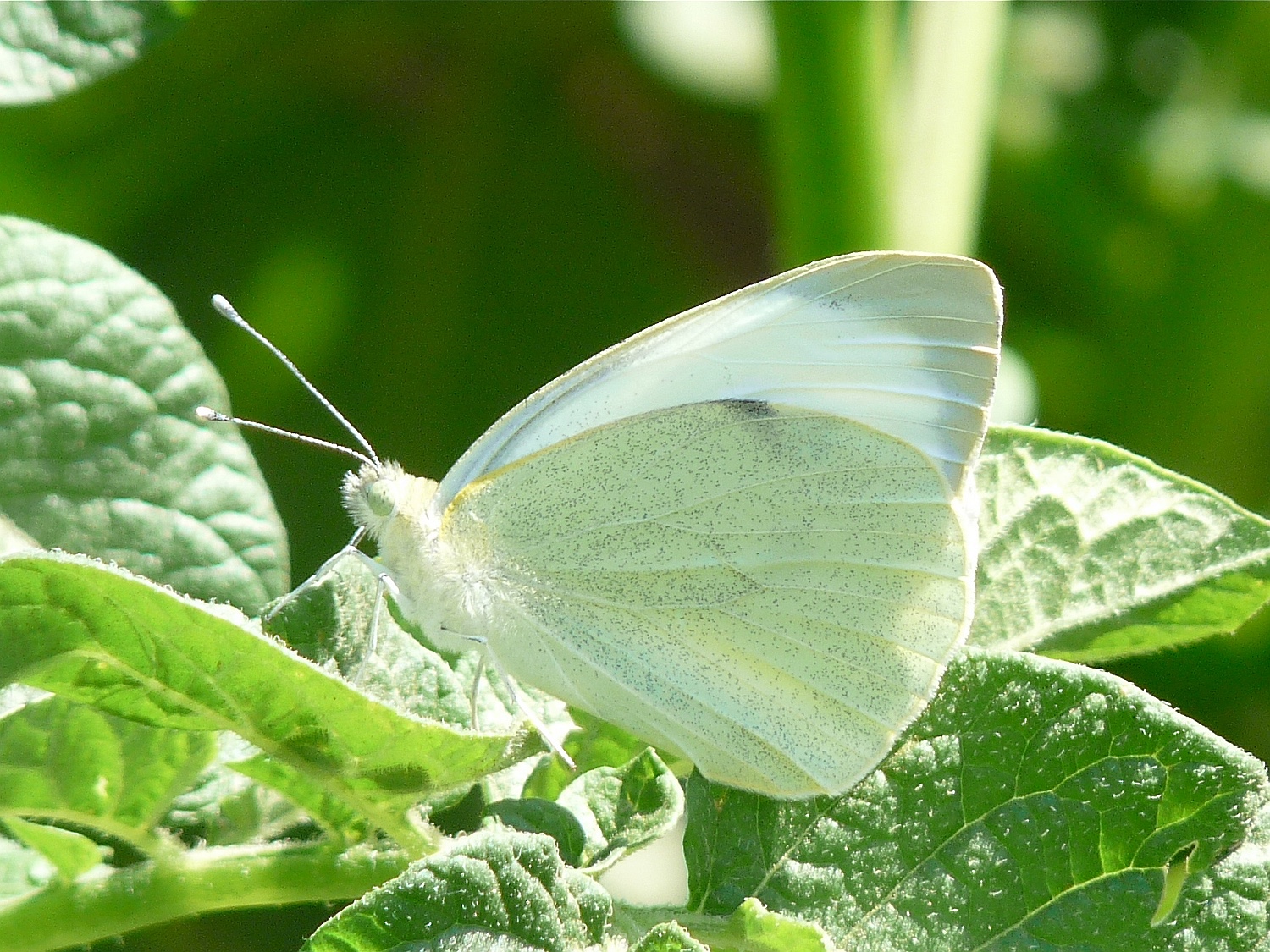
The Large white is a fairly large butterfly. Its forewings have a dark outer edge, which is rather broad.
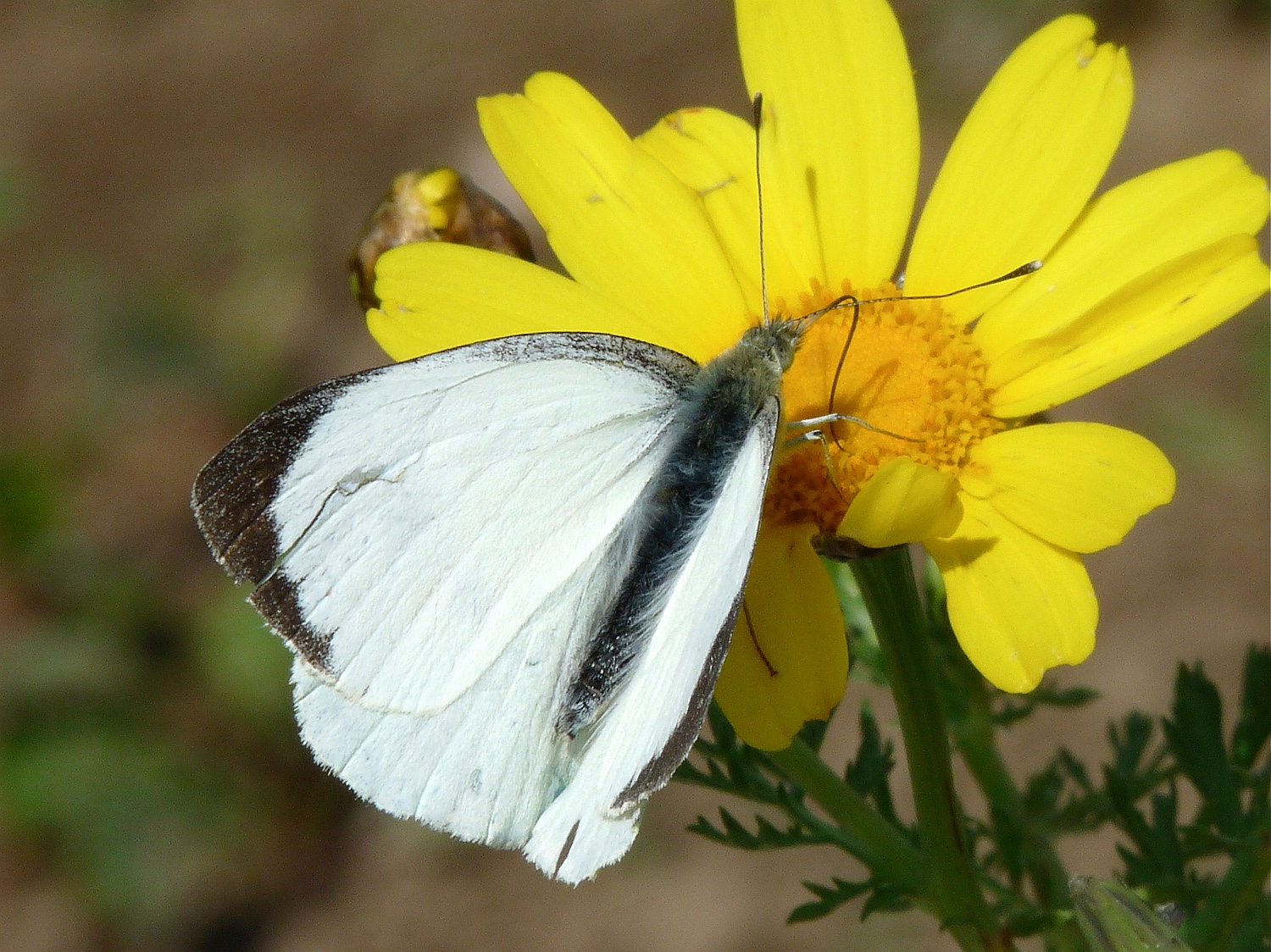
It usually sits with its wings closed, which makes it very difficult to photograph the upper side of the wings.
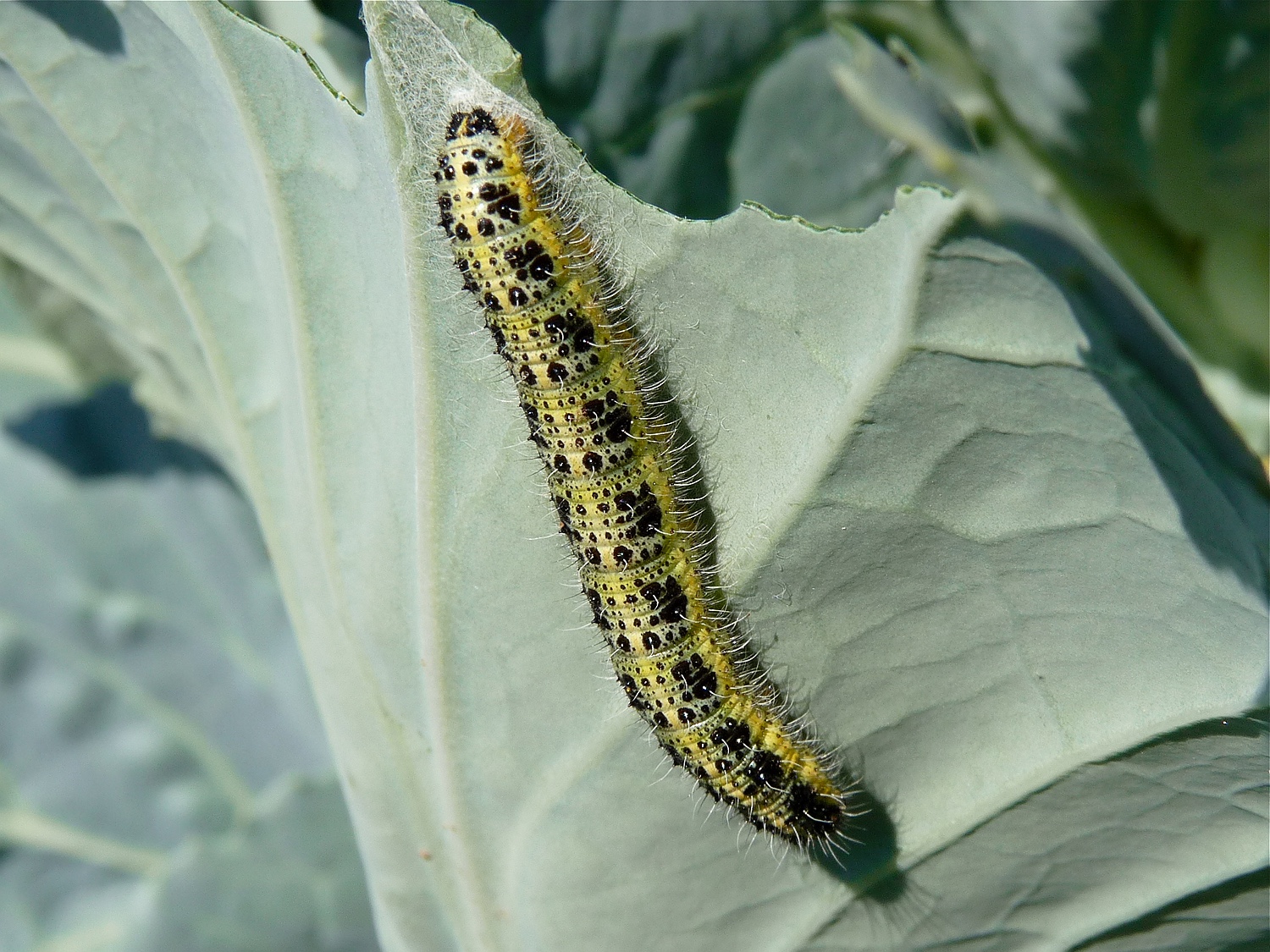
The yellow and black caterpillars of the Large white live on cruciferous plants, such as here on cabbage.
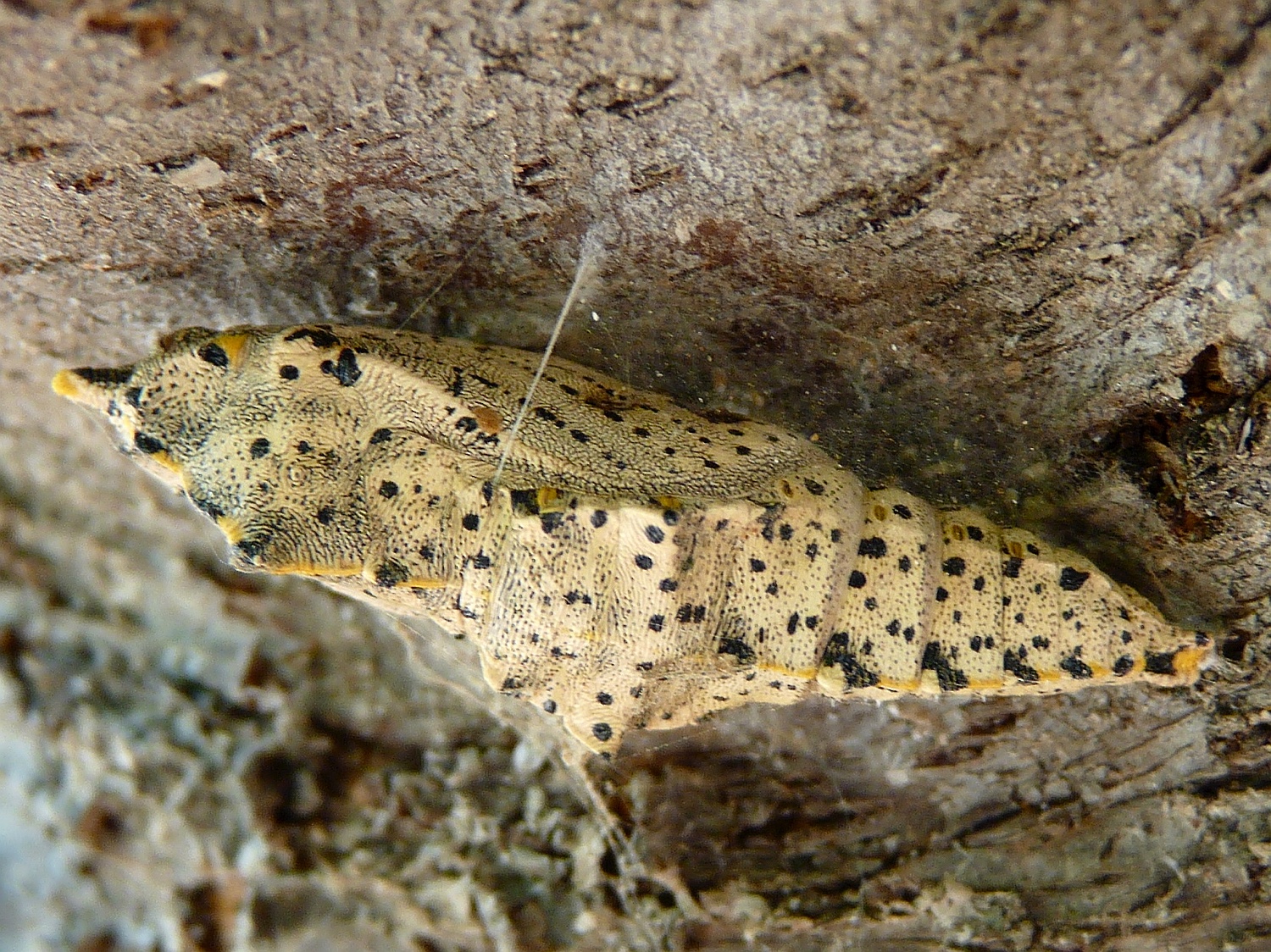
The pupa hangs in places protected from rain.
Small white, Pieris rapae, L.
The Small white is much rarer in our region than the previous species, but can be found from time to time in gardens and cultivated land.
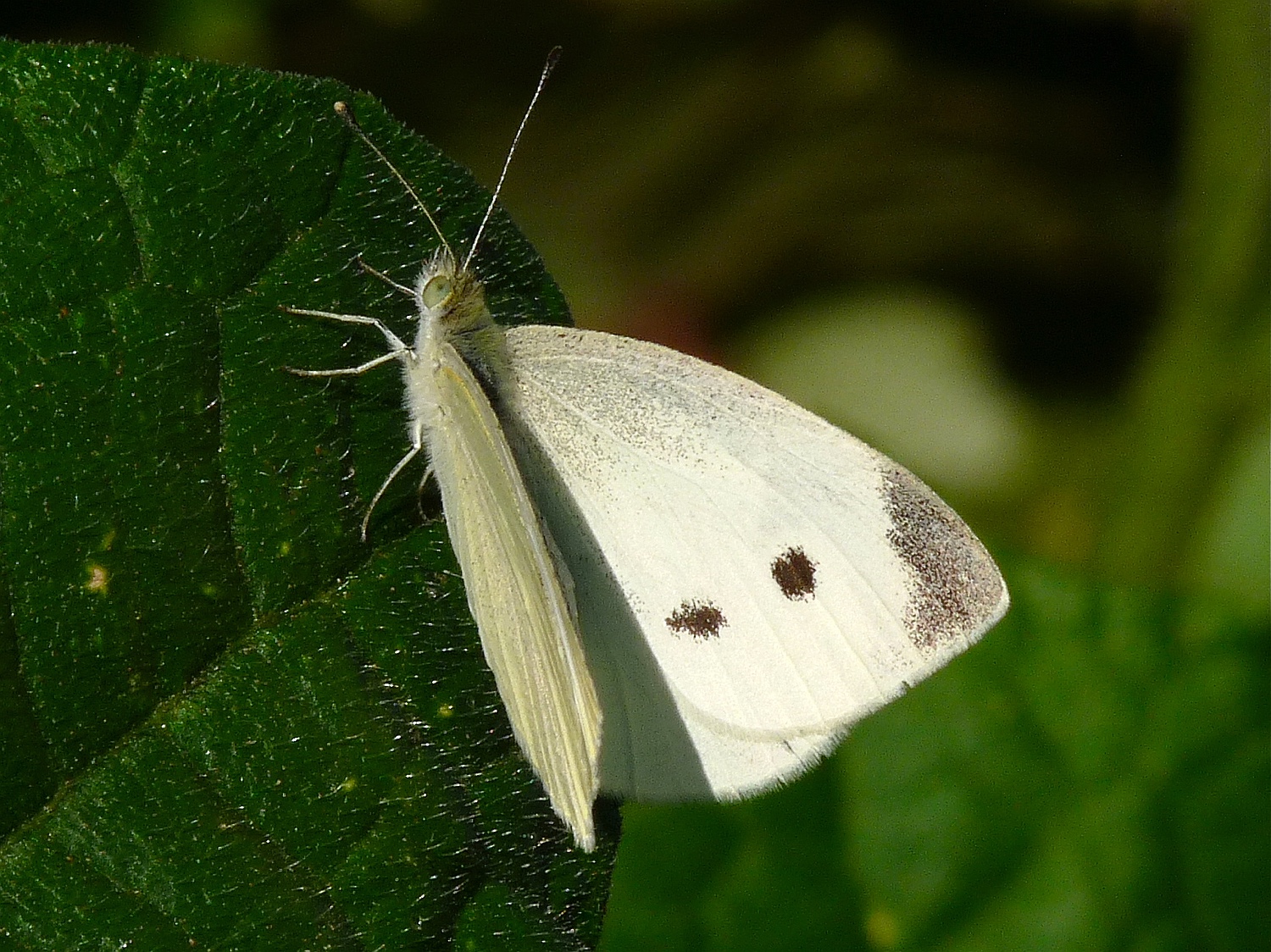
The Small white is significantly smaller than the Large white. The black spots and black tips on the forewings are also much smaller.
Eastern dappled white, Euchloe ausonia, Hübner
Many Pieridae have a greenish colouring on the underside, which can only be seen when the butterfly is sitting. Euchloe ausonia is found in the eastern Mediterranean region.
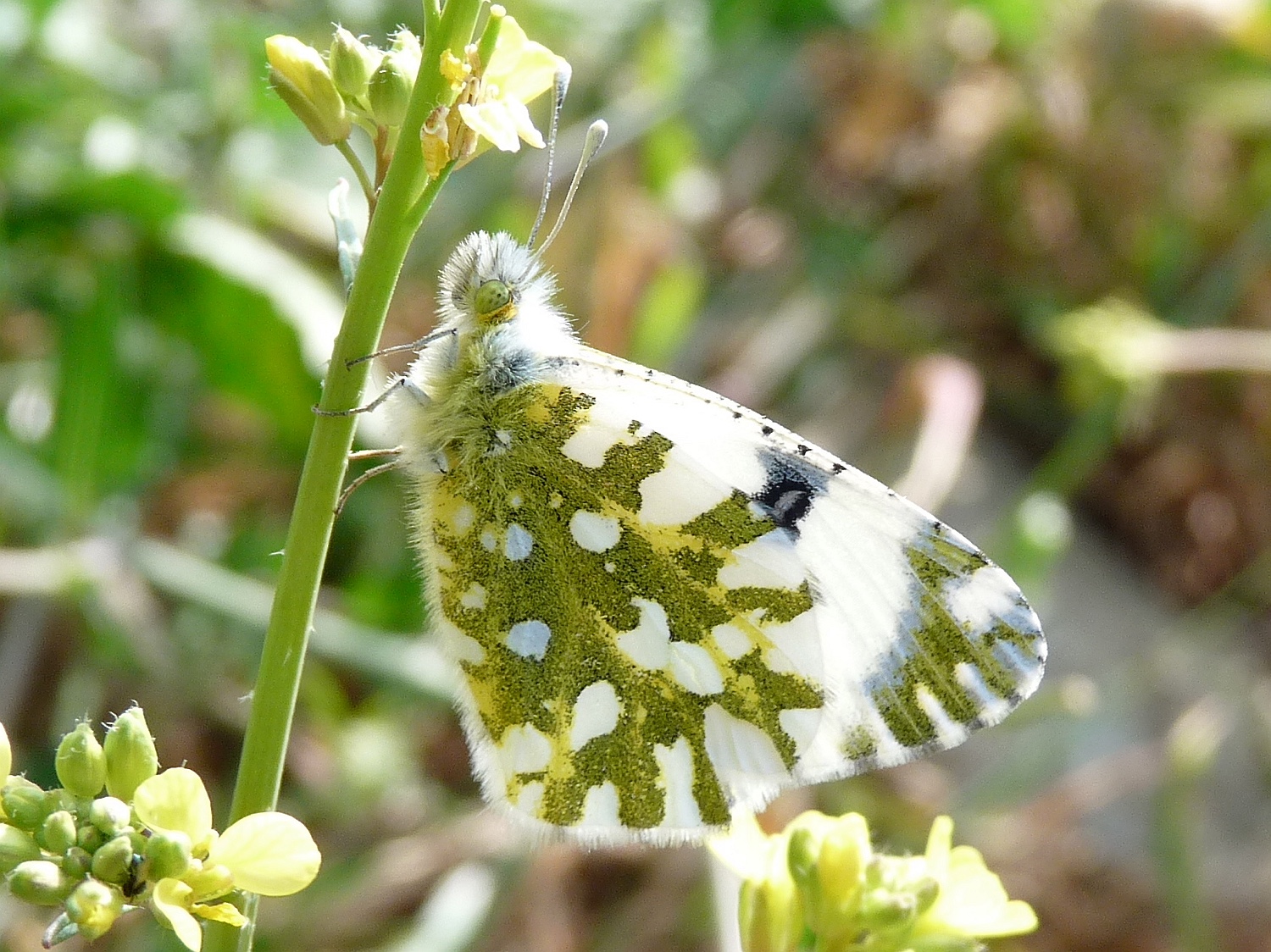
This Eastern dappled white has round white spots on the yellow-green underside of the hind wing.
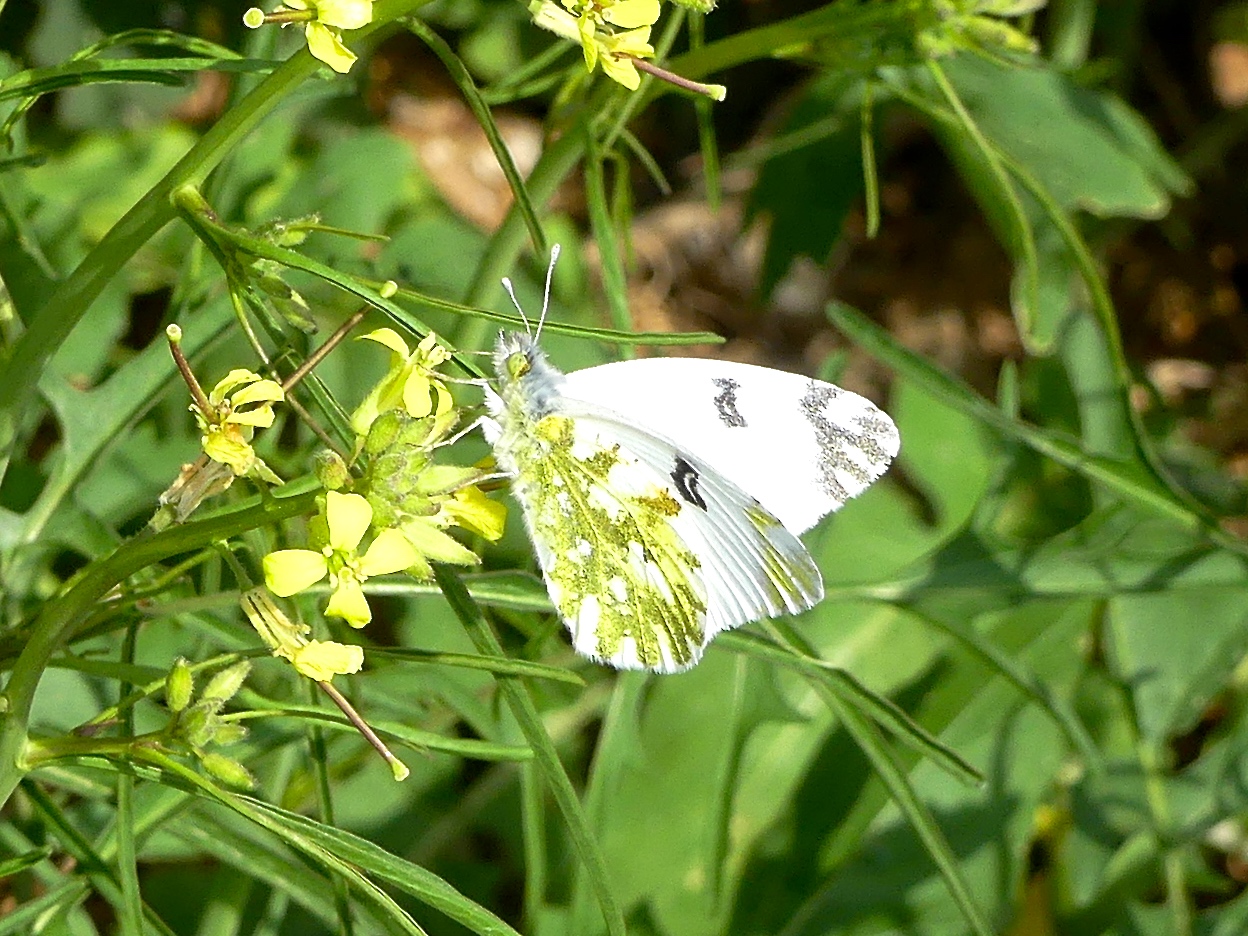
The tip of the forewings has a grey pattern on the upper side, which shows also on the underside. On the underside the wings carry a black spot (sometimes with a white hook-shaped centre) approximately in the middle of the front edge. As with other whites, the upper side of the wings is rarely seen, as the butterflies usually sit with their wings closed.
Cleopatra butterfly, Gonepteryx cleopatra, L.
The Cleopatra butterfly is a relative of the Common brimstone, from which it can be distinguished by the orange colour of its front wings. It is found in the Mediterranean region. Its caterpillars live on buckthorn. This species is quite common in our region.
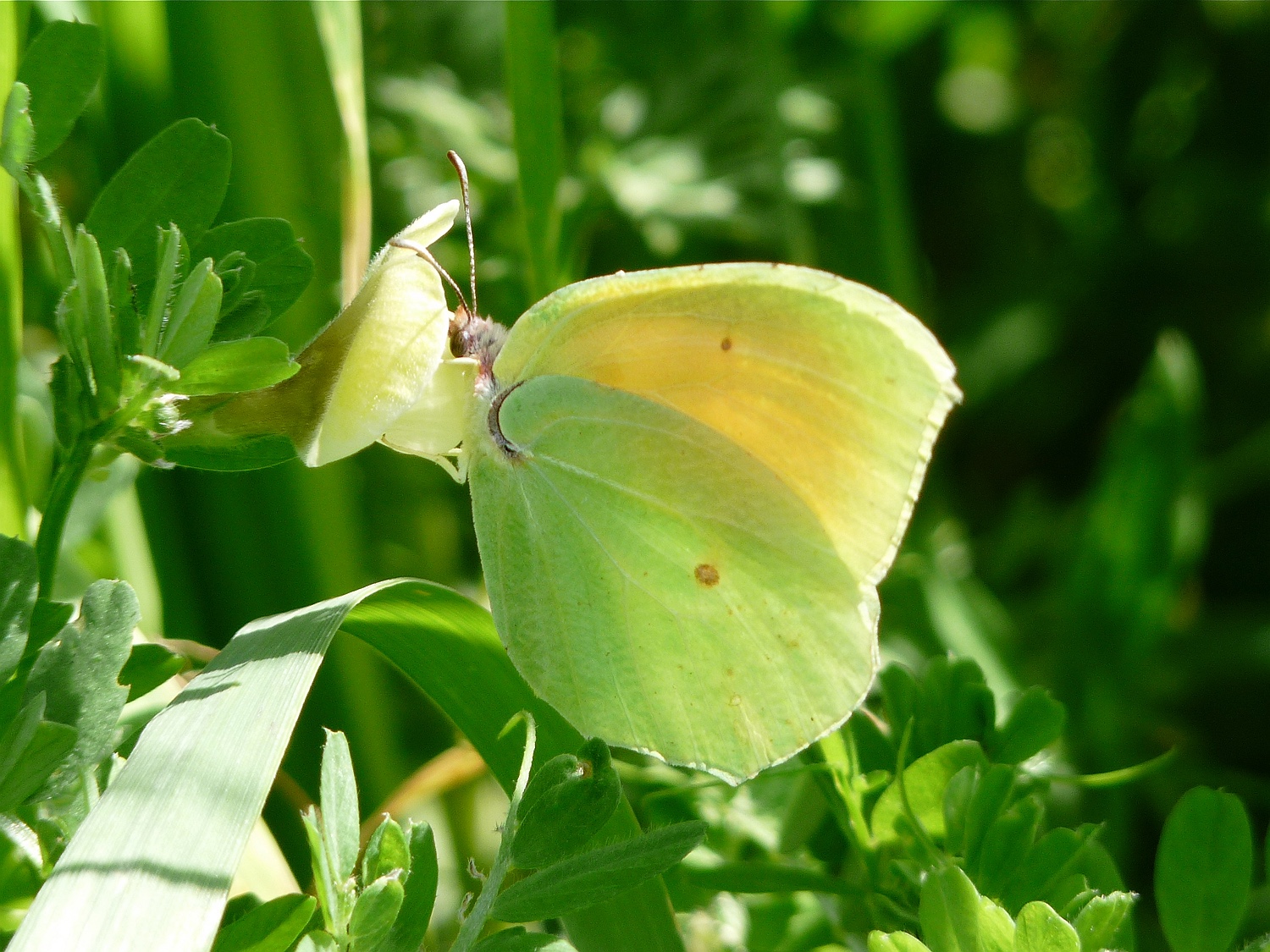
The Cleopatra butterfly is greenish-yellow with an orange area on the forewings and a small orange spot on each wing.
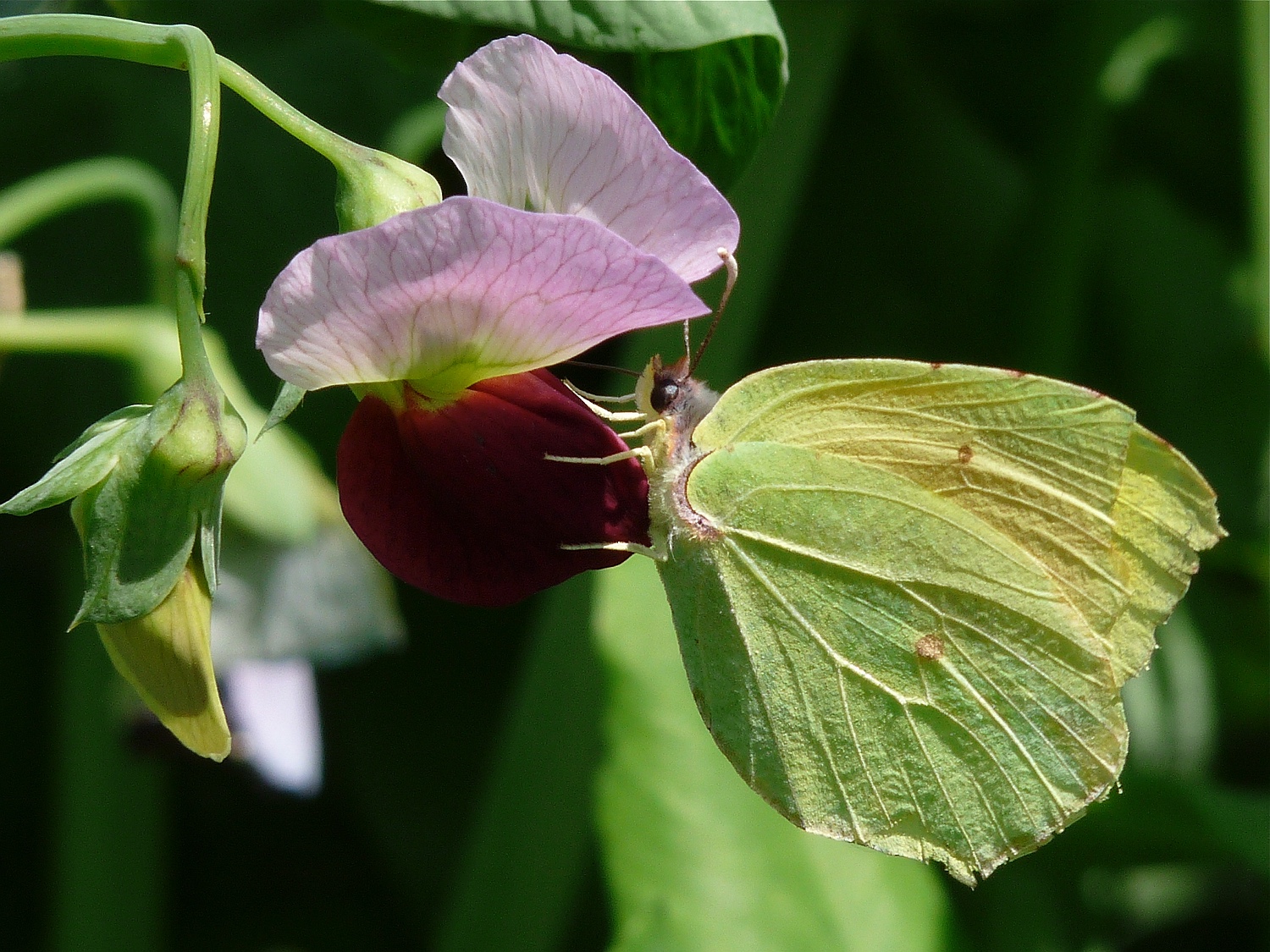
The slightly curved shape of the wings is characteristic.
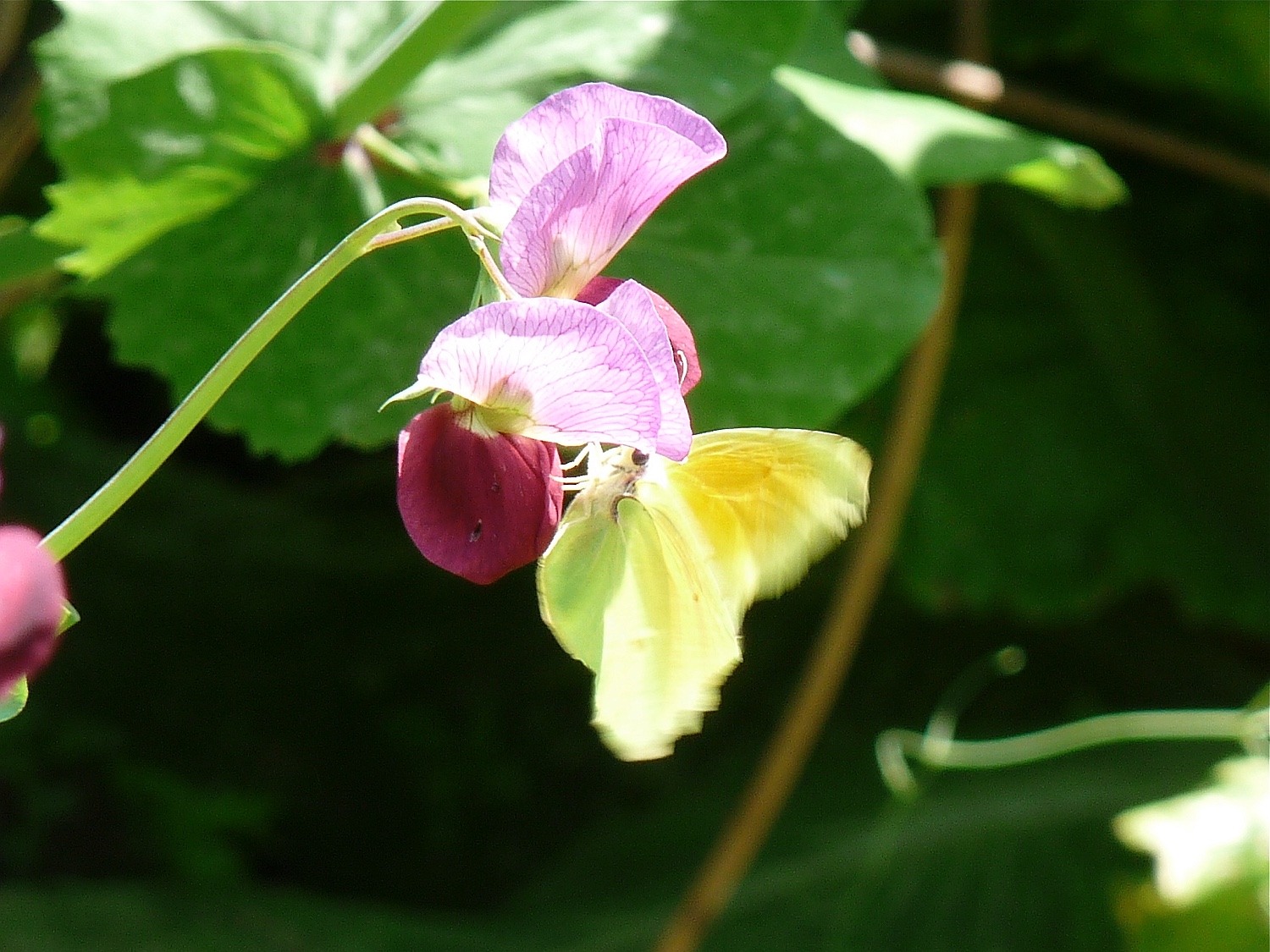
The butterfly almost never sits with its wings open. Here you can see the orange area on the front wings of the flying animal.
Clouded yellow, Colias croceus, Fourcroy
The Clouded yellow is quite common on Naxos. It is quite and therefore not easy to photograph. In our garden this species particularly likes to sit on the flowers of Convolvulus oleifolius.
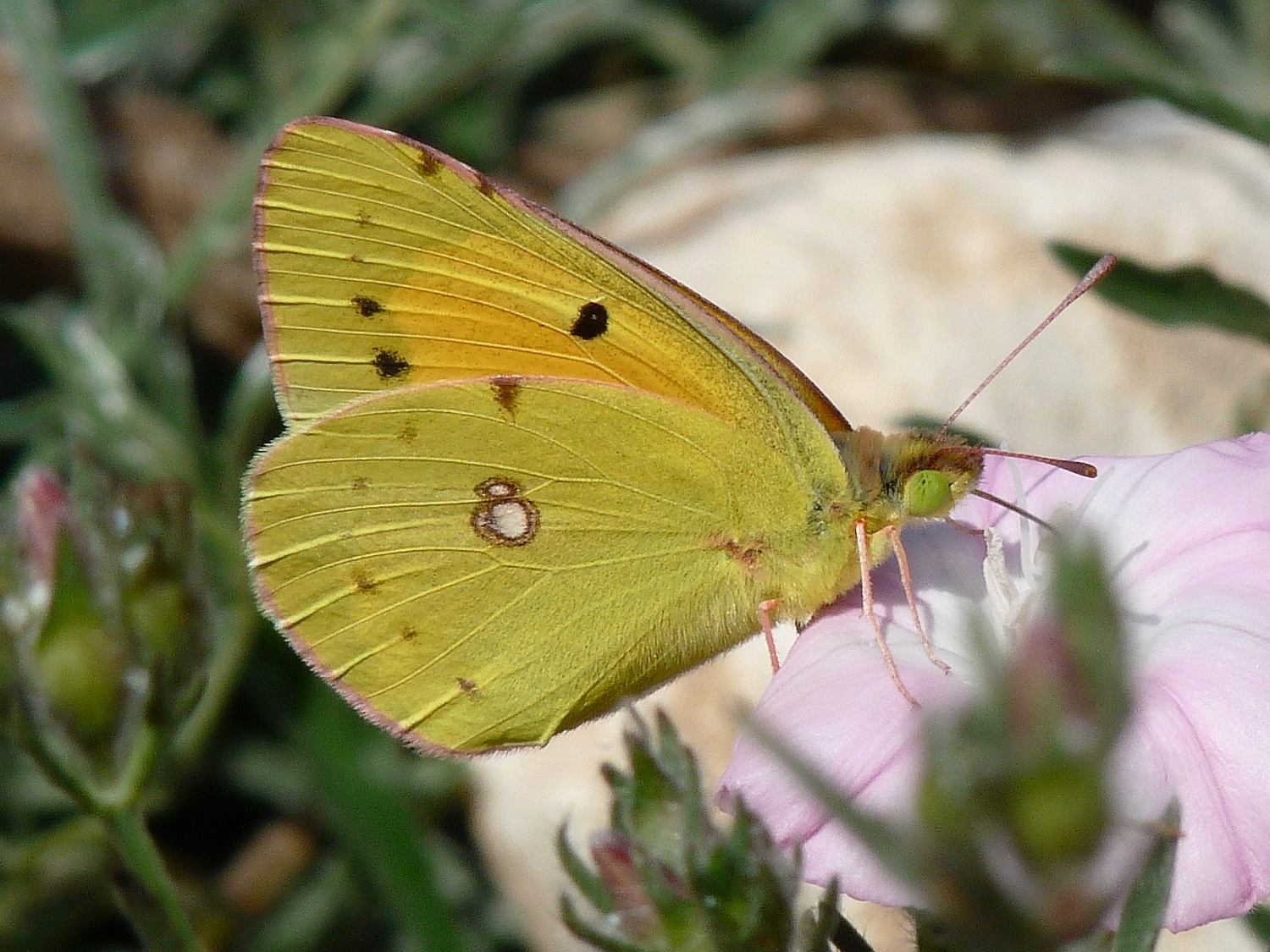
The Clouded yellow, a fairly large butterfly, can be recognised by the black spots on its front wings and a white spot on its rear wings that resembles an 8.
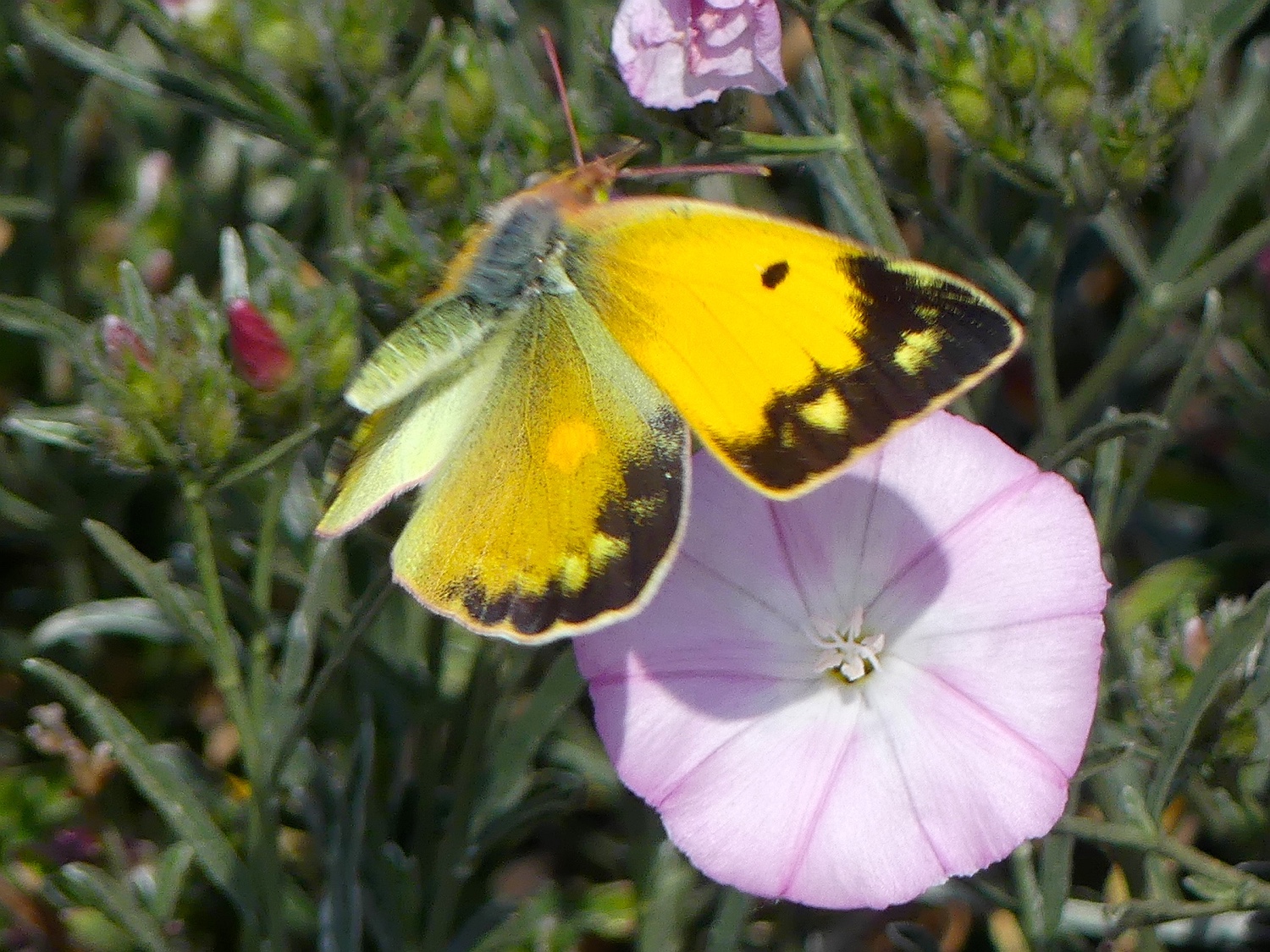
This species also rarely sits with its wings open. In this photo, which is taken as the butterfly is about to land on the next flower, you can see the orange-yellow upper side of the wings with a broad black edge. This is a female, as can be seen from the yellowish spots on the black edge of the wings. Otherwise, males and females look quite similar.
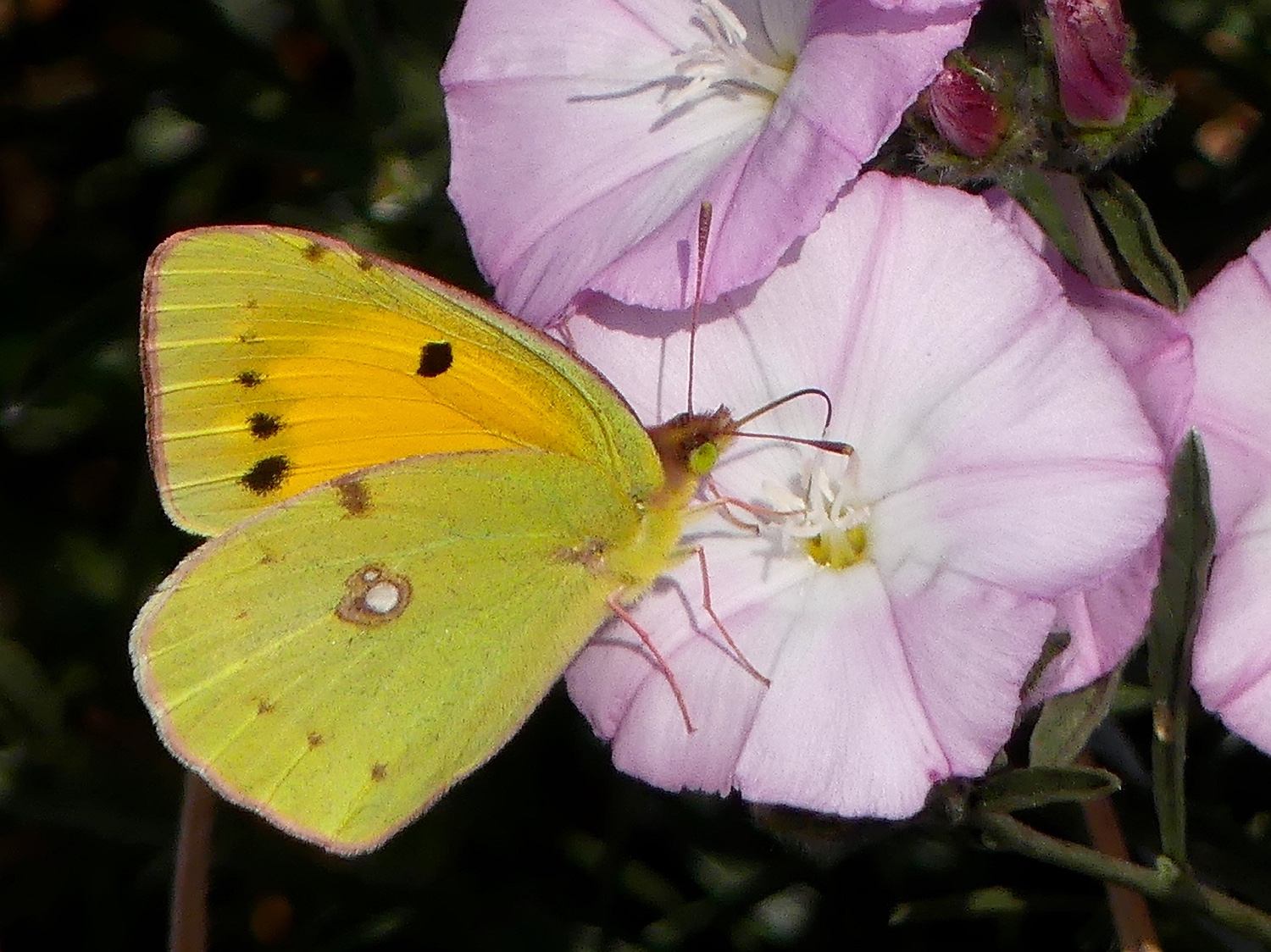
And because it’s so beautiful, here once again!
Gossamer-winged butterflies, Lycaenidae
The Gossamer-winged butterflies are one of the large families of butterflies. Their members are usually quite small and blue or brown in colour, more rarely reddish brown or green. They often have small ocelli (eye spots). Many of the species sit with their wings closed, so that you almost never get to see the upper side of their wings.
The caterpillars of the gossamer-winged butterflies often have a very specialised way of life. About one third of the species live in close association with ants. In some cases the caterpillars invade ant nests where they are fed by the ants or eat their larvae. In other species, the caterpillars produce a sound or secrete a special substance (‘honeydew’) that attracts the ants, or they emit a scent similar to that of ant larvae. This causes the ants to guard them on their food plants or carry them to their nests and care for them there. The species whose caterpillars feed on plants often specialise in a single plant species. As a result, almost all European gossamer-winged butterflies are now becoming rarer or are endangered.
Small copper, Lycaena phlaeas, L.
The Small copper has an intense orange-red colour. It is quite common in our region.
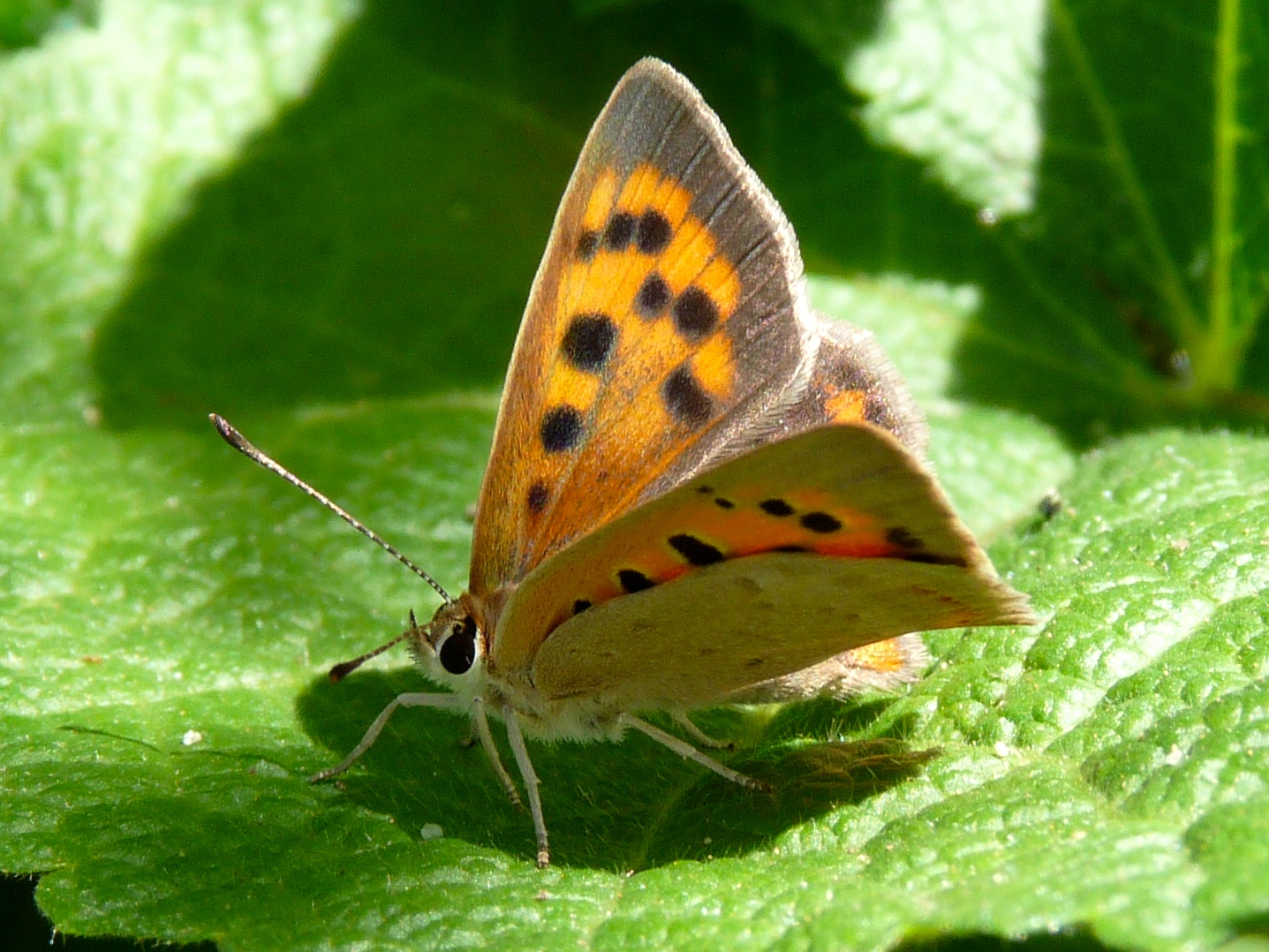
The pretty Small copper has bright orange front wings with brown edges and dark spots; the hind wings are brown with an orange edge.
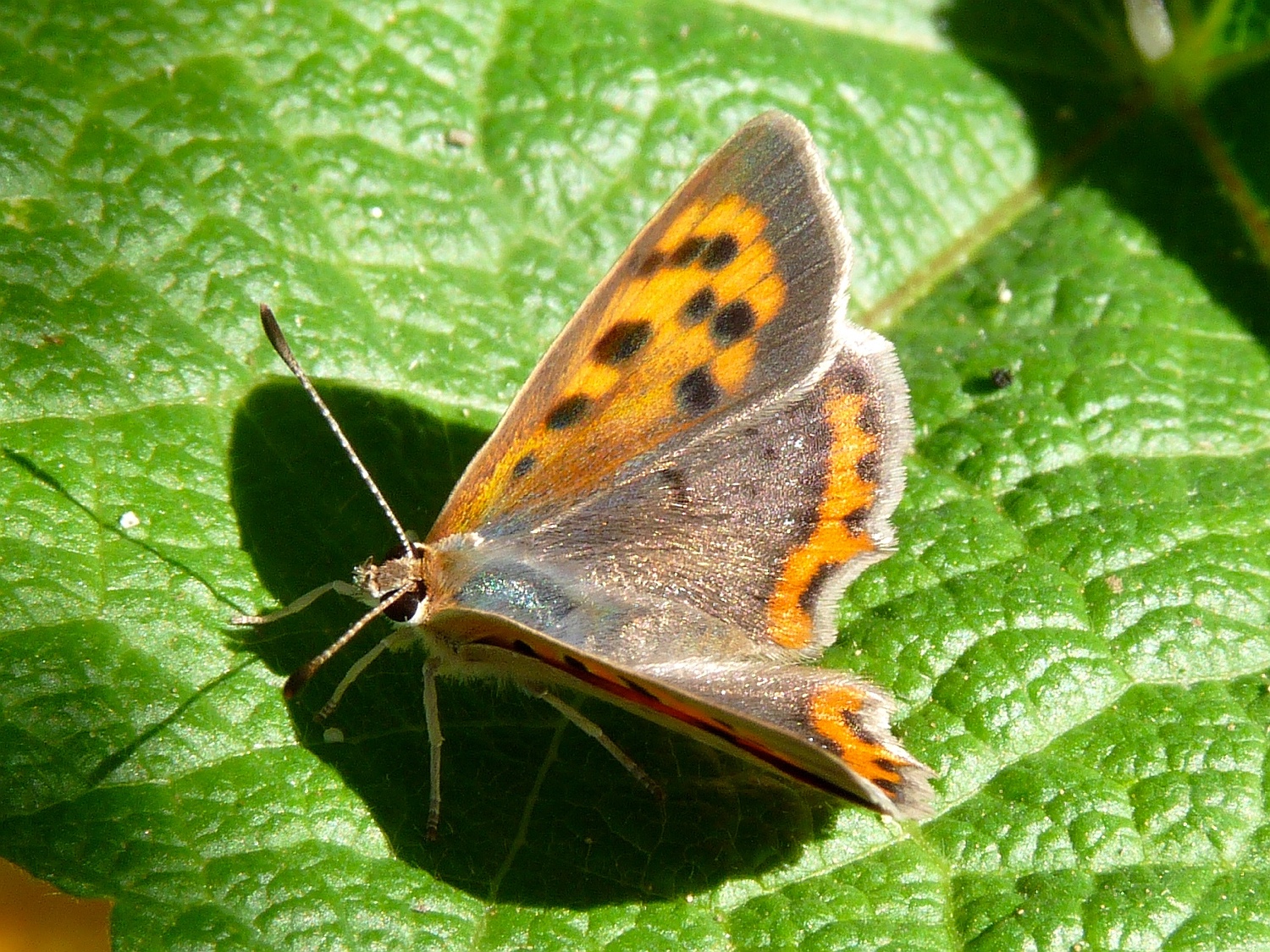
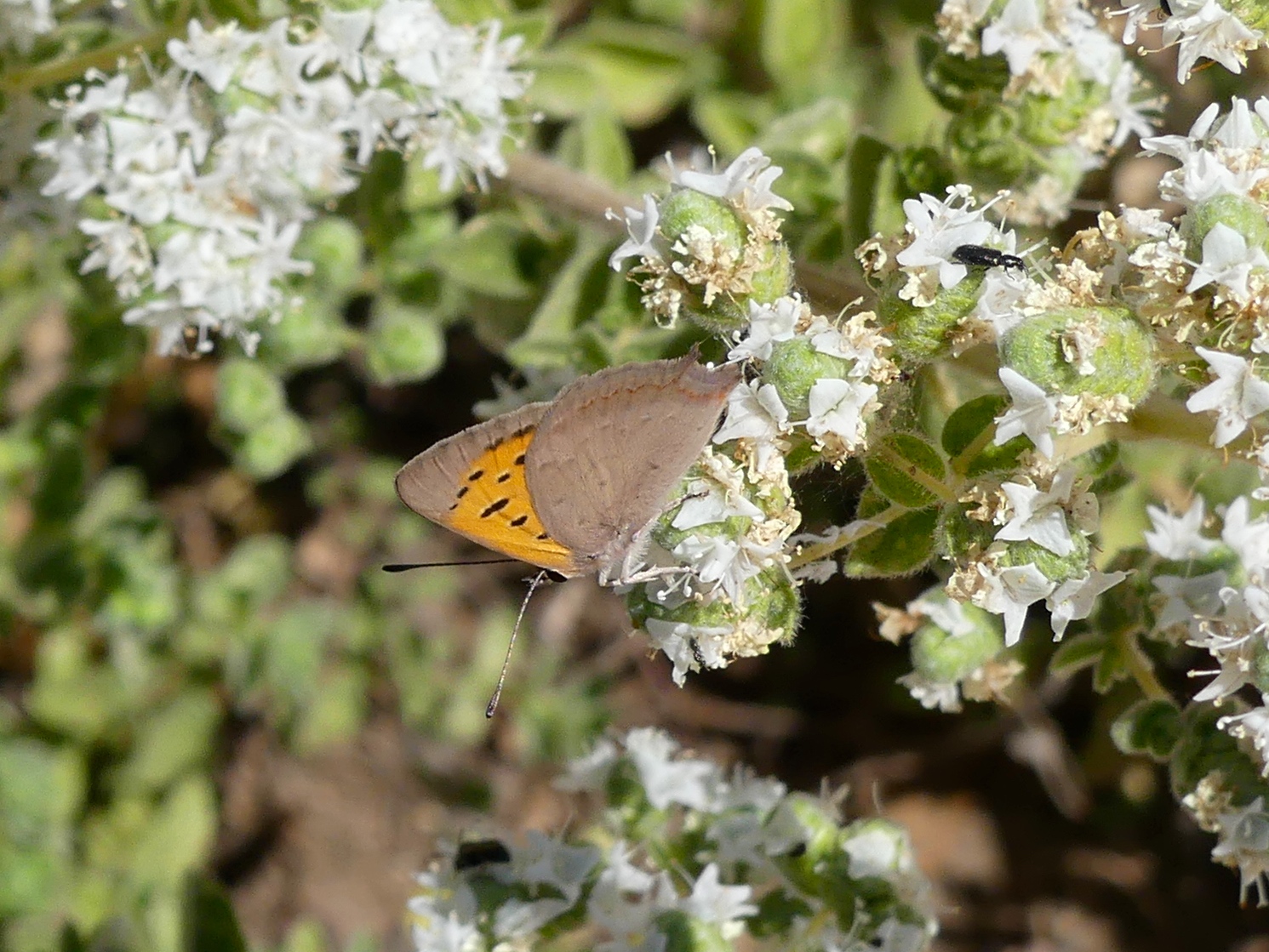
The underside of the hind wing is usually uniformely grey in colour with a curved, delicate orange line near the outer edge.
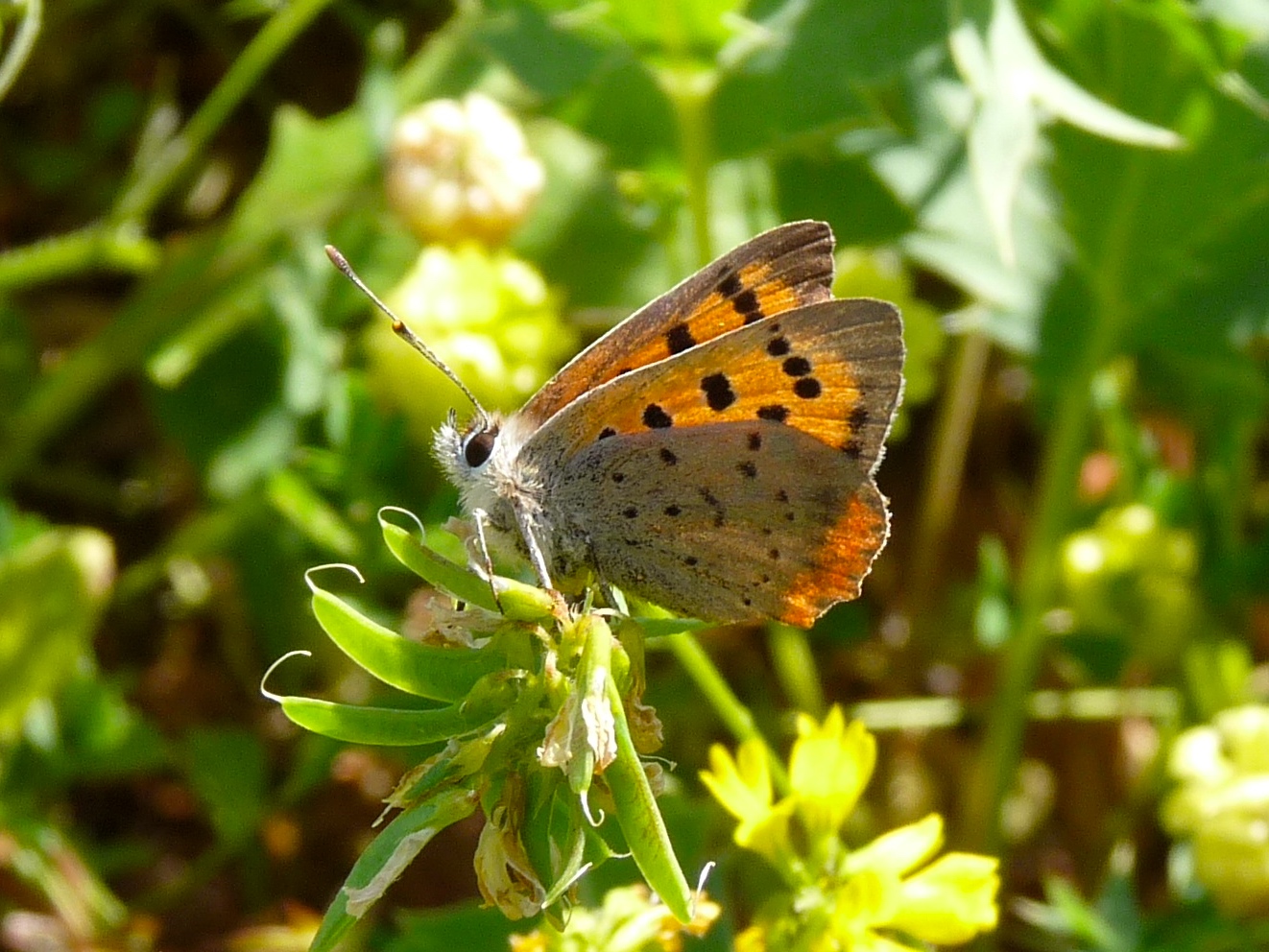
Sometimes the underside of the hind wings carries many small spots.
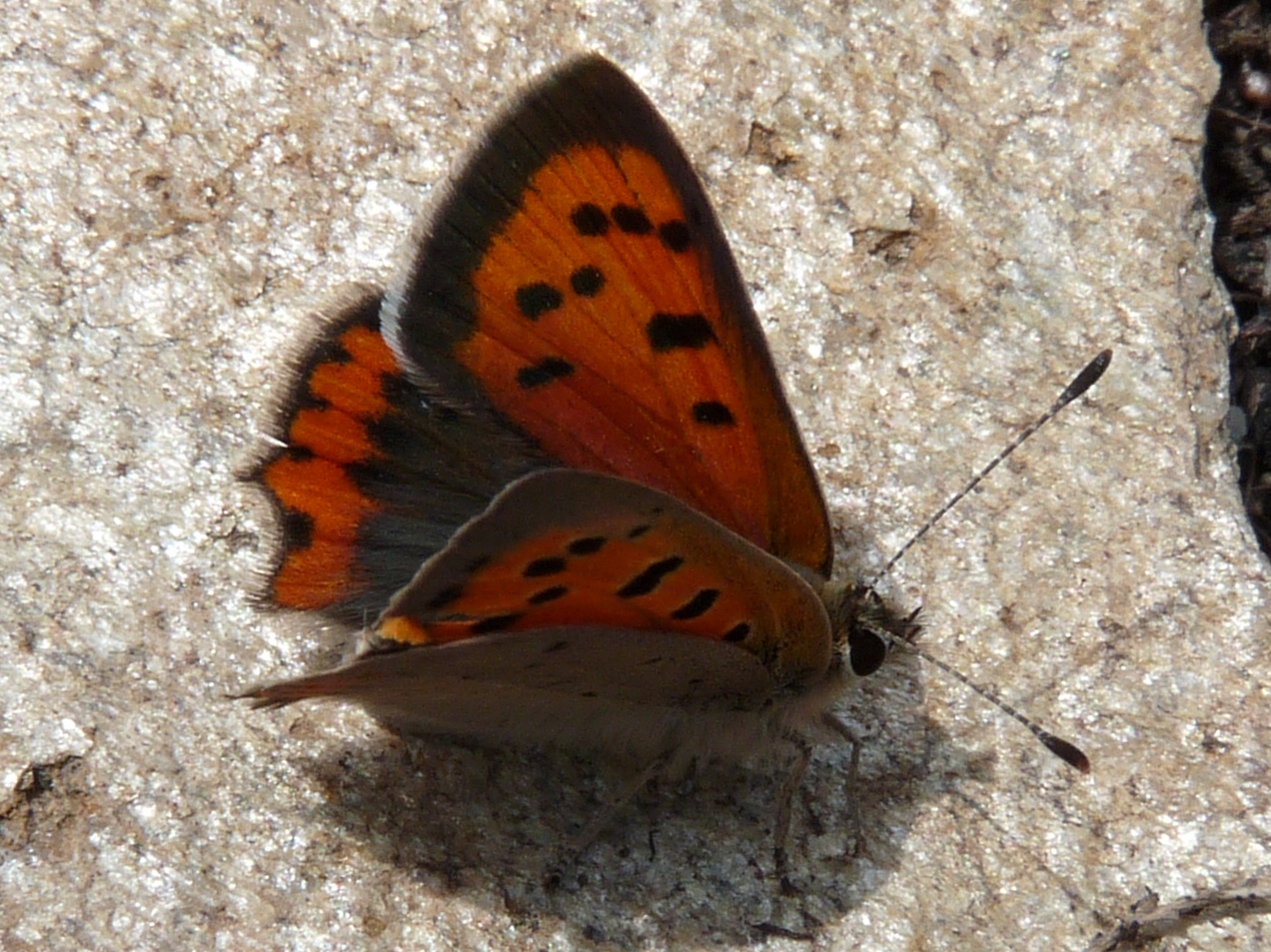
Here you can see the beautiful bright colouring.
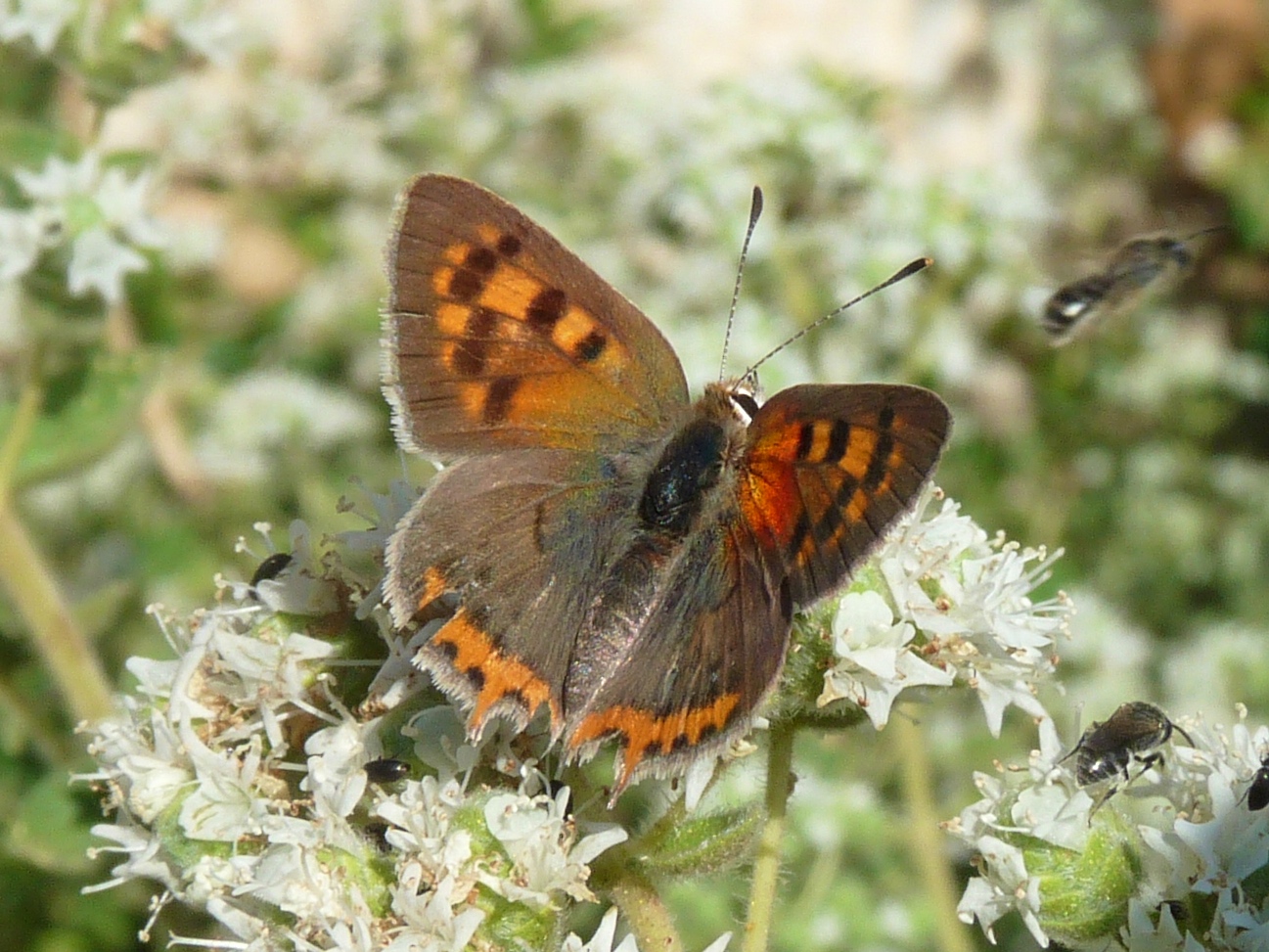
Towards the base, the upper side of the wings has a slight metallic sheen.
Eastern baton blue, Pseudophilotes vicrama, Moore
This very small blue butterfly is very common in our region. It mainly visits small plants of the aster family. There are many similar blue butterfly species that can only be distinguished from each other upon closer inspection. This species is by far the most common in our area.
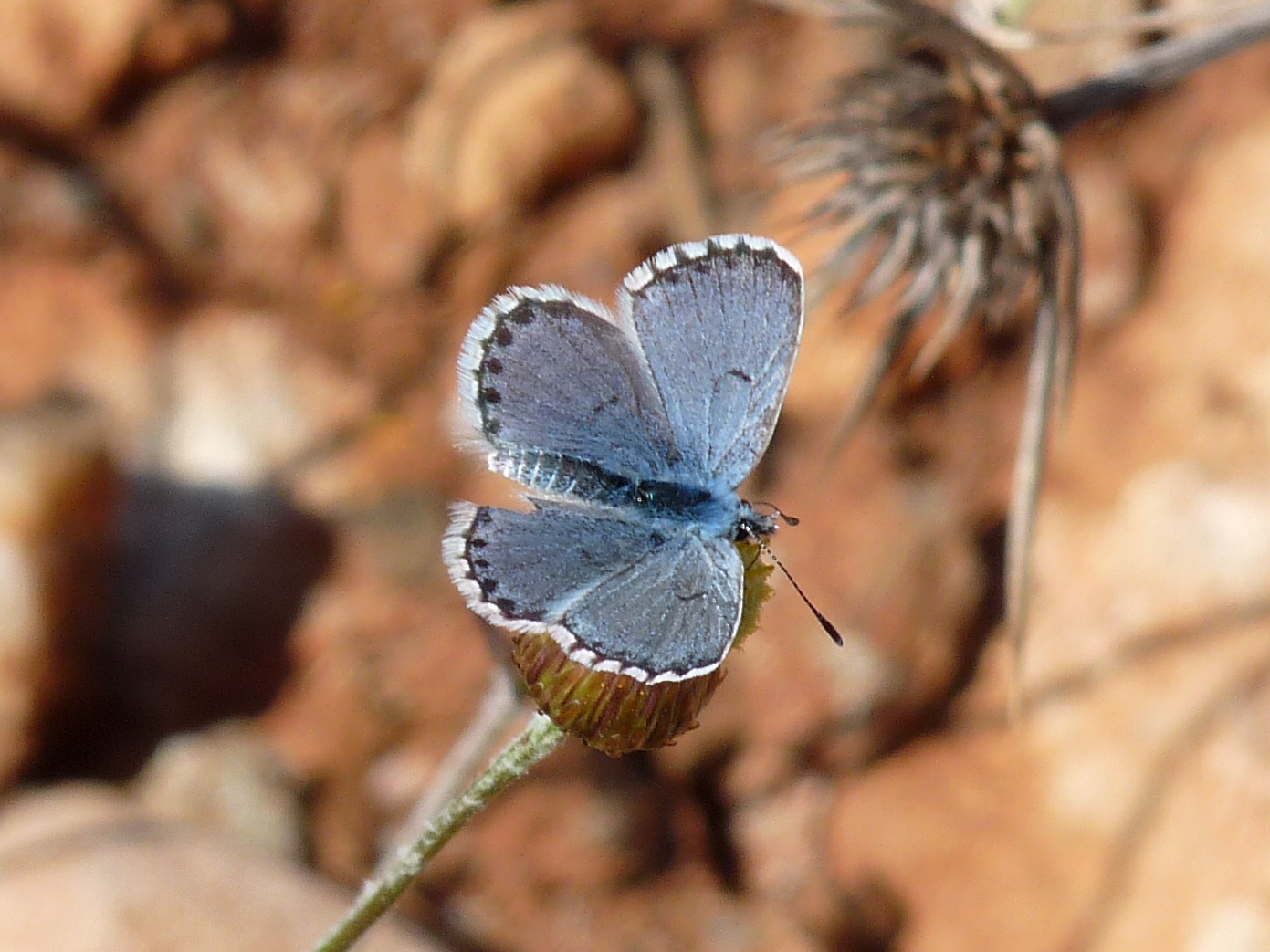
From above, the Eastern baton blue is blue with tiny black spots approximately in the middle of the wings.
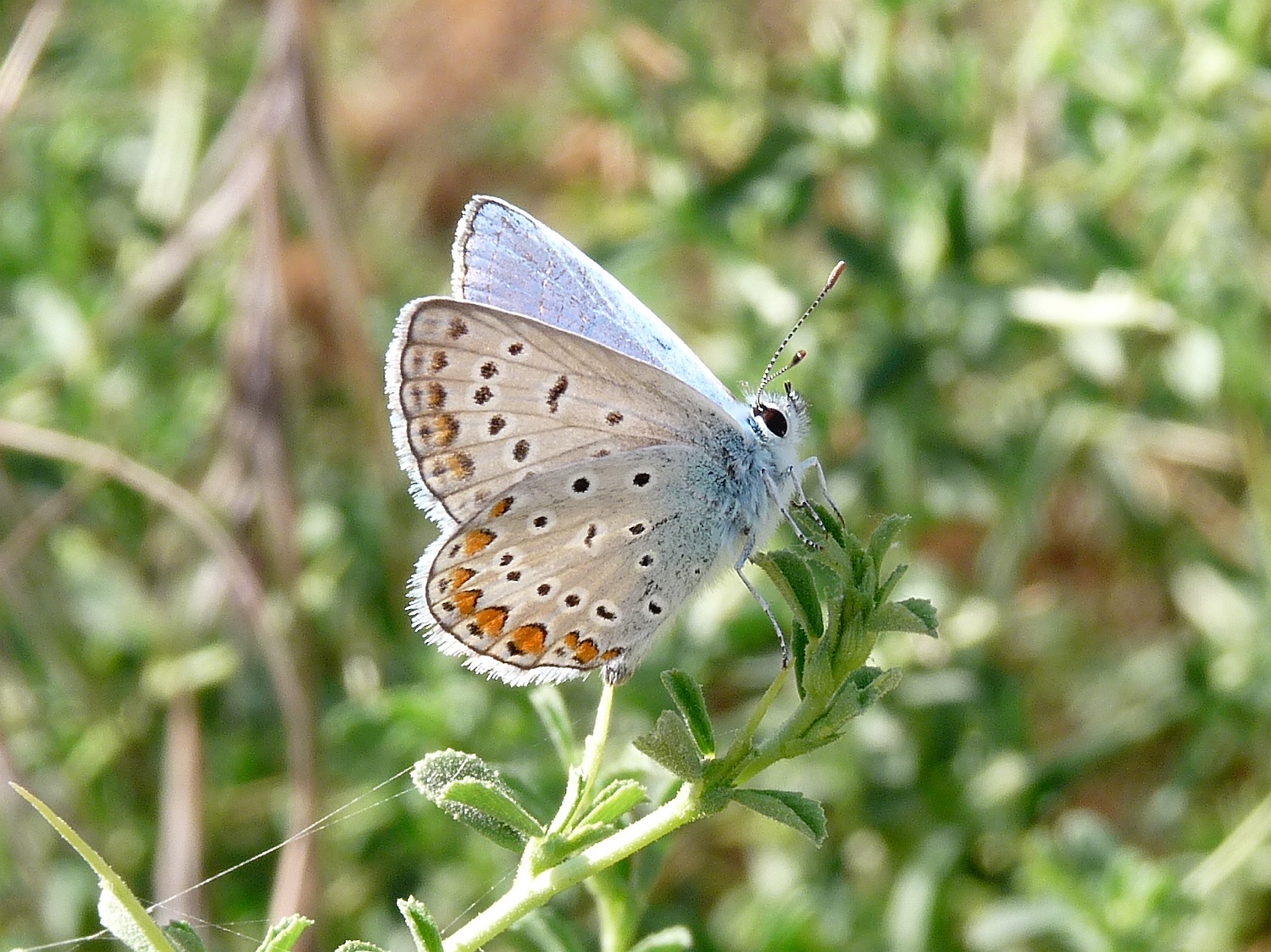
The underside of the wings is patterned with numerous black spots and an orange band on the outer edge of the hind wings.

The entire body of this tiny butterfly is very hairy; even the wings have hairs, especially at the edges. As with all blue butterflies, the antennae are ringed in black and white.
Brown argus, Aricia agestis, Denis & Schiffermüller
At first glance, this small butterfly looks very similar to the previous species, but it carries distinct orange spots also on the edges of its front wings. Probably it is a Brown argus, but the identification is not completely certain as we did not see the upper side of the butterfly. We found this species near Danakós at an altitude of about 500 metres above sea level.
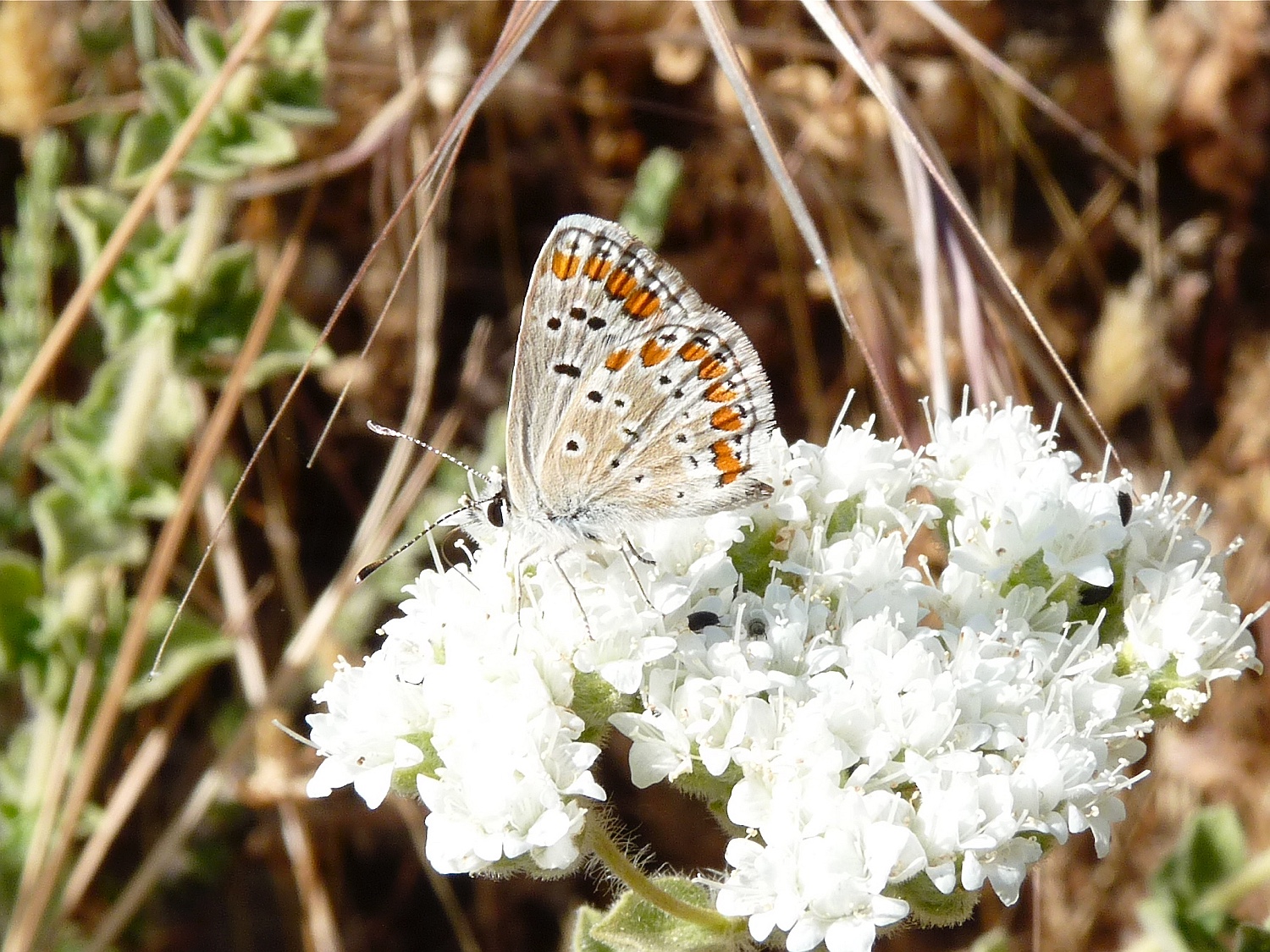
The undersides of this butterfly’s wings differ from the previous species in that the front wings also have orange spots on the edges.
Common blue, Polyommatus icarus, Rottemburg
The Common blue is a widespread and common species in Europe. The wings of the males are bright blue on the upper side, while those of the females are brownish.
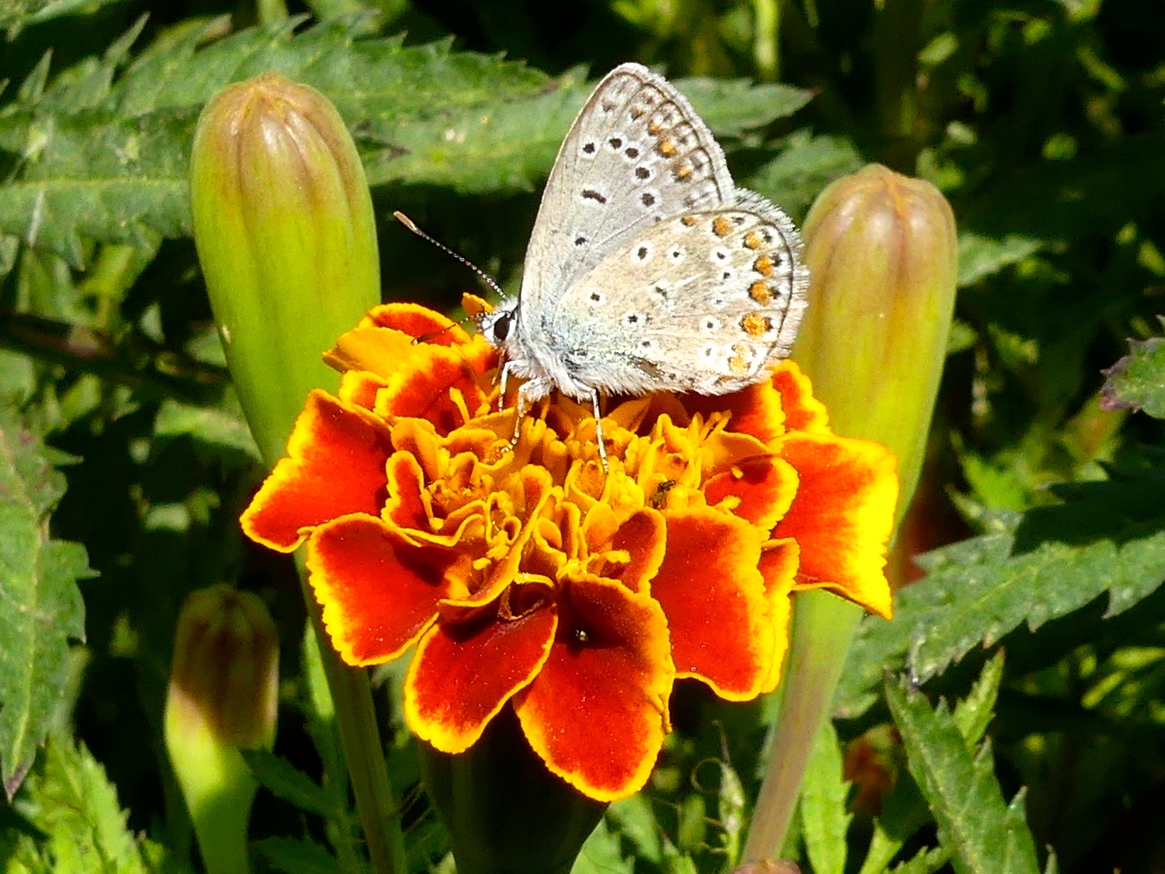
The Common blue can be identified by the exact arrangement of the spots, e.g. the small additional dot on the front wing near the base.
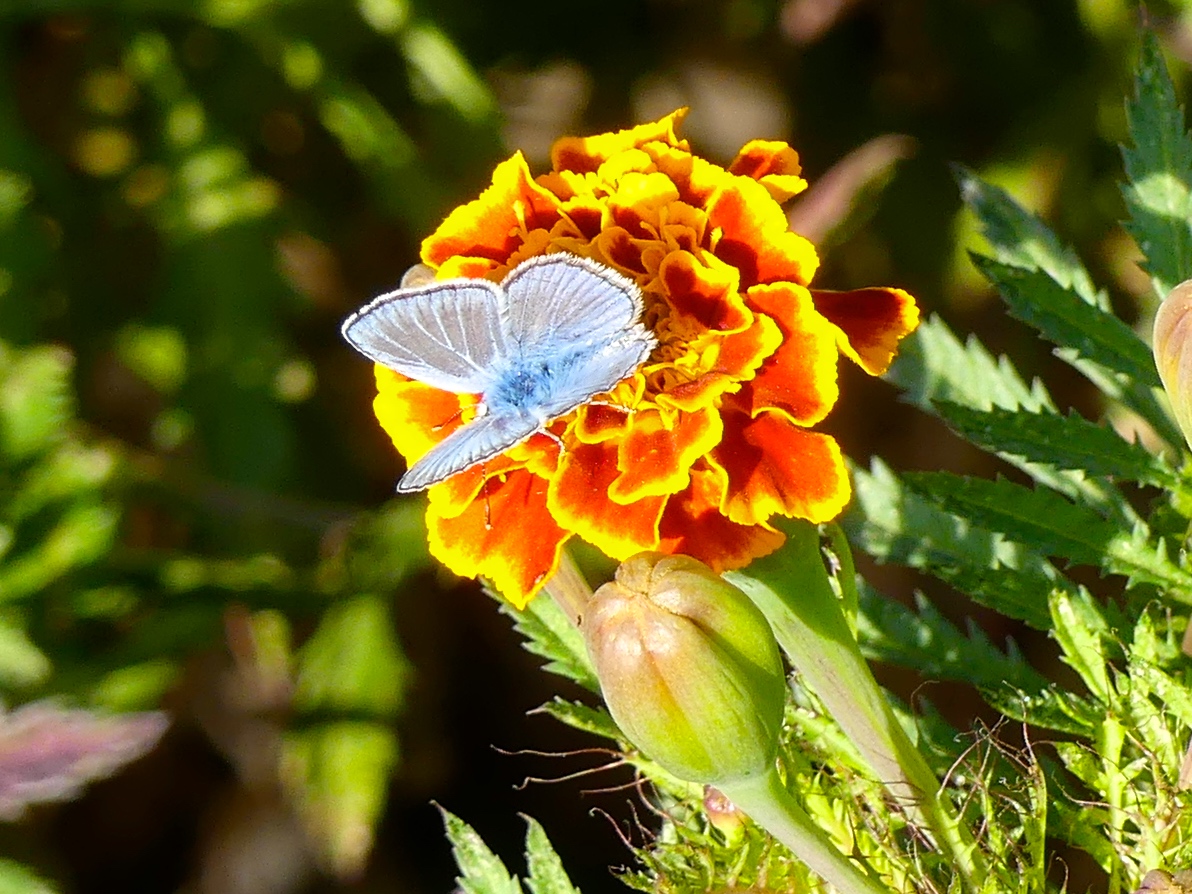
In all gossamer-winged butterflies it is quite difficult to take a picture of the upper side of the wings; here in our garden.
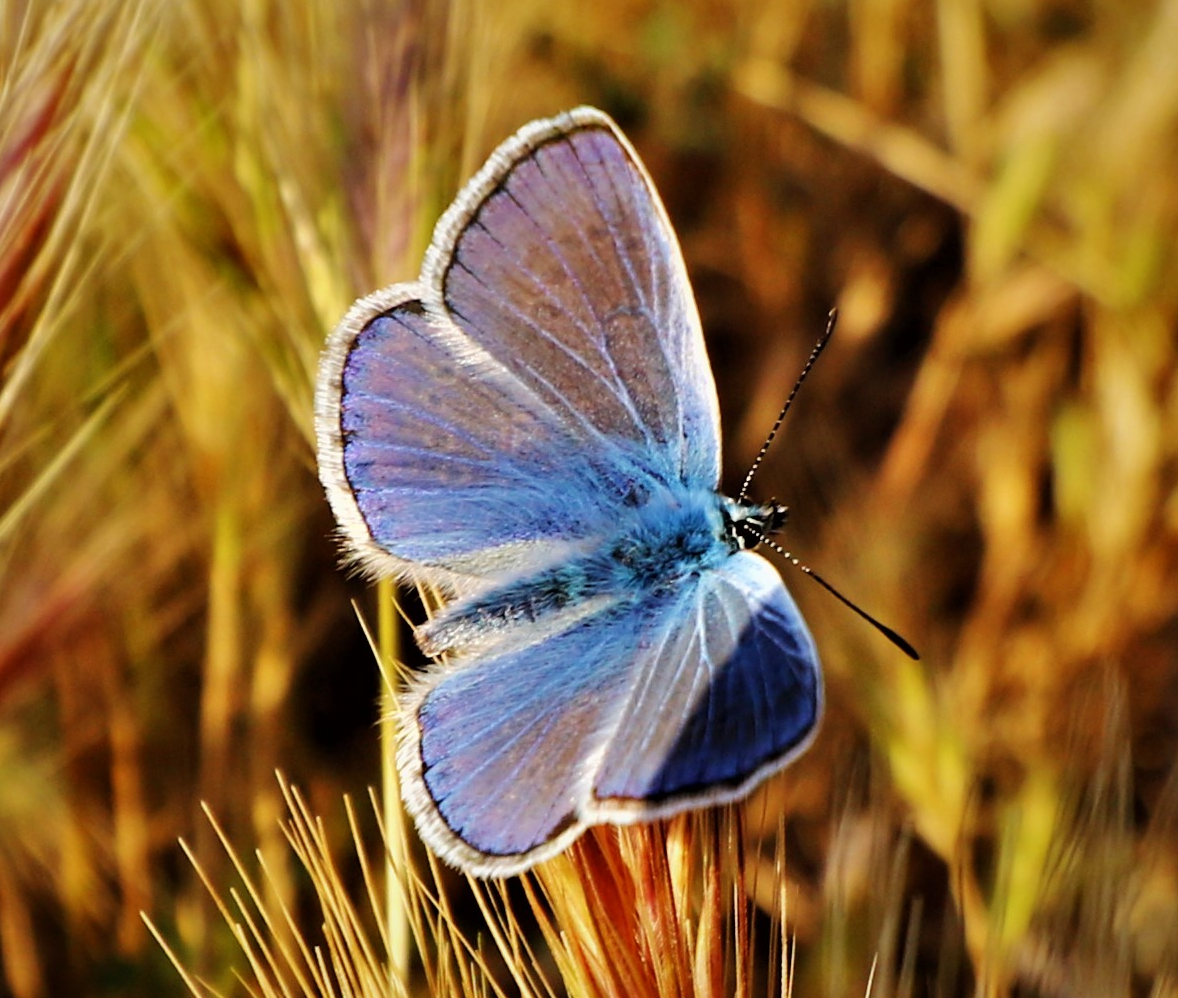
The males of this species show a truly impressive blue colour! Discovered by Joachim Lang at Stelida and photographed by Sven Ungemach.

The underside of the wings carries the characteristic spots used for identification. Photo by Sven Ungemach.
Green-underside blue, Glaucopsyche alexis, Poda
The males of this species have bright blue wings, while the females sometimes are blue-brown (from above). On the underside the wings usually show only a few spots, and in some specimens there are almost none. The Green-underside blue is rare on Naxos.
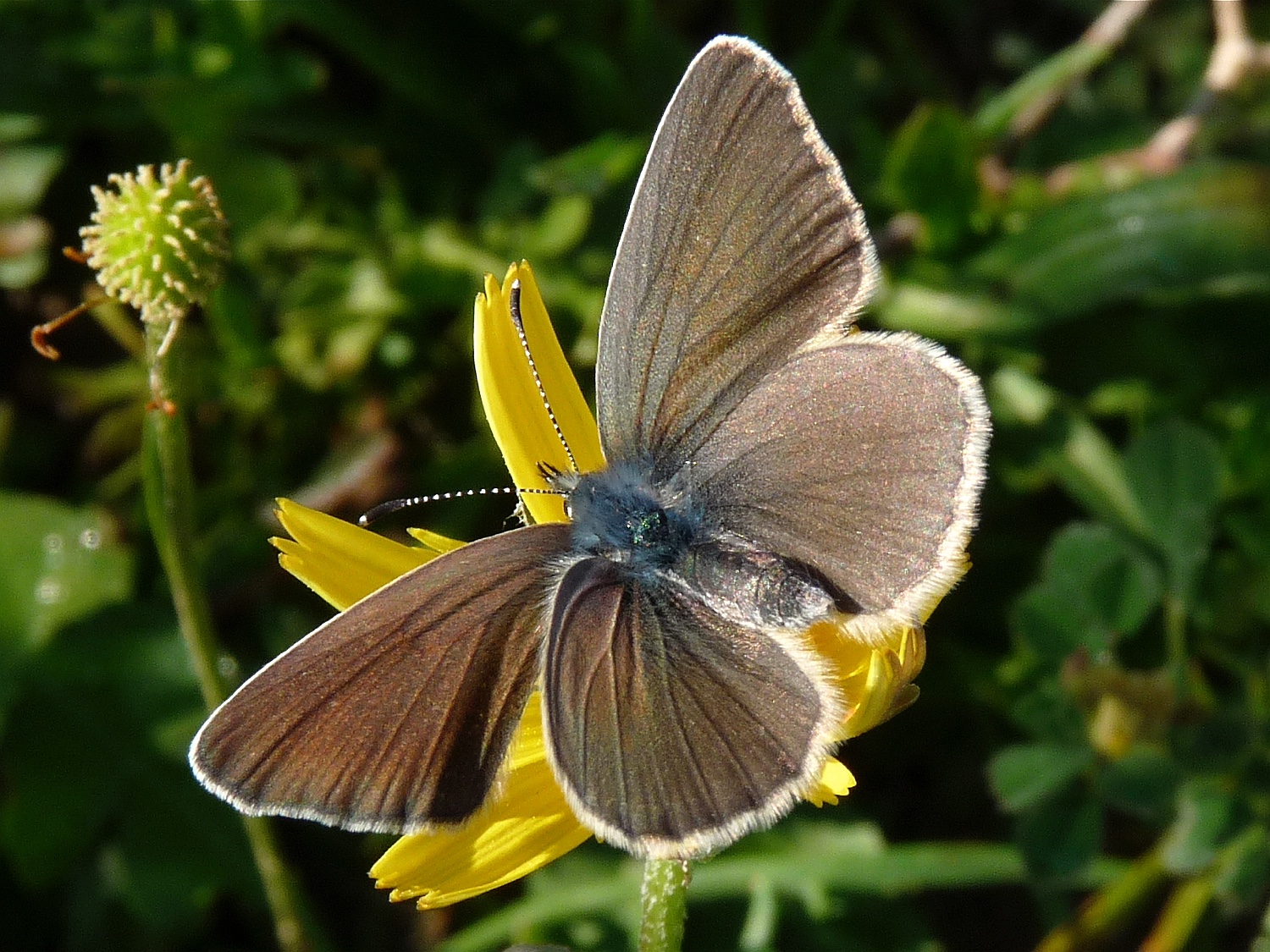
The female Green-underside blue often has a brownish upper side without markings.

Unlike in most similar species, the undersides of the wings have few spots or, as here, almost none; towards the wing base, they show a metallic blue colour.
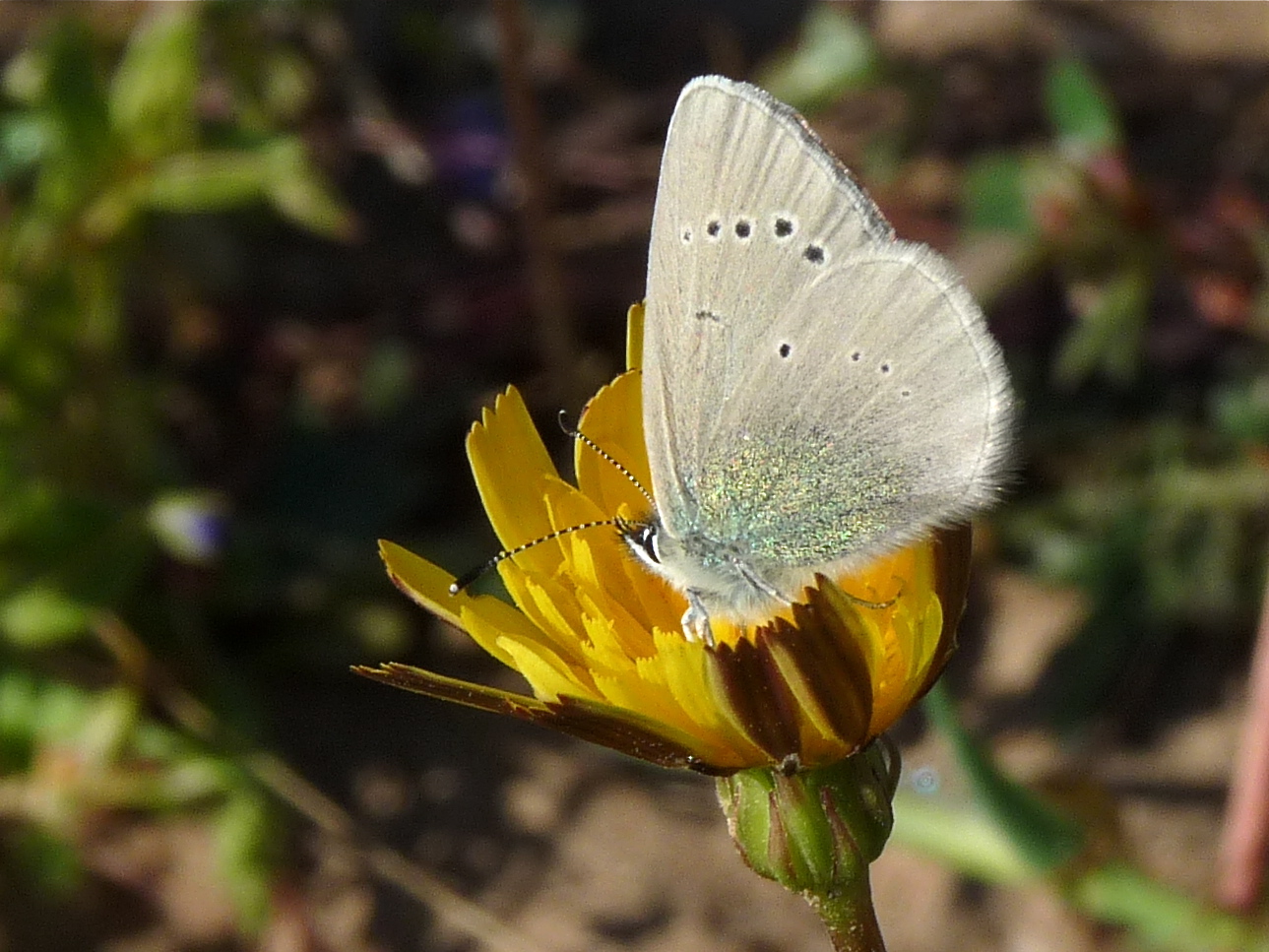
This specimen carries small black spots on the underside of its forewings.
Long-tailed blue, Lampides boeticus, L.
The pretty Long-tailed blue is restricted to the extreme south-east of Europe. On Naxos it is very common. With a wingspan of up to 3 cm, it is one of the larger blue butterflies. In our region, this species lays its eggs on cowpea plants, a bean that is sometimes cultivated in vineyards.
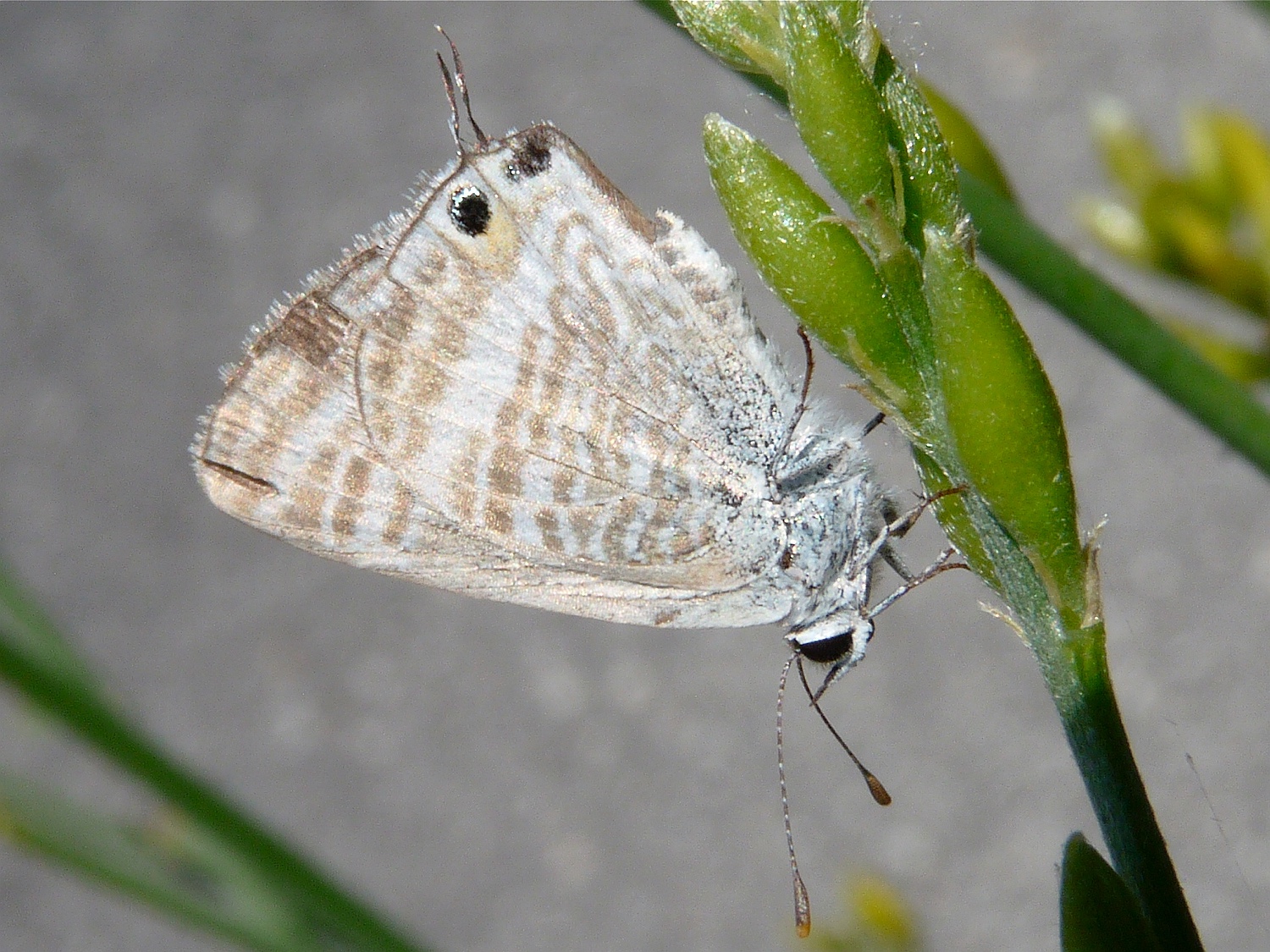
The pretty Long-tailed blue almost always sits with its wings closed, so that only the underside of the wings can be seen, except when it is flying. The species can be recognised by the wider light stripe on the hind wing. At the anal angle of the hind wings, a long, narrow tail sits between two small eye spots.
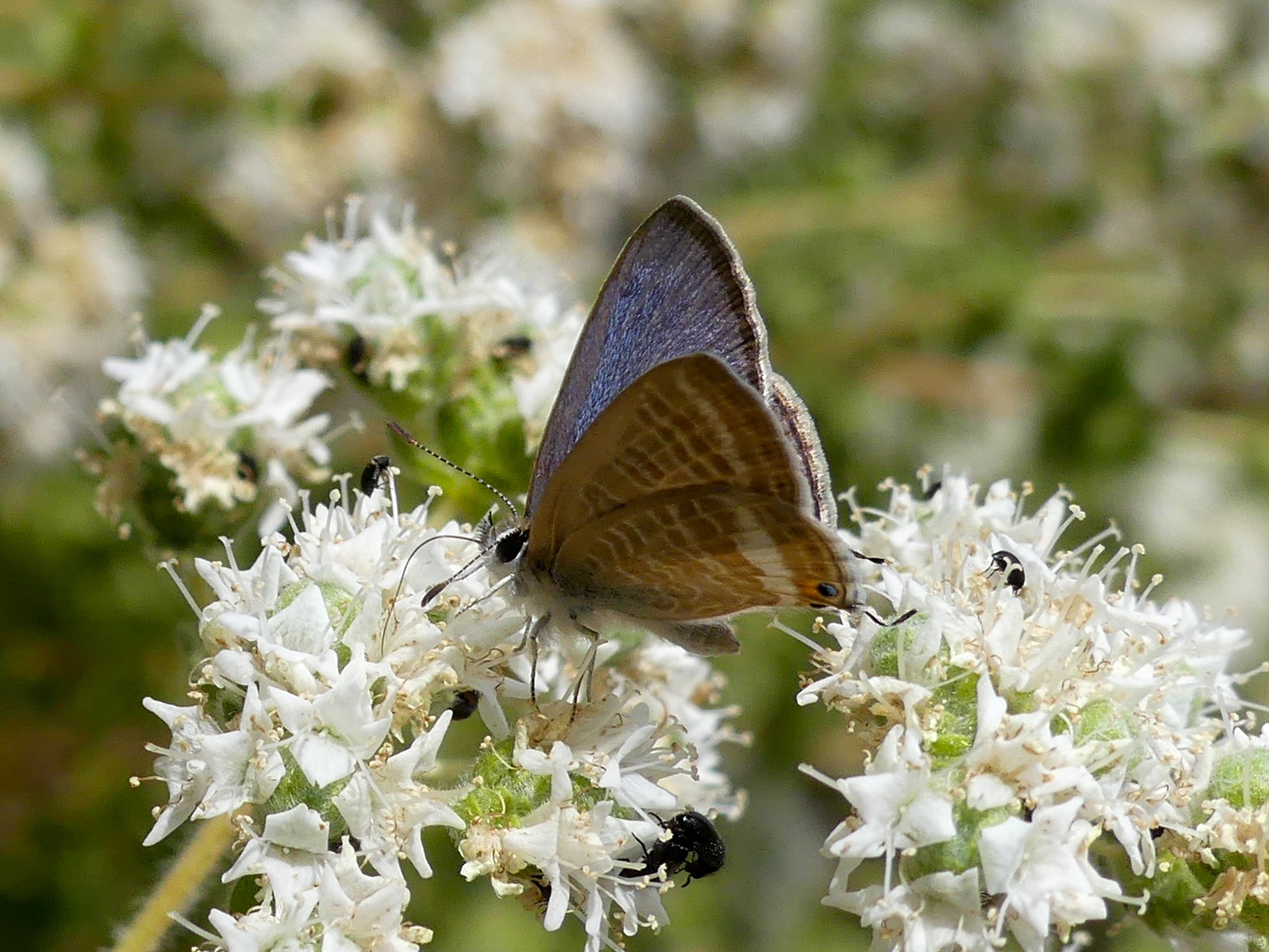
Here, a bit of the bluish upper side is visible.
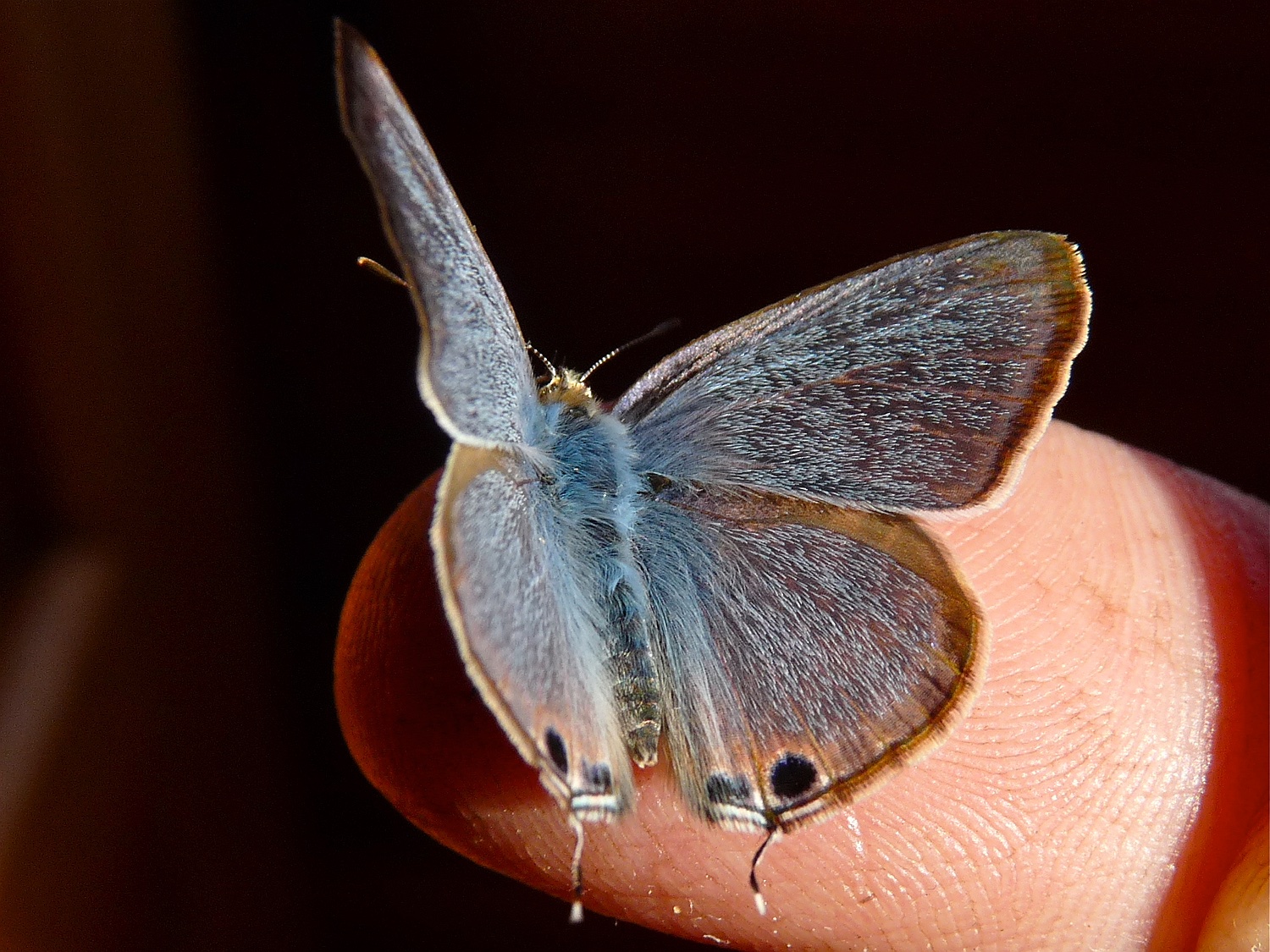
I managed to photograph the upper side of the wings of this specimen, which had strayed into our house. In males, the upper side of the wings is blue, whereas in females it is brownish.
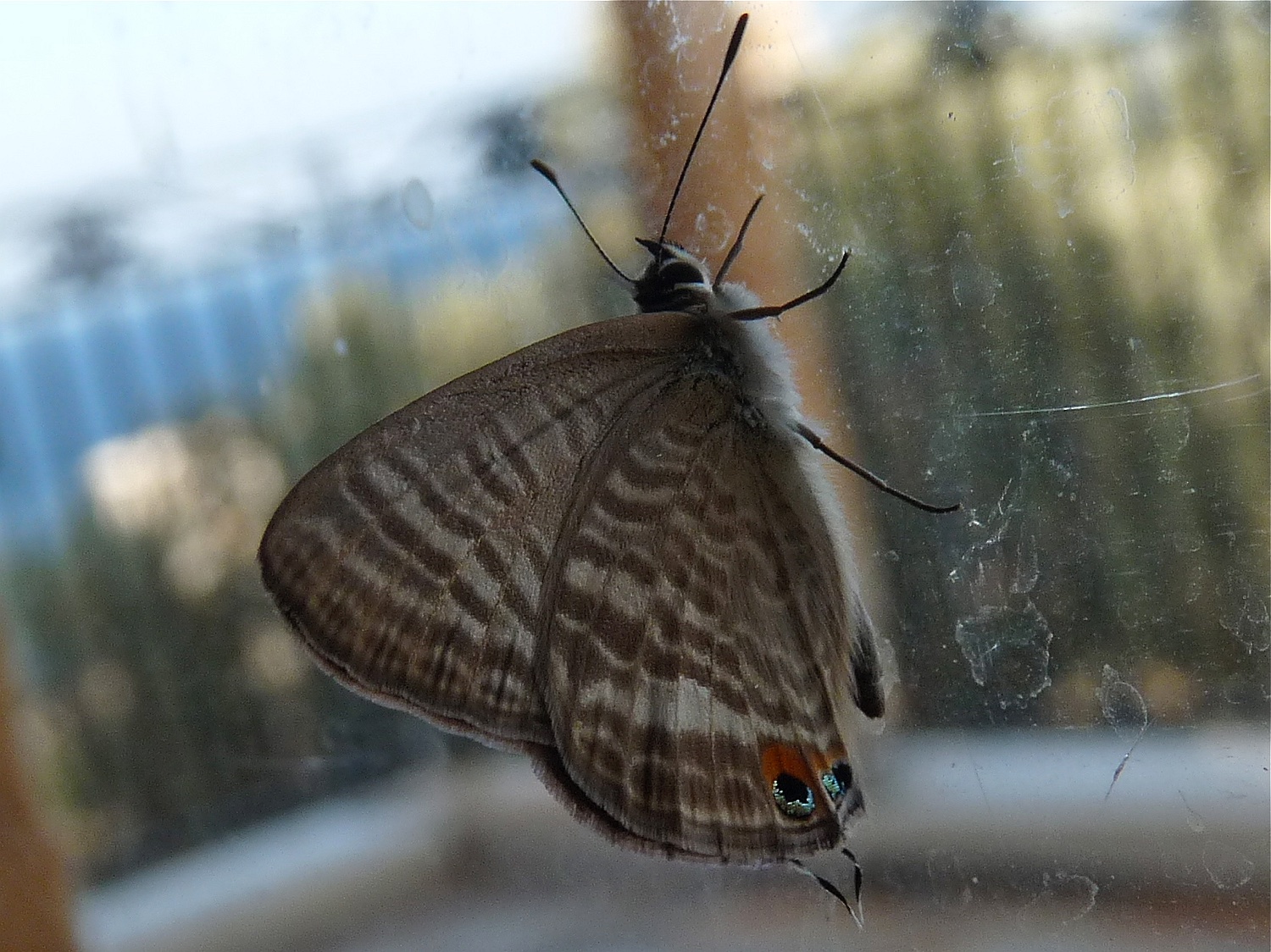
Here is the same butterfly from below; you can see the orange and metallic blue of the ocellus.

In females, the upper side of the wings is brownish grey with only a little blue at the base of the wings.

Nevertheless, the females also appear distinctly blue when fluttering around, perhaps due to a metallic sheen that is usually not visible in the photos. Here, the blue sheen is a little visible on the photo.

In our region, the Long-tailed blue is mainly found on our cowpeas where it often causes some damage.

The caterpillar is thick and compact with tiny legs.

Here a caterpillar in a bean.
Common zebra blue, Leptotes pirithous, L.
The Common zebra blue is similar to the Long-tailed blue, but slightly smaller with a wingspan of only 2.5 cm. It is found in the Mediterranean region, south-west Asia and parts of Africa. The caterpillars live on a whole range of host plants. On Naxos, it is quite rare.

The Common zebra blue can be distinguished from the similar Long-tailed blue by the absence of the white band in the pattern on its underside wings. It has a short, narrow tail on its hind wings and two rather indistinct eye spots.
Green hairstreak, Callophrys rubi, L.
The pretty Green hairstreak is a rather inconspicuous and not very common butterfly.
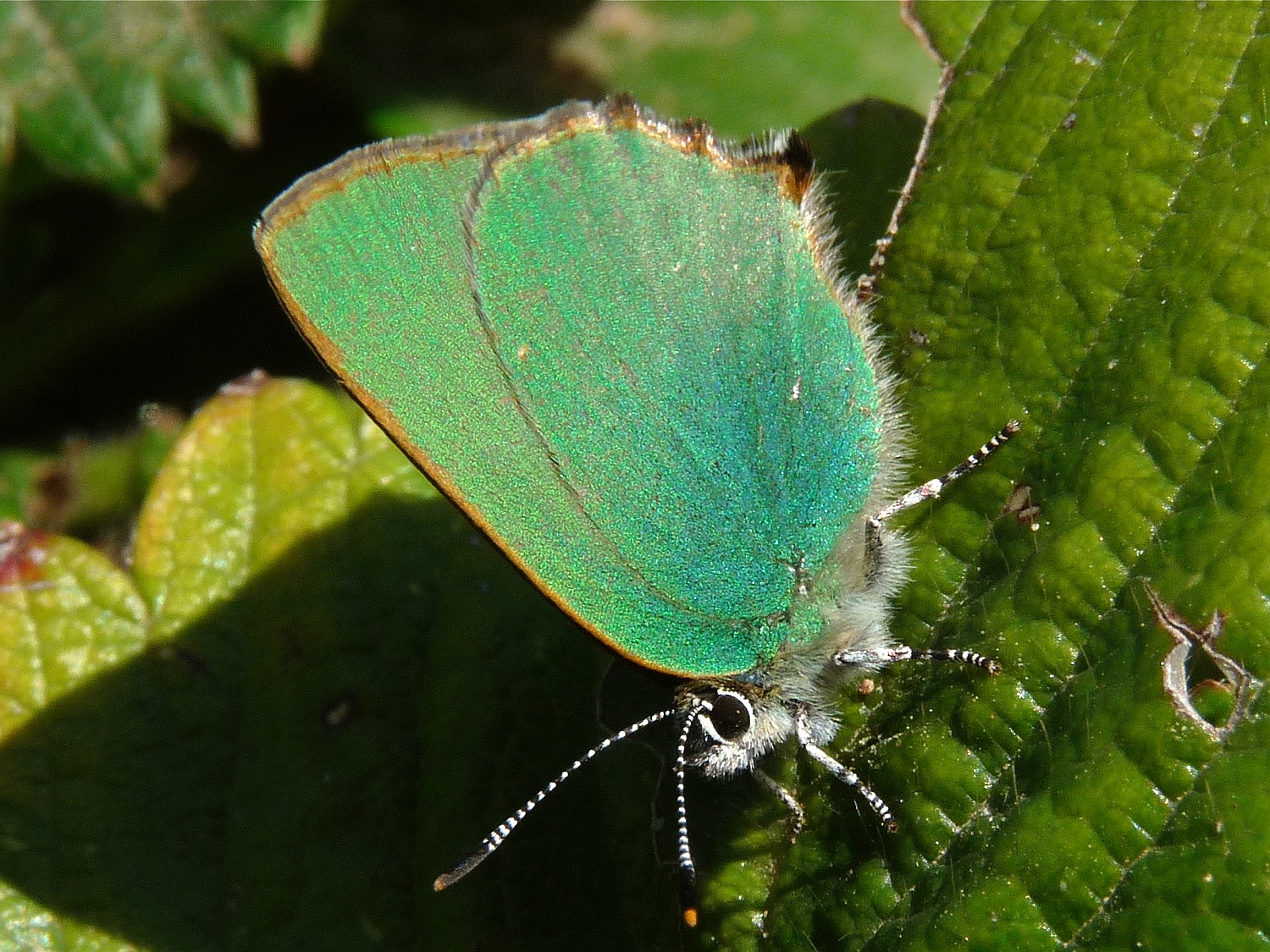
The intensely green, slightly metallic iridescent Green Hairstreak is not very common on Naxos.
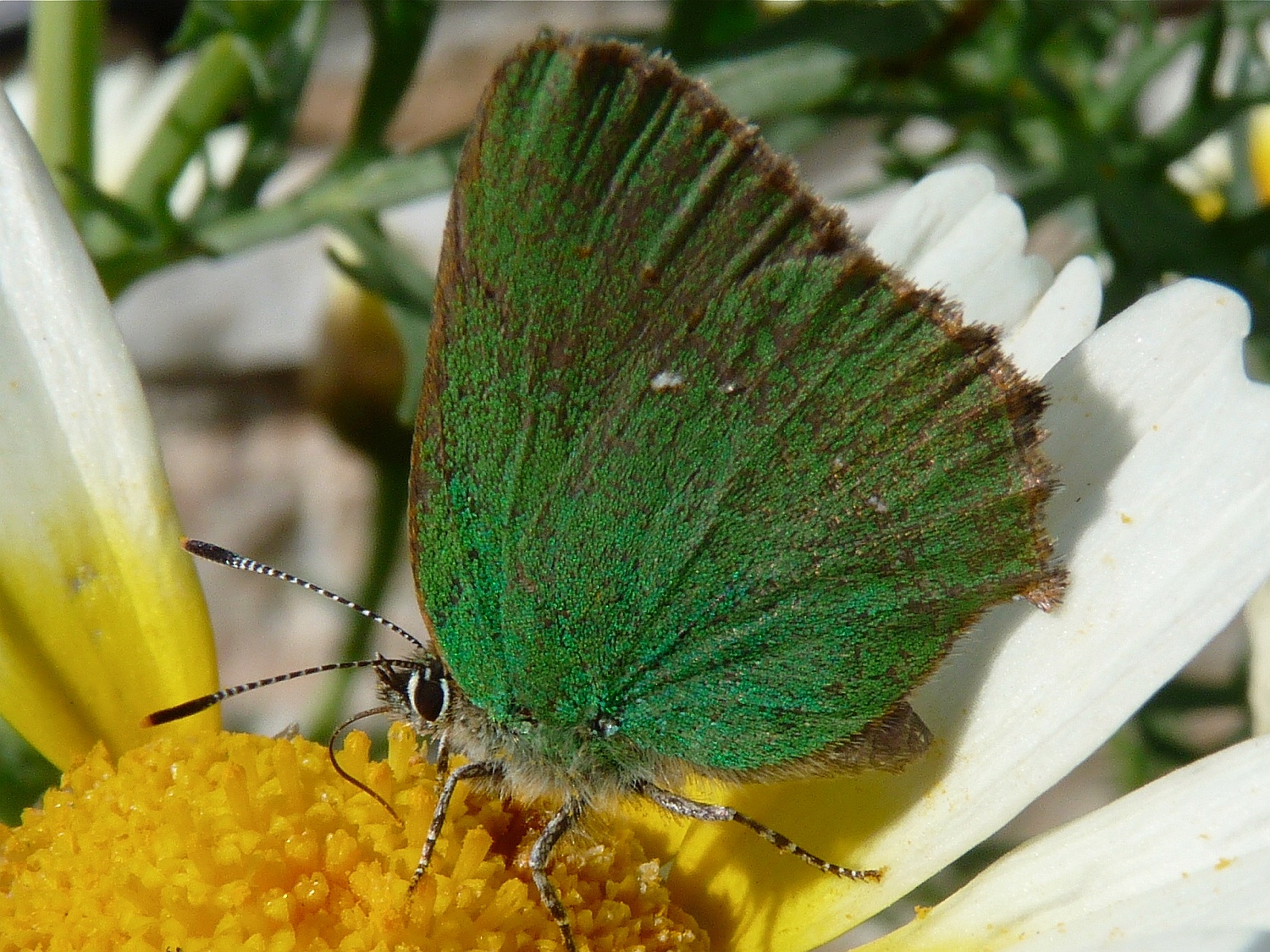
It has a really impressive colour!
Blue-spot hairstreak, Satyrium spini, Denis & Schiffermüller
The small Blue-spot hairstreak is brownish in colour. The caterpillars live on buckthorn. The species occurs in southern Europe and Asia and is associated with open, dry habitats. It seems to have become more common on Naxos in recent years.
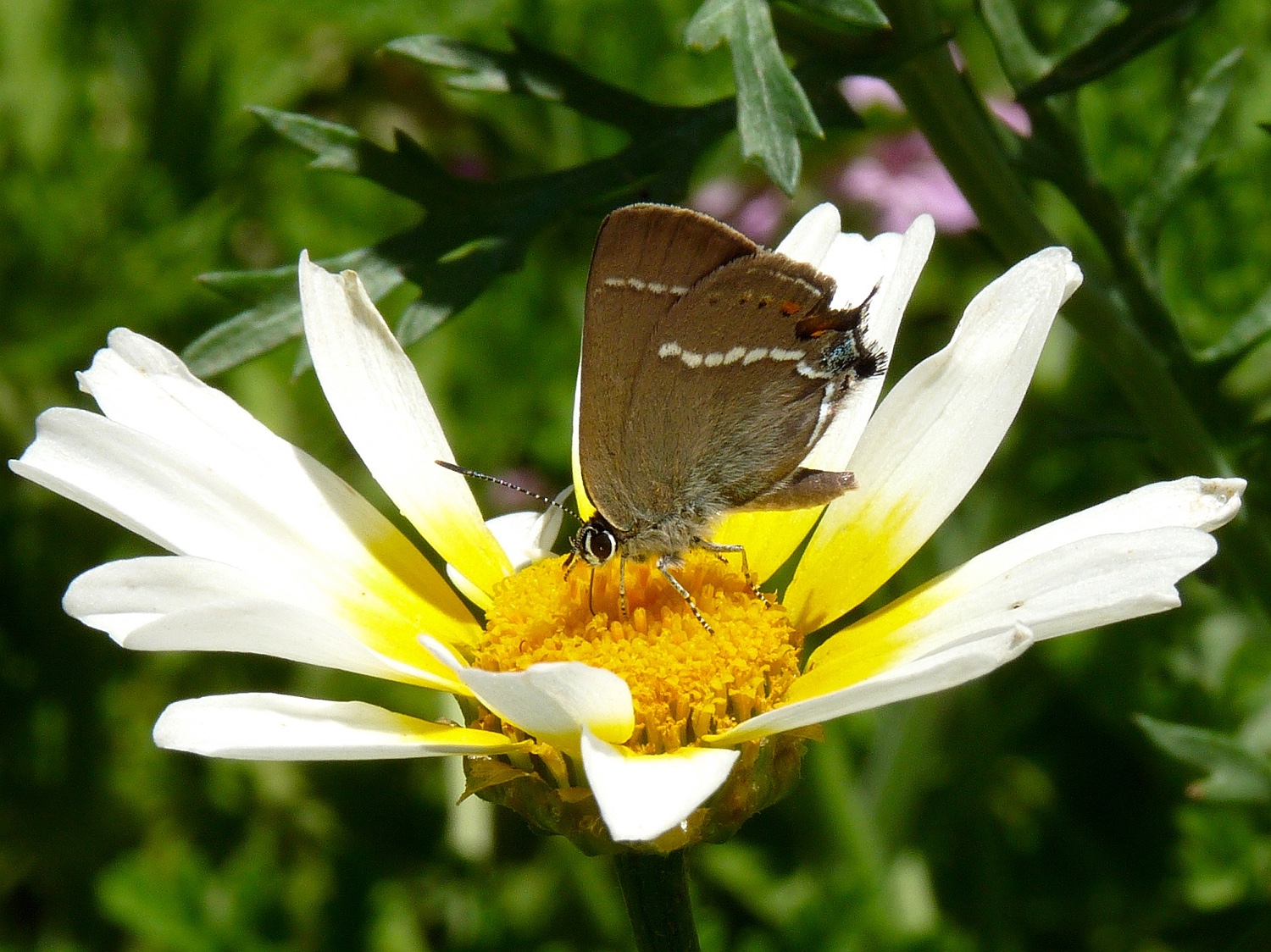
Characteristic of the Blue-spot hairstreak is the bluish spot on the hind wing next to the little “tail”.
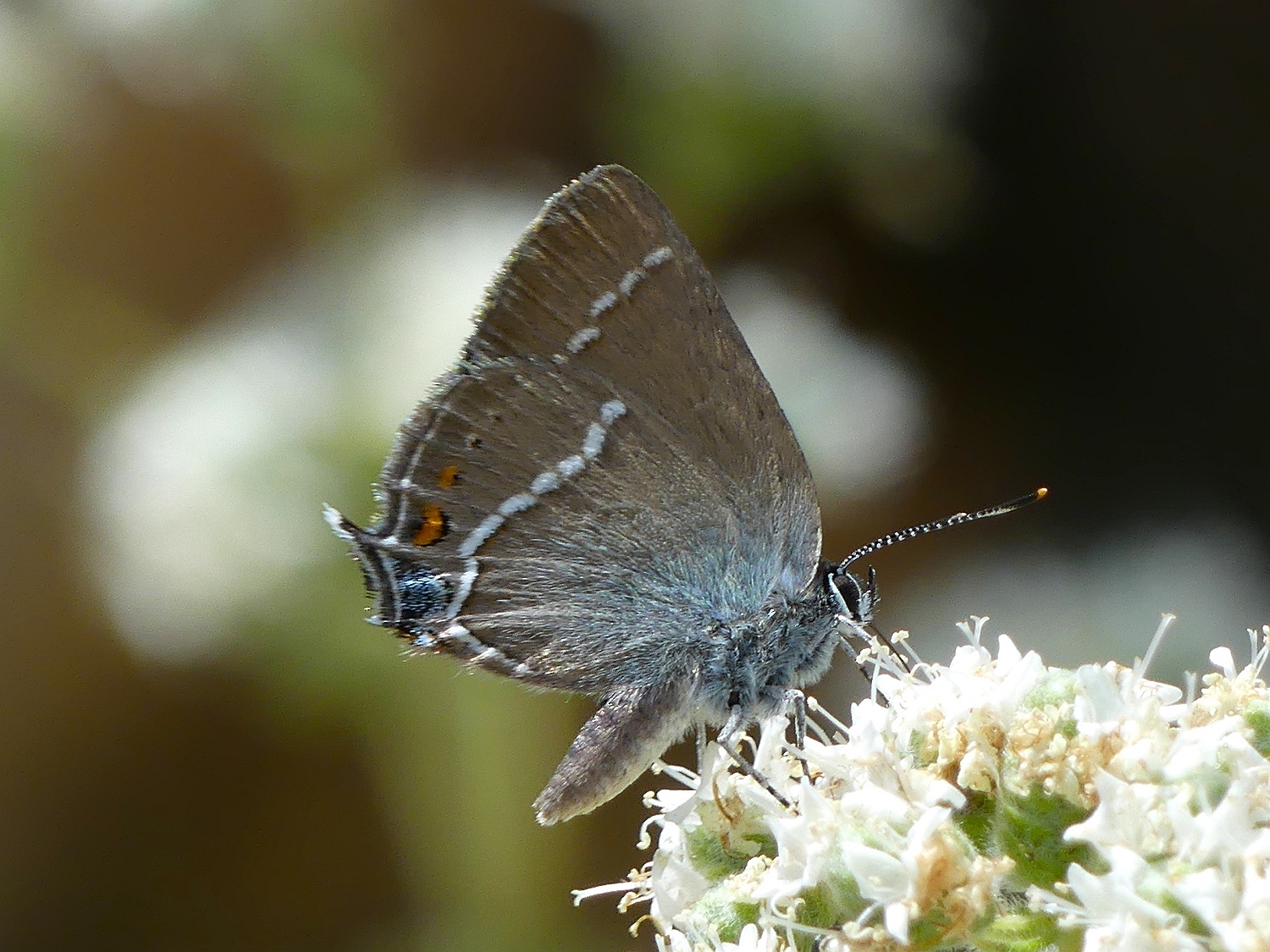
Males and females of this species look almost identical.
Skimmers, Hesperiidae
Skimmers are rather small butterflies with thick heads and thick, hairy bodies and hairy wings. Unlike the ‘true butterflies’, which include all previous families, the antennae of skippers have a hook-shaped tip that curves backwards. The skimmers look more like moths than like butterflies, but are active during the day. Their wings are usually held at a characteristic angle. They are a large and widespread family, but its members are much less conspicuous than many other butterflies and therefore often overlooked.
Lulworth skipper, Thymelicus acteon, Rottemburg
The Lulworth skipper is common in our region. Its intense brown-red colour makes it easy to spot.
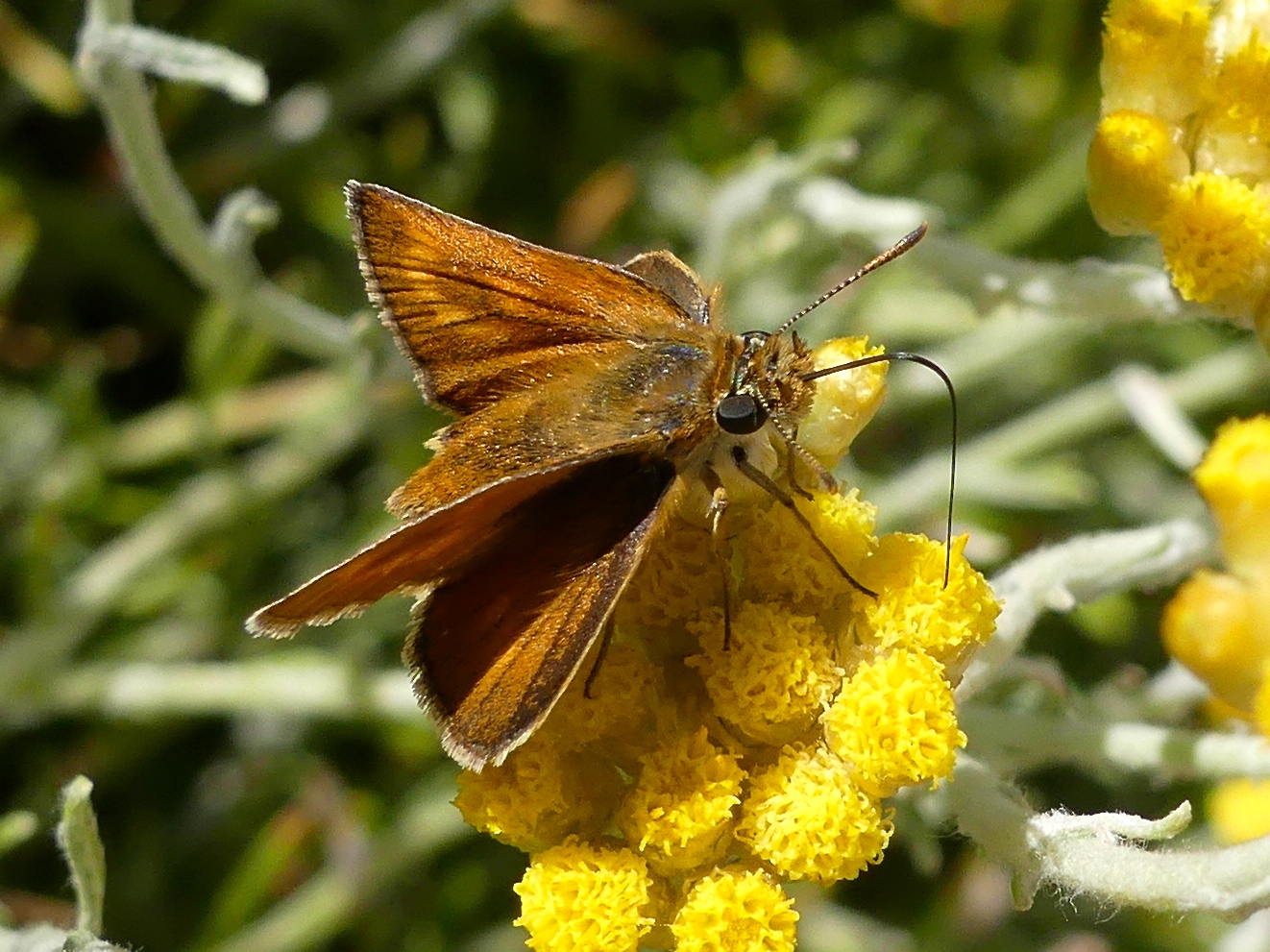
Here you can see the typical wing posture of skippers.
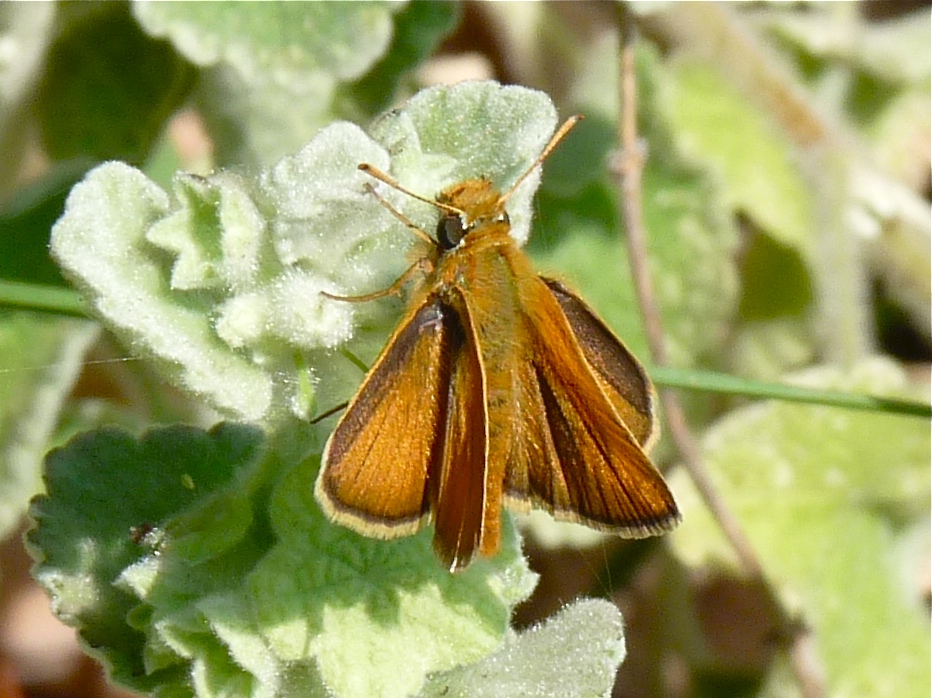
The Lulworth skipper has reddish-brown wings without any distinctive markings.
Mallow skipper, Carcharodus alceae, Esper
The Mallow skipper is one of the less conspicuous species; it is also common in our region. As its name suggests, the caterpillar lives on mallow plants; it pulls a leaf together with silk threads and lives in the shelter thus created.
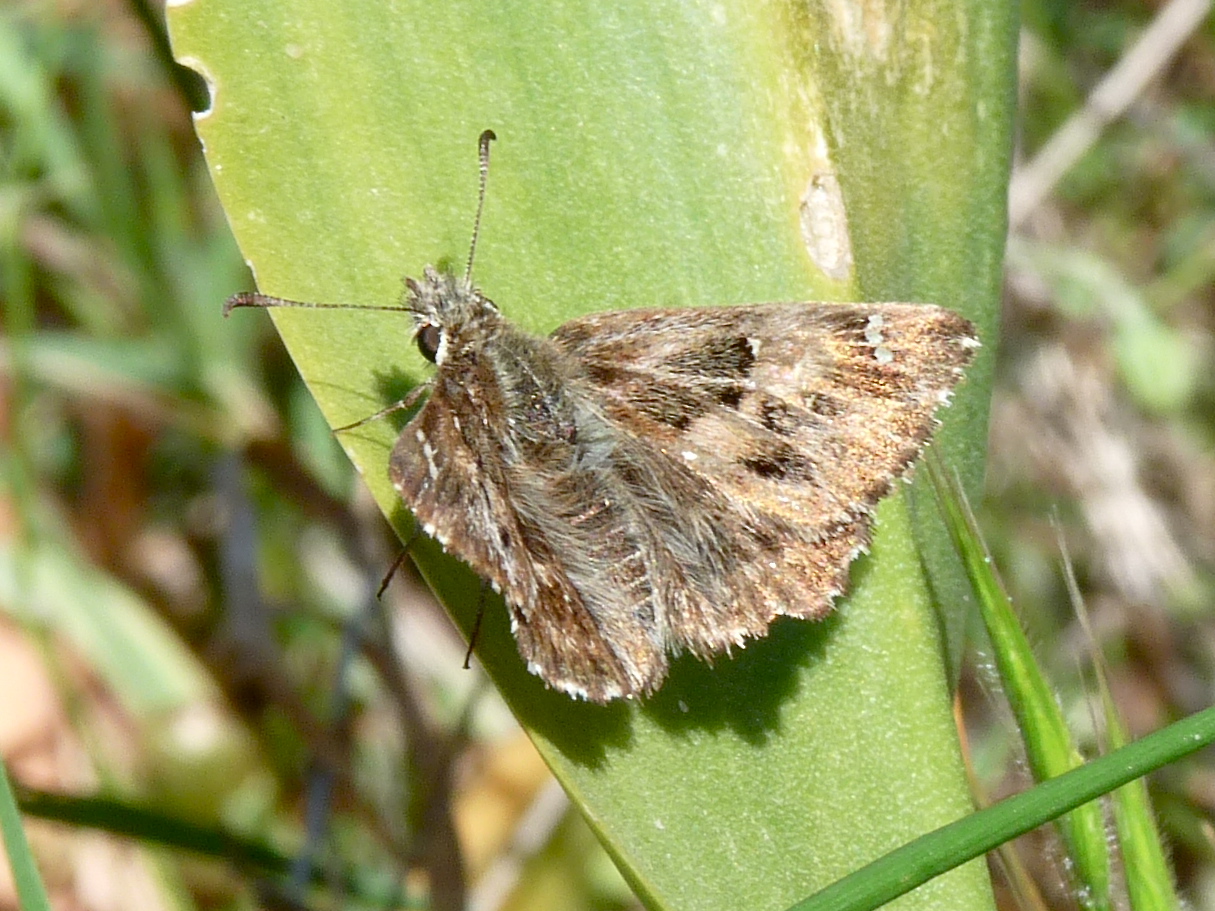
This small species is dark brown with delicate markings; its body is very hairy. The Mallow skipper often sits on leaves or stems, hidden in the vegetation.
The nocturnal moths are discussed on a separate page (note that some moths are active during the day, such as the Hummingbird hawk-moth).
Other insects that resemble butterflies
Some species belonging to the neuroptera may be mistaken for butterflies:
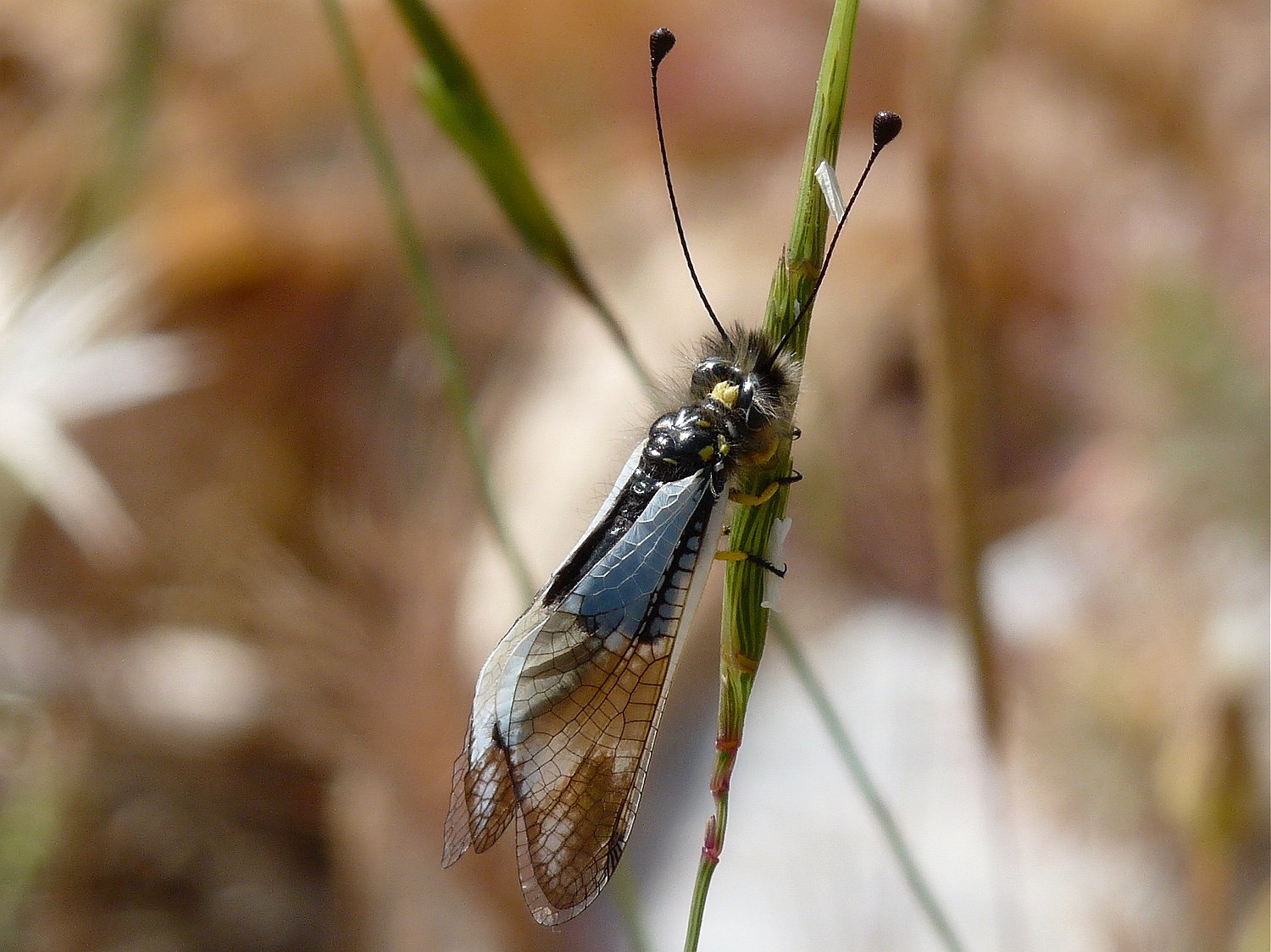
The owl fly Libelloides lacteus may be mistaken for a butterfly because of its coloured wings.
continue: Moths
back:
See also:
further reading: Charaxes jasius, A New Species to the Cyclades, Greece