
Neuroptera
The Neuroptera or Net-winged insects are a relatively little known order of insects that includes lacewings, antlions, owlflies and mantidflies. They have characteristic finely veined wings similar to those of dragonflies and can be recognised by the features of their thoracic segments, legs and mouthparts. Only relatively few species of neuroptera occur in Europe, many of which are nocturnal and therefore not often seen; also, most species are rather inconspicuous. An exception are several large, attractive and diurnal species that occur in the Mediterranean region. The next relatives of the neuroptera are the snakeflies.
The Photo gallery of the dragonflies and neuroptera gives an overview over the species.
A note on identification: While some of the species of neuropterans can be identified easily, this does not apply to all species. In many cases, accurate identification relies on characteristics that cannot be seen in photographs and require examination of the dead animal under a magnifying glass or microscope. Also it is difficult to find detailed information about many groups. For this reason, I cannot guarantee the correctness of the identification of many of the species in the following description. I hope that, despite this uncertainty, the article is still valuable in presenting the diversity of the neuropterans of our area and perhaps awakening interest in these often neglected and overlooked insects.
Here you can jump directly to the larger groups (return with the back arrow or by swiping back):
Owlflies – Antlions – Lacewings – Mantidflies
Owlflies, Ascalaphidae
At first glance, owlflies with their coloured wings resemble butterflies. Different from butterflies their wings have no scales and their long antennae have a round, club-shaped tip. Head, thorax and abdomen are covered with long hairs. Owlflies of at least one species can be seen in our area in May and June. They feed on small insects, which they catch in flight, similar to dragonflies.
Libelloides lacteus, Brullé
Libelloides lacteus is found in Greece and Turkey and lives in open scrubland and phrygana. When disturbed, it flutters a few meters away in a characteristic manner and then settles on some grass stalk.
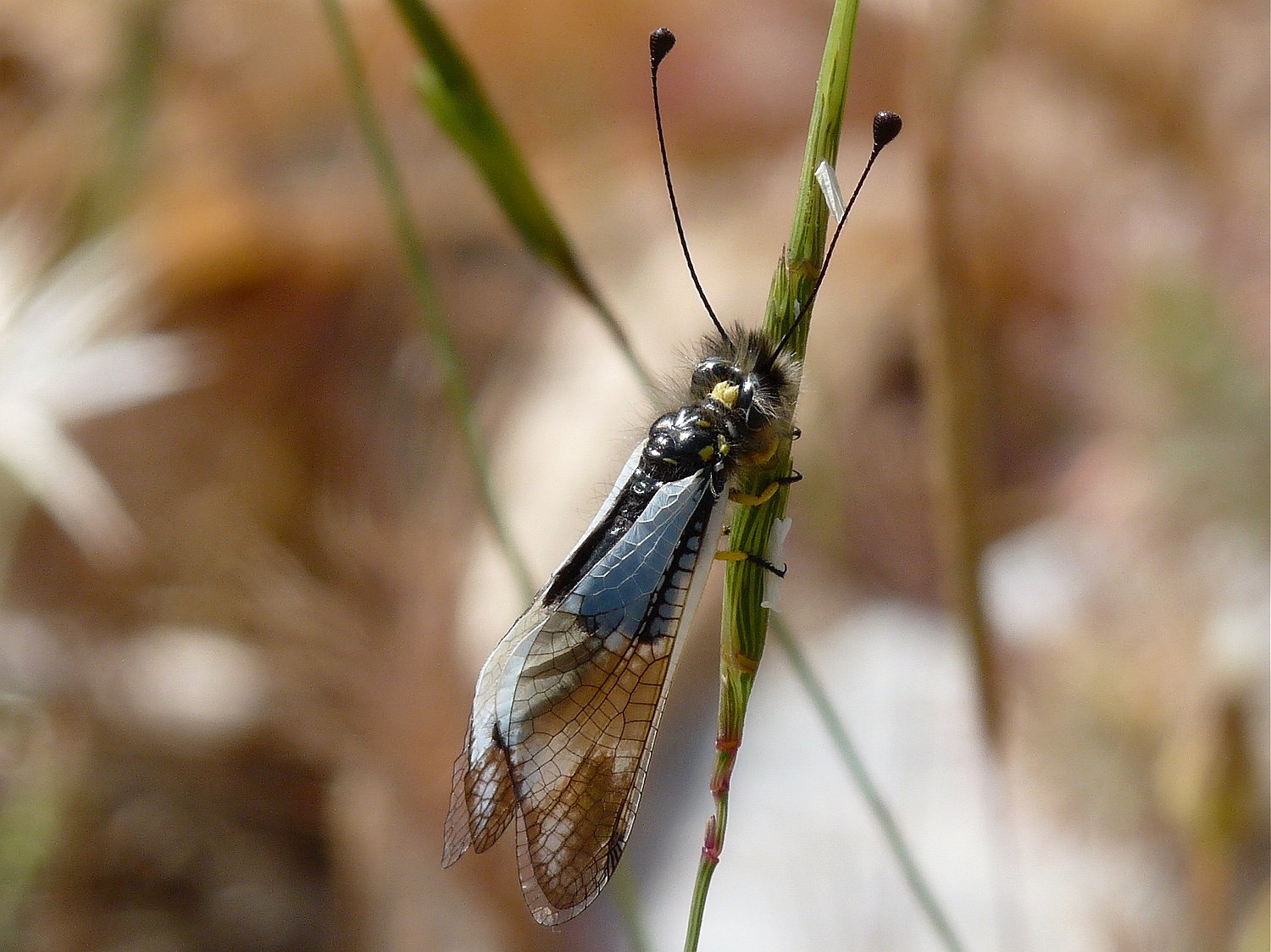
The beautiful owlfly Libelloides lacteus seems quite conspicuous with its light blue wings; but when sitting, it is difficult to spot.
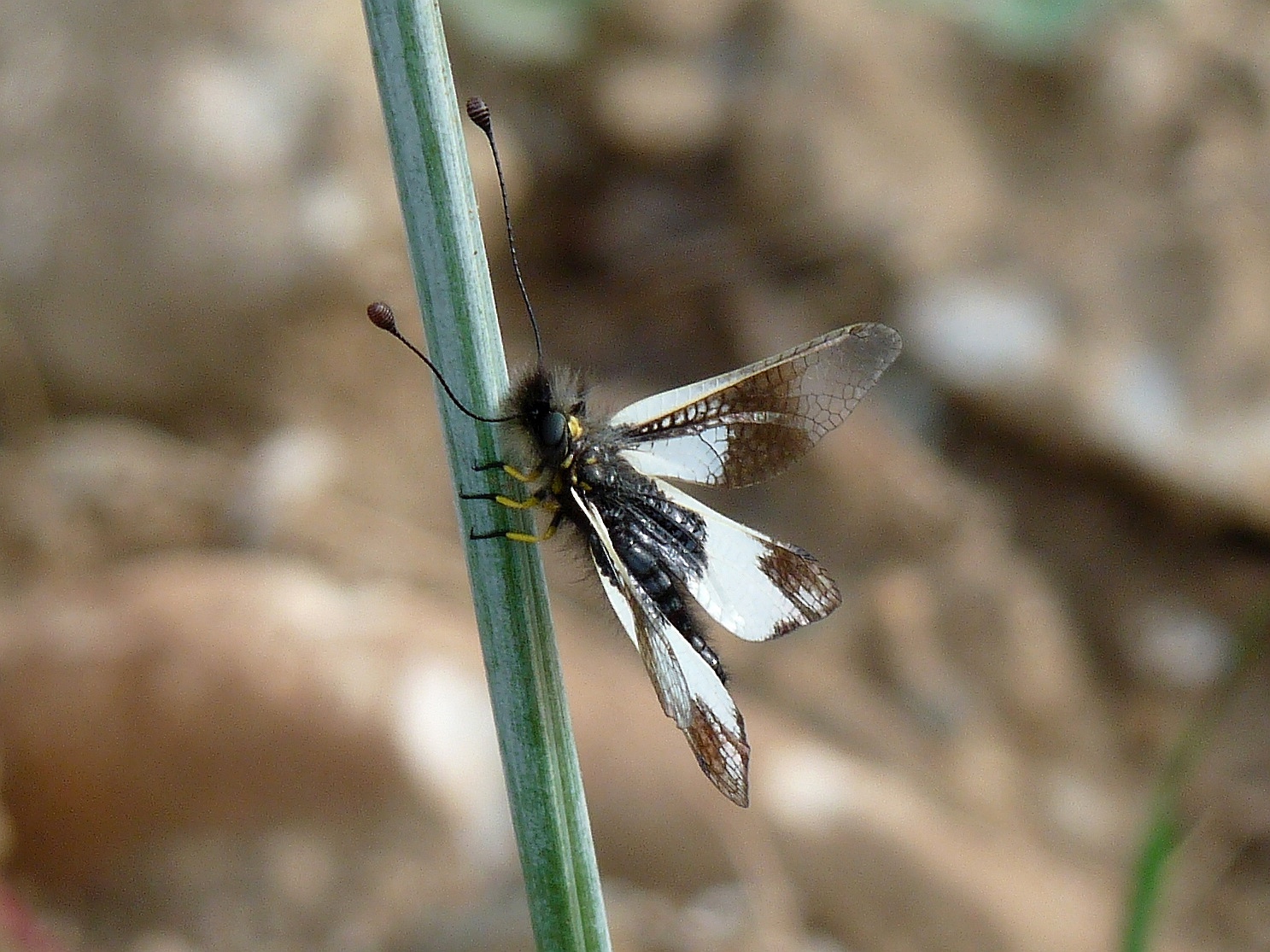
The wings are in part whitish-hyaline, in part translucent and darker in colour. The body is covered with protruding black hairs.
Antlion lacewings, Myrmeleontidae
Of the family of Myrmeleontidae the larvae are much better known than the adults. The larvae, called antlions, dig funnels in the sand, at the bottom of which they lie in wait for insects that pass by and slip into their funnel. The mostly nocturnal adults resemble small dragonflies. They usually feed on small insects or butterflies, which they catch in flight; some species mainly eat aphids. In Europe, most species are restricted to the Mediterranean region.
Palpares libelluloides, L.
The largest species of antlion lacewings in Europe is Palpares libelluloides, with a wingspan of up to 10 cm. This species can be recognised by its size, the yellow and black markings on its abdomen and the pattern on its wings. It flies rather slowly and awkwardly and is often found at dusk, getting attracted by the lamplight. The larvae of this species do not build funnels in the sand, but hunt their prey on the ground.
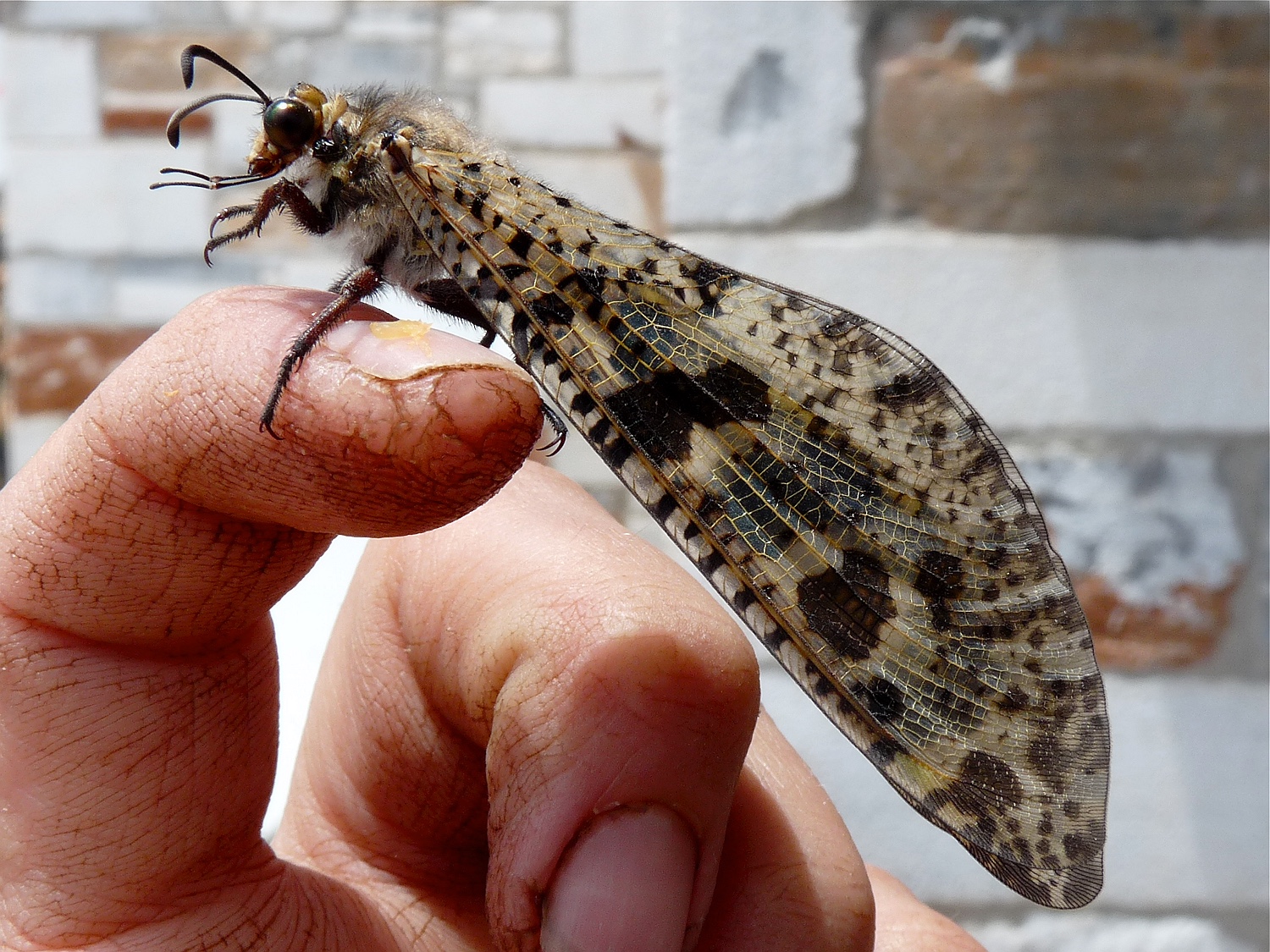
Palpares libelluloides is quite large and impressive. As with all neuropterans, the wings are densely and conspicuously veined. The very broad wings of this species bear an irregular pattern of spots.
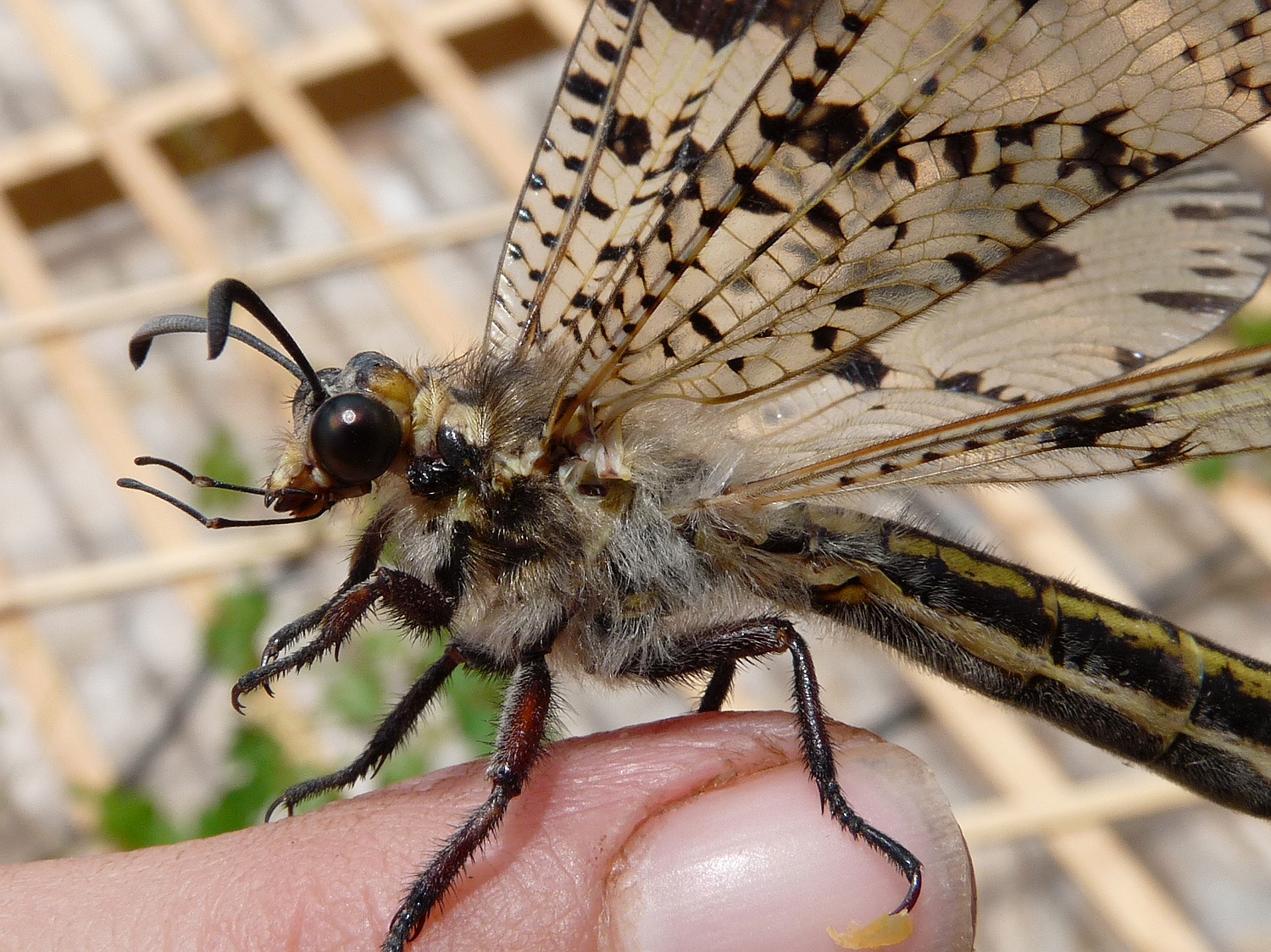
Unlike the owlflies, the imagos of antlions have short antennae. Their bodies are covered in protruding hairs. As one would expect from a nocturnal hunter, the eyes are very large.
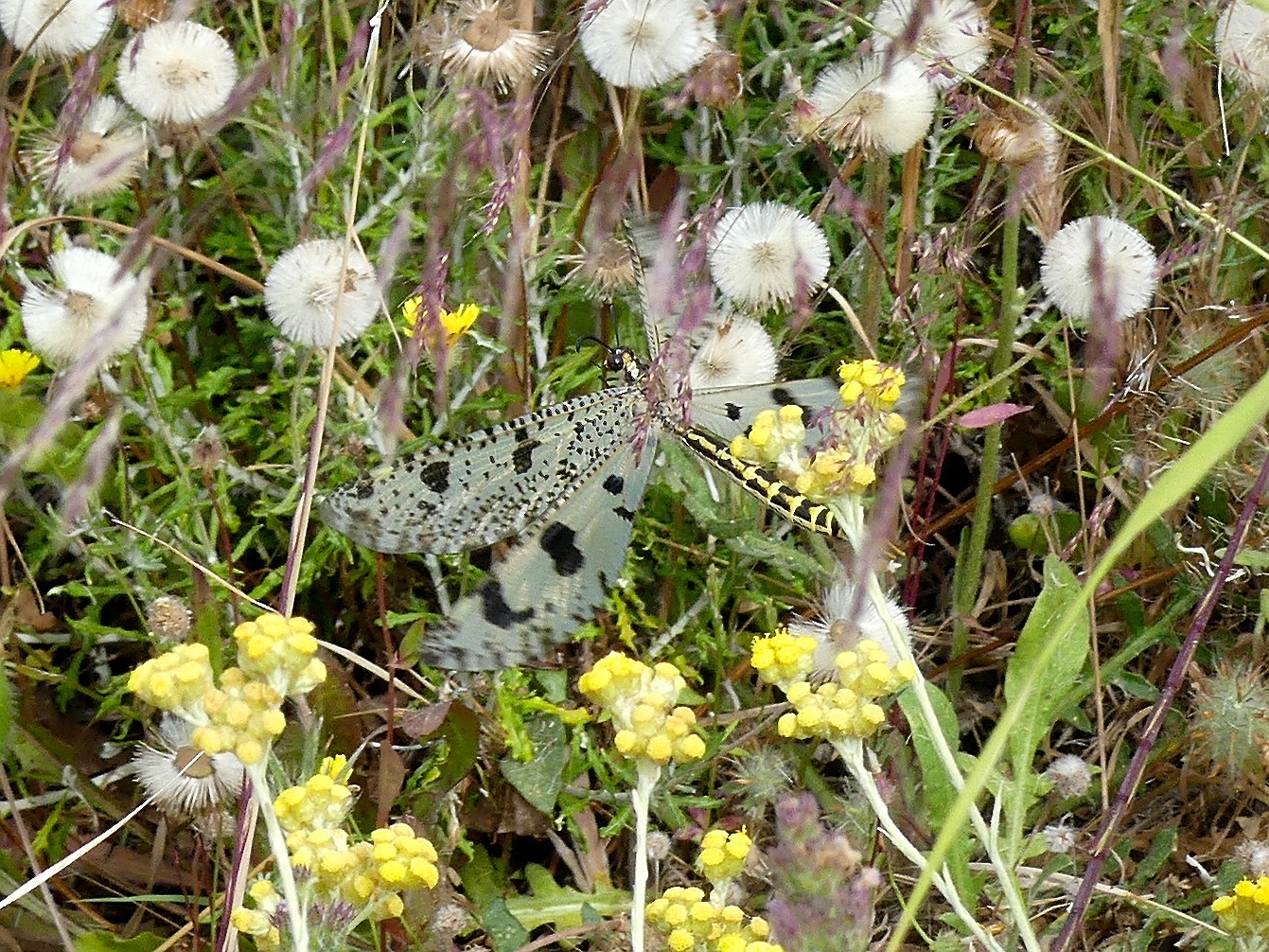
Palpares libelluloides does not fly very well, but flutters rather awkwardly. Due to its size, it is quite conspicuous when flying.
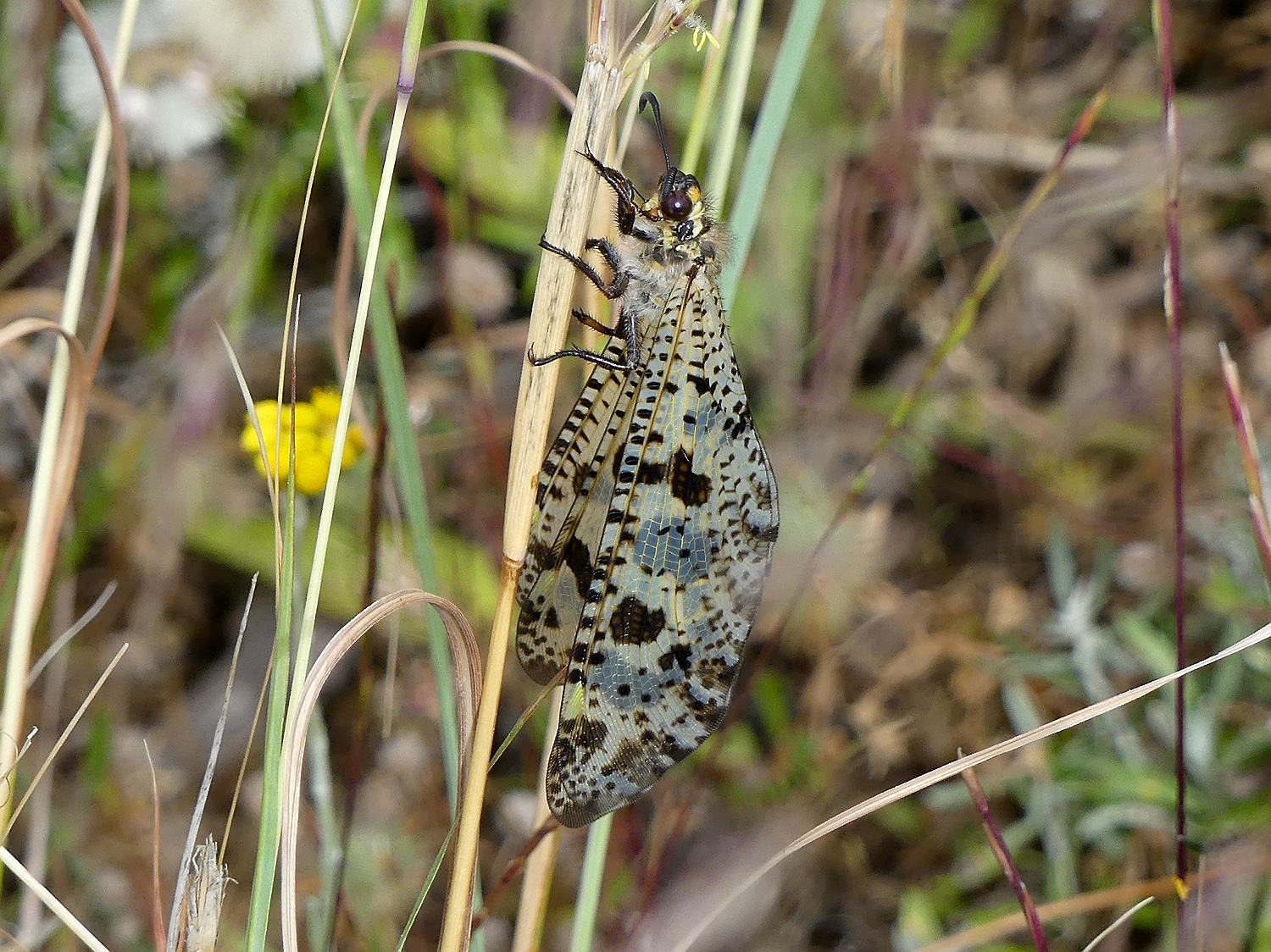
Once it sits down, however, it is almost impossible to spot due to its good camouflage: Its patterned wings blend in with the irregular colours and shapes of the vegetation.
Antlions sensu strictu, Myrmeleontinae
The larvae of many antlions, especially the species of the subfamily Myrmeleontinae, build funnels in the sand in which they lie in wait for insects. The larva, called antlion, is excellently adapted to this way of life. While antlions are well known and studied, much less is known about the adult insects. It is difficult to identify the species in the larval stage: in many species of antlion the larvae are very similar. In most species, the larval stage lasts two years. The first larval stage builds a funnel that is only about one centimeter in diameter, in keeping with its small size.
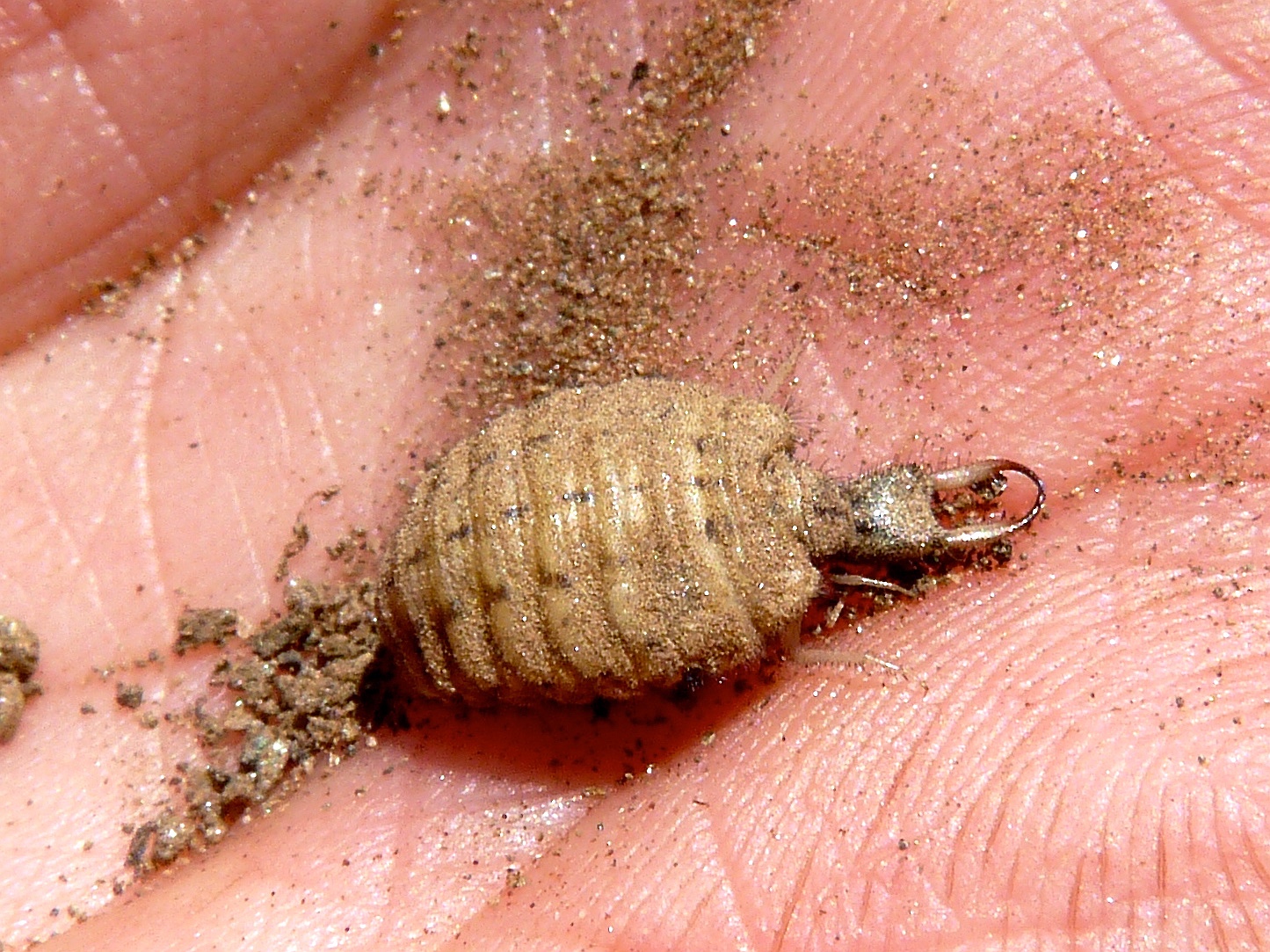
The antlion – the larva of most species of Myrmeleontinae – has a thick, rounded abdomen, a narrow, protractile thorax and a small head with very large jaws, which it uses to seize its prey. The antlion pumps a strong poison into its prey through its jaws, quickly paralysing or killing it. It then injects digestive secretions into the prey and sucks it dry, which can take several hours in the case of large prey. Except for the suction canal, the antlion’s mouth has no opening so that no sand can enter.
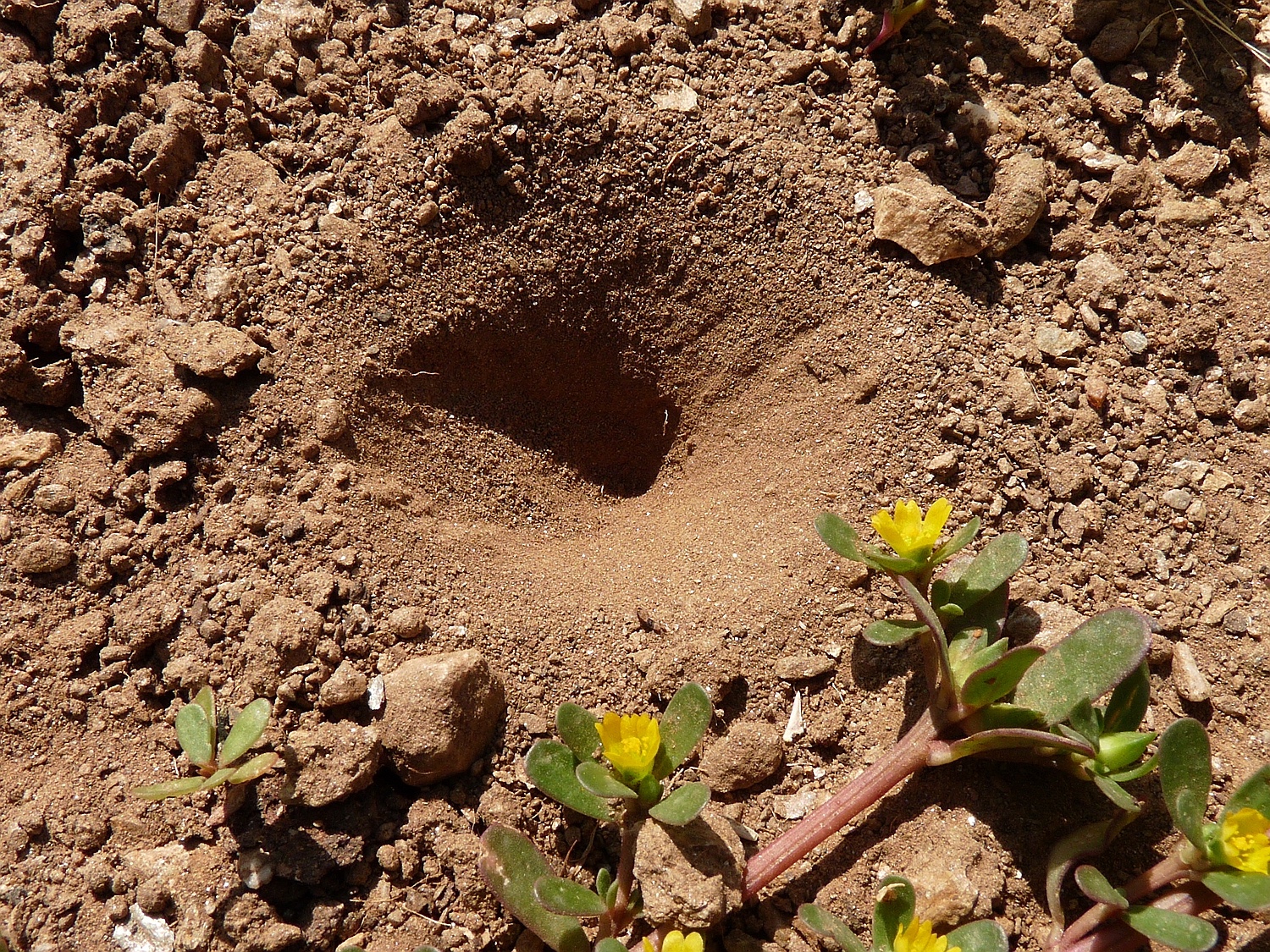
Antlions lie in wait for their prey at the bottom of funnels they build themselves. On Naxos, antlions and their funnels can often be encountered in suitable dry, loose, fine substrate (sand or soil).
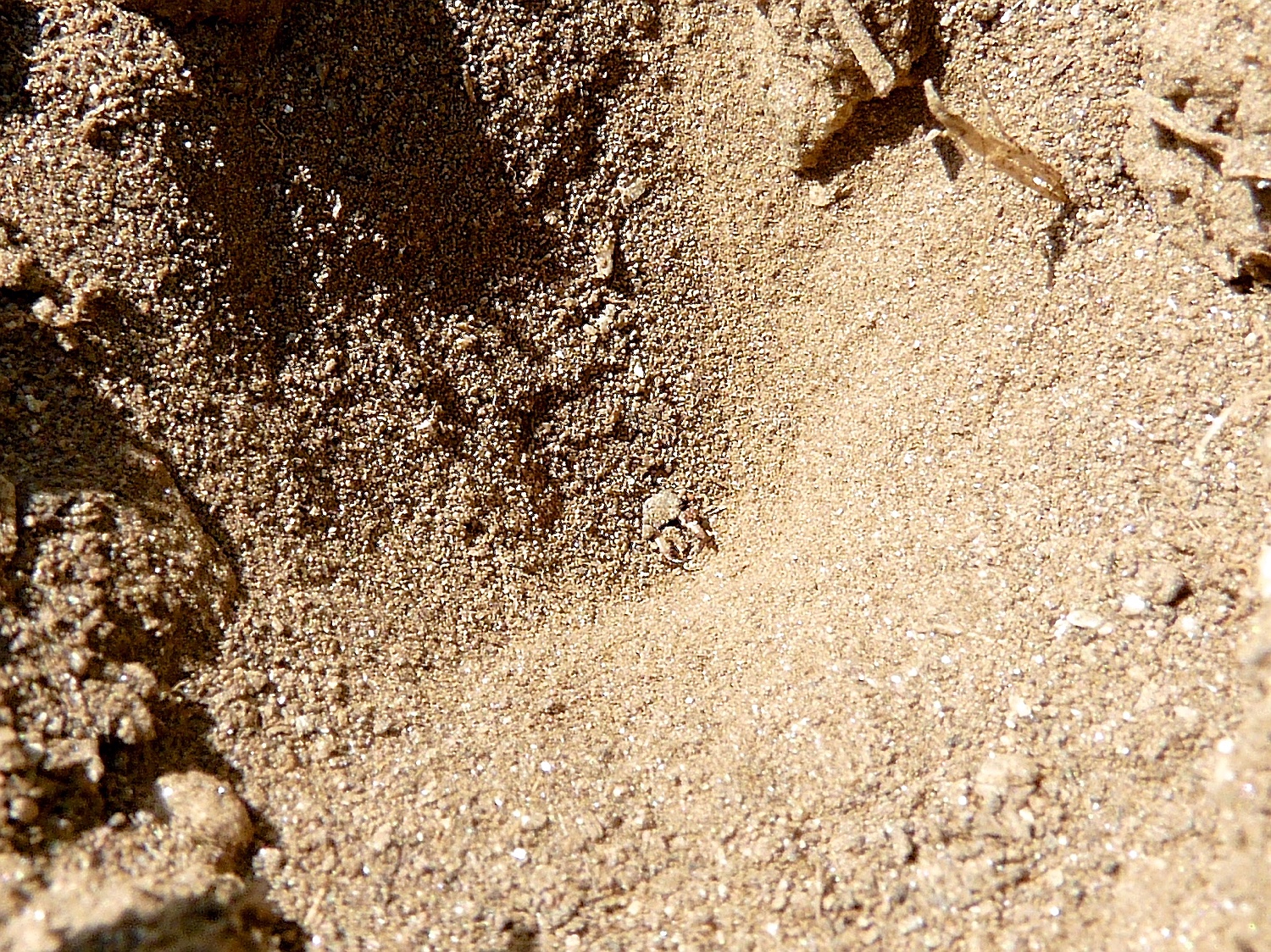
The antlion sits at the bottom of the funnel, buried in the sand with only its head and jaws protruding.
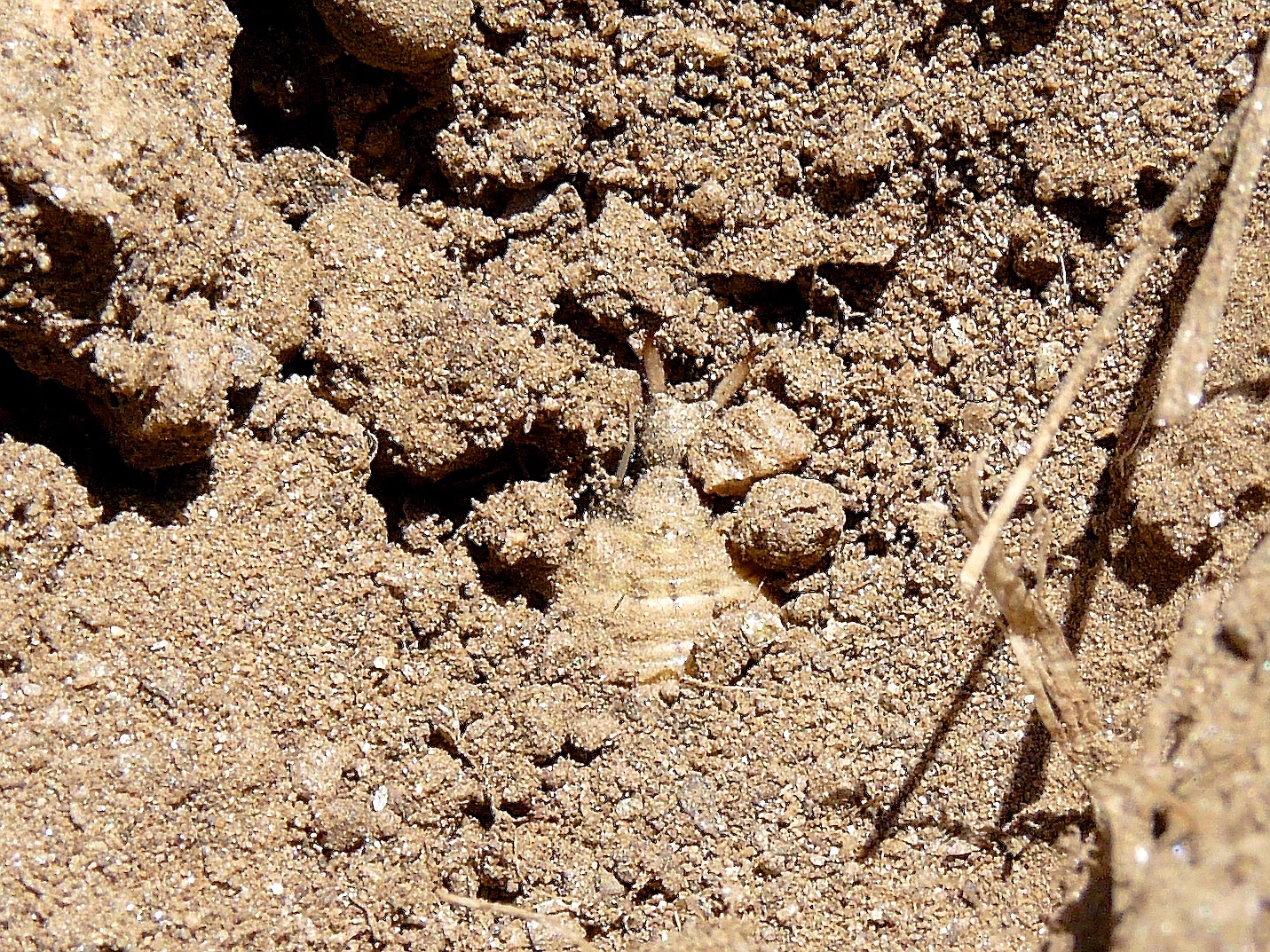
Here you can also see the front part of the body.
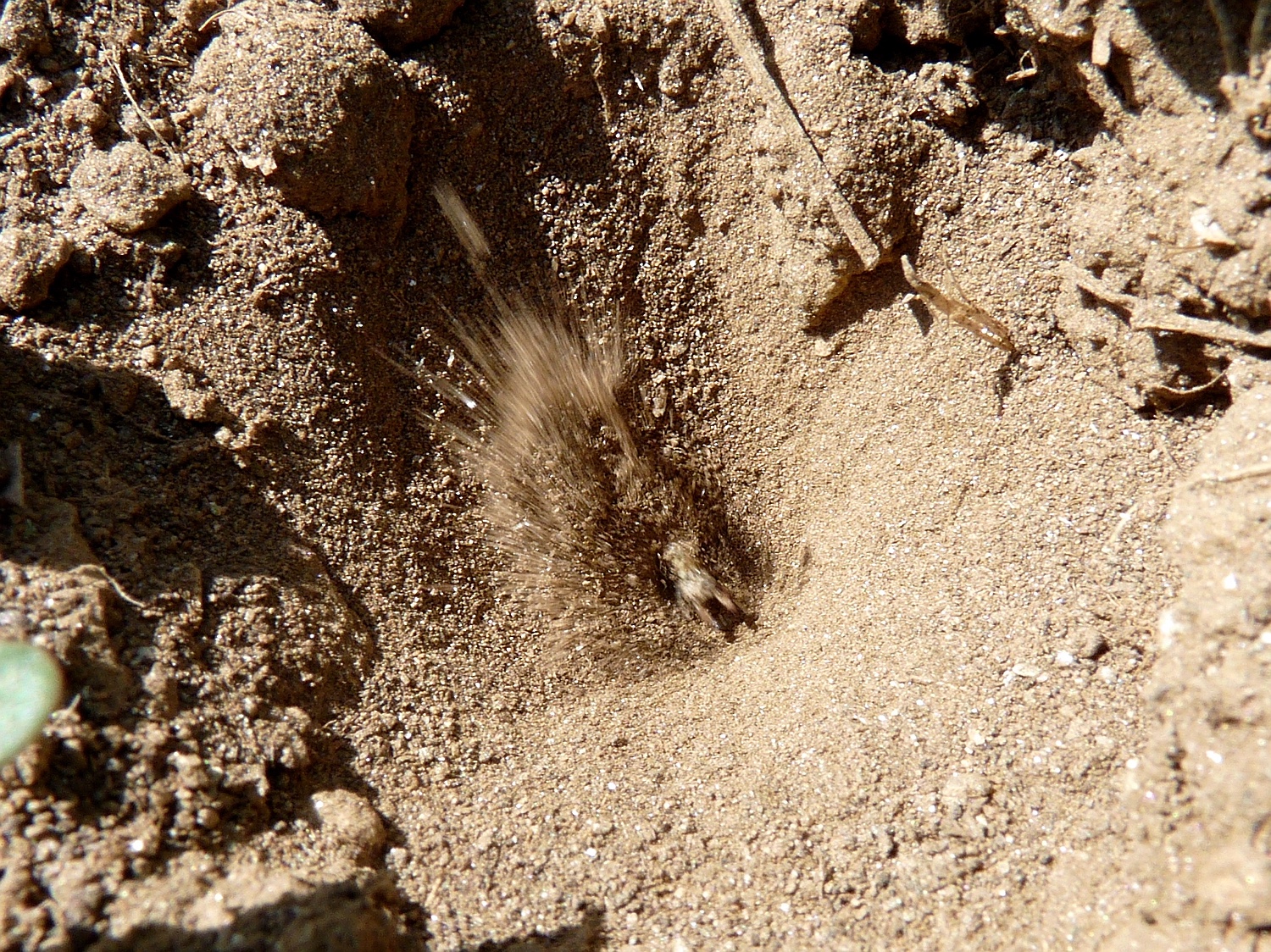
The antlion builds the funnel by throwing sand up and out with its head in a quick, powerful motion of its body.
The antlion can move only backwards in the sand. If you dig it out and place it on the ground, it quickly burrows itself back in. To make a funnel, the antlion first procedes in a circle just below the surface of the ground, ploughing a circular tunnel. Starting from this point, it then works its way spirally inwards, continuously flinging the material outwards until a funnel is formed. Finally, it throws the sand out of the center.
The slope of the antlions funnel is just steep enough so that any small prey that walks into it inevitably slides to the bottom. The antlion waits patiently at the bottom of the funnel until its prey comes within reach. Bristles on the sides of the body enable the antlion to detect the slightest movements in the ground and in the sand. If the approaching animal is too large and potentially dangerous, the antlion burrows itself deeper into the ground. In case of a smaller animal the antlion may throw sand so that the prey slides more quickly to the bottom of the funnel.
Antlions not only prey on ants, but manage to catch fairly large prey – mostly other insects, but also spiders, millipedes and earthworms, for example. In general, the prey has no chance of defending itself. Only a few very well-armoured animals can escape the antlion. The antlion carefully keeps its funnel clean and functional. It can throw out objects up to ten times its body weight.
Myrmecaelurus trigrammus, Pallas
The antlion Myrmecaelurus trigrammus is one of the more common species that is also found in central Europe.
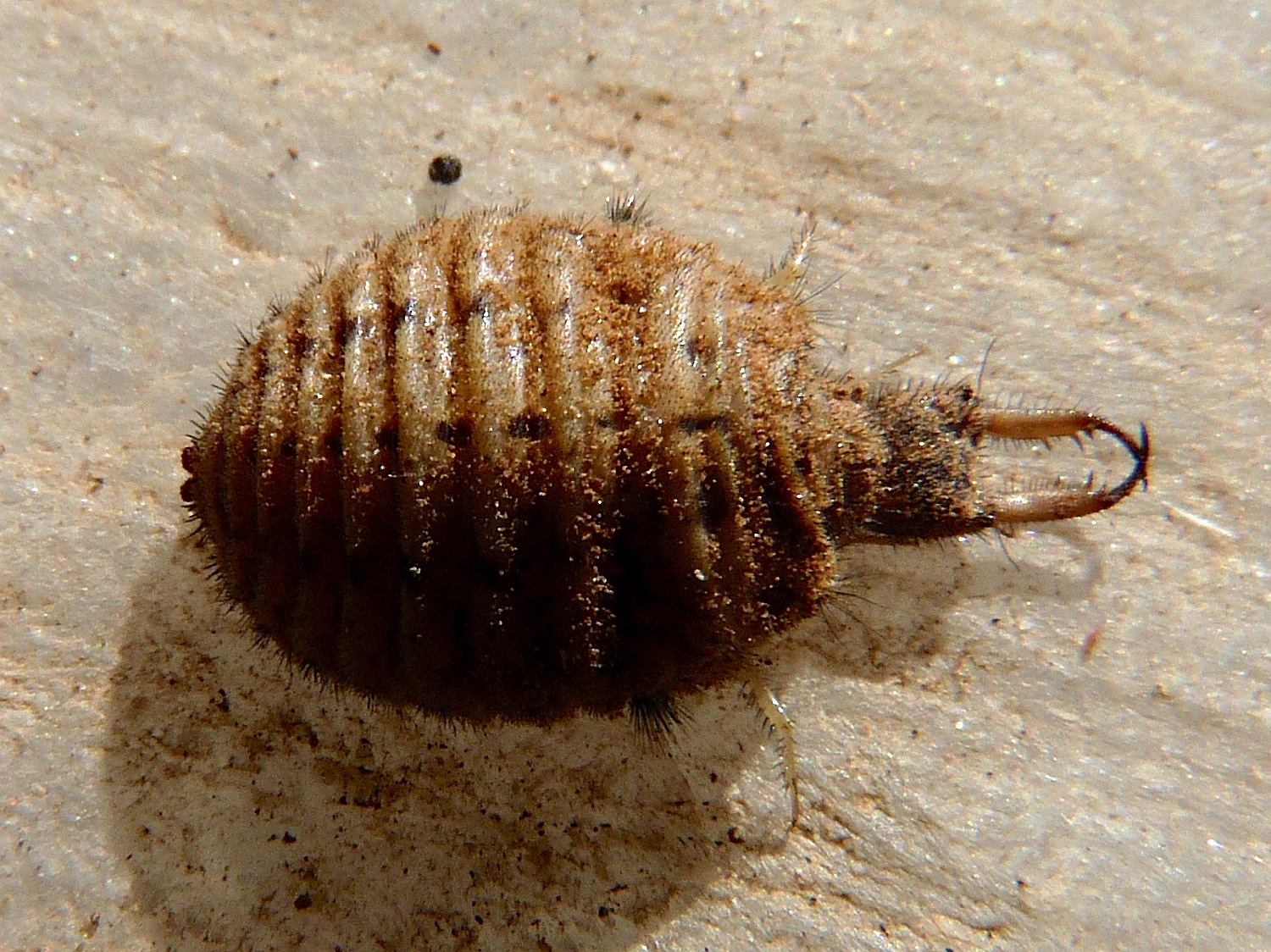
The larvae of the various antlions look very similar. The shape of the jaws and the arrangement of the tufts of hair and bristles are important for identification. This is the most common species in our region, Myrmecaelurus trigrammus.
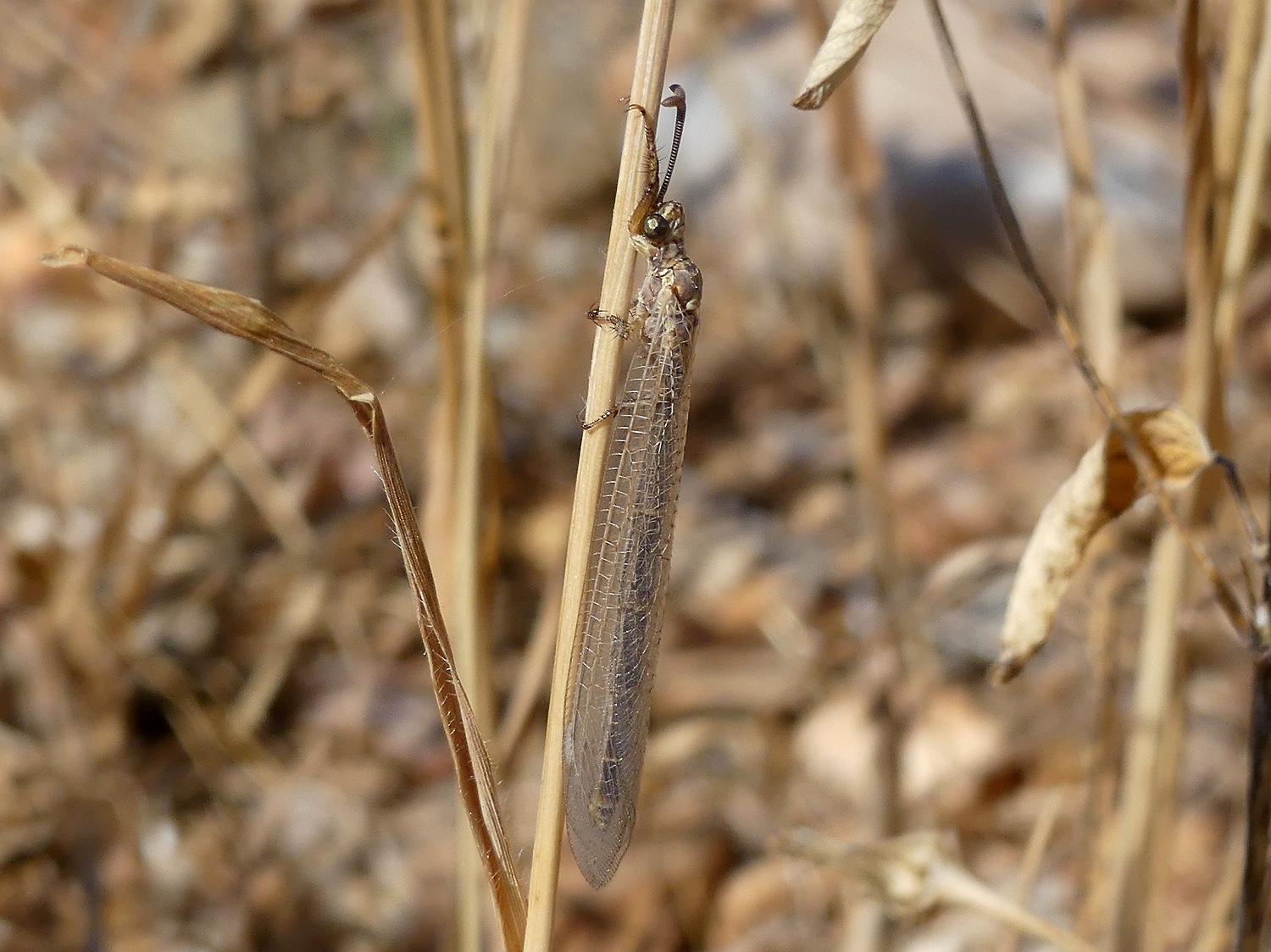
The imagos often sit immobile on a stalk of grass, where they are rather difficult to spot.
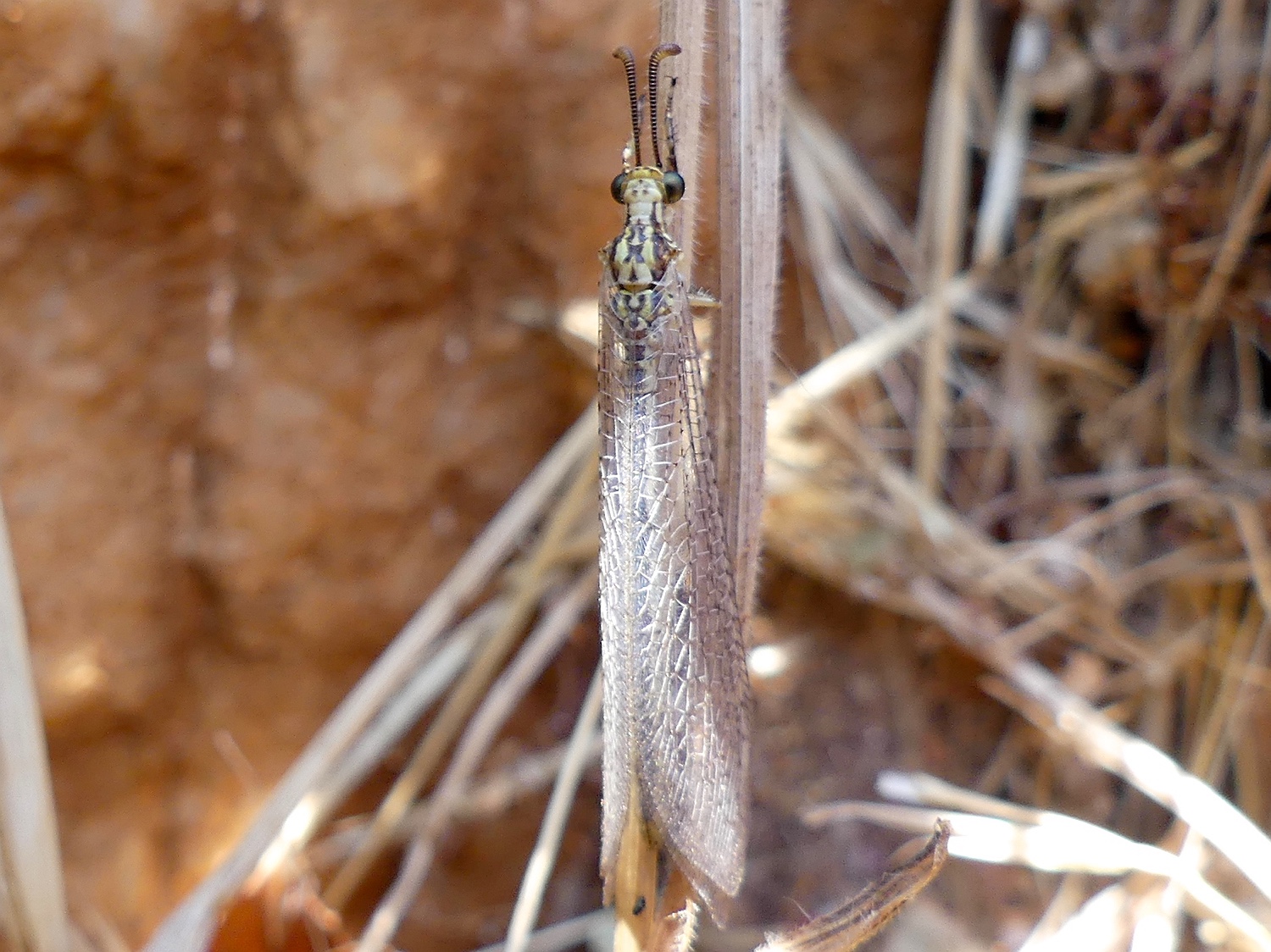
In this species, thorax and abdomen are yellowish with dark markings and a typical pattern on the thorax.
Distoleon tetragrammicus, Fabricius
In early summer, quite a few species appear in our region; however, identification is not easy.
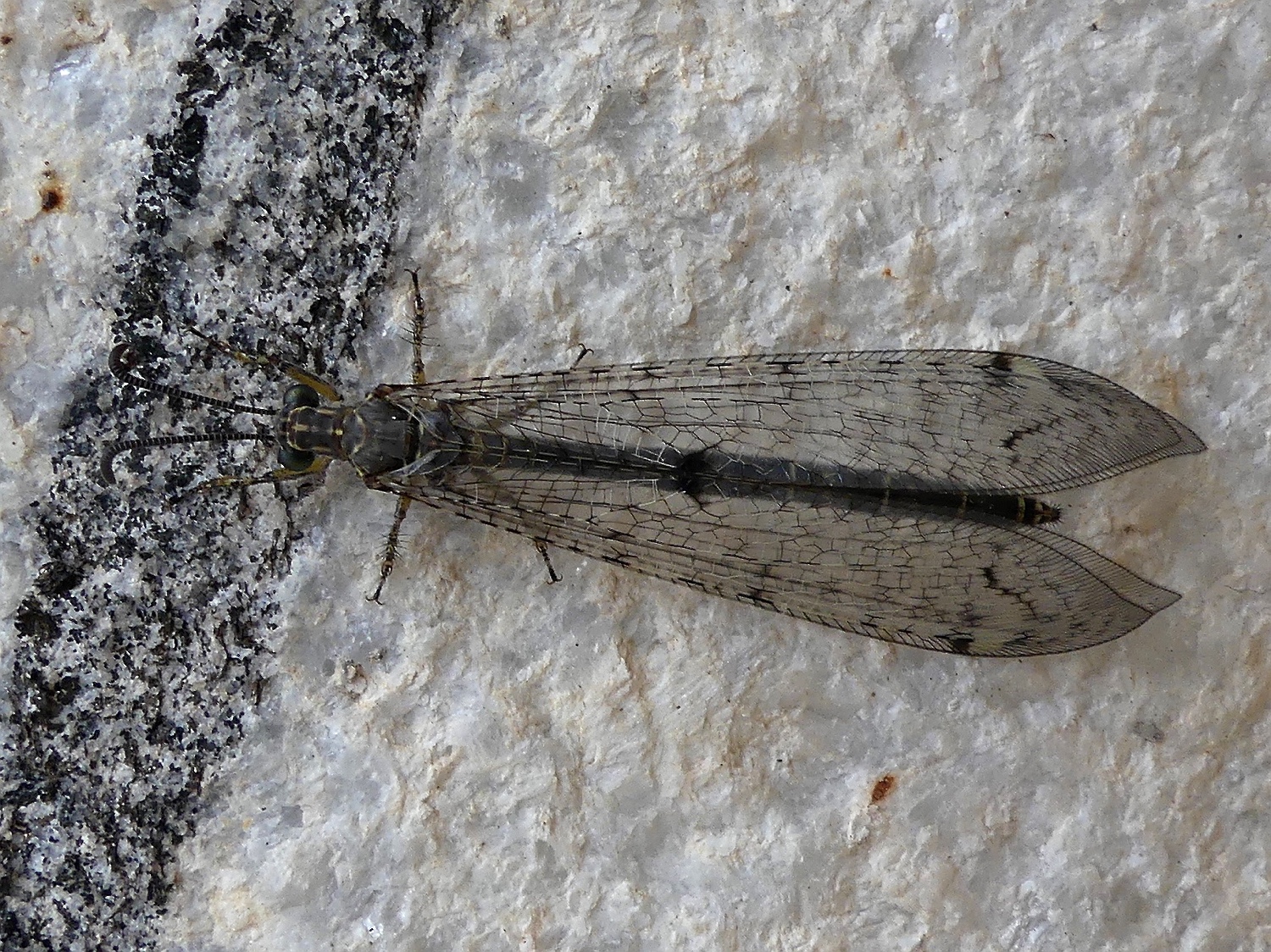
This antlion, probably Distoleon tetragrammicus, can be recognised by the four darker spots on its wings. The thorax is uniformly dark grey.
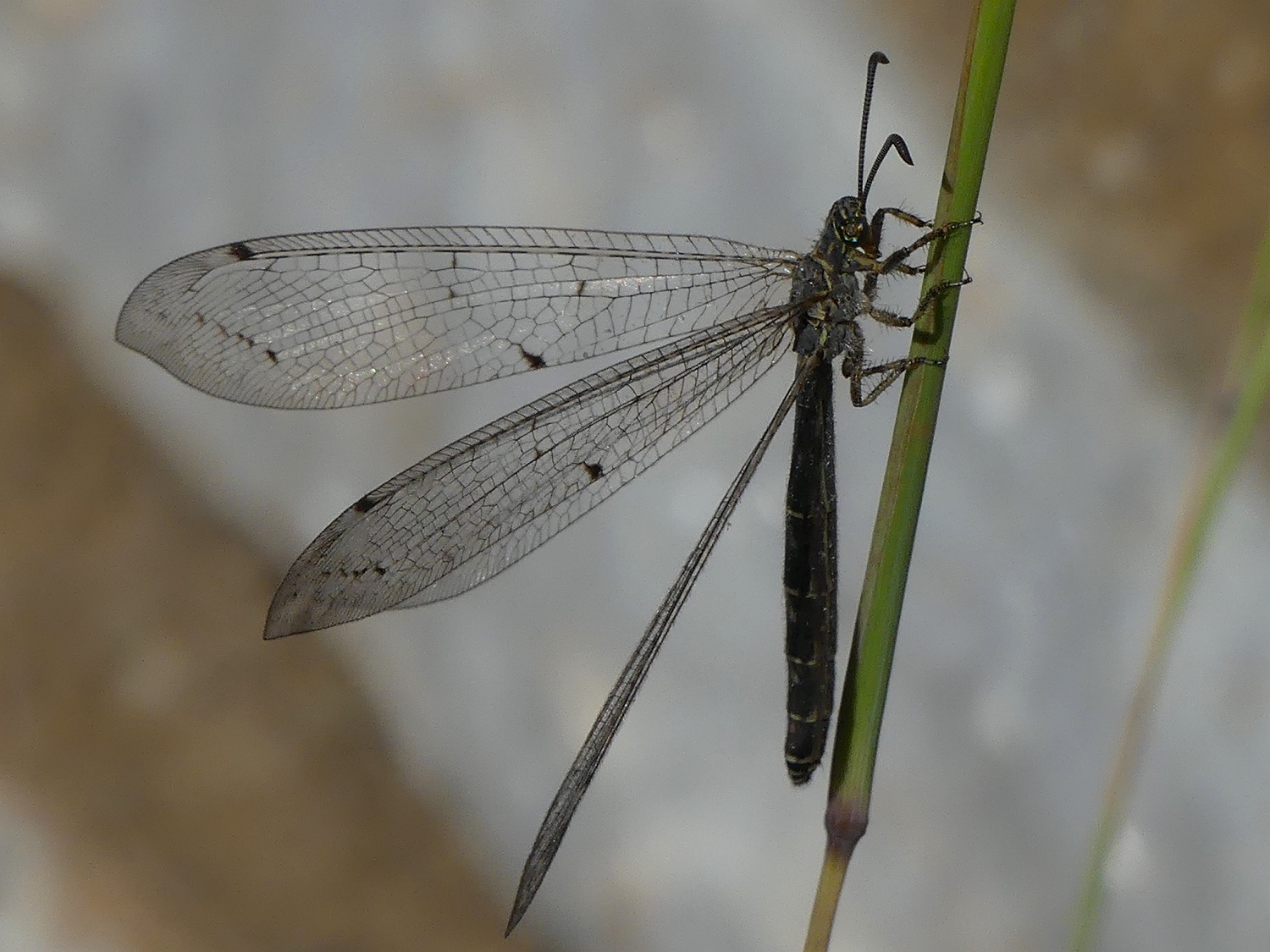
Although I regularly encounter adult specimens of this species in our area, I have not yet been able to find any larvae.
Distoleon annulatus, Klug
The different species of antlion differ in the markings on their bodies and wings. As far as we know, the larvae of this species, Distoleon annulatus, do not build funnels, but live as active hunters.
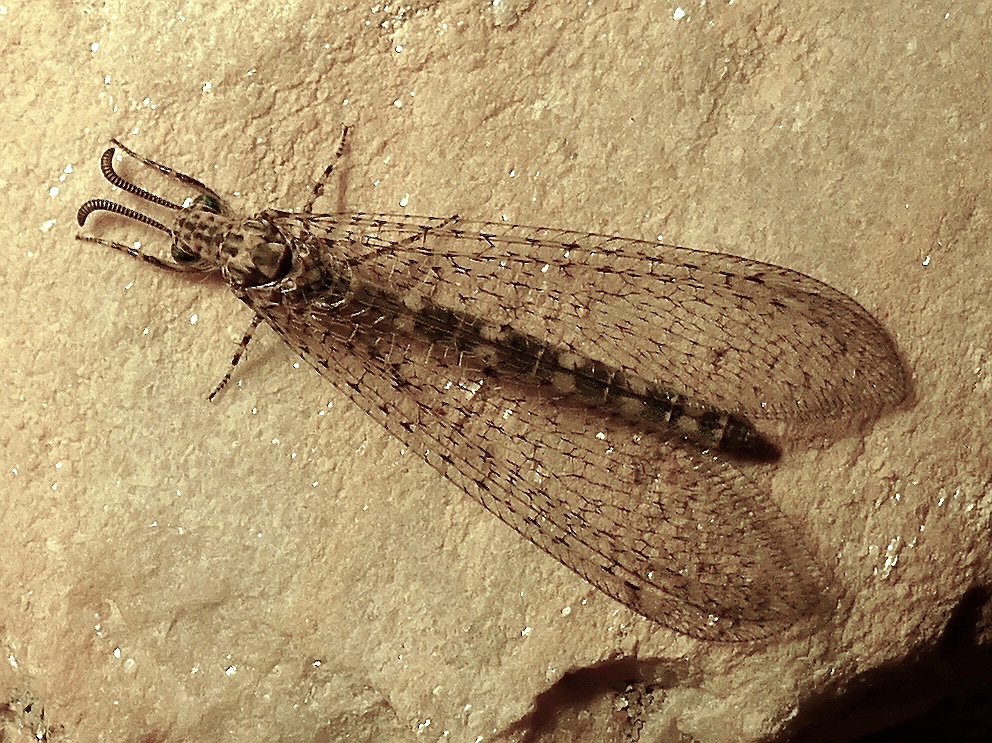
This species has many small dots on its head and distinct transverse stripes on its abdomen. The wings bear a black and white mark that is barely visible here. The larvae of this species appear to be free-living predators and do not build funnels.
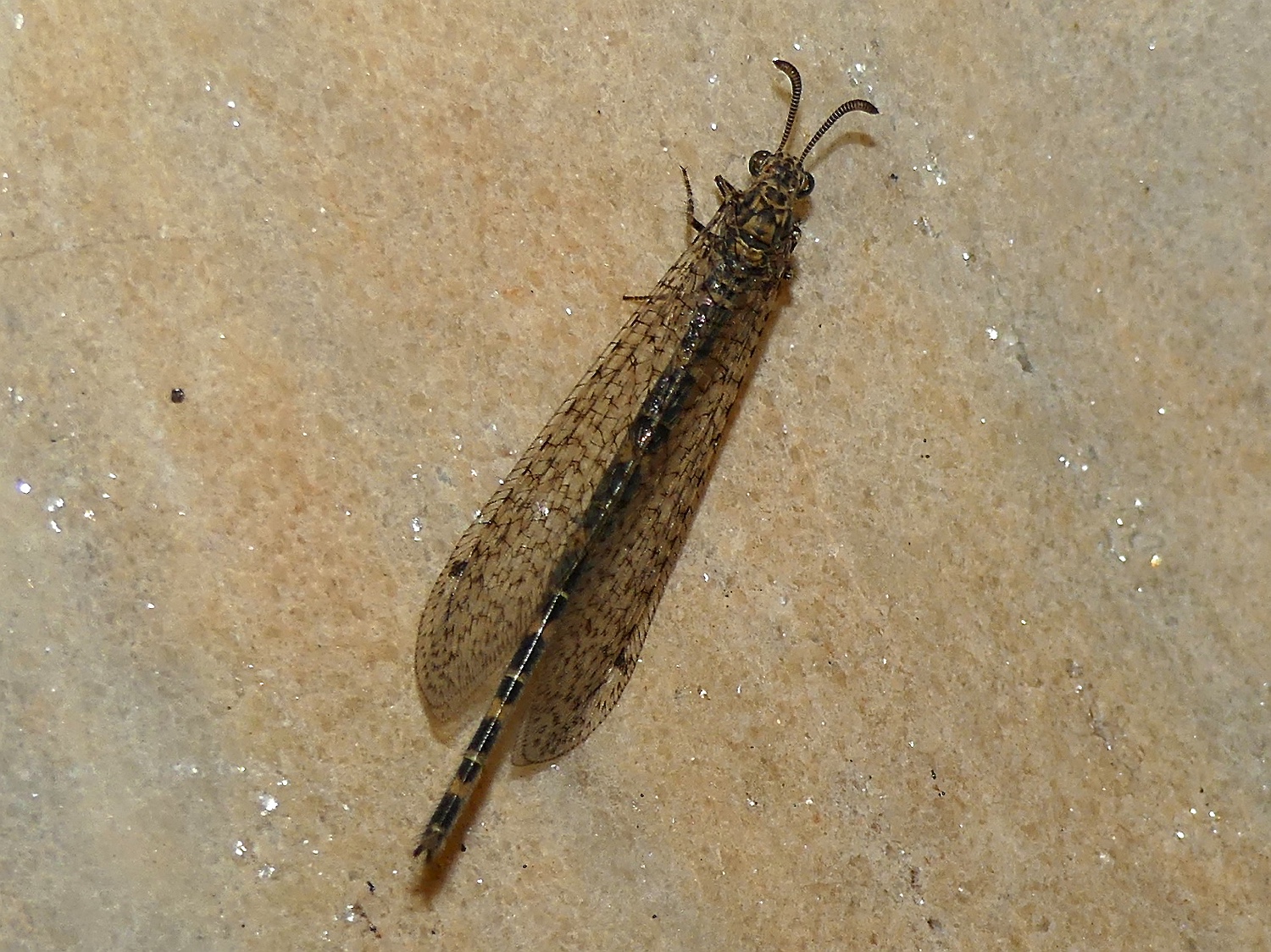
Here an individual with a much longer abdomen that extends beyond the wings. Could the different forms be males and females?
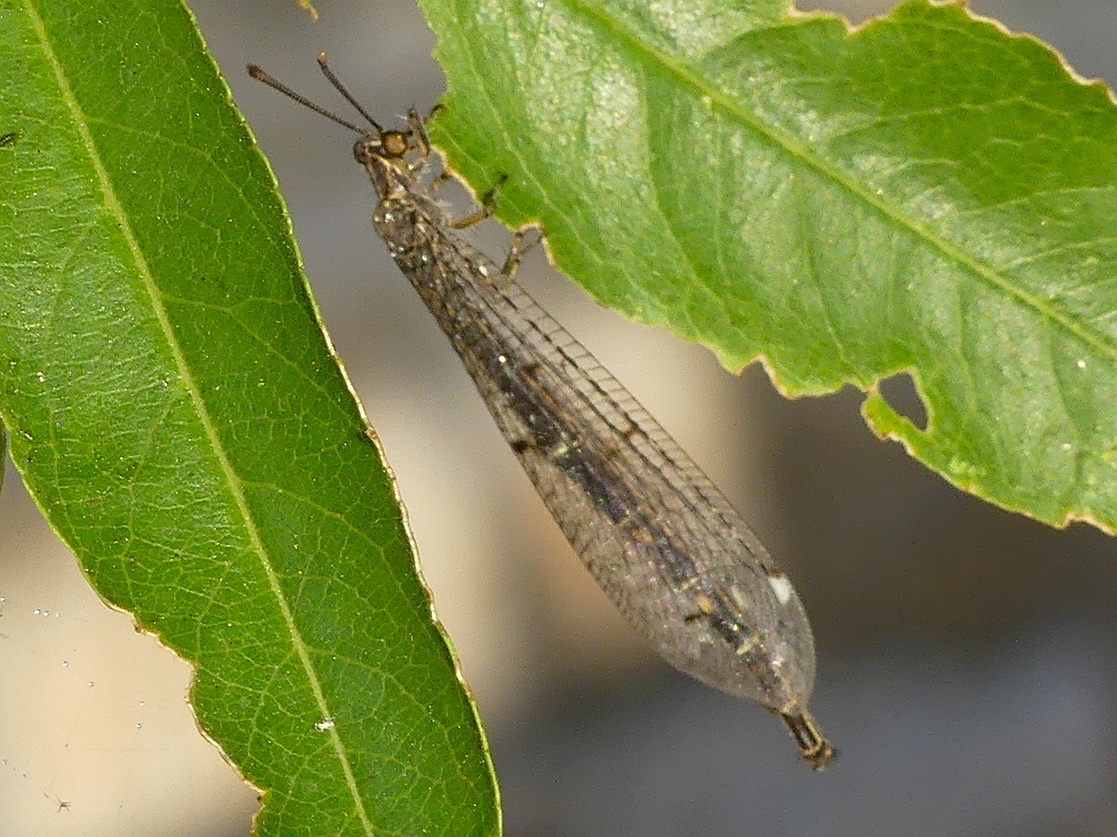
In this picture the characteristic black and white wing marking is visible.
Neuroleon arenarius, Navás
The mostly nocturnal adult antlion lacewings are often attracted to lamplight in the evening.
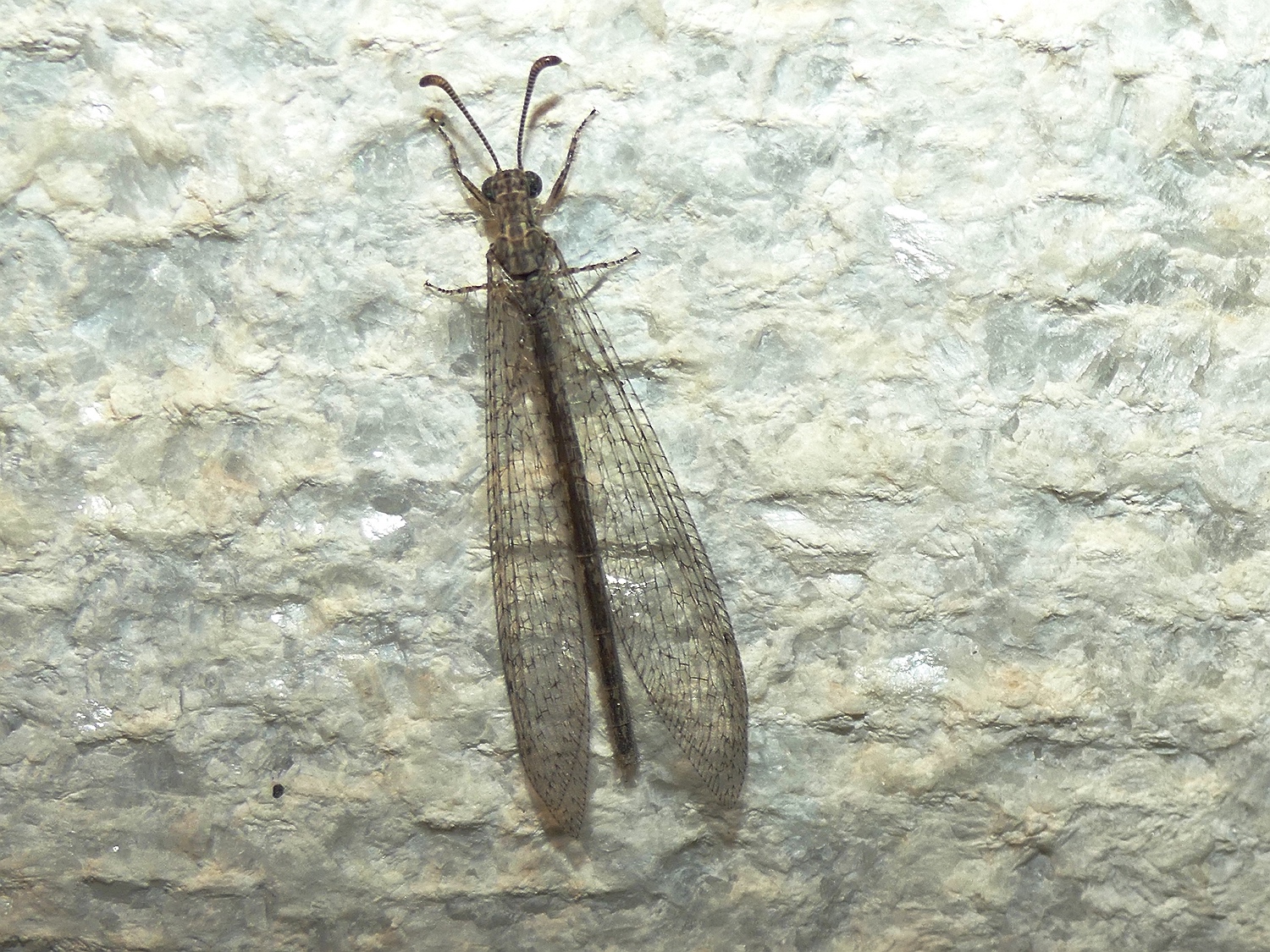
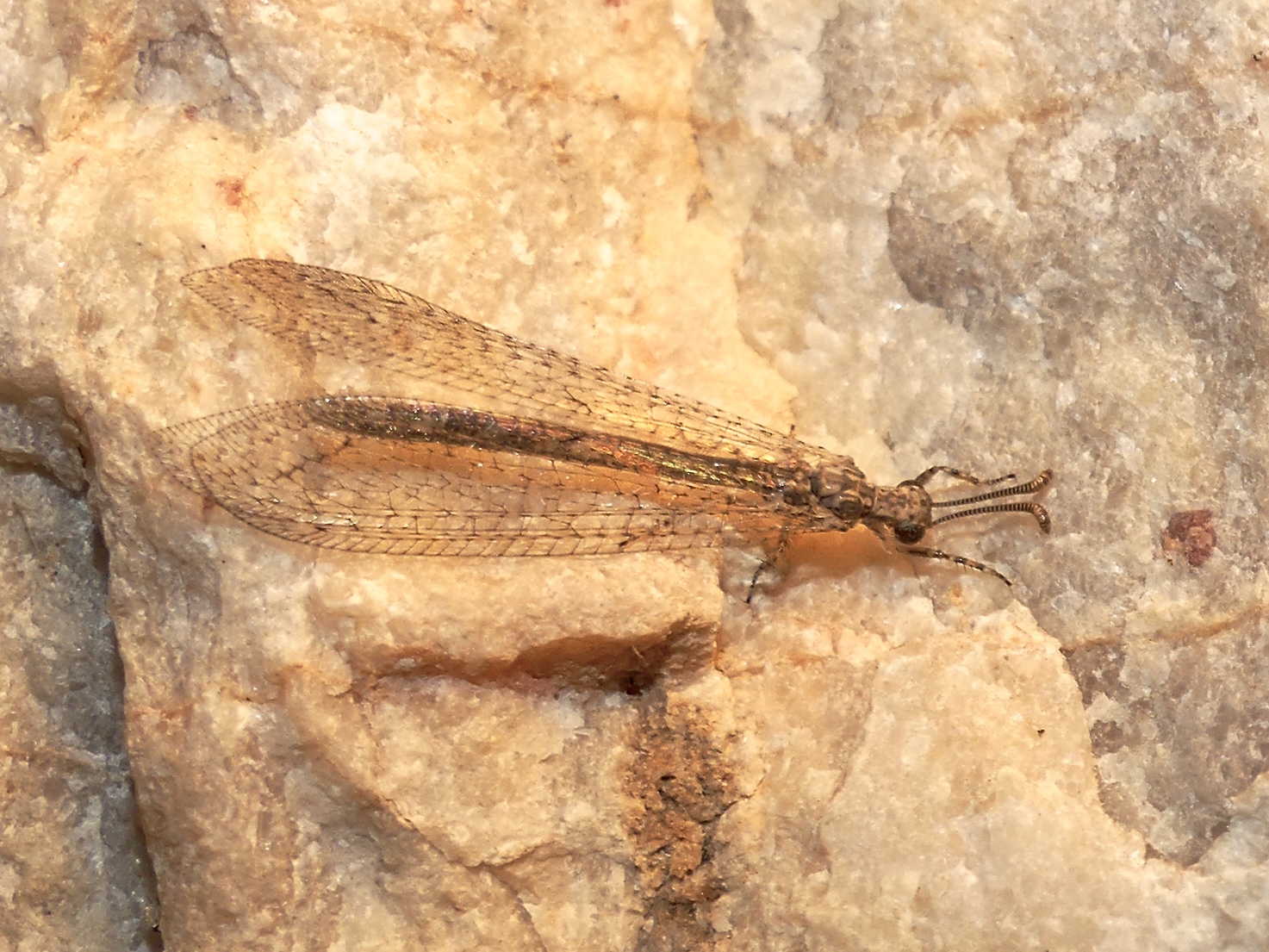
This species has no spots on its wings, only a faint diagonal stripe near the wing tip. Head and thorax show a darker area in the middle.
Green lacewings, Chrysopidae
Green lacewings are rather small and inconspicuous neuropterans, even though they are widespread with around 2,000 species worldwide. They have two pairs of identical wings, which, like all neuropterans, show a fine venation. European lacewings grow to a size of up to 3.5 cm. All species look quite similar, making identification difficult.
Common green lacewing, Chrysoperla carnea, Stephens
The Common green lacewing is, as its name suggests, green in colour. It likes to sit on grass or leaves and mainly flies around at night. The adults feed on nectar and pollen, while the larvae consume large quantities of aphids and similar small prey. Accordingly, lacewings are useful in the garden; they can be used in biological pest control. The female lays her eggs on long, thin stalks near aphid colonies. The larvae attack the aphids with their jaws and inject a strong digestive secretion that dissolves them internally; they then suck the aphids dry. They stick the empty shells to their abdomen for camouflage. During courtship, adult lacewings produce vibrations with their abdomen that are transmitted to the ground. These songs seem to vary between several subspecies that cannot be distinguished by their appearance.
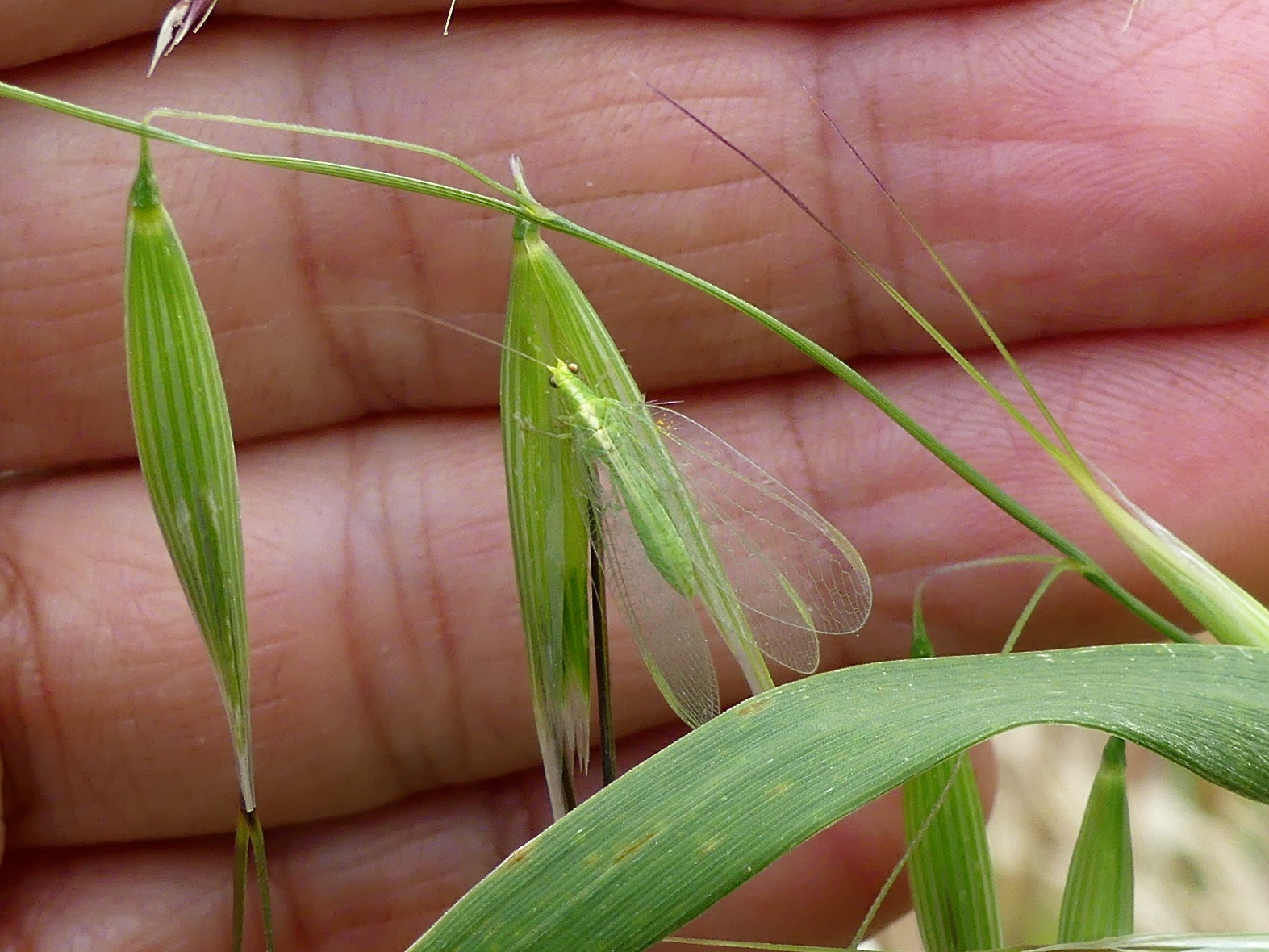
Common green lacewings are inconspicuous with their small size and greenish colour. Usually they sit on leaves or blades of grass and can easily be
overlooked.
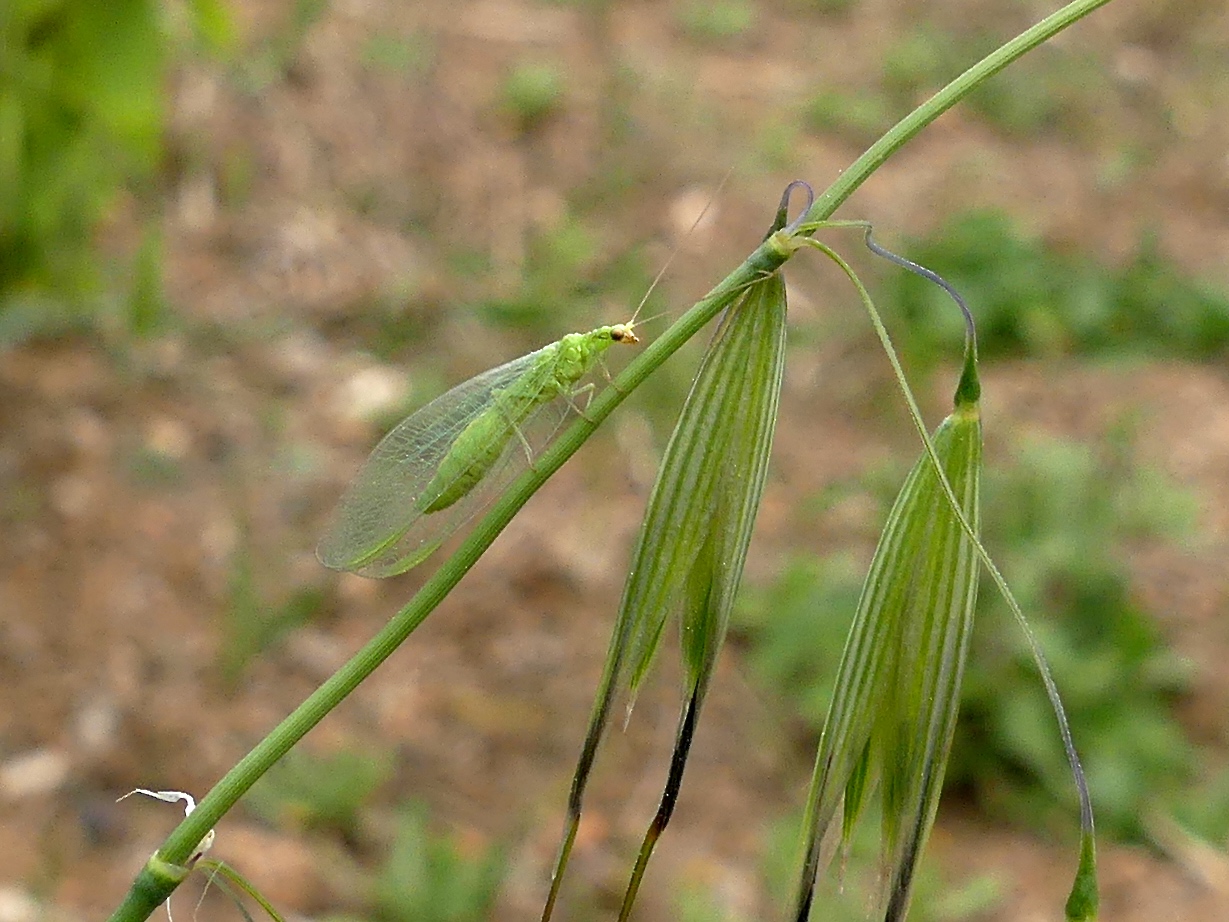
Like all neuropterans, they have finely veined wings. Both pairs of wings are identical. The eyes are golden in colour.
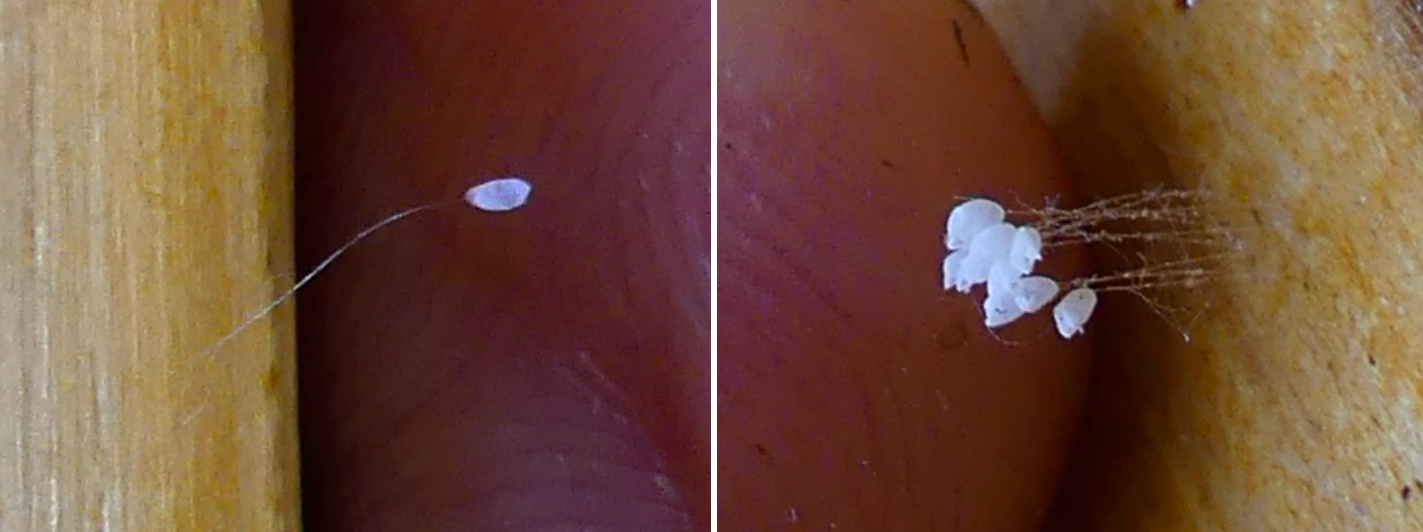
Lacewings lay their small eggs on long stalks. These are probably lacewing eggs.
Unidentified lacewing
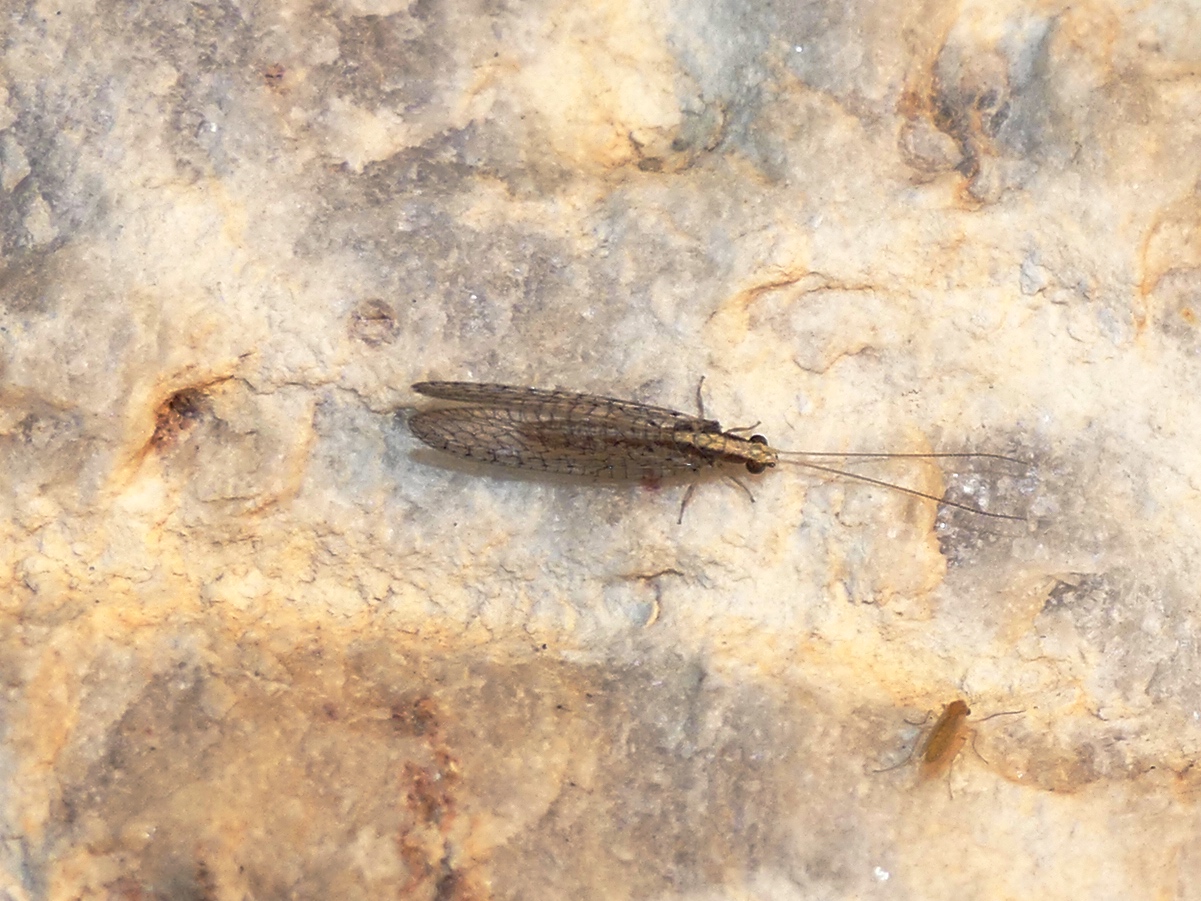
This grey lacewing with black sides of the head is often attracted to lights in early summer evenings. I have not been able to identify the species.
Mantidflies, Mantispidae
At first glance, the curious mantidflies look like praying mantises rather than neuropterans: Their front legs are transformed into “raptorial legs”, which they use to catch insects. Around 400 species exist worldwide, five of which occur in Europe. With a body length of only 5 to 50 mm, they are rather small insects and can easily be overlooked. Like other net-winged insects, they are not particularly skilled flyers.
Mantispa aphavexelte, U. & H. Aspöck
So far I have encountered mantidflies only once in our garden. The identification of the species is not uncertain, but I don’t want to leave it out either. The species Mantispa aphavexelte was described only in 1994. It occurs in southern Europe and North Africa as well as in Asia eastward up to Mongolia, but is also found sporadically in central Europe. The delimitation of the species has not yet been definitively clarified. This confusion is reflected in the scientific name of the species: The Austrian couple who described it, allegedly named the species after a Greek ‘goddess of confusion’ named “Aphavexelte”, while the word is just an idiosyncratic spelling of the word “verwechselte” = confused, as pronounced with an Austrian dialect. Such humorous species names are not uncommon – examples are the grass snails Vallonia eiapopeia, V. hoppla and V. patens tralala, the extinct parrot Vini vidivici, the parasitic wasp Heerz lukenatcha (‘Here’s looking at you’ from the film Casablanca), the digger wasp Aha ha, the long-legged fly Campsicnemius charliechaplini, named after the way it moves its legs, the jumping spider Bagheera kiplingi, the digger wasp Polemistus chewbacca, the fish species Fiordichthys slartibartfasti living in the Norwegian fjords, the shark genus Gollum and the ground beetle Pericompsus bilbo.
Mantispa aphavexelte grows to a length of just under 1.5 cm and is yellow in colour with brownish markings. Its eyes are located far apart on its movable, triangular head. The bristly front legs are located at the very front of its long prothorax, i.e. very close to its head, and can be folded up fitting perfectly into each other. Our specimens were sitting under the inflorescence of a wild carrot, where they were sitting in wait for small insects; one fluttered onto a neighbouring branch when I got too close.
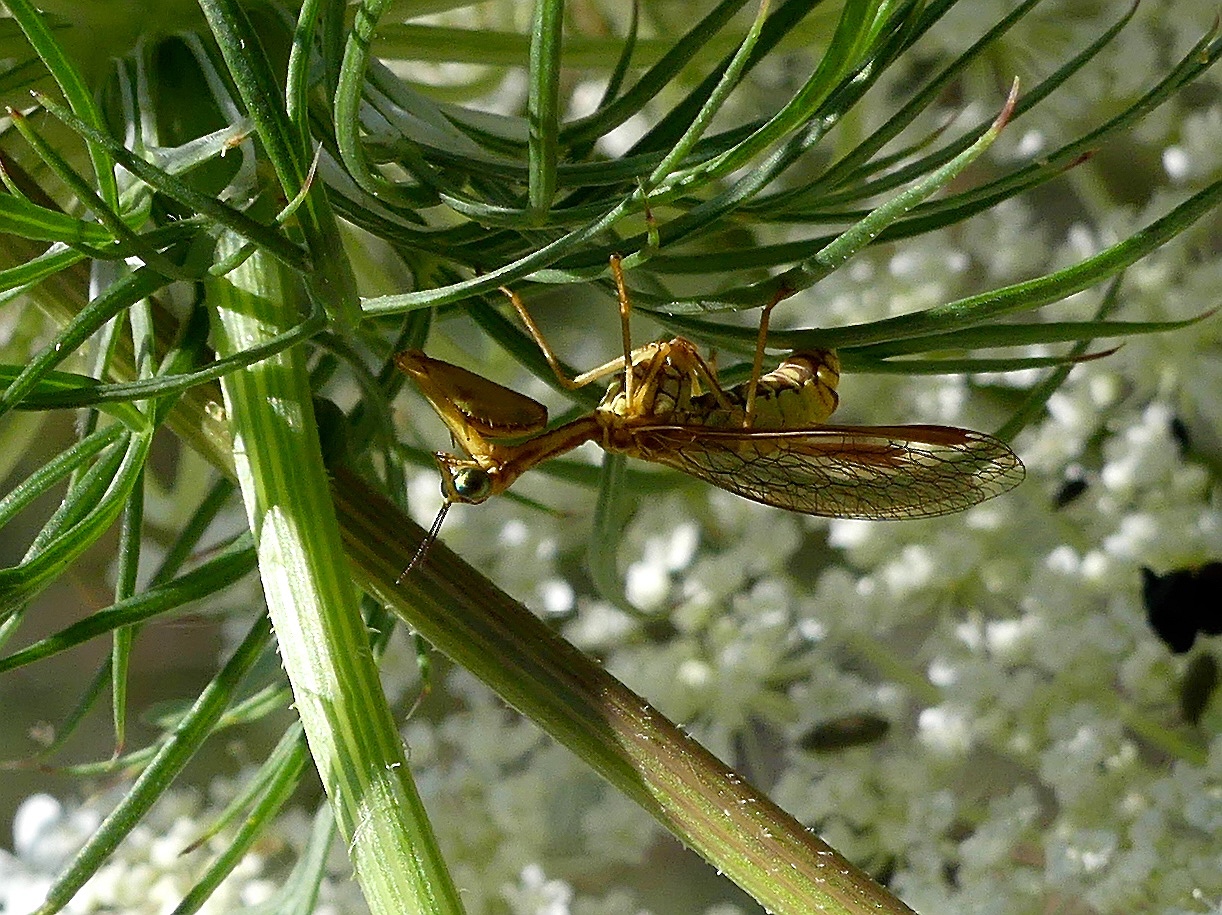
The interesting little mantidflies resemble praying mantises in appearance and way of life.
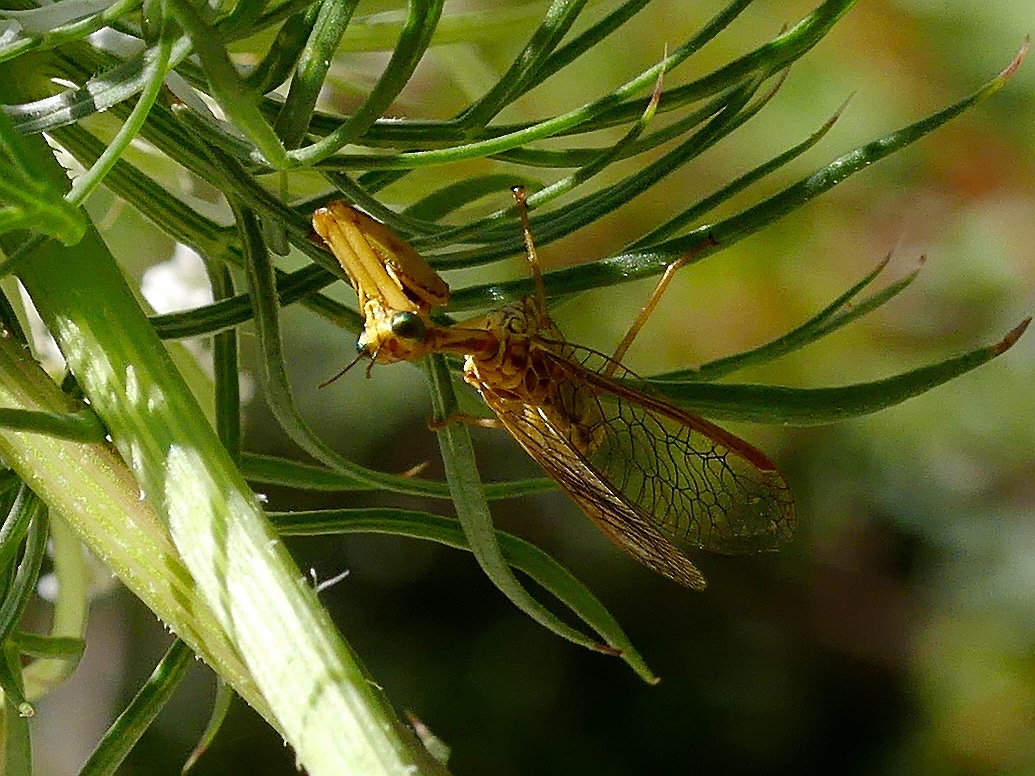
Mantidflies feed on insects, which they catch with their front legs. This specimen sits in wait for its prey under the inflorescence of a wild carrot.
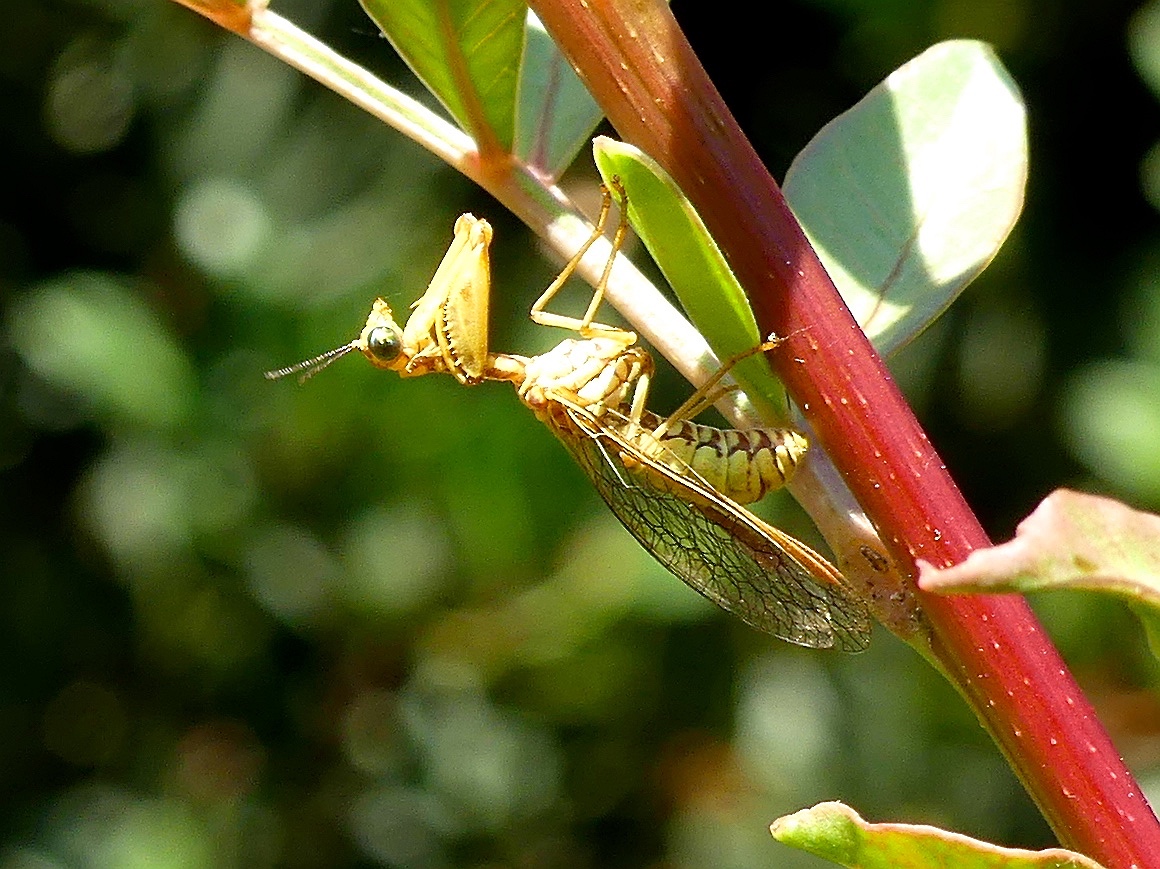
The species Mantispa aphavexelte was described only in 1994.
continue: Snakeflies
back:
See also:
Further reading:
- The larvae of European Myrmeleontidae by Davide Badano (downloadable)