Dragonflies
The insect order of the Odonata includes two large, closely related groups: the dragonflies and the damselflies (I will use the term “dragonflies” in this article also for both dragonflies and damselflies together, instead of the less well known “odonata”). Dragonflies belong to the larger insects, with a wingspan of up to 20 cm. They are particularly beautiful and elegant animals. Dragonflies can only exist where they have access to water as their larvae live in water. Accordingly, Naxos seems not to be the best place for dragonflies. However, quite a few species can be observed on the island – some can be found only directly at the water, while in other species the adults may be found even in the driest areas of the island.
Here you can skip the introduction and go directly to the species.
Anatomy
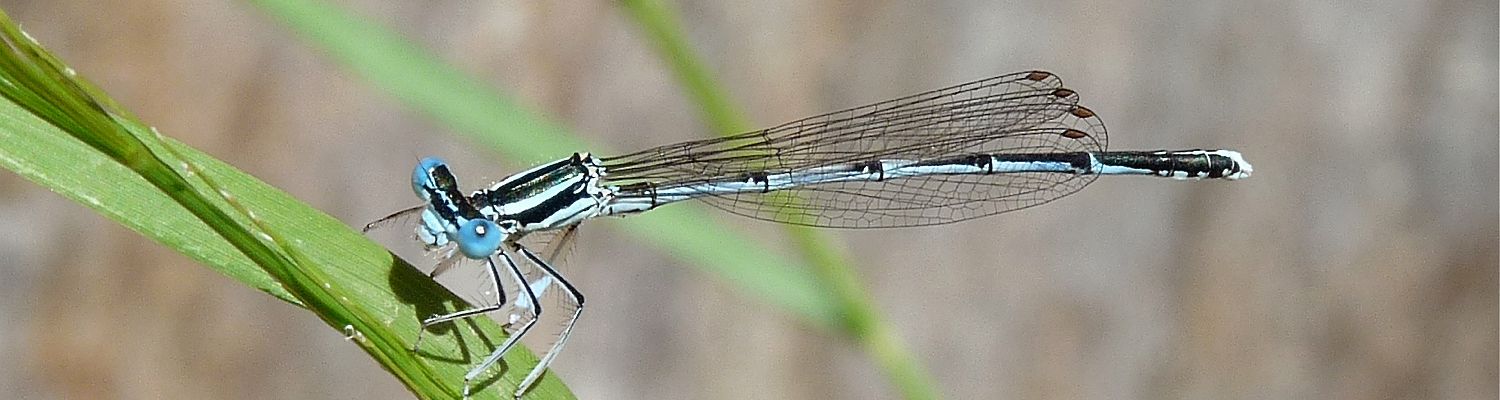
Like in all insects, the body of dragonflies is divided into head, thorax and abdomen. The highly movable head is equipped with large, efficient compound eyes. The powerful thorax carries three pairs of legs and two pairs of wings that can be moved independently of each other and are stabilised by a network of strong veins. The abdomen of the dragonflies is particularly long and slender.
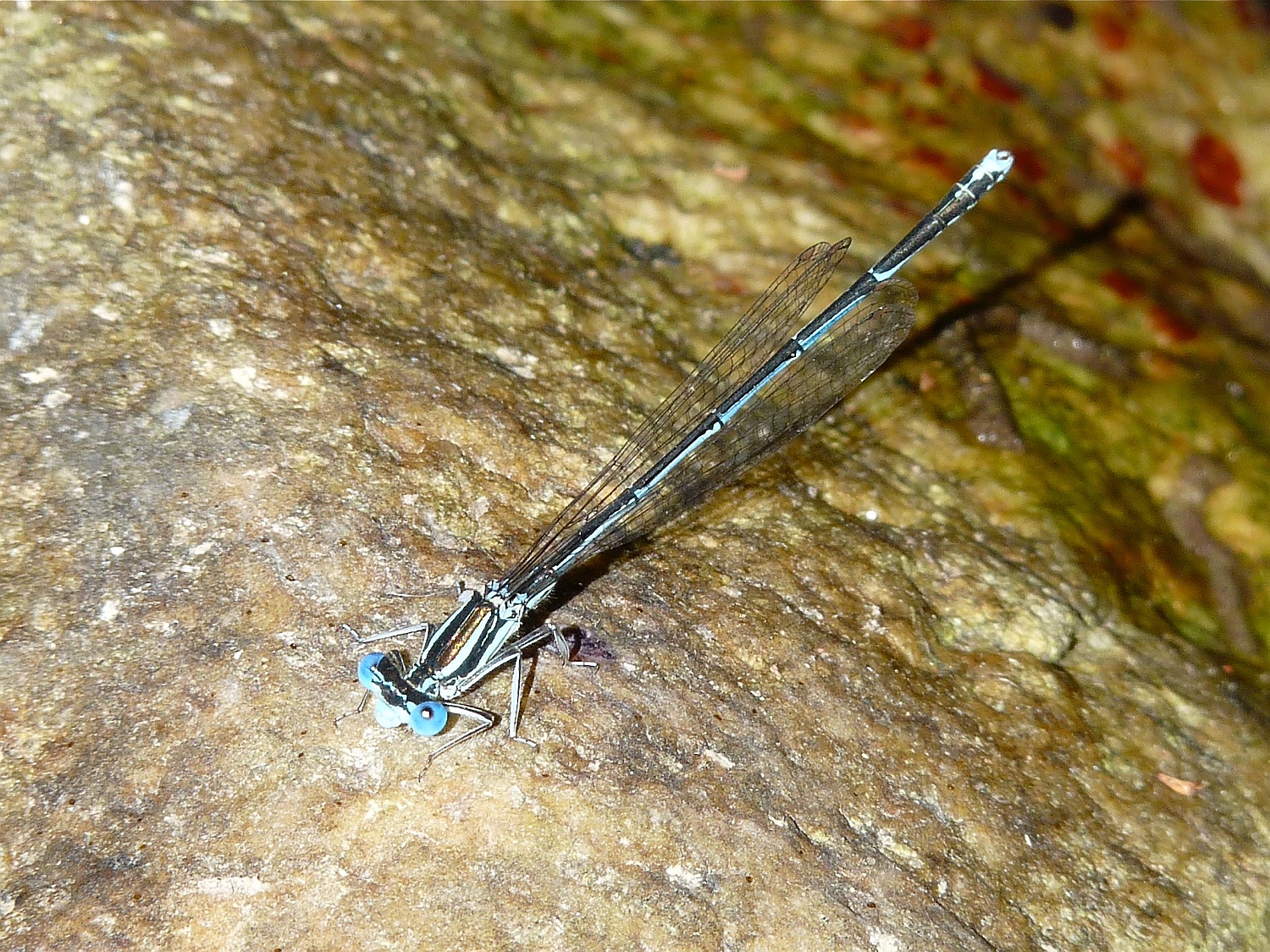
Damselflies have a very elongated, slender body with three pairs of thin legs and two pairs of translucent wings and a movable head with highly developed compound eyes.
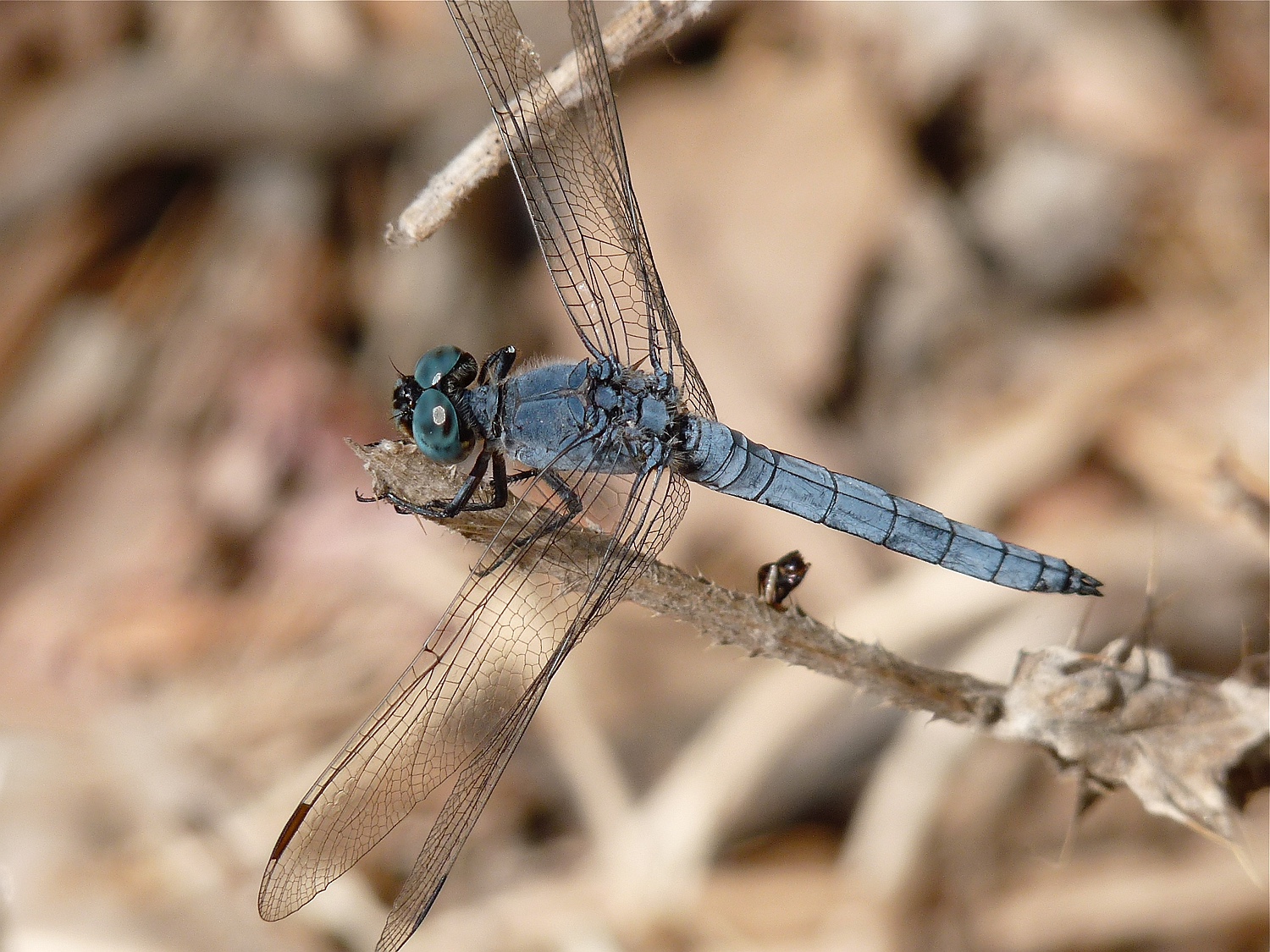
Dragonflies often have strong bodies; the thorax is often hairy.
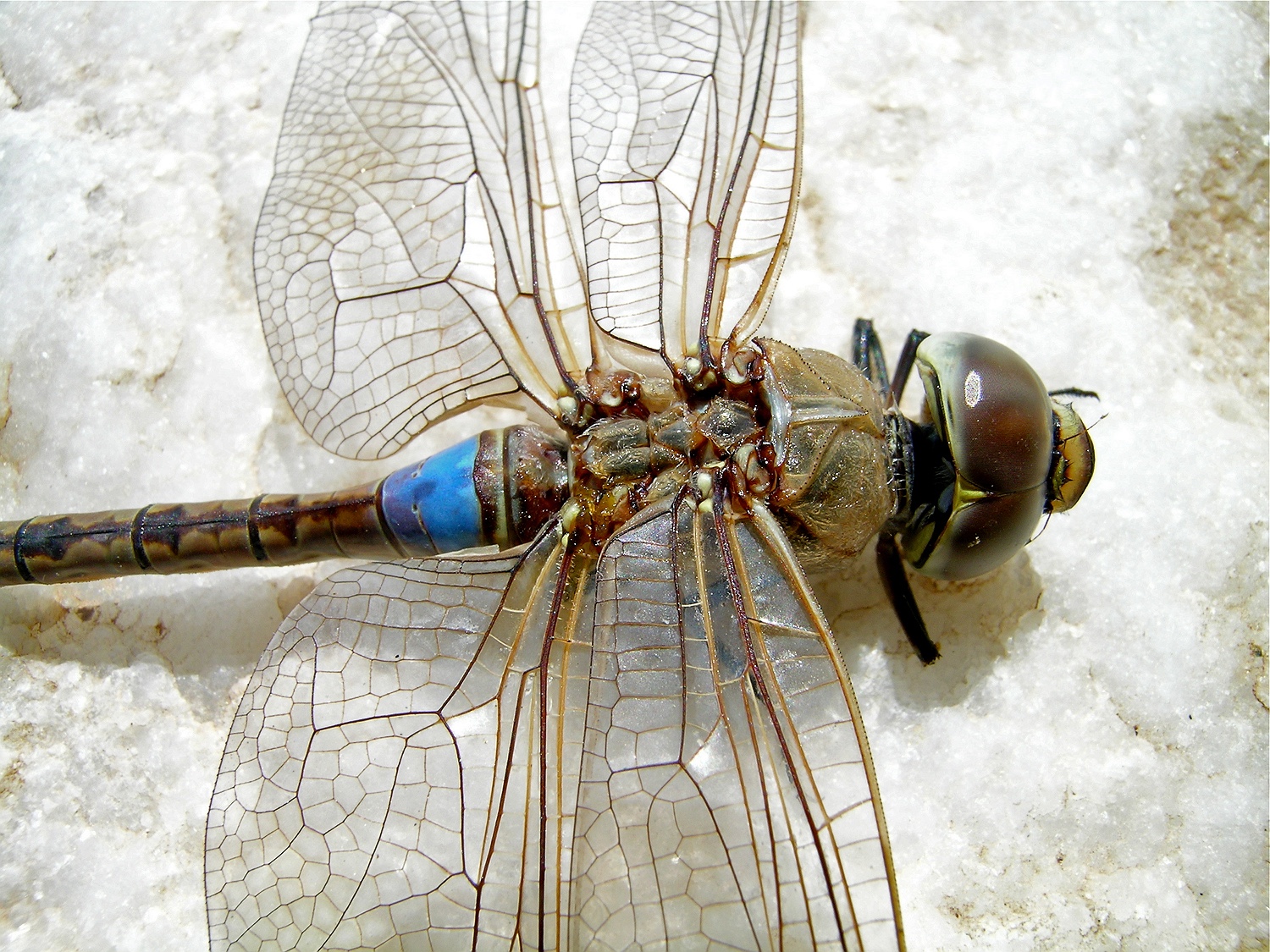
The wings are stabilised by a network of veins. They are attached to the thoracic segments with strong joints and can be moved independently, which enables the dragonflies to fly very quickly and skilfully.
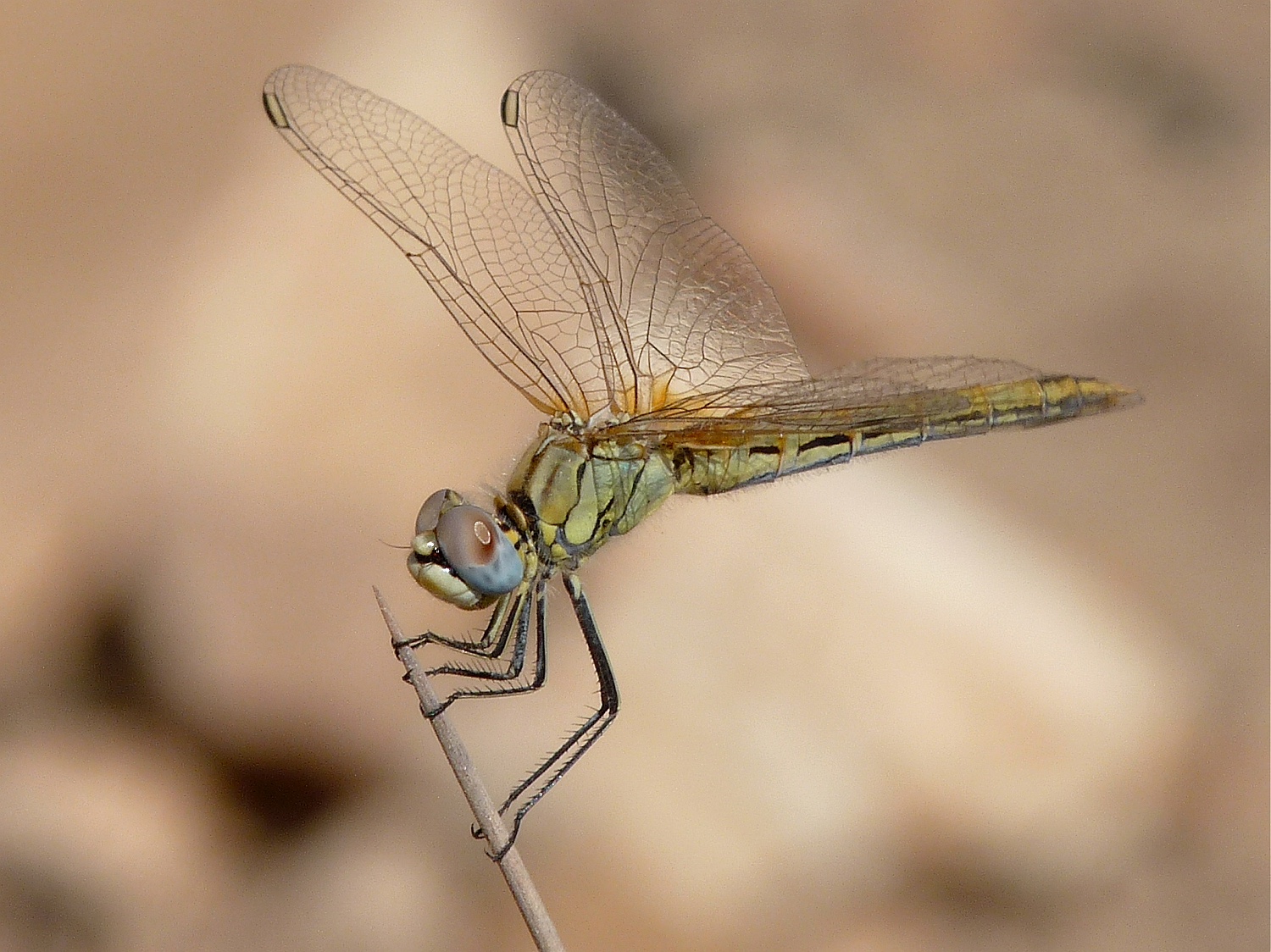
Dragonflies have large, highly developed compound eyes, which can consist of up to 30,000 individual eyes.
Biology
Dragonflies are excellent flyers. They are predators and feed on other insects, which they catch in flight. Many species hunt by flying around tirelessly, while others perch on exposed points such as branches or large stones, from where they can observe their surroundings. Dragonflies are territorial animals that defend their area against other insects.
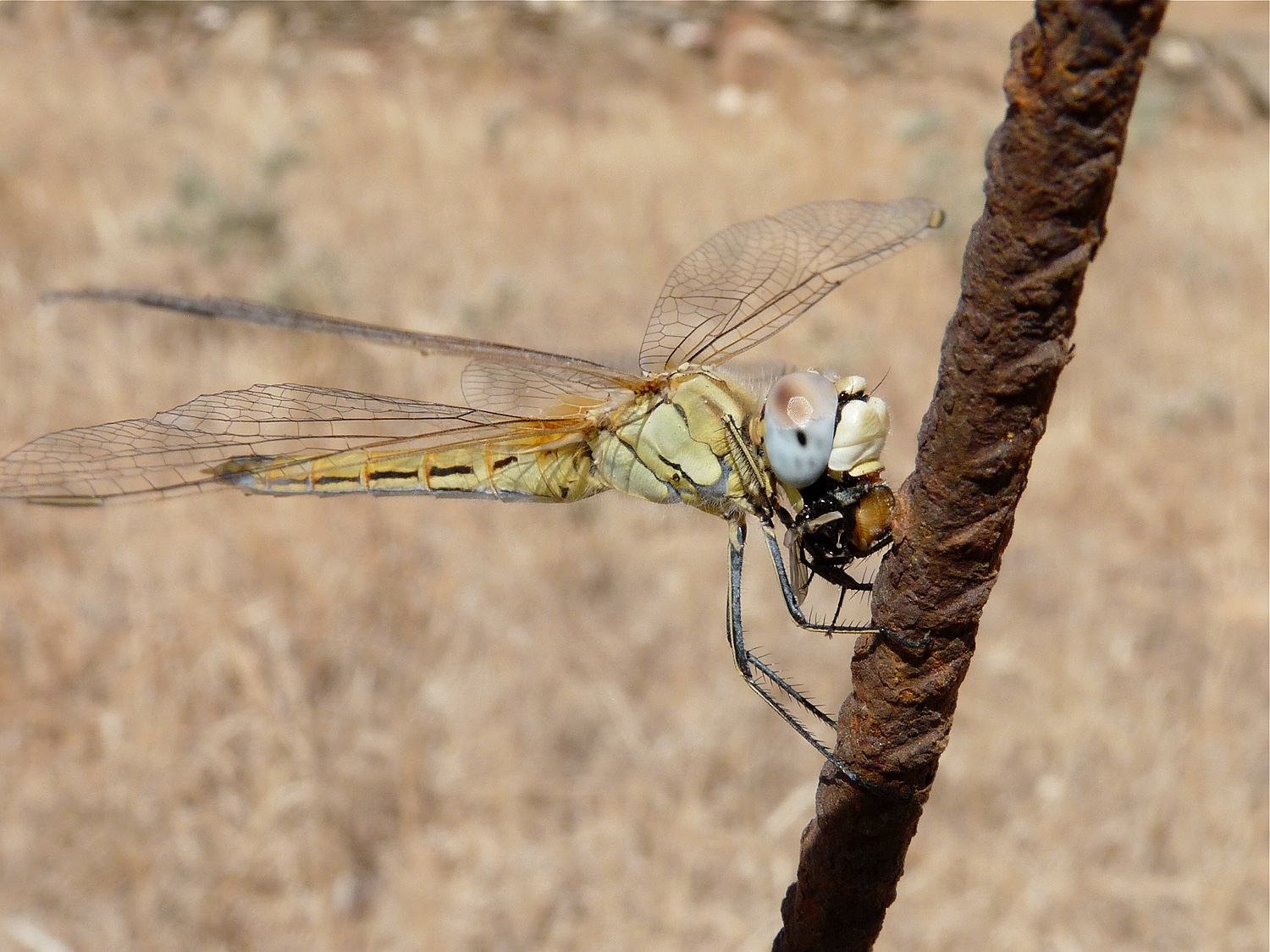
Dragonflies catch their food, mostly small insects, in flight.
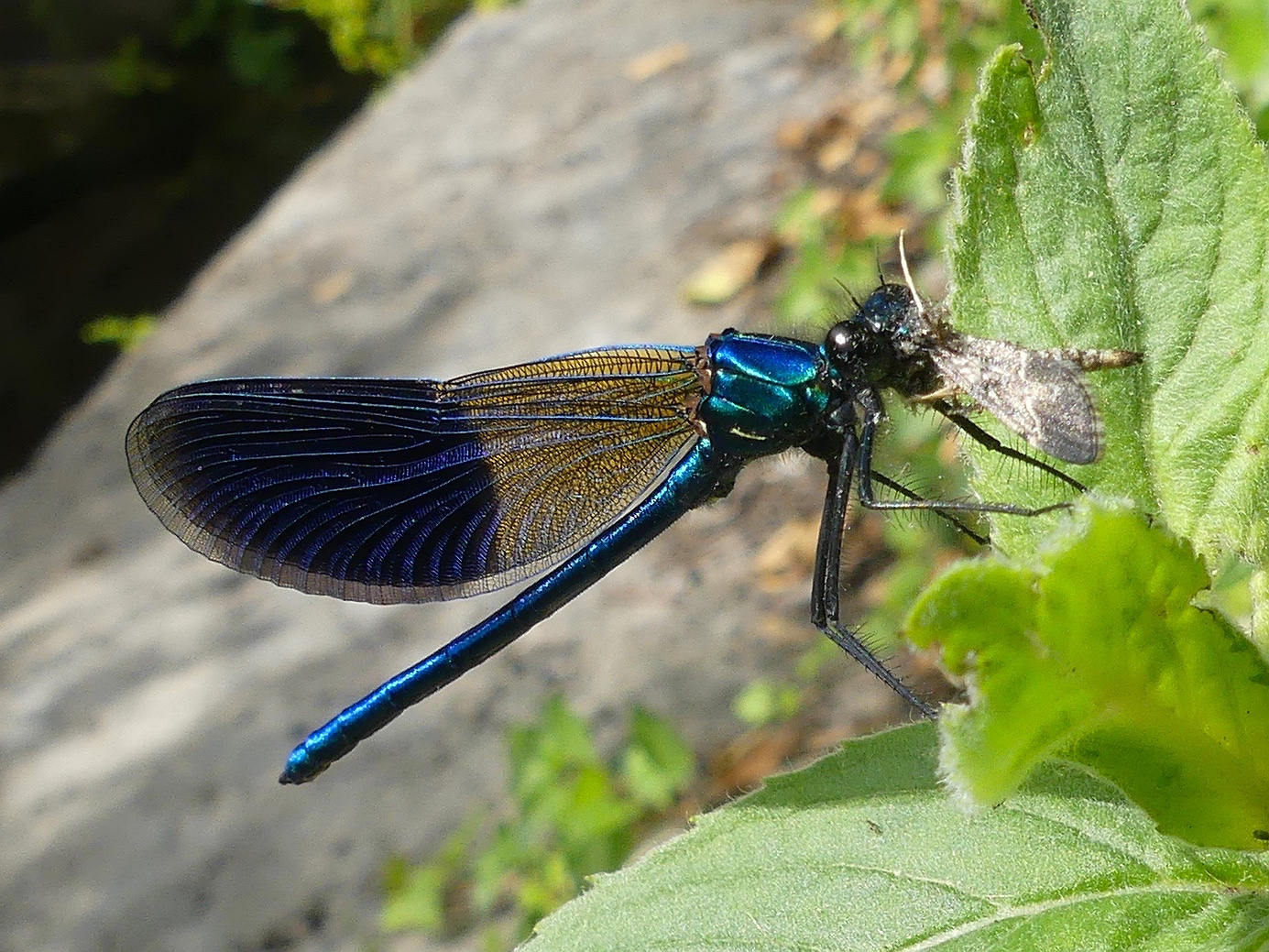
a Banded demoiselle with a captured moth
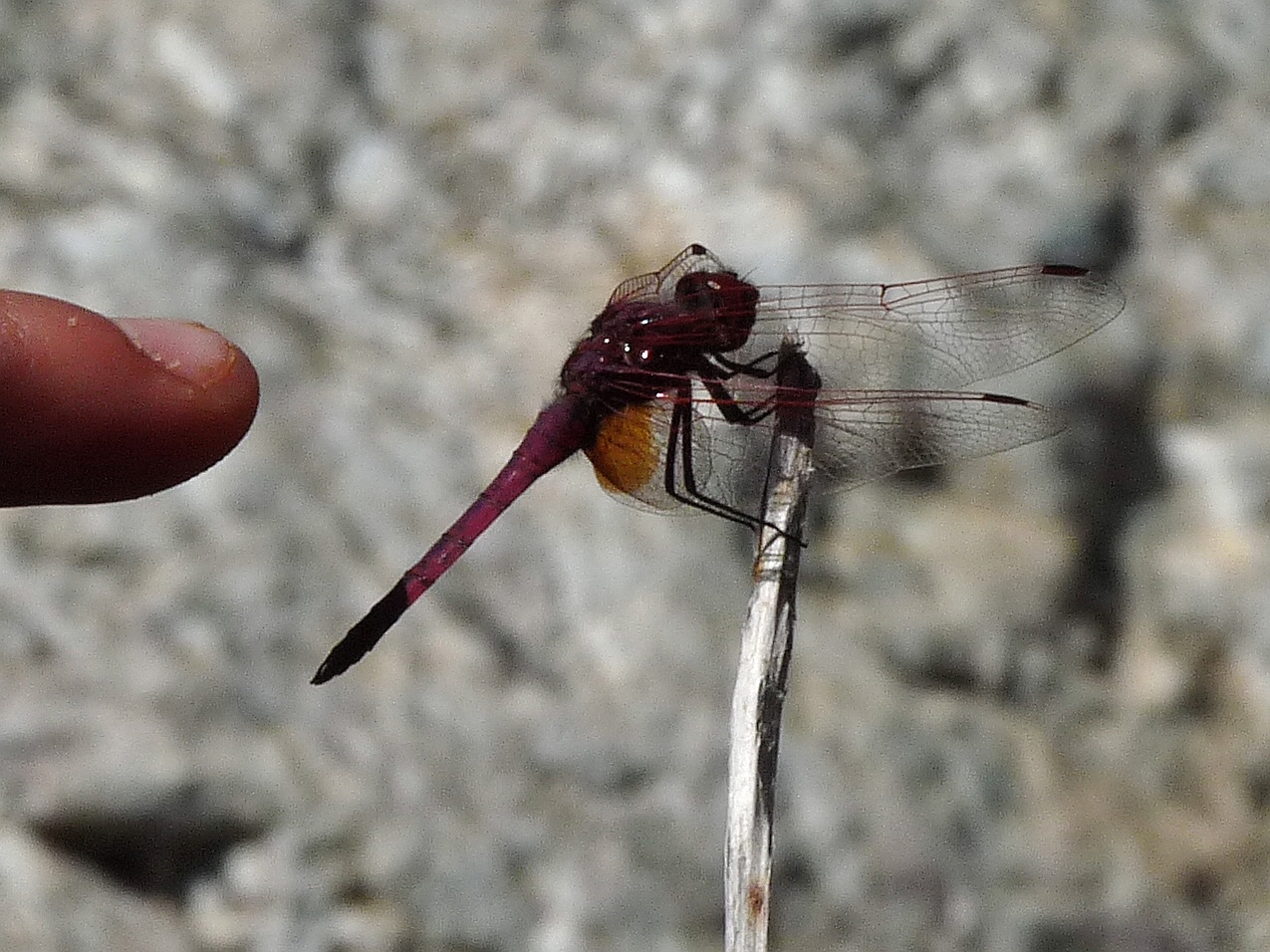
Some species are easy to photograph because they always come to sit in the same perch. With a little patience, you can get very close to the dragonfly…
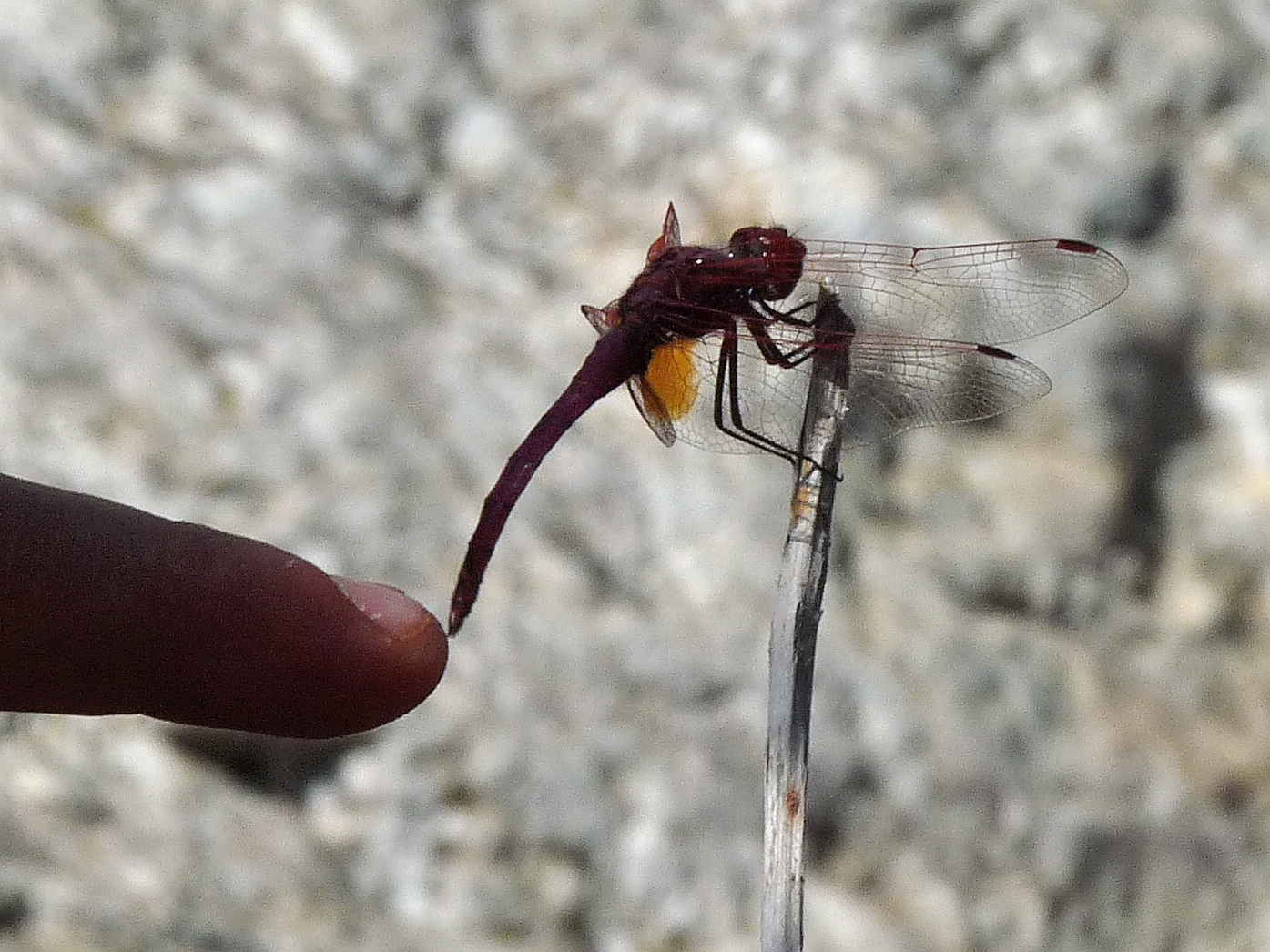
…and even touch it!
Development
Dragonflies are hemimetabolous insects, i.e. they lack a pupal stage in which the body undergoes complete metamorphosis. However, in dragonflies the larvae are very different from the adult insects and also have a significantly different way of life – unlike in many other hemimetabolous insects (e.g. grashoppers).
During mating, the male grasps the female at the back of the head with special pincers located at the end of the abdomen (cerci). Dragonflies can sometimes be seen sitting or flying around in this so-called “tandem”. For the transfer of the sperm, they form a “mating wheel”: the female places the end of its abdomen at the front of the male’s abdomen where the sperm is stored. The eggs are laid in water, with the female often still being in tandem position with the male.
The larvae live in the water. They are effective predators and feed on small aquatic animals like water fleas, tadpoles and even small fish. The larval stage of dragonflies usually lasts one or two years, sometimes more, which is considerably longer than their adult life: adult animals usually live only for a few weeks. The larva undergoes several moults (up to fifteen). For the last moult, it crawls out of the water and attaches itself to a plant such as a reed stalk. There the adult animal emerges, leaving behind the empty exoskeleton (exuvia).
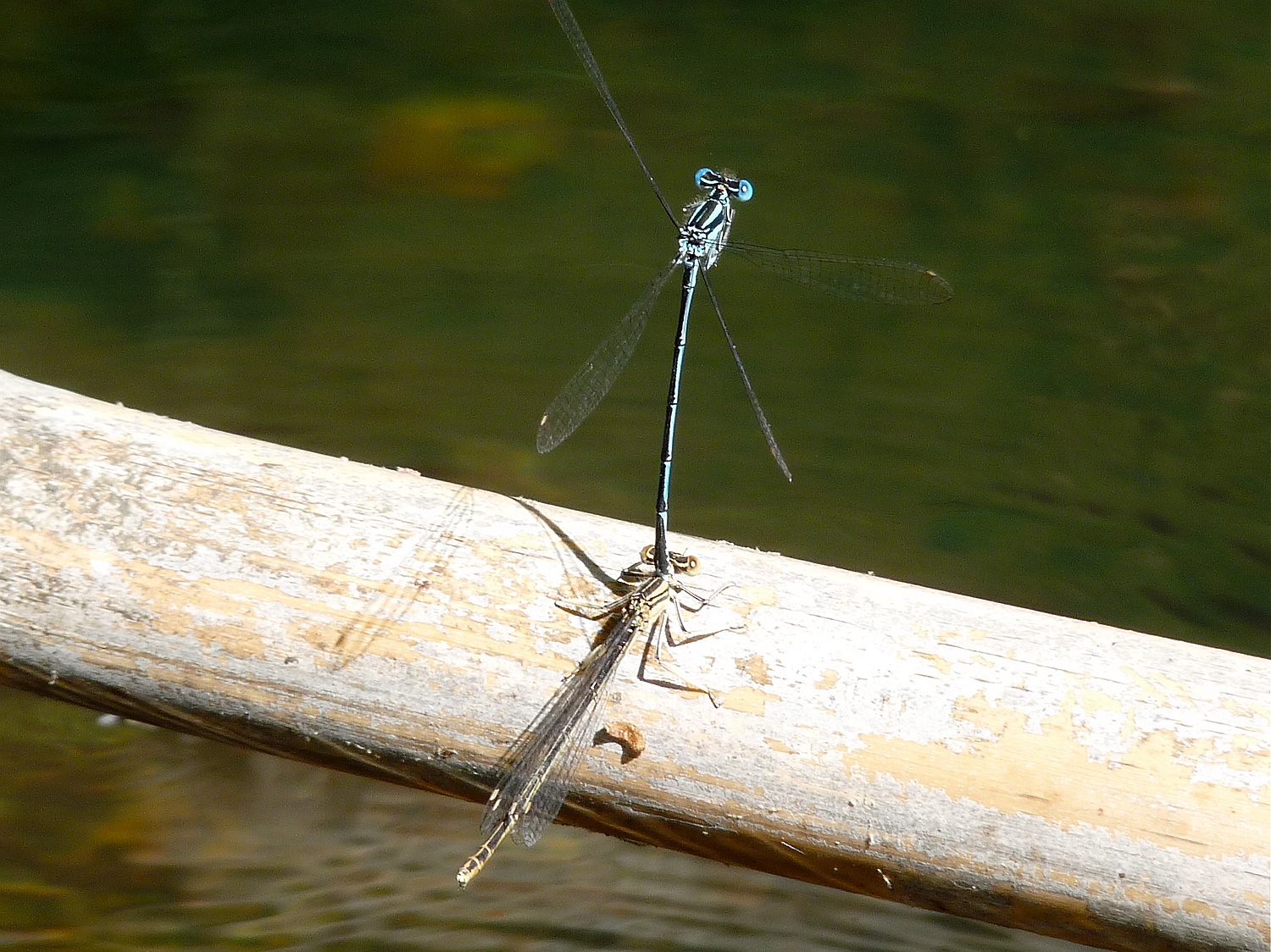
White-legged damselfly in tandem position: the male grasps the female behind the head with the cerci at the end of his abdomen.
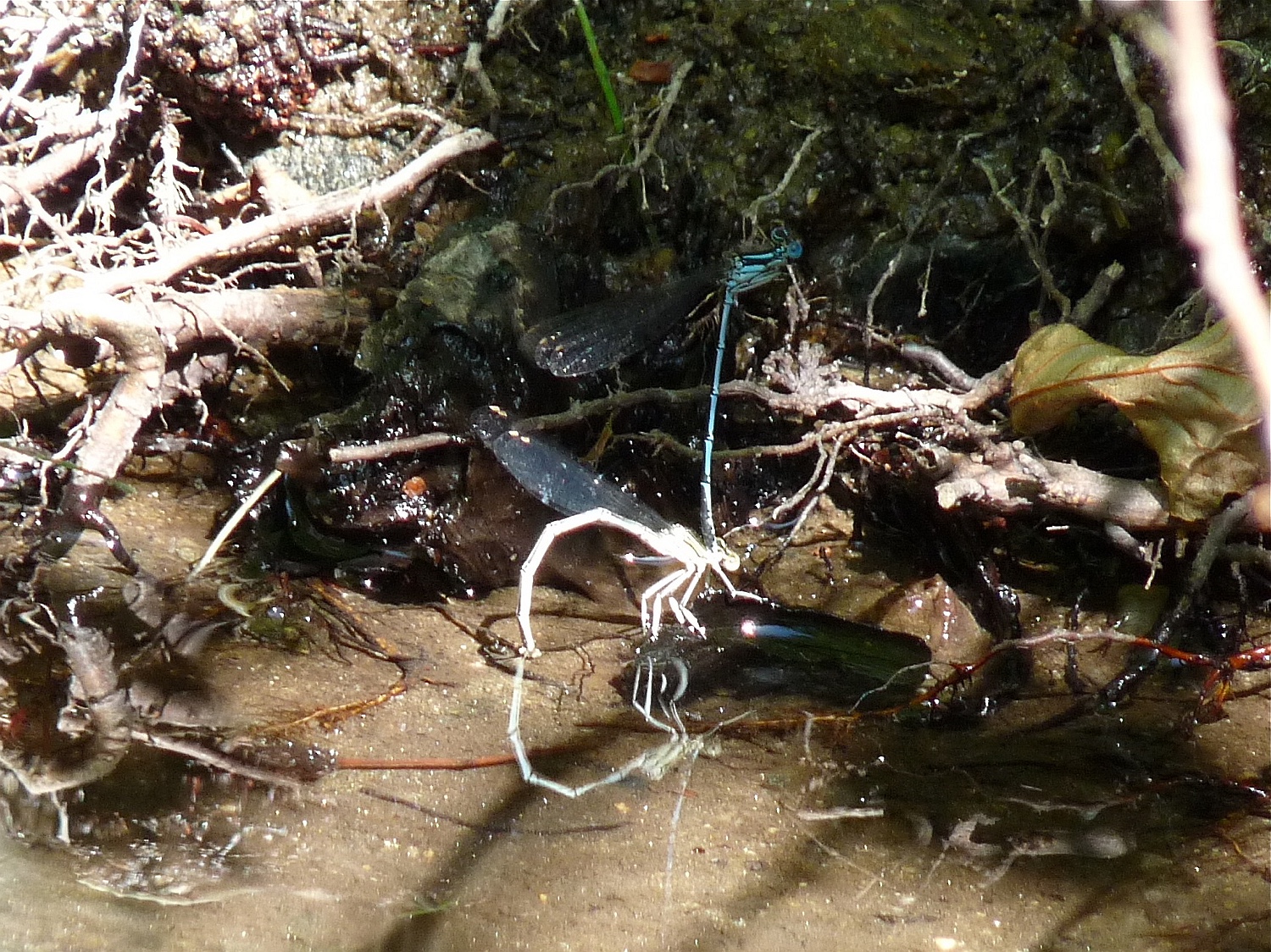
White-legged damselfly laying eggs
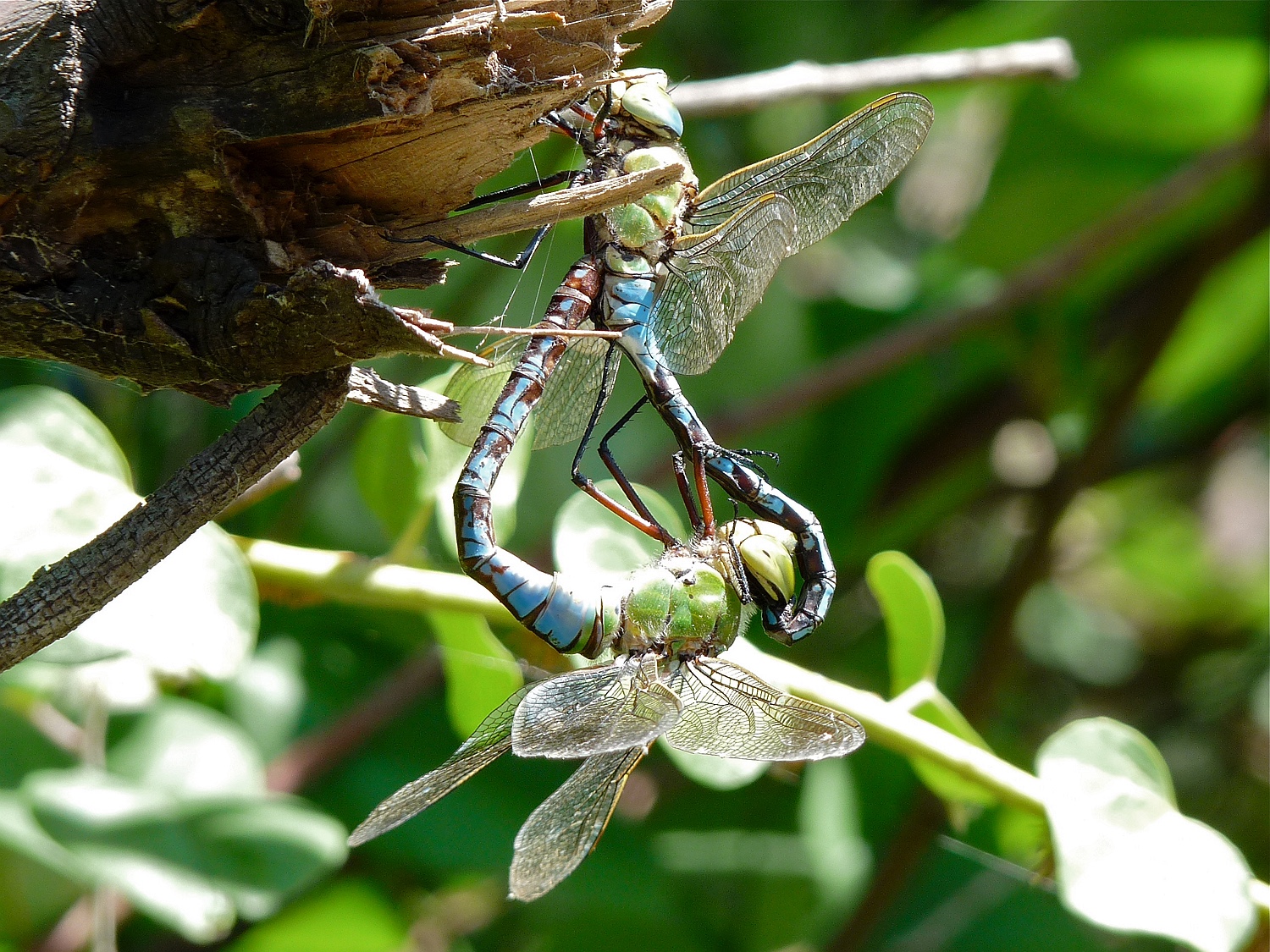
Emperor dragonflies mating: The female bends her abdomen with the genital opening towards the male’s secondary genital opening on the 2nd or 3rd abdominal segment where the sperm is stored.
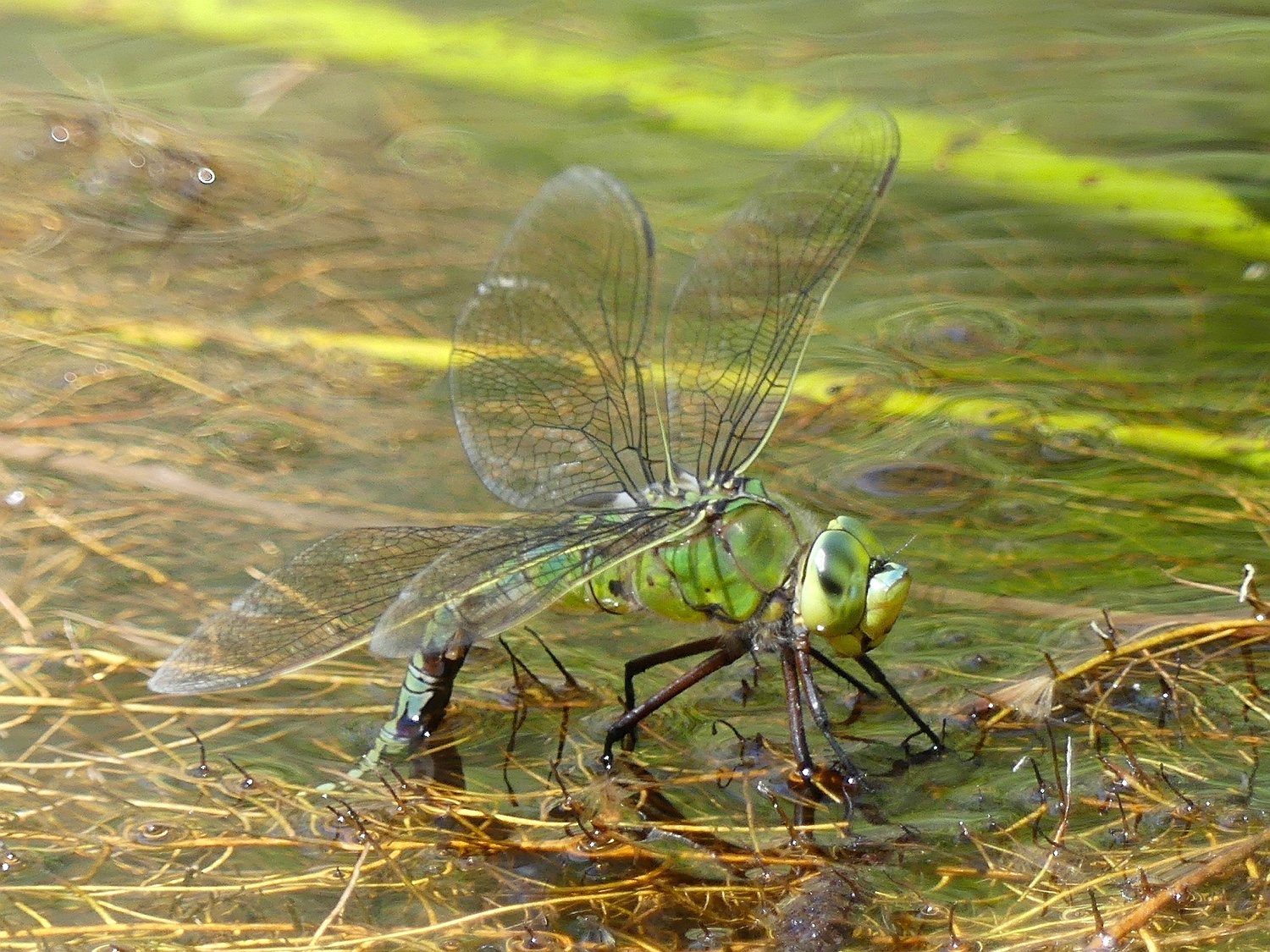
Emperor dragonfly laying eggs: The female lays her eggs on aquatic plants below the water surface.
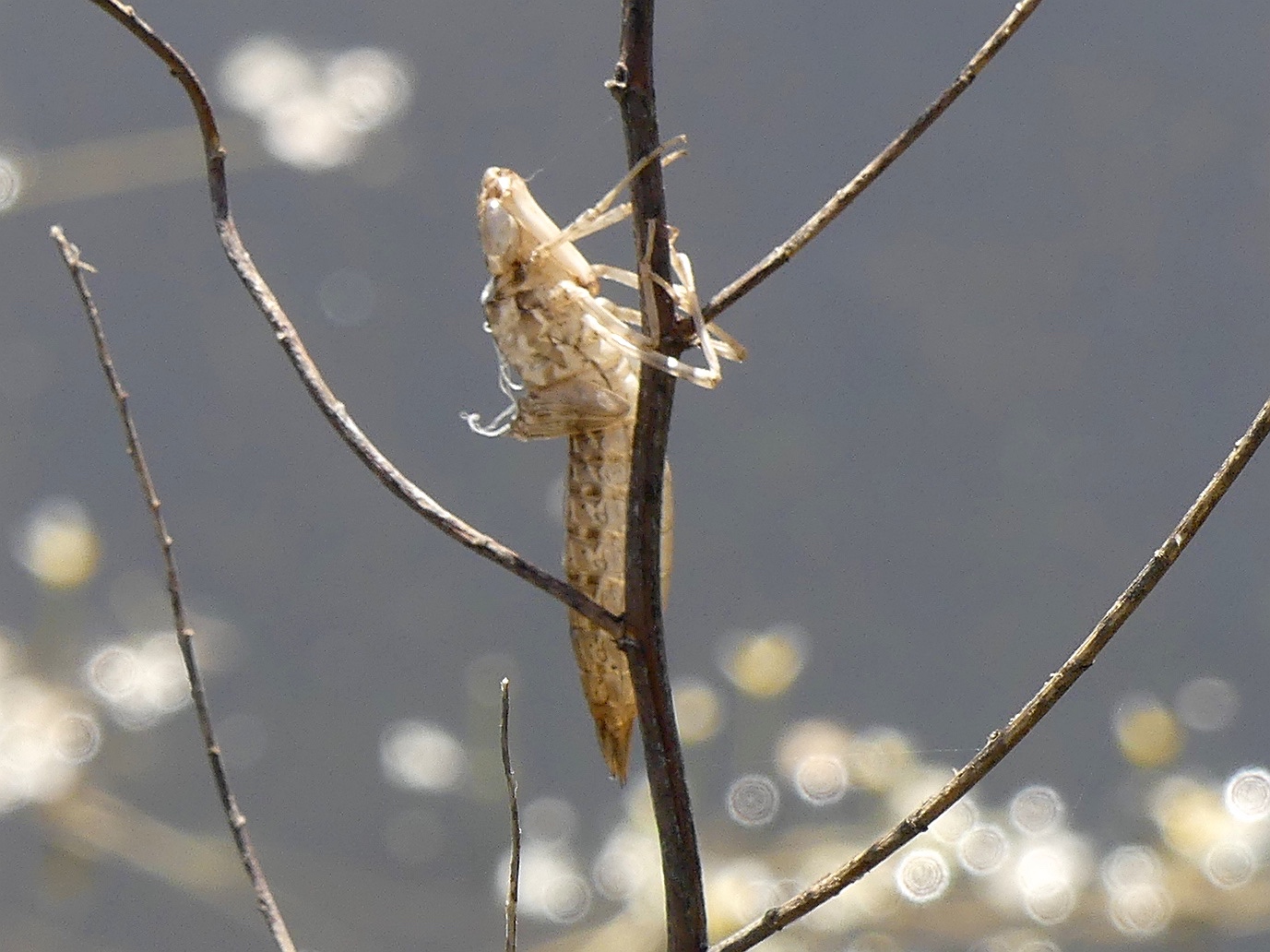
The dragonfly larva lives predatory in the water of rivers and ponds. For its final moult, the larva crawls out of the water and the adult dragonfly emerges. The empty skins (exuviae) may be found on plants protruding from the water. The mouthparts of dragonfly larvae form a “mask”, which the larva can suddenly extend to catch its prey. When at rest, it is held under the head, as in the photo. For the adult animal to emerge, the larval skin bursts open on the back of the thorax.
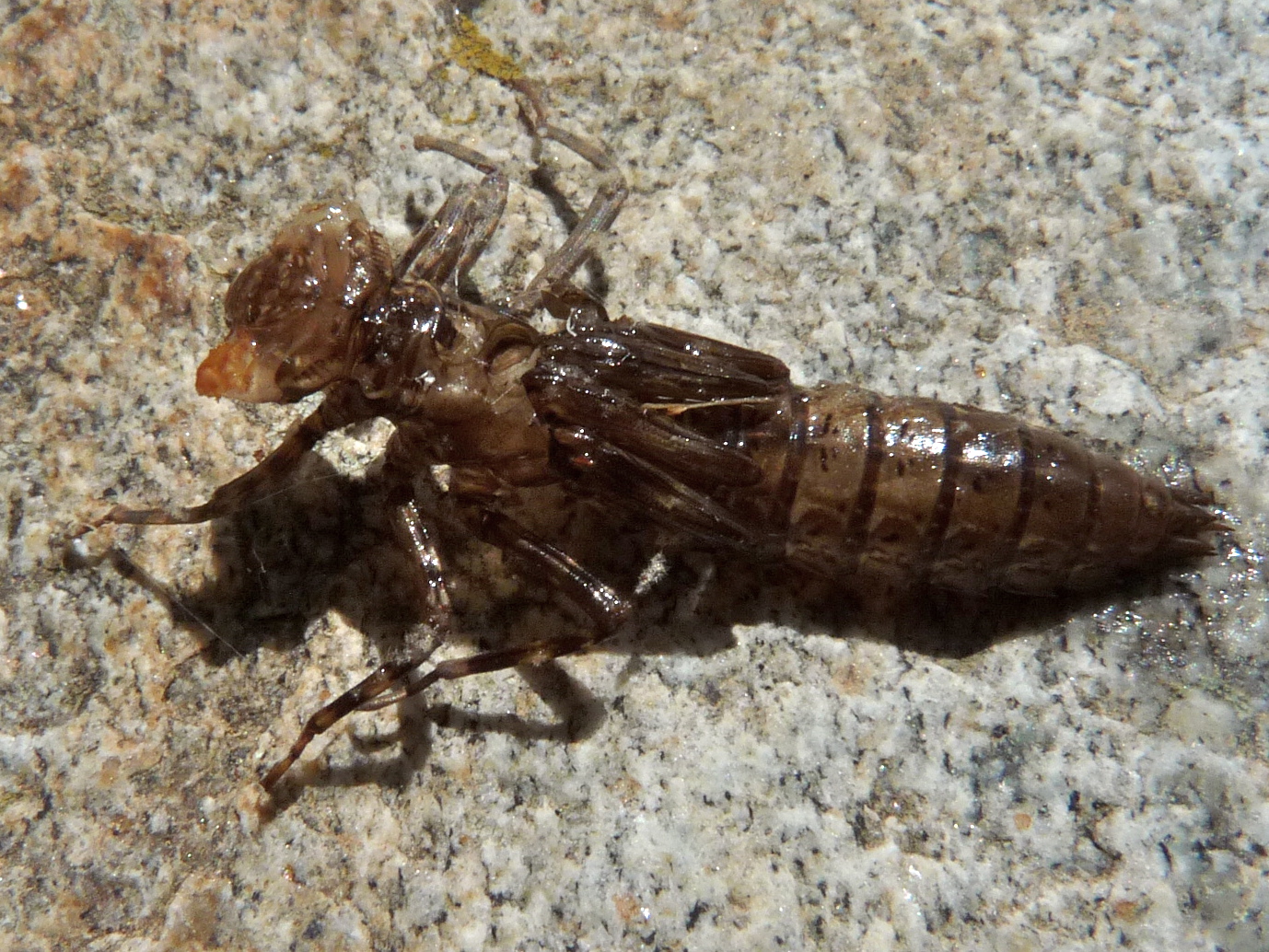
The exuviae can be used to identify the species of dragonfly. Even the eyes are preserved on the empty skin. The last larval stage has visible wing buds.
Dragonfly species on Naxos
Around 150 dragonfly species occur in Europe and around 6,000 species worldwide. As dragonfly larvae live exclusively in water, the adult insects of most species also live near rivers or ponds. Accordingly, they are not the most characteristic animals of dry landscapes such as those prevalent in the Mediterranean region. Nevertheless, quite a few species can be observed on Naxos. So far, 19 species of dragonflies had been recorded for Naxos (Wolfgang Lopau, Distribution Atlas of Dragonflies in Greece, Libellula (Journal of the Society of German Odonatologists), Supplement 10, 2010). Three of these species I have not yet seen, while I can add five to the list (the Dainty damselfly, the Southern emerald damselfly, the Violet dropwing, the Common darter and the Southern darter).

This small perennial river near Apollonas, which is shaded by plane trees and alders, is an excellent habitat especially for damselflies.
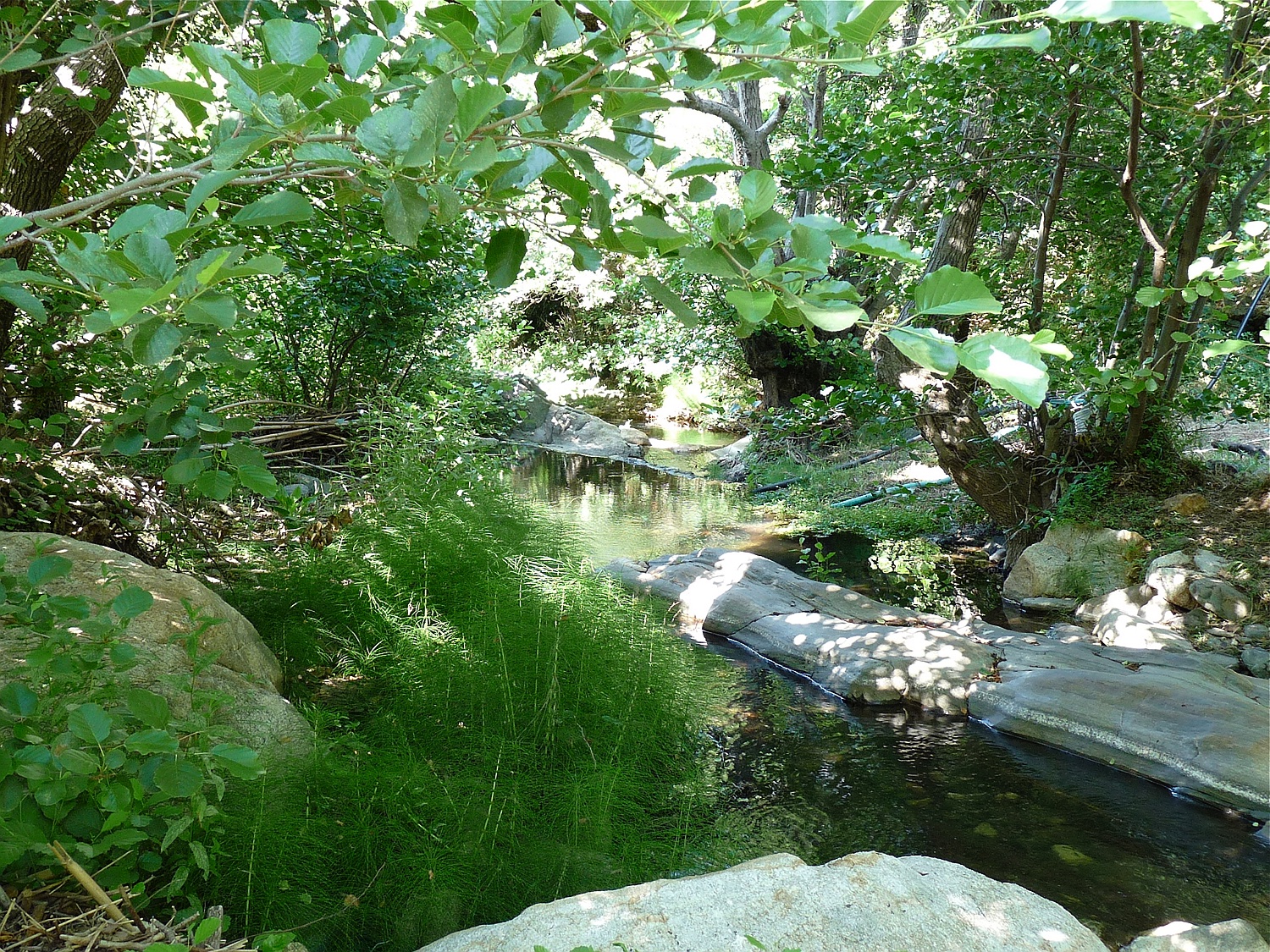
In late spring, this is a wonderful place to observe at least five species of damsel- and dragonflies.
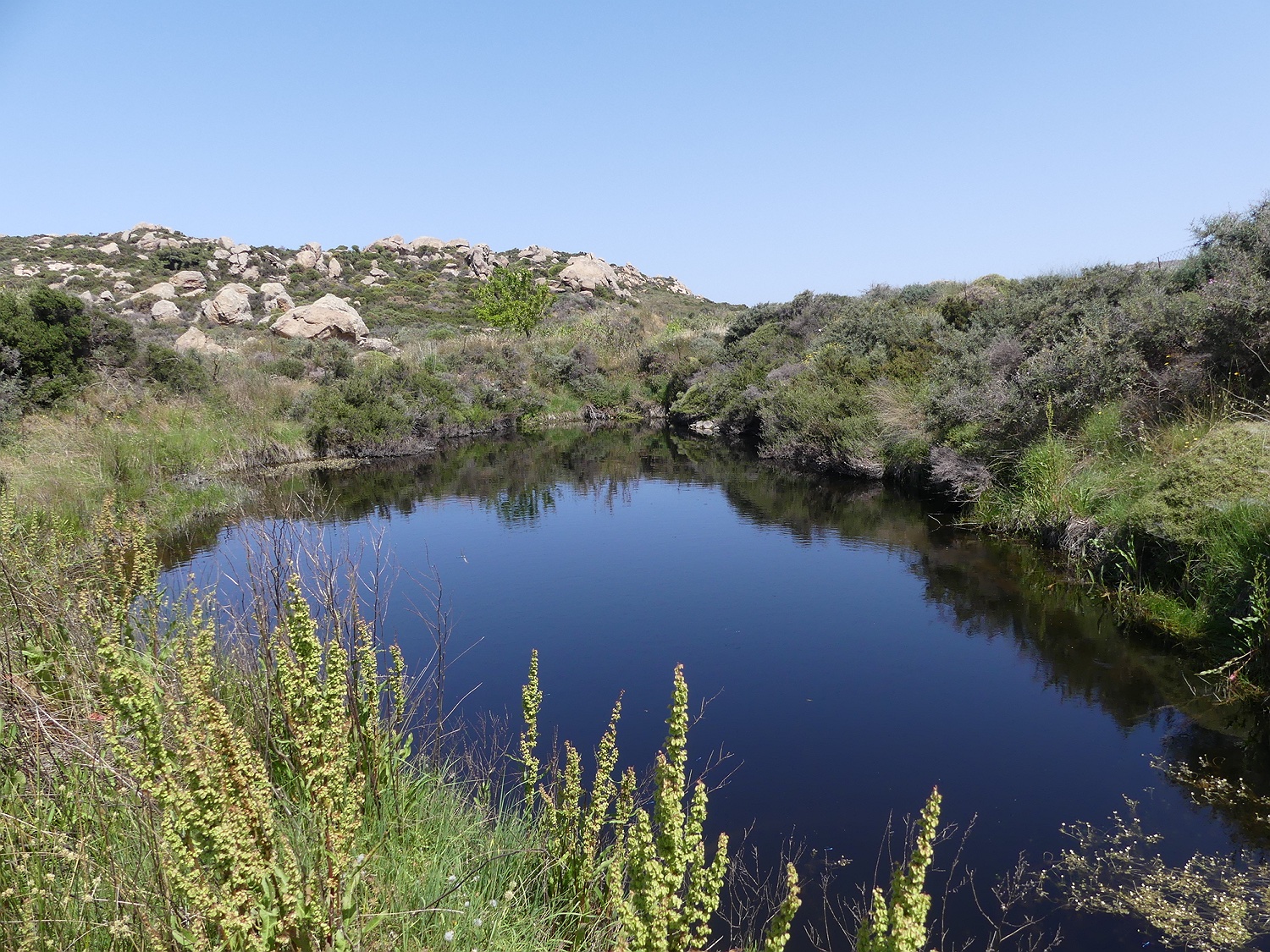
Other species prefer stagnant waters; on Naxos, these species can be found, for example, at the small artificial water holes near Kinídaros.
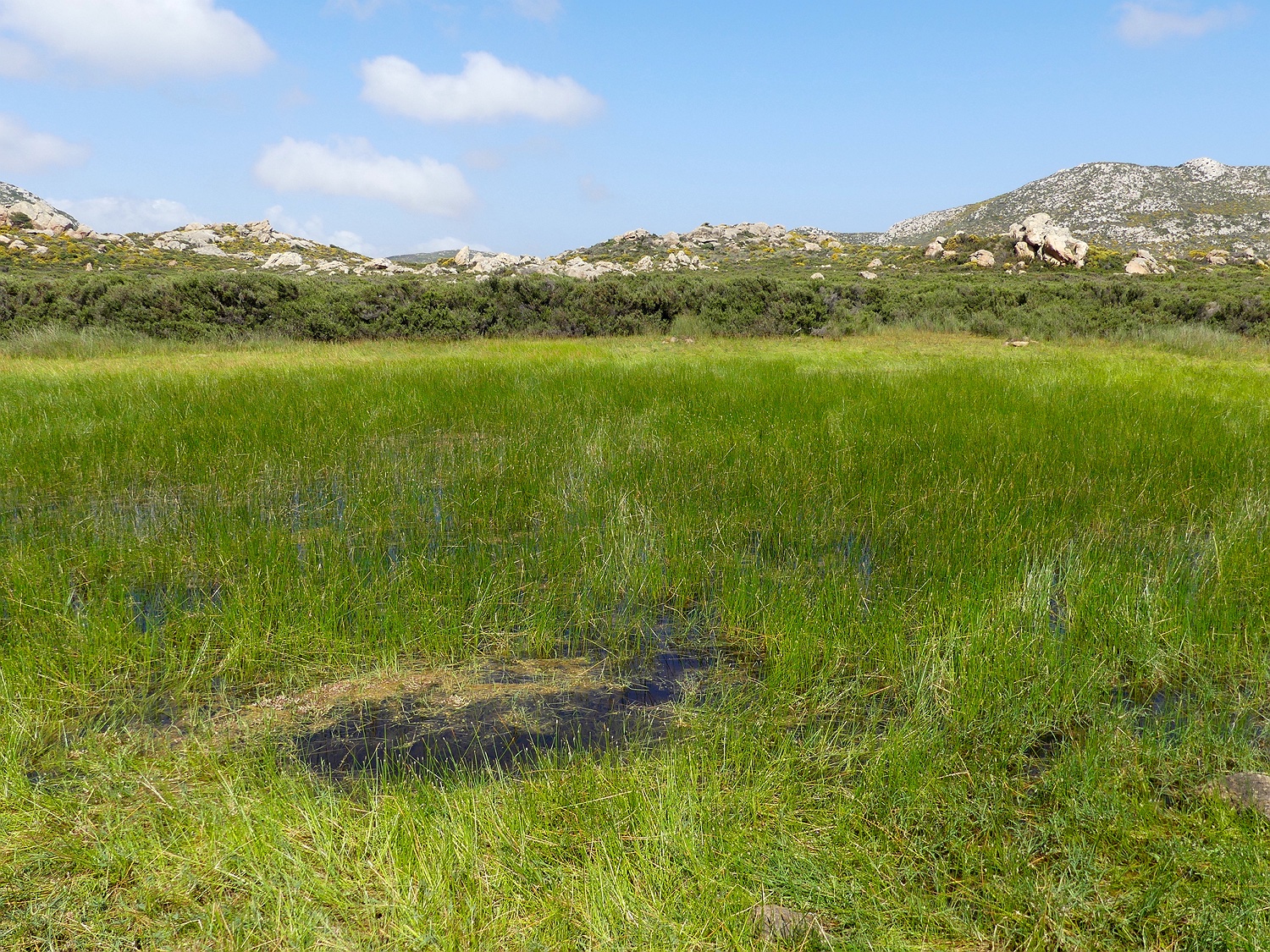
This shallow pond in the migmatite area near Kinídaros, which dries up in summer, is also a good habitat for damselflies.
Dragonfly species on Naxos
Odonata on Naxos
The Photo gallery of the odonata gives an overview over the species.
Here you can jump directly to the genera (you can return by scrolling back):
1. Damselflies:
Demoiselles, Calopteryx – Featherlegs, Platycnemis – Eurasian bluets, Coenagrion – Forktails, Ischnura – Spreadwings, Lestes – Winter damselflies, Sympecma
2. Dragonflies:
Emperor dragonflies, Anax – Aeshnids, Caliaeschna – Pincertails, Onychogomphus – Spiketails or Goldenrings, Cordulegaster – Skimmers, Orthetrum – Darters, Sympetrum – Scarlets, Crocothemis – Dropwings, Trithemis
1. Damselflies
The Odonata are divided into damselflies and dragonflies. Damselflies are smaller, slimmer and more delicate than dragonflies. The front and rear wings have the same size and are normally held over the abdomen when at rest. The eyes are set apart.
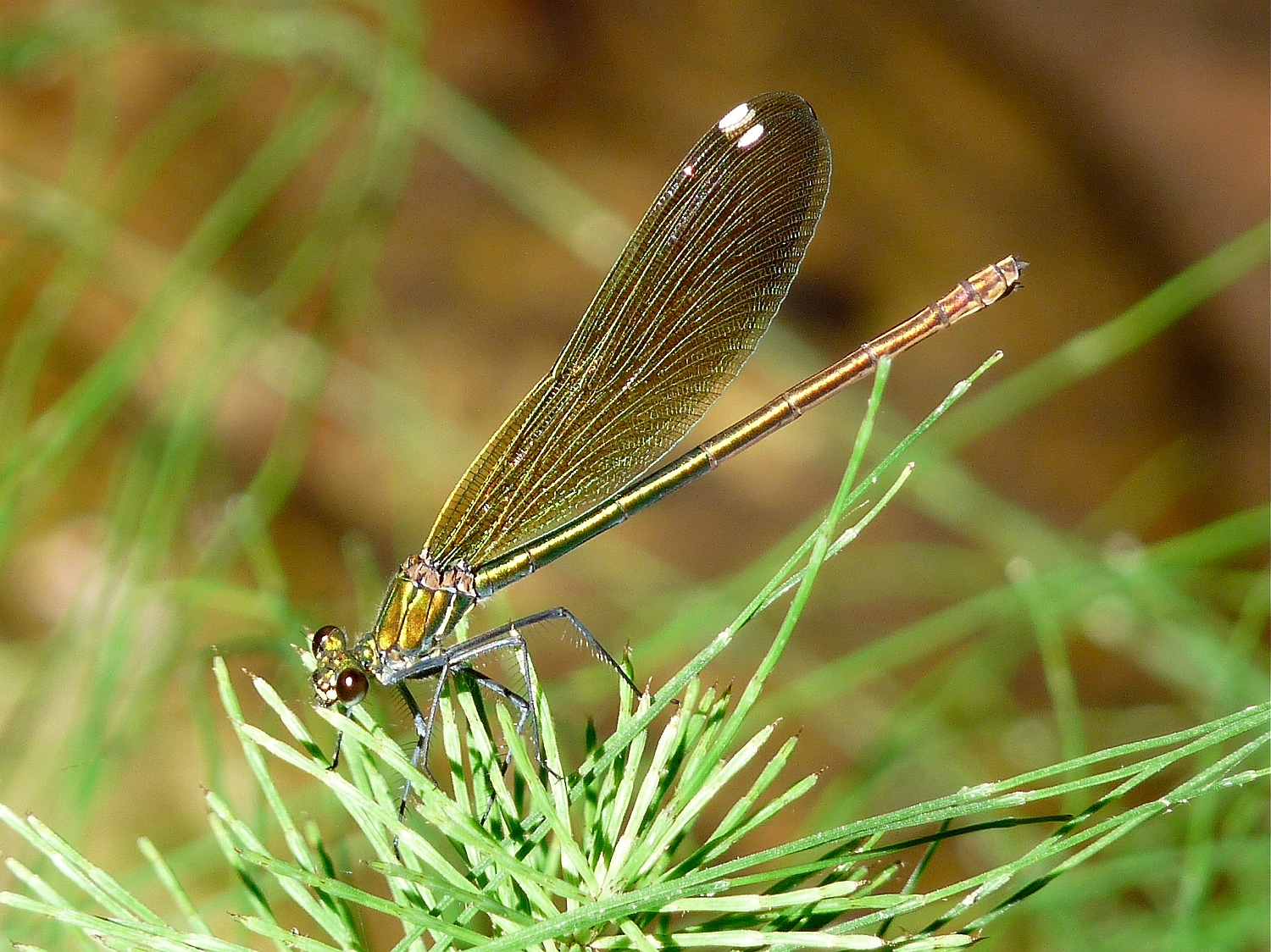
The small, delicate damselflies hold their wings over the abdomen when they are sitting.
Banded demoiselle, Calopteryx splendens mingrelica, Sélys
Demoiselles are probably the prettiest dragonflies. They are found near flowing water and are common on Naxos in suitable habitats, for example, at the river near Apóllonas. The males perform conspicuous display flights to attract the females. In between, they like to sit in sunny spots. Two species of demoiselles occur on Naxos, the Banded demoiselle and, much rarer, the Beautiful demoiselle. While the males of the two species are easy to distinguish by their colouring, the females are very similar and can only be told apart with a little experience.
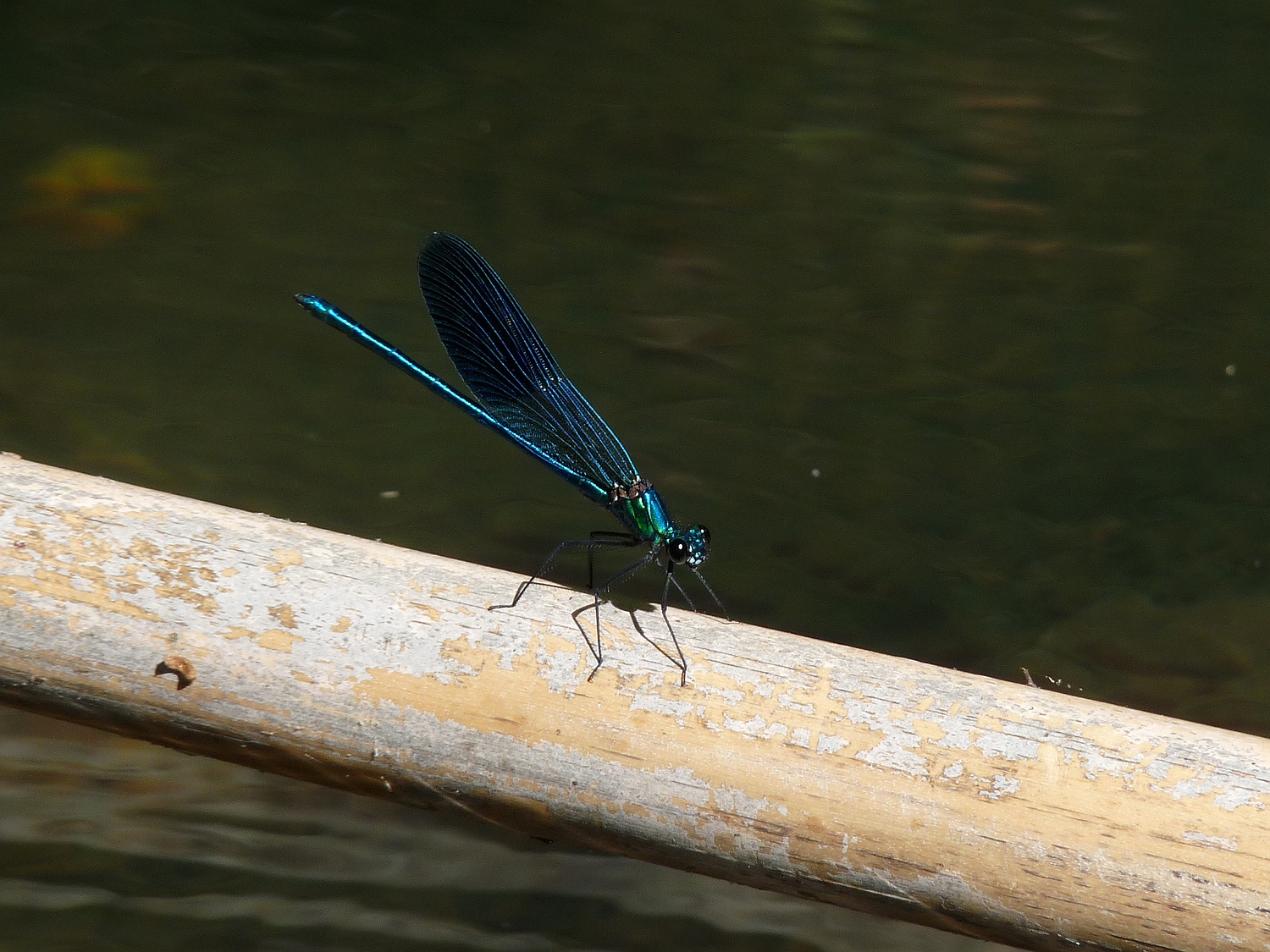
The males of the demoiselles are beautifully coloured in intense dark blue.
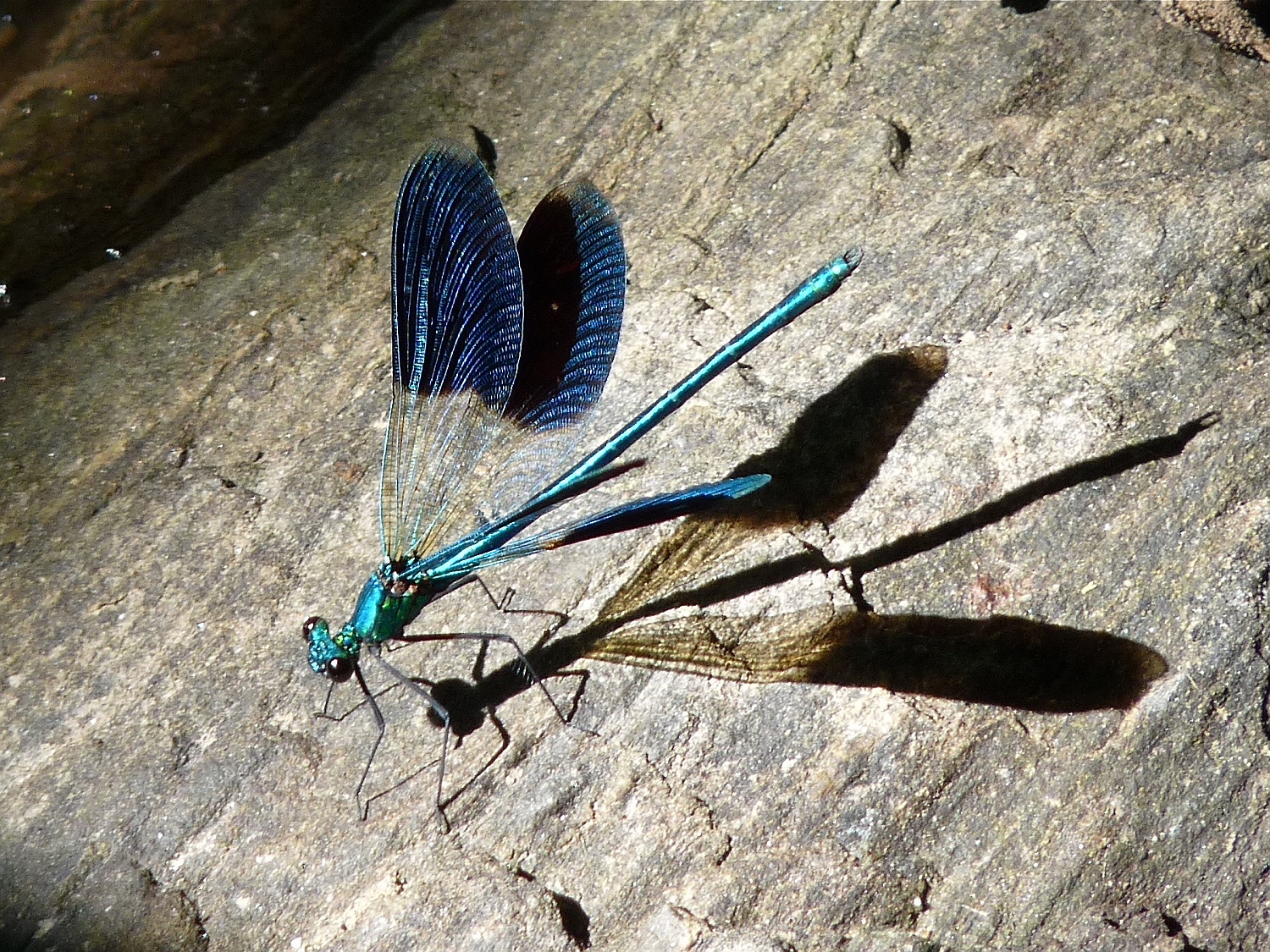
In the case of the Banded demoiselle, only the rear halves of the wings are blue. Damselflies like to sit in sunny spots.
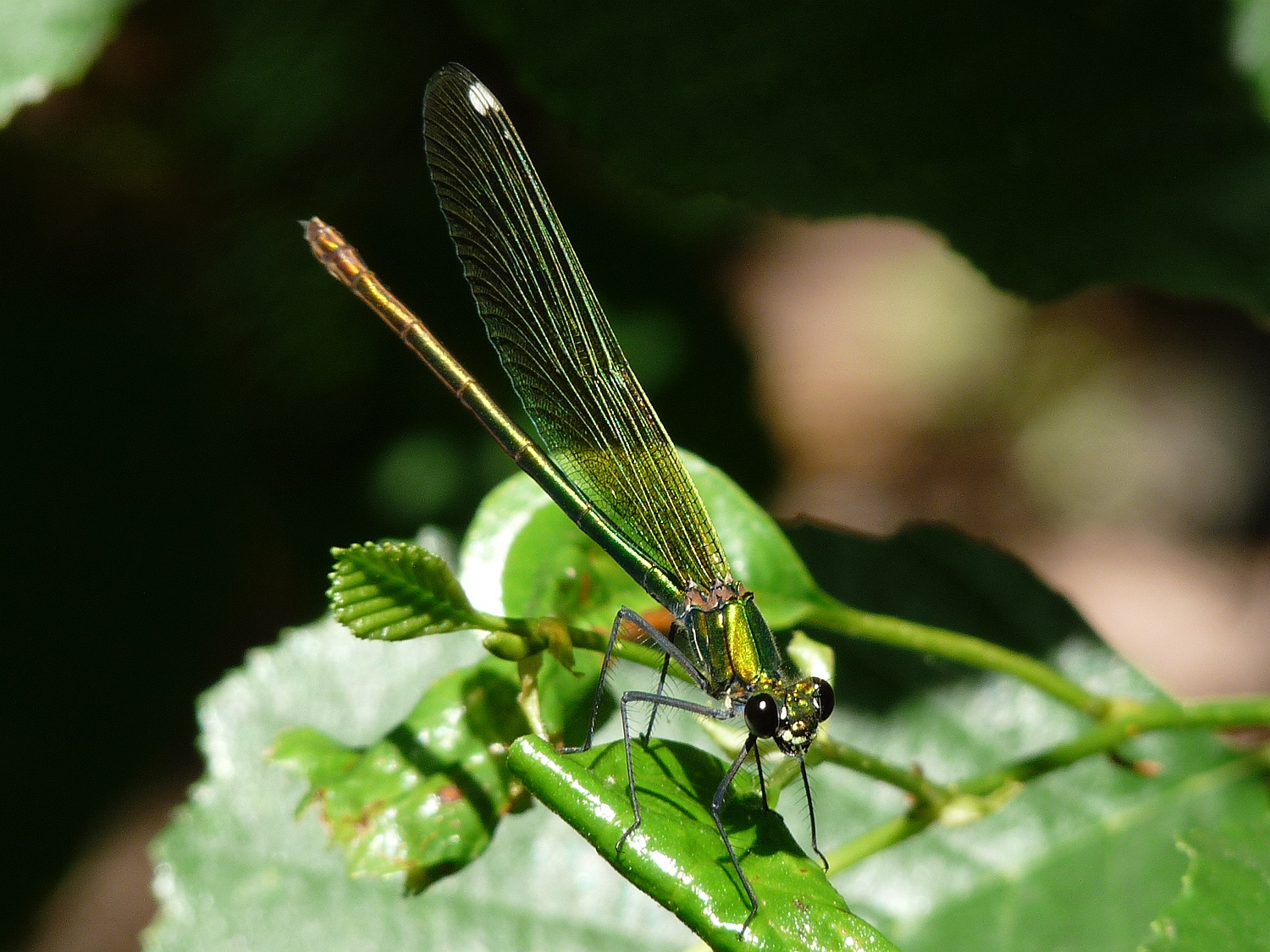
The females are golden-green in colour. In the Banded demoiselle the wings are translucent even when closed and golden-greenish in colour.
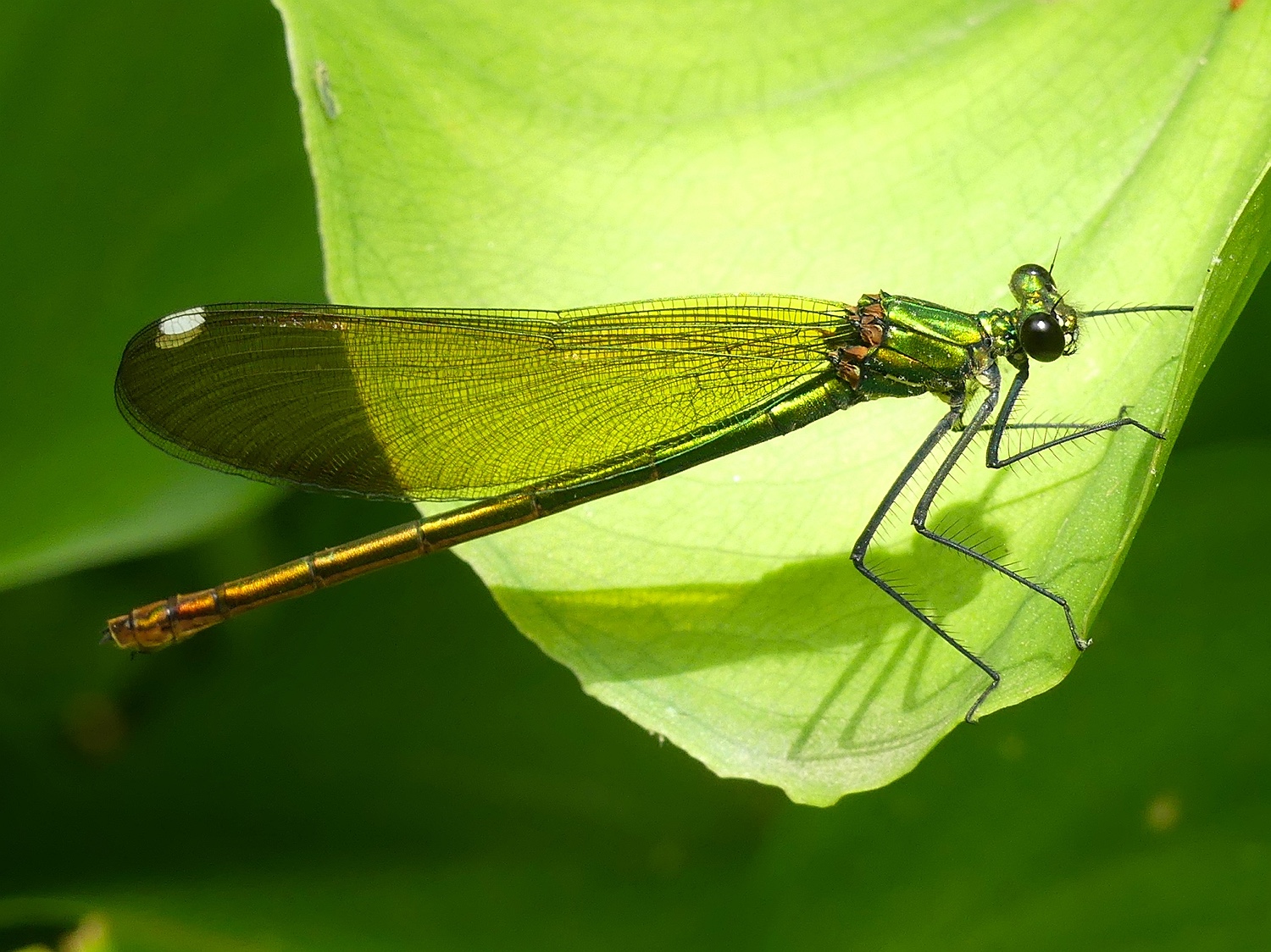
Another female; one can see the translucent wings.
Beautiful demoiselle, Calopteryx virgo festiva, Brullé
This species is much rarer on Naxos than the Banded demoiselle.
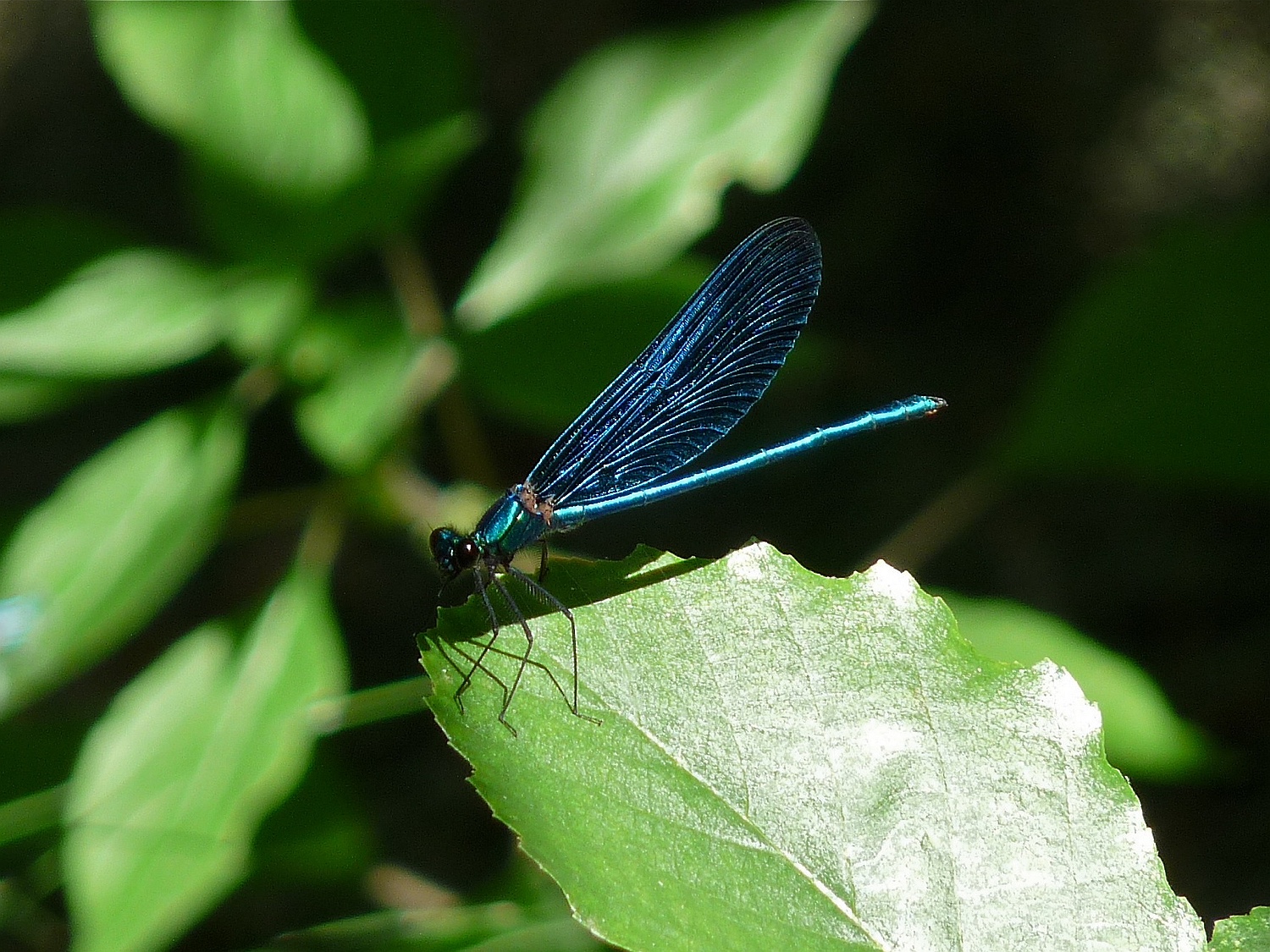
The wings of the male Beautiful demoiselle are completely blue in colour.
Here the veins of the wings are very visible.
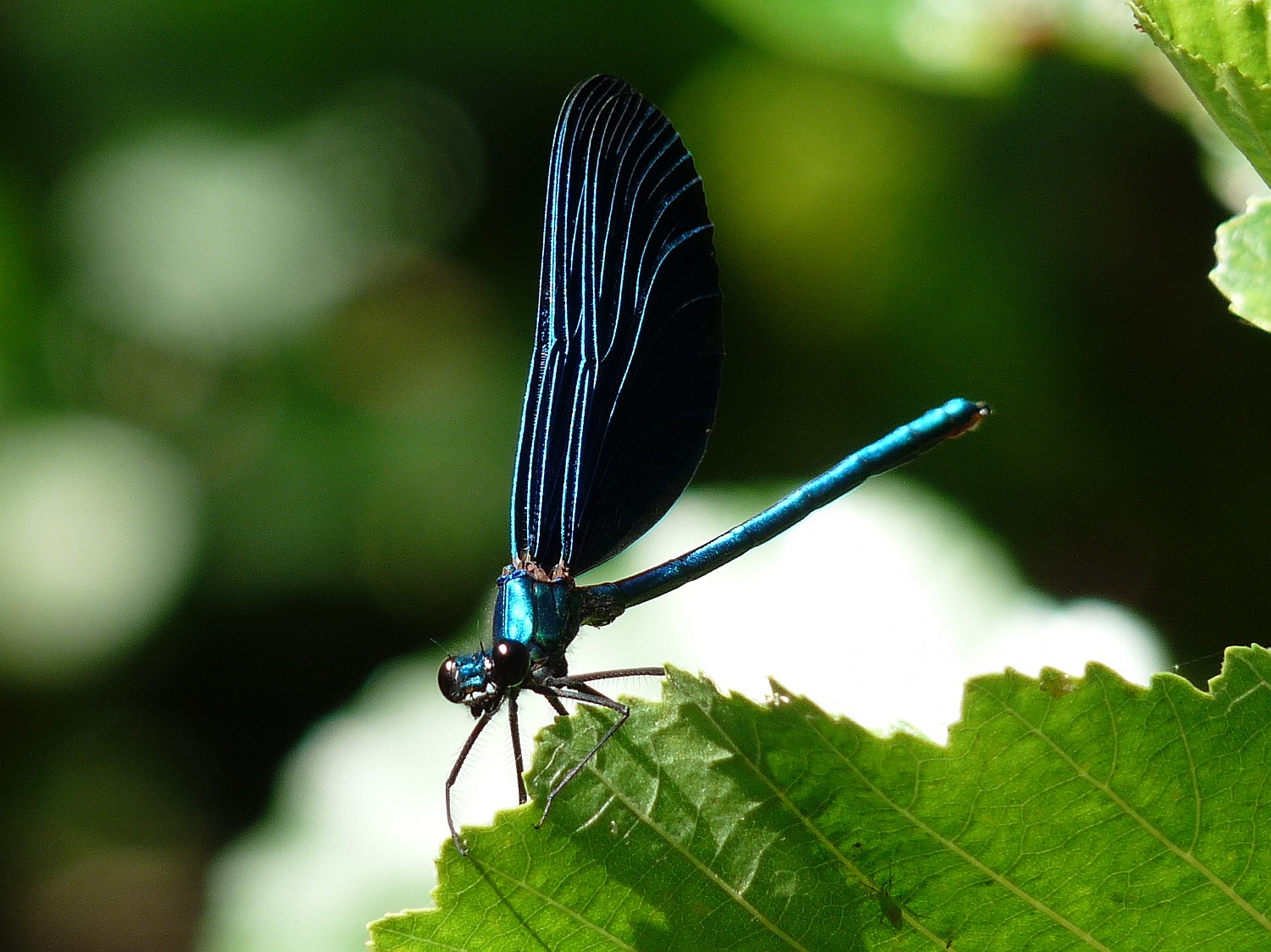
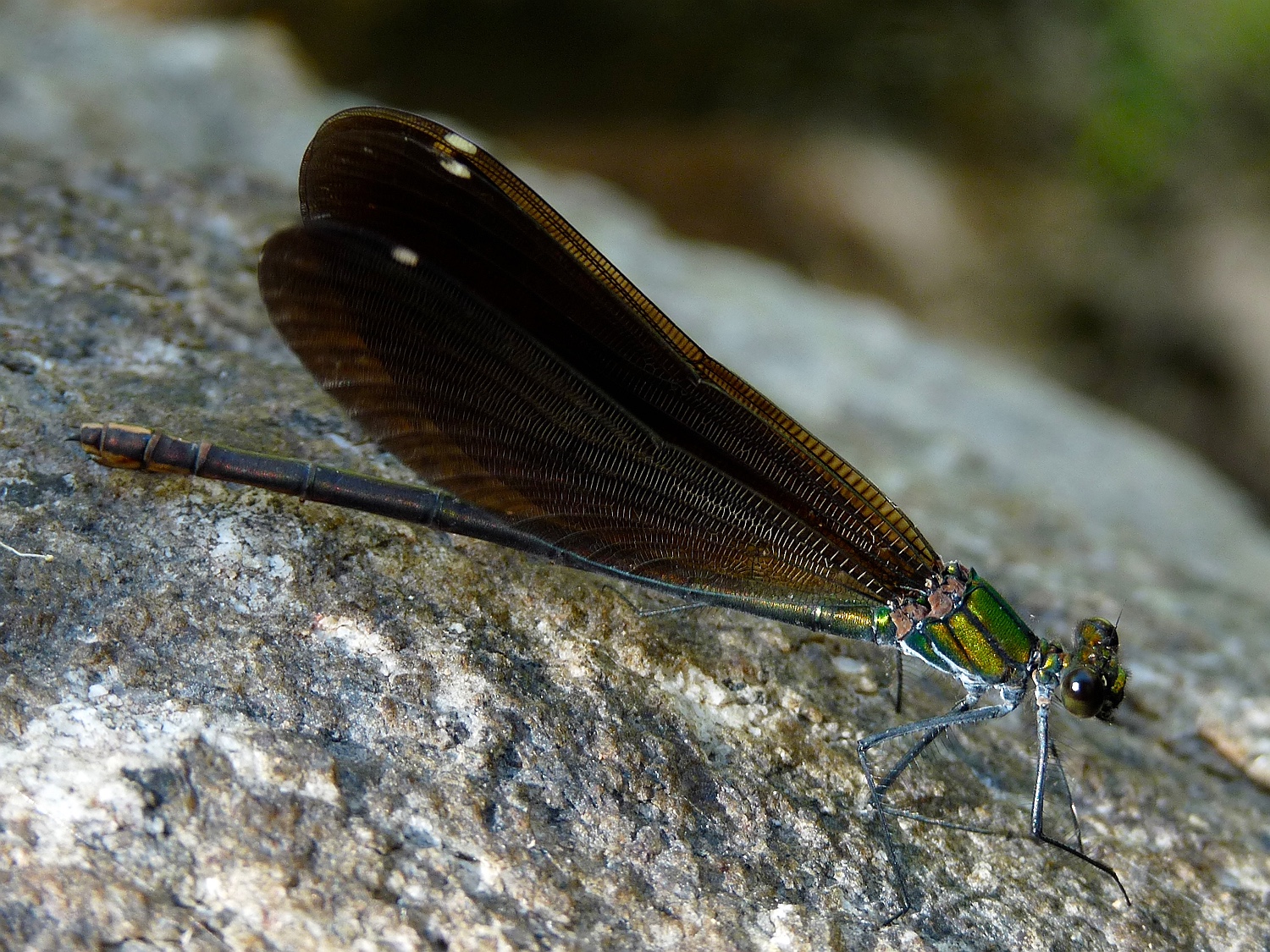
The wings of the females are golden brown in colour and are not translucent when held together.
White-legged damselfly, Platycnemis pennipes nitidula, Brullé
The White-legged damselfly or Blue featherleg, in its Greek subspecies, is by far the most common damselfly along the small watercourses on Naxos.
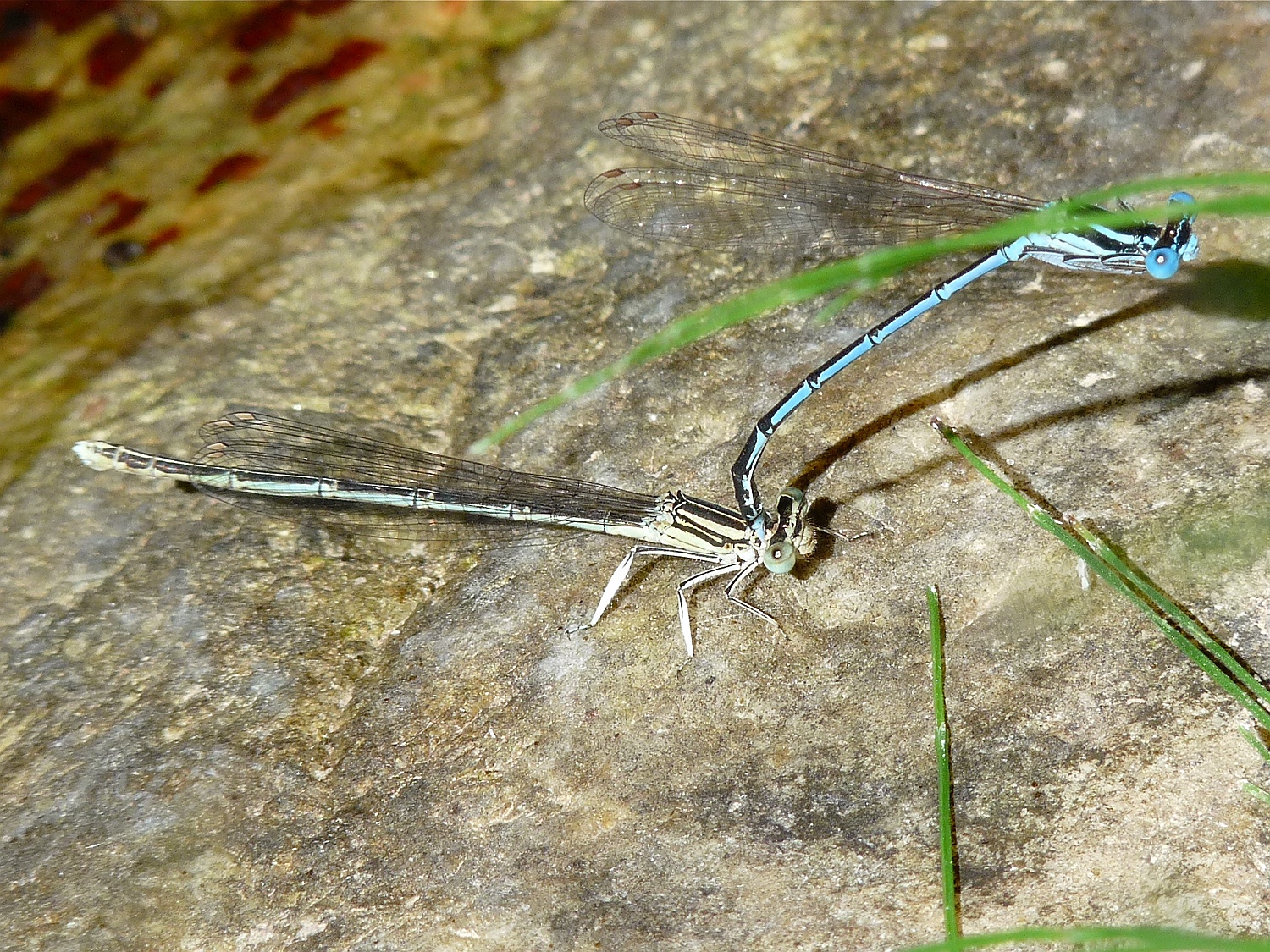
A pair of White-legged damselflies in tandem position. The males are light blue in colour, the females beige.
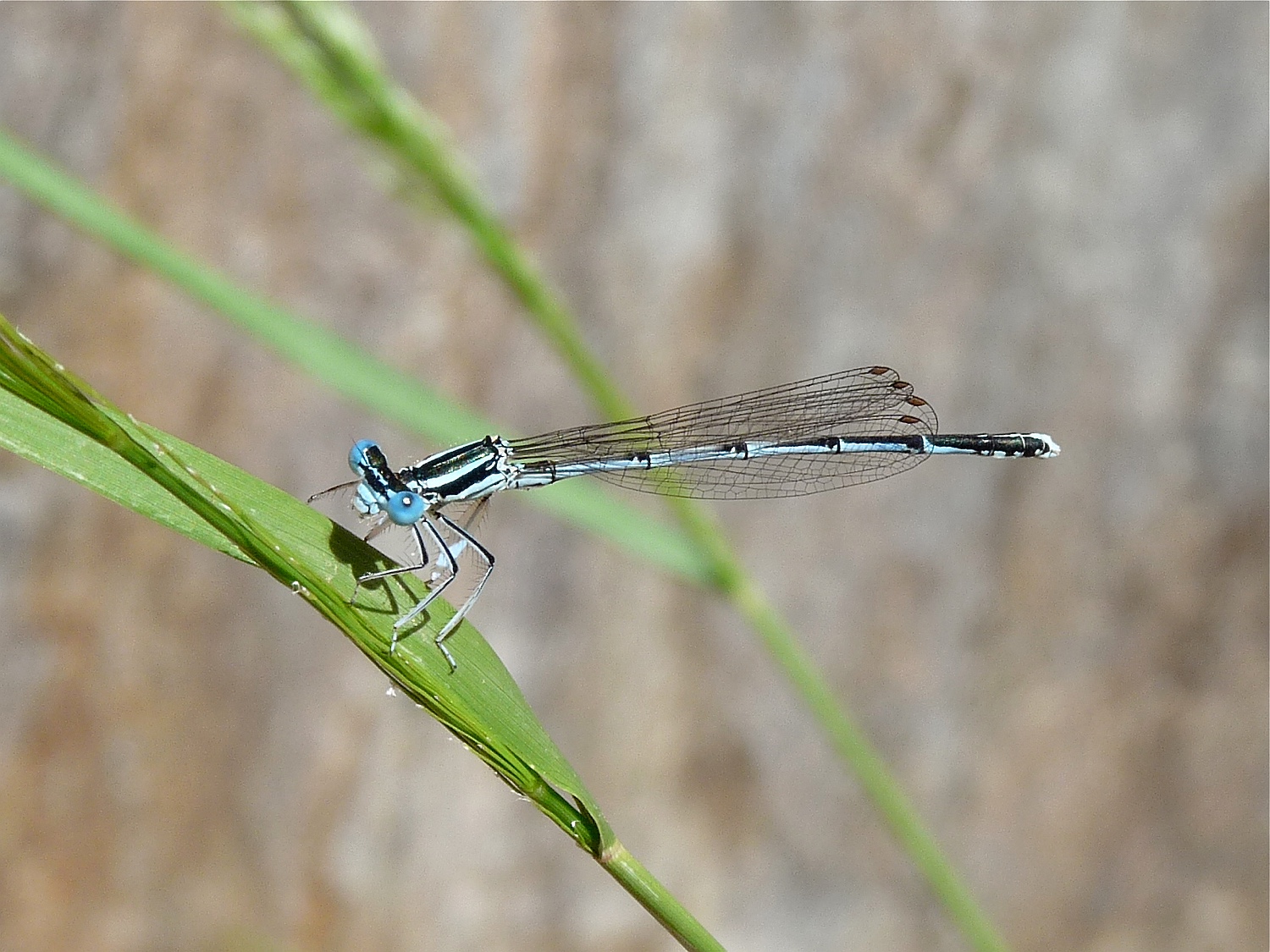
Characteristic features of the White-legged damselfly are the particularly widely spaced light blue eyes, the dark abdomen with relatively little blue when viewed from above, the thick black stripes on its thorax and the broad white edges of the tibias (lower legs).
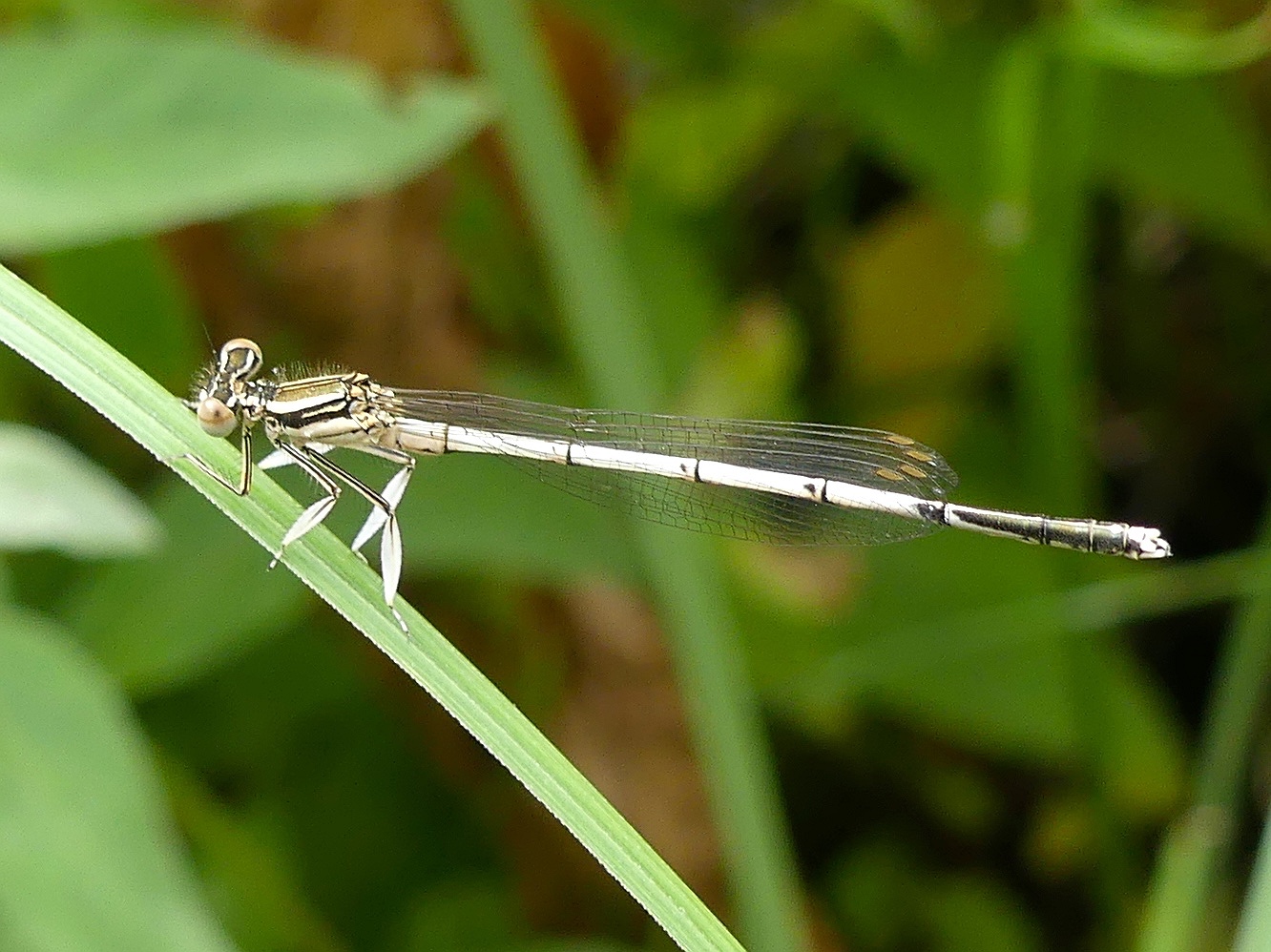
The females of the White-legged damselfly carry a black double stripe on the side of their thorax, as do the males of most related species. They also have broadened, bristly tibias.
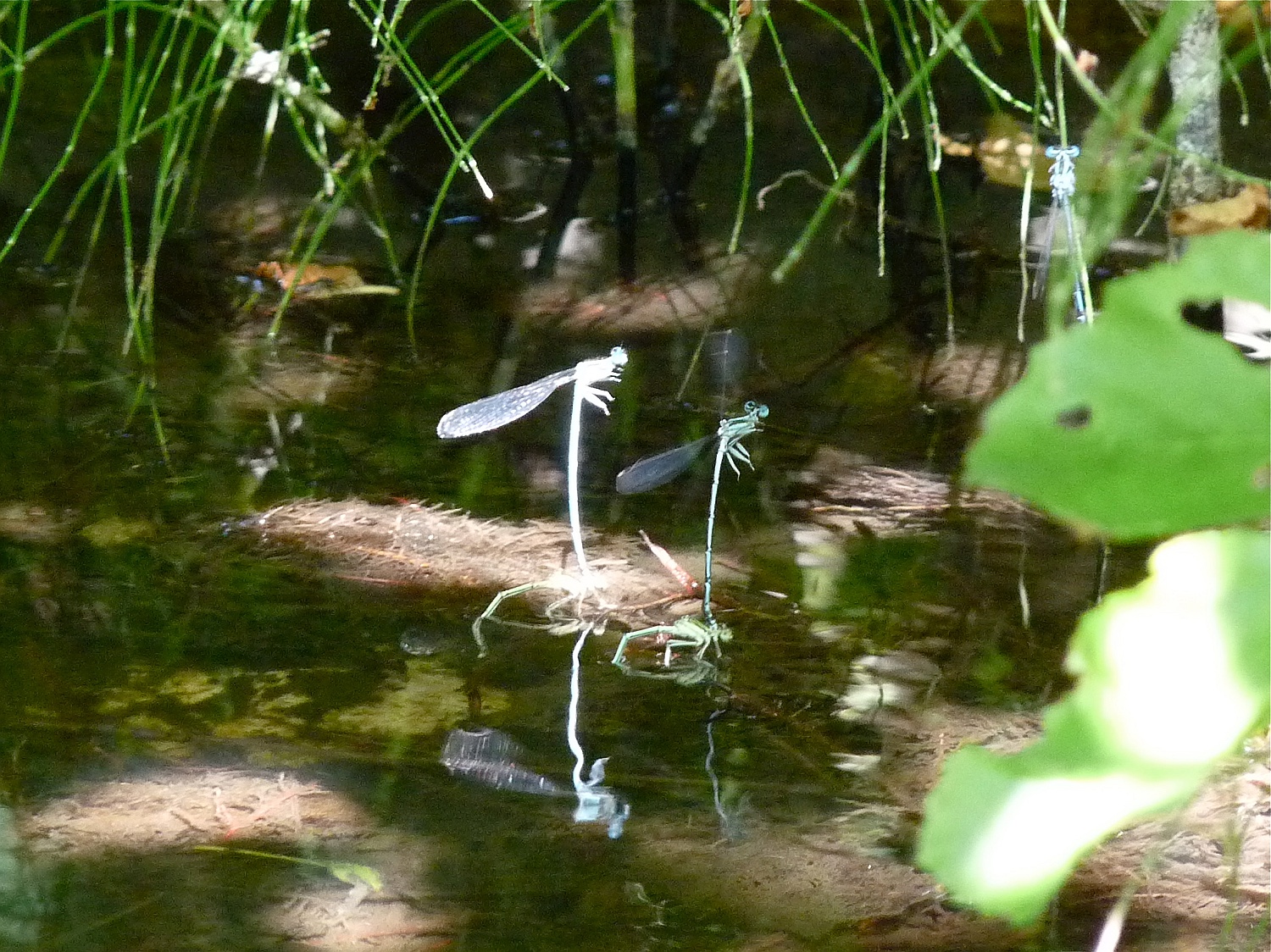
pairs of White-legged damselflies laying eggs
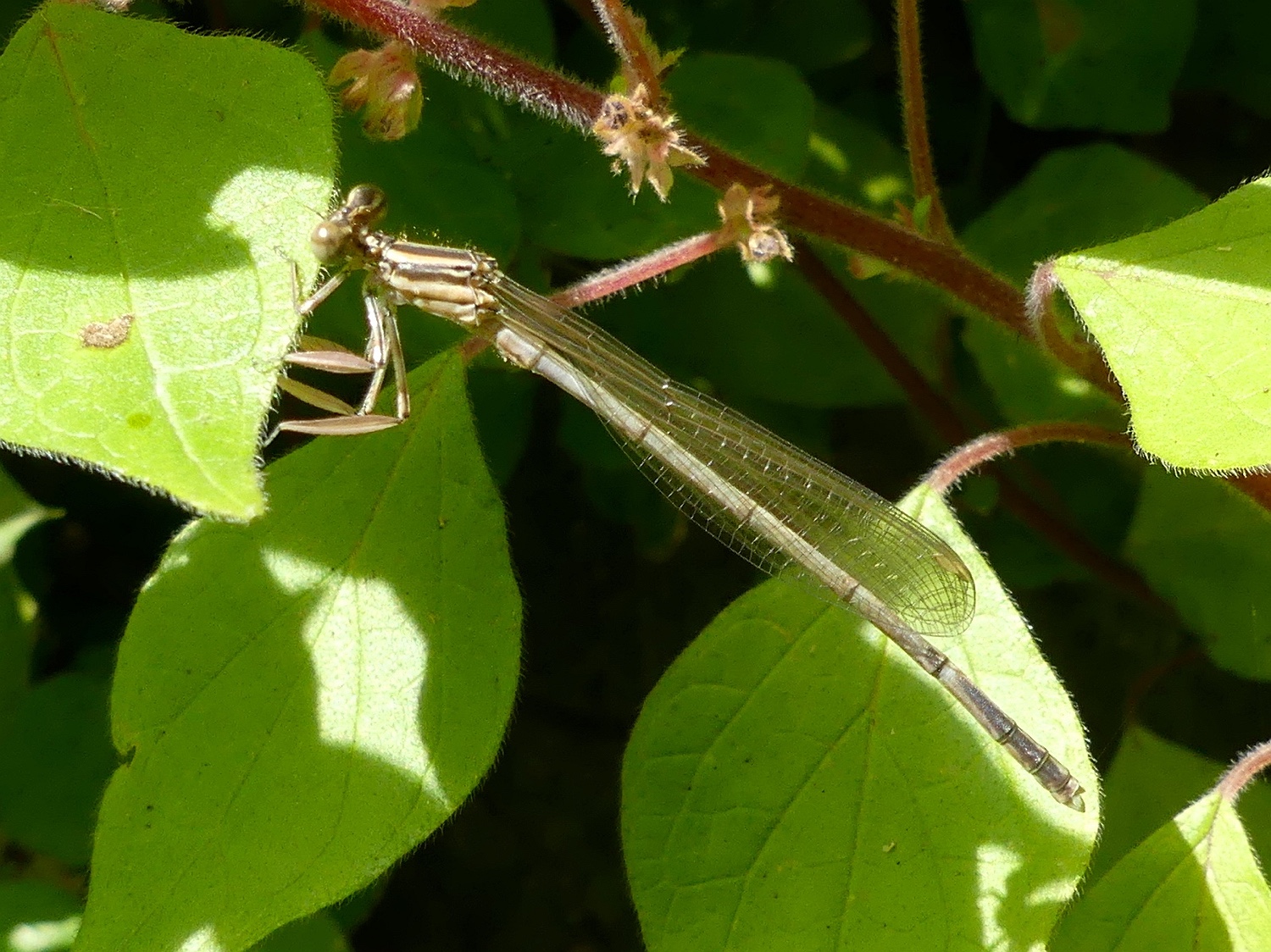
In this freshly “hatched” female White-legged damselfly the black markings are still only faintly visible.
Dainty damselfly or Dainty bluet, Coenagrion scitulum, Rambur
About 15 species of bluets occur in Europe, some of which look very similar, making identification difficult. The Dainty damselfly is mainly found in the Mediterranean region, but has been spreading more and more to central Europe in recent years. It lives around stagnant waters. On Naxos, I encountered it at the small water holes near Kinídaros, where it is quite common.
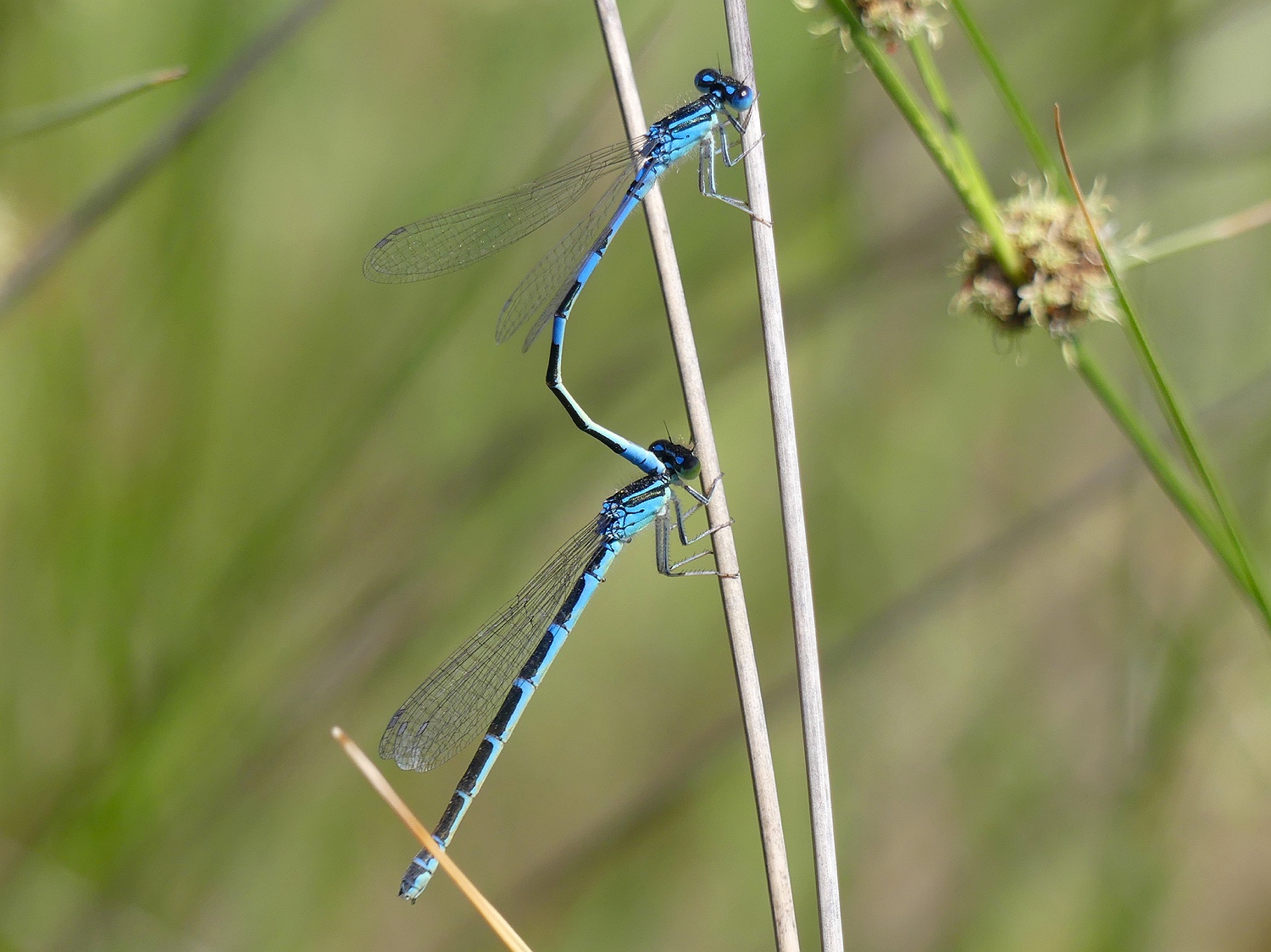
Dainty damselflies in tandem position. Bluets have a striking, bright blue colouring. In the Dainty damselfly, males and females are quite similar in colour, i.e. the female is also predominantly blue.
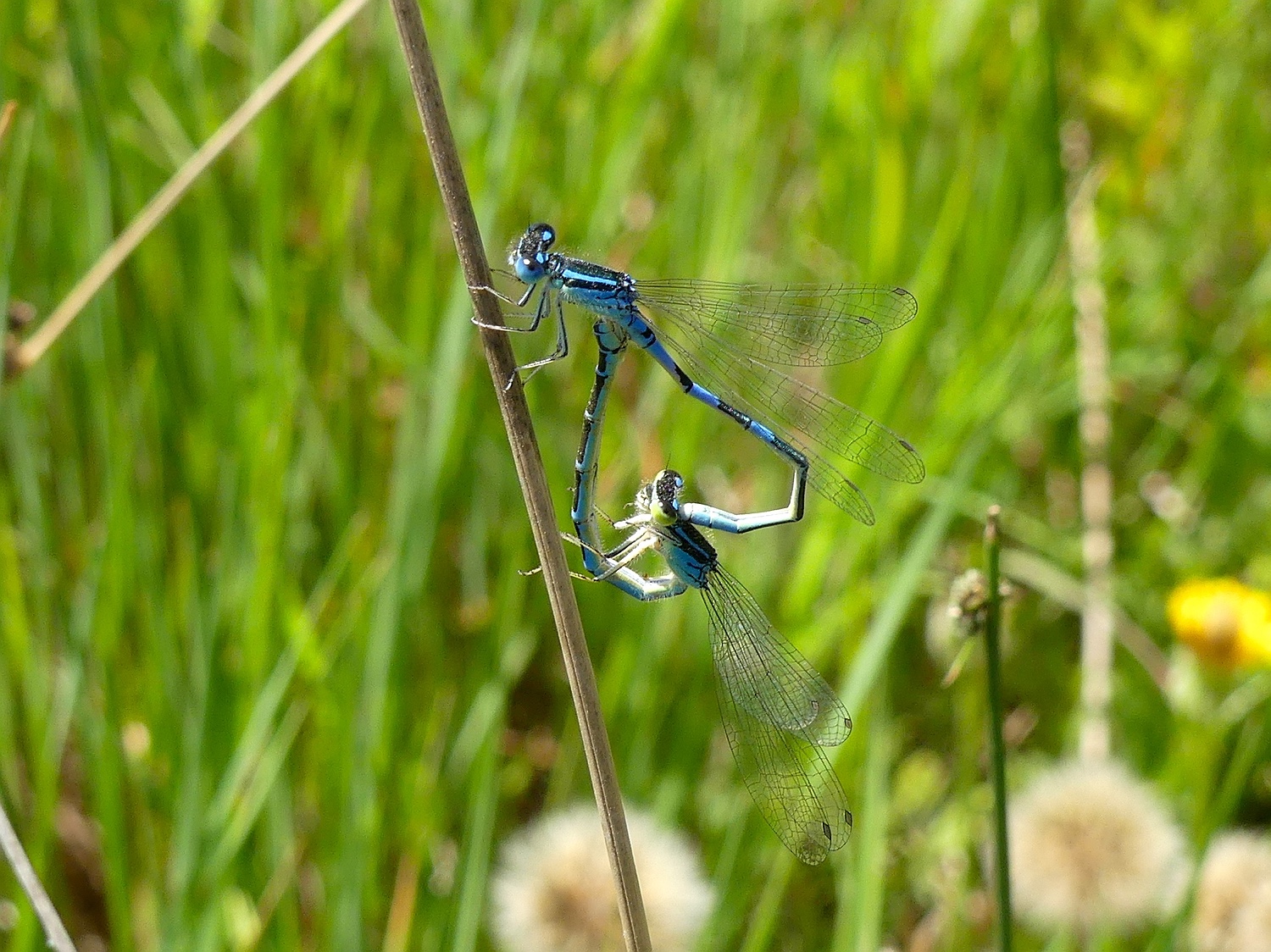
Characteristic features of this species are the crescent-shaped mark on the second segment of the male’s abdomen, the greenish lower half of the female’s eyes and the short, not very dark pterostigma.
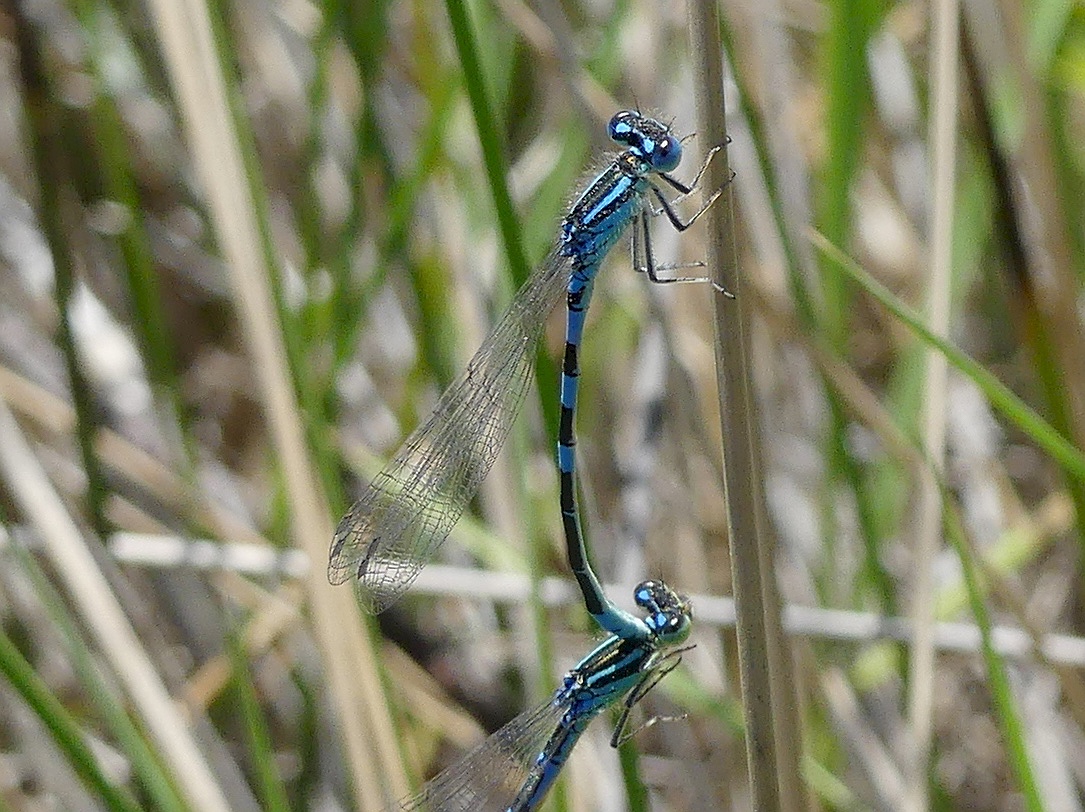
Here the crescent-shaped mark on the second abdominal segment of the male (upper animal) is visible.
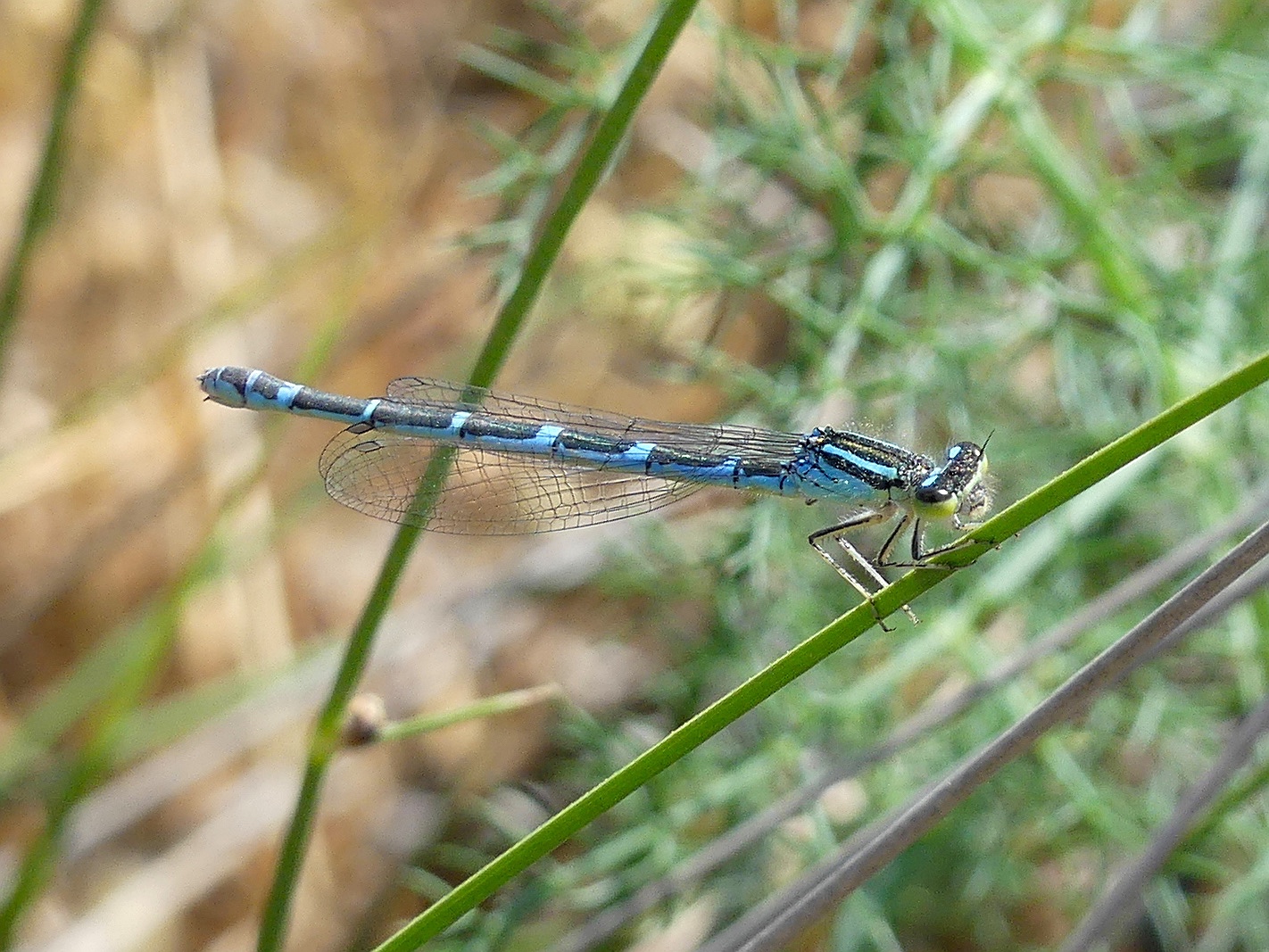
a female Dainty damselfly
Blue-tailed damselfly, Ischnura elegans, Vander Linden
The Blue-tailed damselfly, which is widespread and common throughout Europe, looks similar to the White-legged damselfly at first glance. However, the male is easily recognisable by its light blue eighth abdominal segment. Also the black and white pterostigma is characteristic. The eyes are black on top and blue below. The females are quite variable in colour. The Blue-tailed damselfly lives mainly along stagnant or slow-moving waters; the photo was taken at the river mouth in Apóllonas. It is rather rare on Naxos.
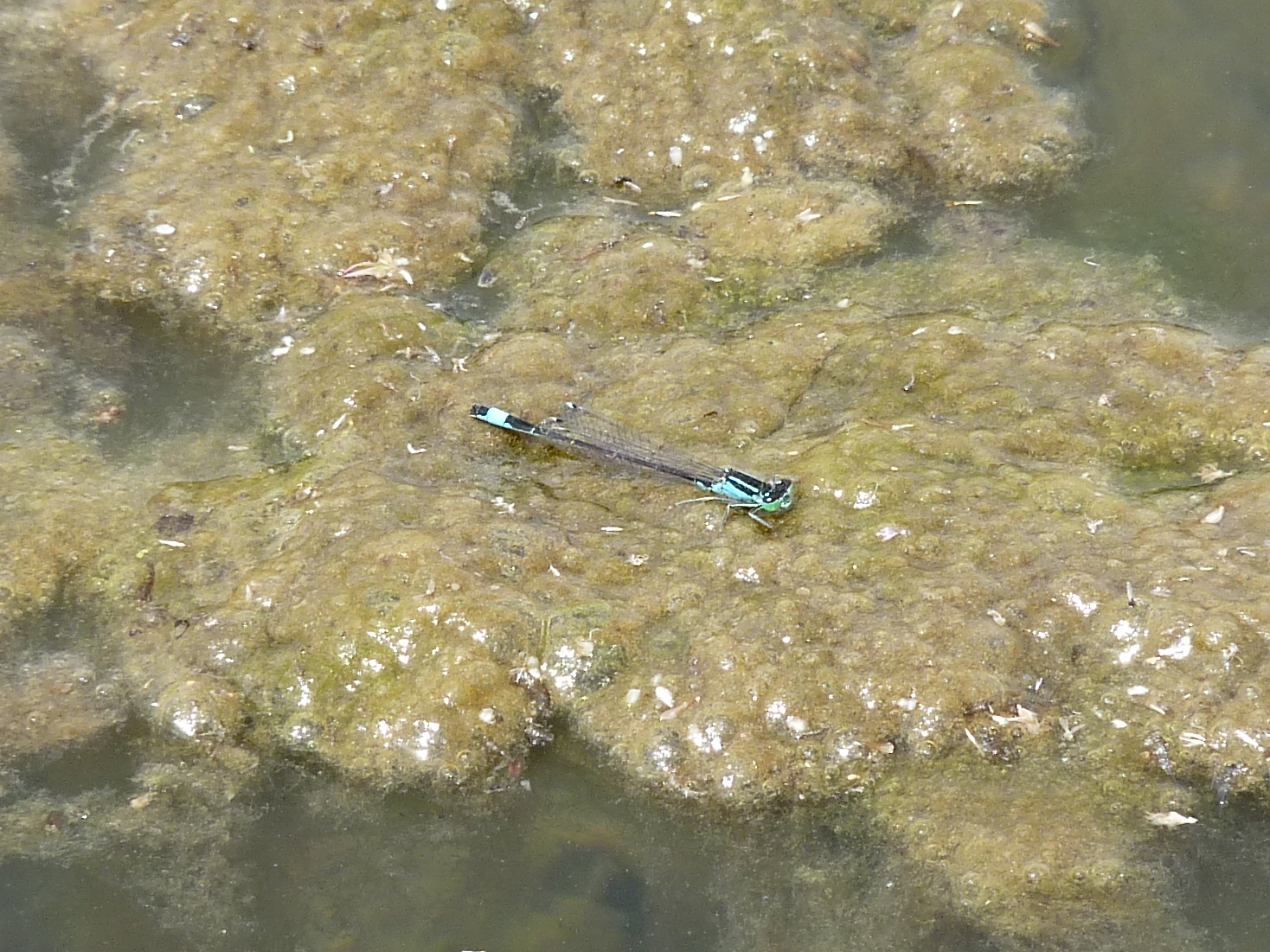
The male Blue-tailed damselfly can be recognised by the light blue 8th segment of its otherwise dark abdomen.
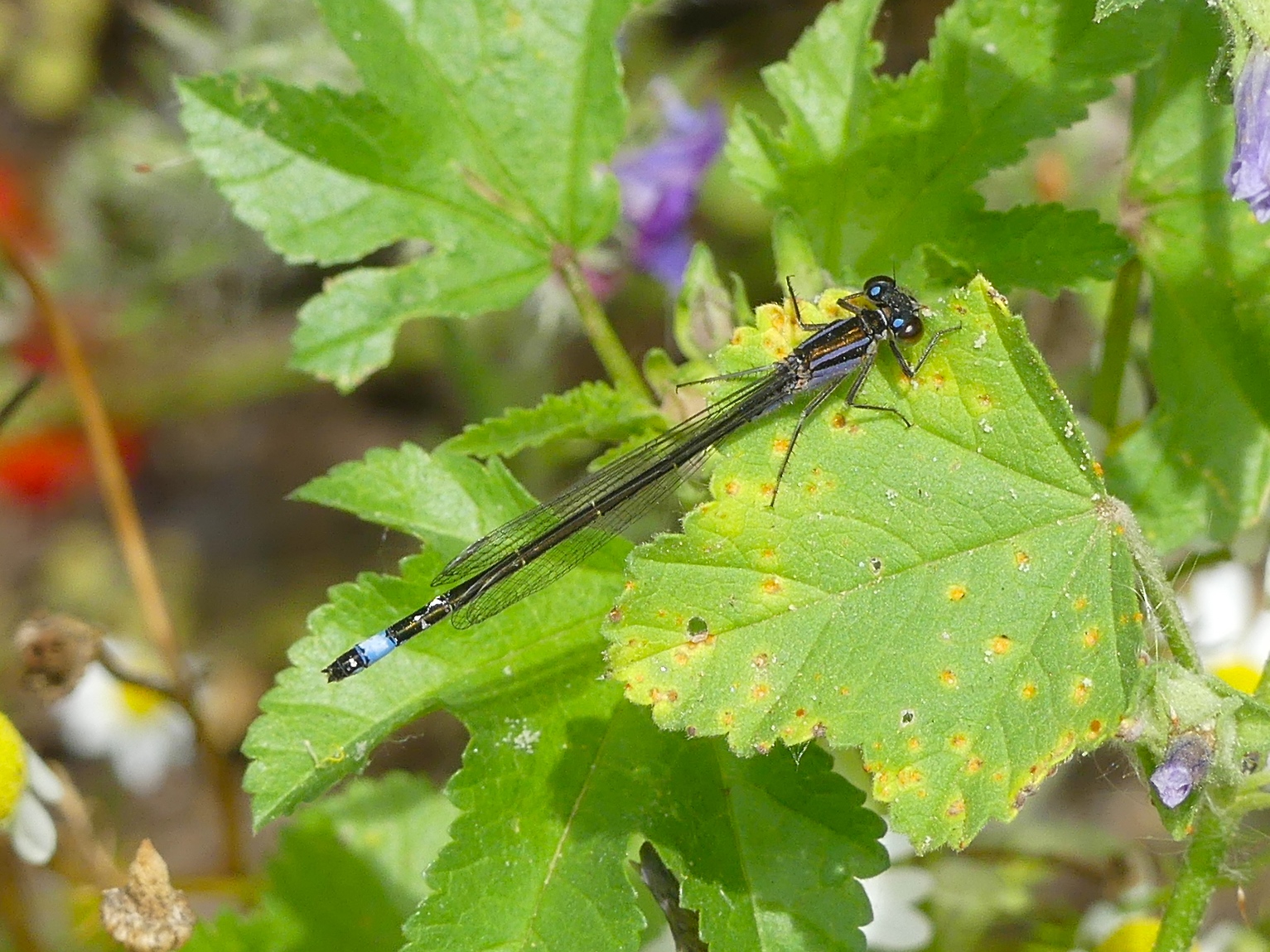
Here a juvenile form of the female, forma violacea, with a slight purple colouring on the chest. Adult females are either coloured like the males or have an olive-green thorax without a blue abdominal segment.
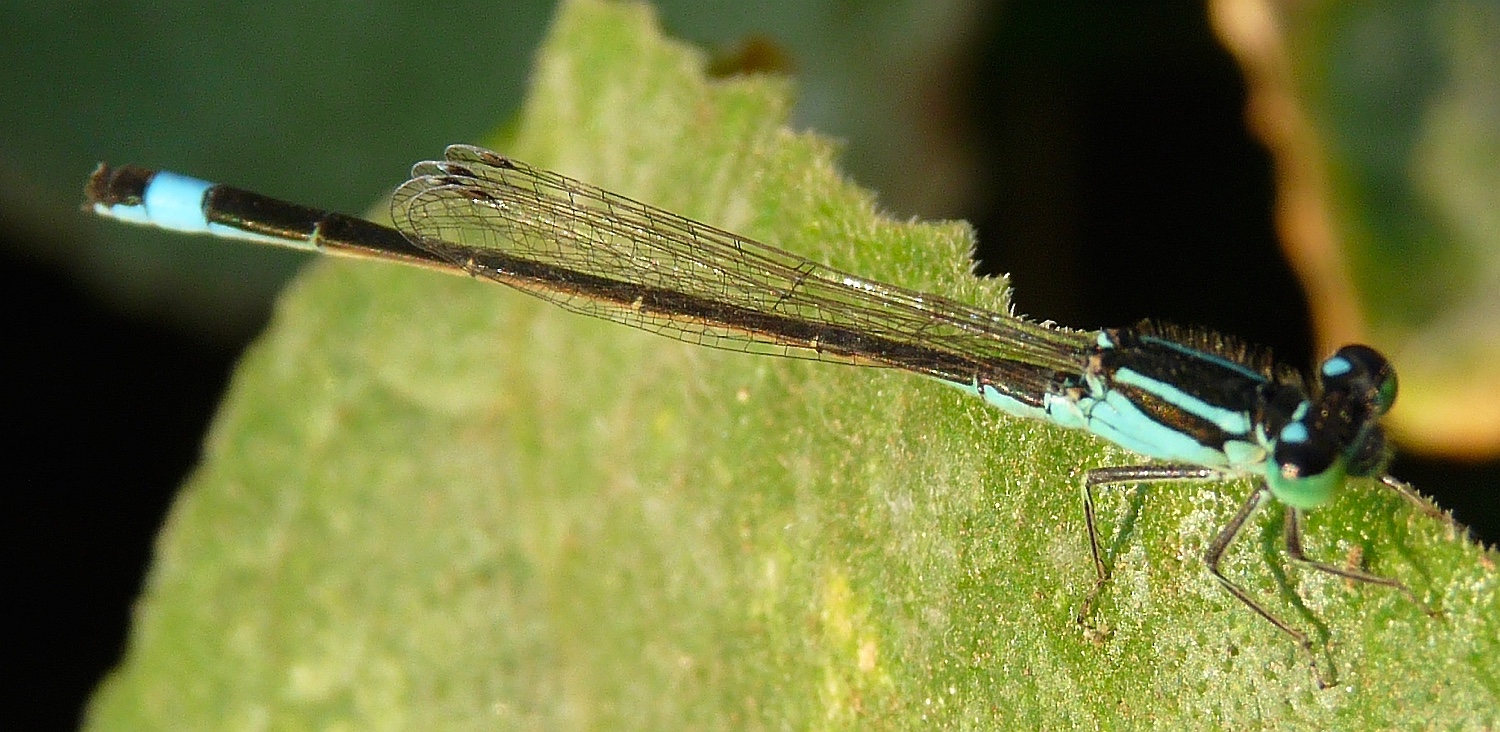
Sometimes this small, delicate damselfly shows up in our garden.
Eastern willow spreadwing, Lestes parvidens (= Chalcolestes parvidens), Artobolevsky
The elegant Eastern willow spreadwing is rare on Naxos; I found it by the river near Kinídaros, where several specimens were sitting near a small streamlet densely covered with flowers and grass. Unlike most other damselflies, the spreadwings keep their wings spread out when sitting. The Western willow spreadwing (Chalkolestes viridis) is very similar in appearance, but much rarer in Greece.
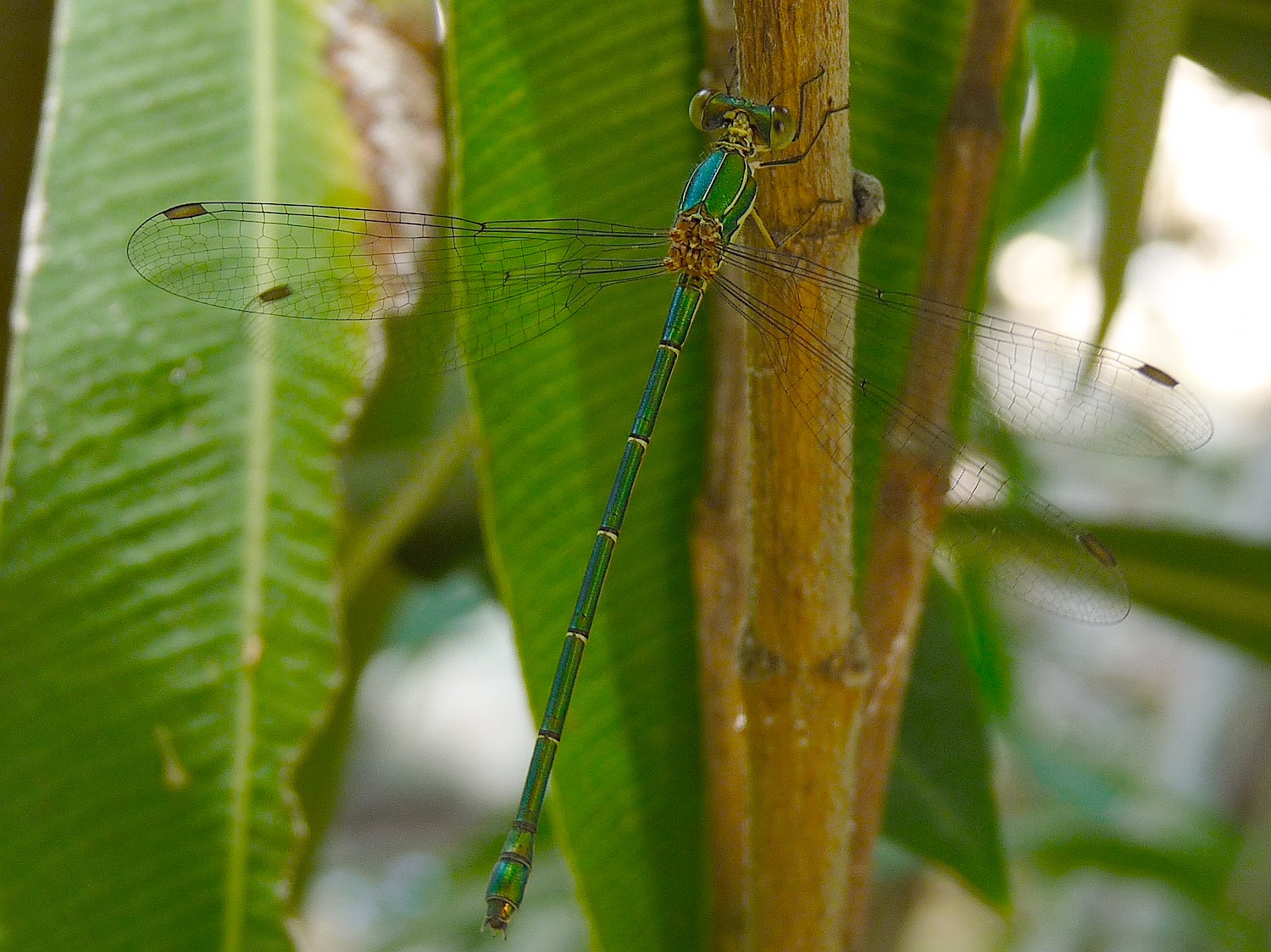
Willow spreadwings have a metallic green-bronze colouring. The pterostigma is brown.
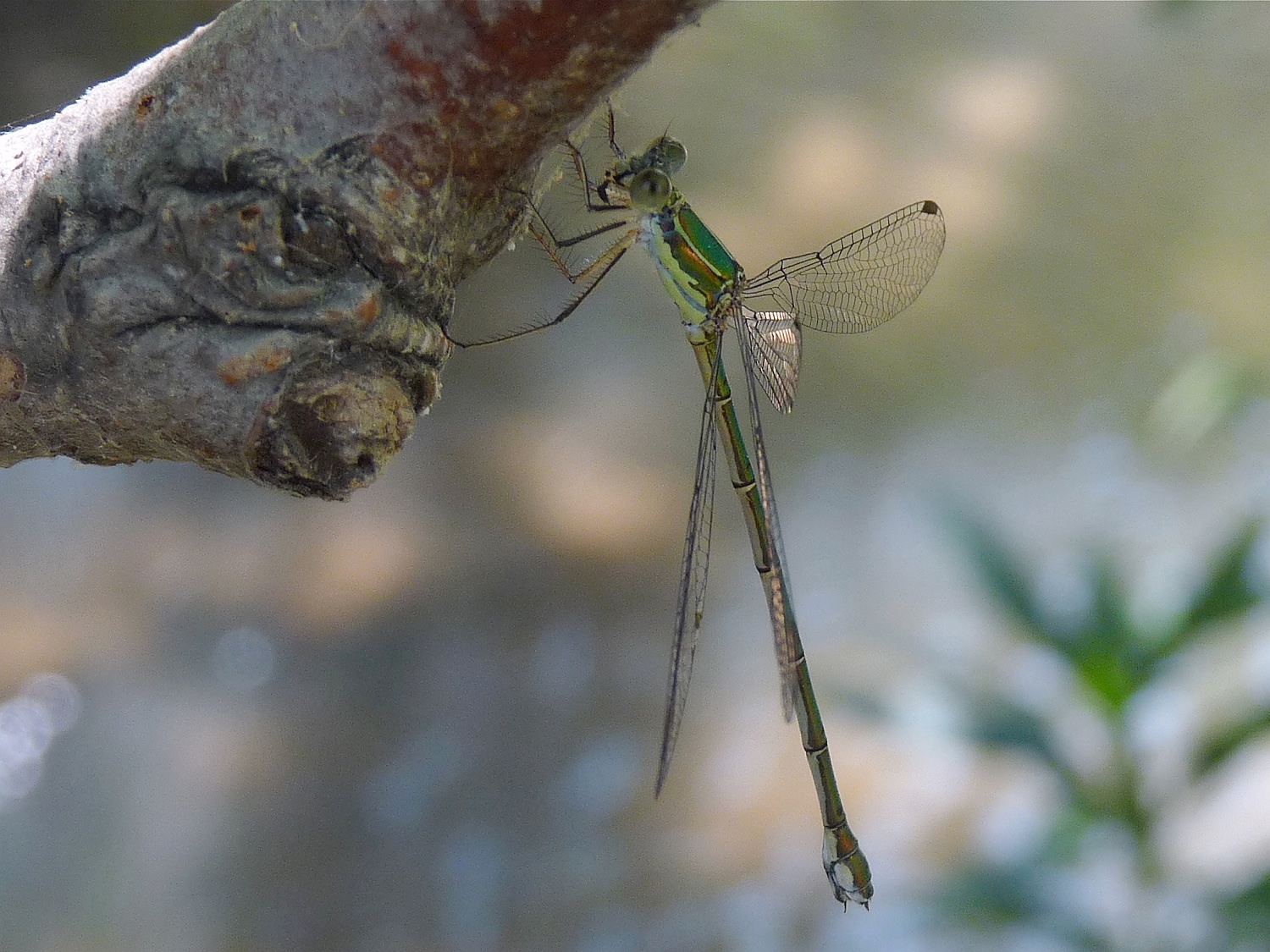
The underside of the thorax is of a light green colour, with the dark green colour of the upper side forming a small forward-facing tooth.
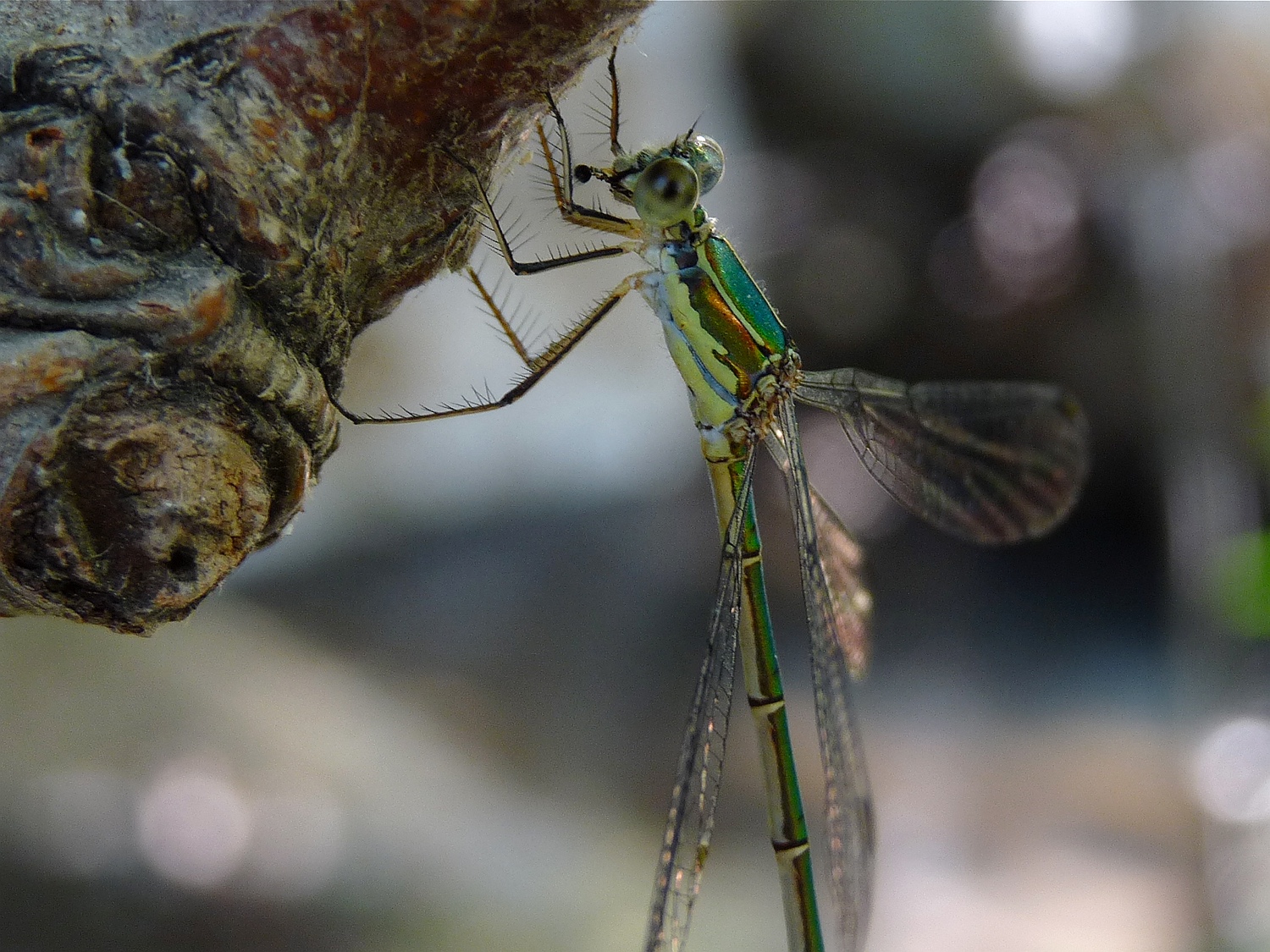
Here a close-up of the characteristic markings on the thorax.
Southern emerald damselfly, Lestes barbarus, Fabriciusa
The Southern emerald damselfly is, as its name suggests, a Mediterranean species, but in favourable years it also migrates to central Europe. It prefers stagnant waters that dry up in summer. On Naxos, it occurs at a small pond near Kinídaros.
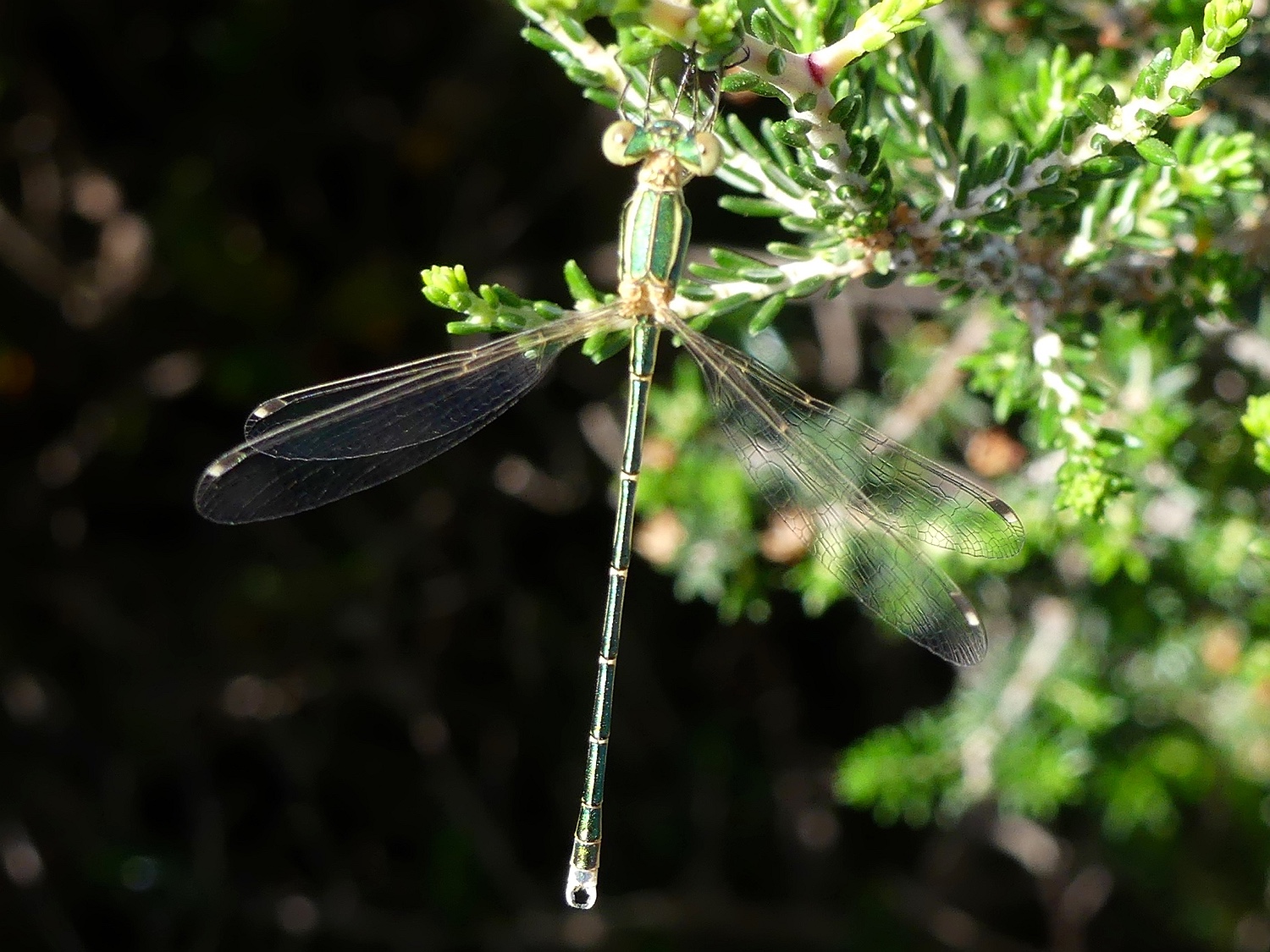
At the end of May, numerous newly “hatched” Southern emerald damselflies can be seen at the small pond near Kinídaros. Here a male with pincer-shaped appendages (cerci) at the tip of its abdomen. It has not yet reached its full colour, which will change to copper brown. A characteristic feature of this species is the black and white pterostigma.
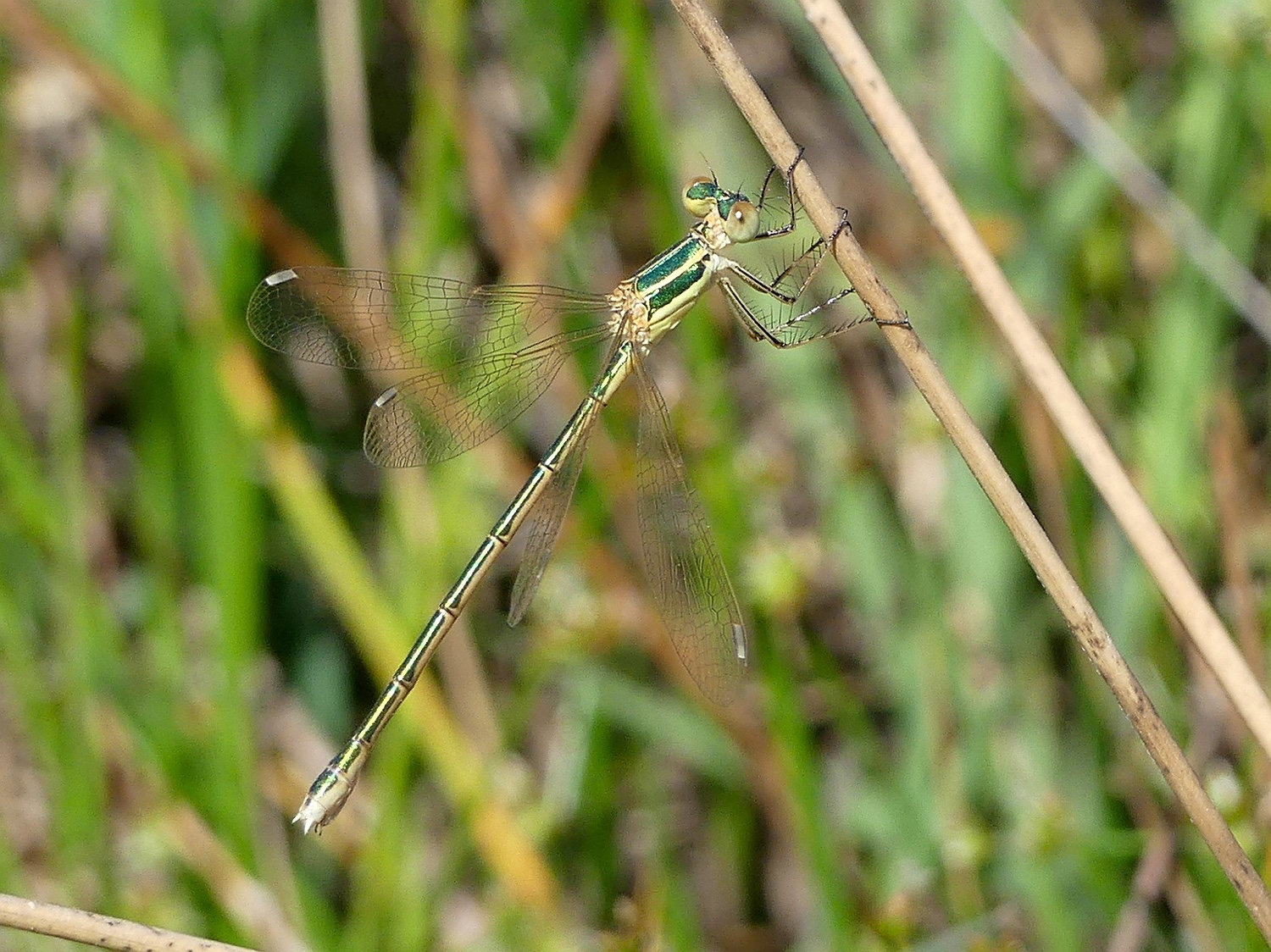
Here a female. The colouring of both sexes is quite similar in this species.
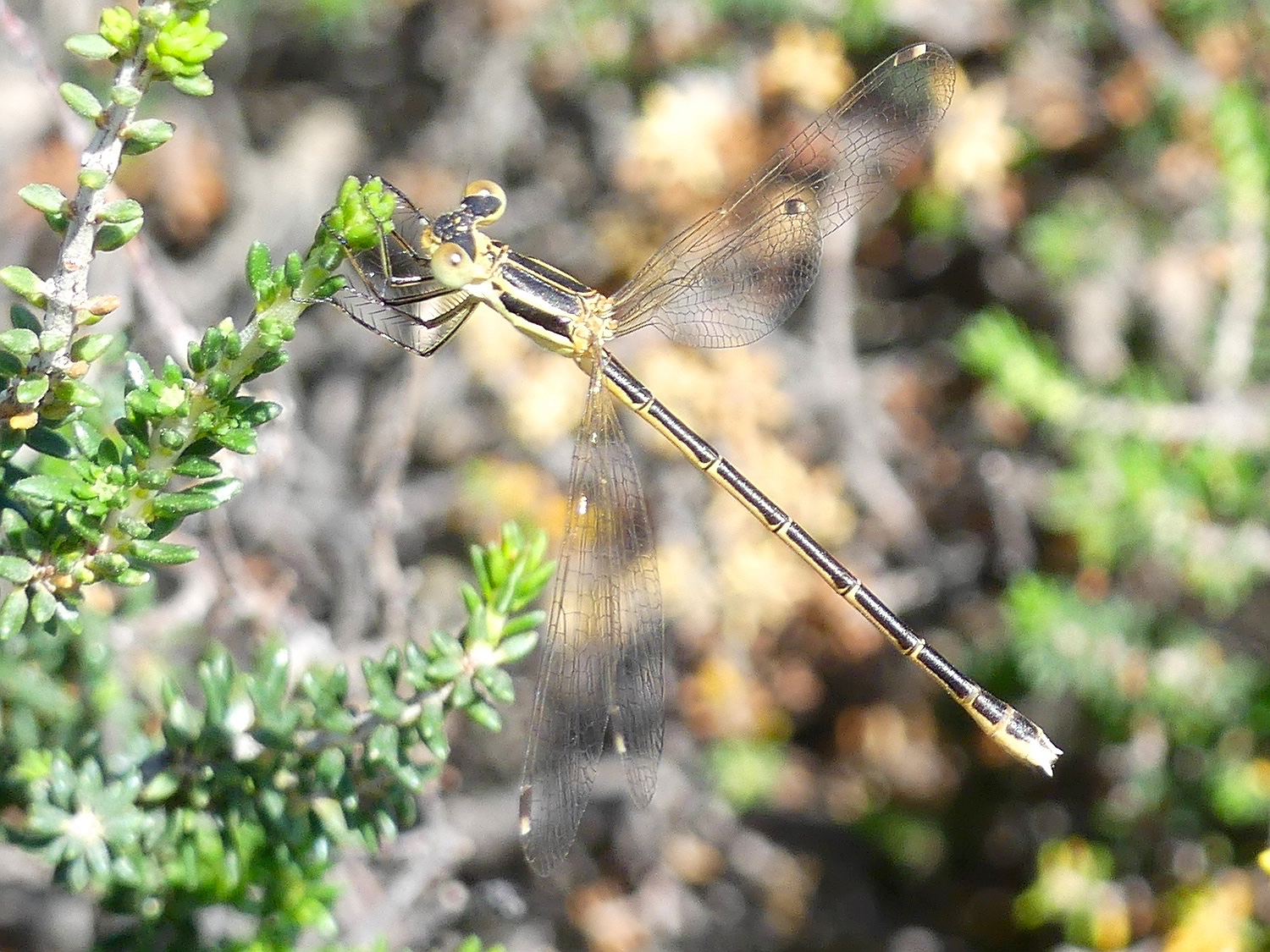
This specimen has already taken on a more yellowish-brownish colouring. It is also a female.
Common winter damselfly, Sympecma fusca, Vander Linden
The Common winter damselfly occurs probably only rarely on Naxos, or it may have been overlooked so far, because it is inconspicuous and small. We encountered it in winter: this species is one of few damselfliese in which the adult animals hibernate. It belongs to the spreadwings, which can be recognised by their long pterostigmas. The Common winter damselfly is common in the Mediterranean region as well as in central Europe.
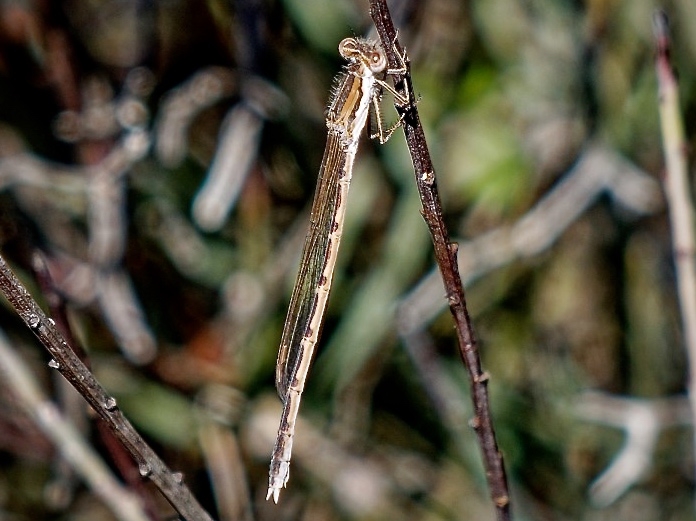
Unlike other damselfly species, the inconspicuous Common winter damselfly is also active in winter, as the name suggests. It usually sits on a branch or plant stem with its wings held over the abdomen. All wings are held on the side of the abdomen that faces away from the sun. In this species, males and females have the same colour. The abdomen is beige with darker rings. The thorax has a dark, copper-coloured stripe with a straight edge on the upper side and a narrow wavy stripe on each side. Photo by Dieter Linde
2. Dragonflies
Dragonflies are in general larger and sturdier than damselflies. Their wings are slightly different in size, the front pair being a bit larger. The sitting dragonfly holds its wings spread out. The large eyes sit close together.
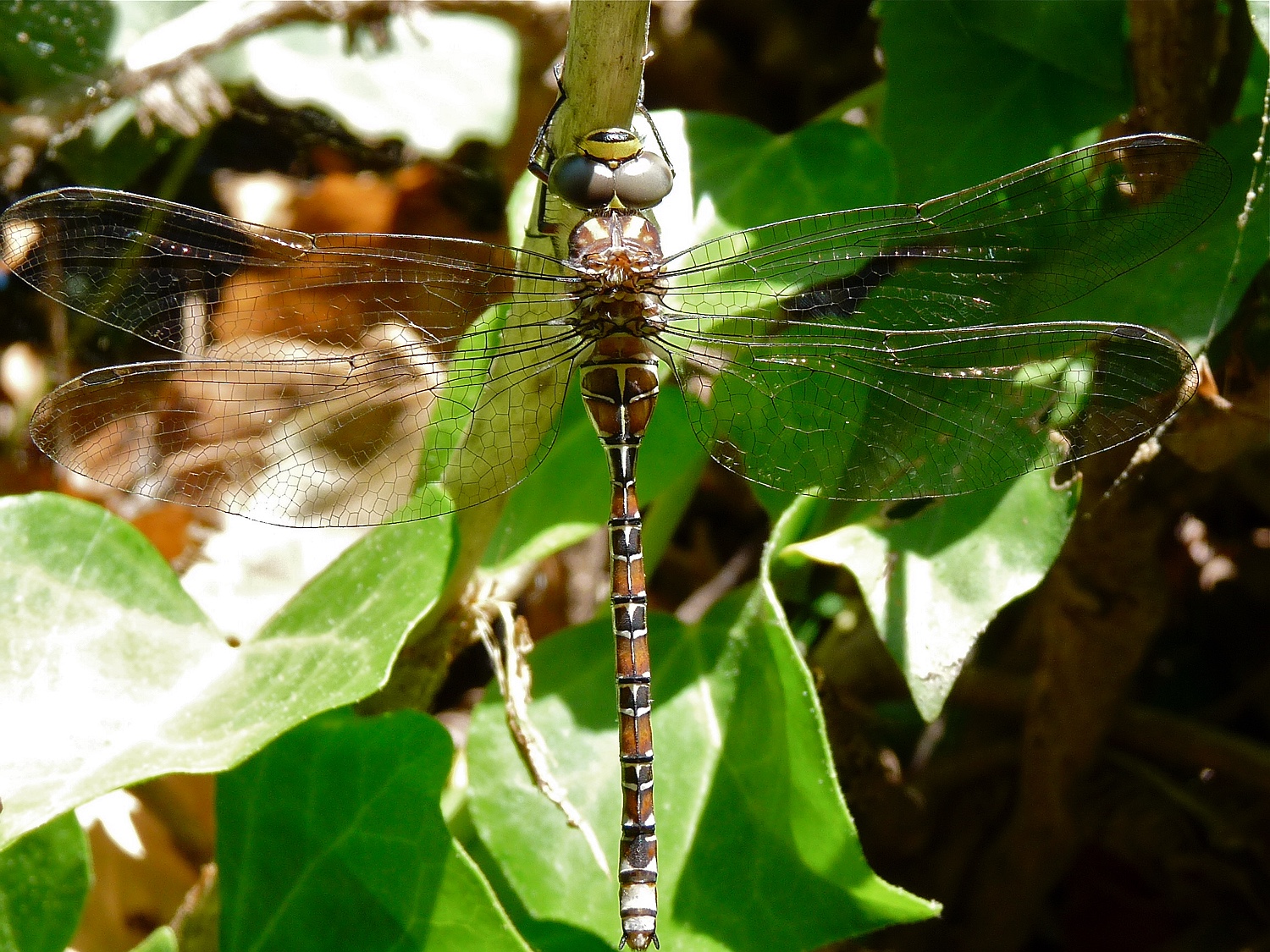
Dragonflies spread their wings sideways when they are sitting.
Vagrant emperor, Anax ephippiger, Burmeister
The Vagrant emperor is found in Asia and Africa; it migrates irregularly to Europe. In the Cyclades, it has so far only been found on Naxos.
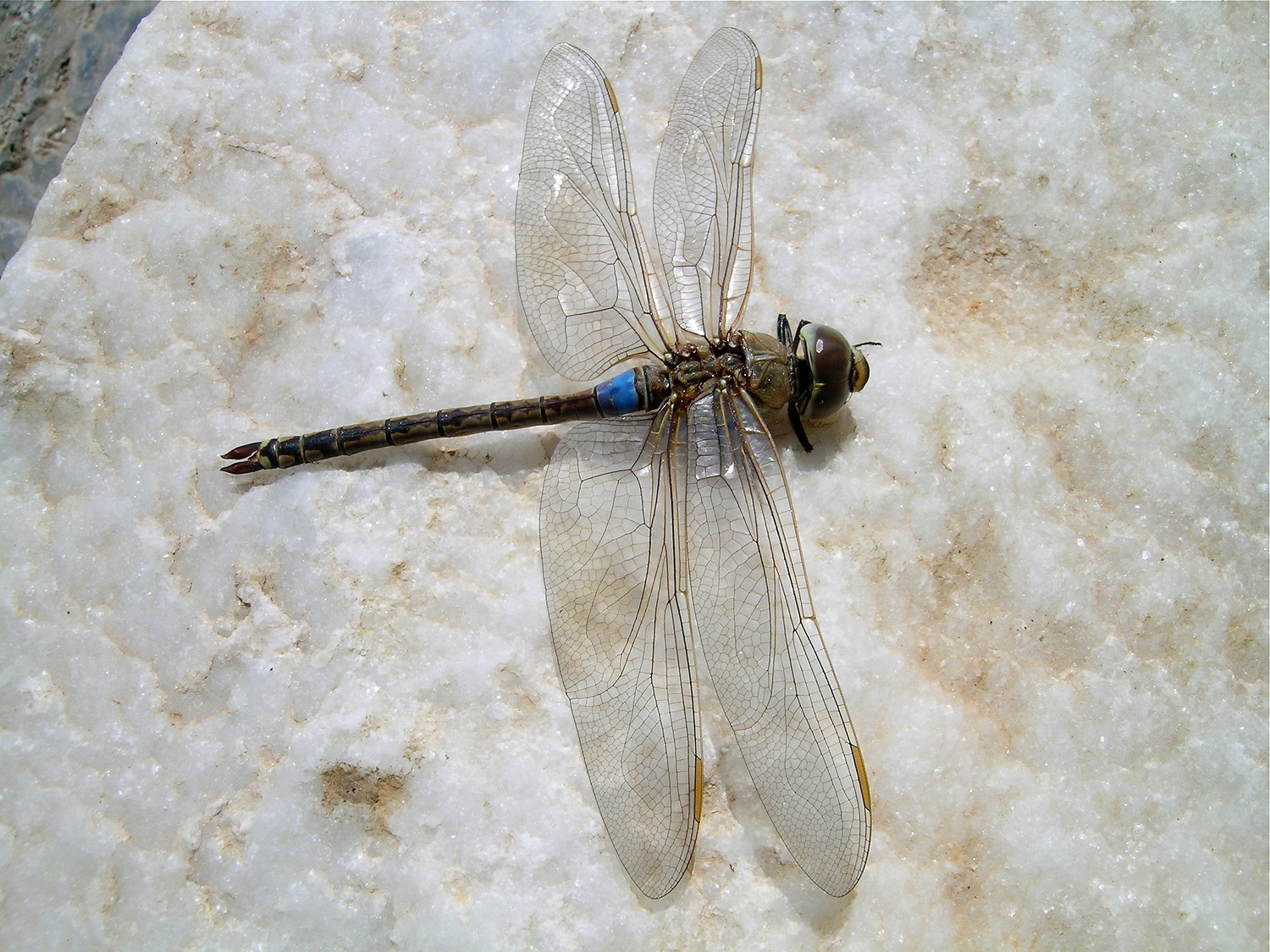
The Vagrant emperor can be recognised by its brown abdomen with a bright blue second segment. It is one of the larger species and has particularly long wings.
Emperor dragonfly, Anax imperator, Leach
The Emperor dragonfly is the largest native dragonfly species and is found all over Europe. Its larva lives in stagnant water. On Naxos, the adults can be seen hunting far away from water. It is difficult to photograph (and therefore to identify) the Emperor dragonfly, as it flies around contantly and rarely sits down.
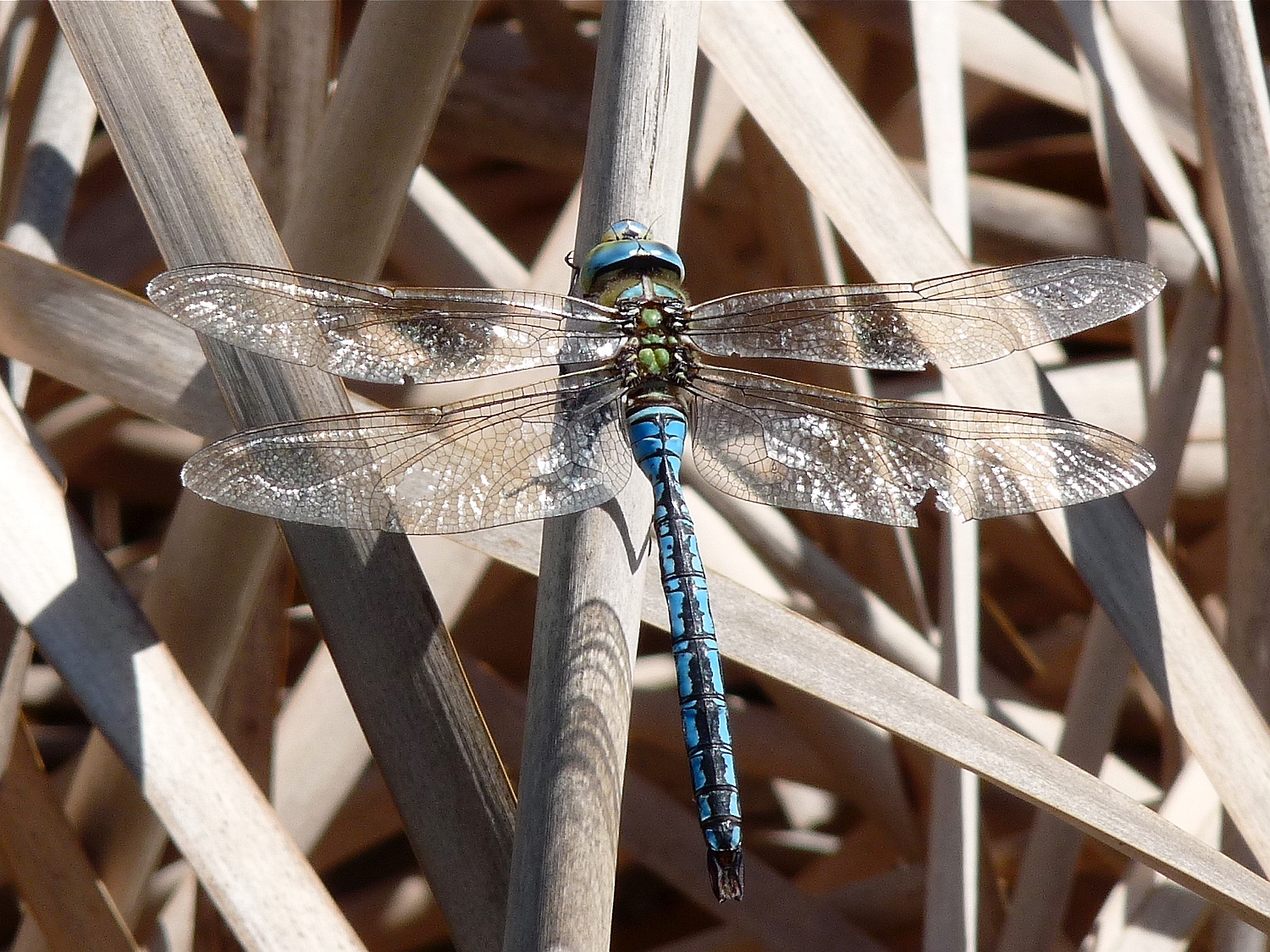
The Emperor dragonfly has a green thorax and a blue abdomen with a black stripe on the back.
mating wheel of Emperor dragonflies
Emperor dragonfly laying eggs. The females have a blue-green abdomen with dark brown longitudinal stripes.
Caliaeschna microstigma, Schneider
Caliaeschna microstigma likes shady areas with trees. It is a tireless flyer. Unlike in most other Aeschnidae, the larvae live in fast-flowing waters. This species is not very common on Naxos.
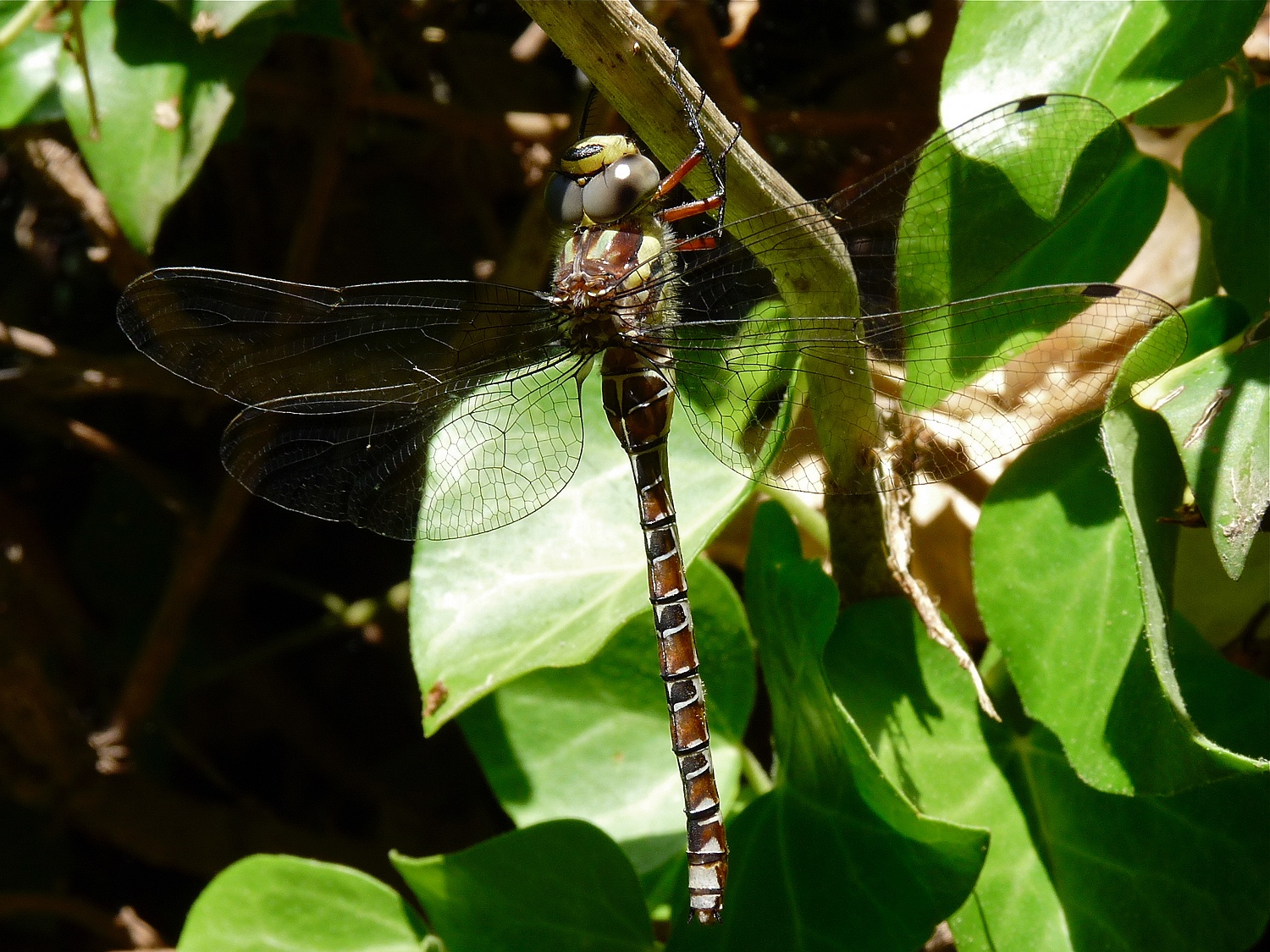
The body of the female Caliaeschna microstigma is brown with black and white stripes on each segment. Two thick yellow diagonal stripes run along the sides of the thorax. The front of the head is also yellow. A characteristic feature is the small black wing mark.
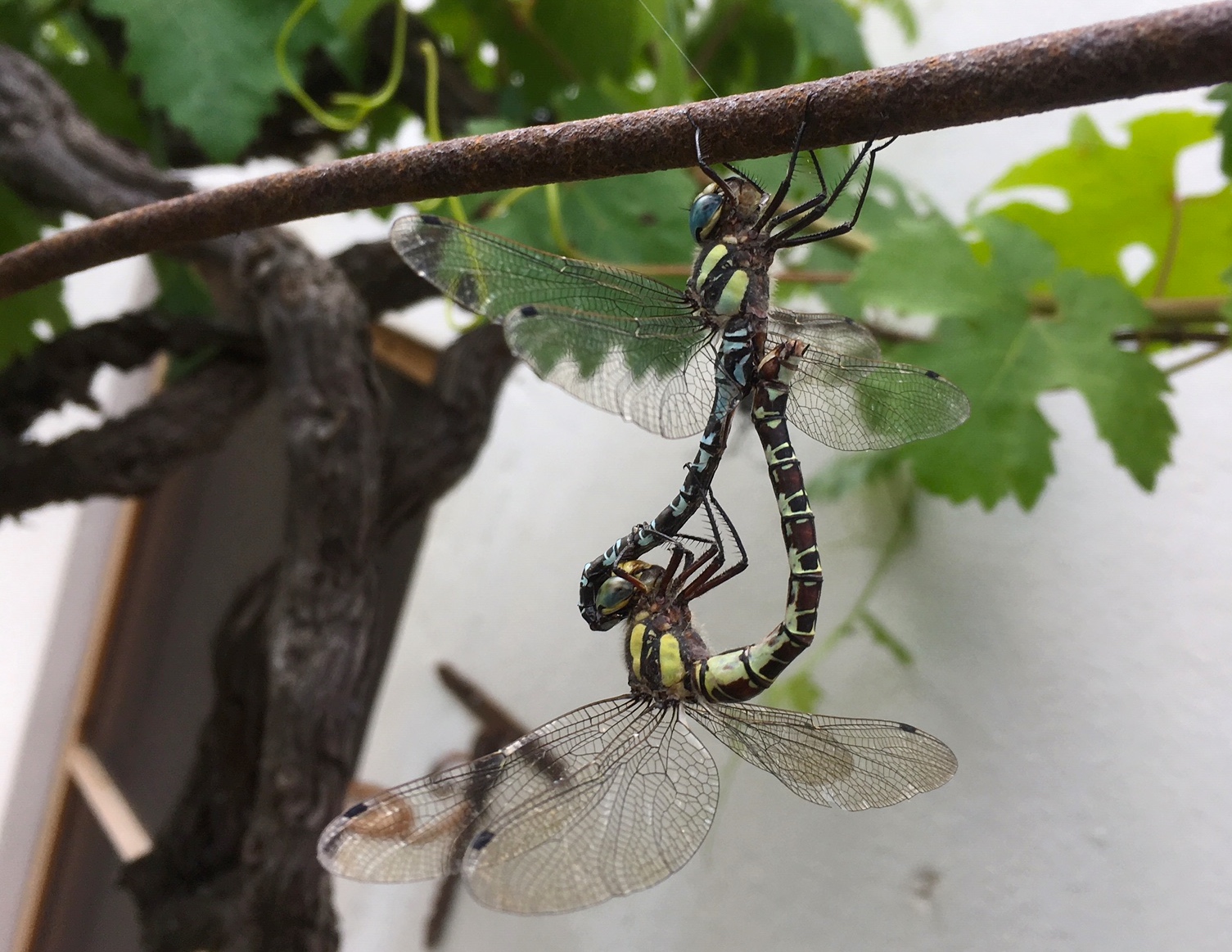
Two animals mating. The male is black and blue in colour. Photo by Sherri Bustad
Small pincertail, Onychogomphus forcipatus forcipatus, L.
The Small pincertail, which is widespread in Europe, particularly likes to sit on stones and rocks. Pncertails have strong cerci (pincer-shaped appendages) at the tip of the abdomen of the males, which are used to hold the females during mating. The Small pincertail is rather rare on Naxos.
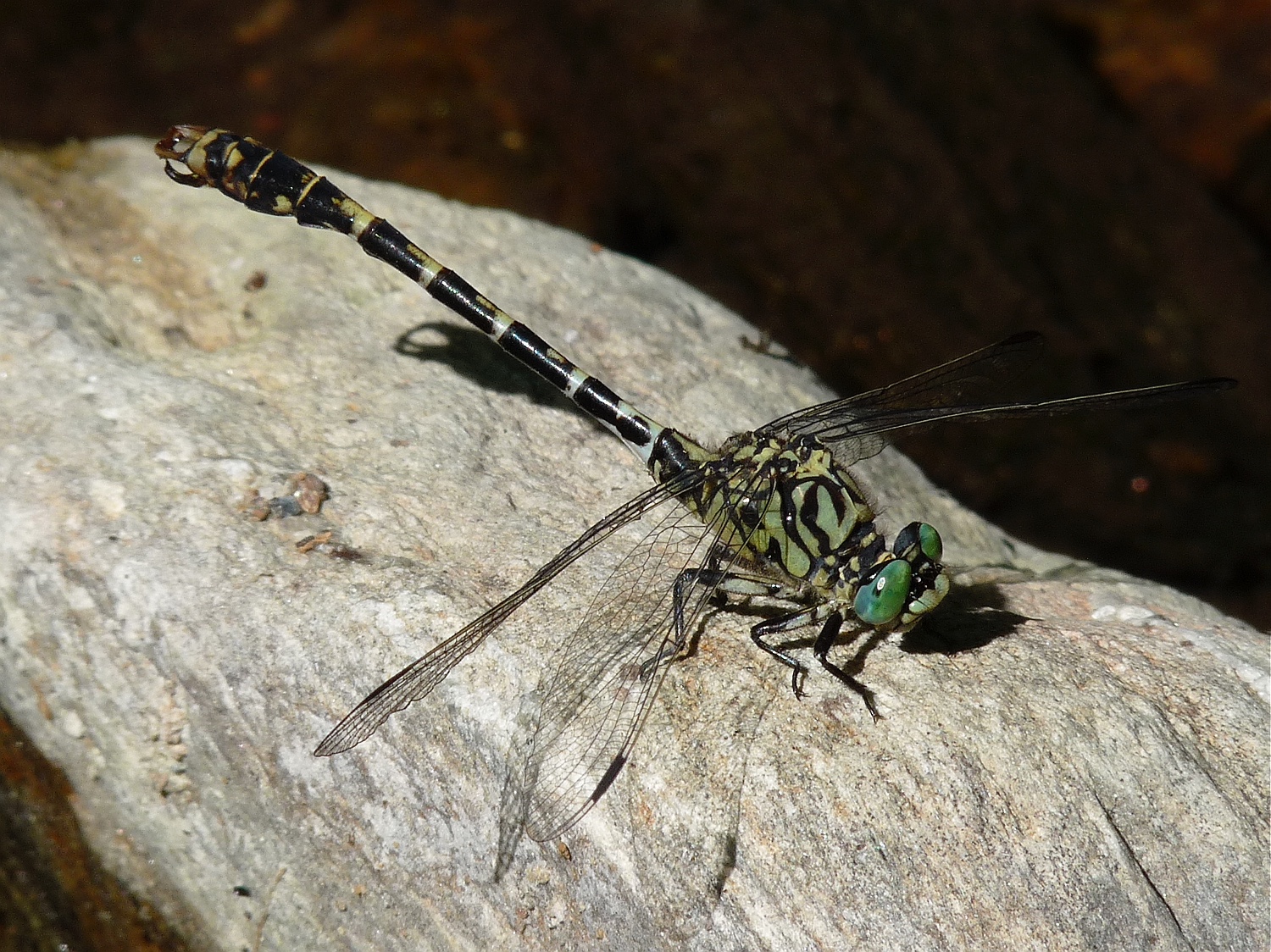
The Small pincertail can be recognised by the large pincers at the slightly thickened end of its abdomen (only in males), by its green eyes that are sitting slightly apart and the characteristic black markings on its green-yellow chest.
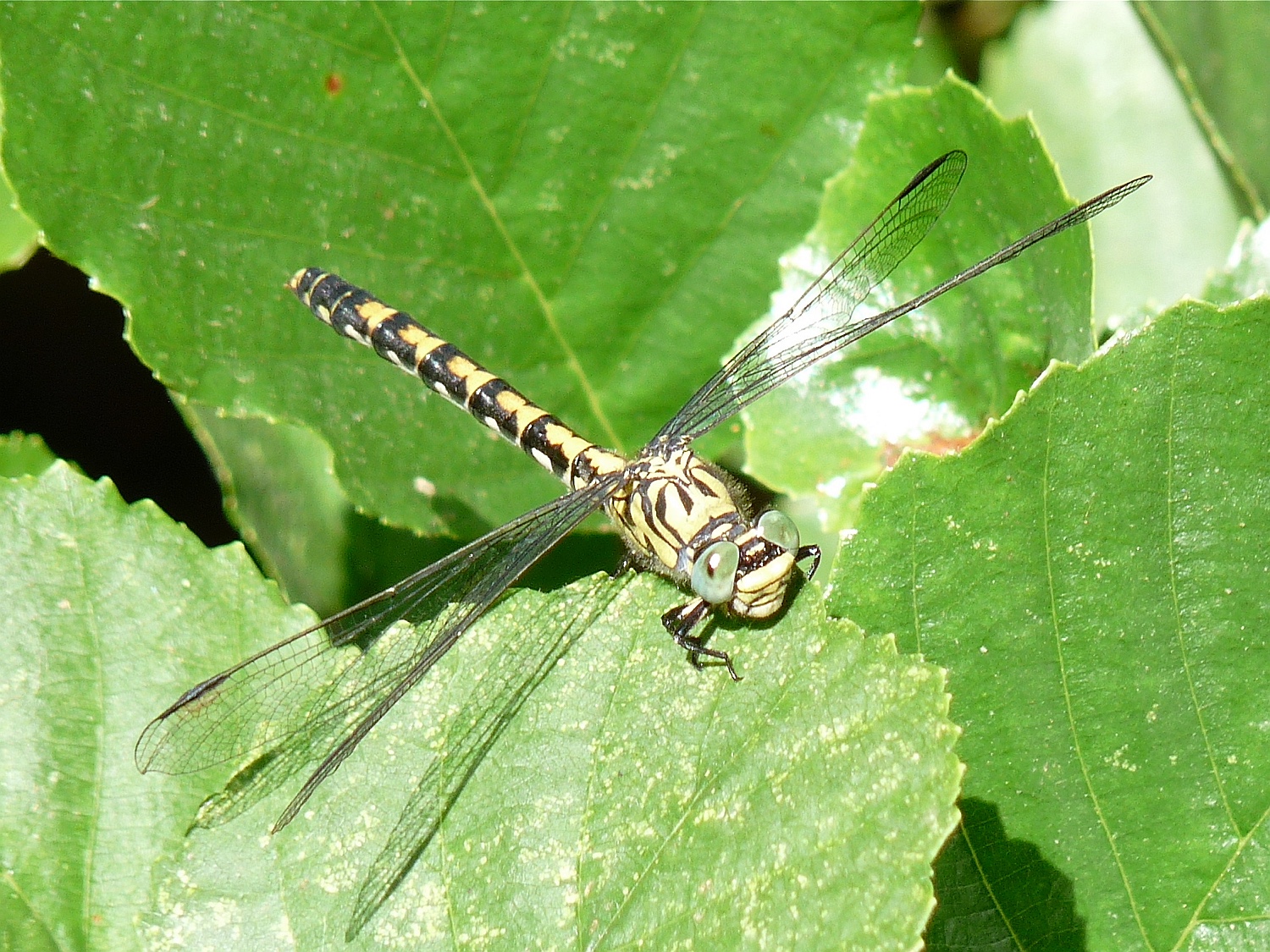
female Small pincertail
Greek goldenring, Cordulegaster helladica, Lohmann
The Greek goldenring, a dragonfly species endemic to Greece, occurs only rarely on Naxos. It is closely related to the Sombre goldenring (C. bidentata).
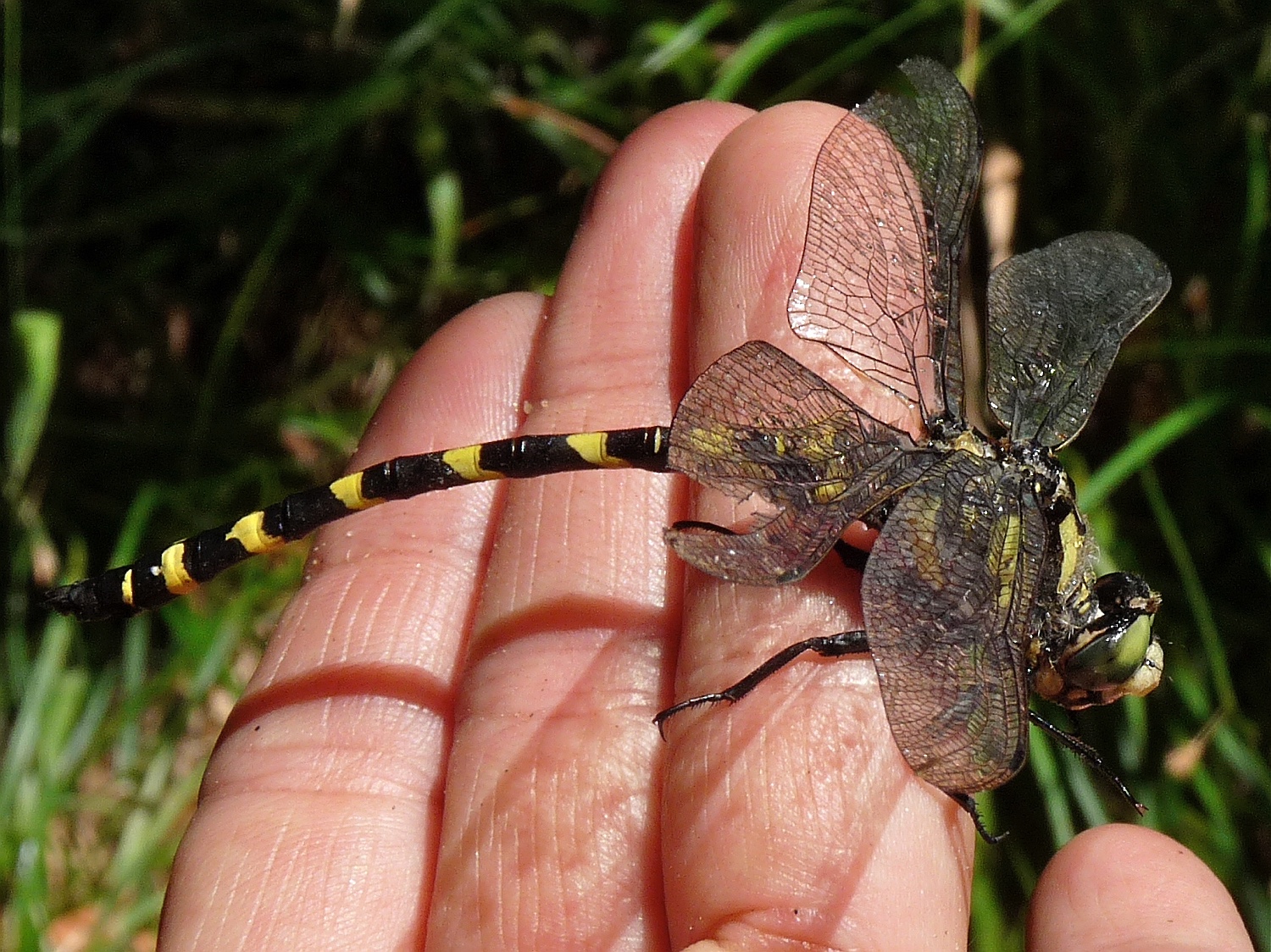
The Greek goldenring has yellow stripes on its black abdomen, with the front segments each bearing one thick and one thin stripe, while the rear segments have only one thick stripe. This specimen we found drowned in the river.
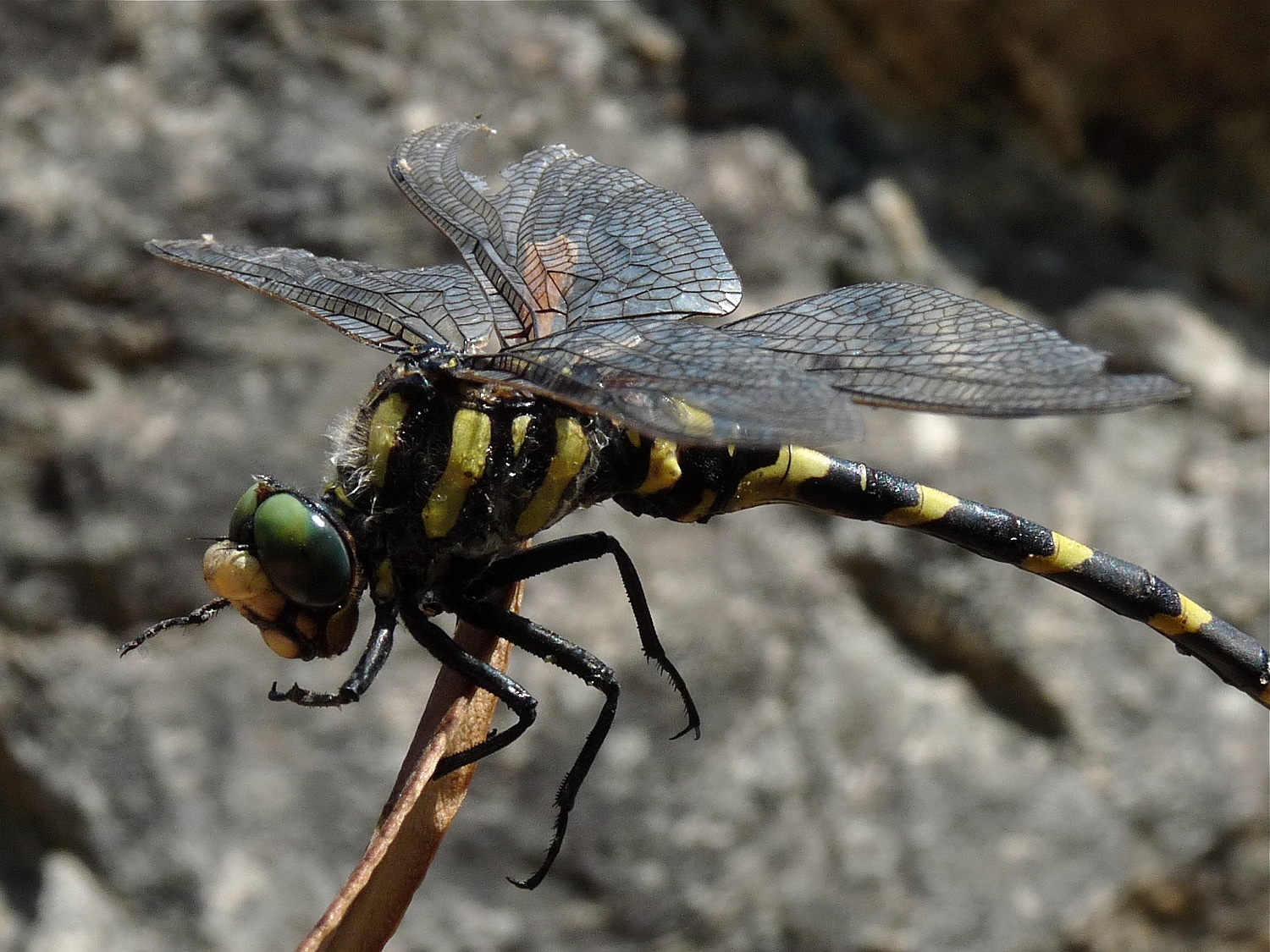
Here you can see the characteristic colouring of the sides of the thoray with two thick yellow stripes and a small yellow triangle between them.
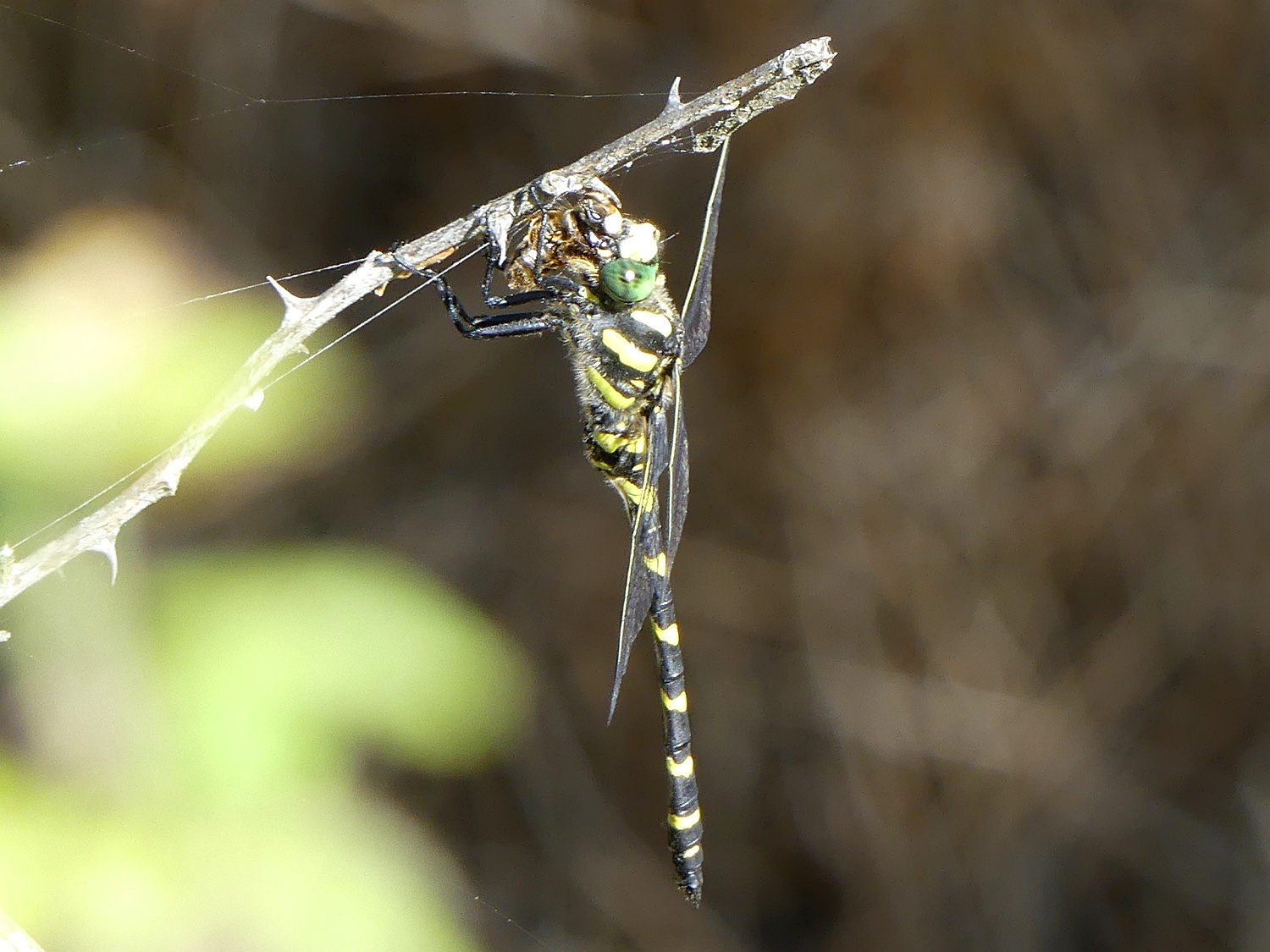
A Greek goldenring with prey in a lush wooded area near Komiakí.
Keeled skimmer, Orthetrum coerulescens, Fabricius
The males of the skimmers can be recognised by their characteristic “pruinose” (“powdery”) light blue colouring which derives from wax particles on the epidermis. The females are yellow-brown in colour. Typical is also the posture of their wings, which they hold angled forwards while sitting. The larvae of most skimmer species live in flowing water.
The Keeled skimmer is found throughout almost all of Europe and western Asia as far as India. On Naxos, it is common and widespread. The male Keeled skimmers usually have a brownish thorax with whitish stripes. As our specimens on Naxos are often completely blue, I mistook them for Southern skimmers, but this blue colouring is apparently typical for southern European animals. I would like to thank Eleni-Maria Vaina from the Facebook group “Odonata of Greece and Cyprus” for correcting my identification!
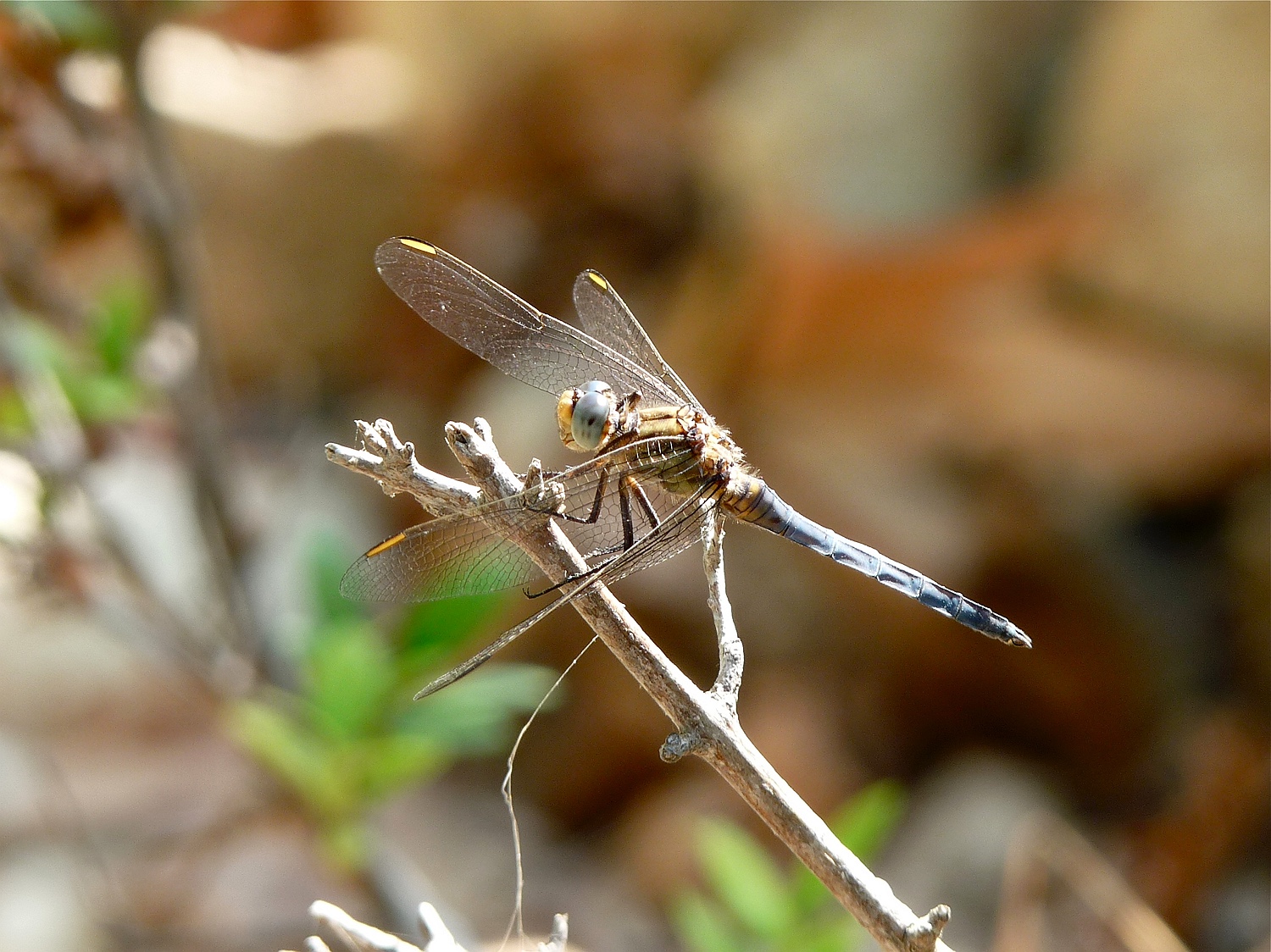
The thorax of the Keeled skimmer is usually not blue, but brown in colour, as seen in this animal. The front of the head and the pterostigma are reddish brown. The abdomen of the male is completely blue with no black tip. This is probably a young male.
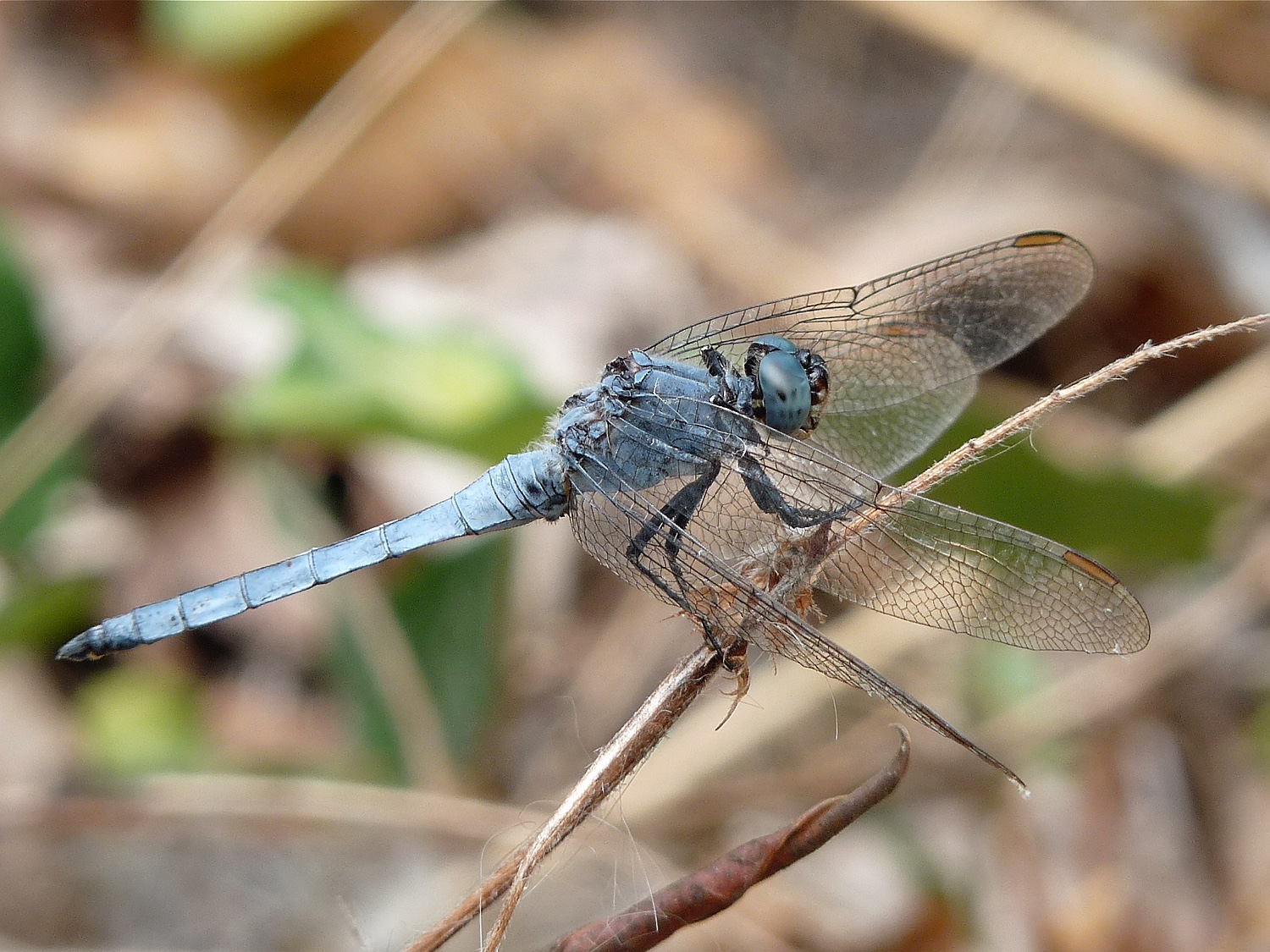
In specimens from southern Europe often the entire body is pruinose blue, so that they can easily be confused with the Southern skimmer.
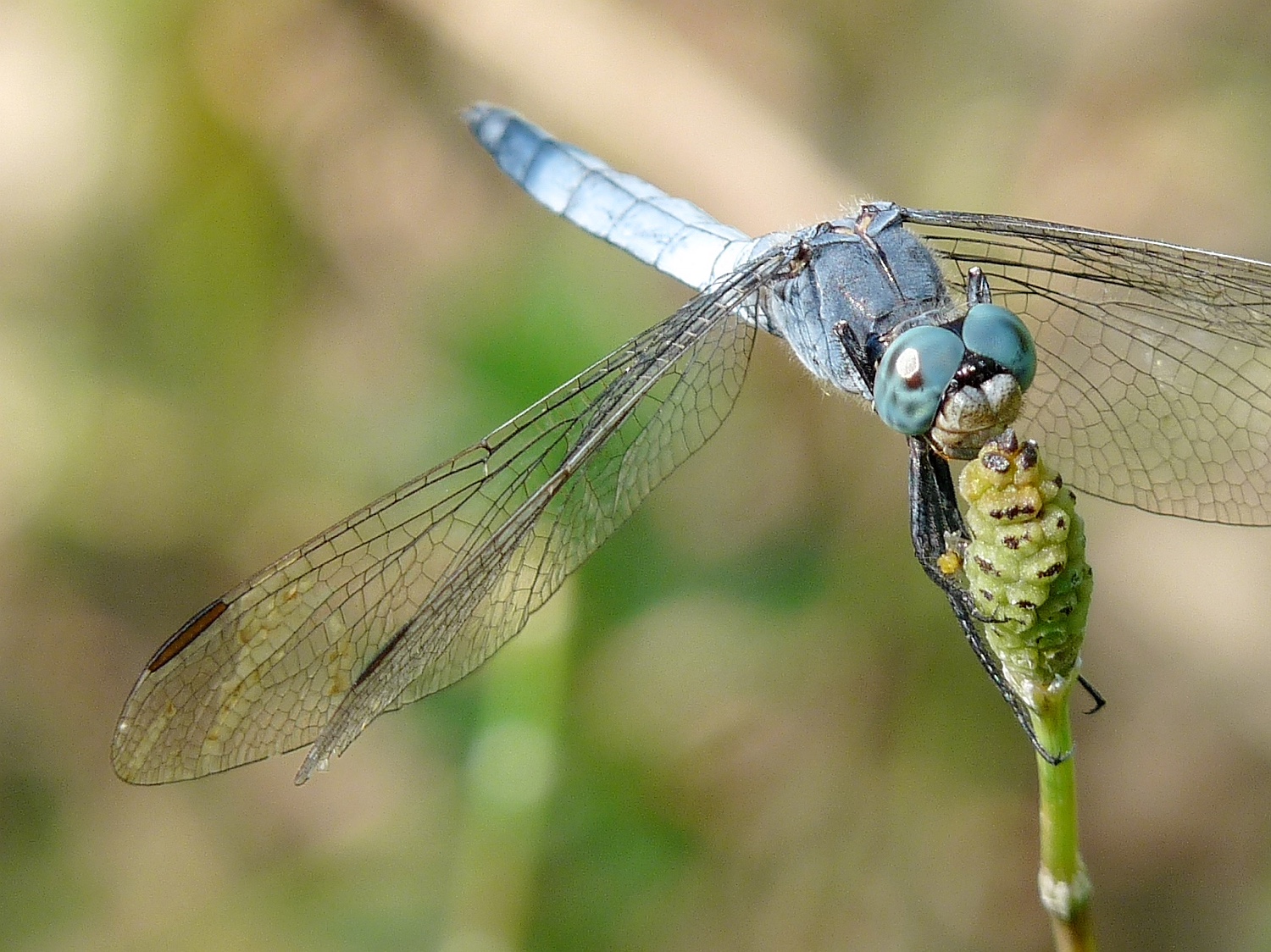
For a reliable identification of the two species one needs to check the venation of their wings. In the Keeled skimmer a row of larger, undivided cells lies above the radial supplement vein, which lies between R3, the radial vein which ends below and behind the wing tip, and R4; in the photo these cells are visible in the middle of the left wing (the dragonfly’s right hind wing).
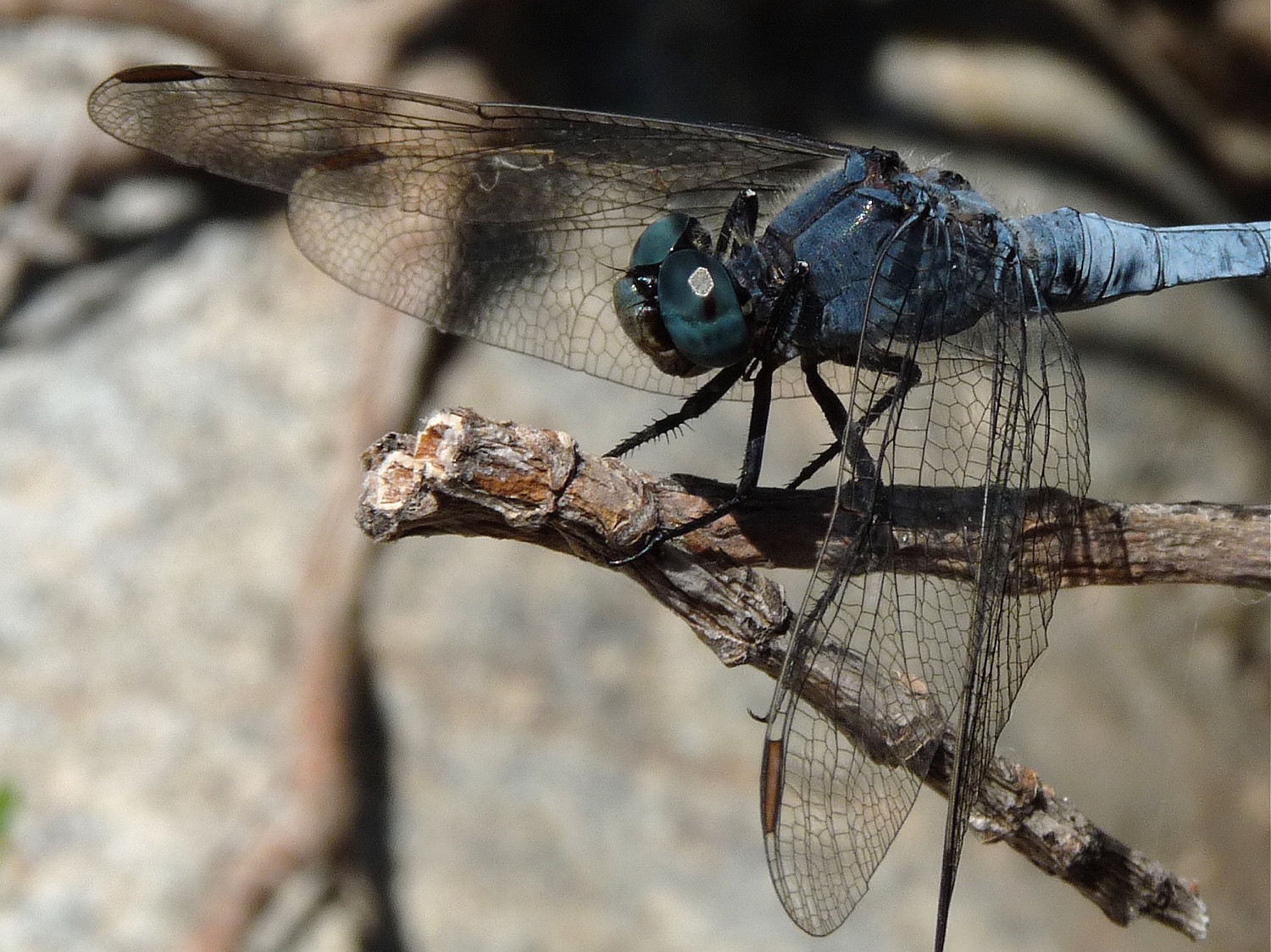
The Keeled skimmer is one of the most common dragonfly species on Naxos.
Southern skimmer, Orthetrum brunneum, Fonscolombe
The Southern skimmer is much rarer on Naxos than the Keeled skimmer. Its range extends from Western Europe to China. It occupies similar habitats to the previous species. On Naxos, I encountered it at the river near Apóllonas.
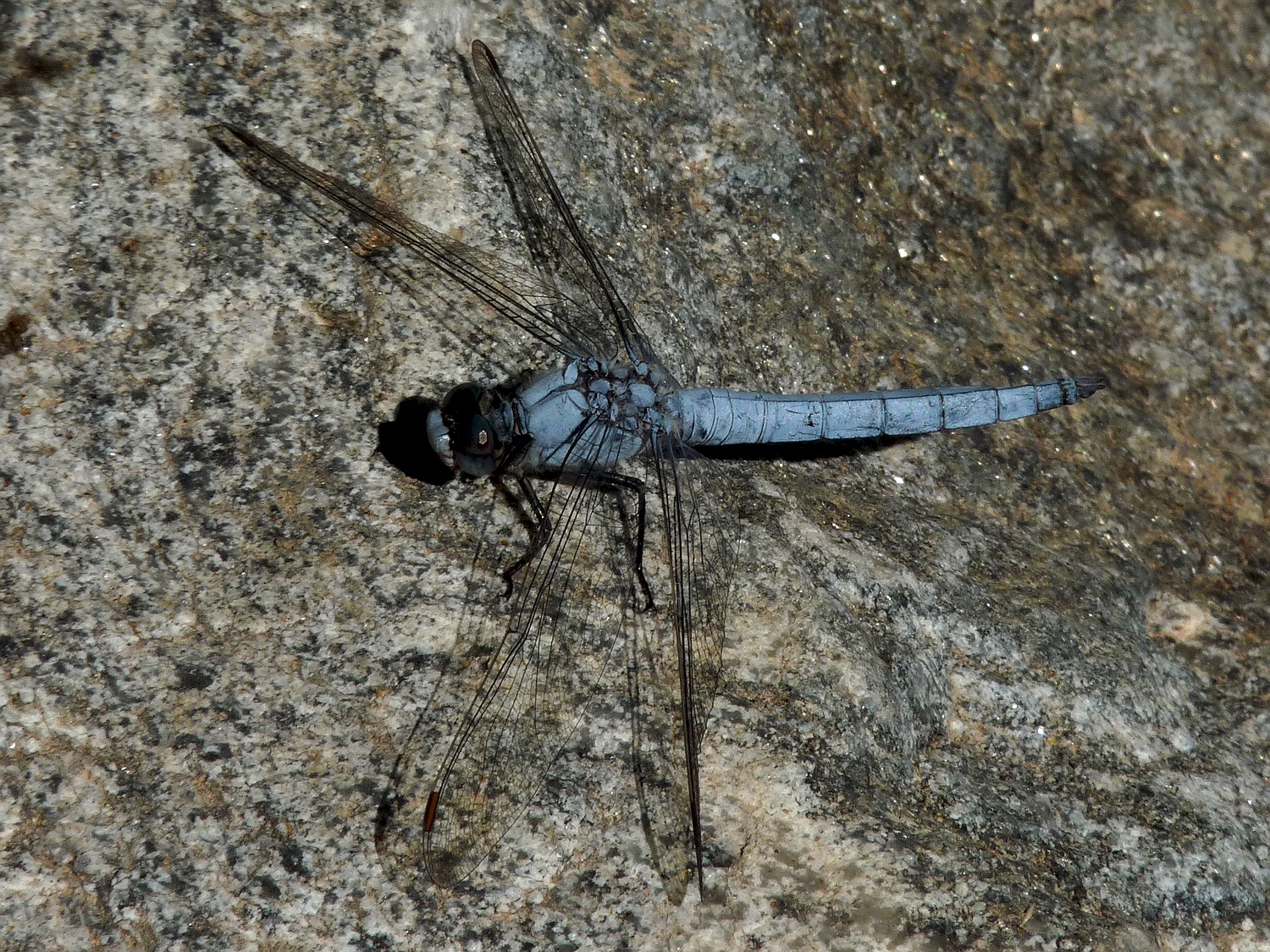
The males of the Southern skimmer are entirely blue in colour with pronounced pruinencence; the females are yellowish or later brown. The Southern skimmer can be distinguished from the Keeled skimmer with certainty only by the venation of the wings.
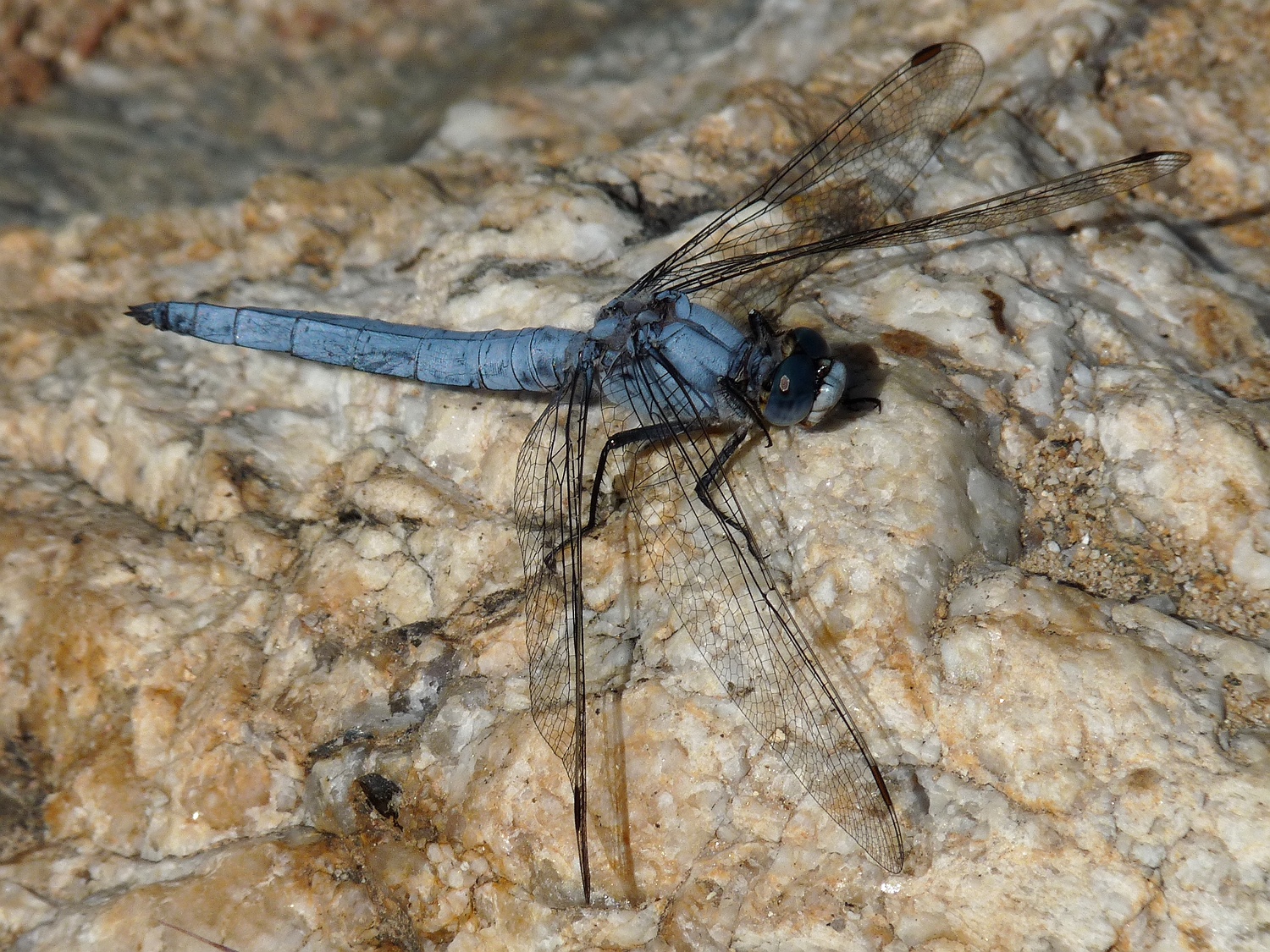
The male Southern skimmer is entirely pruinose blue in colour.
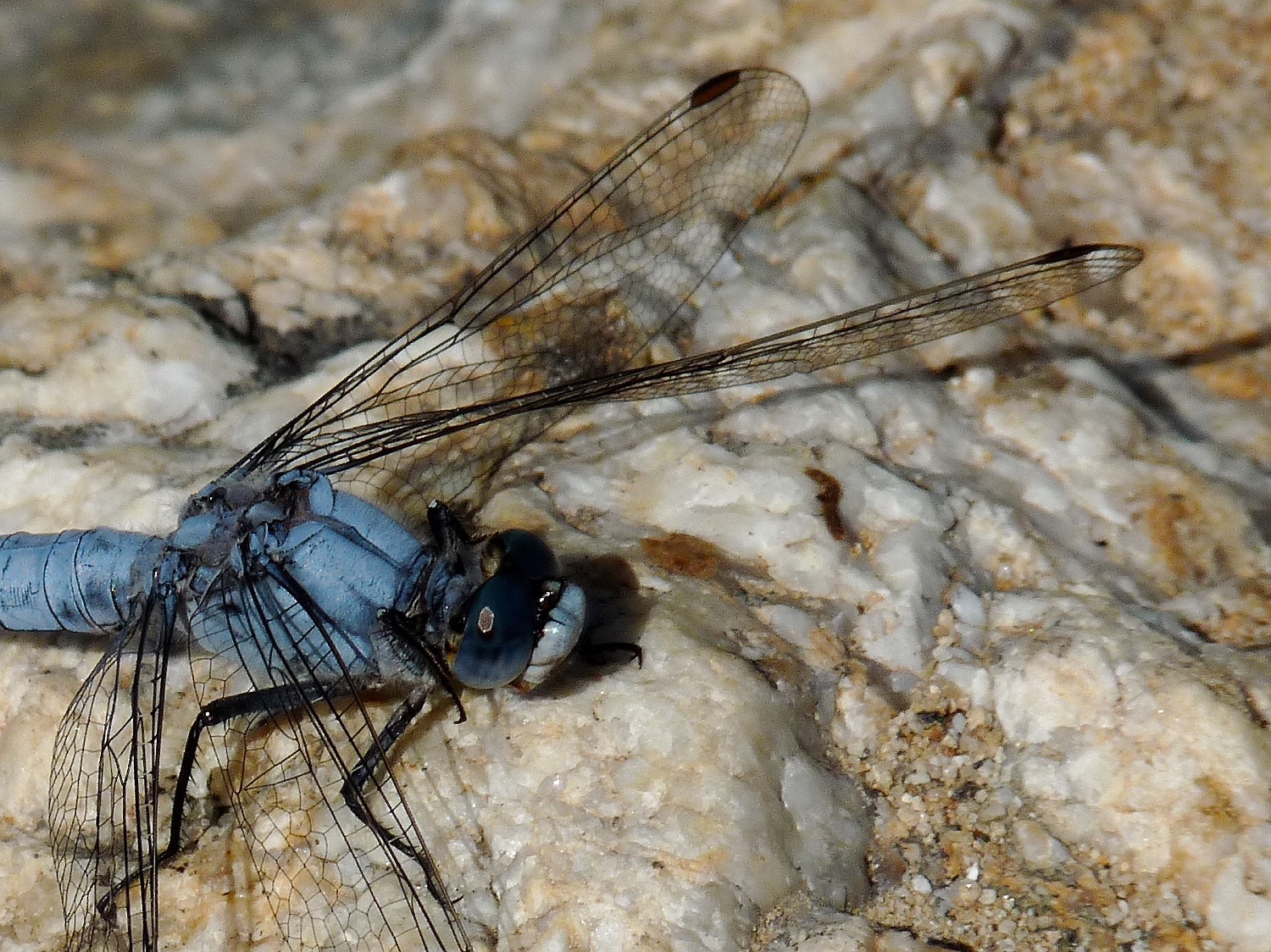
Above the radial supplement vein lies a row of double cells (visible in the middle of the upper wing in the picture, i.e. the animal’s left hind wing). The pruinose “face” is also characteristic.
Unlike the Keeled skimmer the Southern skimmer likes to sit on the ground.
Black-tailed skimmer, Orthetrum cancellatum, L.
The Black-tailed skimmer is widespread and common in Europe and Asia. On Naxos it is quite rare.
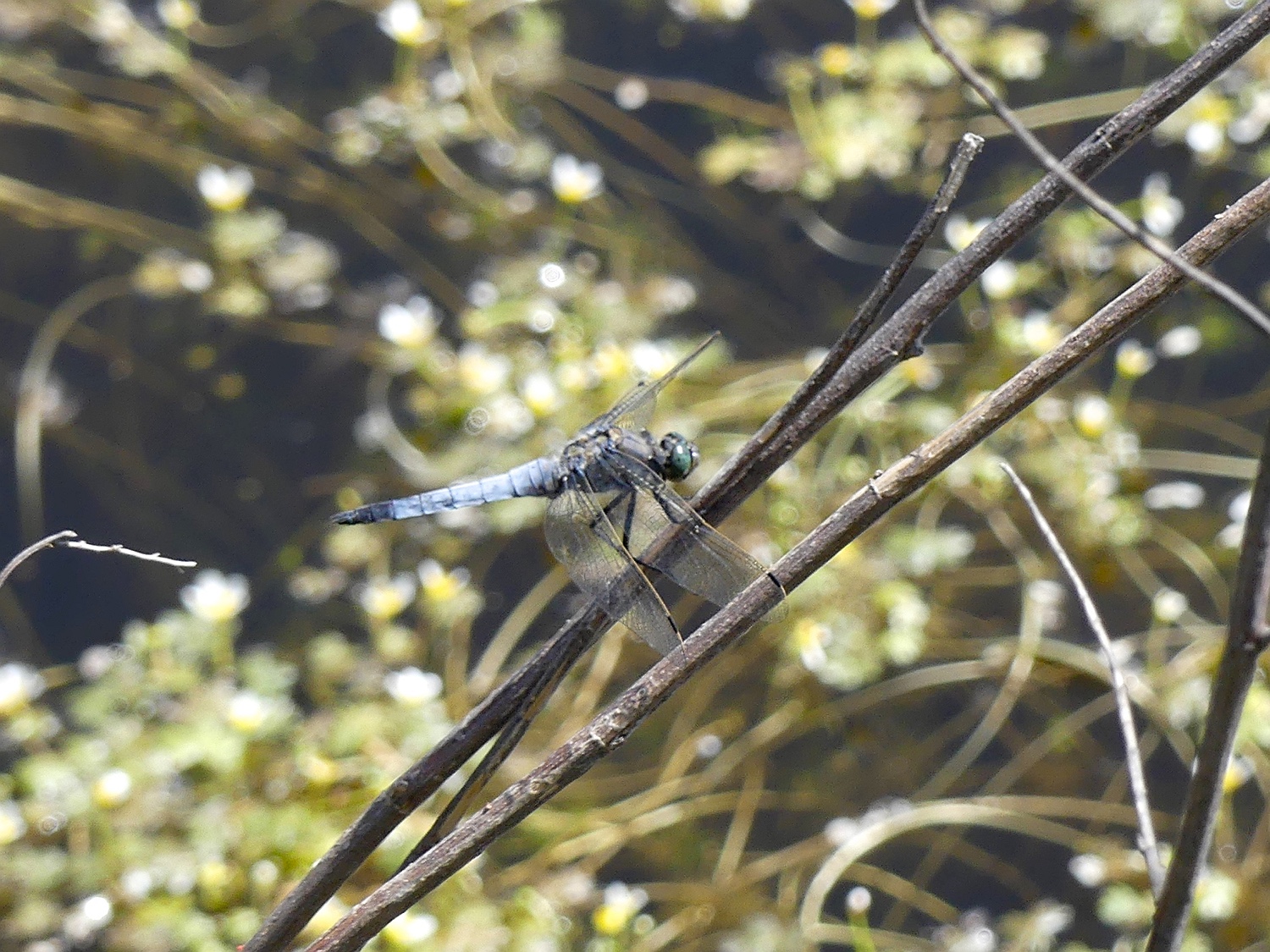
It was not easy to shoot a good picture of the Black-tailed skimmer, as it rarely sat down for a moment!
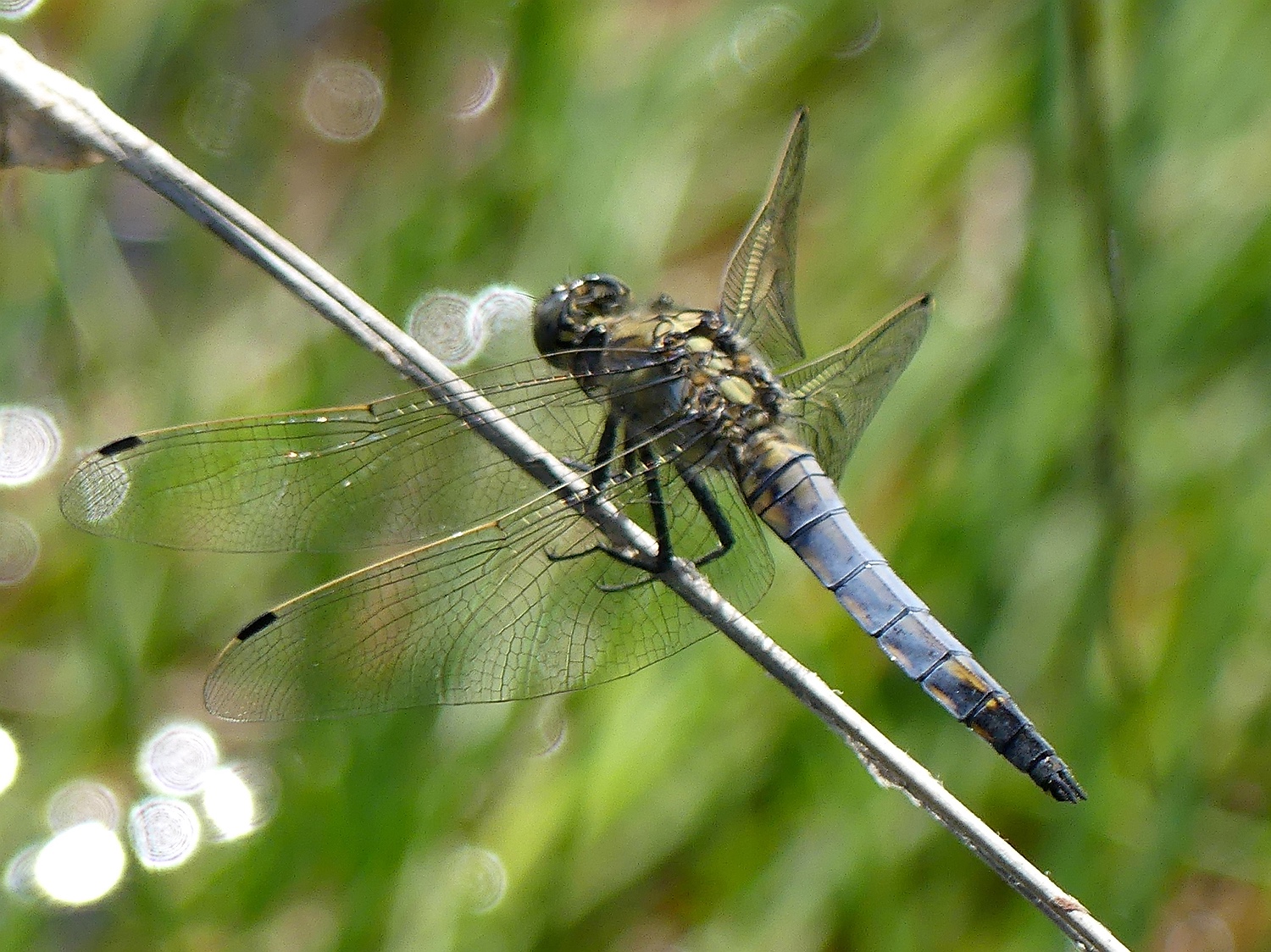
This species is significantly less blue than the previous two; its chest is yellowish brown in colour. Good distinguishing features from the other skimmers are the black-coloured last abdominal segments and the black wing markings.
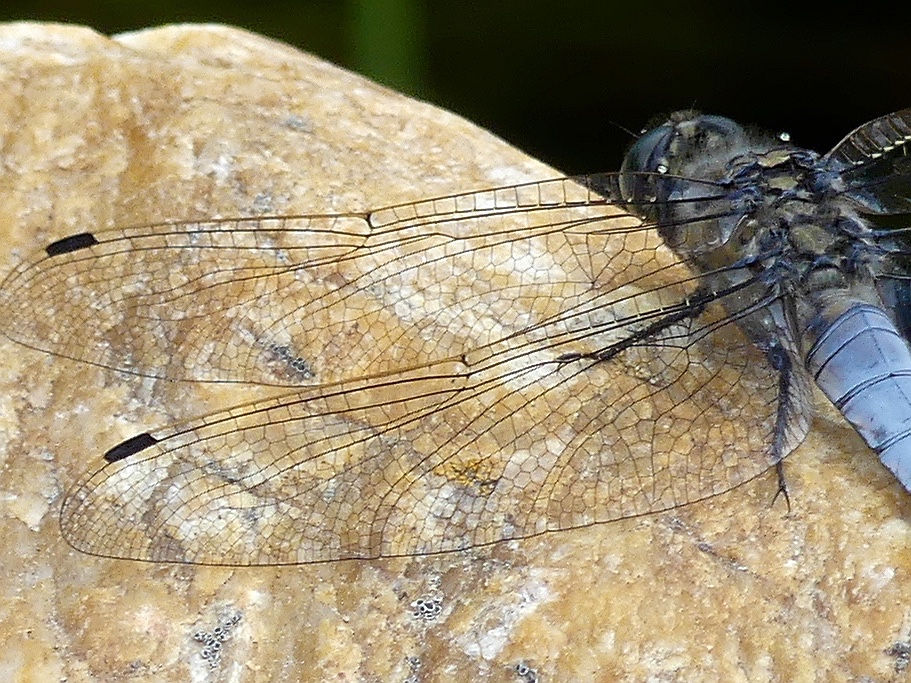
Here you can clearly see the wing veins with the double cells below the R3 vein which ends below the wing tip.
Red-veined darter, Sympetrum fonscolombii, Sélys
The genus of the darters comprises numerous species, which are often difficult to identify. The Red-veined darter is very common and widespread on Naxos. It can be seen in all of summer and occurs far away from water, typically in open landscapes such as phrygana and heather. The males of the darters are mostly red in colour, while the females are yellow.
The Red-veined darter is mainly found in the Mediterranean region, but it also migrates to central Europe. It can be recognised by its relatively long pterostigma, by the relative lack of black markings on the body, by the yellow stripes on its legs, and by the colouring of its eyes, which are brown above and blue below.
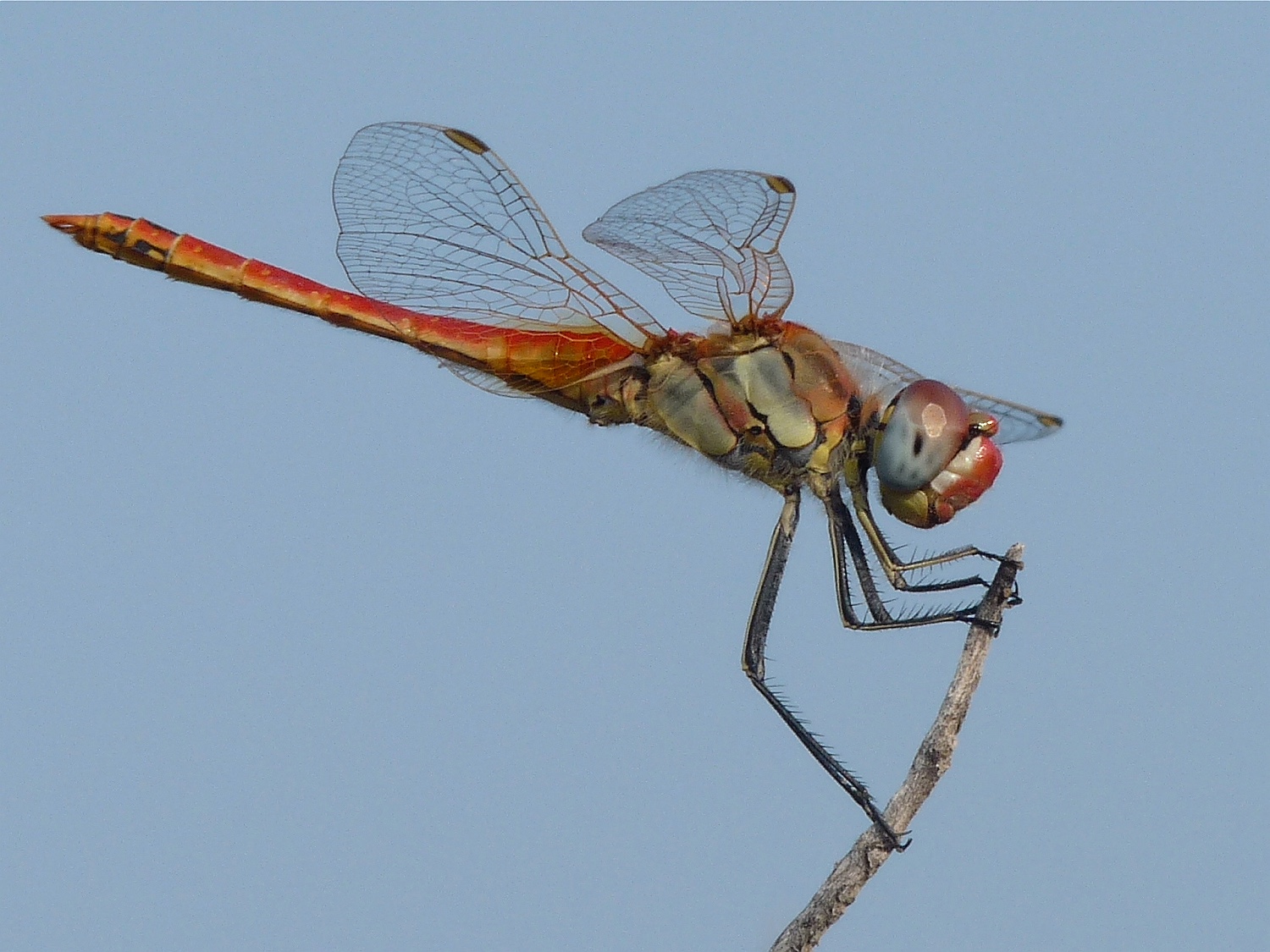
Many specimens on Naxos show only a slight reddish colour; the thorax of these specimens is blue-green on the sides. The yellow stripes on the legs are typical.
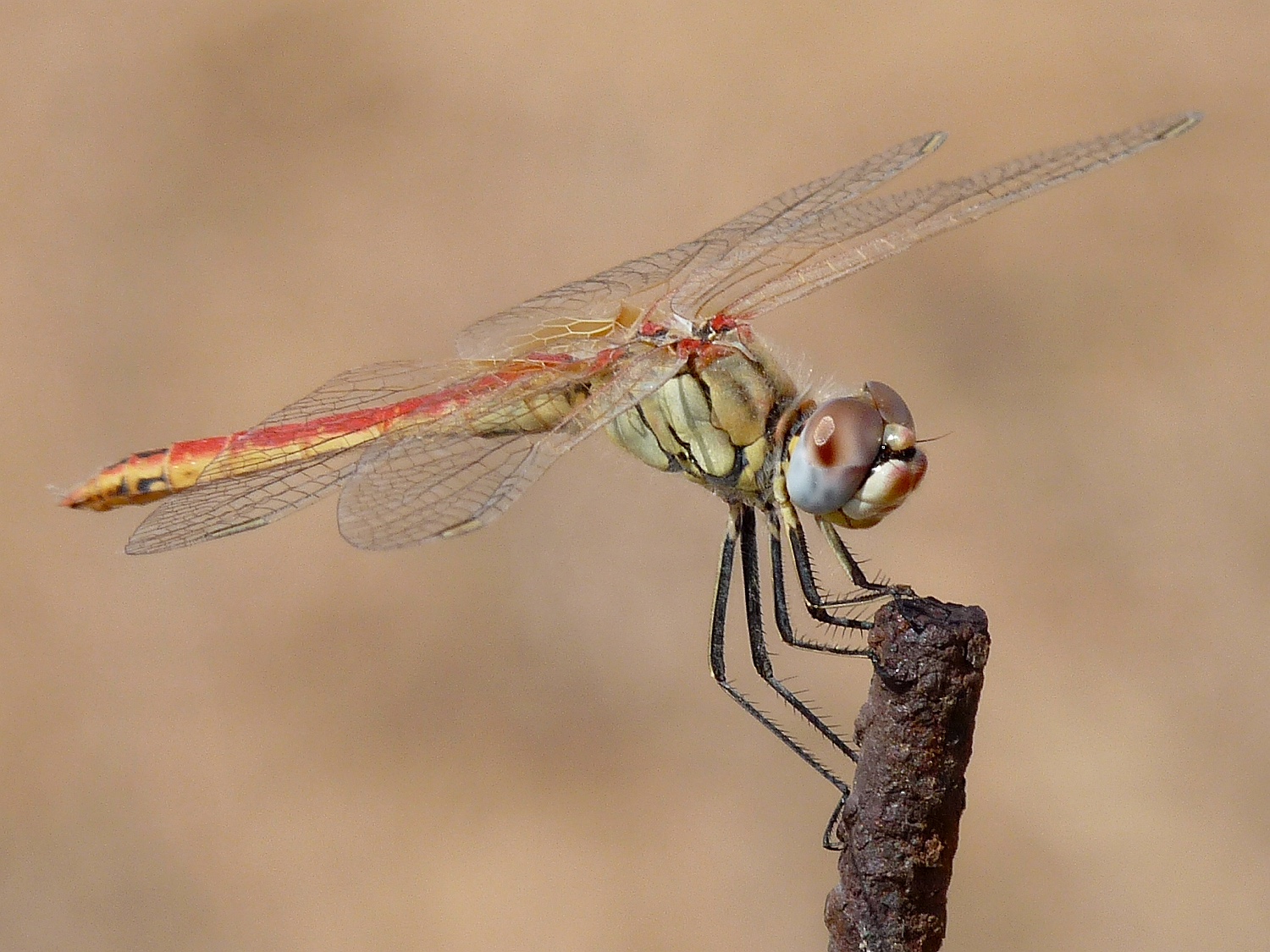
These specimens are probably young males.
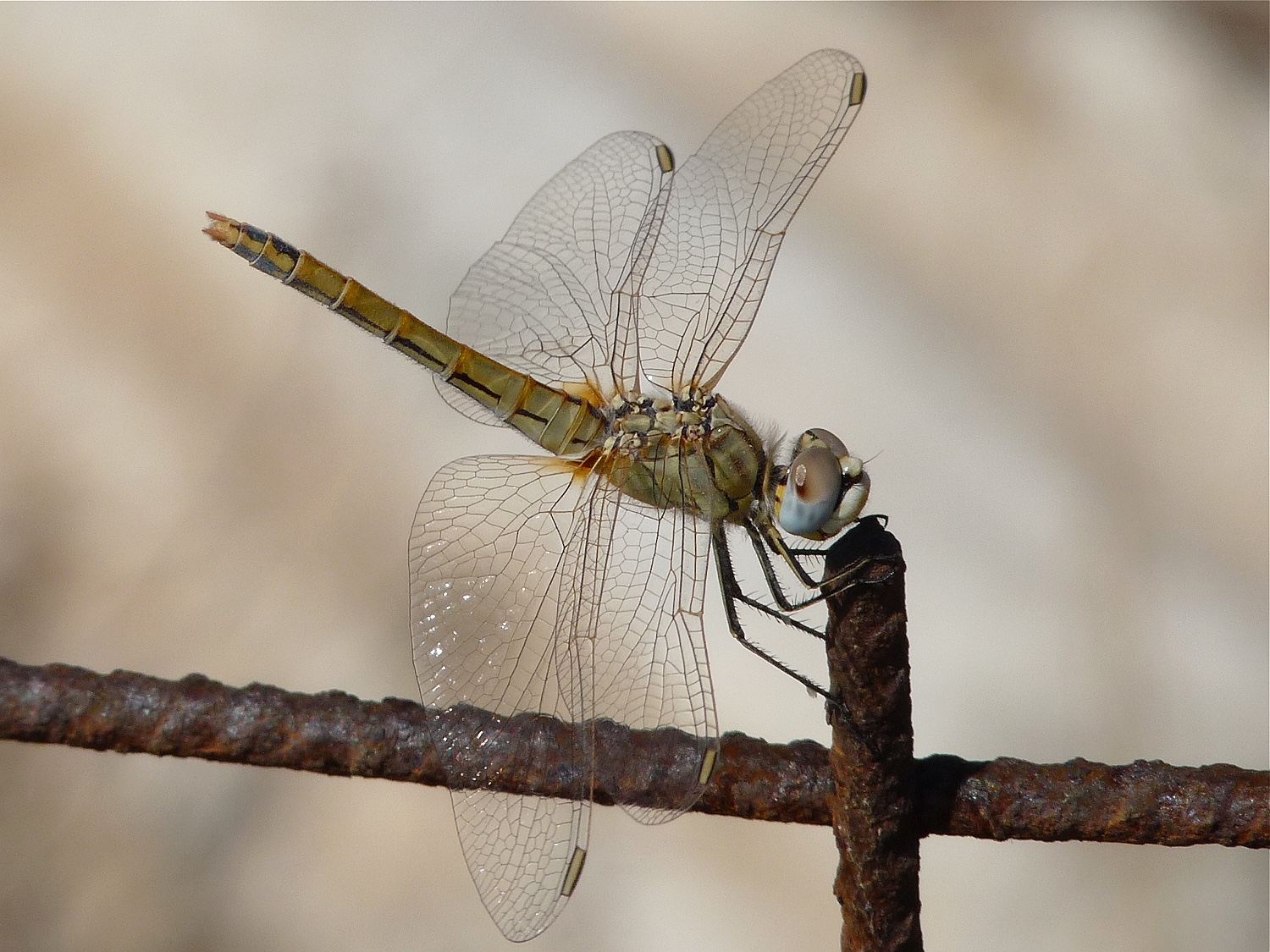
The females, on the other hand, are yellow in colour. On the side of the abdomen they have a narrow black longitudinal stripe.
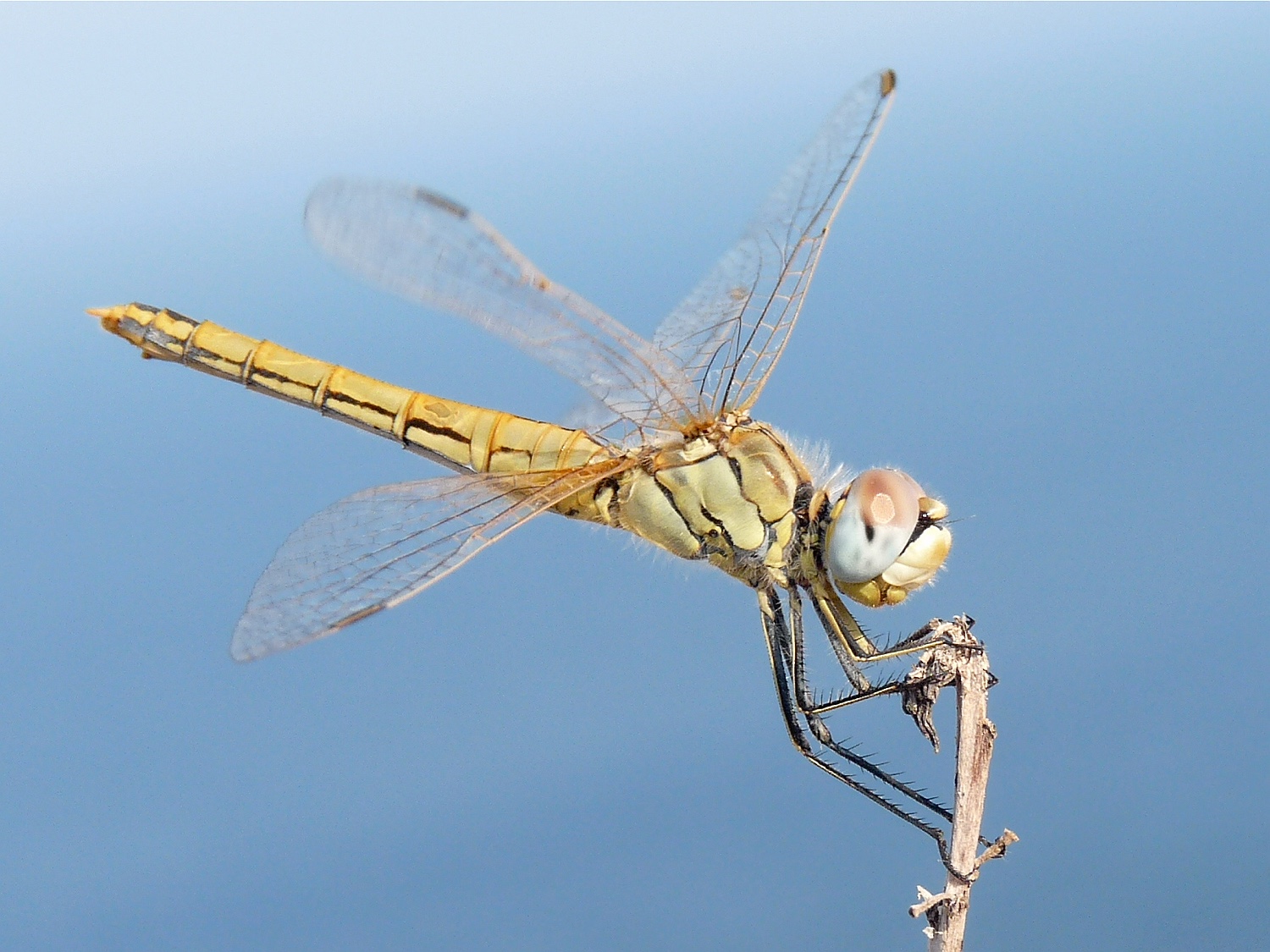
Both genders are easily recognisable by the two-part colouring of their eyes, which are brown above and blue below.
Common darter, Sympetrum striolatum, Charpentier
We encountered this darter in the Tragaía, laying eggs in a small stream. It is rare on Naxos. It is probably a Common darter.
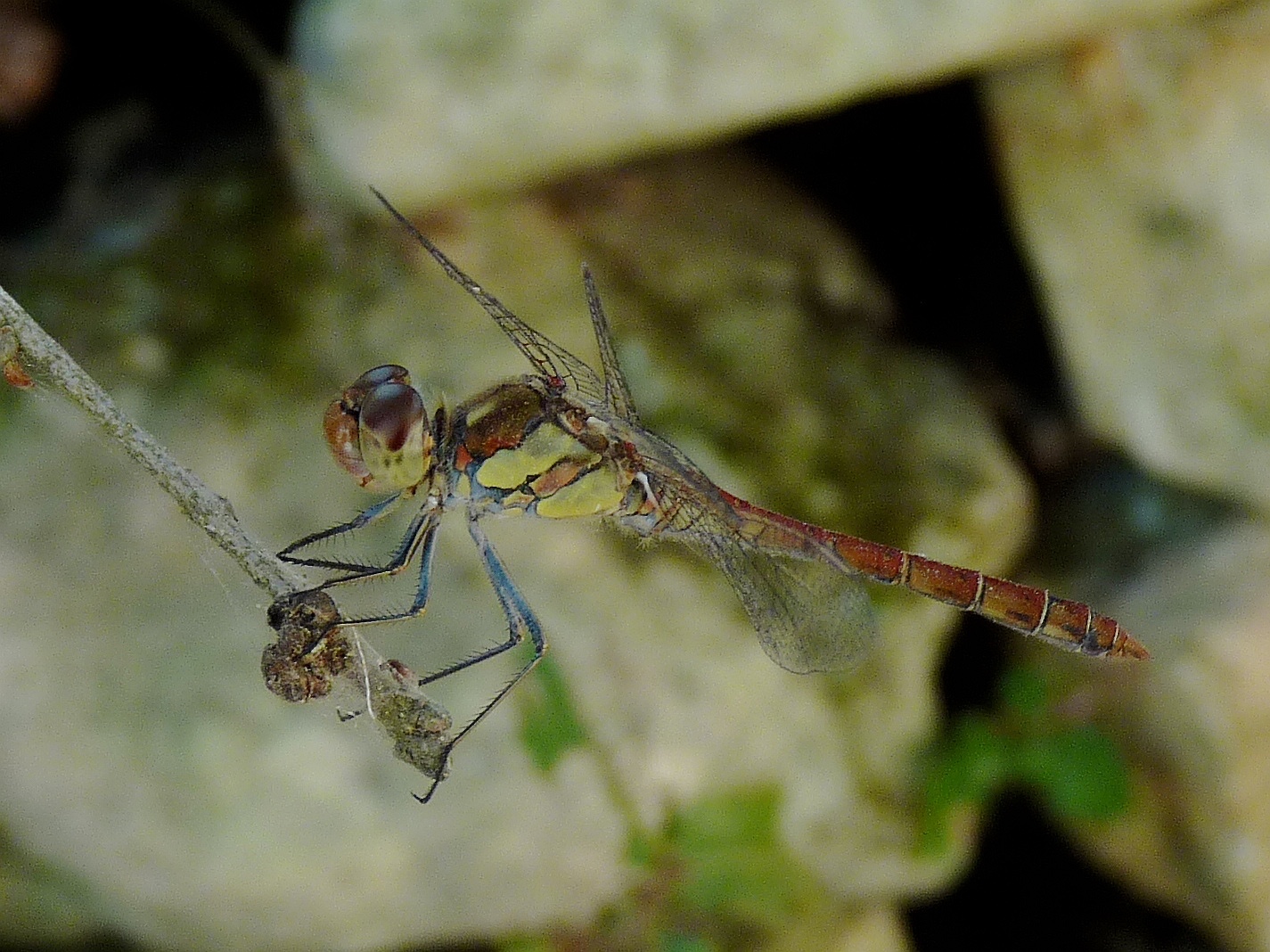
The male Common darter has a red-coloured abdomen and red and yellow stripes on its thorax. The black line on its forehead does not extend down to its eyes, and the lower part of its eyes is yellow-green, not blue.
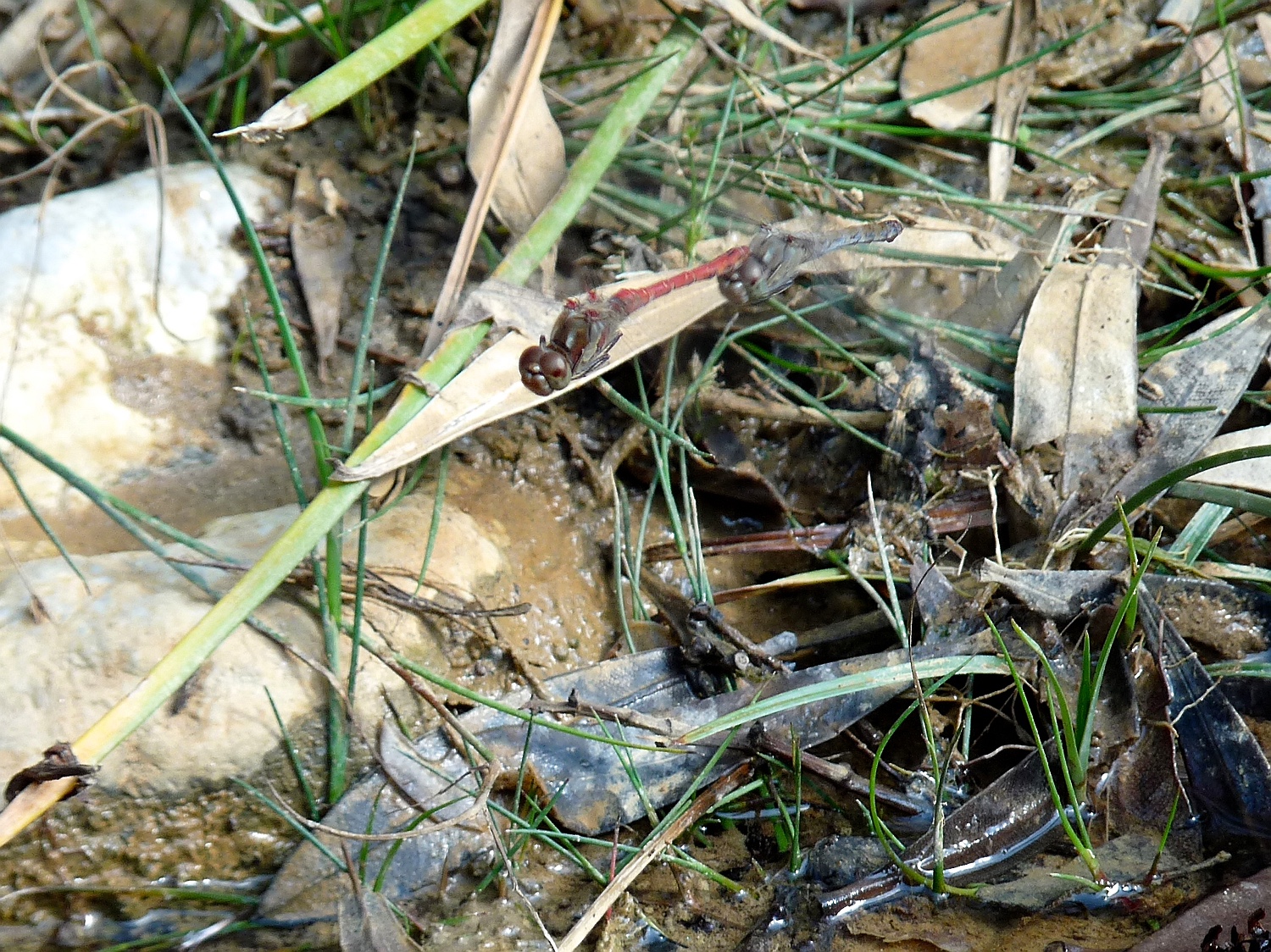
Common darter in tandem formation: the red male has grasped the more inconspicuously coloured female with his cerci behind her head.
Southern darter, Sympetrum meridionale, Sélys
This dragonfly with its lightly marked body is a Southern darter. Its legs are yellowish and its thorax is almost without markings. The female are yellow, while male darters are always predominantly red in colour.
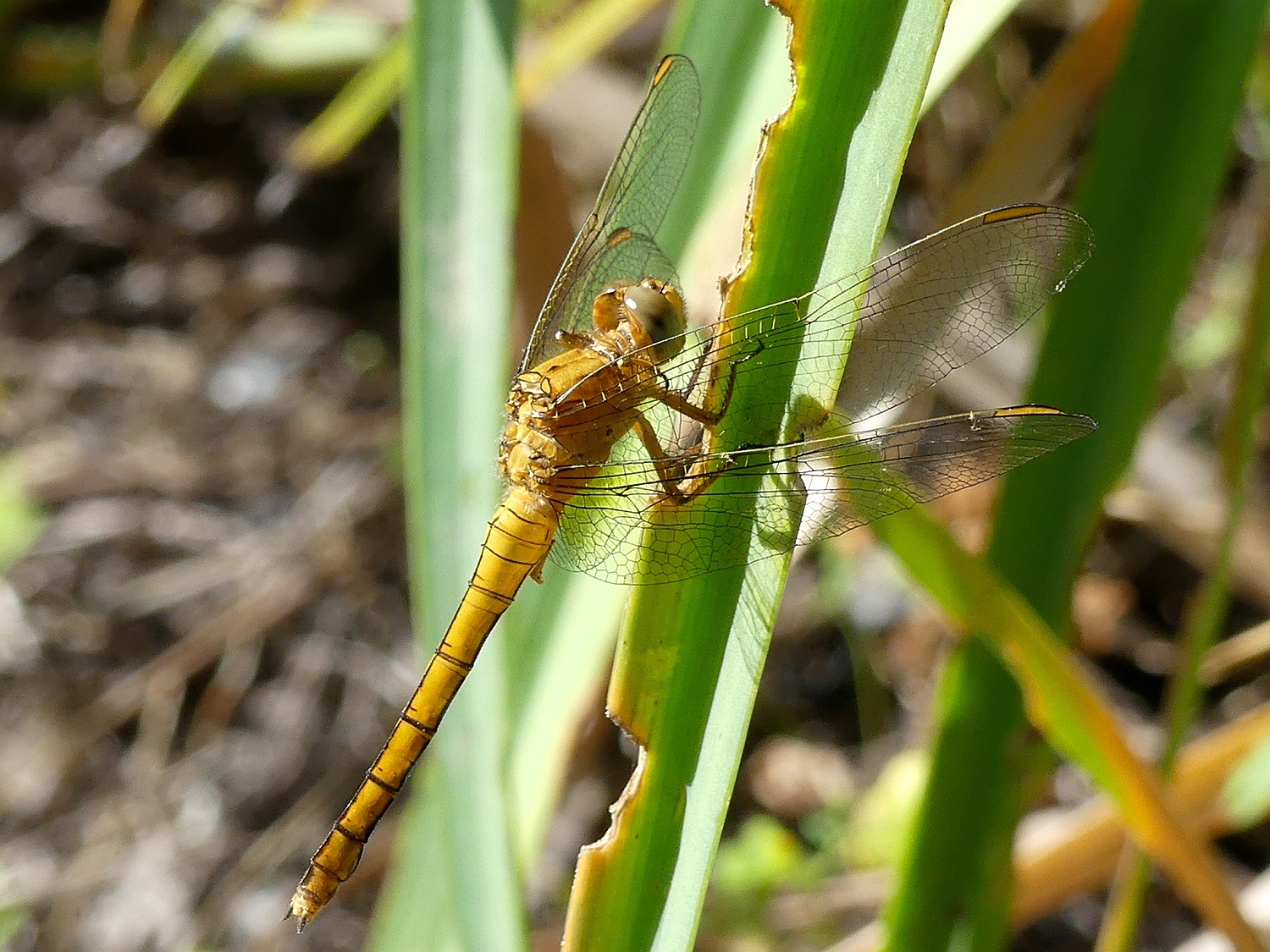
The Southern darter has the least dark markings on its body: thorax and abdomen show hardly any stripes. The legs are yellow. A characteristic feature is the tiny black dot on the side of the thorax, which is visible in this picture.
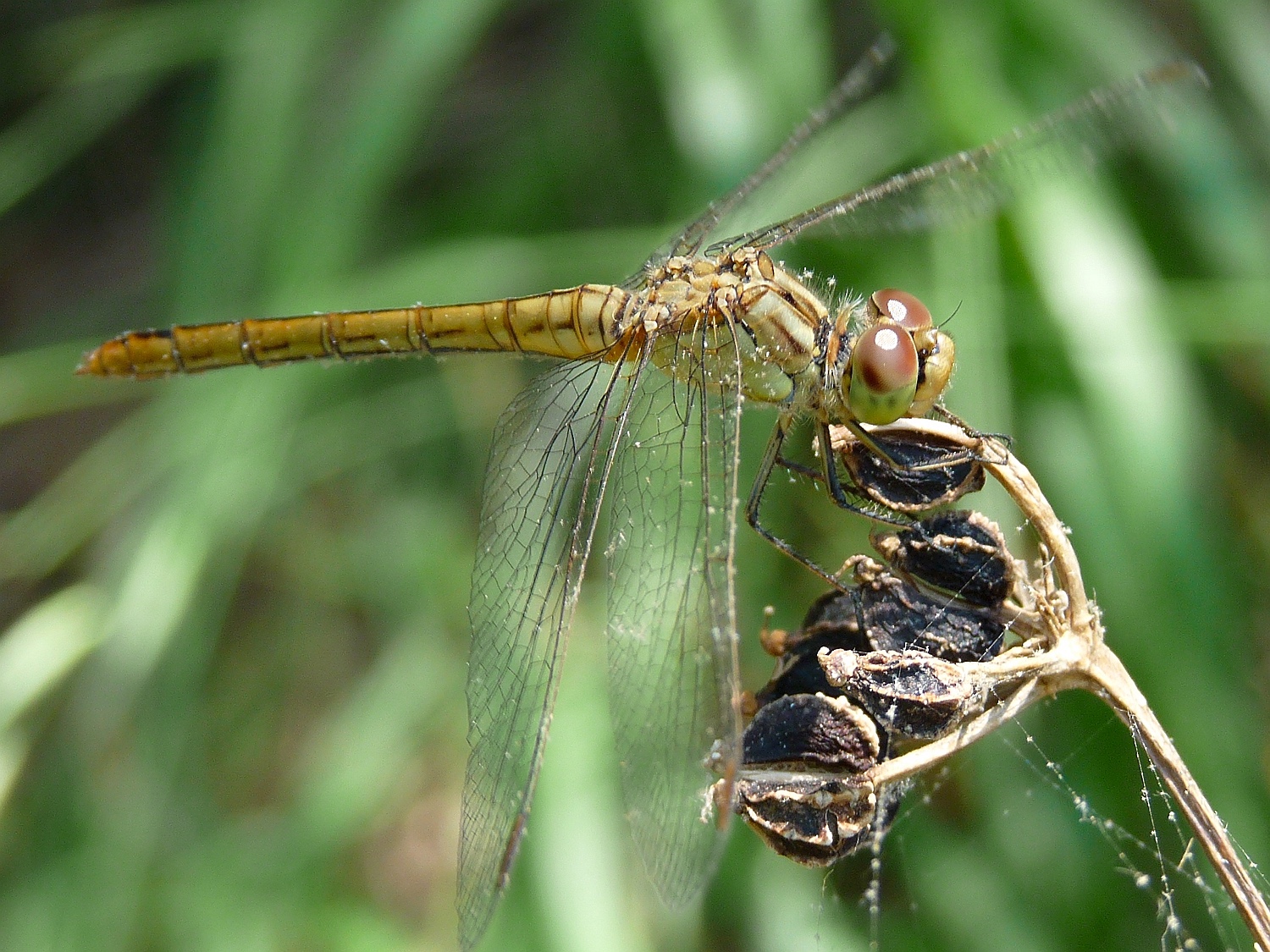
This specimen is also a Southern darter. The eyes are brown in the upper half and yellowish in the lower.
Scarlet dragonfly, Crocothemis erythraea, Brullé
The Scarlet dragonfly is related to the darters. It lives in Africa and the Mediterranean region, but has now also spread to Europe. It is rather rare on Naxos.
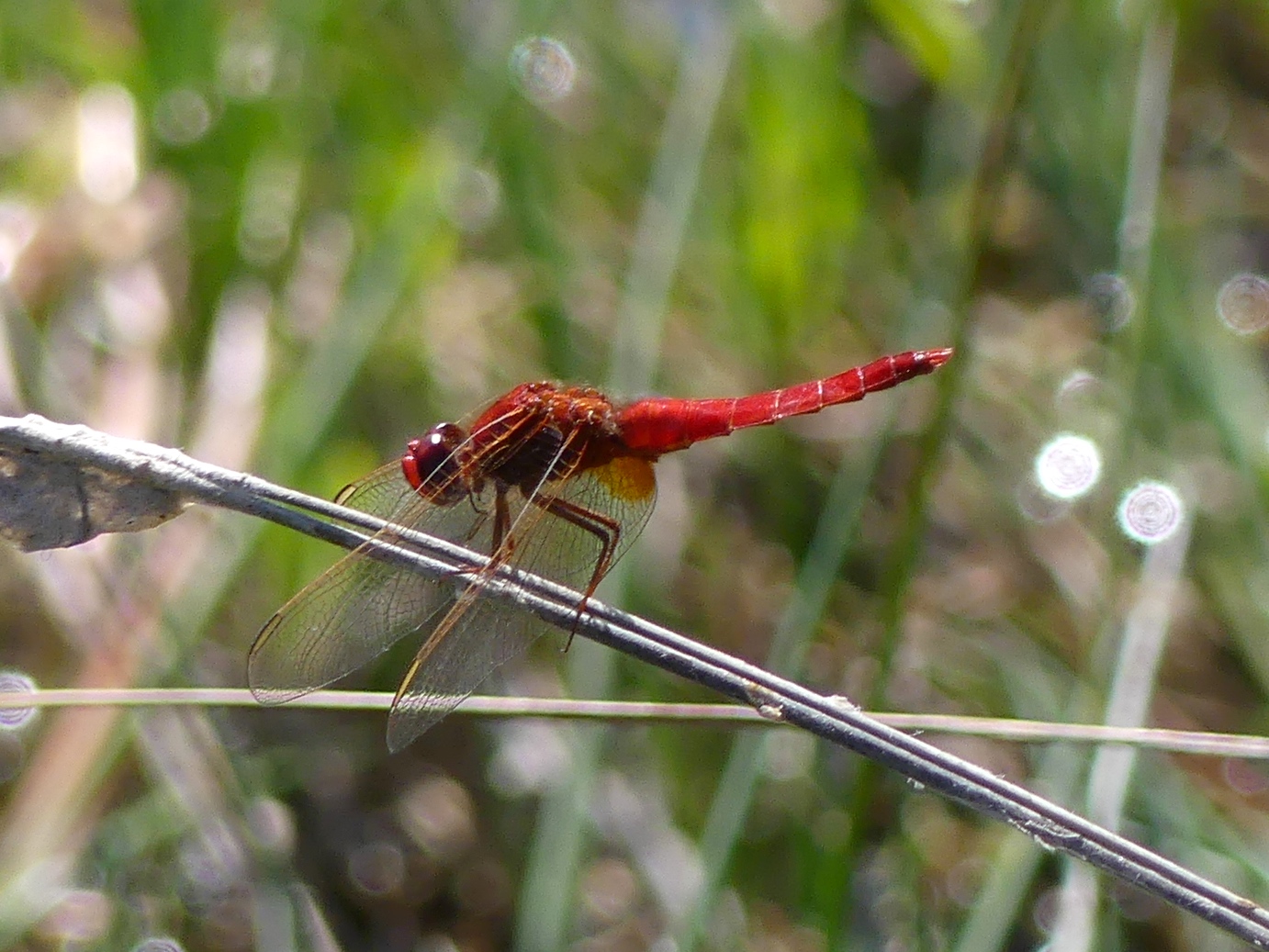
The male Scarlet dragonfly is completely bright red in colour, including eyes, forehead, abdomen and legs. It has a round orange-red spot at the base of its hind wings. The Scarlet dragonfly can be distinguished from red-coloured darters by its flattened abdomen. The pterostigma is yellowish.
Violet dropwing, Trithemis annulata, Palisot de Beauvois
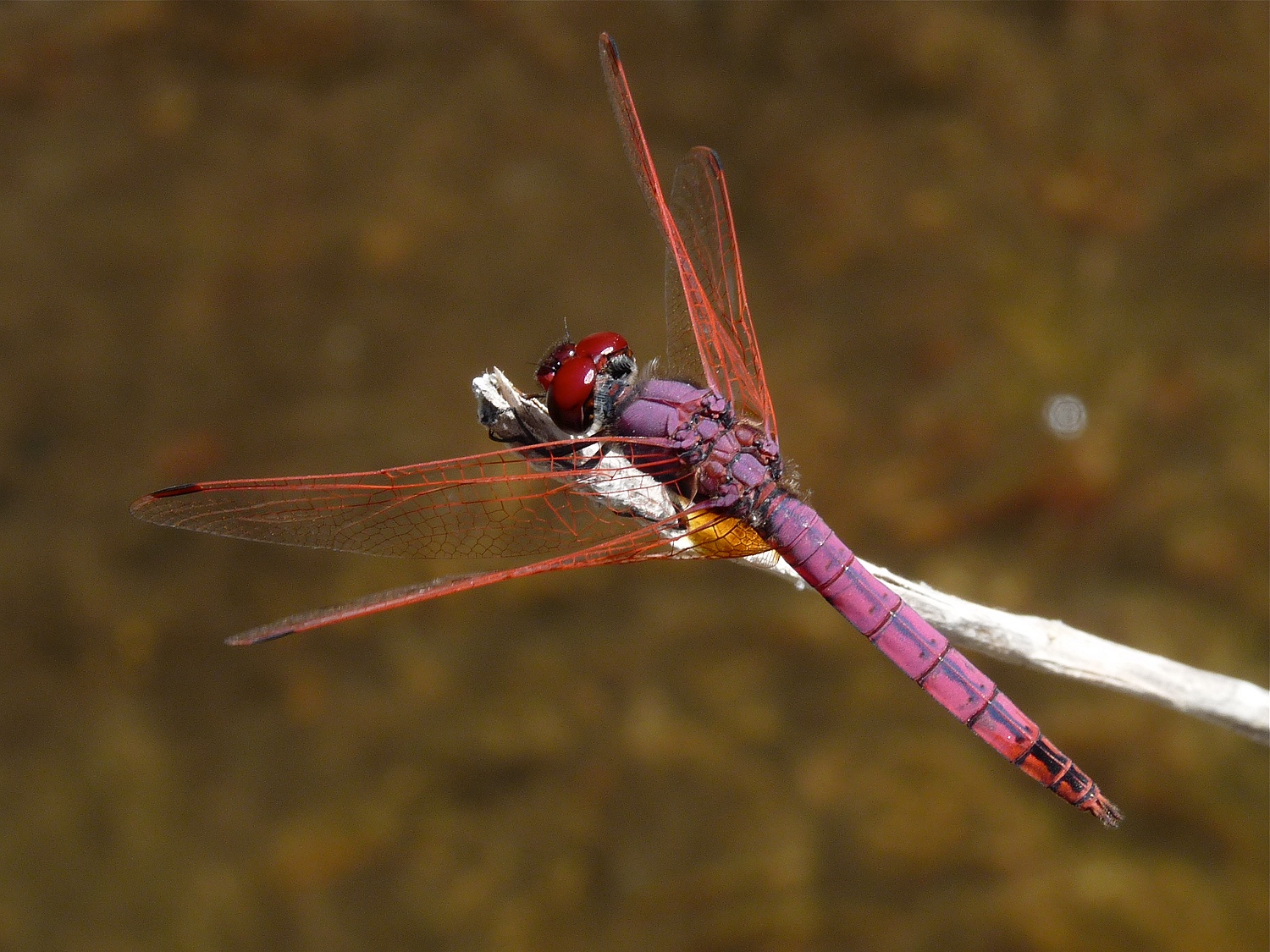
One of the most beautiful dragonflies is the Violet dropwing with its amazing colour. Like the scarlets and the skippers it holds its wings at an angle turned forward and downward when sitting. It strongly resembles the Scarlet dragonfly: The entire body, including its wings and eyes, is intensely red in colour; however, it carries a darker stripe on its abdomen, and the end of its abdomen has a darker pattern on top, while the sides are orange in colour. The pterostigma appears dark, but on closer inspection it is red. The characteristic pink-purple colouring of the Violet dropwing is caused by a layer of wax on the abdomen and thorax (pruinescence). The Violet dropwing is found in Africa and Asia and has been spreading increasingly in southern Europe in recent years. In some places it can be seen regularly on Naxos.
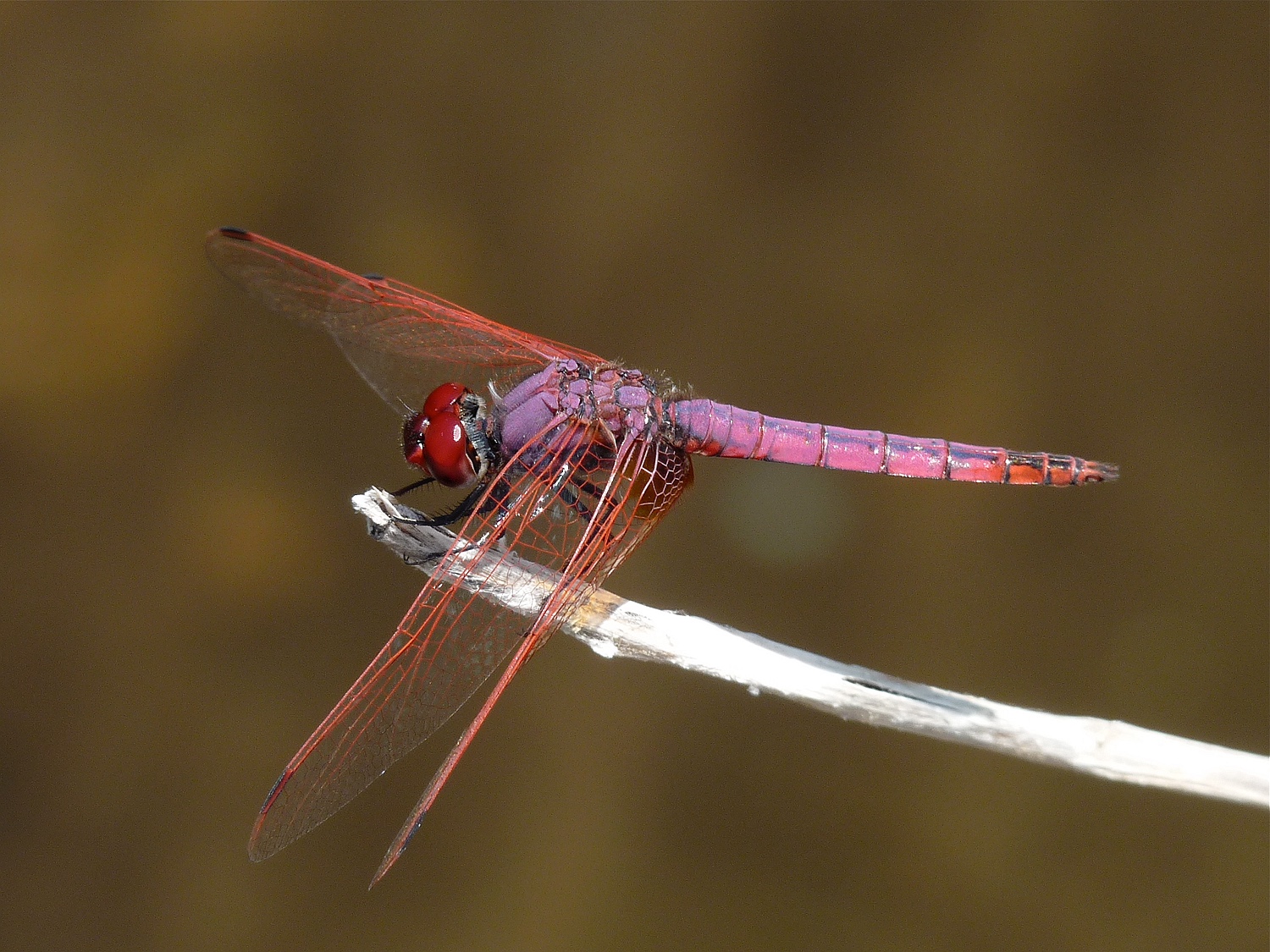
The Violet dropwing is bright violet-pink in colour. The wings have red veins and a yellow spot at the base; the pterostigma looks black, but is actually dark red. A darker stripe is visible on the abdomen.
About a second after sitting down, the dropwing tilts its wings diagonally forward.
continue: Neuroptera
back:
See also: Butterflies
Further reading: Dragonflypix: photos and informative descriptions of European Odonata
Comments are closed.