Beetles
With around 350,000 described species, the beetles form the largest insect order. Around one fifth of all known animal and plant species are beetles, and the total number of existing species is estimated at between 1 and 5 million. Hundreds of new species are described every year, mainly from tropical rainforests. Many species have a highly specialised way of life being, for example, dependent on a single plant species. A large proportion of the species described are known from only one location; sometimes only a single specimen has been found, on the basis of which the species was described. Around 8000 beetle species occur in central Europe.
Here you can skip the introduction and go directly to the species.
Anatomy
Beetles are relatively large and stout insects. Unlike in other insect groups, the two hind segments of the thorax are fused to one part, the pterothorax. The prothorax bears on the back a particularly large chitinous shield, the pronotum. The back shield of the mesothorax (the front part of the pterothorax) is visible as a small triangle between the wing covers, the scutellum. The pterothprax with the two hind pairs of legs and the wings actually seems to belong to the abdomen, as there is no incision between the thorax and the abdomen. Only the hind wings are used in flight, while the front wings have been transformed into rigid, protective wing covers (elytra), under which the membranous hind wings are held folded together. When flying, the wing covers are spread out; they generate the lift, while the hind wings generate the propulsion.
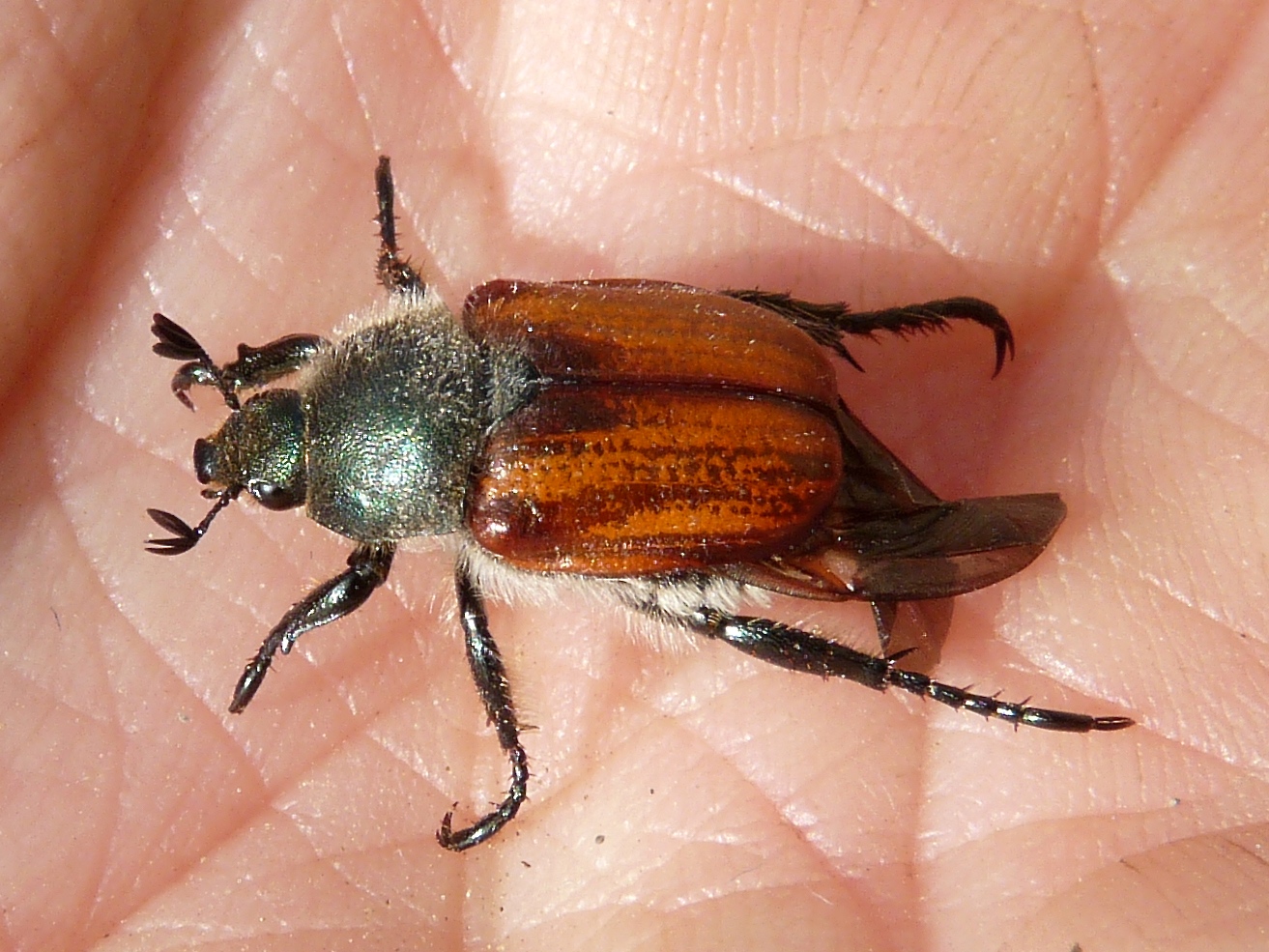
The head of most beetles is rather small. Behind it lies the prothorax which carries the front pair of the legs; its large back shield is called pronotum. The two hind segments of the thorax, the pterothorax with the wings and the two hind pairs of legs is merged the abdomen. In this specimen, you can see the folded membranous hind wings protruding from under the rigid wing covers, the elytra.
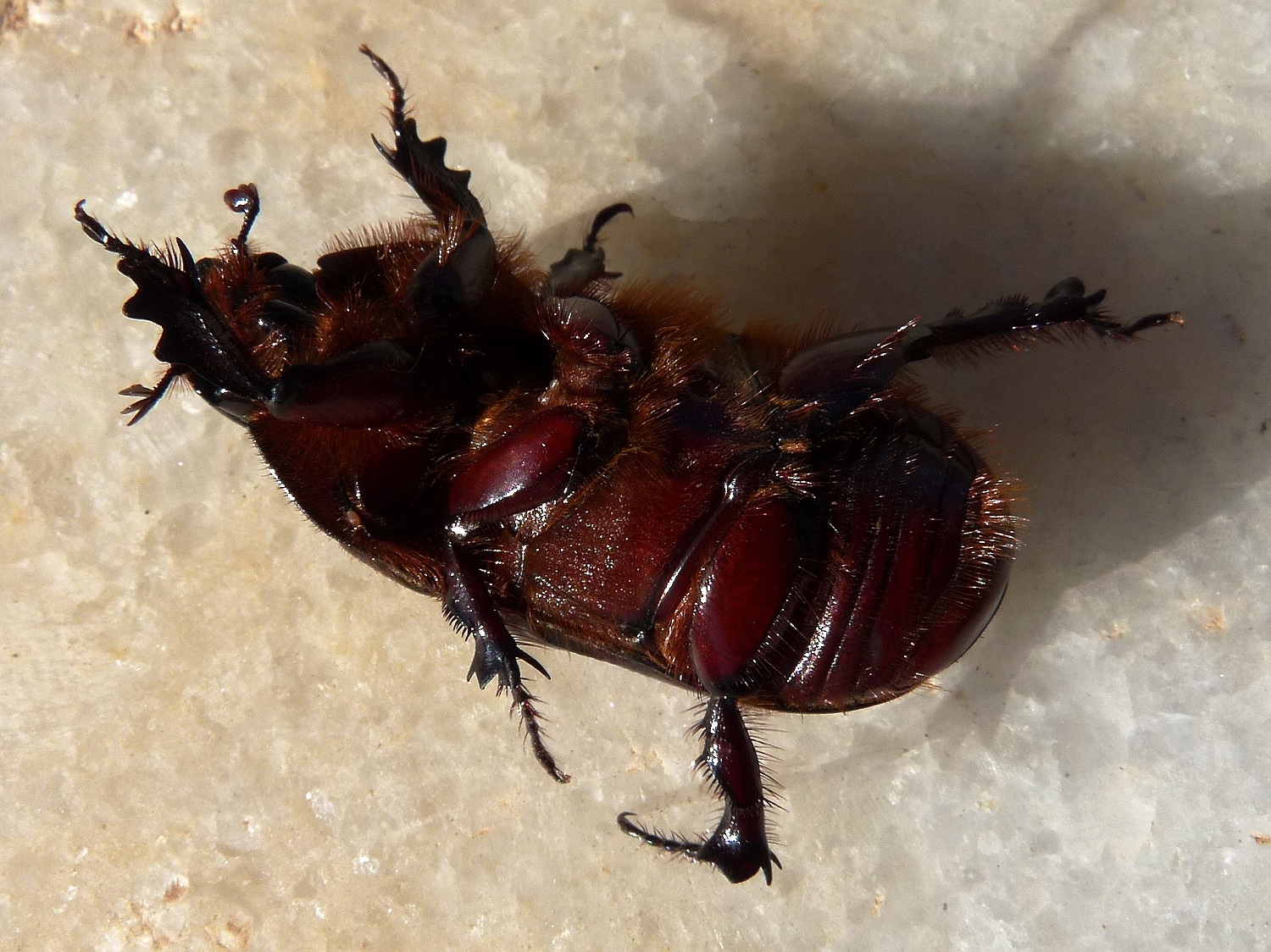
On the underside of the beetle, the sterna (ventral shields) of the middle and hind thoracic segments, to which the two hind pairs of legs are attached, cover more than half of the abdomen. The abdominal sterna can be seen behind them as narrow rings.
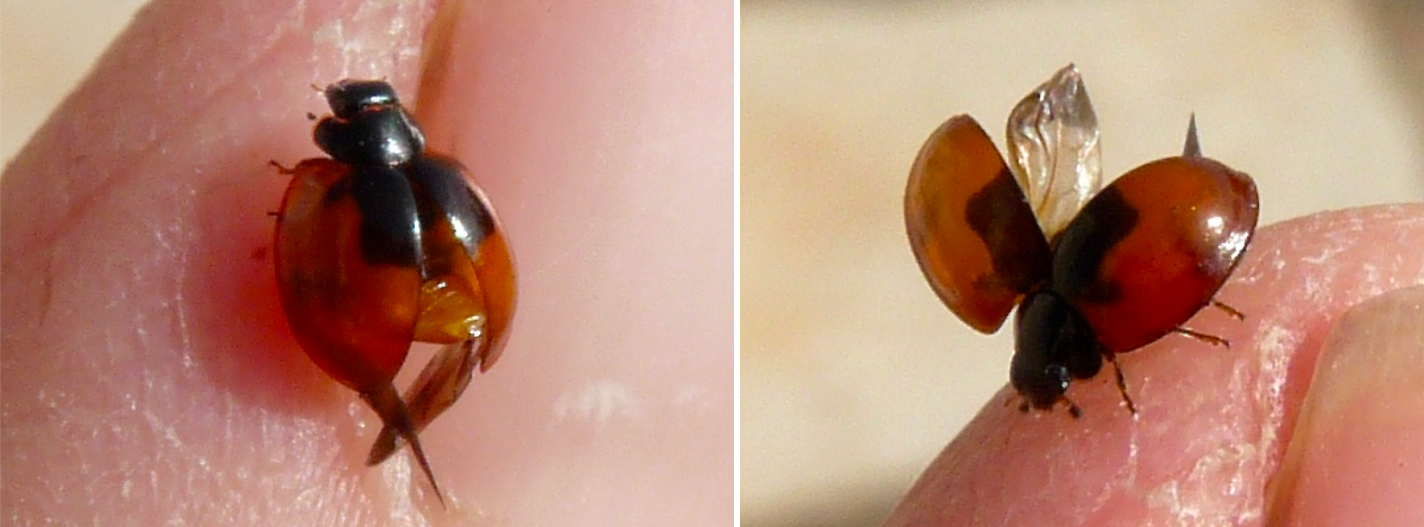
Ladybirds always try to climb to the highest point for takeoff. There they spread their elytra (rigid wing covers) to the sides and unfold the membranous wings underneath.
The antennae of beetles are sometimes particularly long and can be thread-like, club-shaped or fan-shaped. The compound eyes are more or less round or nestle in a semicircle around the base of the antennae. The mouthparts are always of the chewing-and-biting kind. The chitinous exoskeleton may bear hairs, scales or thorns and sometimes has a metallic colouring, which is caused by a special surface structure.
Beetles are a very old animal group with the first beetles fossils dating back to the Permian. The long evolution of the order of beetles is perhaps one reason for their great diversity and for the development of a wide variety of appearances, body types and ways of life compared to many other insect groups.
Biology and reproduction
Beetles are found in all habitats on Earth except Antarctica and the oceans. Many species are predatory, others eat plants or live on dead organic material such as wood, feathers, carrion or faeces. Decomposers and waste recyclers in particular often play a crucial role in the ecosystems. Many beetles are highly specialised and live on a single plant species, while others are very adaptable and found worldwide. Several species have adapted to life in or on fresh water. Some species live parasitically or in symbiosis with ants. Their ability to fly enables many beetles to colonise new habitats quickly and to spread easily.
Like all insects, beetles lay eggs. Often the eggs are laid with much care in the suitable places, e.g. in the appropriate plant or on dead animals, which are sometimes buried. Some swimming beetles construct small boats for the eggs, which float on the surface of the water. Other beetles engage in elaborate brood care, such as the species that live in ant nests, in which the females secrete a substance that the ants like to eat, or some species that live in wood and create gardens of fungi for their larvae.
The larva of the beetle is looks completely differently from the adult beetle. It has an elongated body consisting of almost identical segments. The best-known beetle larvae are mealworms and the ‘grubs’ of cockchafers (maybugs). The larvae have no legs or only very small legs, very short antennae and tiny dot eyes. They usually eat more or less the same as the adult animal; often their diet is also highly specialised. As the adult beetles some larvae are predatory, others are herbivorous, others feed on dead organic material. Depending on the larva’s diet, the duration of larval development varies greatly, from a few days, e.g. in the case of scavenging larvae, to 15 years in the case of larvae that live in old, very dry wood. The larval stage often lasts significantly longer than the adult stage.
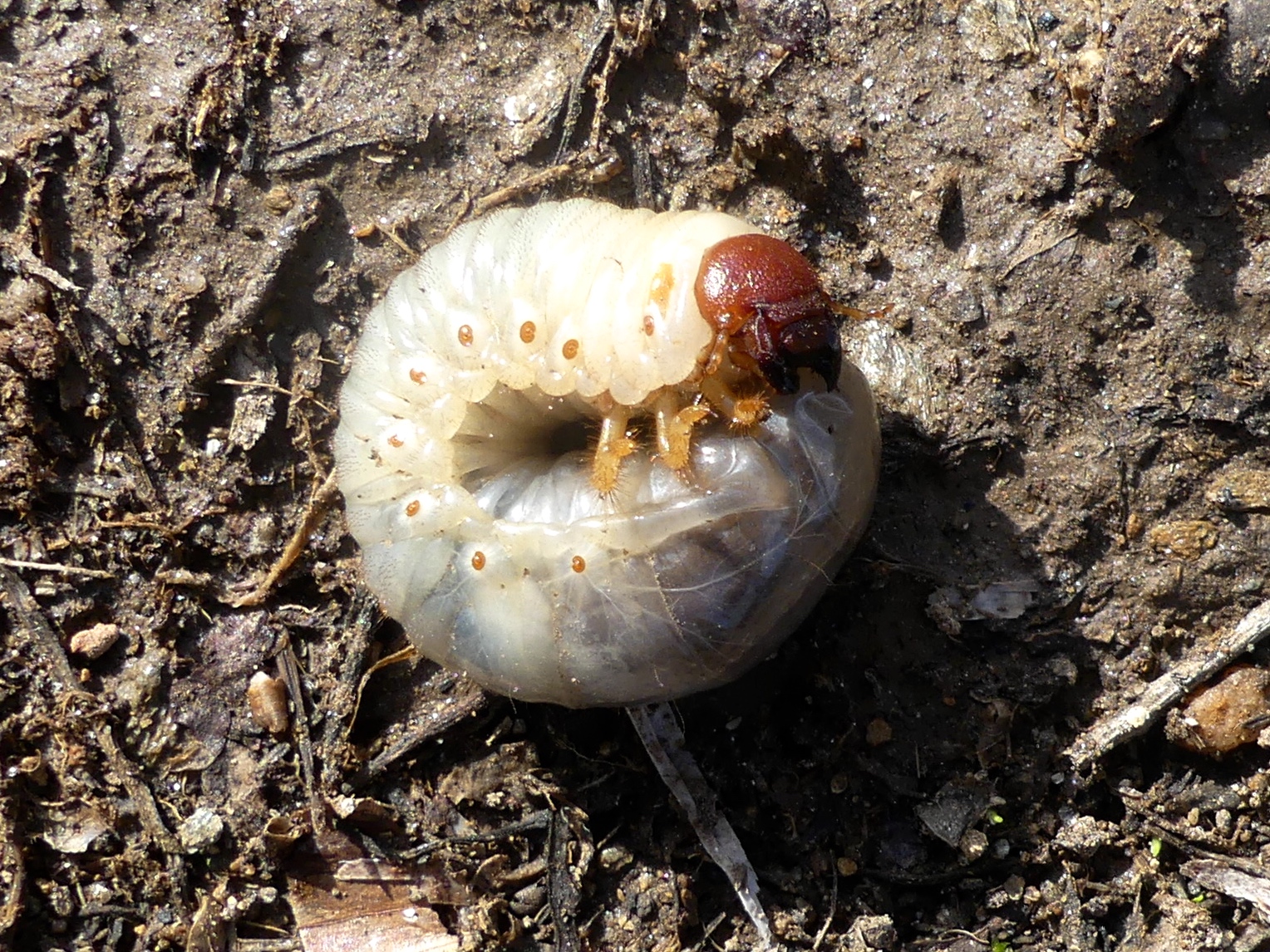
The larvae of beetles have an elongated body made up of almost identical segments, with no wings and only short legs and antennae. Thick grubs like these, in our region mostly the larvae of rhinoceros beetles, live in the soil and feed on roots or dead plant material.
Like all insects, beetles can only grow as larvae. To do this, the larva must moult at certain intervals. The transformation into the adult beetle occurs abruptly through holometamorphosis, which takes place in a protective pupa and involves the reconstraction of the entire body. Sand, plant parts or soil are often used to build an outer shell for the pupa. In the temperate and cold regions of the world, beetles usually hibernate as larvae or pupae, but sometimes adult beetles also survive the cold season in sheltered places.
Beetles as pests and beneficial insects
Depending on their diet, many beetles are harmful pests. Some species live in flour and grain (flour beetles, grain beetles, rice beetles, etc.), other herbivorous species cause damage in argiculture, such as the Colorado potato beetle and the Corn rootworm. The greatest damage is caused by species that live in trees, such as bark beetles, which can kill huge areas of forest within a few years, or other species that specialise in a particular tree species, such as the Red palm weevil, which destroys the growth cone of palm trees. In some cases, the damage is caused by the beetle transmitting a disease, as in the case of Dutch elm disease, which is caused by a fungus transmitted by the Elm bark beetle and which may result over time in the complete extinction of the elm tree.
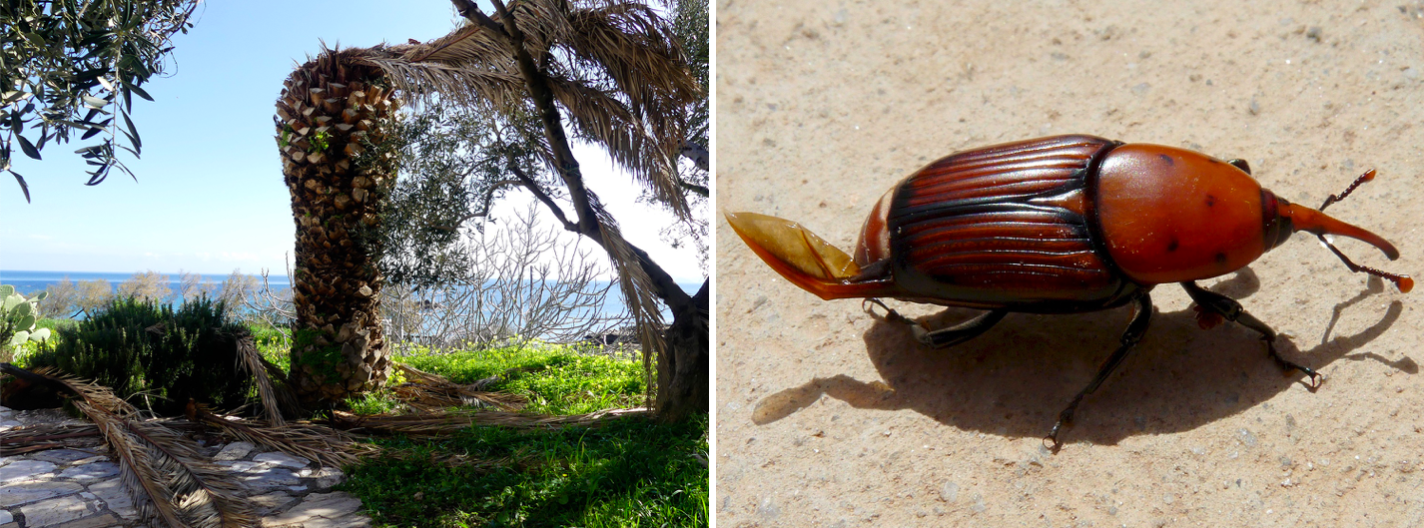
This palm tree in our neighbour’s garden died due to infestation by the Red palm weevil, a species from southeast Asia that is spreading since some decades in the Mediterranean area.
However, some species of beetles are of course also useful to humans, in particular the ladybirds, whose larvae feed on aphids and are therefore often used in biological pest control.
Furthermore the larvae of numerous beetle species are edible and represent an important source of protein for the population in many parts of the world. In Greece and in Europe, too, some grubs and cockchafers were eaten until the Middle Ages. Over 100 beetle species can be identified from the descriptions of ancient naturalists such as Aristotle and Pliny.
Finally, the importance of carrion- and faeces-eaters and decomposers among beetles for the Earth’s ecosystems can hardly be overestimated. The Sacred scarab was venerated by the ancient Egyptians; it symbolised the sun god Re, which probably derives from its behaviour of rolling a ball of dung around.
Beetle species on Naxos
Beetle species on Naxos
Naturally, there are far too many beetle species on Naxos for me to offer an even remotely complete list here, but many of the more common or conspicuous species can be found in the following descriptions.
The Photo gallery of the beetles gives an overview over the species.
A note on identification: While some beetles can be identified easily, this is not true for all species. In many cases, accurate identification relies on characteristics that cannot be seen in photos and require examination of the dead animal under a magnifying glass or microscope; also one would need special literature and identification guides. For this reason, I cannot guarantee the correctness of the identification of many of the species in the following description – sometimes even the genus cannot be identified with certainty. Still, I hope that the article is valuable in presenting the diversity of our beetle fauna and perhaps awakening interest in these mostly litte known insects. Fortunatley some help is available in the internet: I thank the members of the forum of the German Web site on coleoptera Kerbtier.de and of the Facebook-page “Insects of Greece and Cyprus” for several indetifications.
Here you can jump directly to the larger groups within the beetles (return with the back arrow or by swiping back):
Ground beetles – Rove beetles – Whirligig beetles – Fireflies – Soft-winged flower beetles(Melyridae) – Jewel beetles – Ladybirds – Auger beetles – Carpet beetles – Blister beetles – Pintail beetles – False blister beetles – Dung beetles – Scarab beetles – Longhorn beetles – Leaf beetles – Weevils
Ground beetles, Carabidae
Green tiger beetle, Cicindela campestris, L.
The tiger beetles live on the ground in open areas on sand or soil. In spring, the Green tiger beetle can often seen in our garden. Tiger beetles run very fast and usually only fly short distances. The larvae live in the earth; larvae and adult animals feed mainly on spiders and other insects. The species is found in Europe and Asia; in some areas it is endangered due to the destruction of its habitat.
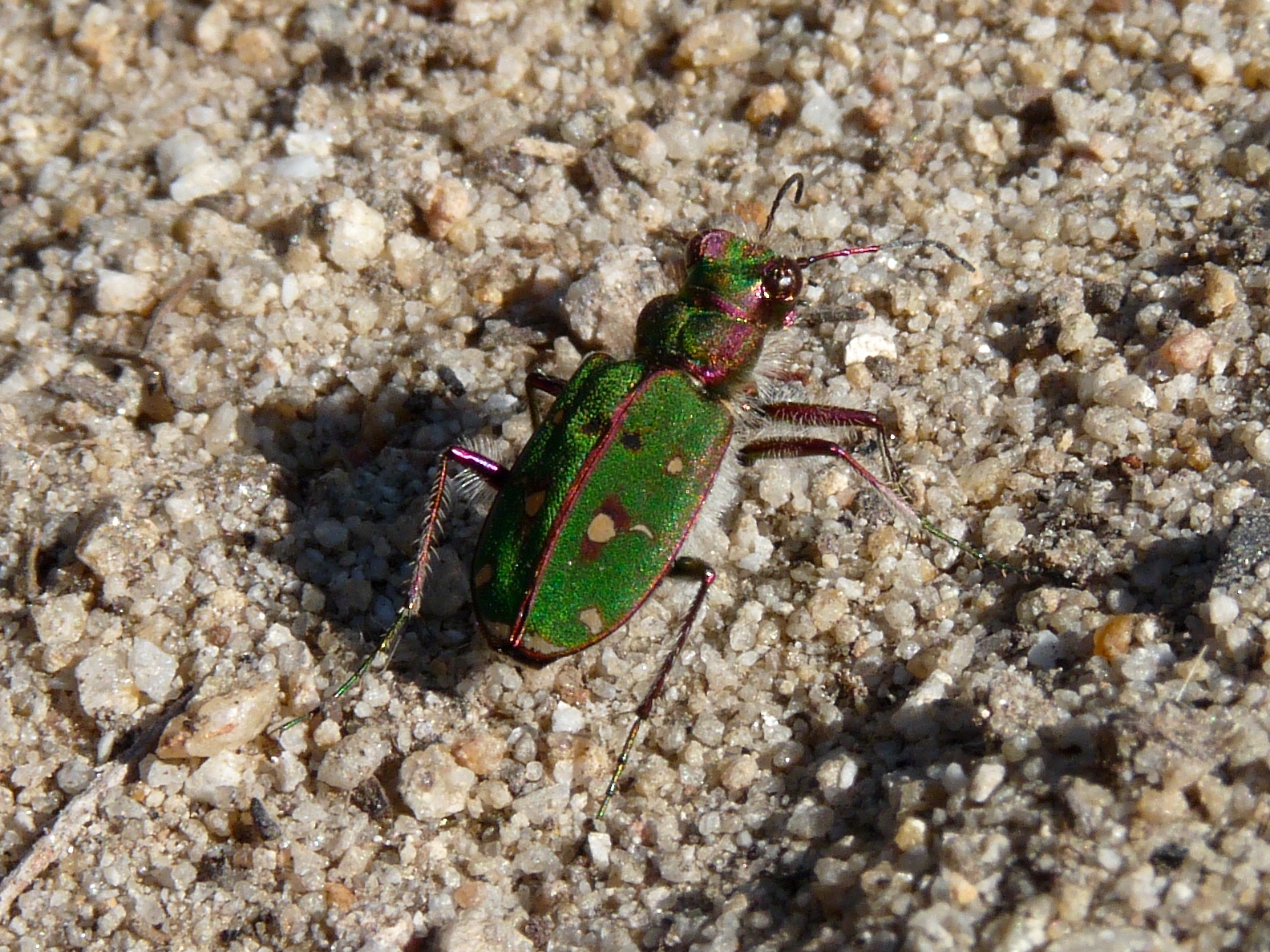
The Green tiger beetle has a metallic green colouring. It can be distinguished from other related species by the shape and arrangement of the white spots on its wing covers.
Littoral tiger beetle, Cicindela (Calomera) littoralis, Fabricius
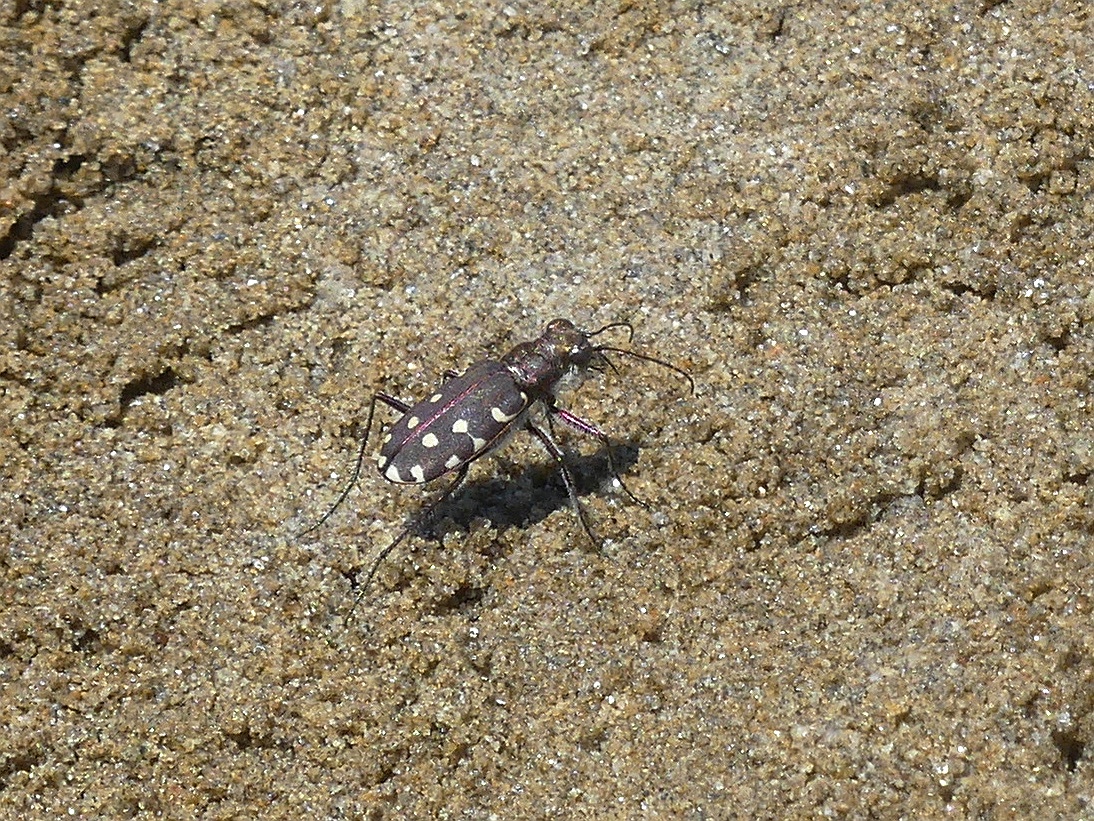
On the sandy beaches of Naxos – here in Kalandós – one can often find another species of tiger beetle: Cicindela littoralis, the Littoral tiger beetle. It belongs to the subgenus Calomera. These restless and shy beetles fly off when you approach them. They have dark brown, slightly copper-coloured shiny wing covers with characteristic white spots, the front one of which is C-shaped. As all related species, they are predators. The larvae live in holes they dig in the sand, where they lie in wait for their prey.
Calathus spec.
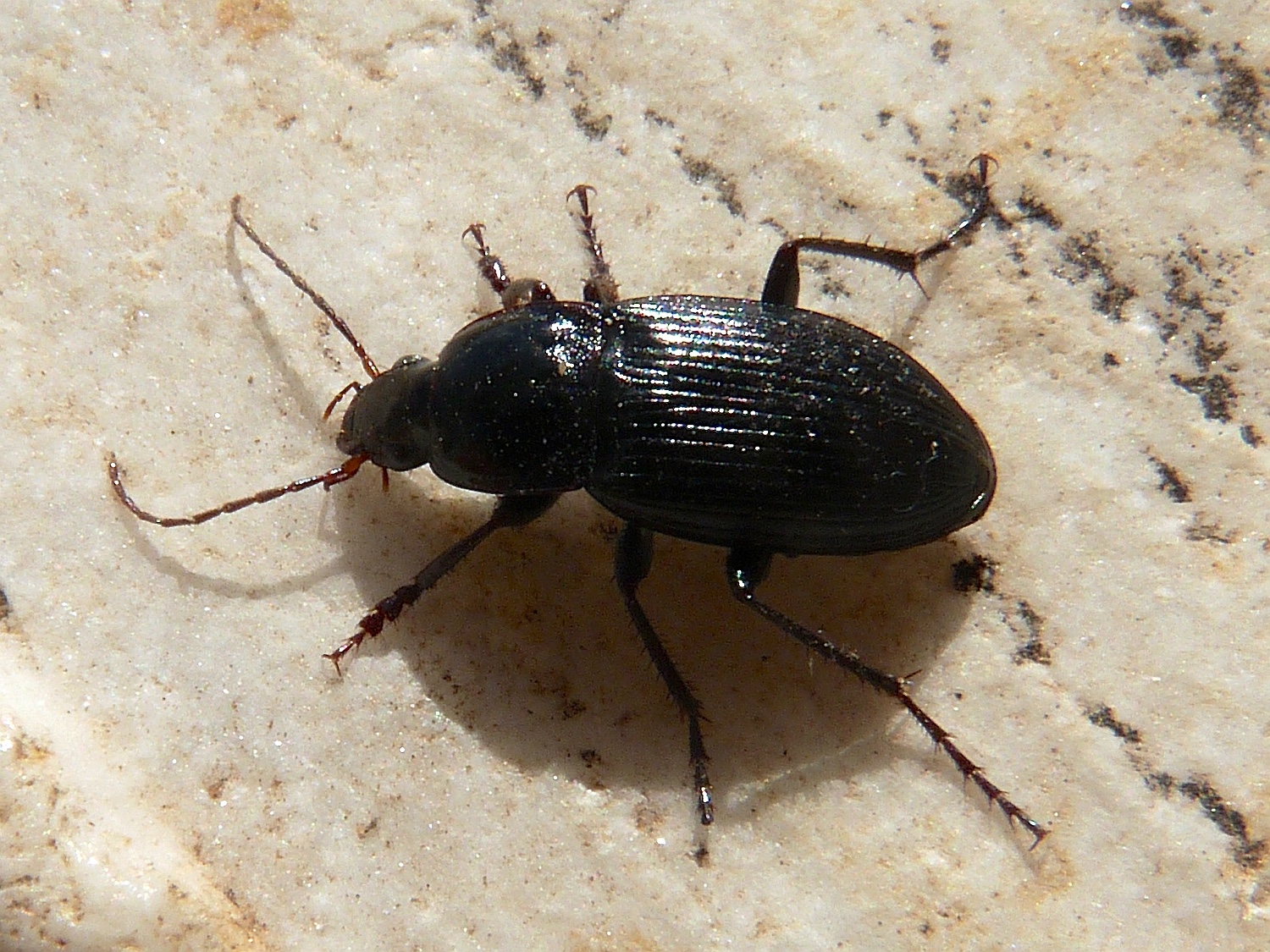
This ground beetle, measuring approximately 1.2 cm, belongs to the genus Calathus in the subfamily Harpalinae, which, with around 20,000 species, most of which are quite similar in appearance, accounts for about half of all ground beetles. Species identification is usually only possible by microscopic examination.
Acinopus megacephalus ?, P. Rossi
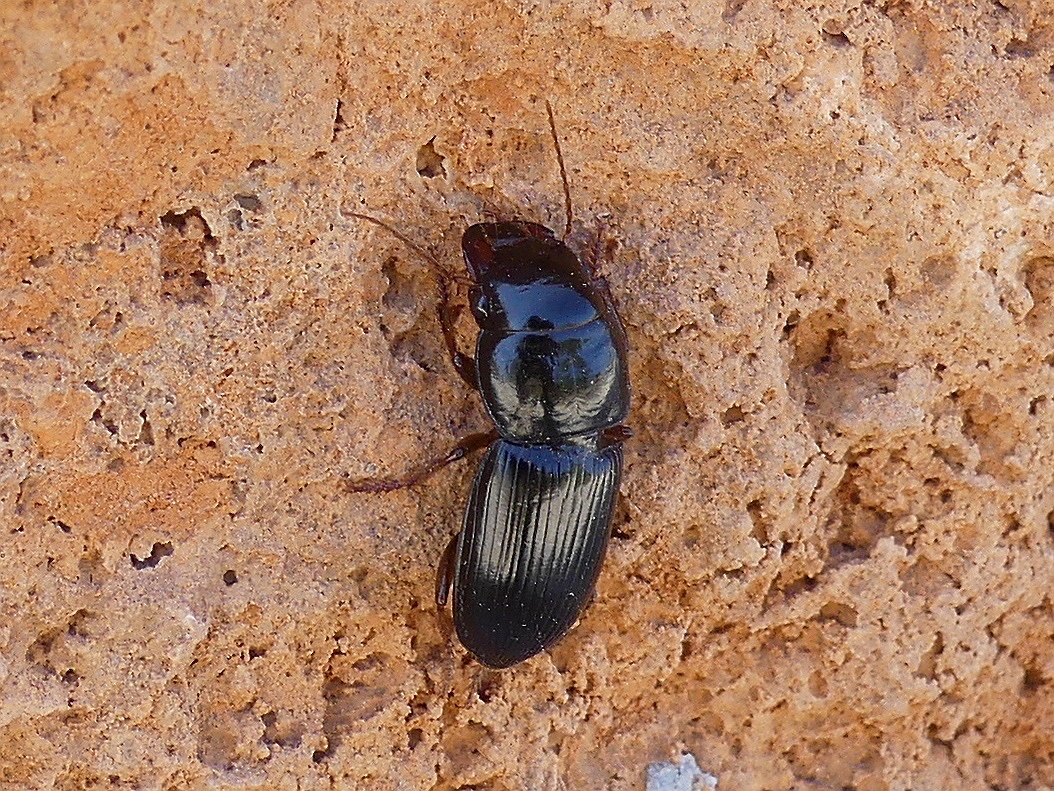
This beetle could be Acinopus megacephalus, which is notable for its broad head. This species also belongs to the subfamily of Harpalinae.
Rove beetles, Staphylinidae
The rove beetles are a very large family within the order of the beetle, with over 47,000 described species, although the actual number of species lies probably much higher. They are quite unusual beetles. Most species are very small, often only a few millimeter long. Head and neck are about the same size; the entire body is elongated and very flexible. The wing covers are greatly reduced, usually covering only about one third of the abdomen. The membranous hind wings have their normal size. When they are not used for flying, they are folded under the short wing covers. The beetle uses its very mobile abdomen to fold and unfold its wings, stroking and pushing them together. Fine bristles at the end of the abdomen help to do this. Many rove beetles produce toxins that they can spray from their abdomen when disturbed.
Rove beetles have conquered all habitats on earth except water and are also found in quite hostile environments where almost no other animals can survive. In favourable habitats such as the litter layer of moist forests, they often live in very large numbers and play an important role in the ecosystem. They have developed virtually all forms of nutrition: predatory, plant- and fungus-eating and parasitic species exist, as well as many decomposers of animal and plant matter. Many species live in ant nests, where they are fed by the ants or eat waste materials in the nest, prey on the ants themselves or are carried along by them on their hunting expeditions – it seems that every imaginable way of life has been tried out by these little animals. The rove beetles are one of the most successful and common animal groups.
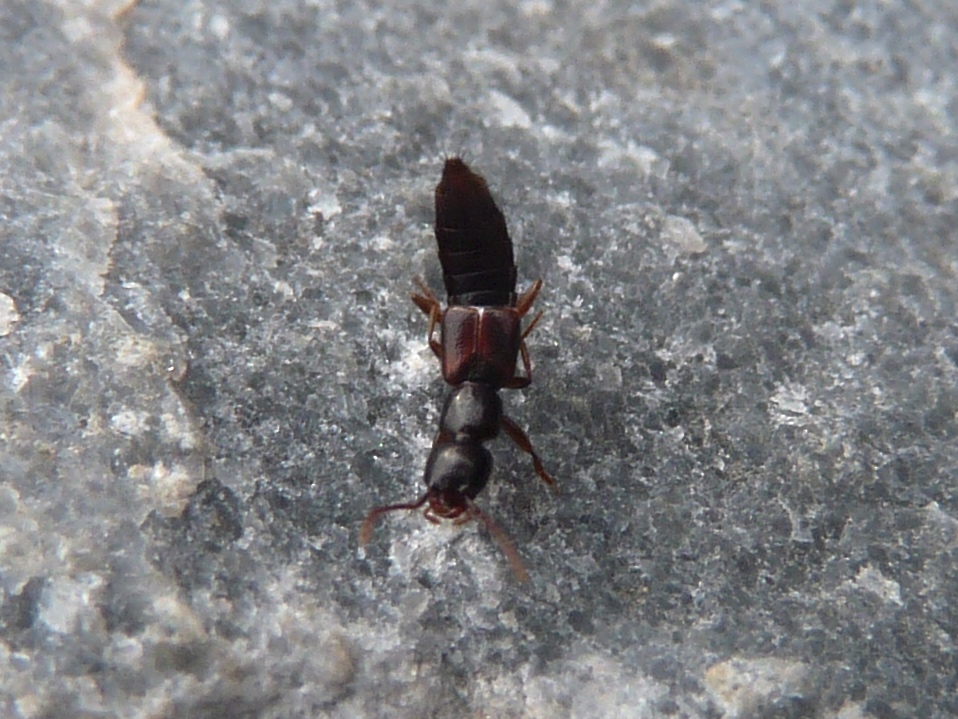
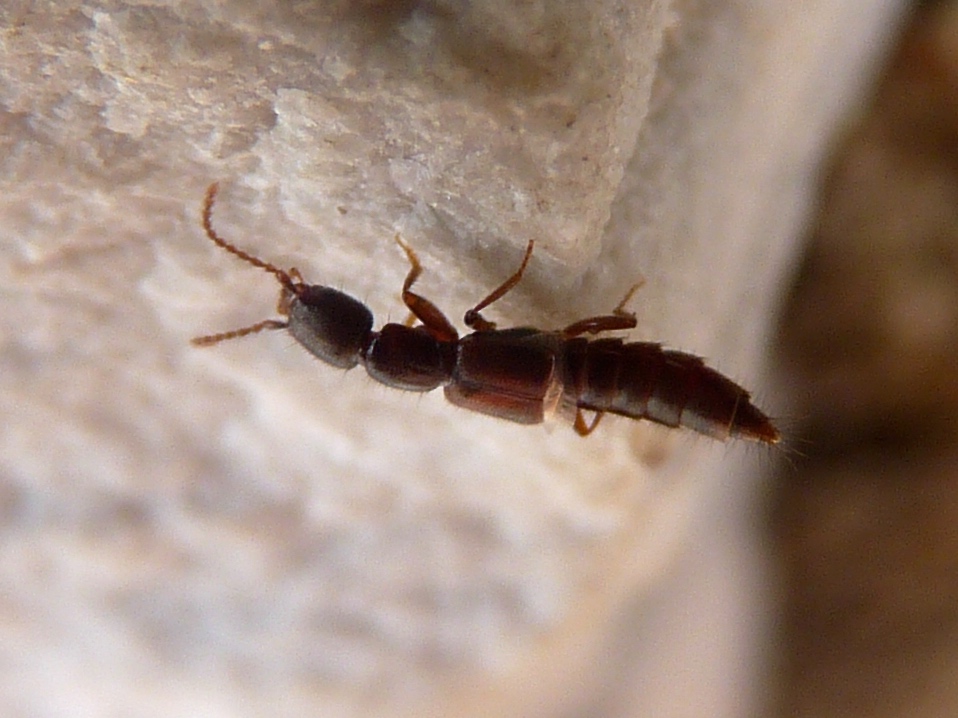
Rove beetles, which are usually only 2 to 8 mm long, are easily overlooked due to their small size, although they are common in most habitats. With their long, mobile, uncovered abdomen, they hardly look like beetles. Most rove beetles are brown or black in colour. The different species are difficult to distinguish.
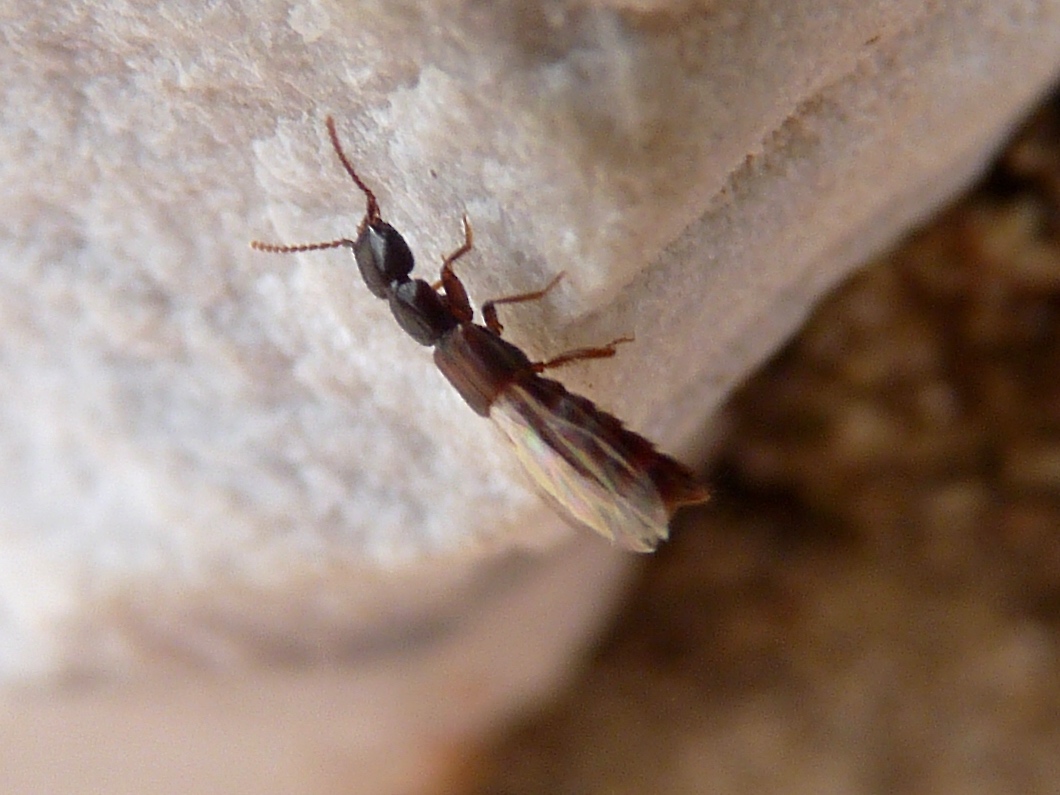
The wing covers of rove beetles are very short and cover only about one third of the abdomen. The membranous hind wings, on the other hand, extend to the end of the abdomen.
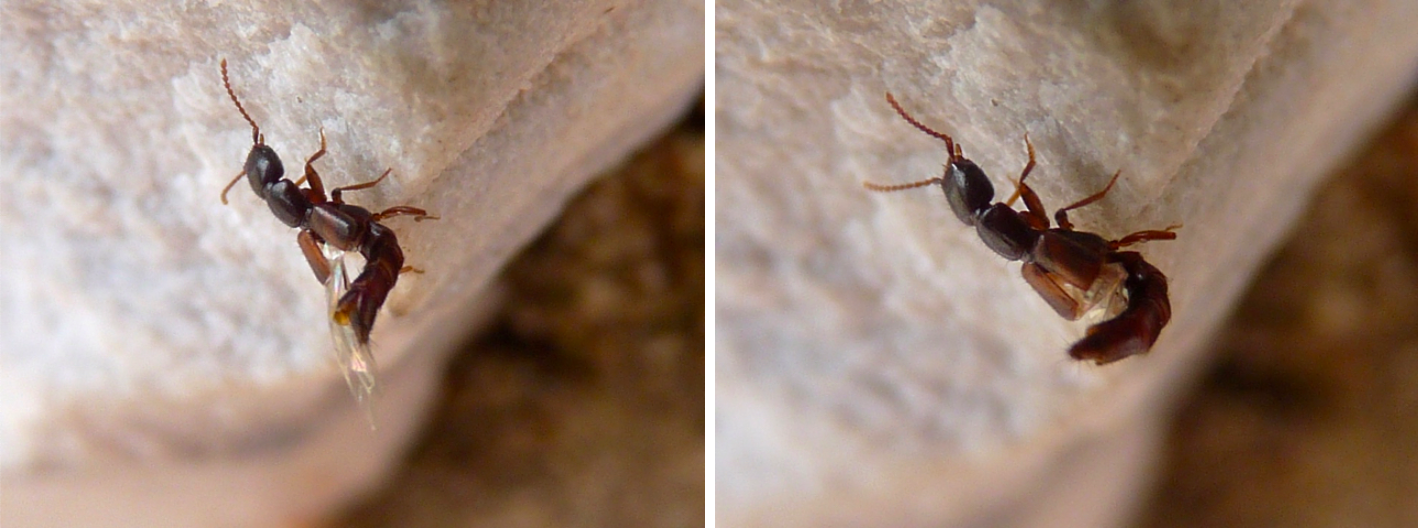
When the rove beetle is not using its wings, it carries them folded under its wing covers. To fold the wings, it uses its mobile abdomen, which it curves upwards to push the wings together.
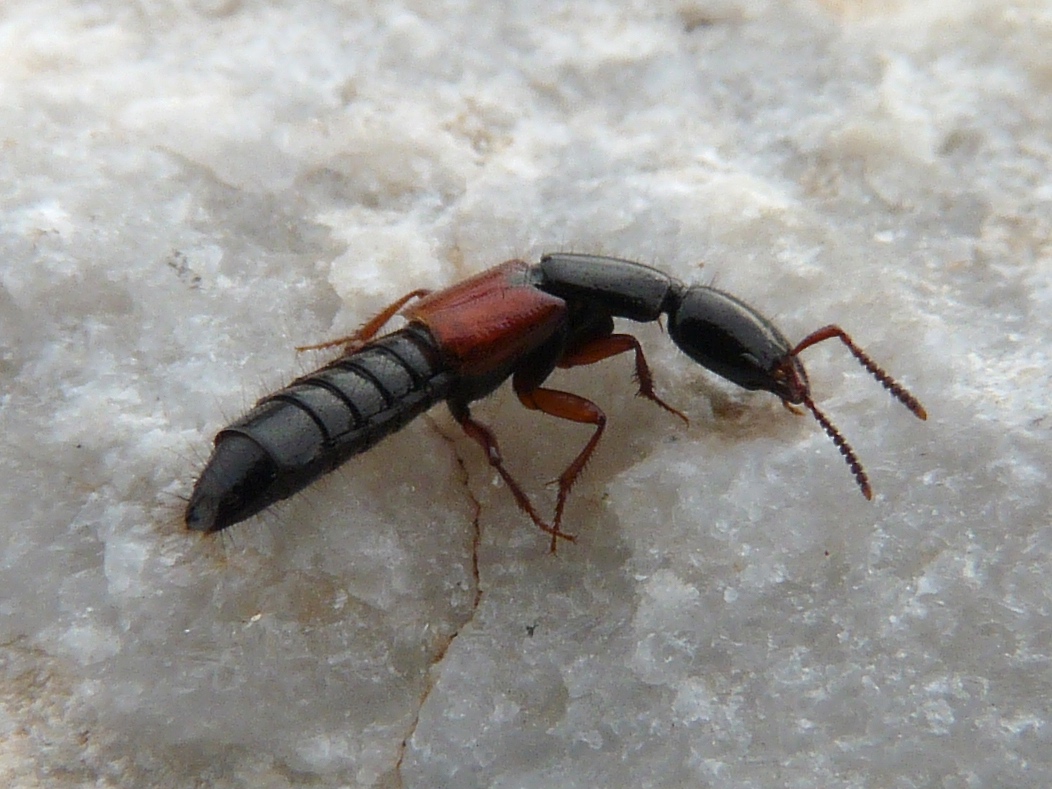
This rove beetle is considerably larger, measuring more than a centimeter. It is shiny black with red-brown wing covers. It might be for example the species Ocypus fulvipennis.
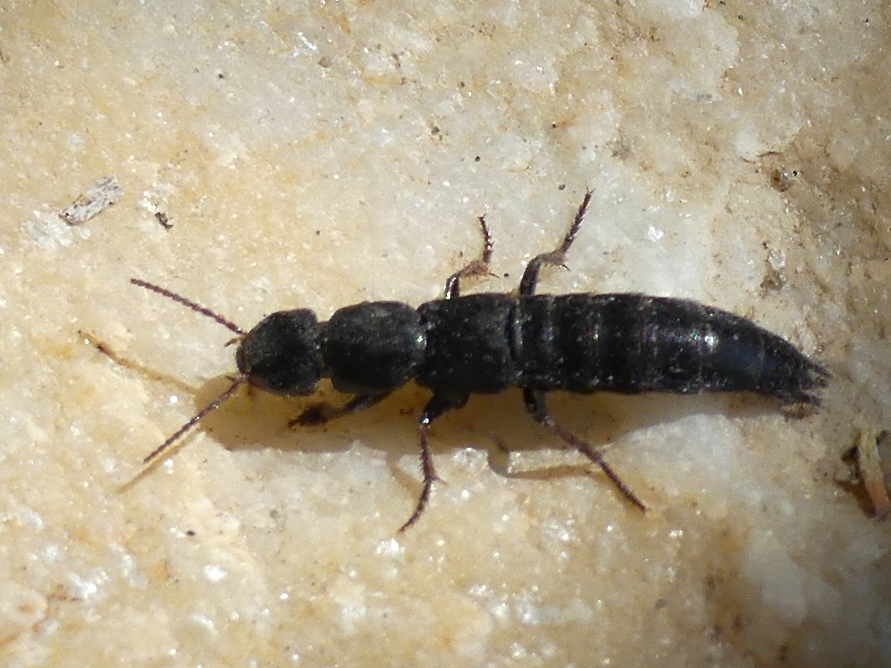
This even larger rove beetle also belongs to the genus Ocypus. There are numerous very similar species; identification is not possible from a photo.
Whirligig beetles, Gyrinidae
The whirligig beetles belong to the beetles that have adapted to an aquatic life. They live permanently on the surface of stagnant or slow-moving waters and swim incessantly, whirling and circling, using a fast, very effective swimming motion of their short, broadened middle and rear legs. The longer front legs are used to grasp prey. Whirligig beetles feed mainly on small animals that have fallen into the water, which they locate with the help of their short antennae, which register the slightest movements of the water. Whirligig beetles increase their buoyancy with an air bubble that they carry under their wing covers. Another air bubble, which is used to take in air for breathing, sits at the end of the body. They have two-part eyes, the upper half of which is used for seeing above the water surface, while the lower half is used for seeing underwater; the ommatidia (individual eyes) of this half of the eye are specially adapted for underwater vision. Whirligig beetles are good flyers, which enables them to seek out a new habitat if the pond they live in dries up.
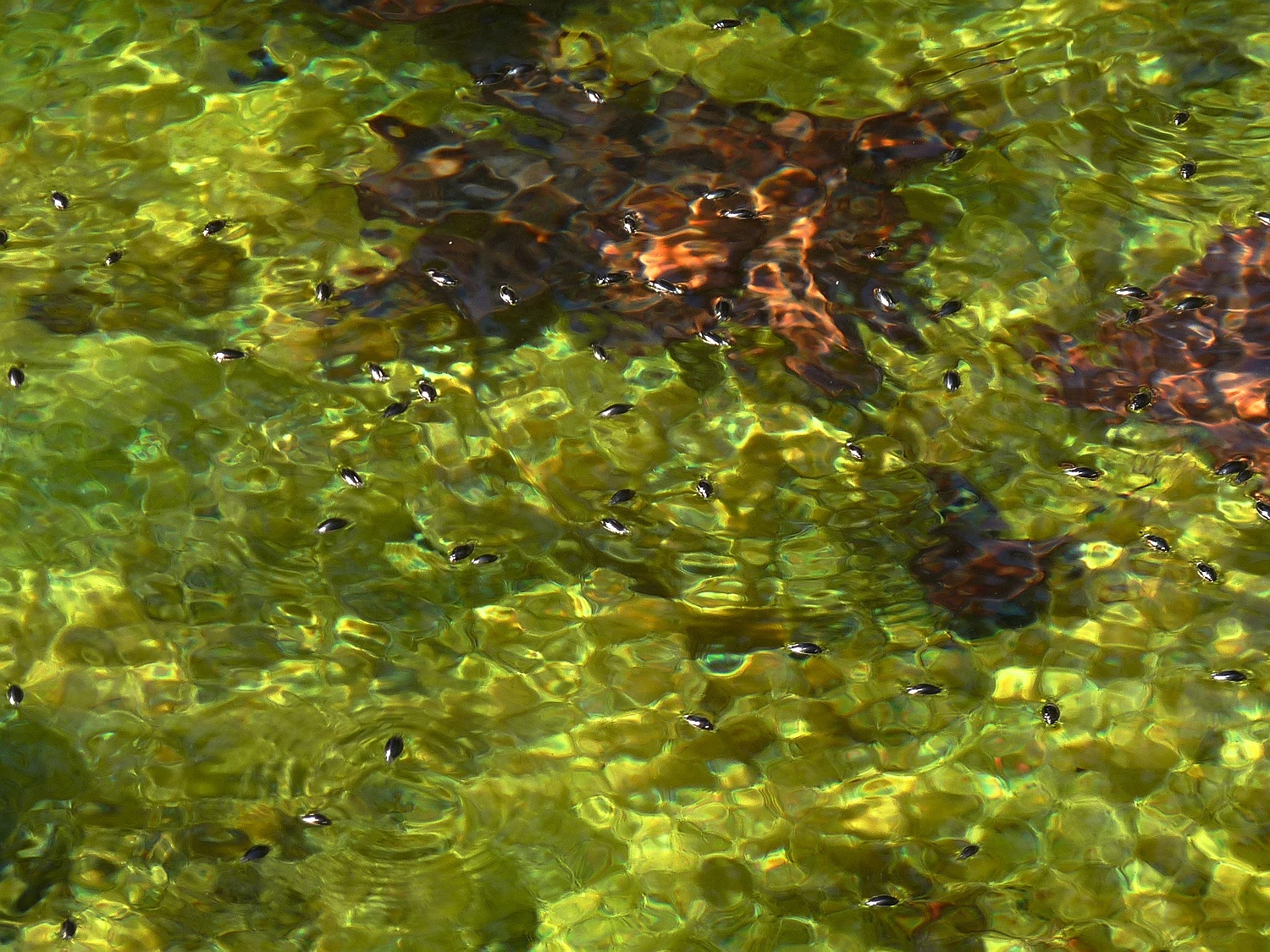
The small, black whirligig beetles are found in slow flowing parts of the rivers of Naxos. They glide incessantly across the water’s surface in ‘whirling’ movements.
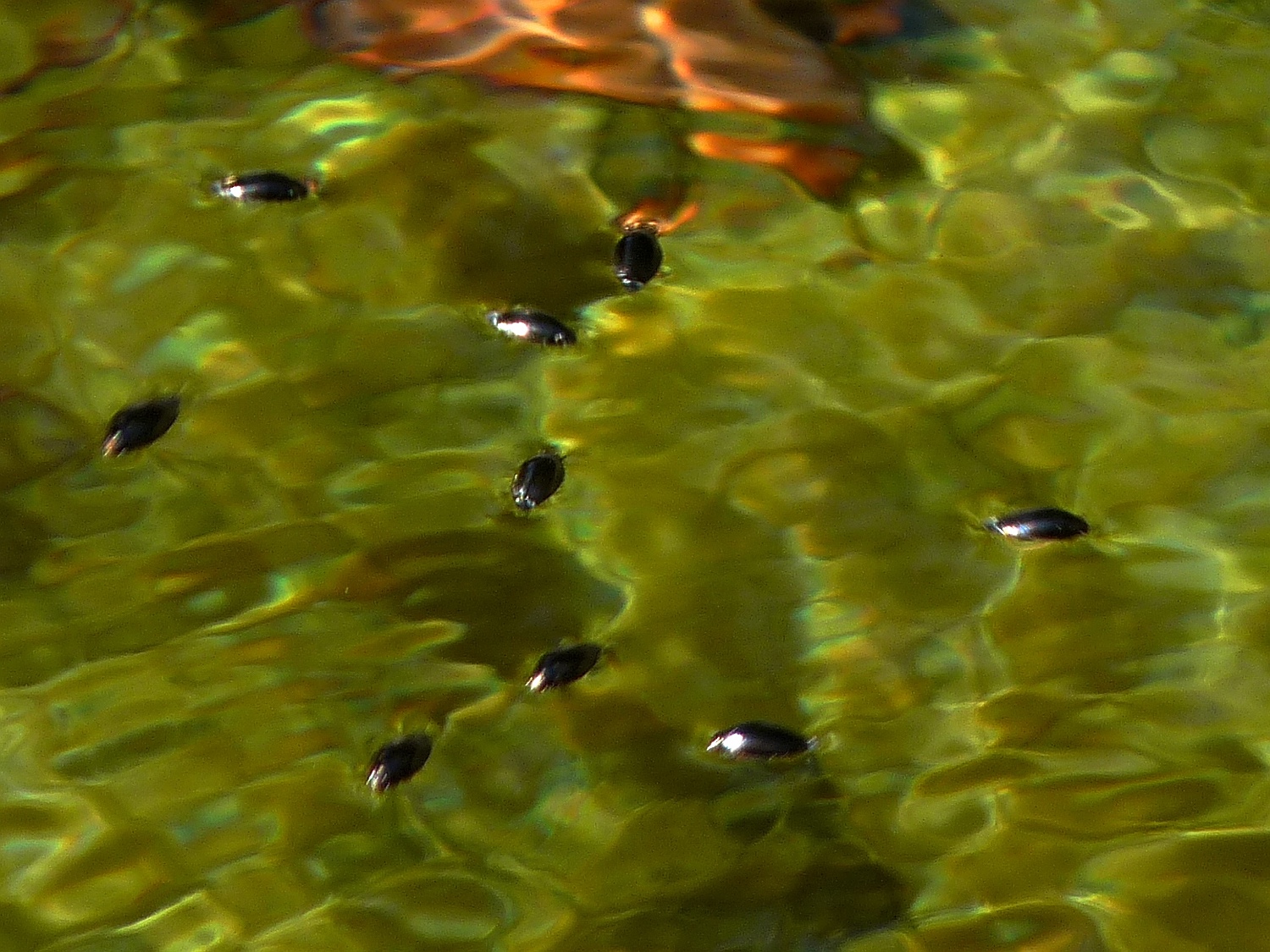
19 species of whirligig beetles occur in Europe, all of them difficult to distinguish. This is probably a species of the genus Gyrinus.
Fireflies, Lampyridae
Fireflies, known also as glowworms, have the ability to produce and emit light through bioluminescence. In most species, it is mainly the females that glow; males and larvae often show only a weak glow. The light signals serve to attract mates and are species-specific. While the three species found in central Europe glow continuously – in some cases while the males are flying – at least two of the species found on Naxos emit intermittent light signals. Fireflies are quite common in our region and can easily be observed on warm early summer nights in most years; it is also not uncommon to encounter these insects during the day.
An interesting feature of many species of fireflies is their pronounced sexual dimorphism. While the males have a typical beetle shape, the females of many species are very different in appearance: They have no wings or only greatly reduced wings, and their bodies show a uniform segmentation that makes them look more like larvae than adult beetles. While adult fireflies eat little or nothing, the larvae are predatory, preying mainly on snails. The females die shortly after laying their eggs. Most species are poisonous or taste very unpleasantly, so they have few natural enemies.
Light production in fireflies (as in some other groups of animals with bioluminescence) occurs with the help of the enzyme luciferase, which oxidises a special protein, luciferin, using oxygen and ATP, releasing energy that is emitted as light to an astonishingly high degree. In fireflies, the chitin layer on the lower part of the abdomen is translucent, so that the glow is clearly visible.
Italian firefly, Luciola italica, L.
The Italian firefly is very small, with a body length of only about 5 mm. The species of this genus, which occur mainly in Asia, are characterised by their light emission, which consists of flashes emitted approximately every second. The females do not look like larvae, but resemble the males, although they are unable to fly. Both males and females emit light signals. The males may also glow in flight. The Italian firefly is native to south-eastern Europe.
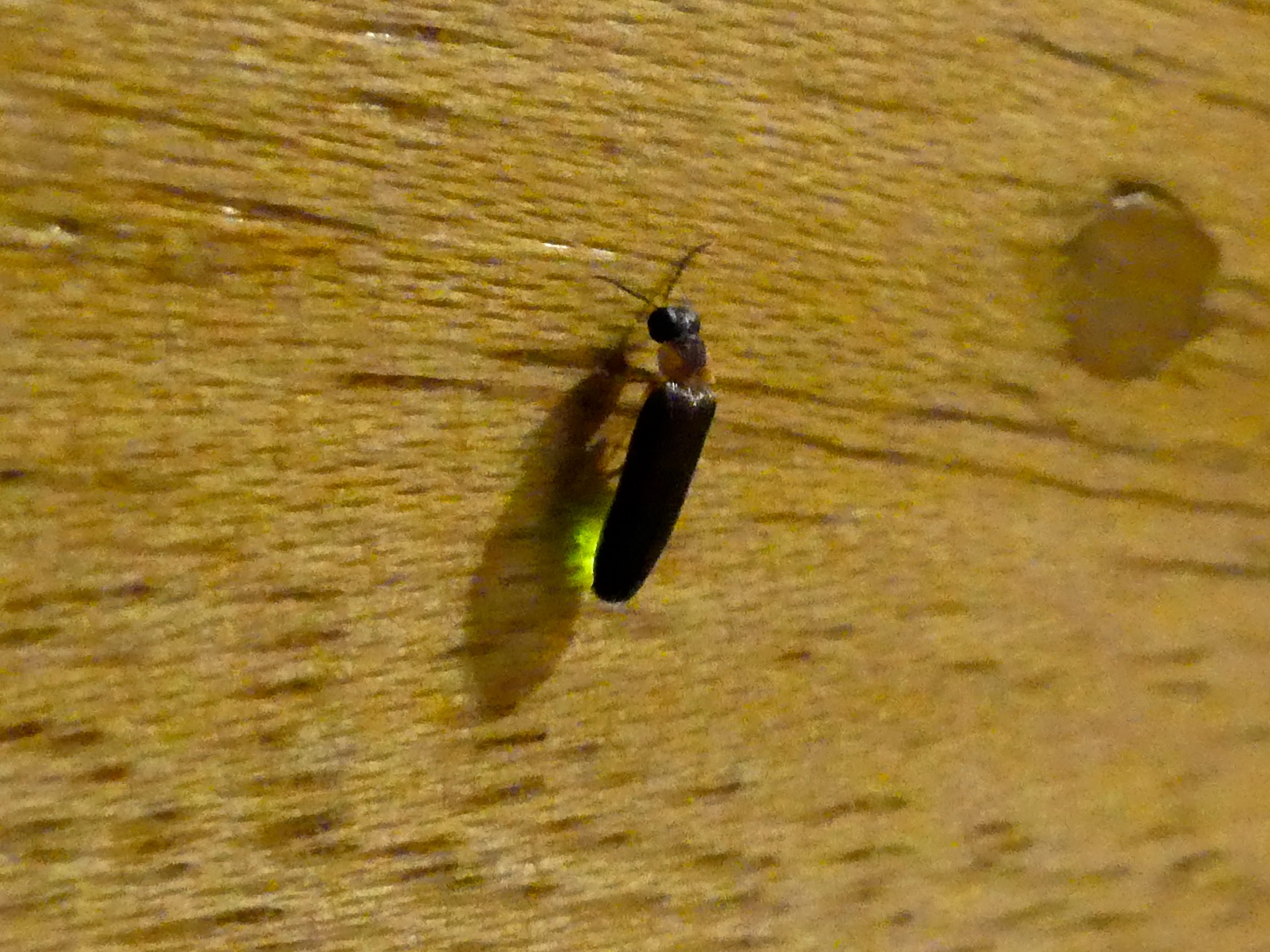
The Italian firefly is very small, with a body length of only about 5 mm. In the first warmer nights in spring, the flashing beetles may be seen sitting here and there on the walls in our garden. The light is produced in the rear segments of the abdomen.
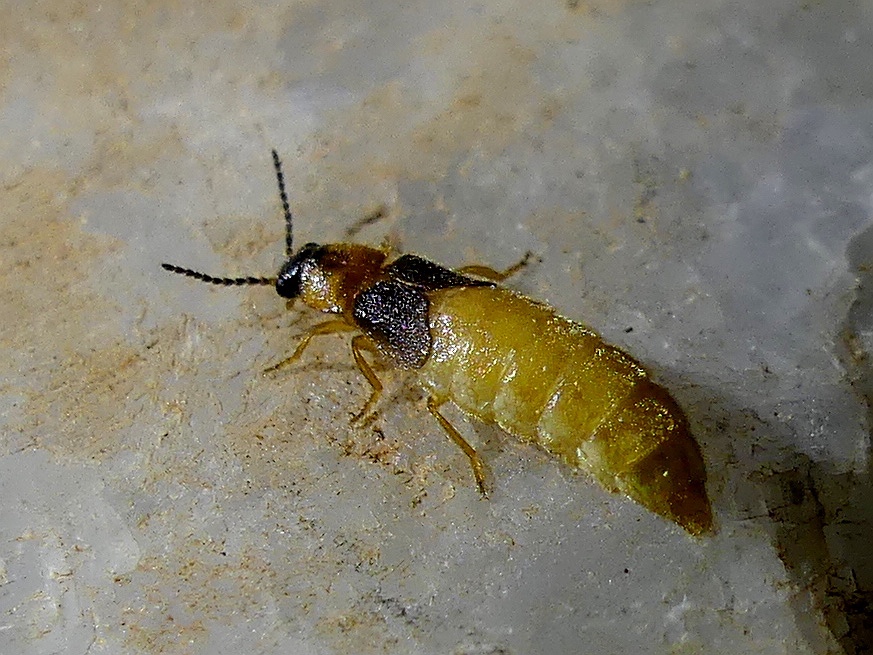
Here we probably have a larval stage of the Italian firefly, which does not yet have wings and whose entire abdomen glows.
Nyctophila colorata ?, Geisthardt
The genus Nyctophila, which belongs to the firefly family, comprises about 20 species. Our specimens on Naxos could be Nyctophila colorata.
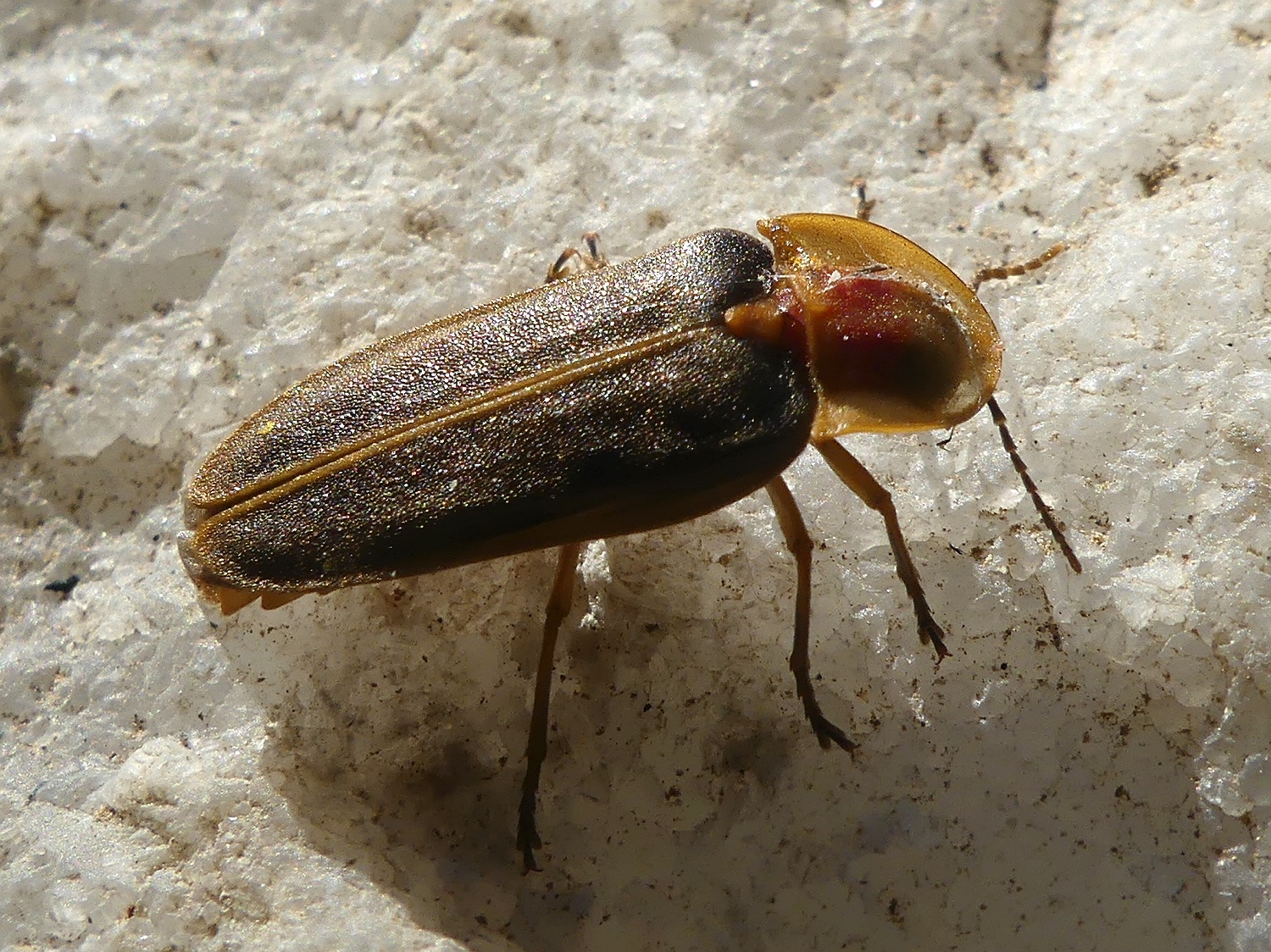
The colouring and shape of the pronotum and wing covers of this male firefly suggest that it is Nyctophila colorata, which occurs in the Cyclades. The males are quite large, measuring around 2 cm. So far, I have seen males of this species only during the day.
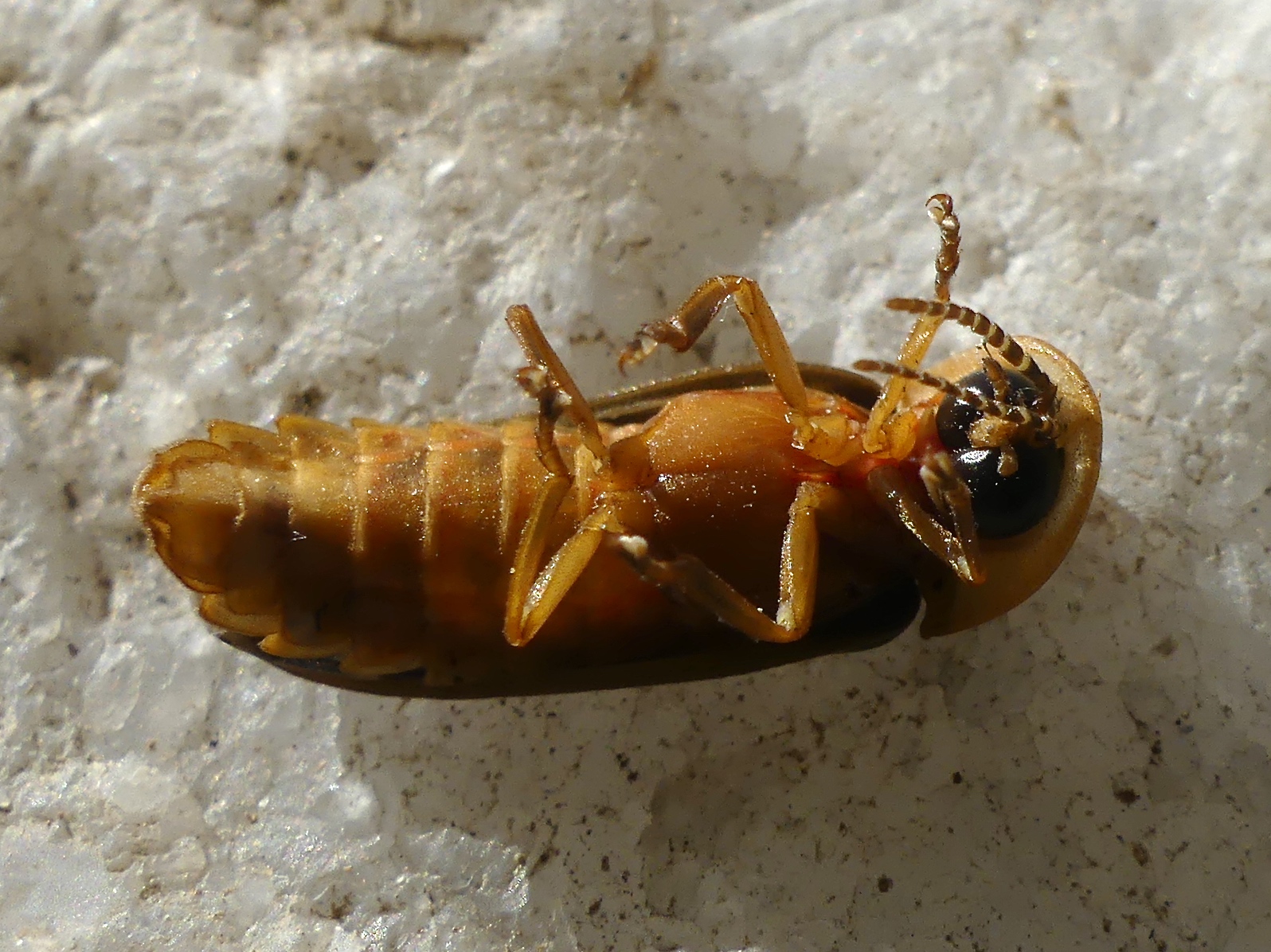
Here the same specimen from below.
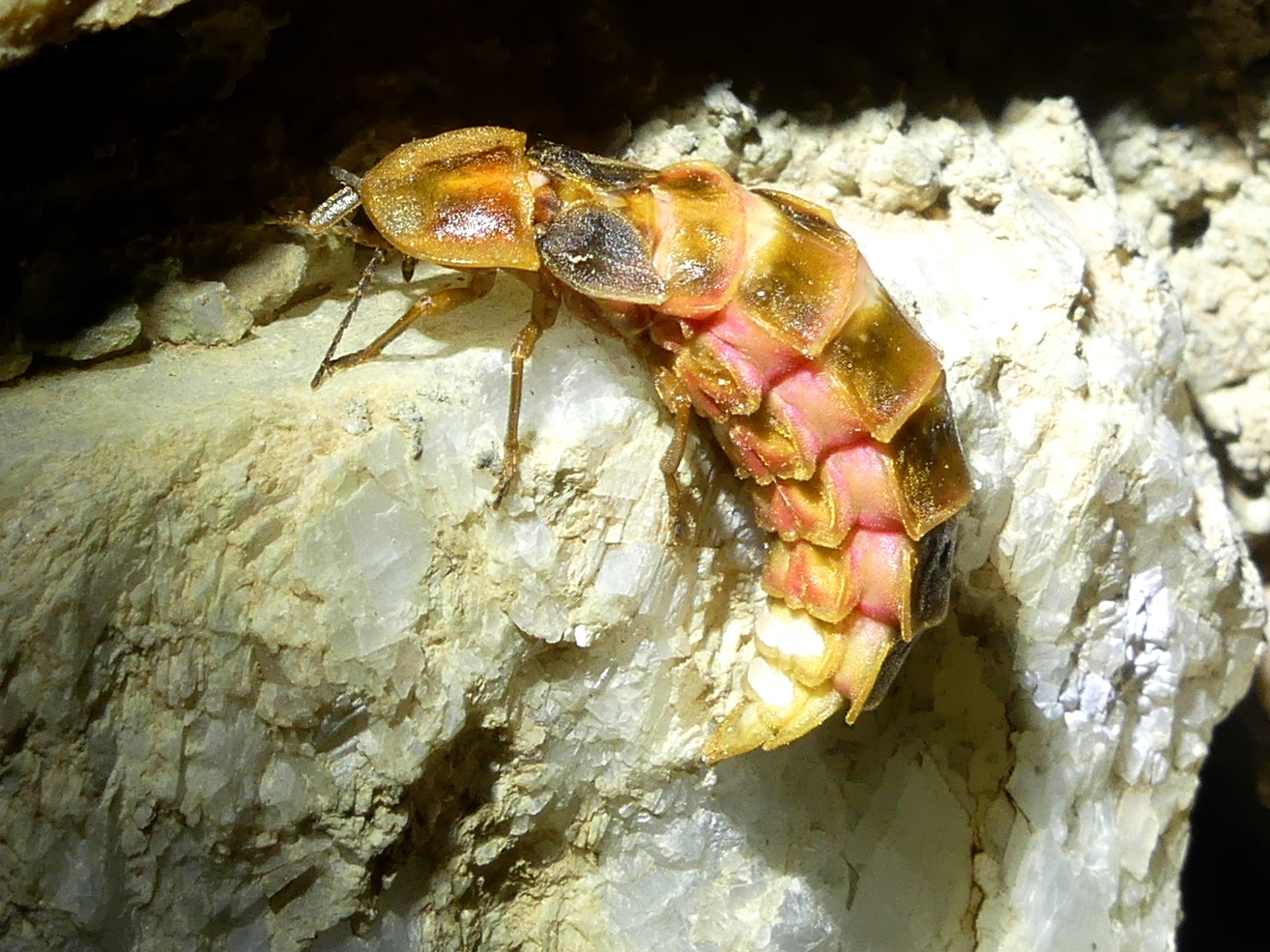
In many species of fireflies, the females look almost like larvae: their body has only a short thorax and a long segmented abdomen. They have no wings or the wings are very small and rudimentary. They can be distinguished from the larvae primarily by their large pronotum (neck shield).
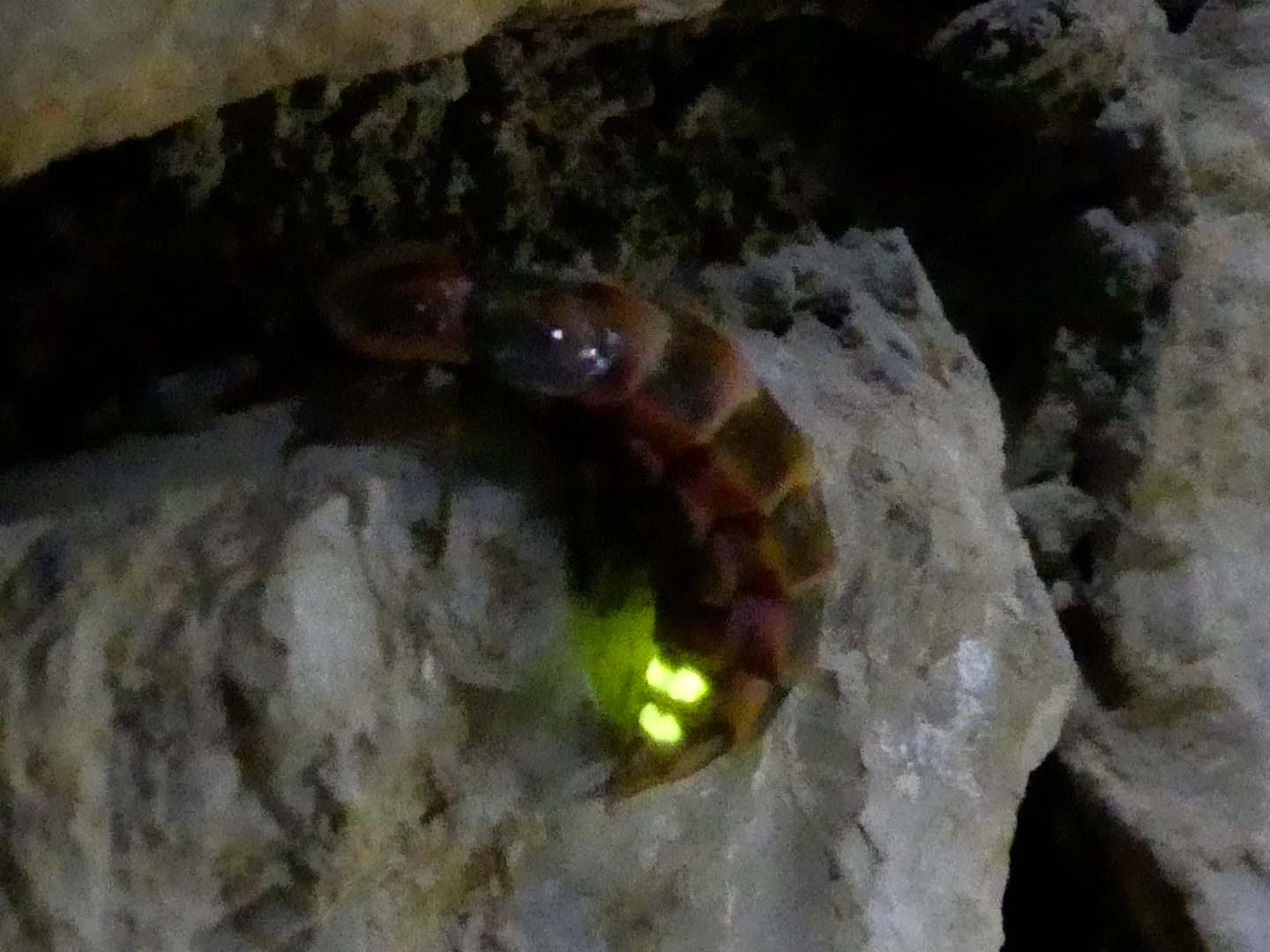
Members of the genus Nyctophila differ from the similar Common glowworm (Lampyris noctiluca) in that the females have only small, reduced wings.
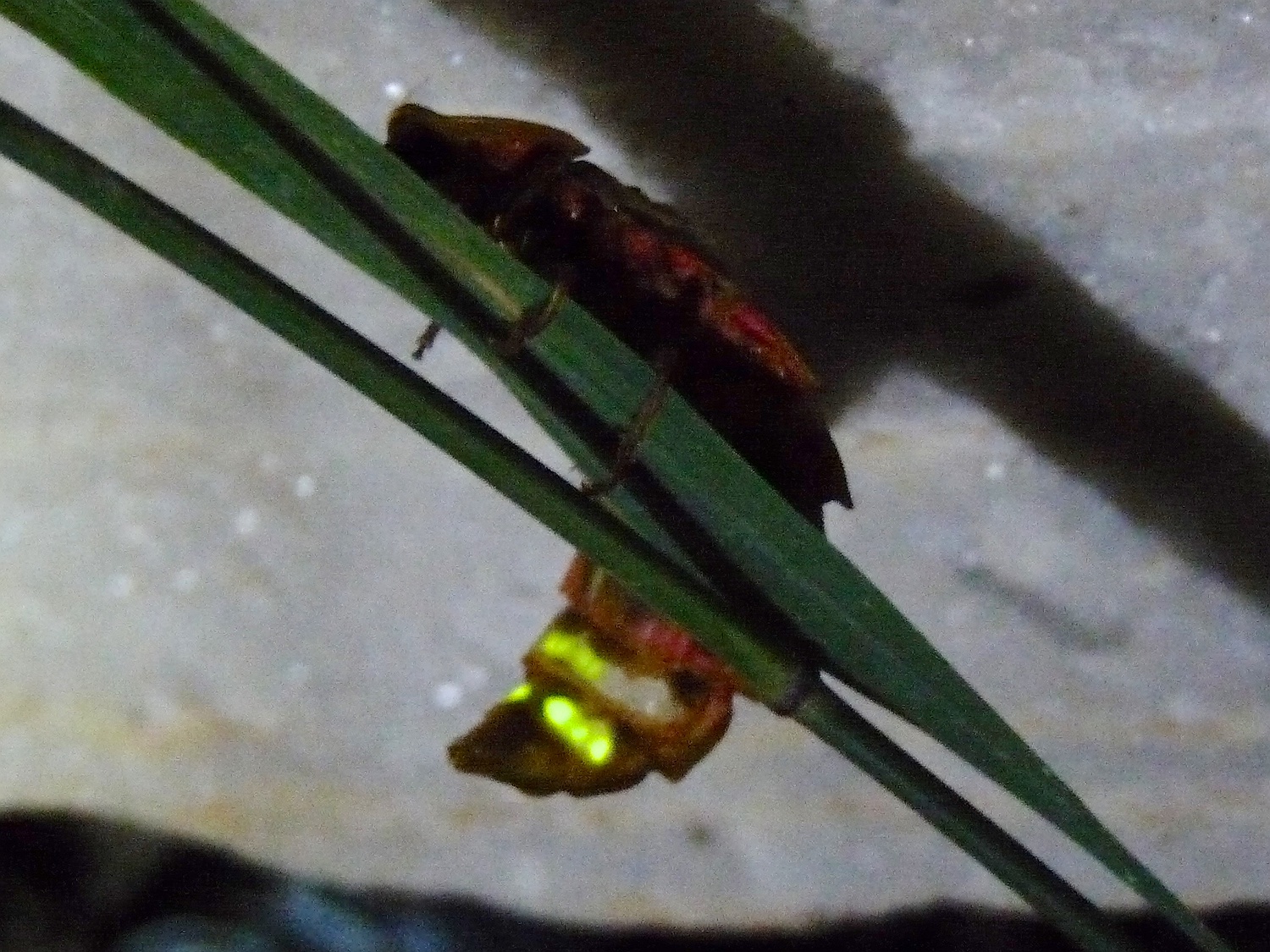
Here you can see the segments of the abdomen that emit the light. The female is holding the abdomen in such a way that the “glowing” underside is visible. Unlike the Italian firefly, this species glows continuously rather than flashing.
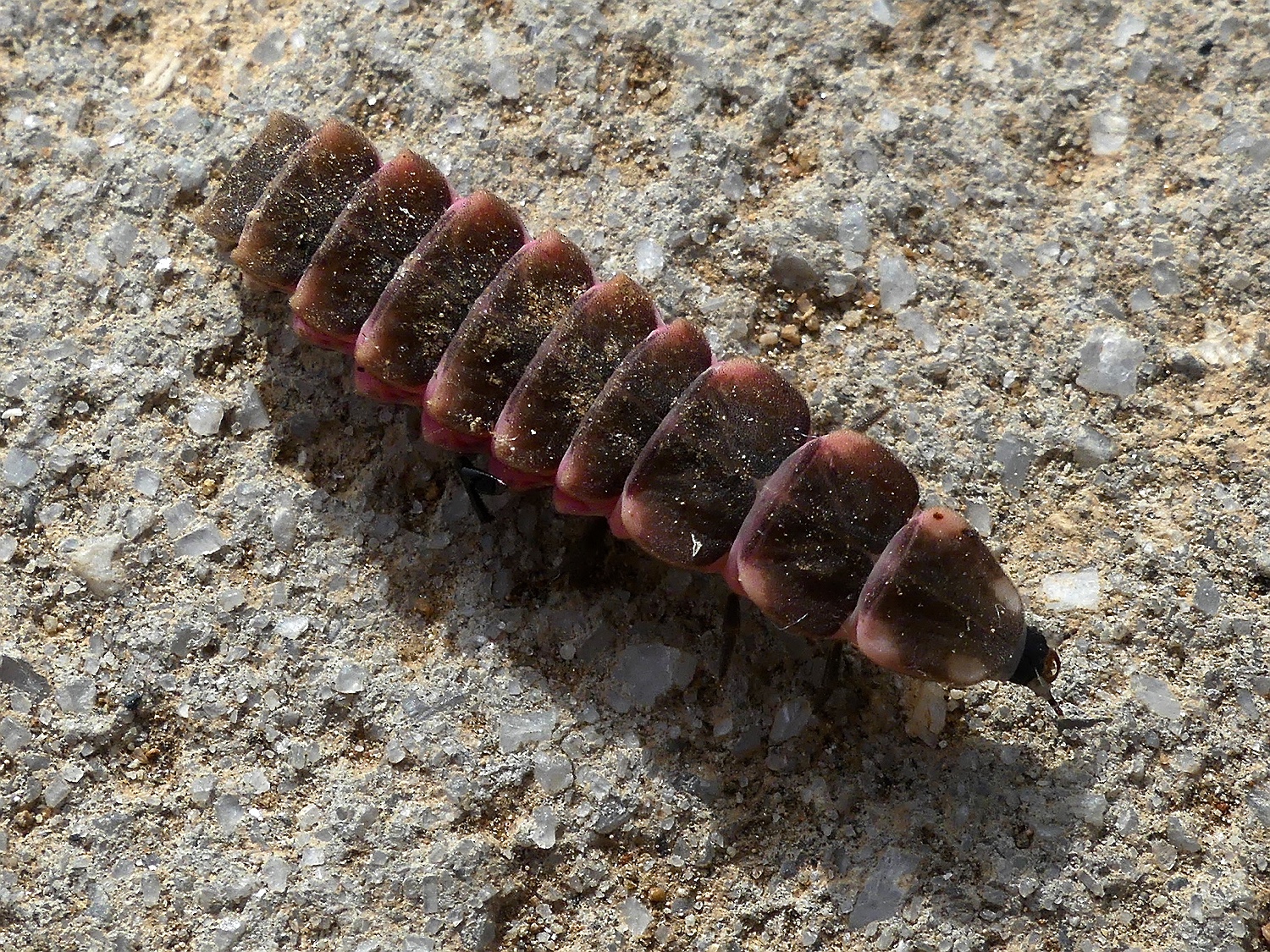
Here a larva of Nyctophila colorata. It differs from the females in its narrow head and small neck shield.
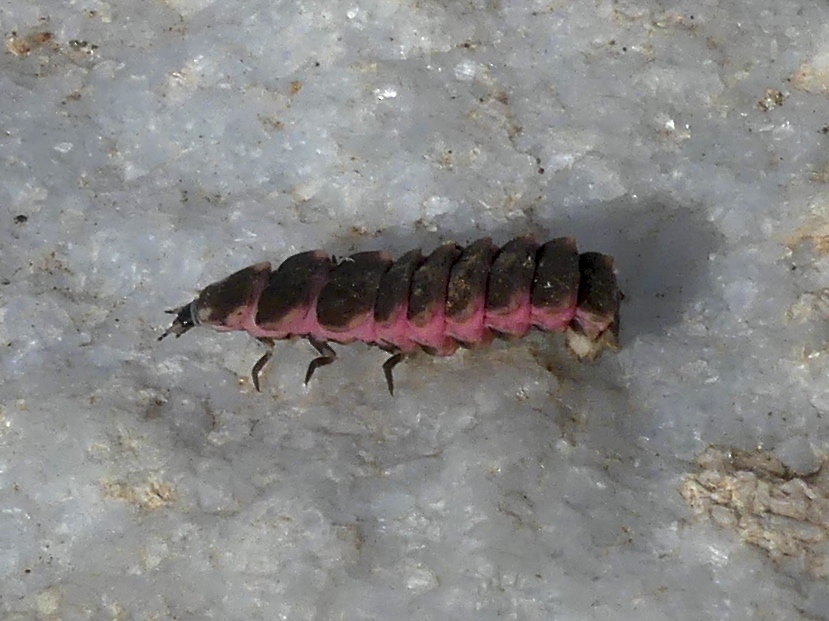
When walking, the larva pushes itself forward with its abdomen by bending it forward and then stretching it out again.
Soft-winged flower beetles, Melyridae
The family of the Soft-winged flower beetles is mainly found in tropical regions. Today, the members of the family formerly known as Malachiidae are also classified as Melyridae. They are predominantly soft, elongated species with a body length of up to 1 cm.
Scarlet malachite beetle, Malachius aeneus ?, L.
The Scarlet malachite beetle belongs to the genus Malachius whose name is derived from the Greek malakó (soft) and refers to its only slightly sclerotised exoskeleton. Like many species of the genus, the Scarlet malachite beetle has a simple, rather elongated body shape and thin antennae. Its colouring is quite variable, with a blue-green body colour and red wing covers.
The larvae of malachite beetles are omnivorous, i.e. they eat both plant and animal material. Because they prey on aphids and larvae of other pests, this species is useful to gardeners and farmers. The adult beetles also prey on other insects to some extent, but feed mainly on grass pollen. The Scarlet malachite beetle is widespread in Europe and Asia and has also been introduced to North America.
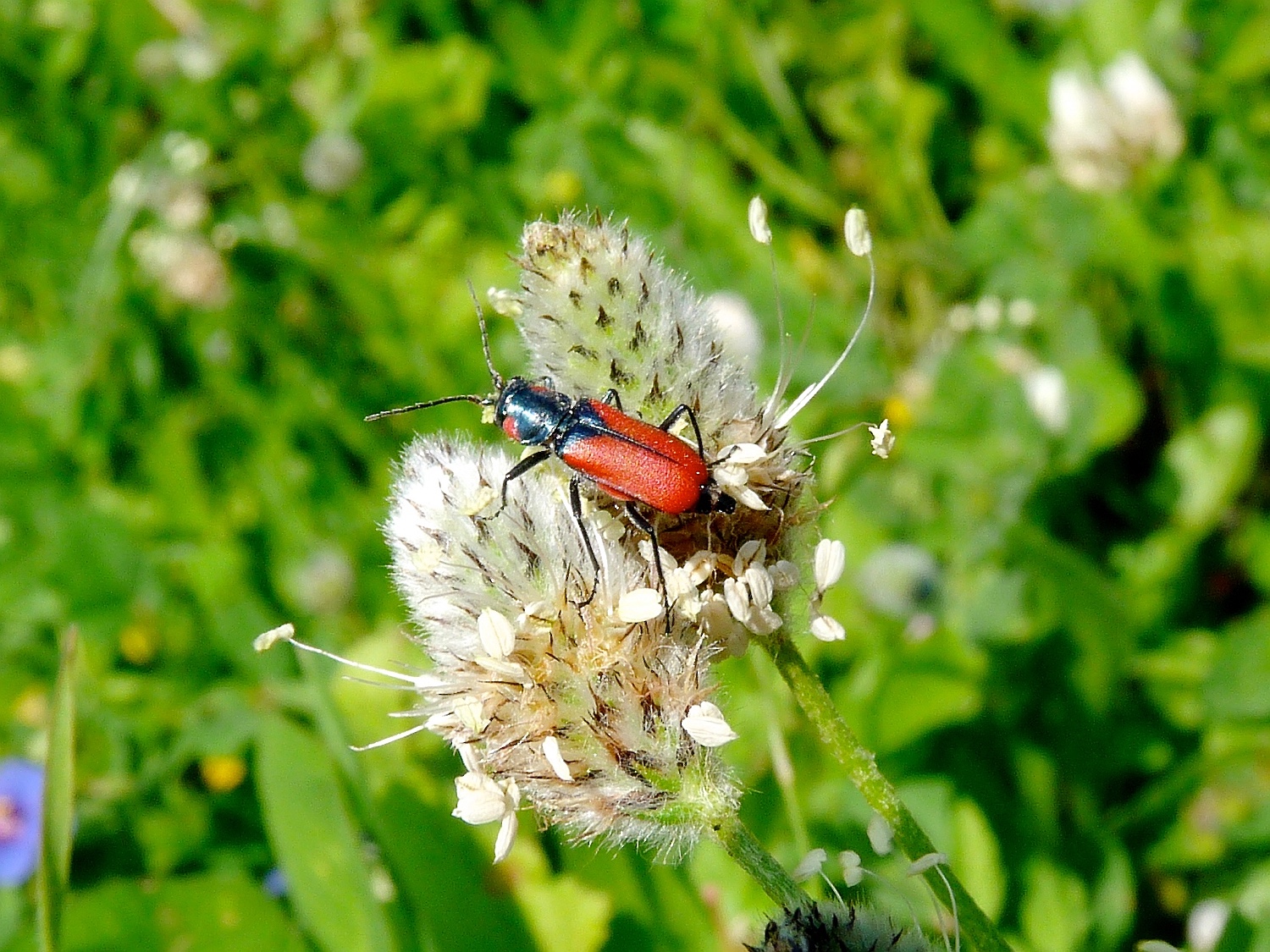
This is the Scarlet malachite beetle or a related species.
Malachite beetle, Malachius bipustulatus, L.
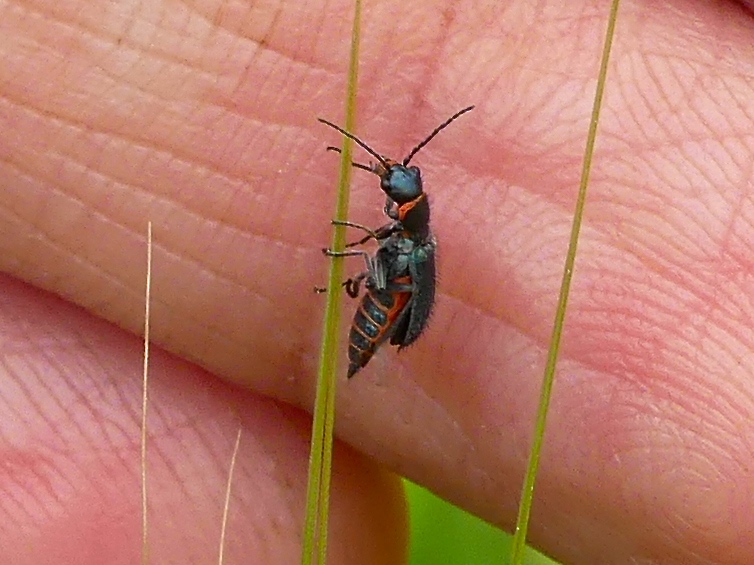
The Malachite beetle is almost blue-black in colour with red sides and a little red on the neck.
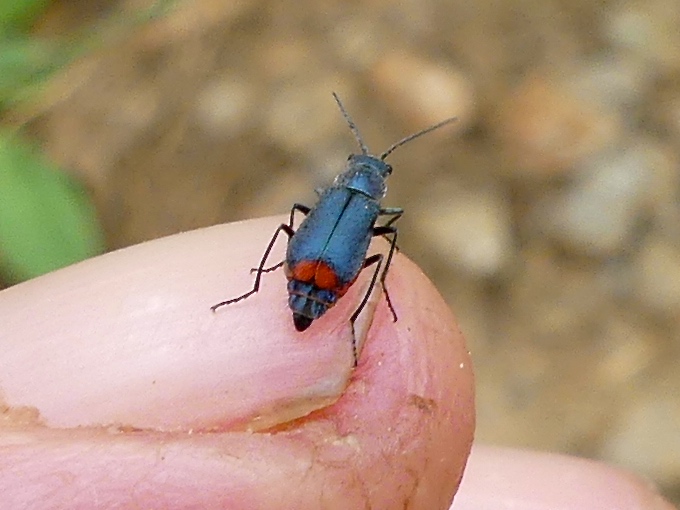
The red tips of the wing covers are characteristic of this species.
Psilothrix viridicoerulea, Geoffroy
This pretty little beetle with its intense metallic green colouring is about 6 mm long. It is often found on flowers. The species is widespread in Europe and the Middle East. The larvae first feed on dead insects, then on plant stems.
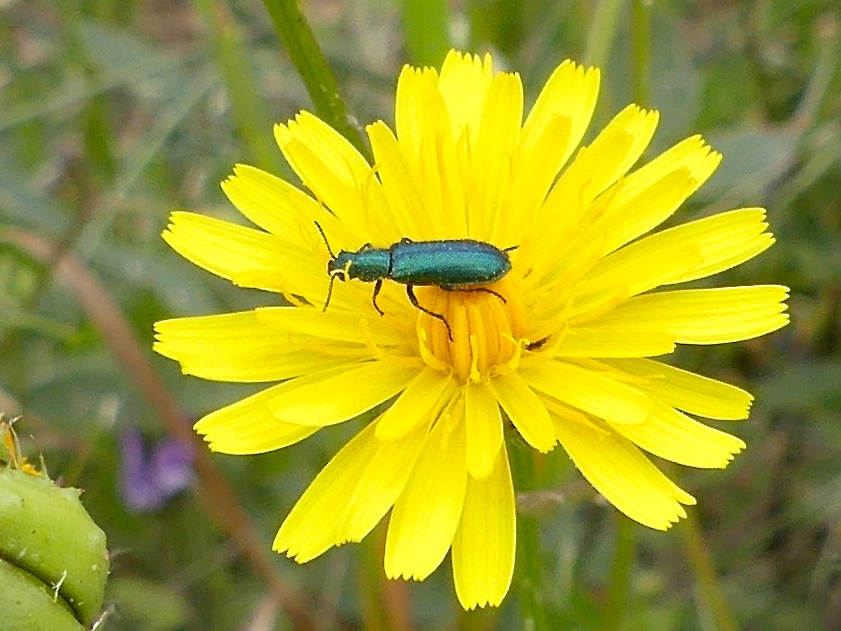
Psilothrix viridicoerulea is very thin and elongated and has a pretty metallic green colour.
Jewel beetles, Buprestidae
The jewel beetles are mainly found in the tropics. They are mostly colourful species, often with a metallic shimmer. They usually have large eyes; their head is mostly covered by the neck shield. Many species contain the toxic substance buprestin in their haemolymph as protection against predators.
Anthaxia spec.
The jewel beetles of the genus Anthaxia are quite small and compact in shape. They are predominantly greenish or bronze to purple in colour. The adult beetles can be found in summer on flowers, where they feed on pollen and petals. The larvae usually live in wood or other parts of plants.
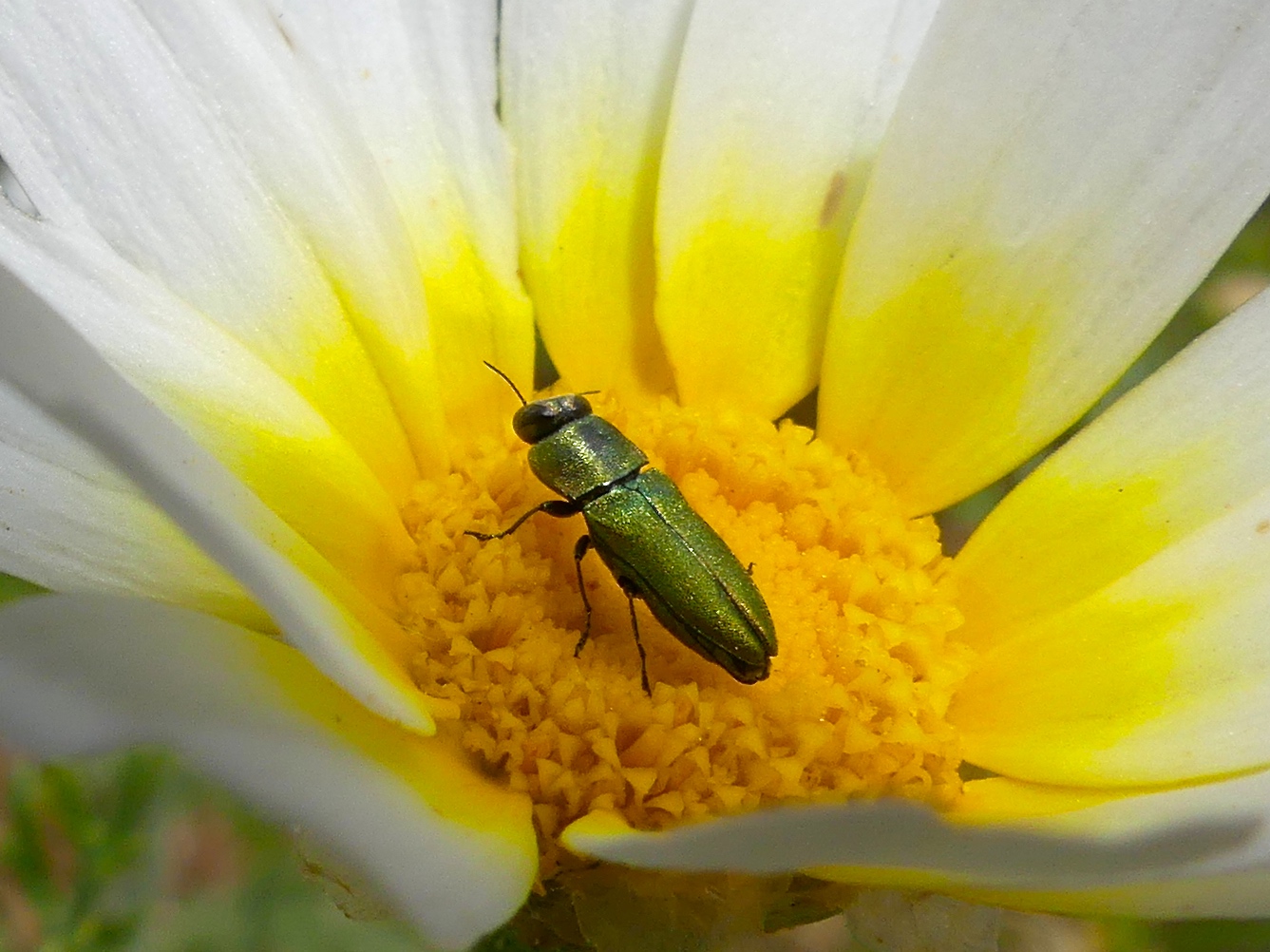
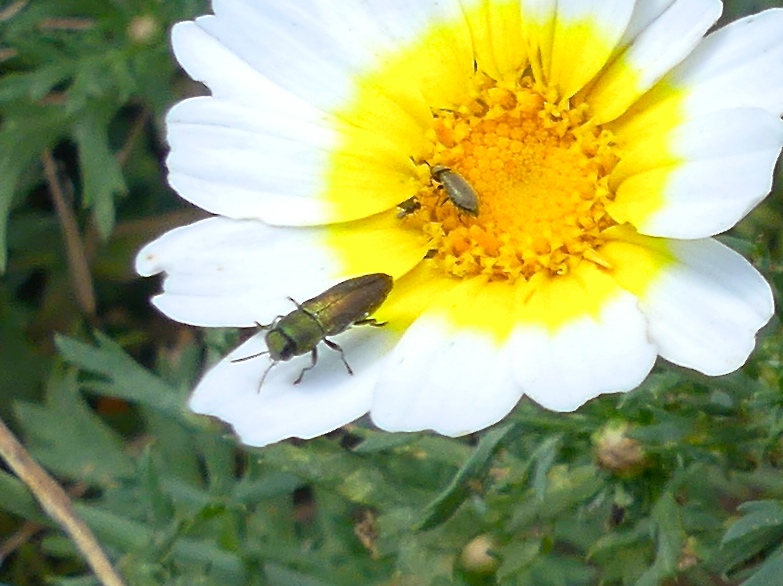
The pretty jewel beetles (genus Anthaxia) can be recognised by their characteristic compact body shape and their mostly greenish or bronze metallic colour.
Ladybirds, Coccinellidae
Ladybirds are probably the best-known beetles in our part of the world and are among the most familiar insects in general. The family Coccinellidae comprises over 6,000 species, around 250 of which occur in Europe. The greatest diversity of species is found in the tropics. All ladybirds are rather small and spherical to oval in shape with a strongly domed upper side. Their short antennae are slightly club-shaped at the end. The head and underside are usually black in colour, while the wing covers are often strikingly colourful, mostly red or yellow. The neck shield is either black or the same colour as the wing covers. Many species carry between 2 and 24 spots that may be black, coloured or white. The number and arrangement of the spots is more important for species identification than the colouring, which is very variable in some species.
Ladybirds are good flyers. They often occur in large numbers; some species of the temperate zones hibernate in dense clusters. Both adults and larvae are predatory. Their main food source are aphids and other plant pests. Over the course of its life, a ladybird consumes around 3,000 aphids. These beetles are therefore very useful in field and garden: they can completely eliminate aphid infestations. Nowadays, ladybirds are often used for biological pest control. Ladybirds are sensitive to chemical pesticides because they ingest them along with the aphids and accumulate them in their bodies.
Ladybirds themselves are eaten by birds, reptiles and larger insects. To defend themselves against their predators, they produce a toxin called coccinellin, which is poisonous to many animals and tastes bad. The striking colouring of ladybirds serves as a warning signal to potential predators. When in danger, ladybirds secrete the toxic and bitter substances as droplets from the joints of their legs.
Ladybirds have been popular with humans since ancient times. This is probably mainly due to their usefulness to gardeners and farmers, but perhaps also because of their pretty appearance. Their name indicates that these beetles were considered by farmers to be a gift from the Virgin Mary. In many cultures, ladybirds are considered to bring luck. The oldest known representation is a 20,000-year-old ladybird carved from mammoth ivory, which was found in France.
Seven-spot ladybird, Coccinella septempunctata, L.
The seven-spot ladybird is the most common and best-known species of ladybird. It has bright red wing covers with three black spots on each and an additional spot on the scutellum flanked by two white spots; the black pronotum and head also have two white spots each.
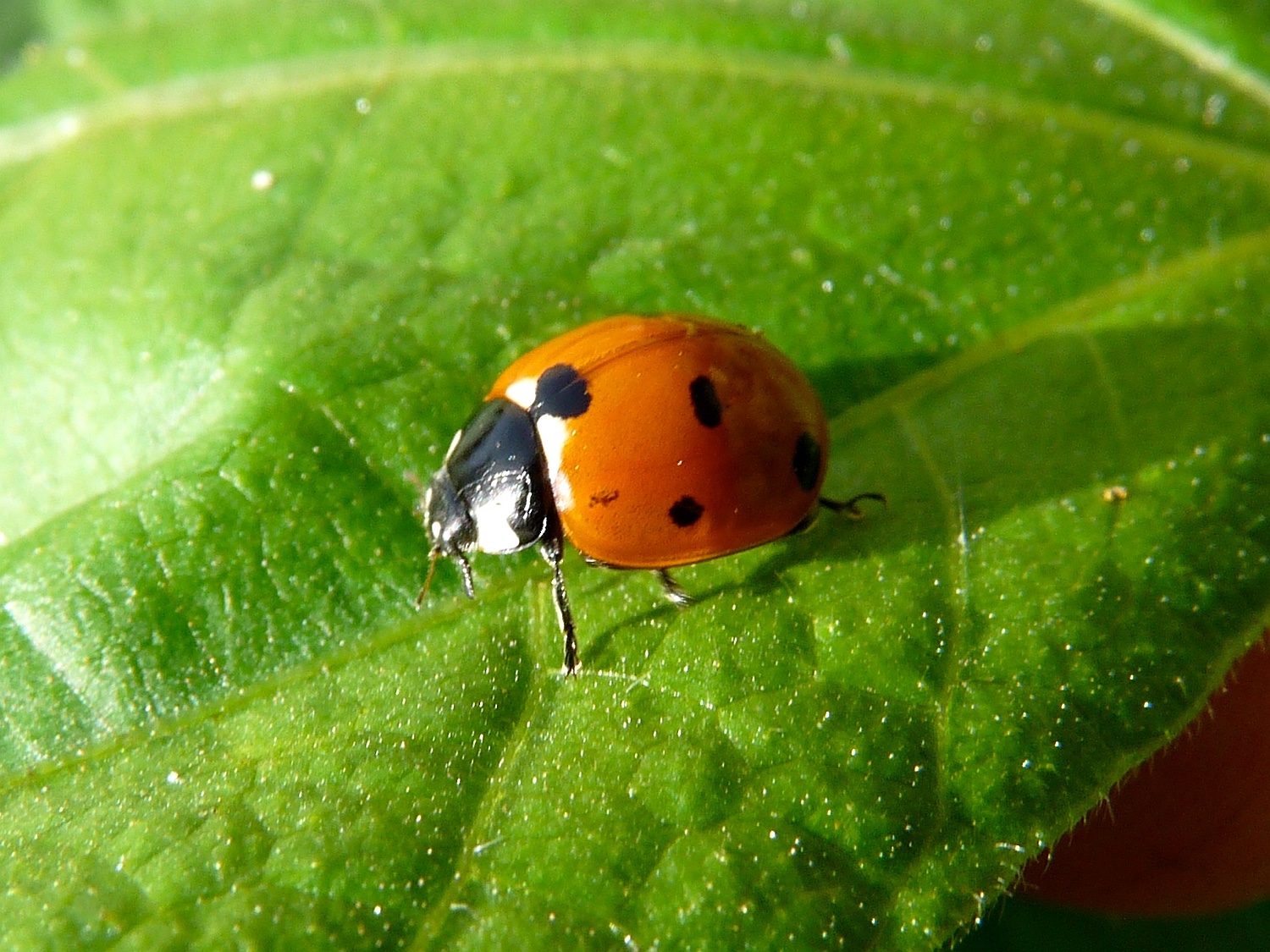
The seven-spot ladybird is the most common species of ladybird. It can be recognised by the seven black spots on its red wing covers.
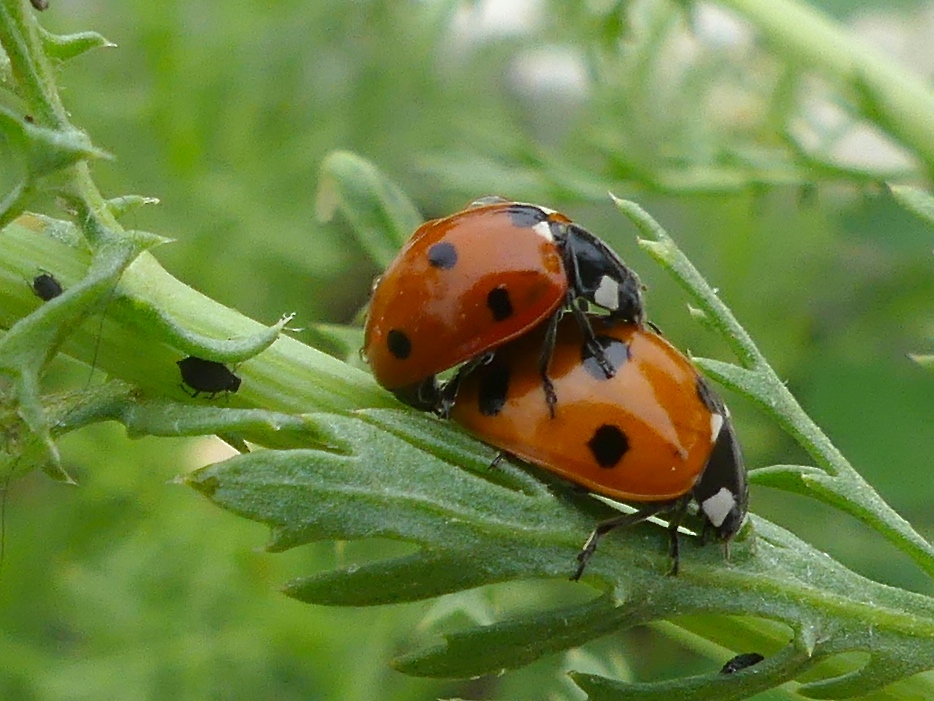
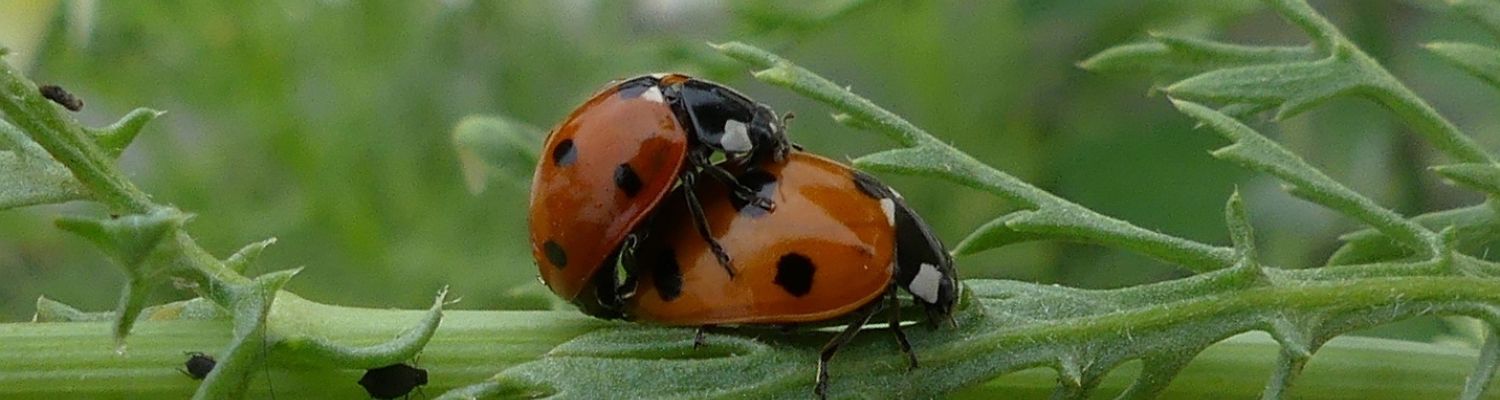
Seven-spot ladybirds mating
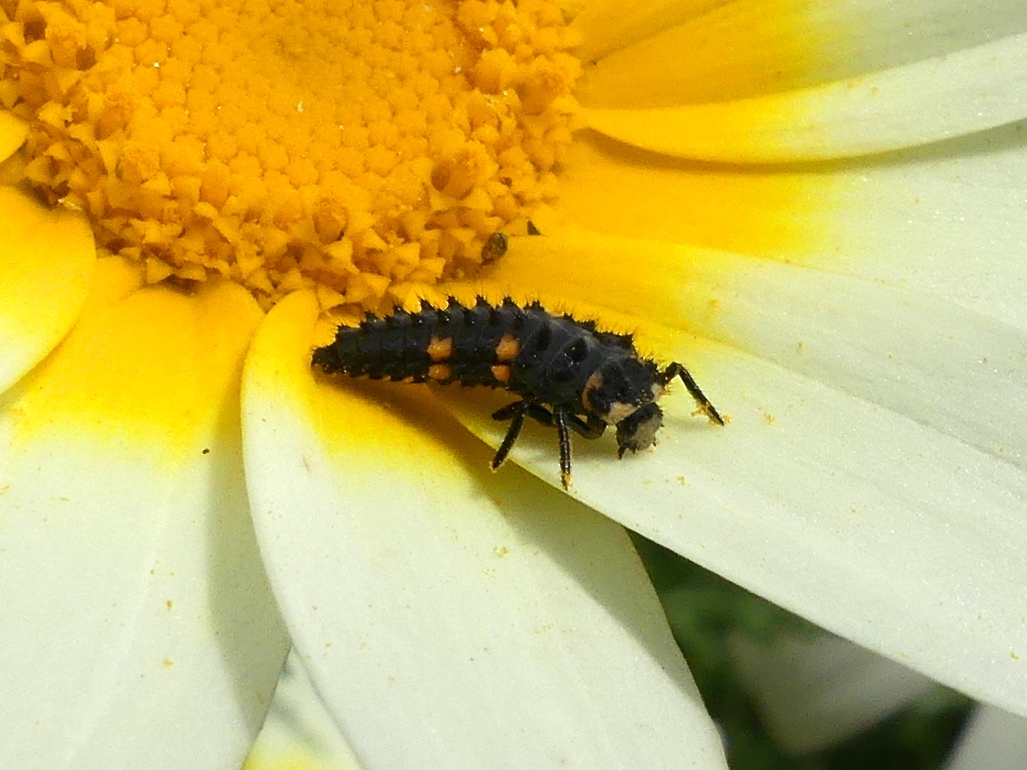
The larva of the seven-spot ladybird is black with small orange spots; its body carries numerous small bristle-bearing warts. The larva is very useful in the garden as it feeds on aphids, consuming up to 50 aphids per day.
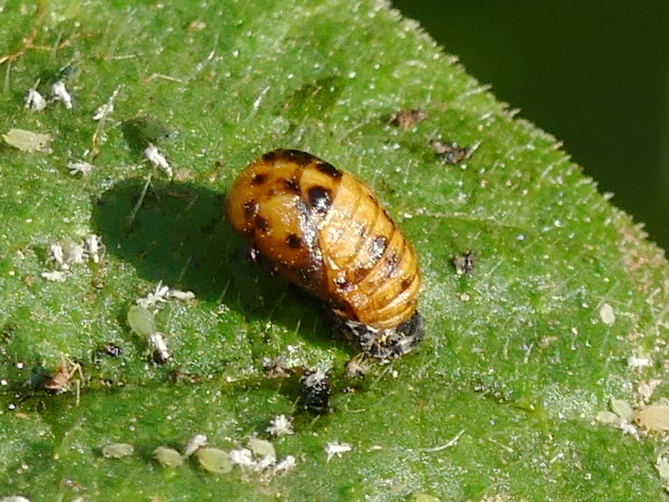
Here a pupa, in which the metamorphosis into an adult takes place in about 5 days.
Asian ladybird, Harmonia axyridis, Pallas
The Asian ladybird is native to Asia, but has been unintentionally introduced to many parts of the world, including Europe, or also been deliberately released for biological pest control. It is now so common in many places that it is displacing native ladybird species, partly because it is usually infected with a parasitic protozoan to which it itself is immune but which it can transmit to other ladybird species. The Asian ladybird reproduces very effectively: it takes only about three weeks from the time the eggs are laid to the metamorphosis into the adult.
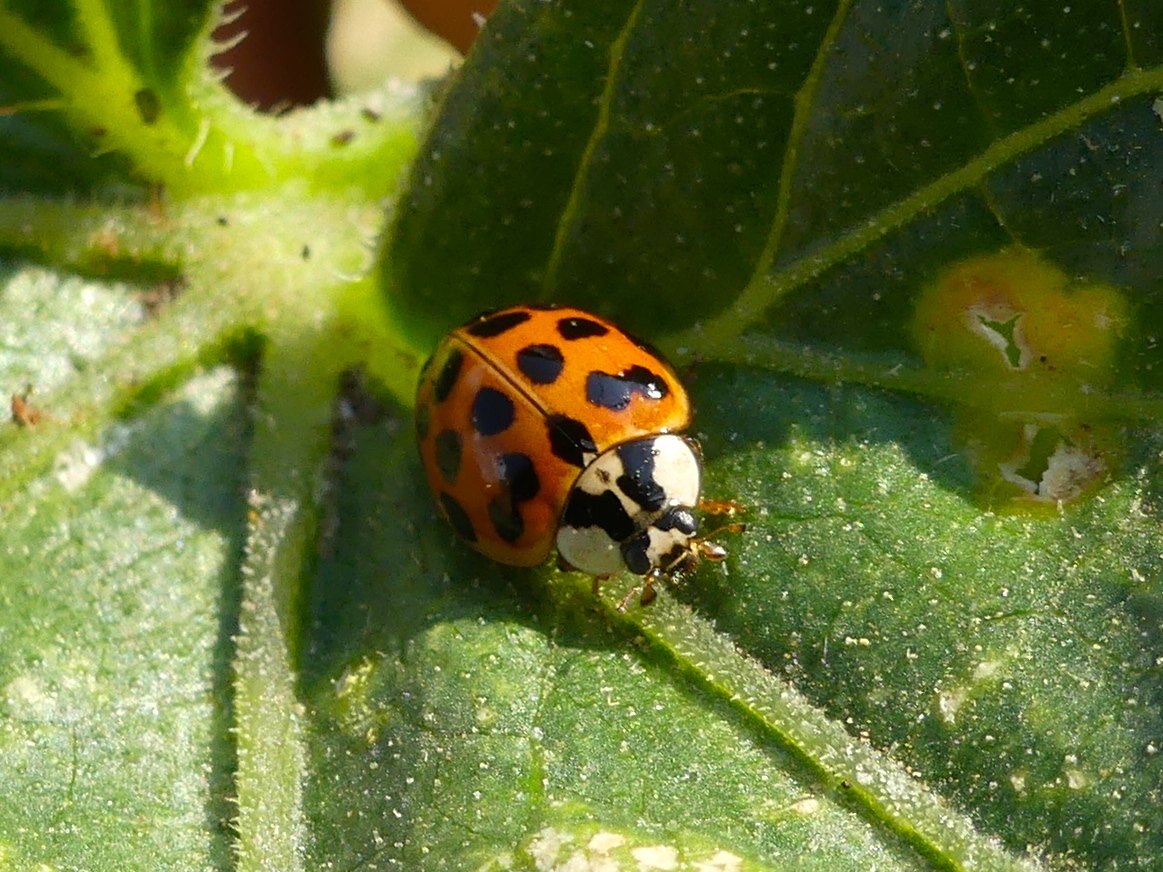
The Asian ladybird is an invasive species that has been introduced in many places for biological pest control. The colouring is variable; usually the wing covers carry many black spots. It is best recognised by the black and white markings on its neck shield. I found the Asian ladybird for the first time in 2022 in our area.
Adonis ladybird, Hippodamia variegata, Goeze
The Adonis ladybird is small and has an elongated and fairly flat shape. Usually, it shows only three black spots on each wing cover, all in the rear half. The markings on the neck shield are characteristic. Like other ladybird species, it feeds on aphids.
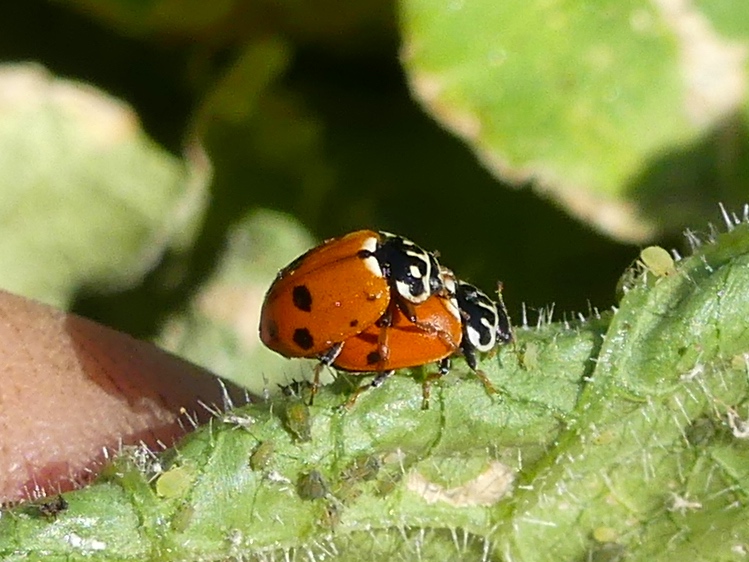
The Adonis ladybird has become more common in our region in recent years. It is easily recognisable by its elongated body shape and the characteristic pattern of the spots.
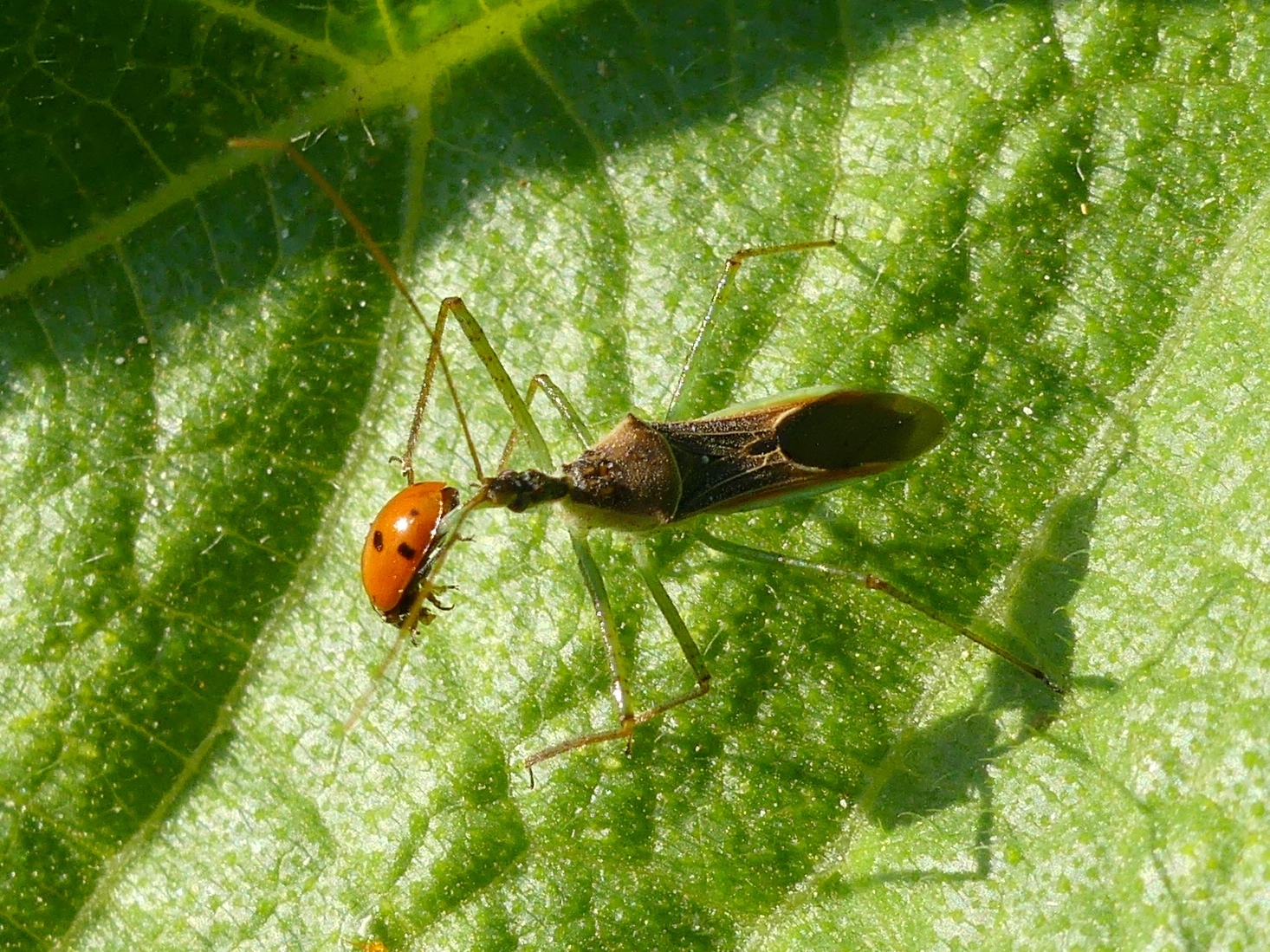
Here, an Adonis ladybird has fallen prey to a bug.
Twenty-two-spot ladybird, Psyllobora vigintiduopunctata, L.
The Twenty-two-spot ladybird is a fairly small ladybird with an intense yellow colour and black spots. It is almost hemispherical in shape. The larva is also yellowish with black spots. Adult beetles and larvae feed on mildew fungi and are therefore useful in the garden. This species is also quite common in our region.
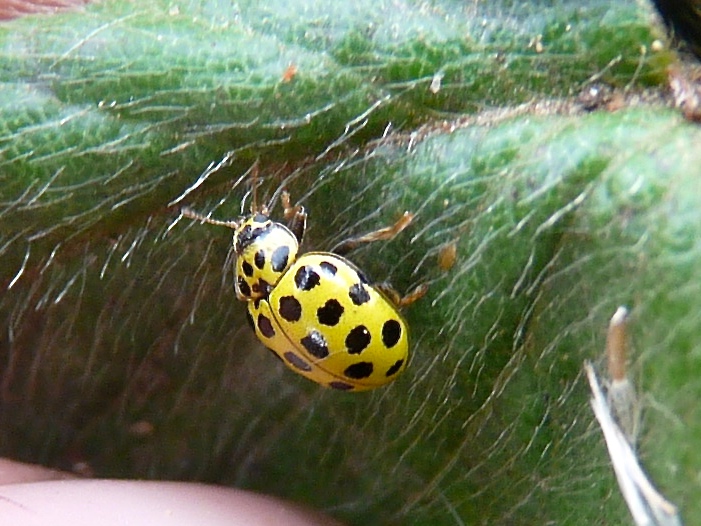
Contrary to what its name suggests, the black spots on the bright yellow Twenty-two spot ladybird are 25 in number.
Exochomus quadripustulatus ?, L.
Most ladybirds have striking colours and characteristic markings, although their colouring can sometimes vary. I have not yet been able to identify this small species.
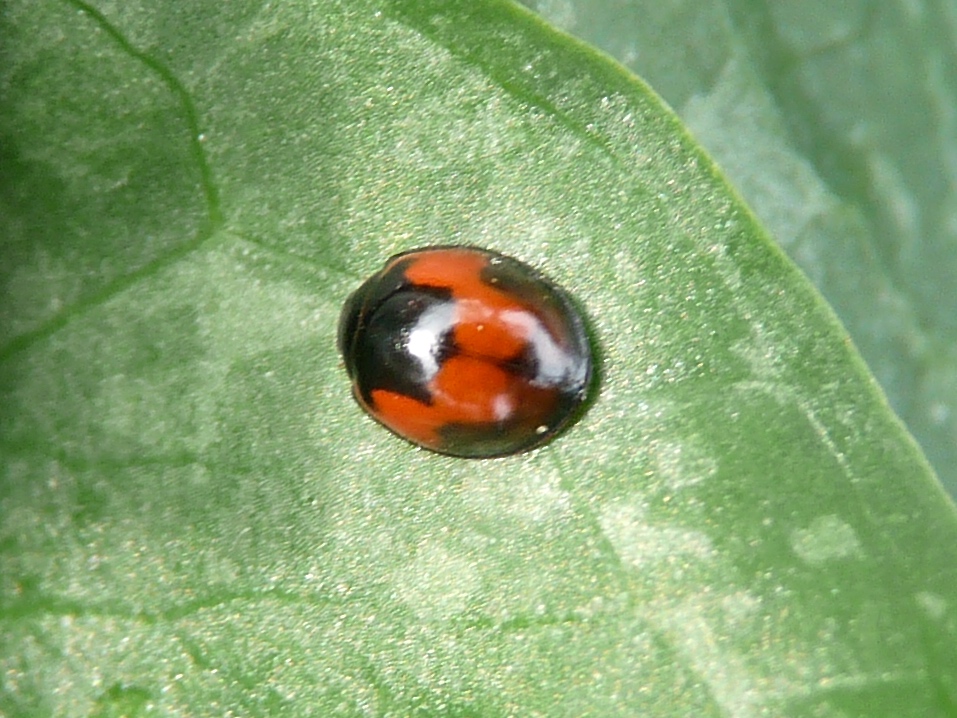
I have not yet been able to identify this small ladybird species. The colouring resembles Exochomus quadripustulatus, but the latter is predominantly black.
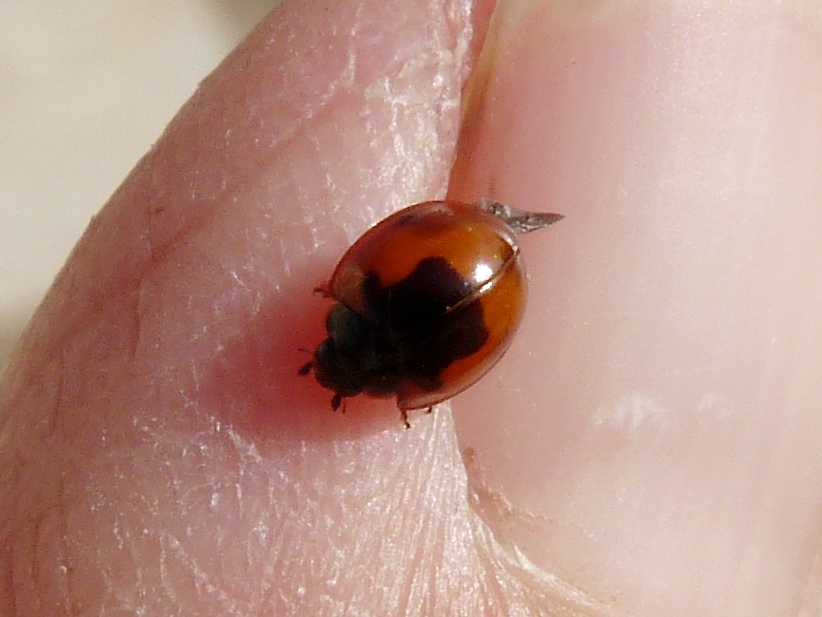
This is probably the same species.
Chilocorus bipustulatus, L.
This small ladybird species carries spots that are arranged like a line across the back. The basic colour is usually black, but can also be deep red, as in this specimen.
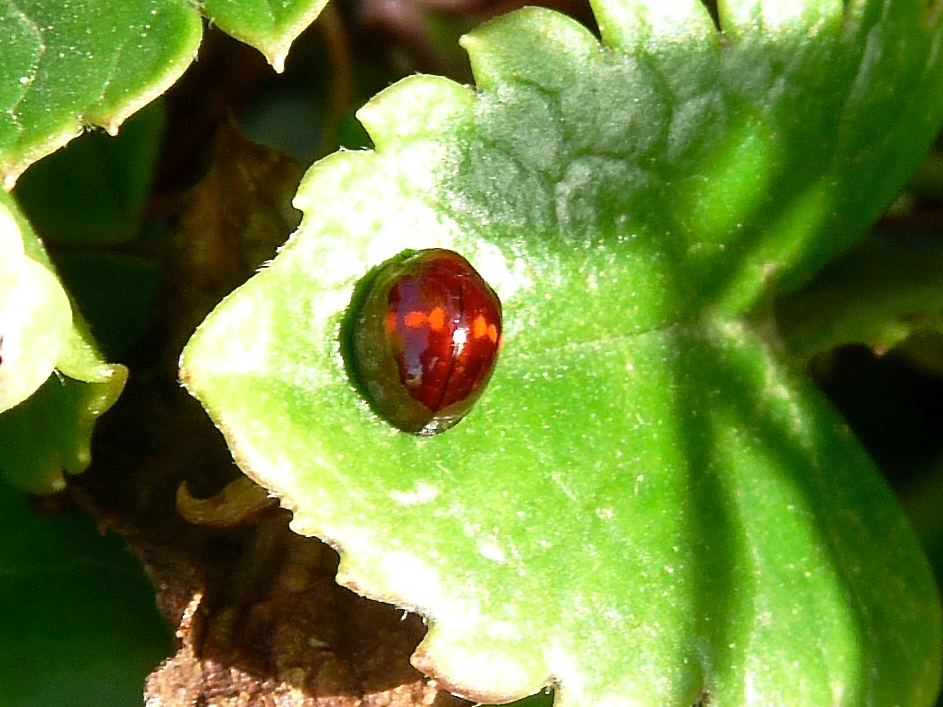
The small, shiny ladybird species Chilocorus bipustulatus has six small bright orange spots arranged in a line across its back.
Auger beetles, Bostrichidae
Auger beetles bore in wood. The family is mainly found in the tropics; only 47 species occur in Europe. One species, the Lesser grain borer, which is very small with a body length of 2 to 3 mm, lives in grain, rice, legumes and nuts and is a significant pest.
Bostrichus capucinus, L.
As in many auger beetles, the head of the capuchin beetle is mostly hidden under the highly arched neck shield. The neck shield is adorned with teeth on the upper side, which wear away over time. The adult animals live on fruit trees and grapevine, boring in the wood, as do the larvae.
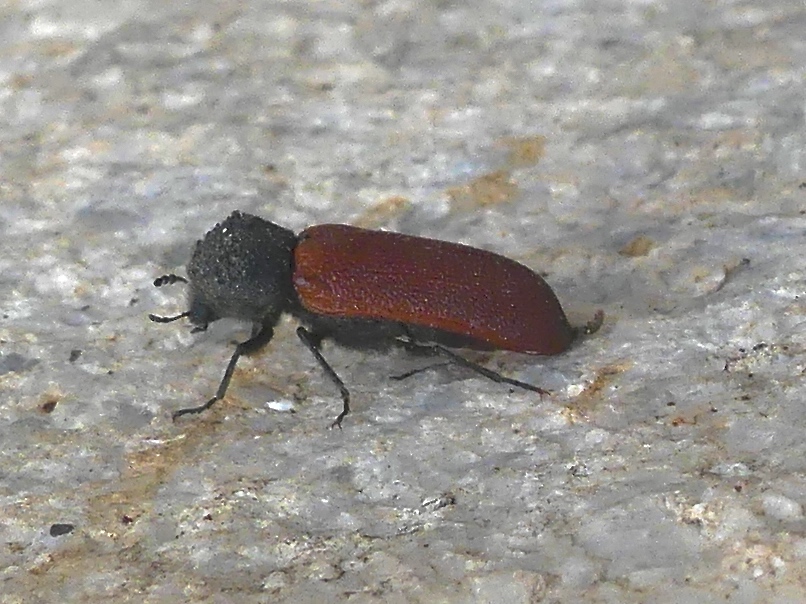
The Capuchin beetle can be recognised by the red colour of its wing covers and its black, domed neck shield, under which its head is hidden and which has rasp-like teeth that are probably useful when it bores in wood.
Carpet beetles, Dermestidae
Carpet beetles are found worldwide with around 1,300 species. They are small and compact, round or oval in shape. Many species feed on dead animal or plant material, including leather, hair and feathers. As a result, some species are significant pests. These include, for example, the Common carpet beetle and the Museum beetle, which is feared by biologists and has caused great damage to many collections. Other species are harmless flower dwellers.
Anthrenus pimpinellae, Fabricius
This pretty beetle, like all carpet beetles, is very small and round in shape. It is varioulsy patterned in white and brownish colours.
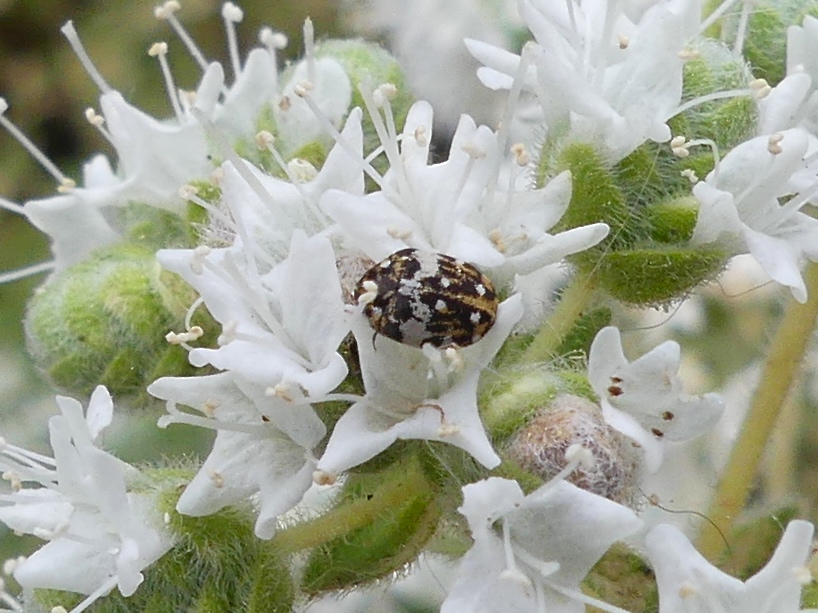
Anthrenus pimpinellae is only 4 mm in size. It can be found in summer on flowers such as Greek oregano, as shown here.
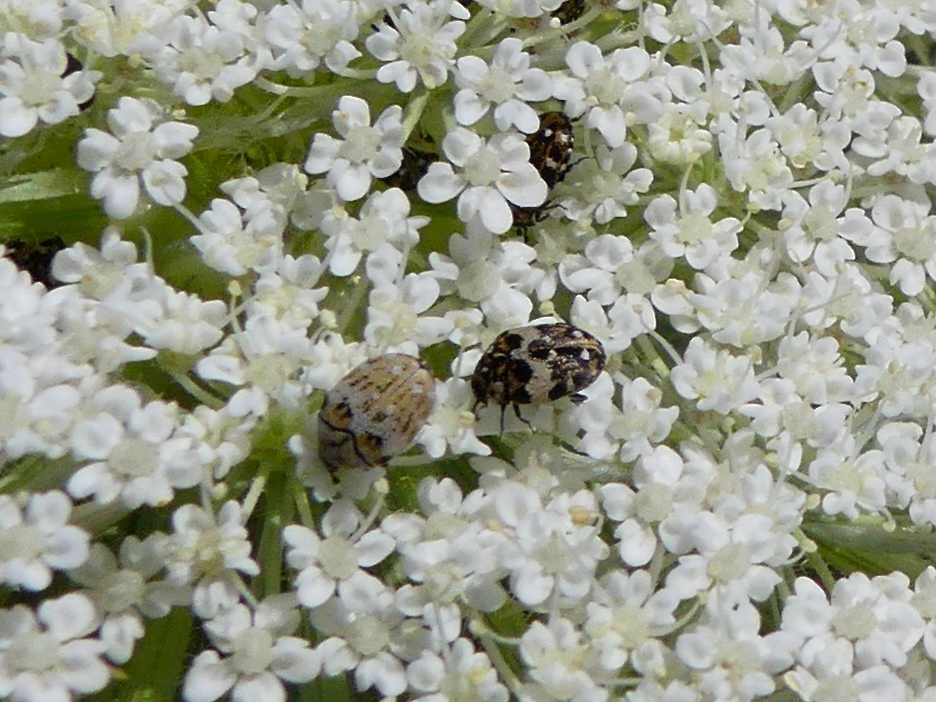
Individuals can vary significantly in colour, even though the markings are usually similar.
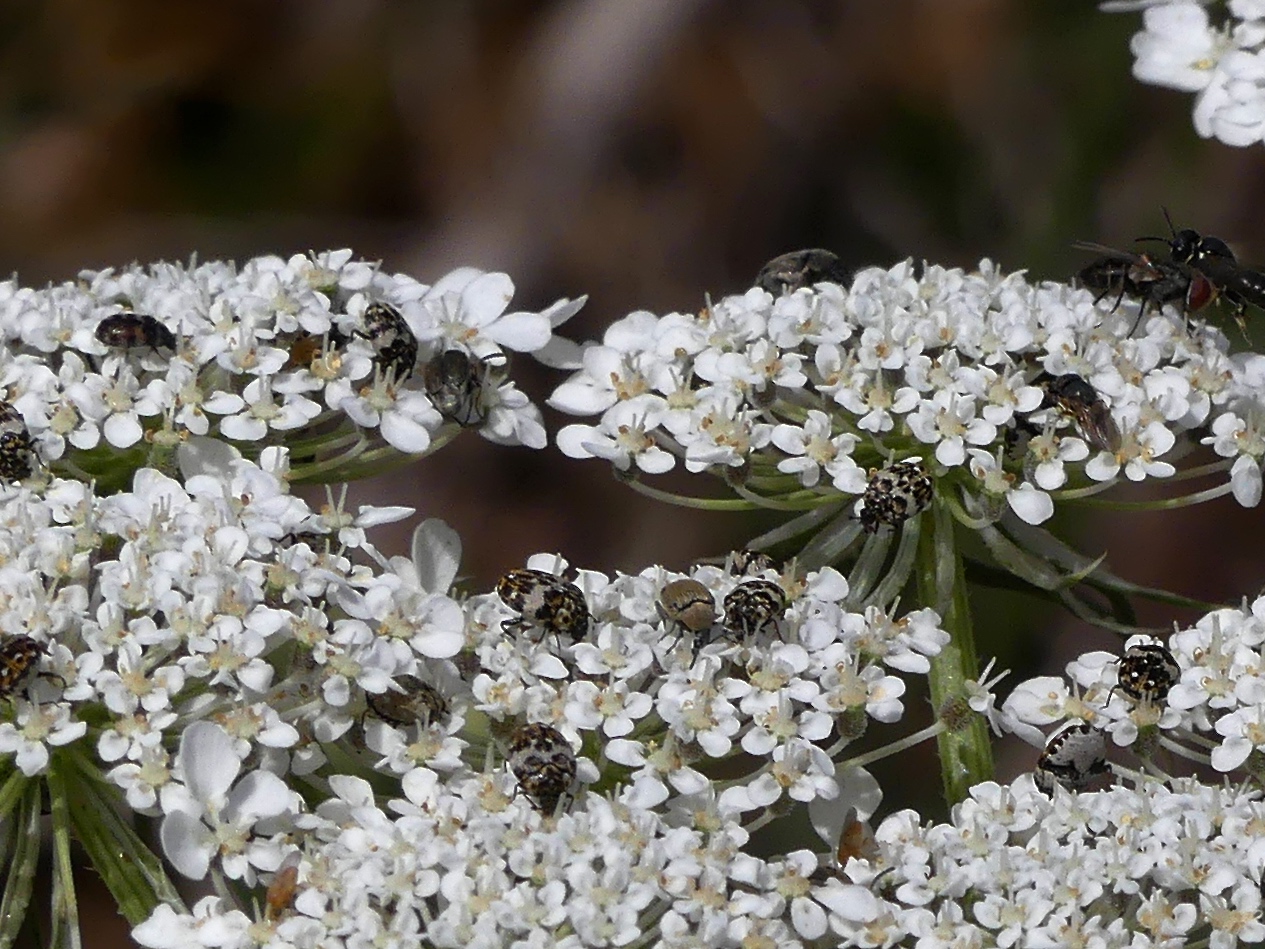
In spring, the carpet beetles often sit in large numbers on the flowers of the wild carrot.
Blister beetles, Meloidae
Blister beetles produce a toxin called cantharin, which they secrete as a yellowish drop from their leg joints when threatened. Cantharin is toxic to ants and ground beetles, but not to birds or hedgehogs, which eat blister beetles. Some insect species are attracted by the toxin over long distances and ingest it, accumulating the poison in their bodies and thus also becoming toxic. Even a species of bird takes advantage of the same effect: the Spur-winged goose, which eats blister beetles in large quantities and can therefore – depending on the amount – be toxic to predators and even to humans. The name blister beetles comes from the toxin, which can cause blisters on human skin.
Another interesting feature of blister beetles is their complicated larval development. The females lay a large number of eggs: up to 10,000 per individual. The females have to consume a lot of food to be able to produce such quantities of eggs. They feed on plants and can cause some damage in agriculture. The larvae of blister beetles live as parasites in the nests of solitary bees (or, in some species, grasshoppers). The first larval stage looks significantly different from the later stages. This so-called triungulin larva or three-clawed larva climbs onto flowers, where it waits for bees. When a bee comes by, it clings to it and is carried to the nest. It cannot distinguish between suitable and unsuitable species, which explains the high number of eggs: only very few triungulin larvae reach a suitable bee nest where they can develop. With long legs and claws on its feet, the triungulin larva is specially adapted to travelling on bees. It does not eat, but can wait for weeks until it finds a transport host. In the beehive, the larva lets go of its transport animal. It now molts and becomes a more simply structured secondary larva that feeds on the honey stores in the bee nest. After several moults, the larva leaves the bee nest. It stops feeding and hibernates as a pseudopupa. The following spring, it moults into a final larval stage, which eventually pupates and transforms into the adult insect.
Violet oil beetle, Meloe violaceus ?, Marsham
The species of the genus Meloe hardly look like beetles, having greatly reduced wings with short wing covers, behind which the segmented, very thick abdomen remains exposed. The head looks a bit like that of an ant. The antennae of the males are bent in the middle in a characteristic way. Several similar species occur in the Mediterranean region (and also in central Europe), so the identification is not entirely certain. The species of the genus Meloe live mainly in rather dry areas.
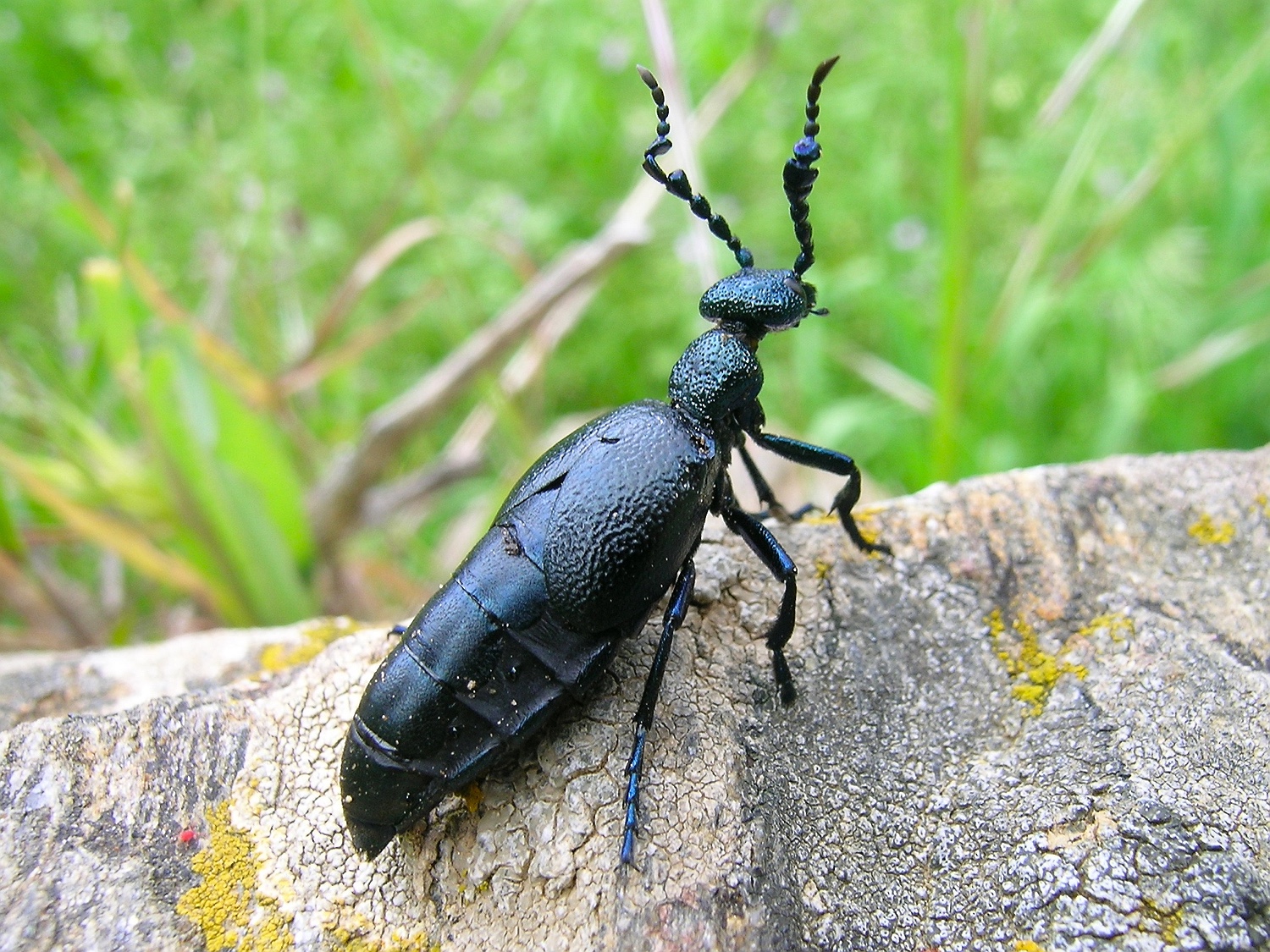
The flightless Violet oil beetle has an interesting biology with the larva parasitising in bee nests. Its appearance is also unusual, with greatly shortened wing covers that leave the abdomen exposed.
Mylabris quadripunctata, L.
This species of blister beetle is common in the Mediterranean region. The adult lives mainly on flowers feeding on the pollen and petals, while the larvae live underground on the eggs of grasshoppers.
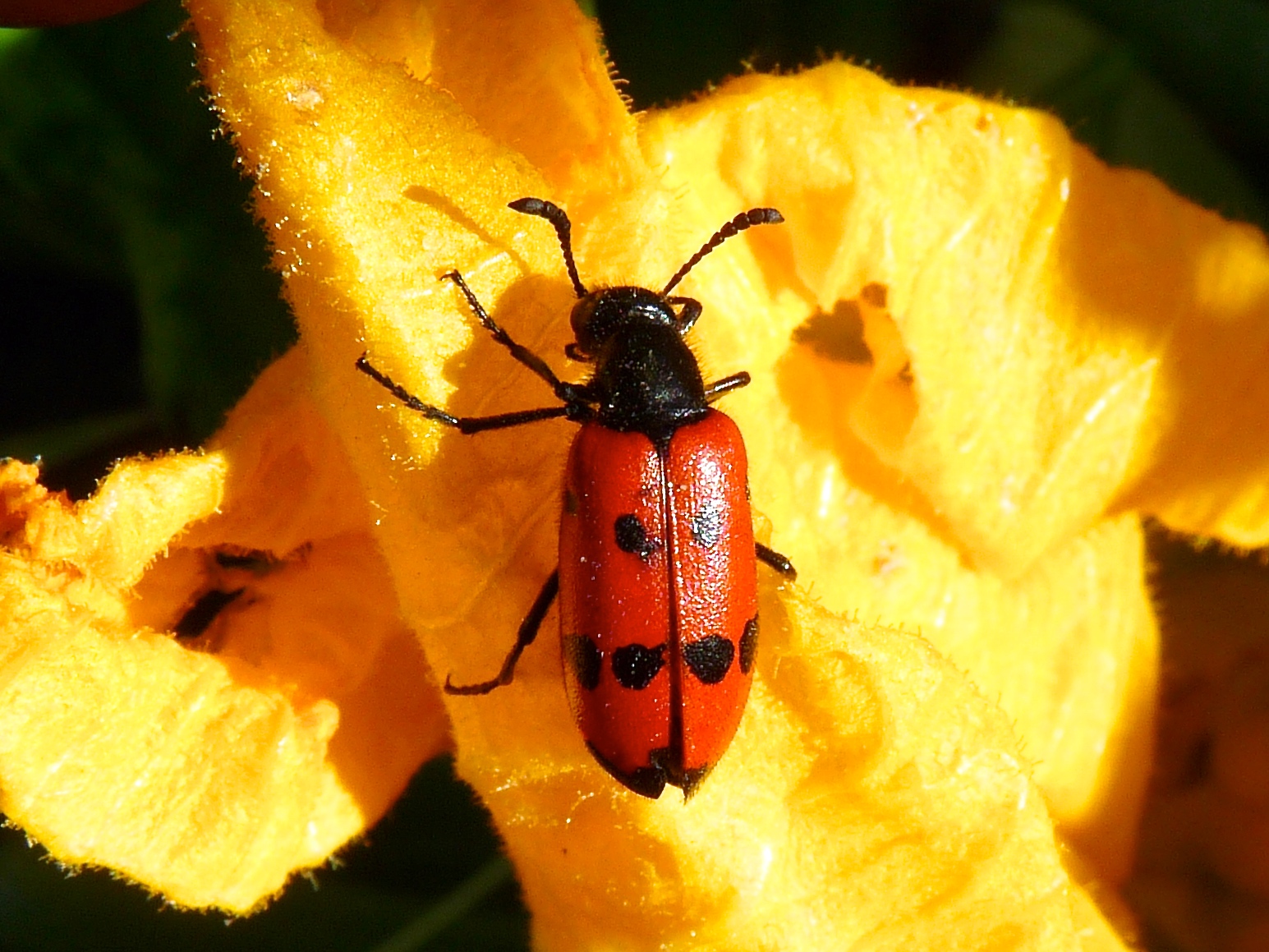
Mylabris quadripunctata usually sits on flowers where it feeds on the pollen.
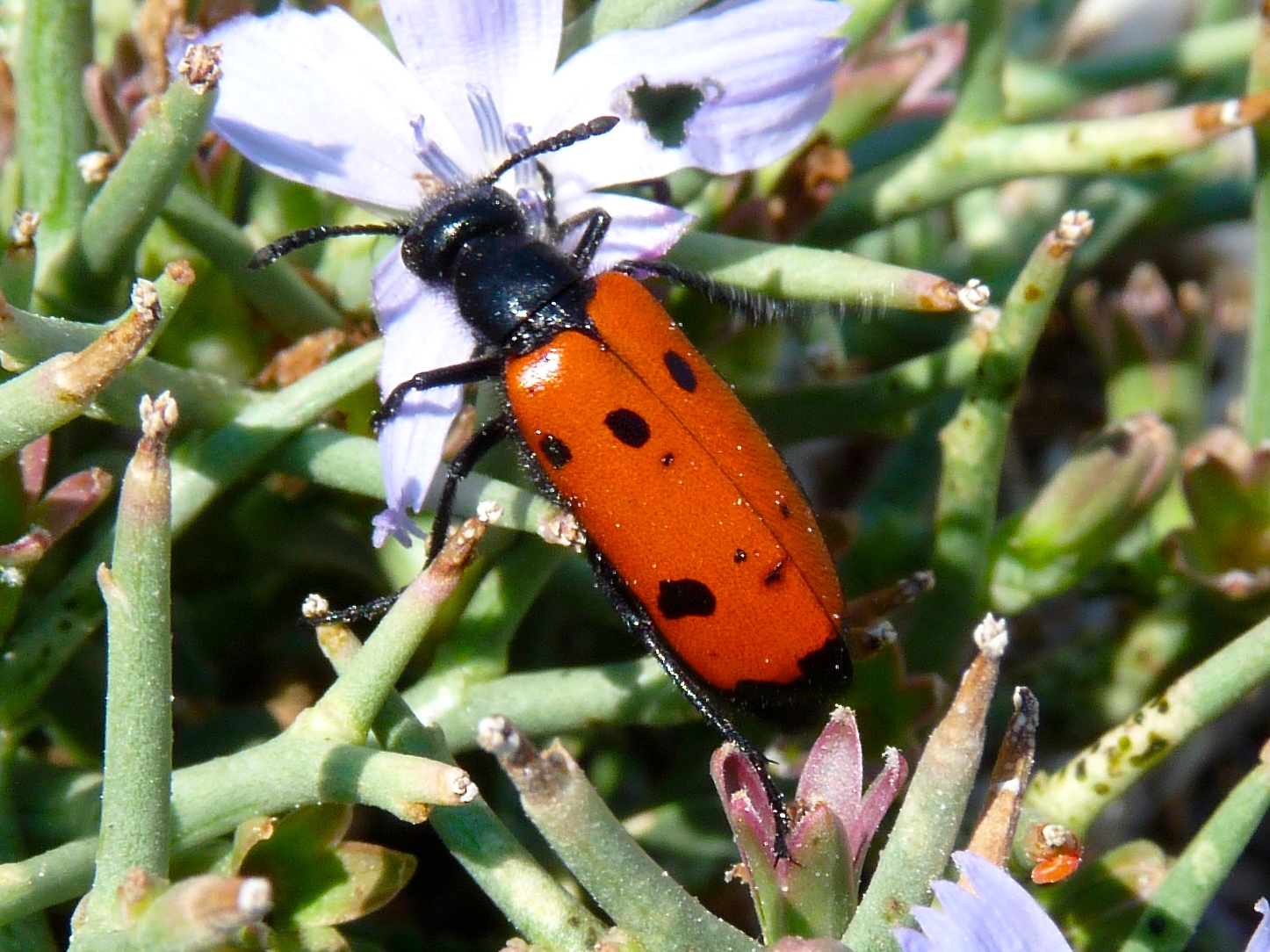
Here an individual with a slightly different pattern.
Mylabris pannonica ?, Kaszab
Mylabris pannonica is also found in the Mediterranean region reaching as far north as Hungary. The adult beetles sit on flowers; the larvae parasitise in bee nests.
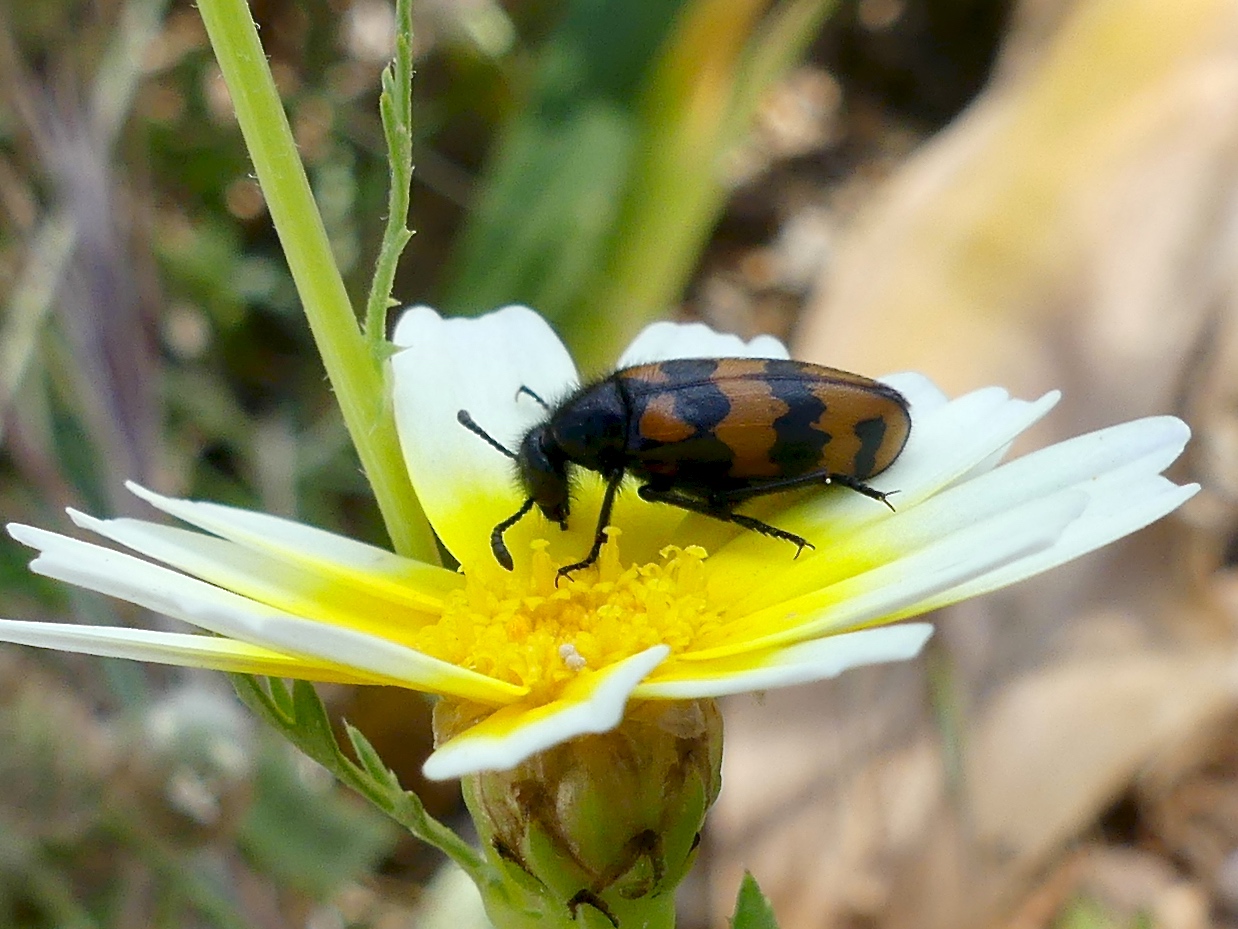
There are several species of blister beetles with yellowish and black transverse stripes on their wing covers, although the colouring can vary considerably; our speciment probably belongs to the species Mylabris pannonica.
Zonitis immaculata ?, Olivier
Another genus of blister beetle is the large genus Zonitis.
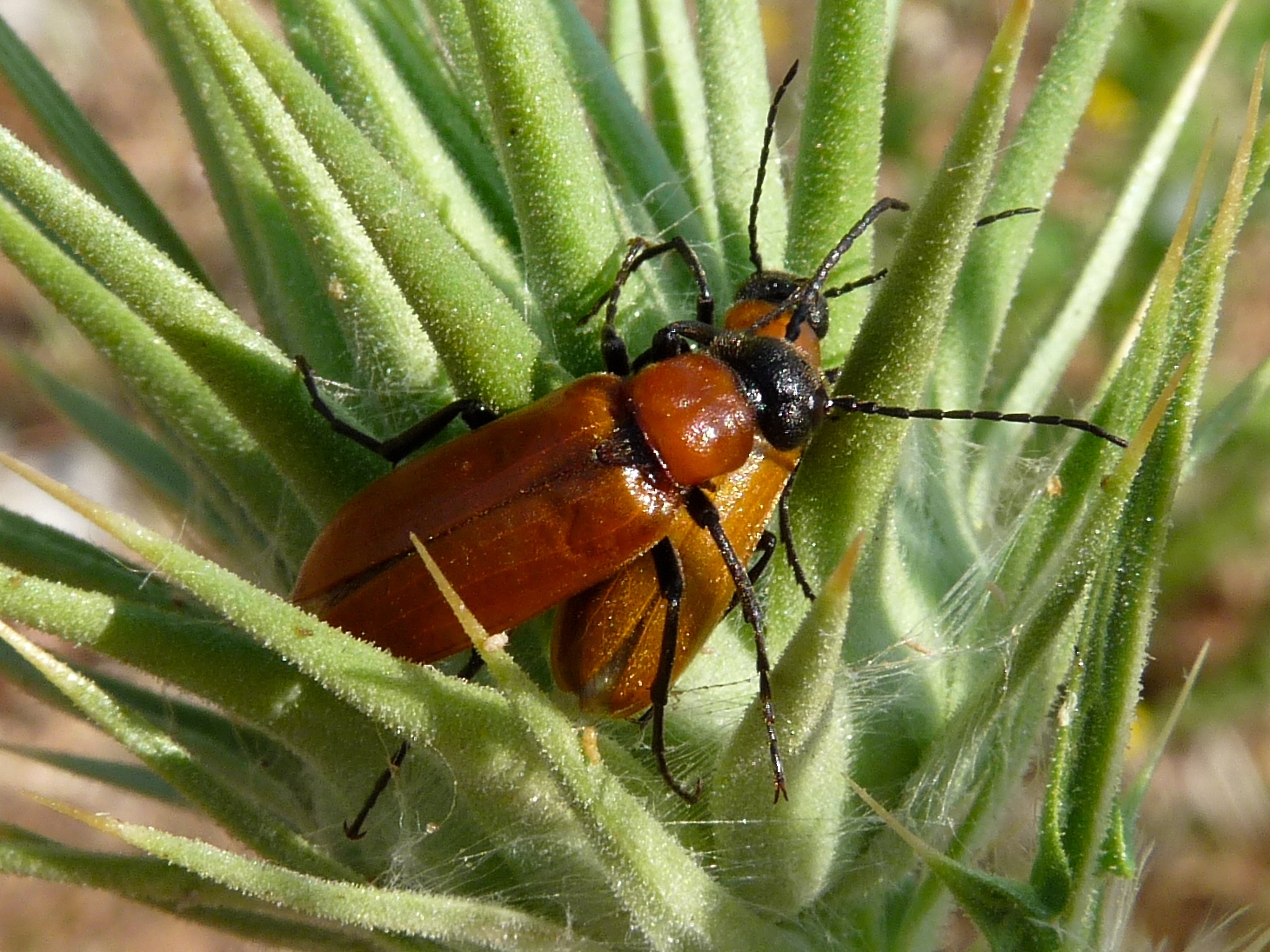
Zonitis immaculata has brown to brown-orange wing covers and neck shield, while the head, extremities and underside are black, as in most blister beetles.
Pintail beetles, Mordellidae
Pintail beetles are small beetles that usually live on flowers. They often have a pointed abdomen, from which their name derives. Colloquially, they are also known as ‘tumbling flower beetles’, which refers to the strange tumbling movements that the beetles show when disturbed. They perform a series of very quick jumps, turning in a spiral. This rotation is made possible by a unique joint on the coxa of the hind leg and achieved with the help of the long pointed abdomen.
Mordella spec.
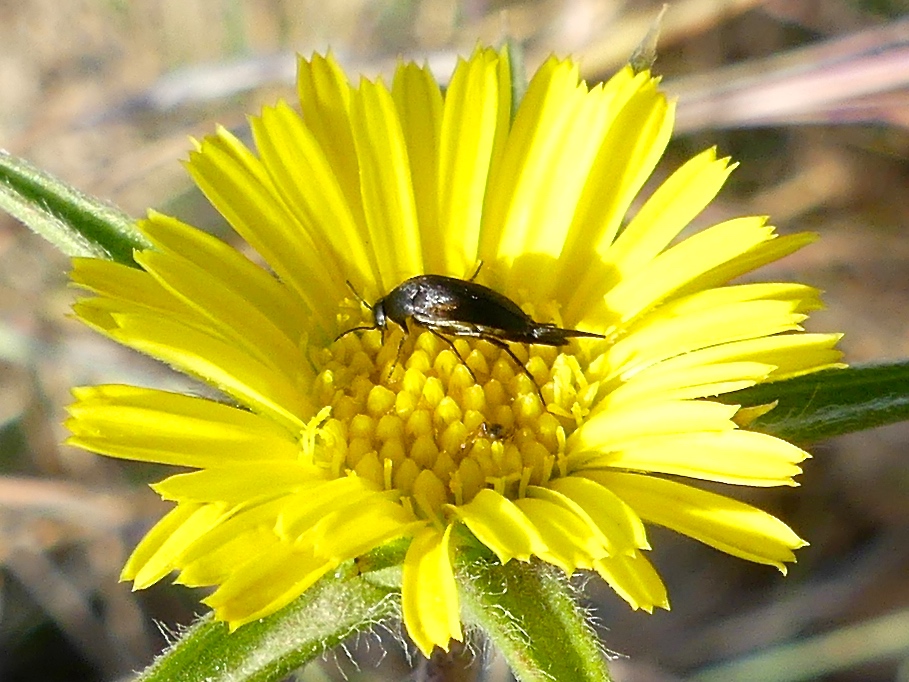
The tiny pintail beetles are easily recognisable by their pointed abdomen. They live on flowers and are quite common in our region, appearing for a short time in summer. Their tumbling movements when disturbed are quite funny. It is not possible to identify the species without closer examination.
False blister beetles, Oedemeridae
The False blister beetles resemble longhorn beetles in their elongated body shape and long, thin antennae, but their bodies are softer, and they usually remain quite small. They are predominantly yellowish, greenish or black in colour. The adult beetles feed on pollen and are often found on flowers, while the larvae live in wood and plant stems.
Oedemera flavipes, Fabricius
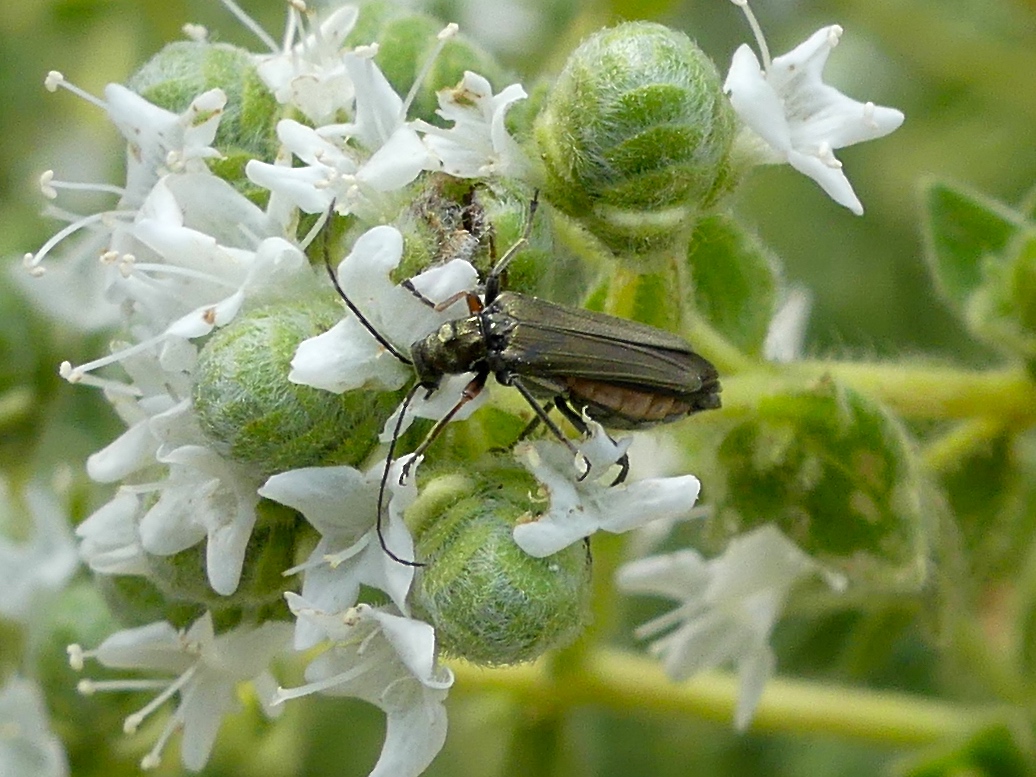
Oedemera flavipes usually sits on flowers. It grows to about 1 cm in length; the body is very narrow. Viewed from the side, its abdomen appears somewhat inflated. The wing covers narrow towards the end.
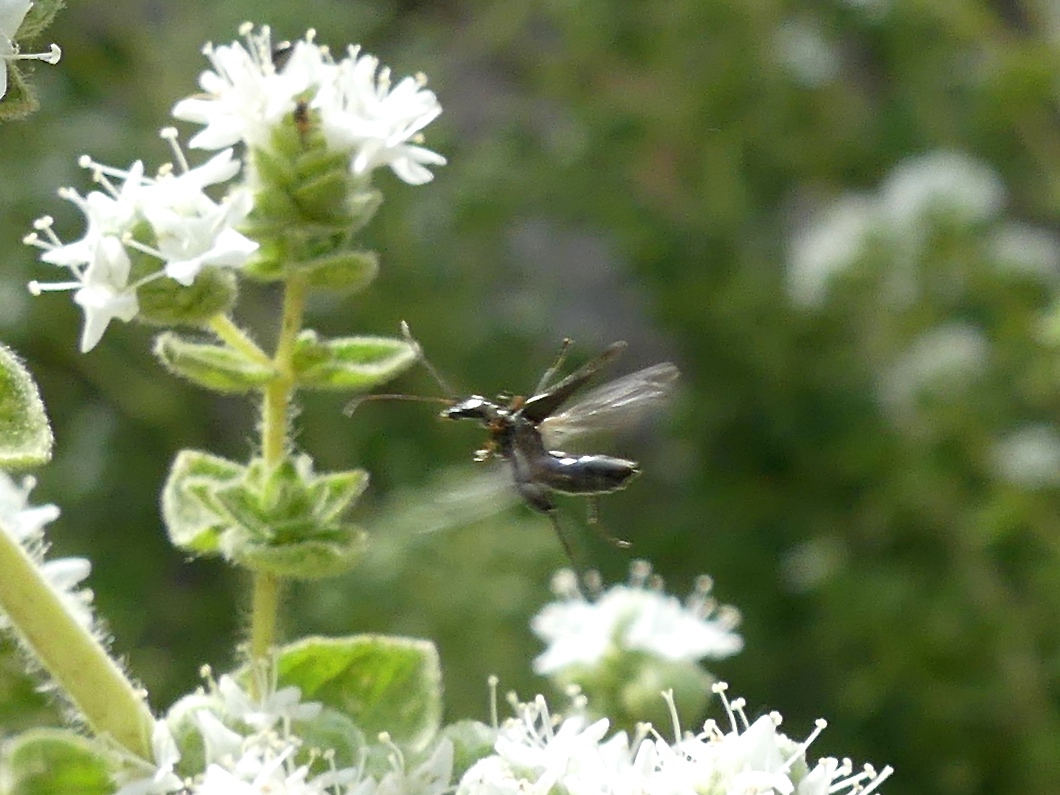
In flight, this species assumes this awkward-looking posture.
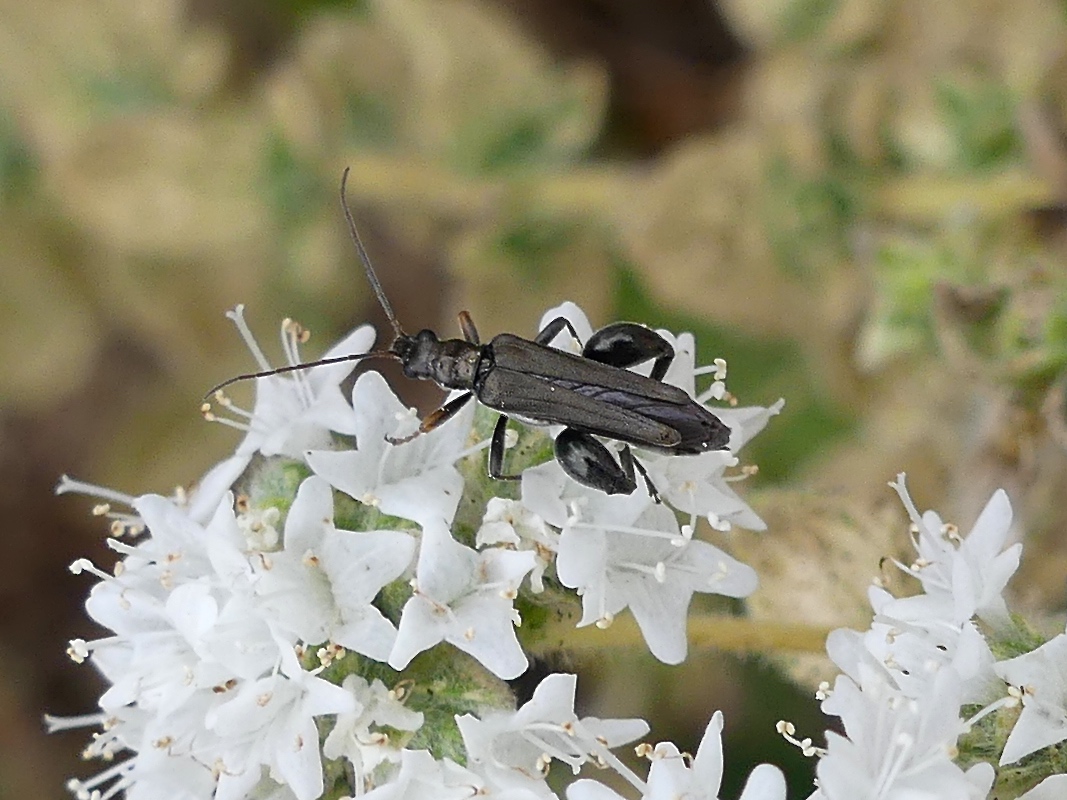
The male beetles of Oedemera flavipes often have greatly thickened femurs on their hind legs. I would like to thank the dedicated members of the Greek Facebook page ‘Insects of Greece and Cyprus’ for their help in identifying this species.
Darkling beetles, Tenebrionidae
With 20,000 species, the darkling beetles are one of the largest beetle families. They show great variability in body shape and way of life. As the name suggests, many species are predominantly black in colour. They usually prefer warm and dry habitats and are herbivorous or omnivorous.
Omophlus lepturoides ?, Fabricius
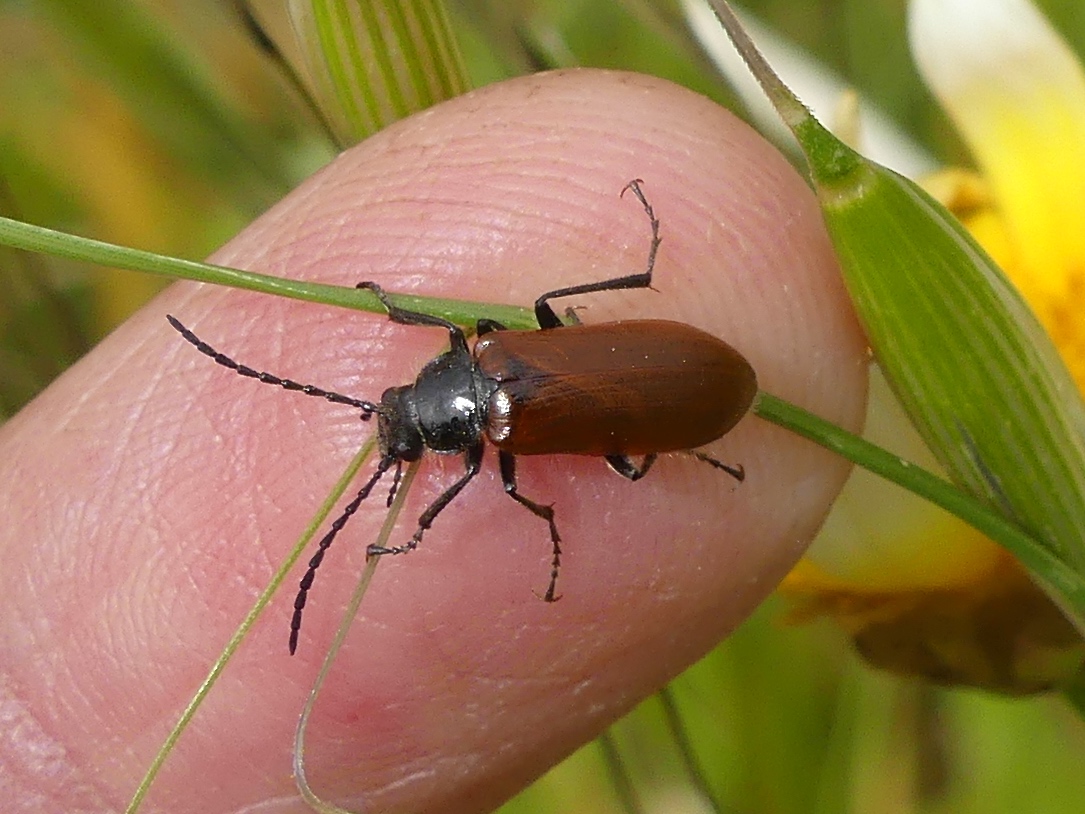
This beetle with shiny orange-red wing covers and black pronotum and head is probably Omophlus lepturoides, a species common in Europe and Southeast Asia.
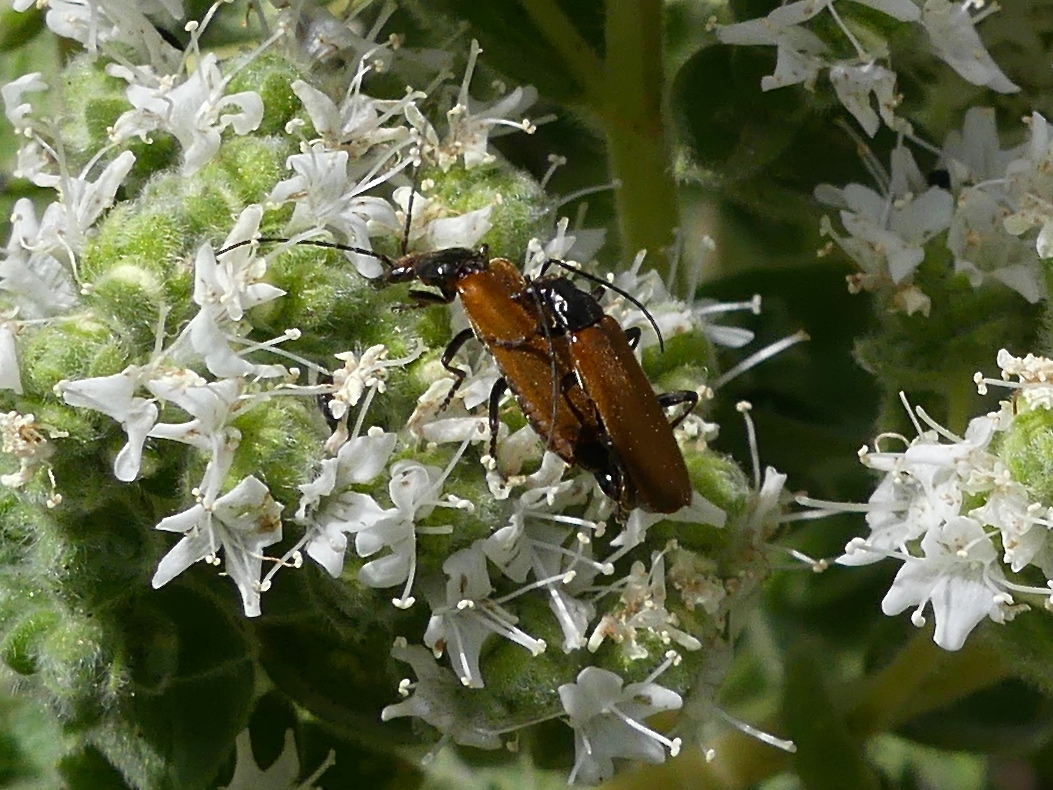
mating
Cephalostenus orbicollis, Ménétriés
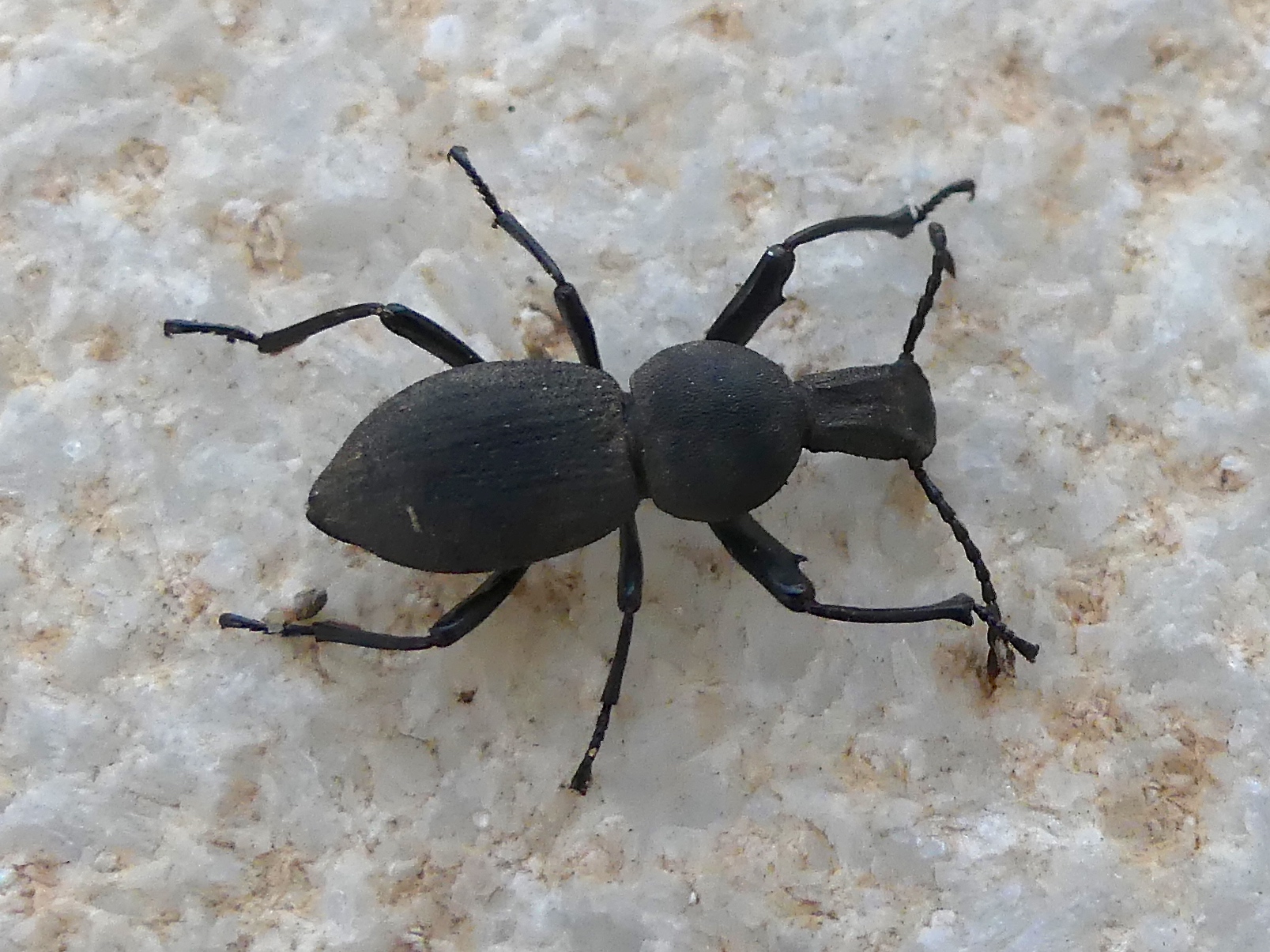
This beetle can be recognised by its narrow head, which is only about half the width of the round thorax. It is quite rare in our area. I would like to thank the members of the Greek Facebook page ‘Insects of Greece and Cyprus’ for their help in identifying it.
Dung beetles, Geotrupidae
Dung beetles are among the better-known beetles. They are usually black or metallic in colour, have a stout, roundish body and live on the ground. Both the adult beetles and the larvae feed on dung, humus or fungi. Dung beetles care elaborately for their brood. They build underground brood chambers with dung as food supply for their larvae. They shape the dung into balls, as this makes it easier to transport. By working the dung into the soil and decomposing it, dung beetles fulfill an important ecological function.
Spring dumbledor, Trypocopris vernalis ?, L.
The Spring dumbledor is common in Europe and Western Asia. It has only slightly grooved wing covers and is usually metallic blueblack in colour. The species cannot be identified with certainty from a photo.
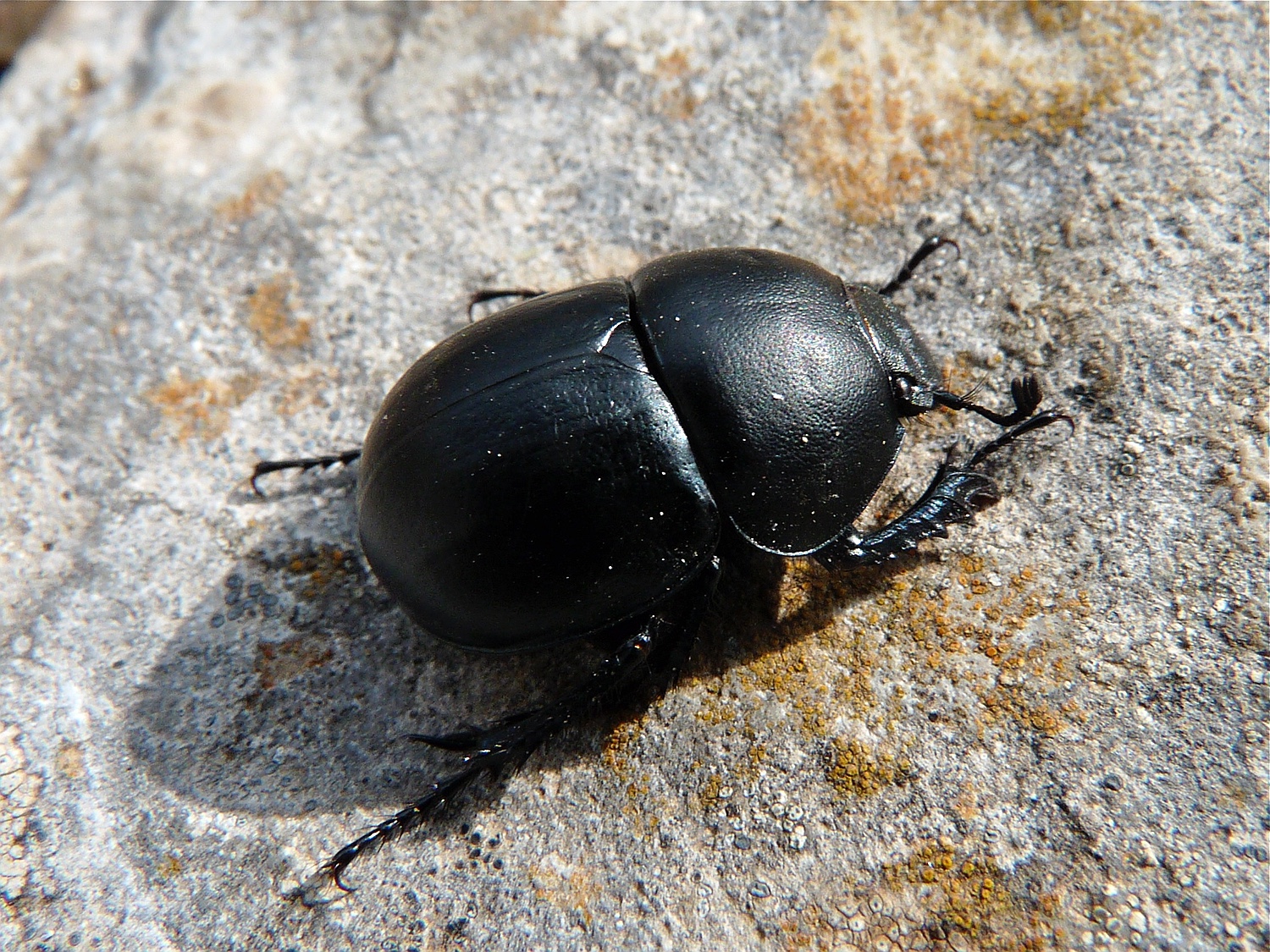
Dumbledor beetles are usually black or dark blue in colour.
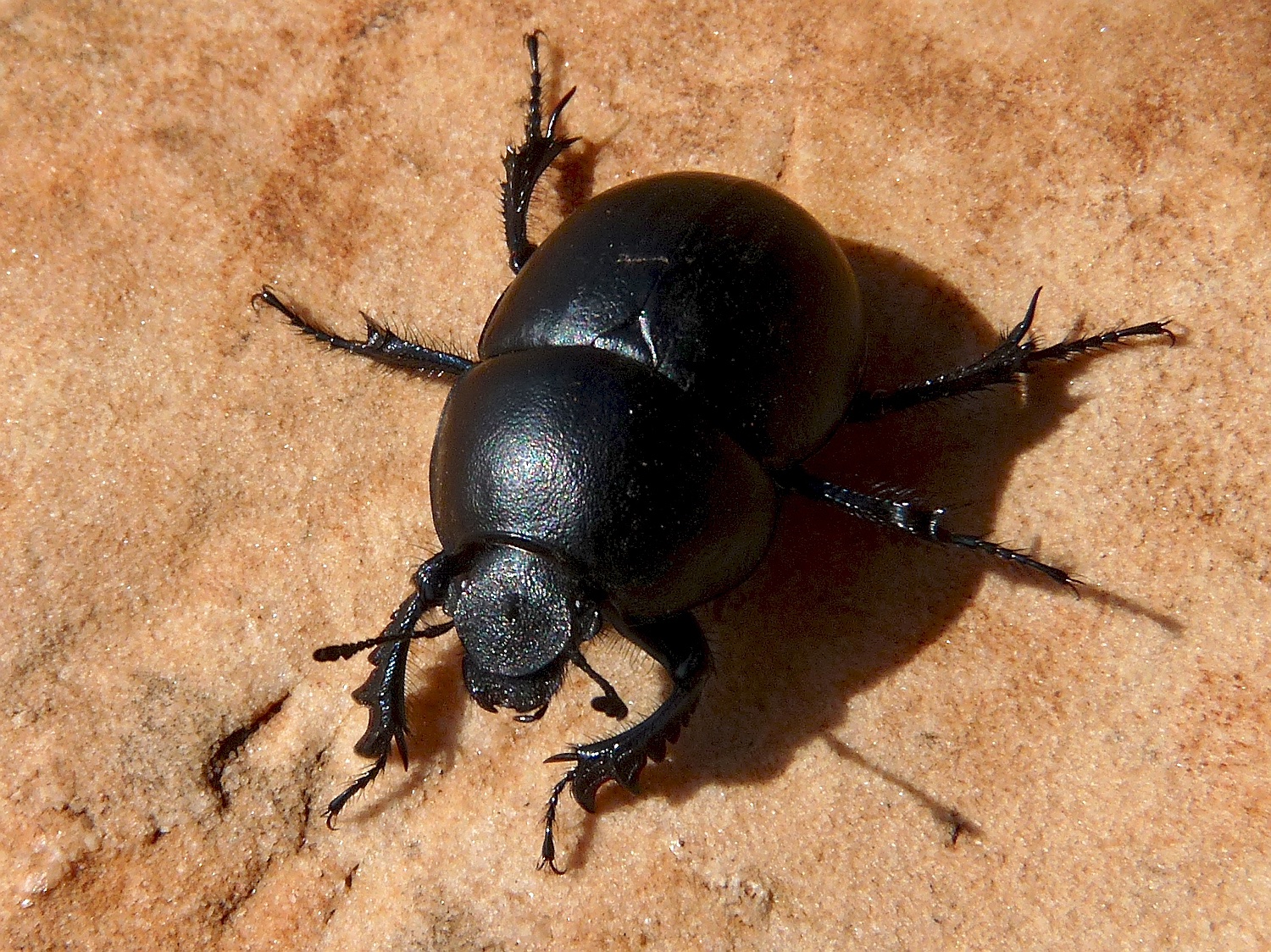
Here one can see the small head with its flat back shield, the large, hemispherical pronotum (neck shield) and, between the wing covers, the small triangular scutellum, the back shield of the mesothorax.
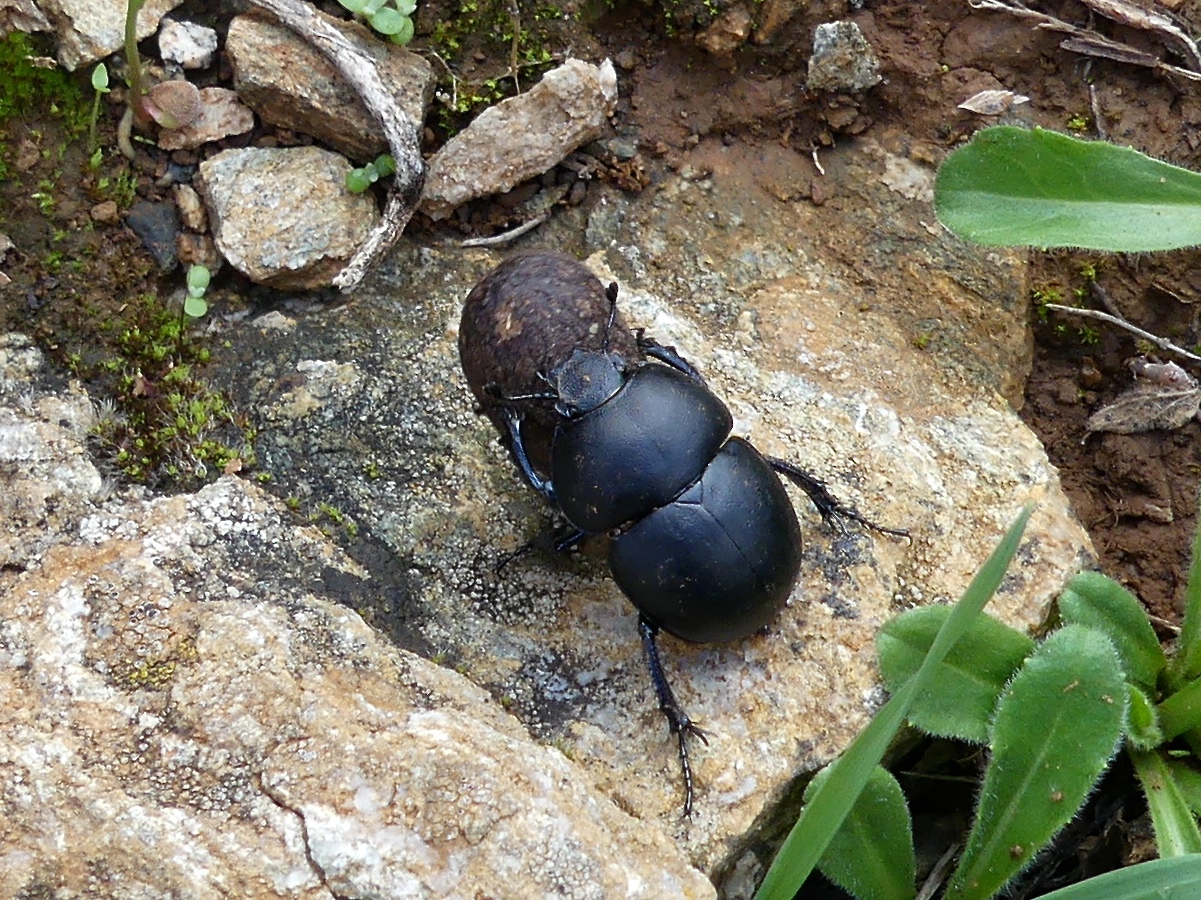
This dumbledor transports a goat’s dung ball to its brood chamber with astonishing efficiency and skill.
Typhaeus fossor, Waltl
The dung beetle species Typhaeus fossor, found in the Balkan region, resembles the Minotaur beetle (Typhaeus typhoeus), which is widespread in Central and Western Europe. Like the Minotaur beetle, it has horn-like protuberances on its pronotum, the middle one of which is very small in this species. It has a similar way of life as other dung beetles.
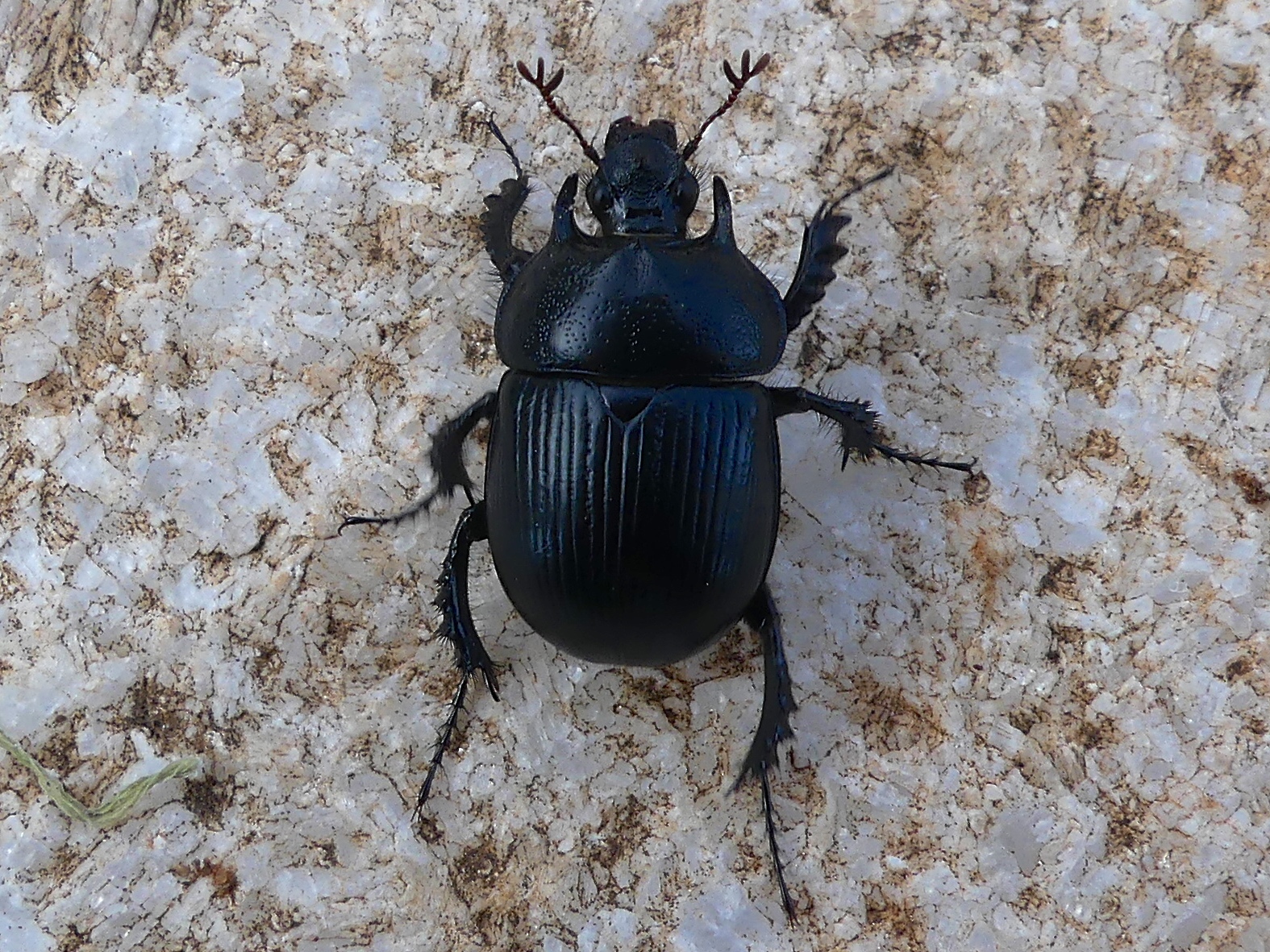
At first glance, Typhaeus fossor resembles a spring dumbledor; on closer inspection, however, the two forward-facing horns on the neck shield are noticeable.
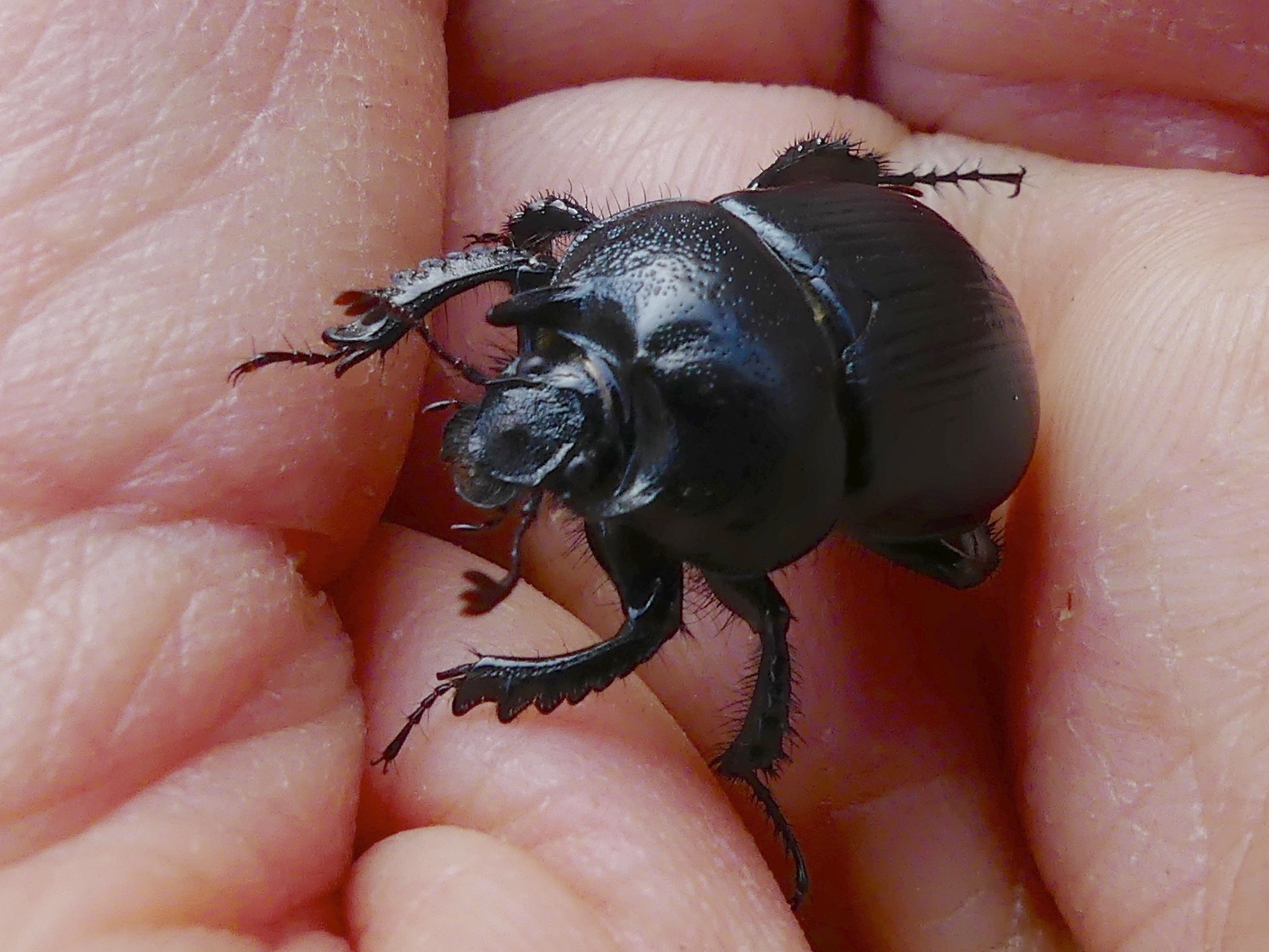
Like other dung beetles, this species builds brood chambers in the earth which it provides with dung balls, which the larvae feed on.
Scarab beetles, Scarabaeidae
The scarab beetles are a large family with 27,000 described species. Their antennae are fan-shaped at the end. Many species are very colourful, sometimes with a metallic shimmer, while others are black. Some genera, such as Scarabaeus, look very similar to dung beetles and have almost the same way of life: they feed on dung, which they shape into round balls, and care for their young. Most scarab beetles are herbivorous.
Scarabaeus variolosus, Fabricius
To the genus Scarabaeus belongs the Sacred scarab (Scarabaeus sanctus), which was venerated by the ancient Egyptians. On Naxos occurs Scarabaeus variolosus which looks similar to the dung beetles (family Geotrupidae). The best distinguishing feature is the jagged front edge of the head shield. The body is black with light spots.

Scarabaeus variolosus engages in elaborate brood care. The eggs are laid in holes in the ground, where the beetle deposits dung balls as a food supply for the larvae. Here you can see the beetle rolling a dung ball.

The ball is rolled backwards using the hind legs.

Here, the beetle has arrived at its underground nest and begins to pull the ball inside.

The genus Scarabaeus differs from dung beetles in the characteristic serrated front edge of the head shield. The neck shield and wing covers carry many somewhat depressed dots that are whitish in colour.
Onthophagus spec.
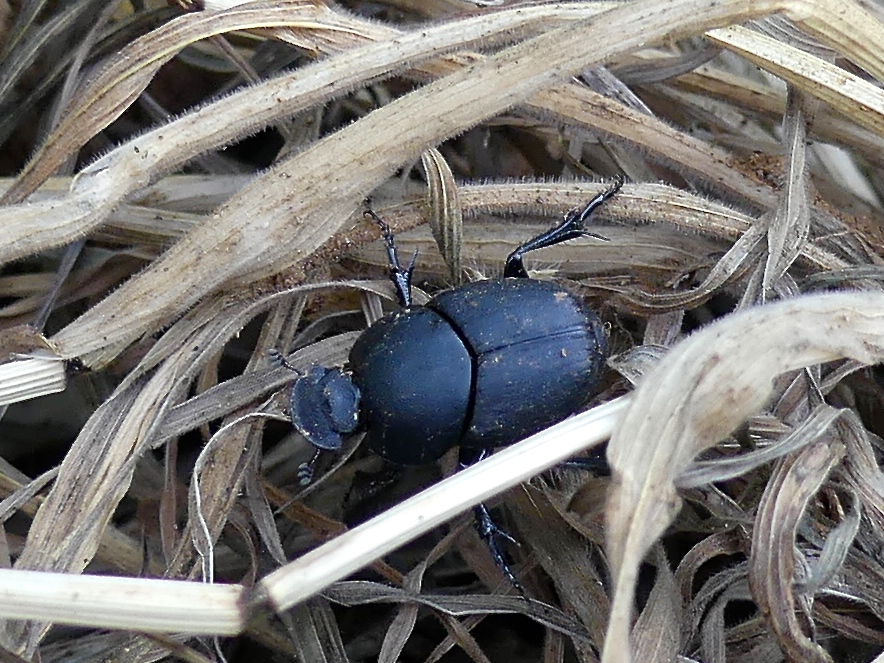
Many species of scarab beetles occur on Naxos. Here we have a specimen of the genus Onthophagus. Unfortunately, it is not possible to identify the species. The semi-circular front part of the head shield, with a distinct corner, is unusual and characteristic.
Polyphylla naxiana, Reitter
The very large scarab species Polyphylla naxiana, which measures almost 4 cm, has unusual antennae with a large fan-shaped tip that is often kept folded. In the Cyclades occurs an endemic species, named after the island of Naxos. The large, light grey body is elongated and densely hairy on the underside. The wing covers and neck shield are dark brown with numerous, dense, very small and fewer larger light grey spots.
Polyphylla naxiana lives in vineyards or open forests with conifers. The larvae, which grow to a lenght of 8 cm, feed on roots. The adults are mainly crepuscular. The beetle can produce sounds by rubbing the hind wings against an edge on the penultimate abdominal segment. The species occurs in the Mediterranean region, but is mostly rather rare. As several very similar species exist, the identification is not certain.
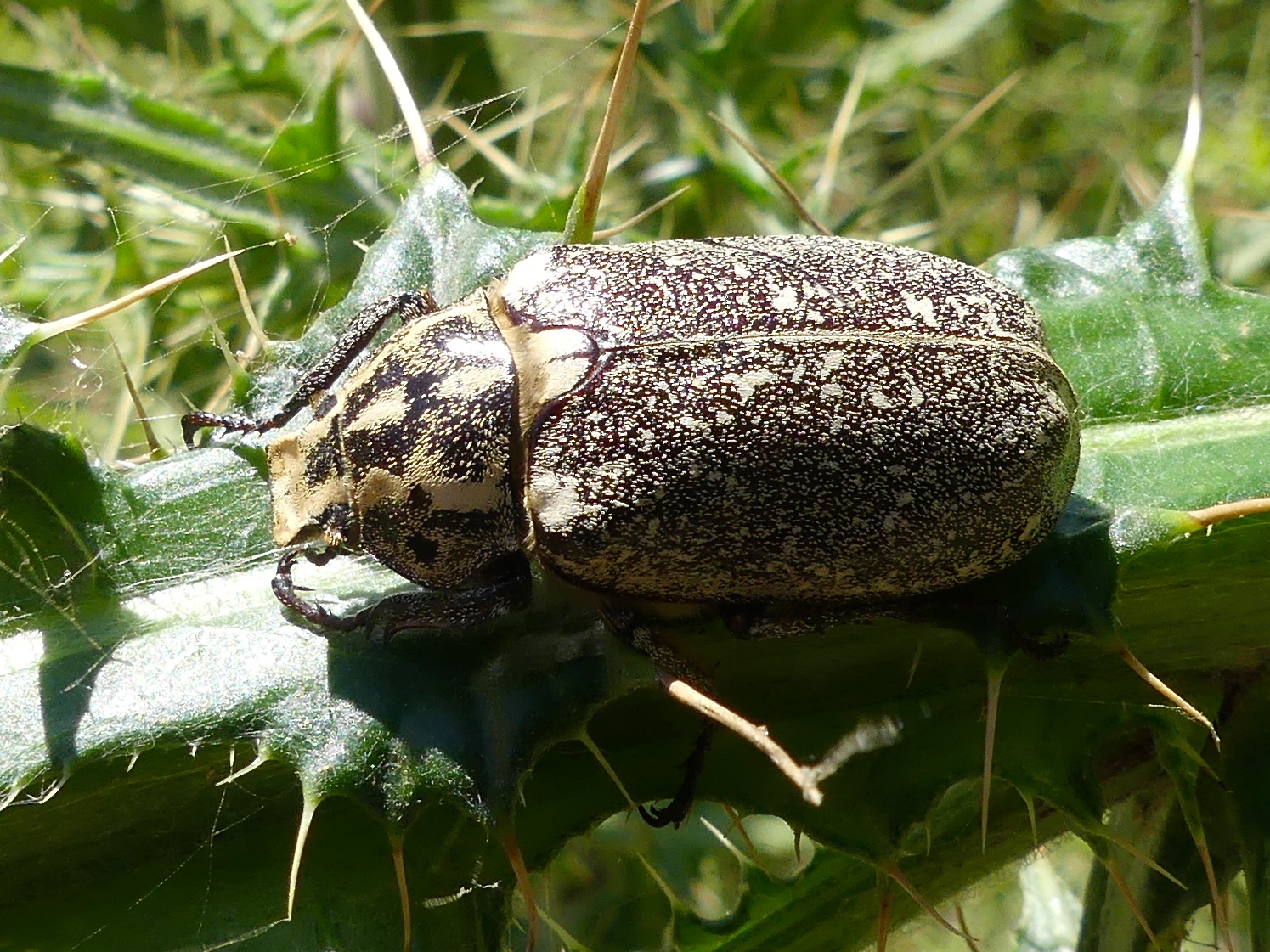
Polyphylla naxiana is one of the largest beetles in our region.
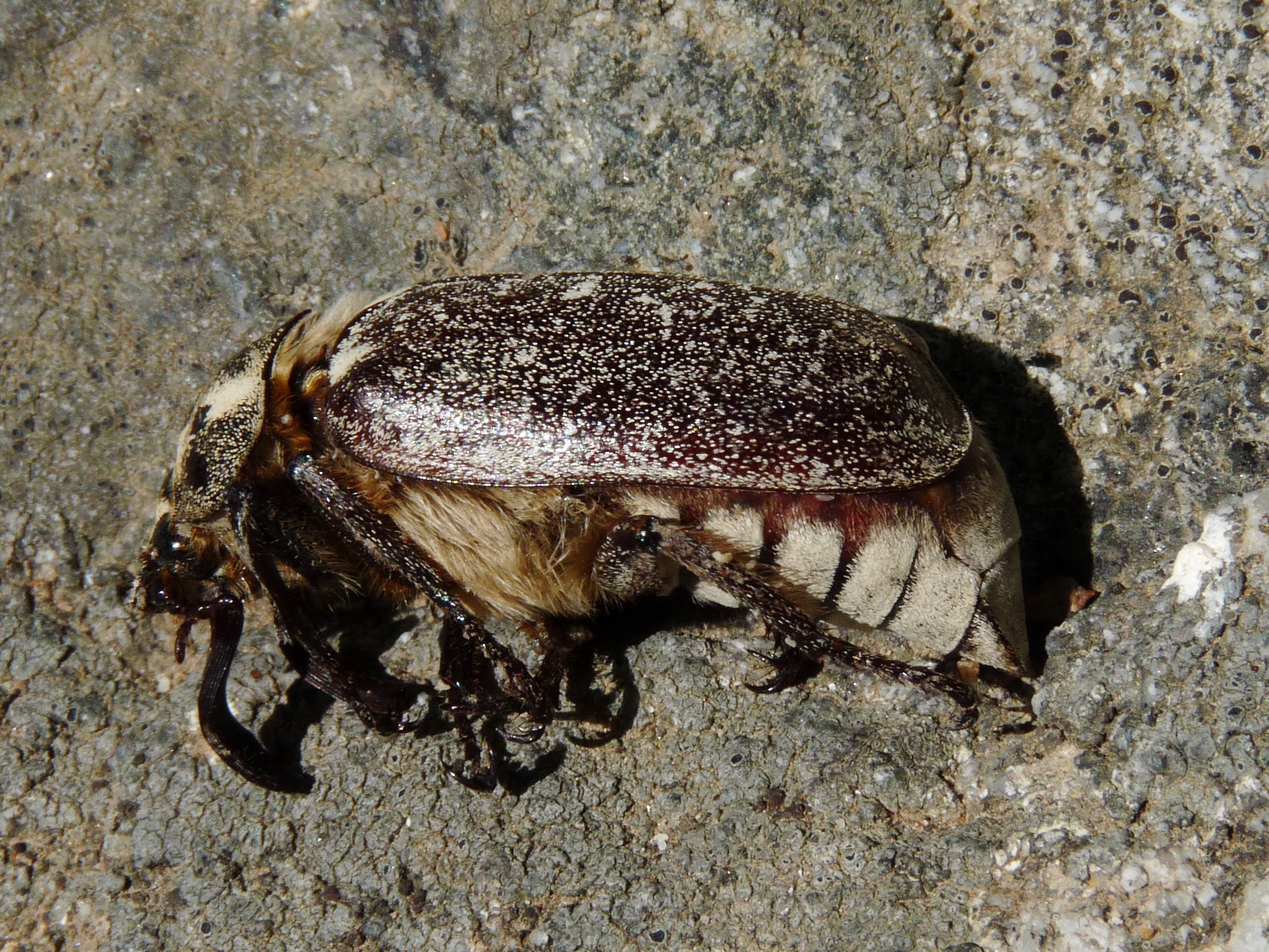
The genus Polyphylla can be recognised by the characteristic shape of the antennae and the colouring; the lighter pattern is variable in extend and form.
Protaetia affinis ?, Andersch
The beetles of the genus Protaetia have a beautiful bright metallic, green-gold colour. The surface of the back shields and wing covers is finely dotted. One of the special features of this group is that the wing covers are fused together, so that they are not spread during flight as in all other beetles, but remain in place while the beetle extends its hind wings sideways beneath them.
A number of species of the genus Protaetia occur in Europe that can only be identified by characteristics that are difficult to see, such as details of the legs. This is probably P. affinis. These beetles live on trees, especially oaks. They like to fly and are often found on fruit or in places where tree sap is leaking. The larvae feed on rotting wood.
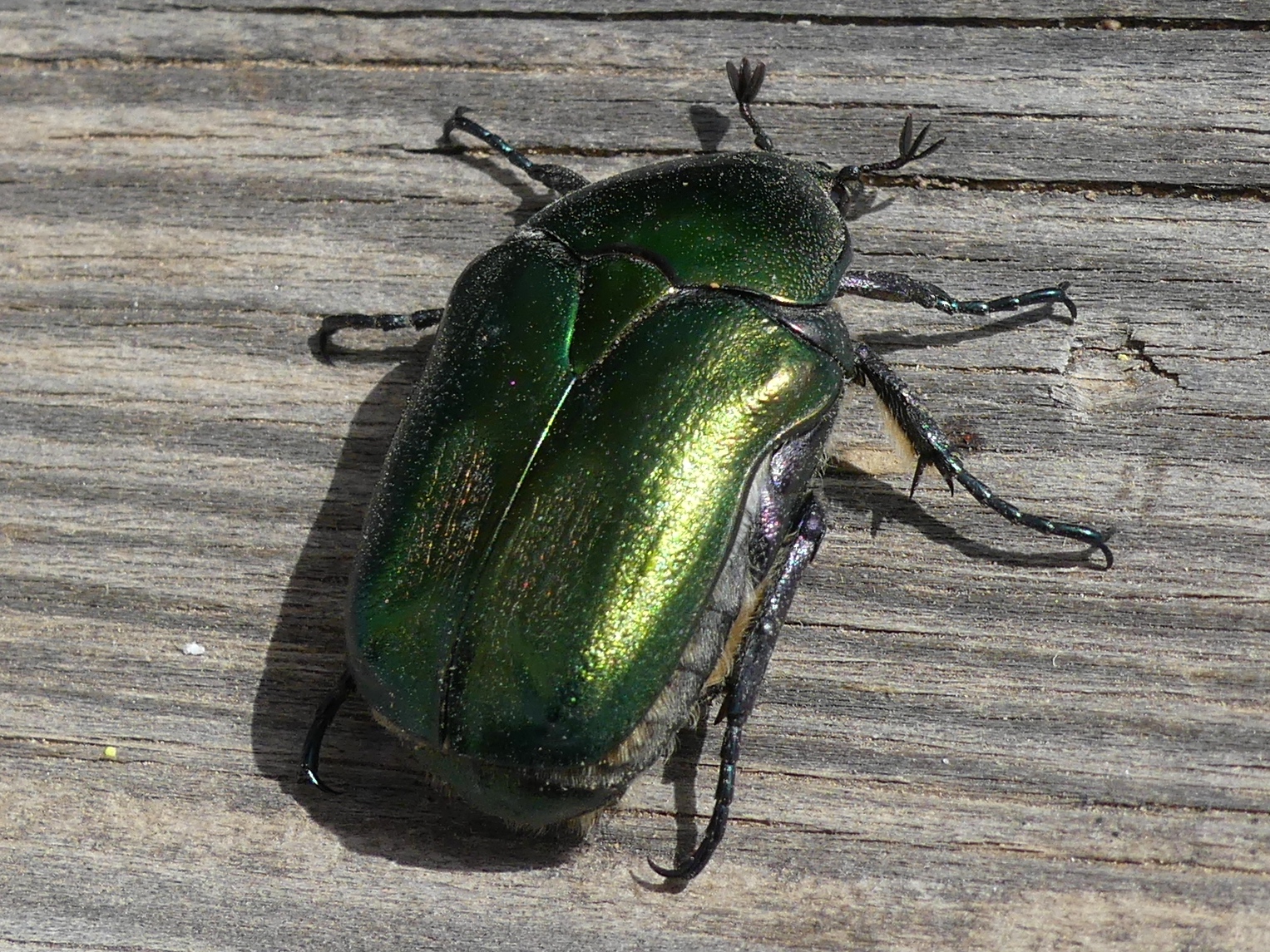
Protaetia affinis has an intensely metallic, greenish-gold colour. This species is rather common on Naxos.
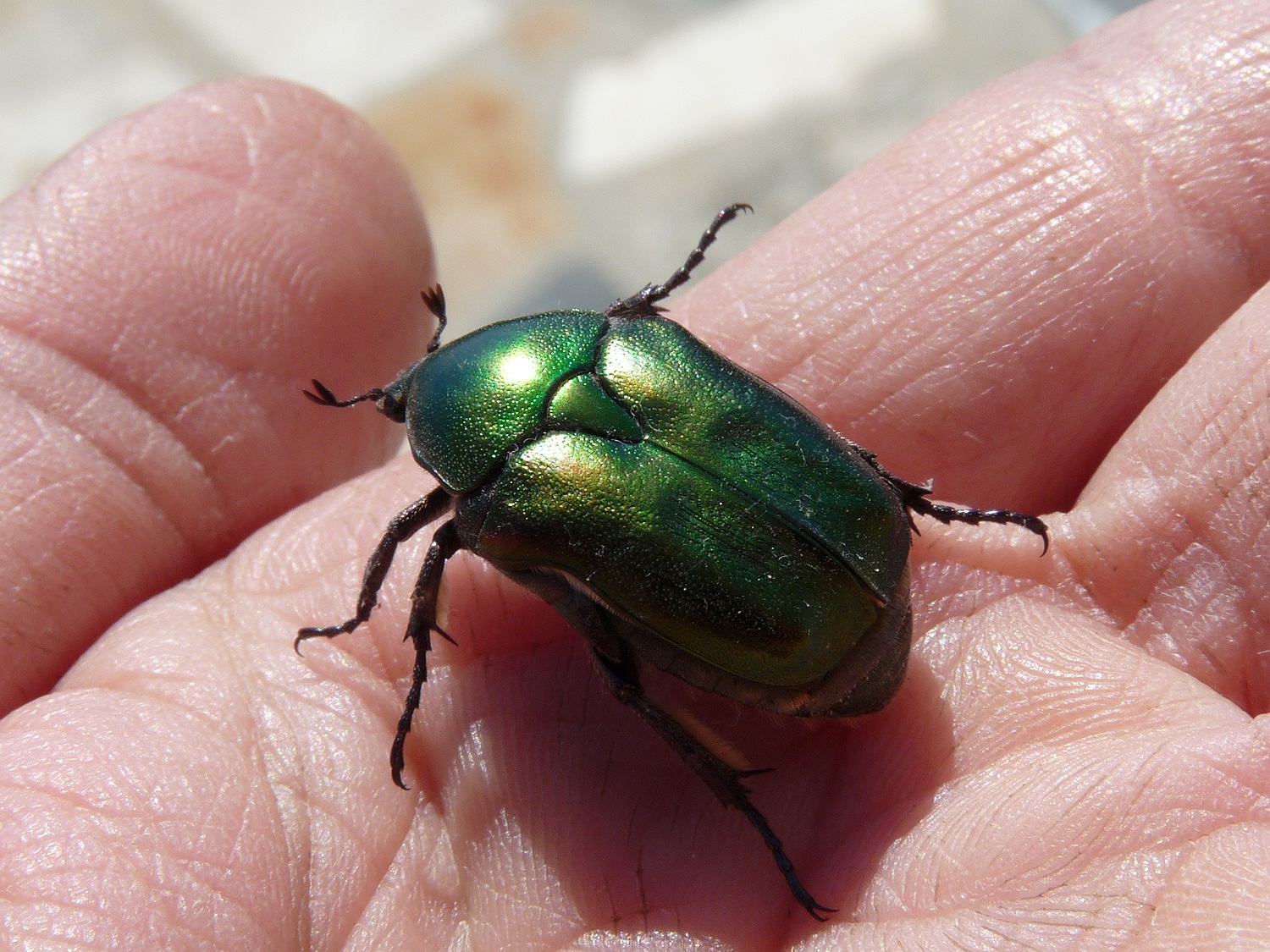
The wing covers carry many very small dots.
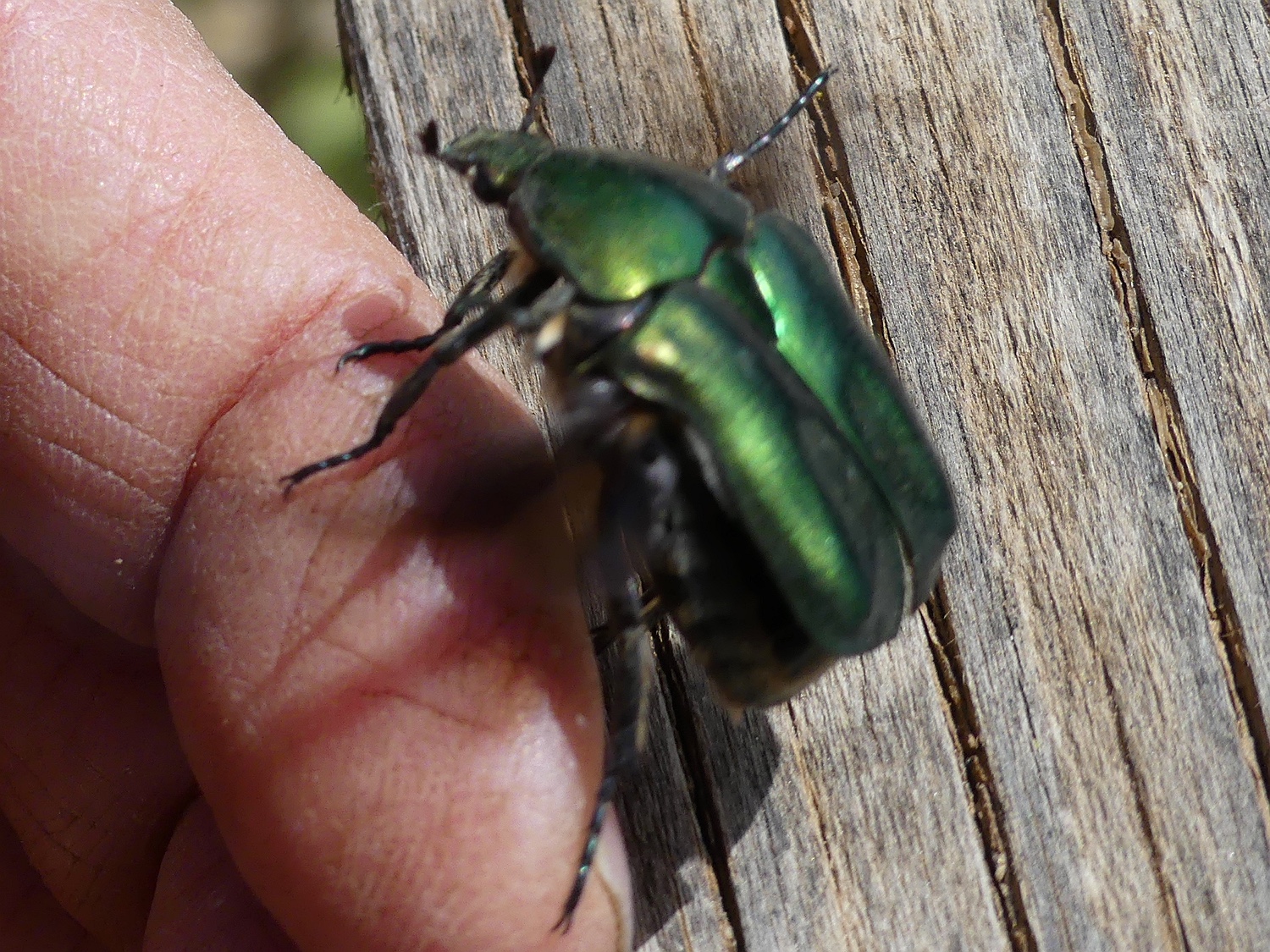
Here you can see (although the photo is not very good) that Protaetia (and related species) do not raise their wing covers to the side when they fly, but only extend their membranous hind wings from underneath them.
Rose chafer, Cetonia aurata, L.
The Rose chafer, which is widespread in Eurasia, resembles the species of the genus Protaetia in its metallic gold-green colour.
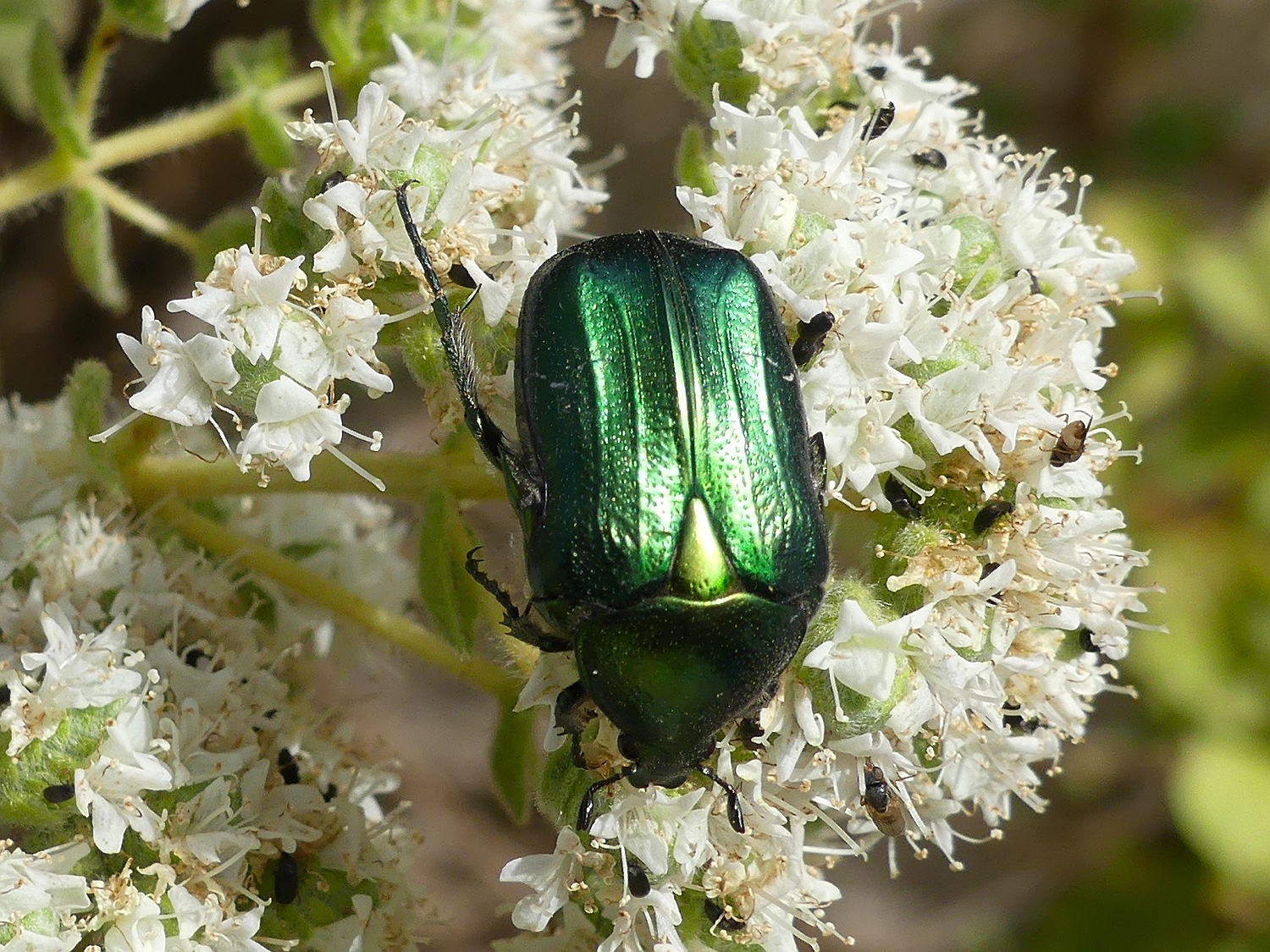
The Rose chafer carries distinct longitudinal edges on its wing covers which also show numerous small indented dots. Several small white lines can be seen on the side of the wing covers about 2/3 to the tip.
Oxythyrea cinctella, Schaum
The chafer beetles of the genus Oxythyrea are related to the rose chafers, but are black with white spots. They live mainly on flowers and feed on pollen. The larvae eat plant roots. This beetle is by far the most common chafer species in our region: In spring and early summer, they can be found everywhere on the flowers.
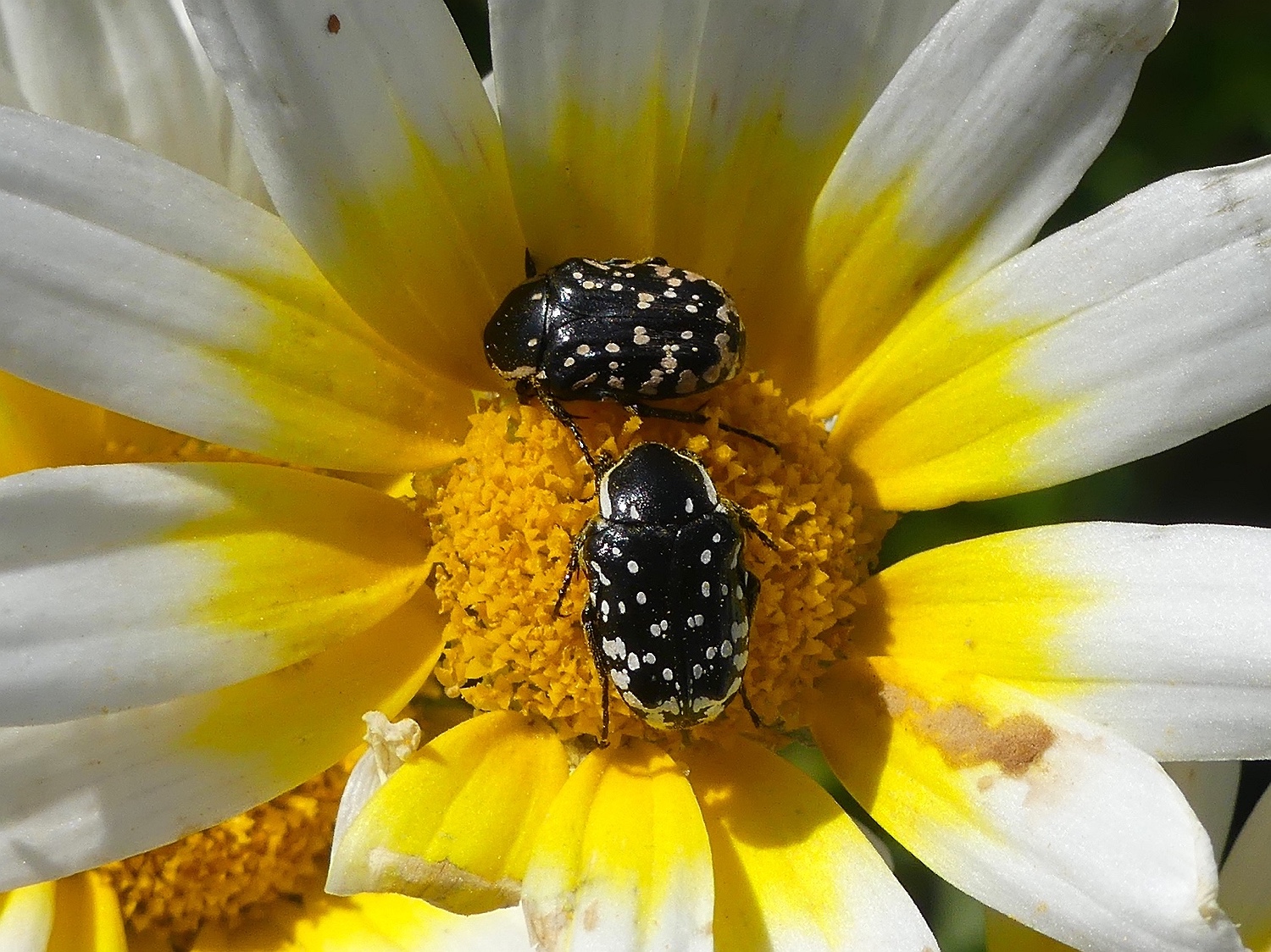
Oxythyrea cinctella can be distinguished from similar species by the whitish edge of its neck shield and the two small white dots on its rear edge. It lives on flowers and feed on pollen. This species is very common in our region.
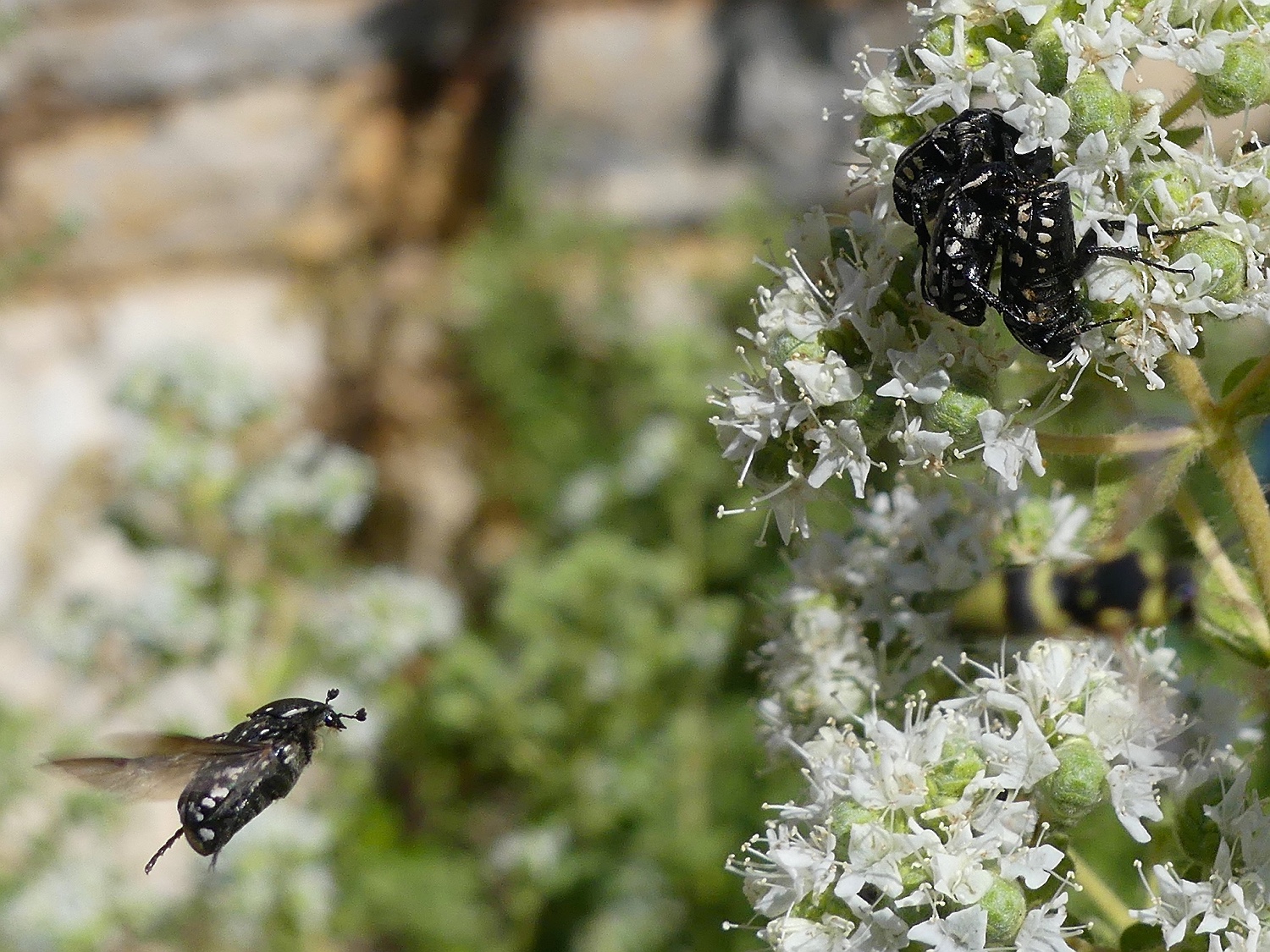
mating individuals
Hairy rose beetle, Tropinota hirta, Poda
The Hairy rose beetle is, as its name suggests, hairy. It is brown in colour with some white spots and stripes on its wing covers. Like Oxythyrea cinctella, it lives on flowers and feeds on pollen. The larvae live in mouldy wood. As always, there are similar species that are not easy to distinguish.
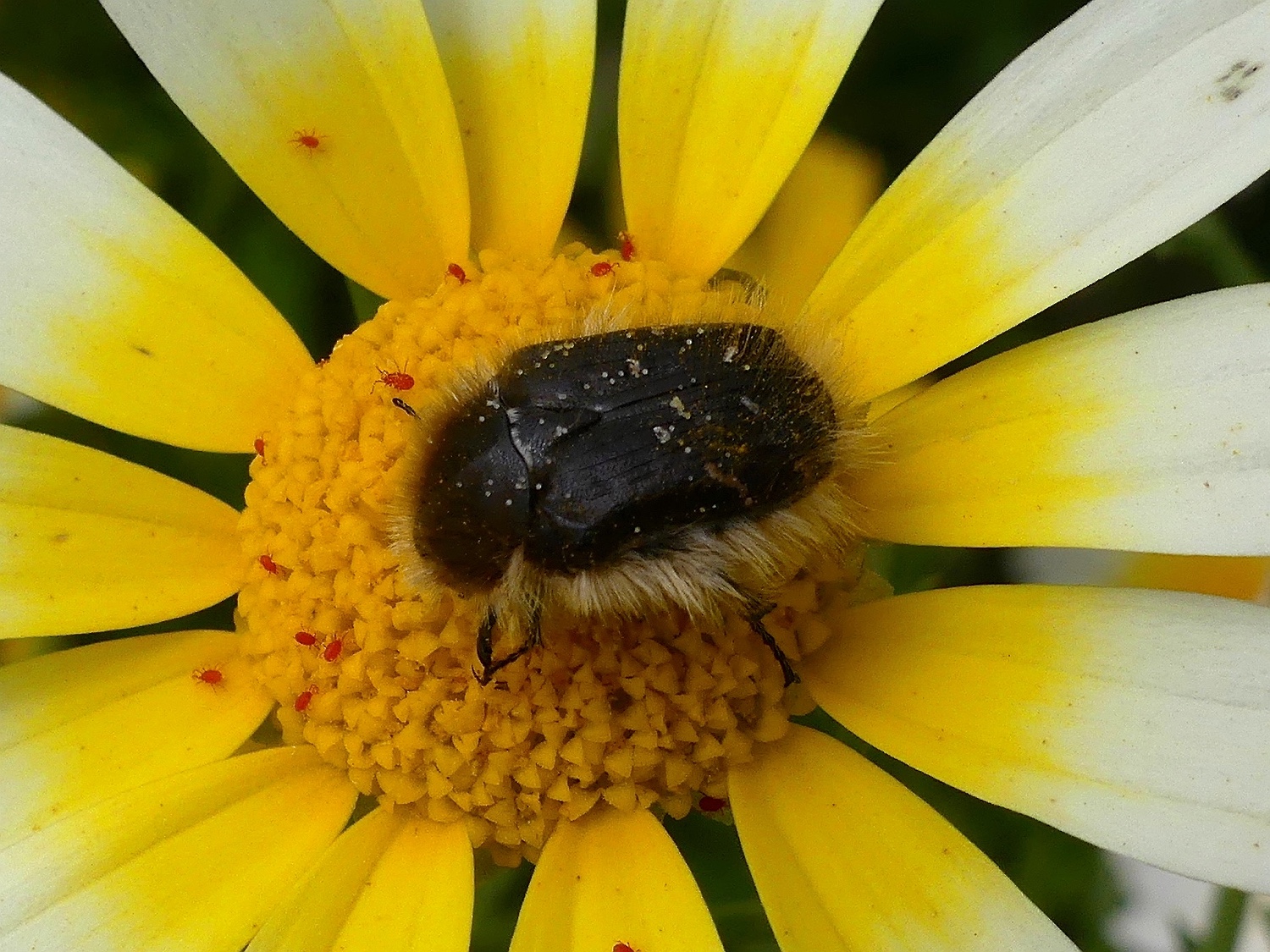
The Hairy rose beetle is brownish and hairy and usually has some white stripes on its wing covers.
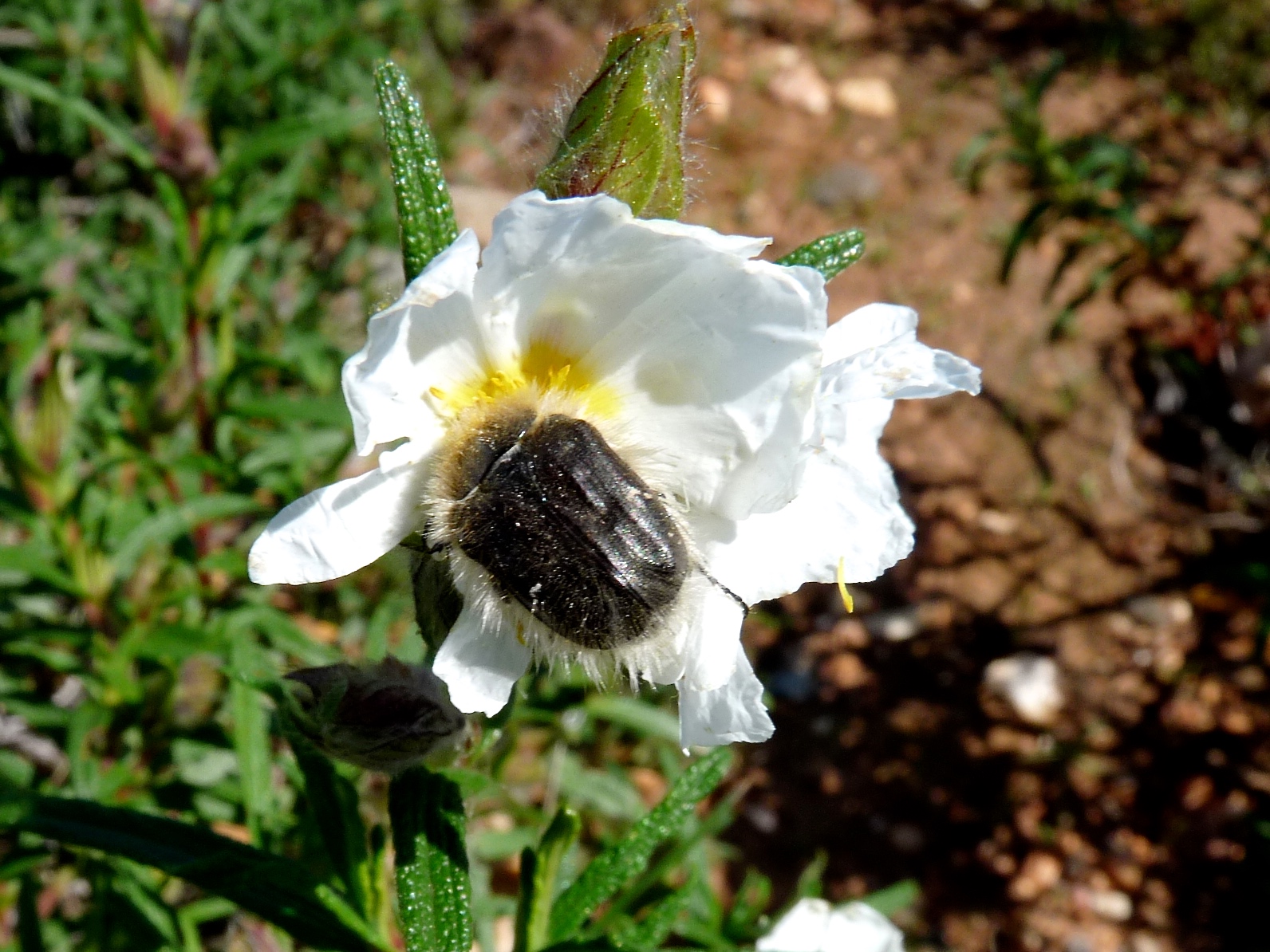
Some specimens do not have any white markings. The dense hairs around the wings and on the neck shield are characteristic.
Anisoplia spec.
The species of the genus Anisoplia looks a bit like a smaller version of the cockchafer, but, unlike the cockchafer, it is active during the day. Some members of the genus Anisoplia are pests in grain fields. Characteristic are the two claws on the tips of their feet which are different in size.
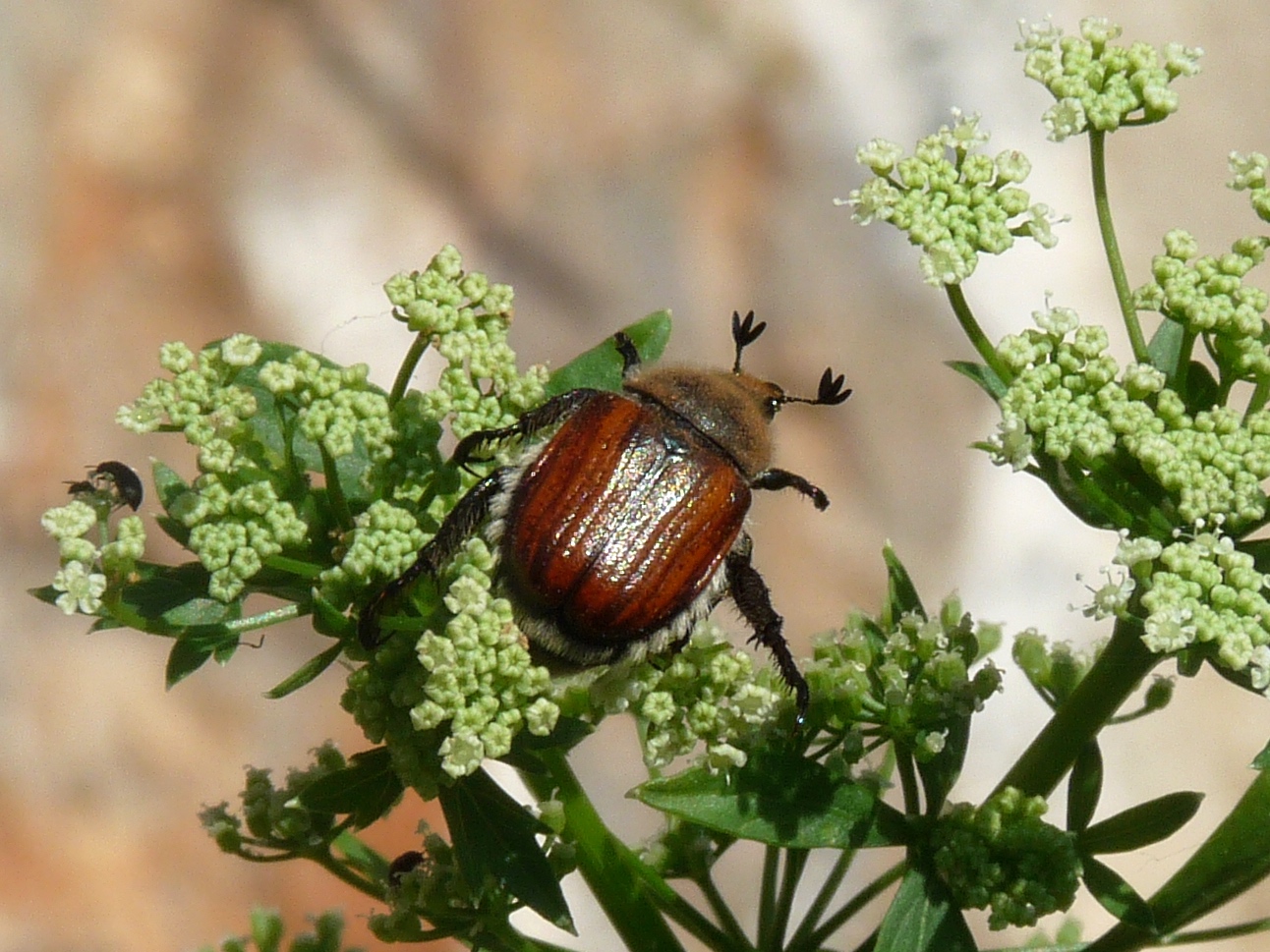
The members of the genus Anisoplia are rust-brown in colour with hairless, shiny wing covers. Around the wing covers lies a striking ring of dense white hair tufts. In this specimen one can see the fan-like antennae, divided into three parts at the tip, which are typical of the scarab beetle family.
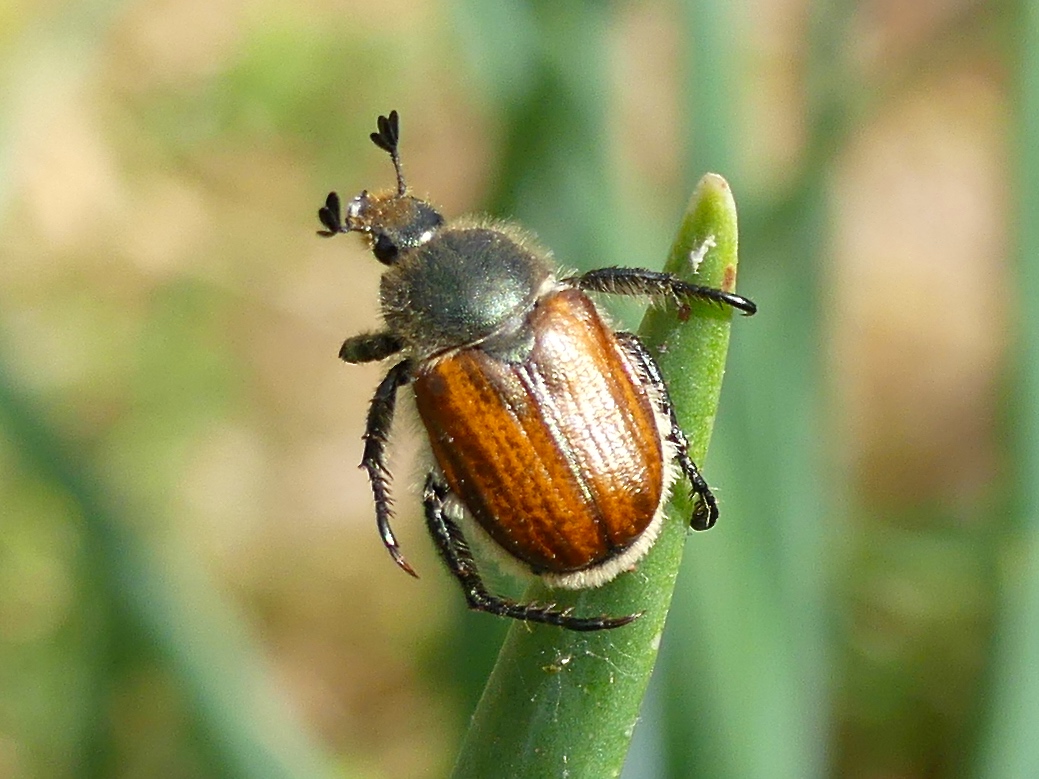
Beetles of this species often sit in this way on the tips of plant stems. What are they doing this for?
Melolontha pectoralis ?, Megerle
This species of cockchafer, also known as the Caucasian cockchafer, is widespread in the Balkans and Asia Minor as far as Iran. It is rare in central Europe. The larva, which needs three to four years to develop into the adult, lives in the soil and feeds on roots. This species is rare on Naxos; we have only found one dead specimen so far.

Melolontha pectoralis, an eastern species, is very similar to the European cockchafer. It is difficult to identify. The triangular white hair tufts on the sides of the abdominal segments are typical of cockchafers.
European rhinoceros beetle, Oryctes nasicornis, L.
The European rhinoceros beetle is common on Naxos. It is nocturnal and can mainly be encountered in warm nights in late spring when it is attracted to lights. This species lives on wood; the larvae are able to digest cellulose with the help of symbiotic bacteria. In the course of adapting to humans, the rhinoceros beetle has also started to live in compost heaps and other materials rich in plant fibres. In many parts of Europe, the rhinoceros beetle has become rare and is protected. The males use the large horn on their head shield to fight each other.
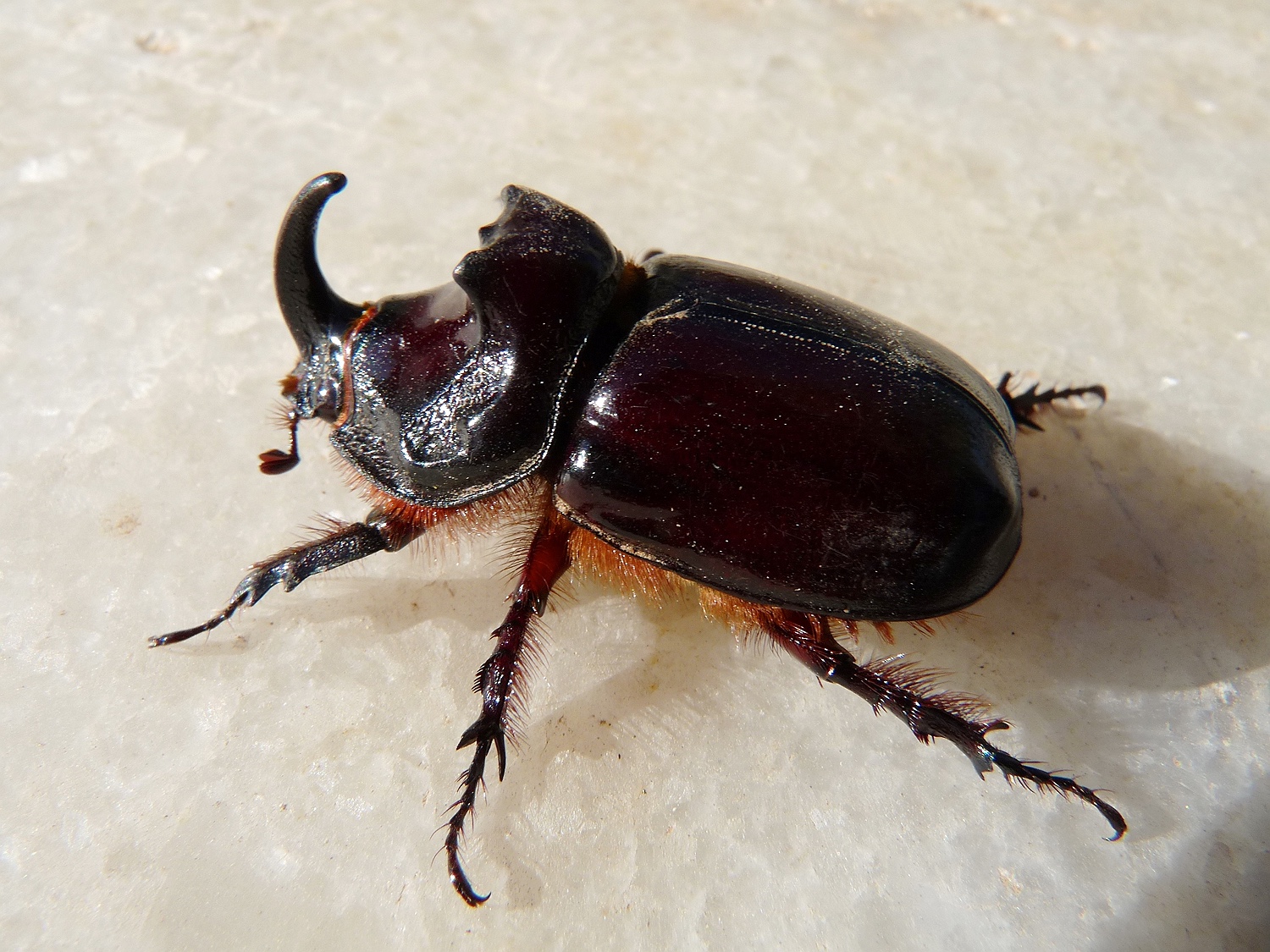
The male European rhinoceros beetle carries an impressive horn on its head. The neck shield is greatly enlarged with a bulge with three humps towards the rear. The head, neck shield, wing covers and legs are shiny dark brown. The underside of the body is rust-brown and hairy.
Phyllognathus excavatus, Forster
This beetle, which also belongs to the subfamily of the rhinoceros beetles (Dynastinae), is characterised by its much smaller horn and its deeply pitted ‘hollowed-out’ neck shield. It is rare in our region. The species is widespread in southern Europe and parts of Asia and North Africa. The larvae can cause damage in vineyards. I would like to thank Jannis Gavalas for his help in identifying this species.
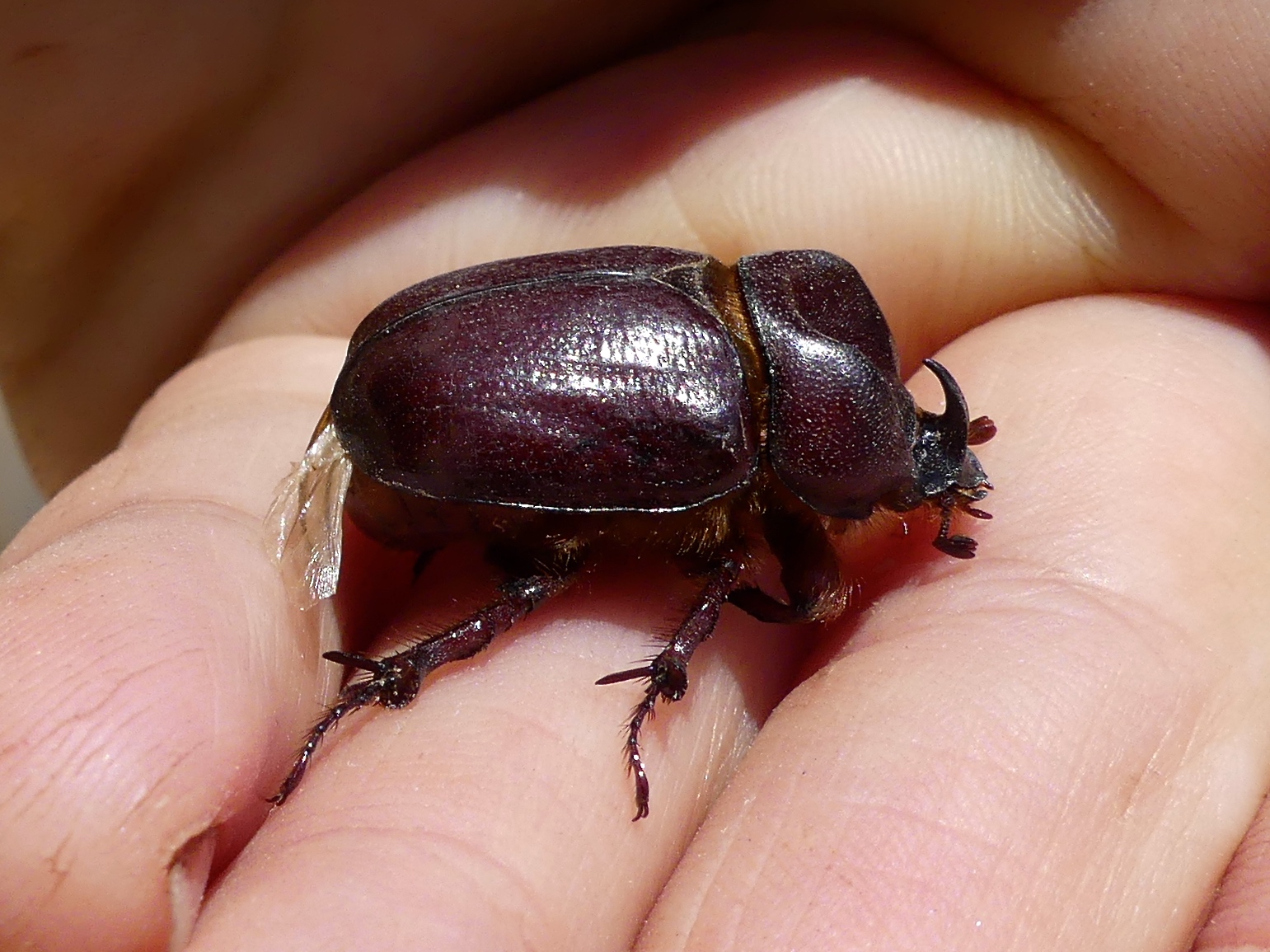
Phyllognathus excavatus is related to the rhinoceros beetle, but has a significantly smaller horn.
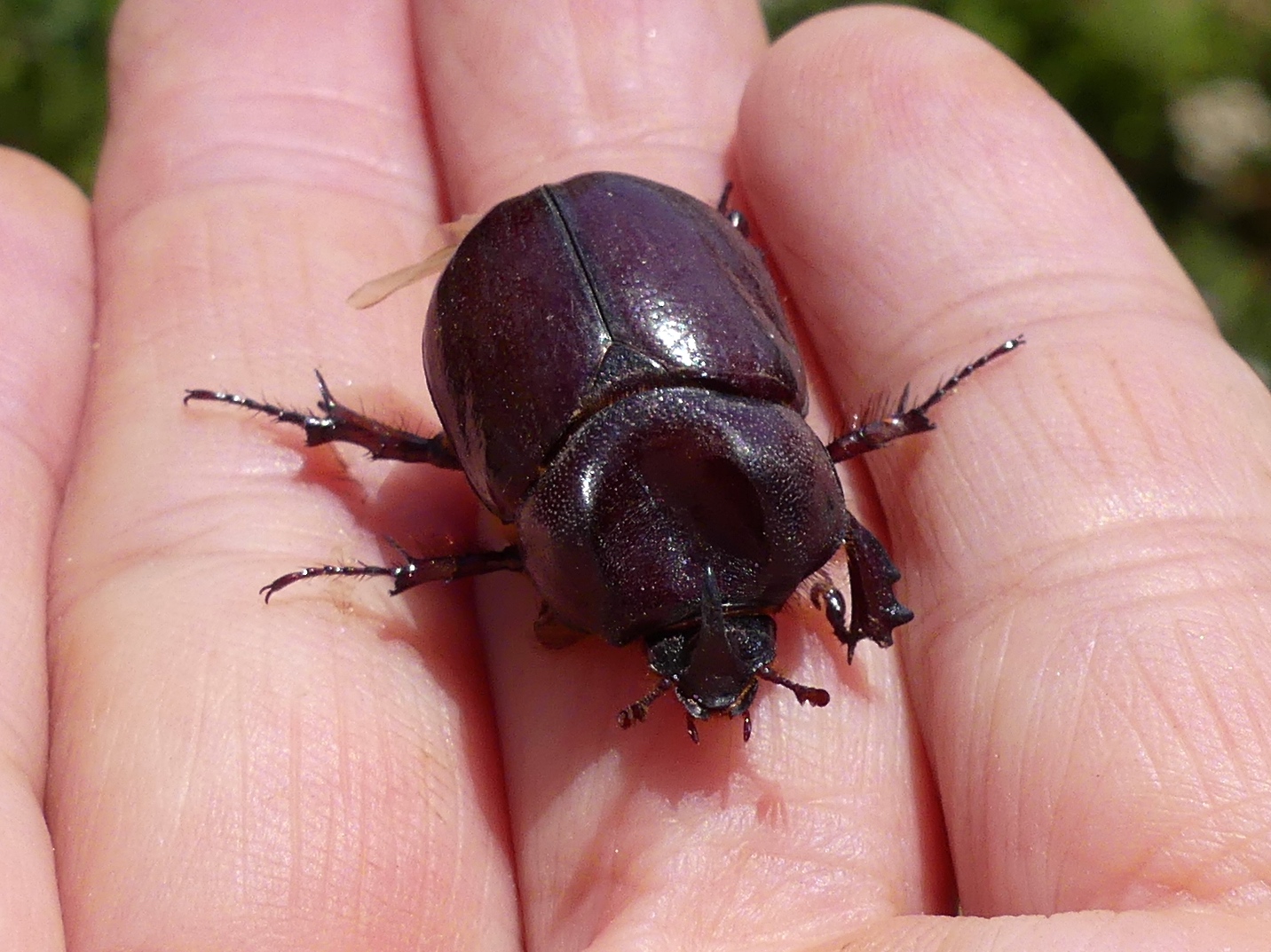
The pronotum is deeply hollowed out at the front.
Copris hispanus, L.
This species looks very similar to the rhinoceros beetle, but has a significantly different way of life: the adult animals and larvae live on dung, like dung beetles. The female lays only a few eggs, and takes special care of the larvae in a breeding chamber in the ground. The male brings the dung, which the female shapes into balls. For four months, until the larvae pupate and the young beetles hatch, the female cares for the dung balls, smoothing their surface and removing mould.
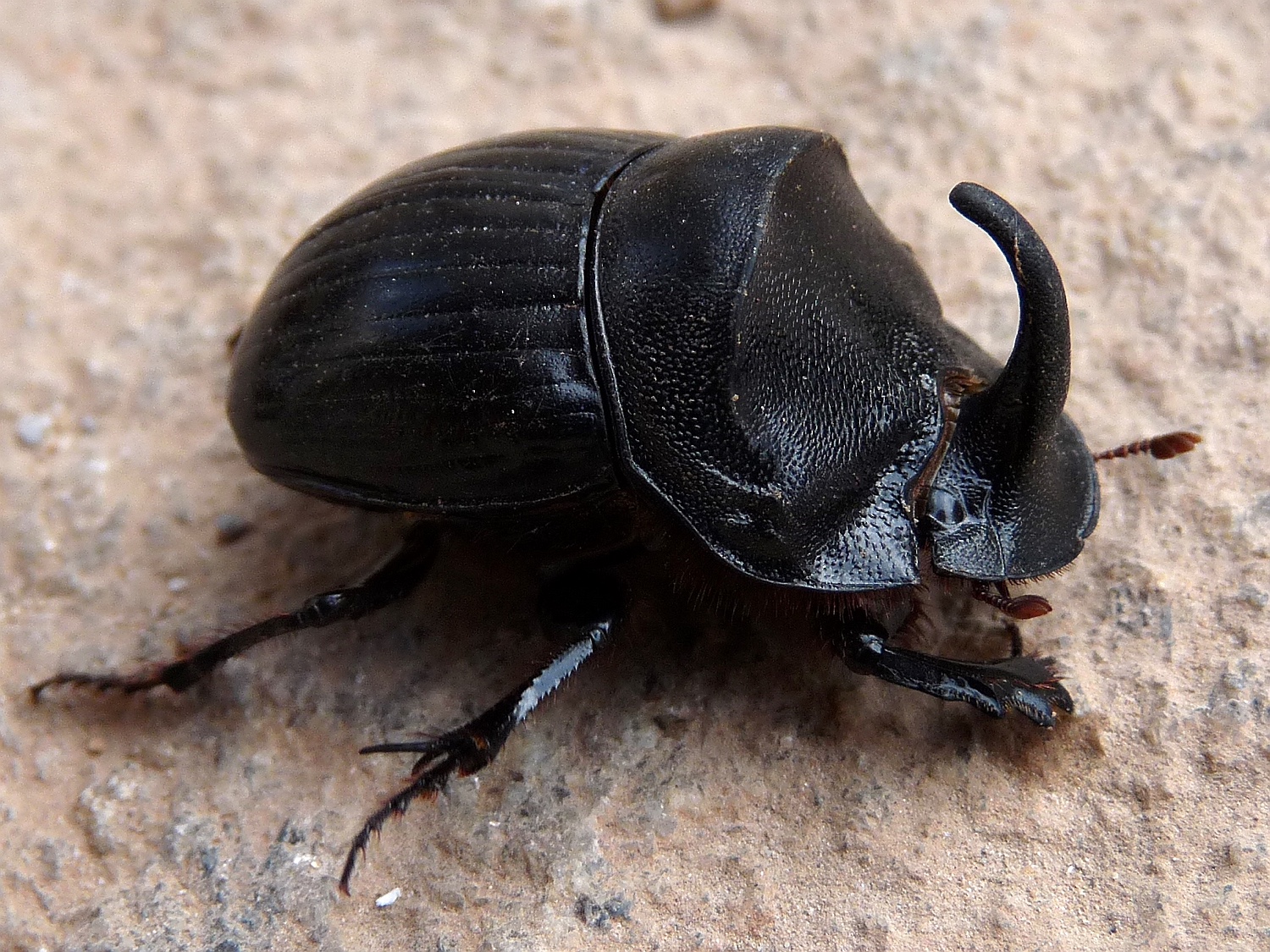
This species differs from the rhinoceros beetle in the longitudinal ribs on the wing covers, the much smaller bumps on the upper edge of the neck shield and its darker colour. The neck shield, head and even the horn are finely dotted throughout.
Longhorn beetles, Cerambycidae
With 26,000 known species, the longhorn beetles are another very large beetle familie. They are characterised by their very long, thin antennae of at least two-thirds and up to five times (!) the length of their body. The eyes of longhorn beetles are crescent-shaped and surround the base of the antennae. The beetles are often quite large; their bodies are elongated and can be brightly coloured; however, many species are mainly brownish or grey. The pronotum often has more or less pointed protrusions on the sides.
Longhorn beetles feed mainly on plants; the larvae usually live in wood. Some species are forest pests. The House longhorn beetle infests the wooden structures of houses and roofs and can do serious damage. Most species are good flyers. Some are able to produce sounds that are intended to deter intruders. Today, many species, especially those that live in forests, have become very rare in many areas of central Europe and are protected.
Grape wood borer, Chlorophorus varius, O. F. Müller
The genus Chlorophorus is rather large with many species. The adult beetles of this genus often sit on flowers feeding on the pollen; the larvae live in the wood of deciduous trees. They have large, slightly arched neck shields and a small, barely protruding head.
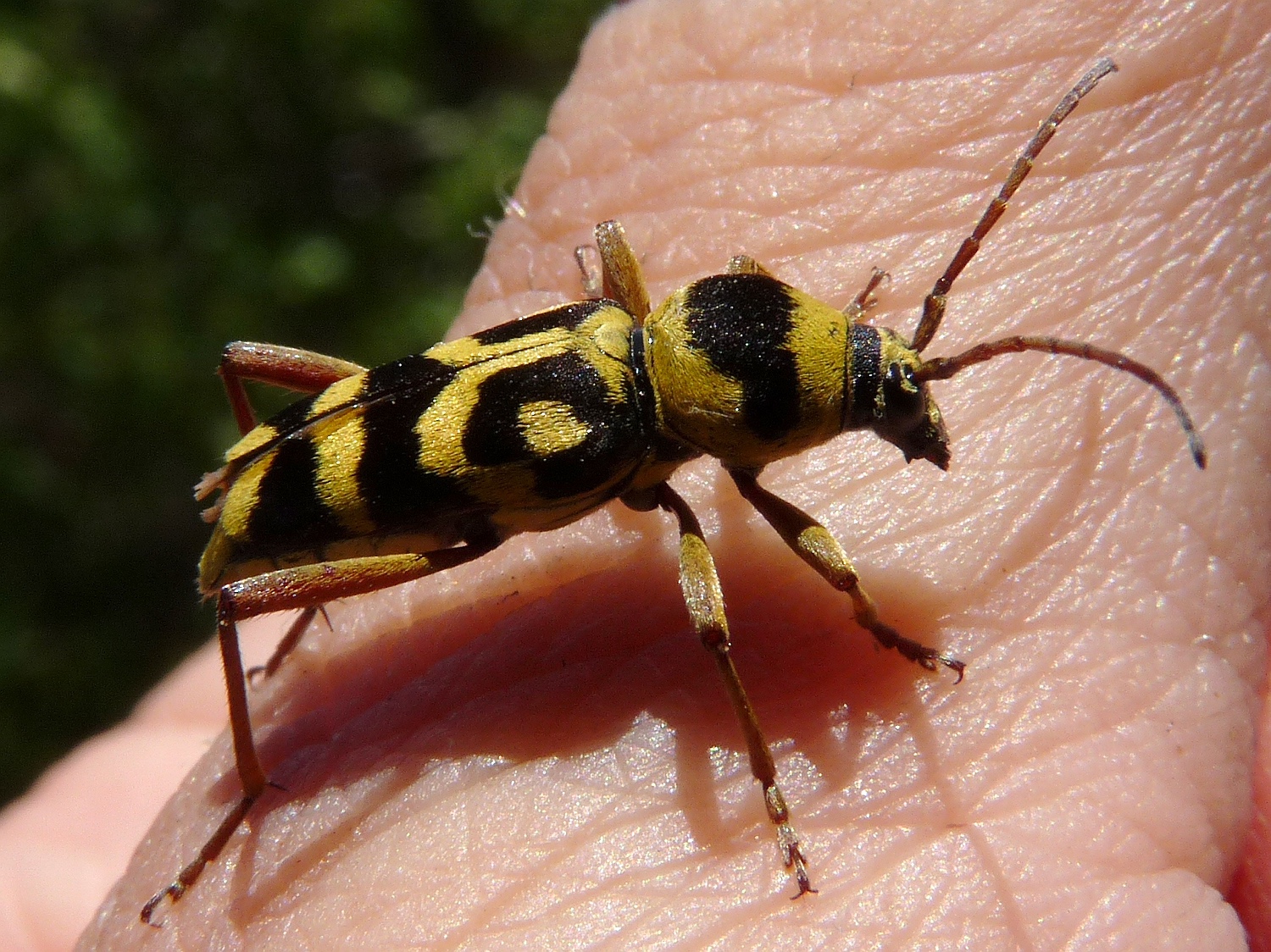
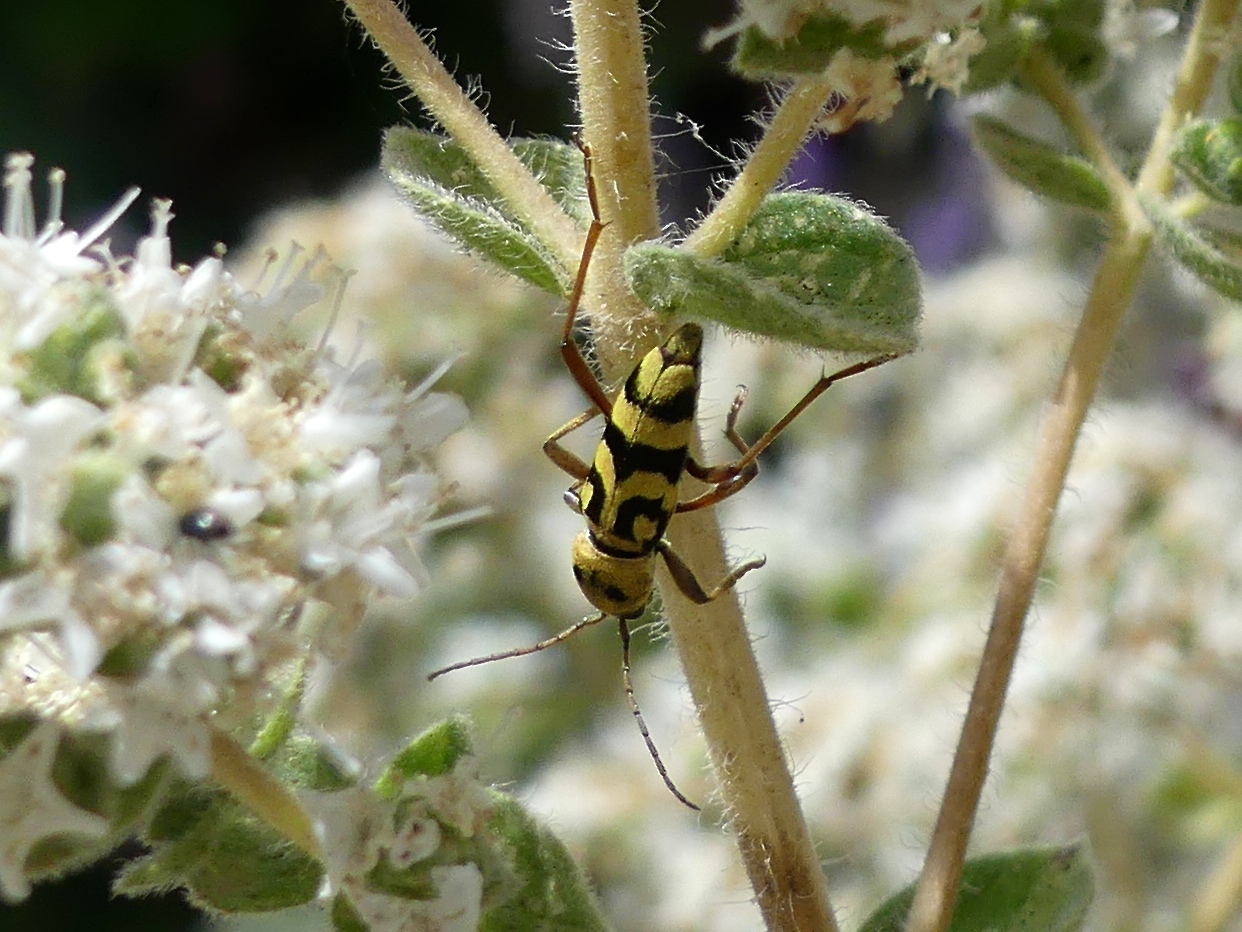
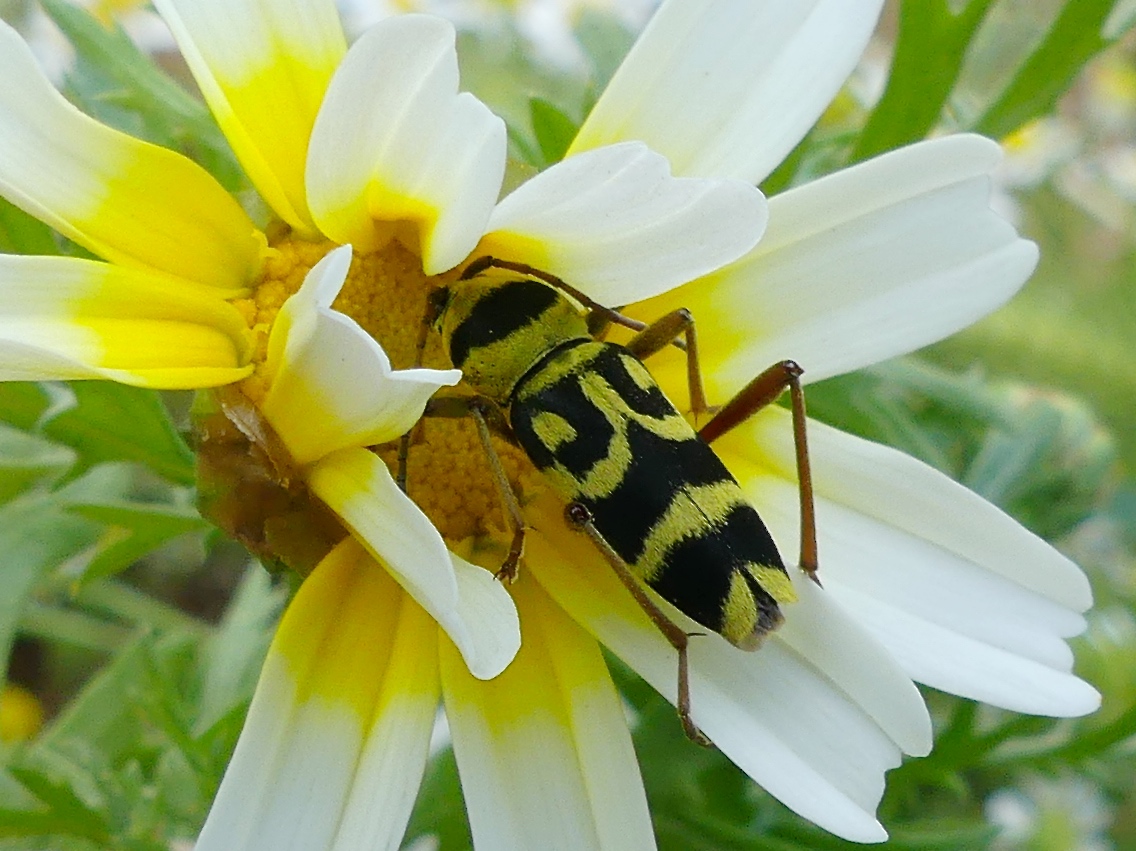
The Grape wood borer has a wasp-like colouring, which it uses to deter potential predators by pretending to be defensive and poisonous.
Chlorophorus sartor, O. F. Müller
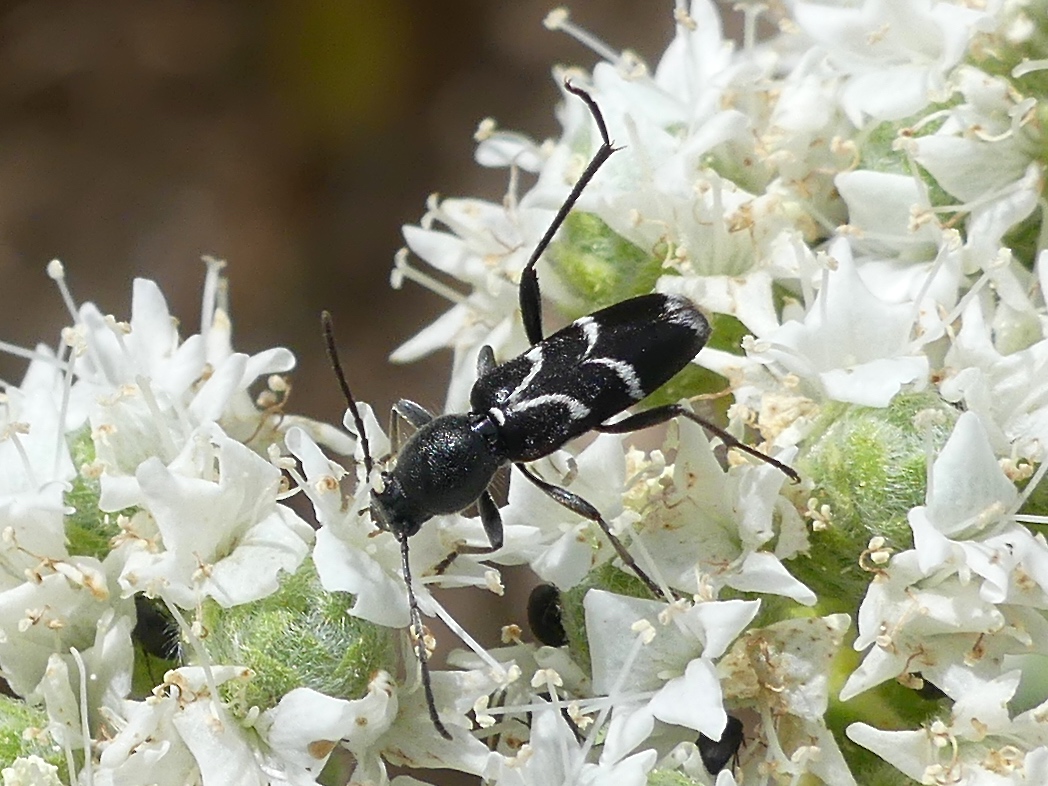
Chlorophorus sartor has a blackish colour with thin light bands on its wing covers. While the larvae live in the wood of deciduous trees such as oak or carob, the adults usually sit on the flowers of umbelliferous plants, as here on our Greek oregano, which is visited by many insects.
Chlorophorus trifasciatus, Fabricius
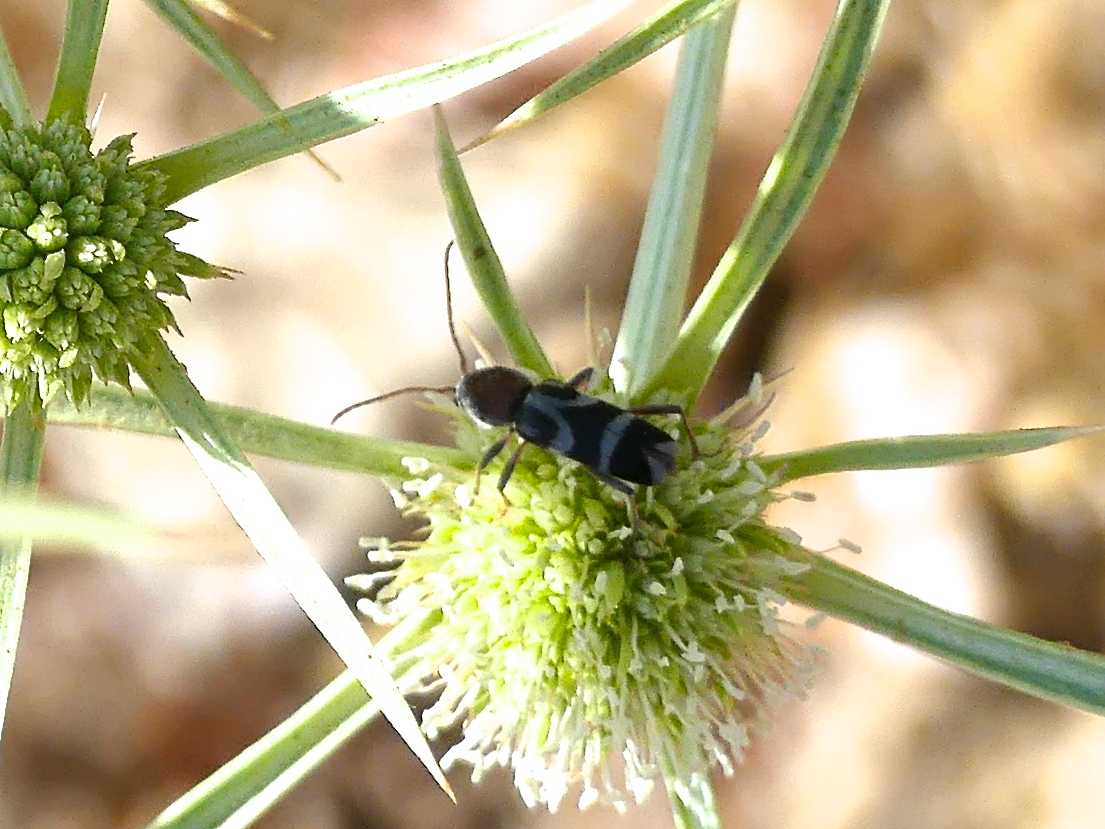
This species is characterised by its reddish-brown neck shield and the horizontal stripes on its wing covers of which the front ones are curved and the middle ones straight.
Opsilia coerulescens (= Phytoecia caerulescens), Scopoli
This small, slender longhorn beetle is widespread in Europe, Asia and North Africa, but is not particularly common in our region. Its larvae live in plants, where they inhabit the lower stems, which usually leads to the host plant dying over time. Opsilia coerulescens was introduced to Australia for biological pest control of the Purple viper’s-bugloss (Echium plantagineum).
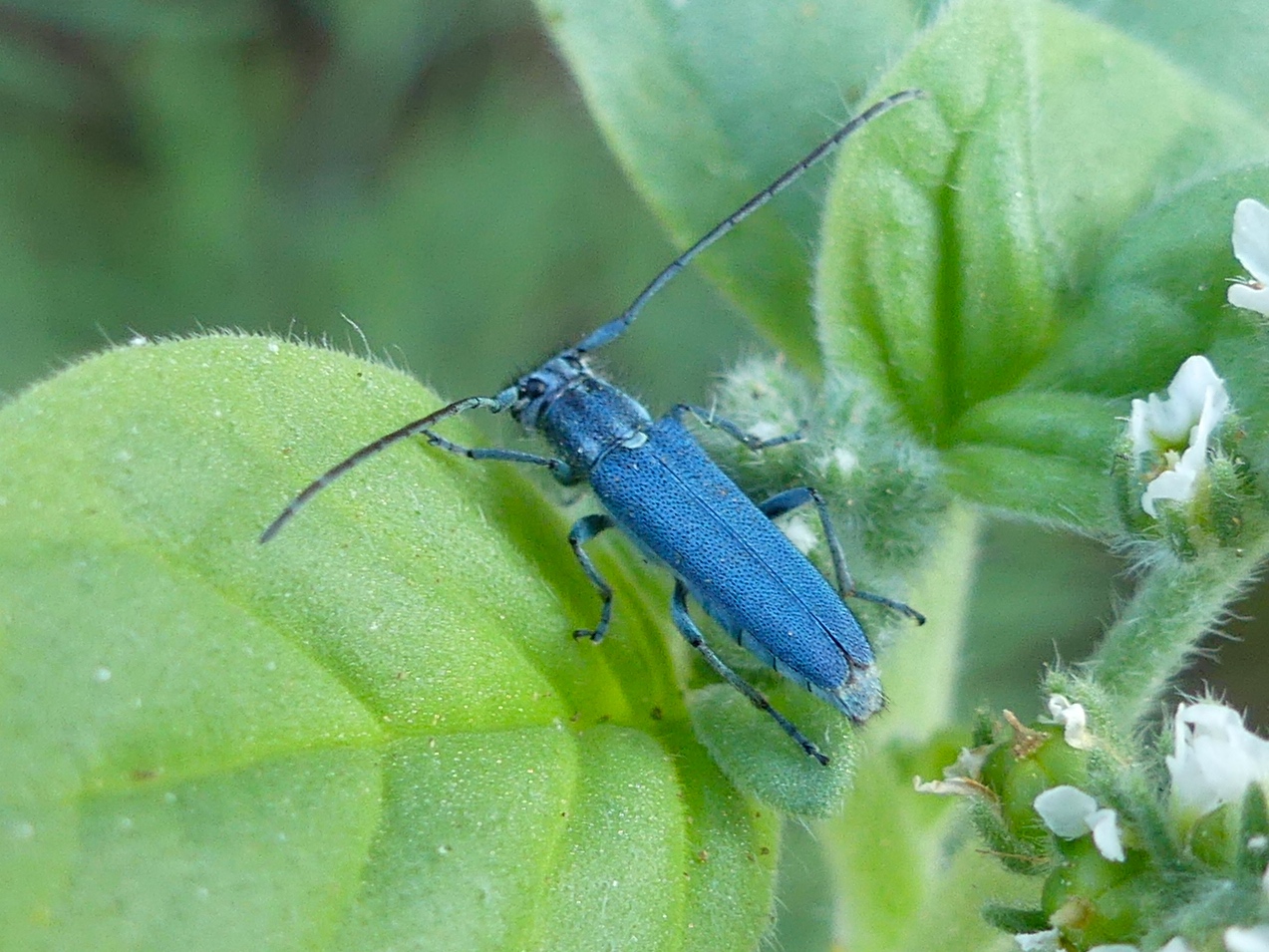
Opsilia coerulescens is black in colour, but appears turquoise due to its fine hairs. Its eyes are divided into two parts, with one half above the base of the antennae and the other half below it on the outside.
Stictoleptura cordigera, Fuesslin
Stictoleptura cordigera has a black spot on its red wing covers that is roughly heart-shaped. This beetle is easy to recognise by its appearance. The larvae of this species live in rotten wood of oak trees or the mastic tree.
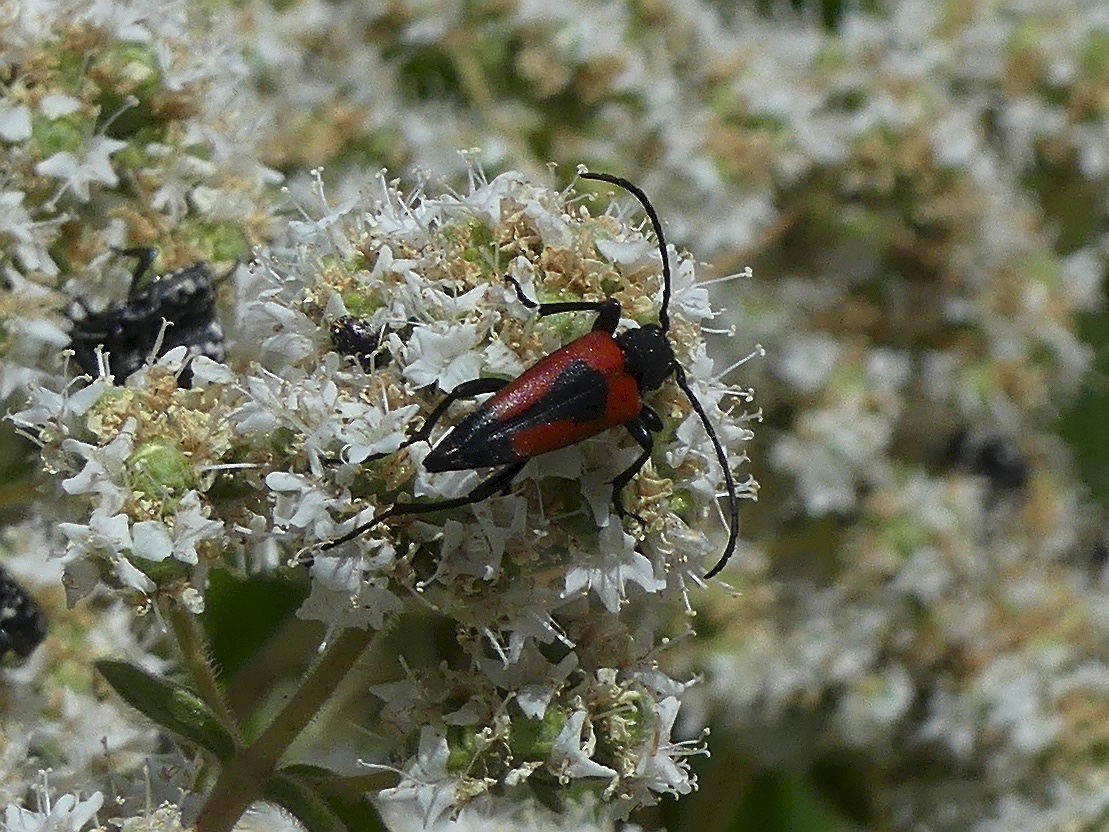
The pretty Stictoleptura cordigera grows to a size of up to 2 cm. It is rather rare in our region.
Purpuricenus desfontainii, Fabricius
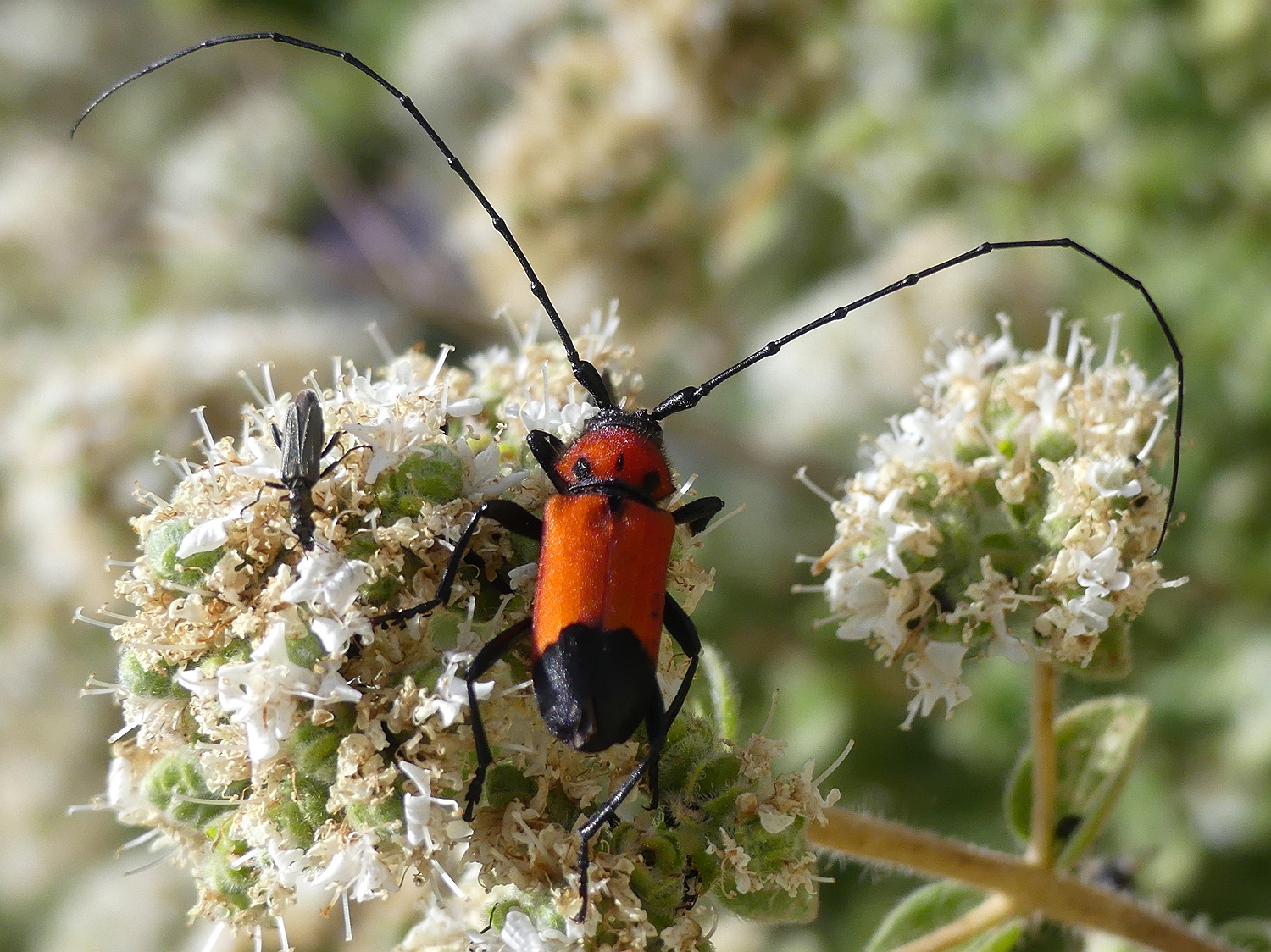
Another species of longhorn beetle with red wing covers that occasionally visits our oregano in spring is Purpuricenus desfontainii.
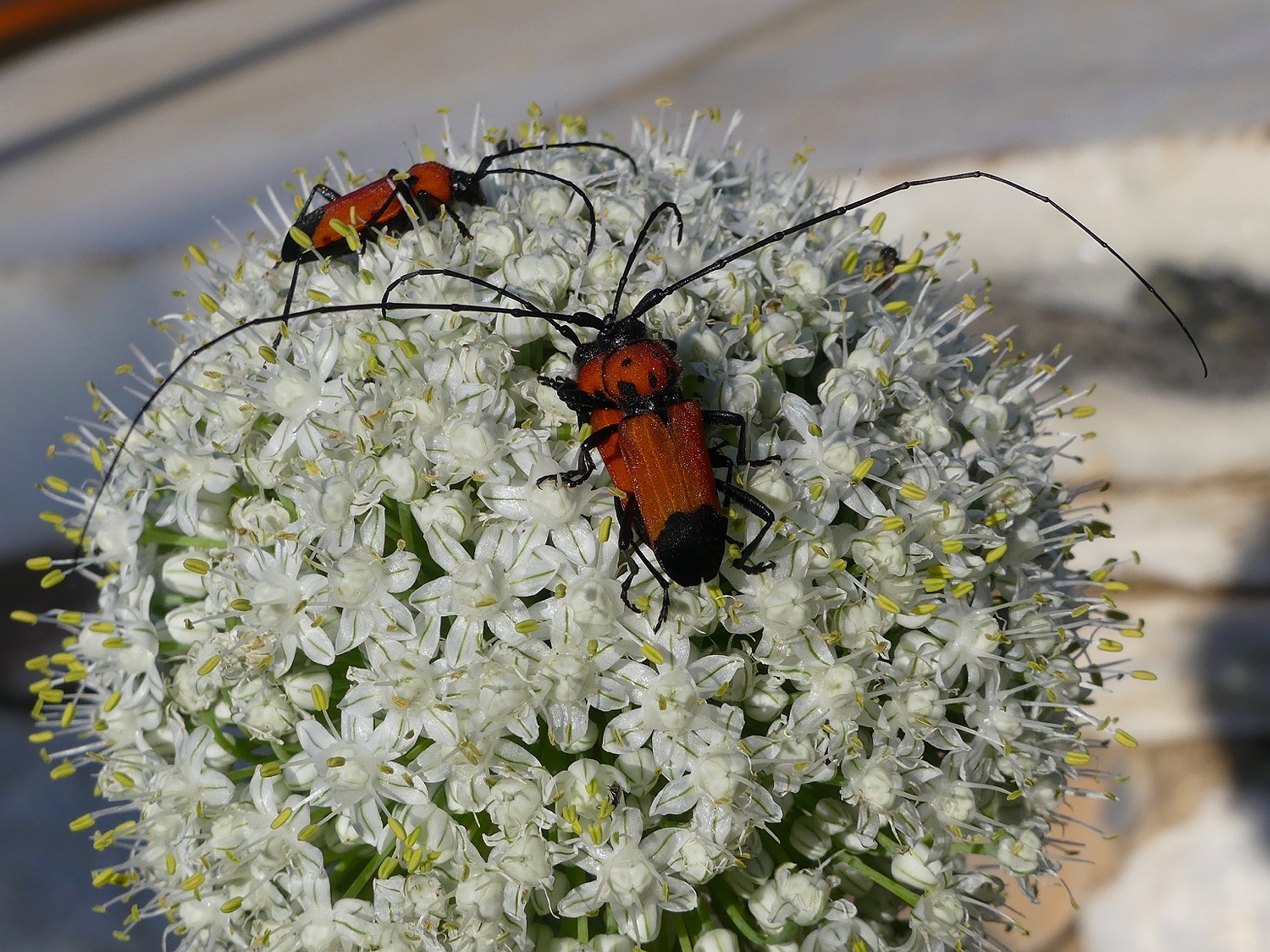
Here you can see the male’s amazingly long antennae; the antennae of the female are significantly shorter (the upper animal).
Agapanthia cynarae, Germar
This southern European longhorn beetle species is particularly narrow and elongated, growing to over 2 cm in length. Agapanthia cynarae is dark in colour with yellow stripes. The larvae live in the stems of various plant species.
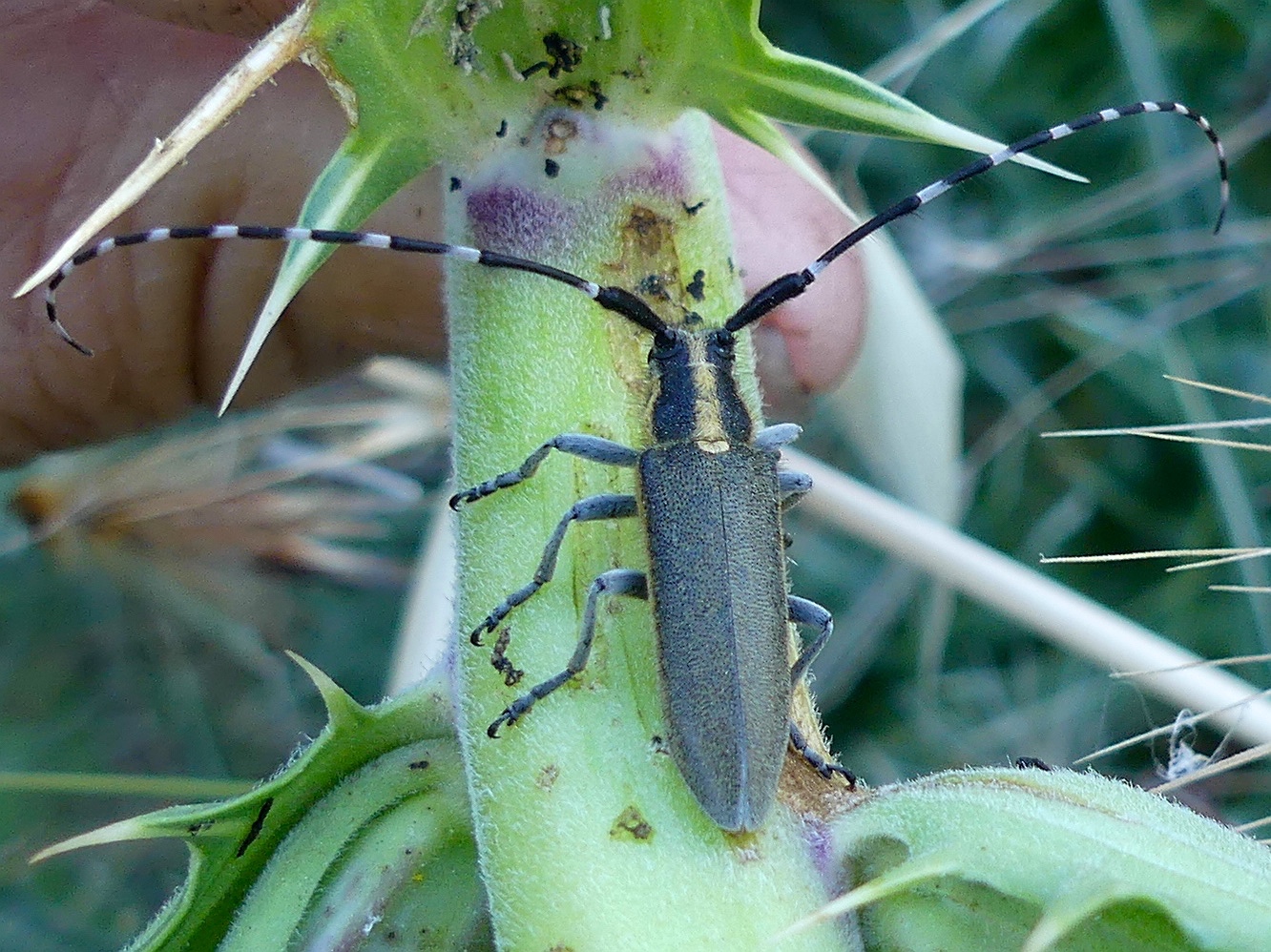
Agapanthia cynarae has a narrow body and long, black and white ringed antennae.
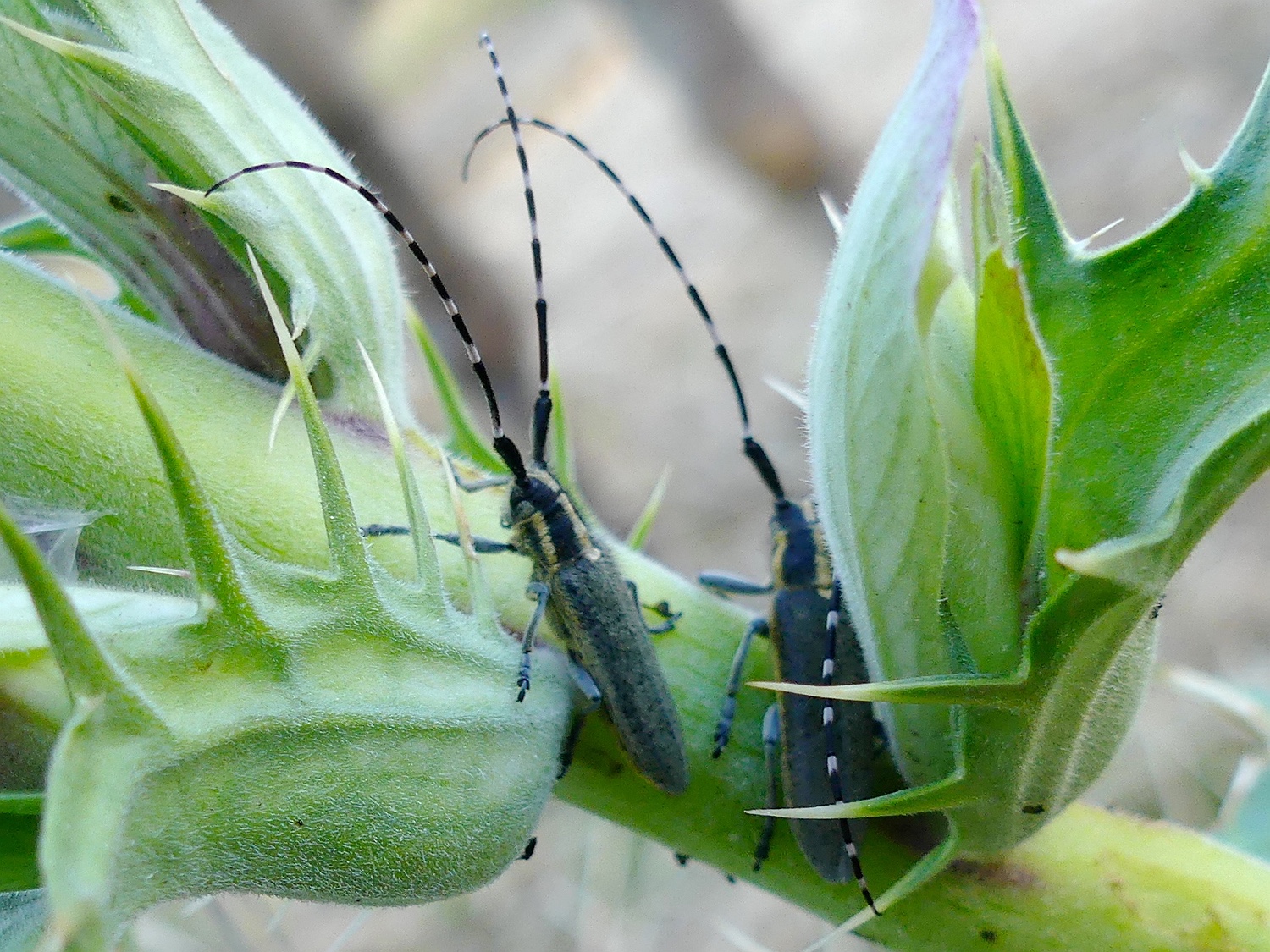
The yellow stripes on its body are caused by yellow hairs. I found this species on acanthus.
Pedestredorcadion insulare, (Kraatz) Sama
The genus Pedestredorcadion is separated from the large longhorn beetle genus Dorcadion by some authors. Both occur mainly in dry and warm areas of southern Europe and Asia. Members of these genera are phytophagous and feed mainly on grass. Most species cannot fly; they have no hind wings.
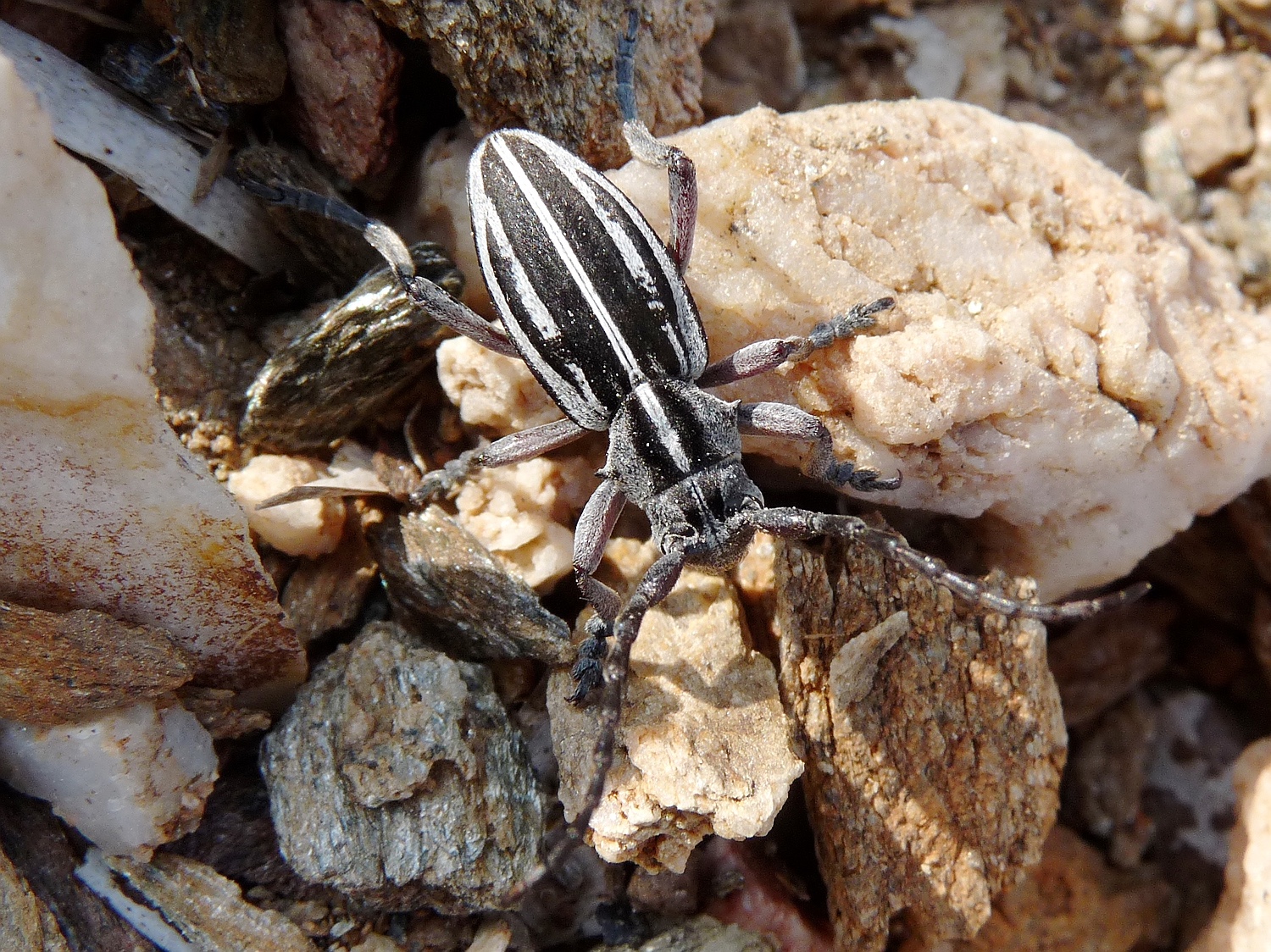
Pedestredorcadion insulare looks from afar a bit like a spider. The wing covers have four white longitudinal stripes and a white seam in the middle, which also extends to the neck and head. This beetle cannot fly and walks around on the ground. There are a number of related species that are very similar. Pedestredorcadion insulare is endemic to the Cyclades.
Hesperophanes sericeus, Fabricius
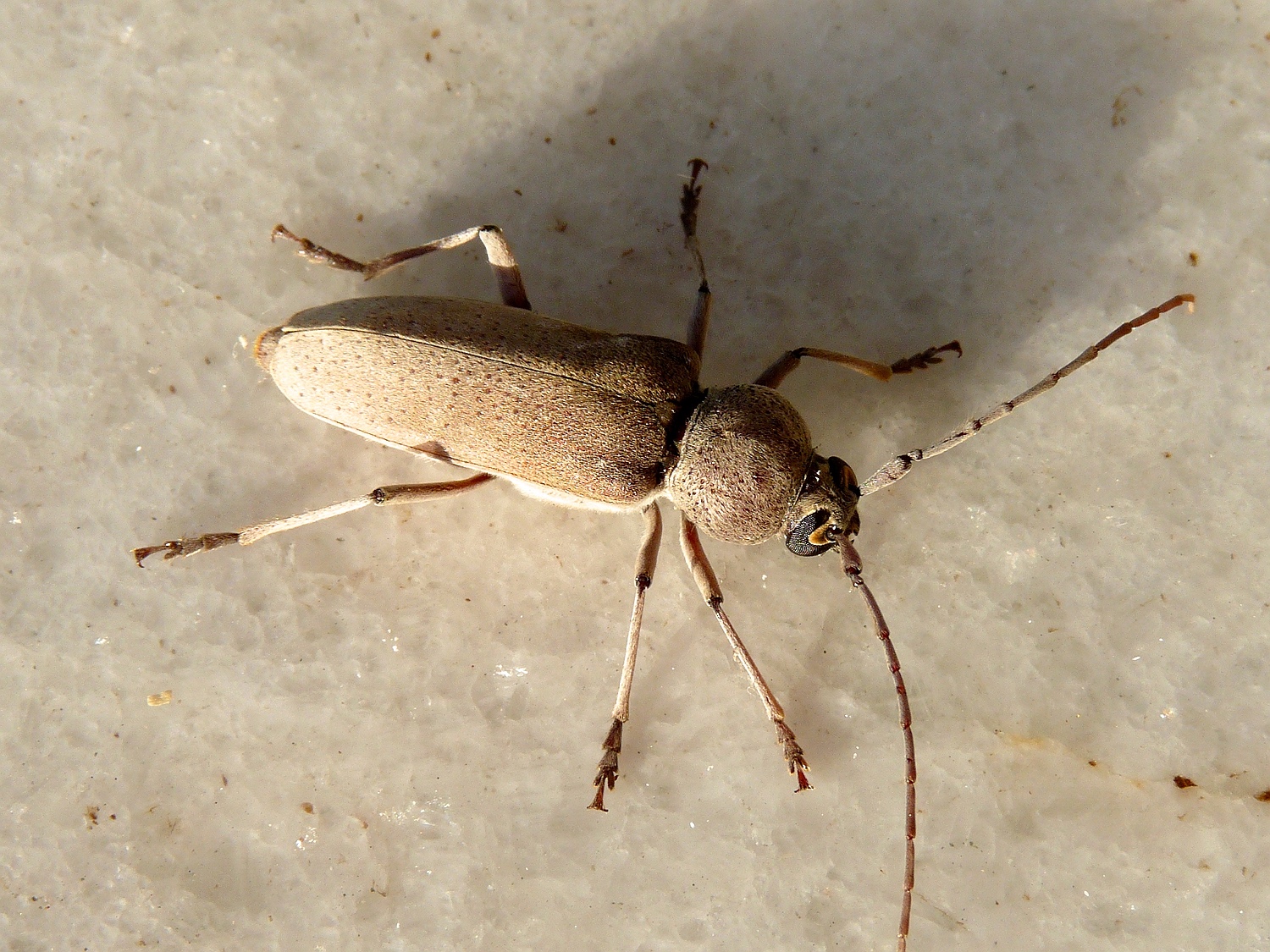
The grey-brown species Hesperophanes sericeus is widespread in the Mediterranean region. In this photo, you can clearly see the crescent-shaped compound eyes nestled around the base of the antennae.
Prinobius myardi, Mulsant
The subfamily Prioninae includes the largest beetle species, the Giant longhorn beetle, which can grow up to 17 cm in length. Our species, which is widespread in the Mediterranean region, is considerably smaller, but with up to 5 cm it is still one of the largest native beetles.
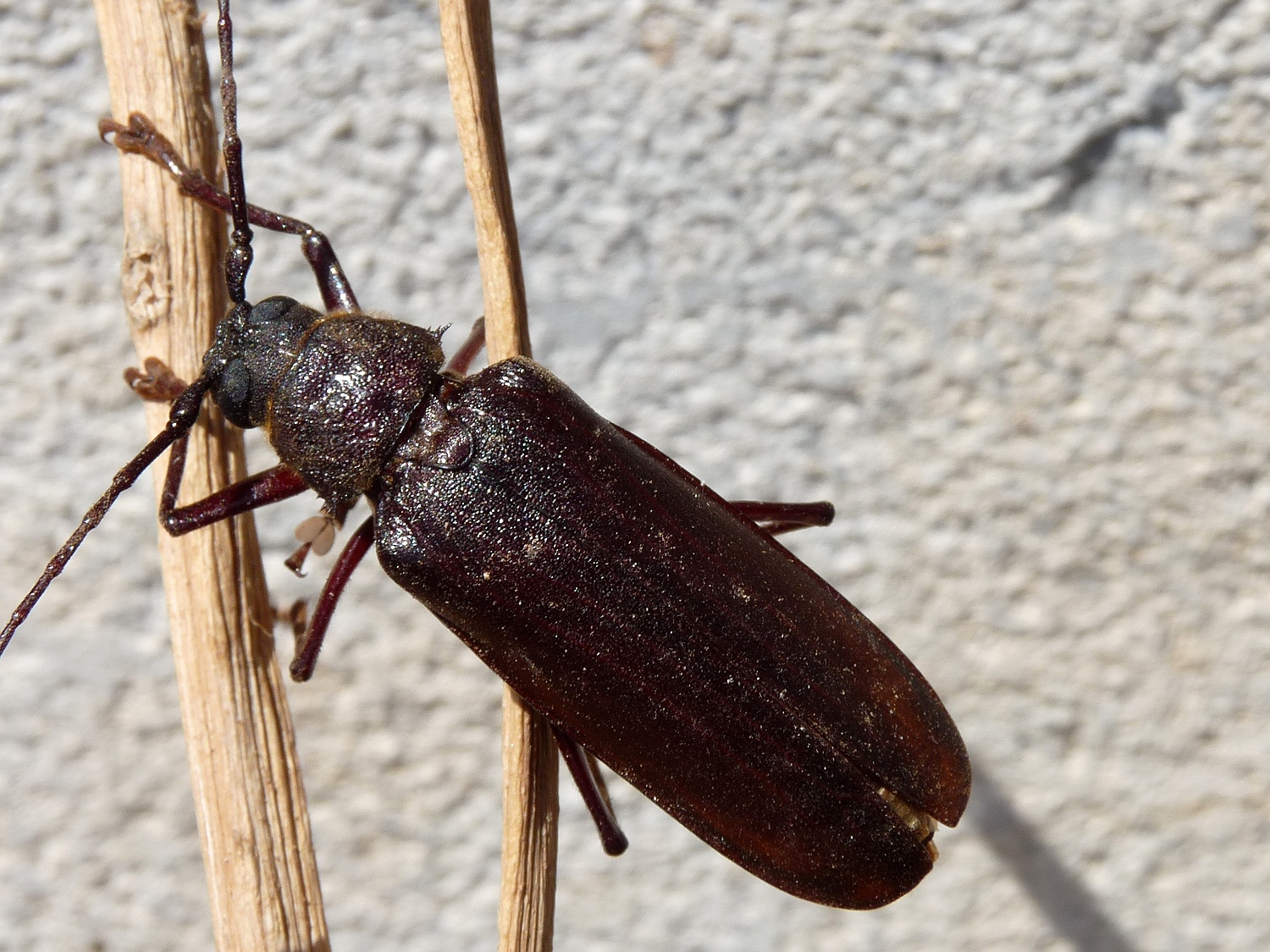
This very large longhorn beetle species is nocturnal and is often attracted to the lights of houses in early summer nights. The larvae live in the wood of trees.
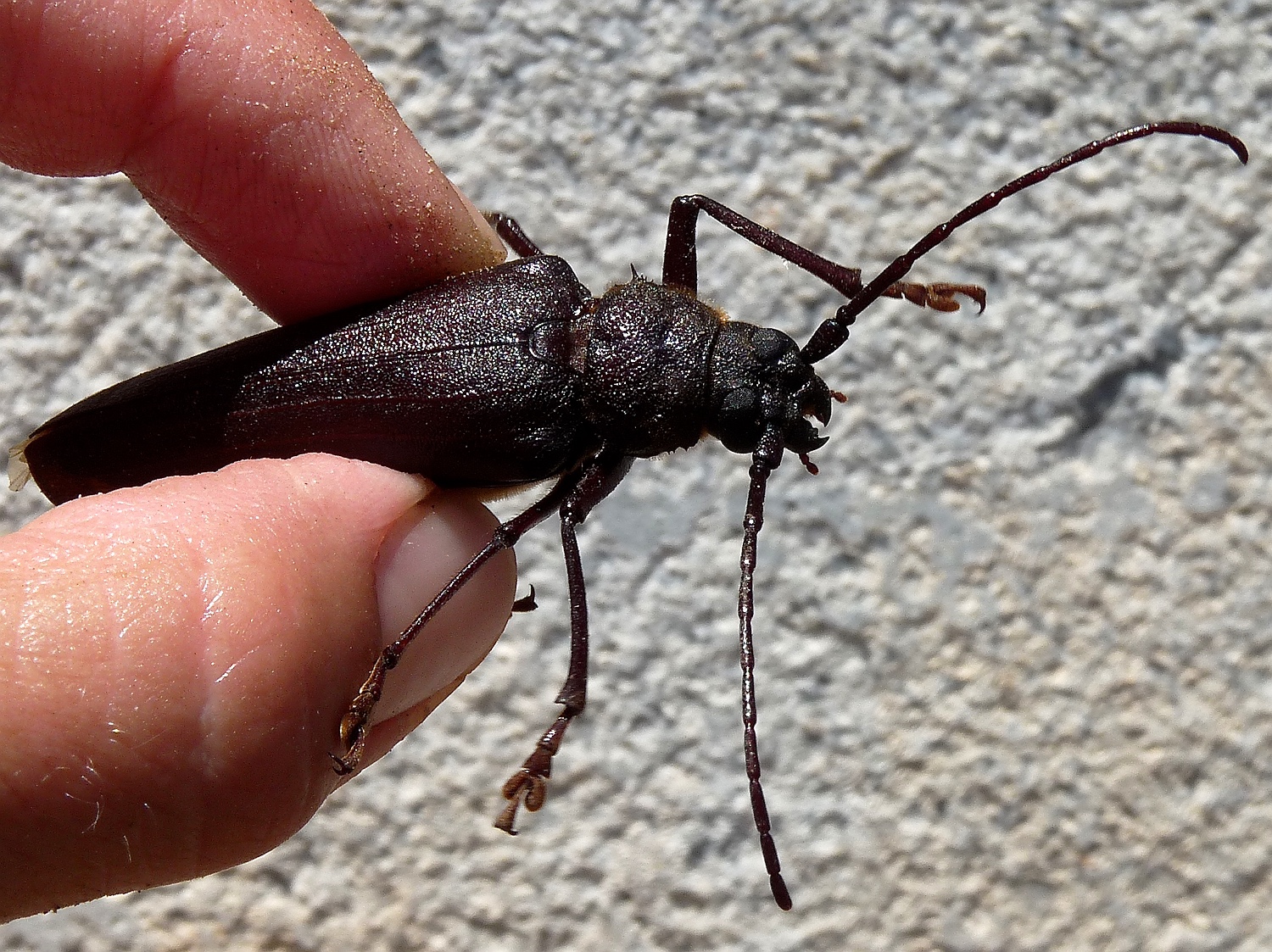
Here you can clearly see the impressive, pincer-like mandibles.
Leaf beetles, Chrysomelidae
The family of the leaf beetles comprises around 50,000 described species, that means about twice as many species as the other large families mentioned before. Leaf beetles are roundish to elongated in shape, often very colourful with a metallic shimmer, and usually rather small. The antennae are thin and mostly quite short. They feed on plants; some species are agricultural pests, as the Colorado potato beetle.
Rosemary beetle, Chrysomelina americana, L.
The Rosemary beetle, as its name suggests, lives on rosemary and related plants (sage, lavender). It has reduced wings and is unable to fly. It is small and round in shape. The shiny wing covers carry alternating green and red longitudinal stripes. The rosemary beetle occurs in southern Europe, the Middle East and North Africa. It often occurs in large numbers and can cause considerable damage to infested plants. This species has appeared in our garden in recent years.
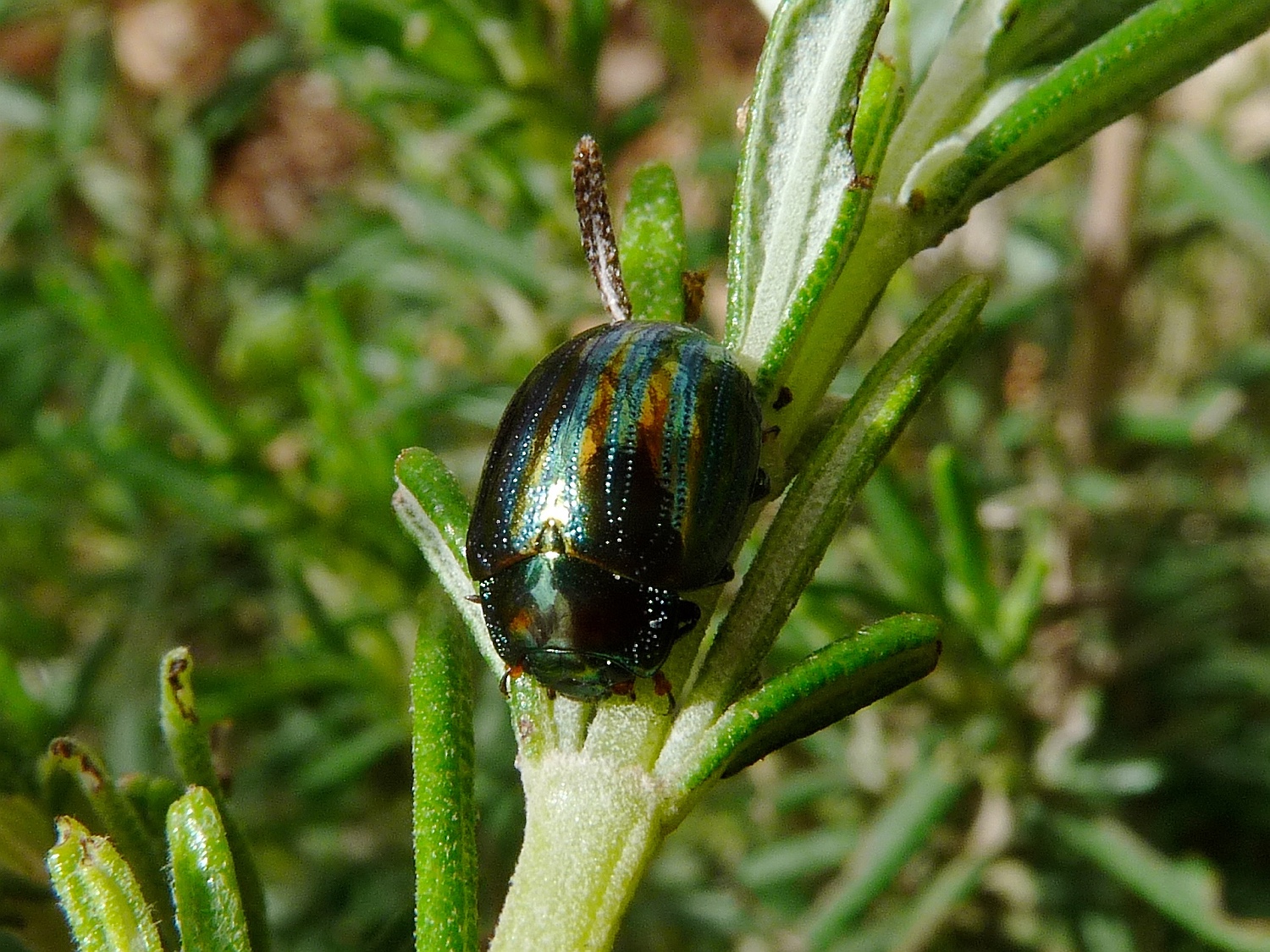
The flightless rosemary beetle lives in large numbers on rosemary bushes, which it can damage quite a bit. This small beetle has a very beautiful metallic colouring.
Clytra novempunctata, Olivier
Another representative of the leaf beetles is Clytra novempunctata. This species is found from south-eastern Europe to central Asia. As in most cases, there are several similar species, so the identification is not entirely certain.
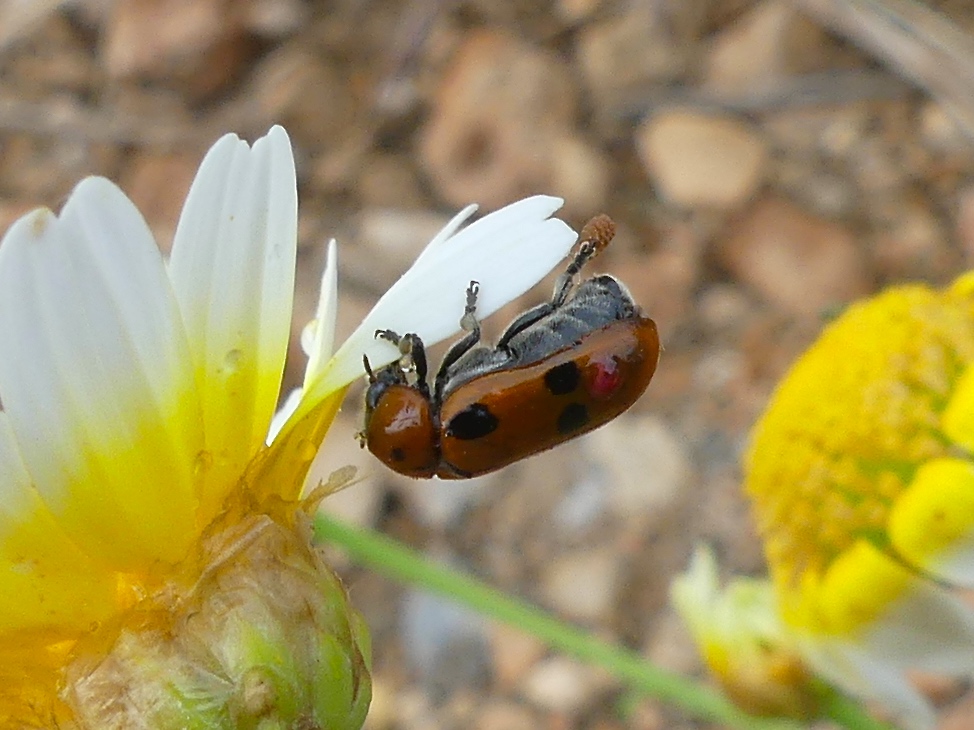
With its shiny orange colour and black spots, Clytra novempunctata bears a certain resemblance to the blister beetles.
Bruchidius quinqueguttatus ?, Olivier
The larvae of Bruchidius quinqueguttatus live in plants, sometimes in plant seeds, often of only one species. Some species can cause damage to food stores; others can be used to combat invasive plant species.
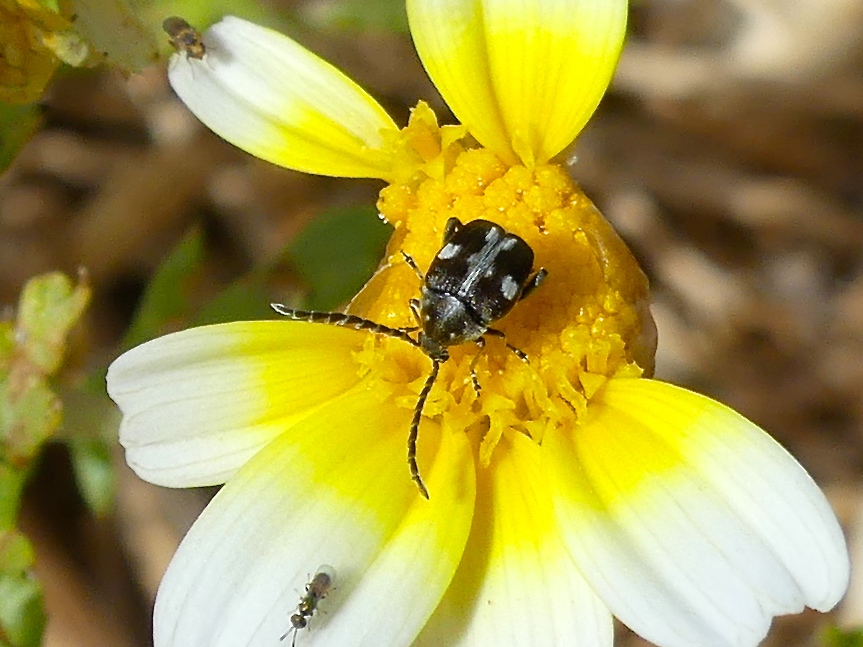
This pretty little species is probably Bruchidius quinqueguttatus.
Flea beetles, Alticini
The numerous members of the flea beetles , a group of leaf beetles with an uncertain systematic classification, usually live on only one or a few plant species, on which the adult beetles and larvae feed (the latter often mining the leaf tissue). Some species are plant pests. Flea beetles are usually very small and have thickened hind legs, with which they can jump up to 100 times (!) their body length. There are many very similar species, so the exact identification must remain open.
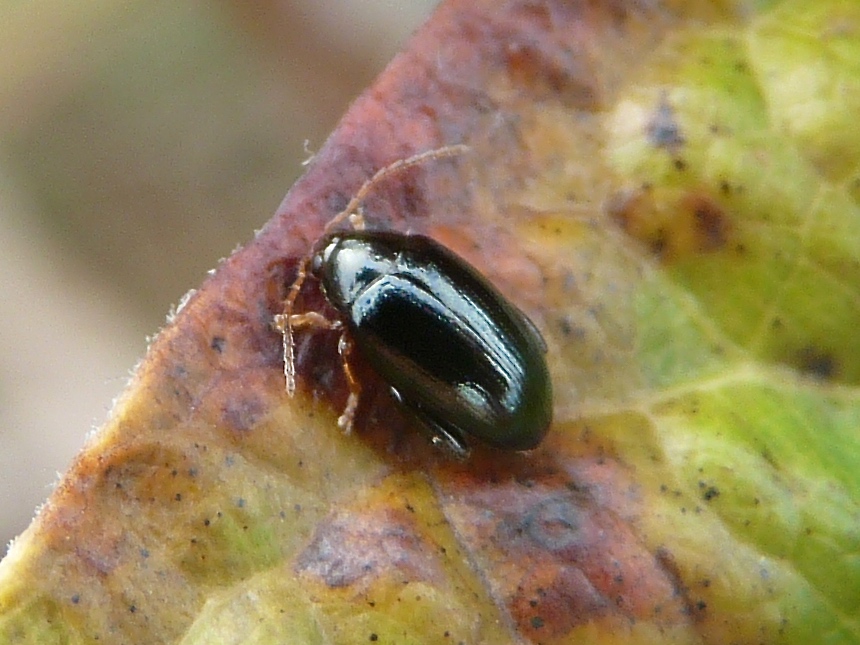
The small flea beetles often have shiny bodies and wing covers with metallic colours. They can jump incredibly well with their powerful hind legs.
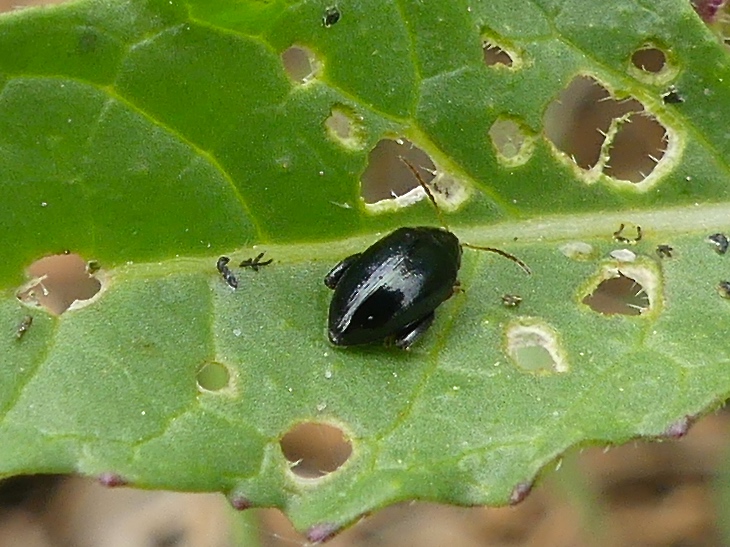
Here another specimen. The species can only be identified by microscopic examination of the dead animal. Here you can also the typical damage caused by flea beetles: small holes in the leaves that do not extend beyond the leaf veins.
Weevils, Curculionidae
Weevils are the largest family of beetles with over 80,000 described species, and thus probably the largest family of all living organisms. They are found worldwide and are almost exclusively herbivorous. Many weevil species specialise in feeding on only one plant species. Hardly a plant exists that is not eaten by a specific weevil species. Most species live on the soft parts of plants such as leaves and shoots, but there are also species that feed on seeds, wood or roots. The larvae often live in the leaves or shoots of the same plants as the adults. Some weevils are significant pests, especially species such as the grain weevil and the bark beetle, which is now also classified as a weevil. Other species can be used to specifically combat invasive plant species.
Weevils have an elongated shape, usually quite long legs and a proboscis-like protrusion on the front of the head. About halfway along this snout, which may be short or up to the same length as the body, sit the thin antennae, which are club-shaped at the end and have a characteristic kink in the middle. The body surface and wing covers of weevils often bear small scales, giving them a slightly dusted appearance. Their colouring is usually inconspicuous in shades of brown, green or olive. Many weevil species are very small and difficult to spot; other species reach a medium size (1 to 2 cm).
Lixus spec.
This weevil, which is quite common on Naxos, has an olive-brown colouring and the typical body shape of weevils. It belongs to the large genus Lixus; identification of the species is difficult and usually only possible in the dead animal.
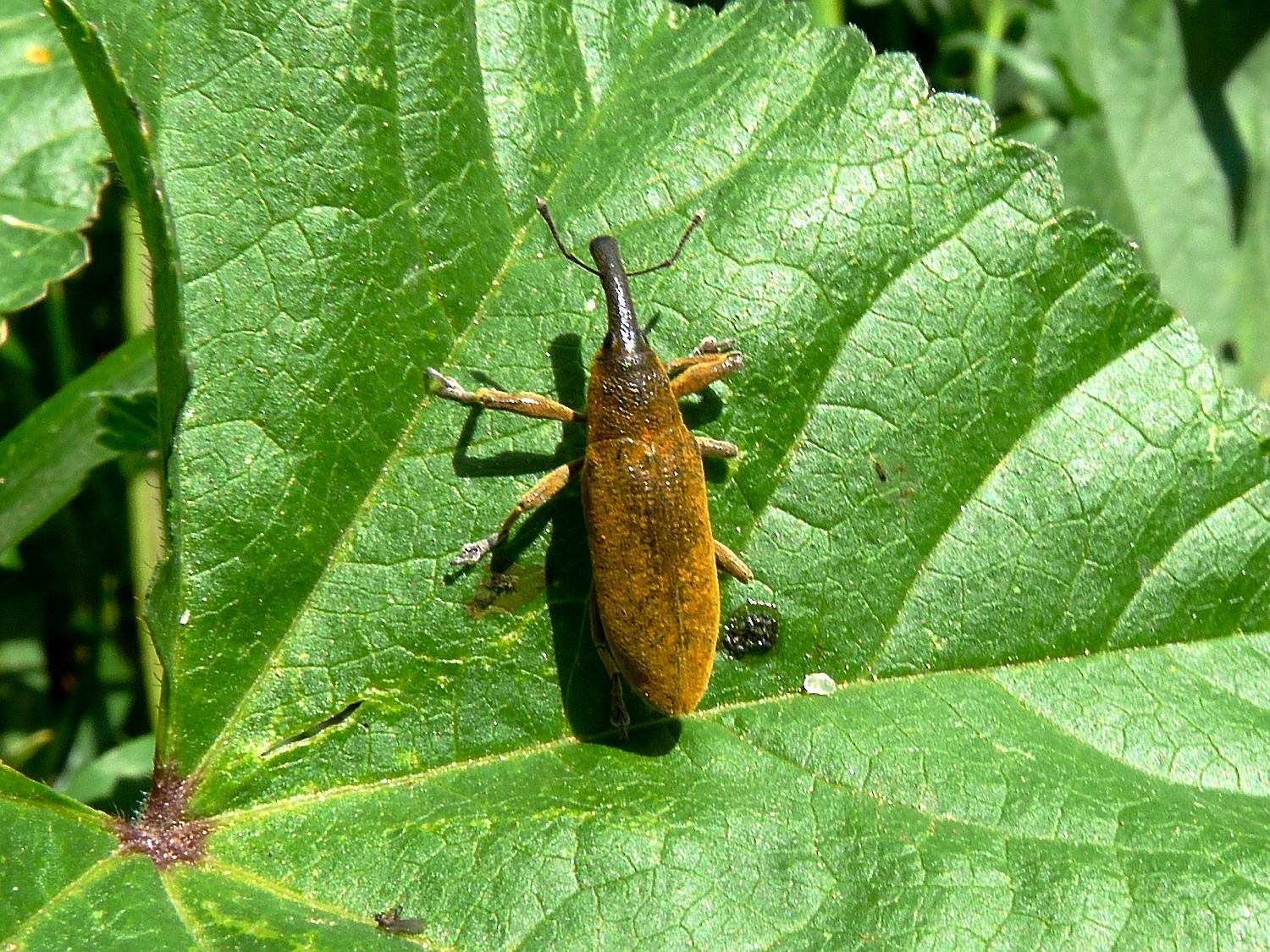
Weevils are easily recognisable by the snout-like protrusion on their head. They feed on plants; many species specialise in one or a few plant species.
Red palm weevil, Rhynchophorus ferrugineus, Olivier
The Red palm weevil is an invasive species that comes from Southeastern Asia and invaded the Mediterranean area since some decades; it has also reached Naxos. It grows to a relatively large size of up to 3.5 cm and is easily recognisable by its shape, its rust-red colour and the black spots on the neck shield; however, its colouring is variable. The larvae of this and related species are known as sagoworm and are eaten in Southeast Asia; in some areas, it serves as an important source of protein.
The Red palm weevil is an extremely unpleasant pest that attacks various species of palm trees. The females lay up to 300 eggs on the very young leaves of the palm tree. The larvae live in the uppermost section of the trunk, the growth cone of the palm tree, from where they eat their way down into the trunk. The infestation only becomes noticeable when the palm fronds begin to droop, by which time the tree is already severely damaged or irretrievably lost. The larvae pupate in the stem bases of the palm fronds, which fall off as soon as the growth cone is destroyed. The adult beetles then fly to the next palm tree. The Red palm weevil has already caused enormous damage to palm trees in the Mediterranean region and is happily eating its way from tree to tree. Despite intensive efforts, it has proved very difficult to combat this species other than by the targeted spraying of trees with a mixture of insecticides in the early stages of infestation.
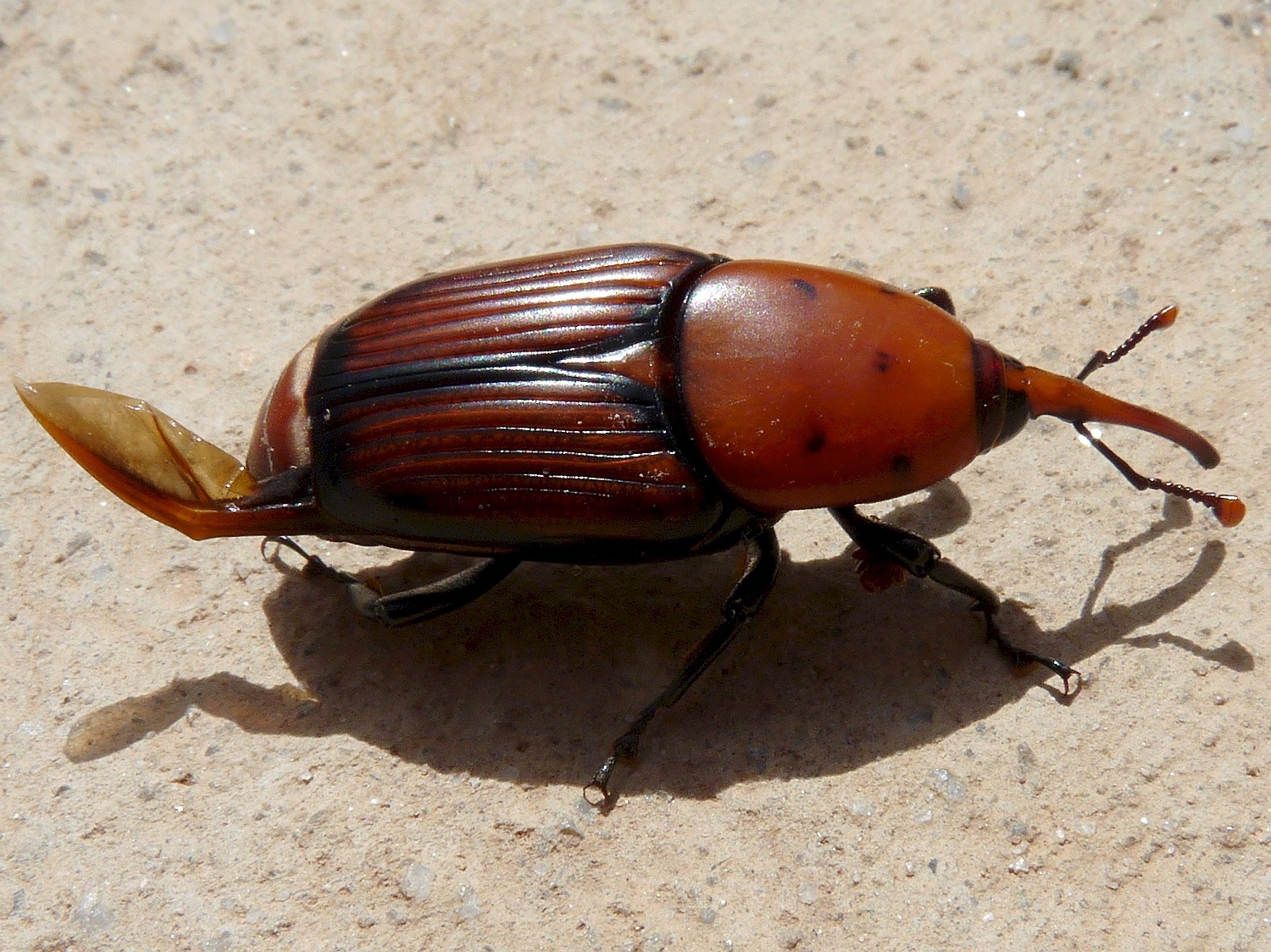
The Red palm weevil, an invasive species from Southeast Asia, is destroying palm tree populations in the Mediterranean region; it is spreading unstoppably and leading to the rapid and complete death of the trees.
Sitona spec.
The species of the genus Sitona and related genera are characterised by a very short proboscis. As with other weevils, the antennae are bent in a characteristic way. Our specimen is grey in colour with black stripes on the sides of the head and neck. Beetles of the genus Sitona feed on leguminosae: the adult beetles eat the leaves, while the larvae feed on the root nodules.
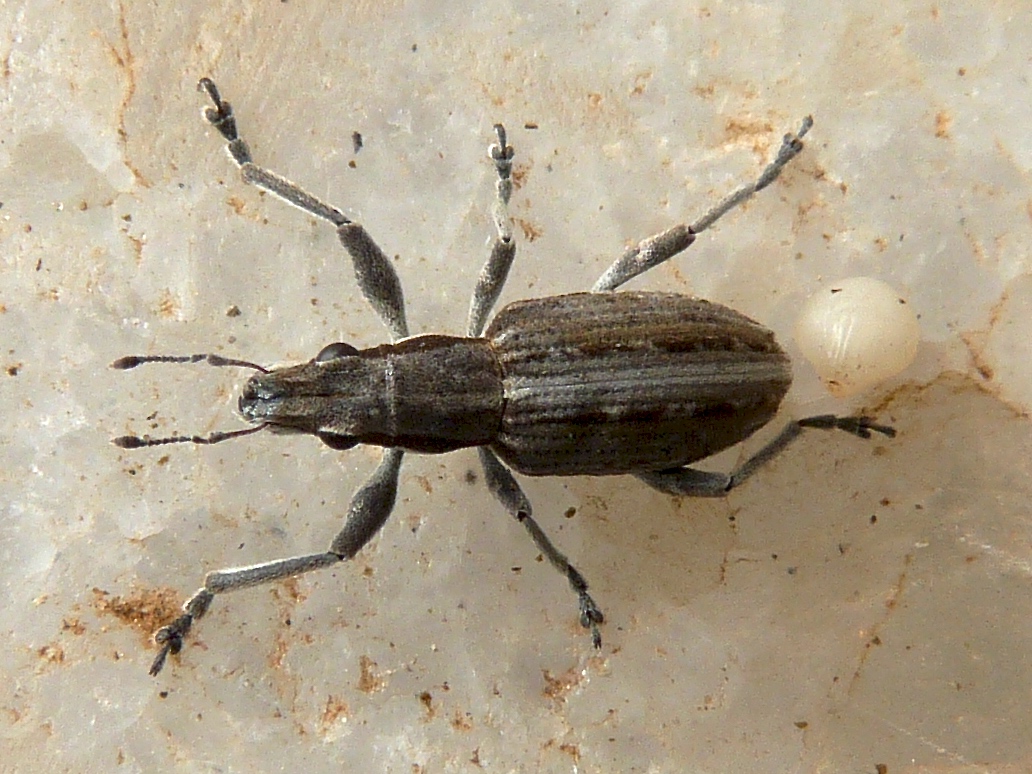
Beetles of the genus Sitona have only a very short proboscis.
Brachycerus barbarus, L.
The very large genus Brachycerus belongs to the weevils, although the members have only small proboscides that are often difficult to see. Members of this genus are small and mostly brownish with ribbed or otherwise sculptured wing covers. All species are adapted to a specific plant species on and from which they live.
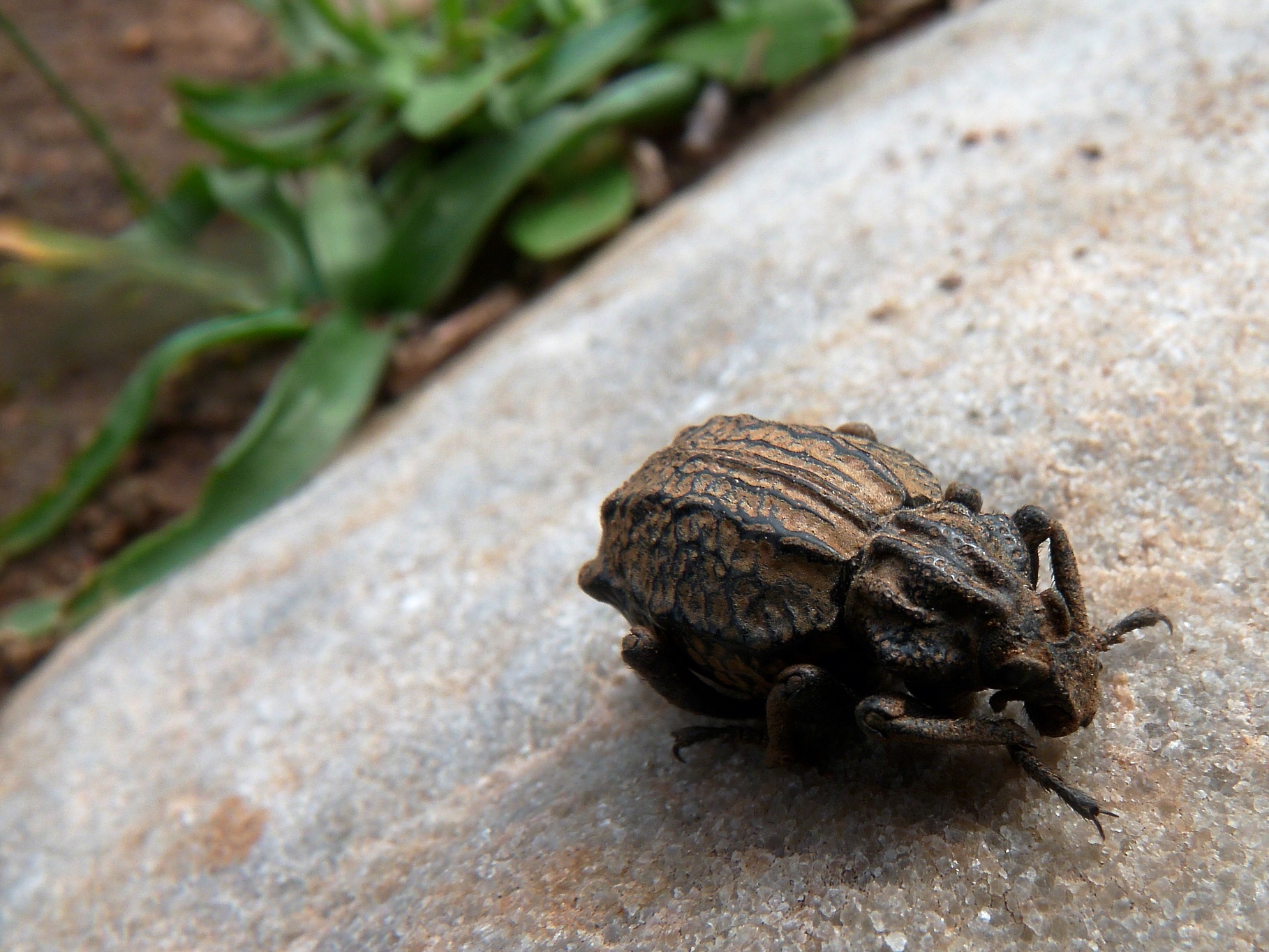
Brachycerus barbarus lives exclusively on sea onions (visible in the background).
Large thistle weevil, Cleonis pigra, Scopoli
The Large thistle weevil is widespread in Eurasia. The larvae live on thistle roots. It has a relatively long proboscis; the short, bent antennae are located about halfway along its length. The pattern on the wing covers is more or less clearly visible. The young beetles are covered in white-grey hairs, but this hair cover wears off over time.
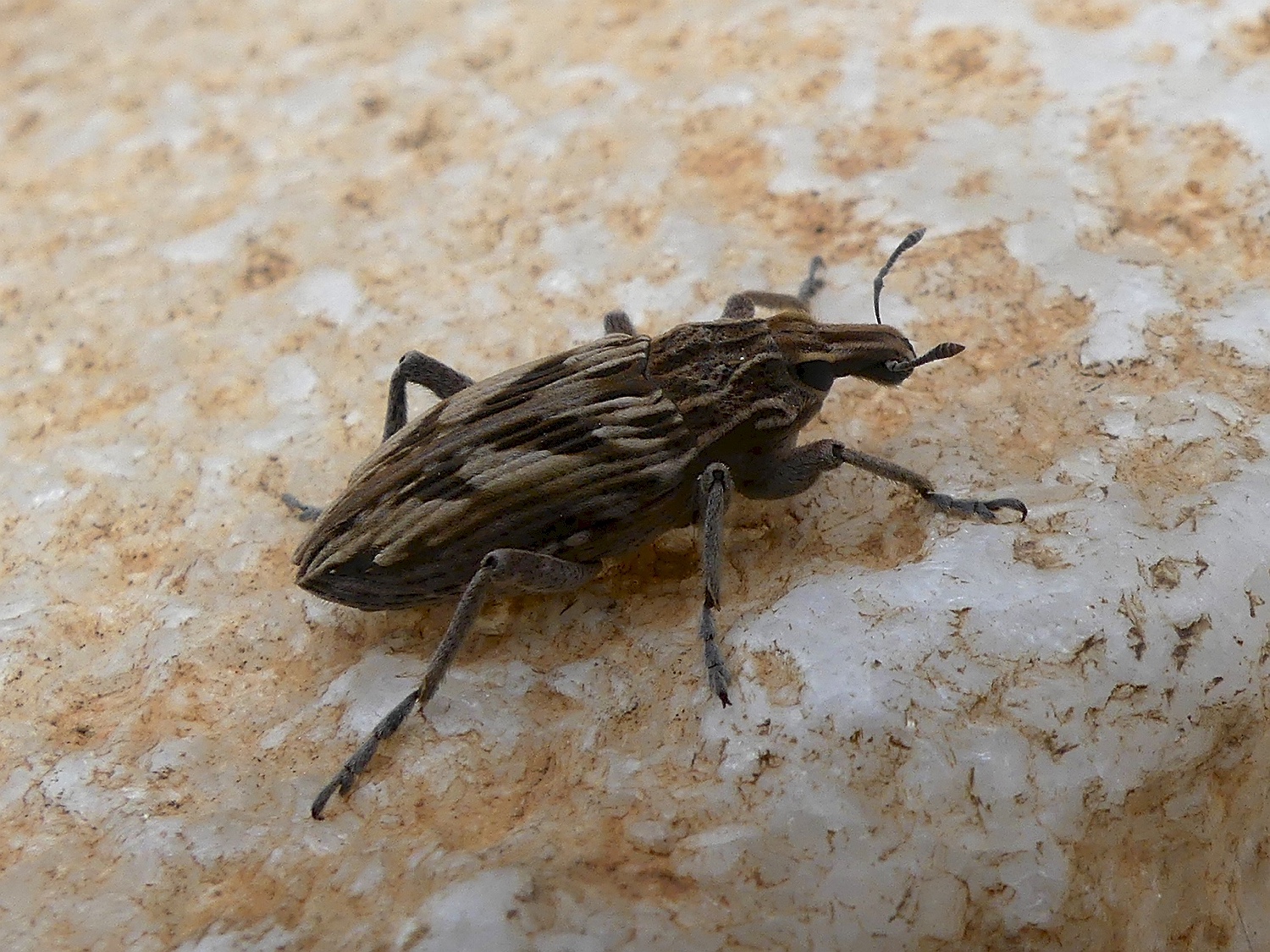
The larvae of Cleonis pigra live in the roots of various thistle species.
Hyperini
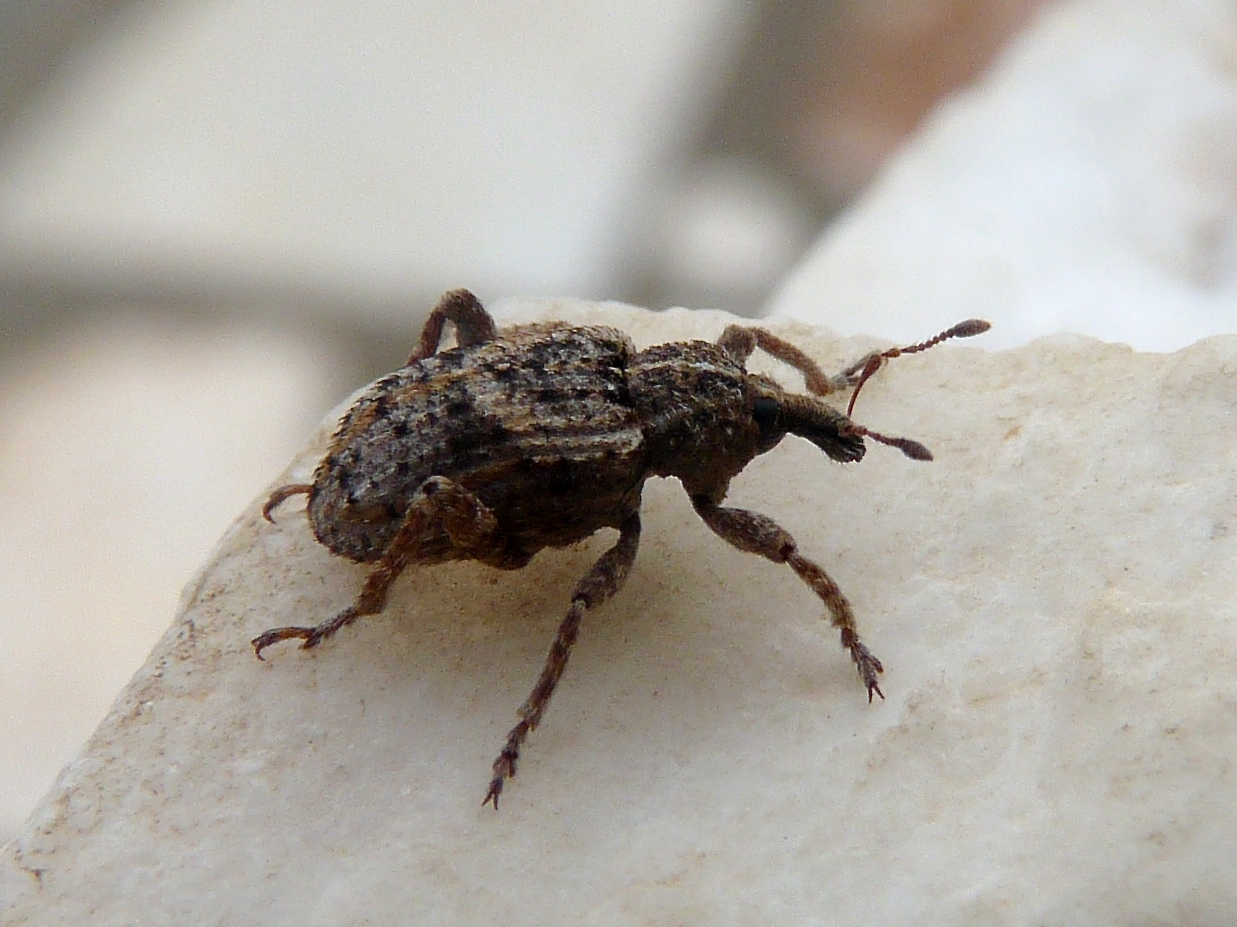
And another weevil species– one of the numerous weevils from the tribe Hyperini that are difficult to identify.
continue: Dragonflies
back:
see also: