Gastropoda 6: Worm snails
Amont the many strange creatures of the intertidal zone are the worm snails. These snails only crawl around freely while they are young, then they attach themselves to the substrate and adopt a sessile lifestyle. Several species are found on Naxos. Worm snails or tube snails form their own family (Vermetidae) within the Littorinimorpha, a large suborder within the Gastropoda, to which many of our marine snails belong.
The Photo gallery of the marine snails gives an overview over the species.
A note on identification: Some species usually can be identified easily and reliably. In many cases, however, several related species are difficult to distinguish. Also not all species are included in the field guides; even using the internet, it is difficult to find information on some species. Accordingly, some of the identifications may not be correct.
And a word about the names: As with many marine animals, there is a great deal of confusion surrounding the names of snails: for almost all species, a large number of synonyms exist that are no longer valid today but are still used in older books. I use the names according to the World Register of Marine Species (as of 2020), where you can also find the corresponding synonyms.
Here you can jump directly to the species (return with the back arrow or by swiping back):
Thylacodes arenarius – Vermetus triquetrus – Dendropoma cristatum
Thylacodes arenarius, L.
(= Serpulorbis arenarius)
The worm snail Thylacodes arenarius is the largest species found in our region. It occurs in shallow water, especially in areas protected from waves. In the beginning, the shell of the small snail has a slightly coiled form, then it becomes attached to the ground and forms an irregularly twisted tube up to 1 cm thick, which resembles the shell of a tube worm. The snail can retreat deeply into the tube. Only rarely can one see the snail’s head with two short antennae sticking out. Due to its sessile lifestyle, the worm snail has developed an unusual way of feeding: It surrounds itself with a spider web-like mucous membrane which gathers small particles and organisms of the plankton. From time to time, the snail consumes the mucous membrane along with all it has gathered.

shell of Thylacodes arenarius
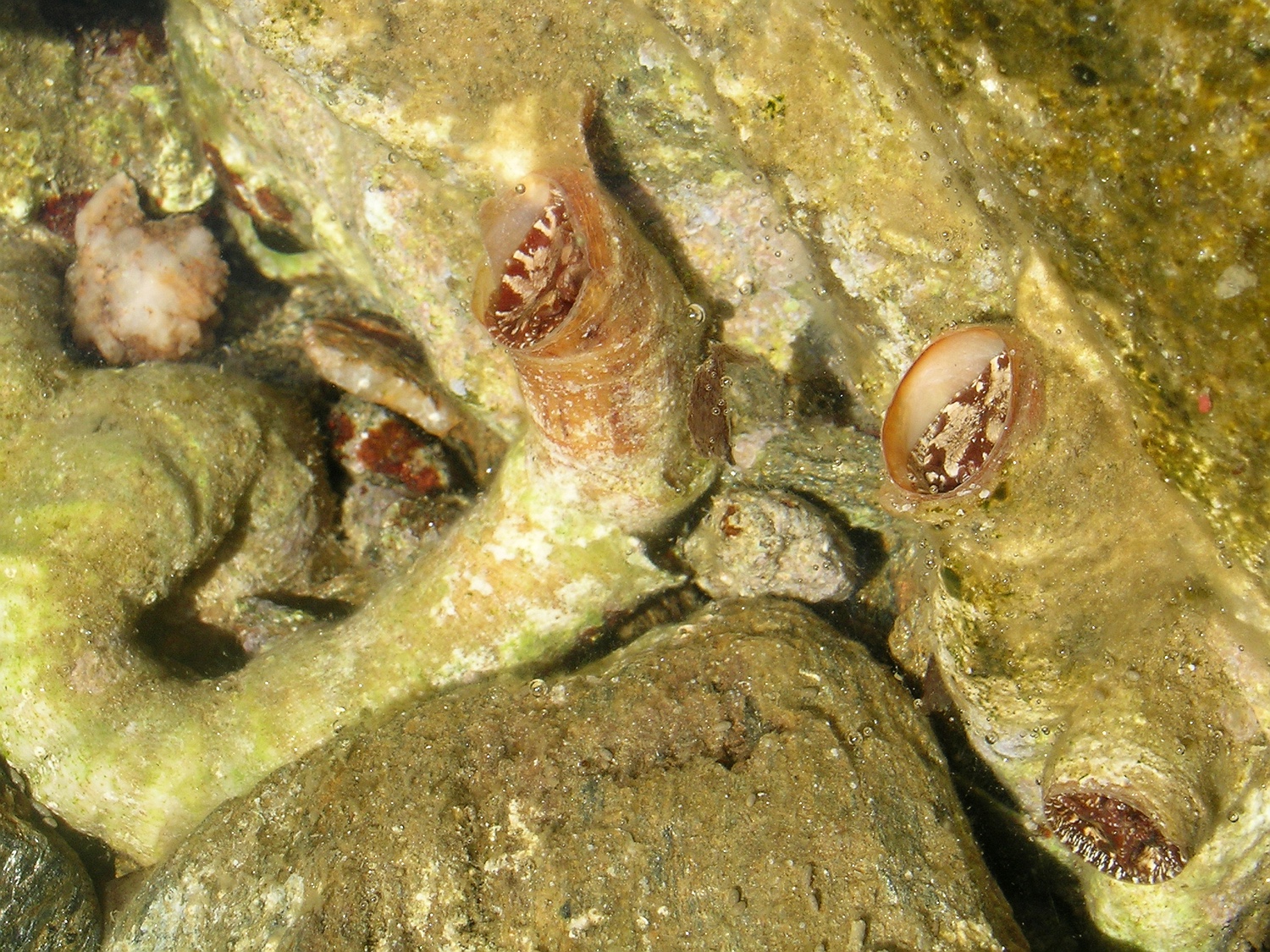
Here, the snails have retreated into their shells; one sees the reddish operculi with a marbled pattern.

Thylacodes arenarius catches its food with a web of mucus threads, which it consumes from time to time along with everything edible that has become entangled in it. In the picture the musus “net” is visible, as is the head of the snail with the small antenna.
Vermetus triquetrus, Bivona e Bernardi
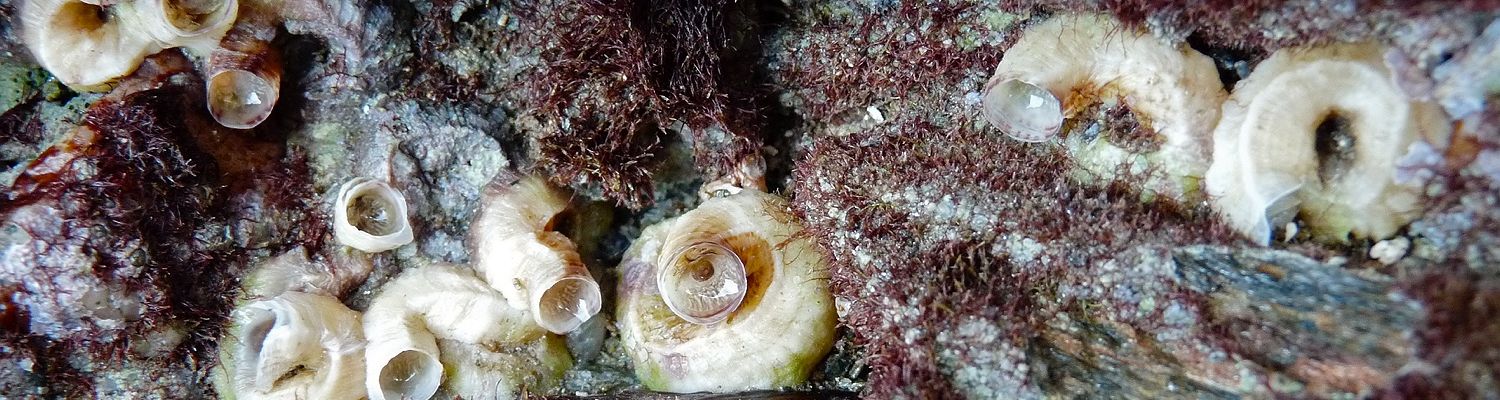
The rarer Vermetus triquetrus can be found in small numbers in the mesolittoral. It can be recognised by the longitudinal ridge on its shell, which gives it a slightly triangular cross-section, and by the transverse ribbing of the shell.

The shells of Vermetus triquetrus lie flat on the ground; only the apertures are turned upwards. They have a roundish cross-section and a longitudinal ridge.

Here you can see the operculum and the snail itself, with the head just visible on the side (the round shape in the lower middle of the photo).
Dendropoma cristatum, Biondi-Giunti
(= Dendropoma petraeum)
Another very small species of worm snail occurs in the upper intertidal zone; it is one of the most common organisms in the coastal “reef” of calcareous algae. It is usually overgrown by the crustose calcareous alga Lithophyllum incrustans, so that only the tube openings are visible as small black holes in the calcareous algae crust.

In many places, the alga crusts in the intertidal zone show countless small holes.
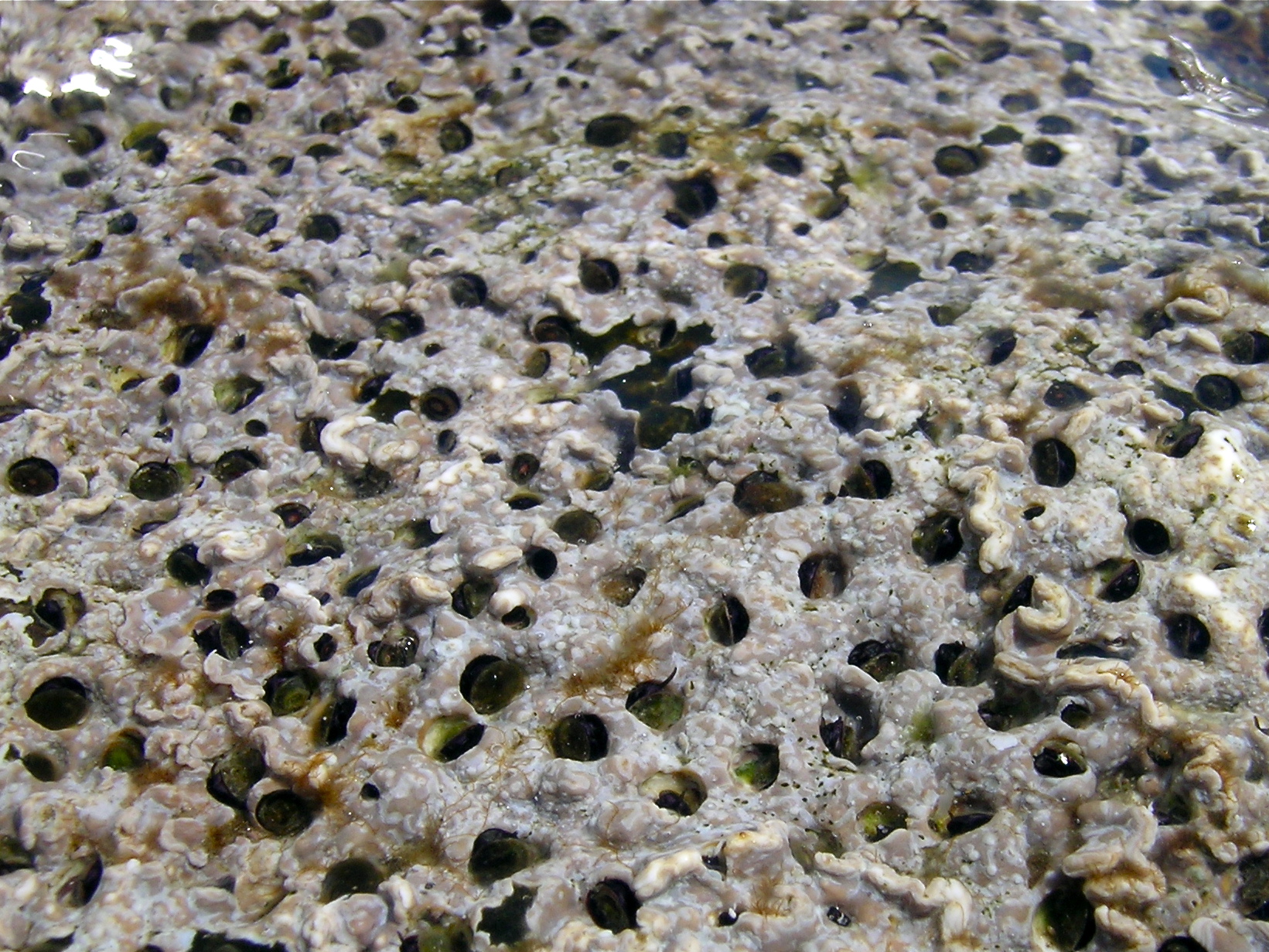
On closer inspection, these turn out to be the openings of worm snail shells, from which the small snails peek out.

If they are not completely overgrown, you can see that the shells of these worm snails are flattened and triangular. In contrast to the Vermetus triquetrus, the body of the animal is dark in colour.

close-up of Dendropoma cristatum
continue: Neogastropoda
back:
see also: The coastal “reef” of calcareous algae