
Gastropoda 7: Neogastropoda
The Neogastropoda are a large and diverse suborder of the superorder Caenogastropoda, to which most marine snails belong. Among the snails that can be found in our region, the Neogastropoda include whelks, dove snails, spindle snails, dog whelks, murex snails, coral snails, mitre snails and ribbed mitre snails, and cone snails. Most species have a siphon groove or siphon canal; otherwise, the shells are very diverse in shape.
The Photo gallery of the marine snails gives an overview over the species.
A note on identification: Some species usually can be identified easily and reliably. In many cases, however, several related species are difficult to distinguish. Also not all species are included in the field guides; even using the internet, it is difficult to find information on some species. Accordingly, some of the identifications may not be correct.
And a word about the names: As with many marine animals, there is a great deal of confusion surrounding the names of snails: for almost all species, a large number of synonyms exist that are no longer valid today but are still used in older books. I use the names according to the World Register of Marine Species (as of 2020), where you can also find the corresponding synonyms.
Here you can jump directly to the species (return with the back arrow or by swiping back):
Whelks, Pisania, Aplus and Euthria – Dove snails, Columbella and Mitrella – Spindle snails, Tarantinaea and Aptyxis – Dog whelks, Tritia – Murex snails, Hexaplex, Bolinus and Stramonita – Coral snails, Coralliophila and Bableomurex – Mitre snails and Ribbed Mitre snails, Episcomitra and Pusia – Cone snails, Conus
A. Buccinoidea
The Buccinoidea are a large superfamily of predatory snails to which belong among others the whelks, the dove snails, the spindle snails and the dog whelks.
1. Buccinidae, Whelks
Pisania striata, Gmelin
very common
One of the common snails in our area is Pisania striata, a species that lives among the algae of the littoral zone, often close to the surface, so that it can also be seen alive.
The shell of Pisania striata is spindle-shaped, slightly convex and smooth with a large last whorl. The aperture has a short, narrow siphon canal and small teeth on the outer edge. The shell is shiny olive green to reddish brown with white spots on narrow spiral bands, that sometimes for clearly defined longitudinal stripes.
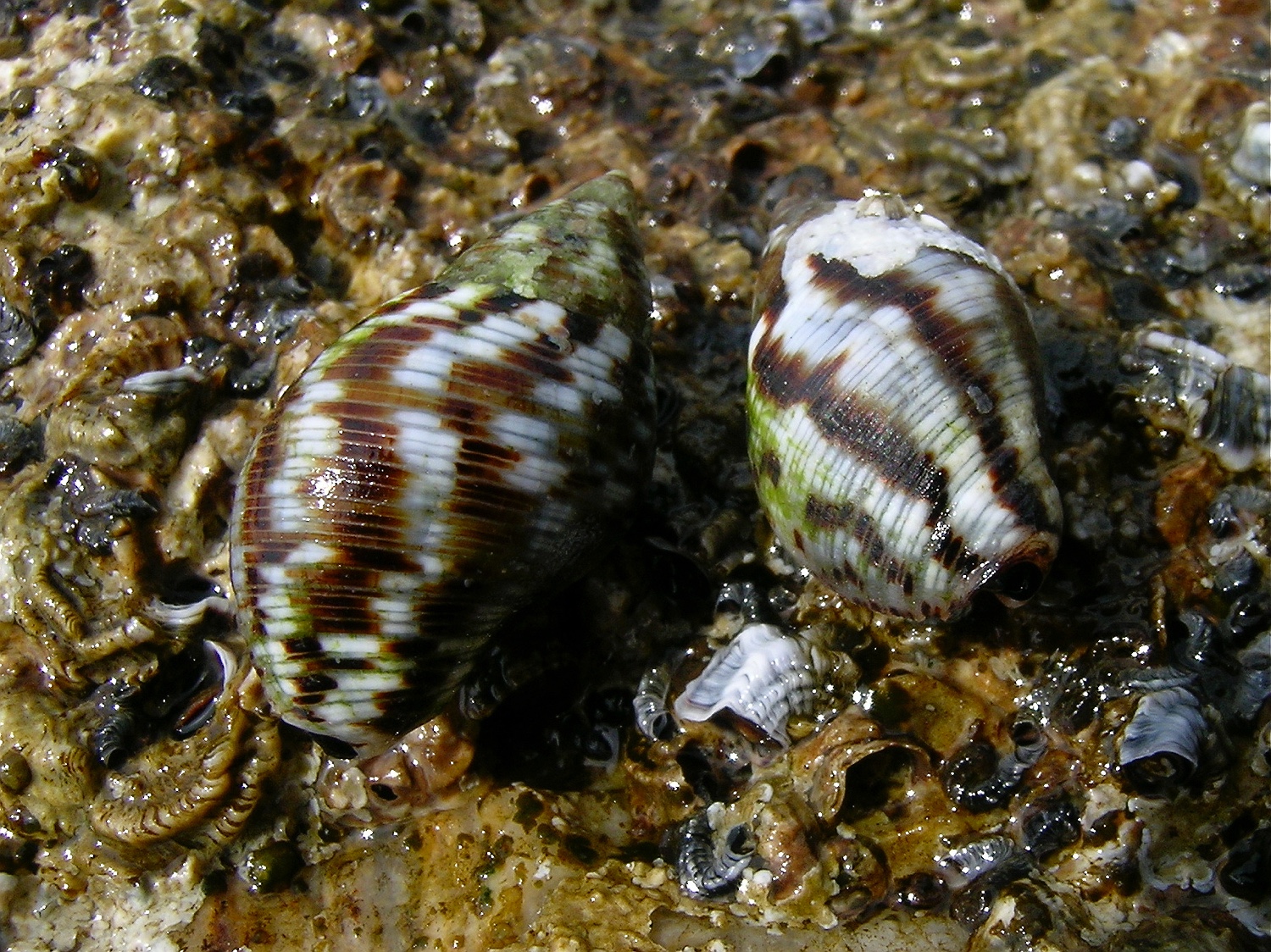
Pisania striata is quite common in shallow water.
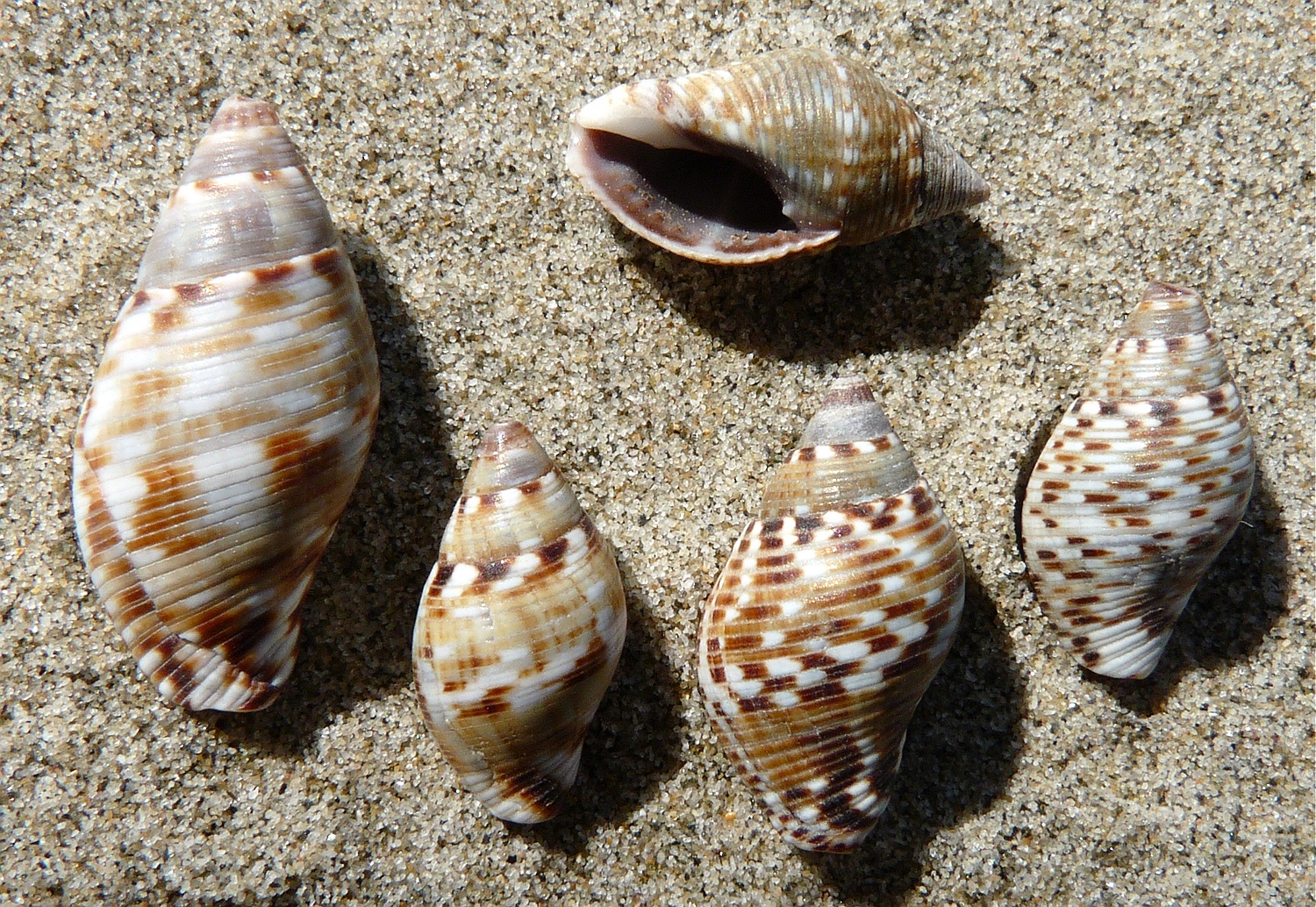
Pisania striata, Height: 23 mm
Aplus dorbignyi, Payraudeau
(= Cantharus dorbignyi)
common
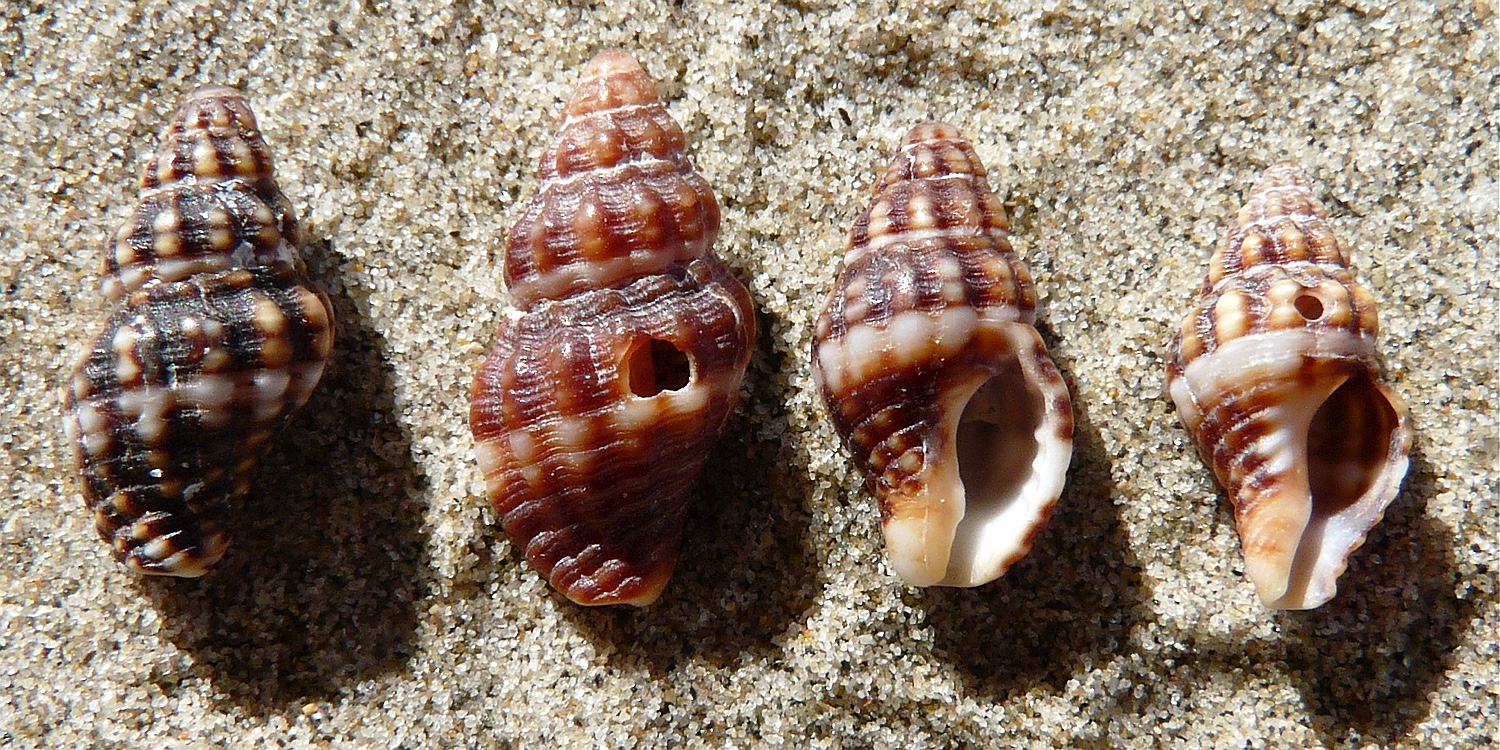
Aplus dorbignyi is brown in colour and has numerous radial ribs with small knots crossed by fine spiral ribs. Height: 16 mm
Spindle euthria, Euthria cornea, L.
(= Buccinulum corneum)
rather rare
The Spindle euthria lives on the rocky coast among the algae, but is rather rare. It grows to a length of about five centimeters. The whorls of the shell bulge out a bit below the suture. The last whorl is large with a small, egg-shaped aperture with a thick, finely serrated lip and a fairly long, broad, curved siphon canal. The colouring is yellowish or brownish with very delicate growth stripes.
The elegant Euthria cornea is rather rare around Naxos.
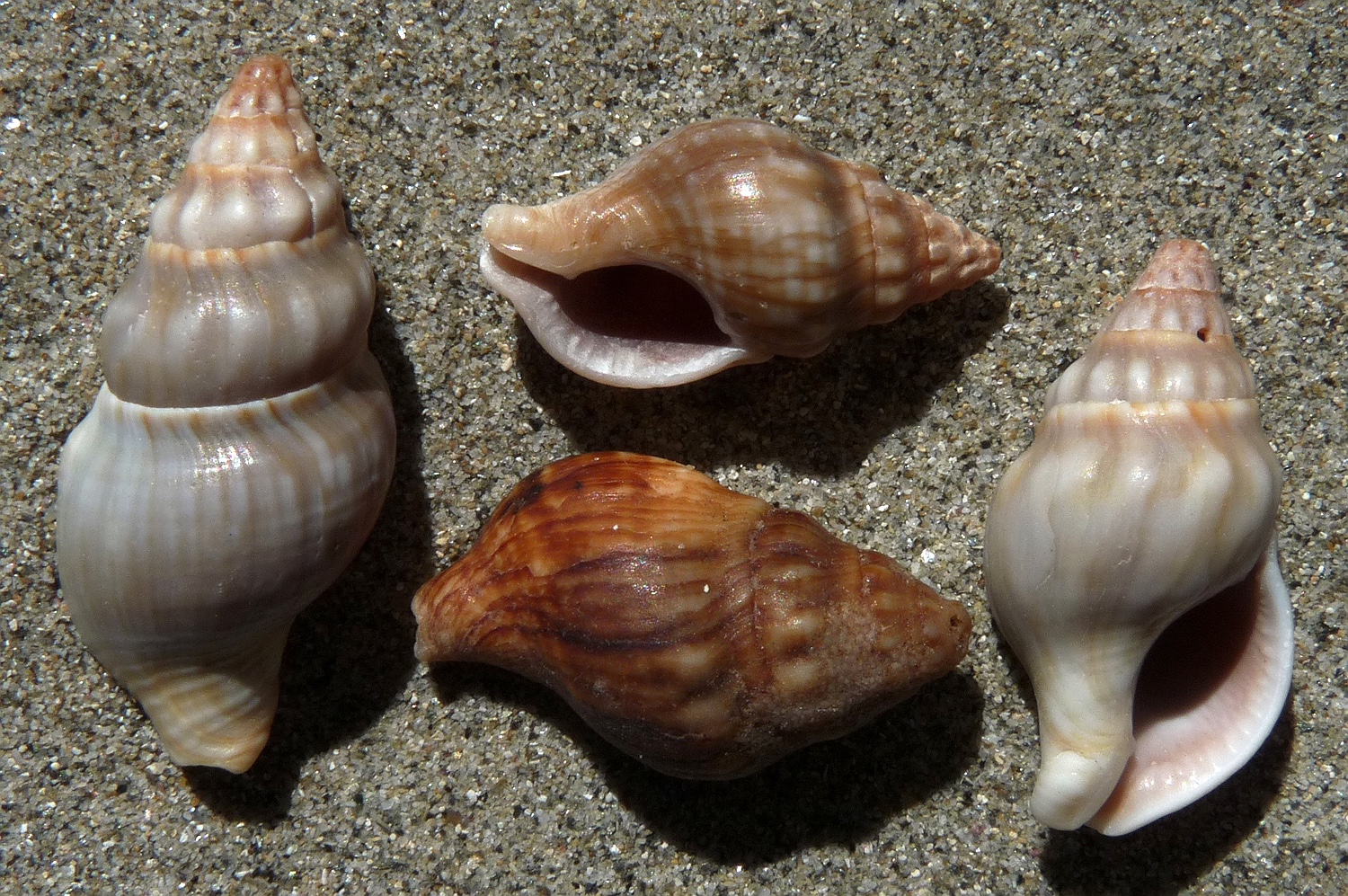
It has curved whorls with fine growth rings and is grey to light brown in colour. Height: 31 mm
2. Columbellidae, Dove snails
Columbella rustica, L.
very common
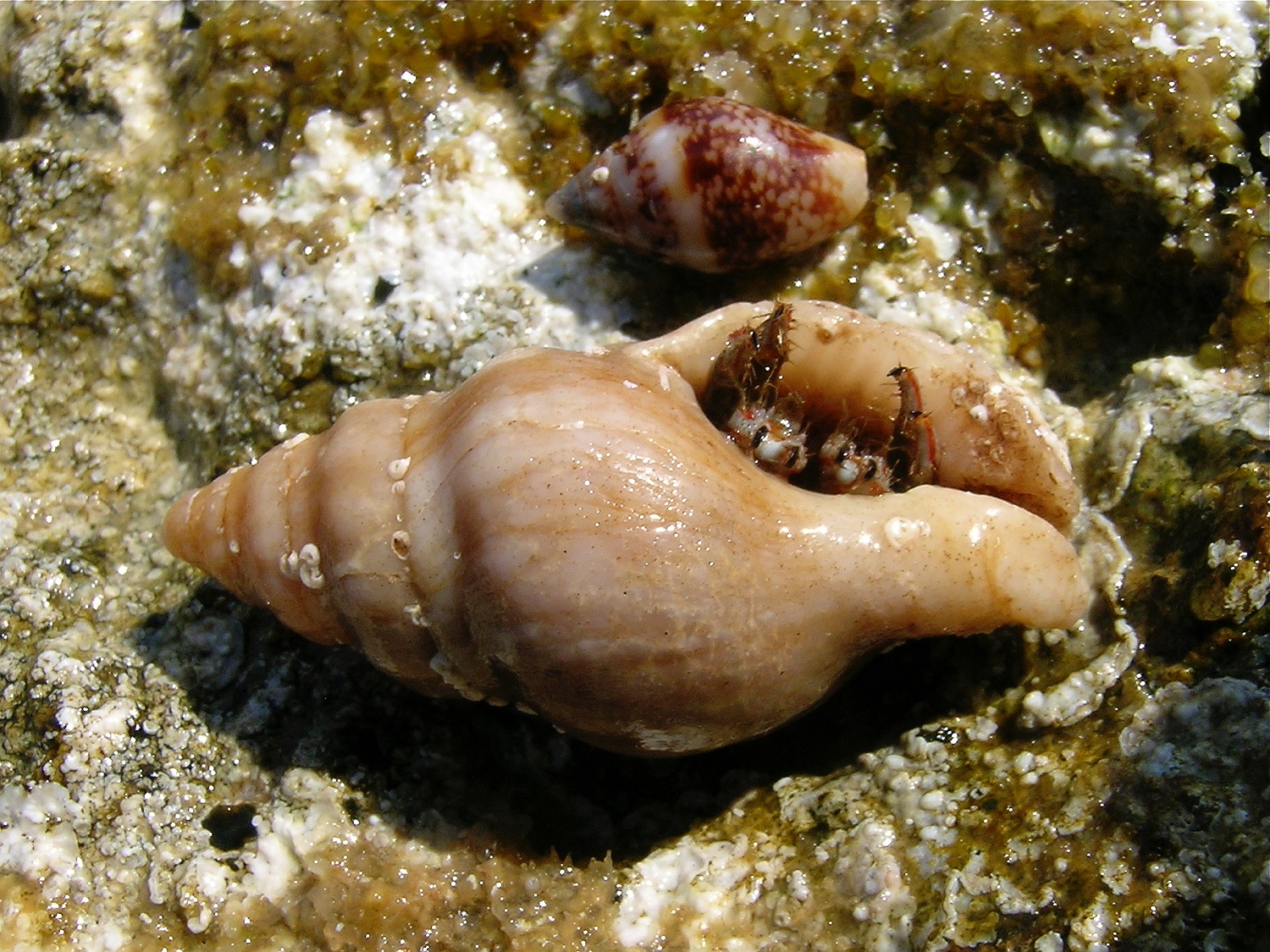
Columbella rustica is one of the most common snails on the rocky coasts of Naxos, although it is rarely found alive. However, its shells are very popular with hermit crabs, who often sit in large number just above the waterline when the water is calm. Columbella rustica is predatory and feeds on small crabs, mussels and other snails.
The shell of Columbella rustica, which can grow up to 1.5 cm in size, is spindle-shaped with a large last whorl and a narrow, finely serrated aperture. Its colour is variable, yellowish or brown with white spots and a lighter band at the upper edge of the last whorl; the tip is usually bluish.
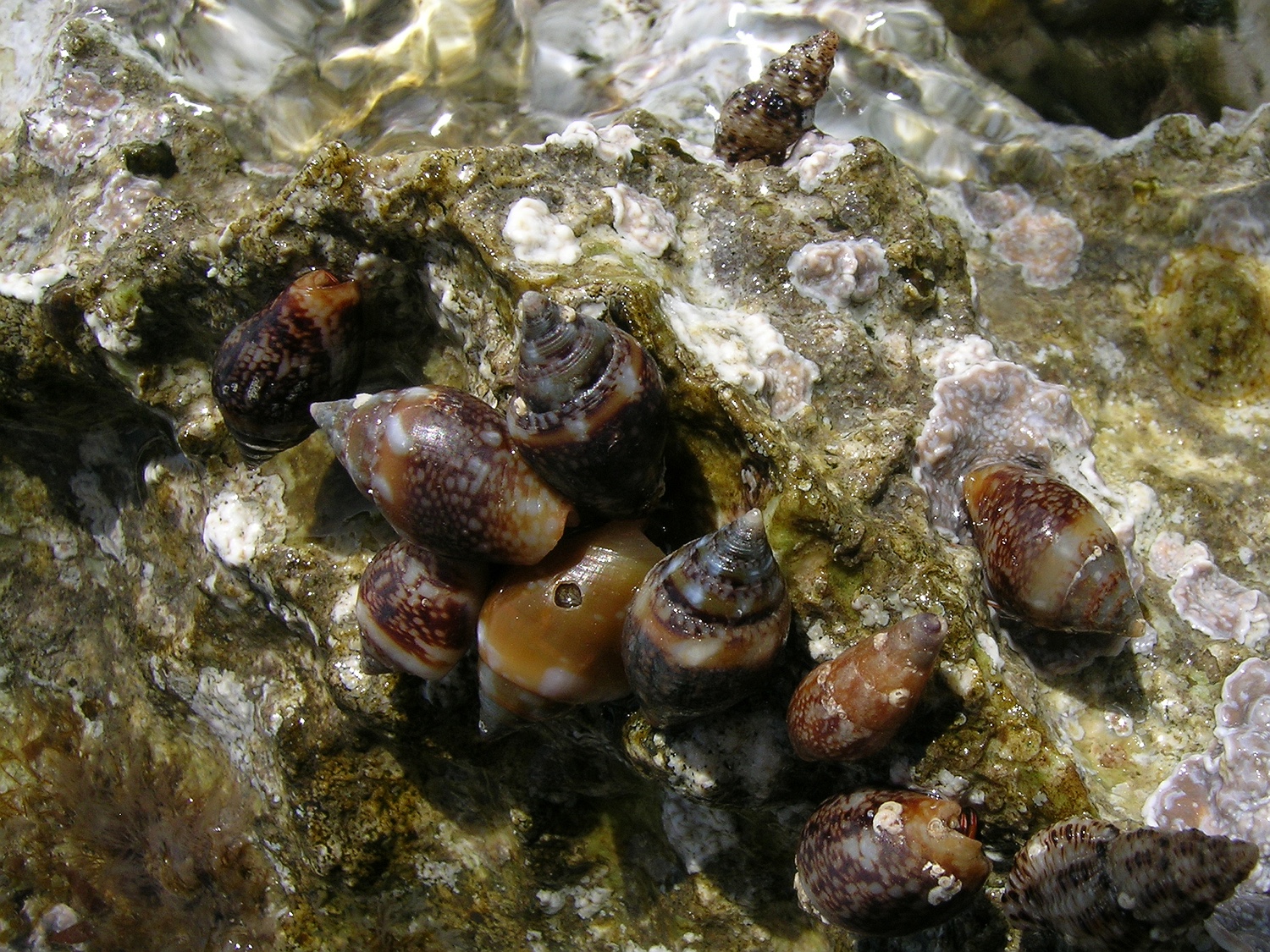
Columbella rustica is one of the most common snail species in our area.
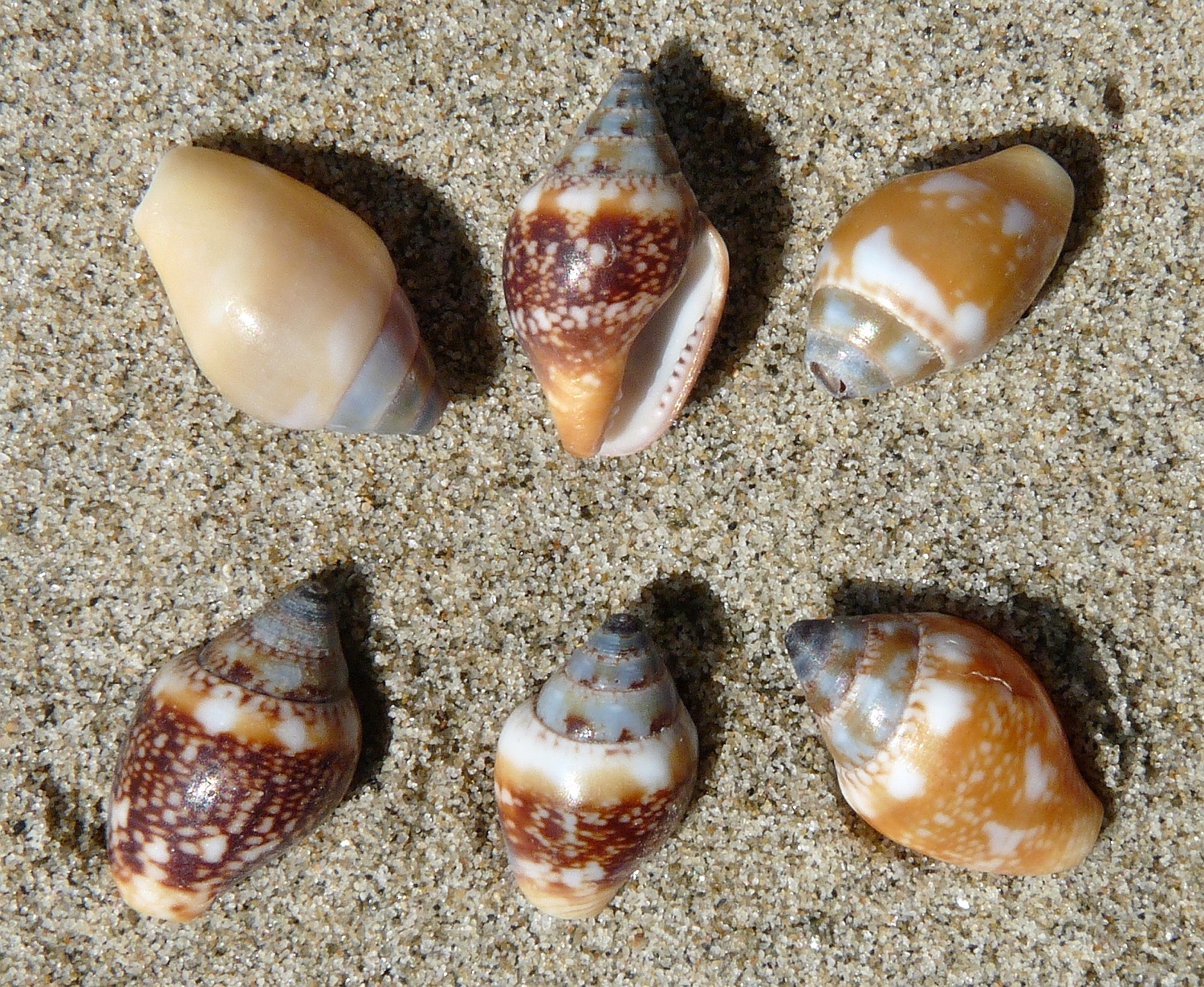
Most specimens have white spots on a brown of orange background with a blue apex, but some are yellow. Height: 12 mm
Mitrella scripta, L.
very rare
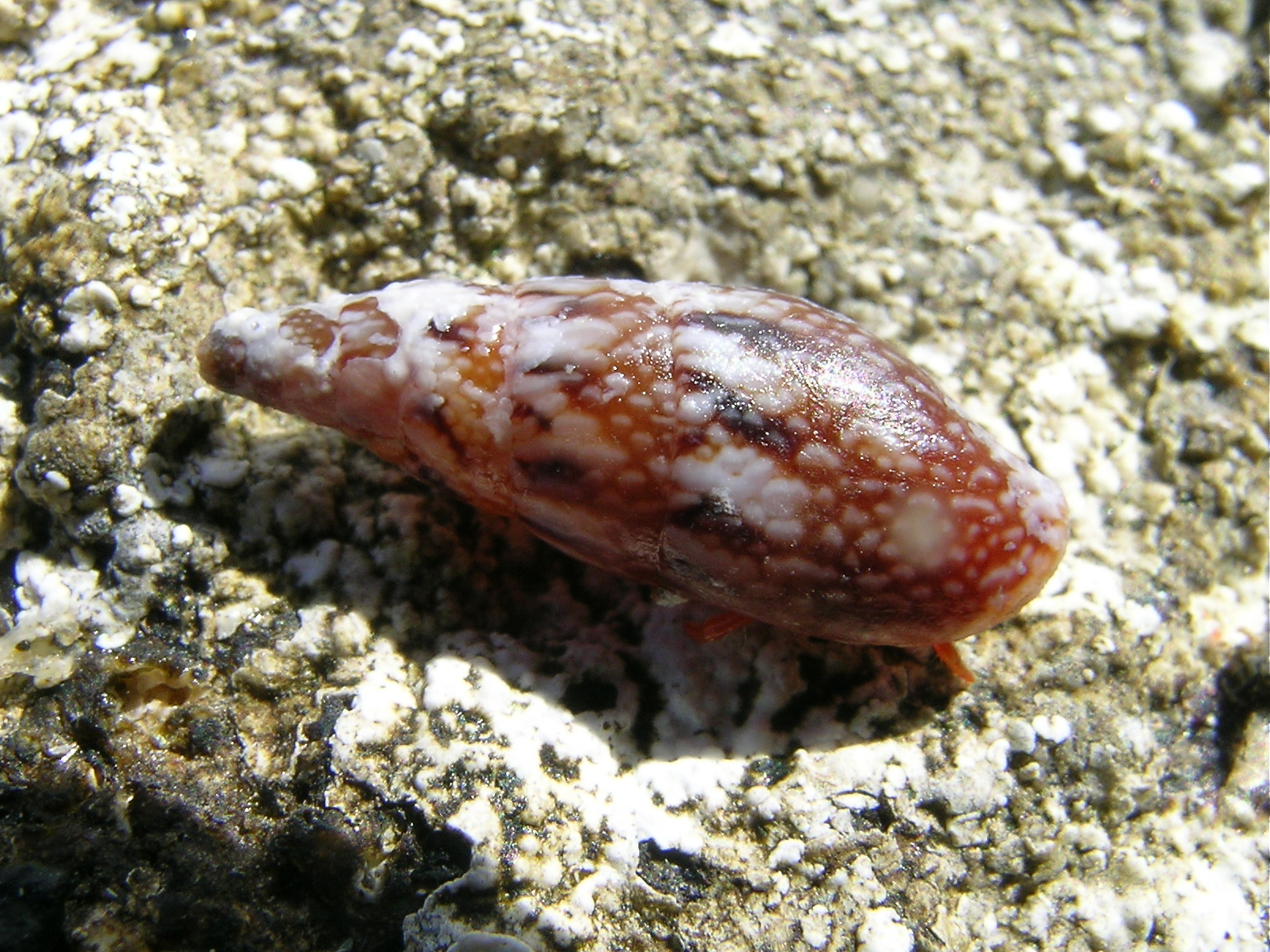
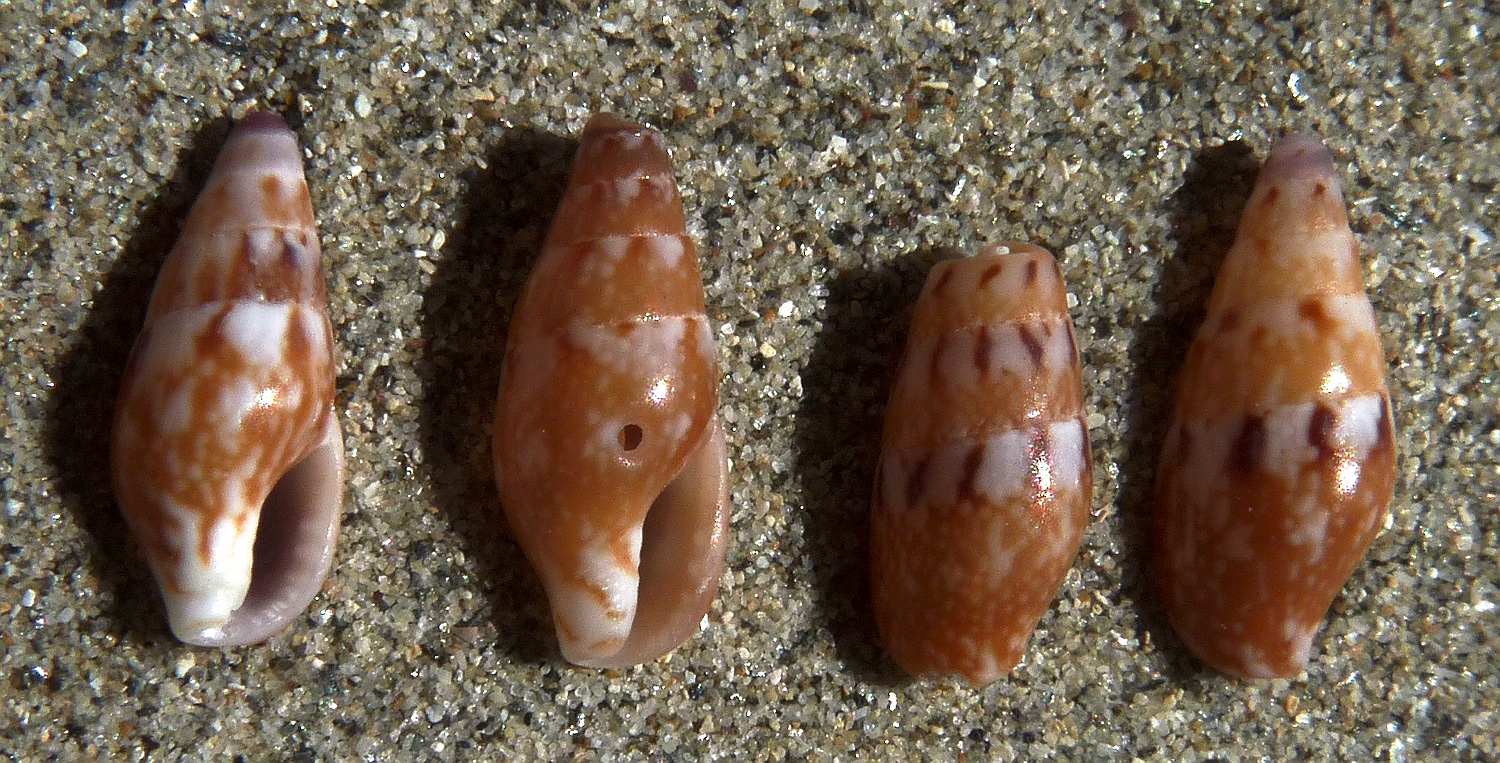
The pretty, reddish-spotted Mitrella scripta with a small, elongated shell also belongs to the family of the dove snails. Height: 14 mm
3. Fasciolariidae, Spindle snails
Tarantinaea lignaria, L.
(= Fasciolaria lignaria, F . tarentina)
common
The spindel snail Tarantinaea lignaria has a tall, spindle-shaped shell with a long siphon canal and angular whorls with radial ribs that bear thick knots. The body of the living snail is bright purple. Like the Banded dye-murex, this species was formerly used to produce the famous purple dye. Tarantinaea lignaria reaches 6 cm in length. It is not uncommon in our region, but hides during the day. It is predatory, killing other molluscs with a poison that it injects through a hole it drills into their shell.
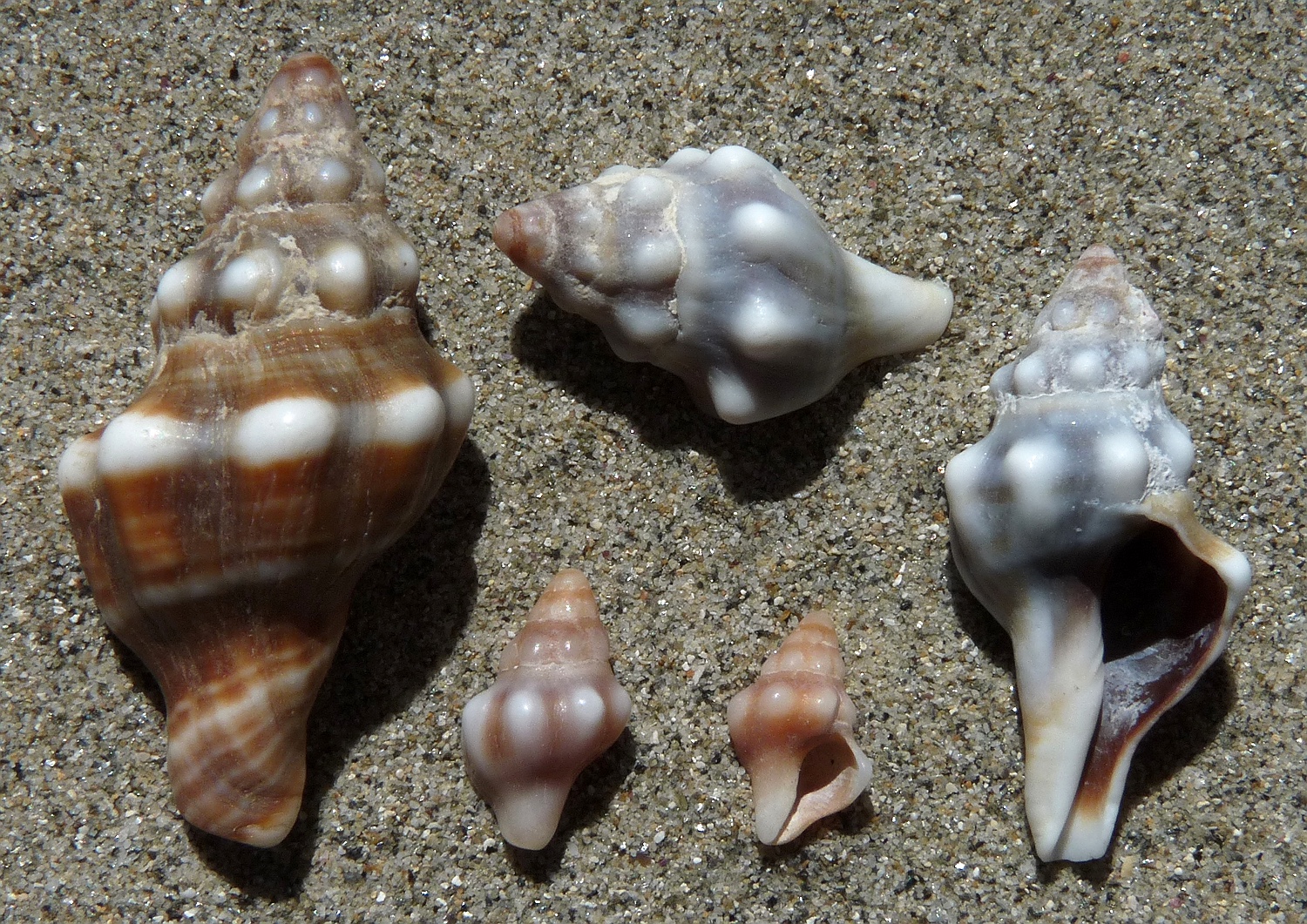
Tarantinaea lignaria has a shell with angular whorls with strong knots that at first glance resembles that of the Banded dye-murex. Height: 50 mm
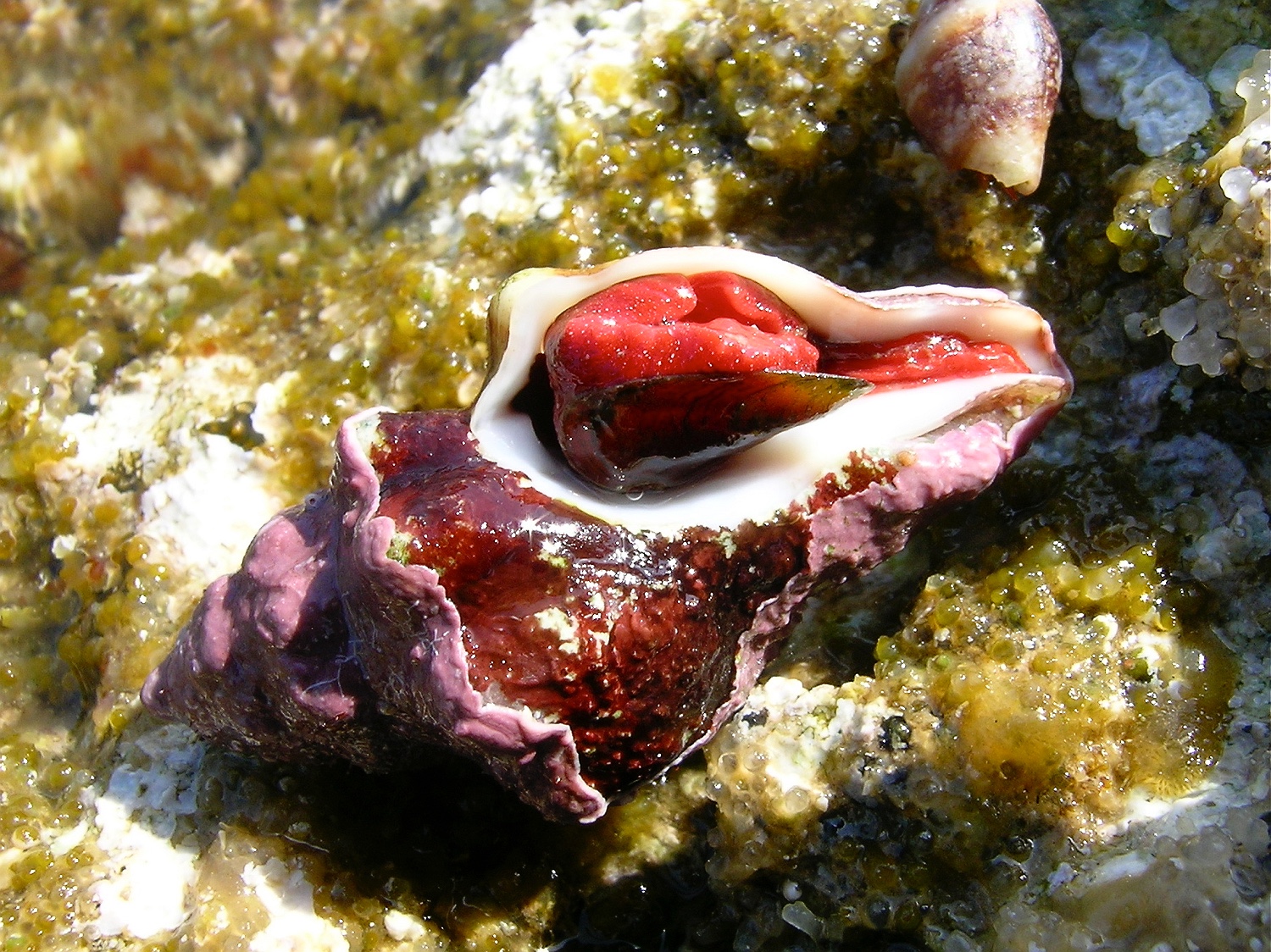
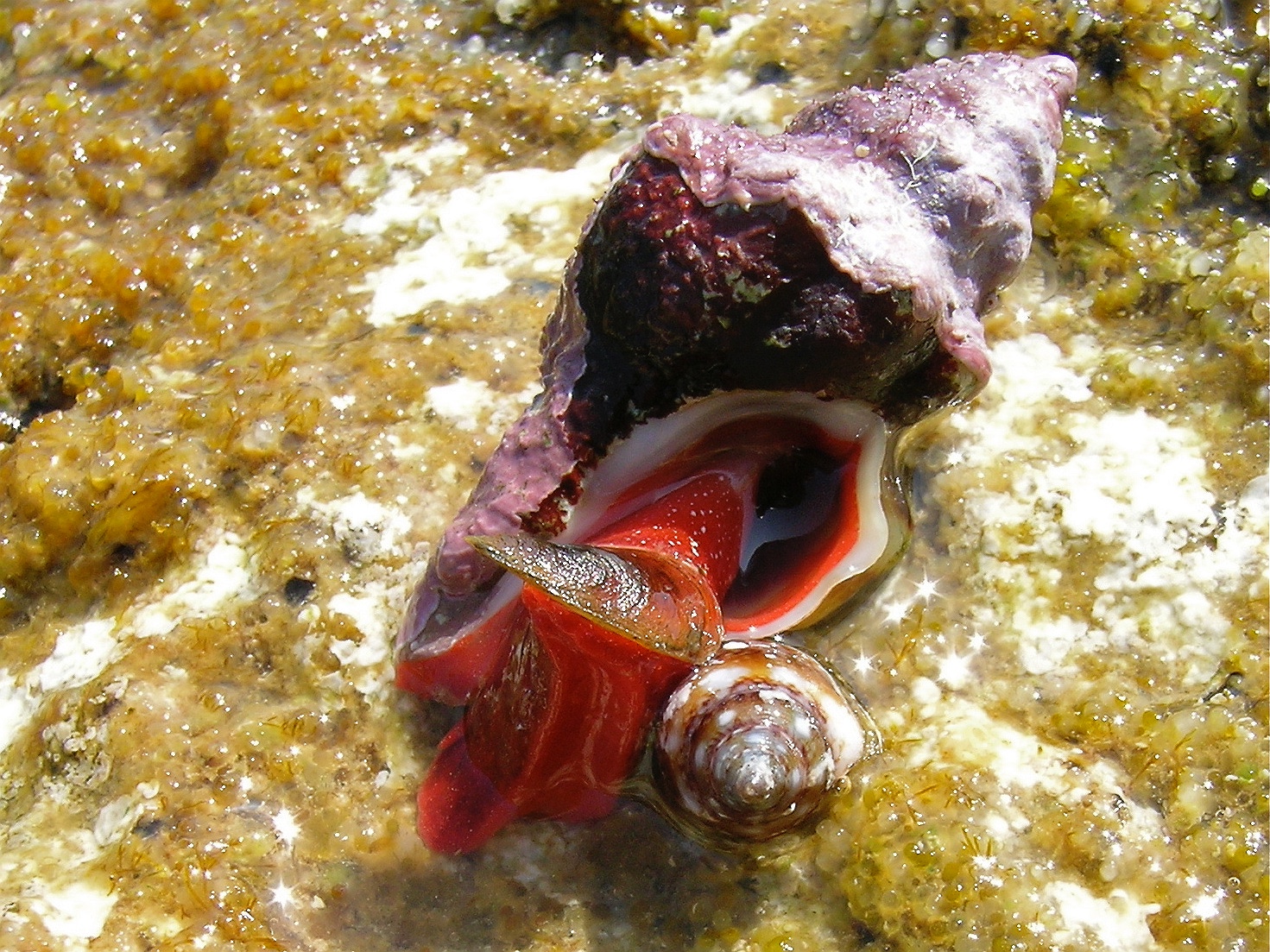
The body of this snail is bright purple in colour (as the dye that was produced from it in ancient Greece), while the lips of the aperture are strikingly white. In the lower photo, the snail is about to kill a specimen of Columbella rustica.
Syracusan spindle snail, Aptyxis syracusana, L.
(= Fusinus syracusanus)
rare
The Syracusan spindle snail has a long shell with strongly angular whorls and a roundish aperture with a long siphon canal. It is brown with white radial ribs and spiral ridges.
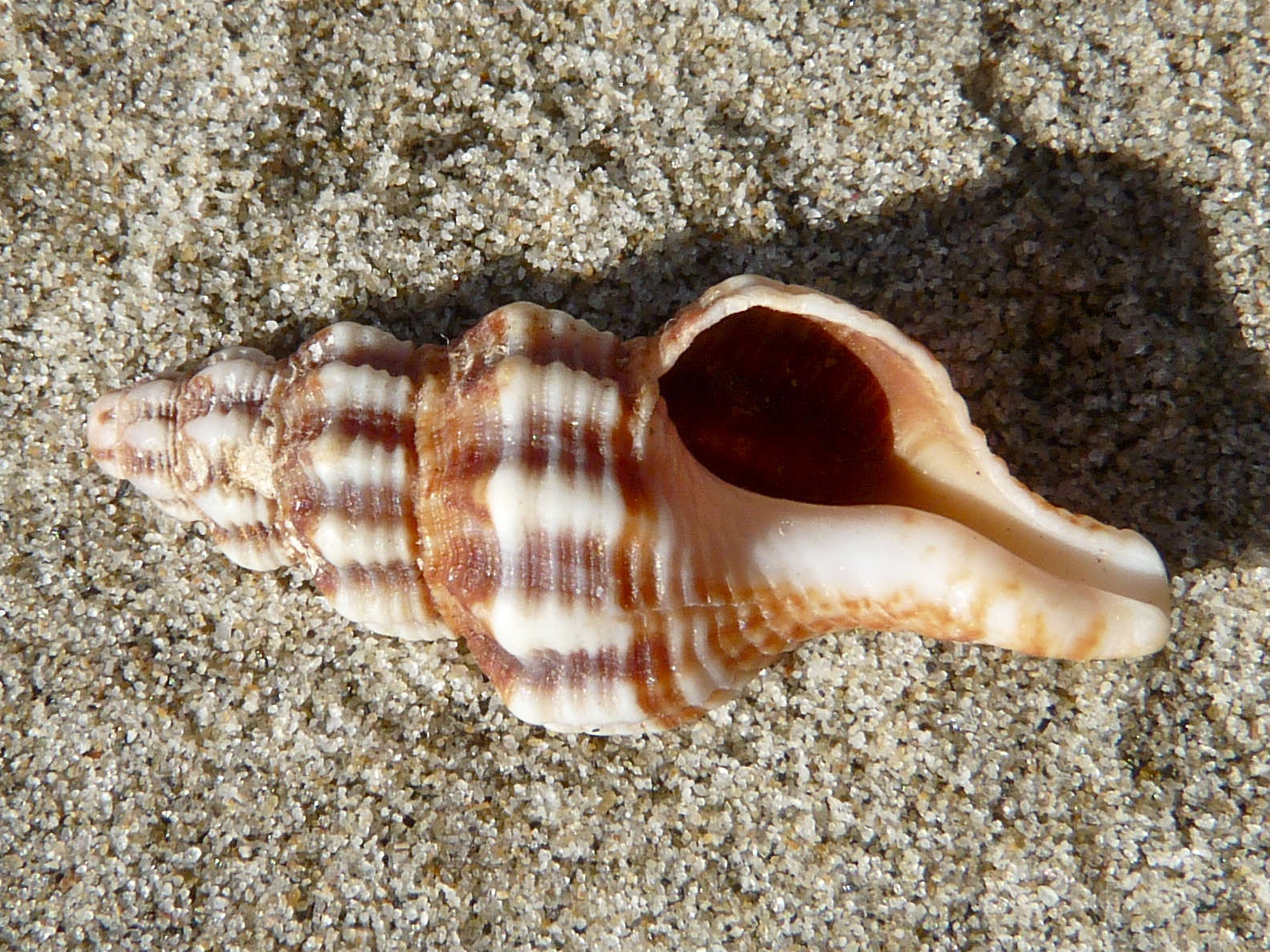
The Syracusan spindle snail has a very long siphon canal and angular whorls sculpted by ribs and spiral ridges. Height: 19 mm
4. Nassariidae, Dog whelks
The dog whelks live mainly on sand and mud, where they can sometimes be found in large numbers. They feed on carrion. The classification of the numerous species into genera has changed repeatedly, which is why most species have many synonyms.
Mutable dog whelk, Tritia mutabilis, L.
regularly
The Mutable dog whelk has a pointed conical spire with angular whorls; the outermost whorl is inflated and the aperture rounded with a short, wide siphon channel. The shell is thin and translucent with light brown flaming and spots on the shoulders.
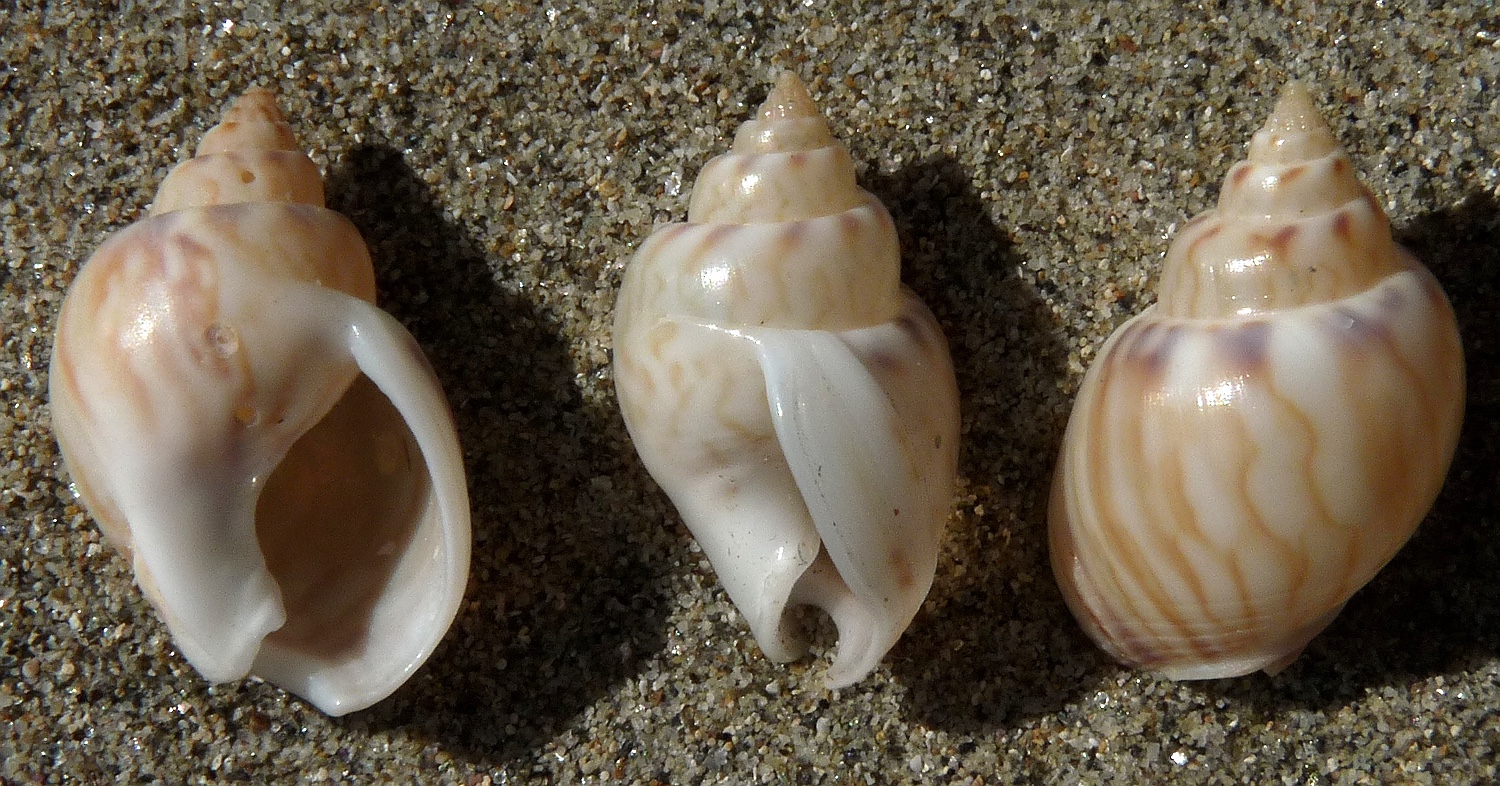
The shell of the Mutable dog whelk is delicate and semi-translucent. Height: 20 mm
Thick-lipped dog whelk, Tritia incrassata, Strøm
regularly
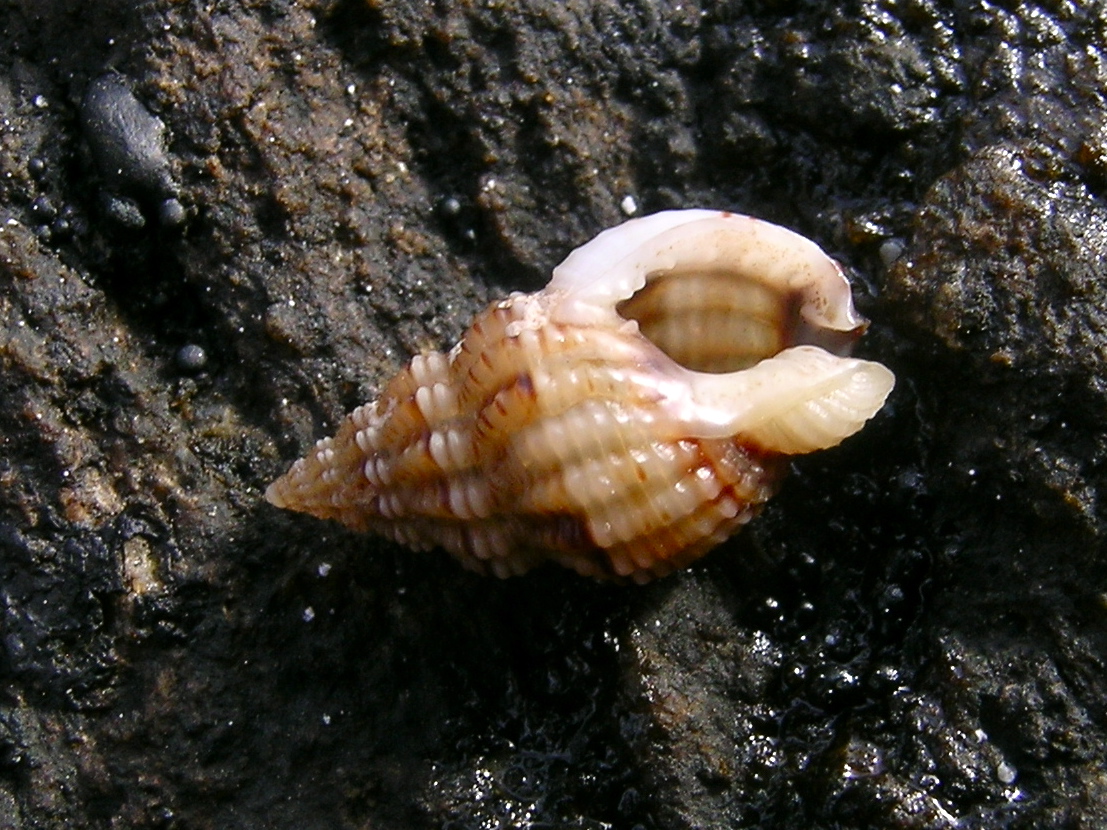
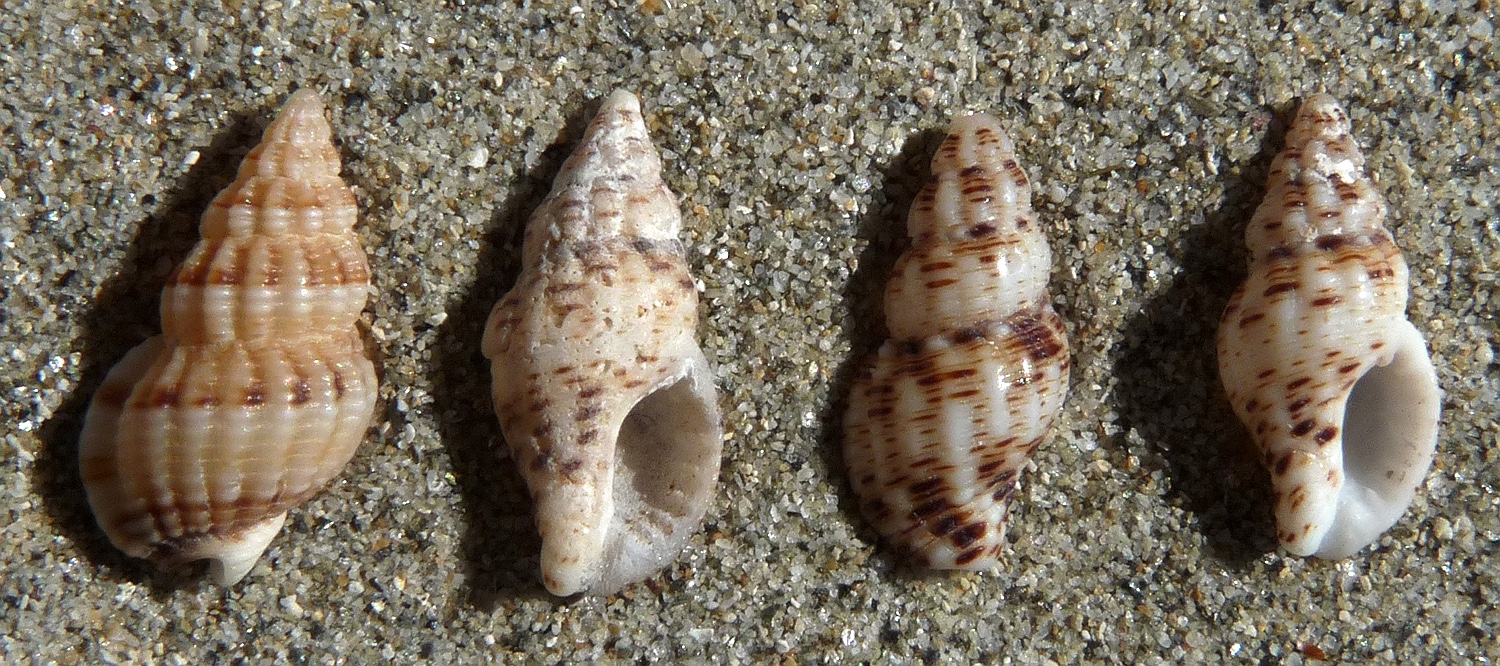
The very small shell of the Thick-lipped dog whelk shows many dense radial ribs and spiral ridges; the aperture is oval with thick lips and a short, deeply incised siphon canal that is dark on the inside. Height: 10 mm
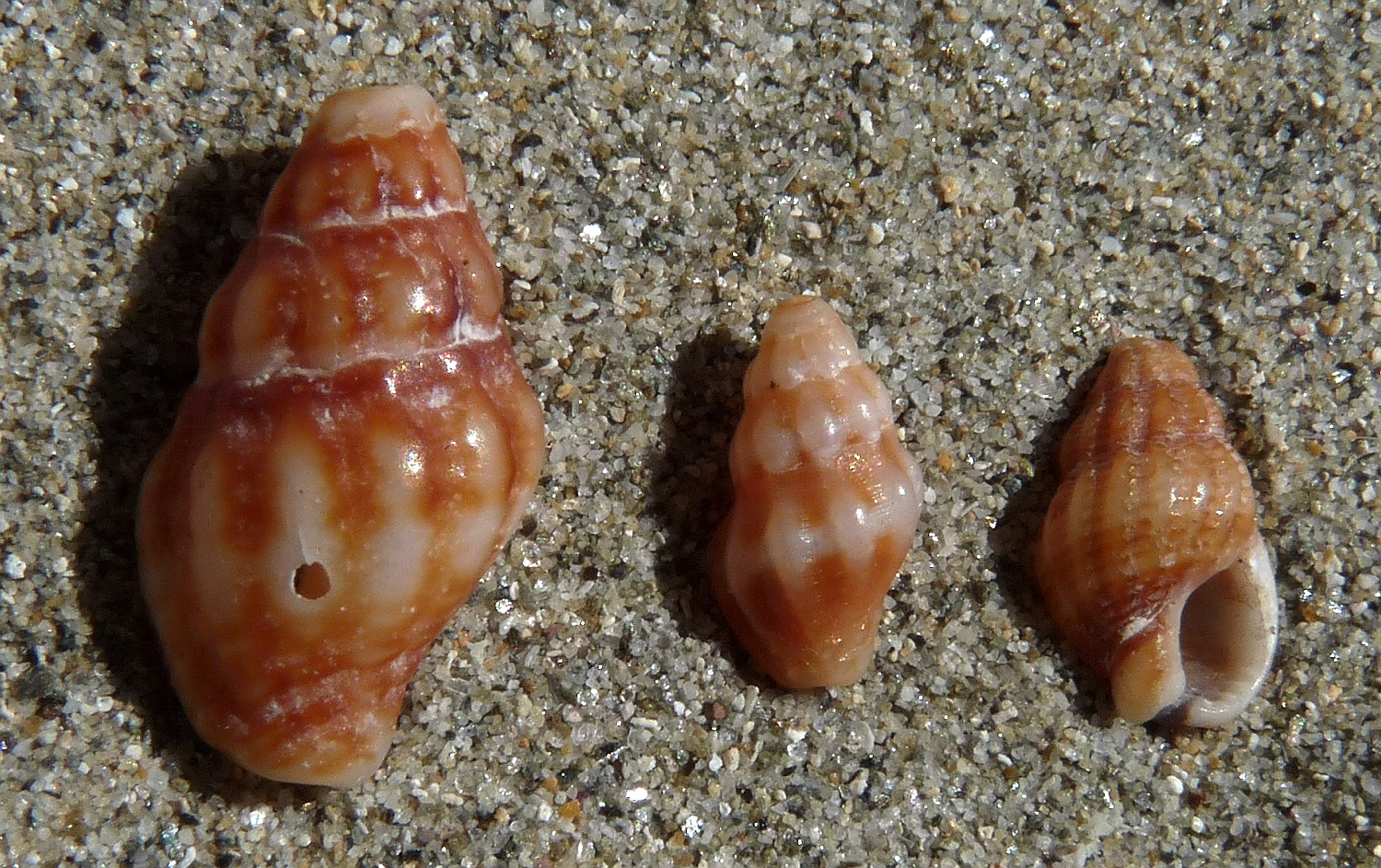
These specimens probably also belong to the very variable species.
Tritia cuvierii, Payraudeau
regularly
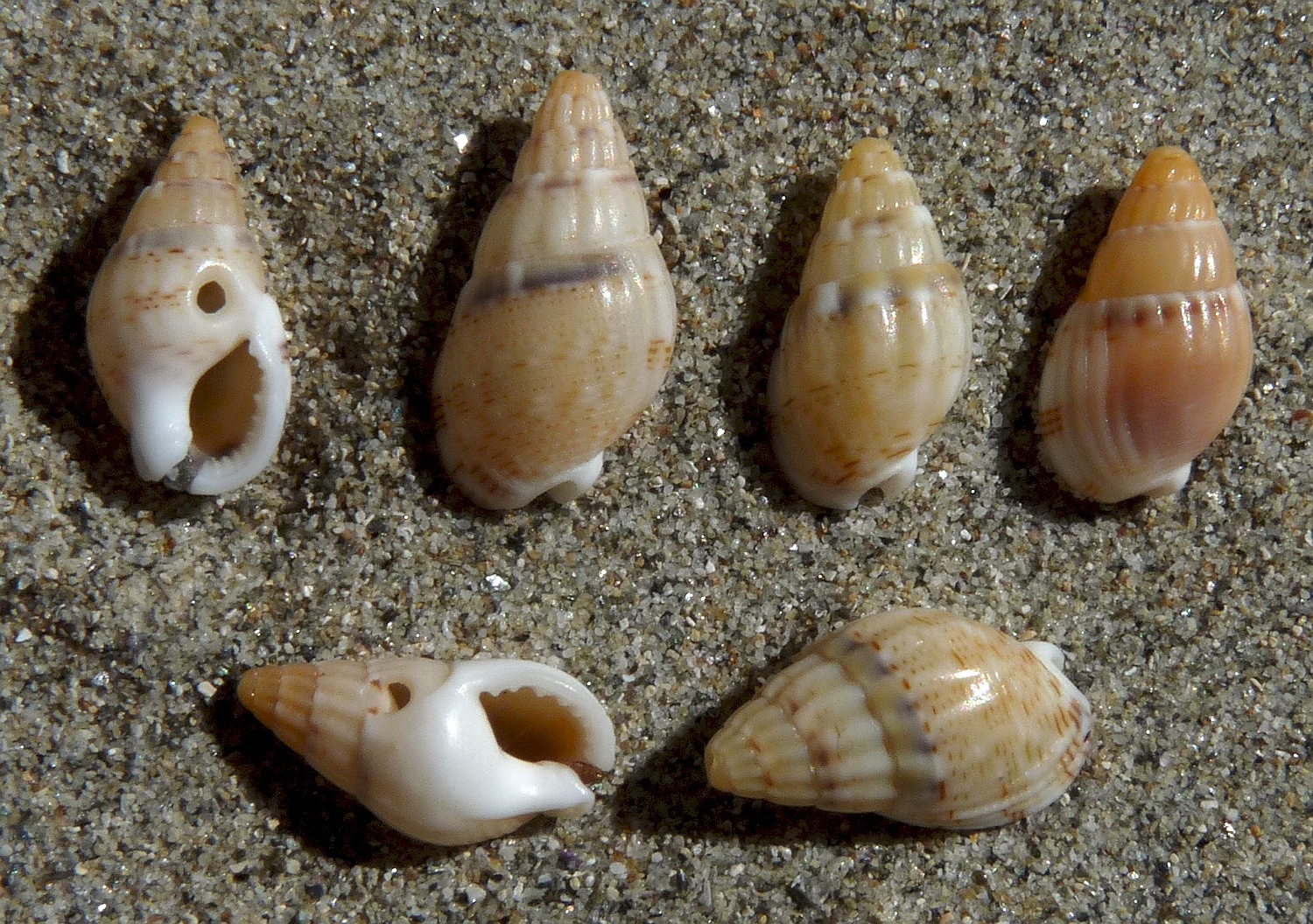
This small, beige-coloured species features only faint ribs and indistinct spiral lines. The outer lip of the almond-shaped aperture is serrated. Height: 15 mm
Tritia pellucida, Risso
(= Cyclope pellucida)
rather common
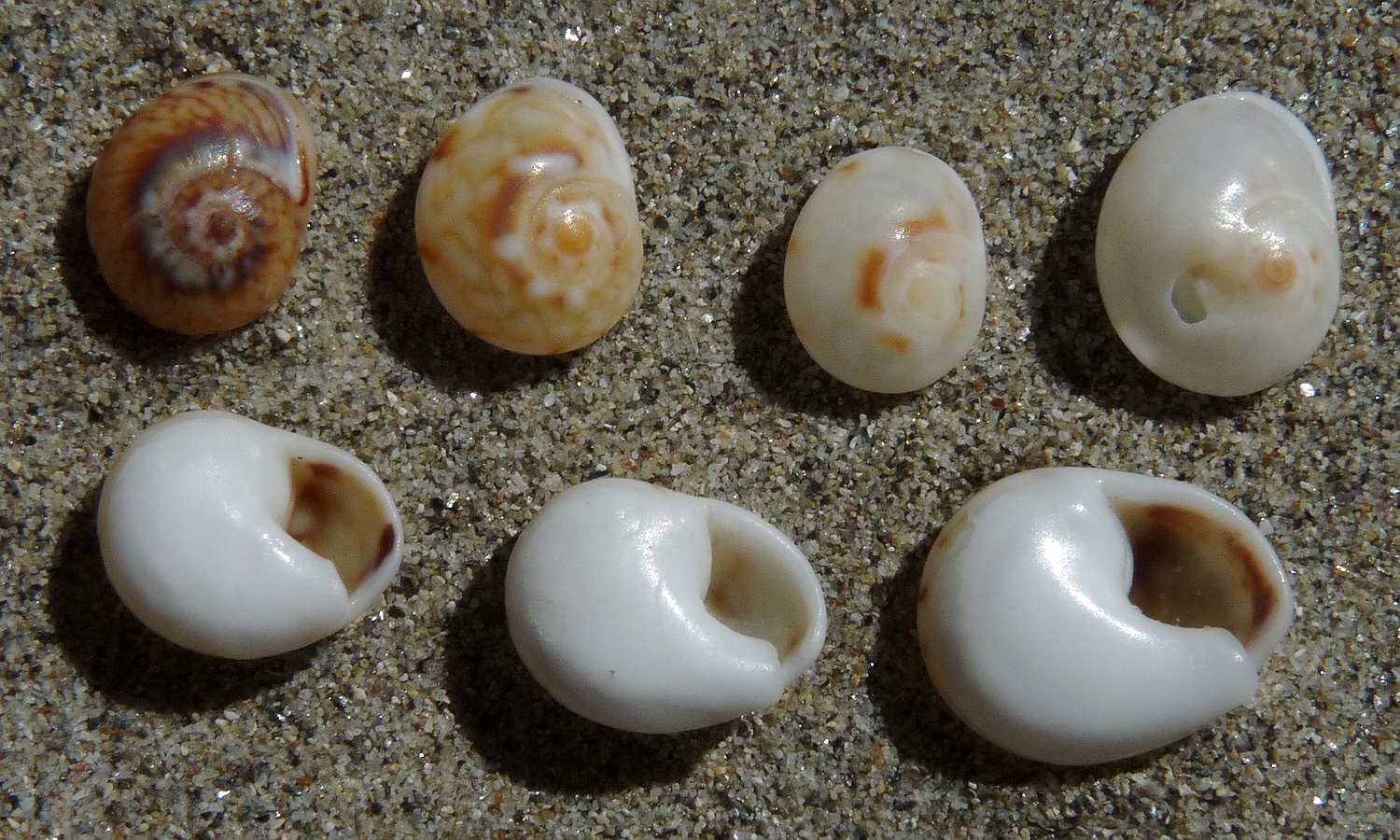
Tritia pellucida is flat and disc-shaped with a brownish of beige patterning on the upper side and a white underside; the aperture is small and lies on the underside of the shell. Size: 9 mm
B. Muricoidea
The Muricoidea are another species-rich and diverse family of snails. Many of their members are effective predators, using their radula to etch and drill a hole in the shell of their prey. Most species have a long siphon canal.
1. Muricidae, Murex snails
A characteristic feature of murex snails are the thick radial ribs (often three or more) on the shell, which often form protrusions such as knots or spines. Many species occur in a spiny form as well as in a nodular form without spines.
Banded dye-murex, Hexaplex trunculus, L.
(= Trunculariopsis trunculus)
common
The Banded dye-murex is common in our region. Nevertheless, it is rare to spot a live snail: the animals hide among the plants of the infralittoral zone and are often camouflaged by thick growths of algae, sponges, bryozoans, etc. They live in rocky areas, often close to the waterline.
The shell of the Banded dye-murex is thick and quite large (up to 8 cm). The whorls are angular with large knobs in thick radial ribs and knots or spines on spiral bands. The shell has a distinct siphon canal. The colouring is more or less grey; three broad brown-violet bands are visible on the inside of the aperture.
The Banded dye-murex feeds predatory on mussels and snails, as well as carrion. Its proboscis is covered with sharp teeth, which it uses to drill holes in the shell of its prey and to kill it. The snail is one of several related species that were used in the past to produce the famous purple dye from the hypobranchial glands which produce a colourless mucus that turns yellow and green to dark red under certain circumstances. Thousands of snails were needed to produce just a few grams of the dye in a complicated procedure, which explains its high price. In the Middle Ages, purple was worn only by emperors and high dignitaries. Even today, it is still the most expensive dye in the world.

On the beach, you can find many shells of mussels and snails with holes etched into them by predatory snails such as the Banded dye-murex (in the top shell one can see that the animal survived the attack and managed to close the hole!)
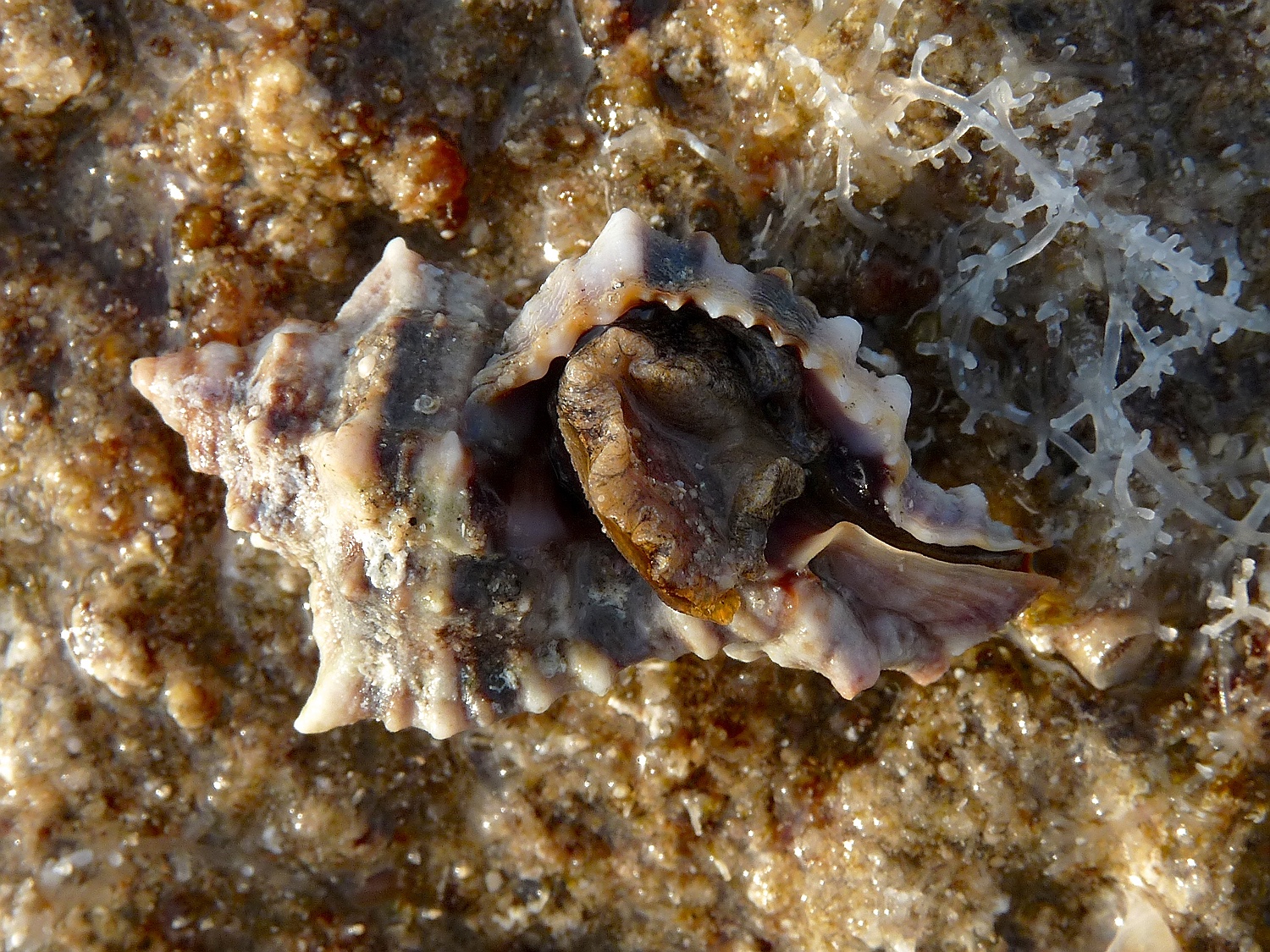
In the past, the famous purple dye was extracted from the hypobranchial gland of the Banded dye-murex in a complicated process.
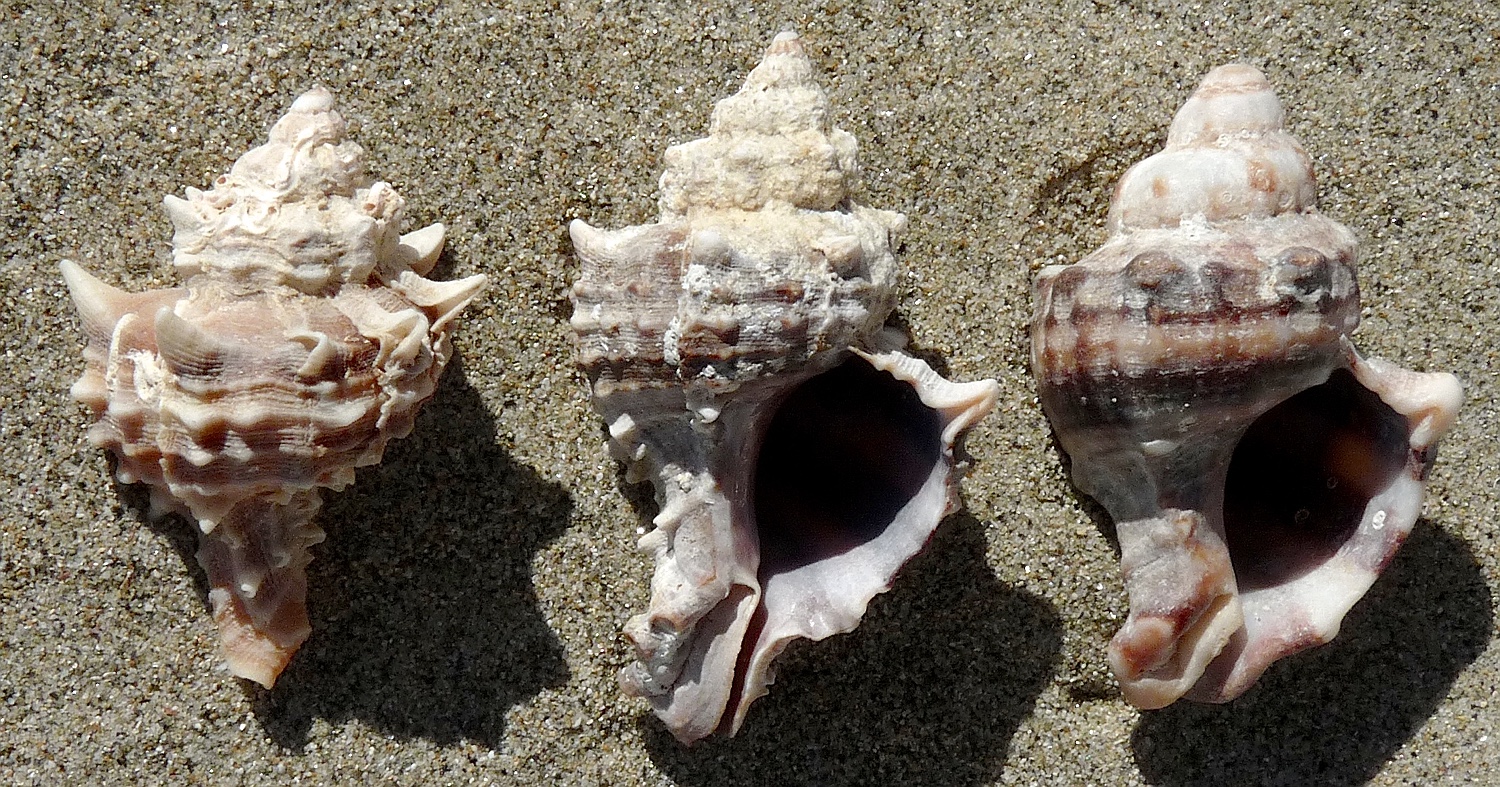
The Banded dye-murex exists in two forms: the nodular form with thickened knots on the radial ribs (right) and the spiny form, in which the radial ribs bear short spines (left). One can see that the spines arise as folds in the edge of the shell. Height: 70 mm
Spiny dye-murex, Bolinus brandaris, L.
(= Murex brandaris)
rare, in deeper water, only rarely found at the beach
The Spiny dye-murex, which can reach a length of 10 cm, has a roundish shell with a thin, long, straight siphon canal, giving it a club-like appearance. This species also shows a spiny form, with long, folded spines on the radial ribs, and a nodular form with thickened but not spiny ribs. Its habits and diet are the same as those of the Banded dye-murex. The Spiny dye-murex is rarer than the Banded dye-murex. It is often found as by-catch in fishing nets.
Like the Banded dye-murex, the Spiny dye-murex can be used for the production of purple dye and was caught in large quantities in ancient times for that purpose.
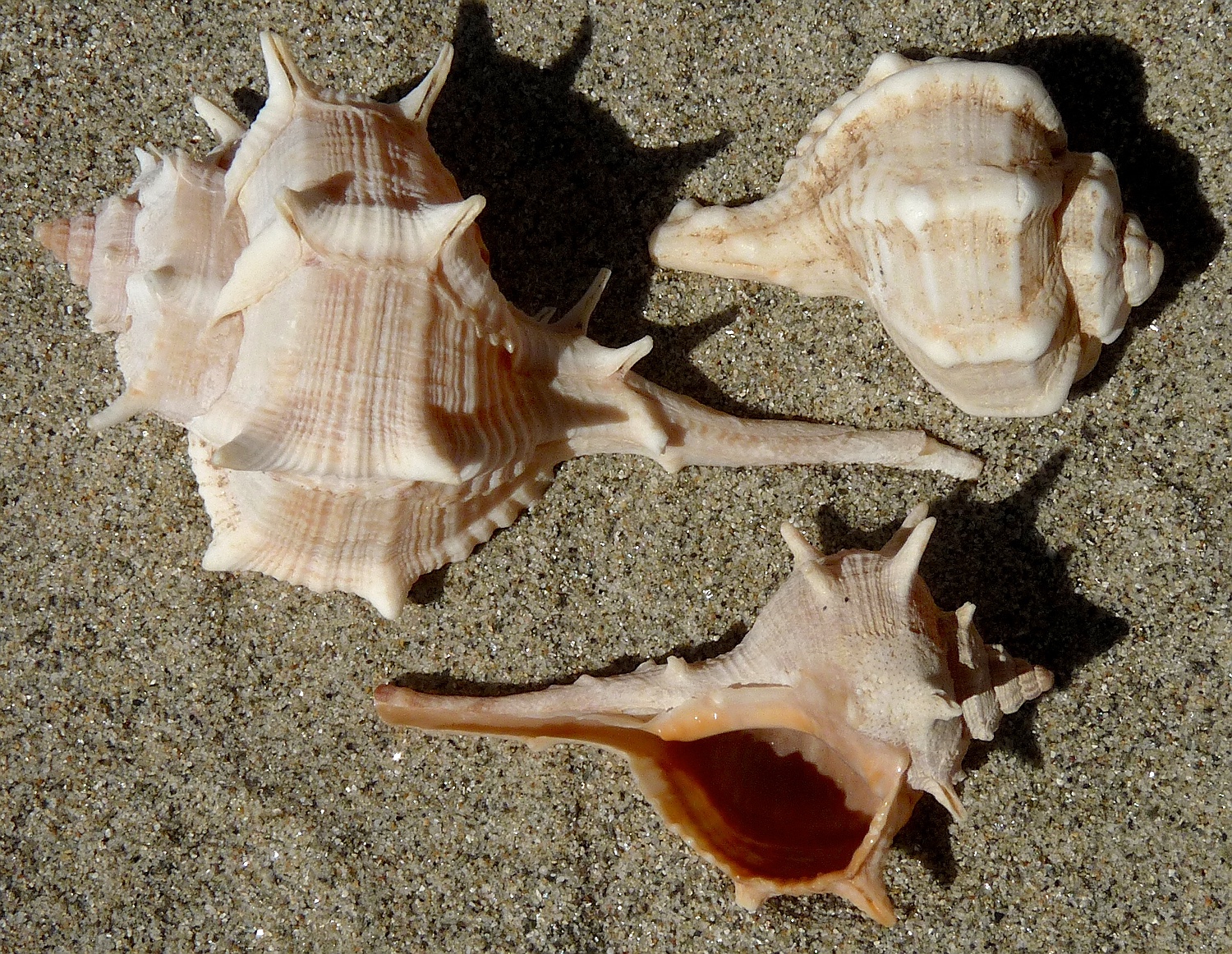
Here you see the spiny and the nodular form of the Spiny dye-murex. The aperture often has an orange colour. Height: 65 mm
Red-mouthed rock shell, Stramonita haemastoma, L.
(= Thais haemastoma)
very rare
Another large species of murex snail found on Naxos, albeit very rarely, is the Red-mouthed rock shell. It has an intensely orange-coloured aperture. The shell is sculpted with faint knots, mainly on its shoulder. This species was also used for dyeing in the past.
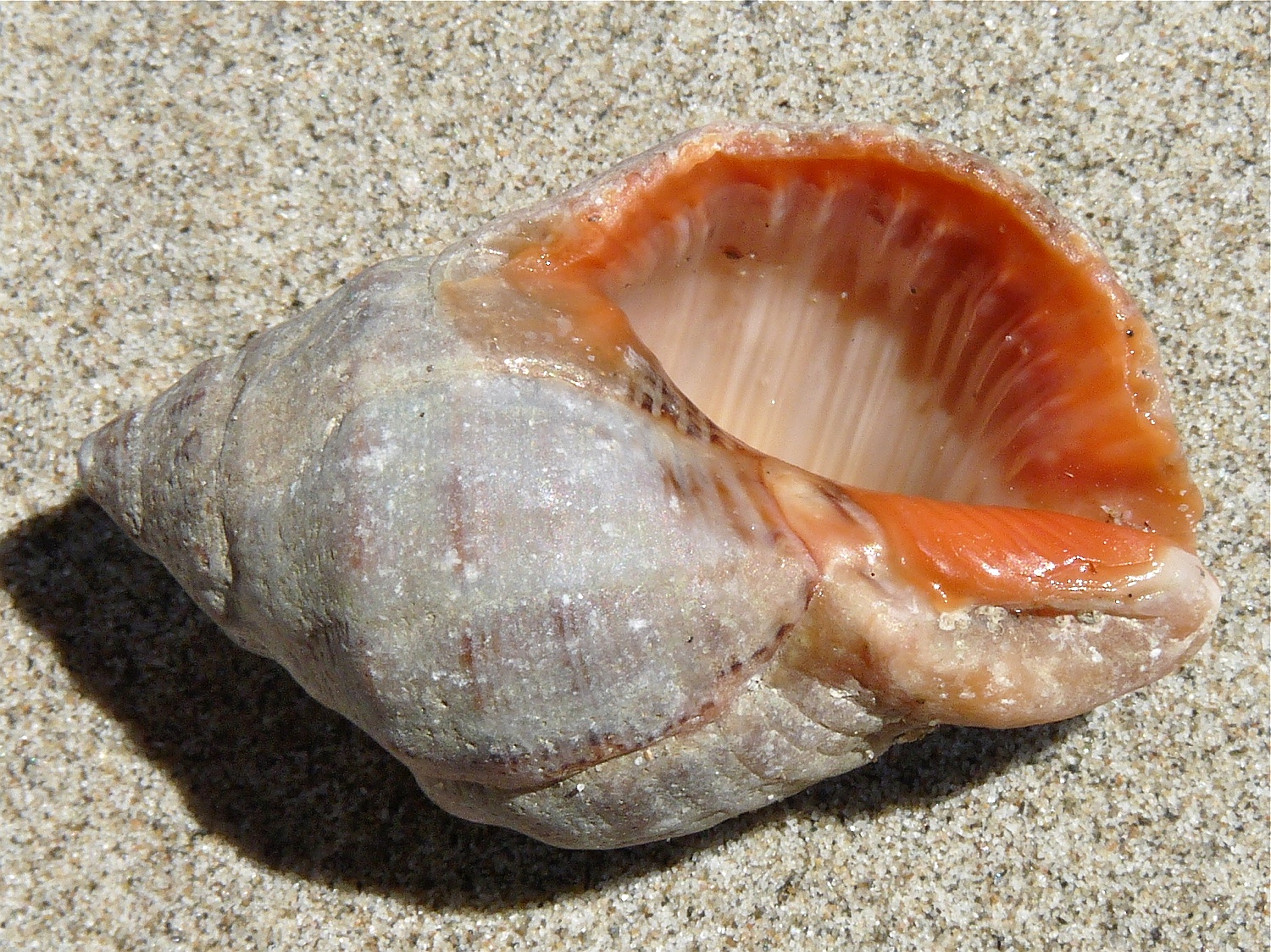
This very beautiful snail with an orange interior we have found only once on Naxos. Height: 45 mm
2. Coralliophilinae, Coral snails
Coral snails were previously classified as a family, but today they are considered to be a subfamily of the murex snails. They feed on anthozoa (corals and sea anemones) and sometimes also on sponges or barnacles, in which they drill holes and suck out the interior. Instead of a radula, the typical “tongue” of the snails, they have a long, extendable proboscis.
Coralliophila meyendorffii, Calcara
very rare
This small snail with a very thick shell occurs in the Mediterranean Sea and the Atlantic ocean.
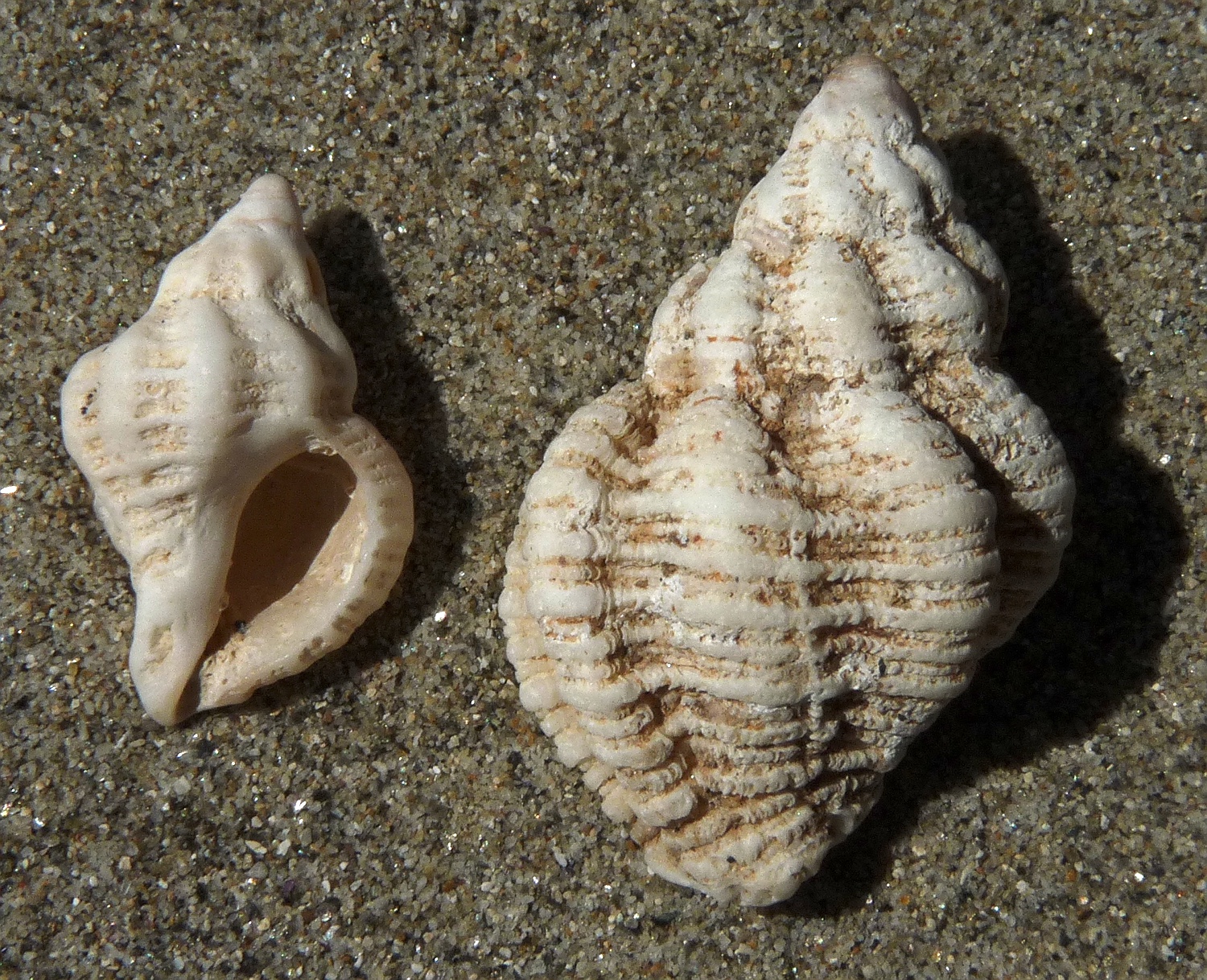
Coralliophila meyendorffii is a small, thick-walled white snail whose shell is sculpted by strong radial ridges and thin spiral bands. Height: 30 mm
Babelomurex cariniferus ?, G. B. Sowerby II
very rare
This snail could be a young, non-spiny form of Babelomurex cariniferus.
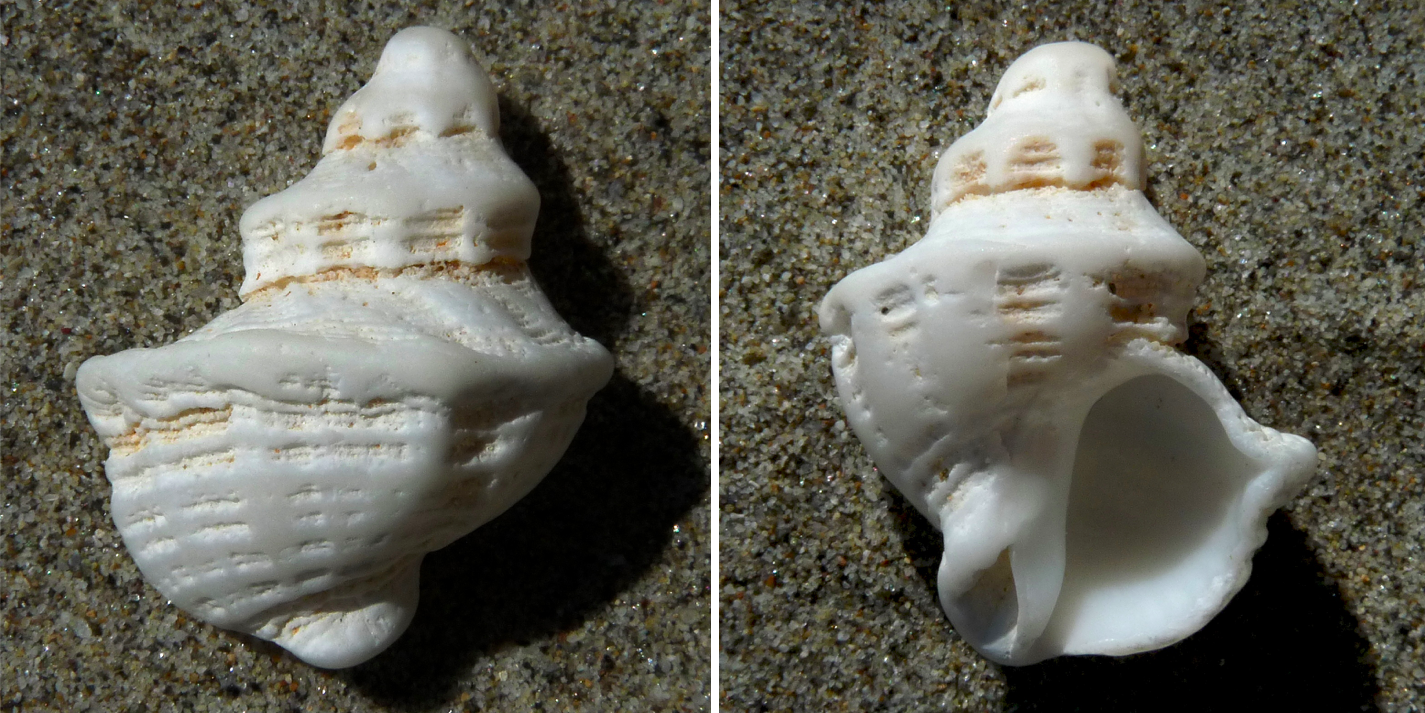
This snail could possibly be a small specimen of the species Babelomurex cariniferus, which usually has distinct spines on its shell, similar to the spines of the Spiny dye-murex. A characteristic feature of this species is the distinct keel approximately in the middle of the whorls which also shows in the aperture as a small fold.
3. Mitridae, Mitre snails
The Mitre nails capture their prey (mainly worms and molluscs) using their long, protractile proboscis to stun them with a poison produced in their salivary glands; this secretion turns purple when exposed to air, similar to the dye from the murex snails. The shells of mitre snails are usually elongated and smooth with a short siphon canal. They don’t have an operculum.
Episcomitra cornicula, L.
quite common
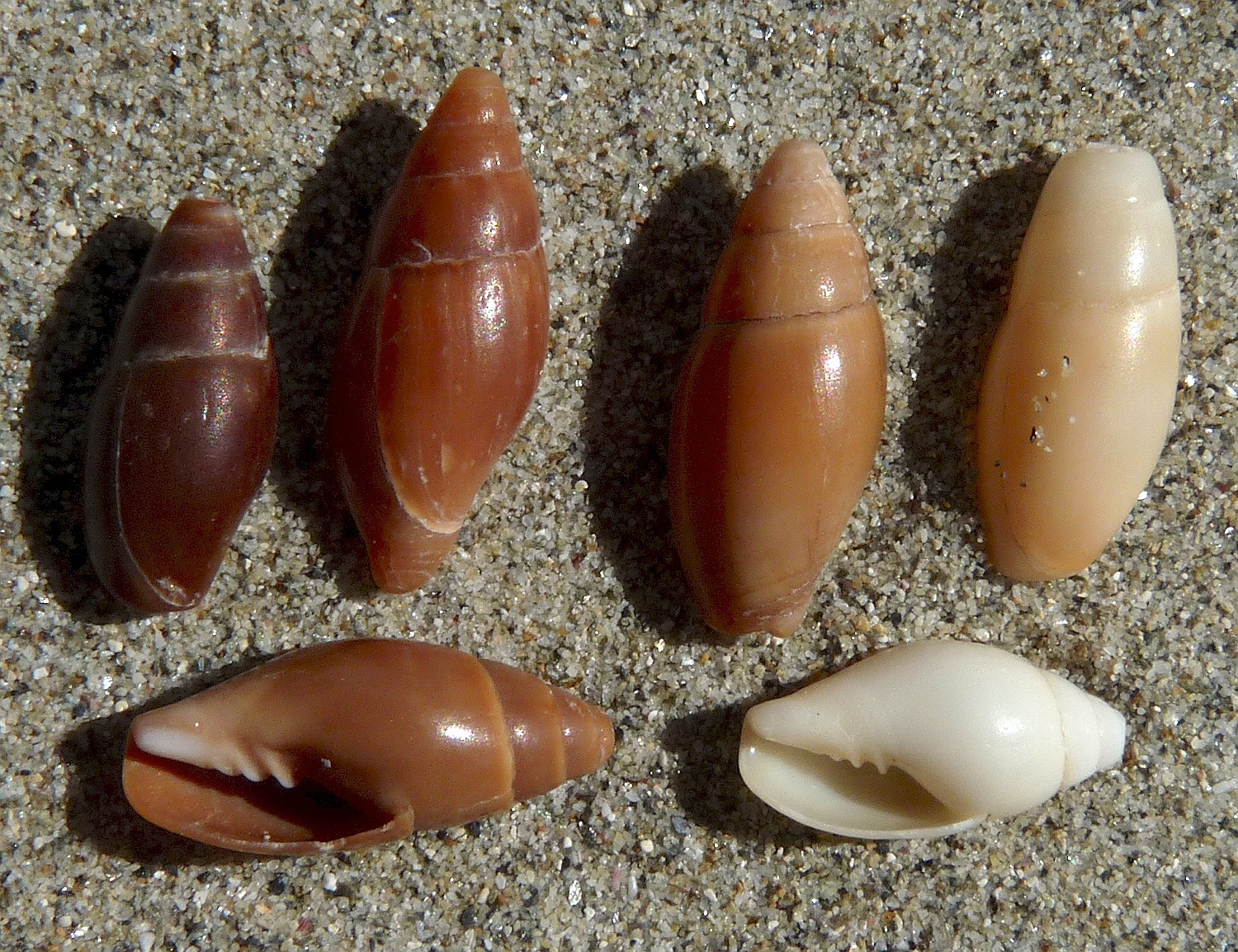
The shell of Mitre snails is spindle-shaped with a narrow mouth and three distinct folds on the inner lip. Episcomitra cornicula is yellowish to brown in colour. Height: 16 mm
4. Costellariidae, Ribbed Mitre snails
The Ribbed Mitre snails look very similar to the Mitre snails, but differ in aspects of their anatomy and in the secretion which remains yellow-green rather than becoming purple. They are related to the murex snails. They mostly live buried in sand where they hunt molluscs and worms.
Pusia ebenus, Lamarck
rather common
The genera Pusia and Vexillum were only recently separated from the genus Mitra on the basis of anatomical characteristics of the living snail despite the great similarity of their shells.
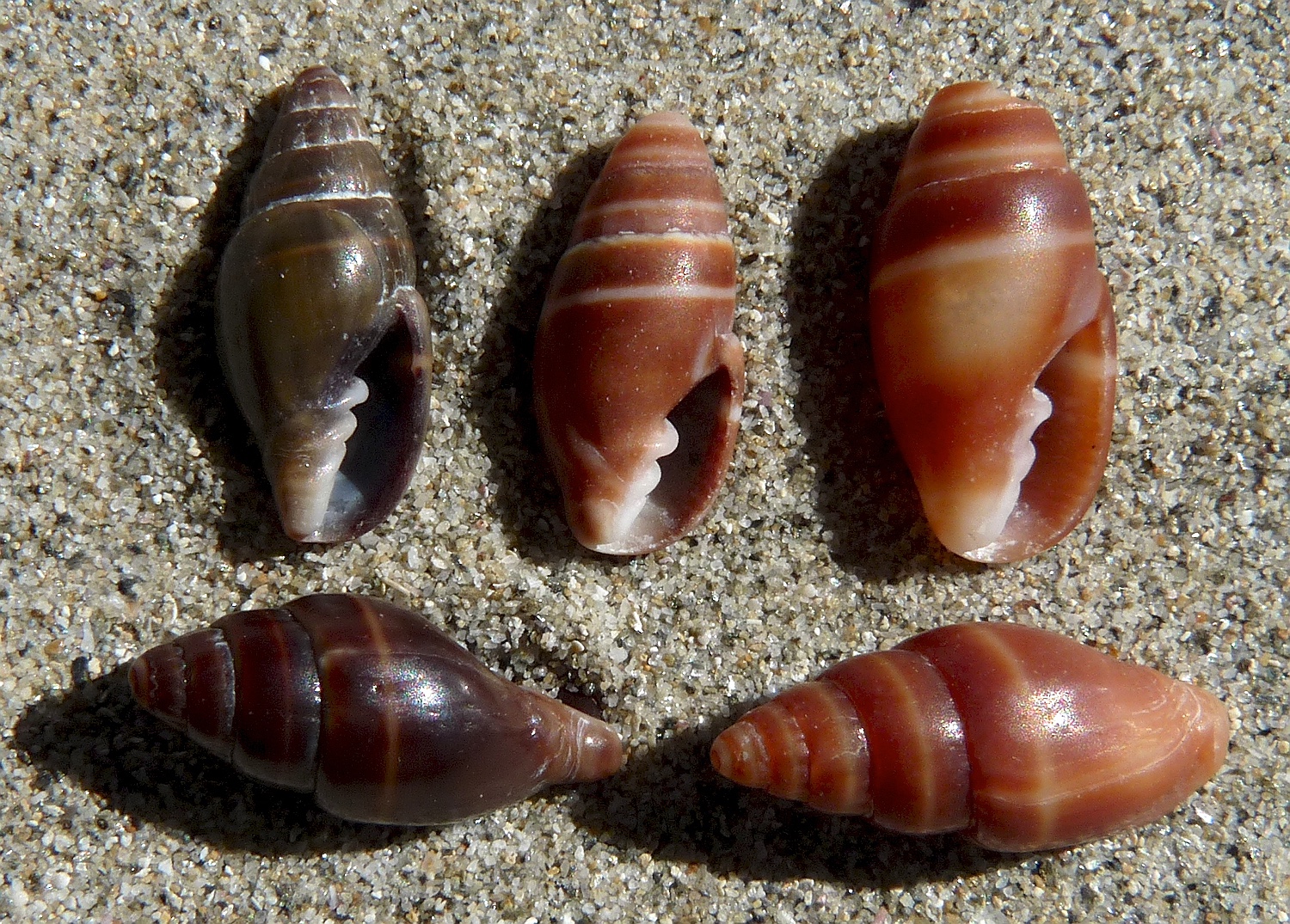
Pusia ebenus is very similar to the previous species, but usually darker in colour. The shell usually shows a whitish spiral line; the folds on the inner lip are slightly more pronounced. The identification is not certain though – it’s difficult to destinguish the two species. Height: 12 mm
Pusia granum, Forbes
very rare
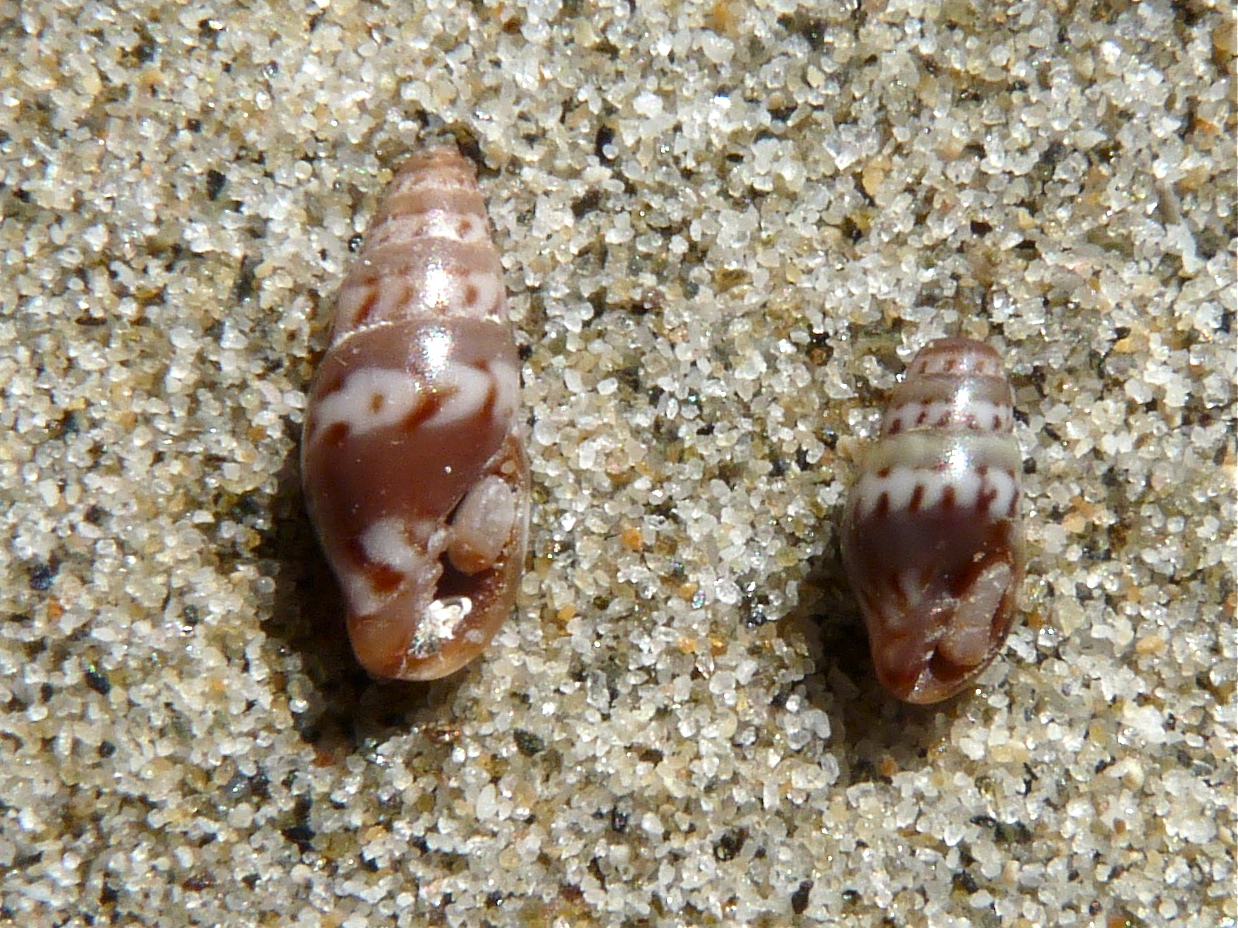
This small species shows beautiful spirally flamed bands. Height: 7 mm
C. Conoidea
The large superfamily Conoidea comprises several predatory snail families with a harpoon-shaped radula that they use to inject venom into their prey. Their best-known members are the cone snails.
1. Conidae, Cone snails
Mediterranean cone, Conus ventricosus, Gmelin
(= Conus mediterraneus)
very common
The cone snail grows up to 6 cm in size. It is rarely seen alive, as it usually spends the day in dense algae beds or under stones. At night, the cone snail goes hunting: it mainly preys on bristle worms, which it “harpoons” with dart-like, pointed radula “teeth”, which are equipped with strong poison. The darts can also be used for defence; some tropical species can even be dangerous to humans. Each dart can only be used once; the snail stores several of the teeth in a pouch on its radula.
The cone snail has a conical shell with a short, flat conical apex and a very large last whorl, which tapers evenly towards its lower tip. The aperture is narrow and elongated with a short, broad siphon groove.
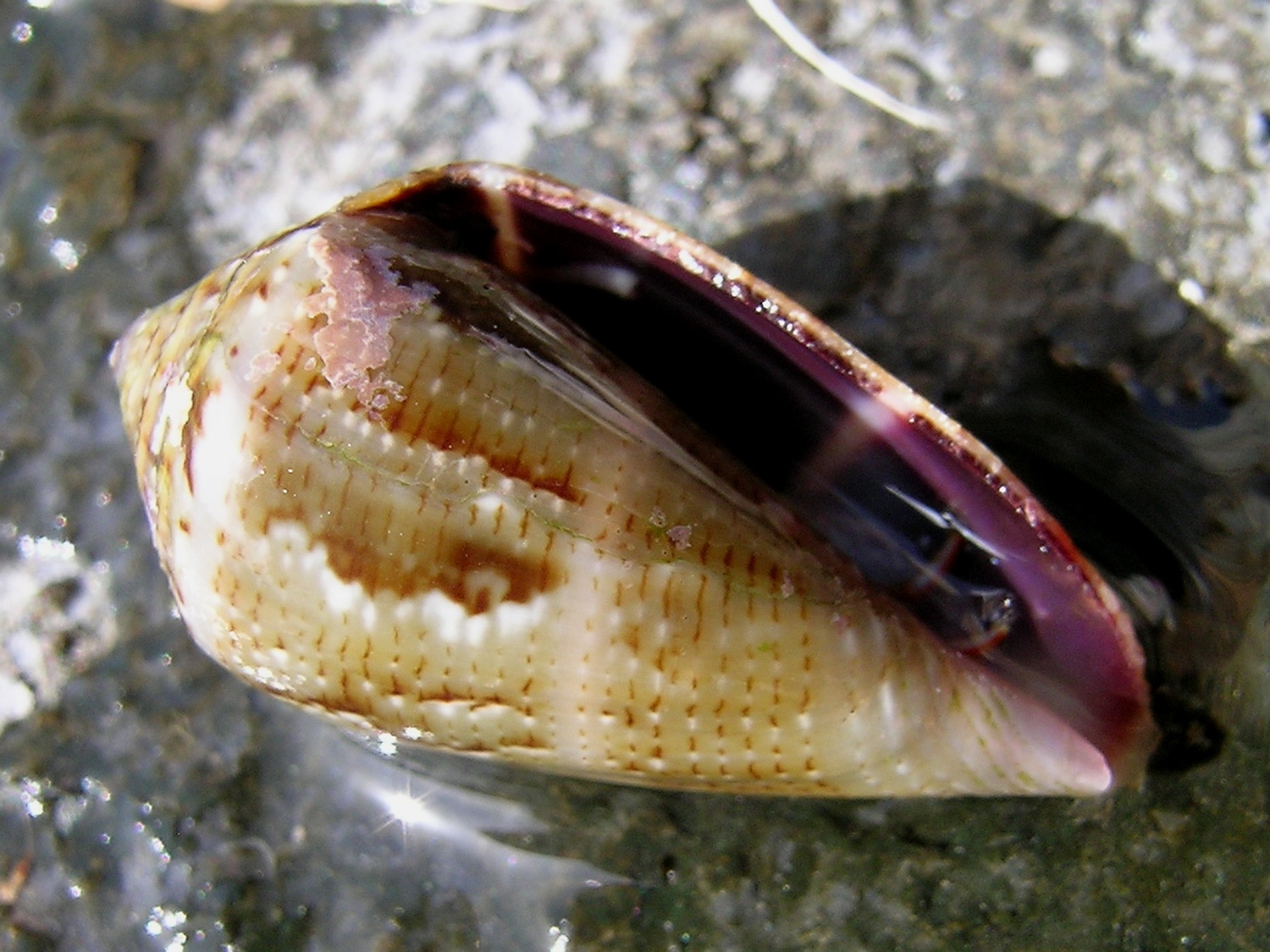
The shell of the Mediterranean cone has a conical shape. Please note: even though the European species are not dangerous to humans, it is best not to touch a live cone snail!
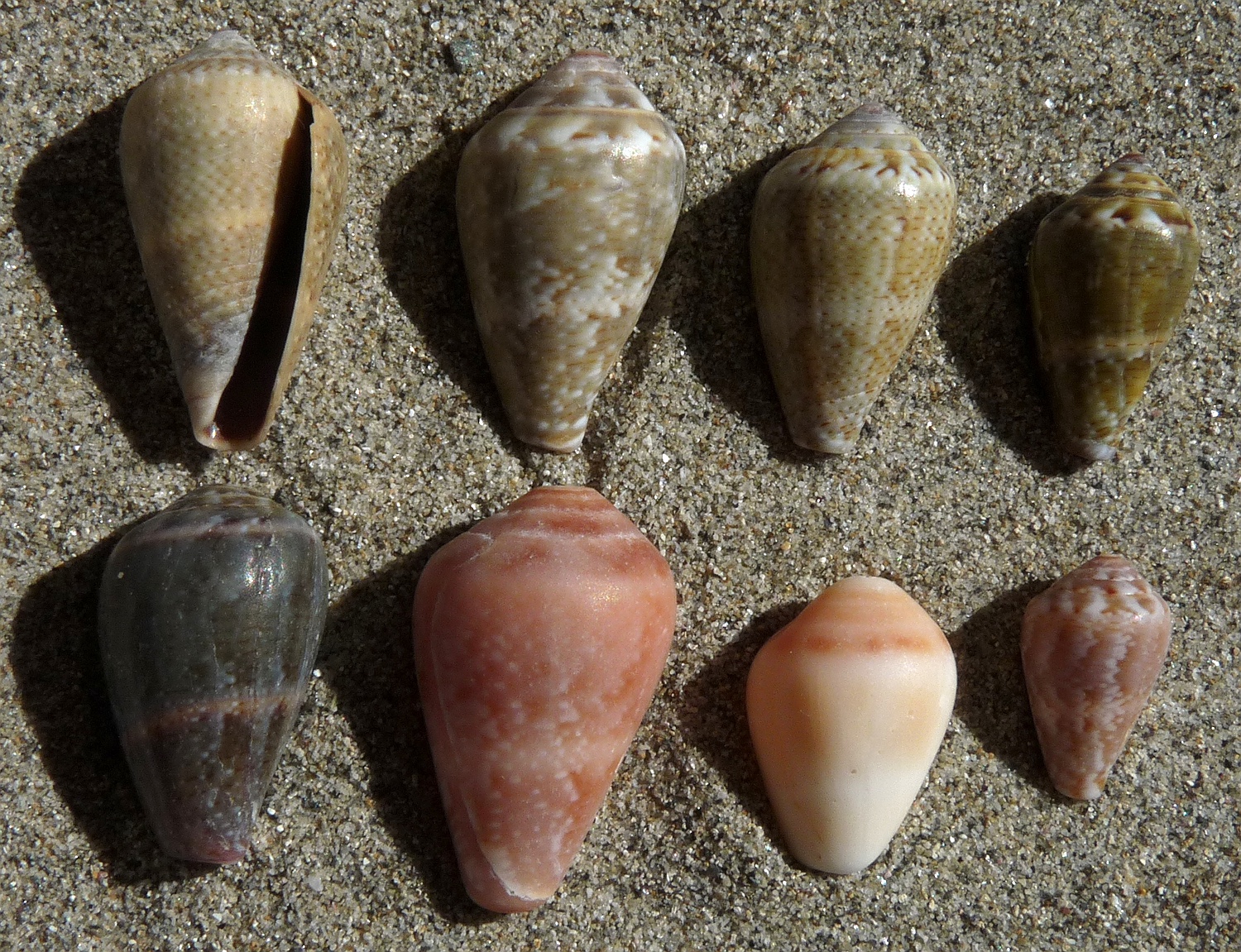
The colouring of the Mediterranean cone snail is variable; olive green with fine spotting is most common, but dark purple, reddish and yellowish specimens also occur. Most shells have a narrow white spiral band approximately in the middle of the shell. The apex may protrude to a greater or lesser extent. Height: 33 mm
continue: Pulmonata and Opisthobranchia
back: