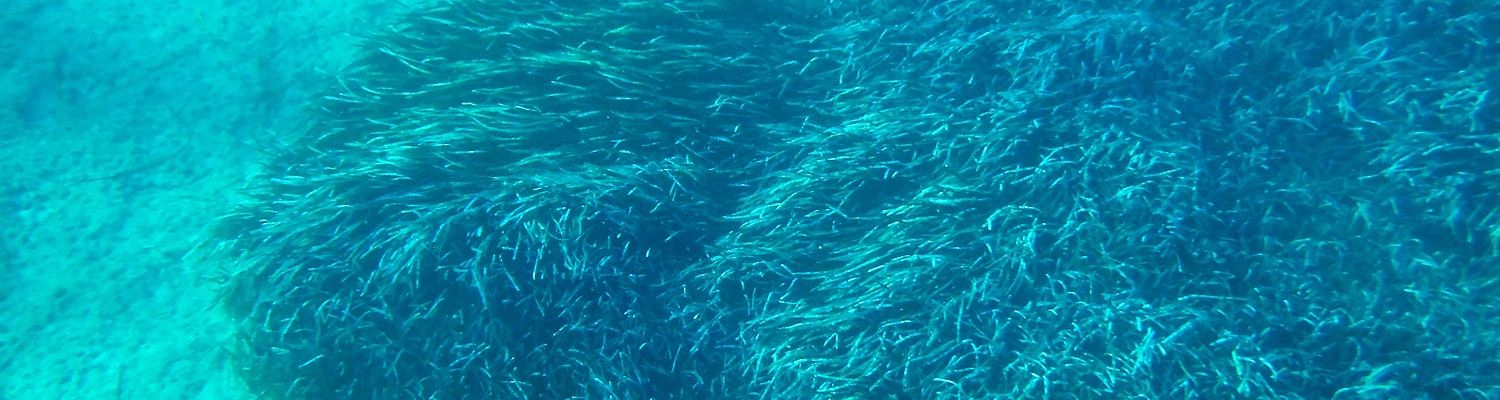
Seagrass meadows
On sandy and muddy soils in shallow coastal areas no plants can grow because the substrate is moved by the waves. The first plants appear in a depth of several meters, where the sea floor is not affected much by the waves. Seagrass species are particularly typical of these locations. These are not algae, but higher plants. Unlike algae, they have well-developed roots with which they can anchor themselves in the sand. In shallower regions of a few meters depth first appears the sea grass Cymodocea nodosa, which grows in a scattered pattern, proliferating by root runners. In a depth of about ten meters or more follows the Neptune grass (Posidonia oceanica), which forms extensive, dense meadows. Neptune grass belongs to the family Posidoniaceae with only one genus and nine species. Cymodocea nodosa belongs to the related family Cymodoceaceae with five genera and 16 species.
The seagrass meadows, which also occur in our bay, look rather uniform, but are home to an astonishing number of different animal species. For example, 350 species of macrofauna and 15 tonnes of animal biomass have been measured in one hectare of seagrass meadow.
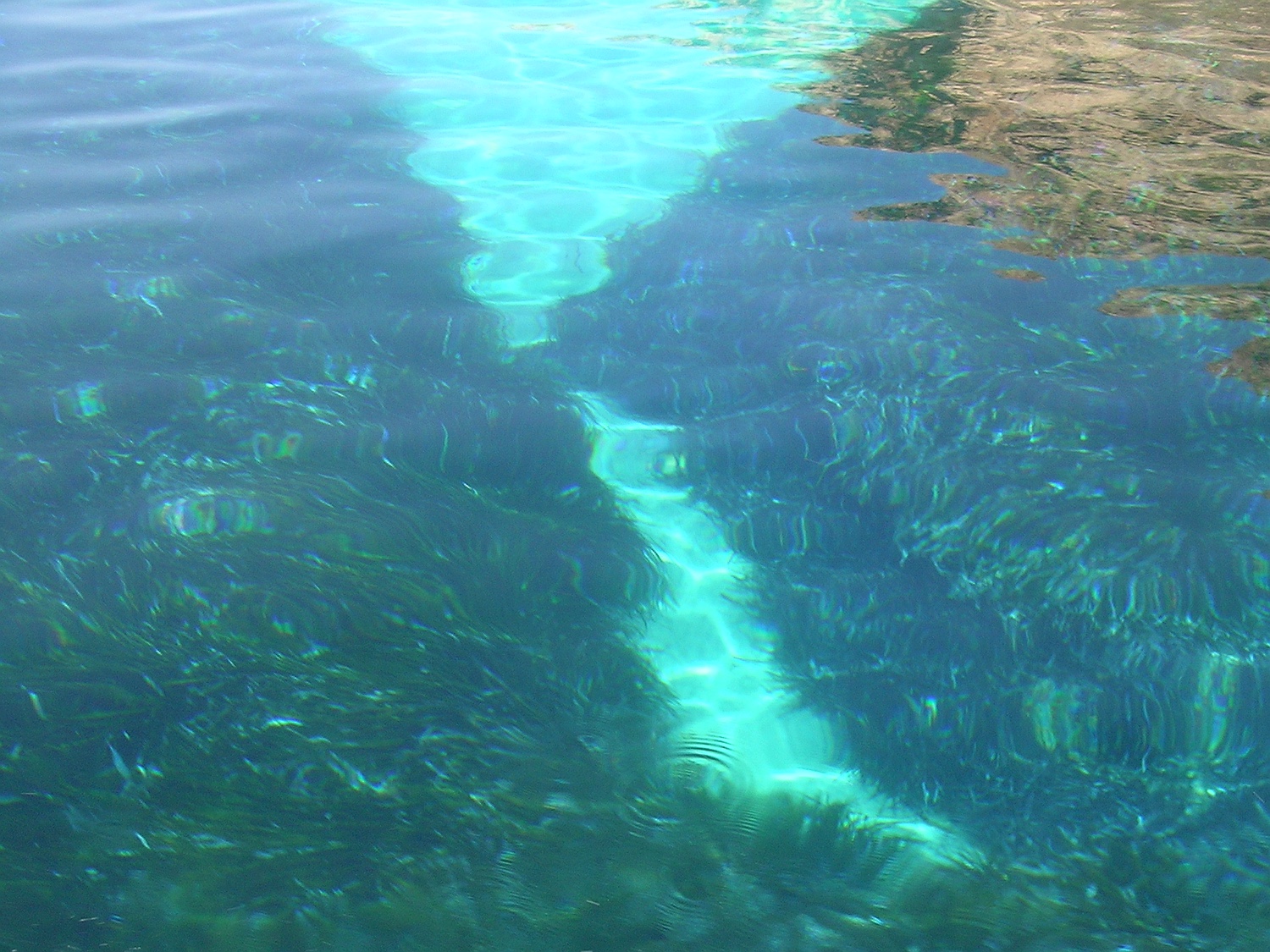
Seagrass meadows are difficult to photograph from the surface because they usually grow at depths of at least ten meters; these pictures were taken at a depth of a few meters near the Mákares islands opposite to Azalás.
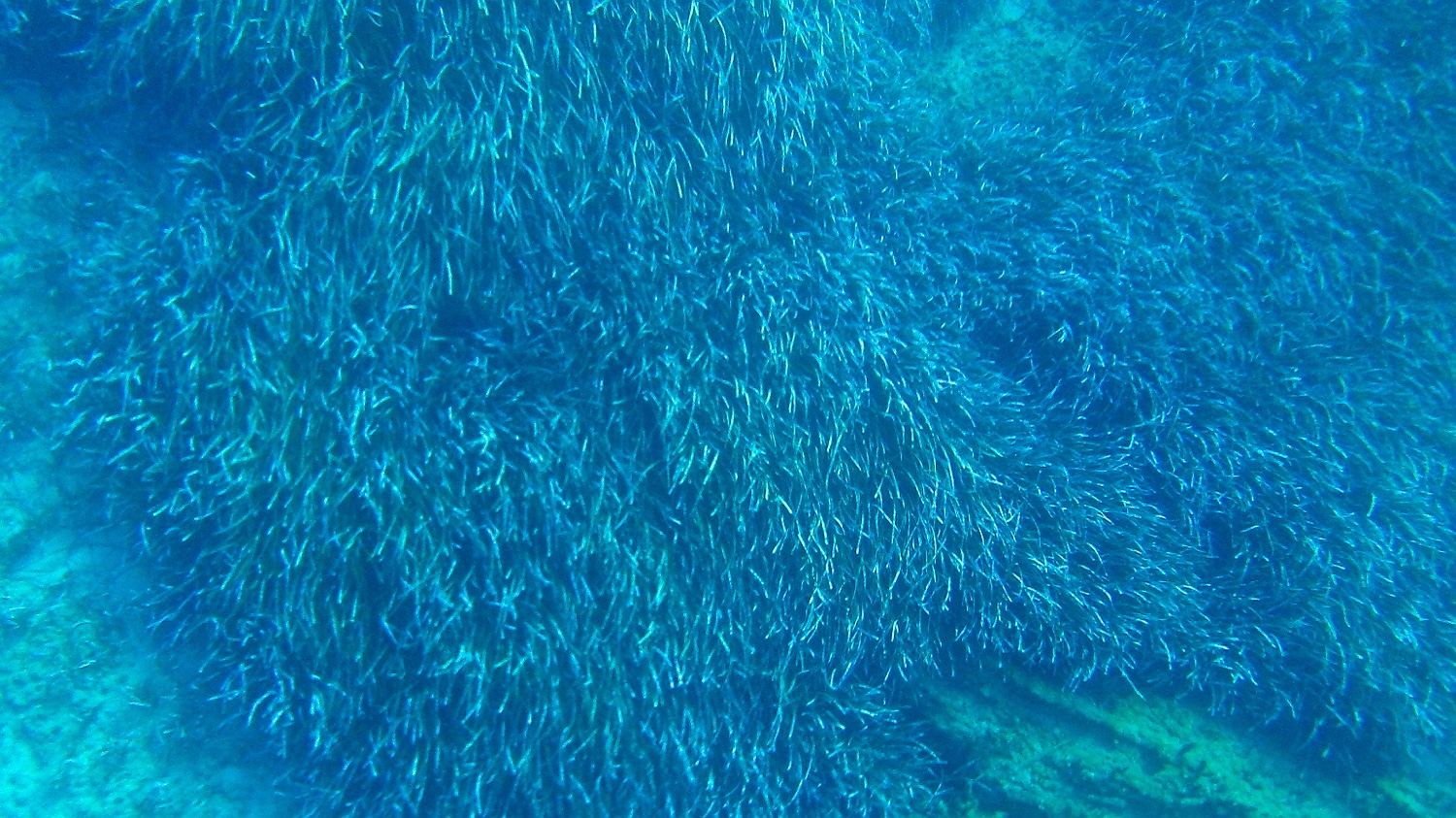
The Neptune grass Posidonia oceanica grows in dense meadows; it mostly occurs in depths of around 10 meters or more.
Seagrass meadows occur on sandy substrate in areas with moderate wave action and sufficient light, i.e. down to a depth of around 40, exceptionally even 100 meters. Neptune grass grows both upwards and sideways, forming rhizomes that help it to spread. Thus dense, thick, matted mats are created in which a lot of fine sediment is captured. At the end of summer, the old leaves of the seagrass die to be torn off by the storms in autumn and winter and washed up on the beaches, where they sometimes form thick deposits that may stay on the beaches til summer. Though these deposits, as well as drifting dead seagrass, that sometimes occurs in great quantities in shallow bays, may be somewhat annoying for beach goers, one should keep in mind that the Neptune grass is a threatened species that has already disappeared in many areas of the Mediterranean due to pollution and excessive trawling. The abundance of seagrass in the central Aegean Sea shows that the underwater world is still largely intact. In autumn, the Neptune grass produces inconspicuous flowers, and in spring the fruits called sea olives due to their similar appearance can be found on the beaches.
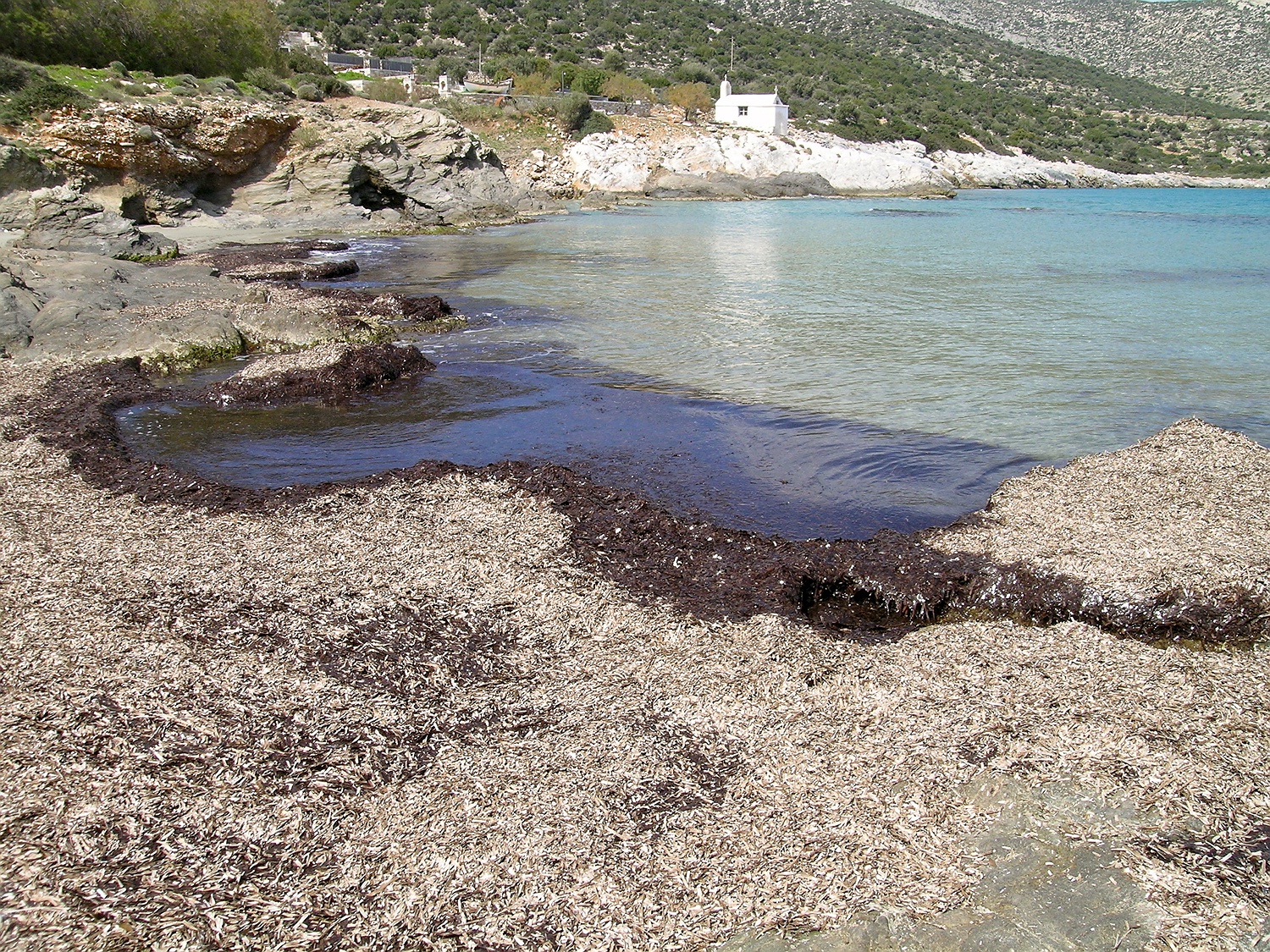
In winter, large amounts of seagrass are sometimes washed up in our bay.
Seagrass meadows play a very important role in the marine ecosystem. They are home to numerous and often rare animal species and provide vital protection for young fish. A large number of small algae species and sessile animals grow directly on the leaves of the Neptune grass. Many predators feed on the numerous animals that live in the seagrass meadows. Despite the relatively small area they cover in the Mediterranean, the seagrass meadows produce a large percentage of the oxygen in the water. Their biomass production is also considerable (20 tonnes of dry matter per hectare per year).
Of the characteristic animals that live in seagrass meadows, the pipefish and the seahorses are particularly well adapted and so well camouflaged that they are very hard to spot. (I have never seen a seahorse; pipefish are occasionally washed up on the beach or can be caught with a hand net in the sea grass meadows.) Also numerous other species of fish, snails, bivalvia, crustaceans, starfish, marine worms, sponges and cephalopods can be found in the seagrass meadows, not to mention the microfauna. The leaves of the Neptune grass are often colonised by the bryozoan Electra posidoniae and the small red foraminifera Miniacina miniacea.

The bryozoan Electra posidoniae grows only on Neptune grass.
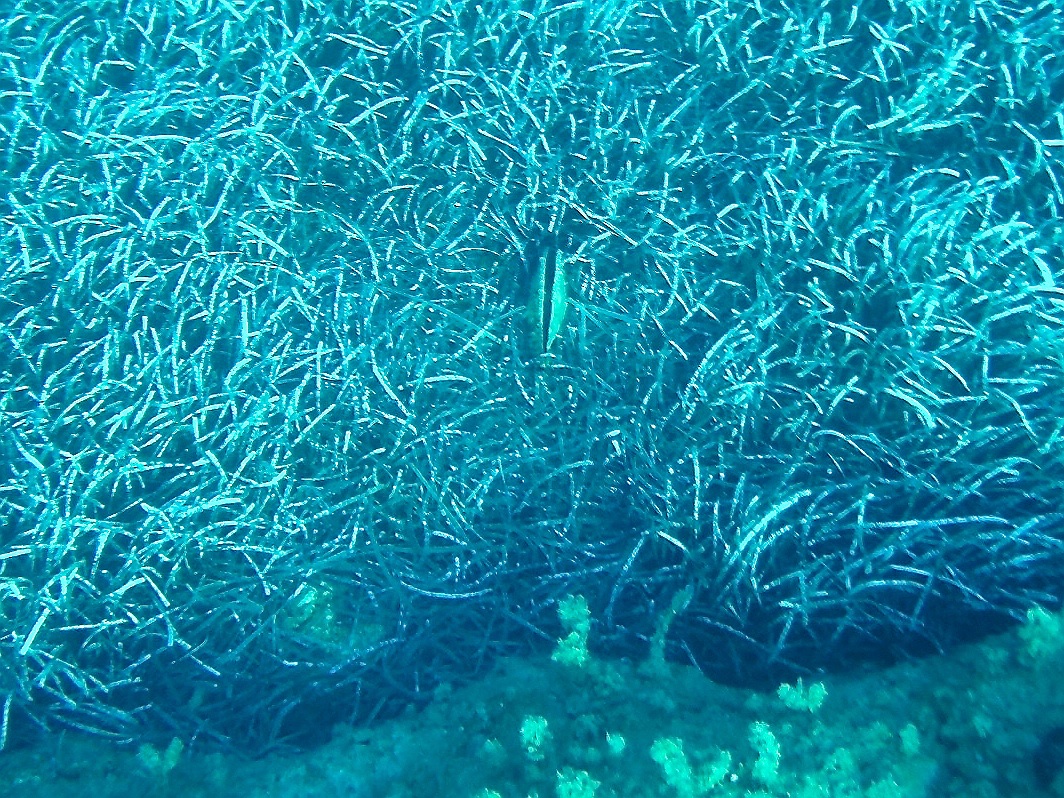
Here, one can see a large mussel, perhaps a razor clam, among the seagrass.
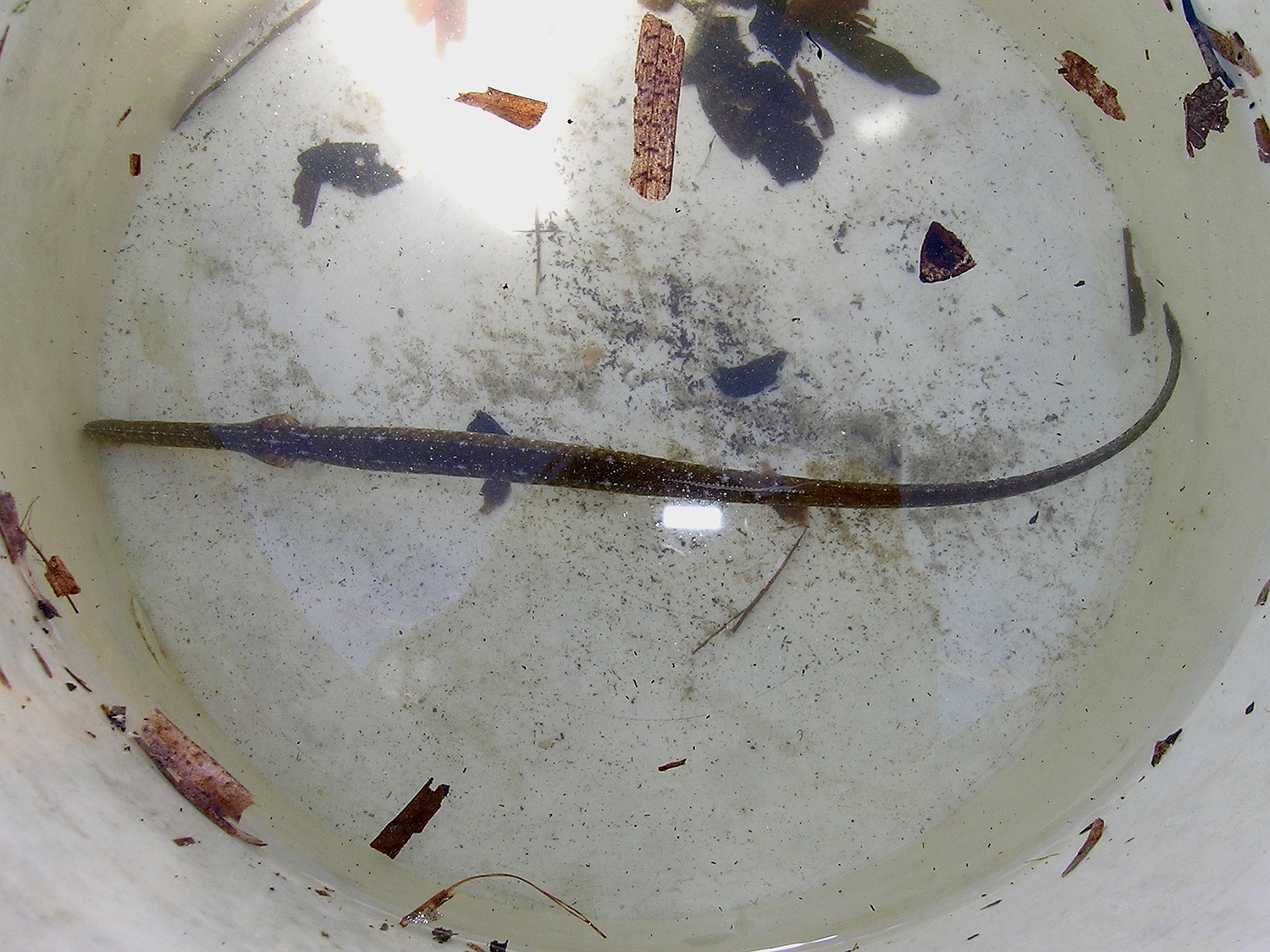
The broadnosed pipefish with its amazing camouflage lives only in seagrass meadows.

It perfectly imitates the leaves of the Neptune grass. The head even shows the characteristic angles of the leaf end.
In addition to their important role in providing a habitat and in producing oxygen, seagrass meadows also have a protective effect on coastlines, as they considerably slow down the waves. Unfortunately, Europe’s sea grassmeadows suffer greatly from human impact, particularly from trawling, which devastates the beds over wide swathes. In the Atlantic and North Sea, seagrass meadows were largely destroyed in the last century (from 1930 onwards) by a disease from which they have still not fully recovered.
see also: