
Blue-green algae
Due to their lack of a cell nucleus, blue-green algae or cyanobacteria belong to the bacteria, not the algae. However, like plants, they are capable of photosynthesis, using various pigments to absorb light. A blue pigment (phycocyanin) gives them their blue-green colour.
Blue-green algae are among the oldest living organisms on Earth. 2.5 billion years ago, blue-green algae, living in large quantities in the sea, were the first organisms to perform photosynthesis, producing so much oxygen that it enriched the atmosphere and enabled (animal) life on land. An important step towards the emergence of the first plants (algae) was taken when simple amoeba-like single-celled organisms absorbed cyanobacteria without digesting them. These then developed into the photosynthetic chloroplasts of the plant cells. Different groups of algae (green algae, brown algae and red algae) were formed through the absorption of different cyanobacteria with different pigments.
Today, around 2,000 species of blue-green algae are known. They live in fresh water, in the sea, in moist soil, on tree bark and on rock surfaces. Most species live as single-celled organisms or form small cell filaments or colonies of a few cells. Only a few species form colonies large enough to be visible to the naked eye (usually surface coatings or gelatinous spherical forms). However, even the larger species are usually difficult to identify. Several species of blue-green algae occur at our coast in the tidal and the spray zone.
Blue-green algae in the spray zone
On marble, the entire splash zone or supralittoral is covered with a thin layer of blue-green algae that often reaches a height of over one meter. Three sub-zones can be distinguished: a lower brown-green zone, a middle black zone and an upper white to brownish zone.
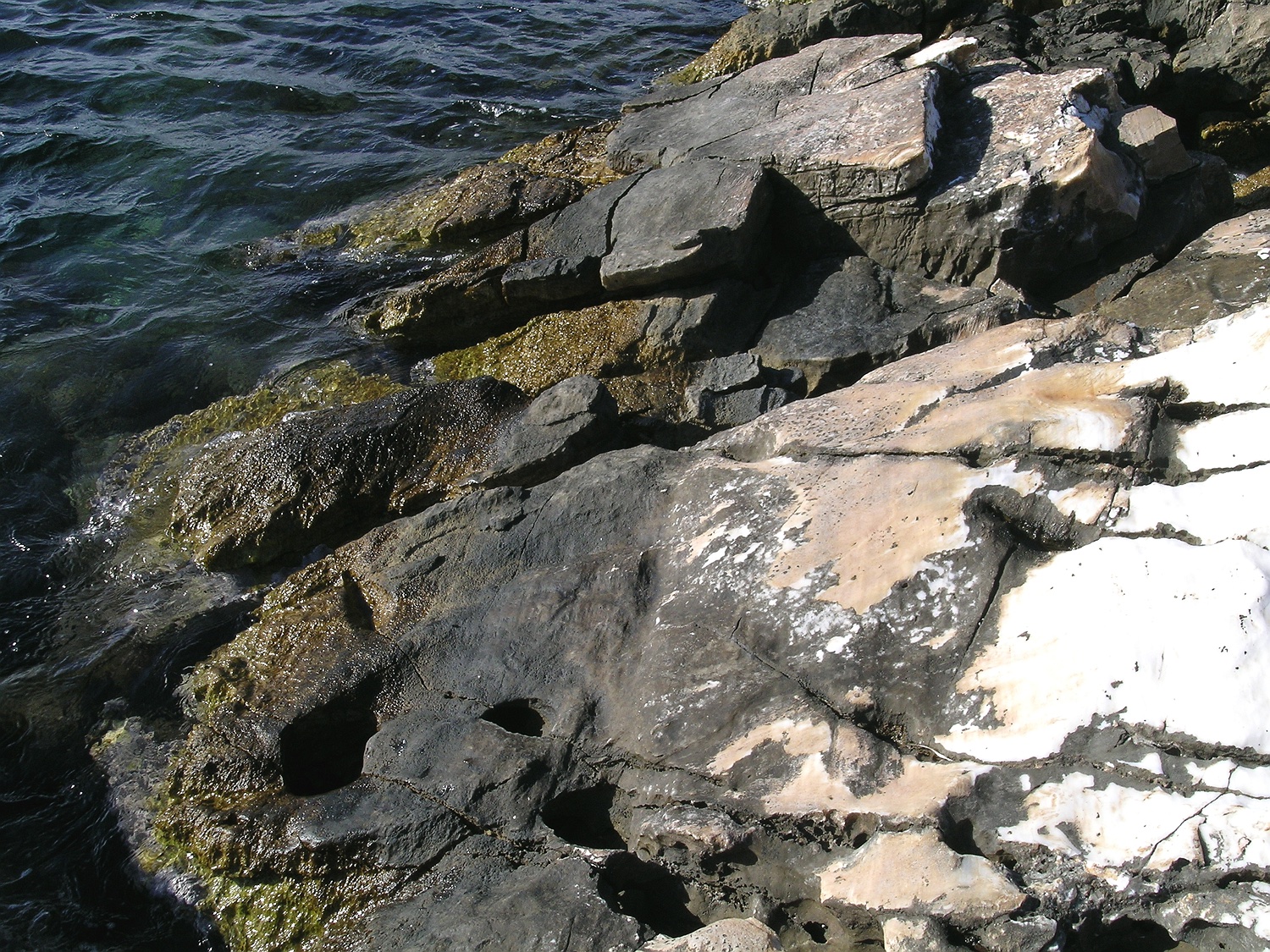
The three zones of the supralittoral can be clearly seen on this marble rock.
The lowest zone near the water, which is flooded regularly, displays a yellow or brown-green layer of small blue-green algae, such as the species Calothrix scopulorum.
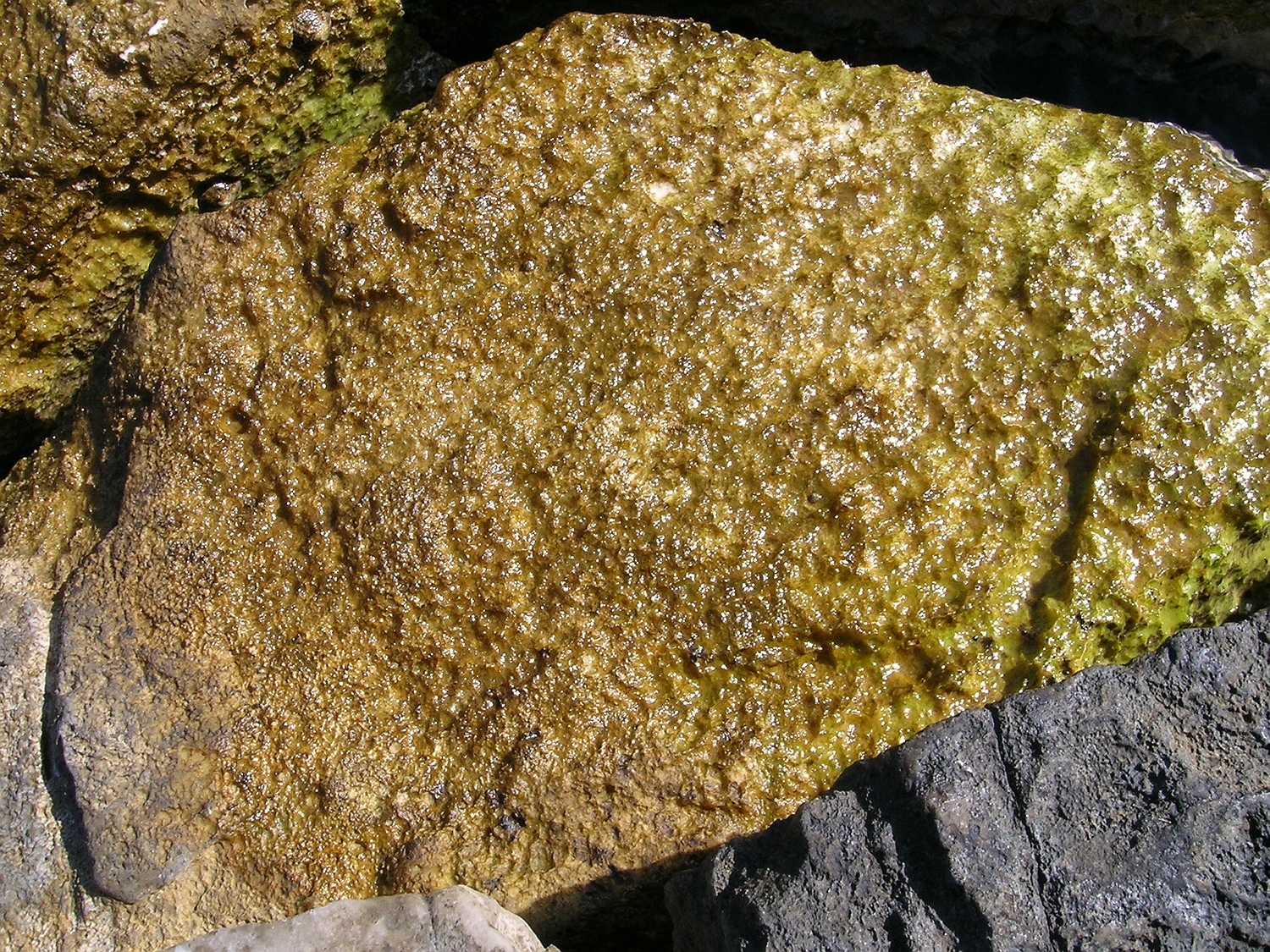
marble rocks covered with epilithic blue-green algae in the lowest supralittoral zone
In this so-called lithophyte zone one finds apart from these epilithic species also endolithic blue-green algae (for example Mastigocoleus testarum), which dissolve the calcareous rock with acids and thus cause the formation of small depressions and holes. Moisture remaining in the holes further promotes the growth of blue-green algae, causing the holes to become larger and larger; in this way, the rocks are slowly eroded.
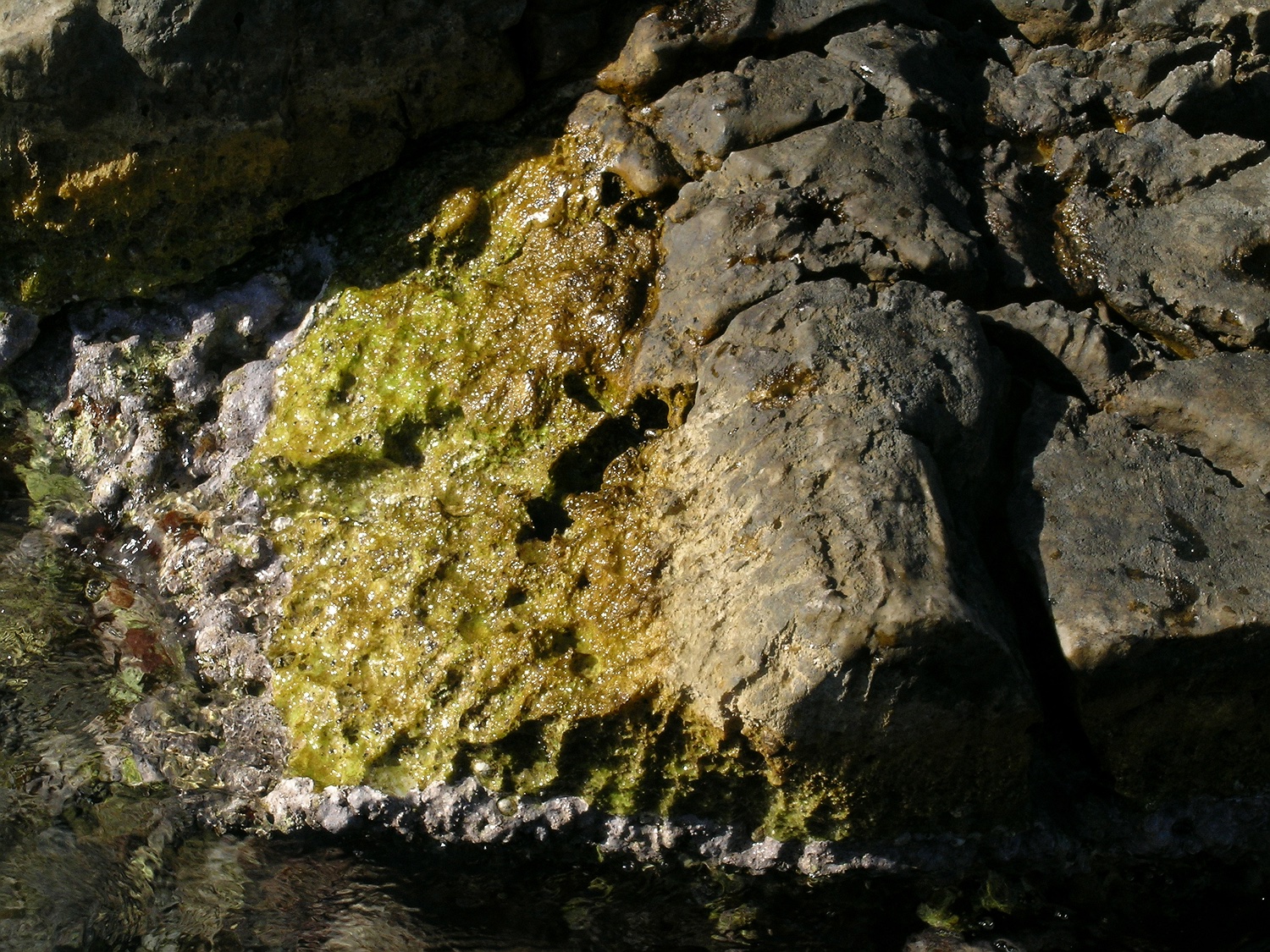
Endolithic and epilithic blue-green algae dissolve the marble.
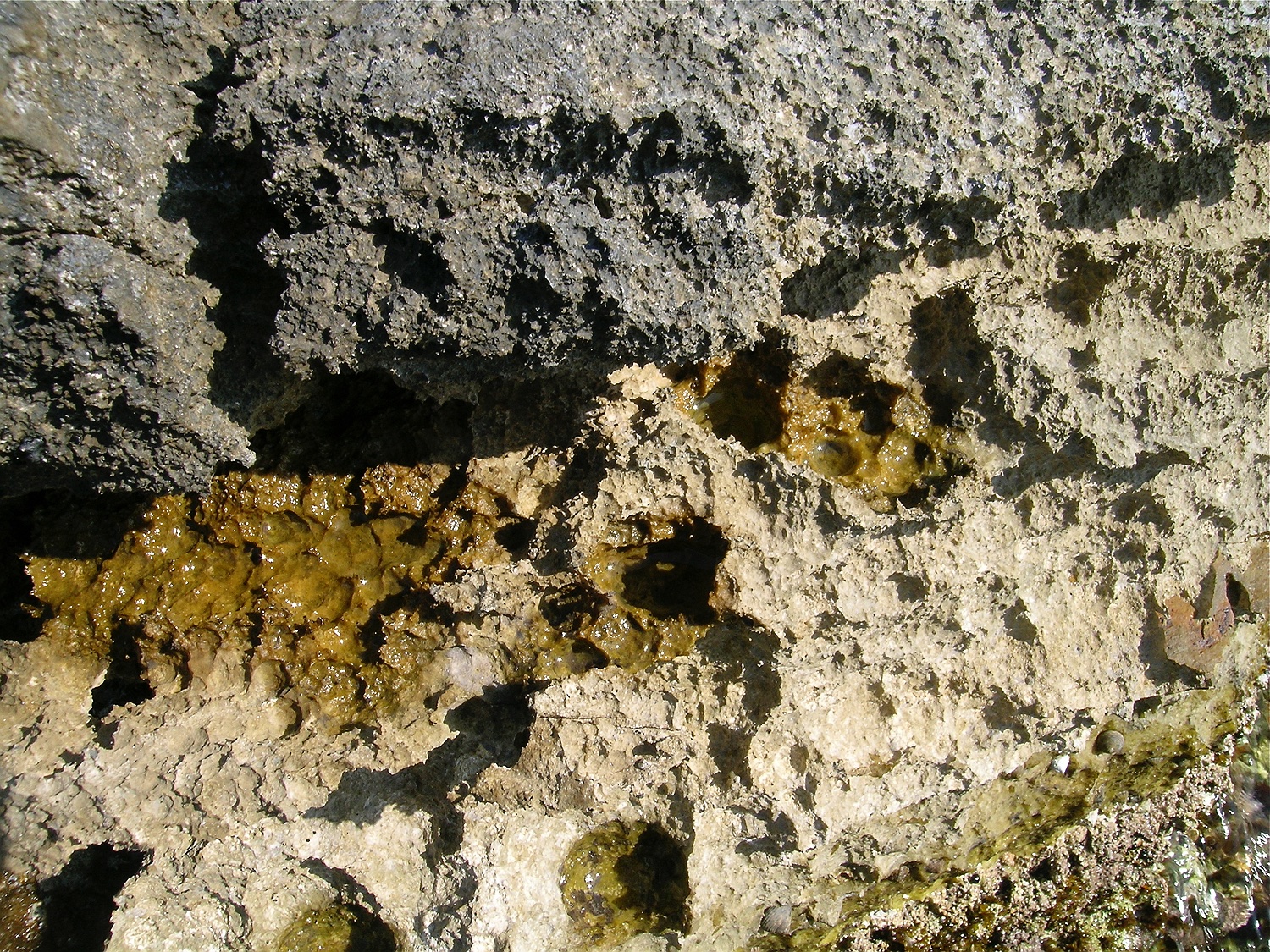
This results in depressions that become deeper and deeper.
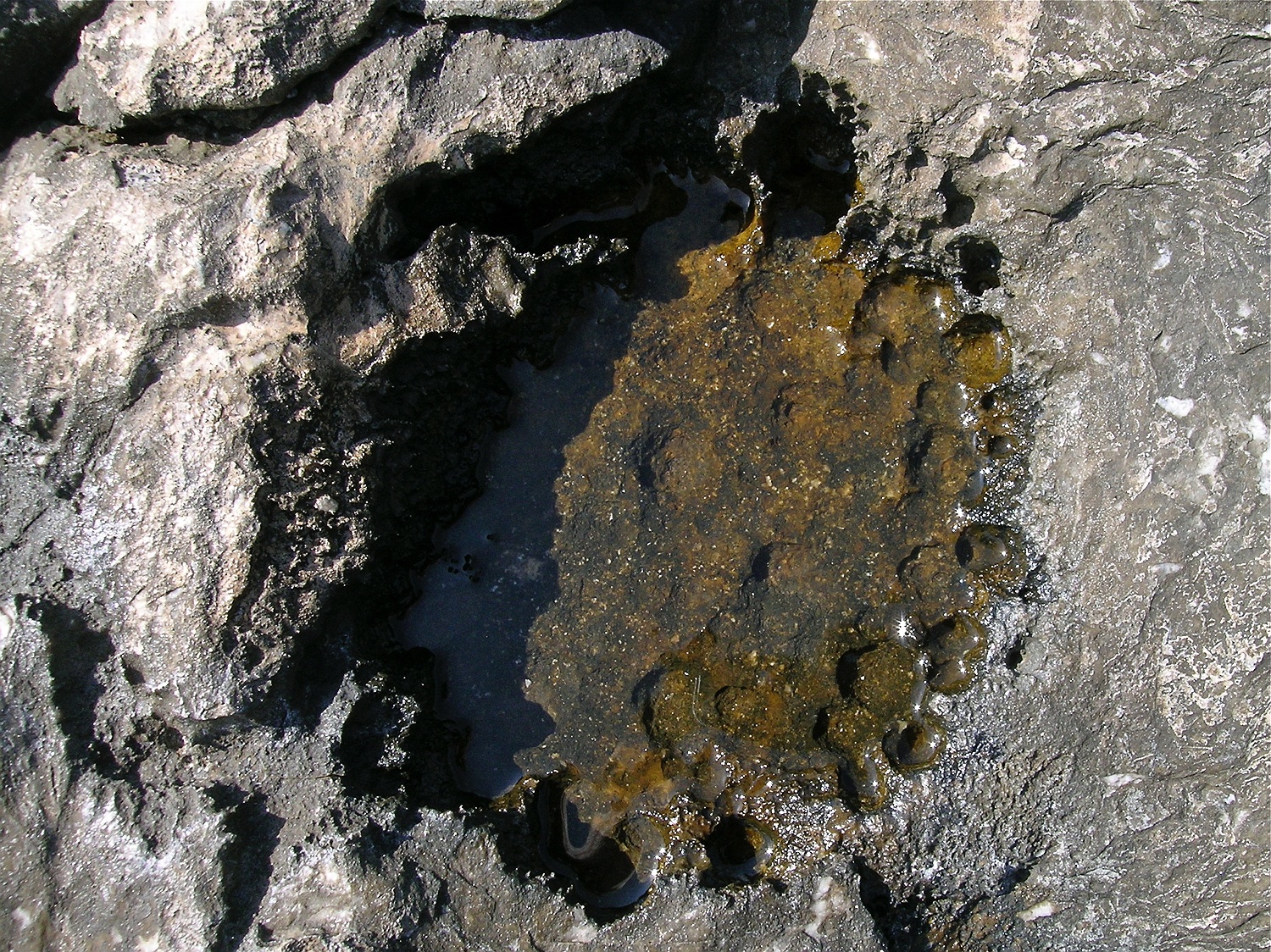
Water collects in the depressions, further promoting the growth of blue-green algae, so that the holes grow continually.
Above this lithophyte zone follows a zone of about half a meter height, which is rarely flooded but regularly reached by the sea spray. Here, the marble rocks are coloured black by a thin coating of the blue-green alga species Entophysalis granulosa. In the black coating (as in the green zone), one can often find feeding traces of limpets.
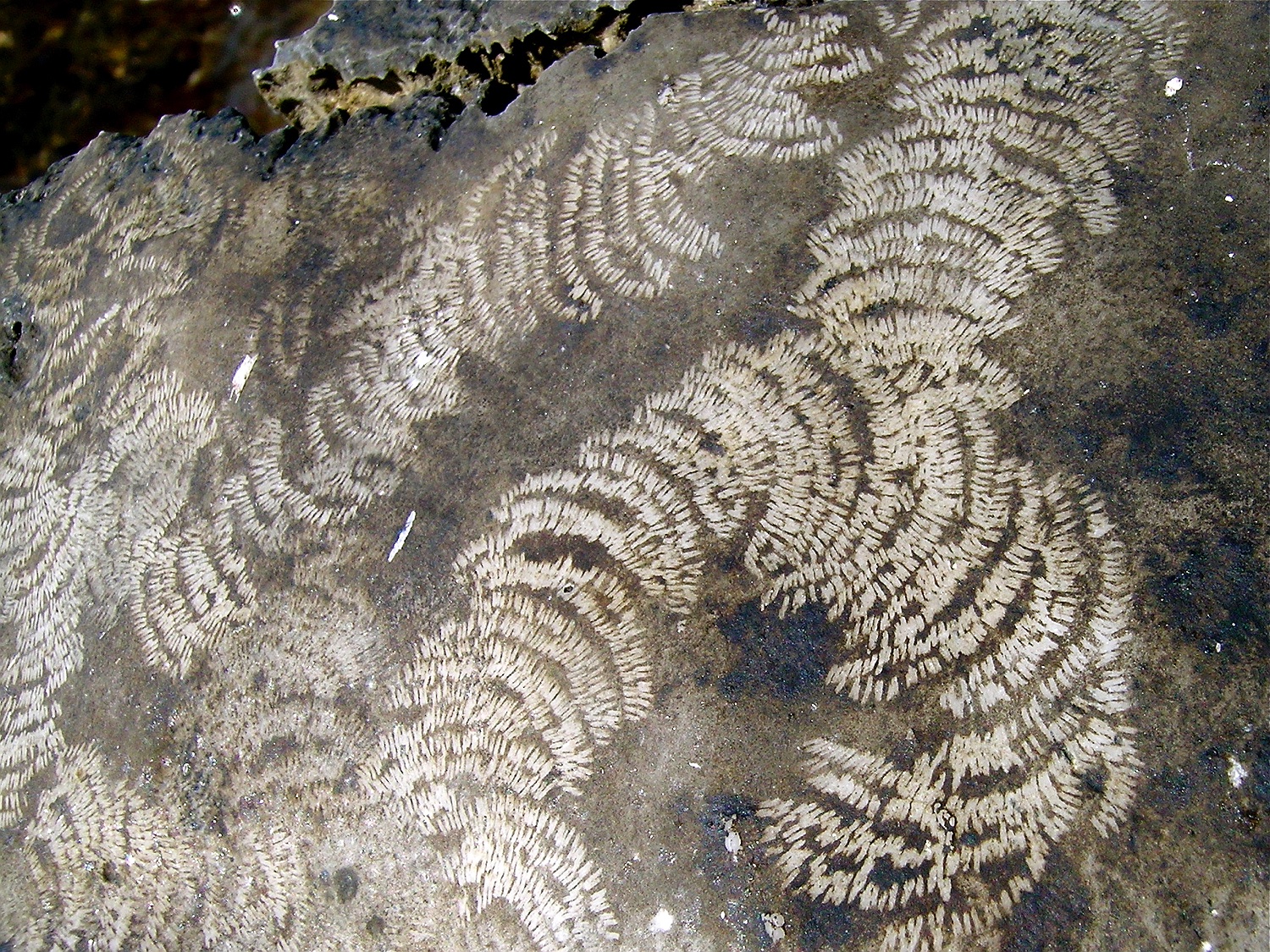
Black coating caused by blue-green algae on marble rock in the supralittoral zone with feeding traces of limpets
Further up, where the rocks are only reached by the spray during storms, the surface is covered with a brownish to white, lacquer-like coating. This coating is also thought to be formed by blue-green algae.

brownish-white, lacquer-like coating in the uppermost zone of the supralittoral zone, probably formed by blue-green algae
The photo gallery of the marine plants provides an overview of the species. Please note that many of the identifications are uncertain.
A note on identification: Some species of algae can be identified easily and reliably. In many cases, however, there are several related species that are difficult to distinguish. Often, examination under a microscope is necessary for correct identification. Another problem with the identification is that not all species are included in the field guides; even using the internet, it is difficult to find information on many species. Often, the species identified with the help of books or photos on the internet look quite different from our specimen here. Accordingly, many of the identifications are unfortunately quite uncertain, and some species must remain completely unidentified.
Rivularia bullata, Berkeley ex Bornet & Flahault
In the tidal zone, apart from the coatings of blue-green algae described above, one can often find large, round colonies of blue-green algae growing on the crustose red algae abundant in these areas. These possibly belong to the species Rivularia bullata.
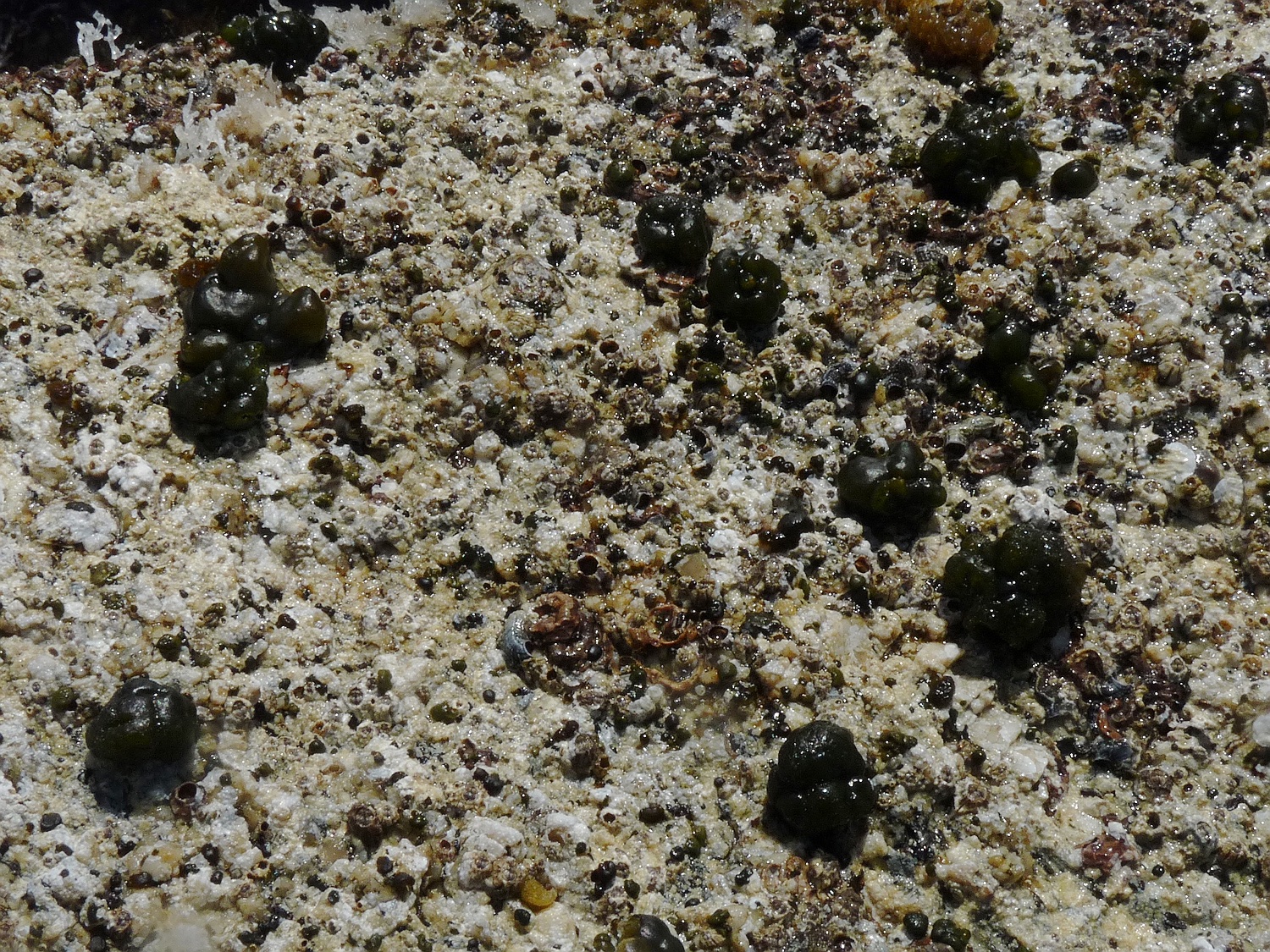
This species forms irregularly spherical colonies that appear dark green when wet and almost black when dry.
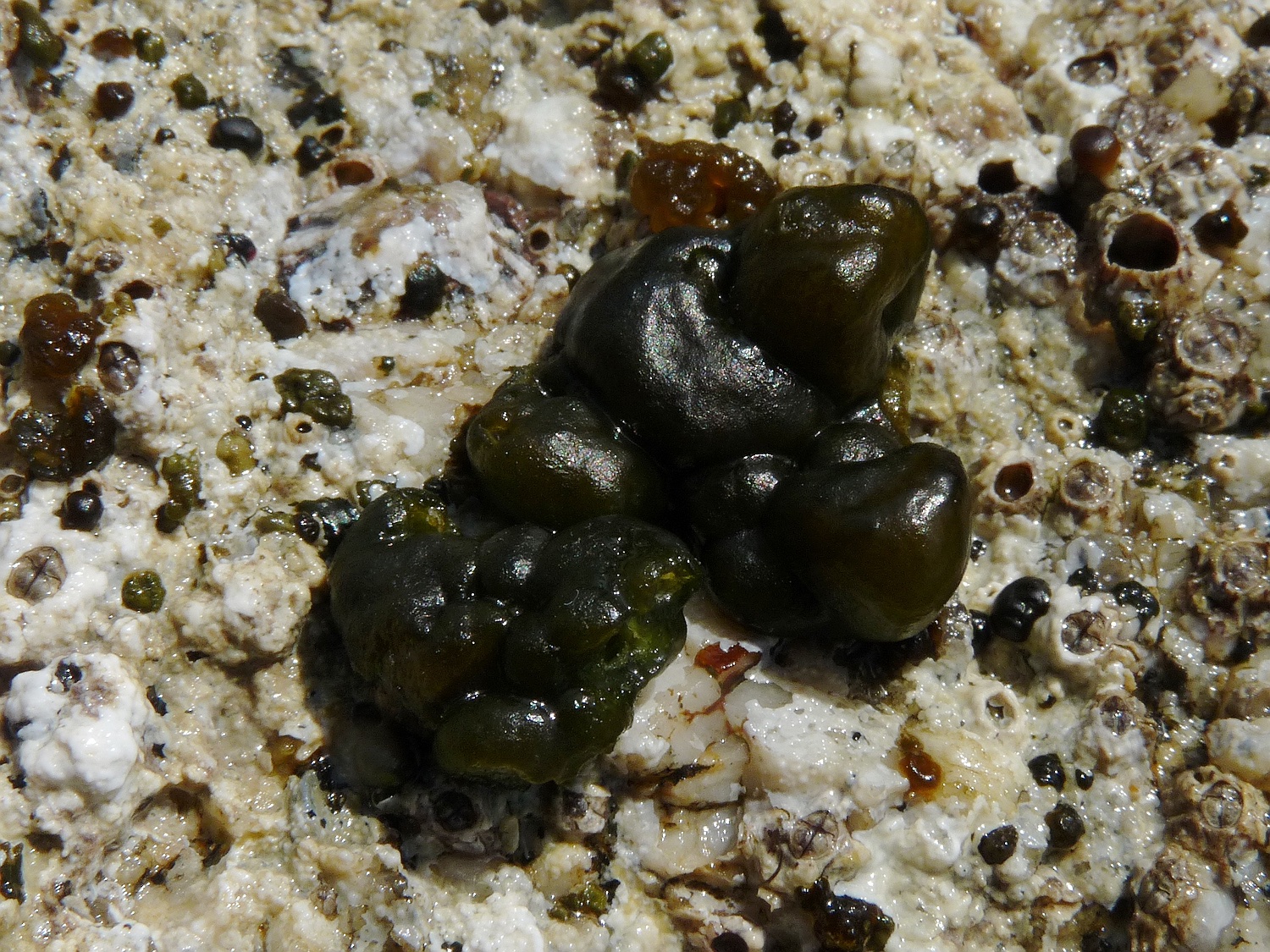
They consist of dense tufts of fine filaments embedded in a gelatinous substance.
back: Introduction to the marine plants
see also: