Bats
Together with flying foxes, bats form the order Chiroptera, which is the largest mammal order after the rodents with around 1,400 species. Bats are found all over the world; the genus Myotis has the most extensive distribution range of any mammal genus. This wide distribution is undoubtedly due to the ability of the bats to fly. Bats include one of the smallest mammals (Hog-nosed bat, body length 3 cm), while flying foxes are quite large with a wingspan of up to 1.7 m.

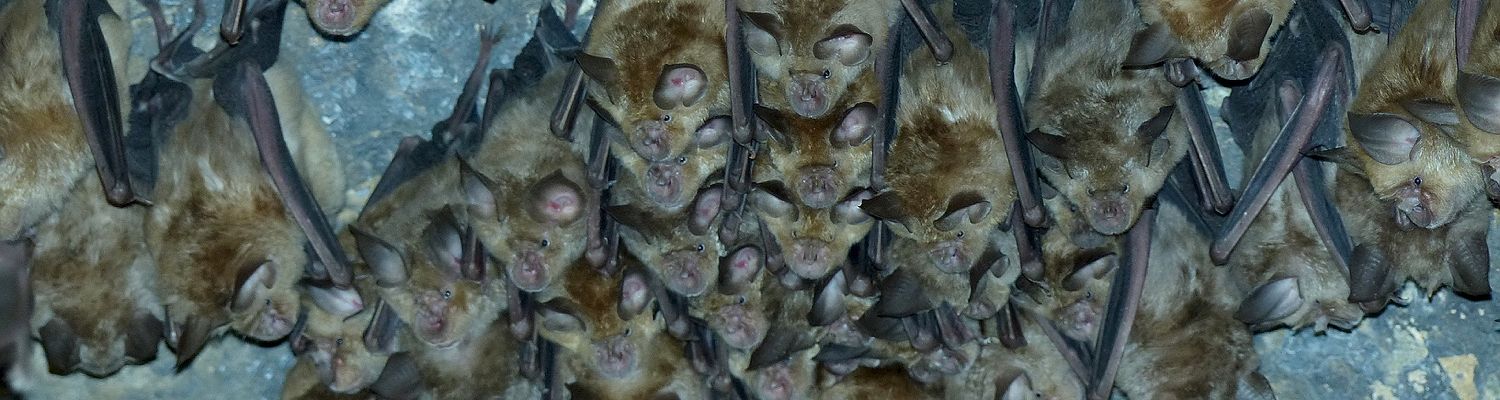
On Naxos, bats are mainly found in caves, in the emery mines or in old buildings. Here two Greater horseshoe bats in a cave.
Anatomy and lifestyle
Apart from the birds and the extinct pterosaurs, bats are the only vertebrates that have developed the ability to fly actively. Their wings are formed by a flight membrane (the patagium) stretched between their front legs, fingers, hind legs and tail. Their fingers are greatly elongated (except for the vestigial thumb). To enable flight, the bones of bats (like those of birds) are very thin and light. The rib cage is large; the heart is about three times larger than that of other mammals of the same weight. The blood also contains a particularly high number of red blood cells and more haemoglobin, enabling it to transport twice as much oxygen as that of other mammals.

The bat’s wing is stretched between its hind legs and the extremely long and thin bones of its front legs and fingers. The thumb protrudes as a claw; it is not integrated into the wing membrane and is much shorter than the other fingers. The wing membrane is stabilised by muscle strands and supplied by veins; it is divided into species-typical ‘fields’.

Bats are the only mammals that can fly actively. They are extremely skilful and agile in flight.
As everyone knows, bats are nocturnal, i.e. they spend the day in their resting places (tree hollows, caves, old buildings, etc.) and fly at night in search of food. When resting, the bats’ metabolism slows down and their body temperature drops significantly. In winter, species in temperate regions hibernate. Unlike other animals, bats do not sit, but hang from the ceiling of the caves or houses in which they live. The hind legs of the bats are turned backwards, which is more practical for hanging. Bats do not need to actively hold on; the tendons in their toes are designed in a way that their claws close automatically.


Resting Greater horseshoe bat. The bats literally wrap themselves in their wing membrane like a little package. When resting, their metabolism slows down considerably and their body temperature drops to just a few degrees above the outside temperature.
Diet and senses
Most bats feed on insects; larger species also hunt small mammals, amphibians or fish. The related flying foxes eat fruit or nectar and pollen. Three bat species common in South and Central America feed on the blood of large mammals (vampire bats).
Bats have good eyes adapted to seeing at night. However, they mainly use echolocation to navigate while flying. They emit calls in the ultrasonic range, with many species having strange fleshy extensions on their noses that help them produce these special sounds. Their large, highly sensitive ears perceive the returning echo so accurately that the bat can navigate its surroundings perfectly and detect even the smallest objects. The bat also uses echolocation to find and catch its prey, usually flying animals such as insects. They can not only locate their prey, but also calculate its movement and size. In many cases, they can even determine the species based on the frequency of its wing beats – and all this while flying at high and changing speed themselves!

This Greater horseshoe bat has a distinctive nose with the characteristic nose-leaf and large, complex ears. Note also the freely protruding, reduced thumb.
Reproduction
Many bats live in large colonies; often thousands of animals can be found in the same cave. In spring, the females gather in special nurseries where they give birth and raise their young together. Bats have only one young per year. Unlike most other mammals, the females have only two teats. Two pseudo-teats often form on the groin, which the young cling to so that they can hang onto their mother while she flies. Normally, however, the young are left in the nursery while the mothers fly off to feed. Bats are long-lived: many species reach an age of 20, sometimes even over 30 years.

Nursery of the Greater horseshoe bat in an old church
Bats as threatening and endangered animals
Since ancient times, bats have been considered eerie by humans. This is certainly due in part to their nocturnal lifestyle, but also to their rather ‘ugly’ appearance. In Europe, bats were associated with darkness and evil to such an extent that the devil was depicted with black bat wings, while angels had white bird wings. It was believed that after death, human souls left the body in the form of bats. All of this led to a very negative opinion of bats in people’s minds. In stark contrast, bats are considered a symbol of good luck in China.
However, one should actually be careful when handling bats. First of all, one should always be aware that it is very stressful for the animals when they are disturbed during their rest, especially in the winter months when they can find little or no food and their metabolism slows down considerably. Sitting bats should therefore be disturbed as little as possible. If you do find yourself in a situation where you have to touch a bat, you must wear leather gloves, as these animals can transmit diseases that are dangerous to humans. Bats have very sharp teeth that can pierce the skin. When touching a bat, you should also bear in mind that these animals have very delicate and thin bones that can break easily.
In any case, humans pose a far greater threat to bats than they do to us. Bats need our protection. They are not only endangered by the decline of their food sources (moths, beetles, etc.), but also by the destruction and sealing of their homes (old buildings, caves, tunnels, wells, etc.). It is important for the animals that their flight paths to their resting places remain open and that they are disturbed as little as possible, especially in their nurseries and winter quarters. Some species can be helped by installing special bat nesting boxes (it usually takes over a year for the animals to find and accept them). With the appropriate attention and consideration, hopefully we will be able to preserve these interesting and amazing neighbours!
Bats on Naxos
Around forty species of bats exist in Europe, roughly half of which are classified as endangered. Thirty-six of these species are found in Greece. So far very little data were available for the Aegean islands; now, around thirteen species have been confirmed as present on Naxos.
I would like to express my thanks to Elena Papadatou, Artemis Kafkaletou-Diez and Geoff Billlington and their colleagues for providing me with their information and photos and for allowing me to participate in their study of the bats of Naxos.
Greater horseshoe bat, Rhinolophus ferrumequinum
The Greater horseshoe bat is the species that is most often encountered on Naxos. It can be found – usually in small numbers – in caves, mines or abandoned houses. In two old buildings, we found nurseries with several dozen animals, and in October 2017, we found over 50 animals, mostly females, in the cave Kakó Spílaio near Kóronos.

The Greater horseshoe bat is one of the larger bats in Europe, reaching a length of 7 cm with a wingspan of up to 40 cm. It is mainly found in southern Europe and North Africa. In Greece it is one of the most common and widespread species, on the mainland as well as on the islands. In the United Kingdom, it is rare and considered endangered. It feeds mainly on beetles and moths, which it also picks up from plants or even from the ground.


Here you can see the strange, characteristic nose of the Greater horseshoe bat.

below and above: nurseries of the Greater horseshoe bat in abandoned buildings

Lesser horseshoe bat, Rhinolophus hipposideros
The Lesser horseshoe bat is the smallest species of its genus. With a body length of 4 cm and a wingspan of 25 cm, it is significantly smaller than the previous species. In Greece it is nearly as common and widespread als the Greater horseshoe bat; but on Naxos it seems to be quite rare. In Europe, its distribution area extends slightly further north than that of the Greater horseshoe bat.

A Lesser horseshoe bat hangs alone in an abandoned house. The species can be recognised by its small size and the shape of its nose.
Blasius’s horseshoe bat, Rhinolophus blasii
Blasius’s horseshoe bat is a species found in south-eastern Europe; in Greece it is very common and widespread, occurring also on many islands. It is about 5 cm long with a wingspan of 30 cm. The species can be recognised by the length of its finger bones and the shape of its nose. We found the Blasius’s horseshoe bat in the cave of Mount Zas. It rarely lives in buildings. It is often found together with other bats.

Each species has slightly different body measurements and a differently shaped nose-leaf; here we see Blasius’s horseshoe bat.
Lesser mouse-eared bat, Myotis blythii
The Lesser mouse-eared bat is one of eleven European species of its genus. Mouse-eared bats do not have nose-leafs like horseshoe bats. The Lesser mouse-eared bat grows to a length of 6 to 7 cm with a wingspan of up to 40 cm; it reaches about the same size as the Greater horseshoe bat. It is found in southern Europe and the Mediterranean region and can also undertake longer migrations. It is very common and widespread in Greece, also on the islands. Mouse-eared bats live mainly in caves, less frequently in houses. On Naxos, there is a colony of about 1,000 to 1,500 individuals in the cave on Mount Zas.

Lesser mouse-eared bats often sit in large clusters, which can consist of several thousand animals. They huddle very closely together to keep each other warm.

Mouse-eared bats have large ears with long, thin ear flaps. The folds on the outer edge of the ear are characteristic of this species. This is an older specimen with very worn teeth.

Mouse-eared bats have a long tail that is connected to their hind legs by a large wing membrane. This helps them to catch their prey. Unlike many other bats, the wing membrane of mouse-eared bats extends right up to the feet of their hind legs.
Geoffroy’s bat, Myotis emarginatus
With a body length of 4 to 5 cm and a wingspan of up to 24 cm, Geoffroy’s bat is significantly smaller than the Lesser mouse-eared bat. It is a heat-loving species found in southern Europe, north-western Africa and the Middle East; it is common in Greece, occurring also on quite a few islands. In the northern parts of its range, Geoffroy’s bat lives mainly in houses, further south mainly in caves. It often shares its nurseries with the Greater horseshoe bat. The nurseries can contain over 1,000 animals. Geoffroy’s bat mainly hunts flies, mosquitoes and butterflies, but it also collects spiders and caterpillars from the vegetation.

Geoffroy’s bat is significantly smaller than the Lesser mouse-eared bat.

Here you can see the pointed teeth. This species does not have folds at the back of its ears.

A nursery of Geoffroy’s bats under the roof of an abandoned house; the animals sit huddled together. The young are usually able to fly after about four weeks.

Whiskered bat, Myotis mystacinus
The Whiskered bat is one of the smallest species of its genus. It is found throughout Europe, but is rather rare. On Naxos, it has been found only once (Geoff Billington, 2017). As it usually does not occur in Greece, this was probably a migrating individual that left the normal range of the species. The Whiskered bat likes to stay near water, but also at the edges of forests and in open terrain.

The different species of mouse-eared bats can be distinguished primarily by their body size. Here a Whiskered bat. Photo by Geoff Billington
Long-fingered bat, Myotis capaccinii
The long-fingered bat is a Mediterranean species that often occurs in large colonies or together with other mouse-eared bat species. This species has been found in several locations in Greece including 9 islands; it seems to be rare on Naxos (Geoff Billington, 2017).
Common pipistrelle, Pipistrellus pipistrellus
The Common pipistrelle is one of the smallest European bats, with a body length of 4.5 cm and a wingspan of up to 25 cm. It is widespread in Europe and is the most common bat in most areas. In Greece it is also very common. Of the thirty-five species of this genus worldwide, only five occur in Europe. The Common pipistrelle lives in crevices and cracks in buildings, where it often roosts in large numbers. It is mainly threatened by the destruction and sealing of its habitats.

The Common pipistrelle is widespread and common in many areas. Please note that bats may only be handled by trained and experienced specialists and only for research purposes. Photo by Elena Papadatou
Kuhl’s pipistrelle, Pipistrellus kuhlii
This species is common on Naxos, as has been proven in particular by recordings made with a bat detector. It is slightly smaller than the Common pipistrelle; the best distinguishing feature (apart from its calls) is a lighter stripe on the rear edge of its wing membrane. Like most pipistrelles, it lives mainly in crevices and cracks, both in rocks and in old buildings. It is very common in Greece, on the mainland as well as on the islands.

Kuhl’s pipistrelle is one of the smallest European bat species. Like all species of its genus, it has a short snout without a nose-leaf, and a dense fur. Photo by Elena Papadatou
Soprano pipistrelle, Pipistrellus pygmaeus
The Soprano pipistrelle has so far only been detected on Naxos by a (not entirely reliable) recording with a bat detector, and its occurrence requires further investigation. It is the smallest European bat species. It was only separated from the Common pipistrelle as a separate species in 2000 and is generally very rare; only in Greece it is in some areas more common than the Common pipistrelle. This bat feeds on very small insects, mainly mosquitoes.

Photo by Geoff Billington
Savi’s pipistrelle, Hypsugo savii (=Pipistrellus savii)
Savi’s pipistrelle is slightly larger than the former species with a body length of up to 5.4 cm. Its ears are comparativley round. It is found in southern Europe and Central Asia as far as Afghanistan; in Greece it is very common and widespread. It usually lives in rock crevices or in buildings, and only rarely in caves. Other species of this genus are mainly found in Africa and the Near East to Southeast Asia. On Naxos, this species has so far only been detected by recordings of its calls.

Savi’s pipistrelle is slightly larger than the former species and has slightly rounder ears with four ear folds. Its long fur is light brown, almost white on the underside. The skin on its face, ears and arms, on the other hand, is noticeably dark. Photo by Elena Papadatou

Photo by Geoff Billington
Mediterranean long-eared bat, Plecotus kolombatovici
Like mouse-eared bats and pipistrelles, long-eared bats also belong to the family Vespertilionidae that do not have nasal extensions. Often they have large ears that can be closed with an ear flap, the tragus. As their name suggests, long-eared bats have particularly long ears: they often reach more than half the length of their body. The Mediterranean long-eared bat is the smallest species of the genus; it is widespread in the Balkans and North Africa. In Greece it is widespread, occurring also on 13 islands, but usually it is not very common. On Naxos it seems to be rare.
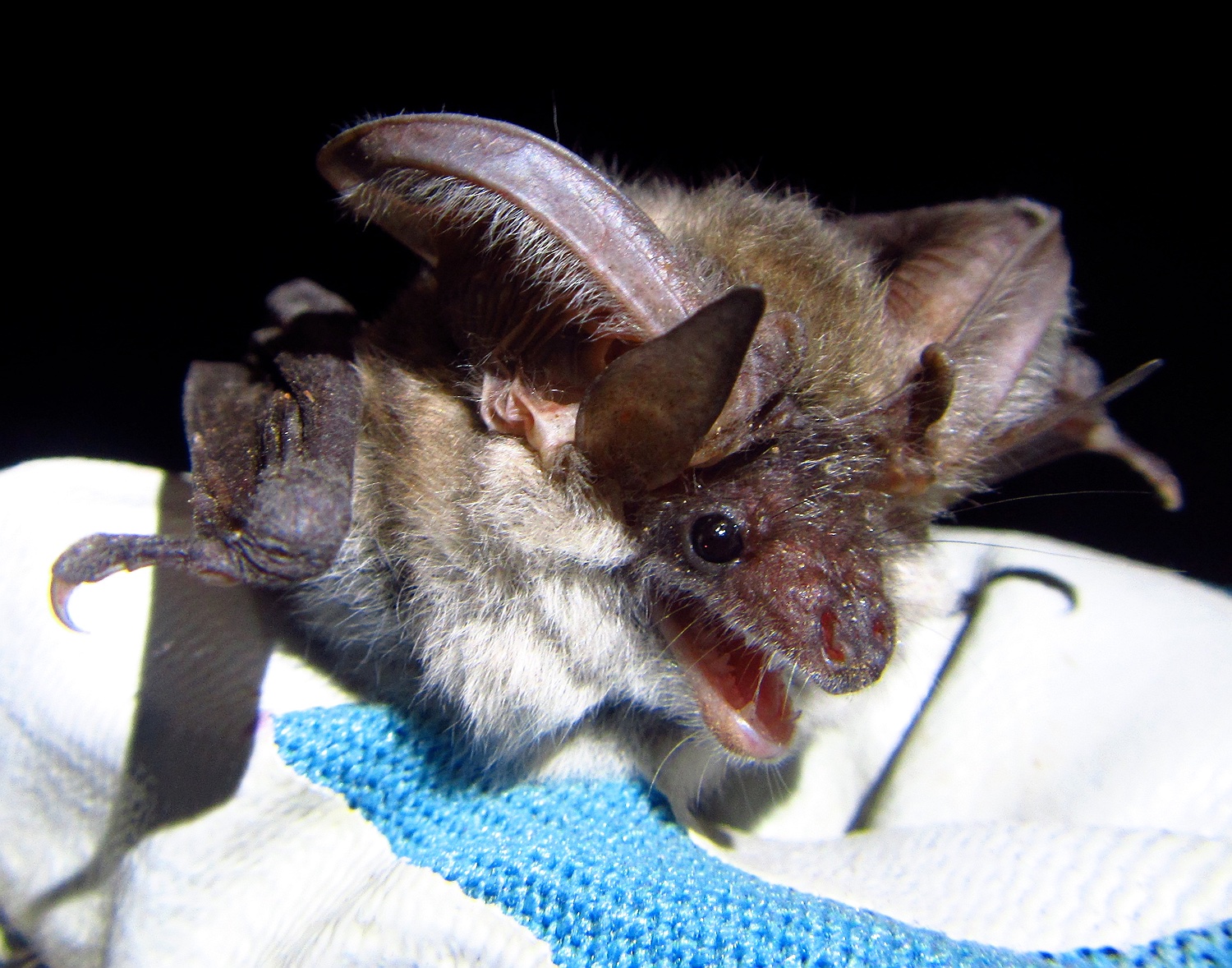
Like all long-eared bats, the Mediterranean long-eared bat has no nasal extension. Its impressive ears are more than 3 cm long, which amounts to half the length of its body. Photo by Geoff Billington
European free-tailed bat, Tadaria teniotis
With a body length of 8 to 9 cm and a wingspan of 40 cm, the European free-tailed bat is one of the largest bat species in Europe. It is only found in southern Europe and the Mediterranean region. It has no nose-leaf and large, round, forward-facing ears that lie flat against the head. Only about half of its tail is integrated into the wing membrane. Its fur and skin are grey in colour. Of all European bats, the European free-tailed bat is the only one whose sounds can be heard by humans. This makes its presence relatively easy to detect. European free-tailed bats can often be heard in our region: The species appears to be widespread on Naxos, as it is in Greece in general.

The European free-tailed bat is easily recognisable by the shape of its face: it has strange, forward-facing ears, a wrinkled upper lip and a fold of skin under the ears that almost reaches the eye. Photo by Geoff Billington
more: Searching for bats on Naxos
continue: The birds of Naxos
back: The Fauna of Naxos
see also: