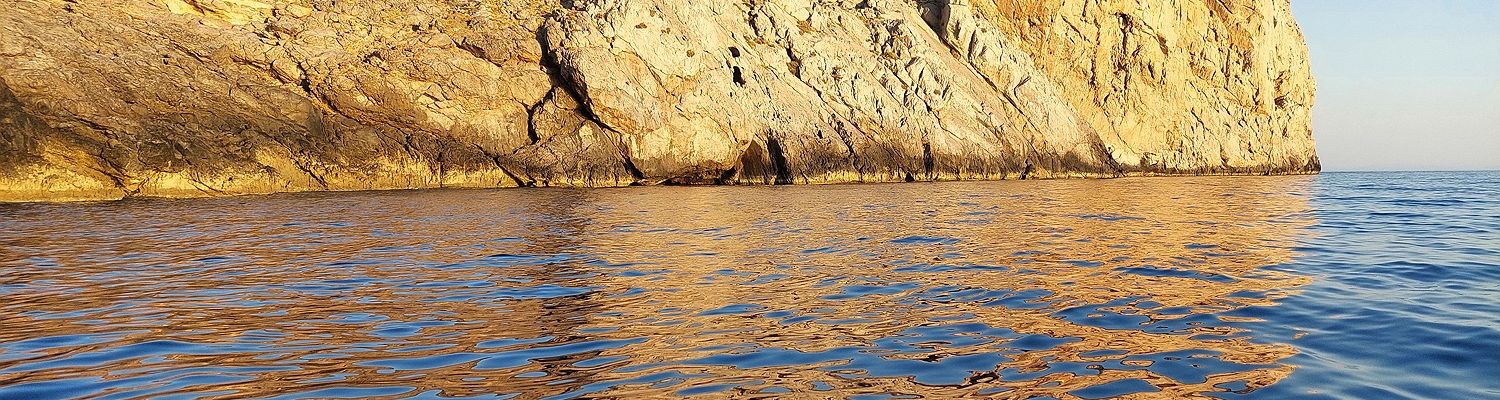
Storm petrels on the Makares islands
The storm petrels are inconspicuous and little-known seabirds that even most ornithologists never get to see. I have never seen one and, until recently, did not even know that storm petrel also breed in the Aegean Sea. Now the European storm petrel can be added to the list of breeding birds of Naxos and the surrounding rocky islands. In this article I provide a few photos and a short report on the discovery of this species near Naxos by staff of the Greek organization NCC (Nature Conservation Consultants).
The storm petrels are a small family with one genus comprising 15 species. Together with albatrosses and shearwaters they form the tube-nosed birds. Like shearwaters, they have tubular appendages on their beaks through which they excrete excess salt. Outside of the breeding season, storm petrels spend their lives exclusively on the ocean, where they flutter close to the water’s surface, seemingly running on the water. Most species disperse across large areas of the oceans outside of the breeding season. Not much is known about their life away from their breeding places. They feed on zooplankton and small fish, squid, and jellyfish. Storm petrels usually breed in colonies, mostly on remote islands, with most species being widespread, while some are restricted to a few or one island (e.g. the Azores storm petrel).
The European storm petrel Hydrobates pelagicus is very dark in color except for its white rump. With a body length of only 16 cm, it is one of the smallest seabirds. It breeds mainly in the North Atlantic, e.g. on the Faroe Islands, where it is very common, but also occurs in the Mediterranean, e.g. in Sicily, the Balearic Islands, and Malta, as well as on rocky islands in the Aegean Sea. The storm petrel is very inconspicuous at its breeding site, as it only comes to its nest at night. Like shearwaters, it can only walk awkwardly on land with the help of its wings. The nesting sites are dug into the ground or located in caves and crevices, which are often only accessible from the sea. Storm petrels mate for life and return to the same nest every year. They lay only one large egg. The young hatch after about 50 days and are fully fledged after about 2 months. In winter, European storm petrels migrate to the southern Atlantic, especially to the Cape region.
As they are mainly active in rough sea, storm petrels were formerly associated with storms and had a bad reputation among sailors; some believed them to be the souls of drowned sailors.

Only in recent years, thanks to more thorough research, has it been found that the European storm petrel breeds on numerous small rocky islands in the Aegean Sea. It breeds mainly in steep, inaccessible cliffs, where the nests are protected from rats and seagulls.

Only this year, a breeding colony of European storm petrels was found in this narrow crevice on the Makares Islands by the team of the NCC.

Since they only come to their breeding sites at night and are dark in color and quite small, the storm petrels can practically only be detected with a thermal camera. Here you see some images of the breeding site on the Makares Islands.


In this photo, you can see the bird flying slightly to the right of center. The bird appears bright because it is warmer than its surroundings.

Video showing a European storm petrel in flight near its nesting site. Click to watch.

Video showing a storm petrel in its nest near Folegandros (southern Cyclades); the upright front body of the sitting bird is visible behind the lying stone in the crevice (only visible on a sufficiently large screen). Click to watch.
All images except for the first two in this article, as well as the information about breeding occurrences, were provided by Tasos Dimalexis from the Greek organization NCC (Nature Conservation Consultants), to whom we extend our sincere thanks.
See also: