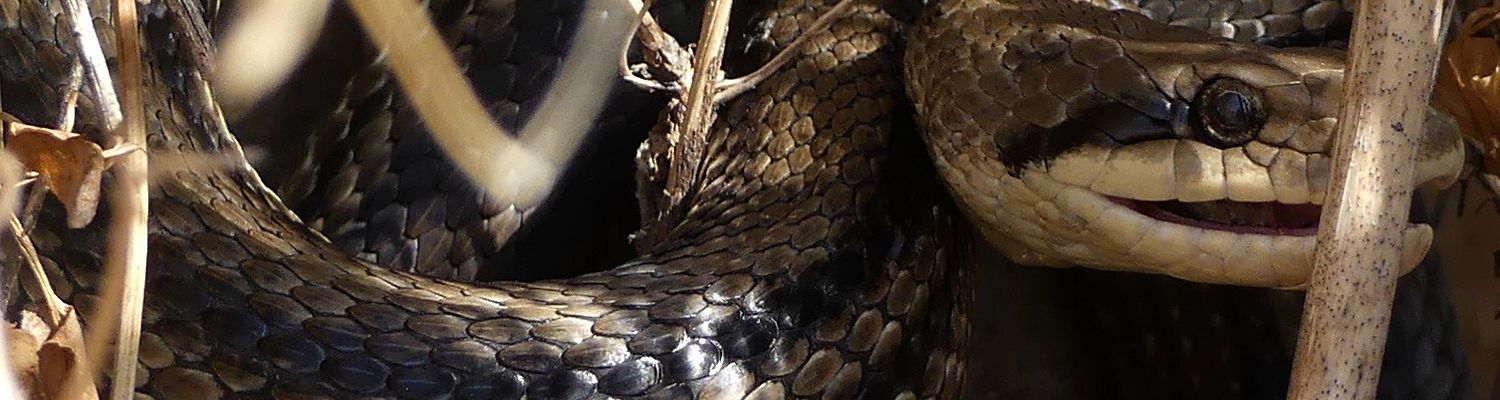
Snakes
Snakes are not very popular with most people. This is in part due to an instinctive fear that exists since millions of years, even though most snake species are completely harmless.
Like all reptiles, snakes are cold-blooded, which means that their body temperature depends on the ambient temperature. Accordingly, most snakes live in the warmer regions of the world. In Europe, most of the 27 snake species are restricted to the Mediterranean region. During the cold winter months, these reptiles generally hibernate, spending their time hidden in the ground, under large rocks or in crevices.
Three species of snake are relatively common on Naxos: the Javelin sand boa, the Four-lined snake and the Horned viper. Grass snakes also occur on the island, but more rarely; they mostly can be found near rivers or ponds. However, all species are rarely seen as they generally keep away from humans.
Javlin sand boa – Four-lined snake – Grass snake – Horned viper or Sand viper
Javelin sand boa, Eryx jaculus, L.
As the only European representative of the boas, the Javelin sand boa remains very small; its length rarely exceeds half a meter. Like all boas, it captures its prey, mainly mice, by constriction. The sand boa also feeds on lizards and large invertebrates. It spends much of its time underground in the burrows of small mammals (mice, etc.) and therefore prefers areas with soil as gardens and fields. The sand boa is predominantly nocturnal and quite sluggish during the day. When encountered, it usually remains motionless, often curling up rigidly and hiding its head under its body. Like many snakes, sand boas are ovoviviparous: the eggs remain in the mother’s body until they hatch, so that the snake ‘gives birth’ to live young.
Sand boas can be confused with Horned vipers, but have a thicker body that is blunter at the ends. Characteristic features are the irregular dark spots on the upper side and a slightly orange longitudinal band on the underside of the body. Sand boas are completely harmless; they are not venomous. However, it is still important to treat them with respect and keep your distance, especially because of their similarity to the Horned viper!
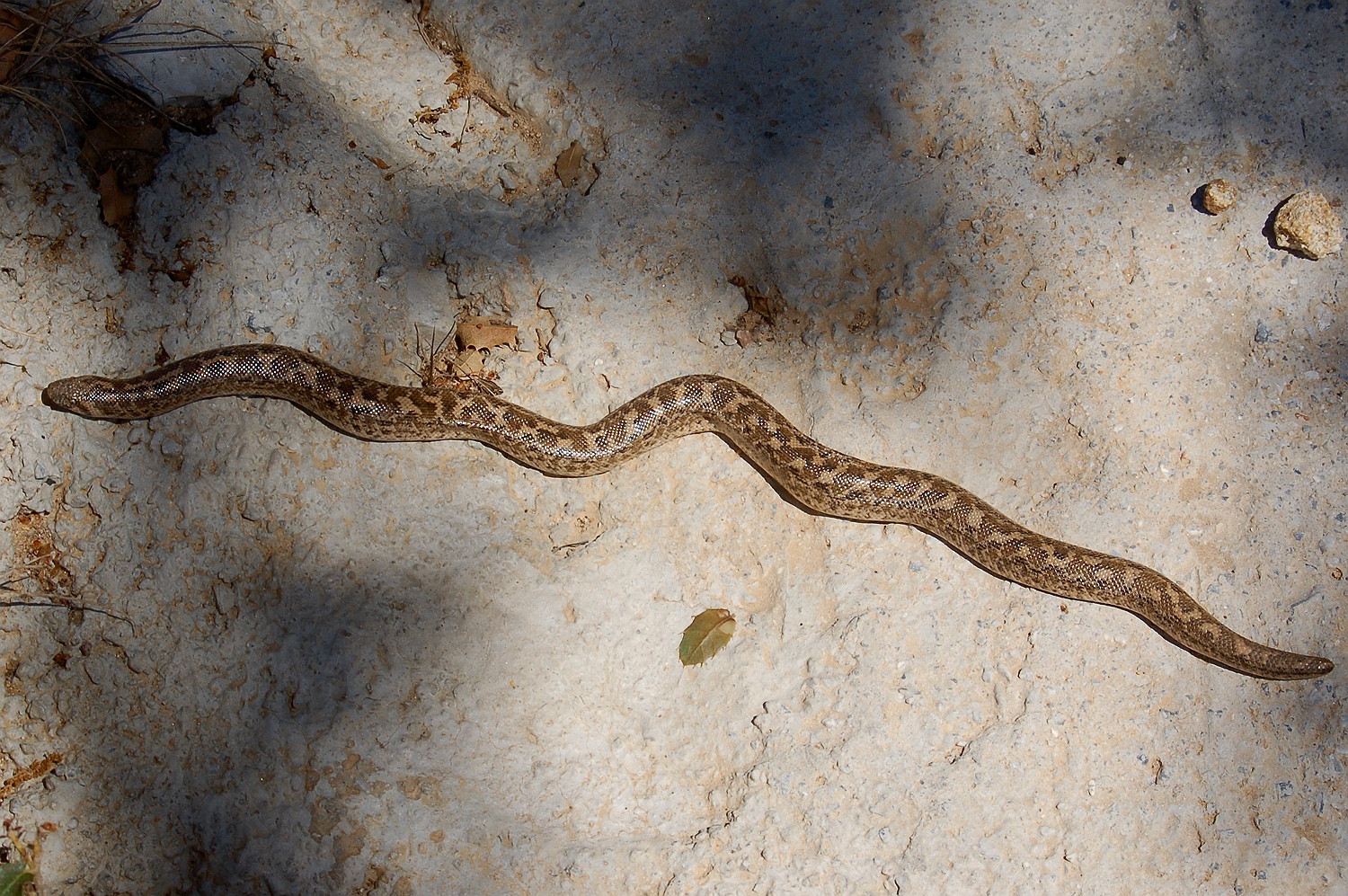
The Javelin sand boa can be recognised by its irregular spots.
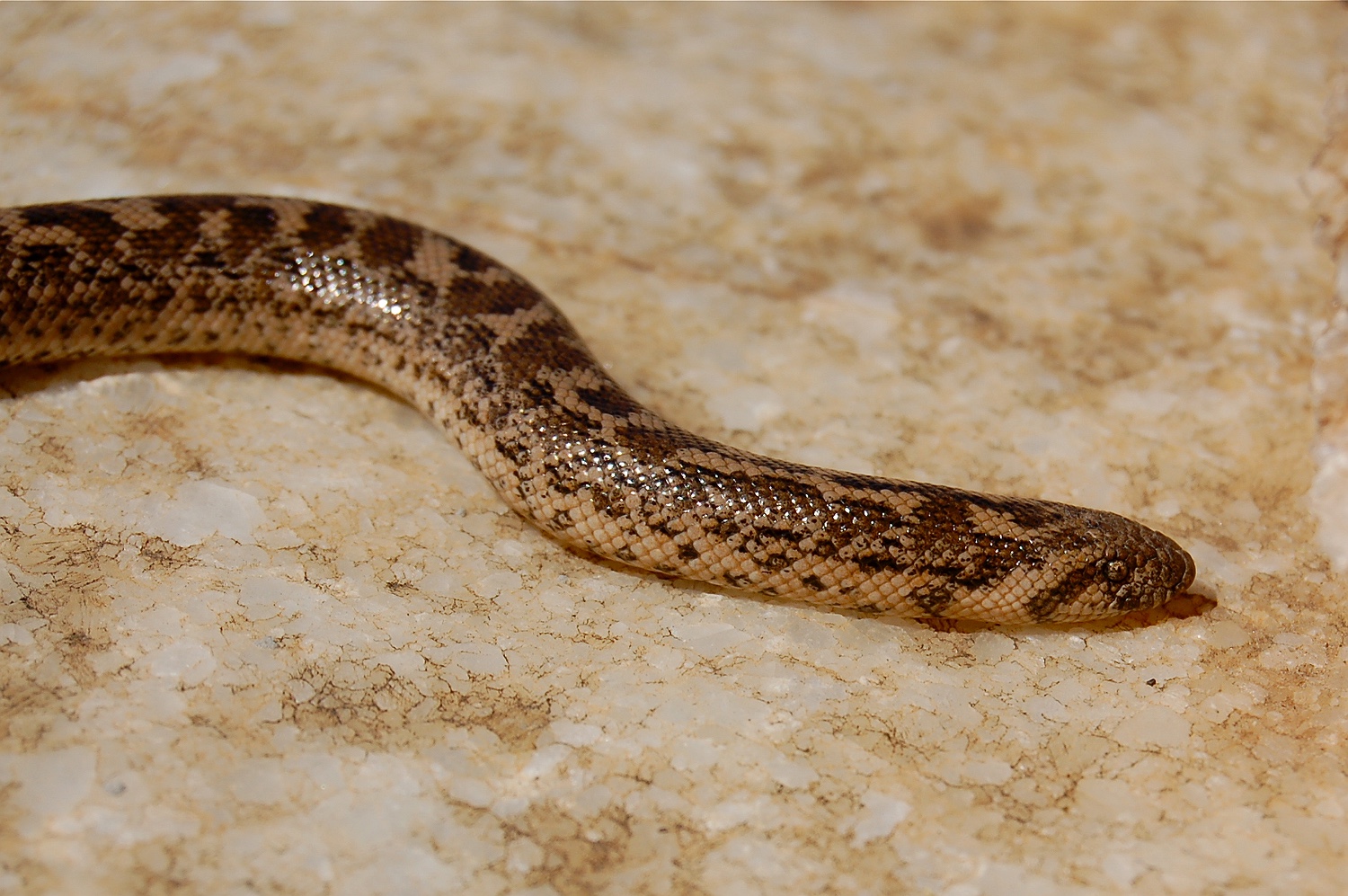
Its head with the tiny eyes is quite small and not clearly separated from the body.
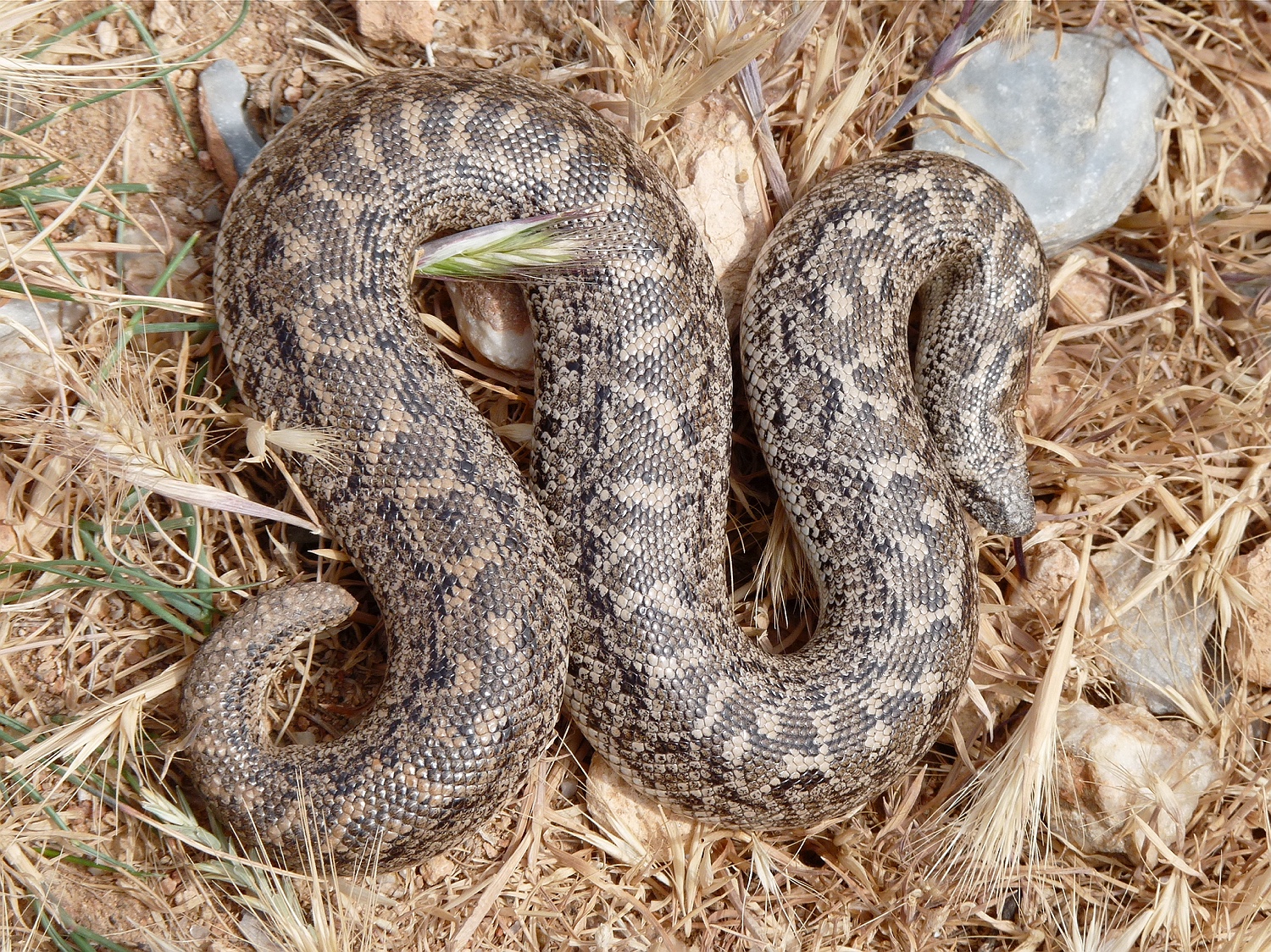
The sand boa usually stays rather short, but it can be quite thick.
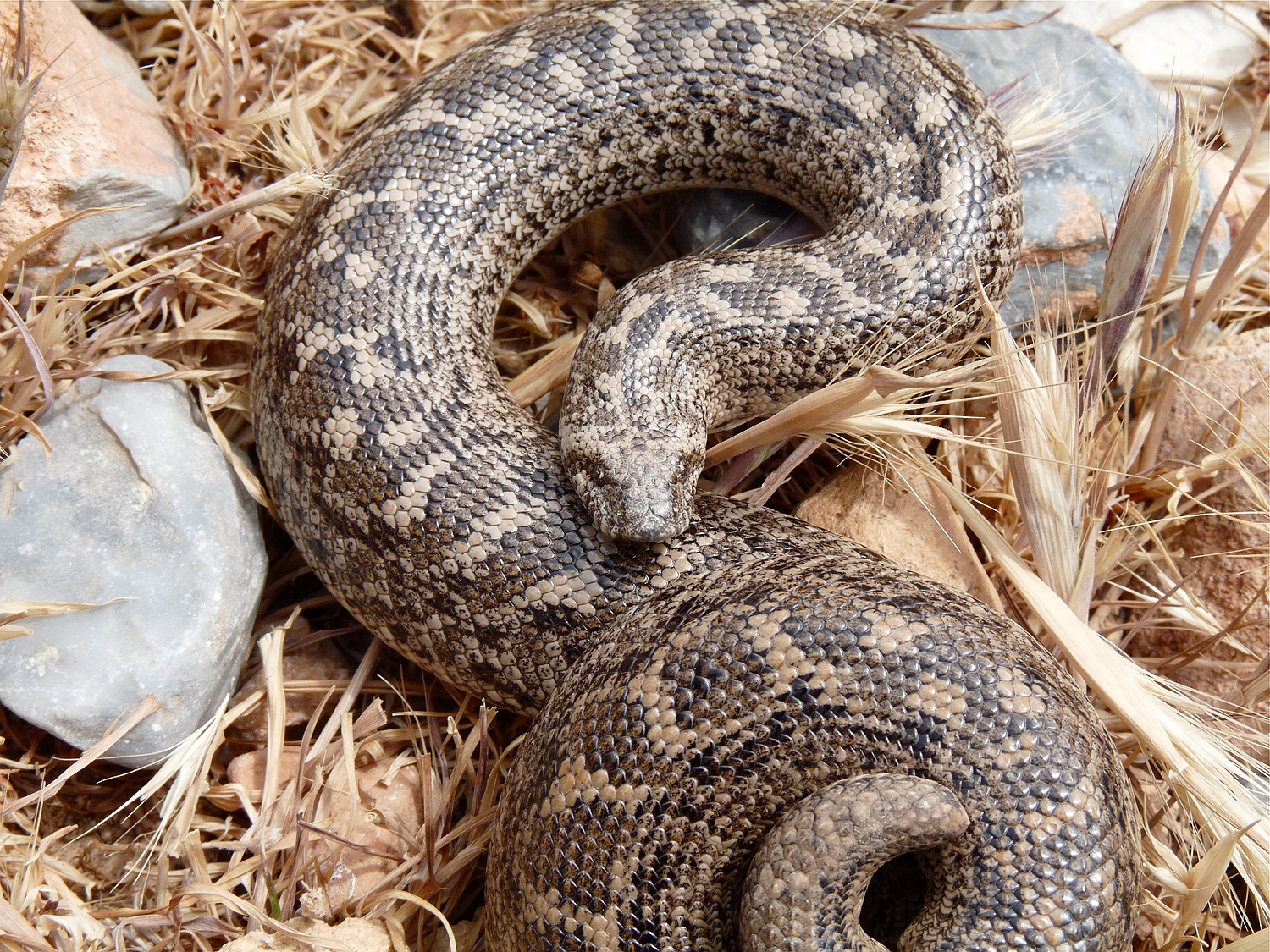
When disturbed, it usually curls up into a ball.
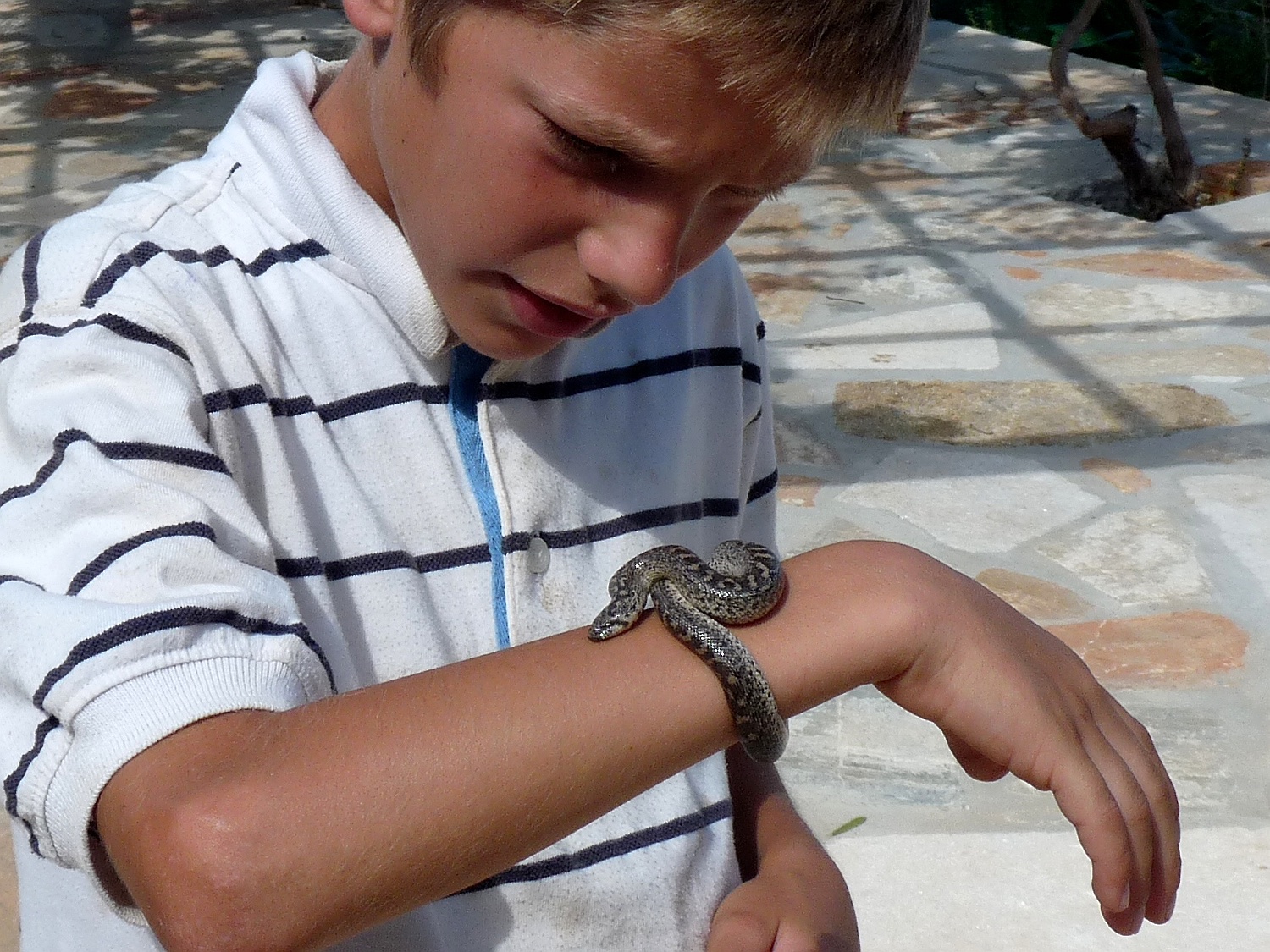
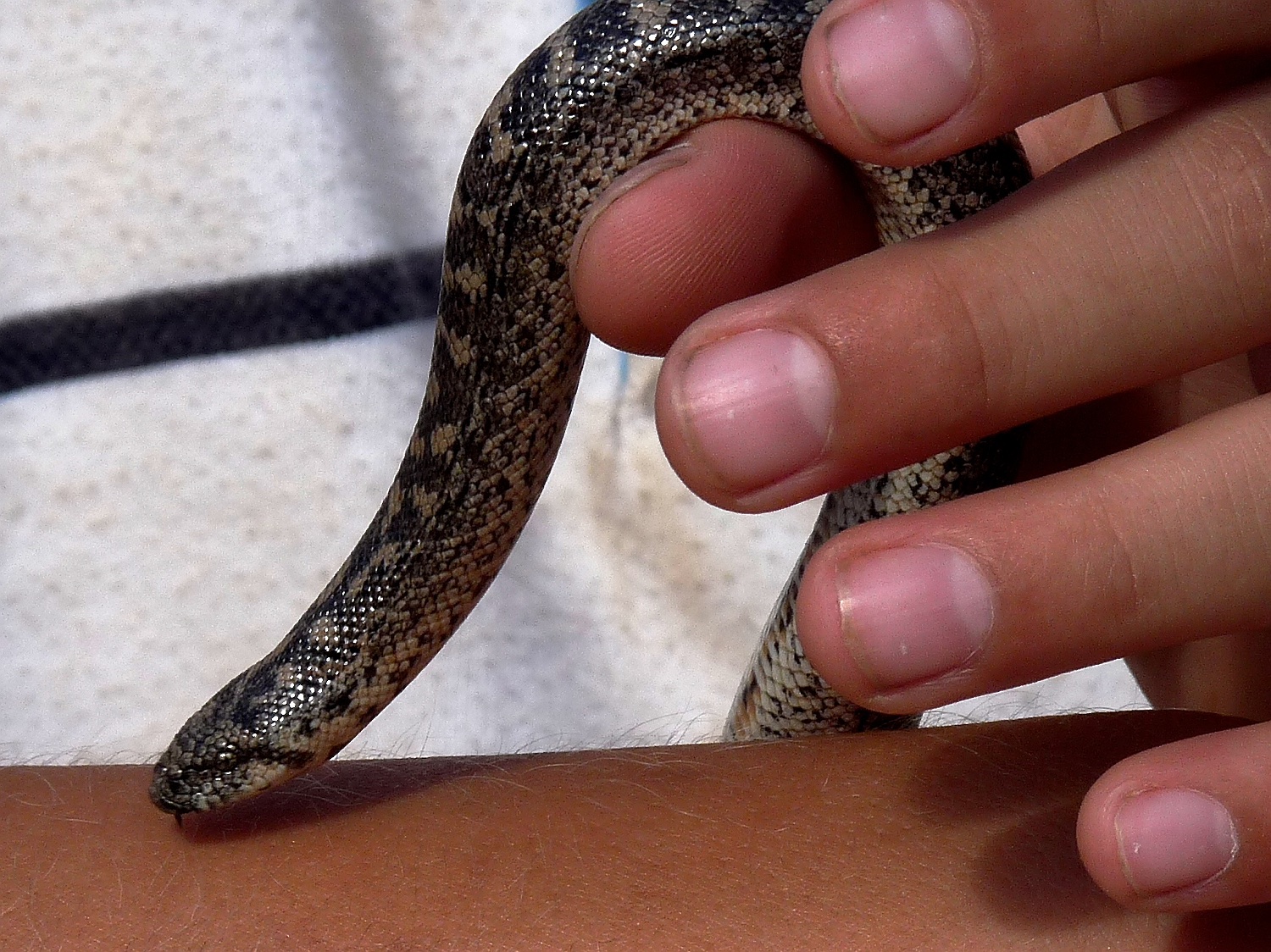
The Javelin sand boa is commonly found in gardens, where it is quite useful as it feeds mainly on mice. It is rather slow and peaceful.
Four-lined snake, Elaphe quatuorlineata, Lacépède
The Four-lined snake is by far the largest snake that occurs on Naxos, reaching lengths of up to 2.40 meters. It is grey or brownish in colour with four dark longitudinal stripes running along its entire body. The underside is yellowish. Juveniles are spotted and thus look significantly different from adults; however, in the subspecies Elaphe quatuorlineata muenteri, which is widespread in the Cyclades, the colour change occurs at a shorter length, that is at younger age, than in the nominate form. I have not yet seen a spotted young animal; even relatively small snakes (about 60 cm long) already had the colouring of adult snakes.
Four-lined snakes feed on mice, rats and rabbits, on lizards, birds and bird eggs. They like to climb trees and sometimes get into the habit of sneaking into chicken coops to steal eggs. If they get caught in the act, they can spit out the last egg they swallowed with great force. Surprised or cornered four-lined snake hiss loudly – interestingly, they hiss both when inhaling and exhaling. In the past, shepherds often put a bowl of milk near the stable for Four-lined snakes so that they would stay in the area and hunt mice – cats were unsuitable because they like to eat cheese quite as much as mice.
Four-lined snakes have no venom and are harmless to humans.

The Four-lined snake is the largest snake on Naxos; it can be recognised by its dark longitudinal stripes.
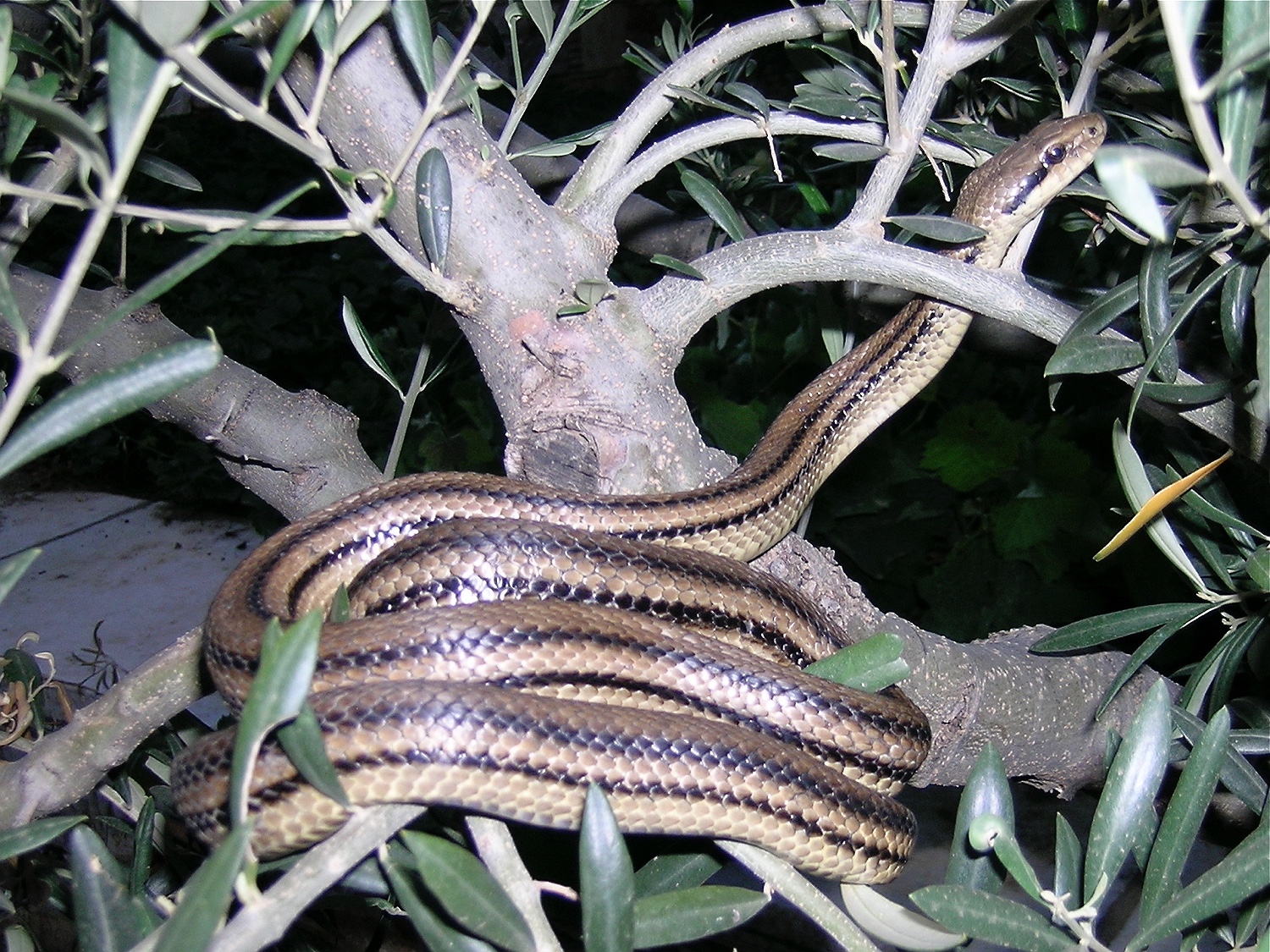
The four-lined snake likes to climb trees.
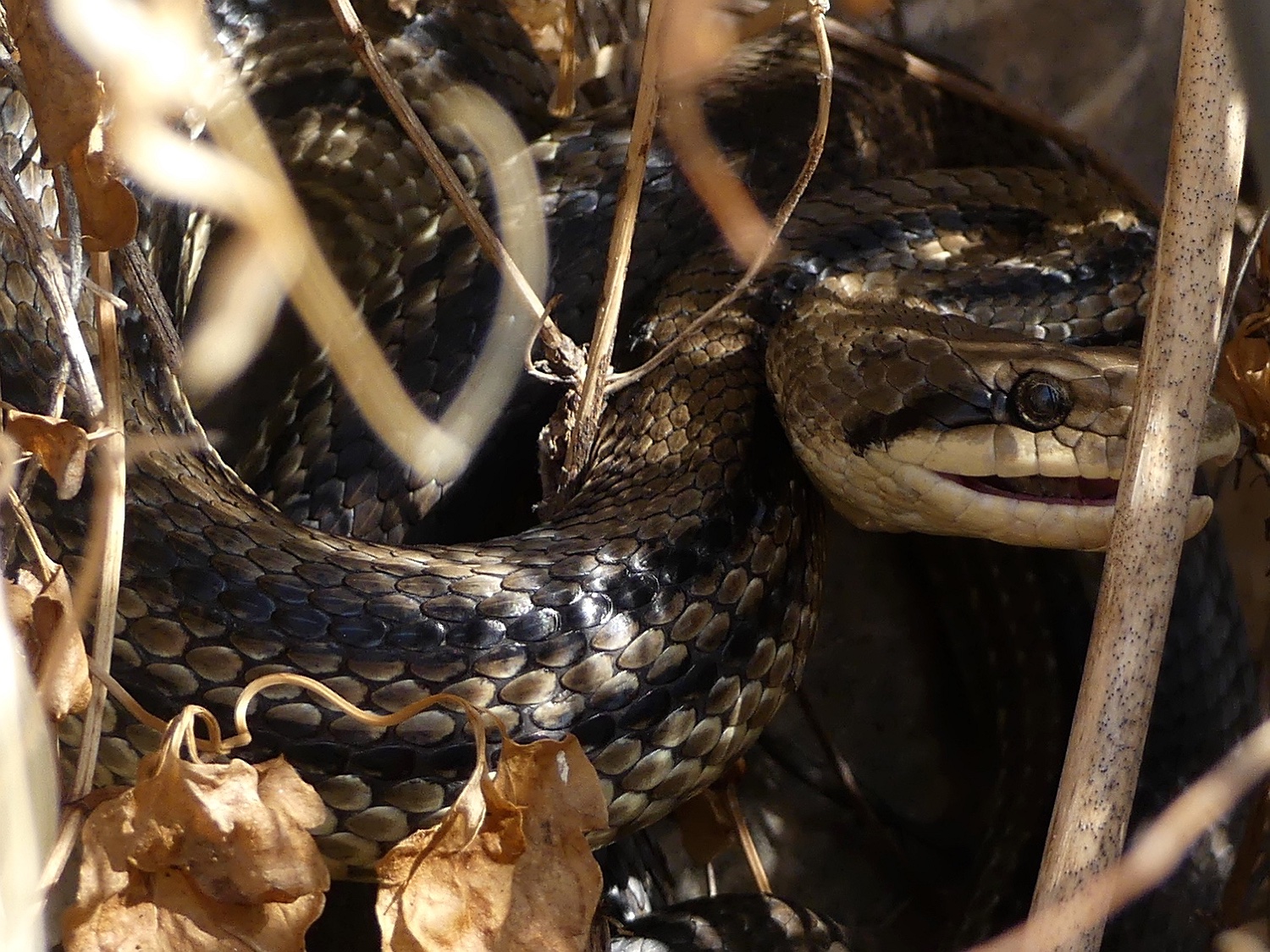
When the Four-lined snake feels cornered, it emits a hiss that can be heard from far away, which it produces both when inhaling and exhaling, so that it continues almost without pause.
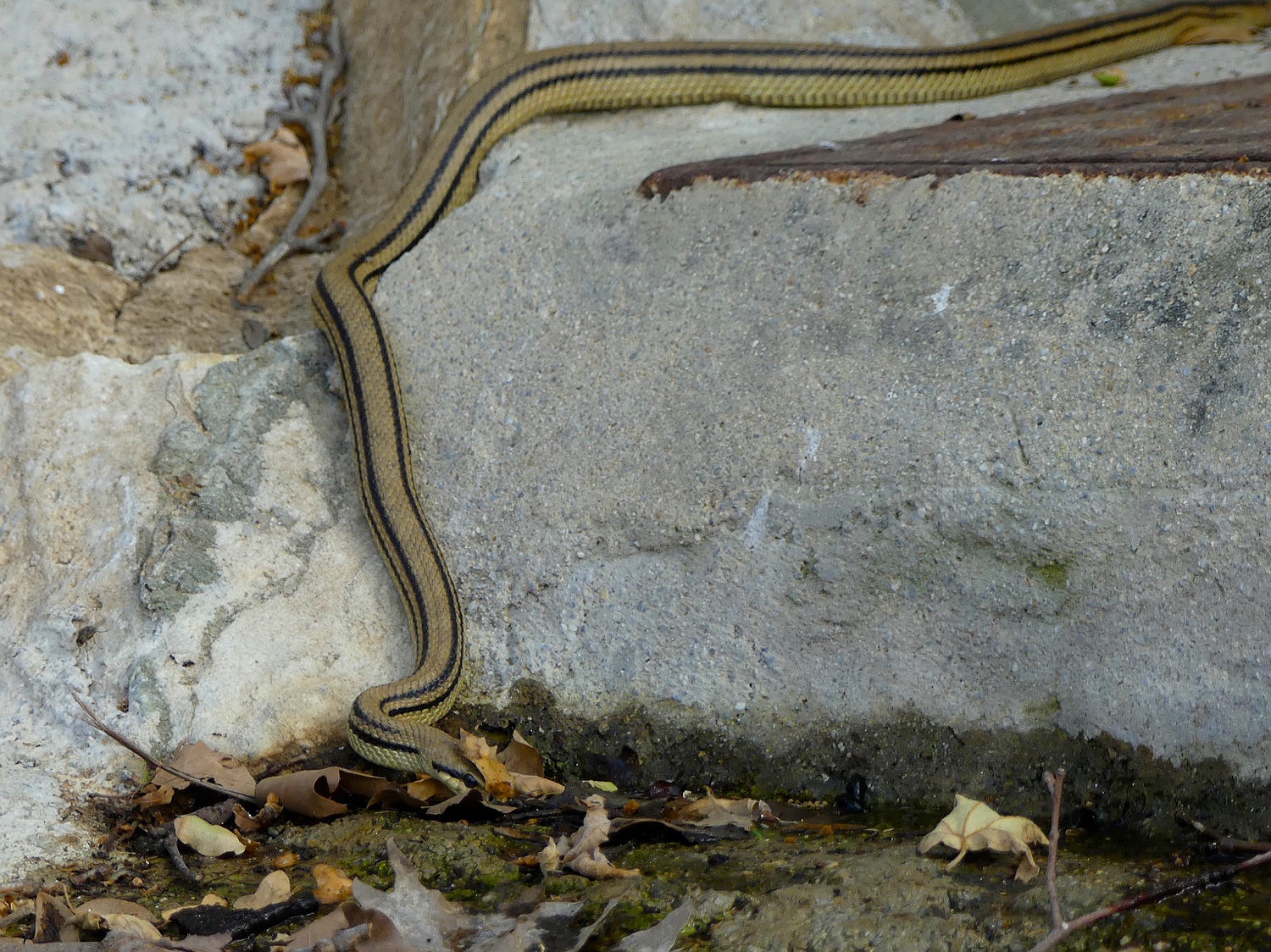
Four-lined snakes like to drink. Here, a snake has come to a small stream to drink water.
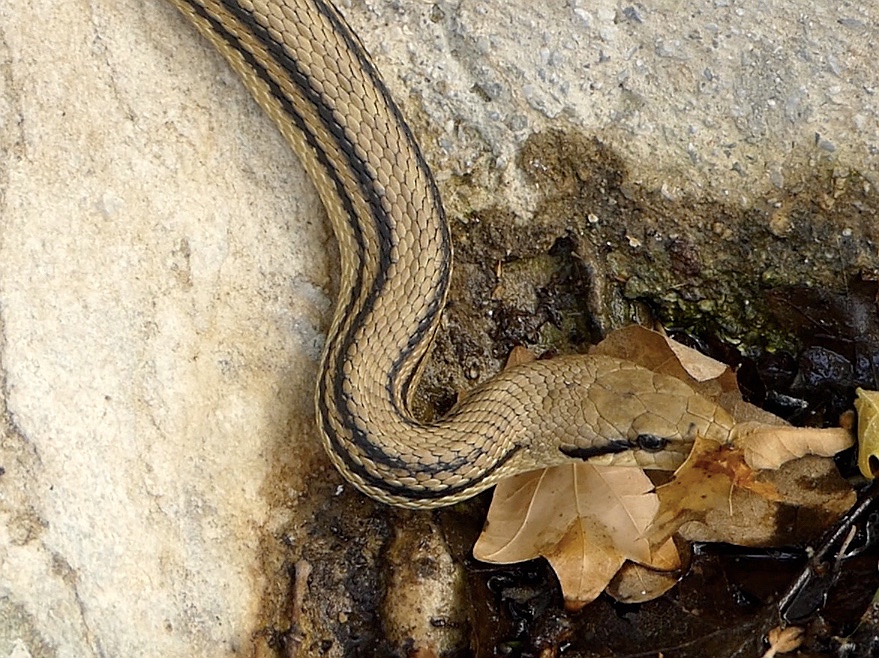
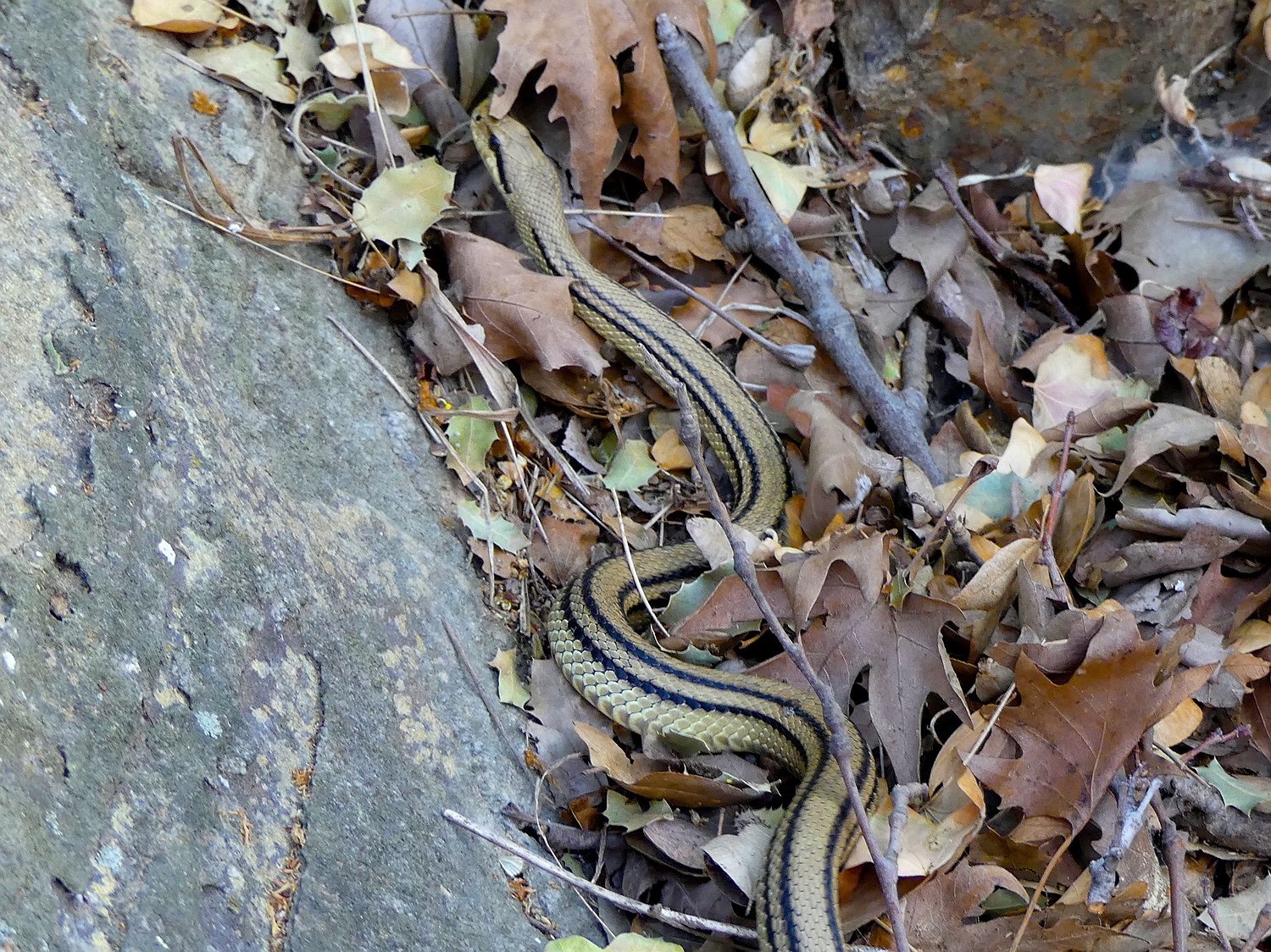
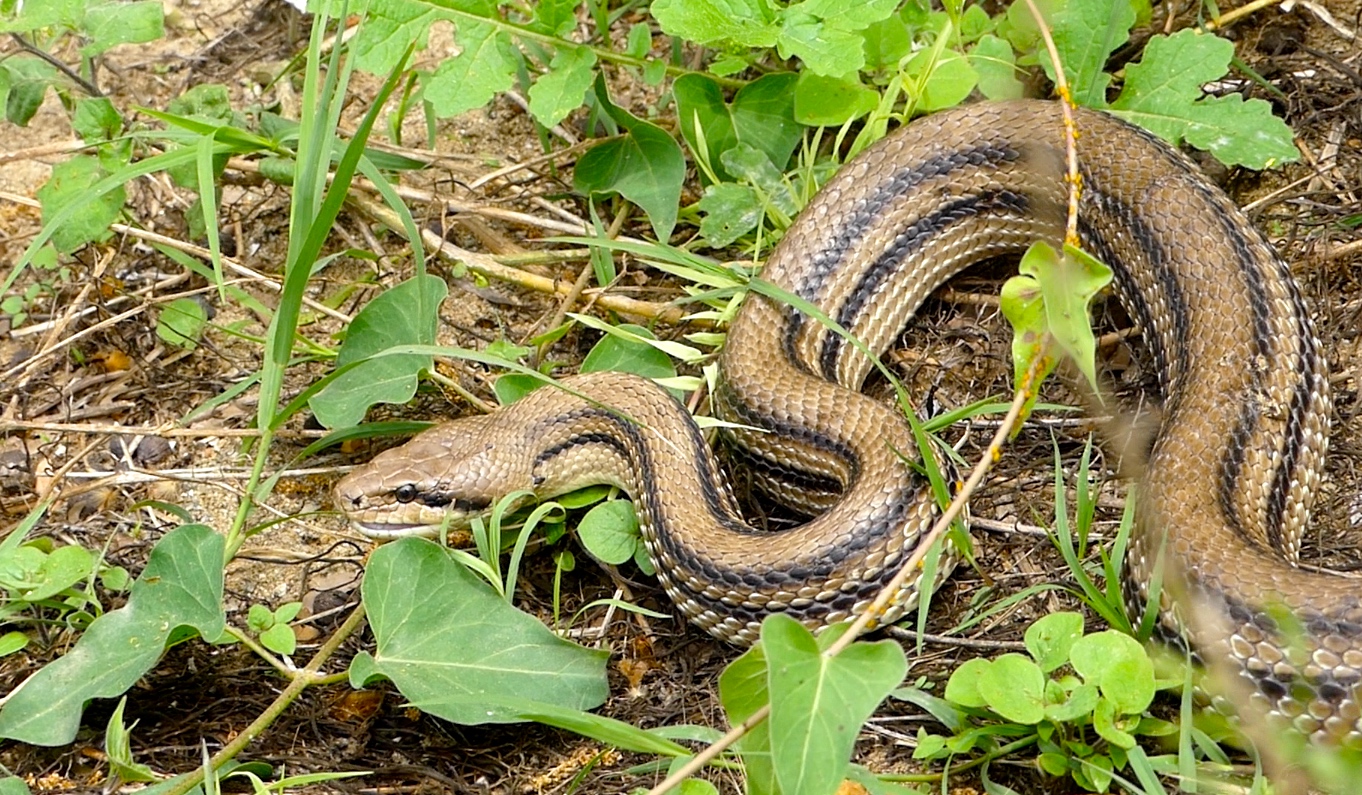
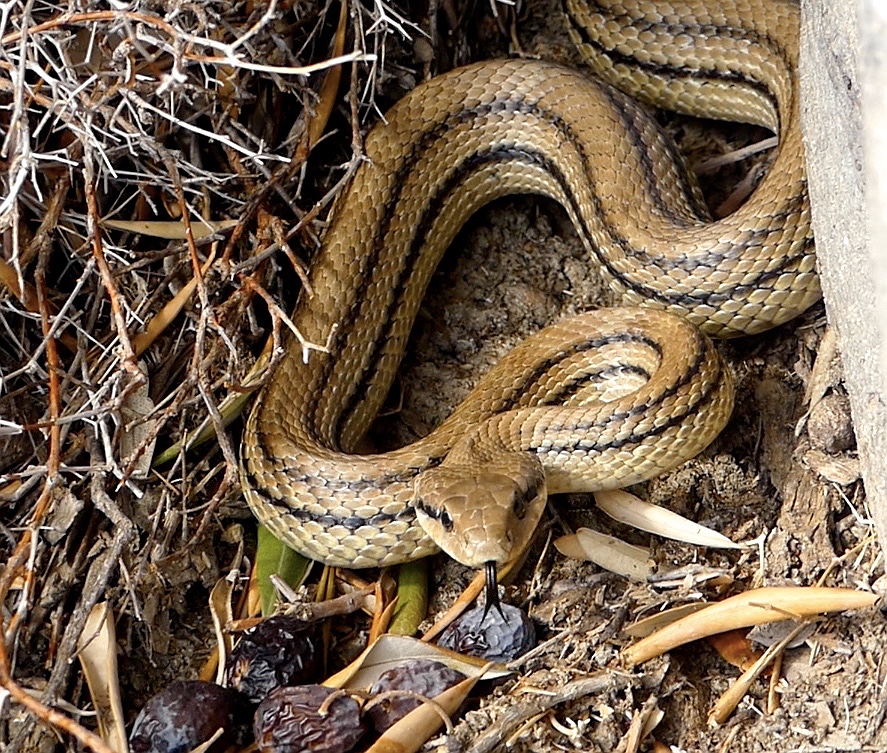
In this picture the forked tongue is visible.
Grass snake, Natrix natrix, L.
The Grass snake is widespread in Europe and Asia. It is mainly found near water and loves to swim. It is therefore not rare on Naxos, but can sometimes be encountered at a pond, one of the rivers or a cistern. The Grass snake feeds mainly on amphibians and small reptiles like lizards.
Grass snakes occur in about 10 subspecies, some of which differ in colouring. On some islands in the eastern Cyclades, especially Milos and Kimolos, occurs the endangered subspecies Natrix natrix schweizeri, which is characterised by black round spots on a grey body while the typical ‘crescent marks’ on the back of the head are white not yellow. The specimens found on Naxos and Paros are also spotted with white crescent marks; their classification is yet uncertain.
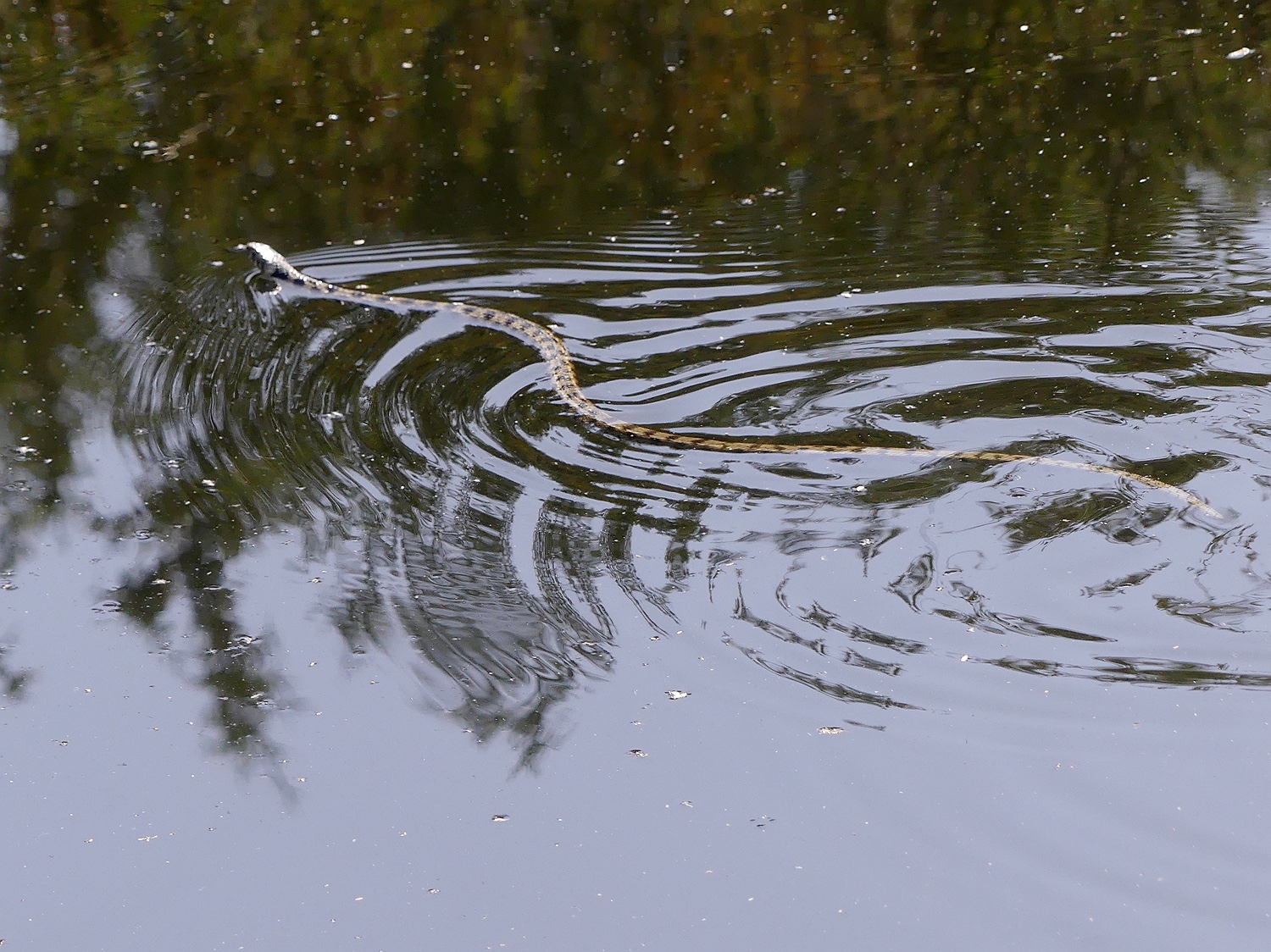
Grass snake swimming in a pool near Kinídaros
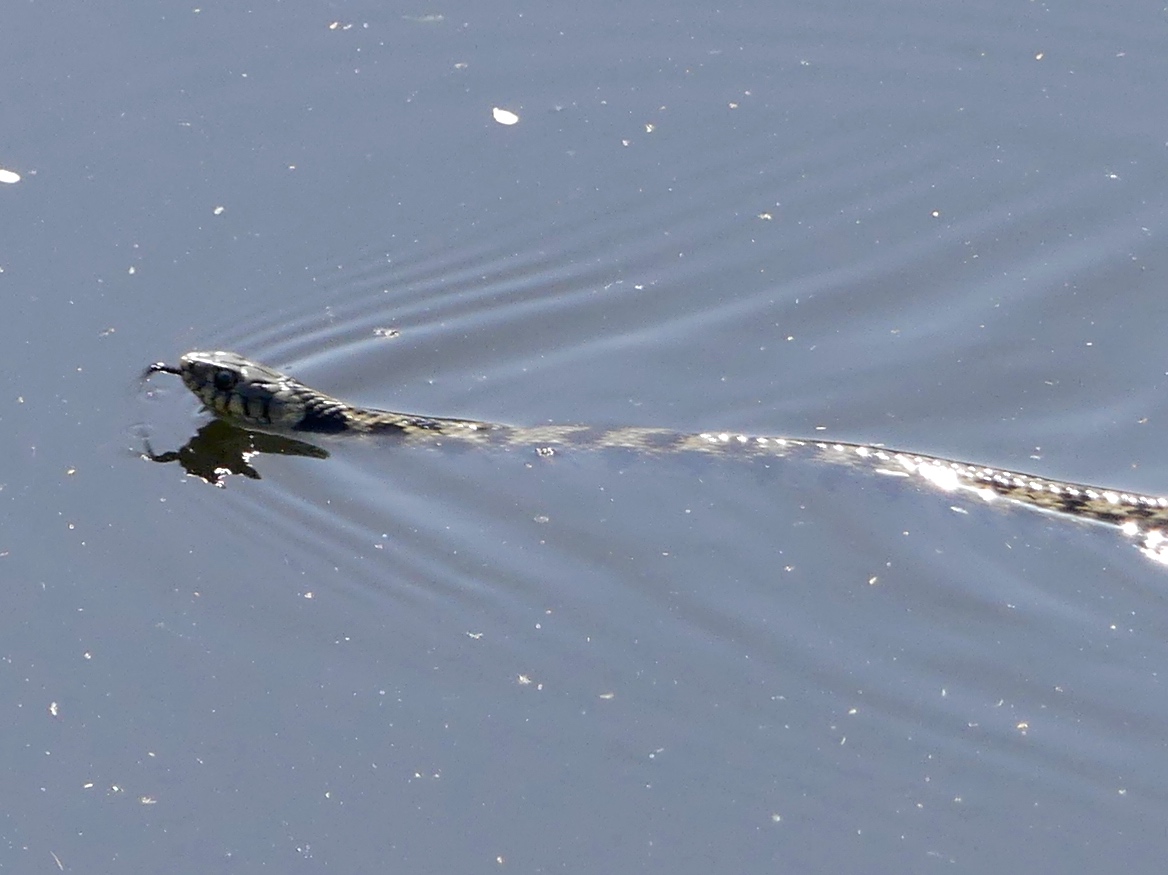
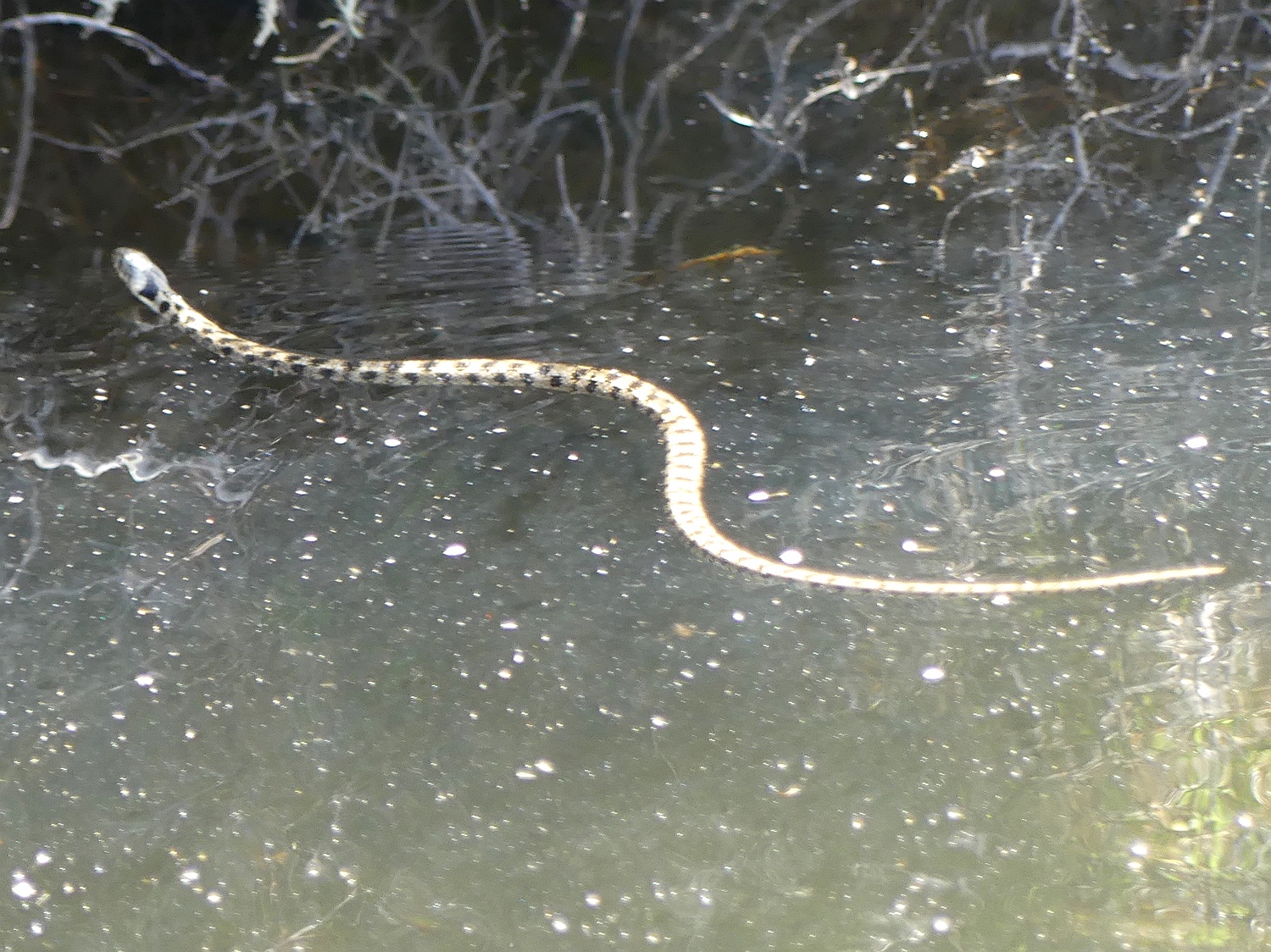
Here you can clearly see the white crescent-shaped markings on the back of the head. These markings distinguish the Grass snake from young Four-lined snakes.
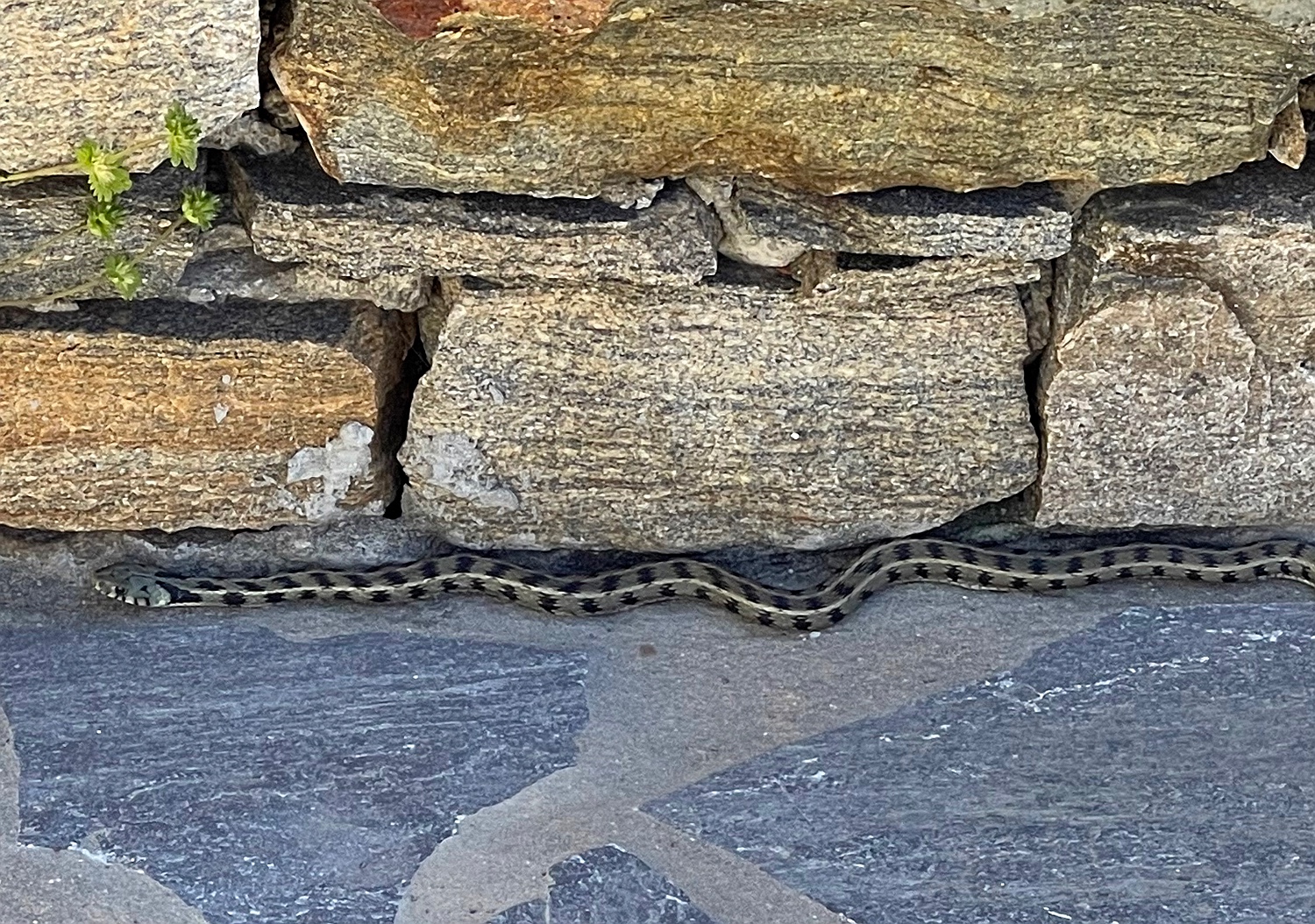
And another Grass snake, photo by Susanne Quistorp
Horned viper or Sand viper, Vipera ammodytes, L.
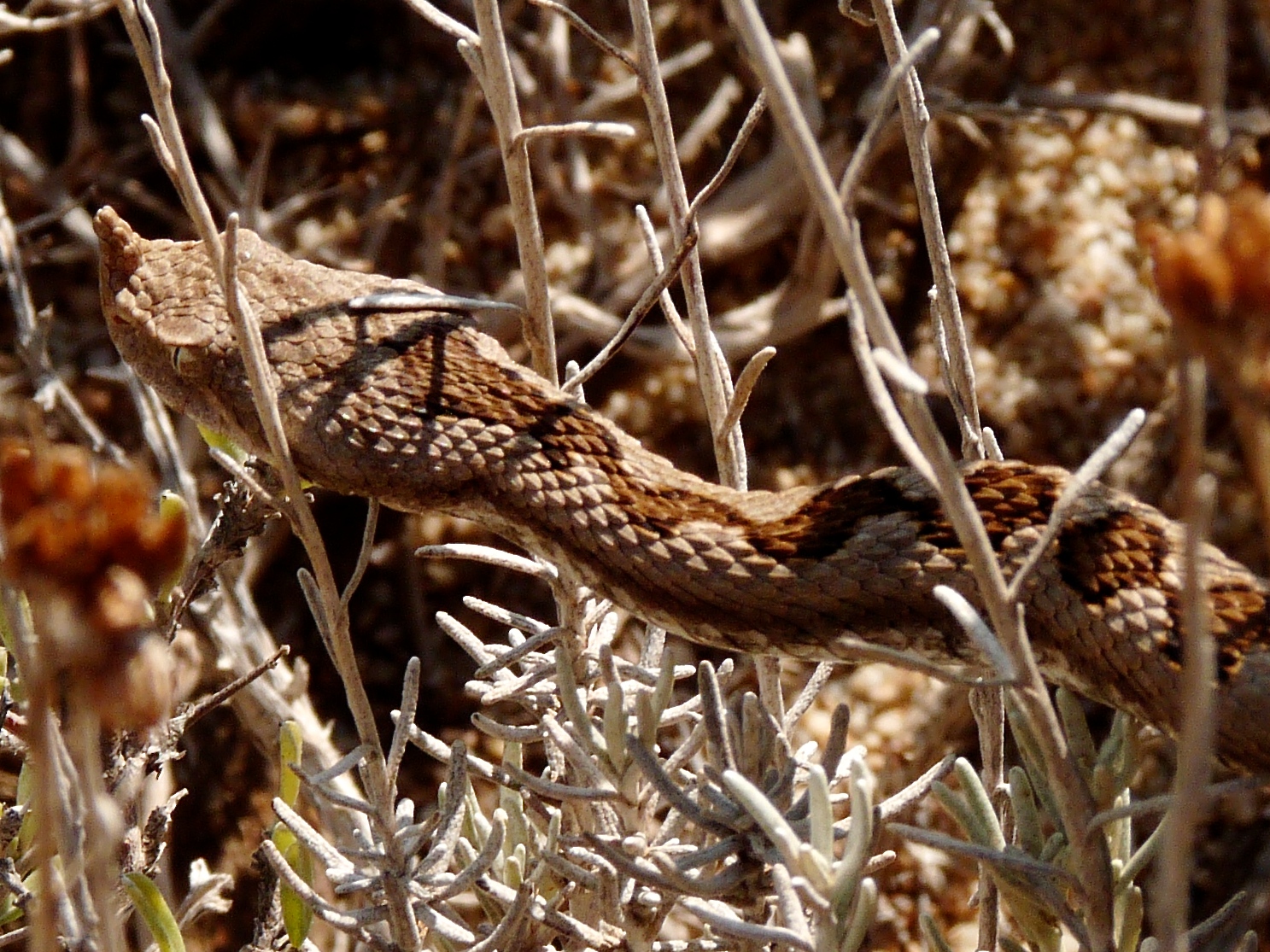
The venomous Horned viper or Sand viper is not a particularly large snake; it usually remains well under one meter in length. It looks very similar to the European adder with the dark zigzag or diamond-shaped pattern on its back (by which it can distinguished from the Sand boa, which has irregular spots). Occasionally one encounters a black specimen. The most characteristic feature is the small horn on the snout, but it is often difficult to see.
The Horned viper can be found in all biotopes on the island, but it prefers drier and rockier areas. Like the other snake species, it feeds on lizards, small mammals and birds. It does not lay eggs, but gives birth to young (“ovoviviparous”).
The Horned viper is the only venomous snake found on Naxos. It is possibly even the most venomous snake species in Europe, though luckily it is not aggressive at all; you really have to step on it or touch it for it to bite. Like all snakes in Europe, the Horned viper will initially try to crawl away when one approaches; when cornered, it will hiss loudly and menacingly at its opponent. Only very rarely does a human get bitten by a Horned viper. However, you should never approach or try to touch a viper.
In case one gets bitten by a Horned viper one should immediately go to the doctor. In the hospitals antidote is available. However, the reaction people show to a bite varies considerably. Sometimes the amount of venom the snake has injected may be so small that there are only mild complications, other people may suffer a long time from the wound. In any case one should not suck out the snake bite, cut it open or tie off the limb, nor use any disinfectant. The correct thing to do is to keep the bitten limb as still as possible so that the venom does not spread quickly through the body. It is also important to remain calm: fatalities are very rare and only occur as a result of excessive shock or lack of treatment (even untreated bites only lead to death in 5% of the cases).
You can effectively protect yourself from snake bites by correct behaviour. The most important measure is to wear sturdy footwear. It is a good idea to make noise when walking by rustling or stepping firmly so that snakes are warned and can go away. The best protection is to watch where you step or put your hands. You should not lay your hands on walls or rocks without first taking a look. Turning over large stones is not recommendable; other poisonous animals such as large centipedes or scorpions may also be hiding underneath them.
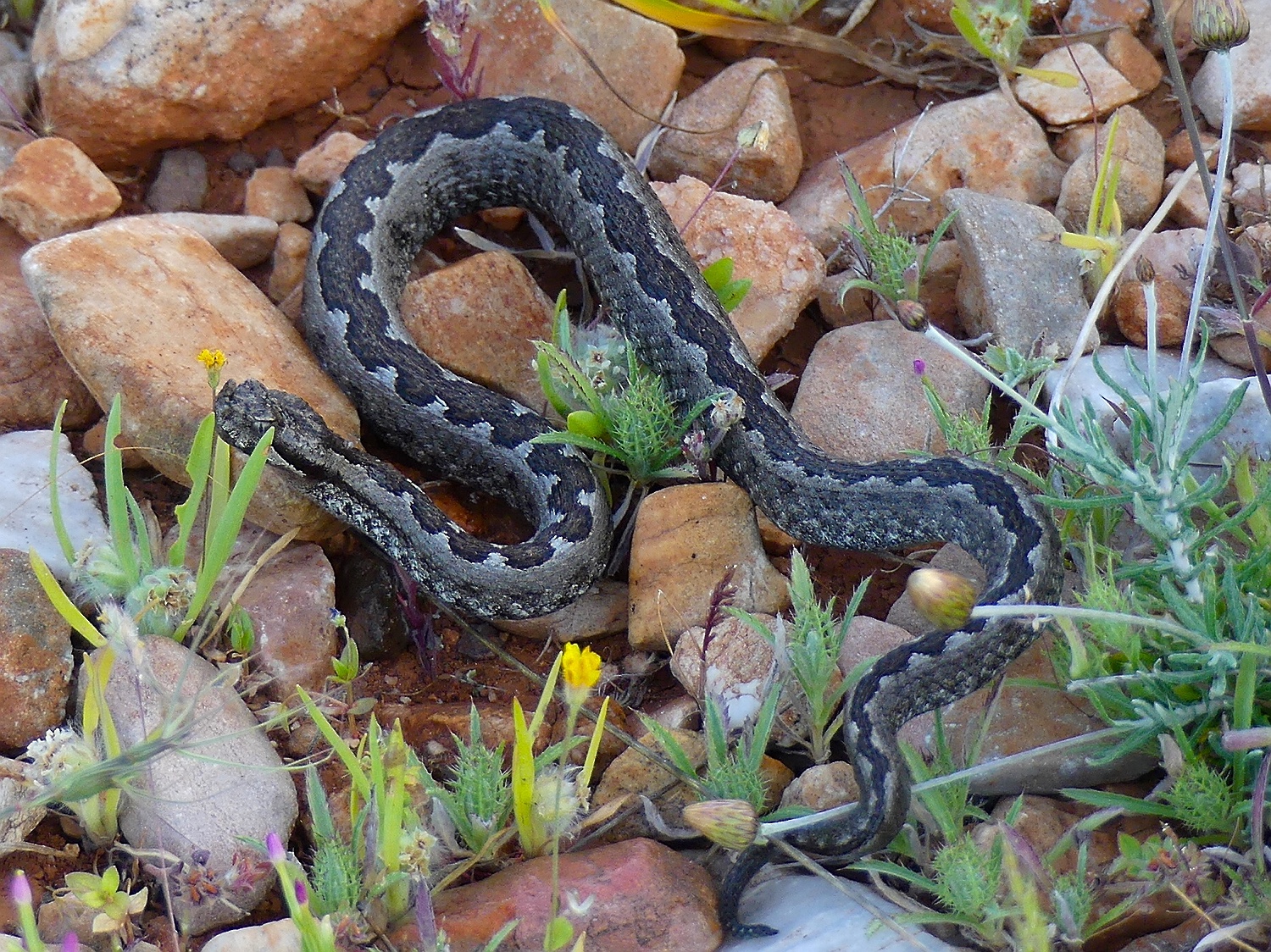
The Horned viper can be recognised by the regular zigzag or diamond pattern on its back.
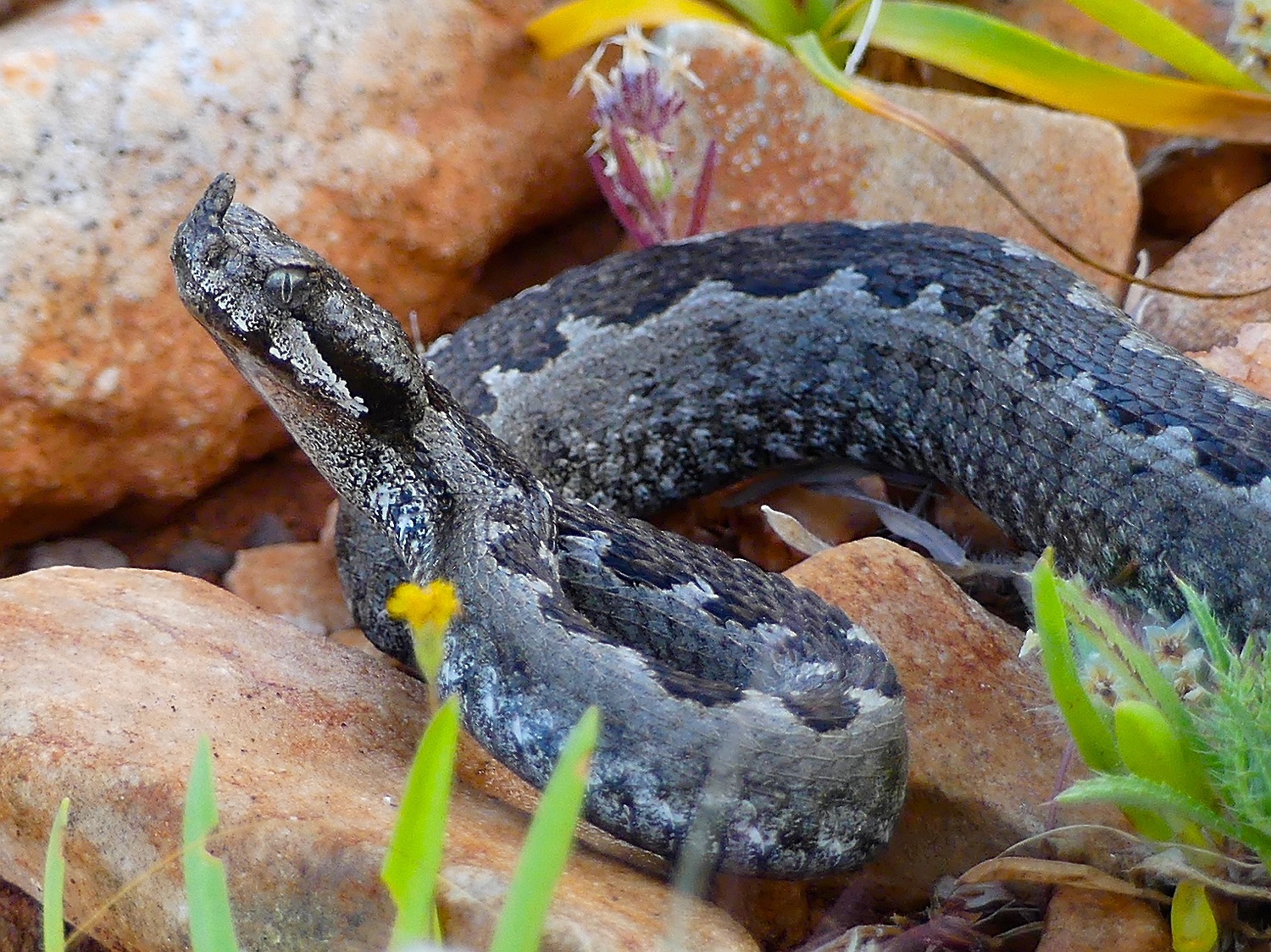
Here you can see the small horn on the snout and the vertical pupil.
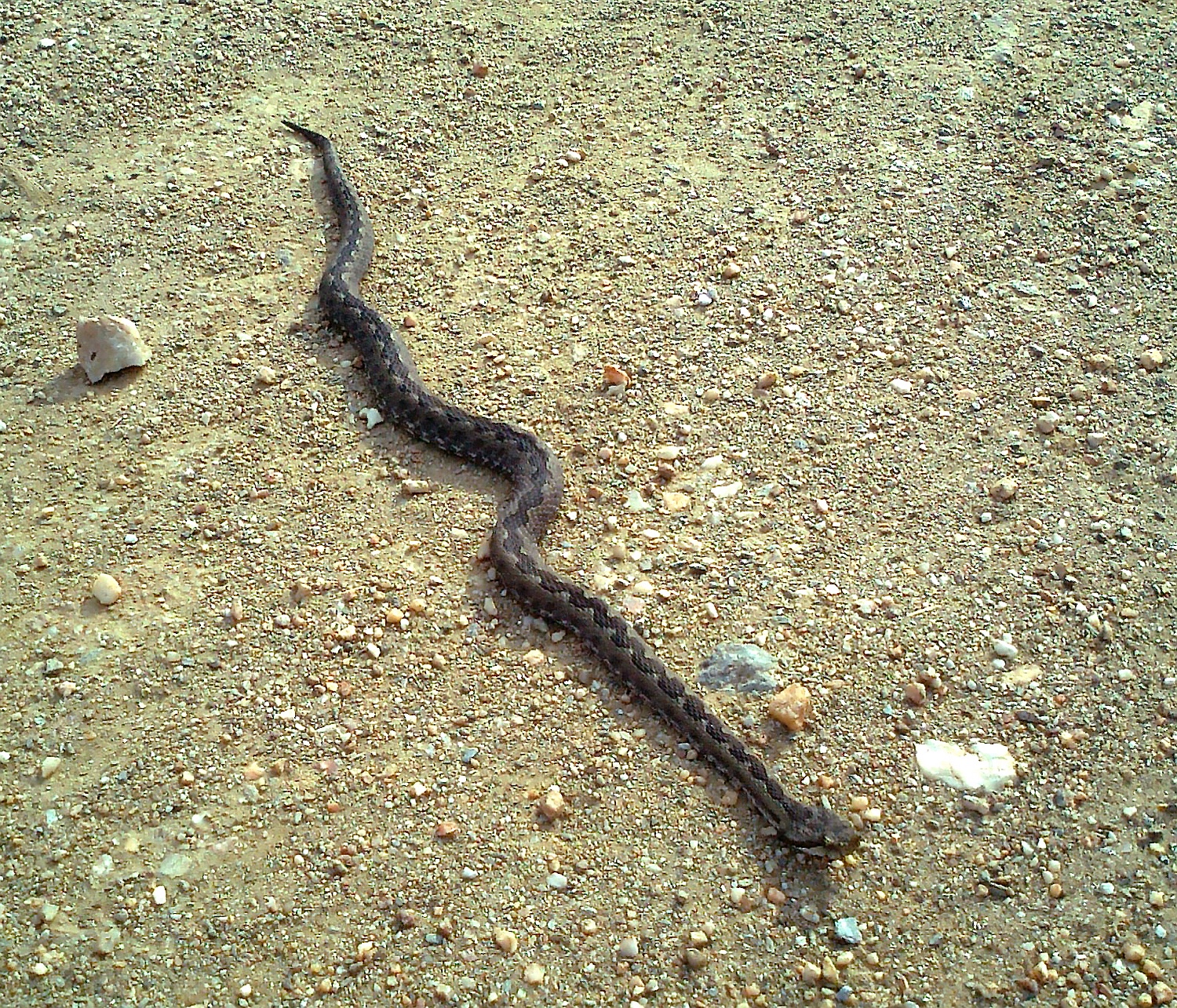
an unusually large specimen (photo by Angeliki Mandilara)
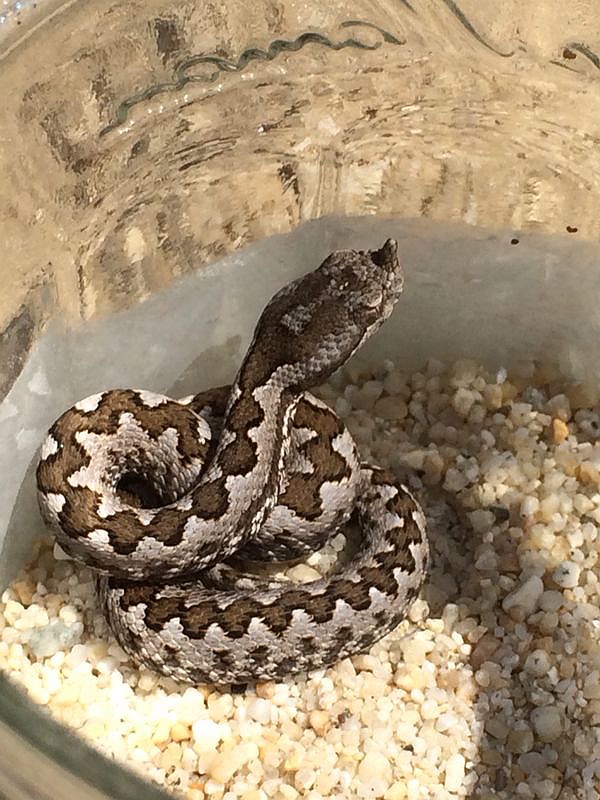
Even small sand vipers should be treated with great respect – they are after all the most venomous snakes in Europe! Photo by Johann Pregernig
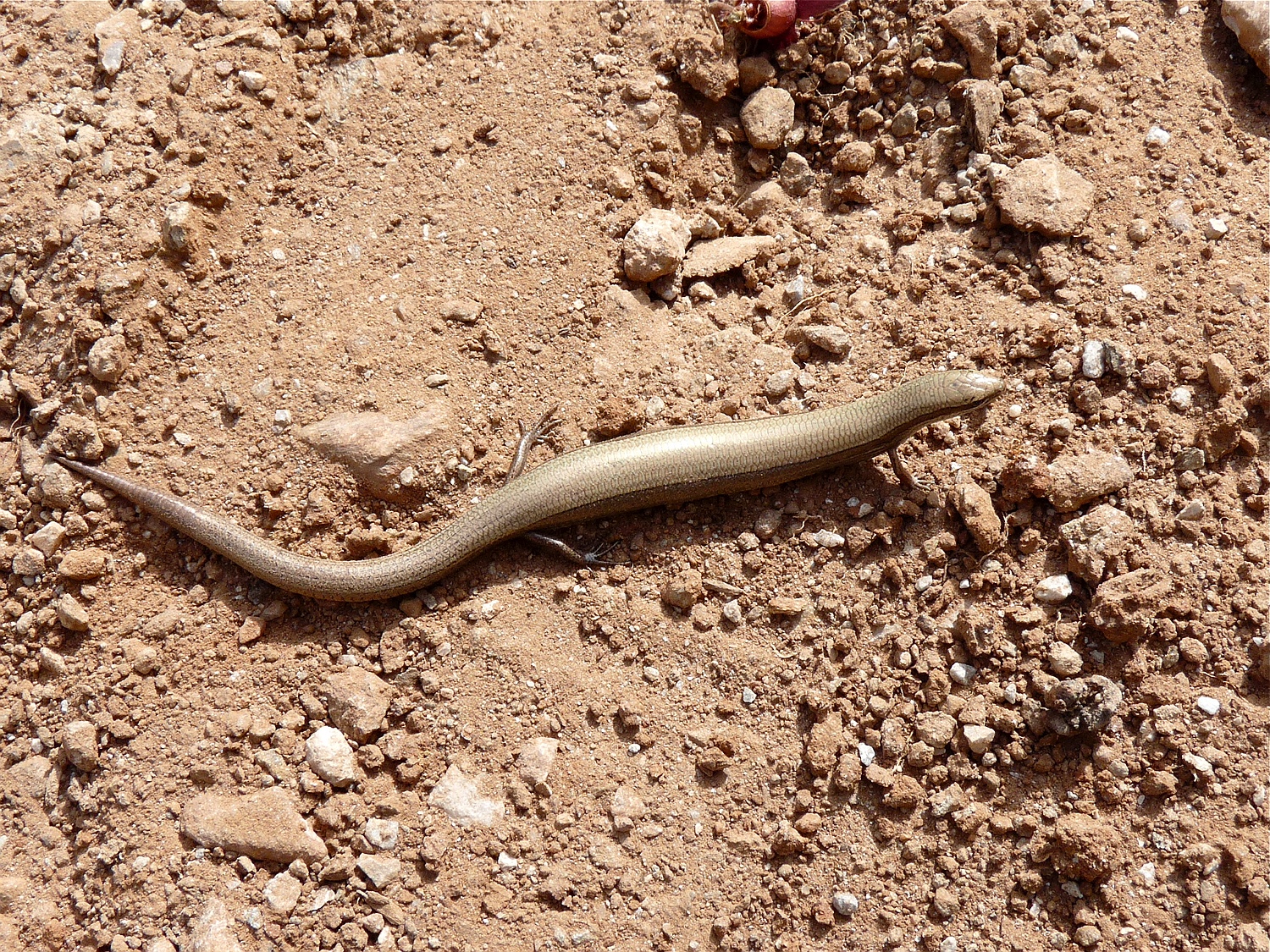
European copper skink, Ablepharus kitaibelii, Bibron & Bory de Saint-Vincent
The small European copper skink is something in between a snake and a lizard: it has very small legs which it uses to support itself while sitting, but moves forward in a snakelike, undulating manner (see Turtles, Geckos and Lizards).
continue: The birds of Naxos
back: The Fauna of Naxos
see also: Turtles, geckos and lizards
Comments are closed.