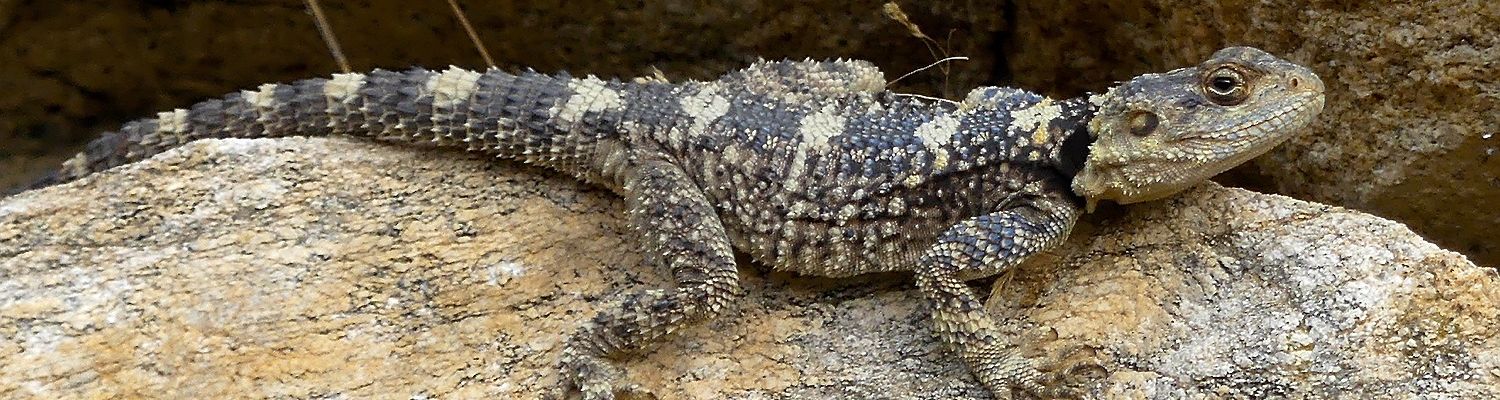
Turtles, geckos and lizards
Reptiles are among the most characteristic animals of the Mediterranean region. They are much more common in the warm regions of the world than in Central Europe, for example, because as cold-blooded animals they depend on the outside temperature. Naxos is home to one species of terrapin (turtle), two species of gecko, three species of lizard and one skink.
Here you can jump directly to the species (return with the back arrow or by swiping back):
Balkan terrapin, Mauremys rivulata – Mediterranean house gecko, Hemidactylus turcicus – Kotschy’s gecko, Mediodactylus kotschyi – Starred agama or Hardun, Stellagama stellio – Aegean wall lizard, Podarcis erhardii – Balkan green lizard, Lacerta trilineata – European copper skink, Ablepharus kitaibelii
Balkan terrapin, Mauremys rivulata, Valenciennes
Apart from the sea turtles, there is only one species of turtle found on Naxos: the Balkan terrapin. (A considerable confusion exists regarding the terrapins, and the species found in the Cyclades and south-eastern Europe is sometimes referred to as the Caspian terrapin (Mauremys caspica) – the two species are indistinguishable in appearance). We have also seen tortoises on Naxos, but these are abandoned pets.
The Balkan terrapin has a dark or greenish-brown colour and grows to over 20 cm in length. It is best recognised by the longitudinal stripes on its neck. Young animals have a more vivid colouring. It lives in rivers, swamps and lakes and, buried in the river or lake bottom, can survive dry periods by falling into a state of rest. The Balkan terrapin is omnivorous and feeds on all kinds of aquatic animals, such as invertebrates, fish and even frogs, but also likes to eat plants, e.g. fruit.
On Naxos, the Balkan terrapin is found in the larger “rivers” that flow all year round, such as the ones at Kinídaros, Potamiá and Apóllonas, as well as in larger estuaries such as Kalandós. It can also tolerate brackish or polluted water.
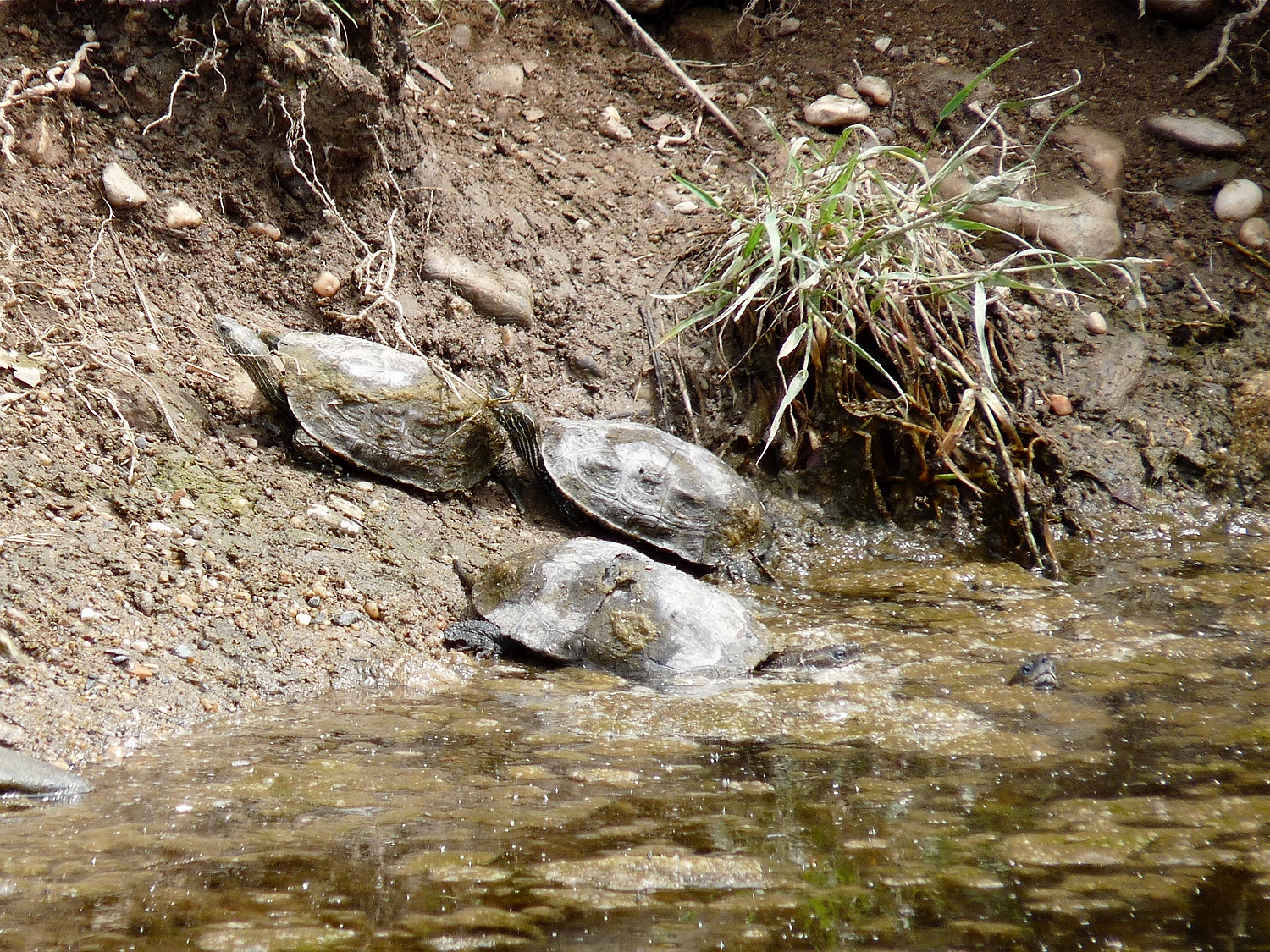
Balkan terrapins often sit at the edge of the water, here at a river estuary in Apóllonas.
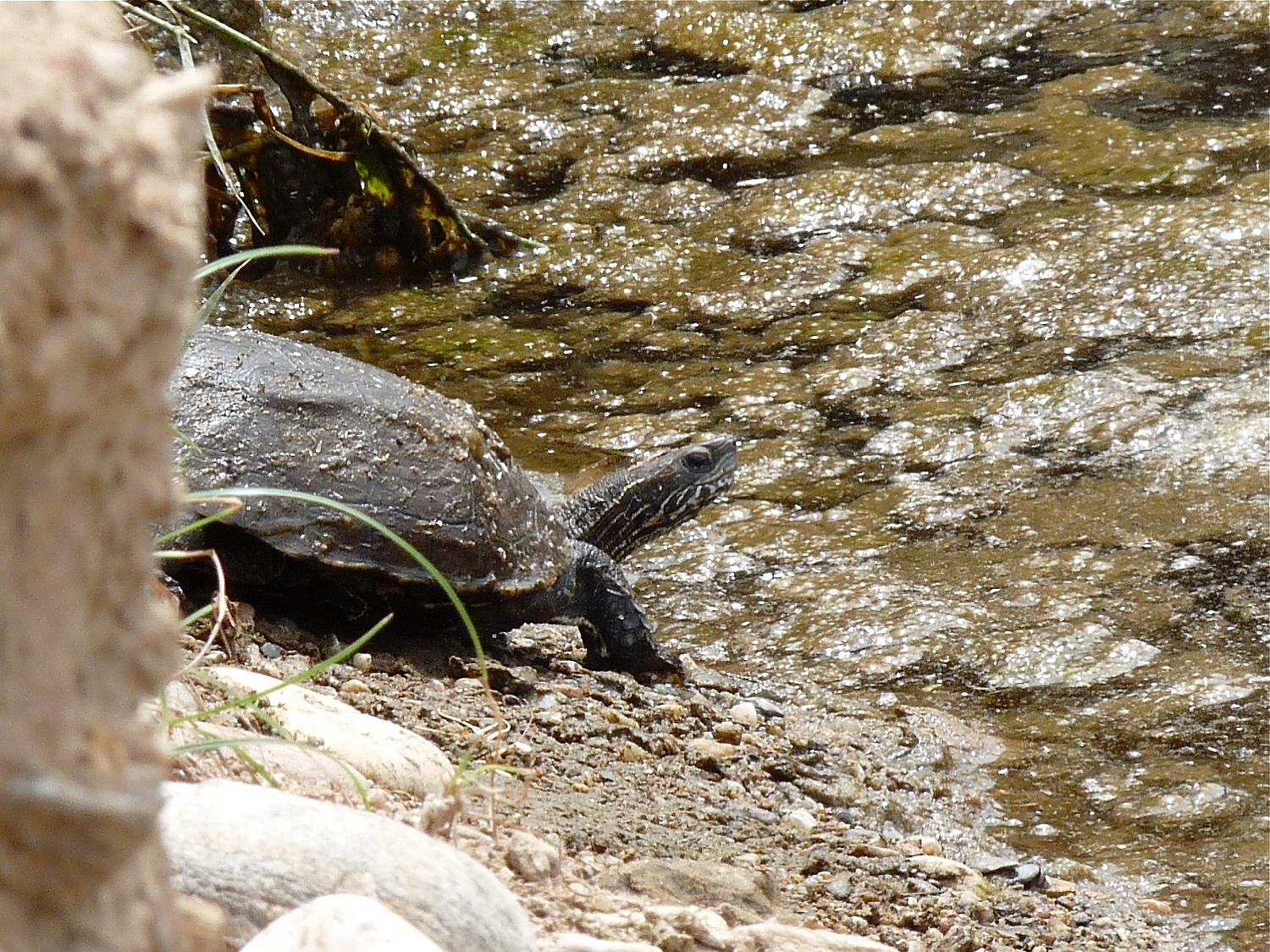
They are very shy and jump into the water at the slightest disturbance, where they can remain below the surface for a very long time.
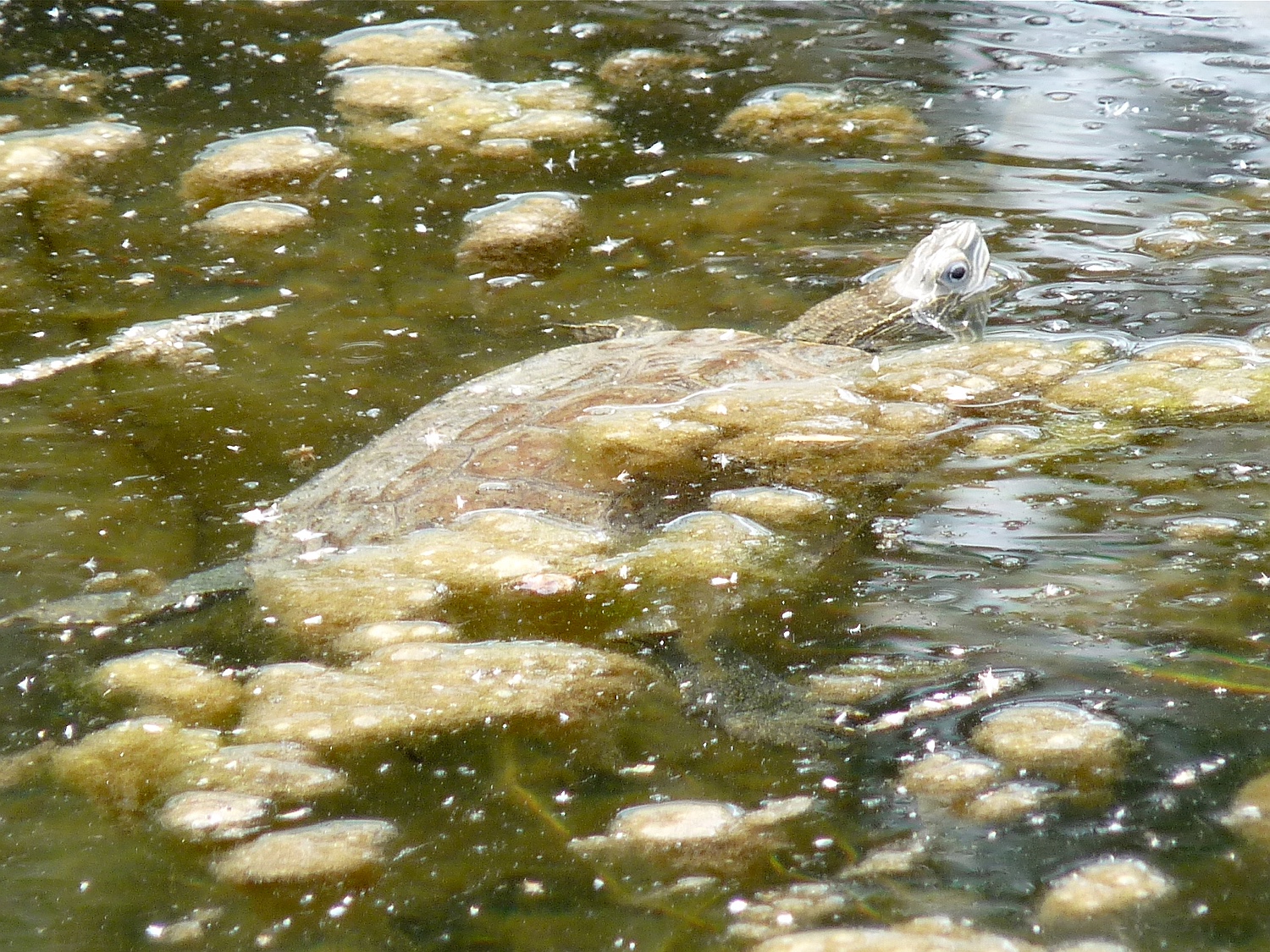
When they surface, only their heads are visible above the water. To enable them to breathe without being seen, the turtles’ nostrils are located at the very front of their heads.
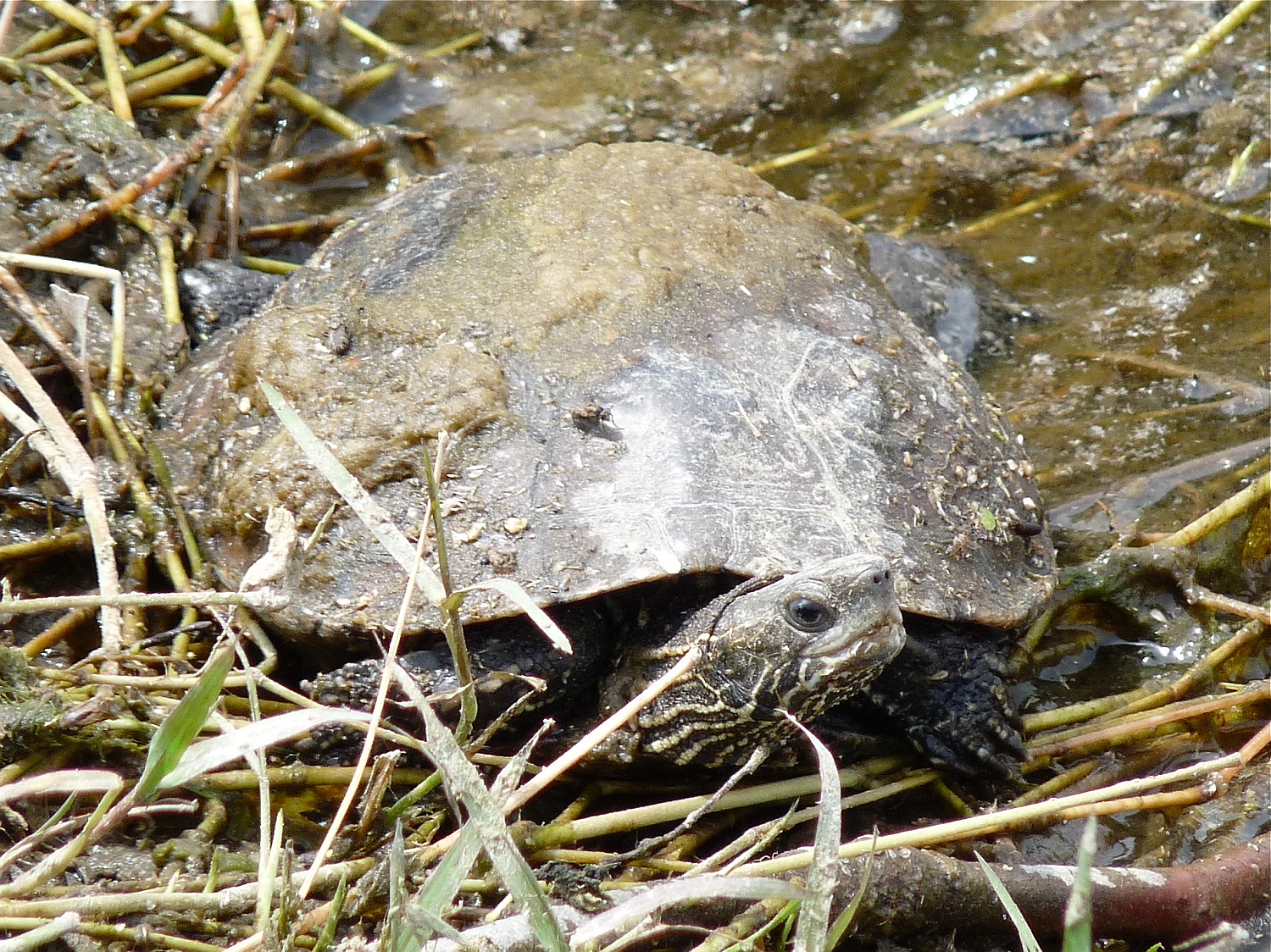
The stripes on the neck are clearly visible here. This terrapin’s shell is covered with algae, which can sometimes be a problem for the animals.
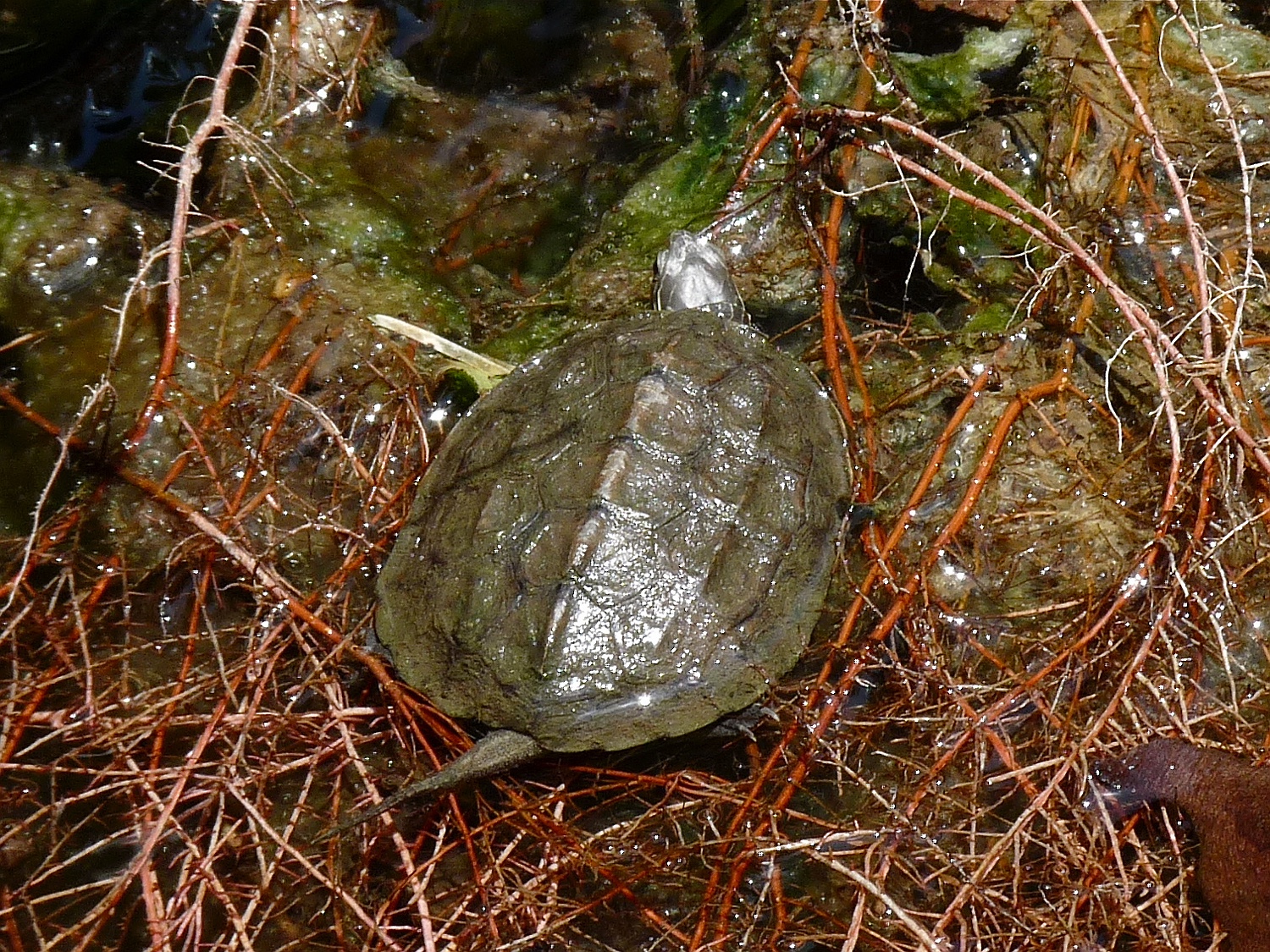
A smaller specimen by the river near Kinídaros
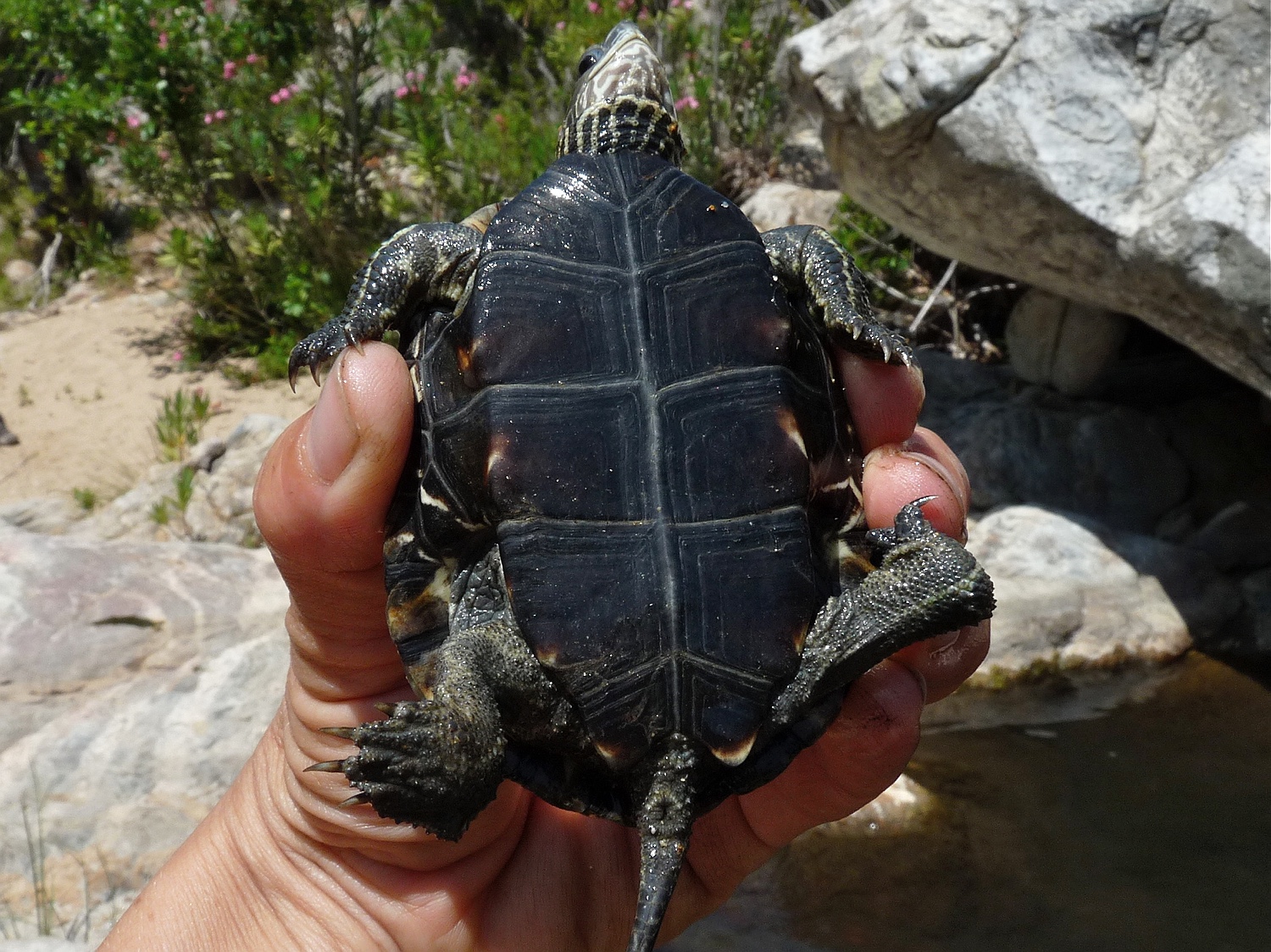
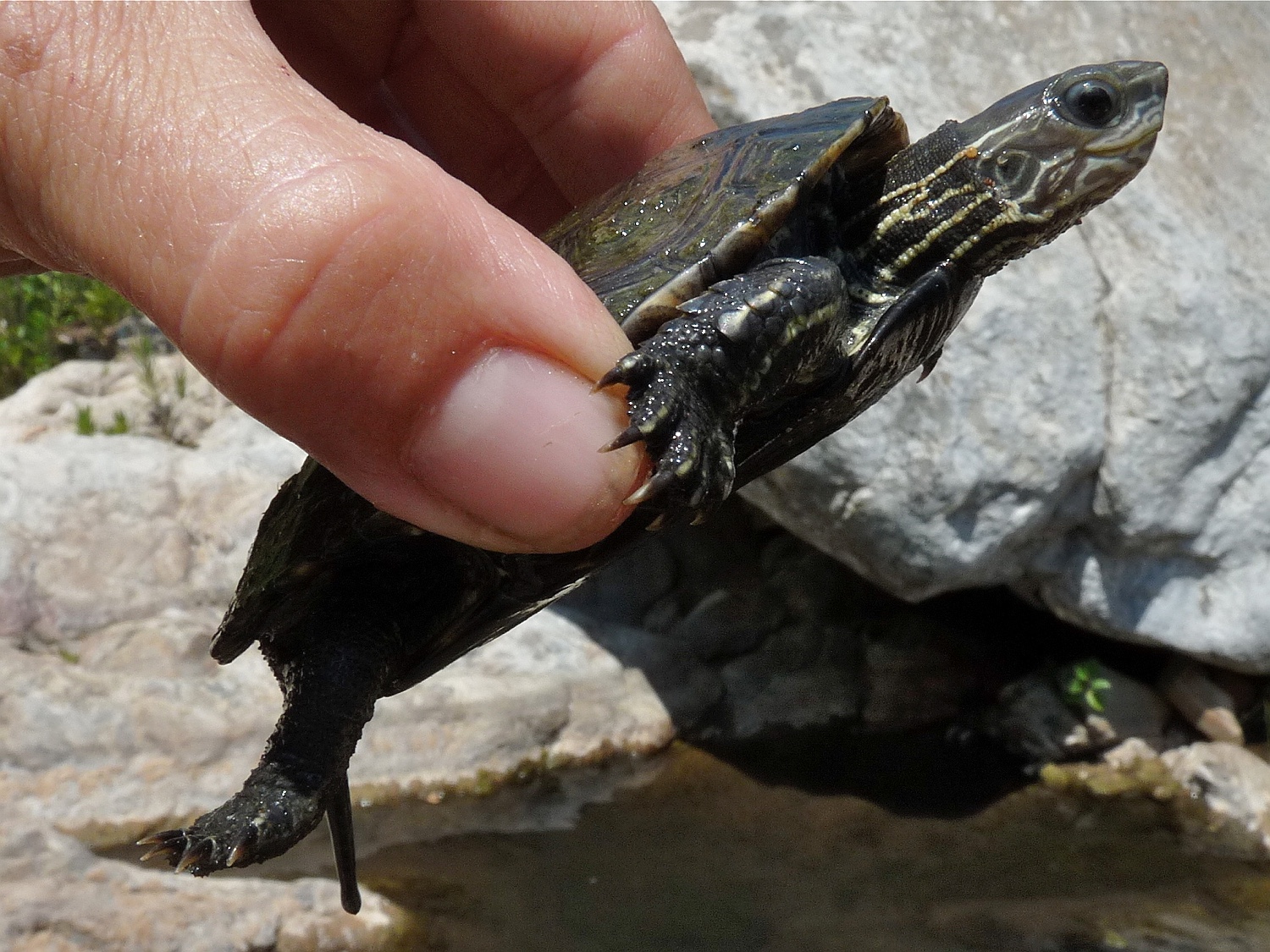
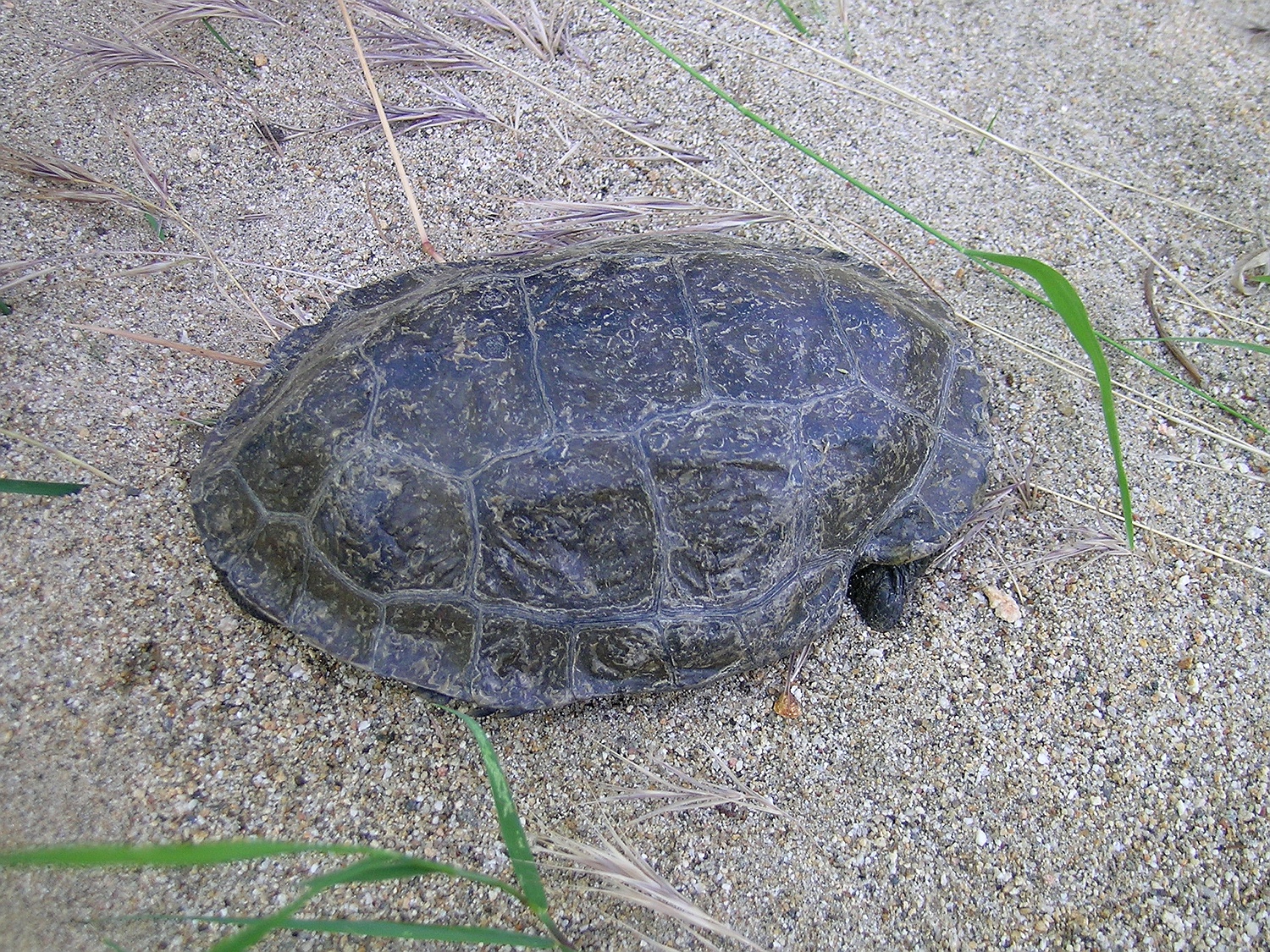
Large Balkan terrapin on land
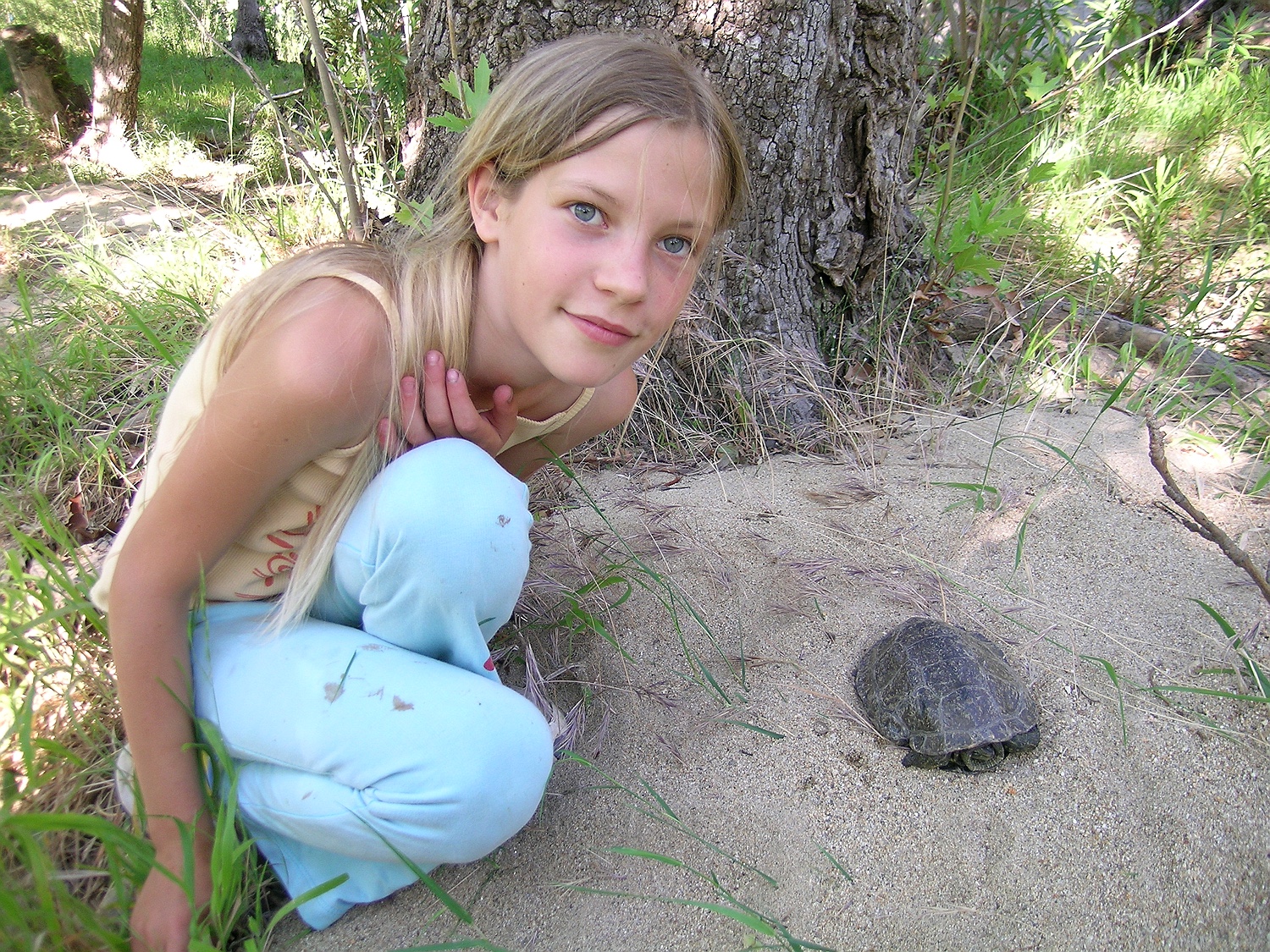
When disturbed, the terrapin retracts its head and legs into its carapace. This specimen also emitted an extremely foul-smelling secretion.
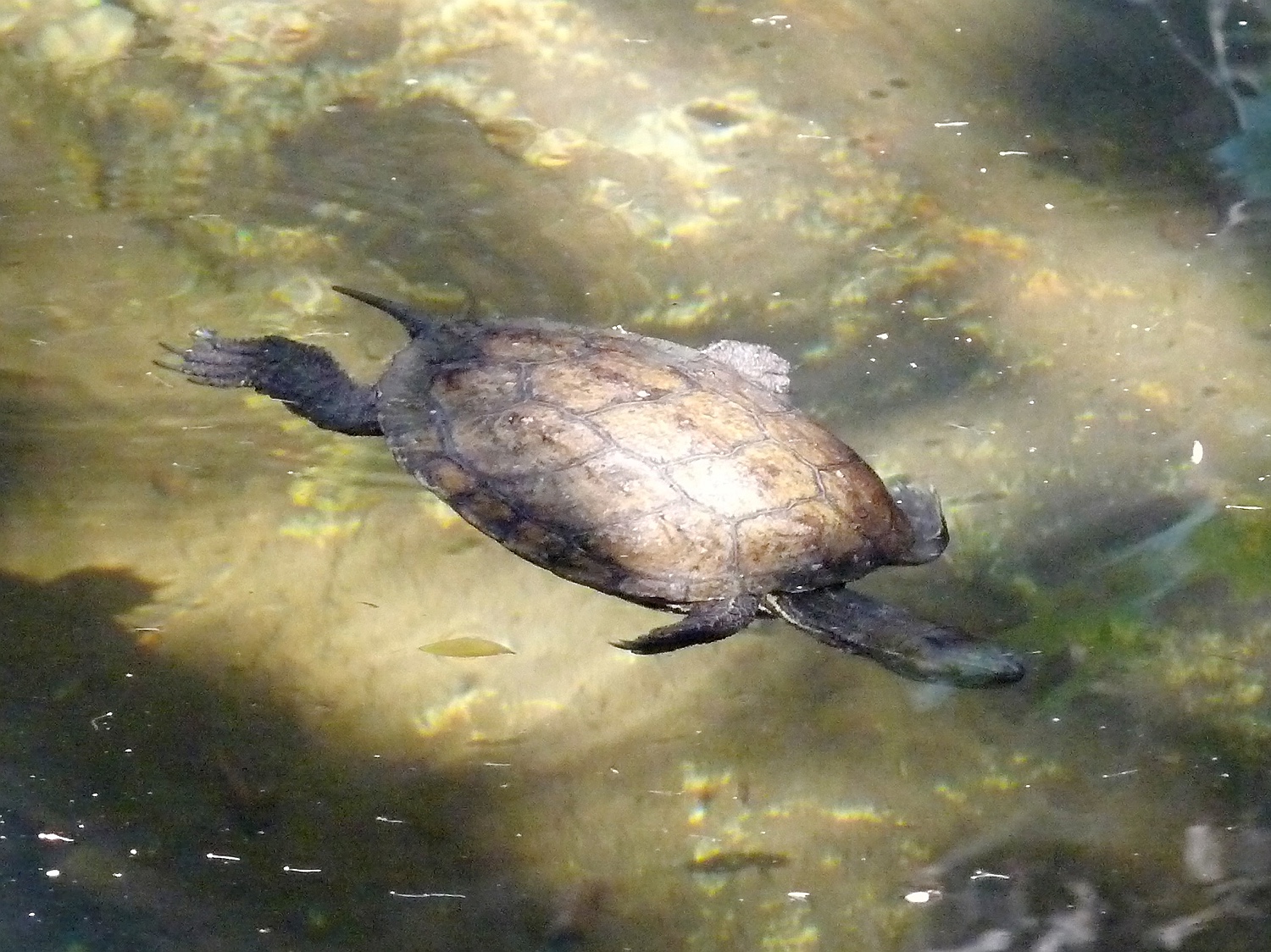
A Balkan terrapin swims in the small pond at the waterfall near Keramotí.
Mediterranean house gecko, Hemidactylus turcicus, L.
The Mediterranean house gecko is one of two gecko species found on Naxos. It grows up to 10 cm long and has a light brown, slightly transparent colour. Small bumps cover its entire body. A characteristic feature are the adhesive discs on its feet, which leave the front toes free. These enable the Mediterranean house gecko to climb even smooth walls; the animals can also run effortlessly along the ceiling. The Mediterranean house gecko makes a rapidly repeated clicking sound. It is found around the Mediterranean region, as well as in North Africa and Southwest Asia as far as India.
Geckos are predominantly nocturnal, but use their eyesight to orient themselves when hunting. Accordingly, they have very large eyes with vertical pupils. The Mediterranean house gecko is found on rocks and trees; it very often lives around and in houses, where it can easily be observed hunting in the evening: it usually sits under the ceiling, especially near lamps, and tries to catch moths and other insects attracted by the light. When hunting, it first stalks its prey slowly and then catches it with a sudden leap.
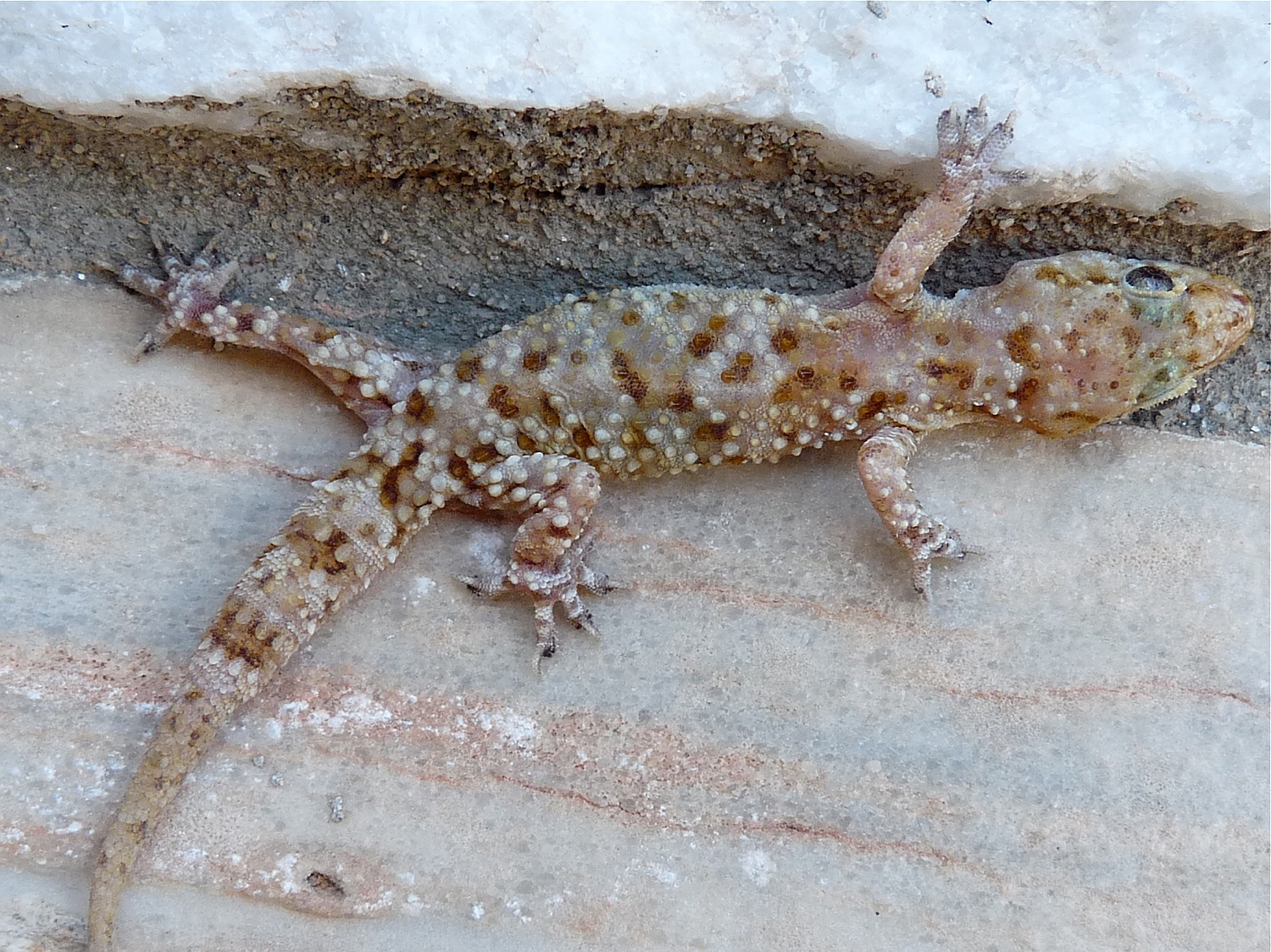
The European house gecko has a brownish colouring with many spots and dots.
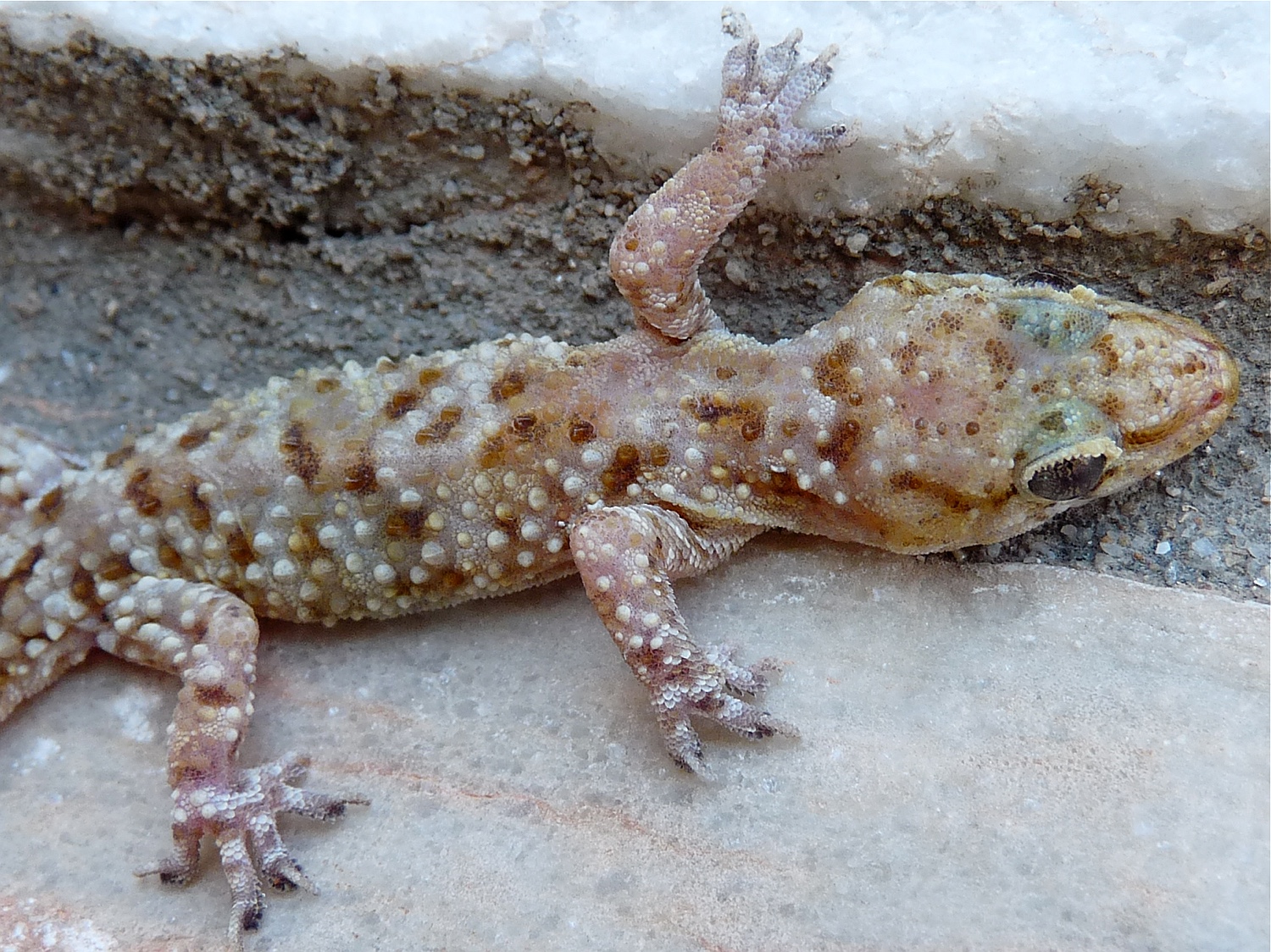
Its entire body is covered with small bumps and warts.
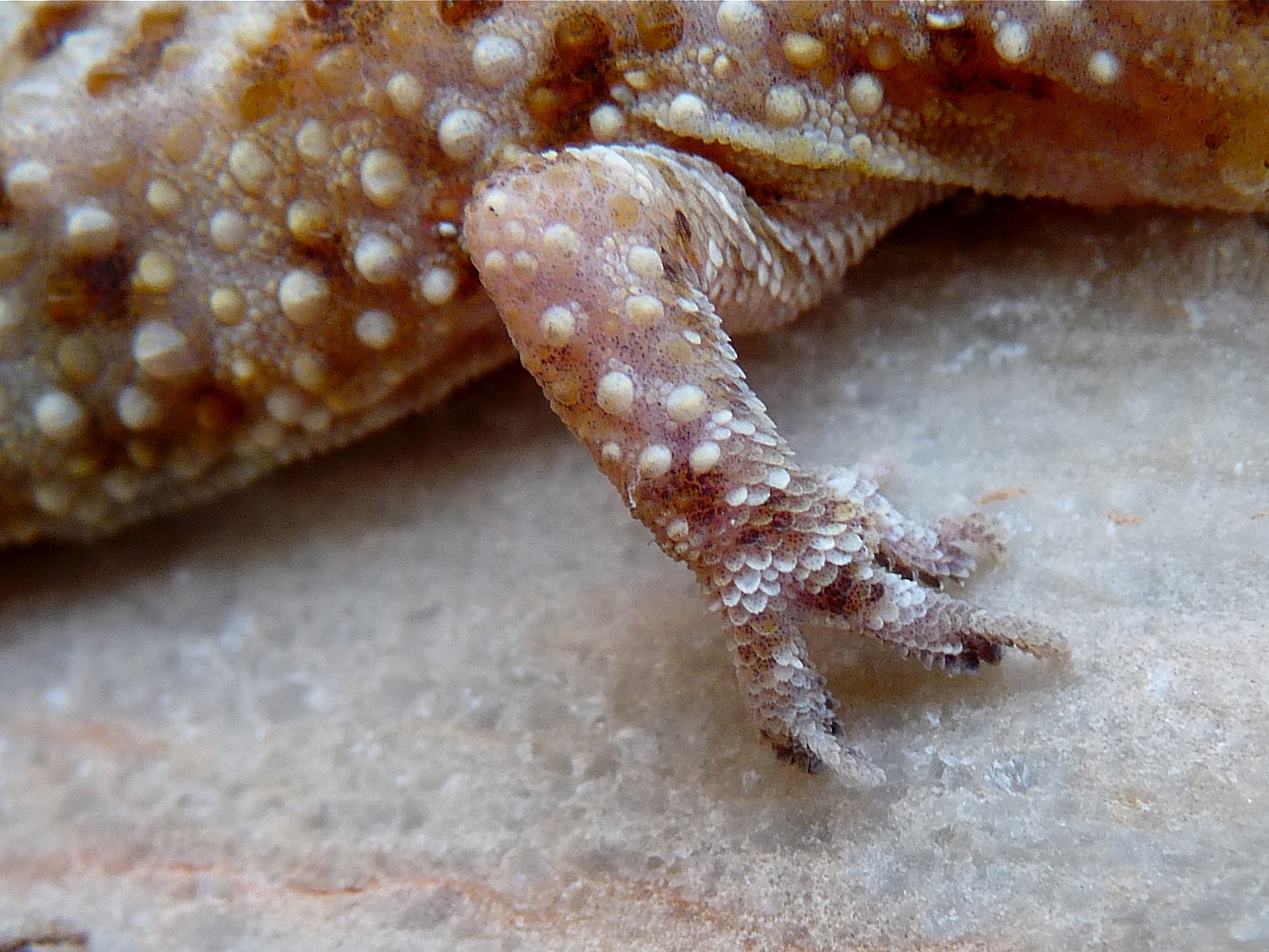
Its feet have small adhesive discs that leave the front half of its toes free.
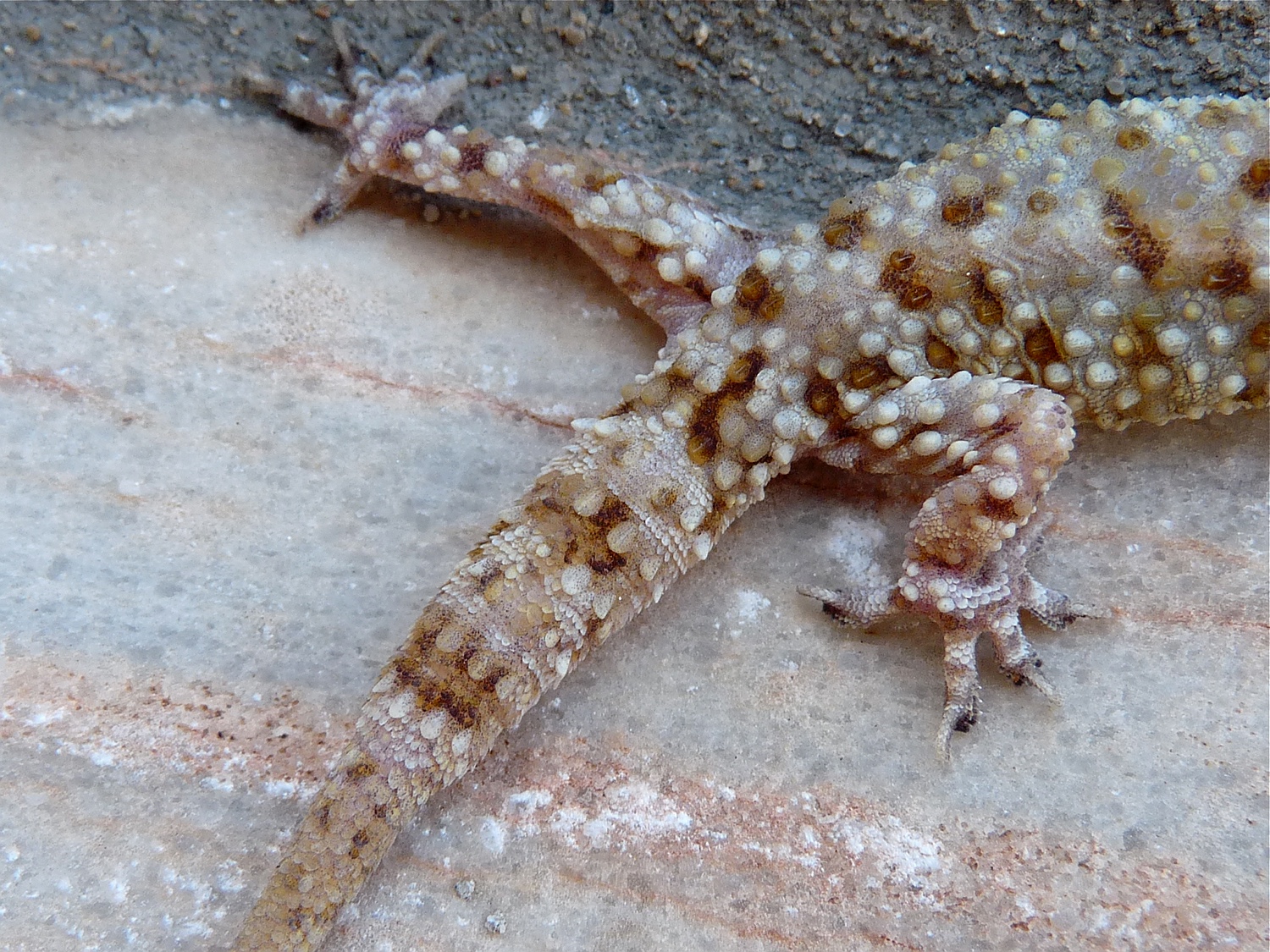
These adhesive discs enable gecko species to climb even very smooth walls.
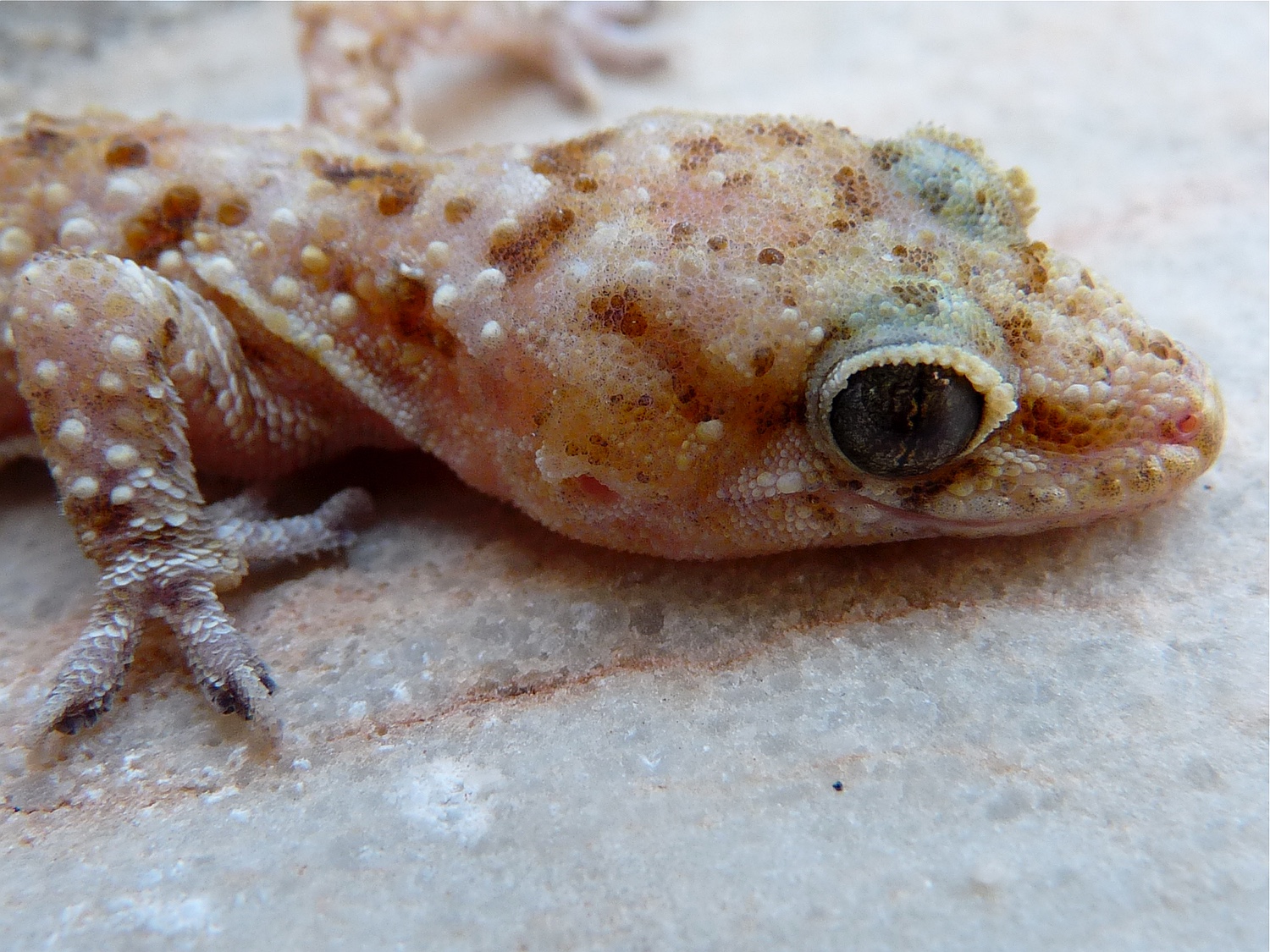
Like all geckos, the Mediterranean house gecko has vertical pupils, which can be seen here as very narrow black slits.
Kotschy’s gecko, Mediodactylus kotschyi, Steindachner
Kotschy’s gecko differs from the Mediterranean house gecko in its darker colouring and the very slender toes without adhesive discs. It too grows to a length of about 10 cm. It has small bumps on its back and tail. Kotschy’s gecko is similar to the Mediterranean house gecko in its way of life, but is slightly less adept at climbing and is less commonly found on buildings. During the day, it likes to hide under large rocks. Kotschy’s gecko is found in Greece and Turkey, the Levant, Crimea and a small area in southern Italy.
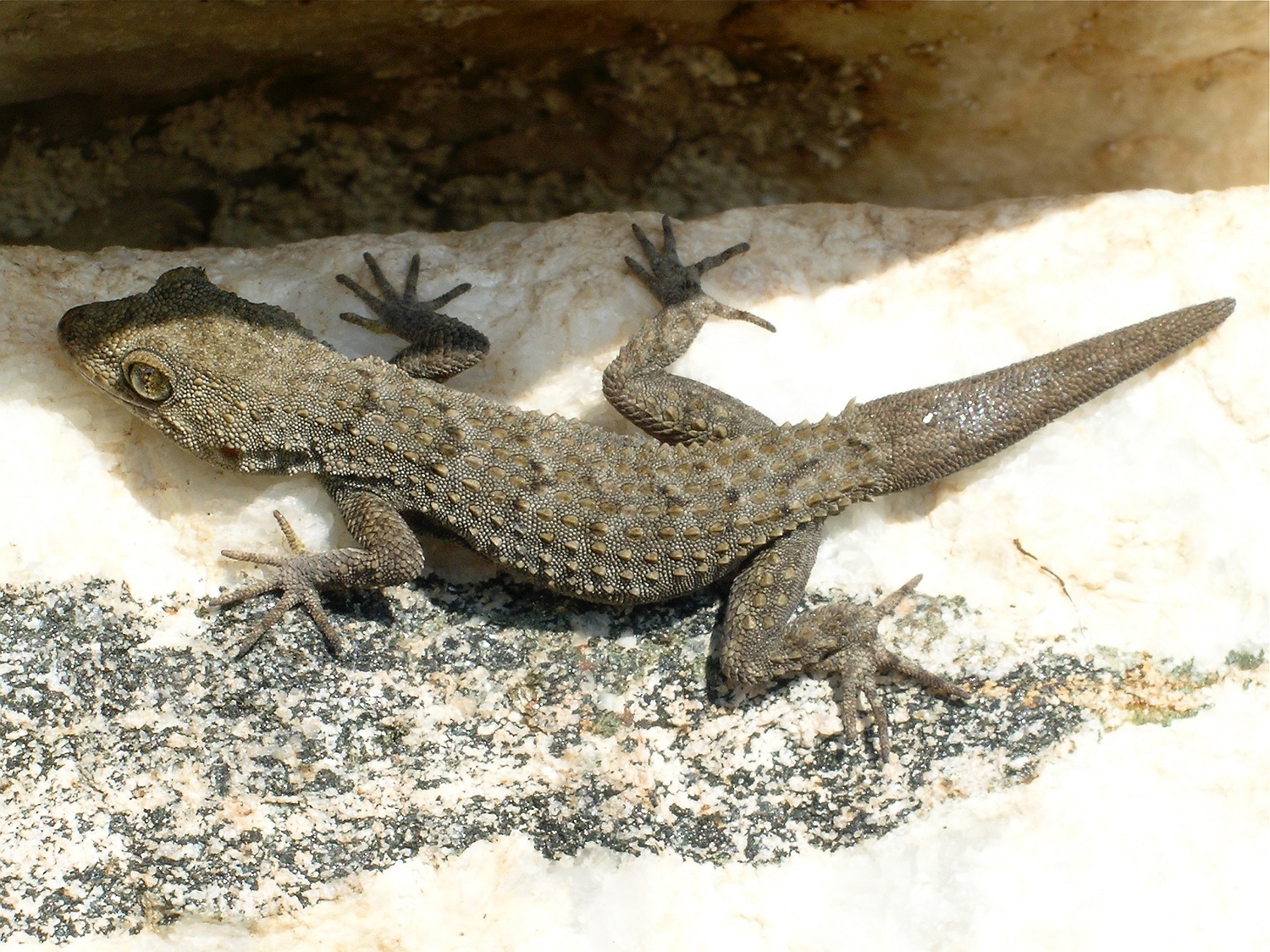
Kotschy’s gecko is usually darker in colour than the Mediterranean house gecko. This specimen has a regenerated tail, as can be seen from the fact that it lacks the typical bumps.
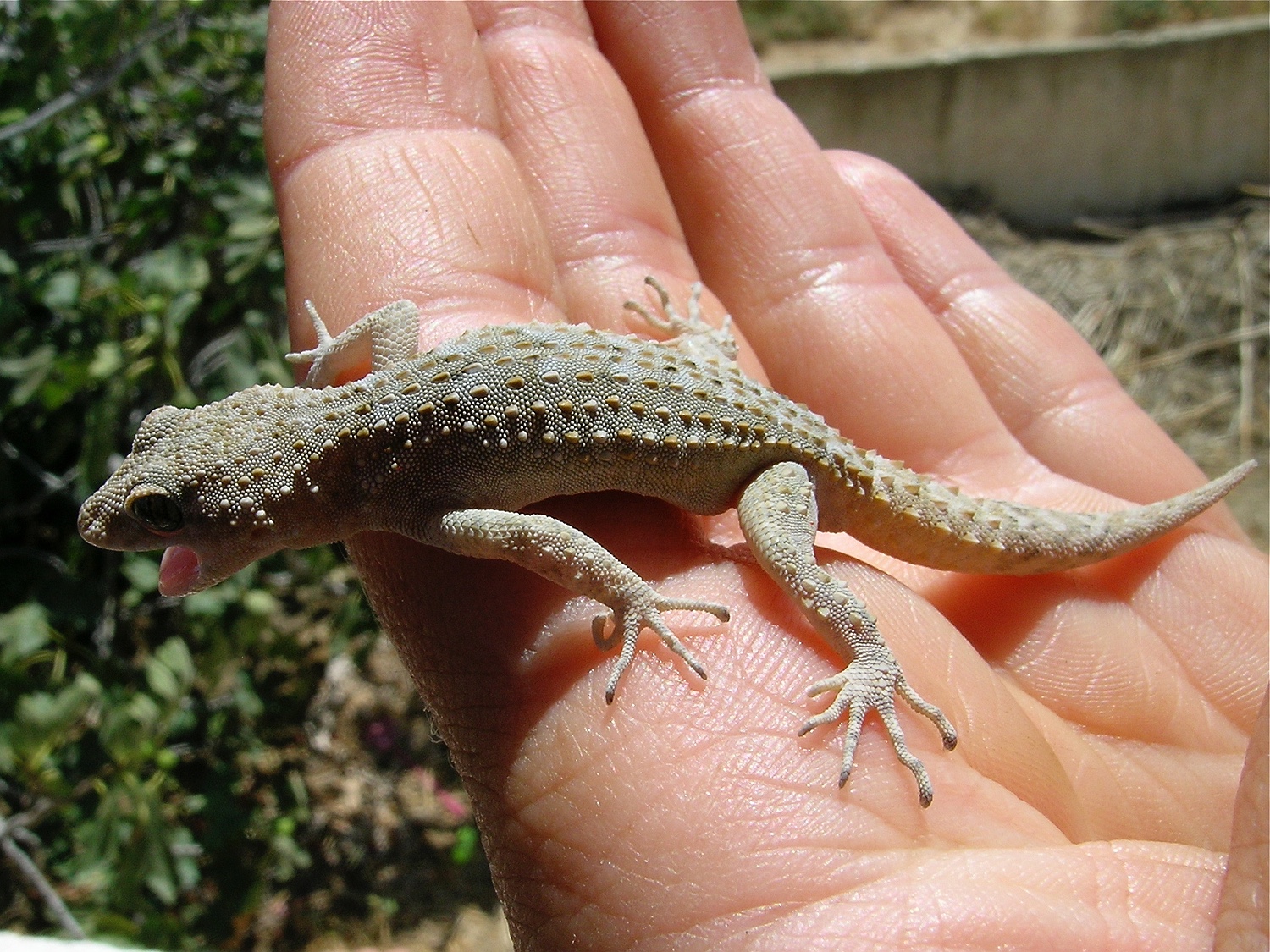
It has very slender toes without adhesive discs.
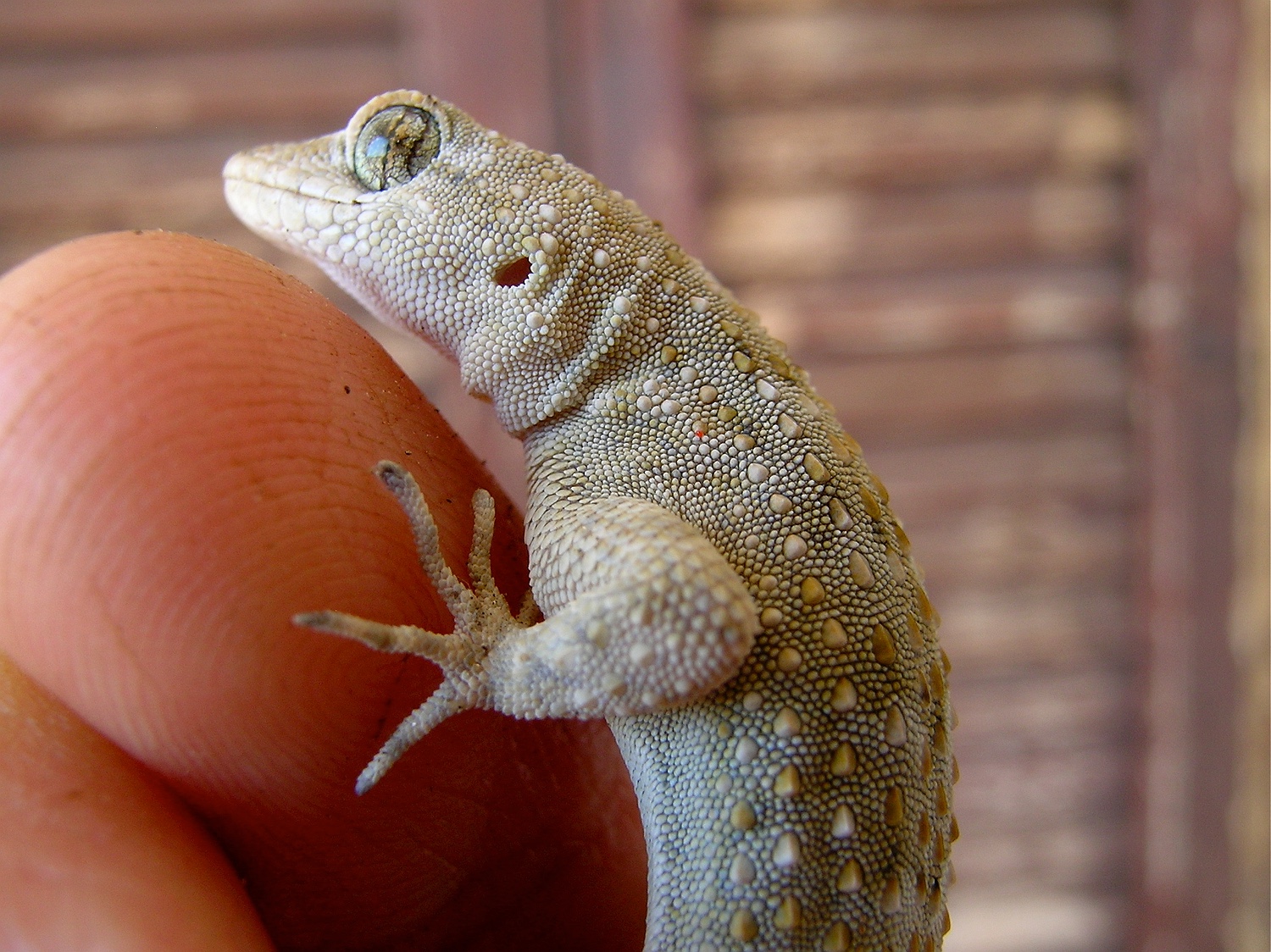
Here you can see the vertical pupils and the large ear holes.
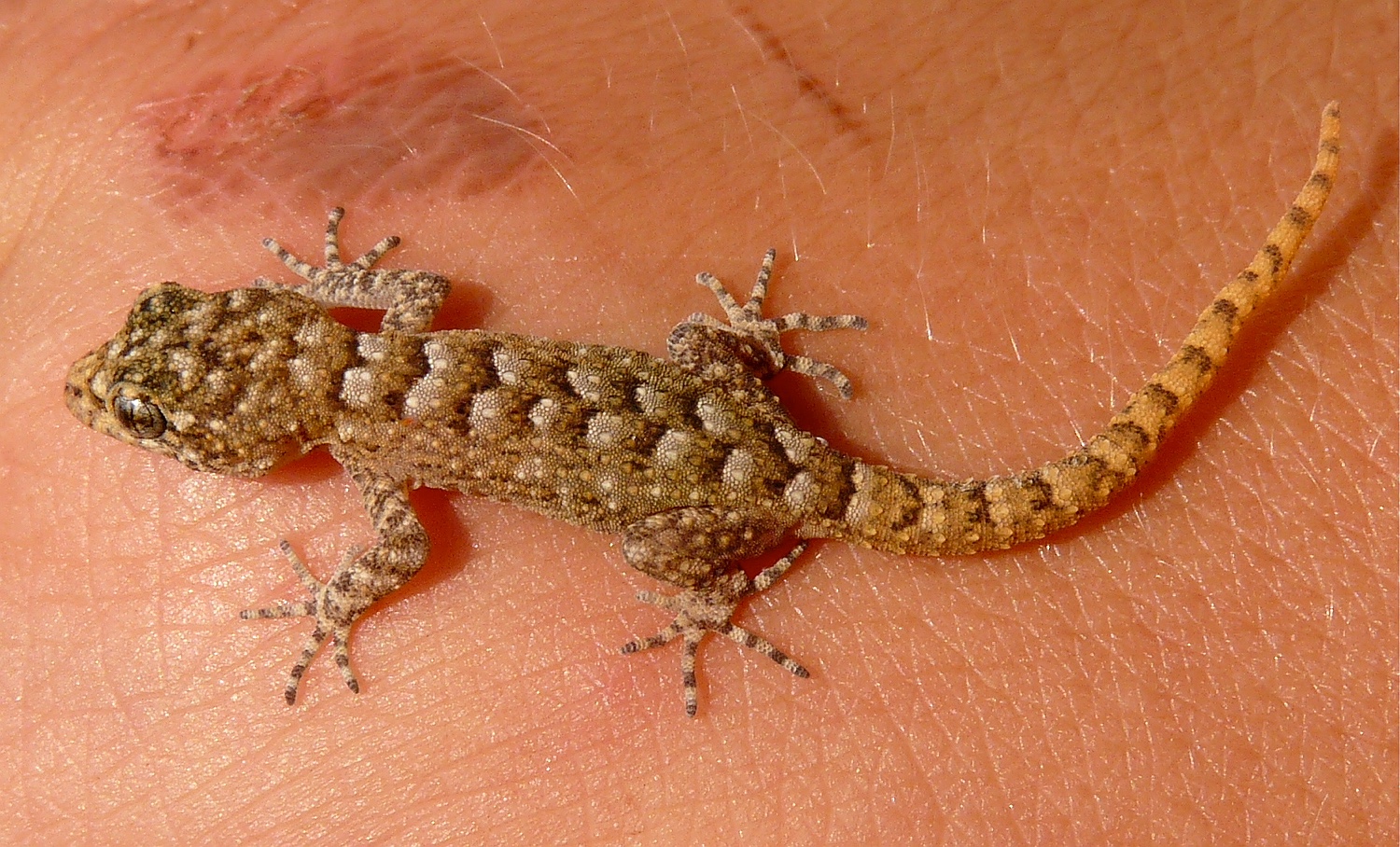
Kotschy’s gecko can change colour depending on its mood. This young specimen shows a light brown colour with intense stripes on its back and tail.
Hardun or Starred agama, Laudakia stellio, L.
The hardun belongs to the large family of agamas, which are found in Africa, Asia and Australia. It is the only species of this family that also occurs in Europe, where its range is limited to a few islands in the Cyclades, Corfu and the area around Thessaloniki. It is believed that the hardun was introduced to Greece from Africa in ancient times.
The hardun is unmistakable due to its size (up to 30 cm). It has a powerful, flattened, very spiny body, a triangular head and a long tail. Its colouring is dark grey, sometimes with lighter spots. The hardun is diurnal and can often be seen on sunny rocks. As a display of dominance, the males perform a conspicuous nodding with the head. Occasionally, when digging in the garden, you may find a clutch of white, soft-shelled, elongated eggs buried flat in the ground. The hardun feeds mainly on large insects such as bees, which is why it is not particularly popular with the population; however, it is a fearless hunter that also preys on large centipedes.
Here I would like to briefly mention the origin of the name “Laudakia stellio“. Linnaeus, who gave the reptile its name and was apparently very knowledgeable about Greek mythology, named it after Stellio, or, according to another version, Askalabos: a boy who was turned into a lizard by the goddess Demeter because he laughed at her when she ate her first meal on her return from her fruitless search for Persephone, the grain porridge kykeon, which she drank hungrily and therefore very hastily.
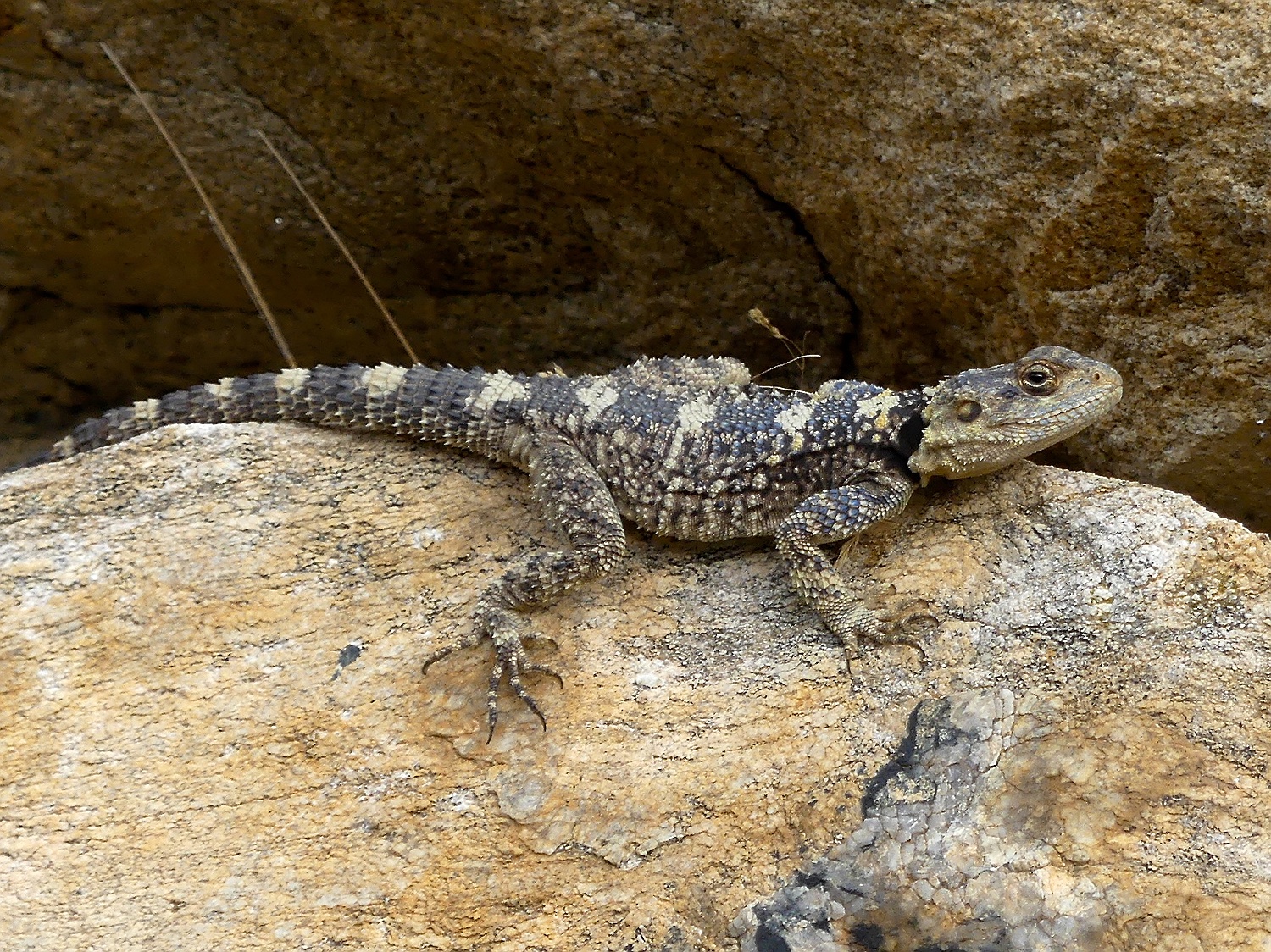
The large hardun is unmistakable.
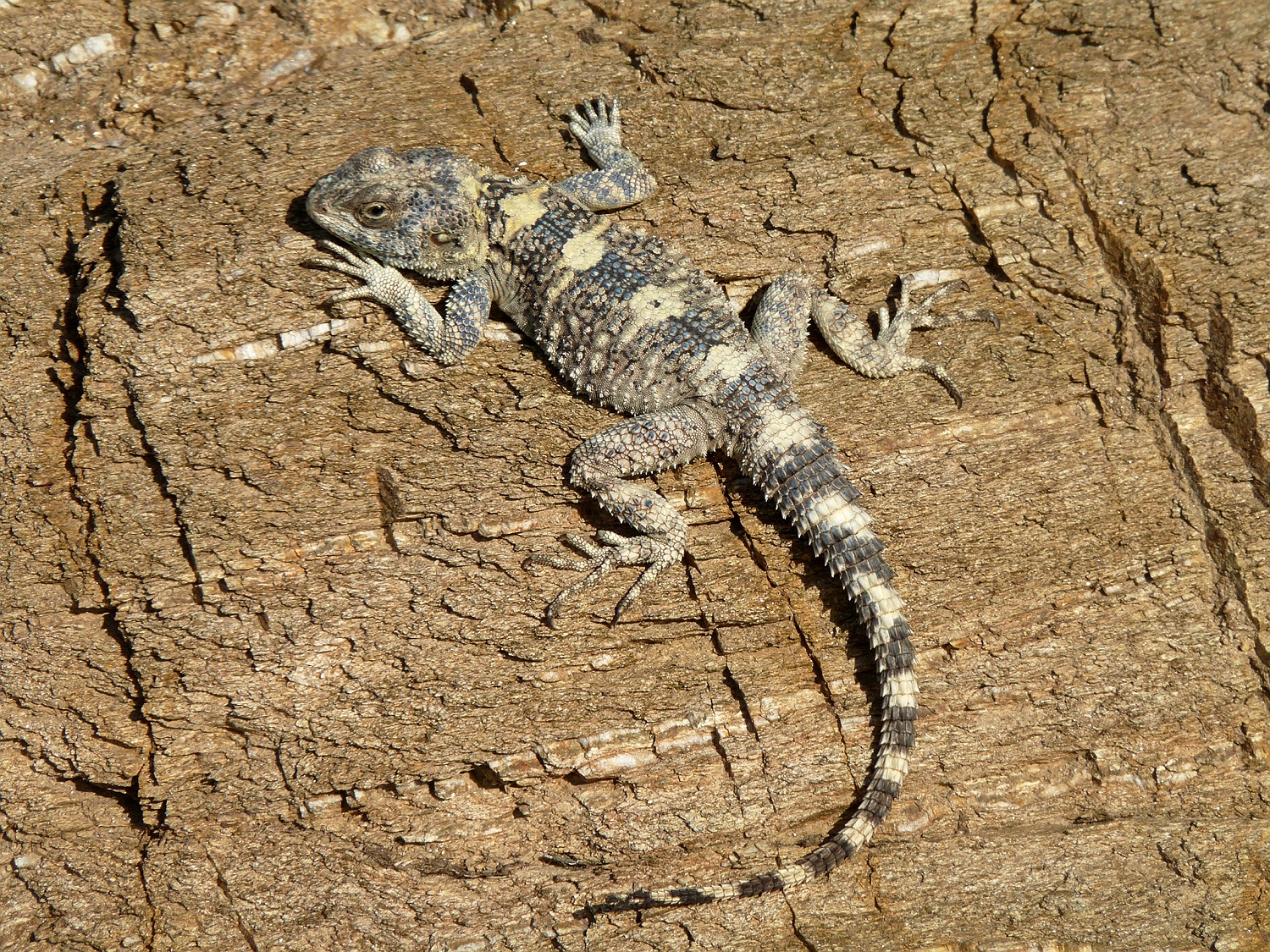
Its entire body is covered with short spines.
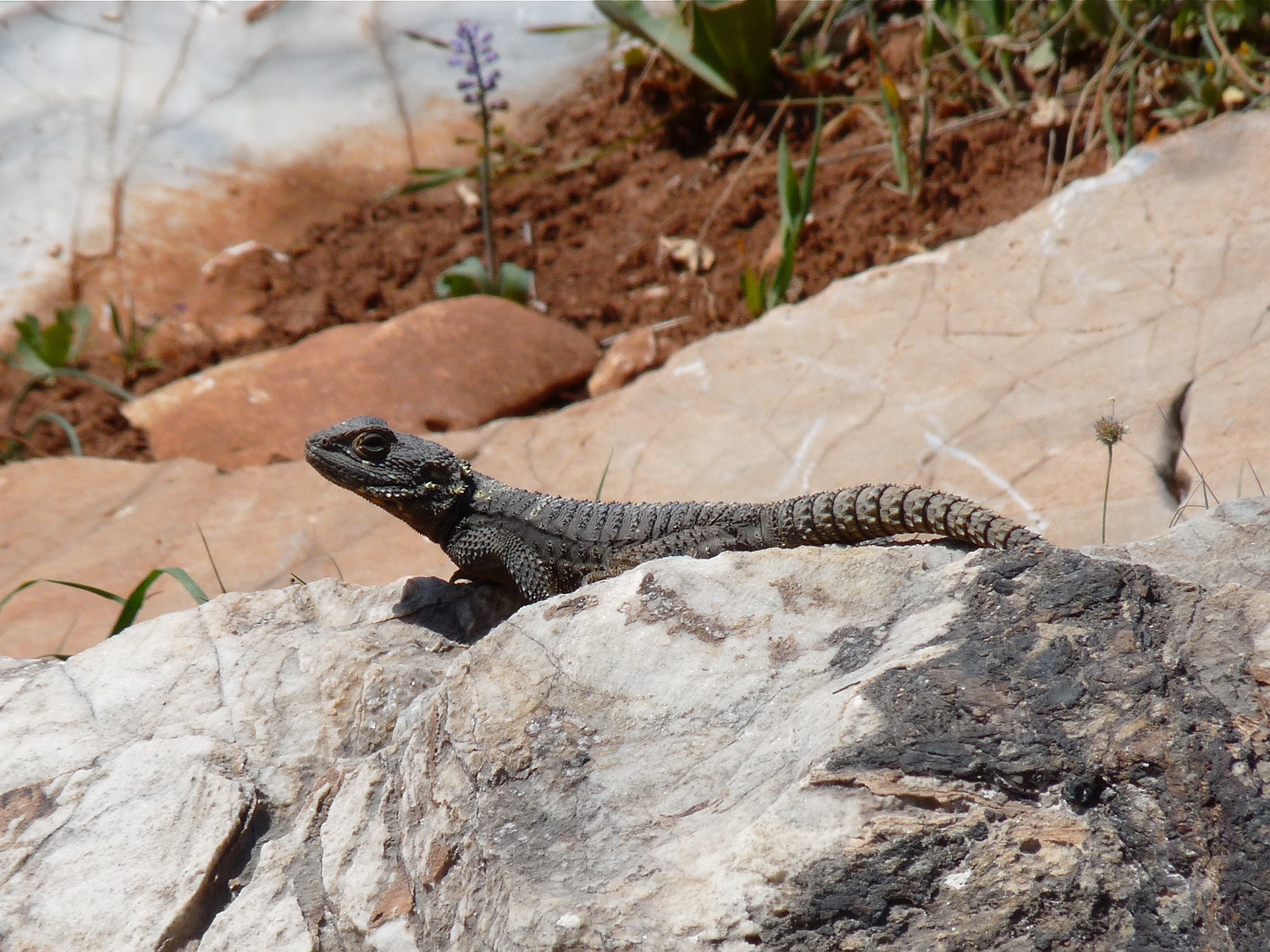
Here a particularly dark specimen.
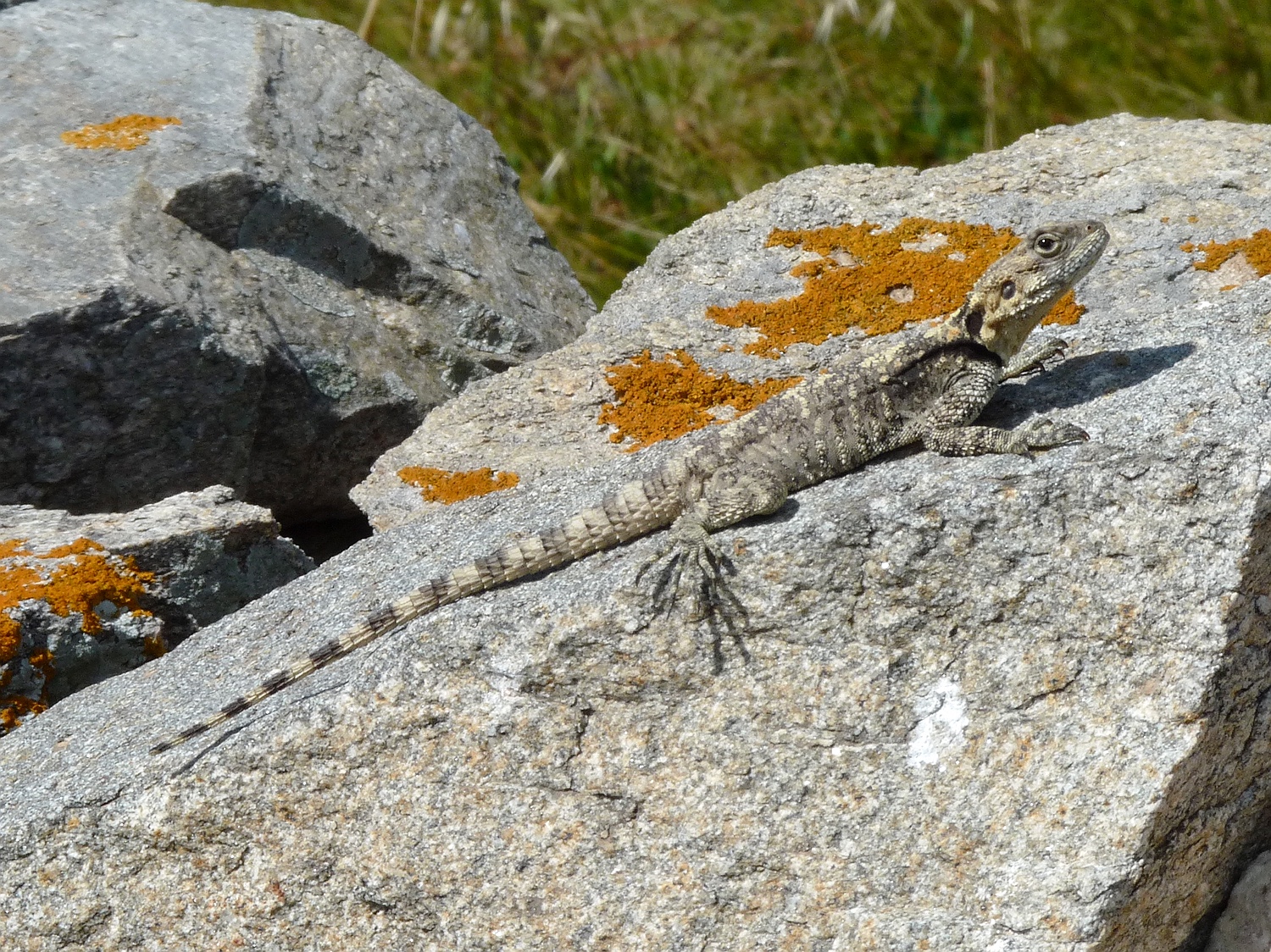
When sitting on a lookout, the hardun often moves its head jerkily up and down as a territorial display.
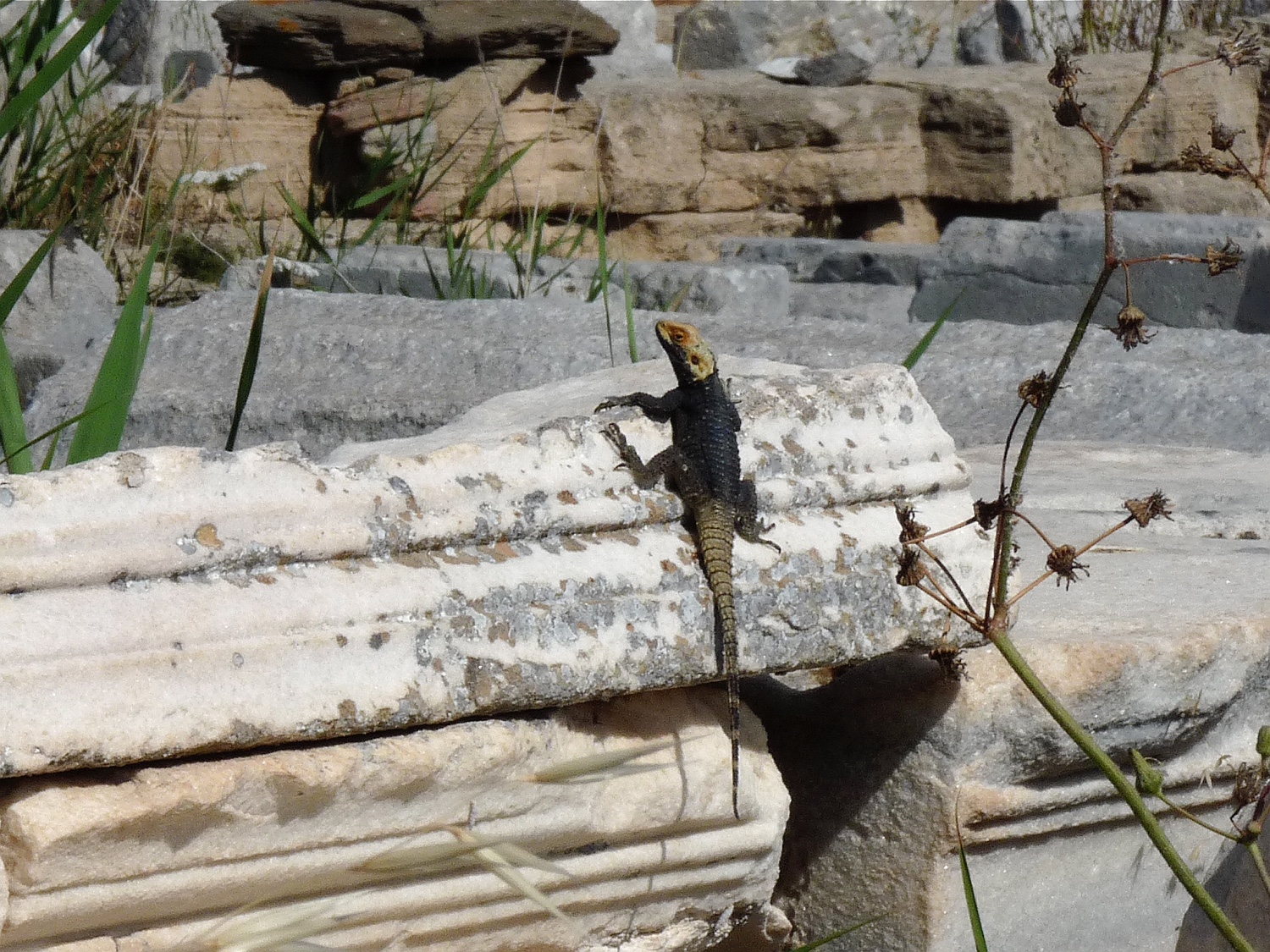
On the small neighbouring island of Delos to the north-west, the Hardun differs somewhat in colouring: Many specimens there have an almost black body and a yellow head.
Aegean wall lizard, Podarcis erhardii, Bedriaga
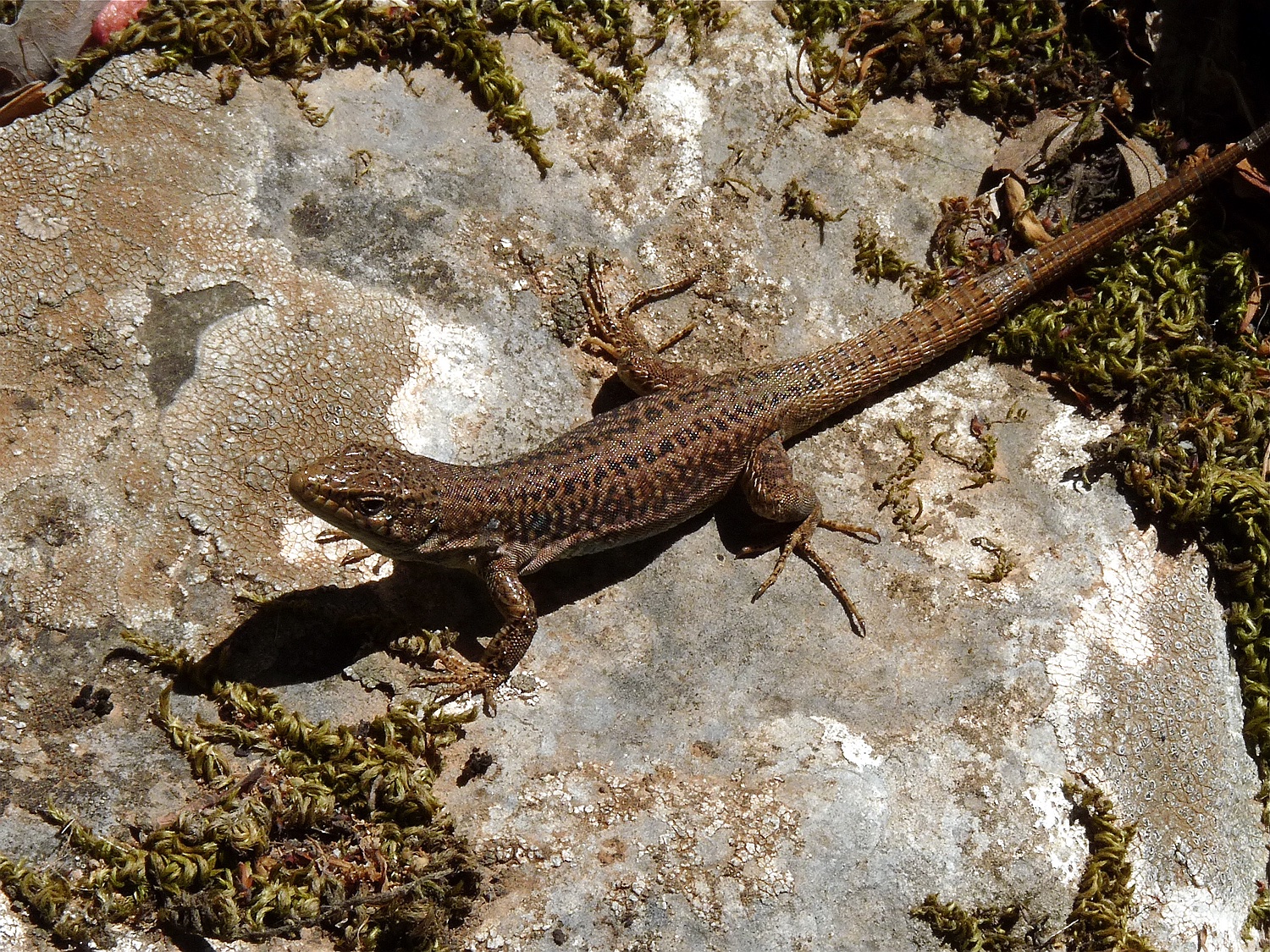
The Aegean wall lizard is by far the more common of the two lizard species that occur on Naxos. It is found in the southern Balkans and is the only lizard species on many Aegean islands. Without its very long tail, it grows to a length of about 7 cm. Its colouring is variable; females are mainly brown, while males are green, especially in spring. It often has distinctive light-coloured longitudinal stripes on its back. The wall lizard is common everywhere, not very shy and easy to observe.
The Aegean wall lizard is divided into several subspecies in the Cyclades. The subspecies Podacis erhardii naxensis (Werner) occurs on Naxos, Paros, Folegandros, Sikinos, Donoussa and the Small Cyclades, while another subspecies occurs on Amorgos and several smaller islands to the east and south-east of it. The larger of the Makares Islands has its own subspecies called Podarcis erhardii makariaisi (Wettstein). Another subspecies called Podarcis erhardii buchholzi (Wettstein) inhabits the small rocky island of Ktenia (called mérmingas (= ant) by the local population, with a beacon), which is visible to the northeast from Azalás.
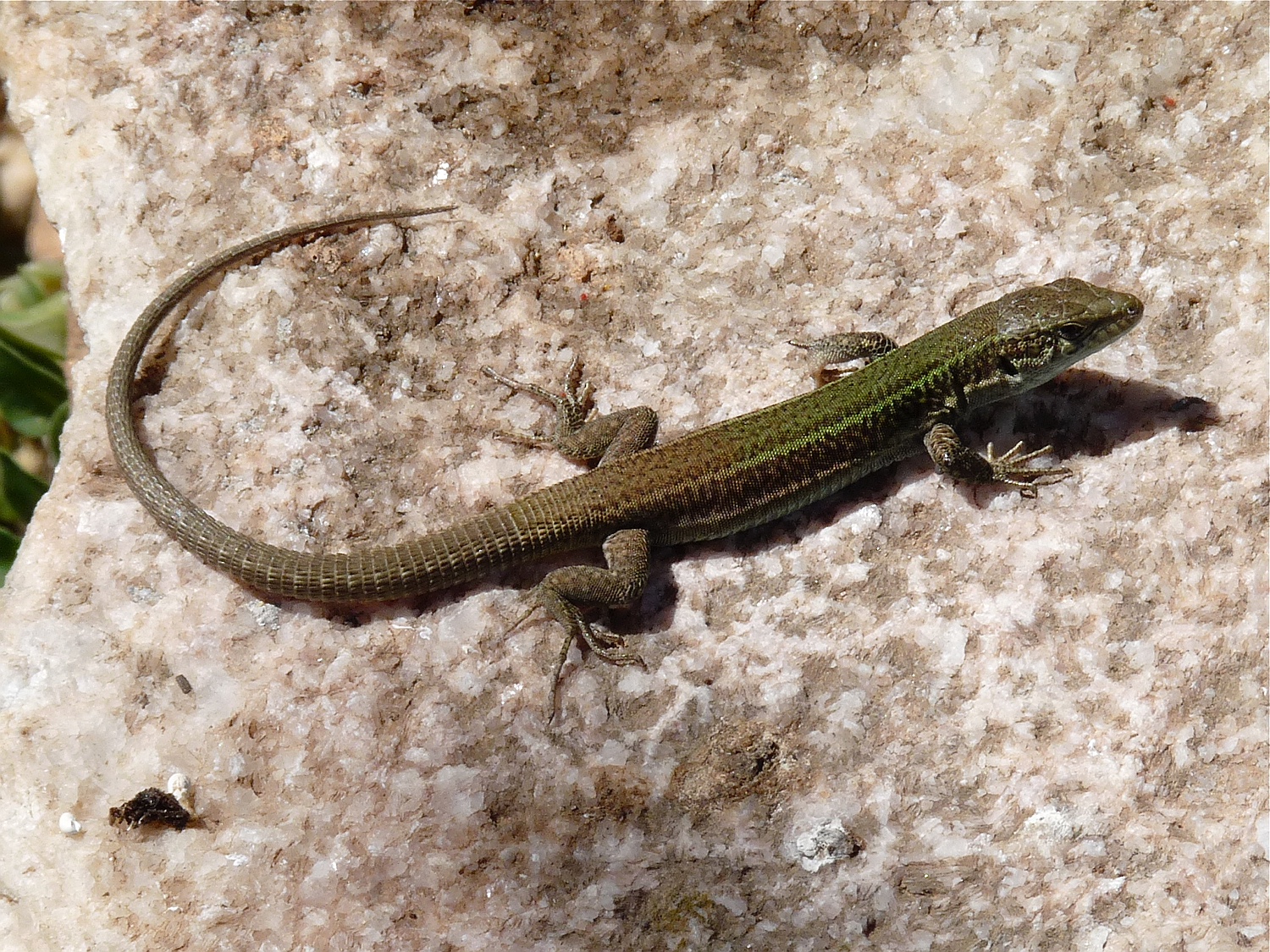
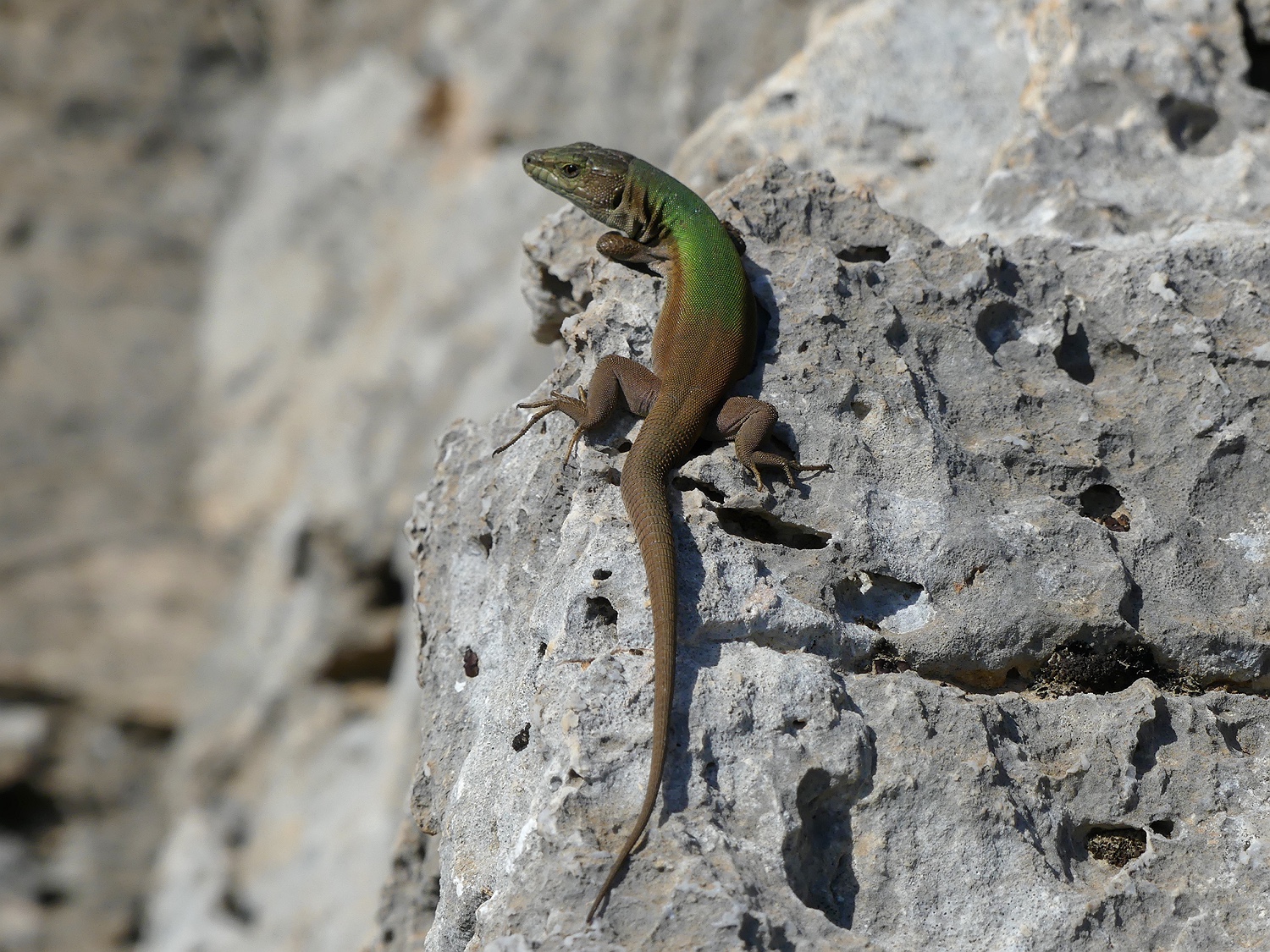
The males of the Aegean wall lizard have a greenish back.
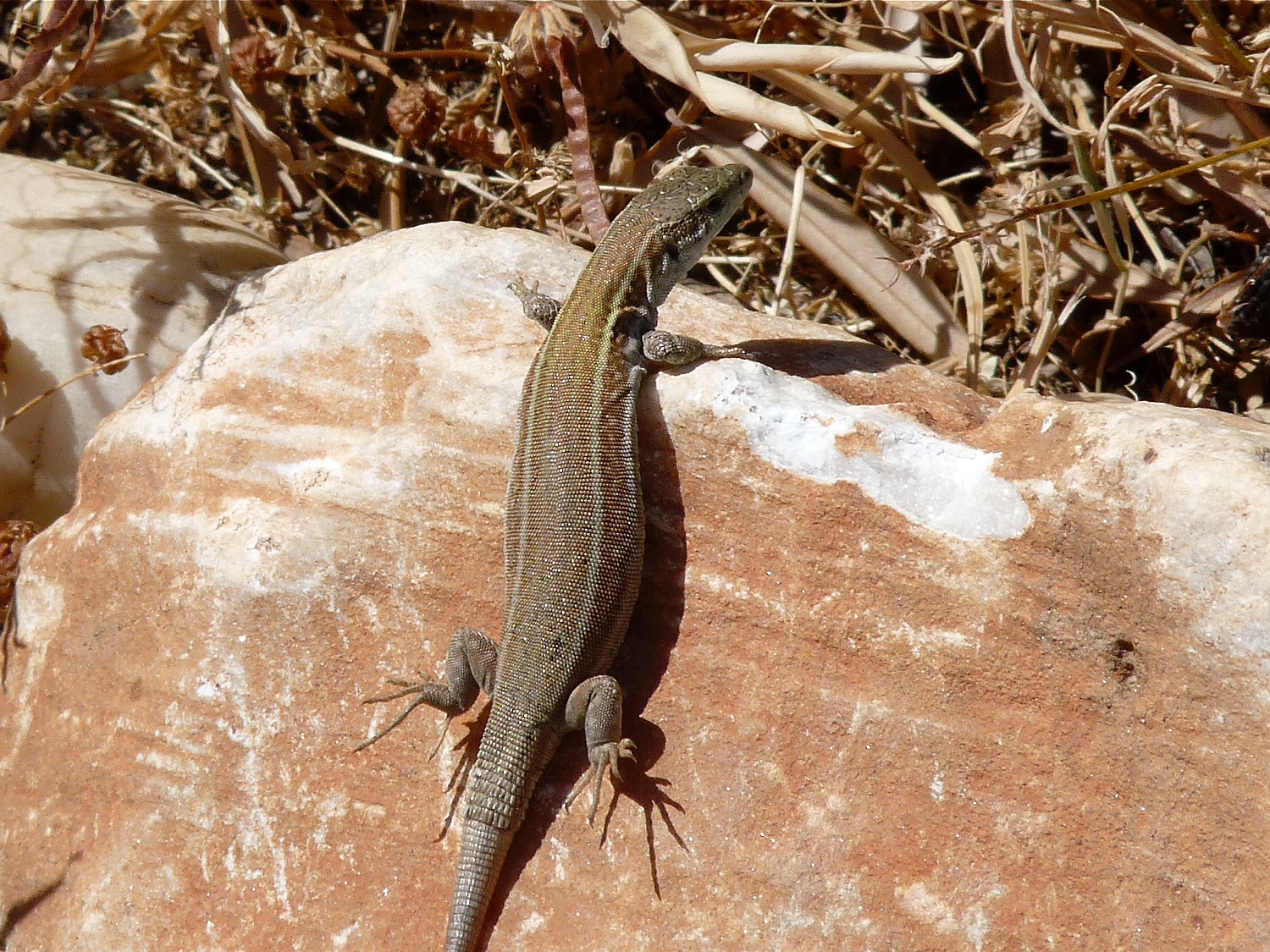
The females are brown with longitudinal stripes. The animals on hot stones in the sun often hold their feet in the air, as shown here.
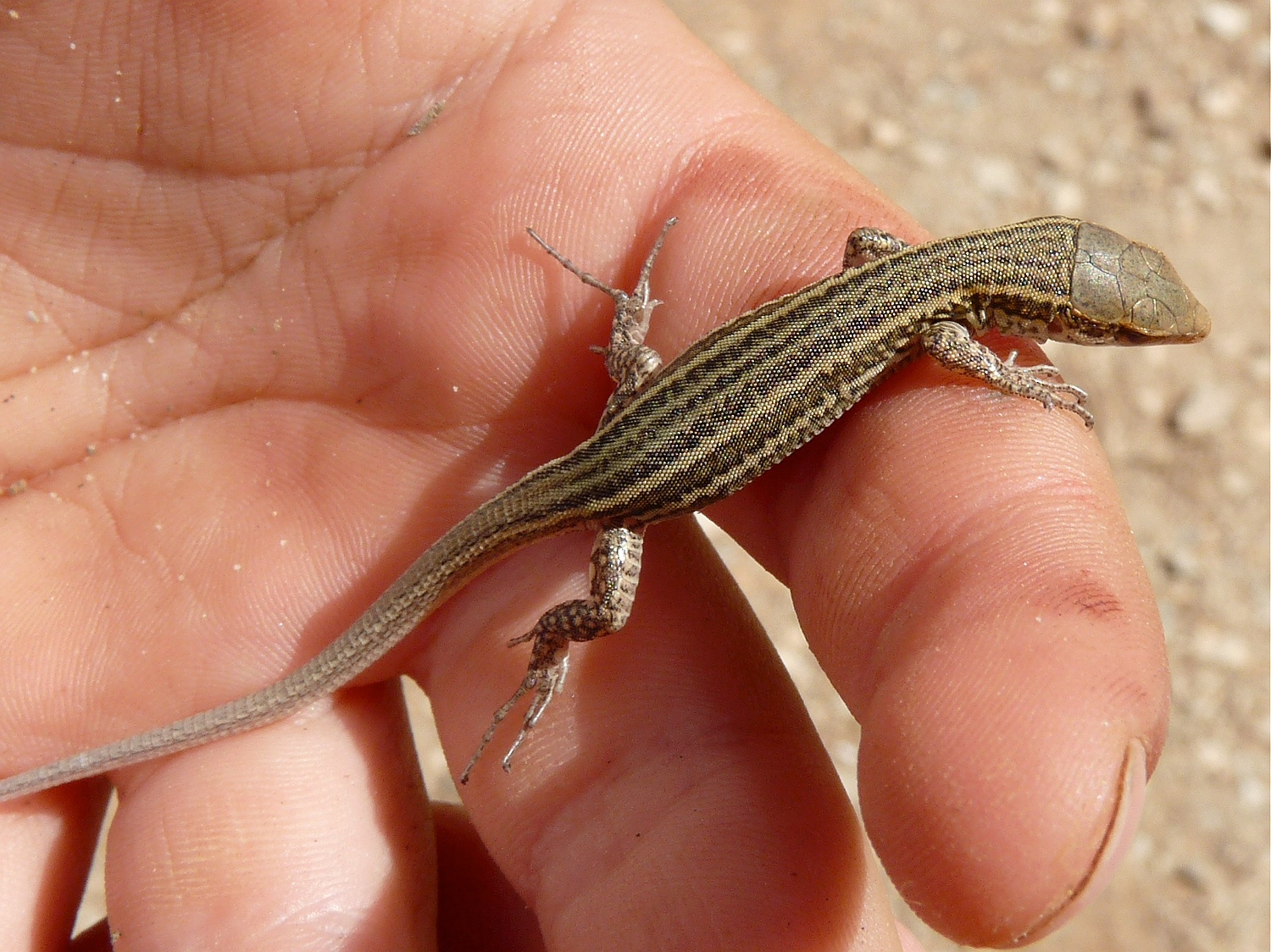
The young animals, which are also striped, can be seen from June onwards.
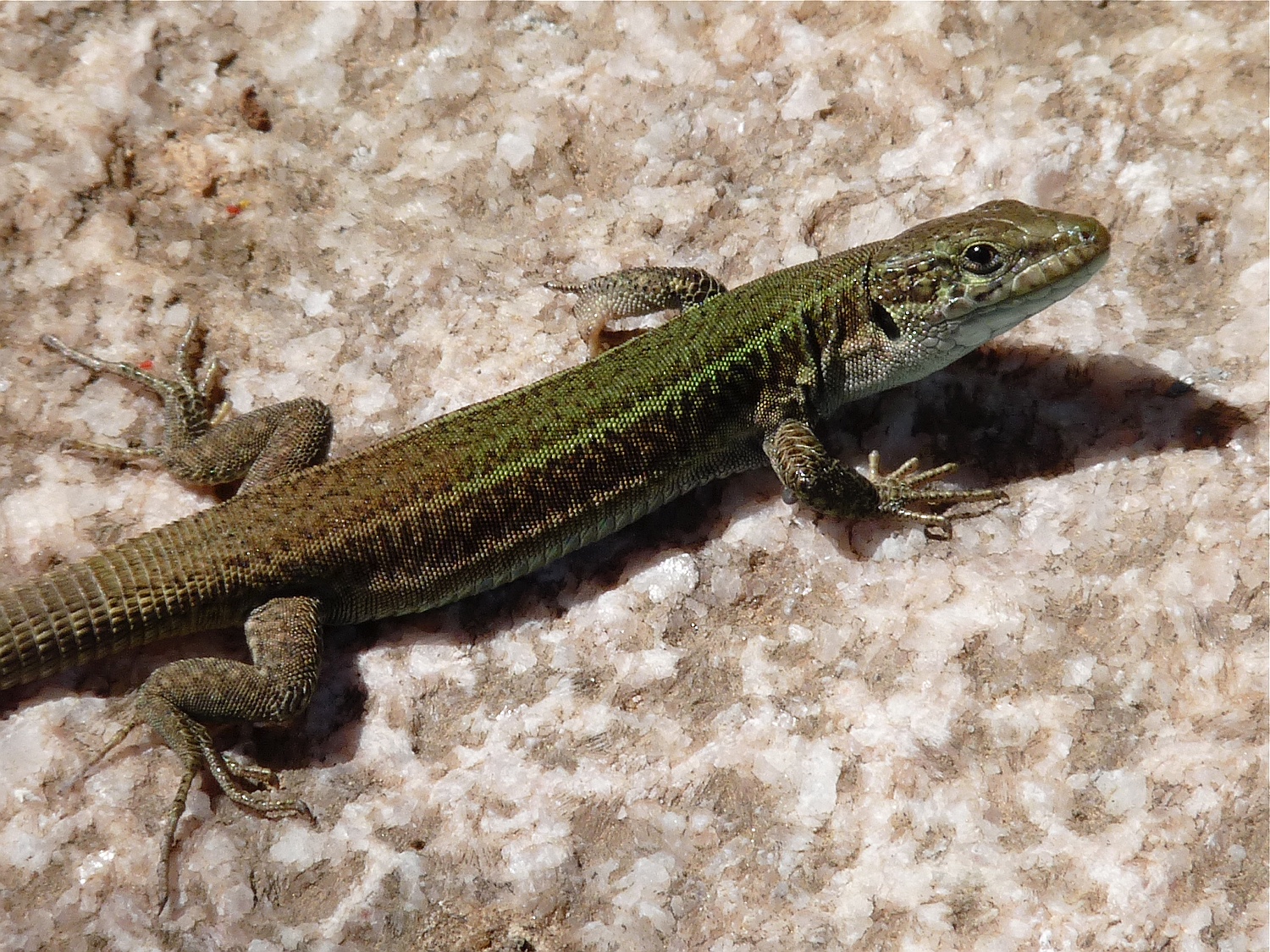
The Aegean wall lizard is very curious!
Balkan green lizard, Lacerta trilineata, Bedriaga
A ssecond species of lizard occurs on Naxos, apart from the small Aegean wall lizard, namely the Balkan green lizard, which can grow to over 40 cm (16 cm without the tail) in length. It is much rarer than the Aegean wall lizard and very shy. Therefore we see it only rarely; usually one only catches a glimpse of the animal darting across the road or disappearing into the bushes. It has a green body with fine speckles; young animals usually have longitudinal stripes and lighter spots. The Balkan green lizard is found only in the southern and eastern Balkans, including the (larger) Greek islands.
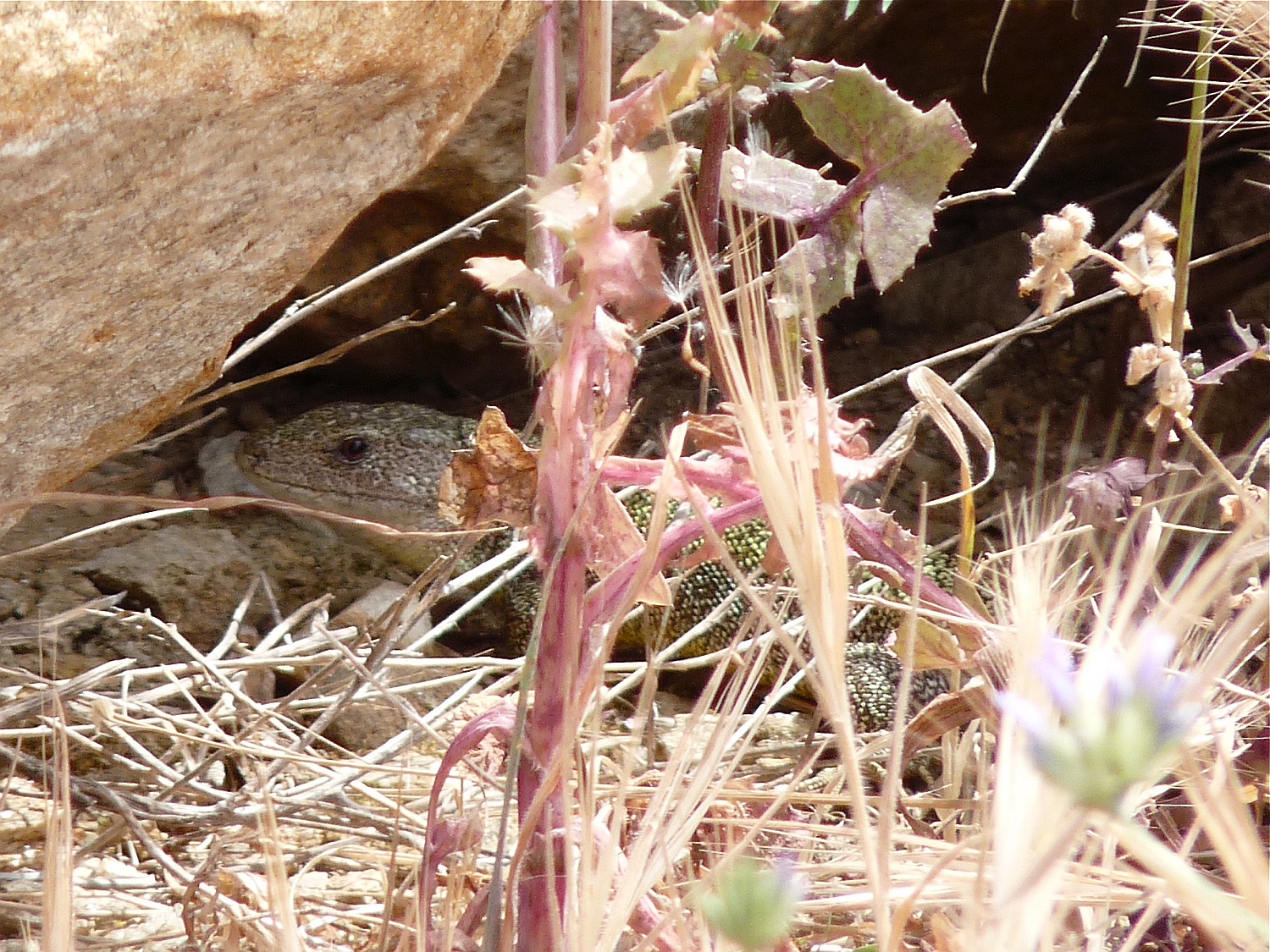
The Balkan green lizard is very shy.
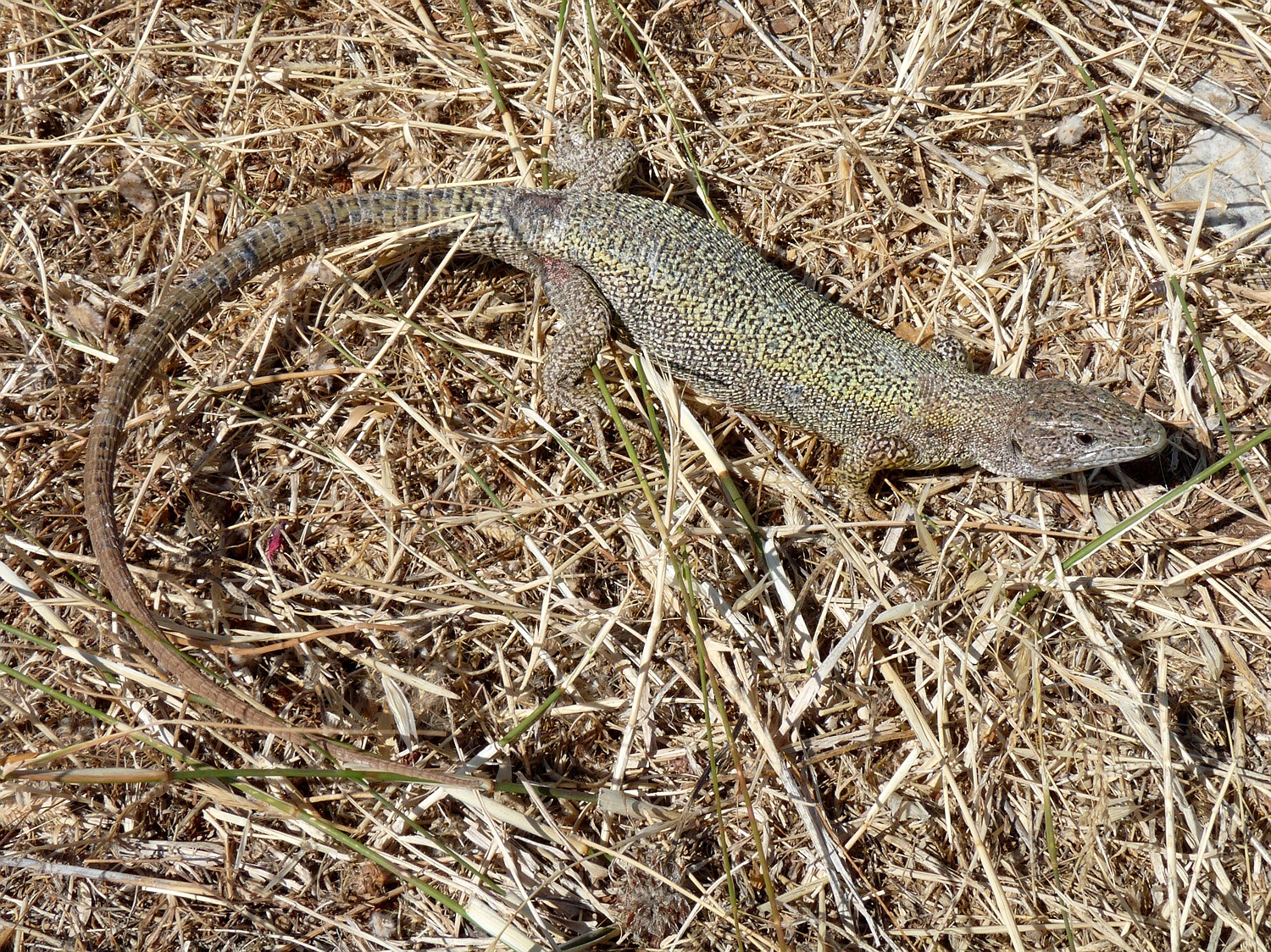
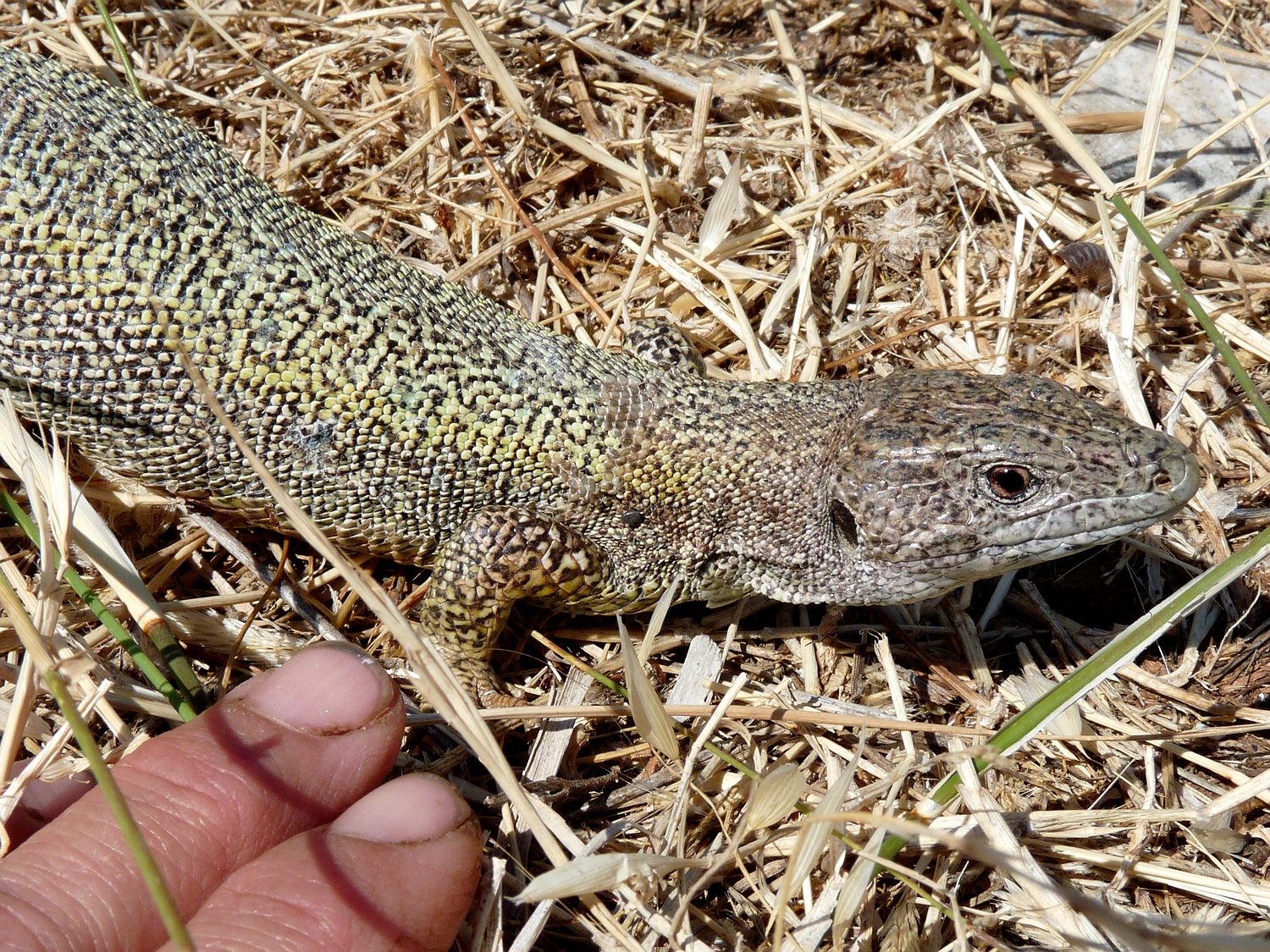
Recently, we have been seeing more of these lizards on our property; however, they suffer somewhat from the cats (although when they encounter each other, the lizard bites the cat quite as much as the cat bites the lizard).
European copper skink, Ablepharus kitaibelii, Bibron & Bory de Saint-Vincent
The European copper skink belongs to the family of the skinks. These have very small legs that are hardly used, or no legs at all. The legs of the European copper skink are relatively well developed and are used to support the body when it sits; however, the animal moves like a snake in an undulating movement without the use of its legs.
The European copper skink is small (up to about 15 cm) and thin. It is bronze-coloured with a darker longitudinal stripe on its side; its back is very shiny. It feeds mainly on insects. European copper skinks are rarely seen, although they are quite common in our garden.
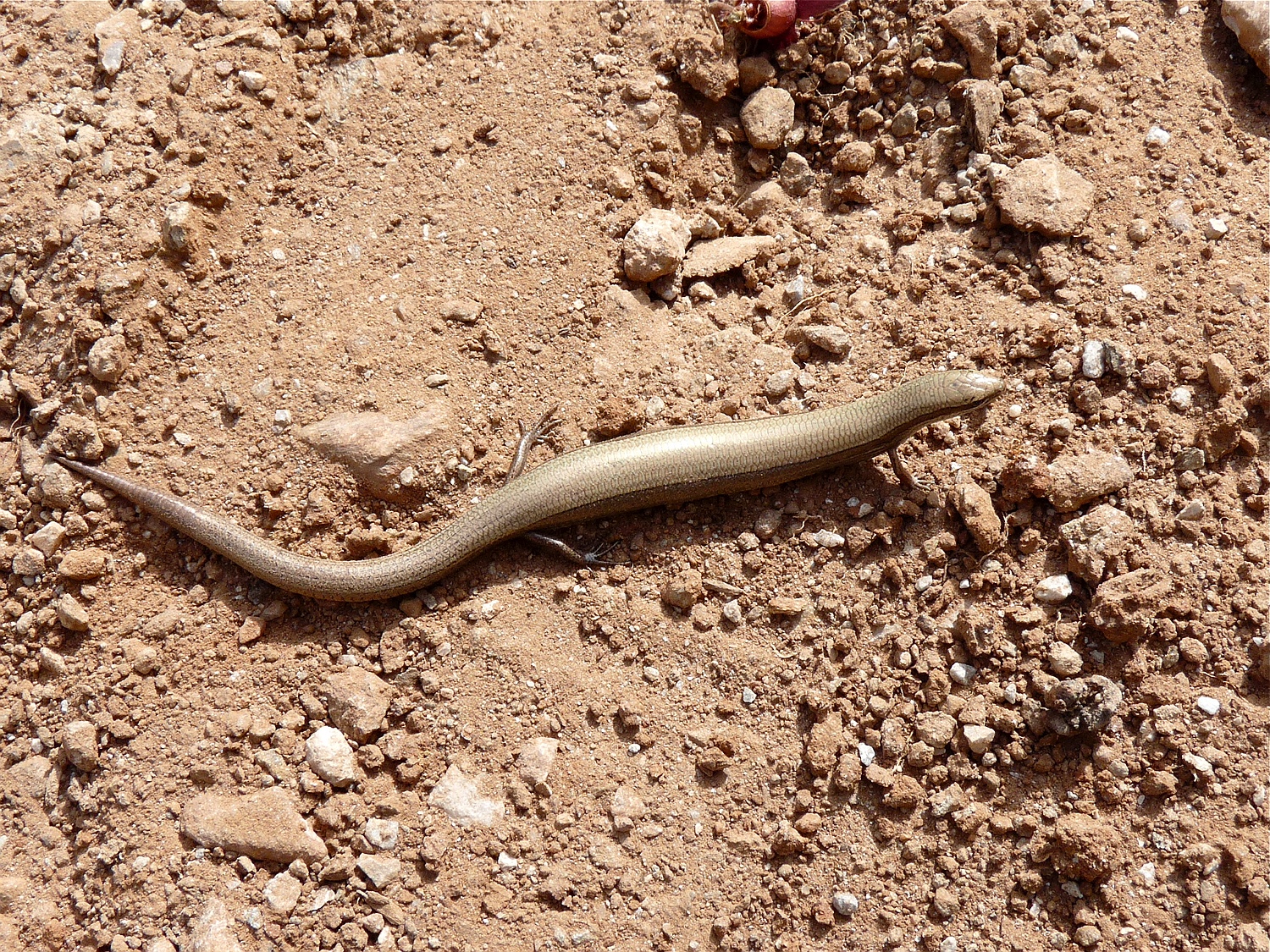
The European copper skink at first glance resembles a tiny snake due to its winding, snakelike movements.
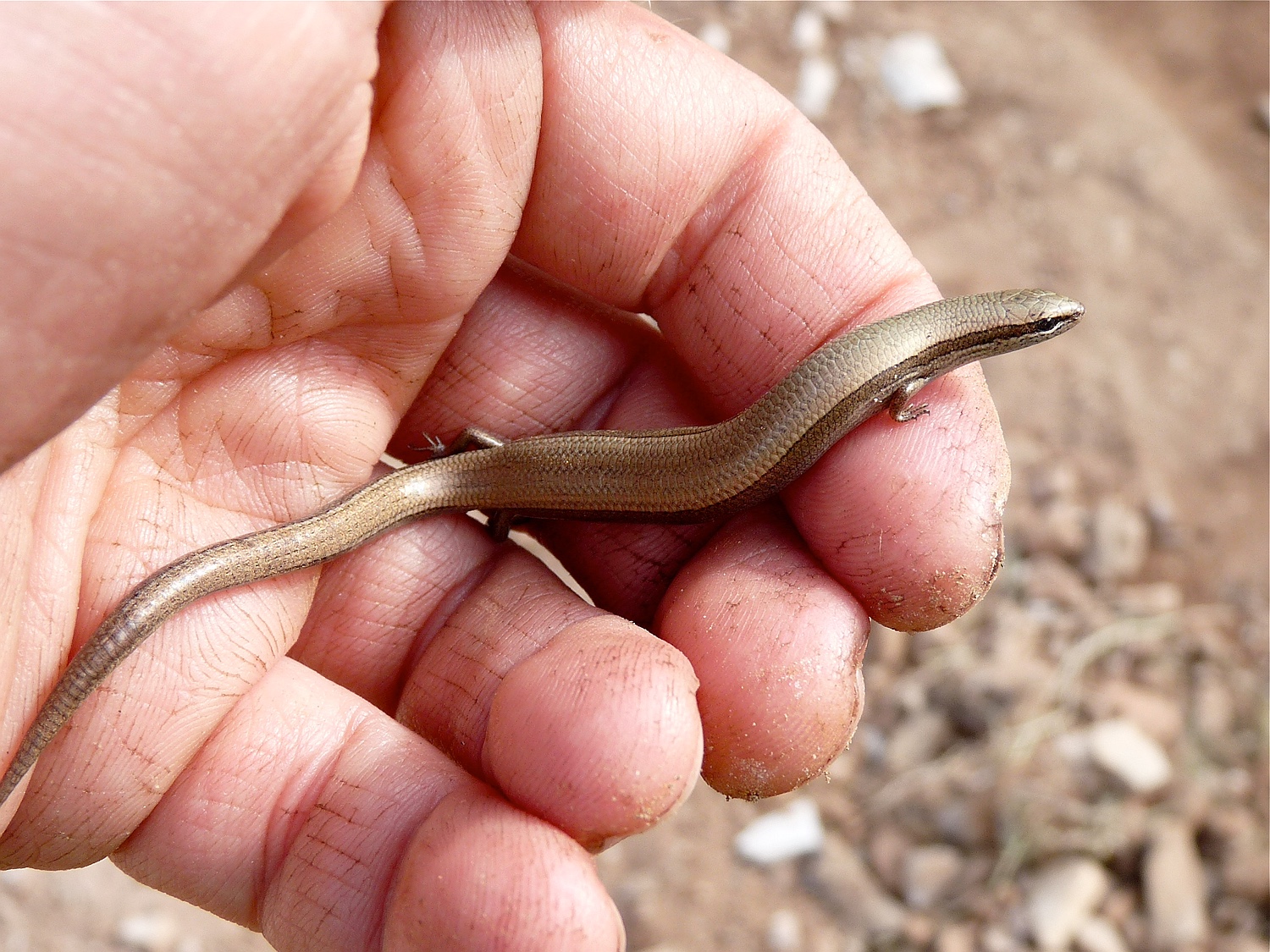
Skinks are a transitional form between a lizard and a snake, with very small legs that are hardly used. The European copper skink is quite common, though one does not see it very often.
continue: Snakes
back: The Fauna of Naxos
see also: Animals in the rivers of Naxos
Comments are closed.