Gastropoda 9: Slugs
Marine slugs belong to the gastropods (Gastropoda) and, more specifically, to the opisthobranchs, though this group is no longer recognized. Today the marine slugs mentioned here are placed in the superorder Nudipleura and the three orders Pleurobranchida, Nudibranchia and Aplysiida (sea hares). There are around 3,000 species of marine slugs, of which some are herbivorous while others feed on sessile marine animals such as sponges, corals, polyps and tunicates. They protect themselves from predators through their colouring, which, despite often being bright, can act as camouflage; in addition, many species are poisonous, partly due to substances they absorb from their food.
Many species of slugs occur in the Mediterranean, but most of them are not very common or are so small that they are difficult to spot. Many marine slugs are very beautiful and conspicuous, with bright colours. One such species can sometimes be observed in our waters: the Dotted sea slug (Peltodoris acromaculata), which lives and feeds on sponges of the genus Petrosia. It is well worth keeping an eye out for this pretty creature when snorkelling. Unfortunately, I do not have a photo of this species. Instead, I can introduce some other small and large species that I have encountered directly at the coast.
The Photo gallery of the marine snails gives an overview over the species.
A note on identification: Some species usually can be identified easily and reliably. In many cases, however, several related species are difficult to distinguish. Also not all species are included in the field guides; even using the internet, it is difficult to find information on some species. Accordingly, some of the identifications may not be correct.
And a word about the names: As with many marine animals, there is a great deal of confusion surrounding the names of snails: for almost all species, a large number of synonyms exist that are no longer valid today but are still used in older books. I use the names according to the World Register of Marine Species (as of 2020), where you can also find the corresponding synonyms.
Here you can jump directly to the species (return with the back arrow or by swiping back):
Elysia timida – Tricoloured felimare, Felimare tricolor – Dwarf sea hare, Aplysia parvula – Spotted sea hare, Aplysia dactylomela – Depilatory sea hare, Aplysia depilans
A: Order Pleurobranchida
Elysia timida, Risso
The small sea slug species Elysia timida grows only to 5 mm in size. It feeds on algae (especially Acetabularia), whose chloroplasts it does not digest but places in its tissue; they give the slug its greenish colour. Since the slug can survive for many months without food in the light, it was assumed that the chloroplasts in the slug continue to perform photosynthesis; however, recent studies suggest that this is not the case.
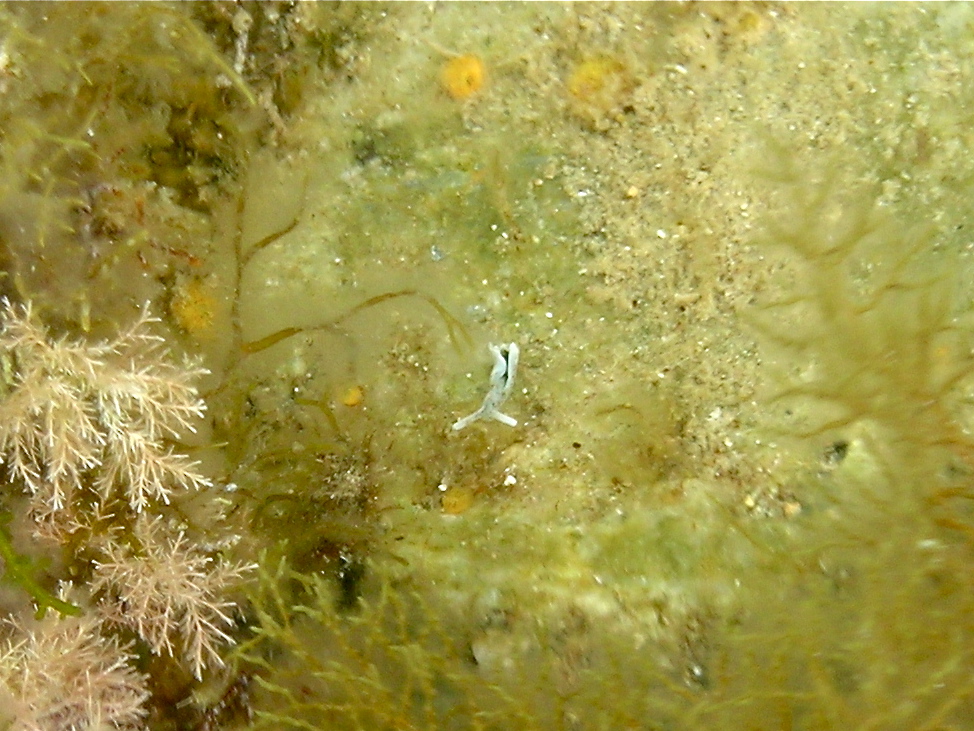
Elysia timida has small red dots, which cannot be seen here (due to the tiny size); which is why the identification is not entirely certain.
B: Order Nudibranchia
Tricoloured felimare, Felimare tricolor, Cantraine
(= Hypselodoris tricolor)
Slugs of the genus Felimare such as the Tricoloured felimare feed on sponges.
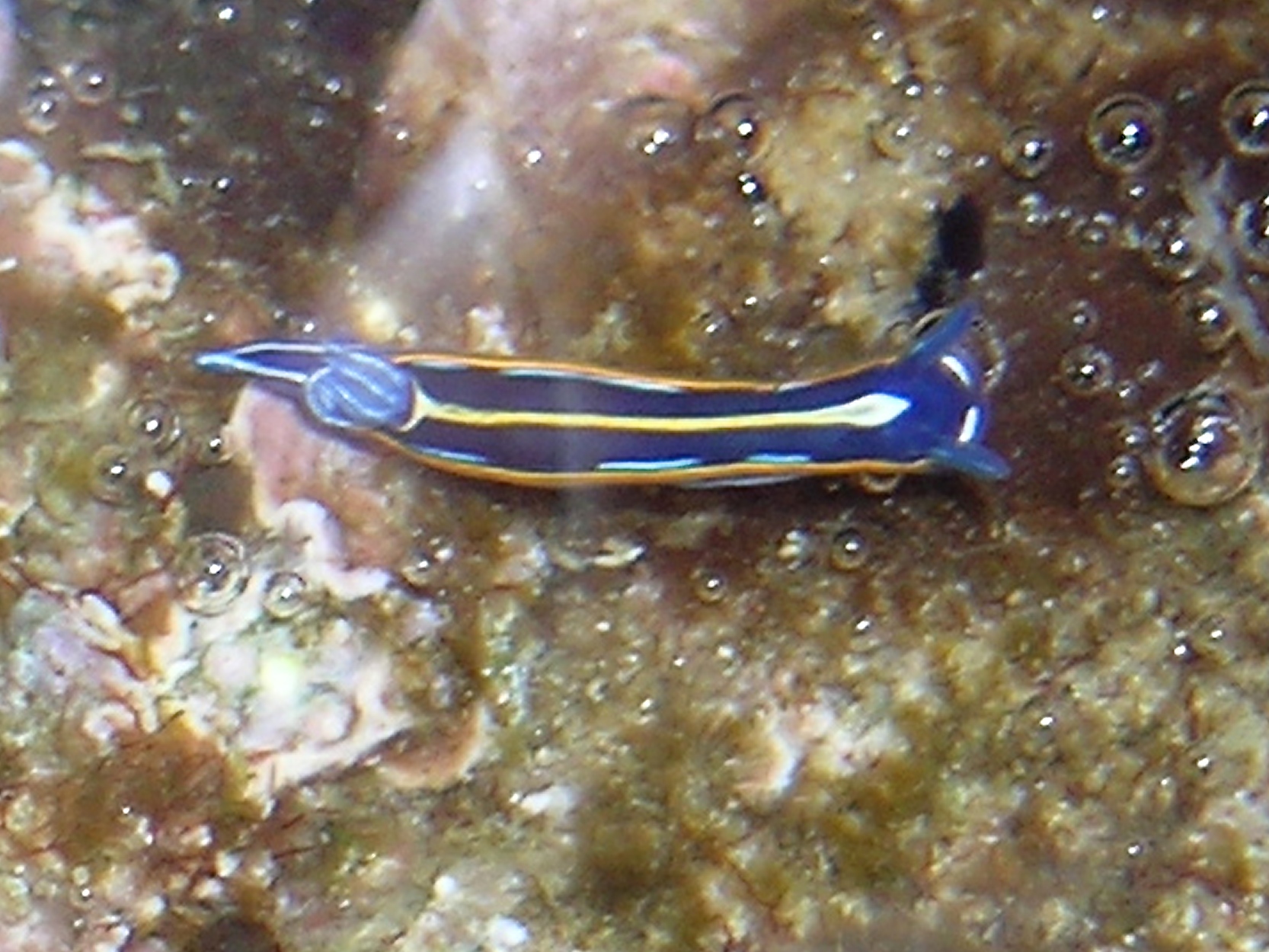
Felimare tricolor is one of many small, intensely coloured nudibranch species; it can be recognised by the deep blue colour and the yellow longitudinal stripes.
C: Order Aplysiida (Sea hares)
Dwarf sea hare, Aplysia parvula, Mörch
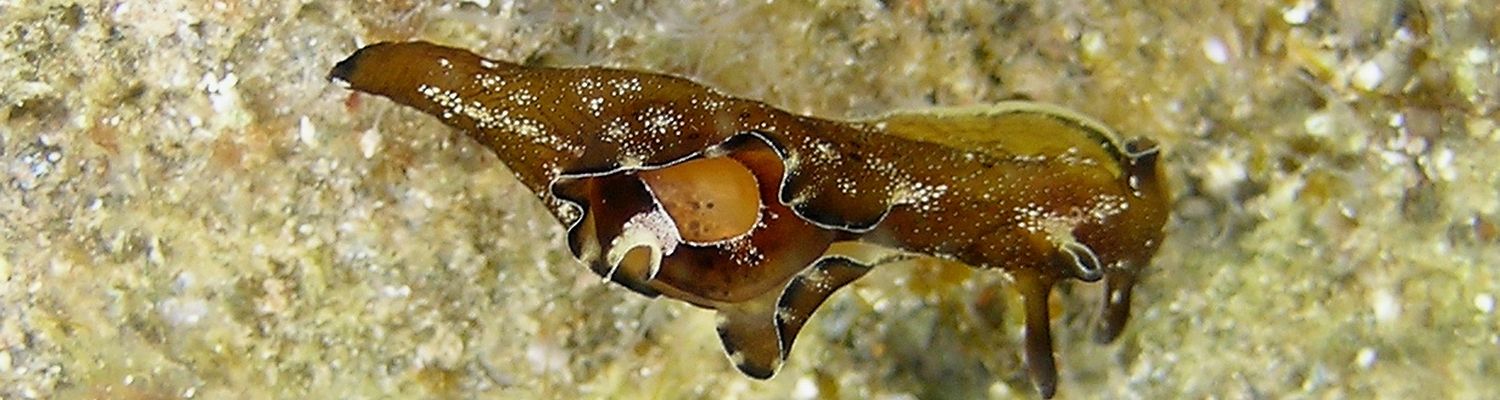
In spring, we often observe small brownish sea slugs on the coast. When disturbed, they release a reddish, ink-like pigment. Probably these are specimens of the Dwarf sea hare (Aplysia parvula).


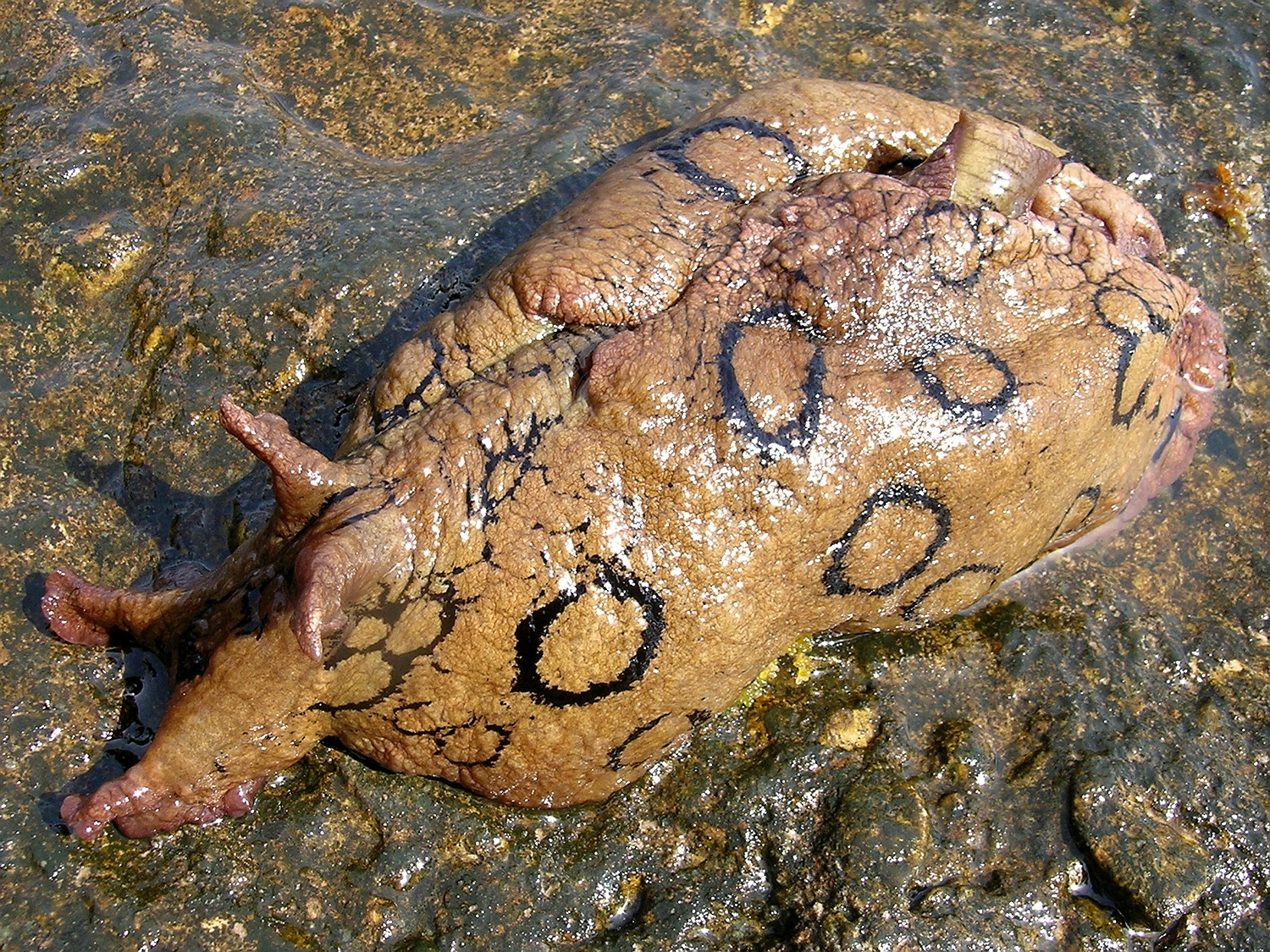
Spotted sea hare, Aplysia dactylomela, Rang
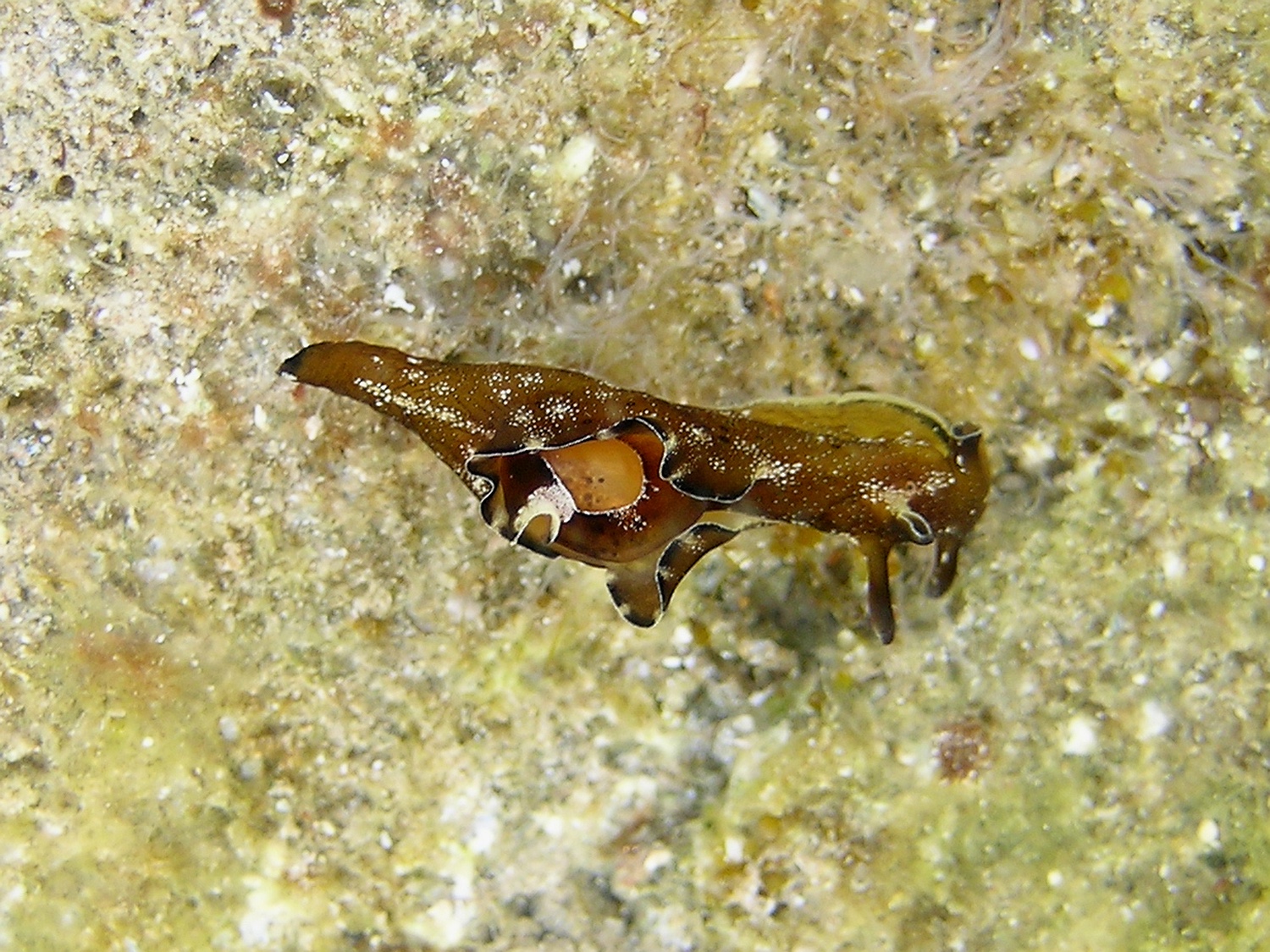
With a little luck, you may encounter another impressive sea slug at the coast: the Spotted sea hare, which can grow up to 40 cm in size. Sea hares show two lower and two upper tubular rhinophores (tentacles) on their heads. On their backs they carry a flat, round, thin, inconspicuous shell, the last remnant of their reduced snail shell.
Spotted sea hares are herbivores and live mainly in seagrass meadows. They accumulate a toxic substance in their bodies from blue-green algae that grow on the seagrass, which is why they are not eaten by other animals. When in danger, they can eject a cloud of ink. Sea hares include the largest snails in the world, measuring up to 75 cm.
The Spotted sea hare originally lived only in tropical seas, but in recent years it has been appearing more and more frequently in the Mediterranean. Unlike other sea hares, this species does not swim in the sea, but crawls on the seabed.
Depilatory sea hare, Aplysia depilans, Gmelin
The Depilatory sea hare is very similar. It also grows to a size of up to 40 cm and is brown in colour with irregular lighter spots. The Depilatory sea hare swims freely in the sea with the help of its wing-like parapodia (mantle flaps) joined at the rear. It feeds mainly on algae of the genus Ulva (sea lettuce). Sea hares are hermaphrodites, but require a partner for fertilisation. In late summer, they come to shallower waters to mate. Soon after laying their eggs, the sea hares die. One animal lays up to 3 million eggs in long jelly-like strings.

The Depilatory sea hare is brown in colour with lighter, irregular spots.
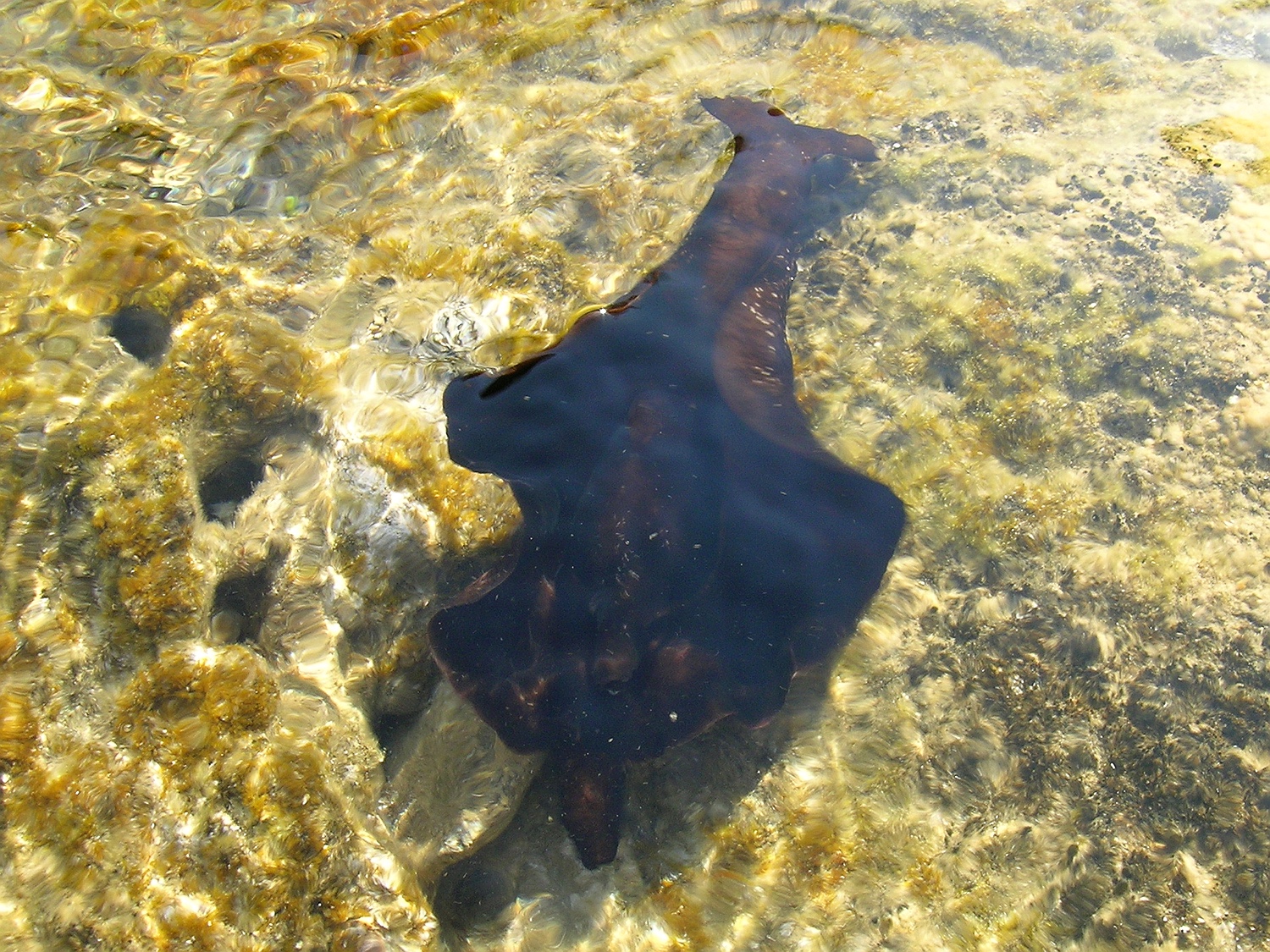
When swimming with the aid of their wing-like parapodia (mantle lobes), sea hares look very elegant.
continue: Chitons
back:
Further reading:
- Forum for marine nudibranchs
- Ed Yong in National Geographic on the presumed photosynthetic activity of velvet slugs