
Praying mantises
Among the most interesting and unusual animals on Naxos are the praying mantises. They are quite large insects: the species found on Naxos grow up to 8 cm long. Praying mantises are predators and feed mainly on other insects; some tropical species also catch small birds and mammals. They belong to the order Mantodea.
Praying mantisses have a movable head with highly developed eyes that are set wide apart for better spatial perception. The prothorax (first thoracic segment) is often very long to enable mobility. The front legs of the mantises are grasping legs (“raptorial legs”), which are normally kept with the lower and upper part bent together like a pocket knife, but can be stretched forward quickly when prey comes into reach; they are equipped with spines that help to hold the prey. Mantises have two pairs of wings: the hind wings are used for flying, the front wings are leathery wing covers (“tegmina”). In the female animals the wings are often reduced or lacking.
Like grasshoppers, mantises undergo incomplete metamorphosis, which means that even the larvae already resemble the adults. During mating, it is not uncommon for the males to be eaten by the females. The females often don’t even need males: They are able to lay eggs that develop without fertilisation by a male (parthenogenesis).
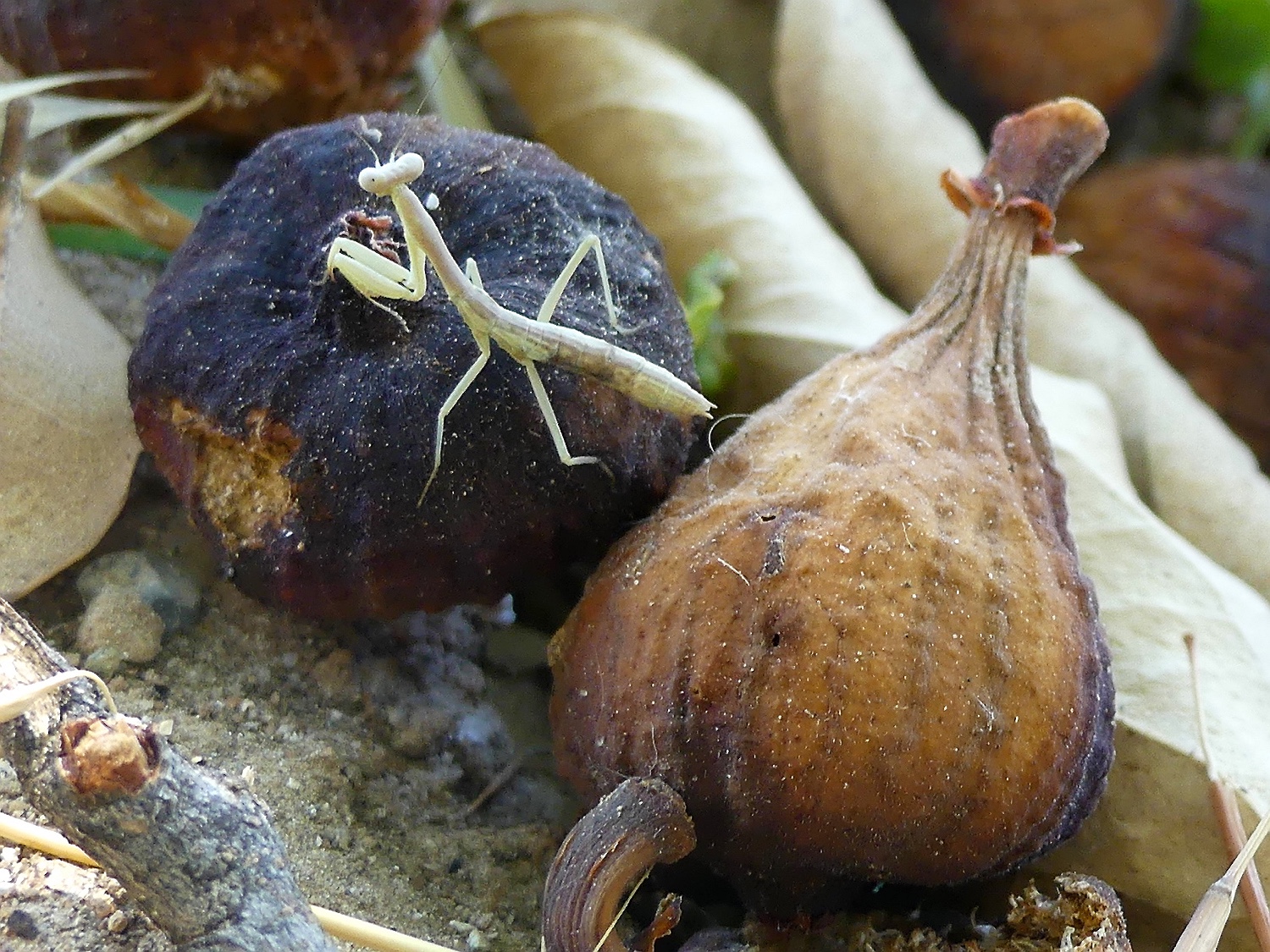
Even tiny mantises are recognisable as such – they look like miniature versions of the adult animals. However, it is not yet possible to determine the species.
Several species of mantises occur on Naxos, but one does not see them very often due to their excellent camouflage. The differences between the various species are sometimes quite small; thus some identifications are not entirely certain. Around 2,400 species exist worldwide, mainly in the tropic and subtropic regions.
The Photo gallery of the orthoptera and relatives gives an overview over the species.
Here you can jump directly to the species (return with the back arrow or by swiping back):
Rivetina balcanica – Mediterranean mantis, Iris oratoria – European mantis, Mantis religiosa – Ameles heldreichi – Empusa fasciata
Rivetina balcanica, Kaltenbach
One of the mantis species that occur in our area is the grey-coloured Rivetina balcanica. The animals are very well camouflaged, especially when they stand motionless in the vegetation.
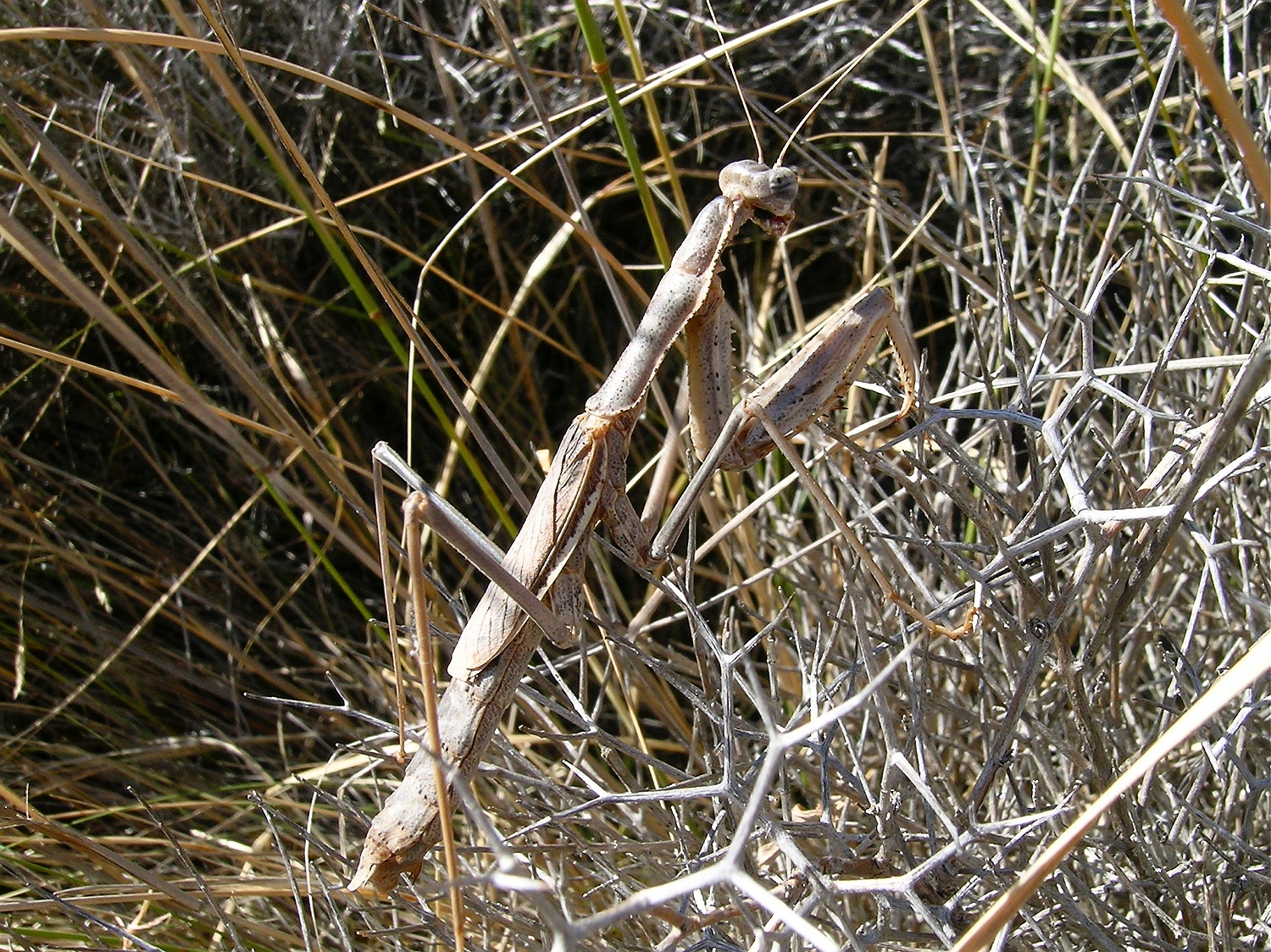
Rivetina balcanica is very well camouflaged in dry vegetation.
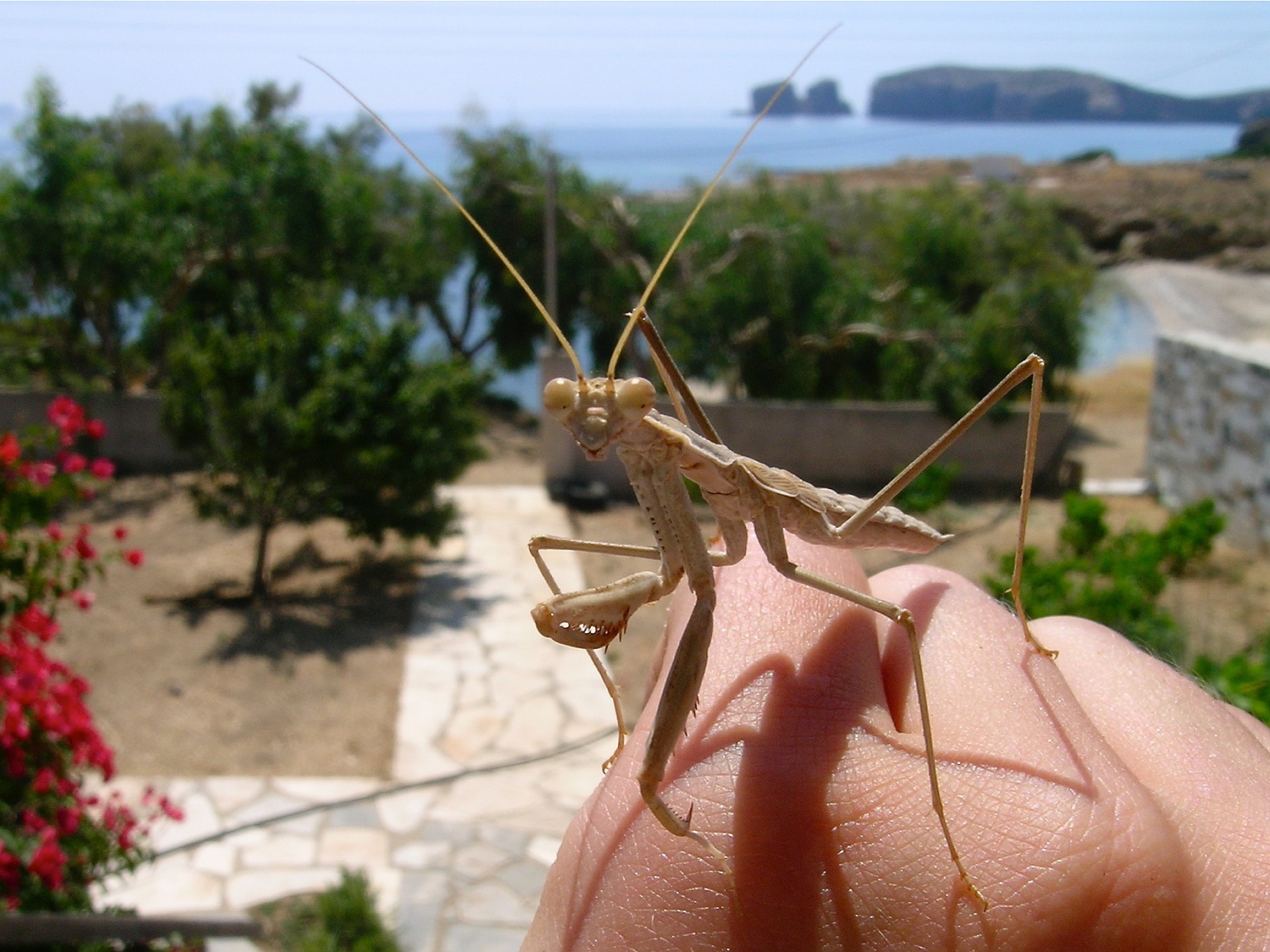
The triangular head is very mobile and the eyes at the sides of the head enable good vision. All praying mantises are predators that catch other insects.
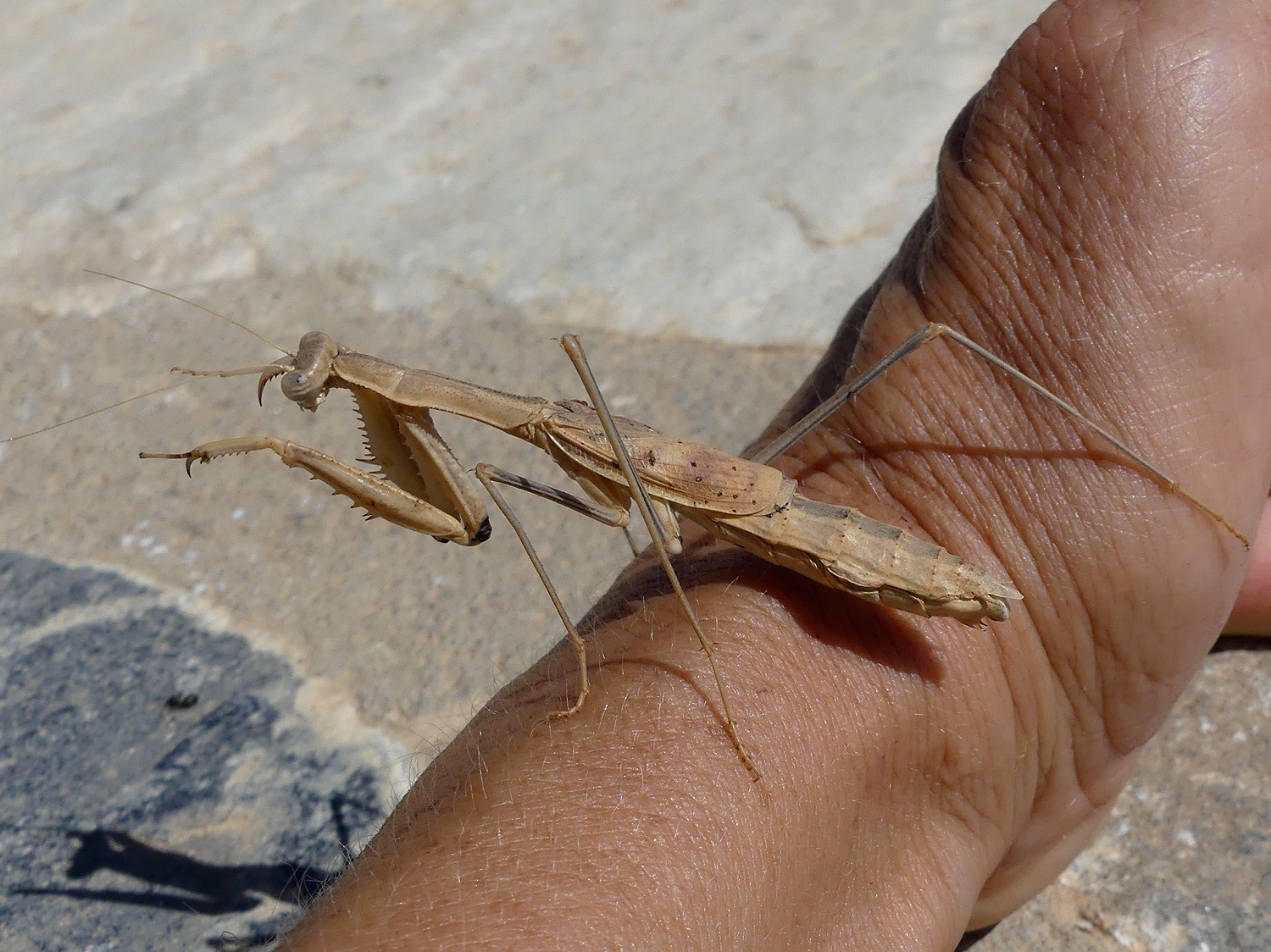
The pronotum (shield of the prothorax, reaches from the head to the wing base) is widest in the front third. Characteristic for the species is the very long first segment of the tarsi. This specimen is a female: it has short wings.
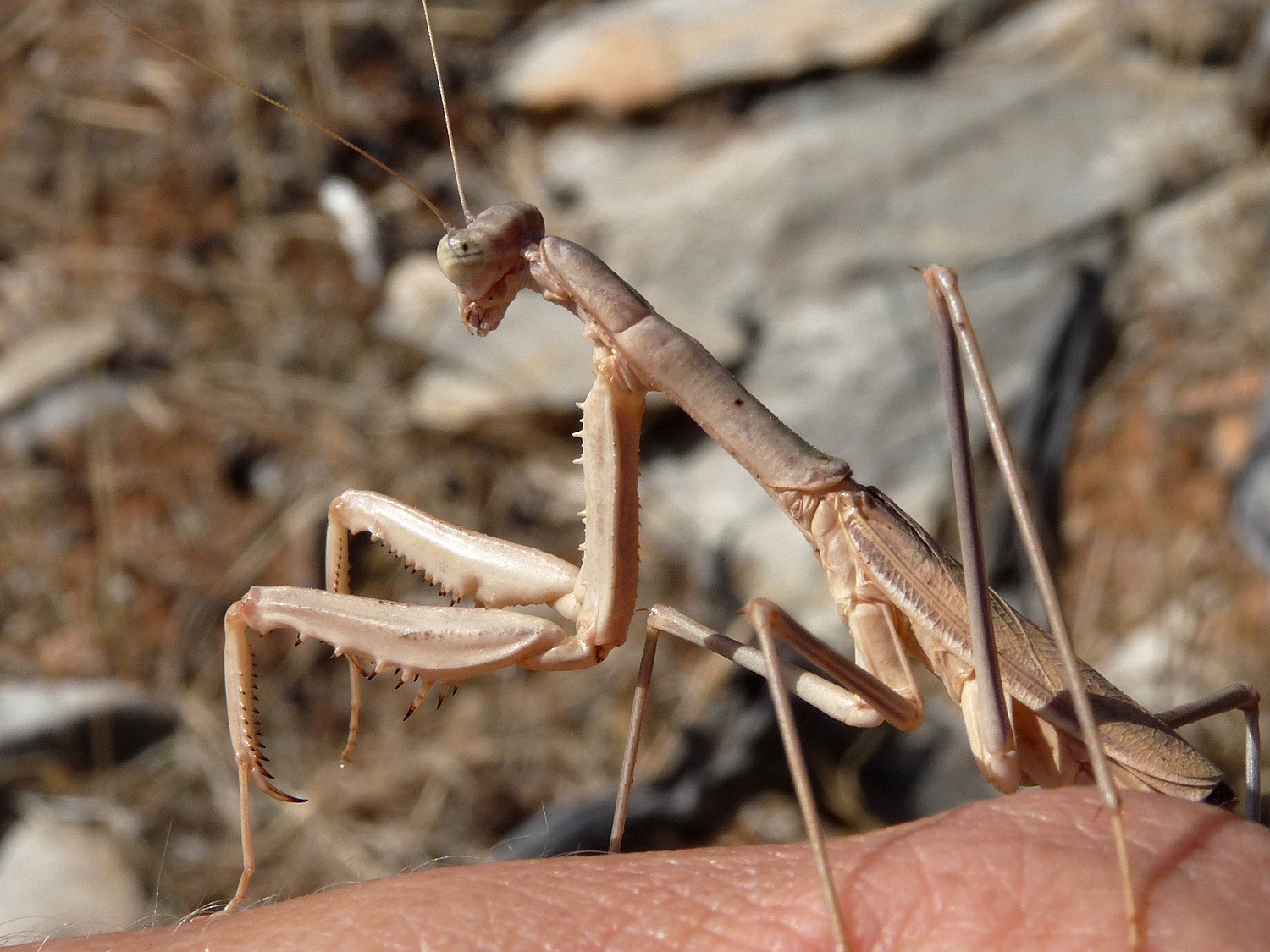
In males, the wings extend to the end of the abdomen. As we approached this specimen with our hand, it suddenly raised its hindwings with large dark spots (apparently a threatening gesture), but unfortunately only so briefly, so that I didn’t manage to take a photo.
Mediterranean mantis, Iris oratoria, L.
Another species we see sometimes in our garden is Iris oratoria.
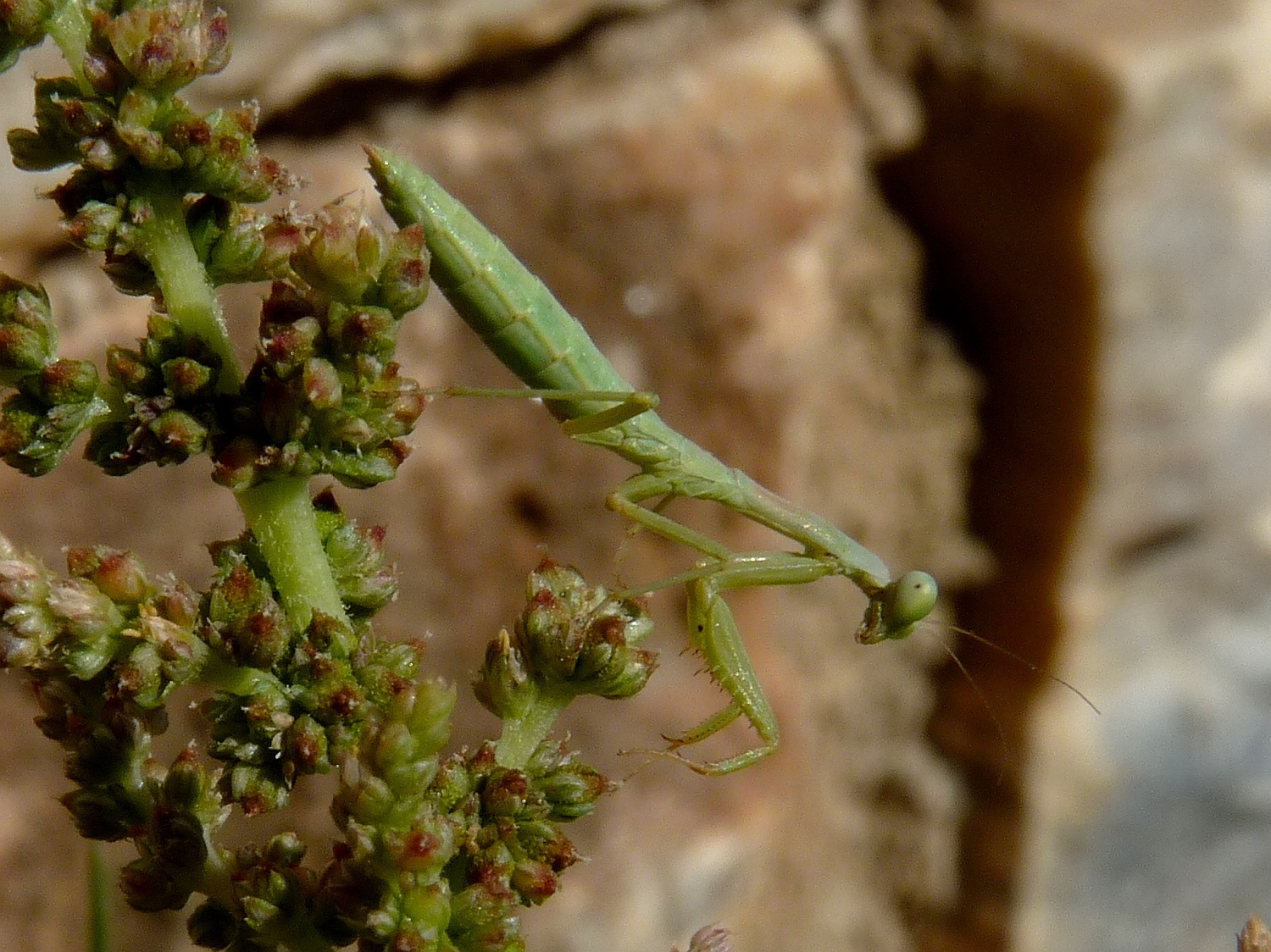
Iris oratoria is usually green coloured. In this species, the first segment of the tarsi of the hind legs is not much longer than the others.
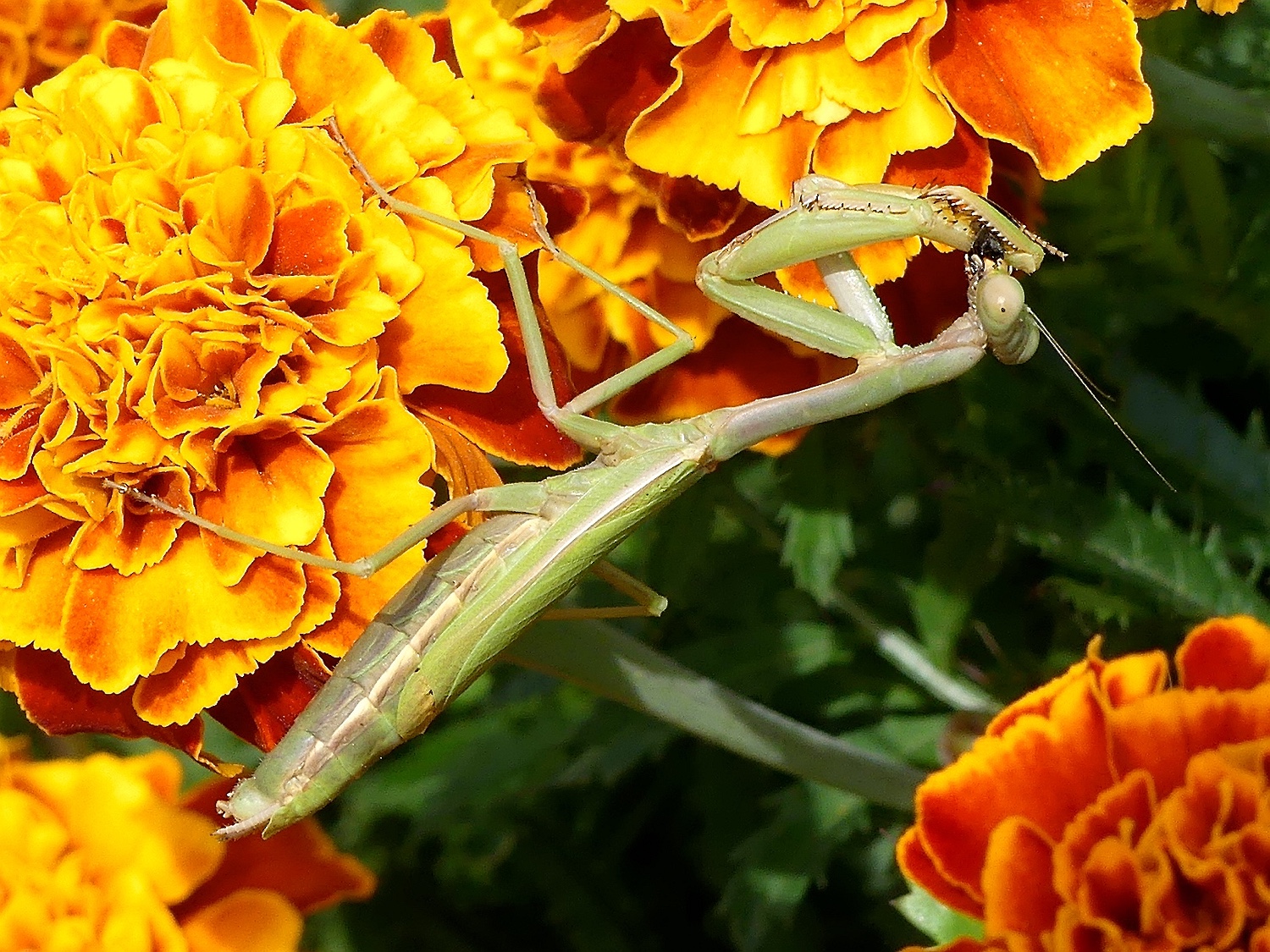
The females have a thick abdomen and wings that do not reach the end of the body.
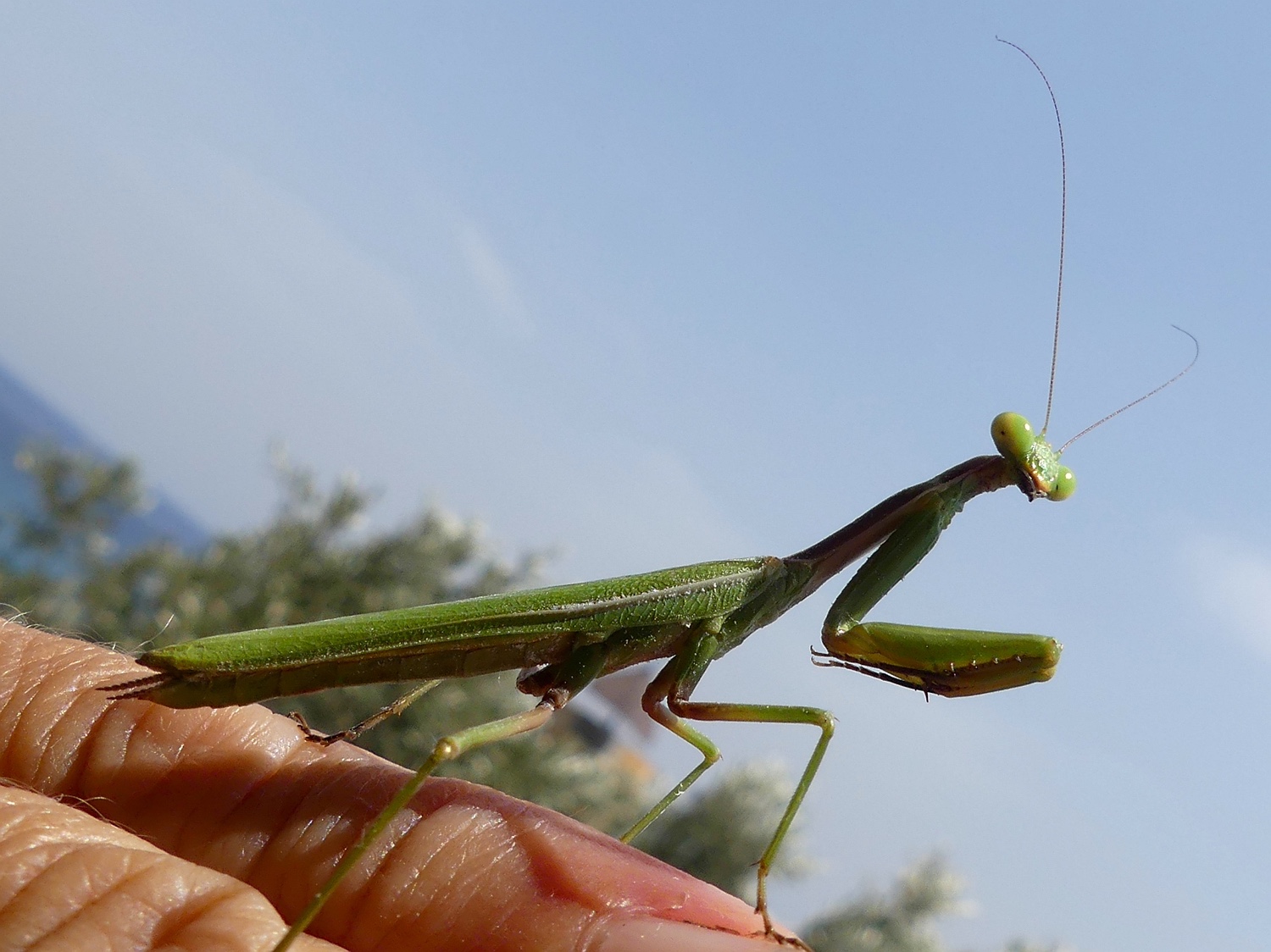
In this species too the males have long wings.
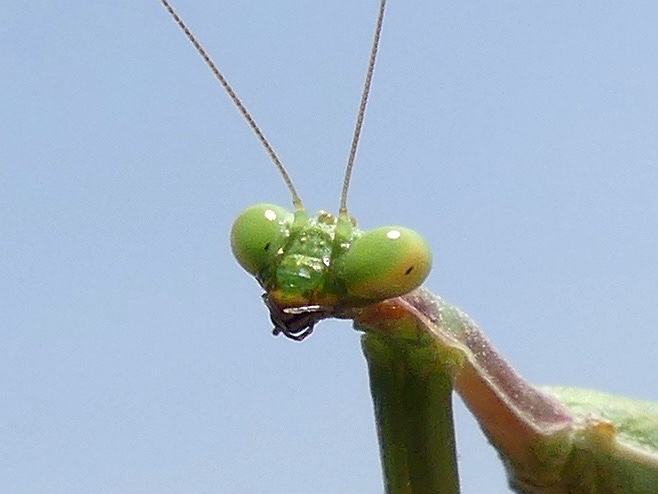
This species can be recognised by two small round warts on the front of the face. The eyes of Iris oratoria are positioned particularly far apart, making the head appear very broad.
European mantis, Mantis religiosa, L.
This species looks very similar to Iris oratoria. Male specimens can be distinguished from Iris oratoria by the black and white spot on the base of the front legs.
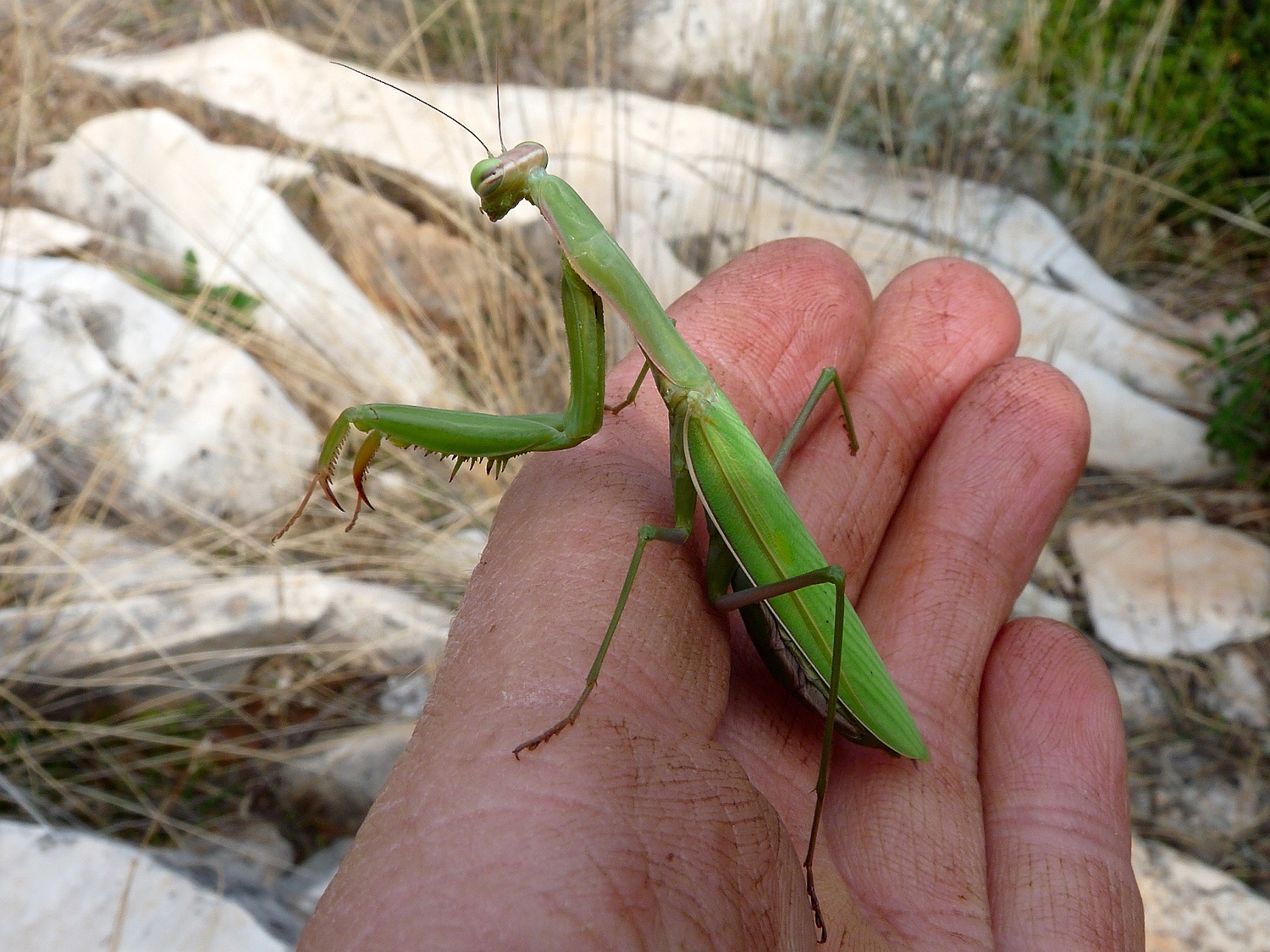
The European mantis is the only mantis species that also occurs in Central Europe. It is rather rare on Naxos. It looks very similar to Iris oratoria, but is slightly larger: females can grow up to 8 cm long, males reach a body length of 6 cm.
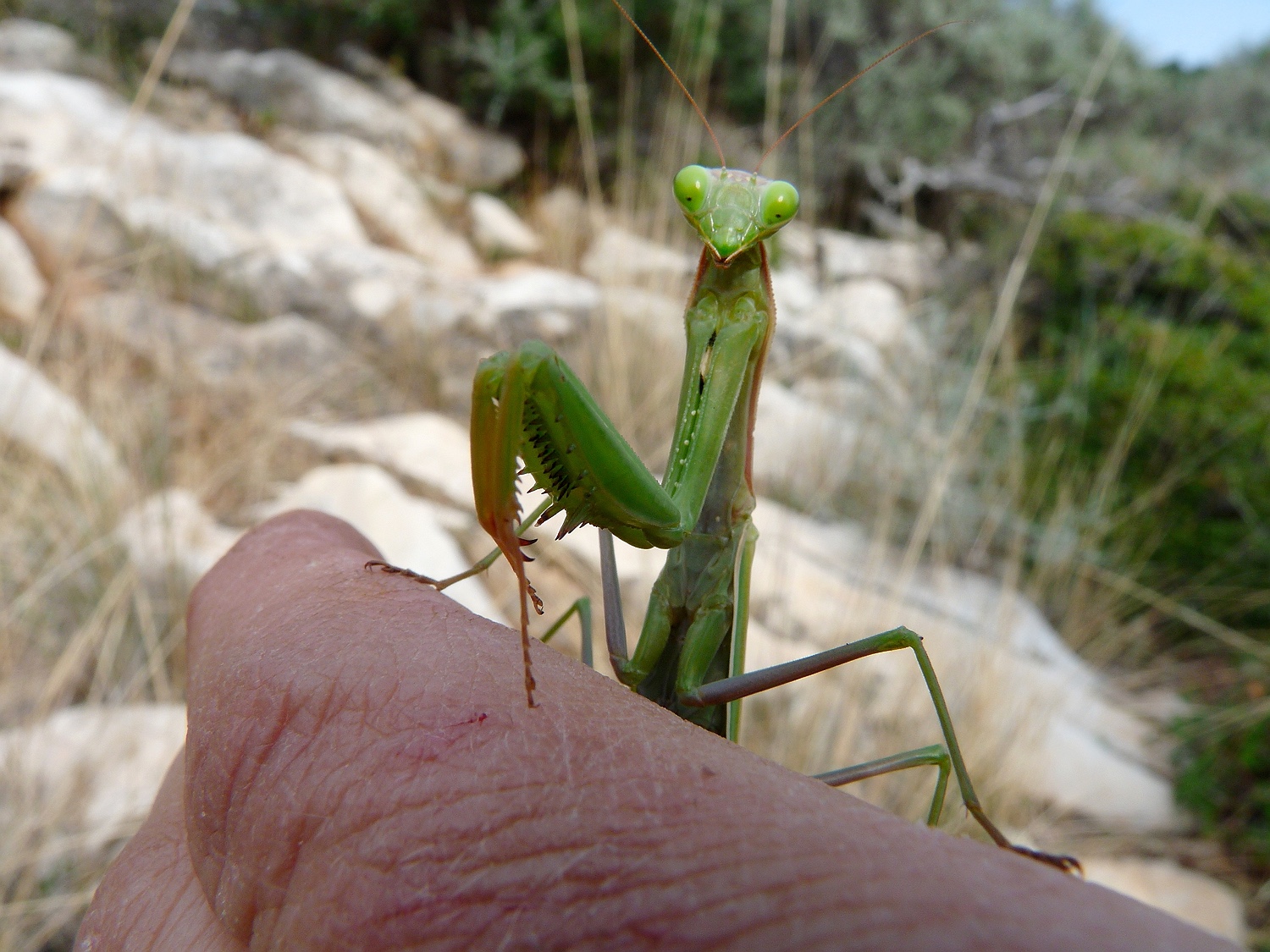
The same animal from the front. The spines on the front legs are clearly visible.
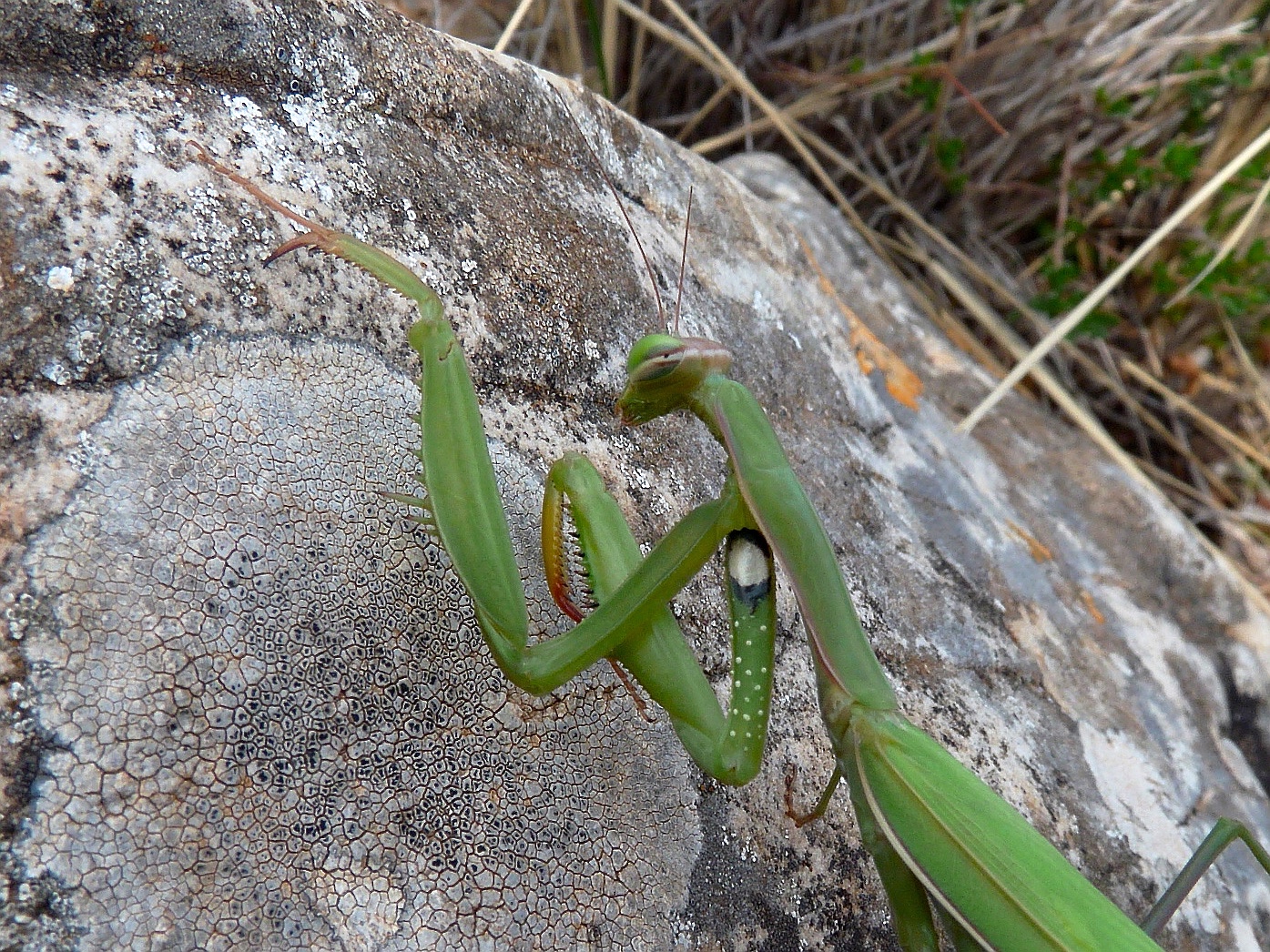
The male has a white-blue spot in its “armpits”.
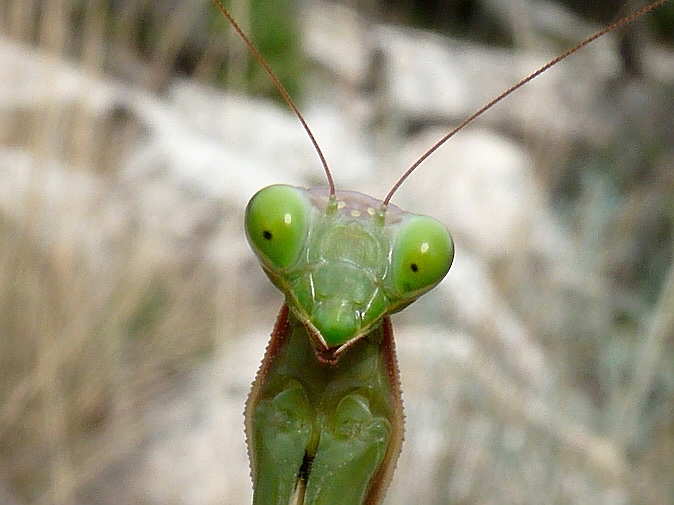
Here you can see the face, which lacks the warts typical of Iris oratoria.
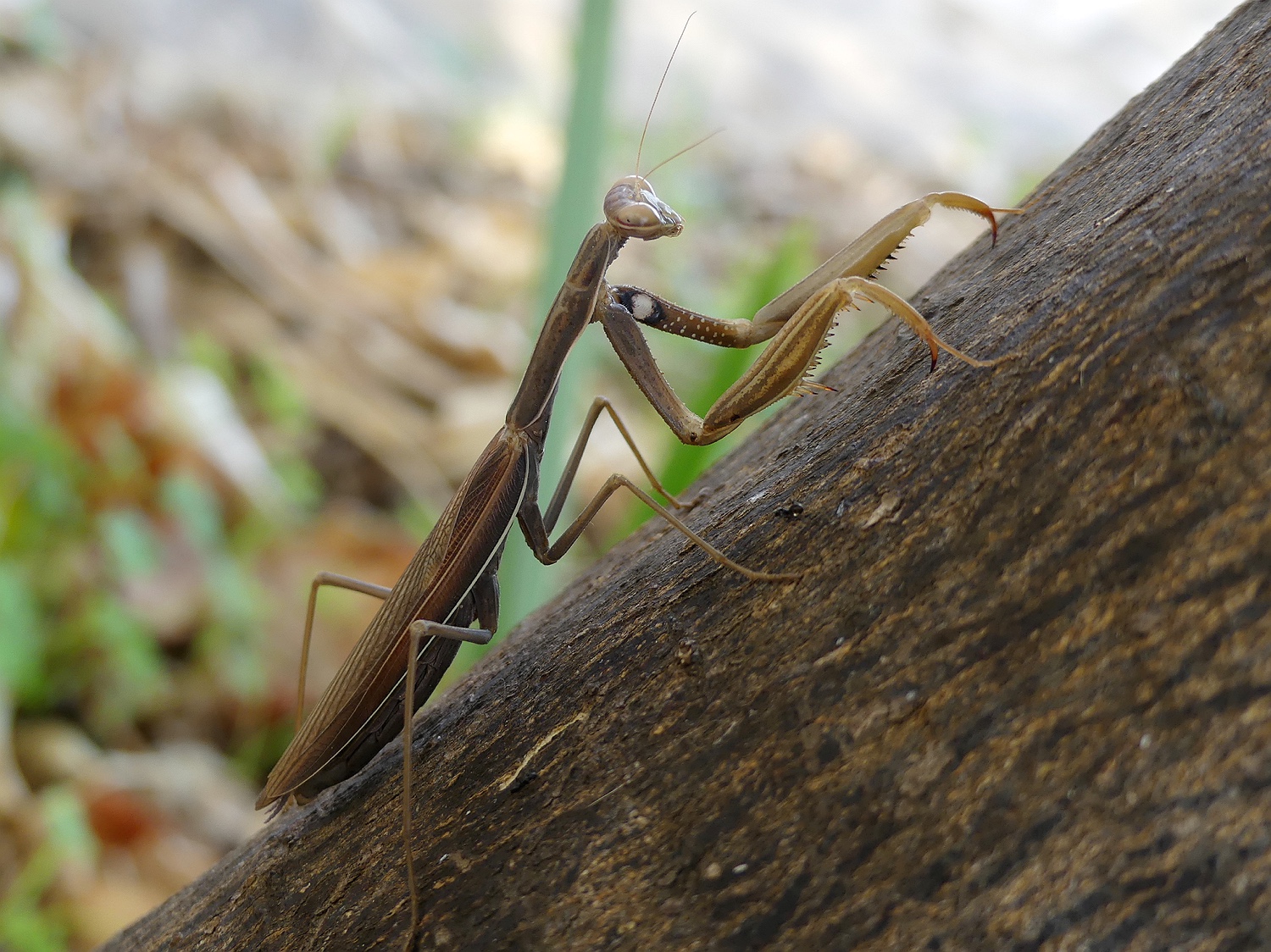
Some specimens have a brown colour.
Ameles heldreichi, Brunner von Wattenwyl
The smallest praying mantises on Naxos belong to the genus Ameles, which is represented in Greece by the species A. decolor and A. heldreichi. The females have no wings and a thick, upward-curving abdomen. The males, on the other hand, have a slender, straight abdomen and long wings. The pronotum of the species of Ameles is widest in the middle; the uppermost foot segment is short. On Naxos, the species Ameles heldreichii seems to be the most common.
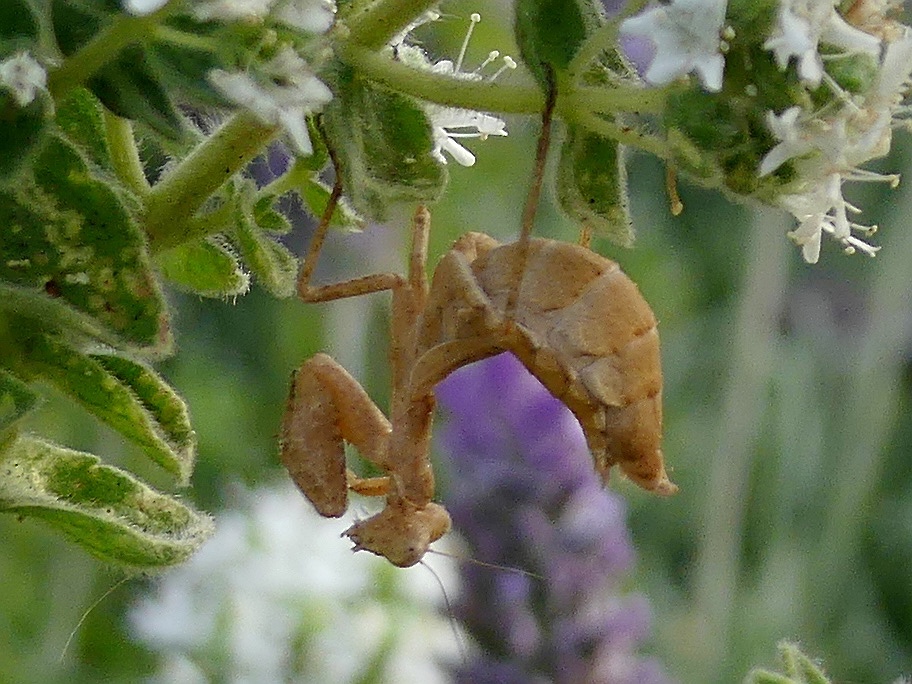
A female Ameles heldreichii sits motionless, waiting for its prey.
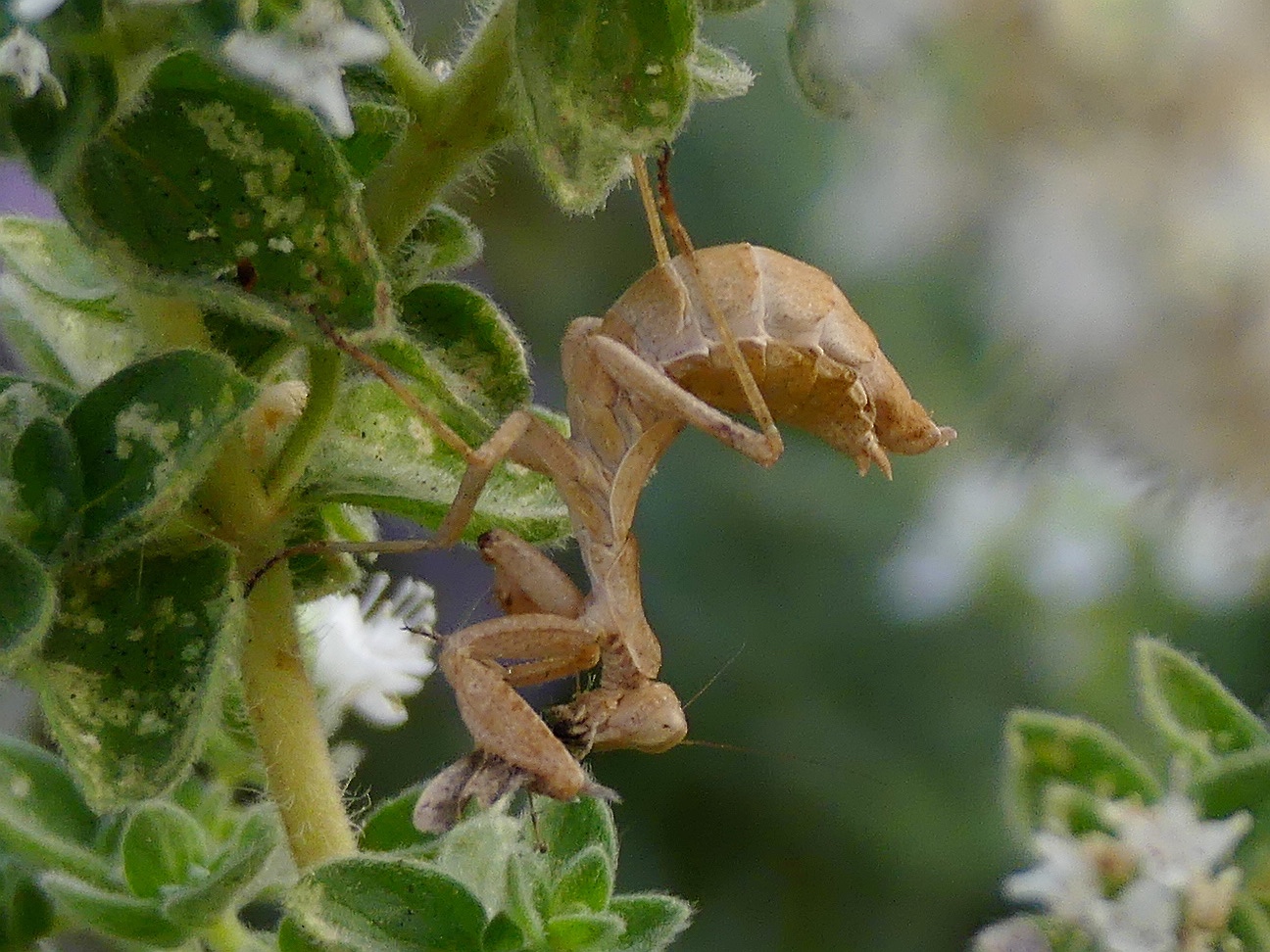
Here it has caught a moth!
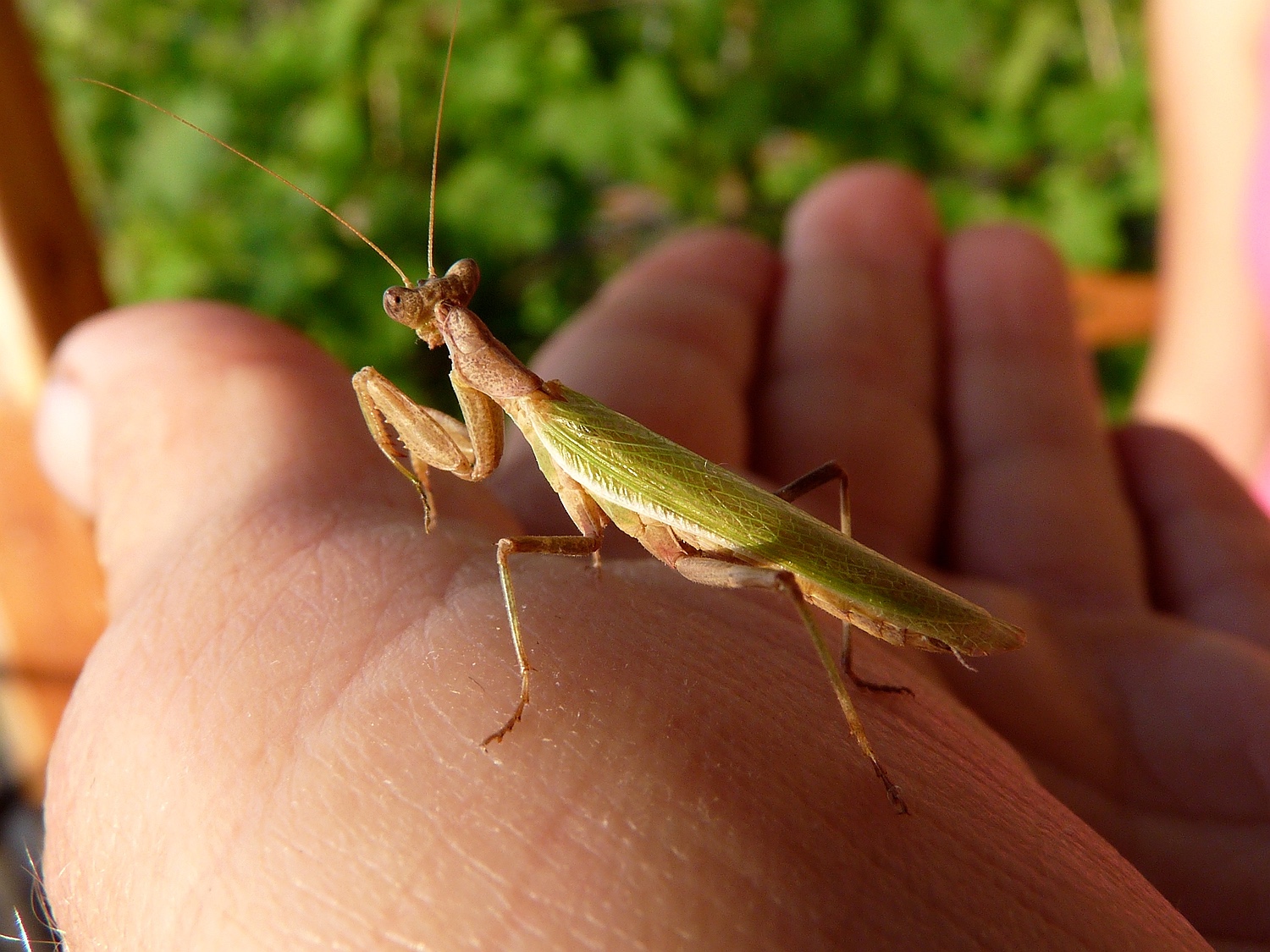
The males can have long greenish wings.
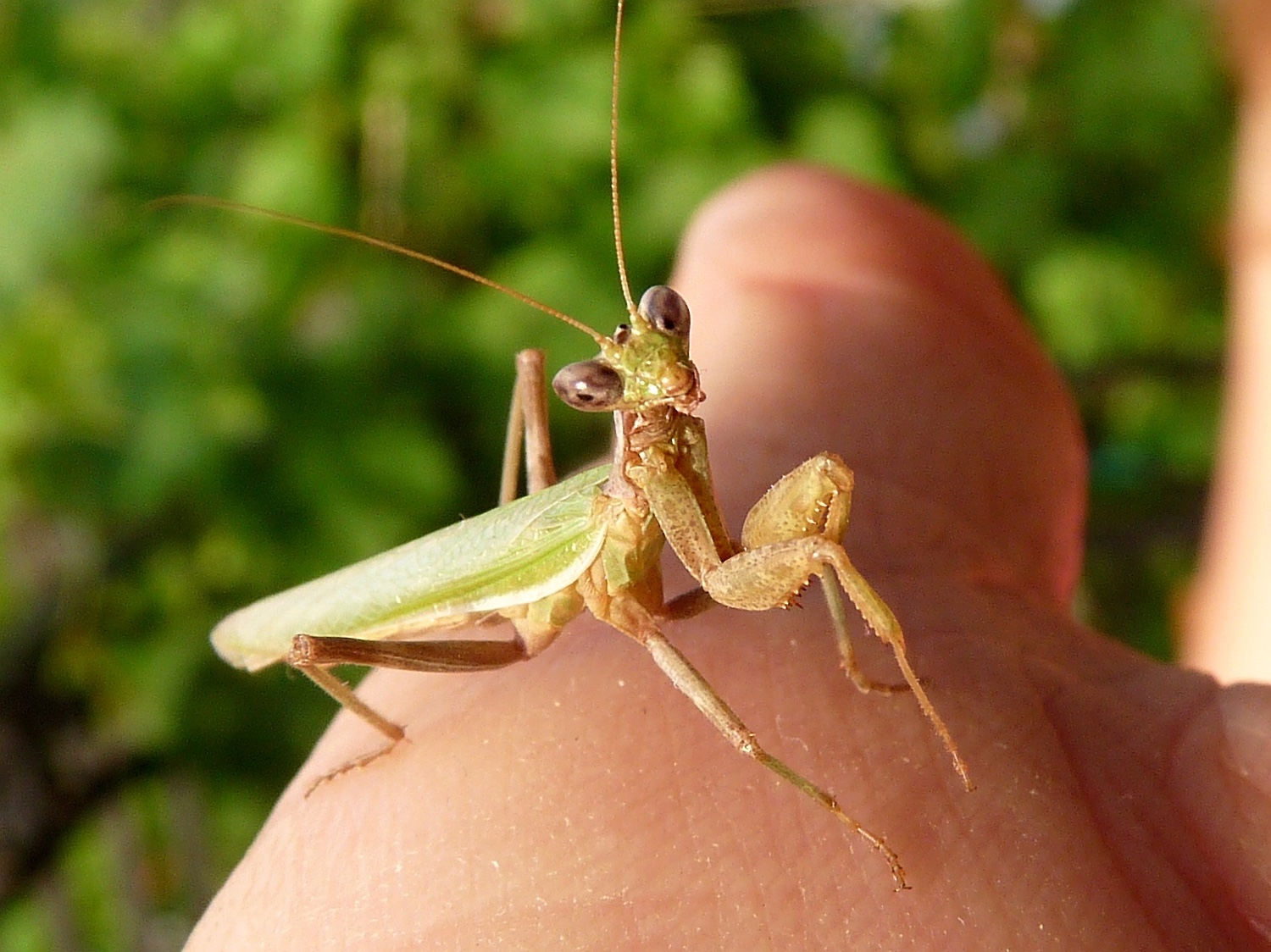
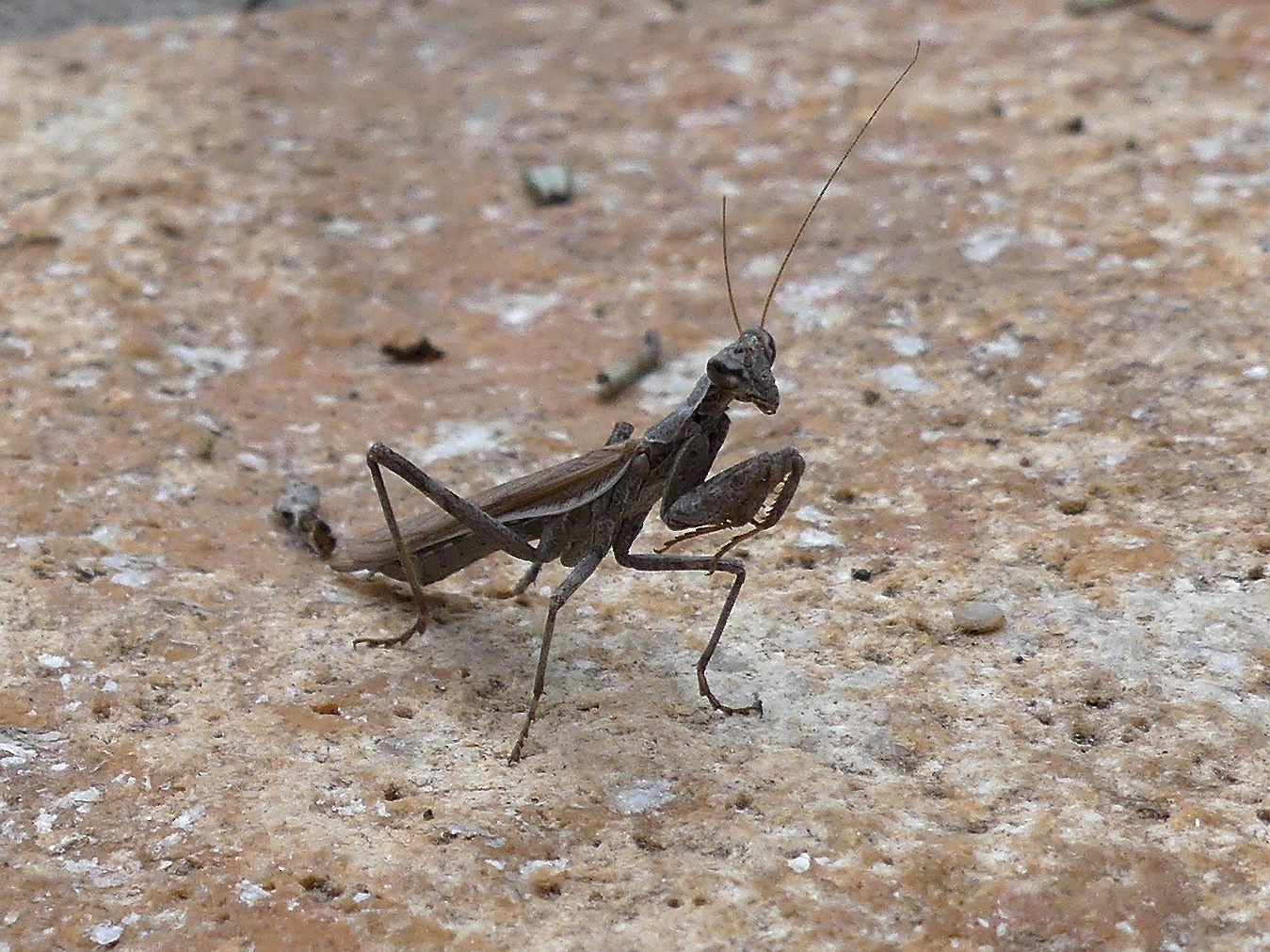
Other specimens are grey in colour.
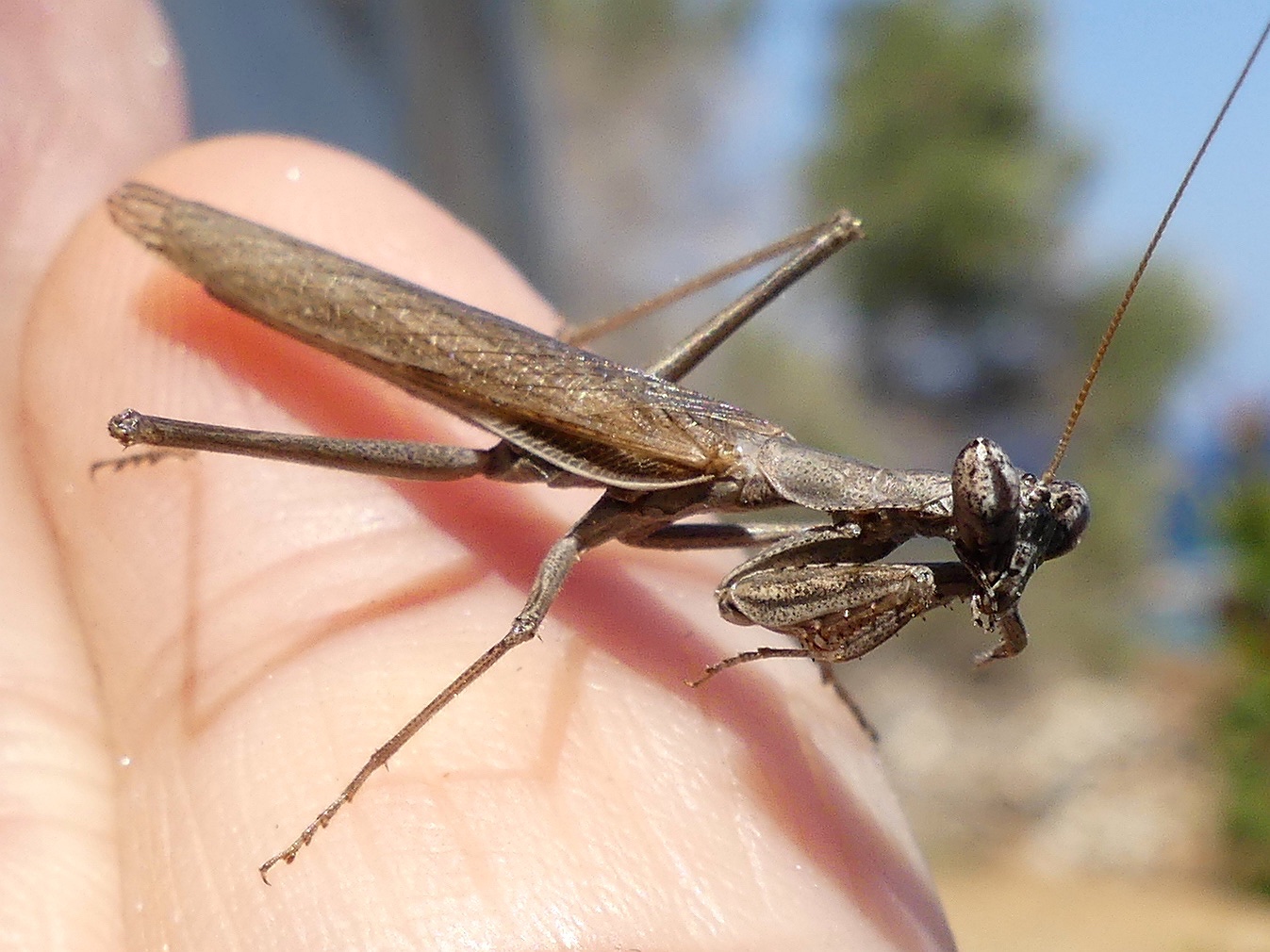
The eyes are slightly conical and have a small tubercle on the apical end.
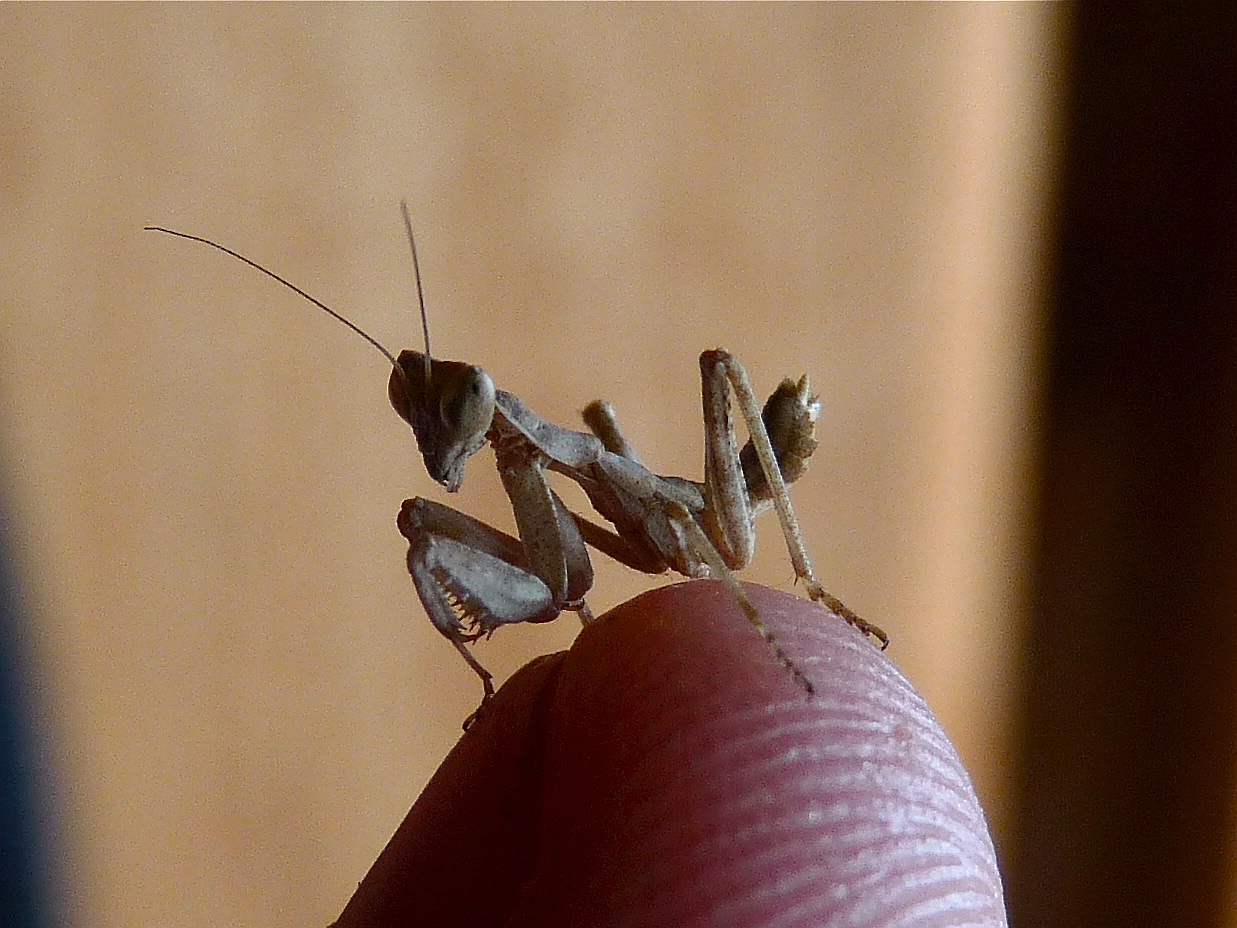
We also quite often find young specimens (nymphs) of this small mantis.
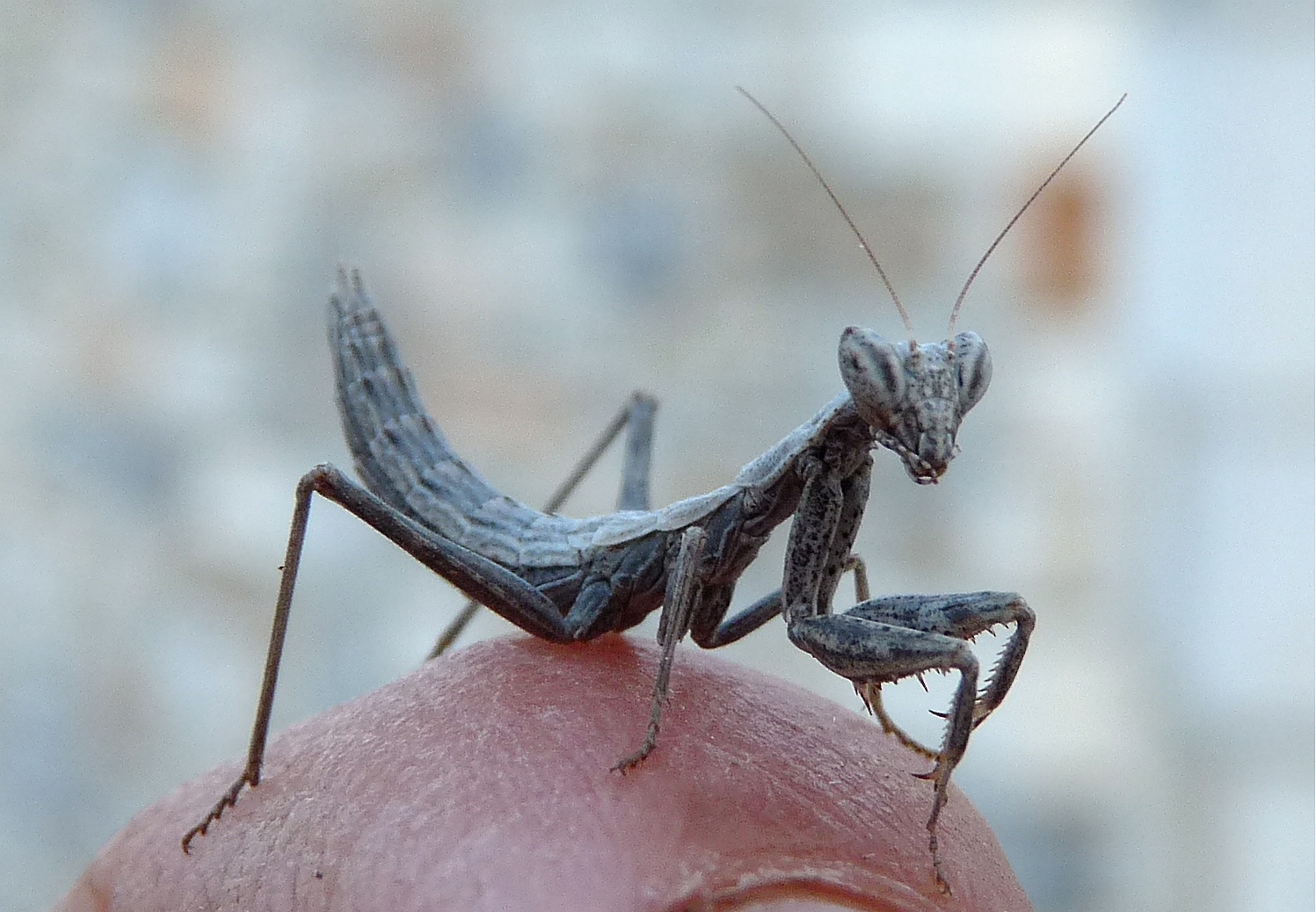
The tubercle on the eye of this nymph is clearly visible, indicating that it is a specimen of Ameles heldreichi. The very similar species Ameles decolor, which does not have a tubercle, also occurs in Greece, but so far we haven’t seen any in our area.
Empusa fasciata, Brullé
The Empusa can be recognised by its long antennae and the short “horns” on its head. The underside of its abdomen has characteristic protuberances.
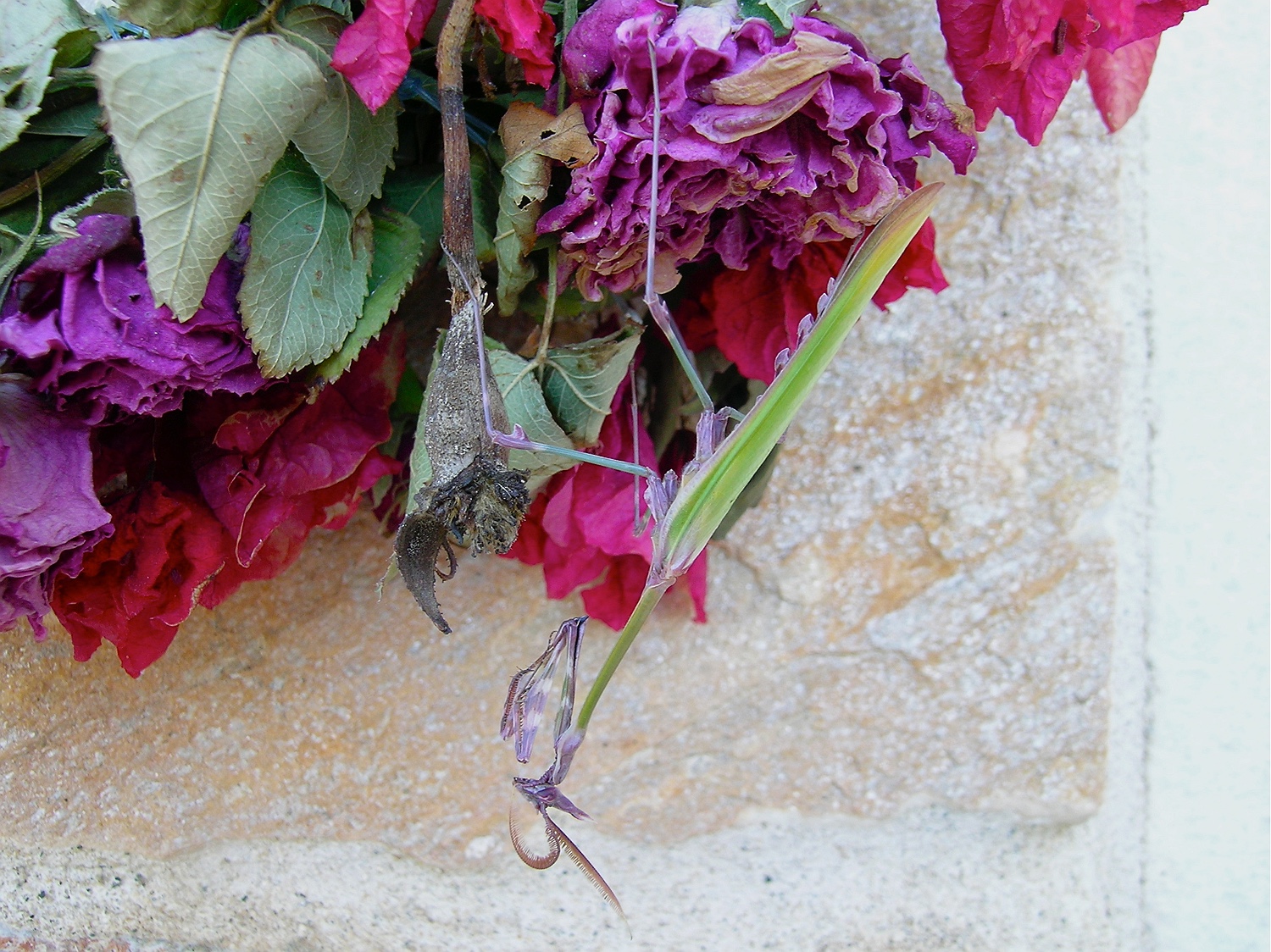
Adult animals have an elongated abdomen and wings; the prothorax is also particularly long. This specimen has a pretty purple and greenish colouring.
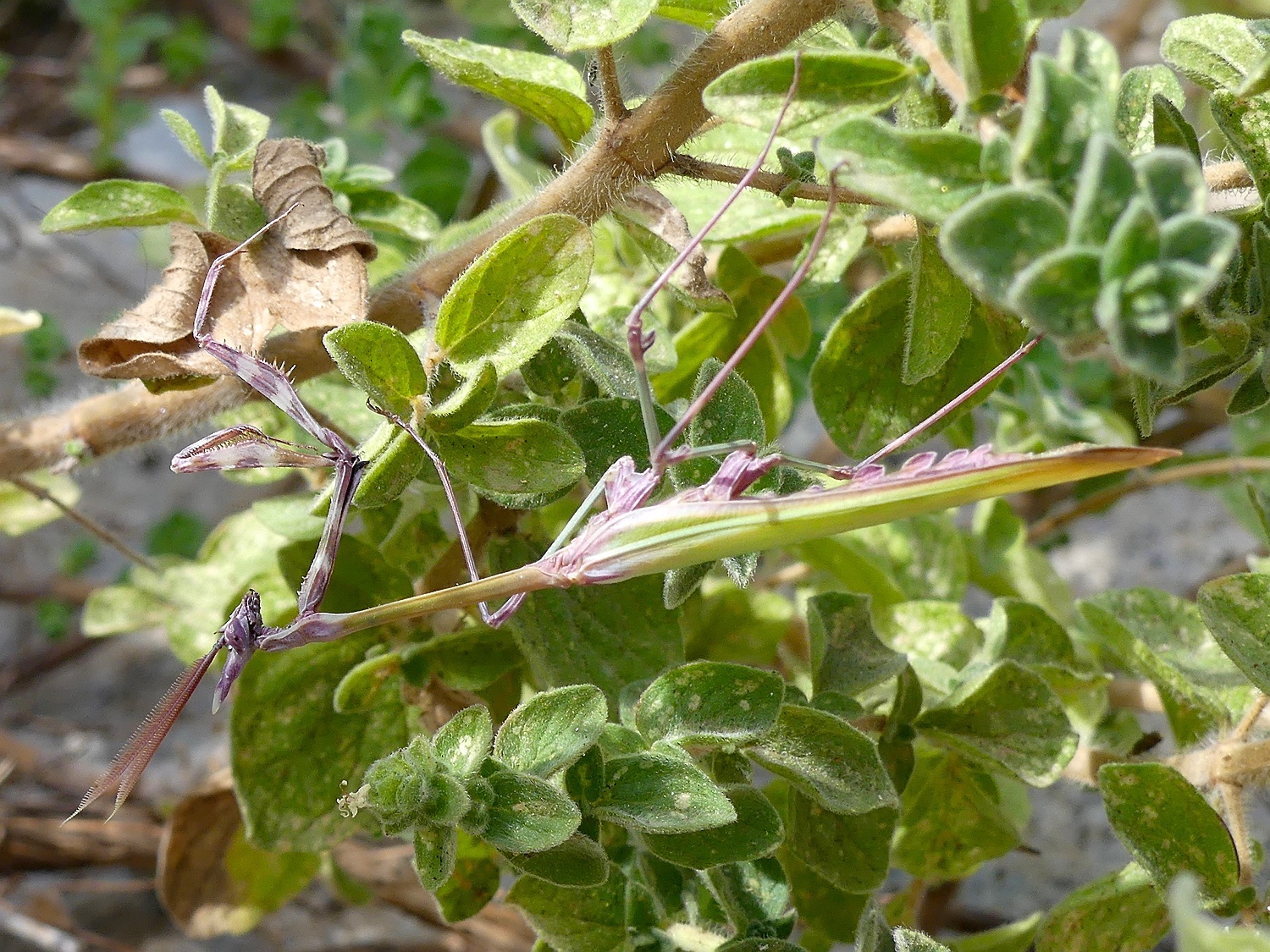
This praying mantis is also very well camouflaged in the vegetation. Here you can see its feathered antennae.
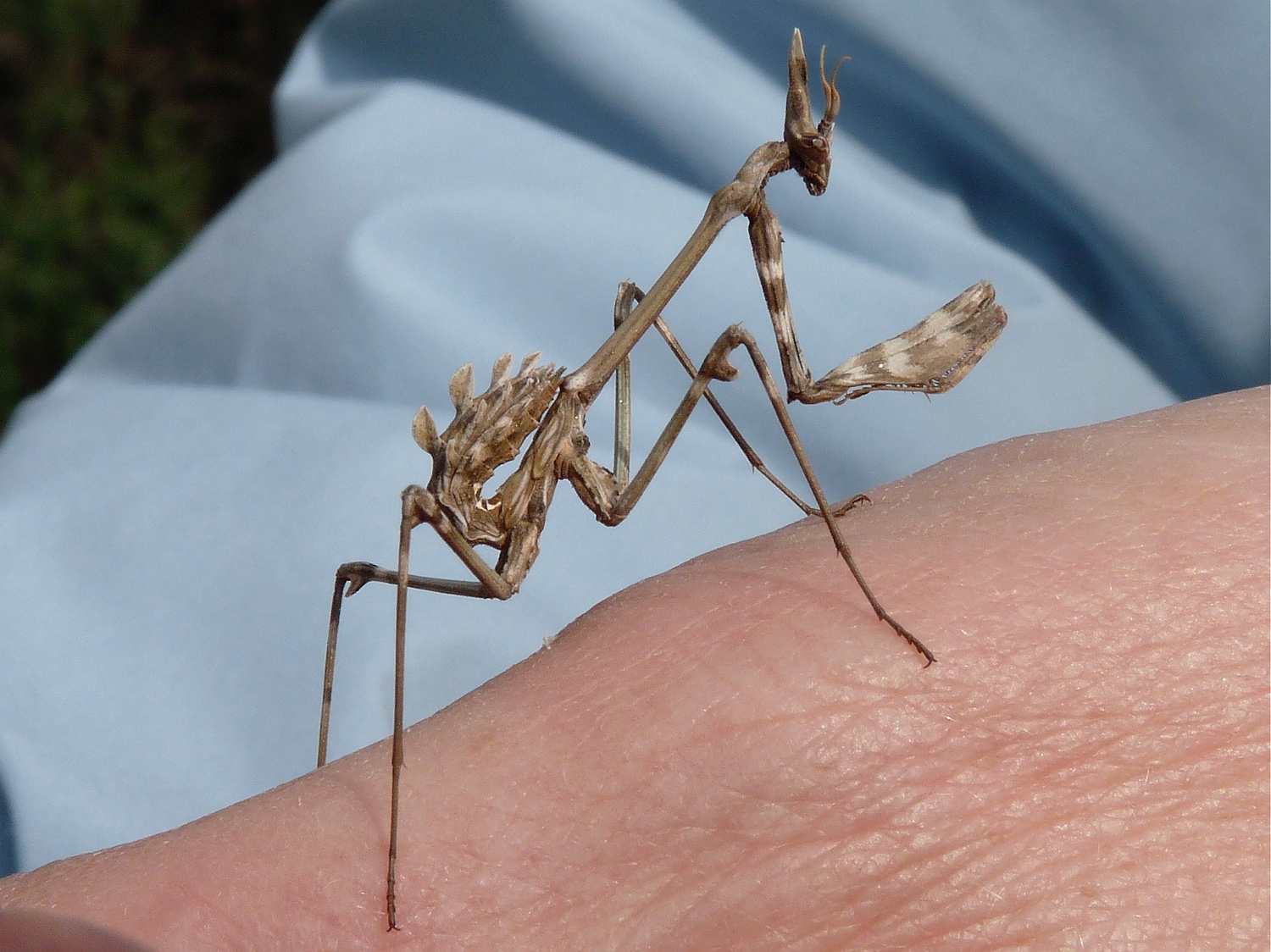
The bizarre nymphs carry their abdomen curved upwards in a characteristic manner.
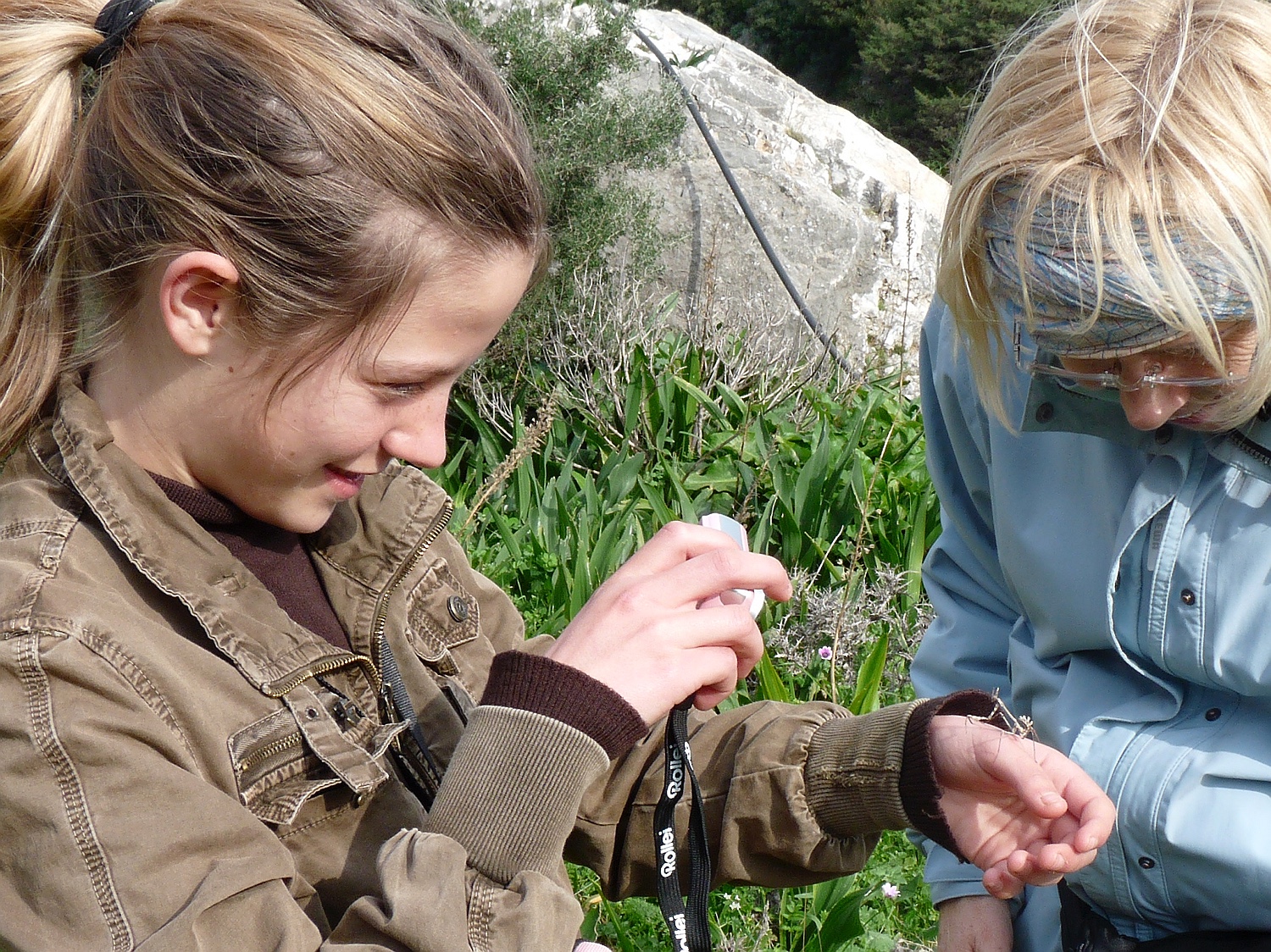
An interesting study object!
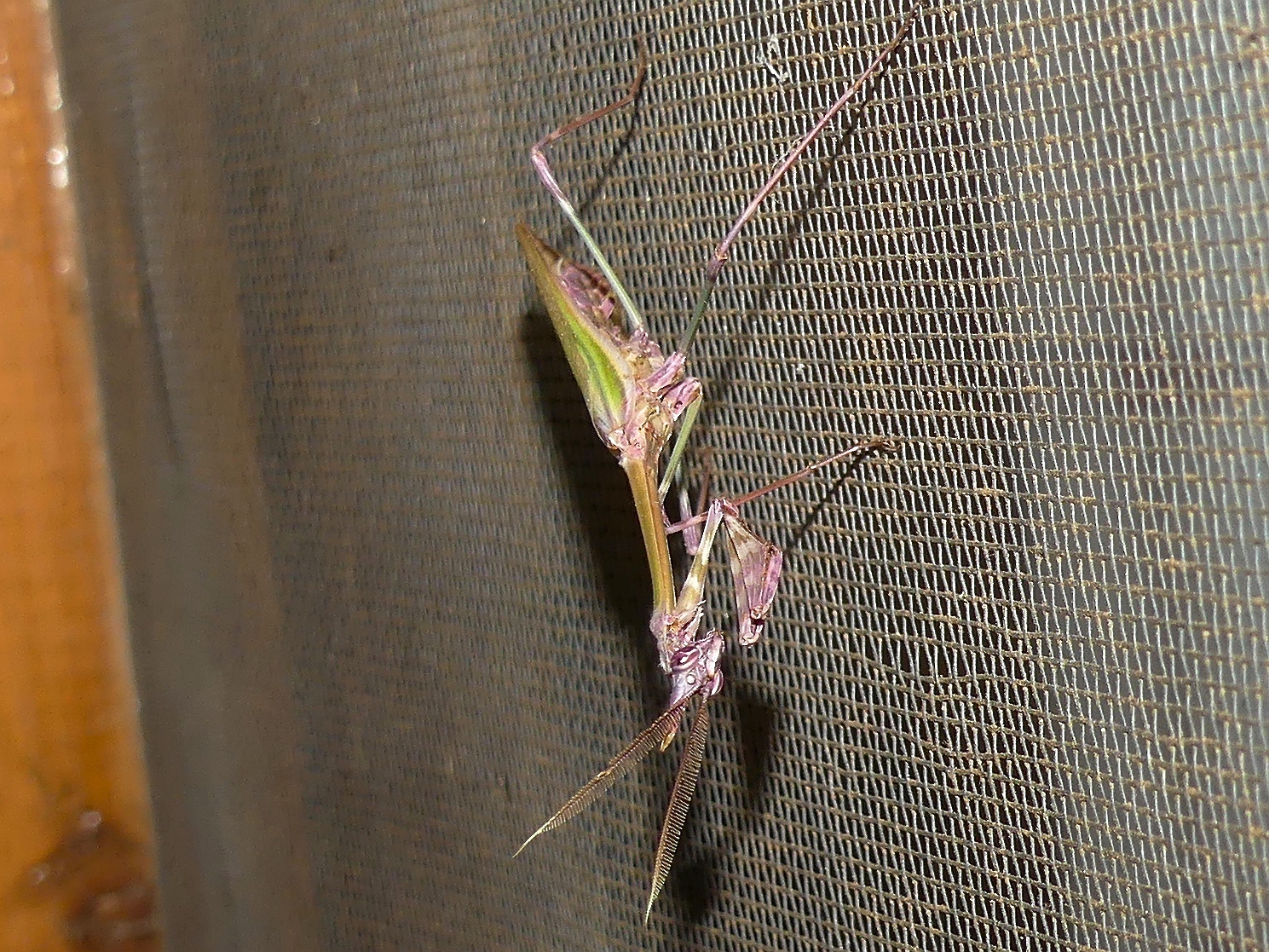
This empusa came to our window in the evening to catch the moths attracted by the light.
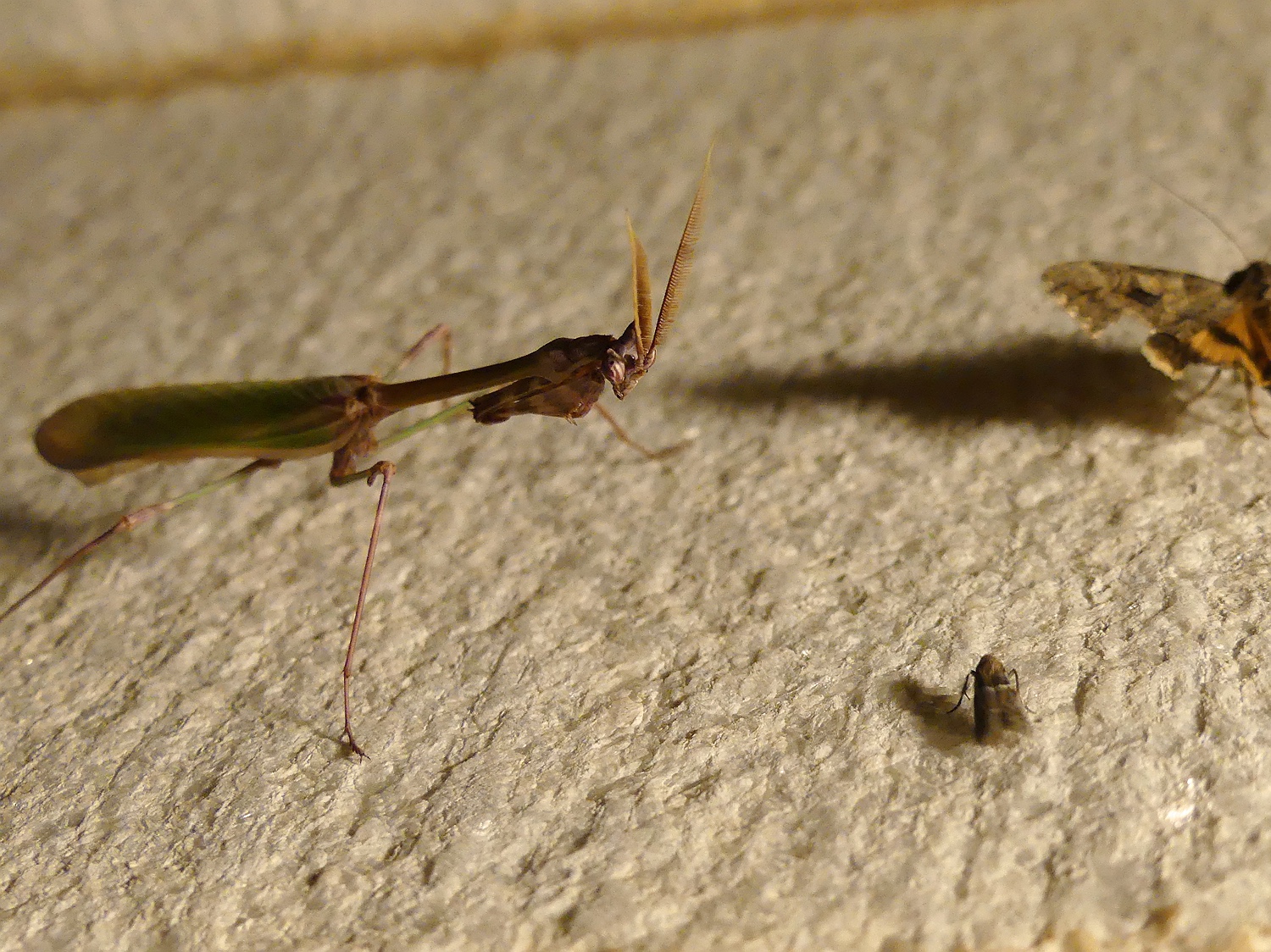
A moth is targeted…
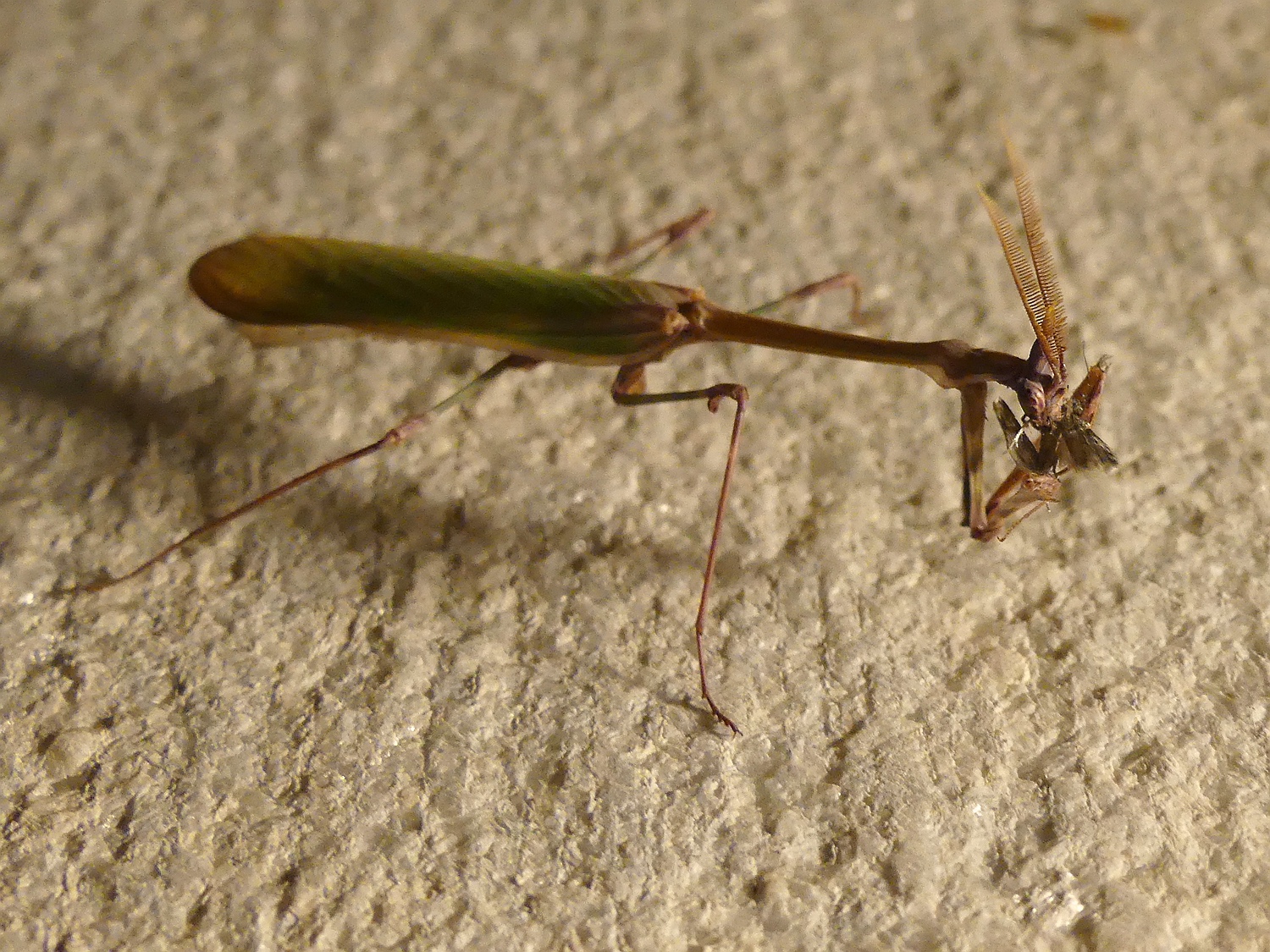
…and caught!
continue: Wasps
back:
see also: