
Dolphins
Dolphins belong to the order Cetacea (whales and dolphins). Approximately 40 species of dolphins exist; they are found in all the world’s oceans. Dolphins are usually between 1.5 and 4 meters long; the largest species, the killer whale (orca), reaches 8 meters. They are excellent swimmers and can reach speeds of up to 55 kilometers per hour. Their streamlined body shape plays a role in this, as does their specially adapted soft skin, which offers extremely low resistance. Dolphins can dive to depths of 300 meters and remain underwater for up to 15 minutes.
Dolphins are very social animals that live in groups. They have good eyesight, but also use echolocation to find their way around and locate their prey (mainly fish and squid). They have a very keen sense of hearing and can perceive sounds well into the ultrasonic range. The dolphins’ acoustic communication is also highly developed; they communicate with each other using a variety of sounds and can also easily learn acoustic signals.
In the Mediterranean Sea occur a number of dolphin species: the Common bottlenose dolphin, the Common dolphin, the Striped dolphin, the Round-headed dolphin and Cuvier’s beaked whale. Two species of whale are also native to the Mediterranean: the Fin whale and the Sperm whale. All of these species are endangered, some severely. Unfortunately, dolphins suffer greatly due to human influence. In addition to general overfishing and marine pollution, they are particularly endangered by direct persecution by fishermen, injury from ship propellers or entanglement in fishing nets, and, more recently, underwater noise pollution (e.g. from sonar surveys of undersea mineral resources or military activities, but also from marine sports). Unfortunately, for all these reasons, dolphins are becoming increasingly rare in the Mediterranean (and in all the world’s oceans).
Dolphins in Azalas
Dolphins (like Mediterranean monk seals) can only be spotted from land when there is no wind – with larger waves it is almost impossible to detect their backs or heads breaking the surface. Still sometimes we happen to see some dolphins from land; also we sometimes see dolphins from the ferry or a boat or even while kayaking. The fishermen also tell us that there are still some dolphins around: the fisherman from Moutsouna often has to manoeuvre cleverly, first setting off in other directions and then turning back later to outwit the dolphins that follow his boat trying to get fish from the nets.
Identifying the dolphins is not easy – you usually see them from a great distance, and they only emerge from the water with the back for just a moment, not enough to get a good look. I have the impression that the dolphins we see here are mostly Common bottlenose dolphins (Tursiops truncatus), which are quite stocky with a mostly uniform colour and a slightly curved dorsal fin, and also Striped dolphins which like to jump out of the water.

Of course, the dolphins are usually too far away for me to take a good photo from land.


Here some photos from the NCC, whichs is monitoring dolphins in the Aegean Sea in the course of various program:

Striped dolphins

Striped dolphin; you can see a fish stuck to the side of the animal, I don’t know of which kind.

Common dolphin

Common bottlenose dolphin

Dolphins like to swim alongside boats.

Even from a boat, however, they can usually only be seen from a distance, making it almost impossible to identify them with certainty.
Dolphins in mythology
Dolphins play an important role in Greek mythology: Since ancient times people have wondered about the dolphins. According to legend, the god Dionysus turned the sailors who wanted to kidnap him into dolphins when they jumped into the water in panic after he revealed his true form to them. Dolphins also brought Apollo to the mainland after his birth on Delos. Furthermore they were associated with the goddess Demeter; also the Nereids are often depicted riding dolphins.
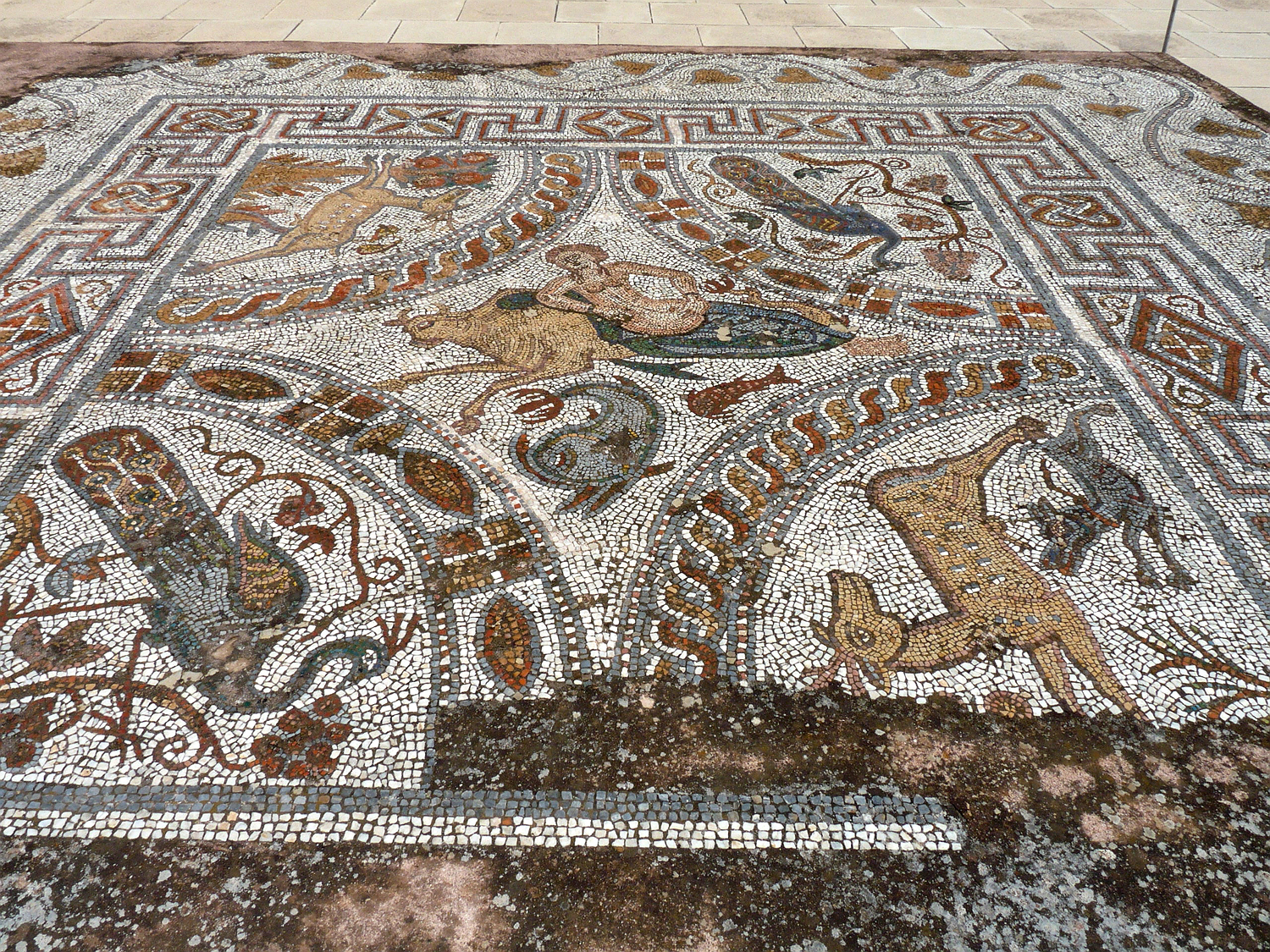
Dolphins were a popular motif in ancient times. Here is a dolphin (under the bull) depicted in a Roman mosaic (Archaeological Museum in Chóra).
Continue: The Mediterranean monk seal