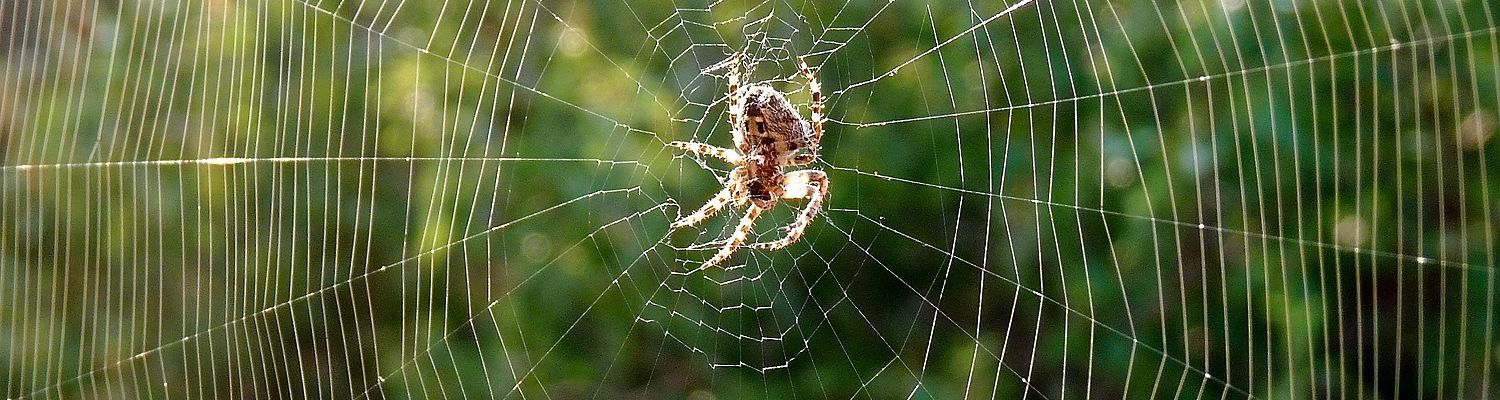
Spiders
Spiders are a difficult subject for many people. However, almost all spiders found in our region are completely harmless, and even those that can bite humans are usually much less dangerous than our fear makes us believe (as with other animal venoms, however, spider bites can also cause dangerous allergic reactions). If you take the time to look at spiders a little more closely, you will find that they are not only interesting animals, but often also very beautiful. Here I would like to introduce a few species, in the hope that some readers will revise their opinion of them a little.
Here you can skip the introduction and go directly to the species.
Spiders, along with insects, crustaceans and several smaller groups, belong to the very large and important phylum of the arthropods. Together with mites, scorpions, daddy long legs and others, they form the class arachnids. Around 50,000 species of spiders have been described.
Anatomy
In contrast to insects, who have six legs and whose bodies are divided into three parts (head, thorax, abdomen), spiders have eight legs and a body consisting of two parts: the prosoma, formed by the head and thorax, and the round or elongated abdomen (opisthosoma). The head of the spiders is equipped with limbs that have been transformed into mouthparts: the chelicerae that end in the fangs that inject the venom in the prey. Besides them sit the often large and conspicuous pedipalps (which fulfill different functions). Unlike insects, spiders do not have compound eyes, but eight simple eyes, usually two larger ones and six smaller ones. Many spiders have good eyesight; their tactile sensory organs are also very well developed. They can hear sound with special hearing organs located on their legs, but also with tufts of hairs (also on their legs), which the spider uses to detect vibrations.
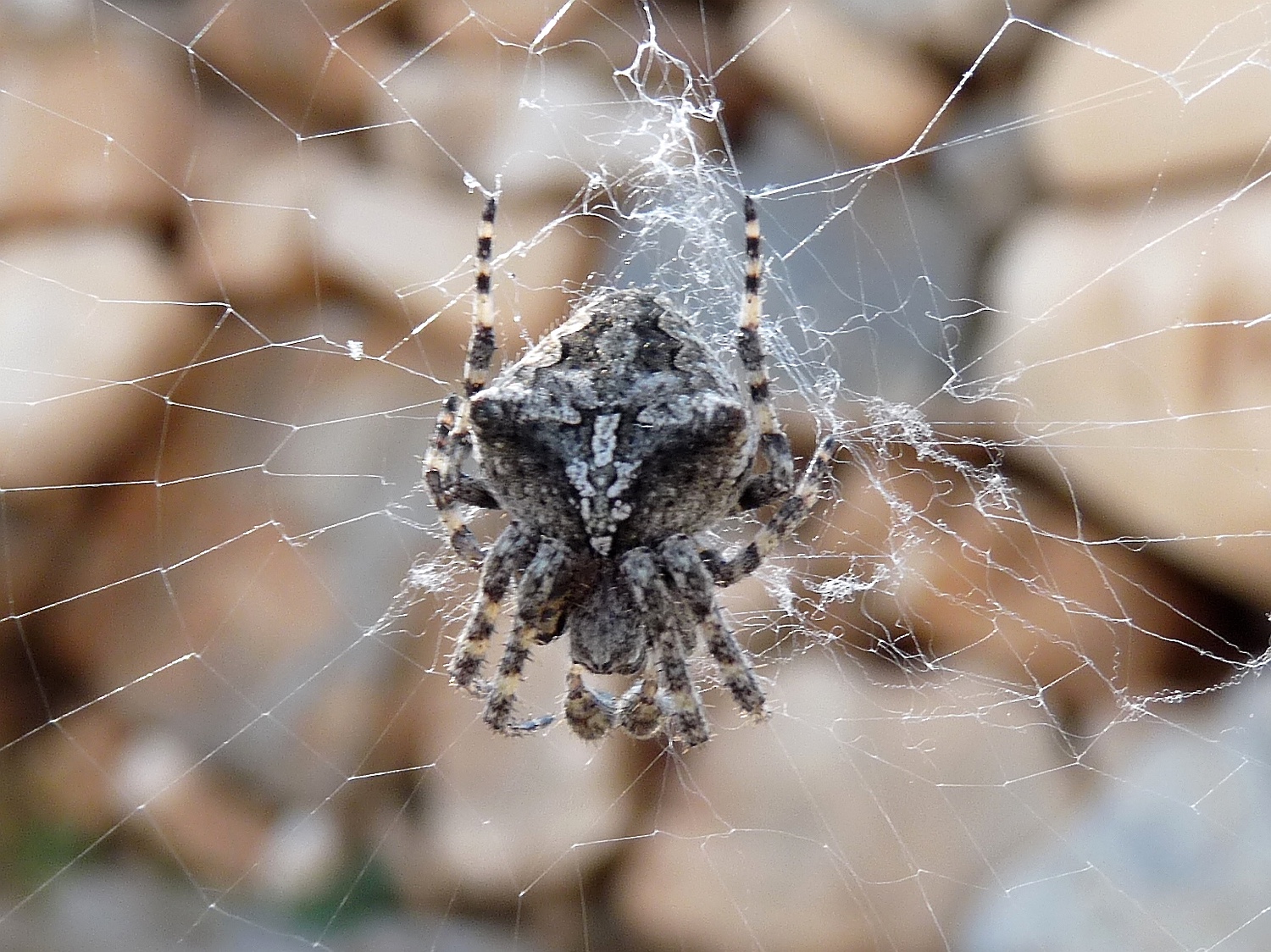
Araneus angulatus has a large abdomen, four pairs of legs extending from a much smaller front body, and large pedipalps that are thickened at the tip; two small eyes close together can also be seen on the head.
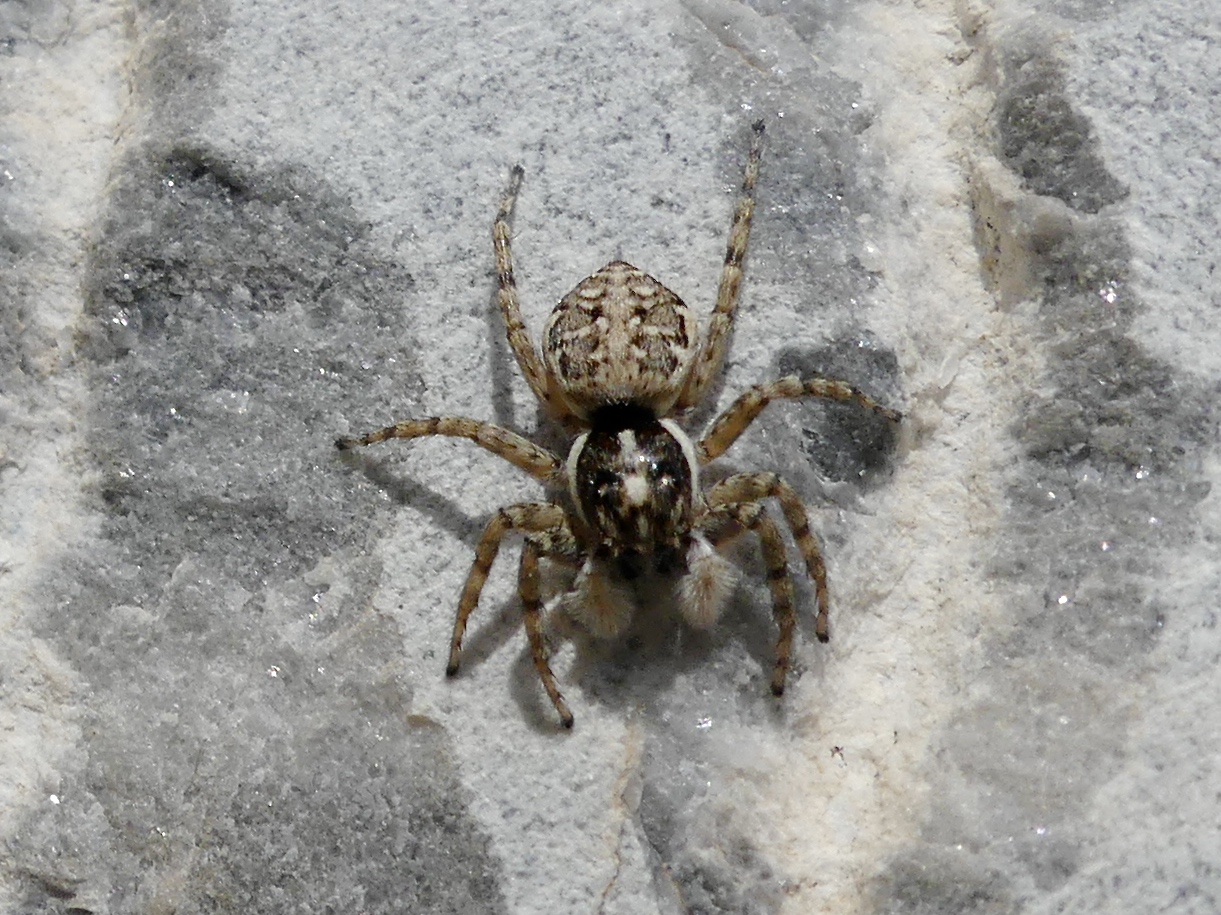
The small jumping spiders have particularly large, long-haired pedipalps.
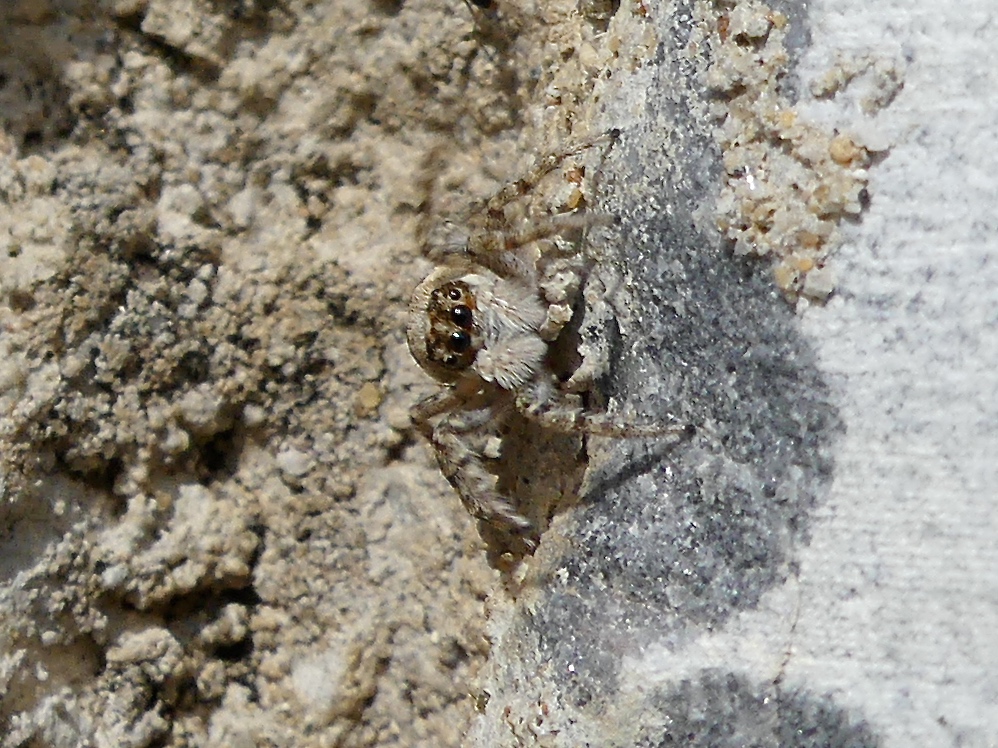
Here you can see the jumping spider’s four front eyes (two larger ones in the middle and two smaller ones on the sides).
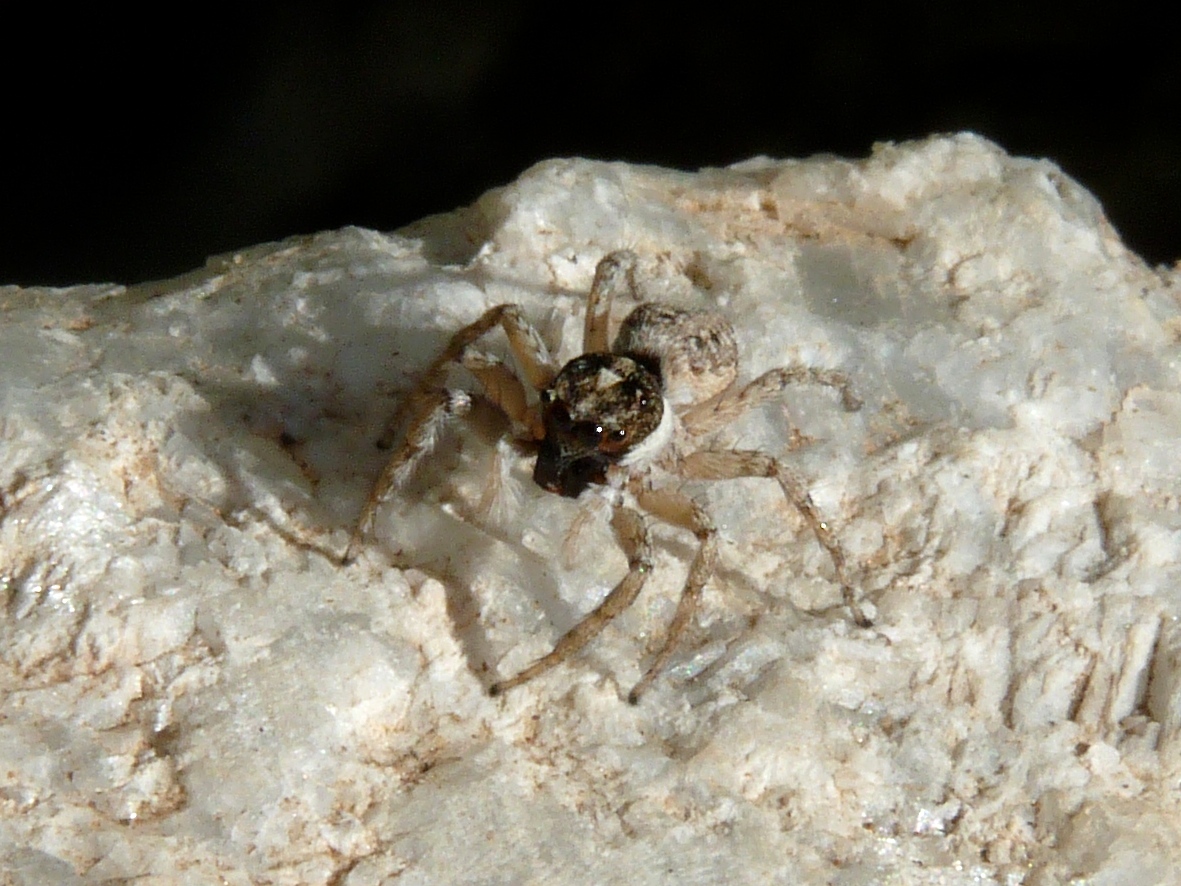
Here you can see the two larger side eyes at the back of the head, which ensure that the entire field of vision is covered. Jumping spiders have very well-developed eyes that enable colour perception and spatial vision. They also show a very sensitive sense of touch.
Spinnerets and silk
The most characteristic feature of spiders is their ability to spin threads and webs. They share this ability with many insects (whose larvae spin cocoons), but also with some millipedes and mussels (some species of mussel attach themselves to the substrate with so-called byssus threads, which in the case of the Noble pen shell can even be woven into garments; the mother-of-pearl on the inside of the shell also contains silk proteins).
Spider silk is secreted by the so-called spinnerets, which are located on the underside of the abdomen. In the silk glands inside the body, the silk exist in the form of its polymer components, which are dissolved in a salty solution; the silk thread is formed as soon as it is secreted and exposed to the air. Depending on the intended use, spiders produce a whole range of different types of threads with varying strength, thickness and elasticity; the formation of these threads is controlled by the spinnerets.
The spider uses a thick, strong thread for its ‘safety rope’ and for the framework of the web (frame, spokes, signal thread), as well as for catching and tripping threads and for constructing its dwelling tube. The adhesive thread of the web, on the other hand, is thinner and particularly elastic. Very fine silk is used for the inner lining of the egg cocoon and for encasing the prey; the outside of the cocoon is covered with particularly tough silk. The spider applies a special glue to the adhesive threads and to the attachment points of the other threads of the web; in some more primitive species, a very fine wool on the threads serves the same purpose by entangling the prey.
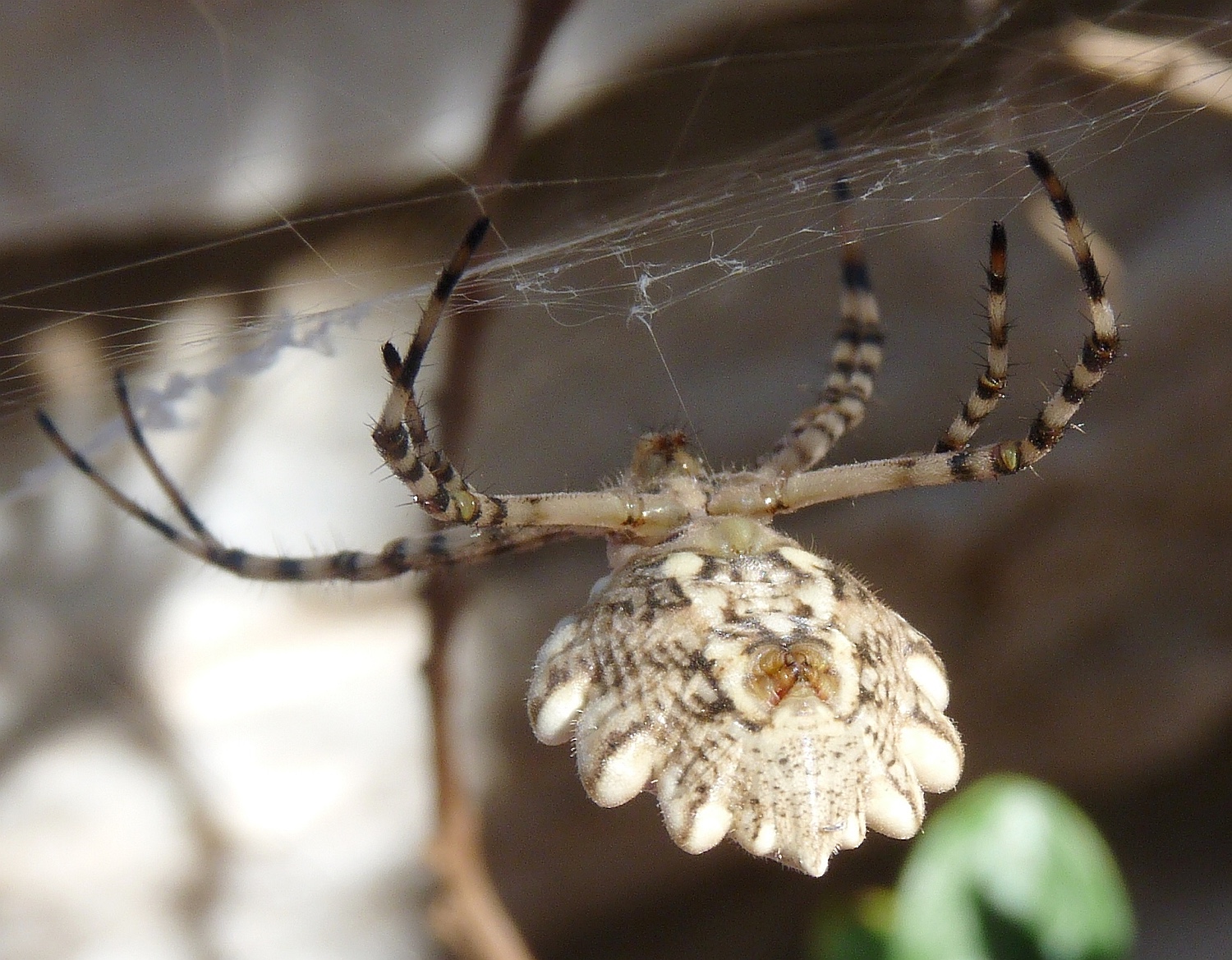
In this specimen of Argiope lobata, the spinnerets that secrete the silk thread are clearly visible on the underside of the large abdomen.
The silk threads of spiders are extremely strong (five times more than steel) and at the same time very elastic (they can be stretched to three times their length). They are not eaten by bacteria and are very durable, but still biodegradable: an ideal material whose efficiency human engineers can only dream of!
Diet
Spiders are predatory, although some species probably also consume some pollen (which gets caught in the web which is eaten by the spider). Their prey mostly comprises insects. The captured prey is paralysed or killed by a bite; then digestive enzymes are injected and the liquified tissue of the prey is sucked out.
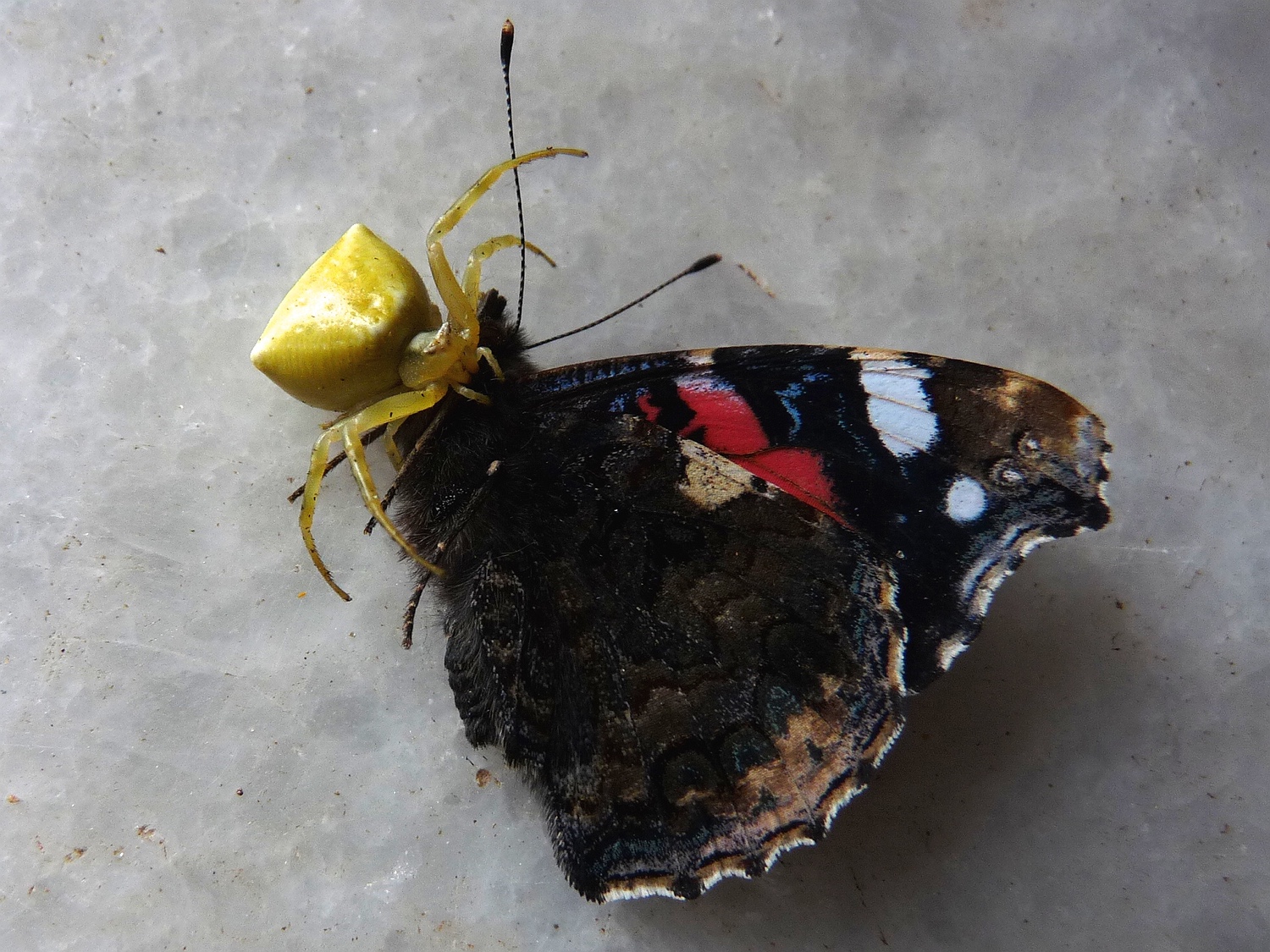
This small crab spider has captured a butterfly.
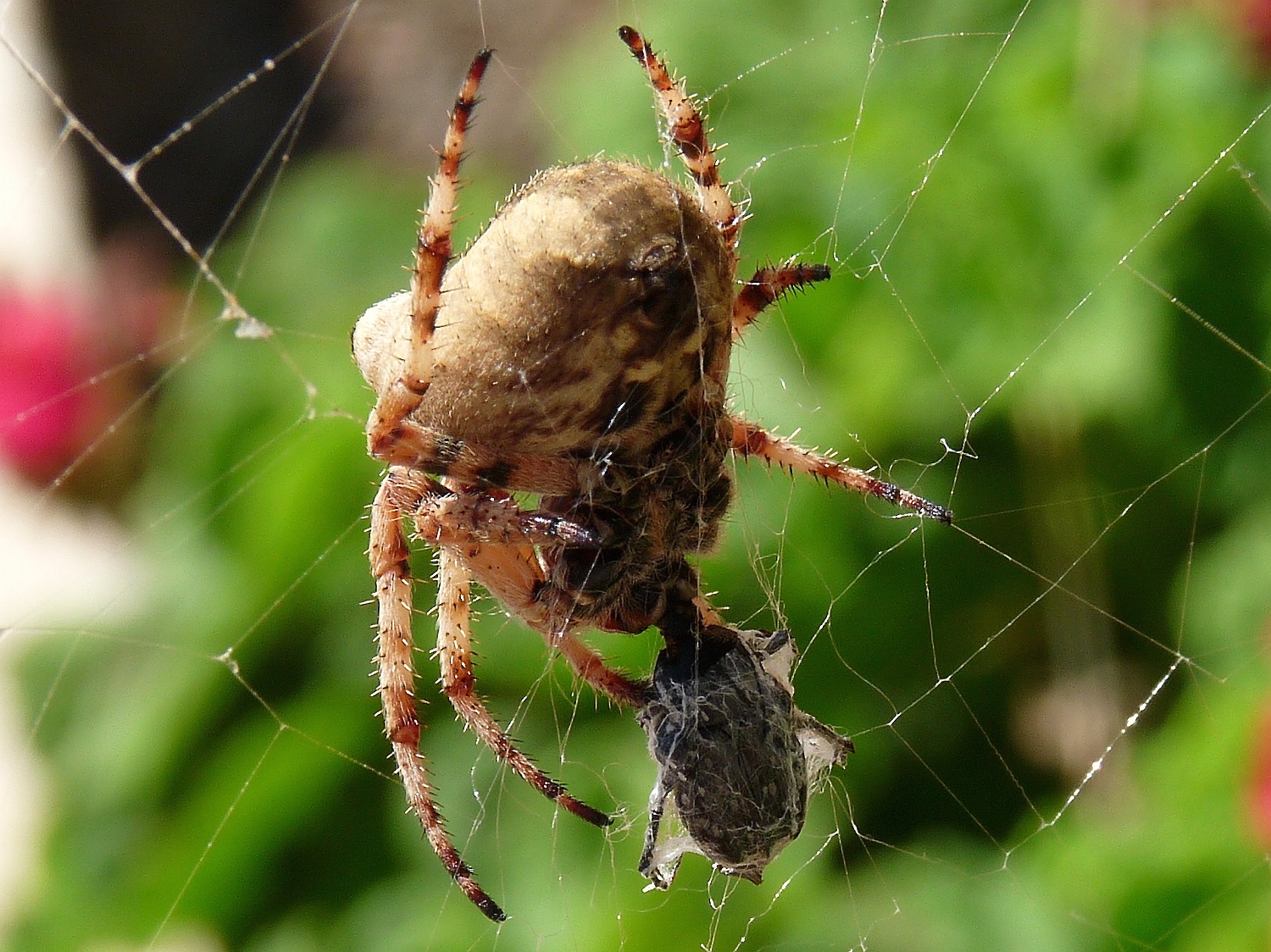
Araneus angulatus with prey
Reproduction
Males are often much smaller than females in spiders. Mating usually takes place externally through the transfer of sperm packets. Females often carry the eggs around with them in an egg sac or guard them in their web.
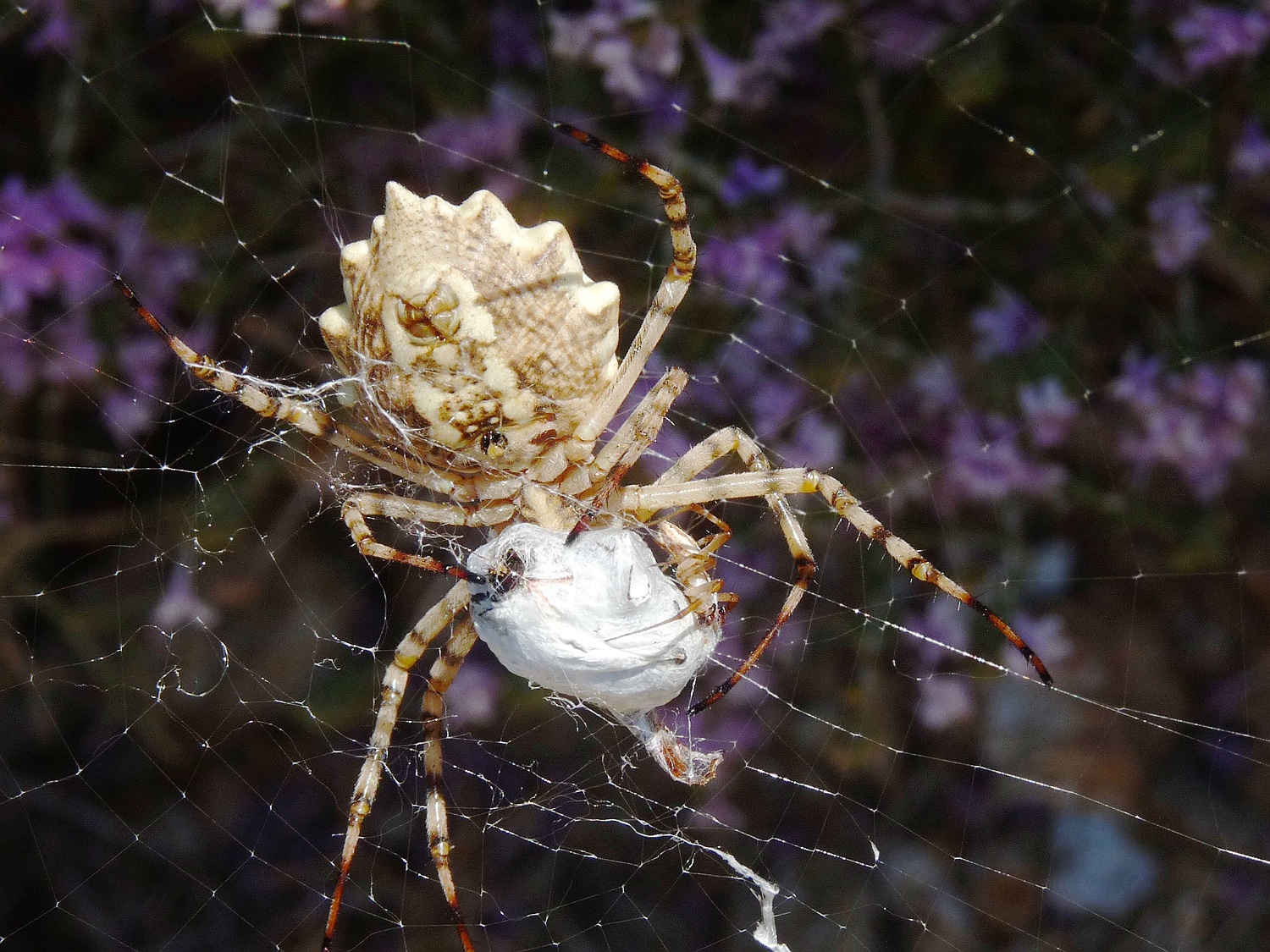
In many spider species, the females are much larger than the males, as is the case here with Argiope lobata – the small male, sitting sideways on the encased prey, is barely visible.
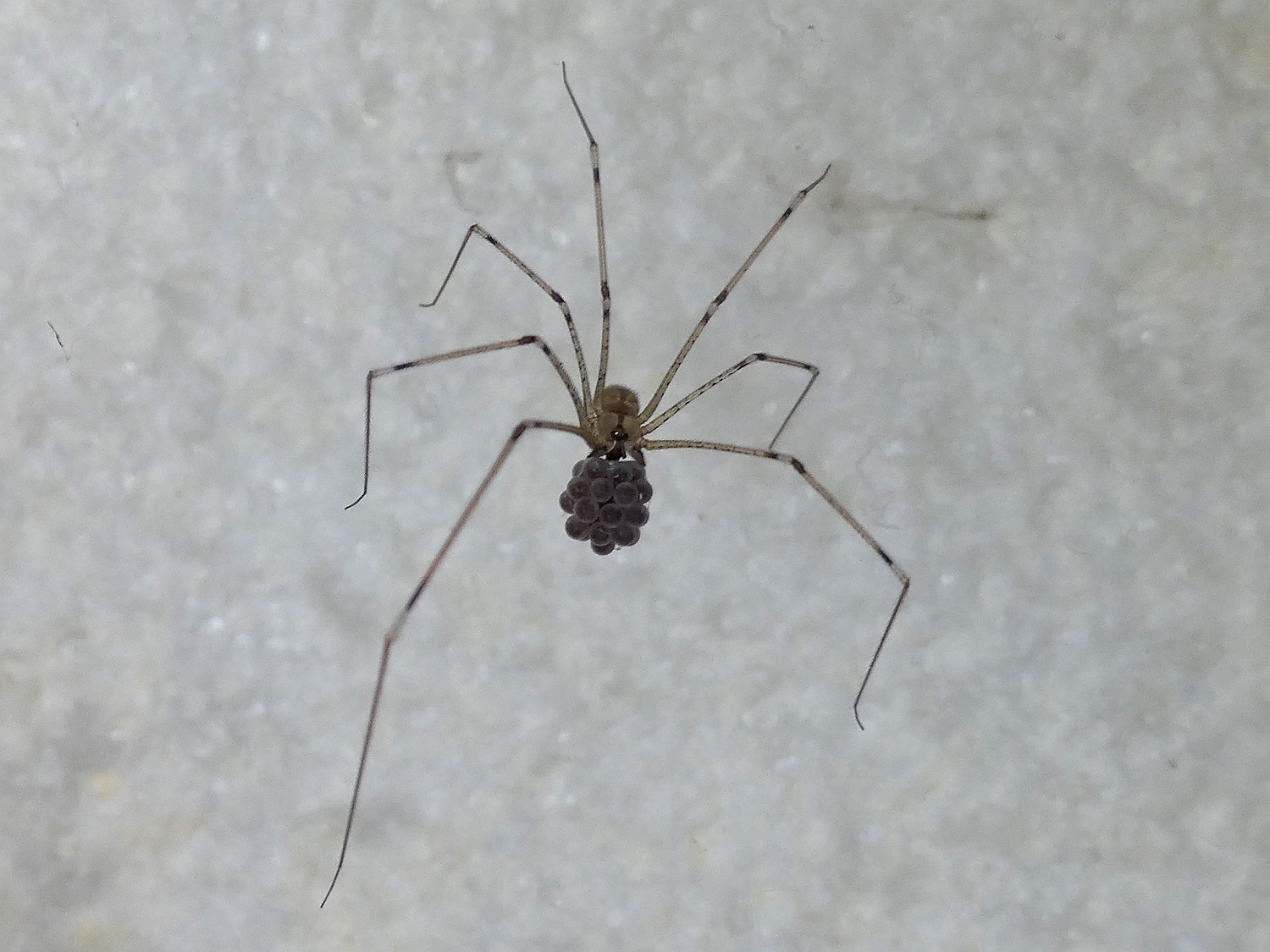
Many spiders guard their eggs and care for their young. In the case of Holocnemus pluchei, the female carries the eggs with her mouthparts until the young hatch.
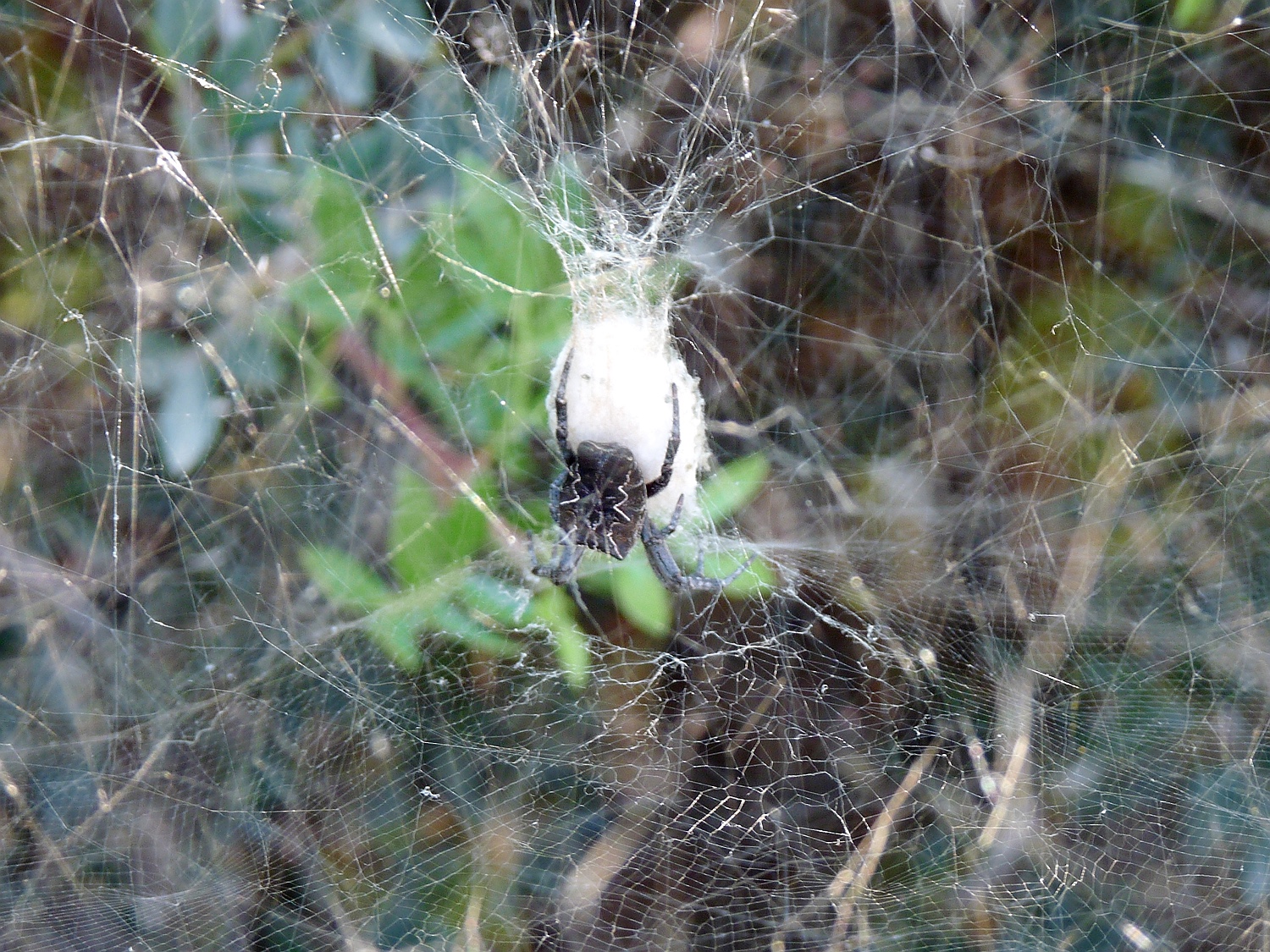
Other species keep their eggs in a densely woven cocoon. Cyrtophora cirticola constructs an egg cocoon which hangs close to the web.
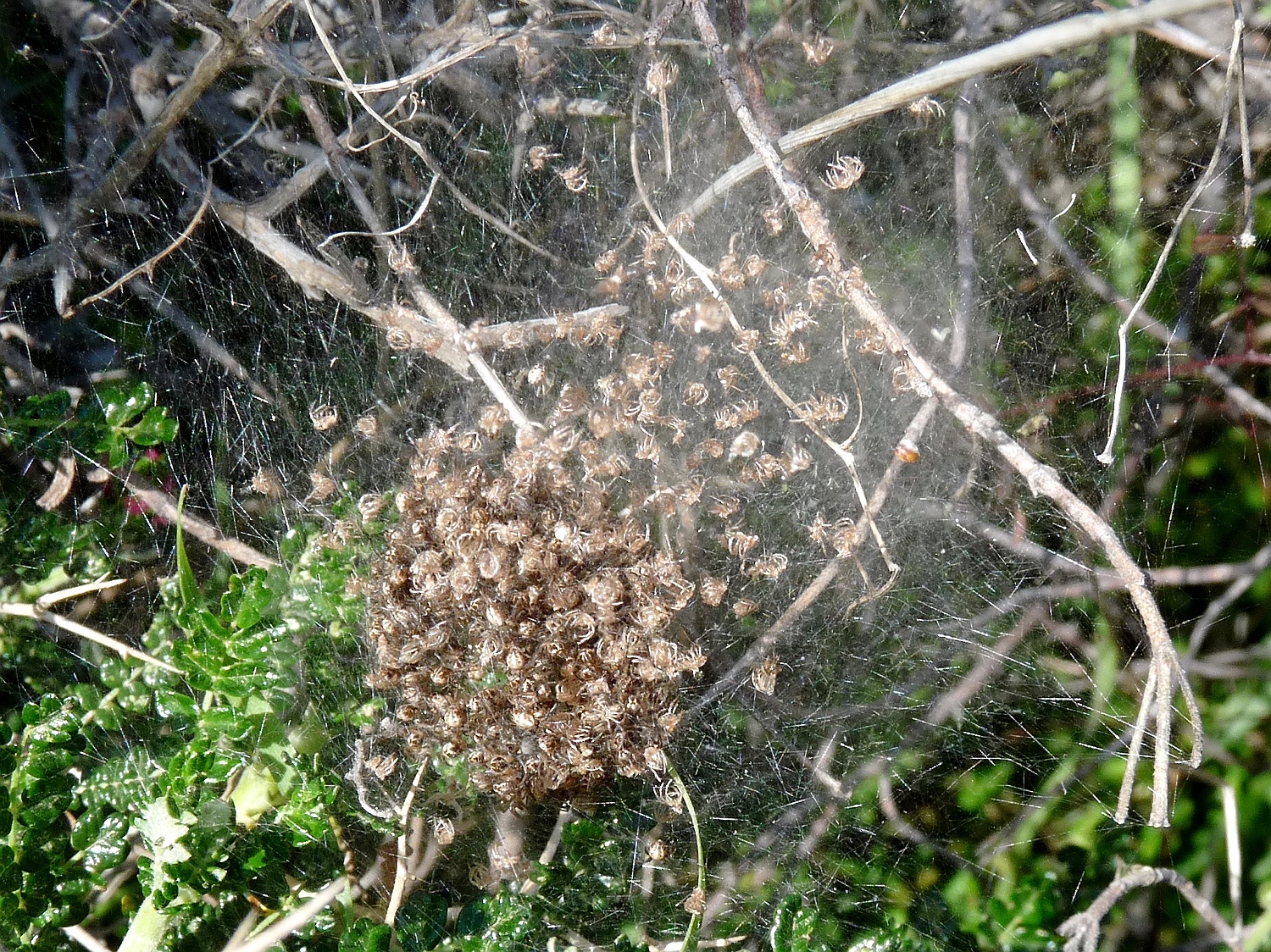
Here you can see the small young spiders still in their mother’s web.
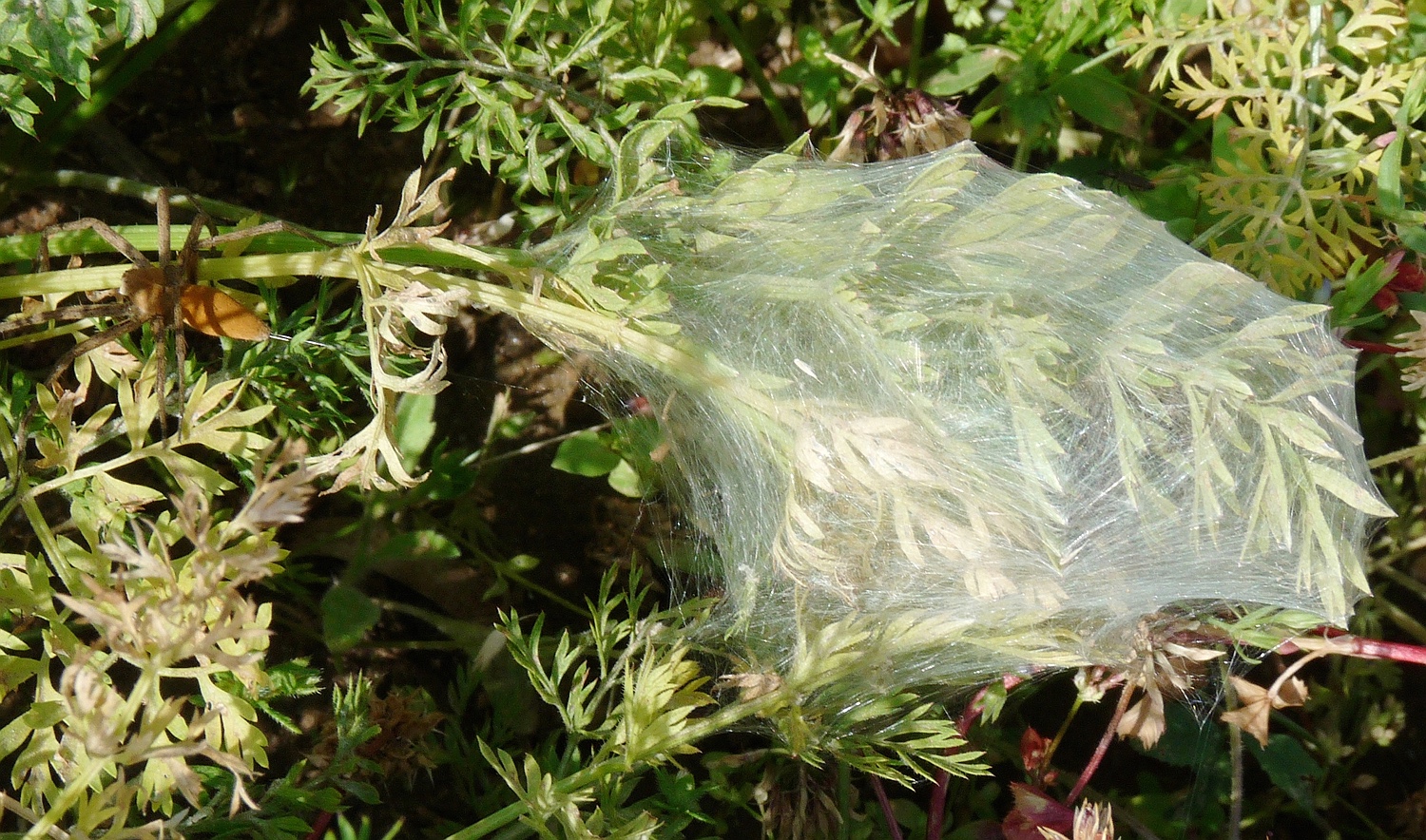
Pisaura mirabilis does not build a web to catch its prey, but it spins a special cocoon-like web in which its offspring spend the first few days or weeks until the young spiders can survive on their own.
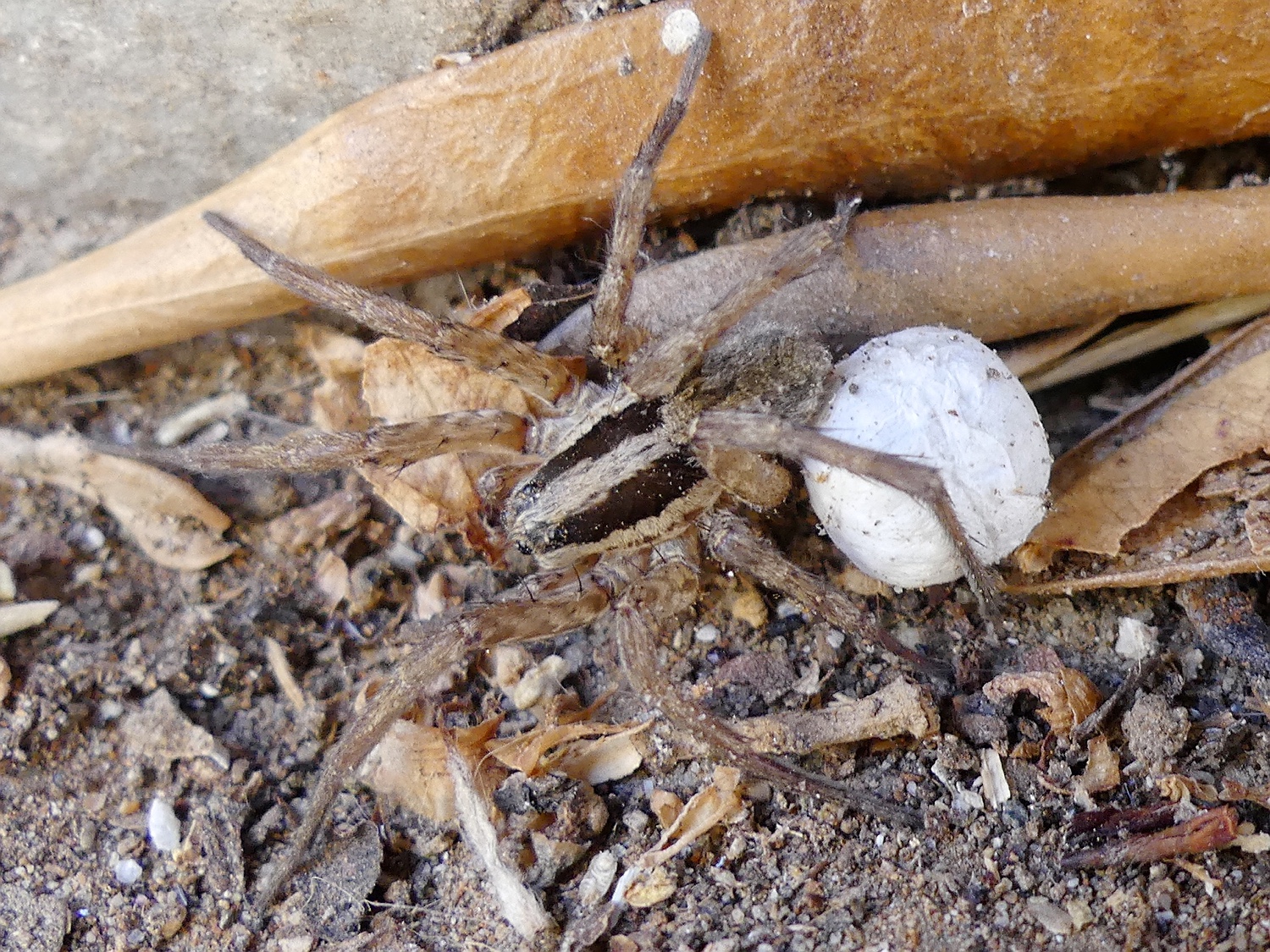
In the case of wolf spiders, the mother spins an egg sac in which she carries the eggs around with her.
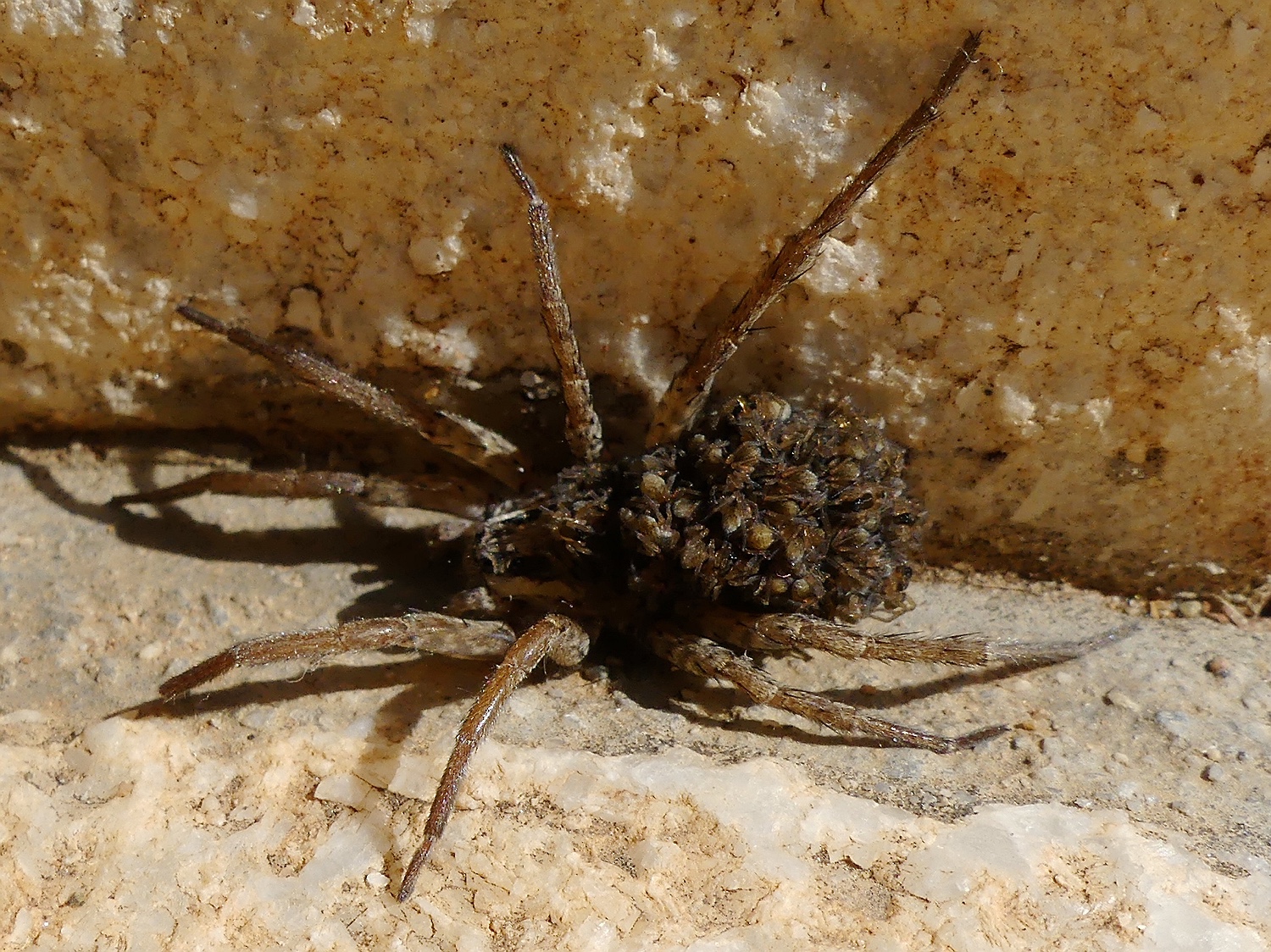
When the young spiders hatch, the mother also carries them around on her back for about eight days. During this time, she does not hunt, but only cares for the young spiders, defending them if necessary and looking after them by staying in places with favourable humidity, etc. During this time, the young spiders still live off the egg yolk and do not need to consume any other food.
In some species, the young spiders disperse by spinning long threads that are caught by the wind. In autumn, this can sometimes be observed on Naxos: the meter-long threads are blown high into the air and carried off, transporting the small spiders over long distances (“ballooning”).
Webs and other hunting strategies
Many species of spider catch their prey in species-specific webs, which are often very elaborate and complex. Other species actively hunt their prey (jumping spiders, wolf spiders) or ambush it, e.g. waiting on flowers for insects (crab spiders).
Most spider species build their webs at night; sometimes they are renewed every night, sometimes at longer intervals. Some species take great care to keep their webs clean, while the webs of others soon become littered with ‘rubbish’.
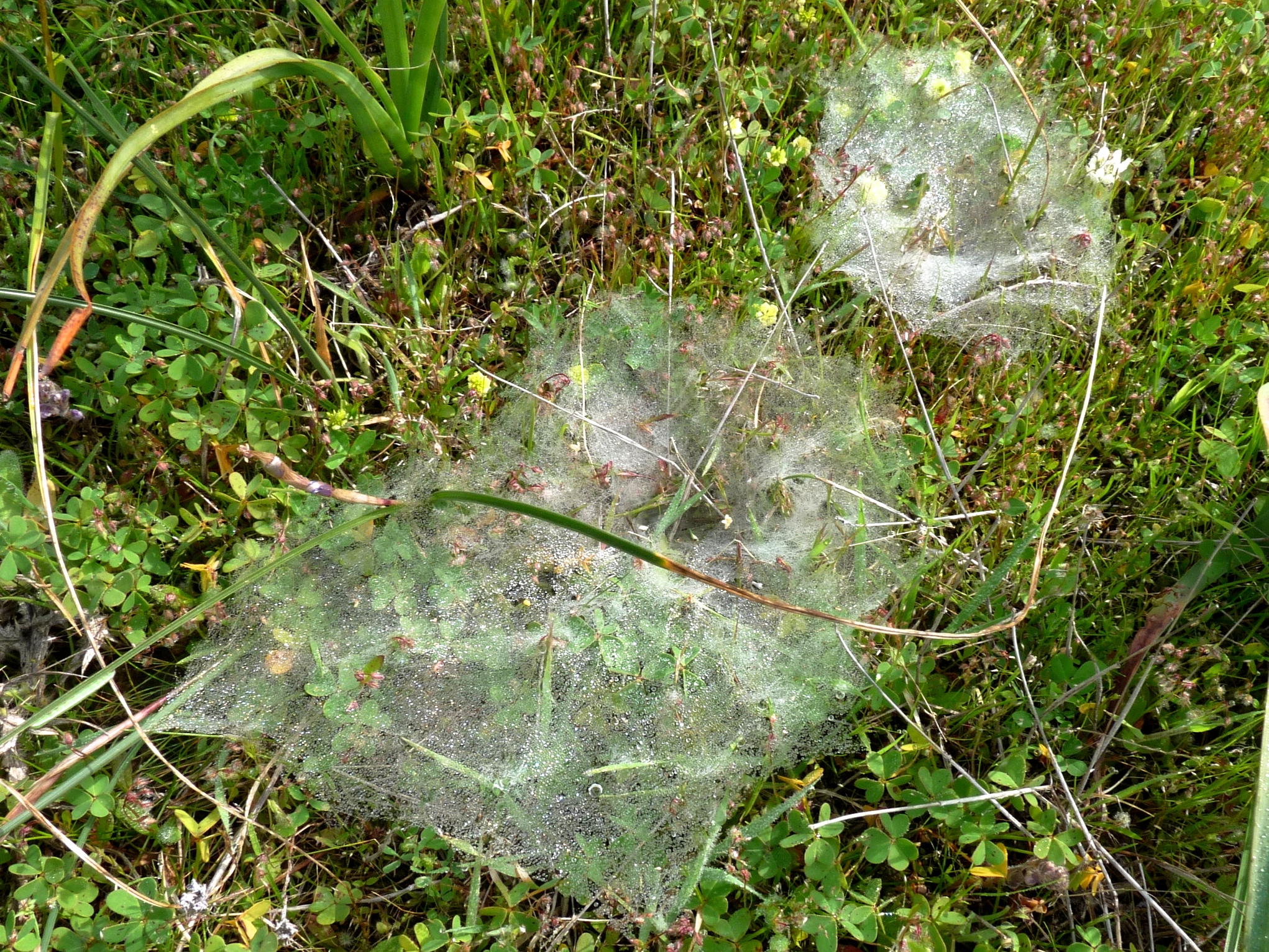
Spider webs with morning dew
Orb webs
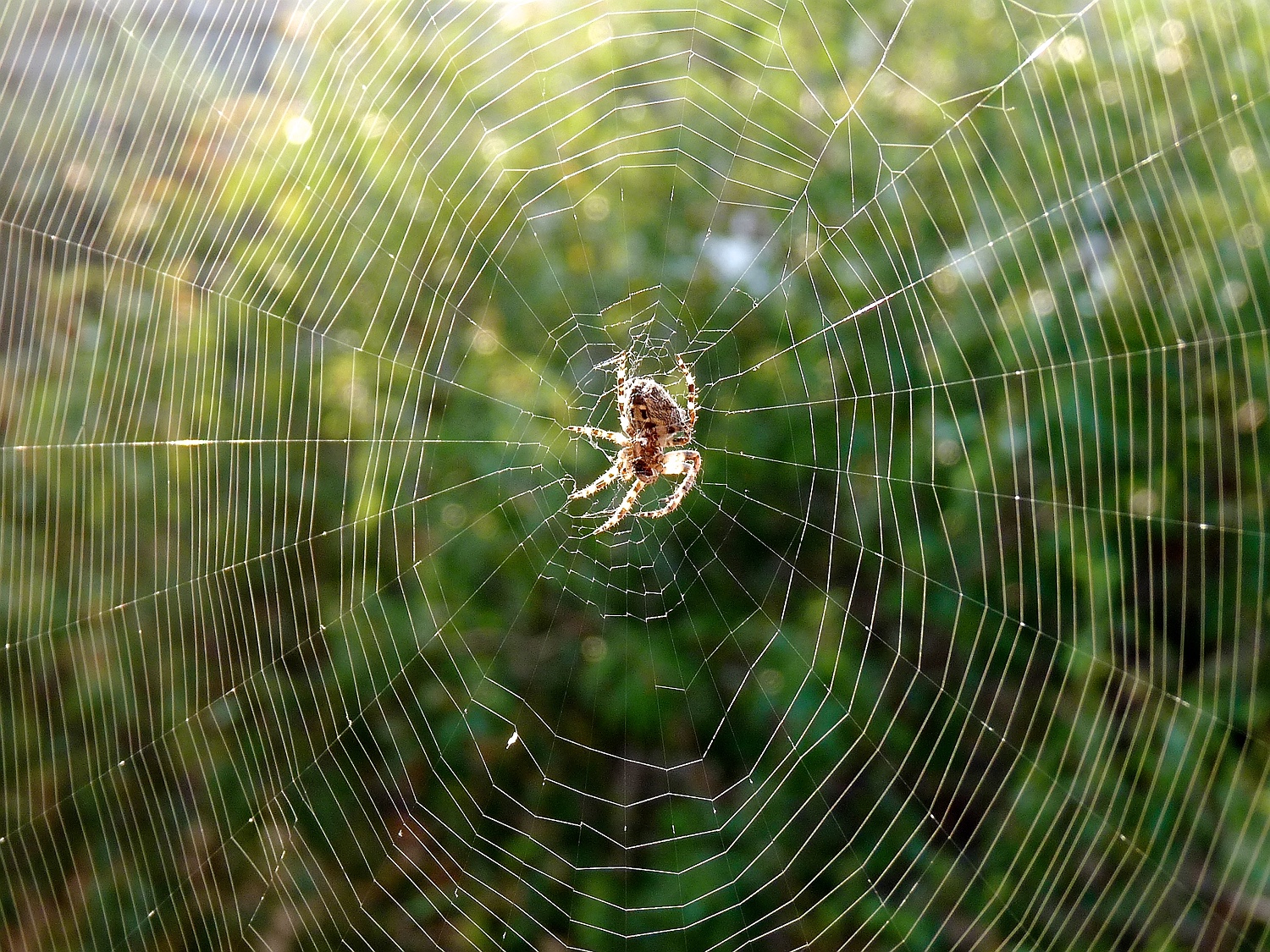
Araneus angulatus sitting in the center of its web.
Orb webs are more or less regular and round. Usually they are set up vertically. In some species, the spider leaves one sector of the wheel free. To create the orb web, the spider, sitting on a high vantage point, first spins a thread that gets blown to another attachment point. When the thread gets caught somewhere, the spider walks across spinning another thread to strengthen the first one. Then it descends spinning a thread from the center of the first thread, creating a Y-shape as the first spokes of the wheel. It then spins the surrounding frame threads and adds further spokes. A fine spiral is often set in the center of the web (hub). From there, the spider spins a non-sticky auxiliary spiral thread, and following this, it adds the fine adhesive thread in a narrow spiral from the outside inwards, removing at the same time the auxiliary spiral. Finally, the hub is remade: sometimes the center remains free, sometimes it consists of a fine, non-sticky spiral. In the larger species, the animal usually sits in the center of the web.
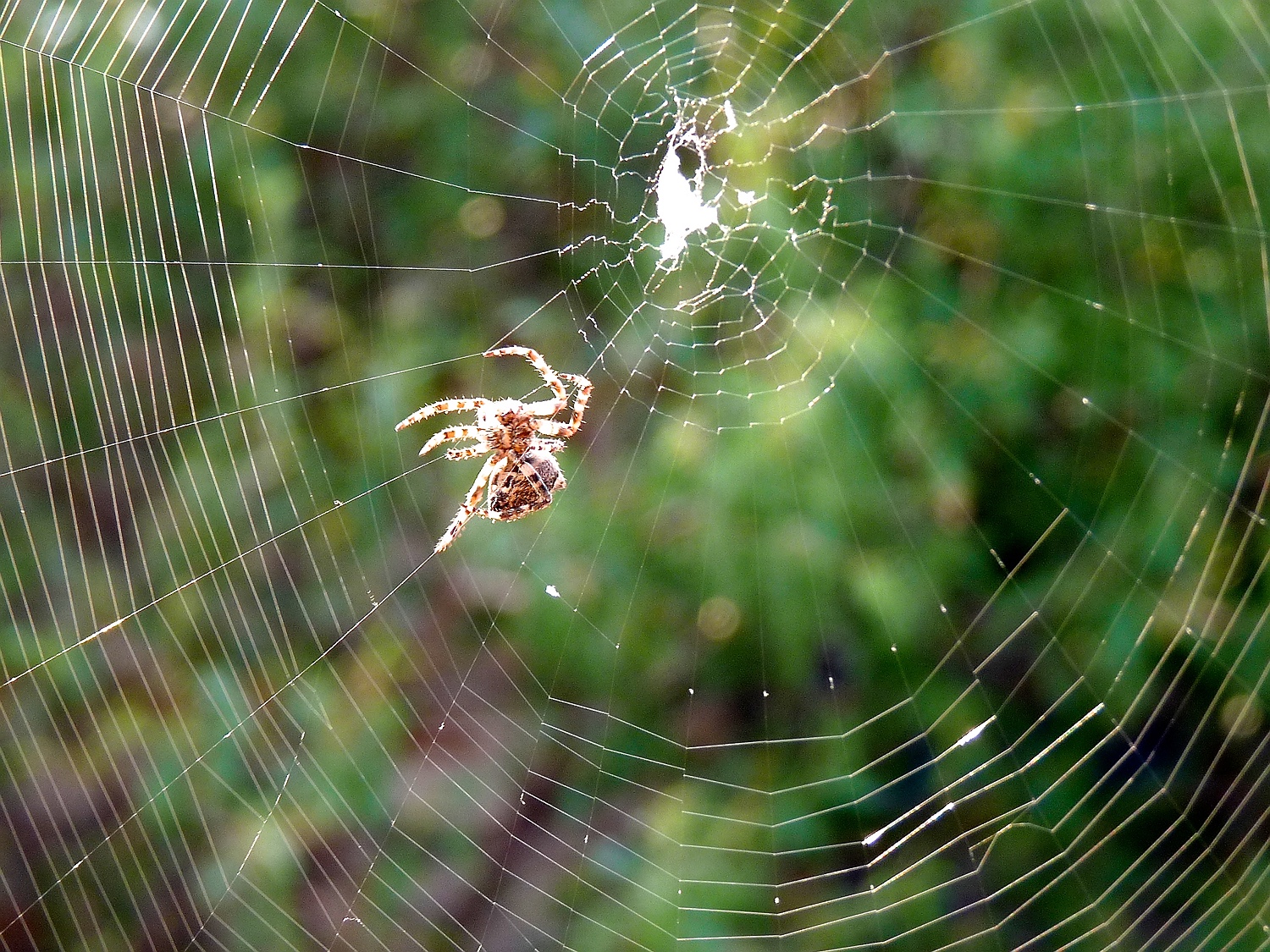
Here you can see Araneus angulatus building its web. In the center lies the hub with the fine, differently designed spiral. The spider walks along the auxiliary spiral and attaches the adhesive thread to each spoke with its hind leg. On the auxiliary spiral one can see the glue droplets with which it is attached to the spokes.
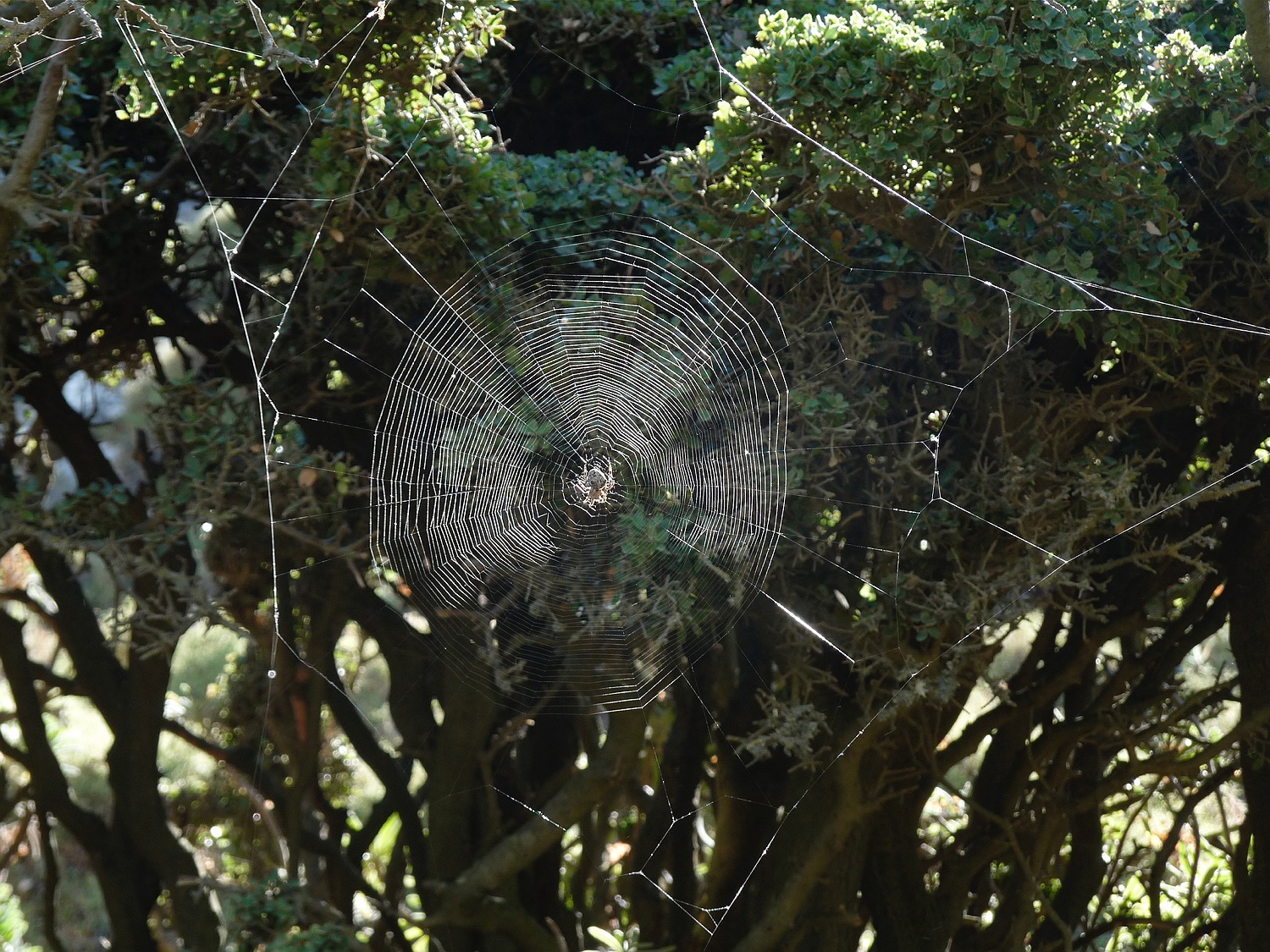
This orb web shows the entire structure with the frame, the stabilising threads within the frame, the radial threads (spokes), the spiral and the hub in the center of the web.
In contrast to the large orb-weaving spiders, which sit in the center of the web, smaller spiders usually pull a signal thread from the center of the web to a nearby hiding place where they sit in a funnel-like construction of silk threads. In this case, the web is not completely vertical, but is slightly conical because the hub is pulled to the side.
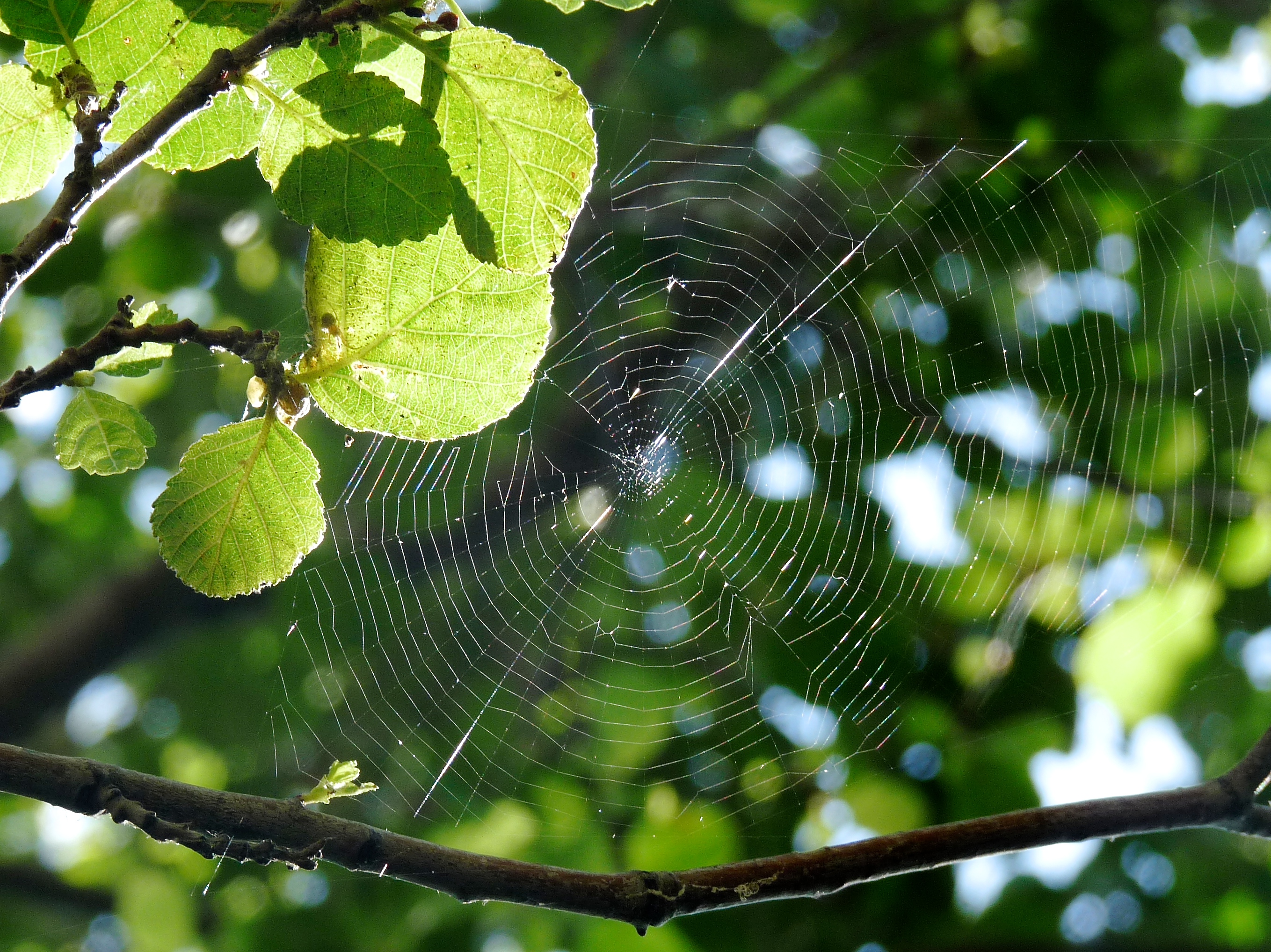
Here you can see the web of a small spider that does not sit in the hub of the web, but has drawn a signal thread from there to its hiding place (not so easy to see; on the left); the spider is sitting on one of the leaves.
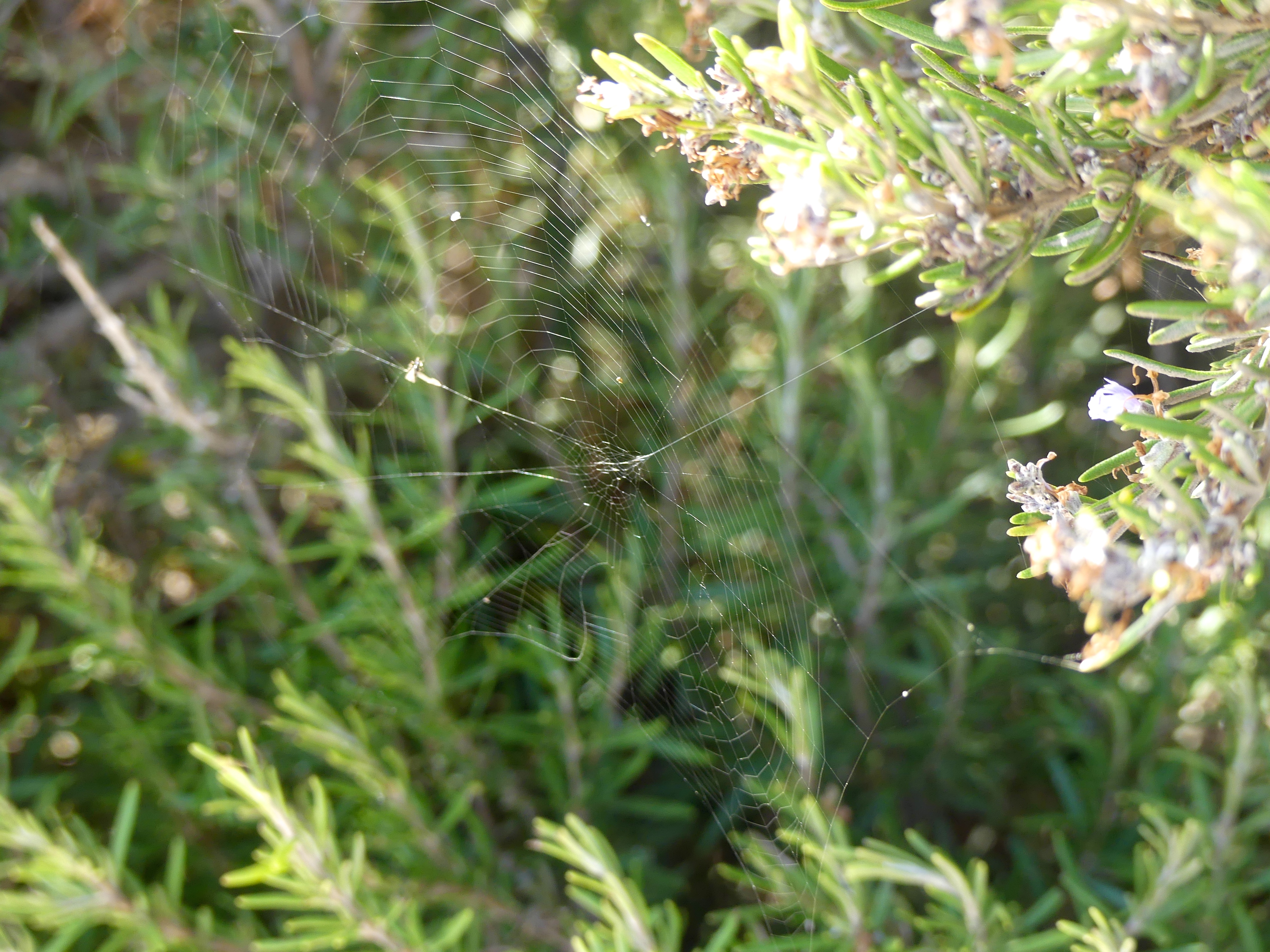
Here another example of a web with a signal thread (leading to the right in this case). This version of orb web is easy to recognise because the hub is pulled slightly to one side.
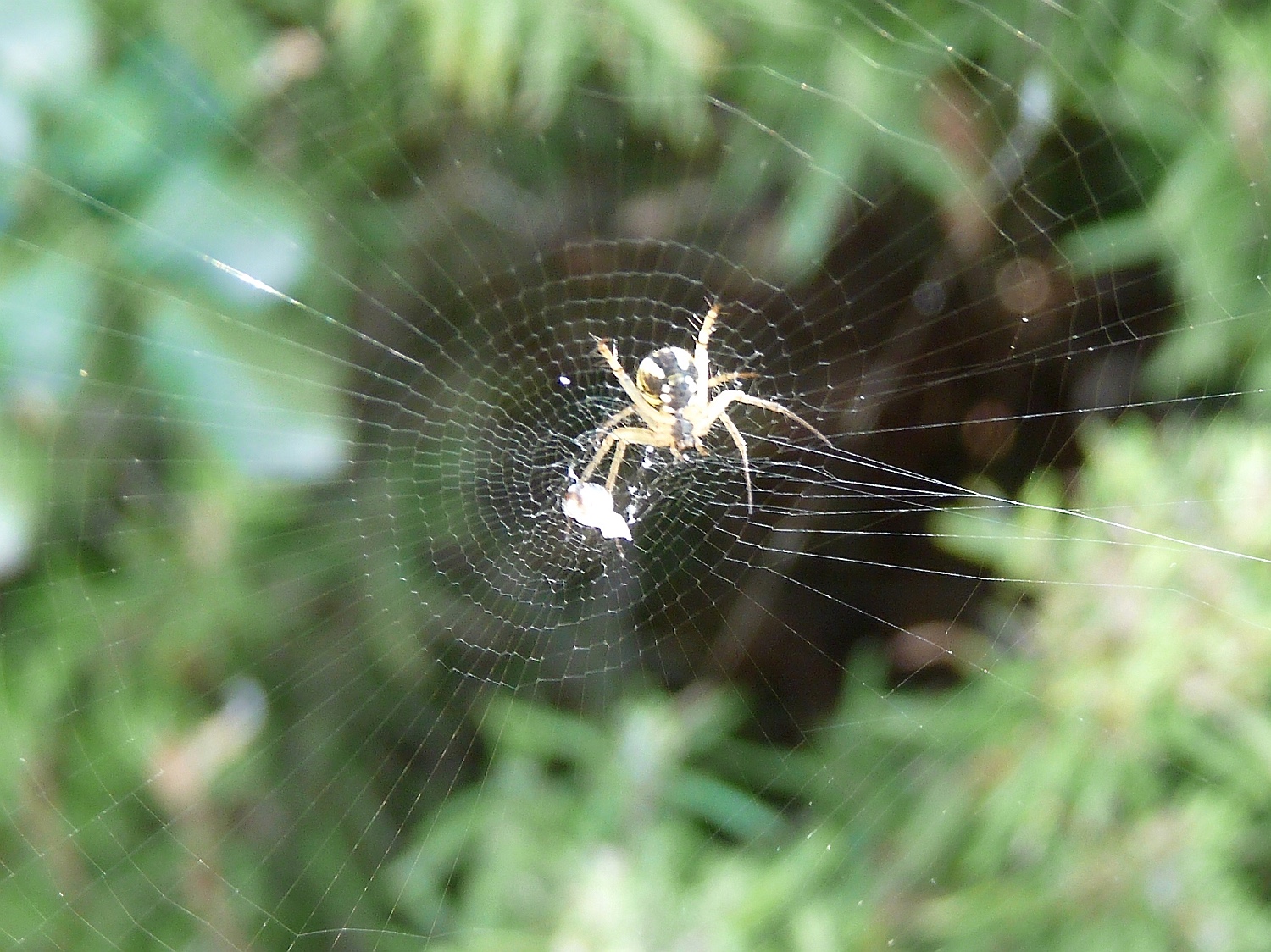
This web shows the differently made hub, which is particularly large and carefully woven.
Tent webs
Some spiders, such as Cyrtophora citricola, build horizontal orb webs above which they spin a tangle of threads that cause passing insects to deflect and to fall into the fine horizontal orb web stretched out below. Horizontal orb webs with ‘tripping threads’ above them are usually referred to as tent webs.
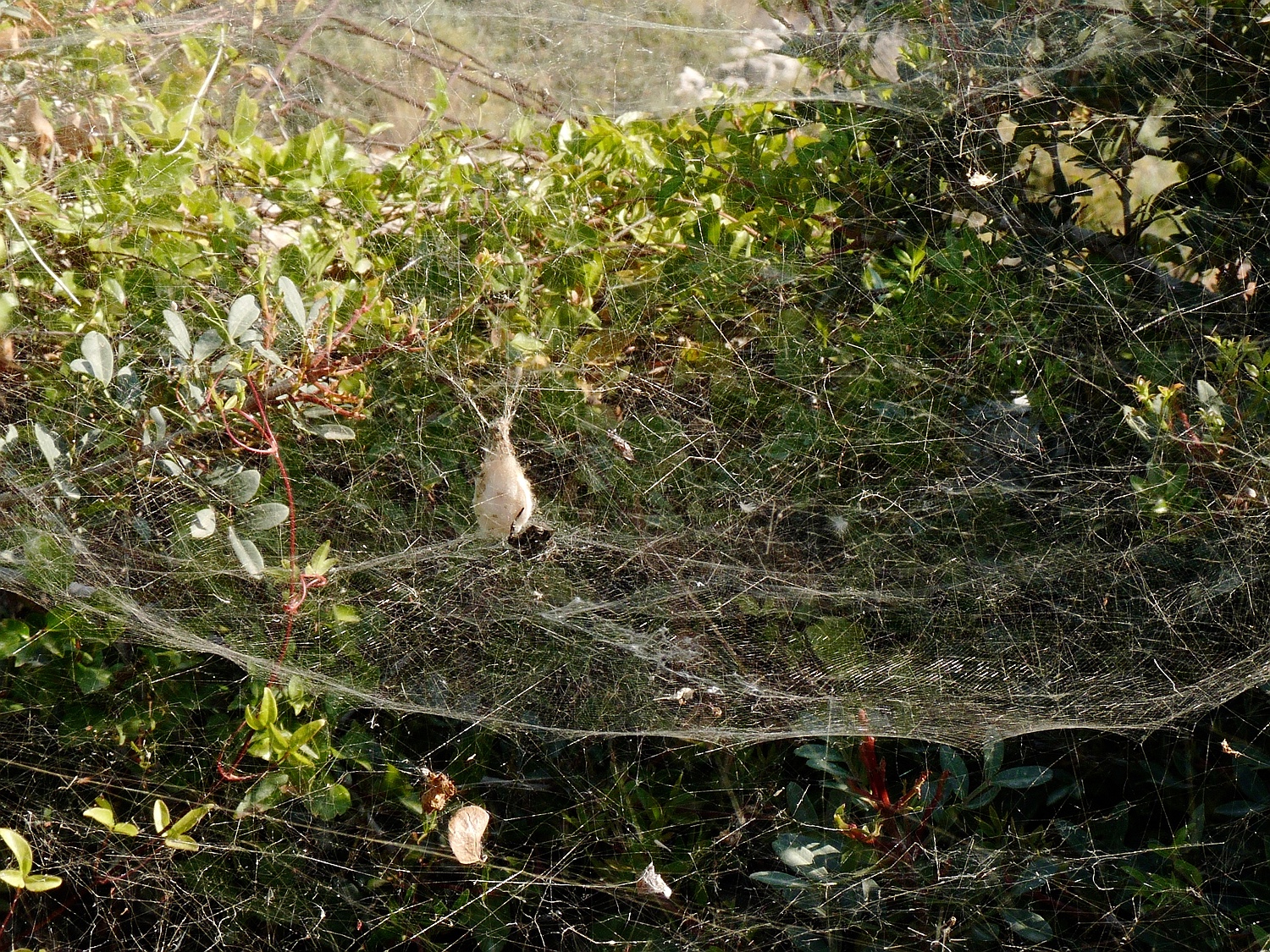
Cyrtophora citricola builds a so-called tent web. Here you can see the very finely-meshed, roughly horizontal catching net with the criss-crossed ‘tripping threads’ above it. The horizontal net catches insects that collide with the threads above it and fall down. The web of Cyrtophora citricola has no adhesive threads; the spider has lost its ability to produce the glue.
Space-webs
Many spider species do not build regular webs, but instead spin a tangle of irregularly running threads, such as the cellar spiders that are often found in houses. Under furniture, you may find another type of space-web with trap lines to the floor that trap passing insects.
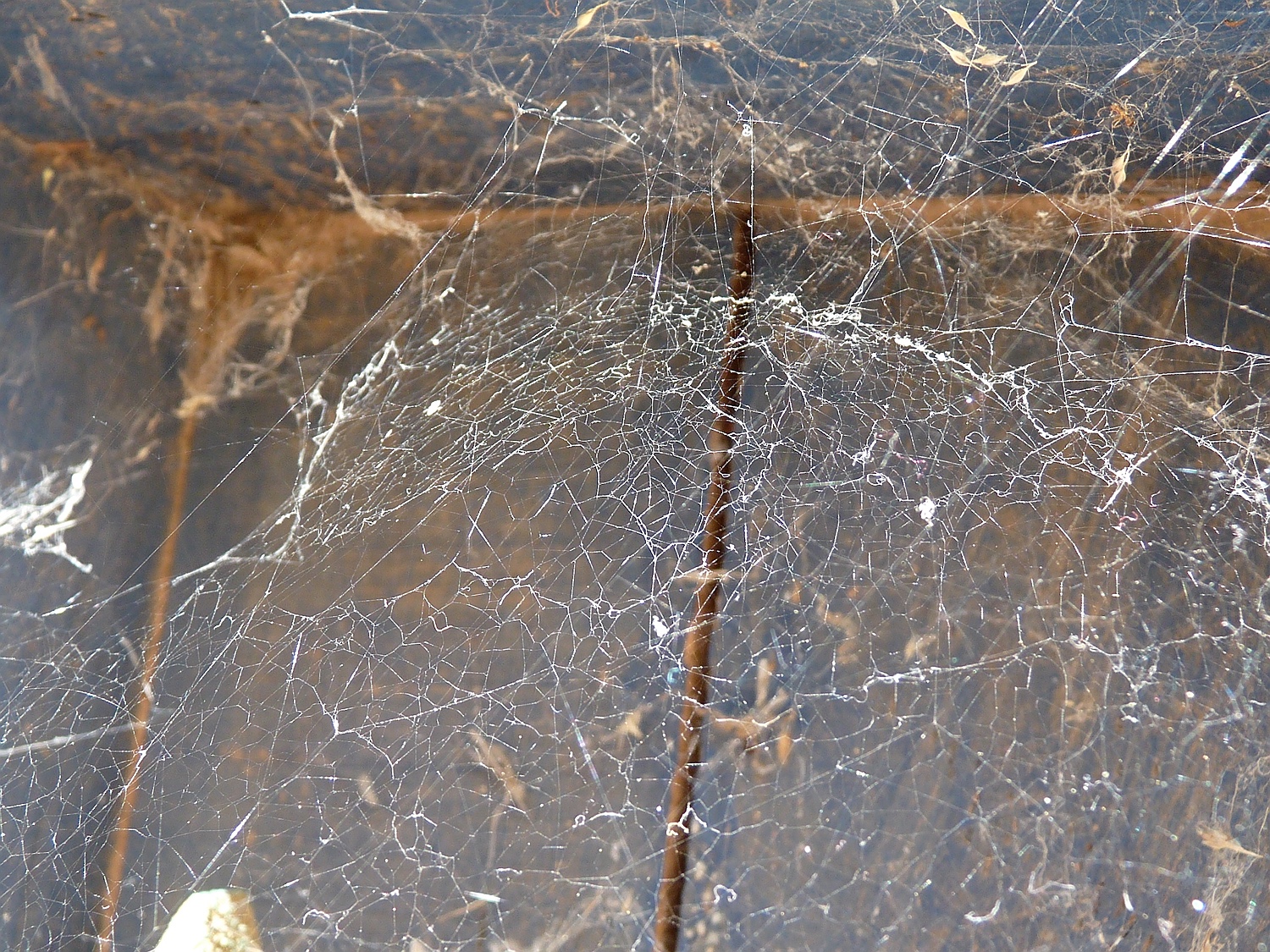
typical space-web with a tangle of criss-crossing threads
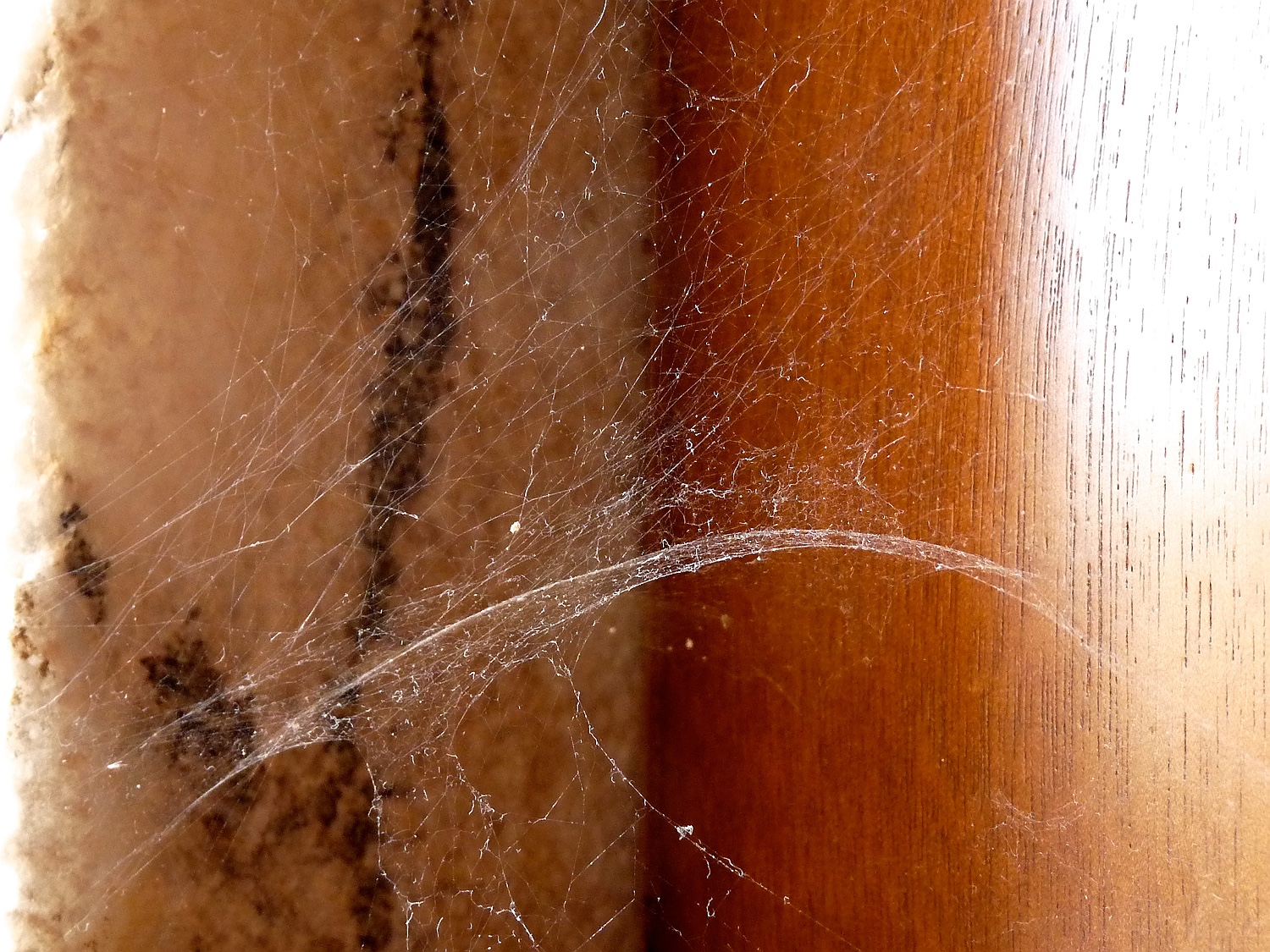
The cellar spiders’ webs have a finer web at the bottom to catch the falling insects; this is often strongly curved, as can be seen here.
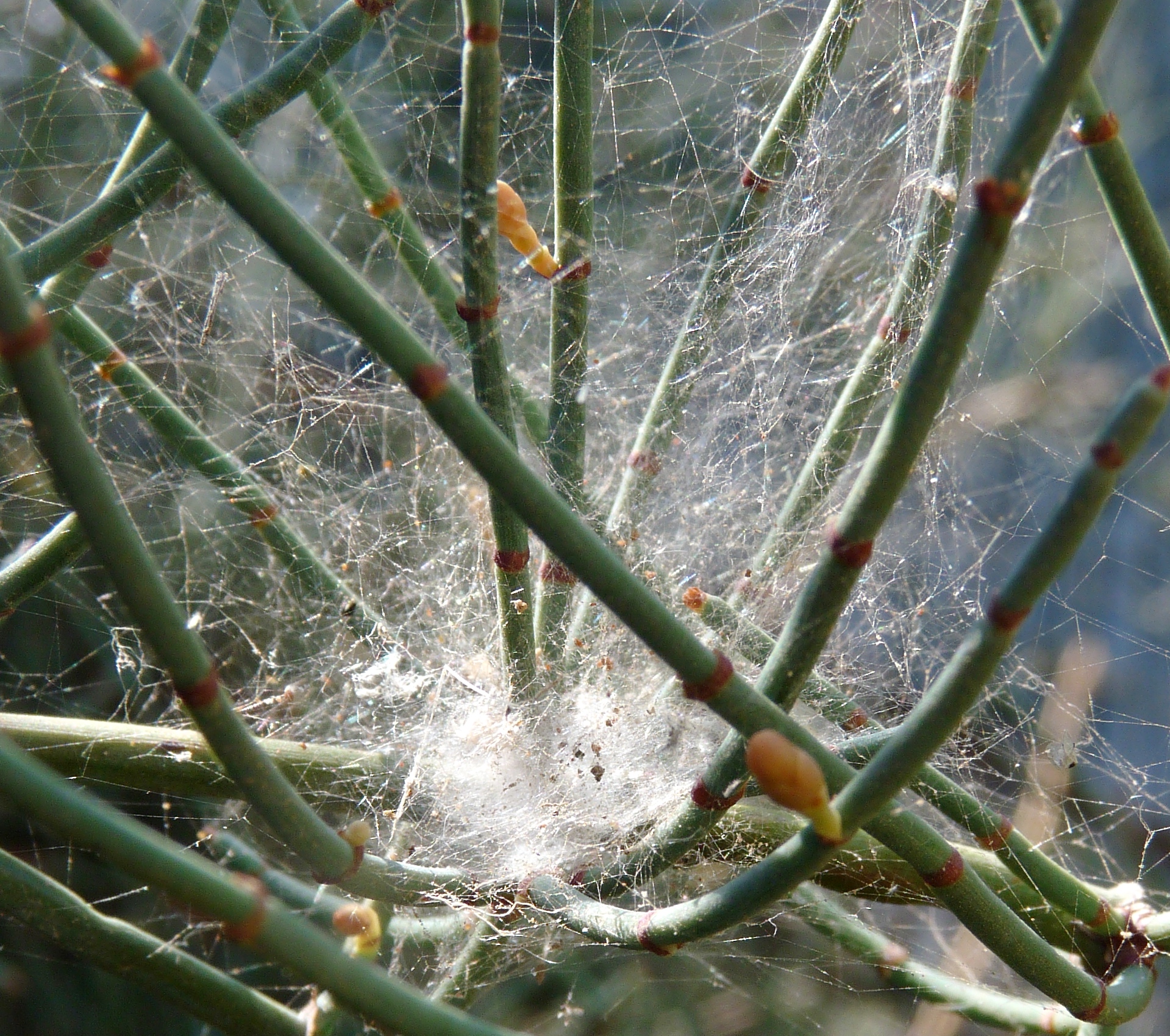
The tips of tree branches (here Ephedra) often contain small space-webs spun by tiny, inconspicuous spiders; these too are often woven much more densely in their lower section.
Funnel and tubular webs
Many species of spiders build webs with a funnel in which the spider sits. From here, it senses the vibrations caused by an insect and quickly emerges from its hiding place. Some species build a very large, dense web in front of their funnel, stretched more or less horizontally; in other species, the web is very small, or they attach only a few trap lines in front of their tube to alert them to passing insects.
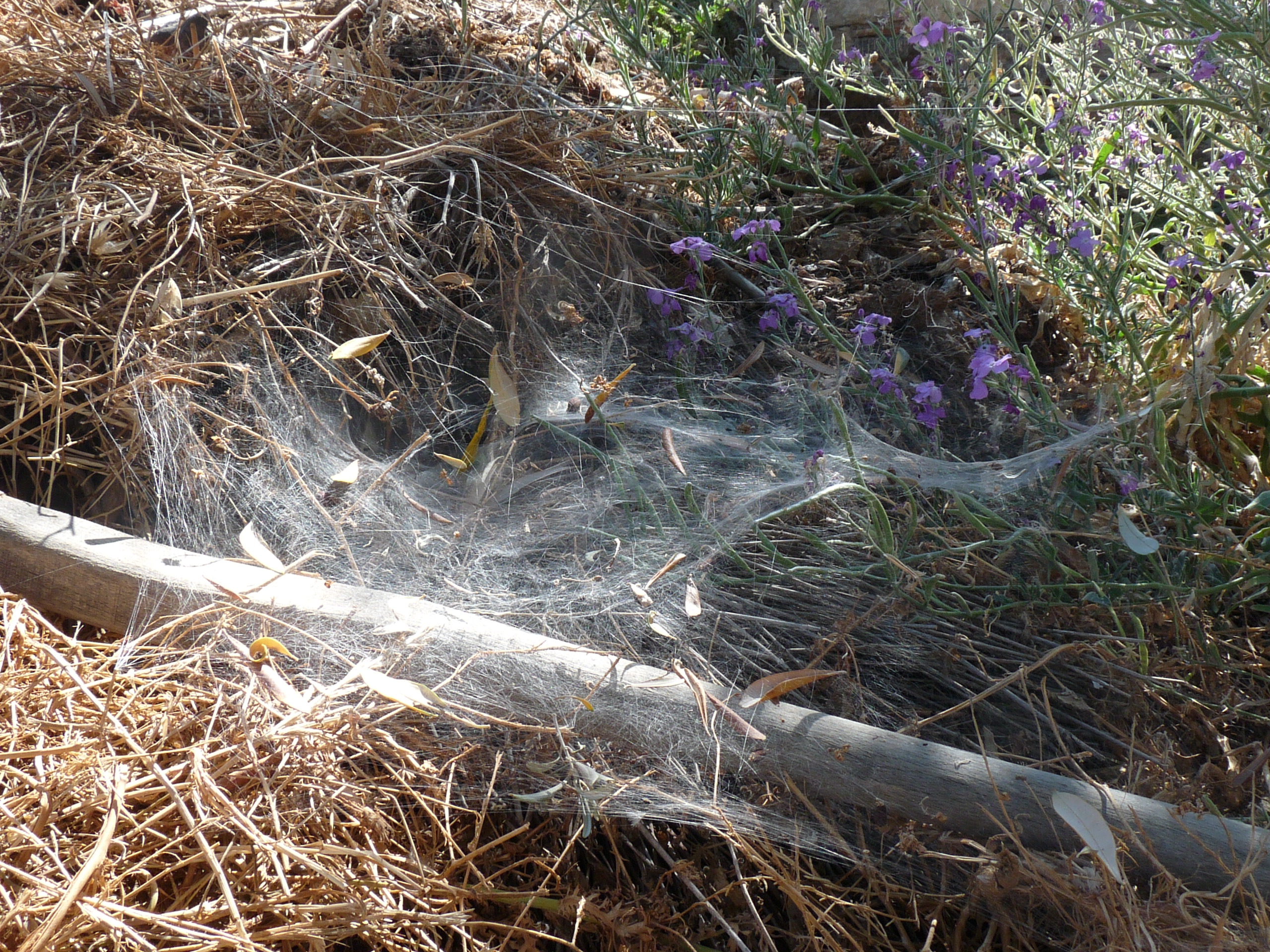
Funnel webs are spread out over the ground and have a more or less distinct funnel that serves as a hiding place for the spider.
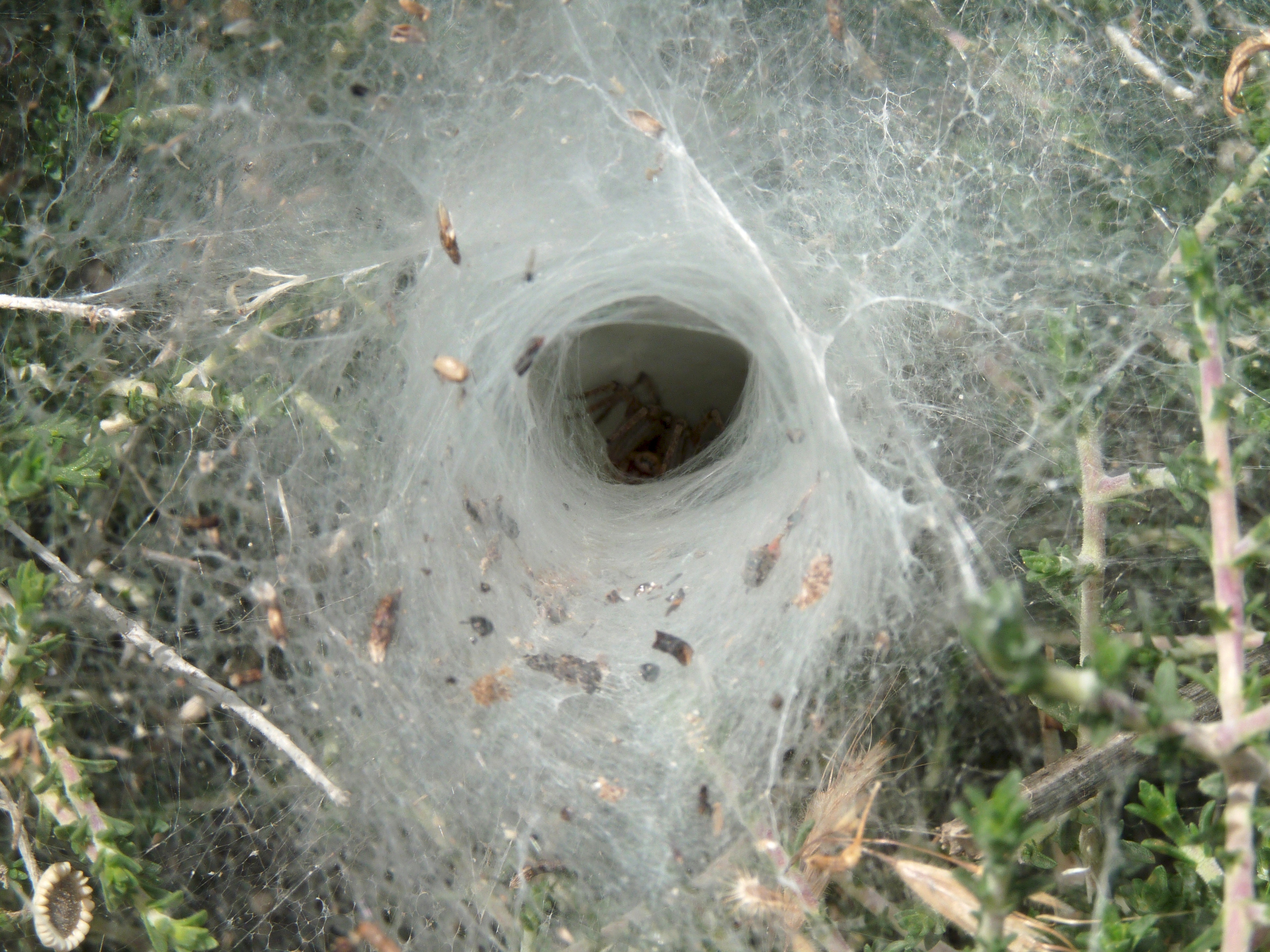
Here you can look inside the funnel, where the spider sits and waits; the web around the funnel is very dense and finely woven.
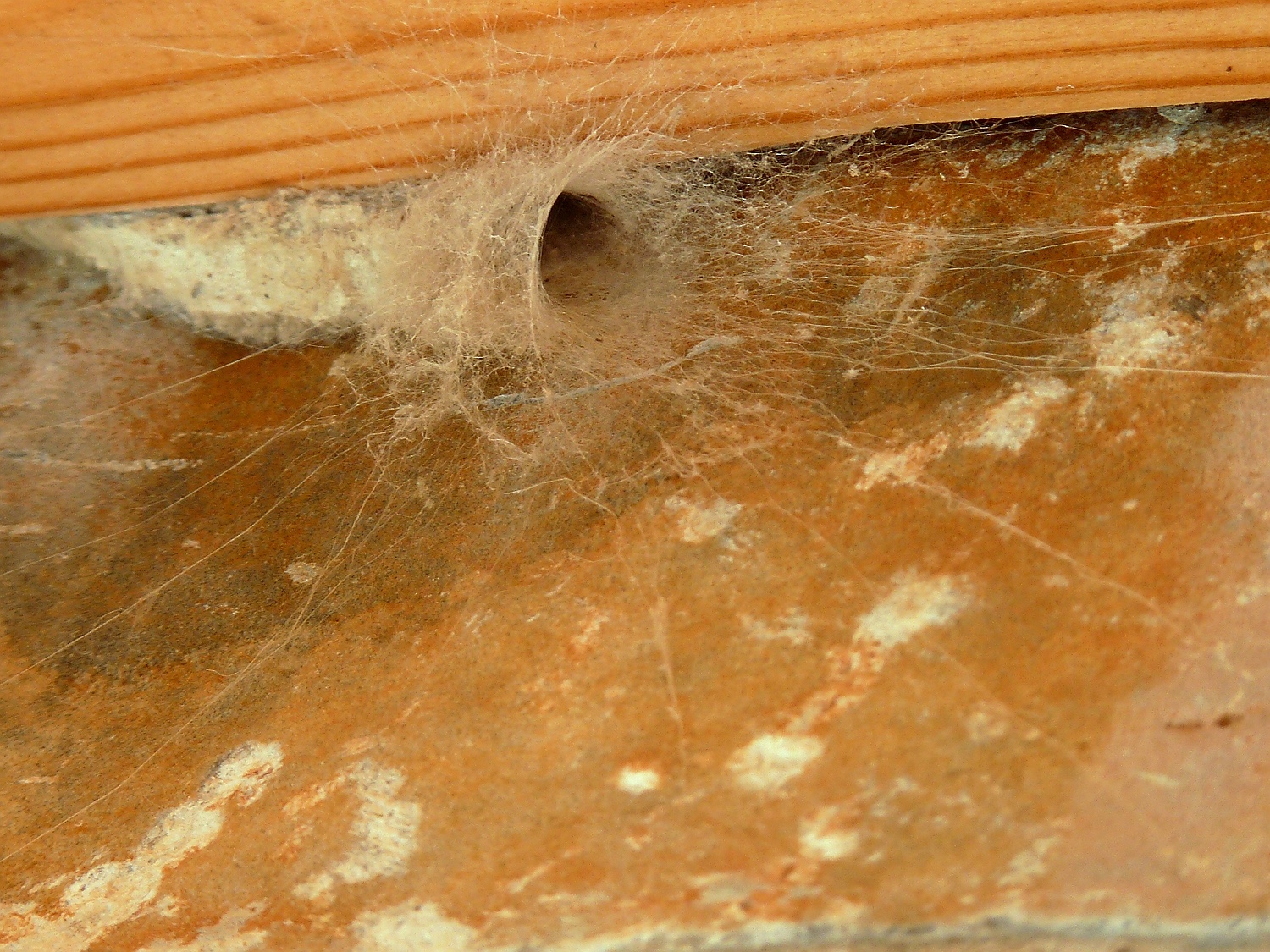
Tubular webs consist of the tube in which the spider hides and several trap lines in front of the tube that stretch out in all directions and serve to alert the spider when an insect passes by.
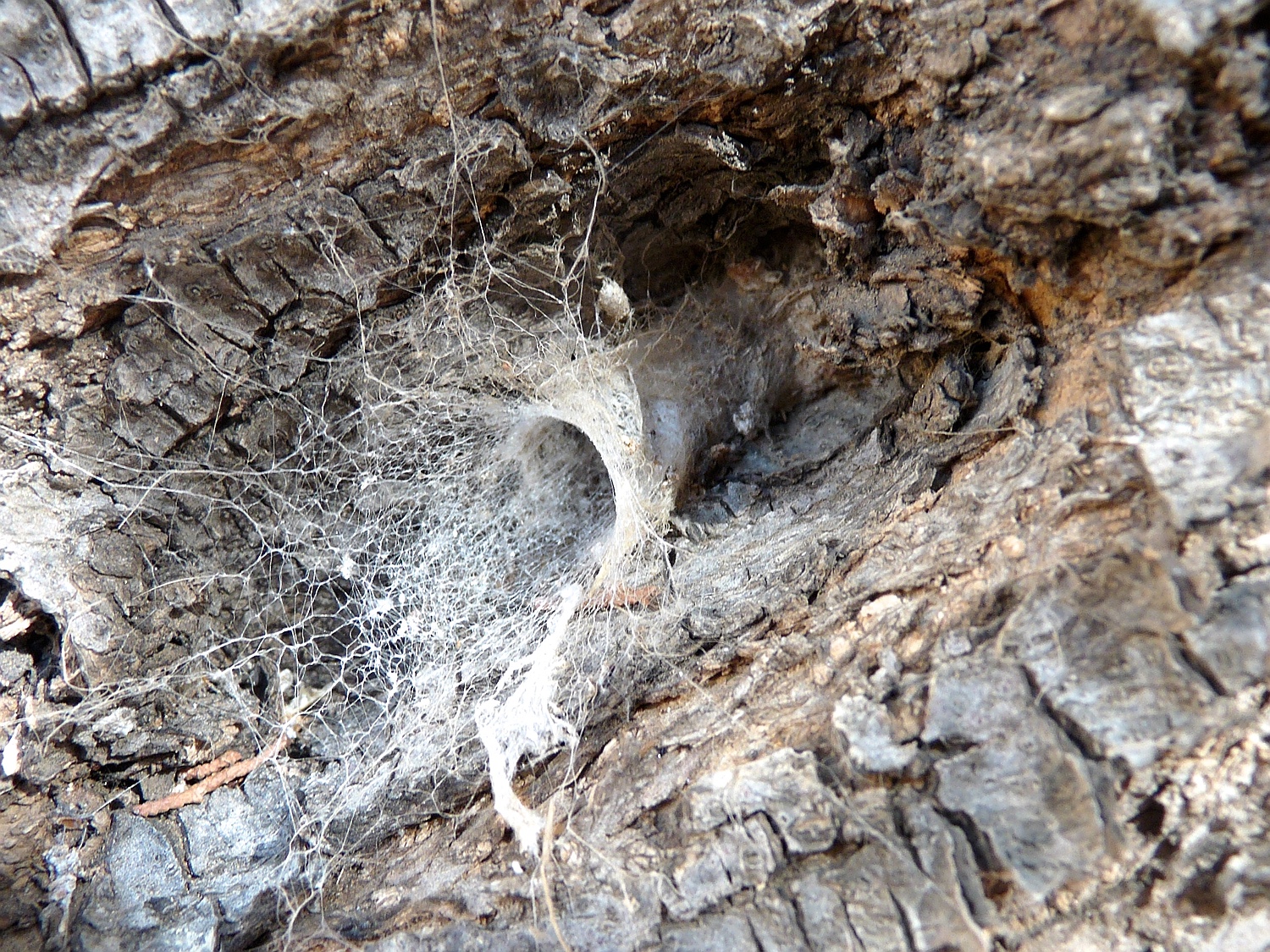
In front of this tube a small web with trap lines is spread out.
Hunting spiders
Not all spiders build webs to catch their prey. Many species hunt their victims by walking around in the area where they live. These active hunters include many nocturnal spider species such as wolf spiders, but also the diurnal jumping spiders. On the other hand, the small, well-camouflaged crab spiders sit in ambush for their prey; the well-camouflaged species often wait on flowers. Another curious group of hunters are the web-casting spiders which hold a small web between their front legs, that they use to catch prey in the air or snatch it from the ground.
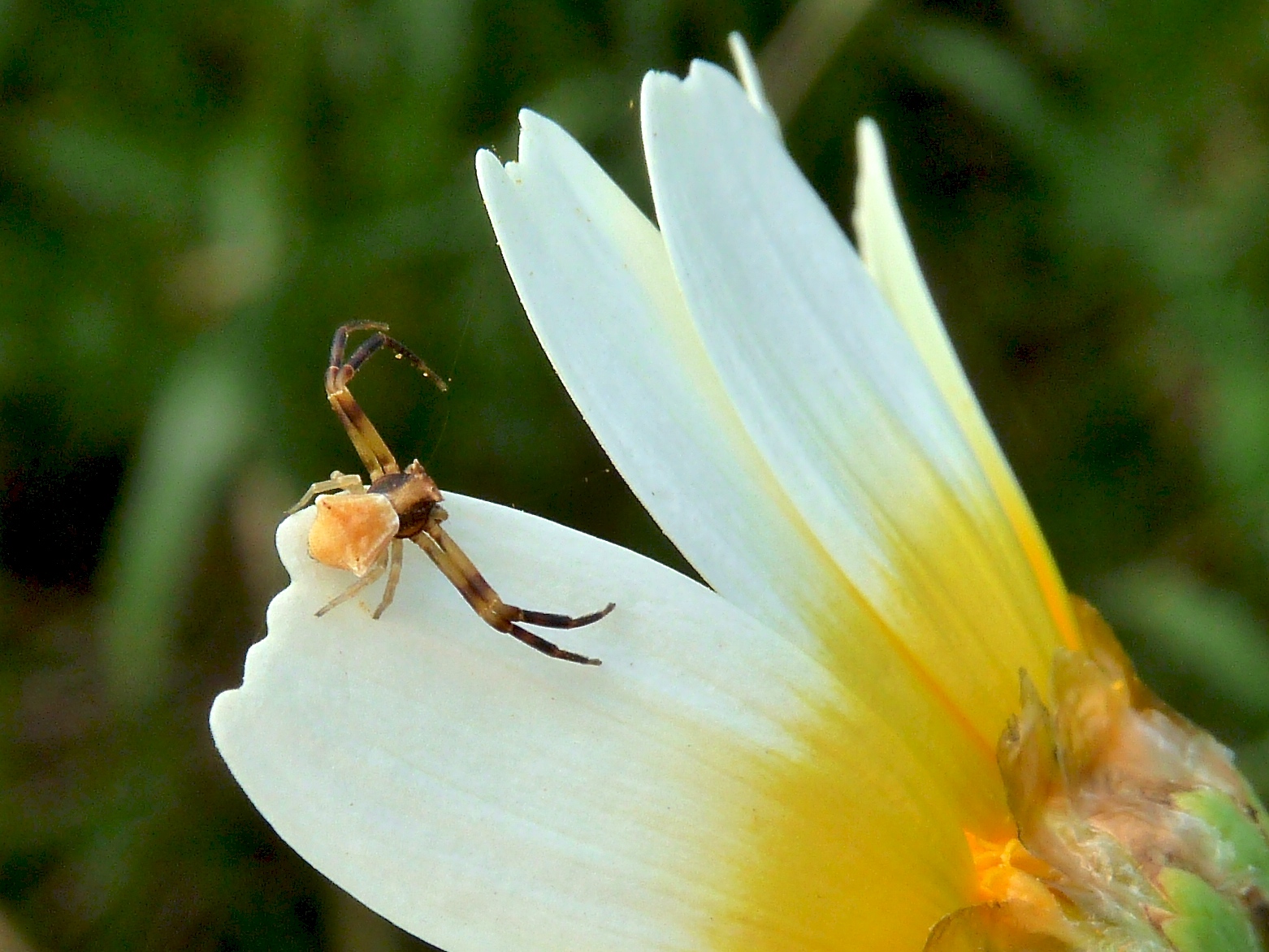
Crab spiders sit on flowers with their long front legs outstretched and wait for prey to come by.
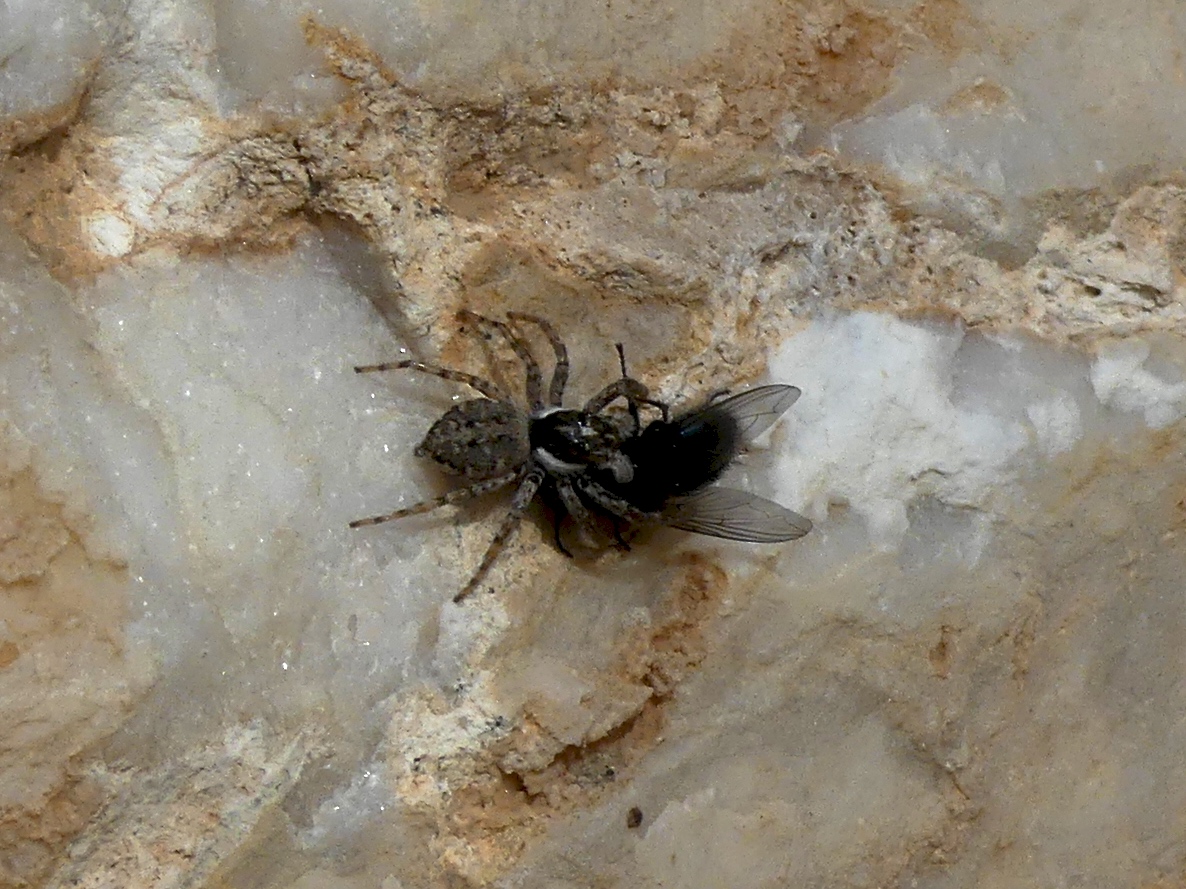
Jumping spiders sneak up on their prey and often seize it with a sudden leap. Jumping spiders have large, powerful eyes located at the front and sides of their heads, which allow them to see in all directions.
Predators
Spinnen have numerous enemies. These include not only birds, but also some insects, such as the “spider wasp”, which collects all large spiders from their orb webs in our garden in early summer within a few weeks.
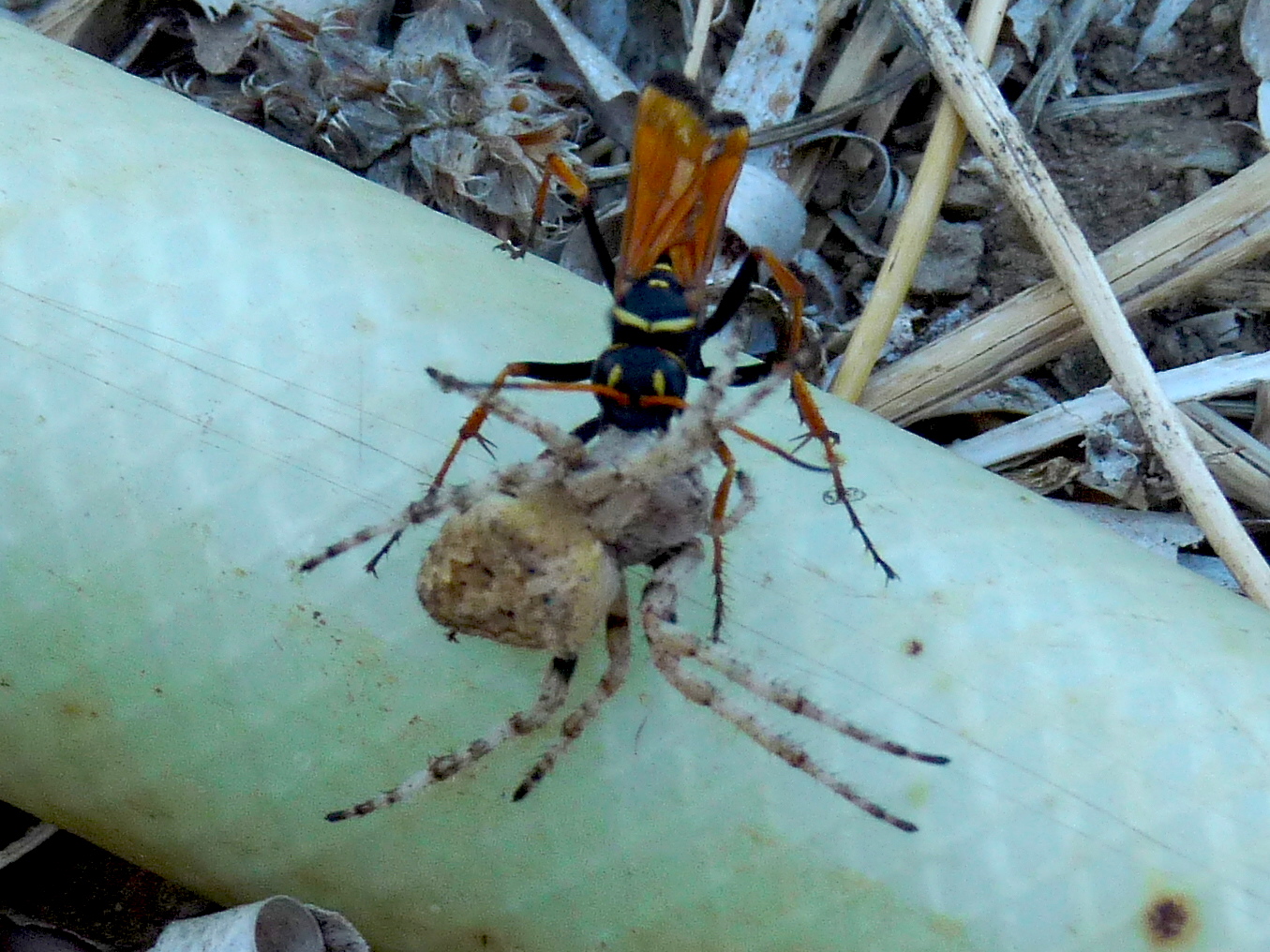
The “spider wasp” (Batozonellus lacerticida) catches large orb-spinning spiders, paralyses them with a bite and then carries them (on foot) to a nest in the ground, where it deposits several spiders as food for its larvae.
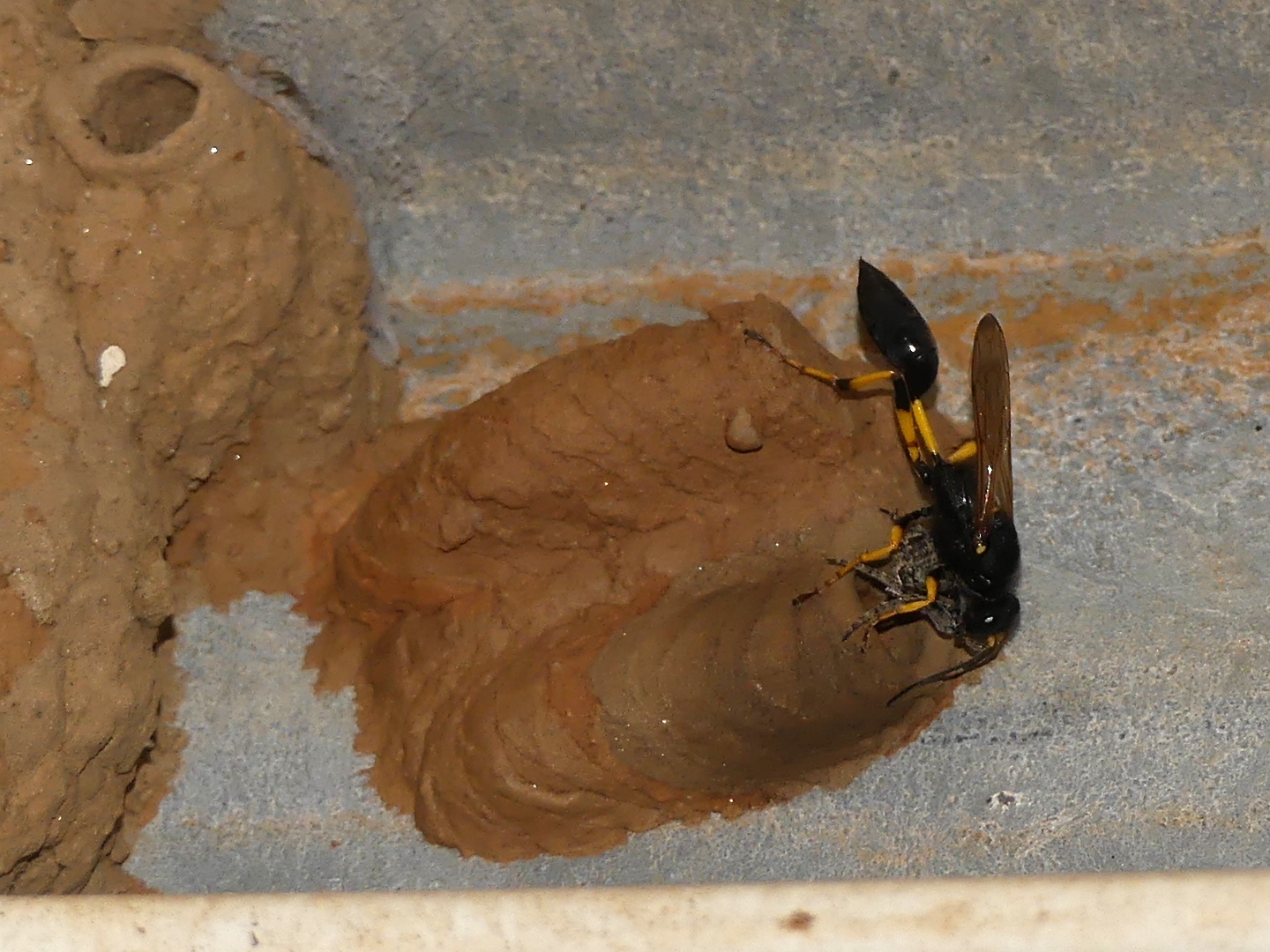
The dauber wasp Sceliphron destillatorium builds clay nests for its larvae and places spiders in the egg chambers as food.
Spiders as a danger and as helpers in home and garden
Spiders are very unpopular with most people, which is understandable in the case of the large species, but mostly unjustified. Spiders are generally not dangerous to humans, especially the species found in Europe. Even with the most poisonous species fatalities are very rare; antidotes are now available in the regions where the species occur, that help mitigate the effects of the bite. The most venomous species in Europe is probably the Black widow, a rather small, black species with red spots on its round abdomen; however, even with this species, fatalities are very rare. To my knowledge, the black widow does not occur on Naxos. In general, spiders and other poisonous animals are most likely to be encountered when working in fields and gardens or when turning over large stones; they can also be found in dark, unused corners of houses.
Though unpopular, spiders are, objectively speaking, very useful to humans. They catch flies, mosquitoes and other annoying insects and play an important role in the ecosystem as hunters. Accordingly, it makes sense to let spiders live undisturbed in the garden, as well as some smaller species in the house, such as jumping spiders, which often sit at the inside of the windows and diligently catch flies.
Spiders on Naxos
Species of spiders on Naxos
Naturally, there are far too many species of spiders on Naxos to provide even a remotely complete list here, but at least many of the more common or conspicuous species can be found in the following descriptions.
The Photo gallery of the spiders gives an overview over the species.
A note on identification: Some spider species can be identified easily and reliably. In many cases, however, many related species exist that are difficult to distinguish. Unfortunately, I have no suitable literature, and even on the internet, it is difficult to find information on many species. Correct identification is often only possible with the help of microscopic examination of the dead animal. Still I hope that, despite the uncertainty of many identifications, this page will be of value in presenting the diversity of our fauna and thus perhaps awaken interest especially in the smaller and often overlooked animals.
Here you can jump directly to some of the better known groups of spiders (return with the back arrow or by swiping back):
Orb weavers – Velvet spiders – Wolf spiders – Funnel weavers – Crab spiders – Jumping spiders – Scorpions
Cellar spiders, Phocicidae
Holocnemus pluchei, Scopoli
The cellar spider Holocnemus pluchei with its long, thin legs and small, slender body builds irregular space-webs that it attaches to the corners of rooms or furniture. It is widespread throughout central and southern Europe.
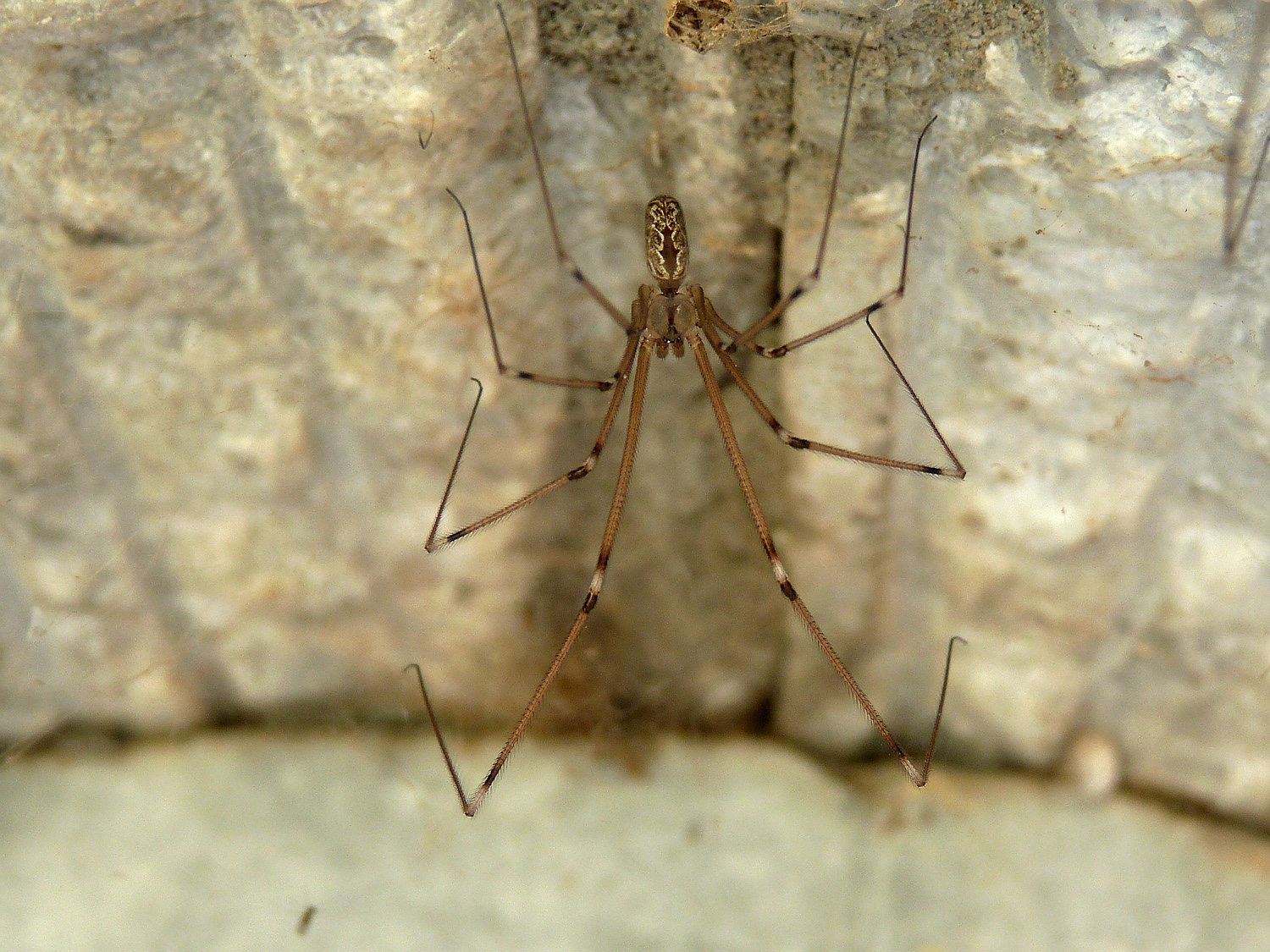
When disturbed, the cellar spider vibrates itself and its web to make it harder to see it and catch it.
Orb weaver spiders, Araneidae
Araneus angulatus, Clerck
Araneus angulatus, a close relative to the Common garden spider, is the most conspicuous large spider species in our region. It reaches a considerable size and is common in gardens as well as in the maquis. Araneus angulatus is widespread throughout Europe; it is one of numerous species of the genus Araneus.
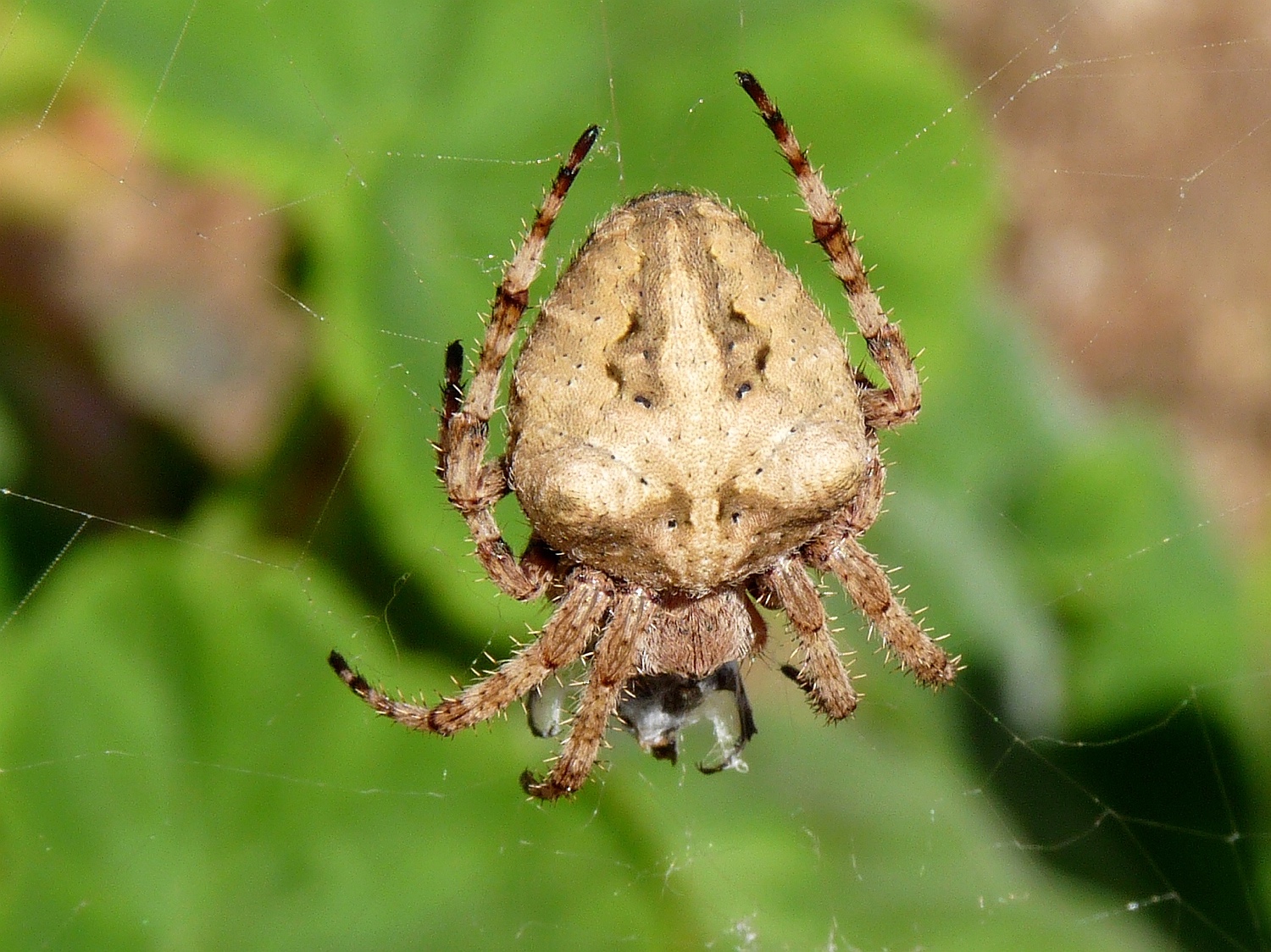
The large species Araneus angulatus can be recognised by the bumps on its abdomen; like in most spiders, its colouring is quite variable.
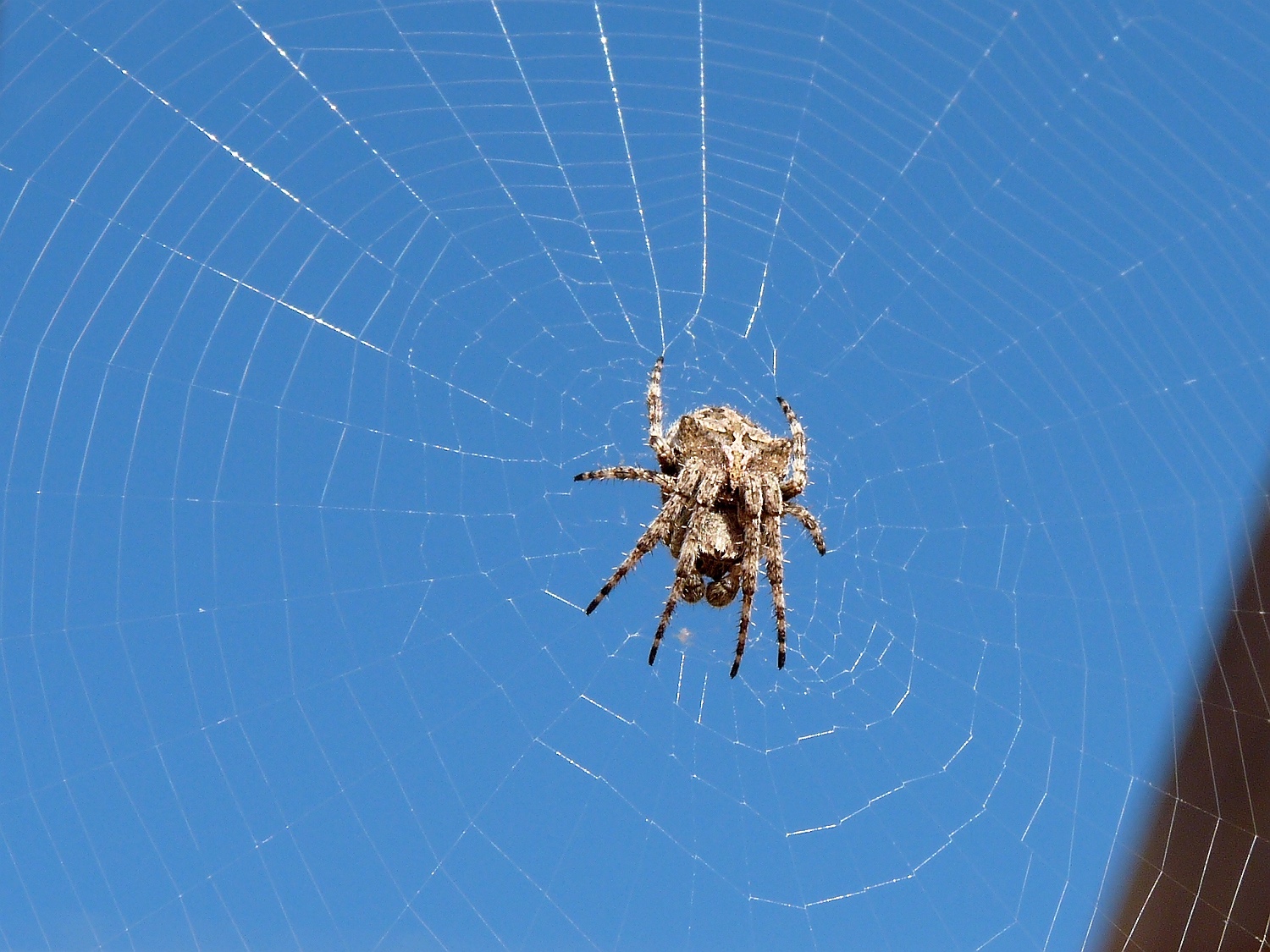
It builds large wheel-shaped orb webs, which are usually stretched between two trees.
Cricket-bat orbweaver, Mangora acalypha, Walckenaer
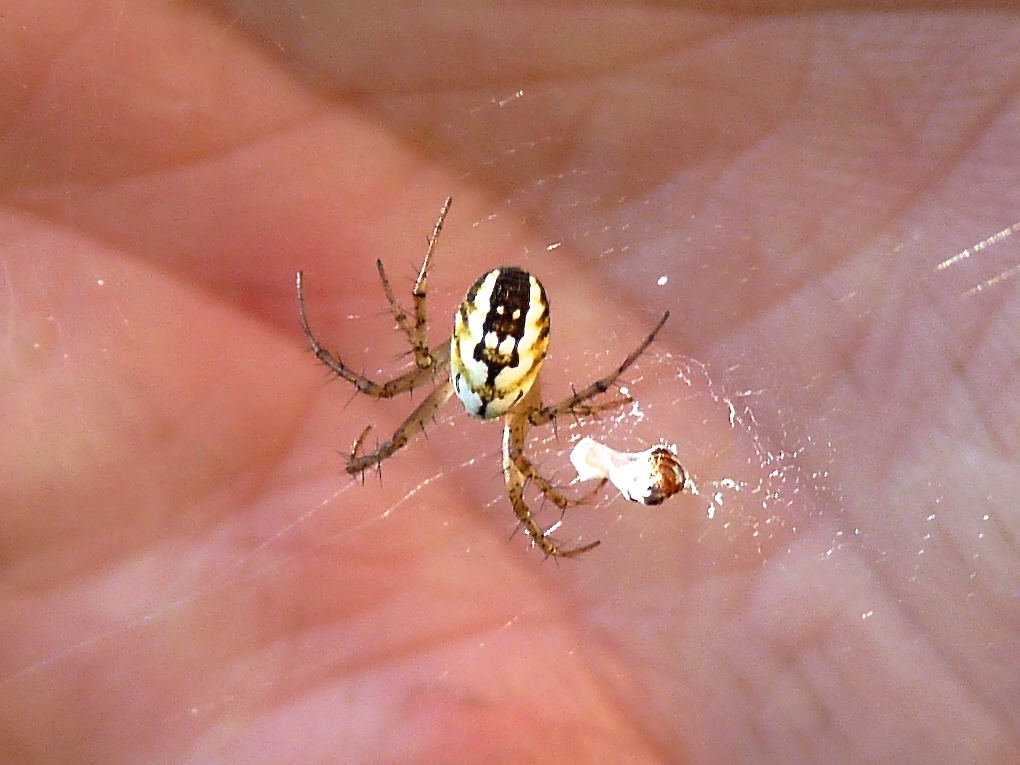
Most spider species vary considerably in colouring depending on sex, age and region; however, they often have characteristic markings, such as the small Cricket-bat orbweaver. This species is common throughout Europe.
Agalenatea redii ?, Scopoli
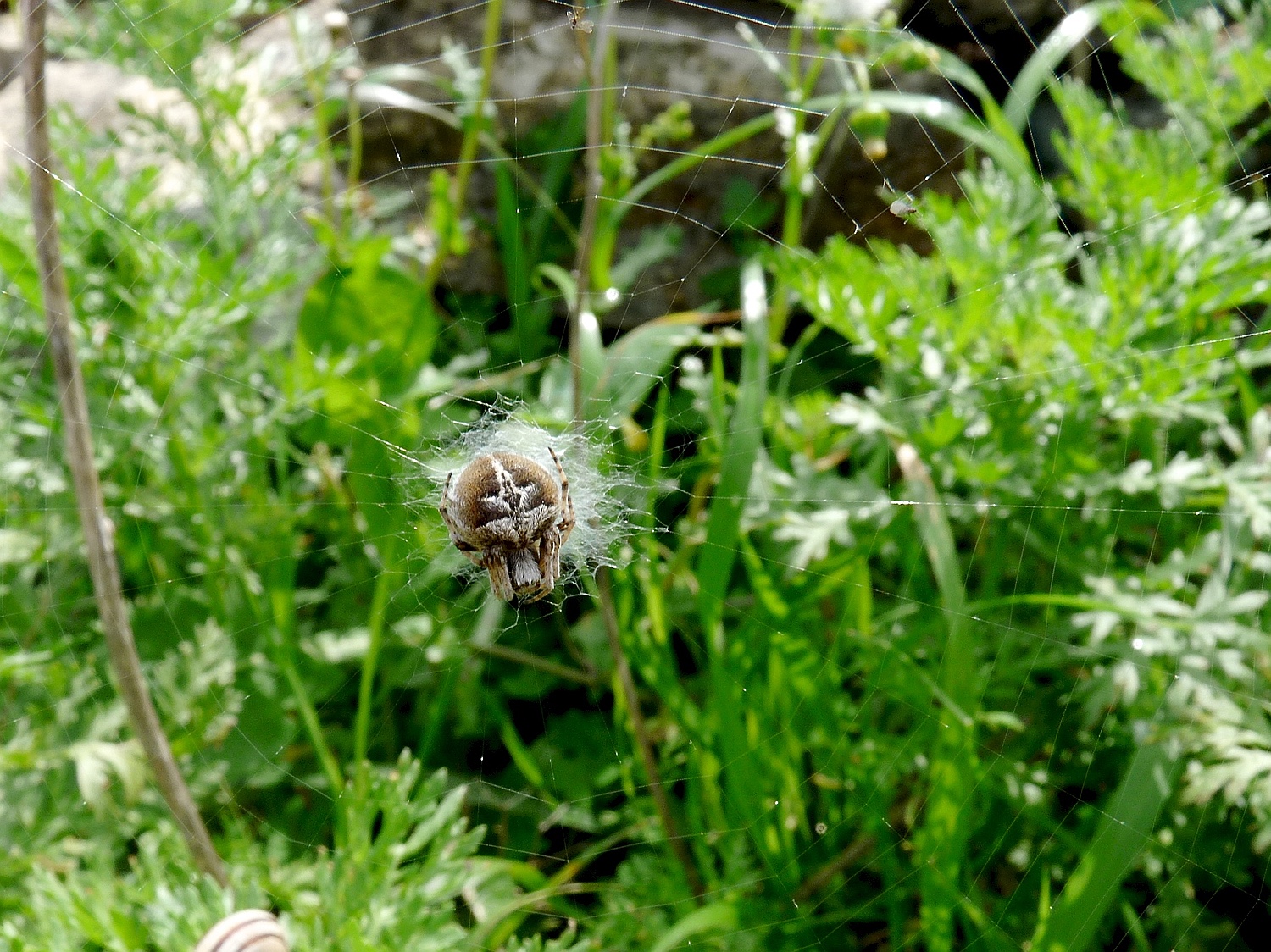
This small spider probably belongs to the species Agalenatea redii.
Oak spider, Aculepeira ceropegia, Walckenaer
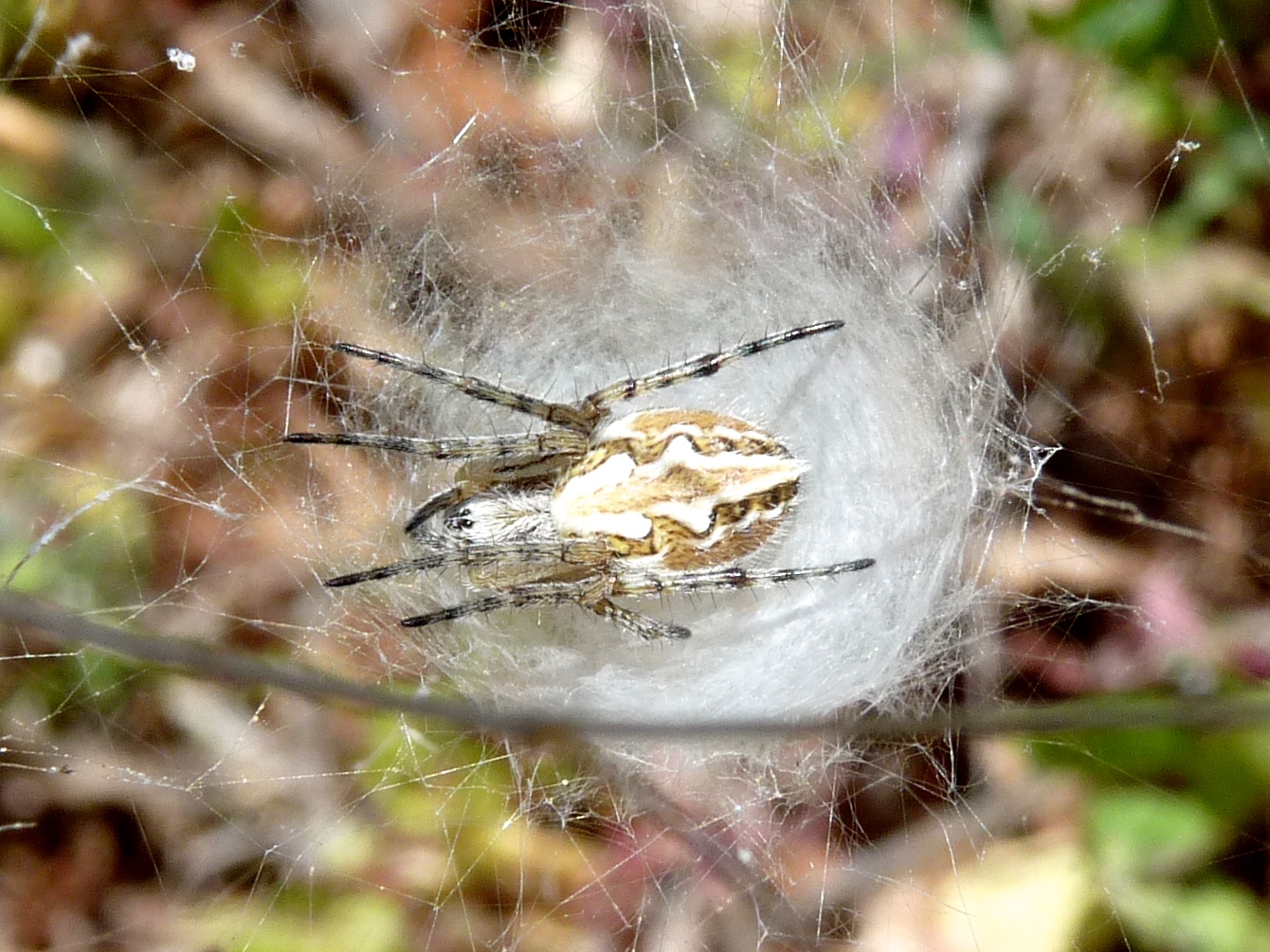
The pretty little Oak spider carries a characteristic pattern on its abdomen that resembles an oak leaf. It builds a dense hub in its web, on which it often sits. It is common in Europe.
Black-lobed garden orb-web spider, Argiope lobata, Pallas
Argiope lobata often weaves a zigzag band into its web, known as a stabilimentum, the function of which is unclear. It can be distinguished from related species as the Wasp spider by the lateral bulges on its abdomen. This species is widespread in southern and eastern Europe. Measuring up to 2.5 cm, it is one of the larger spider species in our region.
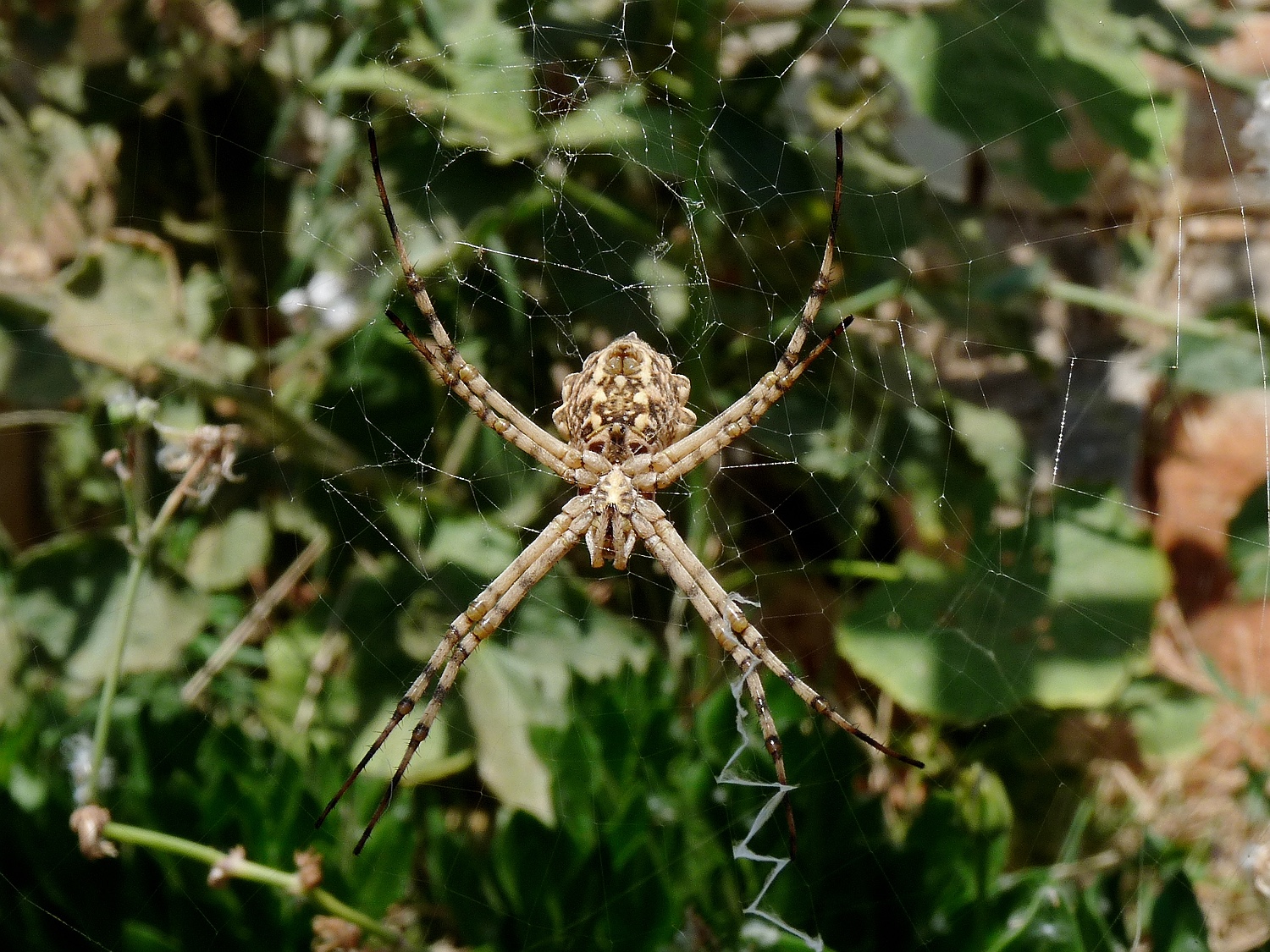
Here you can see the underside of Argiope lobate with the characteristic bulges on the side of the abdomen.
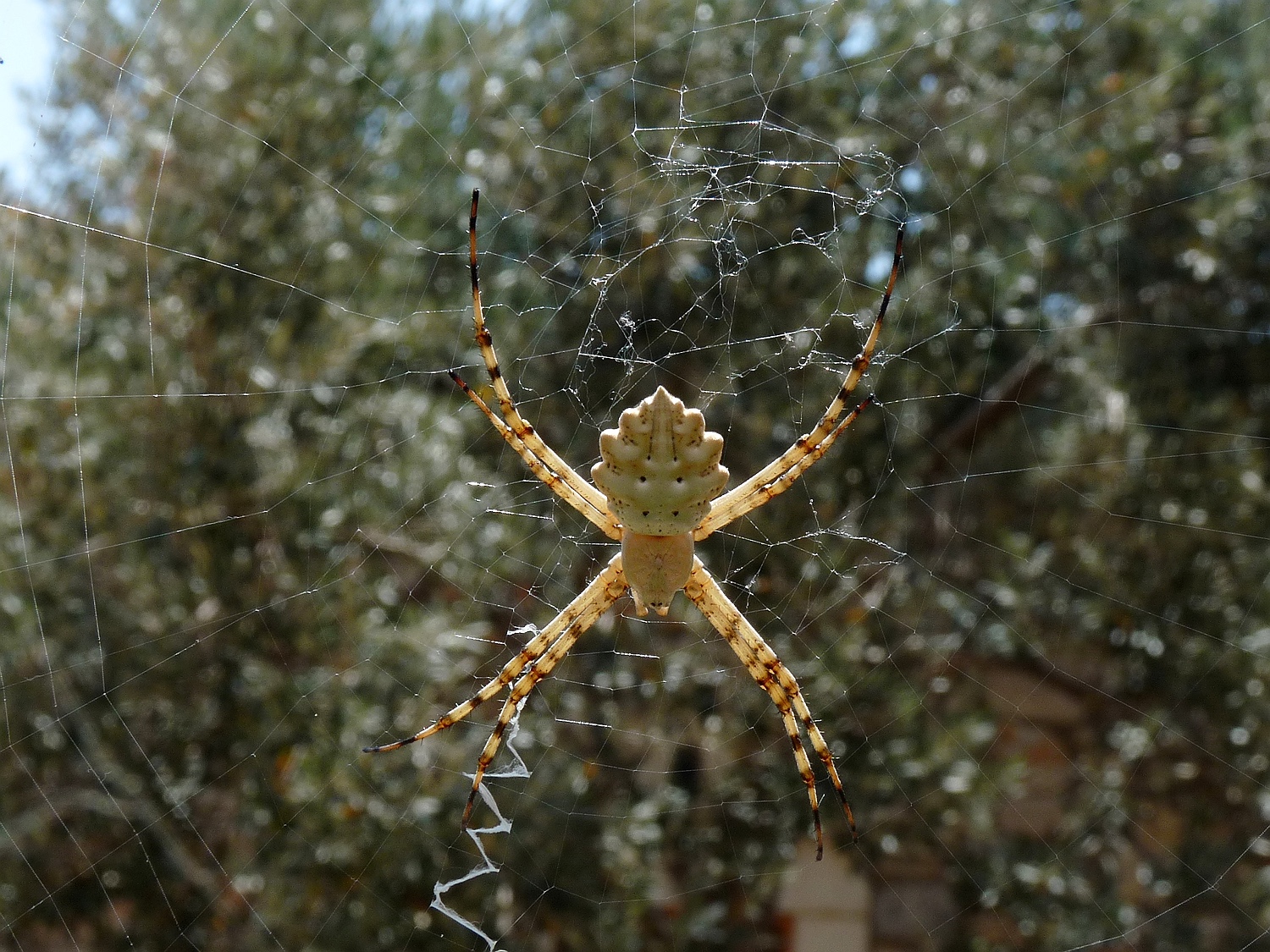
The upper side is pale yellow in colour. Below the spider, you can see the strange zigzag band in the web.
Cyrtophora citricola, Forsskål
Cyrtophora citricola builds large, very finely woven tent webs, which take several nights to construct. Often, several females build their webs above each other in tiers. This species is restricted to southern Europe.
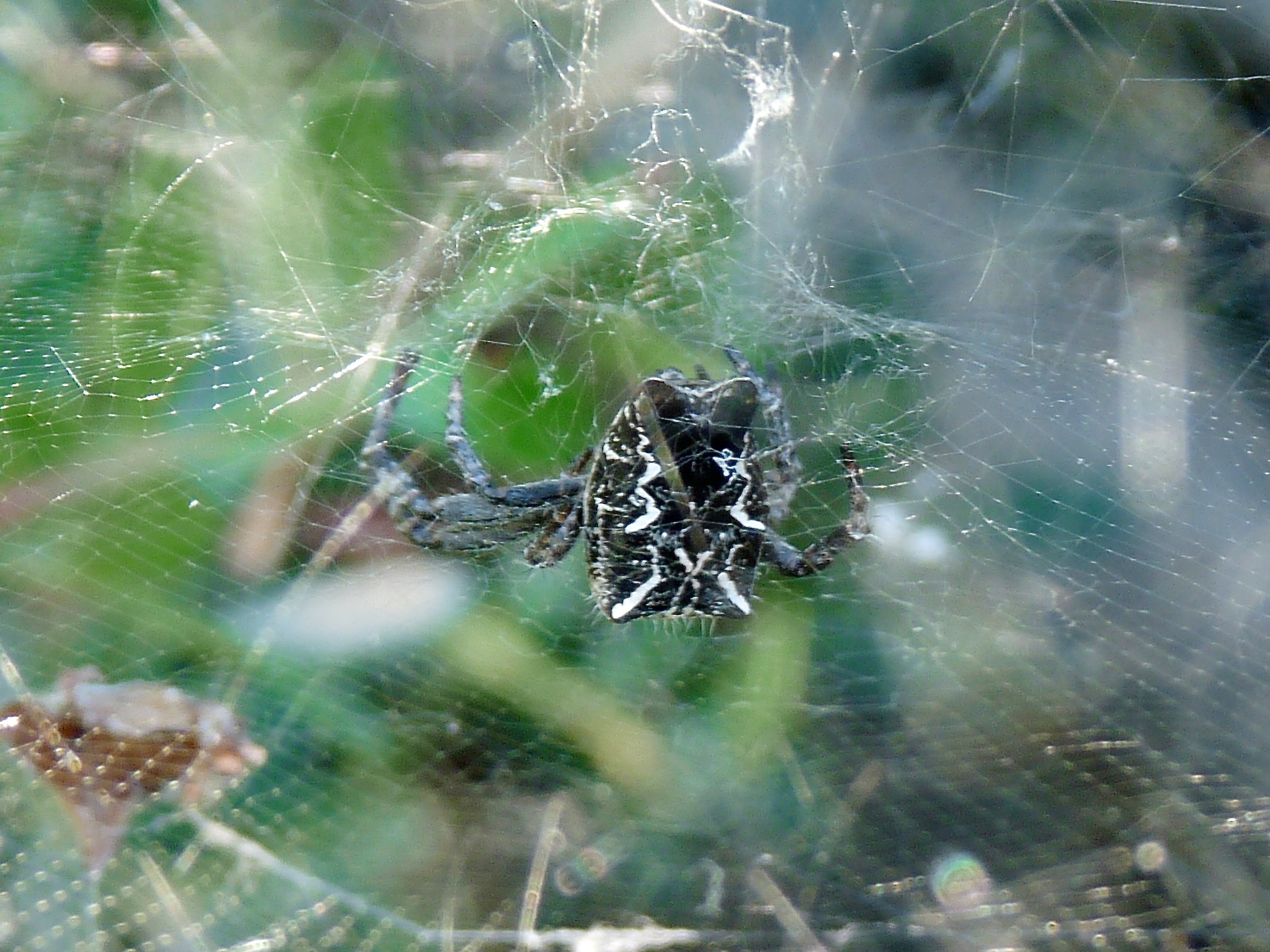
The abdomen of the Cyrtophora citricola is black with a characteristic pattern.
Sheet weavers, Linyphiidae
Trematocephalus cristatus ?, Wider
The sheet weavers or money spiders build poorly structured webs with tangled ‘tripping threads’ above a horizontal catching net (tent nets). The webs pictured here have a funnel-like structure; the photo also shows a small spider near the ‘funnel’. Although these do not appear to be typical tent webs, the spider’s appearance suggests that it probably belongs to the Linyphiidae.
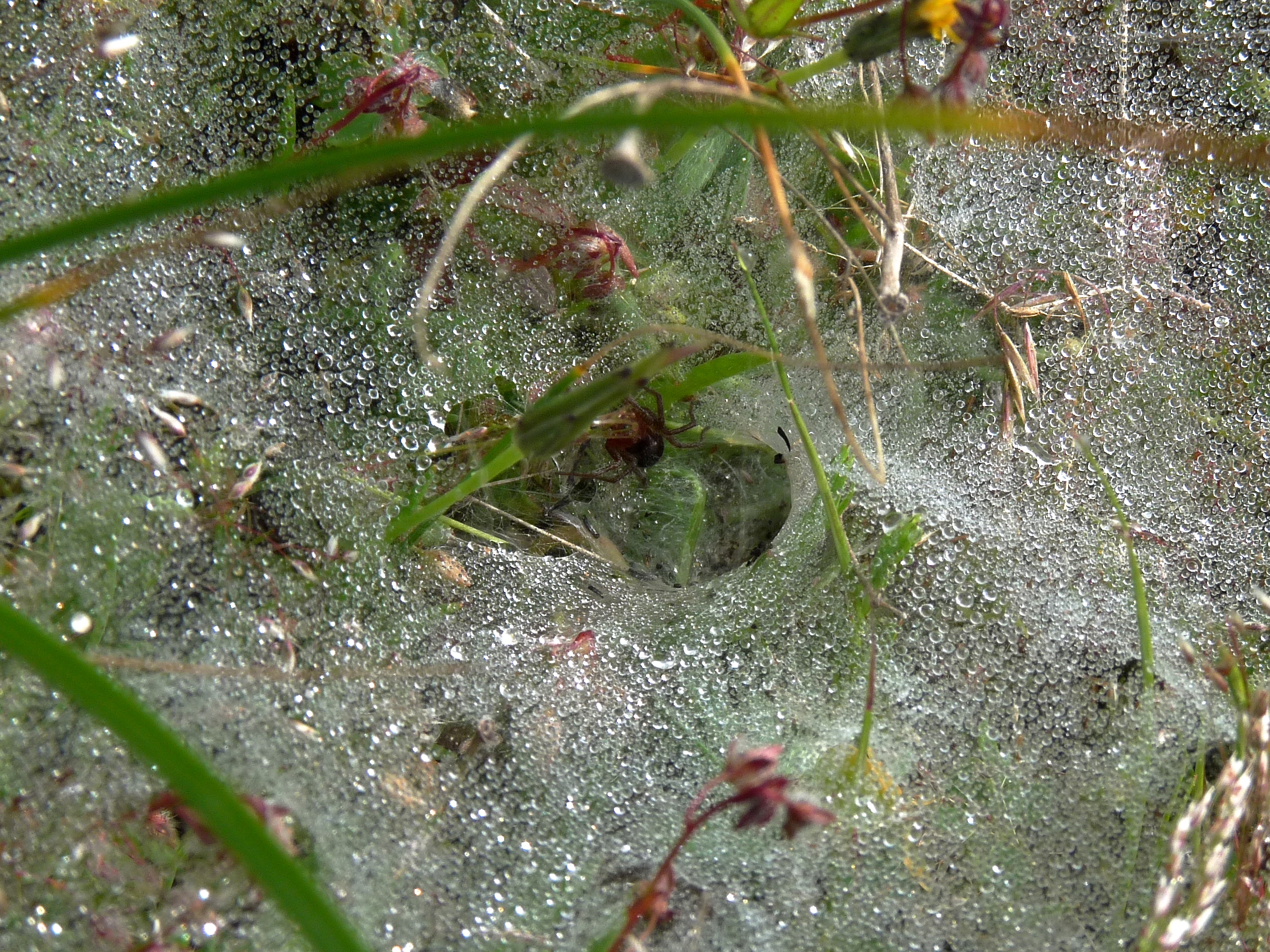
Spider webs of this type can be found everywhere on Naxos in low vegetation. They are usually inconspicuous and easy to overlook, but here the dew has transformed them into pretty eye-catchers. They are probably made by sheet weavers. Sheet weavers are very common in all habitats in Europe. The young spiders of this species are carried away by the wind in autumn with the help of flying threads (“ballooning”).
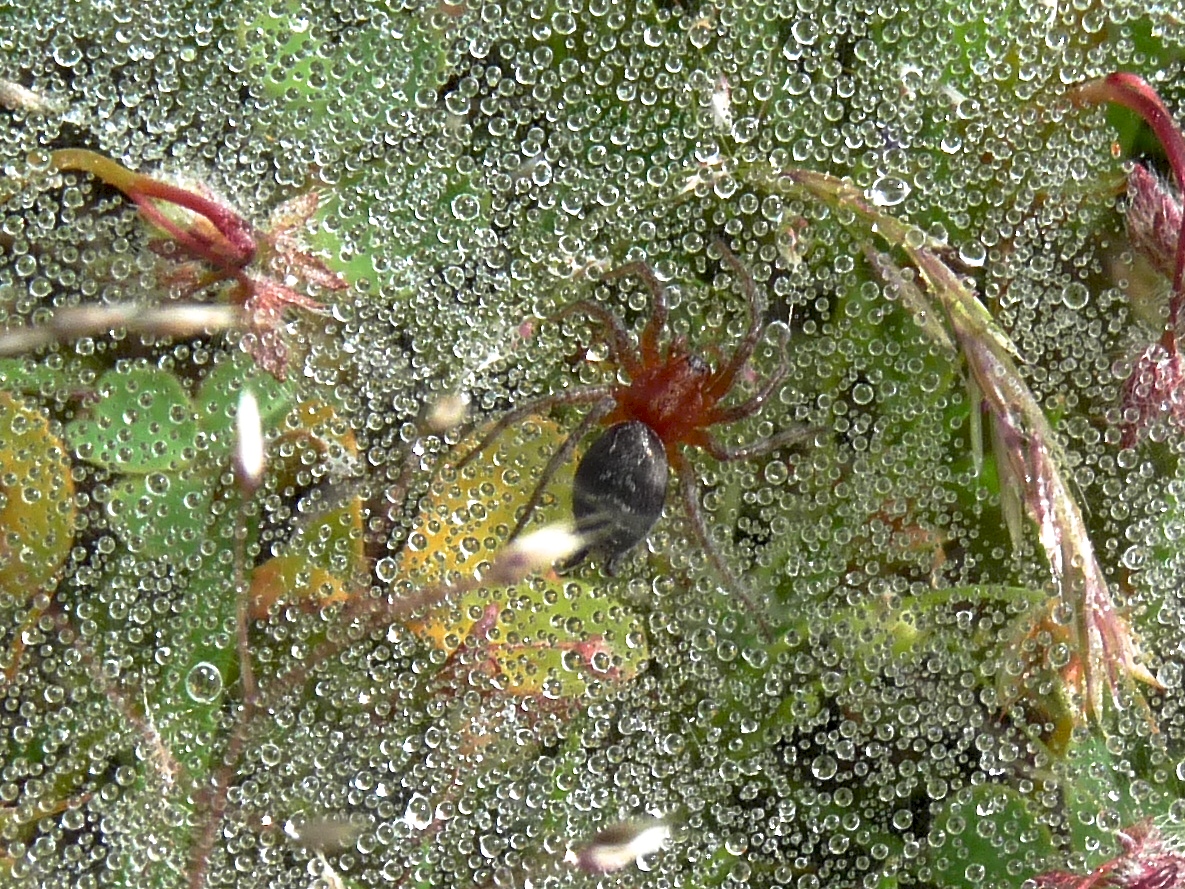
Here a better picture of the spider itself. According to its appearance, it might be Trematocephalus cristatus.
Velvet spiders, Eresidae
Eresus walckenaeri, Brullé
Velvet spiders live in tube-like burrows that are about 10 cm deep, in front of which they build a small tube net made of cribellate (i.e. felt-like, non-sticky) threads that trap their prey. In the genus of the Ladybird spiders (Eresus), the females are significantly larger than the males, whose abdomen bears four large, conspicuous red spots. In the greek species Eresus walckenaeri the black-coloured females grow up to 4 cm in size, making them the largest spiders in Europe.
The females lay almost a thousand eggs in their burrows, where the young remain until they have reached a certain size. They are first fed by their mother; then she dies and the young spiders consume her body. Afterwards they leave the burrow and disperse by ‘ballooning’, i.e. they produce a fine silk thread with which they are carried away by the wind. This somewhat accidental and wasteful way of dispersing explains the high number of offspring. It is likely that the Ladybird spiders of this species also reached the islands through ballooning.
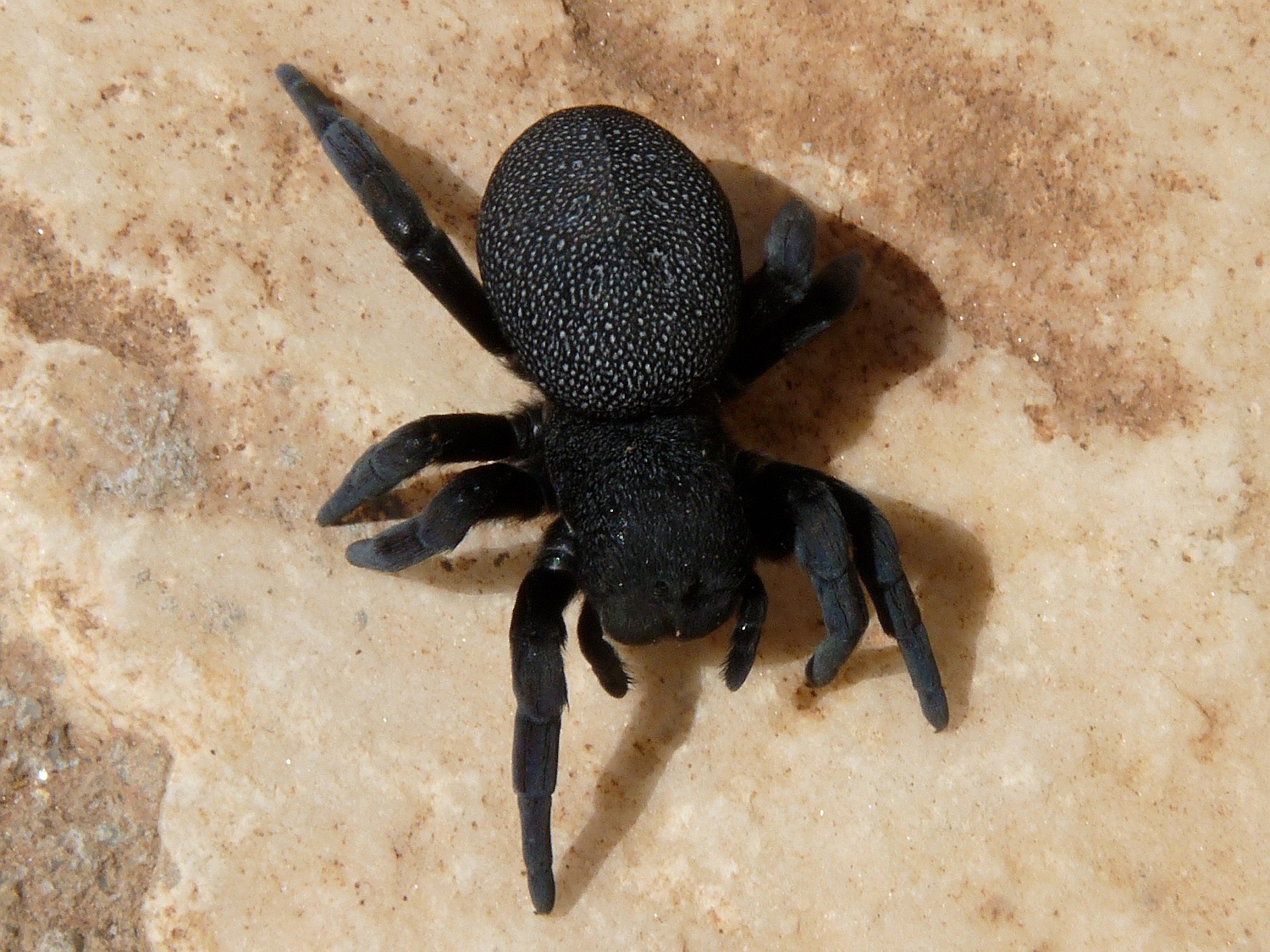
The females of Eresus walckenaeri grow to a very large size, with a body length of up to 4 cm; they are thick and completely black in colour. They are rarely seen as they live in burrows in the ground.
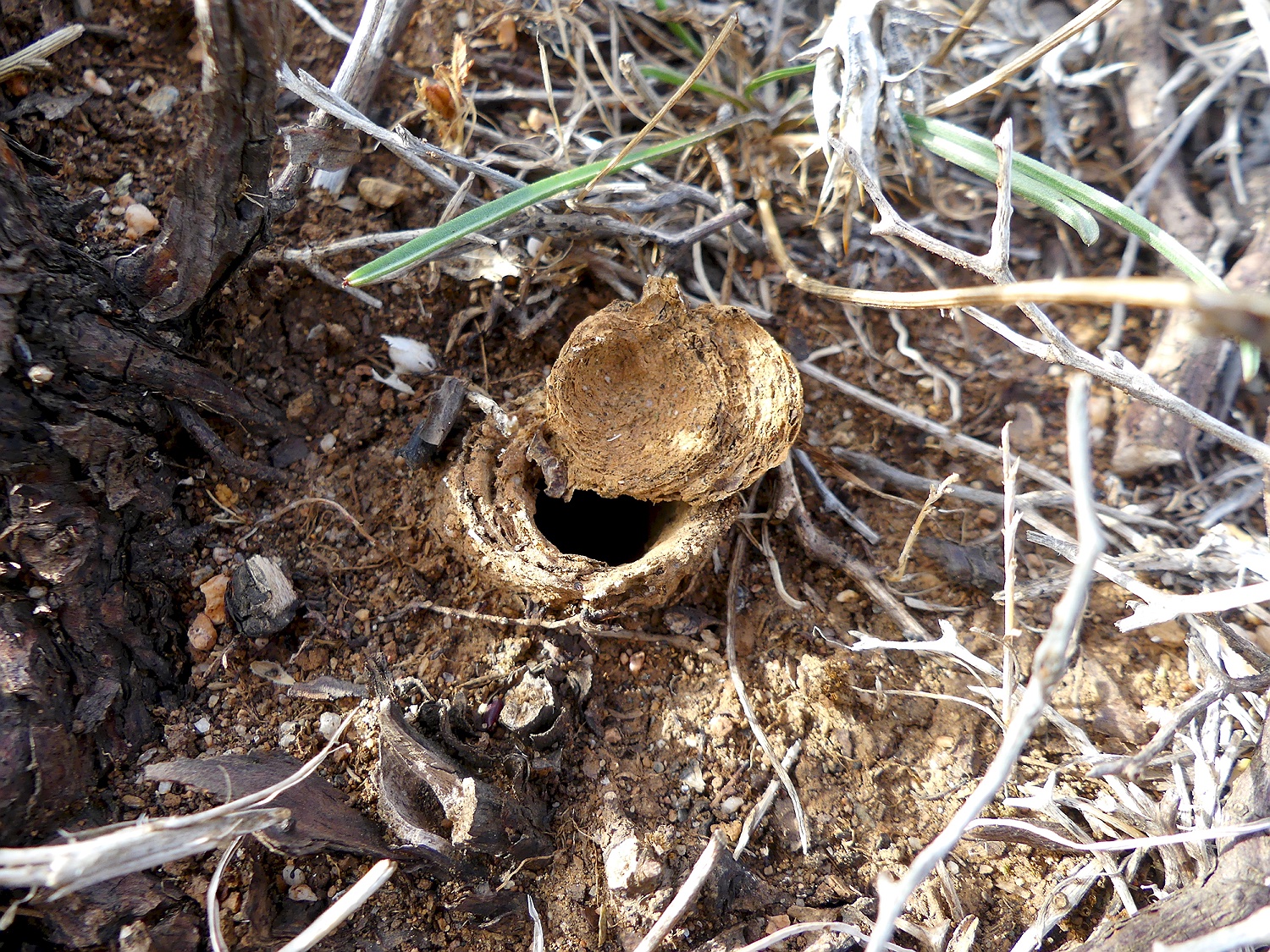
This is probably an abandoned burrow of Eresus walckenaeri. You can clearly see the lid, which, like the lining of the burrow, appears to be made of spider silk mixed with earth.
Crevice weaver spiders, Filistatidae
Filistata insidiatrix, Forsskål
This small spider builds its tube webs on stones, in walls and in corners of buildings. In front of the tube, it spreads a small web with longer trap lines. As soon as an insect passes by and causes the lines to vibrate, the spider comes out of the tube and catches its prey.
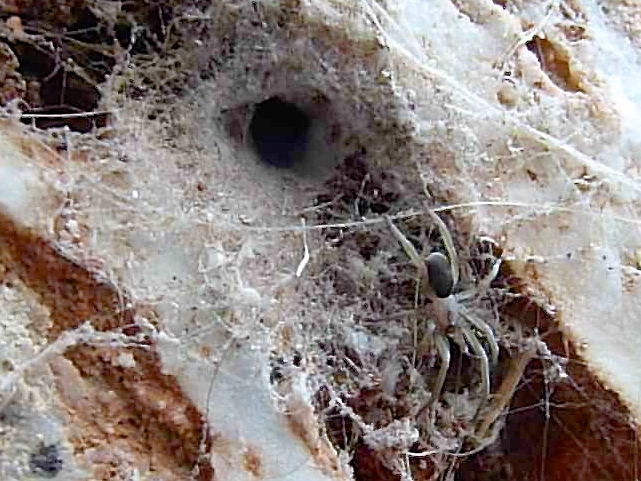
One can lure the spider out by tugging on the web, but it only shows itself for a few seconds, so that I could ‘catch’ it only by filming it and then extracting this image from the film (which is why the quality is not so great).
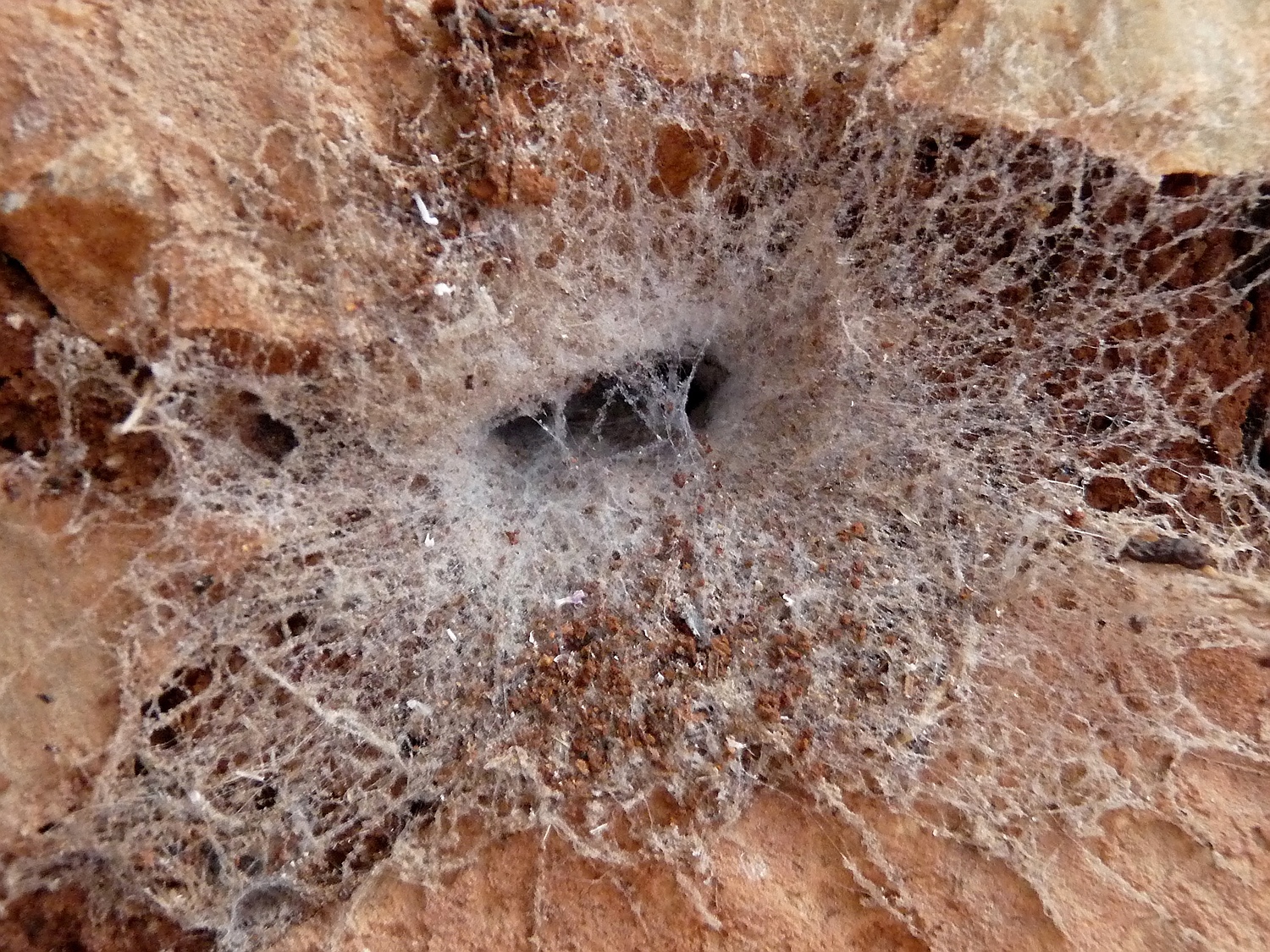
Crevice weaver spiders are among the spiders that produce cribellate threads, i.e. their web threads are not coated with glue but covered with fine, curly wool in which insects get entangled.
Wolf spiders, Lycosidae
Pardosa spec.
Wolf spiders do not build webs, but hunt their prey ‘on foot’. They are nocturnal and live on the ground, in leaf litter and under stones, but also enter houses. In many species, the sides of the body are darker than the ‘back’. The many species native to Europe are not easy to tell apart. Female wolf spiders first carry the egg sac and then the young spiders around with them and take care of them.
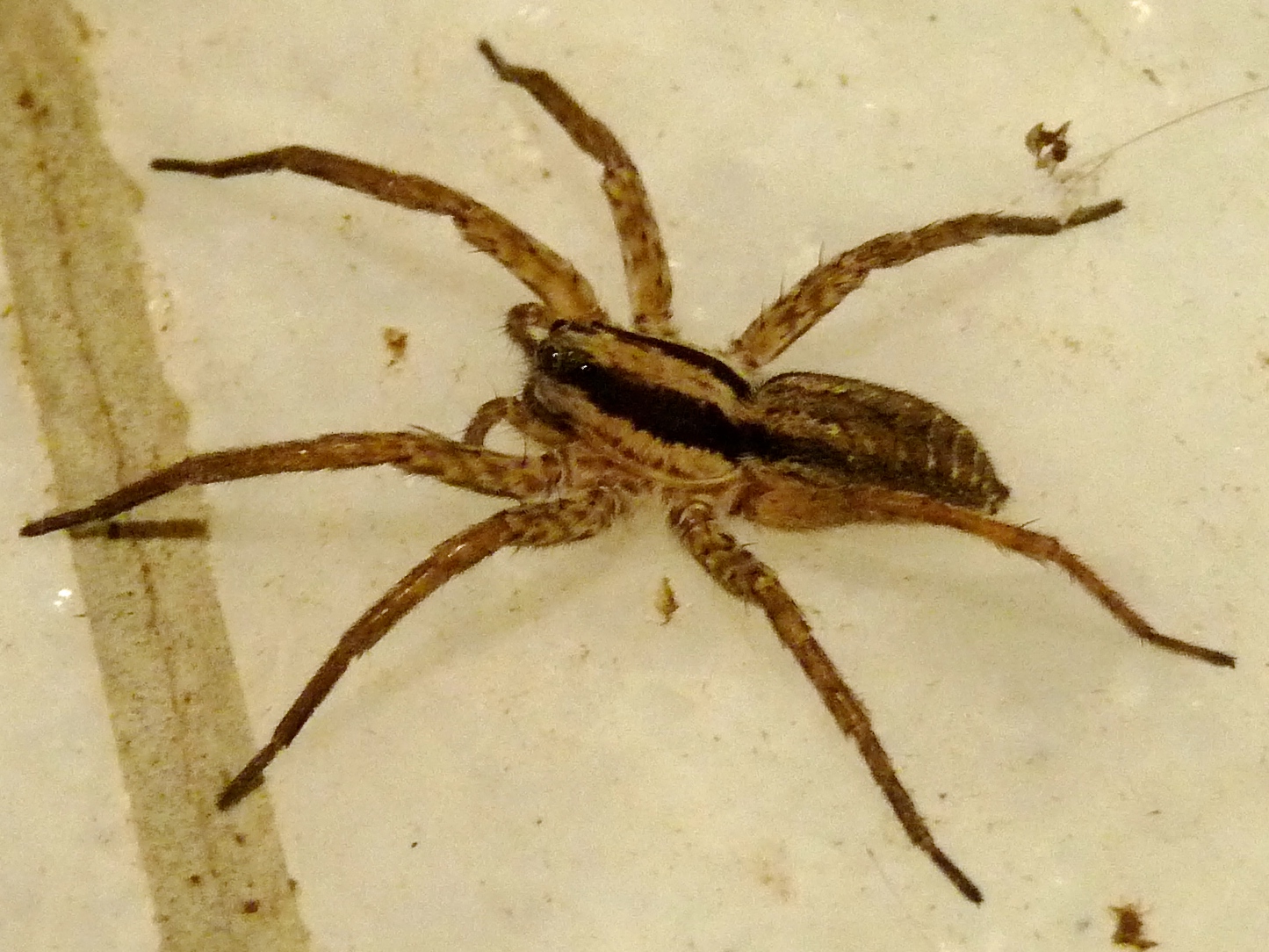
This wolf spider could be a species of the genus Pardosa.
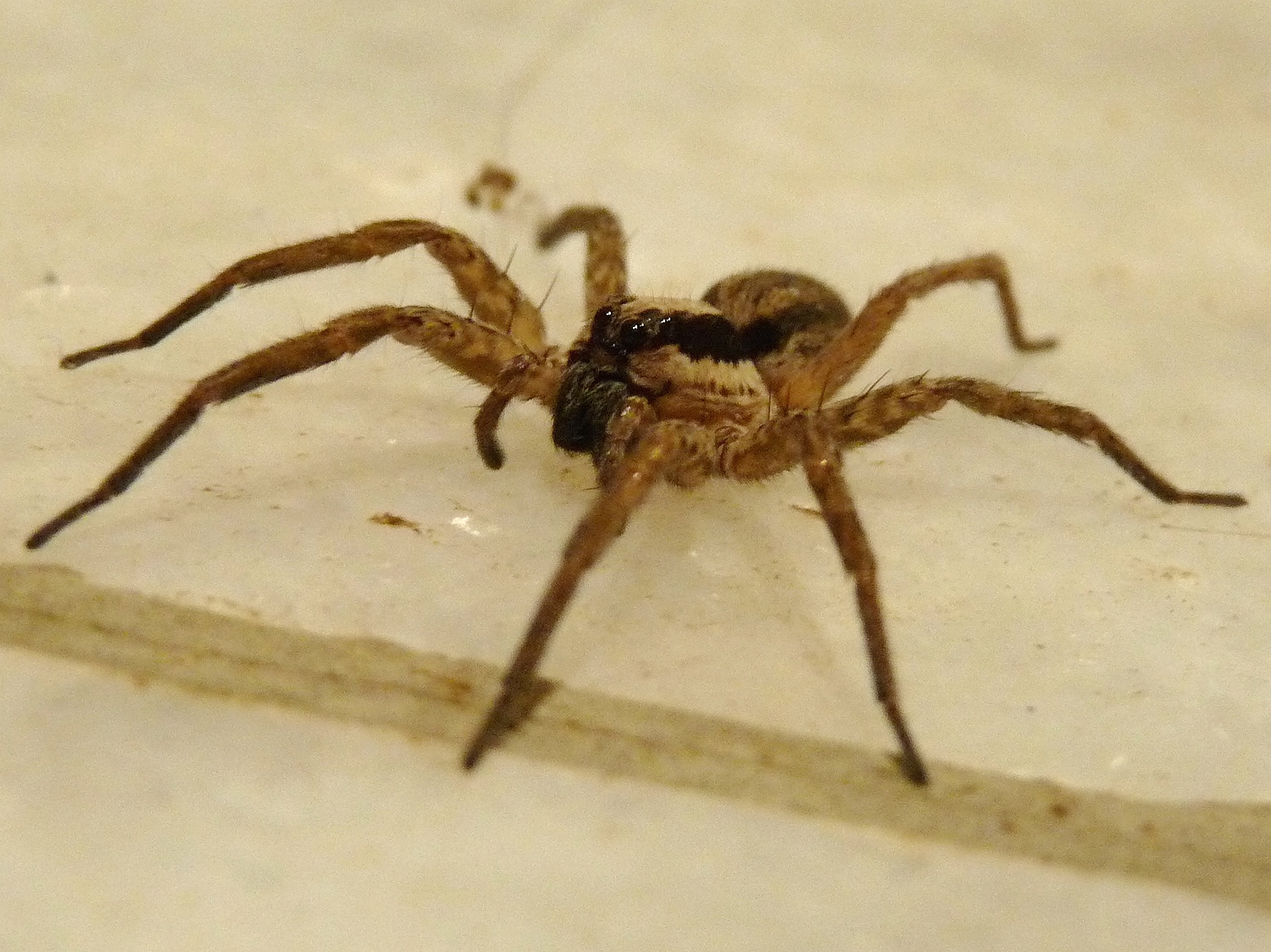
Wolf spiders have powerful eyes that allow them to see well even in the dark. Below the large, forward-facing eyes are two pairs of smaller eyes. They often have long and conspicuous pedipalps.
Alopecosa spec.
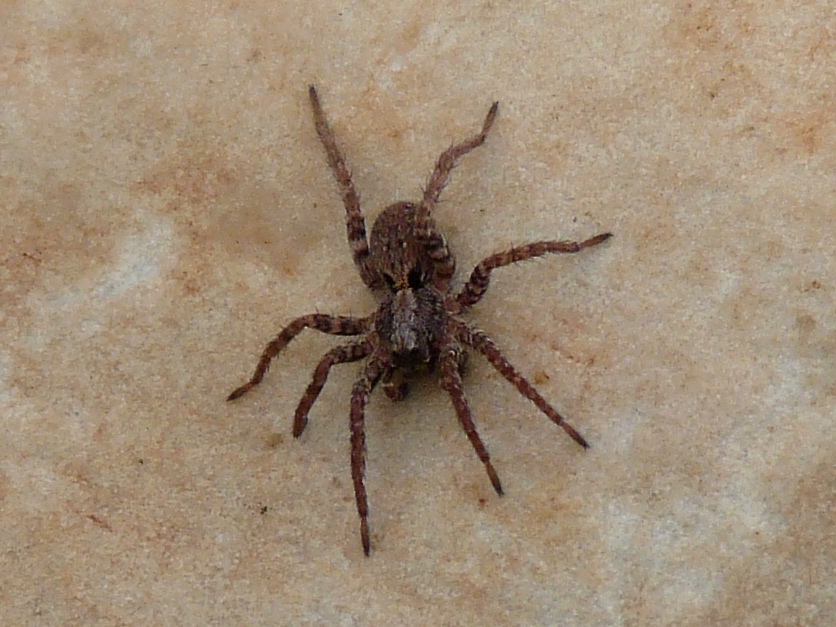
This wolf spider probably belongs to the genus Alopecosa, a large genus with around 50 species found in Europe.
Lynx spiders, Oxyopidae
Oxyopes heterophthalmus, Latreille
Lynx spiders are related to wolf spiders. They also do not build webs, but are hunters. They usually have a pointed abdomen.
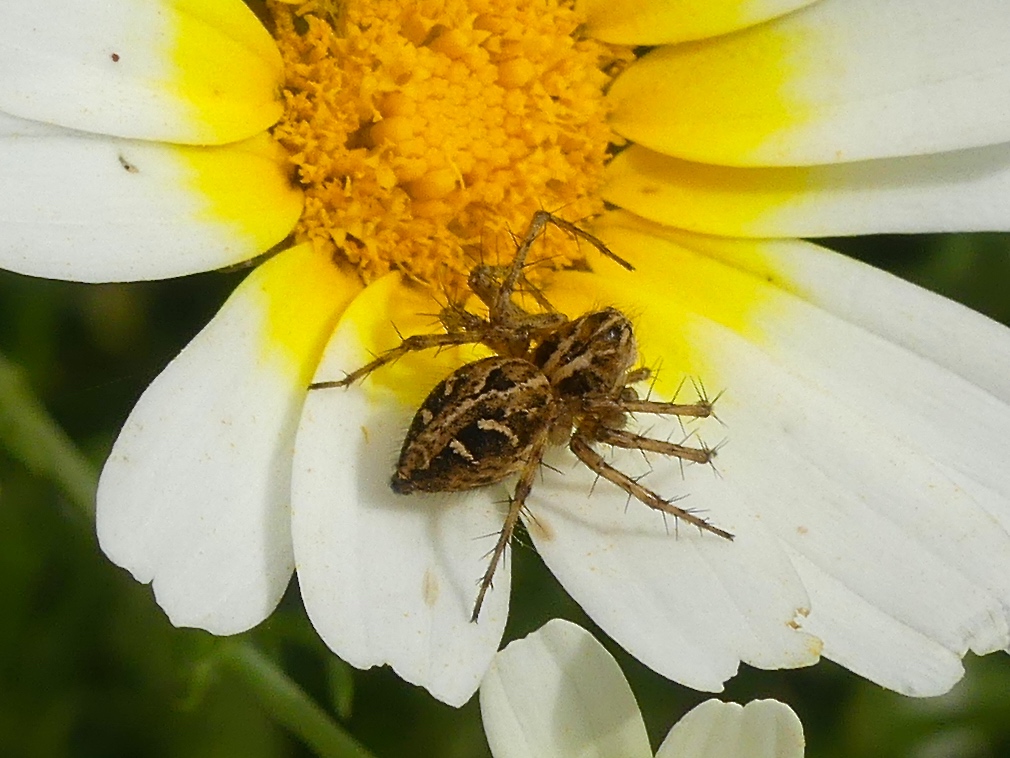
Oxyopes heterophthalmus likes to sit on flowers, similar to crab spiders. It can be recognised by the long spines on its legs and the pattern on its brown body.
Hunting spiders, Pisauridae
Predatory spider, Pisaura mirabilis, Clerck
The Predatory spider usually sits with two legs stretched out in front and two towards the back. Predatory spiders are predatory as their name suggests and overpower their prey ‘on foot’. The female carries the egg sac with her; before the young spiders hatch, the mother builds a nursery web for them, which envelops a plant shoot or several leaves.
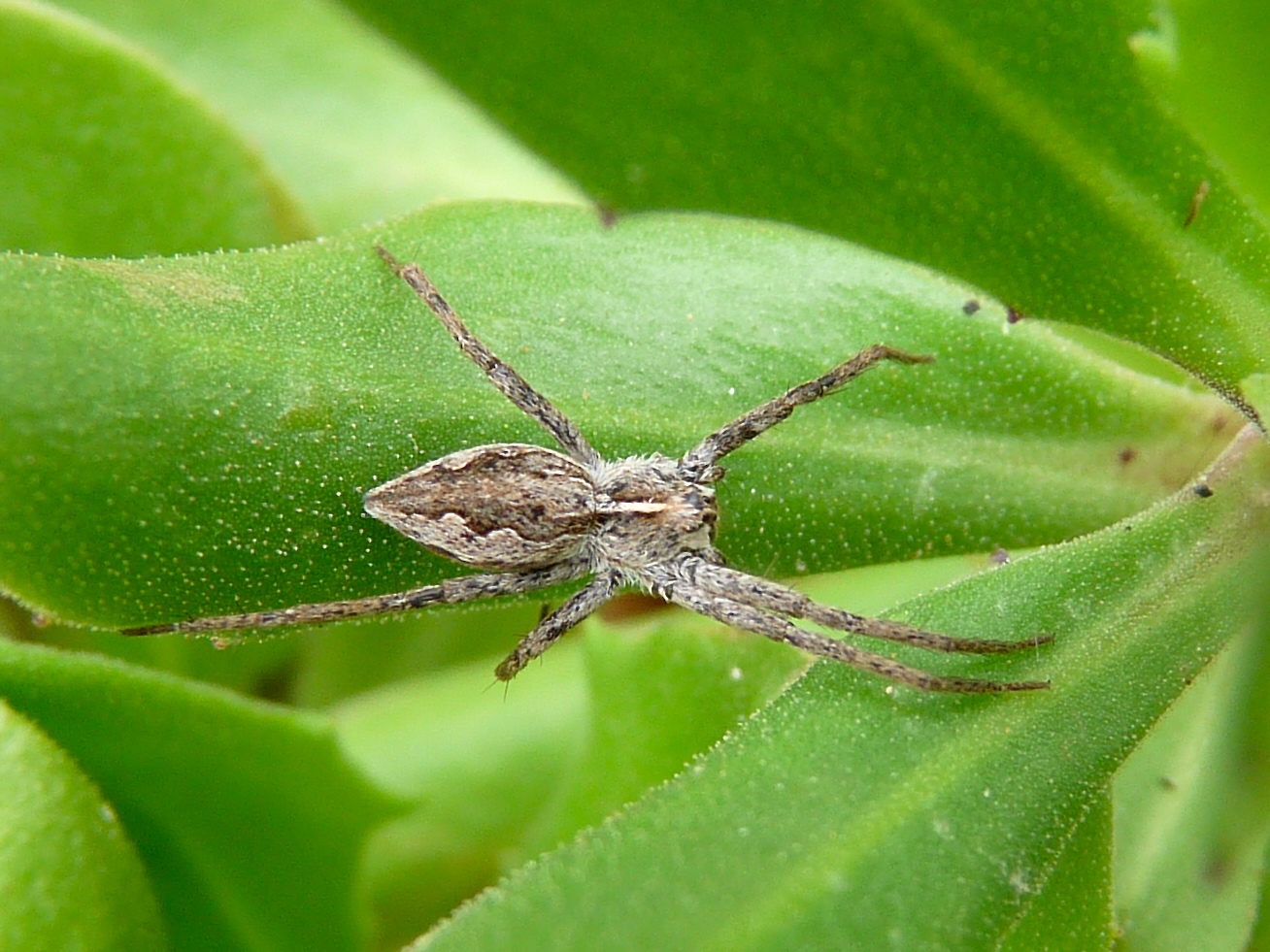
The Predatory spider has a lighter-coloured stripe down the middle of its front body and a dark wavy edge on its pointed rear body.
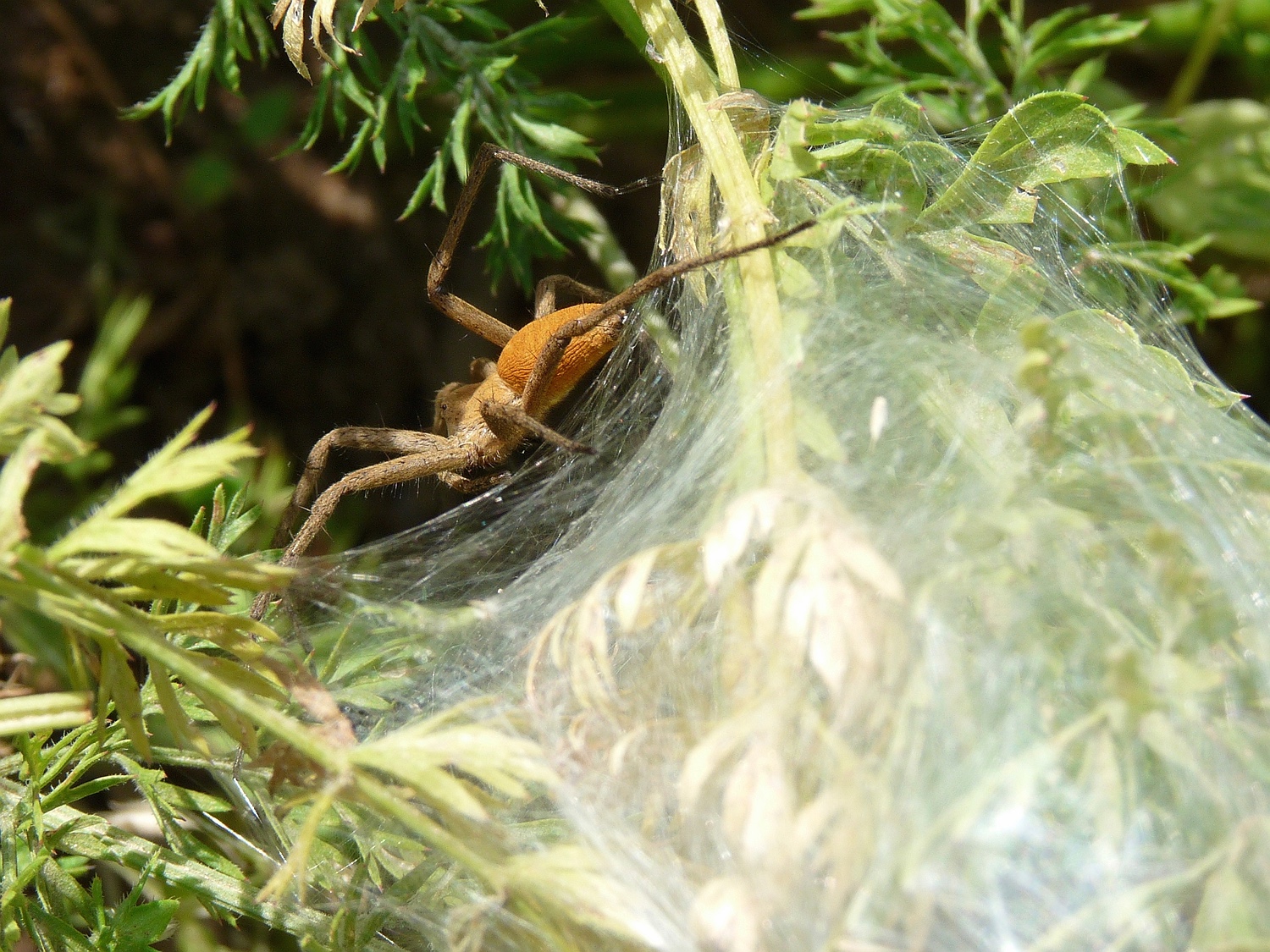
This spider, sitting on its nursery web, is probably also a specimen of Pisaura mirabilis.
Funnel weavers, Agelenidae
Agelena orientalis ?, C. L. Koch
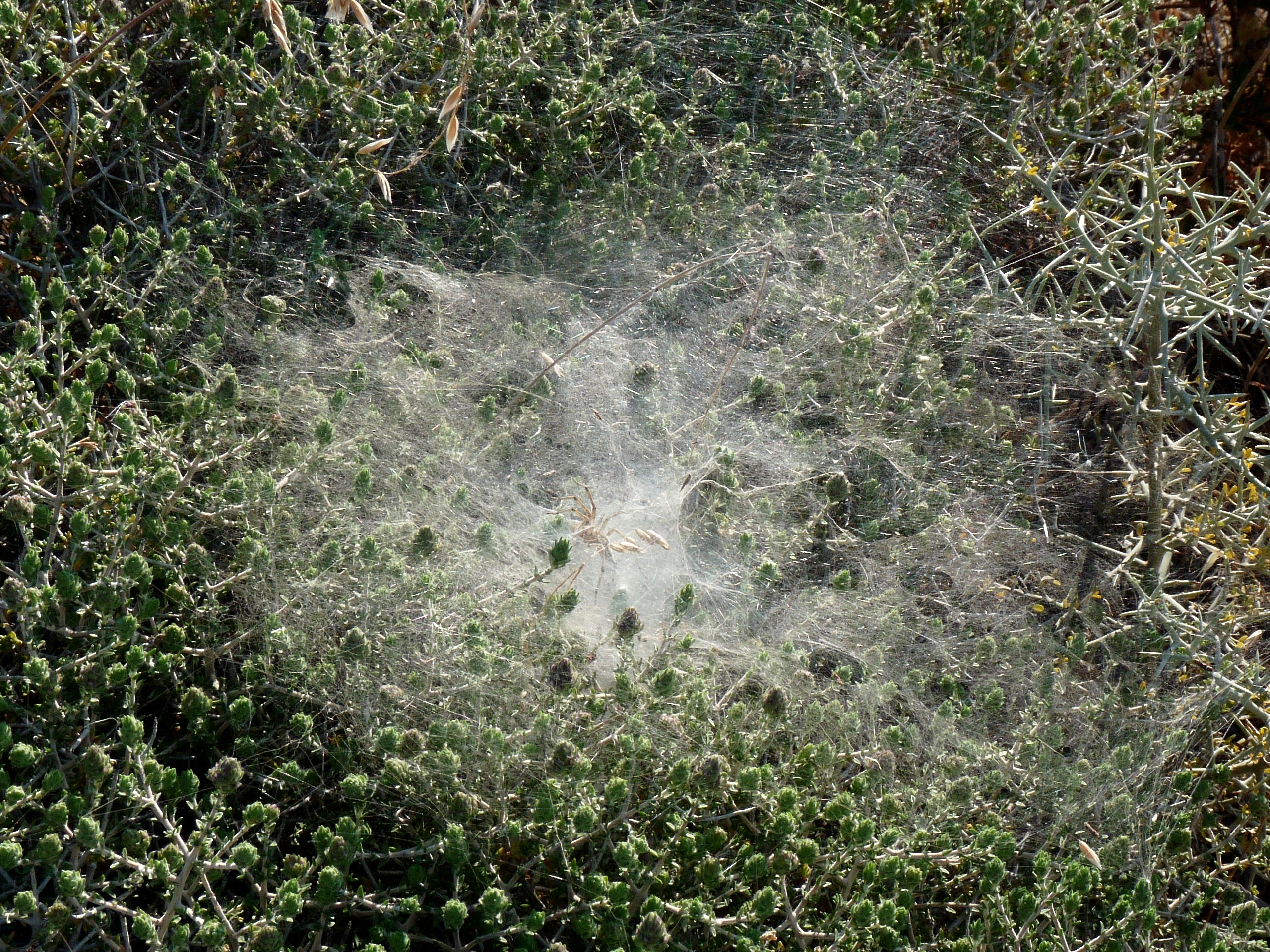
The funnel weaver Agelena orientalis is found in Italy and south-eastern Europe. It builds large, conspicuous funnel webs, which it spreads out in the vegetation.
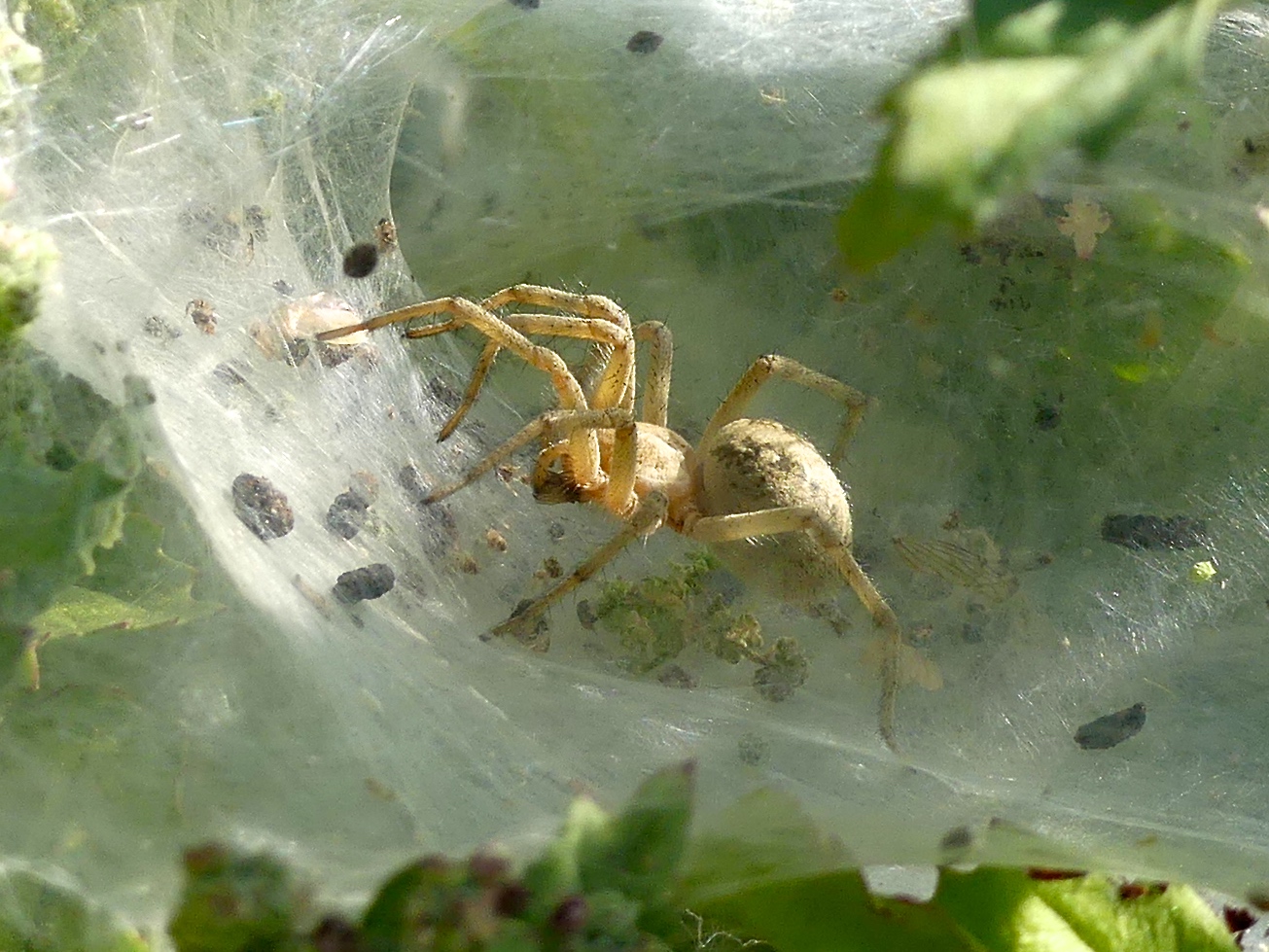
Here you can see the spider.
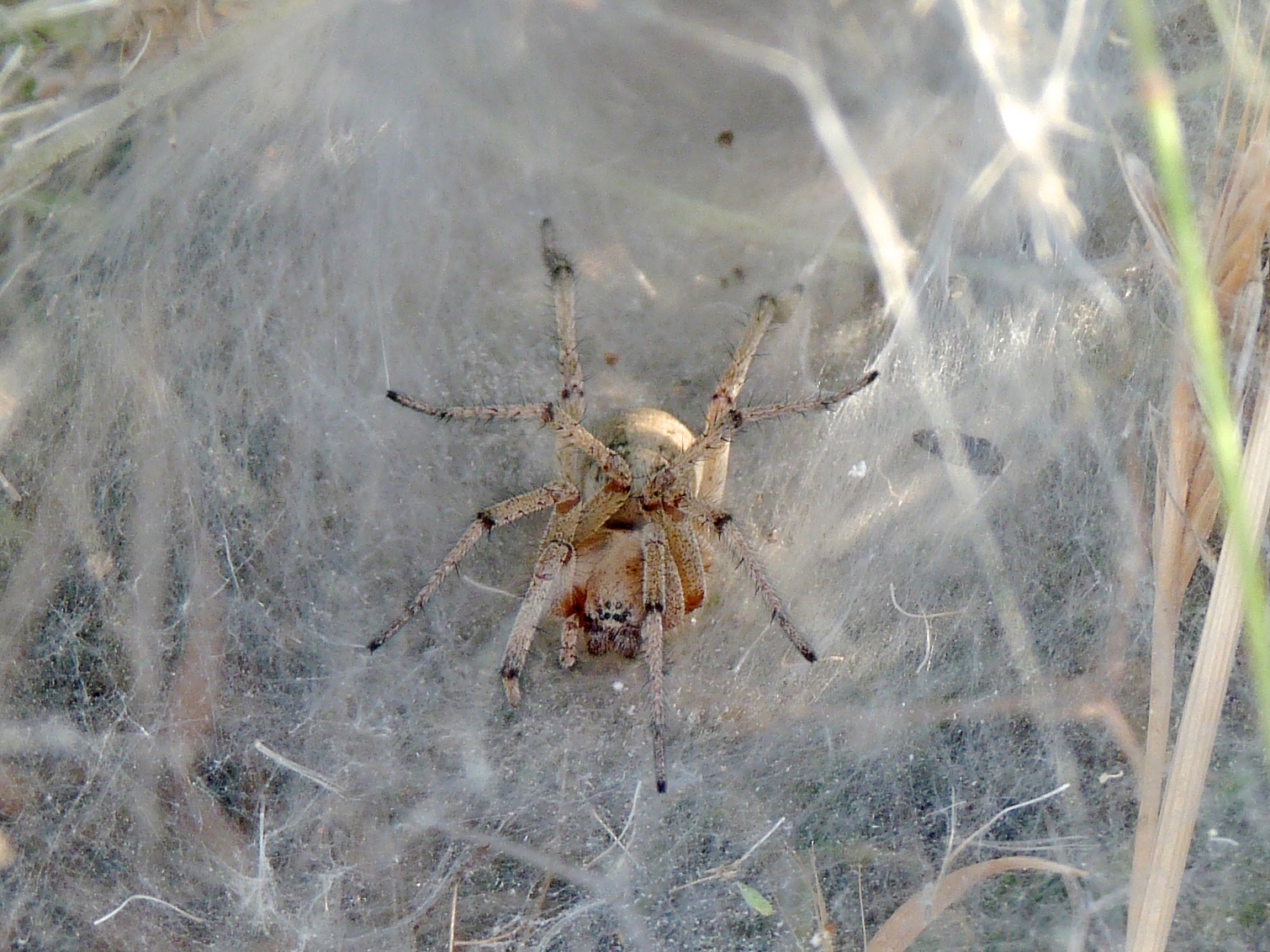
The spider at the entrance to its funnel. The colouring and markings on the abdomen are typical of this species, but microscopic examination is necessary for a reliable identification.
Textrix ?
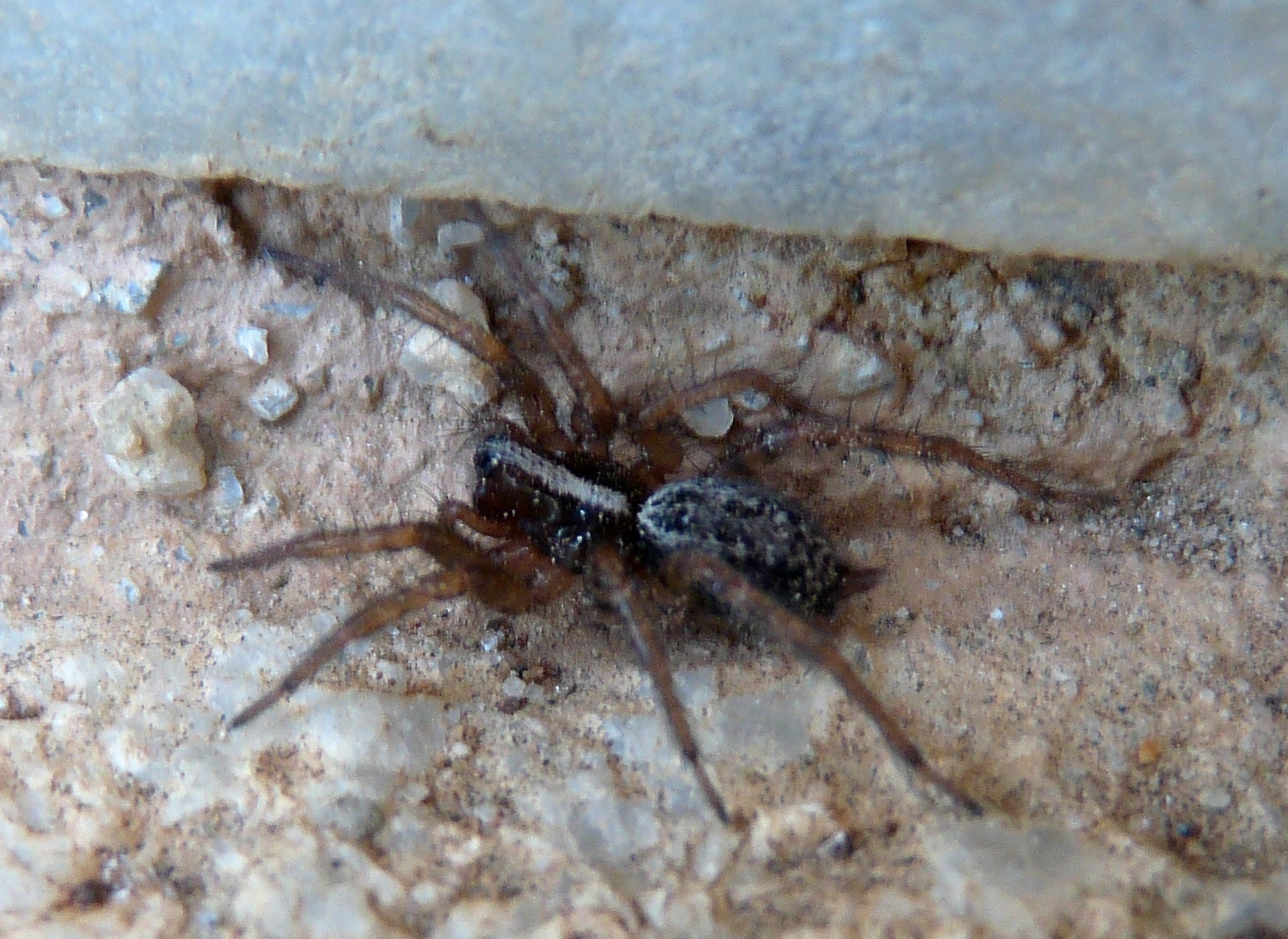
This spider, which reaches 8 mm length, may be a member of the genus Textrix, e.g. Textrix caudata. This species also belongs to the funnel weavers and builds a small funnel-shaped web; however, it can also be found outside its tube.
Dysderoidea
Green-fanged tube web spider, Segestria florentina, Rossi
Segestria florentina builds a tube that is open at both ends; it usually lives under stones. Females grow to over 2 cm in size and can deliver an unpleasant bite. The species is widespread throughout much of Europe and also occurs in Germany, but is rarely encountered. Characteristic of the genus is the posture of the legs, with three pairs facing forwards and one pair facing backwards. Green-fanged tube web spiders have only three pairs of eyes.
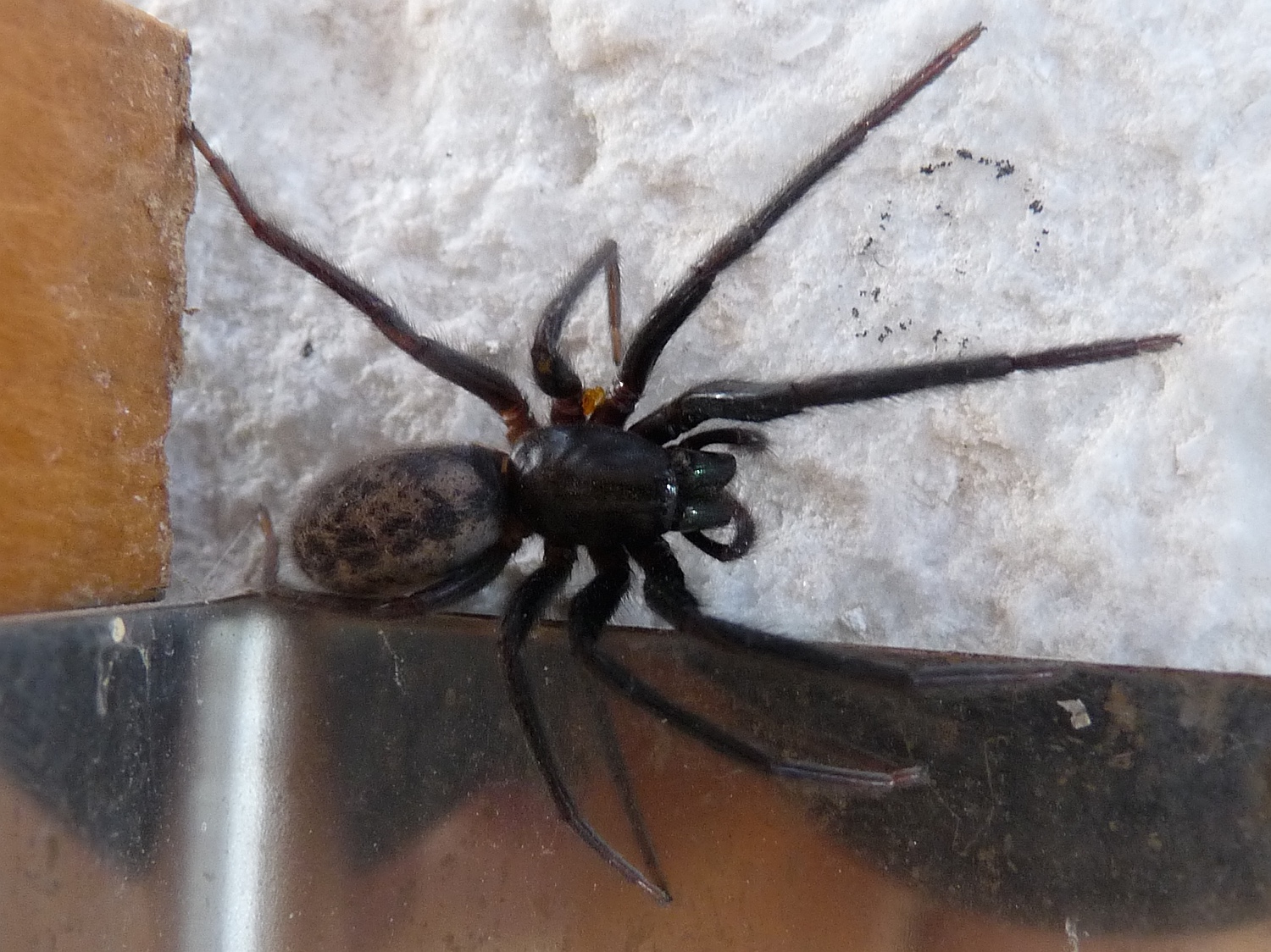
Segestria florentina grows quite large and is predominantly black in colour.
Crab spiders, Thomisidae
Crab spiders usually sit on flowers and wait there for insects to catch. They are often well camouflaged.
Thomisus onustus, Walckenaer
This crab spider, which is widespread in Europe, can have very different colours: white, yellow, orange-brown or pink, either uniform or striped. The species can adapt its body colour to the colour of its surroundings, providing good camouflage. Its body shape is characteristic, with two lateral bulges on the abdomen. The species loves warmth; it is very common on Naxos. It usually sits on flowers, where it lies in wait for its prey; it can overpower large insects such as butterflies. The males are much smaller than the females and difficult to spot.
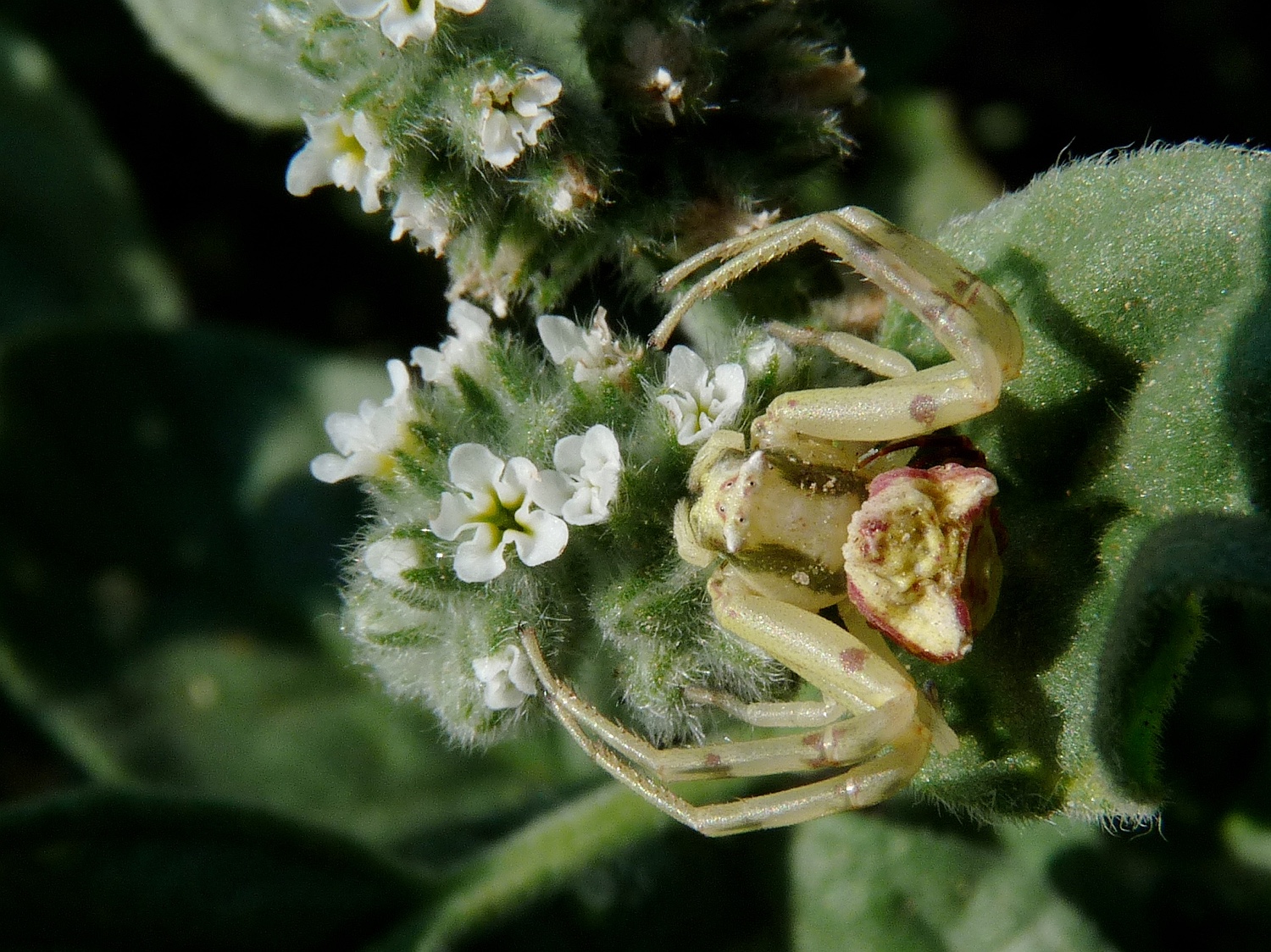
a male with a small abdomen and greenish-reddish colouring
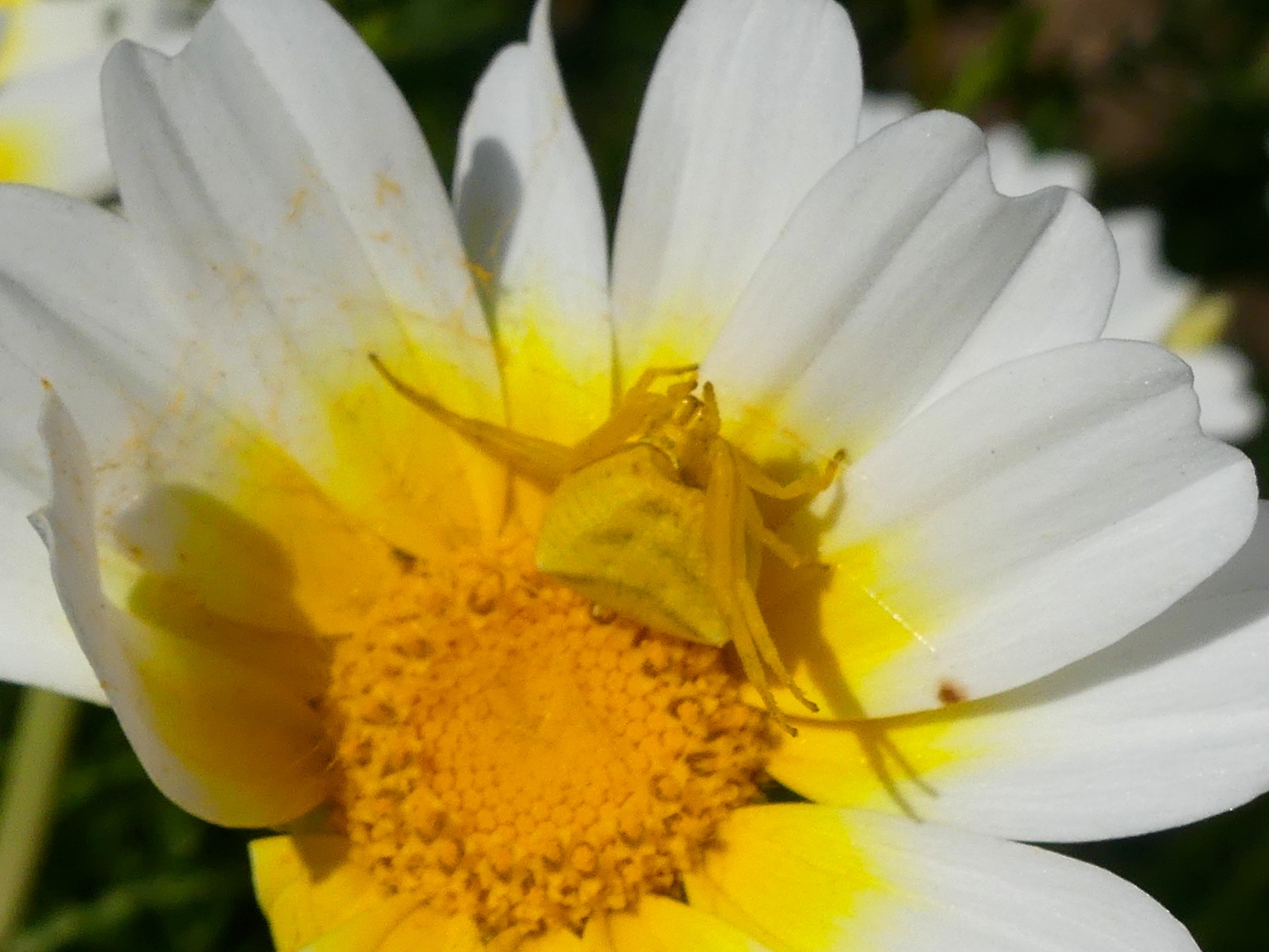
A fat female lies in wait for prey…
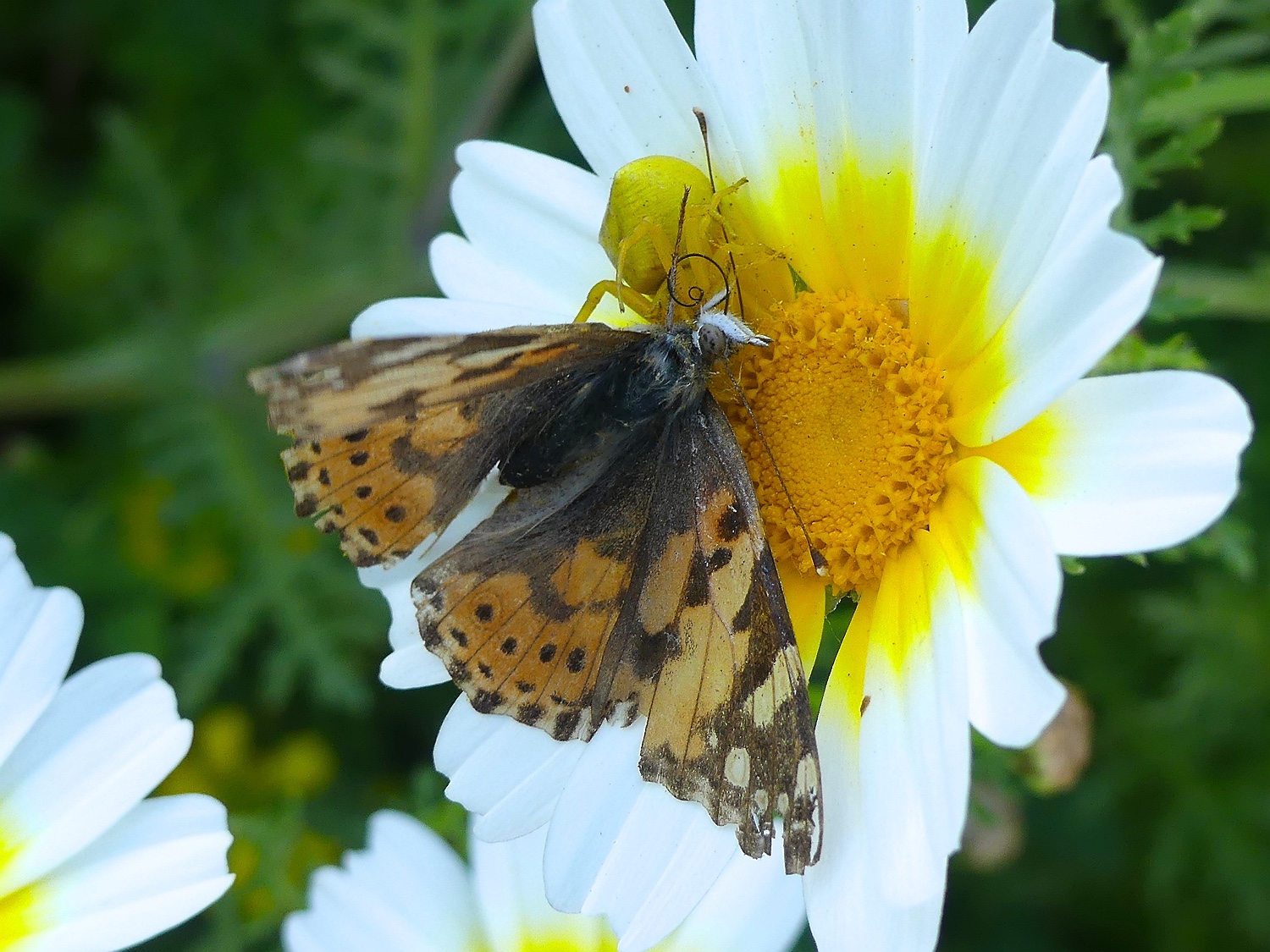
…and snatches a Painted lady butterfly, which it now slowly sucks out. The spiders sitting on crown daisies are yellow, thus being well camouflaged in the center of the flower.
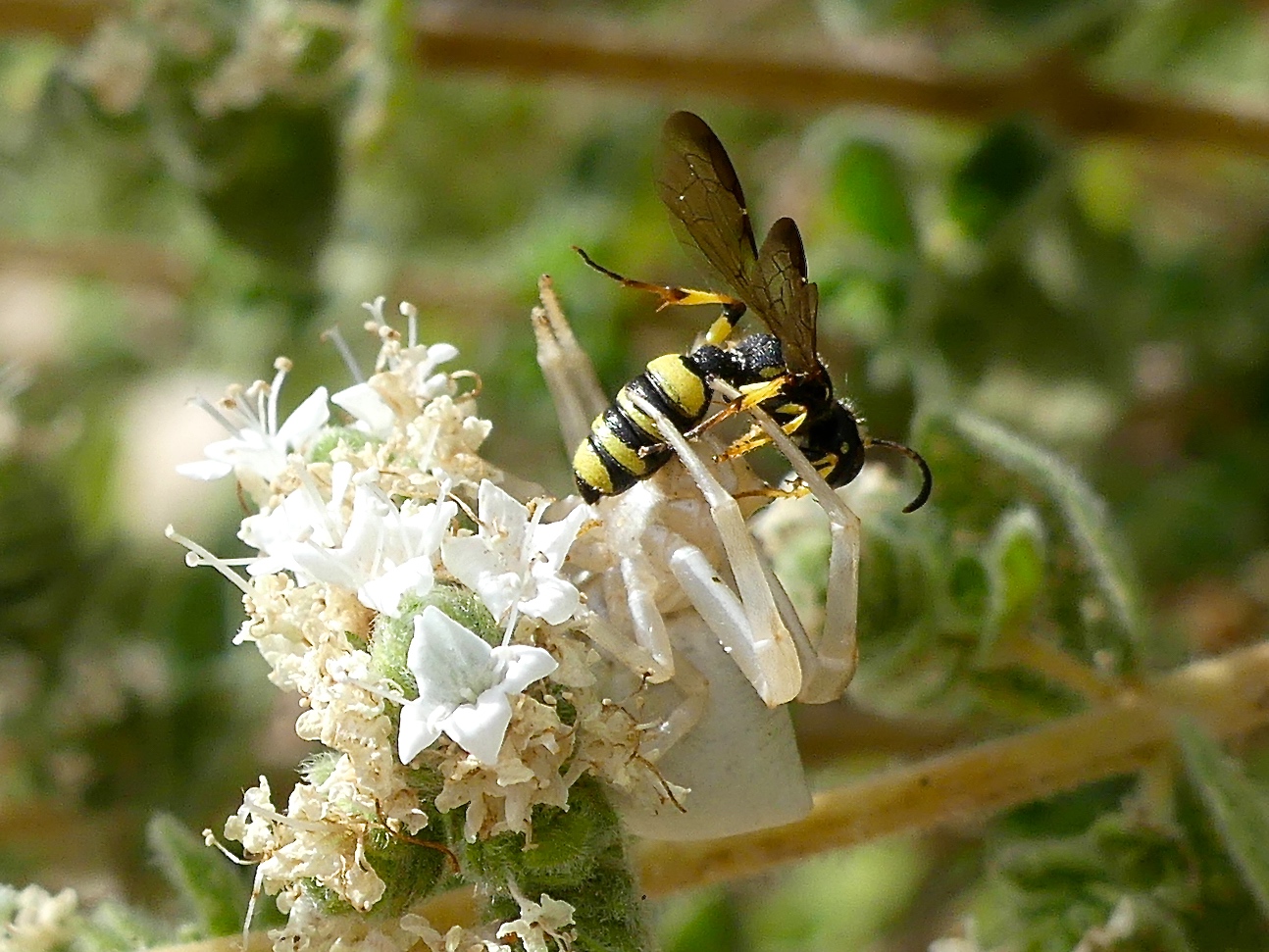
A female on oregano, which is visited by many hymenoptera and flies. Here, the spider has taken on a white colouration to match the colour of the oregano flowers.
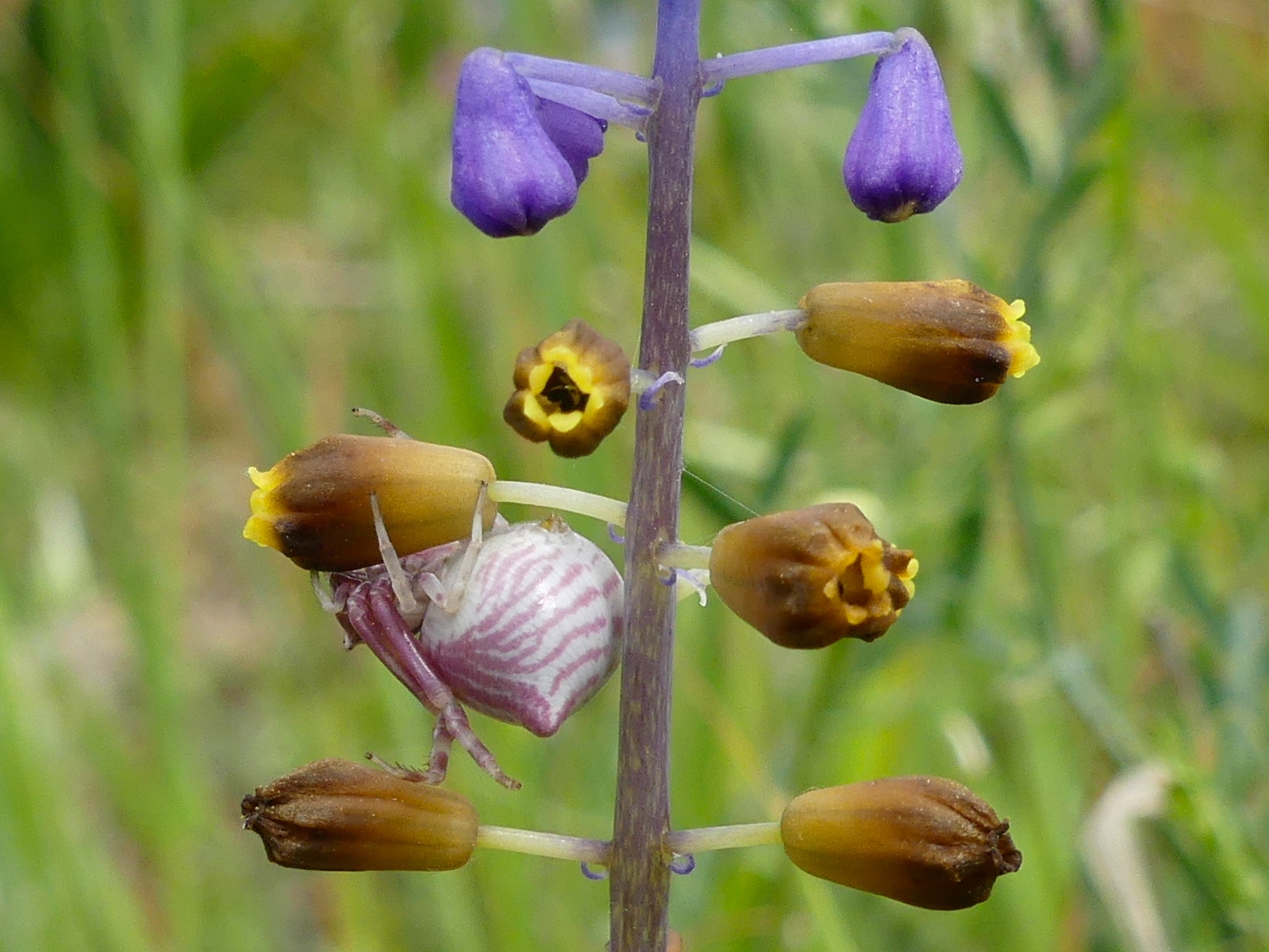
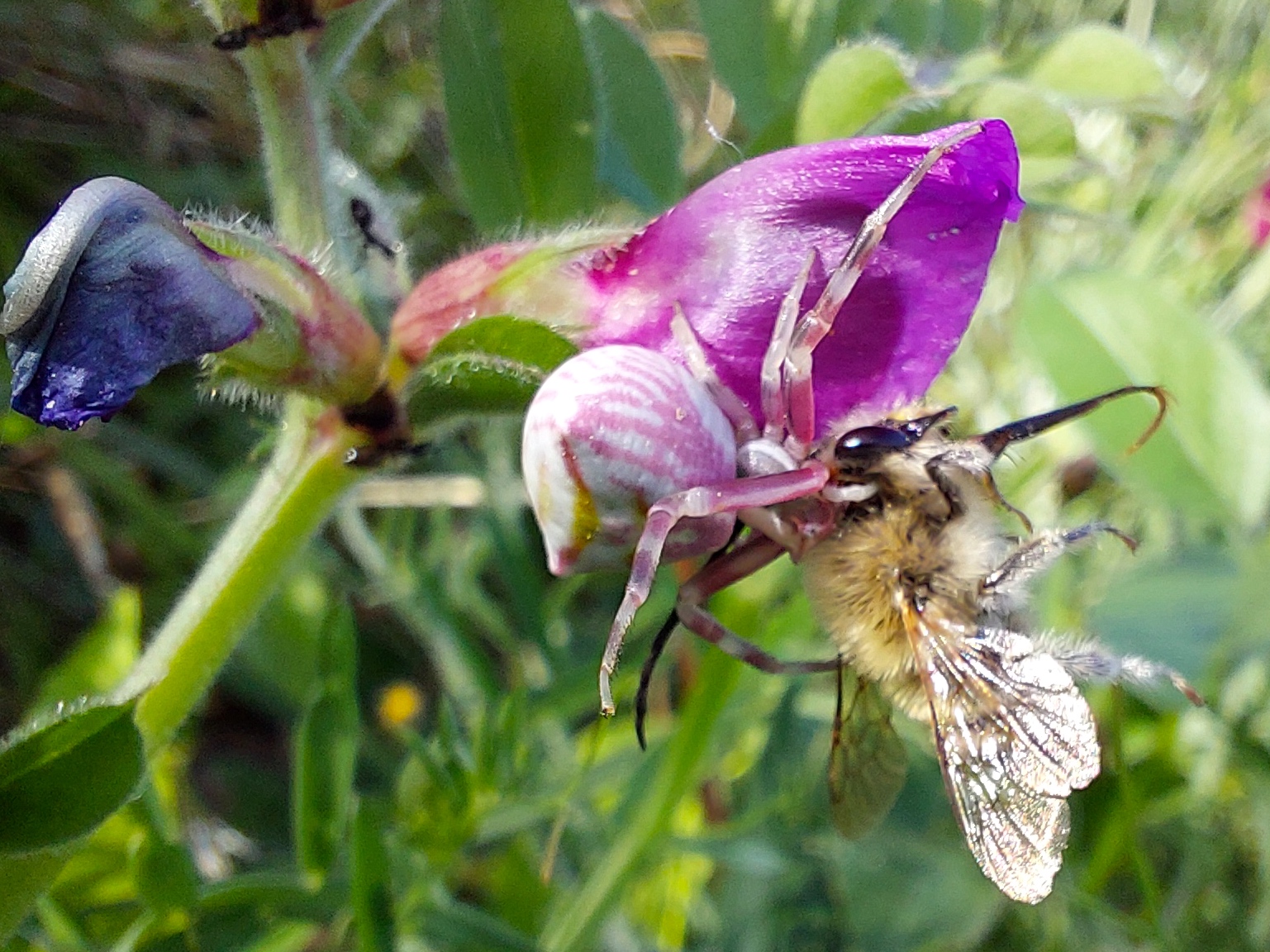
Rarely, you may also find an individual that is pink in colour. The change in colour occurs through the production of the corresponding pigments, which is why it takes several days.
Runcinia grammica, C. L. Koch
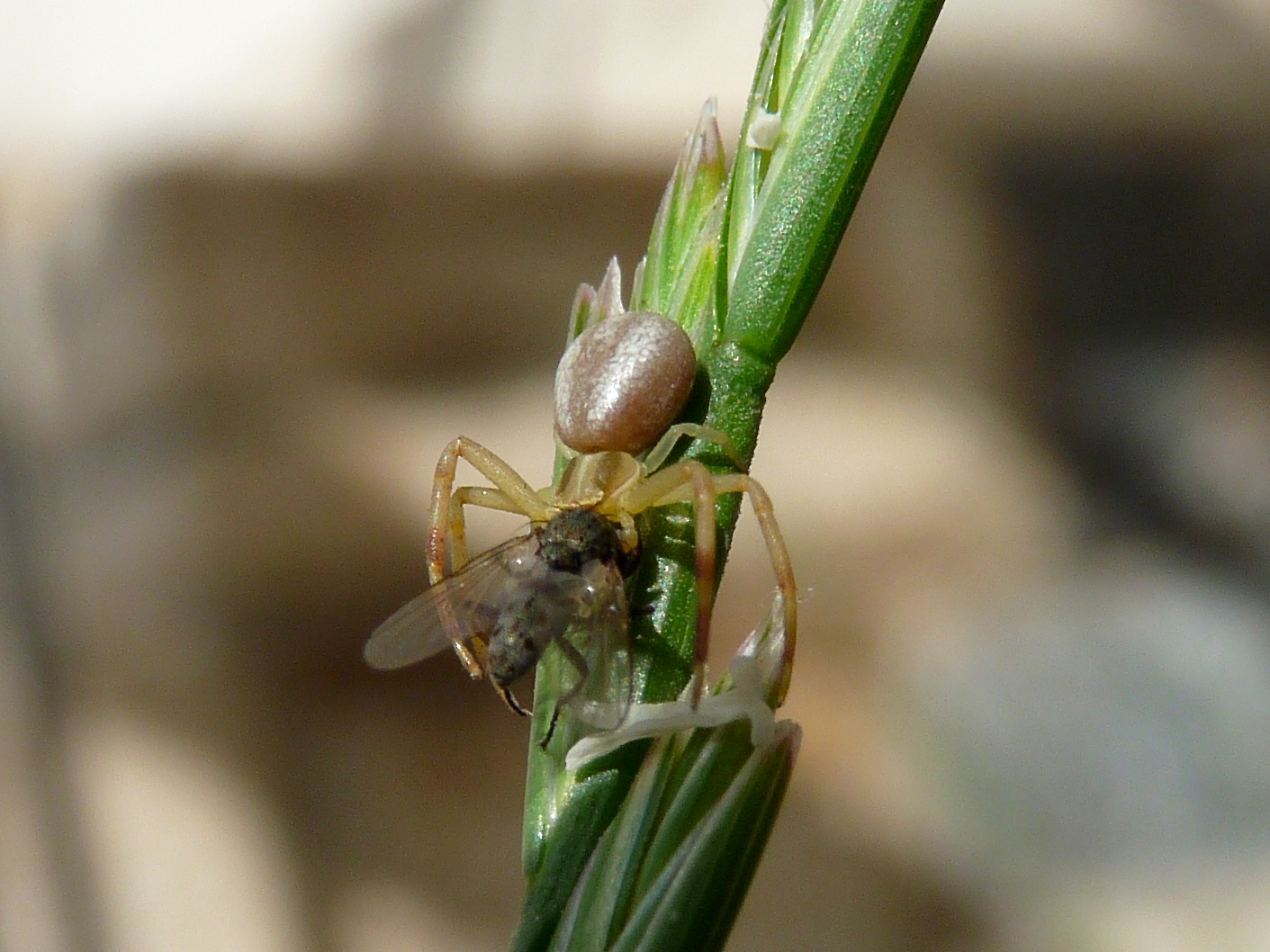
Another species of crab spider found in our region is Runcinia grammica, pictured here, which can be recognised by the stripes on its front and rear body. This specimen has caught a fly.
Napoleon spider, Synema globosum, Fabricius
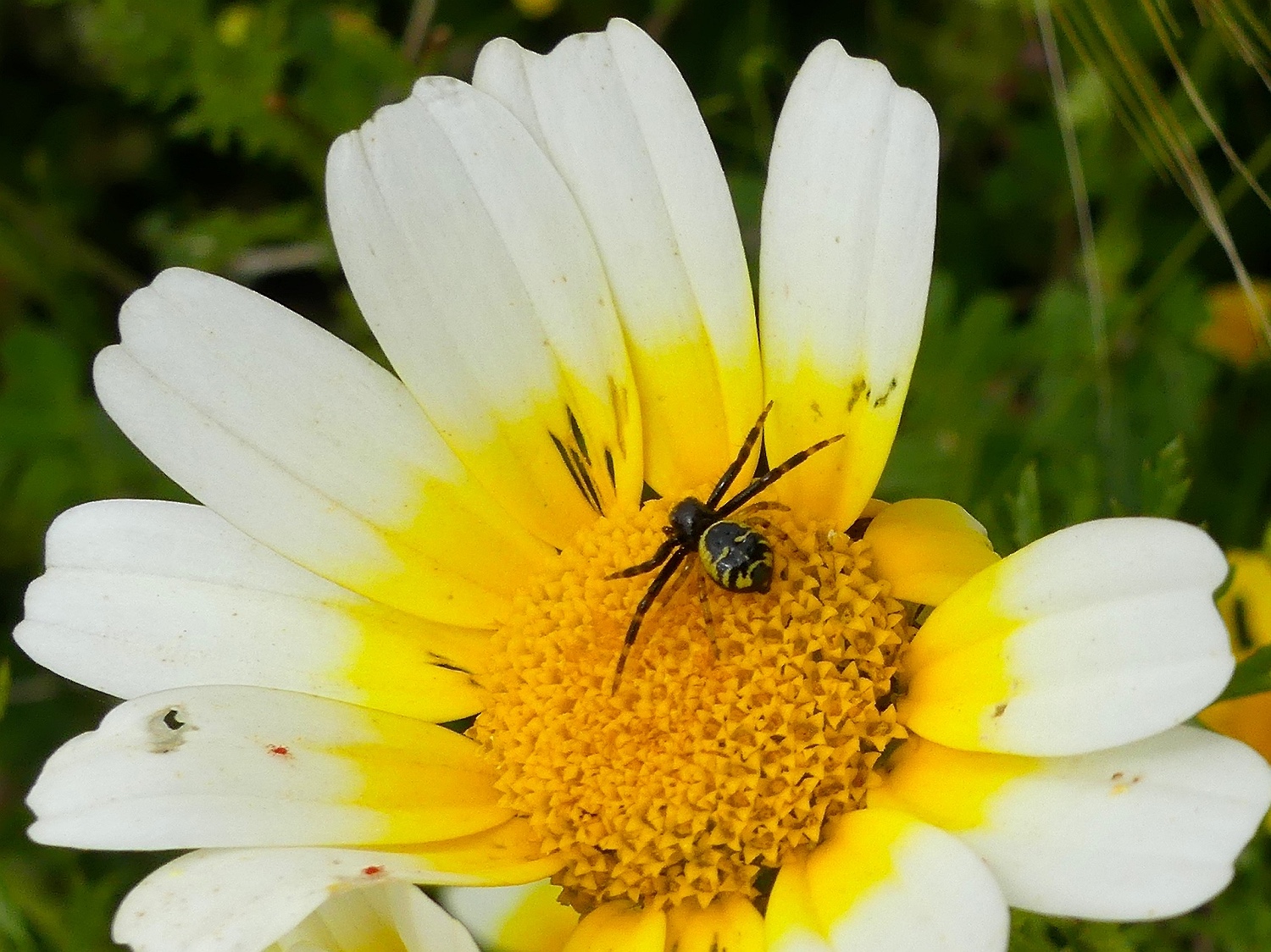
This crab spider can be recognised by the black and yellow markings on its abdomen. The small stalked lateral eyes are typical of this genus. The Napoleon spider is particularly common in southern Europe. It likes to sit on yellow flowers, where it lies in wait for its prey.
Huntsman spiders, Sparassidae
Huntsmen spiders can be recognised by their legs, which are slightly turned forward. Some species, especially those found in the tropics, grow to a very large size.
Emerald spider, Micrommata virescens, Clerck
The Emerald spider is common in Europe; it prefers warm locations.
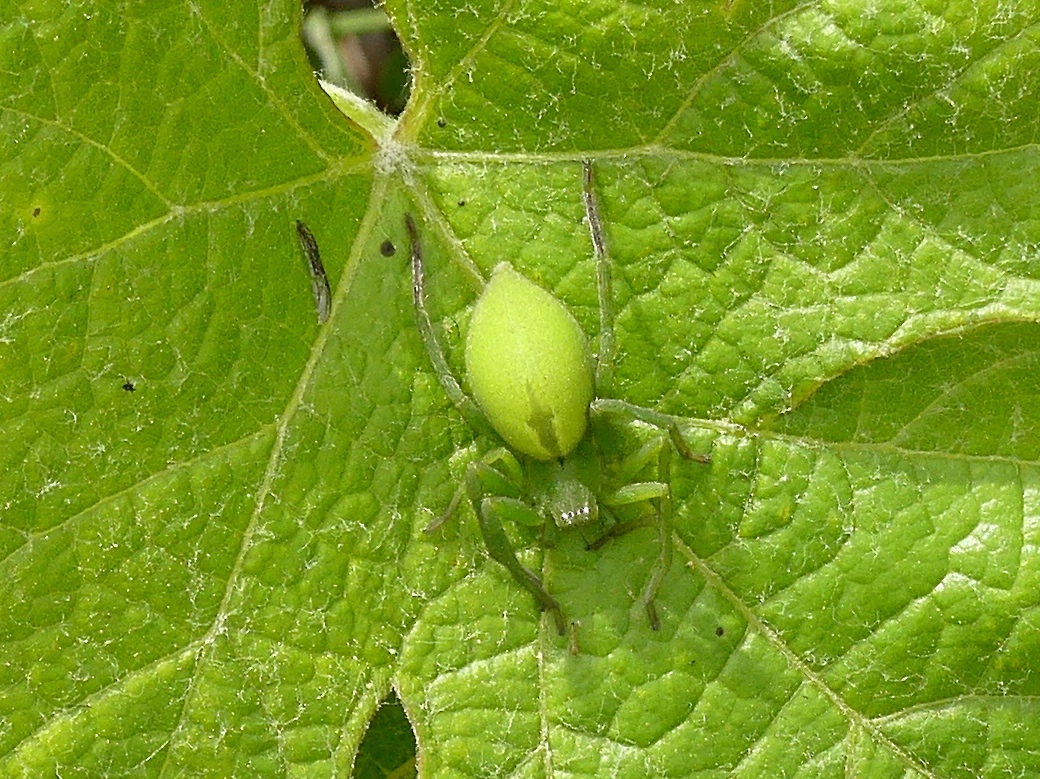
The Emerald spider is easily recognisable by its green colour. The females (in the picture) have a thicker abdomen than the males and are completely green, while the males’ abdomen has red and yellow longitudinal stripes.
Eusparassus walckenaeri, Audouin
This spider species, which is quite common in our region, is found from Greece to Afghanistan. It grows to a considerable size, with a leg span of around 10 cm. It spends the day in a cocoon-like web and goes hunting at night. It also likes to enter houses or hunt its prey around outdoor lamps. The females carry the egg sac with them; they can defend it and their offspring and will bite if necessary.
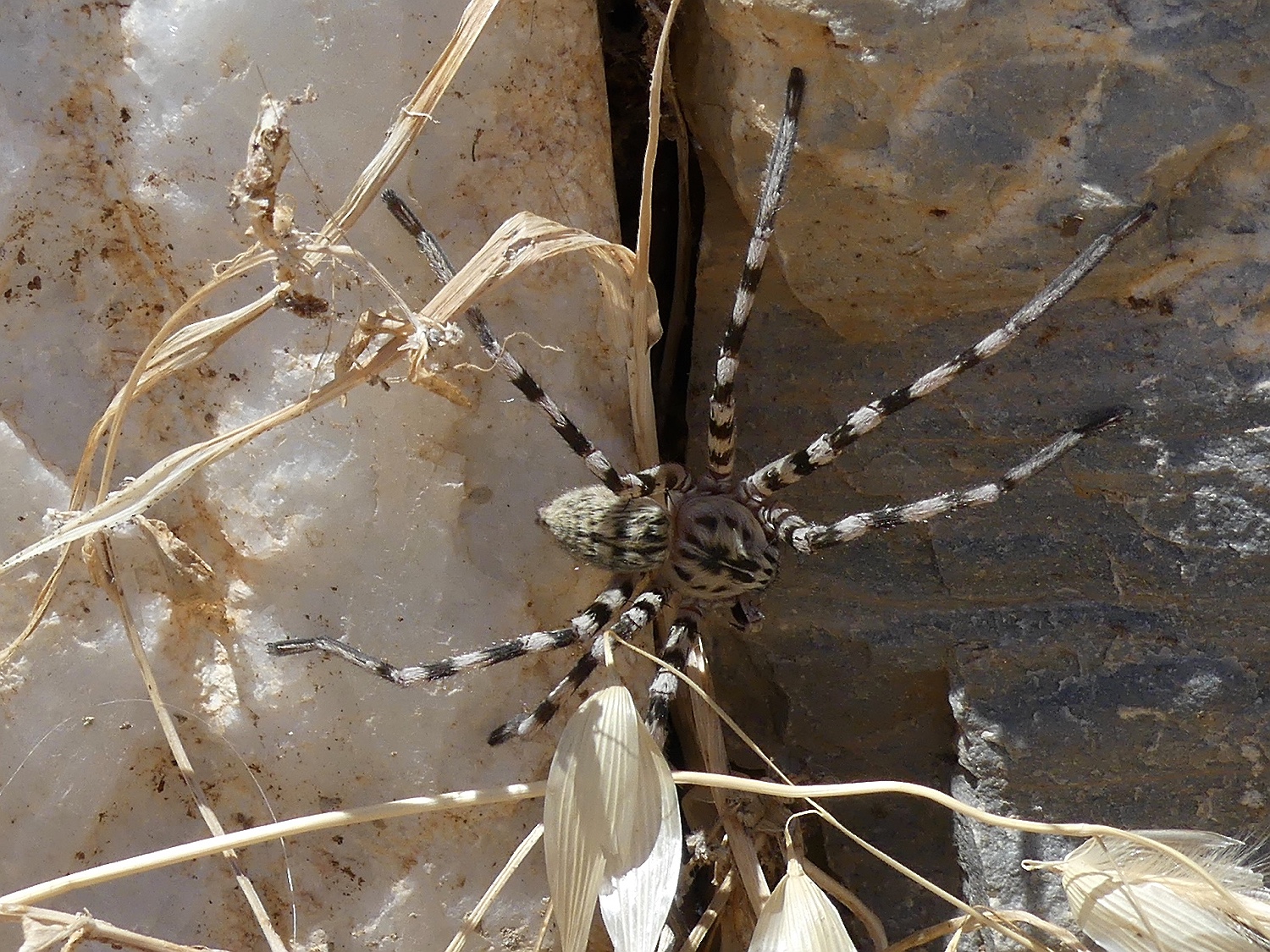
This very large and therefore not so popular spider is actually quite beautiful.
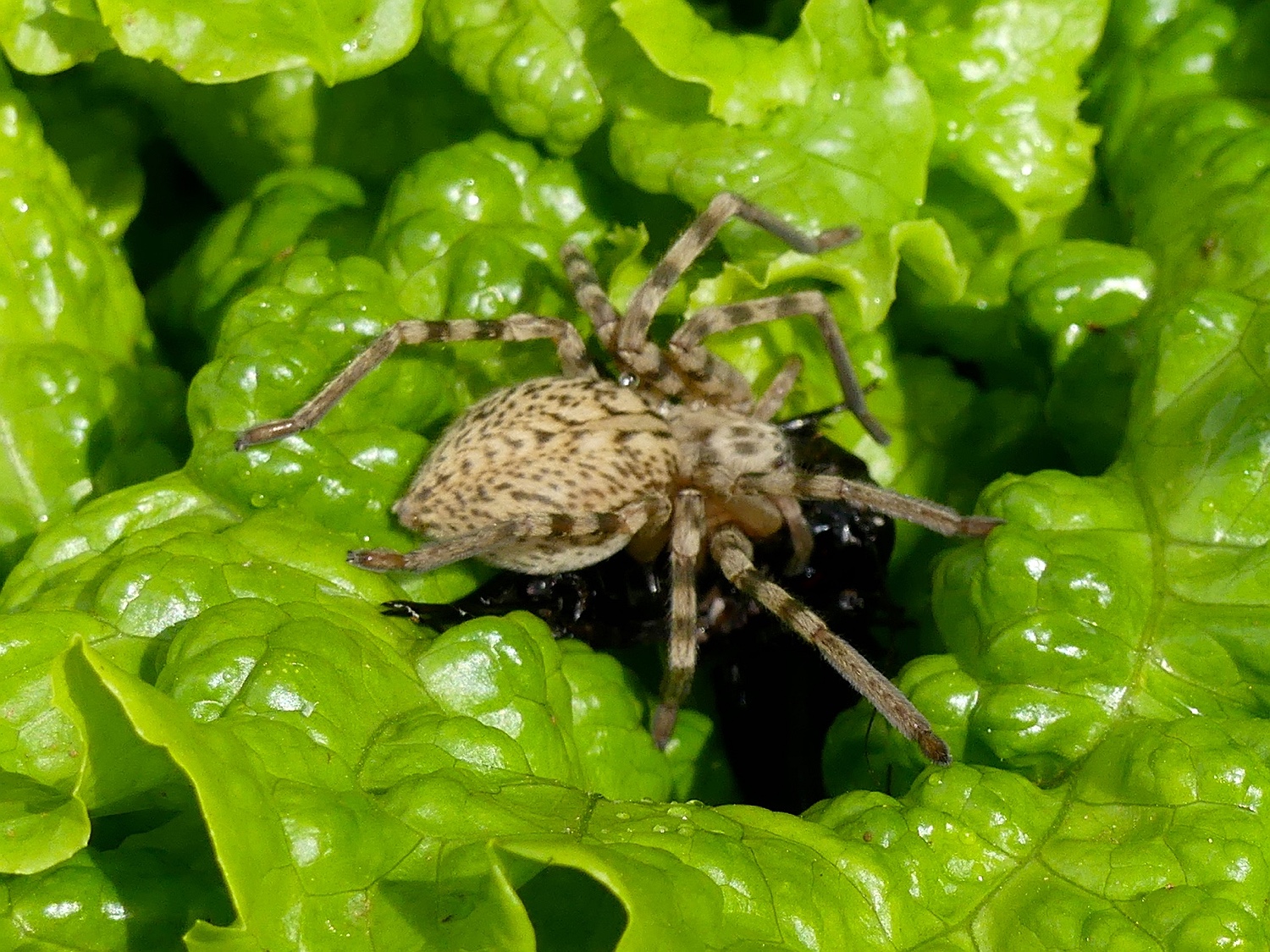
Here with a captured carpenter bee.
Jumping spiders, Salticidae
Zebra spider, Salticus scenicus, Clerck
The pretty zebra spider is one of many jumping spider species found on Naxos. It is easily recognisable by its colouring. Jumping spiders have large, forward-facing eyes; two smaller eyes also face forward, while the remaining two pairs of eyes face sideways or backwards. This allows the jumping spider to see in all directions at once. At short distances, it can see better than humans. The jumping spiders jump at its prey with great precision from a distance of up to 5 cm; the movement is not caused by muscle contraction, but by a sudden increase in haemolymph pressure.
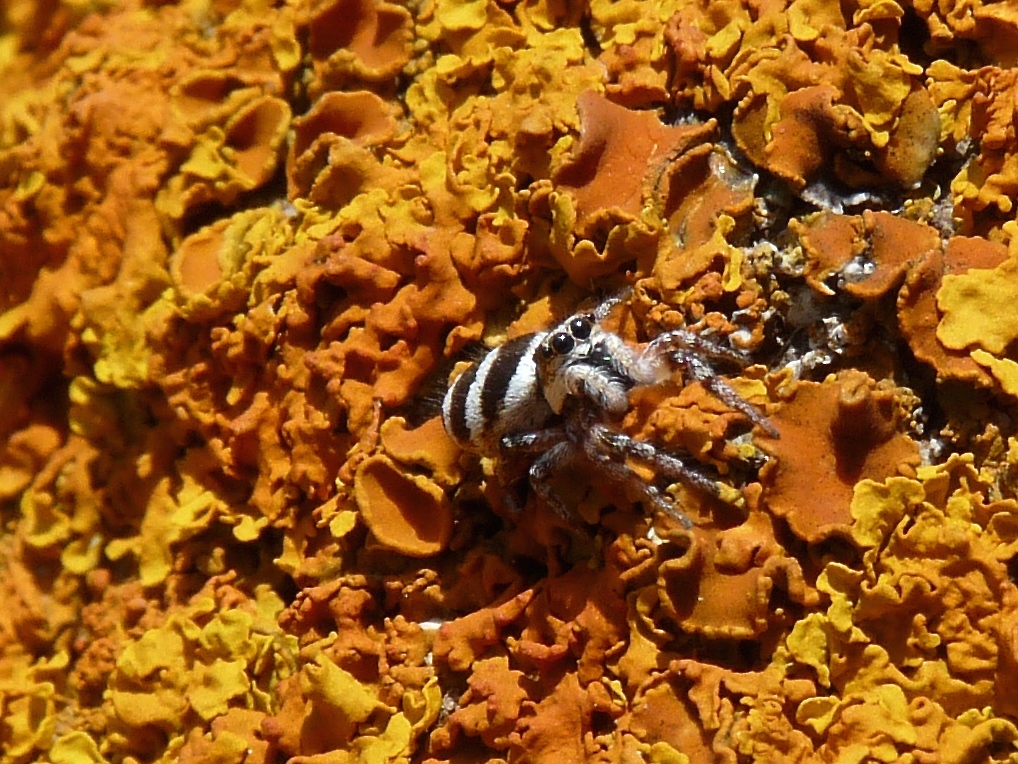
This specimen of the pretty Zebra spider shows its two large, forward-facing eyes.
Menemerus semilimbatus, Hahn
These small jumping spiders search for prey mainly on walls and stones. Menemerus semilimbatus is widespread in southern Europe and very common in our region; it can be recognised by its colouring with a characteristic small white triangle on the upper side of the prosoma. Like all jumping spiders, this species has powerful eyes that can see in all directions.
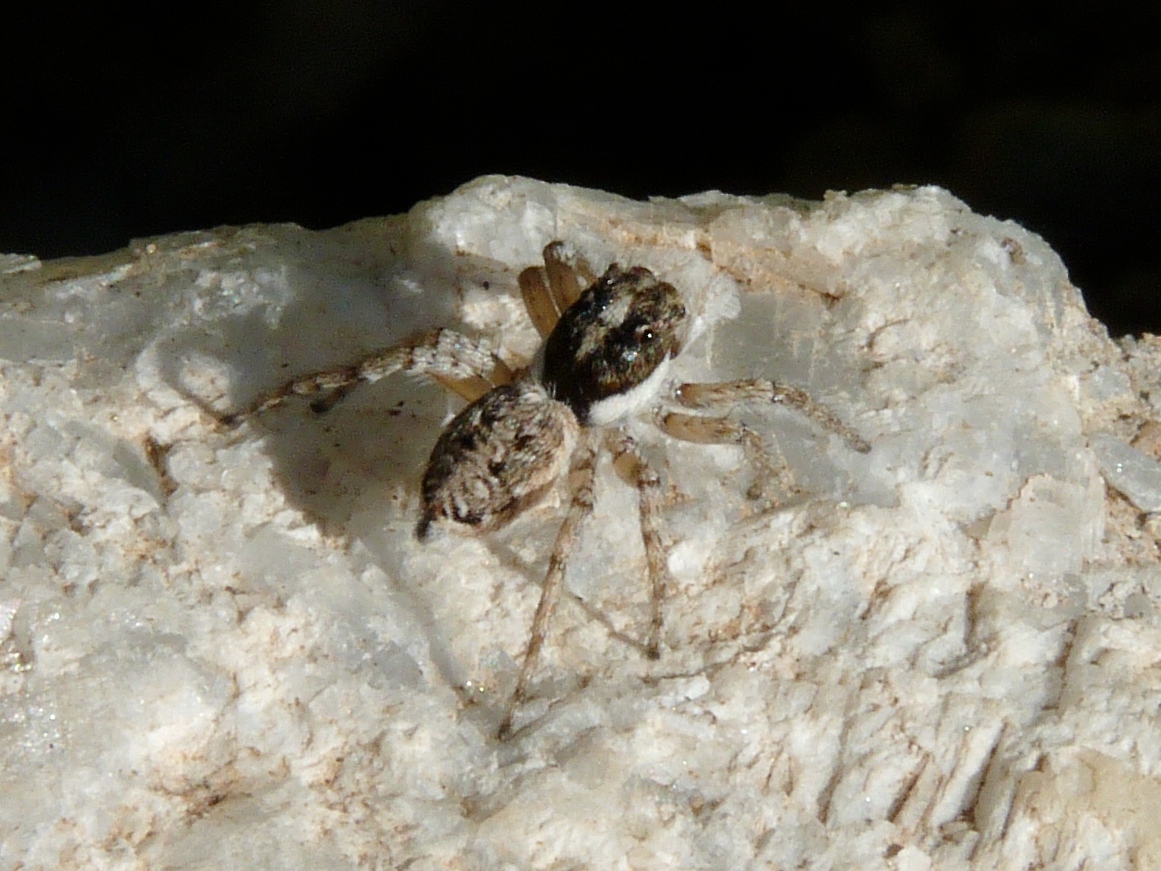
Menemerus semilimbatus is very common in our region and also likes to enter houses. It is very useful, as it likes to sit on the inside of the windows and catch flies.
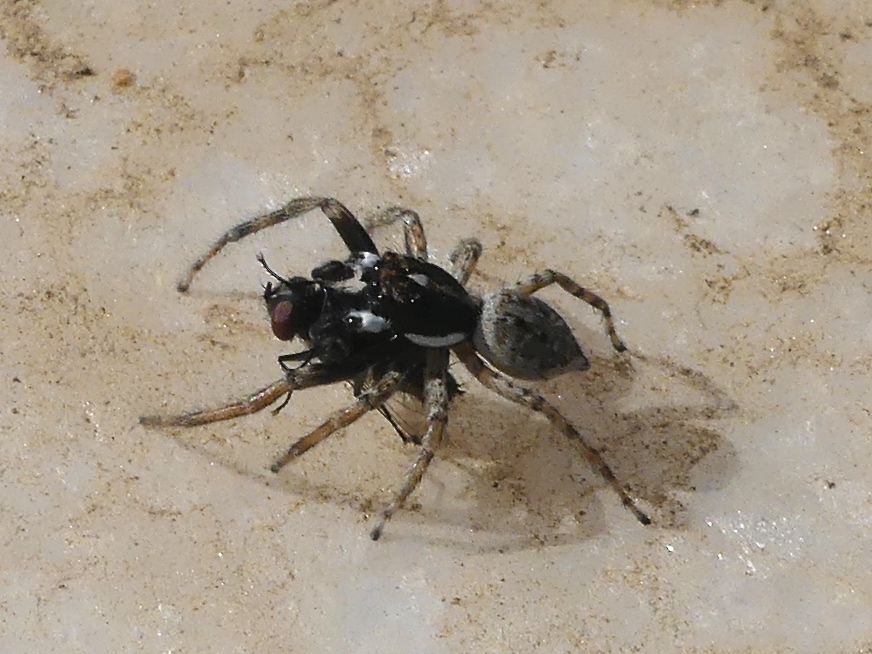
Menemerus semilimbatus with its favourite prey, a housefly.
Philaeus chrysops, Poda
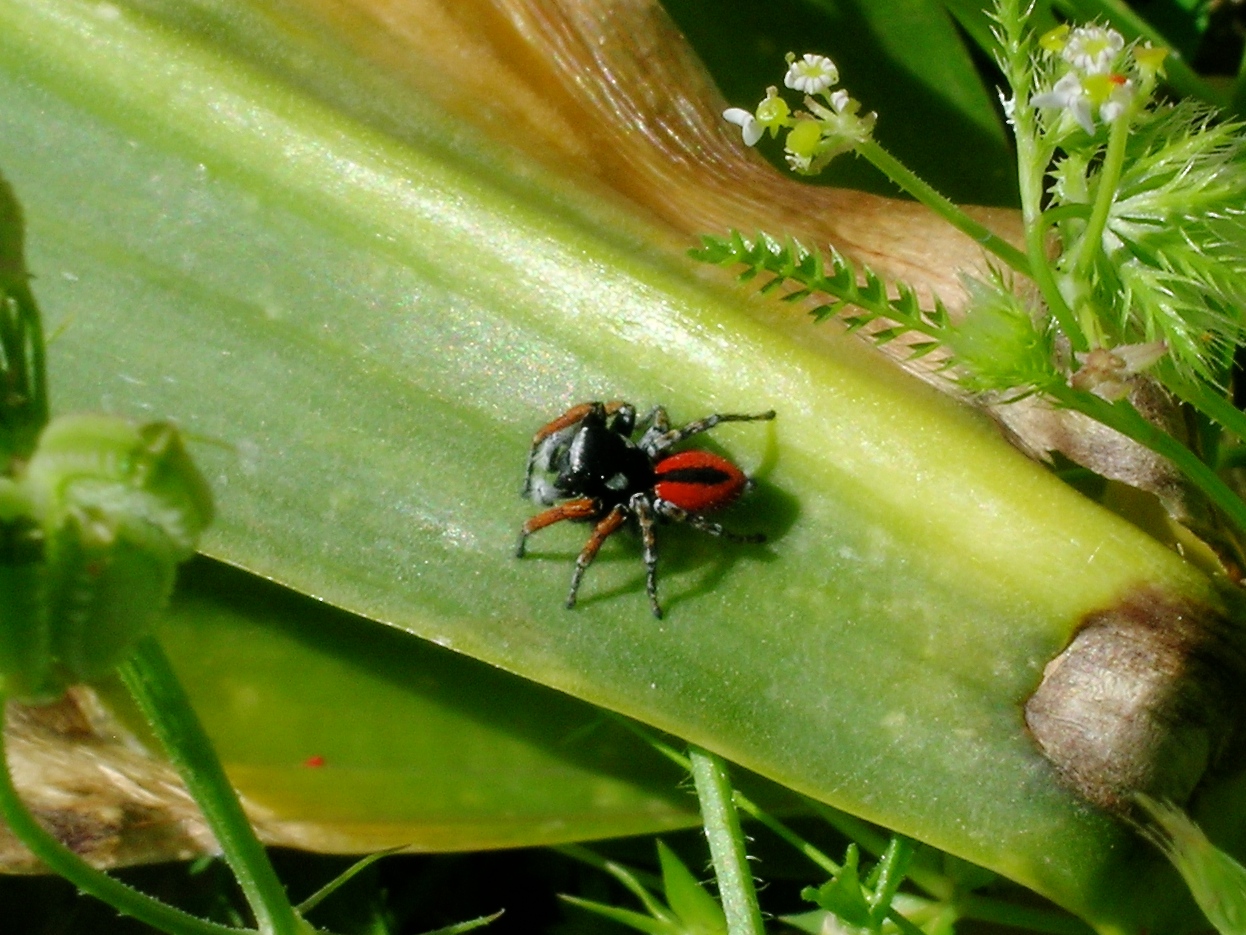
The males of Philaeus chrysops have a conspicuous red and black colouring. This species is found throughout central and southern Europe in dry, open habitats. It also regularly occurs on Naxos, but is not common.
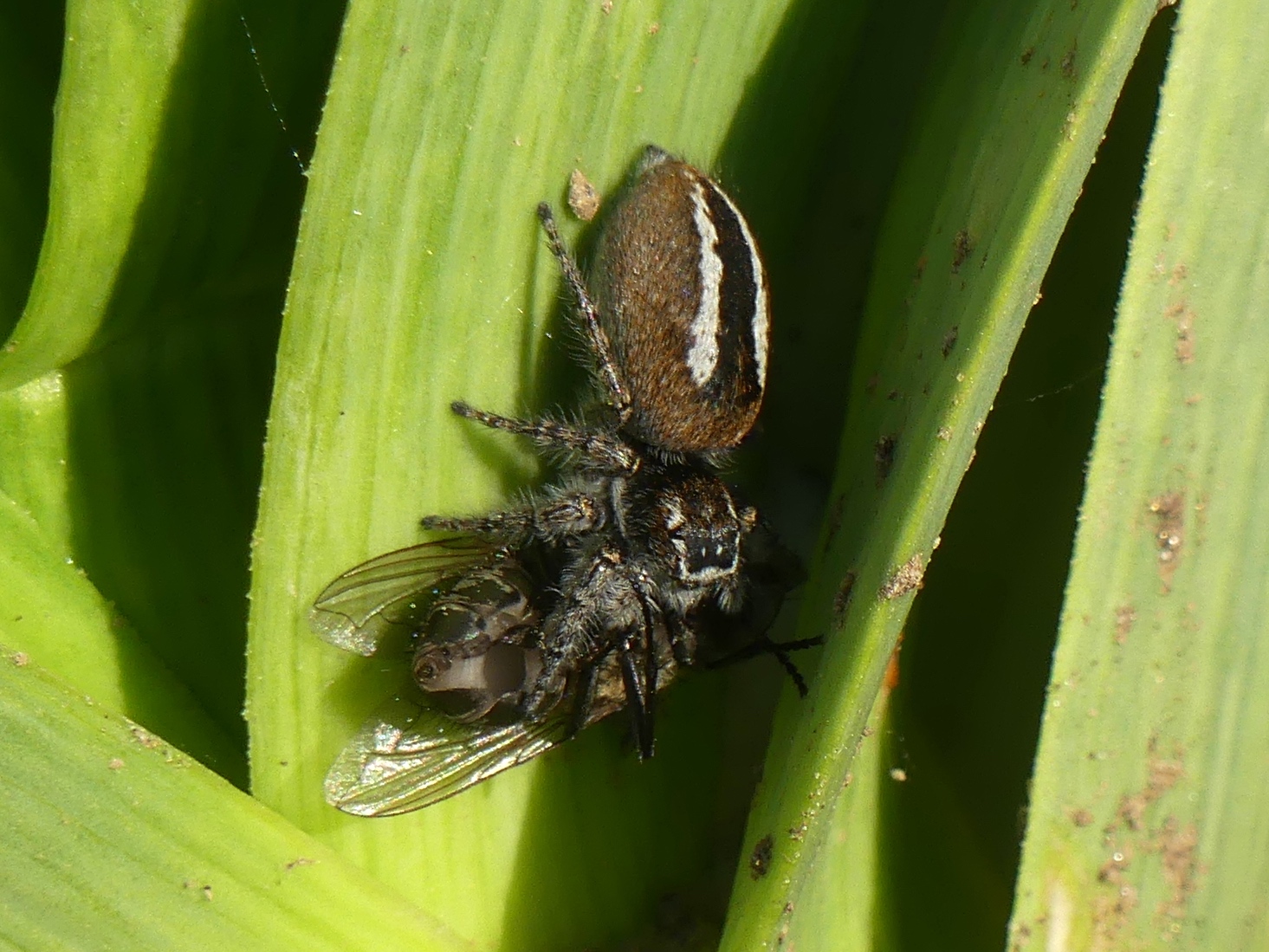
The females are inconspicuous with brown and grey colours.
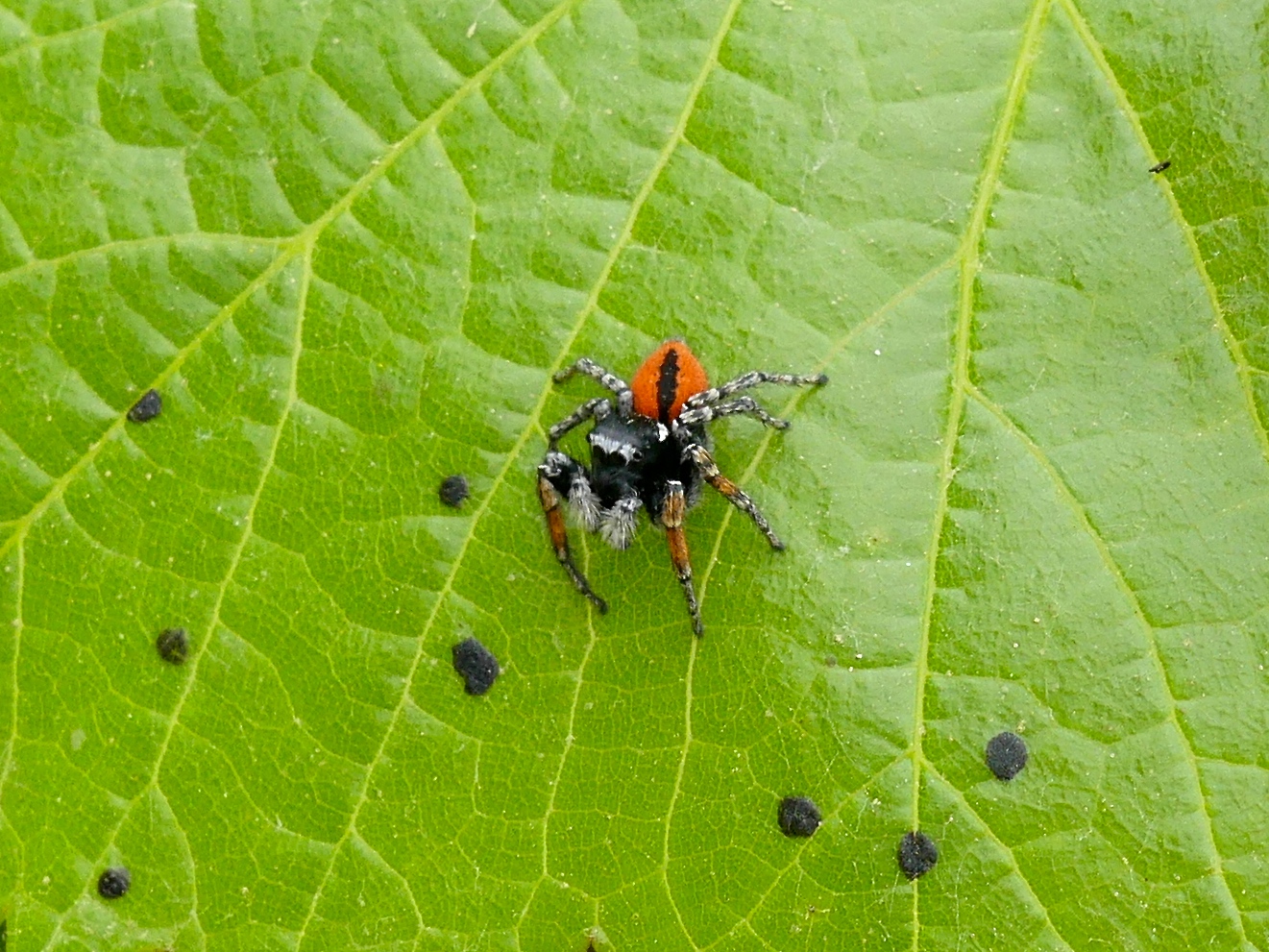
What a pretty spider!
Heliophanus kochii, Simon
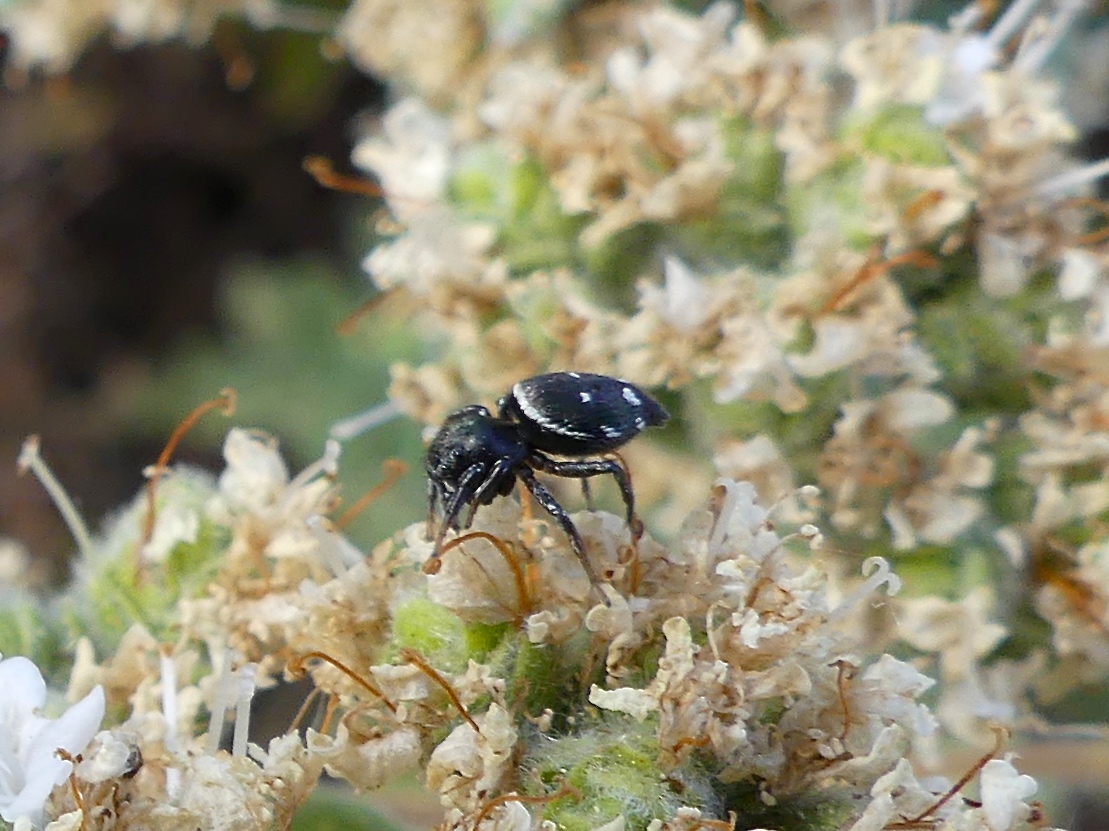
This small, predominantly black jumping spider belongs to the large genus Heliophanus.
Heliophanus melinus, Koch
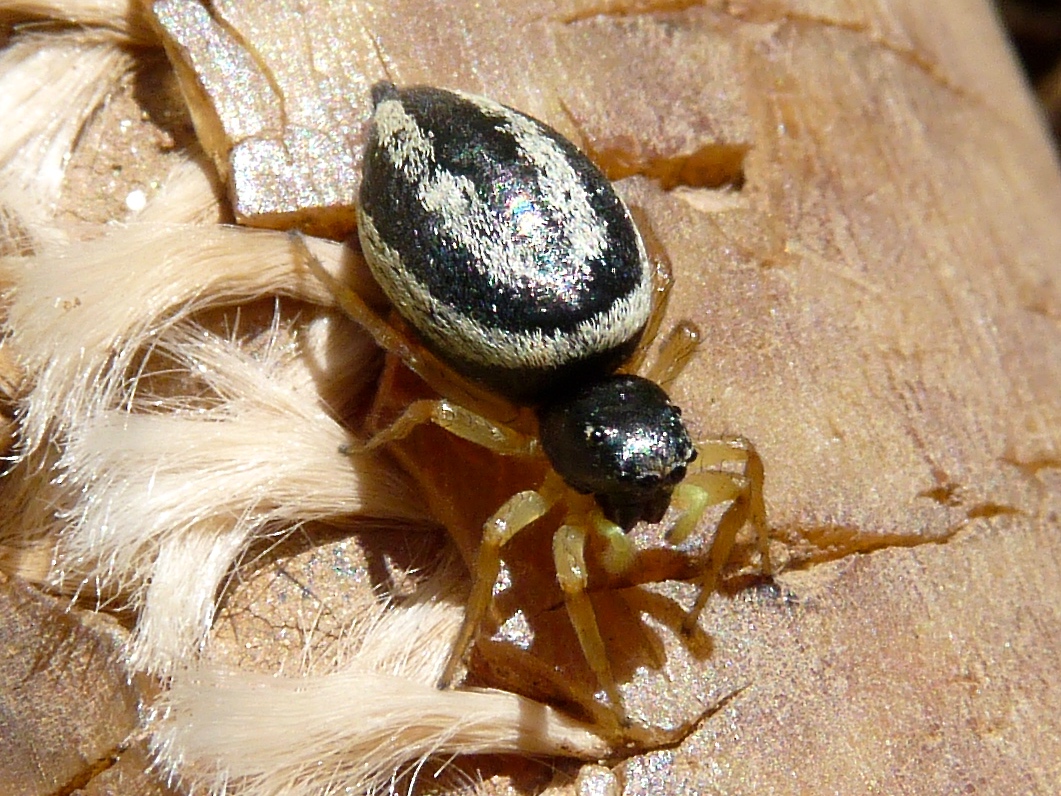
And another small jumping spider of the same genus, recognisable by the characteristic colouring of its abdomen. The light-coloured legs indicate that this is a female.
Evarcha jucunda, Lucas
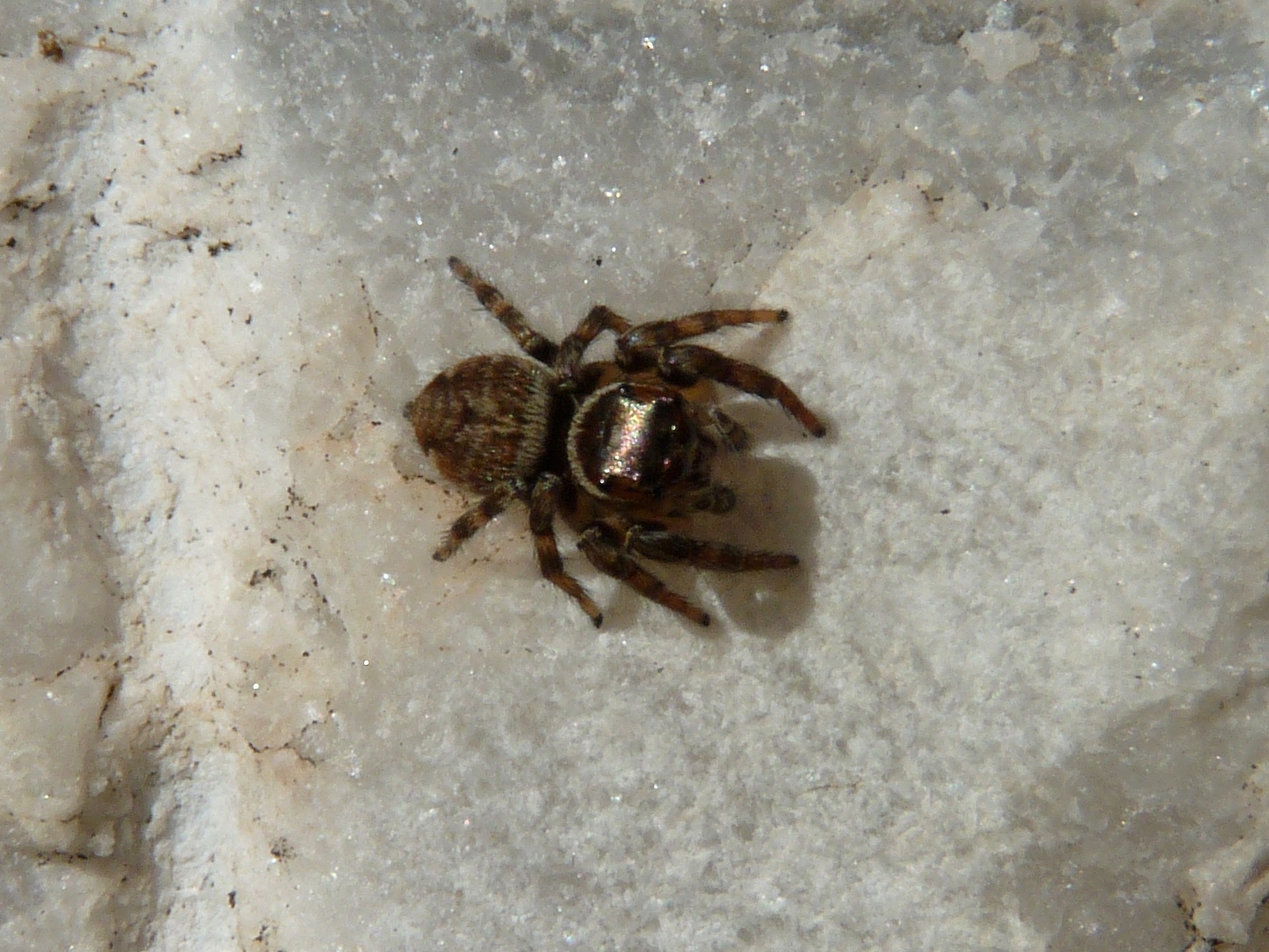
This pretty little jumping spider with a shiny metallic head is Evarcha jucunda. I would like to thank the dedicated members of the Facebook page ‘Spiders of Greece and Cyprus’ for their help in identifying it.
Thyene imperialis, Rossi
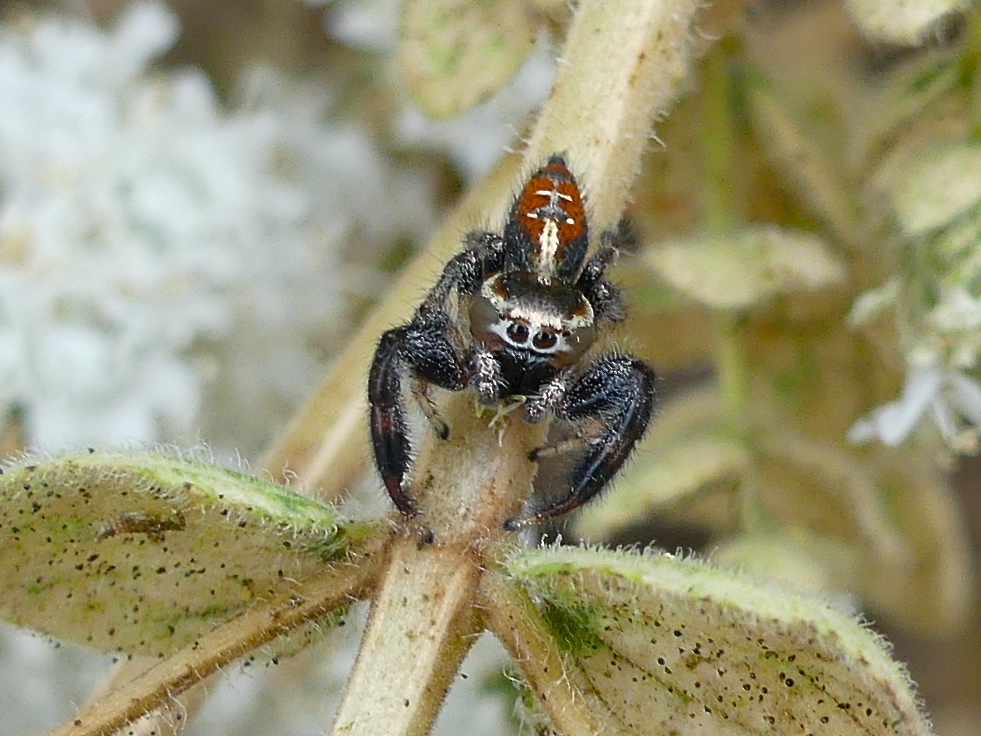
Thyene imperialis is another pretty little jumping spider with a red abdomen with silver markings.
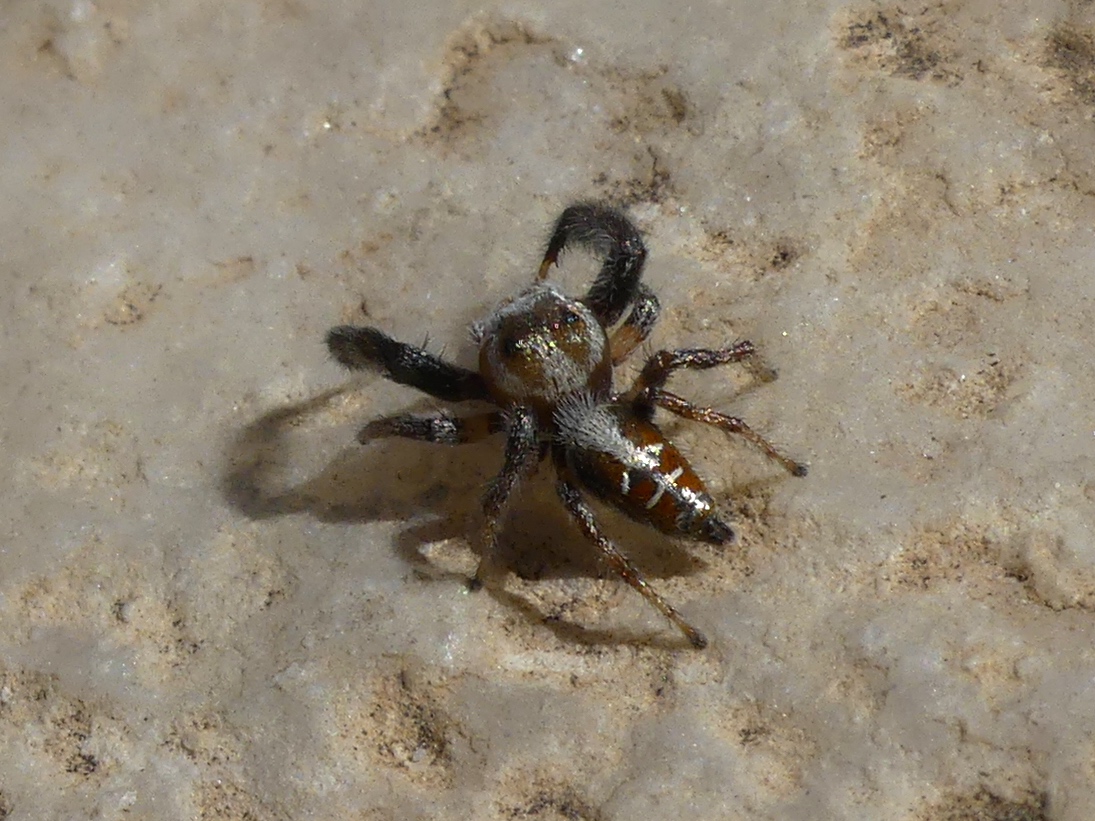
This species has large front legs.
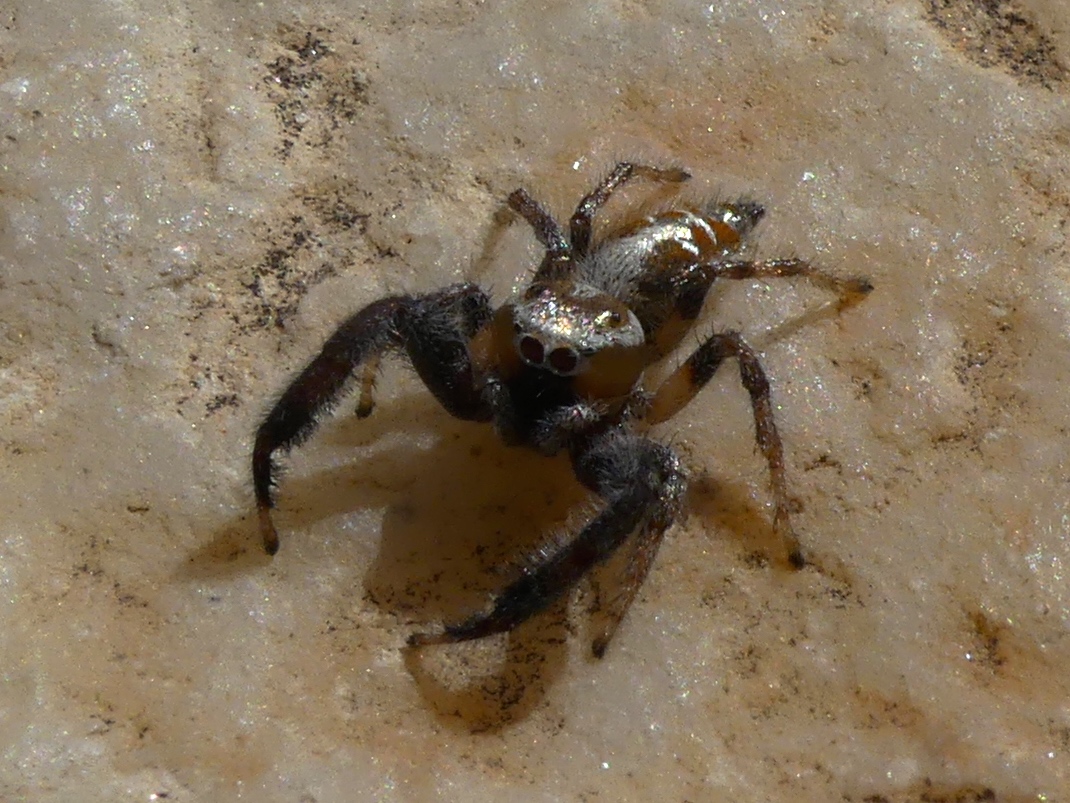
The little jumping spiders give the impression of being responsive and curious.
Asianellus festivus ?, C. L. Koch
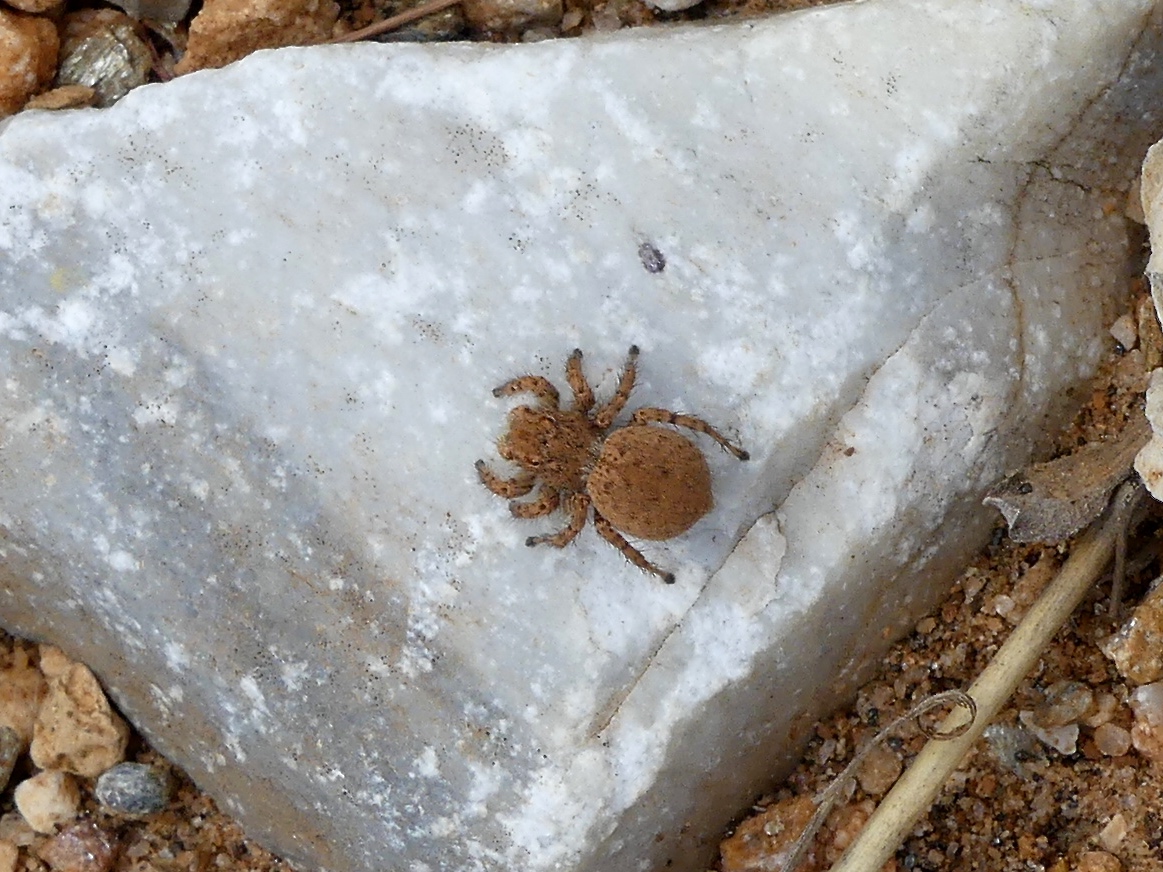
This small, compact spider with a round abdomen is probably a specimen of the jumping spider species Asianellus festivus.
Scorpions, Scorpiones
The class of arachnids includes spiders, harvestmen, mites and several other smaller orders, as well as scorpions (order Scorpiones). Scorpions are rather rare on Naxos, or at least they are not often seen.
Mesobuthus gibbosus, Brullé
The species Mesobuthus gibbosus, also known as Aegaeobuthus gibbosus, is one of the most common scorpions in southern Europe and one of the few yellow-coloured species in Europe. It is found in Greece and on many Greek islands, including Naxos. Like most scorpions, it is nocturnal and hides under large rocks during the day; we found this specimen by turning over a large rock. In summer, scorpions remain mostly inactive retreating into deep crevices. Mesobuthus gibbosus is one of the more venomous and aggressive species in Europe and should not be touched. Its sting is very painful but not usually dangerous to adults.

The scorpion Mesobuthus gibbosus occurs on Naxos, but is rare and hardly ever seen, as it is nocturnal and hides under large rocks during the day. It is one of the few yellow species in the region and reaches a body length of 8 cm. Its pincers are relatively narrow. I would like to thank Markus Braun for the photo. During our hike from Apiranthos to Azalas, he took the trouble to turn over large stones until he actually came across a scorpion – almost the only one I have ever seen on Naxos.
continue: The Freshwater crab
back: The Fauna of Naxos
see also:
further reading:
- Facebook-Gruppe: Spiders of Greece and Cyprus
- Araneae: Spiders of Europe: Detailed species gallery with over 700 genera; identification key for families and species with excellent drawings of characteristics (only applicable for microscopic examination of dead animals)
- Spiders of North-West Europe: Website with pictures of over 300 species of spiders