A visit to the shearwaters on the Makares islands
Two species of shearwaters breed in the Aegean Sea: the Yelkouan shearwater and Scopoli’s shearwater. They breed mainly on uninhabited rocky islands, often in small or large colonies. Both species are found on the Mákares islands east of Moutsoúna. Shearwaters, which are related to albatrosses, spend most of their lives on the oceans, where they fly continuously just above the water’s surface, taking advantage of the updrafts above the waves to hunt for small fish and squid.
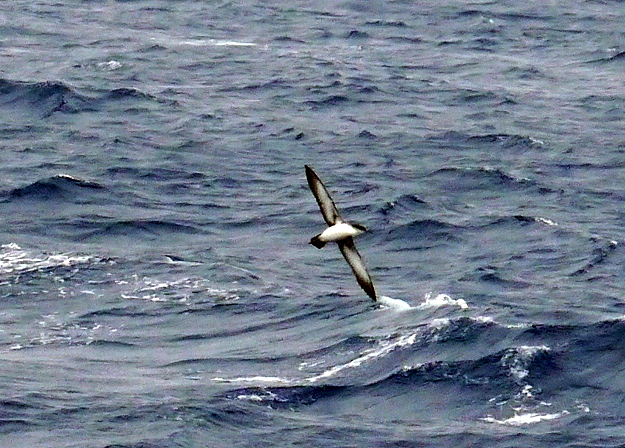
The more common Yelkouan shearwater (Puffinus yelkouan) is smaller, with a wingspan of up to 90 cm. It flaps its wings faster and has more contrasting coloring. The Yelkouan shearwater breeds in the Mediterranean region and spends there also the rest of the year. Photo by Winfried Scharlau
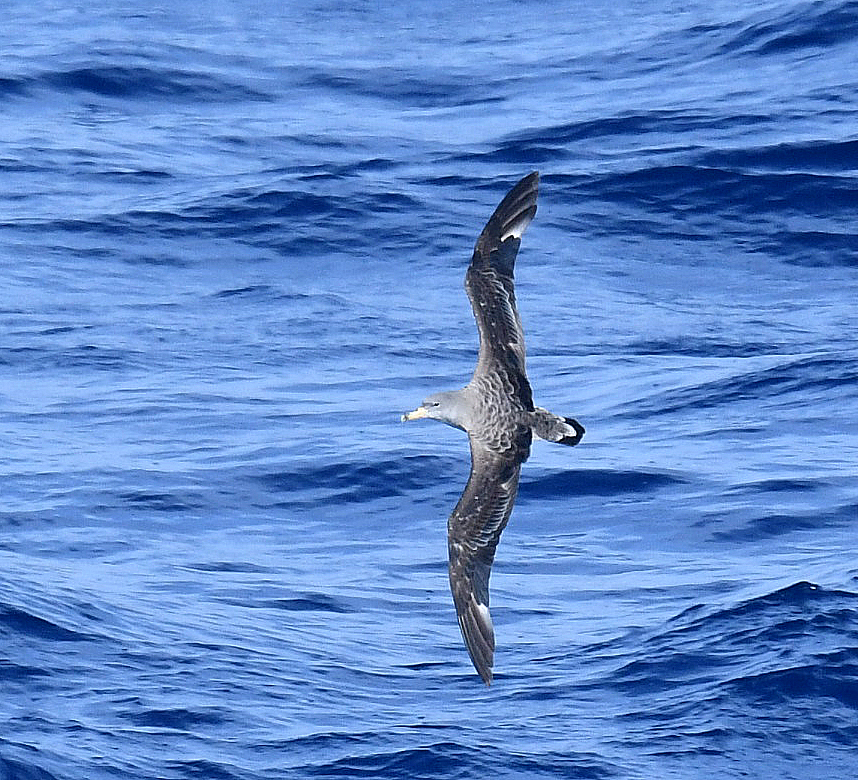
Scopoli’s shearwater (Calonectris diomedea), has a wingspan of 115 cm. Its coloring is less contrasting. When gliding over the waves, it usually stays closer to the water’s surface than the Yelkouan shearwater. Scopoli’s shearwater breeds in the Mediterranean region and winters in the Atlantic, mainly off Africa. Unlike other shearwater species, it can dive completely into the sea in search of food. Photo by Winfried Scharlau
All shearwater species are perfectly adapted to flying over the sea with their long, narrow wings and short tails. Their legs are short and sit far back on their bodies. They often sit on the water’s surface, especially when there is no wind and flying is more difficult for them; however, they only come ashore to breed. They can only walk awkwardly and with the help of their wings; landing and taking off are particularly difficult and birds get often hurt or even killed trying to reach their nesting sites between rocks and bushes.

While they can only walk very awkwardly on land, shearwaters are perfectly adapted to life at sea. Together with albatrosses, storm petrels, and shearwaters, they form the order Procellariiformes, which are characterized by the short, protruding tubes on their beaks through which excess salt is excreted. Photo by Winfried Scharlau

Shearwaters glide very elegantly low over the sea, using the updrafts from the waves so that they hardly need to flap their wings. Photo by Winfried Scharlau
Shearwaters breed under large rocks or in caves. Scopoli’s shearwater in particular is very loyal to its nesting site: these birds, which do not reach sexual maturity until the age of five, prefer to return exactly to their own nest when they come to breed after years spent flying across the oceans. The pair remains faithful to each other for life. The single egg is laid on the bare floor; no nest is built. The young are fed at night with fish or squid and a special stomach oil; however, the parent birds only feed the young every few days. The young birds take a relatively long time to develop; most shearwaters leave the nest after 2 to 3 months. Breeding success is often low; a particular problem are the rats that have been introduced to many breeding islands and eat the eggs.
Both the Yelkouan and Scopoli’s shearwater breed on the Mákares Islands; both species can be observed in large numbers in the surrounding sea areas. A few years ago, the rats on the islands were extinguished as part of a conservation program; this year, staff from the Greek organization NCC (Nature Conservation Consultants) is monitoring the breeding population, partly with the aid of automatic night vision cameras, which are now being collected.

Tasos Dimalexis and his colleagues pick me up in the evening in a small inflatable boat. The Mákares islands, which are geologically very different from Naxos, are simply beautiful! In these cliffs the ornithologists have found two nesting sites of the rare Bonelli’s eagle. Now, in July, the young have already left the nest.

We pass Ágios Nikólaos, the largest of the three islands in the archipelago, on the south side and then enter between Ágios Nikólaos and Ágia Paraskeví (on the right).

The sailboat of the NCC is anchored in the small sheltered bay on the east side of Ágios Nikólaos.


on the sailboat

From the boat, we look at this steep slope from which large boulders have broken off. The shearwaters nest under these boulders. A few weeks ago, the team of the NCC installed several night vision cameras on the rocks at the entrance to larger cavities in which shearwaters nest.

We take a short tour in the inflatable boat to watch the shearwaters at sea before they return to their nests. In the evening (and when there is no wind), the shearwaters often gather in large numbers close together on the water in so-called “rafts.” Here you can see one such gathering.

both Yelkouan and Scopoli’s shearwaters are around
We spend the evening monitoring the cameras via cell phone and computer and counting the shearwaters that enter the caves. Today, relatively few parent birds are coming to the nests; perhaps they were unable to catch enough food due to the calm weather.

Here a picture taken with the night vision camera: a shearwater is sitting in the foreground on the left. I would like to thank Tasos Dimalexis for providing me with the videos.

Video clip showing a shearwater crawling to its nest under the rock; click to watch

We sleep on the beach. Throughout the night, we hear the strange, eerie calls of Scopoli’s shearwaters. Alpine swifts, which breed high in the cliffs, can also be heard repeatedly: they fly around even at night.
The Makares Islands actually owe their name from the eerie calls of the shearwaters, which only come to the island at night, fly like ghosts through the area, and then suddenly disappear underground. The name is derived from the word makarítis (= deceased). Here you can find recordings of the calls of Scopoli’s shearwater (at xeno-canto).

Morning atmosphere

Sunrise over Donoussa

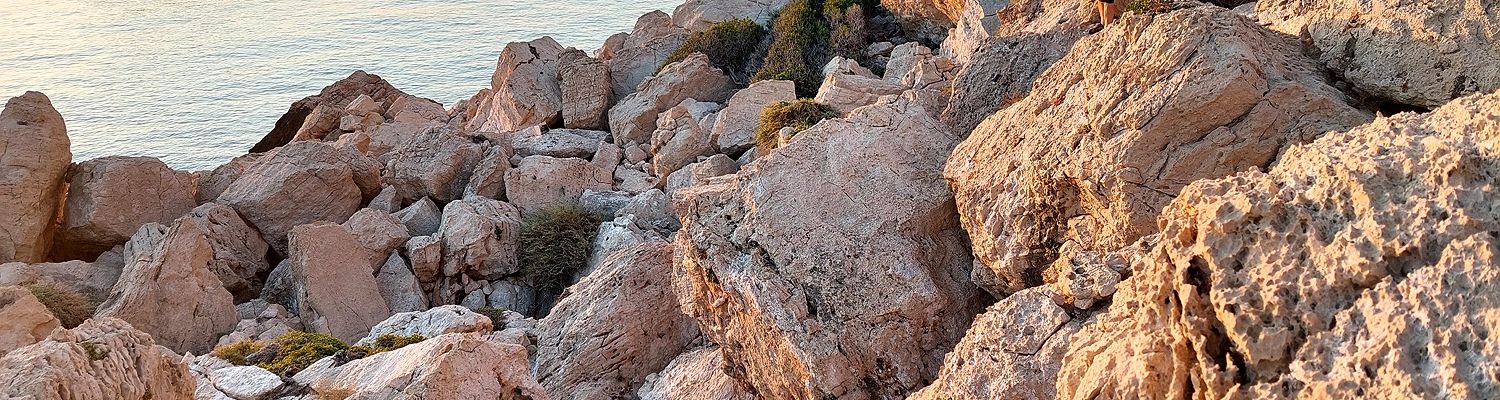
The entire lower slope south of the beach is littered with large fallen boulders – a very rough terrain. The shearwaters breed under these rocks. The area is filled with a characteristic smell of guano and fish.

Cameras are installed at several points on the rocks, allowing the ornithologists to monitor the shearwaters as they crawl into their nests. Landing between the rocks and bushes is a dangerous undertaking for the birds — we find several dead birds that collided with some obstacle.


Tasos Dimalexis from the NCC collects the cameras


Afterwards, I am brought back to Naxos – the team is continuing on to the southern Cyclades by sailboat to install a camera at a breeding site of Eleonora’s falcon and to outfit several shearwaters with radio transmitters so that their migrations can be tracked.

Here, the small inflatable boat is leaving our beach again; in the background on the right, you can see the Mákares Islands.
A wonderful undertaking and a special opportunity for me, bringing back memories of my first stay in Greece in 1989, when I spent two weeks with my father and another ornithologist on the uninhabited island of Paximada at the eastern tip of Crete, where we studied the Eleonora’s falcons and Scopoli’s shearwaters that breed there.
See also:
- The Makares islands
- Storm petrels on the Makares islands
- Eleonora’s falcons on the Makares Islands
- The birds of Naxos
additional links: