
Gastropoda 5: Littorinimorpha
The Littorinimorpha are a large and diverse suborder of the superorder Caenogastropoda, to which most marine snails belong. Among the snails that can be found in our region, the Littorinimorpha include the slipper snails, cowrie snails, periwinkles, moon snails, true conchs, pelican’s feet, helmet snails, tun shell, triton snails, wentletraps and the Velutionoidea, which are similar to cowrie snails.
The worm snails (Vermitoidea), which also belong to the Littorinimorpha, are discussed on a separate page.
The Photo gallery of the marine snails gives an overview over the species.
A note on identification: Some species usually can be identified easily and reliably. In many cases, however, several related species are difficult to distinguish. Also not all species are included in the field guides; even using the internet, it is difficult to find information on some species. Accordingly, some of the identifications may not be correct.
And a word about the names: As with many marine animals, there is a great deal of confusion surrounding the names of snails: for almost all species, a large number of synonyms exist that are no longer valid today but are still used in older books. I use the names according to the World Register of Marine Species (as of 2020), where you can also find the corresponding synonyms.
Here you can jump directly to the species (return with the back arrow or by swiping back):
Slipper snails, Crepidula – Cowrie snails, Luria und Naria – Periwinkle, Melaraphe – Moon snails, Naticidae – Persian conch, Conomurex – Pelican’s foot, Aporrhais – Helmet snails, Semicassis and Casmaria – Tun shell, Tonna – Tritonshorn, Charonia – Triviidae, Trivia and Pseudopusula – Wentletraps, Epitonium and Gyroscala
1. Calyptraeidae, Slipper snails
Slipper snails are similar to limpets in that their shells sit flat on the ground and are not coiled. On the underside, a “lid” covers just under half of the convex shell, giving it a slipper-like shape. When the juveniles of slipper snails reach a size of about one centimeter, they settle in one place, which they will never leave, on a rock or on the shell of other molluscs, and particularly on another specimen of the same species, often forming entire stacks. In the stacks, the lowest animal develops into a female and those above it into males. Like worm snails, slipper snails feed as filter feeders. They form a web of mucus around themselves, which traps food particles; the web is then pulled in and consumed along with the particles attached to it.
Crepidula unguiformis, Lamarck
very rare
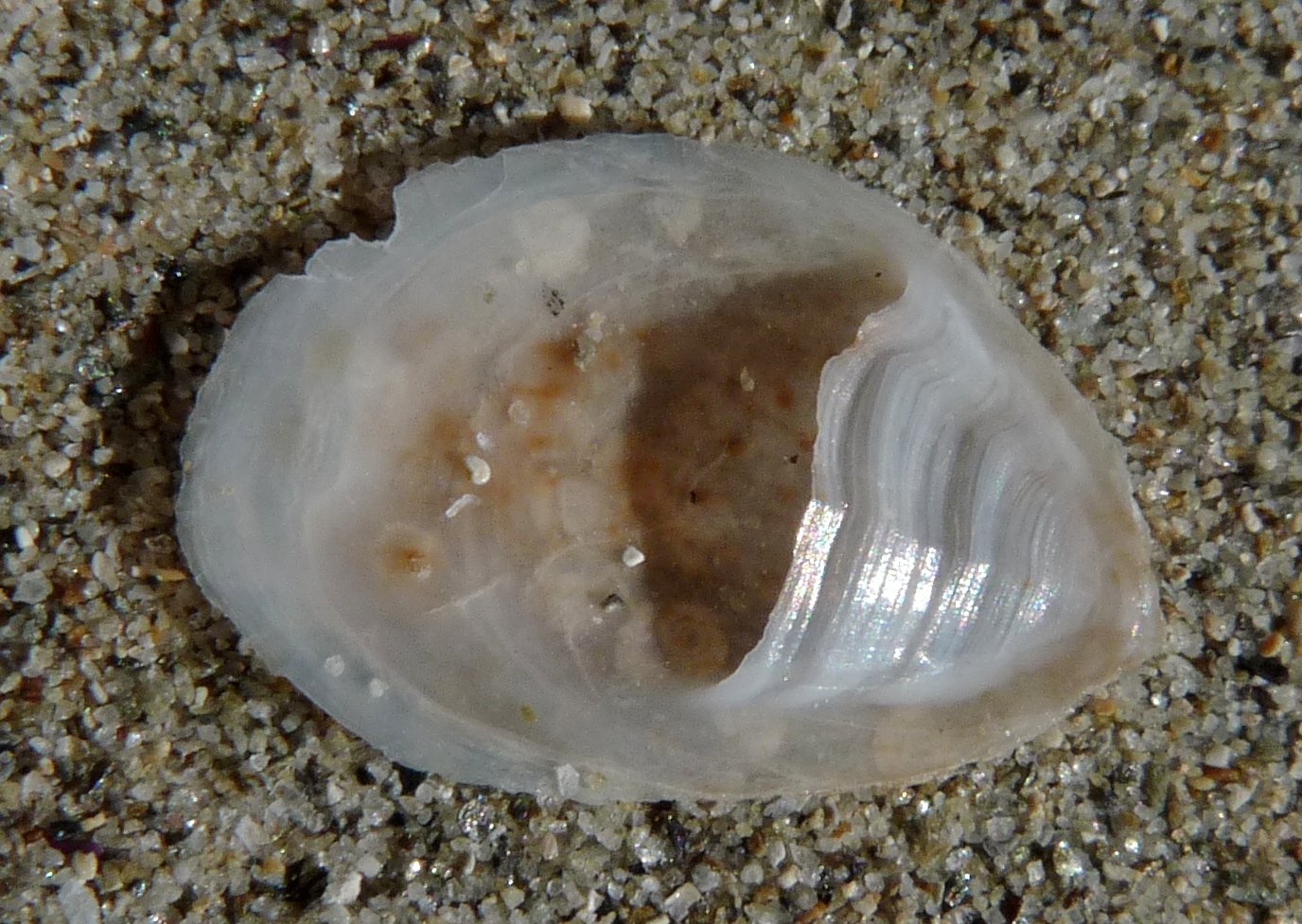
The very small and delicate slipper snail Crepidula unguiformis attaches itself to the substrate in a similar way to a limpet. Size: 14 mm
2. Cypraeidae, Cowrie snails
Cowrie snails are characterised by their oval, convolute shell without spire (the cone-shaped tip made up of the inner whorls that exceed the last whorl) and with a narrow aperture extending along the entire length of the shell. Cowrie shells of various species were of extraordinary importance in the past, especially in Asia and Africa, as people used them as a means of payment: for this purpose, they were distributed in larger quantities and more widely throughout the world than any other form of currency.
Cowrie snails have particularly beautiful, shiny shells. They keep them clean by pulling mantle flaps over the shell during their resting phases. Most cowrie snails are nocturnal. Some species are predatory, other are omnivorous or live mainly on detritus and dead animals. Most cowrie snails are found in tropical seas; they live in shallow water, often on coral reefs. Only a few species occur in Europe.
Luria lurida, L.
rare
One of the rarest and most beautiful sea snails on Naxos is the cowrie snail Luria lurida. Luria lurida lives on rocky or sandy sea floor at depths of up to 40 meters. It is mainly nocturnal and feeds on sponges. It maintains its beautiful, shiny surface by pulling two mantle flaps over its shell from both sides during rest periods, which prevents algae and similar organisms from growing on it. Luria lurida has a shiny brown colour with broad darker and lighter bands and black spots on the ends.
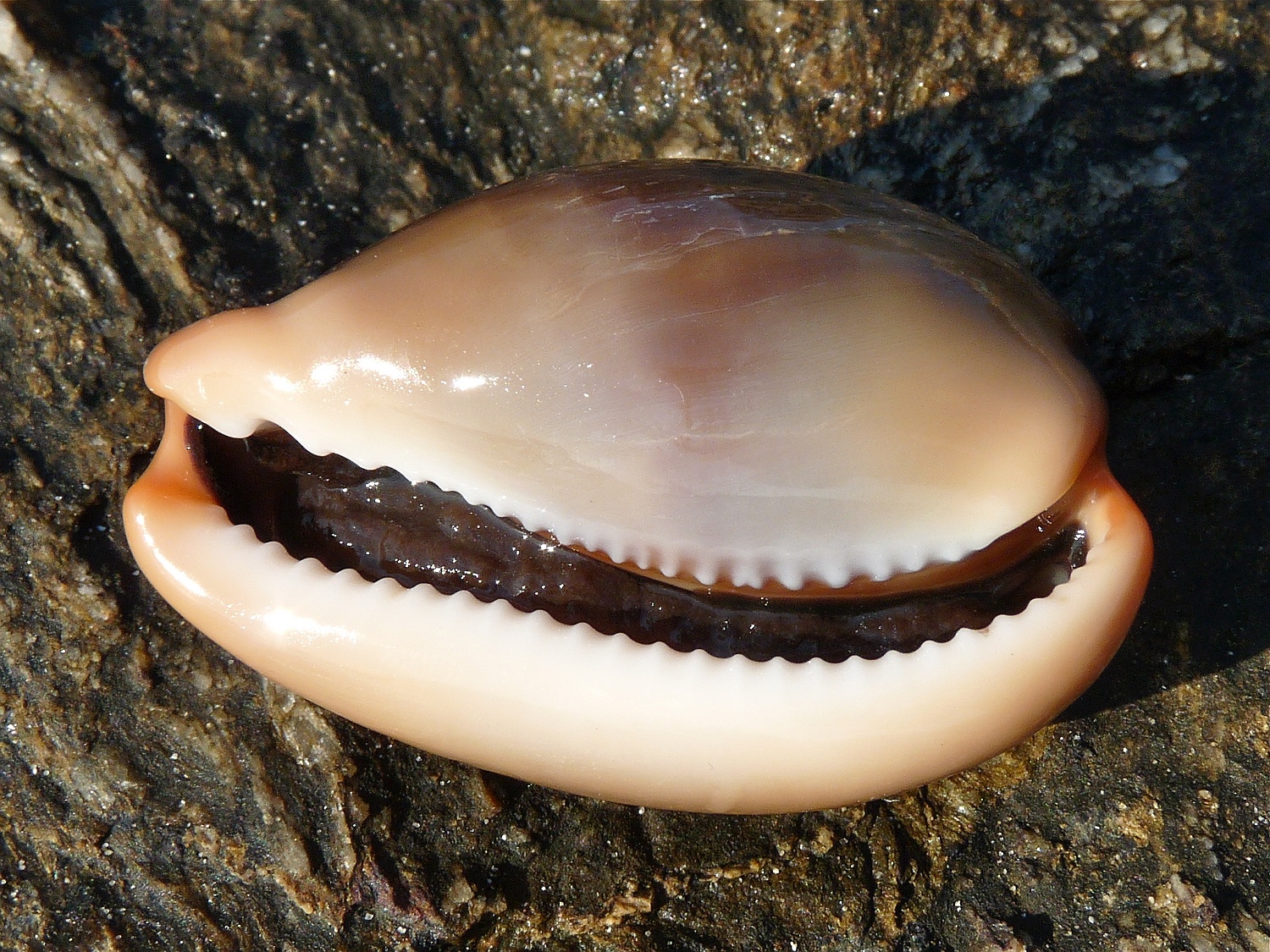
Luria lurida is very rare around Naxos. It is protected and may not be collected.
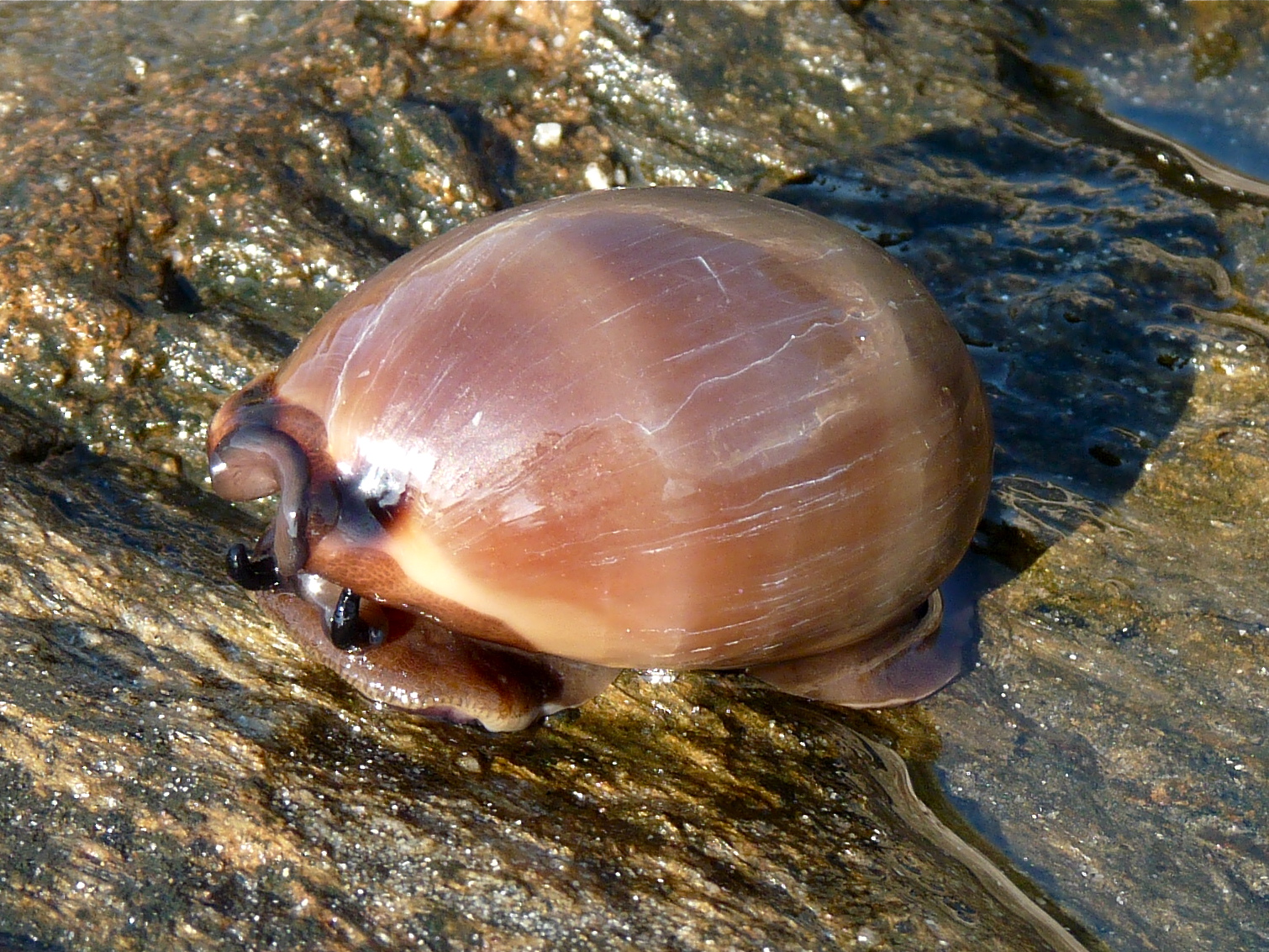
Only once have we seen a live animal.
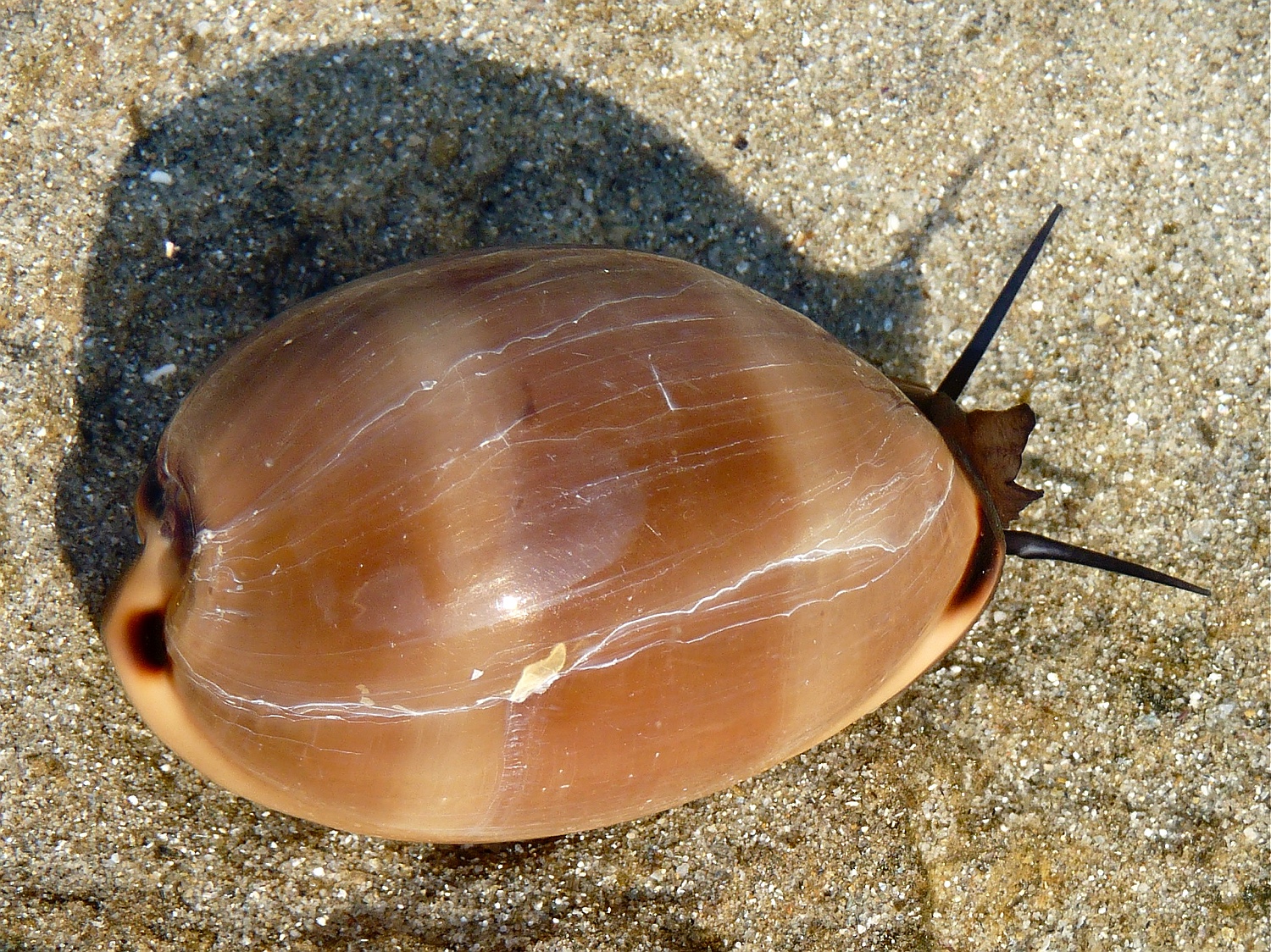
Luria lurida is easily recognisable by its size and the beautiful brown colour of its shell with black spots at the ends. Height: 50 mm
Naria spurca, L.
very rare
Another especially beautiful snail is the related species Naria spurca which is also very rare around Naxos. It is slightly smaller than Luria lurida and has a light brown colour with “blurred” spots and a beautiful shiny surface. Naria spurca is found in the Mediterranean, off West Africa and in the Red Sea; it lives in algae and seagrass meadows at depths of 2 to 20 metes and hides under rocks during the day.
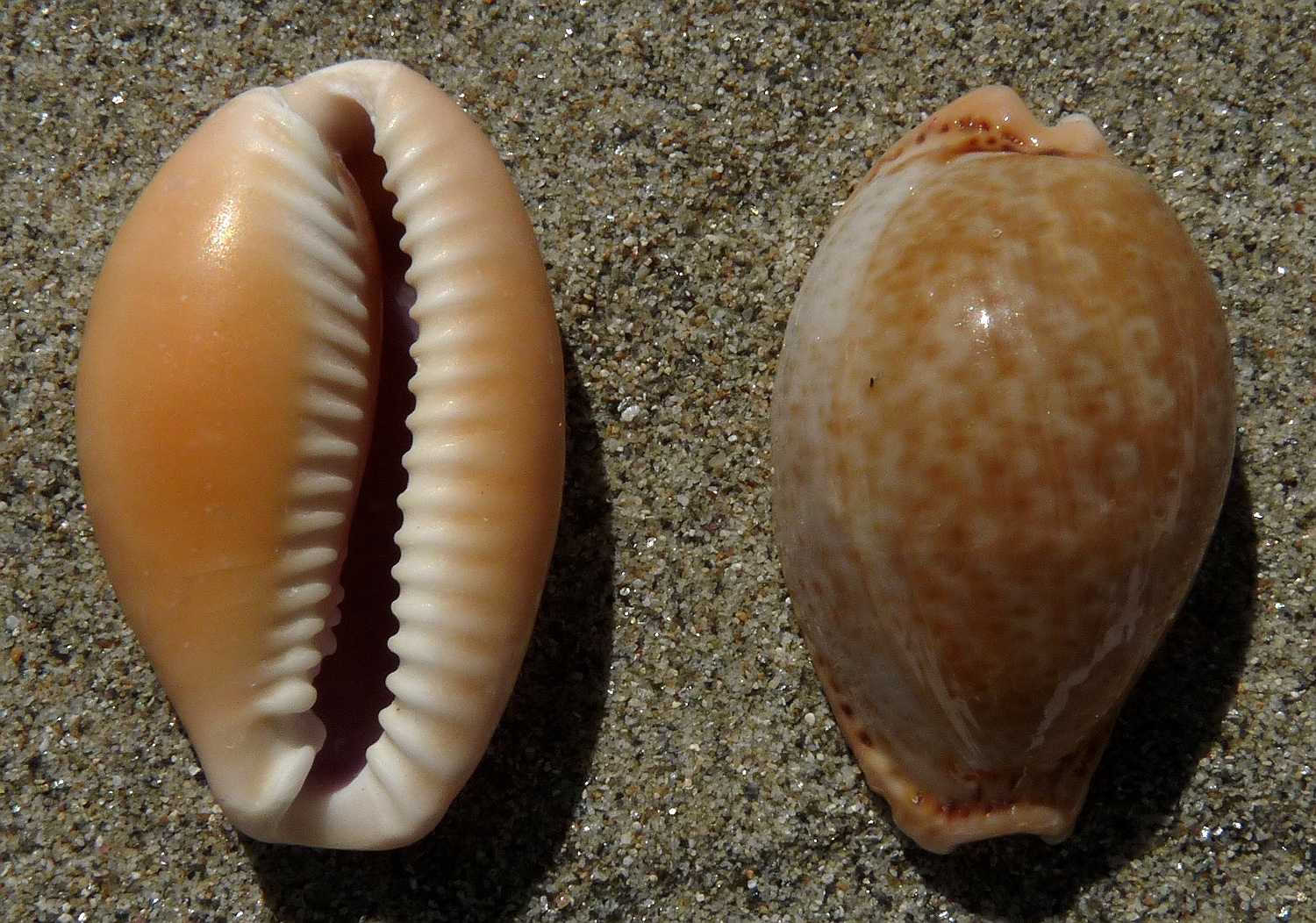
The beautifully coloured Naria spurca can also be seen only with a bit of luck. Height: 36 mm
3. Littorinidae, Periwinkles
Small periwinkle, Melarhaphe neritoides, L.
(= Littorina neritoides)
very common
The Small periwinkle lives in the splash zone and, of all the sea snails found in our waters, including limpets, occurs highest above the waterline. It usually sits alone in small crevices in the rocks. It is an air breather and can survive even long periods without water. At night, like the limpets, it grazes on the blue-green algae in the splash zone or descends into the mesolittoral zone to feed on the algae.
The Small periwinkle is very small (up to 8 mm) and brownish or white. The shell has a small tip and a large, bulbous last whorl. Due to their small size, the shells of Small periwinkles are not used by hermit crabs.
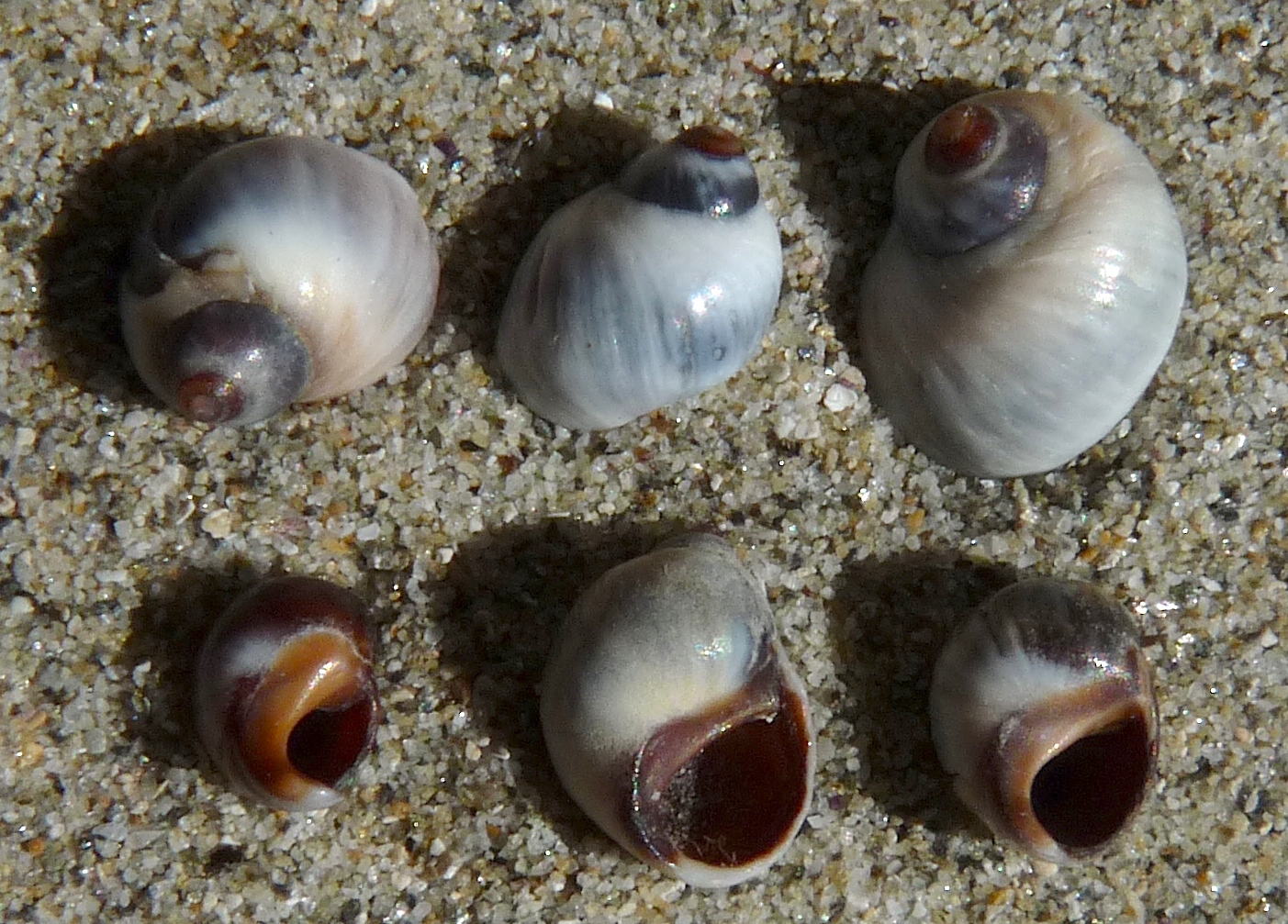
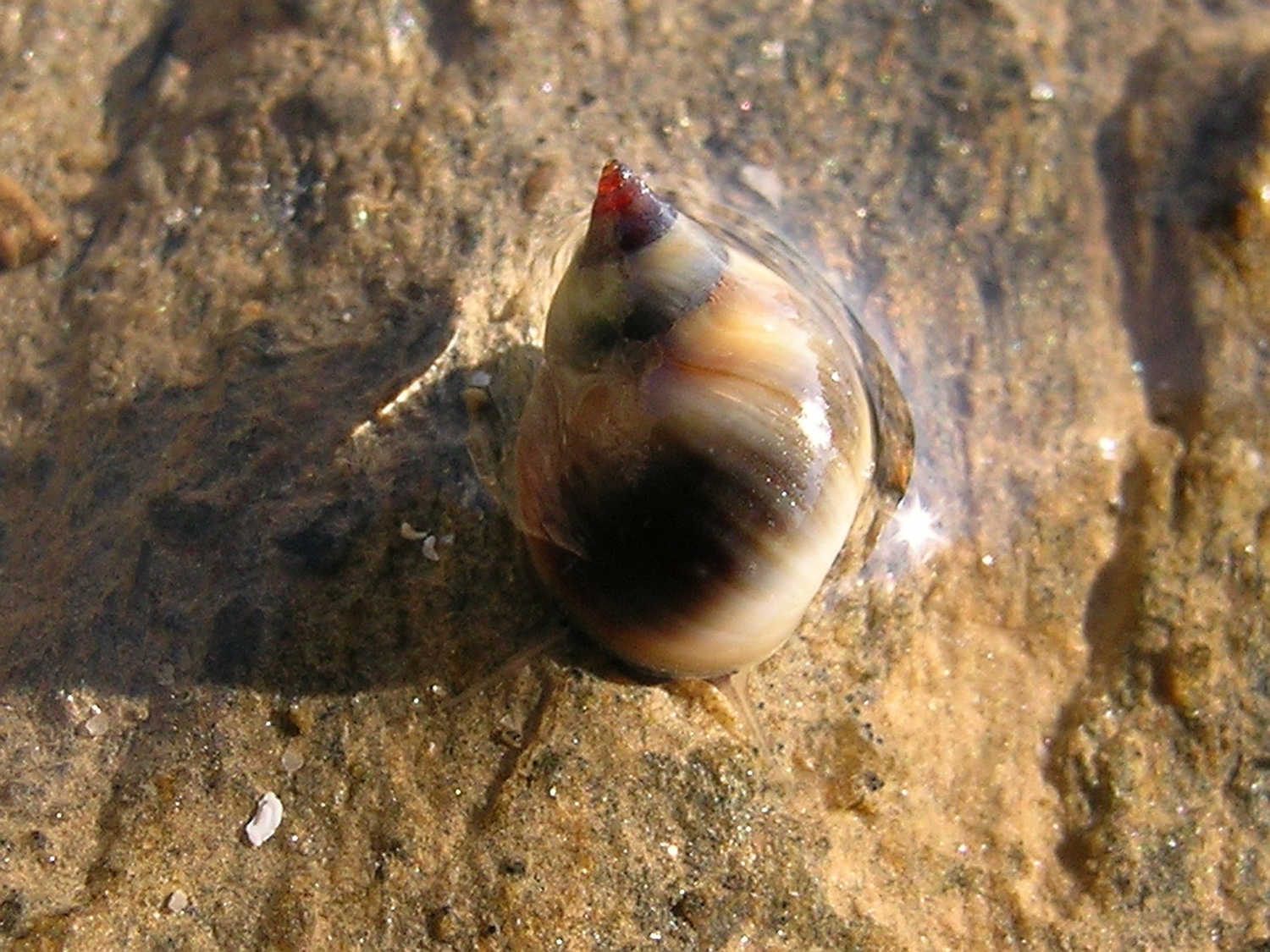
The tiny Small periwinkle sits in crevices in the supralittoral. Height: 6 mm
4. Naticidae, Moon snails
Moon snails have a round, shiny shell with a very small, flat tip, a wide final whorl, a crescent-shaped aperture and a depressed umbilicus, which is usually partially narrowed or closed by an outgrowth. The shell is smooth with very fine growth lines; the colouring is usually light.
Moon snails are predators. They burrow through the sand with their very large foot; when they encounter prey (other snails and mussels), they hold it in place with their foot and mucus threads and use their radula, which is shaped like a drill, to bore a hole in its shell, through which they then suck out the animal with their long proboscis. The snail’s foot is very large and is wrapped around the shell when it rests.
Neverita josephinia, Risso
regularly
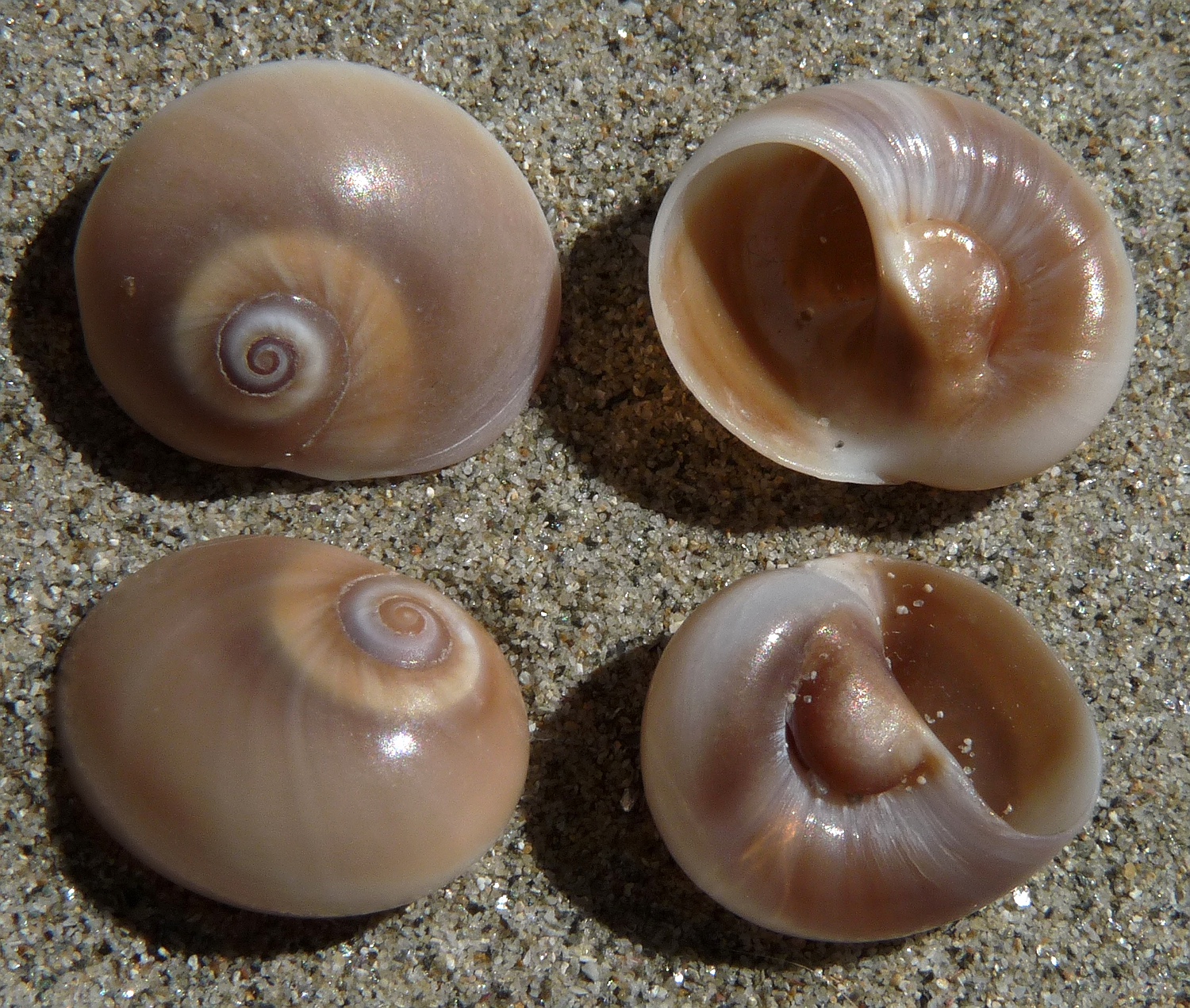
Neverita josephinia is easily identified by the round protrusion above the navel. It is light brown in colour with faint, fine growth lines. Size: 25 mm
Fly-specked moon snail, Naticarius stercusmuscarum, Gmelin
rare
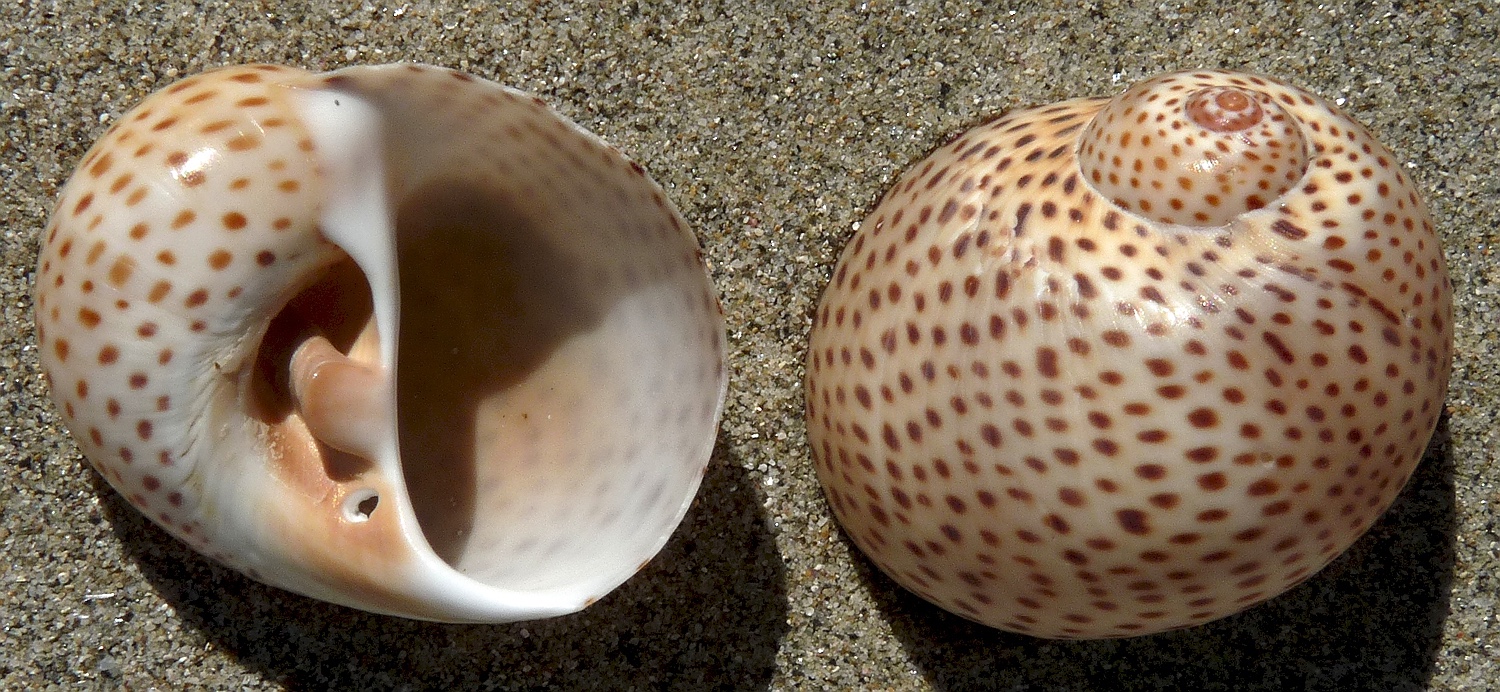
The Fly-specked moon snail grows up to 50 mm in size; it has a large, ridge-like growth over the umbilicus. The shell is evenly covered with small reddish dots. Height: 25 mm
Naticarius hebraeus, Martyn
very rare
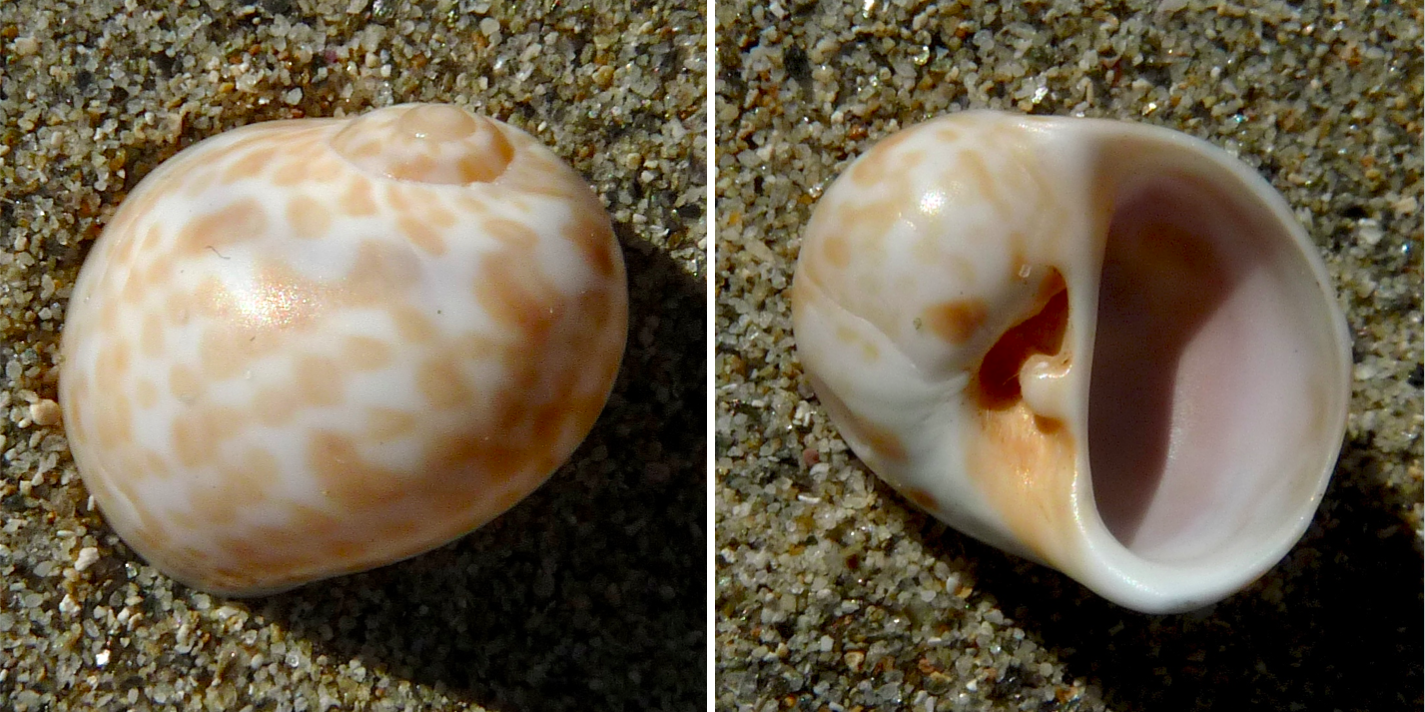
Naticarius hebraeus is usually smaller and has larger, irregular spots. Height: 11 mm
Notocochlis dillwynii, Payraudeau
rather rare
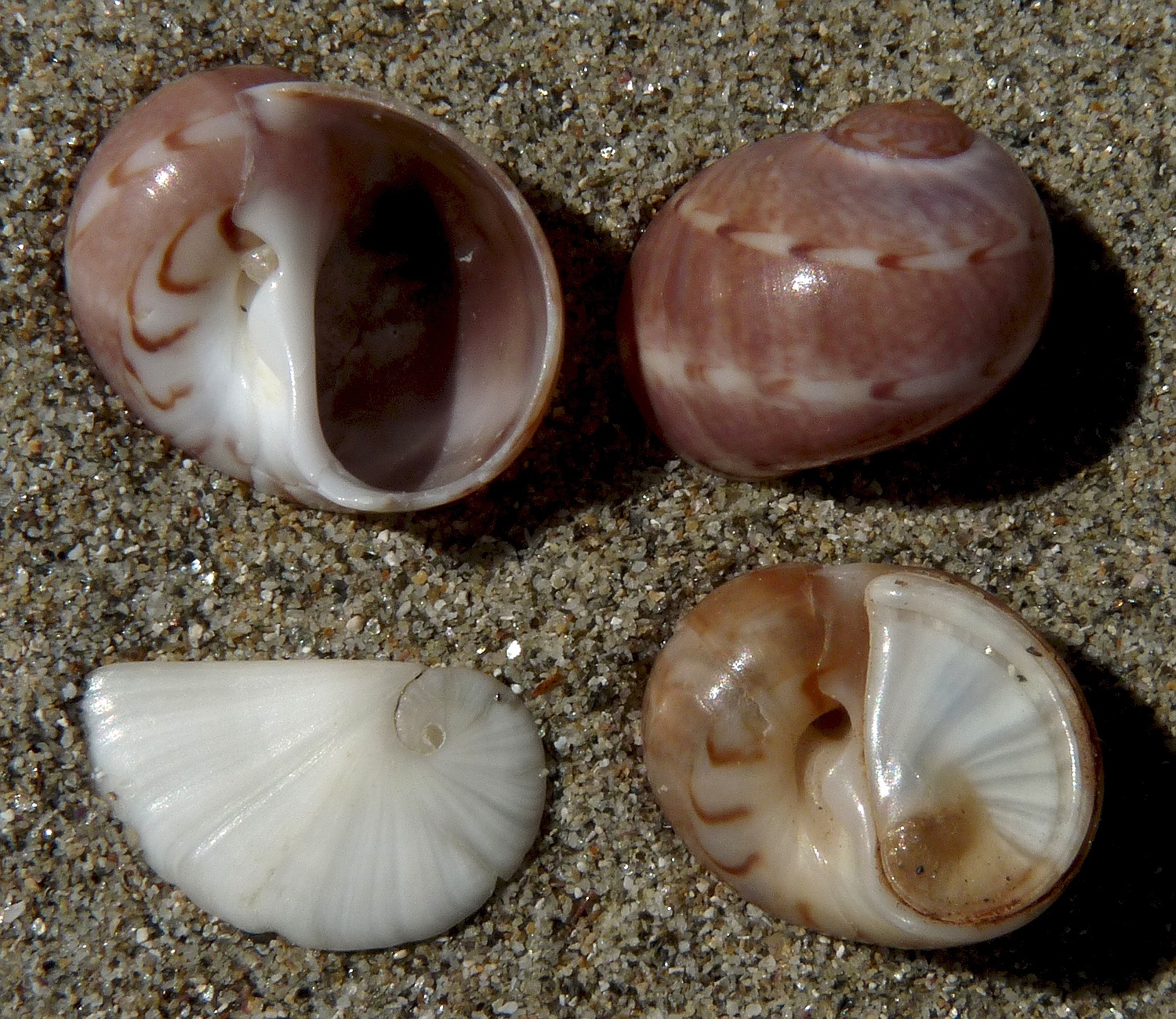
This small snail can be recognised by its flamed bands and characteristic umbilicus. It has a white operculum with finely radial growth lines. Size: 13 mm
Euspira guilleminii (= Lunatia g.), Payraudeau
very rare
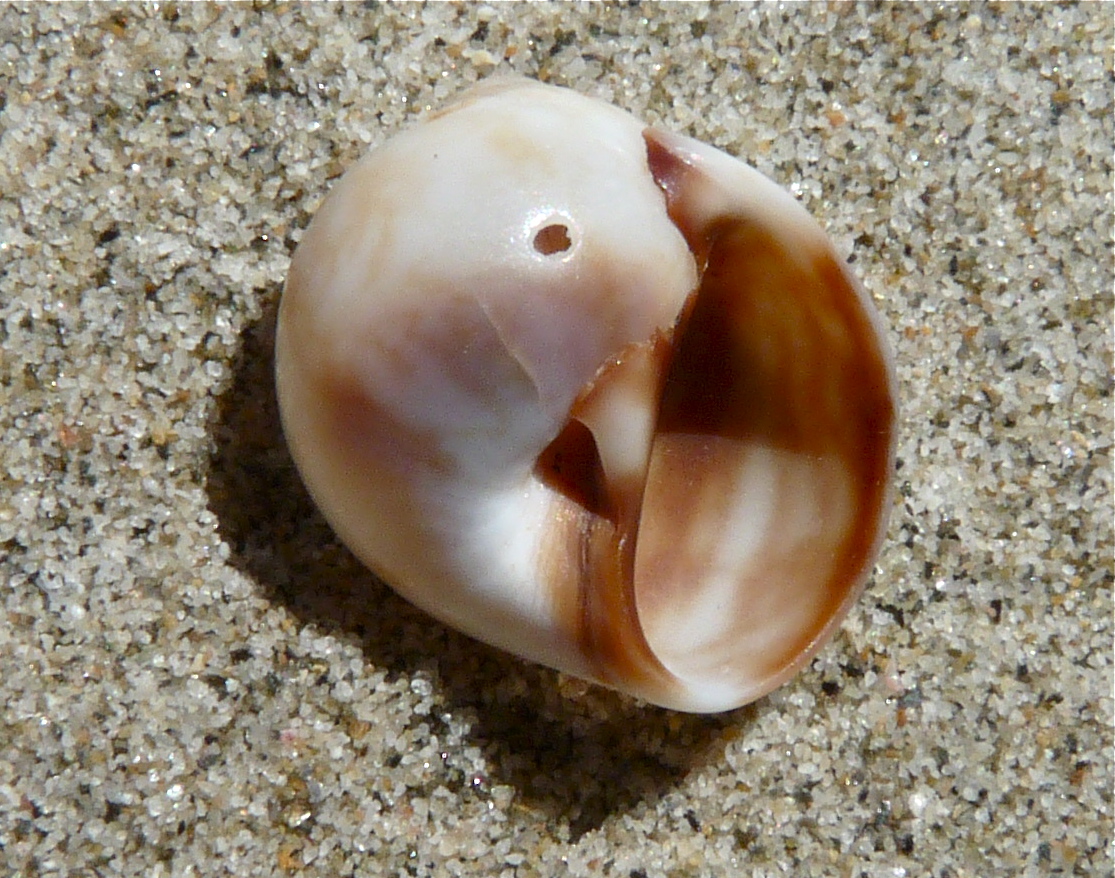
In this species, the umbilicus is narrowed by a thickening of the inner lip at its upper edge; another characteristic feature is the brown columella. A borehole is visible in the shell that could have been made by another moon snail. Height: 20 mm
Payraudeautia intricata (= Euspira intr.), Donovan
rather rare
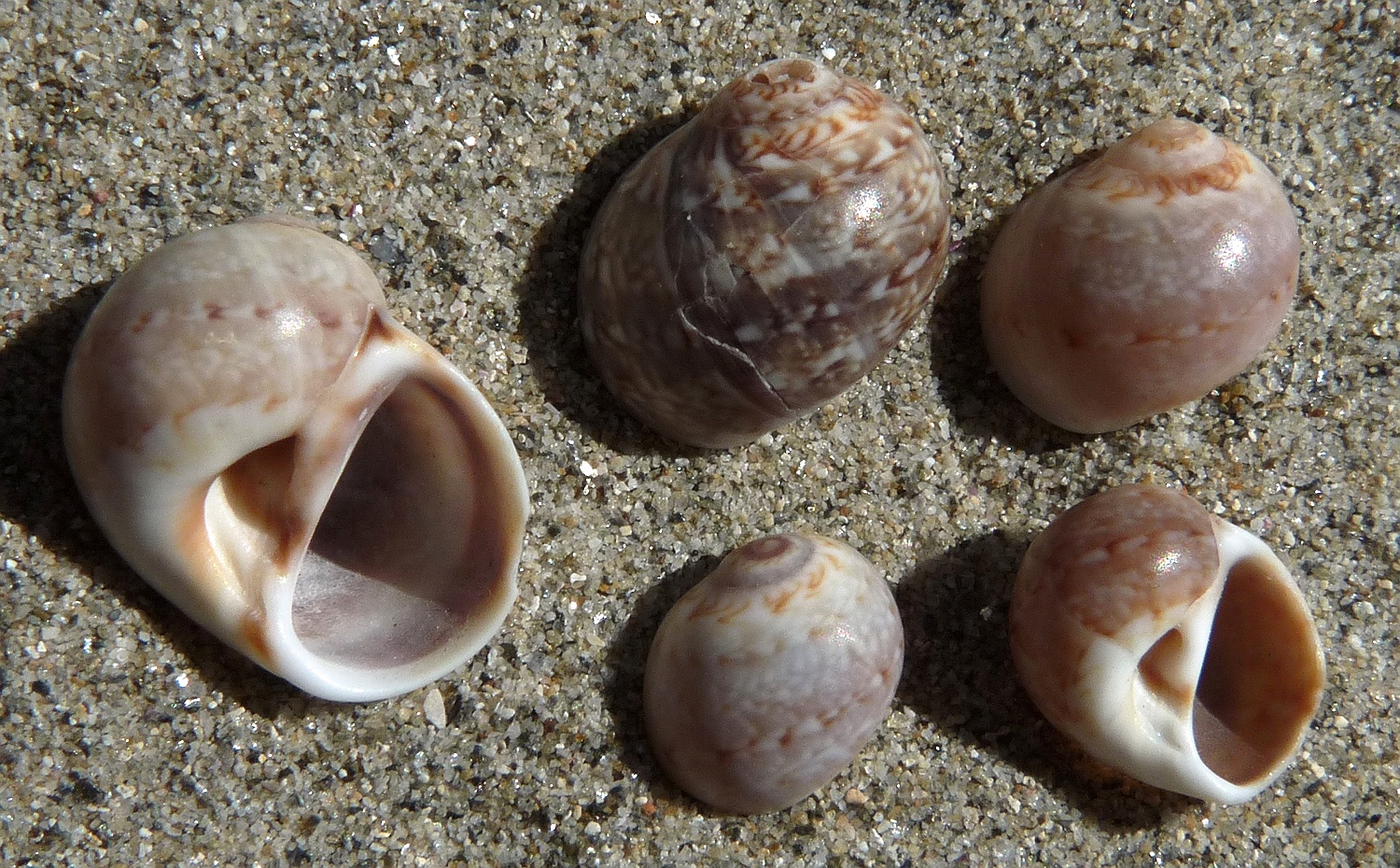
Payraudeautia intricatais a small snail, recognisable by the pattern with three flamed spiral stripes, and by the open navel with a bulge at the lower edge. Height: 10 mm
5. Strombidae, True conchs
Persian conch, Conomurex persicus, Swainson
(= Strombus p.)
rare
The Persian conch is not native to the Mediterranean. It originates from the Persian Gulf, from where it was probably introduced to the Mediterranean via ships. The species first appeared in the Levant and off the southern Turkish coast and is now gradually spreading throughout the eastern Mediterranean Sea. It is a fairly large, double-cone-shaped snail with a long, narrow aperture. True conchs do not crawl, but “walk” with their foot which is divided into several arms. They live in shallow water on sandy bottoms and feed on plant detritus. This species is still quite rare in our region.
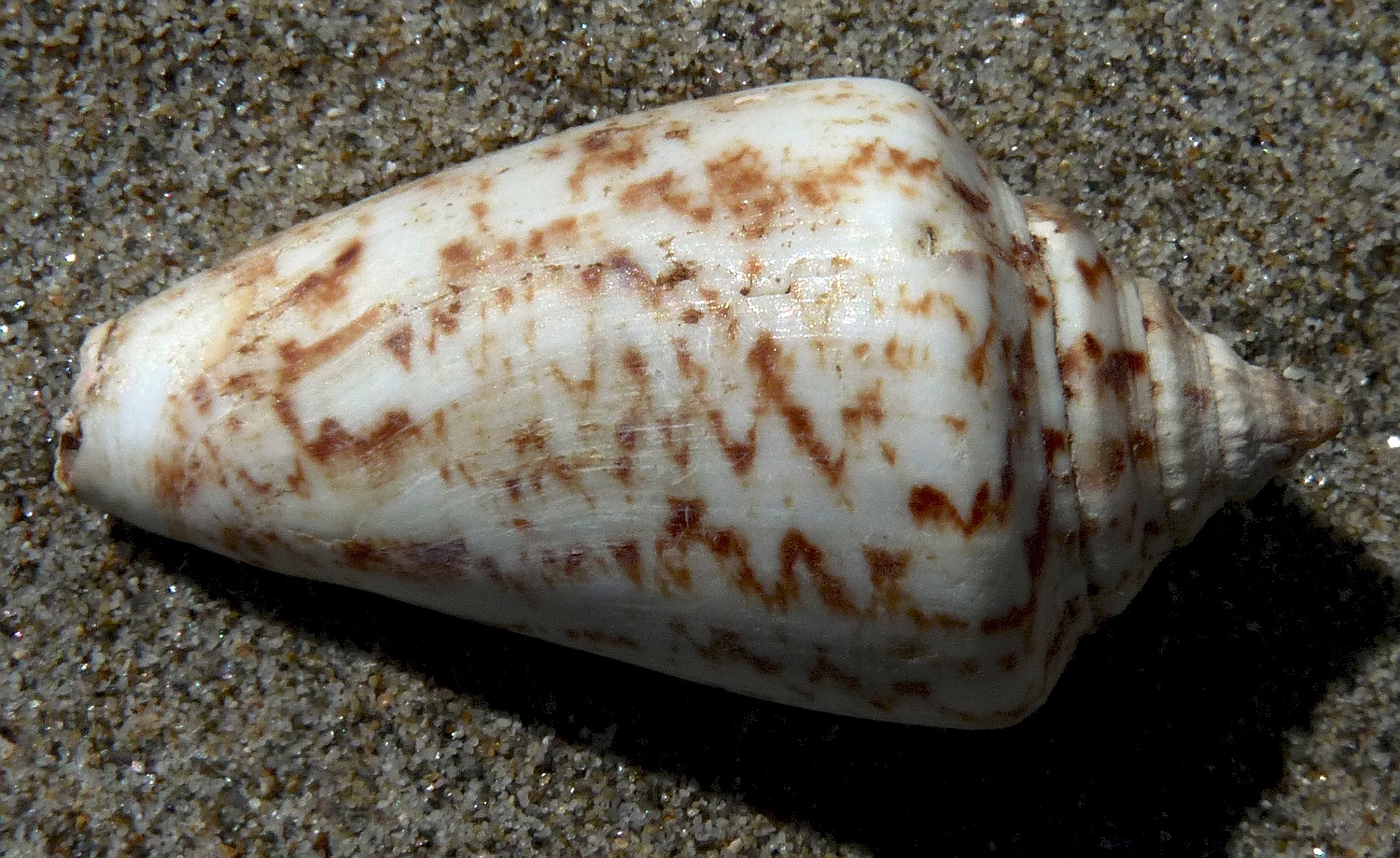
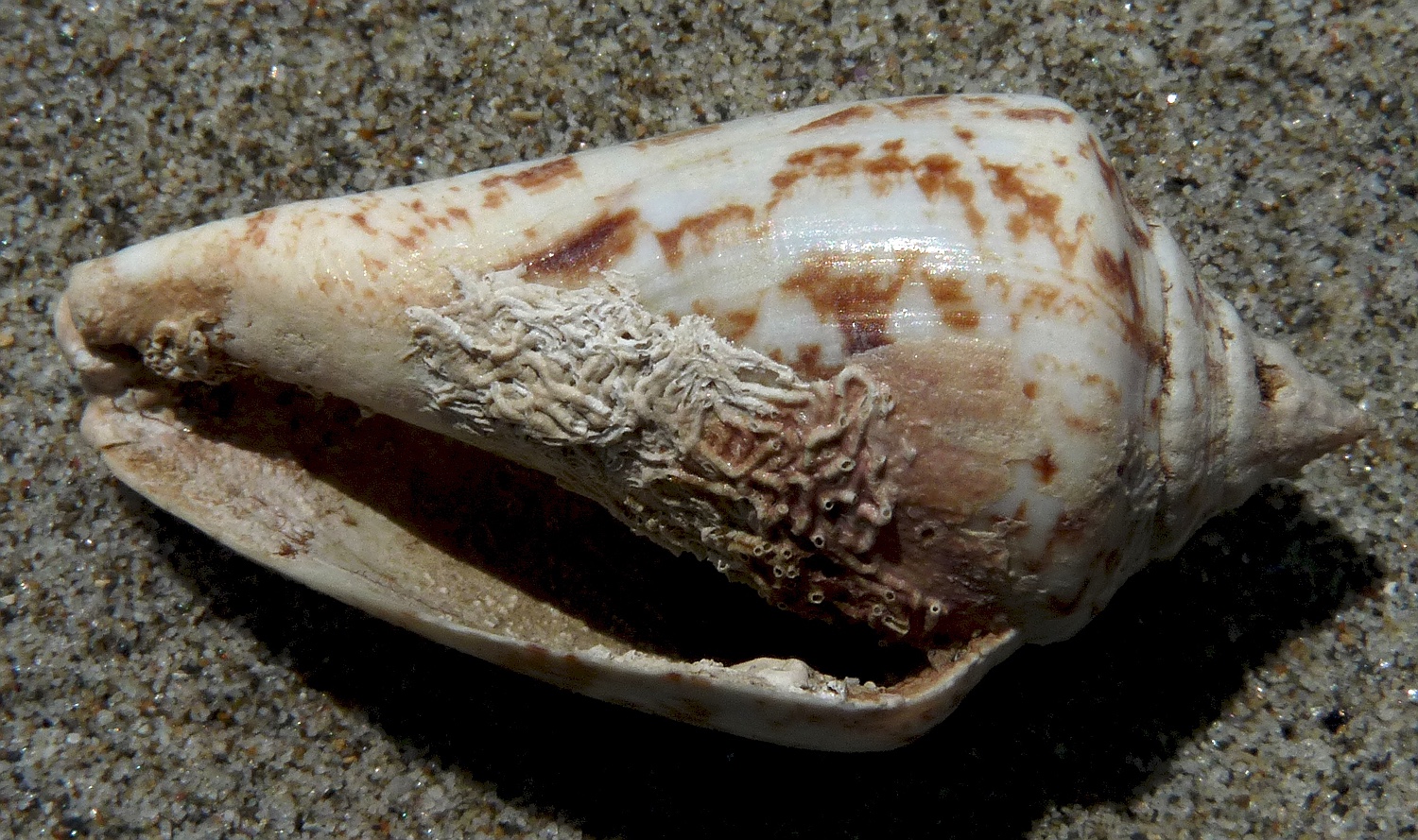
The shell of the Persian conch has a long last whorl which tapers gradually to the lower end in a conical shape. The aperture is long and narrow. The pointed spire (upper end) shows slight shoulders on the whorls. The shell is light in colour with brown zigzag lines. Height: 40 mm
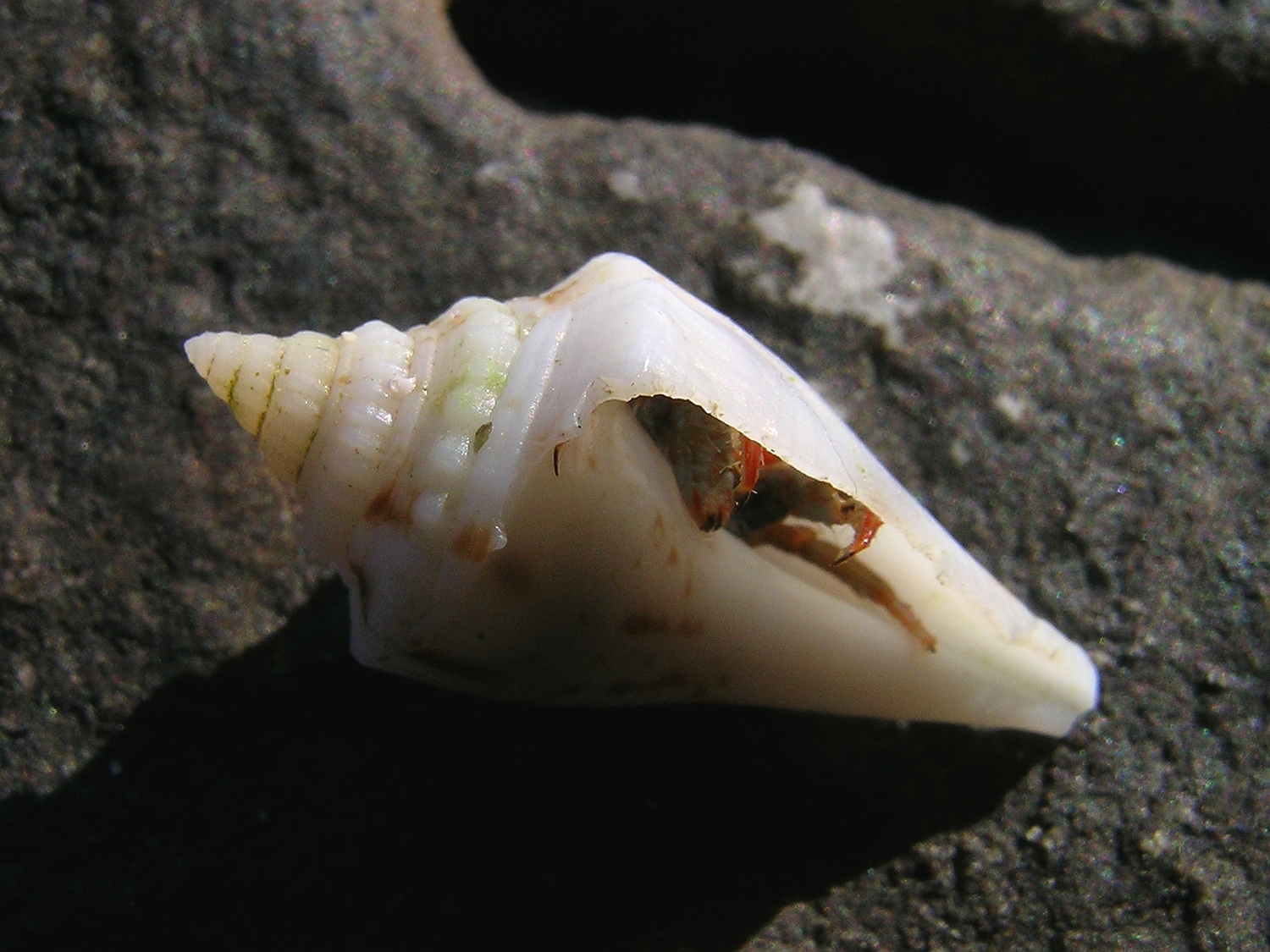
Here a shell that is inhabited by a hermit crab. One sees the long, narrow aperture.
6. Aporrhaidae, Pelican’s foot
Aporrhais pespelecani, L.
rare, in deeper water, only rarely found at the beach
The pelican’s feet are closely related to the true conch snails. They are easily recognised by the characteristic finger-like long and broad extensions of the outer lip of the aperture which give the snail a shape resembling somewhat an open hand. Pelican’s feet live buried in sandy or muddy seafloors at depths of 10 meters or more. Their shells are rarely found on beaches, but often get caught in trawl nets. Pelican’s feet can reach a length of 5 cm.
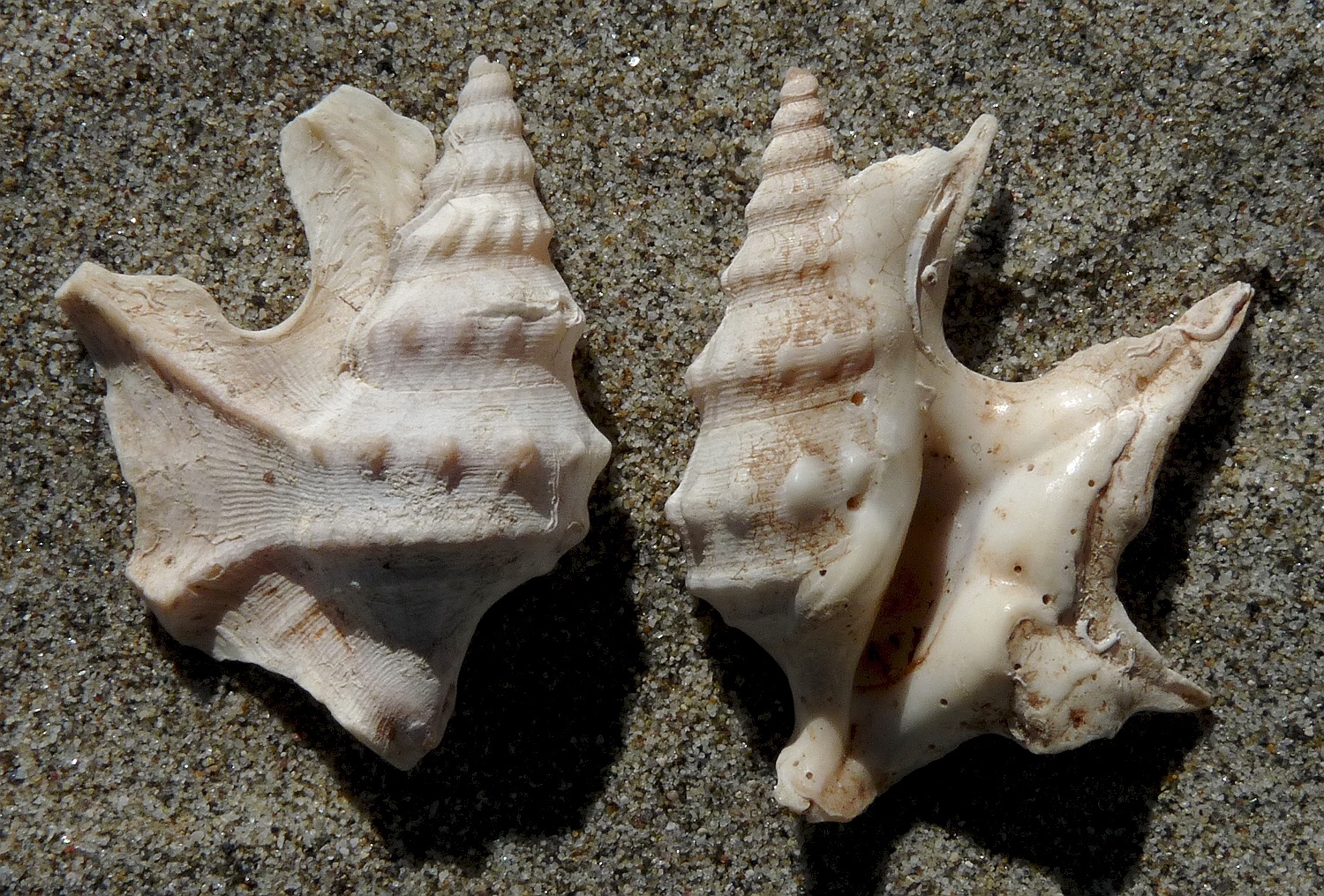
The Pelican’s foot has a characteristic, unmistakable form like a hand. Height: 35 mm
7. Cassidae, Helmet snails
Semicassis undulata, Gmelin
very rare
One needs a great deal of luck to encounter the very beautiful helmet snail Semicassis undulata on Naxos. The shell is thick and strong and rather large, reaching 10 cm in size, with a large last whorl and a small conical spire. It is adorned with spiral grooves and a thick, strongly arched, serrated outer lip. On the other side of the aperture the folded inner lip forms a thick shield close to the base of the columella which shows many small round knots. Helmet snails are closely related to tun snails; they are found mainly in (sub)tropical waters, live on sandy bottoms and feed on echinoderms.
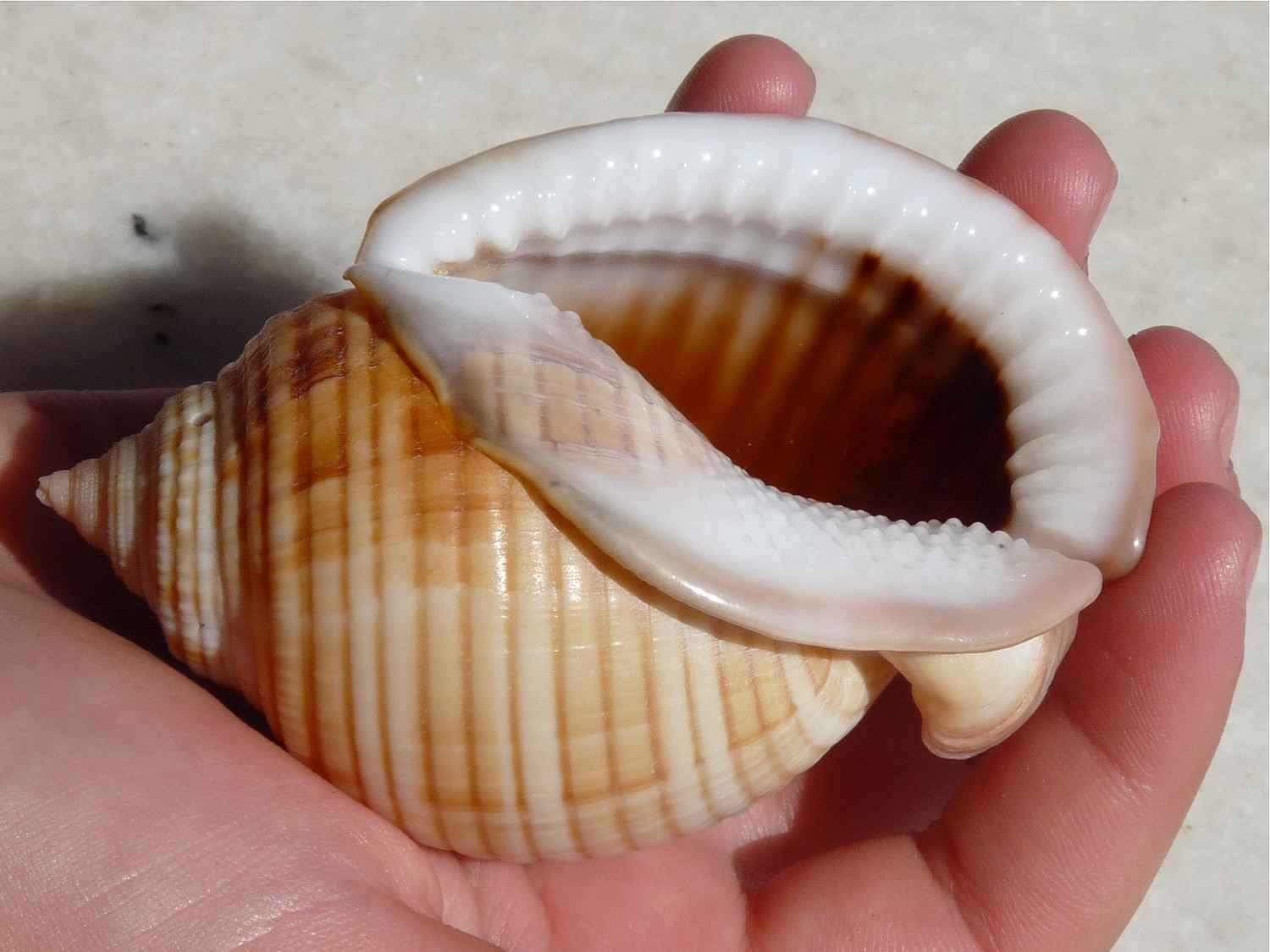
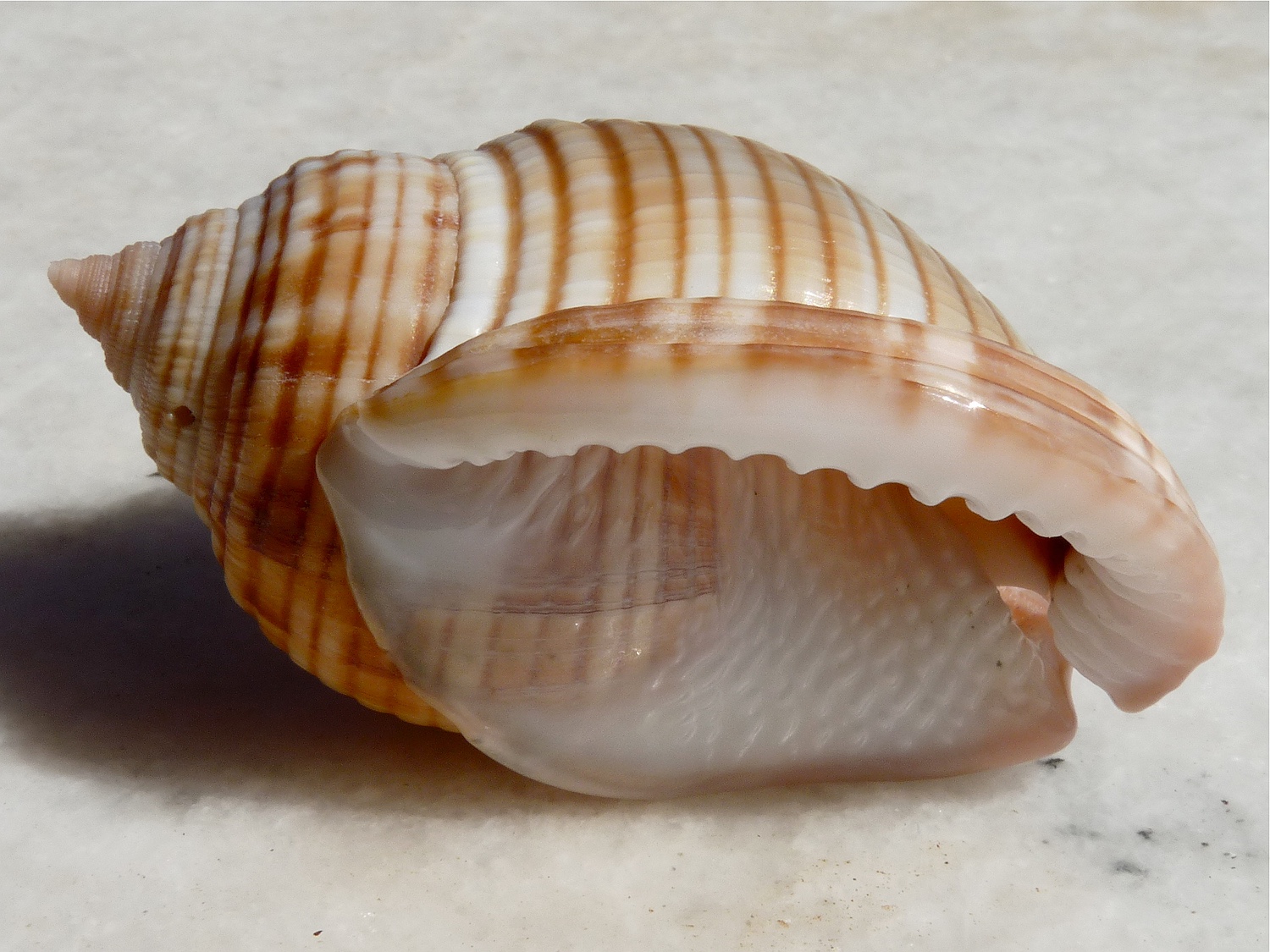
The very rare Semicassis undulata is maybe the most beautiful snail species one can encounter on Naxos. Height: 90 mm
Casmaria ponderosa ?, Gmelin
very rare
This small snail with a thick shell resembles Casmeria ponderosa, which lives in the Red Sea and the Indian Ocean – maybe it is a related species.
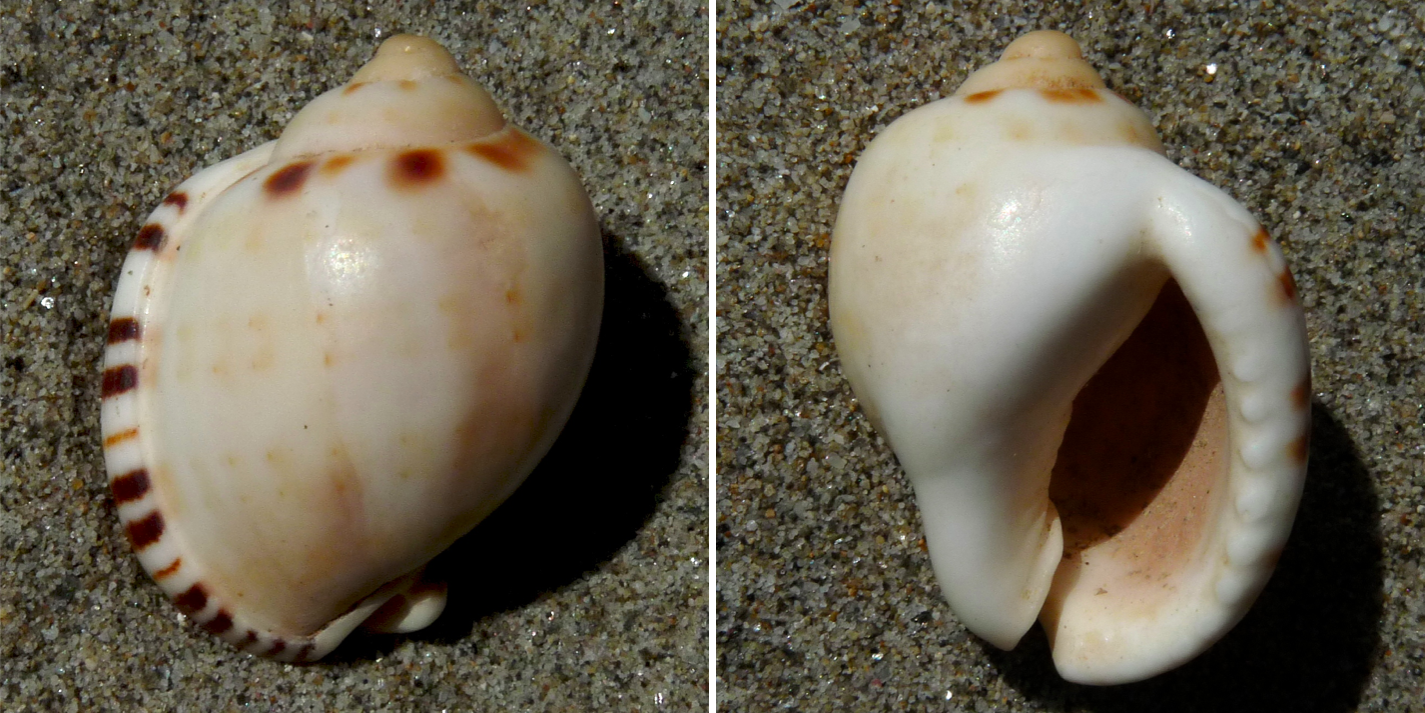
Casmeria ponderosa has a thick-walled shell with a small spire and a large last whorl; the outer edge of the aperture is folded back with regular dark spots. Height: 28 mm
8. Tonnidae, Tun snails
Giant tun, Tonna galea, L.
rather rare
The Giant tun grows to a considerable size of up to 30 cm. It can occasionally be encountered at moderate depths while snorkelling; sometimes small specimens may also be found on the beach. The Giant tun is a dangerous predator that feeds mainly on echinoderms and molluscs. It has a long proboscis for capturing its food and can release 4% sulphuric acid to dissolve the shells of its victims and to kill its prey.
The distinctive shell of the Giant tun is egg-shaped with a low and small spire and a very large, bulbous last whorl with a wide opening. The shell displays numerous deep longitudinal grooves that show as notches in the aperture. The colour is grey to light brown.
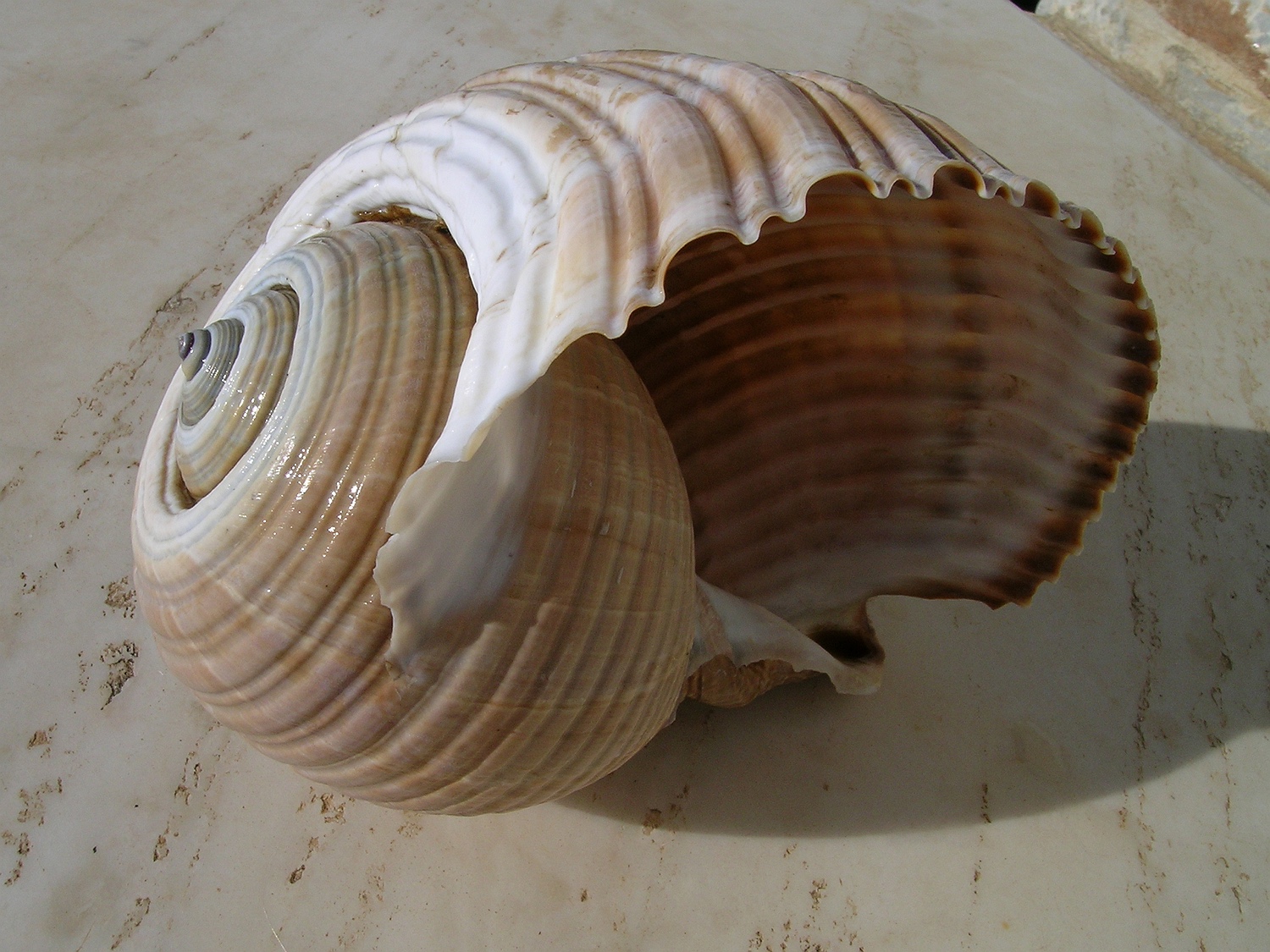
The Giant tun reaches a length of 30 cm. Length of the depicted specimen: 115 mm
9. Ranellidae, Triton snails
Atlantic triton, Charonia variegata, Lamarck
rather rare, in deeper water
The Atlantic triton is the largest snail in the Mediterranean, measuring up to 40 cm in length. It occurs at depths from 10 meters down to 100 or 200 meters. It lives on rocky and sediment floors and among algae and is a dangerous predator that preys on sea urchins, sea cucumbers and even starfish (which are themselves dangerous predators). The triton
dissolves the shell or the hard skin of its prey with a special acid. When the foot of the triton touches a prey animal (or an attacker), the snail strikes its shell against it, crushing or smashing the animal. Tritons also feed on fish caught in nets. Occasionally, you can observe a live triton while snorkelling.
The large, strong shell of the triton has a long spire and a large, bulbous last whorl with a short siphon groove; the aperture has a folded, wrinkled inner edge and double notches on the outer edge. The colour of the shell is brownish with lighter and darker spots in several spiral bands; however, usually the shell is covered by crustose calcareous algae and other sessile organisms. The specimen shown here has been cleaned with vinegar and a wire brush.
The shell of tritons has been used as a signal horn since ancient times. If you cut off the top (as shown in the picture), you can produce a deep sound like a ship’s siren by blowing into the hole. On Naxos, the triton horn, the burú, was formerly used in villages to call workers to the oil mills.
Triton snails stand on the Red List of Threatened Species and may not be collected either alive or as an empty shell; the specimen shown here has been in the family’s possession for a long time.
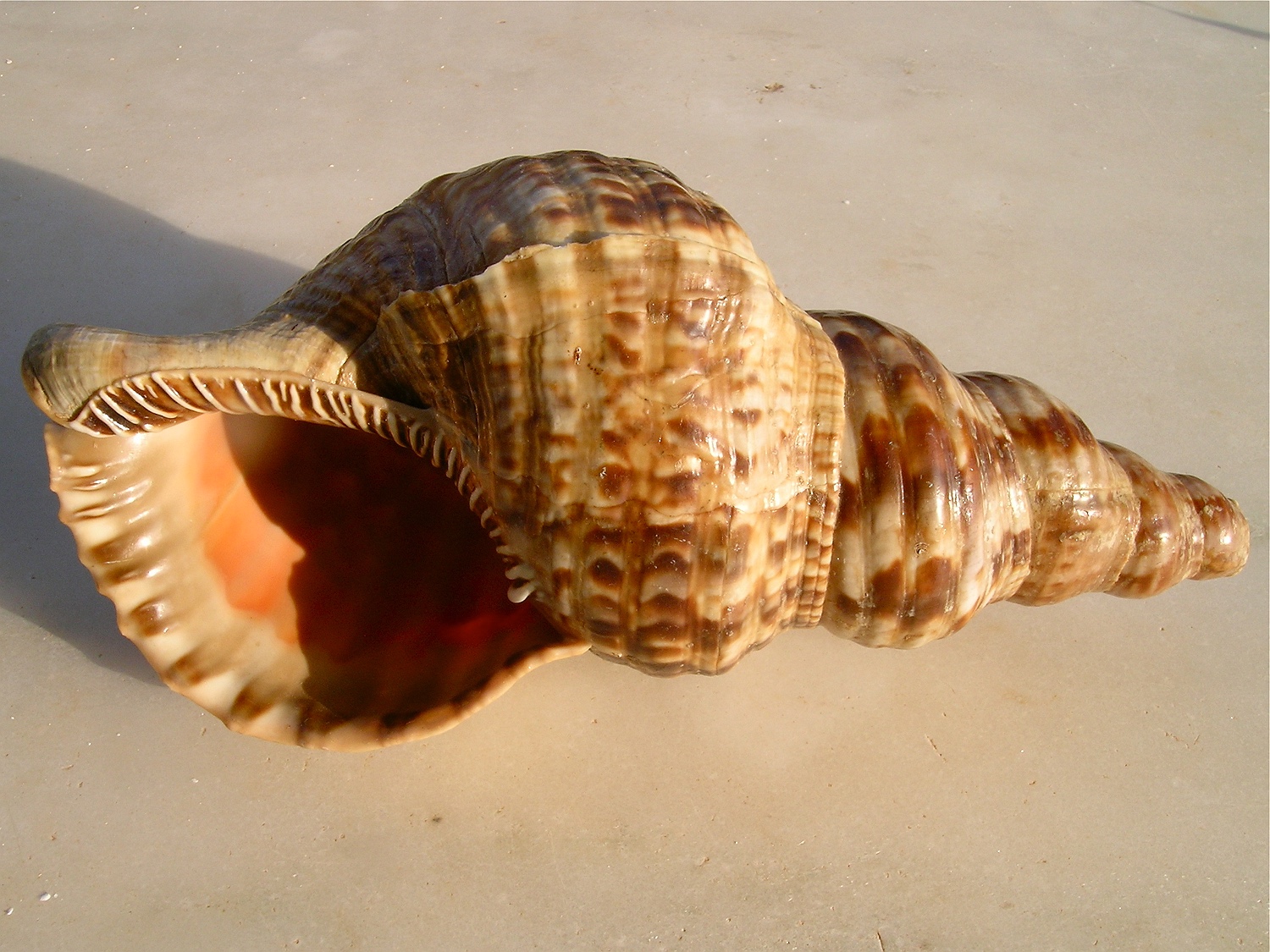
Since ancient times the triton has been used as a signal horn. Height: 230 mm
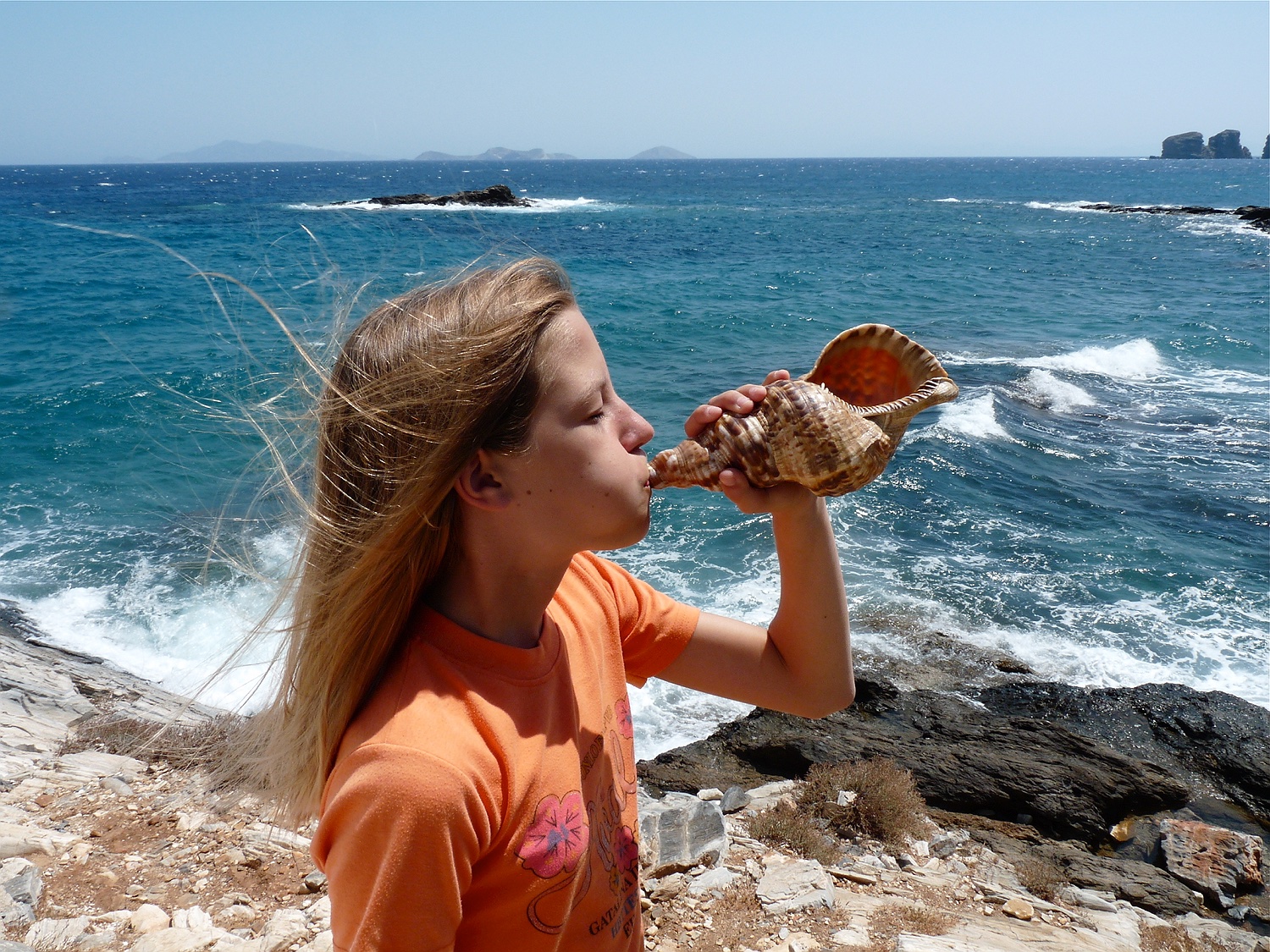
By clicking onto the picture you can hear the sound of the triton’s horn!
10. Triviidae
The family Triviidae belongs to the superfamily Velutionoidea whose species closely resemble cowrie snails: Their shell is also convolute with a tiny spire at one end and a very large last whorl with a narrow, often serrated aperture extending from one end to the other.
Trivia mediterranea, Risso
(= Trivia pulex)
regularly
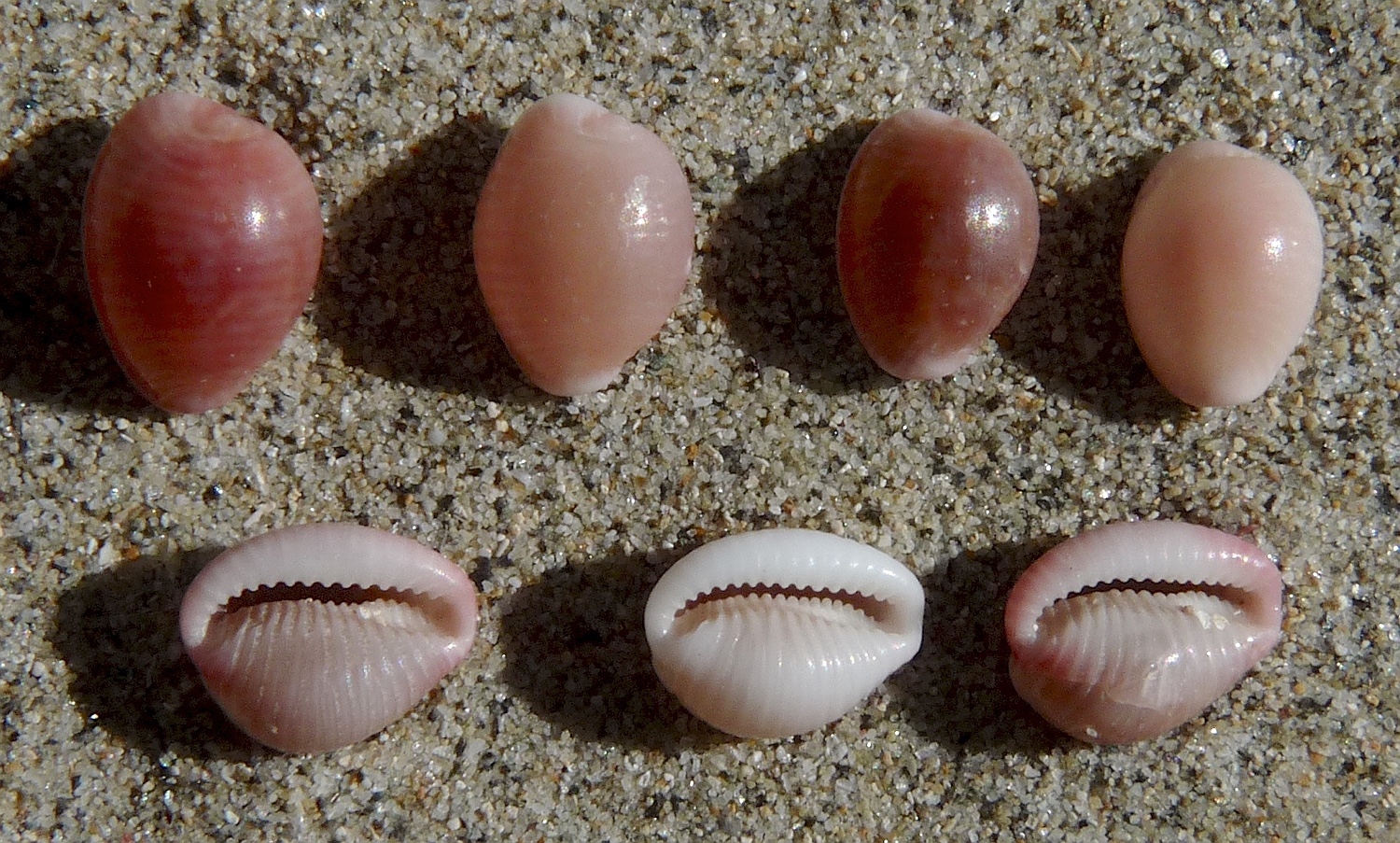
Trivia mediterranea is a very small, pretty, pink snail; typical of the species is the only faint striation on the upper side of the shell. Height: 8 mm
Pseudopusula problematica, F. A. Schilder
(= Niveria problematica)
regularly
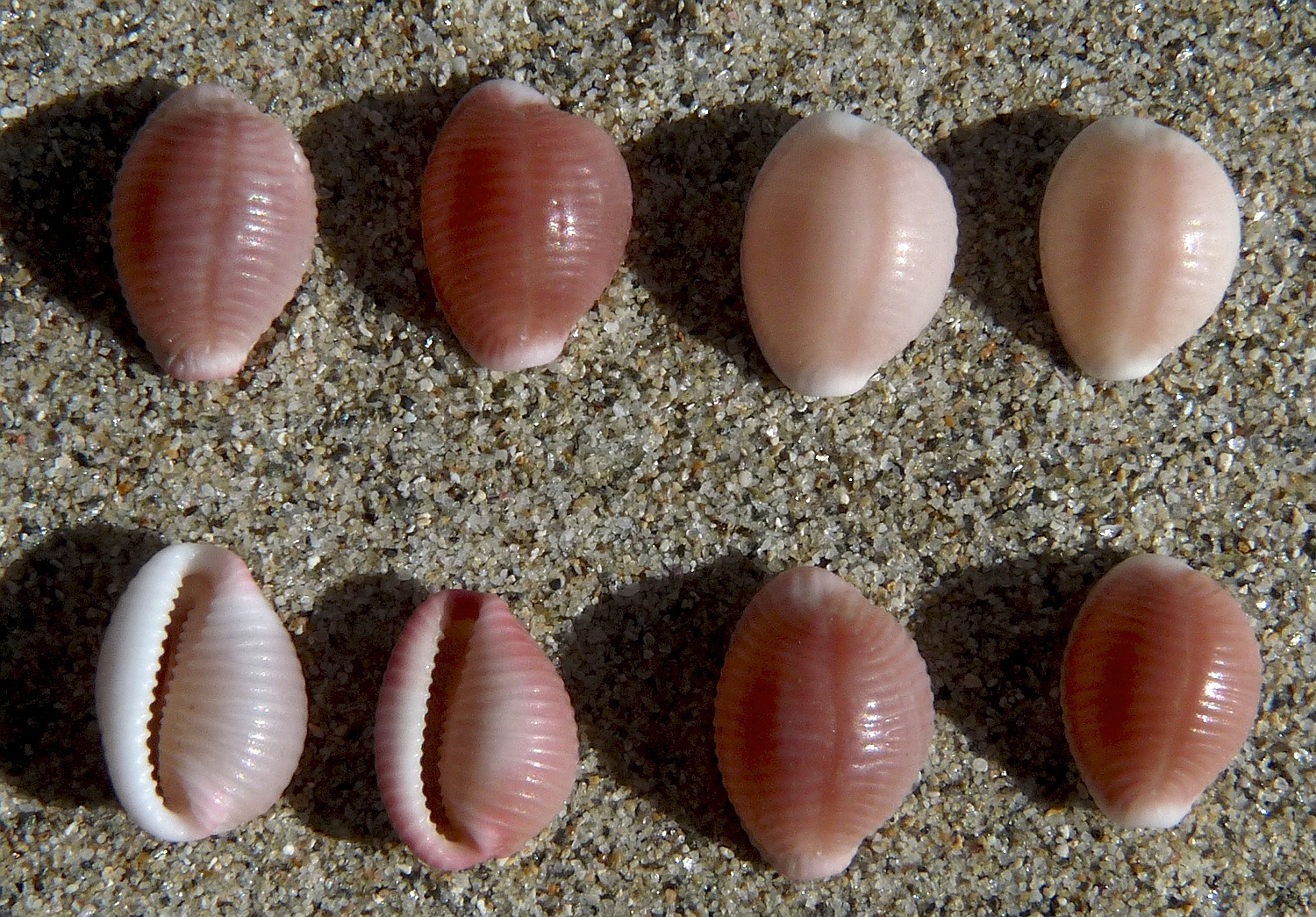
Pseudopusula problematica is very similar to the previous species.Their shell is more strongly ribbed and has a distinct longitudinal stripe on the back. Height: 8 mm
11. Epitonidae, Wentletraps
The wentletraps are among the most beautiful species of snails. They have a tall, pointed shell with strongly curved whorls and narrow, sharply defined radial ribs. The aperture is circular without a siphon groove. Wentletraps usually live buried in the sand. They feed mainly on sea anemones. Only rarely does on see one in our area.
Common wentletrap, Epitonium clathrus, L.
rather rare
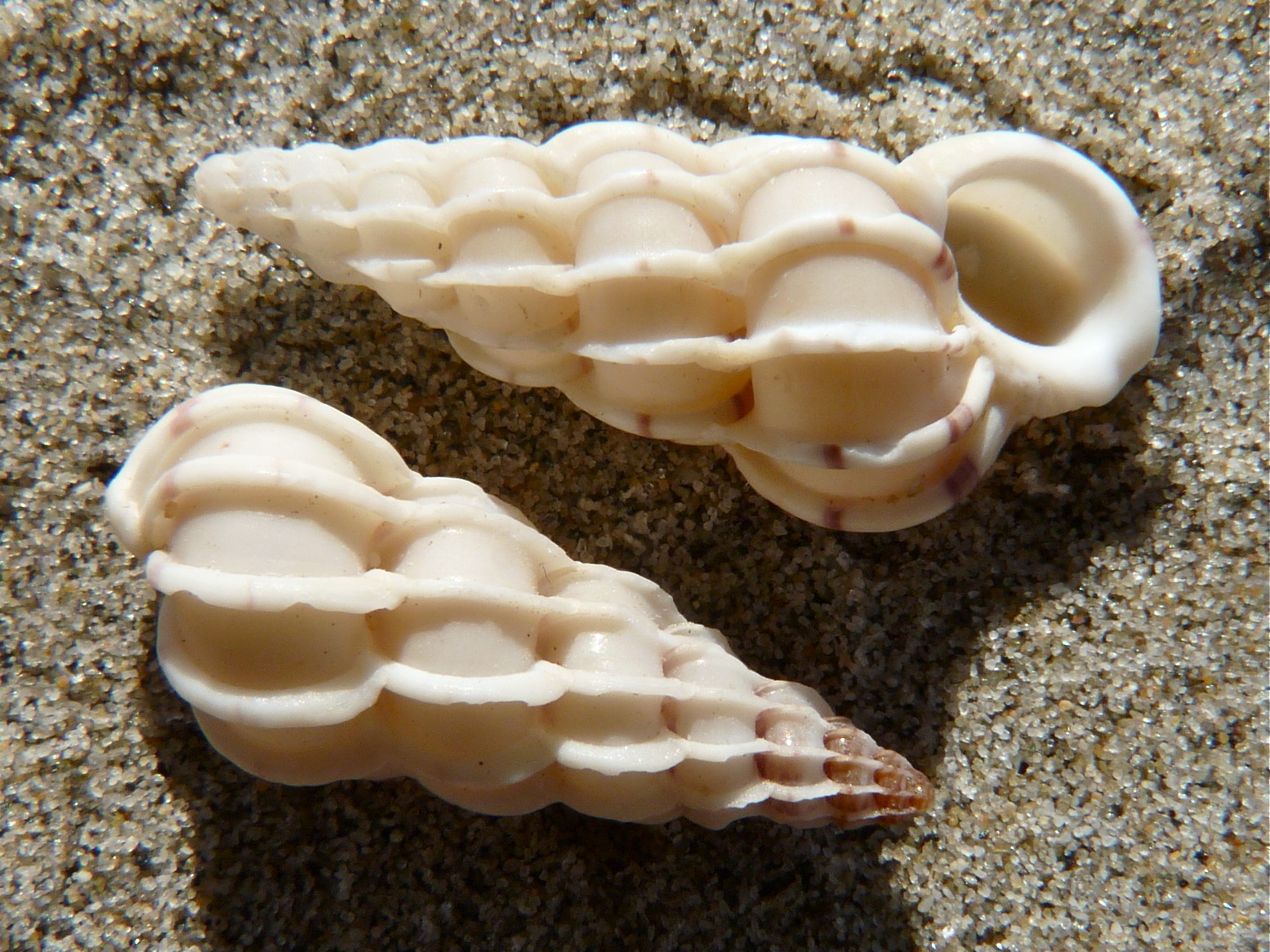
The Common wentletrap is porcelain white with beautiful, slightly slanted ribs. Height: 25 mm
Turtons wentletrap, Epitonium turtonis, W. Turton
very rare
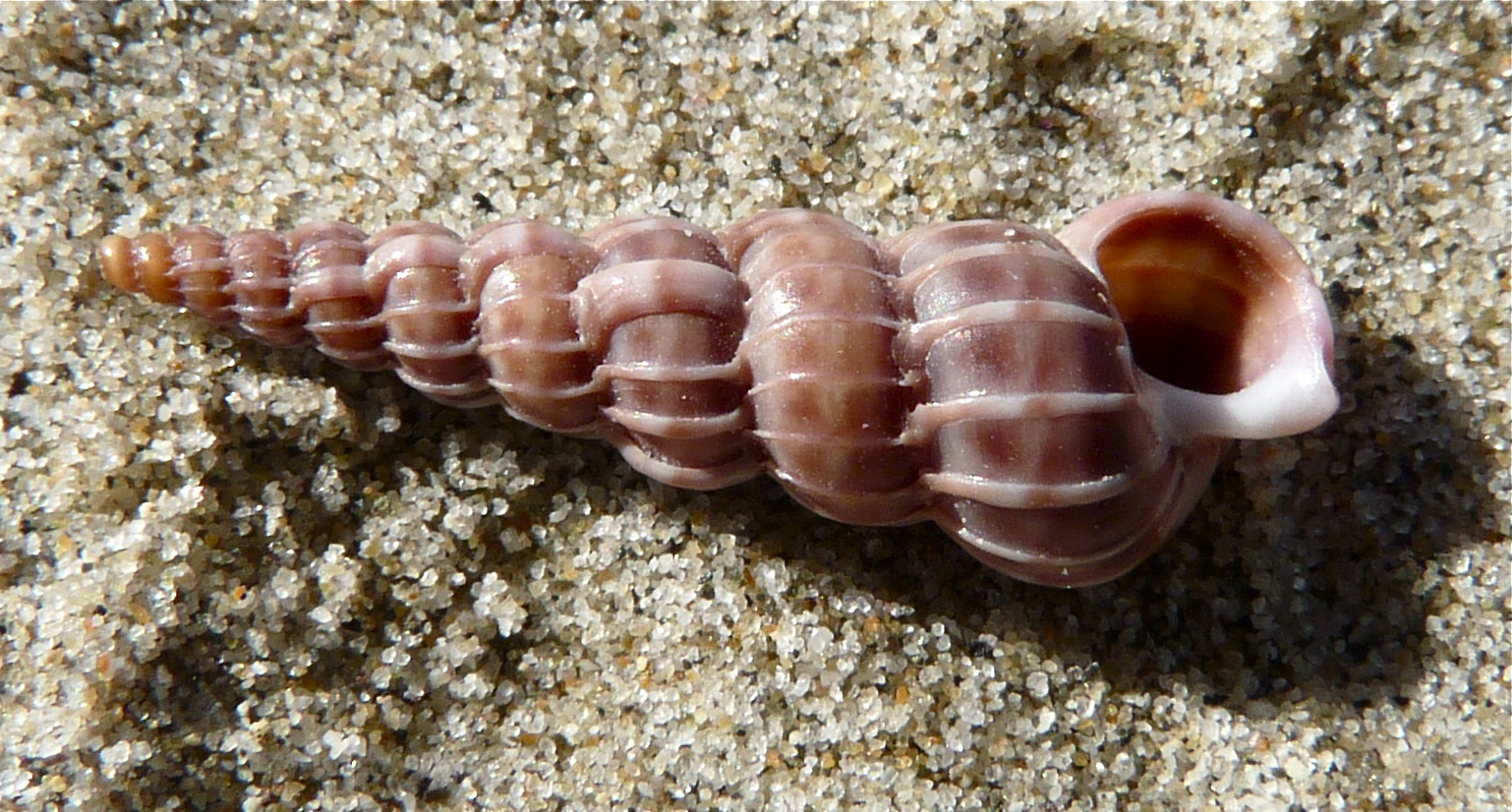
Turtons wentletrap has more whorls with flatter ribs of varying widths, seven of which can be seen on the lowest whorl. Height: 21 mm
Lamellose wentletrap, Gyroscala commutata, Monterosato
(= G. lamellosa)
very rare
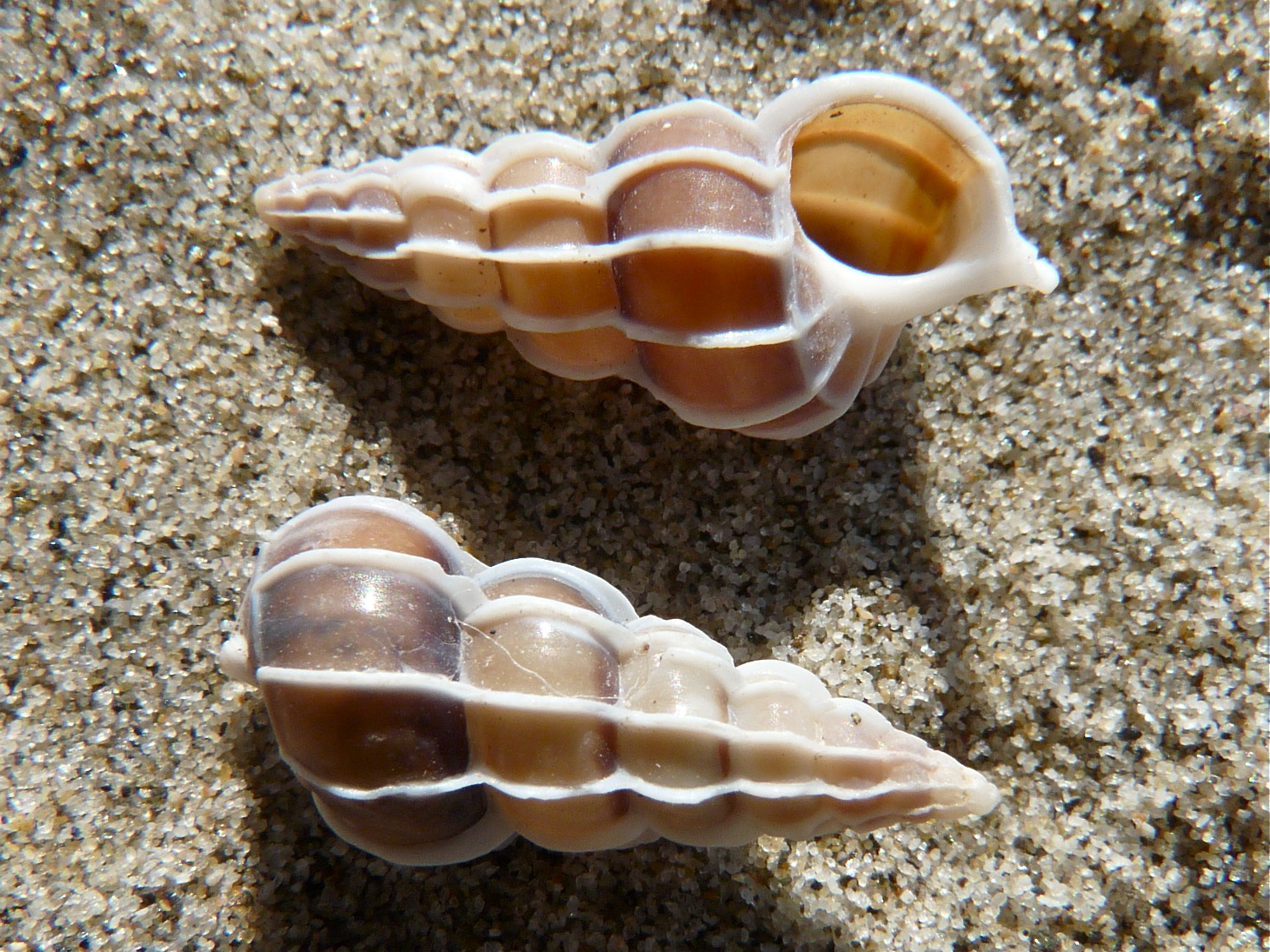
The Lamellose wentletrap has narrower, taller and straighter ribs; the basic colouring of the shell is slightly darker. It is difficult to find an undamaged specimen; here, the lowest whorls are broken off. Height: 17 mm
continue: Worm snails
back: