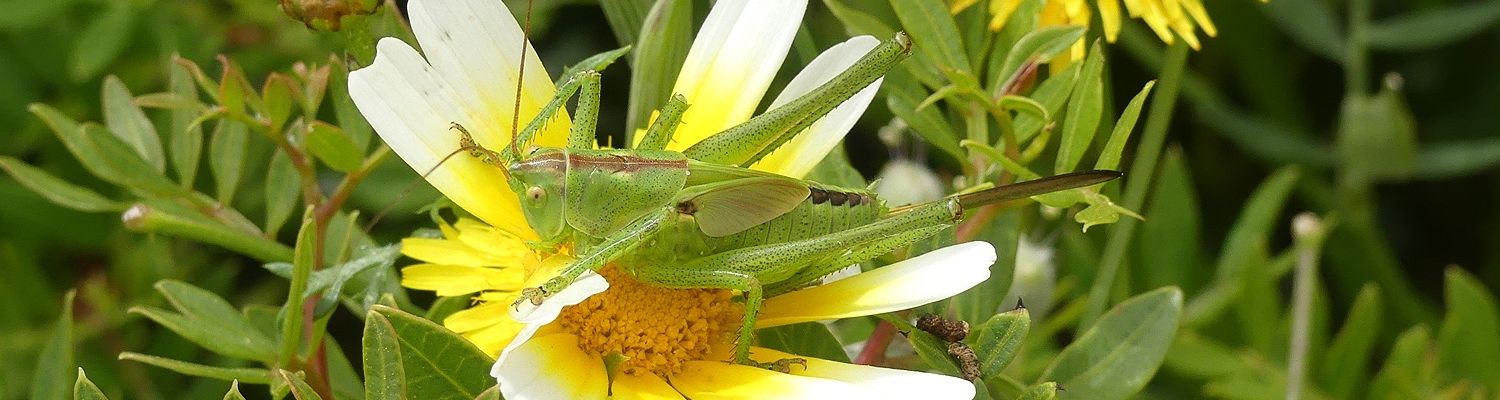
Orthoptera
The Orthoptera are an order of the insects (class Insecta). They are divided into the Ensifera (crickets and relatives) and the Caelifera (grashoppers and relatives). Similar in appearance to the Orthoptera, but not closely related, are the Walking sticks (Phasmatodea) and Praying mantises (Mantodea). Around 20,000 species of Orthoptera exist worldwide.
Here you can skip the introduction and go directly to the species.
Orthopterans are especially common in open vegetation and on dry terrain, and are therefore very abundant in the Mediterranean region. In Central Europe, most species have become rarer due to the intensification of agriculture. Many species are difficult to spot due to their excellent camouflage. Most of the time, you mainly notice the presence of grasshoppers because of their chirping. The animals themselves are often seen only when they jump or fly away.
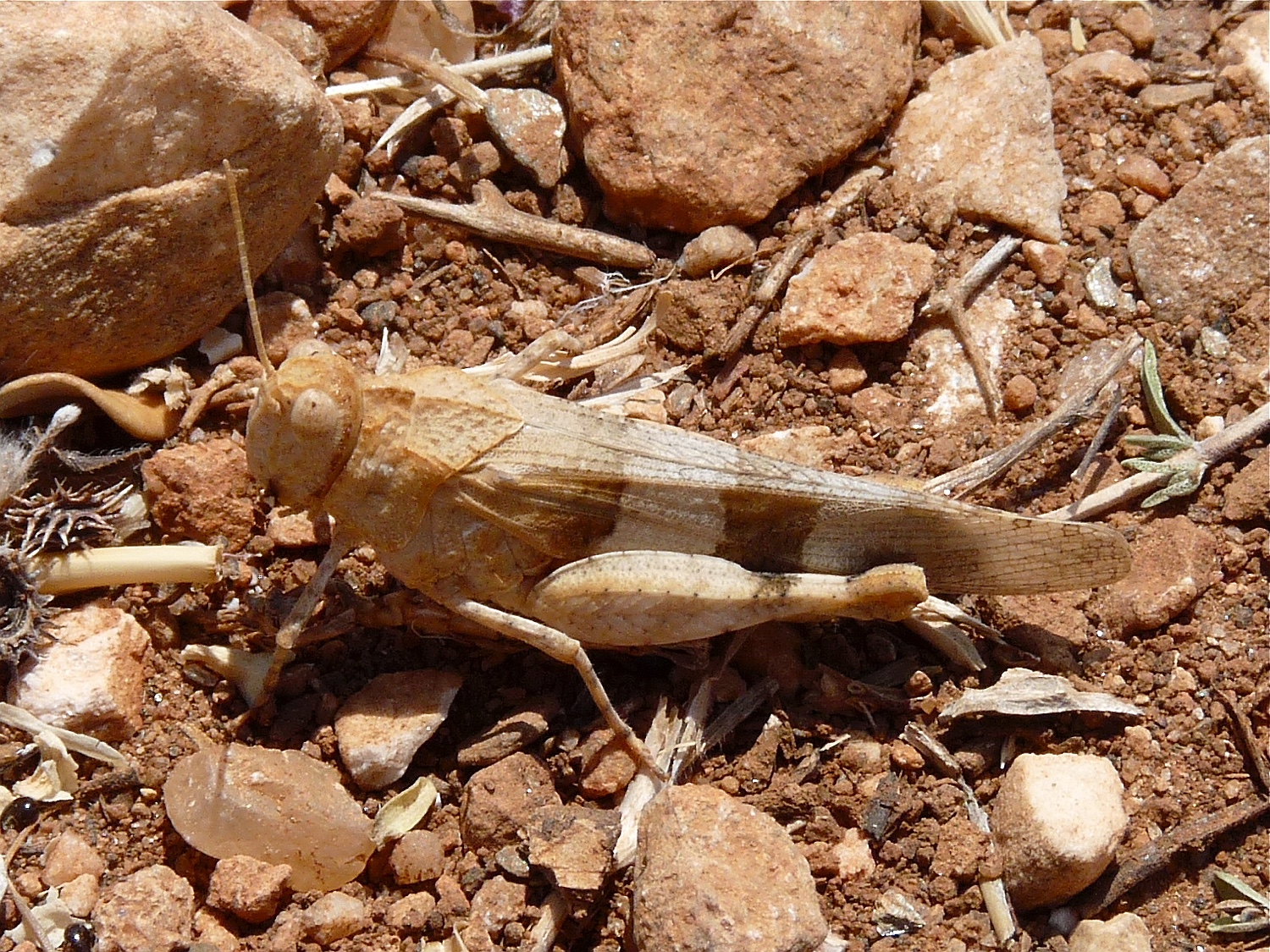
Grasshoppers usually remain on surfaces that match their body colour. In many species, the colouring of individual specimens varies considerably. Here a Blue-winged grasshopper.
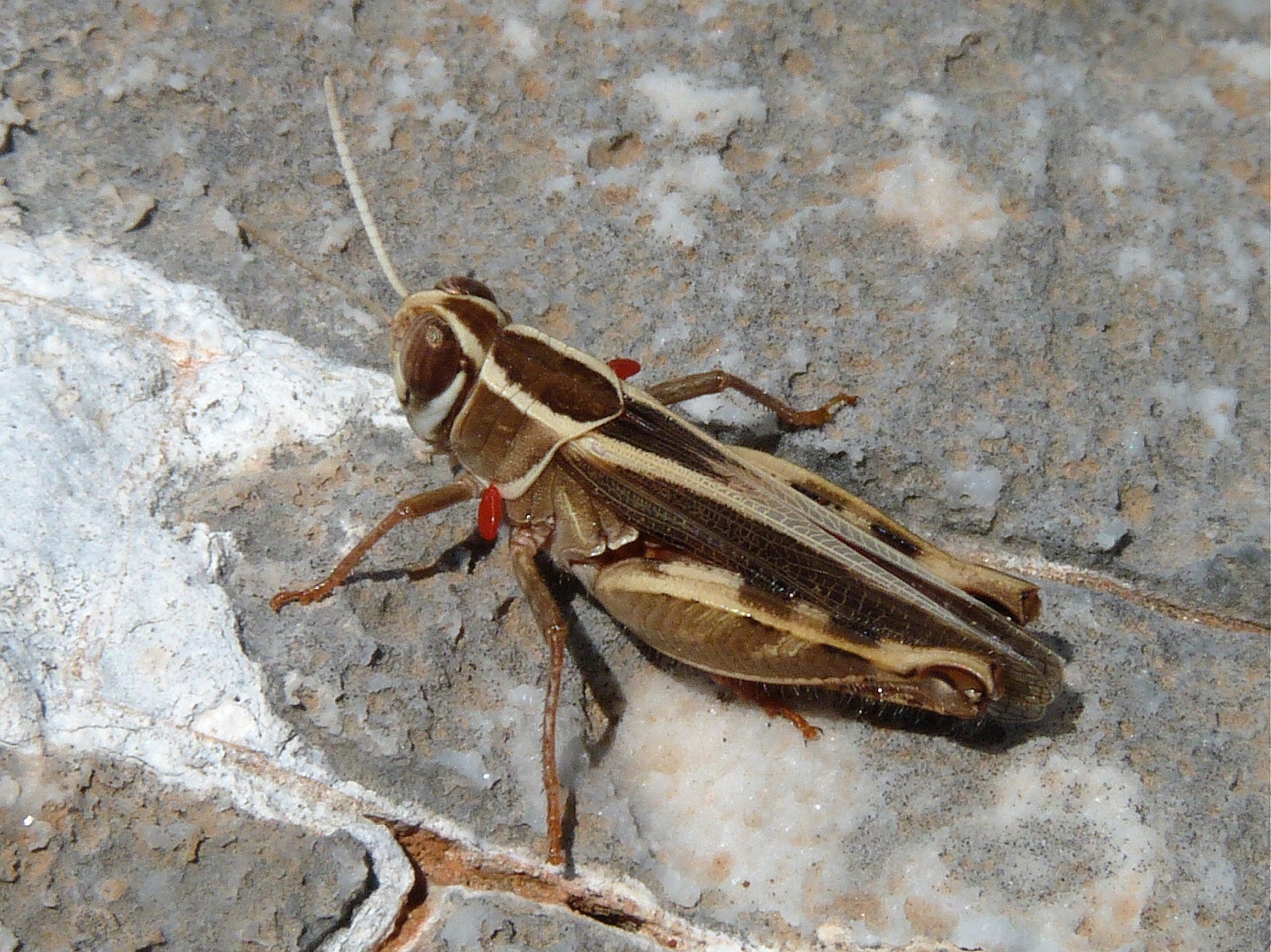
Most people are not very fond of grasshoppers. However, there are also some very pretty species, such as Calliptamus barbarus (the red “appendages” on the side of its body are parasitic mites).
Anatomy
Like with all insects, the body of the orthopterans is divided into head, thorax and abdomen, with each part consisting of several segments that were originally identical in shape. The head (consisting of five fused segments) carries the antennae, the compound eyes and mouthparts of the chewing-and-biting type with mandibles and two pairs of maxillae. The thorax (consisting of three segments) bears three pairs of legs and two pairs of wings, the front pair of which are stiff wing covers, while the grasshopper flies with the rear pair of thin, more or less transparent wings. The hind legs are transformed into powerful, long jumping legs. The abdomen consists of eleven segments.
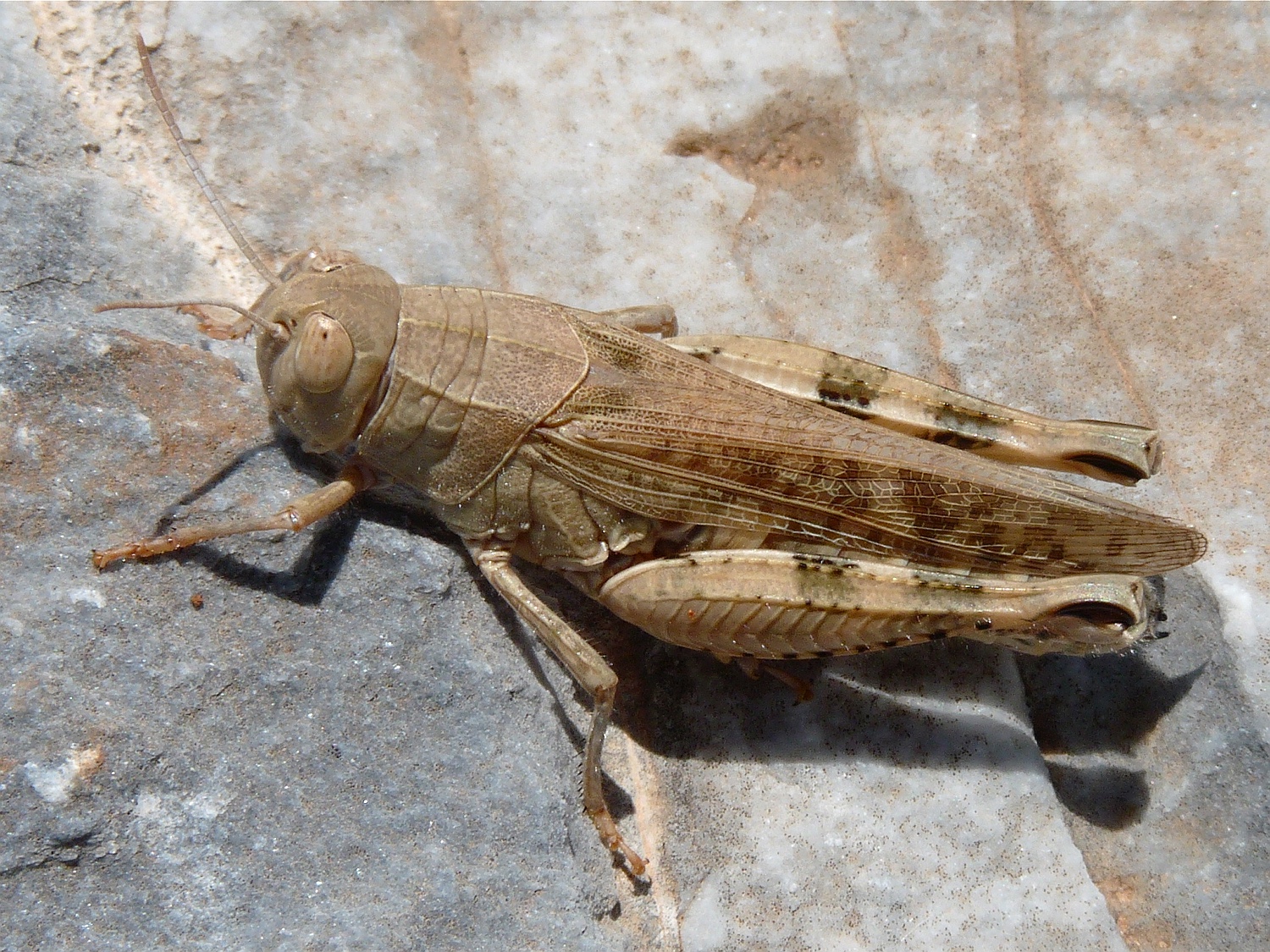
All orthopterans have a very similar anatomy.
Insects do not have an internal support structure such as the bones of vertebrates, but rather an exoskeleton made of chitin, which supports the body and protects it from water loss, etc. Once hardened, the chitinous exoskeleton can no longer grow and must therefore be shed from time to time as the animal grows. This moulting occurs only in between the different larval stages and when the larva transforms to the adult, while the adults do not grow any more.
Development
As all insects, the orthopterans lay eggs. The females can be recognised by the ovipositor which protrudes backwards beyond the abdomen (particularly noticeable in crickets). Usually they lay their eggs into the earth.
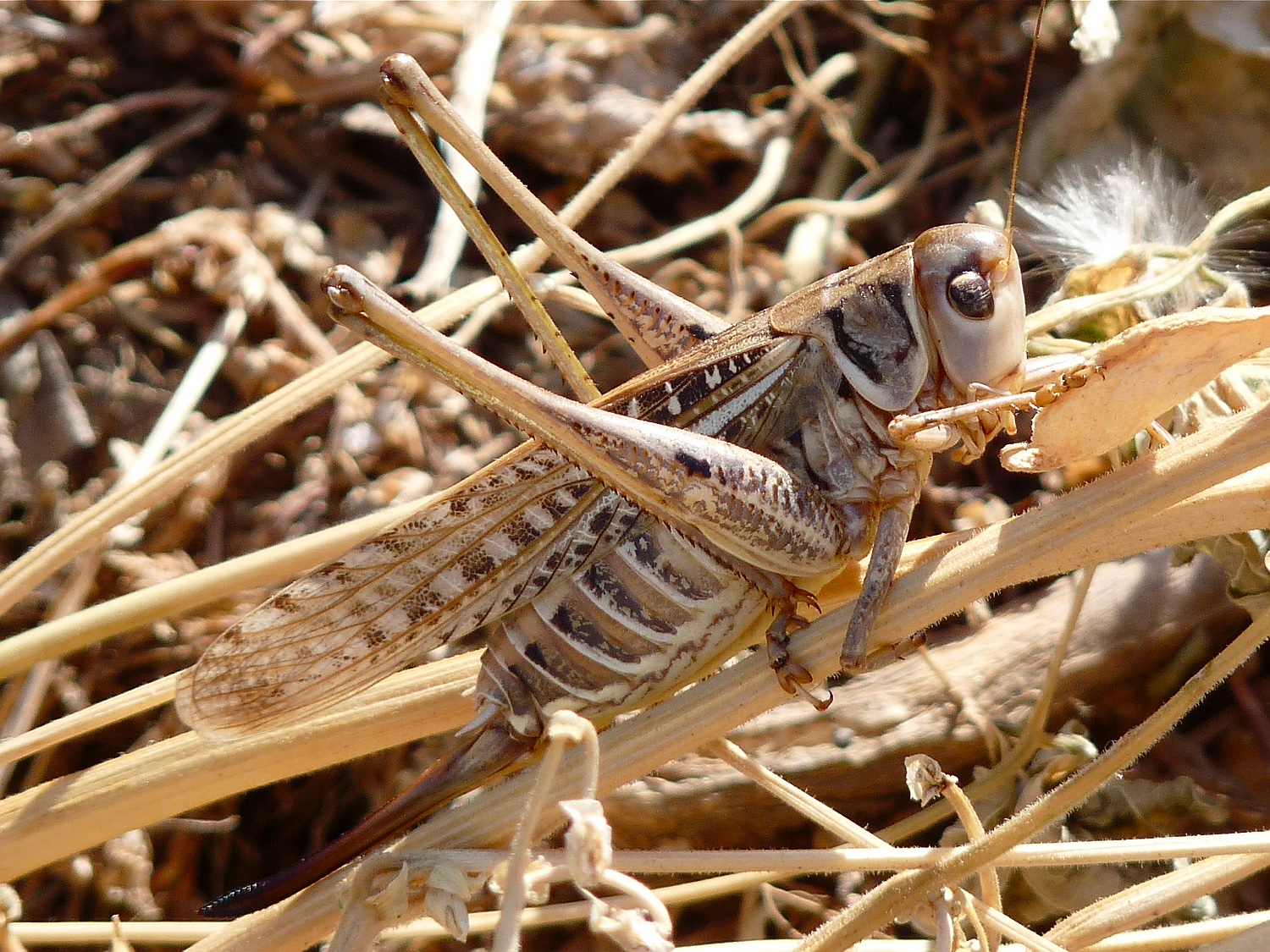
female Southern wartbiter

Italian locusts mating. The male is much smaller than the female.
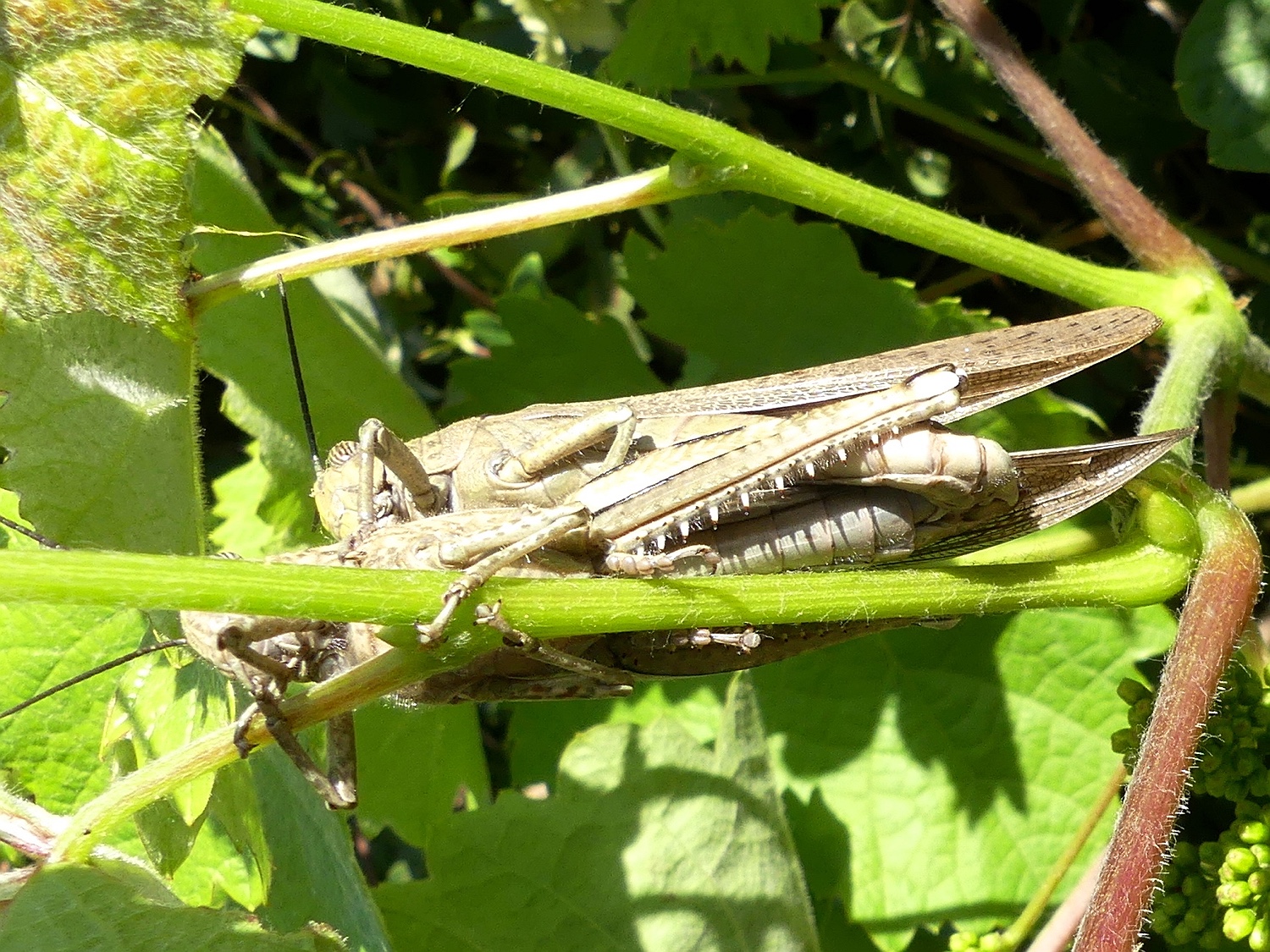
In mating the male transfers a sperm packet to the female, often by means of a complex mating apparatus. Thus mating often is a lengthy process. Here a pair of Egyptian locusts.
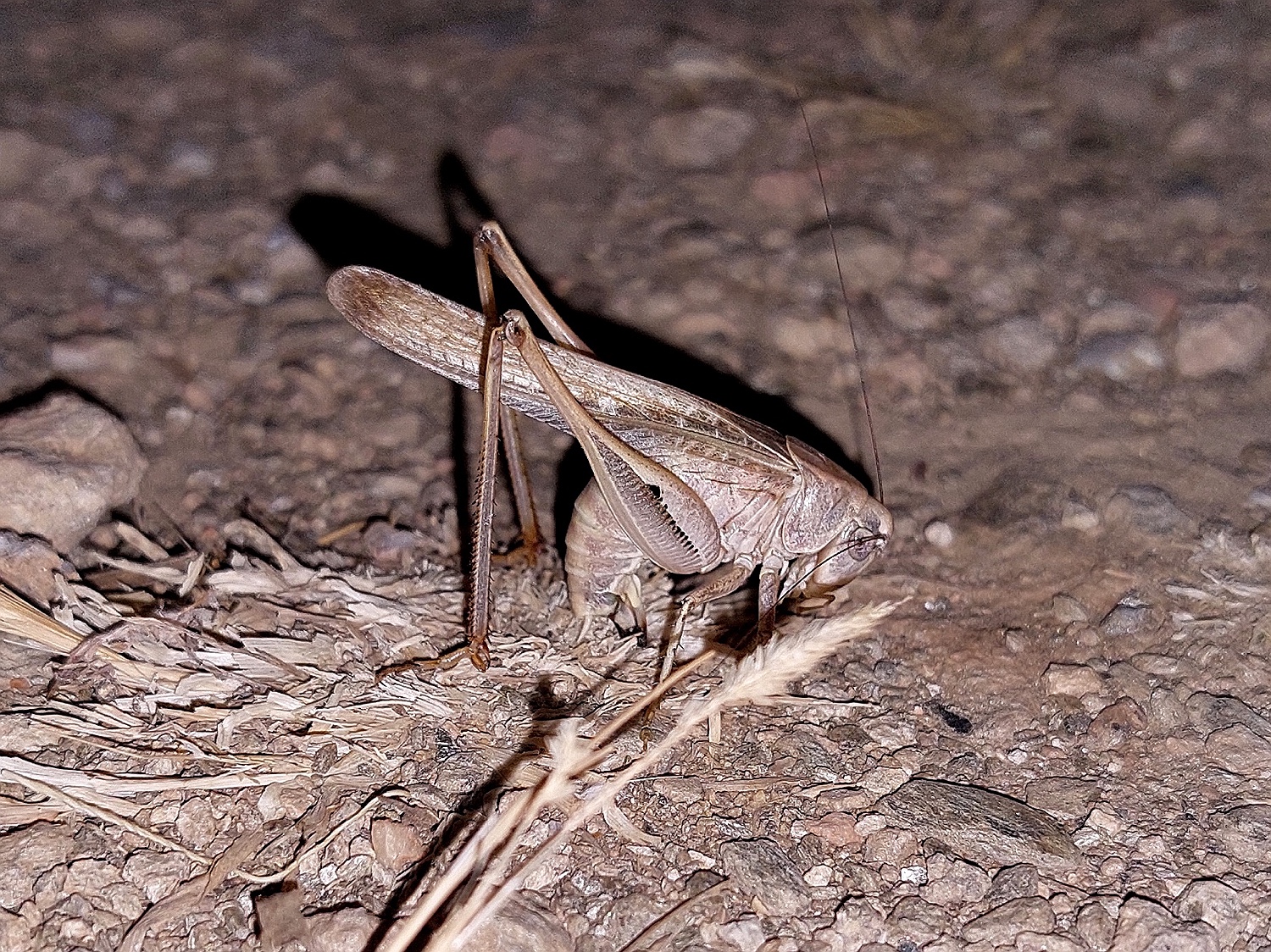
The females lay the eggs into the earth with their rather thick ovipositor, often at night, because they must remain immobile for some time, especially when the soil is dry and hard and difficult to penetrate. The eggs are usually deposited one by one.
Orthopterans undergo incomplete metamorphosis (hemimetabolism), i.e. even the very young animal resembles the adult and becomes more and more similar with each moult, while in holometabolism (complete metamorphosis) which occurs for example in butterflies and bees the larvae look completely different from the adult animal, into which they transform during a pupal stage. In orthopterans the larva moults five to seven times before reaching the adult stage, with the larval development taking up to several years.
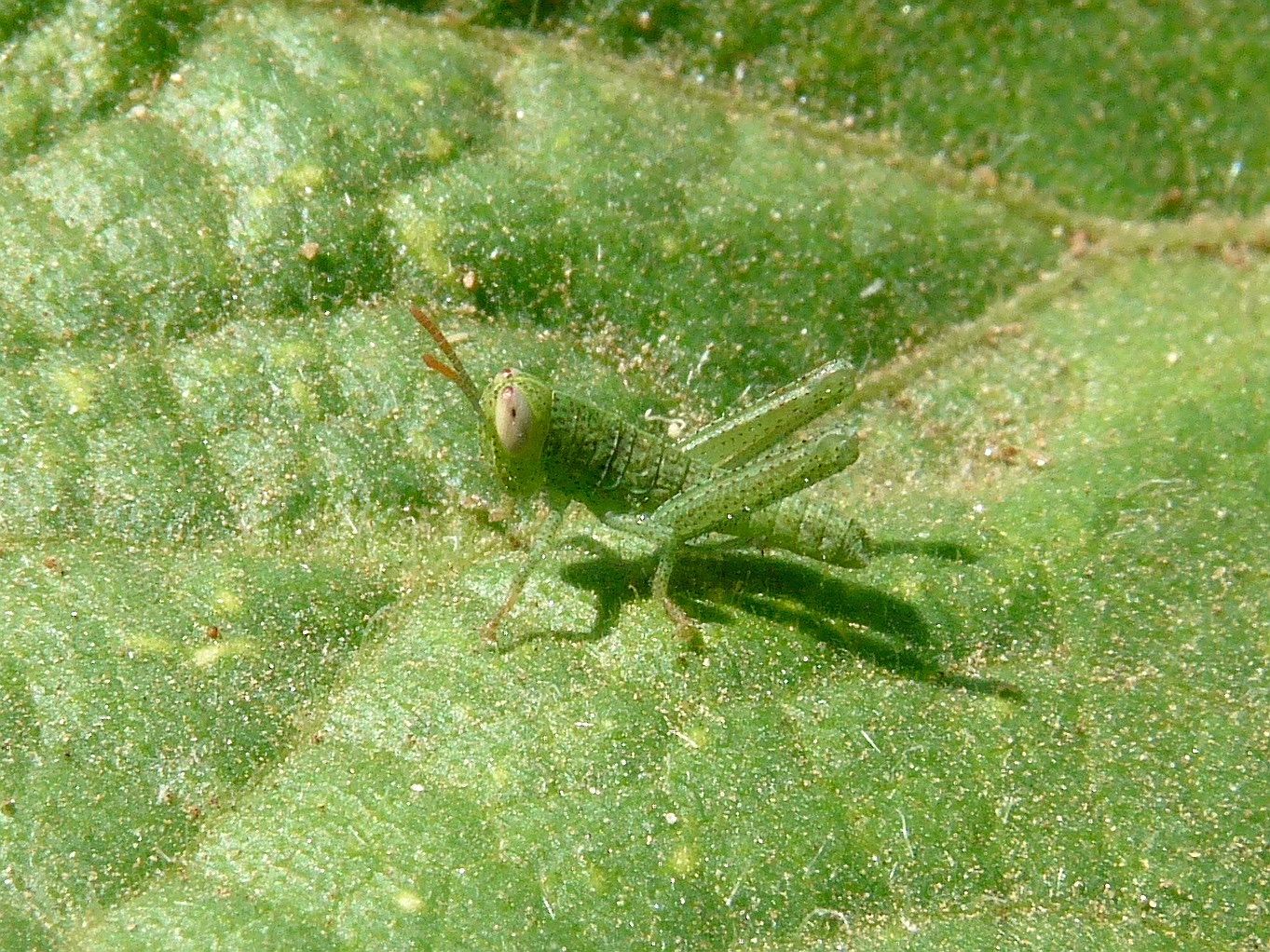
Even the tiniest larvae are clearly recognisable as grasshoppers and already resemble the adult animal.
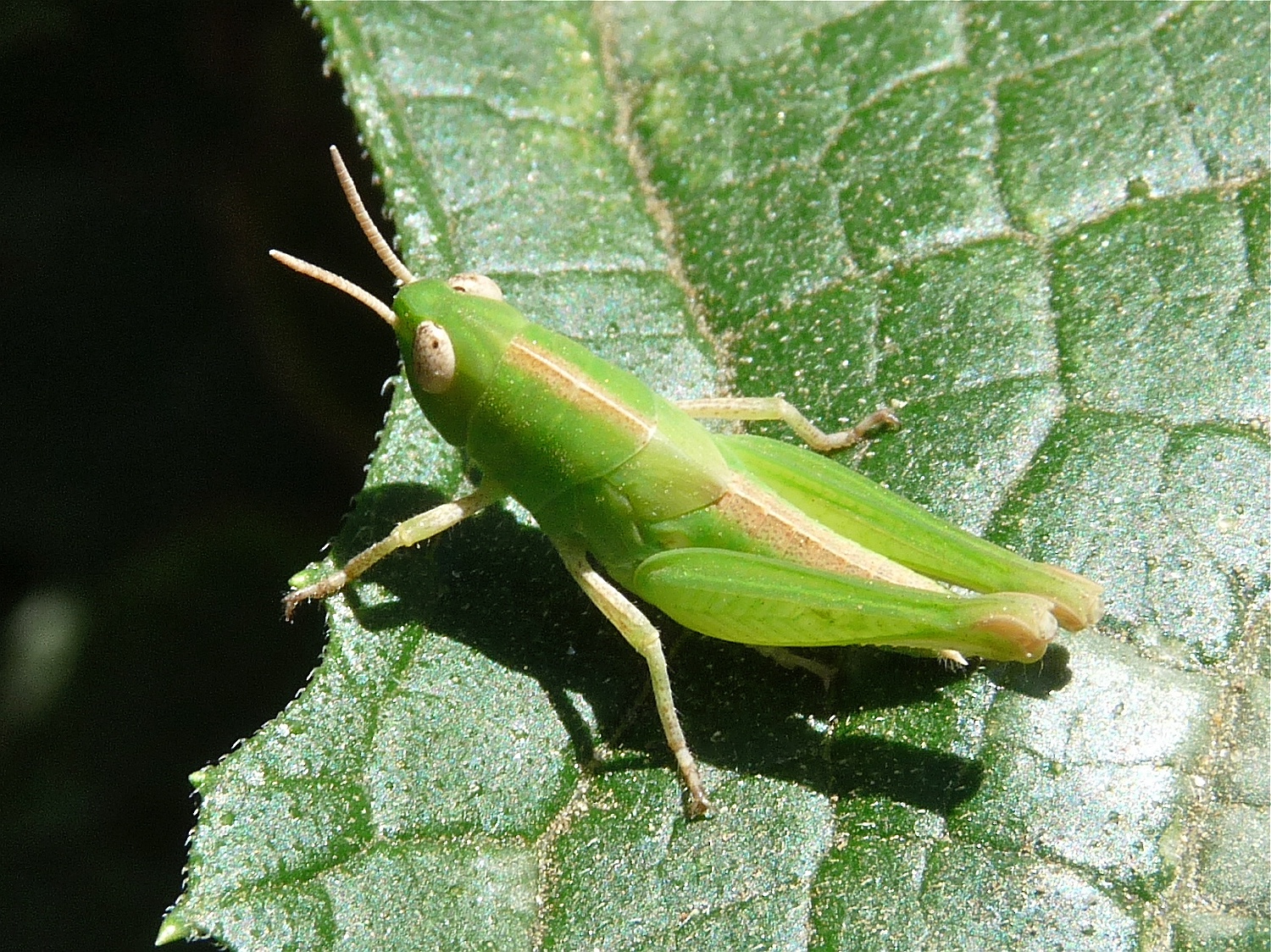
Larger larva with small wing buds on the sides of its body.
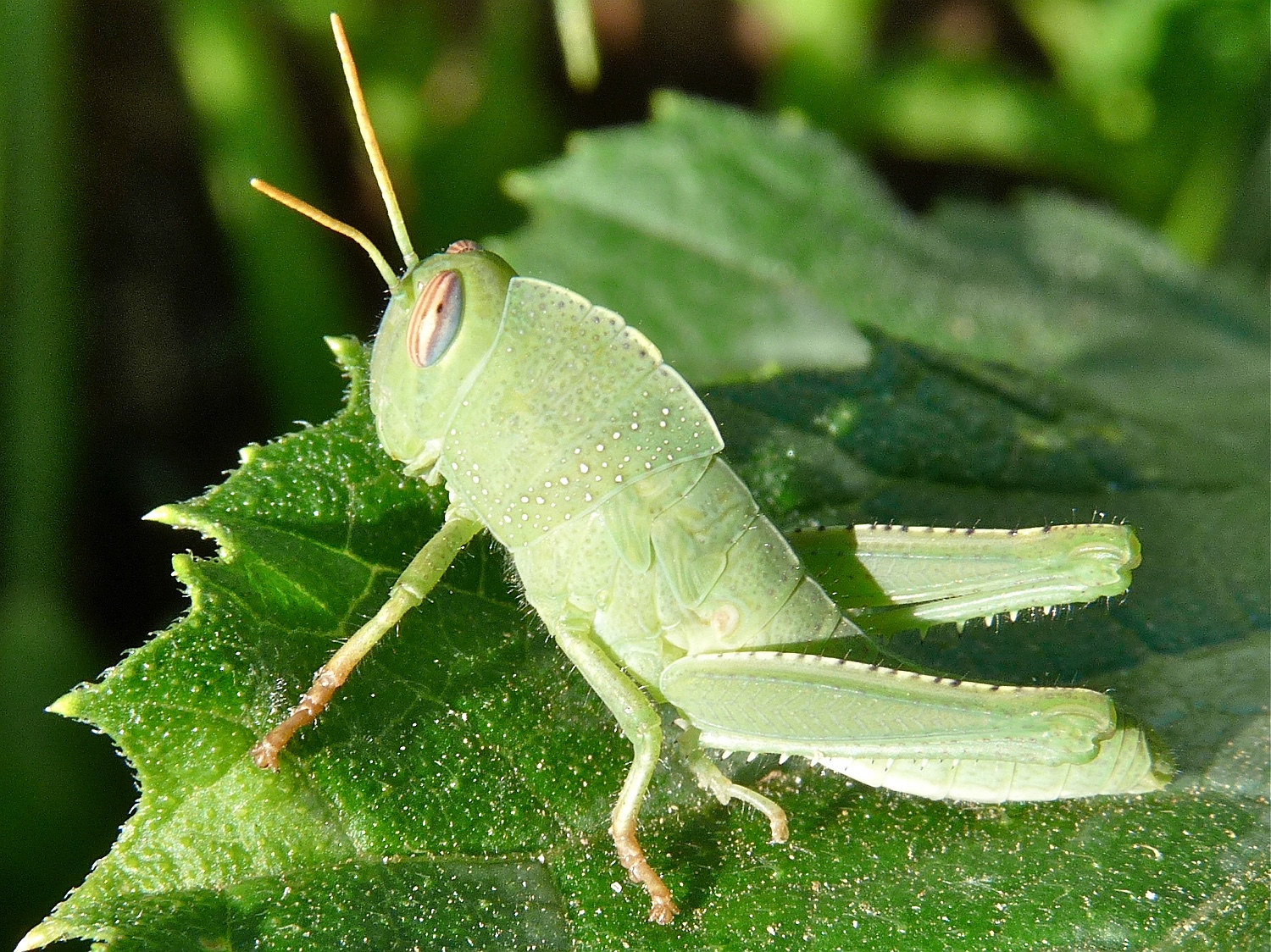
During the several larval stages, locusts gradually appear more and more like the adult, though they may still differ significantly in some characteristics such as colour. Functional wings appear only in the adult state, though the larva may have wing buds. In this middle larval stage of the Egyptian locust, small wing buds are already visible on the thoracic segments. The larva is green though the adult is grey.
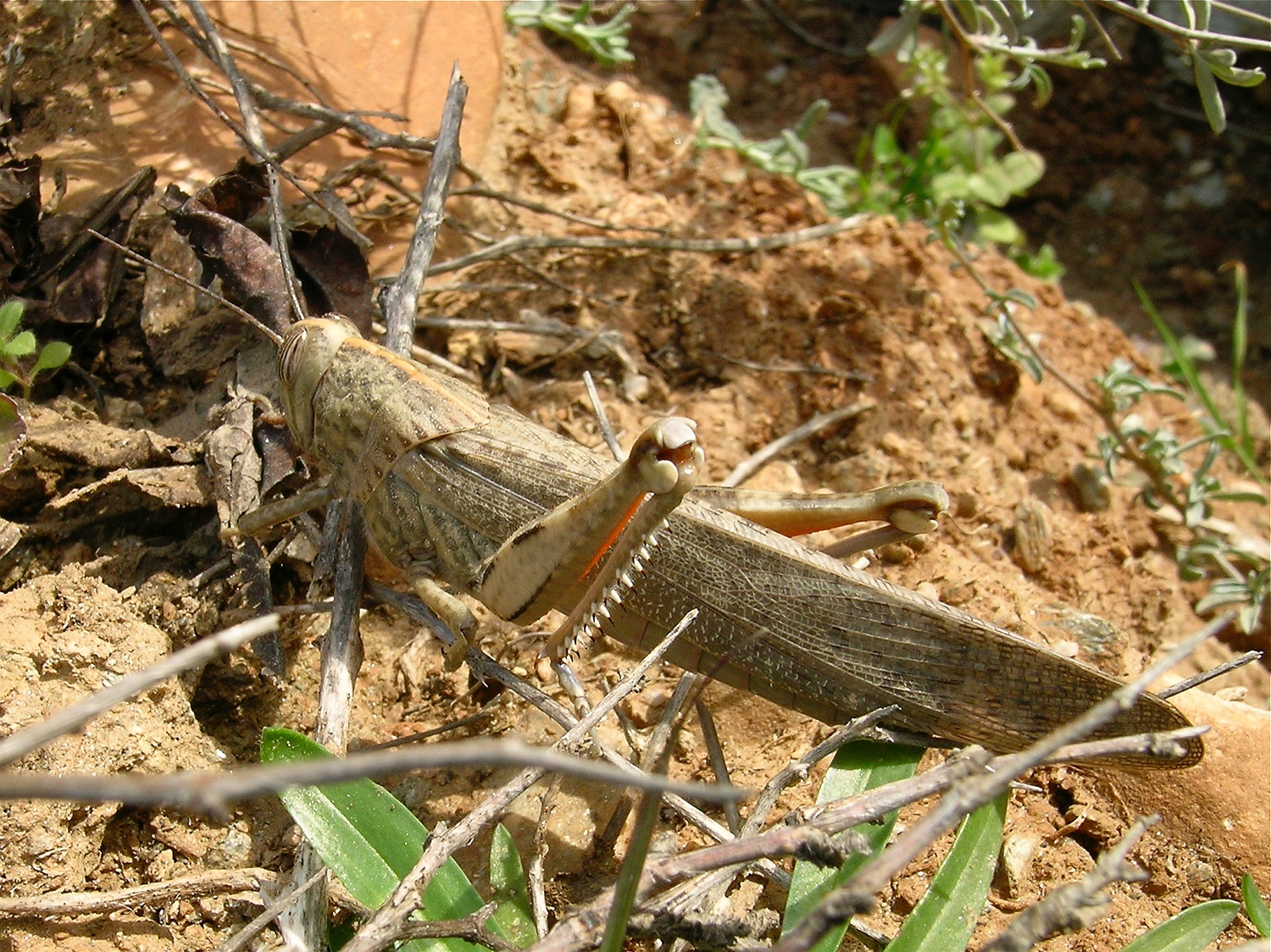
the adult Egyptian locust
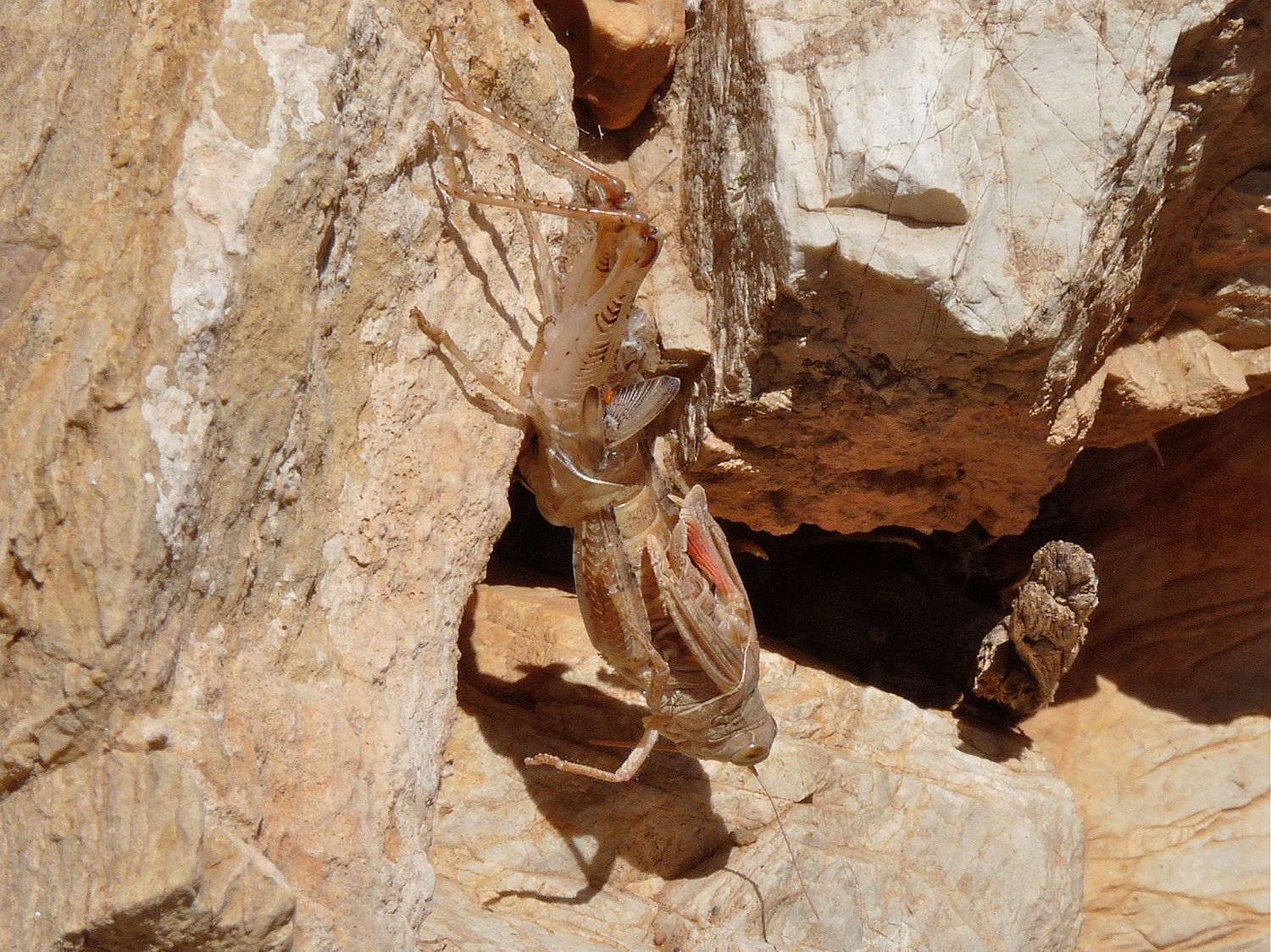
Grashopper during moulting. Before their chitinous exoskeleton hardens, the freshly moulted grashoppers are particularly vulnerable and at risk from predators.
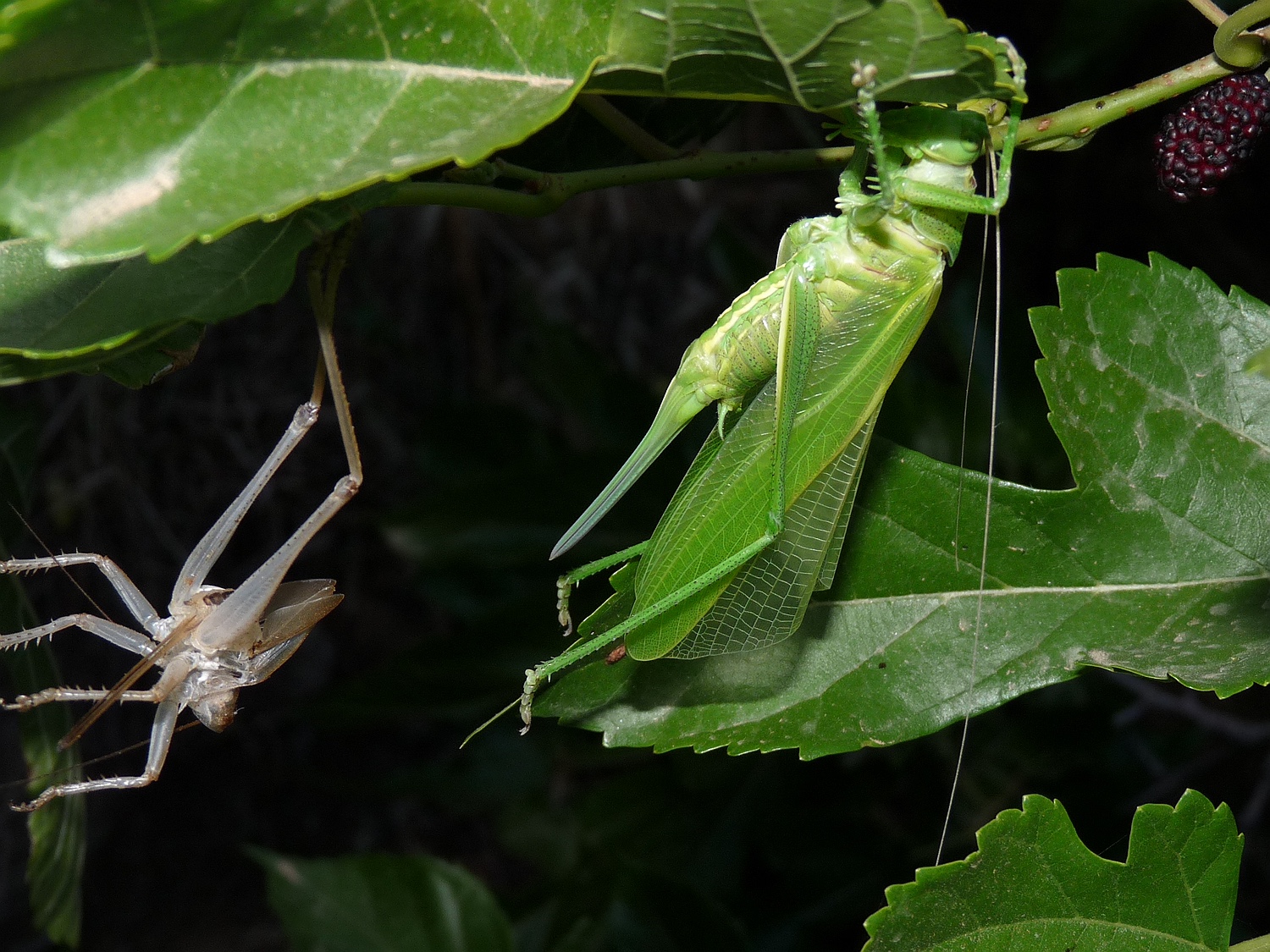
Newly “hatched” adult Great green bush-cricket. Note the long ovipositor.
The vocalisations of orthopterans
The incessant shrilling, chirping and buzzing of grasshoppers and crickets (and cicadas) is the sound of the Greek summer. Many orthopterans produce a species-specific song that serves to establish a territory and to attract females. Some species display different types of sounds, such as territorial songs and courtship songs. Crickets produce their song by rubbing their front wings together: one wing is equipped ith a file covered with tiny teeth while the other has a “scraper”. Grasshoppers rub their hind legs with a file of tiny pegs against a thickened vein of their front wings.
Orthopterans have well-developed hearing organs (tympanal organs), which in crickets are usually located on the lower legs of the front legs and in grasshoppers on the sides of the first abdominal segment.
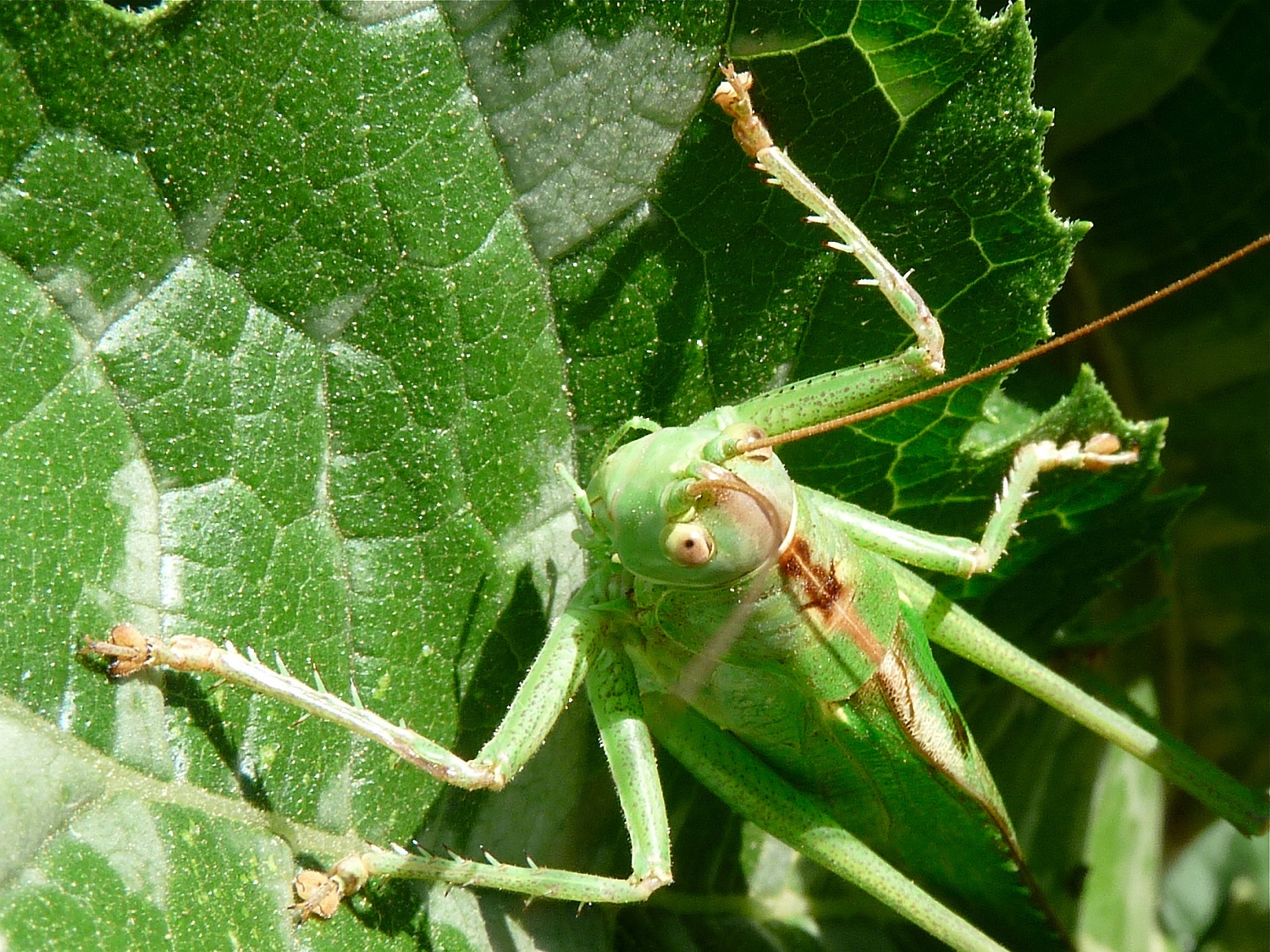
The tympanal organ of the Great green bush-cricket is visible here a small green oval on the tibia of the front legs.
Orthopterans as pest
Not all orthopteran species feed on plants; many species are omnivorous or predatory. Most species are harmless and cause no damage; however, some can reach very high population densities in favourable years causing damage in the vineyards and fields. In some areas, when locust species reach a high population density, they begin to migrate in huge swarms (up to several billion animals) over long distances across the country, eating up all vegetation and crops. Such locust plagues are a major problem, especially in Africa, though today, they can be kept under control to some extent with insecticides.
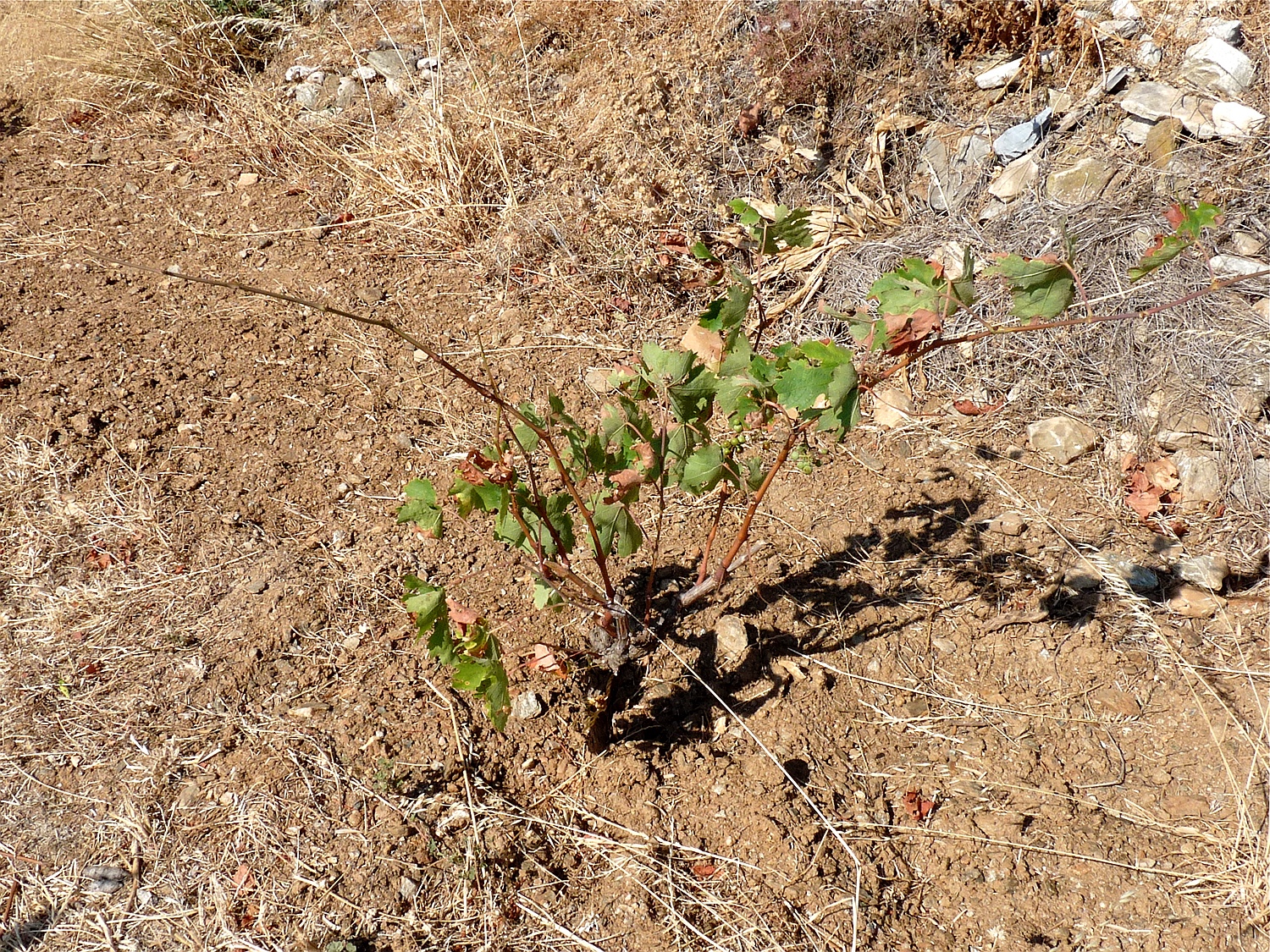
“Locust plague” on Naxos: The southern wartbiter can cause considerable damage in gardens and
vineyards.
Orthopterans as food
However, orthopterans are not only significant for humans as a pest. Actually, around 80 % of humanity regularly eats insects, including many different species of grashoppers, locusts and crickets.
Of course orthopterans are not only valued as food by humans. In our garden their main enemies are cats, seagulls, which often gather in flocks in fields where there are many grasshoppers, and other birds such as Eleonora’s falcons. One particularly interesting species that hunts bush-crickets is the The Golden digger wasp.
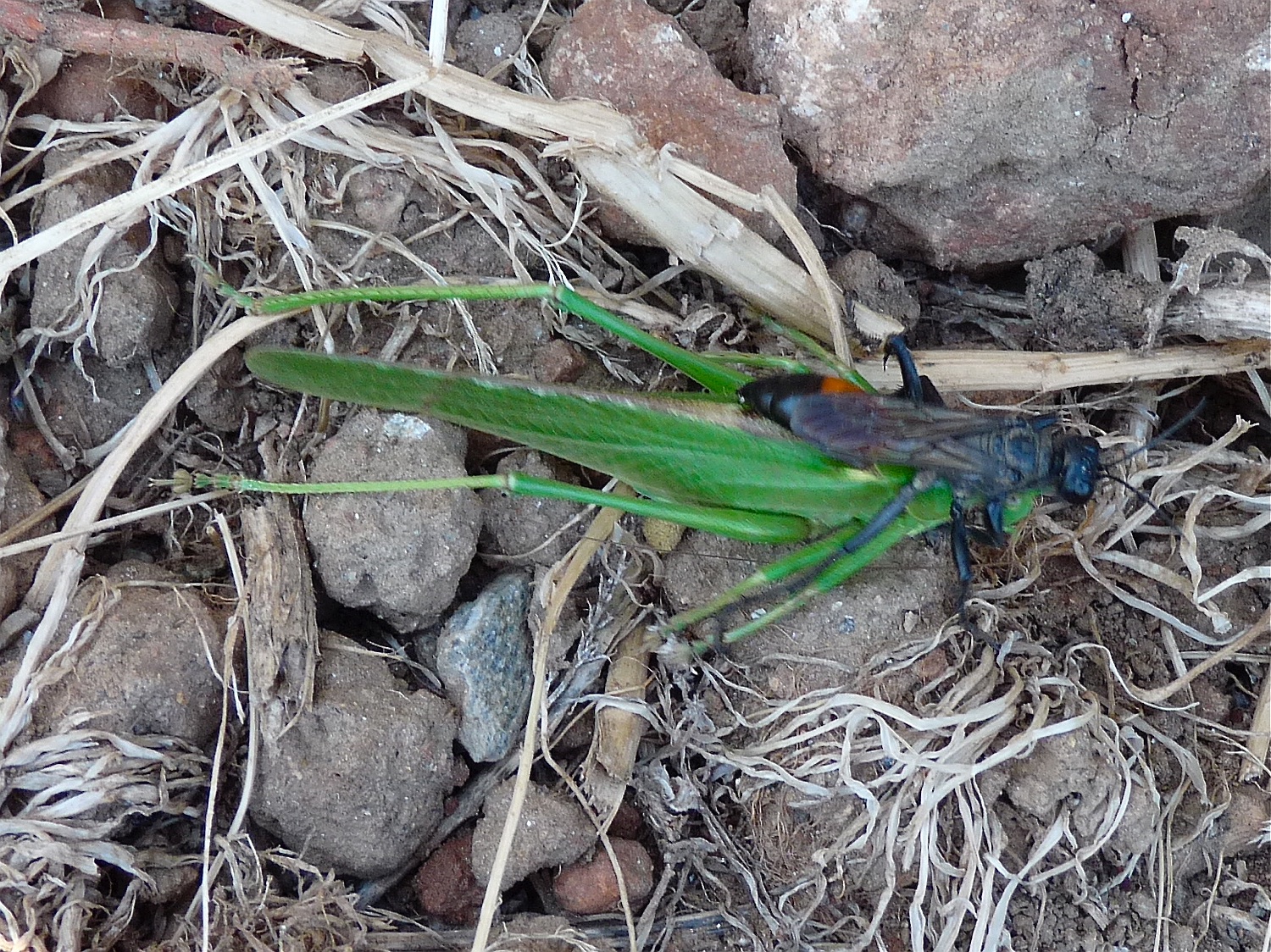
The Golden digger wasp provides its larva with Great green bush-crickets als prey. It paralyses the crickets permanently with a sting and then drags them to its underground nest where it deposits them into the nest chambers as food for its larvae.
Orthoptera on Naxos
Orthoptera on Naxos
The Photo gallery of the orthoptera and relatives gives an overview of the species.
A note on identification: I have identified the species presented below as best I can using my (not very comprehensive) identification books and information found on the internet; however, I am not a specialist and (as always) cannot guarantee the accuracy of the identifications. Sometimes a correct identification can only be managed by examining dead animals under the microscope. I would like to express my sincere thanks to the staff of the forum Insektenfotos.de and Rudolf Hofer for their help in identifying several species.
Here you can jump directly to the larger groups of the orthoptera (return with the back arrow or by swiping back):
1. Bush crickets: Great green bush-cricket – Southern wart-biter – Acrometopa syriaca – Anadrymadusa
2. Crickets: Mediterranean field cricket
3. Cave crickets: The endemic Cave cricket of Naxos is discussed on a separate page.
4. Grasshoppers: Pyrgomorpha conica – Nosed grasshopper – Calliptamus – Egyptian locust – Aiolopus – Oedipoda – Acrotylus insubricus – Chorthippus mollis – Omocestus
Crickets (Ensifera)
The Ensifera include the crickets, the bush crickets and other related groups. They are characterised by their very long antennae. Many species are predators or omnivores, while some species only eat plants. Adult female crickets can be recognised by their long ovipositor. In many species the wings are reduced.
Crickets use their front wings to produce their species-specific song: in the front part of one front wing they carry a “file” with fine teeth, over which a “scraper” on the other wing is pulled. The song serves to attract females and keep other males away. Crickets have highly developed hearing organs equipped with a tympanal membrane, located on their front tibia. Often these lay in a small depression, which enables the animal to locate the sound.
The crickets comprise the superfamilies Tettigonioidea (bush crickets), Grylloidea (crickets) and the often wingless Rhaphidophoroidea (cave crickets and camel crickets).
1. Bush crickets, Tettigonioidea
Great green bush-cricket, Tettigonia viridissima, L.
The easily recognisable Great green bush-cricket is very common in our region. The males sing mainly at night, producing a short, rapid scraping sound.
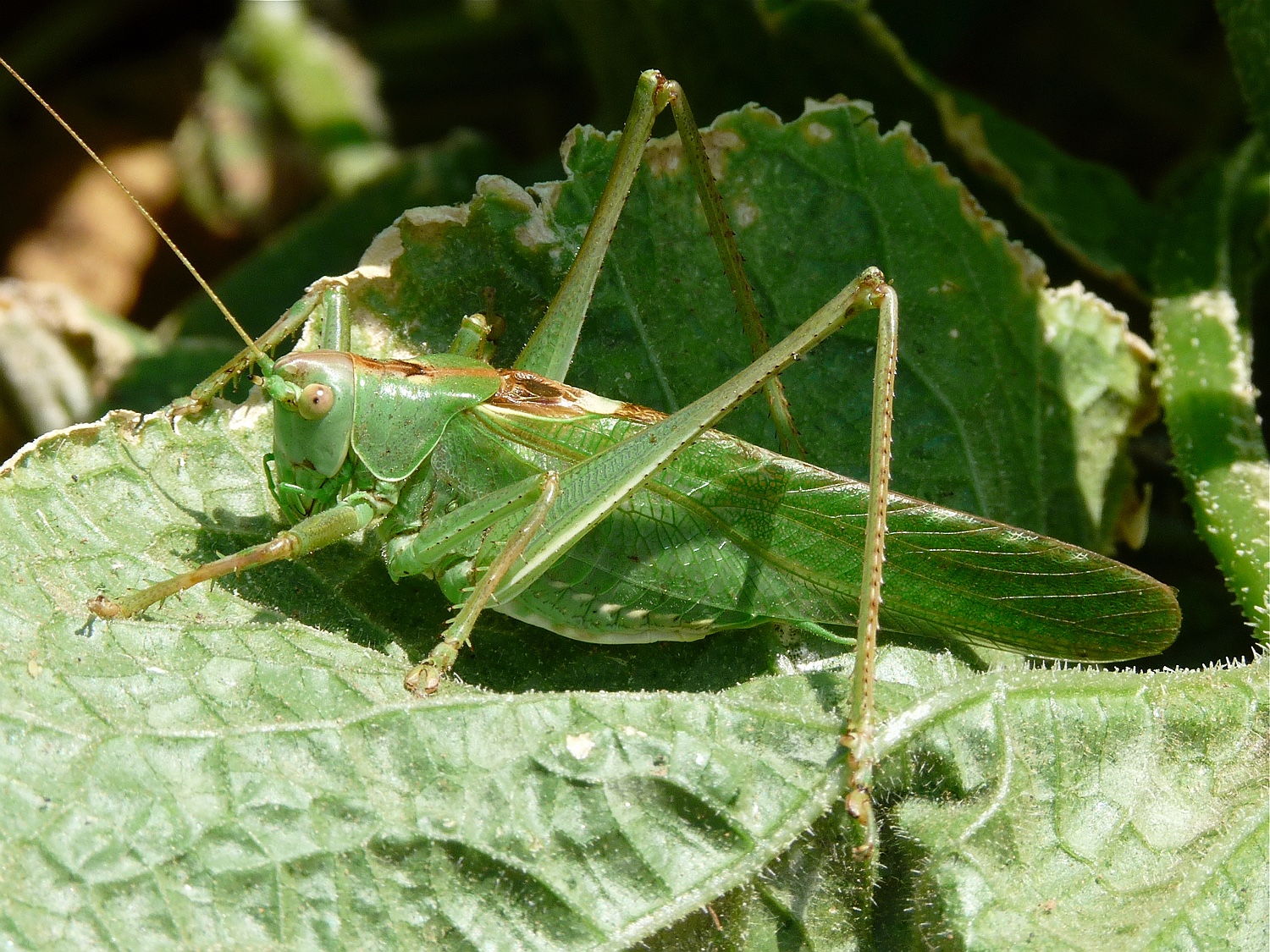
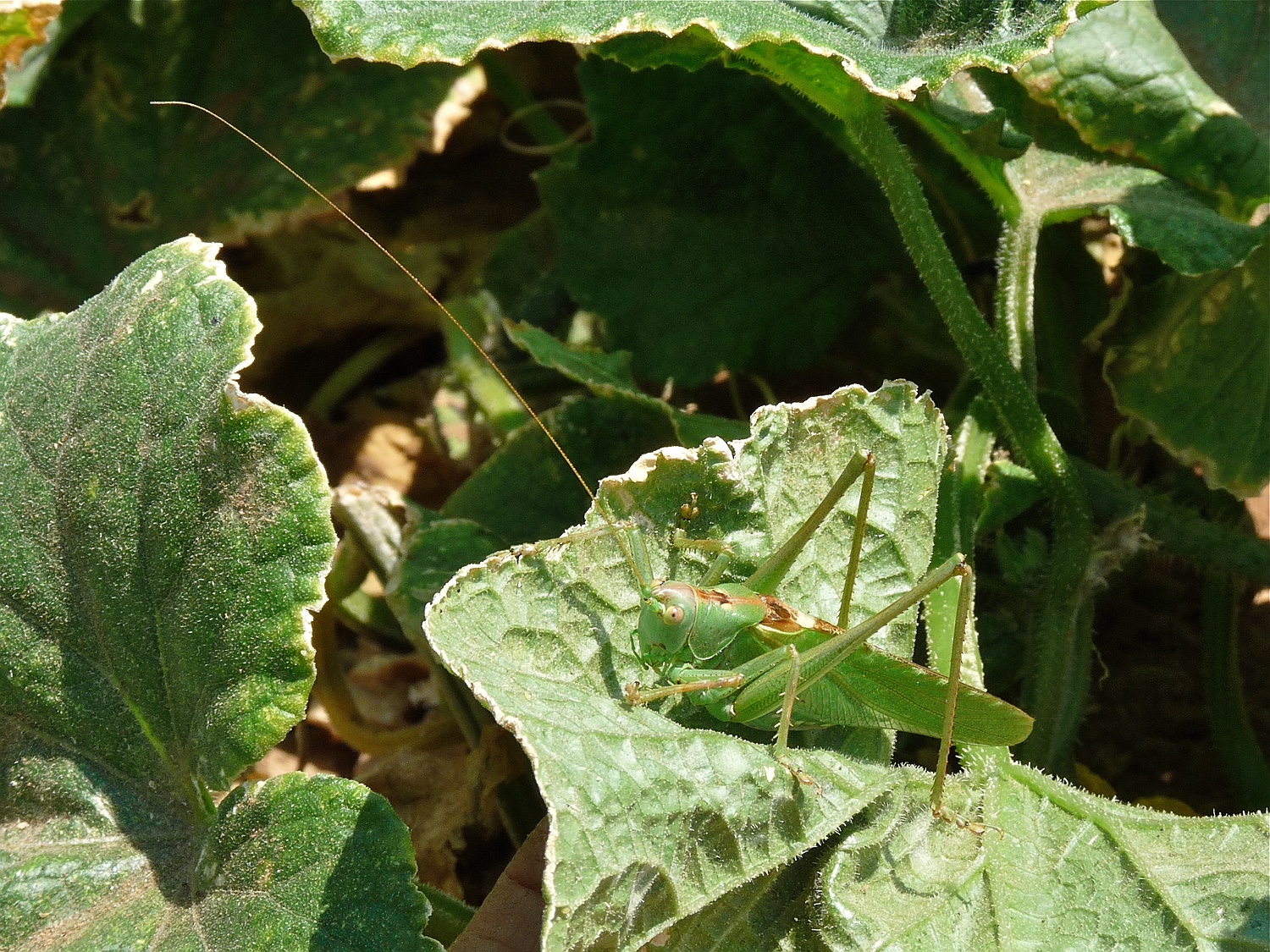
The Great green bush-cricket has particularly long antennae.
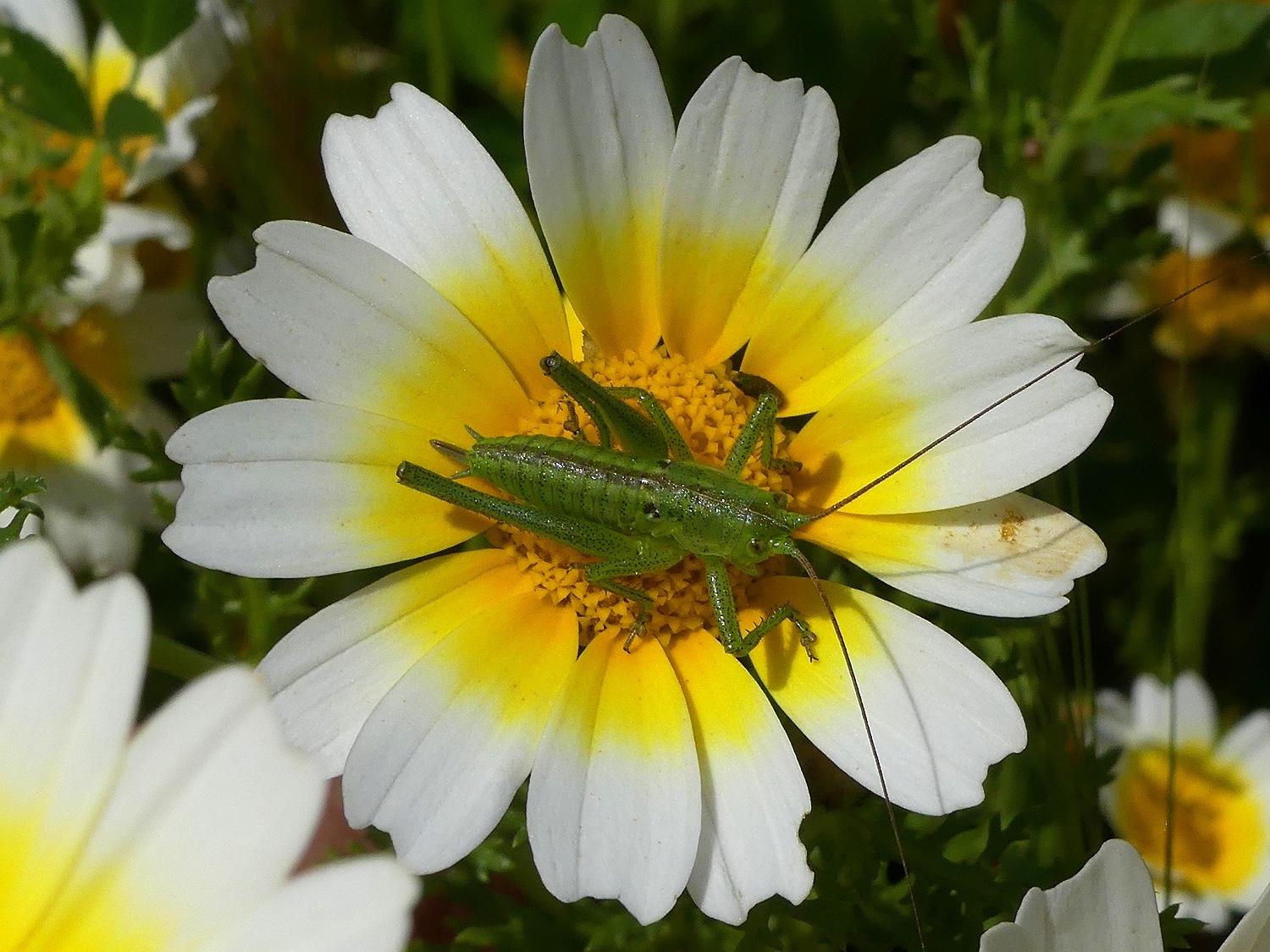
In spring, large numbers of larvae can be found on the flowers of the chrysanthemum.
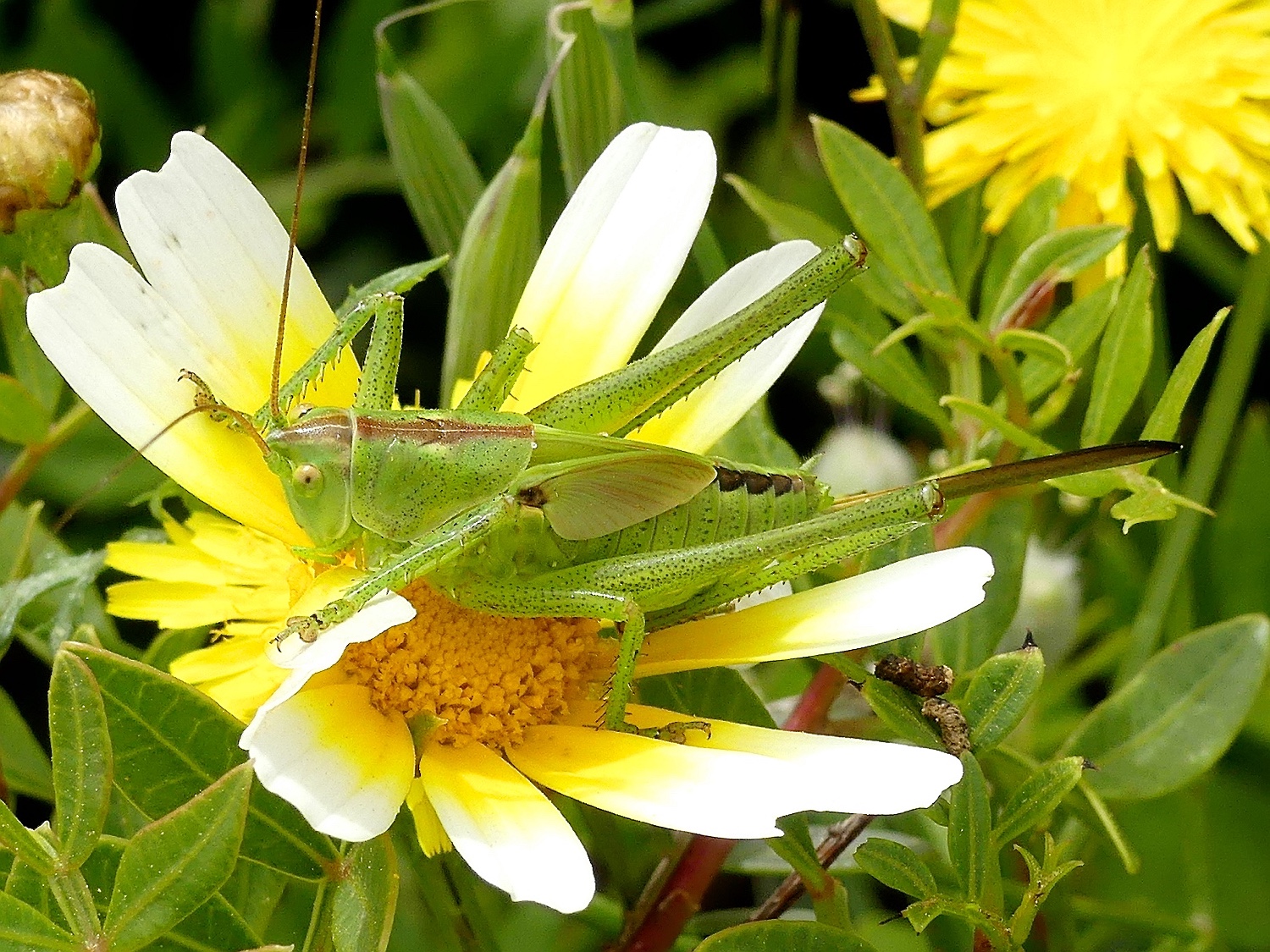
The older larval stages have short (non-functional) wings.
Southern wart-biter, Decticus albifrons, Fabricius
The Southern wart-biter reaches a body length of almost 4 cm. The front of the head is light in colour, and the neck shield has a white edge. When disturbed, wart-biters usually do not jump, but fly away in a conspicuous whirring flight.
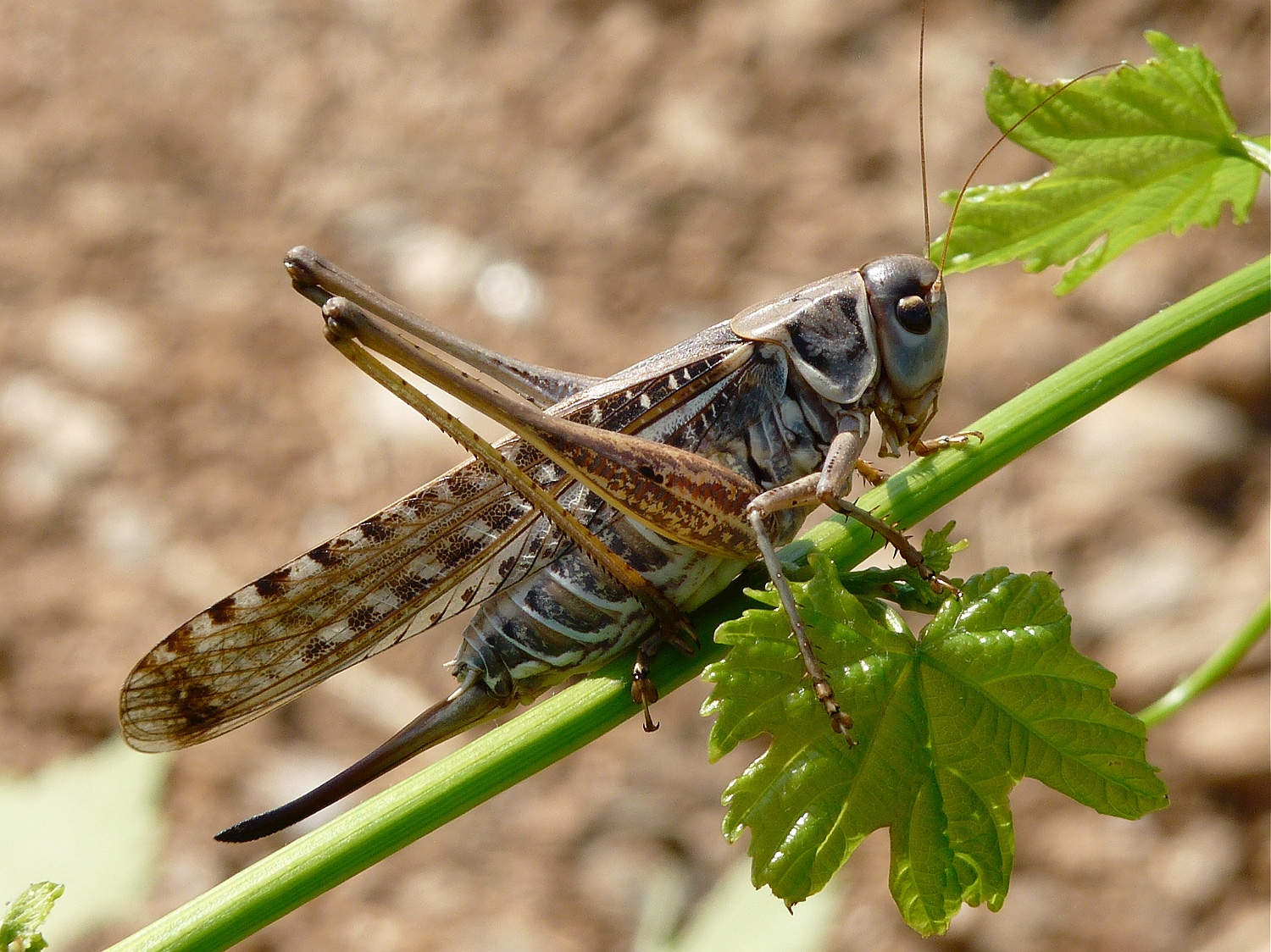
The Southern wart-biter is predominantly brown in colour; its wings extend far beyond its abdomen. The females have a long ovipositor.
Acrometopa syriaca, Brunner von Wattenwyl
The sickle-bearing crickets are a subfamily of the bush crickets that are notable for their particularly long legs. They are especially common in southern Europe and Asia. Our species could be A. syriaca, whose range extends from eastern Greece to Asia Minor and the Middle East.
I would like to express my sincere thanks to Mr Rudolf Hofer for identifying this and other species.
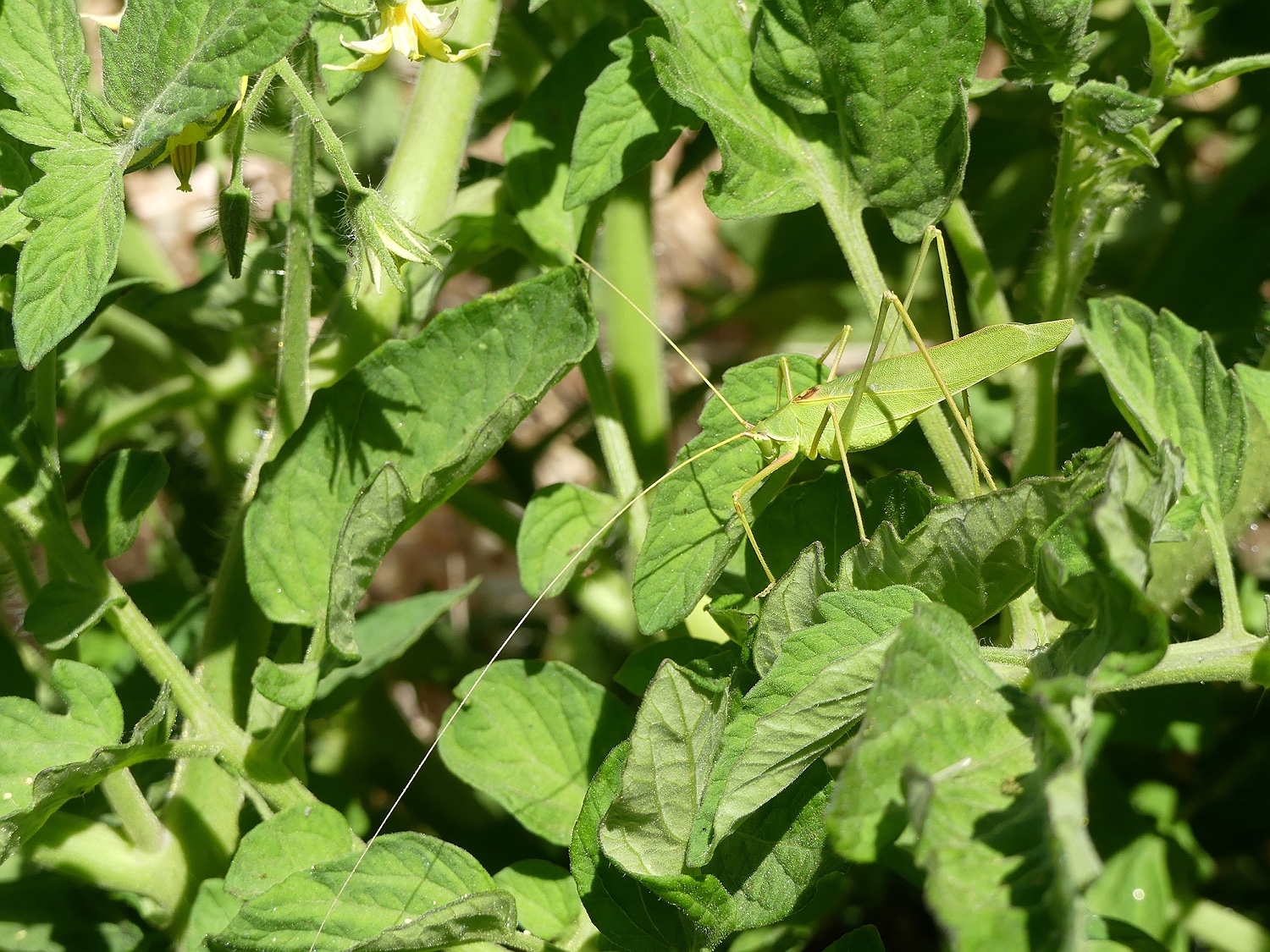
Acrometopa syriaca, like all sickle-bearing crickets, has extremely long, thin legs and long, light-coloured antennae. A characteristic feature is the white stripe on the ‘neck’.
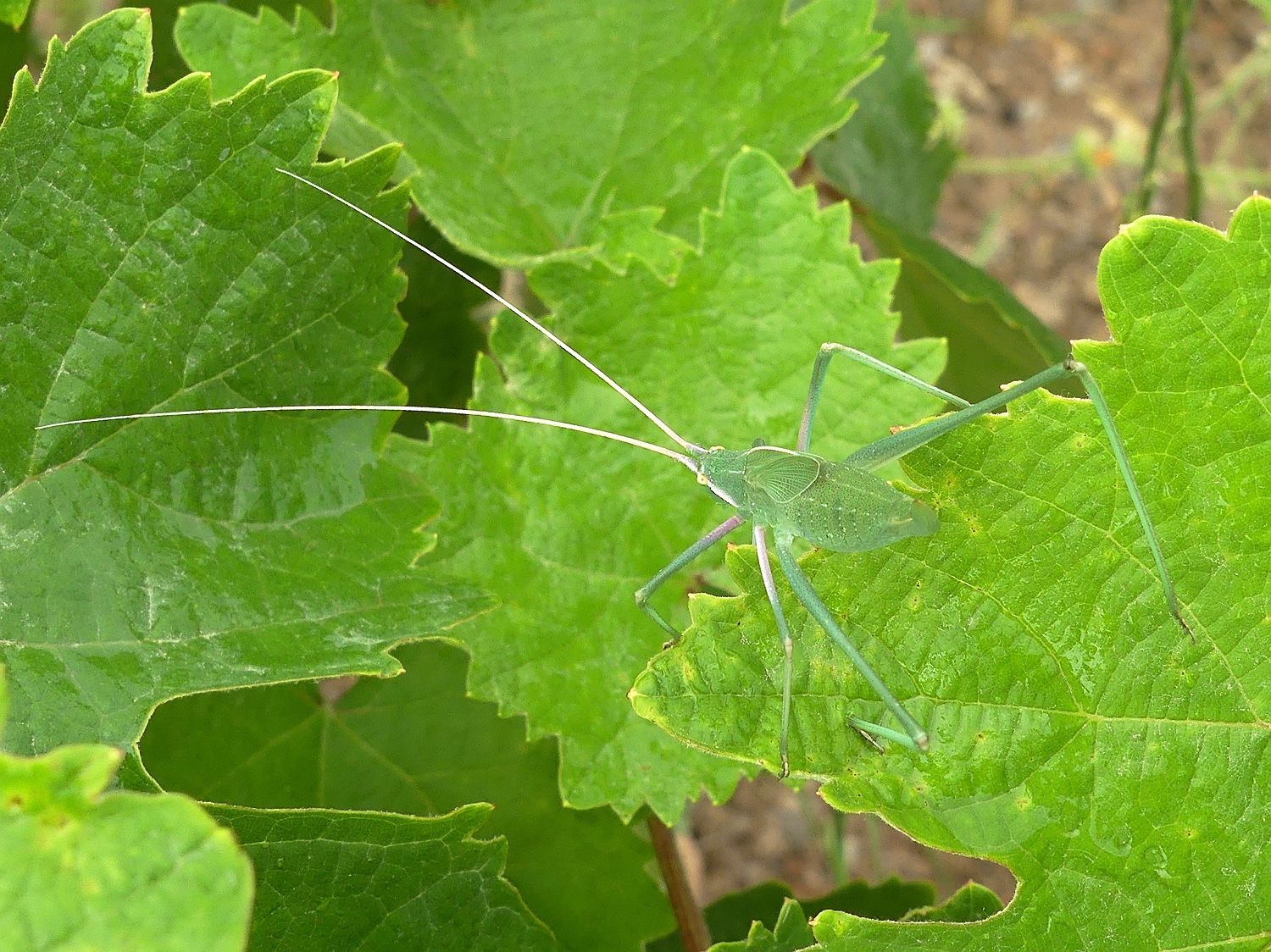
a larva
Anadrymadusa spec.
The genus Anadrymadusa occurs in Greece and the Near East. The species live predominantly in open, arid terrain.
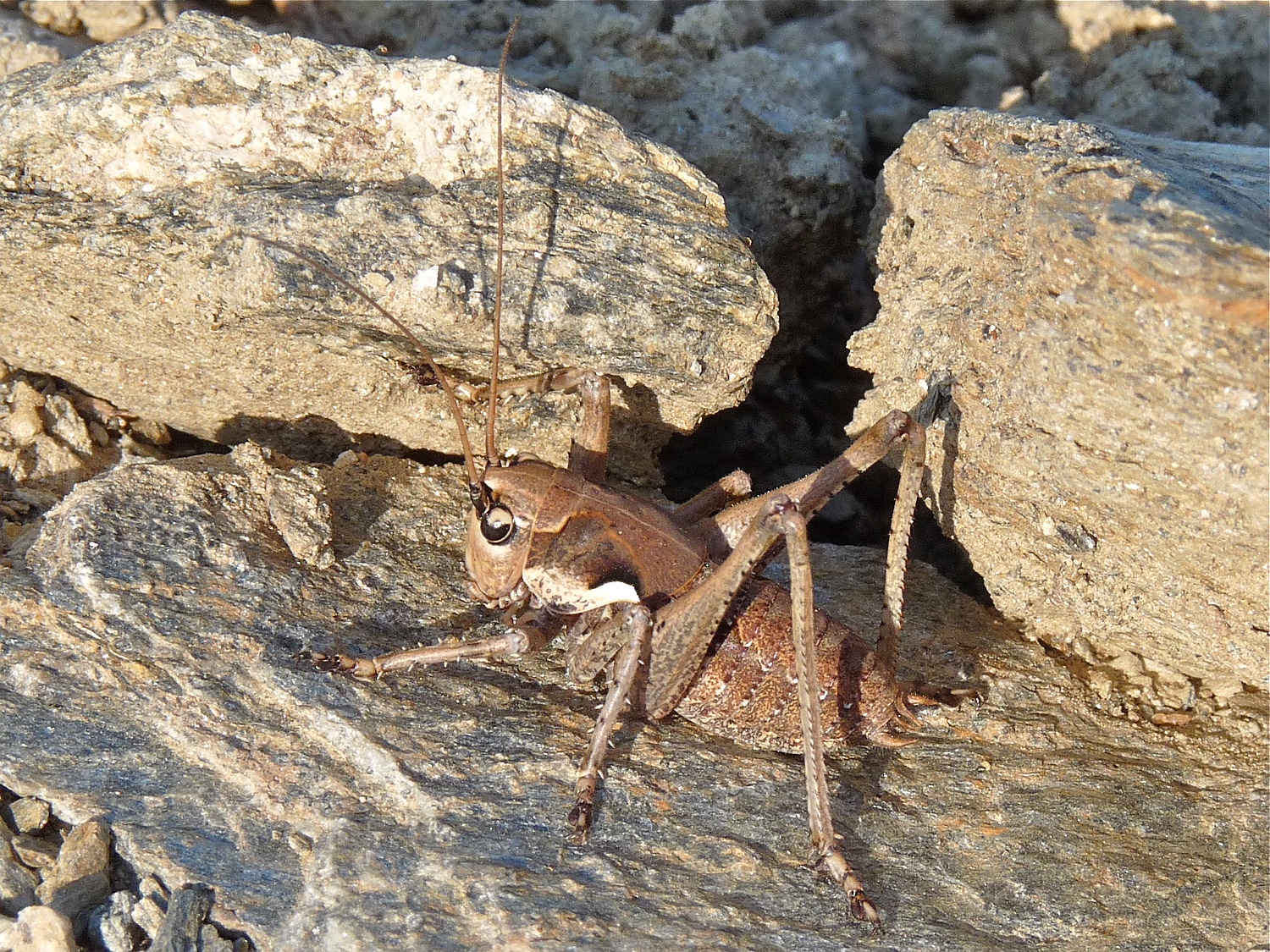
This bush-cricket probably belongs to the genus Anadrymadusa, which in Europe is only found in Greece and Turkey.
Unidentified species
Crickets and grasshoppers are not easy to identify, and I lack the necessary identification literature; therefore, some species must remain unidentified.
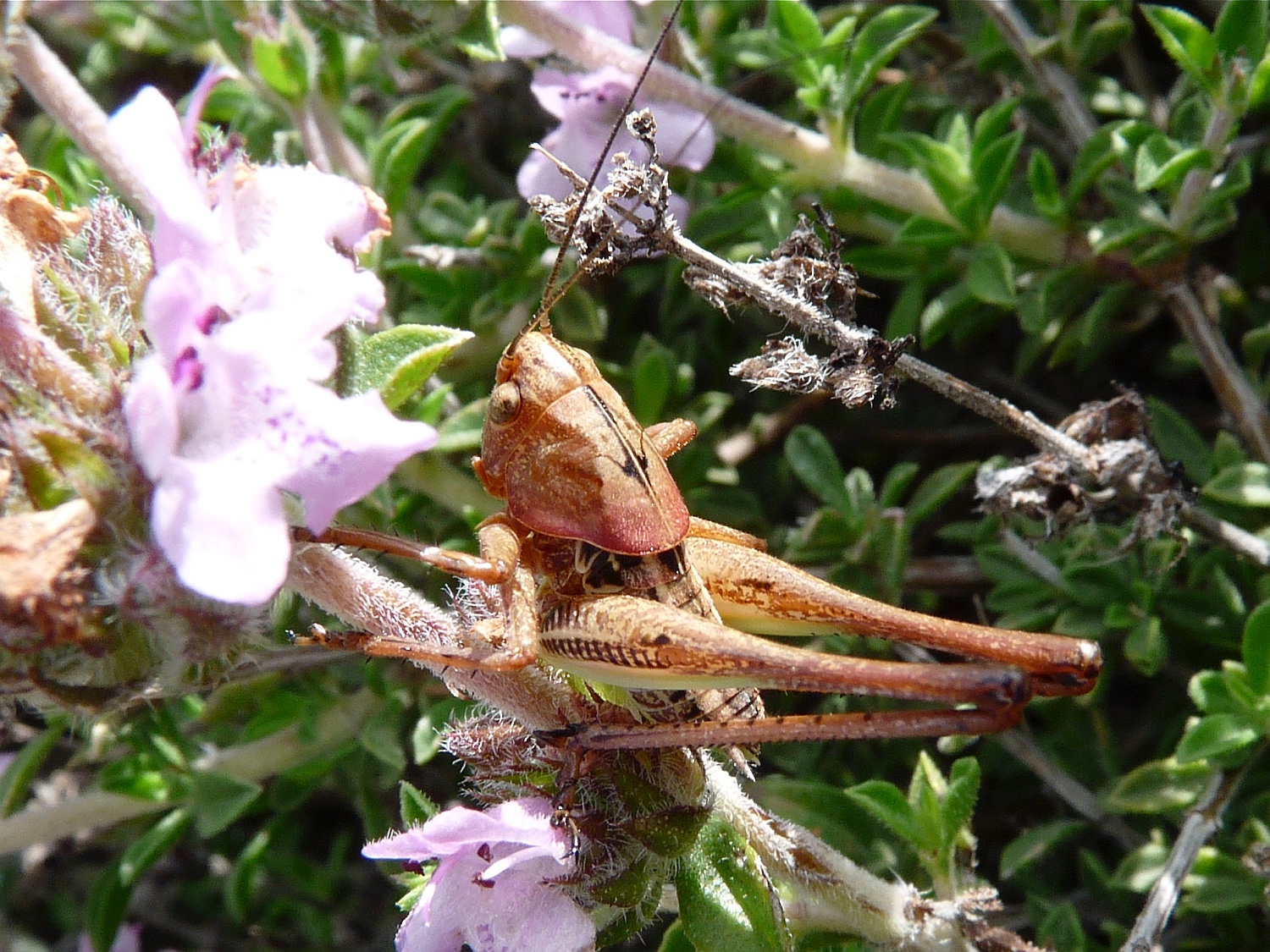
unidentified bush-cricket
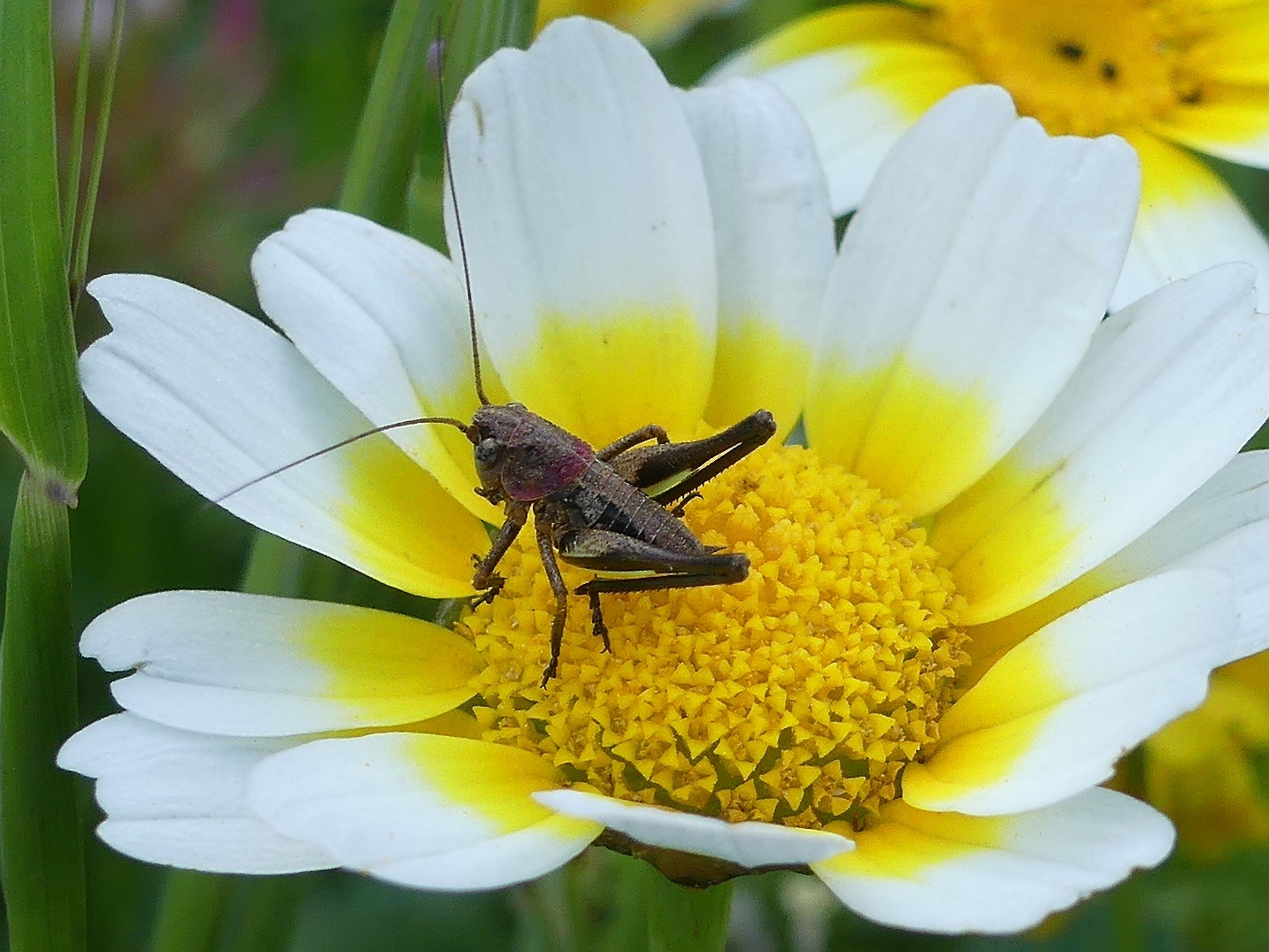
unidentified bush-cricket larva
2. Crickets (Grylloidea)
Crickets differ from bush-crickets in that their bodies are flattened from above, not from the side. Most species are dark in colour. Crickets produce a particularly loud song by rubbing the scraper on their left forewing against the file on their right forewing (the opposite of bush crickets). Crickets hardly jump and do not fly, but they can run quickly.
Mediterranean field cricket, Gryllus bimaculatus, De Geer
The almost black Mediterranean field cricket or Two-spotted cricket lives under stones and in the vegetation. Like its relative, the House cricket, it occasionally enters houses in summer, where it ennoys the residents with its very loud, difficult-to-locate nightly stridulation. The folded hind wings protrude from the body as long tips.
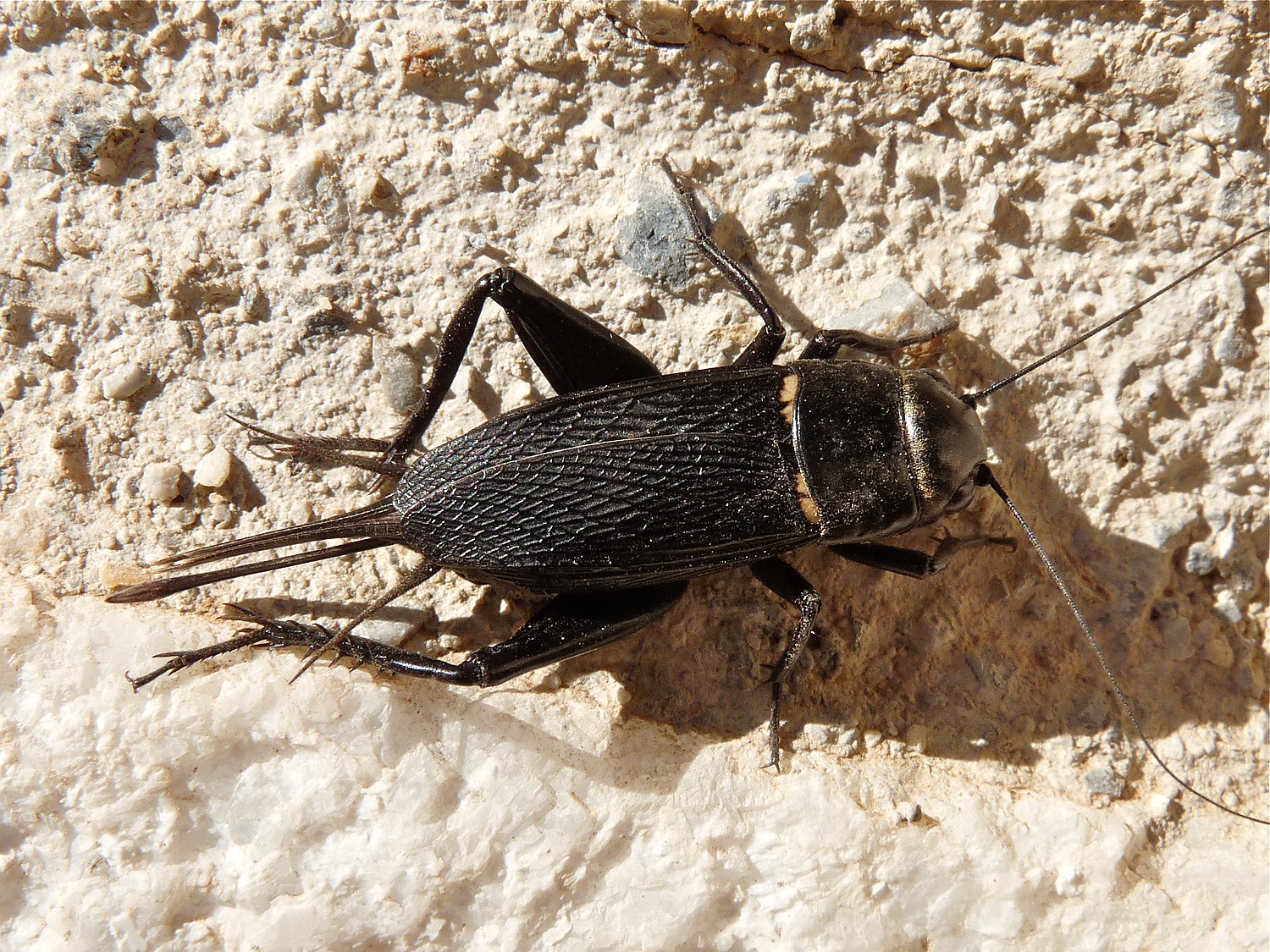
The almost black Two-spotted cricket is often very common in gardens and sings tirelessly all night.
3. Cave and greenhouse crickets (Rhaphidophoroidea)
An interesting representative of the Rhaphidophoroidea occurs on Naxos, the The endemic Cave cricket of Naxos, which is discussed on a separate page.
Grasshoppers (Caelifera)
With over 10,000 species, the Caelifera are a particularly large suborder of insects. The group is not very well researched yet, especially in the tropical regions, where new species are discovered every year. The grashoppers differ from the crickets mainly in their antennae, which are significantly shorter than their bodies. The short ovipositor of the females can be extended like a telescope.
The grasshoppers produce species-specific mating and territorial songs by rubbing the hind legs against the front wings. Sounds can also be produced by buzzing the wings during flight, by clicking the mouthparts or by drumming with the legs.
Pyrgomorpha conica, Olivier
The members of the family of the Pyrgomorph or Gaudy grasshoppers feed on leaves. They do not produce any sounds. Many species are conspicuously coloured, but not the native ones.
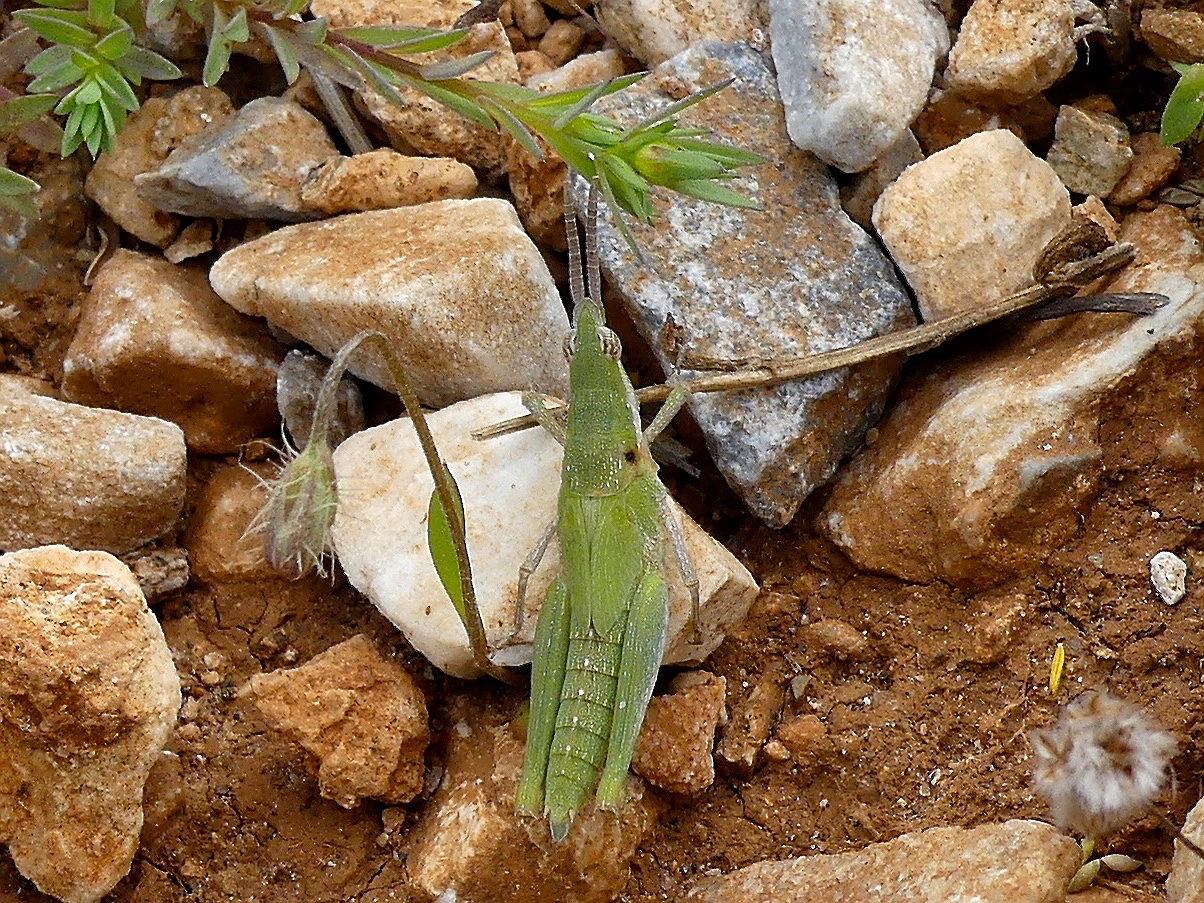
a green-coloured larva of Pyrgomorpha conica
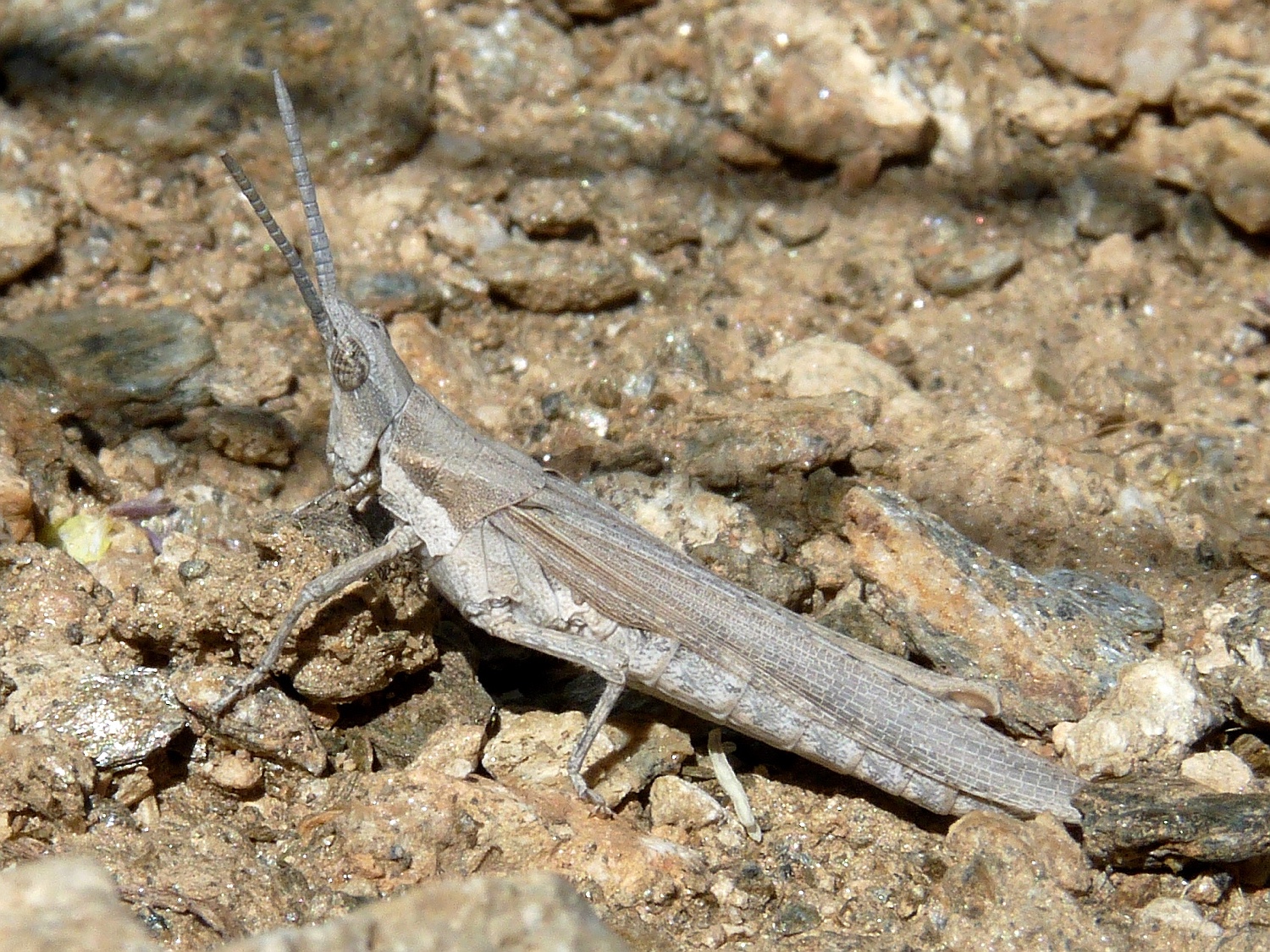
Adult specimens of Pyrgomorpha conica with their characteristic cone-shaped head are grey in colour.
Nosed grashopper, Acrida ungarica, Herbst
The Nosed grashopper (which belongs to the subfamily Acridinae) has a particularly slender body with very long hind legs and an elongated, pointy head with large, protruding eyes located at the very front. The antennae are flattened and slightly curved. The colouring is variable; the specimens can be greenish or brownish grey. Nosed grashoppers live in dry locations in the Mediterranean region; they are typical inhabitants of steppes. Only this species occurs in Europe.
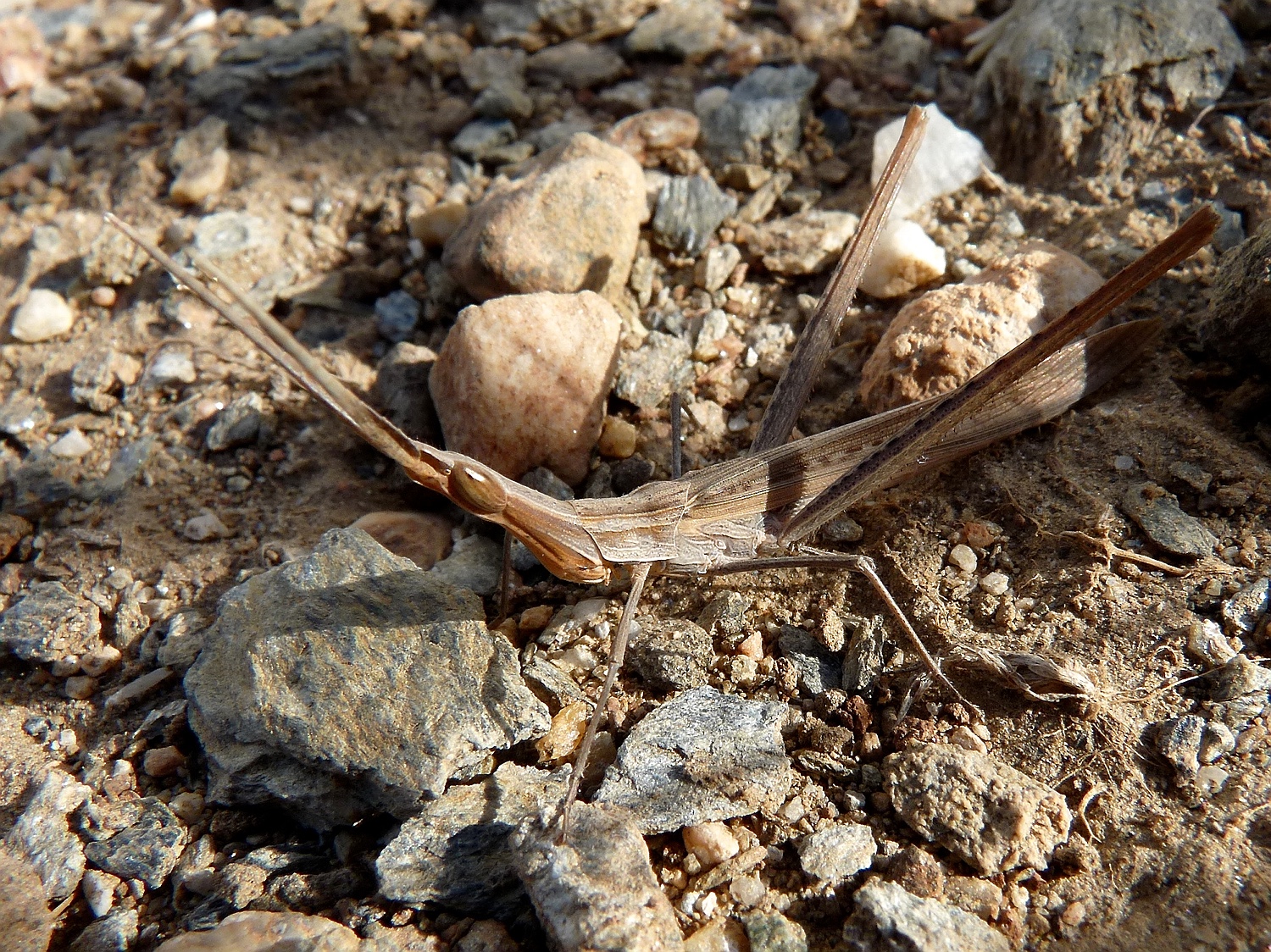
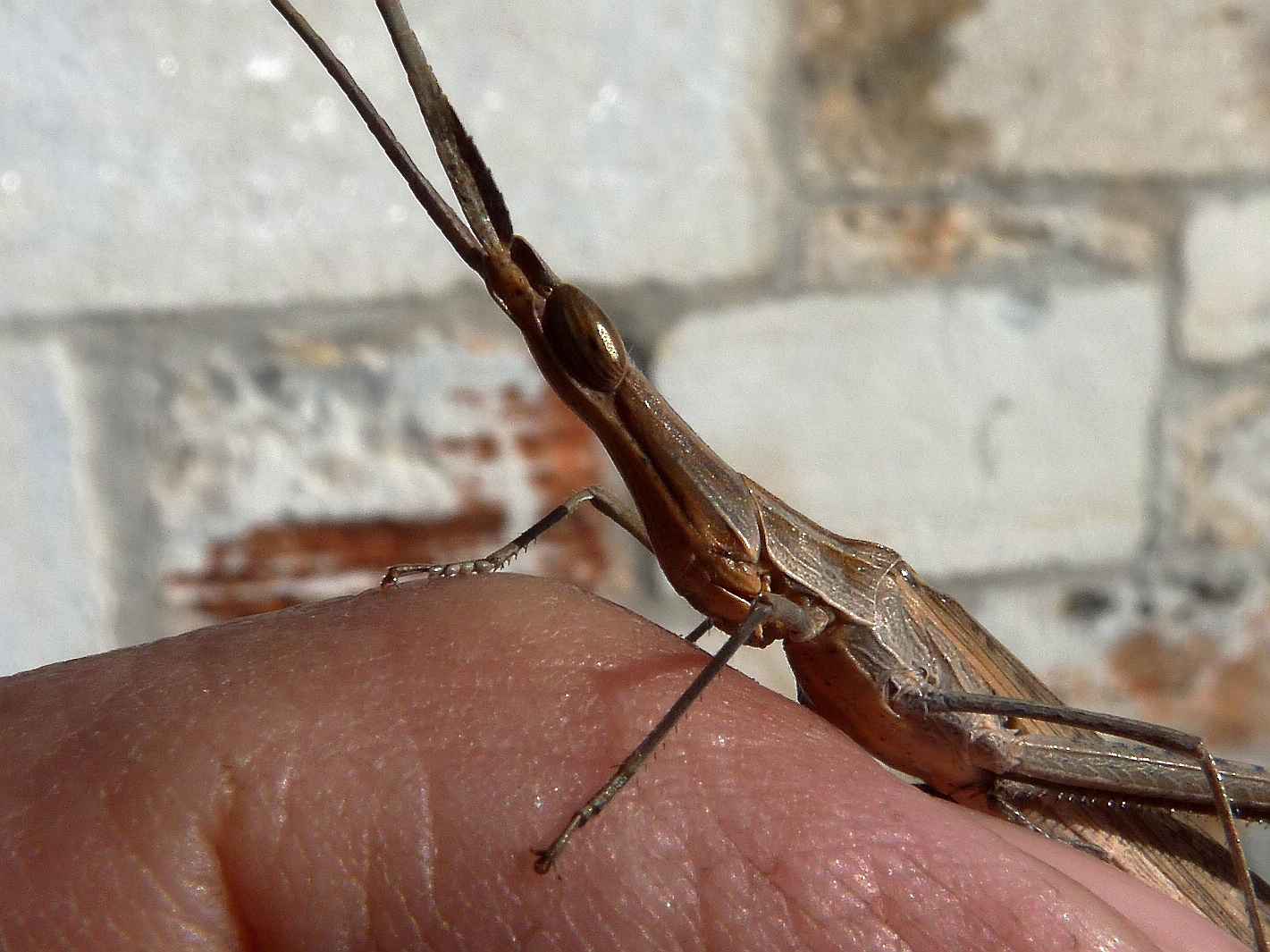
Here you can see the strangely shaped head of the Nosed grashopper.
Italian locust, Calliptamus italicus, L.
The Italian locust belongs to the subfamily Calliptaminae. It is very common in the Mediterranean region, but is now threatened in central Europe due to the intensification of agriculture. The colour is quite variable. Our specimen shows a light-coloured stripe that runs from the head along the sides of the neck shield and then along the wings.
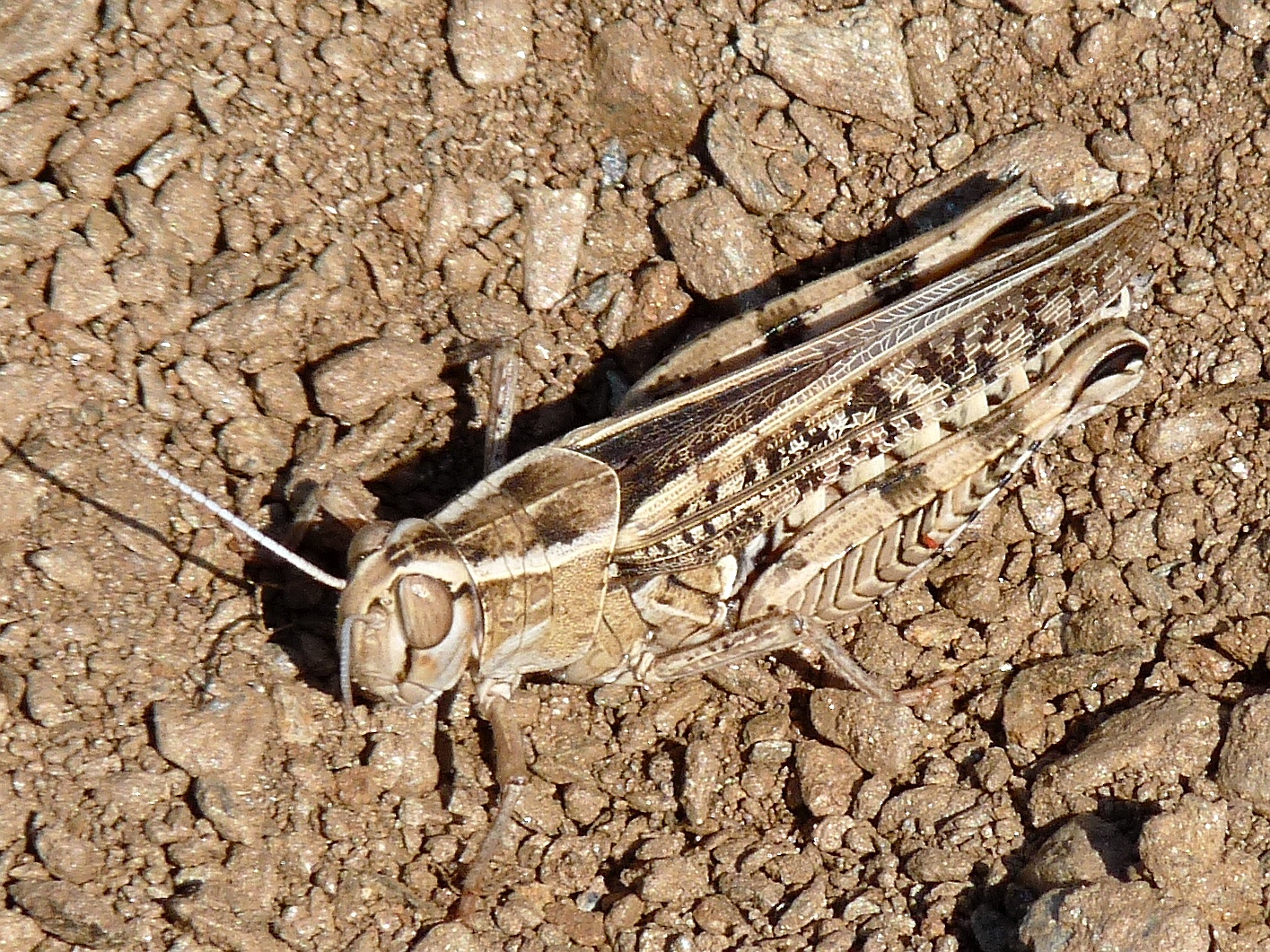
Like many grasshoppers, the Italian locust is very well camouflaged.
Calliptamus barbarus, Costa
Calliptamus barbarus is common in our region.
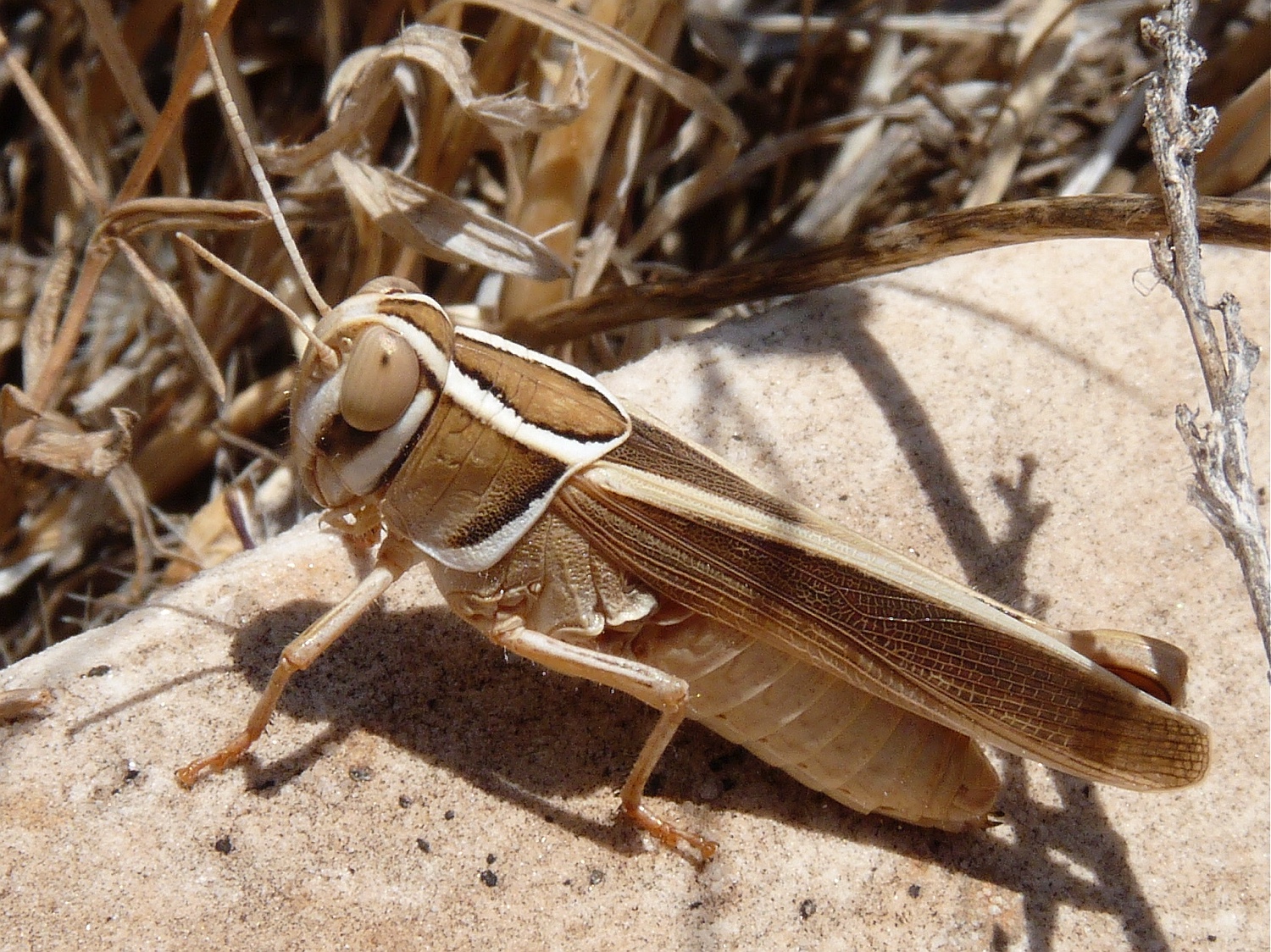
Calliptamus barbarus is very pretty. Its hind wings are slightly reddish in colour. On the photo a tiny simple eye can be seen between the compound eye and the antenna.
Egyptian locust, Anacridium aegyptium, L.
The Egyptian locust (subfamily Cyrtacanthacridinae) is very common on Naxos. As an adult, it is grey in colour (the larva is green).
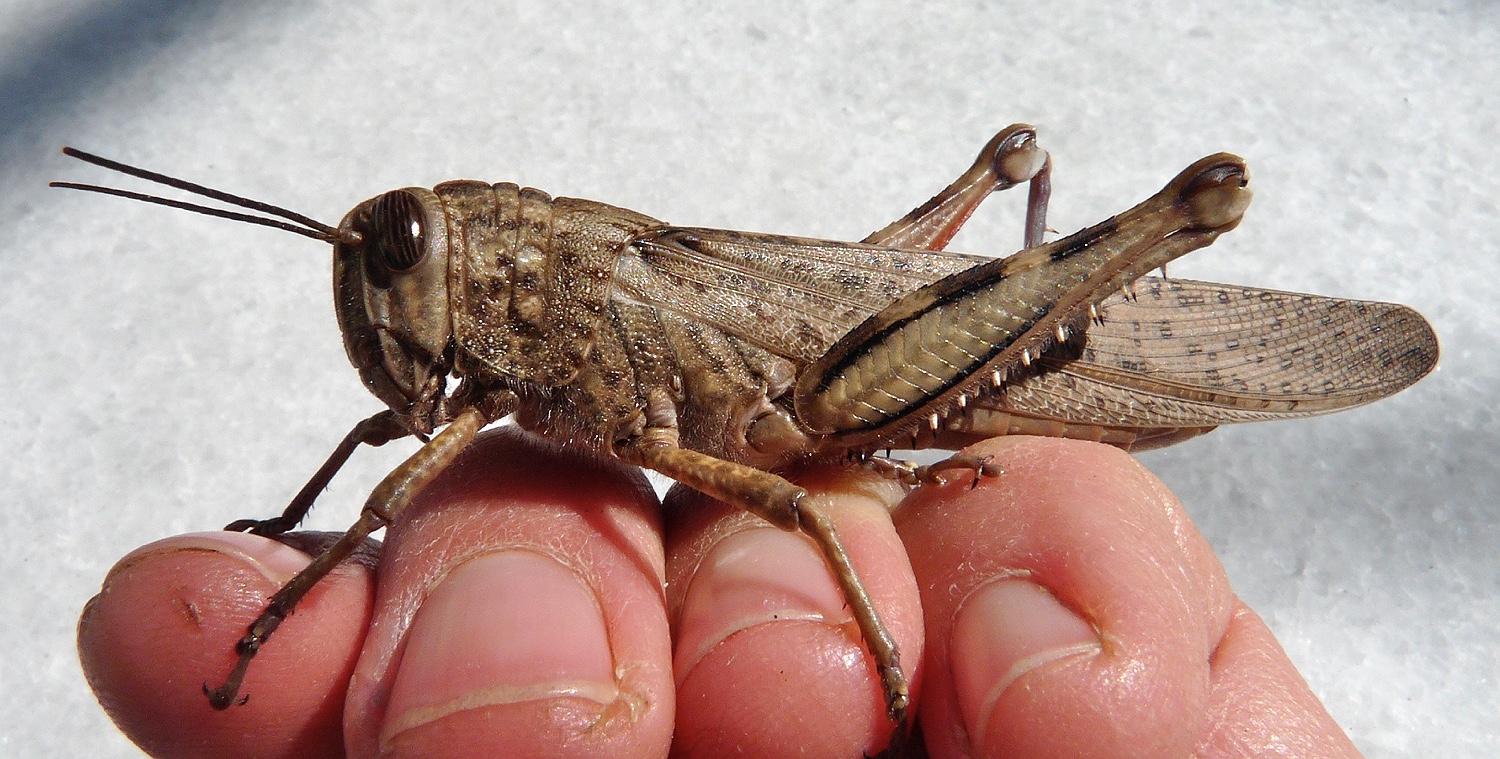
Characteristic features of the Egyptian locust are the longitudinal stripes on the compound eyes, the punctuation on the edge of the neck shield and the strong spines on the jumping legs.
Aiolopus thalassinus, Fabricius
Apart from the more conspicuous grasshopper species, there are a number of species in our garden that are more difficult to see and to identify. One of these is Aiolopus thalassinus who belongs, as do the following species, to the subfamily of the bandwings (Oedipodinae) which usually have colourful hindwings.
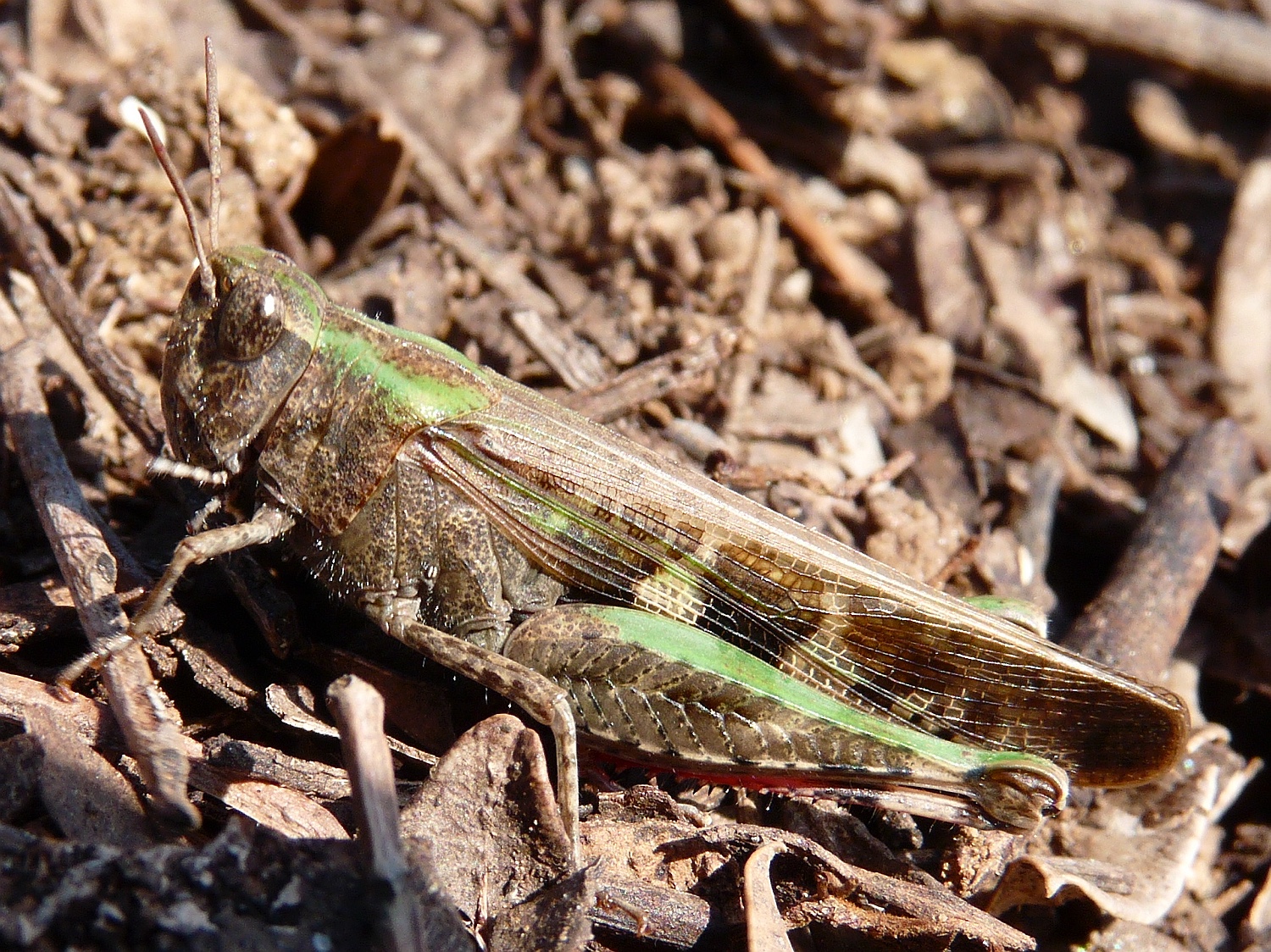
Aiolopus thalassinus often shows a green colouring on the body. The hindwings are transparent.
Blue-winged grasshopper, Oedipoda caerulescens, L.
The small Blue-winged grasshopper is very common in our region, both in vineyards and in the phrygana.
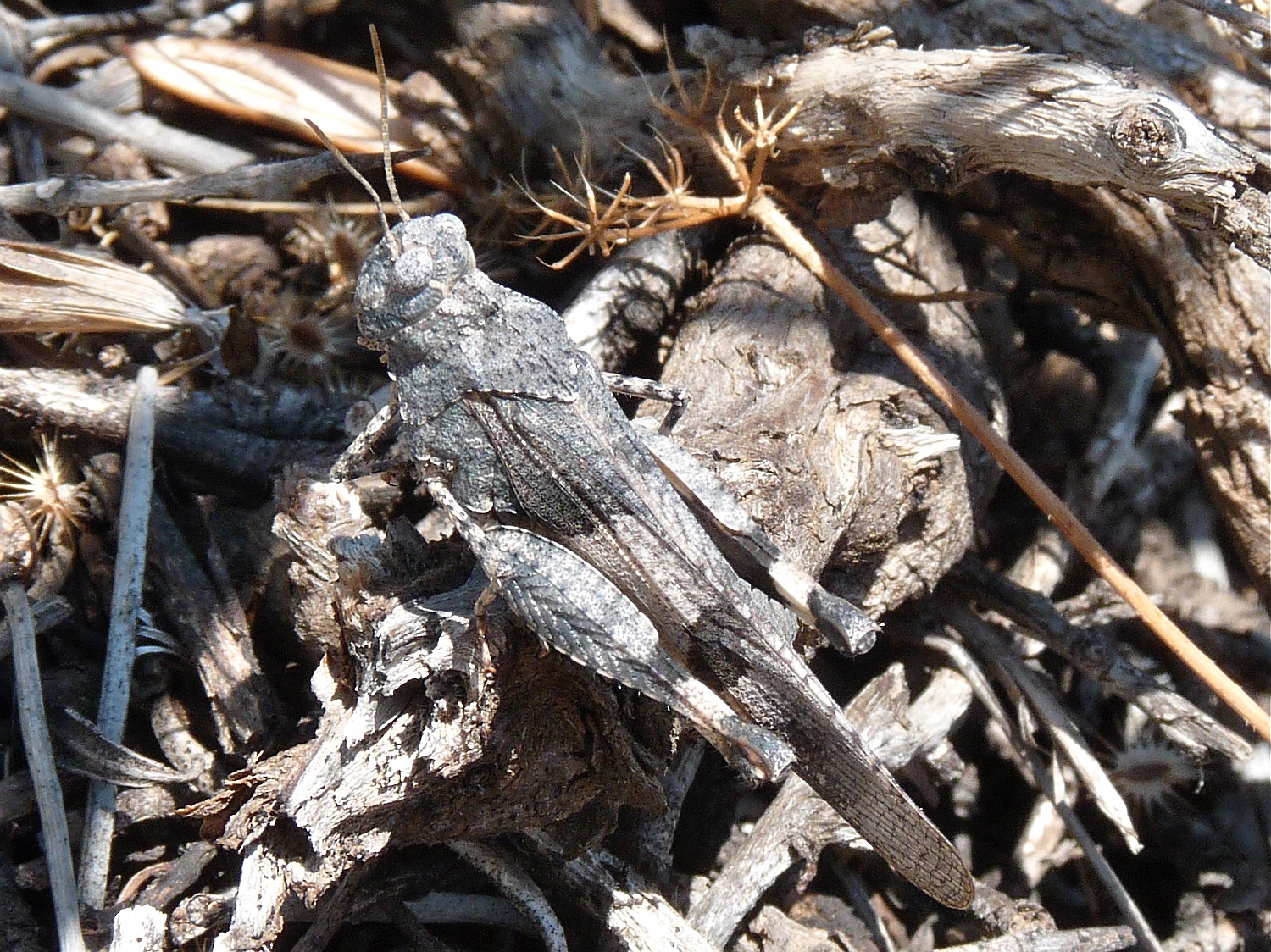
The blue-winged grasshopper occurs in a grey form (as seen here, mainly in dried vegetation)…
… or on the usual reddish soil with a brown colouring. The warty neck shield is typical.
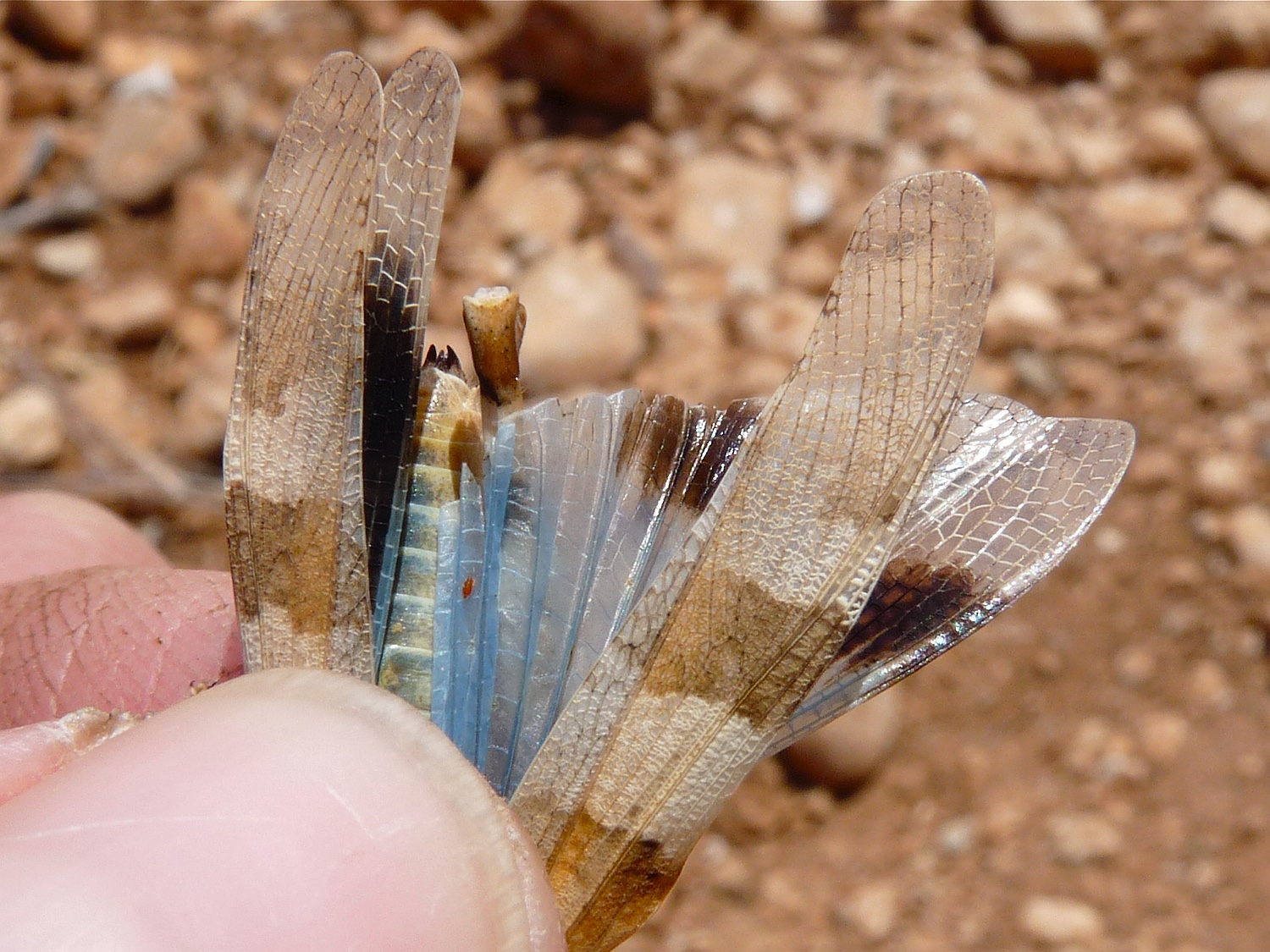
Here you can see the slightly blue-coloured hind wing with a darker band at the rear end.
Acrotylus insubricus, Scopoli
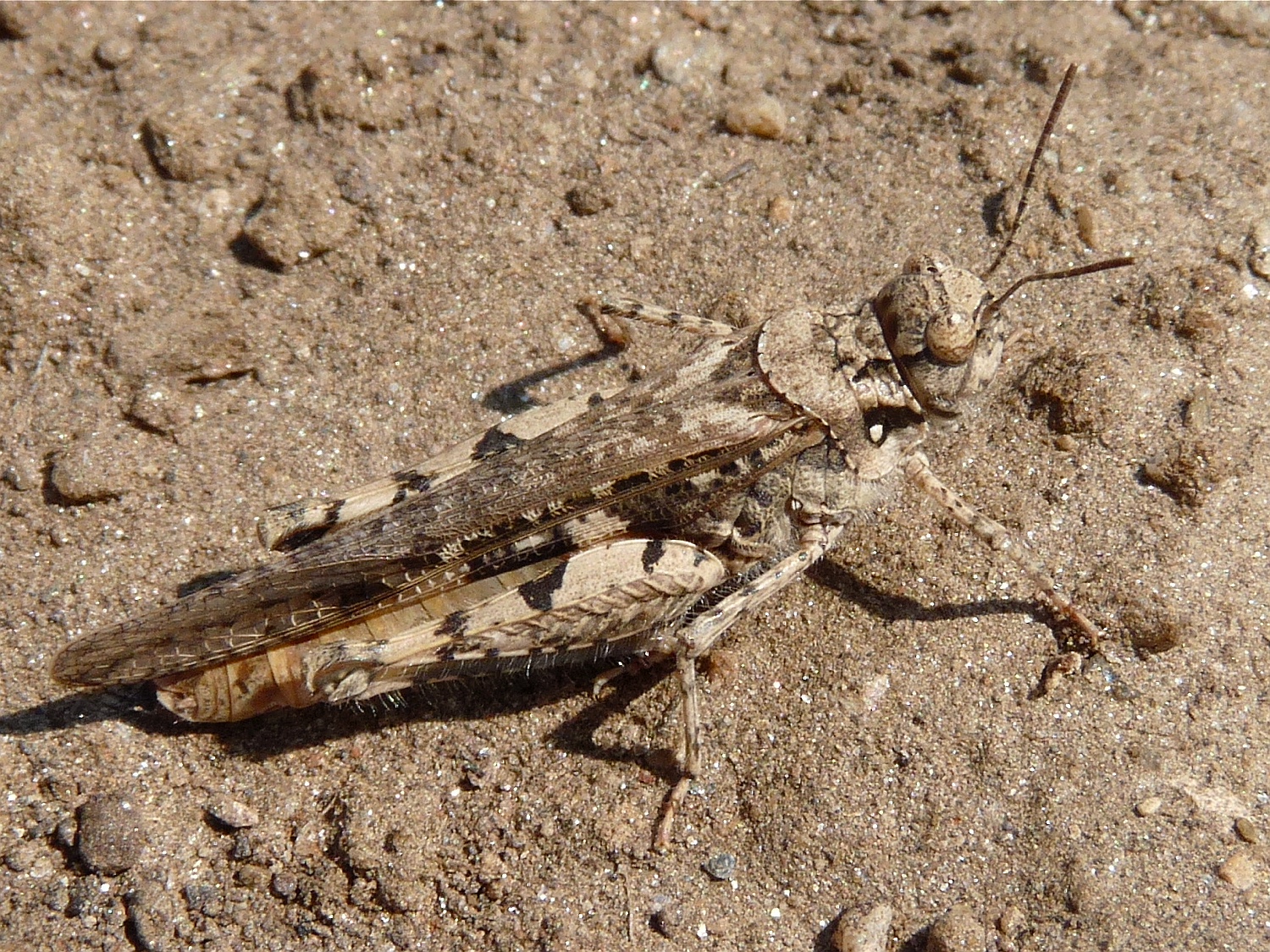
This small, short-antennaed grasshopper, which is very common in our region, is characterised by its rounded, short neck shield and the hair on its thorax and legs.
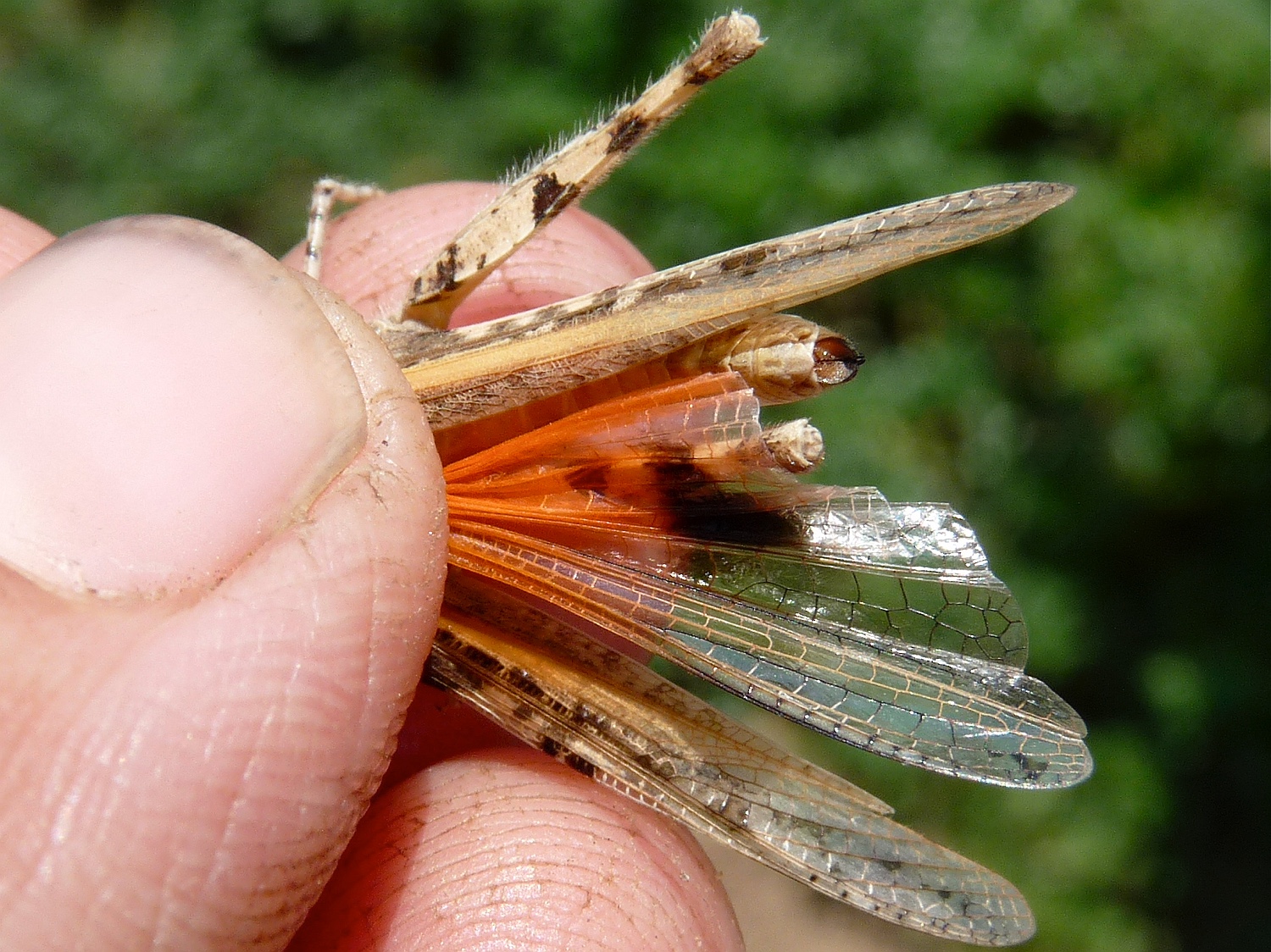
Its hind wings are red with a dark band at the rear edge.
Unidentified bandwing grasshoppers
One can frequently encounter other species of bandwings in our area that I have not yet been able to identify.
This grasshopper, which is also very common in our region, is quite similar to the blue-winged grasshopper, but has reddish hind wings and a non-warty neck shield with three distinct edges.
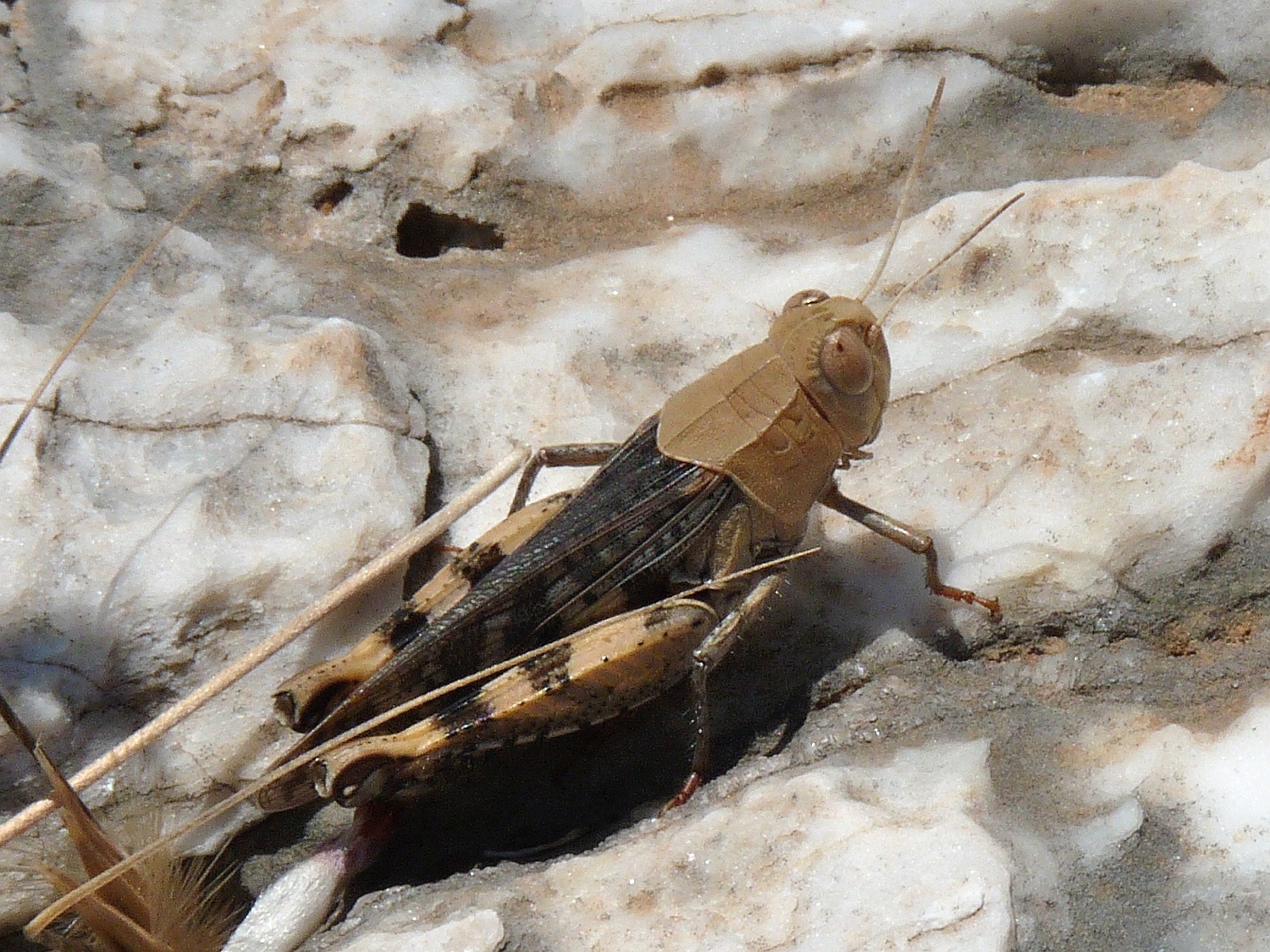
And another species (?) with a strikingly light-coloured head and neck shield and dark front wings.
Chorthippus mollis, Charpentier
This grasshopper belongs to the subfamily of the slant-faced grashoppers (Gomphocerinae). It occurs in our garden and can be recognised by its yellow abdomen.
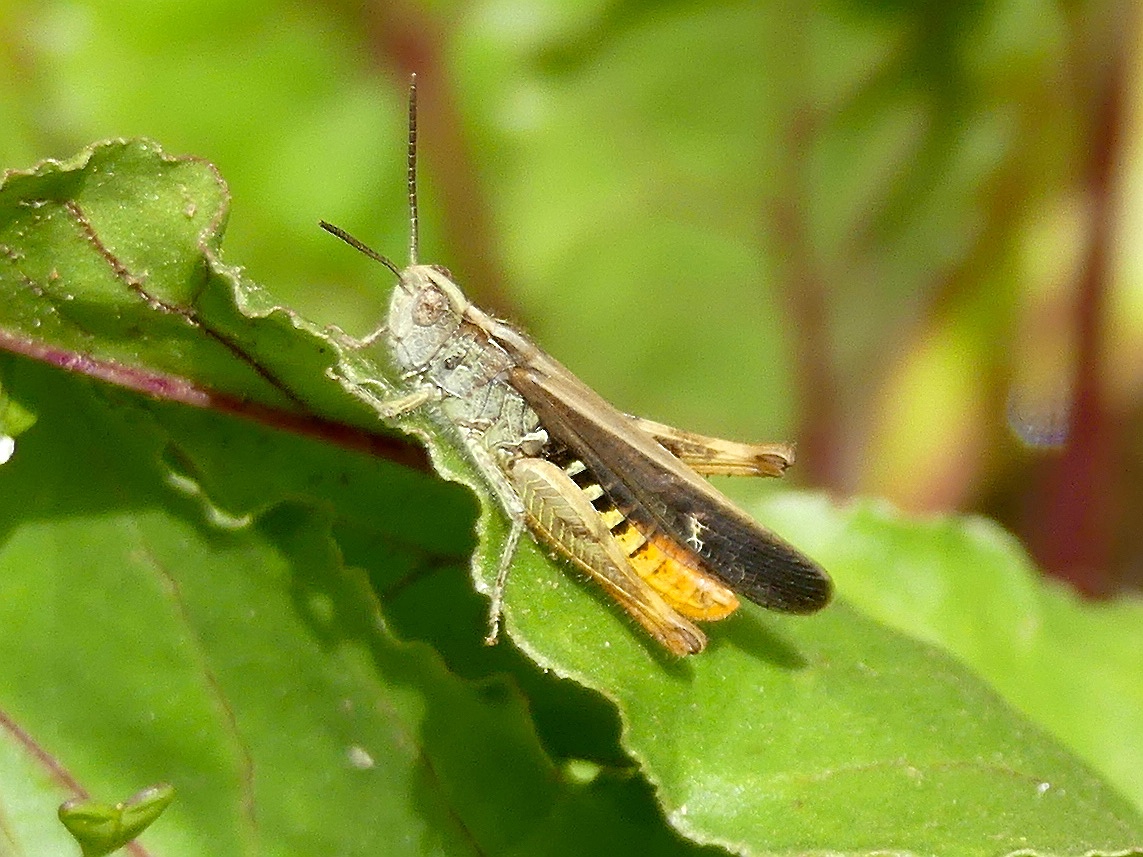
Omocestus spec.
Another genus of the Gomphocerinae occuring in the Mediterranean region and in Europe with several species is Omocestus.
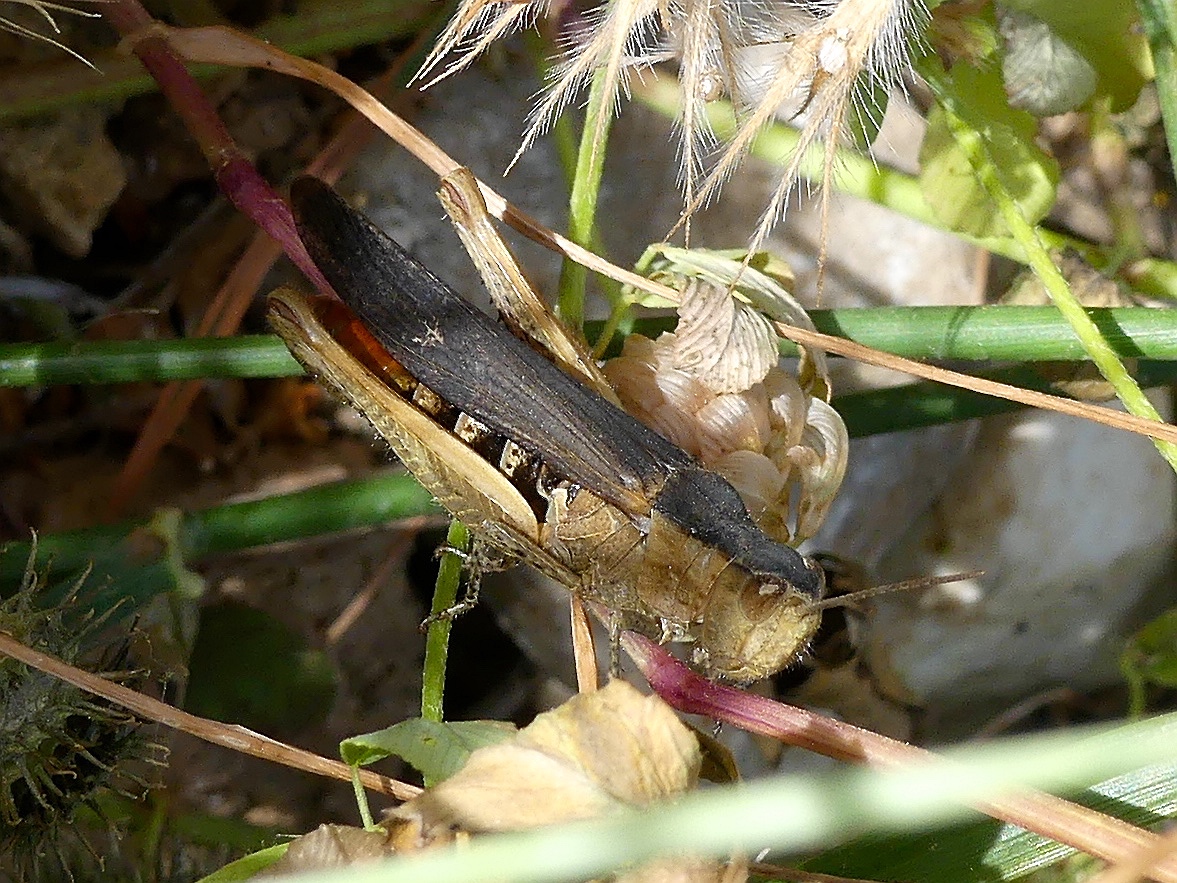
This grasshopper with a red abdomen and dark grey head probably belongs to the genus Omocestus.
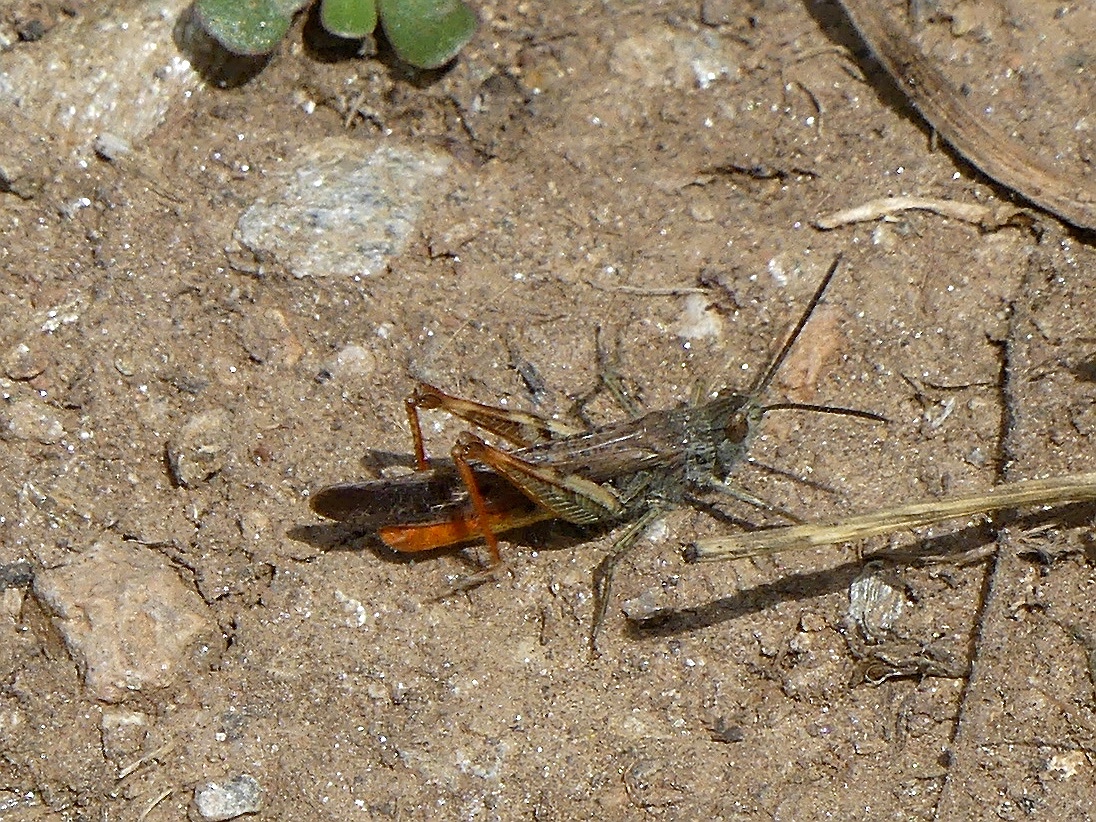
Here we also probably have a species of Omocestus, e.g. Omocestus rufipes.
I would like to express my sincere thanks to the staff of the forum Insektenfotos.de and Rudolf Hofer for helping me identify several of the orthoptera.
continue: The endemic Cave cricket of Naxos
back:
See also: