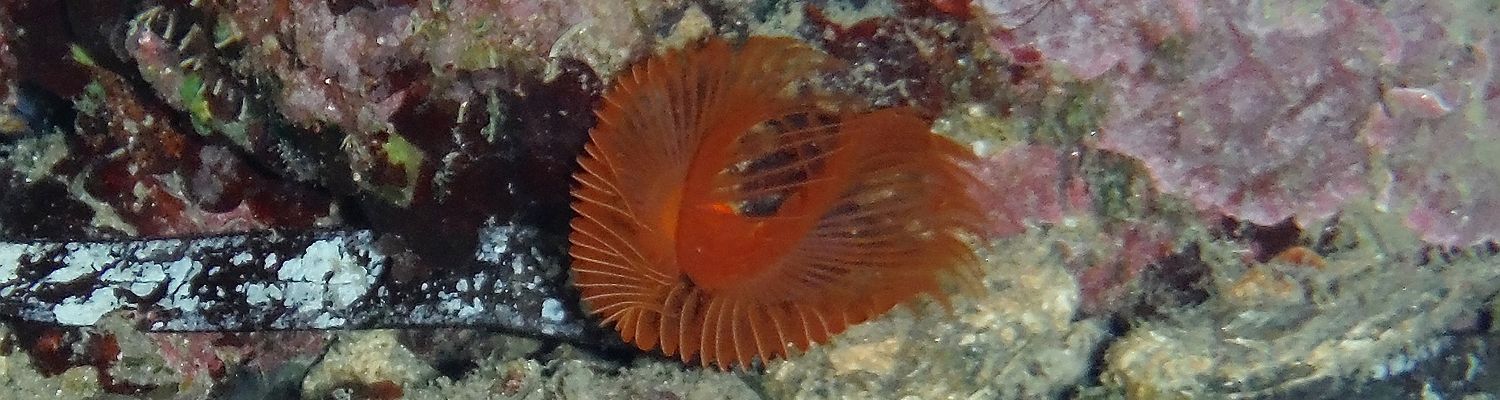
Marine worms
Many species of marine worms populate the seas, most of which are rarely seen due to their small size or hidden lifestyle. Nematodes, acorn worms, priapids, horseshoe worms, annelids, squirt worms, cord worms, chalcidians, flatworms and ragworms each represent their own phylum and, despite their superficial similarities, differ greatly in their body anatomy. On this page, we introduce some representatives of the large phylum of annelids. Annelids have a characteristically segmented body. In the past, it was therefore assumed that they were related to arthropods (insects, crustaceans, etc.); however, recent molecular studies suggest that the annelids form the so-called Lophotrochozoa together with several other classes of worms and the molluscs, as opposed to the Ecdysozoa, the “moulting animals”, which include the arthropods, the nematodes and other groups.
Like higher animals, annelids have a secondary body cavity, the coelom, an intestine, a simple ladder-like nervous system, a simply structured head with sensory organs and a mouth opening, and a closed circulatory system in which the dorsal vessel functions as the heart. The segments of the polychaeta, a large group of annelids, each carry a pair of foot-like appendages (parapodia) and a tuft of bristles; gills are also often located on the parapodia.
The Photo gallery of the marine animals provides an overview of the described species. Please note that I am not an expert and that some of the identifications may therefore be incorrect.
Here you can jump directly to the species (return with the back arrow or by swiping back):
Polychaetes: Bearded fireworm, Hermodice – Eulalia – Tube worms, Serpula, Protula – Spiral fan worm, Bispira – Polycirrus – Janua – Echiura: Green spoonworm, Bonellia viridis
Polychaetes
One of the largest and most diverse classes of the annelids are the polychaetes with around 10,000 species, most of which live in the sea. Over 800 species occur in the Mediterranean Sea. Among the polychaetes free-moving can be distinguished from sessile or sedentary forms. Among the free-moving species some swim in the water, other species live on or in the ground, others live among algae, in the sand gap system or in sponges. The diet of the polychaetes also varies greatly: some species are predatory, others feed on carrion or algae; while the sedentary species are plankton feeders, filter feeders or sediment feeders.
The largest polychaete species in the Mediterranean grow to between several decimeters and one meter in length; others, especially some species that live in the sand gap system, only reach a size of a fraction of a millimeter. Numerous tiny forms also live on algae; we can find these by placing the algae in a bowl of water and examining them with a magnifying glass. The largest and most conspicuous species in our region are the calcareous tube worms, which are not very common, and the bearded fireworm.
Bearded fireworm, Hermodice carunculata, Pallas
The Bearded fireworm belongs to the freely moving polychaetes. It lives in algae beds and sea grass meadows as well as on rocks, from the sea surface to a depth of about 25 meters. The fireworm reaches a length of 30 cm. Its flattened, reddish-brown body is divided into over 100 segments. Each segment has small brown parapodia on the sides with reddish-brown, feathery gills and white bristles, which the worm raises when it is disturbed.
The Bearded fireworm is diurnal; it is not uncommon to see one while snorkelling in shallow coastal waters, or even from land. It feeds on carrion and small invertebrates such as other worms, but mainly on sea anemones and corals, which it scrapes off with special mouth plates.

The Bearded fireworm is unmistakable. It is not rare.
Under no circumstances should you touch a fireworm: its fine bristles break off easily and penetrate the skin, causing burning pain and inflammation that takes days to heal. The best way to remove the bristles is with adhesive tape.
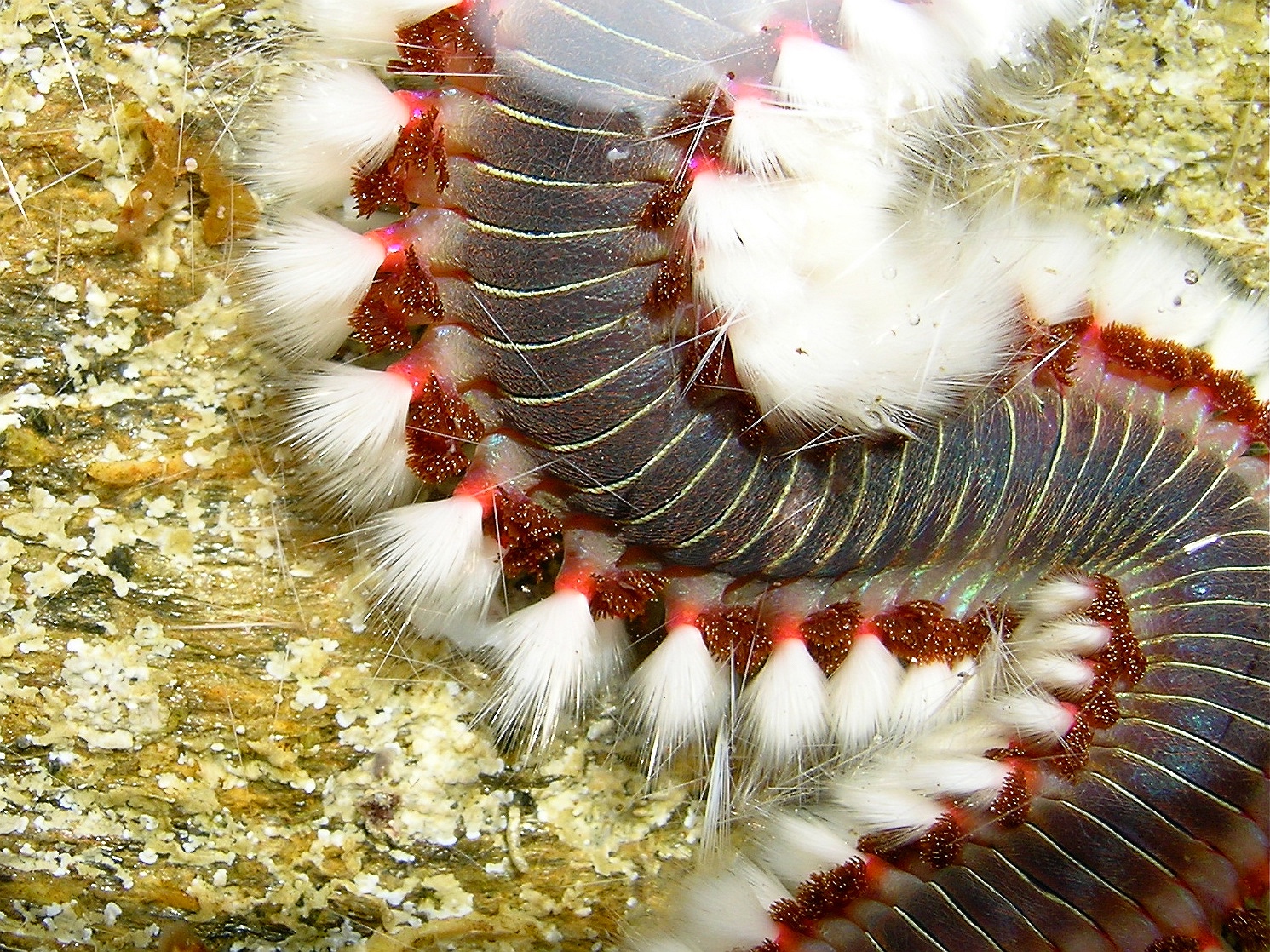
When disturbed, the fireworm flares its poisonous bristles. Apart from the clusters of bristles, the reddish-brown, feathery gills on the parapodia are visible in the picture.
Eulalia clavigera, Audouin & Milne Edwards
This small greenish worm also belongs to the polychaetes.
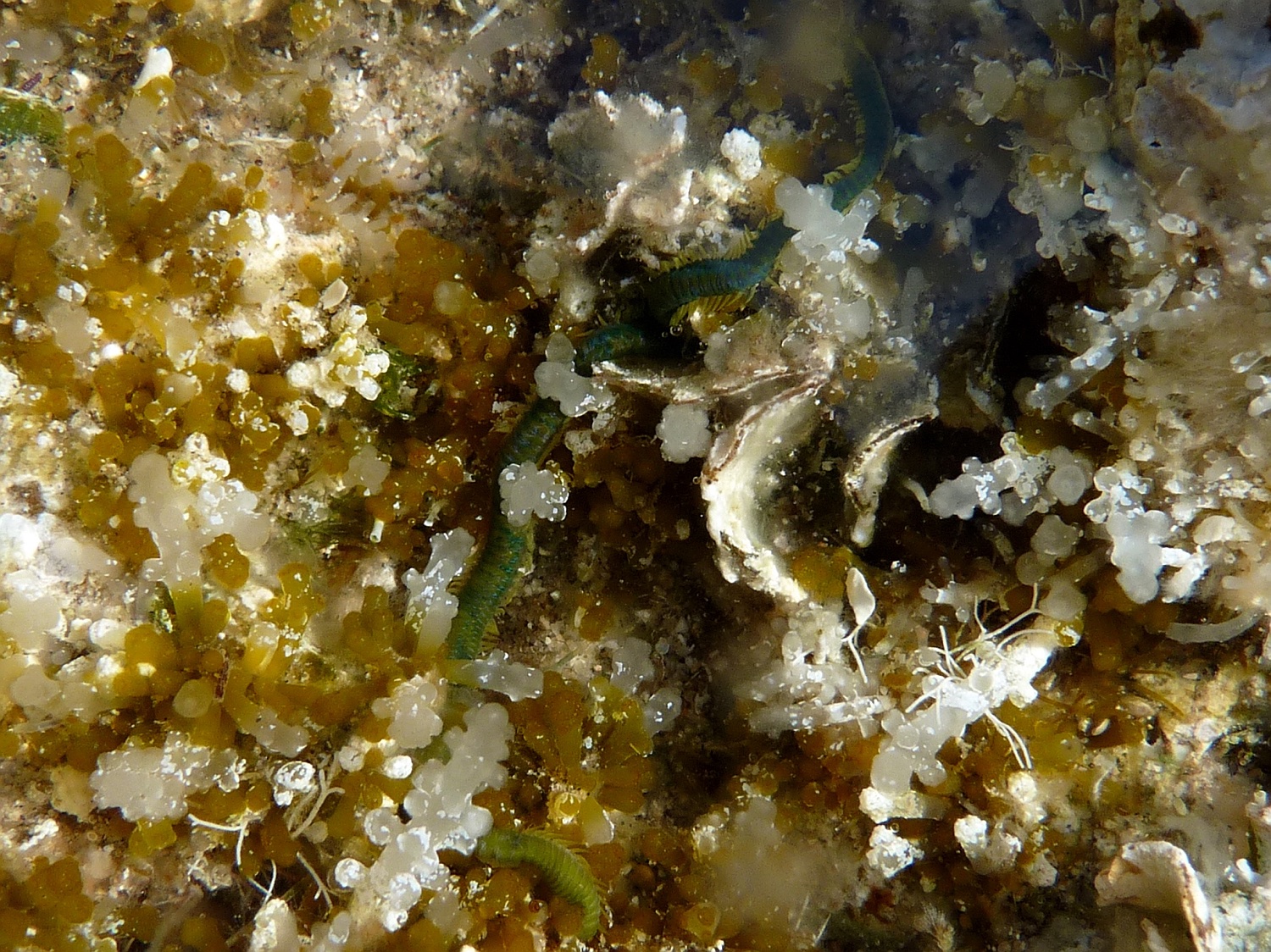
Eulalia clavigera has a greenish body up to 10 cm long, consisting of many segments, with small yellowish feet. The species is often found in shallow water and feeds mainly on carrion.
Calcareous tube worm, Serpula vermicularis, L.
The calcareous tube worms (family Serpulidae) are sedentary organisms, i.e. sessile polychaetes. They form a calcareous tube that is firmly attached to the rocky seabed, or in the case of smaller species, to other substrates such as algae and snail shells. The calcareous tube can be closed with an operculum (lid) made of calcium carbonate or horn. The body of the sedentary worms is divided into differently shaped sections. At the front end sits a plume of about 40 feather-like radioles, with which the tube worm captures its food (plankton). The tentacles are quickly retracted when disturbed. Tube worms are rarely seen in our area, which is probably due to the low levels of plankton in the sea.
The Calcareous tube worm has a reddish tube with slight longitudinal ribs. The plume of radioles (tentacles), which is only 2 to 3 cm in size, is bilobed and consists of red, finely feathered rays. When the worm looks out of its tube, the operculum with its long stalk protrudes like a trumpet. The species occurs from the water surface to a depth of 1000 meters.

The Calcareous tube worm usually has a reddish “tentacle-crown”.
Protula tubularia, Montagu
The tube worm Protula tubularia forms a smooth tube up to 30 cm long with no or only a small operculum and white or red radioles. It is rather common in our region.

The “tentacles” of Protula tubularia can either be white…
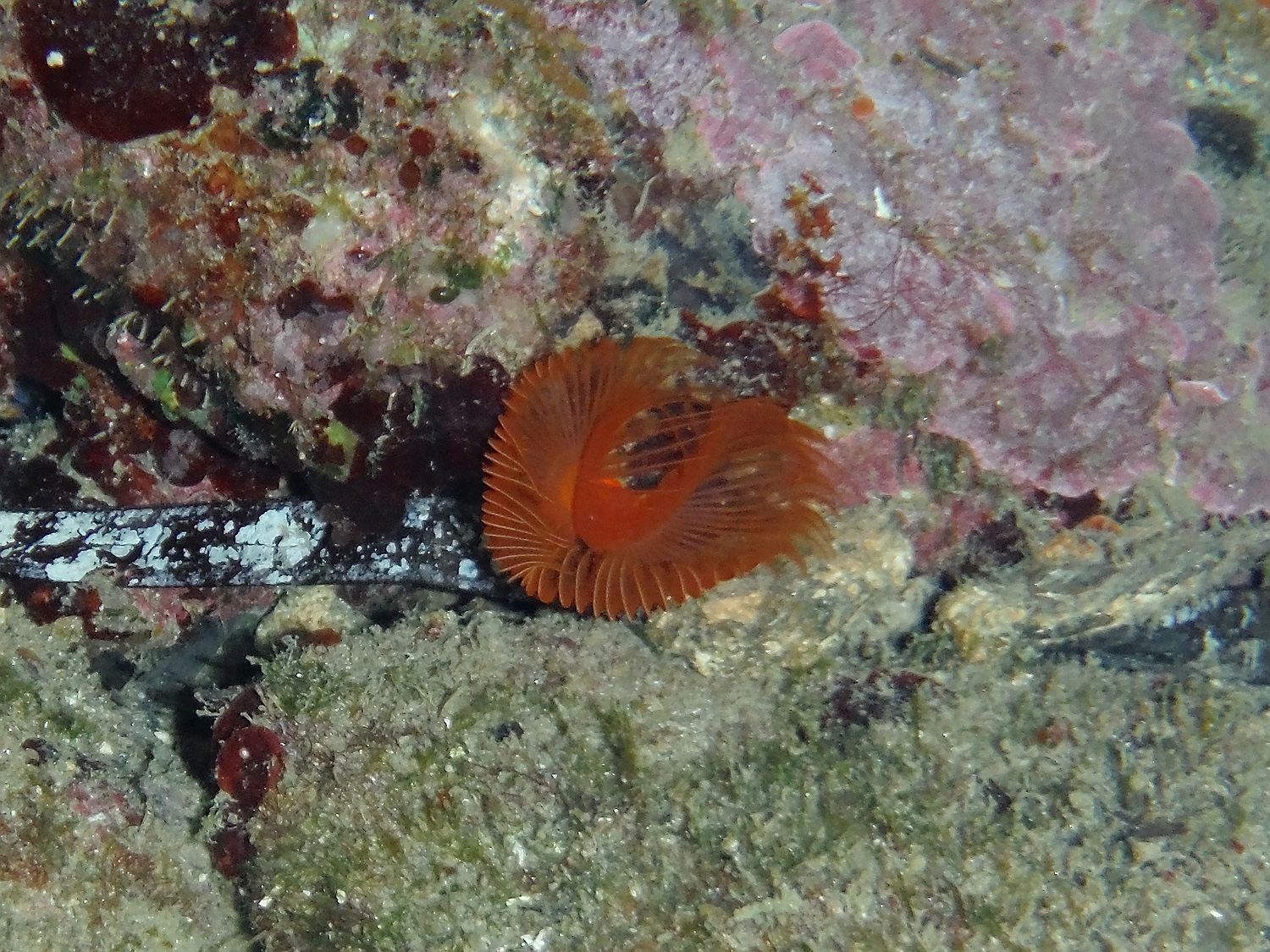
…or (more often) red. In the Mediterranean occur several species that are difficult to distinguish.
Spiral fan worm, Bispira volutacornis, Montagu
The Spiral fan worm belongs to the feather worms (family Sabellidae). It is somewhat rarer in our region than the calcareous tube worms. Its tentacle crown, which can grow up to 6 cm long, consists of two funnel-shaped halves; it is brown in colour with a pattern of lighter and darker lines. The tube is thin and rubbery.
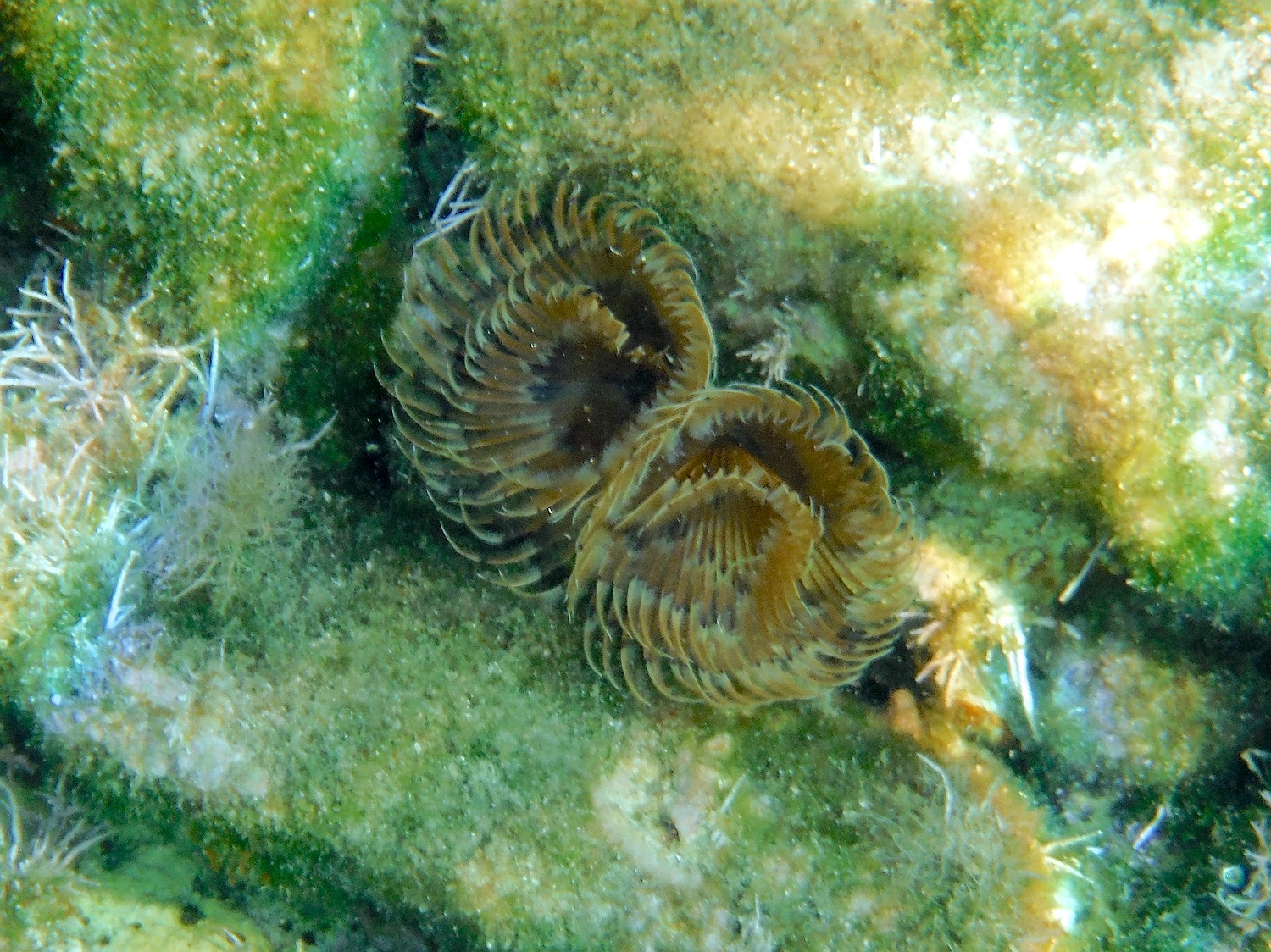
The Spiral fan worm has a characteristic double tentacle crown.
Polycirrus spec.
The genus Polycirrus belongs to the family Terebellidae. The body of this species is hidden in a crevice in the rock; only the long, thin, yellowish tentacles are visible, which the worm spreads out in different directions on the substrate. It uses these tentacles to catch its food, tiny substrate particles, which are transported to its mouth with the help of small cilia. This species is usually found on crustose sponges. It is very inconspicuous and can easily be overlooked.

Here you can see the fine yellowish tentacles of a worm of the genus Polycirrus, which are spread out over a large area.
Janua heterostropha, Montagu
In the Mediterranean Sea occur about 20 species of the genus Spirorbis or Janua (“posthorn worms”), tiny tube worms with strongly coiled, snail-like tubes. The living worms extend tiny tentacles to catch their prey. Posthorn worms live on various substrates such as stones, snails and mussels, but also algae and seagrass. They are hermaphroditic; the young live for some time inside the mother’s shell.
The species shown here can be recognised by its distinctly keeled, counterclockwise coiled tube, which is only 2 mm in size (see also the first two pictures in the article on marine snails). It has recently been placed in the genus Janua.

Janua heterostropha builds a tiny coiled tube with distinct keels that runs counterclockwise.
Echiura
The class of the spoon worms comprises only about 150 species, all of which live in the sea. Today, they are classified as annelids, even though they have lost their segmentation. Spoonworms often live hidden in the substrate, from where they extend only their proboscis, the long prostomium. About four species occur in the Mediterranean, of which the green spoonworm is most common.
Green spoonworm, Bonellia viridis, Rolando
The strictly nocturnal Green spoonworm has an oval-shaped body of 10 to 20 cm and an extendable proboscis that can reach one meter in length. At its tip, the proboscis is forked into two large lobes with wavy edges. A groove with cilia runs along the underside of the proboscis. The body of the Green spoonworm is rarely seen, as it hides in rock crevices; usually one sees only the long, straight proboscis, which it uses to feed. The proboscis collects detritus particles or tiny organisms from the substrate, which are transported to the mouth by the cilia. The dark green colour of the Green spoonworm derives from the substance bonellin, a highly toxic pigment whose use as an antibiotic is being researched.
The most astonishing thing about the spoonworm is its reproduction. The larvae, which are released freely into the sea water, are sexless. If a larva has not encountered a female spoonworm by the time it settles on the sea floor, it becomes itself a female and starts to live in a crevice or small cavity, reaching adulthood after several years. However, if the larva meets a female spoonworm, its pigment bonellin triggers a change that transforms the larva within a few days into a dwarf male which measures only a few millimeters in size. The male larva is ingested by the female and enters her oviduct, where it spends the rest of its life in a special genital sac. The body of the dwarf male is extremely simplified: it consists almost entirely of testicles and does not even have an intestine. It feeds by absorbing nutrients from the female’s body fluid through diffusion. Numerous dwarf males can reside in the genital sac of a female, their sole function and activity being the fertilisation of the female’s eggs.


The nocturnal Green spoonworm can occasionally be seen at the coast; here you can see the extended proboscides of several animals.

The females of the Green spoonworm sit in rock crevices, from which they extend their long, straight proboscides.

Here you can see the body of the Green spoonworm in a crevice with its wavy edge and intense dark blue-green colour, which is caused by a special, highly toxic pigment called bonellin.

The tip of the proboscis is divided into two parts with large, wavy “flaps”. On the underside of the proboscis runs a channel lined with cilia, through which the food (microorganisms and detritus) is transported to the mouth.
continue: Marine snails