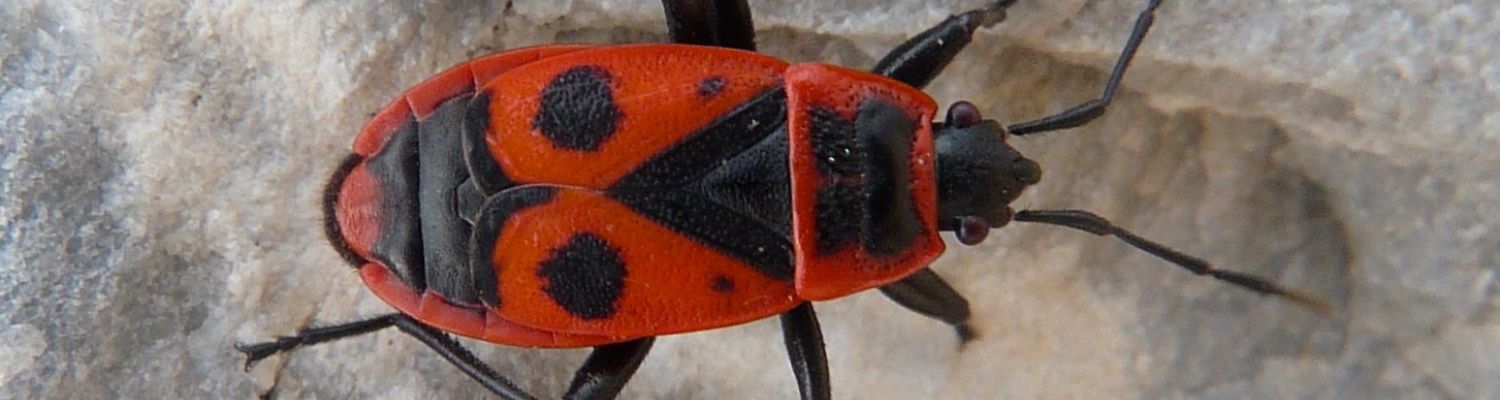
Bugs
Bugs (Heteroptera) are a suborder of the order Hemiptera within the insects, which, in addition to the bugs, also includes the cicadas and related groups. Hemiptera are characterised by their piercing-sucking mouthparts, the proboscis, and certain characteristics of wing venation.
Here you can skip the introduction and go directly to the species.
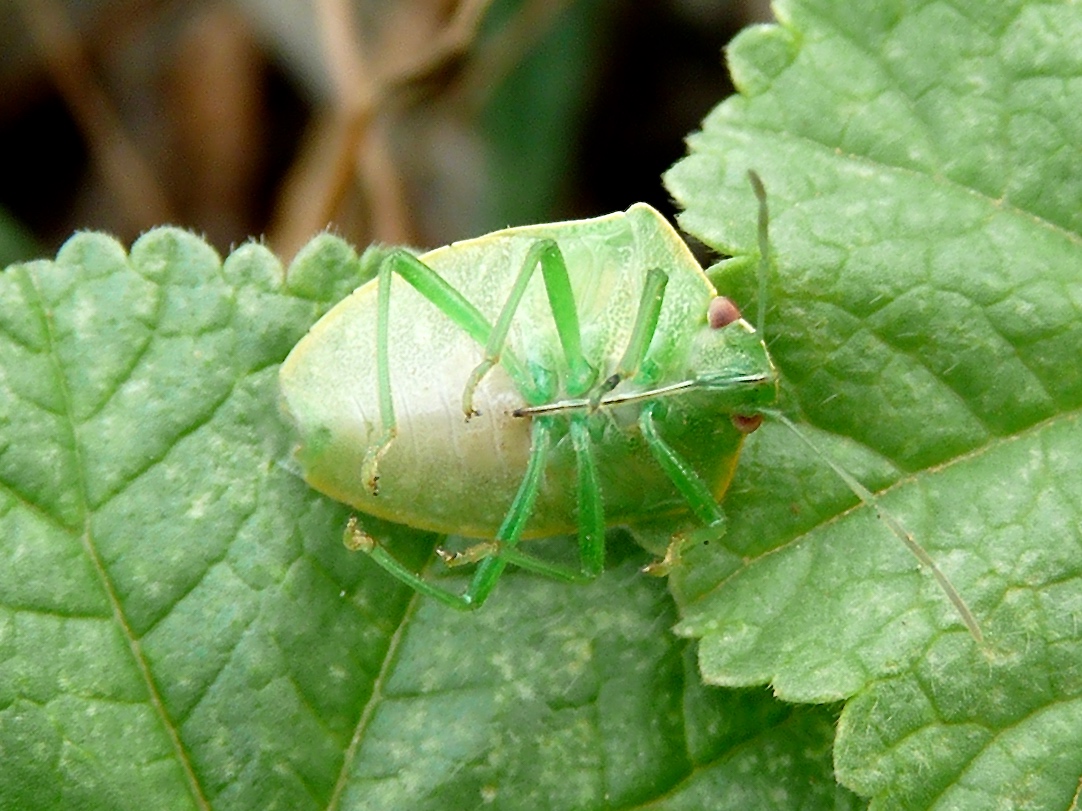
In this Green shield bug lying on its back you can see the proboscis, which the bug uses to pierce plants and suck their sap.
Around 40,000 species of bugs exist worldwide. Most species are herbivores, but some are predators. A few species live as ectoparasites, sucking blood. Bugs are found worldwide and have conquered almost all terrestrial habitats; some bug species also live in fresh water or on its surface and even on the surface of the sea.
Like in all insects, the body of bugs consists of head, thorax and abdomen. The head is usually quite small and carries the proboscis and rather simple antennae usually consisting of four parts. As in all insects, the three thoracic segments are each equipped with a pair of jointed legs. The rear two thoracic segments each carry a pair of wings. The foremost segment of the thorax carries on the back a large neck shield or pronotum. The back shield of the middle thoracic sits as triangular scutellum between the wings, sometimes extending towards the rear end of the body. The forewings (hemelytra) are sclerotised in their front section (corium) and membranous in the rear third, hence the name Heteroptera. The hindwings, with which the animal flies, are completely membranous. The abdomen consists of 11 segments and is roundish or elongated in shape. Many bugs have striking colours; others are well camouflaged and hardly visible in their natural environment.
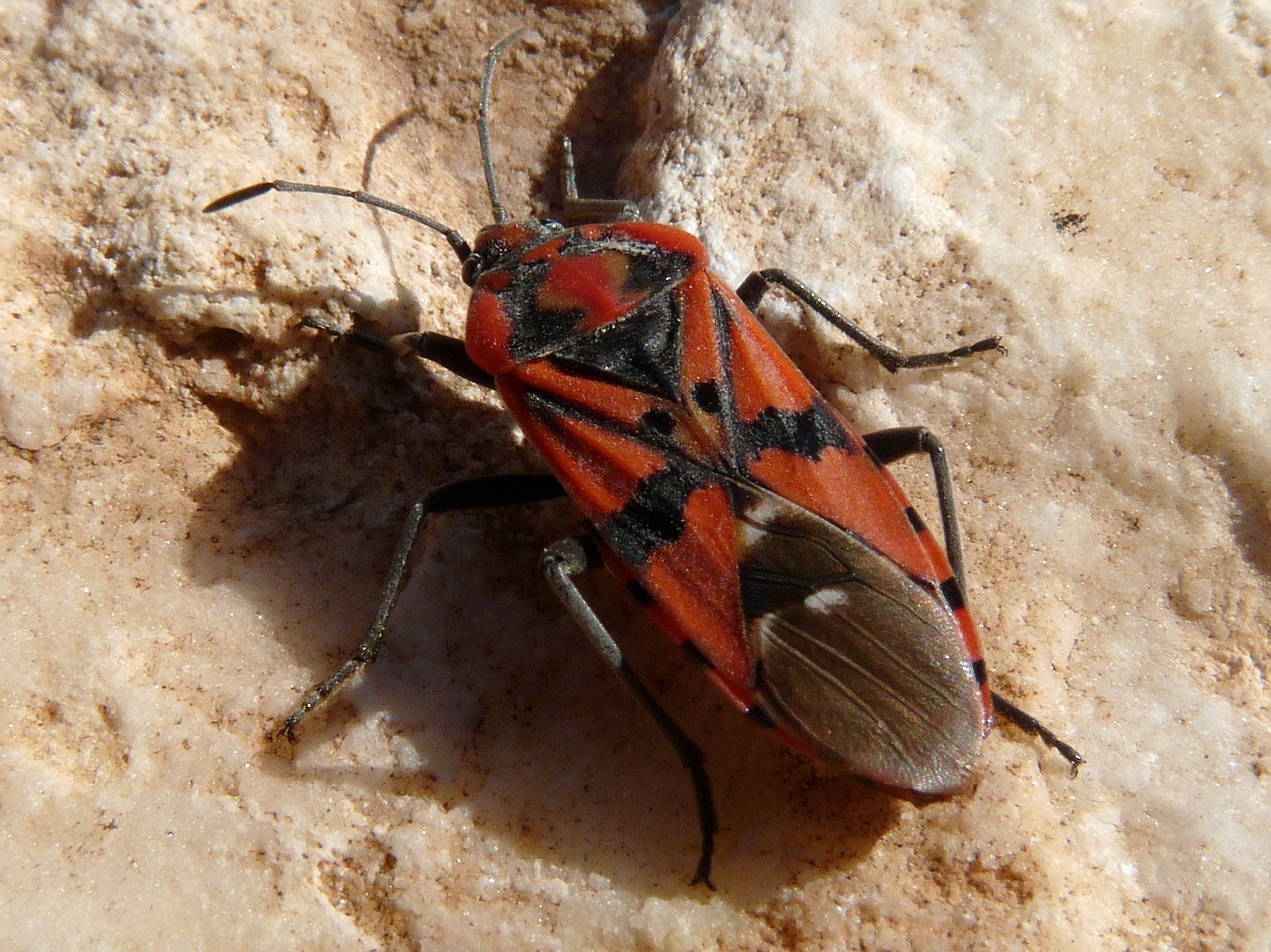
Here you can see the corium, the sclerotised front part of the hemelytra (forewings), and the membranous rear part. The scutellum is quite small in this species; it is black. The pronotum lies between the scutellum and the small head. The four-part thin antennae are also clearly visible.
Bugs belong to the insects with a hemimetabolous development, i.e. the larvae gradually become more similar to the adults without an intermediate pupal stage. This kind of larva, which does not have any physical characteristics that do not appear in the imago (adult), is called a nymph.
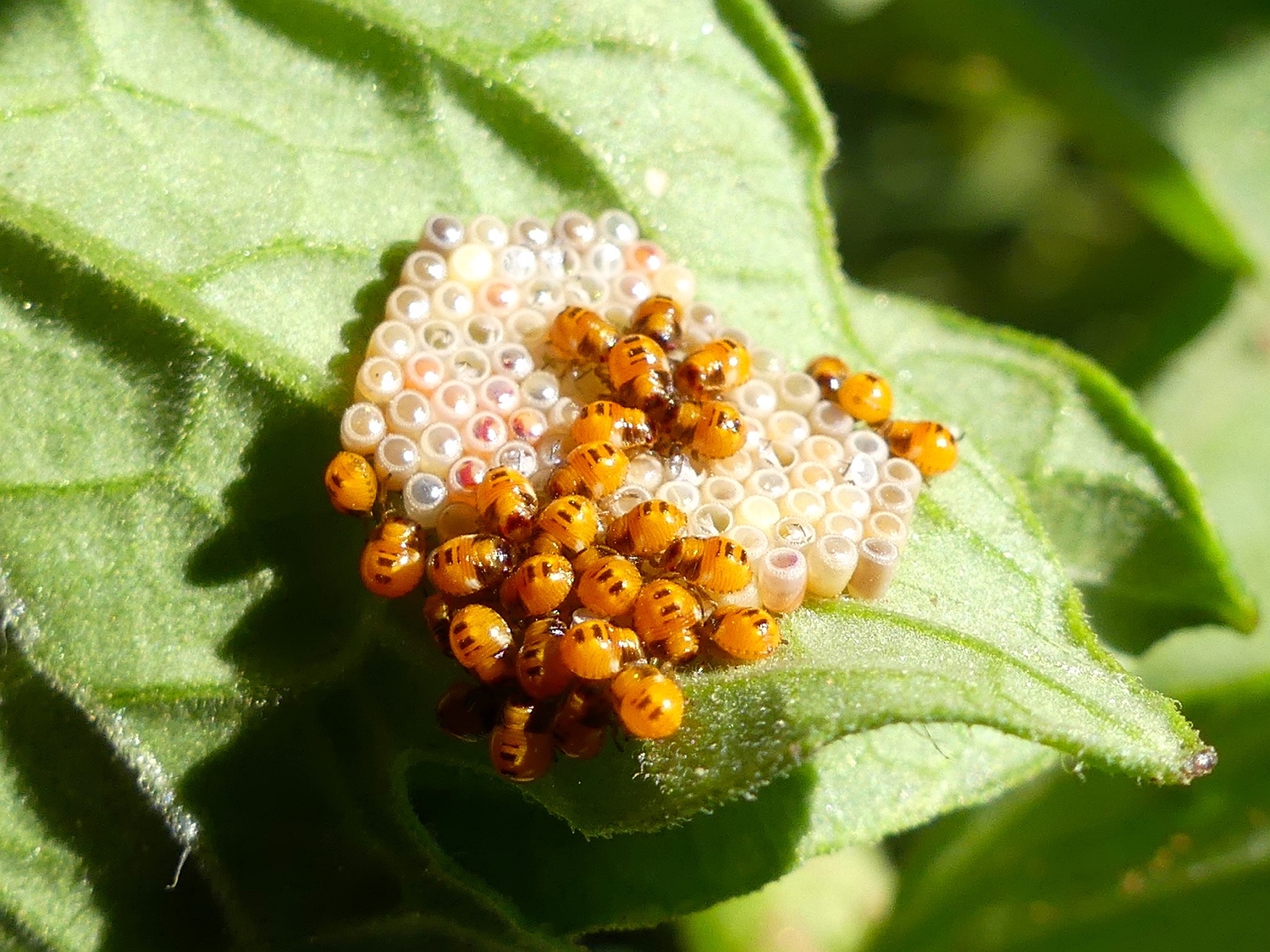
hatching bugs
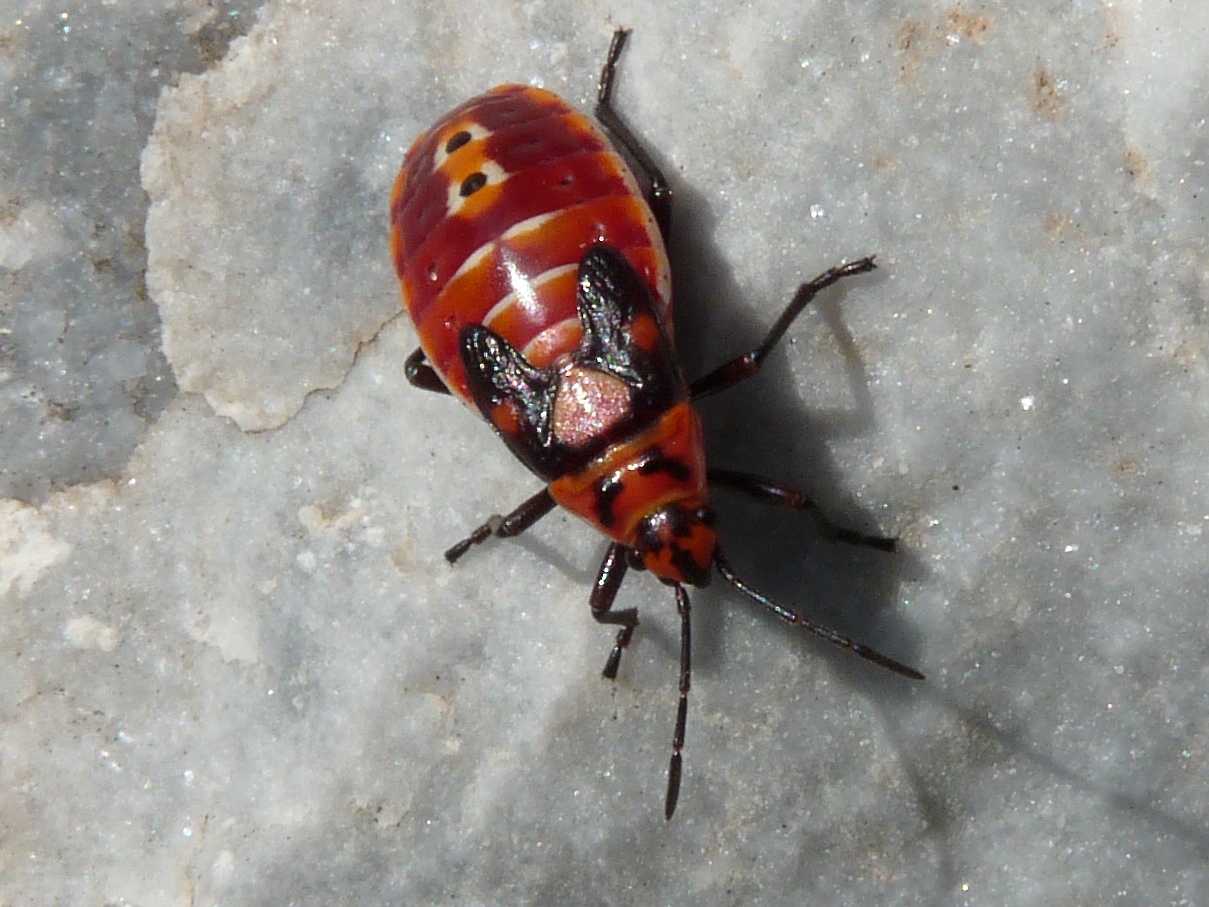
The larvae of bugs are similar in appearance to the adult; however, they do not yet have wings. Τhis larval stage shows only tiny wing buds.
Most bugs feed on plant sap, which they suck with their proboscis. Accordingly, they can cause some damage in agriculture and gardens when infestations are severe, particularly to fruits like tomatoes. Predatory bugs mainly feed on other insects, that they suck dry with their proboscis.
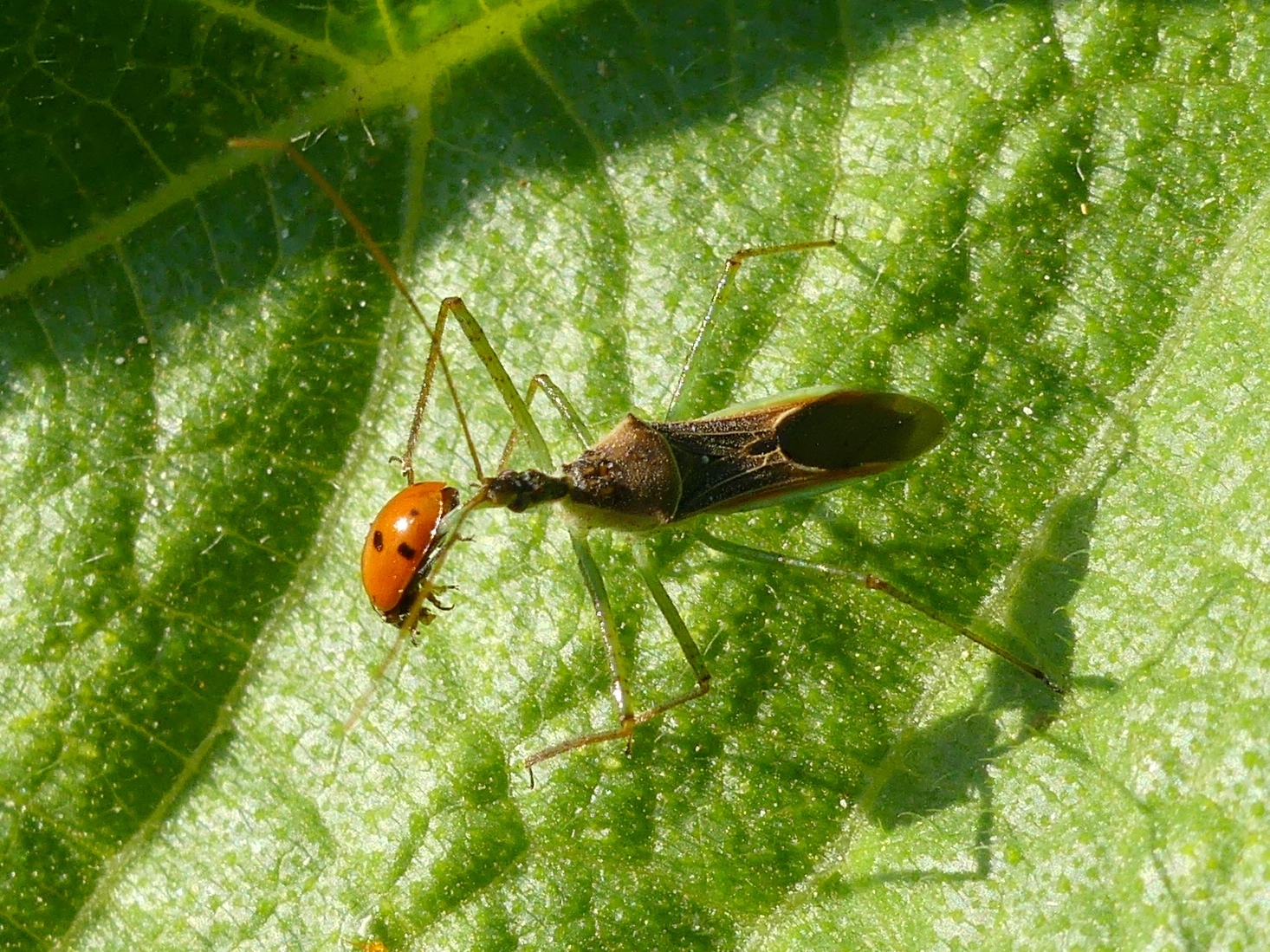
This bug has caught a small beetle and is sucking it dry with the proboscis.
In our garden one may encounter quite a few bugs. One species, Spilostethus pandurus, can be seen all year round; others, such as the Green shield bugs, are active only in the summer months. However, most species are limited to a short timeperiod of a few weeks, with one species alternating with the next. Thus, different members of the family Miridae (plant bugs) appear in spring, being very common for a short time, then they diappear again and other bug species start to show up. Furthermore, some species fluctuate greatly from year to year, such as the burrowing bug Sehirus luctuosus, which in some years appears in early summer in large numbers, while in others you hardly see any at all.
Bug species on Naxos
Bug species on Naxos
Many bug species occur on Naxos, most of which are small and inconspicuous. Most of the species presented here we have encountered on our property and in the garden.
The Photo gallery of the bugs gives an overview of the species.
A note on identification: While some of the bug species can be identified easily, this does not apply to all species. In many cases, accurate identification relies on characteristics that cannot be seen in photographs and require examination of the dead animal under a magnifying glass or microscope. For this reason, I cannot guarantee the correctness of the identification of many of the species in the following description. I hope that, despite this uncertainty, the article is still valuable in presenting the diversity of our bug fauna and perhaps awakening interest in these often neglected and rather unpopular insects.
Here you can jump directly to the larger groups within the bugs (return with the back arrow or by swiping back):
Firebugs – Seed bugs – Coreidae – Shield bugs – Rhyparochromidae – Plant bugs – Broad-headed bugs and Damsel bugs – Reduviidae – Burrowing bugs – Water striders
Fire bugs, Pyrrhocoridae
Firebugs and Red bugs form their own small family among the bugs, the Pyrrhocoridae. They often display warning colours. The Common firebug is easily recognisable by its characteristic black and red colouring with round black spots on its wings. Despite its warning colour, it appears to be hardly poisonous at all. Predators such as birds apparently avoid it because they are similar in colour to the more poisonous Black-and-red-bugs, making this a case of mimicry.
Common firebug, Pyrrhocoris apterus, L.
Common firebugs often gather in large numbers. They are unable to fly; in most specimens, the membranous wings are vestigial. They are phytophagous and feed mainly on the seeds of mallows. The species is widespread in Eurasia.
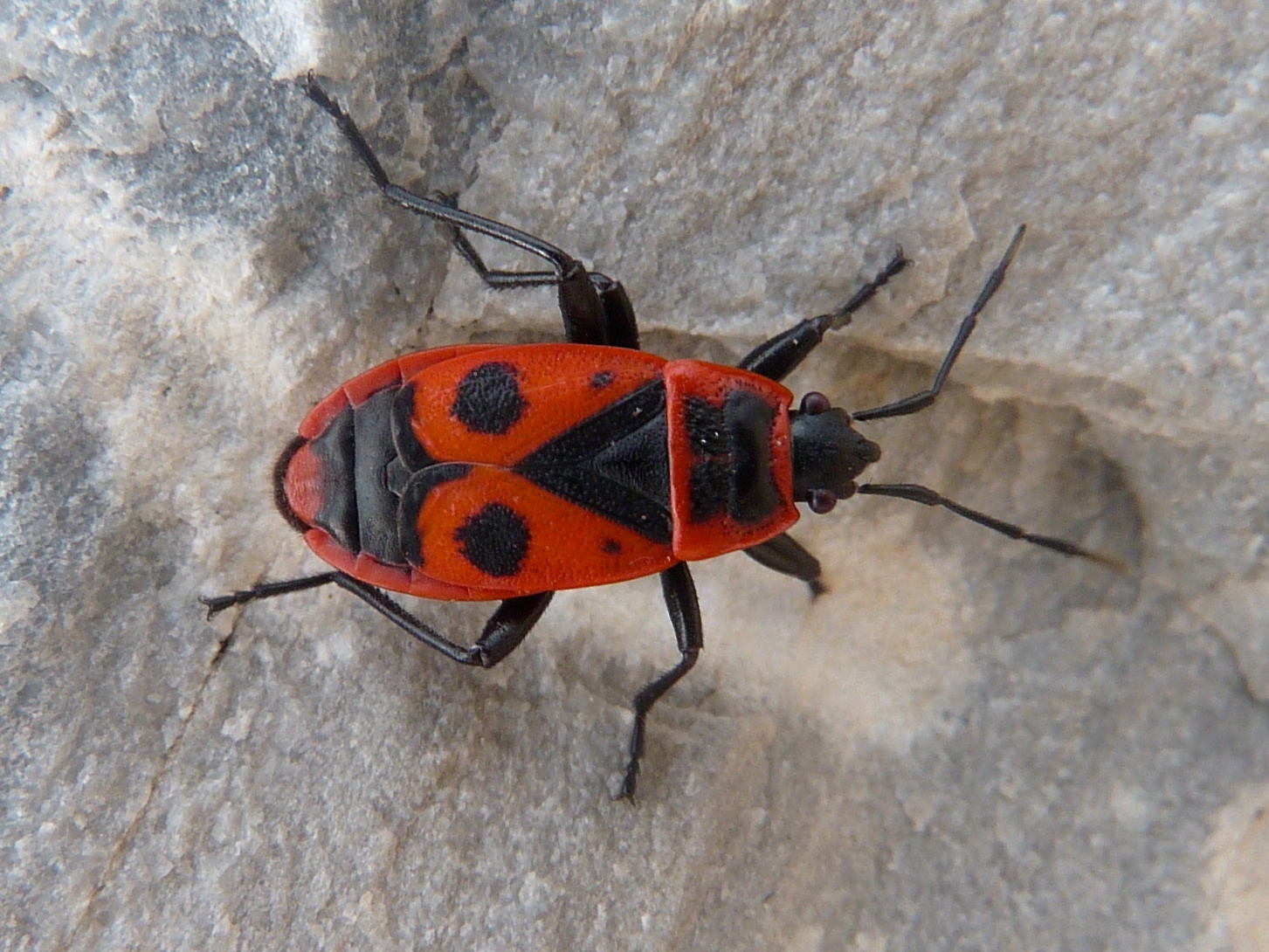
The flightless Common firebug can be recognised by its characteristic red and black colouring, which always reminds me of an African wooden mask.
Mediterranean red bug, Scantius aegyptius, L.
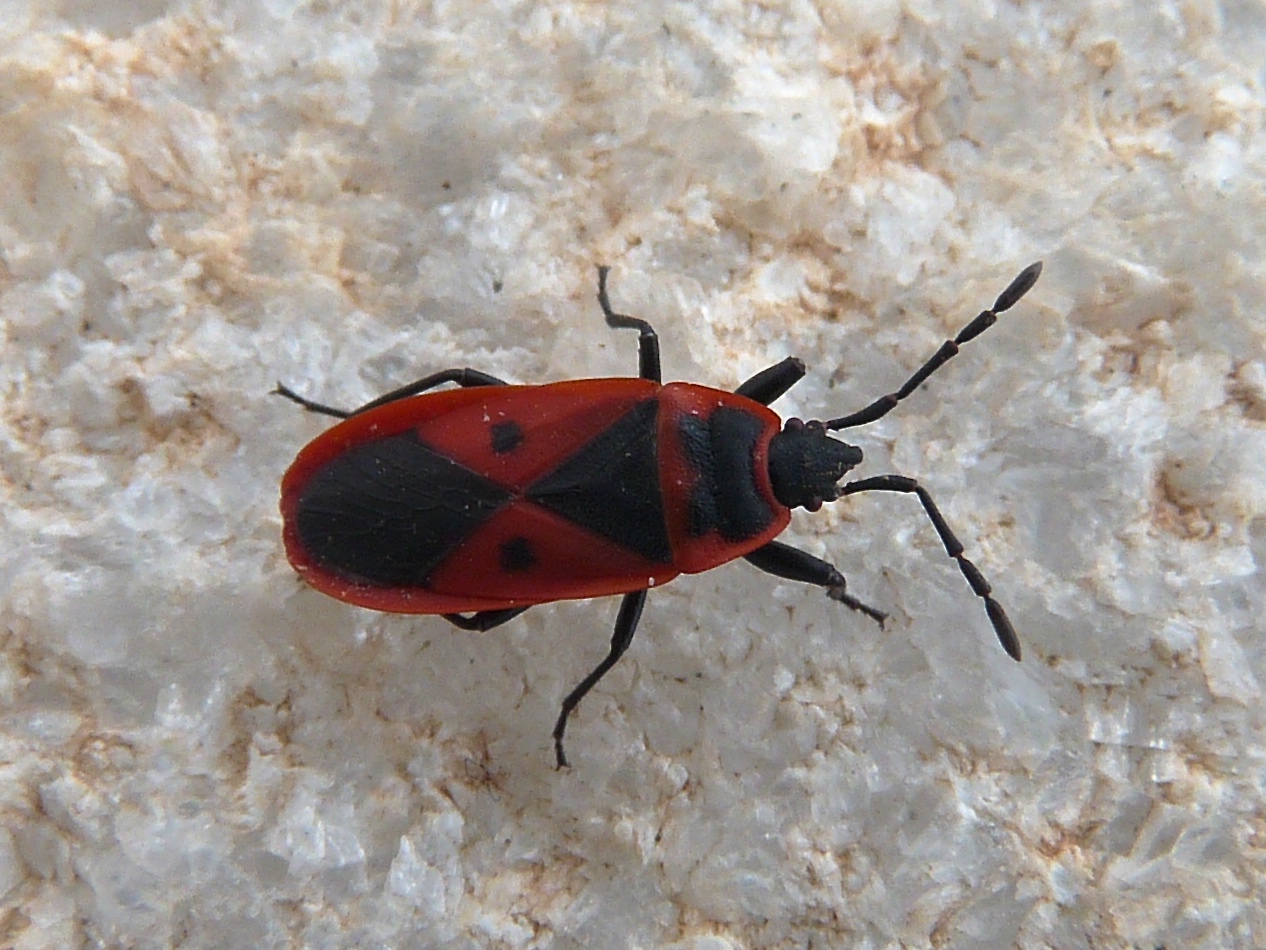
The Mediterranean red bug resembles the firebug in appearance as well as in way of life, but has fully developed wings and smaller black spots on the hemelytra. In our area it is rarer than the firebug.
Seed bugs, Lygaeidae
The Seed bugs or Ground bugs comprise around 4000 species. They are predominantly phytophagous. Their body shape is usually elongated; characteristic features are a faint indented cross on the pronotum and a Y-shaped, raised pattern on the small scutellum.
Spilostethus pandurus, Scopoli
Spilostethus pandurus, easily recognisable with its black and red markings, is by far the most common bug species in our region. Unlike most bug species it is active all year round: Hardly a day goes by without us seeing one on our property.
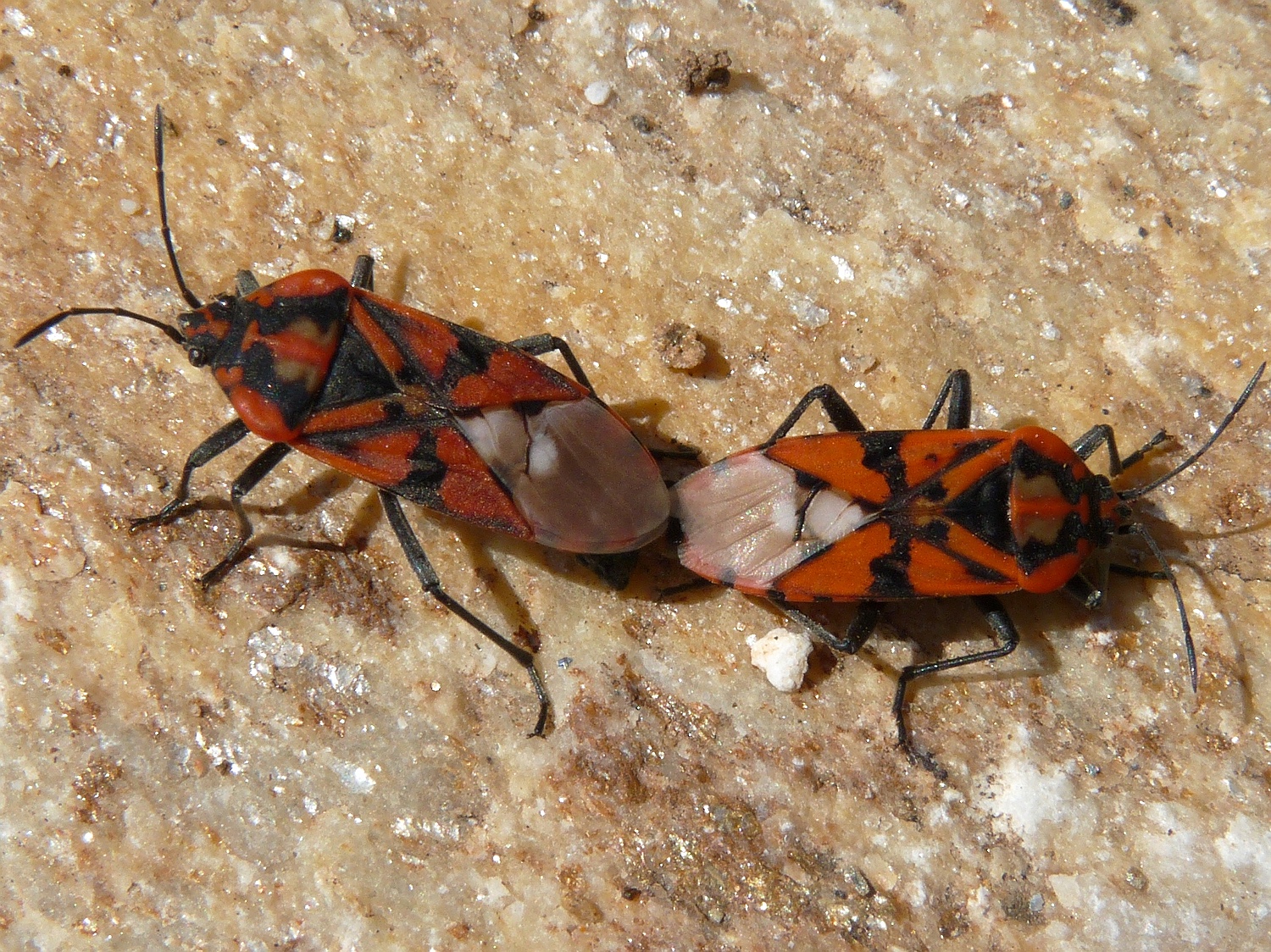
The very common species Spilostethus pandurus has characteristic black markings on its pronotum and coria (leathery front part of the forewings). The small scutellum is black. Males and females look almost identical.
Black-and-red-bug, Lygaeus equestris / simulans
The Black-and-red-bug and the nearly identical species L. simulans also belong to the Seed bugs. They feed on plant sap. Due to the accumulation of bitter substances from their food, both species are poisonous or unpleasant-tasting to predators who learn to avoid them. L. equestris and L. simulans occur together throughout their range and can only be distinguished by microscopic characteristics.
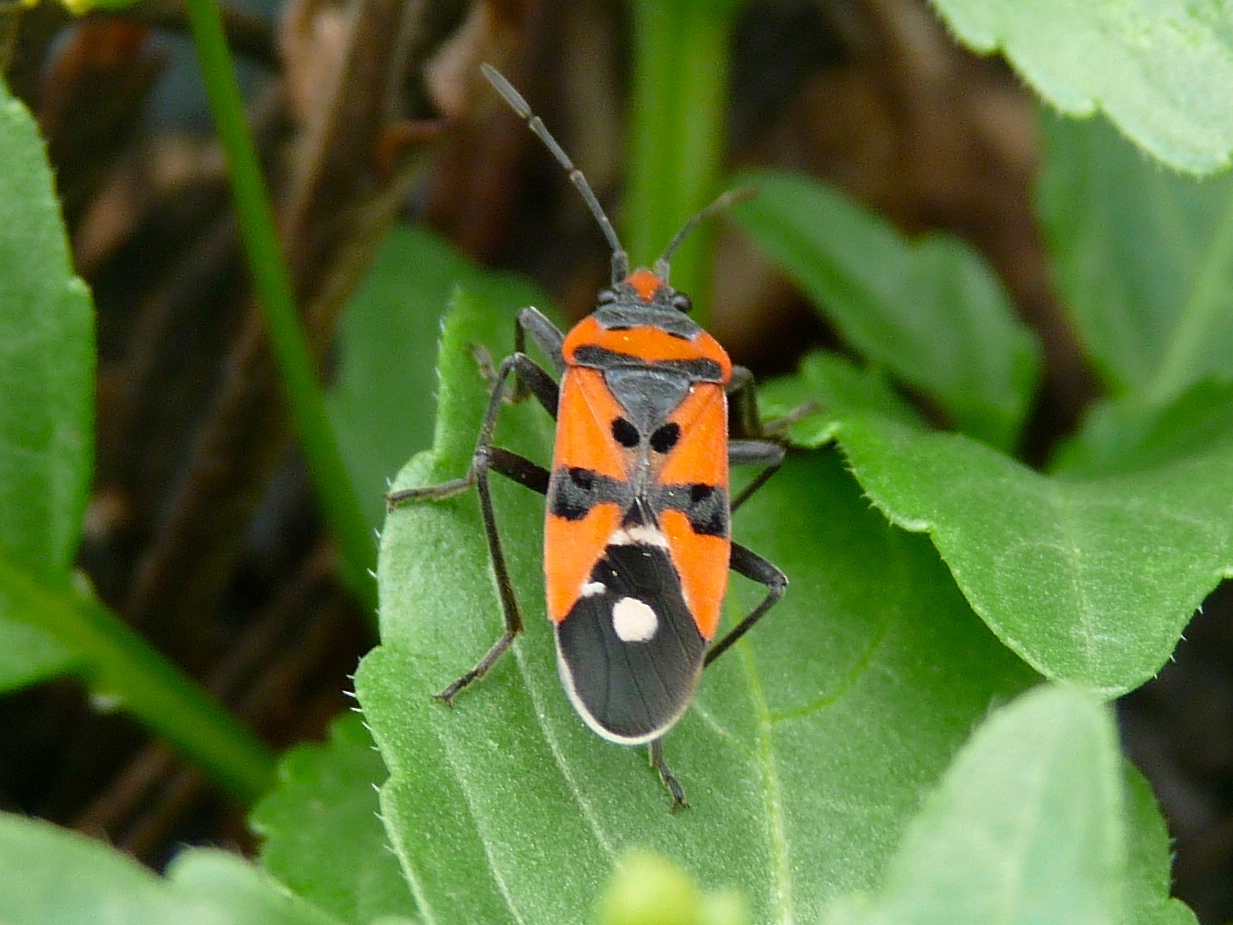
The markings on the Black-and-red-bug resemble a black cross. Characteristic is the white spot on the membraneus part of the wings.
Oleander seedbug, Caenocoris nerii, Germar
So far I have encountered the rather small Oleander seedbug only once on Naxos. It was sitting in large numbers on bushes of Cionura erecta. According to literature, this species lives mainly on oleander, from which it absorbs toxins, which is why it is avoided by predators. I would like to thank Leonidas Romanos Davranoglou from the Facebook group ‘Insects of Greece and Cyprus’ for the identification!

The Oleander seedbug can be recognised by its colouring, especially the red spots around the pronotum and scutellum. A nymph is also visible in the photo.
Coreidae
The approximately 2000 species of Coreidae are characterised by the widened edge of their abdomen. They are mostly brownish in colour; the surface of their body and wings often has a grainy texture.
Box bug, Gonocerus acuteangulatus, Goeze
The Box bug can be recognised by the pointed edges of the pronotum. It lives mainly on berry-bearing shrubs, such as the mastic tree.
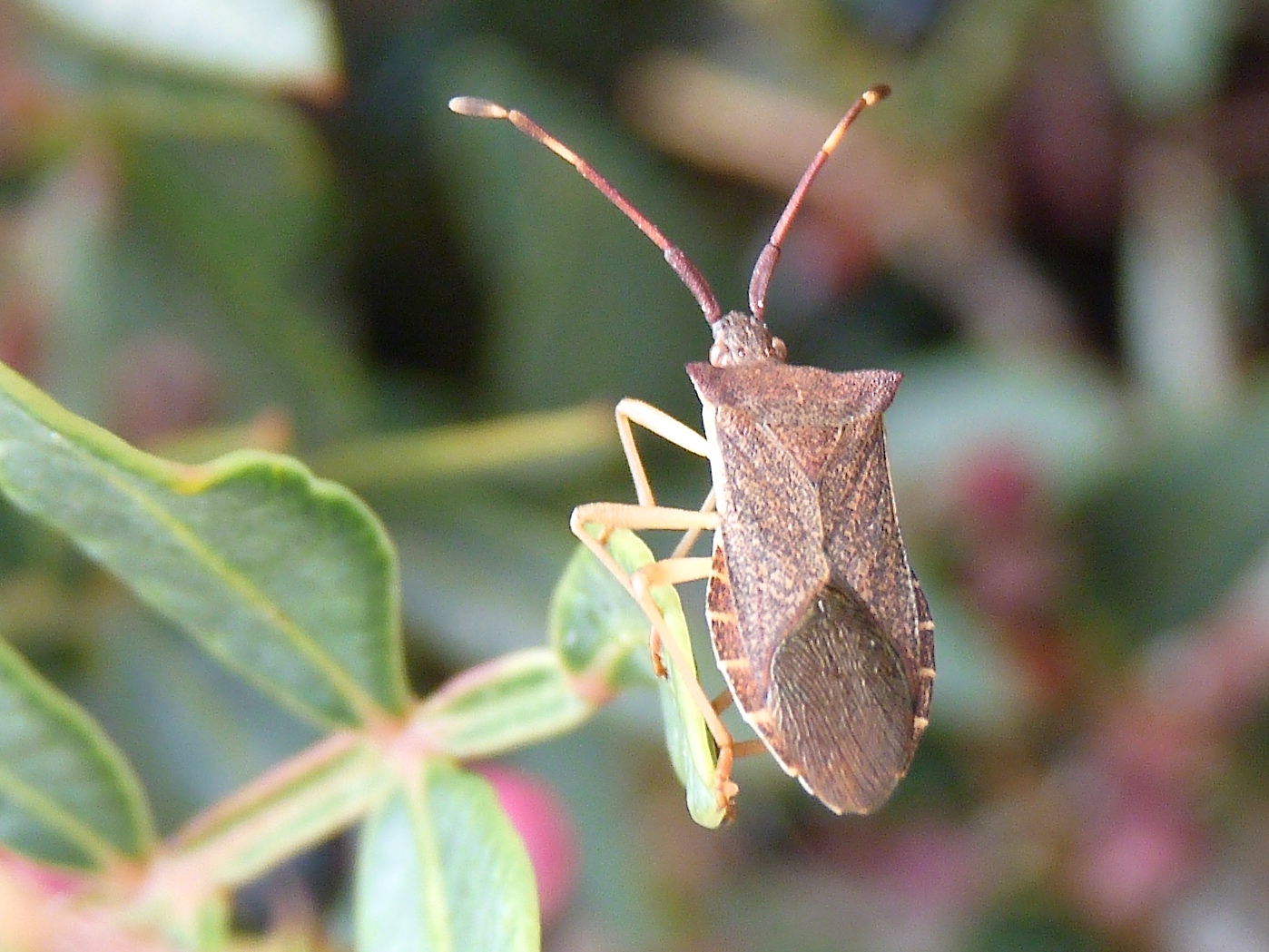
The Box bug can be recognised by its pointed ‘shoulders’.
Centrocoris spiniger / variegatus
In the Mediterranean region, there are two very similar species of the genus Centrocoris, which can only be distinguished by the length of their proboscis, C. spiniger and C. variegatus.
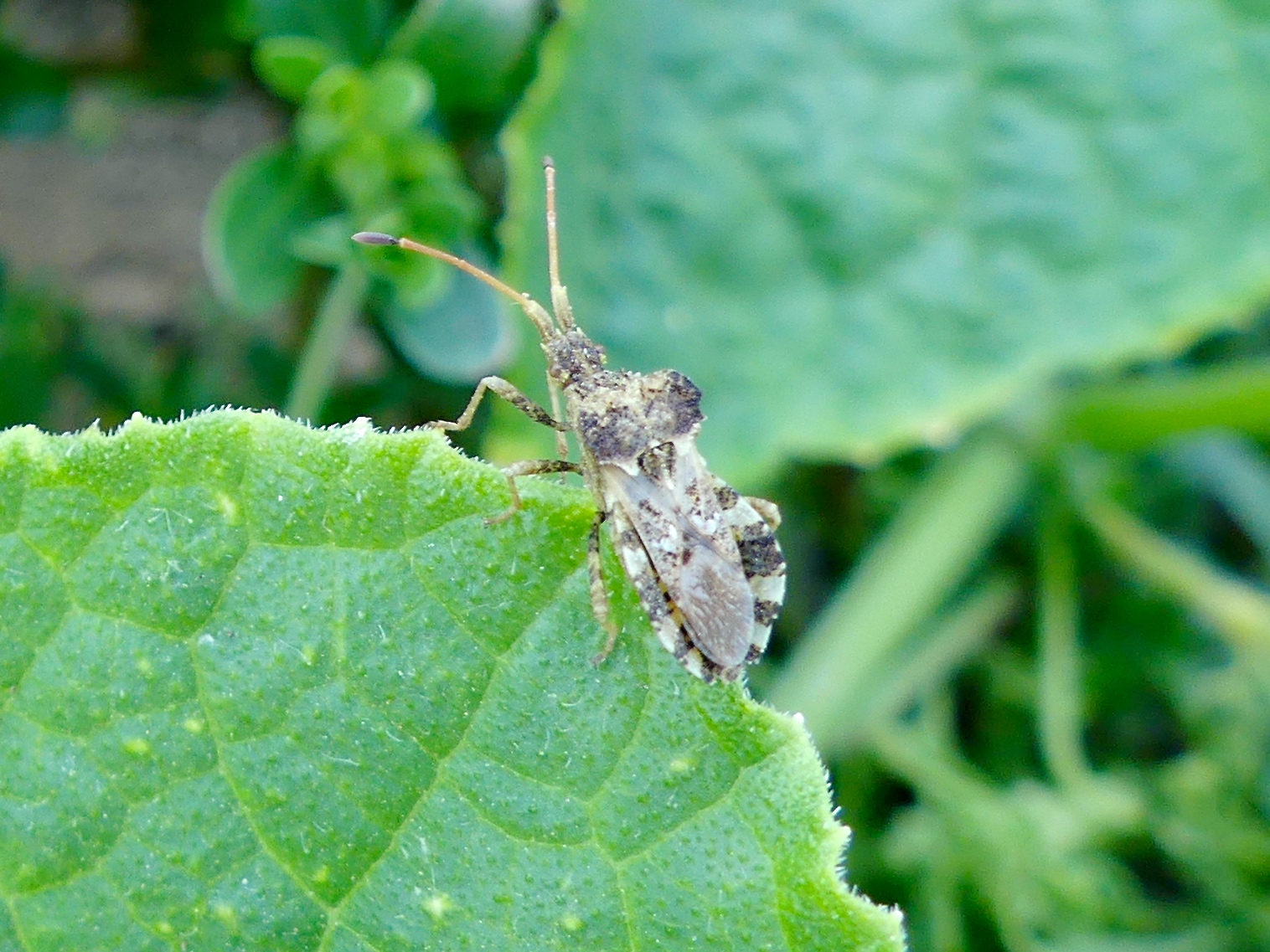
This brownish bug is easily recognisable by its humpbacked appearance when seen from the side.
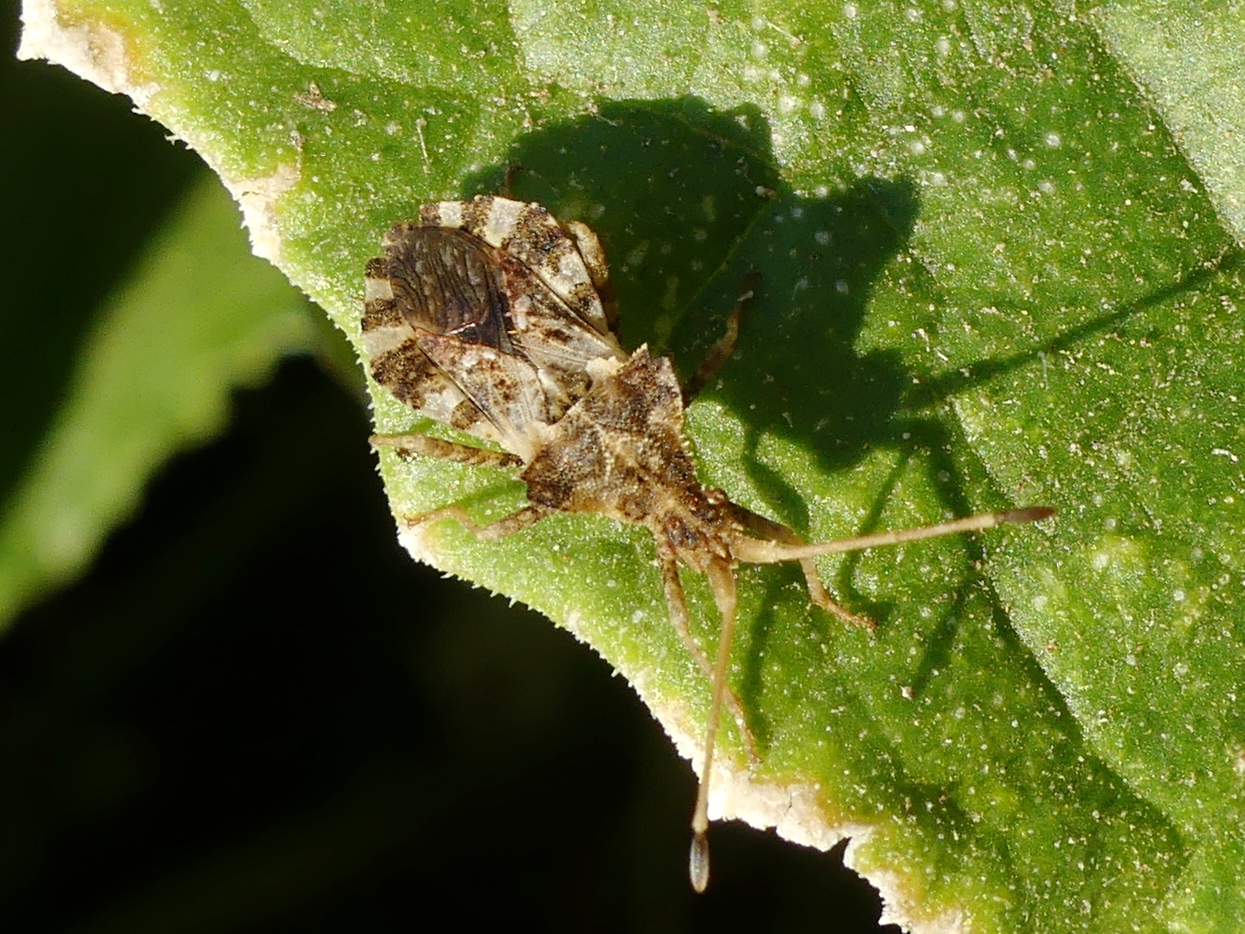
The pronotum, which is arched at the ‘shoulders’, has two white cone-like appendages at the rear edge. The widened edge of the abdomen carries light and dark stripes.
Rhombic leatherbug, Syromastus rhombeus, L.
The Rhombic leatherbug is rather rare in our area. It is easily recognisable by its diamond-shaped, widened abdomen.
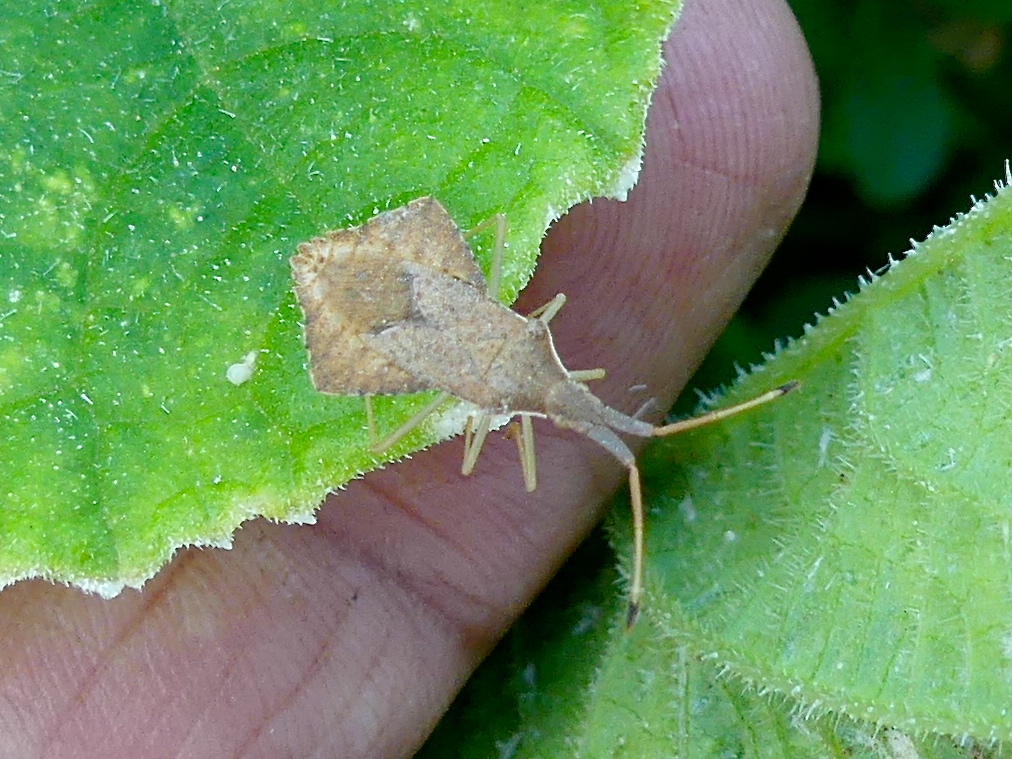
The inconspicuous brown Rhomboid leatherbug has a diamond-shaped abdomen. There are numerous indented dots on the body and the hemelytra.
Arenocoris waltlii, Herrich-Schäffer
This species, like the very similar A. fallenii, is dark grey in colour with distinct veining on the wings. The pronotum, head and scutellum are sculptured with knots and teeth. Arenocoris waltlii differs from A. fallenii in that its antennae are slightly widened towards the tip. Both species occur in the Mediterranean region and parts of Europe and the Middle East. Of the two species, this one is by far the rarer.
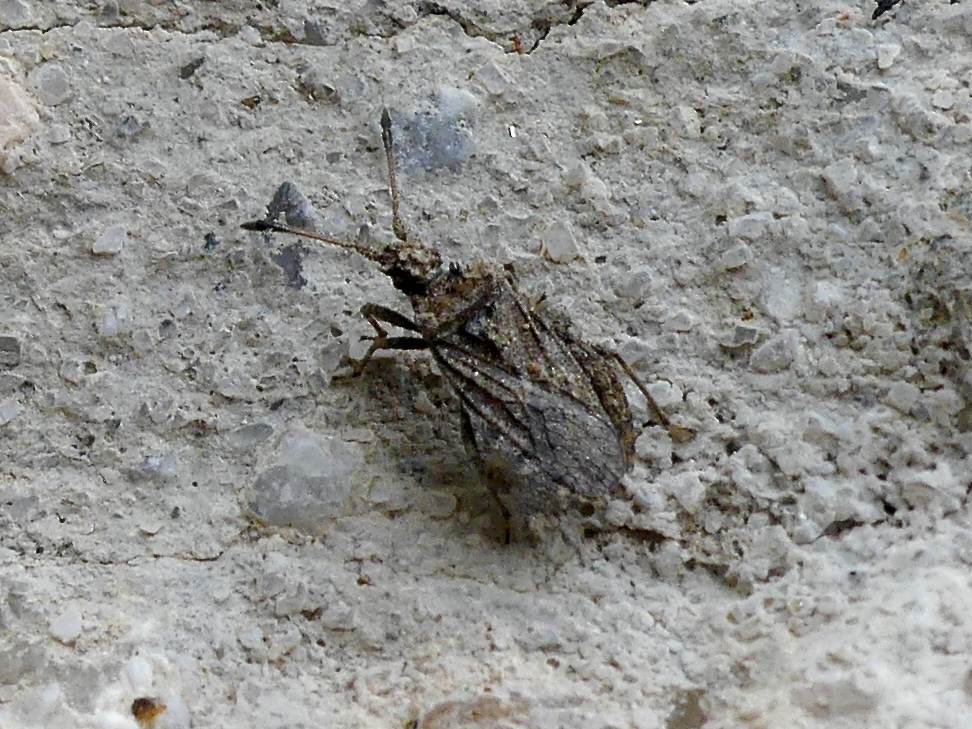
The inconspicuous, well-camouflaged Arenocoris waltlii has distinct veins, knots and teeth on its body and wings.
Shield bugs, Pentatomidae
The Shield bugs are a particularly large family with around 6,000 species. Most species have a broad abdomen with a large scutellum that sometimes covers the entire abdomen. Some species secrete a foul-smelling substance (“stink bugs”). Most shield bugs feed on plant sap, and some are significant pests in agriculture.
Green shield bug, Palomena prasina, L.
Several green bugs occur in our region. One of them is the Green shield bug, which secretes an unpleasant-smelling substance when you touch it. It is green in colour throughout; in winter it sometimes turns brownish. It has a very large scutellum. In this species, the front edge of the pronotum is slightly concave.
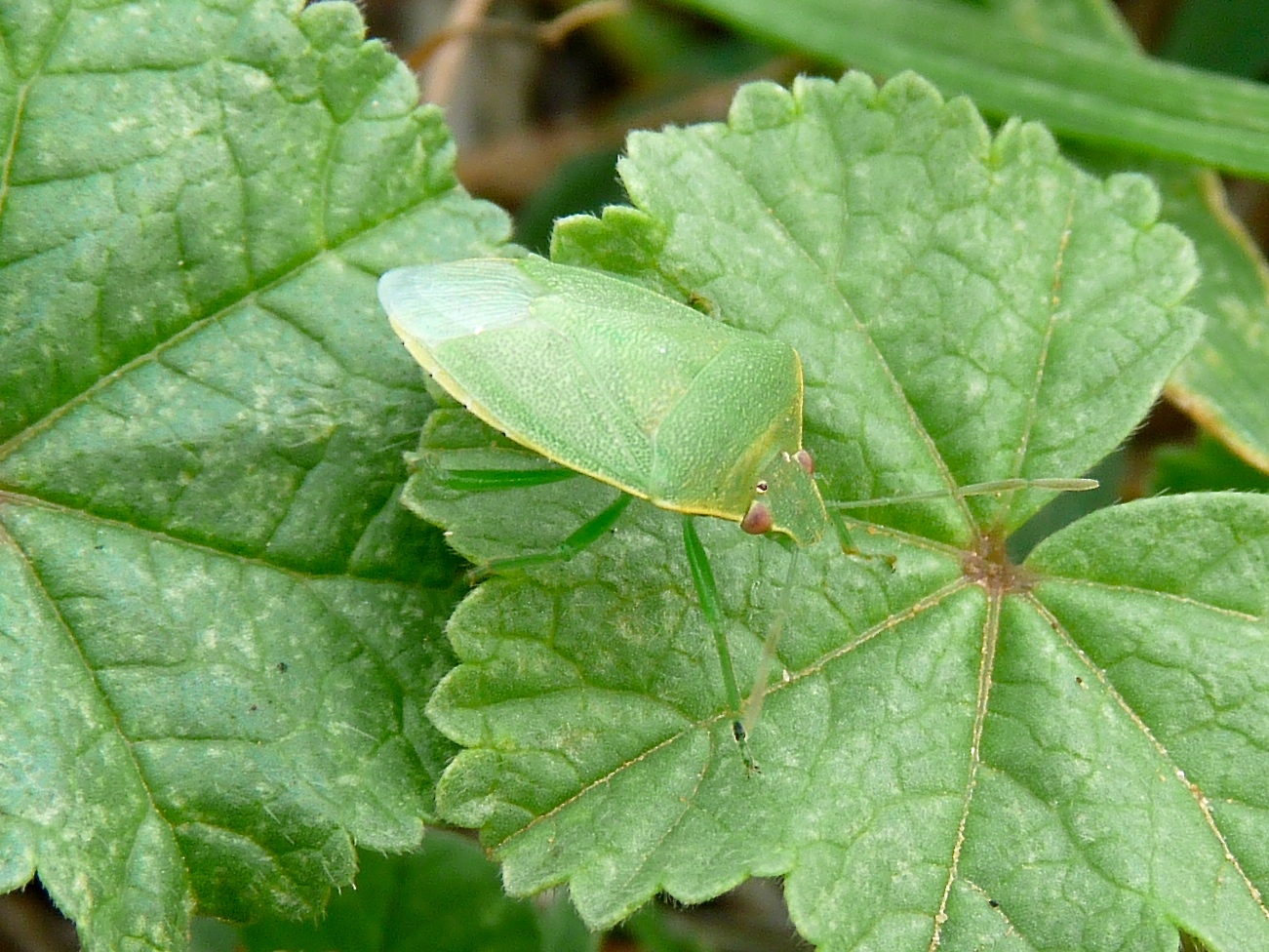
The Green shield bug is entirely green in colour. The front edge of the pronotum is slightly concave in this species. As in all shieldbugs the scutellum is large.
Palomena viridissima, Poda
The very similar species Palomena viridissima lives on various plants, like the Green shield bug, and can cause some damage in the garden. Both species are quite common in our region. Palomena viridissima differs from the Green shield bug in that the front edge of the pronotum is slightly convex rather than concave.
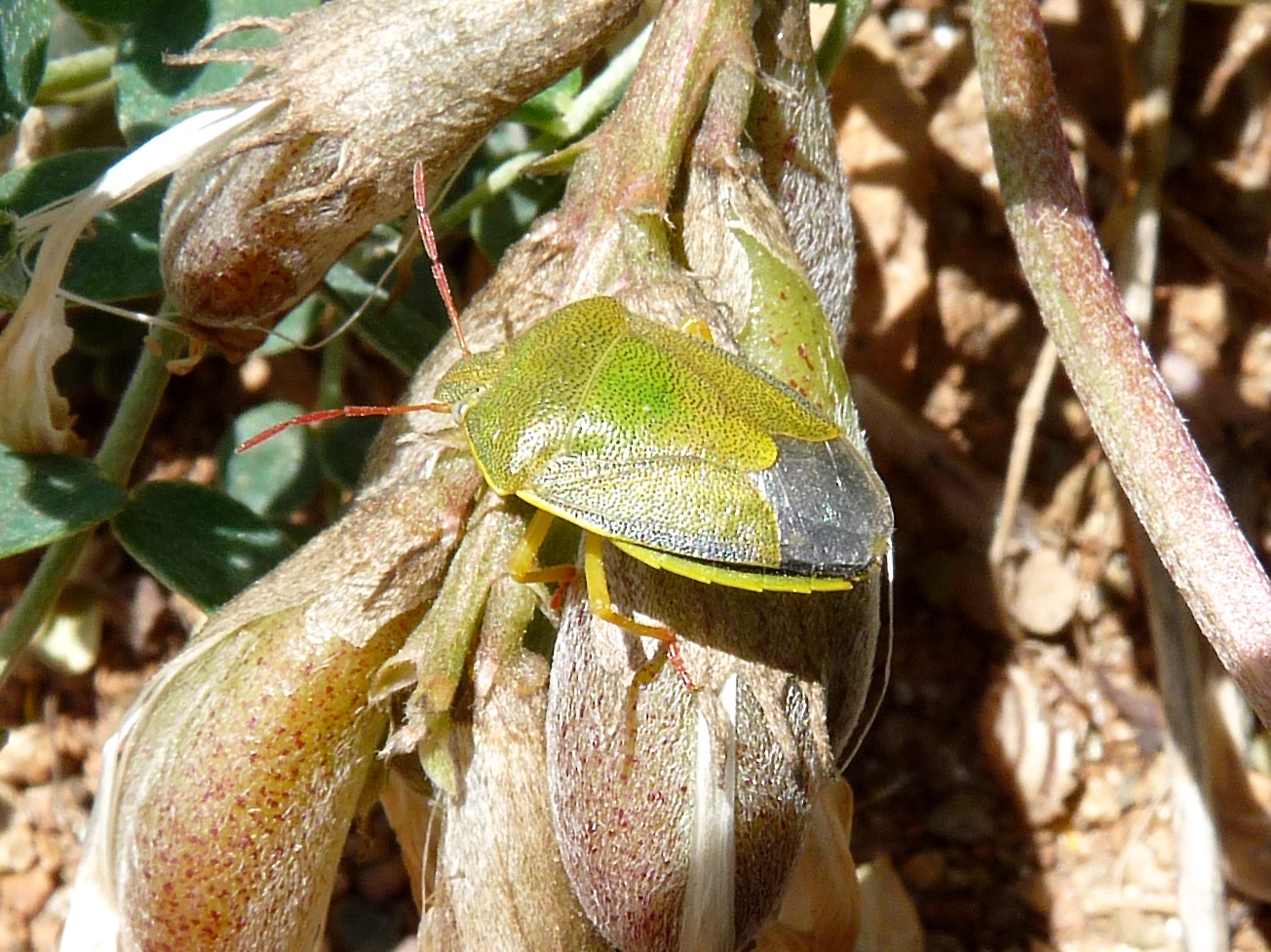
Palomena viridissima is very similar to the previous species; it is usually completely green,
but brownish forms may also occur. The front edge of the pronotum is slightly convex.
Southern green shield bug, Nezara viridula, L.
This species is also green, but has three to five small white dots on the front edge of the scutellum and sometimes a lighter front edge on the pronotum and a light-coloured head. The Southern green shield bug is found worldwide in the tropical and subtropical regions and is also common in the Mediterranean countries. It causes some damage in agriculture and gardens, mainly because the bug very often transmits a fungal disease to the plant, which leads, for example, to the fruits falling off.
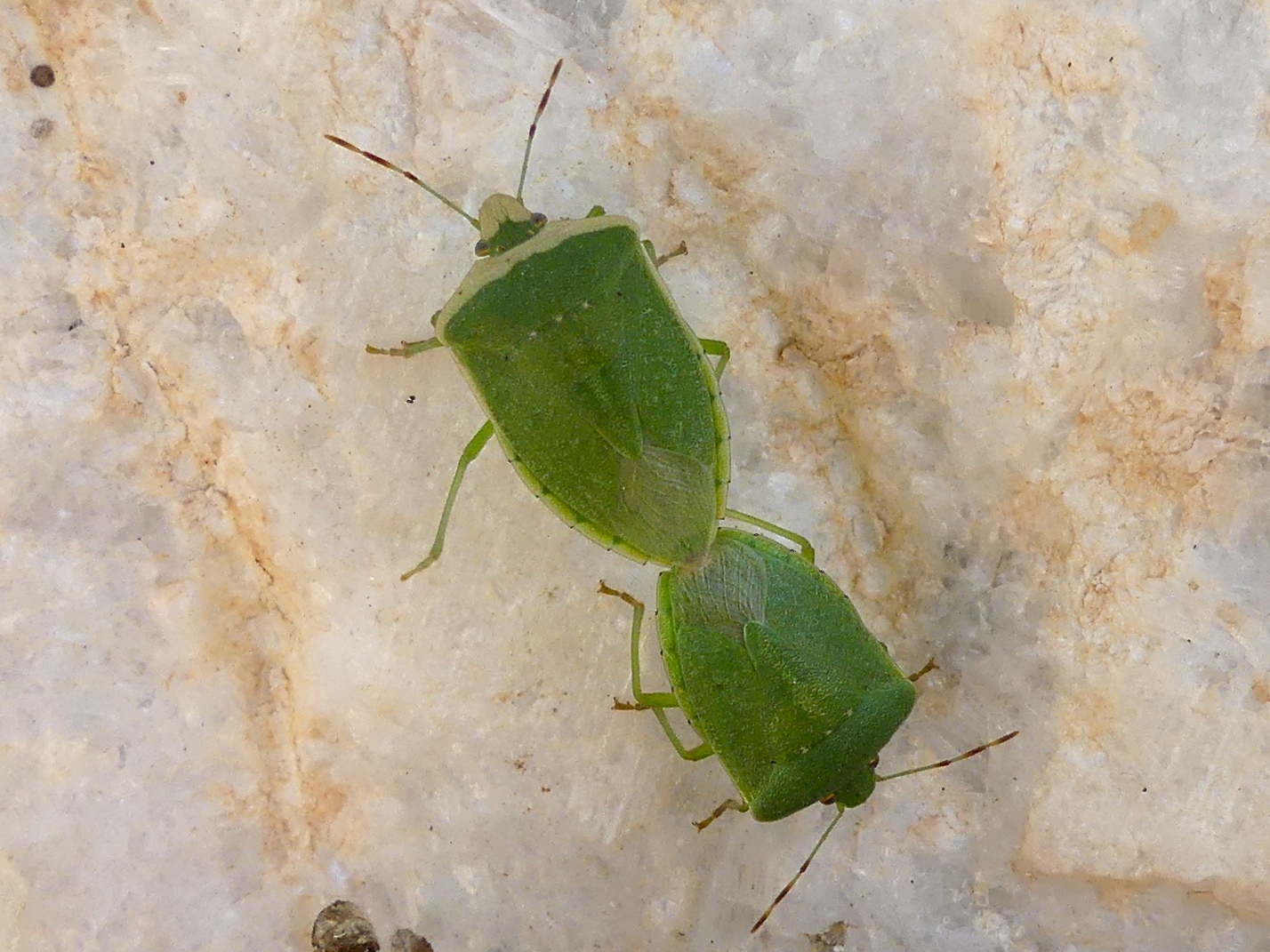
Like the previous species, the Southern green shield bug is green in colour. It can be recognised by three small white dots on the front edge of its pronotum. In addition, its edge and the front of the head are sometimes lighter in colour, as is the case with the upper animal here.
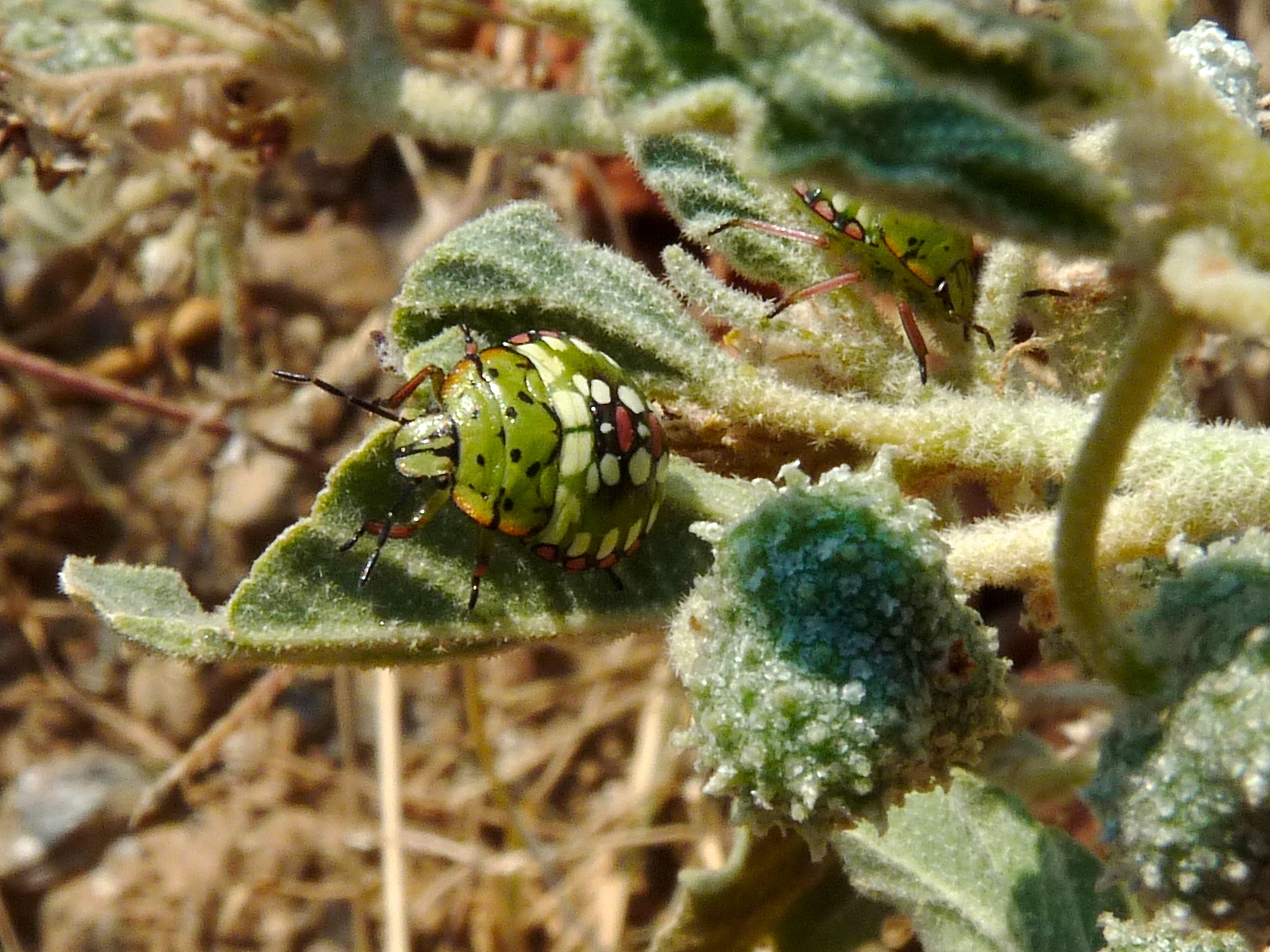
The nymphs of the Southern green shield bug show a characteristic pattern of white, black and red dots on a green background.
North african striped bug, Graphosoma lineatum, L.
The North african striped bug also belongs to the shield bugs. It has characteristic red and black longitudinal stripes on the scutellum which is so large that it completely covers the wings and abdomen; only a small, protruding edge remains exposed, which is also striped. The North african striped bug is widespread in Eurasia and common on Naxos. It is only found in summer, mainly on umbellifers, on whose seeds it feeds, both the nymph and the imago.
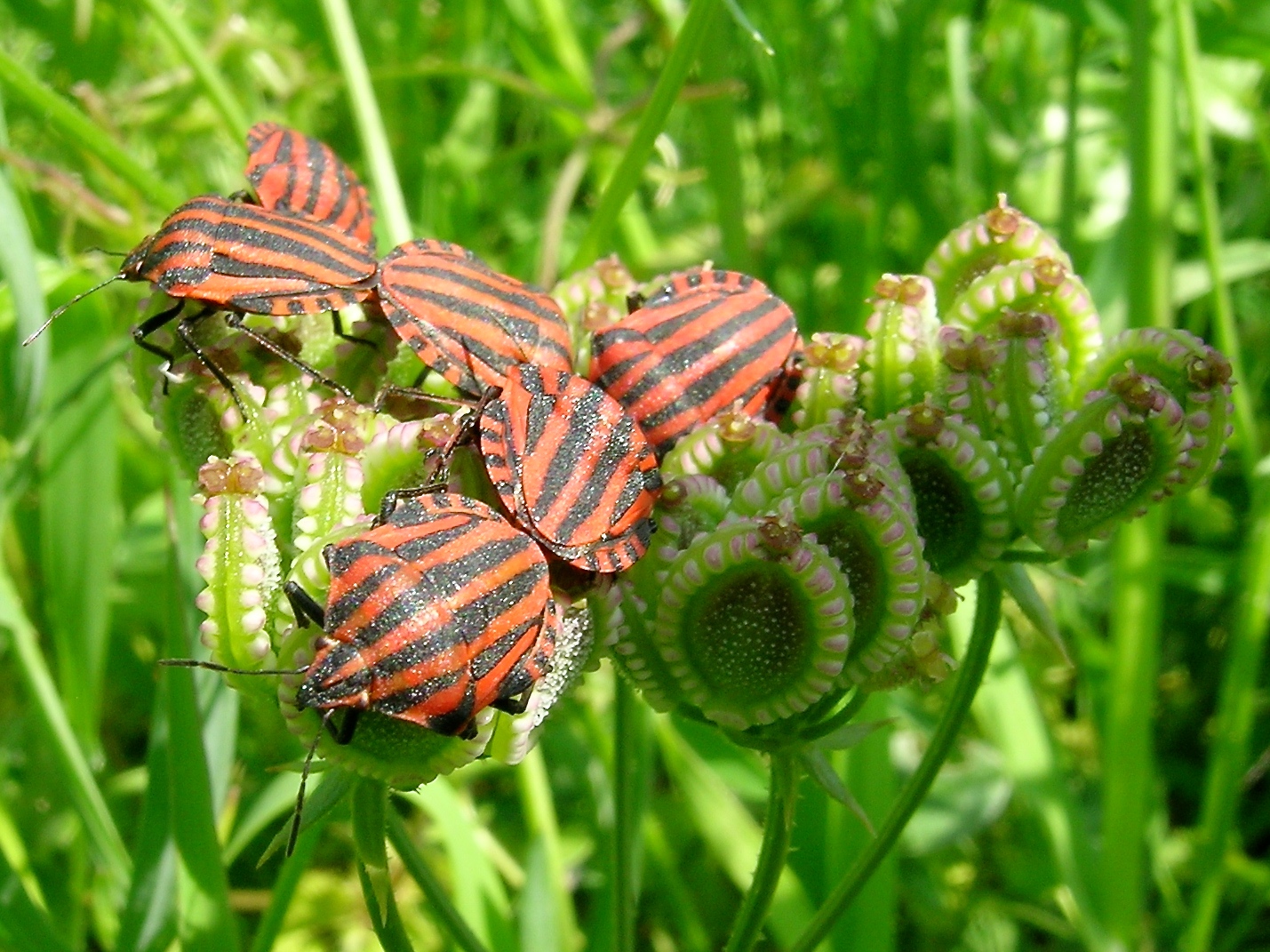
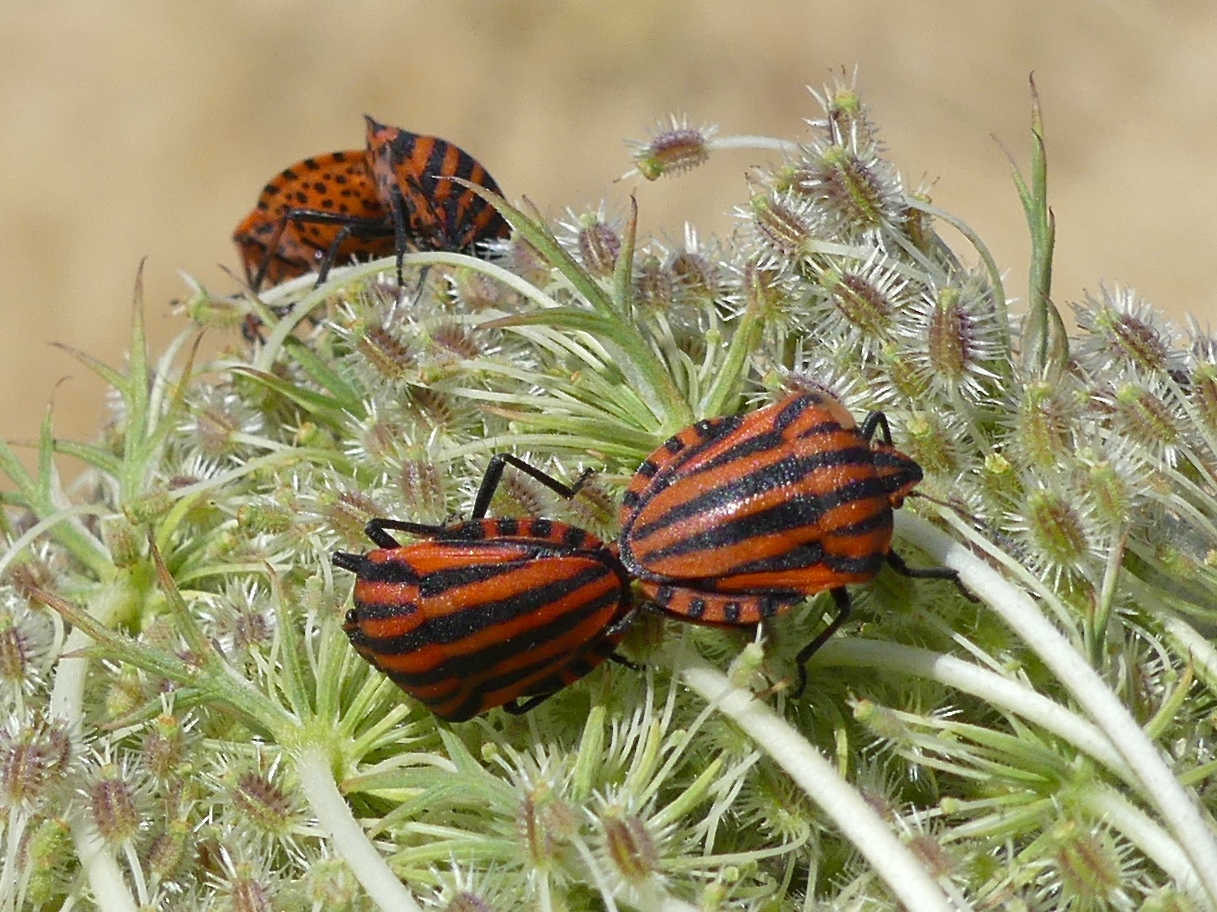
The North african striped bug is unmistakable. It lives on the flowers of umbellifers. It is spotted on the underside.
Graphosoma semipunctatum, Fabricius
Graphosoma semipunctatum is very similar to the previous species in both appearance and way of life, but differs in that it has dots rather than stripes on its pronotum. It is about as common in our region as the North african striped bug.
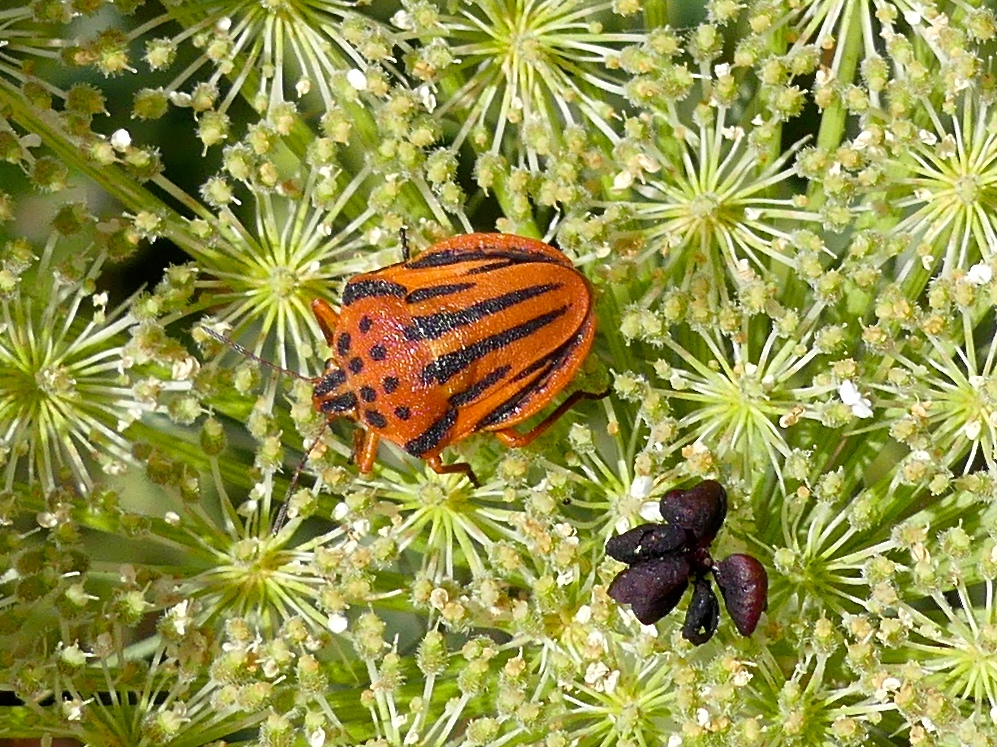
Graphosoma semipunctatum has black dots instead of stripes on its pronotum; the edge of the abdomen has lengthwise rather than crosswise stripes.
Ancyrosoma leucogrammes, Gmelin
Ancyrosoma leucogrammes is widespread in southern Europe. It is rare in our region; I have only seen it once so far.
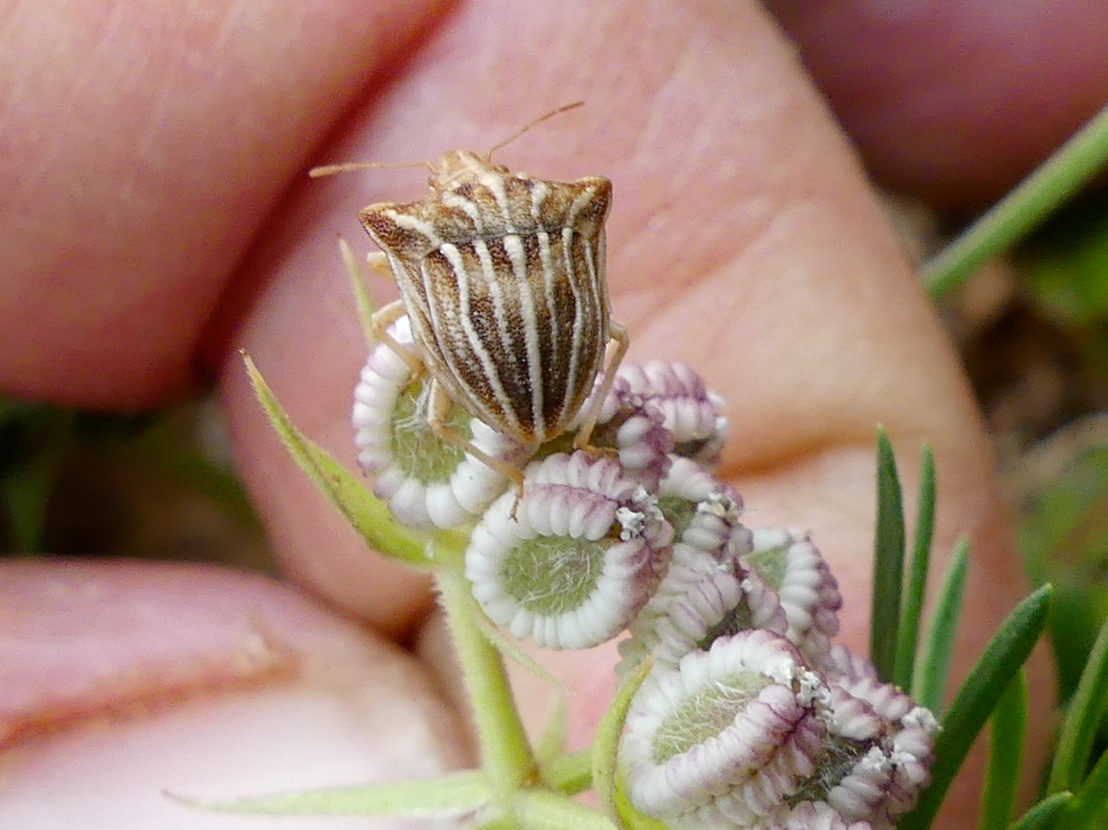
Ancyrosoma leucogrammes is widest in the pronotum which has sharp edges. Characteristic are the white longitudinal stripes on the whole body.
Carpocoris purpureipennis / mediterraneus
Carpocoris purpureipennis often sits on flowers feeding on the nectar. It also sucks on fruit and vegetables and can thus cause some damage in the garden. It is widespread in Europe and Asia. Two very similar species, C. purpureipennis and C. mediterraneus, are difficult to distinguish.
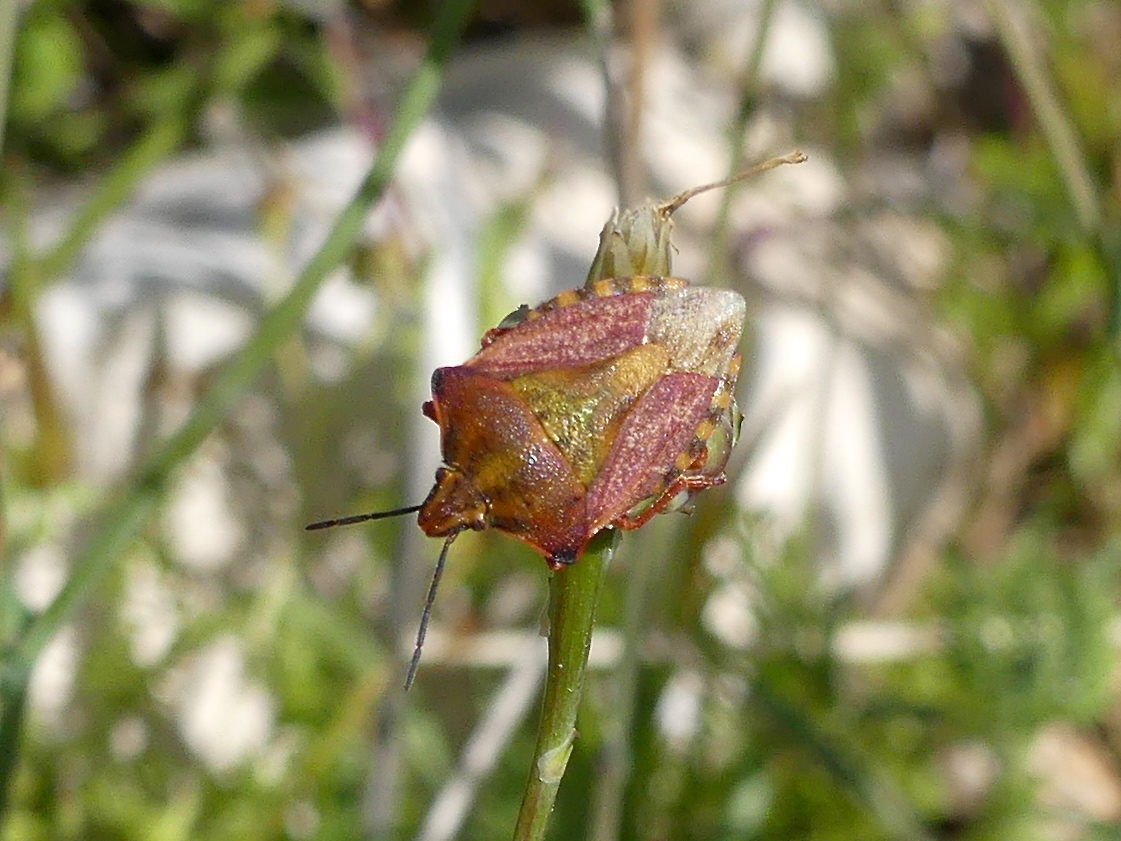
Carpocoris purpureipennis is reddish in colour with a large, curved scutellum that has a tongue-shaped appendage towards the rear. A striped edge is visible outside the wings around the abdomen. More or less distinct stripes can also be seen on the front of the pronotum. The outer shoulders are blackish.
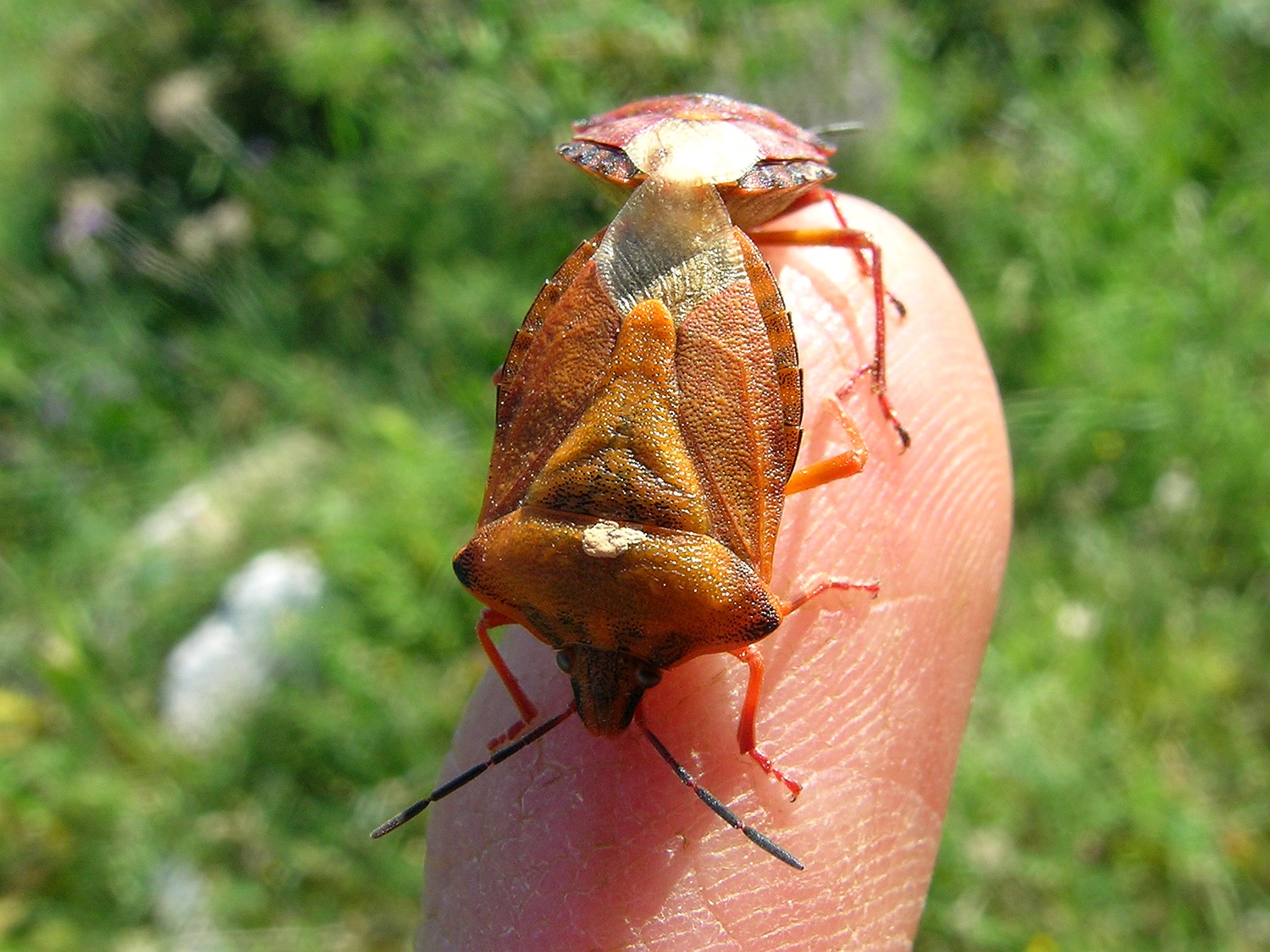
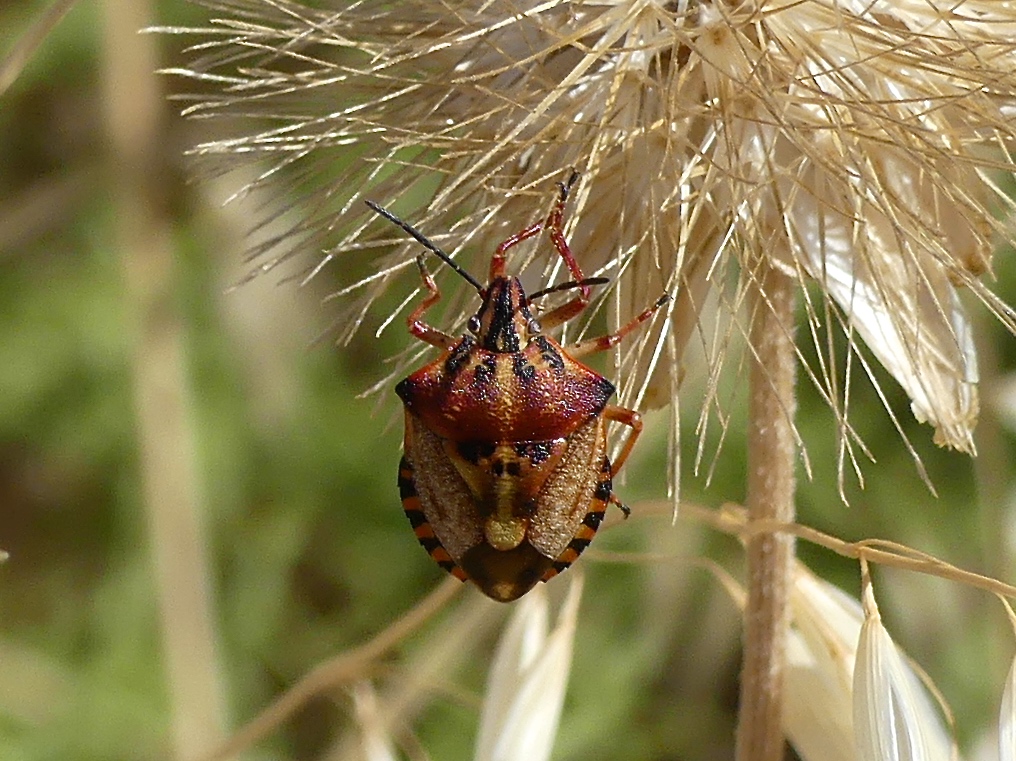
The two species C. purpureipennis and C. mediterraneus cannot be easily distinguished, and there is some disagreement about whether they are separate species at all.
Codophila varia, Fabricius
This species also belongs to the Pentatomidae. As the name says its colouring is quite variable.
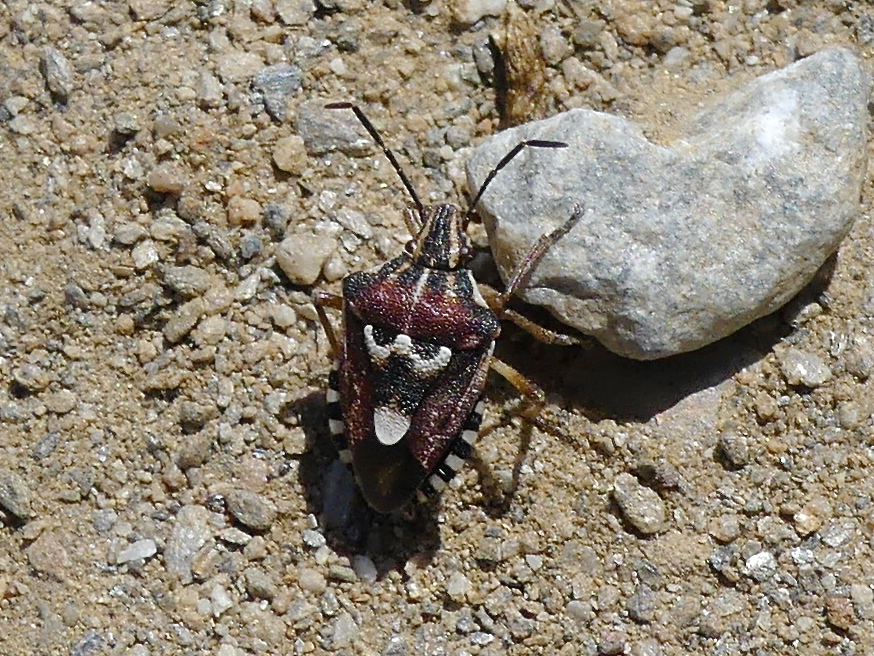
Codophila varia has a black and white, often ω-shaped pattern on the front edge of its scutellum, which extends far back. Other typical features are the conspicuous white end of the scutellum and the longitudinal stripes on the front pronotum and the head.
Hairy shield bug, Dolycoris baccarum, L.
The Hairy shield bug especially likes to suck on fruits. It can cause damage in many crops such as cereals, tobacco and sunflowers. It is widespread in the Palearctic region and very common in many areas, but on Naxos it seems to be rather rare.
I would like to thank H. Günther from the website Koleopterologie.de for the identification.
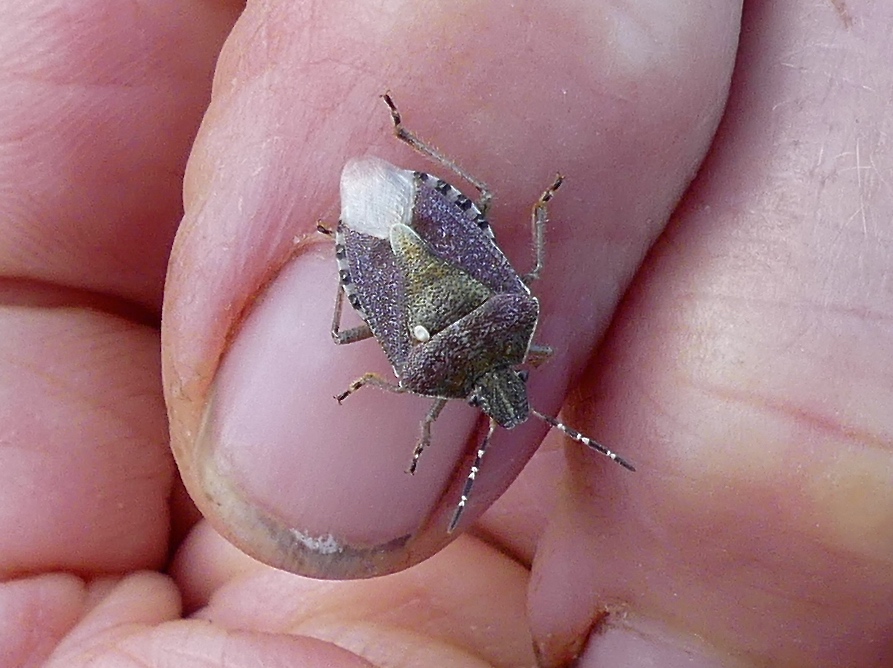
The Hairy shield erry bug is rather inconspicuous, brownish or reddish in colour. Characteristic features are the black and white striped antennae, the black and white border of the abdomen, the whitish membraneous wings and the conspicuously light-coloured appendage at the back of the scutellum. A tiny parasitic mite can be seen on the front edge of the scutellum.
Red cabbage bug, Eurydema ornata, L.
The Red cabbage bug is rather small for a shield bug, measuring about 7 mm. It has the large scutellum typical of the shield bugs. The Red cabbage bug has black spots on a red, or more rarely white, background.
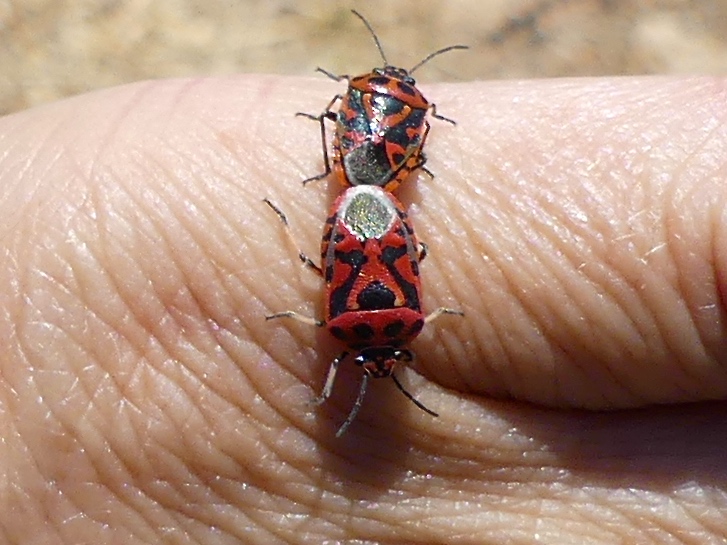
The Red cabbage bug has a striking pattern with black spots and lines on a bright red background.
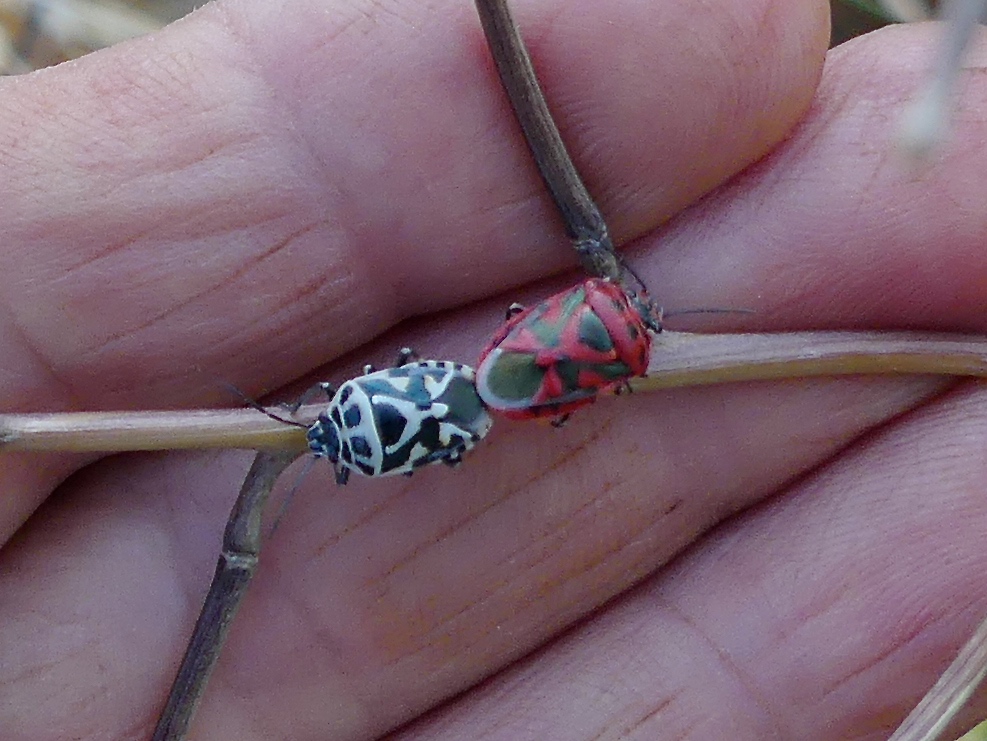
Here you can see the rarer black and white colour variant.
Rhyparochromidae
The members of the Rhyparochromidae, which comprises almost 2,000 species, are mostly rather small and inconspicuous. They often have thickened femurs on their front legs; sometimes their wings are shortened or missing.
Trapezonotus dispar / arenarius
Trapezonotus dispar and T. arenarius; can only be distinguished by microscopic examination. They belong to the family Rhyparochromidae, which was only recently separated from the shield bugs. Like most members of this family they live mainly on the ground and predominantly feed on seeds and other plant parts.
I would like to thank H. Günther from the website Koleopterologie.de for the identification.
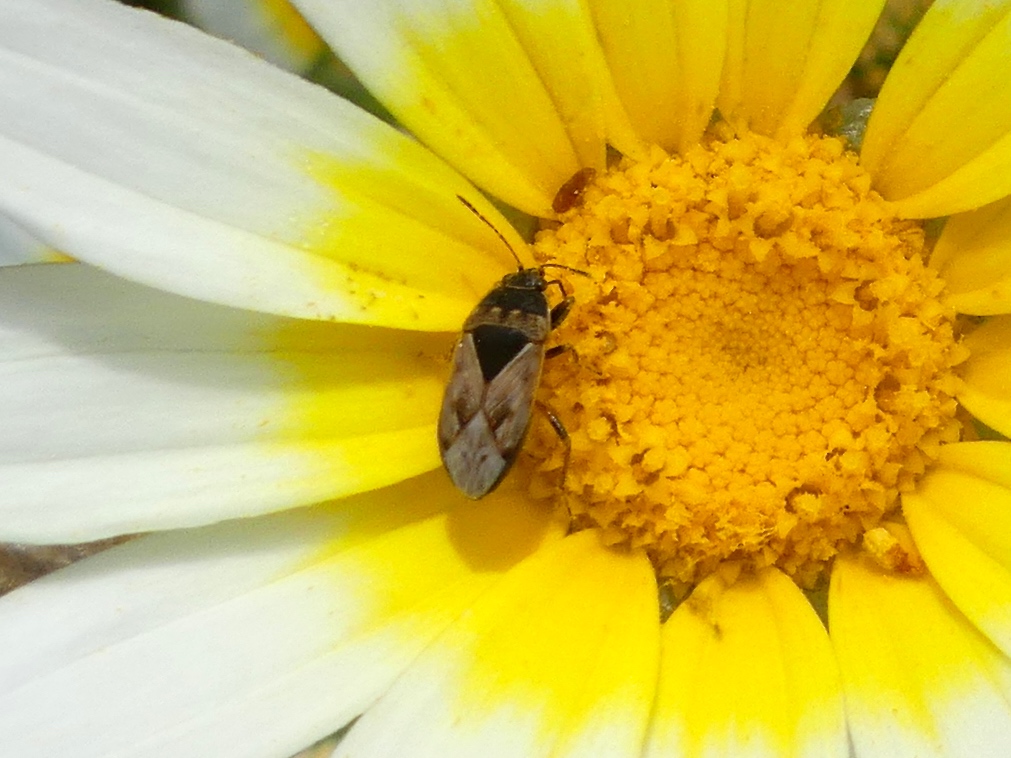
The very small bug Trapezonotus dispar is brownish in colour with a black scutellum. The rear part of the neck scutellum is lighter in colour than the front; the wing covers are patterned.
Plant bugs, Miridae
With 11,000 species described to date, the plant bugs (also called leaf bugs and grass bugs) are one of the largest insect families. Most species are rather small with a narrow body and a mostly greenish colouring, but some are also very colourful. The forewings are less sclerotised than in most bugs and rather soft. A small triangle in the membranous part of the forewings is characteristic. The three simple eyes on the forehead are often missing. Most plant bugs are herbivorous, one often sees them sitting on flowers. Each species only appears for a short time in spring.
Lucerne bug, Adelphocoris lineolatus ?, Goeze
The Lucerne bug, which is widespread in Europe and Asia, feeds on the flowers of composites and fabaceae. It can cause considerable damage in agriculture, especially on alfalfa.
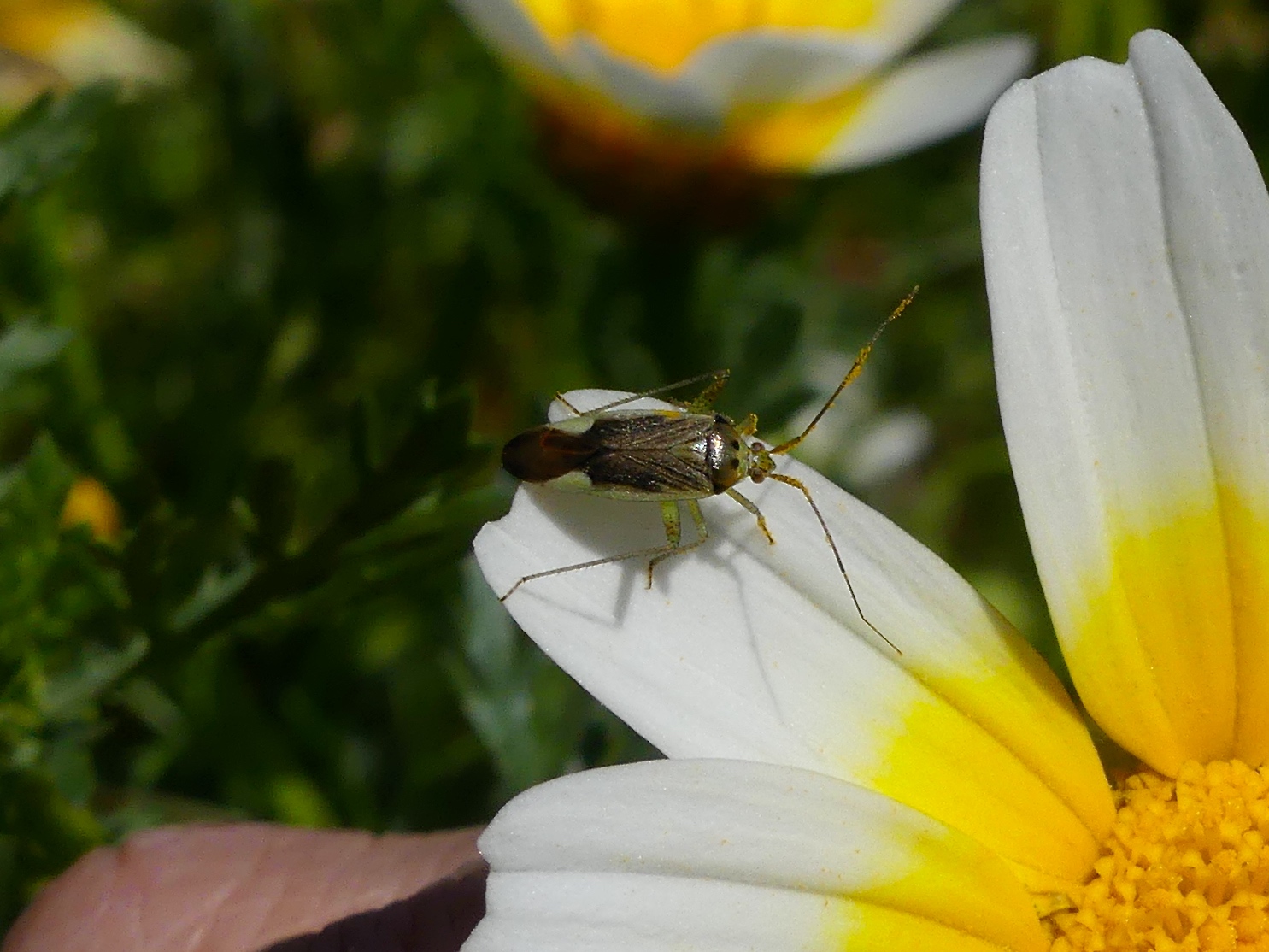
This specimen might be a Lucerne bug, even though the colouring is slightly different.
Calocoris nemoralis, Fabricius
The plant bug Calocoris nemoralis usually sits on flowers, especially those of composites, feeding on nectar. It is very variable in colour, either red or green, with or without black spots. It is mainly found in southern Europe and is frequently encountered on Naxos.
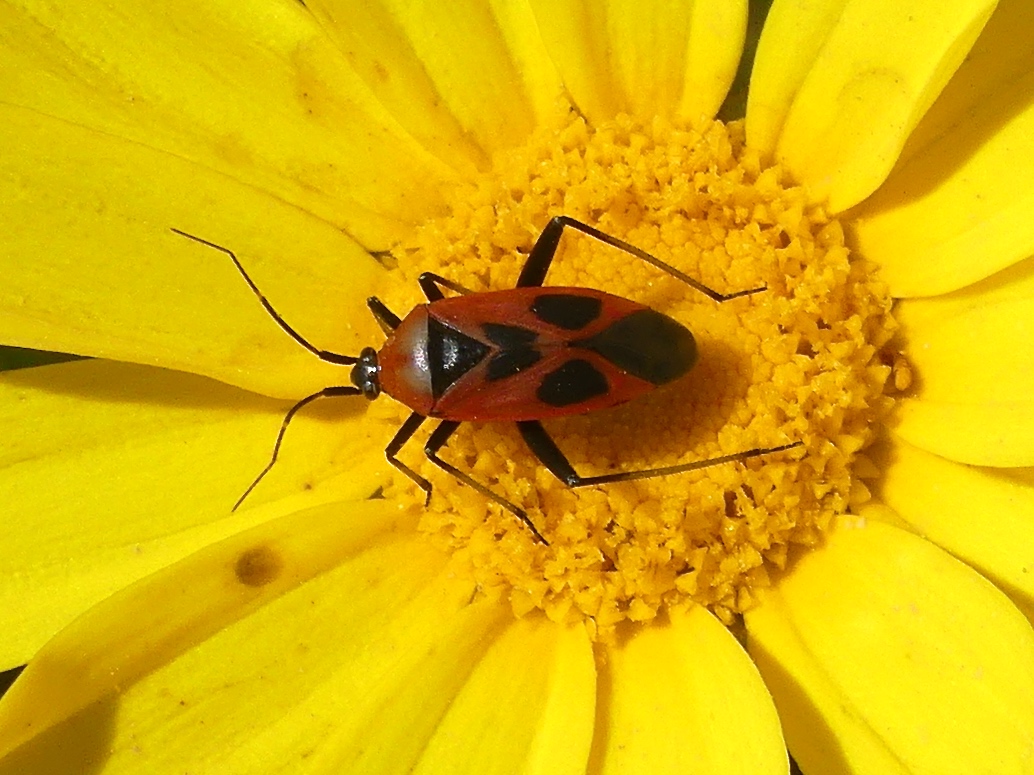
In spring, Calocoris nemoralis is very common on large composites. When approached, it quickly disappears on the underside of the flower. This bug has a rather narrow body. It has black membraneous wings, a black scutellum and two black spots on each wing cover. The head and wings are black.
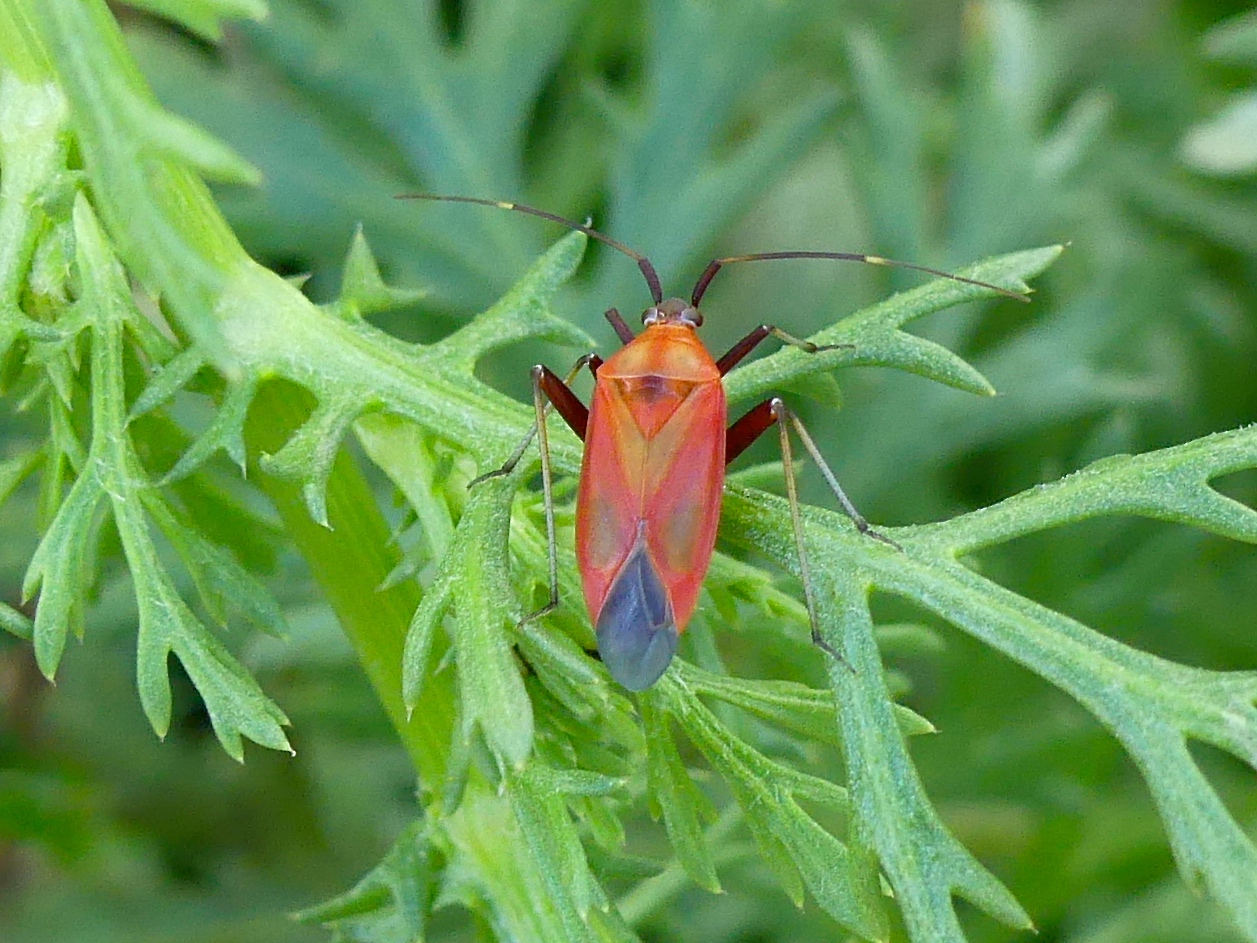
Calocoris nemoralis, like many bug species, can vary in colour. Here you see a red form in which the black spots are only very faintly visible.
Closterotomus norwegicus, Gmelin
The genus Closterotomus is closely related to Calocoris. Closterotomus norwegicus is predominantly green in colour. It feeds on flowers and other plant parts and can cause considerable damage to crops such as potatoes, cereals, beets and pistachios.
I would like to thank H. Günther from the website Koleopterologie.de for the identification.
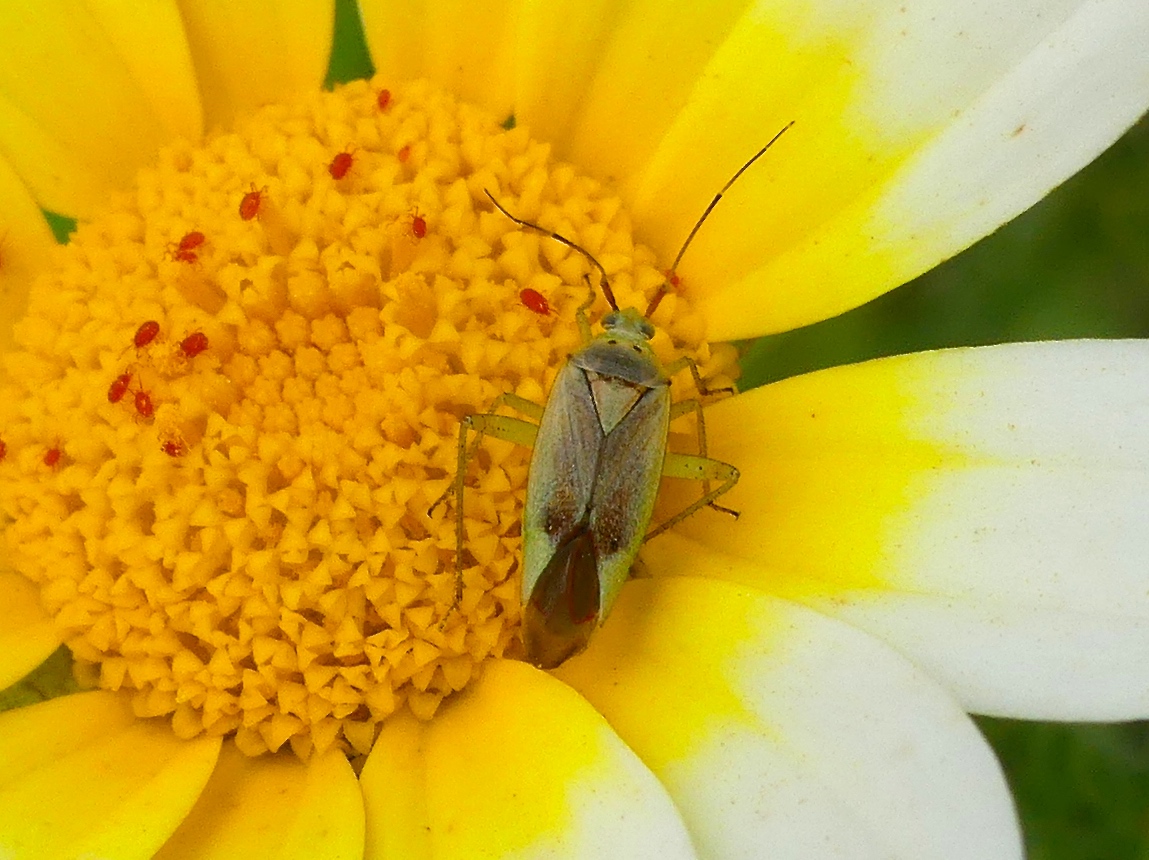
The small, green species Closterotomus norwegicus can be recognised by the two small dark spots on the front of its pronotum.
Grypocoris sexguttatus, Fabricius
Apart from the camouflaged species, quite a few plant bugs exist that are conspicuously coloured. They too are usually difficult to spot due to their small size.
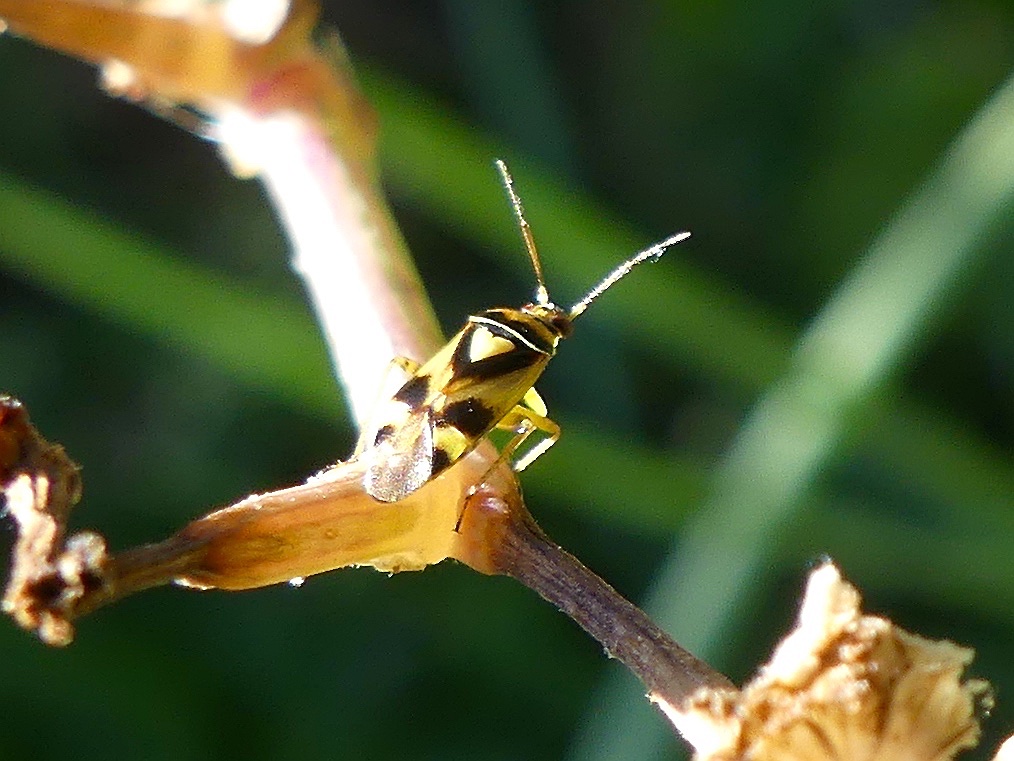
Grypocoris sexguttatus has black and yellow markings. Its wings show six black spots. The scutellum lies amid black areas like a little yellow heart.
Lygus pratensis, L.
Lygus pratensis is widespread in Europe, Asia and North America and often very common. Both the adult insects and the larvae suck on plants and can therefore cause some damage in gardens despite their small size. The population can be controlled by biological means using a species of parasitic wasp that feeds on the larvae. In our region, Lygus pratensis is rather rare.
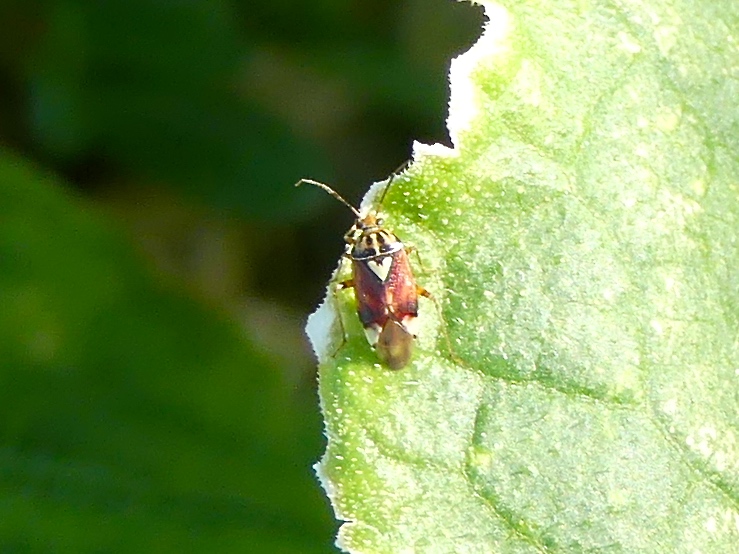
The colouring of Lygus pratensis is quite variable. The males are predominantly reddish, while the females are greenish in colour. The scutellum looks like a white heart. The pronotum carries four darker stripes or spots.
Deraeocoris rutilus, Herrich-Schäffer
The plant bugs of the genus Deraeocoris are predators of small insects, especially aphids. They search for their prey on a wide variety of plant species. With their proboscis they can also cause a painful sting in humans. Like all plant bugs, they hide on the underside of leaves when approached, making it difficult to take a good picture.
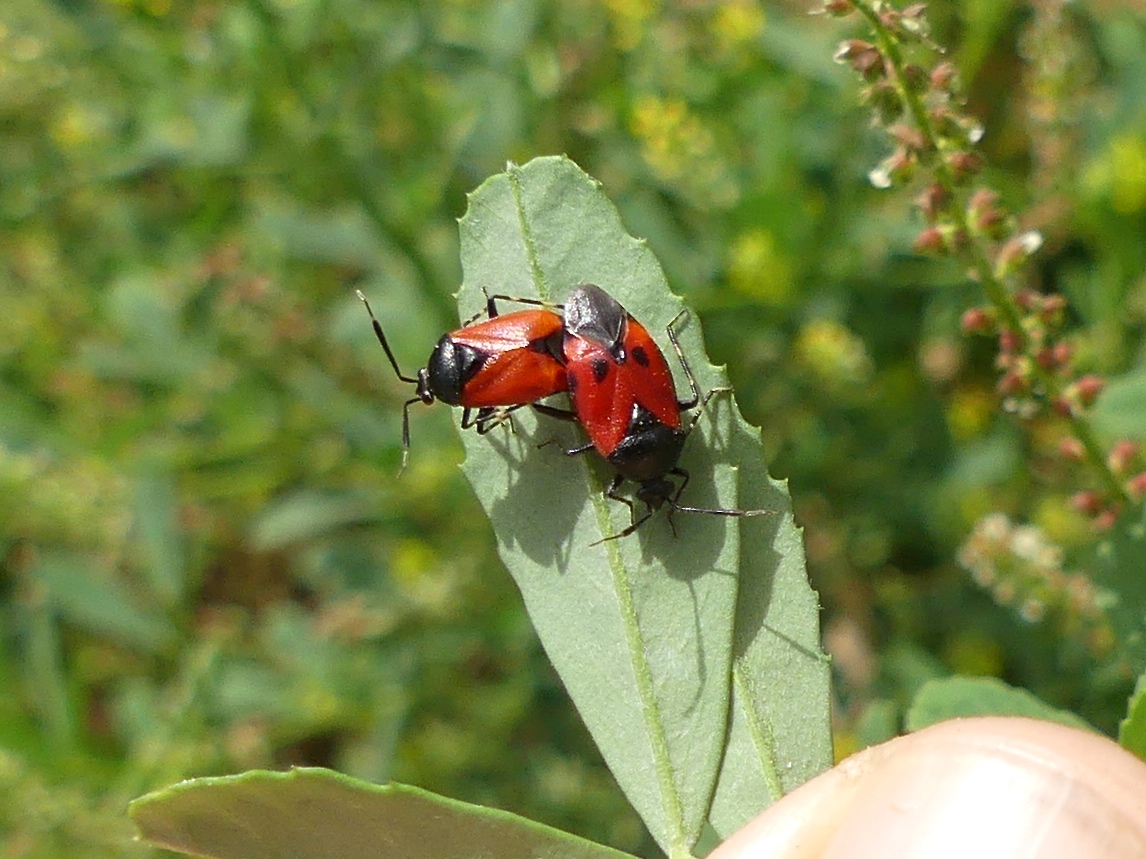
Deraeocoris rutilus has a red corium (the leathery front part of the hemelytron), sometimes with a small black. The head, thorax, scutellum and rear end are black. Here two animals mating.
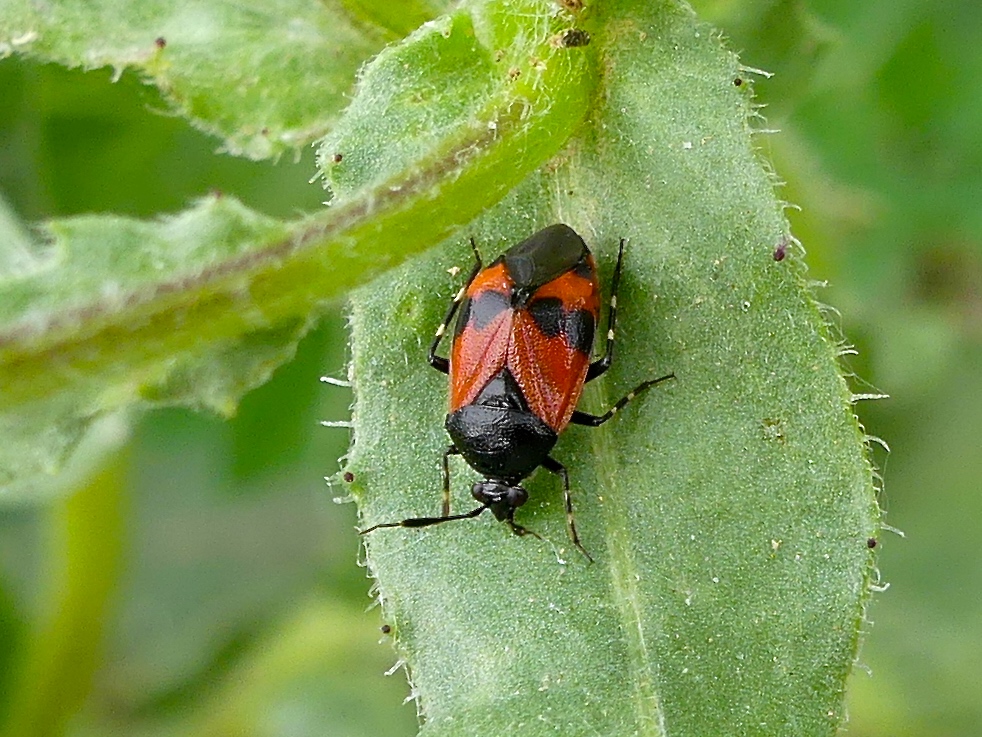
Probably this is also Deraeocoris rutilus.
Deraeocoris schach, Fabricius
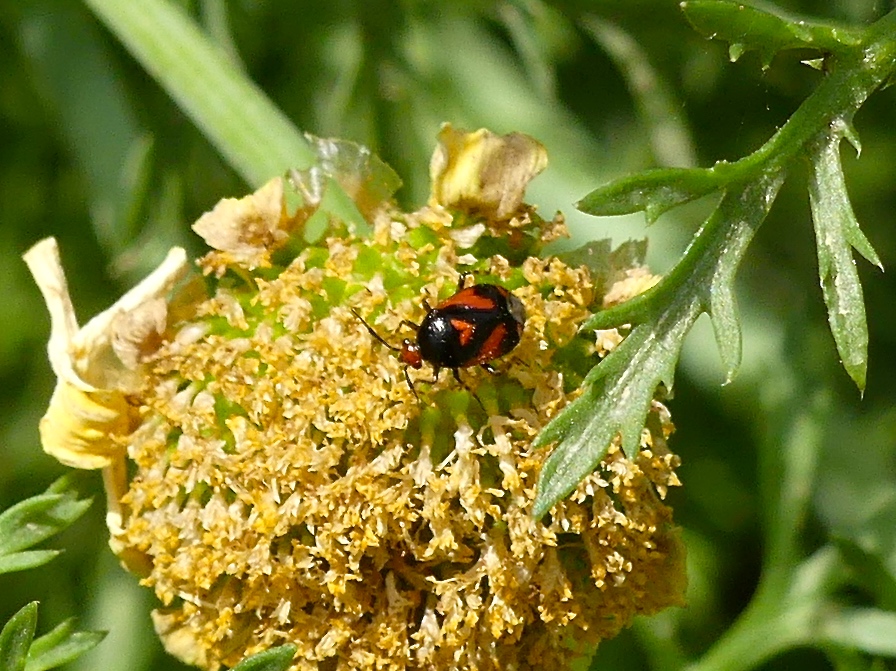
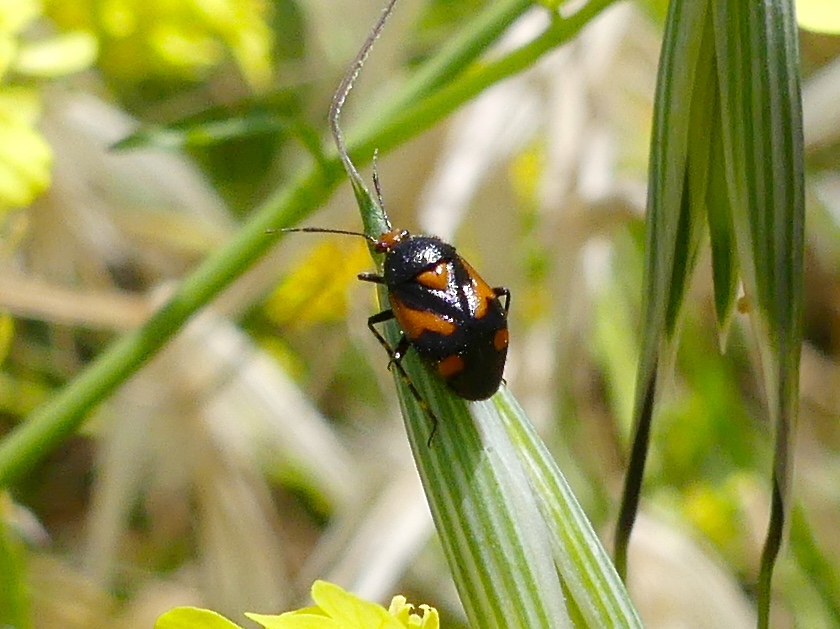
This species of plant bug, which is widespread in southern Europe, can be recognizes by its characteristic black and red markings. It is quite common in our region.
Psallus spec.
In late spring, a very small species of bug, probably belonging to the genus Psallus, can be found sitting on flowers. These bugs, which are only about 4 mm in size, often gather in small groups. Their narrow, elongated bodies have slightly humped backs. The legs are long and, like the antennae, very thin. The bugs are dark with tiny scale-like hairs on their bodies and wings, which give them a grey appearance.
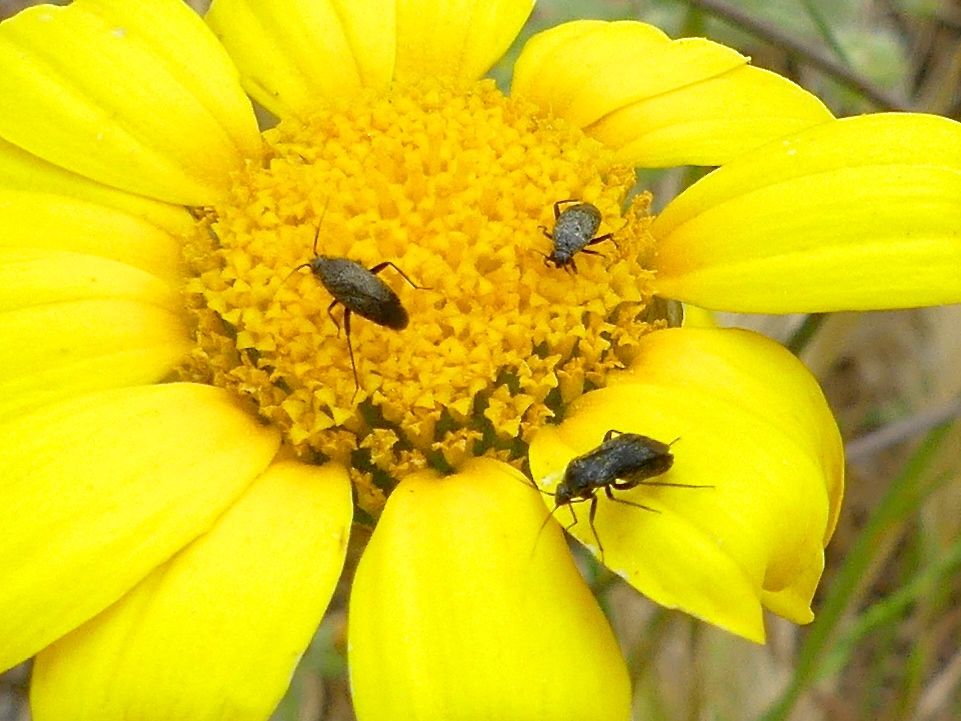
These very small, dark grey bugs, which like to sit on the flowers of chryamthemum, probably belong to the genus Psallus.
Broad-headed bugs, Alydidae
With around 250 species, the broad-headed bugs are a rather small group. They usually have a narrow and elongated body with long legs and a relatively large head that is wider than the front edge of the pronotum.
Broad-headed bug, Camptopus lateralis, Germar
The Broad-headed bug feeds on plants. It is widespread throughout Europe.
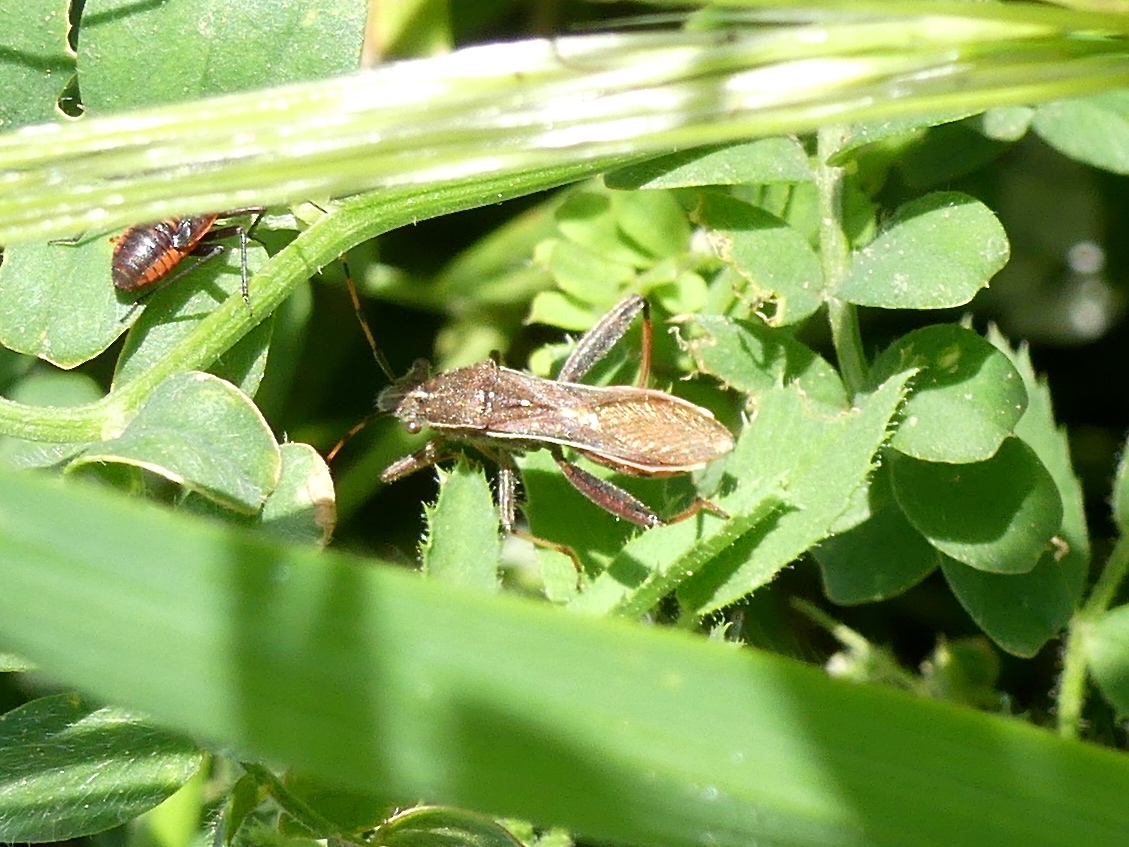
The Broad-headed bug is inconspicuous with a brownish colour and has a characteristic, very narrow shape, with the head on the level of the eyes being wider than the pronotum. The hind legs have broadened femurs and long, slightly curved tibias.
Damsel bugs, Nabidae
The Damsel bugs, with around 500 species, have a curved proboscis. They are usually very small with a narrow body; sometimes the abdomen is widened. The pronotum is often ring-shaped and clearly separated from the rest of the thorax. All species are predatory.
Ant damsel bug, Himacerus mirmicoides, O. Costa
The very small, easily overlooked Ant damsel bug is widespread in Europe.
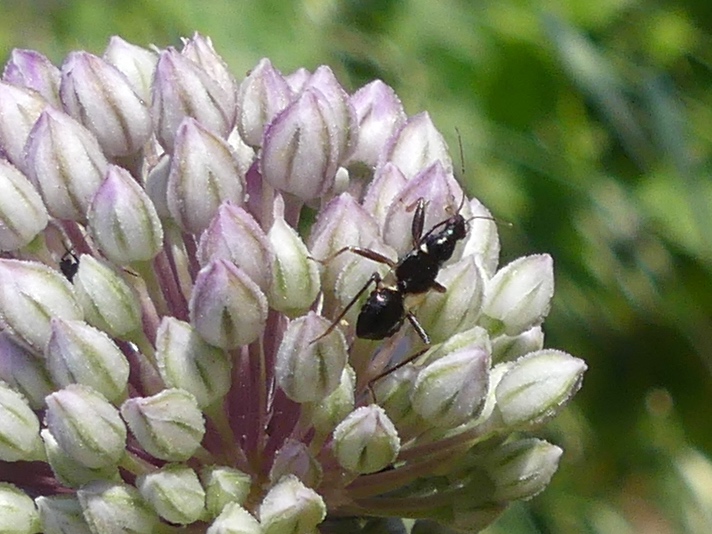
The nymphs of the Ant damsel bug resemble ants, hence their name. As can be seen here, they have two light-coloured spots at the base of their abdomen, giving them the appearance of having a narrow “hymenopteran waist” like an ant.
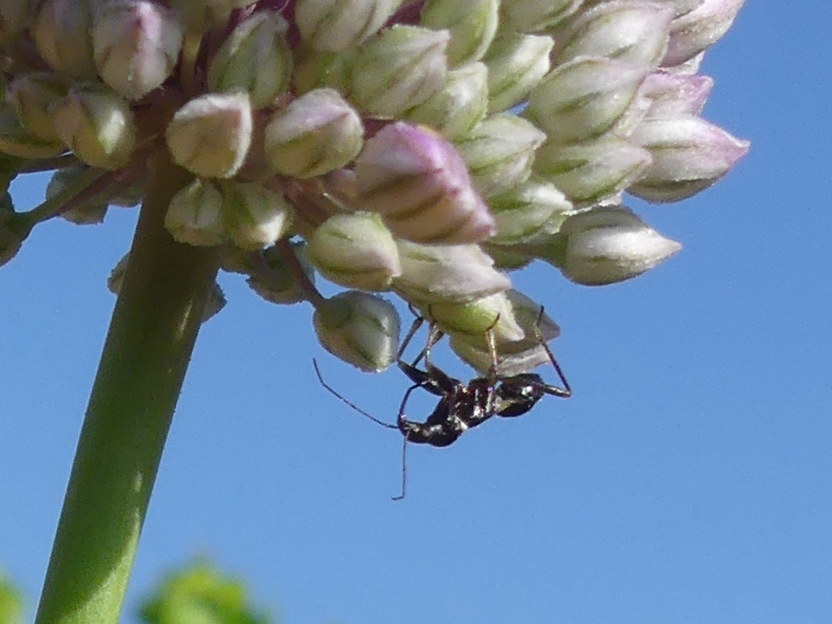
Here you can see the nymph from the side, showing its curved head and sickle-shaped proboscis. Both the nymph and the imago are only about 7 mm long.
Prostemma spec.
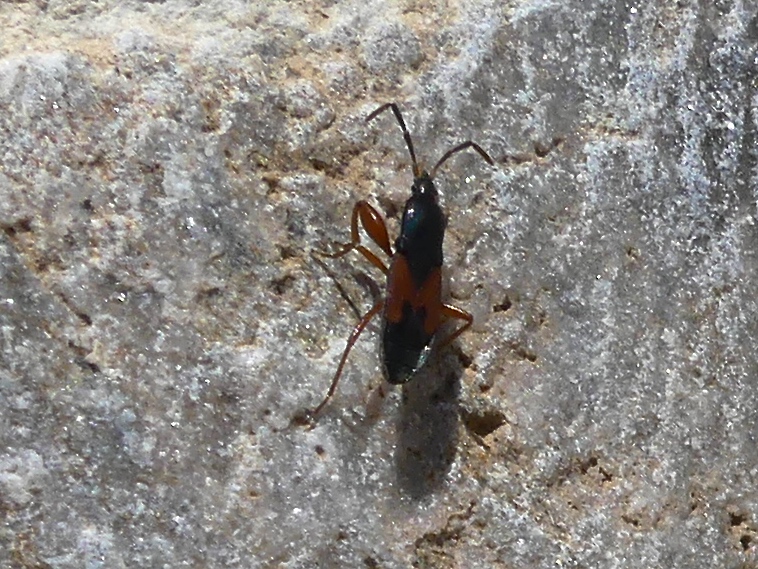
This small black-red bug with reduced wings belongs to the genus Prostemma. The front femurs are thickened. Bugs of this genus are predatory and feed on other bugs, especially seed bugs and burrowing bugs.
Reduviidae
All bugs belonging to the Reduviidae are carnivorous; they mostly catch small insects. Some species can deliver painful stings to humans. The family comprises around 7,000 species, which are mainly found in tropical areas. Their appearance and anatomy are very variable. A characteristic feature is their powerful, curved proboscis. Many species can produce a sound by rubbing their proboscis against a groove on their front thorax. Sometimes the front legs are modified into catching legs. Some species feed by sucking blood from vertebrates.
Spotted assassin bug, Rhynocoris punctiventris, Herrich-Schäffer
The Spotted assassin bug shows a striking red and black warning colour. Several similar species are difficult to distinguish. The Spotted assassin bug occurs in Greece and the Middle East.
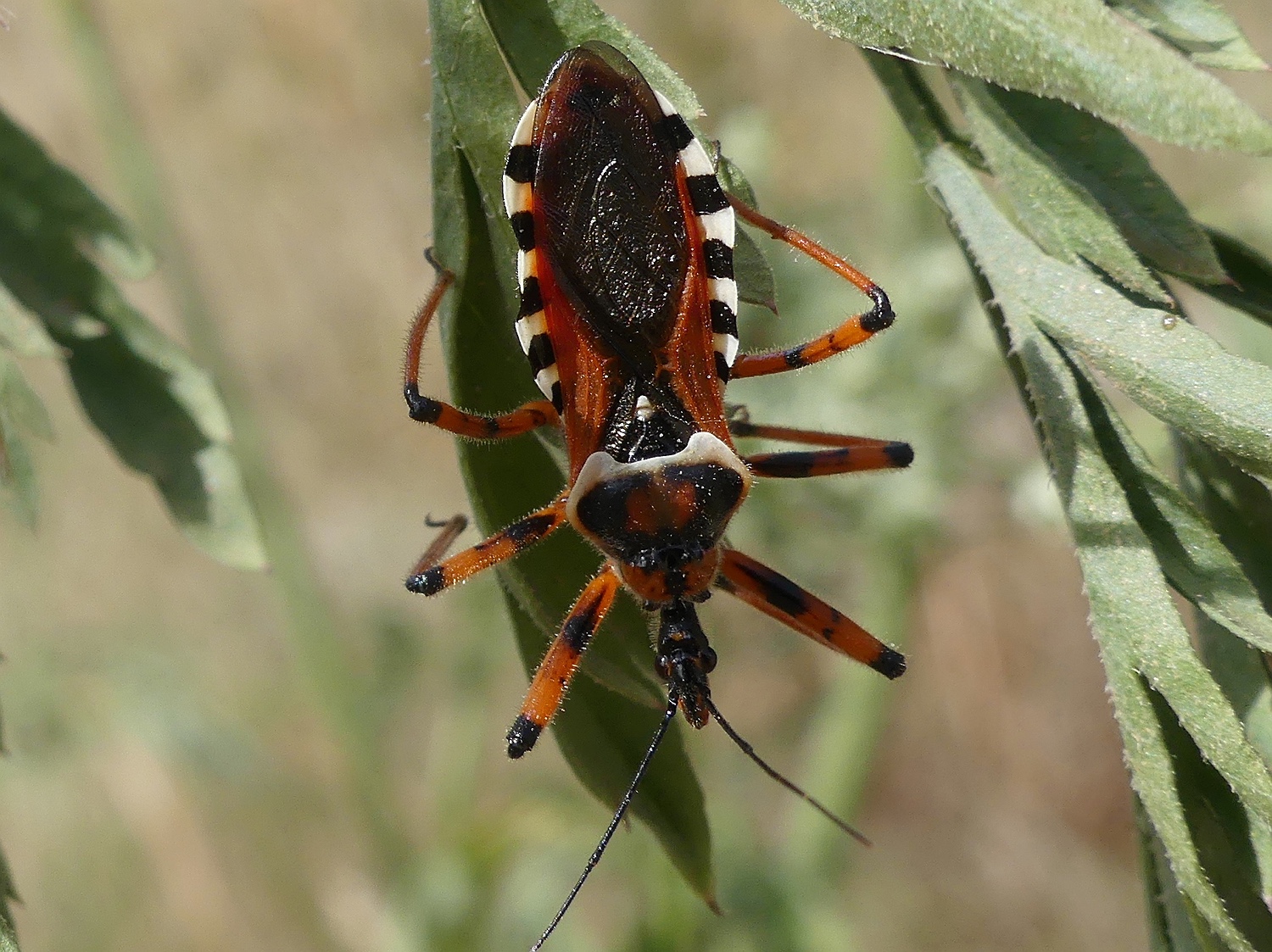
The Spotted assassin bug has a conspicuous black and red colouring. Its head is very narrow; the legs are rather long.
Burrowing bugs, Cydnidae
Burrowing bugs are represented worldwide with over 500 species. They are mostly black in colour and highly sclerotised. They live in the soil and have flat, broad bodies with a barely protruding head. Their bristly hind legs are used for digging and are often shaped accordingly. Burrowing bugs mostly feed on plant roots; some species can cause damage in agriculture. They can make chirping noises when mating or when disturbed, which are transmitted via the soil; the sound receptors are located in their legs.
Forget-me-not bug, Sehirus luctuosus ?, Mulsant & Rey
The Forget-me-not bug remains rather small, with a body length of about 7 mm. Normally, the presence of burrowing bugs is hardly noticeable due to their underground lifestyle. However, like some other species, Sehirus luctuosus has a habit of swarming in early summer. The insects fly mainly in the evening hours on windless days and are attracted to lights in large numbers. They often occur only for a few days, but sometimes in huge numbers, though we have not had any swarming of that kind since many years. The species is called Forget-me-not bug, because it feeds on (the roots of) forget-me-nots and related plant species.
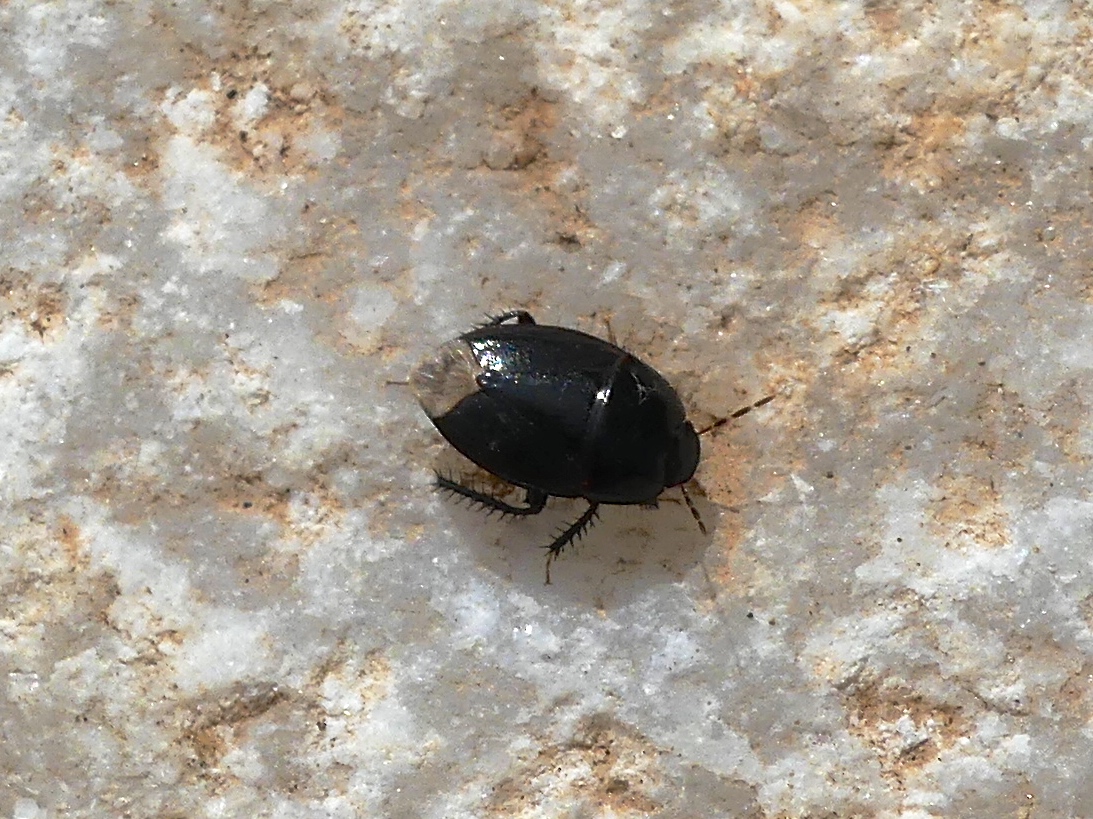
The Forget-me-not bug, which in some years occurs in great numbers in early summer nights, being attracted to lights, looks somewhat like a watermelon seed.
Cydnus aterrimus, Forster
The species Cydnus aterrimus is one of the largest burrowing bugs, with a body length of around 1 cm. It feeds on spurge, sucking mainly from the roots. Unlike most other bug species, the female cares for the eggs and also looks after the nymphs until their second moult. The nymphs suck on secretions that the female releases from her anus, in order to absorb endosymbiotic microorganisms. Like other
burrowing bugs, this species spends most of its life in the soil and is rarely seen.
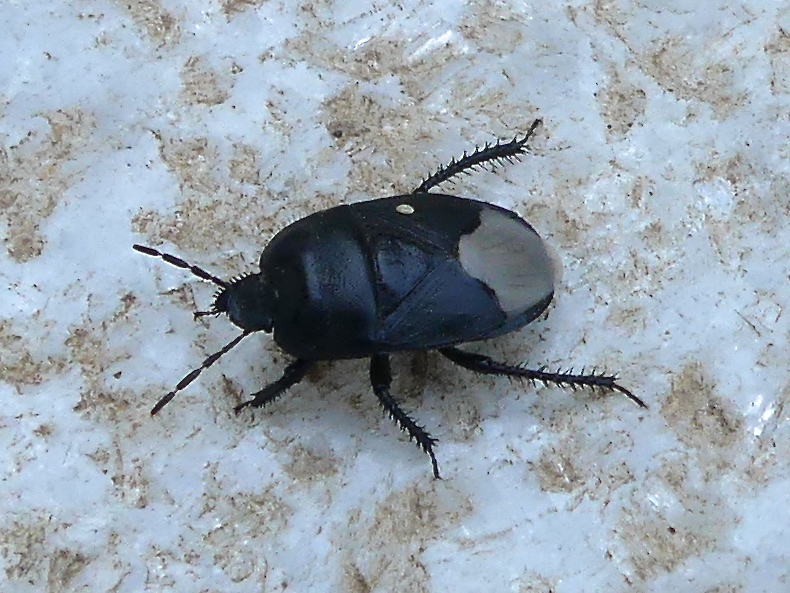
With a length of up to 1 cm, Cydnus aterrimus is considerably larger than the previous species. It can be recognised by the curved rear edge of the corium (the hardened part of the front wing). Its deep black body is covered with tiny dots. The membranous wings are whitish. Note the long spines on the legs and body edges and the very straight, almost equilateral triangular scutellum.
Water strider, Gerridae
Water striders also belong to the bug family. They have very narrow bodies. The middle and rear pairs of legs are very long and are held crosswise. The very dense, short, water-repellent hairs on the “feet” allow them to run and jump on water, carried by surface tension. The shorter front legs are used to locate prey (small animals that have fallen into the water) by the vibrations of the water and to catch it. Like all predatory bugs, water striders suck out their prey with their proboscis. Water striders have differently formed wings: within a population, there are wingless individuals, individuals with vestigial wings and individuals that can fly with fully developed wings.
While most water striders live on ponds and pools, less frequently on rivers, there are also some species that live on the surface of the sea, some near the coast, but some also on the open ocean (in tropical regions). They are the only marine insects.
Water striders, Gerris spec.
In Europe exist are about 16 species of water striders, most of which belong to the genus Gerris. The species are very similar, making identification difficult.
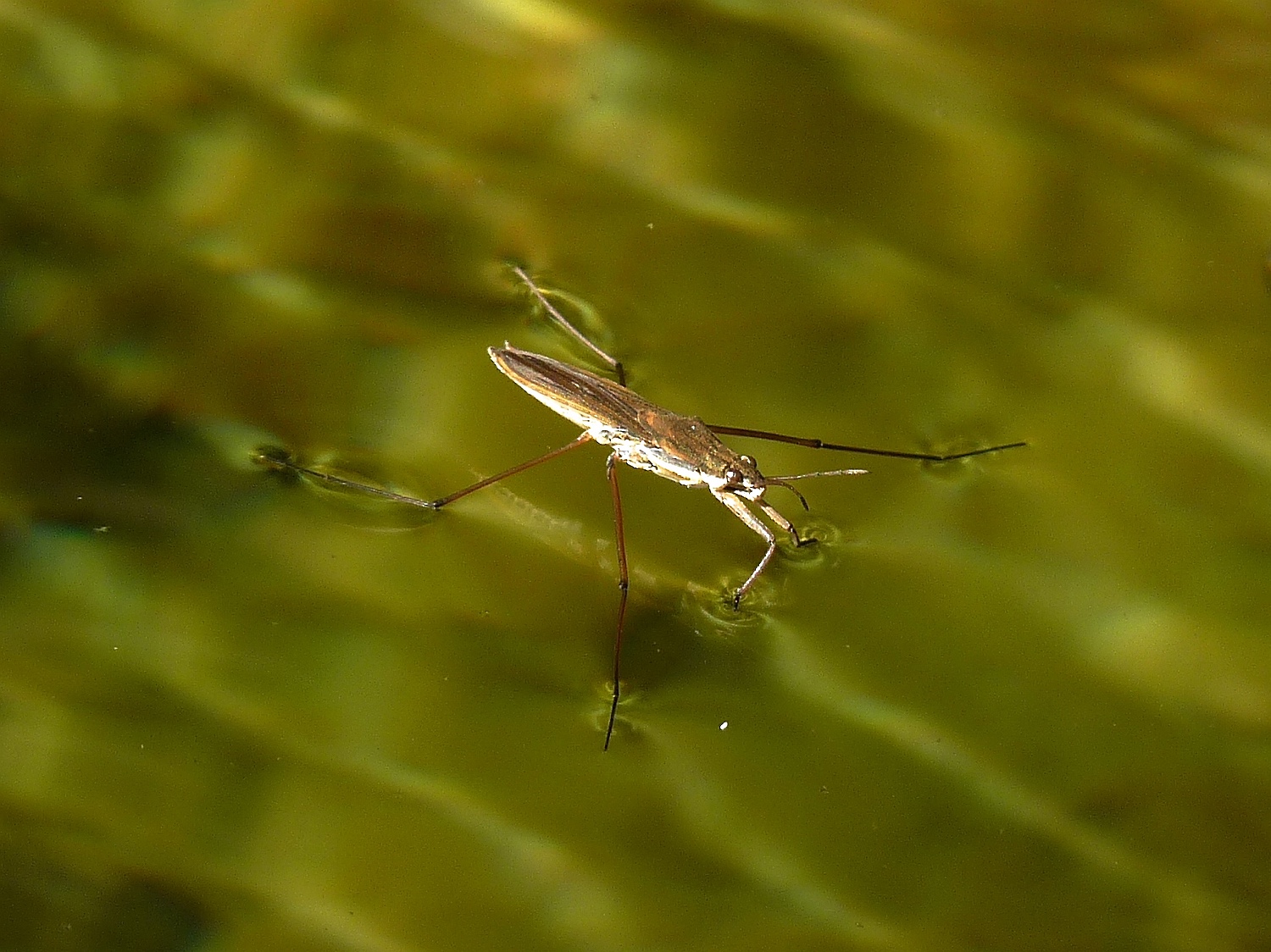
Water striders live permanently on the surface of ponds or slow-flowing rivers. They are more common on Naxos than one might think.
next: Cicadas
back: